Tag: topic-link-auto

  • How the fallout from a Chester County chaplain’s sermon inspired the Trump admin to investigate ‘anti-Christian bias’

    How the fallout from a Chester County chaplain’s sermon inspired the Trump admin to investigate ‘anti-Christian bias’

    Russell “Rusty” Trubey said he was compelled by God to preach the words that helped set off a national battle over religion at the U.S. Department of Veterans Affairs.

    Reading from a sermon titled “When Culture Excludes God,” Trubey, an Army Reserve chaplain, sermonized to a congregation of veterans at the Coatesville VA Medical Center from a Bible passage — Romans 1:23-32 — that refers to same-sex relationships as “shameful.”

    Some congregants, upset by the sermon, walked out of the June 2024 service at the Chester County facility, where Trubey has been employed for roughly 10 years. Soon after, Trubey’s lawyers said he was temporarily pulled from his assignment — and transferred to stocking supply shelves — while his supervisors investigated his conduct.

    Speaking to Truth and Liberty, a Christian group that advocates for the church to play a greater role in the public sphere, Trubey said he knows that reading the Bible verses about same-sex relationships is “100%” the reason he got in trouble.

    “Our VA celebrates — up until at least recently anyway — celebrated and expected us to fully tolerate the LGBTQ lifestyle,” Trubey, who belongs to the Assemblies of God, a Pentecostal denomination, said in March. “It’s that part of the text, obviously, that folks took issue with.”
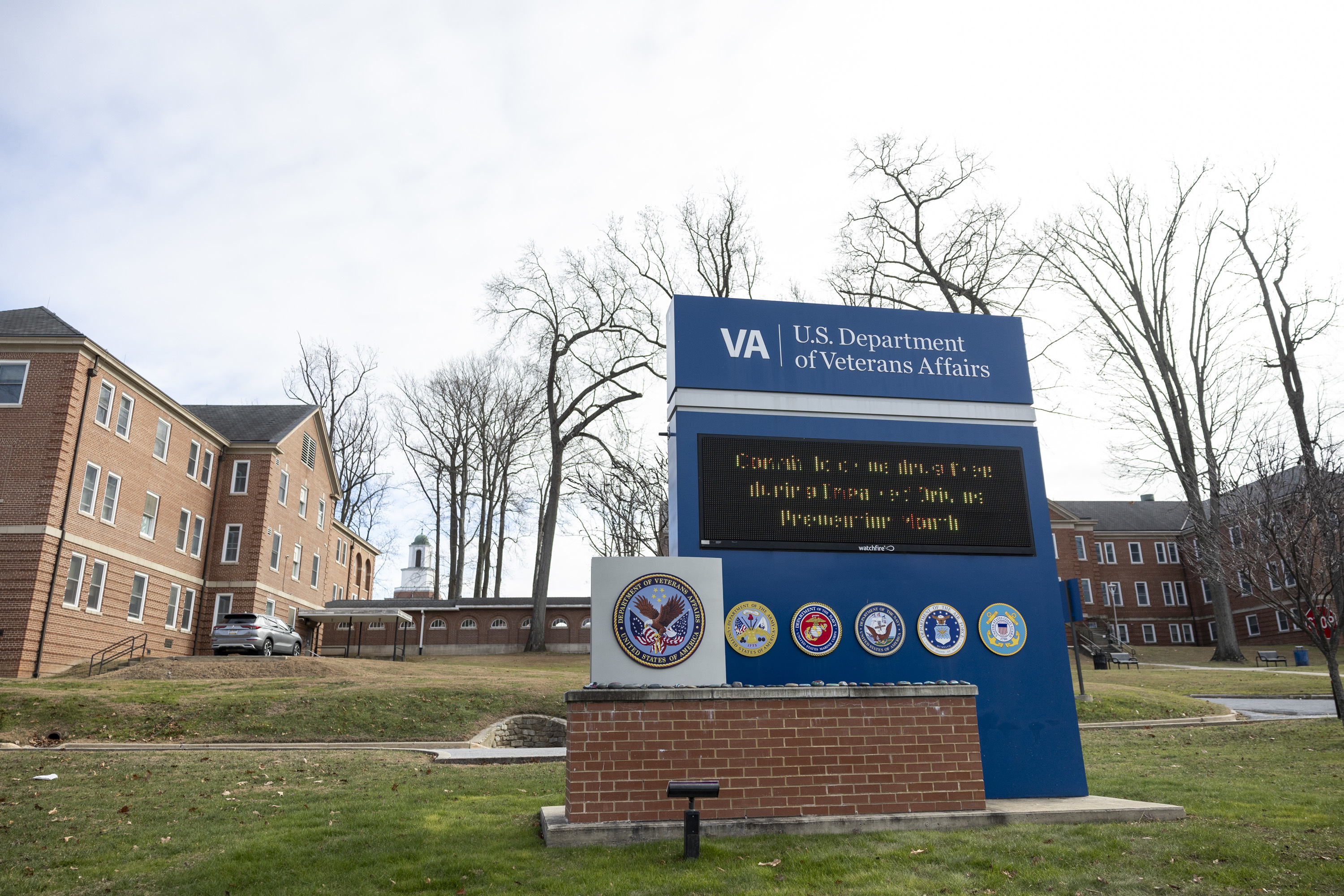
    One of the entrances leading into Coatesville VA Medical Center.

    A month earlier, Trubey’s lawyers had taken his case to the White House. In a letter sent a few weeks after President Donald Trump’s inauguration, Trubey’s lawyers asked Trump’s VA secretary, Doug Collins, to intervene on Trubey’s behalf in regard to repercussions for the sermon.

    Trubey had delivered the talk during former President Joe Biden’s administration — an environment that Trump officials allege was hostile to Christians.

    In the letter, the chaplain’s lawyers from the First Liberty Institute and Independence Law Center accused Trubey’s supervisor of wanting sermons to be screened ahead of time for pre-approval and stated that Trubey received a letter of reprimand, which would later go on to be rescinded by Coatesville VA Medical Center officials.

    Soon after the lawyers’ letter reached the new administration, the VA, one of the largest federal employers in Pennsylvania, reinstated Trubey to his position and Collins reaffirmed that chaplains’ sermons would not be censored.

    But the fallout from this incident — paired with Trump’s ongoing campaign to root out perceived prejudice against Christians and dismantle diversity, equity, and inclusion — left an undeniable mark on the VA, helping to inspire an agencywide “Anti-Christian Bias Task Force.”

    Announced to employees in April 2025, the task force asks employees to report offenses such as “reprimand issued in response to displays of Christian imagery or symbols,” per a department email reviewed by The Inquirer.

    And the VA wants names.

    In the email, the VA encouraged employees to identify colleagues and workplace practices that violate the policy and send information about the alleged offenses to a dedicated email address. The announcement was in accordance with a Trump executive order from February that ordered federal agencies to “eradicate” anti-Christian bias and create a larger White House task force composed of cabinet secretaries and chaired by Attorney General Pam Bondi.

    As of this summer, the VA received more than 1,000 reports of anti-Christian bias and reviewed 500, according to task force documents. Another report is expected in February.

    Some of the offenses the VA is on the watch for could be especially pertinent during the holiday season when workers may want their faith represented at their desks.

    One union leader at the Veterans Benefits Administration office in Philadelphia called the task force, which does not extend to biases against other religions, “McCarthyism for Christians.”

    “What they’re really doing is they’re trying to create a hostile work environment where you’re now afraid to say something because you may be reported,” said the union representative weeks after the VA’s task force announcement. The representative asked to speak anonymously out of fear of workplace retaliation.

    The VA said in a statement that the department is “grateful” for Trump’s executive order. The VA did not answer The Inquirer’s questions on an updated number of reports received through the task force, what happens to people or practices that are reported, and next steps of the task force.

    “As the EO stated, the prior administration ‘engaged in an egregious pattern of targeting peaceful Christians, while ignoring violent, anti-Christian offenses,’” said VA press secretary Pete Kasperowicz in the statement. “Under President Trump, VA will never discriminate against Veterans, families, caregivers or survivors who practice the Christian faith.”

    One of those offenses, as outlined by the VA, is “informal policies, procedures, or unofficial understandings hostile to Christian views.” Another is retaliation against chaplains’ sermons, which appears to be in response to the Trubey incident from June 2024.

    Erin Smith, associate counsel at the First Liberty Institute, who helped represent Trubey said: “If Chaplain Trubey’s story serves as inspiration to help protect the rights of all chaplains in the VA, then that is a wonderful thing to come out of a terrible situation.”

    But some VA employees disagree.

    Ira Kedson, president of AFGE Local 310, which represents employees at the Coatesville VA Medical Center, said in an interview in June that he heard some employees were “deeply troubled” by the incident with Trubey, especially those who worked in clinical settings with patients who were in attendance of the controversial sermon.

    “I was told that some of the residents were deeply hurt and deeply troubled by the situation and it took a long time for them to be able to move past it,” Kedson said.

    Religion takes center stage in the Trump administration

    Trump is leading what is arguably one of the most nonsecular presidencies in modern United States history with his embrace of a loyal, conservative Christian base.

    “We’re bringing back religion in our country,” Trump said at the Rose Garden during the National Day of Prayer in May.

    At a rally in the Poconos this month, the president declared he’s the reason people are saying “merry Christmas.”

    And efforts to elevate religion in the public sphere have gone beyond Trump’s rhetoric. For instance, the Office of Personnel Management, the federal government’s human resources agency, issued guidance that aims to protect religious expression in the workplace for all religions.

    Trump also established a 16-person religious liberty commission in May that appears to include all faiths. The Department of Justice also announced a task force to address antisemitism.

    Yet, some Christian leaders are concerned that the task force excluding biases against non-Christian faiths will actually exacerbate threats against religious freedoms.

    Most of the reports submitted to the VA focused on “denying religious accommodations for vaccines and provision of abortion services; mandating trainings inconsistent with Christian views; concealing Christian imagery; and Chaplain program and protections for Chaplains,” according to task force documents.
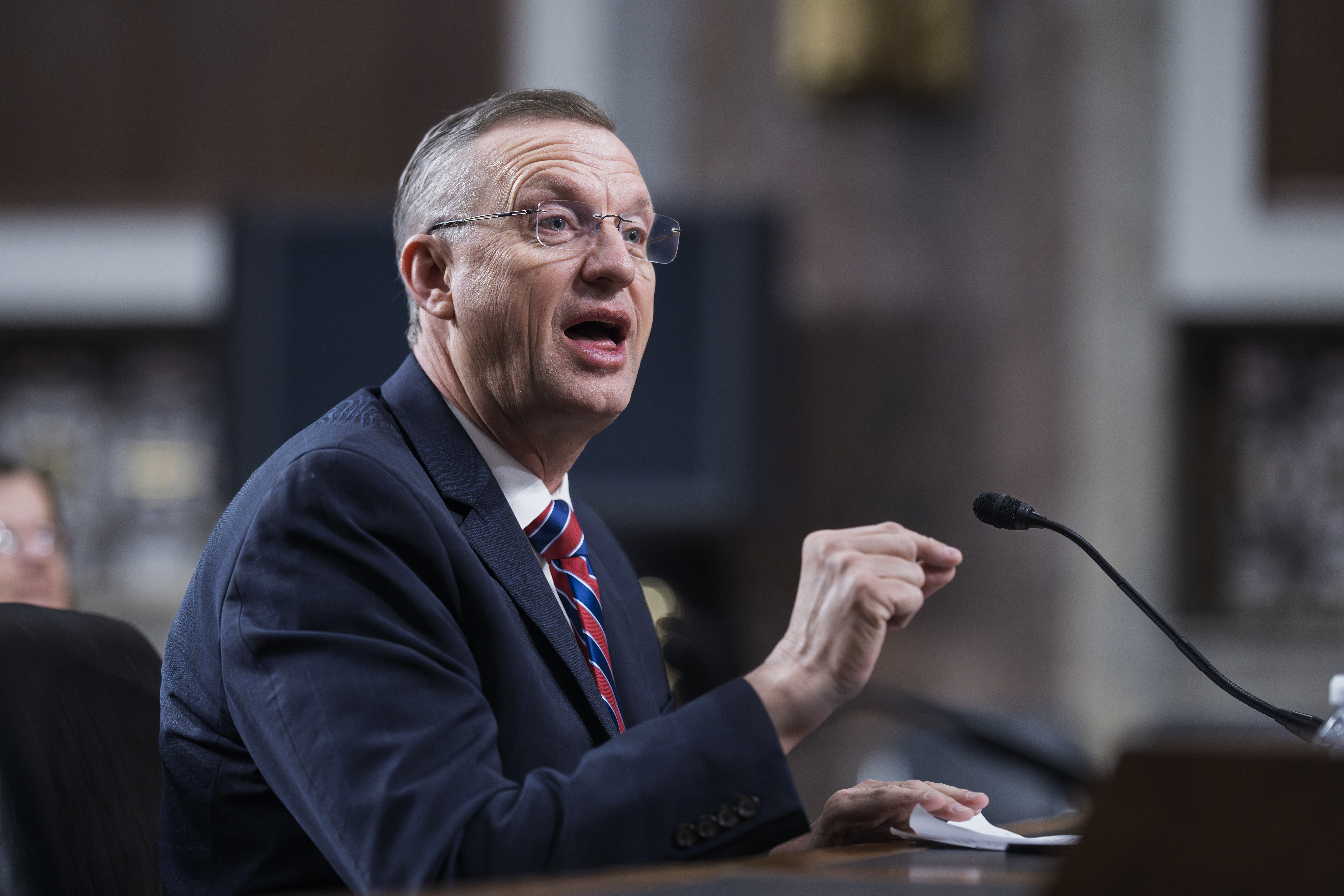
    Doug Collins at his Jan. 21 confirmation hearing before the Senate Veterans’ Affairs Committee, at the Capitol in Washington.

    Charles Haynes, senior fellow for religious liberty at the Freedom Forum, a nonpartisan organization based in Washington that promotes First Amendment rights, said while it’s not unconstitutional or unprecedented to create a faith-specific task force, “the appearance of [the Christian-bias task force], to many people, is a favoritism of the government for one group over another.”

    The White House, in a statement, said Trump has a record of defending religious liberty regardless of faith.

    “President Trump has taken unprecedented action to fight anti-Christian, anti-Semitic, and other forms of anti-religious bias while ending the weaponization of government against all people of faith,” said White House spokesperson Taylor Rogers in an email to The Inquirer.

    Furthermore, she added, that the media is doing “insane mental gymnastics to peddle a false and negative narrative about the President’s efforts on behalf of nearly 200 million Christians across the country.”

    Identifying anti-Christian bias or chasing a ‘unicorn’?

    The Trump administration has shared few details about the operations and goals of the anti-Christian bias task force, raising questions from lawmakers and other stakeholders.

    Rep. Mark Takano, the ranking member of the House Committee on Veterans’ Affairs, was in a monthslong back-and-forth with VA Secretary Collins, trying to get answers to an extensive list of questions he initially sent in May, with the California Democrat particularly concerned that the scope of the initiative is limited to bias against Christians.

    “To preserve this right to religious freedom, the Department cannot prioritize one faith over others, nor can it allow religious considerations to shape its policies in ways that may conflict with the First Amendment,” Takano wrote in May. “Further, the vagueness of the task force’s mission raises significant concerns about how it will be used and whether it is compatible with the mission of the Department.”

    Collins responded in June and did not answer most of Takano’s questions, though he did say that the task force, which reports to the secretary, will identify, strategize, and potentially alter any policies that discriminate against Christians or religious liberty.

    The lawmaker followed up a week later. Roughly four months later, in October, Collins’ responses were vague once again. Most recently, Takano is asking for both Democratic and Republican members of the House and Senate’s Veterans’ Affairs Committees to be looped in on future correspondence regarding the task force.

    The VA, according to a statement from Takano, has not fully answered their questions and has refused to host a bipartisan briefing.

    “The lack of transparency and accountability of this task force leaves me with numerous concerns for the due process and privacy of hardworking VA employees,” Takano said. “VA’s silence won’t stop us from asking the questions we are constitutionally obligated to ask.”
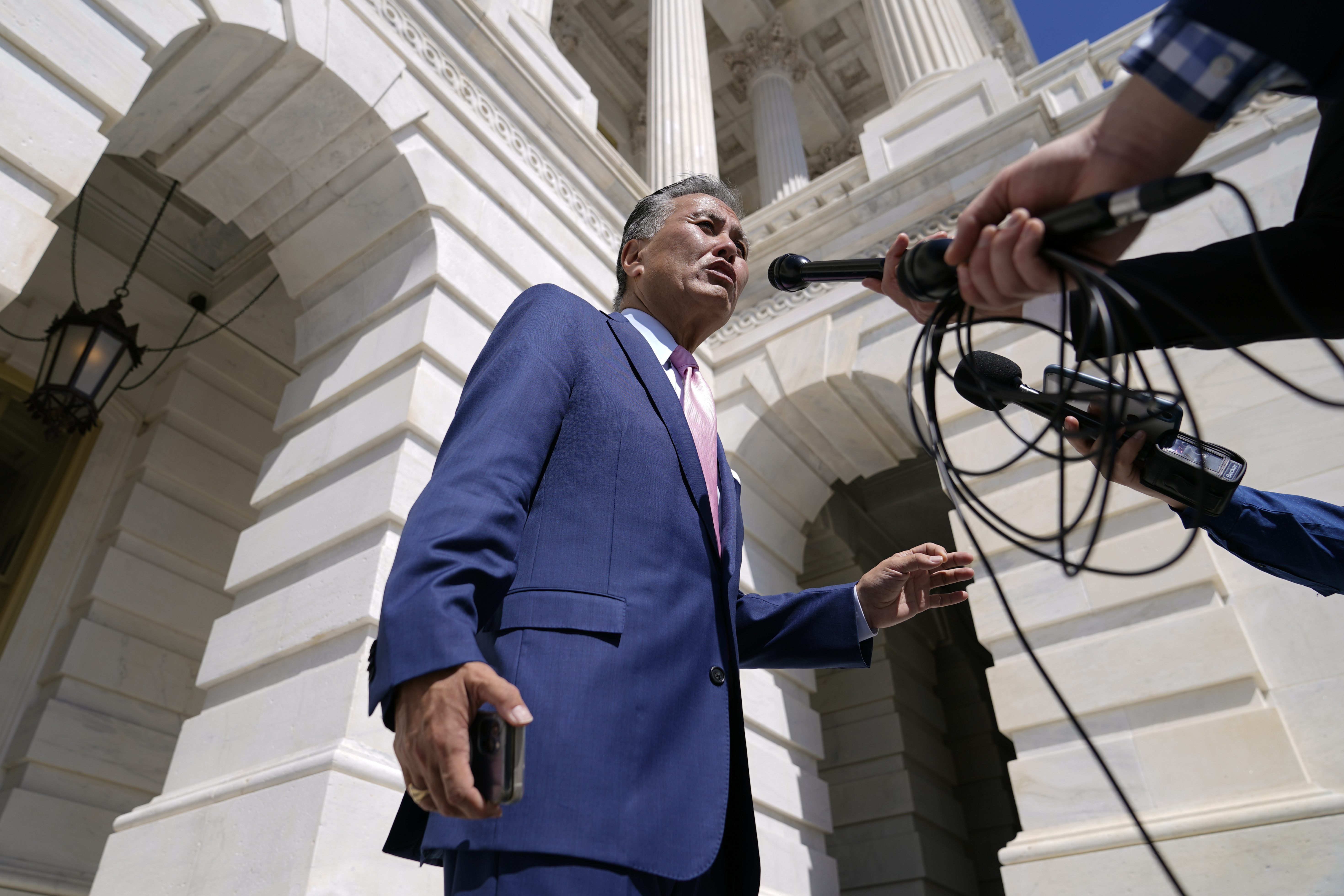
    Rep. Mark Takano (D., Calif.) in August 2022, on Capitol Hill in Washington. Takano, ranking member of the House Committee on Veterans’ Affairs, has been trying to get answers from the VA on the Anti-Christian Bias Task Force.

    Michael L. “Mikey” Weinstein, former counsel for the Reagan administration turned founder and president of the Military Religious Freedom Foundation, said his group is looking for a plaintiff to sue the government over the task force. The group has been receiving calls from VA employees concerned about it, one of whom, he said, was a senior physician at the VA Medical Center in Philadelphia.

    The physician, Weinstein said, was distraught to receive the memo about the task force. He had family in town and noted the irony of showing his family around all the historical sites that signified the birthplace of American freedoms while being asked by the federal government to partake in such a project.

    “It was like a dagger in his heart,” Weinstein said.

    Weinstein is adamant that anti-Christian bias in the federal workforce is nonexistent, like looking for a “unicorn.”

    Noticeably absent from the task force, critics say, is any effort to explore instances of discrimination against other faiths within federal agencies.

    Trump has historically espoused hateful rhetoric against Muslims, including enacting a travel ban on individuals from predominantly Muslim countries during his first term. The president has issued an executive order this term to combat antisemitism on college campuses, but he also has a history of engaging with antisemites on the political right.

    Ahmet Selim Tekelioglu, executive director of CAIR-Philadelphia, a nonprofit that aims to protect the civil rights of Muslims in the U.S., said he believes all forms of discrimination should be stamped out, but he’s concerned the task force isn’t affording those protections to everyone.

    “It focuses exclusively on alleged anti-Christian conduct within the federal agencies, and in our opinion of this, risks then entrenching preferential treatment and signaling the protections that should exist for everyone is conditional, right?” Tekelioglu said.

    There is hope, however, that this task force could lead to other future initiatives to root out hate, said Jason Holtzman, chief of Jewish Community Relations Council at the Jewish Federation of Greater Philadelphia.

    “My hope is that hopefully they’re starting with the task force on Christian bias, and then maybe they’ll initiate one on antisemitism, Islamophobia, because I think task forces need to exist on all of these different forms of hate,” said Holtzman, noting that both Trump and Biden have taken action to combat antisemitism.

    Haynes, the religious liberty expert, said anti-Christian bias is a “matter of perspective.”

    “How you see it for the conservative Christian, what others would say is just creating an inclusive, safe workplace for everyone, they see, in some respects, as being anti-Christian,” Haynes said.

    Haynes said that “anecdotal sort of stories” about prejudice against Christians pushed by conservative groups do not appear to be based in any kind of research into a widespread trend. But it only takes one story — as seen in Trubey’s case — to set off a firestorm.

    “It doesn’t take much,” Haynes said.
  • Tyler Perkins embraces his many roles at Villanova. This year, it’s about being a leader.

    Tyler Perkins embraces his many roles at Villanova. This year, it’s about being a leader.

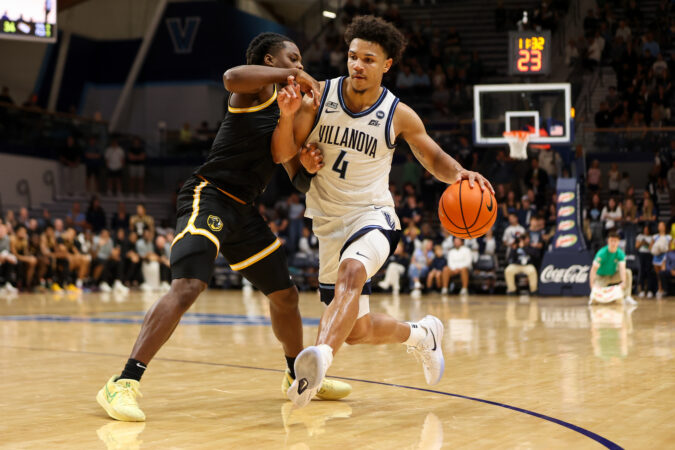
    Tyler Perkins has a different point of view than the rest of his Villanova teammates.

    The junior guard is one of three returning players on the Wildcats roster, and the lone returnee who played last season. Perkins has been a steady presence as the program went through a coaching transition and a total reboot entering the 2025-26 campaign.

    But adapting to a new system isn’t the biggest challenge for Perkins — he’s done it every season of his college career. He played for Penn as a freshman, then transferred to Villanova ahead of the 2024-25 season. While most of his former teammates moved on after Kyle Neptune’s firing in March, Perkins elected to stay on the Main Line as Kevin Willard took the helm.

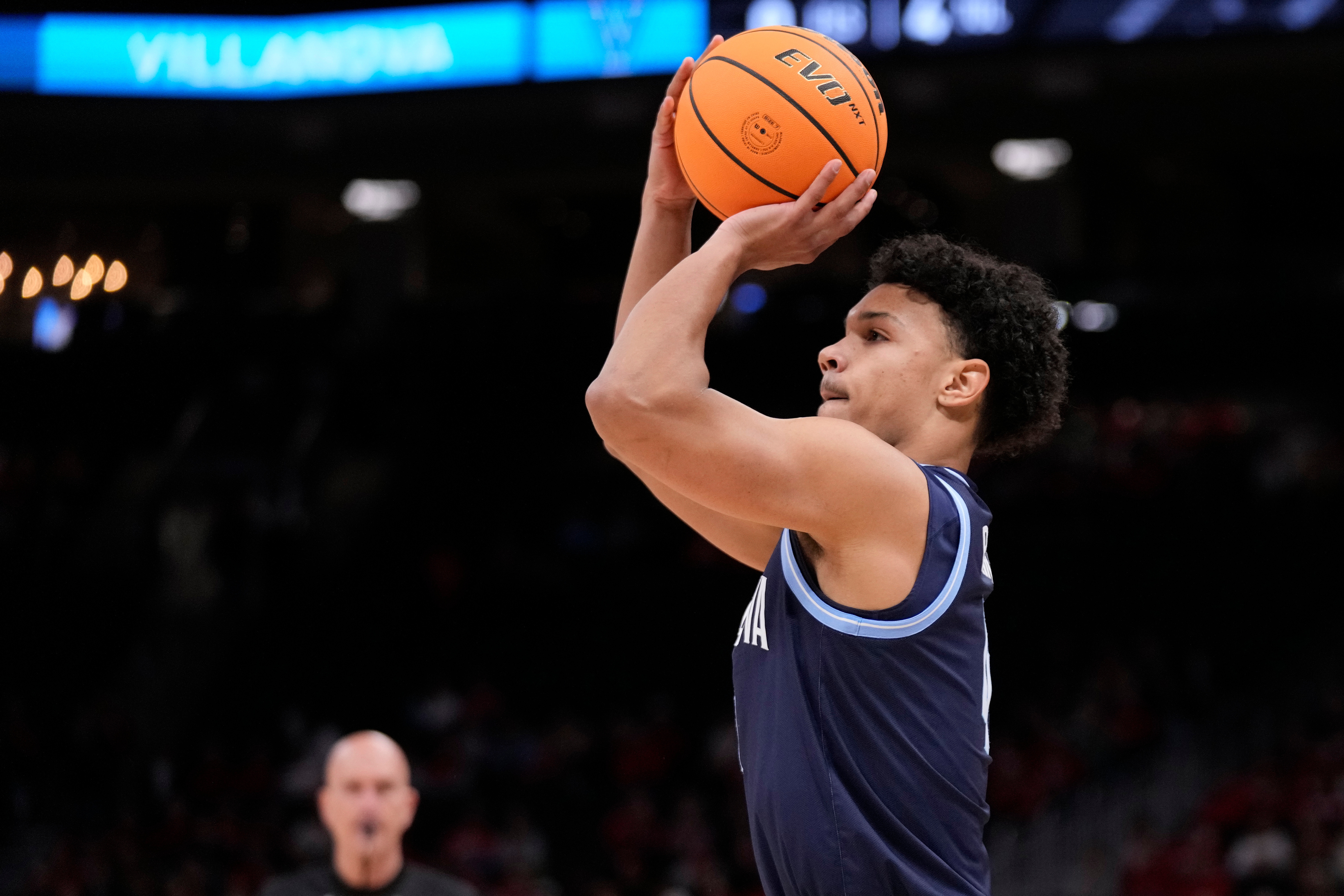
    Perkins is focused on being a leader for Villanova (9-2), in addition to fulfilling Willard’s high expectations of his backcourt. Promoted to the starting five this season, Perkins is averaging 10.6 points and 4.3 rebounds through 11 games.

    “When you’re a college basketball player, you don’t really want to have three new coaches in three years,” Perkins said. “But it’s something you can’t control and have to learn from. Willard has definitely helped me understand that even on your good days and bad days, if you’re one of the leaders, you always have to keep a positive attitude. Even my teammates are holding me accountable.”

    The only returner

    The process of building camaraderie among the new Villanova squad inevitably was difficult when summer training began. The Main Line was unfamiliar to most of the team, apart from Perkins, redshirt freshman forward Matt Hodge, and walk-on senior guard Wade Chiddick. But over the summer, Perkins made a jump in his own game as he got to know his new teammates and coaching staff.

    “When you have 13 new guys, it’s hard and it takes a while, but ever since the summer, we’ve clicked, and it’s been fun,” he said.

    Perkins was a consistent contributor early in the season, scoring eight points in each of the first four games. Against Old Dominion on Nov. 25, he scored 21 points — his most in a Villanova uniform — with seven rebounds at the Finneran Pavilion.

    Tyler Perkins scored a career-high 21 points against Old Dominion on Nov. 25.

    Two games later, under the bright lights of Xfinity Mobile Arena, Villanova defeated Penn, Perkins’ former program, for the Big 5 Classic championship on Dec. 6.

    It was Perkins’ third year playing in the Big 5 Classic. But it was the first time that most of his Villanova teammates — and coaches — had competed in the annual tripleheader among the six Philadelphia teams.

    Perkins took it upon himself to emphasize the significance of the Big 5 rivalry to his teammates ahead of the event. Against Penn, he recorded six points and three rebounds as the Wildcats demolished the Quakers, 90-63, for their first Big 5 title in the revamped format.

    “[The Big 5] is all about pride, to be honest,” Perkins said. “When I was at Penn and we had Villanova on our schedule, it was like our Super Bowl. It was a game where we could show everybody who we are. Being on the other side of that now, I was just trying to tell the guys that these games mean a lot to the Big 5 schools. So being able to finally win it and bring it back to the Main Line is definitely special.”

    ‘It’s bigger than you’

    Upon arriving at Villanova, Willard noticed Perkins’ potential to fill his starting lineup as a versatile guard. In their first conversations, Perkins was eager to buy into Willard’s vision for the program.

    “I thought my playing style and [Willard’s] coaching style meshed, both offensively and defensively,” Perkins said. “He likes his guards to get deflections and get steals. And I feel like that’s something that I’m naturally good at, and just my ability to rebound and play hard. So after talking with him and seeing how those things aligned, I was happy with the decision [to stay at Villanova].”

    In Villanova’s win over Wisconsin on Friday night, Perkins was confident with the ball in his hands. He shot 6-for-17 from the field, including 4-for-10 from three, and scored a team-high 19 points in the 76-66 overtime victory.

    Villanova guard Tyler Perkins shoots a three-pointer against Wisconsin on Friday.

    “I like the fact that Perk’s looking to shoot the basketball. … He does all the little things that most people don’t see,” Willard said postgame in Wisconsin. “But when he’s aggressive out there, it gives us another scorer.”

    When grappling with uncertainty after last season, Perkins turned to some of the former teammates he looked up to as role models, including 2025 graduates Eric Dixon and Jordan Longino. Both played their full careers at Villanova and helped shape Perkins’ understanding of the school’s basketball tradition and how to represent it.

    Now, Perkins sees himself as a leader by example as the Wildcats get ready to open Big East play at Seton Hall on Tuesday (7 p.m., NBCSP, Peacock). Villanova enters the most crucial part of the season, and Perkins hopes to put the program back in the national spotlight.

    “When you walk into the Finn and see [murals of] Jalen Brunson, Collin Gillespie, and all those other greats, they built this place,” Perkins said. “Villanova is Villanova because of them. Now, it’s just our turn to keep it going and play for those guys. That’s the main thing I’ve learned, is that it’s bigger than you.”

  • Drug distribution giant Cencora is boosting its reach in medical specialties

    Cencora Inc., a drug-distribution giant based in Conshohocken, is expanding its presence in oncology and retina care, two medical specialties that rely heavily on pharmaceuticals.

    The company announced on Dec. 15 that it had agreed to buy out its private-equity partner in a national cancer practice management company, OneOncology, for $5 billion in cash and debt.

    Cencora already owned 35% of OneOncology, which has a small presence in the Philadelphia area.

    In January, Cencora spent $5 billion, including contingency payments, for Retina Consultants of America, a network of specialized practices with locations in 23 states, including two in Pennsylvania outside the Philadelphia area.

    The deals are part of Cencora’s effort to extend its reach into medical specialties that rely heavily on pharmaceuticals to treat patients. By positioning itself closer to patients, Cencora can capture more of the profit margin that goes along with selling drugs.

    “We like those two spaces because they’re pharmaceutical centric,” Cencora’s CEO Robert Mauch said at the 2025 J.P. Morgan Healthcare Conference. He said the company doesn’t see other specialties with the same makeup as oncology and retina.

    “That’s where we will continue to focus,” he said. “Now as we look forward, there could be other specialties. There could be other innovations in the pharma industry that create something in another area.”

    Cencora had $321 billion in revenue in its fiscal year that ended Sept. 30. It had $1.5 billion in net income. That’s a great deal of money, but amounted to less than half a percent of its revenue.

    McKesson and Cardinal Health, Cencora’s two biggest U.S. competitors in the drug-distribution business, face similarly narrow margins from drug distribution. Both also own companies that manage cancer practices. Among the benefits of owning the management companies is securing the customer base.

    Cencora’s follow-up to 2023 deal

    Cencora, then known as AmerisourceBergen, paid $718.4 million for a 35% stake in OneOncology in June 2023. That deal, in partnership with TPG, valued OneOncology at $2.1 billion. The seller was General Atlantic, a private equity firm that had invested $200 million in the Nashville management services company in 2018, according to the Wall Street Journal.

    The deal announced last week valued OneOncology at $7.4 billion, including debt. The big increase in value came thanks to a doubling in the company’s size. OneOncology now has 31 practices with 1,800 providers who treat 1 million patients across 565 sites, according to the company.

    Rittenhouse Hematology Oncology, which has offices in Bala Cynwyd, Brinton Lake, King of Prussia, and Philadelphia, became part of OneOncology last year.

  • Good luck affording an apartment in Philly if you earn minimum wage

    Good luck affording an apartment in Philly if you earn minimum wage

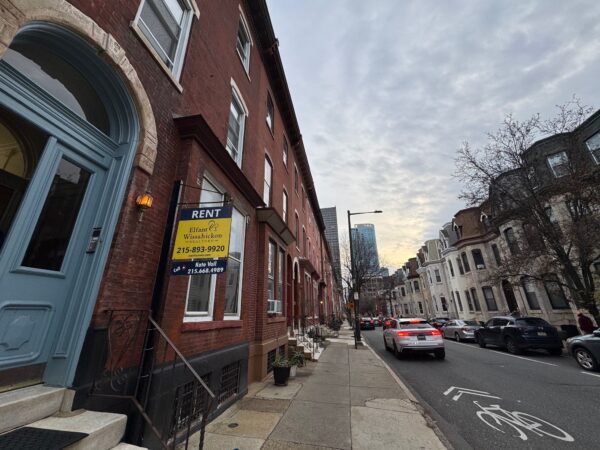
    Out of the 50 largest metropolitan areas, the Philadelphia region is where minimum-wage earners must work the most hours to afford rent.

    Two workers who make Pennsylvania’s $7.25 minimum hourly wage would each have to work 96 hours per week to afford the Philadelphia metropolitan area’s median asking rent of $1,739 in November, according to an analysis by Realtor.com.

    Only five of the top 50 metros have rents that are affordable without overtime for a household in which two workers make the minimum wage. In all five metros, the minimum wage is above the federal floor of $7.25, and the median rent is lower than the median across the 50 metros.

    The most affordable metro is Buffalo, N.Y., where two workers making the state’s minimum wage of $15.50 would need to work only 30 hours per week each to afford the region’s median asking rent of $1,176 in November.

    For Pennsylvanians in the Philadelphia region, the state and federal minimum wages are the same, and the median rent is above the $1,693 median rent for the 50 metros.

    Joel Berner, senior economist at Realtor.com, noted that demand for workers often pushes the lowest actual starting wages above mandated minimums. But in areas with high costs of living, even wages driven higher by market forces or increases to the state minimum don’t close “the affordability gap.”

    “It’s a clear signal that housing costs continue to pose a massive hurdle for those at the bottom of the pay scale,” Berner said in a statement.

    Rents were considered affordable if they were no more than 30% of renters’ income.

    window.addEventListener(“message”,function(a){if(void 0!==a.data[“datawrapper-height”]){var e=document.querySelectorAll(“iframe”);for(var t in a.data[“datawrapper-height”])for(var r,i=0;r=e[i];i++)if(r.contentWindow===a.source){var d=a.data[“datawrapper-height”][t]+”px”;r.style.height=d}}});

    Nationwide, rents have moderated in recent years. But in November, the median rent across the top 50 metros was still 17% higher than just before the pandemic in November 2019.

    Danielle Hale, chief economist at Realtor.com, pointed out that some states’ minimum wages are scheduled to increase in the new year, which “will help to improve affordability for the most burdened households.”

    “While the challenge remains immense, particularly in high-cost areas, the number of metros where two minimum-wage earners can afford a typical rental without working overtime will grow in 2026, a positive sign,” she said in a statement.

    Two metros are set to join these ranks next year: Detroit, where the minimum wage is scheduled to increase from $10.56 to $13.73; and Jacksonville, Fla., where the minimum wage will increase from $13 to $15.

    The number of hours people need to work will drop most in Florida metros. Two minimum-wage workers living together in Tampa would each need to work 45 hours per week in 2026 to afford the median asking rent. That’s down seven hours from this year.

  • Bring in the new year with these local hikes, from Marsh Creek to the Pine Barrens

    Bring in the new year with these local hikes, from Marsh Creek to the Pine Barrens

    With First Day hikes surging in popularity, Pennsylvania and New Jersey are rolling out a full slate of outings to welcome 2026 — from daybreak rambles to sunset treks, and nearly every hour in between for those easing into the new year.

    Many of the guided hikes require advance registration and fill quickly.

    The Jan. 1 hikes are offered through the Pennsylvania Department of Conservation and Natural Resources (DCNR) and the New Jersey Department of Environmental Protection (DEP). Some are guided by rangers, others by volunteers.

    For example, you can set out with “Ranger Kim” for a 1.5-mile walk at Marsh Creek State Park in Downingtown, Chester County. Or venture two to three miles through pine barrens at Black Run Preserve in Evesham Township, Burlington County.

    Another option: Join the Friends of Ridley Creek State Park in Media, Delaware County, for a 3.5-mile loop featuring creek views and a stop at historic hilltop Russell Cemetery.

    Or, for a spectacular bird’s-eye view of the Pinelands at daybreak, you can tackle a 2.5-mile round trip, starting at 6 a.m., to Apple Pie Hill in Wharton State Forest, where hikers climb the 79 steps of the fire tower at sunrise. The only drawback: The hike has become so popular that the DEP holds a lottery at 1 p.m. on Dec. 31 to select participants.

    Apple Pie Hill Tower offers a dramatic view of the Pinelands.

    First Day Hikes began in Massachusetts in 1992, and went nationwide in 2012 under an effort by the National Association of State Park Directors.

    Ian Kindle, environmental education regional program coordinator for DCNR’s Bureau of State Parks, said the hikes in Pennsylvania started not long after that. But, he said, they have become increasingly popular since the pandemic, when many people took to the outdoors.

    “I think people have really taken to the idea of making getting outdoors on the first day of the year a tradition.” Kindle said. “I know that some of the first ones I led at Delaware Canal State Park, we could have 100, 150, and upward of 200 people, which is a challenge to lead.”

    Last New Year’s Day, 2,488 people — and 224 dogs — participated in Pennsylvania. They gathered for 74 hikes at 47 state parks and one state forest, accumulating 6,478 miles.

    Cheryl and Gary Moore, of Bucks County, ride their horses over the Schofield Ford covered bridge in Tyler State Park in Newtown, Bucks County in this 2021 file photo.

    The two most attended hikes were at Beltzville State Park in Carbon County in the Poconos (175 people) and Tyler State Park in Bucks County (170 people).

    This year, DCNR has organized 60 free guided hikes in 49 state parks and three forest districts, choosing to make the walks more focused.

    Kindle said an “almost full moon” hike is set for Delaware Canal State Park in Yardley, Bucks County, at 4 p.m. He noted a two-mile hike around Militia Hill at Fort Washington State Park in Montgomery County.

    He said other hikes will take place at White Clay Creek Preserve and French Creek State Park, both in Chester County.

    Here’s a list of all hikes in Eastern Pennsylvania.

    Meanwhile, New Jersey is offering 30 hikes and one lighthouse climb.

    The hikes include: walks at 10 a.m., noon, and 2 p.m. through historic Revolutionary-era Batsto Village in Wharton State Forest; a more rigorous six-mile hike at Brendan T. Byrne State Forest on the Cranberry Trail that includes Pinelands cedar swamps and Pakim Pond; and a two-mile hike at Washington Crossing State Park in Mercer County where you can learn about the famed feat by the Continental Army that routed the Hessians at Trenton.

  • The new Delco DA talks victories, ambitions, and the importance of mentorship

    The new Delco DA talks victories, ambitions, and the importance of mentorship

    Tanner Rouse will be Delaware County’s new top law enforcement officer, but he’s not new to the work.

    Rouse will be sworn in on Jan. 5 as district attorney after his predecessor, Jack Stollsteimer, steps down to assume the county judgeship he won in November. Rouse, 42, will finish out the final two years of Stollsteimer’s term after working as his first assistant since 2020.

    In a recent interview, Rouse discussed the strides in reducing violent crime he and his colleagues have made under Stollsteimer — the first-ever Democrat to serve as district attorney in Delaware County — as well as how he plans to continue those advances.

    The short answer: Keeping the same playbook, but “putting a personal stamp on it,” as an offensive coordinator does when he takes over as head coach, said Rouse, an avid Eagles fan and ambitious Little League coach.

    A former Philadelphia prosecutor under Seth Williams, Rouse credited the lessons he learned from investigating gun violence in the city, along with the recruitment of several former colleagues he brought over the county line, with improving the way crime is prosecuted in Delaware County.

    “We have demonstrated you can reform the criminal justice system and that it doesn’t have to come at the expense of stopping violent crime,” Rouse said. “They’re not mutually exclusive.”

    Who is Tanner Rouse?

    Rouse, a Phoenixville-area native, is the son of the late Willard Rouse III, the prominent Philadelphia developer behind One and Two Liberty Place. After graduating from the University of Wisconsin and Fordham Law School, Rouse spent seven years in the Philadelphia District Attorney’s Office, prosecuting crimes in Center City and North Philadelphia.

    Rouse left the office in 2017, months before Larry Krasner took over. He practiced civil law for a time and ran an ultimately failed campaign to unseat then-State Sen. Tom McGarrigle before Stollsteimer called and offered him the first assistant job.

    At the time, Rouse said, the offer was unexpected. But, looking back, he now considers it one of the greatest opportunities of his career.

    What is Rouse most proud of from his tenure as first assistant?

    The most notable achievement of his tenure to date in the district attorney’s office, Rouse said, is the steep reduction of gun violence in Chester. Shootings are down 75% since 2020. Rouse credits community outreach efforts for that, especially through the Chester Partnership for Safe Neighborhoods program, overseen by veteran homicide prosecutor Matt Krouse, whom Rouse worked with in Philadelphia and recruited to join him in Delaware County.

    The partnership’s fundamental philosophy is a combination of focused deterrence programs Rouse helped oversee in Philadelphia that target repeat offenders, as well as community outreach efforts run by trusted neighborhood figures.

    Rouse said he never wanted to be a faceless presence in the county and made it his priority to get out and form relationships in all of the municipalities he served, visiting community meetings, block parties, and even a few pickup basketball games.

    “I don’t do this job from behind a desk,” he said, speaking in his county courthouse office. “And I think demonstrating that commitment and that care by being more present in those communities, and not just being kind of the big, scary law enforcement agency on a hill is incredibly important.”

    Rouse said he is proud of other reforms including creating a diversionary unit in the office, revamping its drug court and instituting a special “child’s court,” created by Kristen Kemp — Rouse’s chosen first assistant and an expert in special-victims’ cases — that allows young victims to testify against adult offenders in a more comfortable environment.

    The county’s jail population is down 50% as well, something Rouse says is a result of approaching prosecuting crimes in a humane, logical way.

    What are his priorities as district attorney?

    Rouse said he plans to create a similar community outreach program in Upper Darby, a community he said is “on the verge of some big things.”

    “It’s not as if we’re saying, ‘We’re coming in here to take on Upper Darby and what goes on there,’ but more of, ‘Guys, look, we’re not just the people you pick up and call when there’s a crime.’”

    He also expressed interest in creating reciprocity agreements with his counterparts in the other collar counties around Philadelphia, specifically when it comes to handling drug cases and providing treatment to the people caught up in them.

    How has his time in Philadelphia influenced his work in Delco?

    Rouse said he cut his teeth in the city working alongside veteran prosecutors, and he’s worked to bring that environment of mentorship to Delaware County.

    He said he and his more senior deputies often sit in on trials, giving feedback to younger staff members just as his mentors did for him nearly two decades ago.

    “That’s how I got better, and that’s one of the roles I most cherish here,” he said.

  • How Philly-area grocery workers handle the holiday stress — and find joy along the way

    How Philly-area grocery workers handle the holiday stress — and find joy along the way

    Crowds of last-minute shoppers, customers looking for seasonal ingredients, sappy hands from tying Christmas trees to cars, and of course, hours and hours of cheery holiday music playing on a loop.

    Such is the life of a grocery worker during the holidays.

    “Everyone wants to get, like, the biggest tree on, like, the smallest car,” said Edward Dupree, who has worked at the Center City Whole Foods for over nine years.

    Working at a grocery store during the holiday season can be hectic and intense, requiring a lot of patience, he said.

    “It’s, I think, definitely under-appreciated,” said Dupree.

    Grocery employees from across the region say this time of year brings a surge of stressed shoppers making larger purchases, even in the age of DoorDash, grocery delivery, and curbside pickup.

    Customers rush into the store for their last-minute shopping, said Erika Keith, who works at the Fox Street ShopRite in Nicetown. And they’re often hurried as they fill their carts, said Charletta Brown, of the Acme in Trooper, juggling year-end demands at work and pressures at home as they prepare for the holidays.

    “Those three days moving into Thanksgiving are just insane,” said Dupree. He said the store starts getting busier in September as students return to the area, and it stays hectic through the end of the year.

    Customers aren’t just getting their regular groceries and Christmas trees. They’re looking for specialty seasonal items including cranberries, decorative gourds, chestnuts, eggnog, and black-eyed peas for the New Year.

    “Even in spite of the current economy — we do hear a lot that things are a little rougher than they have been in past years — people still want that tradition,” said Brown.

    Specific holiday wishes

    As the holidays approach, the Philadelphia Whole Foods bakery makes hundreds of pies and a slew of custom orders, said baker Jasmine Jones. During the holidays, they said, “the cakes get bigger.”

    Many are seeking out pie crusts and fillings, as well as phyllo dough to make hors d’oeuvres, said Brown, of Acme. These freezer items are hidden “way in the back” for most of the year, but they get the star treatment, “front and center” for the holidays.

    Keith, of ShopRite, said the holidays bring in more business for the store’s Western Union service, as people send money to loved ones as gifts.

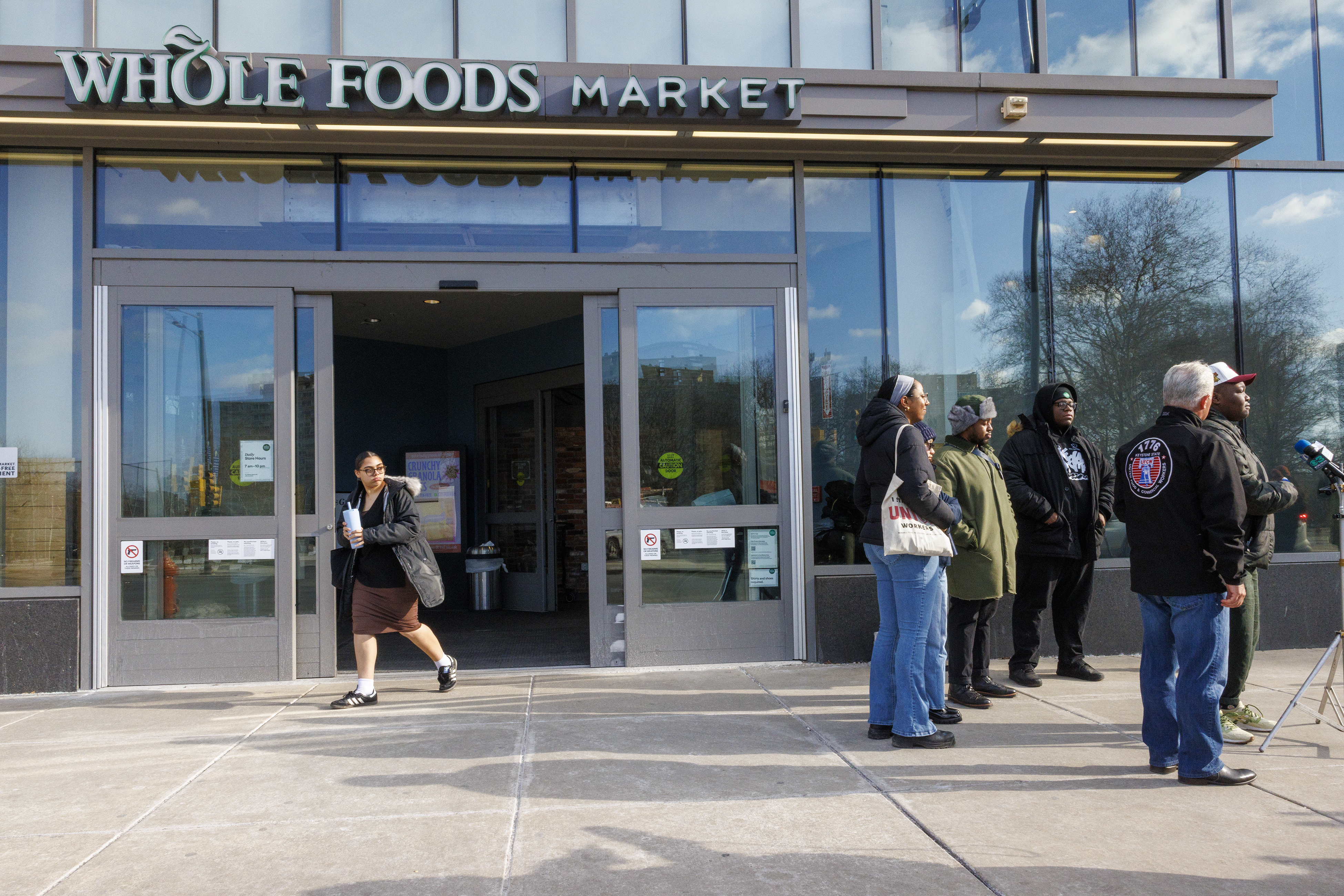
    Union workers gather outside the Center City Whole Foods Market in January.

    At the Trooper Acme, Brown said, shoppers start looking for Ivins Famous Spiced Wafers starting around Halloween, and as the holiday season progresses, they’re looking for specific nostalgic sweets to fill their candy dishes — minty After Eight chocolates or the multicolored, straw-shaped Plantation hard candies, for example.

    “Some people say, ‘We don’t eat them, but we just want them to sit out in the candy dish, because I had that as a kid, and my mother and father always had it out,’” she said.

    Holiday gripes

    For Jones, Whole Foods is a second job on weekends. They said they’re “stretched kind of thin” during the holidays as they juggle another full-time job. Jones sometimes volunteers to work extra hours for the money during the holidays, but they don’t like losing the time with loved ones.

    And, Jones added, the holiday music is not a perk.

    “It kind of makes me angry,” said Jones, adding that they’re “still an overworked worker.”

    “It kind of just reminds me that I could be home if you paid me more.”

    Shoppers peruse the Save-a-Lot grocery store in Atlantic City in this Jan. 2024 file photo.

    Dupree, also of Whole Foods, isn’t a fan of the constant seasonal music either.

    “If I want to go listen [to the song] ‘This Christmas,’ I’ll listen to it on my own — don’t play it 82 times a day,” he said. “It’s a bit intrusive.”

    The customers

    Some customers, for their part, avoid the busiest times at the grocery store.

    In Wayne, Lisa Goldschmidt has become dependent on Instacart grocery deliveries most of the year. But when it’s time to shop for her holiday dinners, she makes a couple in-person trips to her local Acme. For her sanity, she keeps to a personal code, she said: “Avoid the weekends and the after-work times when it typically gets crazy.”

    Goldschmidt, a 58-year-old attorney who works from home, said she’s fortunate that she can run out midday on weekdays to buy her holiday essentials, which include an expansive antipasto assortment that her family eats on Christmas Eve and the prime rib they make on Christmas Day.

    April Beatty, 51, of Broomall, also tries to avoid peak shopping times at her go-to stores — Wegmans, Trader Joe’s, and Gentile’s produce market. She aims to pick up all her groceries at least a couple days before Christmas, and she also buys more this time of year with her two children home from college.

    But her job, too, keeps her busy during this season — she works in supply-chain logistics — so shopping the way she prefers, at “off times, just because it’s more efficient,” isn’t always an option.

    This year, her Wegmans trip for Thanksgiving happened during a shopping rush: “aisles packed, parking lot packed,” she said. During the holidays, she added, “at least people are polite.”

    Customers browse Iovine Brothers Produce at Reading Terminal Market in this 2022 file photo.

    Customers at Whole Foods are more outgoing during the holidays, said Dupree, part of a kind of jolly Christmas mentality around this time of year.

    The days leading up to Thanksgiving are usually the busiest — more so than Christmas — but he didn’t notice quite as much Thanksgiving hustle this year.

    “I wonder if this is because, you know, people’s pockets are hurting,” Dupree pondered aloud.

    At ShopRite, Keith said, some of the busiest shopping days she recalls are the day before Thanksgiving and Christmas Eve.

    “We have our last-minute shoppers — and, you know, I get it. I get the busy life,” she said.

    A Save-a-Lot supermarket employee arranges pears at the chain’s Camden store in this January 2024 file photo.

    At Acme, Brown sees pressure and stress on some customers.

    “Being sympathetic to that, listening to them, is probably half the battle of dealing with any stresses or strain that I might be under — and also what they might be under,” she said.

    Brown said she tries to get a head start on her own holiday decorating and planning each year because there isn’t a lot of downtime once the store gets busy.

    “I have to manage that time effectively in order to be able to really decompress and enjoy the holidays myself,” she said.

    This year, for the first time in a while, she won’t be working on Christmas Eve because it‘s on a Wednesday, her usual day off.

    But Brown said she actually loves working Christmas Eve, “because it just seems to me like everybody’s just so happy.”

  • These college journalists from Philly-area schools are working to support each other and seek funding for their work

    These college journalists from Philly-area schools are working to support each other and seek funding for their work

    Haverford College senior Jackson Juzang earlier this year had been talking to a school administrator about the need for more resources to support student journalism.

    The administrator, Chris Mills, Haverford’s associate vice president for college communications, asked if there was a network of student newspaper journalists in the region that Haverford could join and seek support from.

    There wasn’t.

    “So I decided to create one,” said Juzang, 22, an English major from Pittsburgh who serves as associate editor of the Clerk, Haverford’s student newspaper.

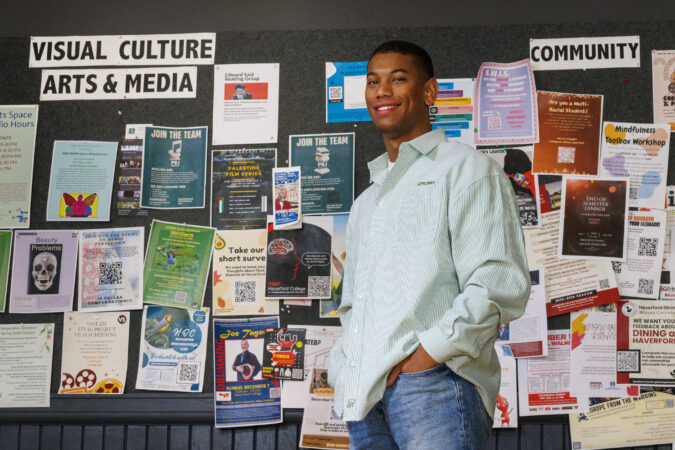
    Jackson Juzang explains why he started the Philadelphia Student Press Association.

    He established the Philadelphia Student Press Association as a nonprofit and created a board with student editors from 11 college news organizations around the region, including Temple, Drexel, Villanova, St. Joseph’s, La Salle, Rowan, Rutgers-Camden, Bryn Mawr, Swarthmore, Haverford, and Eastern.

    With the slogan “Rooted in Philly, Reporting for All,” the group — which collectively represents about 400 student journalists — is seeking funding from organizations to support student journalism at a time when college budgets are tight and the news industry faces challenges, including rising print costs and lower readership. The association already has held workshops with more planned next year, and its 21-member board meets monthly and discusses common issues and problems and brainstorms solutions.

    “We have so many people coming from different regions, but we are united in the sense that we are all here for the same reason,” said Claire Herquet, an editor at the La Salle Collegian.

    At a recent meeting, members talked about artificial intelligence and what to do if an editor suspects a student writer used it, Herquet said. There were two instances over the past semester when she read an article submission and thought the terminology and phrasing didn’t sound like the writer, she said.

    “If I didn’t have PSPA, I wouldn’t have people to lean on,” said Herquet, 21, a junior communications major from Camden. “It would just be me versus the problem.”

    Herquet manages communications for the association. She has been reaching out to foundations about obtaining grant funding for the association. Some college newsrooms are better funded than others and can give writers and editors stipends.

    She’s hopeful that uniting the newsrooms will result in better experiences for students and more funding.

    La Salle’s publication is only digital; there is no print version. Costs are minimal, but funding would cover professional workshops for students and costs, such as travel, associated with their reporting.

    The Whit, Rowan University’s student news site, prints a newspaper once a week and receives financial support via student government, but print costs are rising, said junior Katie Thorn, who serves as managing editor.

    “We’re trying to figure out with the budget we have if it is possible and what we are going to have to sacrifice to keep our paper printing,” Thorn said.

    Thorn, who is serving as treasurer for the association, said it’s been helpful to learn that other student organizations are facing the same challenges.

    “Journalism as a whole is such a scary world right now,” said Thorn, 20, a journalism major from Mantua, Gloucester County, “and you’re kind of throwing yourself into the fire. Am I going to find a job? Where does my future lie? Having people who support you and uplift you is a great thing.”

    Haverford’s student newspaper has received funding via the president’s office and is able to pay its writers, Juzang said. In January, the Clerk will publish its first print edition.

    But the Clerk would like resources for deeper reporting and investigative work and mentorship, he said.

    Juzang, who hopes to pursue a graduate degree in communication management next year at the University of Southern California, said he’s invested thousands of dollars of his own money to get the association started. He currently works as a research/editorial intern for NBC Sports.

    He said the association also has received support from the Philadelphia-based Foundation for Individual Rights and Expression.

    Juzang said he would like to help schools, including Widener and Lincoln, that used to have student news sites revive them. He also has begun talking to student journalists in other metro areas, including Washington, Boston, New York, and Baltimore, about starting an association for their university newsrooms, he said.

    Mills, the Haverford communications administrator, was pleased to see Juzang take that conversation the two had last March and create a mechanism for student journalists to share their experiences and learn from each other.

    “It’s really important for the students to share resources and knowledge and wisdom,” he said. “For those of us who value student journalism, it’s great to see them prioritizing this and making the time to do it.”

  • Letters to the Editor | Dec. 22, 2025

    Letters to the Editor | Dec. 22, 2025

    Government healthcare

    Why is the federal government involved in healthcare at all? Private industry does most of the medical research, invents new drugs, and develops medical procedures. Private industry can deny coverage to anyone they choose; deny payment of any and all medical claims they choose; charge whatever they want for drugs, hospital stays, and treatment; withhold reimbursements to doctors; and lobby politicians to keep their hold on a healthcare industry that earns them millions of dollars every year.

    Following World War II, President Harry S. Truman tried to pass universal healthcare legislation. During the war, companies began offering healthcare benefits to workers as an incentive. Guess what the pharmaceutical, hospital associations, doctors’ associations, and healthcare insurance companies did? Big money to politicians’ campaigns guaranteed that no government plan would be adopted.

    Almost every president since has tried some form of legislation to help the American people, with the same results. President Barack Obama’s Affordable Care Act began as a dream of universal healthcare, but big money to politicians and negative advertising forced the final version to be a weak version of the original proposal.

    Tell your members of Congress and senators that Health Saving Accounts (HSAs) are not healthcare — they are your money being saved for specific medical events. Associations of small companies, trying to obtain better insurance premiums for their members, are at the mercy of the healthcare insurance companies.

    Why do the politicians not put pressure on the pharmaceutical companies, pharmacy benefit managers (middlemen who take a cut of every drug purchased), hospital associations, especially privately owned hospitals, doctors’ associations, and healthcare insurance companies? You guessed it. Political contributions and lobbying.

    Dave Savage, (ret.) Lieutenant Junior Grade, U.S. Navy, Collingswood

    Weaponizing lies

    President Donald Trump signed an executive order declaring fentanyl as a “weapon of mass destruction.”

    “No bomb does what this is doing,” he said of the drug. “200,000 to 300,000 people die each year.”

    Did he forget America’s bomb dropped on Hiroshima in 1945 killed between 90,000 to 166,000 people?

    No.

    Trump lies to us almost daily.

    The Centers for Disease Control and Prevention (CDC) reports approximately 80,000 Americans died in 2024 from fentanyl usage, not “200,000 to 300,000.” Far deadlier, according to the CDC, are annual addiction deaths from American-made alcohol, which total about 180,000; and, from tobacco usage, 480,000.

    Trump’s lies are a “weapon of mass delusion” that will only be defused when responsible news media and brave Democratic politicians fact-check him with evidence — immediately — after every lie he spews.

    Reggie Regrut, Phillipsburg

    Objective criticism

    I appreciate and respect the passionate letters to the editor from Inquirer readers, including a recent submission calling out Republican lawmakers for seeking to corrupt the electoral process through manipulative gerrymandering. The criticism of Republicans is certainly warranted, but unless we can objectively call out equally damaging manipulation by Democratic lawmakers, including efforts in Illinois, New York, California. and other blue states, we will continue to dig our partisan holes deeper. Politicians respond to voter voices and behaviors. As long as they think a voting bloc is OK with gerrymandering that helps their party gain or stay in power while opposing the same actions by the other party, we will continue to get more of the same from Republicans and Democrats. Behavior like that should be an embarrassment to all American citizens.

    Larry Senour, Doylestown

    Join the conversation: Send letters to letters@inquirer.com. Limit length to 150 words and include home address and day and evening phone number. Letters run in The Inquirer six days a week on the editorial pages and online.

  • Horoscopes: Monday, Dec. 22, 2025

    ARIES (March 21-April 19). You can say no warmly, strangely, lightly, whimsically and without anyone feeling hurt: “I don’t think my spirit wants to go.” “My energy’s being weird today.” It’s really acceptable for you to do — or not do — what you want.

    TAURUS (April 20-May 20). There’s intelligence in what your attention gravitates toward, especially when you’re not stressed. So take care of your nervous system first. Then, from the calm place, let intuition choose the order of activities, and you’ll be golden.

    GEMINI (May 21-June 21). There are changes that occur without awareness or effort, but those aren’t the sort you’re interested in now. You want to steer your life. That’s why you’re educating yourself about all options, and as you do this, more options open up.

    CANCER (June 22-July 22). You’re in that awkward phase where it feels like your past efforts didn’t matter because you can’t yet see results. But the seeds you’ve planted are maturing underground. You can relax today in the knowledge that your day is approaching.

    LEO (July 23-Aug. 22). Thinking about something in the abstract creates internal conflict. You can imagine so many possibilities, risks, meanings, interpretations — it all gets quite dizzying. This doesn’t have to be complicated. Just act. When you actually do the thing, the ambiguity dissolves.

    VIRGO (Aug. 23-Sept. 22). This new habit you’re building is still a struggle, but it will get easier. Soon you’ll notice this is no longer any effort at all for you, and after that, you’ll be the proud owner of a new identity. It’s not even a habit. It’s just who you are.

    LIBRA (Sept. 23-Oct. 23). You’re caught between two things, and neither option feels quite right. It’s OK to let it be uncomfortable for a minute. Because that’s better than letting fear push you into a choice you’re not ready to make.

    SCORPIO (Oct. 24-Nov. 21). Your presence is a gift, not a guarantee. People need to learn not to assume access to you. You’re not being aloof; you’re just asserting your right to your own time and experience. Follow your own rules today.

    SAGITTARIUS (Nov. 22-Dec. 21). Your confidence grows because of the action you take. Even when it is not immediately rewarded or even noticed, you witness yourself. Your body knows the truth, and the mind stretches its idea of what you’re capable of.

    CAPRICORN (Dec. 22-Jan. 19). You have values you don’t think about until they surface, as they will spontaneously today. You’re not afraid to notice and wonder at your own behavior, some of which will surprise you in the best way.

    AQUARIUS (Jan. 20-Feb. 18). You don’t have to worry about what people think — their opinions are already shifting. If you tried to manage them now, you’d have the influence of a sandcastle builder 10 minutes before high tide.

    PISCES (Feb. 19-March 20). Energetic mismatches are just a dud. Avoid! Work alongside people who match your intensity, and together you’ll find ideas you couldn’t reach alone. Shared effort makes progress easier, victories sweeter and the whole journey far more fun.

    TODAY’S BIRTHDAY (Dec. 22). Welcome to your Year of Graceful Mastery. You’ll refine what you already do well into something extraordinary. People notice; opportunities follow. Money flows more steadily, and you spend it on things that genuinely bring joy. More highlights: tickets to sold-out shows, professional accolades and a deepening relationship that makes you believe in partnership again. Capricorn and Cancer adore you. Your lucky numbers are: 4, 39, 1, 11 and 17.