Steven Spielberg wanted New Jersey drivers this year — now they’ll get to see the fruits of their labor on the big screen.
The first trailer for Disclosure Day, the lauded filmmaker’s new UFO movie starring Emily Blunt, Josh O’Connor, and West Philly’s own Colman Domingo, is out. The production was filmed in parts of South Jersey and Middlesex County earlier this year.
The premise: “If you found out we weren’t alone, if someone showed you, proved it to you, would that frighten you? This summer, the truth belongs to seven billion people. We are coming close to … Disclosure Day.”
The trailer shows Blunt as a meteorologist who shudders as she experiences some sort of encounter live on air. It includes all the other good stuff: crop circles, deer who are absolutely shook by whatever extraterrestrial activity they’re dealing with, car chases, you know the deal.
“They tell me the movie is primarily about UFOs and some railroad scenes and car chases,” Woodbine Mayor William Pikolycky told 6abc during filming this spring.
The film worked under the code name Non-Viewwhile filming around Jersey. The original Spielberg sci-fi film has a screenplay penned by his longtime collaborator David Koepp (Jurassic Park, War of the Worlds).
Disclosure Day was spotted filming scenes in multiple locations, including Tuckahoe, Woodbine, Buena Vista, and Upper Township. Some scenes took place near railroad tracks in Tuckahoe, with state troopers shutting down roads near production sites at the time. Spielberg was also spotted directing a scene with stunt doubles. Locals observed production crews setting up with a large blue screen, likely for special effects work.
Producers sought locals to work as paid extras, working as background actors in their own cars in Middlesex County in March. The production brought a reported economic boost to the area, with over 150 crew members in town, some who visited local businesses. The New Jersey Motion Picture and Television Commission told 6abc at the time that major film productions are increasingly choosing the state as a location, citing its diverse scenery and financial incentives.
Just last month, Pennsylvania Gov. Josh Shapiro announced HBO’s Task was awarded a $49.8 million tax credit for filming locally.
Universal will release Disclosure Day on June 12. It’ll mark Spielberg’s 37th directed film.
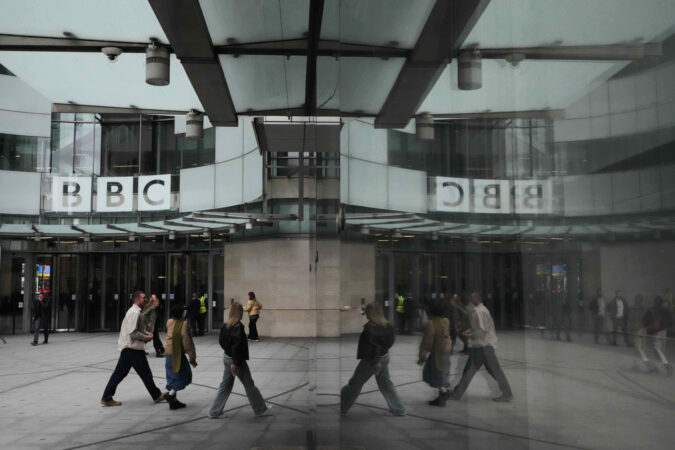
LONDON — President Donald Trump is suing the BBC for $10 billion over a television documentary he claims was “false, defamatory, deceptive, disparaging, inflammatory, and malicious.”
Britain’s national broadcaster has apologized to Trump over the way it edited a speech in the program, but says it will defend itself against the defamation claim.
The BBC is not the first media organization on the receiving end of a lawsuit from the president. But its position is complicated by its status as a taxpayer-funded public broadcaster and its stature as a closely scrutinized national institution.
A pioneering broadcaster
The BBC was founded in 1922 as a radio service to “inform, educate and entertain,” a mantra still central to its self-image.
It launched the world’s first regularly scheduled television service in 1936, and helped make TV a mass medium when many Britons bought a TV set specifically to watch the 1953 coronation of Queen Elizabeth II.
It operates 15 U.K. national and regional TV channels, several international channels, 10 national radio stations, dozens of local radio stations, the globe-spanning World Service radio and copious digital output including the iPlayer streaming service.
As well as its news output it has a huge global viewership for entertainment shows including “Doctor Who,” “EastEnders,” “The Traitors” and “Strictly Come Dancing.”
The BBC is funded from the public purse
The broadcaster is funded by an annual license fee, currently set at 174.50 pounds ($230), paid by all U.K. households who watch live TV or any BBC content.
The license fee has long had opponents, not least rival commercial broadcasters, and they have grown louder in an era of digital streaming when many people no longer have television sets or follow traditional TV schedules.
The BBC’s governing charter, which sets the license fee, is reviewed once a decade, and the latest round of the process kicked off Tuesday. The center-left Labour government says it will ensure the BBC has “sustainable and fair” funding but has not ruled out replacing the license fee with another funding model.
Managing the broadcaster has become a political football
The broadcaster is bound by the terms of its charter to be impartial in its output. It is not a state broadcaster beholden to the U.K government, but is overseen by a board that includes both BBC staff and political appointees.
It’s frequently a political football, with conservatives seeing a leftist slant in its news programs and some liberals accusing it of having a conservative bias.
It has repeatedly battled British governments over editorial independence, from the 1926 general strike, when Cabinet minister Winston Churchill tried to seize control of the airwaves, to a battle with Tony Blair’s administration over the intelligence used to justify the 2003 invasion of Iraq.
Recently it has been criticized for its coverage of trans issues and the Israel-Hamas war in Gaza. In February, the BBC removed a documentary about Gaza from its streaming service after it emerged that the child narrator was the son of an official in the Hamas-led government.
Documentary that riled Trump
The lawsuit stems from an edition of the BBC’s “Panorama” current affairs series titled “Trump: A Second Chance?” that was broadcast days before the 2024 U.S. presidential election. The film, made by a third-party production company, spliced together two sections of a speech given by Trump on Jan. 6, 2021, into what appeared to be one quote in which Trump urged supporters to march with him and “fight like hell.”
By doing so, it made it look like Trump was giving the green light to his supporters to storm the U.S. Capitol as Congress was poised to certify President-elect Joe Biden’s victory in the 2020 election that Trump falsely alleged was stolen from him.
Trump’s lawyers say the program falsely portrayed the president as a “violent insurrectionist,” caused “massive economic damage to his brand value” and was a “brazen attempt” to interfere in the U.S. election.
The lawsuit, filed in a Florida court, seeks $5 billion in damages for defamation and $5 billion for unfair trade practices.
Legal jeopardy
The BBC said in a statement that “we will be defending this case. We are not going to make further comment on ongoing legal proceedings.”
Media attorney Mark Stephens said Trump and his lawyers face several hurdles. They must prove that the BBC program was shown in Florida and that people in that state thought less of him as a consequence. Trump’s lawyers argue that U.S. subscribers to BritBox and people using virtual private networks could have watched it, but they must prove it definitively, said Stephens, a consultant at the firm Howard Kennedy.
“Allegations of libel are cheap, but proof is dear,’’ Stephens said.
Stephens said Trump’s lawyers also have to deal with the fact that public figures have “to put up with the slings and arrows of incorrect reporting,’’ which are protected under the First Amendment.
While many legal experts have dismissed the president’s claims against the media as having little merit, he has won some lucrative settlements against U.S. media companies and he could try to leverage the BBC mistake for a payout, potentially to a charity of his choice.
The BBC’s position is complicated by the fact that any money it pays out in legal fees or a settlement comes from British taxpayers’ pocket.
“I think President Trump is banking on the fact that the British public will not want to spend the money to defend the claim, nor will they want to pay any money in damages to him,’’ Stephens said. “So it allows him to continue a narrative of fake news and all of those other things at fairly little cost in the global scheme of things.”
MONTREAL ― It’s been 280 days since Flyers fans have had a look at Rasmus Ristolainen in a game sweater.
It’s been more than 10 weeks since Flyers general manager Danny Brière said the defenseman would miss the first six to eight weeks of the season while recovering from triceps tendon surgery.
It’s been exactly six weeks since Brière said, “We’re hoping next month, in about a four-to-six week range, hopefully he’s back with the team.” And it’s been eight days since Ristolainen has been a full participant in practice.
Now on Tuesday, the big blueliner will finally suit up and make his season debut.
“He’s a big defenseman who can skate — they’re hard to find — [and a] great shot,” coach Rick Tocchet said after morning skate at the Bell Centre. “Just from talking to people last year, he had played well for [the Flyers] before the injury. So yeah, we’re excited.”
The 31-year-old Finn will skate alongside Nick Seeler on the third pairing against the Montreal Canadiens (7 p.m., NBCSP). According to Natural Stat Trick, since the start of the 2022-23 season, they have played 537 minutes, 37 seconds together at five-on-five.
Although the Flyers have a 46.82% Corsi For percentage with them manning the blue line, the team has outscored opponents (28-24) and generated more high-danger chances (101-82).
“We’ll see if this works. I don’t know,” said Tocchet. “They both have the [same] qualities. They’re both tough. They can stop cycles. Risto’s got a great shot. Two big guys back there; it’s tough to get to the net.”
Since being acquired from the Buffalo Sabres in July 2021, Ristolainen ranks fourth in hits — first among defensemen —on the Flyers with 545 in 234 games. Seeler is right behind him with 516 in 299 games.
“Obviously, we know Risto and how he plays. His physicality, his first touches on the puck,” said Seeler, who likes the predictability of Ristolainen’s game.
“We’re both obviously a little bit more defensive. I think that’s totally fine. I think we feed off each other,” he added. “We want to be able to shut plays down when it’s there and be above and hopefully kill a lot of plays. So that’s kind of what we’re going to hopefully do tonight, and just get some chemistry back.”
Flyers defenseman Rasmus Ristolainen is one of the team’s most physical defensemen.
The addition of Ristolainen helps to solidify the defensive corps with Cam York and Travis Sanheim as the top pair and Jamie Drysdale and Emil Andrae back together.
Drysdale and Andrae were separated during the second period of Sunday’s shootout loss to the Carolina Hurricanes, but Tocchet isn’t giving up on the duo.
“I thought they’ve been good together. I thought Emil, in the last few games, has struggled a little bit. And that’s going to happen. He’s getting some full-time minutes, he’s been playing a lot, and sometimes you hit the wall,” Tocchet said.
“Thought [breaking them up] really worked for us, too, when we did. It was a good in-game adjustment. But that doesn’t mean you stay with it; you go back to it and give the guy a chance again.”
For now, it doesn’t look like Ristolainen will be on a power-play unit, although the bench boss has hinted in the past week that he wouldn’t mind seeing the 6-foot-4, 208-pound defensman with a booming shot on the point.
But baby steps for the Finn as he gets his legs under him in his first game since March 11 after undergoing surgery on a right triceps tendon rupture 15 days later. It followed a pair of procedures in 2024, which also repaired a ruptured triceps tendon. Brière said in April 2025 that the injury was similar, although he wouldn’t confirm whether he suffered a torn tendon again.
“I talked to Todd about this,” said Tocchet, noting his conversation with assistant coach Todd Reirden, who is in charge of the defense.
“You’ve got to target — is it 15, 16, 17 minutes? I mean, I’m not sure it’s smart to play him 23 minutes, that kind of minutes, but that’s the target range you’re looking for.
“But, you know, [once] the game gets going, who knows? He’s been out nine months. I’m not sure [to] red line it the first game is the smartest thing.”
Breakaways
Dan Vladař (11-5-3, .908 SV%) will start in goal. He was in goal for the Flyers’ 5-4 shootout win in Montreal in early November. … Forward Nic Deslauriers, who hails from nearby LaSalle, Quebec, will return to the lineup after being a healthy scratch for four games and play on the fourth line. Nikita Grebenkin will draw out for the first time since Nov. 24. … Forward Carl Grundström has been moved up from the fourth line to play alongside Sean Couturier and Owen Tippett. Matvei Michkov is now alongside Noah Cates and Bobby Brink.
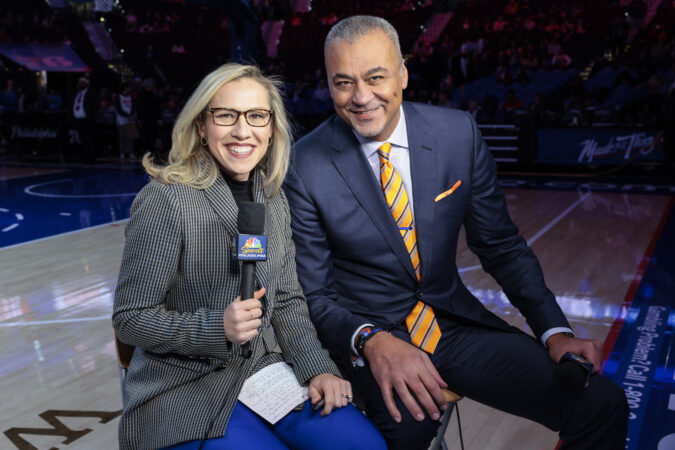
Controversy from the Sixers’ loss Sunday night lingered into Tuesday thanks to a salty message from NBA officials calling out NBC Sports Philadelphia’s Alaa Abdelnaby.
With less than two seconds left and the Atlanta Hawks clinging to a one-point lead, Nickeil Alexander-Walker inbounded a pass in the frontcourt and dribbled it into the backcourt before being fouled by 76ers rookie VJ Edgecombe.
Clearly a backcourt violation and Sixers ball with a chance to win the game, right? Abdelnaby certainly thought so.
“His foot’s in the frontcourt! The ball’s in the frontcourt!” Abdelnaby said during NBC Sports Philadelphia’s telecast.
Can someone explain to me how this was NOT called a backcourt violation by the Hawks?
The officials didn’t see it that way, despite protests from Joel Embiid and Sixers coach Nick Nurse. Their explanation for the no-call after the game was that Alexander-Walker’s “momentum” carried him into the backcourt, which “is legal in the last two minutes of the fourth quarter and overtime.”
Former NBA referee turned ESPN analyst Steve Javie, a Philly native and Temple grad, heard complaints about the no-call from a Sixers fan during a Christmas party Monday night. But after watching the video, Javie thinks the refs made the correct call that Alexander-Walker didn’t establish himself in the frontcourt.
“That’s an easy one. I don’t even think it’s that controversial,” Javie told The Inquirer. “That’s not the one you want to go up the mountain on.”
So instead of it being Sixers ball trailing by just one point, Alexander-Walker made both of his foul shots and increased the Hawks’ lead to three. Quentin Grimes got up a decent shot that would have tied the score as time expired, but it bounced in and out, and the Hawks walked away with the win.
That’s when things got interesting.
On Monday, the National Basketball Referees Association criticized Abdelnaby on social media and defended the officials’ no-call during Sunday’s game.
“For those calling the game, there is a responsibility to know the NBA rules and explain them correctly in order to properly educate the fans,” the association wrote, tagging Abdelnaby’s X account.
This was not a backcourt violation and has never been a backcourt violation.
For those calling the game, there is a responsibility to know the NBA rules and explain them correctly in order to properly educate the fans @alaatweets
The referees’ official X account, with more than 136,000 followers, hasn’t been historically combative and had not called out a single announcer by name this season before going after Abdelnaby.
Why now? That remains unclear. The National Basketball Referees Association did not respond to a request for comment.
“As a ref, you hear so much stuff [from announcers] year after year, game after game, you get kind of frustrated. Like, ‘Dude, this is not the right rule you’re talking about,’” Javie said, especially from hometown announcers openly rooting for their teams. “This is why they’re frustrated and gave him a shot, probably.”
Abdelnaby, a former Duke standout and NBA player in his 10th season calling Sixers games, isn’t afraid to offer strong opinions about the officials during broadcasts. He did so multiple times Sunday night, including after the game from the concourse of State Farm Arena in Atlanta, where he and play-by-play announcer Kate Scott called the game.
“Sometimes you’re told as a player on the road, you have to beat eight instead of just five,” Abdelnaby said, referring to the three officials on the court. “I thought the Sixers got a little shortchanged tonight.”
Abdelnaby declined to comment about the NBA referees’ social media post, but he wasn’t alone in thinking the officials missed a backcourt violation.
“It was a complete blunder by the referees tonight,” NBA Sports Philadelphia studio analyst and former NBA player Marc Jackson said following the game.
What do the NBA rules say?
When in doubt, go to the rule book, where there appear to be two sections invoked Sunday night.
First, the NBA rule book clearly states that the ball “shall be awarded to the opposing team” if a ball in the frontcourt or at the midcourt line passes into the backcourt.
But there is one exception:
And here’s what the rule book says about determining the frontcourt or backcourt status of a player on a throw-in:
The rule basically says a player’s position isn’t determined until he has established a “positive position” on an inbounds pass, as long as it’s under two minutes in the fourth period or in overtime.
So what does “positive position” mean? According to Javie, it basically equates to possession and stopping with the basketball.
“If [Alexander-Walker’s] momentum had stopped from going to the backcourt, and then he took a step into the backcourt, that would then be deemed a backcourt violation,” Javie said. “He didn’t establish position anywhere, really.”
“I thought it was going to be less obvious than that,” Javie added, based on the complaints over the no call.
Fans will certainly have a lot of time to debate the rules, since the Sixers won’t take the court again until Friday night against the New York Knicks at Madison Square Garden on Amazon’s Prime Video.
The county will run 16 propane Chesco Connect buses by February, with seven already on the roads. The majority of the 74-bus Chesco Connect fleet, a door-to-door shared ride transportation system that covers the county, is gasoline-fueled, but the county plans on adding more propane buses in 2027, said Gene Suski, director of transportation for the Chester County Department of Community Transit.
Propane is a cleaner fuel source than gasoline or diesel, and costs$1 to $1.50 less than gasoline per gallon.
“On any given day, our buses go anywhere between 150 and 250 miles a day, so when you can save that kind of money per gallon, it’s a significant factor,” Suski said.
A propane bus costs roughly $33,000 more than a gas bus, but with $20,000 saved in fuel costs annually, “it pays for itself” in 18 months, a county spokesperson said. The buses being replaced were “well past their useful life.”
Chester County’s new propane buses follow similar moves made by neighboring Montgomery and Lancaster Counties, which in recent years have embraced propane for part of their fleets. School districts across the state have also used the model, with more than a thousand propane school buses on the streets through the state, said Tony Bandiero, executive director of Eastern Pennsylvania Alliance for Clean Transportation, an organization that works with 34 counties to encourage alternate fuels.
It’s a relatively easy–and cheap–change for municipalities to make, Bandiero said.
“There’s a little bit of upfront cost, but usually that could be recuperated within a year just by fuel saving, cost savings, and maintenance on the vehicles,” he said.
Propane buses “hit a niche” about seven years ago, Bandiero said. Under President Joe Biden’s administration, his organization saw a ton of interest in electric projects. But that shifted with President Donald Trump’s return to office and the president slashing electric goals. Bandiero expects to see more projects focused on propane and natural gas in response.
In Chester County, the buses are part of the county’s climate action plan, approved by the commissioners in 2021. The county worked with ROUSH CleanTech, which has developed propane buses, vans, and pick up trucks since 2010.
The county was drawn to propane buses for the environmental benefits, and operating more efficiently, said David Byerman, the county’s chief executive officer.
“We believe that we have a duty as a county to be good environmental stewards, and this initiative is a way for us to demonstrate that leadership, and we’re very much looking forward to continuing to realize the goals we laid out in our climate action plan, and continuing to provide a model for sustainability for southeastern Pennsylvania,” he said.
Despite a recent state of emergency over propane woes in neighboring New Jersey, Suski said the county hasn’t had issue with fueling the current supply of buses. A tanker arrives each morning to fuel the buses. But in the next three to six months, the county plans to build its own propane fueling station in Coatesville to directly fuel its fleet.
This suburban content is produced with support from the Leslie Miller and Richard Worley Foundation and The Lenfest Institute for Journalism. Editorial content is created independently of the project donors. Gifts to support The Inquirer’s high-impact journalism can be made at inquirer.com/donate. A list of Lenfest Institute donors can be found at lenfestinstitute.org/supporters.
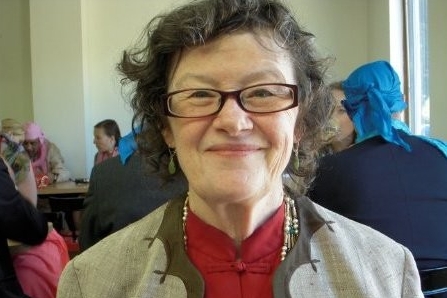
Roberta Fallon, 76, of Bala Cynwyd, cofounder, editor, and longtime executive director of theartblog.org, prolific freelance writer for The Inquirer, Daily News, and other publications, adjunct professor at St. Joseph’s University, artist, sculptor, mentor, and volunteer, died Friday, Dec. 5, at Thomas Jefferson University Hospital of injuries she suffered after being hit by a car on Nov. 24.
Ms. Fallon’s husband, Steven Kimbrough, said the crash remains under investigation by the police.
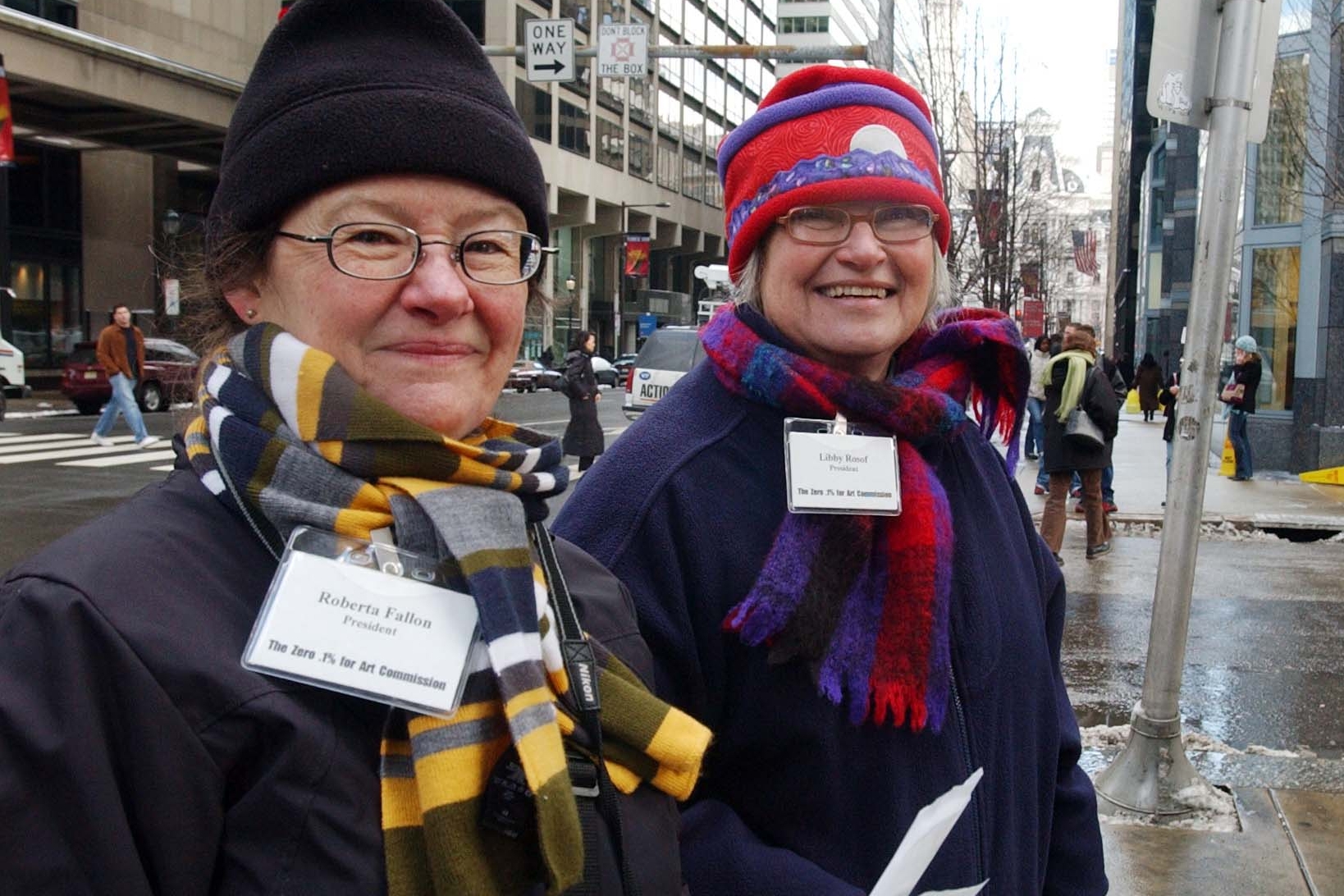
Described by family and friends as empathetic, energetic, and creative, Ms. Fallon and fellow artist Libby Rosof cofounded the online Artblog in 2003. For nearly 22 years, until the blog became inactive in June, Ms. Fallon posted commentary, stories, interviews, reviews, videos, podcasts, and other content that chronicled the eclectic art world in Philadelphia.
The site drew more than 4,500 subscribers and championed galleries and artists of all kinds, especially women, LGBTQ and student artists, and other underrepresented innovators. “I think we have touched base with every major arts organization in Philadelphia at one point or another, and many of the smaller ones,” Ms. Fallon told The Inquirer in May. “We became part of the arts economy.”
She earned grants from the Knight Foundation and other groups to fund her work. She organized artist workshops and guided tours of local studios she called art safaris.
For years, she and Rosof raised art awareness in Center City by handing out miniatures of their artwork to startled passersby. She said in a 2005 Inquirer story: “We think art needs to be for everyone, not just in galleries.”
She mentored other artists and became an expert on the business of art. “She was so generous and curious about people,” Rosof said. “She was innovative and changed the way art reached people.”
Artist Rebecca Rutstein said Ms. Fallon’s “dedicated art journalism filled a vacuum in Philadelphia and beyond. Many of us became known entities because of her artist features, and we are forever grateful.” In a 2008 Inquirer story about the city’s art scene, artist Nike Desis said: “Roberta and Libby are the patron saints of the young.”
Ms. Fallon never tired of enjoying art.
Colleague and friend Gilda Kramer said: “The Artblog for her was truly a labor of love.”
In November, Ms. Fallon and other art writers created a website called The Philly Occasional. In her Nov. 12 article, she details some of her favorite shows and galleries in Philadelphia and New York, and starts the final paragraph by saying: “P.S. I can’t let you go without telling you about what I just saw at the Barnes Foundation.”
She worked at a small newspaper in Wisconsin before moving to West Philadelphia from Massachusetts in 1984 and wrote many art reviews and freelance articles for The Inquirer, Daily News, Philadelphia Weekly, Philadelphia Citizen, and other publications. In 2012, she wrote more than a dozen art columns for the Daily News called “Art Attack.”
She met Rosof in the 1980s, and together they curated exhibits around the region and displayed their own sculptures, paintings, and installations. Art critic Edith Newhall reviewed their 2008 show “ID” at Projects Gallery for The Inquirer and called it “one of the liveliest, most entertaining shows I’ve seen at this venue.”
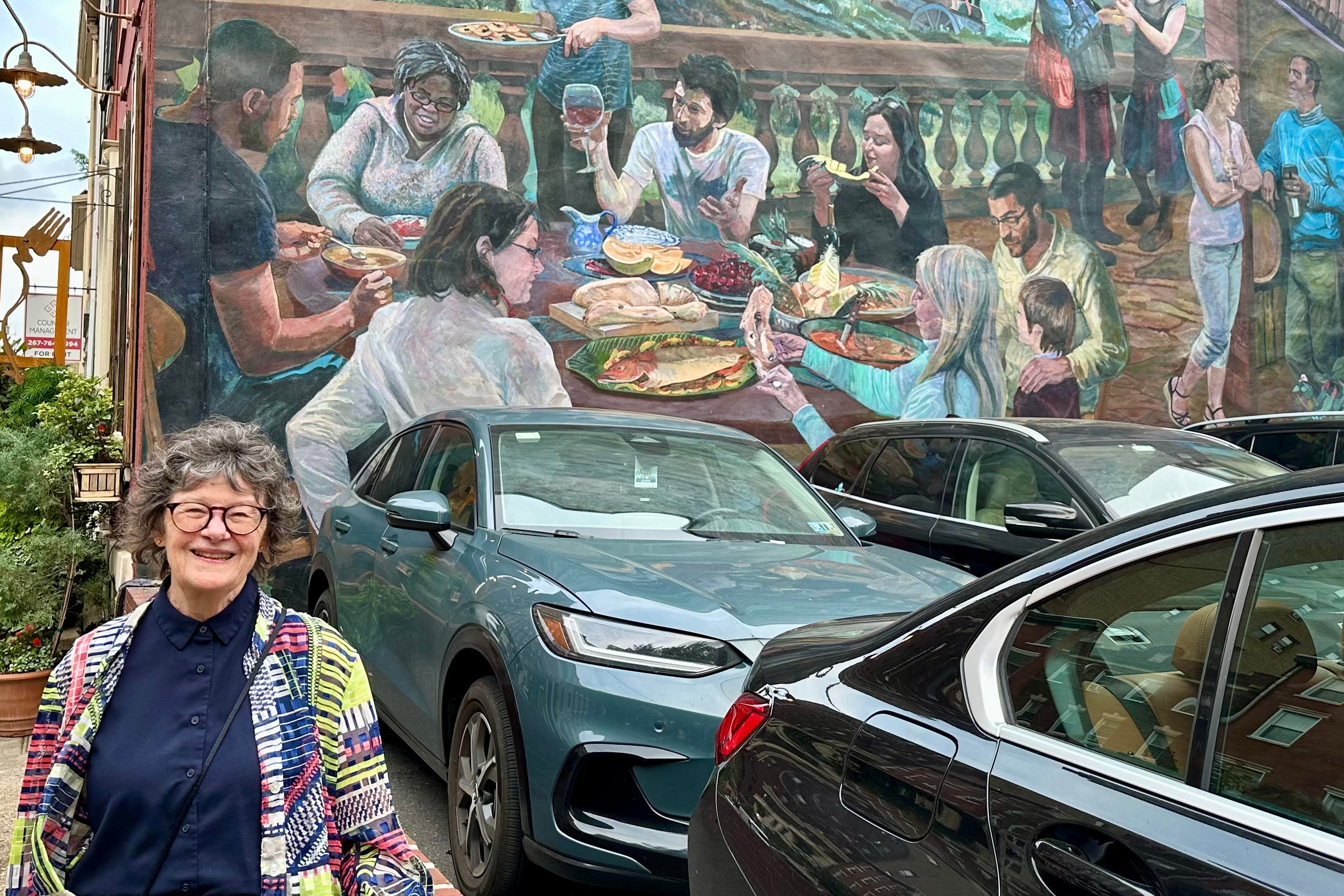
Ms. Fallon stands in front of a mural at 13th and Spruce Streets. She is depicted as the figure profiled in the lower left in the white blouse.
Most often, Ms. Fallon painted objects and sculpted in concrete, wood, metal, textiles, and other material. She was a founding member of the Philadelphia Sculptors and Bala Avenue of the Arts.
She studied at the Pennsylvania Academy of the Fine Arts and Temple University’s Tyler School of Art and Architecture, and later taught professional practice art classes at St. Joseph’s. Moore College of Art and Design, which will archive Artblog, awarded her an honorary doctorate.
“Roberta was an exceptional creative artist” and “a force,” artist Marjorie Grigonis said on LinkedIn. Artist Matthew Rose said: “Robbie was a North Star for many people.”
Her husband said: “Her approach to life was giving. She succeeded by adding value to wherever she was.”
Ms. Fallon (second from right) enjoyed time with her family.
Roberta Ellen Fallon was born Feb. 8, 1949, in Milwaukee. She went to the University of Wisconsin-Madison to study sociology after high school and dropped out to explore Europe and take art classes in Paris. She returned to college, changed her major to English, and earned a bachelor’s degree in 1974.
She met Steven Kimbrough in Wisconsin, and they married in 1980, and had daughters Oona and Stella, and a son, Max. They lived in West Philadelphia for six years before settling in Bala Cynwyd in 1993.
Ms. Fallon was a neighborhood political volunteer. She enjoyed movies and reading, and she and her husband traveled often to museums and art shows in New York and elsewhere.
They had a chance to relocate to Michigan a few years ago, her husband said. But she preferred Philadelphia for its art and culture. “She was like a local celebrity in the art scene,” her daughter Stella said.
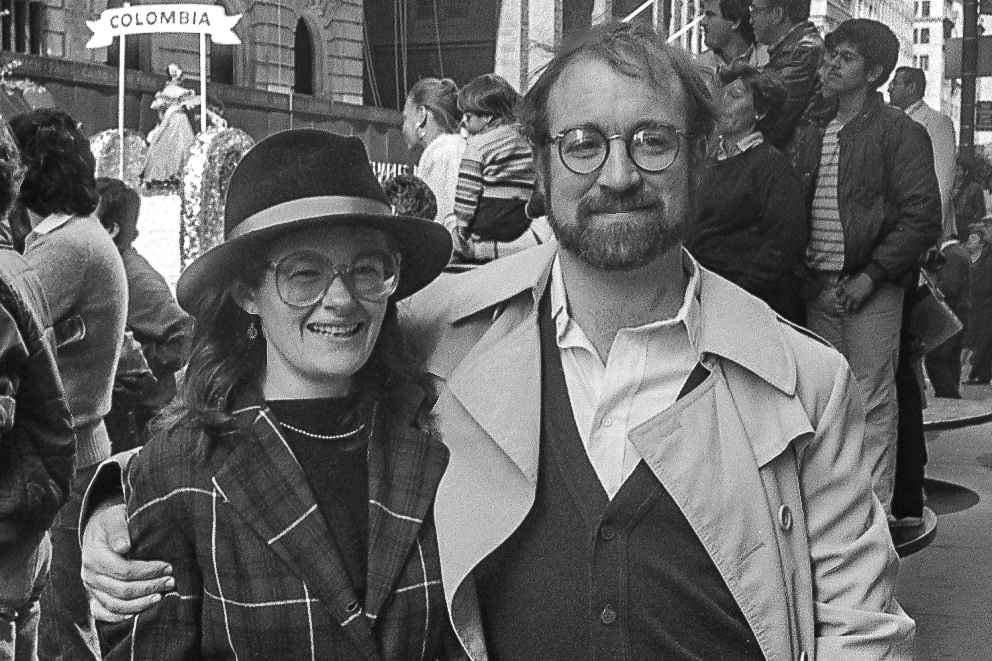
Ms. Fallon and her husband, Steven Kimbrough, visited New York in 1982.
Her husband said: “Everybody likes her. Everybody wants to be around her. She made a difference for a lot of people.”
Her daughter Stella said: “The world would be a better place if we all tried to be like my mom.”
In addition to her husband and children, Ms. Fallon is survived by four grandchildren, a sister, a brother, and other relatives.
Sometimes a terrible year can end with a moment of uplift. This actually happened in the last days of 1968, when Apollo 8 took the first humans in orbit around the moon and sent wonder back to a planet struggling with assassinations and riots. Alas, 2025 seems not such a year. A world already reeling from two mass shootings half a world apart learned Sunday night that Hollywood icon Rob Reiner and his wife Michele had been murdered in their home, allegedly by their own son. Boomers like me saw our own journey in that of Reiner — playing a young campus liberal, then taking down the pomposity of classic rock before both an unprecedented streak of classic movies and unparalleled social and political activism. He had more to give, and leaves a void that can’t truly be filled.
Americans fear AI and loathe its billionaires. Why do both parties suck up to them?
Time’s 2025 person of the year are the architects of AI, depicted in this painting by Jason Seiler. The painting, with nods to the iconic 1932 “Lunch atop a Skyscraper” photograph, depicts tech leaders Mark Zuckerberg, Lisa Su, Elon Musk, Jensen Huang, Sam Altman, Demis Hassabis, Dario Amodei, and Fei-Fei Li.
“This is the West, sir. When the facts become legend, print the legend.” — journalist in the 1962 film, The Man Who Shot Liberty Valance
The top editors at Time (yes, it still exists) looked west to Silicon Valley and decided to print the legend last week when picking their Person of the Year for the tumultuous 12 months of 2025. It seemed all too fitting that its cover hailing “The Architects of AI” was the kind of artistic rip-off that’s a hallmark of artificial intelligence: 1932’s iconic newspaper shot, “Lunch Atop a Skyscraper,” “reimagined” with the billionaires — including Elon Musk and OpenAI’s Sam Altman — and lesser-known engineers behind the rapid growth of their technology in everyday life.
Time’s writers strived to outdo the hype of AI itself, writing that these architects of artificial intelligence “reoriented government policy, altered geopolitical rivalries, and brought robots into homes. AI emerged as arguably the most consequential tool in great-power competition since the advent of nuclear weapons.”
OK, but it’s a tool that’s clearly going to need a lot more work, or architecting, or whatever it is those folks out on the beam do. That was apparent on the same day as Time’s celebration when it was reported that Washington Post editors got a little too close to the edge when they decided they were ready to roll out an ambitious scheme for personalized, AI-driven podcasts based on factors like your personal interests or your schedule.
The news site Semafor reported that the many gaffes ranged from minor mistakes in pronunciation to major goofs like inventing quotes — the kind of thing that would get a human journalist fired on the spot. “Never would I have imagined that the Washington Post would deliberately warp its own journalism and then push these errors out to our audience at scale,” a dismayed, unnamed editor reported.
The same-day contrast between the Tomorrowland swooning over the promise of AI and its glitchy, real-world reality felt like a metaphor for an invention that, as Time wasn’t wrong in reporting, is so rapidly reshaping our world. Warts and all.
Like it or not.
And for most people (myself included), it’s mostly “or not.” The vast majority understands that it’s too late to put this 21st-century genie back in the bottle, and like any new technology there are going to be positives from AI, from performing mundane organizing tasks that free up time for actual work, to researching cures for diseases.
The most recent major Pew Research Center survey of Americans found that 50% of us are more concerned than excited about the growing presence of AI, while only 10% are more excited than concerned. Drill down and you’ll see that a majority believes AI will worsen humans’ ability to think creatively, and, by a whopping 50-to-5% percent margin, also believes it will worsen our ability to form relationships rather than improve it. These, by the way, are two things that weren’t going well before AI.
So naturally our political leaders are racing to see who can place the tightest curbs on artificial intelligence and thus carry out the will of the peop…ha, you did know this time that I was kidding, didn’t you?
It’s no secret that Donald Trump and his regime were in the tank from Day One for those folks out on Time’s steel beam, and not just Musk, who — and this feels like it was seven years ago — donated a whopping $144 million to the Republican’s 2024 campaign. Just last week, the president signed an executive order aiming to press the full weight of the federal government, including Justice Department lawsuits and regulatory actions, against any state that dares to regulate AI. He said that’s necessary to ensure U.S. “global AI dominance.”
This is a problem when his constituents clearly want AI to be regulated. But it’s just as big a problem — perhaps bigger — that the opposition party isn’t offering much opposition. Democrats seem just as awed by the billionaire grand poobahs of AI as Trump. Or the editors of Time.
Also last week, New York Democratic Gov. Kathy Hochul — leader of the second-largest blue state, and seeking reelection in 2026 — used her gubernatorial pen to gut the more-stringent AI regulations that were sent to her desk by state lawmakers. Watchdogs said Hochul replaced the hardest-hitting rules with language drafted by lobbyists for Big Tech.
As the American Prospect noted, Hochul’s pro-Silicon Valley maneuvers came after her campaign coffers were boosted by fundraisers held by venture capitalist Ron Conway, who has been seeking a veto, and the industry group Tech:NYC, which wants the bill watered down.
It was a similar story in the biggest blue state, California, where Gov. Gavin Newsom in 2024 vetoed the first effort by state lawmakers to impose tough regulations on AI, and where a second measure did pass but only after substantial input from lobbyists for OpenAI and other tech firms. Silicon Valley billionaires raised $5 million to help Newsom — a 2028 White House front-runner — beat back a 2021 recall.
Like other top Democrats, Pennsylvania Gov. Josh Shapiro favors some light regulation for AI but is generally a booster, insisting the new technology is a “job enhancer, not a job replacer.” He’s all-in on the Keystone State building massive data centers, despite their tendency to drive up electric bills and their unpopularity in the communities where they are proposed.
Money talks, democracy walks — an appalling fact of life in 2025 America. In a functioning democracy, we would have at least one political party that would fly the banner of the 53% of us who are wary of unchecked AI, and even take that idea to the next level.
A Harris Poll found that, for the first time, a majority of Americans also see billionaires — many of them fueled by the AI bubble — as a threat to democracy, with 71% supporting a wealth tax. Yet few of the Democrats hoping to retake Congress in 2027 are advocating such a levy. This is a dangerous disconnect.
Time magazine got one thing right. Just as its editors understood in 1938 that Adolf Hitler was its Man of the Year because he’d influenced the world more than anyone else, albeit for evil, history will likely look back at 2025 and agree that AI posed an even bigger threat to humanity than Trump’s brand of fascism. The fight to save the American Experiment must be fought on both fronts.
Yo, do this!
I haven’t tackled much new culture this month because I’ve been doing something I so rarely do anymore: Watching a scripted series from start to finish. That would be Apple TV’s Pluribus, the new sci-fi-but-more-than-sci-fi drama from television genius Vince Gilligan. True, one has to look past some logistical flaws in its dystopia-of-global-happiness premise, but the core narrative about the fight for individualism is truly a story of our time. The last two episodes come out on Dec. 19 and Dec. 26, so there’s time to catch up!
The shock and sorrow of Rob Reiner’s murder at age 78 has, not surprisingly, sparked a surge of interest in his remarkable, and remarkably diverse, canon of classic movies. His much-awaited sequel Spinal Tap II: The End Continuesbegan streaming on HBO Max just two days before his death. Check it out, or just re-watch the 1984 original, which is one of the funniest flicks ever made, and which is also streaming on HBO Max and can be rented on other popular sites. Crank it up to 11.
Ask me anything
Question: What news value, not advertising value, is accomplished by publicizing every one of Trump’s insane rantings daily? — @bizbodeity.bsky.social via Bluesky
Answer: This is a great question, and the most recent and blatant example which I assume inspired it — Trump’s stunningly heartless online attack against a critic, Hollywood icon Rob Reiner, just hours after his violent murder — proves why this is a painful dilemma for journalists. I’d argue that Trump’s hateful and pathologically narcissistic post was a deliberate troll for media attention, to make every national moment about him. In a perfect world, it would indeed be ignored. But it was highly newsworthy that his Truth Social post was so offensive that it drew unusual criticism from Republicans, Evangelicals, and other normal supporters. We may remember this is as a political turning point. Trump’s outbursts demand sensitivity, but that Americans elected such a grotesque man as our president can’t easily be ignored.
What you’re saying about…
It’s been two weeks since I asked about Donald Trump’s health, but the questions have not gone away. There was not a robust response from readers — probably because I’d posed basically the same question once before. Several of you pointed to expert commentary that suggests the president is experiencing significant cognitive decline, perhaps suffering from frontotemporal dementia. Roberta Jacobs Meadway spoke for many when she lambasted “the refusal if not the utter failure of the once-major news outlets to ask the questions and push for answers.”
📮 This week’s question: We are going to try an open-ended one to wrap up 2025: What is your big prediction for 2026 — could be anything from elections to impeachment to the Eagles repeating as Super Bowl champs — and why. Please email me your answer and put the exact phrase “2026 prediction” in the subject line.
Backstory on how I covered an unforgettable year
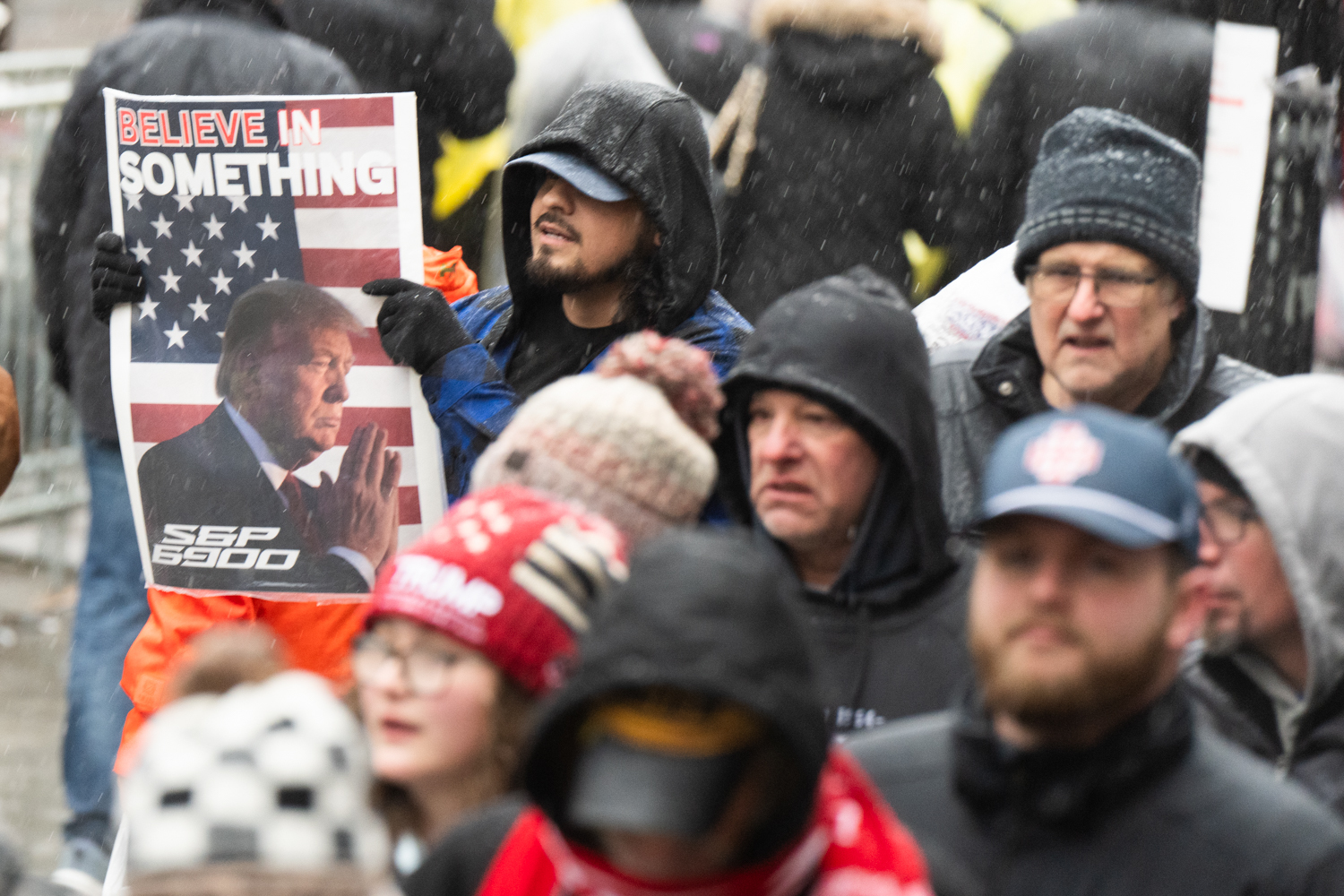
Rick Gomez, who travelled 65 hours by bus from Phoenix, Ariz., holds an AI photo composite poster of Donald Trump, in Washington, the day before Trump took the Oath of Office to become the 47th president of the United States.
Barring the outbreak of World War III — something you always need to say these days — this is my final newsletter, or column, of 2025, as I use up my old-man plethora of vacation days. To look back on America’s annus horribilis, I thought I’d revive a feature from my Attytood blogging days: a recap of the year with the five most memorable columns, not numbered in order of significance. Here goes:
A year that many of us dreaded when the votes were counted in November 2024 began for me with a sad reminder that the personal still trumps the political, when my 88-year-old father fell ill in the dead of winter and passed away on March 11. I wrote about his life, but also what his passion for science and knowledge said about a world that, at the end of his life, was slipping away: Bryan H. Bunch (1936-2025) and the vanishing American century of knowledge.
Still, Donald J. Trump could not be ignored. On Jan. 19, I put on my most comfortable shoes (it didn’t really help) and traipsed around a snowy, chilly Washington, D.C. as the about-to-be 47th president made his “forgotten American” supporters wait on a soggy, endless line for a nothingburger rally while the architects of AI and other rich donors partied in heated luxury, setting the tone for a year of gross inequality: American oligarchy begins as Trump makes billions while MAGA gets left out in the rain.
One of the year’s biggest stories was Trump’s demonizing of people of color, from calling Somali immigrants “garbage” to his all out war on DEI programs that encouraged racial diversity, when the truth was always far different. In February, I wrote about the American dream of a young man from Brooklyn of Puerto Rican descent and his ambition to become an airline pilot, who perished in the D.C. jet-helicopter crash. His remarkable life demolished the MAGA lie about “DEI pilots.” Read: “Short, remarkable life of D.C. pilot Jonathan Campos so much more than Trump’s hateful words.”
If you grew up during the 1960s and ‘70s, as I did, then you understand the story of our lifetimes as a battle for the individual rights of every American — for people to live their best lives regardless of race or gender, or whether they might be transgender, or on the autism spectrum. I wrote in October about the Trump regime’s consuming drive to reverse this, to make it a crime to be different: From autism to beards, the Trump regime wages war on ‘the different’
A grim year did end on one hopeful note. Trump’s push for an authoritarian America is faltering, thanks in good measure to the gumption of everyday people. This month, I traveled to New Orleans to chronicle the growing and increasingly brave public resistance to federal immigration raids, as citizens blow whistles, form crowds and protest efforts to deport hard-working migrants: In New Orleans and across U.S., anger over ICE raids sparks a 2nd American Revolution
What I wrote on this date in 2021
On this date four years ago, some of us were still treating Donald Trump’s attempted Capitol Hill coup of Jan. 6, 2021 like a crime that could be solved so that the bad guys could be put away. On Dec. 16, 2021, I published my own theory of the case: that Team MAGA’s true goal was provoking a war between its supporters and left-wing counterdemonstrators, as a pretext for sending in troops and stopping Congress from finishing its certification of Joe Biden’s victory. That didn’t happen because the leftists stayed home. More than 1,000 pardons later, check out my grand argument: “A theory: How Trump’s Jan. 6 coup plan worked, how close it came, why it failed.”
Recommended Inquirer reading
Only one column this week, as this senior citizen was still recovering from that grueling trip to New Orleans. On Sunday, I reacted with the shock and sadness of seeing a mass shooting at my alma mater, Brown University. I wrote that in a nation with 500 million guns, it’s a virtual lock that some day our families — nuclear or extended, like the close-knit Brown community — will be struck by senseless violence. And I took sharp issue with Trump’s comment that “all you can do is pray.” There is much that can and should be done about gun safety.
Sometimes the big stories are the ones that play out over decades, not days. When I first started coming regularly to Philadelphia at the end of the 1980s, the dominant vibe was urban decline. The comeback of cities in the 21st century has altered our world, for good — but a lot of us old-timers have wondered: Just who, exactly, is moving into all these new apartments from Center City to Kensington and beyond? Last week, The Inquirer’s ace development reporter Jake Blumgart took a deep dive into exactly that — highlighting survey results that large numbers are under 45, don’t own a car, and moved here from elsewhere, and telling some of their stories. Local journalism is the backbone of a local community, and you are part of something bigger when you subscribe to The Inquirer. Plus, it’s a great Christmas gift, and you’ll get to read all my columns in 2026. See you then!
By submitting your written, visual, and/or audio contributions, you agree to The Inquirer‘s Terms of Use, including the grant of rights in Section 10.
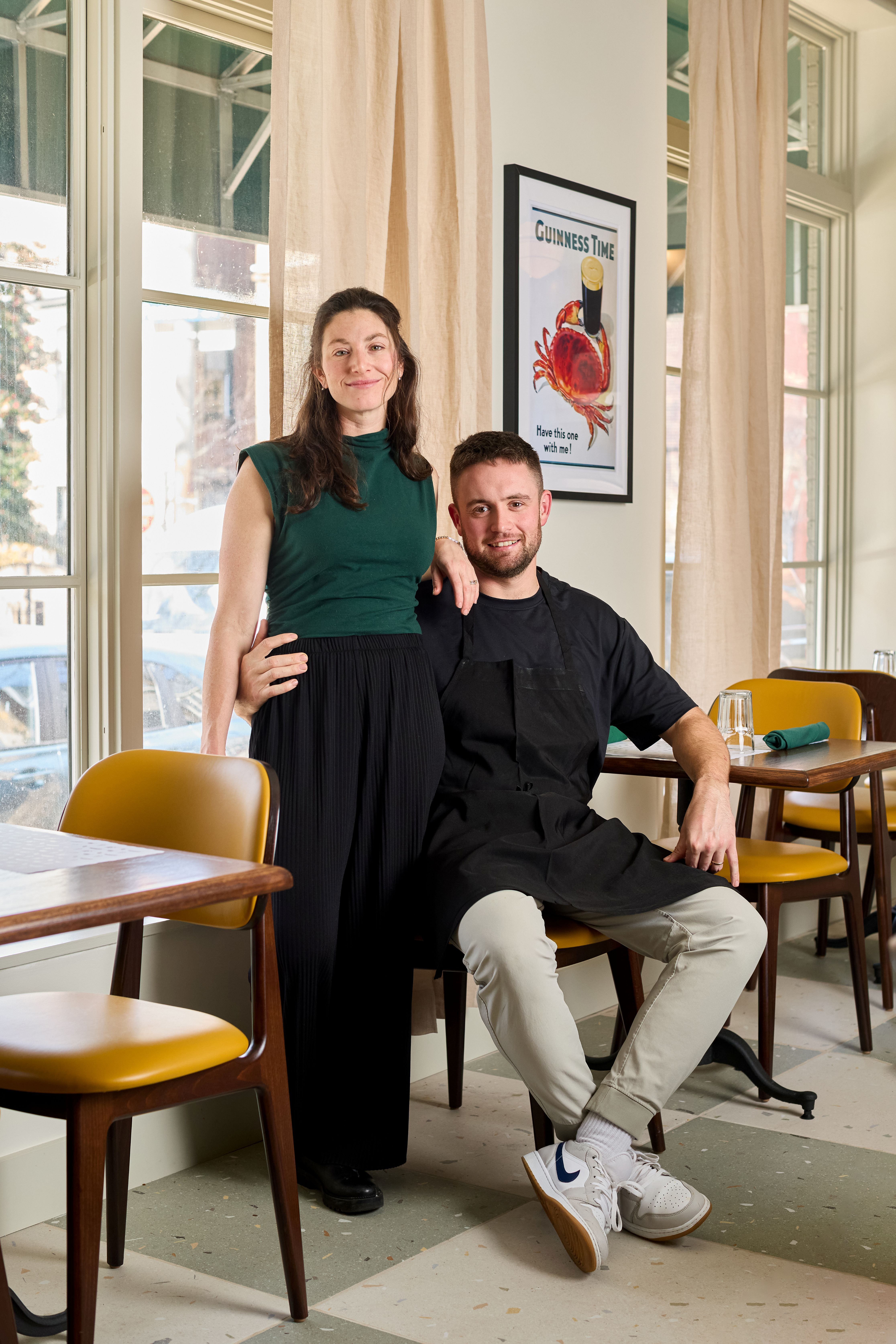
Chefs Amanda Shulman and Alex Kemp have each built distinct destination restaurants — the newly Michelin-recognized Her Place Supper Club and My Loup. This week, they opened one together.
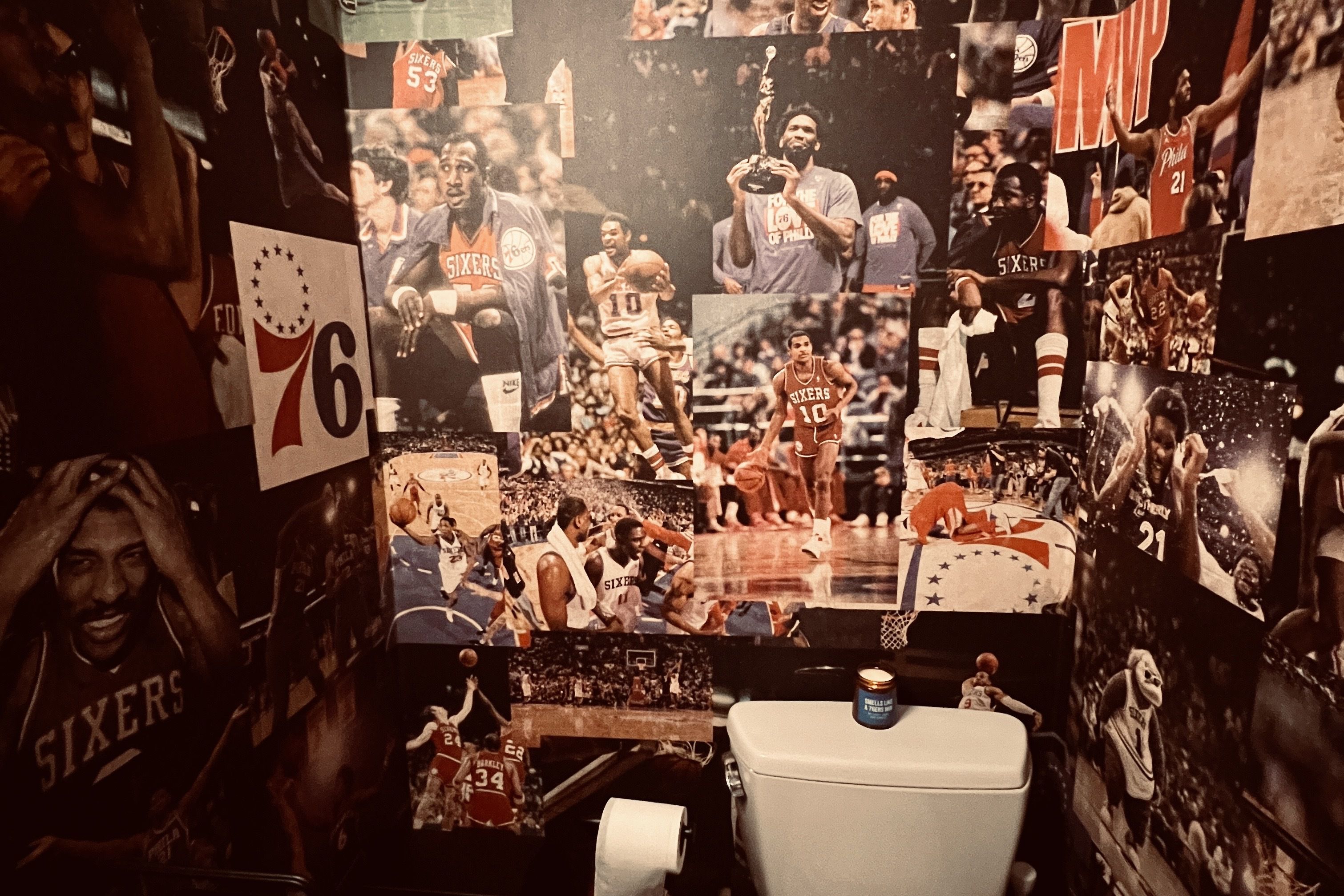
Pine Street Grill, across from Fitler Square at 23rd and Pine Streets, is their take on a neighborhood restaurant. It’s a comfortable, restrained setting with white stamped-metal ceiling, Streamline Moderne-style schoolhouse light fixtures, white walls, and a long bar running through the narrow space. The two single-occupancy restrooms are intentionally contrasting: One is entirely pink, while the other is a tribute to the Sixers, from the photo-collage wallpaper down to the “Smells Like a Sixers Win” candle on the toilet tank and basketball-shaped soap dispenser on the sink. Fitler Square-based contractor Kaman Global built the restaurant, with Philadelphia firm Canno Design consulting.
One restroom at Pine Street Grill has a 76ers theme.
The menu, by Shulman, Kemp, and chef de cuisine Jonathan Rodriguez, is timeless American. For starters, there’s a snack plate of mortadella-stuffed cherry peppers, olives, and spelt crackers ($11); shrimp Louie served in little gem lettuce cups with avocado and pickled onion ($16); wings in brown-butter hot sauce with Stilton blue cheese ($14); and a small soft pretzel with hollandaise mustard ($10). There also are Philly Balls, croquettes filled with roast pork, provolone, broccoli rabe, and spicy relish ($12 for two) that previously appeared on My Loup’s opening menu.
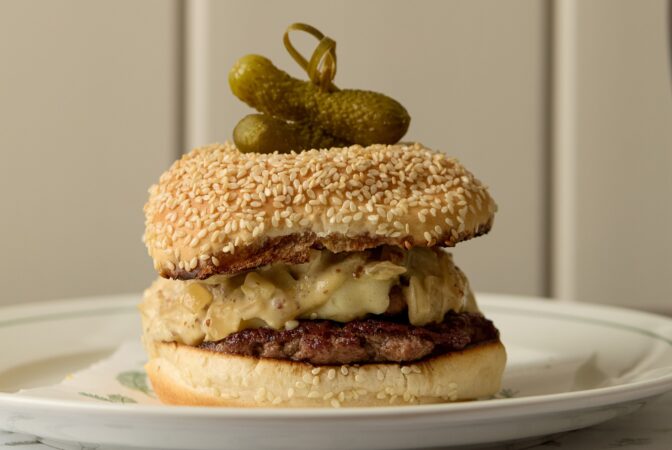
Sandwiches include a turkey club with maple bacon on multigrain ($16) and a signature double dry-aged smashburger with Cooper Sharp and onion condiment on a seeded milk bun ($22).
Pine Street Grill owners Amanda Shulman and Alex Kemp.
There’s a chopped Greek salad with Persian cucumbers, marinated feta, tomato, red onion, and oregano ($15) and a root-vegetable salad with chicories, aged cheddar, cranberries, and praline vinaigrette ($16). Entrées include hanger steak with pot-roast jus ($30); half a rotisserie chicken with gravy ($28); grilled salmon with piccata and spinach ($27); and eggplant Parmesan ($26).
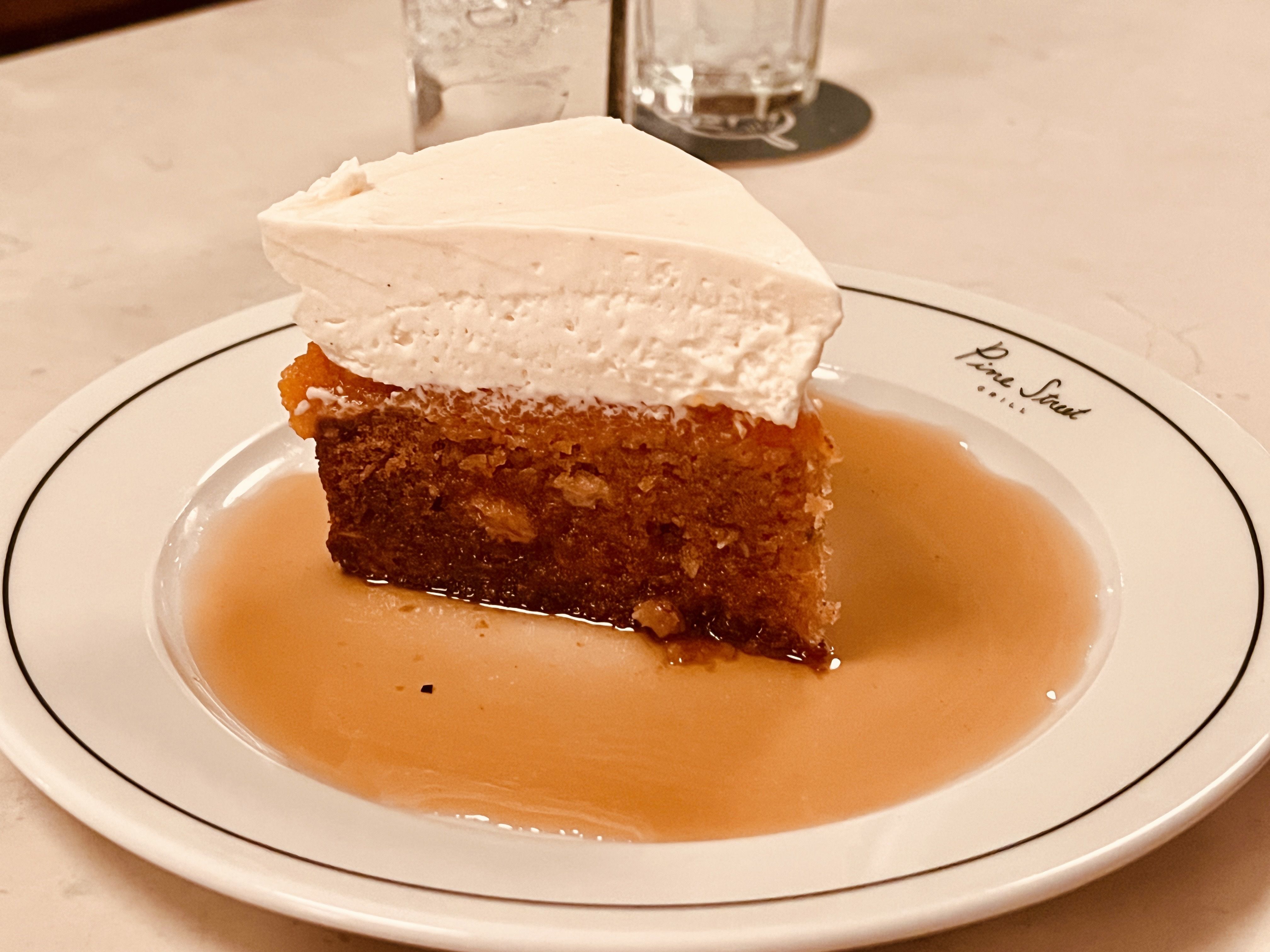
Desserts include a nut-free carrot cake ($13) with rum raisins, carrot jam, and cream-cheese mousse; sourdough chocolate-chip cookie skillet ($12) with vanilla ice cream — the same cookie Shulman serves at Her Place; and a sundae ($14) of malted-milk ice cream with brownie bites, spiced walnuts, hot fudge, and a cherry.
Carrot cake at Pine Street Grill.
There’s even a children’s menu, dubbed Belle’s Bites, after their daughter’s middle name: $10 each for nuggets and fries, grilled cheese, crudités and ranch, and red or white shells.
The late-night special for grown-ups, offered from 9:30 to 10:30 p.m., is any draft beer and the burger.
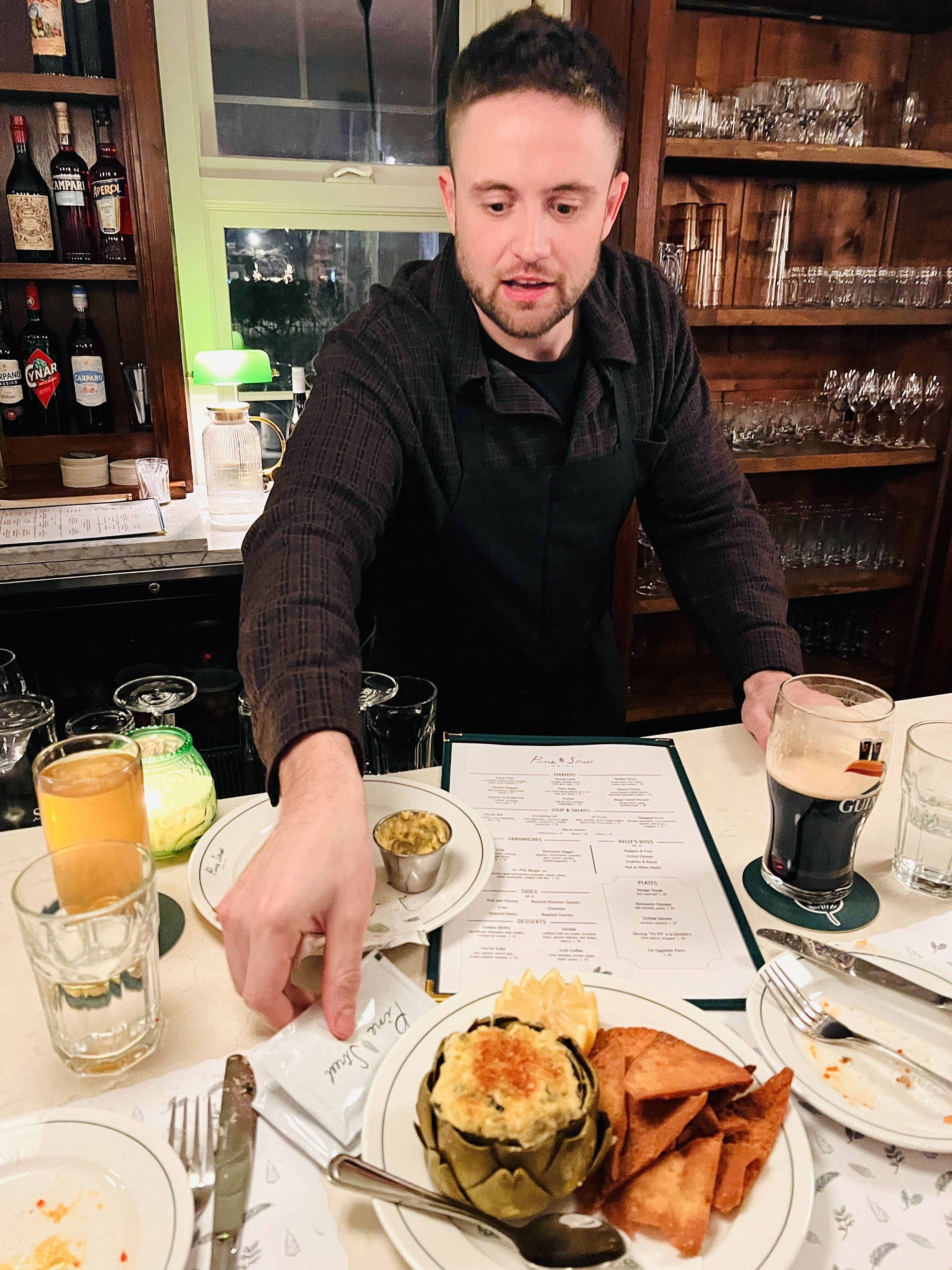
Co-owner Alex Kemp serves an artichoke dip appetizer at Pine Street Grill.
Jillian Moore, bar director of My Loup and bar consultant for the group, developed a cocktail list that includes a freezer martini made with local vermouth, a John Daly cocktail (a boozy Arnold Palmer) on draft, and Irish coffee. There’s Guinness, Strongbow cider, and birch beer on tap.
Nicole Sullivan, Her Place’s beverage director, set up the wine list, which draws inspiration from European tavern culture. General manager Allyson Allen has worked with Shulman and the couple’s Libbie Loup group for several years, including at Her Place and Amourette, their 2024 summer pop-up.
Buffalo wings at Pine Street Grill, 2227 Pine St.
Pine Street Grill’s corner space has had a busy history: It housed Stix, a vegetarian restaurant, from 1997 to 1999; a location of Dmitri’s from 1999 to 2014; a branch of wine bar Tria from 2015 to 2017; and most recently Cotoletta, which closed last year after a five-year run.
Shulman, a Connecticut native and Vetri alumna, burst onto the Philadelphia dining scene in 2021 with Her Place, offering versions of the homespun dinner parties she hosted in her student apartment at Penn. She and Kemp opened My Loup in 2023, three months before their wedding. Shulman has received multiple James Beard Award nominations, including Emerging Chef nominations in 2022 and 2023 and Best Chef Mid-Atlantic in 2025. Kemp, who is Canadian-born, previously worked at Montreal’s Joe Beef and New York’s Eleven Madison Park. The couple met at Momofuku Ko in New York.
Pine Street Grill, 2227 Pine St.,no phone, pinestreetgrill.com. Hours: 4 to 11 p.m. Wednesday to Monday; kitchen closes at 10:30 p.m. Half of the dining room is reservable via OpenTable for parties of up to eight; remaining tables are held for walk-ins. Happy hour: 4 to 6 p.m. weekdays, with a discounted food menu and $2 off draft beverages.
And it was an eventful one for our photographers and videographers who captured images that gave visual life to The Inquirer’s journalism and told stories in ways that transcend words. (For proof, see those racing hot dogs.)
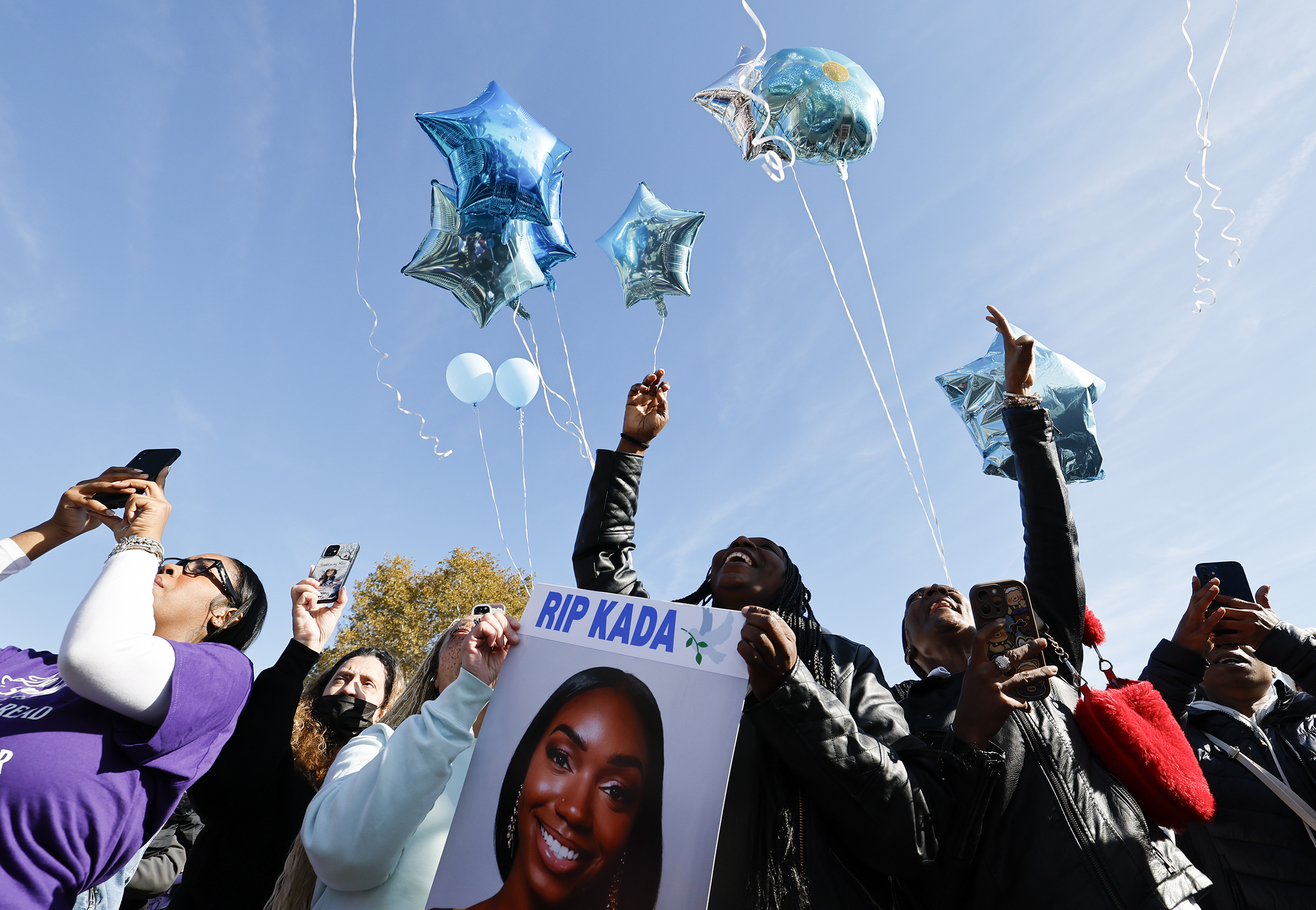
They were on the scenes after two high-profile shootings that, combined, left five peopledead and18 others wounded, and for the march that poignantly drew attention to the tragic killing of Kada Scott.
In the months after the Eagles’ convincing Super Bowl victory, and the cheers in Chinatown when the 76ers decided they would rebuild in South Philly instead of moving, the region showed its resilience among challenges.
Dramatic decreases in homicides continued in Philly — 208 through Dec. 10, down from 527 through the same date in 2021. The city workers’ strike was over ineight days. The one in 1986 lasted three weeks.
SEPTA kept rolling despite fires, threatened drastic cuts, a possible strike, and serious railcar shortage.
Our visual staff was there for it all, and that won’t change in 2026.
— Anthony R. Wood
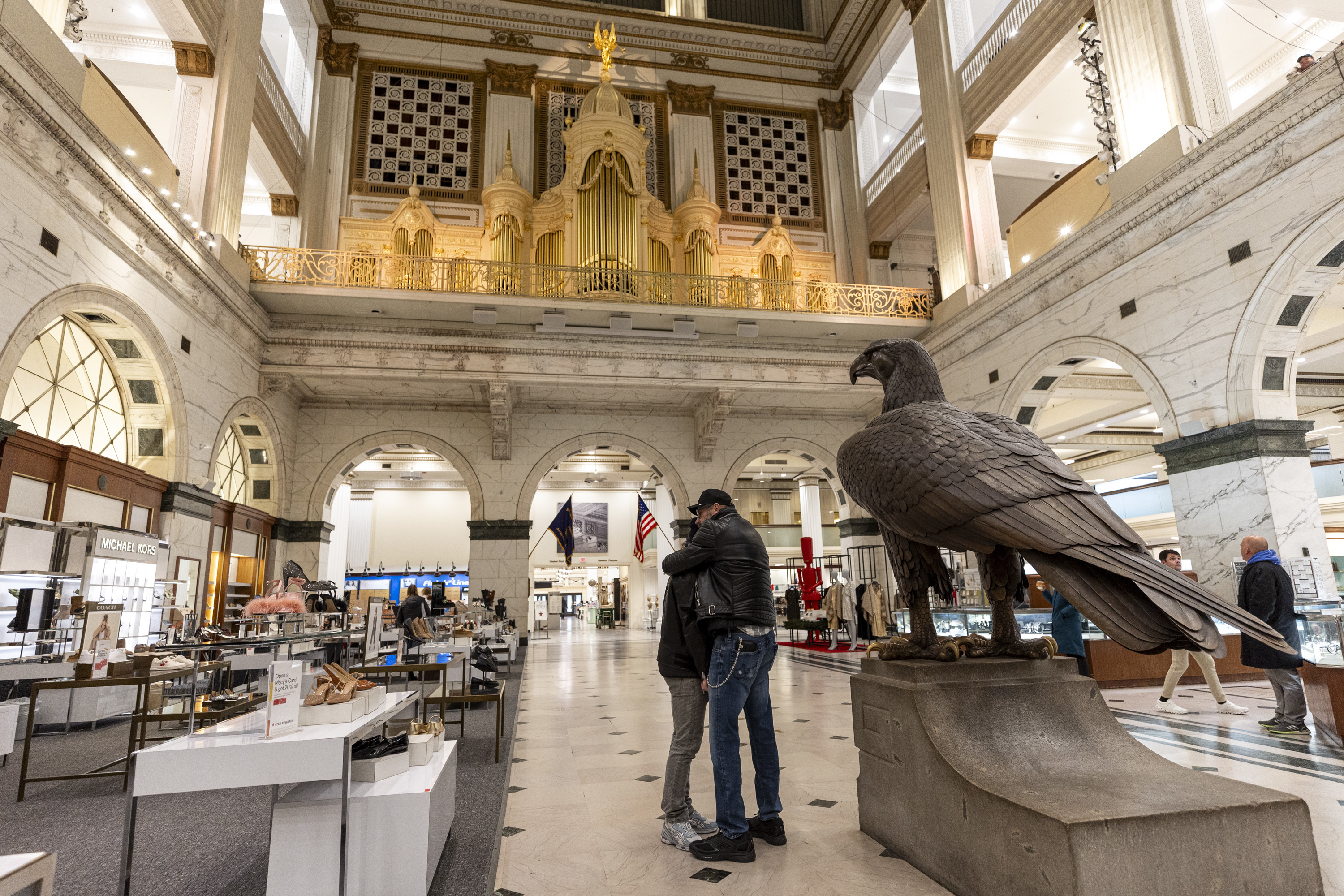
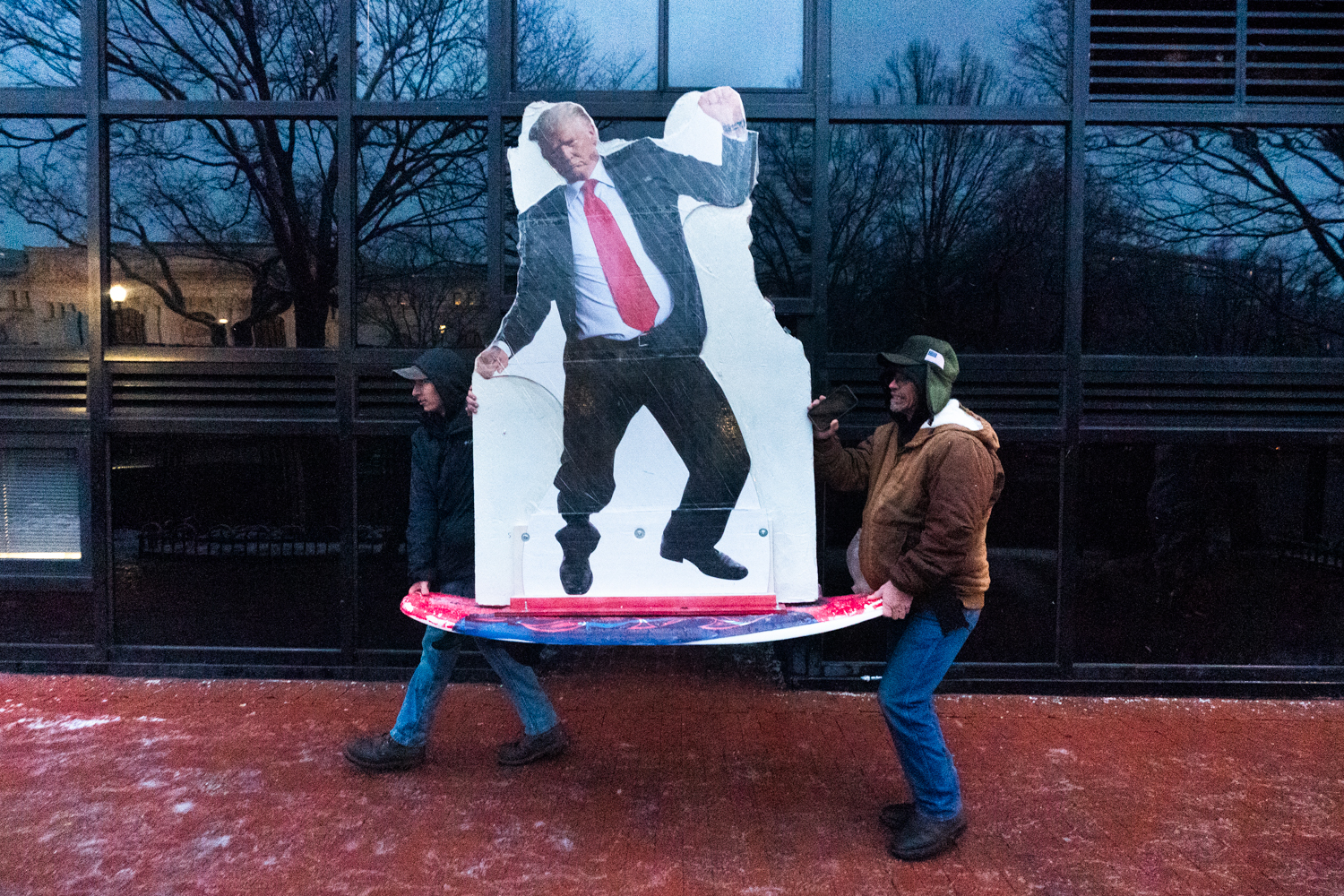
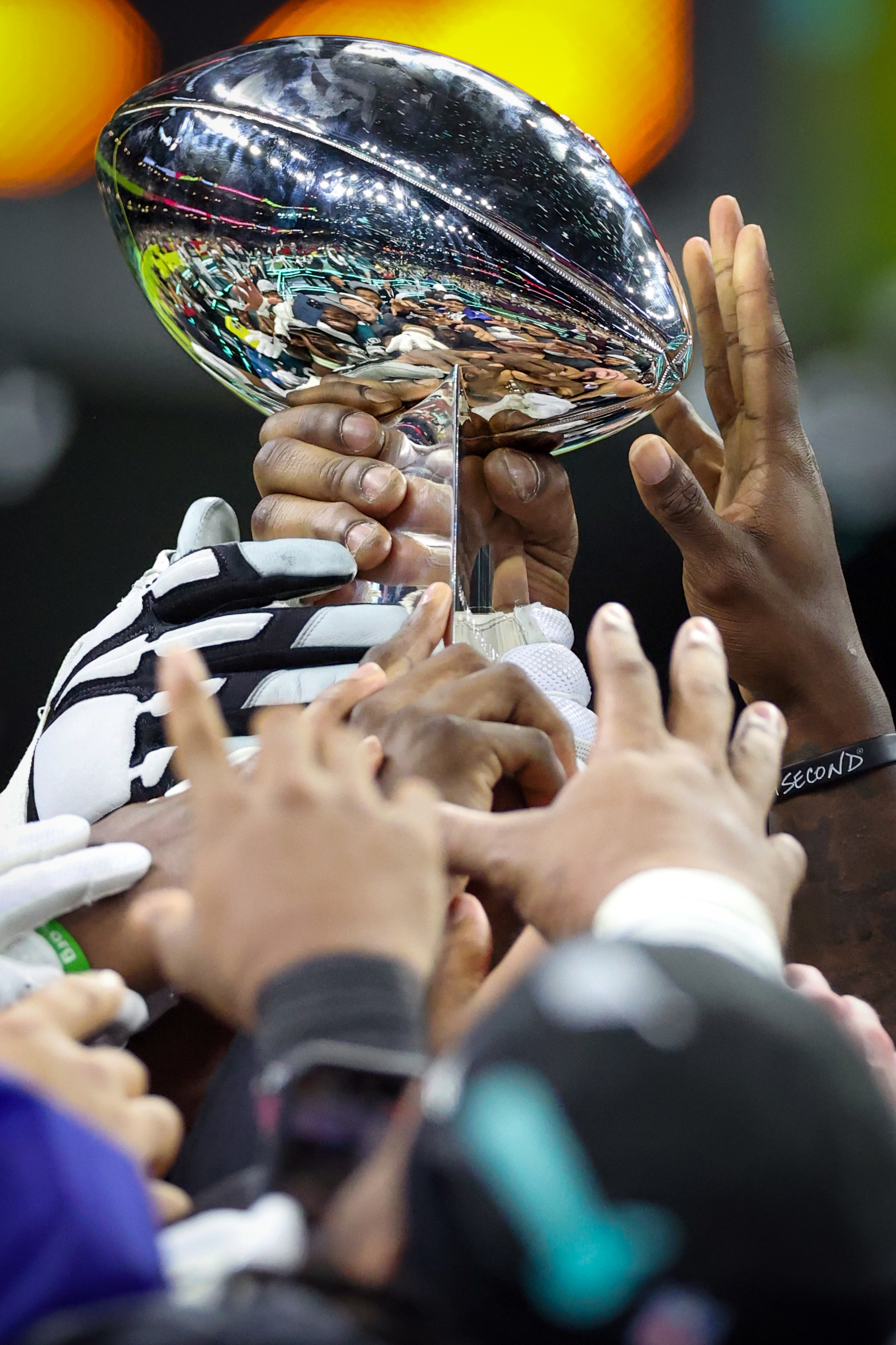
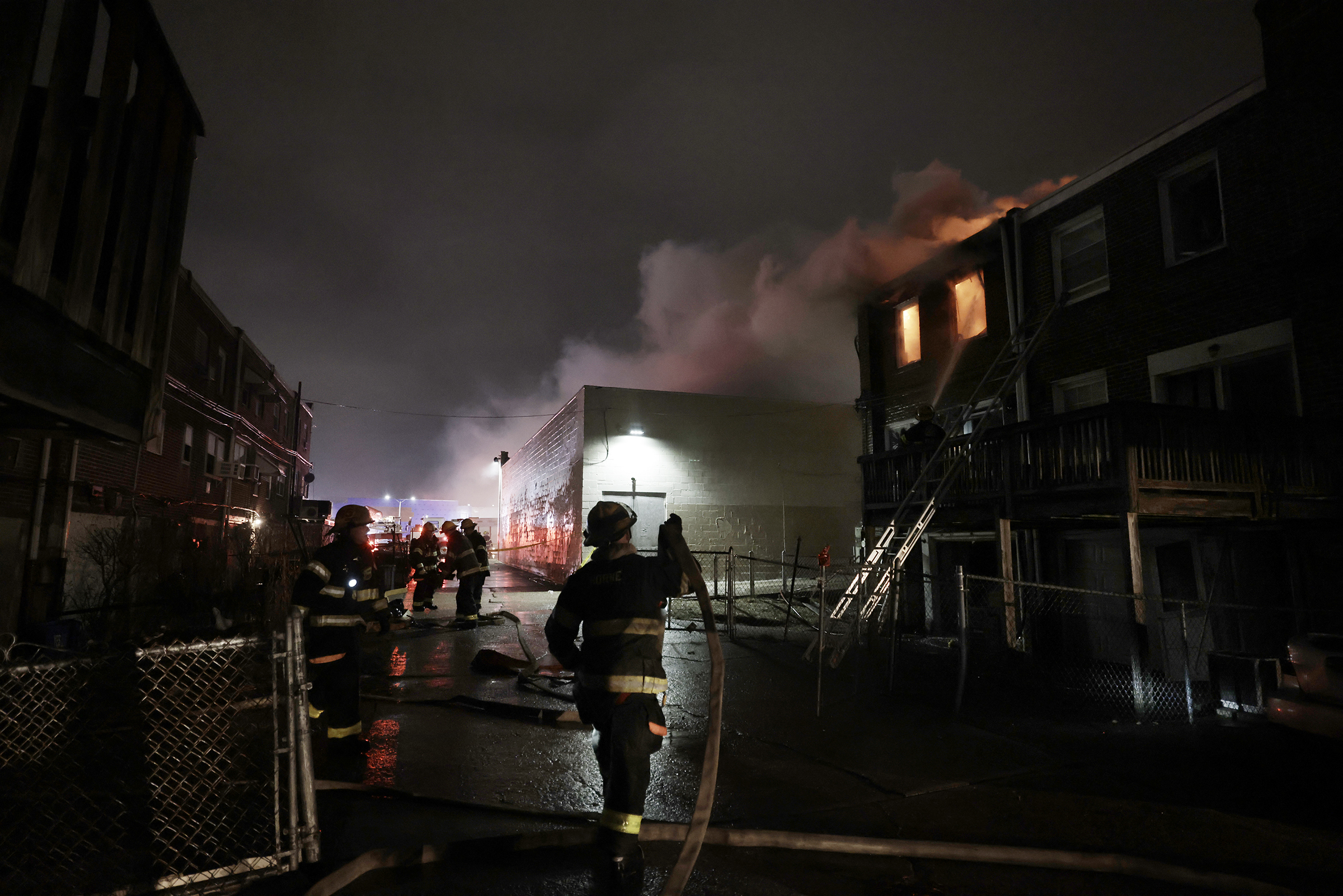
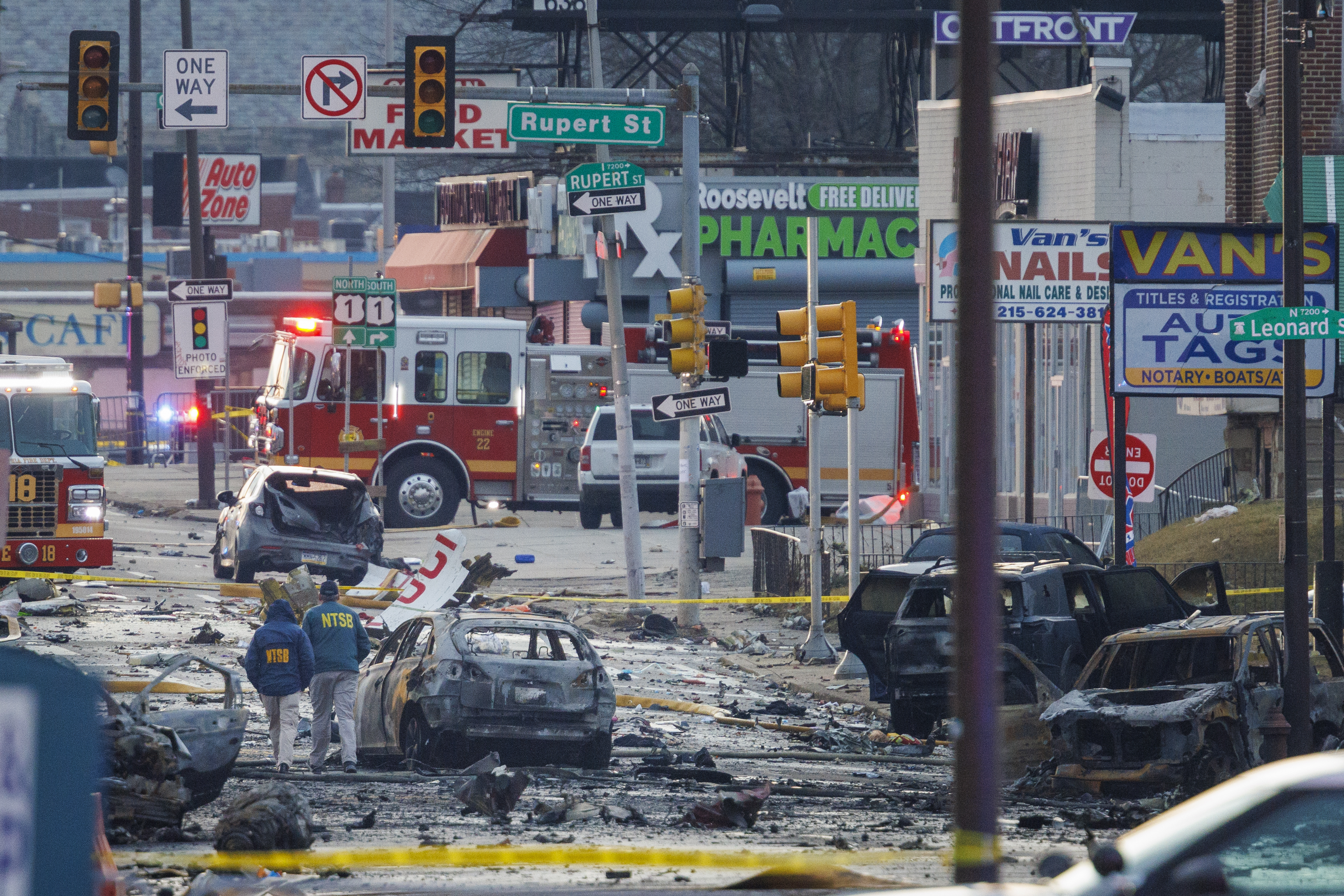
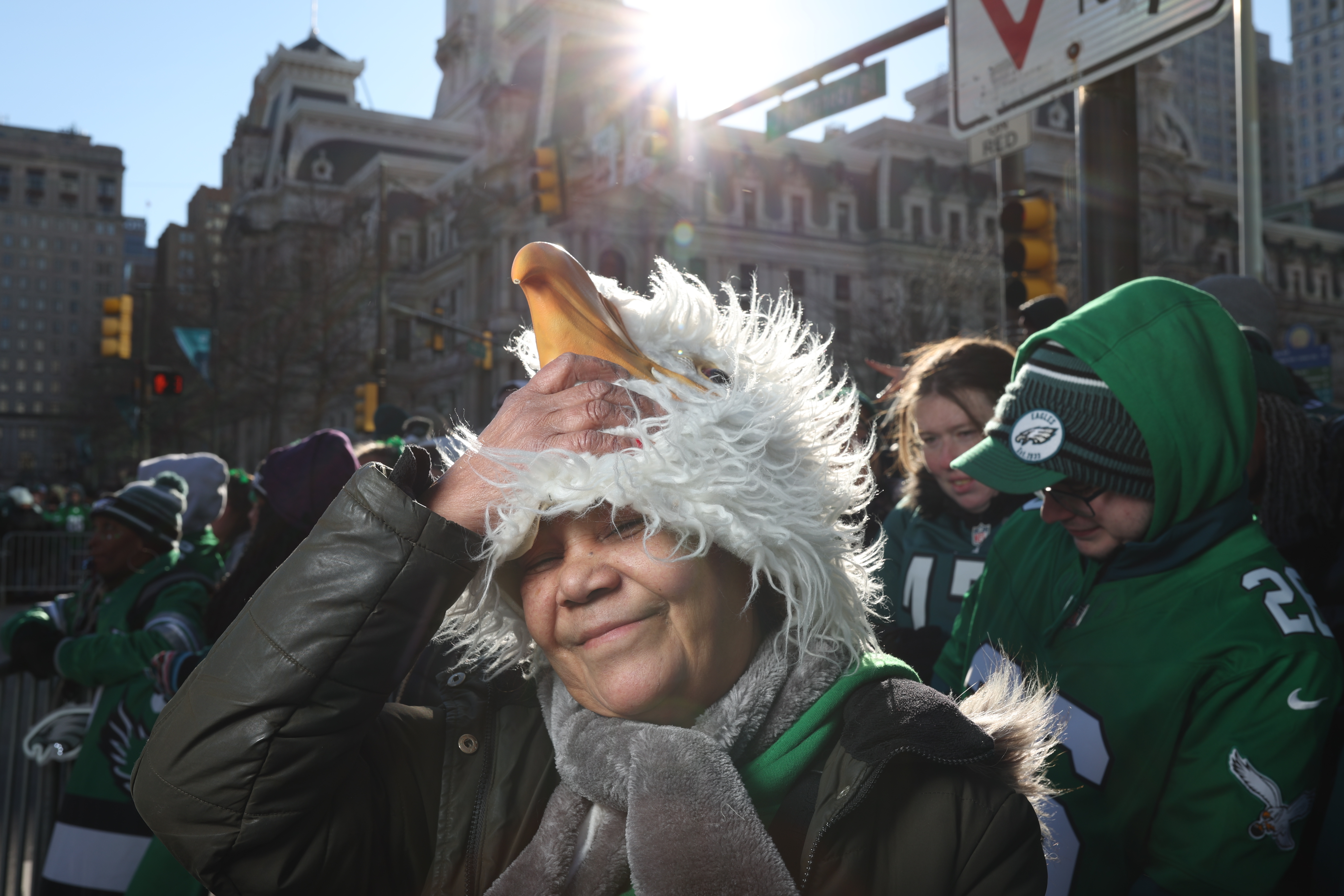
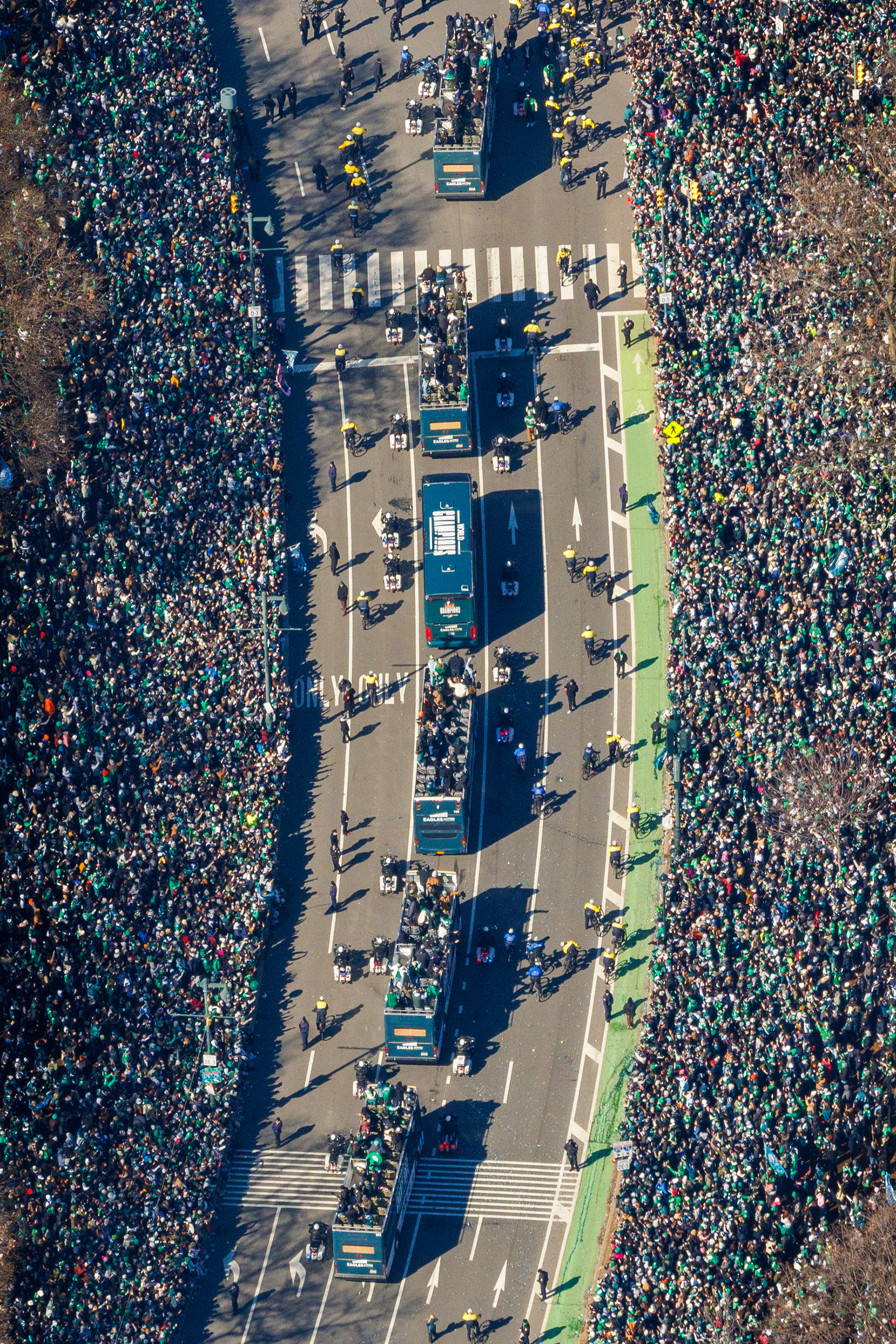
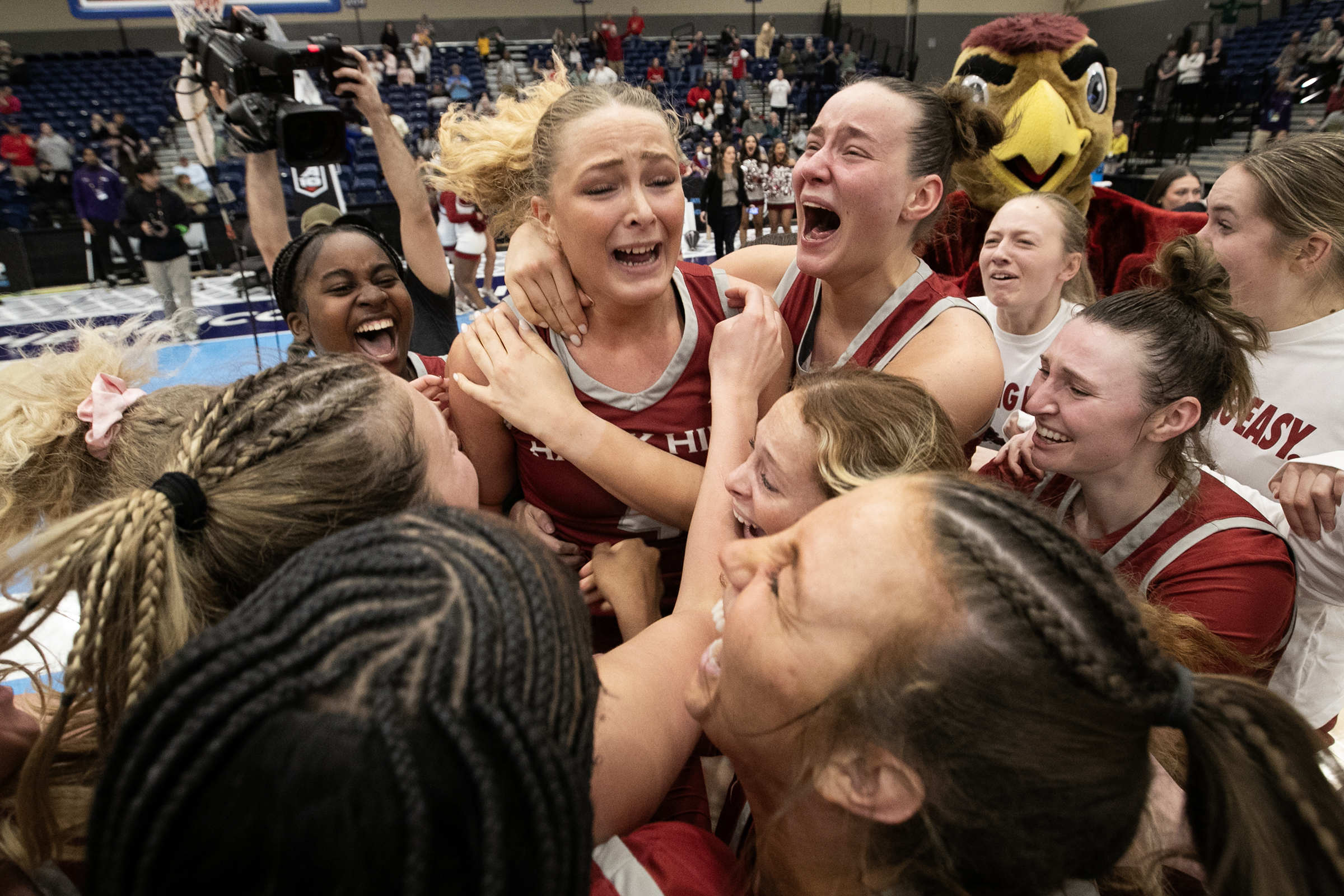
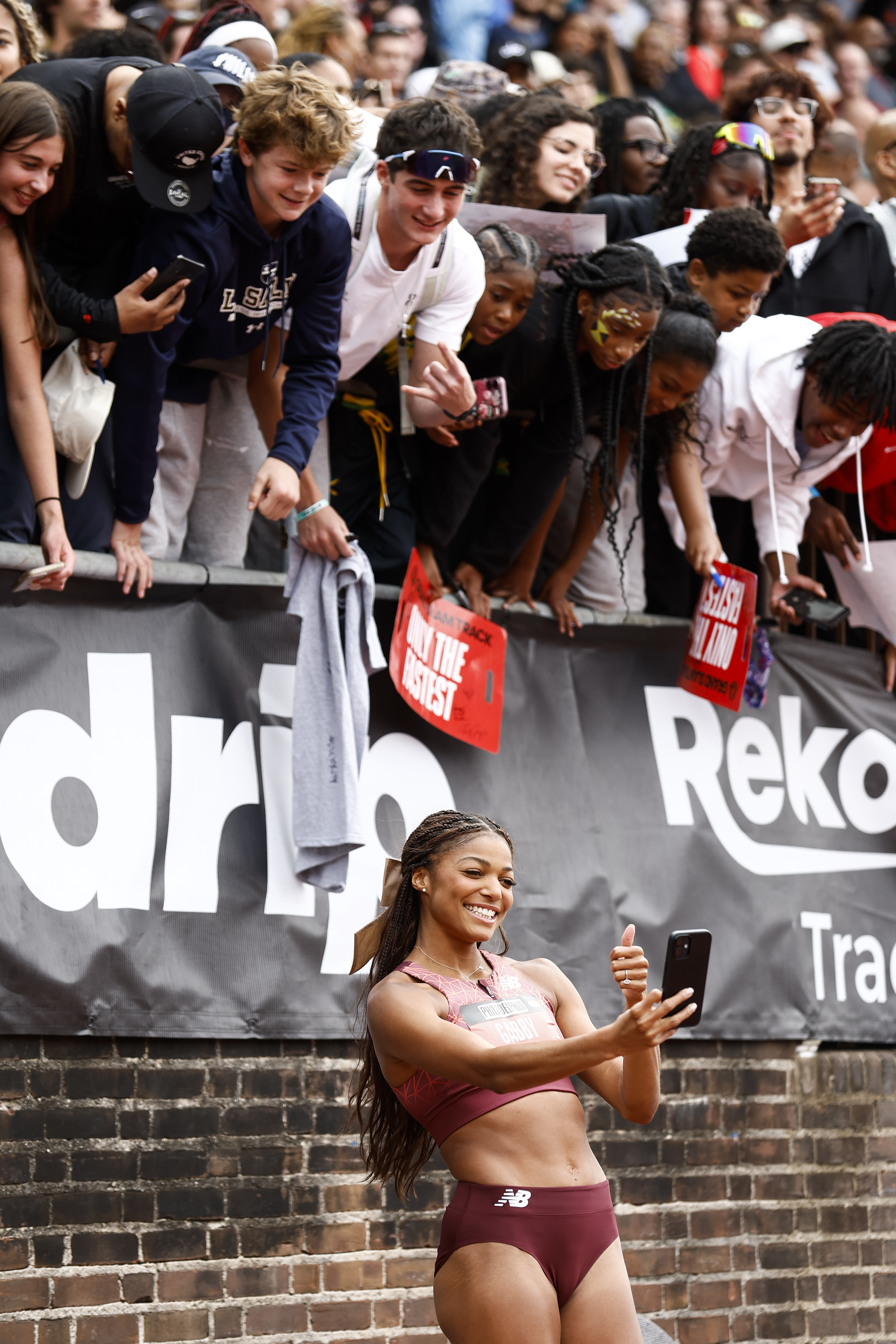
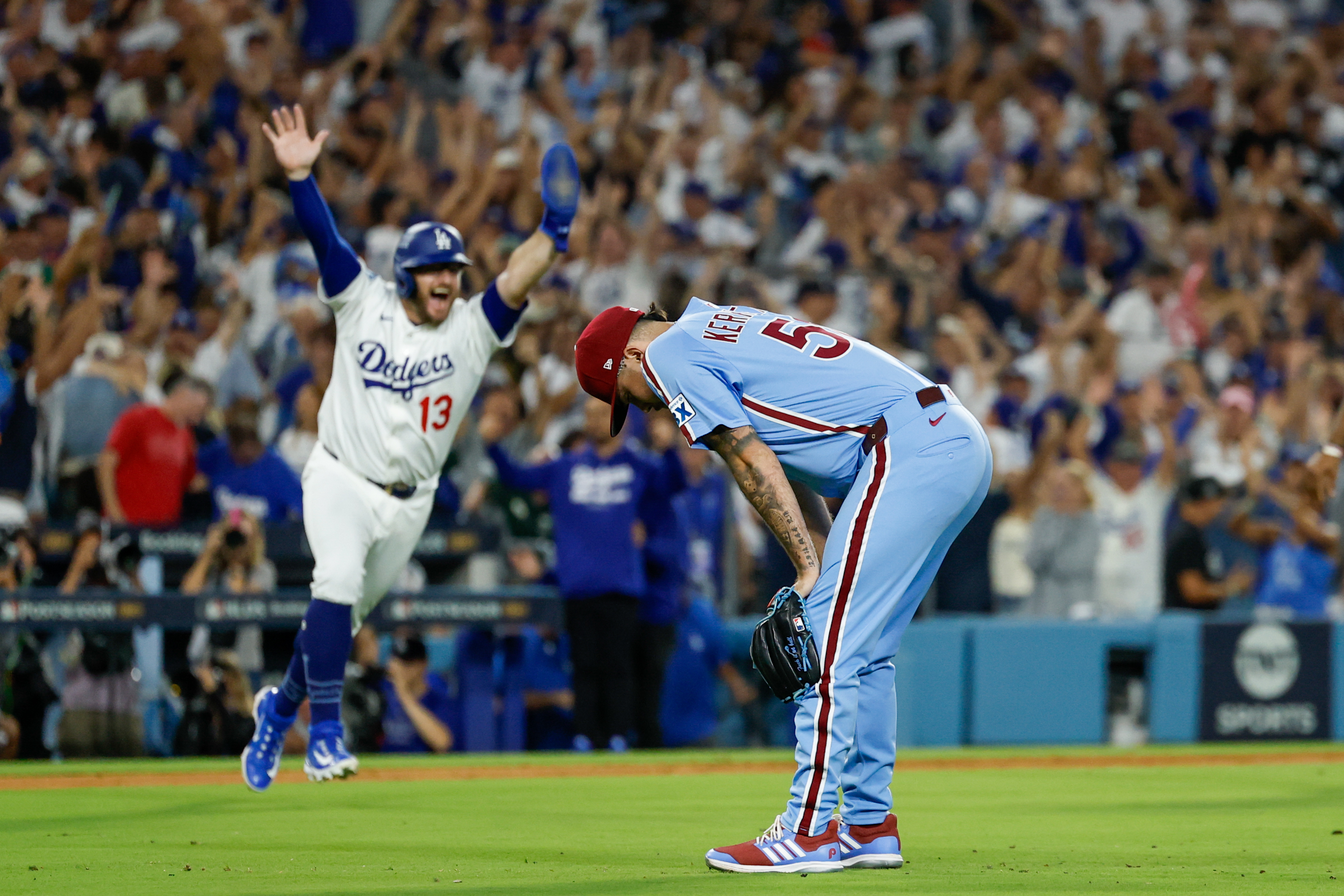
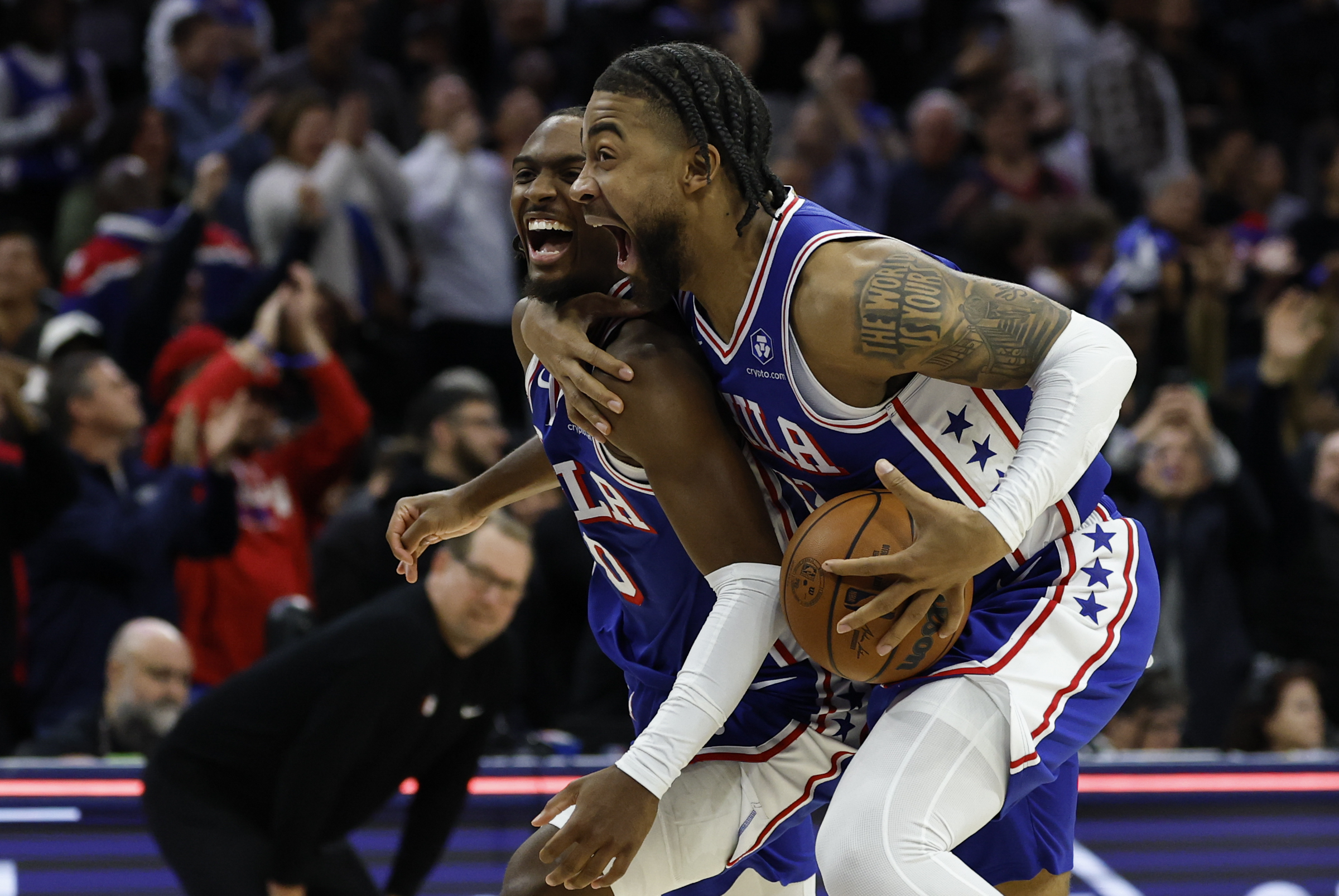
Saturnalian captain Thomas Dougherty dances on Second Street in Philadelphia during the Mummers after-party on New Year’s Day.Under the watchful eye of the eagle statue at the Wanamaker Building on Jan. 10, Bob Koherr, 64, and Walter Batt, 62, of Center City, embrace, remembering the time they spent together there.Lloyd Morgan (right) and a friend carry a cutout of President Donald Trump on a surfboard through Washington on Jan. 19, the day before Trump’s second inauguration.Saquon Barkley celebrates as he nears the end zone on a 78-yard touchdown run during the fourth quarter of the Eagles’ playoff game against the Los Angeles Rams on Jan. 19. The Eagles eked out a 28-22 win.Eagles players lift the Lombardi Trophy after their 40-22 Super Bowl LIX victory over the Kansas City Chiefs on Feb. 9 in New Orleans.Saquon Barkley leaps into the end zone for one of his three touchdowns against the Washington Commanders in the NFC championship game at Lincoln Financial Field on Jan. 26. The Eagles won 55-23 to clinch their second Super Bowl appearance in three seasons.Family and friends skate on the ice rink that Fox Chase resident David Bara built in his backyard last winter. “There aren’t many people in Philly who are crazy enough to do what I do,” Bara said.Jada Pichardo produced Pennsauken’s first state wrestling title when the senior won the 126-pound division at the New Jersey State Interscholastic Athletic Association championships in March.Emergency workers battle a fire at the 7200 block of Calvert Street in Northeast Philadelphia after a medical jet crashed nearby on Jan. 31.National Transportation Safety Board officials walk through debris from the medical jet crash along Cottman Avenue near Roosevelt Boulevard.Marisol Nelson was among the hundreds of thousands of Eagles fans who lined Philly streets on Feb. 14 for the Birds’ Super Bowl victory parade.A sea of fans greets Eagles team buses as they coast along the Benjamin Franklin Parkway during the Super Bowl victory parade.St. Joseph’s guard Laura Ziegler (center) celebrates with teammates after hitting the game-winning shot against Richmond in the Atlantic 10 tournament semifinals in March.Actor and rapper Will Smith, with mother Caroline Bright, attends a street renaming ceremony in West Philadelphia in March. The city renamed the 2000 block of North 59th Street “Will Smith Way.”Gabby Thomas poses for photos with fans after racing in the women’s 100 meters during the Grand Slam Track meet at Franklin Field on June 1.
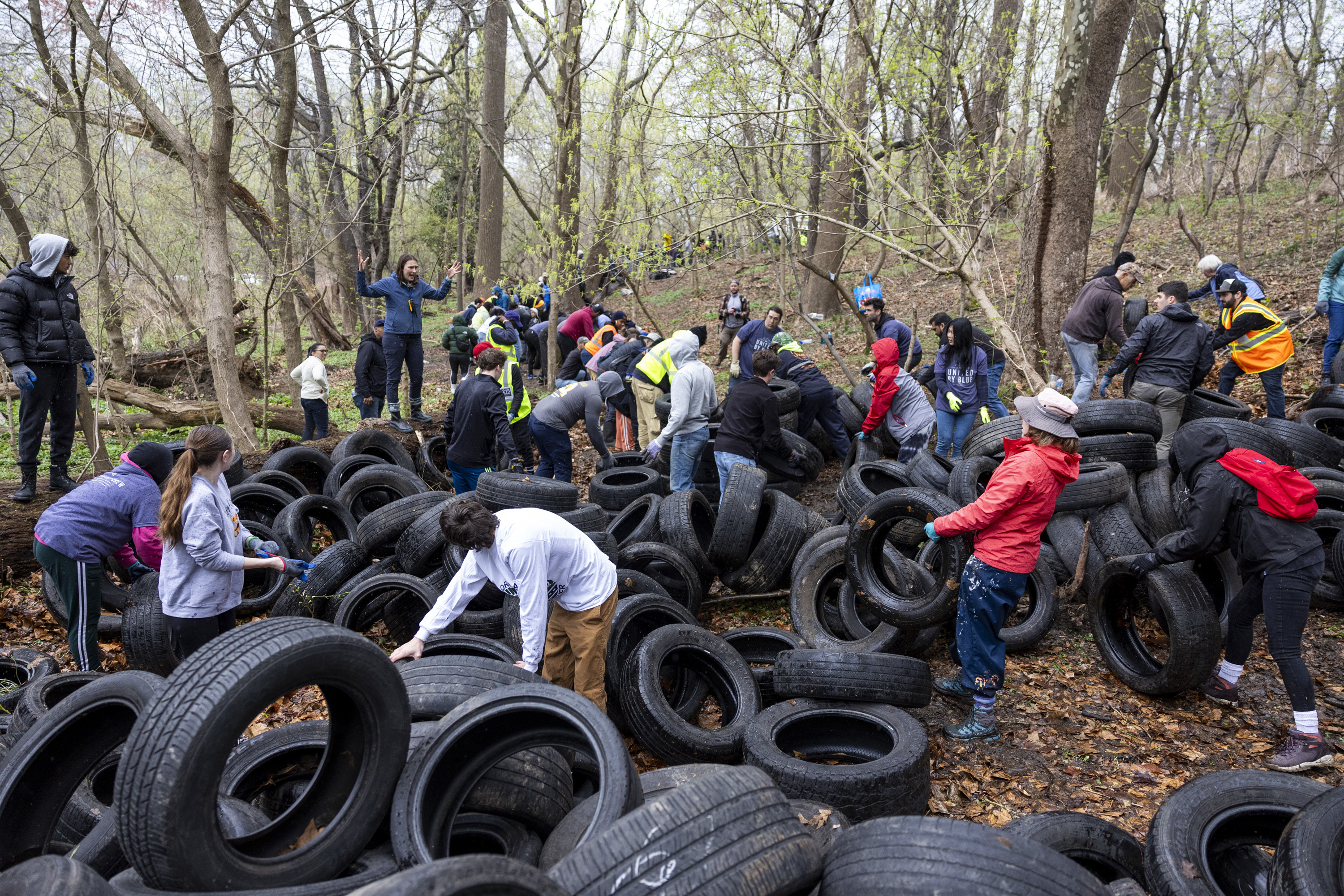
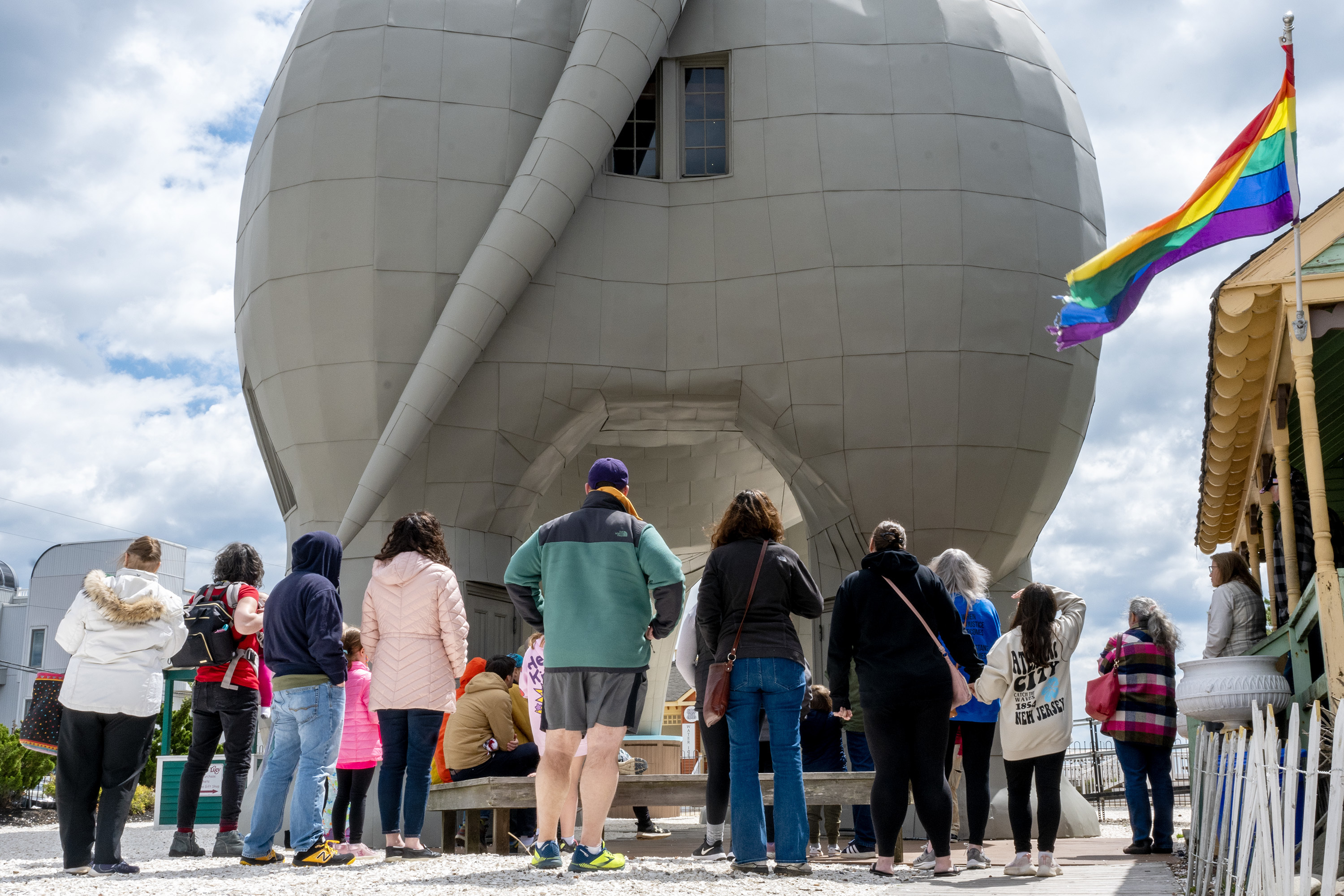
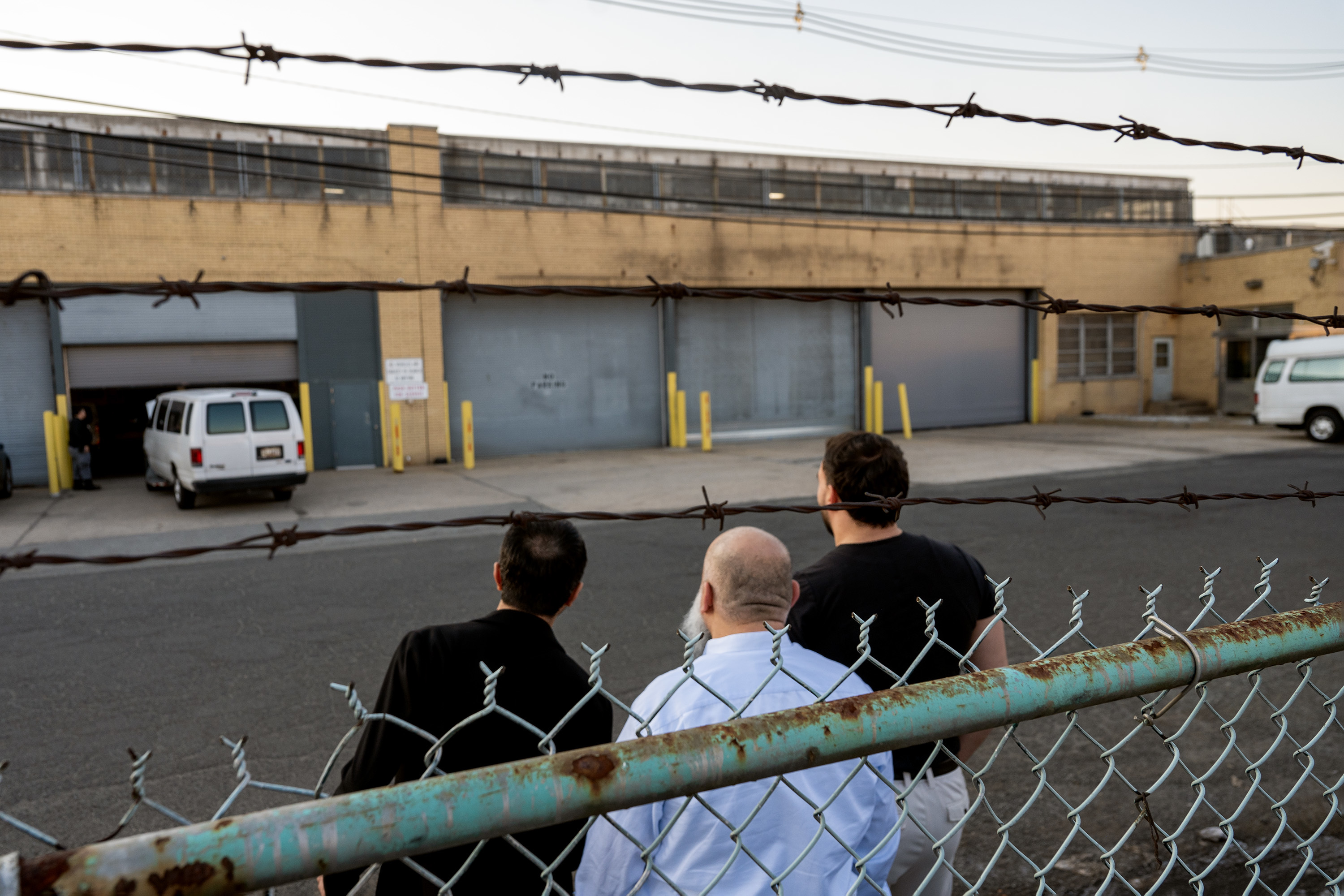
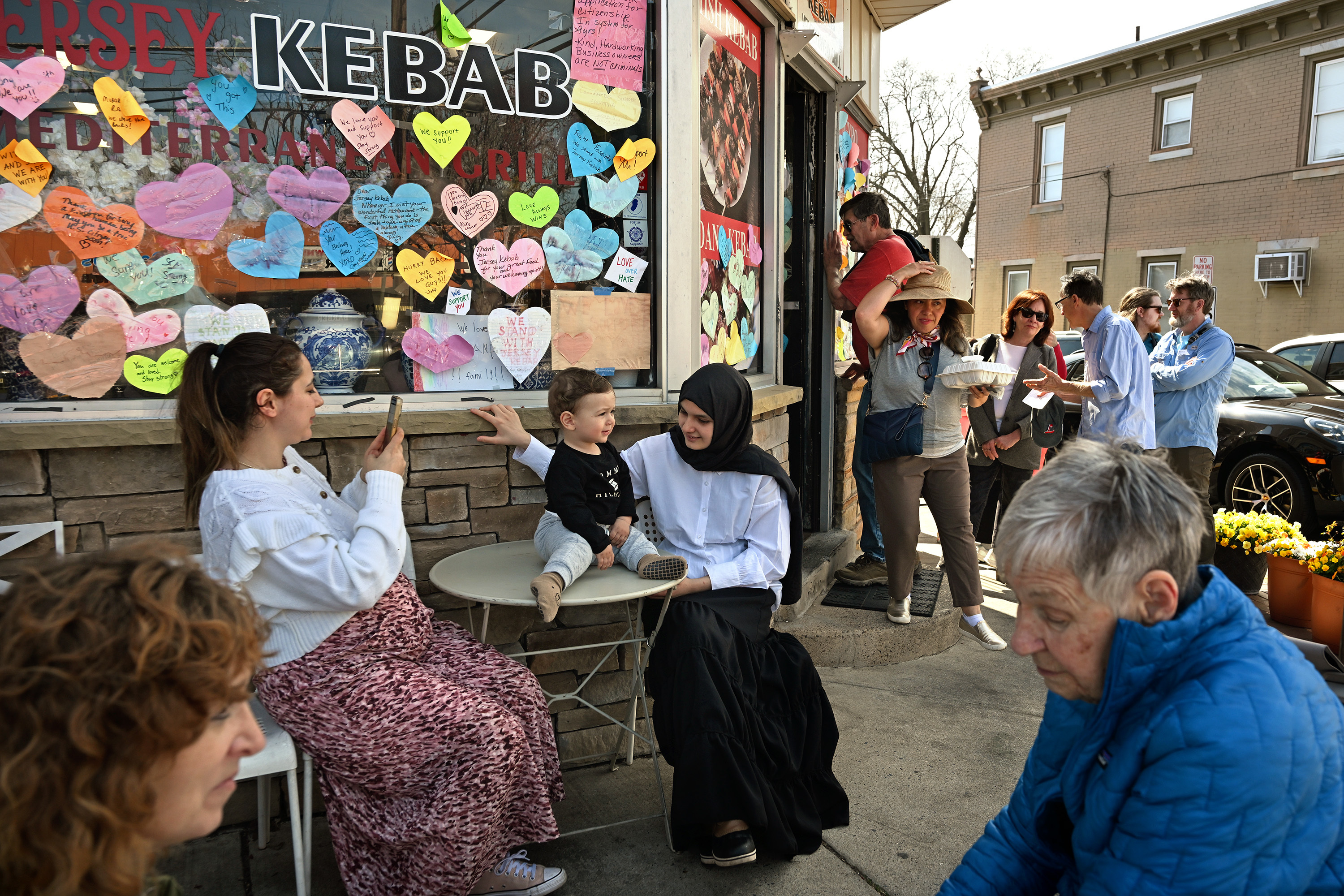
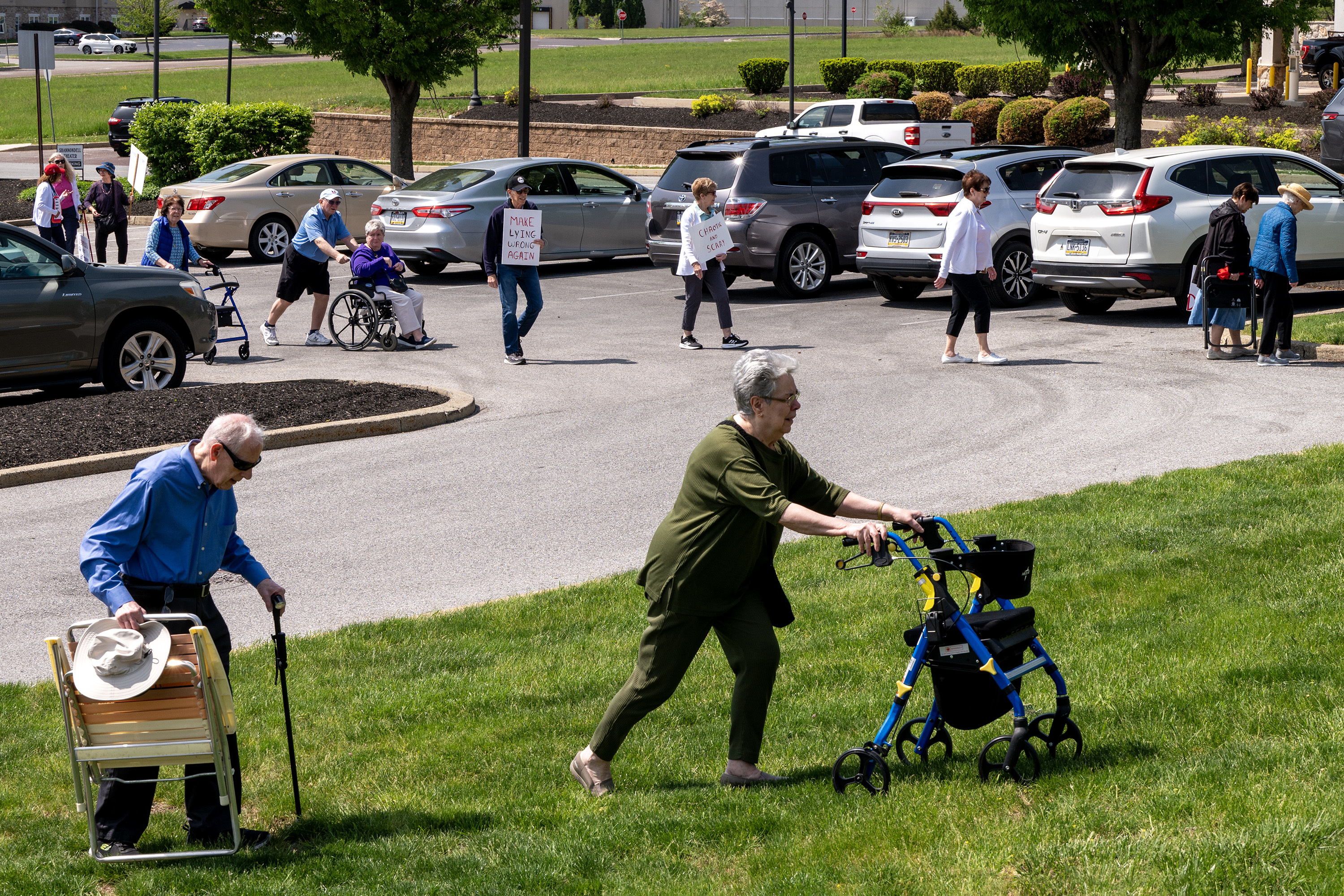
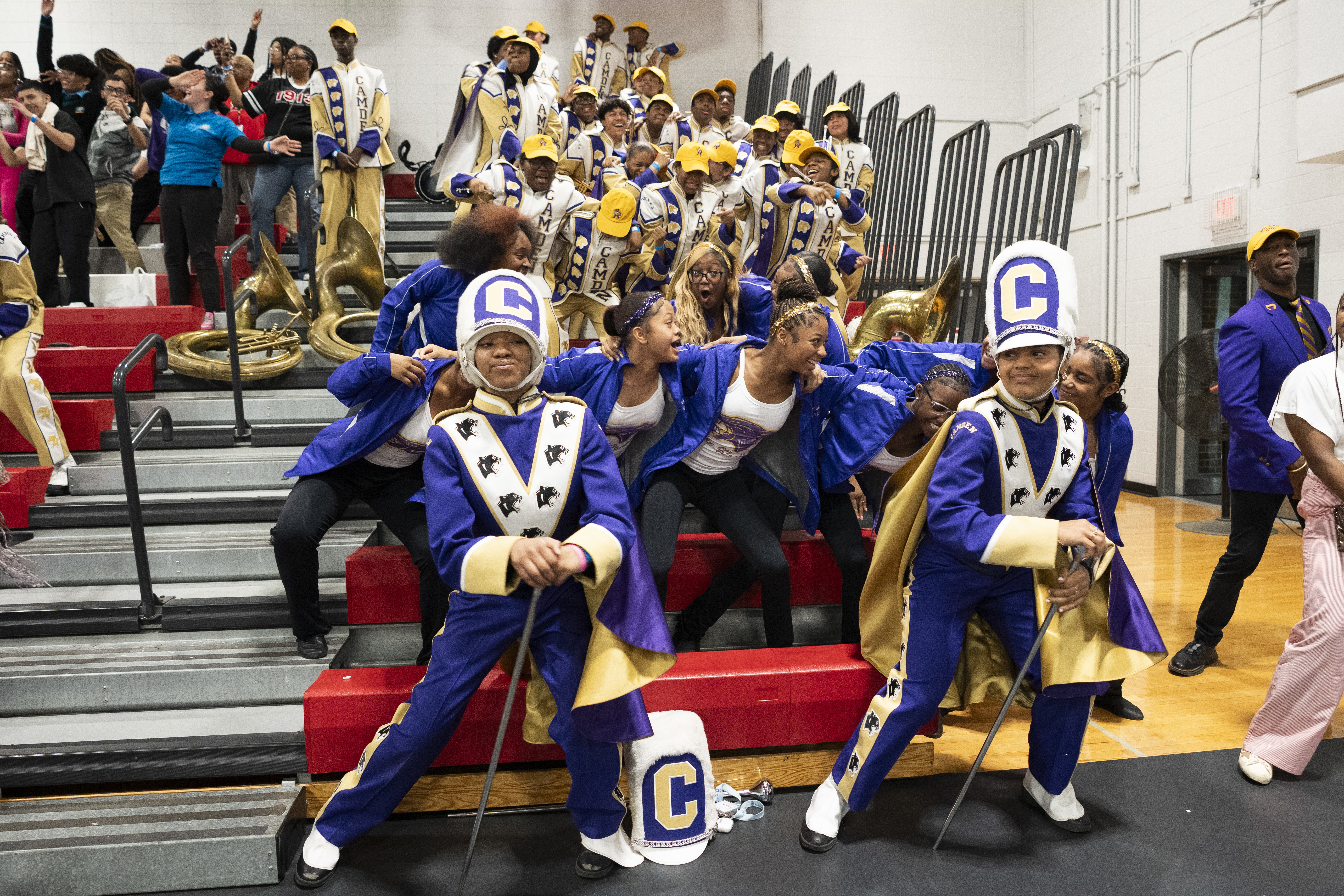
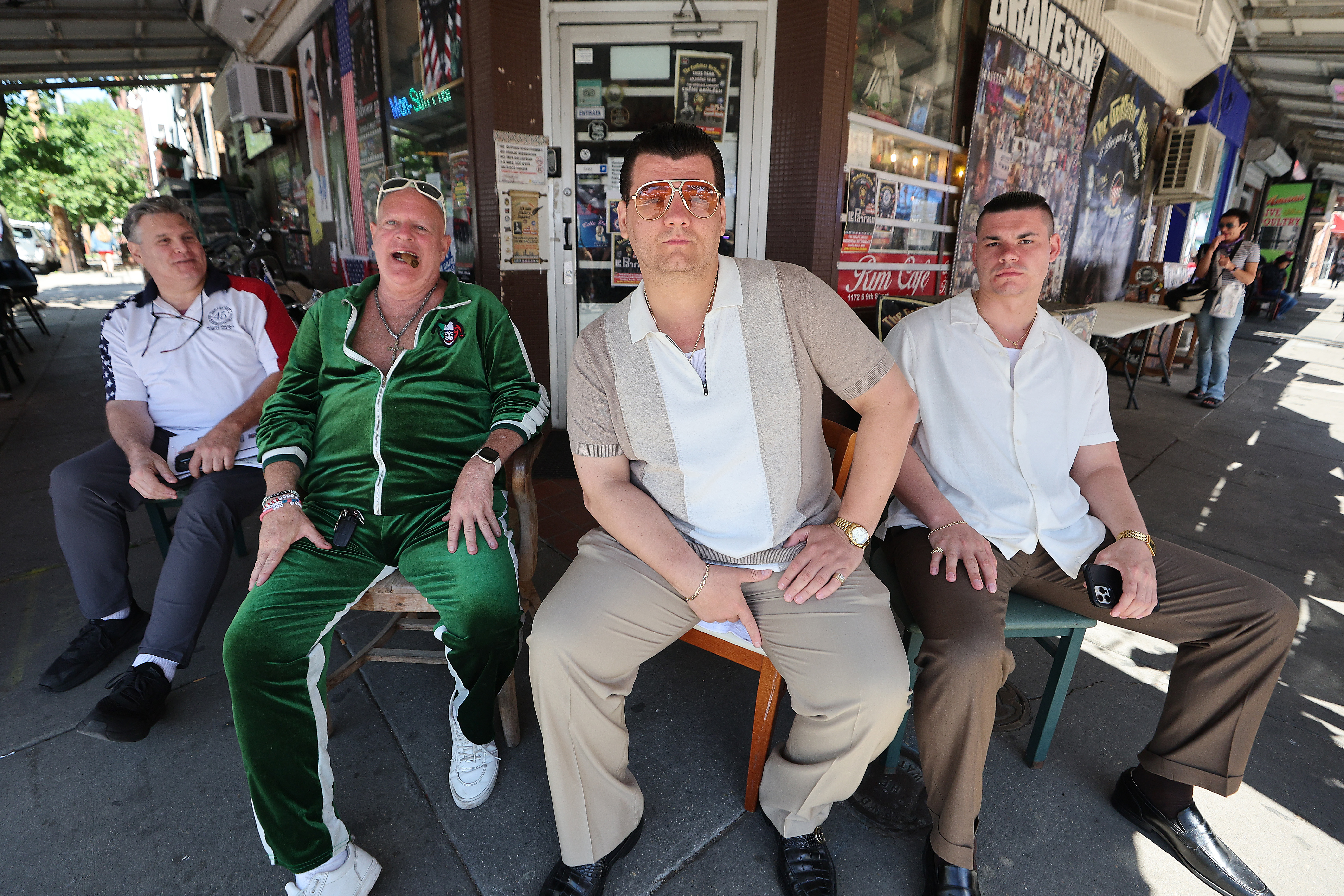
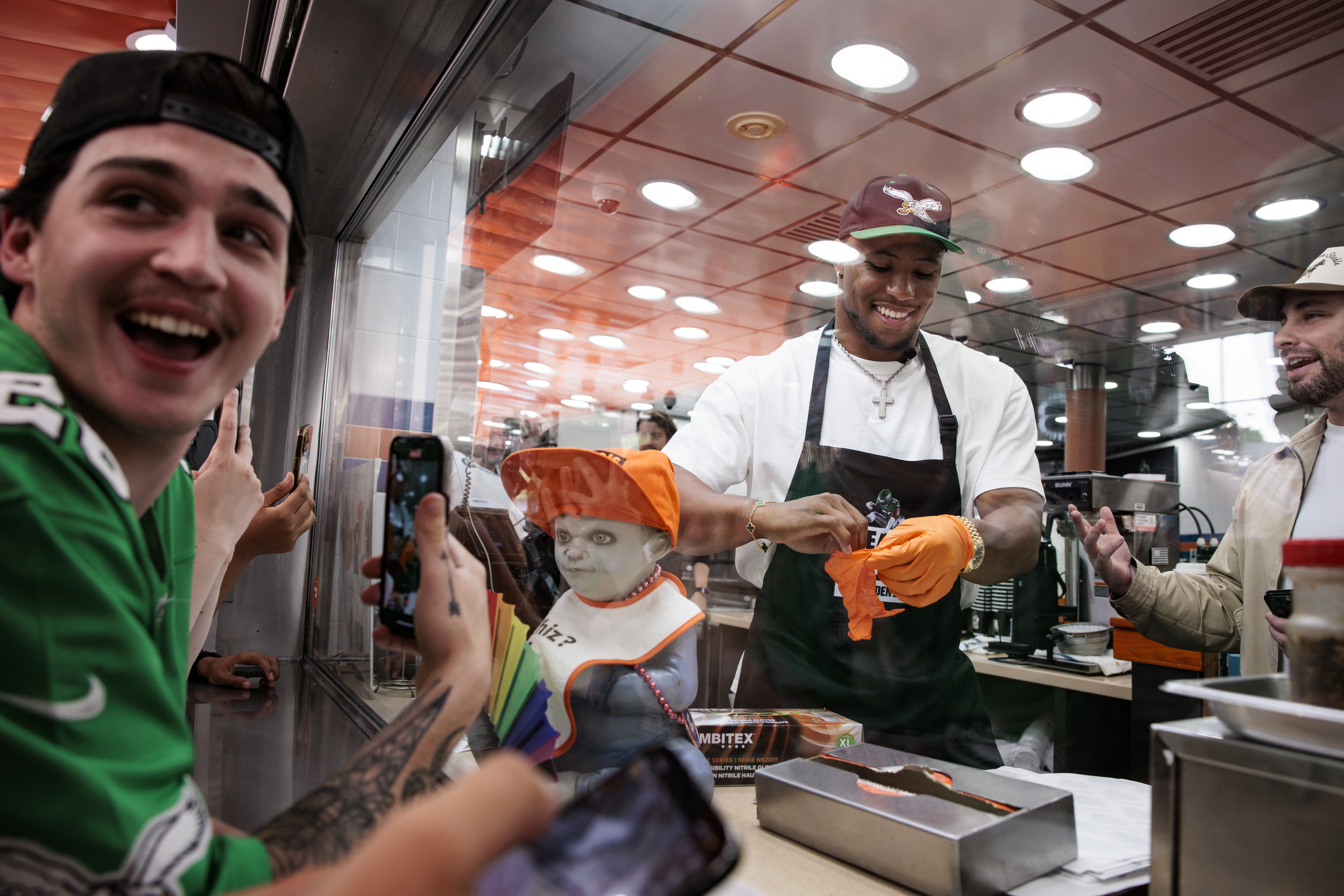
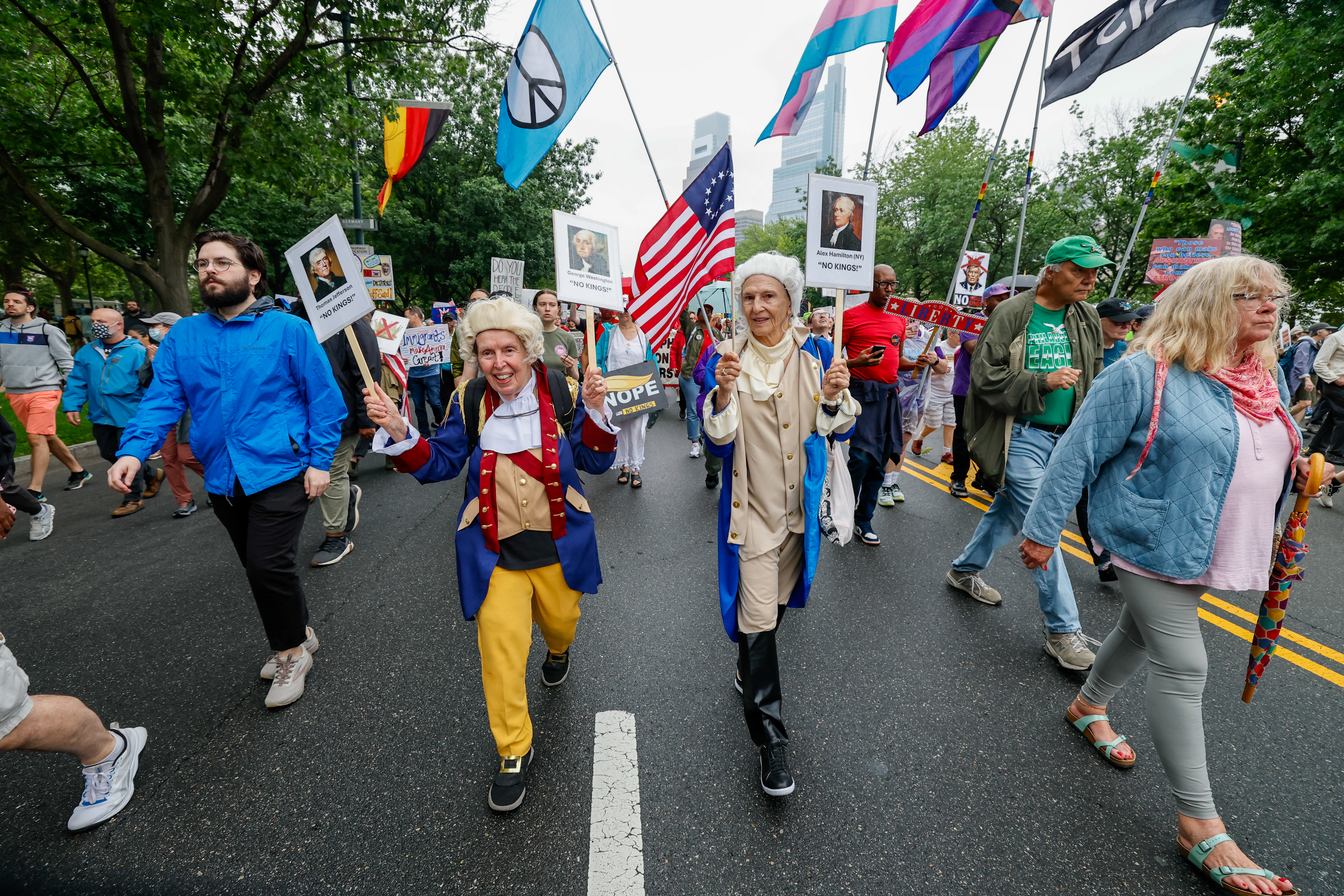
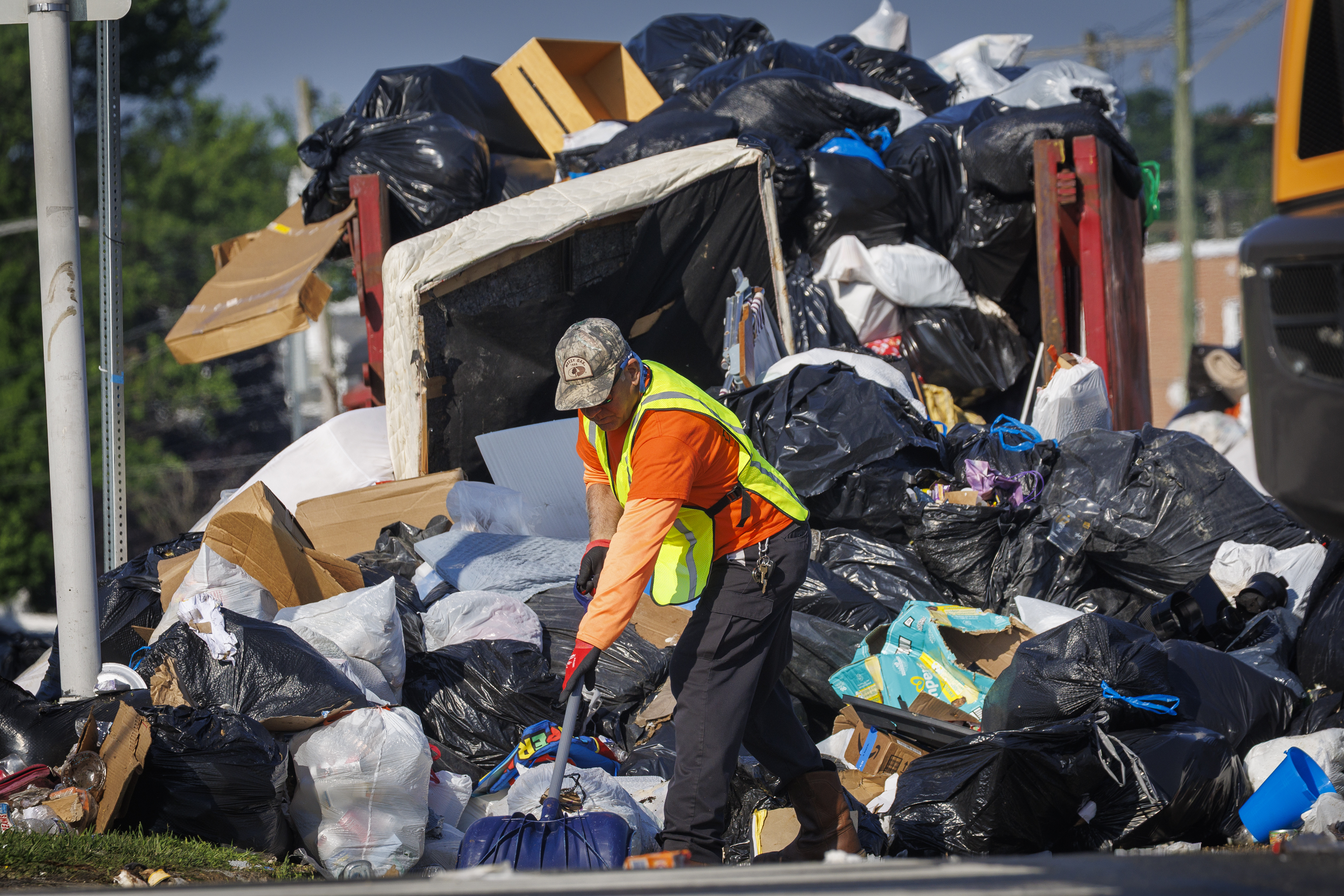
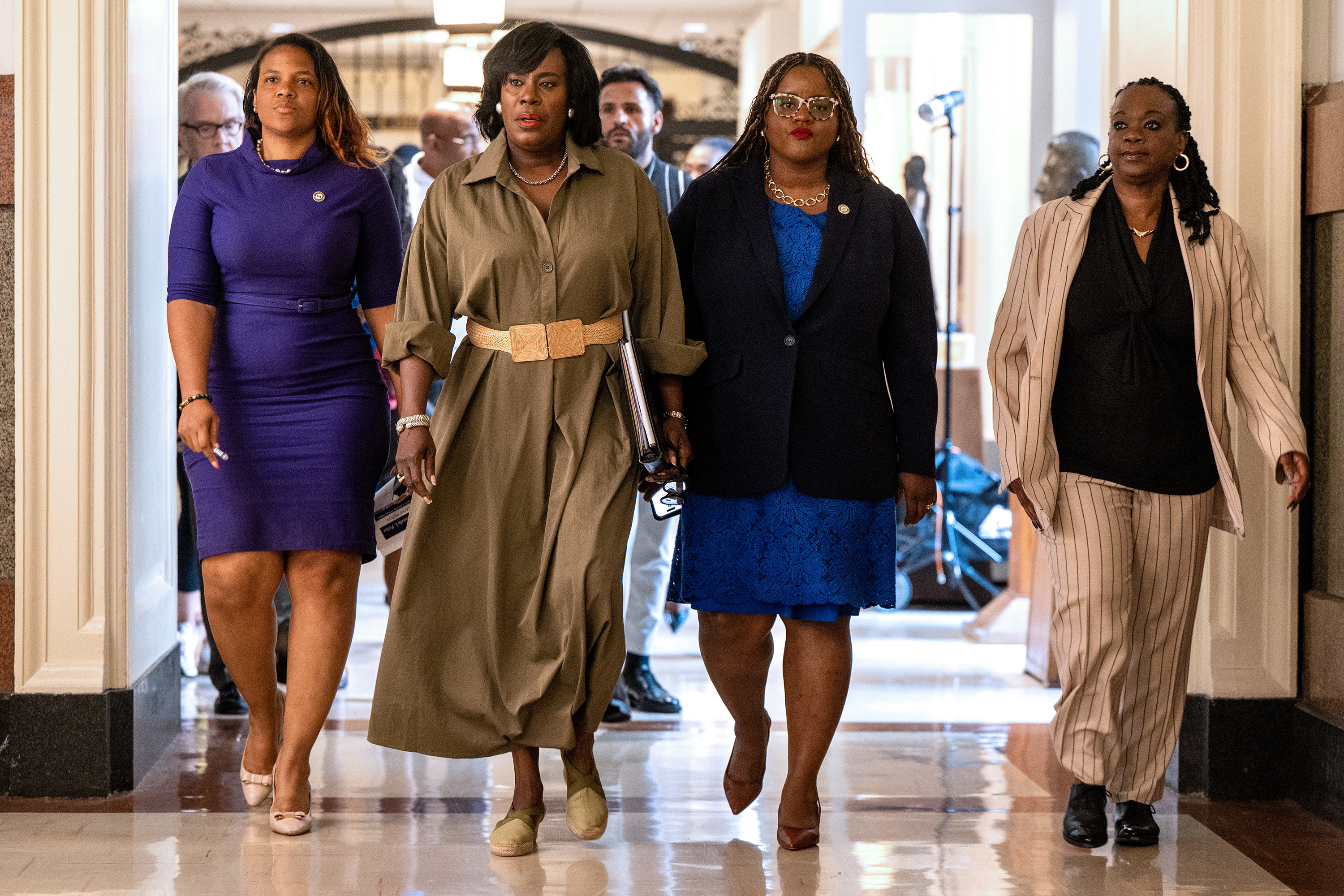
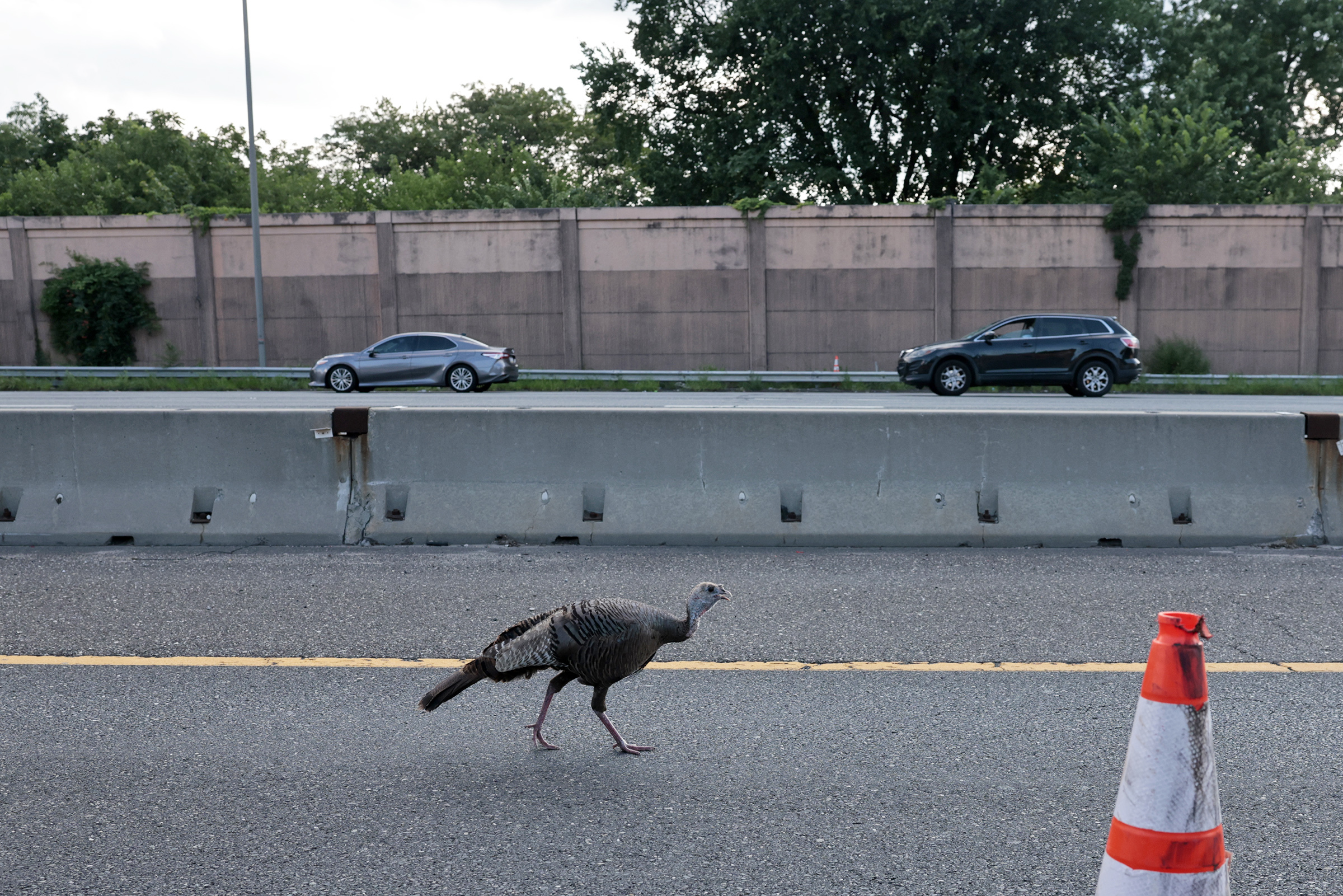
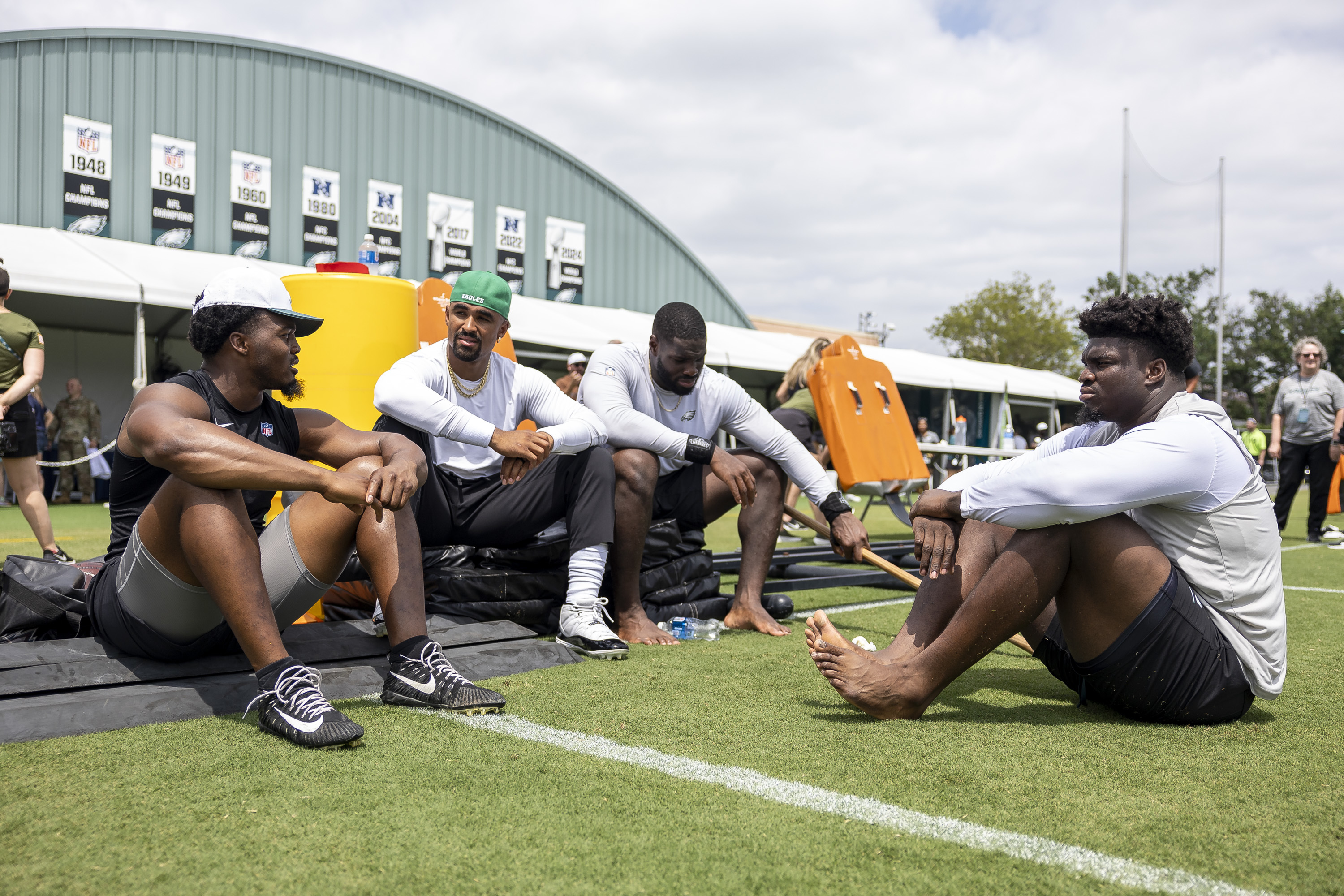
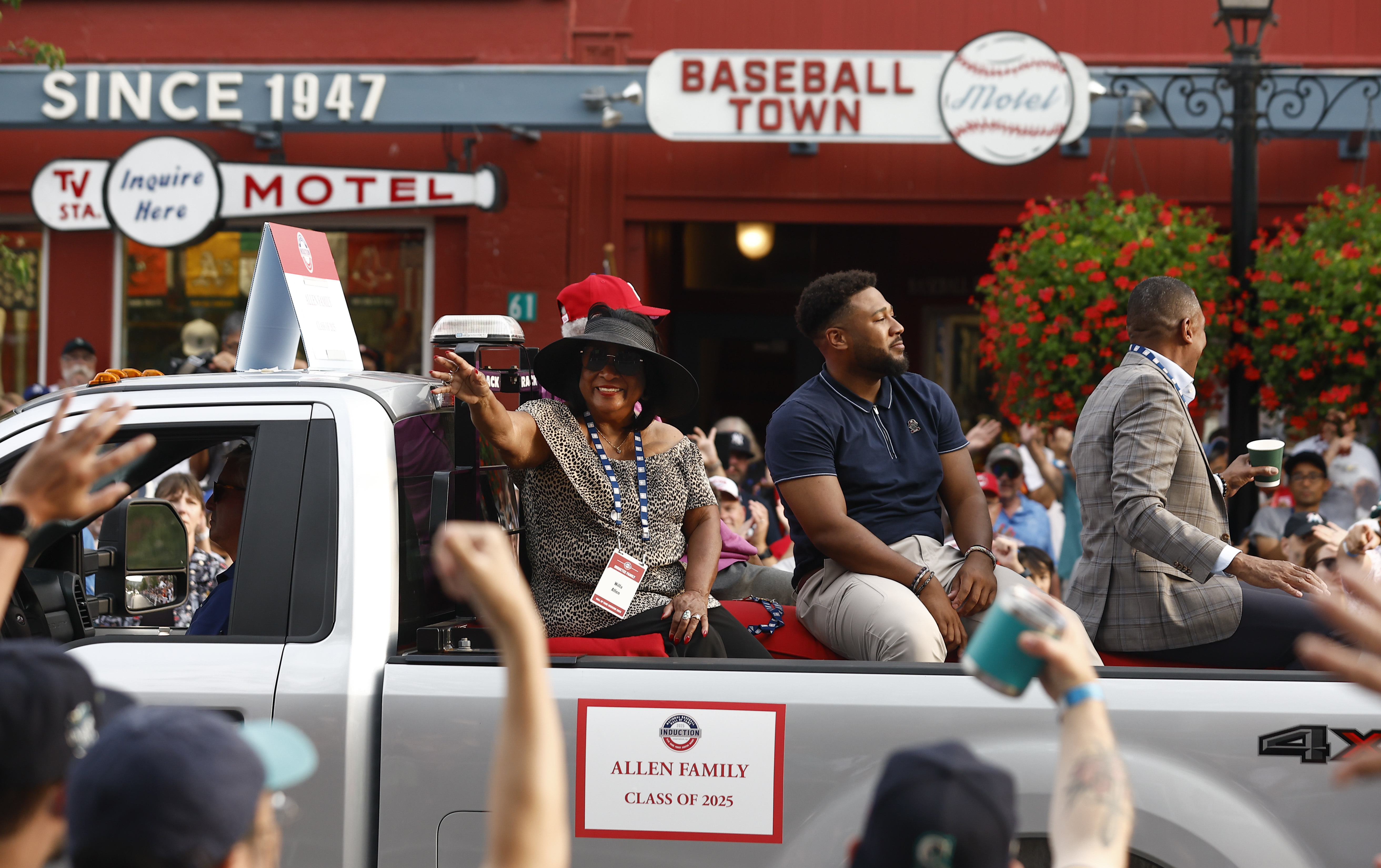
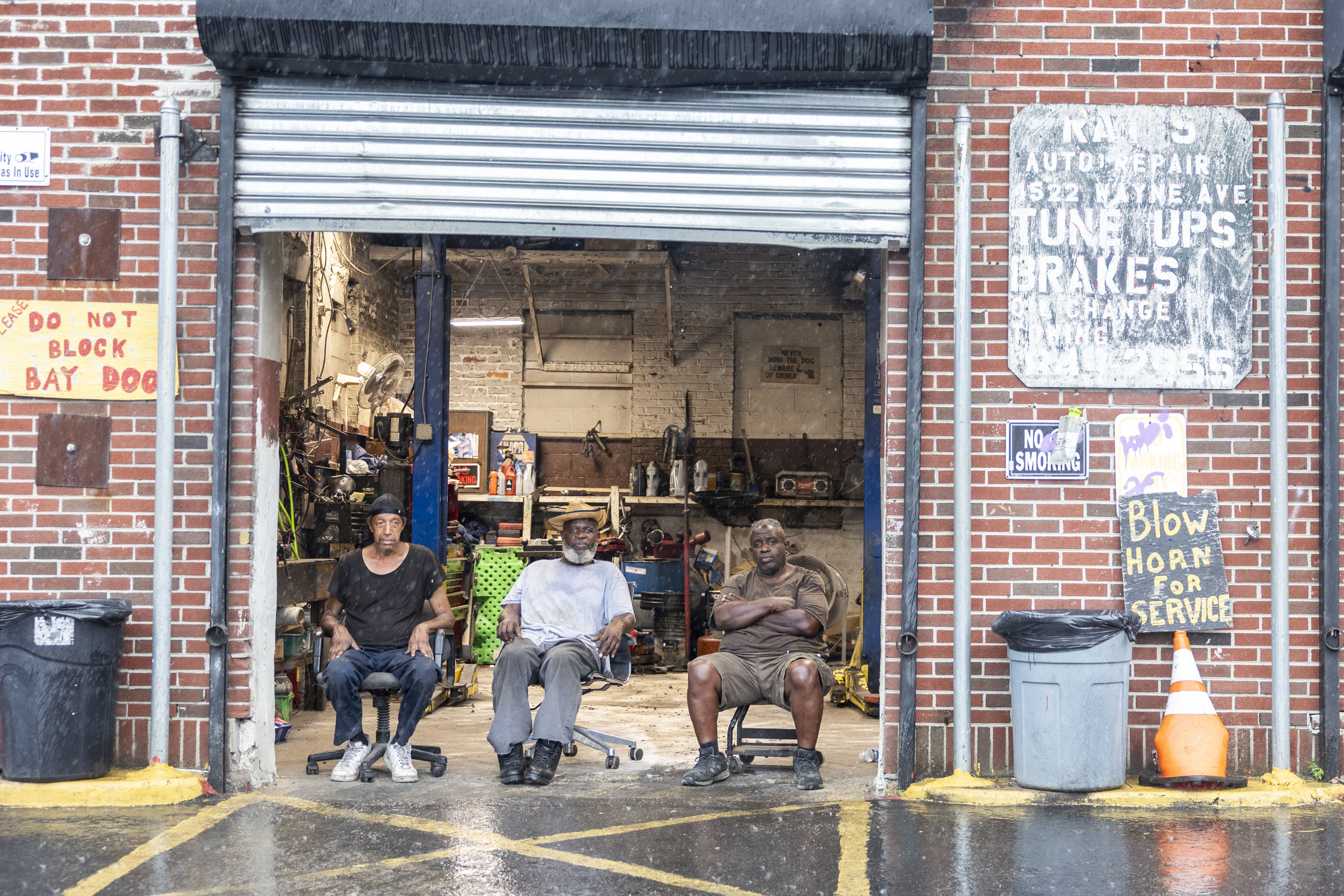
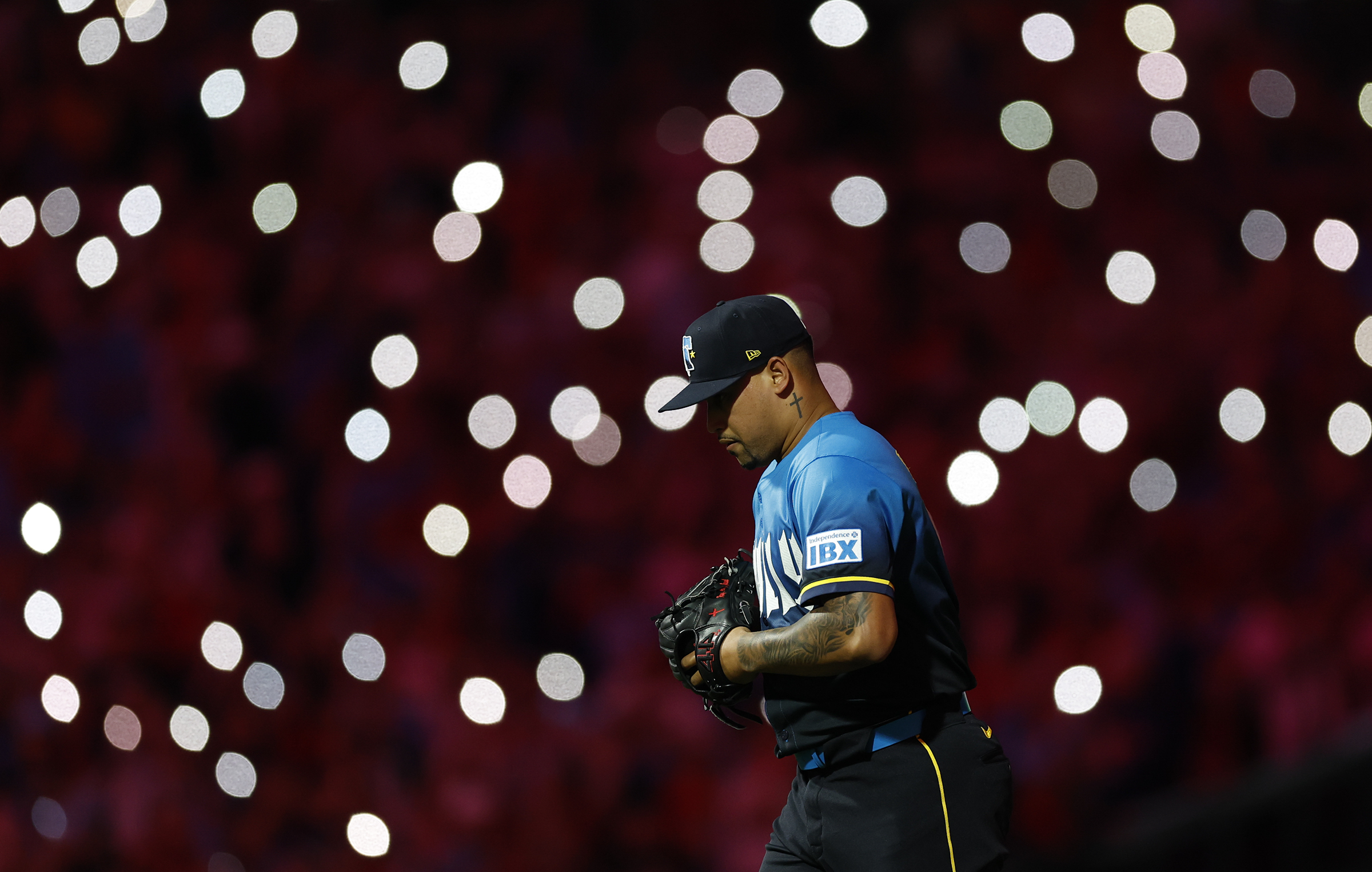
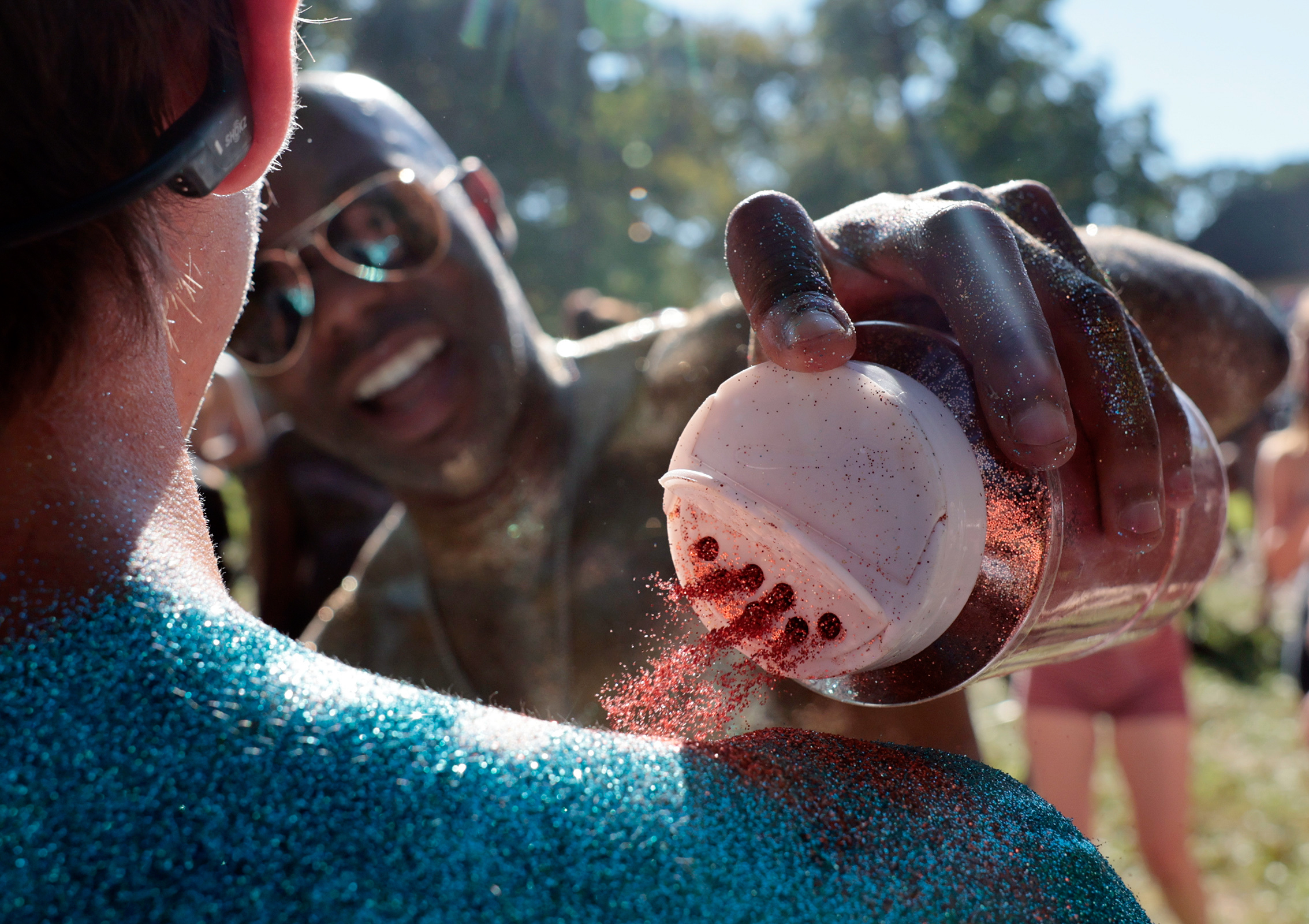
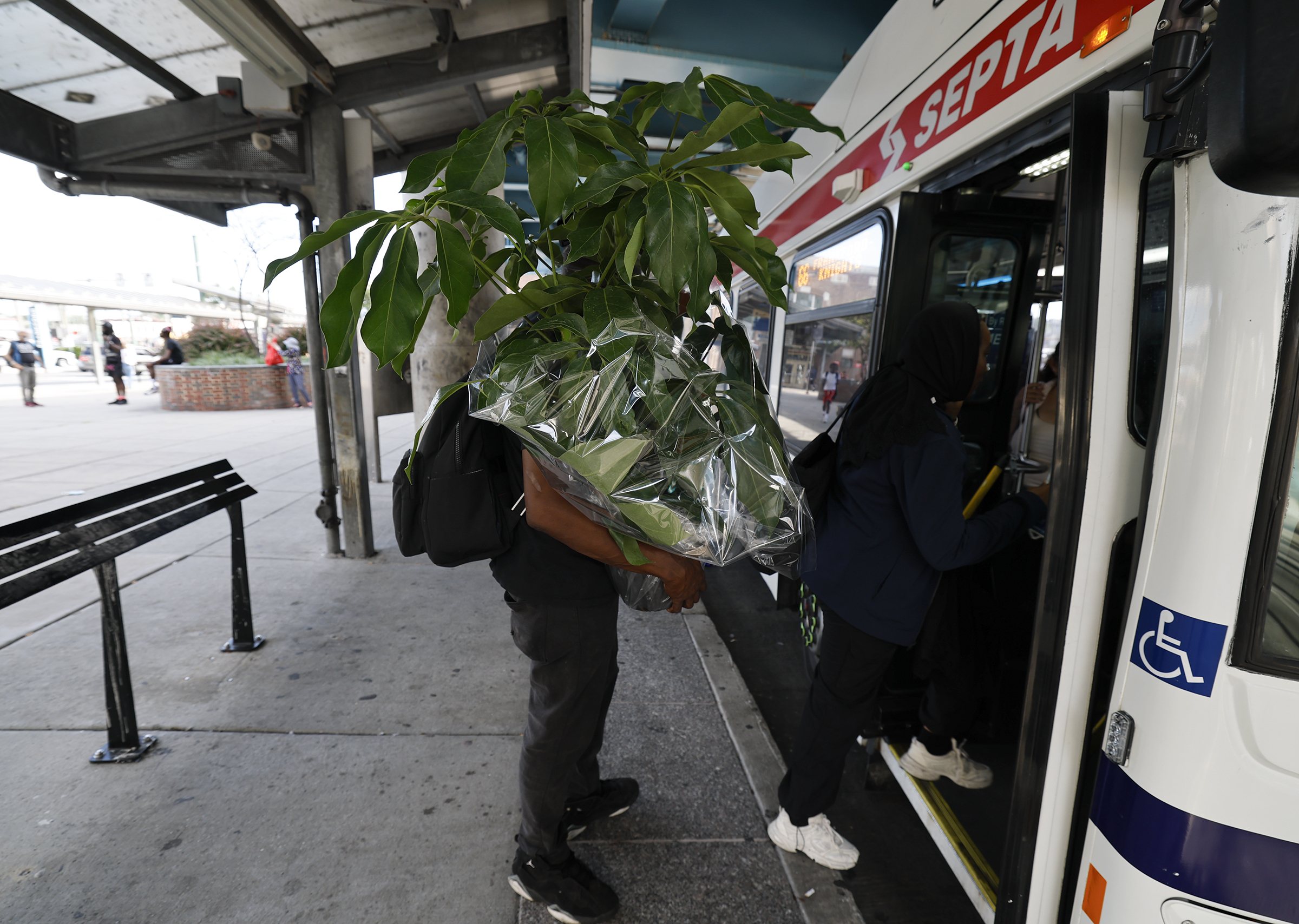
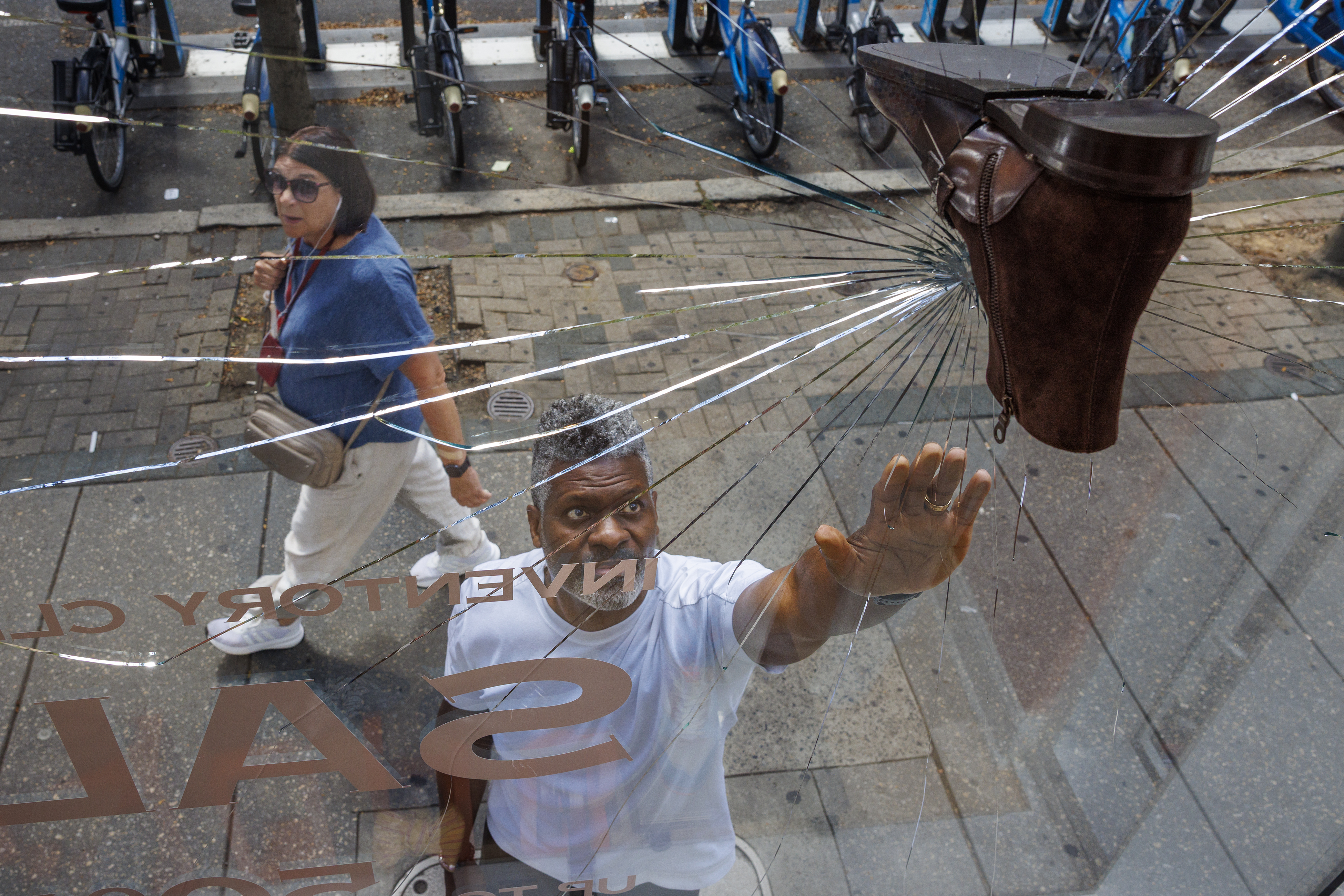
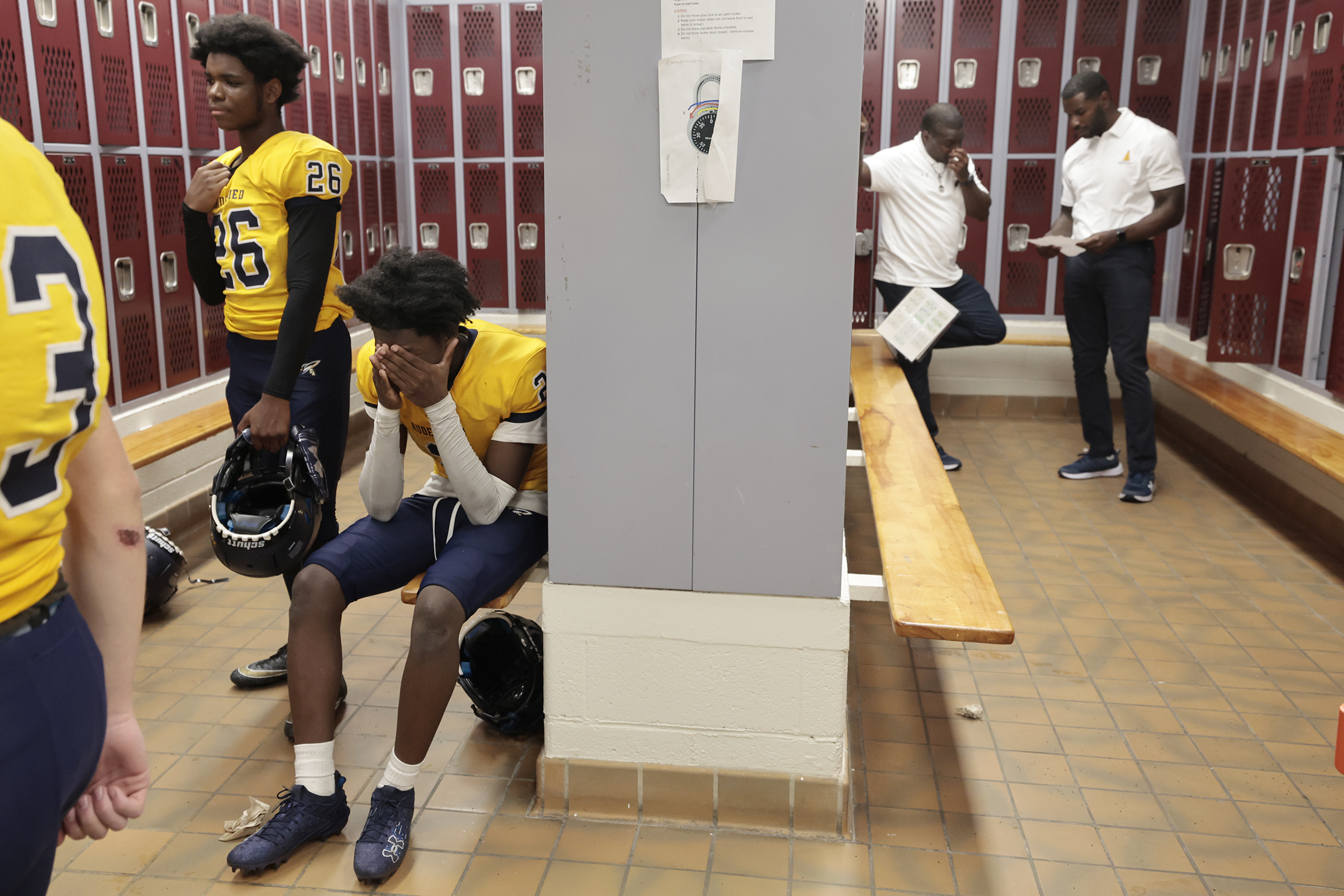
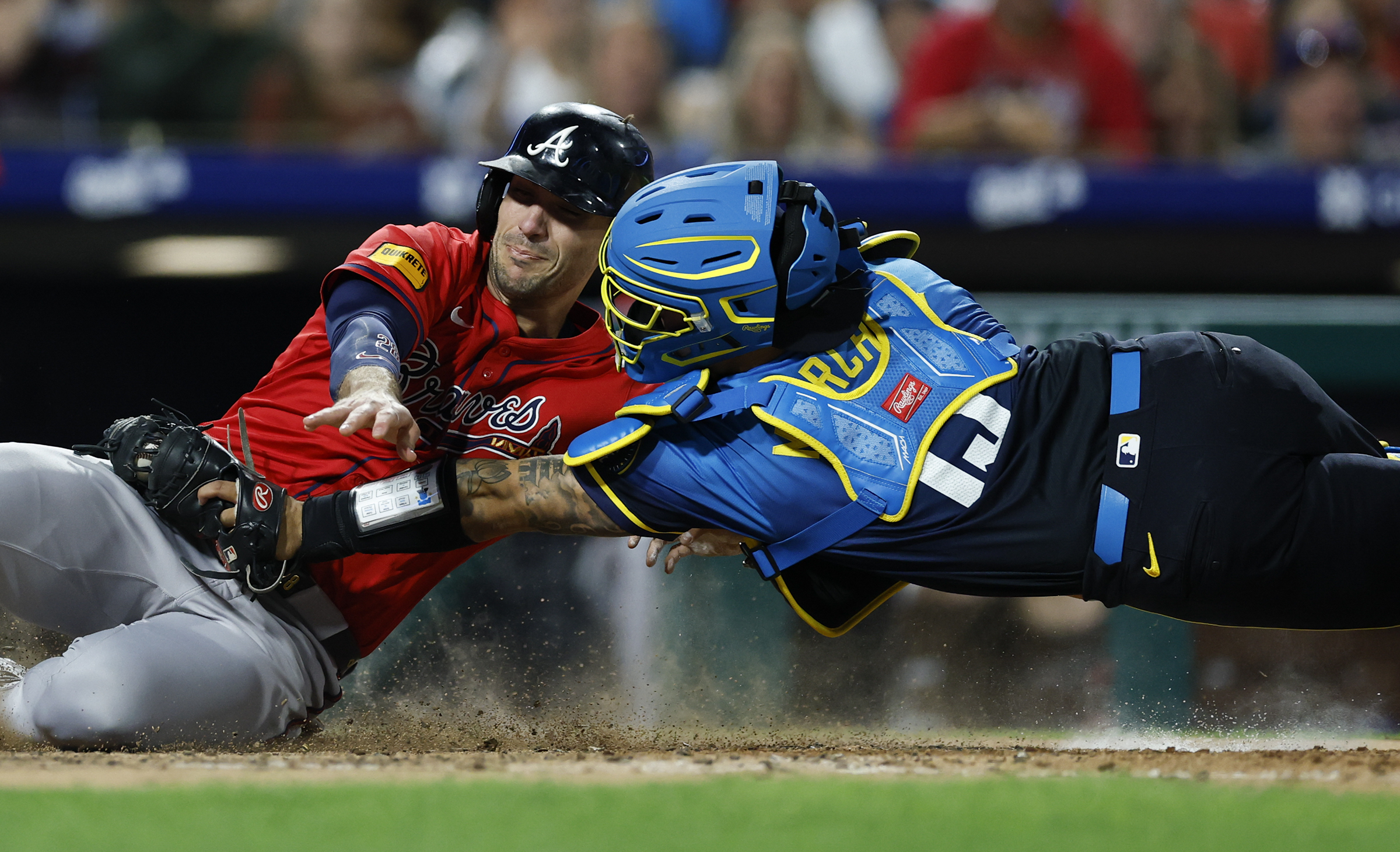
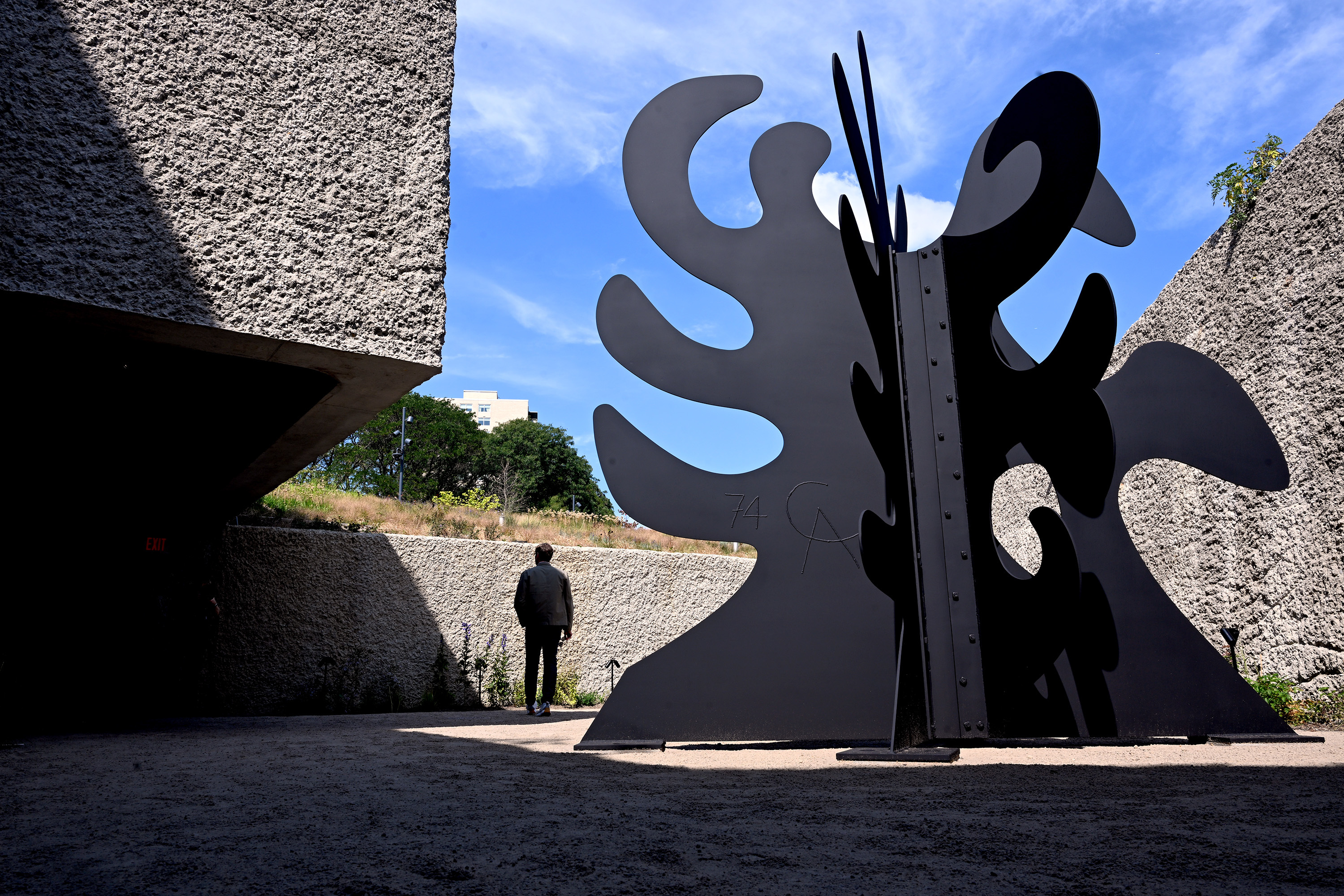
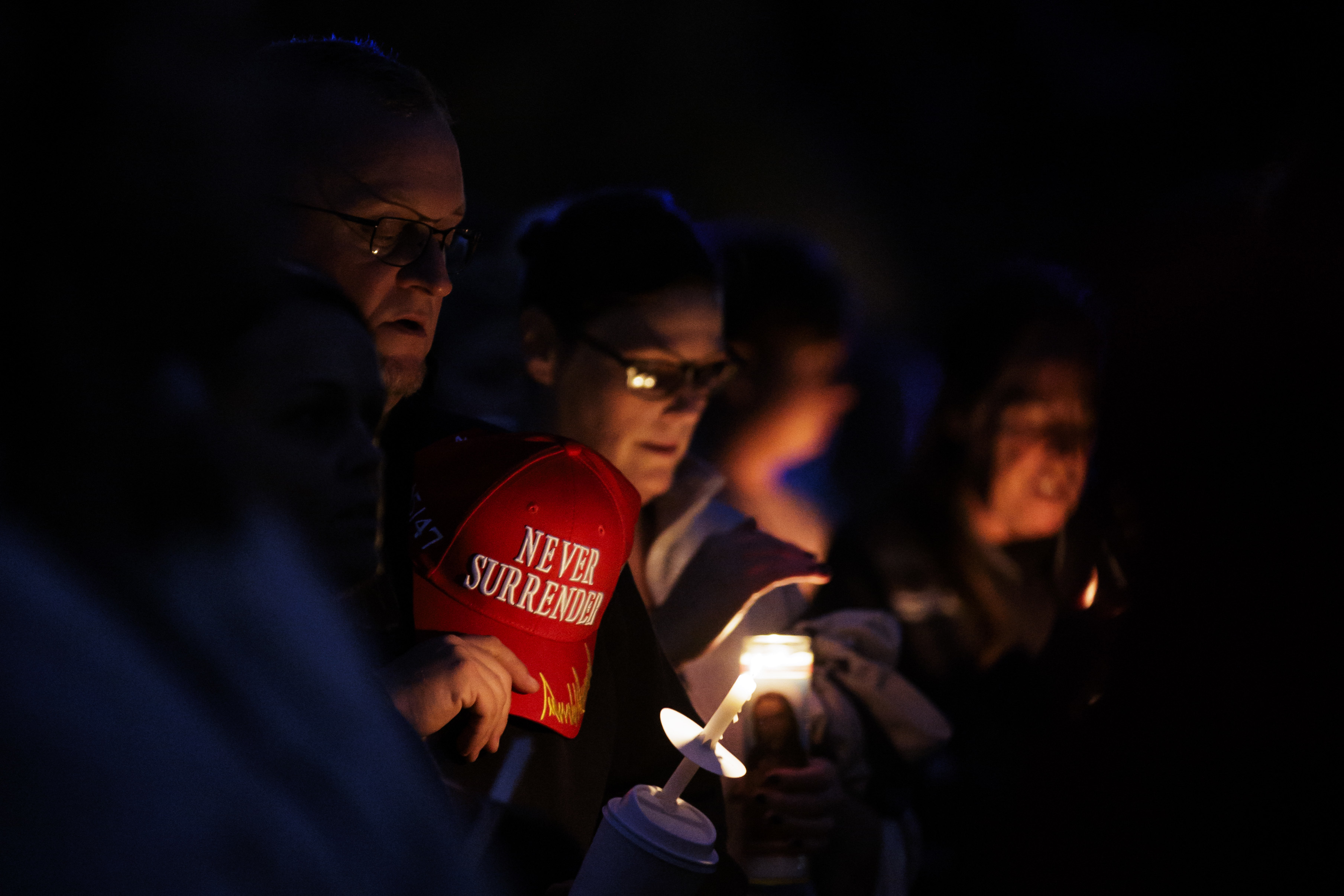
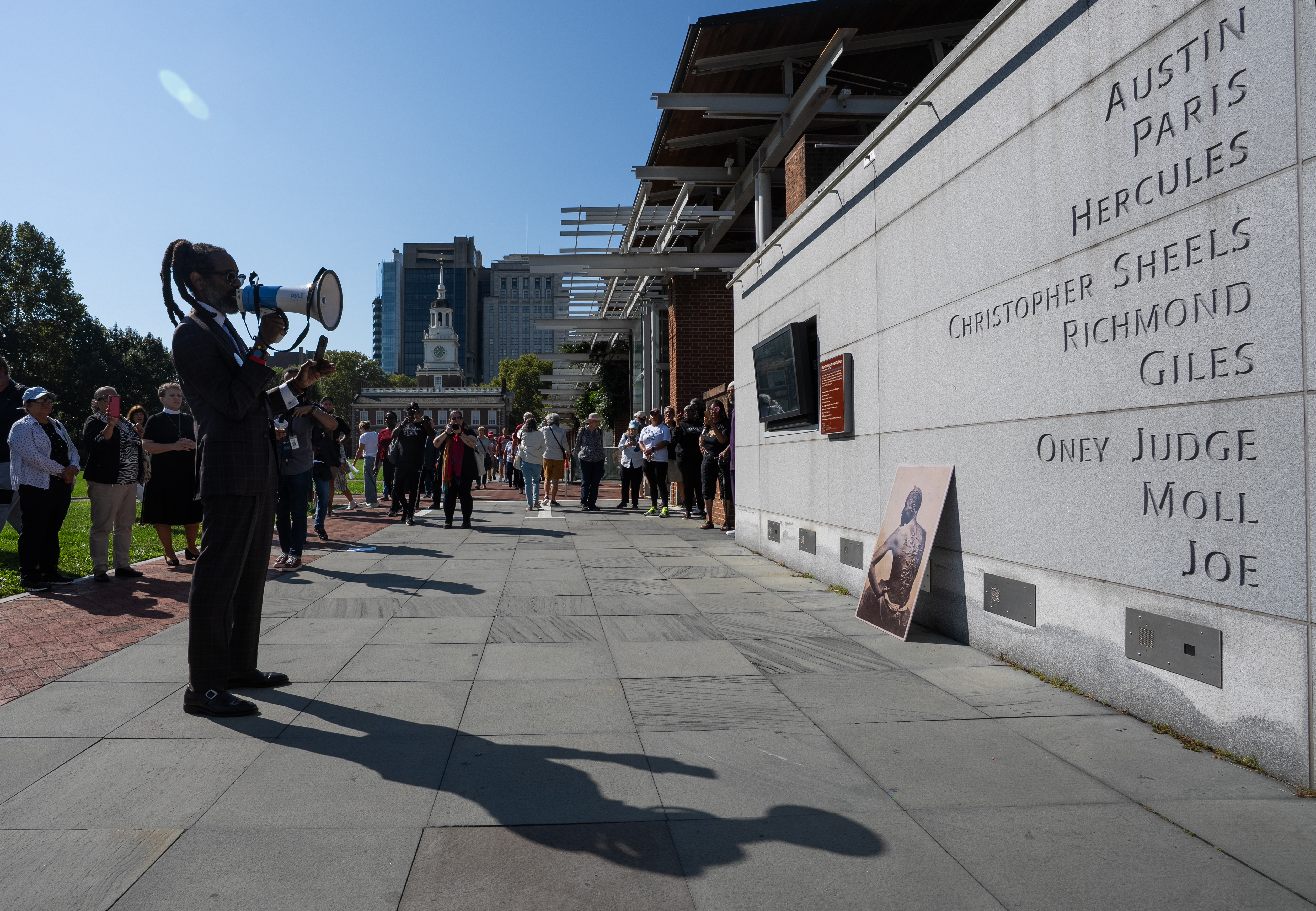
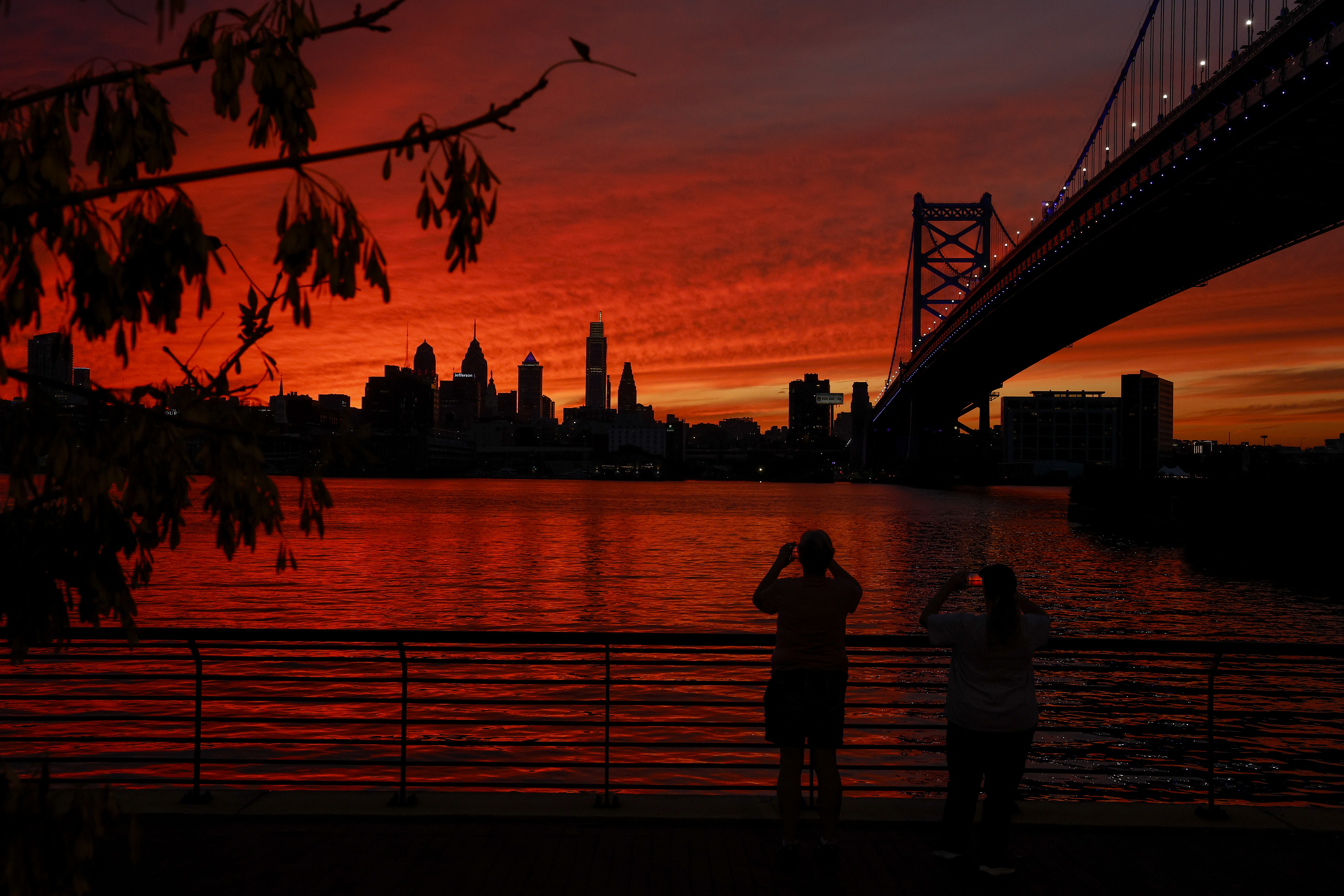
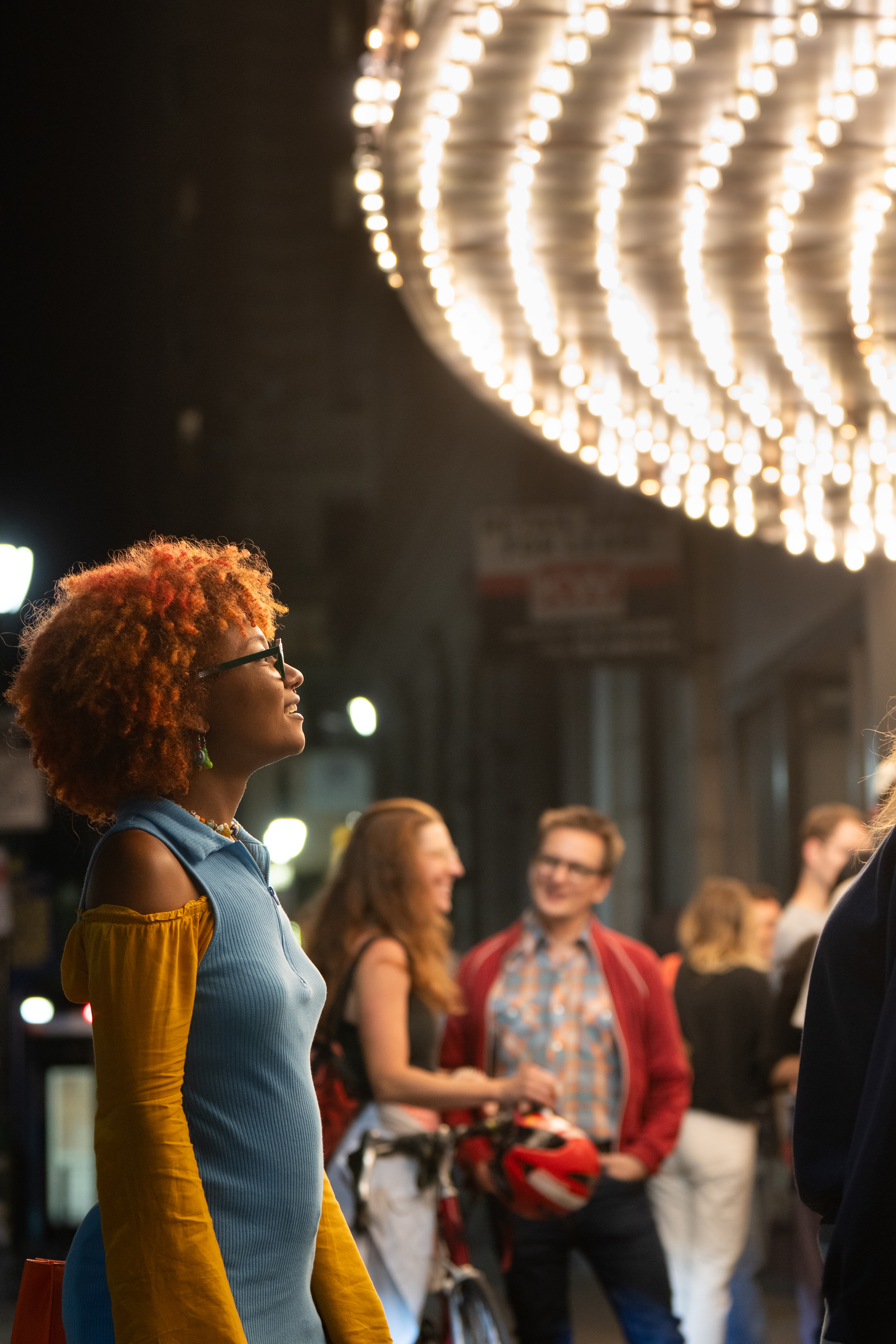
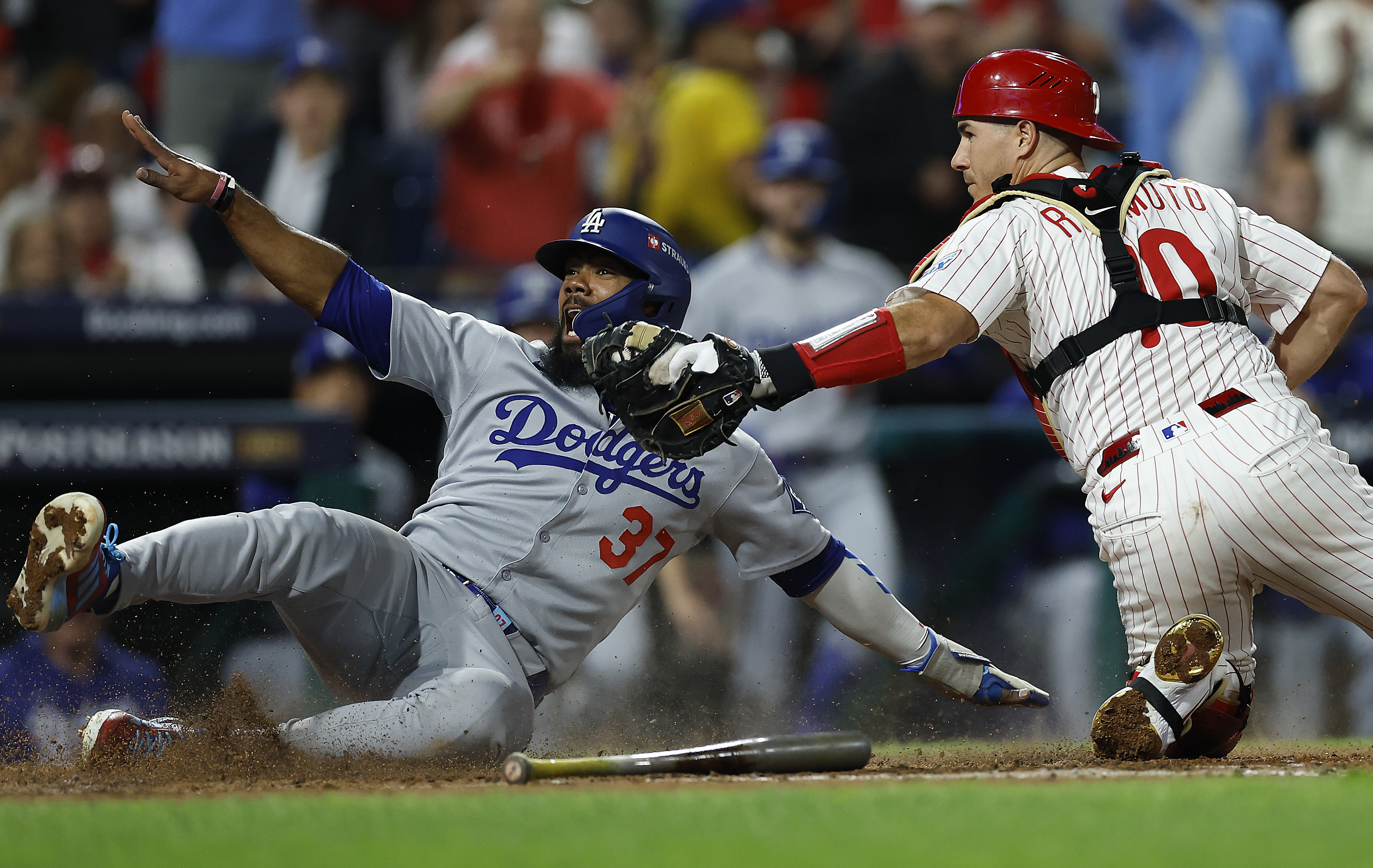
City workers and volunteers move dumped tires toward garbage trucks during the Philly Spring Cleanup at Tacony Creek Park in April.Visitors tour Lucy the Elephant in April. The historic six-story structure has been a Margate, N.J., landmark for more than a century. Celal Emanet (center), with son Muhammed (right) and family friend Mustafa Tug, waits for his wife, Emine, to be released from the U.S. Immigration and Customs Enforcement center in Elizabeth, N.J., on March 12. The Emanets were arrested at their Jersey Kebab restaurant in Haddon Township two weeks earlier.Fulya Labernas (left) takes a picture of her 1-year-old son, Ibrahim, and her cousin, Neslihan Kalkan, outside Jersey Kebab on March 30. Celal and Emine Emanet prepared a feast to thank community members who rallied and raised money on their behalf after they were arrested by ICE agents.Andrew Ahl of the Reptile and Amphibian Department at the Philadelphia Zoo holds a Western Santa Cruz Galapagos tortoise that hatched in April.Montgomery County seniors in their 70s, 80s, and 90s cross Egypt Road from their continuing care retirement community in Audubon to protest the Trump administration on May 1. Members of the Camden High Marching Band attend a college signing day celebration at Rutgers Camden on May 2. Front row from left: Jazmynne Houston and Shaleah Navarro. Second row from left: Marjhani Land, Shalynn Mitchell, and Jaida Mitchell.Spectators watch the action during the Truist Championship at the Philadelphia Cricket Club’s Wissahickon Course on May 8. A roller blader passes the “Weaver’s Knot: Sheet Bend” artwork along the Delaware River Waterfront on May 12. Spectators people-watch outside Rim Cafe during the annual South 9th Street Italian Market Festival on May 18 in Philadelphia. From left: Joe Mirarchi, Howie Brown, William Gambino, and a person who didn’t want to give his name.On June 2, Saquon Barkley stopped by to help out at Geno’s Steaks, which was dubbed “Steakquon’s,” in celebration of the Eagles running back’s “Madden NFL 26” video game cover announcement.The aftermath of a large fire that engulfed multiple SEPTA buses at the Roberts Yard SEPTA Railroad Facility in Nicetown on June 5. Officials said 40 buses in the lot were damaged.Independence National Historical Park staff members fired muskets on June 6 during Revolutionary War weapons training. The training on reproduction flintlock muskets took place on the lawn south of Carpenter’s Hall in Philadelphia.Women dressed in colonial garb march in the “No Kings” political demonstration protesting the Trump administration on June 14 in Philadelphia.Wydad fans celebrate a goal as their team plays Juventus in the 2025 FIFA Club World Cup Group G match at Lincoln Financial Field in Philadelphia on June 22. Juventus won 4-1.Justin and Erica Vidal, of Galloway, N.J., enjoy ice cream cones in their 1967 Dodge Dart convertible with sons Alessio, 2 months; Nino, 2; and Alexander, 5, at Kustard Korner in Egg Harbor City.The Jewell and Alisio families celebrate the Fourth of July weekend with a block party on Roseberry Street in Philadelphia on July 5.Angel Luis Rosado with Athena Contracting Inc. works to clear garbage at a dump site at Caldera and Red Lion Roads on July 8 during the second week of AFSCME District Council 33’s strike.Mayor Cherelle L. Parker walks from her City Hall office on July 9 to speak hours after her administration struck a tentative contract agreement with AFSCME District Council 33 leaders, ending a strike. With her are Chief Deputy Mayor Sinceré Harris (from left), Chief of Staff Tiffany W. Thurman, and Chief Deputy Mayor Vanessa Garrett Harley.A wild turkey found itself stuck in traffic with many others after a crash on the northbound side of the North-South Freeway (I-76) in Gloucester City, N.J., on July 11.Phillies starter Ranger Suárez unraveled in the second inning of a game on July 20 against the Los Angeles Angels. The blur was created in-camera using a slow shutter speed and panning with the movement.Eagles players Nakobe Dean (from left), Jalen Hurts, Moro Ojomo, and Jordan Davis relax on the field after training camp practice on July 26.Willa Allen, the widow of Dick Allen, waves to the crowd as she rides in the Hall of Fame Legends Parade with her family on July 26 in Cooperstown, N.Y. Dick Allen, Dave Parker, CC Sabathia, Ichiro Suzuki, and Billy Wagner were among those inducted into the National Baseball Hall of Fame.Union forward Mikael Uhre (second from left) celebrates his second half go-ahead goal with his teammates against the Colorado Rapids at Subaru Park in Chester, Pa., on July 26.James Burton, 59, of West Oak Lane (from left), Raymond Johnson, 62, of West Oak Lane, and Mike Johnson, 58, of Newport, Del., sit at the bay door watching a downpour at Ray’s Auto in Germantown on July 31.Closer Jhoan Duran makes his Phillies debut against the Detroit Tigers on Aug. 1 at Citizens Bank Park. The Phillies win 5-4.Ari from Philly (back to camera) gets decorated by “the glitter guy” on Aug. 23 before the start of the 2025 Philly Naked Bike Ride at Lemon Hill.Philadelphia schools Superintendent Tony B. Watlington Sr. (left) and Mayor Cherelle L. Parker greet a student at Edward T. Steel School on Aug. 25, the first day of school.A rider carries his plants on the 66 bus at the SEPTA Frankford Transportation Center on Aug. 25. Frustration and confusion were being seen at Center City transit hubs amid SEPTA cuts.Steve Jamison, owner of Blue Sole Shoes at 1805 Chestnut St., on Aug. 26. After a vandal damaged the store’s window with a brick, Jamison cut a boot in half and glued each half on opposite sides of the window to create a “lighter situation” while he waited for new glass to be installed.Audenried players Myhaj Oliphant (26) and Jaylin Simms rest while head coach Roy-Al Edwards (far right) talks with another coach during halftime at Chichester High, in Boothwyn on Aug. 28. Chichester got the win 36-16.Phillies catcher Rafael Marchan tags out Atlanta Braves first baseman Matt Olson at home plate in the fifth inning on Aug. 29 in Philadelphia. Phillies win 2-1.A guest views Alexander Calder’s sculpture “Tripes” (1974) in the Vestige Garden, at Calder Gardens during a preview on Sept. 15.People gather for a prayer vigil for Charlie Kirk at Fluehr Park in Northeast Philadelphia on Sept. 17. Kirk was killed on Sept. 10 during a speaking engagement at Utah Valley University.Michael Coard, an attorney and leader of Avenging the Ancestors Coalition, speaks with a megaphone prior to a silent protest on Sept. 19, near the President’s House. “What can’t occur is slavery being censored in this historical place. We must show the harm,” Coard said. During the rally, the group led a nine-minute tribute to the nine enslaved people that George Washington brought to the Philadelphia residence.Defensive tackle Byron Young celebrates with fans a blocked a field goal sealed the team’s 33-26 comeback win over the Rams on Sept. 21 in Philadelphia.Hurricane Imelda brought conditions for an aurora sunset seen behind the Philadelphia skyline, captured from the Camden Waterfront on Sept. 30.Josh and Tabitha Filomeno, of Northern Liberties, enjoy the weather with their daughter, Joia, 5 months, along Kelly Drive on Oct. 3.Motorcyclists compete on the sand during the Race of Gentlemen in Wildwood on Oct. 5.Tanelsa Franklin-Phillips and moviegoers wait outside the Film Society Center on Oct. 5.Los Angeles Dodgers right fielder Teoscar Hernández (left) slides safely by Philadelphia Phillies catcher J.T. Realmuto to score in the seventh inning of Game 2 of the NLDS at Citizens Bank Park on Oct. 6.The Dodgers’ Max Muncy celebrates after Phillies pitcher Orion Kerkering’s errant throw home allowed the winning run in the 11th inning of Game 4 of NLDS on Oct. 9 in Los Angeles. Dodgers won 2-1, ending the season for the Phillies.Friends Dennis Donnelly (left) and Jack Sharkey of Northeast Philadelphia are soaked as the surf crashes over the North Wildwood seawall during a nor’easter Oct. 12. Donnelly said they were in Wildwood to retrieve his jet ski so it wouldn’t get damaged by the storm.Flyers captain Sean Couturier leaps over Florida Panthers goaltender Daniil Tarasov during the first period of the Flyers’ home opener on Oct. 13, in Philadelphia. The Flyers won 5-2 over the defending Stanley Cup champs.Sixers guard Tyrese Maxey and forward Trendon Watford were all smiles after their 110-108 victory over James Harden and the Clippers on Nov. 17 in Philadelphia.Kada Scott’s mother, Kim Matthews (center right), holds a sign featuring her daughter while releasing balloons at a Domestic Violence Awareness walk at the Philadelphia Art Museum on Oct. 26.
Once considered the loudest hospital in the Philadelphia area, Riddle Hospital in Media has significantly reduced its nighttime noise levels, newly released federal data shows.
At the Main Line Health Riddle hospital, only 12% of patients from the most recent survey rated the area around their room at night as “sometimes” or “never” quiet — down from 26% of patients surveyed between July 2022 and June 2023.
Across the Philadelphia region, 52% of patients said their hospital room was “always” quiet at night. That’s slightly worse than nationally, where patients said hospitals were quiet throughout their stay 57% of the time.
Virtua Mount Holly Hospital in New Jersey is now rated the loudest by patients.
Nazareth Hospital in Northeast Philadelphia, owned by Trinity Health, was ranked the second loudest in the region.
window.addEventListener(“message”,function(a){if(void 0!==a.data[“datawrapper-height”]){var e=document.querySelectorAll(“iframe”);for(var t in a.data[“datawrapper-height”])for(var r,i=0;r=e[i];i++)if(r.contentWindow===a.source){var d=a.data[“datawrapper-height”][t]+”px”;r.style.height=d}}});
Quieter hospitals have benefits for both patients and staff, helping to lower anxiety levels, improve sleep quality, and ease the flow of communication.
Riddle Hospital’s improvement follows construction of a new 230,000-square-foot patient pavilion that had temporarily increased noise at its Delaware County campus.
“With the pavilion’s 2023 completion, as well as the resulting addition of more private rooms, noise is significantly reduced,” spokesperson Larry Hanover said.
Reducing noise is also priority for Penn Medicine, whose Hospital of the University of Pennsylvania (HUP) was rated the quietest hospital among the 25,000 patients surveyed in the Philly-area.
Chester County Hospital, also owned by Penn Medicine, was ranked the second quietest.
The health system has made big investments in recent years to address noise levels at its hospitals, according to the university’s website. The Pavilion, which opened at HUP in Center City in 2021, was designed to reduce noise levels and nightly disruptions by separating nonclinical work from patient care areas.
Each floor of the $1.6 billion building centers around an “offstage” area for staff to hold conversations and calls away from patient rooms that line the perimeter. The design of the rooms also allows care teams to check vitals and refill medications from the hallway, reducing nighttime disruptions.
window.addEventListener(“message”,function(a){if(void 0!==a.data[“datawrapper-height”]){var e=document.querySelectorAll(“iframe”);for(var t in a.data[“datawrapper-height”])for(var r,i=0;r=e[i];i++)if(r.contentWindow===a.source){var d=a.data[“datawrapper-height”][t]+”px”;r.style.height=d}}});