When Jalen Hurts and the first-unit offense took their well-earned rest early in the fourth quarter of an eventual 31-0 blowout over the Las Vegas Raiders, the Eagles had a run-pass ratio of 32 to 17.
There were myriad reasons for a ground-heavy attack on Sunday at Lincoln Financial Field: from wintry weather conditions and schematic improvements to situational play-calling with a lead and rebuilding Hurts after a disastrous performance vs. the Los Angeles Chargers.
But mostly the Eagles ran the ball because it’s what they need to establish if they want to repeat as Super Bowl champions. Coach Nick Sirianni would never cop to looking that far ahead, nor should he, but the hapless Raiders offered the opportunity to give his directionless offense a compass for the future.
The run game wasn’t exactly efficient or close to explosive, especially on traditional handoffs to running back Saquon Barkley. The 2025 offense is unlikely to become the 2024 version of itself.
But a formula closer to that of a year ago — and, really, for most of the five years of the Hurts-Sirianni partnership — is the Eagles’ best hope. That meant, obviously, more carries for Barkley and backup Tank Bigsby, but also more diversity in the calls, more runs from under center, more up-tempo, and perhaps most importantly, more of Hurts on designed keeps.
“These are things that have been staples in our offense for a long time, and we’re just continuing to use things that we think fit for that week,” Sirianni said. “I haven’t watched anything on Washington, but next week we could come out and it could be a completely different game.
“We have core philosophies and visions of our identity, but we’ll see.”
It’s no coincidence that the Eagles’ preceding three-game slide came with Hurts dropping to throw more than he ever has, with a 70-30 ratio away from the run. That’s additional pressure for any quarterback, but Hurts has repeatedly shown that he’s most effective when he doesn’t have to shoulder the offense in the drop-back game.
Can he do it at times? Absolutely. But analytics favor more balanced play-calling for the Eagles. That’s not an endorsement for the “just run it” crowd. Modern NFL offenses have to be adaptable. There have to be pre-snap checks at the line and options at the snap to counter defenses.
But the Eagles didn’t operate that way on Sunday, even though the Raiders continued their tendencies of staying in base personnel and stacking the box. Las Vegas coach Pete Carroll often dared Sirianni and offensive coordinator Kevin Patullo to pass. And they did at times.
Hurts had key first-half throws against single coverage on the outside, one resulting in a 44-yard pass to receiver DeVonta Smith and two others that attracted defensive pass interference penalties against receivers A.J. Brown and Darius Cooper.
But most of the first 45 minutes featured Barkley, Bigsby — and occasionally Hurts — running, no matter what.
“I think the most important thing was we did a better job on earlier downs of being more consistent in the run game,” Barkley said. “And got to get credit to [Patullo] and those guys for sticking with it … even though we [had] some negative runs.”
Jalen Hurts and running back Saquon Barkley embrace before the Eagles game against the Las Vegas Raiders at Lincoln Financial Field on Sunday.
The Eagles also had the luxury of knowing their defense would stifle one of worst offenses in the league. The Raiders crossed the 50 only once in the first half and averaged just 2 yards per play.
Barkley wasn’t much better on the ground with 2.3 yards per carry on 15 first-half rushes. Bigsby was a little better at 4.7 on three carries. But there were positive moments from under center and even in the shotgun, where they’ve struggled the most.
Hurts was more productive with four runs for 25 yards. There was a draw that converted a third down, but three zone-read keeps — while not picking up significant yards — were important because they seemingly created space in the second half.
“I think he did a really good job,” Barkley said. “Some of them [were] read, some of them [were] a feel, but it helps open stuff up.”
In the second half, Barkley had seven carries for 44 yards, even though the trailing Raiders knew the Eagles were already in salt-the-game-away mode. They added wrinkles, like having left guard Landon Dickerson pull from the back side on a Barkley 17-yard scamper.
They even used three-tight end sets from under center and ran counter and duo runs with success. And going no-huddle helped keep the Raiders defense from switching personnel and getting set. The pains of the first half paid off in the second.
“With the changes that we made last week, I think we’re just more comfortable in it,” Eagles tackle Jordan Mailata said about the Eagles’ run blocking schemes. “We were able to execute, able to get to fundamentals, the basics that we do well, especially with that on-the-ball [tempo] stuff.”
Hurts, meanwhile, ran seven times total for 39 yards. One was a scramble. Another was on a successful Tush Push. But five carries on designed runs were a season high and significantly higher than his average of 1.6 per game in the first 13 games.
“Just think the flow of how it went every week is the same in terms of going out there and trying to execute what’s called,” Hurts said. “That’s just how the cookie crumbled today.”
He ran with obvious conviction, though. Much has been made of Hurts’ reluctance to take off as much this season. His last two injuries that led to missed games came on designed runs in December. It briefly seemed like there might be a third when his leg bent awkwardly on a late third-quarter keep.
Jalen Hurts ran the football with conviction in Sunday’s win over the Raiders.
But Hurts stayed in when the Eagles switched sides to open the fourth quarter. And on the next play, he tossed a 27-yard touchdown pass to Brown. All told, Hurts completed 12 of 15 passes for 175 yards and three touchdowns. He was sacked only once.
And most significantly, he didn’t turn the ball over after his five giveaways at Los Angeles. Last week was an uncharacteristically sloppy outing for Hurts. But games in which he’s asked to throw more have produced sloppy games at times.
The Hurts who manages the offense, the one who protects the ball, and the one who runs with authority is the one who has shown he’s championship-caliber.
“Aw, man, that was amazing, wasn’t it?” Mailata said about Hurts running more. “I thought it was great. It was a great reminder that we have a dual-threat quarterback back there that can pull the ball and run the ball. And if you don’t respect that, we took advantage of that today.
“Speedy Gonzalez out there.”
The Eagles haven’t solved all their issues on offense. There will come a time when Hurts and the drop-back passing game will need to deliver. There will be a defense that, for instance, takes away run-pass option plays, or an opposing offense that can actually score.
It’s difficult to place much weight in beating one of the lesser teams in the NFL, and the subdued responses from several offensive players suggested they knew as much. Brown and Smith weren’t even in the locker room to answer questions from reporters.
Hurts’ terse answers were probably in response to outside criticism he’s recently faced. He showed more emotion than usual after his touchdown toss to Brown.
“It was just a natural reaction,” he said afterward.
The quarterback showed his resiliency once again. He benefited from a run-heavy offense, a dominant defense, and an inferior opponent. But that’s not to diminish his performance.
Hurts earned his sentiment and more than that. The same could be said for the entire offense.
“We just haven’t been playing good ball, just call it how it is,” Mailata said. “We just haven’t been, so you’ve got to celebrate the moments that we do, that we do execute, that we do, third-down touchdowns, especially big ones like that. Like, we’ve got to celebrate that.
“I’m glad that he’s showing emotion.”
Teams often take on the personality of their quarterback. The position has that much importance. But the Eagles are often their most joyous when they win running the ball.
Have they turned a corner or was Sunday just a blip?
After serving more than two decades in the military, William Duffy found himself with no direction.
Duffy was coming from an environment where every day was planned for him, surrounded by people who shared his same experiences. Reentering civilian life was a shock to the system.
When one of Duffy’s former captains called him about a veterans hockey program the Flyers were starting six years ago, Duffy, who’d grown up playing goalie, jumped at the opportunity. “No matter where I was at, I was always playing,” he said.
Duffy is now the president of Flyers Warriors, a hockey program dedicated to providing a supportive community for wounded, injured, or otherwise disabled veterans and their families. The team started with a group of 33 veterans, and now spans five teams, from the elite level with former college and junior players to a learn-to-play program for those just starting out.
“It is a life-saving type of program, because some of these guys and girls wouldn’t have anything if it wasn’t for us, to be honest with you,” Duffy said.
Kevin Emore, the vice president of business operations for Flyers Warriors, can attest to its value.
“When I had my first episode with PTSD after running around the world doing contracting work or being in the military and deploying for the first time, I was surrounded by people on my left and my right that I didn’t know if I could trust,” Emore said. “When I made my way back to the East Coast, the Warriors was the first time that I found it again.”
Flyers’ Garnet Hathaway, a big supporter of military-based charities, took some time to talk with several veterans on the ice on Nov. 11.
The higher-level teams play tournaments across the country against Warriors teams affiliated with other NHL organizations. To eliminate barriers for all players to get on the ice, they provide childcare for families, and there’s a large community of Warrior Wives.
But the Flyers Warriors also pride themselves on the community they’ve built off the ice. That extends to social events like their group Thanksgiving dinner and participating in community service.
“What we realized along the way was veterans are better when we’re serving others,” Duffy said. “If we can create pathways to allow veterans to get back to service, that’s where they’re going to start to feel at home again.”
That’s where the partnership with the Flyers organization proves helpful. In addition to ice time and support, the Flyers Warriors are active in local philanthropy through various Flyers Charities initiatives. The Flyers Warriors athletes are key volunteers at events like the Gritty 5K and the Flyers Charities Carnival.
Todd Fedoruk, a former Flyer who played in the NHL from 2000 to 2010, said he too feels like he’s found a second home with the Flyers Warriors. While there are obvious differences between being a military veteran and an NHL veteran, Fedoruk also found similarities to his life after retirement.
After retiring from pro hockey, where his life was similarly structured with a strict schedule, Fedoruk also found himself searching for who he was aside from a hockey player.
“There’s a common bond there,” Fedoruk said. “Working with these guys, it does become more [than just] about hockey, because with my own history with mental health and all those other issues that’ve come maybe because of hockey, maybe not because of hockey, but the dynamics of change that happen to a former athlete are very similar.”
To help veterans make that adjustment, the Flyers Warriors connect their members with mental health services and support. Navigating the services available through the Veterans Affairs office can be a deterrent for those seeking mental healthcare, Emore said. They prioritize connecting their members with behavioral health, addiction, and recovery services.
The space Duffy and the executive board have built on the ice through Flyers Warriors helped build the foundation of trust for veterans to seek those resources out, all based on their shared love of hockey.
“It makes me feel proud about the game that I played,” Fedoruk said.
While waiting for a bus earlier this year, two Philadelphia street artists who rely on public transportation diagnosed an all-too-familiar ailment: I have no idea when the bus will be here.
“No one knows when the bus is coming,” one recalled saying.
“We should really make something.”
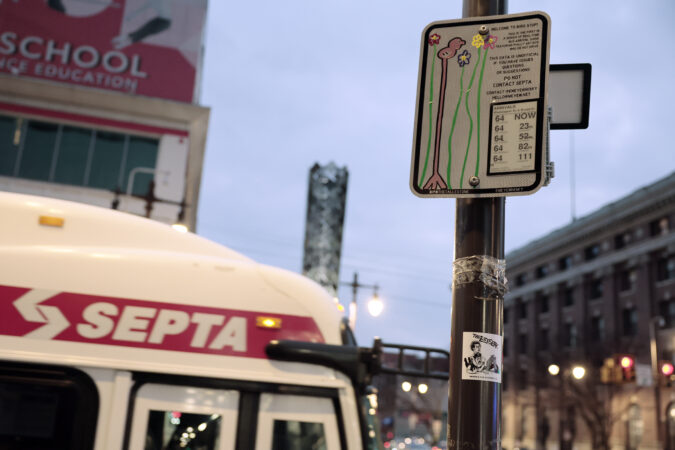
Earlier this month, their brainchild — a solar-powered e-reader mounted into a street sign that provides bus arrival information — went live on the northeast corner of Broad Street and Washington Avenue in South Philadelphia, along bus Route 64.
The device pulls real-time arrival times from publicly available data (the same dataset that feeds SEPTA’s app), according to artist Make It Weird, who engineered the rig and asked to remain anonymous because their work meanders into a legal gray area.
The digital real-time bus tracker that has been installed at the Route 64 bus stop on the northeast corner of Broad Street and Washington Avenue in Philadelphia on Sunday, Dec. 7, 2025.
Their creation is inconspicuous; to passersby, it could be a road sign graffitied with a lanky bird and stalky flowers. Commuters might get closer and see it reads, “This data is unofficial. … Do not contact SEPTA.”
“We have a fundamental issue with funding transit in Pennsylvania,” Make It Weird said. “We, as citizens, often make excuses for real quality-of-life improvements that could be made by saying, ‘Well, SEPTA doesn’t have money, so quit complaining.’ We’re just saying, ‘This could be better.’”
The sign is akin to a Band-Aid on a public transportation network plagued by infrastructure issues, financial turmoil, and an ever-constricting budget, as well as a resource for people who don’t have access to a smartphone with unlimited data or SEPTA’s app, said Make It Weird and collaborator Bird, the alias for the artist whose signature statuesque and slender pink bird appears on the sign.
“Accessibility is something that’s hugely important to me,” Bird said. “It comes from a really large place of privilege that people always assume that everyone has a phone or can look something up, and that’s just not the case. Trying to provide that kind of accessibility for everyone — I think it’s an important place to start.”
Late last month, a prototype of the device near South Philly’s Benna’s Cafe caught the attention of Conrad Benner and wound up on Streets Dept’s Instagram.
The video has garnered more than 8,500 likes; the comments section is filled with fire emojis and clapbacks at SEPTA. One commenter wrote, “This is a sincere public service. Artists are extraordinary. Septa should hire them.” Another said, “Hopefully, it doesn’t find the same fate as Hitchbot did.”
“I’ve been really appreciative of how many people think it’s cool,” Make It Weird said. “I’ve been also really appreciative of how many people say, ‘Yeah, other cities are doing this.’”
Digital screens that feed real-time tracking information have already popped up in other major cities, like New York City and Minneapolis. But Philadelphia has been slow to adopt the tech: While a five-year, $6 million contract to install iPad-sized trackers mounted to bus stops was publicized last year, SEPTA spokesperson Kelly Greene said in an email that none of the screens have been deployed yet, citing cybersecurity.
“We recognize the importance of real-time bus tracking for our customers and will provide an update on this initiative as soon as possible,” Greene said.
Make It Weird started making goofy and whimsically mock street signs in June; all their signs are configured to meet the federal standards, they said, which helps their art meld with the monotonous “No Parking” and “Tow-Away Zone” verbiage. (One sign near City Hall said, “Stop Parking, Ride SEPTA: Fund Public Transit, Sell Your Car,” in the ubiquitous, red Highway Gothic sans-serif font. Another triptych read, “Go Birds,” “F— ICE,” and “Free Palestine,” quoting Hannah Einbinder’s bleeped Emmy acceptance speech.)
The Route 64 sign is the first in hopefully a series of 10, all featuring collaborations with other Philly artists who don’t drive.
Technically it’s always whiskey-sipping season in my house. But there is something extra cozy about the December chill that sparks the spirit of giving whiskey, too. The glint of colorful lights on a big ice cube rattling through a tumbler of amber elixir. The toasty vanilla perfume of barrel char, the punchy spice of distilled rye, a whiff of peat smoke from a faraway land. A great bottle that captures this kind of magic is the definition of a win-win gift because, hopefully, whoever receives it will be in the cheerful mood to crack it open right there and share! That’s just good manners.
That is exactly what I did recently when I gathered a group of thirsty friends, neighbors, and spirit nerds for an afternoon tasting to determine the stars for my annual holiday bottle list. This year we sniffed, sipped, and selected 14 winners from a competitive collection of 33 bottles from across the world, including intriguing entries from two countries not yet known for whiskey — Mexico and Korea — as well as a pleasant surprise from a music icon more famous for her Billboard hits than her high-rye mashbill. All of these bottles are currently available retail in Pennsylvania and South Jersey, and they suit a wide range of tastes and price points, from a half-dozen sub-$50 values to a handful of triple-digit splurges.
One noticeable trend is the continued swing toward high-proof spirits, and in particular, whiskeys categorized as bottled-in-bond. This legal designation was created in 1897 to certify purity — with no additives other than water — and that the whiskey in question is produced by one distillery, aged no fewer than four years, and bottled at 100 proof. While the Bottled in Bond Act was launched as an integrity initiative when late 19th-century rectifiers were adding ingredients like creosote and wintergreen to their booze, the reasons for the current resurgence is unfortunately economic.
America’s craft industry is in the midst of a major implosion, with nearly 25% of America’s craft distillers closing over the past year due to a variety of reasons, from a rise in legalized cannabis and GLP-1 drugs that have cut into liquor consumption to the double-whammy of rising costs and plummeting exports due to tariffs. The net effect, says Rob Cassell of New Liberty Distillery in Northeast Philly, has been a wave of distillers unloading their more expensive aged inventory as the industry consolidates. That’s concerning for whiskey fans.
The flip side is that I also happen to be a fan of the 100-proof category, which offers more punch (and, often, more flavor) than standard bottlings typically in the 80- to 90-proof range. So I was happy to do my part and support the cause, putting several of these intriguing bottles on my annual tasting table and now passing them along as recommendations. While the industry confronts the sobering facts of its new reality, we can at least drink well.
Scotch
From left: Dewar’s Blended Scotch Whisky, The Glendoronach Highland Single Malt Scotch Whisky, and Bruichladdich Islay Single Malt Scotch Whisky.
Bruichladdich The Classic Laddie
The eye-catching teal blue bottle is only one sign this whisky is different. Bruichladdich, a once-fallow Victorian-era distillery, was revived in 2001 by emissaries of the French wine industry with a modern aesthetic and a focus on locally grown barley, which always comprises at least a portion of the mashbill. It’s one of the only distilleries on Islay (the smoke-shrouded home of Laphraoig) that makes some of its whiskies without peat-smoked malts. (Some of its bottles, like Octomore and Port Charlotte, are actually quite peaty). The Laddie is its signature elegant bottling. It smells of lemon and honey on the nose, then coats your palate with a fresh, clean flavor that evokes a breezy field of grain, then blooms into the fruity flavor of a Bosc pear glazed in salted dark caramel. Remarkably smooth for a 100-proof dram. Bruichladdich The Classic Laddie, 100 proof, 750ml, on sale in Pennsylvania in December ($3 off) for $54.99 (PLCB Item # 000096308)
Dewar’s Blended Scotch 19-year-old, Champions Edition Oakmont label
My dear late mother-in-law was a devoted Dewar’s drinker, and what’s fascinating is that even in its fancied-up form, such as this 19-year-old collectible for the U.S. Open Golf Championship, the traditional sweet side notes of this classic blended Scotch hold true: bananas and chocolate, tanged with citrus and baking spice. That profile reads deeper and more resonant in this slightly higher-octane edition (86 proof vs. the usual 80), which also has the added notes of apple brandy from the Calvados barrels used for aging. Apparently, because this 2025 golf tournament was held at Oakmont Country Club in Pittsburgh, Dewar’s wanted to honor Pennsylvania’s long affinity for the fruit, and it landed with my judges. “Smells like Mott’s apple sauce!” said one after a big sniff, while another, who added a splash of water, noted it took on a lovely butterscotch finish. Dewar’s Blended Scotch 19-year-old, The Champions Edition Oakmont label, 86 proof, 750ml, $79.99 (PLCB item #100047823)
The Glendronach 15-year-old Sherry Cask
This 15-year-old Highland malt looks and smells like burnished old copper, and delivers a decadent fruitcake of deliciousness on the palate — fudgy chocolate, bitter oranges, toasty walnuts, candied cherries, and figs, all wrapped up in a minty finishing puff of pipe smoke. Aged in Pedro Ximénez and Oloroso sherry casks, which accounts for the nutty and dark caramel notes, this 92-proof dram is both smooth and brawny, so a small splash of water only lengthens the flavors rather than dilutes them. A worthy splurge for the single-malt collector in your life.The Glendronach 15-Year-Old Sherry Cask, 92 proof, 700ml, $114 (PLCB Item #100043250)
Asian whiskeys
From left: The Yamazaki, Single Malt Japanese Whiskey and Ki One Single Malt Korean Whiskey.
Ki One Korean Single Malt Whisky
The single most fascinating whisky in this year’s tasting came from Ki One, South Korea’s first single-malt distillery, founded in 2020 by Korean American Bryan Do, who quit his job as a Microsoft exec to pursue his passion for spirits. He and master distiller Andrew Shand, who’s worked in both Scotland (Glenlivet) and Japan (Nikka), wanted to create a whisky that spoke to Korea’s love of spice, achieved largely through the choice of casks and the fast-aging properties of the region’s heat. This “Batch 1” edition aged in virgin American oak gets there beautifully, with deep caramel color and tropical fruit notes on the front — bananas, passion fruit, green Gage plums — along with a sweetness that phases into a tingly finish with a peppery, fermented tang reminiscent of gochujang. Not for everyone, considering the price, but well-made and utterly unique. Ki One Korean Single-Malt Whisky, 80 proof, 700 ml, $124.99 at Benash Liquors & Wines, 2405 NJ-38, Cherry Hill, N.J., 856-667-3539, benashliquors.com
Yamazaki Distiller’s Reserve
Any good Japanese whiskey under $100 is worth a second look, but especially one from the Yamazaki, Japan’s pioneering single-malt distillery built in 1923. The Distiller’s Reserve is Yamazaki’s entry-level bottling, but it’s still a gloriously smooth and complex sipper that will convey much of what makes the brand so coveted. The use of Japanese mizunara oak casks, along with American and Spanish wood, lends a subtle incense-scented component to the mix. Each sip is like a lovely pastry of beguiling flavors, with spiced stone fruit and caramel-vanilla on the nose segueing to strawberries and toasted coconut on the palate, shaded by a soft backdrop of peated malt. This is the kind of whiskey that coats your teeth in the best way. Its aromatics are also lovely when they sparkle atop the icy fizz of a luxury highball. The Yamazaki Distiller’s Reserve, 86 proof, 750ml, $94.99 (PLCB Item #100051645)
Mexican whiskey
Prieto y Prieta
When I think of Mexico, I naturally think of agave spirits, but Mexico’s deep relationship to corn is also inspiring, so why not whiskey? This unique, brassy-colored whiskey de maiz shows what can be done with four heirloom varieties of corn from Oaxaca, and the results are intriguing. Caramel corn, grilled corn husks, and cinnamon are the most obvious aromas that hit you first, but what makes this whiskey so cool are the intensely earthy flavors that emerge on the palate, evoking mushrooms, green peppercorns, and a soft hibiscus tang. Your first instinct might be to add a splash of water to this 86-proof spirit, but that only seemed to dilute the character of its best traits. The label, featuring ears of corn with gilded kernels, will look pretty on any bar cart.Prieto y Prieta Mexican Whisky, $49.99, 86 proof, 750ml, at Benash Liquors & Wines
From left: Sirdavis Rye Whiskey Finished in Sherry Casks and Preito y Preita Whisky Mexicano.
American whiskey
SirDavis American Whiskey
On the subject of beautiful packaging, the tall, fluted shoulders of SirDavis’ bottle — topped with a cut crystal-style stopper and embossed with a bronze horse — stood out like an oversized bottle of luxury perfume. The soigné Western-themed look made sense once I told the tasting team this American whiskey was created by Beyoncé Knowles-Carter in collaboration with Moët Hennessy in the midst of her Cowboy Carter glory. I did not reveal that fact, however, until after we sipped. And this brilliant copper-hued spirit rose on its own merits. It wore its high-rye spice proud, lending some needed backbone to the pretty flavors of barley malt that followed with toffee-caramel sweetness, baking spice, and a raisiny finish thanks to Pedro Ximenez barrels.
Celebrity bottles almost always fall flat. But Queen Bey is no ordinary celeb. She also has whiskey roots, paying tribute here to her great-grandfather, Davis Hogue, a Prohibition-era moonshiner for whom SirDavis is named. Not really a profound whiskey, but given the pedigree, far better than it has to be. SirDavis American Whiskey, 88 proof, 750ml, $98, available online at sirdavis.com
Bourbon
From left Baby Jane Bourbon, Old Forester Kentucky Straight Bourbon 1870, and Willett Bourbon
Old Forester Straight Bourbon 1870
This version of Old Forester is made to the original mashbill and shines like a copper penny in the glass. It’s an easy drinker that shows the brand’s classic chocolate-and-cherry notes, but also floral aromas, citrus, and baking spice. Old Forester aficionados will debate which bottling of its age-dated series is best (I’m still partial to the chocolate-cake goodness of the 1920 label), but this bottle — a stellar sub-$50 value that’s perfect over a big ice cube or two — satisfies every time. Old Forester Straight Bourbon 1870, 90 proof, 750ml, $44.99, (PLCB Item # 9882)
Widow Jane Baby Jane Bourbon
The “Baby Jane” edition from Brooklyn’s Widow Jane is the first bourbon that includes whiskey made at its Red Hook distillery in New York. Named for the proprietary Baby Jane breed of heirloom corn that lends this bourbon both creamy and spicy notes, it’s blended with sourced whiskey from Kentucky and limestone mineral water from the abandoned Widow Jane mine in Rosendale, N.Y. (the distillery’s namesake). The nose offers a bright combo of sweet corn and crushed red apple skins, while the flavors channel the advertised duo of sweetness and spice — think strawberry shortcake topped with lots of whipped cream, plus several grinds of black pepper and sea salt. One taster found the name “too creepy,” but the rich texture and balance of this small-batch whiskey, at just under $50, is a worthy gift to give or receive.Widow Jane Baby Jane Bourbon, 91 proof, 750ml, $49.99 (PLCB item # 35053)
From left The Representative Straight Bourbon Whiskey, Still Austin Straight Bourbon Whiskey, Angels Envy Kentucky Straight Bourbon Whiskey and Old Grand Dad Kentucky Straight Bourbon Whiskey for Craig Laban, studio, Tuesday, December 9, 2025
Still Austin “The Musician” Straight Bourbon
This relatively new distillery from Texas’ Hill Country impressed the tasting panel last year with a rye (“The Artist”) that landed on our final list for its combination of character and value. No surprise Still Austin’s straight bourbon earns another recommendation. This also features a relatively high rye mashbill (25%) among its all-Texas grain, which lends some peppery spark to the honeyed, toasty nose of this deep amber juice. More fruit and nuts rise on the palate, shaded by a finish tobacco, baking spice, and tea. Overall, it’s impressively smooth for a young whiskey (aged just two years) that clocks in just shy of 100 proof. Still Austin “The Musician” Straight Bourbon, 98.4 proof, 750ml, $42.99 at Total Wine (Cherry Hill), $44.99 (PLCB Item #52349)
Old Grand-Dad Straight Bourbon Bottled in Bond 7-year-old
The seven-year-old Bottled-in-Bond expression of Old Grand-Dad is a relatively limited seasonal release for this standby bourbon brand. It’s also a step up in character over the basic bargain label associated with Old Grand-Dad, which was founded in 1840 by the grandson of whiskey legend Basil Hayden Sr., also the namesake Jim Beam’s popular (and much more expensive) small-batch whiskey. This 2018 edition is somewhat restrained on the nose, but the initial flavors of grainy graham cracker sweetness open up into a zingy plume of caraway and pepper spice, with a lingering lime-zest acidity that flashes and lingers on the tongue. Those savory elements step forward even more with a splash of water. This would make a fantastic julep. The panel also gave a collective “Wow!” of surprise when I revealed the price: This thrifty Old Grand-Dad rings in just under $40. Old Grand-Dad Straight Bourbon Bottled in Bond 7-year-old, 100 Proof, 750ml, $39.99, (PLCB Item # 100050572)
Angel’s Envy Bottled in Bond Bourbon
This is the first bottled-in-bond edition from Angel’s Envy, which also happens to be its first cask-strength spirit, a six-year-old whiskey that is decadent and rich from first sniff to final sip. Its nose of vanilla custard and caramelized Demerara sugar led one taster to declare it “the crème brûlée of bourbons!” On the palate, the dessert notes take a different and fruity turn — like chocolate-covered apricots — that just keep going. Don’t be tempted to add water. Despite the high proof (actually relatively low for a cask-strength), this whiskey is perfect as is. Angel’s Envy Bottled in Bond Bourbon, 100 proof, 750ml, $64.99 (PLCB Item #53715)
Proof and Wood Straight Bourbon “The Representative”
I never thought about Congress in terms of whiskey until I encountered this series of Washington-themed spirits from Proof and Wood, which ages whiskeys according to political terms in office, from the “Senator” (six years) all the way up to the Presidential Dram (eight years). The “Representative,” aged “at least two Congressional terms,” is a four-year-old powerhouse distilled in 2020 that blends sweetness and spice with impressive balance considering it’s bottled at 114.8-proof cask strength. (When diluted to 80 proof, the same mashbill becomes Proof and Wood’s Deadwood bourbon.) It’s eminently sippable as is, but a splash of water accentuates the buttery sweetness and also teases forward some of its more interesting notes — sassafras, licorice, and an herbal bitterness reminiscent of amaro. It’s delicious on its own terms, but for a cask-strength whiskey at $50, it’s an absolute deal.Proof and Wood Straight Bourbon “The Representative”, 114.8 proof, 750ml, $49.99 Benash Liquors & Wines
Willett Pot Still Reserve Small Batch Bourbon
Despite its slightly elevated heat at 94 proof, this straight bourbon from Bardstown, Kentucky, is an easy sipper that rides the smooth caramel notes of a mashbill that’s mostly corn and wheat, giving off the elegant tang of a moist lemon cake soaked in vanilla syrup. An herbal whiff and salty wave rise just enough to keep the finish peppery and interesting. (“I’d love this in a Manhattan!” opined one judge.) The elegant bottle — shaped like a long-necked pot still — is a major selling point on its own for gift-giving in the $50 range. Even better, this whiskey comes in 50-milliliter minis that makes it perfect for stuffing your stockings with the magic of bourbon, too.Willett Pot Still Reserve, Small Batch Bourbon, 94 proof, 750ml, $46 at Total Wine; 50 ml for $9.49 at Total; $54.99, 750ml in Pennsylvania (PLCB Item #: 30489)
In the last six months, President Donald Trump has sent troops, immigration agents, or both to Democratic cities from coast to coast. The list includes Los Angeles, Chicago, Washington, Memphis, Portland, Ore., Charlotte, N.C., New Orleans, and Minneapolis.
But not Philadelphia.
The city that seemed an obvious early target, condemned by Trump as the place where “bad things happen,” has somehow escaped his wrath. At least so far.
That has sparked speculation from City Hall to Washington over why the president would ignore the staunchly Democratic city with which he has famously feuded. Here we offer some insight into whether that’s likely to change.
Why has Philadelphia been spared when smaller, less prominent cities have not?
Nobody knows. Or at least nobody knows for sure. But lots of people in government and immigration circles have ideas.
There’s the weather theory, that it’s hard for immigration agents who depend on cars to make arrests in cities that get winter snow and ice. Except, of course, the administration just launched Immigration and Customs Enforcement operations in Minneapolis, which gets 54 inches of snow a year.
Then there’s the swing-state theory, that Trump is staying out of Philadelphia because Pennsylvania ranks among the handful of states that can tip presidential elections. But that doesn’t explain Trump’ssurge into North Carolina, where he sent immigration forces last month.
While the Tar Heel State voted for Trump three times, elections there can be decided by fewer than 3 percentage points.
U.S. Rep. BrendanBoyle, a Democrat whose North and Northeast Philadelphia district includes many immigrants, suggested a blue-state theory, that Trump has mostly targeted cities in states that voted for Vice President Kamala Harris in the 2024 presidential election. But Boyle acknowledged that North Carolina and Tennessee are exceptions.
“It could just be that they’re working their way down the list,” Boyle said.
Has Mayor Cherelle L. Parker had a hand in keeping troops out of Philadelphia?
It depends on whom you talk to.
For months she has passed up opportunities to publicly criticize the president, turning aside questions about his intentions by saying she is focused on the needs of Philadelphia. Some believe her more passive approach has kept the city out of the White House crosshairs.
People close to the mayor point out that big-city mayors who land on the president’s bad side have faced big consequences. For instance, in Los Angeles, Mayor Karen Bass frequently clashed with Trump ― and faced a National Guard deployment.
Some point out that Parker has good relationships with Republicans who are friendly with the president, including U.S. Sen. Dave McCormick of Pennsylvania, who has praised the mayor on multiple occasions.
On the other hand, some in the city’s political class ― especially those already skeptical of Parker ― say the suggestion that she has shielded the city gives her too much credit.
One strategist posited that the lack of overt federal action has more to do with Trump’s trying to protect a razor-thin Republican majority in the House, and that targeting Philadelphia could anger voters in the Bucks County and Lehigh Valley districts where Republicans hold seats.
What does Trump say about his plans for Philadelphia?
Trump suggested there should be a “permanent pause” on immigration from “hellholes like Afghanistan, Haiti, Somalia and many other countries,” declared Washington the safest it has been in decades, and praised ICE as “incredible.”
“I love Philadelphia,” Trump declared. “It’s gotten a little rougher, but we will take it.”
That was a marked change from a decade ago, when Trump called Jim Kenney a “terrible” mayor, and Kenney called him a “nincompoop.”
Kenney fought Trump in court and won in 2018, when a U.S. District Court judge ruled that the president could not end federal grants based on how the city treats immigrants. After the ruling, the Irish mayor was captured on video dancing a jig and calling out “Sanctuary City!”
More recently, in May, Philadelphia landed on Trump’s list of more than 500 sanctuary jurisdictions that he planned to target for funding cuts. That was no surprise. Nor was it surprising that in August, when the administration zapped hundreds of places off that list, Philadelphia was among the 18 cities that remained.
“I don’t know why they’re not here yet,” said Peter Pedemonti, codirector of New Sanctuary Movement of Philadelphia. But the larger point is that “ICE is in neighborhoods every day, they are taking away people every day,” and he urged those who support immigrants to prepare.
“Now is the time to get involved with organizations that are organizing around this,” Pedemonti said. “There are neighbors who need us.”
Has Gov. Josh Shapiro helped dissuade federal action in Philadelphia?
It’s hard to say. Shapiro has challenged Trump in court multiple times, including when he was the state attorney general during Trump’s first term.
As governor,Shapiro sued the administration over its move to freeze billions in federal funds for public health programs, infrastructure projects, and farm and food bank contracts. He also joined a multistate suit challenging an executive order that restricted gender-affirming care for minors.
On immigration, however, Shapiro has been careful not to directly engage in the sanctuary city debate, saying his job is to provide opportunity for all Pennsylvanians. But he has been critical of Trump’s enforcement tactics, calling them fear-inducing and detrimental to the state’s economy and safety.
Still, Trump has not lashed out at Shapiro, a popular swing-state governor. At his rally in Mount Pocono last week, in which he criticized several Democrats, Trump didn’t mention Shapiro ― or the Republican in attendance who is running against the governor in 2026, Stacy Garrity.
Why is the president sending troops to American cities in the first place? Isn’t that unusual?
Highly unusual ― and fought in court by the leaders of many of the cities that have been targeted. On Wednesday, a federal judge blocked Trump’s deployment of troops to Los Angeles, saying it was “profoundly un-American” to suggest that peaceful protesters “constitute a risk justifying the federalization of military forces.”
Trump says the National Guard is needed to end violence, to help support deportations, and to fight crime in Democratic-run cities. Last week he declared that Democrats were “destroying” Charlotte, after a Honduran man who had twice been deportedallegedly stabbed a person on a commuter train.
Two members of the West Virginia National Guard were hospitalized in critical condition ― one subsequently died ― after being shot by a gunman in Washington the day before Thanksgiving.
That the attack was allegedly carried out by an Afghan man who had been granted asylum helped spark a wave of immigration policy changes, all in the name of greater security. For some immigrants who are attempting to legally stay in the country, that has resulted in the cancellation of citizenship ceremonies and the freezing of asylum processes.
So what happens next?
It’s hard to say. Immigration enforcement will surely continue to toughen.
But it’s difficult to predict when or whether troops might land on Market Street.
“I’ve heard so many different theories,” said Jay Bergen, the pastor at Germantown Mennonite Church, who has helped lead demonstrations against courthouse arrests. “It’s probably all of them ― a little bit of the way Shapiro has positioned himself, the way the mayor has positioned herself, a little bit the electoral map of Pennsylvania, a little bit, more than a little bit, Trump’s own personality.”
That Philadelphia has been ignored to date doesn’t mean it won’t be in Trump’s sights tomorrow, Bergen said.
“This administration thrives on being unpredictable, and on sowing as much exhaustion and pain as possible,” Bergen said. “We don’t do ourselves a favor by getting panicked in advance, but we also need to be ready.”
Sometimes, it feels like there’s a distance between the U.S. men’s and women’s soccer teams, even though they wear the same crest.
Over the years, various people involved with both programs have tried to close that gap, including at U.S. Soccer headquarters. Sporting director Matt Crocker is definitely on that list, and high up on it.
That’s especially true when he talks about his vision of “the U.S. Way,” the creation of an on-field guidebook for the whole governing body. Many people will instinctively conclude that Crocker is sending a sermon from the mount, given how often the governing body has tried to do that over the years.
But it isn’t that simple, and it’s not just Crocker saying so. The last few months of on-field results at the senior levels have offered proof.
Mauricio Pochettino (center) and his top assistant Javier Pérez (left) at a U.S. men’s soccer team practice in October.
In some countries, every national team would be required to play the same way. Think of the Netherlands and Spain, for example, two programs with decades-long histories of putting philosophy over pragmatism.
Crocker is more pragmatic. Once he hired Mauricio Pochettino to coach the senior men and Emma Hayes to coach the senior women, he wanted to get out of their way. He does not stop Pochettino from playing a 3-4-2-1 formation, and Hayes from playing a 4-3-3.
“They are arguably two of the best coaches in the world,” Crocker told The Inquirer. “Who am I, in my experience, to dictate how they should be playing or not playing? I think the idea of that, for me, is not the way I work.”
His experience gives him power if he wants to exercise it. Before joining U.S. Soccer in 2023, previous stops for the native Welshman included seven years at English soccer’s governing body, the Football Association. He planted seeds that have now made the nation elite on both the men’s and women’s sides.
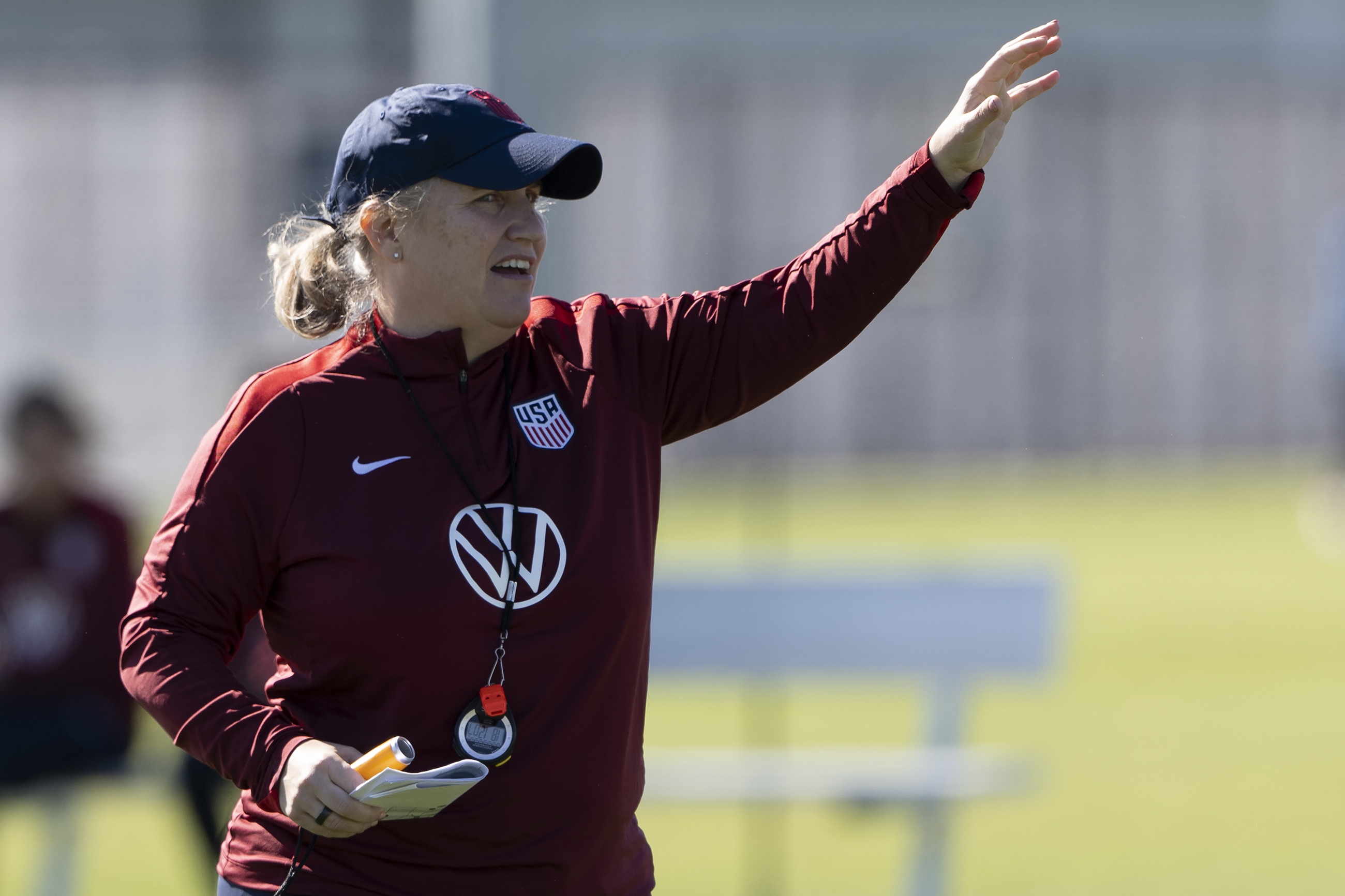
Emma Hayes at a U.S. practice in Chester in October.
But no, what Crocker said is what he meant.
“Of course, there’s going to be a framework … of how we want them to work,” he continued. “But ultimately their job is to provide winning teams, and I think they’re doing a pretty good job at doing that. And my job is to make sure that they get what they need to be able to do that.”
If you only follow soccer casually, you might not think much of this. If you’re deep in the sport, especially the American game, you know it matters to hear that from someone so high-ranking.
“The way I see it is, my job is not to dictate every single detail of how everything needs to look or feel,” Crocker said. “I need to use their experiences, because they’ve got more than me in those areas of what winning looks like.”
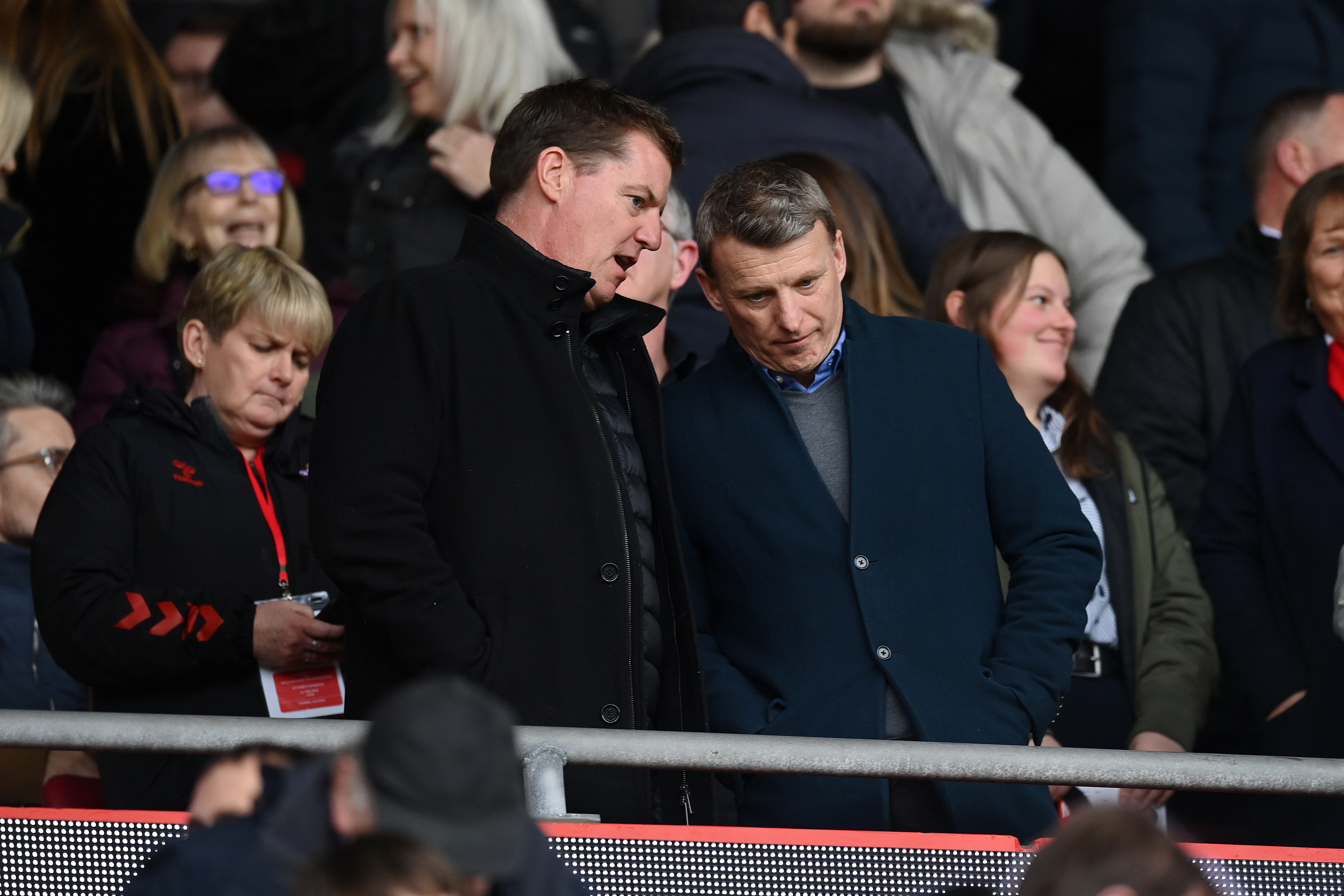
Matt Crocker (left) listening to Mauricio Pochettino at a U.S. game last year.
Hayes vouched for this, and not by making light of the size of her trophy mantel. She knew Pochettino before taking the U.S. job because they overlapped at English club Chelsea, and she knew American soccer from many years of working here before returning to her native London in 2012.
“Mauricio’s ideas on how to win football matches might be different to mine, for example, but we both have ambition to win football matches,” Hayes said. “And we both have an appreciation that American players have their own unique set of qualities that we can lean into.”
“Yes, the U.S. Way is very clear and overarching — that sits above our WNT and MNT and all our other 27 teams,” Hayes said, using the abbreviations for the senior women’s and men’s teams. “But within that, some of those differences are in and around the game model.”
That might not sound like much, but it really does matter.
Emma Hayes has had immense success since arriving as the U.S. team’s manager two years ago.
It all starts with youth soccer
If there’s distance between the men’s and women’s teams, it often feels like there’s a canyon between the senior squads on TV and the youth teams your kids play on. That, too, has seemed deliberate at times, with so many factions in the sport wanting to do what they want instead of working together for the game as a whole.
America’s youth soccer landscape, which better resembles an industrial complex — and really feels that big, in terms of scale — has a long history of rebelling against being told what to do by U.S. Soccer. Crocker quickly became well-versed in this when he took his job, and has spent a lot of time trying to change the tone.
“I think we have to recognize that what we do in state X can’t just be replicated and put into state Y,” he said. “Everyone’s unique and individual, and we have to listen to their individual needs. But we’ve also got to be clear on the framework of the things that are fundamental, and that we are going to do irrespective.”
Before joining U.S. Soccer, Matt Crocker (right) spent seven years at England’s Football Association, and also worked twice for English club Southampton.
“You could bring every county FA to St. George’s Park, all of which were within a three-hour drive [from the national training center],” Crocker said. “You could mandate, you could then put people out into those environments to support it, and you could do it where you could really monitor something on a much smaller scale. Doing this is something I’ve never experienced before.”
That literal geography, not just youth soccer politics, influenced his journey to now.
“I don’t think there’s one silver bullet that you need to take, or you go, ‘It’s not going to work because of X,’” he said. “I just think we have to recognize the uniqueness of the country, build on that as a positive, but also remember not to make the same mistakes as others that have gone before us.”
Then came words that a lot of people — especially the youth coaches out there — have wanted to hear.
Matt Crocker speaking at the United Soccer Coaches convention last January, to an audience that isn’t always on U.S. Soccer’s side.
“I say this respectfully [because] I wasn’t here, but what I heard was U.S. Soccer was telling: We told, we told, we told,” Crocker said. “And now our job is to listen, to work, to problem solve, but to bring everyone together.”
Anecdotally, it’s been working. At various events this year where Crocker has spoken to youth and amateur teams, he has been warmly received. But the hardest part is yet to come, as a recent moment showed.
Earlier this month, Crocker spoke to a crowd of the governing body’s sponsors and donors. Some of them wore track jackets of their youth clubs, but most were in business clothes. Crocker shared the stage with deputy sporting director and onetime Union centerback Oguchi Onyewu and U.S. men’s legend Landon Donovan.
“For those who are not familiar with the youth soccer landscape in this country, it’s a bit of a disaster, right?” Donovan said. “It really is. There’s so many competing interests.”
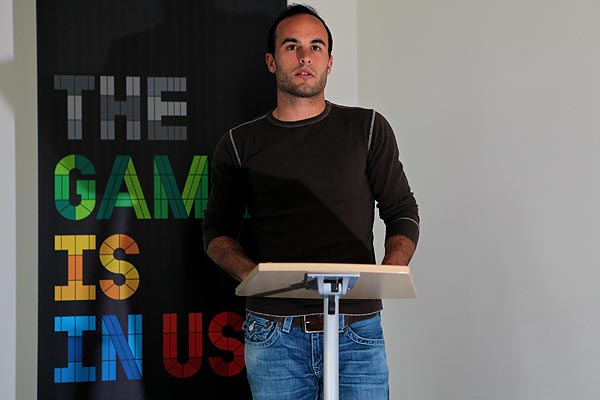
U.S. men’s national team legend Landon Donovan says that the youth model might be too far gone to suggest anything that would affect their bottom line.
He spoke of a local club near his home in southern California, but knew it could have been countless others.
“People are very content with their little fiefdom and their little salary and their club and their control and their power,” Donovan said. “So what’s the incentive now for these clubs to change? … We do have national pride, but they’re more worried about their bottom line than they are [about] growing U.S. soccer.”
“I think the saying is, do what you’ve always done and you’ll get what you’ve always got,” Crocker said. “There’s been a lot of talk about, there’s a player that plays in this league over here that has to drive or fly thousands of miles because this league is falling out with this league, and they won’t play each other. And that’s not putting the child, that’s not putting the sport, at the heart of what we’re all about.”
Matt Crocker (left) with U.S. Soccer Federation CEO JT Batson.
It’s true for the boys and men, and it’s true for the girls and women. It’s an enormous task, but Crocker is willing to give from his side, and that is noticed.
“I think it’s being respectful to environments that have already been created,” he said. “Us as U.S. Soccer, being the national federation, the people that should be really saying, ‘Hey this is what player development and the game could look like in this country’ — it’s about time we spoke up and started to share some of that. But it’s not through a dictator approach, it’s through more of a collaborative way of doing things.”
Crocker’s plans are due to be published in January, the same month Philadelphia will host the 2026 United Soccer Coaches convention. It won’t be easy for him to get that crowd on his side, for the reasons Donovan made clear. If Crocker can, though, the benefits could last long past the World Cup.
When he turned 74 last year, Ira Lubert retired from the day job that had consumed him since the 1990s — raising more than $20 billion for the investment funds he set up with partners.
A top IBM salesman and former IT exec before he set up his constellation of investment funds, Lubert is rich enough to focus on investing what he’s kept and giving the profits away.
Lubert is a salesman, planner, and recruiter, not an investment genius, he said.
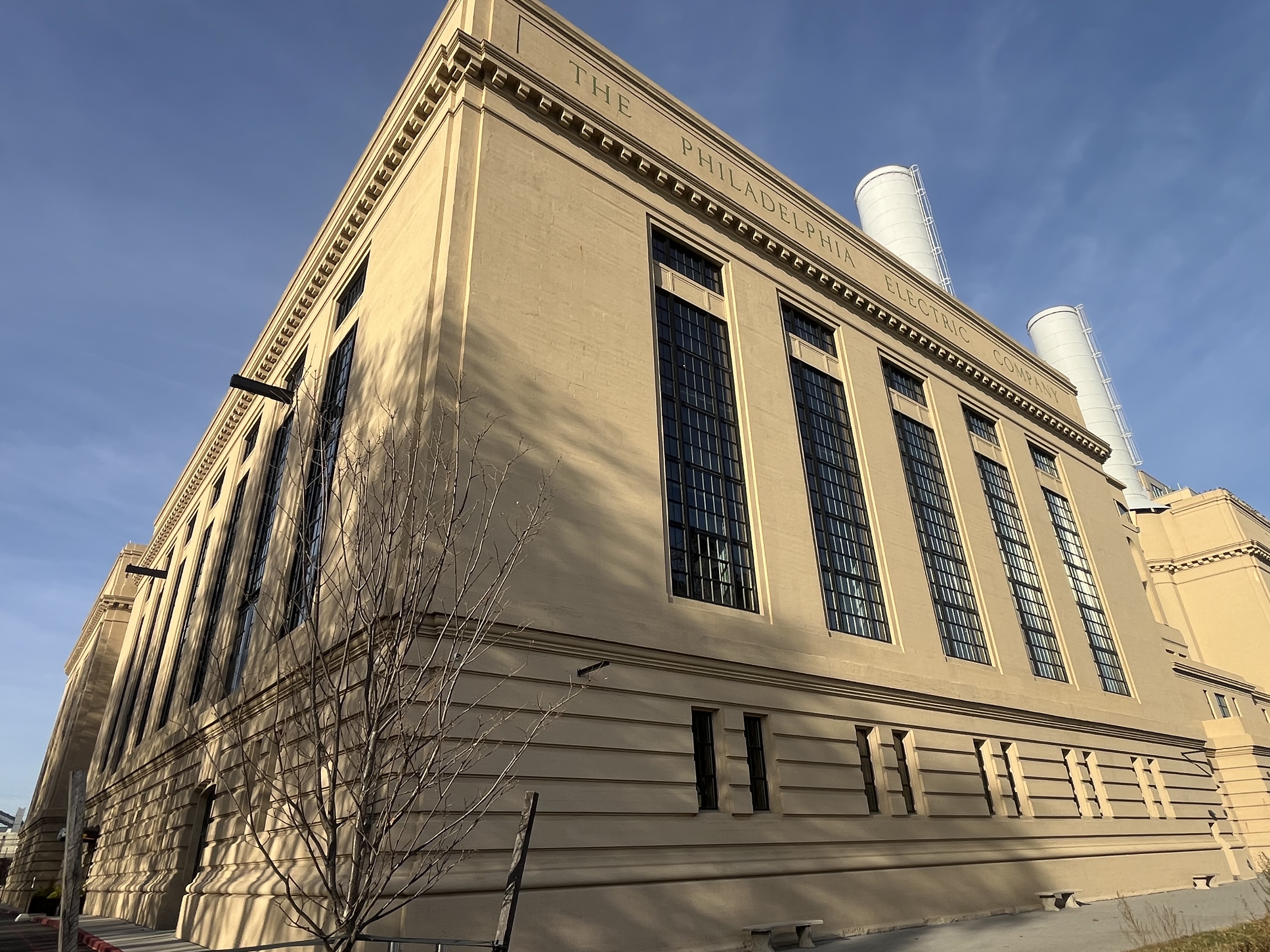
“The key is to always hire people smarter than you,” he said at his family investing office at the Battery, the former electric generating station on the Delaware River that his real estate group, Lubert-Adler Partners, renovated into hotel suites, offices, recreation sites, and apartments. It opened in 2023.
The Battery, formerly an electric generating station, was converted to apartments, offices, meeting spaces, and a hotel by Lubert-Adler Partners in 2022-2023.
Those funds own or have financed hundreds of enterprises and properties around the U.S., including locally familiar Acme Markets, Five Below, and Philadelphia’s Aramark and Bellevue buildings. They have generated billions in net client profits, and a fortune in fees for Lubert and his partners, including hundreds of millions from his key early clients, Pennsylvania‘s state pension funds.
Lubert built a business renting trailers to Penn State varsity wrestlers and grad student couples, before graduating in 1973 with a hotel management degree.
After IBM, he spent the 1980s running big IT businesses, then the ’90s as top aide to Warren “Pete” Musser, Philadelphia’s best-known venture capitalist. He quit, Lubert said at the time, because he didn’t understand how to make money from the early internet (as it turned out, neither did Musser, or a lot of pro investors).
Instead of just trusting his gut, Lubert then partnered with real estate veteran Dean Adler, investment banker Seth Lehr, venture accountant Howard Ross, turnaround ace Greg Segal, and other experts to run his funds, while he focused on convincing state treasurers and other big investors to bet on their projects. Like others, he was solicited by and gave to state officials’ campaigns: only in 2010 did the SEC curb firms paid to manage state and local funds from making political contributions.
The funds include Lubert-Adler; LLR (military contractors and other private equity); LEM Capital (apartments); LBC Credit Partners (distressed debt); and bank, biotech, and other specialty enterprises, most of them owned by Pennsylvania’s pension funds since they started.
Lubert also invested separately from his funds, on what he considered riskier projects, like the Valley Forge Casino Resort. And he lost money, for himself and private partners, during the data center frenzy of the early 2010s, long before the current AI boom.
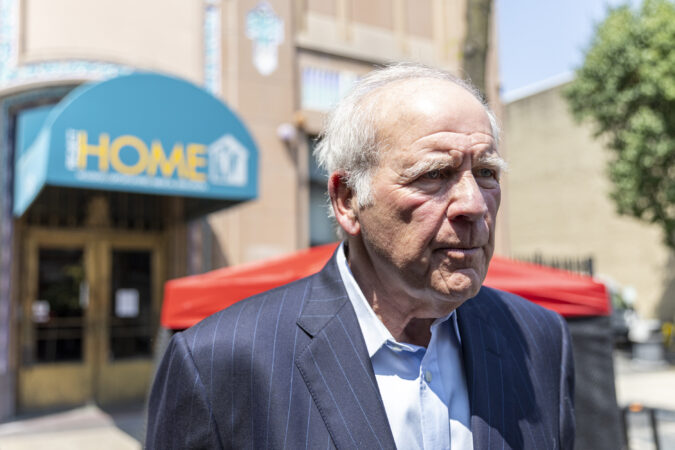
In retirement, Lubert oversees his family office, Belgravia Management LP, named for the Locust Street building he and his partners renovated as their first operating base. He also overseeshis charitable foundations, with assets over $100 million, that give away profits to Penn State, University of Pennsylvania and Jefferson hospitals, Project HOME, Jewish causes, and other nonprofits. He relies on a veteran staff of seven, plus advisers such as Philadelphia trust lawyer Lester Lipschutz.
Lubert recently spoke with The Inquirer about his goals in retirement in light of his career. The conversation has been edited for brevity and clarity.
Who drew you toward business?
My grandfather, Isidore Brody, was an immigrant from Romania. Age 18, he came through Ellis Island and went to his aunt in Newton, N.J. My father grew up there; he had an appliance-repair business. But with my grandfather, it was a lot of businesses. He had a butcher shop, a liquor store, a Sunoco station. He had apartments, the largest had nine units.
A couple days a week, I’d walk a mile to his house from school. He showed me a lot about business and real estate.
Pro investors like to call their shots. Why let your partners pick investments?
At age 47, my expertise was in raising capital. I wasn’t an engineer. I had tremendous respect for people [with specialized knowledge]. I wanted them to do their thing and then at a cocktail party they would be able to say ‘I founded Versa’ or ‘I founded LLR.’ Not ‘I work for Ira.’
I get recognized because my name came out in the different funds. And they got bigger.
Why did you buy high-return assets you didn’t put in clients’ funds?
Not all investments were appropriate for them. But when I did buy something personally, we had to bring it to the fund compliance people to make sure there wasn’t a conflict of interest.
You had a reputation for getting intense in meetings. Did you dial that back as you got bigger?
I don’t believe I have an aggressive style. I am focused and disciplined. I don’t deviate from a plan. I look for partners who are honest, ethical, committed, and capable.
I have it set up so when I pass, my net worth will go to donor-advised funds and charitable foundations.
Philadelphia had big multi-company investors — the Fox brothers, the Perelmans, Ralph Roberts of Comcast. Did you learn from them?
They were brilliant business people and entrepreneurs. I’m really different from those guys. They each had a major operating business that they started, then they sold it and used the money to start their funds. I just started funds from the beginning [in the late 1990s] and partnered with top talent.
It was a great run. Now I really want to do this, while I have something left.
An American Airlines flight attendant who works out of the Philadelphia International Airport is suing the airline, alleging that flight attendants aren’t properly paid for all of their time on the job.
Flight attendants are required to arrive early at the airport and help board and deplane passengers, but these and some other parts of the travel process are not usually counted in payroll and don’t count toward overtime, according to the lawsuit.
Flight attendant Christopher John filed a complaint in the Philadelphia County Court of Common Pleas in October and later moved to federal court in Philadelphia. John is suing on behalf of himself and other flight attendants for American Airlines based out of PHL as far back as October 2022, the complaint said.
The airline “generally does not credit or pay” flight attendantsfor the hour or two prior to a flight’s departure time, time spent boarding passengers before a flight and deplaning them upon arrival, or time spent traveling on a shuttle to and from hotels on stopover flights.
All of these activities “fall squarely within their day-to-day job duties,” the complaint reads.
American Airlines has argued that the Pennsylvania Minimum Wage Act — which establishes a minimum wage and overtime rate in the state — does not apply to this case because the flight attendants have a union contract that outlines pay practices.
American Airlines said in a motion to dismiss the case that the state law “expressly exempts ‘employe[es] of an air carrier’ from its overtime requirements if their ‘hours of work, wages, and overtime compensation’ are governed by a collective bargaining agreement.”
American Airlines flight attendants are represented by the Association of Professional Flight Attendants. A recent union contract for those employees started in September 2024 and ends in September 2029. As of last year, the union represented some 28,000 American Airlines flight attendants.
The attorney for the flight attendant, Peter Winebrake, declined to comment on the case. Lawyers for American Airlines at O’Melveny & Myers did not immediately provide a comment.
American Airlines travelers wait for assistance on a morning in August 2024 when many flights were canceled due to severe weather in Florida.
Last year, American Airlines flight attendants secured a contract including pay for time spent boarding passengers, and Delta started partially compensating employees for this time in 2022.
American Airlines, headquartered in Fort Worth, Texas, is the largest carrier at PHL, carrying nearly 20 million passengers through the airport in 2024.
The airline is the ninth largest employer in Philadelphia County, according to the state’s Department of Labor and Industry. The median pay of flight attendants in the U.S. was $67,130 last year, according to the Bureau of Labor Statistics.
American Airlines employs over 10,000 people in the Philadelphia area, including 2,567 flight attendants, according to the company’s website.
Staff reporter Abraham Gutman contributed to this article.
Thank you for publishing Rabbi Linda Holtzman’s op-ed about why a ceasefire in Gaza isn’t enough, we must also stop arming Israel.
Today, we got news of the first Gazan child — in this case, a baby — dying of hypothermia. She froze to death because there is no adequate shelter in Gaza, it’s winter, and it’s freezing at night. With its relentless bombing, shelling, and deliberate destruction of housing, hospitals, universities, and schools in Gaza, Israel reduced 90% of Gaza’s homes to rubble.
The ceasefire agreement required Israel to send in desperately needed humanitarian aid to Gaza, 600 trucks a day of tents, tarps, bedding, blankets, food, infant formula, and potable water, medicines, and medical supplies. Israel has at most sent in 100 trucks a day. The tents Gazans have been living in for months are torn apart by winter storms; they need new tents, tarps, and blankets to keep them as warm as possible.
Israeli troops occupy most of Gaza and have killed unarmed civilians, including children who are searching for wood to burn or looking for the remnants of their homes in the increasingly occupied eastern part of Gaza. Israeli army Chief Eyal Zamir said a few days ago that the “Yellow Line” in Gaza, which demarcates Gazan land occupied by Israel, is Israel’s new border, meaning Israel will almost certainly never give back the portion of Gaza it’s supposed to be only temporarily occupying.
There is no ceasefire, no food or shelter or medicines for the Gazans. Given that Donald Trump gave birth to this “ceasefire” and so-called peace plan, he needs to hold Israel accountable. Palestinian children are just as precious and deserving of life as Israeli children.
Genie Silver, Wynnewood
…
It is both astonishing and appalling that Rabbi Linda Holtzman fails to grasp the irony — and hypocrisy — of her invoking the holiday of Hanukkah to support her efforts to block certain defense aid to Israel. The Maccabees, the heroes of the Hanukkah story, not only successfully revolted against the oppressive Syrian Greek empire, but they zealously fought against the assimilation of the Jews of that time. And where did these historic events in the second century BCE take place? In the land of Israel!
As an anti-Zionist, Holtzman does not believe the Jews have a right to live in a Jewish state in the land of Israel. Despite the attempts of so many of Holtzman’s allies to distort what Zionism is (with many even despicably comparing Zionists to Nazis), the definition of Zionism is actually quite simple: it is the movement for self-determination of the Jewish people in its ancestral homeland. And an overwhelming percentage of Jews identify as Zionists.
On several occasions, Holtzman describes Israel’s response to the horrific slaughter of Oct. 7, 2023, as genocide, as if that’s a given. Never does she even mention Hamas, a terrorist organization which perpetrated brutal killings, burning of babies, and rapes and sexual mutilations (and glorified it all). No, Rabbi Holtzman, fighting back against an organization whose entire cynical strategy is based on hiding behind Gazan civilians in order to generate more casualties is not genocide. It’s a war against a truly genocidal enemy, a war that the Maccabees would have supported and led.
Richard Lowe, Oreland
Join the conversation: Send letters to letters@inquirer.com. Limit length to 150 words and include home address and day and evening phone number. Letters run in The Inquirer six days a week on the editorial pages and online.
ARIES (March 21-April 19). Some questions are like Pandora’s box: Once opened, they release more truth and feeling than you expected. Ask only if you’re ready for the shift that follows. Choose your moment carefully. Nothing released from the box ever returns to it.
TAURUS (April 20-May 20). Things calm down today, and you’ll get down to business. But remember, fulfillment doesn’t come from merely checking boxes. Your worth isn’t measured by output. What matters isn’t how much you do but how much you love.
GEMINI (May 21-June 21). What seems like a very small distraction simply takes up too much of your time. You’ll be much more productive when it’s out of the picture. You may finally be in a place where it’s worth it to make the change.
CANCER (June 22-July 22). Your feelings surge today. There’s a lot of energy running through you, but you can handle this charge. You can use your emotions instead of letting them use you. You’ll organize, compartmentalize and act on that which serves you.
LEO (July 23-Aug. 22). While many of your relationships bring sweetness to life, some bring a good amount of stress. You still believe that in time you will be grateful for these relationships, and eventually, you’ll understand their purpose in your life.
VIRGO (Aug. 23-Sept. 22). Remember when you predicted the future accidentally, without even trying to make a psychic statement? You’ll do it again today. Write down your thoughts because you’ll later enjoy today’s uncanny accuracy.
LIBRA (Sept. 23-Oct. 23). You have flexibility in some areas of life. You can rearrange habits, preferences, timing, environment, workflow, attitude, priorities. Then there are those that are the immovable fixtures. Don’t see them as blocks but as architecture you can design around.
SCORPIO (Oct. 24-Nov. 21). Everyone learns the rules of life from parents, teachers and leaders, but your inner guidance has always been the stronger force. Today it matters because something you feel is right for you isn’t reflected in the world around you, so you’ll trust yourself instead.
SAGITTARIUS (Nov. 22-Dec. 21). You don’t have to prove yourself to anyone, not even you, but you challenge yourself anyway because you want to see how far you can take this beautiful life. Keep the heart. Angels are around you, cheering you on.
CAPRICORN (Dec. 22-Jan. 19). The theme today swirls around issues of character. Of course, there’s a difference between having character and being a character. Somehow, you’ll do both. You find the funny angle in your circumstances and approach with integrity.
AQUARIUS (Jan. 20-Feb. 18). There’s no substitute for meeting in person. As inconvenient as it may seem, it will be better for building bonds, understanding dynamics and knowing the right thing to do next for the project at hand.
PISCES (Feb. 19-March 20). Big dreams lead to extraordinary outcomes. They are not always the outcomes that existed in the dream, but they are extraordinary because you dared to dream at all. So keep stretching your imagination around the grand scale.
TODAY’SBIRTHDAY (Dec. 15). Welcome to your Year of the Golden Thread, which brings shimmering connections between seemingly unrelated parts of your life — the hobby that becomes a side hustle, the friend of a friend who changes everything, the random skill that pays off. Your timing is uncanny. More highlights: VIP access to something you’ve dreamed about, a luxury home upgrade and friendships that deepen into chosen family. Cancer and Capricorn adore you. Your lucky numbers are: 8, 4, 5, 31 and 47.