Tag: topic-link-auto

  • Twice-weekly trash pickup is coming to North Philly

    Twice-weekly trash pickup is coming to North Philly

    Happy holidays, North Philly: Twice-weekly trash pickups are coming to your neighborhood.

    The city will institute a second pickup day for North Philadelphia, beginning Jan. 5.

    Last year, Mayor Cherelle L. Parker announced a $11.9 million initiative to bring twice-weekly trash collection to Center City and South Philly as a key piece of her push to make the city clean and green. Now, after an additional $7 million investment in trash trucks, the program is ready for North Philly.

    “We’re seeing this make a difference,” said Carlton Williams, director of the Philadelphia Office of Clean and Green Initiatives. He said since the initiative began in December 2024, reports of illegal dumping in South Philly and Center City have fallen by 15% to 20% and the amount of litter has decreased.

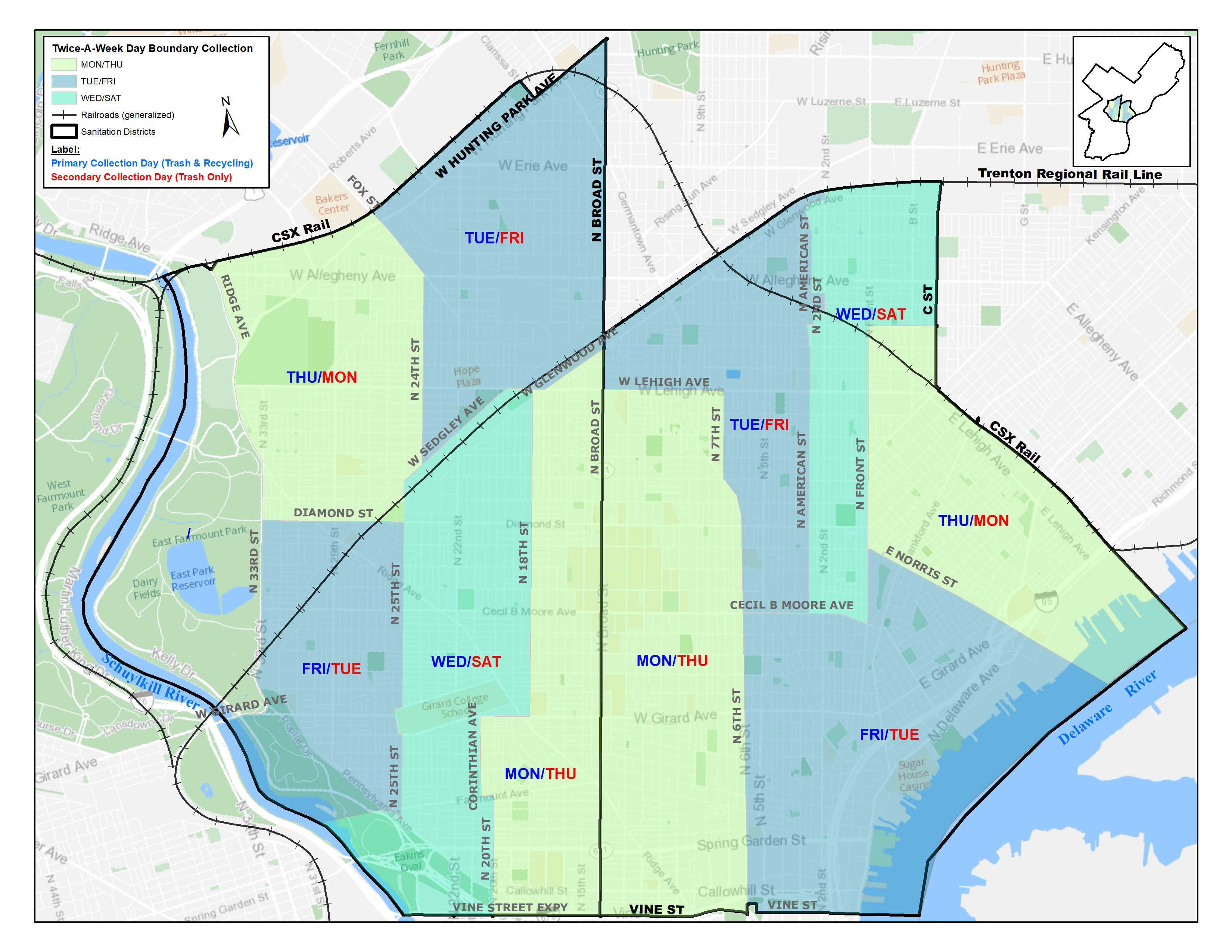
    The North Philly phase of the initiative will cover the boundaries of:

    • Vine Street to Hunting Park Avenue, from Broad Street to the Schuylkill
    • Vine Street to Glenwood Avenue, from Broad Street to the Delaware River
    A map of where and when additional trash pickups will take place in North Philadelphia, beginning Jan. 5, 2026.

    Just like elsewhere in the city, the second pickup will occur on the third day after an area’s typical pickup day. For example, households that normally have their trash collected on Monday will have their second pickup on Thursday. Households with Tuesday pickups will have their second pickup on Friday, and so forth.

    Recycling will not be collected on the second pickup day. That will continue to be done on the original pickup day. And there will be no second collection during weeks of city holidays.

    Residents reported some inconsistency with the twice-weekly program in the first few months of its rollout. Williams said he expects a similar learning curve for pickup crews this time around, particularly since the North Philly phase covers a larger area.

    Mayor Cherelle L. Parker poses for a photo on a sanitation truck at South 21st Street and Point Breeze Avenue in Philadelphia in December 2024.

    Should crews miss a pickup, Williams said, they will collect it within 24 hours, but residents should also call 311 to ensure the trash is on the city’s radar.

    To minimize the amount of time that trash sits outside, the city requires that households and businesses set their trash and recycling on the curb after 5 p.m. the day before pickup during the fall and winter, and after 7 p.m. in the spring and summer.

    It is unclear when the rest of the city could see trucks coming a second time during the week. When the city announced the beginning of the initiative, it said it intended to expand the program to North Philly and West Philly.

    Since then, Williams said, the city has determined that the program might not make sense for all of West Philly or other areas of the city, since some of those neighborhoods have driveways or other trash storage that make extra pickups unnecessary. He said other possible expansion areas will be evaluated.

  • Foreigners allowed to travel to the U.S. without a visa could soon face new social media screening

    Foreigners allowed to travel to the U.S. without a visa could soon face new social media screening

    WASHINGTON — Foreigners who are allowed to come to the United States without a visa could soon be required to submit information about their social media, email accounts and extensive family history to the Department of Homeland Security before being approved for travel.

    The notice published Wednesday in the Federal Register said Customs and Border Protection is proposing collecting five years’ worth of social media information from travelers from select countries who do not have to get visas to come to the U.S. The Trump administration has been stepping up monitoring of international travelers and immigrants.

    The announcement refers to travelers from more than three dozen countries who take part in the Visa Waiver Program and submit their information to the Electronic System for Travel Authorization (ESTA), which automatically screens them and then approves them for travel to the U.S. Unlike visa applicants, they generally do not have to go into an embassy or consulate for an interview.

    DHS administers the program, which currently allows citizens of roughly 40 mostly European and Asian countries to travel to the U.S. for tourism or business for three months without visas.

    The announcement also said that CBP would start requesting a list of other information, including telephone numbers the person has used over the past five years or email addresses used over the past decade. Also sought would be metadata from electronically submitted photos, as well as extensive information from the applicant’s family members, including their places of birth and their telephone numbers.

    The application that people are now required to fill out to take part in ESTA asks for a more limited set of questions such as parents’ names and current email address.

    Asked at a White House event whether he was concerned the measure might affect tourism to the U.S., President Donald Trump said no.

    “We want safety, we want security, we want to make sure we’re not letting the wrong people come into our country,” Trump said.

    The public has 60 days to comment on the proposed changes before they go into effect, the notice said.

    CBP officials did not immediately respond to questions about the new rules.

    The announcement did not say what the administration was looking for in the social media accounts or why it was asking for more information.

    But the agency said it was complying with an executive order that Trump signed in January that called for more screening of people coming to the U.S. to prevent the entry of possible national security threats.

    Travelers from countries that are not part of the Visa Waiver Program system are already required to submit their social media information, a policy that dates back to the first Trump administration. The policy remained during Democratic President Joe Biden’s administration.

    But citizens from visa waiver countries were not obligated to do so.

    Since January, the Trump administration has stepped up checks of immigrants and travelers, both those trying to enter the U.S. as well as those already in the country. Officials have tightened visa rules by requiring that applicants set all of their social media accounts to public so that they can be more easily scrutinized and checked for what authorities view as potential derogatory information. Refusing to set an account to public can be considered grounds for visa denial, according to guidelines provided by the State Department.

    U.S. Citizenship and Immigration Services now considers whether an applicant for benefits, such as a green card, “endorsed, promoted, supported, or otherwise espoused” anti-American, terrorist or antisemitic views.

    The heightened interest in social media screening has drawn concern from immigration and free speech advocates about what the Trump administration is looking for and whether the measures target people critical of the administration in an infringement of free speech rights.

  • Hospital-based anti-violence programs get $3 million in state funding

    Hospital-based anti-violence programs get $3 million in state funding

    Several Philadelphia-area violence prevention efforts will benefit from nearly $3 million in newly released state funding to help hospitals address a leading cause of death and injury.

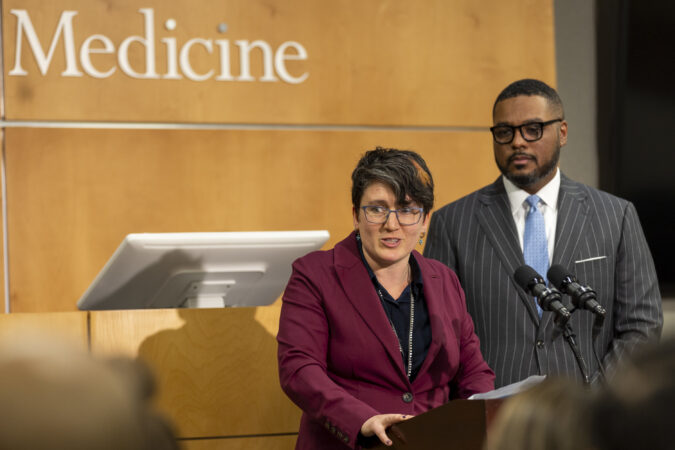
    The new funding for hospital-based violence intervention programs (HVIP) was announced by Pennsylvania Lt. Gov. Austin Davis on Wednesday at Penn Presbyterian Medical Center. One of the recipients, the Penn Trauma Violence Recovery Program, is based at the Penn Medicine hospital in University City.

    Other local awardees include Temple University Hospital in North Philadelphia and the Philadelphia-based nonprofit Urban Affairs Coalition. The coalition received funding on behalf of the Chester Community Coalition to relaunch a program that had been at the now-shuttered Crozer-Chester Medical Center.

    The University of Pittsburgh Medical Center also received funding. The amounts awarded to each program were not announced.

    The Pennsylvania Commission on Crime and Delinquency, which Davis chairs, received 15 applications in total seeking nearly $12 million in funding — four times what was available.

    “Addressing the epidemic of gun violence is a top priority for our administration,” Davis said.

    Lieutenant Governor Austin Davis speaks at a press conference announcing the $3 million in grants for hospital-based violence intervention programs.

    The programs aim to connect patients at risk of repeat violence with resources while they are in a hospital, so they leave with a safety plan. Services can include long-term community-based case management, mentoring, and home visits.

    Since the first HVIP was established in the mid-1990s, dozens have spread around the country and abroad, including in Philadelphia.

    Several local institutions have these programs, including Temple Health, Children’s Hospital of Philadelphia, Penn Medicine, Jefferson Health, and Drexel University. The City of Philadelphia, in conjunction with the area’s Level 1 trauma centers, launched an HVIP Collaborative in 2021.

    Studies have shown these programs reduce rates of repeat violent injuries and recidivism among participants.

    After shootings spiked during the COVID-19 pandemic, gun violence is now declining in Philadelphia. As of July, shootings for the year were at their lowest total since at least 2015.

    Davis noted that Philadelphia has seen a 15% decrease in homicides this year, with roughly four in five gunshot victims surviving their injuries.

    The new funding will allow the Penn Trauma Violence Recovery Program to increase its community presence and mental health programming, said its director, trauma surgeon Elinore Kaufman.

    Through her experience treating victims of violence, she has learned that injuries can be deeper than the physical wounds.

    The program was launched to address social factors often involved in violence by providing psychosocial support and connecting patients with services to help with education, job training, and housing.

    “We’ve worked with patients long enough now that we have high school graduation photos, we have baby pictures,” Kaufman said. “We have patients who want to give back and have joined our patient advisory board to help push us forward.”

  • Phillies select pitcher Zach McCambley in Rule 5 draft: ‘He could make the team’

    Phillies select pitcher Zach McCambley in Rule 5 draft: ‘He could make the team’

    ORLANDO — To close out this year’s winter meetings, the Phillies selected right-handed pitcher Zach McCambley in the Rule 5 draft.

    McCambley, 26, was in the Miami Marlins organization, and had a 2.90 ERA and 1.097 WHIP in 62 innings between double A and triple A. According to draft regulations, McCambley was assigned directly to the Phillies’ 26-man roster.

    To be removed from the roster, he must be placed on outright waivers and offered back to Miami. But the Phillies think McCambley has a chance of impacting their club in 2026.

    “When we drafted him, we had the feeling that he could make the team,” Phillies president of baseball operations Dave Dombrowski said. “And one of the things that we’ve talked about looking to have over the last few years is a right-handed person in the bullpen that dominates right-handed hitters. So we think he has a chance to do that.”

    To further bolster their relief depth, the Phillies acquired reliever Yoniel Curet in exchange for minor league pitcher Tommy McCollum in a trade with the Tampa Bay Rays on Wednesday. Curet had a 3.90 ERA in 55⅓ innings across rookie ball, double A, and triple A this year but missed some time because of a shoulder injury. He had been designated for assignment by the Rays.

    Curet made 14 starts last season, but the Phillies are viewing him as a reliever.

    “He has options available. He has an arm that we really like,” Dombrowski said. “He’s really been successful at the minor league level; plus-plus fastball. … We have roster spots, so we’re going to start building some depth and take advantage of it.”

    Griff McGarry was selected by the Nationals in the Rule 5 draft after the Phillies chose not to protect him.

    The Phillies lost right-hander Griff McGarry in the draft after opting to leave him unprotected for the second straight year. The 26-year-old was selected by the Washington Nationals with the third overall pick. McGarry has been unable to establish himself in triple A but had a bounce back season in 2025 with a 3.44 ERA. He won the Paul Owens Award as the Phillies’ top minor league pitcher.

    “We liked him,” Dombrowski said. “We just think that he’d have a hard time staying with the big league club. We like his arm strength and like a lot of things about him. … It was just a risk that we took, figuring that we’d rather have the roster spot at that time. Wish him nothing but the best.”

    It’s possible McGarry returns to the Phillies if he doesn’t make the Nationals out of camp. Last year, the Minnesota Twins selected Eiberson Castellano in the Rule 5 draft, but he was returned to the Phillies in March.

    In the minor league phase of the Rule 5 draft, in which there aren’t any roster restrictions for selections, the Phillies took infielder Austin Murr from the Detroit Tigers and right-handed pitcher Evan Gates from the San Francisco Giants. First baseman Carson Taylor was selected from the Phillies by the Seattle Mariners.

  • Supreme Court wrestles with death penalty in cases of intellectual disabilities

    Supreme Court wrestles with death penalty in cases of intellectual disabilities

    The Supreme Court on Wednesday wrestled with whether to allow Alabama to execute a man with low cognitive function, a ruling that could set new rules for states to condemn those with borderline intellectual disabilities to death row.

    Roughly two hours of intense arguments did not seem to produce a consensus among the justices over how states should assess IQ tests to determine mental disability.

    In a landmark 2002 ruling Atkins v. Virginia, the court decided that sentencing a mentally disabled person to death violated the Eighth Amendment’s prohibition on “cruel and unusual punishment,” but left it up to states to come up with standards for determining who is too disabled.

    Since then, the rules states have used to determine who is ineligible for the death penalty have come before the court several times, in part because many death row inmates skirt the line of intellectual disability.

    In the current case, Alabama is asking the court to cut back on protections that those previous rulings have given to those who have borderline intellectual disabilities. The case involves how lower courts weighed Alabama’s use of multiple IQ tests to decide Joseph Clifton Smith should face death for robbing and killing a man in 1997.

    Under Alabama’s death penalty rules, a defendant is ineligible for the death penalty if he or she has an IQ at or below 70 and significant deficits in everyday skills and those issues occurred before adulthood. Many states have similar IQ thresholds.

    In Wednesday’s argument, Robert Overing, deputy solicitor general for Alabama, told the justices that lower courts, which threw out Smith’s death sentence, had placed too much weight on a single low IQ score and additional evidence of impairment, rather than considering the cumulative results of five tests that placed Smith above the IQ cutoff. He said the latter was a more accurate yardstick for his abilities.

    “He didn’t come close to proving an IQ of 70 or below … but the lower courts changed the rules,” Overing said.

    The court’s three liberal justices expressed skepticism the law required lower courts to consider the cumulative effect of multiple scores as Overing suggested.

    In previous rulings, the high court said defendants were permitted to offer additional evidence of cognitive impairment if IQ scores fell below the threshold, but Overing downplayed that idea. That drew rebukes from the liberals as well as questions from conservative Justice Brett Kavanaugh.

    “What you’ve done is shift this to be all about the IQ test, which is not supported by our case law,” Justice Ketanji Brown Jackson told Overing.

    Kavanaugh asked at another point about additional evidence: “What’s the logic or the rationale or the sense behind not having a district court or a trial court or a state court have the ability in those circumstances to go on and look at more?” he asked.

    Justice Neil Gorsuch floated the idea of a ruling that would allow states to set the threshold for a claim of mental disability, but not allow eligibility to turn solely on a single IQ test score. Any additional evidence of impairment would not be allowed to outweigh a low test score.

    But there was little agreement among the justices as they groped for the proper standard.

    Smith’s murder case began in 1997, while he was on work release from prison. Smith and an accomplice robbed a man of $140 and killed him. A jury convicted Smith of capital murder during a robbery and sentenced him to death.

    After the court’s 2002 decision in the Atkins case, Smith filed a petition in federal court arguing his intellectual disability met the criteria to bar his execution. The case has gone back and forth in the lower courts ever since.

    During an evidentiary hearing, testimony revealed Smith had scored 75, 74, 72, 78 and 74 on IQ tests over the course of his lifetime. Those were the scores Overing, the lawyer for Alabama, pointed to in arguing that the cumulative effect of the tests placed Smith slightly above the state’s IQ cutoff.

    The federal district judge considering the case, however, pointed to the test on which Smith scored 72, saying it indicated his IQ could be as low as 69, since the test had a three-point error range. For that reason, the court allowed Smith to present additional evidence of his impairment to assess his cognitive function.

    In seventh grade, Smith’s school classified him as “Educable Mentally Retarded,” meaning he had mild intellectual disability. Smith never consistently held a job, never had a bank account and had difficulty following laws, according to testimony in the lower court hearings. He also acted impulsively, and read and did math at a low level.

    The court determined Smith’s “actual functioning” was comparable to someone who was intellectually disabled so he couldn’t be sentenced to death.

    After an appeals court ruled in Smith’s favor, Alabama appealed to the Supreme Court. The high court vacated the decision, asking the appeals court to clarify whether its ruling was based solely on one low IQ score or had considered other evidence and expert testimony.

    The appeals court once again found Smith was intellectually disabled and said its decision was based on a holistic approach that considered Smith’s deficits in everyday skills along with the IQ score of 72. Alabama again appealed to the Supreme Court, which agreed to take up the case it heard Wednesday.

    Seth P. Waxman, an attorney for Smith, said the lower courts had not erred in their assessment of Smith and it was proper to consider additional evidence of his impairment.

    “Every court in Alabama … this court and every other court in every other state that I am aware of understands that raw observed test scores is not the definition of true IQ,” Waxman said.

    But Harry Graver, an attorney for the Trump administration, which backed Alabama’s position, said the lower court did not give proper weight to the multiple IQ scores.

    “Even if you look at other evidence, you still need to circle back and see how that weighs against the evidence on the other side of the scale,” Graver said.

    Smith’s case is not the first time the Supreme Court has tackled intellectual disability and the death penalty.

    In a 2014 case from Florida and a 2019 case from Texas, the high court noted that IQ tests are not precise. In the 2019 case, the court specifically said that lower courts needed to consider the possible error range in IQ scores.

  • Reports: Penn State not retaining Jim Knowles, who’ll join Tennessee as defensive coordinator

    Reports: Penn State not retaining Jim Knowles, who’ll join Tennessee as defensive coordinator

    After one season as Penn State’s defensive coordinator, Jim Knowles will not be retained on new head coach Matt Campbell’s staff, according to several reports. The news was first reported by On3.com. But the 60-year-old defensive coordinator already has a new job lined up.

    According to CBS Sports, Knowles, a Philly native and St. Joseph’s Prep alum, will become Tennessee’s new defensive coordinator. Knowles spent three seasons at Ohio State before joining the Nittany Lions earlier this year. Now he’ll direct the defense at a third school over three seasons.

    Penn State made Knowles the highest-paid coordinator in college football history with a three-year, $3.1 million deal on the heels of a national championship with the Buckeyes. He replaced Tom Allen, who departed for Clemson. Knowles’ unit at Ohio State was No. 1 in the country in yards allowed per game (254.6), points allowed (12.9), second in first downs allowed per game (15.1), and third in passing yards (167) and rushing yards per game (87.6).

    The longtime coordinator was viewed as the critical piece to help the Lions get over the hump this season in the College Football Playoff. That did not happen as Penn State’s defense took a significant step back compared to previous years. The Lions finished 34th nationally in total defense (334.3 yards), 37th in points allowed (21.4 points), and 72nd in rushing yards allowed per game (150.8). The defense also ranked 92nd in third down percentage (.416).

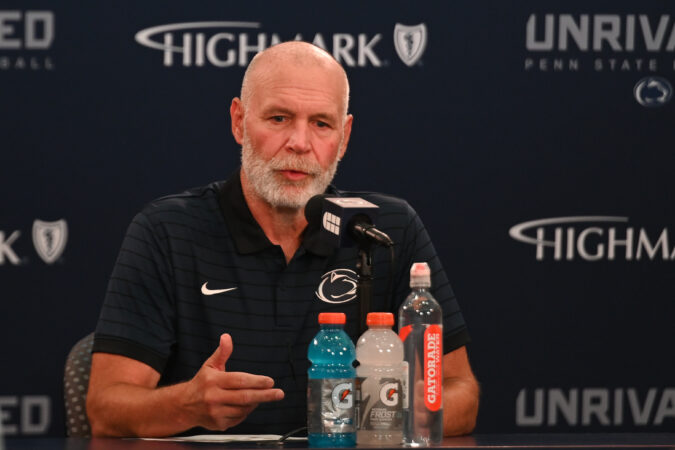
    Penn State defensive coordinator Jim Knowles (left) and offensive coordinator Andy Kotelnicki before the game against Nebraska on Nov. 22.

    Knowles has been a defensive coordinator at the Football Bowl Subdivision level since 2010. He spent eight seasons with Duke in that role before joining Oklahoma State in 2018. He spent four seasons in Stillwater before becoming the Buckeyes’ defensive coordinator in 2022.

    Tennessee moved on Monday from defensive coordinator Tim Banks, who was Penn State’s co-defensive coordinator and safeties coach from 2016-20. Banks spent five seasons as the Volunteers’ defensive coordinator, but he struggled in 2025 as the defense ranked 88th in total defense (395.5 yards) and 93rd in scoring (28.8 points).

    On3.com reported earlier this week that Campbell’s defensive coordinator at Iowa State, Jon Heacock, would join him in Happy Valley, but it’s unclear if he will be in the same role at Penn State. Heacock spent all 10 years running the Cyclones defense under Campbell.

  • Kyle Schwarber found his way back to the Phillies, and he hopes J.T. Realmuto does the same

    Kyle Schwarber found his way back to the Phillies, and he hopes J.T. Realmuto does the same

    ORLANDO — Any day now, Kyle Schwarber’s wife, Paige, will go into labor with their third child.

    First, though, there was a contract to sign.

    So, after reaching a five-year, $150 million agreement with the Phillies late Monday night, Schwarber hopped a flight early Tuesday to Philadelphia to take a physical and finalize the deal. By lunchtime Wednesday, he was back home in Ohio.

    “I’m happy they were able to accommodate that, get me up there and get me back,” Schwarber said on a Zoom call. “So now, whenever our little girl comes into the world, I will be here.”

    Indeed, the week has been a whirlwind for Schwarber, and it’s only getting started. But between signing the largest contract ever for a designated hitter and racing home ahead of the baby, Schwarber found time to deliver a recruiting pitch to a good friend.

    “I’d be lying that I didn’t send a text to J.T. [Realmuto],” Schwarber said, “trying to see where he’s at and try to coax him.”

    If Schwarber was Priority No. 1 for the Phillies, Realmuto is 1-B. While the rival Mets lost core pieces Edwin Díaz and Pete Alonso in free agency on back-to-back days, the Phillies are proudly trying to bring back the band from 95- and 96-win teams that were a Tush Push — or maybe a youth infusion from Justin Crawford, Andrew Painter, and, eventually, Aidan Miller — away from getting over the top.

    Schwarber said he’s “trying to be respectful” of Realmuto’s free-agent process. And surely he can relate.

    In finding his way back to the Phillies, Schwarber cited the “respect” he received during his 37-day free agency from the organization that helped him evolve into one of the most prodigious sluggers in the sport.

    Because as much as Schwarber wanted to stay with the Phillies, he also welcomed the chance to explore his market before the biggest payday of his career.

    Schwarber had been a free agent before. Twice, actually. But the first time came in 2020, with his value at its nadir after the Cubs didn’t tender him a contract. A year later, the owners locked out the players and shut down the sport for 99 days. When the stoppage ended, the Phillies signed Schwarber for four years and $79 million, among the best free-agent deals in franchise history.

    This time, Schwarber hit the market with the force of a 56-homer season — and 187 home runs over four years, tied with Shohei Ohtani for second among all hitters and trailing only Aaron Judge.

    Few names were more prominent on the free-agent menu.

    “When you reach free agency, you want that opportunity to go out and listen and make sure all your bases are covered,” Schwarber said. “You want to hear all different types of information and make sure that you’re making a really great, informed decision. I appreciate the whole process and don’t take it lightly.”

    The Phillies gave Schwarber space to hear pitches from the Orioles, Pirates, and his hometown Reds, among other teams, with the understanding that he would circle back to them when he began receiving offers.

    But they didn’t send him into the free-agent wilds without making clear what he meant to them.

    The owner even made a house call.

    First, Schwarber had what he described as a “really, really good conversation” with president of baseball operations Dave Dombrowski a few days after the divisional series loss to the Dodgers. Then, before he and Paige packed up their two sons and returned to Ohio, John Middleton knocked on the door of their South Jersey home.

    Phillies owner John Middleton made it clear to Kyle Schwarber that he wanted to re-sign him.

    “We were able to spend a really good amount of time just sitting down and talking about the Phillies and his family and talking about what’s the future looking like for us here,” Schwarber said. “Those were conversations that I just never forgot, right?

    “Like, you start having different conversations with different teams, and just because those conversations were fresh, it doesn’t mean that anything was forgotten. That was an important time and important conversations that Dave and Mr. Middleton, that we had.

    “Trust me, I took notes. Once I had everything all said and done, you can look at everything and know that John is committed to winning and wants our organization to continue to keep pushing for a world championship. What else is there for a player to ask for, you know?”

    The Phillies sent Realmuto into free agency with a similar message. The veteran catcher, who will be 35 next season, is weighing multiple offers, a source said Wednesday, the final day of the winter meetings at the Signia by Hilton. It’s unknown whether any of the offers are for more than two years. MLB.com reported that the Phillies have made a bid.

    After re-signing Schwarber, the Phillies can focus on remaking the outfield, filling out the bullpen, and adding overall pitching depth. With 2026 payroll commitments totaling approximately $286 million, as calculated for the luxury tax, some of those pursuits may involve clearing payroll space by trading, say, Alec Bohm or Matt Strahm.

    But Realmuto could be their next domino to drop. And Schwarber hopes the catcher will follow the path that led back to the corner of Pattison and Darien.

    “Selfishly, I think that we would all love to have J.T. back,” Schwarber said. “Because we know what he brings to the table and how important he is to, not just our clubhouse but what he means to Philadelphia. … He should be highly sought-after, and I’m hoping that, at the end of the day, he’s back in Philadelphia.”

  • Shamong voters reject $25 million bond referendum; Mantua question too close to call

    Shamong voters reject $25 million bond referendum; Mantua question too close to call

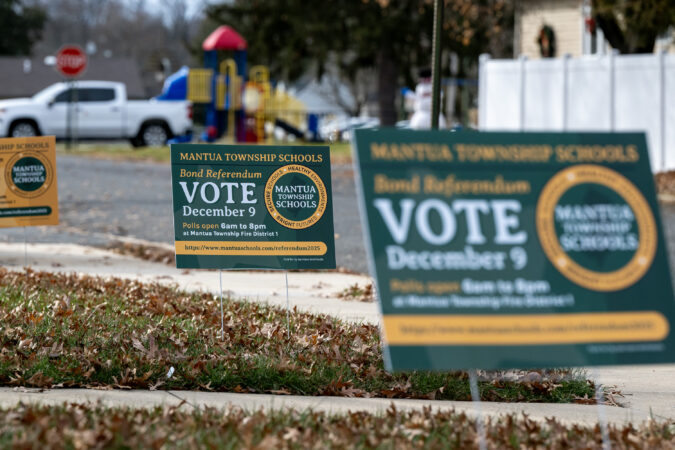
    Voters in Shamong handily rejected a $25 million school bond question that would have raised property taxes, while a referendum in Mantua was too close to call, officials said Wednesday.

    Shamong voters rejected the bond question 797-271, according to unofficial results from Tuesday’s election in the Burlington County school system.

    If approved, the bond issue would have meant a $408 annual property tax increase on a home assessed at the township average of $309,500.

    The district had said funding was needed for projects at the Indian Mills and Indian Mills Memorial schools that need immediate action. They included roofing and HVAC work.

    Superintendent Mayreni Fermin-Cannon did not respond to a message seeking comment on next steps for the district.

    Shamong Mayor Michael Di Croce, who tried unsuccessfully to block Tuesday’s election, hailed the results. Shamong residents make up 90% of the town’s tax base and could not afford an increase, he said.

    Di Croce, an attorney, filed a complaint last week on behalf of several residents that contended school officials provided incorrect or misleading information about state funding for the project.

    The complaint also alleged the district has refused to disclose why it could not earmark $4 million in capital reserves for renovations prior to seeking a bond referendum.

    At a hearing Monday, Superior Court Judge John E. Harrington refused to invalidate the referendum.

    “I’m very happy with the way things played out,” Di Croce said Wednesday. “Their whole sky is falling just was not credible and voters didn’t buy it.”

    Mantua results too close to call

    Meanwhile, the outcome of Tuesday’s vote in Mantua Township on a $39.1 million school bond referendum was too close to call Wednesday.

    In preliminary results, there were 1,097 votes opposed and 1,074 votes in favor, the Gloucester County district said. The totals are expected to change over the next few days as officials count mail ballots and verify provisional ballots.

    “Regardless of the result, our mission remains the same — to prepare our students for lifelong success through comprehensive academics, community partnerships, and character education,” Superintendent Christine Trampe said in a statement.

    The bond issue would fund improvements at all three schools in the kindergarten-through-sixth-grade district, including renovations, roof repairs, and new classrooms.

    Trampe called the renovations “true necessities.” Without the funding, the district may need to cut programs, she said.

    If approved, the bond issue would increase property taxes about $336 annually on a home assessed at the township average of $311,993.

    Elsewhere in the region, voters in Woodbine in Cape May County and Cumberland Regional district in Cumberland County approved bond questions, according to the New Jersey School Boards Association.

    Tuesday was one of five times during the year that school boards may ask voters to approve a bond issue or special question. Bond referendums allow districts to pay for projects that cannot readily be funded through their annual operating budget.

  • First of 30 oil lease sales planned for Gulf of Mexico draws $279 million

    First of 30 oil lease sales planned for Gulf of Mexico draws $279 million

    WASHINGTON — Oil companies offered $279 million for drilling rights in the Gulf of Mexico on Wednesday in the first of 30 sales planned for the region under Republican efforts to ramp up U.S. fossil fuel production.

    The sale came after President Donald Trump’s administration recently announced plans to allow new drilling off Florida and California for the first time in decades. That’s drawn pushback including from Republicans worried about impacts to tourism.

    Wednesday’s sale was mandated by the sweeping tax-and-spending bill approved by Republicans over the summer. Under that legislation, companies will pay a 12.5% royalty on oil produced from the leases. That’s the lowest royalty level for deep-water drilling since 2007.

    Thirty companies submitted bids, including industry giants Chevron, Shell and BP, federal officials said. The total amount of high bids was down by more than $100 million from the previous lease sale in the Gulf of Mexico, under former Democratic President Joe Biden, in December 2023.

    “This sale reflects a significant step in the federal government’s efforts to restore U.S. energy dominance and advance responsible offshore energy development,” said Laura Robbins, acting director of the Gulf region for the Bureau of Ocean Energy Management, which is part of the Interior Department.

    The administration’s promotion of fossil fuels contrasts sharply with its hostility to renewable energy, particularly offshore wind. A judge on Monday struck down an executive order from Trump blocking wind energy projects, saying it violated U.S. law.

    Environmentalists said the fossil fuel sales would put wildlife in the Gulf at an higher risk of dying in oil spills. Spills occur regularly in the region and have included the 2010 Deepwater Horizon tragedy that killed 11 workers in an oil rig explosion and unleashed a massive spill.

    “The Gulf is already overwhelmed with thousands of oil rigs and pipelines, and oil companies are doing a terrible job of cleaning up after themselves,” said Rachel Matthews with the Center for Biological Diversity.

    Erik Milito with the National Ocean Industries Association, an industry group, said the takeaway from Wednesday’s sale was that the Gulf “is open.”

    While results of individual lease sales may fluctuate, Milito added, “the real success is the resumption of a regular leasing cadence.”

    “Knowing that (another lease sale) is coming in March 2026 allows companies to plan, study, and refine their bids, rather than being forced to respond to the uncertainty of a politically-driven multiyear pause,” he said.

    At least two lease sales annually are mandated through 2039 and one in 2040.

    The sales support an executive order by Trump that directs federal agencies to accelerate offshore oil and gas development, Interior Secretary Doug Burgum said in a statement. He said it would unlock investment, strengthen U.S. energy security and create jobs.

    But Earthjustice attorney George Torgun said the Trump administration conducted the sale without analyzing how it would expose the entire Gulf region to oil spills, how communities could be harmed by pollution and how it could devastate vulnerable marine life such as the endangered Rice’s whale, which numbers only in the dozens and lives in the Gulf of Mexico.

    The environmental group has asked a federal judge to ensure that the lease sale and future oil sales better protect Gulf communities.

    Only a small portion of parcels offered for sale typically receive bids, in areas where companies want to expand their existing drilling activities or where they foresee future development potential. It can be years before drilling occurs.

    The drilling leases sold in December 2023 and during another sale in March 2023 are held up by litigation, according to Robbins. A federal court ruled this spring that Interior officials did not adequately account for impacts to planet-warming greenhouse gas emissions and the Rice’s whale.

  • Recovery Centers of America will pay $2 million to settle claims of illegally dispensing controlled substances and falsely billing Medicaid

    Recovery Centers of America will pay $2 million to settle claims of illegally dispensing controlled substances and falsely billing Medicaid

    Recovery Centers of America, a prominent addiction rehab provider, will pay $2 million to settle claims by the federal government that it illegally dispensed strictly regulated medications and billed Medicaid for services it did not provide.

    The Drug Enforcement Administration audited and investigated RCA facilities in Pennsylvania and Maryland between 2019 and 2024, the U.S. Attorney’s Office for the Eastern District of Pennsylvania said in a statement.

    RCA operates 13 rehab centers across the country, with its corporate headquarters in King of Prussia. The for-profit company offers inpatient and outpatient treatments for people in addiction, as well as mental health services.

    The DEA said RCA “dispensed controlled substances in an unlawful matter” and did not comply with federal recordkeeping rules for drugs and other substances that are closely regulated due to their potential for abuse.

    Federal officials did not specify the controlled substances involved.

    In a settlement agreement, federal authorities said that the DEA found a number of recordkeeping issues at an RCA facility in Devon, including that the facility did not maintain records showing that it had received controlled substances, and did not record the number of containers of the substances or the date they had been received. Some prescriptions for controlled substances were issued to “house stock” instead of named patients, authorities said.

    The facility also did not keep accurate records of the controlled substances on hand at the site, authorities allege.

    They also found recordkeeping issues at another RCA facility in Maryland.

    In 2017, a whistleblower who was once employed at RCA filed a lawsuit alleging that some facilities had admitted patients on Medicaid, but had not complied with state and federal regulations on providing them with rehab services.

    Under federal law, whistleblowers can sue on behalf of the government when they believe a company has submitted false claims for government funding, federal authorities said.

    Federal authorities said that between 2017 and 2019, some RCA facilities billed the Federal Employees Health Benefits Program and Medicaid for care that they did not document and did not actually provide.

    The settlement will resolve the whistleblower’s lawsuit.

    RCA did not immediately return a request for comment.

    The company has agreed to pay $1 million to resolve the controlled substance claims and $1 million to resolve the billing claims. RCA did not admit liability as part of the settlement agreement.

    Federal law also enables whistleblowers to receive money from the settlement. The former employee will receive $230,000, authorities said.

    RCA will also pay the employee $450,000 and $75,000 to cover attorney’s fees, according to the settlement agreement.

    “Drug and alcohol treatment facilities must prescribe and store controlled substances in a manner that comports with rules designed to ensure that dangerous drugs do not fall into the wrong hands. They also must provide treatment services that comply with all governing laws and regulations,” U.S. Attorney David Metcalf said in a statement.

    “When they fail in either of those critical duties they will face significant consequences.”