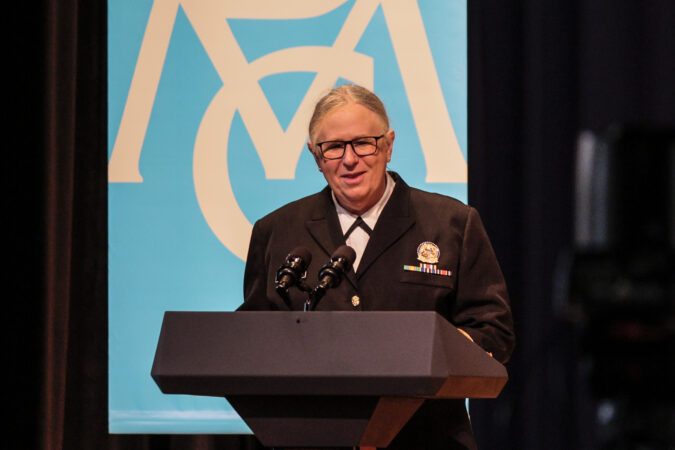
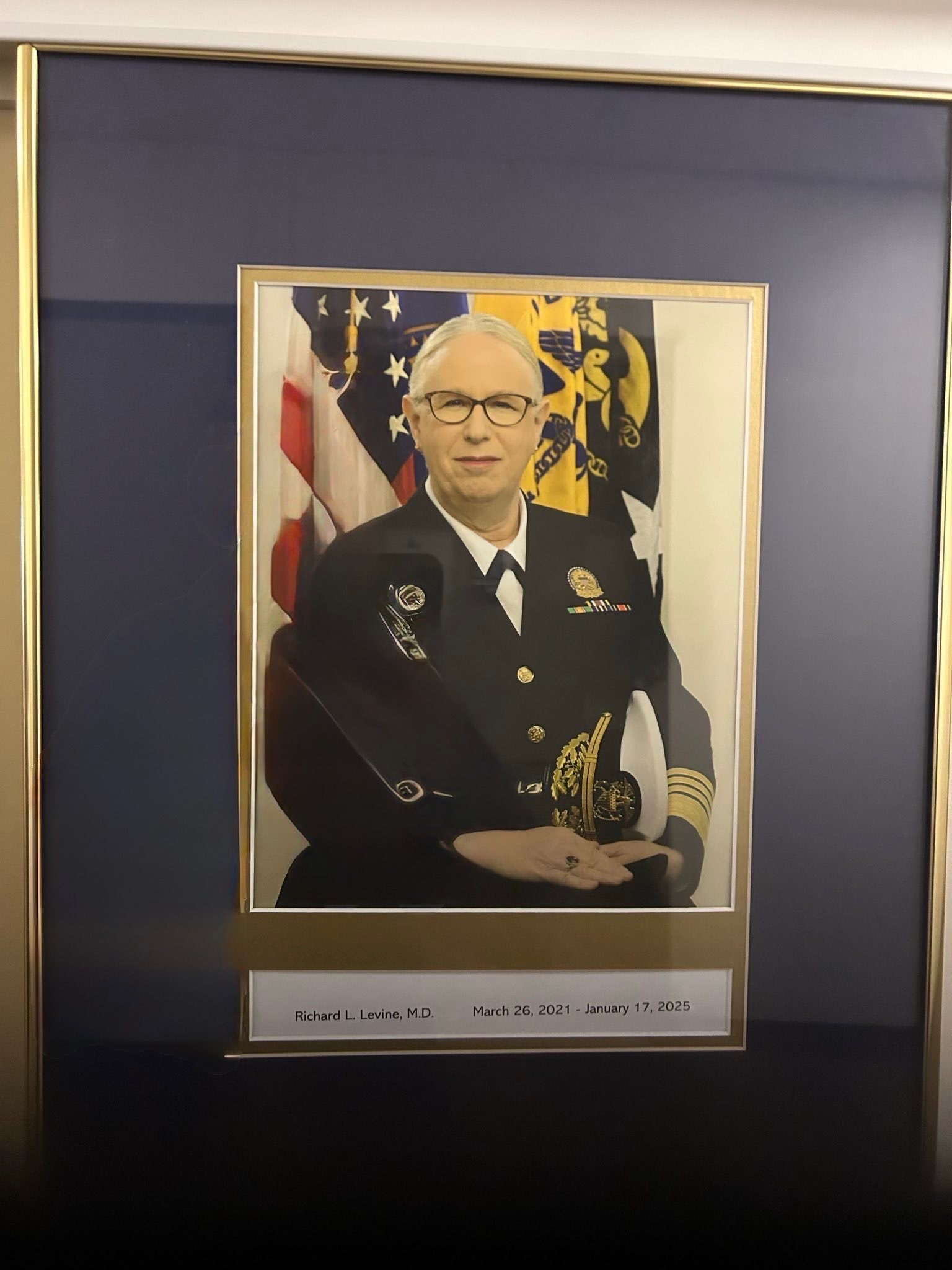
While the federal government was shut down, the U.S. Department of Health and Human Services altered the name under the official portrait of Admiral Rachel Levine, a Pennsylvania doctor who served as the agency’s assistant secretary under former President Joe Biden, to her birth name or “dead name.”
Levine, who had previously served as Pennsylvania physician general and secretary of health under Gov. Tom Wolf, was the first openly transgender official confirmed by the U.S. Senate.
This photograph shows the official portrait of Admiral Rachel Levine, former assistant secretary for health. The portrait hangs in the hallway of the Humphrey Building in Washington, D.C., where Levine served under President Joe Biden at the U.S. Department of Health and Human Services. Someone in the Trump administration changed Levine’s name to her birth name or deadname. The photographer does not want to be identified.
“Deadnaming” — using a transgender person’s birth name rather than the one they chose — is “a horrible thing to do to vilify a group of people,” said Deja Alvarez a LGBTQ community leader. “It’s beyond reprehensible.”
Levine has not spoken publicly about the action, which was first reported Friday by National Public Radio. In a brief statement delivered by her former deputy assistant secretary for health policy Adrian Shanker, Levine described the name change as a “petty action” and said she wouldn’t comment. Shanker, a fellow at the Lehigh University College of Health, manages Levine’s public engagements.
Levine, 68, has received expressions of “sympathy and outrage” since Friday,Shanker said.
Condemning the alteration of Levine’s portrait, he said, it was “hard to understand that this was a priority under a government shutdown.”
”What do you expect from people acting more like high school bullies than federal officials?”
HHS didn’t respond to requests for comment. Agency officials told NPR in a written statement: “Our priority is ensuring that the information presented internally and externally by HHS reflects gold standard science. We remain committed to reversing harmful policies enacted by Levine and ensuring that biological reality guides our approach to public health.”
As Pennsylvania’s health secretary, Levine led the state’s response to COIVID-19 and became a familiar figure in 2020, standing at a lectern in Harrisburg, answering questions about the deadly pandemic.
Prior to the pandemic, Levine led the state’s response to the opioid epidemic. She also helped establish Pennsylvania’s medical marijuana program.
Under Biden, Levine also worked on issues related to HIV, syphilis, climate change, and long COVID.
Levine was a pediatrician who worked at Penn State Health Milton S. Hershey Medical Center for 20 years before moving into public life.
Throughout her career, Levine “earned … recognition through decades of expertise and leadership,” said State Rep. Dan Frankel (D., Allegheny) in a statement Tuesday. HHS’s decision to “strip [her legal] name is an act of political malice.”
The Trump administration has made numerous efforts to counter civil rights gains transgender and LGBTQ Americans had previously won.
These include issuing an executive order on Jan. 20 that redefined the word “sex” in federal programs and services to refer only to biological characteristics “at conception” as well as restricting gender-affirming medical care for people under age 19, banning trans Americans from military service and eliminating protections for transgender people.
Staff writer Gillian McGoldrick contributed to this article.
New Jersey is among the 10 states that allow physicians to assist terminally ill patients in ending their own lives, under certain conditions. But those patients must be New Jersey residents, a federal appeals court ruled.
The U.S. Court of Appeals for the Third Circuit said last week that New Jersey’s limit of the aid-in-dying law to state residents is constitutional, keeping on the books a significant hurdle for people from neighboring states — including Pennsylvania and Delaware — where the practice is not permitted.
“In our federal system, states are free to experiment with policies as grave as letting doctors assist suicide. Other states are free to keep it a crime,” U.S. Circuit Judge Stephanos Bibas wrote in the opinion. “This novel option does not appear to be a fundamental privilege, let alone a fundamental right, that states must accord visitors.”
Jess Pezley, a staff attorney at the legal arm of Compassion and Choices, a nonprofit advocacy organization that brought the lawsuit challenging the residency requirement, said aid in dying “remains a critically important option for all terminally ill people who wish to receive healthcare in the state of New Jersey.”
The “ruling means that terminally ill patients who do not live in an authorized jurisdiction will continue to have to travel”to states like Oregon and Vermont that permit the practice for nonresidents, Pezley said in a statement.
Aid in dying is a controversial concept. While some argue the law creates a pathway for empowerment over end of life, others worry that it can lead to coercion and expansion beyond the terminally ill in a country that has a dark history in how it treats people with disabilities.
The residency requirement is meant to protect physicians from liability in states where assisting in suicide is a criminal offense, proponents of the restriction argue, and to prevent medical tourism in states with the option.
The law does not specify how long a person must live in New Jersey but sets other qualifying requirements: A patient must have a New Jersey driver’s license, be registered to vote in the state, have filed income taxes as a New Jersey resident in the last year, or have another official government record that confirms residency.
The law allows adults who are residents of New Jersey and are expected to die within six months to obtain a prescription for a lethal drug cocktail. They must be able to make their own decisions and administer the medication by themselves.
The ruling is the latest development in a lawsuit filed in August 2023 by a Camden County physician, Paul Bryman, who assists terminally ill patients in ending their lives on their own terms. He challenged the residency requirement, saying the law prohibits him from treating all patients equally because of where they live.
Bryman’s suit originally included another New Jersey physician, Deborah Pasik, and two cancer patients, Judith Govatos of Delaware and Andy Sealy of South Philadelphia. Pasik has since retired, and Govatos, 81, and Sealy, 44, died before the court made its ruling.
The lawsuit argued the prohibition “discriminates” againstpatients like Govatos and Sealy by not allowing them to receive “specific medical care after crossing State lines into New Jersey, even though they would otherwise qualify for this care.”
New Jersey officials asked a federal district judge to dismiss the case, arguing that no court has recognized aid in dying as a constitutional right. The state further said that the residency requirement was among the “safeguards” in a policy that has “extraordinarily high stakes.”
The judge tossed out the lawsuit in 2024.
“And the residence requirement makes sense: While medical aid in dying is permitted in New Jersey, it is indistinguishable from the criminal act of assisted suicide in neighboring states,” District Judge Renee Marie Bumb wrote in her opinion. “By limiting the pool of eligible patients to State residents, the requirement is rationally related to the legitimate objective of protecting from out-of-state liability providers and advocates who assist terminally ill patients in seeking medical aid in dying.”
Compassion and Choices appealed the ruling to the Third Circuit, where the plea met a similar fate.
“The Constitution leaves moral questions like these to the states,” Bibas wrote. “New Jersey has answered them carefully.”
They moved to 16-9-3 Tuesday with a 4-1 win against the San Jose Sharks. It is their best start since the 2019-20 season, when the Flyers last made the playoffs.
Here are two big takeaways from a win that can help propel them forward.
Although he may have been nervous leading up to the game, and was thinking “don’t fall” when he went out for his solo rookie lap, Ty Murchison fit right in during his NHL debut.
But first, he sat in the stands.
“Yeah, taking it in, trying to do a little bit of mental preparation,” he said. “Yeah, I usually do that before every game, but it’s definitely crazy looking around and being in a rink like this, and kind of looking forward to it, and trying to settle the nerves.”
Looks like Flyers rookie Ty Murchison taking in the arena before he makes his NHL Debut Tuesday vs. the Sharks pic.twitter.com/MoofdTXEKW
A fifth-round pick in 2021, the defenseman did not look nervous on the ice. He skated the majority of his 14 minutes, 56 seconds of ice time, including a minute on the penalty kill, alongside veteran Noah Juulsen.
Known for his physicality and edge, Murchison was credited with three hits and one blocked shot while playing tough and making smart decisions along the boards and in front.
“He played well, he didn’t look out of place at all,” winger Travis Konecny said. “He did his job tonight.”
The California native was spotted being physical and playing on the right side of forward Adam Gaudette in front of the net in the third period, and throughout the game with Sharks tough guy Ryan Reaves. The veteran enforcer Reaves, who is the same height as Murchison at 6-foot-2, is listed as 13 pounds heavier and was playing in his 937th NHL game.
“Yeah, it was fun. He’s heavy,” Murchison said with a laugh. “So yeah, that was definitely something for sure. … I mean, that’s, that’s the type of hockey I want to play. So yeah, it was a fun game.”
Ty Murchison impressed in his NHL debut on Wednesday.
He left another good impression on Flyers coach Rick Tocchet.
“He can skate really well, that’s what I like about him, and he’s competitive,” Tocchet said. “I thought he did a great job for us tonight. … In your first game, I think he backed in a couple of times, but that’s normal, and we’ll work with that.
“But he’s a good skater, and he’s got some stiffness to him; that’s what I like. When you have defense that can skate and have stiffness to them — I think he went in the corner one time, not scared, and took a hit from Reaves, and kind of went at it with him — that’s a good luxury to have.”
Murchison did it all in front of about 20 family members and friends — and teammate Carson Bjarnason. The Phantoms goalie and Flyers prospect drove down from Allentown and was wearing Murchison’s Phantoms Christmas warm-up jersey.
Like with goalie Dan Vladař, who earned his 11th win on Tuesday, a lot of people questioned the signing of Christian Dvorak on July 1. Well, it’s paying off.
“He’s great,” said his linemate Trevor Zegras. “He’s great in the room. He’s a 10-year guy, which we love telling him, just a pro’s pro. So good doing the little things in the D-zone and creating space in the O-zone. I love playing with him. He’s been a lot of fun to be around.”
With 19 points in 28 games, he is on pace for 56 points, which would shatter his career high of 38 set when he worked with Tocchet in Arizona. Dvorak scored his seventh goal of the season on a nifty breakaway move and added an assist while skating 19:01 on Tuesday, his highest total since Nov. 4.
“He was more in a defensive role in Montreal, more on the fourth line,” Tocchet said. “And I think he’s getting a chance. He saw the opportunity here with our situation, and I think that he’s grabbing it.”
“I think it’s just more about confidence,” Dvorak added. “And, obviously, I’m playing with some really good linemates. So that helps a lot, too. I think we read off each other very well, and they’re a big help for me.”
Skating between Travis Konecny — who earned his 500th NHL point on the goal by Dvorak before adding an empty-netter — and Zegras, Dvorak has become a utility player. Tocchet has trust in him to play against the opposition’s top line at five-on-five, which was Macklin Celebrini’s line on Tuesday, and across special teams.
Travis Konecny scores his 500th career point with an assist on Dvorak’s breakaway goal! pic.twitter.com/Lei9Aw5t1Y
And while many thought it would be Zegras in the middle, Dvorak is excelling as the line’s center. His faceoff percentage is now at 55.8% after winning 14 of 17 against the Sharks. Among players to take at least 300 draws this season, Dvorak ranks 15th in faceoff percentage.
When Dvorak’s line was on the ice, the Flyers had 16 shot attempts to the Sharks’ seven, outshot them, 11-3, and created five high-danger chances compared to one against. They scored one goal and allowed one, as Collin Graf gave the visitors a 1-0 lead on their first shot of the game.
“Unfortunately, sometimes when you’re playing with myself or ‘Z,’ we’re leaning offense sometimes, and he seems to be a guy that’s going to be in the right spots,” Konecny said.
“If there’s a mistake, we don’t want that, but he’s got the mindset of protecting and cleaning up a lot of errors that I’m making. He’s also got a lot of [offense] too, so I think he’s all around a really good player and I’ve enjoyed playing with him.”
The door of Banshee at 16th and South Streets will be unlocked Thursday, welcoming patrons for crispy onion tarts, chicory salad, and a saucy Spanish mackerel dish you can mop up with house-made sourdough. They can then polish it all off with a sip of draft wine or a sesame- and pineapple-laced whiskey sour.
The cozy, modern American bistro is a refined addition to the Graduate Hospital neighborhood. And although two of its backers will be familiar to followers of Philly’s restaurant scene, Banshee marks a clear break from the Asian-inspired street food and graffitied airs that defined their earlier work.
Shawn Darragh and Ben Puchowitz, who founded Cheu Noodle Bar (2013), Cheu Fishtown (2017), Bing Bing Dim Sum (2015), and Nunu (2018), have brought on two key former employees as partners: twin brothers Kyle and Bryan Donovan, 34.
Mussels in harissa with hakurei turnips in coconut milk, beneath a lid of grilled bread, at Banshee.
Kyle Donovan — who started at the original Cheu near 10th and Locust and later managed Bing Bing on East Passyunk until it closed in 2024 — is Banshee’s general manager, overseeing 12 walk-in-only bar seats and about three dozen seats in the dining room.
Banshee executive chef Bryan Donovan was opening sous chef under Puchowitz at Cheu Fishtown before he went on to cook at Sqirl in Los Angeles and Contra, Wildair, and the Four Horsemen in New York City.
Darragh and Puchowitz, now in their early 40s, have moved on from the day-to-day of restaurant work. Darragh, the front-of-the-house/marketing guy, runs a construction company. Puchowitz — who as a 23-year-old ran the kitchen at the late, great Rittenhouse BYOB Matyson — works in real estate.
“It’s fair to say we’re all grown up now,” Darragh told me. “We’re trying to carry over that neighborhood spirit but take it a step further — maybe a little more refined but still fun.”
The visual shift, not only from their former restaurants but also from the building’s previous occupant, Tio Flores, is obvious. Stokes Architecture + Design created a warm, Scandinavian-inspired space with natural woods, curtains, table lamps, pendant lights, and a mushroom-wood accent wall. The up-lit bar anchors the room.
Winter citruses at Banshee.
Banshee was originally planned for the former Bing Bing space on East Passyunk Avenue at 12th Street, but that deal fell through. Chefs Biff Gottehrer and Kenjiro Omori are renovating it for a new restaurant called Tako Taco.
Mediterranean, Basque, and modern American flavors
Don’t expect ramens or dumplings at Banshee. The menu leans Mediterranean/Basque — chef-driven but not inaccessible. Premium ingredients include Berkshire pork collar ($25) and Lady Edison ham ($17) with persimmon and fromage blanc. The center-of-the-table dish is a half chicken ($39) with pickled peppers and buttery Marcona almonds.
Kyle Donovan at the bar at Banshee.
Vegetables take center stage: braised leeks with boquerones, pepitas, and Comté ($14); grilled Kyoto carrot with txakoli sabayon ($15); and a chicory salad with dijonnaise, pear, and nutty, creamy Midnight Moon cheese ($15). Fermentation-driven umami shows up in red kuri rice with koji butter and nori, as well as a winter citrus salad finished with brown butter, pine nuts, and umeboshi. About half the menu is vegetarian, and five dishes are vegan or easily made vegan.
The tarte flambée ($15) is one of the most distinctive dishes on the menu. It starts with a yeasted semolina dough that’s rolled through a pasta sheeter, cut into squares, and baked on olive oil-lined sheet trays. It’s topped with smoked crème fraîche, caramelized onions, raw onions, maitake mushrooms, chives, and hot honey, and finished with a leek-and-parsley powder made from dehydrated leek scraps. Crispy and bold, “it’s layered onion flavor all the way through,” Bryan Donovan said.
Barnstable oysters in dill mignonette at Banshee.
A dill mignonette brightens the Barnstable oysters ($22). Hamachi crudo ($18) is sliced thick to highlight the fish’s natural fat and paired with a bright, acidic sauce made from minced peppers, passion fruit puree, shio koji, and white verjus. “The sauce actually came first, and then we tailored the fish to it,” Donovan said.
A larger plate of Spanish mackerel ($24) is served over grilled Brussels sprout leaves tossed in a smoked clam emulsion with thyme and tamari, finished with olive oil tapenade and pickled golden raisins.
Chef Bryan Donovan juggling orders in the kitchen at Banshee.
“We’ll change vegetables seasonally and add more snacky, fried, and skewer-style items as we settle in,” Donovan said. “Spontaneity and experimentation are part of the spirit of the place.”
There’s a baked Alaska (not done tableside) and a butterscotch Krimpet filled with boysenberry jam for dessert.
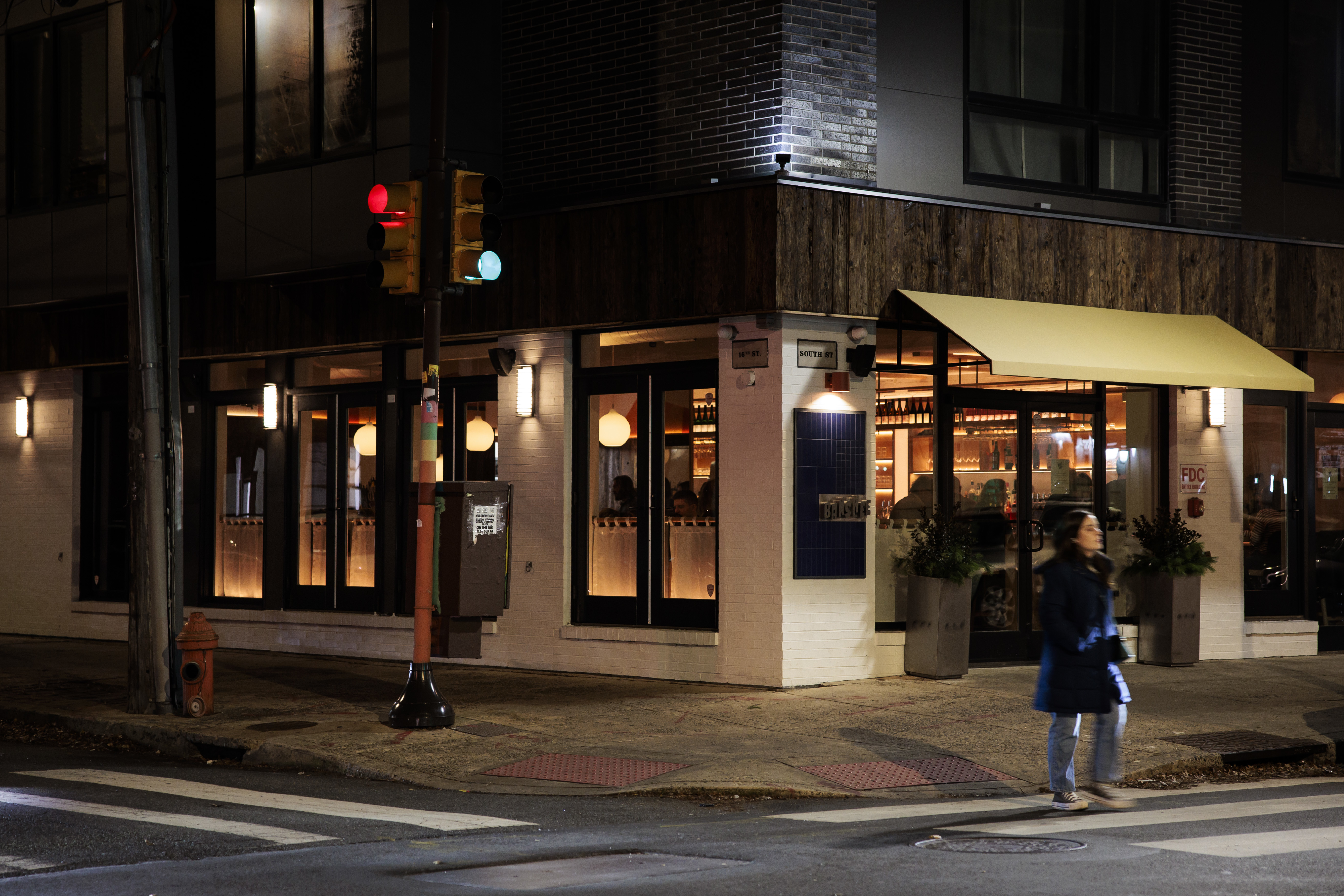
The exterior of Banshee at 1600 South St.
Check average is projected at $70 to $75 per person for two to three dishes and one drink.
The Banshee partners brought in lead bartender Mary Wood to build the cocktail program, working alongside assistant manager Madeline Anneli. “None of us are professional bartenders, so we wanted real expertise on cocktails,” Kyle Donovan said.
Wood’s list draws from home-cooking influences and ingredients already used in the kitchen. The Dirty Banshee ($16) — olive oil-infused vodka, garlic fino, and blue cheese olive — leans deeply savory. Beet imbues the Crowd Work ($15), a sparkling gin cocktail with lemon and quinine. The bar also offers low-ABV drinks, nonalcoholic options, fermentation elements such as tepache, and an accessible beer lineup.
Hours are 5 to 10 p.m. Thursday through Monday. Reservations are available on Resy on a rolling 30-day basis.
Federal authorities are searching for someone who shattered two windows at Philadelphia’s federal courthouse this week.
The vandalism occurred late Monday night when someone used a cobblestone brick to smash two glass windows at the front entrance of the James A. Byrne U.S. Courthouse on the 600 block of Market Street, said Supervisory Deputy U.S. Marshal Robert Clark.
Clark said it was not clear if the attack was targeted. Authorities were also looking into whether there was any link to another report of windows being smashed around the same time that night a few blocks away in Old City, he said.
Investigators were reviewing surveillance video in hopes of identifying a suspect, Clark said, and the brick that was used was left at the scene.
The courthouse is where most of the region’s federal civil and criminal cases are heard. It also houses the Third Circuit Court of Appeals.
A judge said this week that arguments questioning the legality of Joyce Wilkerson’s seat on the Philadelphia school board had merit, and directed the board to halt nonrenewal proceedings for two charter schools.
Philadelphia Common Pleas Court Judge Christopher R. Hall granted a preliminary injunction to People for People Charter School and KIPP North Philadelphia Academy on Monday, saying that a lawsuit against the school board can continue because lawyers had presented sufficient evidence.
The charters claim that board member Wilkerson — who is perceived to be anti-charter schools — tainted the votes against them this year and should not be on the board.
City Council declined to approve Wilkerson last yearas a school board member, but Mayor Cherelle L. Parker asked her to serve until she named areplacement.
People for People’s initial lawsuit complaint, filed in September, said that Wilkerson is an “illegally and unlawfully seated member of the BOE” and that her participation in the nonrenewal deliberations tainted and ultimately invalidated them.
The city and the board have said that the city’s Home Rule Charter allows Wilkerson to continue to serve — without Council approval — until a replacement is named.
Reginald Streater, the school board president, said the ruling overshadows the underlying issues.
“The board’s decision to begin the process of nonrenewal was on the merits of each board member’s independent assessment of the schools’ outcomes,” Streater said in a statement. Board members’ concerns were aired publicly over months.
Any delay slows the board’s ability to give the schools full hearings, with testimony and the ability to present evidence, he said.
“Our schools, families, and children deserve resolution,” Streater said. “We remain committed to transparency and to continuing this work in the best interest of the community.”
(Nonrenewal does not equal closure, though it is the first step on that path. It triggers an extensive nonrenewal hearing, after which an officer makes a recommendation; then the board votes again on whether to non-renew the school.)
Lawyers for the charters argued that Wilkerson essentially poisoned the votes, and the judge wrote in his order that there was enough evidence to move forward with the injunction.
“This leaves the question whether Ms. Wilkerson’s participation in the pertinent BOE meetings without color of right tainted its vote [on the charter nonrenewals]. Plaintiffs have shown it likely did,” Hall wrote.
Hall’s order means that nonrenewal hearings cannot proceed, but the board had not yet scheduled them.
What was Wilkerson’s role on the People for People and KIPP votes?
Wilkerson, Hall noted in his order, “was the first to press” to issue a nonrenewal notice to the schools at a June board meeting, and in August called for a vote on the nonrenewal notice.
The KIPP North Philadelphia nonrenewal vote passed unanimously; board member Whitney Jones was the onlyvote against the People for People non-renewal.
But Wilkerson, a former school board president and School Reform Commission chair, was not the only board member with concerns about the two charter schools.
Board member Cheryl Harper said People for People is “failing our children. How long do we allow them to keep failing our children? I have an issue with these schools not being able to succeed for our children.”
Board vice president Sarah-Ashley Andrews cited issues with KIPP North Philadelphia’s “failure to deliver for our students,” specifically calling out its academics and suspension rates.
Streater, the board president, called KIPP’s performance “unacceptable.”
What’s next?
Thecourt case will now proceed, andis likely to drag on for months.
But Hall’s legal ruling on Wilkerson’s school board seat could mean open season for other parties that are unhappy with decisions the board has made and are willing to challenge those rulings legally.
As to whether Wilkerson will remain on the board, Parker has staunchly stood by her in the past.
When the People for People suit was first filed, a member of her administration said she stood by Wilkerson as “an official member of the Philadelphia Board of Education” who “has the full support of Mayor Cherelle L. Parker.”
What was the reaction?
Mark Seiberling, a lawyer for People for People, said the ruling was an important one.
“We are pleased with Judge Hall’s thoughtful and well-reasoned decision following a lengthy hearing at which multiple witnesses from the School District of Philadelphia were called to testify,” Seiberling said in a statement. “We look forward to Ms. Wilkerson’s replacement being nominated and confirmed in accordance with Philadelphia’s Home Rule Charter.”
A former top-ranking deputy with the Philadelphia Fire Department has been demoted amid two ongoing investigations into sexual harassment and overtime abuse, The Inquirer has learned.
Former Deputy Commissioner for Operations Anthony Hudgins — who had been the second-highest ranking official in the 2,800-member department — was recently downgraded to deputy fire chief and reassigned to the Incident Safety Office, according to spokespeople with the city and fire department. The demotion cut his annual salary by nearly 25%, from $202,550 to $155,106, payroll records show.
Hudgins was the subject of an array of sexual harassment allegations, which led the city to hire an outside law firm to investigate the claims and interview department personnel. In a May interview with The Inquirer, Hudgins called the probe baseless and claimed he was targeted with false allegations after uncovering rampant overtime fraud. He acknowledged that as fewer than10 employees had lodged complaints against him. The city inked a $35,000 contract with the law firm Campbell Durrant to investigate the allegations.
Hudgins, a 31-year department veteran, did not immediately respond to a request for comment. After publication, Hudgins’ attorney, Amanda N. Martinez, sent a statement saying that Hudgins“remains committed to assisting the City with any legitimate investigation into the overtime fraud that he brought to light.”
She added that Hudgins is “reviewing the details surrounding the City’s actions and all defamatory statements made against him by individuals” and will “pursue all available legal remedies under the law necessary to protect Mr. Hudgins’ reputation and employment rights.”
The fire department has for decades faced allegations of pervasive sexual misconduct, and yet the Hudgins probe is significant in that it targeted a top-ranking department official. Although they acknowledged that Hudgins had been demoted, spokespeople for the city and fire department declined to confirm whether any of the allegations against him had been substantiated, citing the city’s policy to not discuss personnel issues.
Fire department leadership did not elaborate on the results of the investigation. A request for comment from Mayor Cherelle L. Parker resulted in a prepared statement from City Solicitor Renee Garcia, who said the city “takes any allegations of sexual harassment or fraud, including overtime fraud, very seriously.”
“We investigate any such allegations thoroughly and, if misconduct is found, we will take appropriate action to implement any warranted discipline expeditiously,” Garcia said.
The city has also declined to reveal whether any fire department employees have faced discipline as a result of the related investigation into alleged overtime abuse. Inspector General Alexander DeSantis — who as far back as January launched a probe into the overtime fraud claims — said his office’s investigation is “still ongoing and may be for some time.” He described the probe as “active” but declined to elaborate.
City officials have declined to release public records that would shed light on some of the fire department’s top overtime earners — and are taking The Inquirer to court in an effort to keep those records hidden.
In an affidavit submitted to the Office of Open Records, the agency that enforces state open-records laws, DeSantis argued that releasing the records to The Inquirer would jeopardize his office’s investigation and that it could not release the files “without identifying or implying who may be directly involved in this investigation.” Records related to noncriminal investigations are exempt from release under Pennsylvania’s Right-to-Know Law.
The Office of Open Records ruled in May that The Inquirer is entitled to receive the records, which cannot be withheld simply because the OIG opened an investigation.
The city again declined to release the overtime sheets and instead appealed the OOR ruling to the Court of Common Pleas. In a 21-page brief filed in that case, attorneys for the city urged the court to vacate the OOR’s ruling on the grounds that releasing the records would raise questions about “the efficacy of investigations, witness confidentiality, and harm to reputation.”
The OIG probe has yet to publicly reveal any findings. DeSantis offered no timeline for its conclusion, and the results may not be made public even after the investigation ends.
The OIG’s stated mission is to “keep City government free from fraud, corruption, and misconduct,” but the office rarely releases specifics related to the outcome of its fraud investigations. Instead, it publishes an annual report summarizing the office’s work from the previous year.
The OIG has yet to release that report for 2024.
Staff writers Samantha Melamed and Ryan W. Briggs contributed to this article.
Correction: A previous version of this story incorrectly characterized the total number of employees that Hudgins said may have filed complaints against him.
Taking his daughters to the Cherry Hill Public Library was a weekend ritual for David Jastrow, andone intricate sculpture out front always gave his family pause.
“For whatever reason, that sculpture always caught the attention of my daughters. When they were younger, they used to call it the ‘mixed-up elephant,’ which I always thought was funny,” said Jastrow, 51, a township resident who still frequents the library to pick up biographies and mystery novels.
The Cherry Hill Public Library hasupward of 50 works of art inside its halls, in addition to numerous sculptures outside, including the “mixed-up elephant” on the front lawn.That spurred Jastrow to write in to Curious Cherry Hill, The Inquirer’s forum for answering your questions.
“It’s a very abstract piece of artwork. You can kind of see the trunk coming out at one part,” Jastrow said. “I thought maybe it was designed with the elephant in mind in some way, but I doubt it.”
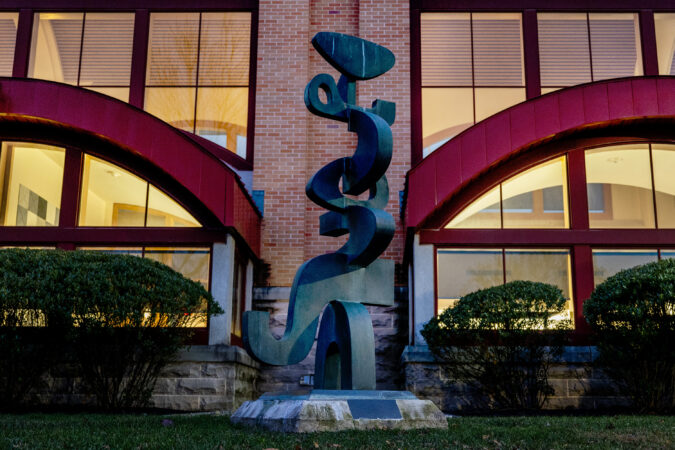
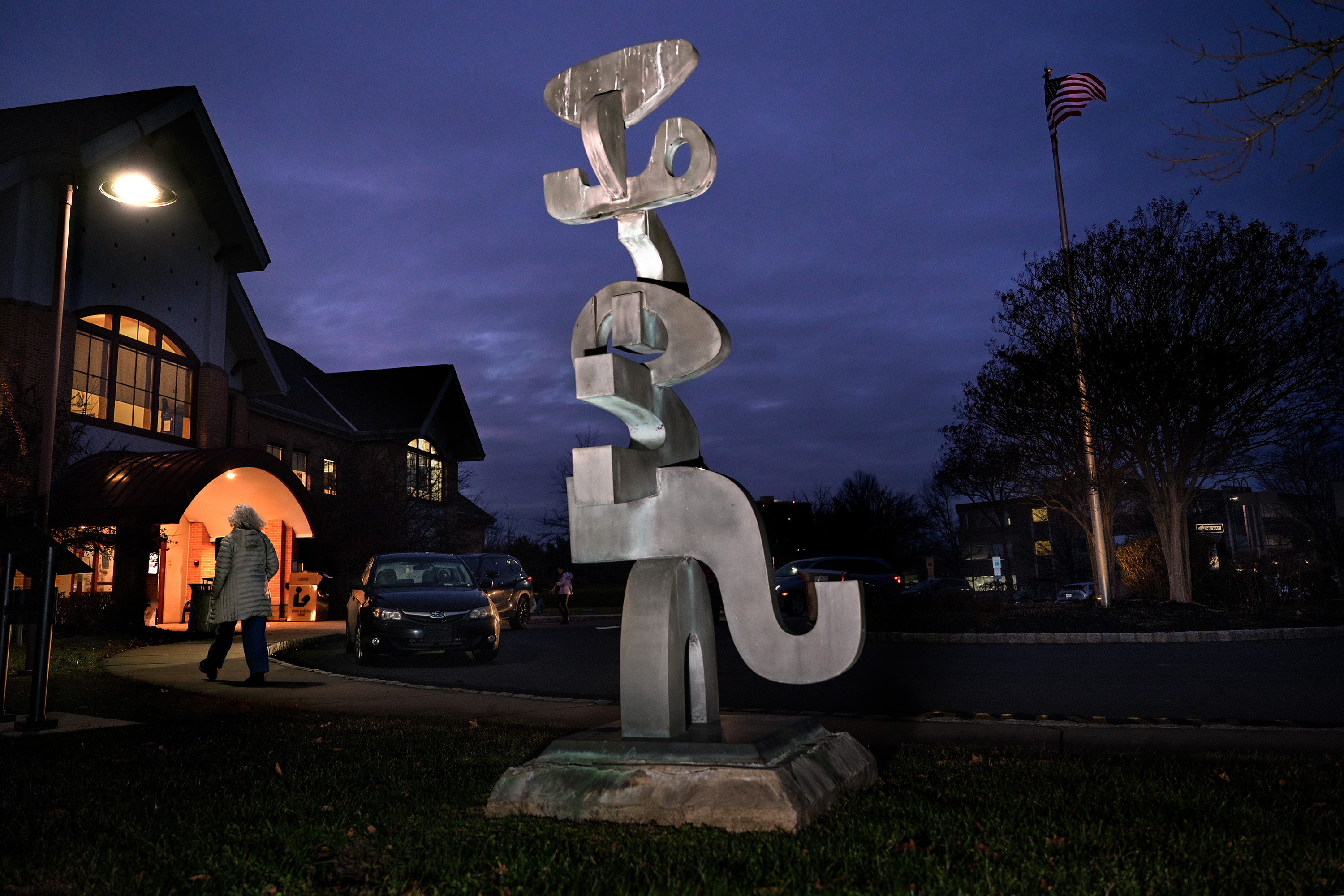
And Jastrow would be right. “Totem” is an 8-foot-tall bronze sculpture that twists into an elaborate structure reaching toward the sky. Sitting to the left of the library’s main entrance since 2009, visitors can’t help but try to decipher its meaning.
Eric Ascalon, the son of award-winning sculptor and stained-glass artist David Ascalon, who crafted “Totem,” said that the different interpretations are exactly what his father intended.
“The sculpture just came from a natural place within his psyche,” Eric Ascalon said. “He feels abstract art is put out there by the artist, but it’s designed to be interpreted in any whatever it means to the viewer.”
Sculpture often takes long periods of time to conceptualize and design. In David Ascalon’s abstract work, he would swiftly sketch a design on a loose piece of paper and lock that design in. Despite a quick conceptualization, the statue took months to build.
David Ascalon, center, the creator of the 8-foot-tall bronze sculpture, “Totem,” installing the statue outside of the Cherry Hill Public Library in 2009. The sculpture stands today at the library, enticing visitors to interpret its abstract form.
“I would say ‘Totem’ is kind of a reflection of his subconscious and just his creative spirit,” Eric Ascalon said.
For David Ascalon, dipping his toes into abstract art was a way to clear his mind from the painstakingly detailed work of his stained-glass windows, saidhis son, who worked alongside his father and the rest of the family at their now-closed West Berlin firm, Ascalon Studios.
After forming Ascalon Studios in 1977, with his father, Maurice, David Ascalon would go on to craft some of the finest stained-glass windows in synagogues and public spaces across the region. His work can be seen in the stained-glass windows in nearby Temple Beth Shalom, and all the way in Harrisburg, where his 15-foot Holocaust Memorial overlooks the Susquehanna River.
It’s not only Ascalon’s work that draws people into Cherry Hill’s library, either.
Walking up to the three-acre property, guests are greeted by what looks like a real couple reading the newspaper on the library lawn — perhaps unusual in 2025 — but step a little closer, and see that they’re not human, but a hyperrealistic sculpture of a man and woman lounging in the grass.
Another abstract sculpture, created in memory of Valerie Porter, a Cherry Hill resident who loved to read but died unexpectedly in 1966 after a neurological condition, sits outside the library. David Ascalon helped restore it in 2016.
Fred Adelson, sculpture committee, Laverne Mann, director of Library, artist David Ascalon of Cherry Hill and Sally Callaghan also of sculpture committee, left to right, outside the Cherry Hill Library.
Inside, several walls are adorned with public art, many created by Cherry Hill residents. Downstairs is a year-round art gallery that promotes a new local artist every month, said library director Tierney Miller.
Such works amount to small glints in human creativity, something that the library continually fosters through its programming, said Miller.
The monthly showcase is so popular among local artists that the gallery space is booked years in advance, “2026 is already full, and we’re booking for 2027 now,” Miller said.
While only Cherry Hill residents can get a free library card — there are paid options for others — anyone can attend its free events.
The sculpture “Totem” by David Ascalon. It was installed in 2009 on the grounds of the newly opened Cherry Hill Public Library.
This suburban content is produced with support from the Leslie Miller and Richard Worley Foundation and The Lenfest Institute for Journalism. Editorial content is created independently of the project donors. Gifts to support The Inquirer’s high-impact journalism can be made at inquirer.com/donate. A list of Lenfest Institute donors can be found at lenfestinstitute.org/supporters.
It’s December, by far the coldest week of the season to date and due to get colder, but to Jeff Hulbert, the Brandywine Valley these days evoke July — July at the Jersey Shore, that is.
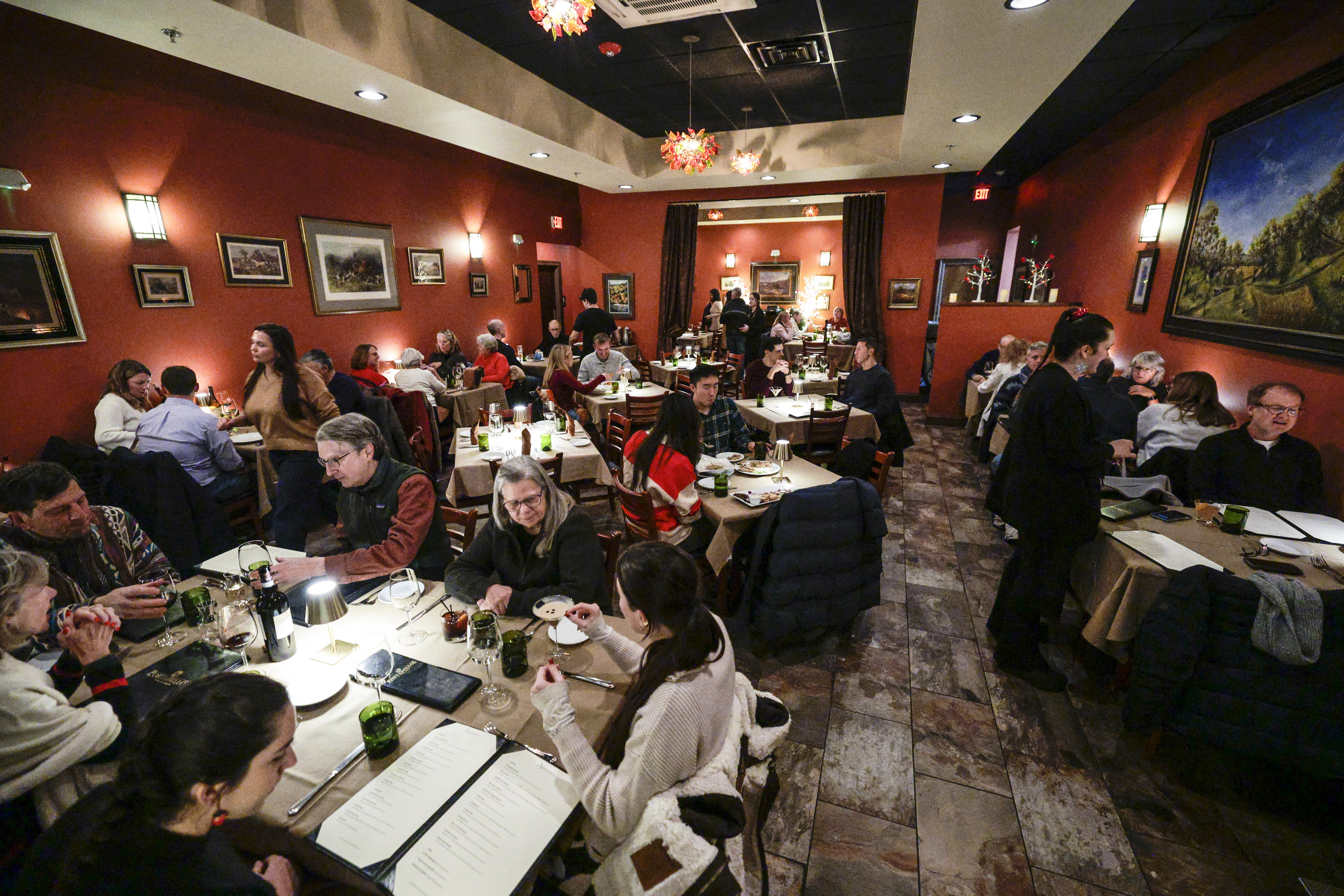
Business has been brisk, and the human traffic thick along State Street, where he and partner Sandra Morris own and operate the popular Portabello’s of Kennett Square restaurant.
Like the peak summer weeks at the Shore, where Hulbert used to work in Atlantic City, this time of year, the Kennett Square area “is twice as busy.” The reason, in a word, is “Longwood.”
Specifically, the annual “Longwood Christmas” festival, an “economic engine” not only for Kennett but for other towns in the region, said Cheryl B. Kuhn, CEO of the Southern Chester County Chamber of Commerce.
Longwood has played a “significant role in the area’s growth,” said Nancy Toltain, director of hotel operations at the Hilton Garden Inn in Kennett. Some guests book their reservations a year in advance, she said.
This year, the merchants on Kennett Street got a jump on the season by turning on the holiday lights and staging the July Fourth-style parade — complete with Mummers and a marching band — on Nov. 22, a week earlier than usual.
Diners at Portabello’s on Friday evening.
It was no coincidence that the event coincided with the first weekend that Longwood, four miles to the northeast and about twice the size of the borough, was throwing the switch to illuminate about 500,000 lights for its annual “Longwood Christmas” festival.
The exuberance is understandable. The Longwood light show is a cause for celebration among the merchants in downtown Kennett Square, a time when business, shall we say, mushrooms in the so-called Mushroom Capital of the World.
Longwood Christmas is a huge draw — 650,000 people visited last season, which ran from Nov. 22, 2024, to Jan. 11, 2025 — one-third of the annual total. And a whole lot of those who bonded with the plants and the lights ended up in downtown Kennett eating or shopping.
Moving up the Kennett fest paid immediate dividends, said Daniel Embree, executive director of the Kennett Collaborative, a nonprofit development group that works with Kennett businesses.
Downtown merchants reported “record-breaking” sales Thanksgiving week, he said, and it gave them five pre-Christmas weekends to make hay, rather than four. They’re planning an encore early start next year.
Sandra Morris said she and Hulbert will be ready, that in the run-up to the Longwood Christmas, “We know that we need to be staffed up and ready.”
Local business people and tourism officials say the region’s diverse population and attractions, in addition to Longwood, are tourist draws.
The Brandywine Museum in Chadds Ford, famous for its Wyeth family paintings, not to mention its elaborate toy train set, and northern Delaware’s Winterthur, with a museum renowned for its Americana collection and its walking paths winding through 1,000 pastoral acres, have long lured holiday crowds.
But if the area could be likened to a decorated room, Longwood would be the lighted tree with the star on top.
“If there were no Longwood Gardens, there would be no Portabello’s,” said Hulbert.
About the Gardens and the Longwood effect
The theme for Longwood Christmas in 2021 was Fire and Ice, a study in contrasts.
Longwood Gardens, located on land that Pierre DuPont opened to the public in 1921, is one of the nation’s preeminent horticultural attractions.
It covers about 1,100 acres, the majority of which is in East Marlborough Township, with the rest in Kennett and Pennsbury Townships. (It has a Kennett Square postal address, but none of it is in the borough, popular perception notwithstanding.)
About 1.78 million people visited in the fiscal year that ended Sept. 30, said spokesperson Patricia Evans, more than double the total of 15 years ago. According to its tax filing for the previous fiscal year, it generated about $35 million in admission and restaurant revenue.
Longwood’s $250 million investment in new buildings and landscaping, part of the “Longwood Reimagined” project, was completed just before last season’s Longwood Christmas, and that likely contributed to a 7% increase in the holiday traffic, compared with last season, Evans said.
All the land and its building are worth about $160 million, according to Chester County tax records.
Close to 90% of that is tax exempt, Longwood having won a landmark case in the late 1990s, but local officials and business people say the region has reaped significant economic benefits from the gardens.
“Longwood is an excellent regional partner,” said Chester County Tourism’s Nina Kelly.
While the biggest impacts have been on local tourism and hotels, the presence of Longwood probably has given a boost to property values in the area, at least indirectly, said Geoffrey Bosley owner of the local real estate concern LGB Properties & The Market at Liberty Place, a food court and event space on State Street.
In Kennett Square, aggregate commercial property values have increased nearly 30% in the last 20 years, adjusting for inflation,state tax records show.
Longwood and Kennett Square
Portabello’s Restaurant with the owners, Sandra Morris and Brett Hulbert.
Kennett Square, literally a square mile, is home to many of those who work in the local mushroom industry. Latino residents constitute about half the borough’s population.
Its median household income, about $75,000, according to Census figures, is among the lowest in Chester County and about half that of some of its wealthier neighboring towns.
Tourism, particularly Longwood-related, has been a huge boon to the businesses by any measure.
While the town has just under 6,000 residents, it has a total restaurant seating capacity of 2,000, said Hulbert.
In all, the downtown has about 150 businesses, said Embree. Part of the allure is Kennett Square’s quaintness and unaffected small-town atmosphere, but Longwood is a huge factor. “That’s why they want to be here,” he said.
Said Hulbert, “When Longwood Gardens is slow, we are slow. When they are busy, we are busy.”
While moving up the Kennett Square’s holiday parade gave sales a healthy boost, “I don’t want to overstate the significance of the date,” Embree said.
Longwood has supported the Kennett Collaborative financially and in other ways, said Embree. The illuminated decorative bunting on State Street was donated by Longwood, a highlight in the conservatory during the 2023 display.
Said Geoffrey Bosley, “I don’t think you would have as robust a town if we didn’t have a Longwood that would drive so much traffic, especially during the holiday season.”
Mental health professionals at Rogers Behavioral Health in West Philadelphia have formed a union, citing increased workloads and business changes that diminished patient care.
The nonprofit mental healthcare provider last year transitioned from individual patient sessions to a group care model, said Tiffany Murphy, a licensed professional counselor and therapist at the facility. Some workers there were also moved from salaried to hourly positions then forced to reduce hours, their union has said.
Some patients and workers have left amid the changes, says Murphy, estimating that 22 of her colleagues have quit in the past year.
“A lot of us sort of put our jobs on the line by [unionizing], because we believe in the organization, but more so, we believe in our patients. We wanted to provide the best patient care that we possibly could for them,” said Murphy.
The 19 West Philadelphia Rogers employees, including therapists and behavioral specialists, filed their petition last month to unionize with the National Union of Healthcare Workers. Rogers voluntarily recognized the union, according to NUHW, marking the union’s first unit in Pennsylvania.
NUHW represents some 19,000 healthcare workers, primarily in California.
Sal Rosselli, NUHW president emeritus, said the union is pleased that Rogers accepted the petition. “All too often, employers do the opposite and put together very anti-union campaigns, spending all kinds of patient care dollars to prevent their workers from organizing,” he said.
A spokesperson for Rogers declined to comment on employees’ organizing efforts and remarks on workplace changes.
Rogers provides addiction treatment and mental healthcare with facilities in 10 states. In Philadelphia, the nonprofit offers outpatient treatment and partial hospitalization, treating patients with depression, anxiety, and obsessive-compulsive disorder.
In recent years, Rogers workers in California also unionized with NUHW. Their recently forged union contract includes caseload limits and a cap on how many newly admitted patients can be assigned to each therapist or nurse.
Thousands of healthcare workers in the Philadelphia area have moved to unionize in recent years.
The organizing push means that about 81% of the city’s resident physicians are unionized.
What do workers want?
When Murphy first started working at the Rogers facility in Philadelphia 4½ years ago, she said there was “a really good work-life balance.”
At the time, clinicians had four patients per day, provided individualized care, and led group sessions. As the organization moved toward group counseling, she said, caseloads have grown, with up to 12 patients in each group.
The organization hired behavioral specialists to support therapists, said Murphy, but “it was difficult to provide the patients with the care that they really needed and deserved with the new structure.”
Some patients and staff left because of the new model, said Murphy.
This year, some salaried workers were switched to hourly, and Rogers started sending workers home due to low patient demand, leaving the rest with larger workloads, according to the union. That meant some used paid time off to avoid going without pay, said Murphy.
When Philadelphia Rogers employees heard their colleagues in California were unionizing, “That became a bit enticing to us,” said Murphy, noting the workplace had become challenging and sometimes “unbearable.”
Now, she says, the union members want more manageable caseloads — or pay increases to account for the larger caseloads — and a return to the old pay model for those who were switched to hourly work.
“We are unionizing to have a voice at work that will allow us to promote a healthier work-life balance as well as high-quality sustainable patient care,” therapist Sara Deichman said in a union news release.
“The industry is forcing fewer providers to care for more and more patients because the focus is on the bottom line,” said Rosselli.
Staffing concerns plague the healthcare industry generally, said Rebecca Givan, an associate professor at Rutgers University’s School of Management and Labor Relations.
“If the facility wants to hold down costs, it tries to keep staffing levels as low as possible,” said Givan. “In the case of mental health providers, it can be about shortening appointment times or increasing caseloads so that each provider has a very large number of cases or clients.”
She says there’s not “a huge amount of union representation” in stand-alone behavioral health facilities, but some public hospitals are unionized.
Private practice mental health workers can’t unionize because they’re self employed, Givan noted, but “one could argue that they might benefit from collectively negotiating, for example, with the insurance companies that determine their reimbursement rates.”
NUHW is leading efforts to organize independent providers. The goal, Rosselli says, is to “establish an employer for them so that they can have leverage against insurance companies to increase pay and increase access to patient care issues.”
The union has already done this in the home care industry in California, Rosselli noted.
Staff reporter Aubrey Whelan contributed to this article.