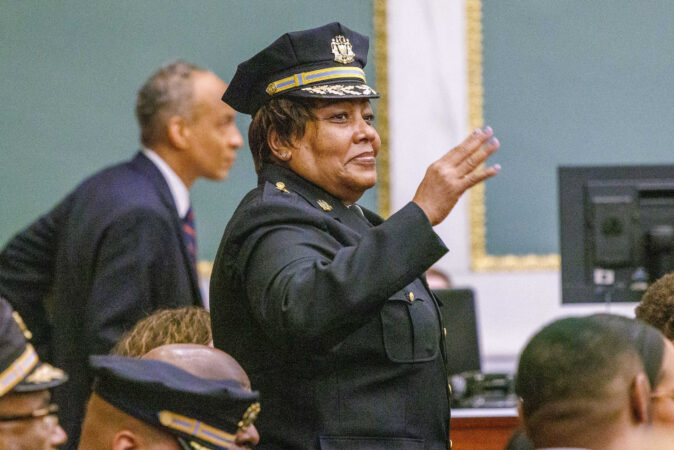
Sheriff Rochelle Bilal has garnered national headlines and condemnation for calling U.S. Immigration and Customs Enforcement “fake, wannabe law enforcement” and sending a blunt warning to immigration officers who commit crimes in Philadelphia.
“If any [ICE agents] want to come in this city and commit a crime, you will not be able to hide, nobody will whisk you off,” Bilal said. “You don’t want this smoke, cause we will bring it to you. … The criminal in the White House would not be able to keep you from going to jail.”
The sheriff’s office and a spokesperson for Bilal did not immediately respond to requests for comment Saturday. In an interview with CNN’s Erin Burnett, Bilal said “enough is enough.”
“People are tired of these people coming into the city, masked up — basically all masked up — and pulling people out and causing havoc,” Bilal told the network. “This was supposed to be helping cities out, this was supposed to be eliminating crime, but yet, you are committing them here, you are putting people in fear, you are breaking up families.”
Bilal spoke for less than four minutes at the Thursday news conference. She upbraided ICE agents for wearing masks that obscure their faces and said their actions violate “not only legal law but the moral law.”
“Law enforcement professionals around the country do their job, and we have been fighting for years to build that bridge between us and our communities,” Bilal said. “You had one negative nutcase that causes this problem and now we all have to fight again to let people know law enforcement works with communities.”
Some praised Bilal on social media. Ben Crump, a prominent civil rights attorney, wrote on Facebook, “Sheriff Rochelle Bilal didn’t hold back. … Tragedies like this happen when agents operate in our communities with little to no oversight.”
Meanwhile, the Pennsylvania GOP posted on X, “When local law enforcement stands with criminals rather than people keeping our communities safe, you know there’s a problem. … Rhetoric like this only makes this situation more dangerous for federal law enforcement and the city of Philadelphia.”
A video of Bilal’s statement was also posted by LibsofTikTok, a controversial far-right social media account. That post had more than 746,800 views and 8,500 likes as of Saturday afternoon.
U.S. Rep. Randy Fine, a Republican from Florida, responded to LibsofTikTok’s post, writing, “She should be arrested.”
The Philadelphia Sheriff’s Office does not police the city; instead, the office’s core functions are deploying deputies to the county’s courtrooms and transporting in-custody defendants to court.
In his statement, Police Commissioner Bethel distinguished the roles of the sheriff’s office and the police department, noting that the sheriff’s office does not “conduct criminal investigations, nor does it in any way direct municipal policing.” The sheriff is an elected official, while police commissioners are appointed by the mayor.
“The Philadelphia Police Department will continue to work professionally with all of our enforcement partners,” Bethel said. “But clear lines of authority — and accurate public representation of those roles — are essential to maintaining public trust and effective public safety operations.”
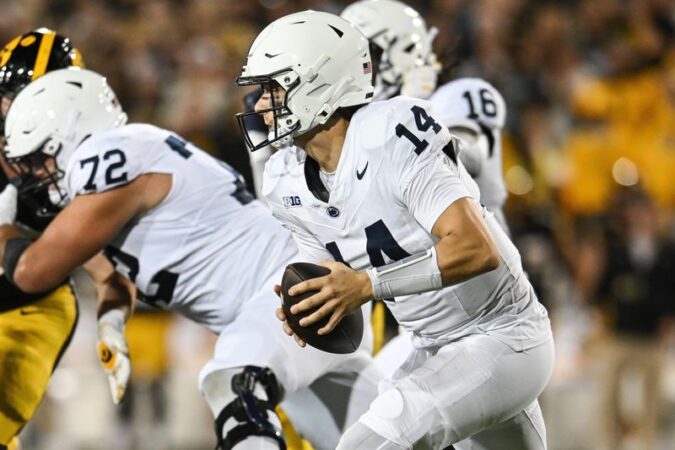
Former Penn State quarterback Jaxon Smolik announced his commitment to Temple on Saturday morning. He joins the program with a chance to earn the Owls’ starting quarterback job in 2026.
Smolik committed to the Nittany Lions in 2023 out of Iowa’s Dowling Catholic. He had originally committed to Tulane but decommitted from the Green Wave after earning an invite to the Elite 11 showcase, which boosted his recruiting profile.
He went 25-8 during his time as Dowling Catholic’s quarterback, leading the Maroon to multiple state semifinal appearances. As a high school senior, the 6-foot-1 signal-caller was all-state in Iowa after tallying 1,967 passing yards and 19 touchdown passes and leading Dowling to a 10-2 record. Smolik was ranked the No. 24 quarterback recruit in the 2023 class by Rivals and the No. 29 quarterback by ESPN.
The former three-star recruit redshirted as a freshman behind starter Drew Allar and then missed the entirety of the 2024 season due to an injury. He entered the 2025 season competing for the backup job with Ethan Grunkemeyer, who ultimately won the job.
Smolik eventually became the backup after Allar suffered a season-ending ankle injury against Northwestern on Oct. 11. He appeared in two games this season, but did not throw a pass and only carried the ball four times for three yards. Smolik entered the transfer portal at the end of the year.
Head coach K.C. Keeler said that Temple was going to open up its starting quarterback competition following the departure of five of its quarterbacks. Starter Evan Simon and backup Gevani McCoy both graduated, as well as Anthony Chiccitt. Third-stringer Tyler Douglas and fellow reserve Patrick Keller both entered the portal following the year.
“We’re probably thinking two out of the portal,” said Keeler on signing day. “We told all the high school recruits the same thing. Two of these guys will be here mid-year, so they will come here in January. We definitely want to have a quarterback competition once we get the kids here in January.”
The Owls will now have four quarterbacks with the team when spring camp opens, barring another addition. Temple currently has Cam Boykin, the only quarterback that was on the roster last year, and high school commits Brady Palmer, Brody Norman, and Lamar Best. Palmer and Norman will join the team for the spring semester, while Best won’t enroll until the summer.
Smolik joins the team with three years of eligibility remaining. If he wins the starting job, he will have a chance to play his former team when Temple plays Penn State at Lincoln Financial Field on Sept. 12.
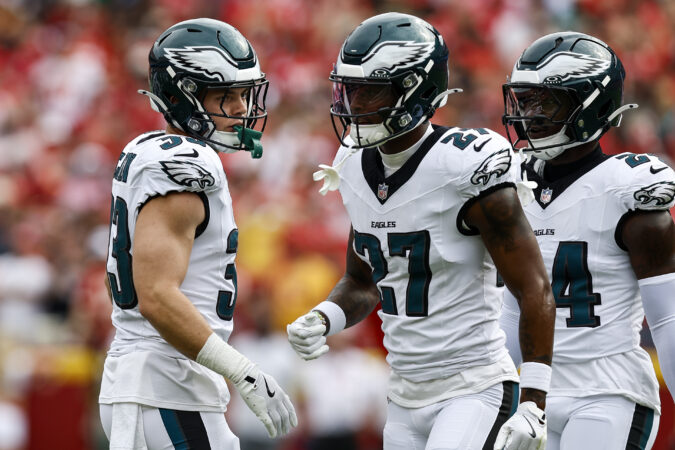
Eagles cornerbacks Cooper DeJean and Quinyon Mitchell entered the league together, and they’ve earned their first Associated Press first-team All-Pro nods together.
DeJean, the Eagles’ 2024 second-round pick out of Iowa, and Mitchell, the No. 22 overall pick in the same draft out of Toledo, were the only Eagles players to garner All-Pro designations on Saturday morning. Both players were named to their first Pro Bowl in December.
DeJean was named to this year’s team in the “slot cornerback” position introduced to All-Pro voting in 2023. Since the AP began to separate cornerbacks from the broader “defensive backs” category in 1962, this is the first time two corners from one team have been named first-team All-Pros. The Houston Texans’ Derek Stingley Jr. was the third cornerback named to the first team.
According to the Eagles’ communications department, this is the seventh time an NFL club has had its top two draft picks from the same class earn first-team All-Pro honors in their first two seasons. The Eagles had already been among those teams. In 1989, Eagles tight end Keith Jackson and cornerback Eric Allen, both members of the 1988 draft class, were voted first-team All-Pro.
The last Eagles cornerback to earn first-team All-Pro honors was Lito Sheppard in 2004.
DeJean, 22, has made an impact at multiple positions this season, playing 63.3% of his snaps at slot corner and 21.8% at outside cornerback. Last season, only eight of DeJean’s 881 defensive snaps came on the outside.
Still, his most impressive play has come in the slot. From that alignment this season, DeJean has allowed a 57.4% completion percentage and 5.9 yards per target, ranking below the league averages of 69.5% and 6.8, respectively, according to Next Gen Stats.
DeJean has allowed just one touchdown in coverage in his career, per Next Gen Stats, which occurred against the Dallas Cowboys in Week 12, when he was lined up on the outside in base defense.
The Odebolt, Iowa, native earned NFC defensive player of the week honors for his Week 16 performance in the Eagles’ win over the Washington Commanders. He notched a career-high four pass breakups and an interception.
DeJean is tied for 10th in the NFL with 16 pass breakups and is second on the Eagles behind Mitchell (17), who is tied for sixth.
Mitchell began the season moving around the formation and often shadowing opposing teams’ top receivers. But since the Week 9 bye, according to Next Gen Stats, Mitchell has aligned as the boundary cornerback on 74.1% of his snaps.
In that span, he has registered more passes defended (nine) than receptions allowed (six) on 26 targets and 233 coverage snaps from the boundary. He has a 20.7% completion rate allowed, which is three times lower than the season-long NFL average from the boundary (65.5%).
Mitchell, a Williston, Fla., native, earned NFC defensive player of the week honors in the Eagles’ Week 4 win over the Tampa Bay Buccaneers. In that performance, he had a career-best five pass breakups, making him one of two NFL players to record five pass breakups in a single game.
Since they were drafted in 2024, DeJean and Mitchell have helped drastically improve the Eagles defense. In the Eagles’ Super Bowl-winning season last year, Vic Fangio’s defense conceded the fewest passing yards in the NFL and the sixth-fewest touchdowns. This year, the Eagles’ secondary has allowed the fewest passing touchdowns and the eighth-fewest yards.
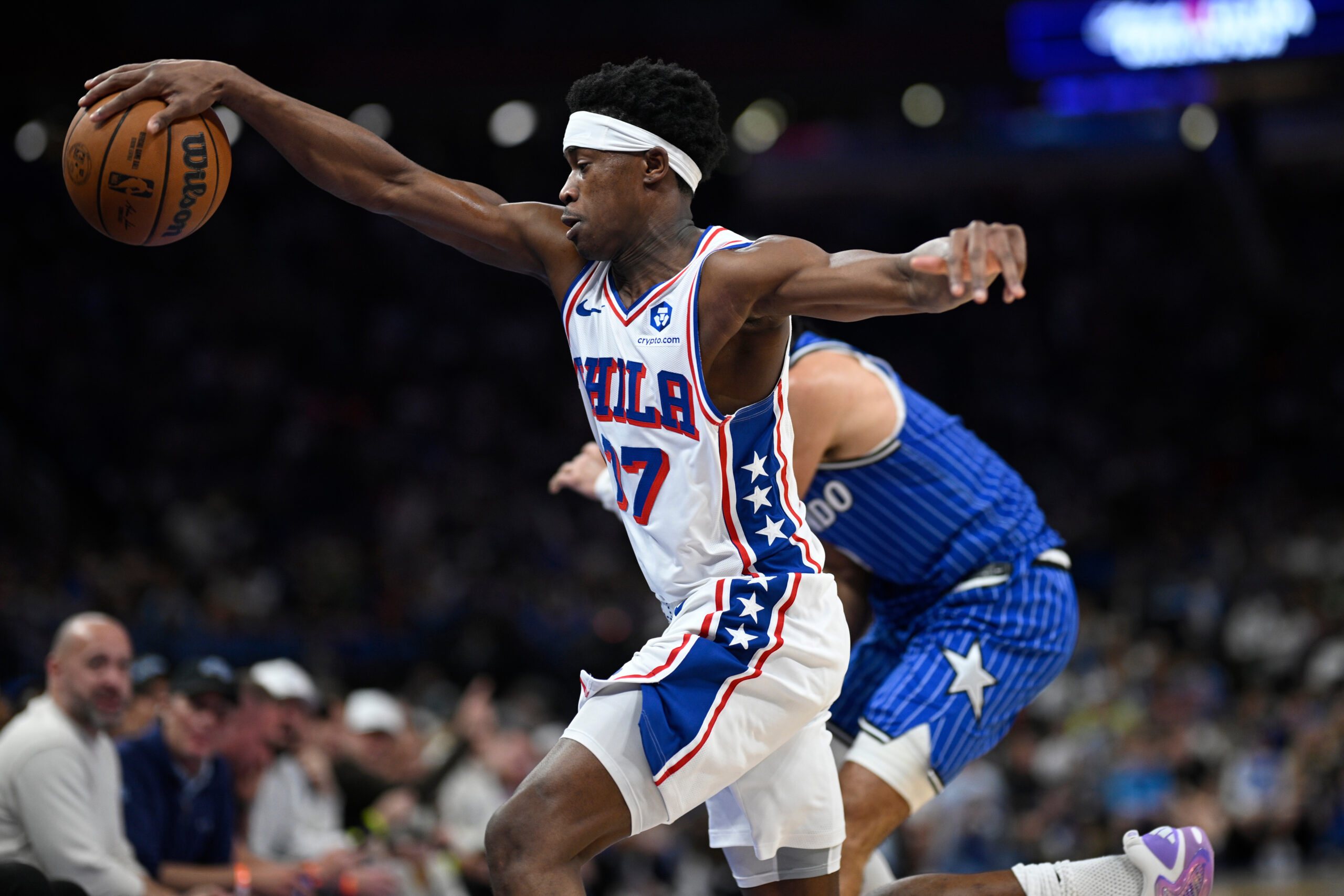
ORLANDO — Nick Nurse called a timeout about two minutes into Friday’s matchup at the Magic, frustrated that his 76ers were “standing up straight and not moving great” defensively.
The coach continued to cycle through personnel groupings, searching for a spark on that end of the floor. He found it at the top of the final period, with guards VJ Edgecombe and Quentin Grimes, wings Paul George and Kelly Oubre Jr., and center Andre Drummond.
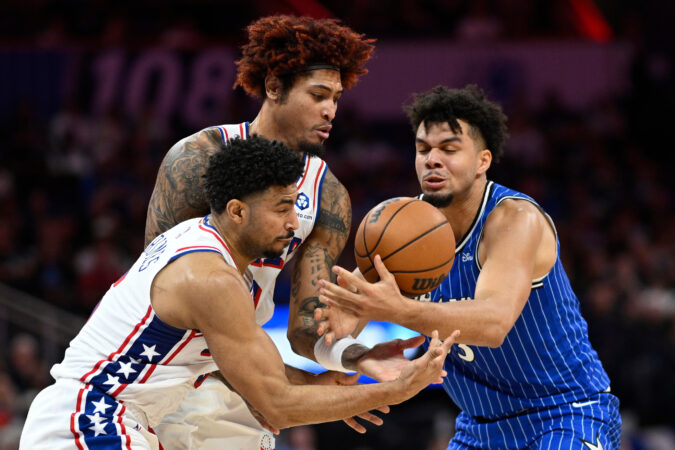
Their suffocating, versatile defense turned a four-point Sixers lead into a 13-point advantage in an eventual 103-91 victory at Kia Arena. It helped the Sixers (21-15) overcome a night when they shot 4-for-28 from three-point range to secure the tiebreaker against a potential Eastern Conference playoff opponent. And the almost-five-minute surge happened with stars Tyrese Maxey and Joel Embiid getting their customary rest.
After the game, George said he believes the “scrappy” effort from that fourth-quarter lineup was only a flash of the Sixers’ potential on the defensive end of the floor.
“I think we can be special defensively,” said George, a four-time, all-defense selection during his standout career. “And that’s where the praise needs to be.”
The Sixers exited Friday ranked 12th in the NBA in defensive rating, with 113.3 points allowed per 100 possessions. Yet in their last five games, which have coincided with a return to a fully healthy roster for the first time since December of 2023, they are sixth (109.1 points per 100 possessions).
Nurse’s teams have regularly been lauded for an aggressive defensive style, anchored by playmakers who can deflect passes and generate takeaways. Yet this season’s Sixers also exited Friday ranked 12th in opponent turnovers (15.2 per game) and steals (8.7 per game).
Though the Sixers did not force a turnover during Friday’s decisive fourth-quarter stretch, Oubre and Grimes disrupted ballhandlers with their perimeter pressure. That allowed George and Drummond to “[patrol] in the back” near the basket. And it was a block party at the rim, with Drummond, George, and Oubre all rejecting one shot during the Magic’s 1-for-12 stint from the floor.
“We were just really keeping the ball in front,” Nurse said. “And when it did get past us, we always were sending a crowd to it.”
It was the second consecutive game that Nurse turned to the lineup that began the fourth quarter, after it blew open Wednesday’s home victory against the Washington Wizards. In 14 minutes across those two victories, that lineup has a stunning defensive rating of 48.1 points allowed per 100 possessions and a net rating of plus-74.9.
Even with that minuscule sample size, that group’s success perhaps represents a more under-the-radar benefit to the Sixers regaining health.
Sixers guard VJ Edgecombe was part of a game-altering defensive effort.
Outsiders may believe roster continuity is most helpful on the offensive end, where timing and chemistry between teammates are critical. But Nurse said last week that it also would allow the Sixers to add defensive schemes to complement the offensive firepower of Maxey, who dropped another 29 points Friday, the returning-to-form Embiid (22 points, nine rebounds) and George (18 points, nine rebounds), and the complementary scoring potential of Edgecombe, Oubre, and Grimes.
When George was sidelined to begin the season, for instance, Nurse said the wing would be especially valuable to this team as a defensive communicator. Oubre, who earlier this week returned from a month-plus-long absence with a knee injury, also welcomes guarding wings and switching onto multiple positions. Edgecombe is already an impact player on that end, a rarity for a rookie, while Maxey is a noticeably improved defender. And if Embiid continues to improve physically, he could become an impact rebounder and rim protector again.
Those options mean the Sixers can contest outside shots and “make it a tight paint” on drives, George said. At other points Friday, the Sixers shifted into a zone defense and used Drummond to “blitz” out on perimeter ballhandlers. The next step as a group, George said, is to become even more comfortable playing “on a string” and rotating sharply with teammates.
Nurse, though, may have discovered a lineup that can provide a defensive spark. And George believes Friday’s five-minute effort is only a glimpse at the Sixers’ capabilities on that end of the floor.
“I know it’s tough to do — especially more now than ever in this league,” he said. “But I think the versatility that we have, we should be able to do it.”
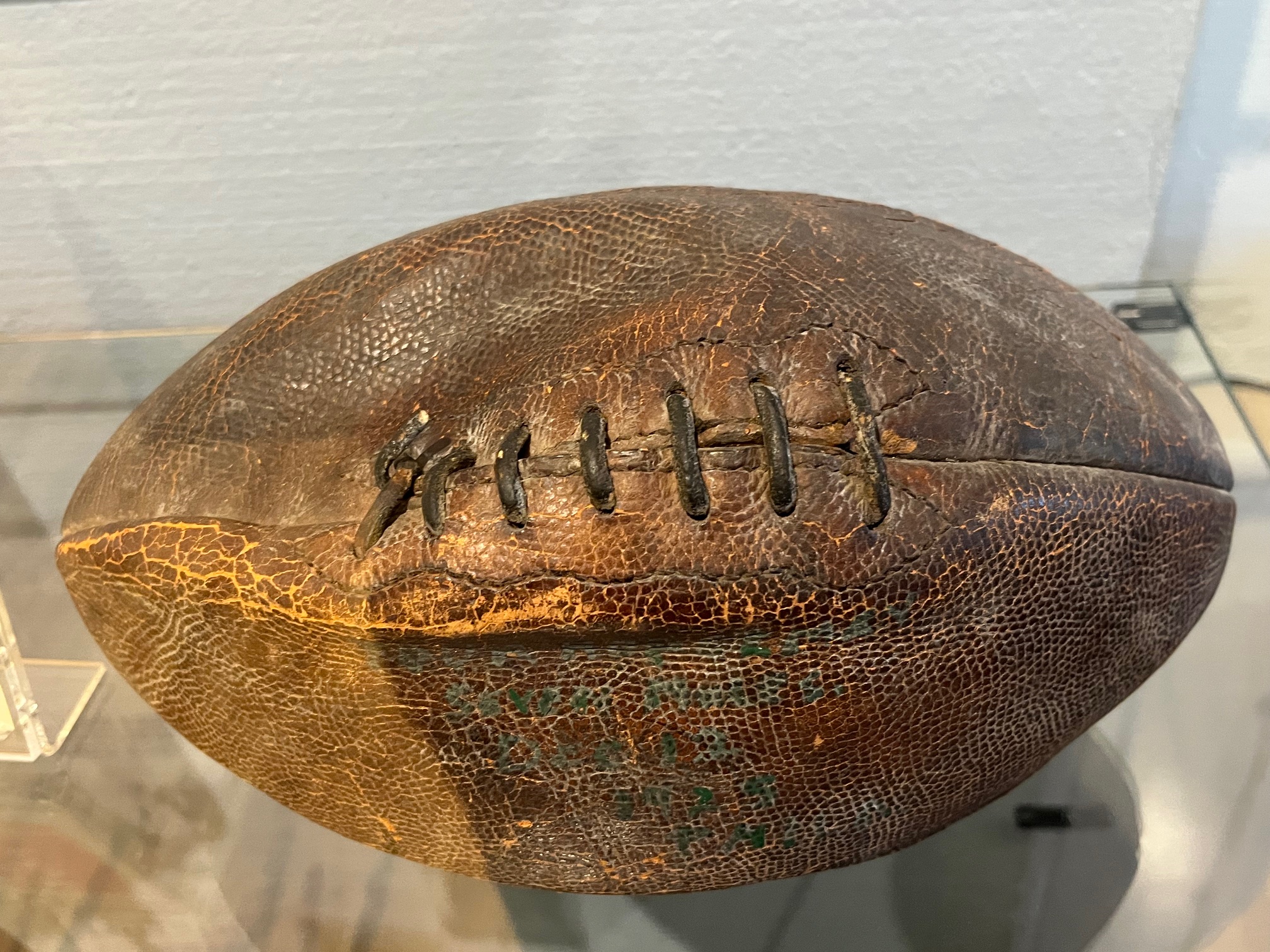
POTTSVILLE, Pa. — Because I love Pennsylvania and football (and not always in that order), I drove 90 miles recently to this coal-region city of 13,300 to take a peek at a bronzed football shoe, a trophy carved from coal, and a battered football, its laces askew.
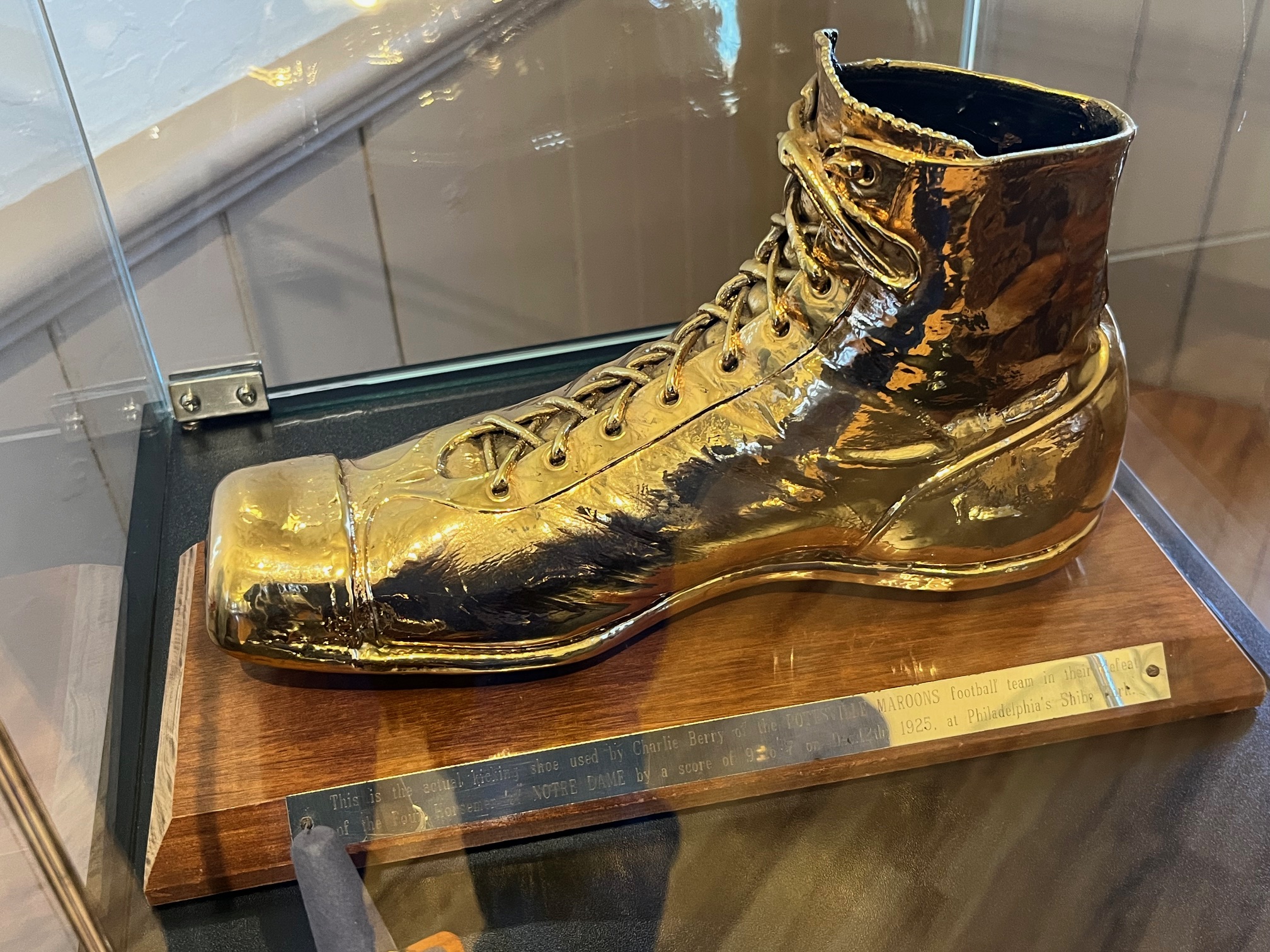
On Dec. 12, 1925, 100 years ago last month, a 23-year-old kid named Charlie Berry — who also played baseball for the Philadelphia Athletics and later became an American League umpire — used that high-top shoe to kick that ball to lift the Pottsville Maroons to a huge victory.
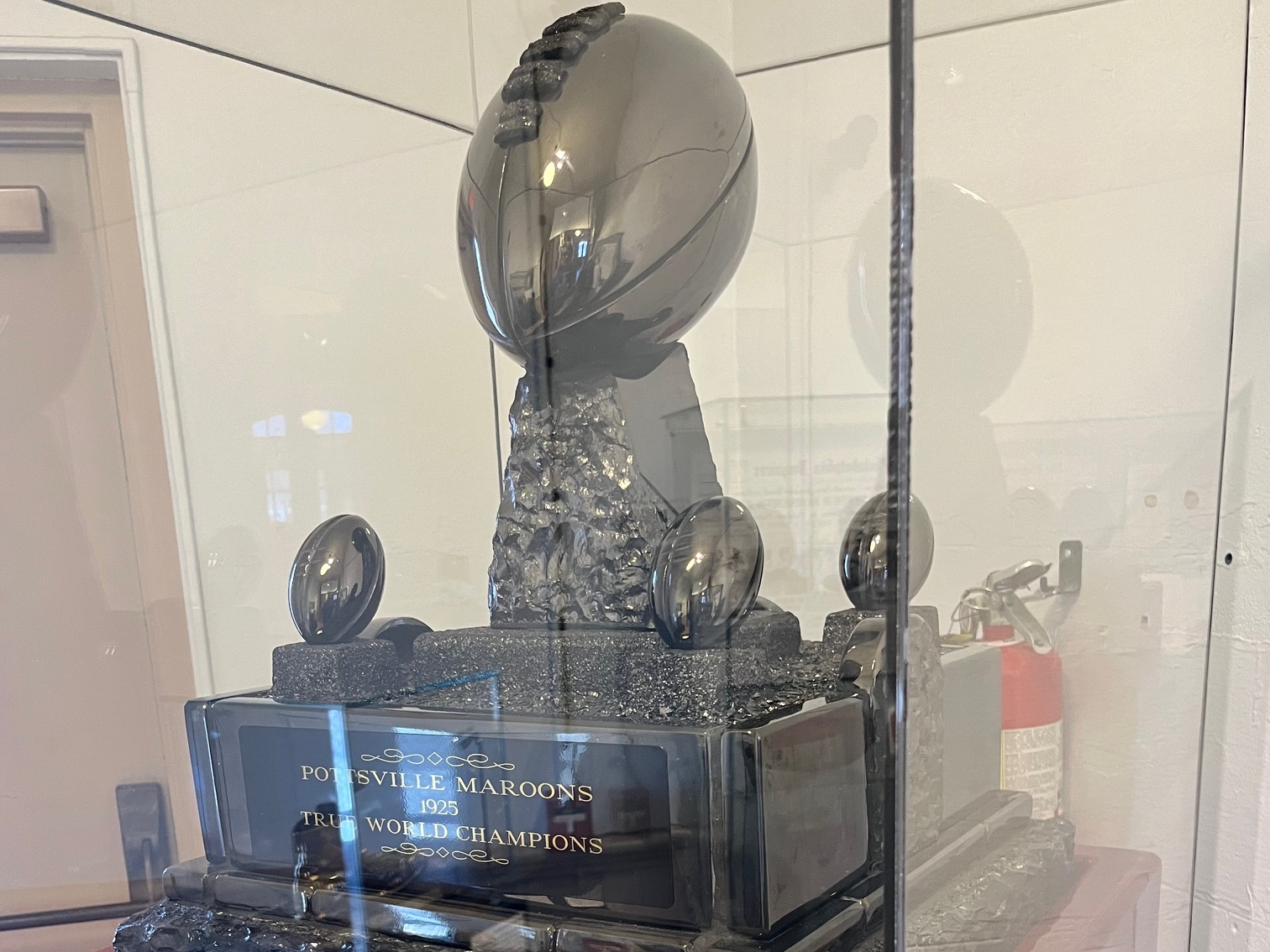
The Maroons got that trophy, emblazoned with the words “TRUE WORLD CHAMPIONS,” after beating a squad of former Notre Dame players, 9-7, in an exhibition game at Shibe Park in Philadelphia. But the Maroons were true world champions only in sentiment. They did not even win their own league.
That would be the National Football League — the same NFL that now includes the Eagles and opens its annual playoffs this weekend, ending with Super Bowl LX. The NFL would deny the Maroons the league championship despite clearly having the best team, having disposed of the Chicago Cardinals a week earlier in icy Chicago, 21-7.
The shoe that Pottsville Maroons kicker Charlie Berry used to kick the winning field goal in the 9-7 victory over the Notre Dame All-Stars on Dec. 12, 1925. The shoe was bronzed in 1961.
The exhibition game turned out to be a big problem. Long story short: Although the Maroons had requested (and, they said, been granted) permission to play the Notre Dame team, they were treading on the turf of the city’s NFL team, the Frankford Yellow Jackets. The Maroons were thrown out of the league.
You have probably heard of the Yellow Jackets, who folded in 1931 and whose remnants were purchased in 1933 by Bert Bell and Lud Wray for $2,500 and relaunched as the Eagles. The Maroons have faded, like a photograph in an album. That is a shame. The Maroons were a town team that climbed through a primitive organizational ladder to reign supreme over a sport.
Payne, who had not heard of the Maroons while growing up in Erie, acknowledged that the NFL is unlikely to declare the Maroons as 1925 champions, saying, “It would take a higher force for this to happen.” And it is old news: The last Maroons player died in 2003, at age 101.
The ball used in the Maroons’ win over the Notre Dame All-Stars.
Rendell wrote that he did not intend “to have any more communications with the cowardly barons that run the National Football League, including their extremely well paid leader, until they relent and grant the gallant Pottsville Maroons what is rightfully theirs.”
(He added that the vast majority of NFL owners lack “cojones.”)
But Rendell only had two NFL teams behind him: those from Pennsylvania, the Eagles and the Pittsburgh Steelers. So that Tush Push, of sorts, failed to reach the line to gain. The NFL still places the Cardinals atop its official 1925 standings, with the Maroons second.
Plus, the Cardinals padded their final winning percentage — used then to determine the champion — by beating teams with some high school kids. They refused to accept the trophy (the one not made of coal) until years later, after the team had been sold to Charley Bidwill.
The last name may ring a bell. The Cardinals, now in Arizona, are still owned by the Bidwill family. How interesting it is that the team has won only one NFL championship since — way back in 1946. They have played in just one Super Bowl, losing in 2009 to the Steelers.
Some “Skooks,” those from Pottsville and surrounding Schuylkill County, still enjoy claiming the Cardinals have been afflicted by the Curse of the Maroons. “And that 1925 championship was stolen. Never forget,” says a Skook friend of mine, still seeking retribution.
“It’s just so tragic and cruel. What should have been a watershed moment by winning such a big game ruined Pottsville and their football team,” David Fleming, who wrote an astonishing book in 2007 about the controversy, Breaker Boys: The NFL’s Greatest Team and the Stolen 1925 Championship, told me recently. “Pottsville put the NFL on the map.”
The NFL of 1925 was prehistoric compared with the NFL of 2025. Salaries were meager, from $100 to $300 a game, and players had to hold down second jobs to pay the bills. Moreover, college football was far more popular and considered to be a far better product.
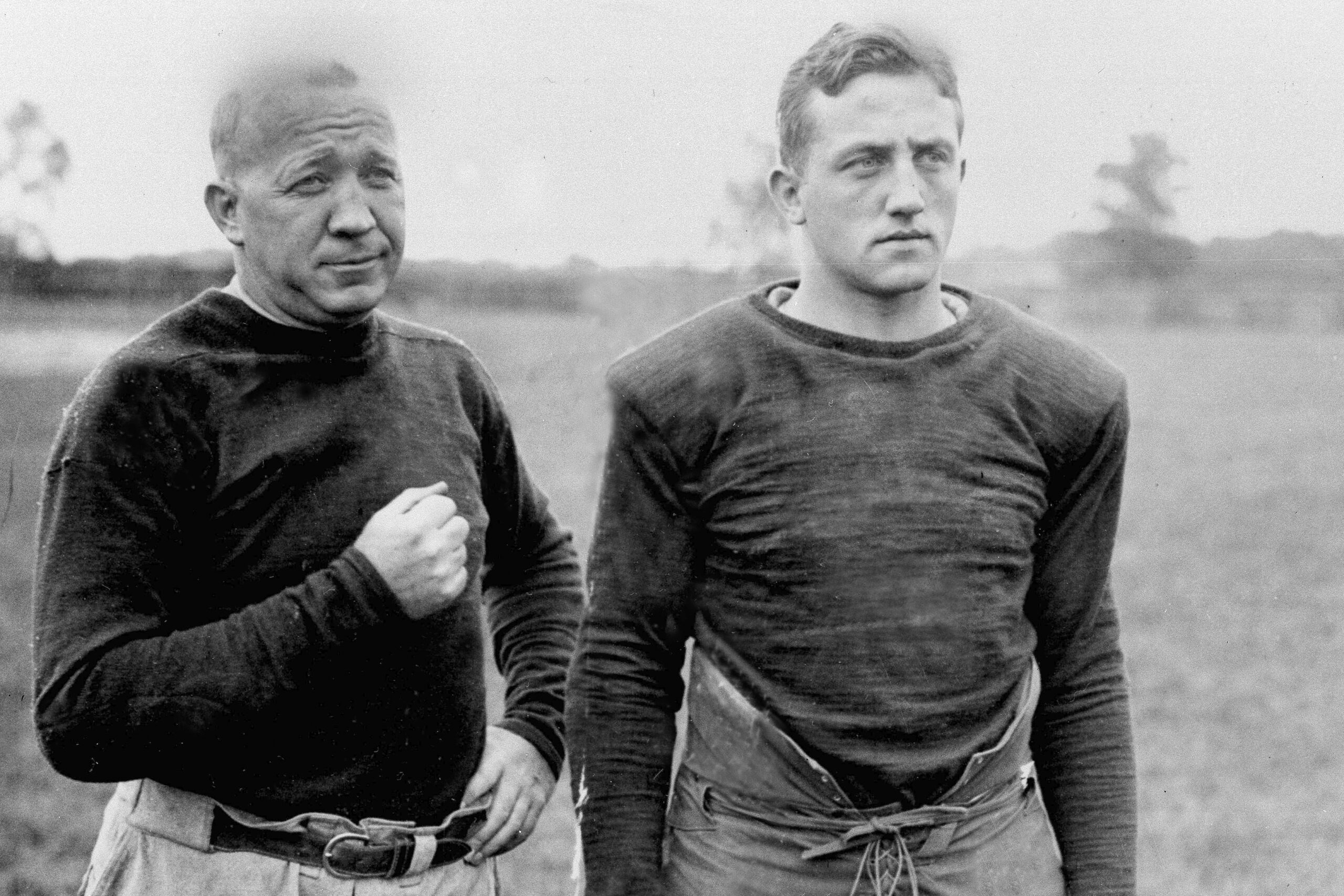
Notre Dame football coach Knute Rockne (left) and team captain Clem Crowe watch the team practice in 1925 — the same year a group of former Fighting Irish players fell to the Maroons, 9-7.
Pottsville sort of ignored the Pennsylvania “Blue Laws,” so the Maroons often played at home on Sundays against opponents that played in Philadelphia the day before. The Maroons set trends that last to this day: For example, the coach insisted his players live in town.
Pottsville was among the smallest cities with an NFL team, but the city more than made up for it by adoring the Maroons — even during a contentious miners’ strike that nearly broke the town. For the exhibition at Shibe Park, as Fleming wrote, several Maroons fans playfully wore coal-miner garb to distinguish themselves from the overwhelming majority of Notre Dame fans.
Even after both teams had arrived at Shibe Park, the exhibition game was nearly canceled because only about 8,000 had paid to see the game, some 10,000 fewer than expected, leading Notre Dame star Harry Stuhldreher, one of the legendary “Four Horsemen,” to push for $25,000 upfront — which is worth about $450,000 today — for his team to play in the game.
(The gate was surely smaller than expected because the Yellow Jackets suddenly scheduled a game at the same time in Frankford, beating Cleveland, 3-0, before 7,000.)
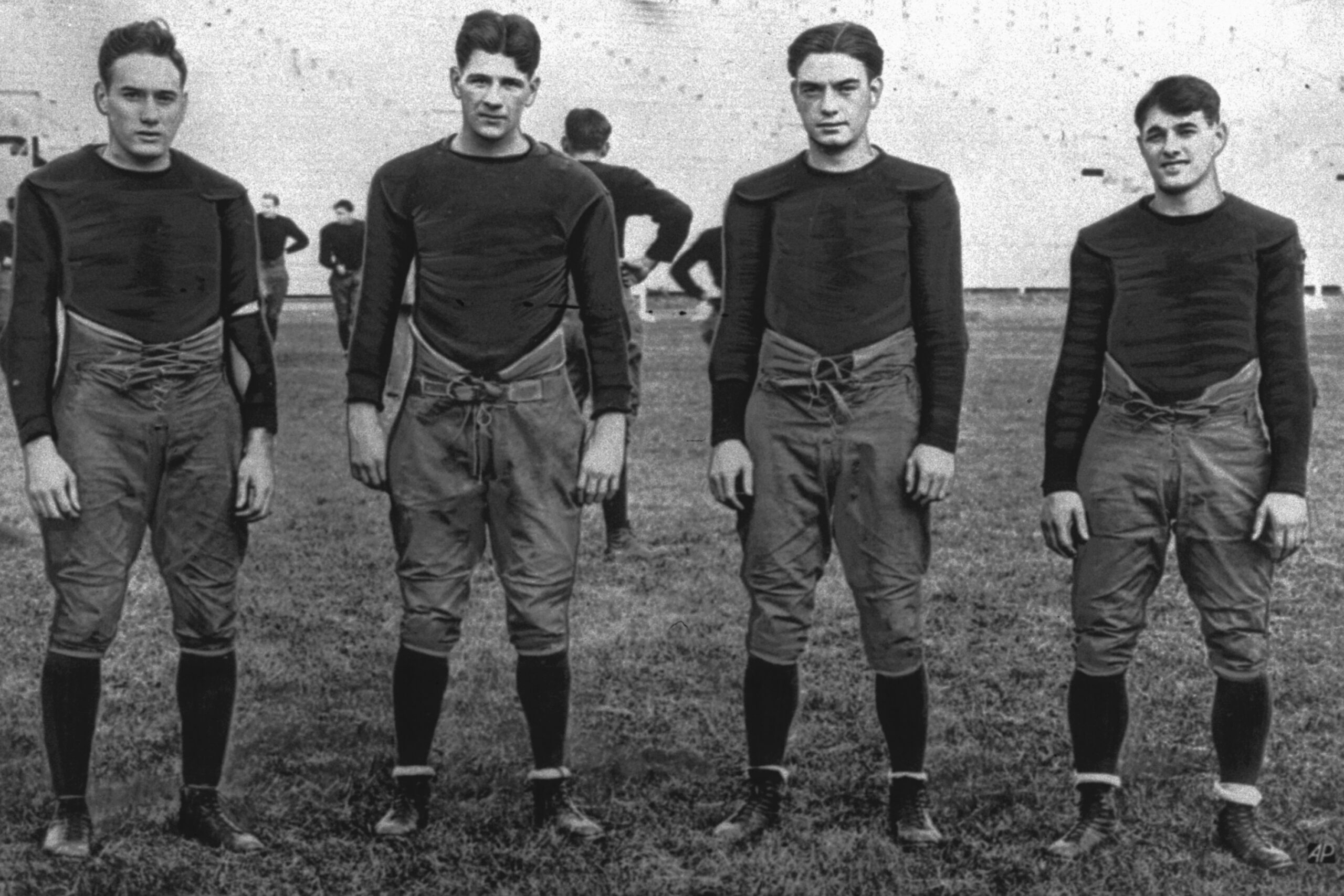
In this 1924 file photo, Notre Dame’s infamous backfield known as “The Four Horsemen,” from left, Don Miller, Elmer Layden, Jim Crowley, and Harry Stuhldreher, pose on the practice field in South Bend, Ind. Stuhldreher asked for $25,000 up front for his team to play against the Maroons.
At the same time, the Maroons were holding out for $10,000 upfront, or about $181,000 today (the pay disparity underscores the difference in perception then between the college and pro games), so the kickoff was delayed. Then Notre Dame took a 7-0 lead on an Elmer Layden touchdown. But the Maroons rallied — gallantly.
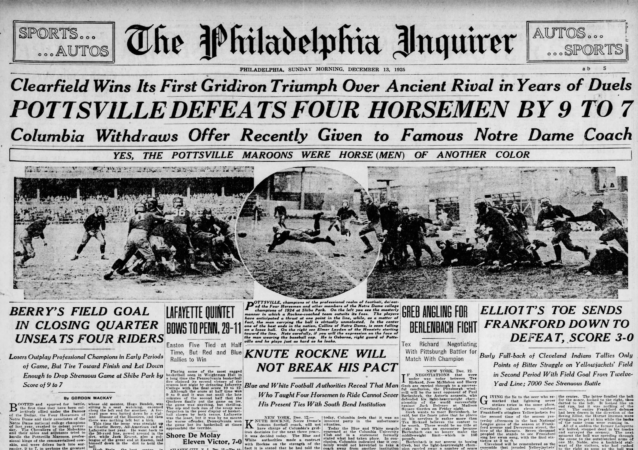
“YES, THE POTTSVILLE MAROONS WERE HORSE(MEN) OF A DIFFERENT COLOR,” The Inquirer gasped the next morning. Gordon Mackay, the reporter, labeled it “perhaps the greatest football battle that this Quaker City has known in years and years.”
The Maroons had put in 28-year-old Tony Latone, the “Human Howitzer,” after halftime. Latone’s story was mythic: He began working in nearby coal mines to support his family when he was 11, after his father died.
At first, he was a “breaker boy,” working 70-hour weeks picking slate and debris from the valuable anthracite coal. (After a week or two, the skin on the tops of a breaker boy’s fingers would peel off.) Later, he strengthened his legs by pushing loaded coal carts from the mines.
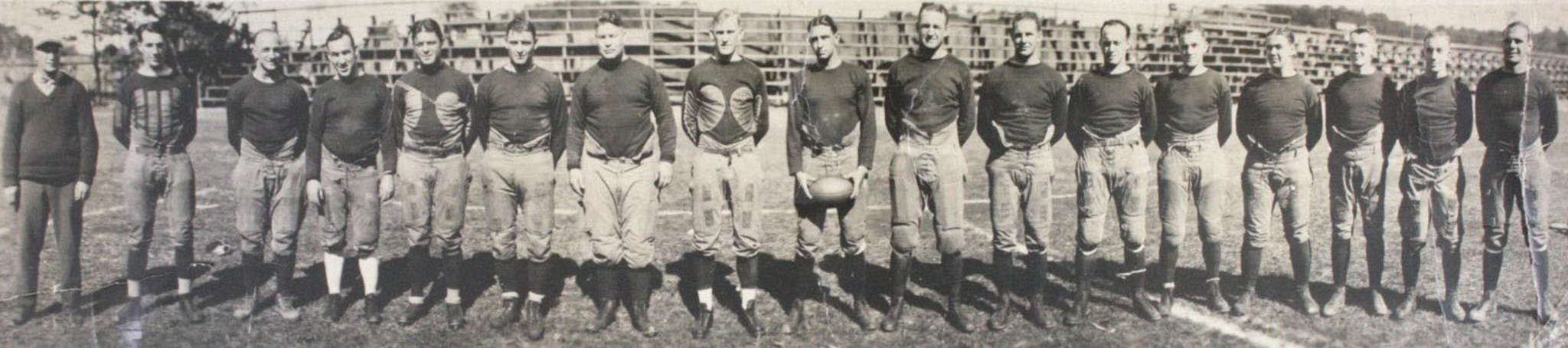
The Pottsville Maroons of 1925, a squad that was comprised of miners from Schuylkill and Luzerne Counties.
Berry, already a catcher for the A’s, hit the crossbar on an extra-point attempt after Latone scored a touchdown late in the third quarter, so Notre Dame still led, 7-6. But Latone, playing on a sore right heel, gained five first downs on another brutal, physical drive.
“He just ripped the Notre Dame team to shreds,” Payne told me of Latone, who ran for more yardage in the NFL in the 1920s than the legendary Harold “Red” Grange.
The drive stalled at the Notre Dame 18-yard line, so Berry tried a 30-yard field goal, which was hardly automatic back in those days. He’d made only three of nine attempts in the season to that point, none past 29 yards.
But, as Mackay so colorfully wrote in The Inquirer the next morning: “He swung that agile hoof. There was a crash of ball and foot, and the crowd, awed into silence, held their breaths as the sphere soared and soared and skipped straight through the crossbar.”
As Fleming wrote in 2007: “Most of the fans at Shibe Park, even the ones from Pottsville, had come out for a fun day of football and a glimpse at the famous Four Horsemen. Instead, they were witness to a watershed moment in the history of American sports: the very moment that professional football surpassed college ball.”
A replica of the trophy — which, like the original, is carved from coal — that the Maroons received for winning the “true” championship resides at the Schuylkill County Historical Society in Pottsville, Pa. The original is in the Pro Football Hall of Fame.
Books about the Maroons, including Fleming’s and the recent release by Payne and Hayes, are on sale at the museum’s gift shop (and online, as well), as are $18 maroon T-shirts with “The Real Champions.” A 100th anniversary celebration was held in August. Students at nearby Nativity BVM High School premiered a documentary, MaRooned.
Fleming, whose book, A Big Mess in Texas, about the antics of the ill-fated 1952 Dallas Texans, was published in October, had Breaker Boys reissued before the 100th anniversary, with a new cover: a photo of the trophy made of silver, not anthracite coal.
“I just wanted to give them the title that they were denied,” he said.
Well, more like, robbed of. Payne and Hayes make a six-premise thesis in their book for the NFL to award the 1925 NFL title to the Pottsville Maroons. They write, “Until the NFL corrects the situation, the Pottsville championship status remains, very simply, marooned.”
Until that day comes, and as a native Pennsylvanian and football fan, the matter should at least be considered; there is only memorabilia from a bygone age in a second-floor alcove at the Schuylkill County Historical Society, a cozy museum in a former school on Centre Street.
Joe Zacko, the late sporting goods store owner and die-hard fan who ordered the jerseys that gave the Maroons their name, had Berry’s shoe bronzed after a 1961 reunion. The goal was to present it to the Pro Football Hall of Fame, then under construction.
The shoe is still in Pottsville. I am not a Skook, but, as I said, I love Pennsylvania and football, and I say a real NFL trophy belongs right next to that shoe, coal trophy, and old ball.
Dave Caldwell, an Inquirer sports writer from 1986 to 1995, grew up in Lancaster County and lives in Manayunk.
The New York Times also names Philly the top place to visit in 2026: A- (yet again)
Well, here we go again. Philadelphia has once more been crowned the world’s best place to visit in 2026 — this time by the New York Times, which means we are now in the extremely Philly position of being right twice and still deeply suspicious about it.
Yes, the reasons are familiar. The Semiquincentennial. The World Cup. The All-Star Game. Fireworks, parades, exhibitions, concerts, TED talks, themed balls, and a calendar so packed it feels like someone dared the city to see what would break first. It’s a lot. Enough, apparently, to push Philly to the top of the Times’ “52 Places to Go” list.
But at this point, the events are almost beside the point. Big moments don’t explain why people want to be here, they just give them an excuse.
Philly keeps landing on these lists because it’s a place that feels alive even when nothing “special” is happening. It’s opinionated without being curated. Historic without being precious. Welcoming in a way that involves some yelling, a little side-eye, and eventually someone telling you where to eat. You don’t visit Philly to be impressed. You visit to be absorbed.
So why not an A+? Because every time the outside world decides Philly is the place to be, the city pays for it in very real ways. Hotel prices climb. SEPTA gets stress-tested. Streets designed for horse traffic brace for global crowds. And locals are once again asked to host a massive party while still making it to work, daycare pickup, and whatever delayed train they’re already standing on.
There’s also the small matter of validation fatigue. Philly didn’t suddenly get good because the New York Times said so — just like it didn’t when the Wall Street Journal said it. The city’s been doing this for a long time, whether or not anyone was paying attention.
Nothing says Philadelphia quite like being named the top travel destination in the world for 2026 and, at the exact same time, going viral for a road sign that simply reads: “Avoid Philadelphia.” No explanation. No branding. Just a warning.
The photo resurfaced on r/philly and immediately became a public forum for collective truth-telling. When one user asked, “Why?” the answers poured in: “The usual reasons.” “Mental health reasons. Financial reasons.” “SEPTA.” Another went full blunt-force: “Bad things happen in Philly.”
Of course, the Eagles entered the chat. “Eagles lost yesterday,” one commenter offered. Another countered, “Or Eagles won yesterday… Could be Eagles just did a thing. Go Birds.” Honestly, both feel correct.
Then came the traffic trauma. “Spend a day on the Blue Route,” someone wrote — a sentence that should probably be included in driver’s ed. One person proposed Google Maps should add a new setting: “avoid highways, avoid toll roads, avoid Philadelphia.”
But buried in the comments was the buzzkill reality check: This sign is almost certainly old. Several users pointed out it likely dates back to the I-95 bridge collapse in 2023, when avoiding Philadelphia was not a vibe, but a Department of Transportation directive. “Why are you posting a 5+ year old pic?” one top commenter asked, ruining the mystery but improving the accuracy.
But the timing is what makes this perfect. As the Wall Street Journal and the New York Times roll out the red carpet for 2026, locals are standing off to the side holding a faded road sign like, just so you know. It’s not anti-tourism. It’s informed consent.
An A for honesty, context, and a comment section that somehow functions as a city guide, traffic alert, sports recap, and warning label… even when the photo is old.
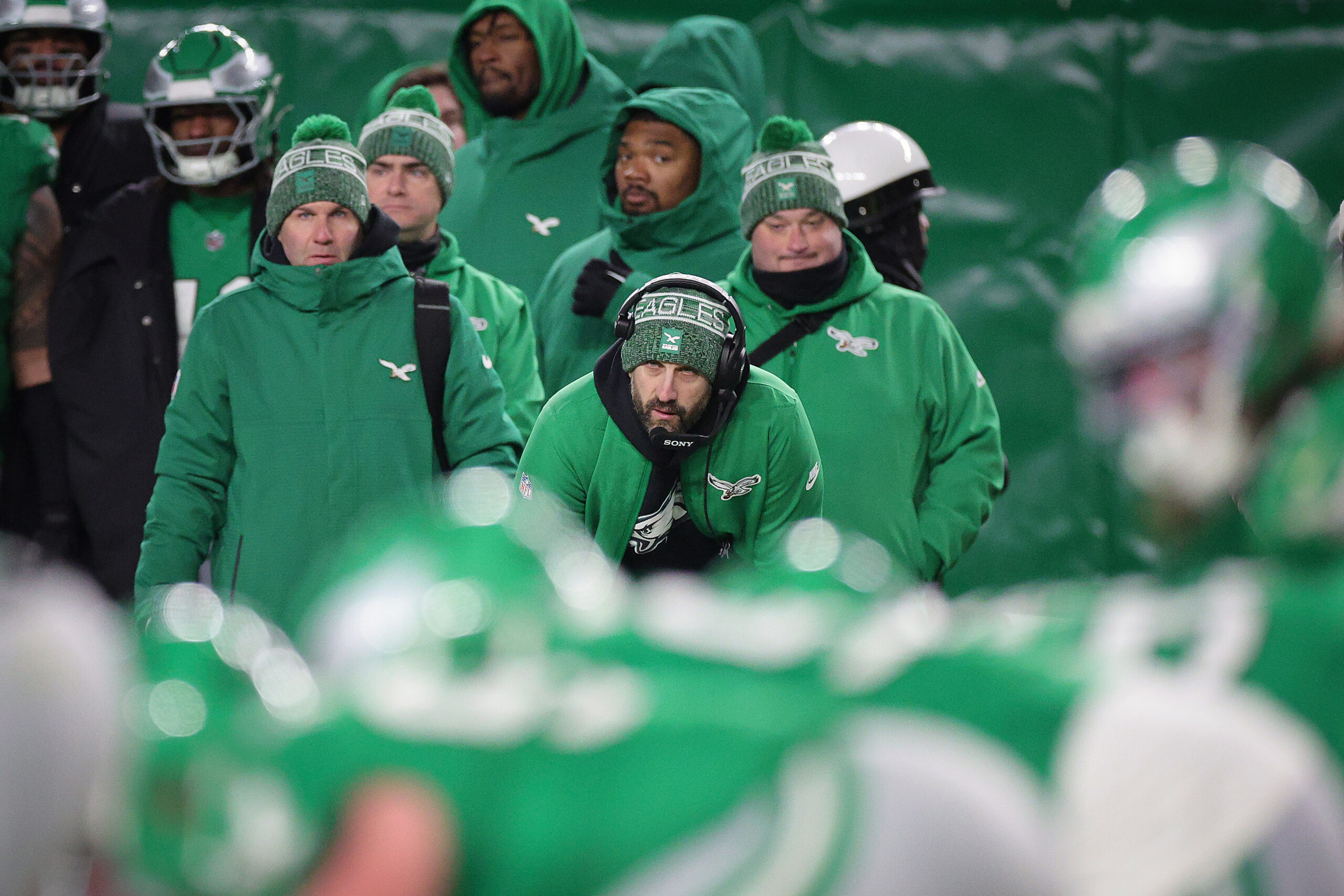
Philadelphia Eagles head coach Nick Sirianni (center bottom) watches his team play the Washington Commanders at Lincoln Financial Field in Philadelphia on Sunday, Jan. 4, 2026.
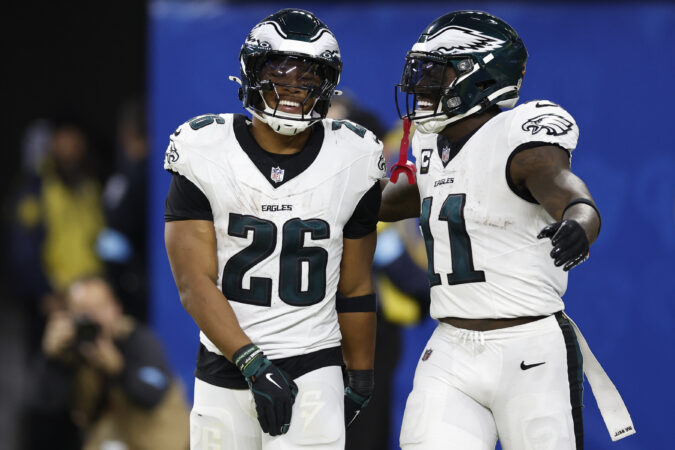
Eagles start the playoffs as the No. 3 seed: B-
The Eagles enter the playoffs as a No. 3 seed, a position that history treats like a warning label. The math is rude: Few No. 3 seeds make the Super Bowl, and most of them don’t even sniff it. The Eagles themselves have tried this route before and usually wound up packing up by the divisional round. Not great.
And yes, this is at least partially self-inflicted. Resting the starters in Week 18 cost them a real shot at the No. 2 seed and an objectively easier path. That decision is already being litigated in every bar, group chat, and radio segment. And it will keep getting relitigated until either A) the Eagles lose or B) they win enough that no one wants to admit they were wrong.
The 49ers limping into the Linc with injuries, tired legs, and a defense that is no longer the Final Boss version Philly remembers? That’s manageable. The Eagles’ defense has been the most reliable unit all season, and if this game turns into trench warfare, that favors the Birds. Saquon Barkley doesn’t need to be vintage playoff Saquon yet. He just needs to exist long enough to keep the offense functional.
Still, the unease is earned. This is a team with Super Bowl expectations walking a historically unfriendly path, powered by a defense everyone trusts and an offense no one fully believes in. That’s not nothing. That’s the whole tension.
So yes, the road is harder than it needed to be. Yes, the margin for error is thin. And yes, if this goes sideways, the No. 3 seed will be Exhibit A in the postmortem.
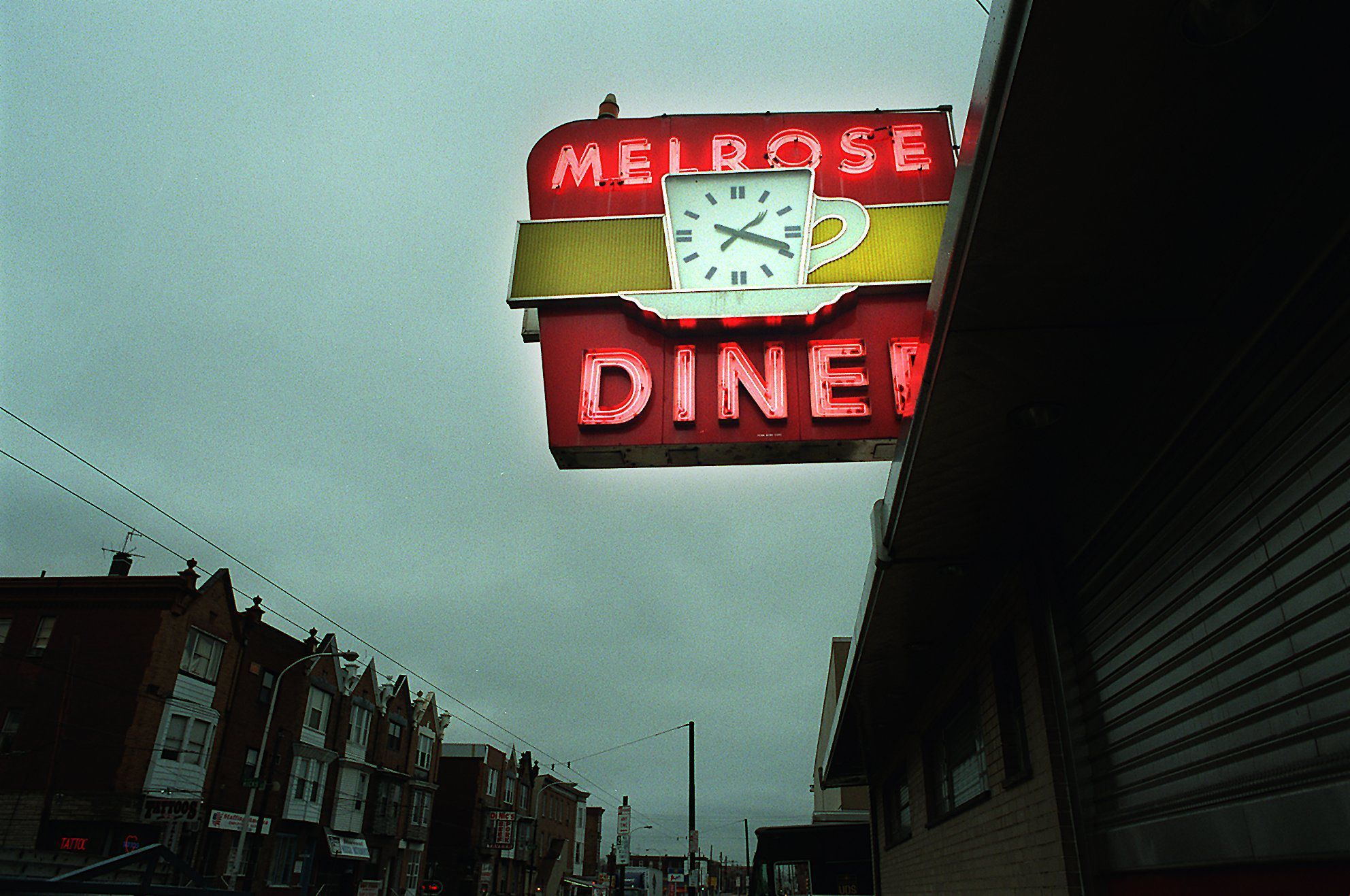
In this photo from 2000, the Melrose Diner sign shines bright on a gray day.
The Melrose Diner sign hits Facebook Marketplace: A+
Nothing says Philadelphia like scrolling Facebook Marketplace and suddenly finding the neon soul of a demolished diner listed as “very heavy and totally cool.”
Yes, the iconic Melrose Diner sign — red, yellow, stainless steel nostalgia and all — is apparently for sale. Not at auction. Not through a preservation society. Not behind glass in a museum. Just vibes, photos, and the immortal Marketplace closer: “Serious inquiries only.”
There’s something perfectly on-brand about this. The Melrose didn’t go out quietly. It didn’t get a tasteful plaque or a respectful archival goodbye. It got torn down for apartments, went into “storage,” and has now reemerged like a ghost asking for a sizable offer and a pickup truck.
The listing itself is doing a lot of work: four pieces, sold as a set, “used — good,” with the helpful reminder that Olga’s Diner once sold signage for $12,000. Philly translation: Don’t lowball me, I know what I’ve got.
Selling the sign feels a little like selling a family photo album. The Melrose wasn’t just a diner — it was late nights, early mornings, post-bar waffles, post-court appearance coffees, and at least one story involving a mobster, depending on who you ask.
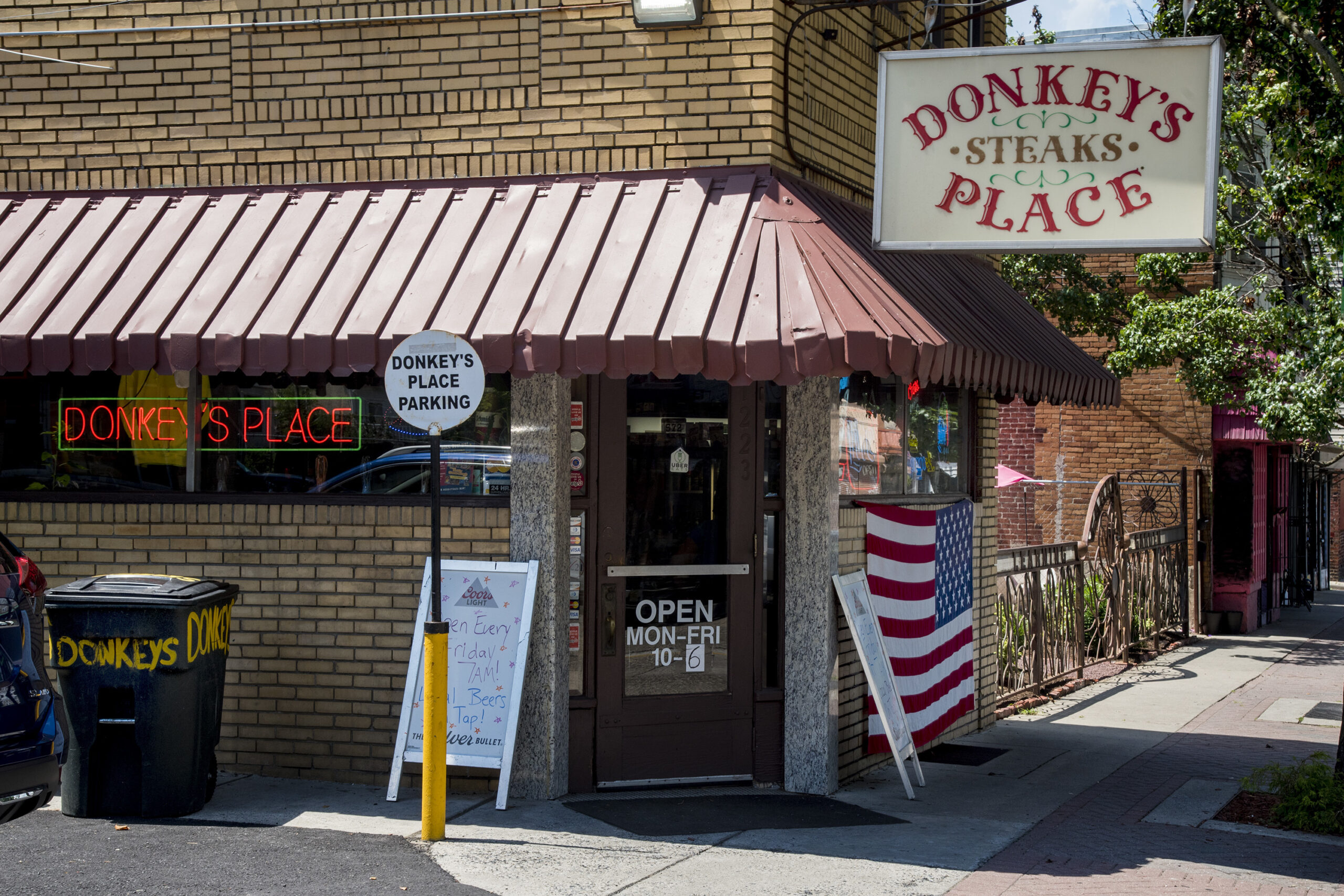
Donkey’s Place in Camden on July 18, 2018, one of 10 eateries Anthony Bourdain visited in a 2015 episode of his “Parts Unknown” show in New Jersey.
Donkey’s Place walrus bone theft: D (return it, coward)
Donkey’s Place didn’t ask questions about the bone for years — it just existed, looming behind the bar like a strange guardian angel of cheesesteaks and beers. It wasn’t sentimental, it wasn’t precious. It was just there. Which somehow makes taking it worse.
The alleged thief wrapped it in a scarf and walked out like this was Ocean’s Eleven: South Jersey Edition, and now the bar is left explaining to the internet why they’re asking nicely for a walrus baculum to be returned, no police report, no drama, just vibes and decency.
The deduction from an A is only because this never should’ve happened. Otherwise, this is peak Philly-area energy: a historic bar, an inexplicable artifact, security footage, TikTok pleas, and a collective regional agreement that yes, this matters.
Mail it back. No questions asked. Everyone will pretend this never happened.
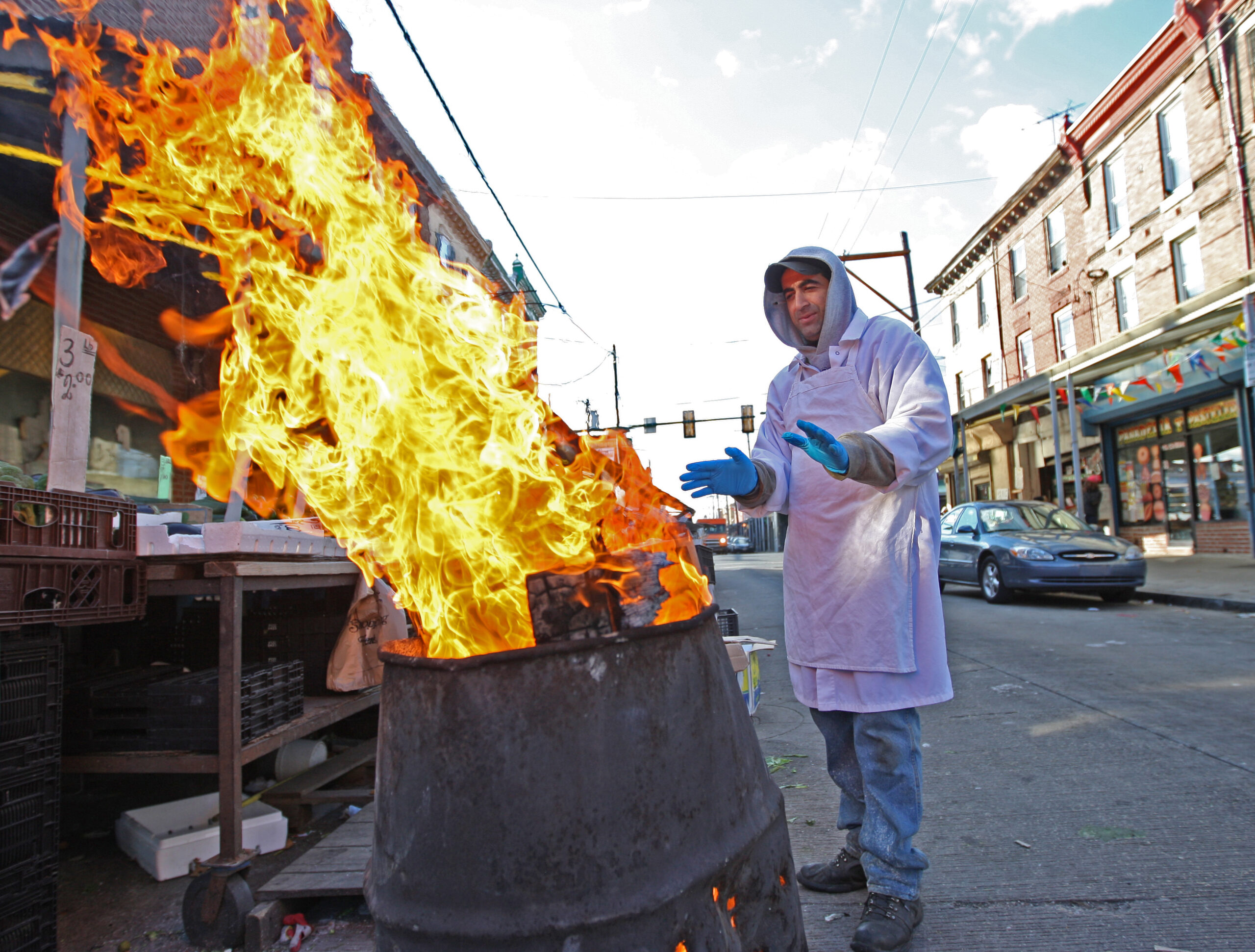
In this Dec. 4, 2007 Inquirer file photo, Joe Carioti, of Carl’s Poultry, warms his hands on the first really cold day down at the market.
Trash can fires are back on Ninth Street: A
You don’t need a calendar to tell you winter has arrived in Philadelphia. You just need to walk down Ninth Street and see a trash can on fire.
The barrels come back when mornings turn brutal and vendors are out before dawn, unloading boxes, setting up stalls, and bracing against the cold. This isn’t nostalgia or aesthetic — it’s practical. A few minutes of heat for hands that don’t get to stay in pockets, a pause before the work continues.
They’re regulated, debated, occasionally questioned, and absolutely unmoved by any of that. Every winter, they come back anyway. Not as a statement, but as a fact of life.
When spring shows up, they’ll disappear again. Until then, the fire’s on.
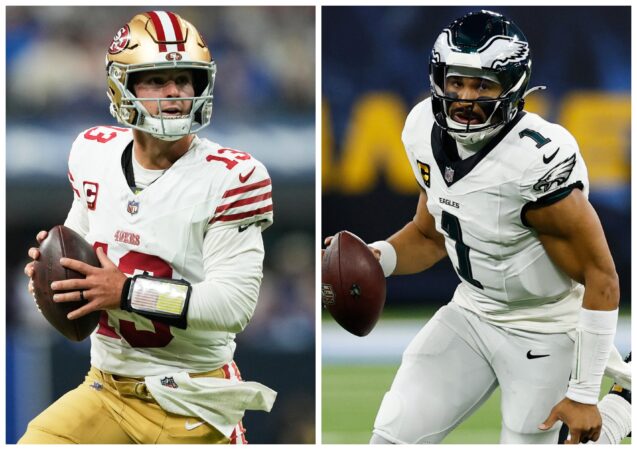
The Eagles host the San Francisco 49ers in a wild-card playoff matchup at 4:30 p.m. Sunday at Lincoln Financial Field. Here’s what you need to know about the game:
When the Eagles have the ball
The 49ers don’t have a good defense. Season-ending injuries to their two best players — linebacker Fred Warner and defensive end Nick Bosa — were a prominent reason why coordinator Robert Saleh’s unit struggled most of the season. But there also isn’t much talent elsewhere on that side of the ball. The 49ers ranked 25th in expected points added per play and 29th in success rate. Saleh has been forced to play a bend-but-try-not-to-break defense, which has meant more two-high safety shells than he’s accustomed to employing and hoping that opposing offenses eventually will make mistakes on grind-it-out drives. The 49ers have done a good job of limiting explosive plays as a result and rank ninth in allowing 20-plus-yard plays in EPA. They’ve also buckled down in the red zone, where they rank 12th overall and fourth in goal-to-go situations.
The Eagles’ offense, conversely, has been at its best inside the 20 and ranked first in the league. Getting there on a consistent basis has been a season-long problem. The chess match here could center on which unit is willing to get out of its comfort zone. Will the 49ers play more aggressively and stack the box — only the Eagles and New England Patriots had a higher rate of light boxes — knowing the Eagles have struggled in the run game when numbers haven’t been in their favor? Or will the Eagles come out firing, looking for explosives through the air, knowing that Saleh likely will make Jalen Hurts and the pass game beat his defense?
Nick Sirianni and Kevin Patullo have several directions they can go that should favor the Eagles, even if the 49ers match heavy personnel with their base front. It would be foolish not to test San Fran’s run defense, especially an off-ball linebacker unit that could be down to its fourth and fifth options on the depth chart. Warner’s replacement, Tatum Bethune, went down for the season last week, which means the aging Eric Kendricks, the younger brother of former Eagle Mychal Kendricks, will be at middle linebacker. Outside linebackers Dee Winters and Luke Gifford also are questionable. The Eagles offensive line, with right tackle Lane Johnson expected to return, likely will need to adapt to a slanting front if they want to carry out their combo zone blocking schemes. But if even all doesn’t go according to plan, Saquon Barkley should have opportunities to do it on his own against a run defense that missed 11 tackles against the Seattle Seahawks in Week 18.
I think more of Hurts on designed runs, and a sprinkling in of the more north-to-south Tank Bigsby, could further buoy a run offense that has shown marginal improvement over the last month. I wouldn’t be surprised to see Patullo open with a fair amount of empty sets. Hurts has operated well out of that formation. It forces defenses to have to account for his legs on draws or scrambles if they’re going to match in man coverage.
Saleh still favors Cover 3 more than any zone, but he’s going to have to pick his poison with Eagles receivers A.J. Brown and DeVonta Smith having skill and size edges over cornerbacks Deommodore Lenoir, Renardo Green, and Upton Stout. Logic would suggest that tight end Dallas Goedert should get a healthy dose of pass plays as the first read with the 49ers’ linebacker corps battered. The same could be said for getting Barkley more involved in the pass game. Hurts should have time in the pocket. San Fran’s pass rush has been deficient without Bosa. Former Eagle Bryce Huff may be the 49ers’ best edge rusher. I watched enough of Johnson and Jordan Mailata dominating him in training camp a year ago to think they’ll keep him under wraps on Sunday. The Eagles’ offensive line must be prepared, though, for a high rate of stunts that Saleh calls to offset his rushers’ inability to win one-on-one.
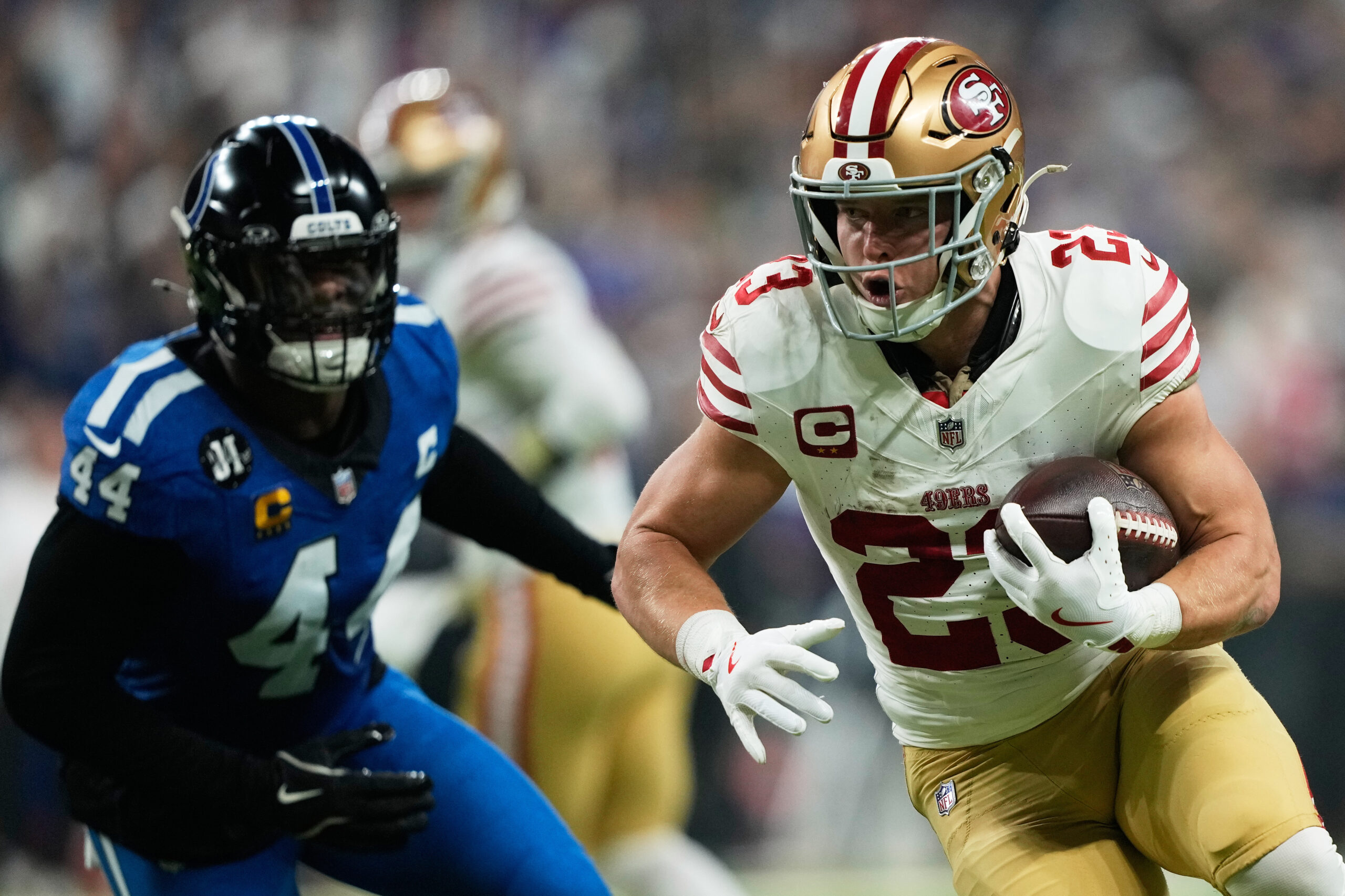
San Francisco 49ers running back Christian McCaffrey (23) runs against Indianapolis Colts outside linebacker and Philly native Zaire Franklin (44) on Dec. 22.
When the 49ers have the ball
This is where the more intriguing matchup lies with 49ers coach Kyle Shanahan and Eagles defensive coordinator Vic Fangio, two of the best play-callers in the business. While Fangio’s defense has jelled into a unit comparable to last year’s, Shanahan’s offense hasn’t been as explosive as it was in previous seasons when the 49ers reached the playoffs. He still has one of the more sophisticated run schemes in the NFL, but the production just hasn’t been there for various reasons. Like the Eagles, San Fran has faced a high rate of stacked boxes. That often is by design. No team utilizes two-back personnel more than the 49ers, who have fullback Kyle Juszczyk. At 34, he isn’t as dynamic, but Shanahan lines him up all over, increasingly in an unorthodox offset position in which he can be a blocker in a variety of ways.
Christian McCaffrey remains the workhorse running back, often from under center. He finished second in the league in carries (311), but had the lowest rushing yards over expected per attempt (-0.5) of his career. The 49ers’ scheme has long majored in wide zone runs, but McCaffrey has had more success running in between the tackles this season. Shanahan’s offense often needs to establish its ground game to utilize play action. His two-back personnel will force Fangio to decide between using his base five-man front to stop the run or his preferred nickel four-man front to protect the back. It will likely be based on the situation, but Fangio doesn’t want to leave his secondary susceptible to throws off play-action. The 49ers’ run game had two strong showings vs. the Indianapolis Colts and Chicago Bears, but it regressed last week against an athletic Seahawks defense.
The possible return of Hall of Fame-bound left tackle Trent Williams (listed as questionable) would help San Fran, but if the Eagles contain McCaffrey, it could be a long day for Shanahan’s unit. He’ll scheme up pre-snap motions to manipulate a defense, and he’ll dial up naked bootlegs and screens to compensate for struggles on the ground. But his offense has been lacking in the dropback game without a top receiver who can consistently get separation downfield for quarterback Brock Purdy. Ricky Pearsall would be the best candidate, but he’s questionable after not practicing all week. That has left most of the heavy lifting to tight end George Kittle and McCaffrey, who led the team with 102 catches. Kittle can do it all. Shanahan will use him like a chess piece. He can win vs. linebackers, safeties, and cornerbacks. The Eagles’ Zack Baun, Reed Blankenship, and Cooper DeJean will be most responsible for keeping him in check.
Purdy isn’t just some byproduct of Shanahan’s genius. He’s quick through his progressions, has good pocket movements, and can extend plays as well as most quarterbacks. He’s not necessarily a scrambler, but he can run to the sticks. If you can collapse the pocket, the throws get harder for him because he’s only 6-foot-1. Purdy’s excellent when “hot,” so it makes little sense to blitz him much — not that Fangio would be inclined to send extra rushers a lot. Shanahan likely will go after cornerback Adoree’ Jackson with Quinyon Mitchell on the opposite side. Fangio has found ways to cover for Jackson with split-field zones. I also could see Purdy targeting safety Marcus Epps or returning linebacker Nakobe Dean on middle-field throws.
Extra point
The 49ers have a lot of success throwing over the middle. But there’s a risk. Eight of Purdy’s 10 interceptions have come between the numbers. That’s part of the reason Hurts doesn’t throw over the middle as often as other quarterbacks. Sirianni has hammered winning the turnover battle into his team. The Eagles finished the season plus-6 in turnover differential, while the 49ers finished minus-6. I also give Sirianni the nod in game management and fourth-down decision-making. He has been more conservative this season, partly because the Tush Push is no longer close to automatic.
Shanahan has lacked the gumption in key spots over his career. He’s a master game-planner and play-caller. But if his teams get behind, they often struggle to rally because his offense isn’t as strong in the dropback world. The same could be said for Sirianni’s system, as well. I think the first team to 20 points wins this game. The Eagles of old could salt away a second-half lead, but Sirianni and Patullo have been unable to find a formula when ahead. It’s been ugly at times and that should be worrisome. But this is how I see the matchup: There’s a push when it comes to the Eagles’ underperforming offense vs. the 49ers’ subpar defense; but I give the edge to a great Eagles defense over a very good, but not great 49ers offense.
Adam Cesare knew by the third date that if he and his future wife were going to end up together, he was going to have to start calling sub sandwiches hoagies. “She’s a Philly lifer,” the New York-born, USA Today best-selling author said. Sure enough, after graduating from college in Boston, the couple relocated to Philadelphia, where Cesare threw himself into the city’s film and literary scenes. “I took to Philly like a fish to water,” Cesare said. That was 15 years ago.
Fast forward to today, and the former high school English teacher is an acclaimed local author with more than a dozen horror novels under his belt, including the popular Clown in a Cornfield series, the first of which was adapted for the big screen and released in theaters this past summer. Now, Cesare is gearing up to release Clown in a Cornfield 4: Lights! Camera! Frendo!
When he’s not busy editing his manuscript, Cesare still loves to explore Philly’s extensive film and lit scenes, roaming through used bookstores or catching a flick at PhilaMOCA.
Here’s how Adam Cesare would spend a perfect day in Philadelphia.
9 a.m.
First, I would make sure it’s not a Sunday because I want to go to Beiler’s Doughnuts in Reading Terminal, and it’s closed on Sundays.
11 a.m.
After Beiler’s, I’d pop over to Old City to go to The Book Trader. I could name-drop all the current new bookstores, but there’s something about used bookstores that I really like. I’d swing by the comics shop, Brave New Worlds, because it’s right next door, then I’d head to Mostly Books on Bainbridge. I love that place. It’s great because they have a pretty decent VHS, DVD, and Blu-ray selection too, so I’ll get a few movies.
I might also pop into the Philly AIDS Thrift. It’s fun to walk around. They have a good book section. It’s mostly general fiction. I like their physical media section too. You can get the DVD or VHS of every television series that’s been kicked off Netflix.
1 p.m.
For lunch, I’m definitely going to Monster Vegan. It is what it sounds like. It is a really good vegan restaurant themed on monsters. They play clips from Count Yorga and stuff on the walls. They do events, too. I once saw Lloyd Kaufman present Class of Nuke ‘Em High.
3 p.m.
After lunch, I might drive over to Manayunk to check out Thrillerdelphia. It’s a new bookstore that exclusively sells horror and thrillers. They just opened two months ago, and I did one of their first events. They’re really nice people, and they have a great selection.
5 p.m.
It’s time to beam back down to South Street for dinner and a movie. On a perfect day, I’m going to Royal Izakaya, a Japanese restaurant I like to go to on my birthday. Since money is no object on my perfect day, I’ll order the omakase. Let the chef decide.
7 p.m.
There are so many good places to see a movie in Philly. There’s the Philadelphia Film Society. There’s also PhilaMOCA. It’s probably my favorite place to go. They work closely with Exhumed Films, which is a group of film fans who screen 35mm and 16mm films from their private collection in local theaters. They do a lot of work with The Colonial in Phoenixville as well.
The last time I went to PhilaMOCA, I saw Hedwig and the Angry Inch, and John Cameron Mitchell was there doing a live commentary, which was sick. They do really cool stuff like that all the time.
It’s become fashionable to pile on first-year offensive coordinator Kevin Patullo. He’s the target of local and national self-styled experts, none of whom, you might note, works for an NFL or college team.
Certainly, no matter how close his friendship with Nick Sirianni, Patullo won’t survive next week if the offense again struggles and the Eagles don’t beat the San Francisco 49ers on Sunday. The offense averaged 22.3 points, down 4.9 points from the Super Bowl team of 2024, and 311.2 yards, down 56 yards from last year.
If you know anything about the Eagles front office, without a deep postseason run, that sort of performance simply will not stand.
Jeffrey Lurie and Howie Roseman have standards that are not being met.
Howie Roseman spent $128 million of Jeffrey Lurie’s money on that side of the ball, more than twice what they spent on defense. No matter how badly the players have executed, a quick playoff exit will spell the end for at least Patullo, and probably quarterbacks coach Scot Loeffler as well. No player on the team has regressed as much as Jalen Hurts.
But if the day after the wild-card game turns out to be Black Monday for Patullo, his defenders, if they exist, should have some ammunition. Because regardless of the plays called, the real problem lies with the players running them. These are not failures of scheme or sequence. These are failures of execution, focus, and maybe even heart.
Is it age? Right tackle Lane Johnson is 35, but A.J. Brown and Saquon Barkley are just 28. Then again, in the NFL, high-usage receivers and backs age in dog years.
Is it fatigue? Maybe. The Eagles enter Sunday having played 38 games in the past two seasons, more than any other team. Including playoffs, Barkley had 482 total touches last season, second-most in NFL history.
Is it injury? Maybe. Offensive linemen Cam Jurgens, Landon Dickerson, and Johnson, who have 11 Pro Bowls among them, have been limited or absent all season. Brown battled a hamstring issue in training camp and through at least the first eight games, and he managed the lowest yardage total of his four-year tenure in Philly — but just 76 yards lower than last year.
In fact, as much as folks want to criticize the Eagles’ passing game, it actually averaged 6.4 more yards per game this season (194.3) than it did in 2024 (187.9).
Jason Kelce isn’t walking through that door, and it’s fair to ask how much the Eagles have really overcome his absence.
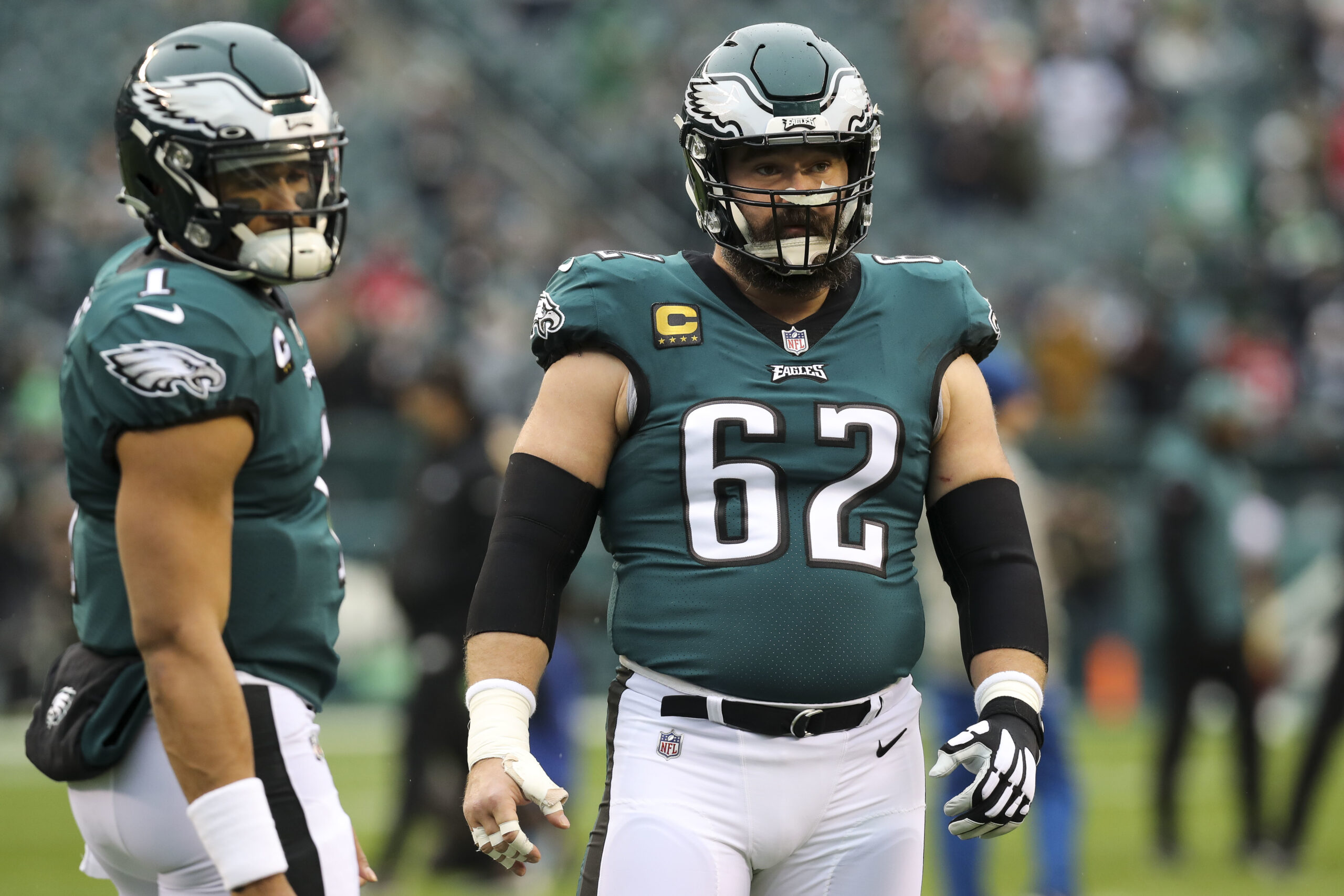
The brutal truth is the passing offense hasn’t been the same since center Jason Kelce retired after 2023, despite Jurgens making the last two Pro Bowls.
Are there other factors at work?
Was last year’s passing offense a casualty of Barkley’s 2,504 rushing yards, which is an NFL record, playoffs-inclusive? Or was it because the passing game wasn’t sharp in 2024, either? After all, Hurts threw for seven more touchdowns and 321 more yards in 2025.
Second, opposing defenses more steadfastly forced Hurts — and, of course, Patullo — to beat them through the air.
You can’t blame Patullo for the stagnation of Hurts’ game. His processing remains slow, his footwork remains clunky, his arm strength no better than average.
But what Patullo will be blamed for, fairly or not, is that he did not make more of Lurie’s $255 million man. It won’t matter that Patullo’s predecessor didn’t, either.
Kellen Moore was hired to maximize Hurts’ abilities the way he’d allegedly done with Dak Prescott as the Dallas Cowboys’ quarterbacks coach or offensive coordinator from 2018 to 2022 — emphasis on allegedly.
History has been kind to Kellen Moore … perhaps too kind.
Prescott’s passer rating during Moore’s five seasons was 98.8. His quarterback rating was 55.2. Since Moore left, it’s 99.4 and 73.4. Justin Herbert’s passer rating of 93.2 in 2023, Moore’s single season as the Chargers’ OC, matched Herbert’s career-low.
Just saying: Maybe Moore wasn’t the reason the Eagles shined as brightly as they did. After all, four healthy potential Hall of Famers on any offensive line can cover up lots of shortcomings.
Nobody likes watching Patullo call passing plays that give Hurts limited options and require too long to throw. Nobody likes watching running plays that, given the defensive alignment, appear doomed on conception. Those are on Patullo — but those also are infrequent. Besides, no OC nails every call.
Nobody likes watching Hurts deal with pressure in his face from up the middle on every third dropback because his center and guards get blown off the ball. Nobody likes seeing tight end Dallas Goedert rounding off his routes.
We’ve also seen Brown give up on routes and short-arm passes, seen Barkley hit holes soft, misread blocks, and run out of bounds when he didn’t have to, and we’ve seen Hurts miss wide-open receivers, sometimes two on the same play. He clearly has no interest in running the football much anymore; he ran 105 times this season, one-third less than his average over the last four seasons.
Sure, some of that is Patullo.
But a lot of it is a worn-down Hurts and his quickly aging cast.
Although some of Lindsey Heaps’ games in Europe aren’t easy for American fans to watch, the chances that do come along show why she’s so comfortable there.
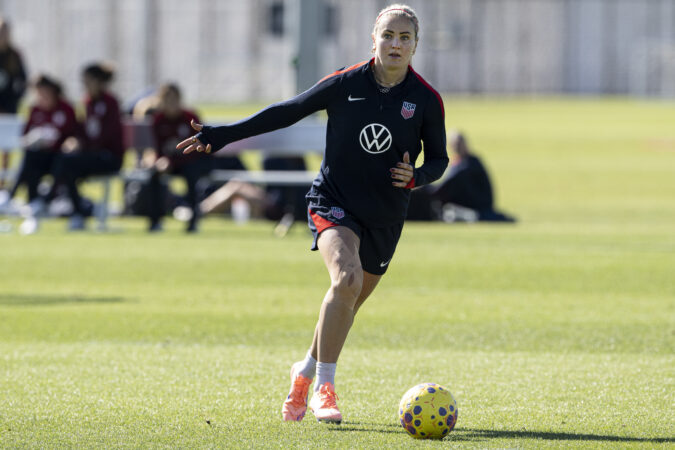
The 31-year-old midfielder plays for her club, France’s OL Lyonnes, as more of a facilitator than the do-it-all general she’s often been cast as with the United States — not just by fans, but by coaches over the years.
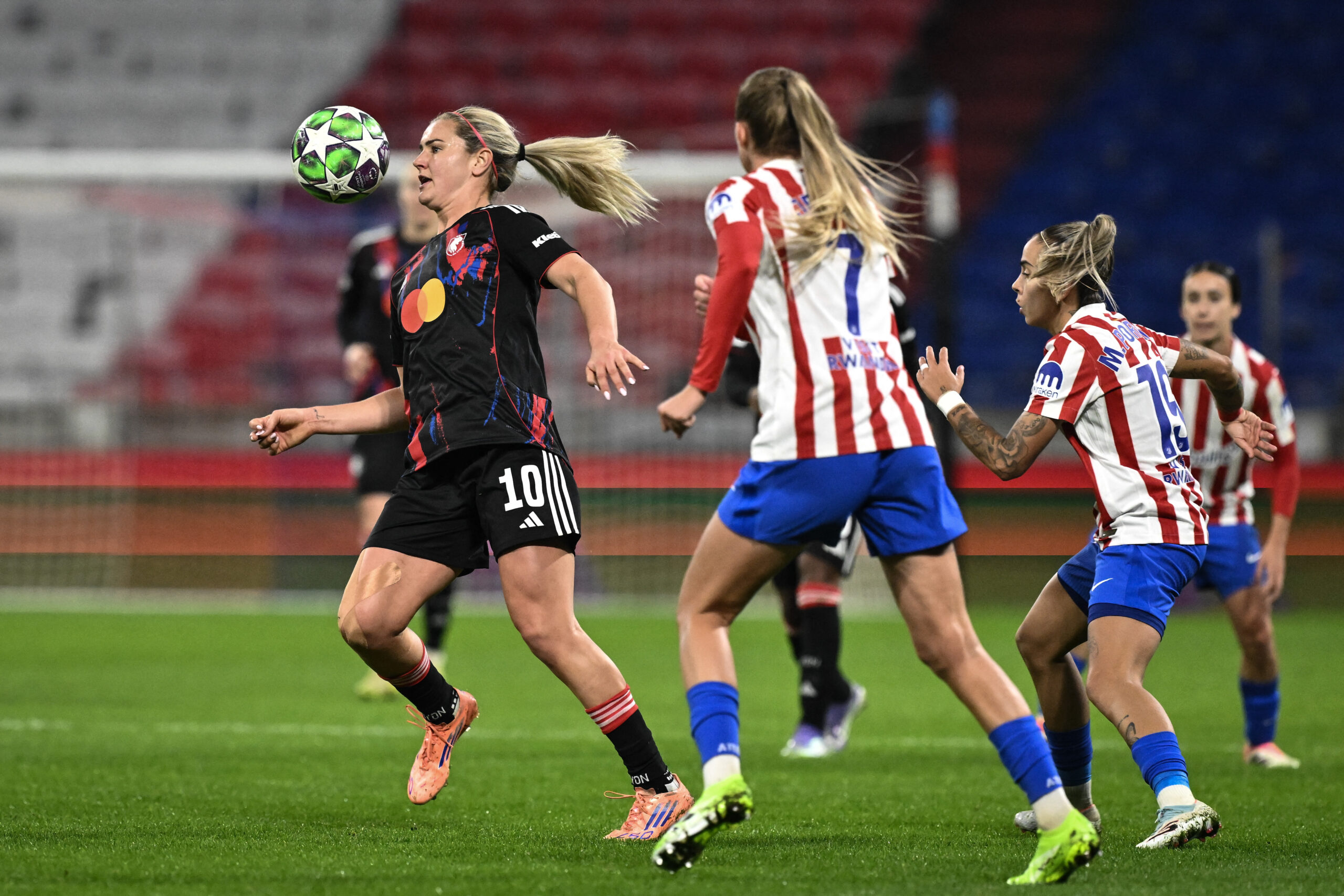
It’s easy to focus on Heaps not scoring, especially given that she started her career as a forward before moving into midfield. But her last game for OL, against Spain’s Atlético Madrid in the Champions League, showed a different side of Heaps.
She completed 42 of 44 passes that night, continuing a pace of a 90% pass completion rate in Champions League games this season, and had eight defensive recoveries. The players around her did most of the creating, especially midfielder Melchie Dumornay and wingers Tabitha Chawinga and Kadidiatou Diani.
Any team would dream of having OL’s squad of superstars. The club was the standard-bearer in Europe long before American businesswoman Michelle Kang bought it in 2023 (she also owns the NWSL’s Washington Spirit and England’s London City Lionesses), and it has remained at that level.
No team in France comes close to OL’s 18 league titles, all won in the last 19 years — as in, every season except one. Nor is any team in Europe close to OL’s eight Champions League triumphs from 2011-22, even though Barcelona is the continent’s top team right now.
Heaps has three league winners’ medals and one from the European Cup, and could add to both totals this season. OL is running away with the French league, and earned a round-of-16 bye in the Champions League thanks to an unbeaten group stage run.
“It’s unbelievable, I think this year especially,” she told The Inquirer. “New coach, new culture a bit, standards, competitiveness. The training is unbelievable in everything that we’re doing, and obviously you see it on the pitch as well. But we take each game at a time, and we just keep rolling.”
Lindsey Heaps (left) on the ball during last month’s OL Lyonnes-Atlético Madrid game in the UEFA women’s Champions League.
A high value on high standards
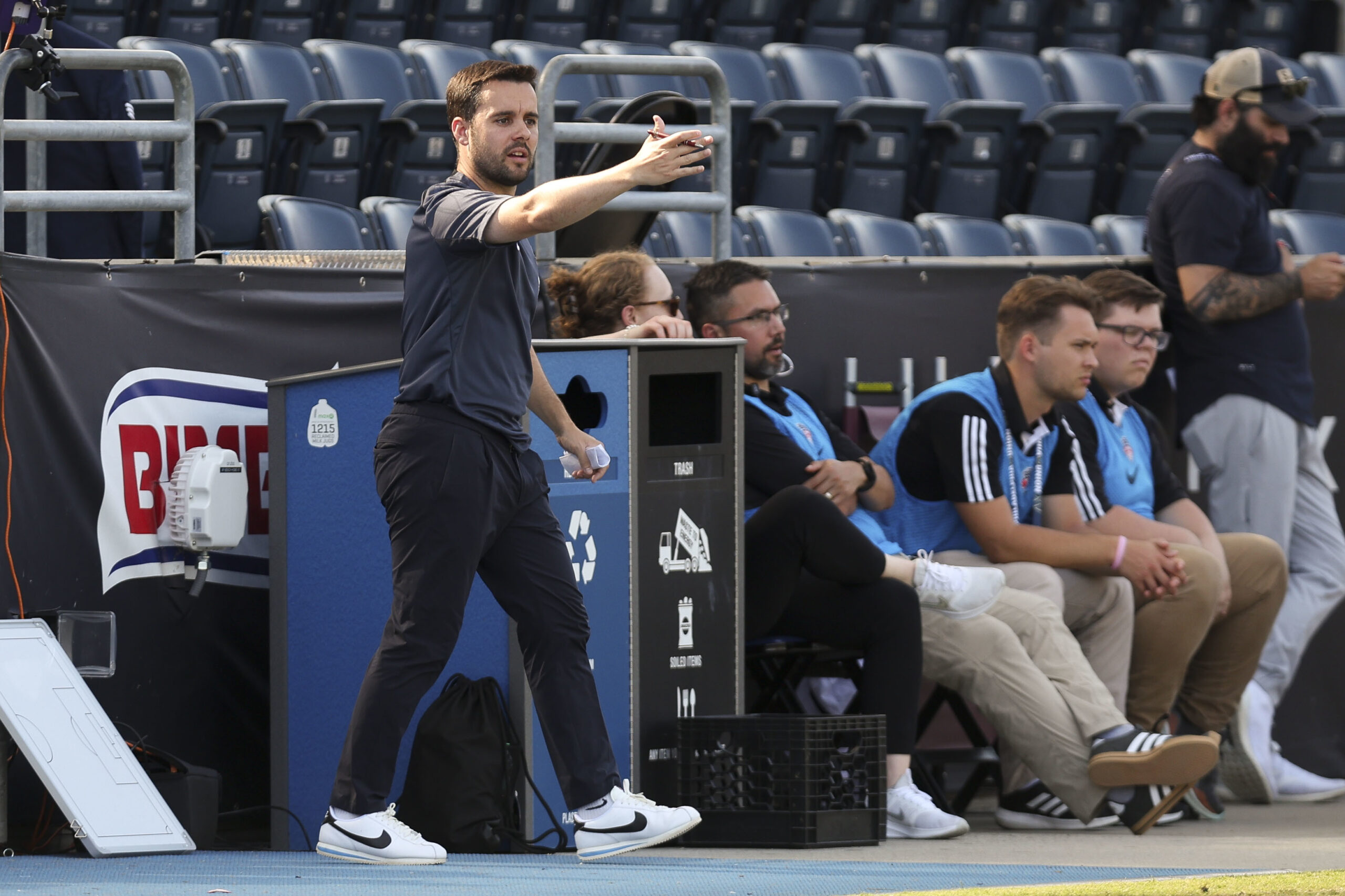
That new coach is a familiar name: Jonatan Giráldez, who joined OL from the Washington Spirit in the summer. It was a controversial move, since Kang was accused of taking from one of her teams to boost another.
But that claim is above Heaps’ pay grade.
“Honestly, I think I speak for everyone on the team: he is such a quality coach,” Heaps said. “You just learn so much, and even for me, I want to continue learning, or looking at the game in a different way, or tactical adjustments, or things like that. … He wants us to win so badly, and he wants us to do so well as players, and he cares about us — he cares about how we do and how we perform, but also us as people.”
“A very, very important player,” he said of Heaps. “Her role on the field is beyond the tactical, because she’s able to understand a lot of situations on the field — when the team has the ball, when the team doesn’t have the ball. … I’m very happy to have her in the team.”
Jonatan Giráldez on the sideline at Subaru Park when the Washington Spirit played a game there in 2024.
Heaps mentioned the team’s “training environment” a few times in the interview, praising the high standards there. That counts for a lot, especially among U.S. national team stalwarts.
For lack of a better way to put it, the top American players have long relished getting their butts kicked on a daily basis, whether by the NWSL’s competitive balance or the famed ferocity of U.S. practices.
Heaps is the latest in a lineage from Mia Hamm through Abby Wambach, Heather O’Reilly, Julie Ertz, and Carli Lloyd, all of whom spoke just as bluntly (and sometimes more so). Now Heaps wants to pass it on to a new era.
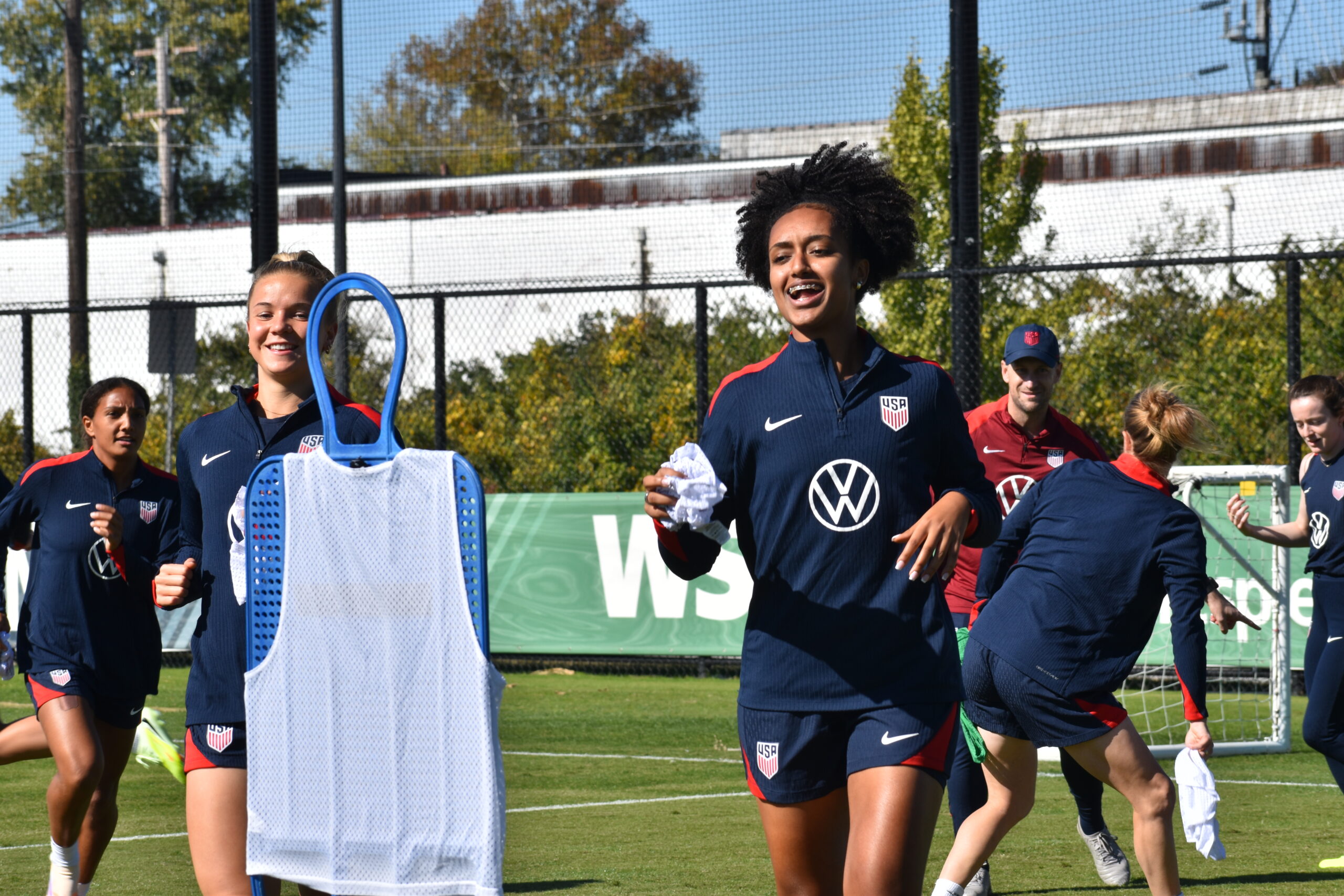
She gets to do that in Lyon, not just with the national team. The club’s squad includes 22-year-old American midfielder Korbin Shrader and 18-year-old Lily Yohannes, the latter of whom is starting to meet the hype as a generational talent.
Lily Yohannes (center) at work with the U.S. women’s soccer team in Chester in October.
‘The best midfielder in the world soon’
Unfortunately, Yohannes hasn’t gotten to play much in the Champions League this season. She didn’t play at all against Atlético Madrid, where the tactical matchup would have been a great lesson.
Heaps also wanted that, but she preached patience.
“We all need to remember that she’s 18 years old,” she said. “At the end of the day, she needs to keep doing her thing, because she’s been playing so well — she’s been playing well with the national team, she’s training well here. And like I said before, it is just such a competitive environment.”
But Heaps is not immune to the buzz around Yohannes, and didn’t mind indulging in some.
“I know these games mean a lot for her, but her ceiling is so, so high,” she said. “I just said to her that no matter what, in a few years from now, you’re going to remember games like this that maybe you don’t come into. But you’re going to be a starting player and a non-stop player, and I believe the best midfielder in the world soon to come.”
Yohannes has played her entire career in Europe, and Heaps has played eight of her 14 professional years there. The American contingent across the Atlantic keeps growing, with Penn State product Sam Coffey soon to join it at England’s Manchester City.
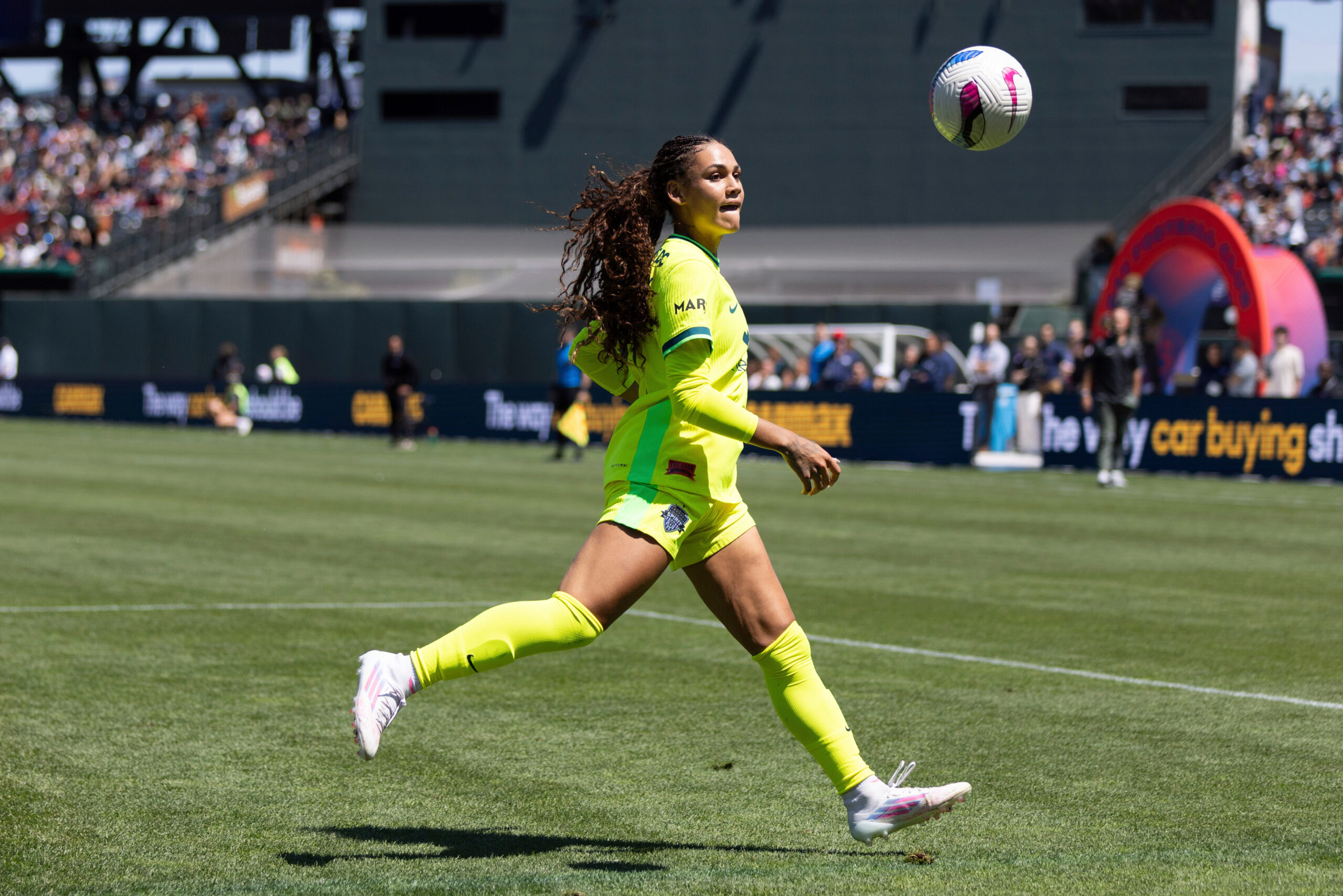
Will playing overseas fit other Americans as well as it does Heaps? The question is always on the table, but it’s in bright lights above Trinity Rodman’s head right now. Her standoff with the NWSL over getting paid what she’s worth — with Kang on her side, trying to structure a contract within the league’s salary rules — has naturally led to European suitors chasing her.
It might also reveal a truth that Europe’s chattering class doesn’t like admitting. Very few European clubs are truly at a high enough level to be right for elite U.S. talents.
Lyon is one for sure, but there would be an even bigger uproar if Rodman moves there. Barcelona is another, but the Spanish giants don’t sign Americans. Manchester City, Arsenal, and Chelsea measure up in England, but Chelsea’s roster looks too loaded to have room for Rodman right now.
Trinity Rodman’s uncertain future is the biggest story in the women’s soccer world right now.
‘Do what’s best for her’
Beyond them? Paris Saint-Germain was in that class, but has fallen hard this year. Germany’s Wolfsburg is far from its past glories, and Bayern Munich still has a ways to rise. Real Madrid and Manchester United have stars, but their ownerships aren’t trusted to build truly top programs.
The highest tier is really just the first five clubs you read above, and that’s not much.
Then add in Rodman’s huge commercial impact, which would be diminished going abroad — less so in England, but still notably.
Many clubs outside England also have poor attendances. OL averages just over 5,000 in a 59,000-seat stadium despite all its stars. PSG plays almost all its French league games at a 1,500-seat field within the bigger club’s practice facilities, far out in the Paris suburbs. Both are a far cry from the 15,259 that Washington averaged this year, or the even bigger crowds in Los Angeles and Portland.
Not for nothing, then, did U.S. legend Tobin Heath — who played for PSG, Manchester United and Arsenal amid many years in American leagues — recently say Rodman should stay in the NWSL.
Tobin heath during her playing days with Manchester United in 2020.
“I advise a lot on players going or staying, and 95% of the time, I will usually say go,” she said in an interview on fellow former superstar Megan Rapinoe’s podcast. “I think that her game will be 1000% louder here. I think she can be the face of the league.”
At the time Heaps was asked, the NWSL was still putting together its new High Impact Player rule. She had heard about it, but the details hadn’t all been published yet — including the controversial rules on how players qualify. So Heaps chose her words carefully, but she had plenty of them.
“I don’t think it’s a bad idea,” she said, tying in what she has seen over the years from MLS’s Designated Player rule. (Her husband Tyler is San Diego FC’s sporting director.). “If you want some of the best players in the world to come and play in the NWSL, some things do have to change. … We want to continue growing the league. So, what’s the best way of doing that? We’ve got to get the best players there.”
It was also easy to think Rodman’s situation would be settled by now. Heaps wondered if it might not just come down to salary, but she encouraged Rodman to do what she feels is right.
“Trinity needs to do what’s best for her,” Heaps said. “The money is kind of on the side of it — obviously, that’s a big thing for us professionals. But Trinity, she’s going to make the decision that’s best for her, and I think that’s the most important.”