Heading into the Eagles’ wild-card matchup with the San Francisco 49ers, fans have plenty of questions surrounding the team’s offense, adjustments they could make in the playoffs, and players who may step up in the postseason.
Before Sunday’s game at Lincoln Financial Field, The Inquirer’s Olivia Reiner took to Reddit for an AMA — or “Ask Me Anything” — to answer reader questions about the team … and the future of its offensive coordinator.
The following has been edited for length and clarity.
Despite the 11-win season, the offense has felt ‘enigmatic’ (and at times dysfunctional) compared to the defense this year. In your opinion, is the disconnect primarily viewed as a play-calling issue with Kevin Patullo, or are there deeper issues with the offensive players this year?
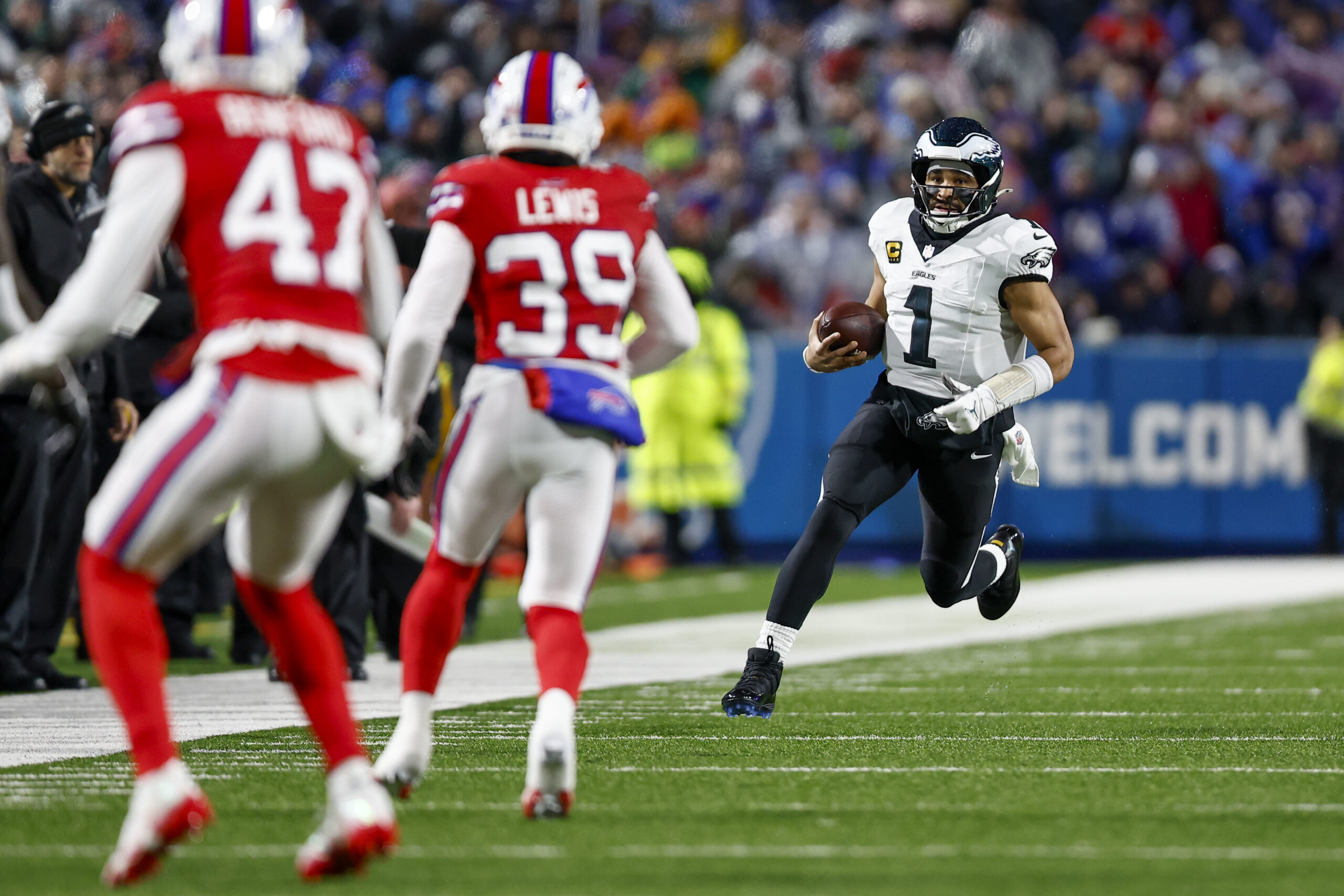
Reiner: It would be very easy to chalk all of the offense’s dysfunction up to one thing, but I don’t think that’s fair. The blame deserves to be spread around. But just anecdotally speaking, I feel like there have been too many instances this year where Hurts doesn’t have anywhere to go with the ball. He’s been forced to make plays out of structure, whether he’s scrambling for yardage or extending the play.
I think we saw in the season finale with Tanner McKee and the backups what happens when the Eagles don’t have a quarterback who can do those things. Re: the lack of answers, how much is that on Patullo for the play call? How much is that on Hurts for not changing the play if he has the freedom to do so based on what the defense presents before the snap? Or on the offense for not getting to the line fast enough for Hurts to make a change? Only the Eagles really know.
Jalen Hurts’ designed runs have been more frequent during the second half of the season.
What adjustments could we hope to see for the offense to finally get going in the playoffs
Reiner: I’m curious to see if Kevin Patullo calls more designed runs for Jalen Hurts now that the team is in the playoffs and they could be a little less concerned with the self-preservation aspect of it. Hurts has insisted throughout the season that his designed rushes being down are more of a product of the offense, not so much an issue of keeping him healthy, though, although Nick Sirianni has acknowledged the health aspect of it.
I wrote about Hurts’ designed rushes being down this year last month. His rushing ability has the power to help keep defenses honest and open up opportunities for his teammates. That could be the most logical tweak to the offense this late in the game. I wouldn’t expect wholesale changes at this point.
Do you think the eagles offense will be able to get it done if they don’t put together four solid quarters in four straight games?
Reiner: Well, that’s how they’ve won most games this season! Many games have come down to Vic Fangio’s defense playing nearly flawless to bail out an inconsistent offense. A.J. Brown referred to it earlier in the season as the defense putting a “Band-Aid” over the offense’s inability to produce over a full four quarters.
I’m not sure if that method will fly in the playoffs. The competition, of course, gets better in the postseason. But can the Eagles offense suddenly become this consistent, well-oiled machine after sputtering so many times throughout the regular season? I think they’re still going to need the defense to bail them out, and that doesn’t sound like a recipe for success going forward.
Jahan Dotson has just 18 catches on the season. Could he be more impactful in the postseason?
If you had to pick a player likely to take a big step forward in production in the playoffs, who would it be? Is anyone unexpected going to break out?
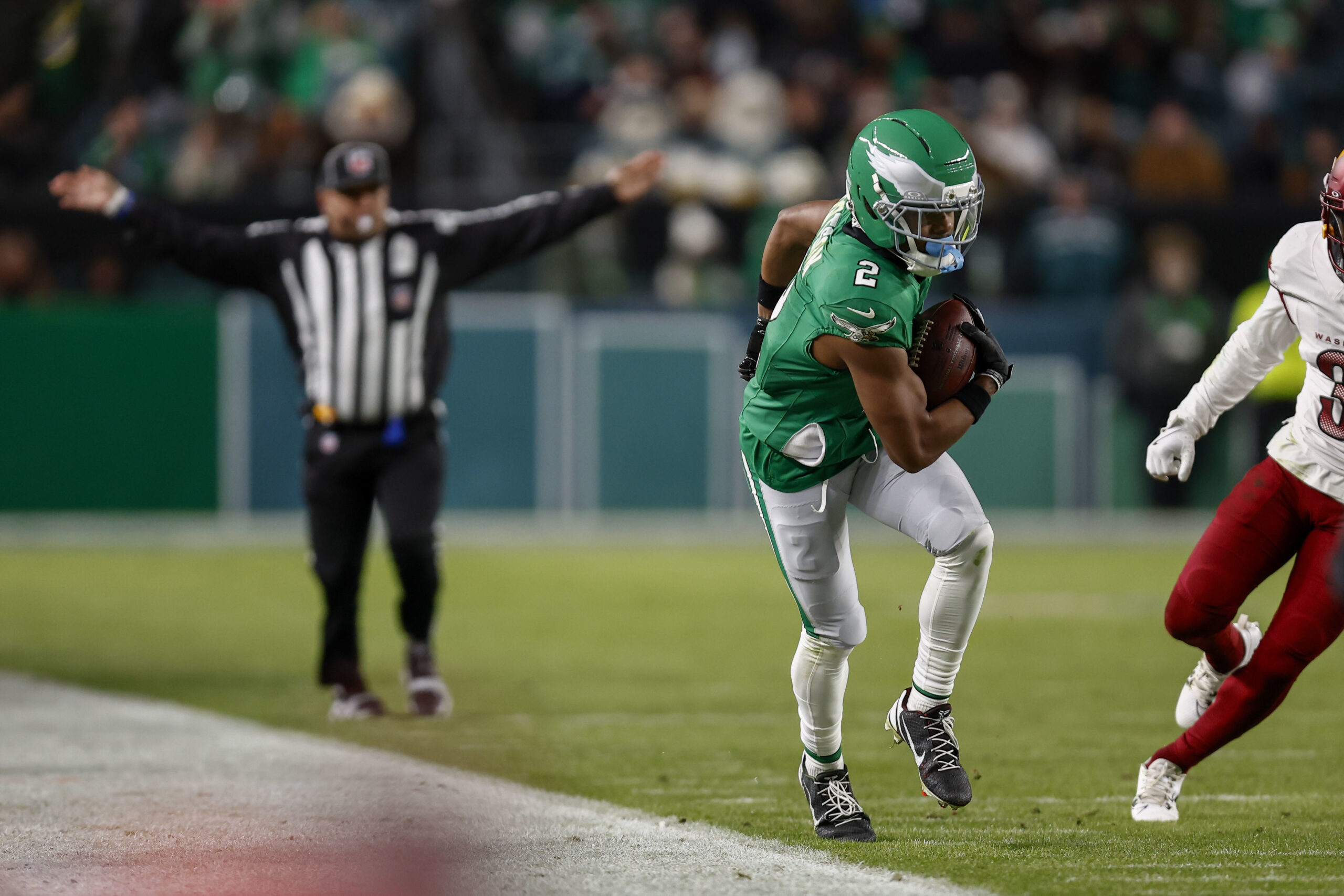
Reiner: Jahan Dotson was kind of that player last postseason, especially in the Super Bowl. I’m more surprised that he hasn’t been more of a factor in the passing game during the regular season given his contributions in February. Maybe he comes down with a couple of key catches in the postseason. Even if it’s just a couple, that would be notable, given that he has just 18 catches on the season (one fewer than 2024).
Regardless of Sunday’s outcome, do you expect major changes to the coordinator staff this offseason? Hopefully that change involves Kevin Patullo.
Reiner: This is pure speculation and not reporting: I would think that Sunday’s outcome has to be taken into consideration regarding any changes at the offensive coordinator position, and the outcome of any additional playoff games. A wild-card exit wouldn’t reflect well on anybody. Another Super Bowl win would. This postseason run is important for Kevin Patullo, as my colleague David Murphy wrote about this morning.
To check out the rest of Olivia’s AMA, click here.
BalletX and the Philadelphia Chamber Music Society opened the world premiere of Amy Hall Garner’s highly colorful, theatrical Petrushka Thursday night at the Kimmel Center’s Perelman Theater.
Petrushka takes the second half of a program that opens with ensemble 132 alone in the first act, playing Bartok, Wiancko, and Mozart. So when Peter Weil (as Pete, who becomes Petrushka) wanders on stage and settles in for a nap, it is amusing already.
It’s as if a Kimmel visitor walked through the wrong door.
Now the musicians, playing the Stravinsky score — rescored for, and played by, a piano quintet, are backstage while a surreal fever dream of a scene erupts. Pete is woken up by a chorus of dancers who steal his blanket and wrap him into the traveling show that is approaching.
It’s like we went to a classical concert and a circus broke out.
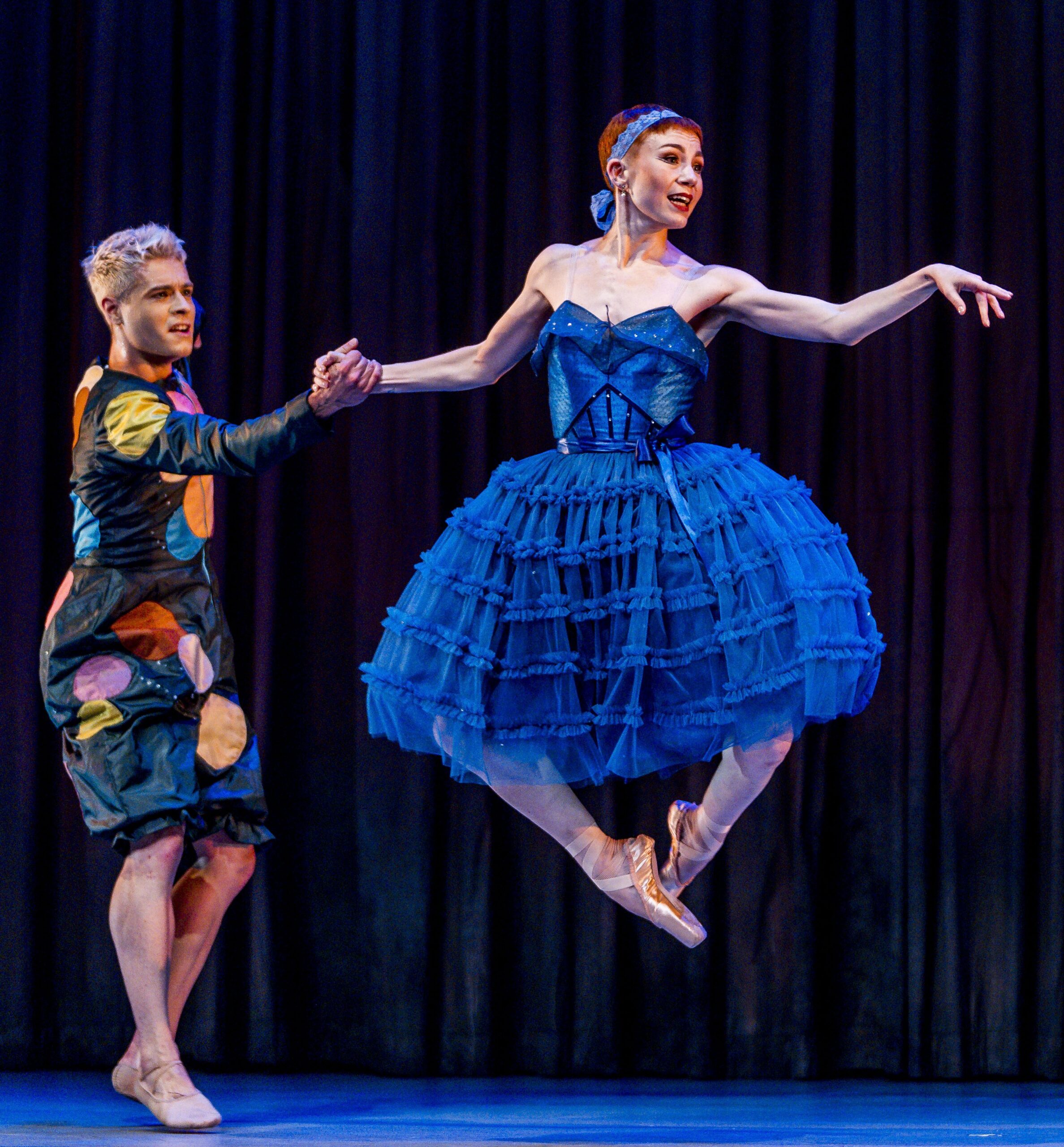
BalletX dancers Peter Weil as Petrushka and Lanie Jackson as Belle in Amy Hall Garner’s “Petrushka.”
Last summer, BalletX offered a preview of Petrushka, for which choreographer-in-residence Garner teamed up with theater director Nancy Meckler and set and costume designer Emma Kingsbury. Then, it was intriguing but hard to parse.
Garner’s story is still hard to parse without reading the program notes, but it’s a wild adventure.
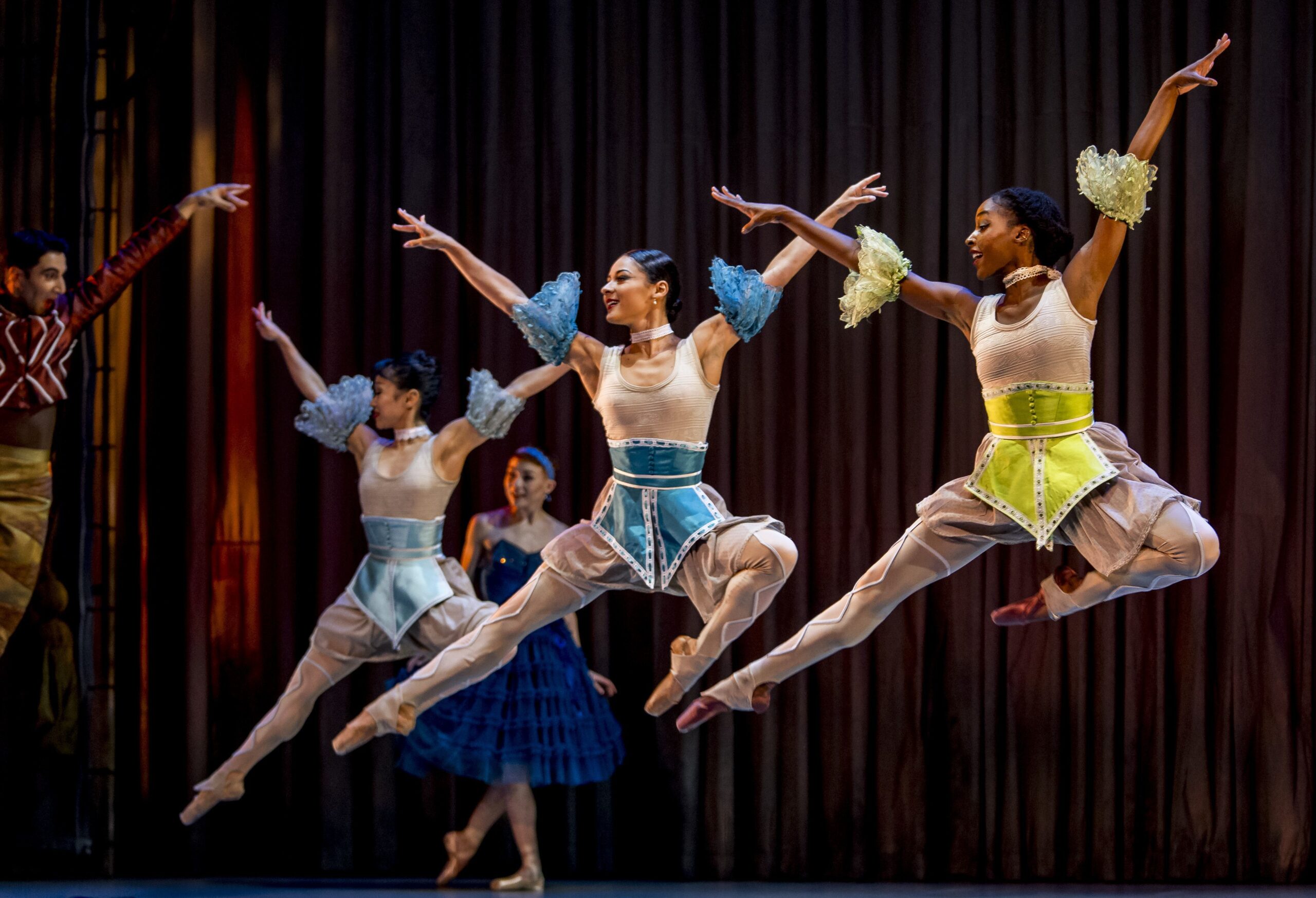
BalletX dancers Ashley Simpson, Itzkan Barbosa, Minori Sakita, and Lanie Jackson (back) in Amy Hall Garner’s “Petrushka.”
This is the first time BalletX has remade an older story, artistic director Christine Cox said on stage before the show.
Garner’s traveling show is an amusing cast of circus characters who are sometimes puppets, other times human. A hilarious strongman (Mathias Joubert) and a magician/impresario (Jonathan Montepara) share the role as the bad guys. Montepara controls everyone with his wand. Both Pete and the magician are in love with Belle, the ballerina (Lanie Jackson).
Jackson convinces Pete to change into a costume, thus becoming Petrushka and distracting the audience.
There are also acrobats and dancers who perform with ribbons, clubs, and hoops.
BalletX dancers are used to a variety of types of dance and roles. The company specializes in new work, so they are all flexible and able to perform in many ways. More surprising was how good they are as actors. In particular, Weil and Jackson didn’t only impress with their dancing but their strong storytelling and range of emotions.
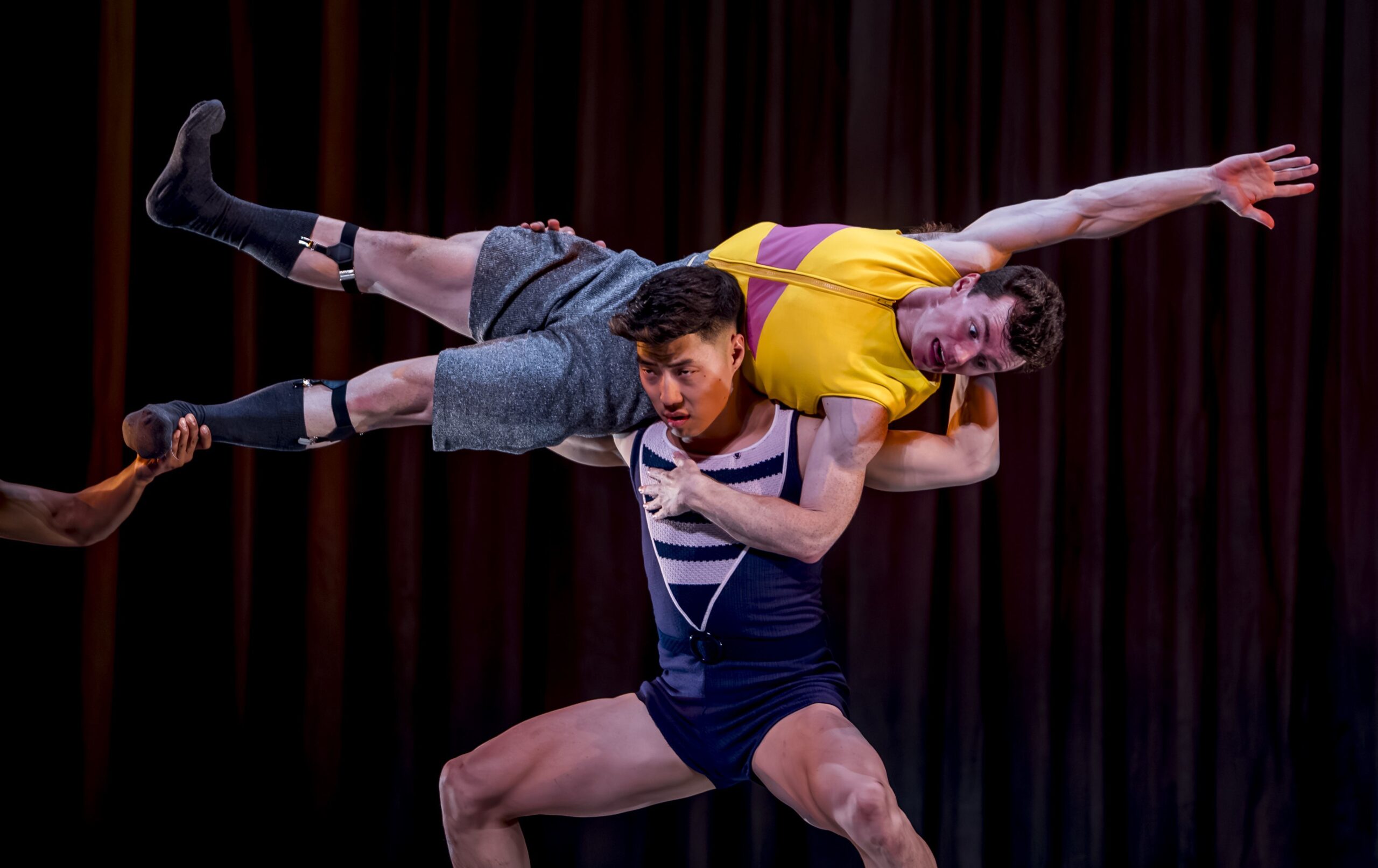
BalletX dancers Mathis Joubert lifts Jerard Palazo in Amy Hall Garner’s “Petrushka.”
Joubert was the strongest supporting character as the egotistical strongman, breaking the fourth wall to use it as a mirror, flexing his muscles and kissing himself.
The large number of bodies on stage made for a lively scene, but it also overwhelmed the Perelman stage at times. Ensemble 132, which owned the first half, almost faded into the background in the second.
It would be interesting to see this sometime at the Highmark Mann Center for the Performing Arts, BalletX’s second home.
If they made a movie about the Phillies as 2026 begins, the climactic scene would feature Bryce Harper at the plate, flipping his Victus bat, and shouting four words at a bloodthirsty crowd.
It’s a fair question. Because the Phillies have a $300-plus-million payroll and as many stars as a planetarium. They won more games in the last three seasons than all but two teams (Dodgers, Brewers). And only the Dodgers have a streak of playoff appearances longer than the Phillies’ four-year run.
Surely, the 3.3 million fans who surged through the gates of Citizens Bank Park last season enjoyed all that.
Except, well, you know what keeps happening to the Phillies in October: divisional-round ousters in 2024 and ’25 after the Game 6 and 7 soul-crushers at home in the 2023 National League Championship Series. That’s eight losses in 10 playoff games — and nothing to show for so much regular-season success.
So, when the Phillies re-signed Kyle Schwarber last month and made an offer to bring back franchise catcher J.T. Realmuto, it mostly was met with a shrug from fans who are more wary than they should be about keeping together the guts of a roster that chased 90 wins three years ago with 95 and then 96.
But before channeling our inner Gladiator and questioning the entertainment value of yet another winning summer spent with the cast that disappoints every autumn, the Phillies went and set up a meeting next week with star free-agent infielder Bo Bichette, a major league source said Thursday, confirming a report by The Athletic.
Entertaining? Maybe. Interesting? Definitely.
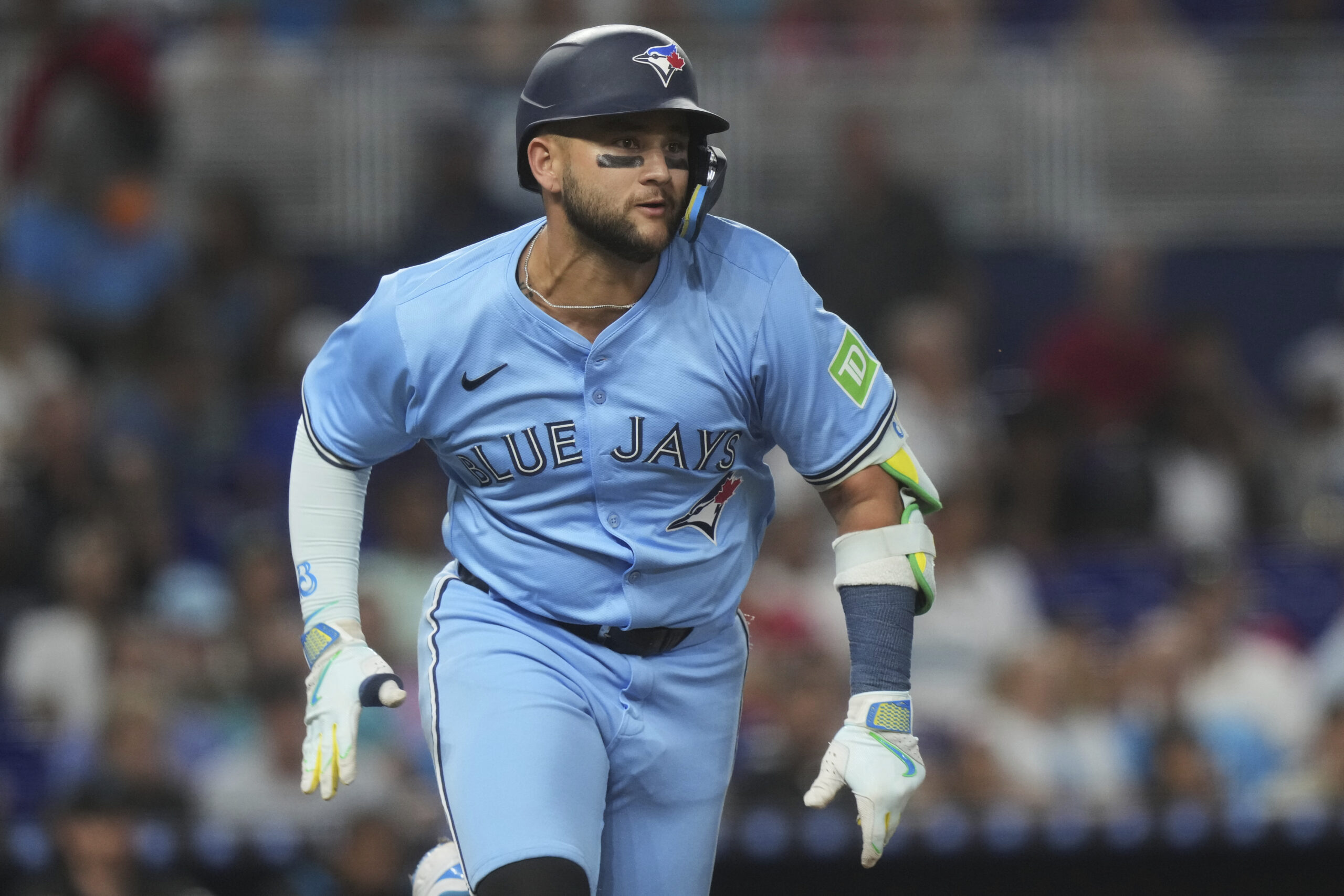
Free-agent infielder Bo Bichette is scheduled to meet with the Phillies over video next week, according to a major league source.
Bichette, who will be 28 next season and twice led the American League in hits, would bring a high contact rate and right-handed power to the Phillies’ lineup. Imagine a batting order that looked like this:
But the real explanation for the fans’ collective endorphin rush is that Bichette — son of former major leaguer Dante Bichette, godson of ex-Phillies manager Joe Girardi — would represent the biggest change of the mix since Turner’s arrival as a free agent in December 2022. And let’s be clear: Signing Bichette would be like taking a blender to the roster.
Not only would the Phillies need to teach Bichette a new position (third base), but to squeeze him into the budget — with the payroll pushing up against the highest luxury-tax threshold — they must move third baseman Alec Bohm’s $10.2 million salary and say goodbye to Realmuto.
Are the Phillies really better off with Bichette? Maybe. Realmuto is older (35 this season) and amid a three-year decline at the plate. But he still has more wins above replacement over the last three seasons (9.0, as calculated by Baseball-Reference) than Bichette (8.0). And he’s beloved by the pitchers for his leadership and game-calling.
The Phillies remain hopeful of retaining Realmuto, but the sides have been locked in a contractual staring contest for a month. There isn’t a Phillies story — and depending how things go Sunday at the Linc, maybe not a Philadelphia sports story — that will dominate the news more than the Bichette-Realmuto saga for as long as it lasts.
But 2026 will bring several entertaining Phillies storylines, such as:
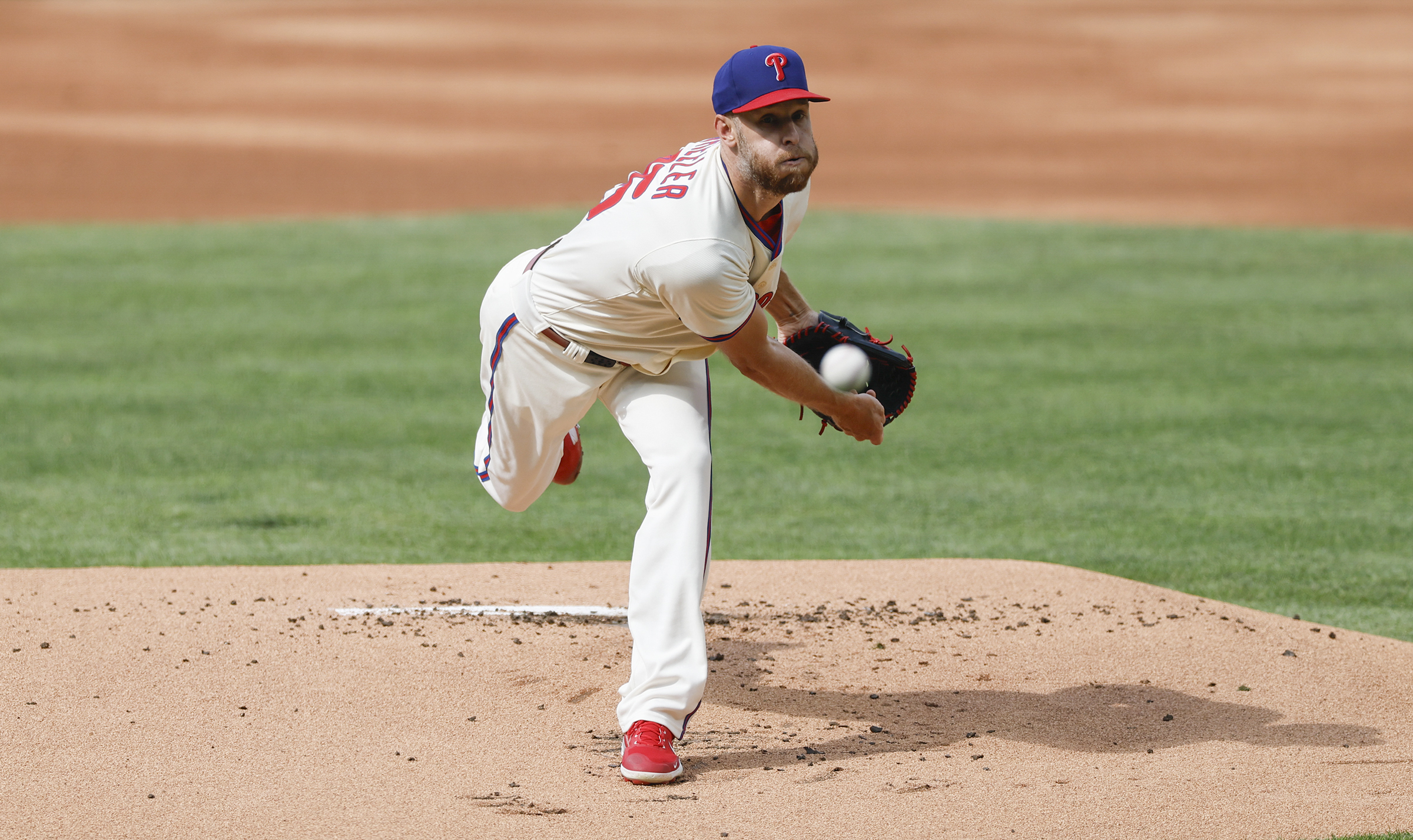
Phillies ace Zack Wheeler is seeking to return from thoracic outlet decompression surgery.
Whither Wheeler?
When we last heard from Zack Wheeler, it was August, and he was where he normally is, smack dab in the conversation with Paul Skenes, Tarik Skubal, and maybe Garrett Crochet for the best pitcher in baseball.
Then, in the flash of his fastball, he was gone, diagnosed with a blood clot near his right shoulder.
The clot was brought on by venous thoracic outlet syndrome, a condition in which the subclavian vein gets compressed between the collarbone and rib cage. Wheeler had season-ending surgery to remove the clot, then another procedure in late September in which his top rib was removed to relieve the pressure on the vein.
(Aside: It’s difficult not to wonder if the divisional series against the Dodgers would’ve turned out differently if the Phillies had Wheeler and reliever José Alvarado. Then again, they scored only seven runs in the three losses — and lost by a total of four runs. Pitching wasn’t the problem.)
Wheeler is throwing again — from 75 feet, manager Rob Thomson said before seeing him in person this week. The Phillies are optimistic he won’t miss much of the season. As one major league source put it, his recovery is “going great.”
“The trainers seem to think he’s doing very well,” Thomson said, purposely not venturing a guess for Wheeler’s return.
But thoracic outlet syndrome isn’t as common as, say, Tommy John surgery, and the return isn’t always as smooth. Maybe Wheeler, 35 in May, will make a full recovery, à la Diamondbacks righty Merrill Kelly, who was in his 30s when he returned from TOS. Maybe he will need to reinvent himself on the mound.
Either way, it won’t be as automatic as winding up Wheeler and watching him dominate for 200 innings. And the rest of the starting rotation, still the Phillies’ backbone, must be adjusted accordingly.
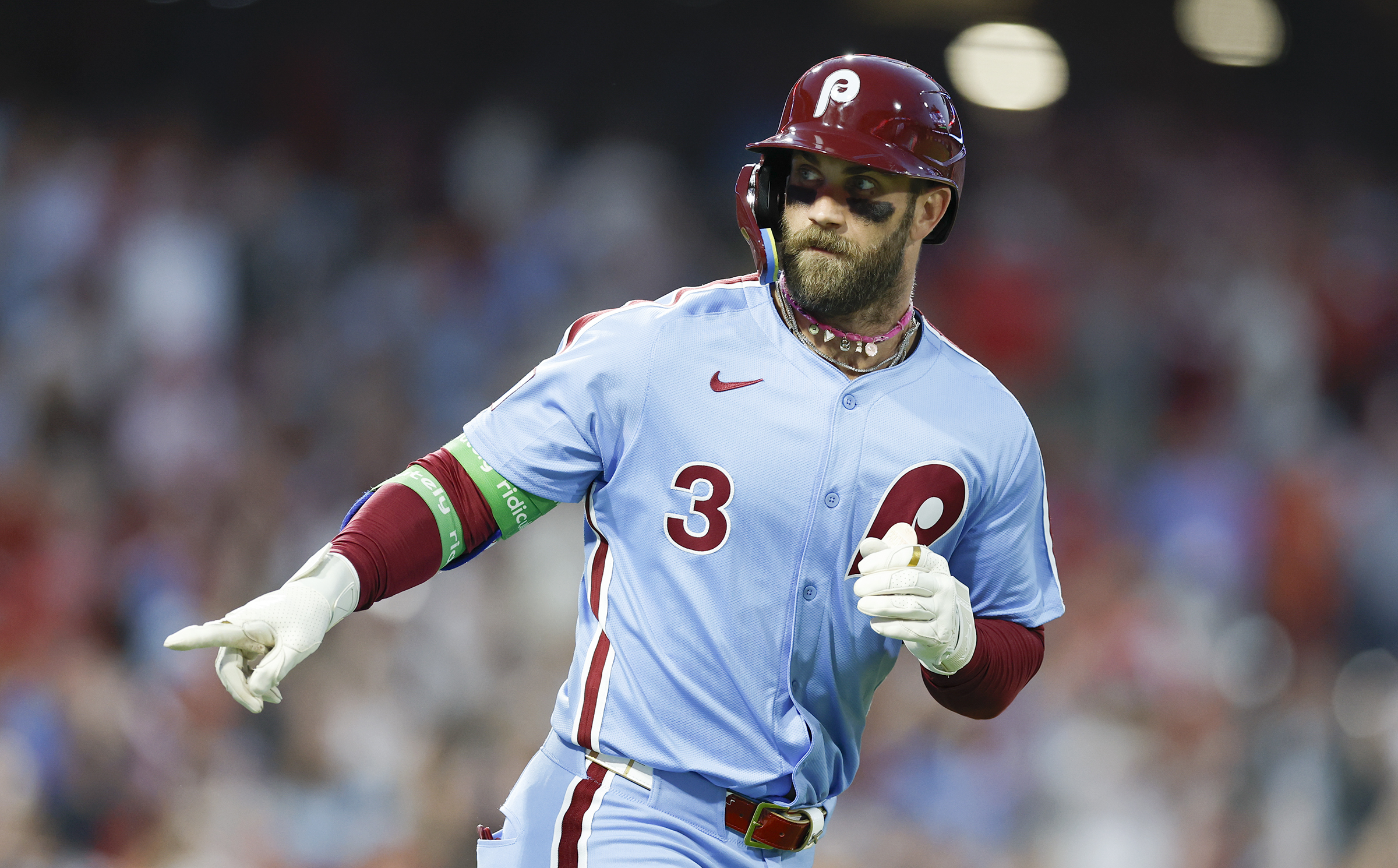
Bryce Harper finished with an .844 OPS last season, 11th among qualified National League hitters.
But there are tangible things that Harper can improve.
Start here: Harper swung at 35.6% of pitches out of the strike zone last season, 129th among 144 qualified hitters, according to Statcast. Not only was it worse than the league average (28.4%) but also his career mark (29.3%).
Harper was hampered in the first half of the season by an inflamed right wrist, which eventually sidelined him for 23 games. And he did still finish with an .844 OPS, 11th among NL hitters who qualified for the batting title.
Not bad. Just not … elite.
There’s that word again.
“He expanded a little bit more than we’re accustomed to,” hitting coach Kevin Long said in November on Phillies Extra, The Inquirer’s baseball podcast. “I don’t know what his actual chase rate ended up being, but it was probably 35%. That’s high. If he gets that number down to 32, just drop it 3%, now he’s swinging at better pitches, [and] he’s going to do more damage.”
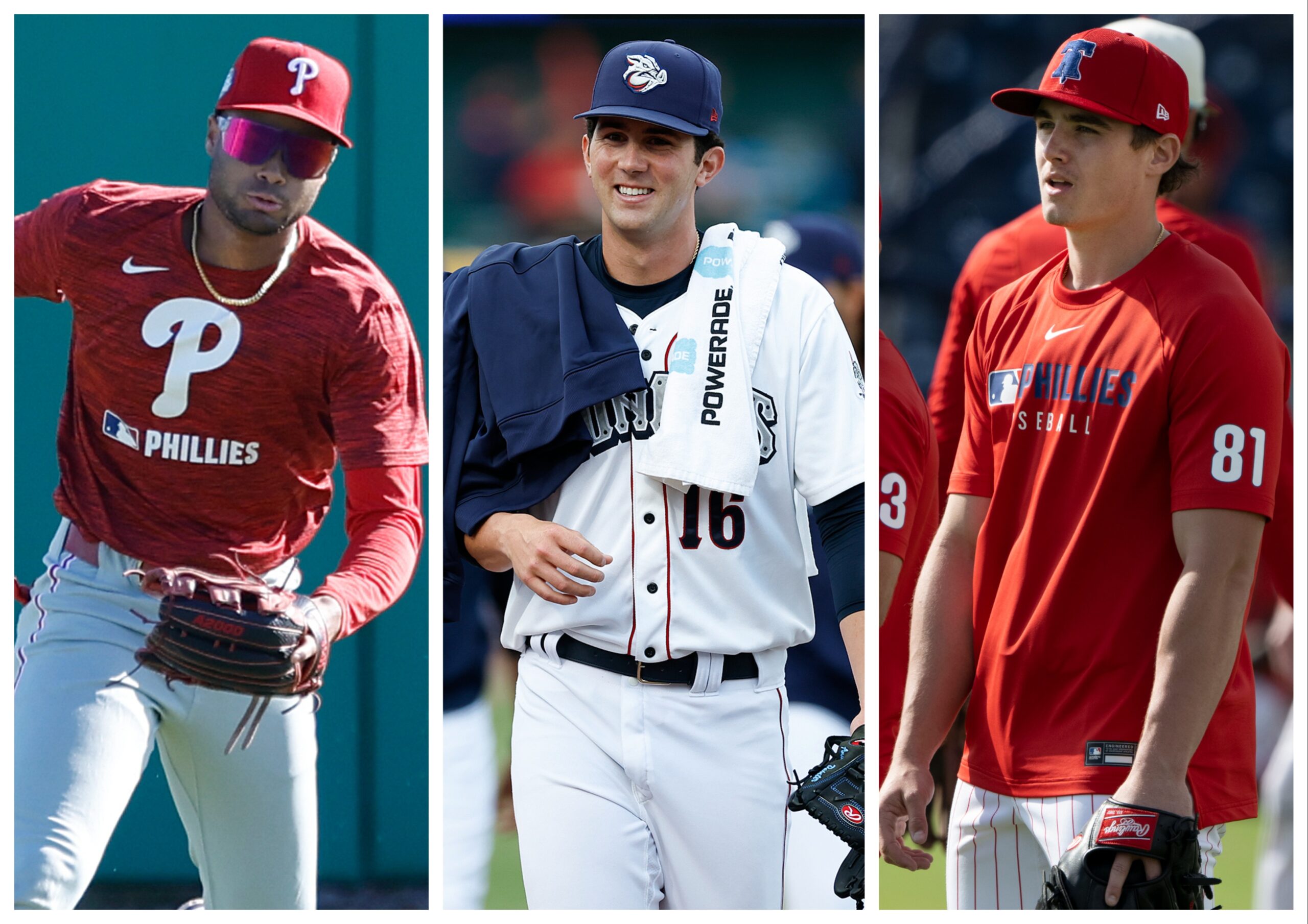
Justin Crawford (left), Andrew Painter, and Aidan Miller are among the Phillies’ top prospects.
Will the kids be all right?
The Phillies had 12 players make their major league debuts in the last three seasons — fewer than any team, based on FanGraphs research.
That’s about to change.
Barring a spring training from hell, Justin Crawford will be part of the Phillies’ opening-day outfield, likely in center, on March 26 against the Rangers. There’s a decent chance Andrew Painter will be in the season-opening rotation, especially if Wheeler misses the first few weeks.
And if infielder Aidan Miller plays well for a few months in triple A, he could accelerate the Phillies’ timetable to call him up.
The existing core is aging, though not yet old. Harper and Schwarber will play at 33 all season; Turner and Aaron Nola will turn 33 in June. And if this is the year that the Phillies finally scale the October mountain, their stars will have led the charge.
But it’s imperative that the Phillies’ trio of top prospects graduate to majors and provide at least as much impact, if not more, than the last wave of young players.
“I’ve said this all along, and I still believe this: We need to start working our young players into our [roster],” Dombrowski said last month. “We have good young players, and we’ll be better for it. I do think that good organizations can blend young players with veterans.”
Speaking of the Phillies’ previous youth brigade, Stott and Marsh finally got better results at the plate last season after making midyear changes. Stott hit .294 with an .855 OPS after the All-Star break; Marsh batted .303 with an .836 OPS after a hitless April. Can they build on that success?
And will reliever Orion Kerkering bounce back from his devastating season-ending throwing error?
File them away among the subplots in the Phillies’ 2026 soap opera.
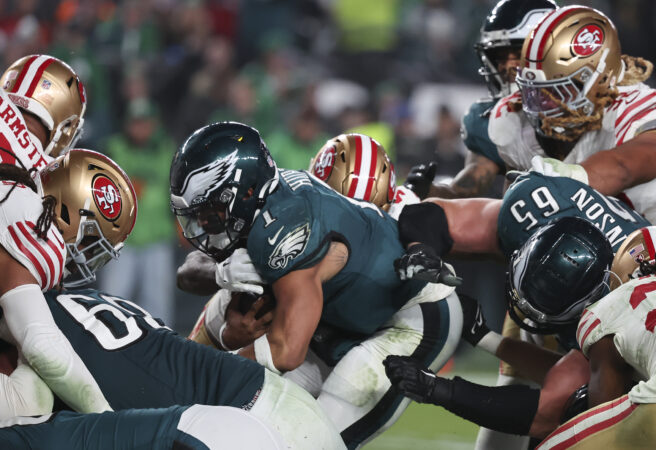
After finishing the regular season with an 11-6 record, the Eagles are preparing for the first round of the NFL playoffs, where they’ll will host Christian McCaffrey and the San Francisco 49ers in what is expected to be a windy wild-card matchup.
Here’s how those in the local and national media are predicting Sunday’s game …
Inquirer predictions
As always, we start with our own writers. Here’s an excerpt from Jeff Neiburg’s prediction:
To see what our other beat writers are expecting from this NFC playoff matchup, check out our full Eagles-49ers predictions here.
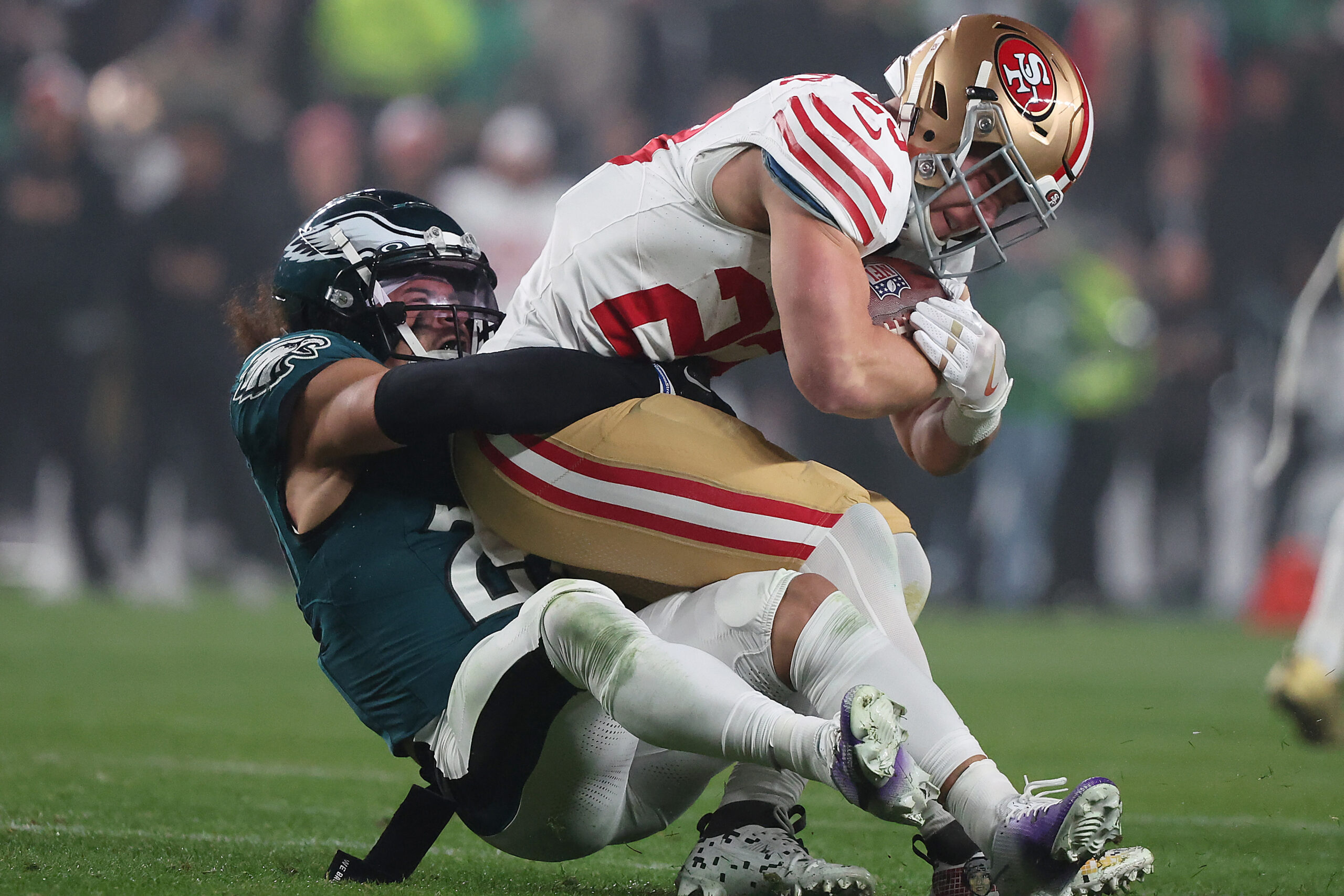
Eagles safety Sydney Brown (left) tackles 49ers running back Christian McCaffrey during the two teams’ last meeting at the Linc in 2023.
National media predictions
Here’s a look at who the national media is picking for Sunday’s game …
ESPN: Six of nine panelists are picking the Eagles to win and advance.
CBS Sports: CBS Sports is also leaning toward the home team, with four of seven experts choosing the Birds.
USA Today: In a clear sweep, all six panelists like the Eagles Sunday.
The Athletic: They turned their picks over to a panel of 11 NFL insiders — coaches and high-ranking executives — and the majority (six) think the 49ers will upset the Eagles.
Bleacher Report: Bleacher Report picks against the spread, and their crew is leaning toward the 49ers, with five of seven analysts taking the away team and the 4.5 points they’ll be getting from the Eagles.
Yahoo! Sports: Frank Schwab has the Birds beating the Niners, 20-14.
Sporting News: Vinnie Iyer is picking the Eagles to win, 23-20.
Sports Illustrated: Six of the 10 MMQB writers have the Eagles advancing past the 49ers, and two (Gilberto Manzano and Andrew Brandt) have the Birds advancing to the Super Bowl, with Brandt picking them to win.
But another recent announcement seemingly sent people over the edge. For the first time in the history of the tournament, FIFA will charge fans to attend its fan festivals across many of the 16 cities in North America selected to host games in the monthlong tournament.
And while that has been made public for at least one of the hosts, general admission to Philly’s fan festival, scheduled for June and July on the grounds of Lemon Hill Mansion in the Brewerytown section of the city, will remain free, according to Philadelphia Soccer 2026, the committee responsible for the planning and execution of Philly’s tournament footprint.
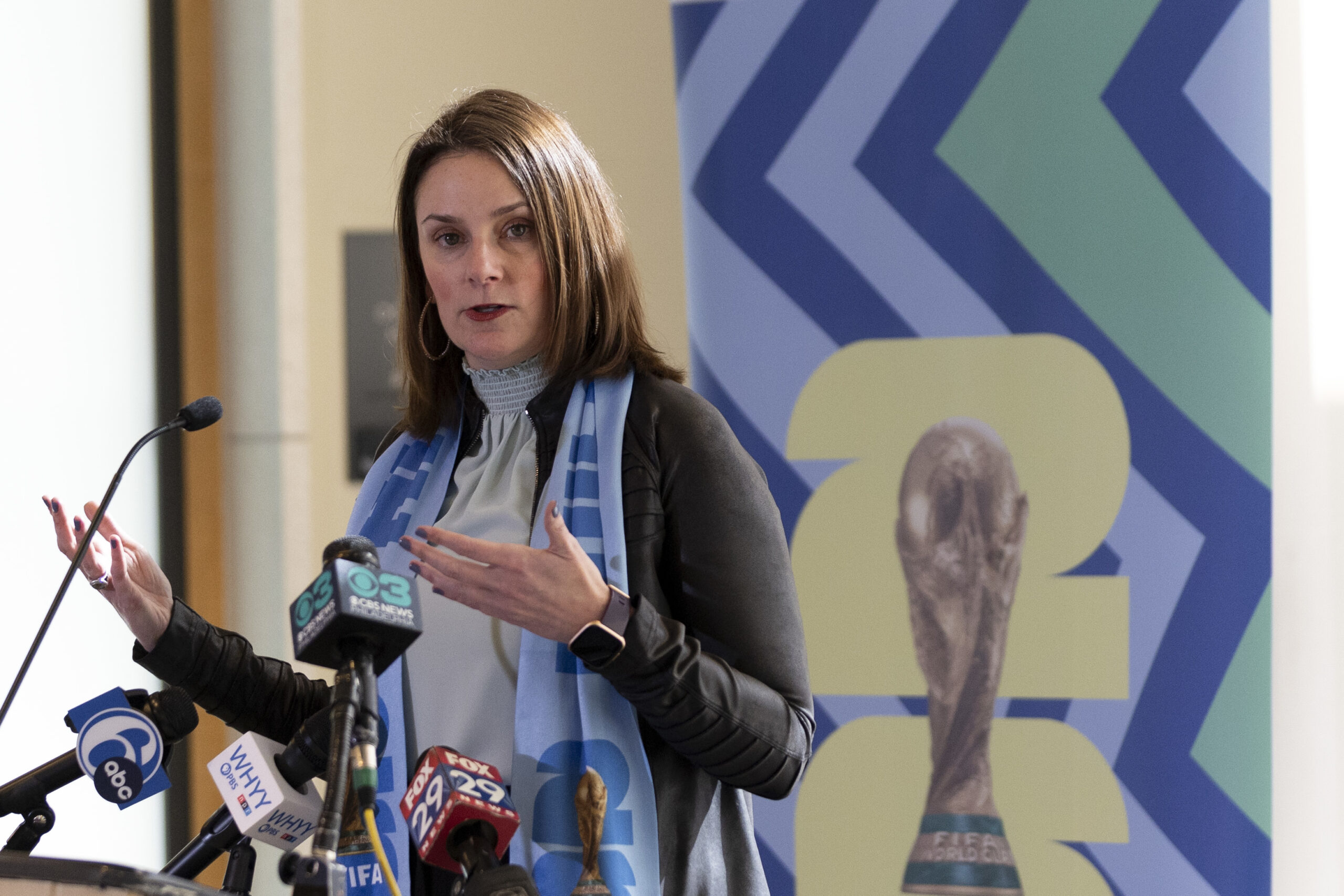
Meg Kane, host city executive for Philadelphia Soccer 2026, said Philly’s version of FIFA’s Fan Fest will remain free, as the event is “committed to making sure every fan can share in the excitement.”
“Since our selection as a host city in 2022, Philadelphia Soccer 2026 has remained committed to making sure every fan can share in the excitement, culture, and community of this generational sporting event,” Meg Kane, host city executive of Philadelphia Soccer 2026, said in a statement to The Inquirer on Wednesday.
“Essential to that commitment, we made the decision to offer free general admission to FIFA Fan Festival at Lemon Hill, ensuring an inclusive and welcoming environment where fans from all backgrounds can come together to celebrate the world’s game.”
While general admission will remain free for the scores of fans who are expected to descend upon Philly over the course of five group matches and a massive round of 16 game on July 4, there will be “optional VIP experiences,” including expedited entry into festival grounds, and are expected to be available for purchase at a later date.
Kane’s announcement mirrors that of other cities, such as Kansas City and Vancouver, which also have stated their intention to keep admission free for their events.
But when the news of potential fees at fan festivals initially landed, it certainly didn’t appear that would be the case.
Amid the news that FIFA plans to charge for its fan festivals, it was overlooked that only one delegation has formally announced its intent to charge an upfront entrance fee.
In fact, a spokesperson with knowledge of the proceedings told The Inquirer that any intention to add a fee to the festivals was not a blanket decision made by FIFA as soccer’s world governing body; instead, it is left to host city committees to decide.
A FIFA spokesperson confirmed this and added on Thursday that while some host city delegations have begun relaying their fan festival plans, “FIFA will communicate the full suite of details [for all 16 host cities] in the first quarter of 2026,” where, in addition to what’s to come at those sites, announcements of which ones might consider charging a fee will be made public.
Artists rendering of what Philadelphia’s 2026 World Cup fan fest site at Lemon Hill will look like.
“From the outset, FIFA has worked closely with host cities and local stakeholders to help shape meaningful fan experiences beyond the stadiums that are community-led, fan-oriented and aligned with the spirit of the FIFA World Cup,” a FIFA spokesperson said in a statement to The Inquirer. “It is important to recognize that there is no one-size-fits-all model for fan engagement across a tournament of this scale.”
FIFA’s spokesperson also noted that “fan experiences can take many forms — from large-scale gatherings to more decentralized, community-driven activations,” which dovetails into the preliminary plan of attack of the New York-New Jersey delegation, which isn’t viewing its overall fan engagement strategy as hosted at one large site, but several.
For soccer fans planning a trip for the World Cup final or New Yorkers who can’t afford it but want in, tickets are available for New York’s main fan festival at Liberty Park via Ticketmaster for $12.50.
But there’s a methodology at play here.
According to a host city committee official, the move isn’t as much a revenue driver as a crowd management strategy designed to regulate capacity and effectively coordinate staffing, security, and transportation.
Essentially, by putting a limit on the number of people expected to descend upon the area to watch a series of matches in June and July, the Liberty Park fan festival can be capped at a number, one anticipated to still be in the tens of thousands, daily.
To accommodate a global population, the delegation plans to bring in a scaled-down version of its festival, termed as “fan zones,” into all five New York boroughs. The first two have already been announced: Rockefeller Center in Manhattan will host a “fan village,” as will the Billie Jean King National Tennis Center, the home of the U.S. Open in Queens.
The grounds of the Billie Jean King National Tennis Center will also be utilized as one of five FIFA World Cup “fan zones” across New York’s five boroughs in addition to the Liberty Park Fan Festival on the banks of the Hudson.
More are expected to be announced later, and the fan village at Rockefeller Center will be free to attend. As of now, New York-New Jersey is the only host city committee planning fan experience that’s not situated in a single location.
“New York-New Jersey is building a regional fan experience unlike anything seen in World Cup history,” Alex Lasry, CEO of the New York-New Jersey host committee, told The Inquirer. “We’re proud to have announced three official NYNJ Host Committee fan experiences that will bring the World Cup far beyond the stadium.
“These spaces are essential to the World Cup experience, creating accessible and affordable places for people to come together and experience the biggest games in one of the world’s most iconic venues. And this is just the beginning — we look forward to announcing additional fan engagement opportunities so the entire region can feel the impact of the World Cup.”
Frosted vegan pop-tarts, swirls of dairy-free soft serve, and meatless bacon-egg-and-cheese croissants have officially arrived in East Falls.
Crust Vegan Bakery opened Thursday at the intersection of Ridge and Midvale Avenues, just off Kelly Drive. The move from its two-space operation in Manayunk to a larger location enabled the confectionery to consolidate its retail storefront and commercial kitchen, said owner Meagan Benz.
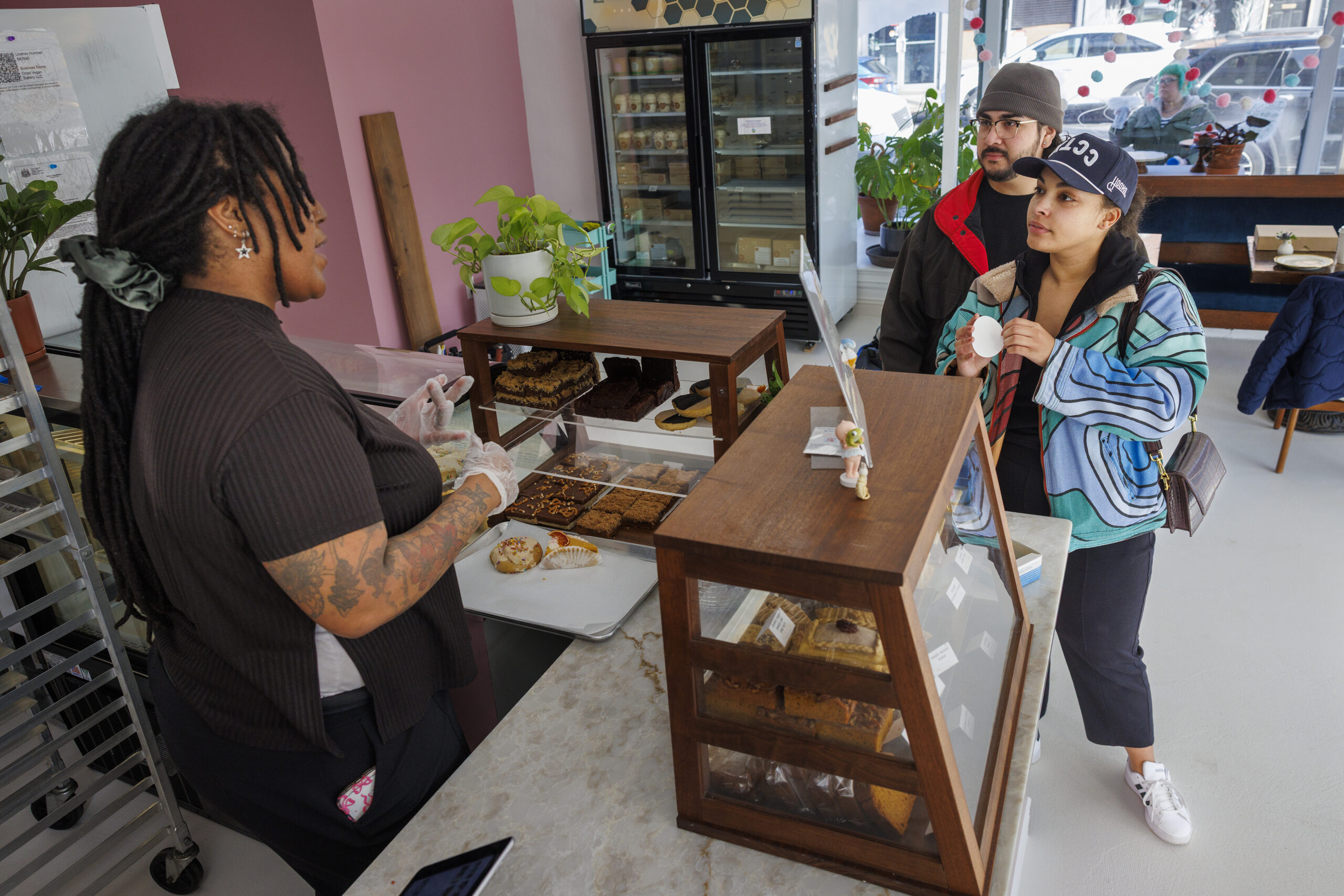
Benz spent more than nine months transforming a 3,000-square-foot office along the Schuylkill River into what she called a “cakelike retail space” with baby-pink walls piped with white paint and ceiling tiles modeled after Lambeth-style cake trims. Light from oversized front-facing windows dapple a trio of pastry cases filled with batches of all-vegan sweets, from cheesecake slices and cinnamon buns to black-and-white cookies and crumb-coated coffee cakes. Baristas-slash-bakers pull espresso shots and whisk matcha for lattes sweetened with house-made syrups.
“I wanted to create a place where people think, ‘Oh, I can get everything I need there,’” Benz said.
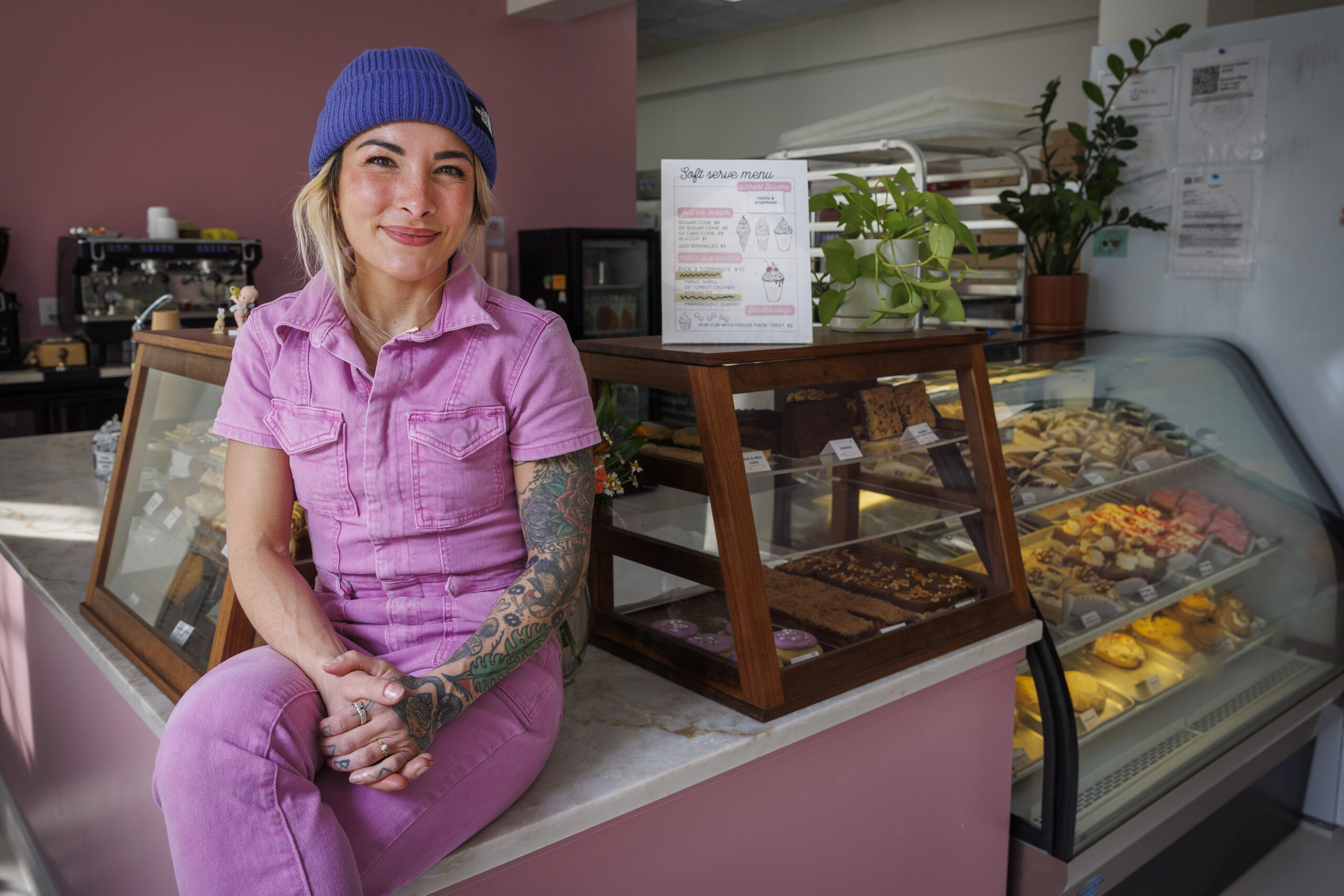
Crust Vegan Bakery owner Meagan Benz with a display case of treats on opening day Jan. 8 at the bakery’s new location at 4200 Ridge Ave. in East Falls. Crust moved there from Manayunk.
Benz, who went vegan in 2009 while a freshman at University of North Carolina Greensboro, launched Crust in 2015 as a wholesale vegan bakery out of a commissary kitchen at 220 Krams Ave. in Manayunk. When custom cake and wholesale orders dried up almost overnight in 2020, she and then-co-owner Shannon Rocheopenedtheir storefront at4409 Main St.as a way to keep on staff they would’ve otherwise had to lay off during the pandemic, a move Benz said ended up making Crust profitable enough to bring on more employees.
“Retail is where we make more money,” said Benz, 35.
Now, the business has outgrown the satellite storefront that saved it.
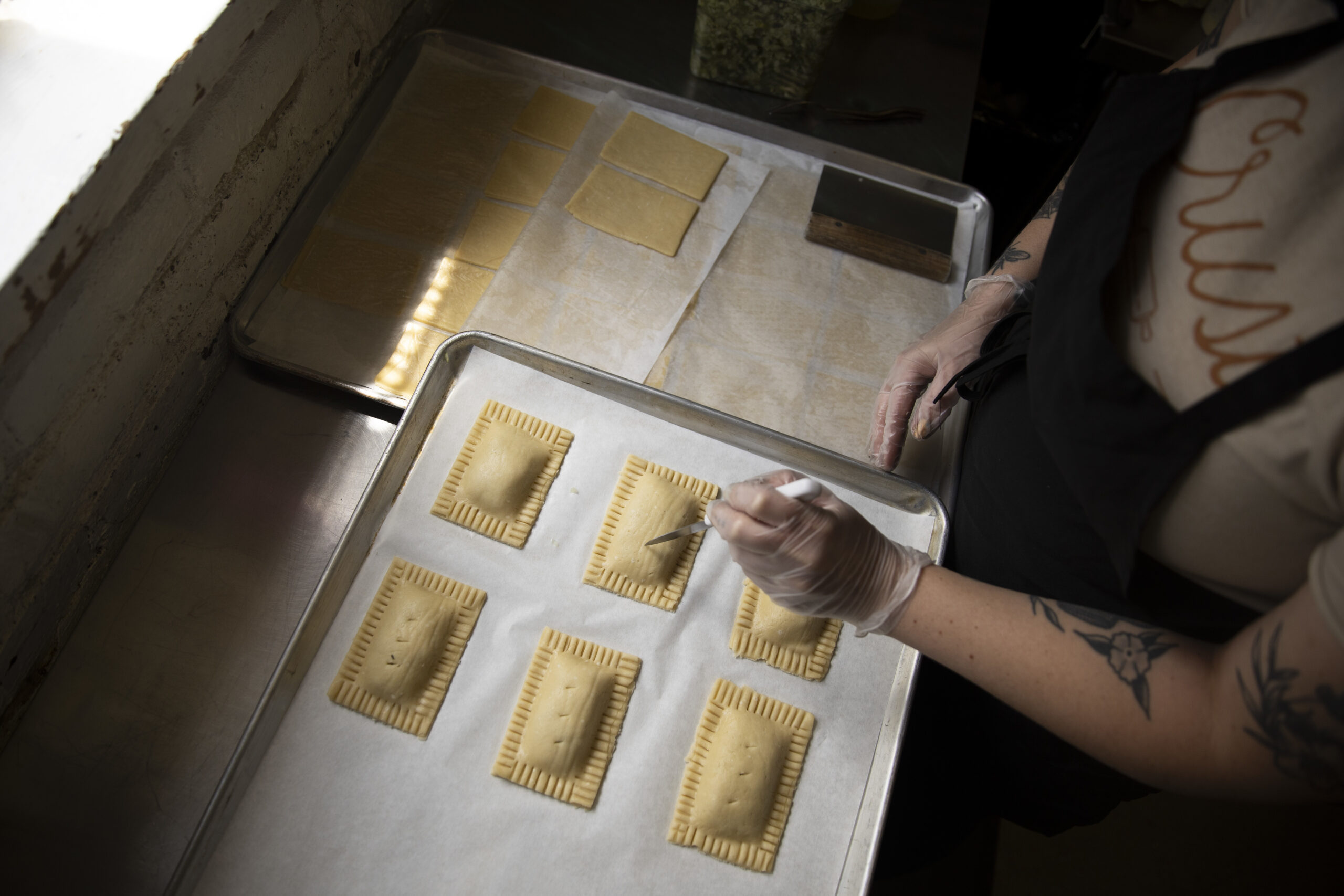
Jordan Fuchs prepares pop-tarts at Crust Vegan Bakery’s former commercial kitchen space on Krams Avenue.
Splitting time and staff between the retail space and commercial kitchen proved logistically challenging. Benz said Crust’s storefront manager wound up spending most of her time ferrying pastries between locations, a half-mile journey that led to lots of wasted product.
“It was a really short distance, but people drive crazy — someone slams on the brakes in front of us and we’re done for,” Benz said. “We had many times where things would tip over and we’d have to determine if it was still usable.”
At Crust’s new location, a sparse yet cozy cafe area with two tables and a large, lived-in green couch bleeds into the kitchen, where staff pivot from packaging cakes and swirling soft-serve cones to frosting pop-tarts. The streamlined setup has allowed Benz to dream big. Already on her wish list for the future: a separate convection oven for made-to-order breakfast sandwiches, a back room for cake-decorating classes, and more room for colorful displays.
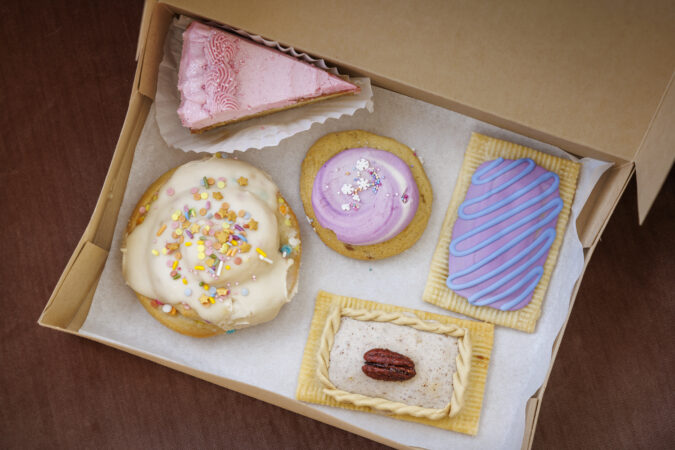
A brown sugar pecan pie pop-tart, soft frosted cookie, and vanilla strawberry cake from Crust Vegan Bakery are plated next to a hot latte. Beverages are new to the bakery.
Benz spent two years looking for the right location, unwilling to compromise on a short list of non-negotiables. Most of the bakery’s 15-member team live in Northwest Philly, she said, so the new space needed to remain in the area while being more transit-accessible.
Crust’s new location sits at the convergence of five bus lines. It also will leave Manayunk without a pastry specialist when Crust’s former commercial-kitchen neighbor Flakely decamps for Bryn Mawr in February.
Taleema Ruffin takes an order from Chase Sanders and Ryan Martinez-Peña, of East Falls, at the counter of Crust Vegan Bakery’s new location at 4200 Ridge Ave. on opening day, Jan. 8, 2026.
Crust’s move also marks the launch of its first-ever coffee program, headed by cake decorator-turned-beverage coordinator Jordan Fuchs.
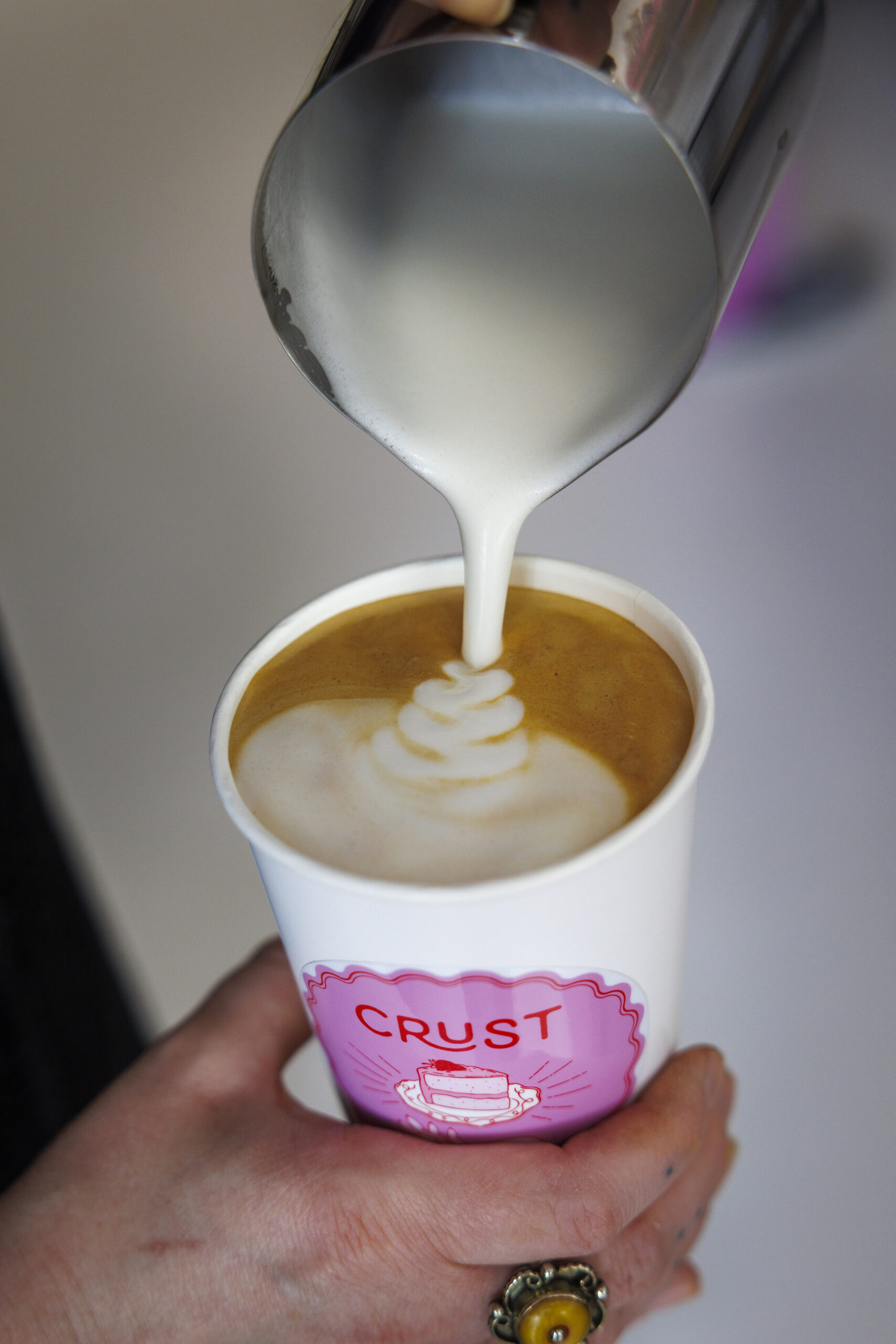
The bakery will serve a short but sweet menu of coffee and tea drinks, with beans and matcha sourced from Rise Up Coffee, a fair-trade roaster based in Maryland. Crust makes its own vanilla and mocha coffee syrups, and Fuchs has plans for a rotating menu of seasonal additions. The signature drink will be a black sesame latte, Fuchs said, and she’s currently perfecting a chocolate-covered strawberry latte in time for Valentine’s Day.
Jordan Fuchs pours a rosetta on top of a hot soy latte inside Crust Vegan Bakery. Its new retail space in East Falls has enabled the bakery to start a beverage program.
Crust will also continue selling two things Benz said many of her vegan customers desperately miss from their dairy-consuming days: soft-serve ice cream and hulking breakfast sandwiches.
Benz’s breakfast sandwiches are served on flaky vegan croissants or thick biscuits, both made in-house, with Just Egg patties and seitan bacon that crisps up like the real thing.
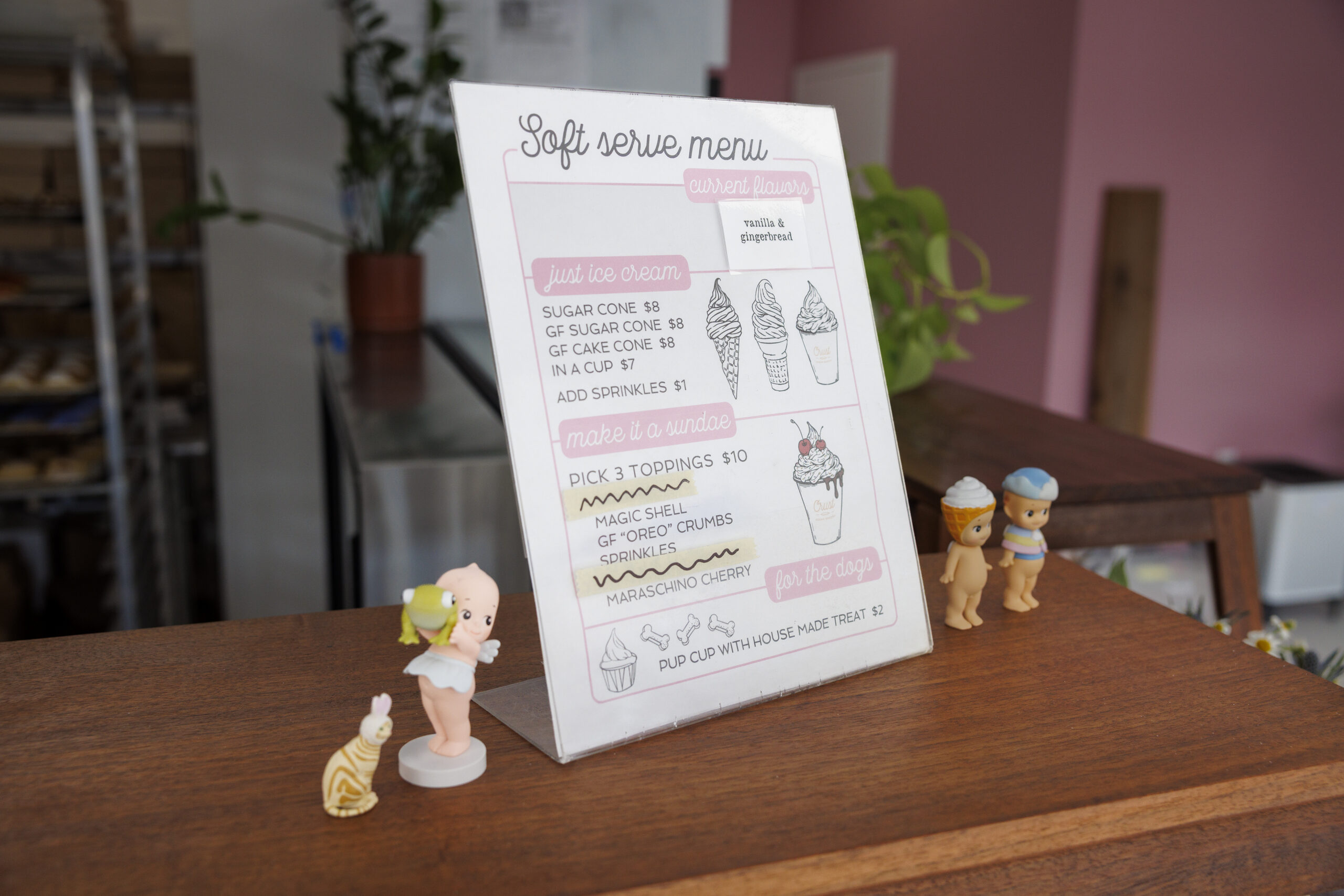
The bakery started offering nondairy soft serve year-round in 2023, Benz said, as a way to satiate her own craving. Crust uses a vanilla base made with pea protein and then adds mix-ins for flavors that rotate every two weeks. The ice cream is silky, and curls out of the machine with the flourish of a Dairy Queen swirl. It’s sweet, but doesn’t quite capture the essence of its full-dairy counterpart; Benz said that’s the point.
“If our ice cream doesn’t exactly taste like dairy ice cream, that’s OK,” she said. “I just want it to taste really good.”
Crust Vegan Bakery’s dairy-free soft serve menu, which is offered year round and includes toppings.
Pastries are still the main event at Crust’s new location. The bakery’s staff make roughly 22 dozen pop-tarts a week, with some bakers spending a full eight-hour shift solely on rolling out dough, preparing fillings, and sealing the edges for baking. To make the process smoother, Benz made a custom crimping tool that creates cartoonishly perfect hash marks. Her favorite flavor is the wild berry, a dead ringer for the purple-frosted Kellogg’s version.
Also on offer: slices of sweet potato, Oreo, blueberry lavender, and funfetti cheesecakes (gluten-free and vegan) that take up a pastry case’s entire top shelf. The secret to Benz’s recipe is Tofutti cream cheese, which is versatile enough to be customizable and easily whipped into a dairy-accurate texture.
“I make a lot of things because I want them, I miss them,” Benz said. “Then I hope other people do, too.”
A display case of vegan cheesecake, cake slices, and cinnamon buns inside Crust Vegan Bakery’s new location at 4200 Ridge Ave. in East Falls.
Crust Vegan Bakery, 4200 Ridge Ave., Philadelphia, 215-298-9969. Hours: 10 a.m. to 6 p.m. Wednesday and Thursday, 8 a.m. to 8 p.m. Friday and Saturday, 8 a.m. to 6 p.m. Sunday.
The University of Pennsylvania, German biotech firm BioNTech, and Osage University Partners, a Bala Cynwyd venture capital firm, have formed a $50 million fund to back early-stage life sciences startups at Penn, the partners announced Friday.
The announcement came on the eve of the much-hyped annual J.P. Morgan Healthcare Conference in San Francisco, which starts Monday. The conference has become a way to measure the mood of the biotech sector, which has slumped after investment peaked in 2021. It’s been particularly difficult for early-stage biotech companies to raise money in recent years, according to a recent J.P. Morgan report.
For Penn scientists and company founders, the so-called Penn-BioNTech Innovative Therapeutics Seed Fund, or PxB Fund for short, will step into that gap. It is designed to invest in companies that are developing new therapeutics, diagnostics, and research tools.
The announcement did not include a breakdown of how much money each of the three backers provided. Osage University Partners, which has $800 million under management and had previously invested in at least 10 Penn spinouts, will run the fund.
“Penn has a remarkable track record of creating cutting-edge startups,” Marc Singer, an Osage managing partner, said in a statement.
Penn was among the first six universities Osage partnered with 15 years ago when it started investing in spinouts from research universities, while allowing the institutions to share in some of the profits. This was at a time when few universities were investing in their own startups.
Penn’s evolution as an investor in its own startups
For Penn, that began changing about a decade ago. The university’s first investment in one of its own faculty-member spinouts came in 2016, when it invested $5 million in Carl June’s Tmunity Therapeutics. In 2018, Penn Medicine agreed to invest an additional $45 million in Penn biotech companies over three years in conjunction with outside funds.
In December, Penn announced a $10 million fund that will make seed investments of up to $250,000 in companies that have at least one founder affiliated with the University of Pennsylvania. That fund is for the entire university, not just life sciences.
PxB is another part of what John Swartley, Penn’s chief innovation officer, called in an interview Friday a “constellation of different support structures and funding sources that our companies can draw upon in order to advance their opportunities and agenda.”
Anna Turetsky, a biotech investor in New York who received her undergraduate degree at Penn and has a doctorate in biophysics from Harvard University, has joined Osage and will serve as PxB’s general partner.She said PxB is a 10-year fund and is expected to build a portfolio of around 15 companies in the early years.
“Part of why this is a fantastic time to start this fund is that there has been a gap in venture funding for early stage startups over the last few years. Everyone wants to see clinical data these days,“ Turetsky said. If that continues, ”then in a few years, there will be no early-stage clinical companies,” she said.
Germany’s BioNTech, which partnered with Pfizer on one of the COVID-19 vaccines that used mRNA technology developed at Penn, will use the fund to deepen its longstanding ties to Penn researchers.
Philadelphia’s place in biotech
Some observers of Philadelphia’s biotech sector have lamented the relative lack of local investors, which are abundant in places like Boston and San Francisco and have helped turn those metro areas into leading innovation centers.
Quaker BioVentures was a local investment fund that raised $700 million in the early 2000s to buy into biotech firms in Philadelphia and elsewhere, but was not successful for its investors, which included Pennsylvania state pension funds.
Others, when asked why the Philadelphia region trails Boston, San Francisco, and San Diego, as a biotech hub, point to the need for a deeper pool of management talent.
“Part of our hope with the fund is to create some companies, start from scratch, take technology, find management teams, start them in Philadelphia. Hopefully, that will create a new crop of managers,” he said.
Philadelphia-based Iron Stone Real Estate Partners transferred control of two of their former Hahnemann University Hospital properties in the last two weeks.
The investment group acquired a portfolio of Hahnemann properties in 2021 and began redeveloping them into laboratory and office space.
But in recent weeks Iron Stone disposed of two of these properties.
The company donated the New College Building at 245 N. 15th St. to Drexel University on Dec. 31.
“It’s a charitable donation,” said Jason Friedland, director of operations and investments at Iron Stone. “We felt that that building was best served with Drexel owning it and using it for a long time, long-term, for their research.”
When Iron Stone acquired the New College Building five years ago, Drexel occupied the property’s medical labs and was one of the few remaining tenants in the Hahnemann campus.
Back then the university was considering moving this Center City operation to the suburbs in the short term and to University City in the long term.
“The generous gift will provide the university with flexibility as it continues to consolidate operation of its College of Medicine on its University City campus,” Drexel spokesperson Britt Faulstick said in an email statement. “Plans for the New College Building will be determined in the future.”
On Jan. 6, Iron Stone sold the Broad and Vine Parking Garage at 1416 Wood St. to the Philadelphia Parking Authority for $21.3 million.
The 850-space garage had been exclusively for Hahnemann’s use. Iron Stone renovated the vacant garage after the bankruptcy and hired Metropolis Technologies — the largest parking operator in the United States — to run it.
The acquisition is the first time the Parking Authority has purchased a garage built by someone else, said Rich Lazer, executive director of the Parking Authority.
“Most of our garages, outside of the airport, are Center City-based, so its nice to push out onto North Broad,” Lazer said. “Our garages are lower cost than private garages, so it’ll help us maintain reasonable pricing.”
The authority plans to retain Metropolis Technologies as the operator, Lazer said.
Iron Stone still owns a couple former Hahnemann properties, including the 120,000-square-foot Race Street Laboratories at 1421 Race St. and the 15,000-square-foot building at 231 N. Broad St., which is fully leased by Bayada Home Health Care Inc. with a third of the space and Dynamed Clinical Research with the rest.
Race Street Laboratories was developed to tap into the life sciences and biomedical market, which boomed during the pandemic but has slowed substantially as interest rates spiked. Currently the building has only one tenant, Sbarro Health Research Organization, with 7,500 square feet of space.
Friedland said Iron Stone plans to move its headquarters from University City’s FMC Tower to one of Race Street Lab’s unused floors.
As for the rest of the space, Iron Stone is exploring alternative uses as the life sciences market continues to struggle.
“We’re seeing where the opportunities are in commercial real estate,” Friedland said. “We have a couple things we’re exploring, but we’re not really in a rush.”
Their plans for an apartment building were complicated by a bill introduced in December by Councilmember Jeffery Young to ban housing from the former hospital site.
But on Dec. 24, in advance of City Council action on the legislation, the developer received zoning permits for a 361-unit apartment complex at 222-248 N. Broad St. Dwight Group says they are nonetheless in negotiations with Young to secure his support.
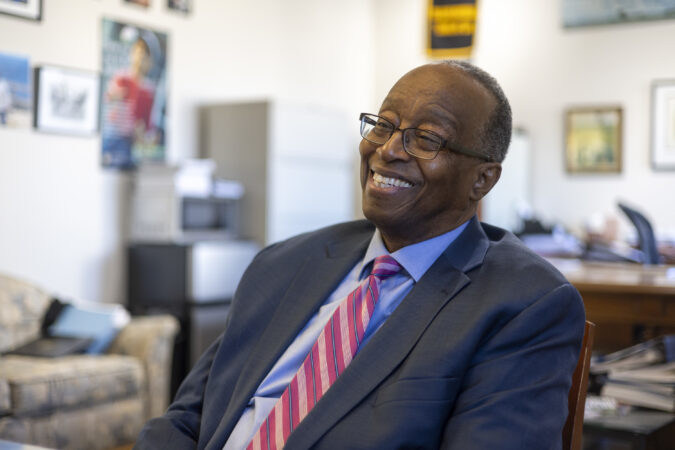
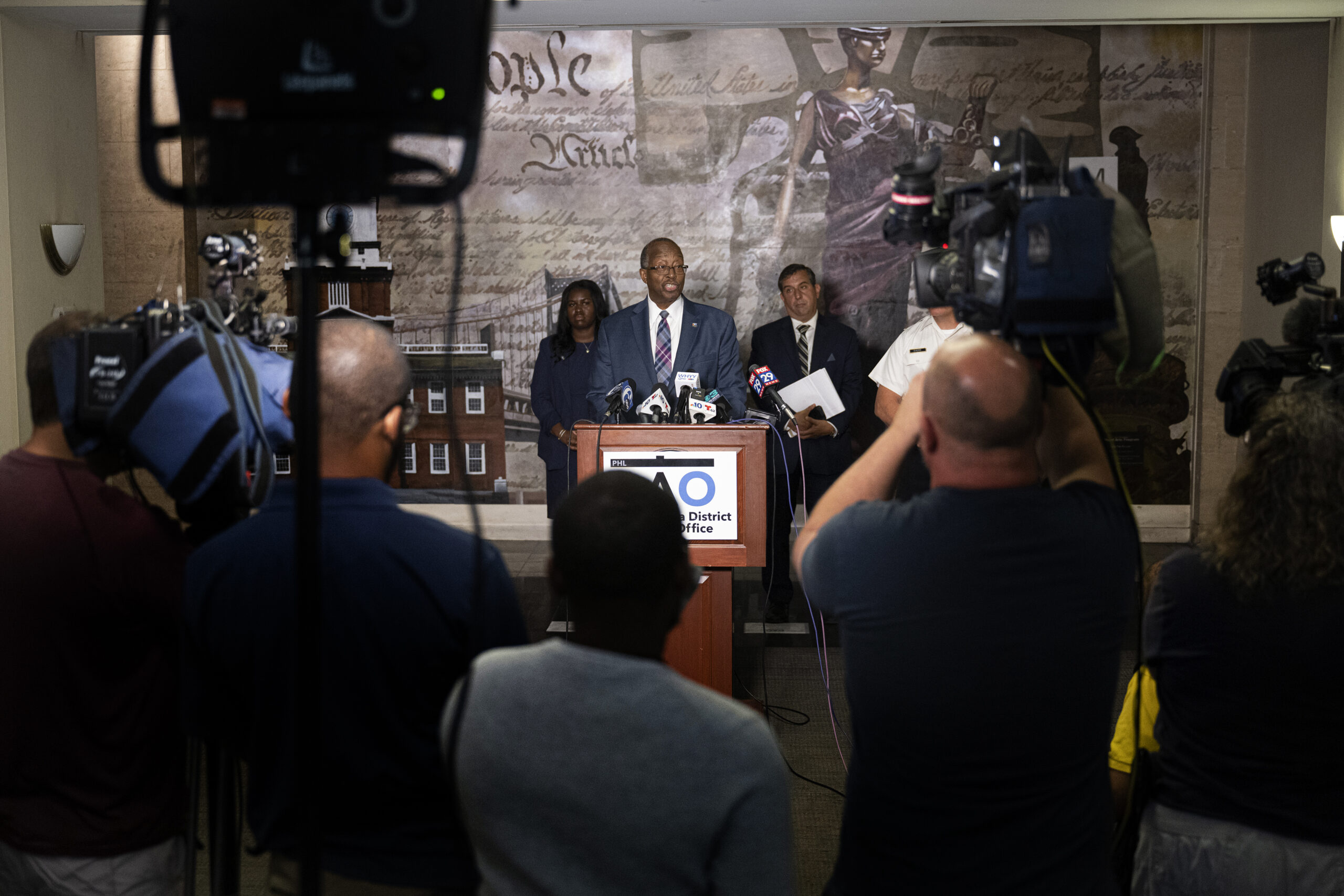
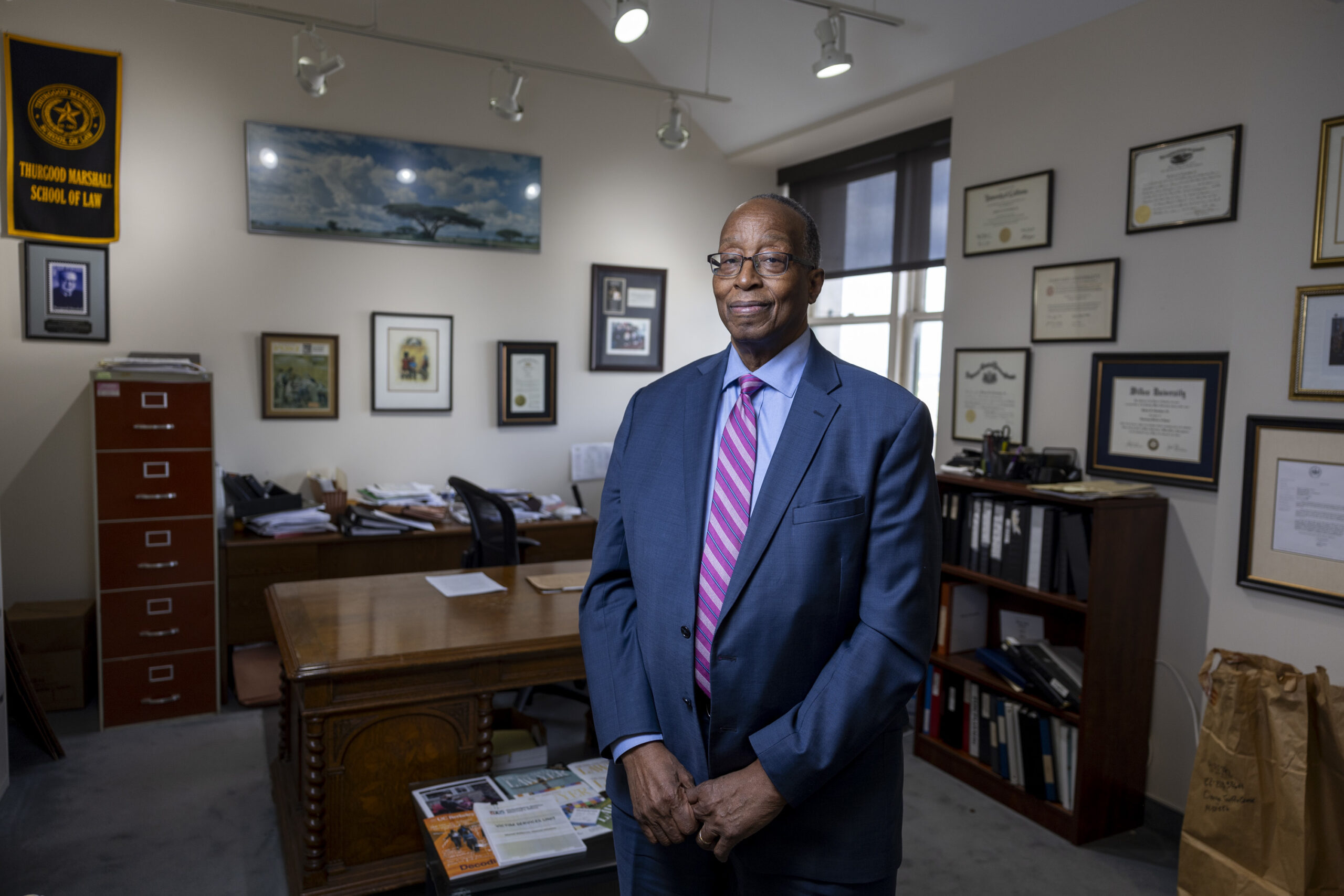
Robert Listenbee, the first assistant district attorney under Larry Krasner and a largely behind-the-scenes enforcer of the office’s progressive agenda, is retiring after nearly eight years as the office’s second-in-command.
Listenbee, 77, is expected to announce Friday that he is stepping down, marking the first shift in Krasner’s leadership team as the top prosecutor begins his third term.
A longtime public defender and juvenile justice advocate, Listenbee joined the administration at the outset of Krasner’s first term in 2018 — even as Krasner openly questioned whether the role of first assistant was necessary beyond its statutory requirement.
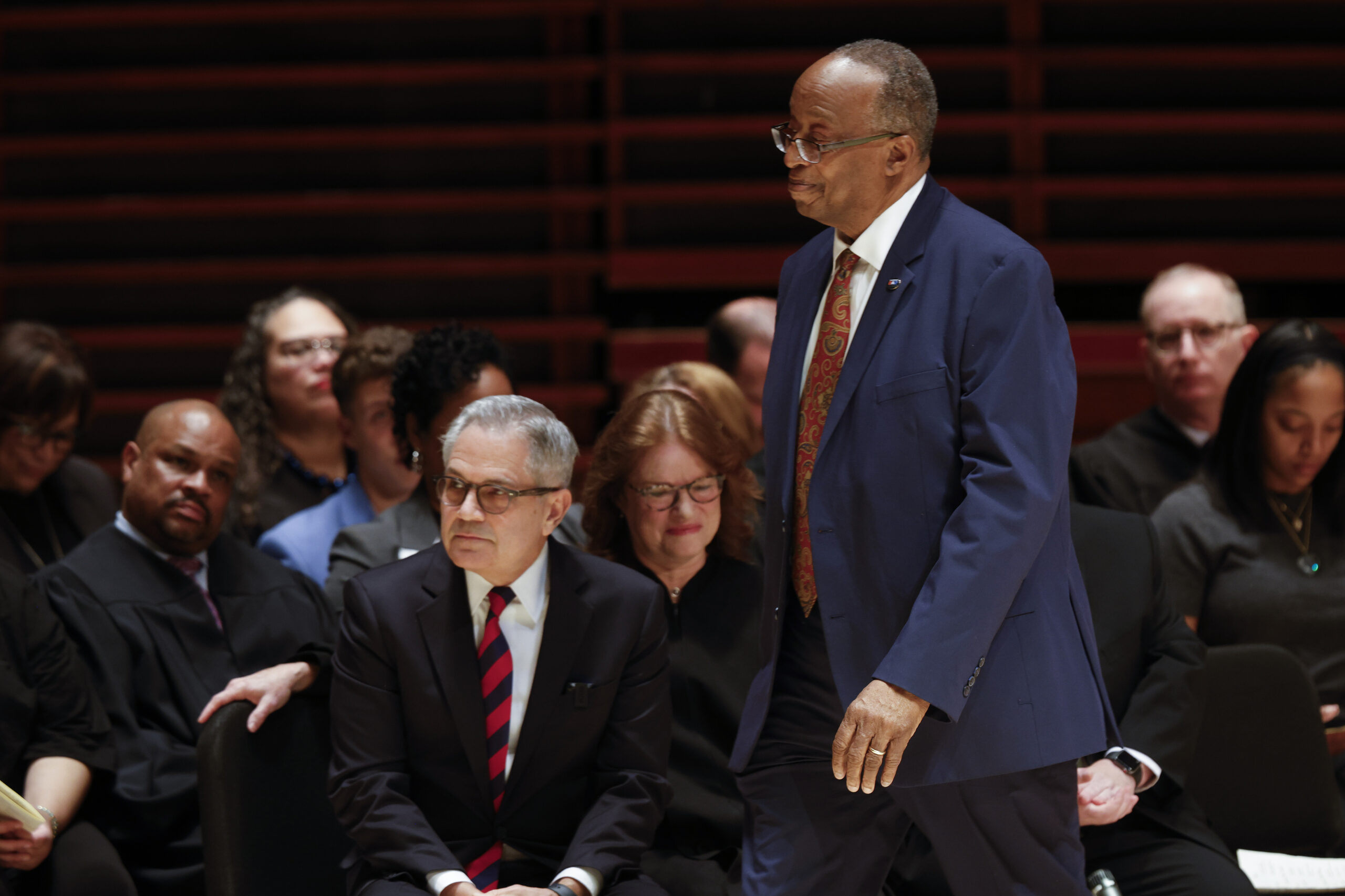
Robert Listenbee joined District Attorney Larry Krasner at the 2026 inaugural ceremony.
Over the course of Krasner’s tenure, Listenbee rarely served as the public face of the office on major cases, focusing instead on juvenile work, recruitment, and personnel matters.
Some prosecutors in the office said that often translated into a lack of visible management compared to previous first assistants, and that he served more as an internal messenger of Krasner’s often controversial agenda than the traditional day-to-day overseer of the office.
Listenbee has said his role was never set up to operate traditionally, and his goal was to carry out Krasner’s vision and reform the office.
Krasner declined to say who might replace him but he said he was evaluating candidates.
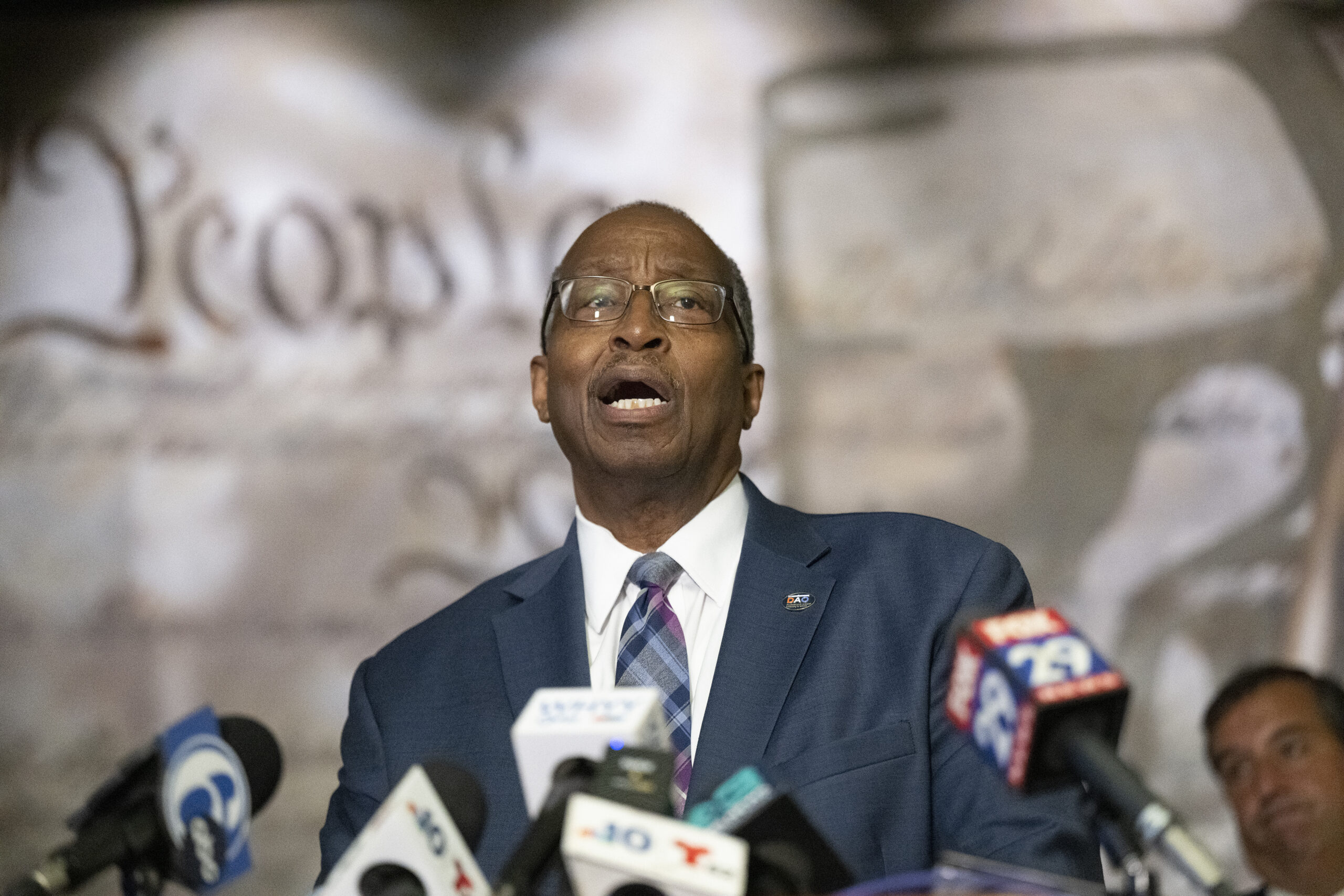
Robert Listenbee, first assistant district attorney, announced developments in the case against a West Philadelphia teen who was planning a terrorist attack.
Before joining the district attorney’s office, Listenbee spent decades as a public defender, including 16 years as chief of the juvenile unit at the Defender Association of Philadelphia. He later led the U.S. Department of Justice’s Office of Juvenile Justice and Delinquency Prevention during the Obama administration, and worked at Drexel University before returning to Philadelphia to join Krasner’s team.
We spoke with Listenbee about his unconventional path to the law, his years reshaping juvenile justice, internal tensions within the DA’s office, and his advice for Krasner’s third term.
This interview has been edited for length and clarity.
Tell me about your life growing up.
I was raised in Mount Clemens, just north of Detroit. My father worked in the auto industry. We were poor and lived in the projects. I went to a public high school, and was the first in my family to go to college.
I came from a small African American community where people look out for one another. This community saw something in me very early. When I was only planning to go to Kalamazoo College, a mom at my school decided my life was going to be different. She contacted the recruiter at Harvard University, and they visited me out in my little home in the projects when I hadn’t even applied. I got a full ride to Harvard.
I was among the first large group of African Americans at Harvard. It was 1966. We were in the middle of the Civil Rights Movement and the Vietnam War.
How was that?
There was total upheaval in this nation. Demonstrations everywhere, college campuses being taken over.
I worked on the committee that helped establish the African American Studies Department at Harvard, one of the first in the nation.
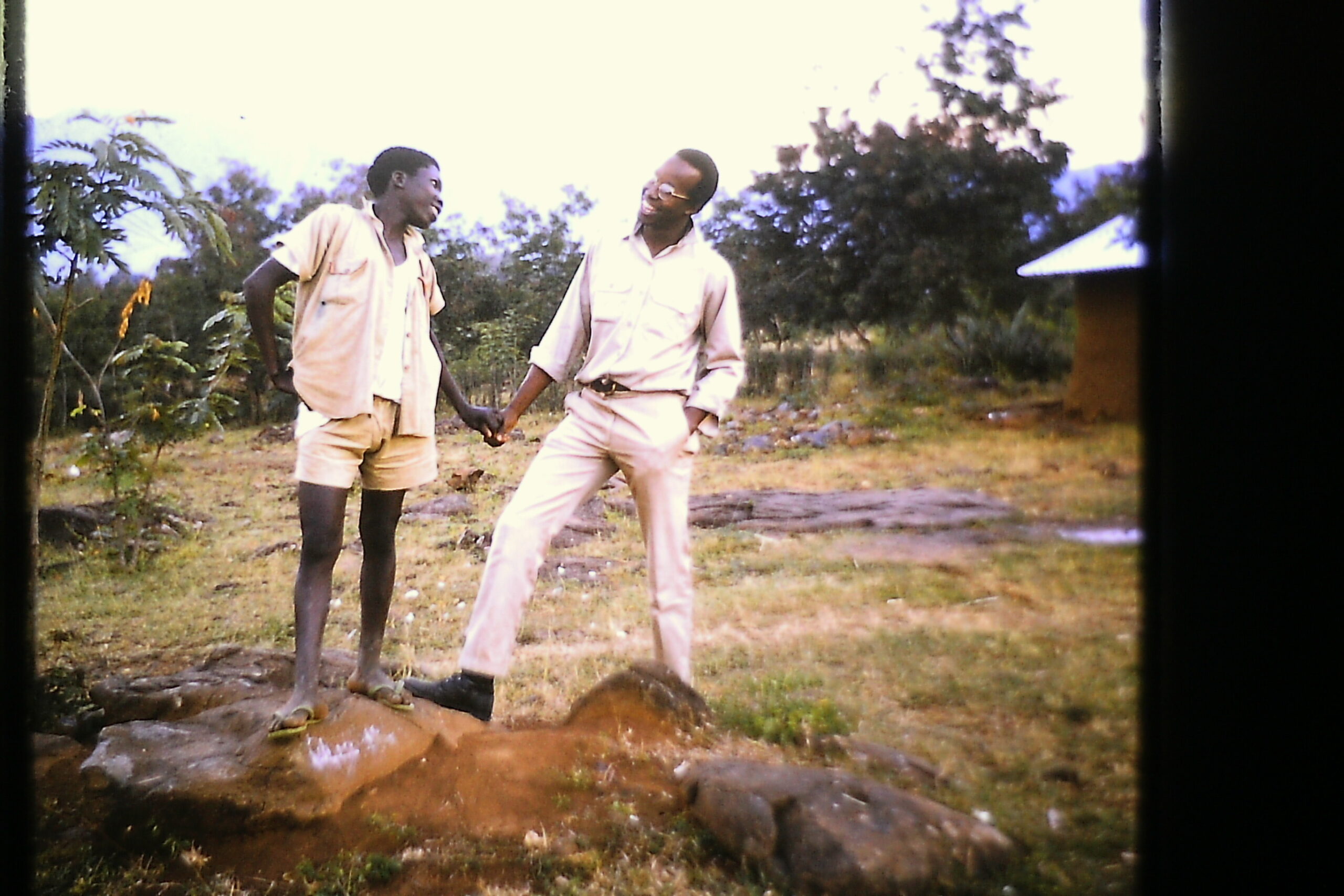
This was also at a time when African countries were becoming independent. I spent 16 months as a teacher in the rural area in western Kenya.
Robert Listenbee spent 16 months in Africa teaching English, and then traveled the continent before going to law school.
Instead of coming back from Africa, I decided to hitchhike around the world. I spent six months in Asia — Thailand, Laos, even as the war was going on. I rode a motorcycle into the Mekong Delta in Vietnam and had experiences that make me grateful to be alive. I hitchhiked across Africa and traveled 8,000 miles by train across India. I did all of this on about $600.
After a two-year gap year, I returned to Harvard and finished my degree.
I ended up getting a full-ride scholarship to Berkeley law school.
Where did you go after law school?
I had job offers but I had this crazy idea that I wanted to build a road across Africa, from Nairobi to Lagos, but I was broke and needed money to do it.
This was when the pipeline was being built across the North Slope of Alaska, and you could make gobs of money in a short period of time. So in 1976, I went to Anchorage without a job and lived in the YMCA. I shoveled snow, washed dishes, and worked at McDonald’s.
Robert Listenbee worked in the oil fields building the pipeline on the North Slope of Alaska for several years beginning in 1976.
Finally, I got a job on the pipeline.
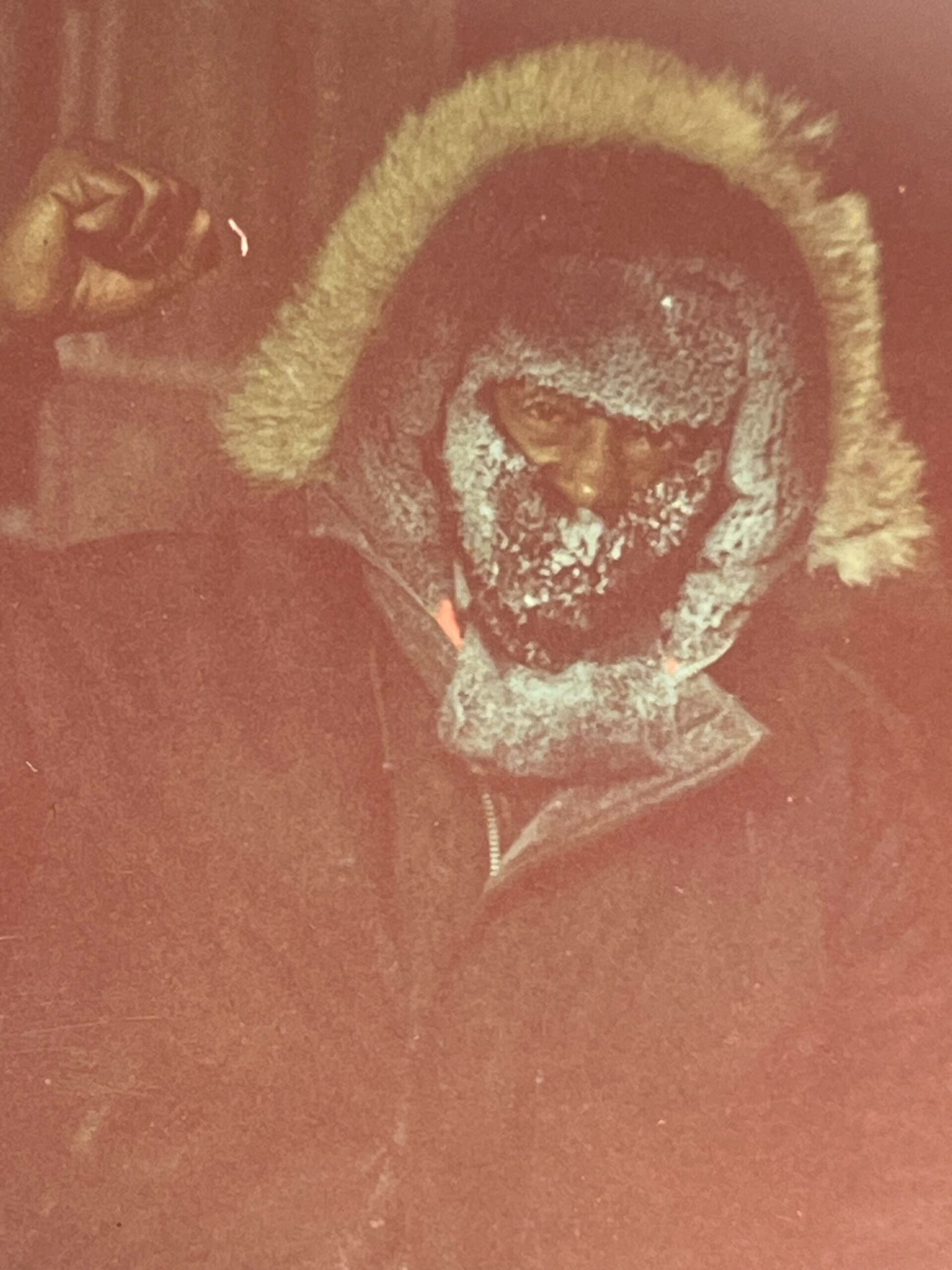
I was there for a couple of years. I was a laborer in the oil fields. I worked trucks that rode across the Arctic Ocean in the middle of the winter. I worked on wildcat wells 50 miles from base camp. I had to relieve pressured gas to keep it from blowing up. It was 50 degrees below zero.
Robert Listenbee worked in the oil fields building the pipeline on the North Slope of Alaska for several years beginning in 1976.
I got into fights. People were trying to kill me at different points in time, and I was trying to kill other people, too. So I mean, the reason I know a little bit about criminal justice is because I was almost a criminal.
I never built the road in Africa. I eventually came back to Philadelphia, and worked construction until 1986.
So what about being a lawyer?
After my construction company failed, I was broke again. I ended up going back to legal work, and got a job working at the Defender Association.
You were the head of the juvenile unit for 16 years, and then you finished your career here on the other side — going from defending young people to prosecuting them. How was that transition for you?
Working for the U.S. Department of Justice’s Office of Juvenile Justice and Delinquency Prevention under President Obama helped prepare me for prosecutorial work.
I was adamant I would never work for this office. I thought it was corrupt. Krasner called me three times before I agreed to join as first assistant.
We were engaging in culture change. Some of the behavior of the people who were here was absolutely outrageous, especially in the homicide unit. They had a sense that this office belonged to them. It didn’t belong to the people. They were willing to cheat and do it and hide evidence in the process of doing it. That’s the feeling that I had when I first got here, and that’s what we found.
Robert Listenbee, first assistant district attorney, takes questions from the media after announcing developments in the case against a West Philadelphia teen who investigators say purchased materials including chemicals, wiring, and tactical equipment associated to become a terrorist.
There has been criticism of your juvenile work — some have said that it was too lenient during the period of intense gun violence and that kids went on to commit worse crimes. Others say the office hasn’t gone far enough to treat kids as kids. How do you assess your record?
We’ve reduced the number of kids in out of home placements. We’ve expanded juvenile diversion programs. In 2024, we created a juvenile homicide unit to review all cases of juveniles charged with murder.
I’m satisfied that we’re being as fair as we can and taking the time to carefully evaluate every issue in a case.
The first assistant is typically the person who manages the office day-to-day. Some prosecutors have said that, in this administration, that role functioned differently — that much of the management flowed directly from Krasner. Do you think that perception is fair, and how did you approach leadership in that environment?
The DA did not want the imperial first assistant that had been here before. He would prefer a flat structure to a hierarchical structure, which means you get assigned a lot of odd jobs depending on what he wants you to do.
If I were running the office, I would have run it completely differently. But I have to tell you that, having been here as long as I have, we never would have gotten this far without the DA’s serious concerns about what people around here were doing, whether they were implementing his policy or not. His skepticism, his oversight, is what’s kept this place moving in the direction that he wanted to go in. I wasn’t tuned in enough to the office to understand that from the very beginning, but I listened to him.
We hire people, we fire people, we move people around. That’s happened a lot. We sometimes end up with younger and inexperienced supervisors, because we haven’t really developed a program for training supervisors really well. We’re working on that.
I wish I had worked on juvenile issues earlier than I did.
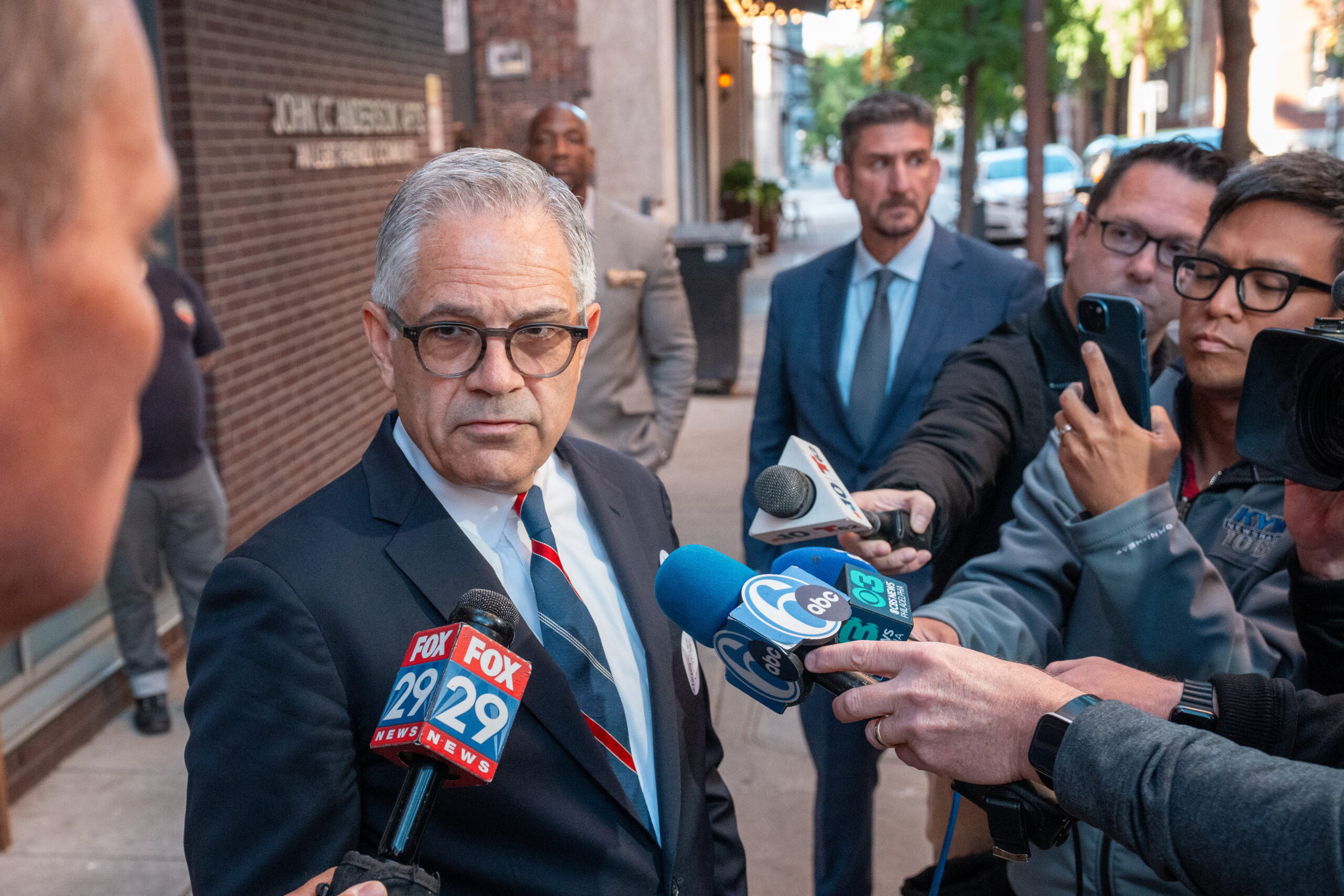
District Larry Krasner speaks with the media after casting his vote in the 2025 primary.
What’s your advice for the next first assistant?
You have to understand the DA’s goals and purposes and how he operates.
So, listen to Larry?
Not that. The DA is not a micromanager. But there’s no written directives on most of the things he wants, and there’s no organizational chart or hierarchy. If we have issues, we often go to him.
Do you have a piece of advice for Krasner in his third term?
This is a city that has a chip on its shoulder. The DA is a person who has a chip on his shoulder. They respect him for that when he speaks out. A lot of the things he says may not be politically astute, but they’re things he believes in. They like that about him.
He is the Donald Trump of the progressive era.
He needs to continue surrounding himself with people who can understand him and help him implement his policies.
A lot of people don’t like him, and I understand that. A lot of people don’t like me because I work for him. A lot of people don’t like what we do. That never mattered to me. I know that the people we have seen in court, the victims and the defendants and the witnesses, I know that we’re doing right by them. That’s my North Star.
Robert Listenbee, the first assistant to District Attorney Larry Krasner, retired on Friday.
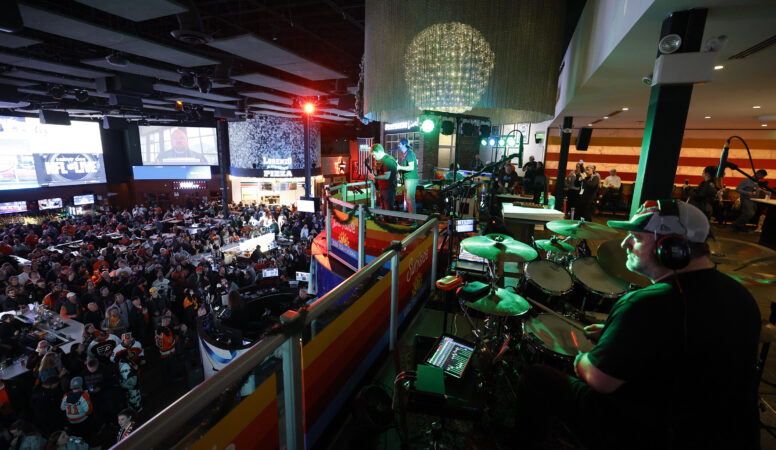
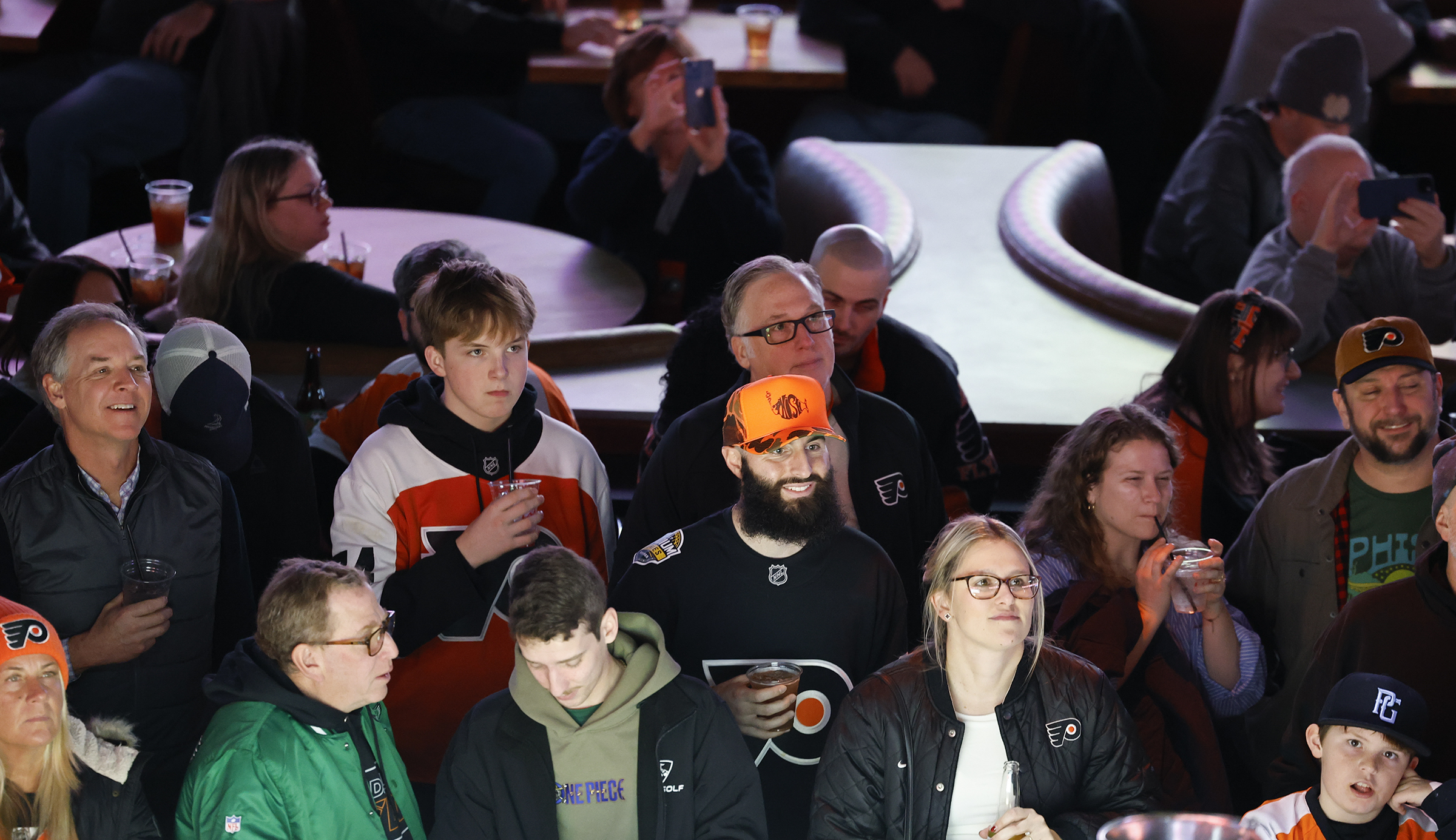
Hundreds of fans gathered at Stateside Live! ahead of the Flyers’ home game against the Toronto Maple Leafs on Thursday night to celebrate the franchise’s first Phish Night.
Whether they were dressed in Flyers gear, wearing Phish merchandise, or custom Trey Anastasio Flyers T-shirts, they danced to the sounds of Philly’s Phish tribute band, Rift, as they performed their 90-minute pregame set to get fans excited for what was in store for the rest of night.
Phish Night was a highly anticipated event for 45-year-old Doylestown native Brett Erpel and his brother Aaron. After the official announcement, Brett received a text message from his 47-year-old brother that read “Let’s go to this.”
The brothers have been fans of the band since 1995 after watching them perform for the first time at the Mann Music Center. Brett’s fandom has stretched over three decades.
For diehard fans like Brett and Aaron, Thursday night was the perfect combination of three things they love the most: Philadelphia, the Flyers, and Phish.
“I’m a huge Phish fan,” said 23-year-old Andrew Singer, a Philadelphia native. “The Flyers are an integral part of our city, especially during the winter time. I love Phish, the city of Philadelphia, and the Flyers. I just wanted to come out and support that.”
The Flyers and the band have had long connection. Phish’s first-ever performance at the Spectrum took place on Dec. 15, 1995, which saw their guitarist and singer Anastasio perform in a No. 10 John LeClair Flyers jersey. And before that performance the band visited the team in their training center.
Flyers fans listen to Philly Phish tribute band Rift, at Stateside Live! on Thursday, January 8, 2026.
Since then, Phish had historic performances at The Spectrum which became immortalized on the album The Spectrum ’97.
“Tonight is sort of like the culmination of this long dating process,” said Ike Richman, who owns a communications company and is long-time friends with Phish. “Tonight’s their wedding day. The Flyers and Phish are finally getting married because we’ve had this parallel for so many years. The Flyers fans know about Phish and the Phish fans know about the Flyers. But, tonight they get to all come together in this beautiful night that features their music and celebrations.”
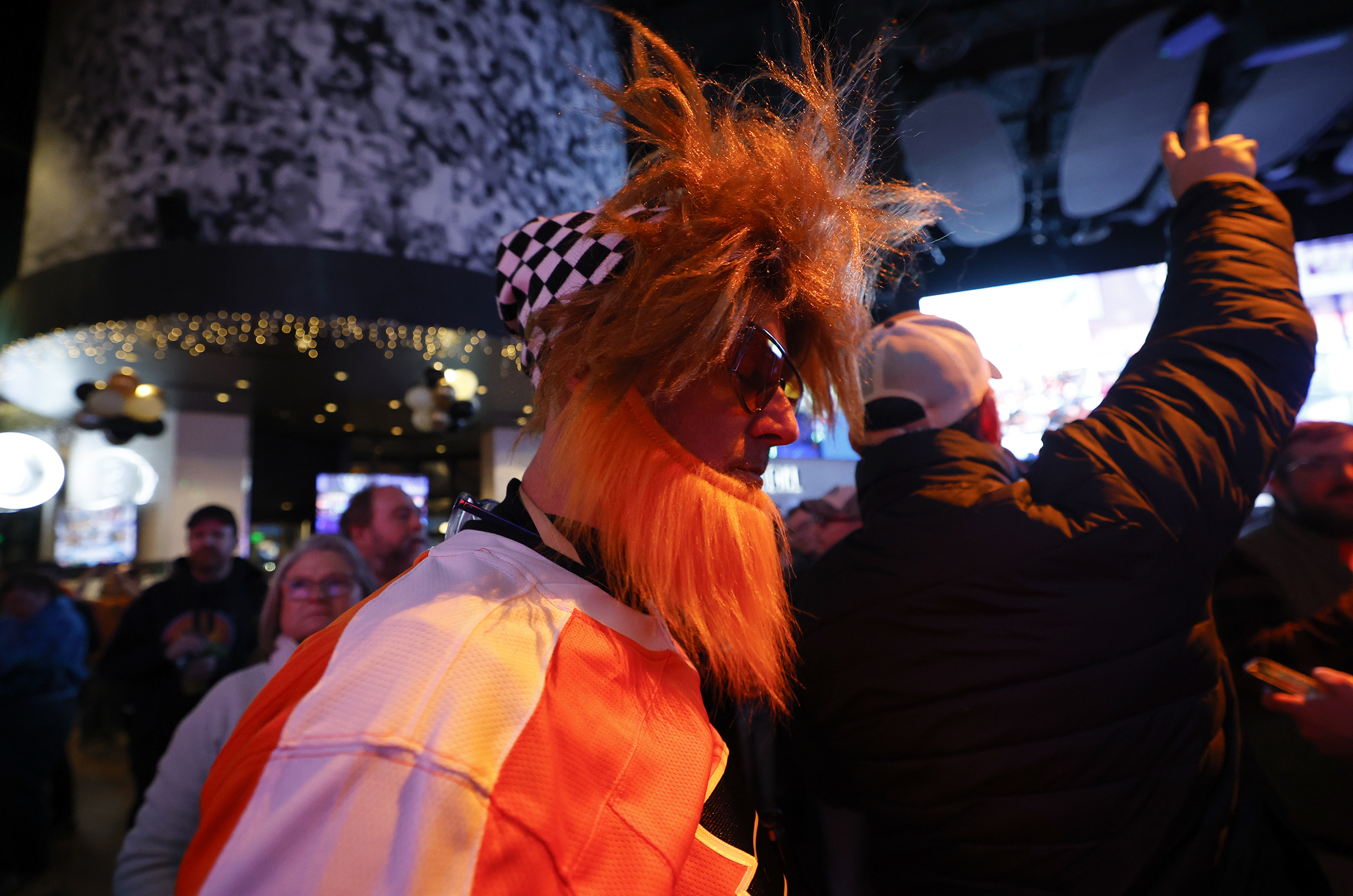
Anastasio has been a lifelong fan of the Flyers. Some have even made the connection that Anastasio and Flyers mascot Gritty look very similar, leading to some fans dressing up as the NHL mascot for a DIY Gritty costume contest, including Frank McGannon.
“I’m 50-years-old and dressed like this,” McGannon said. “I was invited to the concert being that it was Phish Night tonight. … And I was nominated to dress up for the Gritty contest. I guess I have that spirit, and here I am.”
McGannon made his way to the Xfinity Mobile Arena after the concert to get his one-of-a-kind, co-branded Phish and Flyers T-shirt, which features the band’s logo decorated in Gritty’s orange fur with the bubbles replaced by popcorn. The line for the shirt stretched across 11 sections, starting at the Sales and Service table, located across from Section 112, and ending at Section 101.
Flyers fan Greg McGannon listens to Phish tribute band Rift at Stateside Live! in a DIY Gritty costume.
“The shirt is great,” McGanon said. “I’m not going to lie, it’s the only reason I’m here.”
Along with the exclusive merchandise, fans could grab special menu items only available on Thursday night — including a Fishman doughnut from Federal Donuts & Chicken, a Split Open and Melt cheesesteak, a Poor Heart burger, a Ruby Waves vodka cocktail, and a Scent of a Mule vodka mule with a hint of mint.
The Fishman donut: A spiced cake donut with vanilla cream glaze and a red raspberry glaze ring pic.twitter.com/Bo2x8XJE88
Throughout the Flyers-Maple Leafs game, there were singalong moments from some of the band’s greatest hits, and Phish trivia questions which resulted in a fan winning a signed vinyl record from the band.
“It’s like a dream come true to see this happen,” said Richman, who presented the Flyers with the idea over the summer. “I’m grateful, again, that the Flyers are doing this and Phish is doing this. But, this is really for the fans and we want the fans to have a real good time. And as they say, let’s get down to the nitty-gritty and let’s get this show on the road.”
A portion of the tickets sold from the event will benefit The WaterWheel Foundation, which supports causes in the Phish community.