The proposed merger of Temple University and the Library Company of Philadelphia moved closer to reality this week with a nod from the library’s shareholders.
Shareholders voted Tuesday 174 to 33 in favor of the deal, and the action was followed Thursday with approval by the executive committee and finance and investment committees of Temple’s board of trustees.
But for that to happen, they must get approval for the merger from the Pennsylvania attorney general’s office and Philadelphia Orphans’ Court.
“We are delighted to help preserve one of Philadelphia’s most important educational and historical institutions through this partnership,” Temple President John Fry said in a statement. “This will help bring stability to the Library Company while also ensuring that its legacy does not just live on but also thrives. For Temple, this is also an opportunity to further enrich our academic and research resources.”
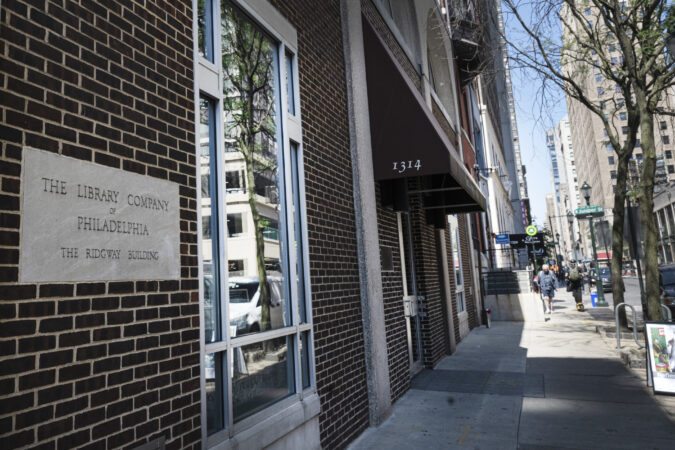
Not much will change for the Library Company’s day-to-day operations, at least immediately. It will remain at its 1314 Locust Street location in Center City and keep its collections, staff, identity, mission and programming, Temple said. It will operate as its own division within Temple Libraries and maintain its own board of visitors.
The Library Company will gain access to Temple’s research arm, grant-writing help, facilities and administrative functions, the university said.
“The Library Company has been an important resource for Philadelphians for nearly 300 years, ever since Benjamin Franklin first envisioned a shared library as a tool for advancing the self-education of his circle of artisans and tradesmen,” John Van Horne, Library Company director, said in a statement. “I am certain that Franklin would heartily approve of our expanded education mission over the last few centuries, and I have no doubt that he would also approve of this partnership with a university dedicated to serving his city and beyond.”
The move comes after the Library Company, faced with a string of operating deficits, began exploring merger possibilities with a number of other institutions. Financial data given to shareholders showed substantial operating deficits for most years since 2017, as well as projections for deficits continuing into 2030.
Officials estimated that in order to remain independent, the company would need to raise $23 million to add to existing endowment.
Van Horne previously said that raising that kind of money would be “an incredibly steep hill to climb, and probably unrealistic.”
The library houses more than 500,000 rare books, manuscripts, prints, photographs, works of art, ephemera, and other objects. It boasts items once owned by Benjamin Franklin and William Penn, and has a concentration in African American and women’s history.
Some shareholders strongly preferred that the library ― founded in 1731 as the first subscription library in the U.S. ― would have remained independent, even as they recognized the current financial bind.
Shareholder Joel Gardner was philosophical about the merger.
“I think it’s the only solution the Library Company could find. We all have to keep our fingers crossed that it works out,” he said while declining to add how he voted.
It didn’t seem likely that the Library Company would be able to raise the money required to remain independent, he said, “in a city that is not notable for having a large number of philanthropists and depends on just a few of them.”
Michelle Flamer, a shareholder who in an Inquirer opinion piece mourned the impending loss of the company’s “historical identity,” said Thursday that the deal “seemed like it was a fait accompli, and there was not very much we could do about it.”
The Library Company also will be incorporated into the university’s fundraising plans, Temple said, though the merger agreement made no promises. It calls for including the Library Company in Temple’s upcoming capital campaign, “with the goal of raising $25 million in new endowed funds to permanently and exclusively support the LCP Division.”
“This is especially significant as the Library Company will soon celebrate its 300th anniversary in 2031, which presents a major opportunity for fundraising,” the university said in its announcement.
The fix was needed because Council earlier this week amended a separate but related piece of legislation — called the H.O.M.E. budget resolution — that sets the first-year spending levels for the housing programs funded or created by the initiative.
Council’s changes, which Parker largely opposed, were significant enough that the budget resolution no longer aligns with the bond authorization bill Council approved in June, meaning the administration cannot rely on the original legislation as its legal basis for taking out city debt.
The new bond bill introduced Thursday reflects Council’s changes, which include increasing the first-year H.O.M.E. budget from $194.6 million to $277.2 million and changing eligibility requirements for some programs to make sure the lowest-income Philadelphia households were prioritized.
“We want to make sure that this is a H.O.M.E. plan that supports everyone, but obviously members of Council had an issue and concern about making sure those most in need are supported throughout this process,” Johnson said.
The bill now heads to committee, and Johnson said negotiations could lead to further changes. Next week is Council’s final meeting of the year, and Johnson on Thursday ruled out adding an extra session, meaning the bill likely will not pass until January at the earliest.
“Working with Council President Johnson and the Members of City Council, we are laser-focused on building, repairing and restoring 30,000 units of housing and making H.O.M.E. a reality for the people of Philadelphia,” Parker said in a statement Thursday.
‘That’s my sister’: Johnson says relationship with Parker still strong
Parker-Johnson pact intact: The Council president on Thursday downplayed his spat with Parker that saw both issue pointed statements Tuesday night blaming the other for delays in issuing the bonds.
But Johnson said Thursday their relationship remains the same and has always involved disagreements — just not ones that have spilled out into public view.
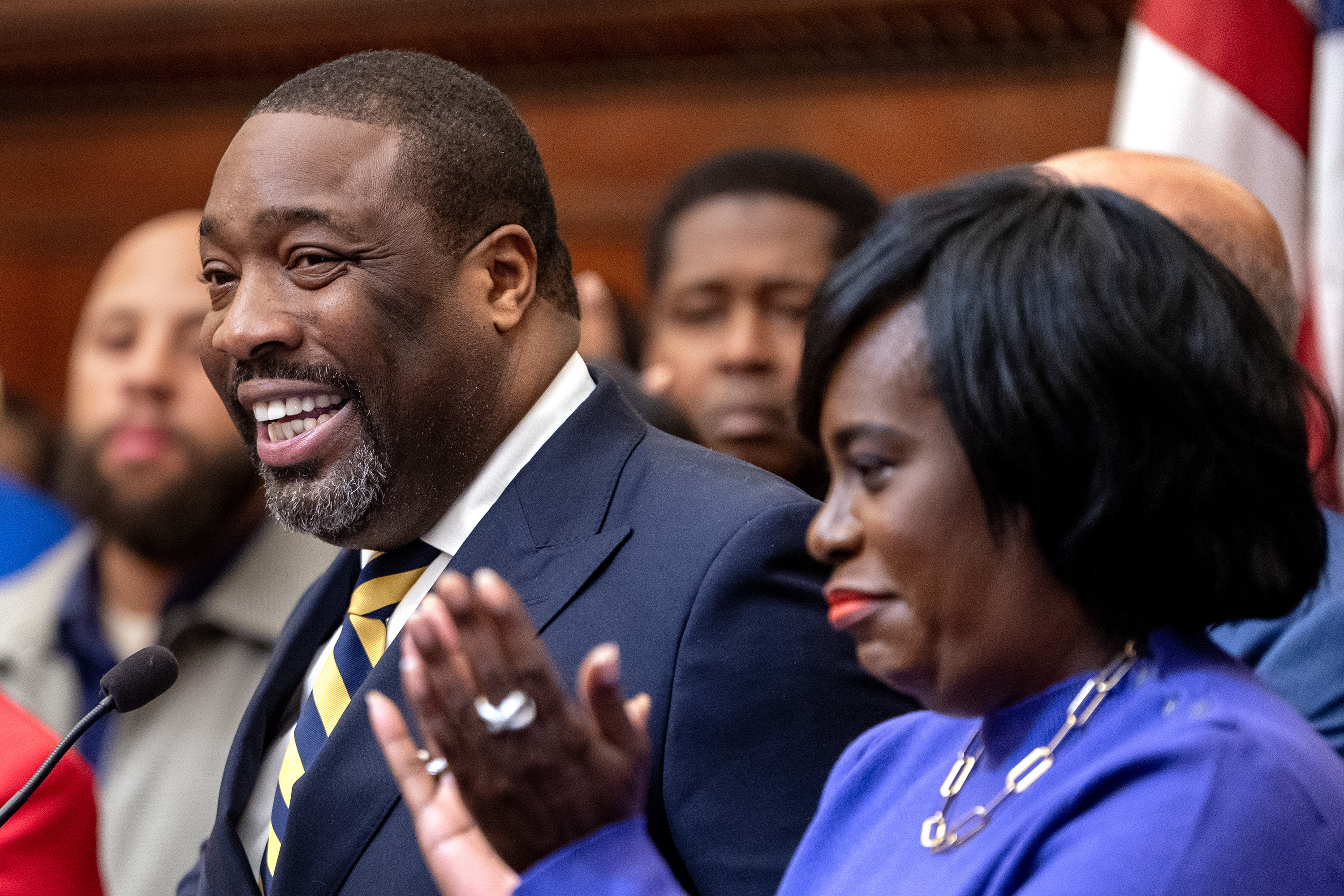
City Council President Kenyatta Johnson and Mayor Cherelle L. Parker have maintained a close working relationship.
“That’s my sister,” Johnson said. “Most of the time, when we do have disagreements, y’all just don’t see it. We meet every week, so you don’t get a chance to see the back-and-forth. But at the end of the day, the mission is to move the city of Philadelphia forward together.”
Council makes it harder to open convenience stores and pharmacies in Kensington
The bill, authored by Councilmember Quetcy Lozada, forces any new “sundries, pharmaceuticals, and convenience sales” businesses in her 7th District — which covers much of Kensington and parts of North and Northeast Philadelphia — to get approval from the Philadelphia Zoning Board of Adjustment. That process is notoriously long and can be expensive for applicants.
Lozada has said that the bill is targeted at corner stores and smoke shops, not chain businesses like CVS and 7-Eleven.
The legislation is part of the body’s broader war on so-called nuisance businesses, which lawmakers say attract crime and disrupt neighborhoods. And it comes in addition to a controversial 11 p.m. business curfew in Lozada’s district that took effect earlier this year.
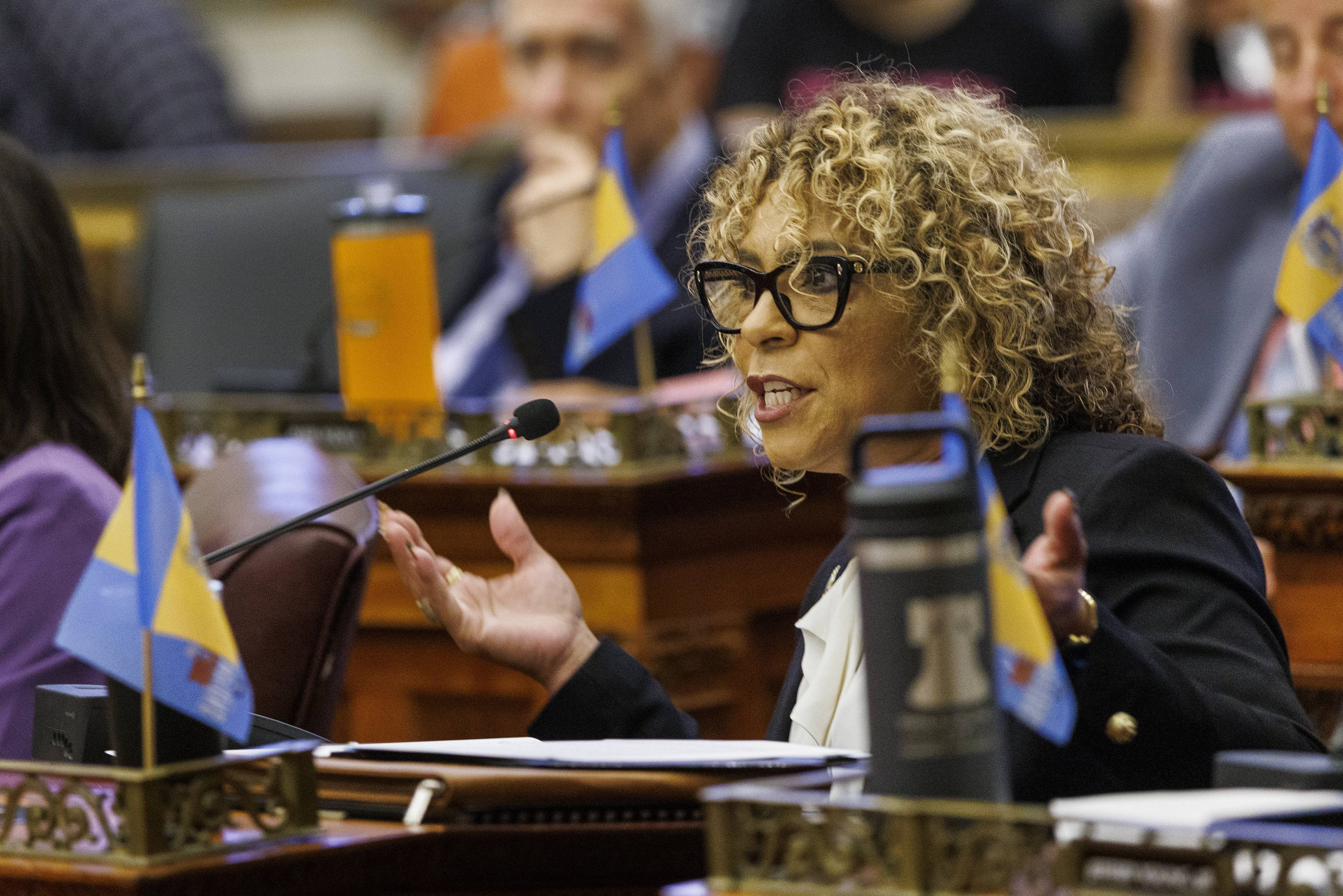
City Councilmember Quetcy Lozada represents Kensington.
It’s one of several legislative remedies lawmakers have undertaken to curb small businesses like smoke shops and convenience stores that have unregulated slot machine-like “skill games,” sell marijuana-like products, and peddle drug paraphernalia without a license to do so.
Seriously … no nuisances, please: Lozada was not the only lawmaker taking aim at “nuisance” businesses Thursday, when Council approved two bills by Majority Leader Katherine Gilmore Richardson on the same topic.
One measure makes it easier for the Philadelphia Department of Licenses and Inspections to issue stop-work and cease-operations orders to businesses violating city regulations. The other is aimed at closing loopholes that “let nuisance business owners avoid enforcement by changing their name or ownership, ensuring those with similar ownership or operations remain accountable for past violations,” Gilmore Richardson’s office said.
The measures, which were both approved 16-0, were aimed at stopping “the spread of dangerous and destructive businesses and the need for further action to address their impact on our communities,” Gilmore Richardson said.
“While I am encouraged by the steps we are taking today, I am also working on additional legislation to more aggressively crack down on these businesses and the bad actors behind them,” she said.
“Anybody that knew Paul will tell you he really was that guy, that guy who would give you the shirt off his back,” Harrity said. “He’s the only person I truly knew never lost faith in me, even when I was at my lowest 10 years deep in my addiction.”
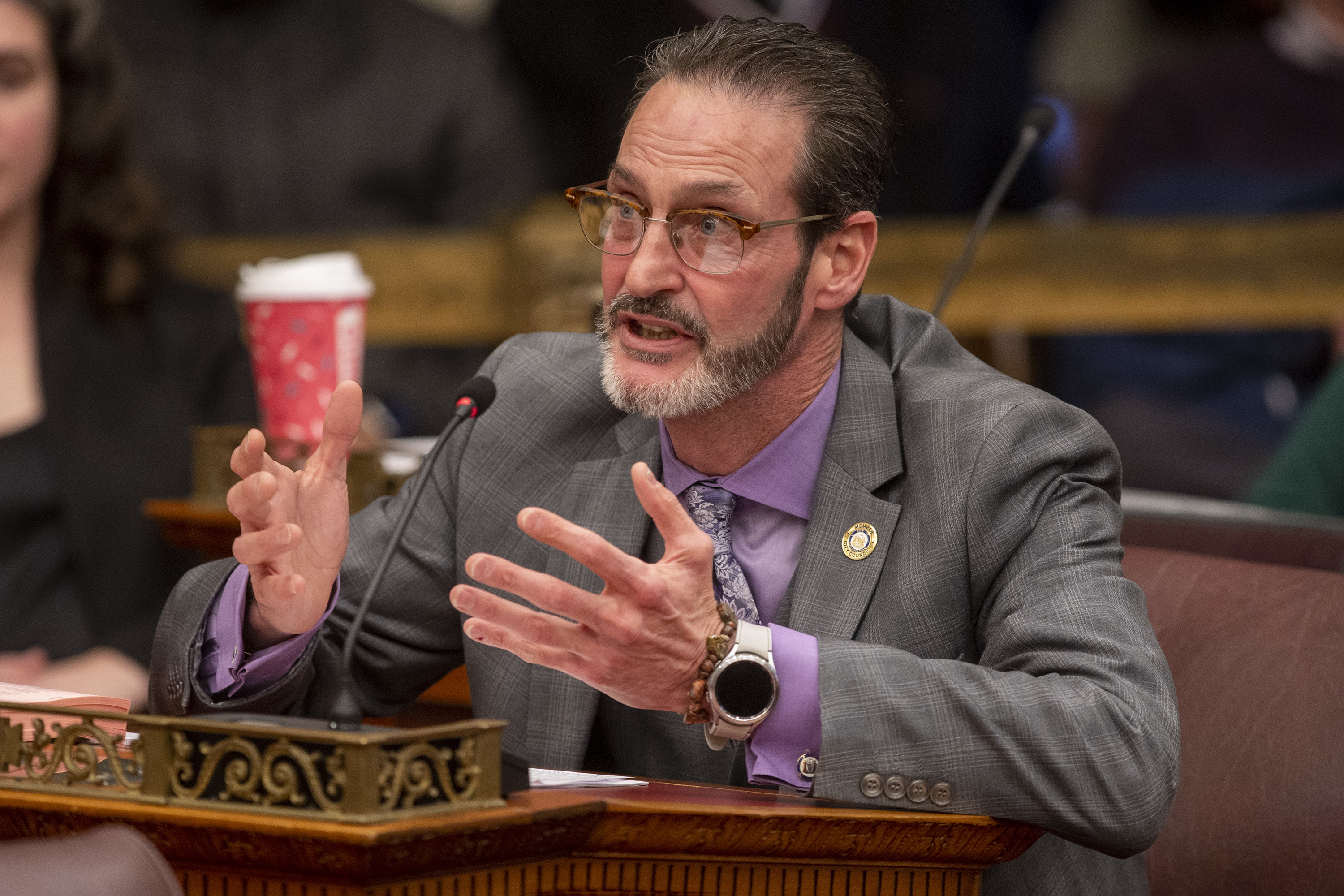
Councilmember Curtis Jones Jr. thanked Harrity, who often gives impassioned speeches, for his heartfelt tribute to Staico.
“I want to shout out Jimmy Harrity for making crying in Council cool,” Jones said. “Nobody does it better, brother.”
Staff writer Jake Blumgart contributed to this article.
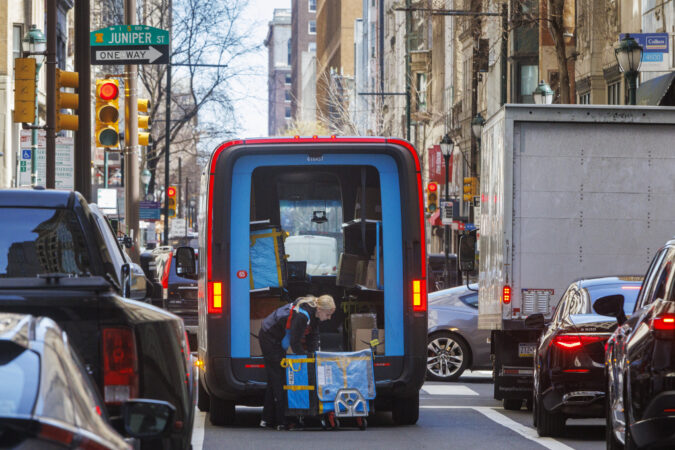
Amazon delivery is getting faster in Philadelphia.
The online retailer is testing out a new delivery model that aims to get items to customers in 30 minutes or less. The service, which is being called Amazon Now, was announced on Dec. 1 and will be available only in areas of Philadelphia and Seattle.
“Building on our decades of delivery innovation, we’re now testing an ultrafast delivery offering of the items customers want and need most urgently in parts of Seattle and Philadelphia,” the company said in a news release.
The service seems comparable to those offered by DoorDash and Gopuff, which allow consumers to purchase food and retail items to be delivered to their homes same-day.
Customers in areas where the new program is offered will see an option in their Amazon app or webpage navigation bar for “30-Minute Delivery.”
Thousands of items are eligible for the service, according to the company, including produce, milk, eggs, diapers, and over-the-counter medicine.
Prime members will pay at least $3.99 for quick delivery, while the fee for nonmembers starts at $13.99. Customers will also incur an additional fee of $1.99 if their order is worth less than $15.
“Amazon is utilizing specialized smaller facilities designed for efficient order fulfillment, strategically placed close to where Seattle- and Philadelphia-area customers live and work,” notes the news release.
“This approach prioritizes the safety of employees picking and packing orders, reduces the distance delivery partners need to travel, and enables faster delivery times,” the company said.
When Amazon launched same-day delivery in 2009, Philadelphia was among the first cities elected to roll out the service. At the time, the company already offered two-day delivery on orders, which was available to Prime members for no extra cost after their $79 annual subscription. The same-day delivery service, when it was announced, cost an additional $6 per item.
Prime members today pay $14.99 a month or $139 for a year and get access to free delivery. Amazon saw an increase in Prime membership during the pandemic and has said this year that it offers over 300 million items eligible for delivery with the program compared to 1 million in 2005 when the model first got its start.
The company also continues to expand its network. In April, Amazon announced that it was investing more than $4 billion to broaden delivery in more rural parts of the country.
Montgomery County immigration advocates renewed calls for more municipalities to approve policies that would limit police and local government cooperationwith U.S. Immigration and Customs Enforcement as President Donald Trump’s administration ramps up enforcement.
Advocates have been calling for welcoming policies across the county for months but advocates estimated that as of Wednesday, only six of Montgomery County’s 62 municipalities had enacted policies. Even those, they argued, were lackluster.
“ICE has created a crisis in our neighborhoods, and we cannot afford silence, mixed signals, or leadership that only reacts once harm has already happened,” said Stephanie Vincent, a leader of Montco Community Watch.
Ambler, Springfield, West Norriton, Abington, Norristown, and Cheltenham had approved policies, advocates said, though they are mostly internal policies that advocates say don’t do enough to protect immigrants.
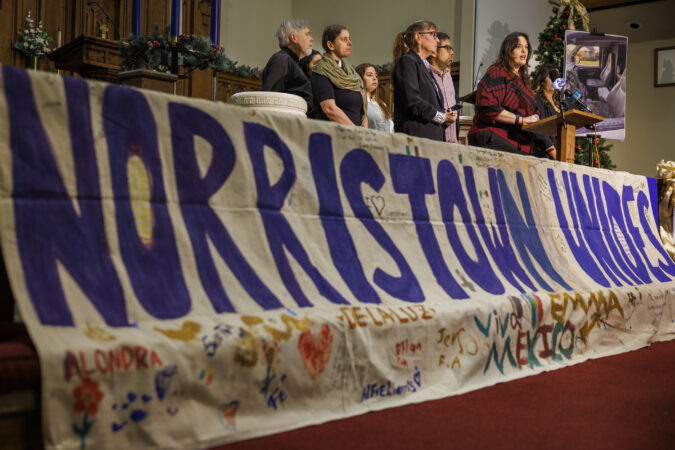
Stephanie Vincent, the leader of Montco Community Watch, speaks at a news conference about ICE activity in Montgomery County at Ascension Church in West Norriton Thursday.
The sense of urgency was palpable Thursday as ICE dramatically expands its presence and visibility, both in the Philadelphia region and across the United States.
Montco Community Watch has documented at least 97 detentions and 30 suspected ICE detentions in Montgomery County, and “there are likely more detentions that we have not heard about,” Vincent said.
The group was joined Thursday by representatives for Indivisible Greater Jenkintown, a progressive advocacy group, and the Pennsylvania Immigration Coalition at Ascension Church. Advocates said that strong welcoming policies,sometimes referred to as sanctuary policies, would outline that police will not honor ICE detainer requests without a judicial warrant, that local government resources will not be spent on ICE, and that communities will feel safe to access resources without fear of federal agents.
Advocates had been working since the summer to encourage municipalities across Montgomery County to approve policies limiting cooperation with ICE. The county, particularly the Norristown area, had become a hot spot for ICE enforcement in the early months of the Trump administration.
In July, video of a raid at a West Norriton grocery store appeared to show local police assisting the federal agency; the township said federal authorities had sought assistance to retain order while they served a warrant for tax evasion.
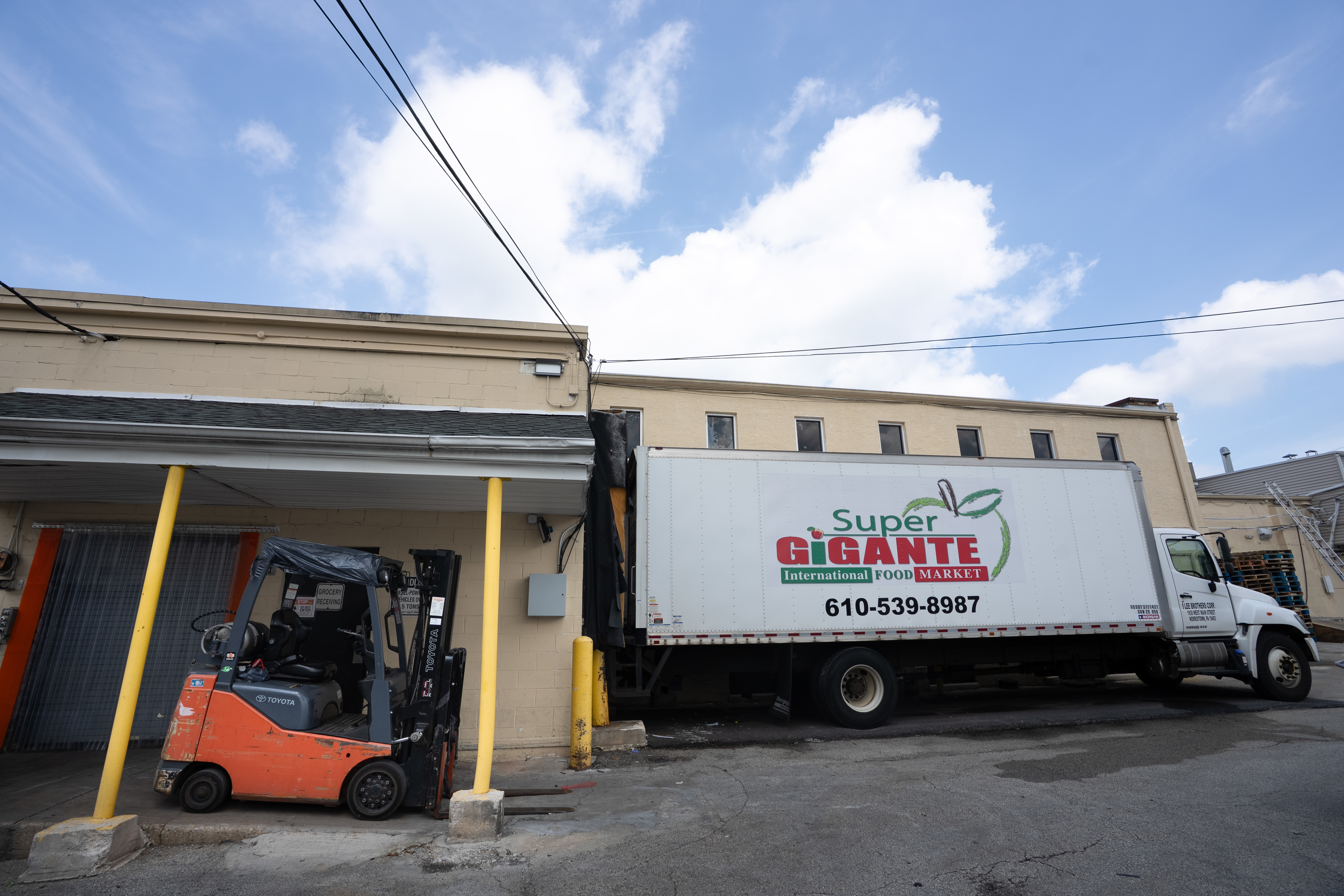
Super Gigante International Food Market, 1930 W. Main St., in West Norriton on July 16.
Advocates pushed county leaders to enact a welcoming resolution, but officials consistently reiterated that they lacked any control over local police forces.
Despite months of requests, Montgomery County has not passed a formal ordinance or resolution declaring itself a welcoming county. The county’s Democratic commissioners have cited limits to their power, concern about creating a false sense of security, and a preference for internal policy changes.
Advocates said Thursday that they strongly prefer limitations on local collaboration with ICE to be enshrined in ordinances rather than enacted throughinternal policies or statements, which canlack transparency and accountability and are not alwaysenforceable.
“None of [the six municipalities’ policies] are complete and the most visible problem on all of them is a lack of any accountability,” said Rabbi Elyse Wechterman, of Indivisible Greater Jenkintown.
Julio Rodriguez, from the Pennsylvania Immigration Coalition, added that a lack of clear boundaries between local policies and federal agents creates more confusion and worry in the community.
“It reinforces that fact the people just don’t know what’s happening,” Rodriguez said.
Staff writer Jeff Gammage contributed to this article.
Authorities have charged two men in connection with a double fatal shooting outside a Bordentown convenience store, prosecutors said Thursday.
Justford Doe, 23, and Giovanni Varanese, 21, are charged with first-degree murder, first-degree robbery, and other offenses stemming from the Nov. 5 killing outside a 7-Eleven and Valero gas station at the intersection of Route 130 North and Farnsworth Avenue.
The shooting left Daniel Patterson, 22, and Mason Knott, 21, dead.
Bordentown Township police were called at about 11:30 p.m. to the convenience store after Patterson, a Philadelphia resident, came into the store suffering from gunshot wounds and asked for help. He was pronounced dead at the scene, according to the Burlington County Prosecutor’s Office. Knott, of Wrightstown, was transported to a hospital in Trenton, where he died.
Police said the men shot Knott in the back of the head, then stole marijuana that was in his vehicle. They shot Patterson three times and stole his Jeep, police said.
The assailants fled but crashed in Florence Township, the prosecutor’s office said.
Authorities did not say Thursday how they connected Doe and Varanese to the killings.
The men are being held in the Philadelphia Department of Prisons, but will be extradited to New Jersey to face the charges, according to the prosecutor’s office.
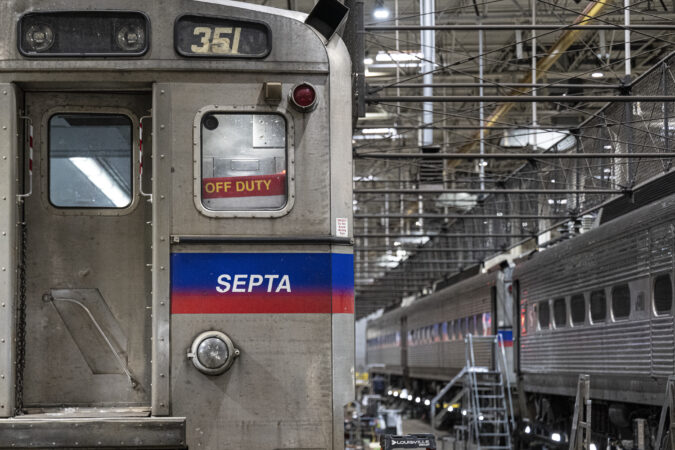
The transit agency says it will miss Friday’s federal deadline to finish outfitting all 223 Silverliner IV Regional Rail cars with a new heat-detection system. The reason: It needs to wait for 7,000 additional feet of thermal wire.
About 30 of the 50-year-old cars have not yet had the safety feature installed, officials said. The wire required to finish the job is on back order.
“I don’t think the suppliers expected one agency to raid their entire stockpile,” spokesperson Andrew Busch said.
SEPTA needed about 39,000 feet of the thermal wire to outfit the entire fleet of Silverliner IV cars, he said. “It was an unusual demand on the supply chain,” Busch said. SEPTA has worked with two manufacturers and four distributors.
The missing link is expected to arrive next week, and the installations should be finished the following week, Busch said.
SEPTA worked with two manufacturers and distributors to get the large rolls of wire.
The thermal wire is made of spring steel, separated by a polymer that melts at high temperature, allowing the steel conductor to touch and connect the electric circuit. That allows it to provide earlier warning of a potential problem so cars can be pulled from service.
Delays, cancellations, station skips, and overcrowded trains running with fewer than the normal number of cars have been regular challenges for riders during the work, which started in October.
Meanwhile, SEPTA is leasing 10 passenger coaches from Maryland’s commuter rail system, MARC, which Amtrak is scheduled to deliver late Friday night at 30th Street Station. They will be towed to SEPTA’s nearby Powelton yard.
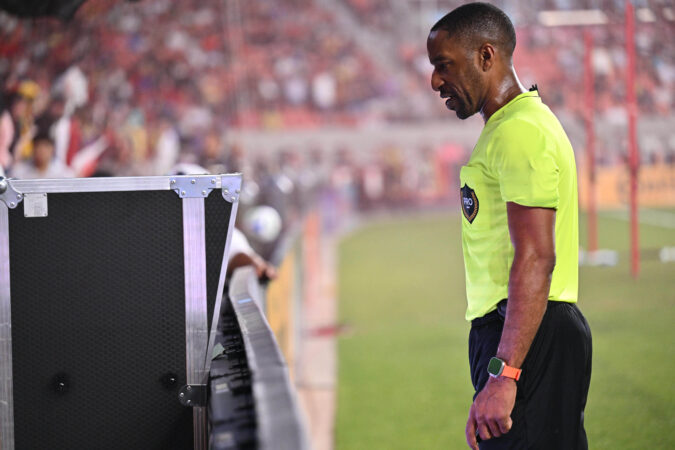
WASHINGTON — Whether fans like video reviews in soccer or not, they tend to draw complaints when those reviews seem to take too long.
It might seem natural to want a time limit for those reviews, perhaps one or two minutes. The sport’s global governing body is saying no, though, at least for now.
“Well, there might be different opinions, which I will respect,” FIFA’s refereeing chief Pierluigi Collina said Thursday at a media briefing ahead of Friday’s 2026 men’s World Cup draw. “Certainly, when something lasts a bit longer, it’s not because the referee is, say, lazy or slow. Probably, things which are considered are particularly complicated.’”
A game referee from 1995 to 2005, including the 2002 men’s World Cup final, Collina took his new role with FIFA in 2017 and has remained a public figure ever since.
Pierluigi Collina (left) speaking at Thursday’s event.
“Something else to consider is when you are waiting for someone, every second looks like an eternity — when you are under pressure and you are doing something, time flies,” he said. “So, referees, when they are doing that, probably they do not really realize that time is passing for them so quickly. But, we all know that timing is an issue in every activity, so we are always trying to improve.”
Collina acknowledged a report by the Times of London earlier this week that the International Football Association Board — the entity that sets the rules of how soccer is played — is considering expanding what VAR is allowed to rule on.
The expansion would include second yellow cards, which result in red cards and expulsion; and whether officials got it right calling a corner kick vs. a goal kick.
“It was already announced after a meeting of the IFAB football and technical advisory panel: the discussion took place, and the outcome was to propose to further discuss and propose” at the IFAB’s next business meeting on Jan. 20, Collina said. If a proposal passes there, it will go to the annual general meeting in March. That vote would be for implementation on June 1, in time for the World Cup.
Under the current rules, a straight red card is reviewable, but a second yellow card that results in expulsion is not reviewable.
“Certainly, extending the possibility of the VAR to intervene in some specific circumstances is something [on] the table,” Collina said, adding: “It would be a pity if the result of the competition, whichever the competition is, is decided not by what the players do on the field playing, but by a honest mistake made by the decision-maker.”
Specific to corner kicks calls, he said “that the main criteria is no delay” in the action on the field.
“It takes normally, how long? 10, 15 seconds to get the attackers ready to take the corner kick,” Collina said. “In these 10-15 seconds, if the corner kick was wrongly given, everybody has the evidence that the start of play is wrong. To me, it’s difficult to understand if they have the possibility to see that, why we have to hide our head under the sand and hope that nothing happened on the corner kick which is taken.”
Collina also said that FIFA hopes to use referee bodycams again next summer, after debuting them in the Club World Cup.
“It was, I would say, a great success,” he said. “It has been implemented in some leagues, [which] means that it was well-received by the TV viewers — also, referees got some benefit from using that. So, pretty confident that the rule-maker, as mentioned, IFAB, will give us the permission to to implement it during the next World Cup [in] ’26.”
Preparations at the Kennedy Center in Washington for Friday’s event.
FIFA defends expanding the World Cup to 48 teams
It was no surprise to hear FIFA officials say Thursday that it’s a good thing to expand the men’s World Cup to 48 teams, as will happen for the first time next year. The women’s tournament will follow suit in 2031 when the U.S. spearheads a regional tournament alongside Mexico, Costa Rica, and Jamaica.
But the way those officials framed it nonetheless was news, especially for the international media outlets that have traveled to D.C. this week.
“It’s less than 25% of the 211 countries who are affiliated to FIFA,” said Arsène Wenger, FIFA’s chief of global football development and the famed former manager of English Premier League club Arsenal. “Still, 75% of the teams are not there, and I count in there China, India — that’s 3 billion people.”
FIFA’s chief football officer Jill Ellis, the former U.S. women’s national team manager, noted how the growth of women’s soccer worldwide has made it easier to have a 48-team tournament without fear of lopsided games.
“We see it in the in the college basketball landscape right here in the U.S.,” said the coach who led the U.S. women to World Cup titles in 2015 and 2019. “We’re used to these teams that are maybe lower-ranked and then they suddenly have this phenomenal run.”
Jill Ellis (left) and Arsène Wenger (right) on stage Thursday.
Will weather be an issue again?
The hot temperatures at this summer’s Club World Cup understandably raised a lot of complaints, and fears of more problems next summer. Wenger raised that unprompted.
“If there’s one uncertainty that we don’t master, it’s the weather,” Wenger said. “Especially in Miami, you know, places like Atlanta, where you had some problems last year. So we’ll do the maximum to protect the competition and the players.”
He also said “we will consider a lot the best possibilities for the teams to be protected from heat” as FIFA finalizes the kickoff times before Saturday’s announcement. But skeptical fans worldwide won’t believe that until they see it.
Temperatures were in the 90s during many Club World Cup games this past summer.
Paul George will sit out the first game of the 76ers’ back-to-back to end the week.
The forward will miss the game against the Golden State Warriors on Thursday at Xfinity Mobile Arena due to left knee injury recovery, which has included holding him out from playing on back-to-back nights.
The 6-foot-8, 220-pounder could be available to play on Friday against the Milwaukee Bucks at Fiserv Forum.
Sixers forward Paul George is averaging 13.5 points and 4.8 rebounds this season.
He’s not the only Sixers player unavailable to face the Warriors.
Kelly Oubre Jr. (sprained left knee) and Trendon Watford (left adductor strain) will remain sidelined. Joel Embiid (left and right knee injury recovery) was upgraded to questionable. And Quentin Grimes (right calf tightness) is available to play.
George has already missed 14 games due to his left knee and a sprained right ankle. He missed the first 12 games of the season with left knee injury recovery, then he sat out the Nov. 19 loss to the Toronto Raptors because it was the first game of a back-to-back. And George missed the Nov. 25 loss to the Orlando Magic with a sprained right ankle.
He is averaging 13.5 points, 4.8 rebounds, 2.8 assists, and 1.8 steals in 22.2 minutes.
President Donald Trump will visit Northeast Pennsylvania on Tuesday to promote his economic agenda, including efforts to lower inflation, the White House confirmed to The Inquirer on Thursday.
The trip will kick off what is expected to be anationaltour of Trump touting his economic policies ahead of the 2026 midterms, when Democrats and Republicans will battle for control of Congress.
The specific location for Trump’s visit has not yet been made public, but Northeast Pennsylvania will be a major battleground in next year’s midterms.
Democrats believe that they can oust freshman Republican U.S. Rep. Rob Bresnahan, of Lackawanna County, threatening the GOP’s slim House majority. Democrats are also specifically targeting the districts of U.S. Reps. Brian Fitzpatrick, of Bucks County; Ryan Mackenzie, of Lehigh County; and Scott Perry, of York County.
Trump endorsed Bresnahan and most of Pennsylvania’s GOP delegation on his social media platform, Truth Social, last month. Scranton Mayor Paige Cognetti, a Democrat, is mounting a campaign to unseat Bresnahan, who won by roughly a percentage point last election.
Affordability — which Trump called a “fake narrative” used by Democrats — has been a top issue for voters, including during November’s blue wave when Democrats won local contests throughout Pennsylvania, in addition to the gubernatorial races in Virginia and New Jersey.
Since World Cafe Live founder Hal Real stepped down as CEO in May, drama at the University City music venue has been unending.
Joseph Callahan, who brought the Portal to Philadelphia in 2024, took over from Real and pledged to save the nonprofit venue from financial ruin and $6 million of accumulated debt, in part by turning it into a virtual reality entertainment hub.
Labor peace seemed to be achieved during a rowdy town hall meeting in July, when then-World Cafe Live president Gar Giles said the company had agreed to collective bargaining with production and front-of-house workers who unionized with IATSE Local 8 and Unite Here Local 274.
But this fall, union organizers say, the venue has reneged on that promise, and on the pledge, made by new CEO J. Sean Diaz in September, to hire back fired employees.
“World Cafe Live has refused to come to the bargaining table,” said Unite Here’s Mat Wranovics. Some workers have been sent letters claiming they owe money back to the company. Others had paychecks deposited into their bank accounts, they say, only to have the money withdrawn without explanation.
And workers are not the only ones expressing frustration with Callahan and his management team — so is the venue’s landlord, the University of Pennsylvania.
Sharon Van Etten & The Attachment Theory perform at World Cafe Live, in Philadelphia, Friday, February. 7, 2025.
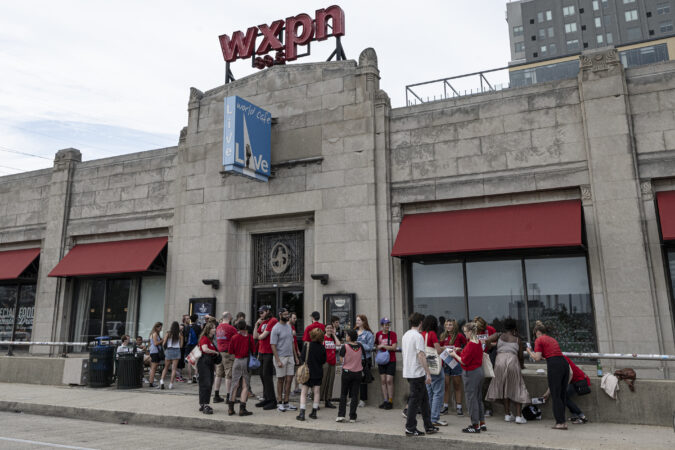
The university owns the building at 3025 Walnut St. that houses World Cafe Live’s 650-capacity Music Hall and 220-capacity Lounge. It is also home to the university’s radio station, WXPN-FM (88.5), which is a separate business.
According to public documents obtained by The Inquirer, as early as July, Penn’s real estate office sent Callahan and Giles notice that they had defaulted on their lease and owed the university $1.29 million for rent and utility payments dating back to April 2022. (Callahan has said that in the period before he took over as chairman of the World Cafe Live board, the venue was losing between $45,000 and $70,000 per month.)
Most of that bill had accrued while Real — who converted World Cafe Live into a nonprofit in 2018 — was still CEO. Callahan and Giles were granted 12 days to pay, stressing that the grace period “is being afforded to you only because of Landlord’s relationship with prior management and WXPN, not you.” The last two words were underlined for emphasis.
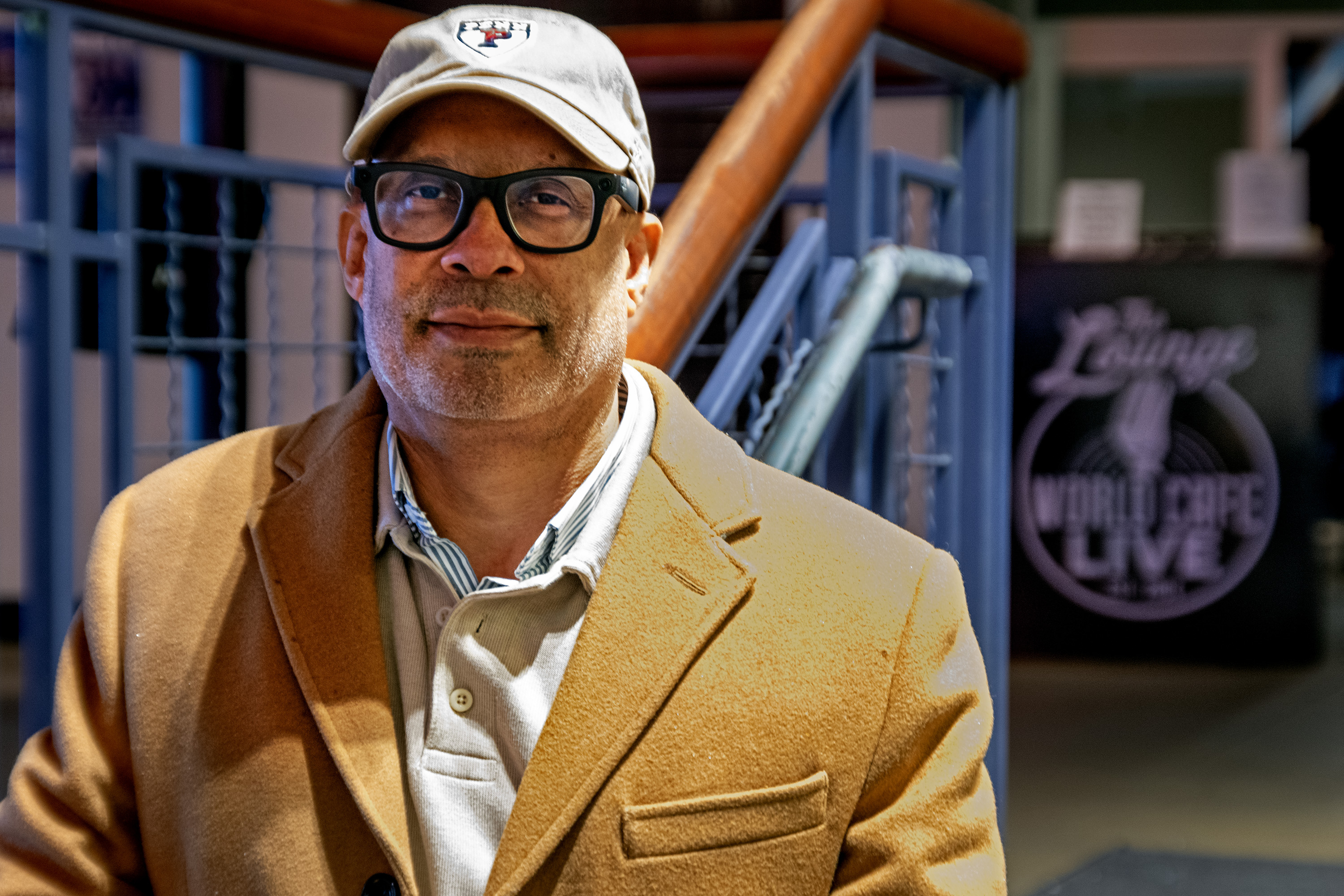
World Cafe Live President and CEO J. Sean Diaz poses at the embattled West Philly music venue Tuesday, Dec. 2, 2025.
On July 22, Penn lawyers delivered a notice to vacate, terminating their lease with Real Entertainment LLC. (The venue is still identified by the name Real gave it in 2004.)
World Cafe Live, however, remains in business, with a busy schedule this weekend: Indie band Carbon Leaf is playing the Music Hall on Friday, and country-folk stalwarts Pure Prairie League on Saturday.
That’s because Real Entertainment, with Callahan as its chairman, challenged the eviction notice with a counterclaim in Common Pleas Court.
It states that World Cafe Live has been engaged “in ongoing negotiations regarding lease modifications and denies it is in default,” and adds that “the alleged amount owed is disputed, inaccurate and does not account for significant offsets, concessions and mutual understandings between the parties.”
The case is scheduled for a trial date in January. This week, a spokesperson for Penn’s facilities and real estate services declined to comment.
The new CEO
Diaz was brought in as World Cafe Live’s president and CEO in September by Callahan, who remains chairman of the board. Diaz is a Penn alum, an entertainment lawyer, a former DJ, and a band manager whose clients have included WanMor, the vocal group of Boyz II Men’s Wanya Morris’ four sons, who are also all named Wanya.
His appointment as the new CEO was announced on social media in September. He was also named Giles’ replacement as president.
“I’m not a proxy for Joe,” Diaz said in an interview this week. Callahan, he said, had extracted himself from day-to-day operations to focus on technology concerns.
In that same announcement, Diaz said that all terminated employees would be hired back. Former employees said they did receive emails urging them to request an interview, but none had been rehired.
“I should have chosen my words more carefully,” he admitted.
He also expressed optimism that the conflict over the lease could be resolved and that World Cafe Live and Penn could come to terms to keep the venue open.
“There needs to be a meeting of the minds,” said Diaz, who lives in Voorhees, in South Jersey. “Penn’s main concern, obviously, is getting paid as a landlord and making sure that XPN has the continuity they’re built up in that building. That’s an important partnership.”
Diaz acknowledged alcohol had been served at some World Cafe Live shows after the license had expired, saying he anticipated the venue would have to pay a penalty for the infraction. “But what does everybody want? The city and the state want their tax revenue. Penn wants XPN back in the building. So we are working to resolve this as fast as possible.”
In the meantime, World Cafe Live is a BYOB venue. On Thursday, a sign on the window said ticket holders would be charged $20 per person for bringing their own drinks, and $10 if they ordered food.
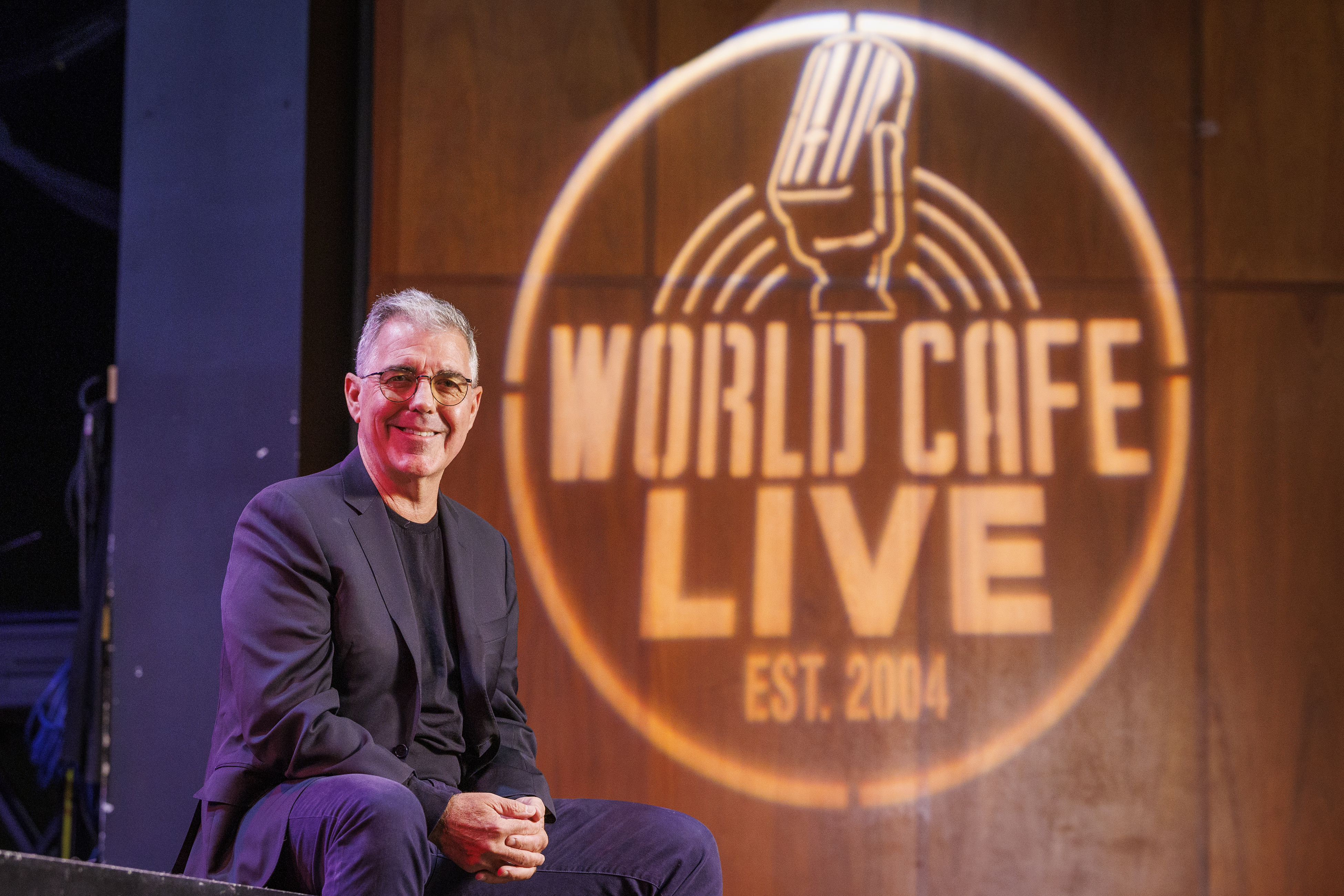
Joseph Callahan, the World Cafe Live’s chairman of the board and former CEO at World Cafe Live, 3025 Walnut St. Phila Pa, Wednesday, June 18, 2025.
Continuing labor unrest
Employees like Emilia Reynolds, who is one of two former World Cafe Live bartenders who spoke to The Inquirer, do not believe Diaz’s claim that he is not Callahan’s proxy.
“Joe does all the work behind the scenes,” Reynolds said of Callahan, who is also CEO of California-based Sansar, a virtual reality company. “He tells everyone what to do.”
Reynolds, who started tending bar at World Cafe Live in 2023, said they were optimistic about this summer after “me and all my coworkers all got together and unionized the building and got our recognition.”
But that optimism waned in the fall, Reynolds said, after the company did not come to the bargaining table.
“Then fast-forward to Oct. 1, when I woke up without a paycheck. Or, to be more specific, I woke up with a paycheck and then a few hours later had the exact same amount taken right back out.”
Reynolds confronted Callahan after a show later that month about the missing money and was told “that I was one of 16 people who maliciously stole from the company and manipulated payroll.”
Two days later, they were fired via email.
Reynolds, Wranovics said, is among the employees who “were fired for a totally outrageous situation relating to the fact that they had not received pay.”
Diaz did not address Reynolds’ case but claimed that “there was some manipulation of the payroll, with employees logging in for rates or hours they weren’t authorized at.”
Allison Eskridge, also a bartender, first worked at World Cafe Live in 2005 for a two-year stint, then returned in 2015.
Like Reynolds, Eskridge talks fondly about the community of coworkers during the Real years. “Hal was always hands on. He was always going to the shows and passionate about the music. It felt like there really wasn’t another place like it. It was really, really special,” she said.
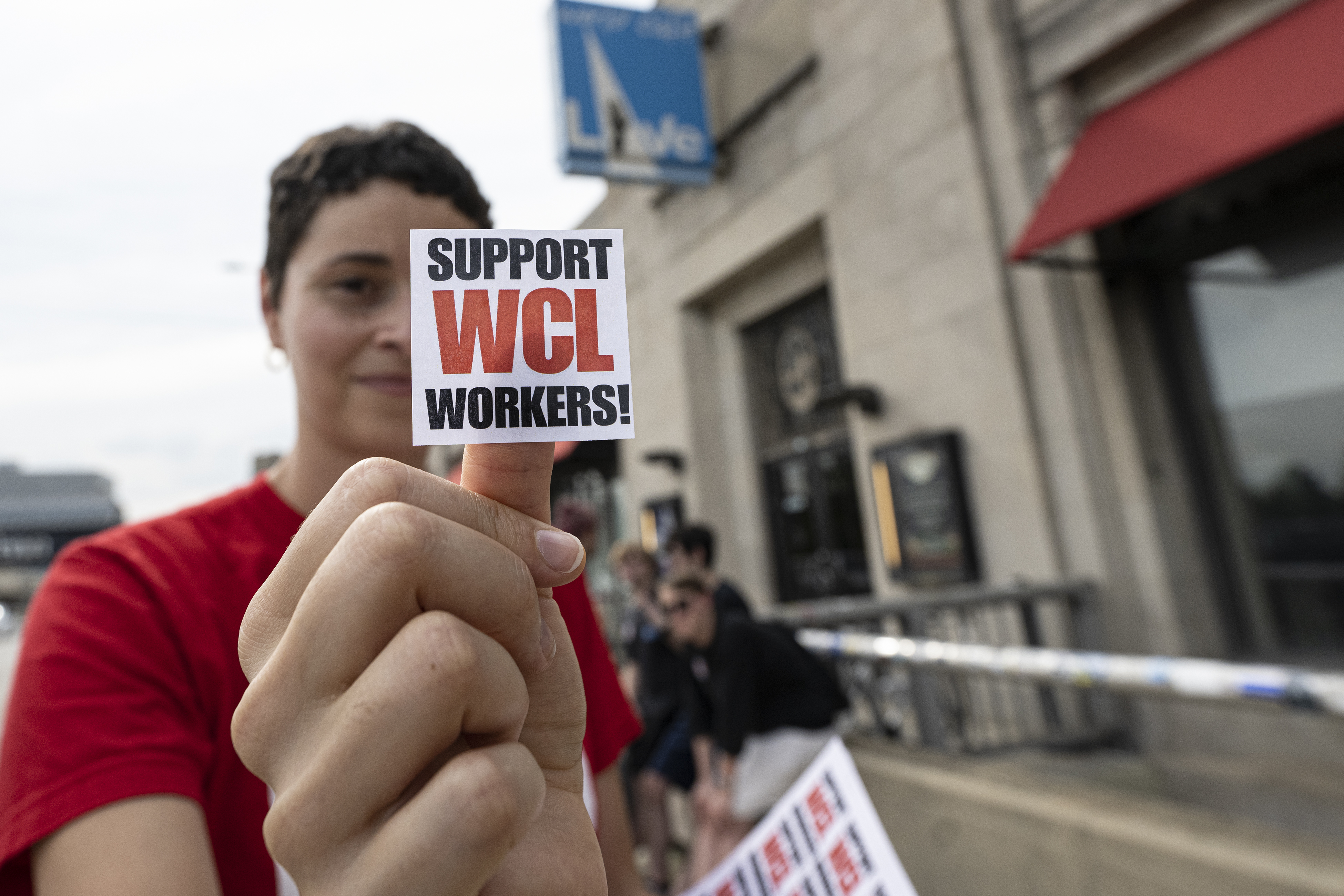
Union rep Kerrick Edwards, shows a support sticker outside the World Cafe Live building on Thursday, July, 2025 before a Town Hall meeting at the World Cafe Live with new leaders taking questions about changes at the music venue, which has been in turmoil since workers walked out during a show last month.
Eskridge said she was not paid for two pay periods in October and is owed between $1,000 and $2,000. After sending multiple emails to managers about her missing money that were not responded to, she, too, received a termination notice via email, she said.
“It just said: ‘Your services are no longer required.’”
Growing solidarity
On Oct. 12, State Rep. Rich Krajewski and City Councilmember Jamie Gauthier, who both represent the University City area, posted a joint social media video after visiting World Cafe Live.
“We are here to show solidarity with the workers,” Krajewski (D., Phila.) said in the video, adding that he was “extremely disappointed and ashamed that the workers have been mistreated, they have had wages taken away from them.”
He went on to call on management “to do better and come to the table and negotiate in good faith.”
“We came here today to meet with management,” Gauthier said, only to find no managers at the venue. “We are here to say: Pay your workers.”
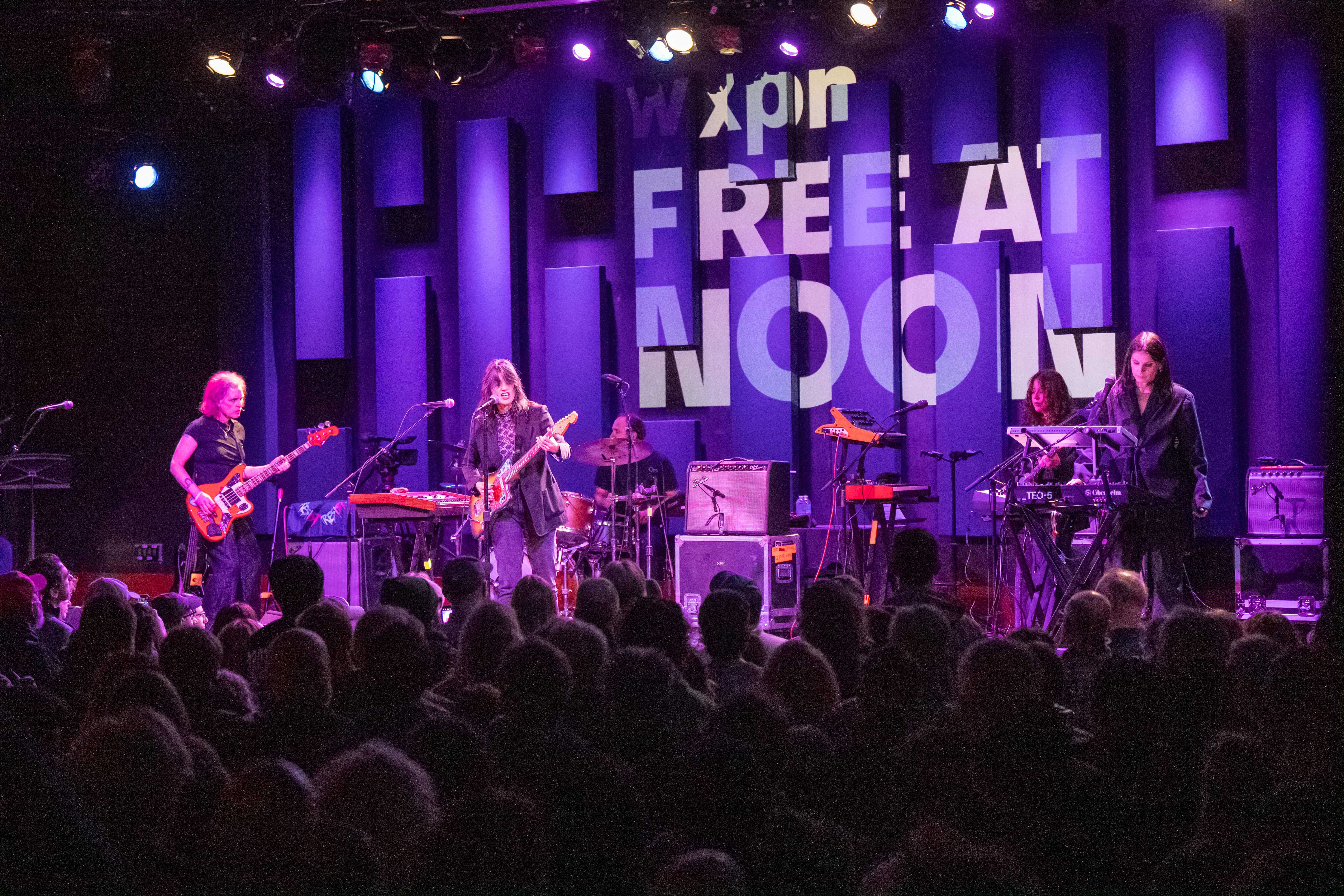
Sadie Dupuis, also known as Sad13, and the singer for Speedy Ortiz, performs with the band at the World Cafe Live for Free at Noon in Philadelphia, Pa., on Friday, Aug., 4, 2023. She will play as part of a World Cafe Live Workers benefit at Johnny Brenda’s on Jan. 11.
With the chaos and accusations of mismanagement, can World Cafe Live survive?
Diaz believes it’s too important not to.
“There’s a real cost” if the venue were to close, he said. “Not just to World Cafe Live as a brand, but to XPN, to Penn, to West Philadelphia, to the city, to this community.”
Though the World Cafe Live calendar has been thin and uninspired in recent weeks, Diaz said that by cutting costs, “we have got the operation to the point where it’s financially stable.”
He welcomes Callahan’s metaverse ideas if they can bring in new revenue streams, but said he imagines a venue that can sustain itself by being “more accessible and inclusive.”
“And when I say that, everybody thinks I just mean race, but I don’t. It means to be more accessible to the arts in a broader way. More kinds of music, but also dance, theater, and food events. You have to make this a place that more people have access to.
“It’s going to take the right resources, the right timing, the right relationship with Penn, and some resetting to bring it back,” Diaz said. “But what I do believe is that people are forgiving. And if you do the right thing, people will come back and support.”
This article has been updated with the correct pronouns for Emilia Reynolds and the correct price for BYOB tickets at WCL. Reynolds uses they/ them pronouns and the tickets cost $20.