Of course, not all of the Jeffrey Epstein files were released.
Even some files made available late Friday were quickly removed. Large portions were heavily redacted. Some portions contained boldfaced names, but there was little mention of Donald Trump.
As long as Trump keeps his thumb on the scales at the U.S. Department of Justice, no one should ever expect a fair shake — let alone an honest accounting of the yearslong connection between a convicted sex offender and a convicted president who is a congenital liar.
This is life under a brazenly corrupt administration that rewards billionaire cronies, punishes hundreds of political enemies, kills in broad daylight, and tramples the Constitution.
Better to prepare for how to defend against three more years of authoritarian rule mixed with kabuki theater.
In normal times, the Trump administration’s continued cover-up of the Epstein files would be an epic scandal, prompting hearings, investigations, and accountability.
But the Republicans who control the House and Senate have been a profile in cowardice. Until enough voters wake up, Trump and the GOP will continue to provide misdirection, denials, and a flouting of the law.
Gary Rush, of College Park, Md., holds a sign outside the U.S. Capitol urging the release of the full Epstein files in November.
Trump has not been implicated in any wrongdoing, but his enablers — including Attorney General Pam Bondi and FBI Director Kash Patel, and most Republicans in Congress — inexplicably continue to protect him.
Doing so obliterates any trust in the justice system and the rule of law.
The main tragedy involves the yearslong sex trafficking, rape, and abuse of hundreds of underage girls, including one alleged 11-year-old, and young, vulnerable women by Epstein and his many rich and powerful friends.
Epstein’s survivors have demanded that the files be released so there can be at least some public accounting of the horror they endured. But instead, the survivors have had to relive the trauma and fear of death threats.
One survivor who Epstein recruited from Trump’s Mar-a-Lago spa when she was a teen took her own life earlier this year. In atelling admission of how Trump views women as objects, he said earlier this year that Epstein “stole” her from him.
A recent story by the New York Times detailed how Trump and Epstein “pursued women in a game of ego and dominance” where “female bodies were currency.”
But the American people have been misled and abused, as well, while other pressing issues have been ignored or made worse.
Trump’s disregard for women has been well documented.
More than two dozen women have accused Trump of sexual abuse. He was caught on tape bragging about grabbing women by their genitals.
Danielle Bensky (left) and Anouska De Georgiou, victims of convicted sex offender Jeffrey Epstein, embrace during a news conference in Washington, D.C., in September.
A separate video showed Trump and Epstein partying at Mar-a-Lago, while Trump patted a woman on her behind. In 2023, a jury found Trump liable for sexually abusing a woman.
Everyone knew Trump was a lout, but more than 77 million Americans, including millions of women, voted for him anyway. And the Republicans in Congress have dutifully stood by him for years, bringing repeated shame to themselves and the country.
During last year’s election campaign, Trump used the Epstein files to stoke conspiracies and rally his supporters. He promised to release the files if elected, but after returning to the White House, called them a hoax.
(Trump also promised to lower prices, but that is a separate editorial, just as is his promise to end the war in Ukraine in one day.)
After mounting pressure from his base, and a 427-1 House vote last month to release the Epstein files, Trump ultimately signed a bill to make them public by Dec. 19.
The deadline passed, and all the files have yet to come out. Expect more gamesmanship and Truth Social rants.
The Epstein saga is a microcosm of Trump’s modus operandi. Lie, steal, cheat. Deny, deflect, delay, and degrade. Blame, complain, pressure, and sue. Line pockets whenever possible. Always overpromise and underdeliver.
Truth, honesty, humility, compassion, or responsibility are nowhere to be found.
Trump’s sinking poll numbers indicate that many supporters are finally catching on. The midterms loom, but so does three more years of hell.
But could the end of our long national nightmare be near?
More than a hundred years ago, the Lanzetta family seemed to be living the American dream in South Philly.
Immigrants from Italy, the family patriarch, Ignazio, worked hard at local restaurants, while his wife, Michelina, tended to their growing family, which included six boys by the early 1920s.
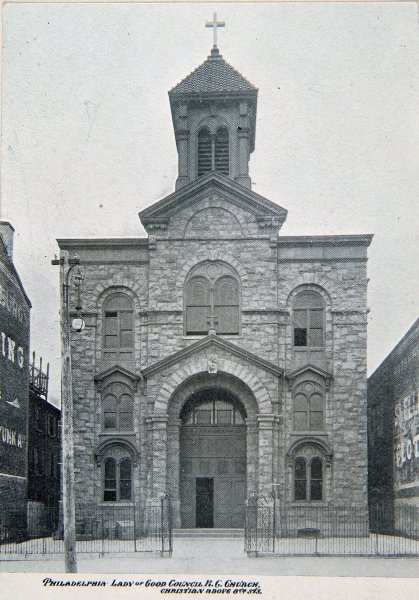
The former Our Lady of Good Counsel church on Christian Street.
But times were hard in 1920s Little Italy, and some native-born Americans scapegoated the recent arrivals for much of Philadelphia’s woes.
Mayor W. Freeland Kendrick, a Republican, decided to recruit a U.S. Marine general to “clean up” the whole city, where, he claimed, “vice and crime [were] rampant” and “disregard of law and order [was] almost unbelievable,” as the New York Times put it in July 1924.
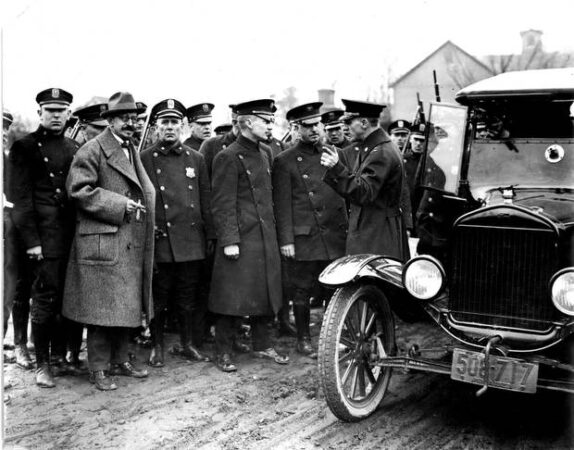
This required White House approval, ultimately causing clashes between local and federal officials — not unlike the ones we are seeing today, with National Guard troops and U.S. Immigration and Customs Enforcement and Border Patrol agents on the streets of many U.S. cities over the objections of state and municipal authorities.
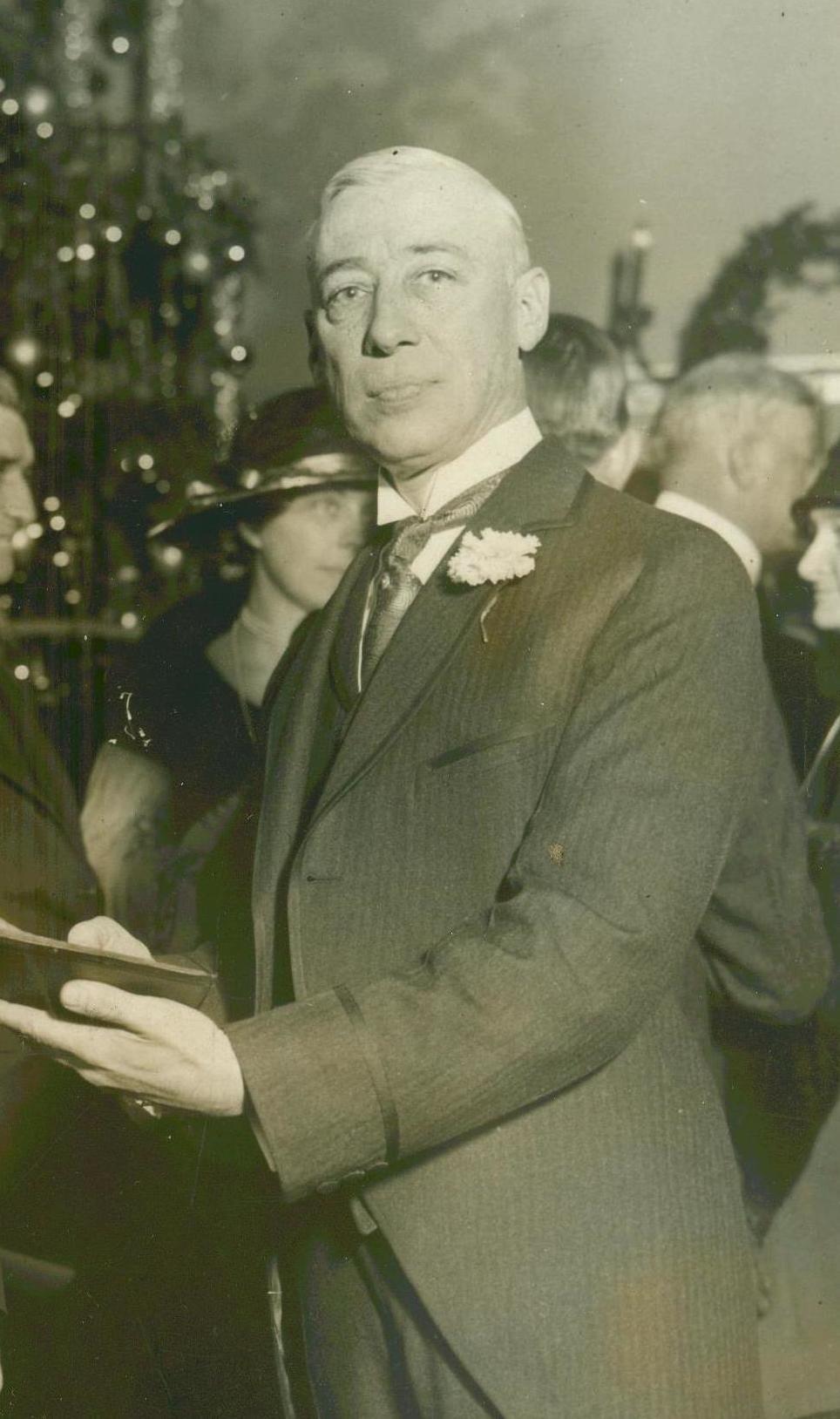
W. Freeland Kendrick, a Republican, served as the 84th mayor of Philadelphia from 1924 to 1928.
Democrats — including Gov. Josh Shapiro, who isoften mentioned as a 2028 presidential candidate — have denounced President Donald Trump’s use of federal man power.
“I think the way the President has chosen to deploy the [National Guard] … is extremely dangerous,” Shapiro said in October, as two dozen states tried to block what critics call Trump’s “militarization” of urban police work.
Long forgotten today are the travails of immigrants like the Lanzettas. They and other newcomers to the United States were branded as undesirable and accused of turning Philadelphia into a city where “banditry, promiscuous sale of poisonous liquor, the sale of dope, viciousness and lawlessness of all kinds are rampant,” as Mayor Kendrick put it, according to The Inquirer in 1923.
President Trump has used even harsher rhetoric to justify deploying federal agents and troops to Washington, D.C., Los Angeles, and Memphis, while threatening to do the same in Philadelphia.
Back in the Roaring Twenties, city officials were particularly worried that organized crime, fueled in part by Prohibition, would mar the citywide Sesquicentennial celebrations marking America’s 150th birthday in July 1926.
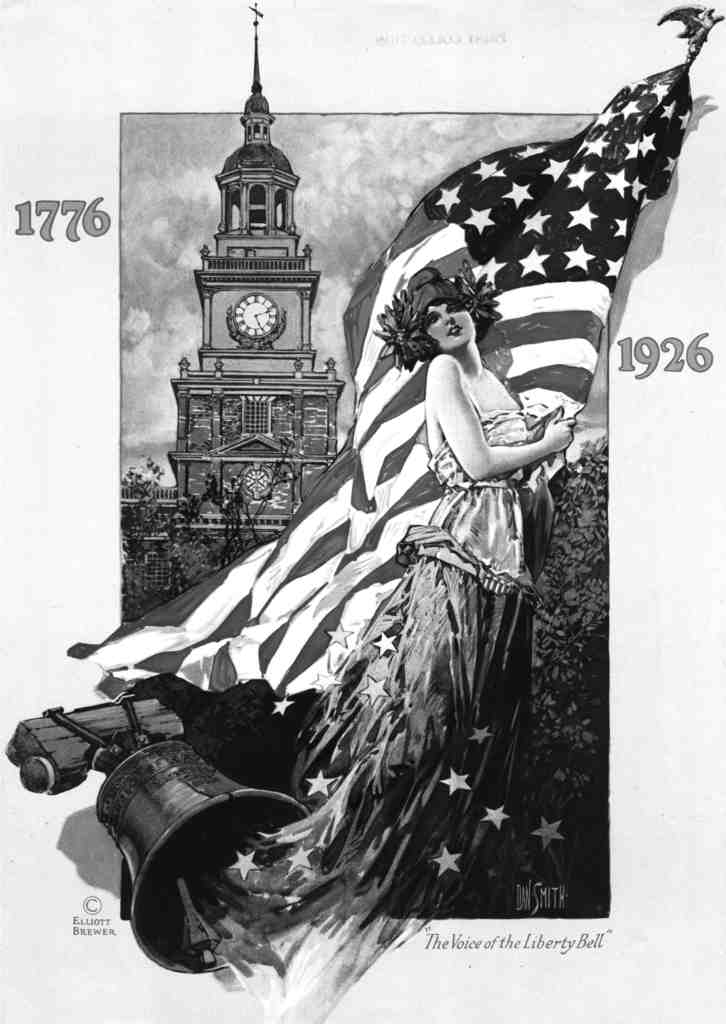
A poster for the Sesquicentennial International Exposition in Philadelphia.
When President Calvin Coolidge finally gave the go-ahead for Brig. Gen. Smedley Darlington Butler to suspend his Marine duties in January 1924, the West Chester native and Haverford graduate swiftly established his authority as the city’s director of public safety.
“You have a cesspool in Philadelphia,” declared Butler. “If necessary you should pass laws taking [Philadelphia’s] government away if they don’t know how to run it.”
Butler had two decades of experience in Latin America, the Philippines, the Boxer Rebellion in China, as well as France during World War I, earning two Medals of Honor and eventually rising to the rank of major general. Only a tough, experienced Marine could tame Philly, Mayor Kendrick and local reformers believed.
And while Butler didn’t have soldiers to command, he was later quoted as saying that his ideal job title would be “martial law commander of Philadelphia with 5,000 Marines under me. Then I would not be hampered by writs and magistrates hearings.”
“Cleaning up Philadelphia,” he later lamented, “was worse than any battle I was ever in.”
By the end of 1925, even Kendrick had come to see some of Butler’s more authoritarian initiatives as “intolerable.” Criticisms of any federal role in combating local crime grew louder and louder.
J. Hampton Moore, who preceded and then succeeded Kendrick as mayor, called the Butler controversy a “spectacular misuse of the White House.”
According to an Associated Press article from Nov. 4, 1925, a congressman bluntly asked Kendrick: “Would you favor the president designating an Army or Navy or Marine to do police work in every one of the big cities of the country?”
“Mine is an exceptional case,” Kendrick responded.
To which the congressman snapped, “Some of us don’t see it that way.”
Butler ultimately agreed and returned to the Marines.
Though largely forgotten, this controversy has clear lessons — and warnings — for today.
Polls show Americans are highly skeptical of recent ICE raids and National Guard patrols — a problem Republicans could have avoided if they stuck to their long-standing preference for local rather than federal solutions.
But Gov. Shapiro should also remember that Trump won the 2024 election, in part, because voters didn’t trust Democrats on urban crime.
This is no mere philosophical discussion.
Consider Michelina and Ignacio Lanzetta, those striving South Philly immigrants. Their sons were pulled into “every vice and crime of the day,” historian Celeste A. Morello has written, and two of them were ultimately murdered.
With the nation’s 250th birthday almost upon us, Philadelphia might finally guide Americans toward a resolution to these long-standing conflicts over local crime and federal power.
Tom Deignan has written about history for the New York Times and the Washington Post. He is working on a book about violence in and around Philadelphia in the 1920s.
Deanna Baker made reservations for A Longwood Christmas in late summer.
The 32-year-old Downingtown resident has been gifted a Longwood Gardens membership each of the past five years, but even the member reservations for the annual holiday light show book up well in advance. So she secures her family’s time slots while the weather is still warm.
“Yes, it’s ridiculous this time of year,” she said of the Longwood demand at Christmastime. But “yes, it’s worth it.”
Baker, who works in operations for Victory Brewing Co., said there is “a magical element” to the experience, whether she’s going with her toddler or her adult friends and relatives. She went once in early December and plans to return in the afternoon on Christmas Day.
Every holiday season, hundreds of thousands of people visit A Longwood Christmas, which serves as an “economic engine” for the business communities in Kennett Square and surrounding towns, as Cheryl B. Kuhn, CEO of the Southern Chester County Chamber of Commerce, recently described it.
Longwood Gardens’ holiday attendance has increased nearly 42% since pre-pandemic times. Last year, 650,000 people visited the gardens at Christmas, up from 609,000 the prior holiday season and from 458,000 during the 2019-2020 event (the show ends in the beginning of January).
Many of these guests book months in advance, leaving last-minute planners few options for afternoon and nighttime visits during the holiday week.
More than 500,000 lights shimmer at Longwood Gardens’ A Longwood Christmas through Jan. 11, 2026.
“We open ticketing in July, and there are always a few early planners that buy tickets and make reservations then,” Longwood Gardens spokesperson Patricia Evans said in a statement. “By late Octoberish, the most desirable evening time slots on the weekends and the week of and following Christmas tend to be sold out.”
But as of Monday, Evans noted, some tickets were available for time slots before noon and after 8:30 p.m. for the remaining days of December. Availability opens up in January, she added. The holiday lights stay on through Jan. 11.
If nonmembers snag tickets, the experience will cost $45 a person for adults and $25 a person for kids, which Evans said is a $2-$3 per person increase from last year. Children 4 and under are free.
window.addEventListener(“message”,function(a){if(void 0!==a.data[“datawrapper-height”]){var e=document.querySelectorAll(“iframe”);for(var t in a.data[“datawrapper-height”])for(var r,i=0;r=e[i];i++)if(r.contentWindow===a.source){var d=a.data[“datawrapper-height”][t]+”px”;r.style.height=d}}});
Philly-area holiday attractions that have availability
For Philly-area residents who want to enjoy a festive experience before 8 p.m., or at a slightly lower price point, other options have availability this week.
As of Monday afternoon, the ice skating rinks at City Hall and Penn’s Landing had online reservations available for any day this week, though spokespeople said some time slots can sell out around the holidays. Both cost about $20 per person for admission and a skate rental.
A family walked into the Philadelphia Zoo’s LumiNature holiday light display in this December 2021 file photo.
“While tickets are available, the most popular times that guests reserve their tickets for are from 5-6 p.m., and it is likely that that particular hour will sell out on our most popular nights,” zoo spokesperson Maria Bryant said.
Last year, LumiNature saw nearly 70,000 guests, according to Bryant, and it is on pace to exceed that number this season.
Depending on the day, tickets cost between $25 and $29 per nonmember 12 and over, and $20 and $24 per child between the ages of 2 and 11. Younger children are free.
Nighttime turned the Philadelphia Zoo into a wonderland of lights as LumiNature returned for its third year in December 2022.
In the suburbs, the Elmwood Park Zoo’s Wild Lights “will not sell out,” with “plenty of tickets for each day of the rest of the event,” marketing director Kyle Gurganious said. Guests can buy at the gate, he added, or book online to save $1 per person.
For nonmembers, online tickets are $27 per person 13 and older and $24 per child between the ages of 3 and 12. Children under 3 are free.
Last season, the Norristown attraction brought in about 50,000 visitors, a number Gurganious said the zoo is “on track to eclipse … significantly” this year.
A miniature Art Museum was on display in the Holiday Garden Railway at the Morris Arboretum & Gardens in 2023.
At least one other Philly-area holiday attraction is completely sold out this week: The Holiday Garden Railway Nighttime Express at the Morris Arboretum & Gardens.
Because it’s “so popular and because we only have a limited number of nights, the Nighttime Express sells out every year,” said Christopher Dorman, the director of visitor experience for the arboretum, which is part of the University of Pennsylvania.
Those looking to snag tickets for next year may want to mark their calendars: Holiday tickets go on sale at the beginning of November for arboretum members and a week later for the general public.
Added Dorman: “While the Nighttime Express is sold out, folks can still see the trains all lit up [and the rest of the garden] during normal daytime hours through Dec. 30.”
And for those turned off by the planning — and expense — required for these paid festivities, there’s always the low-cost, low-commitment option: touring your neighborhood’s home light displays.
Christina Gallo and Daniel Zehnder came to McPherson Square in the Kensington neighborhood looking for a fix, as they did almost every day.
But on this day in late April, an SUV pulled up. A woman bounded out with an offer that sounded like a miracle: an all-expenses-paid trip for free treatment at a luxury rehab center in California.
Gallo and Zehnder, both then37, hoped their lives were finally about to turn around after two decades strugglingwith addiction.
“We wanted to get clean,” Gallo said.
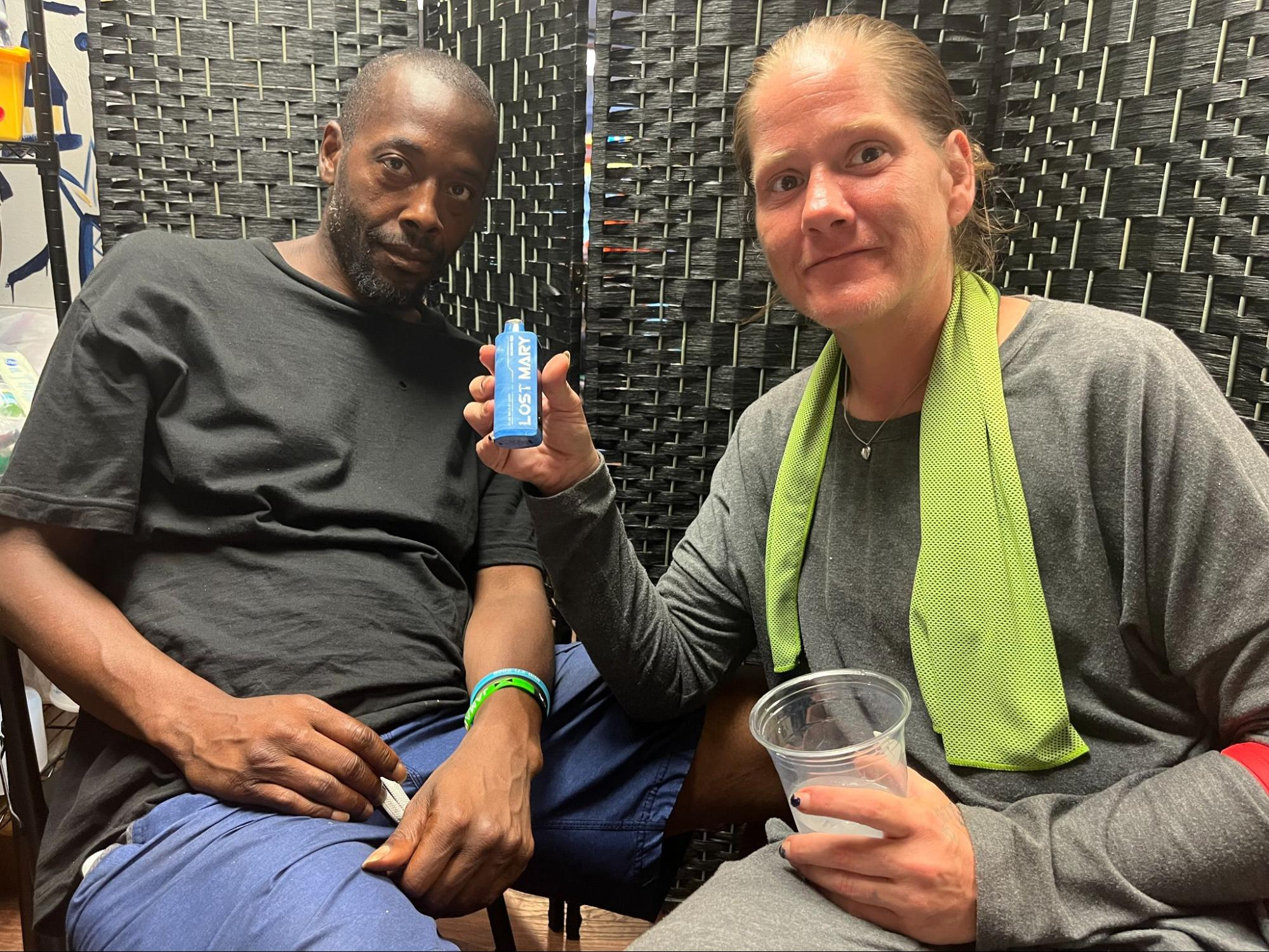
Christina Gallo and Daniel Zehnder, pictured here in Kensington’s McPherson Square in June, were recruited to what they thought would be a luxury rehab in California.
Within days, they were in a Lyft from their Bucks County trailer to the Philadelphia airport. Everything — the Lyft, the flight, the rehab — had been paid for, by whom they did not know.
They landed at a treatment facility in Los Angeles with a gleaming swimming pool, but said they did not see doctors or nurses and were offered little medical treatment to ease their agonizing withdrawal symptoms.Within a few days,the couple had left the clinic, relapsed, and the life-changing trip they envisioned ended in an ambulance rushing to a nearby hospital, where Gallo was admitted to intensive care.
Their California dreams were dashed. But the trip notchedanotherrecruitmentfor The Rehab Specialist, a year-old operation that makes money by scouting the streets for people in addiction to send to independently run rehab centers across the country.
Rehab Specialist recruiters working in Philadelphia offered free plane tickets, housing, and medical care — and at times cash, cell phones, cigarettes, and clothes — to entice people into recovery homes, Inquirer reporters found in interviews with seven people who had firsthand knowledge of the recruiting tactics.
With a single conversation in Kensington, recruiters alsogot willingpatients enrolled in private health insurance that could pay higher rates, often without the patients understanding what they had signed up for — until bills started to arrive.
Businesses like The Rehab Specialist operate as middlemen inan industry where one person’s recovery can be cashed in for hundreds of thousands of dollars in insurance payments.
Some referral and marketing services in the addiction treatment industry are legal. But the business is also notoriously rife with insurance fraud and patient brokering — a term that describes referrals to specific clinics in exchange for illegal kickbacks or bribes.
Rehab Specialist brochure, advertising a Spanish-Colonial style mansion with a pool in the backyard.
Pennsylvania is seeing a resurgence of patient brokering, according to tracking in 2023 by Highmark Health, a Pittsburgh-based Blue Cross Blue Shield affiliate. Such schemes are especially a concern in Kensington, home to one of the nation’s largest open-air drug markets.
Federal laws and a patchwork of state laws are supposed to protect vulnerable people. Prosecutors have limited resources, however, and rarely investigate low-level players.
Pennsylvania considered stronger laws after a major scandal.In 2019, federal and state prosecutors uncovered a multimillion-dollar insurance fraud scheme at Liberation Way, a Bucks County recovery home. The abuses spurred Pennsylvania lawmakers to introducelegislation that would have made it a felony to use money or services to lure patients into addiction rehabs and other healthcare facilities. The measure died without advancing to a vote.
“People get pretty brazen when nobody’s looking,” said Alan Johnson,chief assistant state attorney in Palm Beach County and a national expert on fraud in the industry.
Johnson called a description of The Rehab Specialist’s practices “classic patient brokering.”
For months, Philadelphiaadvocates for people in addictioncirculated warnings about the business and posted photos of its recruiters on Facebook. They tried to alert police, but never heard back.
Screenshot of text messages between Christina Gallo and a Rehab Specialist recruiter, saying that Gallo and Zehnder got approved for private insurance that would pay for their treatment in California.
The Philadelphia Police Department did not respond to requests for comment, and the Philadelphia District Attorney’s Office said it has not opened an investigation and declined to comment on The Rehab Specialist’s practices.The Pennsylvania Attorney General’s Office also declined comment.
On social media, The Rehab Specialist’s director and founder, Gus Tarrant, strongly disputed critics who accused his business of patient brokering.
“I have never and would never give a client money to go to rehab or encourage them to cycle in and out of programs,” Tarrant wrote in a March post to a Facebook group that monitors addiction treatment.
Tarrant, in a June interview with The Inquirer, reiterated that he and his business havedone nothing wrong.
Tarrant said that his operation has a national focus and came to Philadelphia this spring because the city has “the worst drug epidemic in the country.”
Tarrant said his recruiters send patients out of their home state to avoid triggers for relapse, a practice he strongly believes in, having gone through his own recovery from addiction about five years ago. (Though popular in some recovery circles, some research suggests that it can be less effective than getting treatment closer to home, where people have established support networks.)
“Our goal is to help as many people as we can,” Tarrant said. Now based in Myrtle Beach, S.C., Tarrant has channeled his experience into starting at least two businesses in the past five years focused on people in addiction.
He said rehab centers payhis business a flat fee to arrange for people from Kensington to receive treatment in California, but declined to share details. Two Los Angeles treatment centers told The Inquirer they had paid Tarrant and his operation a flat fee for “marketing,” but both also declined to give specific details of the arrangement.
On business cards, Tarrant’s title is listed as The Rehab Specialist’s founding partner; his LinkedIn profile says he started working there in 2024.
The Inquirer was unable to find any documentation indicating the business was formally incorporated in a search of state corporate registries where its recruiters and Tarrant have operated. The Inquirer also did not identify any lawsuits filed against The Rehab Specialist.
The Inquirer interviewed Tarrant by phone this summer. He did not return multiple calls, texts, and emails this month requesting additional comment.
Reporters interviewed five people who were approached by The Rehab Specialist’s recruiters on the street, and another two whose relatives were recruited.
All shared similar stories about how the process worked. Two said they enjoyed eating chef-made meals and benefited from group therapy and daily outings in Los Angeles.
One mother said her son ultimately decided not to board the plane to California, though he continued to receive frequent calls from Rehab Specialist recruiters urging him to travel for treatment. In another case, a woman said her brother did not get the care he needed in California and ended up in the ICU.
Gallo and Zehnder were among the three people interviewed who said the medical care they received in California did not meet their expectations for a luxury rehab facility. The couple blames The Rehab Specialist for launching them on a journey that ended with them worse off than before.
“I don’t know if they have the intention of trying to help people,” Gallo said, “but they’re going about it totally the wrong way.”
Christina Gallo and Daniel Zehnder in June, sitting in the spot where they were first approached by The Rehab Specialist recruiters in McPherson Square Park.
Lofty promises and dire warnings
The fliers that The Rehab Specialist recruiters passed out in Kensington featured photos of a Spanish Colonial-style mansion surrounded by palm trees, with a pool in the backyard. They advertised “holistic treatment” including equine therapy, medical detox, and an intensive outpatient program.
All that, in sunny California.
The pitch has particular appeal in Philadelphia, where people have struggled through long waits to access medical detox programs that allow patients to withdraw under the supervision of a doctor or nurse. These programs typically offer medications to help ease intense withdrawal symptoms like nausea, vomiting, and agitation, all of which have become more dangerous as potent animal tranquilizers and industrial chemicals contaminate the local drug supply.
Despite often lofty promises, the addiction treatment industry has long seen high-profile prosecutions over exploitative practices.
In the Philadelphia area, the Liberation Way prosecution sent the company’s CEO and medical director to federal prison. Prosecutors said the center had signed patients up for private insurance plans and paid their premiums. It then charged insurers for shoddy or unnecessary treatment that resulted in excessive insurance payouts.
California and Florida in particularhave emerged as hot spots for addiction treatment fraud. In South Florida, a 2022 federal prosecution of a$112-million scheme led to prison sentences foreight people accused of using cash bribes and free rides, flights, drugs, and alcohol toattract patients to a rehab center.The payments were distributed via anetwork of lower-level street recruiters, purportedly hired for “marketing,” according to an affidavit from the case.
But addiction treatment scams are often ignored because they involve sprawling national investigations that require significant resources. State prosecutors can’t justify the expense and federal prosecutors won’t take on low-level fraudsters, according to Johnson. Palm Beach County prosecutors stepped up enforcement after the state passed stricter laws in 2017.
“You have to prioritize cases. This is not high on their hit list, unless it’s going to make a big splash,” said Deb Herzog, a former federal prosecutor turned fraud investigator at Anthem Blue Cross.
Melissa Ruby, an activist who runs a national Facebook group to monitor patient brokering, in Philadelphia in October.
Warnings about The Rehab Specialist instead came from Melissa Ruby, 46, and other local advocates. Ruby runs a Facebook group dedicated to monitoring patient brokering nationwide, and started sharing photos on social media as soon as the recruiters showed up in Kensington. She did the same when they were reportedly spotted in Pittsburgh.
She said she also alerted aPhiladelphia police officer who runs an independent nonprofitto help people in addiction, but never heard back.
For Ruby,the issue is personal: She has a relative who was a victim of patient brokering.
“BEWARE!!” she wrote in a March post about The Rehab Specialist, punctuated with red stop sign emojis. “No good will come from any of this!!”
Tarrant, the Rehab Specialist director, was a member of Ruby’s Facebook group at the time and wrote that the vast majority of the negative information Ruby had posted about him was “completely wrong.”
“I am not paid by the client or any ‘referral fees’ based on clients sent,” Tarrant wrote.
When asked in the Facebook group why The Rehab Specialist was sending patients out of state on free flights, he declined to answer, writing that he believed the questions were in bad faith. He encouraged people to reach out to him directly so he could explain.
After a few weeks, Ruby kicked him out of the group. “Adios, Gus!” she wrote.
A sunny pitch in Kensington
One day in April, two female Rehab Specialist recruiters introduced themselves to Samuel Rosato, 47 at the time, as he got off the El near Kensington. He was immediately intrigued.
“They were just real pretty and tan,” Rosato said.
They later said all they needed were a few identifying details, and they would be able to set him up with private insurance that would pay for everything at a luxury rehab out west.
Rosato scribbled down his Social Security number and handed over his ID card. Within 10 minutes, he said, the recruiters told him they had secured him Blue Cross Blue Shield insurance. Rosato, like others interviewed by The Inquirer, did not know who was paying for his insurance or lodging.
The Rehab Specialist recruiters, whose names he shared with The Inquirer, are not licensed insurance brokers or healthcare navigators in Pennsylvania.
Allison Hoffman, a health law professor at the University of Pennsylvania, said that without more information on how patients were signed up for insurance plans, it isdifficult to say definitively whether insurance laws were violated. But, she added, “it sounds potentially illegal.”
Tarrant said his employees “don’t deal with any of the insurance.” He said they do not directly enroll clients in insurance, but rather direct recruitsto independent, licensed insurance brokers.
Patients “sign up for the insurance themselves,” he said. Hedeclinedto say more, citing patient confidentiality.
A week later, Rosato said an Uber picked himup at his mother’s home in Northeast Philadelphia for his flight to California. He said he was joined by three other people from Kensington who told him they had also been recruited by The Rehab Specialist.
“I love it out here,” Rosato said in June, several months into his recovery in California. “I’m trying to rebuild my life now, starting at the bottom.” (Rosato stopped responding to calls and texts from The Inquirer in the fall; his mother said this month that he’s back in Philadelphia, but she is not sure where.)
Jerome Hayward, 48 at the time, and his girlfriend, Megan McDonald, 39 at the time, also didn’t ask too many questions when they were recruited in front of a Kensington soup kitchen and traveled separately to California in the spring.
Told only that she had been “approved” for treatment, McDonald said she didn’t realize she had been signed up for a Blue Cross Blue Shield plan until she received paperwork at a hospital.
“How would we pay for it?” McDonald asked. “Because we’re broke. We got no money.”
Megan McDonald and Jerome Hayward at a drop-in center in Philadelphia’s Kensington neighborhood.
A rising entrepreneur
Tarrant rose in the rehab industry after getting his start vacuuming floors at a rehab company run by LaMitchell Person, a mentor who Tarrant credited for giving him “the opportunity to get sober and clean,” in an interview with a local news station in California. The two later became business partners.
They were working together at a California rehab company in 2021 when a 22-year-old named Dean Rea died of a fentanyl overdose after leaving an associated sober home.
Rea’s mother later accused Tarrant, Person, and other employees ofcontributing to the death in a lawsuit filed against the facility,Ken Seeley Communities. Neither Tarrant nor Person, then the facility’s executive director, was named as a defendant in the case.
In court records, Rea’s mother claimed Tarrant falsely told Rea that his insurance wouldn’t cover more intensive treatment elsewhere.
“Gus is, essentially, a salesman whose goal is to admit as many patients to KSC as possible,” their legal complaint said. The rehab company denied the allegations, and Rea’s suit was settled in a confidential agreement in 2023 for an undisclosed amount.
In an interview this month, Person called the lawsuit’s claims inaccurate. “Fentanyl killed her son. Not Gus, not me, and not the organization,” Person said.
By the time the suit was settled, Tarrant and Person had both left the business.
In 2022, they filed paperwork to incorporate a company called Origin Addiction Services, based in Idaho, according to state corporate records. An official address on the website is a P.O. box in a Boise strip mall.
The company’s website said it offered addiction recovery services such as interventions, sober companionship, counseling, and transportation.
The company’s website featured an ‘about’ page with professional headshots of a nine-member executive team. All but three of those headshots appearedto be drawn from stock photo services,and The Inquirer was unable to trace the individualsto authentic social media or LinkedIn accounts.
After The Inquirer contacted Personabout the photos in September, all of them– except his own — were removed overnight. Person later said in a phone interview that the stock photos and some of the employee names were “placeholders,” but insisted that the staffers were real.
The company filed paperwork to dissolve a year later; Person said it had never done business, and he and Tarrant went on to pursue separate endeavors.
Person was in Philadelphiarecruiting people at the intersection of Kensington and Allegheny Avenues in March, according to acity employee there to help people in addiction. Person handed him a business card identifying himself as a “regional director” of The Rehab Specialist, said the employee,whom The Inquirer is not naming because he was not authorized to speak to the media and feared losing his job.
Person answered the phone this summer when The Inquirer called the Rehab Specialist’s general number, but he said he did not work there.
In a follow-up interview this month, he said that Tarrant had hired him to build a call center for a California rehab, saying that was his only involvement with The Rehab Specialist.
He said he hadnot come to Kensington and was not responsible for business cards that listed him as the regional director.
“Gus wanted me to work for him, because we are friends,” Person said.
Christina Gallo and Daniel Zehnder in McPherson Square Park in June.
A dream dashed in California
Desperate to get clean, Christina Gallo and Daniel Zehnder accepted the offer to fly to California after being recruited in Kensington earlier this year. A luxury van picked the couple up when they arrived at Los Angeles International Airport on May 3, they said.
The driver took the couple to Gevs Recovery, a large gated house in a residential neighborhood in Northridge. Gevs has been licensed as a drug abuse recovery home since 2024. State records show that as of early August, no complaints about its care have beenfiled with the California Department of Public Health.
Gallo and Zehnder said the Gevs house was dark and empty when they arrived, aside from a handful of employees. Gallo began to panic as drug withdrawal left her shaking and sweating, with a bloody nose and headache pangs that felt like she had stuck her finger in an electrical outlet.
“I said, ‘What’s going on here? Where’s any of the nurses or the doctors?’” she recalled. “‘Who’s going to be taking care of us, medically?’”
“We don’t do that here,” she remembers them saying. The Gevs employees told Gallo they could send her to a hospital, or give her some Tylenol, she said.
Alarmed, Gallo and Zehnder decided to leave. On their way out, they said a woman descending the stairs told them she had just left the hospital after a month there.
“Are you guys from Philadelphia, too?” Gallo recalled the woman asking.
She and Zehnder headed to a cheap motel, but they didn’t feel they could stand the withdrawal effects and decided to buy drugs nearby. By the morning, their symptoms had grown worse, and they returned to Gevs to demand plane tickets home.
Kristine Kesh, an operations manager at Gevs, told The Inquirer the center does have medical staff on site and does offer medication treatment for withdrawal.
“These clients have been addicts for most of their lives, and they come in expecting this glorious detox,” Kesh said. “Whatever they’re expecting is not realistic. I mean, you can’t help everybody.”
At the airport, Gallo vomited on herself before collapsing to the ground in pain. Zehnder defecated and vomited on himself. An ambulance took them to the emergency room, where Gallo was placed in intensive care.
After two days in the emergency room and the intensive care unit, Gallo and Zehnder were released.Zehnder’s mother paid for their flights home.
While Zehnder was away, bills from Highmark started arriving at his mother’s house — even though he had been promised free treatment.
The bill, which misspelled his last name, said he owed a $267 premium for the month of May. He said he also received a $700 bill for the ambulance ride from the LA airport to the emergency room, which he threw away.
Six months after their disastrous trip, recovery feels as far away as when their return flight from California landed. At the Philadelphia airport, they hailed a cab and went straight to Kensington. They wanted to inject heroin, right away.
With hockey leagues around the world nearing the midway point and the World Junior Championship starting on Friday, we caught up with Brent Flahr to talk prospects. In Part 2 of our interview with the Flyers’ assistant general manager, we focused on the team’s international-based prospects and those competing in Lehigh Valley.
This interview, which was conducted on Dec. 10, has been edited for clarity and length. Part 1.
While No. 1 center and No. 1 defenseman remain holes the Flyers organization is looking to fill, Flahr noted that while there are fewer than 32 of those guys around, the Flyers remain on the lookout and have assets that could help in acquiring one.
Swedish center Jack Berglund’s skating has been a contentious point among fans, but Flahr says it has improved and that Berglund reminds him of a young Mikko Koivu in that regard.
When asked for his favorite under-the-radar prospects, Flahr pointed to Cole Knuble and Denver Barkey as two guys that are easy to “cheer for.”
More Details
With hockey leagues around the world nearing the midway point and the World Junior Championship starting on Friday, we caught up with Brent Flahr to talk prospects. In Part 2 of our interview with the Flyers’ assistant general manager, we focused on the team’s international-based prospects and those competing in Lehigh Valley.
This interview, which was conducted on Dec. 10, has been edited for clarity and length.
Q: Where do you see Jack Berglund, who was pretty impressive at development camp, fitting?
A: I think he’s a very well-rounded player and has the ability to be a really good 3C, maybe more. But he can play power play. He’s strong. He wins battles. He can make plays. He’s very sound defensively. Where he’s played, he’s had to earn everything he can, but he can shoot it.
I think people worried about his skating, but his skating is coming along as well, and he’s big and strong. You’ll see at the U20 level, he’s a big, strong horse out there, but he’s nowhere near where he’s going to be at 23 years old. When you see him off the ice, he’s still a young guy, and you forget about that. … Not all these players who have been drafted are going to play the next year, but he’s on the right path to being a very good pro.
The Flyers remain bullish on Jack Berglund, who Brent Flahr says continues to make strides with his skating.
Q: Alex Bump, Denver Barkey, and Carson Bjarnason, have been the three B’s in Lehigh Valley. What have you seen from them in their transition to pro hockey? [Note: Barkey was recalled after this interview was conducted.]
A: Barkey, I think right from the start, he’s played very well. On the production side, he makes plays, he works, and the details are great. Such a smart player. He’s got to get stronger and build up his body to handle the grind but so far, so good. Down there, he’s been arguably our best forward a lot of nights, and coaches love him. …
I think Bumper, when he first went down there, even though playing last year — I don’t know if he thought it was going to be easy or disappointment from not making the team right away — I thought he stumbled around a little bit early, and then he found his game, and now he’s going. But part of the why he’s down there is to find the consistency in his game, not just offensively, but defensively, and managing the game and then playing it every night. But he’s talented. He’s producing now. I think he’s feeling good about himself, and he’s certainly going in the right direction. …
And Carson … I think he’s exceeded expectations so far. He’s got the right demeanor, the size, the athleticism, and he’s learning the pro game. … It just seems easier for him. In juniors, it was so chaotic in front of him; he used to get so many Grade A chances.
Q: You mentioned Aleksei Kolosov. He seems like a different player this year, no?
A: He is a different player, different personality. He’s really trying to fit in. He’s very athletic, very competitive, and he’s giving our team a chance to win down there almost every night. He’s a talented kid, so he’s got a chance to be an NHL goalie now. He just skipped a step last year. Now he’s building it back up again here, and we’ll see where it goes.
Q: What about Yegor Zavragin? He has another year on his deal but it sounds like he’s playing well in Russia.
A: He’s a talented, talented kid with size. … He’s got to build up his body, which is a big focus for St. Petersburg, and he’s working hard. … We want him to be over here right away, but the one thing the KHL does, or has a history of doing recently, is developing goalies. So we’re in a good spot and, hopefully, when the time comes, we can get him over here and get him going.
Egor Zavragin has firmly established himself as one of the best young goaltenders in Europe.
Q: There’s been a lot of criticism of the Flyers not having a 1C or 1D. What would you say to those people, and how would you assess the system?
A: There are not 32 1Cs in the league or 32 1Ds. So we’re always trying to look for that and strive for that. But we have some good players coming, guys who can play, hopefully, 2Cs. We have some guys on the wing, we think. We have some solid defensemen coming.
We understand what we need to be an elite team; at the same time, we’re growing a pretty good base as far as depth through the lineup and people that can contribute in different ways. So, that’s where the Berglunds and some of these guys that aren’t talked about as much could be valuable pieces as well. Then you’ve got [Jett] Luchanko, and [Jack] Nesbitt, who are going to take a little time to get stronger. Heikki [Ruohonen], as well, is a really good player.
Q: Give me one or two prospects that you’re excited about in the system.
A: Porter [Martone] is Porter. He has a chance to be a special player. When you meet him, he’s kind of got that “it factor,” as far as he’s got cockiness, but in a good way. I think he’s a pro; he’s got the mindset now where he knows where he has a little more work to do as far as getting there. But he understands. Getting that experience last year with Team Canada was huge, to be a young kid playing with those types of players and see where you’ve got to get to. I just think he’s matured, and he has a chance to be a really good one for us.
But the guy we drafted, who is one of my favorites … is Cole Knuble. Just a good hockey player. So competitive, great motor, smart, plays every position. I don’t know where it’s going to get to, but he’s worked really hard on his skating, and it’s become good. It’ll be interesting to see when he turns pro. Guys like Barkey and him are the guys you cheer for.
Brent Flahr believes Cole Knuble, son of former Flyer Mike Knuble, is a prospect who has a chance to surprise.
Barkey’s such a smart player, he’s so competitive. You watch a game, you just kind of start just watching him, just because of the way he plays the game. Whether he can handle the size [remains to be seen] but he’s proven everybody wrong at every level.
Q: What are the strengths of the 2026 NHL draft?
A: Early on, I think it’s a strong defensemen draft. There are some quality wingers. I think there are a couple of centermen, but not a really deep pool of centermen. But some good players. … I don’t think there’s any Connor McDavids. There are some well-known, big-name players at the top end, and there are some guys challenging behind who aren’t as far up as some people think. So it’ll be interesting.
With hockey leagues around the world nearing the midway point and the World Junior Championship starting on Friday, we caught up with Brent Flahr to talk prospects. In Part 2 of our interview with the Flyers’ assistant general manager, we focused on the team’s international-based prospects and those competing in Lehigh Valley.
This interview, which was conducted on Dec. 10, has been edited for clarity and length.
Q: Where do you see Jack Berglund, who was pretty impressive at development camp, fitting?
A: I think he’s a very well-rounded player and has the ability to be a really good 3C, maybe more. But he can play power play. He’s strong. He wins battles. He can make plays. He’s very sound defensively. Where he’s played, he’s had to earn everything he can, but he can shoot it.
I think people worried about his skating, but his skating is coming along as well, and he’s big and strong. You’ll see at the U20 level, he’s a big, strong horse out there, but he’s nowhere near where he’s going to be at 23 years old. When you see him off the ice, he’s still a young guy, and you forget about that. … Not all these players who have been drafted are going to play the next year, but he’s on the right path to being a very good pro.
The Flyers remain bullish on Jack Berglund, who Brent Flahr says continues to make strides with his skating.
Q: How do you define it when you say a player’s skating is not NHL-ready?
A: Nine times out of 10, that’s strength-related. Like Tyson Foerster, everybody was worried about his skating when we drafted him. He was not a great skater when we drafted him. But it’s not all fundamentals. You see his body, he’s got no leg strength at this point. And you see he can generate speed in a straight line, quickness, agility, and lower-body power, stuff like that.
So Jack could skate in a straight line. His foot speed and everything had to improve, turning and that. But a lot of its strength, a lot of it’s just his body linking up for a big 6-4 guy. And as he gets older and stronger, he’s skating more than fine, and it’s something that he’s always gonna have to work on, the quickness and agility.
I compared his skating, when I saw him play as a young player, to a player that we had in Minnesota a long time, Mikko Koivu, who was a great player. He’s someone that he could pattern his game after because Mikko was a great two-way player, but he’s big and strong, and as a young player, people worried about his foot speed and whatnot, and he just became a really good pro for a long time that you can win with.
Q: Alex Bump, Denver Barkey, and Carson Bjarnason, have been the three B’s in Lehigh Valley. What have you seen from them in their transition to pro hockey? [Note: Barkey was recalled after this interview was conducted.]
A: Barkey, I think right from the start, he’s played very well. On the production side, he makes plays, he works, and the details are great. Such a smart player. He’s got to get stronger and build up his body to handle the grind but so far, so good. Down there, he’s been arguably our best forward a lot of nights, and coaches love him. …
I think Bumper, when he first went down there, even though playing last year — I don’t know if he thought it was going to be easy or disappointment from not making the team right away — I thought he stumbled around a little bit early, and then he found his game, and now he’s going. But part of the why he’s down there is to find the consistency in his game, not just offensively, but defensively, and managing the game and then playing it every night. But he’s talented. He’s producing now. I think he’s feeling good about himself, and he’s certainly going in the right direction. …
Alex Bump is producing down in Lehigh Valley but his defensive consistency remains a work in progress.
And Carson … I think he’s exceeded expectations so far. He’s got the right demeanor, the size, the athleticism, and he’s learning the pro game. … It just seems easier for him. In juniors, it was so chaotic in front of him; he used to get so many Grade A chances.
Q: You mentioned Aleksei Kolosov. He seems like a different player this year, no?
A: He is a different player, different personality. He’s really trying to fit in. He’s very athletic, very competitive, and he’s giving our team a chance to win down there almost every night. He’s a talented kid, so he’s got a chance to be an NHL goalie now. He just skipped a step last year. Now he’s building it back up again here, and we’ll see where it goes.
Q: What about Egor Zavragin? He has another year on his deal but it sounds like he’s playing well in Russia.
A: He’s a talented, talented kid with size. … He’s got to build up his body, which is a big focus for St. Petersburg, and he’s working hard. … We want him to be over here right away, but the one thing the KHL does, or has a history of doing recently, is developing goalies. So we’re in a good spot and, hopefully, when the time comes, we can get him over here and get him going.
Egor Zavragin has firmly established himself as one of the best young goaltenders in Europe.
Q: Christian Kyrou has hit the ground running in Lehigh Valley. What have you seen from him, and what are his NHL chances?
A: Well, he brings a dimension we didn’t really have there as far as his offense and the power-play ability but I think it was a good trade for both players, a new environment. What he’s brought is some swagger and some offensive instincts.
Obviously, he’s not the biggest guy, and his criticism was defensive play and lack of size, but he’s been fine. … What he does with the puck is he gets it going up the ice and transitions. … He’s been very good and productive … and really helped the power play.
Q: Samu Tuomaala went the other way in the deal. What do you think went wrong?
A: He just kind of stalled, and part of it, you’ve seen the guys that kind of went ahead of him. But Samu, when he’s on his game, he brings speed, he can really shoot the puck, and he’s a good kid. I just think for whatever reason, he just didn’t have it at the start of camp. … You look at what we have coming and what we have now, the way he was going, he was going to be boxed out, so we decided to make the move, and it kind of worked out for both teams.
Q: Ty Murchison recently made his NHL debut, and he has seemed to have jumped a few people. What made the Flyers opt to call him up from Lehigh Valley?
A: He’s a great kid. He can skate, he’s competitive, and he’s taken his game, even from last year in college, to a whole new level, even in the playoffs, and it’s opened a lot of people’s eyes here. He went down to Lehigh, and he did nothing but play well, played hard, played his game, and some other guys were up and down and not going. So when Rick Tocchet wanted a guy, that’s a guy they recommended just because of his performance and consistency and his battle level. I think it sends the right message to a lot of guys down there.
Flyers prospect Oliver Bonk just recently joined the Phantoms after missing most of the summer with an injury.
Q: Oliver Bonk just got back on the ice. What’s the latest with him?
A: Finally, he’s healthy, feeling good. … He’s a smart player. I assume he’ll be a fairly quick study, and I know coaches are happy with this first game, but it’s going to take him some time for conditioning, strength, and all that to get back up to normal.
Q: Where do you see Alex Bump this year? Do you see him getting called up?
A: It’s all based on his play and, to be honest with you, an opportunity here with injuries or whatever. … But he’s going in the right direction, and at some point, my guess is he’ll get an opportunity. .
Q: John Snowden was very impressive in my first interactions with him. How important has he been to the development of not just the ‘killer Bs’ that we talked about, but Karsen Dorwart, Devin Kaplan, and others in Lehigh Valley?
A: He’s got a presence on the ice when he teaches, when he runs a practice, but …[also] has fresh ideas, whether it’s generating offense or the way the team plays.
He wants guys to hold on to pucks, make plays, and that comes with mistakes. These guys are young, and they’re gonna have to learn to manage the puck and manage situations a little differently, but that’s part of the process of learning down there. … They’re having fun and they’re winning some games. So yeah, it’s a good development environment.
Q: There’s been a lot of criticism of the Flyers not having a 1C or 1D. What would you say to those people, and how would you assess the system?
A: There are not 32 1Cs in the league or 32 1Ds. So we’re always trying to look for that and strive for that. But we have some good players coming, guys who can play, hopefully, 2Cs. We have some guys on the wing, we think. We have some solid defensemen coming.
The Flyers believe Jack Nesbitt can develop into a strong 2C on a winning team.
We understand what we need to be an elite team; at the same time, we’re growing a pretty good base as far as depth through the lineup and people that can contribute in different ways. So, that’s where the Berglunds and some of these guys that aren’t talked about as much could be valuable pieces as well. Then you’ve got [Jett] Luchanko, and [Jack] Nesbitt, who are going to take a little time to get stronger. Heikki [Ruohonen], as well, is a really good player.
Q: Does it take the pressure off needing a 1C when you have such top-tier wingers?
A: I think it certainly helps, yeah. You can do some things, but you look at the elite teams, and they have 1Cs. Sometimes it surprises you, some guys turn into that, that you weren’t necessarily expecting. But I think we’re doing the best we can to build up around it, and last year, the most skilled position we can to help our team going forward. And at one point, whether we have the assets to get it by trade, or develop it within your system, we’ll do the best we can to do that.
A: Early on, I think it’s a strong defensemen draft. There are some quality wingers. I think there are a couple of centermen, but not a really deep pool of centermen. But some good players. … I don’t think there’s any Connor McDavids. There are some well-known, big-name players at the top end, and there are some guys challenging behind who aren’t as far up as some people think. So it’ll be interesting.
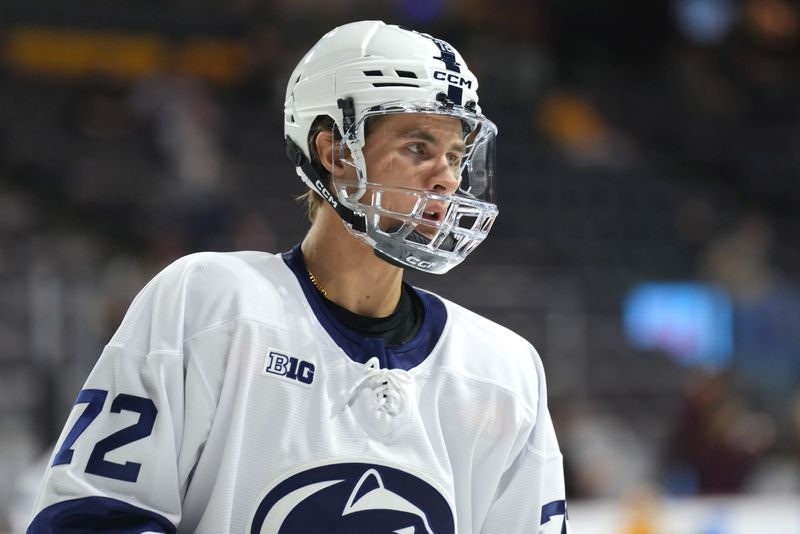
Penn State winger Gavin McKenna is viewed as the prize of the 2026 NHL draft, but others like defenseman Keaton Verhoeff are gaining steam.
Q: Trade chatter is starting to pick up. Do you think the Flyers can be competitive with putting packages together?
A: We have assets now, and teams are going to have interest in our assets and make trades. The thing is that we have this prospect pool now, part of what’s going to make the players good is these guys emerging into the NHL and down the road filling in roles in the depth. But now, if you have a chance to add a star piece or elite player, you’ve got to match the value of it, but you can’t totally decimate your prospect pool and all your young players just to get one player — and then you have one player, and you have a bad team. Not everybody’s going to be able to play, but at the same time, we’re in a good position now.
Q: Give me one or two prospects that you’re excited about in the system.
A: Porter [Martone] is Porter. He has a chance to be a special player. When you meet him, he’s kind of got that “it factor,” as far as he’s got cockiness, but in a good way. I think he’s a pro; he’s got the mindset now where he knows where he has a little more work to do as far as getting there. But he understands. Getting that experience last year with Team Canada was huge, to be a young kid playing with those types of players and see where you’ve got to get to. I just think he’s matured, and he has a chance to be a really good one for us.
But the guy we drafted, who is one of my favorites … is Cole Knuble. Just a good hockey player. So competitive, great motor, smart, plays every position. I don’t know where it’s going to get to, but he’s worked really hard on his skating, and it’s become good. It’ll be interesting to see when he turns pro. Guys like Barkey and him are the guys you cheer for.
Barkey’s such a smart player, he’s so competitive. You watch a game, you just kind of start just watching him, just because of the way he plays the game. Whether he can handle the size [remains to be seen] but he’s proven everybody wrong at every level.
On Monday at Xfinity Mobile Arena, Flyers fans would boo the Vancouver Canucks, like they do with every opposing team.
But one Canuck, defenseman Tyler Myers, had a cheering section to drown out the noise, led by his half brother, 76ers guard Quentin Grimes.
Grimes and Myers are the only pair of brothers to ever play in the NHL and NBA.
Their mother “gets on my dad a lot about who’s got the best genes in the family,” Grimes said jokingly. “She gets the bragging rights on that.”
Myers was born Feb. 1, 1990, 10 years before Grimes was born, in Houston. His father Paul, a former college hockey player, encouraged him to put on skates. Their mother, Tonja Stelly, and later Grimes’ father, Marshall Grimes, both former college basketball players, taught Myers how to play basketball.
“He said he had a pretty good crossover and stuff like that,” Grimes said. “He definitely [has] a little bit of game to him, for sure.”
When Grimes was much younger, he said the two sometimes would try and play one-on-one. “Just messing around, trying to play against the tallest guy I’ve ever seen,” he said. Myers is one of the NHL’s tallest players, standing at 6-foot-8, compared to Grimes, who is 6-4.
The brothers never lived together. Myers left Texas shortly after Grimes was born to live in Calgary with his father, where he grew into a professional hockey player. Grimes stayed behind in Texas, but the two of them would see each other as often as they could during the summer or school breaks.
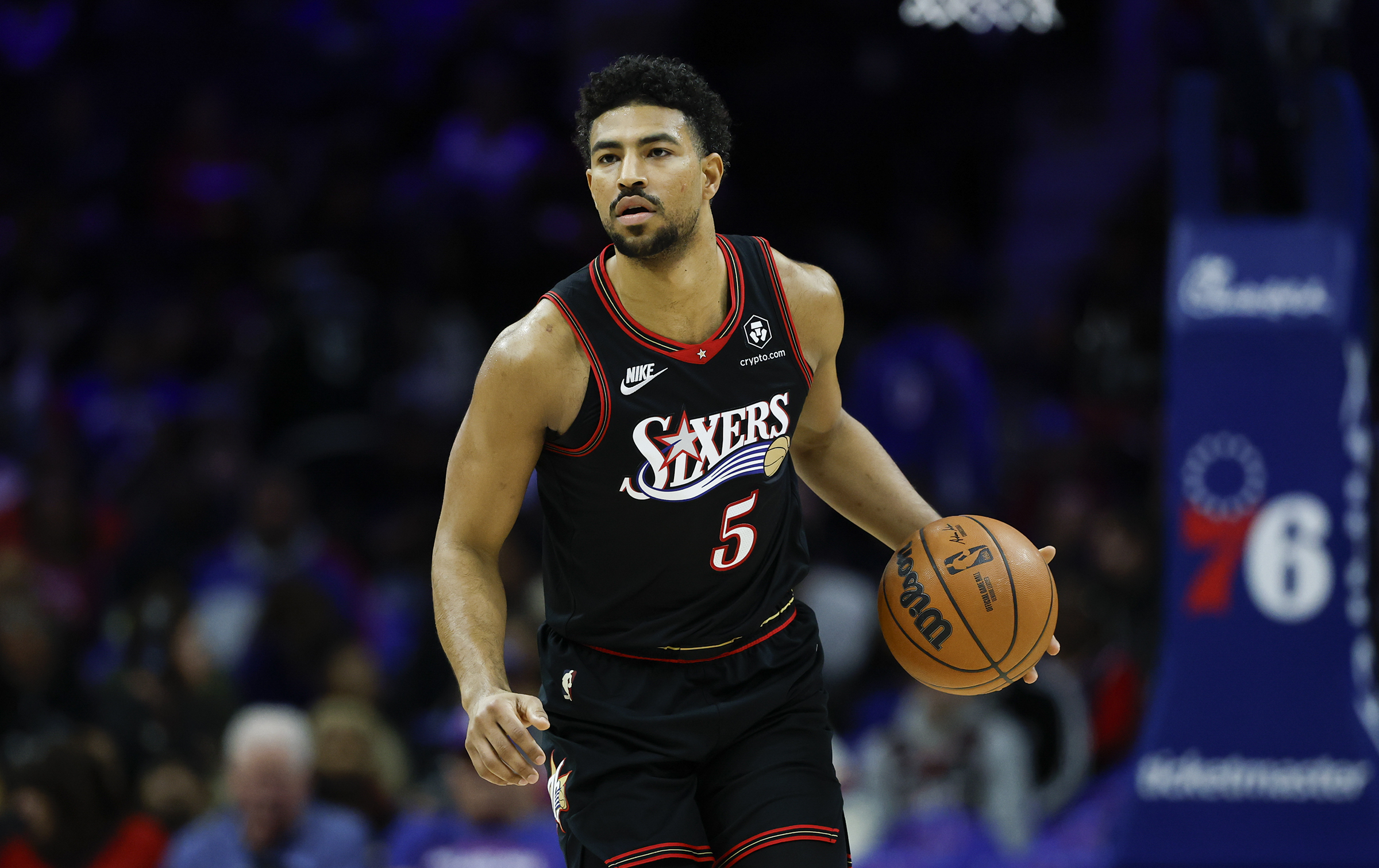
Sixers guard Quentin Grimes has a half brother who plays for the Vancouver Canucks.
Myers became a mainstay in the NHL while Grimes established himself as a top basketball prospect. When Grimes was a junior in high school, the two got back in regular touch, with Grimes tapping into Myers’ years of experience as a professional athlete as he was just starting out.
“It’s been growing ever since I got pretty good at basketball,” Grimes said. “My mom was asking him some stuff to help me be a professional: eating habits, how to take care of your body, and stuff like that.”
The Canucks defenseman is one of just 28 active players to play more than 1,100 games in the NHL, a feat he has accomplished over 17 seasons. Myers had one goal and eight points this season. Grimes, in his fifth NBA season, is averaging a career-best 15.3 points for the Sixers.
The sports might be different, but the daily routines of the NBA and NHL schedules are nearly identical. They play 82 regular-season games from fall to spring, with a similar playoff and travel structure.
That means that whenever Grimes is going through something, Myers said usually has experienced it, too, and they’ll talk about it.
“Watching him on the court, you can tell his confidence and his mindset just have come such a long way,” Myers said. “I remember that progression when I was a young kid from 20 to 25, it looked very, very similar.”
Tyler Myers (left) of the Vancouver Canucks pursues former Flyer Cam Atkinson during a game in 2023.
Grimes said Myers has been critical in teaching him how to be a pro. He’s nowhere close to Myers’ longevity in his sport, but seeing the habits and routines up close helped him transition into the league.
“Listening to your body if you have nagging injuries,” Grimes said. “[Myers would] always say that he would take some lighter days or try to do that. Early in my career, I would just try to grind and grind and grind, and then an injury gets worse, and your body just breaks down a little bit.”
Myers, who has played in cities that don’t have NBA teams his entire career, has seen Grimes play in person in the NBA only once, when the Canucks’ extended road trip to New York gave him a day off on a night with a Knicks home game.
Unfortunately, Grimes played just a few seconds before he suffered an injury and missed the rest of the game.
“I showed up a couple minutes in; the game had started already,” Myers said. “A couple minutes went by, he came in, and like a minute later, he was laying on the floor, hurt. I was bad luck that day, and that was the only time I’ve been able to overlap with him.”
One day, Myers hopes to have another opportunity to see his younger brother play a full game in person, but he’s been following his career from afar. Grimes is a bit luckier — he gets to see Myers play about once a year, including on Monday night for the first time in Philly, since all the teams he has played on have been in cities with NHL teams of their own. He also has made trips to Vancouver and Buffalo.
“This is fun for me, to be a fan,” Grimes said. “Get rowdy, because hockey fans are completely different from NBA fans. They get real rowdy. I like to get rowdy with them, talk a lot of smack with the other fans if they’re in the arena.”
The Canucks had a cheering section at least 12 strong at the Flyers’ arena, including Grimes, their mother, and several other family members making the trip to celebrate having both brothers together around the holidays. The Canucks ultimately lost the game, 5-2, but Myers still gave them something to cheer about, earning a secondary assist on Vancouver’s first goal.
Myers, who now has three children of his own, couldn’t remember the last time they had a group this big together around the holiday season.
“Having this so close to Christmastime is a little bit more special,” Grimes said ahead of the game. “Knowing that Christmas is around the corner, our mom came up, a lot of our family came up for the game, so it’ll be pretty special.”
It’s official — this season’s collection of Birds doesn’t resemble the 2023 Eagles.
After a second consecutive definitive victory, this time over the Washington Commanders on Saturday, the Eagles have effectively shot down any further comparisons to their plight two seasons ago.
No, their last two opponents, including the Las Vegas Raiders, won’t frighten most playoff-caliber teams (although the Geno Smith-led Raiders hung 21 points on the top-ranked Houston Texans defense on Sunday). Plus, the Eagles still have a number of concerns to address before the playoffs, including Jake Elliott’s kicking woes and the inefficiency of the Tush Push.
But the 2023 Eagles too frequently stooped to the level of their opponents, as evidenced by their late-season losses to the Arizona Cardinals and the New York Giants. That has not been this Eagles team, even in the absence of two of their top linemen in Lane Johnson and Jalen Carter.
The Eagles’ greatest remaining test of the regular season awaits Sunday when they visit the 11-4 Buffalo Bills. Here’s what we know (and what we don’t) about the Eagles heading into their penultimate game of the season:
Could keeping Jalen Hurts out of harm’s way be in the cards for Week 18 against the apparently angry Commanders?
Seeding on the line
Ahead of last year’s Super Bowl run, Jalen Hurts sat out the final two games of the season while in concussion protocol, but he likely wouldn’t have started in Week 18 anyway given that the Eagles had already clinched the NFC’s No. 2 seed.
Could a respite be on the horizon for the Eagles starters? After Saturday’s win, Hurts was asked whether he would welcome a chance to rest if the opportunity presented itself over the last two weeks.
“That’s above me,” Hurts said. “If someone asks me, I’ll answer. But it’s above me to answer right now.”
In reality, that opportunity isn’t imminent. By the time the Eagles’ game against the Bills starts at 4:25 p.m., Hurts and his teammates will have a chance to improve their seeding in Week 17 with a win.
According to Wharton professor Deniz Selman, if the Eagles beat the Bills, they will only be locked into the No. 3 seed if the Seattle Seahawks beat the Carolina Panthers on Sunday at 1 p.m. and the Chicago Bears defeat the San Francisco 49ers at 8:20 that evening.
The Eagles play before the Bears, so Nick Sirianni ought to play his starters in Week 17. If that scenario for the Seahawks and the Bears doesn’t pan out, the Eagles could have a chance to improve to the No. 2 seed in Week 18, pending the outcome of Colts-49ers on Monday Night Football.
Unlike last season, there’s a chance that Week 18 will have real meaning, requiring the starters to play to give the Eagles a shot at a better seed. But the Bills will look to get in the Eagles’ way, as they’re still in the fight to win the AFC East with the 12-3 New England Patriots.
Will reigning MVP Josh Allen be ready to go against the Eagles?
Trouble afoot?
The injuries have been piling up for the Eagles’ opposing quarterbacks over the last four weeks. There was Justin Herbert’s left hand injury, Geno Smith’s shoulder, Jayden Daniels’ elbow, Marcus Mariota’s right hand, and now Josh Allen’s foot.
But Allen’s injury, which he suffered on a foolish sack just before halftime in the Bills’ 23-20 win over the Cleveland Browns on Sunday, didn’t sideline him. He received an X-ray on his foot and was cleared to return for the second half.
While Allen said after the game that he didn’t think the injury impacted his play after halftime, his production dipped considerably. The 29-year-old quarterback went from 6-of-7 for 86 passing yards and 17 yards on four carries in the first half to 6-of-12 for 44 passing yards and no yards on three runs in the second.
That second-half rushing output is unusual for Allen. He leads the league’s quarterbacks with 552 rushing yards, with the majority of that total coming from scrambles (436), according to Pro Football Focus.
The Eagles have had their issues containing mobile quarterbacks this season. Vic Fangio’s unit has given up 328 rushing yards to quarterbacks, the fifth-highest total in the league.
But while Mariota was in the game on Saturday, the Eagles kept him contained. He finished with one kneel-down for a loss of a yard, his worst rushing total in a game this season and just his third game out of 11 in which he did not post double-digit rushing yards.
James Cook III provides an offensive threat for the Bills.
Bills get Cooking
The Bills neutralized the Browns’ Myles Garrett-led pass rush in part by handing the ball off to James Cook. The 26-year-old running back rushed for 117 yards and two touchdowns on 16 carries, bringing his total for the season to a league-best 1,532 yards (on a league-high 287 attempts).
Cook is getting a helping hand from his offensive line and tight ends. According to Pro Football Reference, Cook leads the league with 919 rushing yards before contact. The Detroit Lions’ Jahmyr Gibbs is the next-closest back with 770.
The Bills’ running game will meet its match on Sunday. Since the Eagles’ nightmare of an outing against the Bears’ rushing attack last month, the group has tightened up, conceding 4.0 yards per attempt in the last three weeks (tied for the sixth-lowest average in the league).
Jordan Davis has been one of the keys to the Eagles’ success in stopping the run. He tied for the team lead with six run stops on Saturday, wreaking havoc on a Commanders attack that ranks fourth in the league in rushing yardage. Davis has been disruptive late into the season, even while he’s playing a career-high 62% of the defensive snaps this year.
“I feel great,” Davis said after the game. “It’s the wear and tear of the season. Your body is never going to feel as good as it is going into camp. But I feel good. The work has been put in. It’s just continue on. Just have to continue.”
Eagles running back Saquon Barkley after scoring a rushing touchdown against the Washington Commanders on Saturday.
Running rampant
The Bills won’t be the only team looking to run the ball on Sunday. The Eagles’ rushing attack has had a resurgence over the last couple of weeks, combining for a league-high 390 yards in Weeks 15-16.
Saquon Barkley, of course, is at the center of that achievement. He took strides in the Week 14 loss to the Los Angeles Chargers, highlighted by the efficiency of the under-center running game. While Barkley had far more shotgun runs in Week 16 against the Commanders, his explosive 48-yard run came from an under-center jumbo personnel handoff.
In his last three games, Barkley ranks second in the league with a combined 332 rushing yards and three touchdowns.
Barkley — and Hurts — could be bound for more success on the ground on Sunday. The Bills have conceded 5.4 yards per rushing attempt this season, which is the second-worst clip in the NFL.
They’ve had a particularly tough time corralling quarterbacks. The Bills have allowed 356 rushing yards to quarterbacks this season, which is the third-highest total in the league. Browns quarterback Shedeur Sanders took advantage of the Bills’ leaky run defense, leading the team with 49 rushing yards on four scrambles.
Hurts gave the Commanders headaches on scrambles, too. He had 40 yards on five scrambles, picking up three first downs along the way. While the designed running game was less of an emphasis in that game, Hurts was still able to extend plays with his legs. He could have another opportunity to build on that success on Sunday.
A sinkhole that shut down a segment of the popular Schuylkill Banks trail in Center City in October remains unrepaired, though work could begin early in the new year — if weather allows.
Joe Syrnick, executive director of the Schuylkill River Development Corp. (SRDC), a nonprofit that has driven the revitalization of the section of the Schuylkill River Trail known as Schuylkill Banks, said he expects repairs to start soon, though he could not offer a firm timeline.
The trail has been closed between Race Street and JFK Boulevard, just north of the SEPTA Bridge, after a “chasm”-sized void opened beneath the asphalt.
According to Syrnick, the city Streets Department will handle the repairs. The hole presented a challenge, Syrnick said, because of its size and position next to the river.
A representative for the Streets Department could not be reached Monday for comment.
Syrnick explained that the sinkhole has been far from a simple fix.
“It took a while to figure out the problem and develop a solution,” Syrnick said. “There were several dye tests and a drone flight into the sewer channel and visual observation from topside.”
The problem stems from a steel bulkhead that was built for the trail in 1995 to extend land farther into the river and create more parkland, he said.
Gaps developed in a seal between the bulkhead and concrete sewer infrastructure. It’s unclear, Syrnick said, whether those gaps occurred at the start or developed over time.
Regardless, the gaps allowed soil to seep away as the tide ebbs. Over the decades, enough soil was washed away “to create a sizable hole,” he said.
The gaps had to be sealed before anything else could be done.
So the job became more than just filling a hole. Recent progress has been halted by weather, especially recent cold and snow.
“City workers need two to three days of moderate temperatures and no rain to pour the concrete and let it cure,“ Syrnick said. ”After that, the hole has to be backfilled and paved.”
However, holidays also present a staffing issue, Syrnick said.
“In a perfect world,” he said, “the trail would be open by New Year’s or a short time after.”
By now, most people have heard about the “no tax on tips” and “no tax on overtime” provisions of “One Big Beautiful Bill” that became law during the summer. It sounds great. But unfortunately, the new legislation is not all that it seems. Why?
Yes, there is a “no tax on tips” benefit. But be careful because you may not be eligible.
A specific list shows all the jobs that qualify. As a rule of thumb, you’ll be eligible for the tipped income deduction if you work in a business where tips are common. Regardless, you should know that the deduction is limited to $25,000 per person and begins to phase out once you start earning more than $150,000 individually and $300,000 if you file a joint return.
You can only take advantage of the deduction when you file your individual tax returns after the year has ended. And if these deductions result in you getting a tax refund, you’ll have to wait until next year, when your 2025 return can be filed and processed by the IRS.
Remember too that this deduction is scheduled to expire in 2028, so you’ve only got a few years to take advantage. So does the deduction on overtime wages.
The overtime deduction is even more limited. It only applies to the “overtime” wages you receive, which means that if you receive time-and-a-half for overtime worked, you get to deduct only the amount related to the “half.”
For example, if your base wage is $20 an hour and you get paid $30 for one hour of overtime, only the $10 difference is eligible for the deduction. Also, the overtime deduction is limited to $12,500 for individuals and $25,000 for joint-filers, and it begins to phase out after you’ve earned more than $150,000 individually or $300,000 if you’re filing a joint return. And, depending on prevailing wage rules or overtime calculations that are part of union contracts, some of these wages may not be eligible at all.
Even though the new law promises “no taxes” on tipped and overtime income, that’s not entirely true either. Social Security and Medicare taxes will still be required by both employees and their employers. Most states — including Pennsylvania and New Jersey — are not excluding tipped or overtime income from their tax calculations.
“It’s kind of a misnomer,” said Andrew Gargana, a federal compliance analyst at HR firm Paychex. (Gargana is a client of my firm.)
“Yes, no tax on tips or overtime sounded great on the campaign trail, but the reality is that an employee is still paying some taxes on this income,” Gargana said.
If you’re an employer that has tipped workers or pays overtime, you are looking at potential reporting headaches.
Employees now must know the correct amount of tipped wages and overtime to include in their tax returns. Usually, this will come from their W-2 form, which is used to report wages and is required to be mailed by the employer to both the employee and the IRS by the end of January.
The IRS has released a draft form W-2 for 2026 that enables an employer to separately report these amounts. But what about 2025?
According to a blog post from Bala Cynwyd-based accounting firm Isdaner & Co., the IRS announced that the 2025 versions of Form W-2 — where overtime wages are not broken out from total compensation — will be unchanged.
Gargana says 2025 reporting will be like the “Wild West.”
“The IRS’s guidance just offers ‘transition relief’ to employers and employees for 2025,” he said. “As long as an employer makes reasonable attempt at reporting, the IRS is not going to penalize. They’re acknowledging that employers and employees were not tracking this information in the form they needed at the beginning of the year.”
But what is “reasonable”? And what if their mistakes cause a significant mistake on their employee’s tax return? It is unclear how much leeway employers will get. Accuracy still matters, and a big enough miscalculation could mean potential penalties and interest for employees that underreport taxes due and a potential legal problem for the employer.
In the end, the responsibility of filing a correct individual tax return still rests with the individual.
“Employers and payroll management companies should begin tracking qualified tip and overtime income immediately and implement procedures to retroactively track qualified tip and overtime income amounts that were paid going to Jan. 1, 2025,” accounting firm Isdaner said in an email to clients.
This is a looming hassle for employers. Whether they’re required to report externally or not, workers and their accountants will want to take advantage of this deduction, and if the amounts they need are not disclosed on their W-2, they’re going to be pressing their bosses for the correct information for their individual tax returns.
Both Paychex and Isdaner are warning their clients to get on top of this issue to avoid confusion when employees start filing their individual returns. Gargana said employers may even provide a separate statement along with employees’ W-2 forms.
“Communication is critical,” Gargana said. “Employers should expect questions and proactively share available data.”
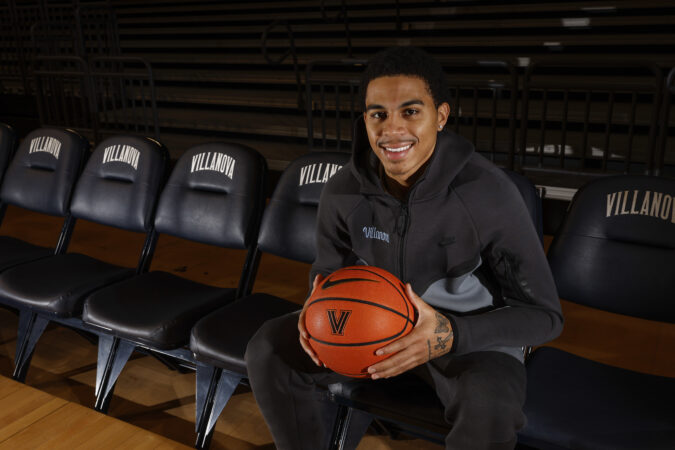
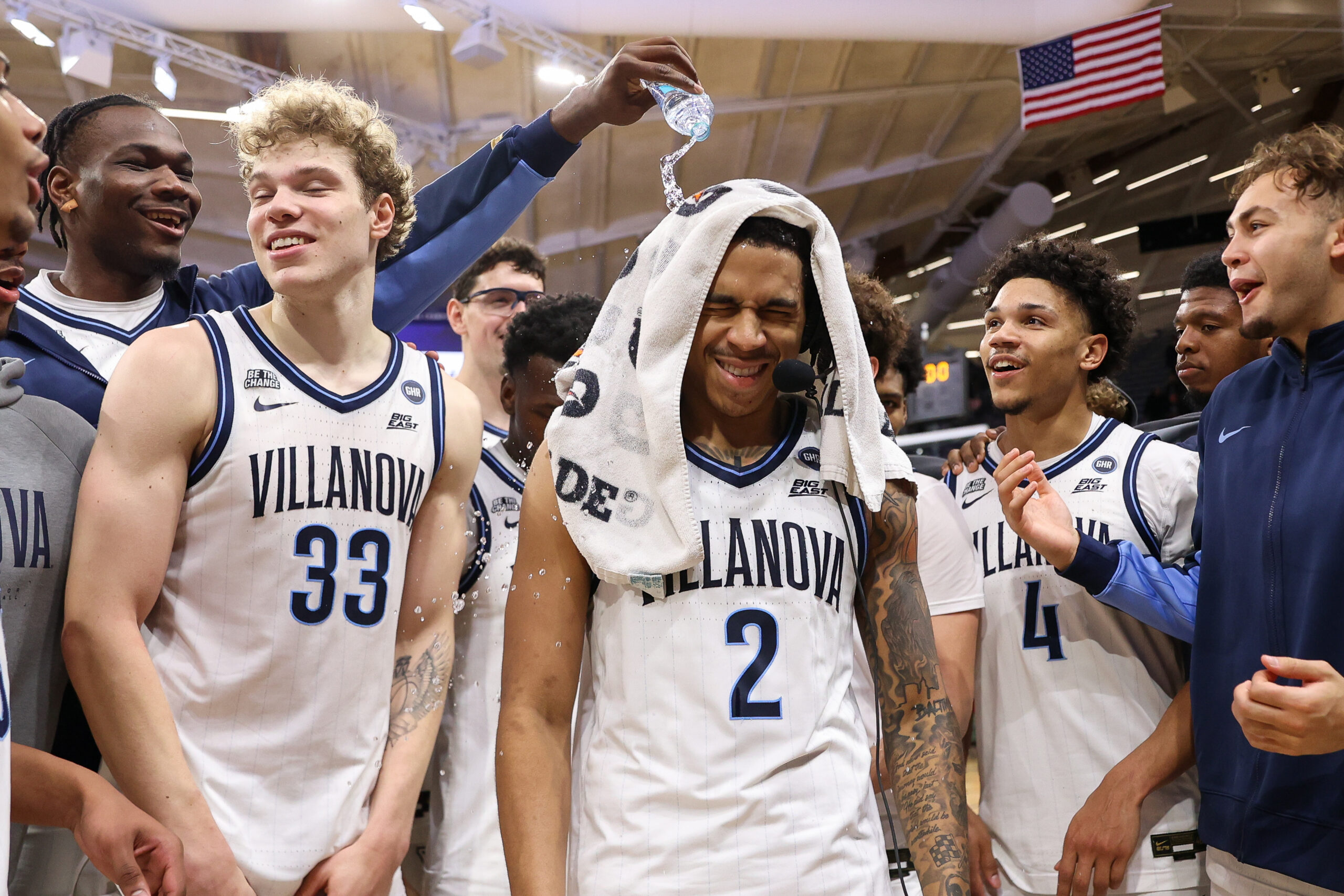
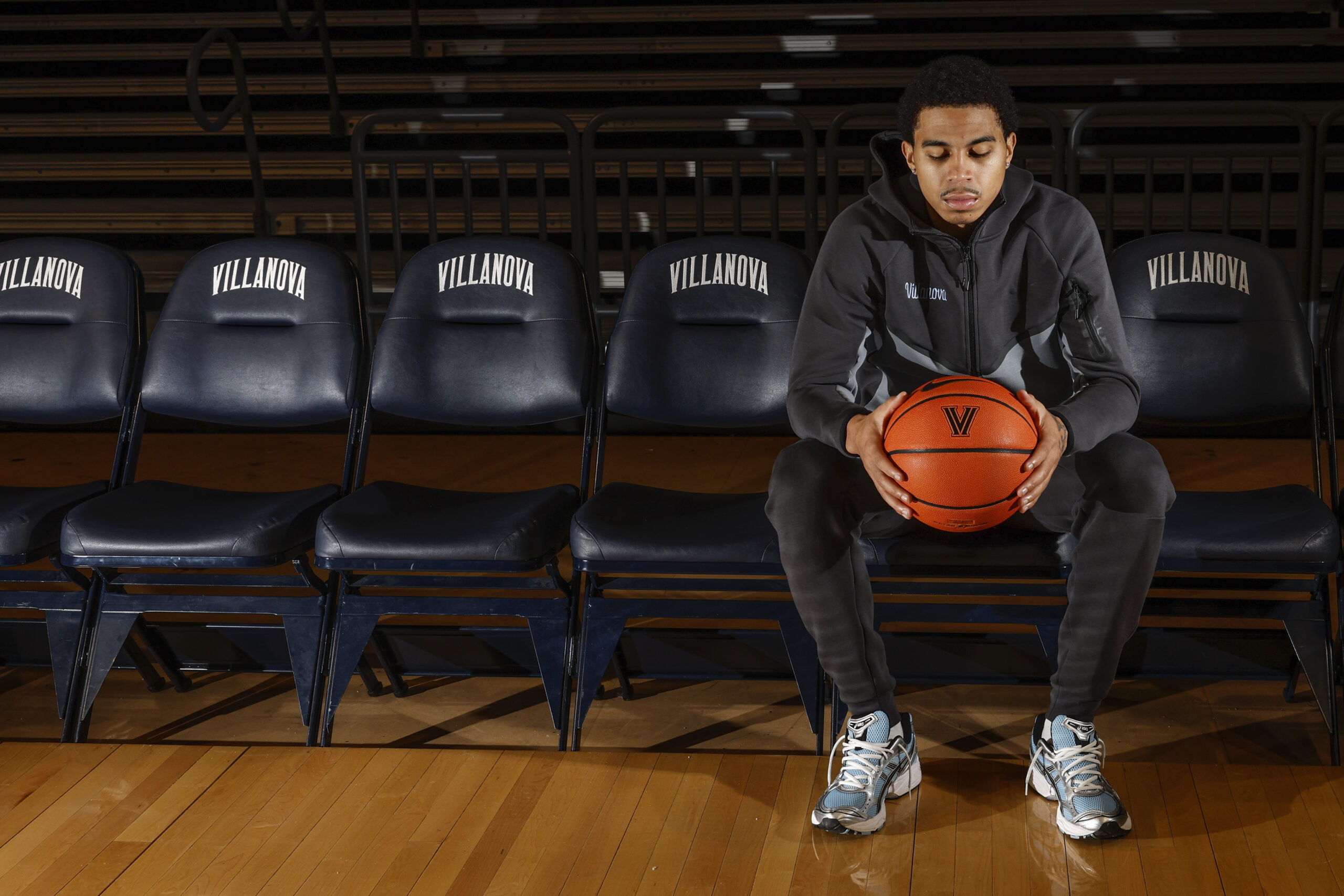
On Nov. 9, 2022, Bryce Lindsay announced his commitment to Texas A&M. It was just three days after his mother, Takisha, died.
Lindsay, now starting at guard for Villanova, calls his mother his biggest inspiration and the strongest person he knew. He watched her fight through surgeries and life changes and take care of a family during a 10-year battle with Grade 2 astrocytoma, a brain tumor that was diagnosed in September 2012.
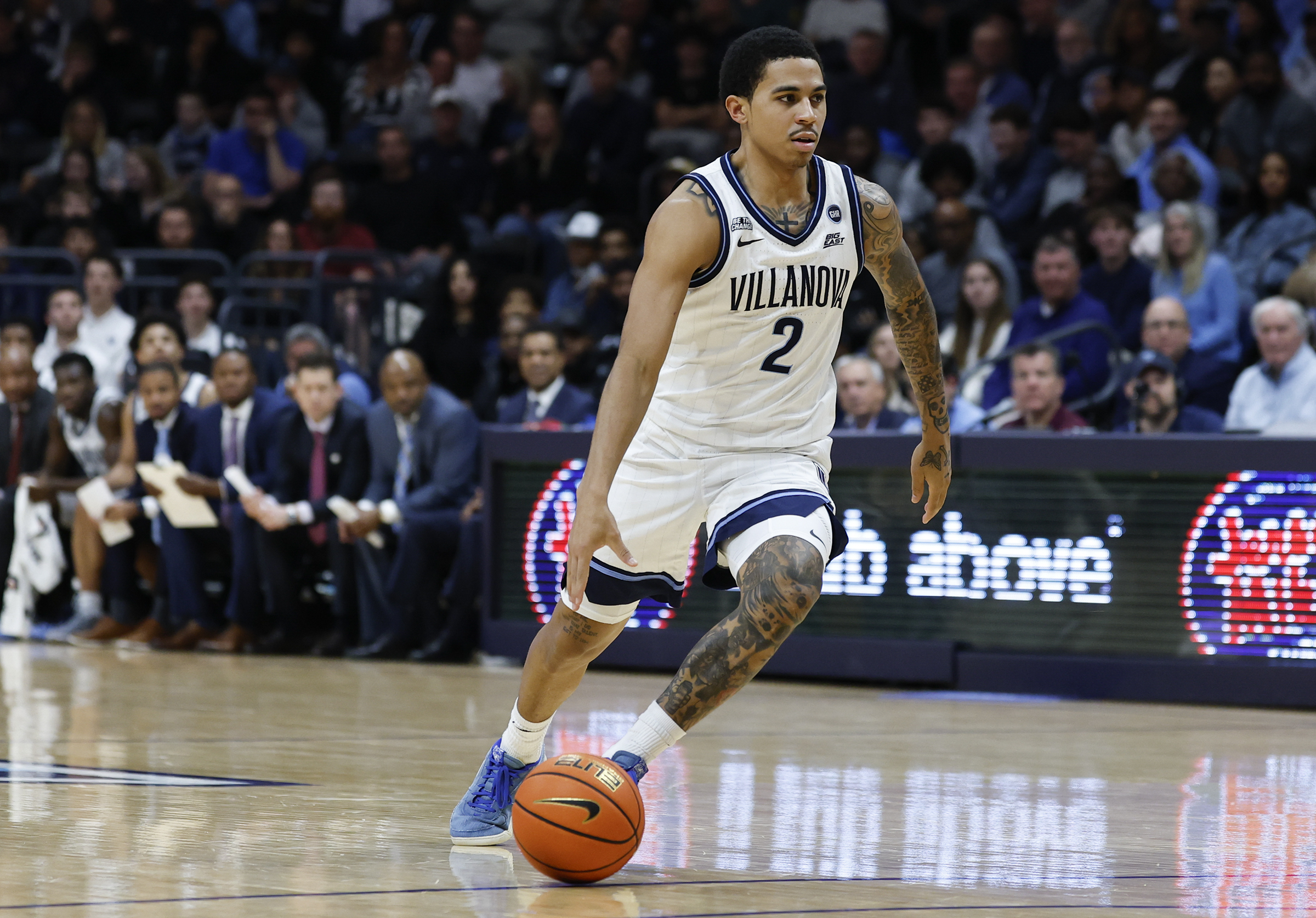
Up and down his left arm and leg are tattoos that are meaningful to Lindsay. On the back of Lindsay’s thigh is a tattoo of his mother and her middle name, Simone. It is a permanent dedication to her.
“That time when I was at [Texas] A&M, [still dealing with] my mother passing was a very hard time,” Lindsay said.
It was not the first or last time Lindsay, 20, faced adversity in his young life.
In 2022, Lindsay was committed to South Carolina out of St. Frances Academy in his native Baltimore. He was determined to play for Gamecocks coach Frank Martin. However, Martin was dismissed from the program in mid-March. Because of the timing of the firing, Lindsay was left with limited options.
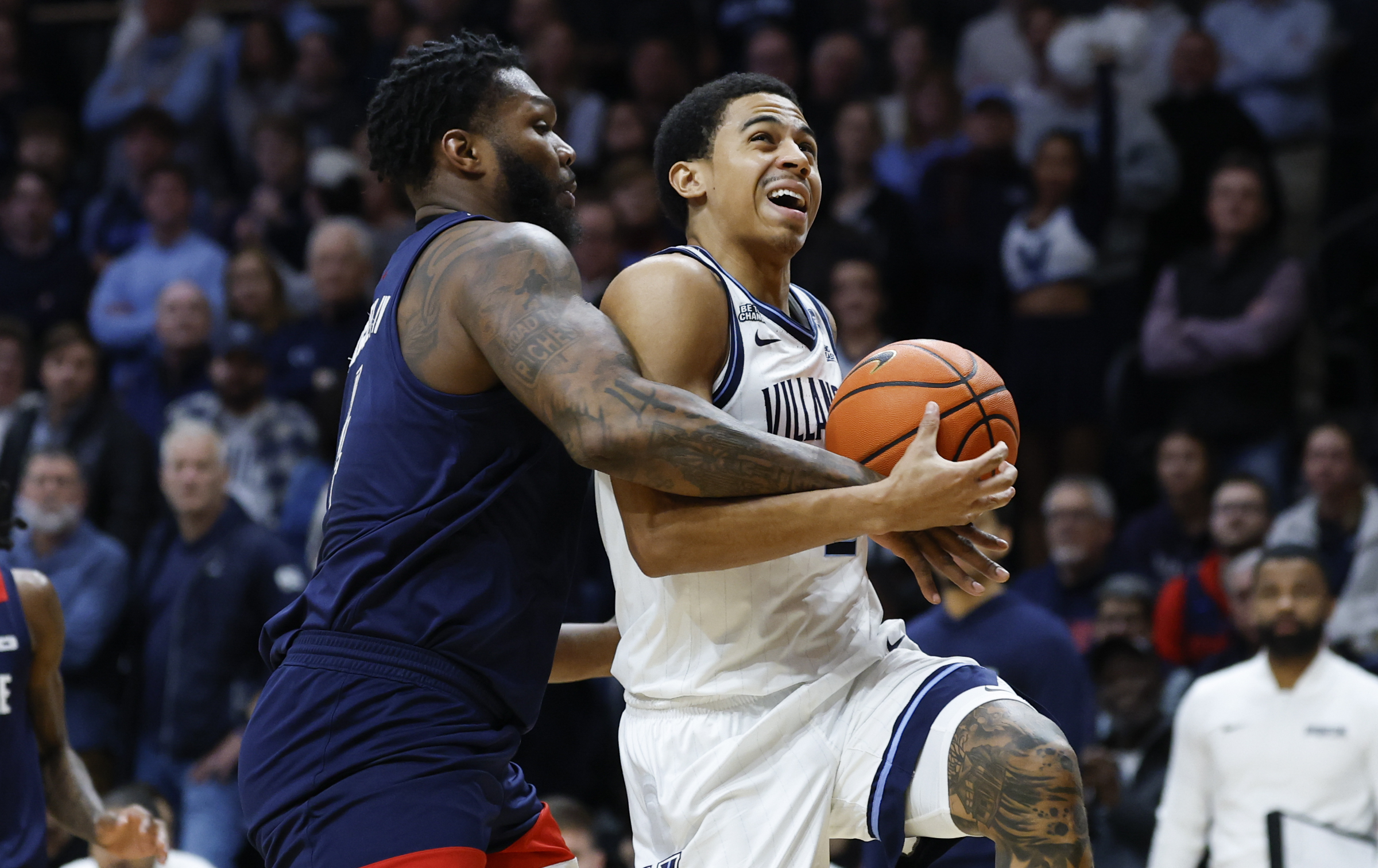
Villanova’s Bryce Lindsay is fouled by Duquesne’s John Hugley as he drives to the basket on Nov. 15.
He decided to play a prep school year at IMG Academy in Bradenton, Fla.
That’s when Lindsay committed to Texas A&M. Exactly one year after his mother’s death, Lindsay finally played his first college minutes on Nov. 6, 2023.
‘Amazed at his strength’
“It was tough for him,” said Lindsay’s father, Dustin. “It was tough for our entire family. She was the rock. She held everything together, to be honest. So that stretch was really tough for him. Losing his mom could have broken anyone’s spirit. So watching him through it, though, I was honestly amazed at his strength, to be honest with you. He never let it define him.
“He grieved, he healed, but he also stayed committed to coming back stronger, and I saw it firsthand. That period really showed his resilience and character both on and off the court. He faced more than most people could imagine, but he turned it into fuel to grow mentally and emotionally.”
Then, just eight games into his college career, the 6-foot-3 Lindsay was struck with another setback. He suffered a sports hernia that required surgery on both sides of his abdomen and forced him to redshirt the remainder of his freshman season at Texas A&M.
Lindsay was without two of the most important things in his life: his mother and basketball.
“I saw him just put both feet in the sand and just say, ‘It’s my time, right?’” Dustin Lindsay said. “And that’s easier said than done. Because most of us never have to go through a tragedy like that. But, I tell people this all the time, it’s not until you go through a tragedy like that that you realize how strong a human being can really be. I saw an individual who realized that wasn’t making excuses.”
Guard Bryce Lindsay played at Texas A&M and James Madison before he landed at Villanova.
After he recovered, Lindsay committed to James Madison in May 2024. He came in thinking he would be a key player, but he was not in the starting lineup for JMU’s season opener against Ohio.
Despite yet another setback, Lindsay was unfazed.
“Bryce tells me, ‘Dad, I’m not even worried about it. I’m going to be sixth man of the year,’ Dustin said. “And when he told me that, I mean, it really almost brought tears to my eyes. The maturity that showed in him at that time was just priceless.”
Lindsay went on to accomplish that goal. He came off the bench for the first 18 games of the season, shooting 45.6% from the field and 42.9% from beyond the arc. His performances pushed him into the starting lineup for the final 12 games of the season and the conference tournament.
At the end of the season, Lindsay was named the Sun Belt’s Sixth Man of the Year and Rookie of the Year.
“I believe that true confidence comes with the work you put in behind the scenes,” Lindsay said. “I was always the type of guy who was a gym rat. I would always be in the gym before practice, after practice, and I feel like that gave me my true confidence with me coming up.”
When Villanova hired coach Kevin Willard last spring, Lindsay had the opportunity to move up from a mid-major program.
Wildcats center Nico Onyekwere (left) pours water on Bryce Lindsay after Villanova beat Pittsburgh at the Finneran Pavilion on Dec. 13.
“I absolutely think he’s had such a positive effect on everybody offensively just because of the way he’s playing,” Willard said. “And he never worries about missing a shot. He never worries about a turnover. He’s like, ‘Next play.’ Guys like that who have that confidence, who don’t get down on themselves — and he doesn’t get down on himself at all, which is great — always have a positive impact on his teammates.”
Baltimore basketball
When asked about his resilience, Lindsay laughed. “It’s crazy that you use the word ‘resilient,’” he said. “I was about to get that [as my] next tattoo.”
Much of that comes from where he grew up, in a city known for its basketball culture.
“I could be kind of biased, but I think we have the best group of guys coming out of not just Baltimore, but the [D.C., Maryland, and Virginia] area as well,” Lindsay said. “Specifically, Baltimore, I just think that we just have that competitive edge and that nitty-gritty to our game and play style. Just because where we come from, we don’t really come from too much.”
It was not easy to carve out a path in a crowded Baltimore basketball scene.
“I remember Bryce when he first picked up a basketball,” Dustin Lindsay said. “He was young, and I could already see the love for the game. Seeing him maneuver and again, finding that resilience to overcome a lot of the obstacles that he had to endure, just growing up and playing that sport here that so many people are passionate about.”
Lindsay’s father put him on teams with older, more experienced players, so he was forced to play more physical basketball.
Bryce Lindsay is averaging 16.6 points for the Villanova Wildcats.
“I think it created that part of him, that resilience that I’m going to try my best not to let these obstacles get in my way,” Dustin Lindsay said. “I tried to put him in a lot of difficult situations on purpose. Because I just know how hard life can be sometimes. And so I just wanted him to face obstacles early on in life, and it wasn’t easy. But that kid just never gave up.”
Lindsay was a part of the Class 3A state title team at Baltimore Polytechnic in his freshman year. Then he transferred to St. Frances, the second of three stops in his high school journey. In 2021-22, Lindsay averaged 19.6 points, 3.0 rebounds, and 3.0 assists.
“Being from Baltimore, I think that definitely puts an edge on me,” Lindsay said. “I mean, I just wanted to do extra work because nobody wants to be in Baltimore forever. They always want to get out, so I think I’m super grateful for being from Baltimore. I love my city.”
Now, Lindsay has transitioned from a mid-major to Villanova. He already has set a program record for three-pointers in a game, hitting nine against Sacred Heart on Nov. 11. It broke a record that had stood for 20 years.
He is averaging a team-high 16.6 points and has four 20-plus point outings in 11 games. Lindsay is also the 10-2 Wildcats’ best three-point shooter at 44.2%, and ranks in the top 40 nationally in threes made per game (3.17).
“I’m very grateful that I got to mesh with this group of guys,” Lindsay said. “We all came together pretty well in such a short time. So I’m grateful for that. We have a great coaching staff here. That’s why I chose to come here to Villanova. Plus, the culture and what Villanova means.”
Even after a dominant nonconference performance, Lindsay says there is more work to be done on his game. He believes he has not hit his ceiling.
“I would say I’m never satisfied with my play,” Lindsay said. “I feel like certain guys they get satisfied, and they stop doing all the little things. I was that type of person. Like during practice, I’m going to keep going hard 110% every day, and I’m never going to cut corners.”
![As long as [REDACTED] has his thumb on the scales of justice, the Epstein files were always going to be [REDACTED] | Editorial](https://wp-brooklyn.enclave.vn/wp-content/uploads/2025/12/56QJ6RRBRHQJHDGZ7NKUDPNTPU-675x450.jpg)