A sinkhole that shut down a segment of the popular Schuylkill Banks trail in Center City in October remains unrepaired, though work could begin early in the new year — if weather allows.
Joe Syrnick, executive director of the Schuylkill River Development Corp. (SRDC), a nonprofit that has driven the revitalization of the section of the Schuylkill River Trail known as Schuylkill Banks, said he expects repairs to start soon, though he could not offer a firm timeline.
The trail has been closed between Race Street and JFK Boulevard, just north of the SEPTA Bridge, after a “chasm”-sized void opened beneath the asphalt.
According to Syrnick, the city Streets Department will handle the repairs. The hole presented a challenge, Syrnick said, because of its size and position next to the river.
A representative for the Streets Department could not be reached Monday for comment.
Syrnick explained that the sinkhole has been far from a simple fix.
“It took a while to figure out the problem and develop a solution,” Syrnick said. “There were several dye tests and a drone flight into the sewer channel and visual observation from topside.”
The problem stems from a steel bulkhead that was built for the trail in 1995 to extend land farther into the river and create more parkland, he said.
Gaps developed in a seal between the bulkhead and concrete sewer infrastructure. It’s unclear, Syrnick said, whether those gaps occurred at the start or developed over time.
Regardless, the gaps allowed soil to seep away as the tide ebbs. Over the decades, enough soil was washed away “to create a sizable hole,” he said.
The gaps had to be sealed before anything else could be done.
So the job became more than just filling a hole. Recent progress has been halted by weather, especially recent cold and snow.
“City workers need two to three days of moderate temperatures and no rain to pour the concrete and let it cure,“ Syrnick said. ”After that, the hole has to be backfilled and paved.”
However, holidays also present a staffing issue, Syrnick said.
“In a perfect world,” he said, “the trail would be open by New Year’s or a short time after.”
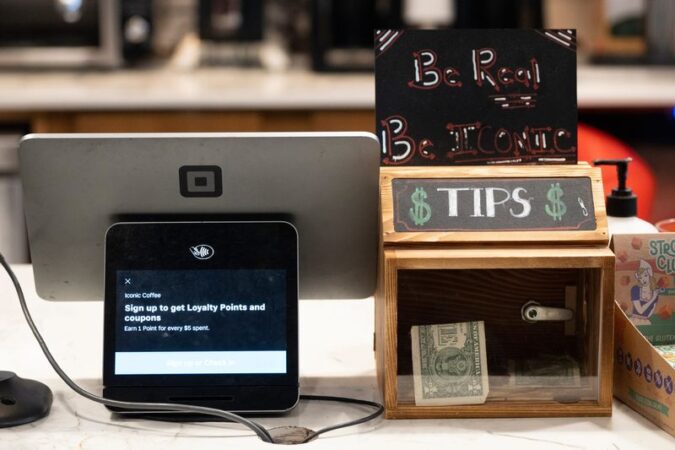
By now, most people have heard about the “no tax on tips” and “no tax on overtime” provisions of “One Big Beautiful Bill” that became law during the summer. It sounds great. But unfortunately, the new legislation is not all that it seems. Why?
Yes, there is a “no tax on tips” benefit. But be careful because you may not be eligible.
A specific list shows all the jobs that qualify. As a rule of thumb, you’ll be eligible for the tipped income deduction if you work in a business where tips are common. Regardless, you should know that the deduction is limited to $25,000 per person and begins to phase out once you start earning more than $150,000 individually and $300,000 if you file a joint return.
You can only take advantage of the deduction when you file your individual tax returns after the year has ended. And if these deductions result in you getting a tax refund, you’ll have to wait until next year, when your 2025 return can be filed and processed by the IRS.
Remember too that this deduction is scheduled to expire in 2028, so you’ve only got a few years to take advantage. So does the deduction on overtime wages.
The overtime deduction is even more limited. It only applies to the “overtime” wages you receive, which means that if you receive time-and-a-half for overtime worked, you get to deduct only the amount related to the “half.”
For example, if your base wage is $20 an hour and you get paid $30 for one hour of overtime, only the $10 difference is eligible for the deduction. Also, the overtime deduction is limited to $12,500 for individuals and $25,000 for joint-filers, and it begins to phase out after you’ve earned more than $150,000 individually or $300,000 if you’re filing a joint return. And, depending on prevailing wage rules or overtime calculations that are part of union contracts, some of these wages may not be eligible at all.
Even though the new law promises “no taxes” on tipped and overtime income, that’s not entirely true either. Social Security and Medicare taxes will still be required by both employees and their employers. Most states — including Pennsylvania and New Jersey — are not excluding tipped or overtime income from their tax calculations.
“It’s kind of a misnomer,” said Andrew Gargana, a federal compliance analyst at HR firm Paychex. (Gargana is a client of my firm.)
“Yes, no tax on tips or overtime sounded great on the campaign trail, but the reality is that an employee is still paying some taxes on this income,” Gargana said.
If you’re an employer that has tipped workers or pays overtime, you are looking at potential reporting headaches.
Employees now must know the correct amount of tipped wages and overtime to include in their tax returns. Usually, this will come from their W-2 form, which is used to report wages and is required to be mailed by the employer to both the employee and the IRS by the end of January.
The IRS has released a draft form W-2 for 2026 that enables an employer to separately report these amounts. But what about 2025?
According to a blog post from Bala Cynwyd-based accounting firm Isdaner & Co., the IRS announced that the 2025 versions of Form W-2 — where overtime wages are not broken out from total compensation — will be unchanged.
Gargana says 2025 reporting will be like the “Wild West.”
“The IRS’s guidance just offers ‘transition relief’ to employers and employees for 2025,” he said. “As long as an employer makes reasonable attempt at reporting, the IRS is not going to penalize. They’re acknowledging that employers and employees were not tracking this information in the form they needed at the beginning of the year.”
But what is “reasonable”? And what if their mistakes cause a significant mistake on their employee’s tax return? It is unclear how much leeway employers will get. Accuracy still matters, and a big enough miscalculation could mean potential penalties and interest for employees that underreport taxes due and a potential legal problem for the employer.
In the end, the responsibility of filing a correct individual tax return still rests with the individual.
“Employers and payroll management companies should begin tracking qualified tip and overtime income immediately and implement procedures to retroactively track qualified tip and overtime income amounts that were paid going to Jan. 1, 2025,” accounting firm Isdaner said in an email to clients.
This is a looming hassle for employers. Whether they’re required to report externally or not, workers and their accountants will want to take advantage of this deduction, and if the amounts they need are not disclosed on their W-2, they’re going to be pressing their bosses for the correct information for their individual tax returns.
Both Paychex and Isdaner are warning their clients to get on top of this issue to avoid confusion when employees start filing their individual returns. Gargana said employers may even provide a separate statement along with employees’ W-2 forms.
“Communication is critical,” Gargana said. “Employers should expect questions and proactively share available data.”
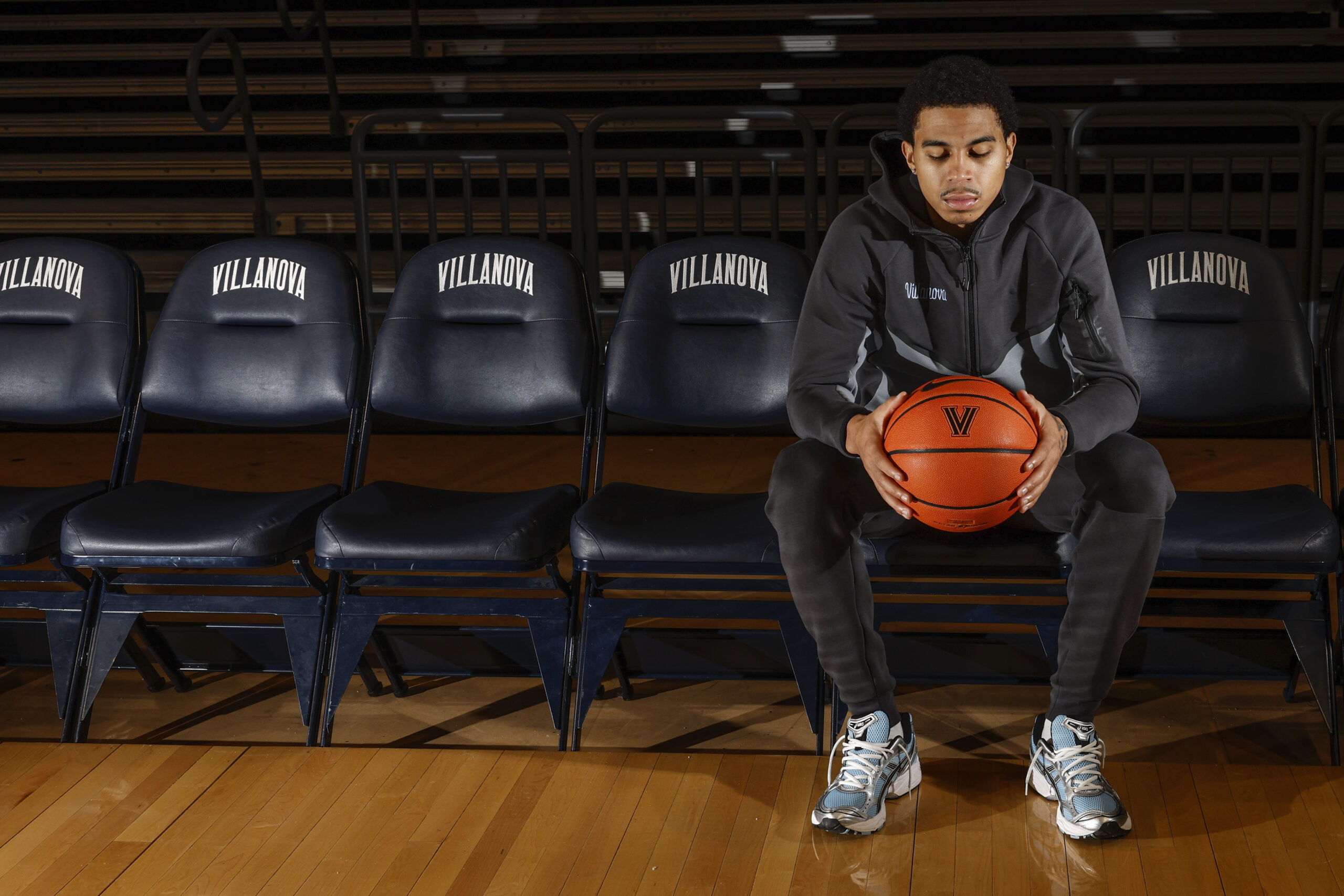
On Nov. 9, 2022, Bryce Lindsay announced his commitment to Texas A&M. It was just three days after his mother, Takisha, died.
Lindsay, now starting at guard for Villanova, calls his mother his biggest inspiration and the strongest person he knew. He watched her fight through surgeries and life changes and take care of a family during a 10-year battle with Grade 2 astrocytoma, a brain tumor that was diagnosed in September 2012.
Up and down his left arm and leg are tattoos that are meaningful to Lindsay. On the back of Lindsay’s thigh is a tattoo of his mother and her middle name, Simone. It is a permanent dedication to her.
“That time when I was at [Texas] A&M, [still dealing with] my mother passing was a very hard time,” Lindsay said.
It was not the first or last time Lindsay, 20, faced adversity in his young life.
In 2022, Lindsay was committed to South Carolina out of St. Frances Academy in his native Baltimore. He was determined to play for Gamecocks coach Frank Martin. However, Martin was dismissed from the program in mid-March. Because of the timing of the firing, Lindsay was left with limited options.
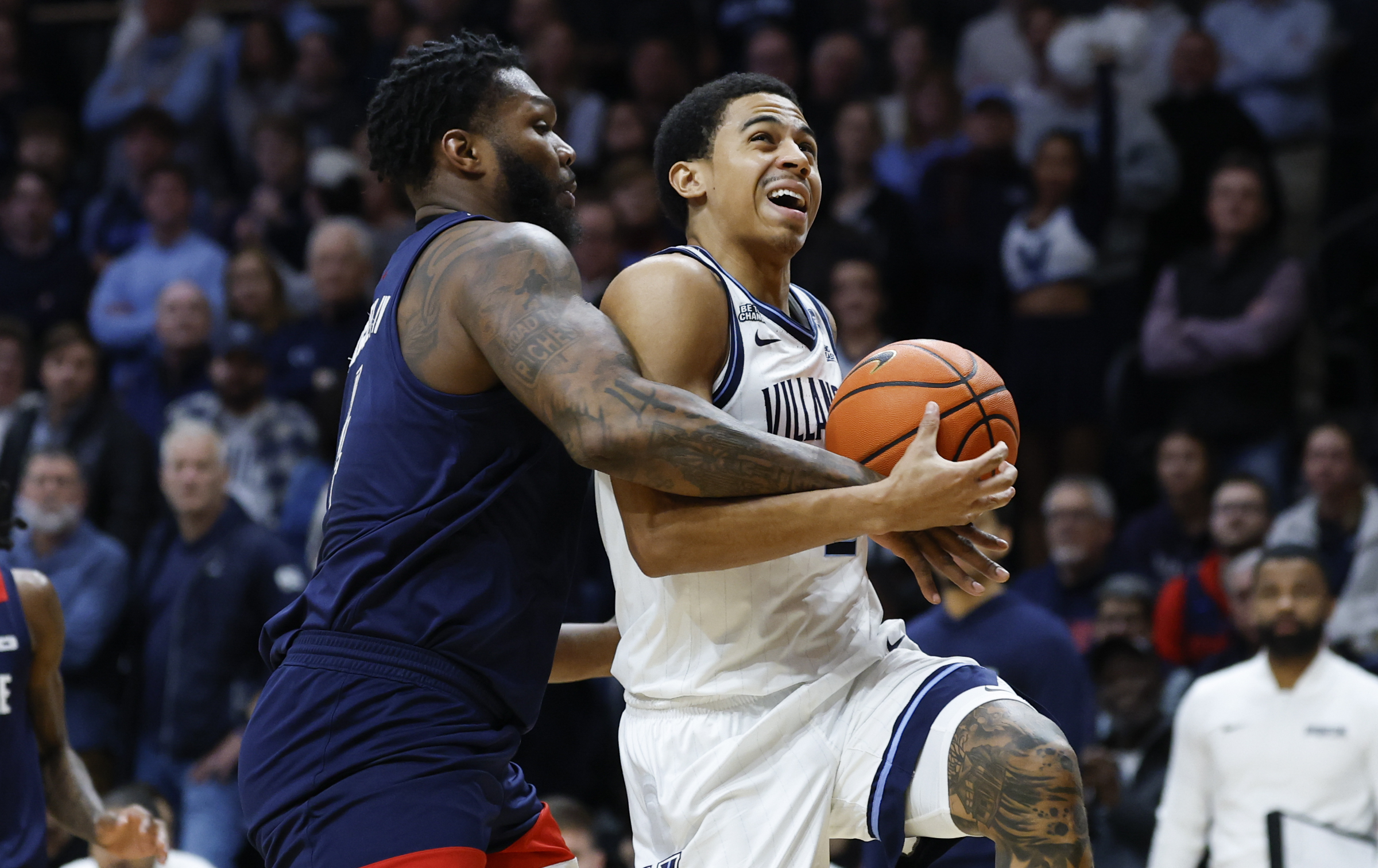
Villanova’s Bryce Lindsay is fouled by Duquesne’s John Hugley as he drives to the basket on Nov. 15.
He decided to play a prep school year at IMG Academy in Bradenton, Fla.
That’s when Lindsay committed to Texas A&M. Exactly one year after his mother’s death, Lindsay finally played his first college minutes on Nov. 6, 2023.
‘Amazed at his strength’
“It was tough for him,” said Lindsay’s father, Dustin. “It was tough for our entire family. She was the rock. She held everything together, to be honest. So that stretch was really tough for him. Losing his mom could have broken anyone’s spirit. So watching him through it, though, I was honestly amazed at his strength, to be honest with you. He never let it define him.
“He grieved, he healed, but he also stayed committed to coming back stronger, and I saw it firsthand. That period really showed his resilience and character both on and off the court. He faced more than most people could imagine, but he turned it into fuel to grow mentally and emotionally.”
Then, just eight games into his college career, the 6-foot-3 Lindsay was struck with another setback. He suffered a sports hernia that required surgery on both sides of his abdomen and forced him to redshirt the remainder of his freshman season at Texas A&M.
Lindsay was without two of the most important things in his life: his mother and basketball.
“I saw him just put both feet in the sand and just say, ‘It’s my time, right?’” Dustin Lindsay said. “And that’s easier said than done. Because most of us never have to go through a tragedy like that. But, I tell people this all the time, it’s not until you go through a tragedy like that that you realize how strong a human being can really be. I saw an individual who realized that wasn’t making excuses.”
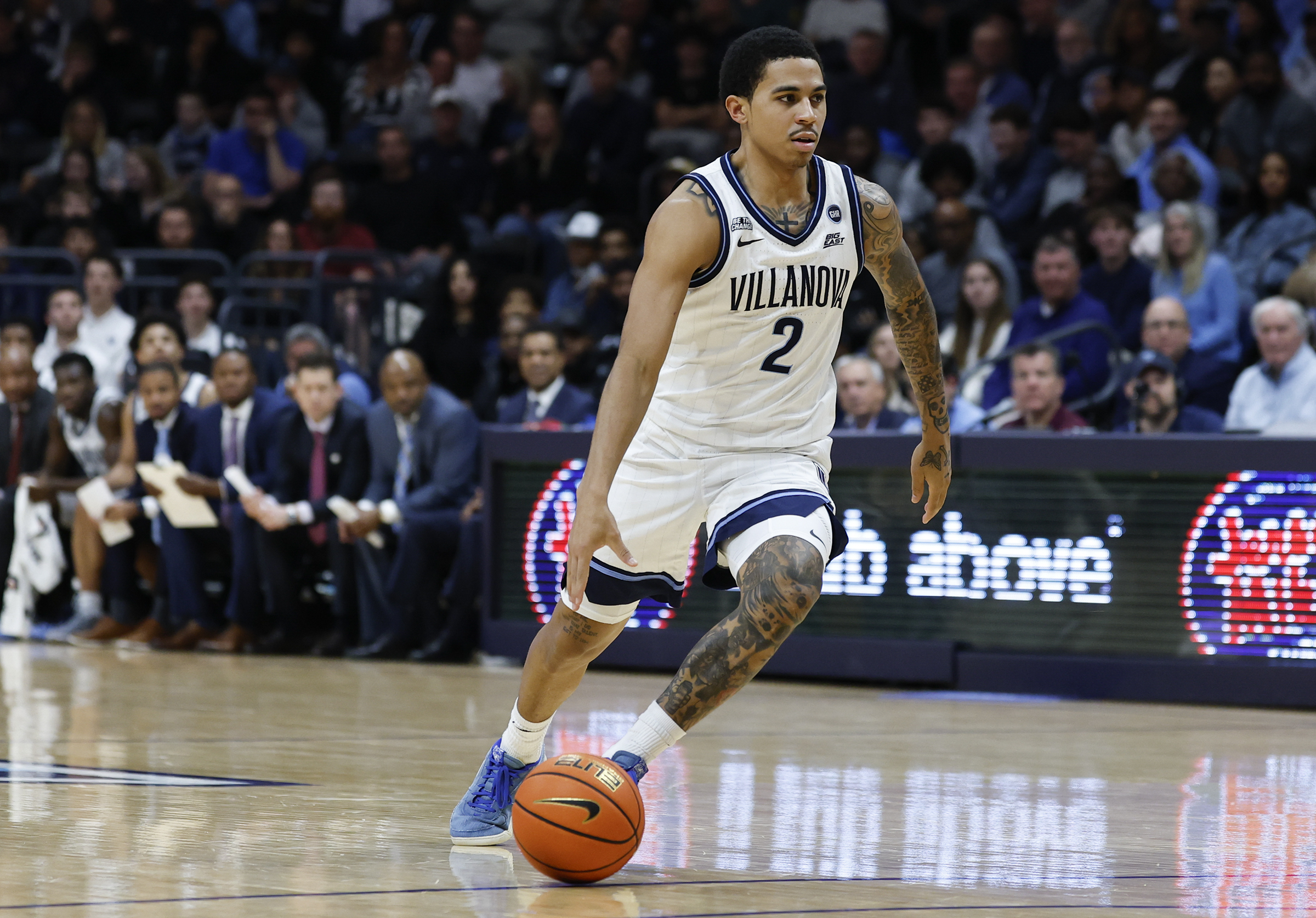
Guard Bryce Lindsay played at Texas A&M and James Madison before he landed at Villanova.
After he recovered, Lindsay committed to James Madison in May 2024. He came in thinking he would be a key player, but he was not in the starting lineup for JMU’s season opener against Ohio.
Despite yet another setback, Lindsay was unfazed.
“Bryce tells me, ‘Dad, I’m not even worried about it. I’m going to be sixth man of the year,’ Dustin said. “And when he told me that, I mean, it really almost brought tears to my eyes. The maturity that showed in him at that time was just priceless.”
Lindsay went on to accomplish that goal. He came off the bench for the first 18 games of the season, shooting 45.6% from the field and 42.9% from beyond the arc. His performances pushed him into the starting lineup for the final 12 games of the season and the conference tournament.
At the end of the season, Lindsay was named the Sun Belt’s Sixth Man of the Year and Rookie of the Year.
“I believe that true confidence comes with the work you put in behind the scenes,” Lindsay said. “I was always the type of guy who was a gym rat. I would always be in the gym before practice, after practice, and I feel like that gave me my true confidence with me coming up.”
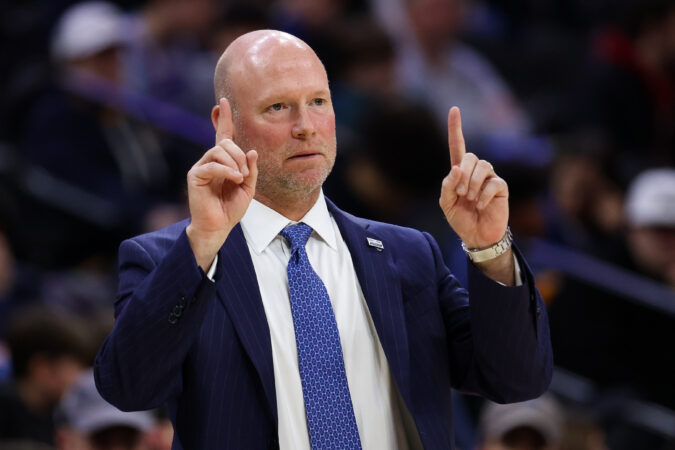
When Villanova hired coach Kevin Willard last spring, Lindsay had the opportunity to move up from a mid-major program.
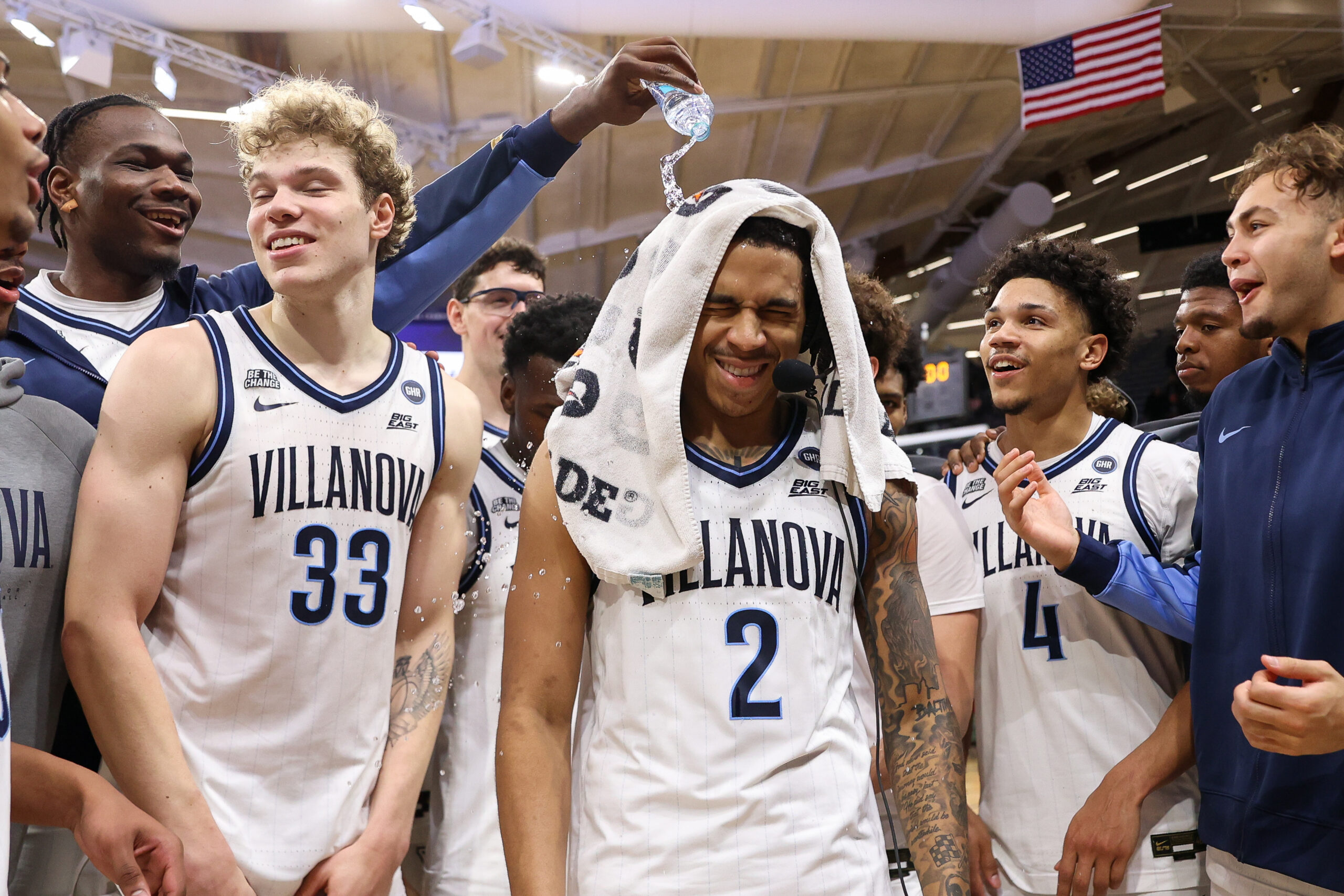
Wildcats center Nico Onyekwere (left) pours water on Bryce Lindsay after Villanova beat Pittsburgh at the Finneran Pavilion on Dec. 13.
“I absolutely think he’s had such a positive effect on everybody offensively just because of the way he’s playing,” Willard said. “And he never worries about missing a shot. He never worries about a turnover. He’s like, ‘Next play.’ Guys like that who have that confidence, who don’t get down on themselves — and he doesn’t get down on himself at all, which is great — always have a positive impact on his teammates.”
Baltimore basketball
When asked about his resilience, Lindsay laughed. “It’s crazy that you use the word ‘resilient,’” he said. “I was about to get that [as my] next tattoo.”
Much of that comes from where he grew up, in a city known for its basketball culture.
“I could be kind of biased, but I think we have the best group of guys coming out of not just Baltimore, but the [D.C., Maryland, and Virginia] area as well,” Lindsay said. “Specifically, Baltimore, I just think that we just have that competitive edge and that nitty-gritty to our game and play style. Just because where we come from, we don’t really come from too much.”
It was not easy to carve out a path in a crowded Baltimore basketball scene.
“I remember Bryce when he first picked up a basketball,” Dustin Lindsay said. “He was young, and I could already see the love for the game. Seeing him maneuver and again, finding that resilience to overcome a lot of the obstacles that he had to endure, just growing up and playing that sport here that so many people are passionate about.”
Lindsay’s father put him on teams with older, more experienced players, so he was forced to play more physical basketball.
Bryce Lindsay is averaging 16.6 points for the Villanova Wildcats.
“I think it created that part of him, that resilience that I’m going to try my best not to let these obstacles get in my way,” Dustin Lindsay said. “I tried to put him in a lot of difficult situations on purpose. Because I just know how hard life can be sometimes. And so I just wanted him to face obstacles early on in life, and it wasn’t easy. But that kid just never gave up.”
Lindsay was a part of the Class 3A state title team at Baltimore Polytechnic in his freshman year. Then he transferred to St. Frances, the second of three stops in his high school journey. In 2021-22, Lindsay averaged 19.6 points, 3.0 rebounds, and 3.0 assists.
“Being from Baltimore, I think that definitely puts an edge on me,” Lindsay said. “I mean, I just wanted to do extra work because nobody wants to be in Baltimore forever. They always want to get out, so I think I’m super grateful for being from Baltimore. I love my city.”
Now, Lindsay has transitioned from a mid-major to Villanova. He already has set a program record for three-pointers in a game, hitting nine against Sacred Heart on Nov. 11. It broke a record that had stood for 20 years.
He is averaging a team-high 16.6 points and has four 20-plus point outings in 11 games. Lindsay is also the 10-2 Wildcats’ best three-point shooter at 44.2%, and ranks in the top 40 nationally in threes made per game (3.17).
“I’m very grateful that I got to mesh with this group of guys,” Lindsay said. “We all came together pretty well in such a short time. So I’m grateful for that. We have a great coaching staff here. That’s why I chose to come here to Villanova. Plus, the culture and what Villanova means.”
Even after a dominant nonconference performance, Lindsay says there is more work to be done on his game. He believes he has not hit his ceiling.
“I would say I’m never satisfied with my play,” Lindsay said. “I feel like certain guys they get satisfied, and they stop doing all the little things. I was that type of person. Like during practice, I’m going to keep going hard 110% every day, and I’m never going to cut corners.”
The thoughts and feelings facing Kevin Willard this week hadn’t crossed his mind until Sunday, he said.
Villanova, with no classes to rush home for, spent the night in Milwaukee on Friday after finishing its nonconference schedule with an overtime victory over Wisconsin. The Wildcats traveled home Saturday with their 9-2 record and their ascending metrics tucked away with the cargo.
It’s time for Big East play, Willard’s first conference campaign since taking over at Villanova after three years coaching Maryland. Up first: Seton Hall on the road and a return to a place Willard spent 12 years from 2010 to 2022. Credit to the conference schedulers, who probably couldn’t have predicted it would be the 9-2 Wildcats against the 11-1 Pirates. They nailed it nonetheless.
On Sunday, though, Willard and his wife, Julie, started reminiscing. Willard didn’t play Seton Hall in any of his three seasons at Maryland, although he did coach a game at the Prudential Center in Newark, N.J., Seton Hall’s home court, last season, coincidentally a Maryland victory over Villanova.
Tuesday will be much different. The Willards have numerous family photos that document memories around the Seton Hall program. There are pictures of their children, Colin and Chase, running around on basketball courts at the Prudential Center and on road trips. Willard said he has about 80 people attending Tuesday’s game, a mix of family and friends.
It’s a community he remains connected to. Seton Hall coach Shaheen Holloway was one of his assistants for eight years and the guy he wanted to succeed him. He still goes on golf trips with Seton Hill alums and stays in touch with former players, like Sandro Mamukelashvili, a Raptors forward who was in Milwaukee on Thursday night playing against the Bucks.
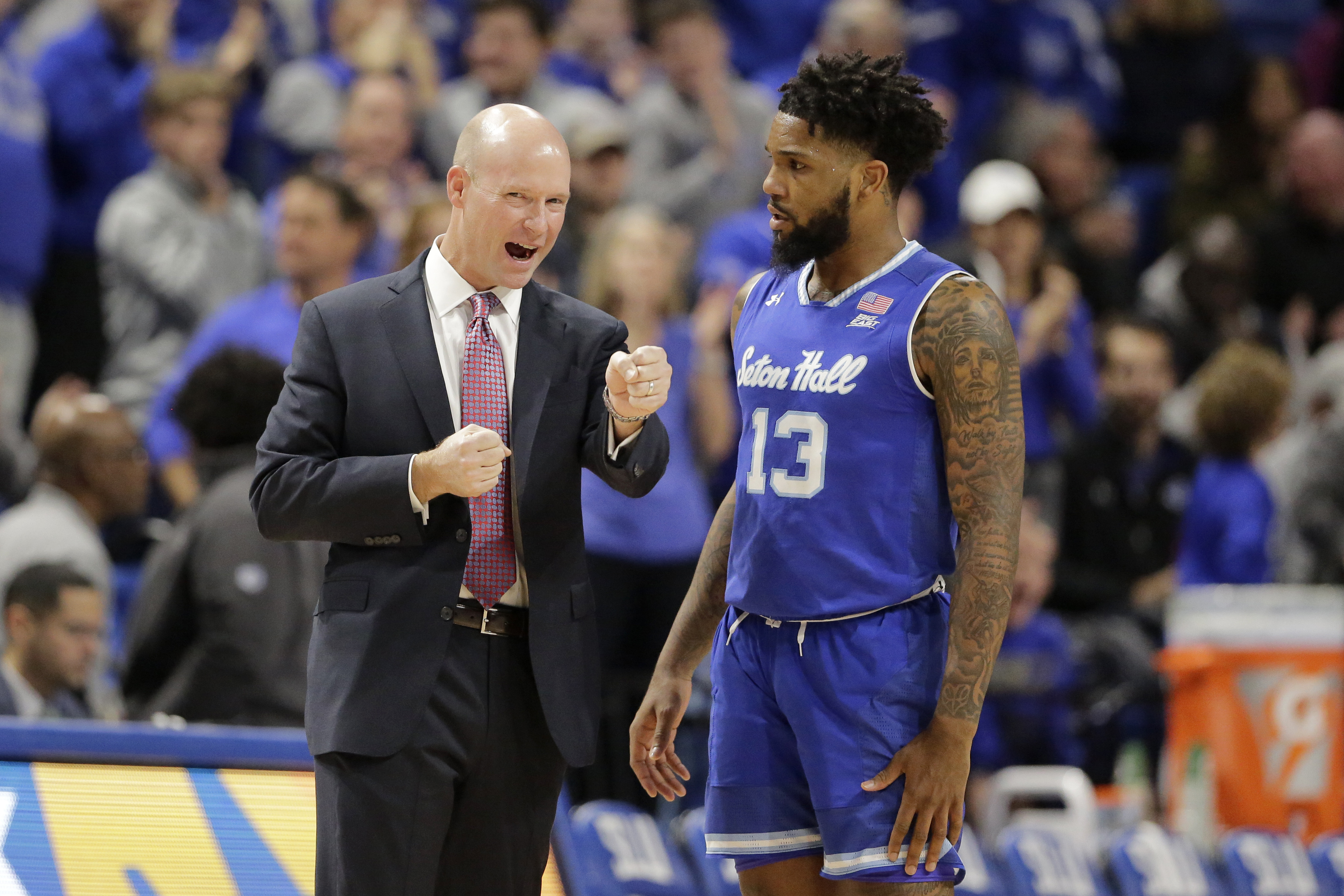
Seton Hall coach Kevin Willard talking with guard Myles Powell in November 2019.
Willard said he imagines he’ll be emotional seeing former staff members and fans Tuesday night.
“There’s a little bit more to this one,” he said Monday. “I love Seton Hall. I raised my kids in Jersey, my kids grew up there, my wife and I spent 12 great years at Seton Hall and in the community. It’s a great fan base, it’s a great alumni base.
“It’s probably going to be a little bit harder for me going back than I think it is.”
That being said …
“It’s obviously a league game, so it’s not like I’m going to be crying at halfcourt,” he said. “But it’s definitely a place that I hold very dearly and will always be the love of my life to be honest with you.”
That is the balance Willard will need to find Tuesday night. He will surely be cheered, and for good reason. Willard led the Pirates to five NCAA Tournament appearances in his last seven seasons, and a sixth would have happened if not for the COVID-19 pandemic. Seton Hall won 20 games just once in the first decade of this century before Willard hit that mark seven times in 12 seasons.
But whatever fanfare Seton Hall has planned for Willard’s return is only a distraction from what is a critical Big East Conference game.
Villanova entered Monday 29th in the NCAA’s NET rankings while Seton Hall was 36th. At the metrics site KenPom, Villanova was 28th and Seton Hall was 43rd. Meanwhile, ESPN’s bracket guru Joe Lunardi on Saturday had Villanova as a No. 10 seed, the 39th-ranked team in his 68-team field, and Seton Hall was a No. 7 seed, the 28th-ranked team.
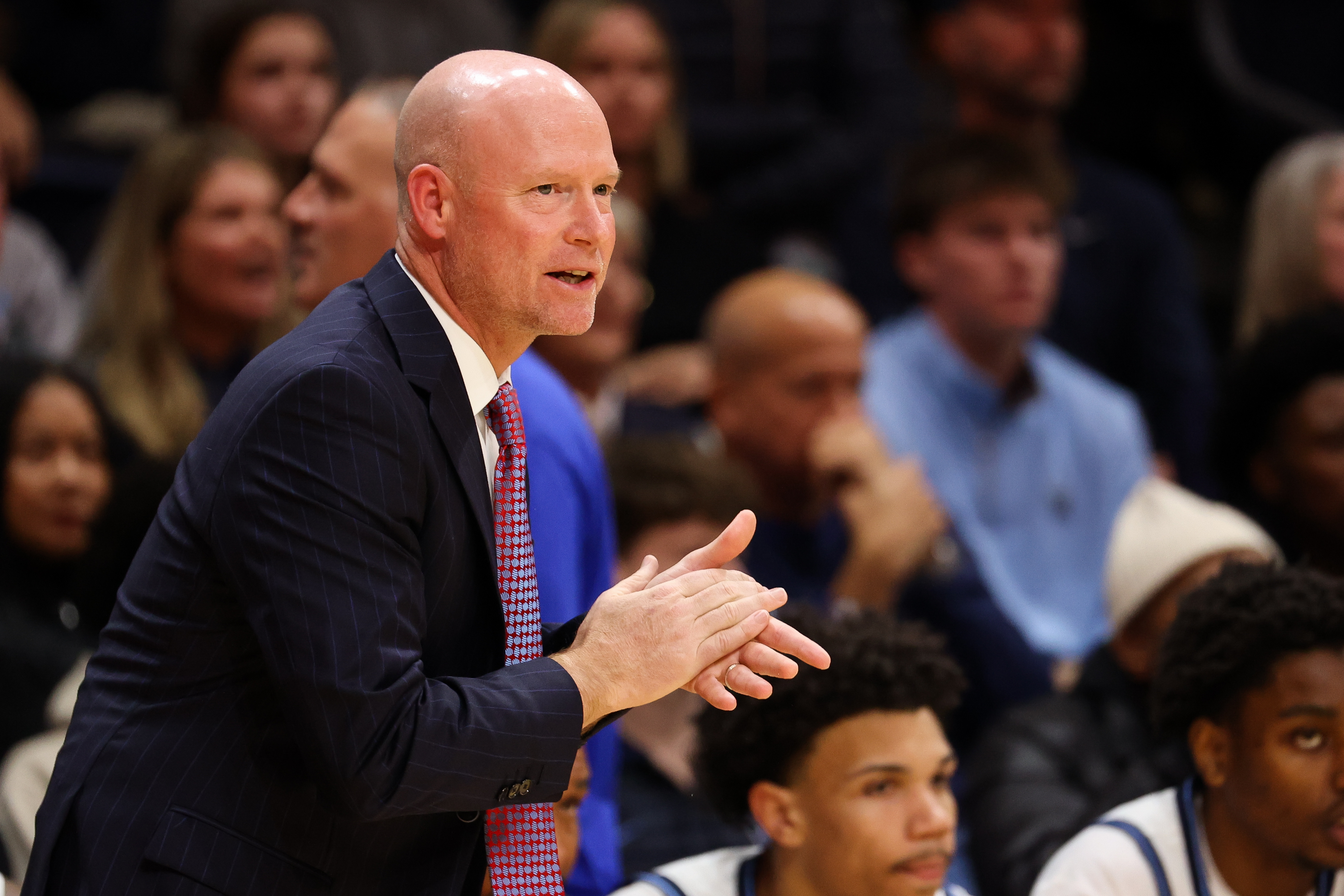
Kevin Willard coaching Villanova against the Pittsburgh Panthers at Finneran Pavilion on Dec. 13.
It may be a little early for such discussions — the teams are barely one-third of the way through their 2025-26 schedules — but it is surely a game that could be a big deal come March. That is not a reality Willard hides from, a departure from his predecessor at Villanova, who treated every game like the “Super Bowl” and didn’t talk to his players about bubbles and rankings and metrics.
“We talk about where we are, where we’re standing,” Willard said. “We talk about our NET numbers. I let them know everything.”
When Bryce Lindsay decided to make a layup rather than run the clock out in the waning seconds of Friday’s win, Willard said the guard told him afterward that he was trying to protect Villanova’s NET ranking.
What’s the benefit of keeping his players aware of it all?
“Because you’re going to go through some parts of the season where you struggle,” Willard said. “Everybody does. If the players understand where you are and what your numbers are and what opportunities you have, it’s much easier to get them out of that struggle because they’re sitting there saying, ‘OK we lost a couple games, it’s over.’
“Nope. I lost a game last year on the road and my NET went up. It’s all about your opportunities … and once you get to conference play, as long as you did what you had to do for the most part in the nonconference, you’ve just got to stay focused and keep guys focused.”
Villanova did what it had to do in the nonconference portion of its schedule. It is, as Willard said, time to focus on the 20-game Big East schedule. But taking his own advice will be harder Tuesday night than the other 19 contests.
When Beverly Allen bought the three-bedroom, one-bathroom house near Temple University at a sheriff’s sale in 1987, her son Devon recalls that he and his three siblings were not impressed by the neighborhood. They didn’t think the house was a promising investment.
But “she had the vision and we didn’t,” Devon Allen said as he prepared to sell the house where his late mother, head disciplinarian and assistant director of the ROTC program at Benjamin Franklin High School, lived until her death in 2020.
She did a considerable renovation of the house, and in her will, she left it to her four children with the provision that they divide the sale proceeds. It remained mostly vacant for three years — another son lived there during the COVID-19 pandemic — until Devon started further renovating it in 2023. Now, he said, he is convinced that the neighborhood is on the upswing and will prove that his mother’s instincts were correct.
“With the new construction going on around it, it’s very promising,” Devon said.
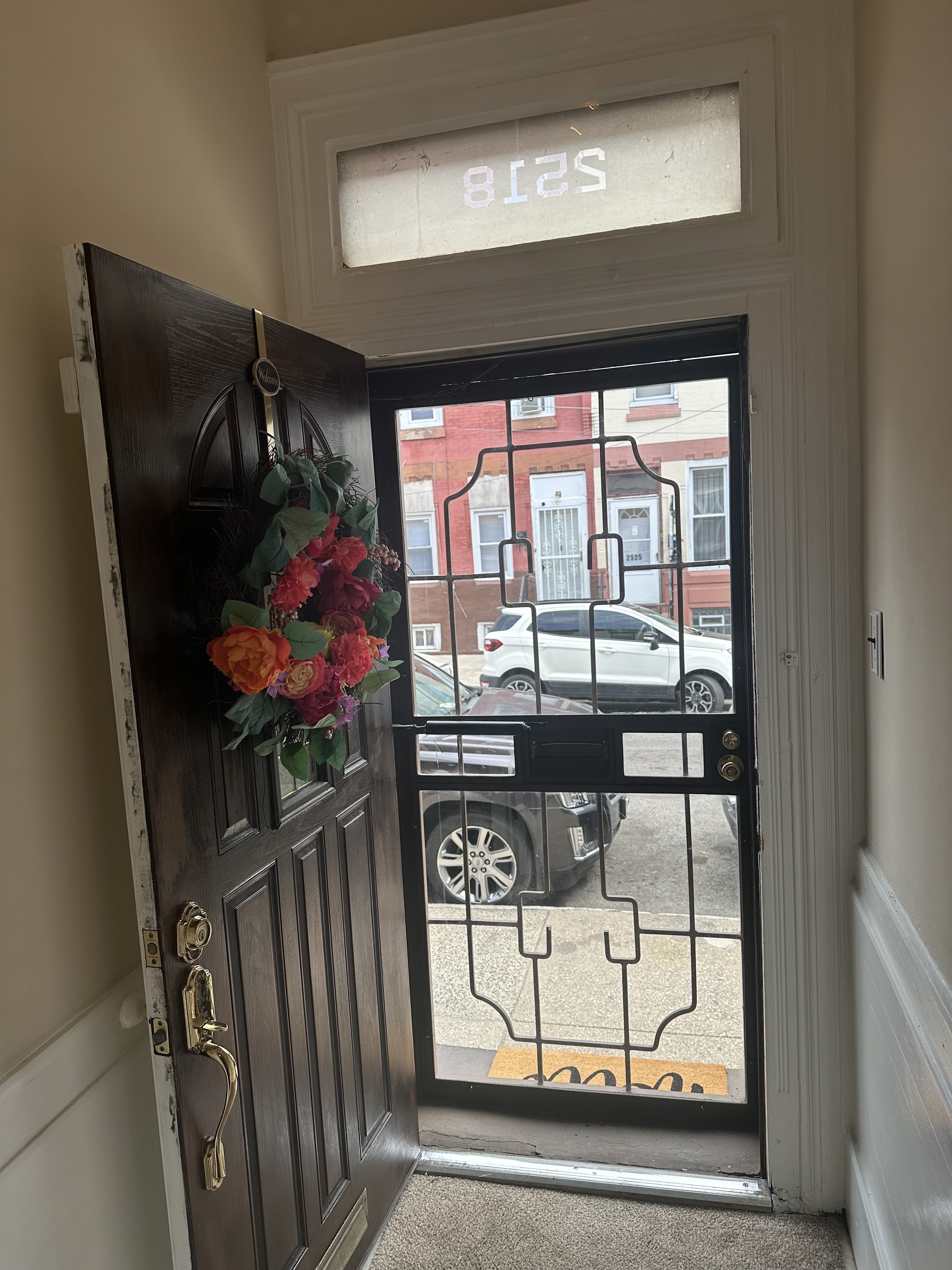
Vestibule of the rowhouse.
The 1,600-square-foot rowhouse in the Hartranft neighborhood is four blocks from the university and Temple University Hospital. It comprises two stories plus an unfinished storage basement with washer and dryer.
The interior has been totally repainted.
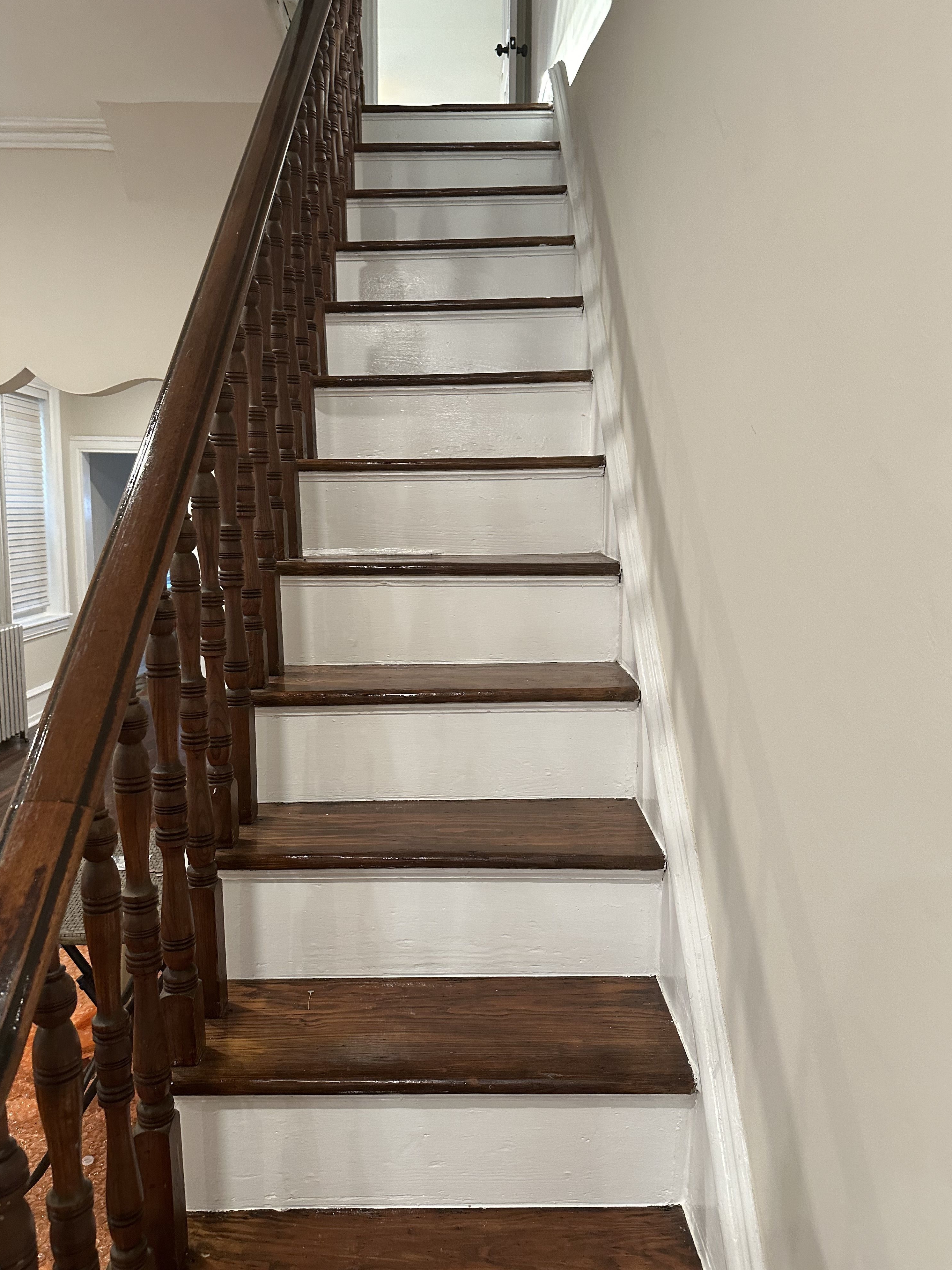
The house has high ceilings, a large eat-in kitchen, and hardwood floors. The lower level has an open-concept living and dining area, and all three bedrooms are on the next level. And there is a paved backyard.
Stairs of the home, which has hardwood floors.
The kitchen has granite countertops, white cabinetry, and ceramic flooring. The bedrooms all have ceiling fans.
The house is near the North Broad Regional Rail station, Fotterall Square park, athletic fields, and a dog park.
It is listed by Brian Wilson of BHHS Fox & Roach Center City for $225,000.
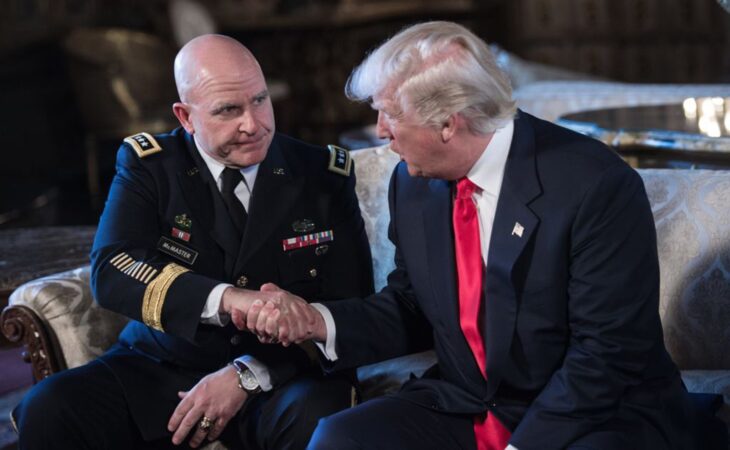
Americans should “have a say” in the Trump administration’s unilateral decision to use military force against Venezuelan boats, according to H.R. McMaster, former national security adviser during the first Trump administration, and a retired lieutenant general who grew up in Roxborough.
Being honored Jan. 16 at the Museum of the American Revolution’s 320th birthday celebration of Benjamin Franklin, McMaster was interviewed by The Inquirer last week. He offered a brief but wide-ranging discussion on foreign policy and military matters. McMaster will be named the 2026 Franklin Founder honoree during the annual Philadelphia event that celebrates the life and legacy of Franklin. McMaster is scheduled to speak about the role of the military in a democracy.
“A comprehensive explanation for bombing boats is lacking,” McMaster said in the interview, referencing the attacks on vessels allegedly carrying drugs that find their way to the United States, which have resulted in around 100 deaths since early September. “The American people should have a say through Congress.” The Trump administration has said it has complete authority to conduct the attacks.
McMaster said certain questions must be answered, such as whether the strikes are a “just cause,” and whether the right to conduct the missions is within the purview of presidential power under Article II of the U.S. Constitution.
McMaster didn’t discuss the ongoing controversy about whether U.S. forces were justified in killing two survivors of a Sept. 2 attack on a Venezuelan boat. Defense Secretary Pete Hegseth is refusing to release video showing the killing of two men clinging to wreckage in the Caribbean Sea.
McMaster, 63, is a historian and senior fellow at the conservative Hoover Institution at Stanford University who served 457 days in the Trump administration, from February 2017 to April 2018. He left after disagreements with Trump over foreign policy and internal dynamics.
Trump considered using force against drug smuggling during his first term, McMaster said, when the president asked his staff, “Why don’t we just bomb the drugs?” coming out of Mexico.
Military intervention was avoided, McMaster said, after he “huddled a team” and won “unprecedented cooperation” with the Mexican government to fight the flow of drugs.
Addressing other military matters, McMaster discussed the widely reported meeting of military commanders called by Hegseth in September.
One of Hegseth’s main messages was there’s no place for “wokeness” in the military, saying too many uniform leaders were being promoted “for the wrong reasons — based on their race … gender quotas [and] based on historic so-called firsts.” He added he wants “no more … DEI programs or dudes in dresses. No more climate change worship.”
While he agrees with much of what Hegseth said, McMaster explained, the secretary was speaking to the wrong people: “There are no woke generals and admirals,” McMaster said. “They had been following unwise directives from senior civilian officials pushing an extreme social agenda in the Biden administration.” Under Biden, McMaster concluded, the military had come to “valorize victimhood.”
Civilian guidance on so-called woke matters isn’t needed in a self-policing entity such as the military, McMaster said: “Yes, there have been criminals and sexists in the military, but hell, we threw them out ourselves.”
McMaster also said he doesn’t have a problem with the Trump administration deploying National Guard troops to U.S. cities such as Los Angeles; Chicago; Memphis; Washington, D.C.; and Portland, Ore. “It’s the president’s right to do so, allowing local law enforcement to enforce the law,” he said. “Regrettably,” he said, local authorities have resisted guard placement, especially in Oregon and California, where Democratic governors are in charge. “This is an example of how partisan politics can undermine our ability to work together,” he said.
As a former insider in a Trump-led administration, McMaster has said in previous writing that he’d witnessed the machinations of the White House, including “exercises in competitive sycophancy” among officials in Oval Office meetings. McMaster didn’t comment on the atypically blunt revelations by Trump chief of staff Susie Wiles in Vanity Fair.
He’s written that Trump is a “flawed commander in chief: mercurial, inconsistent, and easily distracted.” But, he added, Trump’s erratic course reversals can be helpful, because they make him unpredictable to our adversaries.
This cover image released by Harper shows “At War with Ourselves: My Tour of Duty in the Trump White House” by H.R. McMaster.
Despite his time in the inner sanctum of the Trump administration, McMaster would write in his book, At War With Ourselves: My Tour of Duty in the Trump White House, that he’d been unable to foresee Trump’s “persistent false claims of widespread election fraud [in 2020] and his encouragement of a mob [on Jan. 6] to conduct the most significant attack on the U.S. Capitol since August 1814,” when British troops set fire to the White House.
The partisanship that helped spur the attack is a continued threat to the republic, McMaster said in the interview with The Inquirer, referencing Franklin, “who feared factionalism.”
Each year, the Franklin celebration highlights a theme that connects Franklin’s work to current social issues and concerns. In receiving the Franklin Founder Award, McMaster joins company with others from a wide variety of fields:
John Mather, an astrophysicist who won a Nobel Prize, was the 2025 winner. He helped develop the James Webb Space Telescope, connecting with Franklin who uncovered important principles in electricity, marine oceanography, magnetism, and aeronautics.
In 2020, the centennial anniversary of Congress’ act to grant women the right to vote, awards went to Linda Greenhouse for her coverage of the Supreme Court for the New York Times, as well as to Cokie Roberts, political commentator and author.
The 2016 award went to pediatrician Paul Offit from Children’s Hospital of Philadelphia as well as the Perelman School of Medicine. Offit is the co-inventor of the rotavirus vaccine, and an author and public speaker. This topic was closely aligned with Franklin, whose civic involvement included creation of the first public hospital. Offit has frequently sparred with Health Secretary Robert Kennedy Jr. over the issue of vaccines.
McMaster is a graduate of Norwood-Fontbonne Academy (formerly Norwood Academy for Boys, and Fontbonne for girls), a private Catholic school in Chestnut Hill. He also graduated from Valley Forge Military Academy, which will be closed in the spring (it doesn’t affect Valley Forge Military College, which shares a campus with the academy in Wayne).
McMaster went on to the U.S. Military Academy at West Point, and was a U.S Army Officer for 34 years. His career included combat service in the Gulf War. Afterward, he returned to teach history at West Point and earned a Ph.D. in history from the University of North Carolina-Chapel Hill.
A patient with no home to return to was pushed in a wheelchair to the curb outside Temple University Hospital. Staffers left him sitting on a bench, even though he was considered at a high risk of falling.
An hour later, a security officer found the man had fallen and was lying on the ground.
He was shaking when the guard brought him back into the hospital, but didn’t respond to a nurse’s questions. So hospital staff again sent him away — this time leaving him alone in a wheelchair outside the emergency department.
He was found there five hours later, slumped over, unresponsive, and without a pulse. He died the following week.
Temple’s treatment of the patient during the Oct. 3 incident prompted state and federal investigations. In a report released earlier this month, the Pennsylvania Department of Health cited Temple for violating state rules that require hospitals to provide emergency care.
Experts say the hospital’s actions amounted to “patient dumping,” a practice prohibited under a federal law that requires hospital emergency departments to medically screen and stabilize all patients.
The Centers for Medicare and Medicaid Services (CMS), which oversees hospital safety nationally, confirmed it is also investigating, but has not released details.
Hospitals that violate the Emergency Medical Treatment and Labor Act, known as EMTALA, risk hefty fines or losing their Medicare license, though such penalties are rare.
Temple acknowledged that its own protocols were not followed. Health system officials told state investigators the patient should not have been removed from the hospital without being evaluated and cleared by medical staff.
“The safety of our patients, visitors and staff is Temple’s highest priority,” the hospital said in a statement to The Inquirer. “We believe that everyone deserves high quality care.”
The hospital declined to say whether any of the staff members involved were disciplined or fired.
But such incidents are rarely the fault of one individual, legal experts and homelessness advocates said. Rather, they are a sign of systemic problems, such as understaffing that can leave staff overwhelmed, and bias among medical providers that can put vulnerable patients at risk of being dismissed.
“If you work in an environment where safety is prized and honored and enforced from the top down, everyone feels that’s their mission,” said Eric Weitz, a medical negligence lawyer in Philadelphia. “If that’s not a priority being set by leadership, then it’s no surprise the culture doesn’t reinforce it.”
Hospital administrators said the triage nurse who turned away the patient should have sought help, if the patient wasn’t responding to questions. The nurse said she was overwhelmed and working without sufficient support in one of the region’s busiest trauma hospitals.
“I was busy and alone,” she told state inspectors.
The incident violated Temple’s emergency department protocol, staff told Pennsylvania Department of Health inspectors.
Pa. Department of Health investigates Temple
To piece together what went wrong, Pennsylvania Department of Health inspectors watched security camera footage, interviewed staff members, and reviewed internal hospital reports. Their timeline shows a series of mistakes.
At about 3:15 p.m., an employee brought the patient in a wheelchair to a bench near the curb outside the hospital, and left him there on the mild October day with highs near 70 degrees.
He was being discharged to “the community” because he was experiencing homelessness, according to the inspection report. (The state report does not say whether staff attempted to place him at a skilled nursing facility, rehabilitation center or homeless shelter.)
The man sat alone on the bench for an hour before standing unsteadily, taking a few steps, and ultimately falling to the ground.
He managed to get back up, leaning against a tree for support, only to fall again. He was on the ground for 10 minutes before a security guard found him.
The guard brought the man back into the emergency department in a wheelchair about two hours after he had been released.
Back inside the hospital, the man followed orders to raise his arms for a security check at the door. Then he waited in line to be seen by the triage nurse responsible for checking in patients at the emergency department.
When he reached the front of the line, he did not respond to the nurse’s questions. “He was not answering any questions, just shaking,” according to a Temple incident report reviewed by inspectors. Staff said the patient was “not cooperating” and should be sent to the back of the line.
After two minutes with the nurse, a security guard moved his wheelchair to a corner of the emergency department near the entrance.
The man was once again wheeled outside the hospital a few minutes later and left alone.
He was found by medical staff around 9:30 p.m., slumped over in his wheelchair.
Staff began CPR, rushing him back inside for trauma care.
Pennsylvania Department of Health’s inspection report details how a patient in Temple’s emergency department was rolled away in a wheelchair without being evaluated.
The inspection report does not identify the patient’s name, age, or provide details on the medical condition for which he had been hospitalized. It also does not say what happened after he was found unresponsive. He died five days later, on Oct. 8.
Temple responds
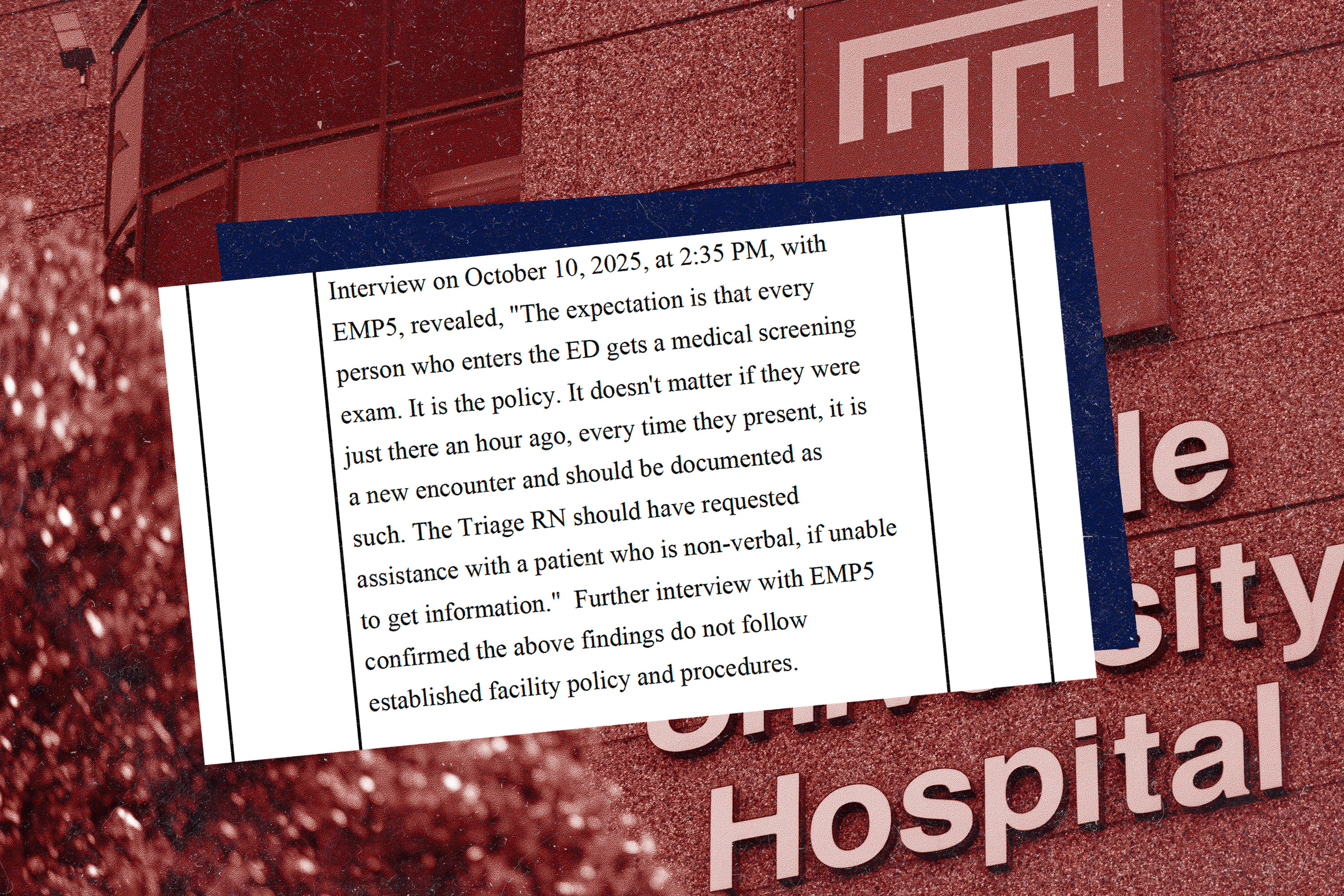
Medical screening of every patient who comes to the emergency department is “explicitly required” under Temple’s EMTALA policies, according to the hospital’s response to the state findings.
“It doesn’t matter if they were just there an hour ago, every time they present, it is a new encounter and should be documented as such,” a Temple staffer said in an interview with inspectors.
The hospital told the state it would retrain staff on EMTALA rules, making clear that security officers cannot remove patients from the emergency department unless they have been evaluated and cleared for release by a medical professional.
A week after the incident, hospital staff were instructed to keep a log of patients who are removed from the emergency department and the name of the provider who approved their release. (Temple police may still remove patients from the emergency department if they are threatening the safety of other patients or staff.)
The hospital also said that it would order mobility evaluations for patients who are being discharged “to the community” if they had a high risk of falling, with a doctor’s sign-off required.
Temple treats some of Philadelphia’s most vulnerable patients in an emergency room that sees more than 150,000 visits a year, including high numbers of gunshot victims and people experiencing opioid withdrawal. It operates a Level I trauma center in a North Philadelphia community where 87% of patients are covered by publicly funded Medicare or Medicaid.
The emergency department is so busy that about 8% of patients choose to leave before being seen, according to CMS data, compared to about 2% of patients at hospitals nationally and across Pennsylvania.
The triage nurse on duty Oct. 3 is not identified in the inspection report.
Two healthcare lawyers who reviewed the state’s inspection report said the entire episode is troubling.
“It sounds like they violated every part of EMTALA,” said Sara Rosenbaum, professor emerita of health law policy at George Washington University.
The law does not require specific treatment, but mandates that hospitals evaluate everyone who walks in the door seeking care, and prohibits them from sending them away or transferring them until they are medically stable.
“They failed to screen him, threw an unstable person back on the street, and didn’t arrange a medically appropriate transfer,” she said.
What’s more, the hospital could be sued for malpractice over how it initially discharged the patient.
The incident appears to be “a classic EMTALA violation,” said Weitz, the Philadelphia lawyer who serves on Pennsylvania’s Patient Safety Authority, an independent state agency that monitors hospital errors.
The health department’s description of what happened is “almost eerily the exact fact pattern the law was passed to prevent,” he said.
Healthcare challenges for patients experiencing homelessness
People who are experiencing homelessness often receive subpar treatment when they seek medical care, research shows.
One study that analyzed thousands of California patient records found that those who were described in their medical records as “homeless” were more likely than patients who have a permanent legal address to be discharged from the emergency department, rather than being admitted for care.
In the Philadelphia region, caring for this population is increasingly challenging. The number of available shelter beds has declined in recent years, while the number of people who are considered unhoused has risen, according to Philadelphia’s Office of Homeless Services.
Stephanie Sena, CEO of Breaking Bread Community Shelter in Delaware County, said the colder months also see more people experiencing homelessness coming to hospitals to get off the street.
“If they say they’re sick, they might get a bed and be able to survive the night,” Sena said.
The pattern can make doctors and nurses less likely to believe patients when they report real medical needs. Especially when staff are overwhelmed in busy hospitals, patients experiencing homelessness may be at greater risk of getting denied or discharged when they need help, she said.
Sena said she was disappointed to hear about the Temple incident.
“It is tragic,” she said, “but also not at all surprising, unfortunately.”
Even after selling more than $2 billion worth of sports and pop culture memorabilia, and adding celebrities like Drake, Kim Kardashian, and Shane Gillis to his client list, South Jersey’s Ken Goldin hasn’t lost the thrill of the chase.
During a visit to Japan last summer, Goldin made sure to post on social media that he wanted to meet nearby collectors and appraise their items.
Goldin’s years of collecting are evident in his office. The walls are lined with framed photos, encased music records, World Series trophies, and other prized collectibles, like signed baseball bats from Phillies legend Mike Schmidt and Reebok sneakers worn by Shaquille O’Neal.
The owner of Goldin Auctions in Runnemede said the things he has collected are invaluable heirlooms. Yes, they are rare, but they are also artifacts that carry the glory of pivotal moments in sports history, especially ones he witnessed himself.
Ken Goldin holds a 1976 Phillies bat used by Mike Schmidt, on Thursday, Dec. 11, 2025. Goldin, the star of Netflix’s “King of Collectibles,” the South Jersey-based collector and high-profile dealer has several new finds sure to excite Philadelphia sports fans.
Every time Goldin, 60, looks at the signed 1980s Phillies team poster in his office, he’s reminded of the World Series games he attended with his parents, sitting in the 500 level at Veterans Stadium.
The Phillies were playing the Kansas City Royals, and the teenage Goldin watched relief pitcher Tug McGraw tap his chest on the mound, a sign of his fiery competitiveness.
It’s those memories, not the money, that keep Goldin in the auction game, he said. They’re also the reason Netflix built a reality show around his collection and his business of selling high-value memorabilia.
“Every collectible I sell is a moment, it’s a piece of history,” he said. “And to me, if you love what you do, you will never work a day in your life. What drives me is that I really enjoy what I do.”
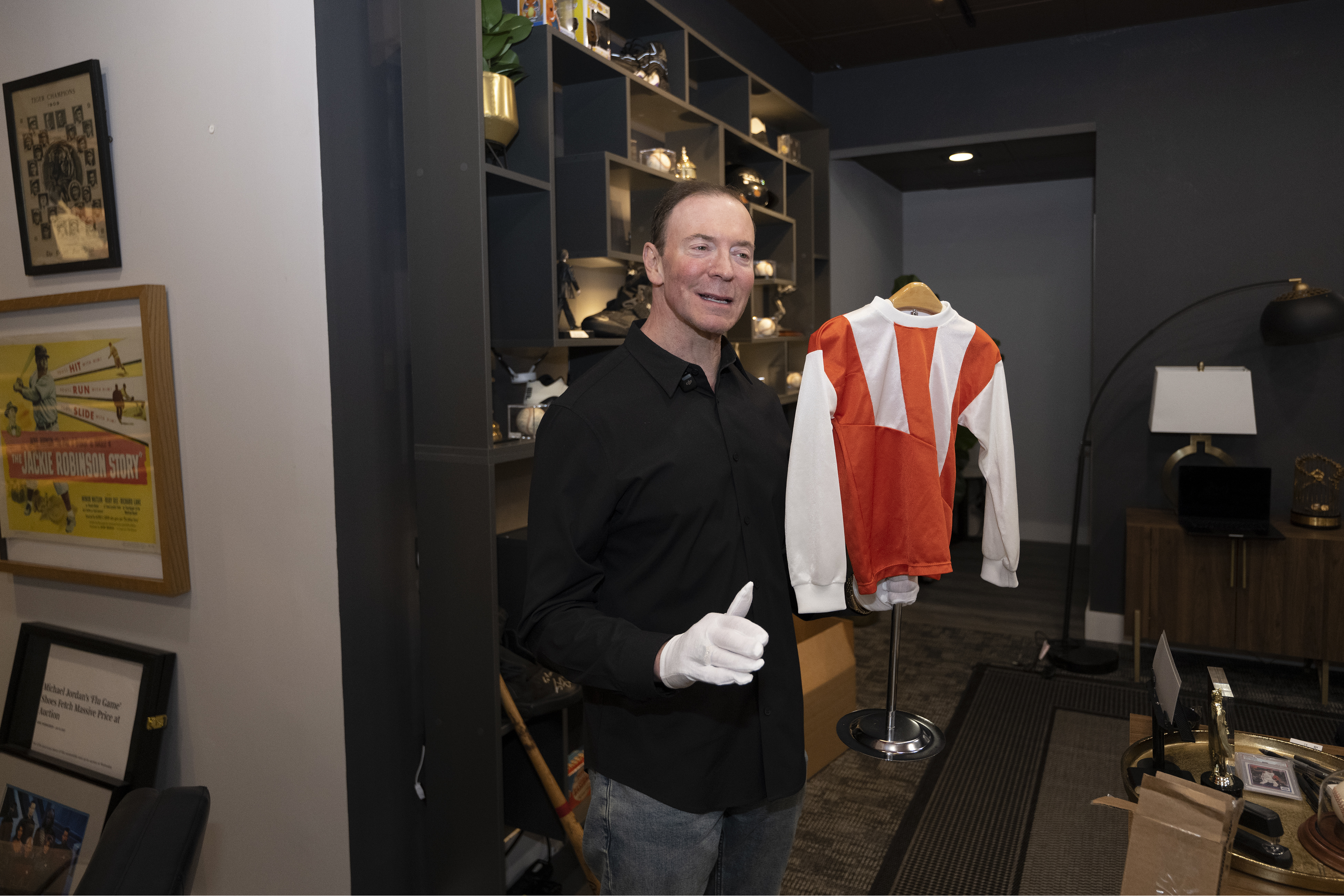
Ken Goldin shows a childhood soccer jersey that belonged to Lionel Messi, on Thursday, Dec. 11, 2025, at his office. Goldin, the star of Netflix’s “King of Collectibles,” the South Jersey based collector and high-profile dealer has several new finds sure to excite Philadelphia sports fans.
Among the season’s biggest surprises is a soccer jersey worn, or verifiably used, by Lionel Messi as a child. The story of how it landed in his hands, he said, is almost too good for TV.
“I’m not allowed to say any more than that, except that the provenance is unbelievable and the story behind it is remarkable,” he said in an interview prior to Tuesday’s premiere.
For Philly sports fans like himself, Goldin said there will be several Kobe Bryant and Allen Iverson items making an appearance on the six-episode season.
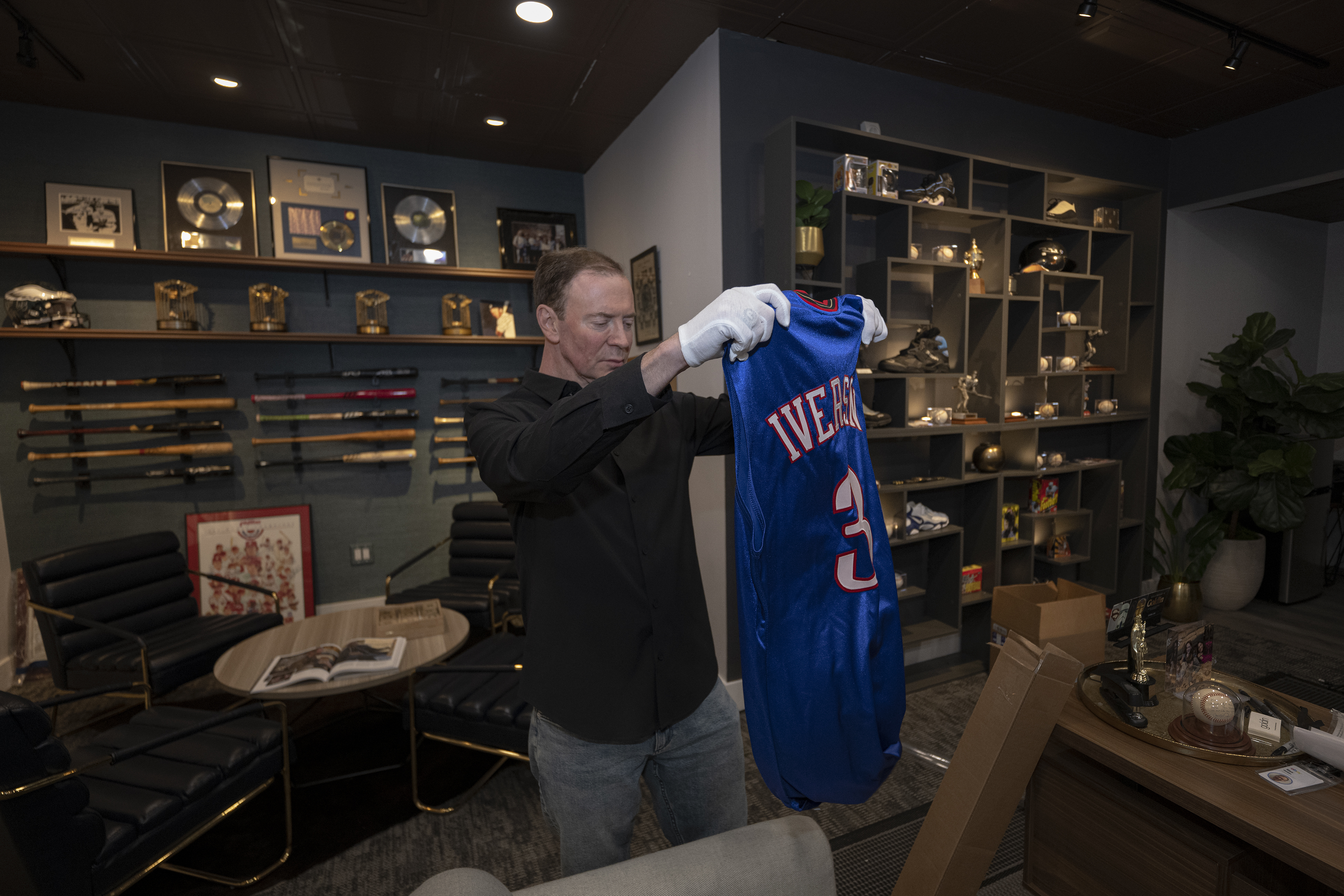
Ken Goldin unpacks a 2006 signed Allan Iverson jersey on Thursday, Dec. 11, 2025 at his office in Runnemede. Goldin, the star of Netflix’s “King of Collectibles,” the South Jersey based collector and high-profile dealer has several new finds sure to excite Philadelphia sports fans.
Some will be things Goldin acquired on his travels to Tokyo, where he met the “single-best Iverson collection in the world.”
Among the people who responded to his social media post was this Iverson fan who had a signed 2006 alternate blue jersey of the Hall of Fame player. It features a classic “Sixers” wordmark with white letters, and red and black trim. It was photo-matched and could be forensically linked to Iverson.
“When I saw it, I was like, ‘Whoa,’” Goldin said.
When it comes to Philly sports, certain athletes and figures transcend international lines, and Iverson is one of them, Goldin said.
“AI is one of those players who connects with everyone, whether they’re 14 years old or in their 50s,” he said. “I’ve lived and breathed Philly sports my whole life, so I know.”
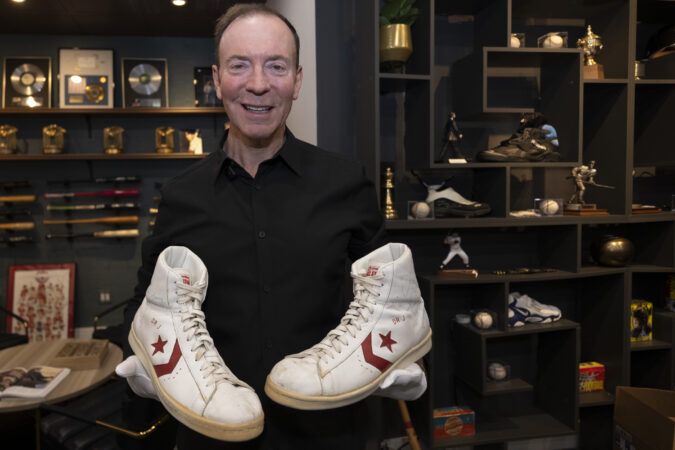
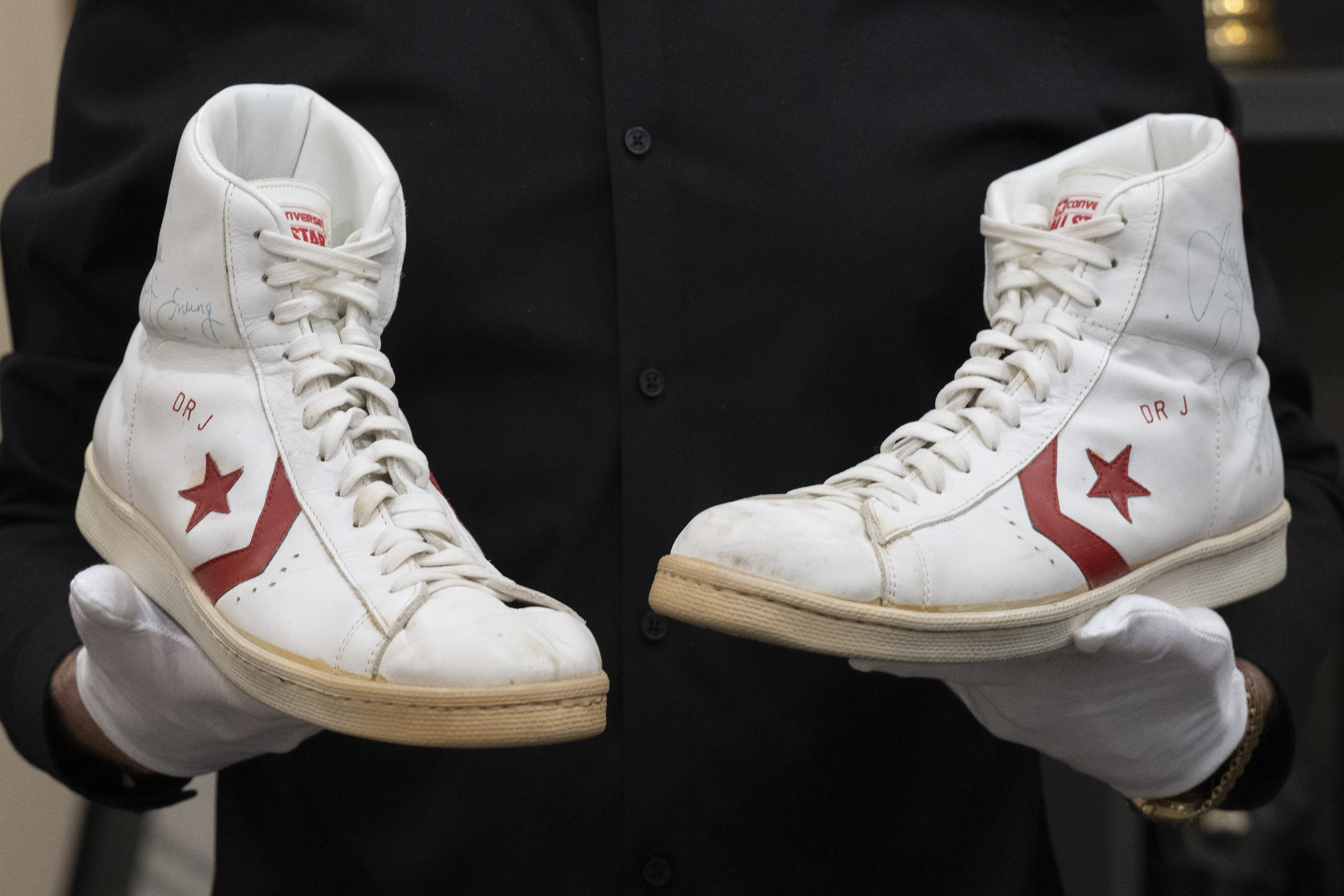
Ken Goldin holds a pair of Converse basketball sneakers on Thursday, Dec. 11, 2025, that belonged to 76ers star Julius “Dr. J” Erving and were worn during a game against the Boston Celtics in the 1980s. Goldin, the star of Netflix’s “King of Collectibles,” the South Jersey based collector and high-profile dealer has several new finds sure to excite Philadelphia sports fans.
On a recent Thursday afternoon, Goldin dug into his personal collection to reveal the sneakers of another legendary Philly sports icon: Julius “Dr. J” Erving.
The Converse All-Stars, worn by the revolutionary ABA and NBA star, feature his signature on both shoes. The sneakers are photo-matched to an early 1980s game that Erving’s Sixers played against Larry Bird’s Boston Celtics.
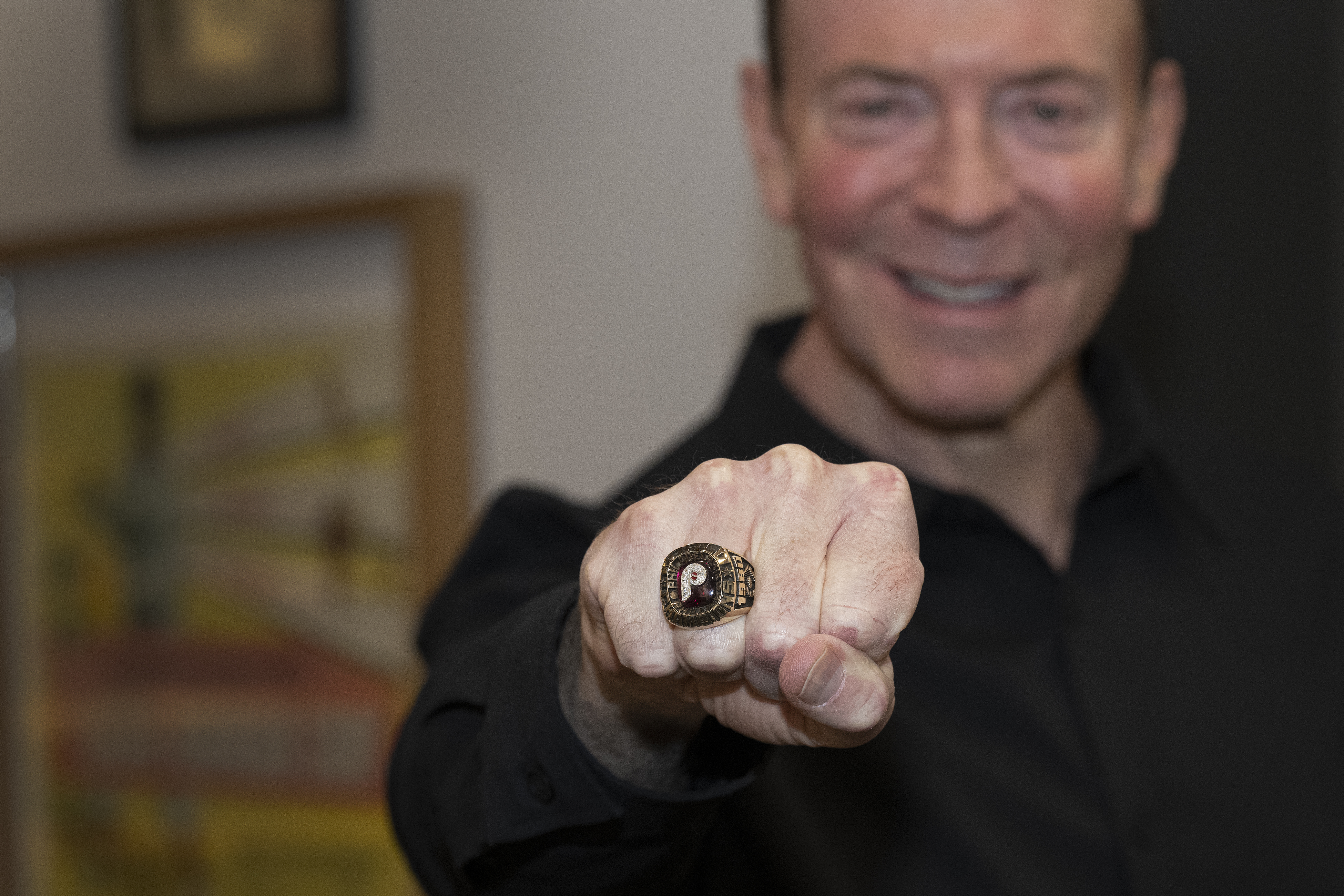
No stranger to TV-level theatrics, Goldin wore former Phillies center fielder and famed broadcaster Richie Ashburn’s 1980s World Championship ring that afternoon.
“I wear it almost never. It is set in a vault. But for this [interview], I said, ‘I’m going to put the ring on,’” Goldin said.
Ken Goldin shows his 1980 Richie Ashburn bicentennial ring on Thursday, Dec. 11, 2025. Goldin, the star of Netflix’s “King of Collectibles,” the South Jersey based collector and high-profile dealer has several new finds sure to excite Philadelphia sports fans.
But sports memorabilia won’t be the only thing Goldin is dealing with this season.
To further hone in on the Philly nature of the show’s new season, Goldin promised a Rocky-related find but wouldn’t share details. The show will also showcase high-priced items like Paul McCartney’s guitar, paintings by Bob Ross, and even the alleged mummified hand of Cleopatra.
Goldin said there will also be guest appearances from Logan Paul, Steve Aoki, and Giannis Antetokounmpo and his three brothers.
He knows Sixers fans aren’t the most welcoming to Eastern Conference contenders, but Goldin makes an exception for Antetokounmpo. “I know it’s Philly, but you have to love the guy,” he said of the Milwaukee player, before signing off with something of a prophecy.
“Who knows, maybe we can get him next year.”
The new season of “King of Collectibles” is streaming on Netflix.
Organizations providing homelessness services were thrown into crisis mode last month when the U.S. Department of Housing and Urban Development announced an extreme shift in funding priorities.
The department has since withdrawn the notice, but it offered a stark preview of an administration willing to gamble with the futures of our most vulnerable neighbors and the crippling changes that could still be coming — unless neighbors make their opposition known, and lawmakers work to stop it.
HUD’s fiscal year 2025 Continuum of Care Competition Notice of Funding Opportunity brought widespread changes and signaled a drastic shift away from proven permanent supportive housing solutions to combat homelessness in favor of transitional housing.
We at Project HOME immediately recognized the danger this posed to Philadelphia’s communities and the people we serve. The outcry from fellow organizations on the front lines and elected officials was swift and fierce. Gov. JoshShapiro even joined a multistate lawsuit challenging HUD’s move.
While HUD has temporarily paused the Notice of Funding Opportunity, the department remains intent on reshaping funding requirements to reflect new priorities. For now, organizations have been spared the chaotic rush to adjust grant applications based on the changes. But make no mistake: The administration’s intentions have been revealed, and if future funding notices are similar, the consequences could be devastating.
The changes would disregard proven solutions and could destabilize established programs, putting people’s homes — and their lives — in jeopardy.
The reality is, permanent supportive housing is a proven and effective approach to breaking the cycle of homelessness. Per the Urban Institute, “Rigorous studies consistently show that it is the most effective solution to increasing housing stability and reducing chronic homelessness.”
At Project HOME, we witness the transformative power of permanent supportive housing every single day. Our model has leveraged permanent supportive housing as the foundation of our H-O-M-E model in tandem with opportunities for employment, medical care, and education services. The most critical step in a person’s journey to break the cycle of homelessness is to have a safe and stable place to call home.
Consider David, who spent 25 years experiencing chronic homelessness before finding stability and hope in our community. With access to housing and supportive services through our H-O-M-E model, David rebuilt his life — moving into permanent supportive housing, pursuing adult education, and securing employment through our social enterprise program.
Today, David is a pillar of our community: He organizes an annual back-to-school barbecue for neighborhood children and continually looks for ways to help others still struggling on the streets. Whether he’s distributing coats, offering comfort at memorials, or lending a helping hand, David embodies the power of proven solutions to break the cycle of homelessness, restore dignity, and inspire lasting change.
Stories like David’s are not isolated — they are why we remain steadfast in our commitment to permanent supportive housing.
Critics point to a rise in homelessness nationwide as a failure of permanent supportive housing approaches, but the real culprit is a nationwide shortage of affordable housing.
According to the National Low Income Housing Coalition (NLIHC), there were only 35 rental homes that were affordable and available for every 100 extremely low-income households in 2024. That’s a shortfall of 7.1 million rental homes across the country. Without pathways to affordable, permanent supportive housing for people at risk of homelessness, the crisis would be so much worse, and more unsheltered people would be on the streets.
We recognize it is not the administration’s intention to increase rates of unsheltered homelessness in Philadelphia and countless other communities nationwide. No one wants to see more people living on the streets — not neighbors, not service providers, not civic and business leaders, and certainly not the administration. Yet, if these changes go forward, that could very well be the outcome.
The reduction in permanent supportive housing threatens to have a drastic effect on people like David. They’d risk falling back into the cycle of homelessness, and local businesses and neighborhoods would be forced to grapple with the effects.
Homelessness is the defining crisis of our time. Yes, we must always strive to improve our response and evolve best practices. But change must be rooted in evidence, not theory.
Philadelphia has made steady progress over three decades and has been on the front line of developing best practices that work.
We don’t want to go backward. We must hold our elected officials accountable and demand proven solutions that benefit communities and honor the dignity and progress of every person.
Donna Bullock is the president and CEO of Project HOME.
Having Pennsylvania politicians spend a weekend in New York City looking for money for their local elections adds a corrosive element to our elections. The $1,000-a-plate “money primary” that is the Pennsylvania Society dinner drowns out the voices of people who are running without the backing of corporate interests and party bosses. The entire point of the event is for the wealthy to influence things in the Keystone State. And it’s working. Both of the likely nominees in next year’s gubernatorial race appeared, along with several candidates for U.S. Rep. Dwight Evans’ 3rd Congressional District seat. And Sen. “Connecticut” Dave McCormick appeared. He won’t appear for an in-person town hall anywhere in his district, but he’ll go to New York, which shows how events like this reveal skewed priorities.
The focus is on fundraising, not generating the real political change people need. It’s really just moneyed people protecting their narrow self-interest, not building a movement that answers voters’ concerns, addresses crucial needs in the commonwealth, and creates a distinct branding in people’s minds. It’s insensitive and reeks of venality. Follow the money.
In the late 1950s and early ’60s, when Levittown development projects were being built in the New York, New Jersey, and Pennsylvania suburbs — exclusively for white people — Philadelphia Mayor James Tate, City Planning Commissioner Edmund Bacon (Kevin’s dad), and the Rev. William H. Gray Jr. (U.S. Rep. Bill Gray’s father) put their heads together and began planning an urban renewal project for future Black homeowners in North Philadelphia.
It was named Yorktown to celebrate the 1781 Franco-American victory in Yorktown, Va., where George Washington’s forces — with French naval support — trapped the British, forcing their surrender.
Historians tell us the Battle of Yorktown and Washington’s victory directly led to serious peace negotiations resulting in the Treaty of Paris in 1783 and American independence.
Designed by builder Norman Denny, the development featured suburban-style two- and three-story homes with front lawns and driveways. The sprawling area included cul-de-sacs named after significant historic figures, Betsy Ross, Patrick Henry, Marquis de Lafayette, etc.
An artificial intelligence program I consulted while writing this letter even agrees that my neighborhood is significant, calling it a “unique North Philly community inspired by the decisive Battle of Yorktown in the Revolutionary War that has created a lasting middle-class enclave known for its distinct style and strong identity despite early predictions it wouldn’t last.”
How much more history must Yorktown hold to get its own anniversary Liberty Bell?
Karen Warrington, Philadelphia
Join the conversation: Send letters to letters@inquirer.com. Limit length to 150 words and include home address and day and evening phone number. Letters run in The Inquirer six days a week on the editorial pages and online.