Tag: topic-link-auto

  • The lying is out of control. People need to go to prison.

    The lying is out of control. People need to go to prison.

    Even by the pitifully low standards of the fact-free government of the United States, this one was a whopper.

    Last month, agents from U.S. Immigration and Customs Enforcement (ICE) showed up at a Minneapolis hospital emergency room with a 31-year-old Mexican immigrant named Alberto Castañeda Mondragón who’d suffered severe head injuries.

    The ICE agents told the ER nurses, according to the Associated Press, that Mondragón “purposefully ran headfirst into a brick wall.” But doctors could immediately see that the official version made zero sense, since their patient had multiple head injuries on the front, back, and side — not consistent with a fall or a collision.

    Under oath, the feds suddenly switched to passive voice, as an ICE deportation officer said only in a sworn statement that Mondragón “had a head injury that required emergency medical treatment.” A judge ruled the arrest was unlawful — Mondragón had come to the U.S. legally and overstayed his visa — and ordered the man freed. Mondragón, who survived his eight skull fractures and brain bleeds and is suing the government, weeks later told an AP reporter his story of what really happened.

    “They started beating me right away when they arrested me,” he recounted, describing how immigration agents pulled him from a friend’s car at a St. Paul, Minn., shopping center on Jan. 8, then slammed him to the ground, handcuffed him, punched him, and whacked him with a steel baton. Mondragón said he was beaten again at a federal detention center, where his pleas for mercy were met by laughter and more blows.

    “There was never a wall,” he said.

    Alberto Castañeda Mondragón, who says in a lawsuit that he sustained eight skull fractures when he was beaten by ICE agents, poses for a portrait earlier this month in St. Paul, Minn.

    Mondragón’s narrative would be outrageous if it were an isolated incident, but this is simply one of the most egregious examples of falsehoods by an American secret police regime that has been caught in high-profile lies again and again. The best-known cases are the Minneapolis killings of Renee Good — where officials up to the president falsely claimed an agent was struck by a car and rushed to a hospital — and Alex Pretti, who was accused of brandishing a gun at federal agents, a lie that was instantly demolished when videos emerged.

    And these are just three of the many instances where a U.S. Department of Homeland Security (DHS) agent or top official has offered a version of events — often backed up by sworn testimony — that soon fell apart.

    On Wednesday, another woman DHS had described as “a domestic terrorist” — Mirimar Martinez, the Chicago Montessori schoolteacher who was shot five times after a vehicle collision with ICE agents — presented powerful evidence of government lies as she pursues legal action against DHS and the agent who shot her, Charles Exum.

    Marimar Martinez (center) is greeted by her family after being released from the Metropolitan Correctional Center in October, after being shot by immigration agents and charged with assaulting federal officers in an incident in Chicago’s Brighton Park.

    Martinez, whose federal charges stemming from the encounter were later dropped, and her lawyer said that a federal diagram of the crash scene presented in court showed three other vehicles that do not exist, that the shots did not come through the front windshield as claimed by Exum, and that another claim — that Martinez had “rammed” Exum’s vehicle — was also false. Said her lawyer, Christopher Parente, “This is a time where you just cannot trust the words of our federal officials.”

    Ya think?

    Let’s not pretend to be so naive as to act as if official deceit began on the June 2015 day that Donald Trump descended on that Trump Tower escalator. It was the late 1960s — the era of Lyndon B. Johnson’s Vietnam “credibility gap” — when the investigative journalist I.F. Stone famously wrote, “All governments lie.” I became an opinion journalist because of my disgust over George W. Bush’s lies that drove the Iraq War.

    That said, the outrageous, Soviet-caliber falsehoods of the Trump regime feel much worse. These are not “plausible denial” fairy tales to push an unpopular policy or cover up some dirty deeds, like Watergate, but a vast empire of Big Lies — easily disprovable, about everything from election results to economic statistics — with a much more ambitious goal of undermining the very notion of objective reality.

    This fish stinks from the head. That Trump was elected a second time after the Washington Post (remember them?) chronicled some 30,573 false or misleading claims during his first four years was essentially America’s drive-through order of a Double Whopper.

    The nation seems to have all but given up on challenging Trump’s absurd claims that he won Minnesota three times (although he actually lost three times), or his fact-free insistence that his tariff policies have sparked $18 trillion in new investments, just to name two instances. But America’s liar-in-chief has also offered fresh inspiration to his underlings.

    One would be hard-pressed to find a more blatant case of highest-level lying than the matter of Commerce Secretary Howard Lutnick and his friendship with Jeffrey Epstein, the deceased financier and sex trafficker. When the Trump regime’s cover-up of its massive Epstein files became a big story last summer, Lutnick, a former Wall Street CEO who lived next door to Epstein in Manhattan, told a podcast that he’d briefly visited Epstein’s home in 2005, and was revulsed at the sight of a massage table. He insisted that he then decided, “I will never be in the room with that disgusting person ever again.”

    This was an epic lie.

    We now know — thanks to the congressionally mandated (but still incomplete) release of the Epstein files — that Lutnick and his family and entourage stopped for lunch at Epstein’s Caribbean island in 2012, and that this was one of many contacts — about meeting for drinks, or philanthropic contributions — the two men had almost up until Epstein’s arrest and jail cell death in 2019.

    There’s no evidence Lutnick committed any crime — beyond telling a massive and now discredited lie to the American people he purportedly serves. In Europe, heads are rolling for far less, but Lutnick has “the full confidence” of the president. That fact, bobbing above a vast MAGA sea of lies, should make us ask some hard questions as a nation.

    Commerce Secretary Howard Lutnick listens during an event with President Donald Trump in the Oval Office in February.

    The current consensus — honored mainly in the breach — that lying is wrong, or bad, does not go nearly far enough. Perhaps it muddies the water that the U.S. Supreme Court has ruled it is First Amendment-protected free speech when private citizens utter things that aren’t true. But official deceit is a different category.

    “The government’s lies can be devastating,” a leading scholar — University of Colorado law professor Helen Norton — wrote in a powerful 2015 article, arguing that official government dishonesty is fundamentally unconstitutional. Norton noted that false testimony and evidence in criminal cases — what we’ve seen frequently in the immigration terror campaign — is a violation of the Constitution’s due process clause, while invented allegations that aim to silence critics are offenses against constitutionally protected free speech.

    It’s a felony to lie in federal court cases, or when testifying under oath before Congress, or in other types of governmental proceedings. And the federal statute of limitations for perjury is five years — plenty of time for a liberated U.S. Department of Justice to pursue these many cases if democratic forces can win back the White House in 2028.

    But we should also recognize that top officials who tell deliberate lies are abusing their power in ways that, as Norton rightly argues, are grossly unconstitutional. When Noem lies to the American people about Good and how she was killed by ICE, she should resign or be impeached. When Lutnick looks into a camera and offers complete fiction about his friendship with the world’s most notorious sex trafficker, he, too, should quit immediately, or face impeachment.

    Norton, in her prescient article from 11 years ago, notes that beyond the specific wrongs against individuals — such as Mondragón, Martinez, Good, and Pretti — that occur when the government lies, there is a much broader problem: the loss of public trust.

    Indeed, the steep decline of public faith not only in government but in other civic institutions began with those official lies about Vietnam and Watergate, and the flawed probes into the John F. Kennedy assassination. It was those and other countless moments of scatheless lying by those in power that created the rubble Trump marched over in 2016.

    We won’t get anything resembling democracy until we clear that widespread debris, and that means sending a bunch of these liars to prison, because they are the real criminals. America desperately needs truth and consequences.


  • ArchWell Health is a new primary care provider for Philadelphians with Medicare Advantage

    ArchWell Health is a new primary care provider for Philadelphians with Medicare Advantage

    A new sign with orange letters outside a former Rite Aid in Germantown announces the arrival of a primary care model new to the Philadelphia region.

    ArchWell Health recently opened its first three of eight planned primary care centers here for people with Medicare Advantage, promising convenient and personalized care in neighborhoods with a relative lack of doctors.

    Two others have opened on North Broad Street, near Stenton and Susquehanna Avenues, also in former Rite Aid stores.

    A privately held company based in Nashville, Tenn., ArchWell says it can offer patients greater access to healthcare through lower patient-provider ratios.

    It plans to limit each of its physicians to no more than 500 patients — about a fifth of the patient load for typical primary care doctors. Nurse practitioners working under the doctors will manage a maximum of 250 patients, officials said.

    The approach is built around a financial model that differentiates ArchWell from Medicare-focused competitors already in Philadelphia like Oak Street Health and ChenMed’s Dedicated Senior Medical Centers. ArchWell only accepts patients who have private Medicare or are willing to switch to it. Oak Street and ChenMed also accept traditional Medicare.

    Privately run Medicare Advantage plans are increasingly popular among people ages 65 and older who qualify for government-funded Medicare coverage. Advantage plans appeal to people by covering services, such as dental and vision care, left out of traditional Medicare, but have come under scrutiny for exaggerating how sick patients are to rack up more revenue.

    ArchWell sees exclusively working with Medicare Advantage plans as helping doctors to focus solely on the best outcomes for patients, rather than on providing more services to bring in more revenue, a criticism of traditional Medicare, said Doron Schneider, its medical director for the Philadelphia market.

    Melissa A. Herd, community relations specialist for ArchWell Health in Philadelphia, is shown outside the company’s Germantown location, which is in a former Rite Aid building.

    “You have different incentives, you have different care models, you have different case management models, you have different ways to treat one person versus the other,” Schneider said.

    Before starting at ArchWell in late 2024, Schneider worked at Tandigm Health, an Independence Health Group company founded in 2014 with the goal of helping primary care doctors manage costs and improve care for their patients. He learned there how hard it is for doctors to work with different types of insurers and the varied incentives that go with them.

    How ArchWell conducts business

    ArchWell, which opened its first clinic in 2021 in Birmingham, Ala., operates under contracts with Medicare Advantage plans. The plans give ArchWell a portion of the monthly payment they get from Medicare for each patient. That money is supposed to cover all of the person’s medical costs.

    Aetna, UnitedHealthcare, and Devoted Health have contracts with ArchWell to cover the Philadelphia market. ArchWell is close to getting contracts with HealthSpring and Humana, Schneider said. Those five companies had more than 90,000 people in their plans in December, according to federal data.

    Aetna and UnitedHealthcare said they work with clinics like ArchWell’s around the country to improve health outcomes and leave patients more satisfied with their experience.

    “We are pleased that they are now an option for Aetna Medicare Advantage members in the Philadelphia area,” Aetna said in a statement.

    ArchWell declined to provide financial details, such as annual revenue from the more than 80 clinics it had in a dozen states before coming to Philadelphia or how much it spends to open each center. ArchWell representatives also did not disclose who its owners are.

    The interior of Archwell Health’s Germantown primary care clinic has Philadelphia-centric images painted on the walls.

    Company founder Carl Whitmer worked at Clayton, Dubilier & Rice, a global private equity firm, before founding ArchWell.

    “We have partners that are focused on our sustainability and growth,” said Christina Cober, ArchWell’s vice president of marketing.

    But companies focused on primary care for seniors haven’t always been as successful as anticipated.

    Oak Street, founded in Chicago in 2012, grew rapidly and now services 450,000 patients at 230 centers across the country. It declined to say how many patients it has in Philadelphia. Oak Street arrived here in 2018.

    CVS Health bought Oak Street in 2023 for $10.6 billion, anticipating that it would expand to more than 300 centers by this year. Last fall, CVS announced it was closing 16 centers and taking a $5.7 billion write-down on its health-services business, largely because of slower anticipated growth at Oak Street.

    Patina Health, a Bala Cynwyd company that offered virtual and in-home primary care for Medicare Advantage patients through a partnership with Independence Blue Cross, shut down last year due to “unforeseen business challenges.”

    How ArchWell approaches patient care

    ArchWell says its lower patient-provider ratios allow more frequent interactions with patients. If a patient is diagnosed with high blood pressure, Schneider said, the message to the patient is: “We’ll see you back in a week. We’ll see you back in two weeks.”

    The repeat visits happen with no cost to the member and no extra revenue to ArchWell because all care is supposed to be covered by a monthly payment per member.

    ArchWell expects to add about 300 patients per year at each center, said Cober. Staffing at the centers starts out with a physician, a nurse-practitioner, two care navigators, two medical assistants, and a center manager.

    Among the early patients at ArchWell’s center on Germantown Avenue is Marcella James, 69, who lives across the street from the clinic and watched as the building was transformed from a shuttered Rite Aid.

    “I walked over there one day just to see what it was like and what they offer, and I signed up right away,” James said. James likes her doctor at Temple Health, but ArchWell was irresistibly convenient.

    “If I can get the same help or better help from ArchWell is to be seen because I just started with them,” she said.

  • SAVE Act would drastically change how Americans vote

    SAVE Act would drastically change how Americans vote

    This week, lawmakers in Congress renewed their push to pass the SAVE Act, rebranding it as the “SAVE America Act.” Wednesday night, this bill passed the House and will move on to the Senate.

    Although this legislation’s title suggests safeguarding Americans and ensuring election security, its actual impact would be catastrophic.

    The SAVE America Act would impose sweeping new “show your papers” requirements that threaten to disenfranchise millions of eligible Americans, including hundreds of thousands of Pennsylvanians. It places new burdens on voters and election officials without addressing real problems. Mainly, it seeks to solve an issue that does not exist: Noncitizens are already prohibited from registering to vote, and checks are already in place to prevent ineligible voters from casting ballots.

    The League of Women Voters of Pennsylvania urges our senators to reject this renewed effort to undermine Americans’ freedom to vote.

    The SAVE America Act would require voters to present documentary proof of U.S. citizenship in person when registering to vote, whether it be for the first time or when voters move, along with proof of state residency. It would also require proof of citizenship and photo ID not only for registration, but again when casting a ballot — including when requesting and submitting an absentee ballot.

    This is not a minor paperwork adjustment. It is a fundamental change to how Americans exercise a constitutional right.

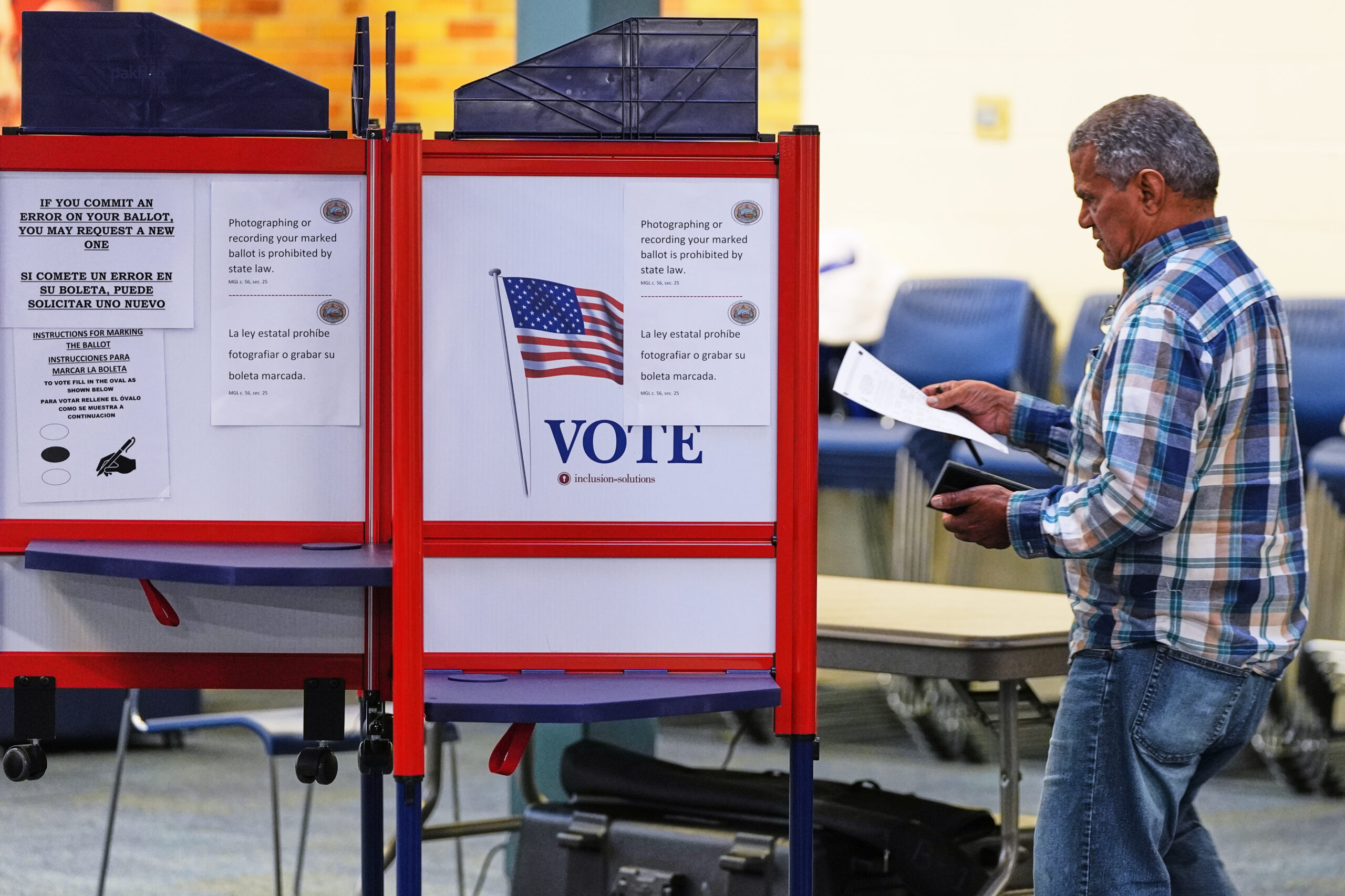
    A voter prepares to cast a ballot in Lawrence, Mass., in 2025. A GOP-backed bill would fundamentally change how American vote.

    In Pennsylvania, that means hundreds of thousands of eligible voters could face new barriers. Voters who don’t have a passport or a copy of their birth certificate, voters who move and don’t update their driver’s licenses right away, married women who change their names and lack matching documentation, Americans living abroad, including members of the military and their families overseas, and naturalized citizens who would need to safeguard their original citizenship papers.

    These are not hypothetical voters. They are our family, our friends, and our neighbors. They are people like you.

    The SAVE America Act would add undue burden on voters, including travel, fees, lost work time, and bureaucratic hurdles, to solve a problem that does not meaningfully exist.

    There is simply no evidence of widespread noncitizen voting that justifies such sweeping restrictions, especially ones that rely on obtaining documents that are hard to get under the best circumstances, and are simply inaccessible for some.

    This legislation is a gross example of federal overreach into our elections. Pennsylvania already has safeguards to ensure only eligible citizens vote. Federal law requires voters to attest to citizenship under penalty of perjury. Election officials verify identity and eligibility. Adding unnecessary documentation does not strengthen democracy; it burdens it.

    For over a century, the League of Women Voters has defended the right of eligible citizens to participate in our democracy. We do not support candidates or parties, but we will always stand for voter access and voting rights.

    The original SAVE Act failed last year after widespread public opposition. The SAVE America Act is simply a new vehicle for the same restrictive policy. Election integrity and voter access are not at odds with one another. We can protect both without disenfranchising millions.

    Democracy is strongest when all eligible citizens have their voices heard. For more than two centuries, our nation has moved — often imperfectly, but steadily — toward a more inclusive and participatory democracy.

    The SAVE America Act reverses this progress by creating new barriers to a fundamental right. Pennsylvania’s congressional delegation must reject this bill and reaffirm a simple principle: If you are an eligible citizen in America, your right to vote should not depend on producing the right documentation at the right moment.

    Our democracy depends on participation, not paperwork.

    Amy Widestrom is executive director of the League of Women Voters of Pennsylvania.

  • Sheetz opens its first store in Wawa land, right across from a Wawa

    Sheetz opens its first store in Wawa land, right across from a Wawa

    Sometimes Sheetz happens, and at 8:02 a.m. on Thursday it happened in Montgomery County, when the chain opened its first convenience store in what’s long been undisputed Wawa territory.

    The store — which is directly across from a Wawa on West Ridge Pike near Lewis Road in Limerick Township — opened not with a Boom Boom, but with a whisper.

    Unlike a Wawa grand opening — where fans often queue up well before the doors open and the line to get in wraps around the building — there was just David Swartz waiting outside for the opening, bundled up in his folding rocker chair.

    Swartz, 36, of Collegeville, who arrived an hour before the opening, was surprised to find himself the only one in line, as were the gaggle of Philadelphia reporters who far outnumbered him and peppered him for interviews.

    A self-identified “diehard Wawa fan,” Swartz said he came to Sheetz’s opening for the food.

    “There’s nothing you can get here that isn’t delicious,” he said. “I love Wawa but they need different stuff and that’s what Sheetz is here to do, they’re here to deliver that.”

    Slushies, plushies, and more

    Once the doors opened, folks who’d been waiting in their cars started to file in, forming a line for the coffee, which was free all day (the Wawa across the street offered free coffee on Thursday, too). Other customers explored the touch-screen menus, checked out the prepared food offerings, and browsed the aisles.

    Inside, Swartz poured himself a slushie and ordered a hot dog, nachos, and fish tacos with fries — at 8:15 a.m. He also picked up three Hello Kitty plushies for his girlfriend. Wawa, he pointed out, does not sell plushies.

    “My girlfriend is going to be very happy when I come home with these,” he said.

    Inside the store after being the first to enter, Dave Swartz of Collegeville organizes his plushie toys and frozen drink as the first Sheetz store opens in the Wawa territory Thursday in Limerick Township.

    Elsa Ortiz, 54, drove an hour from Philadelphia to pick up a hoagie (or “Subz” as they call them at Sheetz) for her boyfriend.

    “Sheetz is definitely better than Wawa for him,” she said. “Right now I’m neutral, but today I am a Sheetz girl.”

    Ortiz said the store being across from a Wawa is very on brand for the Philadelphia region.

    “The rivalry is just like Philly, with its rivalries and everything else,” she said. “Still, go Eagles! I’m still Eagles!”

    There are some rivalries you can play both sides of, and some you can’t.

    Shortly after 9 a.m., when giveaways for gift cards and Sheetz schwag began, the store became so packed with people it became a real Sheetz show and the line outside for freebies stretched down the building. The residents of the Delaware Valley may rep hard and local, but they also won’t say no to a free T-shirt.

    The expansions

    While opening a Sheetz across from an existing Wawa may seem like the new guy in town is throwing down the gauntlet, it’s actually a move taken out of Wawa’s own playbook. In 2024, when the Delaware County-based chain opened up its first store in central Pennsylvania — what was traditionally Sheetz country — it did so within eyeshot of an existing Sheetz.

    For decades, the urban lore in Pennsylvania was that there was a gentleman’s agreement regarding unspoken boundaries between Delco-based Wawa in the southeastern corner of the state and Blair County-based Sheetz, in south-central Pennsylvania.

    Amy Rudolph (seated) of Collegeville holds court with fellow grand opening patrons as she recounts her story of being #2 in line as the first Sheetz store opens in the Wawa territory Philadelphia suburbs Thursday, Feb. 12, 2026 in Limerick Township.

    But that’s all it was — lore (New Jersey has its own devil, we had to come up with something) — and as both chains began rapid expansions in the 2010s, it seemed inevitable they’d cross over to each other’s markets at some point. In fact, Wawa and Sheetz have coexisted in several markets already for some time, including right here in Pennsylvania, in Berks and Lehigh Counties, according to Wawa spokesperson Lori Bruce.

    Today, Wawa has 1,193 stores in 13 states and Washington, D.C., and more than 95 store openings planned for this year. Ten stores have gone up in central Pennsylvania in the last two years, with 40 more planned over the next five, Bruce said.

    Sheetz, meanwhile, has more than 800 stores in seven states. Previously, its closest store to Philadelphia was in Berks County, but now that it has officially moved into the Philly suburbs, it doesn’t appear it plans to slow down. Sheetz stores have been proposed in Chester County and even in Delco, at Painters Crossing shopping center in Chadds Ford, just five miles down the road from Wawa’s headquarters.

    Now that could get Sizzli.

    A rivalry?

    Representatives of both chains deny they are rivals and point out that they have worked together to support various nonprofits.

    Adam Sheetz, executive vice president of Sheetz, said it has been a friendly competition for decades.

    “They’re one of the best retailers in the country, certainly one of the best in our industry, and we have great respect for them and competing with them has just made us better over the years,” he said.

    Bruce agreed.

    “We’re fortunate to have always had a respectful and friendly relationship with the folks at Sheetz,” she said. “And, while we have always embraced healthy competition at Wawa, when we think about competitors, we tend to think about challenging ourselves to make sure we are meeting the needs of our customers and communities.”

    Folks may eat on trash cans at Wawa, but you’ll never hear Wawa officials talking trash on Sheetz. Wawa fans, on the hand, are a whole other hoagie roll.

    Craig Scott (left) of Wayne and Dave Swartz (right) of Collegeville have breakfast as the first Sheetz store opens in the Wawa territory in Limerick Township.

    The low-stakes rivalry between the stores’ fans has resulted in memes, debates, op-eds, and even a forthcoming documentary, Sheetz Vs. Wawa: The Movie.

    When news of the impending Sheetz opening spread last month, cheeky comments by Wawa fans on social media included “We are all protesting this,” “sheetz is temu wawa,” “Sheetz is fire, but Wawa is for life,” and “this is my heated rivarly [sic].””

    But local officials said they didn’t hear of any pushback on the Sheetz.

    Patrick Morroney, a Limerick Township supervisor, has never been to a Sheetz but said he’s pro-business and welcomed Sheetz opening a store in the community.

    “I think that people are going to find their niche between Wawa and Sheetz,” he said.

    Jamila Winder, chair of the Montgomery County commissioners, said she frequented Sheetz while going to Pennsylvania State University and having the company open a store in Montco is “nostalgic” for her.

    “Even though Wawa has dominance here in Montgomery County and the region, we always welcome new businesses because that creates economic drivers, job opportunities for both, and it just gives people options to choose from,” she said.

    The opening

    During his remarks at the opening ceremony, Neil Makhija, vice chair of the county commissioners, took a different approach and leaned into the playful rivalry by putting on a Wawa hat while speaking to the crowd.

    He called the opening a “complicated day” for him and many people in Southeastern Pennsylvania.

    “I thought, ‘What is happening to our community? Do we need a stronger border security policy in Montgomery County? Should we build a wall and make Delco pay for it?’” he said to laughter from the crowd. “[But] here in Montgomery County we’re welcoming, we’re inclusive, and we’re hungry and I think we’re OK with a little competition.”

  • The Sixers’ best players should benefit from the NBA All-Star break — but not everyone will be off

    The Sixers’ best players should benefit from the NBA All-Star break — but not everyone will be off

    The NBA All-Star break has finally arrived for the Sixers, and it couldn’t have come at a better time for the team’s three most important pieces: Joel Embiid, Tyrese Maxey, and VJ Edgecombe.

    “I think everybody’s looking forward to it,” coach Nick Nurse said of the time off. “I think we need it. It’ll be pretty good timing for us.”

    Yes, Wednesday’s 138-89 loss to the New York Knicks was embarrassing, but despite the Sixers’ ups and downs this season, they are firmly in a playoff spot. Still, the Sixers need a physical and mental reset, even if some of their stars won’t be entirely off.

    Maxey will be heading to Los Angeles as an All-Star Game starter, with Edgecombe in tow to play in the Rising Stars game. But Embiid will have a full, much-needed weeklong break.

    Embiid missed his second consecutive game Wednesday with right knee soreness. Quentin Grimes also missed Wednesday’s game, while Dominick Barlow, who missed the final game of the road trip at Portland, returned to play 30 minutes, 37 seconds on Wednesday.

    Nurse said before Wednesday’s game that there was “not a ton of concern” about Embiid’s knee long-term.

    Joel Embiid has missed the Sixers’ last two games with right knee soreness.

    Embiid has appeared in 31 of the Sixers’ 54 games so far this year, skipping one leg of back-to-backs and missing most of November. But since that month, Embiid has quickly rounded back into form.

    “He’ll still tell you that he’s — I don’t know, you can have him tell you — but still not near 100%, not close,” Nurse said. “I think that’s encouraging because he’s starting to look pretty good again in a lot of different areas.”

    Some might consider Embiid’s exclusion from the All-Star Game a snub, but because of the break, the Sixers don’t play again until Feb. 19.

    That’s a full week for Embiid to stay off his knee and recover while the Sixers can stay locked into their sixth-place spot in the East. Since January, the Sixers are 12-5 with Embiid in the lineup, and 1-5 without him.

    “It’s hard,” Maxey said of playing without Embiid. “You go from one way to play without him early in the season, he comes back, you’ve got to play that way, then play a different way when he’s there — which is OK, it’s fine. It’s the reality of it, and we’ll be all right. I think he’ll be here more than he isn’t here when we get back, and we’ve just got to maintain those games that he’s not there.”

    It’s not just Embiid who can benefit from the time off. Edgecombe will be competing in the Rising Stars event at All-Star Weekend, but the rookie, who has played in 50 of the Sixers’ 54 games, will get a brief, needed reprieve from the grind of the NBA schedule.

    “He’s never played these type of minutes in his life,” Maxey said. “Even playing a 40-minute basketball game in college is way different than this. … We’re asking him to do a lot, so he’s probably definitely tired, but it’s OK. This is what the break is for.”

    Rookie VJ Edgecombe has already played in 17 more games than he did all of last season at Baylor.

    Entering the final game before the break, Edgecombe averaged 35.4 minutes, the most of any rookie, and ranked ninth in the NBA. Edgecombe played just 33 games at Baylor last year.

    Edgecombe ended Wednesday night with 14 points on 6-for-16 shooting, displaying his incredible physical tools and his recent shooting woes. Early in his career, Maxey learned how seriously he needs to take recovery in order to keep playing big NBA minutes.

    “I used to be like, ‘I don’t need treatment.’ I thought I was Superman,” Maxey said.

    He’s making sure Edgecombe is taking that feedback.

    But there might not be anyone on the team who needs rest more than Maxey. He has taken on the role as the Sixers’ top offensive option, and he is playing a career- and league-high 38.6 minutes per game.

    Maxey has also made 52 starts and played the most games of anyone on the Sixers. He scored 32 points in 32:07 on Wednesday but sat for the entire fourth quarter of the blowout. He’ll get a little less rest than his teammates, since he’s making his first All-Star Game start — and taking part in Saturday night’s three-point contest — but said he still would make plenty of time for relaxation.

    “I just want to get out there and just chill, sit in my hotel room, relax, get some good weather,” Maxey said. “I’ll get some relaxation and be good to go by Thursday.”

  • ‘She was struggling alone’: Family mourns Bucks County woman killed after reporting a sexual assault

    ‘She was struggling alone’: Family mourns Bucks County woman killed after reporting a sexual assault

    When Yuan Yuan Lu’s boyfriend sexually assaulted her in his Pennsport home last week, her cousin said, she broke up with him and went to the police.

    The 28-year-old Bucks County woman thought she was doing the right thing by reporting the crime, her cousin Natalie Truong said.

    “She told me how safe she felt, how much better she felt opening up and telling the cops her story,” said Truong, who spent time with Lu the evening she reported the assault.

    That was the last time Truong saw Lu alive.

    On Sunday, less than 12 hours after Lu called police to say that her ex-boyfriend, Yujun Ren, had attacked her, police said, Ren, 32, stalked her. He followed her to her home in Levittown, police said, approached her as she sat in her car outside her house, and shot her in the head, killing her.

    Lu’s death shook her loved ones and led to calls on social media for increased awareness of intimate partner violence.

    Truong said Lu leaves behind dreams unfulfilled. Lu grew up in a small village in south China, and moved to the United States with her father in 2009 to seek a more prosperous life.

    In Philadelphia, she attended Constitution High School, perfected her English, and always kept her friends abreast of her latest entrepreneurial pursuits, Truong said.

    Lu went into the food business with friends, cooking homemade Asian cuisine and selling it in carts on local college campuses, and later worked in a bubble tea shop and at a nursing home.

    Yuan Yuan Lu loved to eat at Philadelphia’s restaurants, according to her cousin, Natalie Truong.

    She loved her pets — a corgi named Dundun and a cat named Milk Cap, after a creamy bubble tea topping. Lu and Truong frequented Philadelphia restaurants, most recently dining together at Kalaya in Fishtown, and took day trips to places like New Jersey’s Swaminarayan Akshardham, the second-largest Hindu temple in the world.

    Despite the cousins’ close relationship, Truong said, Lu did not share a lot of details about her personal life, perhaps not wanting to trouble others with her concerns.

    Truong said Lu did not talk a lot about her relationship with Ren, whom she had met at her nursing home job and had dated for about a year. Truong’s perception of the relationship changed the night her cousin opened up about Ren’s behavior, she said.

    “She was struggling alone for a while,” Truong said, adding that initially, Lu “liked him, so we all trusted her judgment.”

    On Sunday, the day after Lu reported the assault, Ren turned himself in to police in Middletown Township, and officers discovered Lu’s body in her white Hyundai shortly after noon, authorities said. He was charged with murder, stalking, and a firearms crime.

    Ren told police that Lu had said “hurtful things” to him that day and that, in an attempt to scare her, he had brandished the firearm, which he said accidentally discharged. He was licensed to own the weapon, according to the affidavit of probable cause for his arrest.

    Ren’s aunt later turned in her nephew’s 9mm handgun — a weapon Lu had told police he “carried everywhere,” leading her to fear for her safety, the affidavit said.

    Truong said she wished law enforcement had had more time to investigate the sexual assault before Lu was killed. Her death was tragic, her cousin said, a life ended all too soon.

    Lu’s father had recently left Philadelphia to join his wife and son in China. Truong has started a GoFundMe campaign to raise money to help the family with funeral expenses and to pay for travel to Philadelphia to attend the service.

    As the family mourns Lu’s death, Truong said, they are hopeful that law enforcement officials will hold her killer accountable.

    “We just want her to get the justice that she deserves, because she’s a really kind person,” Truong said. “She never thought this would happen to her — because you would never think someone you love can hurt you like that.”

    Yuan Yuan Lu poses with her corgi, Dundun, and her cat, Milk Cap.
  • Cameras will soon enforce speed limits in five Philly school zones

    Cameras will soon enforce speed limits in five Philly school zones

    Philadelphia drivers are about to get a new incentive to obey the flashing caution lights and 15 mph speed limit near schools.

    On Tuesday, the Philadelphia Parking Authority plans to turn on automated speed-enforcement cameras in five school zones, targeted because they have had a relatively high rate of crashes. All are on major roadways.

    Violators will get warnings until April 20, when the cameras start enforcing the law. Driving 11 miles faster than the school-zone speed limit will carry a $100 fine.

    “The goal is to protect students,” said Rich Lazer, executive director of the PPA. “Speed cameras work. They reduce dangerous behavior.”

    Roosevelt Boulevard has seen a 95% reduction in speeding violations and a 50% reduction in pedestrian-involved crashes since cameras went up in 2020.

    The high-priority school zones were selected based on an analysis of Pennsylvania Department of Transportation crash data by the Philadelphia Office of Transportation and Infrastructure Systems.

    From 2019 through 2023, the five locations recorded 10 crashes in which a person was killed or seriously injured, and 25 pedestrian crashes, as well as several speed-related vehicle-on-vehicle crashes, the PPA said. (Victims included people of all ages; it was not clear how many were students.)

    (function() {
    var l2 = function() {
    new pym.Parent(‘SKLZONECAMS’,
    ‘https://media.inquirer.com/storage/inquirer/projects/innovation/arcgis_iframe/SKLZONECAMS.html’);
    };
    if (typeof(pym) === ‘undefined’) {
    var h = document.getElementsByTagName(‘head’)[0],
    s = document.createElement(‘script’);
    s.type = ‘text/javascript’;
    s.src = ‘https://pym.nprapps.org/pym.v1.min.js’;
    s.onload = l2;
    h.appendChild(s);
    } else {
    l2();
    }
    })();

    “We have tried many traffic-calming methods to stop people from driving dangerously fast in school zones, but many drivers still speed,” said Michael A. Carroll, a deputy managing director for the city who is in charge of OTIS.

    “Speeding is the No. 1 cause of fatal crashes,” he said. The cameras will protect students walking to and from school, as well as crossing guards, “who often put their lives at risk,” Carroll said.

    Automated speed enforcement remains controversial, despite studies that show it is effective, particularly on major urban roadways like the Boulevard.

    The cameras are also popular in dense cities.

    Recently, the Trump administration’s Department of Transportation restricted cities from using federal road safety grants for cameras that enforce speed limits and other traffic laws, unless they are in work or school zones.

    The Pennsylvania legislature, historically skeptical of automated enforcement, in 2024 gave Philadelphia permission to use school-zone cameras through Dec. 31, 2029, on a trial basis.

    There was some hesitation last March when City Council considered an ordinance to authorize the cameras. Three members held up the measure in committee, expressing concerns about a “money grab by the city.” The members also said they did not have enough information about the bill.

    After they met with Councilmember Isaiah Thomas, the chief sponsor, the legislation was enacted.

    “Everybody thinks it’s a money grab, but it’s really not,” Lazer said. “Resources are stretched; police are dealing with a lot of things. … If we can use technology, and it works, why not? Don’t speed, and you won’t get a violation.”

    Unlike the speed cameras on the Boulevard and those along 13 miles of Broad Street since November, the school-zone units deployed by the PPA are squat and at street level.

    Some people say they look like mailboxes or small refrigerators.

    They are meant to be portable, PPA officials said, so that cameras can be moved to other schools with problems, as long as they are operating in only five school zones at any one time.

    That limit is fixed by state law. Cameras can operate only when school zones are active, meaning weekdays when students are arriving in the morning or departing in the afternoon.

  • La Salle’s loyal baseball community restored the program. Now it’s time to get it ‘back on the map.’

    La Salle’s loyal baseball community restored the program. Now it’s time to get it ‘back on the map.’

    Kevin Ibach reached a milestone as Tampa Bay Rays assistant general manager in September 2020. The Rays defeated the Toronto Blue Jays in the wild-card round, marking the first time in Ibach’s 20-year career in baseball that he made it past the opening round. Before the team opened its next series against the New York Yankees, though, Ibach received news that crushed his mood.

    La Salle, his alma mater, was shutting down its baseball program after the 2020-21 school year. Ibach played middle infield for the Explorers from 1996-2000, but the program that helped forge his baseball career was suddenly on its way out.

    The Rays reached their second World Series that year, but the success was stained for Ibach.

    “I have a ring to this day from that journey and at the same time, it was the low point,” Ibach said. “A program that I cared so much about. Four years that were instrumental in my life and my development that probably led me to my job today. Getting that email that they were shutting the doors was pretty disheartening.”

    When Ashwin Puri took over as La Salle’s athletic director in July 2023, he ensured that those doors did not stay closed. With a three-phase plan centered on facility upgrades, fundraising and fan experience, Explorers baseball was officially welcomed back in April 2024, targeting a return this year.

    “What I soon realized after being here for two or three months was that every other conversation was about baseball,” Puri said. “I don’t know if it was fate or chance, but I felt an amazing sense of pride and connection to the university. A lot of people love baseball and care about baseball.”

    La Salle spent 2025 preparing to throw its first pitch in four years. Now, the program’s return is right around the corner. The Explorers will open their season against Maryland Eastern Shore on Friday (2 p.m.) at Hank DeVincent Field.

    La Salle baseball players practicing Wednesday at Hank De Vincent Field.

    Coach David Miller constructed a roster that is ready to write a new chapter of La Salle baseball while remembering the history that brought the Explorers to this point.

    “It’s going to be a lot of hard work that everybody collectively did to make this happen,” Miller said. “That first pitch, hopefully that first win, it’s going to be a great day for La Salle athletics.”

    Bringing a vision to life

    The main step in getting the program off the ground was improving the stadium and facilities while raising the necessary funds. An alumni advisory board formed to lead the operation helped focus on alumni outreach, and after a few months the progress in donations became notable.

    “When baseball came back, there was a small group of us that were excited to have the program back,” said Bill Watts, who played at La Salle from 1991-94 and serves on the advisory board. “Ashwin reached out and asked, ‘Would you be willing to be part of the rising here?’ I thought about it for a while and talked it over with some of my teammates and decided if we did it, we needed to do it the right way.”

    The feedback and excitement from alumni have been encouraging. More than 200 former players and alumni attended a “La Salle first pitch” dinner as an official welcome back for the program. While the program may have taken a few years off, the history and tradition carried on.

    The Explorers held alumni games in 2023 and 2024 at Hank DeVincent Field. La Salle made its conference tournament nine times before the program shut down. In its last season, La Salle finished with 32 wins, the most in program history.

    It is important, Puri said, that the program’s history is remembered in a new era.

    “I think history is a big part of it, but we also want to do things a little different this time,” Puri said. “We are going to take baseball very seriously. We are going to invest and we want to compete.”

    Building the team

    To put a team back on the field, Puri and the advisory board knew it started with one man: Miller.

    Miller was named La Salle’s head coach in 2018 and had the Explorers on an upward trajectory before the program shut down. They went 14-41 in his first season, then improved to 25-31 in 2019. After a shortened 2020 season, Miller led La Salle to one of its best performances in program history in 2021, finishing 32-21. Miller was named Atlantic 10 coach of the year and believed he was on the verge of accomplishing something special.

    That momentum was halted when the program shut down.

    Miller coached at Manhattan for two years before he got the offer to return to La Salle. Despite having to take a year off from coaching in 2025, the former Penn Charter coach decided it was worth it.

    David Miller returned to La Salle as the head coach, after serving at the helm for four seasons before the program was cut.

    “There’s just something about this place that draws me,” Miller said. “It’s like home to me. When my time is up here, I want La Salle baseball to be a destination baseball program in the northeast. And I don’t see why we can’t be.”

    With Miller back at the helm, the next step was putting the roster together. It was no easy task, considering he was starting from scratch.

    La Salle netted the 17th-ranked recruiting class by Perfect Game in 2025, bringing in 36 commitments. Next, its attention turned to the transfer portal.

    The Explorers brought in seniors who were looking for one more season to play college baseball or underclassmen seeking a fresh start. For utility man Chase Swain, a transfer from West Virginia, playing at La Salle brings his college career full circle.

    “I was committed here for like two years in high school,” said Swain, who played at Woodstown High. “… [The program getting cut] threw everything into a tailspin for me, recruiting-wise. So this place coming back, it was always in the back of my mind. I wonder what it would have been like there. I stayed loyal and the second that they brought it back, it was like a light bulb went off in my head, and I thought I would really enjoy playing there.”

    Underdog mentality

    With a completely new team, the players understand that expectations from the outside are low. The Explorers know a restarted program won’t be picked as a preseason favorite in the Atlantic 10 Conference, but they are using that as a chip on their shoulders and carrying an underdog mentality into the season.

    Because of the weather, La Salle has been forced to travel about an hour away to find an indoor facility for practice. The team has embraced the challenges.

    La Salle coach David Miller says his team is “more excited now than ever to play.”

    “I think we can take the motivation of being a gritty program because we don’t have all the facilities and everything that a lot of other schools have in Division I baseball,” said shortstop Justin Szestowicki, a transfer from Elon out of Kingsway High. “But I think we take that as an advantage. We have more of a chip on our shoulder, just knowing that, based on our opportunities to create a grittier play style, instead of just being taken care of all the time, we have to take some accountability for ourselves to be successful.”

    The players and coaches counted down the days until Friday, when they can say La Salle baseball is back and the two-year rebuilding process has come to fruition.

    Miller is ready to show the college baseball world who the Explorers are.

    “You’re seeing all these high-profile fans from Tennessee and LSU saying, ‘La — who?’” Miller said. “And we embrace that. That’s now my hashtag for the year. We’re going to show you who it is. These kids are more excited now than ever to play, because all the vision that we talked about, and getting them to see what’s coming, is here.”

    Ibach added: “I think that a lot of players who will be playing can take that inspiration to show the world, show the city, that La Salle baseball’s back on the map.”

  • Medicaid insurer AmeriHealth Caritas is closing its PerformRx PBM at the end of this year

    AmeriHealth Caritas, one of the nation’s largest Medicaid insurers, is closing its in-house pharmacy benefits manager, PerformRx, by the end of this year, the Newtown Square company said in an announcement to employees Wednesday.

    Health insurers effectively subcontract with pharmacy benefit managers to oversee drug benefits. They have become increasingly powerful cogs in healthcare and face new restrictions under a law signed by President Donald Trump this month.

    OptumRx, a unit of UnitedHealth Group Inc. and one of the three largest PBMs, is scheduled to take over for PerformRx on Jan. 1. OptumRx already provides PBM services to the majority owner of AmeriHealth Caritas, Independence Health Group. Independence is best known for its Independence Blue Cross business.

    “This decision reflects evolving market and regulatory landscape, not the performance or dedication of our PerformRx leadership or associates,” the AmeriHealth Caritas announcement to staff said.

    Caritas said in a statement to The Inquirer that it expected a “limited impact on jobs, with many functions remaining in-house to support the same high-quality experience for members and providers.”

    The company did not elaborate on the market and regulatory changes that precipitated the decision to close PerformRx, which Caritas formed in 1999. PerformRx has contracts in 13 states, including Pennsylvania and Delaware, according to the Caritas website.

    One of those states is California, where a new law took effect Jan. 1 that prohibits PBMs from charging health plans, including Medicaid plans, more than they pay the pharmacy for a drug. PBMs are still allowed to change a flat administrative fee in the state.

    Independence owns 61.3% of AmeriHealth Caritas. Blue Cross Blue Shield of Michigan owns the rest. Caritas accounted for about three-quarters of Independence’s $32 billion in revenue in 2024. The former CEO of AmeriHealth Caritas, Kelly A. Munson, succeeded Gregory E. Deavens in the top job at Independence last year.

  • A wordplay-forward California cabernet sauvignon that’s ripe and fruity

    A wordplay-forward California cabernet sauvignon that’s ripe and fruity

    Much of the communication that takes place in the wine world is in code. Words are used that may seem to mean one thing, but actually signal another. This wine unpacks an expert-level wine concept (as its name indicates), and its lesson is quite helpful for those who’d like to be able to navigate their wine options with more confidence.

    While the name Textbook cabernet sauvignon might seem innocuous, it’s a clever play on words — suggesting that this wine is a good example of the classic style associated with that particular grape. This is a reference to what experts call “varietal correctness” in wine, a concept that is rarely encountered in other corners of the food world. After all, most of the time, a tomato tastes like a tomato, a cheddar cheese like a cheddar, and so on. However, there is considerable style variance found in wines made using the same grape. Not only can they taste quite different based on where they are grown, but that flavor can also be manipulated dramatically in the winemaking process.

    So what is the “correct” way for cabernet sauvignon to taste? A century ago, all wines of quality came from Europe, from regions that each grew their own native grape varieties, with cabernet sauvignon hailing from the Bordeaux region of France. So when vintners aim to produce a classically styled version of this grape, they aim for Bordeaux-style characteristics, and that is what the sly branding here conveys.

    While this California wine is far riper and fruitier than a Bordeaux, thanks to the climate and terrain of the Paso Robles region, it does display a French-inspired restraint in its styling. Compared to its closest competitors, it feels a touch lighter on the palate, tastes a smidge drier on the tip of the tongue, and has a bit more of the tartness and slight bitterness found in French cabernet sauvignon. The overall effect is to give the wine a flavor profile closer to that of fresh blackberries than of baked blackberry desserts, making it quite food-friendly and especially well-suited to foods containing peppers, tomatoes, or olives.

    Textbook Cabernet Sauvignon

    Textbook Cabernet Sauvignon

    Paso Robles, California; 13.9% ABV

    PLCB Item #100034407 — on sale for $22.99 through March 1 (regularly $27.99). No alternate retail locations within 50 miles of Philadelphia.