Berndt, 43, was a part of an online chat group in which people discussed and shared videos of tortured animals, according to Department of Justice court filings. Among the chat’s participants, Berndt’s “focus on the most grotesque forms of torture was unsurpassed.”
“Over and over again, Berndt expressed a desire for more extreme torture that resulted in more pain, experienced over a longer period of time,” prosecutors told the judge.
Messages from the chat are included in DOJ’s sentencing memo, and show Berndt’s enthusiasm over a video of a rat burning. Despite calling the footage “awesome,” he had suggestions on how to make the torture even crueler.
“Like I want to see them maimed and miserable,” Berndt wrote under the alias Requiem Rhythm. “Killing them is great, of course, but it puts an end to it while I want them to suffer longer.”
When the group discussed monkeys, Berndt expressed his desire for the tormentors to inflict more pain and focus on the primates’ genitalia.
Berndt and his chat-mates actively commissioned footage of the torture. They’d contact so-called videographers, usually in Indonesia, who would torture monkeys following specific requests — some for as little as $10 a video.
The monkeys in videos reviewed by DOJ were long-tailed macaques, which are native to Southeast Asia.
Berndt and a co-conspirator even discussed the possibility of buying a baby monkey that was advertised for sale, DOJ said in court filings. The two daydreamed about meeting up to torture the youngster together in real life.
“Hahah you would be welcome to visit and hang out,” Berndt said in a message to his co-conspirator, according to court records. “Like watching surgical theater.”
The baby monkey that Robert Berndt and his co-conspiracy discussed purchasing to torture.
Prosecutors from DOJ’s Environment and Natural Resources Division indicted Berndt in April and he pleaded guilty in May to a felony count of conspiring to create and distribute in videos depicting animal crush videos, the legal term for causing a non-human mammal serious bodily injury. Five other co-conspirators from the chat group were indicted, at least two of whom were sentenced to serve time in prison.
Berndt’s attorney and DOJ did not immediately respond to a request for comment.
Ahead of his sentencing, Berndt’s family members pleaded with the judge to not exceed the sentencing guidelines. which provide a range of 37 to 46 months of imprisonment.
The letters and Berndt’s attorney’s sentencing memo paint a picture of a man who loved animals and was dependable whenever his loved ones needed him in the past. But Berndt changed following a sexual assault and opioid addiction, the filings say.
Family members say that Berndt became manic and treated those who loved him as enemies. He became isolated, paranoid, and drank alcohol excessively.
By 2021, most of Berndt’s social interactions were through online chat rooms, according to his attorney’s memo. He sought the approval of his new friends by escalating his rhetoric.
“His acceptance and sense of validation with the group seemed to increase when he said more and more violent and troubling things,” his attorney told the judge.
But DOJ prosecutors rebuffed the idea that Berndt was merely a follower, and note that he only stopped his engagement in the groups after he was contacted by law enforcement in 2024.
“Berndt was personally responsible for creating some of the groups, establishing the rules of behavior within the groups, and then enforcing those rules after perceived violations,” prosecutors said in a sentencing memo.
Judge Edmund Sargus Jr., of the Southern District of Ohio, sentenced Berndt to 38 months of imprisonment followed by three years of probation.
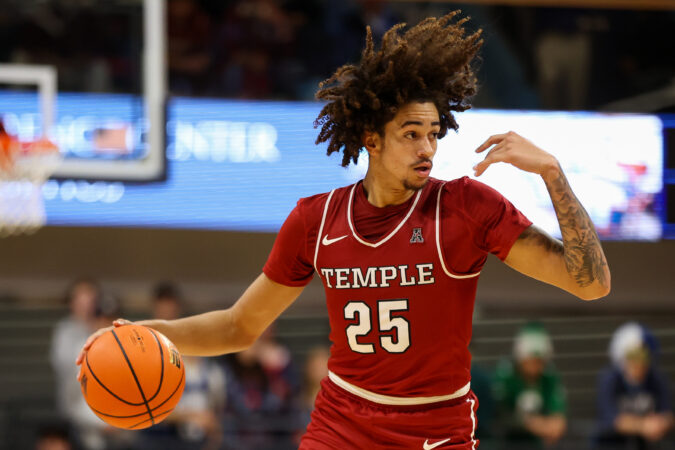
Temple entered halftime against Davidson on Thursday with a 13-point lead and was looking to earn its third straight win.
Instead the Owls (7-5) went quiet, and it didn’t take long for their lead to dwindle.
Down by four with 35 seconds remaining, Davidson (8-3) had the chance to send the game into overtime or even win it when guard Parker Friedrichsen launched a three-pointer.
However, it ricocheted off the rim and went into the hands of forward Ian Platteeuw for the offensive rebound. Plattueew tried to give it to guard Roberts Blums, but it went over his head and into the back court. Blums corralled it and tried to call a time out with 19 seconds left. The only issue was that the Wildcats had none left.
A technical foul was called, and Temple drilled its free throws to seal a 68-63 road win.
Next up, Temple will host Princeton (3-10) for the second time this season in its nonconference finale on Monday (7 p.m., ESPN+).
Showing their depth
Temple has been without guard AJ Smith, who’s dealing with a shoulder injury and missed his third straight game. But he wasn’t the only player sidelined with an injury. The Owls were without guards Masiah Gilyard and Gavin Griffiths due to lower body injuries.
Their absences gave freshmen Ayuba Bryant Jr. and Cam Wallace bigger roles. Bryant earned his first career start, while Wallace saw 23 minutes of action and finished with 9 points, with 8 coming in the first half.
The Owls’ depth allowed guards Derrian Ford (23 points), Aiden Tobiason (19), and Jordan Mason (14) to lead the way in scoring.
Turning to old habits
Temple’s first-half success came from forcing Davidson to take low percentage shots. However, both sides of the ball started to collapse after halftime, and the Wildcats took advantage.
Blums and Platteeuw were the main beneficiaries. The two combined for 23 points.
Instead of making an extra pass, Temple relied on hero ball and played in isolation. The Owls finished with just five assists, after compiling 48 in the past two games.
They also shot 39.1% from the floor, and the Owls had a seven minute scoring drought in the second half, as the Wildcats went on a 13-0 run.
Part of their struggles stemmed from not having Griffith on the floor. The guard, who is third on the team in scoring with 10.9 points, leads Temple in three-pointers. On Thursday, the Owls made six of 19 attempts from deep.
Tobiason provides a lift
As Davidson crawled back, Temple’s offense fizzled and relied on its free-throw shooting, where the Owls made 26 of 33 attempts.
Ford was the main beneficiary, as his late free throws helped Temple keep Davidson at arm’s length. However, it was Tobiason who gave the offense some life.
Aiden Tobiason delivers in the clutch with a cold-blooded step-back. ❄️🔥
He made a layup to give Temple its first field goal in nearly nine minutes to push the lead to four. A few possessions later, he drilled a three-pointer to make it a six-point game. Then he swished a step back as the lead grew to 10.
The Wildcats continued to counter, but Tobiason had a rebuttal. He got a layup in the waning seconds that all but sealed the deal. Nine of his 19 points came in the final 10 minutes.
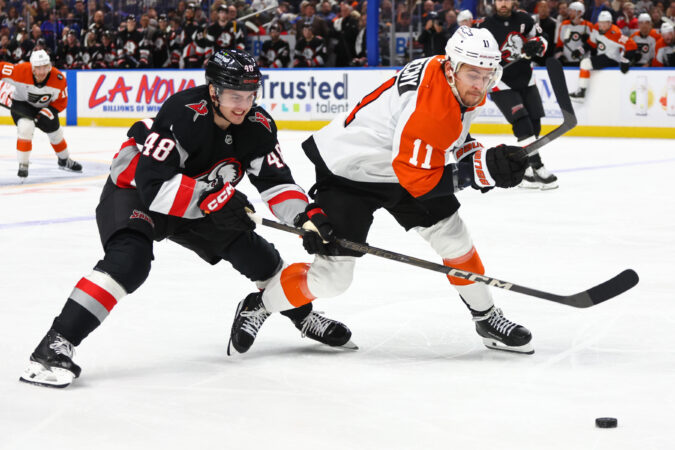
BUFFALO — The Flyers were handed a 5-3 loss by the Buffalo Sabres on Thursday, a team that just fired its general manager and may make a coaching move soon.
They came out hard but still trailed, and while they tied the game and even took the lead at one point, they eventually sputtered and lost.
Here are two things to know from Western New York:
Special teams struggled again
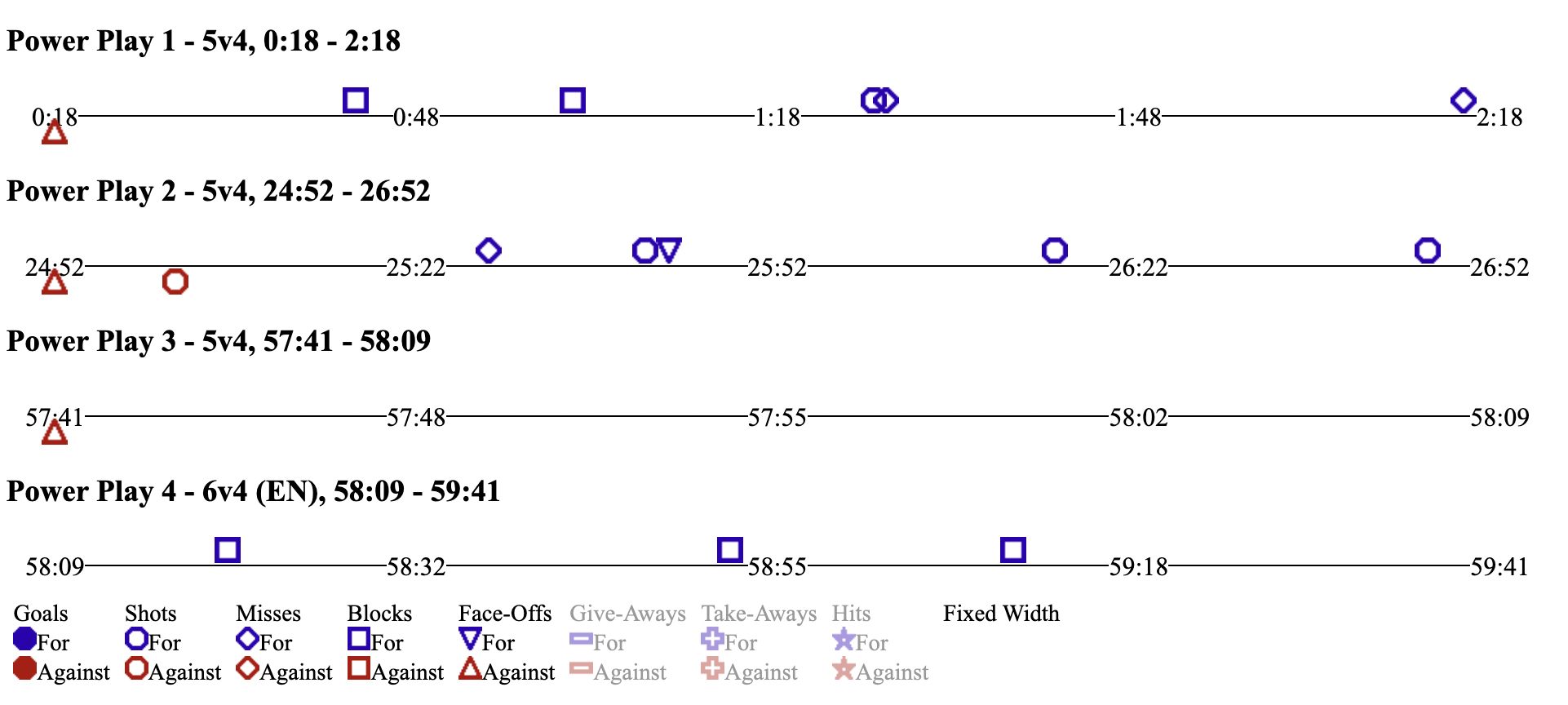
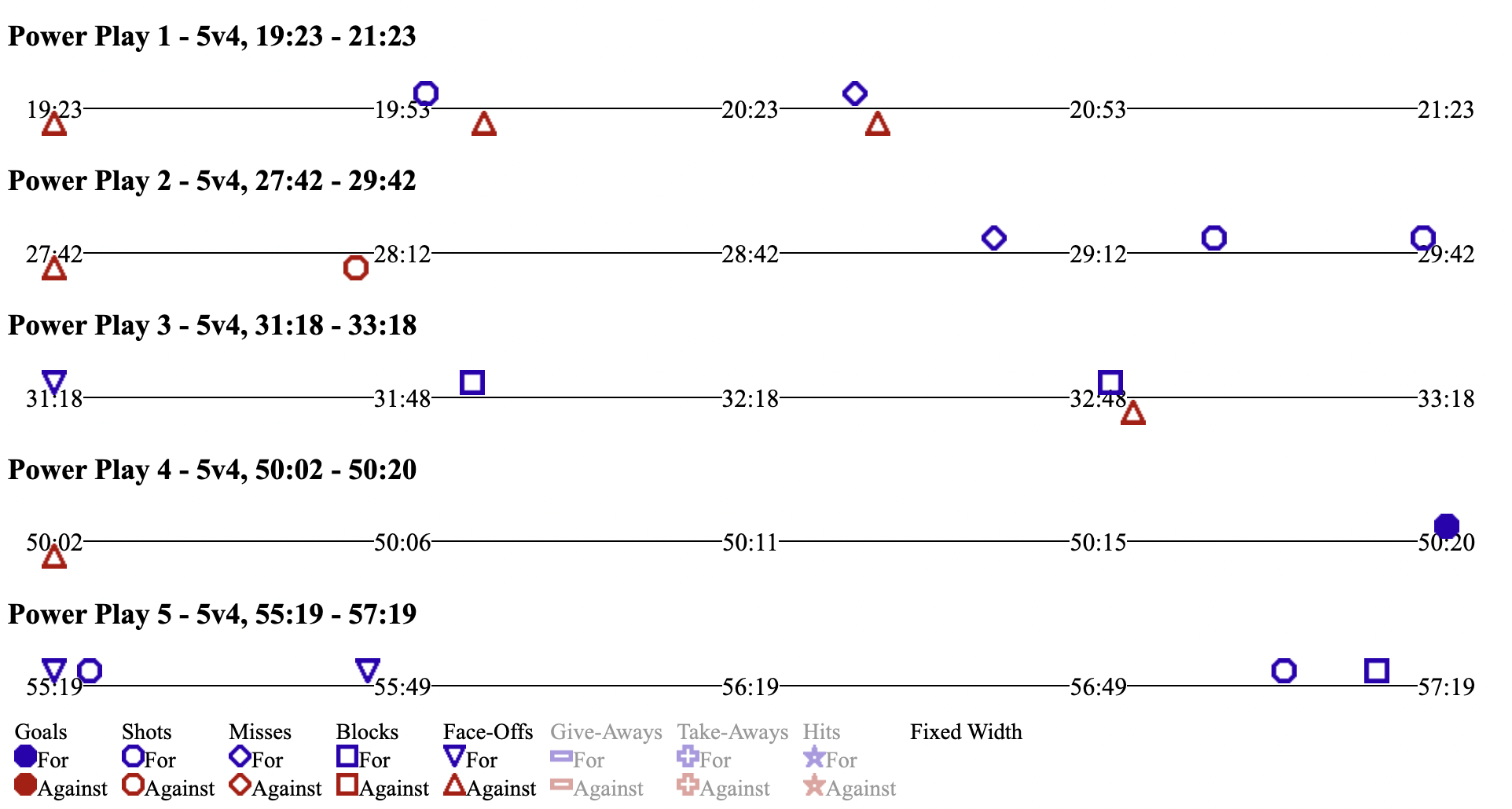
The Flyers had three power-play opportunities but were unable to put one past former Flyers goalie Alex Lyon. According to Natural Stat Trick, they had 12 chances, including four shots on goal; the four shots came on the first two power plays.
The last man advantage was in the third period, with the Flyers down a goal, after Mattias Samuelsson, the son of former Flyers defenseman Kjell Samuelsson, put the puck over the glass with 2 minutes, 19 seconds left in the game. They had shots by Trevor Zegras, Jamie Drysdale, and Owen Tippett blocked when goalie Sam Ersson was pulled to make it a six-on-four.
The Flyers’ power play had 12 chances across three opportunities, with five shots blocked.
“We’re getting points. It’s a loss. I mean, relax. I’m not saying you, nothing against you [the media],” coach Rick Tocchet said. “But, I mean, yeah, it’s a loss, I’m mad like you, but we’re getting points. These guys are trying, so we’ve got to take it easy on that part.
“But saying that we got to be more disciplined, right? I’d like to see the power play, we got to get some guys to score some goals on the power play. Too perimeter. We need some people in front. That’s the one thing. I thought the key tonight, we didn’t have people in front of the net. You’ve got to be in front of the net to score goals.”
The penalty kill allowed a goal to Josh Norris, who was left wide-open in front, in the third period. Norris’ goal, the eventual game-winner, came 18 seconds after Bobby Brink took a high-sticking call in the offensive zone when he hit Michael Kesselring in the face as he tried to make contact with the puck in the air.
Norris was left alone in front as all four Flyers penalty killers went to one side of the ice.
The penalty was one of five by the Flyers, although the goaltender interference call on Matvei Michkov in the second period was questionable. The winger appeared to be bumped into Lyon and then took several cross-checks to his back while on the ice and defenseless behind the net.
The Sabres had 11 chances during five-on-four action and nine scoring chances. The Flyers had four scoring chances during their power-play opportunities, none in the third.
Philly has been called for 117 minor penalties this season in 33 games, tied with the Winnipeg Jets for the seventh-most in the NHL. Last season, the Flyers had 238 across 82 games, tied with the Chicago Blackhawks for the 13th-fewest.
“We’re taking a lot of penalties and we’re playing good players, so the more opportunities they get, the more chances for them to score,” defenseman Travis Sanheim said. “But in saying that, obviously we have to do a better job, and we’re at our best when we’re pressuring and disrupting and it’s something obviously we know we’ve got to be better, and I’m sure we will be moving forward.”
The Flyers’ penalty kill was better early on but faltered in the third period, allowing the game-winning goal to be scored.
They had good moments but also bad
Defenseman Cam York, whose second goal of the season gave the Flyers a 2-1 lead in the second period, probably said it best postgame.
“I think it’s just group maturity. I think we’re still maturing in some areas,” he said. “You don’t want to play simple sometimes, and it comes back to bite you, I think, when you don’t want to get the pucks behind their D-man and forecheck; we’re not going to have the puck much, and we’re going to be defending.
“So there’s a lot of things that go into the game, obviously, but we’re definitely struggling to put a full 60 [minutes] together.”
The Flyers’ Cam York celebrates his second-period goal against the Sabres on Thursday.
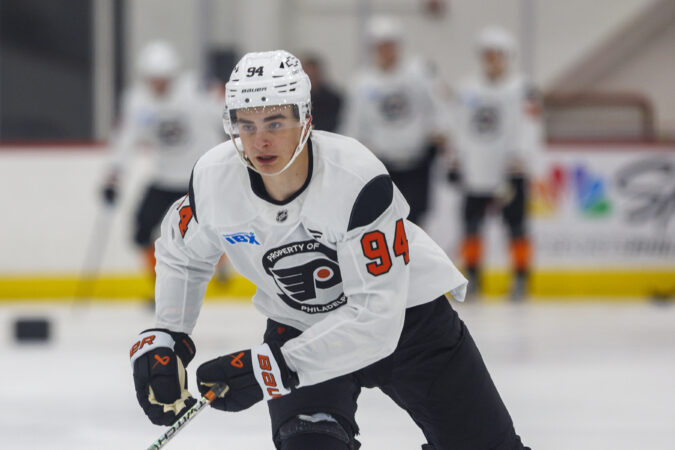
According to Elite Prospects, the Flyers are the sixth-youngest team in the NHL with an average age of 27.08, aging slightly with the recent return of 31-year-old defenseman Rasmus Ristolainen.
And while they are young and still learning and growing, they’ve also played just 33 games under a new coaching staff led by Tocchet.
“There’s positives,” Tocchet said. ”To learn how to win, you’ve got to be disciplined. You can’t throw pucks away. We have a couple guys who were diving in when we shouldn’t.
“That’s hockey, and we’re not a team that could outscore our mistakes. But we’re in every game, so I give them credit. But there’s some things there. We need some other guys to contribute too. It just can’t be the same guys.”
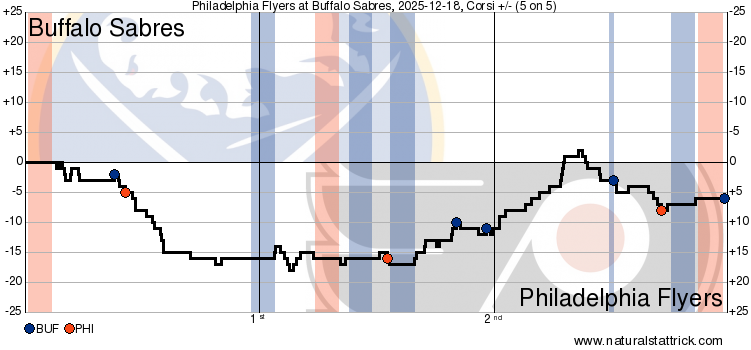
At five-on-five, the Flyers had 53.66% of the shot attempts, but while they controlled play for the most part, they had dips and which allowed the Sabres back into the game.
Despite it being the fourth game in six days, the Flyers came out firing and dominated the analytics. But they ended up trailing before Noah Cates tied things up less than a minute later.
“You just got to stay focused and be ready,” Cates said. “Any opportunity you’re given, no matter who or what the situation is. So just something we’ve honestly been needing to work on our whole season.
“It [stinks] because we’ve honestly been good kind of in the back half of games, kind of coming back and kind of bites us in the butt. So we obviously can’t rely on it, and going to learn from it and move on and have a big one on Saturday.”
After beating up on the 2-12 Las Vegas Raiders on Sunday to end their three-game skid, the Eagles turn their attention toward the Washington Commanders for a Saturday matchup at Northwest Stadium. Heading into the Week 16 contest, the Eagles (9-5) are early 6.5-point favorites.
Here’s how experts in the local and national media are predicting Saturday’s game …
Inquirer predictions
We start with our own beat writers. Here’s an excerpt from Jeff Neiburg’s prediction …
To see how our other beat writers are predicting this one, check out our full Eagles-Commanders preview here.
National media predictions
Now, here’s a look at how the national media feel about Saturday’s matchup …
ESPN: Eight of nine panelists picked the Birds straight up.
CBS Sports: In a clear sweep, all five experts are picking the Eagles to win.
The 76ers return to the court to face the New York Knicks Friday night, but you won’t find the game on NBC Sports Philadelphia or anywhere else on TV.
Instead, Sixers fans will need to log in to Amazon Prime Video, which is streaming tonight’s game exclusively as part of a 11-year deal with the NBA that runs through the 2035-36 season and totals nearly $20 billion.
Unlike Amazon’s Thursday Night Football, which broadcasts NFL games locally in the teams’ home TV markets, the only way to watch tonight’s Sixers game is to log in to Prime Video.
The good news is, if you already have Amazon Prime for free shipping, you also get Prime Video for free. Otherwise you can subscribe to Prime Video on its own for $8.99 a month.
Sixers fans will also need to log in to Amazon next week. Philly will be back on the subscription streaming service Friday, Dec. 26, to face the Chicago Bulls.
Then there’s Peacock, which is also streaming exclusive NBA games this season as part of NBC’s deal with the league. Sixers fans will need to log on to stream the team’s matchup with the Denver Nuggets on Jan. 5, but that’s a problem that can wait until next year.
Amazon has familiar NBA voices on its broadcast
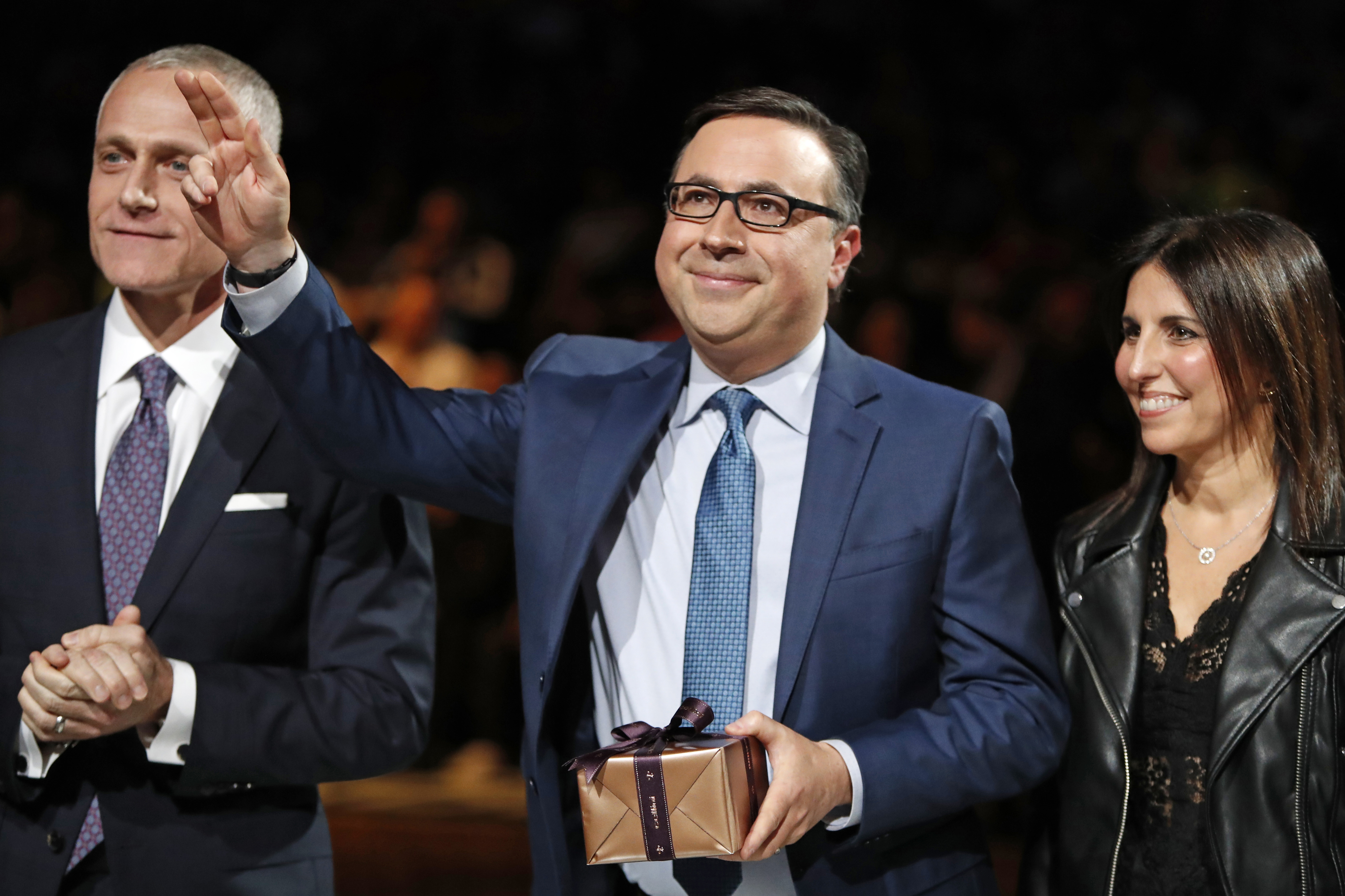
Ian Eagle will call tonight’s Sixers-Knicks game on Amazon’s Prime Video.
Calling tonight’s Sixers-Knicks game on Amazon will be former TNT announcers Ian Eagle and Stan Van Gundy, with Cassidy Hubbarth reporting from the court at Madison Square Garden.
Eagle is among the top play-by-play announcers in all of sports. In addition to his role at Amazon, Eagle also calls NFL games for CBS alongside J.J. Watt and has been the voice of the Brooklyn Nets on the YES Network for more than 30 years.
As with the NFL, Amazon has quickly put together a fun pre- and postgame show on a wild, two-story set hosted by Taylor Rocks. Tonight’s studio analysts will be former NBAers Blake Griffin, Steve Nash, and Udonis Haslem, who still holds the record as the longest tenured undrafted player in league history (20 seasons).
Tonight’s Sixers’ game is the first of a doubleheader that will stream on Amazon tonight, followed by a Western Conference matchup between the first-place Oklahoma City Thunder (who have lost just two games this season) and the Minnesota Timberwolves.
Sixers’ record and Eastern Conference standings
window.addEventListener(“message”,function(a){if(void 0!==a.data[“datawrapper-height”]){var e=document.querySelectorAll(“iframe”);for(var t in a.data[“datawrapper-height”])for(var r,i=0;r=e[i];i++)if(r.contentWindow===a.source){var d=a.data[“datawrapper-height”][t]+”px”;r.style.height=d}}});
Sixers news
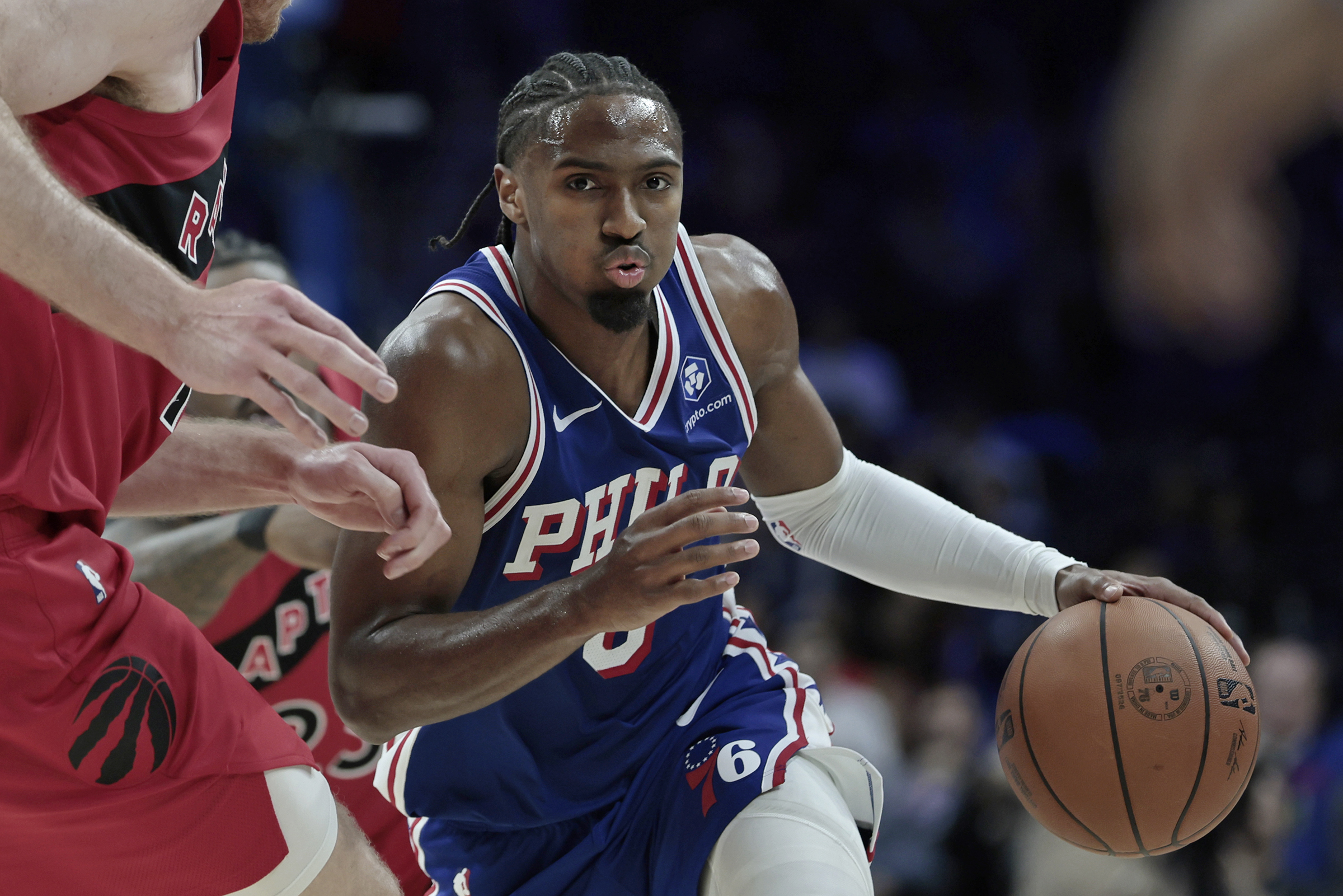
Tyrese Maxey is part of a young group bringing new life to the Sixers.
Thanksgiving brought a revelation. I was sous-chef to my children and my mother, a sounding board for my son as he completed college applications and my parents as they navigated different doctors, and the planner working around the needs of my children, husband, parents, and in-laws. I now realize what it means to be part of the “sandwich generation.”
My generation is also squeezed between older and younger cohorts in the professional world — especially medicine and healthcare. I am solidly Gen X and lie squarely between the boomers and the millennials.
These days, no matter where you turn, the realities of the U.S. healthcare crisis are impossible to ignore. From access to medications, availability of health insurance, affordability of medical costs, even trust and reliability in the messaging or directives we hear, the situation is daunting at best and overwhelmingly dark at worst.
Perhaps the canary in the coal mine has been the growing healthcare workforce crisis.
Physician burnout and moral injury, worsened by COVID-19, drove millennial and even Gen X doctors and nurses to leave the field. Adding to the dearth of primary care physicians as the U.S. population ages with worsened chronic diseases, the imminent retirement of a large cohort of boomers results in projections of a shortage of a combined 400,000 physicians and nurses by 2037.
I can’t help but feel the weight and responsibility of my generation of doctors in the world of medicine, along parallel lines of my personal life.
The same voices, same perspectives, and same ideas have been echoing across institutions for years — even when not representative of the rest of younger medical professionals, writes the author.
When we were born and grew up shapes the decisions we make and the ways we manifest and execute them. In his book Birth and Fortune, Richard Easterlin, an economist and demographer who researched happiness, posits that the size of the cohort you are born into shapes your generational opportunity.
Large cohorts, such as the baby boomers, face competition, but they also get the benefits of institutions that bend to their size. Smaller cohorts in the shadow of the larger generation ahead of them often contend with fewer resources and less investment. That’s Gen X in a nutshell.
And it models my experiences in the world of Philadelphia medicine almost perfectly.
Even within these cohorts, Easterlin illustrates, there are differences and disparities. Resources and opportunities available to early boomers became scarce to the later boomers, as the systems were slow to meet their needs. Those returning from the Vietnam War later were more likely to feel this dearth of structures and resources — such was the “birth” of homelessness as we recognize it now.
I saw that firsthand in Philly as a member of the Homeless Death Review team — a small group of experts from across the city convened by the Medical Examiner’s Office. We reviewed every death of a person experiencing homelessness in Philadelphia.
The author makes a home visit, as part of Pathways to Housing Philadelphia, in 2018, to care for a client who was at that time part of the Prevention Point community in Kensington.
From a systems-level view, it became clear that a lack of resources decades ago created a disparity that was perpetuated throughout the lives of specific demographics. They contributed to their premature deaths.
Boomers created the healthcare system we know today. Building on advances in science, research, and opportunity, they expanded and deepened training pipelines. They established medical specialties, subspecialties, and leadership roles.
They also continued long-standing practices anchored in hierarchy and compliance, where gravitas comes from the company you keep and not always the merit and competency you demonstrate.
A look across academic medical leaders in Philadelphia shows several with tenures that started in their 40s or early 50s and continued for well over 20 years, ongoing even now. Our city’s medical leadership — whether it be the Philadelphia County Medical Society, Pennsylvania Medical Society, or the American Medical Association — shows many of these same individuals making decisions across organizations.
Years ago, I wrote about how my approach to being an emergency physician evolved as I saw a changing world of healthcare that was not meeting the needs of the patients who turned to me for help.
That same month, the Wall Street Journal reported on the shift among doctors from “GOP stalwarts” to Democratic voters. My Gen X brethren look different from the generation before us: more women, more people of color, a broader range of ethnicities and cultures. It makes sense that we vote differently, in line with our priorities, values, and missions. Just as it makes sense that we lead differently, as well.
As Gen X doctors, we trained under the “old rules” of loyalty, compliance, endurance, and strict hierarchy. We worked with paper charts, well before computers became the central source of our clinical work. We mastered clinical skills and memorized reams of information. We also understood how issues outside the exam room and beyond our control impacted our patients.
My cohort went on to learn to practice medicine as the corporatization of hospitals took hold and our profession took on the additional contours of a business. We met productivity quotas and metrics around how quickly we saw patients and moved on to the next. We eventually even learned to ask corporate conglomerates for permission to get the tests, procedures, and medications our training and expertise, together with our direct evaluation, told us our patients needed, through prior authorizations.
Boomers continued to adhere to their definition of an ideal physician over the last 25 years — fixating on their commanding expertise and a brand of patient care they developed. In the process, they ceded governance of medicine, including financial oversight and systems design, to non-medical stakeholders. They often treated these issues as beneath them.
For the bulk of our careers, we Gen Xers were complicit — through our silent obedience and compliance. Many of us had learned from personal experience that speaking up or being seen as contrarian to those in power was overtly punished or covertly met with retaliation.
Now however, Gen X physicians are positioned to do something the generation before could not: carry medicine’s core values forward while shedding the destructive traditions and practices that broke the system.
We are facing AI in medicine, further decentralization of medical care, technology and innovation, unprecedented availability of our own health data through wearables, simultaneously with more difficult access to the doctors we have always turned to, and fewer hospitals in our communities.
I see us at a critical generational inflection point. And it’s time to assert ourselves in a few tangible ways:
Claim leadership by redefining it. We don’t have to wait to inherit positions when those who have inhabited them for decades finally vacate. Gen X knows well that true leadership doesn’t come through hierarchy or titles. In the words of my dear friend Jeremy Nowak: “Power belongs to the problem solvers.”
Reclaim and own our voice. Our predecessors confused apolitical detachment with impartial professionalism. In the process, the discussions, decisions, and policymaking that shaped physicians’ reality excluded us. It’s time we lean in unapologetically and stop waiting for permission.
Reject passive compliance as a virtue. Our silence has helped no one. The courage we spent decades swallowing is exactly the courage we need now to right this ship. We must be intentional in how we define ourselves, our profession, and our value: clinical integrity, collaboration, dignity, empathy, humanity, all come to mind as our unmatched superpowers.
It feels we are standing at the precipice of the unfamiliar and unknown. Where technology and AI will redefine what is possible, but the needs of our patients will demand practical and accessible solutions.
Sustainable change will come from us — crammed in the middle. At the risk of making a sweeping generalization, Gen X believes in fairness, head-down work, and accomplishment. We have learned and adapted throughout our lives. Unlike the boomers and millennials on either side of us, we are “raised analog, fluent digital, comfortable with a rotary phone and an AI dashboard.”
We are the stewards of the medical profession — not its museum guards. We can bridge the meaningful lessons of our past with the awareness of today and the promise of the future, while centering empathy, values, missions, and ethics.
The silver lining is this: Our hard-earned lessons have become the foundation for a new kind of courage. It’s one that refuses passivity, demands better, pushes into all the spaces that exclude us, and insists that we show up not just for ourselves, but for our colleagues, our patients, our community, and the generations coming behind us.
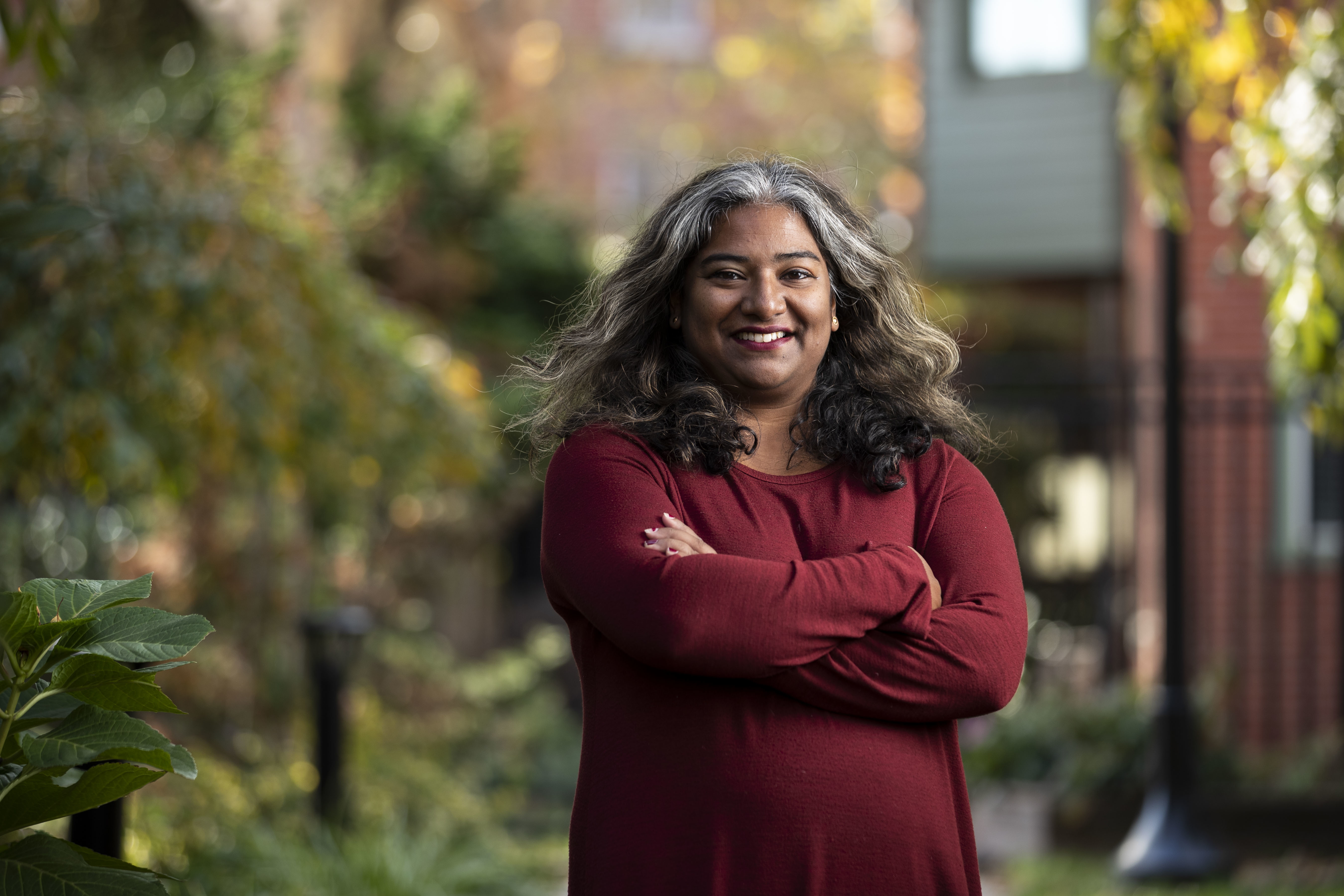
Priya E. Mammen is an emergency physician, healthcare executive, and public health specialist who helps the nation’s most impactful companies integrate clinical integrity at scale.
By most accounts, the Philadelphia Police Department has had a good year.
Crime is down, a majority of residents feel safer and many give Commissioner Kevin J. Bethel high marks.
But as is often the case with the PPD, the good work of many dedicated officers gets marred by one scandal after another.
In February, former homicide detective James Pitts was sentenced to at least 2½ years in prison for fabricating evidence in a murder investigation and then lying about it on the witness stand.
In May, Officer Mark Dial was convicted of voluntary manslaughter and other crimes after he shot Eddie Irizarry six times, killing him seconds after encountering him in his car with the windows rolled up.
In November, nine current or former police officers, including a former captain, were charged with theft and conspiracy in connection with the misuse of city anti-violence funds surrounding a youth boxing program.
Earlier this month, more than 130 drug cases were tossed out after three narcotics officers repeatedly gave false testimony in court. When all is said and done, nearly 1,000 cases are expected to get dismissed because the officers apparently lied about drug deals that never happened or they did not witness.
The string of scandals is not the case of a few bad apples, as the police often like to claim. It points to a systemic problem that has undermined the department for decades. Stamping out the skullduggery will require a change in recruitment practices, training, culture, and accountability.
The latest scandal resulting in hundreds of dismissed drug cases underscores the disturbing tolerance for corruption that runs through the department.
Common Pleas Court Judge Lillian Ransom vacated the first tranche of 134 drug cases after prosecutors said the testimony of three officers on the Narcotics Strike Force was deemed unreliable.
Hundreds of additional cases built on the officers’ testimony are expected to be voided in the coming months. Amazingly, Officers Jeffrey Holden, Eugene Roher, and Ricardo Rosa remain on the job and assigned to their narcotics squad.
Commissioner Bethel declined to speak with the Editorial Board but issued a statement that said an internal affairs investigation was launched in March 2024 and remains ongoing. That’s good, but what is taking so long?
He added that “thus far we have not identified any evidence that would raise concerns of misconduct or criminal behavior on the part of those officers.”
In other words, move along folks. Nothing to see here. Just about 1,000 criminal cases falling apart because three police officers apparently lied over and over again.
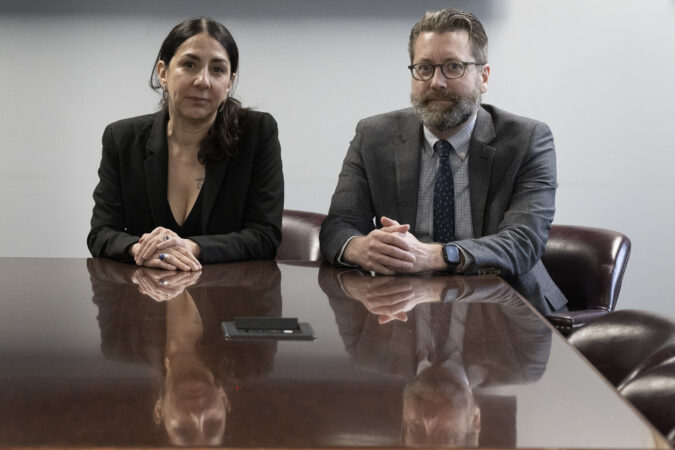
Credit for uncovering the injustice goes to the overworked and underpaid lawyers at the Defenders Association of Philadelphia.
In particular, Paula Sen and Michael Mellon of the Defenders’ Police Accountability Unit uncovered video footage that contradicted the evidence mounted by the officers.
More disturbing, this is not the first time the Defenders Association caught the police cooking cases.
In 2015, Bradley Bridge, a longtime public defender, got more than 950 drug convictions vacated after discovering six narcotics officers robbed and beat drug dealers and then filed bogus paperwork.
Bridge, who came out of retirement to help on the recent cases, estimated he has overturned about 2,500 drug convictions since 1995.
Therein lies the problem. Different day, same corruption.
Bethel said the Police Department takes “potential credibility issues with our officers extremely seriously.” But the department’s history of corruption over the past half century or more indicates otherwise.
To be sure, Philadelphia does not have a monopoly on police corruption. Problems exist in other big cities and small towns.
And despite recent reforms, it is unclear if all have been for the better.
A high-quality police department begins with high quality recruits. But to combat staffing shortages, the department — like many others — eliminated the need for college credits and lowered the requirements for physical training.
There must also be independent accountability. But a Citizens Police Oversight Commission created in 2022 has not conducted a single investigation.
Bad cops reduce morale and must be weeded out. But most corrupt officers not only avoid criminal charges but get to keep their jobs — thanks to a police union that goes to bat for every cop, good or bad. A recent analysis found friendly arbitrators reinstated 85% of fired officers.
Dirty cops undermine community trust and the good work of committed officers who risk their lives to keep the city safe. Even worse, the wrongful prosecutions can take away a person’s liberty and upend lives and families.
Police corruption also costs taxpayers real money. Over a recent 18-month stretch, Philadelphia taxpayers spent more than $60 million to settle cases stemming from police misconduct.
The recent reduction in crime is welcome, but a question remains: Will there ever come a day when the Philadelphia Police Department is not plagued by scandal?
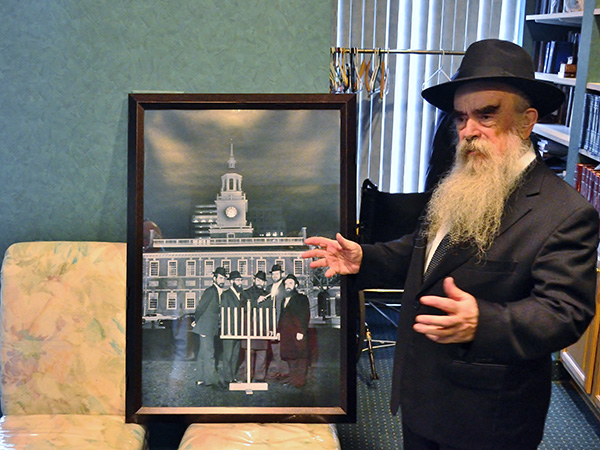
Outside the front door of Independence Hall, amid a wet and mild December in Philadelphia, a handful of devoutly orthodox Jews decided to add their light to the world.
Four men of the Lubavitcher sect of Hasidic Judaism, including renowned Rabbi Abraham Shemtov, gathered on Independence Mall on Dec. 14, 1974. Together they lit what is believed to be the first menorah, or Hanukkah candelabrum, ever illuminated on public property.
And together they watched their light spread.
“Philadelphia is where we started,” the now-88-year-old Rabbi Shemtov told The Inquirer in 2014. “Now it’s everywhere, in too many places to count.
“So, the idea caught fire,” he said, smiling through his long, gray beard.
Hanukkah is the Jewish celebration of light over darkness, and of faith and freedom over oppression and persecution. While it’s not the biggest holiday in the Jewish faith, its themes of perseverance and hope have been as synonymous with the winter solstice as any Christian tradition.
The most obvious reason that menorahs were traditionally not lit outside was because the flame would go out.
So on that breezy evening in mid-December, the flame stayed lit against all odds. Some might even call it divine intervention.
“What you need to understand,” Shemtov explained, is that Jewish tradition dictated that the candelabrum be lit at home, and placed “at the spot the house shares with the outside,” typically at the front door.
“Our sages say outside is better,” he said with a shrug. “So, we brought it outside a step further.”
In the years since, public menorahs havesprouted up across Europe and North America, from Revolution Square in Moscow to the White House in Washington.
“The simple lighting ceremony in Philadelphia,” wrote The Inquirer’s longtime religion reporter David O’Reilly, “became the foundational story of public menorahs for most of the world’s Jews.”
For centuries, menorah lighting had at times been a covert domestic ritual.
“We lit the first candle. There was some singing and dancing. It was a private event in public,” Shemtov said in 2014. “But even so, in concept we were sharing the thing with the world.”
With the Flyers nearing the midway point and the World Junior Championship around the corner on Dec. 26, it’s time for our annual midseason prospect check-in with assistant general manager and scouting chief Brent Flahr. In Part 1 of a two-part series, we asked Flahr about the team’s prospects that are playing NCAA or Canadian junior hockey, headlined by Porter Martone at Michigan State.
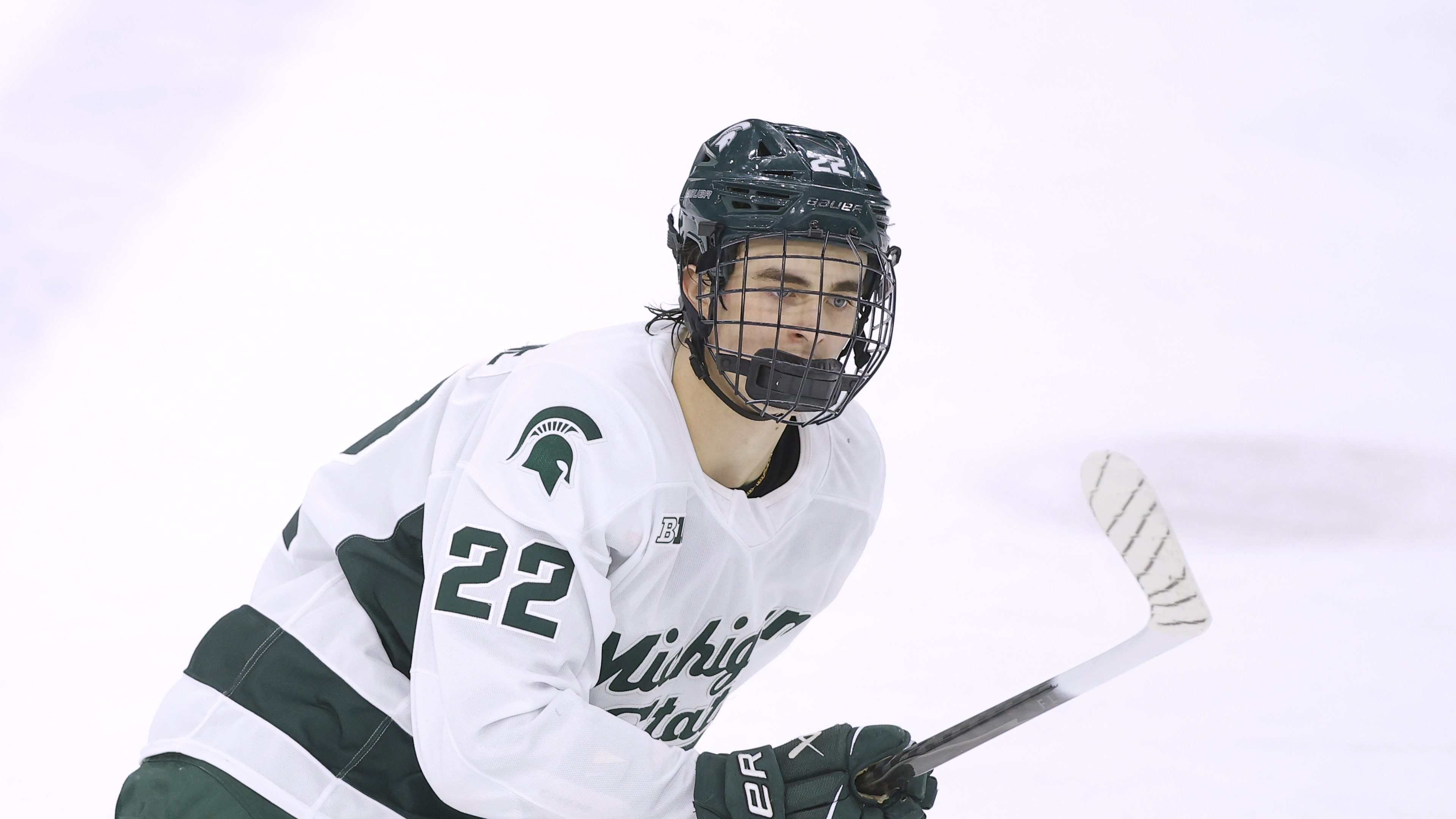
Flahr believes Porter Martone, who is averaging 1.25 points per game, which is third among freshmen, has improved his pace in the faster college game. Flahr believes Martone is on track to challenge for an NHL opening-night roster spot next season.
Flahr name-checked Jack Berglund, Heikki Ruohonen, and Max Westergård as less-talked-about prospects who have impressed him over the past few months.
While Flahr said Jett Luchanko wasn’t unhappy in Guelph, he thinks the move to Brantford is in the best interest of both Luchanko and the organization, as the center will play alongside better players and should benefit from not having to be “the guy” all the time.
Disclaimer: This interview, which was conducted on Dec. 10, has been edited for clarity and length.
More Details
With the Flyers nearing the midway point and the World Junior Championship around the corner on Dec. 26, it’s time for our annual midseason prospect check-in with assistant general manager and scouting chief Brent Flahr. In Part 1 of a two-part series, we asked Flahr about the team’s prospects that are playing NCAA or Canadian junior hockey, headlined by Porter Martone at Michigan State.
Disclaimer: This interview, which was conducted on Dec. 10, has been edited for clarity and length.
Q: We are heading into the midway point of the season. How would you assess the Flyers’ prospect pool right now?
A: It’s pretty good. Obviously, we had a lot of picks last year. We’ve had some guys emerging from previous drafts that have played well and are trending in the right direction. So overall, pretty excited.
Q: Is there anyone who has stood out to you thus far?
A: I think Porter Martone gets a lot of the attention because of where he was picked and whatnot, and he’s had a terrific start at a good program. I think [among] the lesser talked about guys, Jack Berglund and Heikki Ruohonen. Those two guys in the summer at the World Junior Showcase in Minnesota were both really good. Max Westergård played well. So I think those guys overseas have done their part to be big parts of their teams going to the World Juniors, which would be fun to see. And then obviously with Jack Nesbitt, Shane Vansaghi, a number of the guys we drafted last year, they’re big parts of their really good teams, and it’s been exciting for them.
Q: We’ll start with Martone because he is the one everyone talks about. What have you seen from this year with Michigan State, and how do you think it’s helping him prepare for the NHL?
A: His biggest challenge, and what we’ve talked about, is his pace. He was a really good junior [player], obviously, but he could slow things down all the time and kind of do what he wanted. In the college game, he’s playing against older kids, bigger, stronger, faster, and the way they practice, the way they play games, it’s all out and all full speed. So I think it’s forcing him to move his feet. Obviously, you can’t teach the brain he has, the skill set he has, and the size and whatnot. I think even he’s the first one to tell you, he’s in better shape. He’s playing faster. And I think it’ll really help him adjust to the pro game faster.
Flyers top prospect Porter Martone has 11 goals and 20 points in 16 games for the third-ranked Michigan State Spartans.
Q: Outside of Martone, Nesbitt is probably the most important player from the 2025 draft class. What have you made of his start in the OHL this season?
A: Yeah, I’ve seen him a number of times. He plays his game. The biggest thing with him is we’re going to have to be a little patient. He’s just a tall drink of water right now, and he’s got to get put on weight. He’s got to get stronger, which we’re well aware of that. But he is a competitive kid. He’s got skill, and he’s very sound defensively.
He plays with an edge — he’s been suspended a couple times already — but he plays to the identity of a Flyer, what we think of a Flyer. I think he’s going to be a very well-rounded centerman when he gets here. His details are good, good net-front on the power play, and he’s a good penalty killer. But the thing with him, I think the strength and skating is what you can wear down, so that’s a big focus with him. He’s got a good program there, where they have the trainer, and he’s drinking as many shakes as he can and doing all the things he needs to do.
But it’s going to take some time. His offseason is going to be critical this year and next, but he’s shown that he’s willing to put in the work. But so far so good, really positive, and hopefully next year he’ll get his chance at World Juniors. He’s part of a really good team there in Windsor, and they have a chance, I think, with a few additions to go on a pretty good run there this year as well.
Flyers center Jett Luchanko was recently traded from Guelp to OHL favorites Brantford. Brent Flahr believes that move will serve his development well.
Q: What have you seen from Jett Luchanko, and how important was the trade to Brantford for his development?
A: I don’t think he was unhappy in Guelph; he had friends there, guys he played with and played a ton. But I think his lack of offseason — he had injuries he was dealing with — so he wasn’t able to train and do his thing. So I think out of the gates, he was slow here in camp. He was fine, but really didn’t knock the door down. His details are good enough, skates good enough, where our coaches were like, we would like to give this guy a chance. But for us, long-term, we felt the necessity [for him] to go back to junior.
I think going to Brantford now, he’s not the guy. He’s one of many guys there, and I don’t know if there’s a better team in Canada. They have a really good coaching staff there, and he has a chance to just play and be a big part of the team there. Jett doesn’t get too high or low ever. He’s always going to take care of the defensive side of things, but I think playing with some good offensive players there and in a lot of situations is only going to help him be confident.
The one thing with him is, he’s unselfish to a fault. He can really make plays, but at the same time, he passes up opportunities to shoot it, which is what Riley Armstrong and Johnny LeClair, and Patrick Sharp want to get him going and shooting the puck more, being a little more selfish and taking more chances. But he’s in a good spot, good spot mentally, and I think he’s finally feeling back to normal again.
Flyers Asst. GM Brent Flahr is excited about the progress of many of the team’s top prospects.
Everything
With the Flyers nearing the midway point and the World Junior Championship around the corner on Dec. 26, it’s time for our annual midseason prospect check-in with assistant general manager and scouting chief Brent Flahr. In Part 1 of a two-part series, we asked Flahr about the team’s prospects that are playing NCAA or Canadian junior hockey, headlined by Porter Martone at Michigan State.
Disclaimer: This interview, which was conducted on Dec. 10, has been edited for clarity and length.
Q: We are heading into the midway point of the season. How would you assess the Flyers’ prospect pool right now?
A: It’s pretty good. Obviously, we had a lot of picks last year. We’ve had some guys emerging from previous drafts that have played well and are trending in the right direction. So overall, pretty excited.
Q: Is there anyone who has stood out to you thus far?
A: I think Porter Martone gets a lot of the attention because of where he was picked and whatnot, and he’s had a terrific start at a good program. I think [among] the lesser talked about [guys], Jack Berglund and Heikki Ruohonen. Those two guys in the summer at the World Junior Showcase in Minnesota were both really good. Max Westergård played well. So I think those guys overseas have done their part to be big parts of their teams going to the World Juniors, which would be fun to see. And then obviously with Jack Nesbitt, Shane Vansaghi, a number of the guys we drafted last year, they’re big parts of their really good teams, and it’s been exciting for them.
Flyers top prospect Porter Martone has 11 goals and 20 points in 16 games for the third-ranked Michigan State Spartans.
Q: We’ll start with Martone because he is the one everyone talks about. What have you seen from this year with Michigan State, and how do you think it’s helping him prepare for the NHL?
A: His biggest challenge, and what we’ve talked about, is his pace. He was a really good junior, obviously, but he could slow things down all the time and kind of do what he wanted. In the college game, he’s playing against older kids, bigger, stronger, faster, and the way they practice, the way they play games, it’s all out and all full speed. So I think it’s forcing him to move his feet. Obviously, you can’t teach the brain he has, the skill set he has, and the size and whatnot. I think even he’s the first one to tell you, he’s in better shape. He’s playing faster. And I think it’ll really help him adjust to the pro game faster.
Q: Aside from his pace of play, is there anything else that you want to see him work on? And what do you see as his strengths already?
A: Just the pace of play is the biggest thing for me. His food speed, working on that. His conditioning, and being able to play hard and not coasting like you can get away with in juniors. In college and especially in the NHL, he’s not going to be able to get away with that. But he’s a quick study. He’s a really smart player and skilled. His ability to go to the right spots, and he knows where to be on the ice. He has the ability to process the game at the level that a lot of guys can’t. So whether it’s scoring goals or making plays. Defensive side of things, he’s being forced to work harder at stuff like that, which just helps him when he gets here.
Q: Do you foresee him pushing for an NHL spot next year?
A: I think so. But at the same time, we don’t get too far ahead. I don’t even like talking about it. I just want him focusing on his season there and not getting ahead of things. He’s got a good group, and he has a chance to do something special; they’re one of the top teams, and hopefully win it all. And I don’t want him focusing on the end of the season or next year. I just told him, go there with the right attitude and work, and earn your spot, and he has. And, obviously, he’s had success. So I think he gets it, but I want to make sure he makes the most of it and has a chance to have a real special year with World Juniors, and potentially, if you win a national championship and things like that, that really helps build a player going into their pro career.
Q: Martone will play for Canada at World Juniors. How important is that for him, or any player really, to get that experience?
A: Well, it can be great. It’s not a be-all, end-all. Especially in Canada, it gets so blown up on the stage, people get crazed if guys don’t make it or make it. But the thing that fans don’t understand is that the coaches of those teams and management have different goals than what we have. We have players that we envision in the NHL in a couple of years — and there’s been lots of great players who have been cut that go on to have great careers — but they’re building a team to win a 10-day tournament in January this year. So they look at it a little differently. But if you are a part of it and you win, just the experience, I think, is great. Especially when it’s in Canada or in a full building, and to play it’s exciting and usually, a lot of times, it translates.
Flyers Asst. GM Brent Flahr is excited about the progress of many of the team’s top prospects.
Q: Vansaghi is teammates with Martone on the Spartans and will play for the U.S. at World Juniors. He’s not someone who is talked about as much, but maybe he should be?
A: You go to a game at Michigan State, you understand what he brings and how he impacts games. He’s a tank. He’s physically engaged. He wins every battle, but his details are really good. And more importantly, off the ice, the way he conducts his business is extremely mature for a young player. It’s contagious to the people around him with how hard he works and the intensity he works. So, you know, he’s a guy that it’s different roles, probably, when they get here, but he could be a very valuable piece to a good team we hope.
Q: Outside of Martone, Nesbitt is probably the most important player from that draft class. What have you made of his start in the OHL this season?
A: Yeah, I’ve seen him a number of times. He plays his game. The biggest thing with him is we’re going to have to be a little patient. He’s just a tall drink of water right now, and he’s got to get put on weight. He’s got to get stronger, which we’re well aware of that. But he is a competitive kid. He’s got skill, and he’s very sound defensively.
He plays with an edge — he’s been suspended a couple times already — but he plays to the identity of a Flyer, what we think of a Flyer. I think he’s going to be a very well-rounded centerman when he gets here. His details are good, good net-front on the power play, and he’s a good penalty killer. But the thing with him, I think the strength and skating is what you can wear down, so that’s a big focus with him. He’s got a good program there, where they have the trainer, and he’s drinking as many shakes as he can and doing all the things he needs to do.
At 6-foot-5, Jack Nesbitt’s skill popped at this year’s offseason camps.
But it’s going to take some time. His offseason is going to be critical this year and next, but he’s shown that he’s willing to put in the work. But so far so good, really positive, and hopefully next year he’ll get his chance at World Juniors. He’s part of a really good team there in Windsor, and they have a chance, I think, with a few additions to go on a pretty good run there this year as well.
Q: What have you seen from Jett Luchanko, and how important was the trade to Brantford for his development?
A: I don’t think he was unhappy in Guelph; he had friends there, guys he played with and played a ton. But I think his lack of offseason — he had injuries he was dealing with — so he wasn’t able to train and do his thing. So I think out of the gates, he was slow here in camp. He was fine, but really didn’t knock the door down. His details are good enough, skates good enough, where our coaches were like, we would like to give this guy a chance. But for us, long-term, we felt the necessity [for him] to go back to junior.
I think going to Brantford now, he’s not the guy. He’s one of many guys there, and I don’t know if there’s a better team in Canada. They have a really good coaching staff there, and he has a chance to just play and be a big part of the team there. Jett doesn’t get too high or low ever. He’s always going to take care of the defensive side of things, but I think playing with some good offensive players there and in a lot of situations is only going to help him be confident.
Flyers center Jett Luchanko was recently traded from Guelp to OHL favorites Brantford. Brent Flahr believes that move will serve his development well.
The one thing with him is, he’s unselfish to a fault. He can really make plays, but at the same time, he passes up opportunities to shoot it, which is what Riley Armstrong and Johnny LeClair, and Patrick Sharp want to get him going and shooting the puck more, being a little more selfish and taking more chances. But he’s in a good spot, good spot mentally, and I think he’s finally feeling back to normal again.
Q: You also have a trio at Boston University in Jack Murtagh, Owen McLaughlin, and Carter Amico. What have you seen from them?
A: They’re finding their way. McLaughlin is actually having a pretty good year.
Amico is coming off the knee injury, so he’s just finding his way. Saw him there the other night, and he’s a huge kid. He’s going to hopefully get more and more as we go along here.
And Murtagh, he’s a freshman; they don’t get put into top offensive roles right away, so he’s going to have to earn it. I think the things that he needs to work on, he’s going to have to figure out there, which is good. With the U.S. program, he was the goal scorer. Now he’s learning the details of the game, not only defensively, but where to be on the ice, and whether it’s forechecking, playing within the system, and it’s not just about him, but his attitude is great, and he works hard.
Almost 20 years after the Philadelphia Housing Authority (PHA) moved out of its Center City headquarters, a long-promised mixed-income tower will finally begin construction early next year.
The 14-story building is being built by Philadelphia developer Alterra Property Group, which may also manage the site after it opens. PHA will hold a 99-year ground lease on the property at2012 Chestnut St., which will be its only affordable building in Center City.
“It’s a multifamily, mixed-use, mixed-income building in a high opportunity neighborhood,” said Kelvin Jeremiah, president and CEO of PHA.
It “would afford residents a huge opportunity to live in an area that has access to transportation, employment opportunities, and a whole host of amenities literally right outside of their building entrance,” he said.
The tower will have 121 apartments, 40% of which will be rented at market rate with the rest targeted at tenants below 80% of area median income (or almost $83,000 for a three-person household). It will have 28 studios, 63 one-bedroom, and 30 two-bedroom units.
It also will have 2,000 square feet of commercial space, parking available off-site, and amenities that include a roof deck. The project was designed by JKRP Architects.
“I’m looking to break ground in Q1 of next year,” said Mark Cartella, Alterra’s senior vice president of development and construction. “It’s been a long time coming, so we’re excited to finally be going vertical here.”
What took so long?
PHA moved out of its Chestnut Street headquarters in January 2008, leaving a four-story husk. The agency cycled through numerous plans for the property, including a new headquarters and selling the land to a private developer.
The partnership with Alterra began in 2016. At that time, the project would have had 200 units, a majority of them market rate, and the developer would have held the 99-year ground lease on the property.
But neighborhood pushback and the resulting negotiations delayed the proposal until 2020. Then the pandemic caused more chaos, followed by a spike in construction costs and elevated interest rates that killed the original financing plan.
That led to a new strategy in which PHA issued bonds backed by the future rents of the market-rate units to help pay for the project, along with additional funds from federal housing programs, and a $2 million boost promised by Council President Kenyatta Johnson from funds available through Mayor Cherelle L. Parker’s Housing Opportunities Made Easy (H.O.M.E.) initiative.
“By adding high-quality, affordable apartments alongside retail space in the area, this project helps ensure that our downtown remains vibrant, diverse, and accessible to working families and individuals,” Johnson said in a statement.
“The PHA project will also help deliver a more inclusive Center City that reflects the full spectrum and diversity of Philadelphia’s residents,” he said.
A rendering of the roof deck planned for the new mixed-income building proposed by PHA and Alterra.
The 95-year-old headquarters was demolished in early 2024, but groundbreaking has been delayed in the current unpredictable national economic and political environment.
“You can probably sum that all up with it’s just general uncertainty with the change of[presidential]administration, as well as just getting through the design development process with a lot of folks having input,” said Cartella of Alterra.
“This is a little bit beyond the [usual] design development process with Alterra,” he said. “It’s more stringent than what we typically have to go through.”
Jeremiah has repeatedly expressed concerns about how long the development process can take in Philadelphia, especially in combination with federal guidelines and requirements.
But as this process nears its end — 18 years after the move, 10 years since bringing on Alterra, and two since demolition — he is feeling optimistic.
“It is the first PHA built development in Center City,” said Jeremiah. “That’s going to be a signature project for me, for the city, for affordable housing.”