Tag: topic-link-auto

  • How is Tyrese Maxey handling his heavy minutes? The Sixers star is ‘lost in the competitiveness’

    How is Tyrese Maxey handling his heavy minutes? The Sixers star is ‘lost in the competitiveness’

    When Tyrese Maxey flew down the court for his game-saving block on the Golden State Warriors’ De’Anthony Melton last week, it was not only an impressive burst of speed.

    “That’s conditioning, too,” Doc Rivers, the Milwaukee Bucks coach who formerly was with the 76ers, said while commending Maxey’s play the following day. “If you’re tired mentally or physically, you can’t make that play.”

    Maxey insists that, a quarter of the way through this season, he is not fatigued. But perhaps no Sixer is savoring this light stretch in the schedule before Friday night’s game with visiting Indiana more than their star point guard.

    Maxey entered Thursday leading the NBA in minutes played, averaging 39.9 in 23 games. That is three minutes greater than the next player with a comparable number of games logged (the Los Angeles Lakers’ Austin Reeves’ 36.9 minutes in 21).

    Maxey’s recent workloads have included playing the entire second half and overtime of a Nov. 20 win at the Milwaukee Bucks, when he scored a career-high 54 points. In a Nov. 30 double-overtime loss to the Orlando Magic, he played more minutes (52) than there are in a typical NBA game (48).

    No NBA player has averaged 40 minutes or more per game since Monta Ellis with Golden State in 2010-11 (40.3). So conventional wisdom says this pace for Maxey is not sustainable for the 82-game grind. Sixers coach Nick Nurse hopes having the team’s four rotation guards healthy — and productive — will ease Maxey’s load moving forward.

    Still, it has taken impressive physical fitness and mental fortitude for Maxey to pull this off for the season’s first seven weeks while playing at an All-NBA level. He entered Thursday ranked third in the league in scoring (31.5 points per game) and averaging a career-high 7.2 assists and 4.7 rebounds.

    “He’s a warrior,” teammate Paul George said. “There’s no question about it. He’s a fighter. … [There’s] a leadership about him. And when he’s out there, I play for him. I do everything I can to make the game easier for him. He’s our guy. It’s inspiring. Me, as a vet, it’s inspiring for a guy to consistently do it — and to be efficient with all the minutes that he’s been playing.”

    Nurse said Maxey’s relentless energy stems from him being “lost in the competitiveness” of the Sixers’ 13-10 start, that “it’s not like I’m sitting there saying, ‘Hey, you’ve got to come out.’ It’s the other way around. He doesn’t want to come out.”

    It’s also a responsibility to which Maxey has become accustomed. Last season, he led the NBA at 37.7 minutes per game in 52 games. In 2023-24, he ranked second in the league in that category, with 37.5 minutes in 70 games.

    Nurse’s top players racking up heavy minutes has also become a trademark of his coaching approach. Pascal Siakam, when he was a Toronto Raptor, led the NBA for two consecutive seasons, in 2021-23, while Fred VanVleet landed in the top five in both seasons. This season, fellow Sixers Kelly Oubre Jr. (34.8 minutes) and VJ Edgecombe (34.6) rank in the top 20, although their workloads have been diminished by injuries.

    Though there may not appear to be a massive difference between 37 and 40 minutes on the court, they add up game after game. Especially when Maxey is so active in generating the Sixers’ offense with the ball in his hands, and he has become more of a defensive playmaker.

    “He’s taken that challenge on a nightly basis, while being guarded by the best defender, usually,” George said Wednesday. “ … He’s doesn’t look for a night off, to go and sit in the corner and guard no one.”

    Maxey, 25, credits sports performance consultant Alexander Reeser with building foundational offseason strength and conditioning programs that “[push] me to my max limit, every day.” Maxey also has gained a reputation for his early morning on-court workouts, and for sometimes clocking in for as many as three sessions per day.

    Last season, Maxey added, was his first time “really locking in” on recovery, an effort to blend his present high performance with career longevity. Which means his routine between games in-season has become “very minimal work, for obvious reasons,” Nurse said.

    Maxey said the goal of his individual sessions is not “running around” to get to his spots on the floor to shoot — or to execute elaborate dribble combinations — which expend more energy. Instead, he drills passing, touch layups, floaters, and jumpers from the midrange and beyond the arc.

    “It’s the stuff you do after you do the move,” Maxey said. “Making sure it feels good.”

    Added Nurse: “He’s maturing a little bit, to have the confidence to just understand he can roll [in games] without having to have a big day on the floor on the off days.”

    Nurse has tinkered with when to rest Maxey, typically at the end of the first and/or third quarters or at the beginning of the second and/or fourth quarters. In that Nov. 20 game at Milwaukee, however, Maxey told Nurse, “Coach, let me go,” leading to him playing the final 29 minutes. Yet even within those lengthy on-court stretches, teammate Jared McCain has noticed Maxey going “straight to sit down” on the bench during timeouts.

    “Give him his time to breathe and rest,” McCain said. “[It’s] definitely a responsibility … [that] all the guards take, and something we’ve got to help him with.”
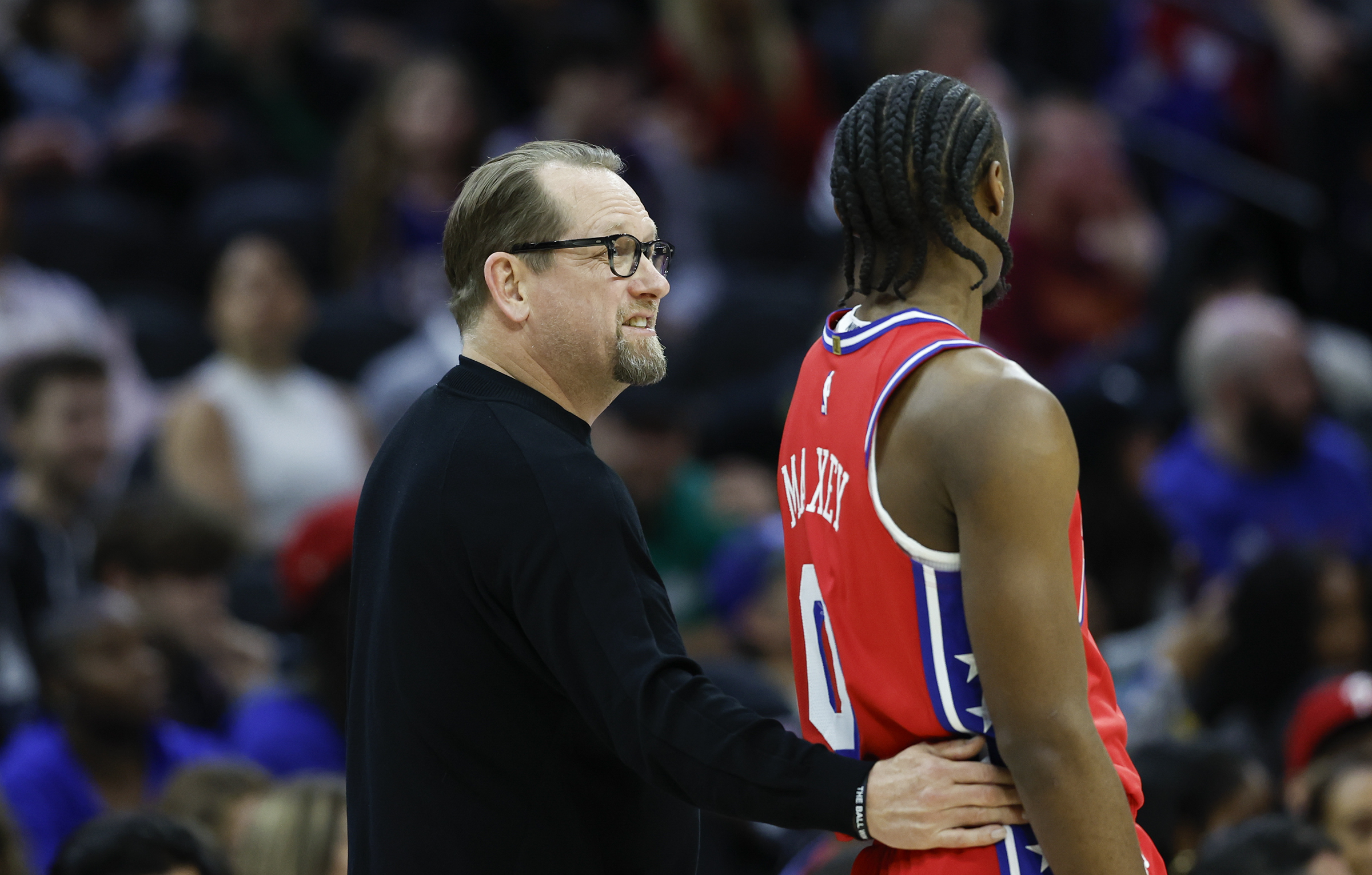
    Sixers coach Nick Nurse has started to lean on a three-guard lineup without Tyrese Maxey to give him much-needed time on the sideline.

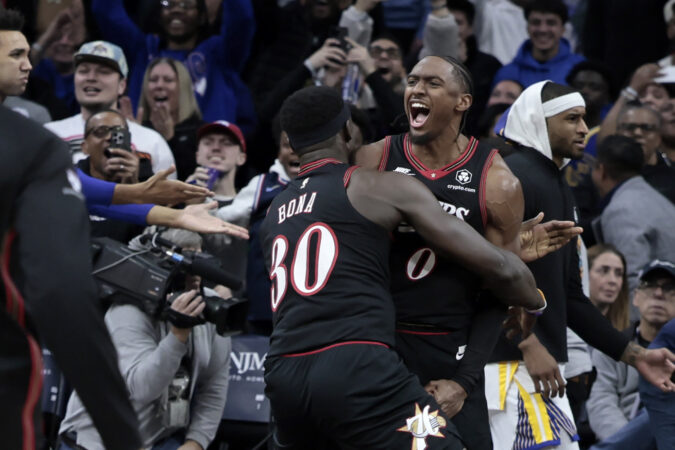
    The Sixers’ new-look offense, after all, has been built around its four rotation guards — Maxey, Edgecombe, McCain, and Quentin Grimes — who can score, push the pace, and pass in a variety of lineup combinations. But only recently did that full group reach full strength.

    McCain got off to a rocky start after missing nearly a calendar year following knee and thumb surgeries, but now he looks like a threat to score from all three levels. Edgecombe, a hyper-athletic two-way player, missed three games with a calf injury. And, outside the backcourt, max players George and former MVP Joel Embiid remain limited after offseason knee surgeries.

    “That’s kind of part of the reason we spread the floor out and we’re moving the ball a lot more,” Nurse said of those guard-heavy looks last week. “We’re trying to get them to play downhill and off the catch. We just haven’t quite got to it yet. There’s glimpses of it. …

    “We’re just [spreading] them out, and they go back and forth and move the pieces a little bit and then, boom, one of them’s down the lane. I hope they make a good decision. They either take it forcibly to the rim, or they just kick it out to a shooter or start it all over again.”

    Perhaps the start of the second quarter of Sunday’s 112-108 loss to the Lakers offered some encouragement, when the Sixers turned a tie game into an eight-point advantage while Maxey rested for nearly six minutes. But their latest poor third quarter followed, and then LeBron James’ shot-making buried the Sixers down the stretch.

    That the vast majority of the Sixers’ games so far have been tight has also contributed to Maxey’s workload. They entered Wednesday having played the league’s third-most “clutch” games (16), which occurs when the score is within five points or less with five minutes remaining in the fourth quarter.

    So when the Sixers staged a rare blowout win over the Washington Wizards last week — and Maxey logged a season-low 29 minutes — he chuckled when asked if he could immediately play another game.

    “Yeah, I guess so,” he said.

    Maxey followed that up by amassing 40 minutes against the Warriors and 37 at the Bucks on back-to-back nights. Then, another 39 against the Lakers.

    After that game, how did Maxey plan to spend this lighter stretch in the schedule?

    “Rest,” he said. “Just rest.”

  • CHOP was Southeastern Pa.’s most profitable nonprofit health system in first quarter of fiscal 2026. Four systems lost money.

    CHOP was Southeastern Pa.’s most profitable nonprofit health system in first quarter of fiscal 2026. Four systems lost money.

    Children’s Hospital of Philadelphia was the most profitable nonprofit health system in Southeastern Pennsylvania during the three months that ended Sept. 30, according to an Inquirer review of financial filings.

    CHOP reported $70 million in operating income in the first quarter of fiscal 2026, up from $67 million the same period a year ago. The nonprofit’s revenue climbed nearly 9% to $1.3 billion.

    The biggest loss in percentage terms was at Redeemer Health, the region’s smallest health system and the only remaining operator with a single hospital. Redeemer had an $11.7 million operating loss on $103.4 million in quarterly revenue. That was an improvement over an $18.9 million loss last year.

    Jefferson Health had the most patient revenue following its acquisition last year of Lehigh Valley Health Network. The 32-hospital system had $2.9 billion in patient revenue, $100 million more than the $2.8 billion at the University of Pennsylvania Health System, which has seven hospitals.

    window.addEventListener(“message”,function(a){if(void 0!==a.data[“datawrapper-height”]){var e=document.querySelectorAll(“iframe”);for(var t in a.data[“datawrapper-height”])for(var r,i=0;r=e[i];i++)if(r.contentWindow===a.source){var d=a.data[“datawrapper-height”][t]+”px”;r.style.height=d}}});

    Here’s a recap of selected systems’ results for September quarter:

    Jefferson Health

    Jefferson Health reported a $104 million operating loss, as its insurance business continued to drag down results. The loss included $19.4 million in restructuring charges for employee severance related to earlier job cuts and moves designed to make the system more efficient.

    University of Pennsylvania Health System

    University of Pennsylvania Health System had an operating gain of $109.3 million, up from $49.3 million in the same period a year ago. This year’s results include Doylestown Health, which Penn acquired April 1. Total revenue was $3.3 billion, up from $2.8 billion a year ago.

    Temple University Health System

    Temple University Health System’s loss in the quarter was $15 million, an improvement over a $17 million loss last year. Total revenue was $800 million, up 13% from $712.5 million a year ago. Outpatient revenue increased by nearly $62 million, much of it from the health system’s specialty and retail pharmacy business.

  • A nonprofit thought it had $170,000 in the bank. Then the payroll didn’t clear.

    A nonprofit thought it had $170,000 in the bank. Then the payroll didn’t clear.

    Lil’ Filmmakers, a Roxborough-based nonprofit, was supposed to have $170,000 in the bank.

    The mission of helping young people become storytellers through film and media had caught the attention of major donors in 2025. The city awarded it a $28,000 anti-violence grant, and one of Michael Jordan’s charitable organizations issued a separate $35,000 grant. Funding should not have been a problem, according to CEO Janine Spruill, who started the program in 1999.

    But on Aug. 27, neither she nor her four staffers, nor her summer program participants, had gotten paid by the Federation of Neighborhood Centers, the Philadelphia nonprofit that managed their money.

    She remembers FNC staff telling her they had decided not to process payroll because they were trying to “figure some things out.” Without specifics, Spruill walked away suspecting the worst.

    “I went into a bit of a panic mode,” Spruill said, upset that she hadn’t even been given a heads-up. “I ended up crying my eyes out because I said, ‘Oh, my God, I raised all this money, and they’re telling me they don’t have it.’”

    Other organizations that had contracts with FNC soon realized that they, too, were having issues accessing their funds. They reported overdue invoices, payroll issues, and spotty communication with FNC.

    As the weeks turned into months, Spruill said, FNC would not let her access the money she had raised. She had to launch emergency fundraisers.

    The announcement many of the groups dreaded arrived in November. FNC’s grant management services — known as a fiscal sponsorship program in the nonprofit world — would shut down Dec. 31.

    “This choice does not come lightly,” said FNC’s announcement on its website. “It comes after years of carrying work that we believed in wholeheartedly — often beyond our capacity — because we care deeply about every project, every leader, and every community member who trusted us with their mission.”

    FNC’s collapse, by its own admission, is a story of an organization that grew too quickly and let basic accounting principles go by the wayside. Demir Moore, the nonprofit’s new CEO as of Aug. 26 and a former Lil’ Filmmakers intern, insisted FNC’s collapse was due to a “lapse of management” and “absolutely not attributable to malfeasance or embezzlement.”

    FNC spent itself into a deficit over the course of years, continuously using money belonging to one group to pay for another, according to Thaddeus Squire of Social Impact Commons, an organization aiding FNC as it winds down.

    “That deficit started to become unrecoverable,” he said. “Money that was borrowed was not put back.”

    Moore declined to say how much money FNC has or how many groups are affected by the end of the fiscal sponsorship program. FNC has about 50 groups on its rolls, he said, but some have not been active or have no funds with the nonprofit.

    Still, it is unclear how the nonprofit was able to operate the way it did for years. Sorting out just how FNC’s fiscal sponsorship program unraveled is going to take time, Moore said, declining to comment on leadership turnover in the last year.

    Attempts to reach past FNC leadership for insight on what transpired were unsuccessful.

    And while Moore described a round-the-clock effort to sort out how much every group should have in its account, he would not say for certain whether groups would get all their funds back by the time FNC shuts down.

    When the ‘safe approach’ loses control

    When run right, a fiscal sponsor can be a boon to newer community groups that do not have a tax-exempt status. By contracting with fiscal sponsors, which are registered as 501c3s, these smaller groups can apply for grants.

    Donors are left assured that a more established nonprofit is guiding the smaller or newer group, said Brian Mittendorf, the H.P. Wolfe Chair in Accounting at Ohio State University, who specializes in nonprofit accounting.

    “Financial difficulties at fiscal sponsors are much less frequent just because their position … is typically an indicator that they have strong financial controls and other infrastructure in place,” he said, adding that signing with a fiscal sponsor is “often viewed as the safe approach.”

    Fiscal sponsors can also be of much help to registered nonprofits that would rather focus on providing services than on managing administrative tasks.

    In exchange for a fee, the sponsor signs on to manage and distribute grants, offer reports, and take on a range of tasks, such as payroll or legal questions, giving community groups peace of mind.

    For Lil’ Filmmakers, the promise of back-office support led it to contract with FNC nearly a decade ago. Spruill said the monthly accounting report FNC sent her would sometimes require adjustments, but she cited no major issues until this year.

    The first red flag came in March. Spruill said FNC did not pay the rent for Lil’ Filmmakers’ studio in Roxborough. FNC ultimately took care of the late fees and cut the rent check, so Spruill said she chalked it up as a one-time occurrence.

    Teens at the Lil’ Filmmakers nonprofit learn the ins and outs of filmmaking.

    What Spruill and other community group leaders could not see was an organization Moore said could not keep up with its own expansion. The nonprofit recorded a revenue of $774,000 in 2019 tax filings, which peaked at $4.76 million in 2023.

    A years-old message from then-CEO Jerry Tapley remained on the FNC website until this summer, touting more than 50 projects ranging from urban farming and the arts to animal rescue work. The organization’s work affected 250,000 people annually in “Philadelphia and beyond,” he wrote.

    Moore said that as the nonprofit grew, FNC was not always collecting key documentation, such as receipts. Community groups were allowed to draw checks for funds they did not have, and balance statements given to groups were out of date or inaccurate.

    When Moore stepped down as FNC board president and took over as CEO, the first thing he did, in an attempt to take stock of finances and accounts, was freeze outgoing payments.

    While Moore described the move as a necessary first step, community groups struggled to pay for basic overhead, and some sought outside help. Soon, Philanthropy Network Greater Philadelphia and Social Impact Commons, an organization that supports fiscal sponsors, were working with FNC — but it was too late.

    There did not appear to be any nefarious intent behind the mismanagement, Social Impact Commons’ Squire said, but FNC’s system allowed some projects to spend into the negative and for debt to snowball.

    Social Impact Commons recommended FNC shut down its fiscal sponsorship program and “stop trying to catch up,” according to Squire.

    Clarity may not come for at least several more weeks

    Sharon Wilson, Lil’ Filmmakers’ attorney, said one of her biggest frustrations is what she finds to be a general lack of transparency as FNC winds down operations, despite her repeated requests for updates in writing.

    “All of the information that was learned about FNC’s internal problems, and the fact they were failing other nonprofits other than Lil’ Filmmakers, was all gleaned outside of them,” she said.

    The way Moore explains it, the reason FNC has not outright said all community groups would be made whole is that figuring out who is owed what will take at least several more weeks. He said FNC does have funds available, but until the reconciliation process is complete, “no final conclusions can be made about individual project balances or what each project’s final financial position will be.”

    Polaroids from a community pet day at Lil’ Filmmakers Thursday, Dec. 4, 2025. The Roxborough based nonprofit and other community groups claim they have been unable to access their funds managed by FNC, which insists it’s not a case of embezzlement or financial malfeasance

    For now, multiple third parties, including the city, are working to move the process along.

    The Philadelphia Office of Public Safety, for example, said Lil’ Filmmakers and three other anti-violence grant recipients with awards managed by FNC are in different parts of the process. Together, the groups had roughly $380,000 in city-issued funds awarded, which the city said are largely accounted for.

    Though the final spending report for Lil’ Filmmakers remains in dispute, it might be resolved by the end of the month, according to the city.

    In the meantime, a public safety office spokesperson said staffers were working with organizations to help close their accounts with FNC and offering technical assistance to its grant recipients, including bookkeeping and fiscal sponsor matchmaking.

    Still, the office said, there is not much it can do for other grants awarded by other donors.

    Complicating money matters further, some organizations used a California-based fundraising platform called Flipcause to collect donations. Last month, California’s attorney general sent a cease-and-desist order to the company, ordering it to halt operations after more than a dozen nonprofits in the state accused Flipcause of withholding funds. The platform also faces a class-action lawsuit in federal court.

    In all, Moore said, FNC organizations have about $100,000 being withheld by Flipcause; Lil’ Filmmakers is not one of them.

    Moore did not rule out that some groups might have less in their accounts than they were initially told in their FNC financial statements because of accounting discrepancies.

    Squire went a step further, adding that philanthropic fundraising would be necessary.

    “We’re cautiously optimistic that despite a lot of genuine harm that’s been done, that we can at least get people sorted out and back on their feet in the next few months,” Squire said.

    The goal, he said, is that each of the groups needing to be placed with a new fiscal sponsor to access their money will have a new one by the end of the first quarter of 2026.

    The results of the internal audits will likely determine any legal recourse or investigations. For example, the Pennsylvania Bureau of Corporations and Charitable Organizations, part of the Department of State, can impose fines against charities and revoke their registrations if they are found to be violating the state laws that govern them.

    But Spruill, her staff, and her teaching artists cannot afford to keep waiting.

    Lil’ Filmmakers has launched another fundraising campaign, this time for $50,000, so programming can continue uninterrupted.

    When speaking about the financial setback, Spruill remains defiant.

    “We refuse to let this stop the stories that need to be told,” reads her plea to donors.

  • Who is living in all of Center City’s new apartment buildings?

    Who is living in all of Center City’s new apartment buildings?

    When Adam Sawyer and his wife, Marissa Tan, moved to Philadelphia in 2024 from Baltimore, they were attracted to Center City by its proximity to work and mass transit.

    The couple figured if they sold their car, they could even afford to rent in one of the thousands of new, high-rise apartments that have been built across Center City over the last 10 years.

    Tan had just gotten a new job with the Cooper University Hospital in Camden, and Adam needed access to 30th Street Station for work. They eventually settled on the PMC Property Group’s Riverwalk North at 23rd and Arch Streets and have been impressed by the city, its transit system, and life without a car.

    Adam Sawyer and his wife, Marissa Tan, moved to Philadelphia in 2024 from Baltimore.

    “One of the things I love about living in a city is that you’ll be walking down the street and there are five different events you didn’t even know about,” Sawyer said. “Festivals, farmers markets, just activity, people doing things. I love that Philadelphia has so much energy.”

    In many ways Sawyer and Tan — who are both 35 — are representative of the people who have taken up residence in the new apartment buildings across Center City. Between Pine and Vine Streets, river to river, 3,500 new apartments have opened since 2023.

    Center City District (CCD) set out to learn more about who is calling these apartments home, with a survey of more than two dozen buildings constructed since 2015.

    Like Sawyer and Tan, the vast majority of respondents to CCD’s survey are under 45 (83%), more than half don’t own a car (55%), and close to half moved from outside the Philadelphia area (44%). Sawyer works remotely like 21% of respondents, and Tan works in healthcare like 32% of them.

    window.addEventListener(“message”,function(a){if(void 0!==a.data[“datawrapper-height”]){var e=document.querySelectorAll(“iframe”);for(var t in a.data[“datawrapper-height”])for(var r,i=0;r=e[i];i++)if(r.contentWindow===a.source){var d=a.data[“datawrapper-height”][t]+”px”;r.style.height=d}}});

    In a city where a fifth of all residents live in poverty, the respondents aren’t representative of the average Philadelphian in many ways. The buildings surveyed have an average rent of $2,645, well above the median of $1,387.

    But the results show that there is a market for the kind of new buildings that are still being proposed. They also highlight that many people are attracted to the most central parts of Philadelphia because it offers more density, walkability, and other urban characteristics that few other American cities can boast.

    “People actively choose Philadelphia over other cities and metropolitan areas because we outperform them in some ways,” said Clint Randall, vice president of Economic Development with CCD, which is funded by downtown property owners and provides advocacy and services like additional security and cleaning downtown.

    “The city spent so many decades shrinking,” Randall said. “When you see this entire skyline of high-rise apartment buildings emerge, it contradicts what longtime Philadelphians think they know about this place, which is that it does not grow or attract residents.”

    Reversing reverse commuting

    Center City District’s survey confirmed a longtime finding of the organization’s other research reports: People who live downtown are likely to work there or very close by.

    In Philadelphia, reverse commuting is common, a testament to the fact that many private-sector employers have remained outside the city to avoid wage and business taxes. But among survey respondents, only 12% commuted to the suburbs for work compared to almost 40% citywide.

    Over half of respondents work in either Center City or University City, and a similar proportion work in either healthcare (32%) or in the jobs more typically associated with office towers: “business, professional, or financial services” (27%). Twenty-one percent work from home.

    “A lot of people are in medicine, in healthcare. I see a lot of scrubs,” said Kaz Rivera-Gorski, about her building One Cathedral Square at 17th and Race Streets.

    window.addEventListener(“message”,function(a){if(void 0!==a.data[“datawrapper-height”]){var e=document.querySelectorAll(“iframe”);for(var t in a.data[“datawrapper-height”])for(var r,i=0;r=e[i];i++)if(r.contentWindow===a.source){var d=a.data[“datawrapper-height”][t]+”px”;r.style.height=d}}});

    “I would imagine there’s a good amount of people that work remotely, too,” said Rivera-Gorski, who is a management consultant who works from home. “I see people on their laptops in the shared spaces during the day.”

    Seventy percent of respondents said their jobs are within walking, biking, or transit distance from their homes, while 80% of them said that owning a car was not necessary to enjoy daily life in Philadelphia.

    That’s part of what attracted Sawyer and Tan, even though another part of Philadelphia’s allure was that it was closer to family in central and eastern Pennsylvania (the couple have a Zipcar membership).

    “While I do drive, I really, really dislike driving,” Sawyer said. “I’ve lost people. Everybody has, to either accidents or crashes or DUIs. So we were open to selling our car and became more and more convinced it was a good idea.”

    window.addEventListener(“message”,function(a){if(void 0!==a.data[“datawrapper-height”]){var e=document.querySelectorAll(“iframe”);for(var t in a.data[“datawrapper-height”])for(var r,i=0;r=e[i];i++)if(r.contentWindow===a.source){var d=a.data[“datawrapper-height”][t]+”px”;r.style.height=d}}});

    Retaining out-of-towners

    Randall said that he was surprised by the proportion of CCD’s respondents who reported having moved to Philadelphia from outside the region. (A recent Realtor.com report showed that Philadelphia switched from having mostly local interest in rental listings before the pandemic to mostly out-of-towners today.)

    The survey also found that the majority of Center City dwellers planned to be living in Philadelphia in three to five years, with 45% planning to continue renting and 16% hoping to buy.

    “You hear about the transience of other places like D.C. or Boston, and it seems like people are here [in Philadelphia] and they intend to stay,” Randall said.

    That is certainly the goal of Annika Verma, a student at Temple University who lives in the Logan Lofts in Callowhill.

    “I am already calculating: Can I get an entry-level job? What salary would work for the rent in this area?” Verma said. “I would love to stay. The area seems ideal for me in terms of commuting or walking. Anything, everything is a 15-20 minute walk or bus ride away.”

    Sawyer and Tan are hoping to stay in Philadelphia, too. They are currently searching Center City for a condo to buy. They may try to stay in their current Logan Square neighborhood for its proximity to the Schuylkill River Trail and 30th Street Station.

    “We love it,” said Sawyer, who notes that they’ve lived in three cities in Texas, Cooperstown in New York, and Baltimore before this. “But our favorite place we’ve ever lived is here in Philadelphia.”

  • Nick Sirianni: Sitting Jalen Hurts ‘ridiculous’? Hardly. Bench him if he struggles Sunday.

    Nick Sirianni: Sitting Jalen Hurts ‘ridiculous’? Hardly. Bench him if he struggles Sunday.

    Early during Nick Sirianni’s weekly interrogation by Eagles flagship station 94-WIP on Wednesday morning, he was asked about Jalen Hurts by host Joe DeCamara: “Is there a possibility later this season, if he continues to struggle, that you could make a change at the quarterback spot?”

    Sirianni replied:

    “I think that’s ridiculous.”

    You know what’s ridiculous?

    Saying you would never replace a quarterback in the middle of a horrible performance — that’s ridiculous. Saying you would never bench a quarterback who’s slumping worse than the economy — that’s ridiculous.

    It’s more than ridiculous. It’s malpractice.

    It’s not as if Sirianni is averse to benching people.

    He benched defensive coordinator Sean Desai late in the 2023 season.

    Hell, he benched himself in 2021, when, as a rookie head coach, he found the burden of play-calling too onerous, and ceded it to then-offensive coordinator Shane Steichen.

    Don’t be afraid to do unto others, Nick.

    There are two reasons a coach has not only the right, but the responsibility, to bench a quarterback who is playing losing football. This is doubly true of a coach whose team has the weapons to make another deep postseason run, which is exactly the sort of team Sirianni has.

    First, the coach owes it to the rest of the team to give them the best chance to win. He doesn’t just owe the players. He owes his coaching staff, his support staff, the administrators, the scouts, the janitors — everybody.

    Because everybody’s livelihood suffers when the team doesn’t win, and if Hurts continues to play this poorly, the team cannot win.

    Second, when you’re in a tailspin like Hurts, you’re very unlikely to dig your way out of it. Defensive coordinators are using a very clear formula to beat Hurts: Load the box to stop the run, force the receivers inside, give up nothing deep, and don’t bother with a spy, since Hurts doesn’t want to run anymore, and he has lost a step, anyway. And blitz, blitz, blitz.

    This is the third time since Hurts became the unquestioned starter that he has lost three straight regular-season games. However, it is, by far, his worst performance of any three-game slide, and the first time he has been the biggest reason for the losing. Hurts has a lower passer rating (69.9), more total turnovers (seven), and fewer rushing yards (72) than in previous losing streaks. He’s been bad before, but never this bad.

    The Eagles are 8-5. A loss Sunday to the visiting Las Vegas Raiders combined with a Dallas Cowboys win against the Minnesota Vikings would shrink the Eagles’ lead in the NFC East to a half-game and put even a wild-card berth in peril.

    This is no time to worry about Jalen Hurts’ feelings.

    It might sound heretical to say of the Super Bowl MVP, but if Hurts continues to struggle, he damn well should be benched. He is not sacred.

    Also: Do you believe Sirianni?

    Liar, Liar

    Can you believe Sirianni? He lies all the time to protect players. He admitted this in 2023: “That’s something I’ve always done.”

    With that in mind, if, by halftime Sunday, Hurts has thrown two interceptions, fumbled the ball away, and he’s 3-for-11, I think we‘ll see Tanner McKee.

    I guess Sirianni needs to say that Hurts is untouchable in order to fortify Hurts’ confidence. Sad.

    The Eagles were burned the last time they benched a starter. In 2020, Carson Wentz, who already was angry that the Eagles drafted Hurts in the second round, was benched with 4½ games to play. The benching infuriated Wentz. He first got coach Doug Pederson fired, then forced a trade. The trade hung the Eagles with a then-record $33 million salary-cap hit and left them with Hurts, a talented, raw, flawed quarterback.

    Four years later, Hurts has gone to two Pro Bowls, two Super Bowls, and won a Super Bowl, and signed a $255 million contract. Nevertheless, Hurts remains raw and flawed — less so, but still.

    It’s rare that franchise quarterbacks get benched on merit, but that’s a phenomenon almost exclusive to NFL QBs. Hurts is on a five-game slump, which is about 30% of his season. If Bryce Harper hit .150 over 54 games and made 10 errors or if Tyrese Maxey shot 20% for 27 consecutive games and averaged seven turnovers, you can bet your britches they’d get a day or two off.

    Hurts understands that he’s a big part of the problem. He acknowledged that he’s in a slump, and it’s a granular slump. And when he says he needs to be more “detailed,” it means he needs to get back to the basics in practice so they translate during games.

    “How can I have the right technique?” he said. “How am I playing with the fundamentals? To run the way I want to run? To throw the way I want to throw?”

    It comes. It goes.

    “For whatever reason, that’s a part of the game,” Hurts said. “Success or greatness — those things aren’t linear. You have your ups, you have your downs.”

    When athletes in other sports have their downs, they get sat down.

    But not quarterbacks.

    They’re special.

    Whatever.

    Tradition!

    It’s more than a little ironic that the analytically driven Eagles have, in Sirianni, a pocket-protector spokesman who is essentially telling us that he wouldn’t bench his quarterback because “This is the way it’s always been done.“

    Listen: If you want to go for it on fourth-and-4 from your opponent’s 32-yard line with 3 minutes, 30 seconds to play, when a field goal would put you up seven or eight points, then you don’t get to use the “This is the way it’s always been done” defense.

    I understand the concerns with going to McKee — concerns independent of how it affects Hurts. There are concerns about offensive timing. You know Raiders defensive coordinator Patrick Graham will show McKee exotic looks on every snap. McKee will be baited by defensive backs.

    McKee might fail catastrophically, and then, where are you?

    You are no worse off, that’s where.

    It’s not as if Hurts hasn’t been benched before. He lost his job as Alabama’s starter at halftime of the 2018 College Football Playoff national championship, which his replacement, Tua Tagovailoa, won. Instead of transferring, Hurts returned the next season, served as a backup, and, 11 months later, replaced Tagovailoa in the SEC title game and led a comeback win.

    If anybody can handle a benching, it’s Jalen Alexander Hurts.

    There’s no debating that there’s a contingent of folks, especially in the Philadelphia area, who would love to see Hurts fail. You can debate their motives, but he’s not nearly as appreciated as he should be.

    This has led to a cycle of protectionism inside the NovaCare Complex. That’s not good for anybody.

    However, most folks don’t want any scenario to surface in which Hurts gets benched. He has played wonderful football at times.

    But to dismiss his benching out of hand isn’t just ridiculous.

    It’s coaching malpractice.

  • 2026 Hyundai Ioniq 5 XRT: Built for the rail trail?

    2026 Hyundai Ioniq 5 XRT: Built for the rail trail?

    2026 Hyundai Ioniq 5 AWD XRT: Off-road electric?

    Price: $57,085. Floor mats added $210.

    Conventional wisdom: Motor Trend likes that the Ioniq 5 XRT offers “proper fun in mild dirt,” that it’s “great as an everyday do-it-all crossover,” with “built-in NACS convenience.” But they lament the “off-road gear brings on-road compromises, using Tesla Superchargers not yet optimal,” and the “price close to high-end Ioniq 5 Limited trim.”

    Marketer’s pitch: “Our fast-charging electric SUV that goes the distance.”

    Reality: The off-road accoutrements are so limited, you might as well get one with more range.

    Catching up: Last week, we tested a Chevrolet Equinox EV, which seemed like a real bargain until we started digging deeper.

    This week we blow another $20,000 and see what we have to show for it.

    What’s new: The Ioniq 5 received a refreshed appearance for 2025. It adds the NACS charging port, allowing easy access to Tesla superchargers, and boosts the size of the batteries across all models.

    The new XRT model is marketed as a more rugged version, slightly lifted and with all manner of cladding and black.

    Unfortunately it still has the Ioniq 5 look, which I find hearkens back to 1980s econohatches, specifically the Mitsubishi-made Dodge Colt/Plymouth Champ.

    Competition: In addition to last week’s Chevrolet Equinox, there are the Ford Mustang Mach-E, Honda Prologue, Kia EV6, Mini Countryman EV, Subaru Solterra, and Tesla Model Y.

    Up to speed: The Ioniq 5 gets to 60 mph as fast as any EV. It reaches the magic number in just 4.5 seconds, according to Motor Trend. Unlike last week’s stripped-down Equinox, the Ioniq 5 offers power aplenty throughout the range of driving, as well as through the range of models.

    Shiftless: I’ve been singing the praises of the Hyundai twisty-stalk gear selector, and that will continue.

    On the road: The Ioniq 5 handled nicely on highways and wasn’t too bouncy for its squared-off shape. Country roads were quite fun, especially in Sport mode.

    The Ioniq 5 did have more than its share of rattles, though, from either the hatchback door or the rear cargo area; the squarish shape of the vehicle is probably a factor here.

    In the rain: EV makers put low-resistance tires on to help with range. I can’t specifically recall having any other EV in the rain, but the Ioniq 5 with its 235/60/R18 all-terrain tires designed for off-ish roading seemed like it would slide on wet roads. Test drive in the rain, if you can.

    Steady speed: The Smart Cruise Control with curve control feature in the Ioniq 5 felt dumber than advertised. I’ve noticed many test vehicles from all brands slowing on curves while the cruise is set, and it’s a welcome feature, but more than a few times I found myself shouting at the dashboard as the Ioniq 5 suddenly started to slow dramatically from my set speed. The cruise was still engaged, too, so it required me taking complete control and starting from scratch.

    This can all be controlled through the various settings, but I never found one that I thought worked as well as other manufacturers’ offerings.

    The interior of the 2026 Hyundai Ioniq XRT offers plenty of comfort and easy operation.

    Driver’s Seat: The leather-covered seat was geared for comfort but still supportive. It held me in place while not getting fresh. The lumbar bolster was just fine and the seat bottom stretched to my knees, something often lacking at this vehicle size.

    The seat heater operation and some other functions are in a row of silver buttons (yay!) on the console that will help you in yoga class, requiring a sharp contortion just to reach them (boo!).

    Friends and stuff: Sturgis Kid 4.0 blessed the rear seat as comfortable and roomy on a trip to the Sweetest Place on Earth. The flat floor means middle seat occupants won’t feel too bad.

    Cargo space is 26.3 cubic feet behind the rear seats and 58.5 when it’s folded.

    Play some tunes: Sound from the system is pretty good, about an A-, maybe a B+.

    The 12.3-inch touchscreen makes playing tunes and getting to other functions easy enough, and buttons and dials underneath offer a real assist. The home screen has large icons that make navigation swift.

    Keeping warm and cool: I was at first pleased at the HVAC’s use of real buttons underneath the infotainment display. But things were not exactly as they appeared; those were just faux buttons of the highly sensitive touch pad variety. Every time my hand got close, I seemed to adjust three things I didn’t intend to. So the driver’s attention is still stolen away from the driving portion of our adventure and is instead trying to fix things that have been changed by accident.

    Range: The Ioniq 5’s advertised range of 258 miles was about spot on, as determined by our trip to the AACA (Antique Automobile Club of America) museum in Hershey. We used up about 200 miles of range in 180 miles or so of travel — about half of them keeping up with turnpike traffic; those high speeds suck down the juice. (I could slow down, and yet, I don’t.)

    A less expensive SE model would get you beyond 310 miles on a charge. Recharging from 10% to 80% takes as little as 20 minutes.

    Where it’s built: Ellabell, Ga. This was the site of an ICE raid in September. It remains to be seen how long the Ioniq 5 will actually come from there, also considering recent trends in EV sales. Stay tuned.

    The U.S. and Canada supply 29% of the parts; South Korea another 29%; and Hungary, 33%.

    How it’s built: Consumer Reports predicts the reliability to be a 2 out of 5.

    In the end: The Ioniq 5 has always been tied with the Kia EV6 on my list of EV champs; the Kia looks a little less stupid, so I’d probably go that direction. But the Equinox is a strong challenger and is worth a look.

    A lower price and more range makes any of them more attractive.

    Next week: How does the Volkswagen ID.4 compare?

  • The West Philly rapper whose work has landed on ‘Abbott Elementary.’ Twice.

    The West Philly rapper whose work has landed on ‘Abbott Elementary.’ Twice.

    When Philly artist Amir Bey Richardson first uploaded his rap songs online in 2010, he was told his music was “too corny” to garner an audience.

    “I definitely had friends who encouraged me, but I had other friends who used to call it ‘bus driver rap,’” Richardson said. “Or they said, ‘Too many people rap. Get out of here.’”

    Today, Richardson is a go-to musician-for-hire for major network shows, including for the Emmy-winning, Philly-set comedy series Abbott Elementary.

    Philly artist Amir Bey Richardson in his home studio on Monday, Dec. 1, 2025.

    Richardson, who goes by Bul Bey, knows his music doesn’t have the same musical edge that has long defined Philadelphia’s hip-hop sound. But he makes up for it with his more soulful and personal hip-hop records that speak to his West Philly roots and connect with a wider range of rap fans.

    “Philadelphia is one of those cities where rapping is held to a higher standard, so I had to listen to my heart,” he said. “I was an artist whether I wanted to be one or not.”

    While his sound didn’t match that of his contemporaries, he believes it sets him apart from other Philly artists.

    On the Oct. 22 episode of Abbott Elementary, Richardson’s 2024 track “Elbow Deep” can be heard in the background as characters Gregory and Janine (played by Tyler James Williams and show creator Quinta Brunson), set the vibe for a friendly hangout.

    “I lost my mind when I heard it,” Richardson said. “There are some explicit moments in the song, but when I saw the scene, it all made total sense.”

    This was the second time Richardson’s music was placed in the hit series.

    Back in February 2022, Richardson sent an “awkward” introductory message on LinkedIn to Abbott Elementary music supervisor Kier Lehman. Among the tens of tracks Richardson pulled from his catalog to include in that message, the 2014 single “Where I’m From” struck a chord with Lehman.

    Philly artist Amir Bey Richardson at his home studio Monday, Dec. 1, 2025.

    In early 2023, the Grammy-nominated music supervisor reached out to Richardson to request the use of “Where I’m From” for season two, episode 19, of the show.

    Richardson said he’s still processing the achievement. “Sometimes I go back to the episode just to make sure it wasn’t changed,” he said.

    That song placement, Richardson said, arrived at a “time of desperation.”

    After a decade of making music, Richardson was at a creative crossroads. He was confident in his musical talents, but it felt like there were limited avenues to showcase them. “I felt very lost and desperate,” he said.

    He stumbled onto Abbott Elementary like everyone else. Only he paused the TV to find Lehman’s name in the credits and reached out to him months later on the networking platform.

    While he’s now “embarrassed” by his direct message to Lehman, the eventual song placement was the first time Richardson was ever paid for his music.

    “That was definitely me crossing a threshold,” he said. “And in my mind, I was like, ‘I have to do that again.’”

    It would be two years until that would happen. Earlier this year, Lehman reached out to Richardson to use “Elbow Deep.” Richardson approved immediately.

    Philly artist Amir Bey Richardson at his home studio Monday, Dec. 1, 2025. He is seen doing the voice-over for a Joel Embiid Skechers commercial.

    In the meantime, that first placement opened several creative doors.

    Between his role as an event coordinator for the Free Library of Philadelphia Foundation, Richardson dropped a pair of collaborative EPs with producers Sam Live and Patrick Feliciano. He also contributed music to WHYY programs, such as Albie’s Elevator and The Infinite Art Hunt, and served as host of the Franklin Institute’s So Curious podcast.

    He was even tapped to narrate a Skechers ad featuring Sixers star Joel Embiid, showcasing his abilities as a voice-over talent.

    It’s all been a surprising path, Richardson said. One that has inspired him to pursue avenues that meld his love of music and Philadelphia.

    “It let me know I had a narrower view of what I could do as an artist,” Richardson said. “I wouldn’t say I’m doing unconventional things, but it’s more of a wider range.”

    Philly artist Amir Bey Richardson in his home studio Monday, Dec. 1, 2025. He did the voice-over in a new Joel Embiid Skechers commercial, seen on screen.

    His goal is to be a more notable name for big-budget shows and eventually land a placement on a blockbuster film. He currently has his sights on Sony’s animated Spider-Man multiverse saga, which Lehman served as the music supervisor for in 2018.

    For someone who started out making songs from his college radio station at Pittsburgh’s La Roche University, and now sees his name on TV screens, Richardson has learned to avoid limiting his art and musical reach. And to the friends who previously doubted his abilities, he’s proving his music can take him places he’s never been, including prime-time television.

  • L&I is underfunded and overworked. It’s also integral to Mayor Parker’s affordable housing plan. | Editorial

    L&I is underfunded and overworked. It’s also integral to Mayor Parker’s affordable housing plan. | Editorial

    Philadelphia Mayor Cherelle L. Parker is traveling around the city to tout her $2 billion plan to invest in 30,000 new or renovated homes. Yet, one of the key city departments for ensuring her plan is enacted safely is facing questions about transparency and efficiency.

    If Parker’s affordable housing initiative is to succeed, it needs clear answers and greater efficacy from the Department of Licenses and Inspections.

    In many ways, L&I performs one of the most quintessential duties of local government: regulating local businesses and inspecting property. Despite the essential nature of their work, the department has not always met the standards Philadelphians deserve. For decades, it was known for corruption, with rogue inspectors accused of accepting bribes.

    In 2013, these issues metastasized into a catastrophe. A building being improperly demolished on Market Street collapsed onto the Salvation Army store next door, killing six people. An inspector took his own life, blaming his own actions for the disaster, even as city officials strongly defended his integrity.

    Mayor Jim Kenney appointed David Perri to lead L&I in 2015 with a mandate to effect transformational change, root out corruption, and embrace new ways of doing things. One of the changes Perri made was to the system of tracking vacant and abandoned properties. In the past, inspectors would verify vacancy by doing a “windshield survey.” This meant driving by homes to look for physical signs of abandonment. The method was inefficient, and the counts were almost certainly inaccurate.

    The department partnered with the city’s Office of Innovation and Technology to create a new way of tracking vacancies. They used data from the Water Department, Peco, and other city sources that strongly indicate abandonment.

    This information was not only used by the city, but also by groups like Clean and Green Philly, which aims to reduce gun violence by cleaning up empty lots. According to a study led by University of Pennsylvania physician Eugenia South, keeping these lots from becoming sources of blight, trash, and disorder helps reduce shootings.

    Then, without warning, the database disappeared.

    According to Nissim Liebovits, the founder of Clean and Green Philly, it was down for 16 months before being restored. Even before its disappearance, it had significantly fewer properties listed than expected.

    While the data is available again on the city’s Open Data portal, residents still deserve to know what happened. City officials have yet to provide an adequate explanation for the disparity or the gap in publication.

    Beyond the missing data sets, L&I also struggles with understaffing and political pressure, particularly from members of City Council. Despite many quality inspectors joining the department in the years following the 2013 collapse, outside pressures often led them to leave city government. Union leaders called it a mass exodus.

    The workers themselves said they were often told to ignore violations by bigger developers and contractors, while also being urged to come down harshly on smaller entities.

    The U.S. attorney who oversaw the investigation into the Market Street collapse said the remaining inspectors are overworked and have too many buildings to handle. Meanwhile, Council members regularly divert departmental resources away from the backlog and toward their pet issues. They also seek to put their finger on the scales to help or hinder projects.

    A city controller report from earlier this year cited insufficient enforcement of the city’s building regulations, with construction crews across the city operating without licenses or work permits. Meanwhile, some contractors with suspended licenses and records of shoddy work have resumed doing business simply by changing their names.

    Philadelphia cannot afford further backsliding at L&I, particularly when the city has committed to increasing the rate of construction. Mayor Parker and City Council President Kenyatta Johnson must work together to provide adequate staffing, restore full transparency, and insulate inspectors from the kind of political pressures that routinely interrupt regular business and contribute to the backlog of unfinished work.

    The ability to call up an inspector and get immediate results may be politically beneficial for the city’s elected leaders and a few lucky constituents, but the “squeaky wheel” approach must end if the department is ever going to systematically address ongoing concerns.

    Parker says she wants Philadelphia to be America’s “cleanest, greenest, and safest city, with economic opportunity for all.” Her One Philly dream can only be achieved if residents feel they can trust L&I to work for all.

  • Why a ceasefire is not enough: A call to block the bombs

    Why a ceasefire is not enough: A call to block the bombs

    This Hanukkah, while Jews around the world prepare to light the menorah and bring light into the darkest days of winter, our celebration of hope and resilience remains in the shadow of Israel’s ongoing genocide of Palestinians in Gaza. And, nearly two months into a U.S.-brokered ceasefire, I am still protesting.

    Hanukkah, which in Hebrew means dedication, tells the story of Jewish peoples’ resistance to an oppressive empire, and of a miracle that kept candles aflame for eight days and eight nights when there was only enough oil for one.

    It is a story that resonates to this day, and it is in the spirit of hope, light, and miracles that I find myself rededicating to the struggle for Palestinian liberation.

    The U.S.-brokered ceasefire went into effect on Oct. 10. Since then, Israel has continued near-daily attacks, killing at least 345 Palestinians and wounding another 889. While the agreement required Israel to lift its blockade on aid reaching Gaza, Israel continues to interfere with the free flow of humanitarian aid. Less than 25% of aid deliveries have made it to Gazans, who face increasingly dire circumstances.

    Palestinians grab sacks of flour from a moving truck carrying World Food Programme (WFP) aid as it drives through Deir al-Balah in central Gaza, in November.

    While the United States and Israel insist the ceasefire holds and deny the well-documented violations of the ceasefire agreement, I find it difficult to describe the current conditions as anything other than a slower-paced extension of the genocide.

    The need for our solidarity is no less urgent or crucial than it was last year or the year before.

    What’s more, Israel’s genocidal campaign against Palestinians isn’t confined to Gaza. Tens of thousands of Palestinians have been forcibly expelled from the illegally occupied West Bank, actions that human rights groups have classified as war crimes. It is worth noting that the primary targets of this ethnic cleansing are the refugee camps set up in the 1950s to house Palestinians who were forcibly driven from their homes when the state of Israel was founded.

    I have been in the movement for Palestinian liberation for decades through my work on the Rabbinic Council for Jewish Voice for Peace, the largest progressive Jewish anti-Zionist organization in the world. More recently, I joined over 400 other rabbis organizing as Rabbis for Ceasefire.

    Because of my organizing, I know history didn’t start on Oct. 7, 2023. Palestinians have faced expulsion from their lands, destruction of their homes and civil infrastructure, and deadly violence since 1948. They enjoy fewer rights than their Jewish counterparts, lacking freedom of movement and access to land, jobs, and public services.

    Many falsely proclaim that this system of violent occupation and the ongoing genocide are necessary for Jewish safety. The truth is that this is a desecration of Jewish values and an affront to our long tradition of resisting empire and seeking justice.

    I reject the claim that Jewish safety relies on the subjugation of Palestinians, and am inspired by the growing anti-Zionist movement among American Jews. Just as the Hanukkah lights our ancestors lit were not extinguished, our struggle for Palestinian liberation burns brightly.

    It doesn’t take a miracle, but it does require courage, rededication to fundamental human rights, and, for many, the willingness to shift positions and take accountability for the role of the United States in bankrolling and providing diplomatic cover for Israel’s genocide of Palestinians in Gaza.

    One opportunity I implore our elected officials to take is to sign on to the Block the Bombs legislation, which prohibits the president from selling, transferring, or exporting certain defense articles or services to Israel, except in specified circumstances. I was heartened to see Rep. Dwight Evans recently sign onto the bill, joining 59 other legislators, including three from Pennsylvania.

    Hanukkah celebrates an important miracle in the Jewish faith, the rededication of the Second Temple in Jerusalem.

    This Hanukkah, I call on all of us to shine a light on Gaza and rededicate ourselves to Palestinian liberation. Only by keeping the flame of our solidarity alive can we hope to one day say, as in our Hanukkah story, “a great miracle happened there.”

    Rabbi Linda Holtzman teaches at the Reconstructionist Rabbinical College. She is the organizer of Tikkun Olam Chavurah, a group that pursues social and political justice work together as a Jewish community.

  • Letters to the Editor | Dec. 11, 2025

    Letters to the Editor | Dec. 11, 2025

    Well-meaning policy

    If you walk into any nursing home in the southeastern corner of the commonwealth, you’ll find a highly choreographed system of long-term care (LTC) pharmacies humming along that help keep older Pennsylvanians safe and are the backbone of patient care.

    But this system is just months away from a potential collapse. Unless the Trump administration or Congress takes action now, on Jan. 1, a new policy will devastate LTC pharmacies that serve senior living facilities and nursing homes.

    Passed during the Biden administration, the Inflation Reduction Act allowed the federal government to negotiate with drug companies to determine “maximum fair prices” on certain expensive brand-name drugs for Medicare Part D beneficiaries — a policy designed to help seniors afford medications.

    But there’s a problem: The law is about to bankrupt the very pharmacies these seniors depend on to stay alive.

    By setting “maximum fair prices” on certain brand-name drugs, the policy significantly reduces the reimbursement rates LTC pharmacies receive.

    This price change will have rippling effects on all facilities that depend on the services of LTC pharmacies, including the 200,000 Medicare Part D beneficiaries over age 65 who have long-term care needs.

    The Trump administration can act via an executive order to keep LTC pharmacies operational by delaying or modifying the new drug pricing until a sustainable payment model is identified.

    Simultaneously, Congress must pass the bipartisan Preserving Patient Access to Long-Term Care Pharmacies Act (HR 5031). This legislation would establish a temporary $30 supply fee for each prescription filled under the new negotiated prices — a modest investment that would keep pharmacies solvent through 2027.

    We can’t afford to look the other way — our seniors deserve a system that supports them, not one that collapses under the weight of well-meaning policy.

    Rob Frankil, executive director, Philadelphia Association of Retail Druggists

    Risks vs. benefits

    The loss of a child is always a profound tragedy, and any parent would take extraordinary measures to avoid that possible outcome. Potentially saving their child, though, would not justify the certain death of thousands of other children as a result of their actions, which is what would happen without the timely availability of vaccines. The risk-vs.-benefit consideration is the foundation of effective public health decisions. The Food and Drug Administration even has a reporting system for adverse effects after a vaccine comes on the market to ensure the blessings of getting a jab far outweigh the harms.

    If every vaccine were evaluated solely on the occurrence of any adverse event, it would be regulated out of existence, and the death rate for the diseases the vaccines were meant to address would be catastrophic. While every death is devastating, the 10 deaths Vinay Prasad of the FDA has attributed to COVID-19 vaccinations would not statistically justify impeding the timely development of new vaccines. It is puzzling that President Donald Trump would allow a reversal of his greatest achievement: the timely development of vaccines.

    Jo-Ann Maguire, Norristown

    Join the conversation: Send letters to letters@inquirer.com. Limit length to 150 words and include home address and day and evening phone number. Letters run in The Inquirer six days a week on the editorial pages and online.