Artificial intelligence is fundamentally changing the world we live in at a speed unprecedented in modern history.
Headlines buzz with warnings that this tech boom will bring a disruptive reindustrialization, and people are already seeing this play out in real time. Behemoth data center campuses have been proposed across the nation, including dozens right here in Pennsylvania.
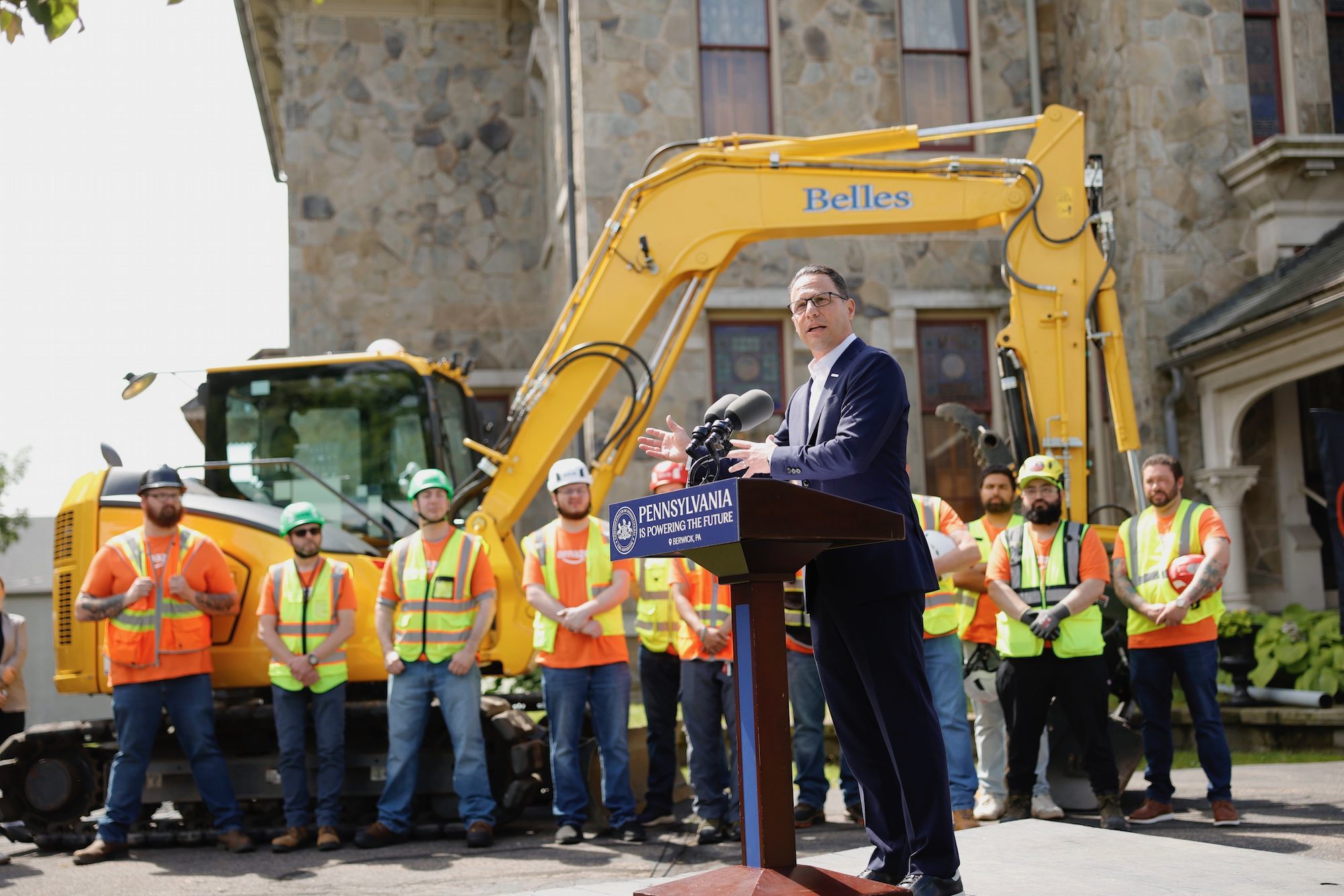
Gov. Josh Shapiro has been at the helm of this push, incentivizing data center developers to take advantage of Pennsylvania’s resources to accommodate these energy-guzzling facilities and offering industry tax breaks that will cost taxpayers big time.
Gov. Josh Shapiro announces a $20 billion investment by Amazon in Pennsylvania data centers in Salem Township and Falls Township in June 2025.
Instead of diving in headfirst, lawmakers must consider the real-world consequences of a largely unfettered data center build-out. That’s why the grassroots organization I am part of, Food and Water Watch, has endorsed the three-year moratorium State Sen. Katie Muth (D., Berks, Chester, and Montgomery) introduced in the Assembly.
A recent comprehensive report from Food and Water Watch details the harms AI-driven hyperscale data centers will bring. Shapiro’s embrace of this technology — notwithstanding his recent attempt to make data center development less worrisome to Pennsylvania residents — has left communities grappling with secretive billion-dollar projects that threaten to swallow agricultural land, drive up residential and small-business electricity rates, and ruin quality of life.
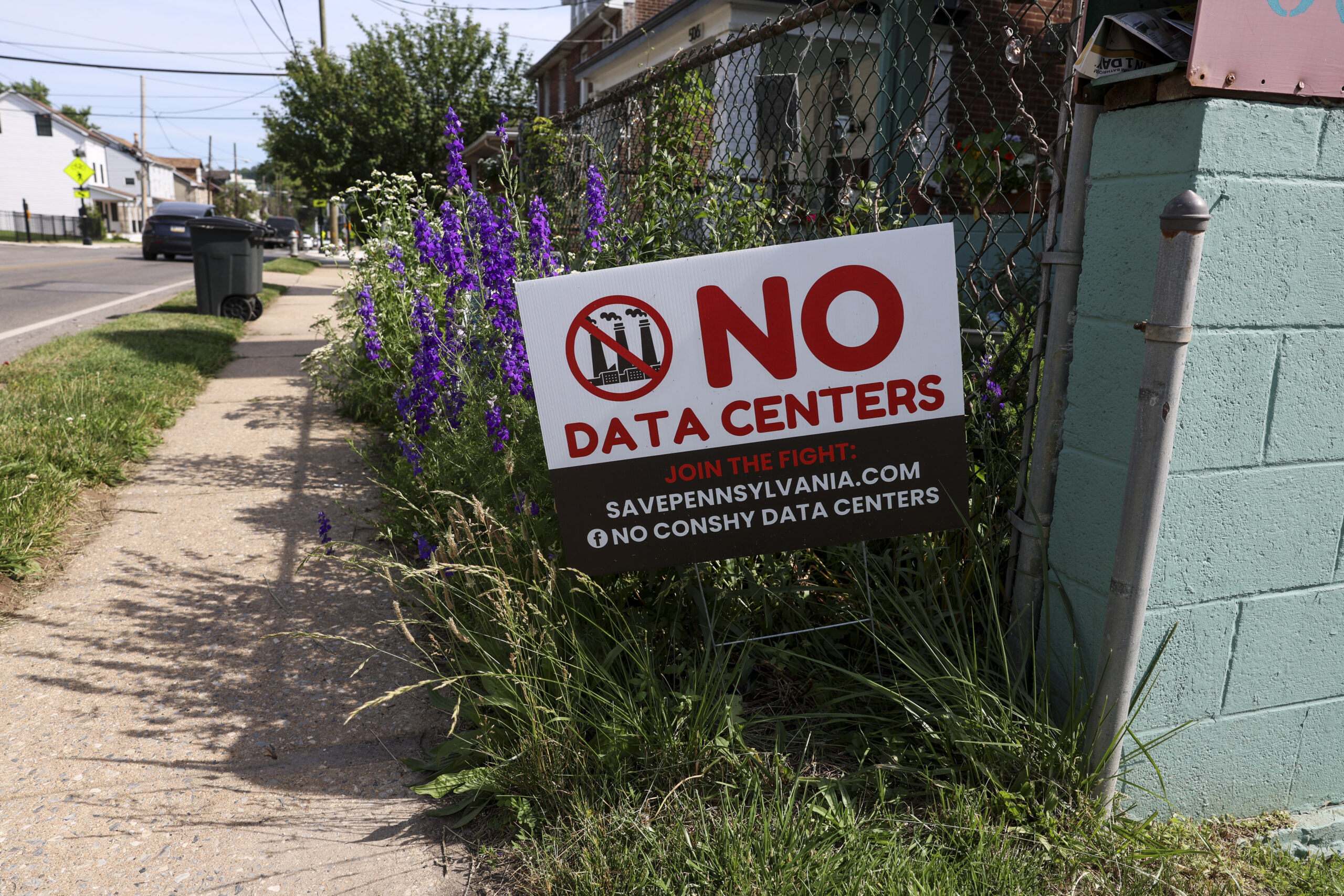
A yard sign protests the proposed data center on New Elm Street near the Closed Cleveland-Cliffs steel mill, photographed on June 4 in Conshohocken.
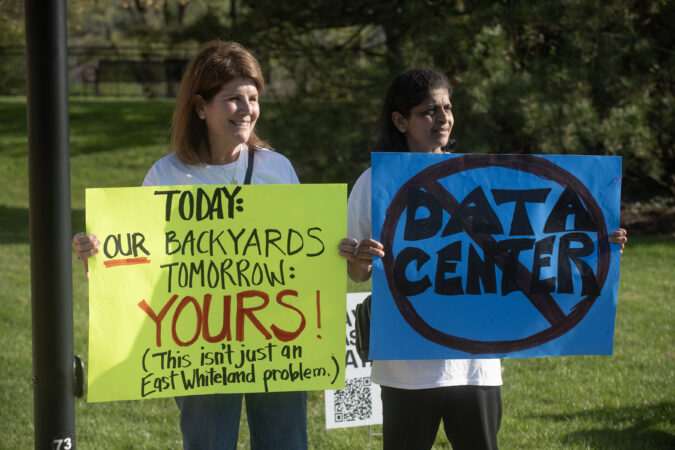
Communities across Pennsylvania have pushed back on each and every data center project, from East Whiteland and Hazle Townships to Montour County and beyond. Concerns include lack of transparency and due process, high water use, skyrocketing energy prices, an unprecedented build-out of power plants and high-voltage transmission lines, and more.
These concerns are not purely theoretical — Pennsylvanians are already seeing the financial impacts of the data center build-out. In 2024, Pennsylvanians paid $492 million in energy infrastructure upgrades for 16 data centers. Shapiro’s GRID plan notwithstanding, as more projects are proposed and more infrastructure is needed to bring these sites online, we can expect ratepayers to fork over more of their hard-earned cash for facilities that do not serve their needs or interests.
Pennsylvanians don’t have to look far to see what unchecked data center expansion can do to communities.
Two states away in Virginia, massive, loud data centers have been built right next to homes, turning neighborhoods into industrial sites. Now this industry is attempting to bully Pennsylvania communities to accept the same fate.
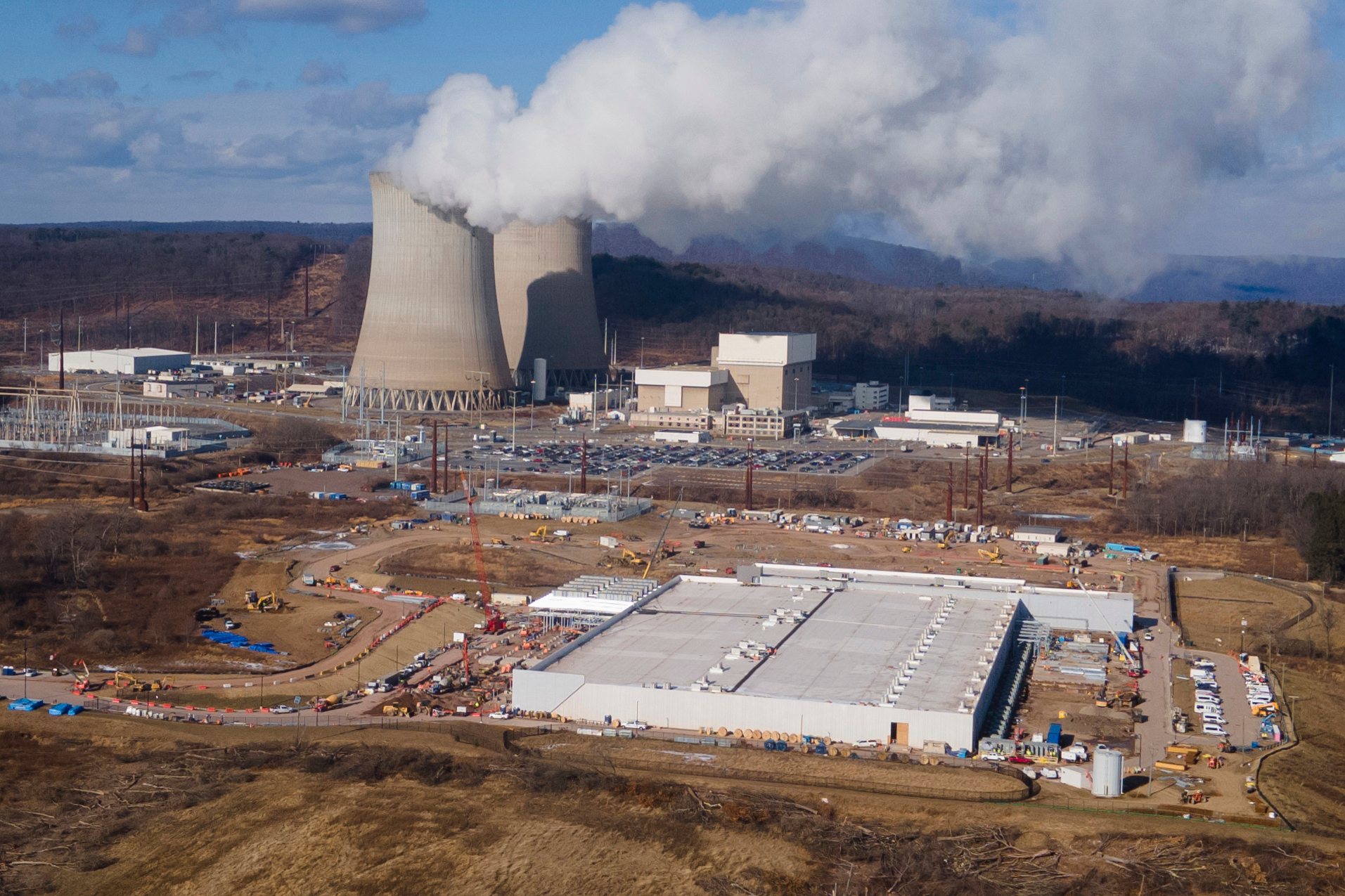
A data center owned by Amazon Web Services, front right, under construction next to the Susquehanna nuclear power plant in Berwick, Pa., in January 2025.
Many of these industrial compounds are proposed for rural Pennsylvania, threatening to disrupt communities’ way of life. A proposed data center in South Whitehall Township, Lehigh County, would include six buildings spread across 410 acres — which Food and Water Watch analysis finds is equivalent to the size of 100 Walmart supercenters.
On an even grander scale, as part of the Shapiro-touted $20 billion data center AI investment by Amazon, a proposed campus in Luzerne County would stretch across 1,5200-1,700 acres.
These are not modest developments. They are sprawling industrial complexes that threaten to reshape rural and residential communities beyond recognition.
These proposals also threaten drinking water supplies. Hyperscale data centers can consume as much as two million to eight million gallons of water daily, putting enormous strain on local water supplies. This comes as the majority of Eastern Pennsylvania, a hot spot for development, is currently experiencing moderate to severe drought.
Nationwide, two-thirds of data centers built since 2022 have been built in water-stressed regions, showing an alarming pattern of development that ignores the limits of local resources. Pennsylvanians should not be forced to compete with corporate server complexes for access to safe, reliable drinking water.
Data centers are not a public good. They are profit-driven extractive industrial facilities that destroy local communities’ quality of life, all while draining their most necessary resources.
Lawmakers have the choice to stand with communities and allow state regulators to pause and take an informed path when deciding if — not how — data centers can coexist with the needs of Pennsylvanians.
It’s why Food and Water Watch drove 180-plus impacted residents facing data center projects in their communities to Harrisburg on June 23, and it’s why Pennsylvanians across the commonwealth must call on their legislators to support Muth’s bipartisan moratorium on hyperscale data centers today, before we all pay the price later.
Ginny Marcille-Kerslake is a senior organizer for Food and Water Watch in West Whiteland Township.
I’ve driven across the Ben Franklin Bridge countless times but until last week I’d never walked across it, and I walked across the Brooklyn Bridge once, so I’ve quietly carried that shame with me for years.
When I received a news release about the bridge turning 100 on July 1 and a subsequent anniversary party on July 11 that will close it to vehicles for public use for the first time since Pope Francis’ visit in 2015, I wanted to finally check walking across it off my Philly bucket list before the event.
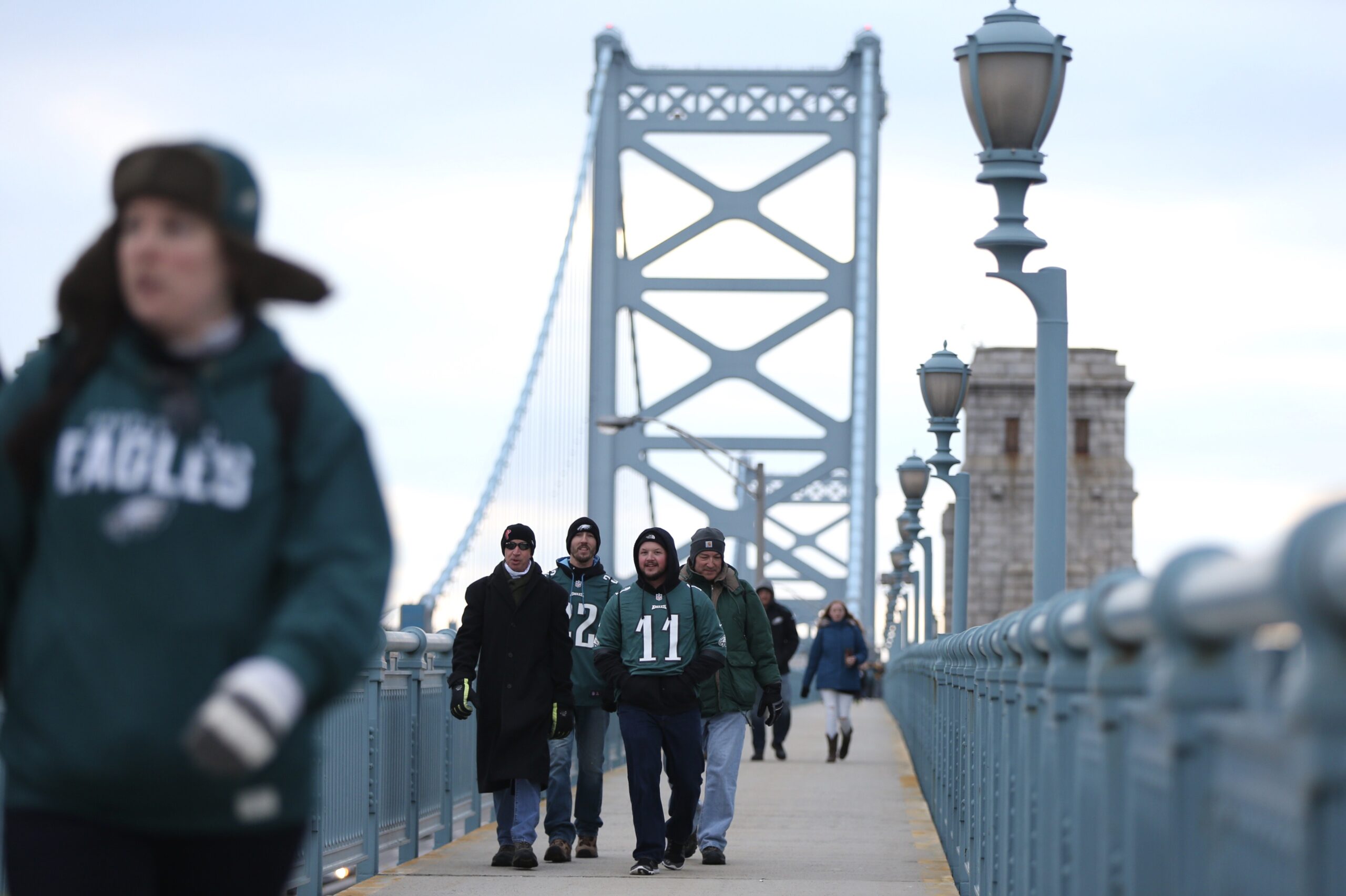
Fans cross the Ben Franklin Bridge into Philadelphia on the morning of the Eagles’ Super Bowl parade in 2018.
I was going to go it alone, but I decided to reach out to Mike Williams, spokesperson for the Delaware River Port Authority (DRPA), which manages the bridge, and he offered to schedule a walkway tour of it for me with DRPA principal engineer Michael Howard.
I met both men at Fifth and Race Streets at the base of the bridge on the Philly side, but as luck would have it, we showed up on opposite sides of the heavily-trafficked span. We waved at each other across the cars and as I tried to figure out how to Frogger my way over to them, Howard and Williams disappeared.
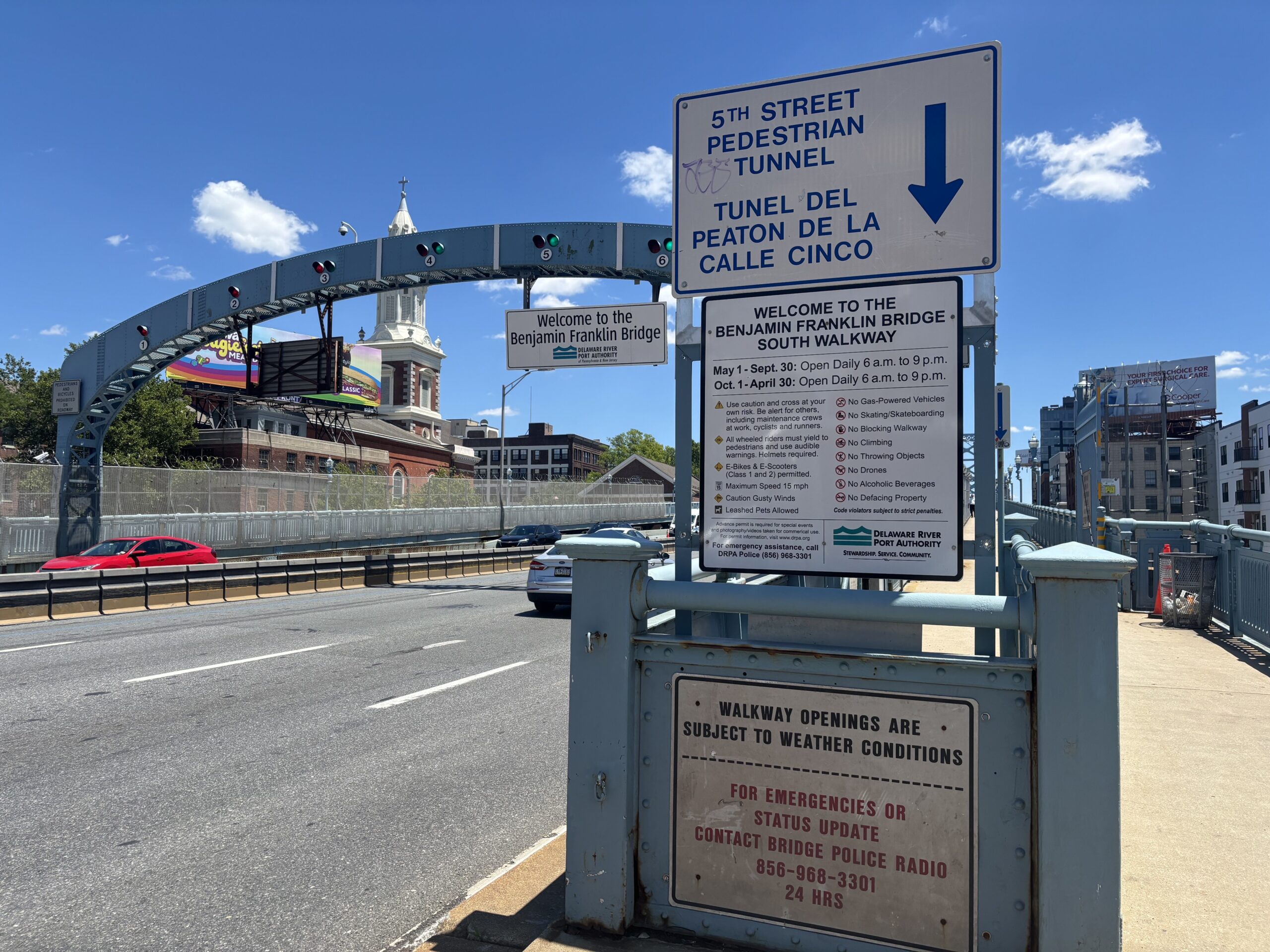
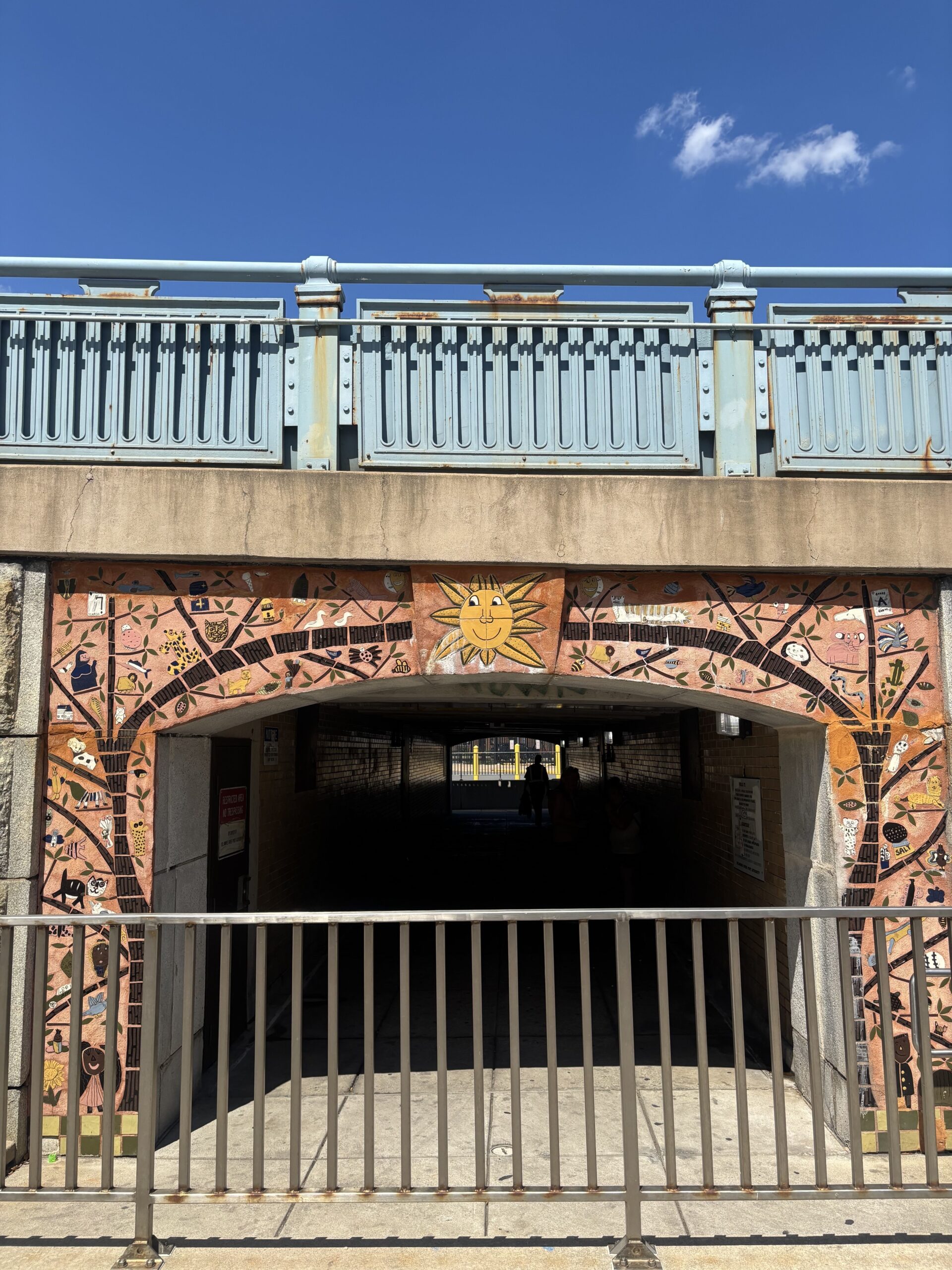
The men popped up out of a stairwell right next to me, having used the Fifth Street pedestrian tunnel under the bridge.
The entrance to the Fifth Street pedestrian tunnel on the south side of the Ben Franklin Bridge in Philadelphia.
“This was one of the original things that we incorporated into the bridge because we didn’t want people to try to walk across the traffic — because they would, you know,” Howard said, and I agreed.
Obviously, it was the first place I wanted to check out.
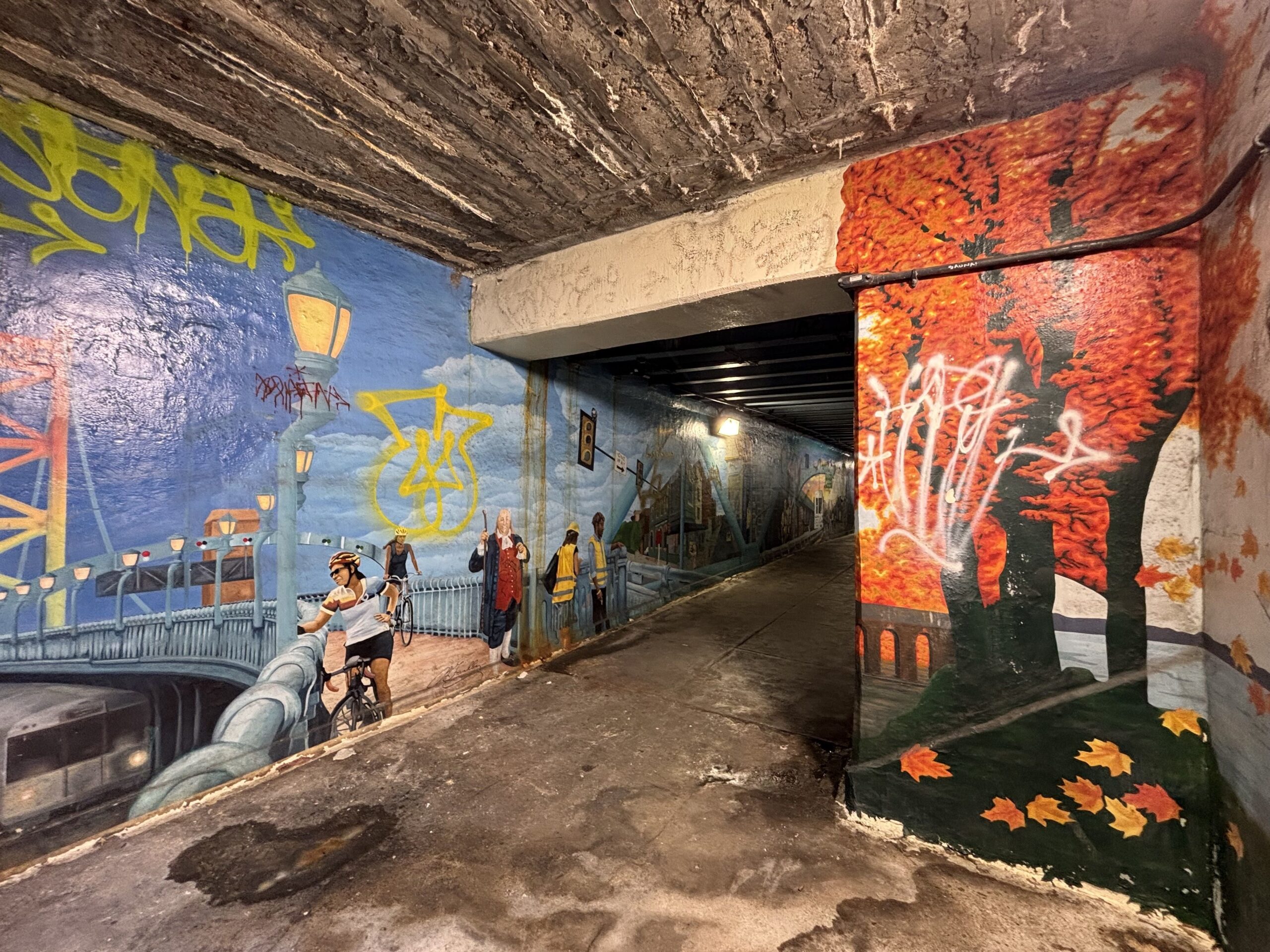
The “Building Connections through Time” mural inside of the Fifth Street pedestrian tunnel on the Philadelphia side of the Ben Franklin Bridge.
The entire length of the 91-foot-long tunnel was painted with a vibrant Mural Arts Philadelphia work by Brad Carney and Melissa Mandel. Created in 2018, Building Connections through Time shows people using the bridge, the building of it, and images of its early years. There are also paintings of Independence Hall, Benjamin Franklin, and other bridges that span the Delaware River.
Finding one of the city’s most secluded murals felt like finding one of those wonderful Philly secrets the city gives sometimes, if you never stop exploring it.
Come along with me as I explore one of Philly’s most secluded murals.
Back on the surface, Howard said that while the bridge has two pedestrian walkways, for operational reasons, only one side is open at a time and it’s usually the south side. The walkway has restricted hours, so be sure to check the signs (currently, it’s open from 6 a.m. to 9 p.m.).
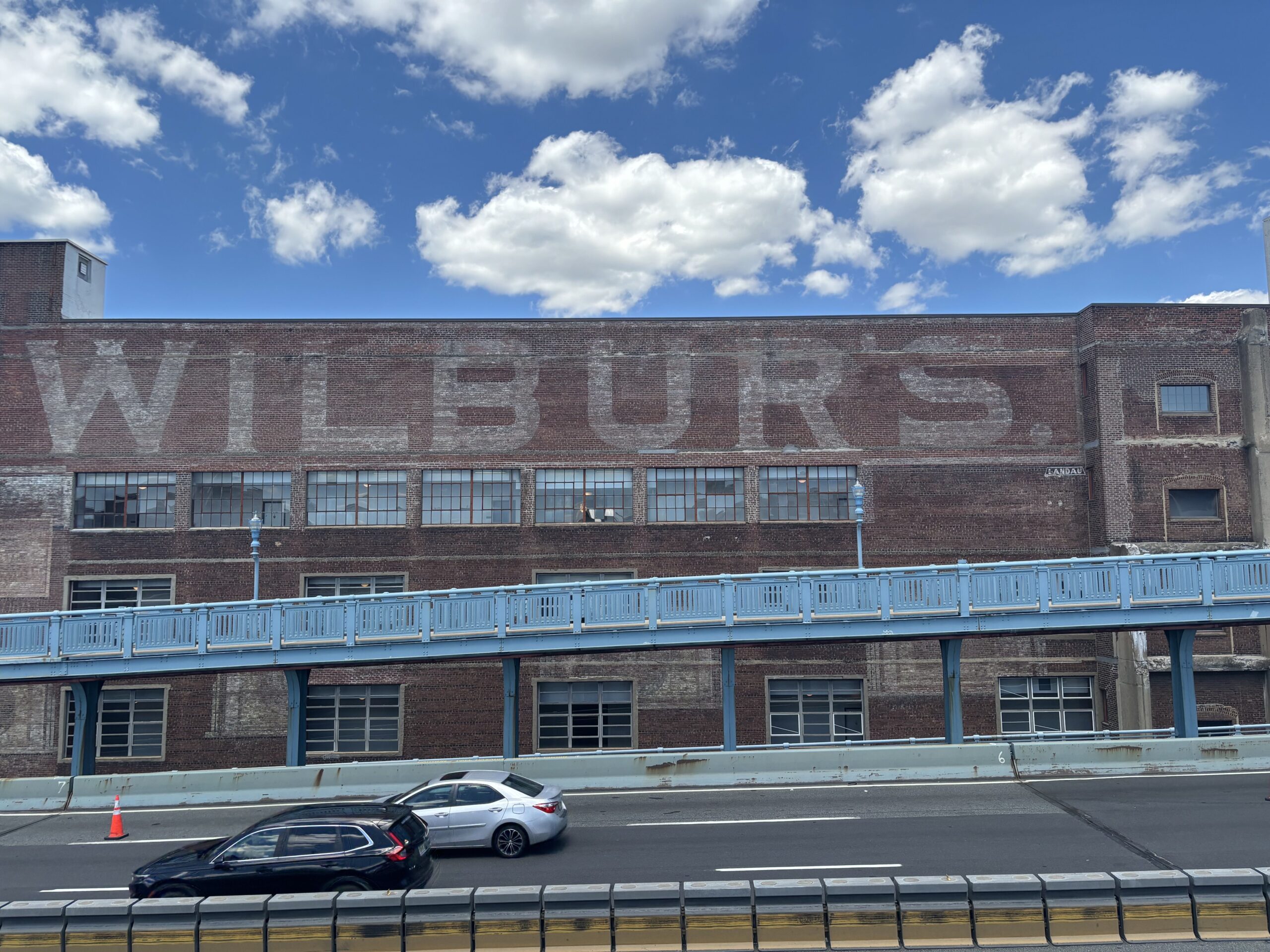
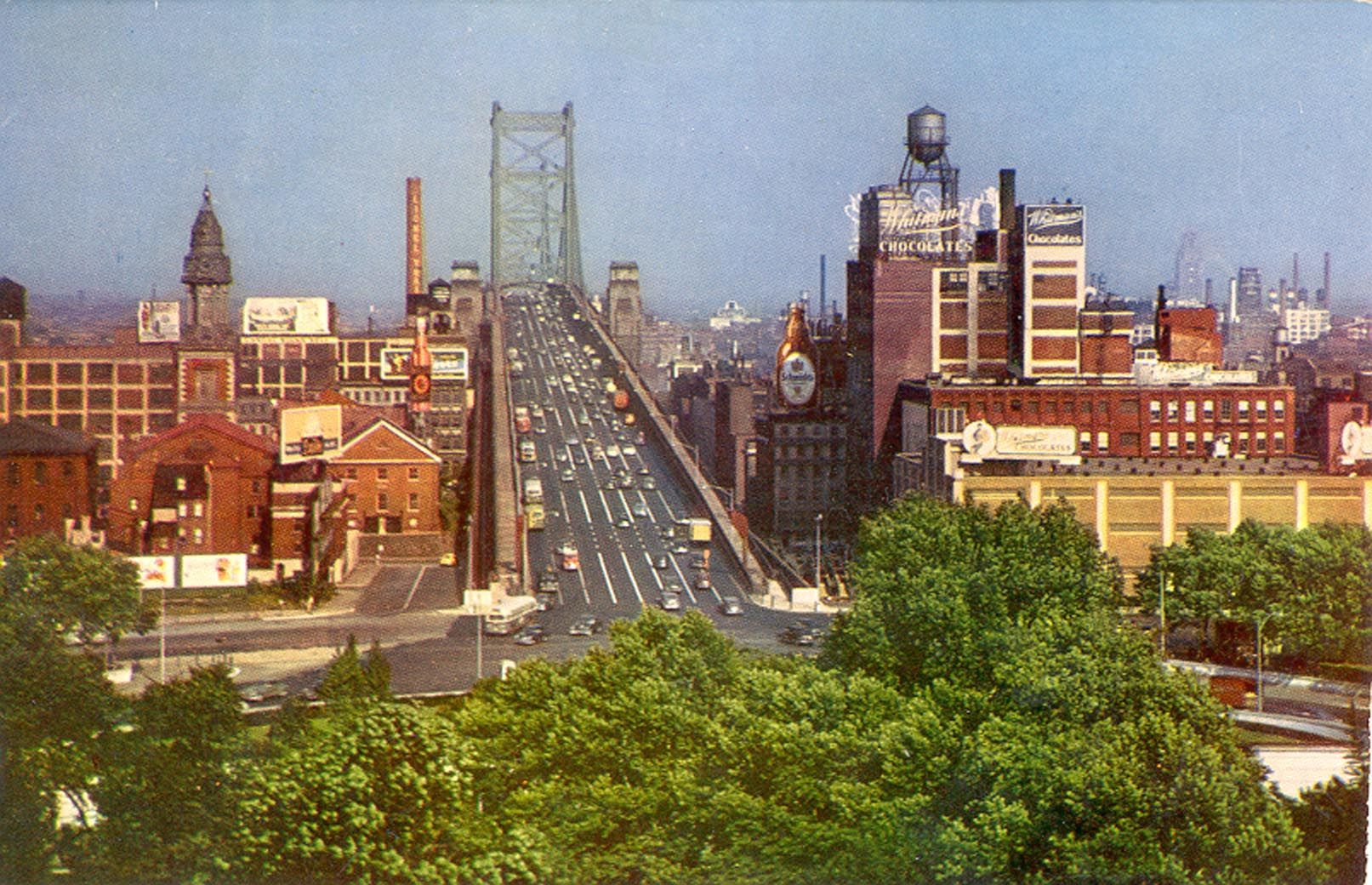
Howard pointed out the old Wilbur Chocolate factory on Third Street and explained that a part was sliced off to make way for the bridge.
“One of the things that we had to do when we were constructing was kind of take a surgeon’s scalpel to the area because you know with Old City, everything’s tightly packed and we wanted to make sure we took the bare minimum of structures,” he said.
A piece of the former Wilbur’s Chocolate Factory had to be sliced off to make way for the Benjamin Franklin Bridge.
Also under threat when the bridge was built was nearby St. George’s United Methodist Church on Fourth Street. Opened in 1769, it’s the country’s oldest Methodist church in continuous service.
“Luckily, the engineers were able to just adjust the angle of the approach ever so slightly to avoid encountering the building,” Howard said.
I marveled as I looked at the mere 14 feet that still separates St. George’s from Philly’s big Ben. The engineers left just enough room for the Holy Spirit.
‘Bridge angels’
As we began our journey across the bridge, Howard said it took about four-and-a-half years to build and it was designed by architect Paul Philippe Cret, who also designed Philly’s Rodin Museum. The bridge was constructed with eight lanes — six for traffic and two for trolleys, as well as two tracks for heavy rail.
But in the time it took to build it, trolleys went out of fashion and buses came in. The trolley tracks sat unused until the 1940s, when they were paved over. A vast, empty space for a never-opened trolley station remains under the Bolt of Lightning sculpture near the base of the bridge.
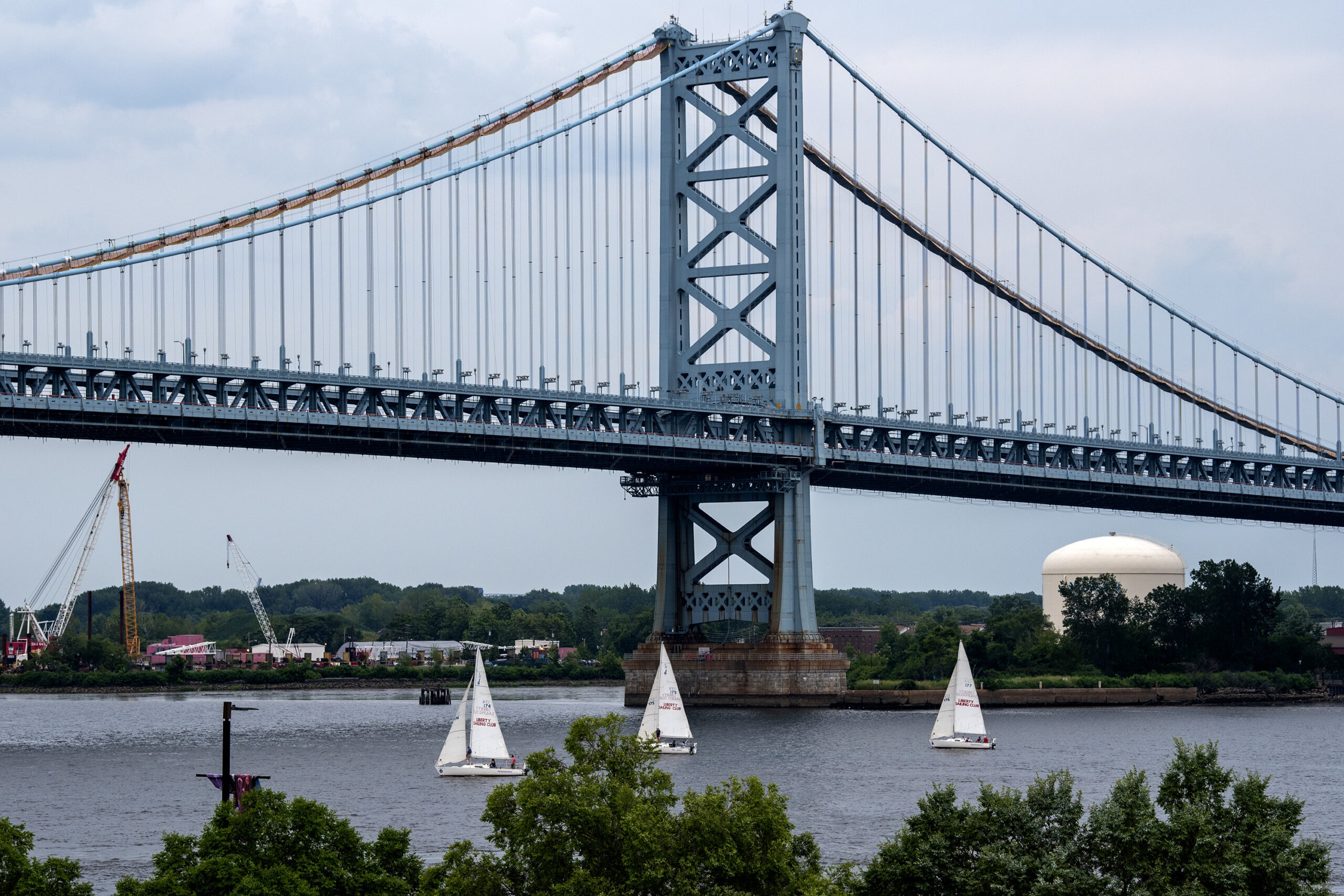
Sailboats pass under the Ben Franklin Bridge in 2020.
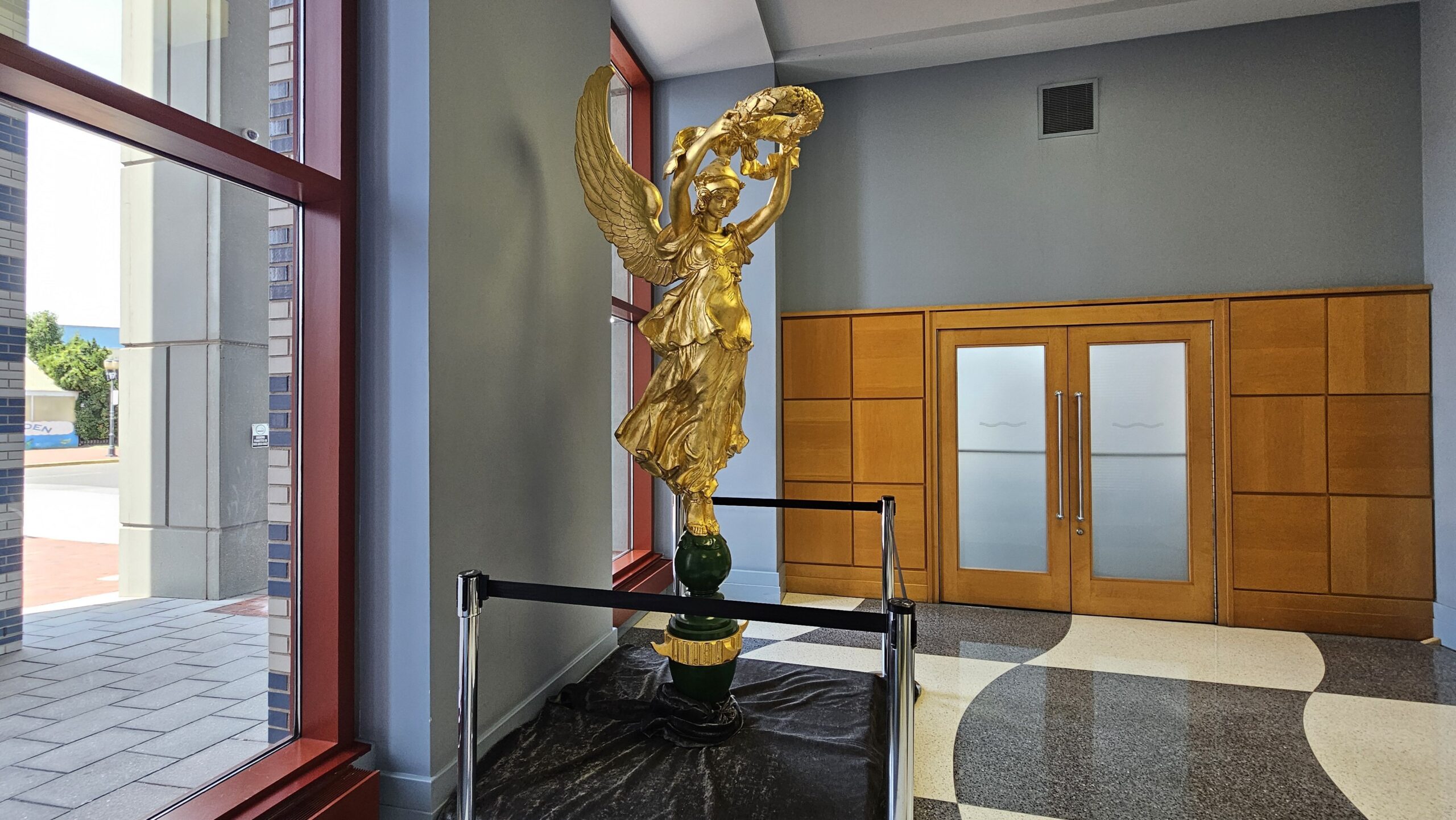
Another original component lost when the trolley tracks were paved over were four 75-foot-tall pylons — two on either side of the bridge — that were topped with bronze angel statues called Winged Victory.
One of the angel statues is in the lobby of DRPA’s headquarters and three are in storage, but one will be displayed at the upcoming 100th anniversary celebration, according to Williams.
One of the four “Winged Victory” statues that used to decorate the Ben Franklin Bridge is now on display at the Delaware River Port Authority’s headquarters.
‘A living beast’
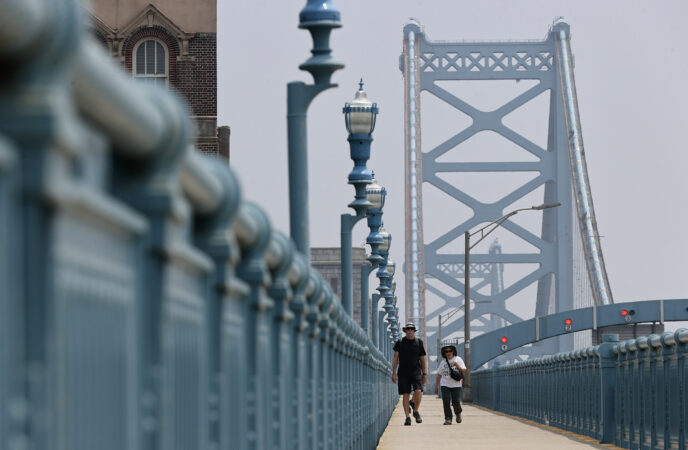
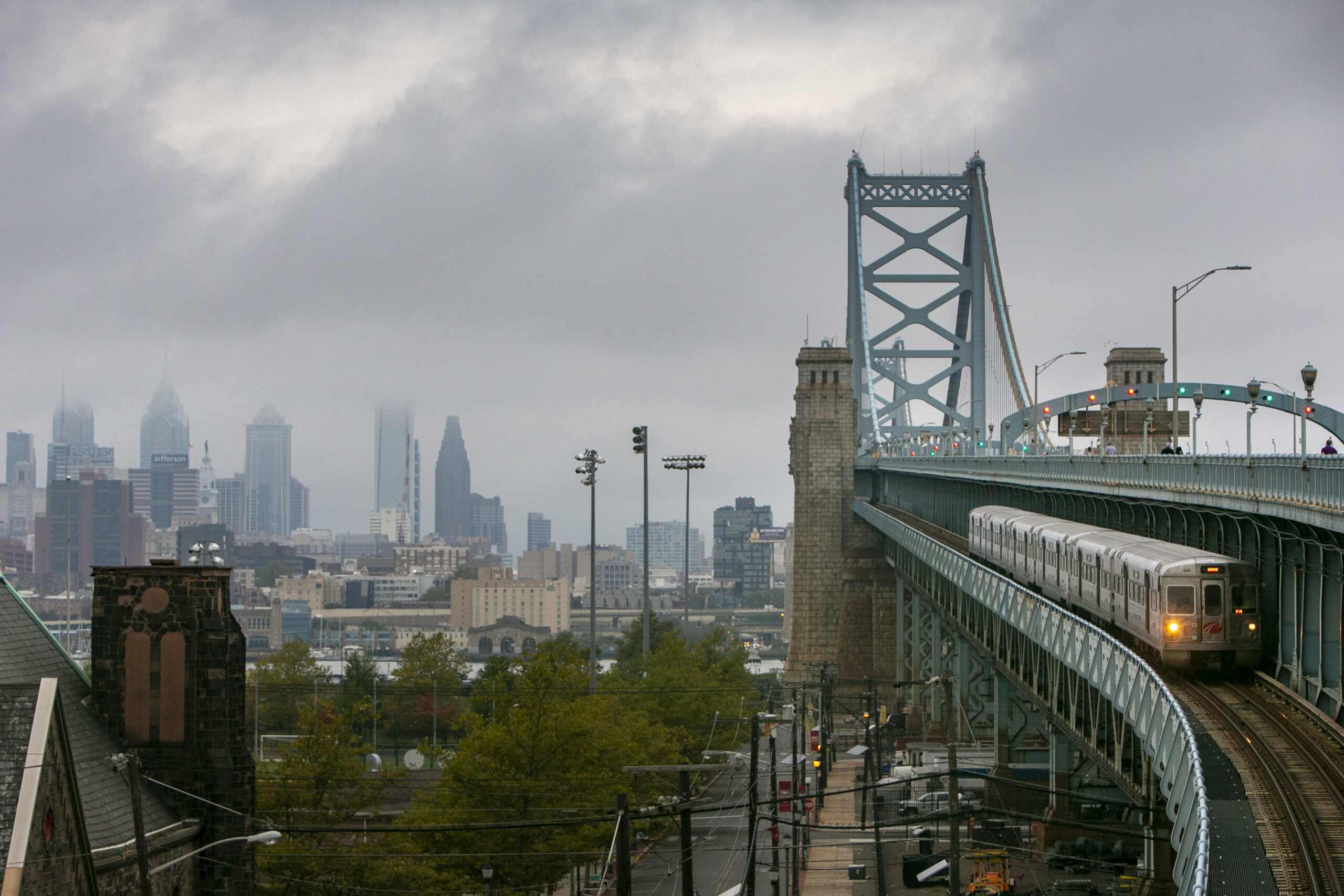
Shortly after we began our trek on the 1.3-mile walkway, I felt a PATCO train speeding beneath my feet and the bridge move ever so slightly.
“The bridge is dynamic, almost like a living beast because the steel expands when it gets warm out and with traffic, it bounces,” Howard said.
A PATCO train travels from Philadelphia to Camden underneath the pedestrian walkway of the Ben Franklin Bridge.
I got used to the sensations within minutes. That being said, I’m not afraid of heights. It could be unnerving if you are.
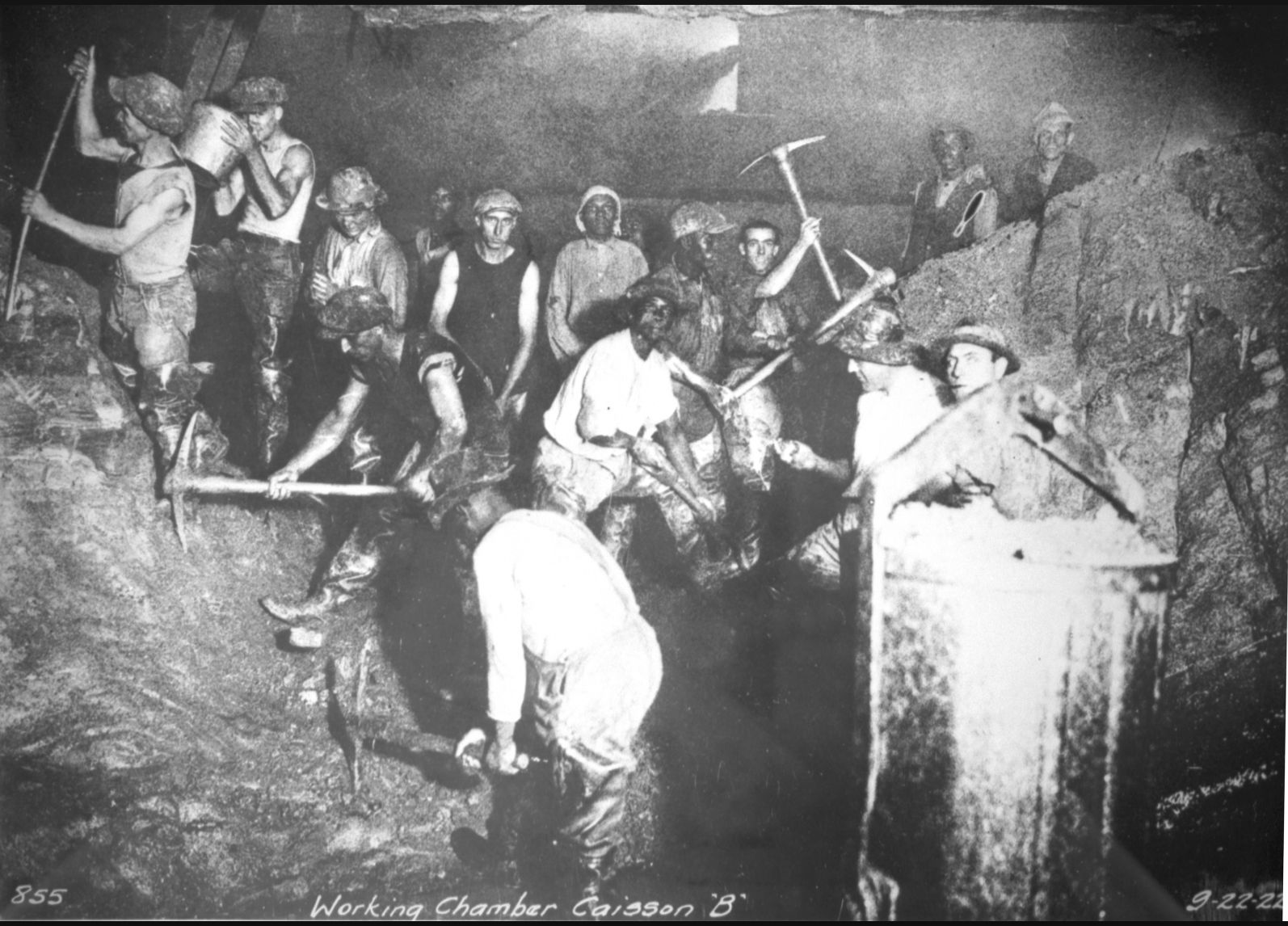
It took $36 million and 1,300 people to build the 376-foot-tall bridge that extends an additional 100 feet or so below the river, Howard said. Guys known as “sand hogs” worked in submerged watertight structures called caissons where temps sweltered into the 90s, even in winter, to dig down to the bedrock of the Delaware River.
In a photo dated 1922, men known as “sand hogs” work in a submerged watertight structure called a caisson to dig down to the bedrock of the Delaware River during the construction of the Benjamin Franklin Bridge.
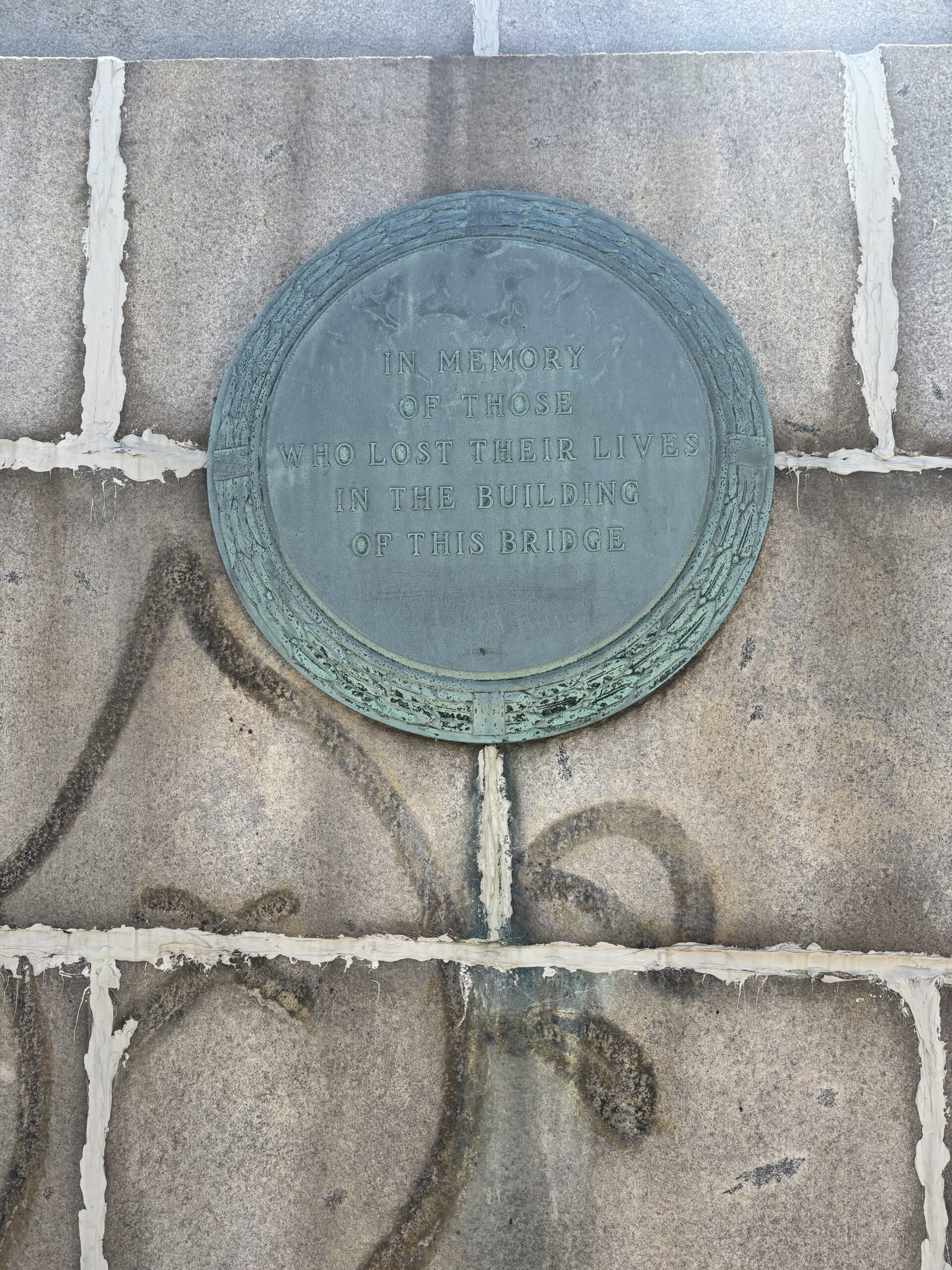
Fifteen workers died in the construction of the bridge. We passed a circular plaque in their memory as we walked. I wondered who they were, how they died, and how they lived.
“Unfortunately, the rule of thumb at the time was for every million dollars you’re spending, you expect to lose a life … so by that rationale you could have had 36 fatalities.” Howard said. “Nowadays, you know, one injury is unacceptable.”
A plaque on the Benjamin Franklin Bridge is dedicated in memory of those who lost their lives while building it.
Unique elements
Our pace was a steady stroll, so we were often passed by runners, walkers, and cyclists. Some appeared to be having a good time, and others looked like they were going through tough times. Some talked to themselves and some stopped to take photos. It was a microcosm of Philly and Camden, suspended high above the river.
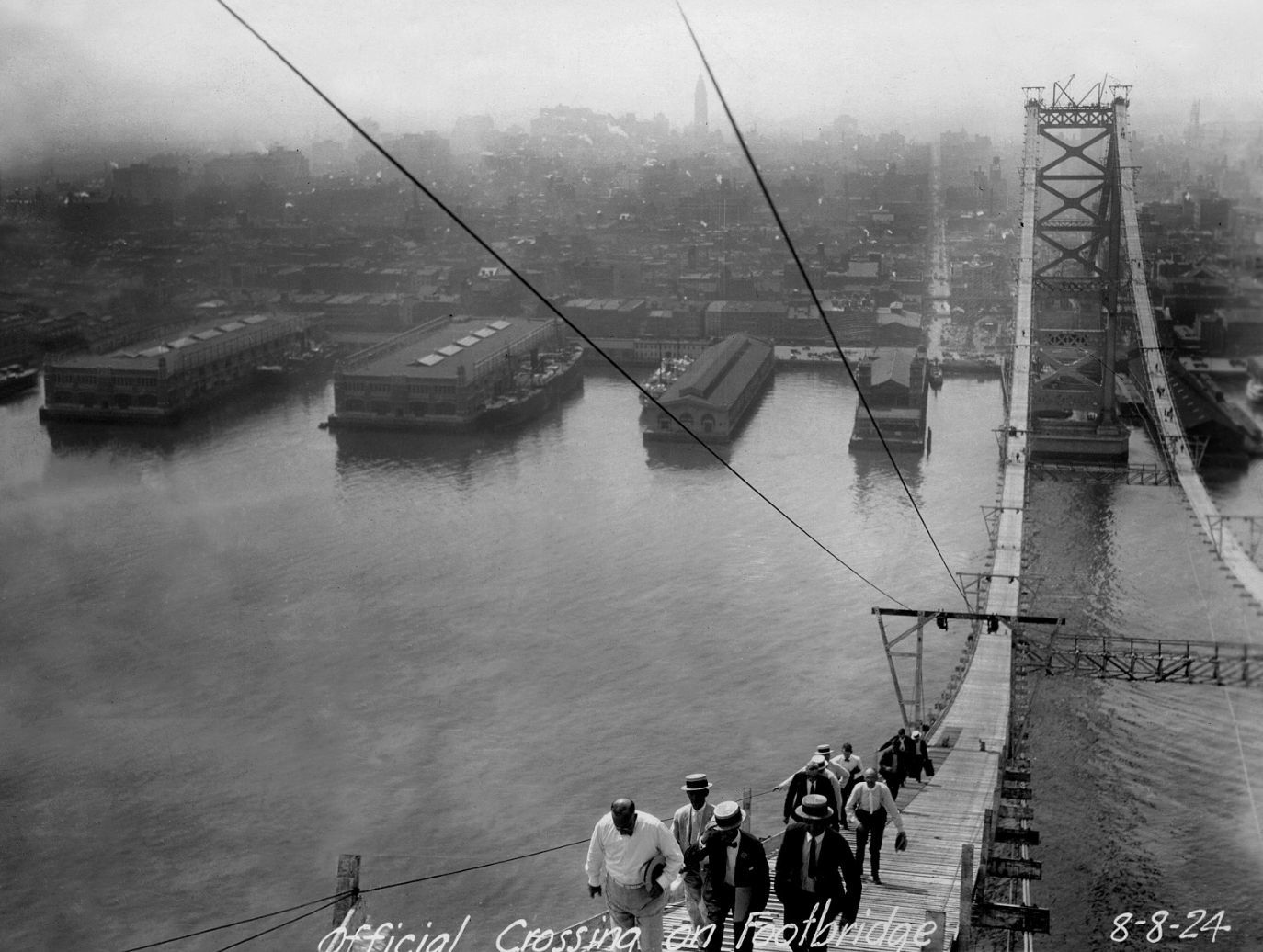
Howard said when the bridge was built, its chief engineer believed the walkways wouldn’t be used “in an increasingly or completely motorized age.”
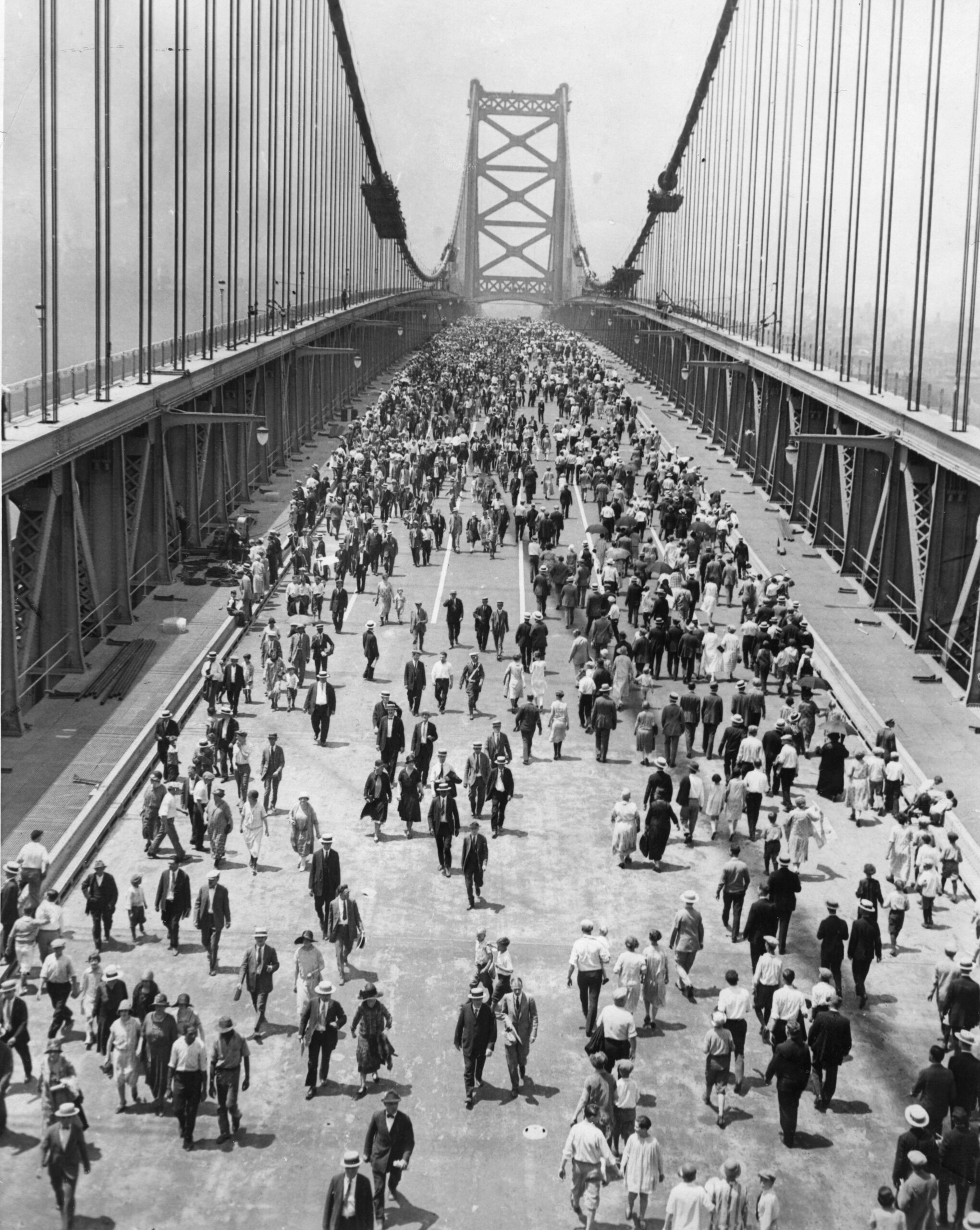
A photo dating from 1924 shows the first official crossing of the Benjamin Franklin Bridge’s pedestrian walkway prior to the 1926 opening of the bridge.
“But you see today the amount of people that are using this walkway and it’s one of the unique elements of this bridge,” he said.
I looked ahead to Camden and then back to Philly. I was so grateful for this walkway and this view. I couldn’t imagine not having it and I couldn’t believe it took me so long to see the city from this new perspective.
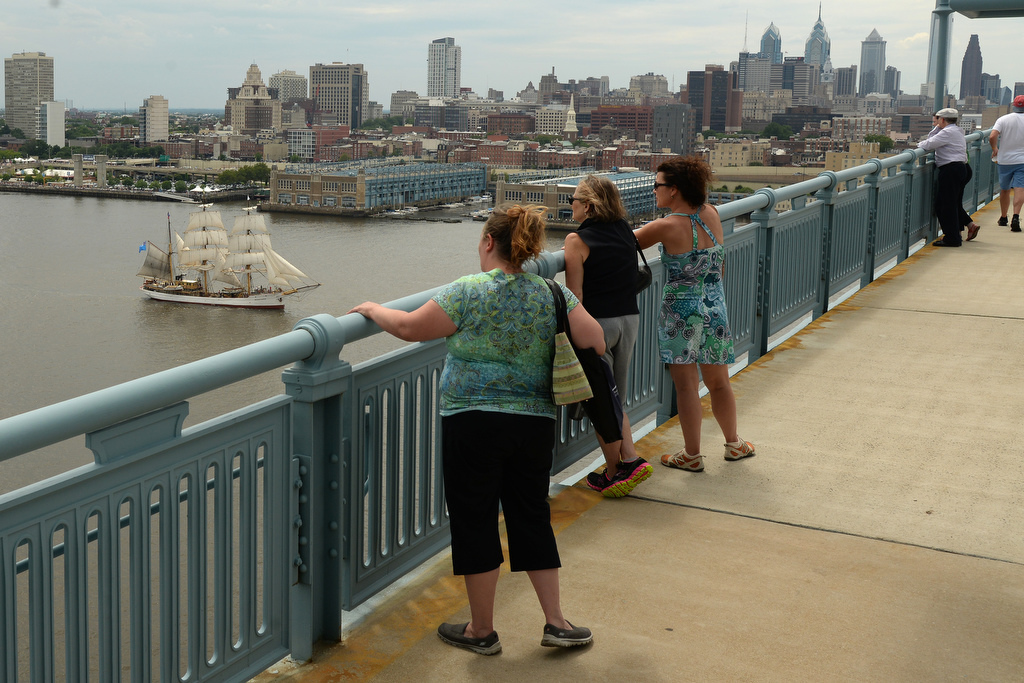
Spectators watch from the Ben Franklin Bridge pedestrian walkway as the Picton Castle sails up the Delaware River in 2015 during the Parade of Tall Ships.
The only thing I found worrisome and the thing that kept all three of us looking over our shoulders, were the e-bike and e-scooter riders we didn’t always hear zooming behind us. Skateboards and rollerblades aren’t allowed, but certain classes of e-bikes and e-scooters are. Gas-powered vehicles are also prohibited on the walkway, but a guy on a dirt bike definitely zoomed by at one point.
In the bridge’s early days, horses and carriages were allowed on the main span alongside cars, according to Howard, but their slow pace proved dangerous and their excrement, troublesome, so they were banned in the 1940s.
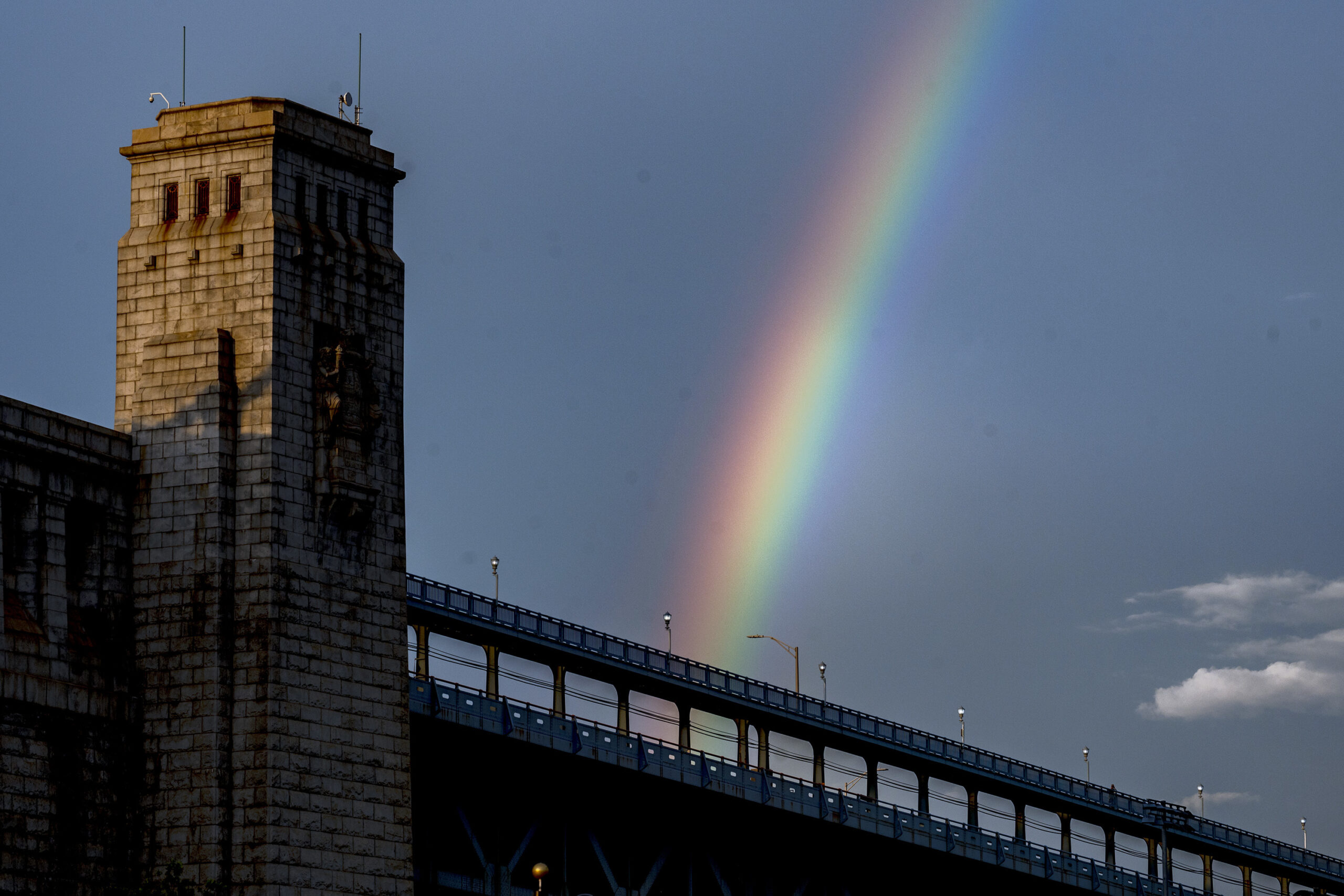
A rainbow appears behind the Camden anchorage of the Ben Franklin Bridge after an early evening rainstorm passes through.
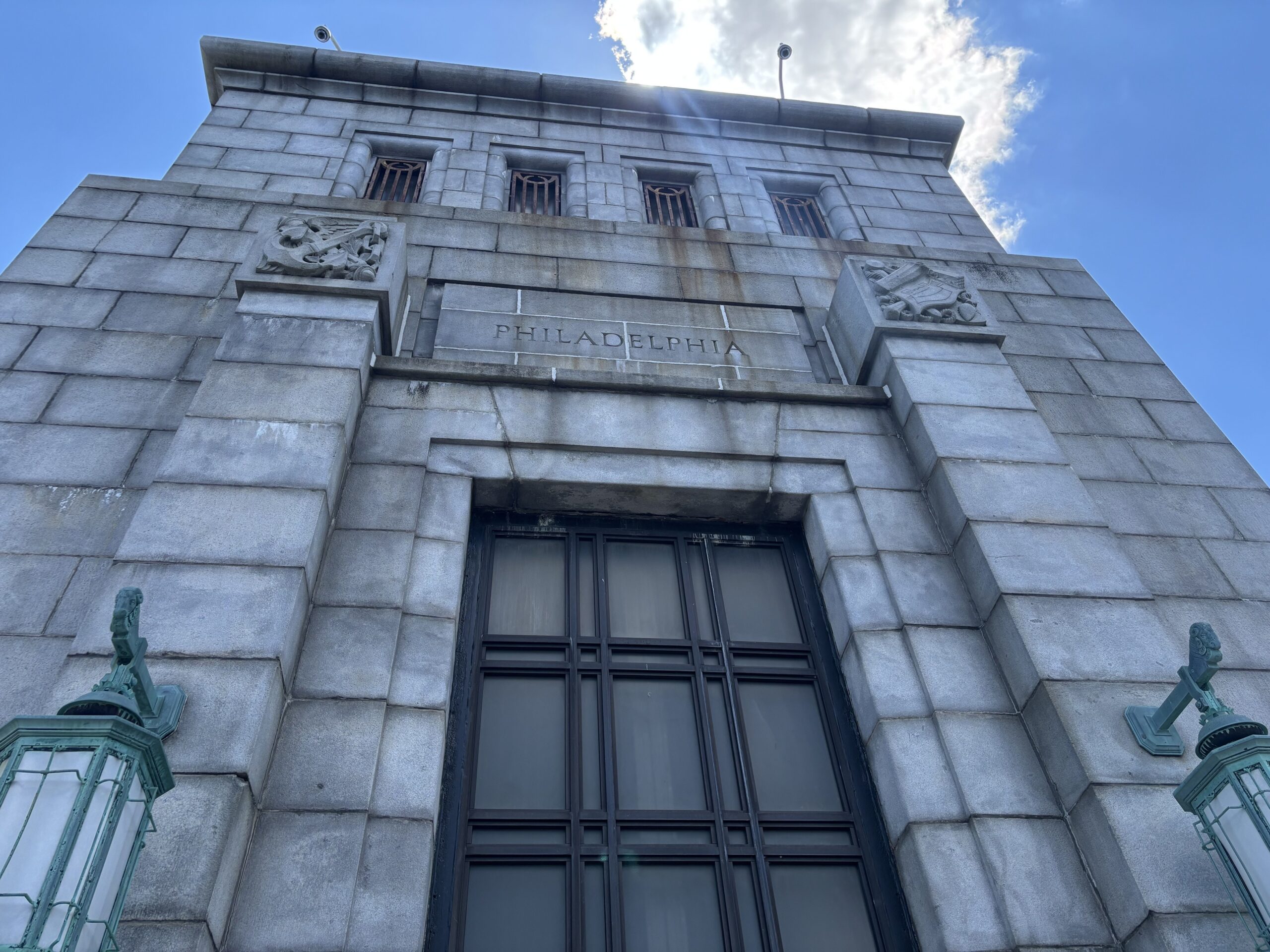
We stopped at one of the Philadelphia anchorages, the massive concrete-and-granite structures where the bridge’s cables are anchored.
These structures were made to house elevators for the trolleys. Alas, the anchorages are off-limits spaces, but Howard told me that each of the four have the same seven artistic tiles inside commemorating milestones in transportation, from one of a Conestoga wagon to one of the USS Shenandoah, the ill-fated dirigible that crashed before the bridge even opened.
One of the anchorages on the Philadelphia side of the Benjamin Franklin Bridge as seen from the pedestrian walkway.
Another name
The Ben Franklin Bridge was the longest suspension span in the world, with a distance of 1,750 feet between the two towers, when it opened on July 1, 1926.
In a front-page Inquirer report, journalist Richard J. Beamish noted 250,000 people crossed the bridge on foot opening day and that the structure was “beautiful as gossamer web and seemingly as frail.”
Pedestrian cross the Delaware River Bridge on its opening day in 1926.
Howard, who quoted that report to me, then asked: “When do you think our first accident was?”
I guessed July 2, 1926. I guessed wrong.
“It was the day it opened,” he said. “People were jockeying to be one of the first to cross the bridge, and over in Camden, you had a fender bender.”
Back then, the span also had a different name — the Delaware River Bridge. It was rechristened in 1956 to avoid confusion when the Walt Whitman Bridge was also built over the Delaware River.
A view of the Benjamin Franklin Bridge in the 1950s.
The Ben Franklin Bridge wasn’t always blue, either. It was originally gray and was repainted to its current color just ahead of the Bicentennial, Howard said.
‘Calm and serene’
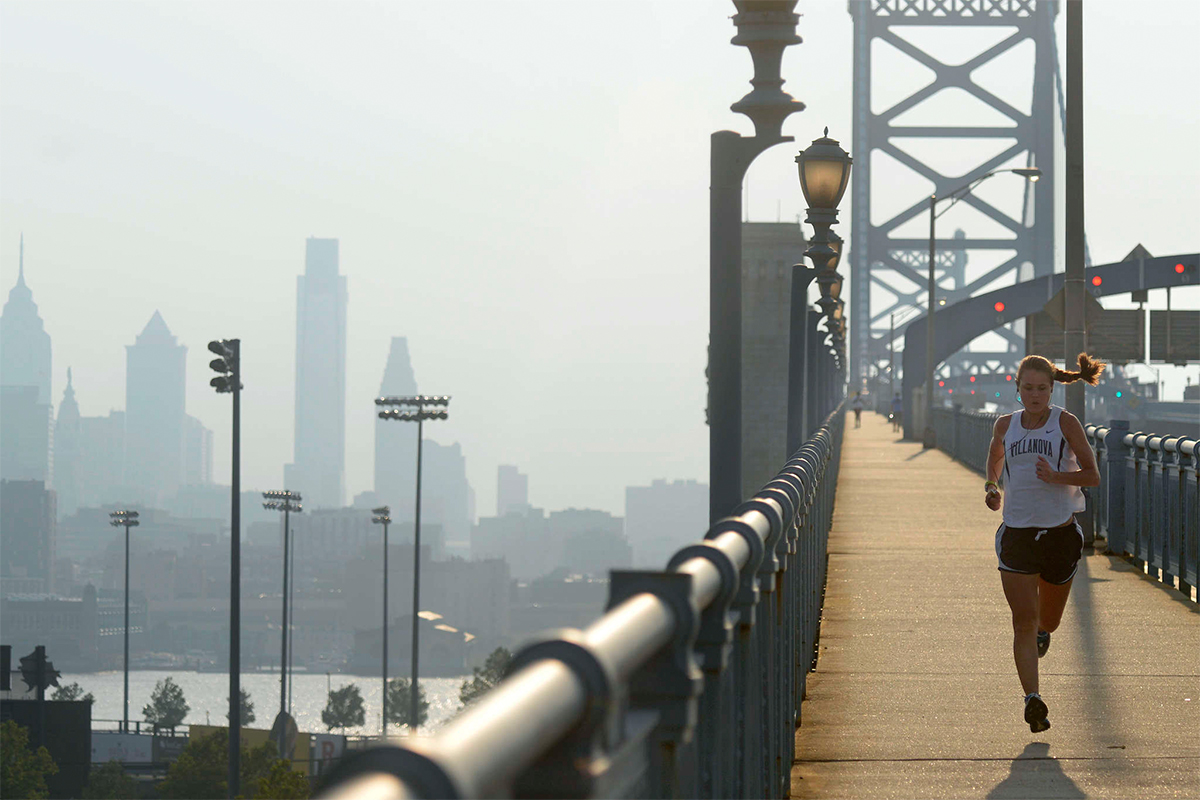
As we stood talking, a man jogging by in Rocky Run T-shirt asked if we’d take a photo of him with the Philly skyline.
Jim Bach of Voorhees works in Camden and likes to run the bridge during his lunch break.
“It’s fantastic. I mean the views that you get when you’re up here, it’s just calm and serene,” he said.
I too felt serene. It was quiet and peaceful on the bridge and being atop it helped me see the city I love in a new way.
A jogger runs across the Ben Franklin Bridge in an Inquirer file photo.
Howard also helped me to see something else — the Betsy Ross, Walt Whitman, and Commodore Barry Bridges are all visible from the top of the Ben Franklin.
“All bridges essentially become monuments to the area,” he said. This was most true of the one we were standing on.
We talked about the Ben Franklin’s many appearances in television and movies, from Blow Out to 12 Monkeys.
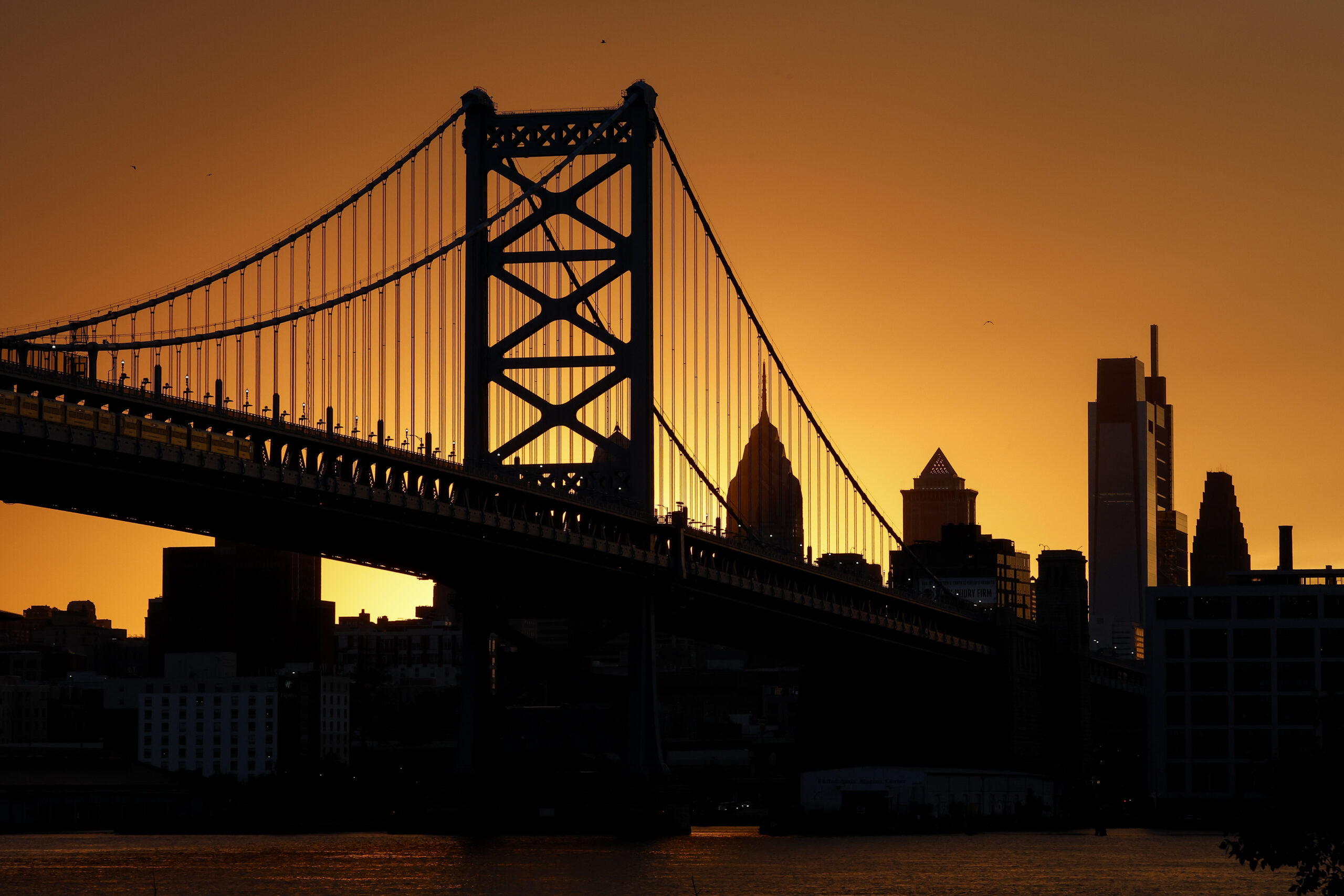
The sun sets behind the Ben Franklin Bridge, seen from Cooper’s Poynt Park on Tuesday, Sept. 30, 2025 in Camden, NJ.
“Last year they kept coming back from commercial breaks during Monday Night Football and they showed one of three things — the Liberty Bell, someone making cheesesteaks, or the bridge,” Howard said.
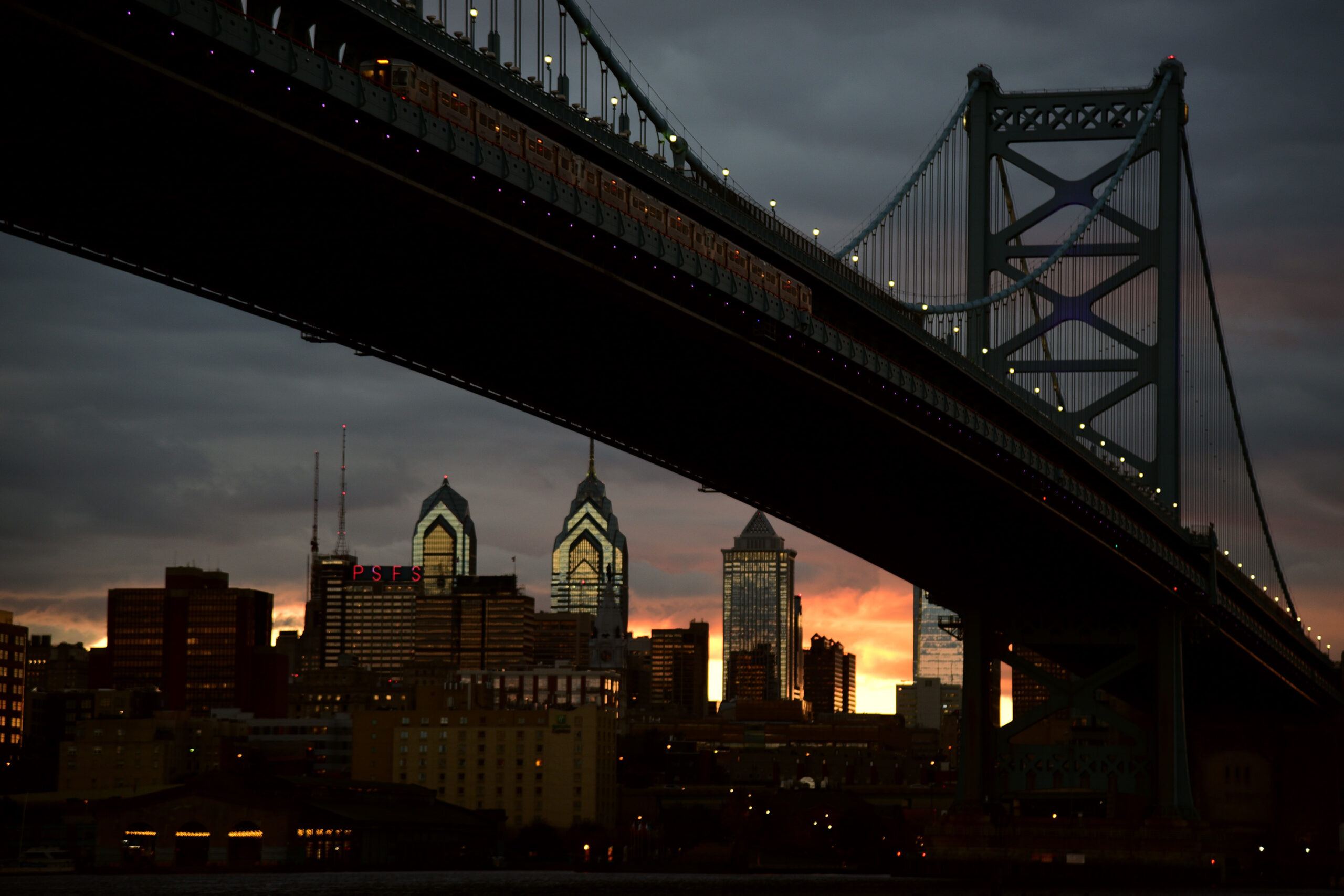
In its 100 years, the bridge has become a visual touchstone for the region. You see it and you know you’re in Philly, whether you’re watching a movie or coming back from a road trip. It’s given Philly its sense of place as much as the LOVE sculpture or Independence Hall.
A great connector
When we got to Camden, we walked through the pedestrian tunnel on that end, too. It doesn’t have a mural, but the exterior is decorated with a bright mosaic of birds and animals created by Camden schoolchildren in the early 2000s.
A mosaic created by Camden schoolchildren decorates the exterior of the pedestrian tunnel on the Camden side of the Benjamin Franklin Bridge.
On our return walk, I asked Howard if he had a moment on the bridge that’s stuck with him. He said a few years ago, while he was leading a tour, there was a commotion on the Philly side. A kitten found its way onto the bridge and police were called. The feline then crawled into the engine compartment of a police cruiser, which had to be taken apart to get it freed.
“I was like, ‘Yeah, so I gotta go adopt it,’” Howard said.
And so he did, and he named the furry little girl Beanie.
I thought of a poignant moment I had once on the bridge. I was a passenger in a vehicle years ago, when I looked over and saw that the car I was in was traveling at relatively the same speed as the PATCO train next to us.
The sun sets over the Philadelphia Skyline behind the Benjamin Franklin Bridge looking southwest from Cooper’s Point Waterfront Park in Camden in this Inquirer file photo.
I locked eyes with a woman on the train, who looked a lot like me. We smiled at each other and I waved and she waved back. It’s a brief moment that’s always stuck with me. Maybe it’s because I felt like I could have been her in another life, or she could have been me.
Walking the bridge and hearing its stories, I realized that it connects so much more than just Camden and Philly. It connects all of us to each other — in big and small ways — and it connects our future with our history.
Today, I have a new story about the Benjamin Franklin Bridge, the day I walked across it. If you haven’t done so yet, I encourage you to walk it, too, and make a new memory with one of Philadelphia’s great old structures.
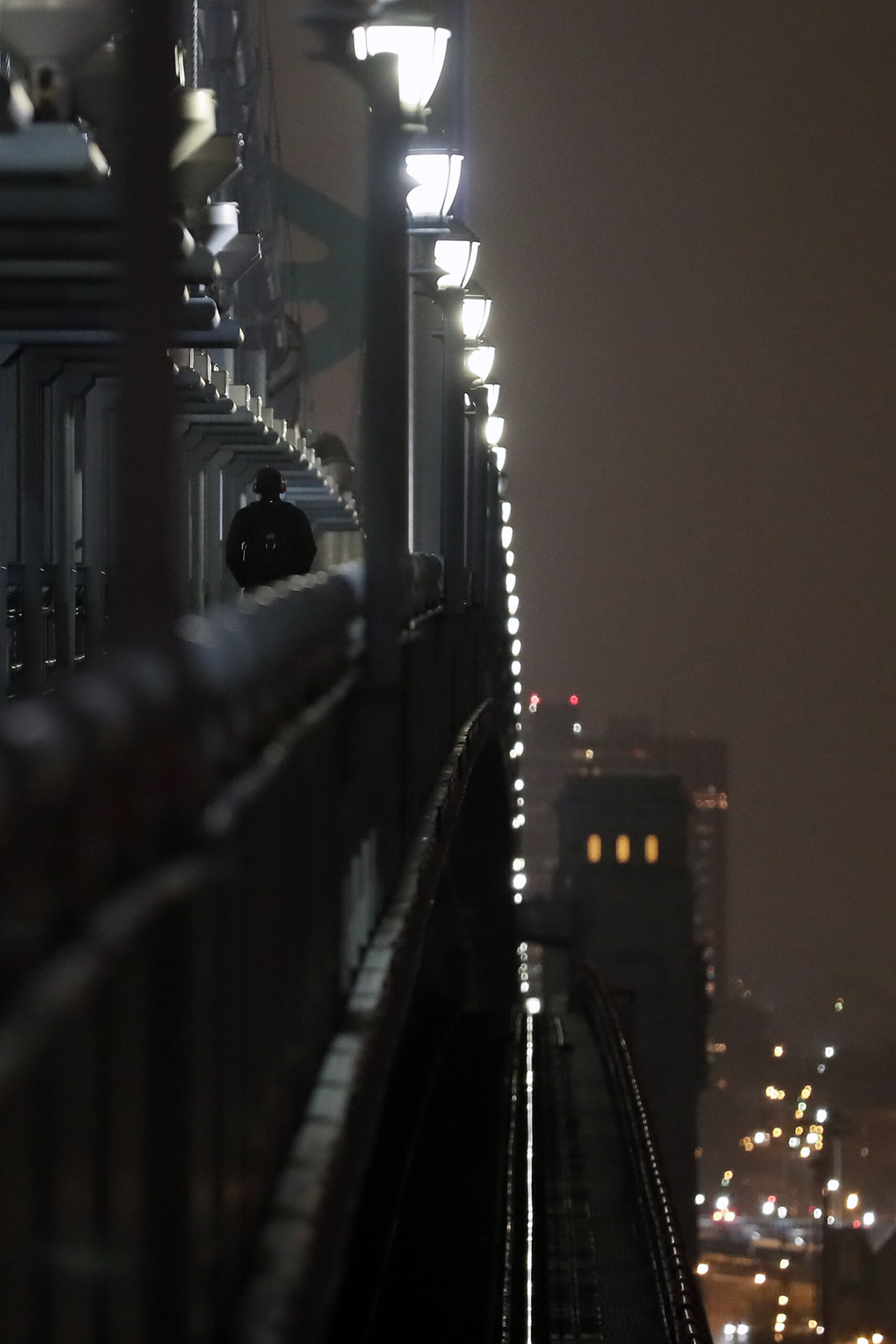
A man walks across the Ben Franklin Bridge towards Camden in an Inquirer file photo.
The anniversary celebration for the Ben Franklin Bridge will take place from 10 a.m. to 2:30 p.m. July 11. Details can be found at drpa.org/bfb100/.
The Philadelphia area restaurant boom continues into the summer, with newcomers including a neighborhood cocktail bar, bakery/cafes, a suburban brewpub, a $2 million pizzeria, a vegan cafe, a destination dining room, and a fusion sandwich shop.
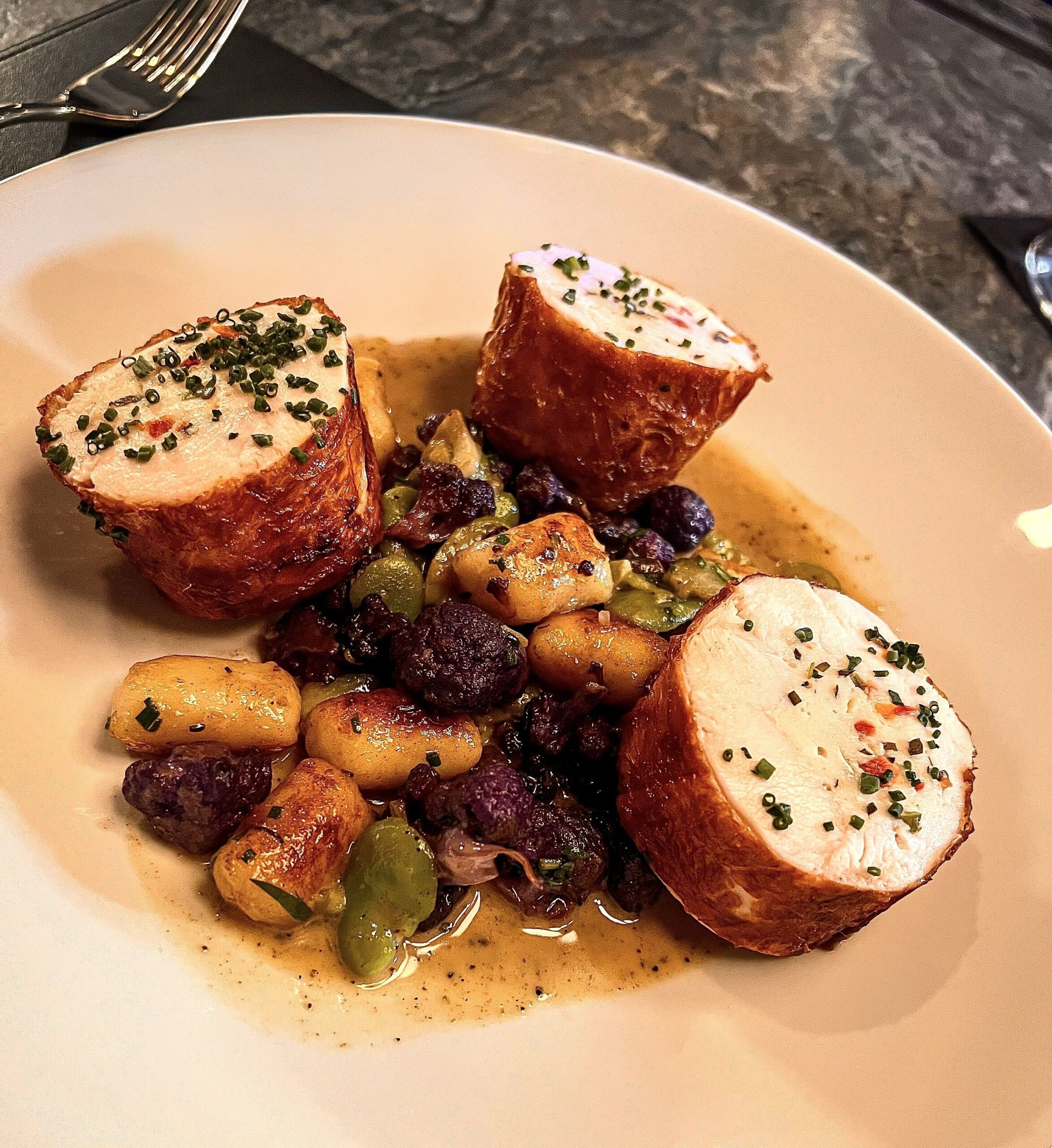
Chicken roulade with fava beans, gnocchi, and cauliflower at Academy Grill in Fort Washington.
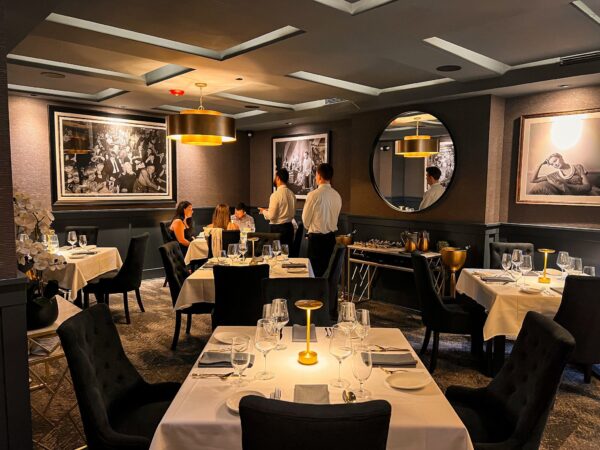
Academy Grill(424 S. Bethlehem Pike, Fort Washington): Fine Line Dining’s next project, an Italian-inspired, white-tablecloth restaurant, will serve seafood, steaks, and pastas in the former Cantina Feliz space near Germantown Academy (hence the name). Chef Jeff Power, formerly of Dettera in Ambler, is leading the kitchen. Owners Mike Sloane and Jay Rosenthal, who also own the casual Fort nearby and Jasper’s Backyard in Conshohocken, plan to open July 7 for dinner, July 9 for lunch, and then operate Tuesday to Saturday for dinner.
Banjara Indian Bistro (689 Berlin-Cross Keys Rd., Sicklerville): Vaneet Chopra, whose family owns Cross Culture in Haddonfield and previously operated Banjara in Chestnut Hill, is behind this Indian restaurant due to open soon in the strip center that also houses Gouldsburger’s, the Breakfast Nook, and Saladworks. Owners told 42Freeway that it was awaiting final inspections.
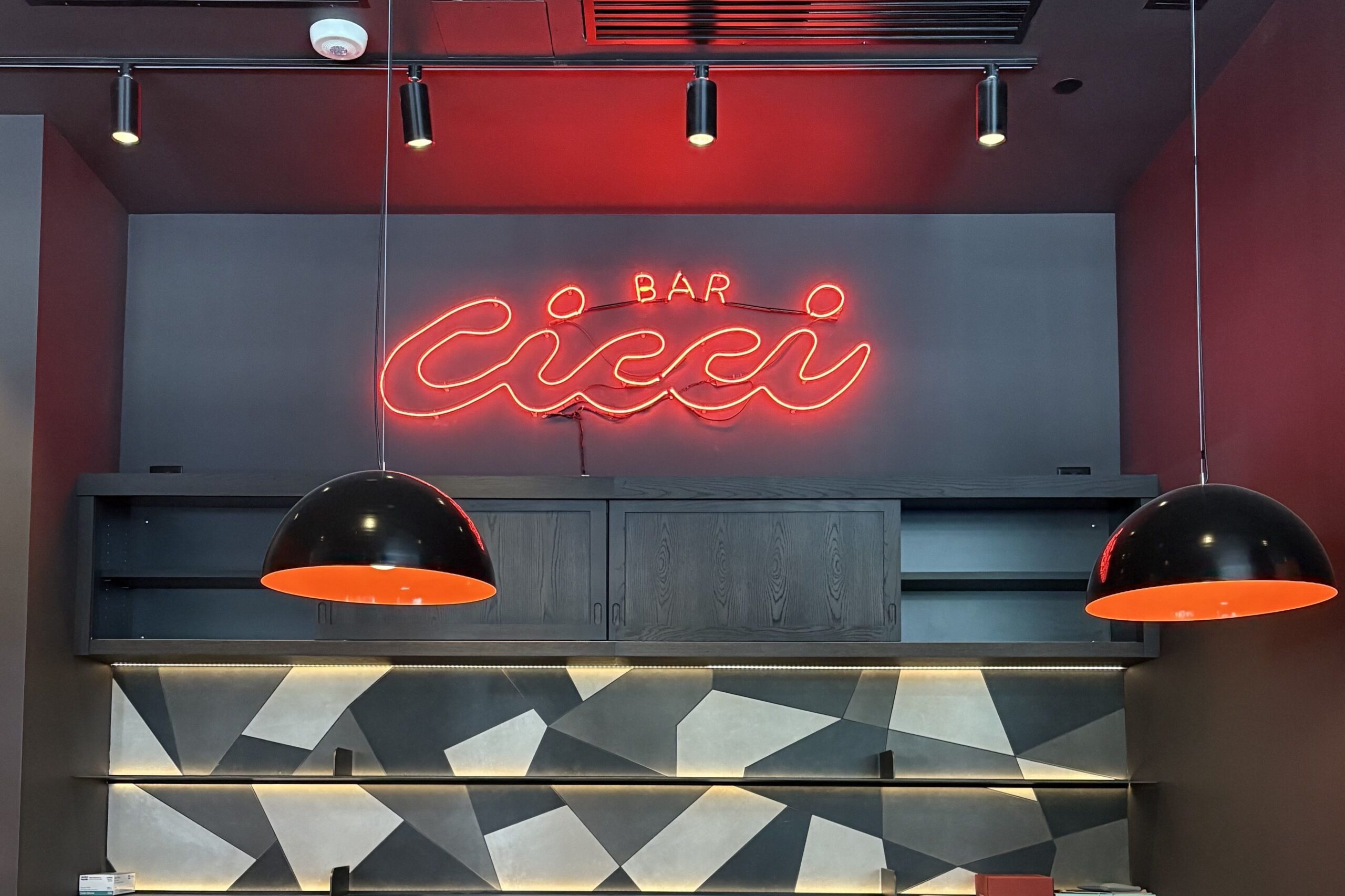
Bar Cicci is due to open in late July at 1620 Sansom St.
Bar Cicci (1620 Sansom St.): Ellen Yin and High Street Hospitality Group are behind this Italian cafe-bar next to Uchi near Rittenhouse Square. Pronounced “chee-chee,” it is positioned as an all-day salon for espresso, pastries, panini, cicchetti, wine, and aperitivi. It’s due to open later this month.
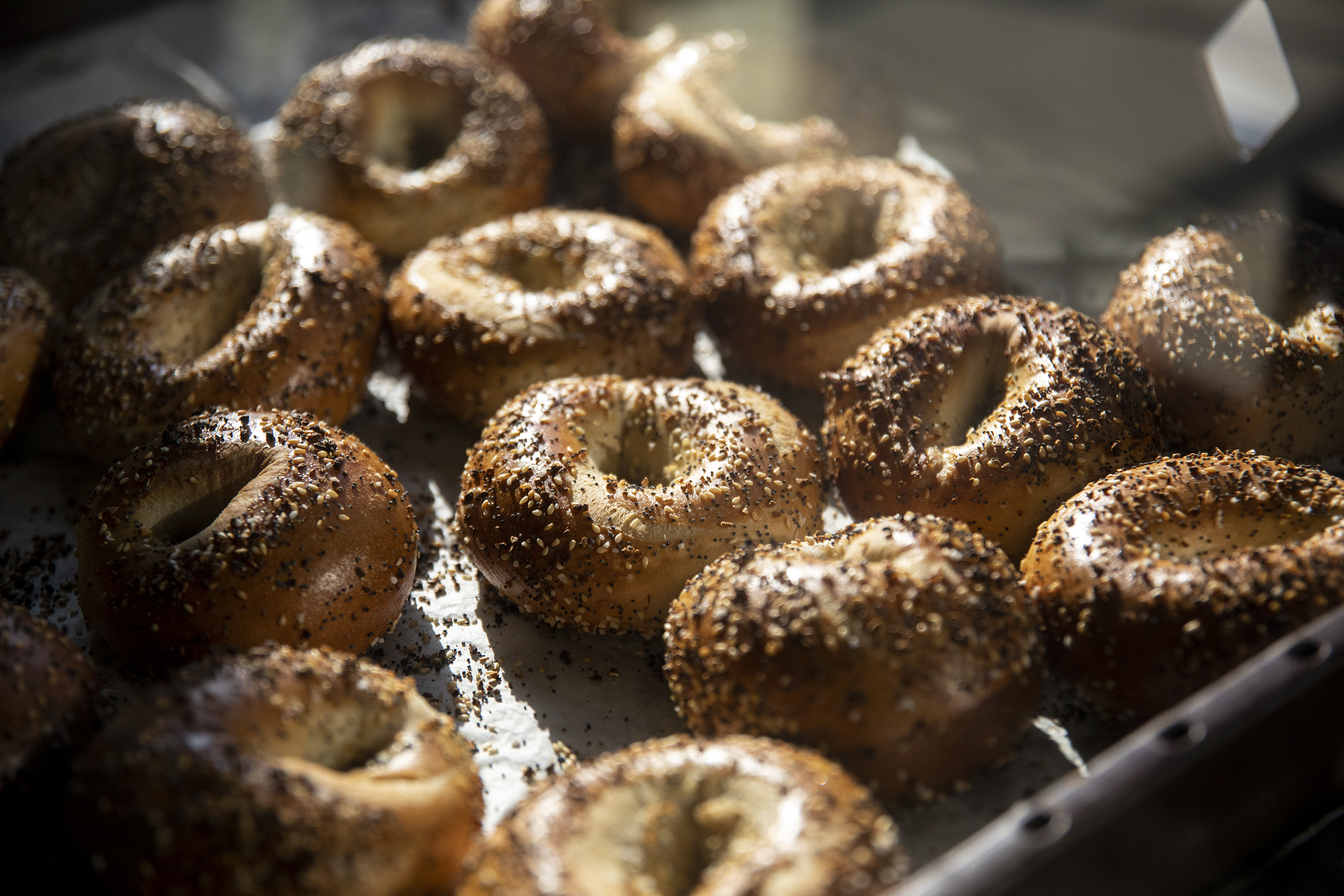
Bart’s Bagels’ first shop opened in 2020 in the Powelton section of West Philadelphia.
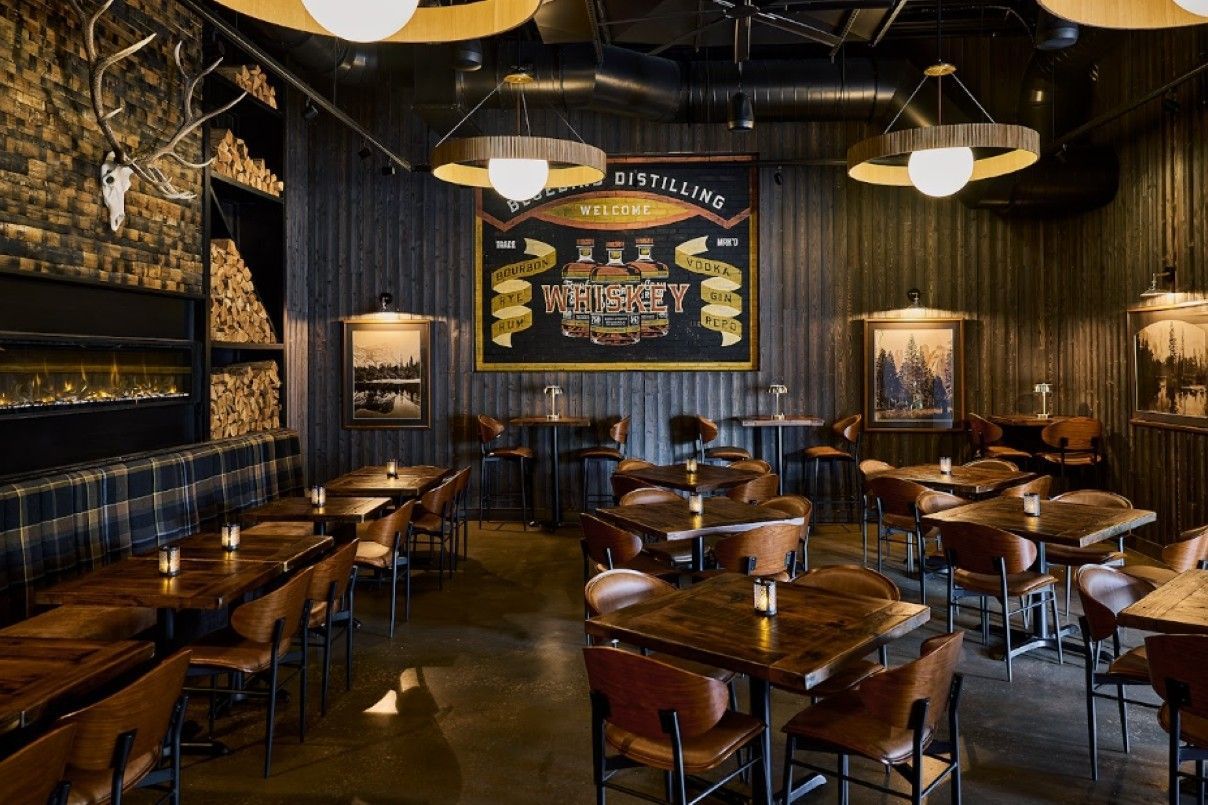
Bluebird Distilling & Dough House is a $2.2 million expansion and renovation of the popular Phoenixville destination.
Bluebird Distilling & Dough House(100 Bridge St., Phoenixville): Bluebird’s $2.2 million expansion, Dough House, arrives July 7. It’s a neo-Neapolitan pizzeria and restaurant inside its downtown Phoenixville distillery, and adds an expanded cocktail bar, a 50-seat dining room, a chef’s counter, and an enlarged retail shop. Executive chef Devon Migeot, formerly of Zahav, Laser Wolf, Rosalie, and Tresini will serve naturally fermented pizzas, house-baked breads, and shareable small plates alongside the distillery’s cocktails.
Cheezy Vegan by Chef Reeky (1216 S. 17th St.): Now in soft-opening mode at 17th and Manton Streets in Point Breeze, this plant-based concept from Tarik “Chef Reeky” Ryant and Erin Mignogna-Dougherty (previously in Woodlyn, Delaware County) serves a full menu — breakfast, lunch, appetizers, coffee drinks, milkshakes, and smoothies — from a counter, with coffee beans roasted on-site. A sidewalk cafe is planned.
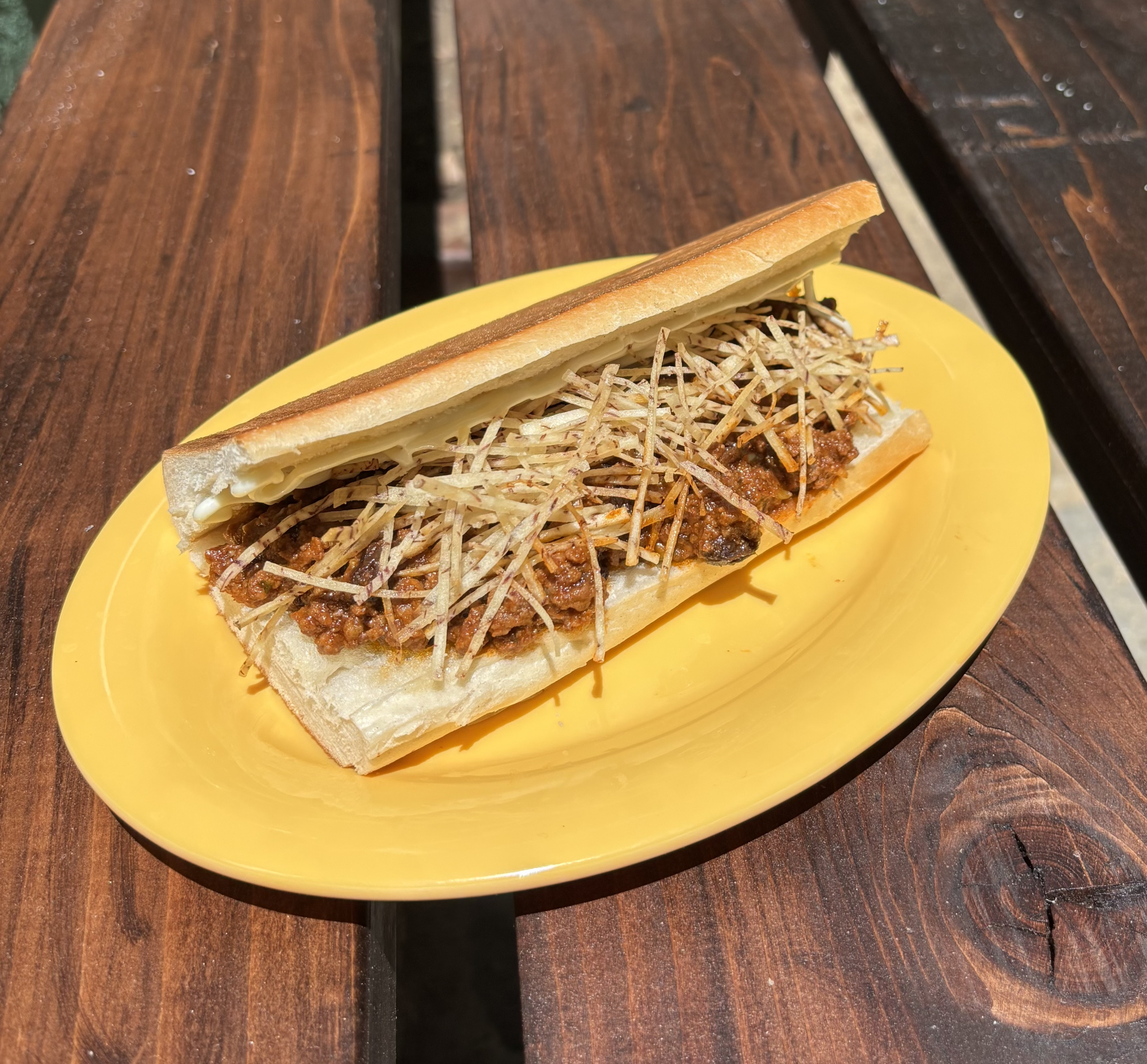
The pica pica sandwich at Chibanos, which comes with picadillo, Swiss cheese, mayo, and crispy taro sticks.
Chibanos(1127 Pine St.): Opening today at 8 a.m., this casual sandwich shop in Effie’s former Washington Square West building is an ode to owner Evan Jaroff’s multicultural upbringing, blending Chinese and Cuban flavors for a tight fusion menu. Breakfast sandwiches are made on Dodo Bakery bolo baos, there are pressed sandwiches like the pica pica (picadillo, swiss, mayo, crispy taro sticks) and mima frita (Chinese sausage croquetas, Swiss, mayo, cabbage, mojo vinagrette), plus salads, sides, and a robust drink list that offers both colada and black milk tea.
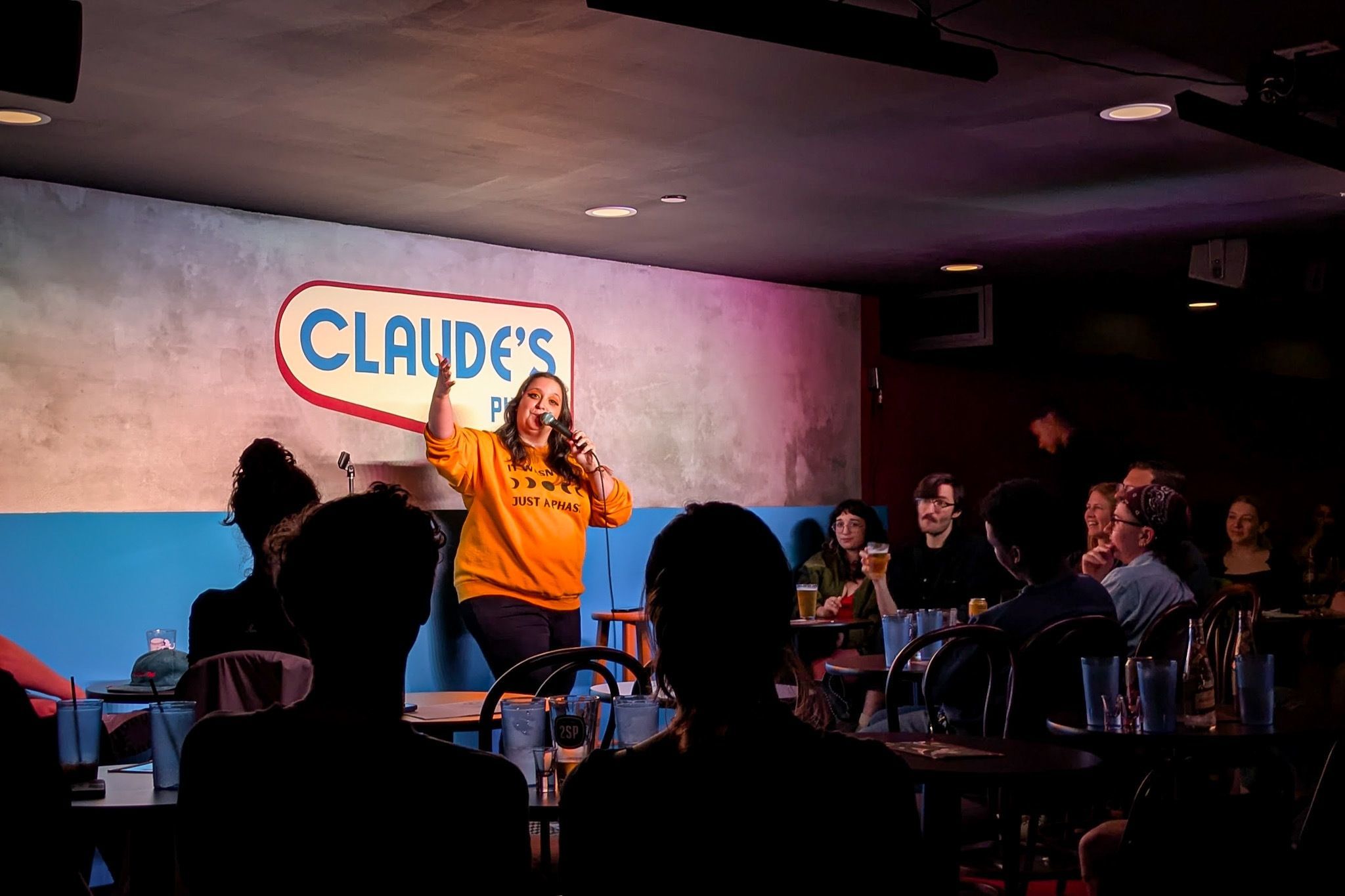
Comedian Meg Goetz entertains at a preview of Claude’s Comedy Club & Bar, 1123 S. Broad St.
Claude’s Comedy Club & Bar (1123 S. Broad St.): Reid Benditt’s intimate South Philly venue for stand-up, in its opening days, sits alongside a bar serving cocktails, beer, and casual fare from 4 p.m. daily. He’s positioning this as an affordable alternative to larger comedy clubs, with modest ticket prices, no two-drink minimum, and a mix of touring performers and local comics.
Dublin Brewing Co., Brendan FitzGerald’s Irish pub, in Downingtown.
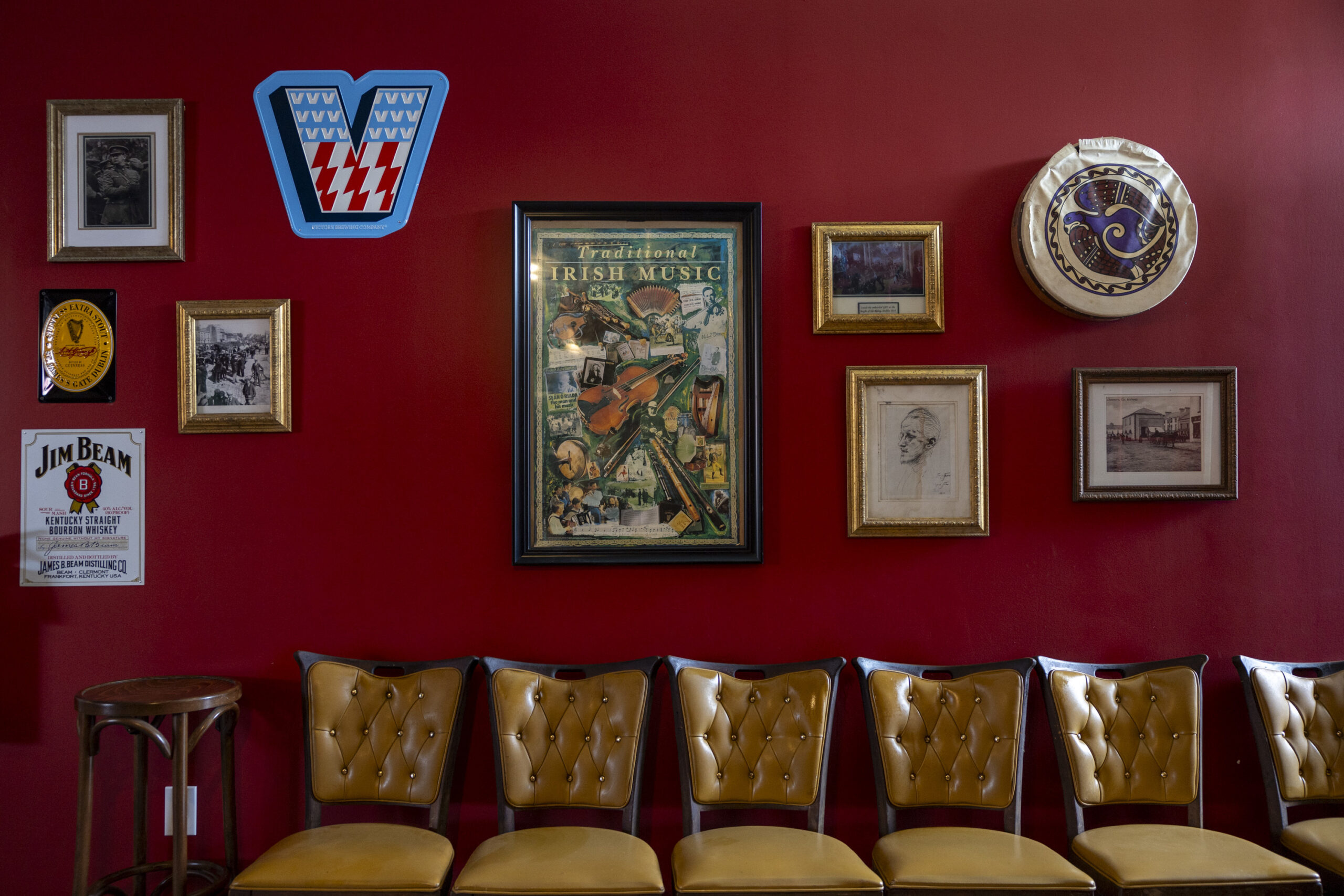
Dublin Brewing Co. (137 Wallace Ave., Downingtown): Irish-born homebrewer Brendan FitzGerald’s decade-in-the-making brewpub is designed as an authentic Irish pub, with an Irish dry stout, Irish red ale, IPAs, pale ale, Pennsylvania wine and spirits, and bar food. FitzGerald built the pub himself while continuing his day job, borrowing design cues from pubs in Howth and Dublin’s Temple Bar. It’s open for special events (check Instagram) while FitzGerald awaits final permitting.
Home Team Tavern (267 S. Black Horse Pike, Mount Ephraim): The short-lived Mount Ephraim Bar & Grill has been flipped into a compact, sports-minded neighborhood tavern from Greg Carta, who previously managed North Bowl and South Bowl in Philadelphia. He told 42Freeway that he’s aiming for an early July opening with a menu built around tavern pizzas, burgers, starters, and other game-day food.
Lillian’s, 1900 S. 19th St., during a preview on June 25, 2026.
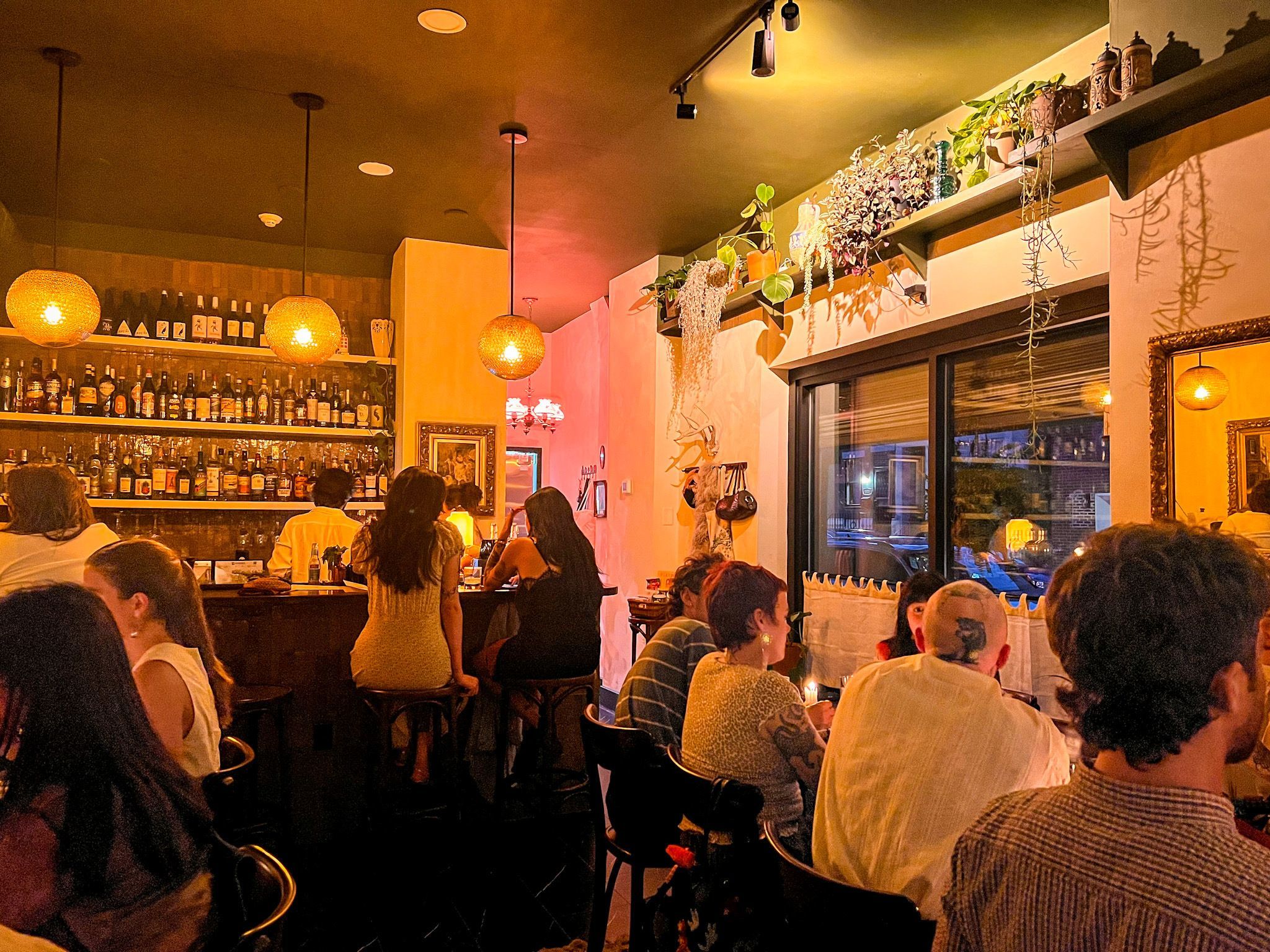
Lillian’s Bar (1900 S. 19th St.): This week, Point Breeze got a cozy neighborhood cocktail bar at 19th and Mifflin Streets with an evolving kitchen concept from Sam Ahern, a former bar manager at Fabrika who also worked at Cicala at the Divine Lorraine and Fitler Club after hosting backyard supper clubs during the pandemic. Ahern has brought in chef Alejandro Martín Sánchez (Mesona) to set up the concise menu of Mediterranean-leaning bistro fare, including sandwiches, salads, tinned fish, charcuterie, and cheese boards with kitchen operations overseen by Isobella “Izzy” Ioffreda. Guest chefs will take over for weekend or monthlong runs. First will be Miled Filianos of Habibi Supper Club, whose six-course dinners and happy hours are scheduled for July 9-11, 17-18, and 23-25. Cocktail program is led by Fitler Club alum Avdo Babic. Opens at 5 p.m. Tuesday through Saturday.
Luna at the Luxe (1705 N. American St.): Sarah Varisano expects to open her relocated Luna Cafe on Monday in the Luxe apartment complex in Old Kensington. The reboot keeps Luna’s familiar brunch, breakfast, and coffee-to-go identity, while adding a larger bar and beverage program, evening hours, and courtyard seating.
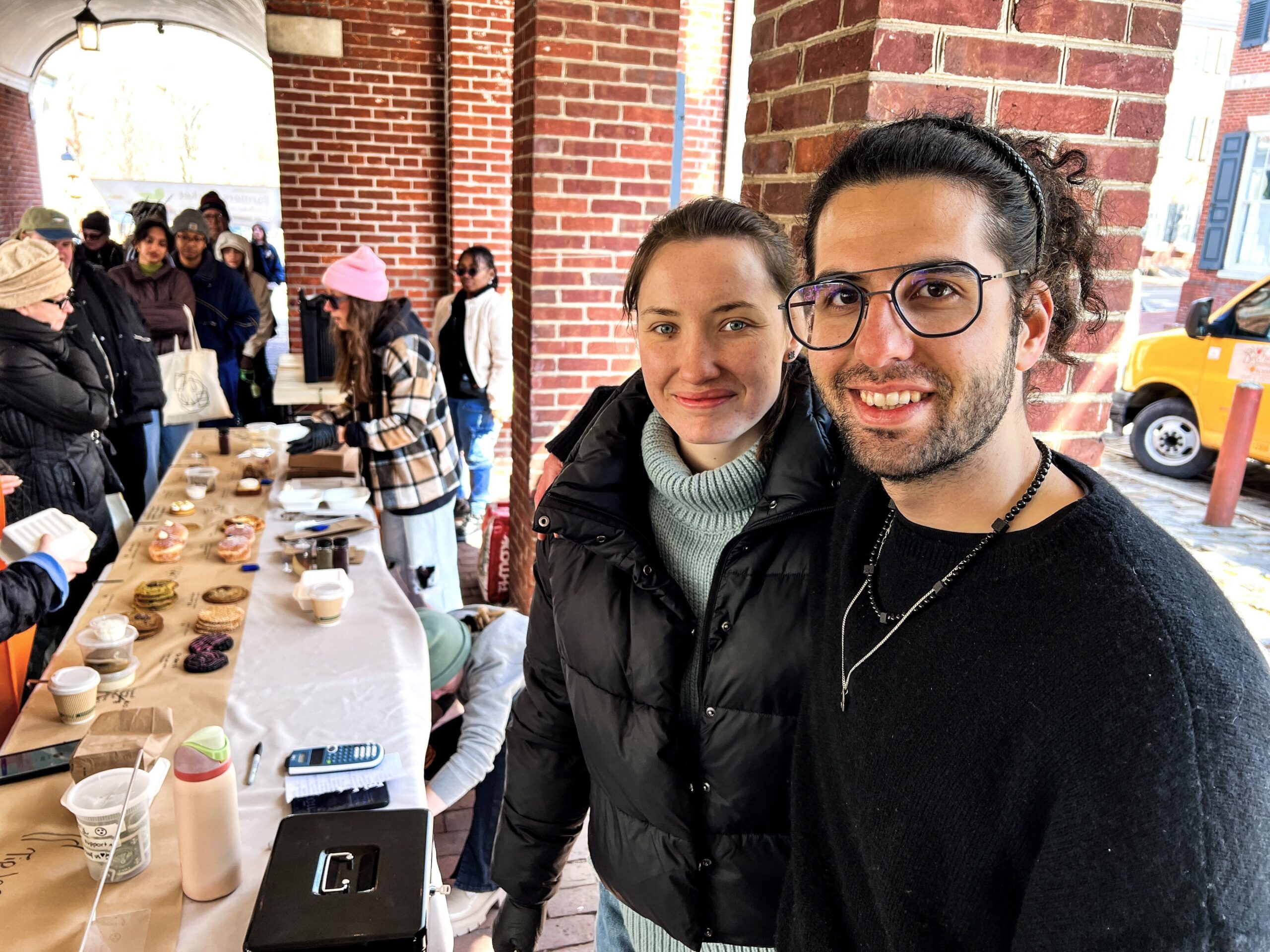
Bakery owner Saif Manna and his wife, Stefaniya Surikova, at their table at Headhouse Farmers Market.
Manna Bakery (110 W. Berks St.): Baker Saif Manna, shifting from pop-ups to a brick-and-mortar at the former Essen in Kensington, is looking for a late-month soft opening of his 50- to 60-seat bakery/cafe specializing in Levantine and Palestinian wares. It will initially open for daytime service, in addition to his farmer’s market stops. The menu expands to include individual manakish made in the style of Manna’s grandmother, rotating savory buns led by a chicken-sumac version, airy Palestinian-style brioche filled with seasonal fruit and creams, cookies, cakes, and gluten-free desserts such as a flourless chocolate cake and whipped rice pudding created in honor of Manna’s late father. The space also will host baking, cooking, coffee, and arts workshops with visiting chefs, bakers, artists, and baristas, and monthly supper clubs.
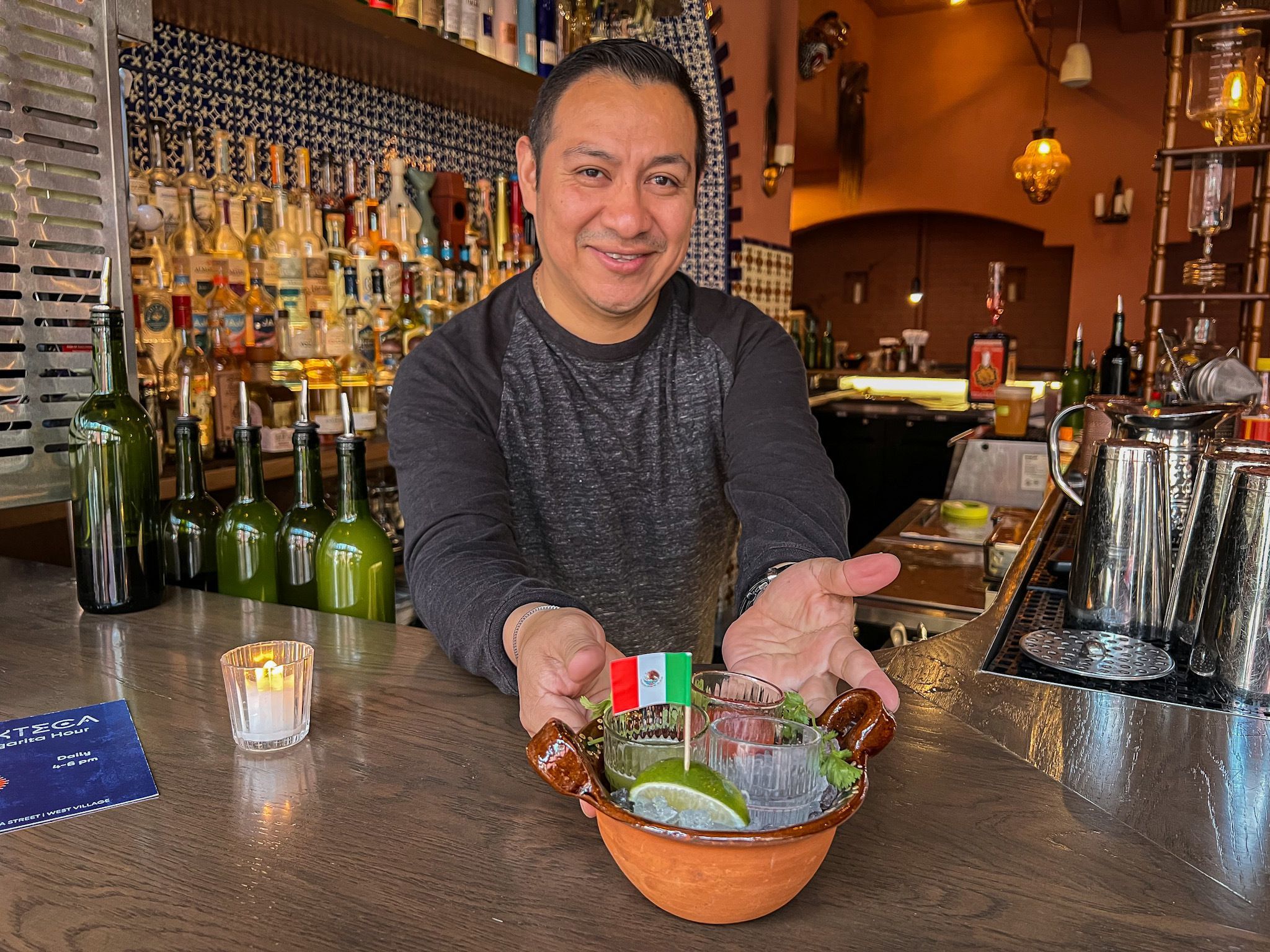
Bartender Euclides “Victor” Lopez behind the bar at Mixteca in New York City on June 4.
Mixteca (2113 E. York St): This agave-focused Mexican cocktail bar from New York’s Jeff Bell and Euclides “Victor” Lopez is taking over the former Martha in East Kensington. The Philly location, expected later in the month, marks the local debut for Mixteca and Apres Cru Hospitality. The plan includes tequila, mezcal, Mexican drinking culture, indoor-outdoor seating, and a reworked layout with an expanded bar and lounge.
Philly Po Boy Co. (102 W. Berks St.): Brothers Chris and Greg Lynch are looking for late month for their New Orleans-inspired sandwich shop under the Berks El stop, with po’boys, gumbo, jambalaya, beignets, and coffee from Applied Arts Coffee in New Orleans. Chris spent years cooking in New Orleans, while Greg’s Philly resumé includes Starr Restaurants and LMNO.
Sandpiper Cafe (1640 South St.): This all-day breakfast-and-lunch spot is due to soft-open Thursday at 1640 South St. It’s the latest from Gunawan Raharjo, who owns the West Passyunk Indonesian gem Indo Spice (noted in our list of Philly’s 76 most influential restaurants). Sandpiper’s American menu, served from 7 a.m. to 5 p.m. daily, will expand upon the menu at Raharjo’s other restaurant, Cafe Olivier in Old City. At Sandpiper, Raharjo is partnered with Deddy Pornomo.
Stella’s Ice Cream (1832 N. Front St.): This Idaho-based chain of ice cream shops planted its first East Coast location on June 27 in Kensington/Fishtown on what reporter Beatrice Forman has dubbed Ice Cream Row, mere blocks from Sweet 45 and 1-900-ICECREAM. Franchisee Shay Marlin had no prior ties to Idaho or the ice cream biz, but was drawn to Stella’s inclusive and family-friendly vibe. The shop offers 24 flavors of ice cream — including eight nondairy options — plus gluten-free waffle and sugar cones, sandwiches made on hulking brownies baked in-house, and yogurt-peanut-butter popsicles for pups.
Thirsty Turtle Tavern(270 White Horse Pike, Barrington): Just days old, this Camden County taproom in the former Chuck Lager/Wild Wing Cafe building near I-295 is the brand’s second, after Whitehall, Pa., and 42Freeway says it features a refreshed dining room, open kitchen, wood-fired pizza oven, sushi station, and patio.
333 Belrose Bar & Grill (333 Belrose Lane, Radnor): A slow-moving top-to-bottom renovation will add a larger bar, expanded kitchen, redesigned dining rooms, upgraded private-event spaces, and refreshed outdoor dining to this Main Line landmark, whose new American menu is overseen by chef Ross Esner.
Staff writer Beatrice Forman contributed to this article.
Two boats, two schools, two historic national championship wins.
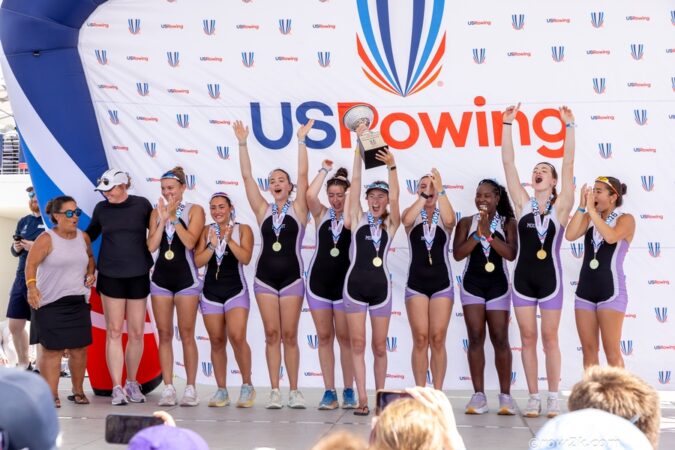
Malvern Prep and Mount St. Joseph Academy competed in the USRowing Youth National Championships from June 11-14 at Nathan Benderson Park in Sarasota, Fla., and brought home first-place trophies.
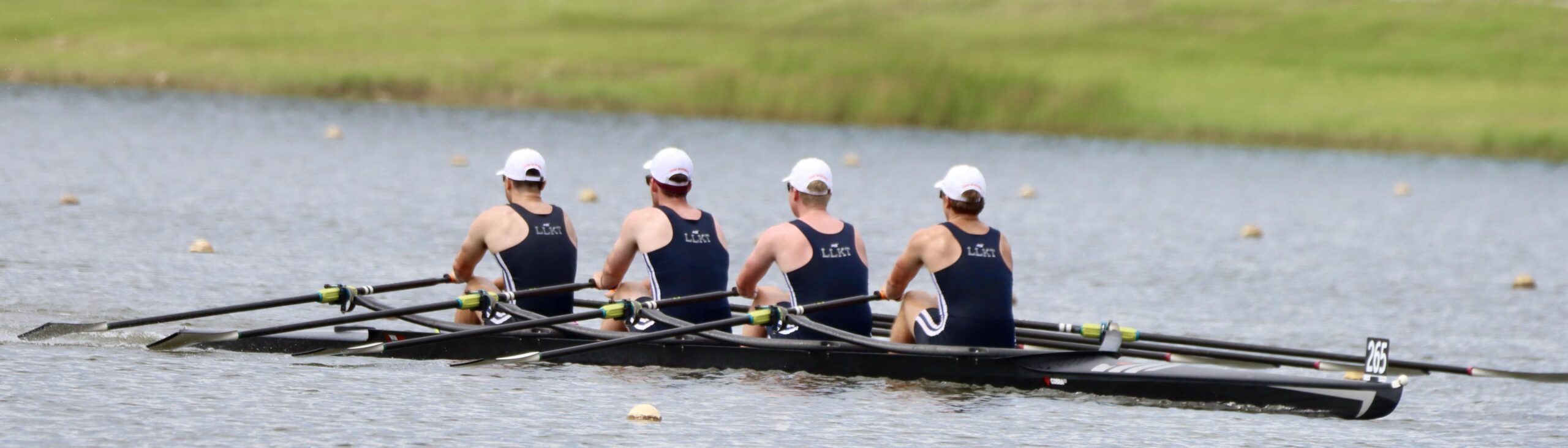
The regatta featured 235 of the top youth teams from around the nation. Malvern Prep’s youth quadruple sculls, which featured Will Bentley, Rory Coleman, Jack Arbogast, and Brendan Schuck, crossed the finish line in 5 minutes, 48.12 seconds to beat 28 other programs competing in the event.
Mount St. Joseph’s second varsity eight team won gold, with a time of 6:34.7. The championship boat included Kayleigh Costello, Ella Kurek, Addison Marques, Aubrey Sheehan, Megan Bell, Addison Ross, Christian Robinson, Ava Kristel, and Zoe Nguyen.
The last time these schools won at nationals was roughly two decades ago: Malvern in 2008, and Mount St. Joseph in 2006.
The two teams supported another from the sidelines. Malvern cheered on the Mount girls from shore, and vice versa when the boys were in the water.
“There’s only so many crews that are coming down from this area,” Mount St. Joseph coach Alanna McCoy said. “We all often are on the same stretch of water, so we took all the boats on one trailer and made it one trip — it was cool to come home with two trophies.”
‘Fueled the fire’
Malvern sent four boats to Nathan Benderson Park.
Beside from the youth quad boat, the youth double sculls, under-17 double sculls, and under-17 quadruple sculls also competed in the regatta.
Malvern’s spring has been filled with wins, including a first-place finish in the quadruple sculls at the Scholastic Rowing Association of America championship in May.
But placing second in a race at the Stotesbury Cup Regatta “unlocked this second gear,” Bentley said.
“That was hard for us,” he added. “This fueled the fire for our training going into nationals, so I think it really helped us.”
First-year head coach James Konopka helped cultivate that determination.
“It was the willingness from the guys to make changes, to do the work, to really push themselves into moments of discomfort,” Konopka said. “At times, I’d argue, we were maybe the hardest-working team on the river. These guys worked so hard for this win.”
Three Friars from the boat will move on to college rowing this fall.
Bentley will row at Holy Cross, Schuck at the University of San Diego, and Arbogast at Wesleyan University. Coleman will return next season as a senior and plans to row in college.
“It’s bittersweet to leave the program you spend so much time pouring hours and hours of effort into,” Schuck said. “But I know we left it in a place better than we found it.”
Malvern Prep sent four boats to Nathan Benderson Park for the USRowing Youth National Championships.
‘Doing it for our sisters’
For the Mount, inspiration and drive came from a more unconventional source.
“[Coach] gave us this book, The Little Engine That Could,” Sheehan said. “Before our races, we read it, and it was interesting to go into the unknown with the idea of, ‘I think I can, I think I can, I think I can,’ and that kind of pushed us through the race.”
With that mentality, the varsity eight boat crossed the finish line nearly two seconds ahead of the second-place boat. The group credited its teamwork and training for a successful final race of the season.
“We would come to the boathouse in the morning, row on the water for two hours, go home, and then come back and go again for a few hours, and then do it all again for the whole week,” said Ross, who will row at George Washington next season. “I think that extra training is a really big push, especially for this boat, because we came together so late.”
McCoy said the team shares a “unique bond,” despite nationals being the group’s first race competing together.
“They all spend a ton of time together,” she said. “They’re together at school, they’re together after school, they’re together at the boathouse. They also are very good friends and hang out with each other outside of the boathouse.”
Added Marques: “The main theme for our races is always to think about the legacy of the team. Doing it for the people who cheer us on, doing it for our siblings, doing it for our coaches, but the main thing is doing it for our sisters in the boat.”
With Eagles training camp drawing nearer on the horizon, The Inquirer is taking a closer look at the more than three dozen new faces who are expected to report along with the rest of the team on July 28. Whether a 2026 draft choice, a veteran addition, or a rookie free-agent hopeful, we’re telling you more about each player’s potential role this season. We’re rolling out two players per day in a mostly unscientific order that balances offense and defense, bigger names with mysteries, and locks with longer shots to be chosen for the 53-man roster.
Player: Elijah Moore
Position: Wide receiver
Age: 26
Previous experience: Moore was taken three spots ahead of Landon Dickerson in the 2021 draft. He went to the New York Jets in the second round, No. 34 overall, after three seasons at Ole Miss. His rookie year arguably was the best of his NFL career, when he posted a career-high five touchdowns and 538 yards on 43 receptions in 11 games (six starts).
During his second season with the Jets, Moore reportedly requested a trade over his lack of involvement in the offense. But he remained on the team until March 2023, when he was traded to the Cleveland Browns. He posted a career high in receiving yards that season with 640 and two touchdowns on 59 receptions through 17 games (12 starts).
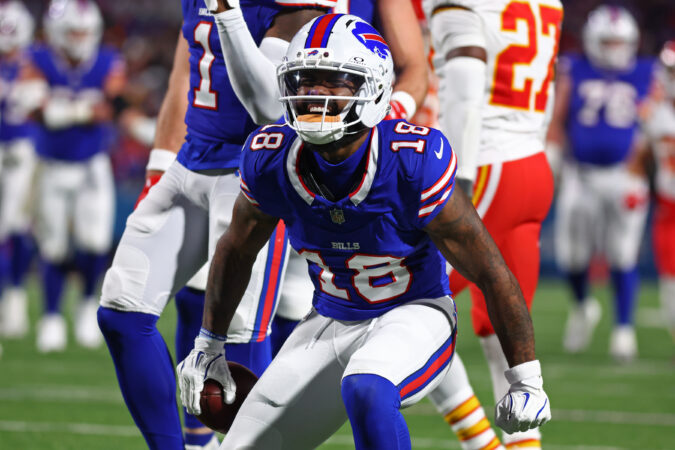
Moore played for the Browns for two seasons before signing with the Buffalo Bills as a free agent last year. He played nine games (two starts) and had nine receptions for 112 yards, plus six carries for 24 yards and a touchdown, before he was released in November.
Moore finished the season on the Denver Broncos’ practice squad and was elevated to the game day roster for the AFC championship game. The 5-foot-10, 178-pound receiver signed a one-year, $1.32 million contract with the Eagles in March.
Path to a roster spot: Moore is a potential wide receiver depth option. The Eagles have a clear-cut top four receivers in DeVonta Smith, Makai Lemon, Dontayvion Wicks, and Hollywood Brown, but they could carry at least another receiver or two on the active roster. Moore will compete in training camp for one of those depth roles, along with Darius Cooper and Johnny Wilson.
Moore’s experience sets him apart, especially as he vies for a role on a team in need of playmakers in the absence of A.J. Brown, his former college teammate and roommate. He still can show up in key moments and displayed his versatility on his second career rushing touchdown last season when he motioned out of the slot and took the handoff for a 4-yard score against the Jets. Earlier in that game, he also had a 31-yard catch-and-run reception on third-and-long.
Fun fact: In just eight games in 2020, Moore broke Brown’s single-season record at Ole Miss for receptions by one catch with 86. Moore accumulated 1,193 yards that season, 127 short of Brown’s total in 12 games in 2018. In his record-setting season, Moore led the nation with 149.1 receiving yards per game and 10.8 receptions per game.
Quotable: “I think he’s so sudden in and out of cuts. I think that he can play inside and play outside and have that versatility for us. Smart guy. He knows his stuff. And he’s a fun guy to be around, too.” — Bills quarterback Josh Allen on Moore in July 2025
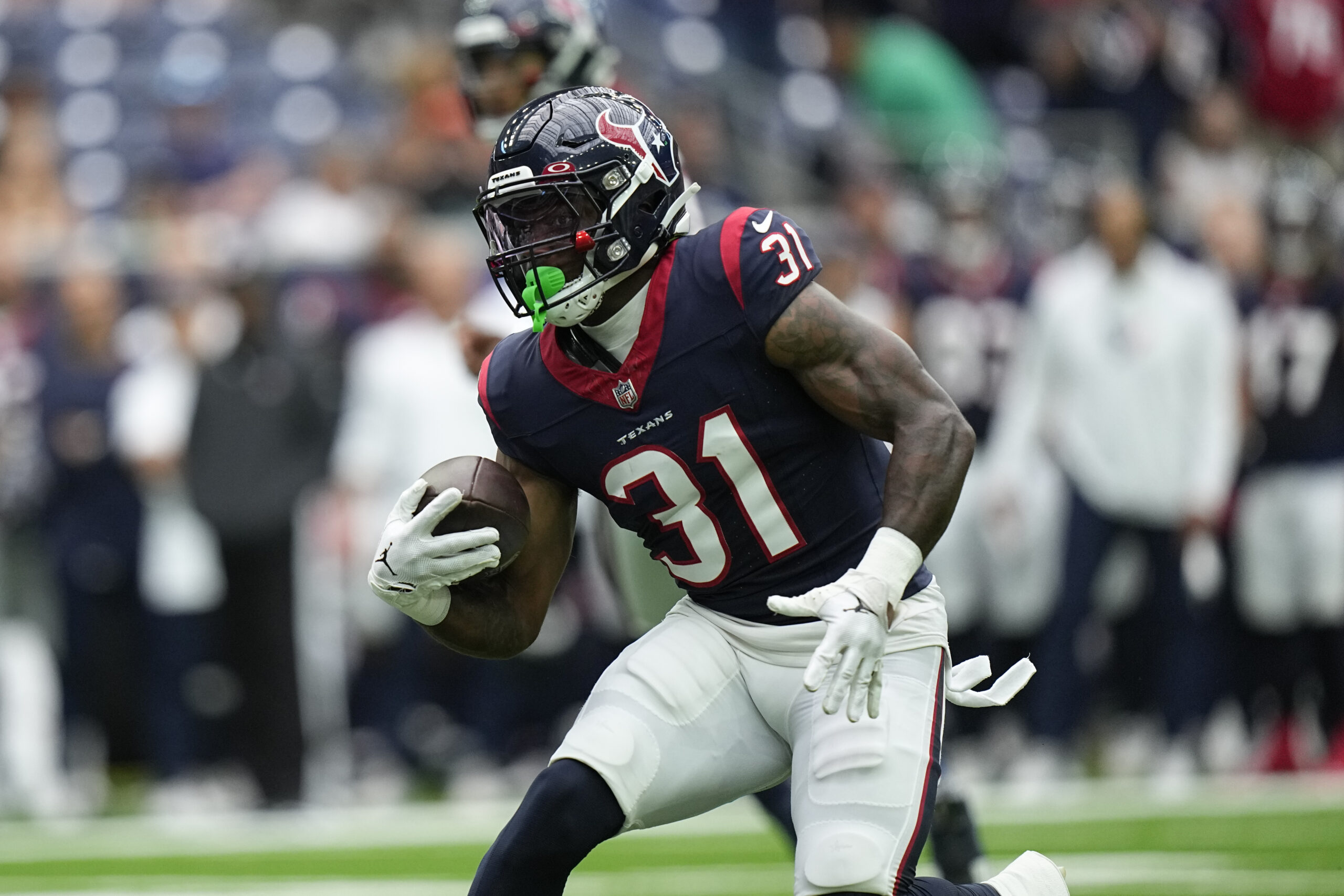
Dameon Pierce was once a starting NFL running back with the Houston Texans.
Player: Dameon Pierce
Position: Running back
Age: 26
Previous experience: Pierce brings four years of NFL experience to the Eagles. He was selected by the Houston Texans in the fourth round of the 2022 draft out of Florida. Pierce spent more than three seasons with the Texans, highlighted by his rookie year, when he started 13 games and rushed for 939 yards and four touchdowns on 220 carries.
An ankle injury ended his rookie campaign prematurely. Pierce fell down the depth chart in subsequent seasons and served as a depth running back and kick returner. In 2023, Pierce returned a kickoff 98 yards for a touchdown against the Cleveland Browns.
Houston released Pierce in November 2025. He landed with the Kansas City Chiefs and appeared in one game. Last season, he took just 14 handoffs total and rushed for 36 yards. Pierce’s days as a full-time starter likely are behind him, but the Eagles could represent an opportunity for him to carve out a contributing role.
Path to a roster spot: Special teams and running back depth. With Saquon Barkley and Tank Bigsby locks to make the initial roster, Pierce will compete with Will Shipley and Elijah Mitchell for the third running back spot. As the incumbent, Shipley has a leg up, but training camp will provide an opportunity for the three players to compete for the role, with the consolation prize being a chance at making the practice squad.
Pierce could have an advantage over Mitchell, given his kick return experience. He has averaged 32.8 yards per return over the last three seasons. However, on four returns with Houston in 2025, Pierce averaged 23 yards per return.
Fun fact: Pierce told the Texans in 2022 that if he could go pro in another sport, he would choose pie eating. Tastykake, here’s your next spokesperson.
Quotable: “I’m still learning. Coming into this year, I just look at it as, I got four years of experience on my side. I take every up and down in my career as a collective and just look at it and try to learn how to get better from it. Coming to Philly is just another step in my journey that I’m looking forward to. At the end of the day, man, I just want to play ball, and Philly gave me a great opportunity to do so.” — Pierce in March
That special time of year when general managers can fulfill their wish lists or end up with coal.
Here’s everything you need to know before the frenzy begins.
What time does free agency start?
Beginning at noon on Wednesday, the Flyers can sign players from other teams to contracts. Of course, they could also lose members of the squad that led them to their first postseason spot since 2020.
Although terms shouldn’t have been discussed prior, miraculously, teams always announce new contracts at the stroke of noon.
It is also the kick-off point for offer sheets if anyone wants to be an agent of chaos.
Who are the Flyers’ free agents?
According to a league source on Tuesday, the Flyers have agreed to sign pending unrestricted free agent forward Carl Grundström to a one-year, $1 million contract. It comes one day after they handed out qualifying offers to four players and released six more to unrestricted free-agent status.
AHL unrestricted free agents: forwards Karsen Dorwart,Oscar Eklind, Brett Harrison,Boris Katchouk, Lane Pederson, Anthony Richard,Tucker Robertson,and Philip Tomasino;defensemen Adam Ginning, Maxence Guenette, Artem Guryev, and Christian Kyrou
Dorwart, Harrison, Robertson, Tomasino, Guryev, and Kyrou were not given qualifying offers on Monday. They could all be signed to a new deal or an AHL-only deal to stay with the club. Garrett Wilson is listed as an unrestricted free agent on Puckpedia, but he is signed to an AHL contract for next season.
A league source has told The Inquirer that Juulsen will not be re-signed.
How much cap space do the Flyers have?
According to Puckpedia, as of Tuesday, the Flyers have $32,681,250 of cap space before signing the four restricted free agents. The expectation is that McDonald will be in the minors to start the year, and Grebenkin, who was skating on Tuesday at development camp, is working his way back from an injury.
Center Trevor Zegras and defenseman Jamie Drysdale are the Flyers’ most important restricted free agents that they need to sign.
Not counting Grebenkin’s deal, the expected cap space to sign Zegras and Drysdale should come in at an approximate annual average value of $15 million combined. That leaves about $17 million, and then minus $3 million to $4 million to cover Grebenkin and McDonald, there is some room left to add pieces to the lineup.
What are the Flyers’ biggest needs?
The Flyers have a few spots in the lineup that could use a boost.
The fourth line struggled at times this past season and went through a few retoolings. It needs at least a right winger, now that Garnet Hathaway has been traded to the Florida Panthers, and there is talk that Glendening could return, but nothing has been confirmed.
Although the wings are pretty much set, the center spot could always use an upgrade as the Flyers continue to search for a top-line pivot. And while the defense looks OK, there is always room for improvement, especially if the Flyers can find a defenseman to help the team’s dormant power play.
Who are the top free agents?
John Carlson, on a big-money, short-term deal, would make a lot of sense for the Flyers to help with the power play. But do the Flyers make sense for him? He’ll turn 37 during the season, and time is ticking on his window to win another Stanley Cup.
Rumors are percolating that the Flyers could add Noel Acciari to the roster. A 5-foot-11 center who just played against the Flyers in the playoffs with the Penguins — he had one assist in the six games — the Rhode Island native would slot onto the fourth line and be a key piece in the faceoff dot as a coveted right-shot, as well as on the penalty kill. Fellow bottom-six center Teddy Blueger is another name to keep an eye on, as he played for coach Rick Tocchet in Vancouver.
What about offer sheets/trade targets?
As previously mentioned, the Flyers and Edmonton Oilers defenseman Darnell Nurse have a mutual interest, with the Flyers, Pittsburgh, and Boston on his short list of teams. He previously requested a trade and would need to waive his no-movement clause to approve any trade destination.
The Flyers are obviously interested in Norris Trophy-winning defenseman Zach Werenski from the Columbus Blue Jackets and All-Star center Dylan Larkin of the Detroit Red Wings. Like Nurse, they would need to approve any trade. And they surely wouldn’t mind adding one of Shane Pinto or Dylan Cozens, two young centers from the Ottawa Senators, to the mix if either was made available via trade.
Could the Flyers target Dallas’ Mavrik Bourque in an offer sheet or trade as a potential center solution?
Now, who doesn’t love an offer sheet? Would the Flyers be willing to partake in the one thing that gets everyone going? To be determined, but if they do, center Mavrik Bourque, 24, might be an attainable target given Dallas’ cap crunch.
What about Dan Vladař?
All signs are pointing to Dan Vladař signing a five-year extension with an average annual value of $5.5 million.
The Czech goalie is coming off a season where he went 29-14-7, with a 2.42 goals-against average and .906 save percentage. It was the lowest GAA of his career and tied his career-best save percentage, although he played in 22 more games than in any previous season.
When Sara Aldana auditioned for the coveted Philadelphia Orchestra assistant conductor spot in April, she tried out in front of the ensemble with Copland and Bartok.
For the third piece, she chose an excerpt from Rachmaninoff’s Symphony No. 2. The Russian composer is closely associated with the Philadelphians — he once called the orchestra the greatest in the world — and the second symphony, Aldana said, was close to her heart.
“I was like, whatever happens with the audition, I just want that memory of — wow — doing Rachmaninoff Two with Philadelphia for five minutes.”
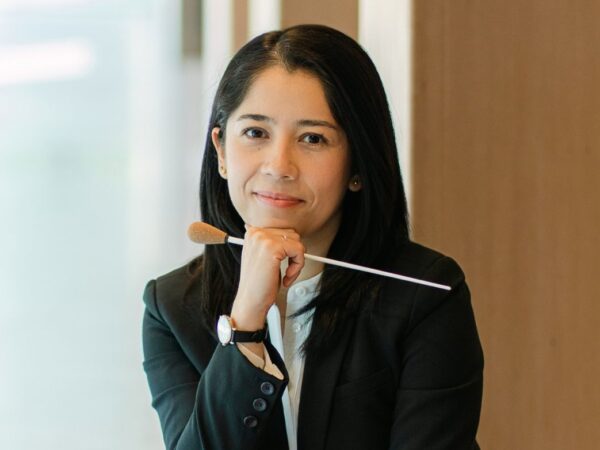
Now she’ll be spending many more minutes with the Philadelphians. Aldana won the audition, and is the orchestra’s next assistant conductor, the group announced Wednesday.
The position is a junior one, though it has been a steppingstone to bigger opportunities. Aldana follows Naomi Woo, who has already been engaged as a guest conductor next season.
Aldana studied with Philadelphia Orchestra principal guest conductor Marin Alsop and worked as a cover conductor with the Detroit Symphony Orchestra. As assistant conductor in Philadelphia, she will lead family and special concerts and give pre-concert talks.
One of her biggest responsibilities will be one that the public may never get to see — or that could make her career. She will serve as cover conductor, which means she could be tapped to lead a Philadelphia Orchestra concert at any moment if the scheduled conductor falls ill or is otherwise unable to perform at the last minute.
“I always think it’s like the Formula 1 reserve driver, you know? You might not be driving the car, but you could get a call and you have to get on, driving the car,” she said Aldana.
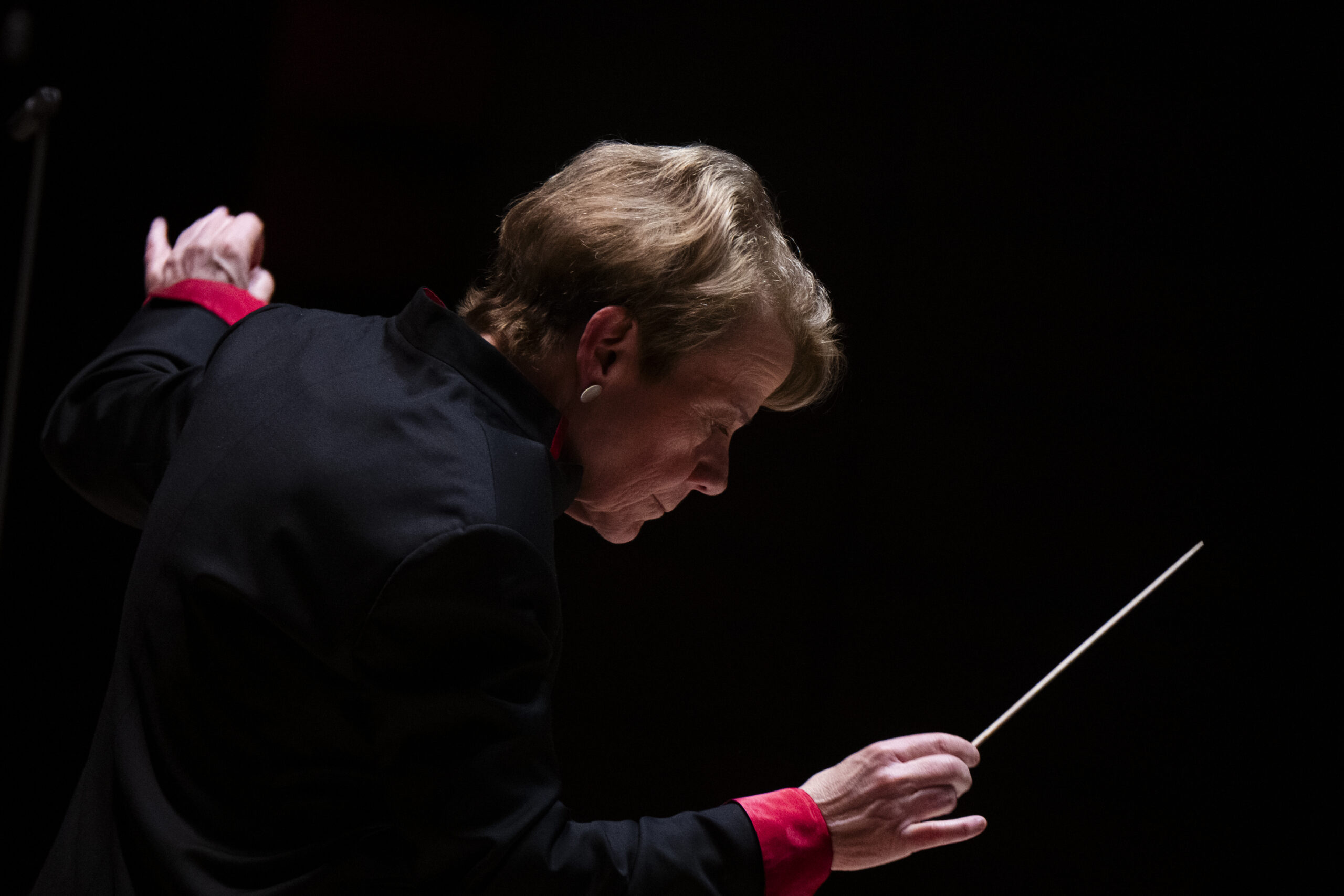
Conductor Marin Alsop — who has worked with Aldana — leading the Philadelphia Orchestra, May 28, 2026, in Marian Anderson Hall.
Aldana, 30, was born in Bogotá, Colombia, and earned an undergraduate degree in violin performance at the University of Texas at Austin. She holds a master’s degree in orchestral conducting from the University of Michigan, where she studied with Kenneth Kiesler, and did further studies with Alsop and Joseph Young at the Peabody Institute of the Johns Hopkins University.
She has served as assistant conductor of the Reno Chamber Orchestra and is a 2026 mentee with the Taki Alsop Conducting Fellowship.
Aldana was at Peabody for a year, but left after winning the Philadelphia audition.
That tryout ended with five finalists for the job. Each had a short time conducting the orchestra, dipping into excerpts of various styles — Copland’s Appalachian Spring, Bartok’s Miraculous Mandarin Suite, and the third piece, which the finalists could choose themselves from among three possibilities.
All five chose the last few minutes of the famously emotive third movement of Rachmaninoff’s Symphony No. 2.
Why this piece?
“I’m a violinist by training, and so I absolutely love Rachmaninoff Symphony No. 2.”
The audition lasted all of 15 minutes.
“Fifteen minutes is a short amount of time, but you realize with Philadelphia, it’s all you need to get a good idea of who they are as an ensemble and the culture that they have as a group. It just happened to be a beautiful connection.”
Although Aldana started out as a violinist, she long harbored, even as a child, an interest in conducting.
“Your instrument is the orchestra, all these colors, and it’s just getting to play with all of them — how you create sound, balance, getting to discover, you’re continuously learning. That’s something that really appealed to me.”
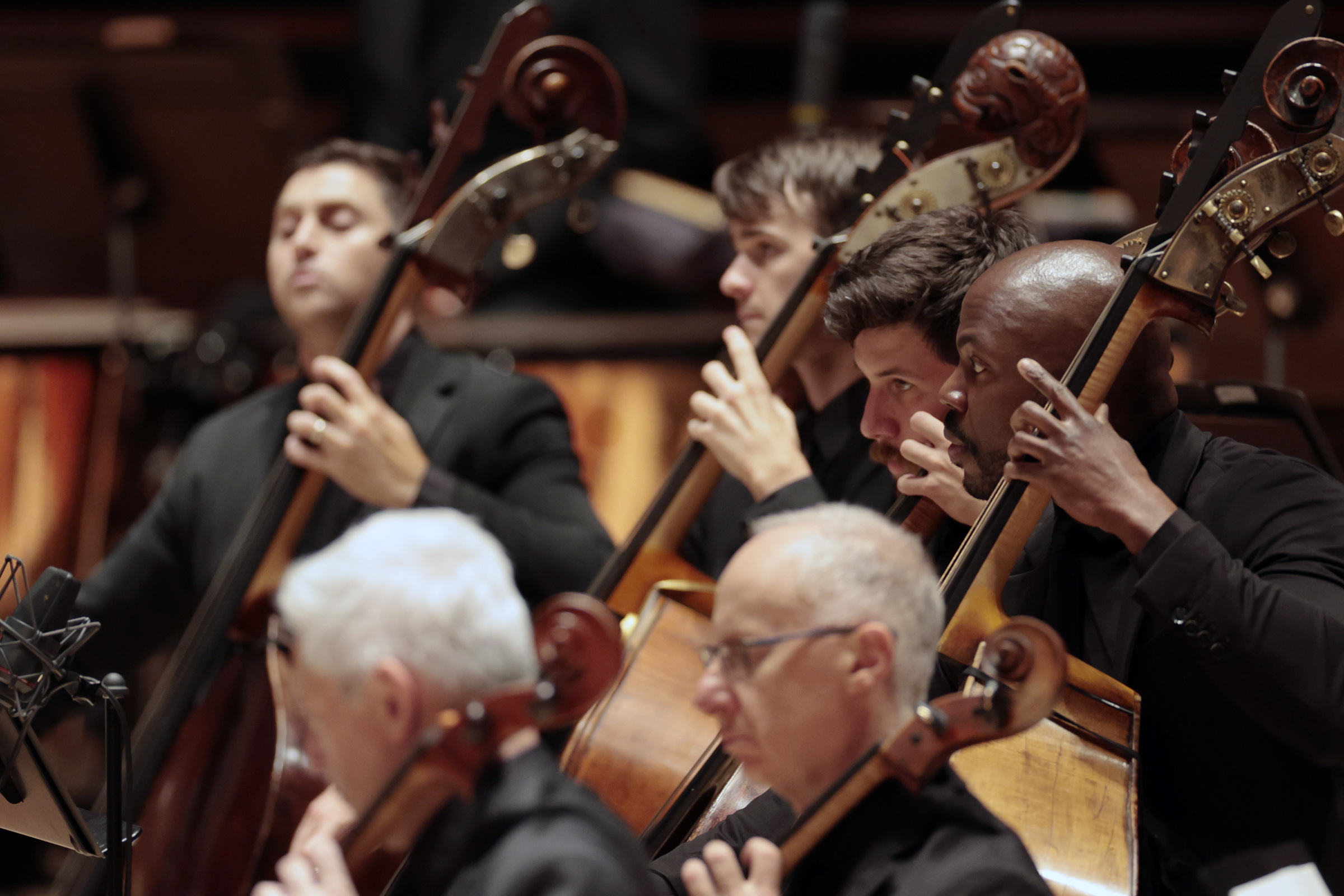
The double bass section of the Philadelphia Orchestra performing on opening night of the 2025-26 season in Marian Anderson Hall, Sept. 25, 2025.
Aldana’s official start is Sept. 1. Her first scheduled concert with the orchestra is a Jan. 2 matinee in Marian Anderson Hall of Strauss family waltzes and other works.
Asked what piece she might dream of someday conducting with this orchestra, Aldana said any Tchaikovsky symphony, but especially the Sixth.
“There was an Ormandy recording that I remember listening to a lot. I was obsessed with this piece — obsessed. I remember that lush of the strings in the most heart-wrenching moments.”
Is there a piece she would find too daunting to conduct?
“Daunting. Hmm. I don’t think so.”
Does that mean she’s musically fearless?
“I am a little fearless,” she said, “when you have one of the best orchestras in the world in front of you.”
BAPS Shri Swaminarayan Mandir, a Hindu temple on the eastern border of Cherry Hill, is preparing for a major facelift.
The Cherry Hill Township Zoning Board approved site plans last week during a 4½-hour meeting for an 18,330-square-foot expansion that would transform BAPS Cherry Hill’s exterior and add a gym, lobby, prayer hall, improved Sunday school rooms, new parking spaces, and more.
More steps will have to be made before construction can begin, but this approval is a majormove forward after what zoning officials say took more than a year of planning.
BAPS Inc., an international religious nonprofit, has more than 100 temples across the U.S., including eight in New Jersey. Cherry Hill Township approved a zoning variance back in 2002 to allow a former vacant warehouse building on an 11-acre property at 1 Carnegie Plaza, acquired by a real estate company for $1.9 million and conveyed to BAPS, to become a Hindu temple despite the lot being zoned Industrial Restricted. The temple is run by BAPS Cherry Hill, a limited liability company.
Decades have passed since BAPS Cherry Hill opened, and the mandir, a Hindu place of worship that neighbors King’s Christian School and Remington & Vernick Engineers, still looks like a warehouse.
But the new plans propose a more decorative exterior, including the addition of three shikharas, tall spires on the roof that would reach 58 feet at their highest. Aavart Patel, the project’s architect, said the change matches more traditional styles of Hindu architecture.
The current zoning rules put the building’s maximum height at 35 feet, but BAPS Cherry Hill’s lawyer, Damien Del Duca, sought a variance allowing for the boost.
“Metaphysically, the shikhara represents the spiritual connection between the earthly realm and the divine,” Del Duca wrote in a March letter. “It guides the eyes to move from the earth upwards toward the sky — representing heaven.”
Del Duca and BAPS did not return requests for comment about the projected cost of the expansion, but Del Duca said during the zoning board meeting that the temple had raised the necessary funds for the project.
Riya Patel, a BAPS Cherry Hill volunteer and youth coordinator, testified during the zoning meeting that the temple’s current structure poses a problem for its youth classes and group activities.
“It still serves as this warehouse layout,” Patel said. “So talking about some of our weekly activities, a lot of the space that we have doesn’t have much utility.”
Neel Patel, a lead volunteer and national coordinator for BAPS, has attended BAPS Cherry Hill for the last 22 years. He said the temple has 400 to 500worshipers on an average Sunday and offers scriptural studies, language learning, music, and sports programming for attendees from kindergarten age to adults.
The new additions would mean educational and sports programs could take place in designated classrooms and a gymnasium rather than in the current dining hall, makeshift spaces, or outside on the warehouse loading dock, which the temple converted into a basketball court. The addition of about two dozen parking spaces will accommodate extra visitors during the high holidays.
Under the current site plans, the building’s footprint would only expand about 3,000 square feet, and the remaining 15,000 square feet of additions come in the form of a second story to accommodate classrooms, offices, and the new gym.
Anand Bhatt with Arna Engineering, the project’s civil engineer, said the project will be completed in one phase, and the mandir will remain open throughout the process since construction will be limited to weekdays. The temple has little foot traffic except on Sunday.
‘A space where I can express my religious freedoms’
The BAPS location in Cherry Hill came to be in 2002 when Rishi Realty acquired the vacant warehouse space from Graphic Controls Corp. for $1.9 million and quickly conveyed ownership to BAPS.
Although the property is zoned industrial and accompanied by surrounding commercial businesses, the temple faces a residential neighborhood, Point of Woods, in Cherry Hill.
Three neighbors attended the zoning board meeting via Zoom last week to voice their concerns, mostly regarding the desire to protect the property’s wetlands and limit lighting at night.
Jody and Jenn DeMarco, who live across from the BAPS parking lot and its wooded area, asked the zoning board to deny the application unless the front facade of the new temple is reoriented to face away from their neighborhood.
“It’s a matter of preference, not a matter of necessity, that they are putting this giant variance that impacts our neighborhood negatively facing our property,” Jenn DeMarco said.
In 2012, BAPS Cherry Hill received violations from the township and the New Jersey Department of Environmental Protection for illegally removing trees in a wetland without proper permits, but BAPS Cherry Hill said in its zoning application that the organization remediated the issue by planting more trees.
BAPS representatives said at the zoning board meeting that they would follow N.J. DEP’s rules and make sure any lighting above the height maximum of 35 feet turns off by 10 p.m. Plus, BAPS Cherry Hill doesn’t anticipate increased visitor volume after the renovations, and they don’t plan to add any additional seating for its Sunday services.
Another Cherry Hill resident, Deepak Chhatwal, said he was excited about the upcoming changes.
“I’m very happy that there’ll be an organization and a space where I can express my religious freedoms, and there will be a better space for myself and my family and other neighbors who are practicing the Hindu faith.”
The six zoning board members who attended the meeting approved the site plans unanimously.
Brian Bauerle, the township’s chief of staff, said Cherry Hill still has to adopt a resolution confirming the decision and its conditions of approval at a future meeting on an undecided date.
As for BAPS Cherry Hill, the nonprofit will have to update its site plans based on the new approvals and satisfy remaining compliance items, which Bauerle said can take weeks to months. Then, the Department of Community Development can issue a zoning permit allowing BAPS to apply for construction permits.
Going solely off paper, the U.S. men’s national team has the talent to defeat Bosnia and Herzegovina and advance to the FIFA World Cup’s Round of 16. Oddsmakers all over have the United States winning and have even built parlays around the notion.
When the U.S., No. 15 in FIFA world rankings, plays No. 61 Bosnia in San Francisco on Wednesday (8 p.m., Fox29), it will be the U.S. seeking its first win in the knockout stages since 2002. During the last World Cup in Qatar in 2022, the USMNT lost 3-1 to Netherlands in the round of 16.
This is Bosnia’s first knockout-round appearance and just the second time qualifying for the tournament since its debut at the 2014 edition in Brazil.
This feels ripe for the taking. But again, this World Cup might go down as one of the most shocking in recent memory with teams in the knockout stage in their first-ever World Cup (see Cape Verde) and some even needed a playoff game to even make the tournament (see Democratic Republic of Congo). To equate this to casual American fans, this is March Madness, this is Florida Gulf Coast’s Sweet 16 run circa 2013, or tiny Fairleigh Dickinson knocking off No. 1 Purdue in 2023.
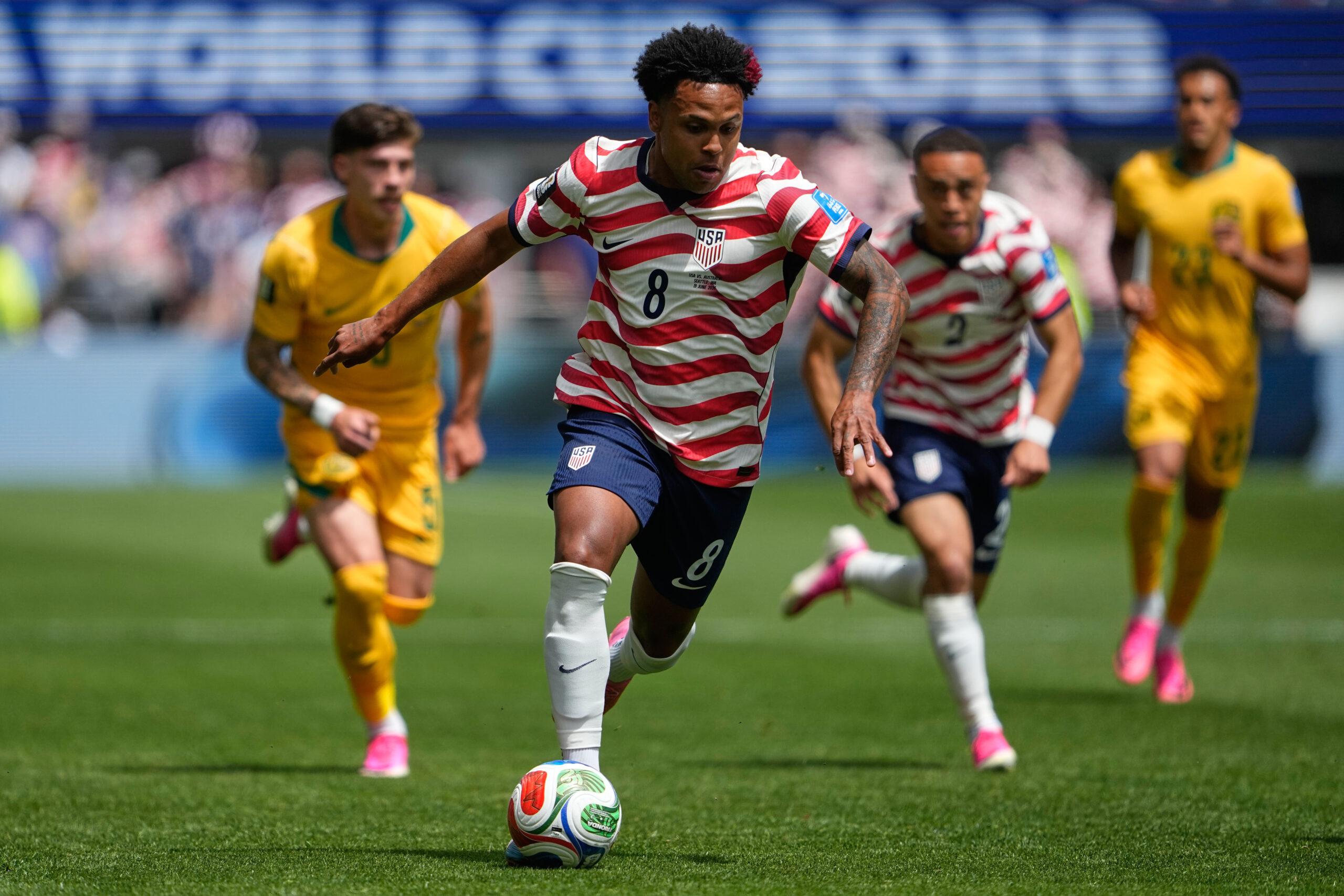
Weston McKennie (8) has been one of the U.S. men’s national team’s toughest players in this World Cup.
It’s been a must-watch because the underdogs are bringing it. What does that mean for the United States, a team that showed dominance through the group stage but is coming off an eye-opening loss to Turkey entering the knockout phase?
Did that loss recenter these players, and they’re ready to show what they learned against a Bosnia team happy to still be in the fight? Or will there be a World Cup-ending theater late on Wednesday night?
Our team of writers take a look at the matchup and the tournament at large to offer where they think this one will end up.
I know it will shock all of you that I’m a cynic by nature, not just profession. The stakes for the U.S. losing this game are almost higher than for winning it, because everything the program has done for the last eight years — not just since 2022 — goes up in smoke if they go out now.
Meanwhile, Bosnia is on house money, and I can only imagine how many emotions will be in Esmir Bajraktarević’s mind as he plays against the nation he used to represent. But in the end, the U.S. has the better talent and should have another electric home crowd behind it in the Bay Area.
That’s good for one goal, and a first-choice starting lineup (even if the bench isn’t full) is worth another.
Prediction: United States 2, Bosnia and Herzegovina 0
Bosnia’s Esmir Bajraktarević (left) was in the U.S. youth system before committing to playing for Bosnia in the World Cup.
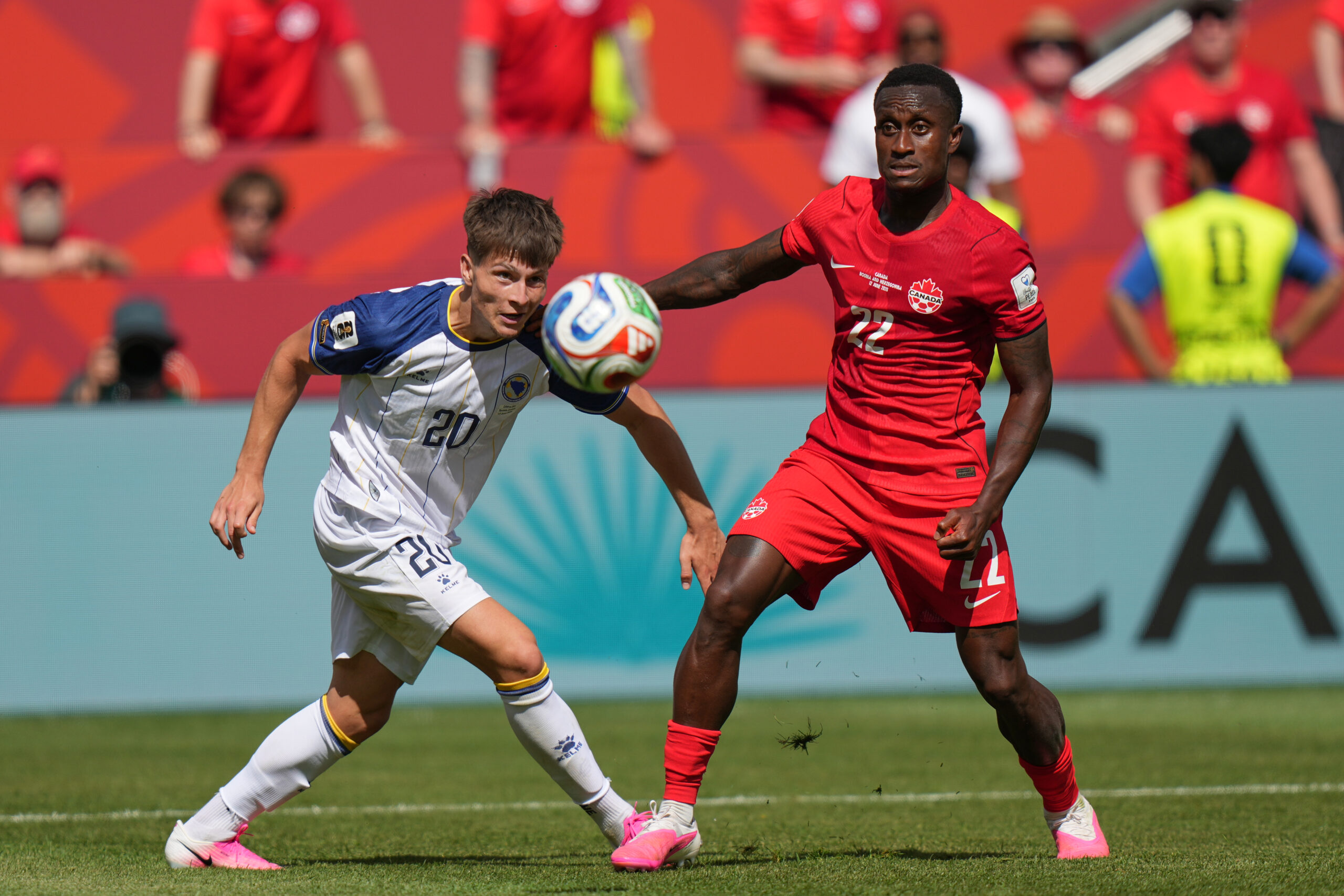
How this plays out for me is largely determined by the lineup U.S. manager Mauricio Pochettino puts out against a really big, physical Bosnia team that bullied its way to four points against Canada and Qatar after shaking off a 4-1 beat down to Switzerland in its second game of Group B.
There are guys who need to be on the field for the U.S. in the biggest moments. Chris Richards is one of them. Tyler Adams is another, and obviously, a healthy Christian Pulisic and locked-in Matt Freese make the difference.
Plus, moving to the next round on U.S. soil, on the West Coast, where the Americans have already found success, feels natural. Frankly, they should want it more. So if we’re talking about what’s at stake for the U.S. vs. what Bosnia stands to gain, it’s tough to see how this American contingent doesn’t take that into account, play the best 11 of the 26, and move on. But I’ll hedge that it won’t come easy.
Prediction: United States 1, Bosnia and Herzegovina 1 (U.S. wins 5-4 on penalty kicks)
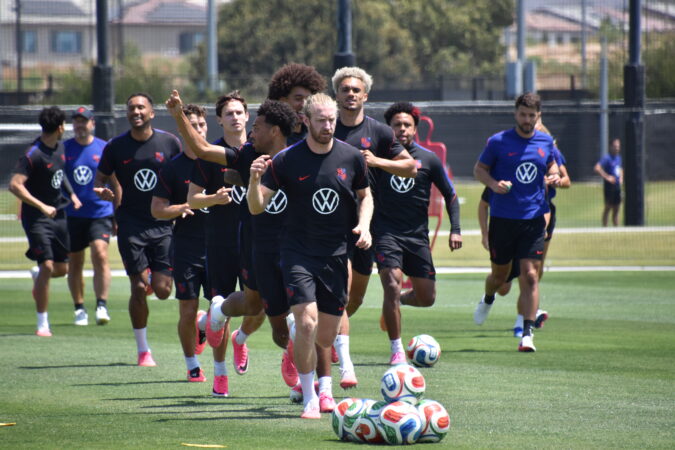
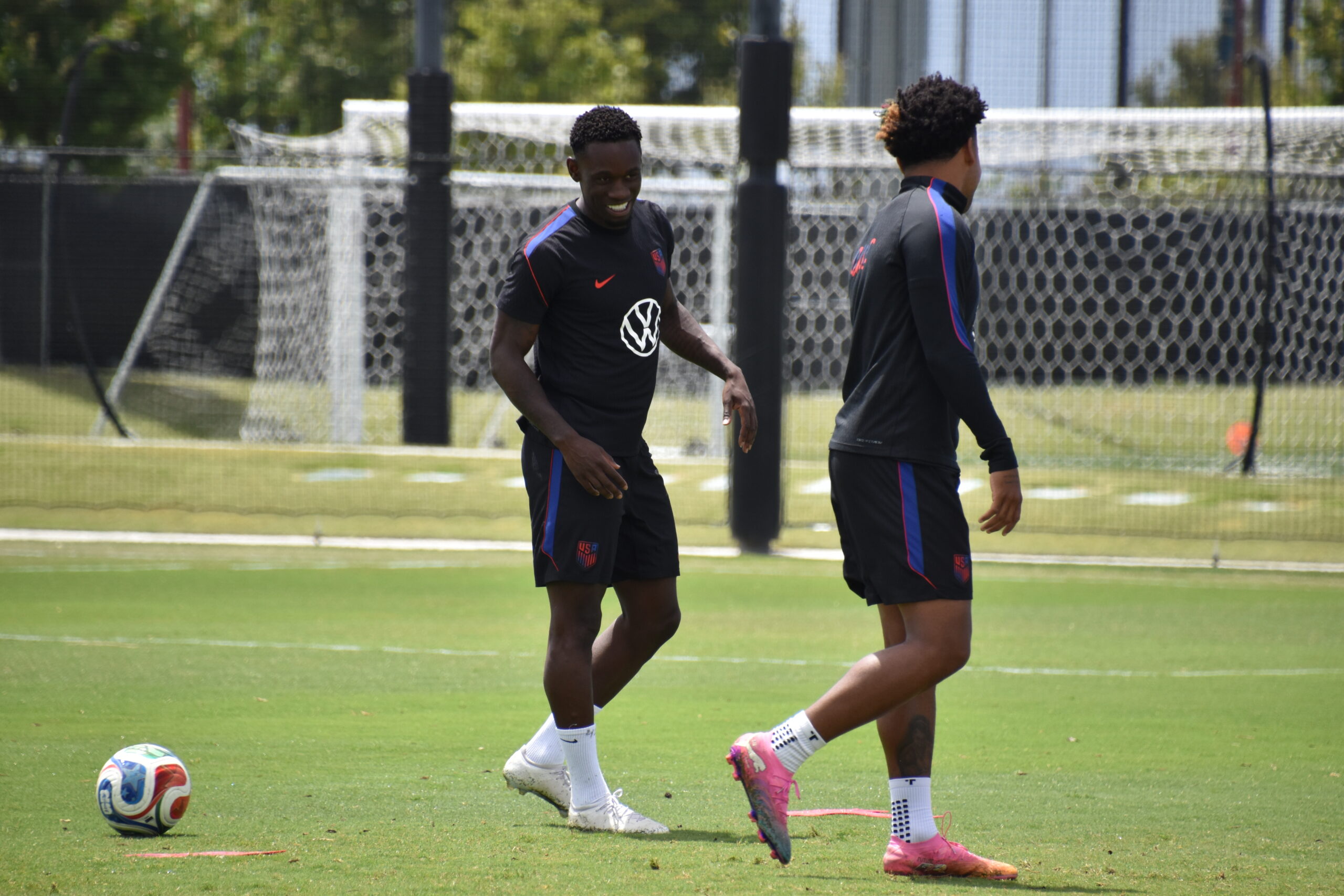
Folarin Balogun (left) is all smiles during the U.S. national team’s practice at Great Park in Irvine, California, this week.
Key American players like Adams, Folarin Balogun, and Tim Ream watched from the bench as the U.S. conceded a 98th-minute winner to Turkey in the USMNT’s group stage finale.
But since the Americans had already secured the group and a place in the knockout rounds, the worst the loss could do was produce a temporary sting. Now, a loss could end it all. The U.S. will need to follow up a strong group stage performance with its second-ever win in a knockout game at the World Cup.
A win in the expanded knockouts wouldn’t quite have the magnitude of the “dos a cero” round of 16 win over Mexico in 2002, but knockouts are knockouts.
The U.S. has played confidently at this World Cup, something it will need to continue to snap a 10-game losing streak against European sides. The Bosnians will be a tough test, but a well-rested American team should overcome its recent form against Europe.
Prediction: United States 2, Bosnia and Herzegovina 0
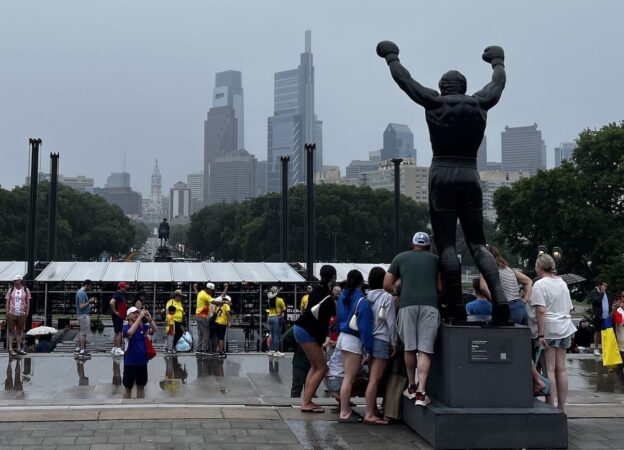
As soon as international soccer fans arrived in Philadelphia for the World Cup, they continued a time-honored tradition of gathering en masse at the foot of the Philadelphia Museum of Art steps, thrusting their fists to the sky as Sly Stallone did 50 years ago, and rallying for their team to victory.
From the thousands of Ecuadorian fans draping soccer jerseys on the Rocky statue, inadvertently cursing the Ecuador national team before it lost to Ivory Coast, to Brazilian fans staging security guards to deter fans from doing the same, and Iraqi fans waving their flags at the top of the steps — Rocky and its picturesque views of the Benjamin FranklinParkway have been a staple of Philly’s World Cup.
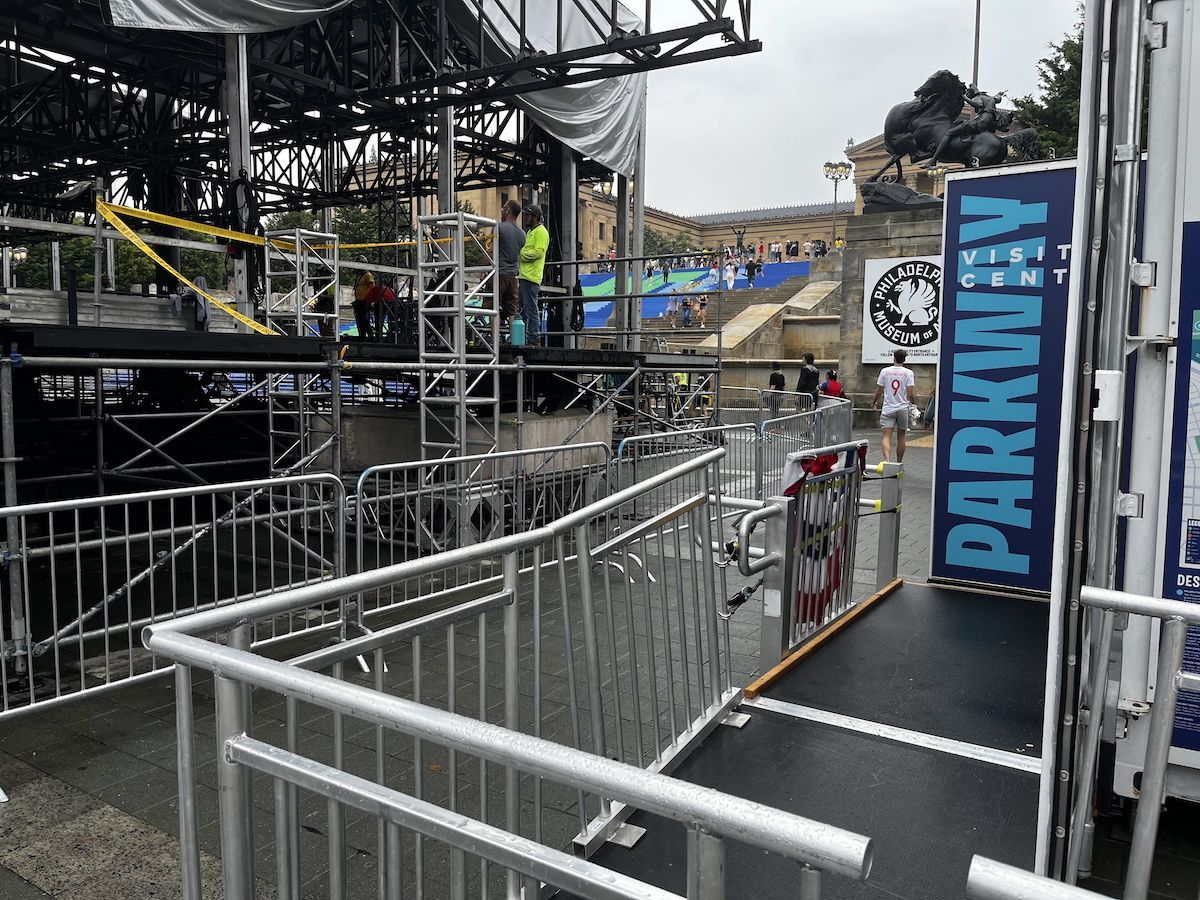
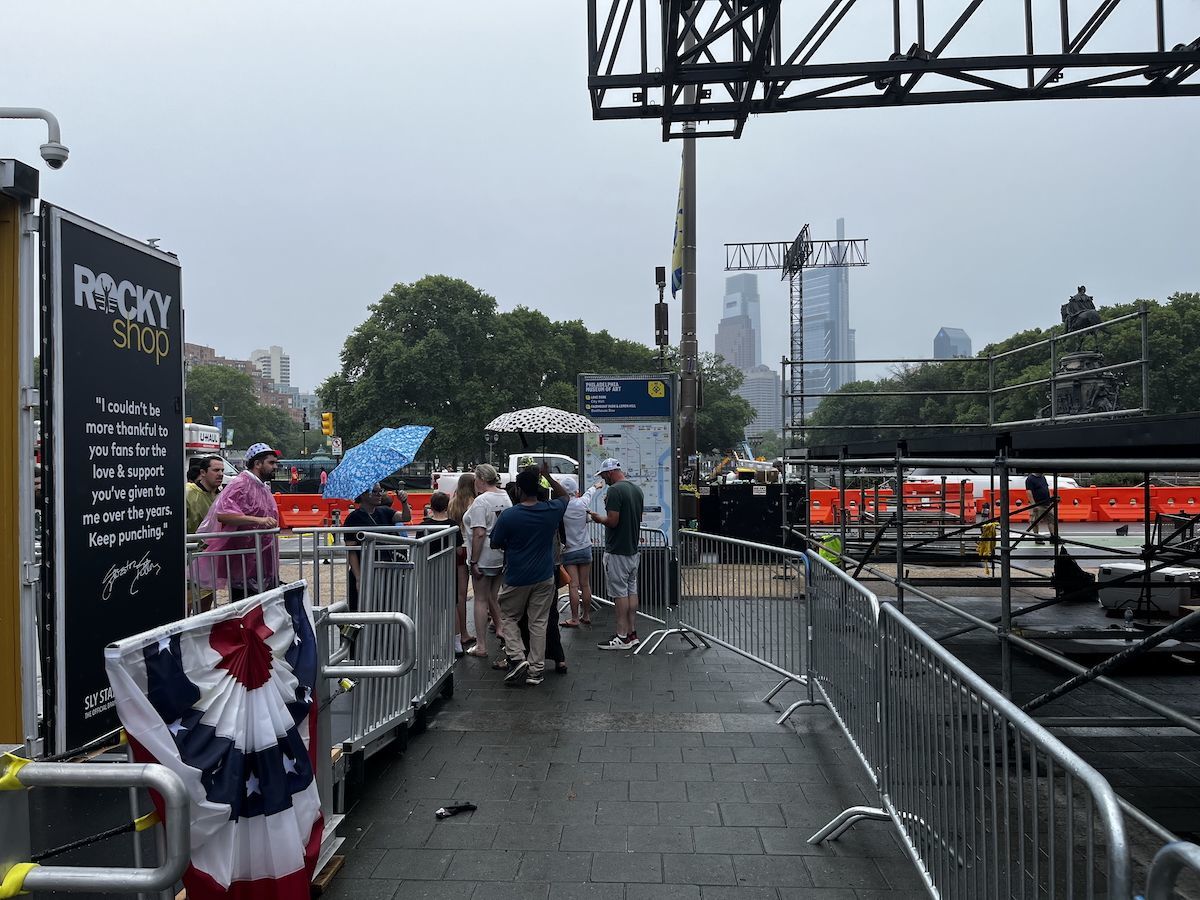
Temporary fenced walkways were erected for tourists to access the Philadelphia Museum of Art steps and Rocky Statue while the One City: Unity Concert for America stage is under construction on Saturday, June 27, 2026. Some World Cup fans and tourists have remarked on its inconvenience, but are enjoying the Parkway anyway.
However, last week, a stage spanning the width of the steps was erected in front of theRocky statue, leaving two narrow walkways to access the iconic landmark. Metal fencing ushers tourists through a walkway behind the under-construction stage, which will soon host the One Philly: Unity Concert for America on July 4 — the city’s revamped Fourth of July concert, which had been known as the Wawa Welcome America July 4th Concert for more than a decade.
“Because of the magnitude of this year’s event, organizers needed to properly position the stage back to where they’ve done large scale events before at the Art Museum,” a spokesperson for the Mayor’s Office of Communications said about the placement of the stage.
Additionally, a spokesperson for the Office of Special Events said Croatia was the only fan meetup that was asked to relocate so far, as it planned to transport a 300-foot Croatia flag through the area which would prove difficult in the narrow walkways.
For most, this is a minor inconvenience. For Croatian fans, it forced them to relocate their pre-game rally and march.
“People did want to start the parade at the Rocky steps, and some people were upset by it,” said Croatia supporters organizer Daniel Pedisich. “But some of our fans went to Rocky on their own, and in some ways, maybe we avoided that Rocky curse?”
Croatia fans cheer outside Con Murphy’s Irish pub along Benjamin Franklin Parkway on Friday, June 26, 2026. A plan to gather at the Rocky statue turned out to be logistically impossible.
Before the Croatian fan delegation would go on to cheer the checkered-clad team to a win against Ghana on Saturday, Pedisich said the city encouraged them to relocate their parade elsewhere along the Parkway. They settled for Con Murphy’s Irish Pub on 17th Street.
Before the fan parade Friday, Bosko Katic, known to friends as “Coach Bosko,” was sporting red-and-white checkered overalls and a Croatia-themed cowboy hat as he waited for the fan parade to start at the new location. Croatians know how to bring joy to everyone they meet, Katic said, so while the delegation didn’t begin their march with Rocky, they still found ways to make memories — including crashing a wedding photo shoot at City Hall.
Bosko Katic cheers while waving the Croatia national flag outside of Con Murphy’s Irish pub along the Benjamin Franklin Parkway on Friday, June 26, 2026.
“We couldn’t gather at Rocky because there is something happening there, so we changed the parade route,” Katic said. “But it does not matter anyway — we always bring party, happiness, and love to everybody who is around us.”
Later that weekend, as tourists made their way to the Art Museum steps, squeezing by each other in the walkways, El Salvadorian World Cup fan Stephanie Rodriguez took photos of the steps while standing behind the stage. While Rodriguez admits she’s never seen a Rocky film, the site is “one of those things in pop culture that’s so iconic that you have to see it — like you can’t go to Philly and not see the Rocky steps,” she said.
Tourists shuffle by each other in the temporary fenced walkways erected for near the Philadelphia Museum of Art steps and Rocky Statue while the One City: Unity Concert for America stage is under construction on Saturday, June 27, 2026.
While the large stage perplexed her, she said she was able to eke out some great photos with Rocky, as the statue itself was accessible and not blocked from view.
“I mean it was surprising because I wasn’t expecting to see such a big stage in front of the Rocky steps, but I think the photos are coming out great,” Rodriguez said.
The concert will turn the Parkway into a festival on July 4 from 3 p.m. until midnight, when a fireworks finale caps the night. Some of Philadelphia’s most prized musical acts will headline, from The Roots and Jill Scott to Will Smith and DJ Jazzy Jeff, plus Meek Mill, Beanie Siegel, and Freeway are scheduled to perform starting at 5 p.m.