Pennsylvania’s new budget has $5 million in supplemental payments for the two Delaware County Hospitals that have seen significant increases in patient volumes since Crozer-Chester Medical Center and Taylor Hospital closed in the spring.
Main Line Health’s Riddle Hospital, near Media, is getting $3 million. The amount for Trinity Health Mid-Atlantic’s Mercy Fitzgerald Hospital, in Darby, is $2 million, according to budget documents.
The $5 million will be doubled by a federal match, said Democratic State Sen. Tim Kearney, who represents part of Delaware County. The $5 million is from a fund used to help hospitals the serve a large number of patients with Medicaid and used to go to Crozer Health, Kearney said Friday.
“Since Crozer’s shutdown in April, Riddle’s Emergency Department has experienced an unprecedented surge — 46% more patients than the same period last year, an increase of nearly 4,000 overall,“ the nonprofit said.
Main Line, which also owns Lankenau Medical Center, Bryn Mawr Hospital, and Paoli Hospital, said it has seen 55,000 patients from the Crozer market — a 15% increase over the same time period last year. That figure includes 8,000 patients who went to a Main Line facility for the first time, the health system said.
Trinity Health did not respond to a request for comment.
Shuttered hospitals in limbo
While Riddle and Mercy Fitzgerald have scrambled to accommodate patients who used to rely on Crozer Health, efforts are underway to bring healthcare services back to at least Taylor Hospital in Ridley.
A group from New Jersey called Chariot Allaire Partners LLC has agreed to pay $10 million for the former Crozer-Chester Medical Center in Upland but has not disclosed its plans. That facility served as a key safety provider for a low-income area of Delaware County.
A partnership of Restorative Health Foundation and Syan Investments won an auction for Springfield Hospital for $3 million, but it does not have support from township officials.
Delaware County legislators also obtained $1 million from the state to buy emergency department equipment if one of the closed hospitals, such as Taylor, reopens, Kearney said.
Editor’s note: This story has been updated with additional detail on the funding.
This suburban content is produced with support from the Leslie Miller and Richard Worley Foundation and The Lenfest Institute for Journalism. Editorial content is created independently of the project donors. Gifts to support The Inquirer’s high-impact journalism can be made at inquirer.com/donate. A list of Lenfest Institute donors can be found at lenfestinstitute.org/supporters.
Long before U.S. men’s soccer team manager Mauricio Pochettino unveiled a 3-4-2-1 formation for his players, outsiders debated the possibility.
Though the program went decades without playing that way, the rise of high-flying outside backs like Sergiño Dest made the idea start to sound sensible.
But since Pochettino made the switch in September, Dest hasn’t gotten to play in the new setup much. He was a second-half substitute in the momentum-turning win over Japan, then had to miss October’s games because of an injury.
That makes this month’s games crucial for the 25-year-old, who plays his club soccer at Dutch power PSV Eindhoven. The odds are good that fans will see him play a major role Saturday at Subaru Park when the U.S. faces Paraguay (5 p.m., TNT, Telemundo 62).
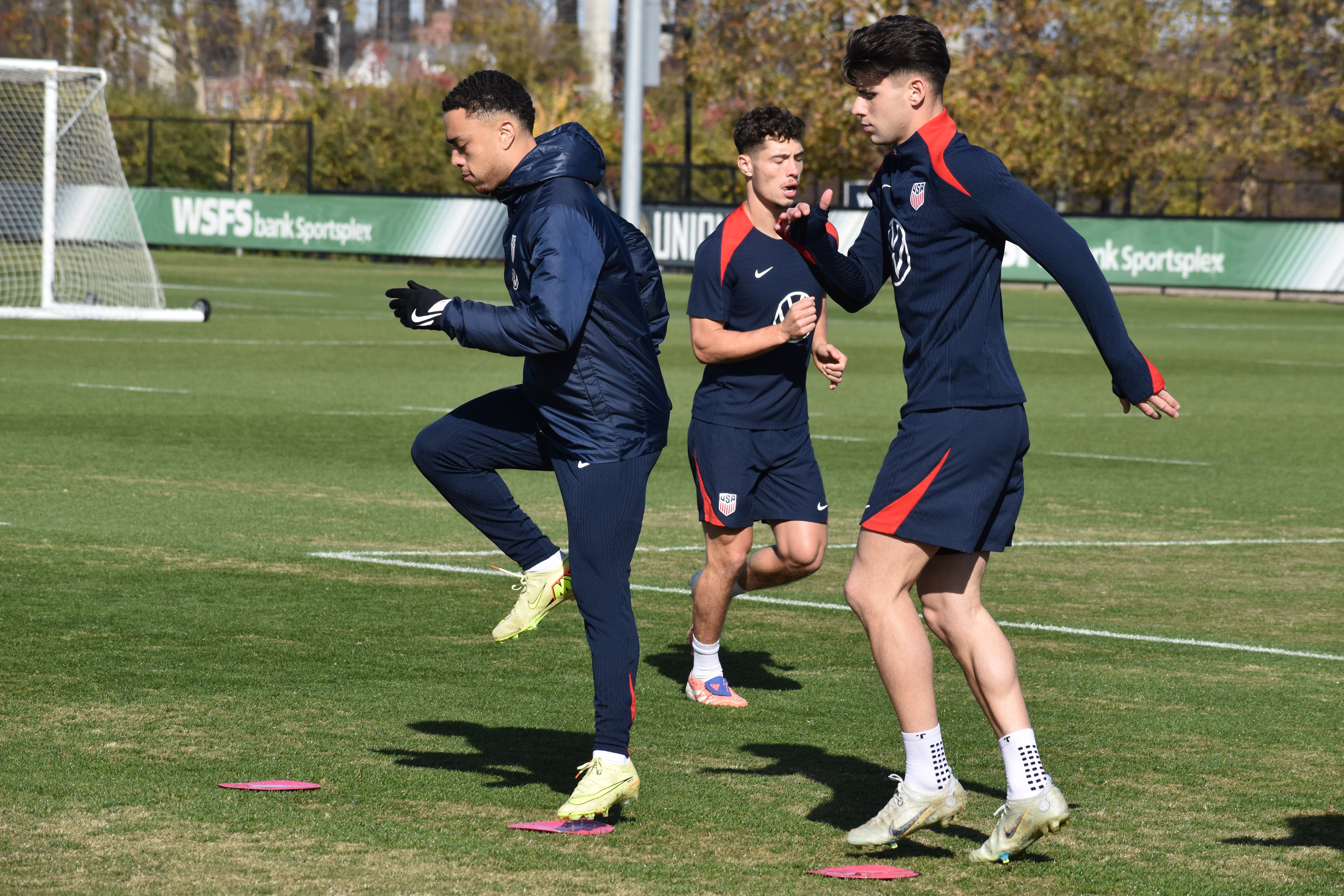
Sergiño Dest (left) and left wingback Max Arfsten (right) working out together at Friday’s practice.
“Yeah, I feel like it’s really important,” Dest said at Friday’s practice in Chester. “Because the rosters are a little bit different. For me personally, because I was injured, I didn’t really have that much time to play with everyone, the players that I didn’t know before. It needs time.”
Dest has historically played on the right side of a four-defender setup with both club and country. The right wingback spot ahead of three centerbacks isn’t too different, but as with any tactical change, there are subtleties.
“It’s a little bit different, but obviously, that’s the way we play at the moment, so I feel like you have to adapt to that formation,” Dest said. “For me personally, I’ve always been an attacking outside back, so I feel like it’s not that hard. But you still need some time.”
Dest can also play on the left side, as he did against Japan. That could matter even more if longtime starter Antonee Robinson can’t overcome his longstanding knee issues. A combination of Dest and Tim Weah (who’s out injured right now) as the wingbacks would be quite dynamic — though with plenty of defense needed between them.
Sergiño Dest (center) at a U.S. practice in September, the last time he was with the team.
“Now is a good opportunity for him,” Pochettino said. “I think we have good players in that position [in this squad] like Alex Freeman and Joe Scally, that are very competitive and they can play in different [roles]. Sergiño is more offensive than defensive — he needs to improve in defensive areas — but I think it’s a great opportunity for us to know him, to see the capacity to adapt to our demands that are completely different for his club, or were in the past year. “
Whatever Dest is asked, he made it clear he’s ready to answer the call.
“I always want to play for the national team,” he said. “I feel like it’s an honor to be here and to fight for my spot. I always wanted to be here, but to have some extra training and some extra rest between some games, especially after the injury I came from, I think it’s also not bad, especially with the long season we still have ahead.”
Gio Reyna in the spotlight
While local fans will obviously be focused on the four Philly-area products on this squad, many eyes nationally will be on Gio Reyna’s return to the squad. The talented young playmaker had been on a downward slide for a while, but has finally started to trend back up in the last few weeks.
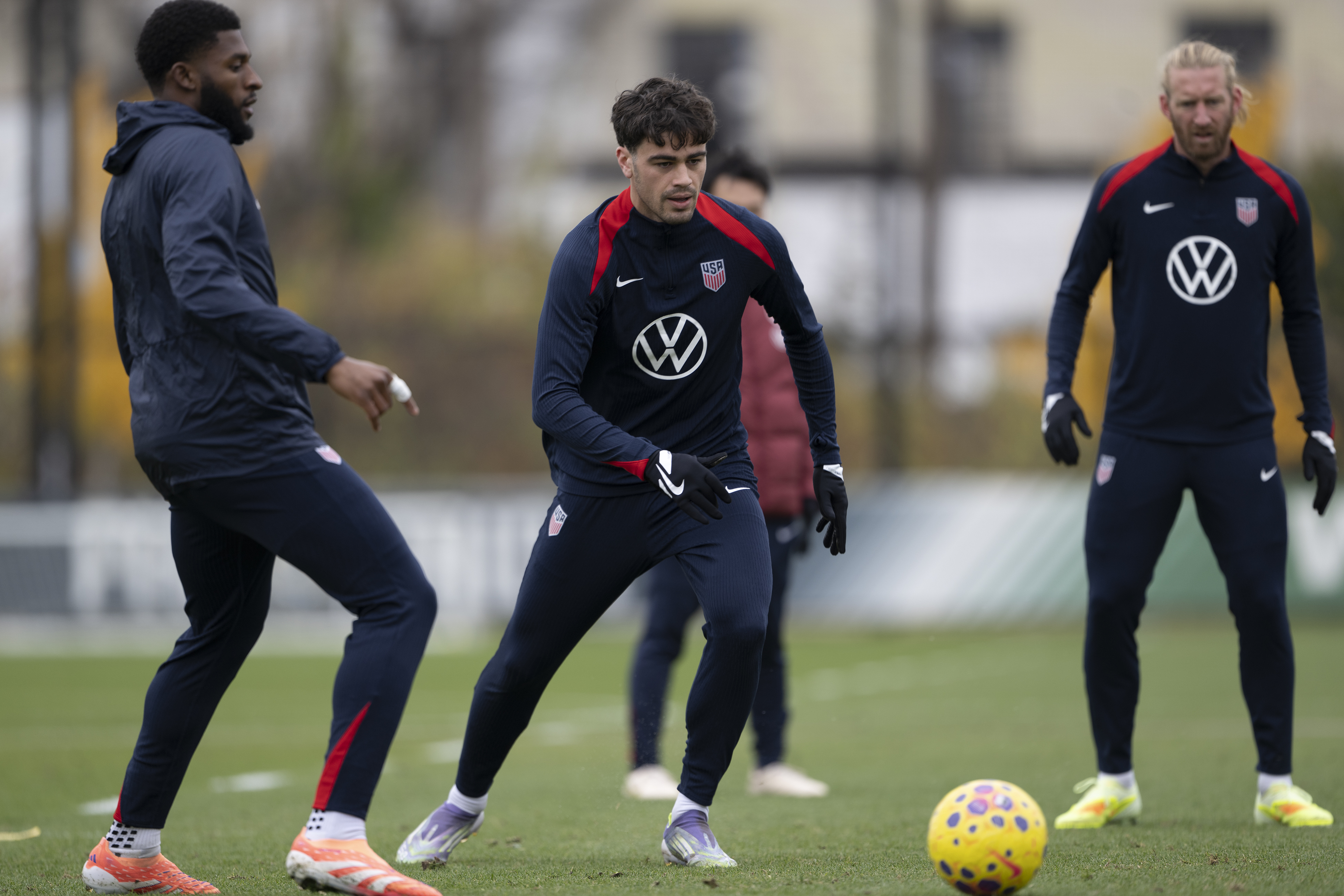
Gio Reyna (center) on the ball at Wednesday’s practice.
If he can make an impression in these two games, it will be a big deal in his quest to make a second straight World Cup team.
Reyna hasn’t spoken with the media yet this week, but veteran U.S. centerback Tim Ream had praise for Reyna’s work in practice.
“He’s not really letting the challenges overseas seep into camp, which is great to see,” said Ream, who wears the captain’s armband under Pochettino as the squad’s most experienced player. “He’s speaking up a lot more in the trainings, in terms of, ‘OK, I’m seeing this, what are you seeing?’ He’s really getting involved in the understanding of the movements and what we’re doing in the buildup and in the defensive shape.”
Ream said he has observed a better mentality in Reyna, too. That has long been a question about the attacking midfielder, dating back to the scandal with former U.S. coach Gregg Berhalter at the 2022 World Cup.
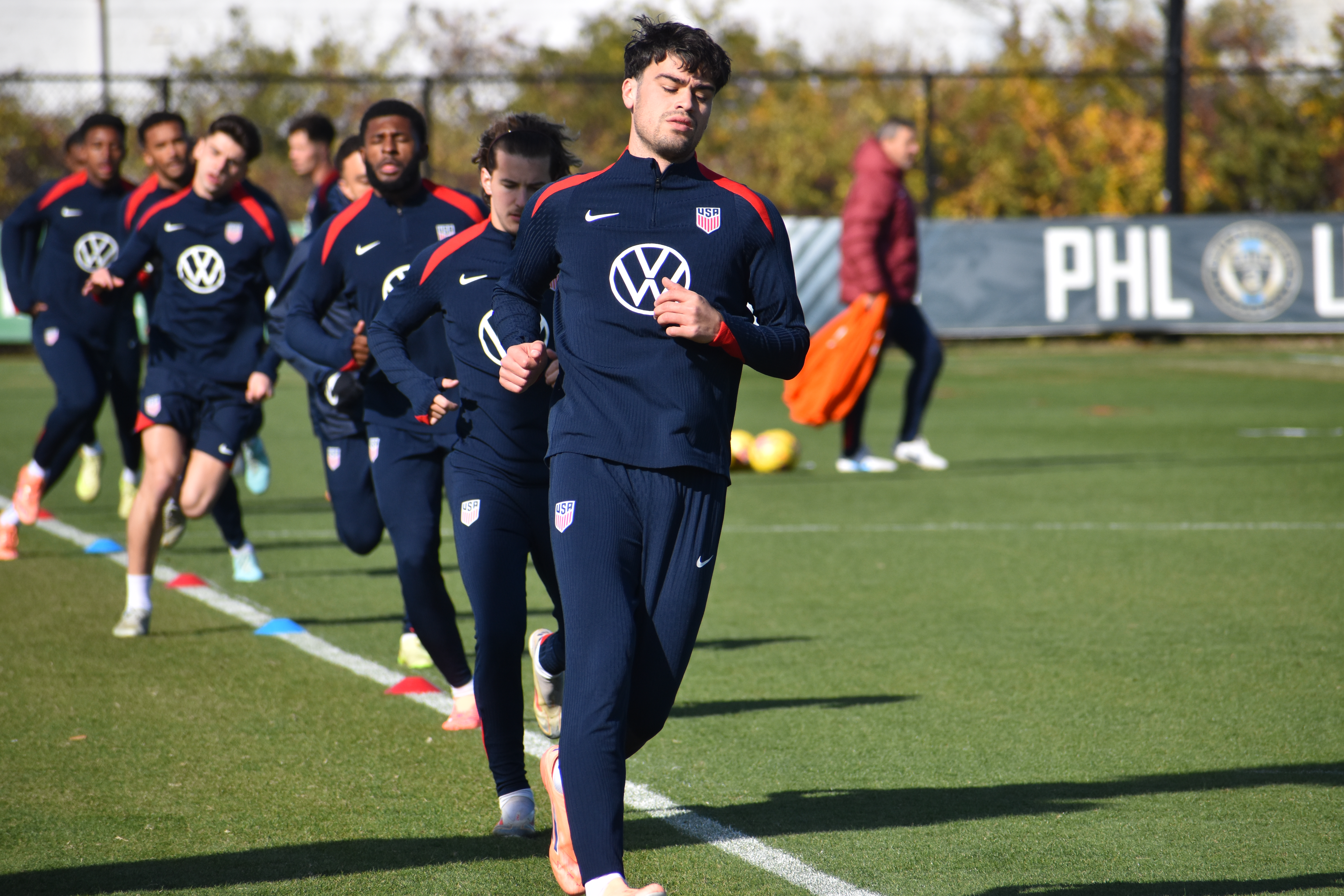
Gio Reyna leading the jogging line at the start of Friday’s practice.
“I feel like he’s more in tune and more focused on the field than I’ve seen in the past, which is a great thing,” Ream said. “And I think whether it was injury or other things that were going on, I think his focus is so much greater now, and that’s a good thing.”
The mention of “other things” didn’t need further detail. Just last month, Reyna talked about it with the Associated Press, and his lack of contrition did not go over well.
This U.S. squad is the first one where Reyna has worked with Sebastian Berhalter, Gregg’s son. Gio’s famed father, Claudio, was as close as could be with Berhalter until the scandal erupted.
Pochettino was asked whether the subject had come up between the sons, and he said it has not.
“I hear some things, but for me it’s not important, because in front of everything is the national team,” he said. “I cannot judge, I cannot take decisions from the past. … Now it’s a completely different environment. And what I saw from day one — good synergy, good teammates — I think the interaction and the communication is fantastic.”
Across the Philadelphia suburbs, county leaders are tightening their budgets, and looking toward potential tax increases.
Counties are required by law to complete their budget for next year by Dec. 31. But they entered this year’s budget season facing uncertainty withfederal funding and a lack of clarity over state dollars as lawmakers remained locked in a monthslong budget impasse that ended only Wednesday when the Pennsylvania General Assembly and Gov. Josh Shapiro approved a $50.1 billion budget.
“We were preparing for more needs and less money,” said Josh Maxwell, a Democrat who chairs the Chester County Board of Commissioners. And even as Washington and Harrisburg resolved their budget woes this week, they did little to resolve concerns at the county level.
“I don’t think if the General Assembly had sent us a gold-plated demand or invitation to raise property taxes it could have been any clearer,” said Delaware County Council member Christine Ruether, a Democrat.
Counties in Pennsylvania can only increase their revenue by raising property taxes. By failing to provide additional funds for social services, county officials argued, the state had created a situation where counties would immediately or eventually have to raise property taxes.
“The people we serve … all their problems don’t suddenly go away because there’s a lack of funding to address the problem,” said Bob Harvie, a Democrat who chairs the Bucks County Board of Commissioners and is running for Congress.
“It will likely mean that this county will have to consider a tax increase because we need to meet the needs of those people.”
Bucks County has not yet released its proposed budget for 2026. But residents in Montgomery and Delaware Counties are likely facing tax increases.
Delaware County’s executive director Barbara O’Malley told the all-Democratic council last week that the county would need to increase property taxes 19% to eliminate the county’s structural deficit. A healthy financial setting, she argued, was especially important as state and federal funding streams have become less reliable.
Both budgets were crafted before the state budget was released but county officials said they wrote the documents assuming stagnant funding from the state despite inflation.
“We kept it status quo,” said Dean Dortone, Montgomery County’s chief financial officer.
Chester County officials said they’ve taken a similar approach. The county, Maxwell said, had also lookedfor budget cuts throughout the year as federal grant cancellations created uncertainty.
“We’ve been cutting all year because we know that the federal and state governments are going to be flat or less funding,” Maxwell said, but if the state continues to leave funding flat for social services it will eventually have an impact.
“Over time it’s going to mean property taxes are … going to go up more than they would have otherwise.”
Meanwhile, counties have spent the last several months backfilling for state funds that didnot come during the impasse.
In Montgomery County, officials estimated the county had spent between $40 and $50 million from budget reserves to maintain services. Chester County officials estimated the county spent $40 million, while Delaware County officials reported spending $12 million monthly until October when the county was forced to reduce payments to social services providers.
Counties expect to be reimbursedby the state for those expenses, but it’s unclear how quickly those payments will come.
Delaware County declared a state of emergency Wednesday allowing them to more quickly distribute funds to local food pantries while the organizations wait for state and federal dollars to come through.
“It’s going to take a while for the money to trickle down and in the meantime if somebody can’t get food on the table it’s an issue,” Reuther said during the county’s board meeting.
This suburban content is produced with support from the Leslie Miller and Richard Worley Foundation and The Lenfest Institute for Journalism. Editorial content is created independently of the project donors. Gifts to support The Inquirer’s high-impact journalism can be made at inquirer.com/donate. A list of Lenfest Institute donors can be found at lenfestinstitute.org/supporters.
As VJ Edgecombe prepared to leave the 76ers’ locker room Sunday, following the team’s second set of back-to-back games in less than a week, veteran teammate Andre Drummond noticed the rookie looked “exhausted.”
So Drummond offered direct instructions for Edgecombe heading into the Sixers’ mandatory off day.
“Don’t get up until 6 p.m. tomorrow,” Drummond publicly reiterated in front of reporters a few minutes later. “6 p.m., VJ. So if you see this, keep your [butt] in bed.”
Perhaps no Sixer will benefit more than Edgecombe from this light stretch of the Sixers’ early schedule, when their only game in five days is Friday at the Detroit Pistons. After a torrid scoring start — including a historic 34-point outburst in the Sixers’ opener at the Boston Celtics — Edgecombe has shot 27.9% (17 of 61) from the floor and 25% (5 of 20) from three-point range and averaged 9.4 points during his past five games.
The mini slump is understandable for a rookie going through the demanding 82-game NBA schedule for the first time, and playing heavy minutes for a competitive Sixers team in record (7-4) and in number of “clutch” games played (nine, tied for the NBA lead entering Thursday). And there is no substitution for Edgecombe simply experiencing the grind.
“It’s not weighing on me,” Edgecombe said of his recent struggles. “Why I say it’s not is because it’s an 82-game season. Nobody’s going to remember these games early. I mean, I’m a rookie, man. I’ve got to give myself some grace. Obviously, I set a pretty high standard when I came and had a good debut scoring the ball.
“But at the end of the day, I just want to win. That’s the main thing for me. I just want to win.”
Coach Nick Nurse said that Edgecombe’s “tremendous engine” — the 20-year-old guard can “work really long days, and then do it again the next day,” the coach added — and mental fearlessness have been present since the Sixers drafted him this summer.
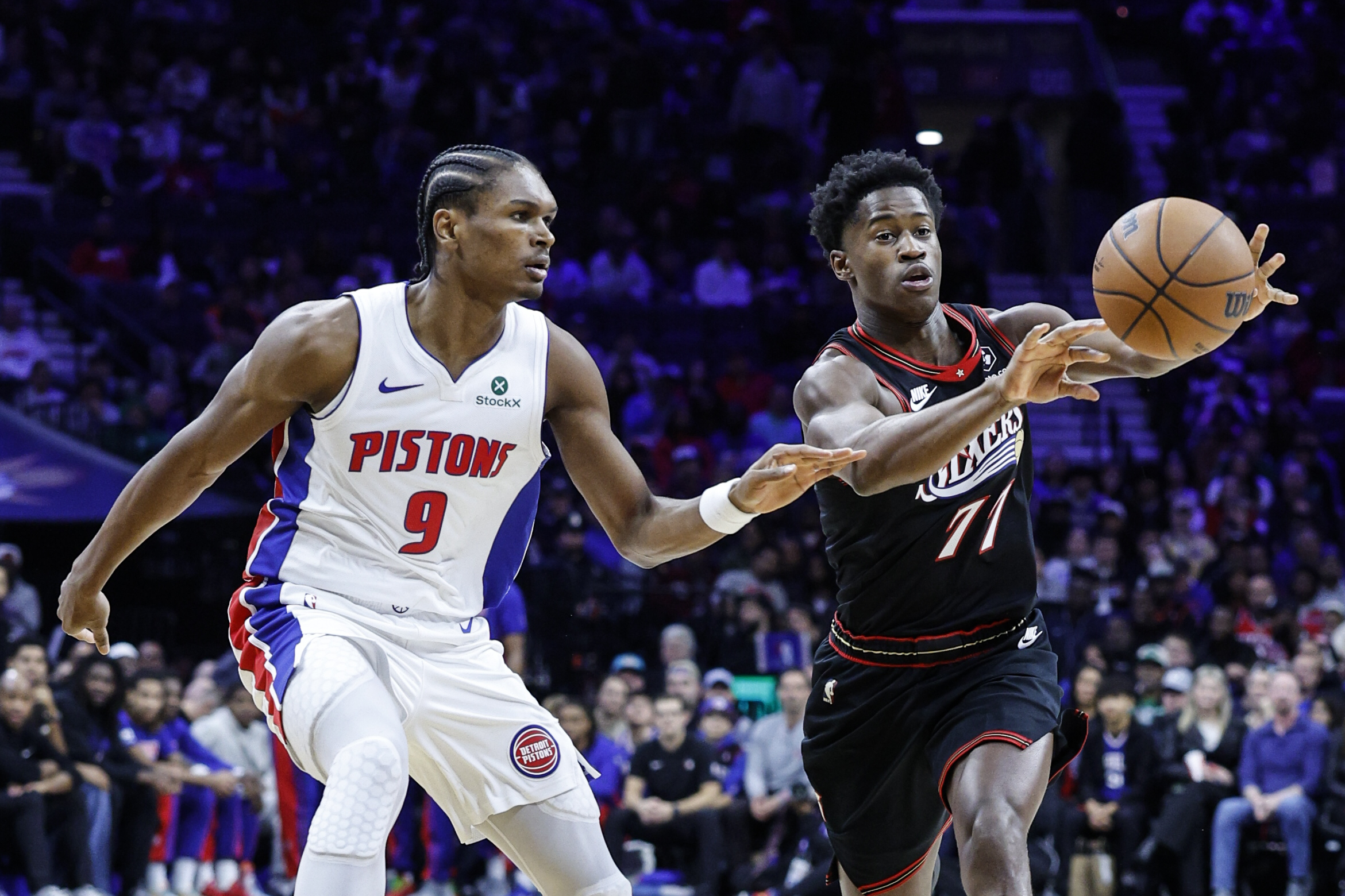
Sixers Vj Edgecombe has shot 27.9% from the floor and 25% from three-point range and averaged 9.4 points during his past five games.
That motor has already been put to use. Entering Thursday, Edgecombe ranked second in the NBA in minutes played (37.3 per game), only behind teammate Tyrese Maxey (40.5 per game). And after playing 35 total games his one college season at Baylor — “and 12 of them don’t really count,” Nurse quipped — Edgecombe logged 11 NBA games in less than three weeks. That included three back-to-backs, which Edgecombe acknowledged was “tough for me personally.”
“I don’t know if I can prepare myself for that,” Edgecombe said.
And it is not just the avalanche of games, but everything in between. Last week, the Sixers completed their first multigame road trip to Brooklyn, Chicago, and Cleveland. That typically means leaving one city immediately after a game, landing in the next city in the middle of the night, then needing to be ready to jump into practice or game preparation a few hours later.
Maxey said Tuesday that, in Year 6, he has just begun to figure out a maintenance routine that works for him. Justin Edwards, who was a rookie last season, learned preventive treatment such as sitting in a cold tub, “flush” massages, and red light therapy are crucial.
So far, Edgecombe spends nights without a game sitting on his couch in recovery boots that alleviate leg soreness. On game days, he takes a nap and speaks to his family. His goal is to keep his mind peaceful, following a mantra from high school coach John Buck that “you can’t be grateful and stressed at the same time.”
Edgecombe had already earned the trust of teammates and coaches with his work ethic and temperament. Nurse praised that Edgecombe was “everywhere” the team asked during the offseason, even canceling a visit home to the Bahamas.
That is why Nurse was not hesitant about immediately inserting Edgecome into the starting lineup. Or keeping him with the closing group, even when he struggled with his shot or turnovers earlier in the game. Edgecombe is already one of the Sixers’ better perimeter defenders. He also always has the potential to flash his insane athleticism as a driver or finisher. And he has already shown a knack for knocking down clutch shots, while averaging 15.4 points, 5.5 rebounds, and 4.3 assists so far this season.
“He’s got great composure. He’s calm. He doesn’t make too many mistakes,” Nurse said. “I super believe in him. … He needs to be out there and learn this stuff, and he’s produced.”
Like during the Sixers’ win over Celtics Tuesday night. Edgecombe missed eight of his first nine shots, including an air-balled three-pointer to begin the third quarter that prompted him to mouth “Oh my God” in surprise (or self-deprecation).
Sixers guards VJ Edgecombe and Tyrese Maxey occupy the NBA’s top two spots in minutes played per game.
But with about five minutes remaining, Edgecombe elevated to block All-Star Jaylen Brown’s dunk attempt, then pushed the ball ahead to Edwards for a three-pointer. Then with 2 minutes, 20 seconds to play, Edgecombe let an open three-pointer fly — and watched it bounce high off the rim and through the net to give the Sixers a four-point lead. Perhaps that was a reward for Edgecombe’s summer work to get more arc on his shot, and “give it a chance to get in the rim,” he said.
“It’s been a rough couple days, but I won’t stop shooting the ball,” Edgecombe said. “I will continue shooting the ball if I’m wide-open, if it’s the right shot.”
That is one of several on-court lessons for Edgecombe during these first 11 games. Another is that he cannot expect to outjump competitors for a rebound, because “they’re 7-foot and they’re gonna get there quicker than me.” Nurse added that Edgecombe must get downhill more aggressively while playing alongside Joel Embiid, in order to draw the defender away from the former MVP and open opportunities for Edgecombe to pass to a rolling or popping Embiid. Even the speedy Edgecombe notices the increased pace at the NBA level, and that he needs to sharpen his defensive positioning.
And though Edgecombe feels empowered by coaches and teammates to be himself on the court, Nurse acknowledged Thursday that the staff can more deliberately put Edgecombe in situations with the ball in his hands.
“Come hell or high water, this is your play,” Nurse said. “Go make something happen.”
After Tuesday’s sputters, Edgecombe believes he is “due for a game to get back on track.” Nurse added that Edgecombe’s past two days have been filled with “constant film work,” which is “still [a] pretty heavy load mentally, no matter if he’s on the court or not.”
But that approach does allow Edgecombe to take Drummond’s advice. On Monday, Edgecombe said he woke up after noon, then was back asleep by 5 p.m. So it is fair to assume he will aim to maximize this lighter early-season stretch, with one game in five days.
“When I get home, in my bed,” Edgecombe said, “that’s the best thing.”
Dorothea Cathell, 77, of Philadelphia, longtime community volunteer, retired hospitality worker, three-time cancer survivor, expert tailor, and mother of four, died Friday, Sept. 26, at Lankenau Medical Center of injuries she sustained as a victim of a hit-and-run at 54th Street and Lancaster Avenue.
Ms. Cathell was walking home from a shopping trip with Halloween decorations on Sept. 26 when she was struck by a speeding car. The driver left the scene in a damaged vehicle, and a suspect was arrested later and charged with homicide by vehicle-DUI and other charges. The case is pending.
“She was an awesome woman and mother,” said her son Ralph. “She was a real big light for the universe.”
Born and reared in South Philadelphia, Ms. Cathell lived in West Philadelphia as an adult and treated her neighbors like family, her son said. She volunteered at local free meal programs and youth activities and “opened her door to the homeless and anyone else in need,” her son said.
“She valued education first and promoted so much positivity in the neighborhood,” he said. “She had an extraordinary personality. Her heart was so huge.”
Ms. Cathell survived two bouts of stomach cancer and a case of colon cancer, and was “as tough as 30 gorillas,” her son said. She championed order and cleanliness in the community, worked in housekeeping for a hotel, and was an expert tailor.
Ms. Cathell was an avid storyteller, her son Ralph said. “She was a poetic person.”
“She made my sixth-grade graduation suit,” her son said. “Jacket, vest, shirt, pants, and tie. My friends said, ‘Wow.’ I said, ‘My mom did it.’”
Dorothea Elizabeth Cathell was born Dec. 25, 1947. She grew up with three brothers and three sisters, her son said, and graduated from South Philadelphia High School.
She married Charles Carter in the early 1980s, and they divorced later. He died earlier.
She had sons Ralph, Dwight, and Erik, and a daughter, Samiyah. Erik died earlier.
Ms. Cathell was an avid storyteller, her son said. “She was a poetic person,” he said. A friend said on Facebook: “She loved the hell out of her children and grandchildren. Amazing woman, heart of gold.”
Roman Catholic coach Rick Prete said it best: Every team in the state playoffs is good, and this is what each program has prepared all year for. What they’re playing for is different.
For the Cahillites, it’s getting back to the state final after making their first appearance in school history last season, when Roman Catholic fell in overtime to Harrisburg’s Bishop McDevitt for the PIAA Class 5A crown at Cumberland Valley High School.
The heartbreaker has been Roman Catholic’s fuel all season, and this time Prete believes his team is “in a good place” to reach the final.
The Cahillites (8-3) handed La Salle College High its first loss of the season, nearly beat St. Joseph’s Prep (in a 40-39 double overtime loss), and are riding a four-game winning streak entering a matchup against Whitehall of District 11 in the first round of the PIAA playoffs on Friday night.
“We’re the only team that can get in our own way,” said Prete, who has been at the helm since 2019. “We have to stay focused and get better every day. … From the beginning of the year to now, it’s been about staying out of our way and understanding that if we play our best, we’re the best team in Pennsylvania.”
Roman Catholic is led by Akron-bound quarterback Semaj Beals, who has passed for 2,456 yards this season. His main targets have been Ashdan Roberts (12 touchdowns) and Eyan Stead Jr. (eight), who both recently committed to Temple.
Prete also credited center/guard Dom Ramos and defensive end Julian Enoch as the team’s vocal leaders. The two seniors “lead by example and try to hold guys accountable,” Prete said.
“We tell them to be where their feet are,” he said. “We’re not focused on coming off of four wins. We’re coming off of a loss in the state title game. We’re coming off a loss in essentially the PCL championship game. … Roman has been coming back from a loss. That’s been our mindset.”
Pennridge eyes history
Pennridge High has never won a district or state championship. The Rams (11-1) are having their best season under third-year coach Kyle Beller after going 3-7 in 2023 and 4-7 in 2024. They opened the season on a seven-game winning streak, with victories against conference foes North Penn and Neshaminy.
District 1 Class 6A includes top competition. Pennridge, which earned a Suburban One League title outright and was seeded No. 1 in districts, barely got past No. 16 Plymouth-Whitemarsh to open the district playoffs, 22-21.
Pennridge celebrates its victory over Neshaminy on Oct. 3.
“Plymouth-Whitemarsh is a very good program,” Beller said. “We’re talking about the 16th seed and their record is 7-3 — that’s a pretty darn good football team. When you’re looking at that top to bottom there, we knew we had our work cut out for us.
“We have three of the four teams left in District 1 right now, playing for the district championship. That’s how good the conference is [Suburban One National]. It’s the best conference in this side of the state and one of the best in the state.”
Pennridge has found ways to win — against schools it hasn’t beaten in some time. Beller has been building the program for this moment. Pennridge is one win away from a district final appearance, but first must take down Coatesville in the District 1 semifinal on Friday night.
“It’s about consistency,” Beller said. “We’ve had that for three years.”
Following in his footsteps
Cardinal O’Hara coach Michael Ewing reminded his team to stay level-headed entering its matchup with Bonner Prendergast in the Class 4A Catholic League final last Saturday.
“They’re our school’s biggest rival,” said Ewing, in his fourth season at the helm. “Any time we play them in any sport, both schools’ student sections, the alumni, everybody shows out. It’s a great atmosphere.”
The Lions (8-4) silenced the defending 4A state champions, 24-3, marking the first time that O’Hara has beaten Bonner in nine years. O’Hara will face West Philadelphia at the Northeast Supersite on Saturday in the District 12 championship with the chance — at least to Ewing’s knowledge — to win the program’s first district title.
There’s also a unique opportunity for Ewing, who is the grandson of Bob Ewing, the winningest coach at O’Hara and a hall of famer. Michael recalled when his late grandfather won a city title at Veterans Stadium in 1979.
Saturday is his chance to earn the team a city title, following in his grandfather’s footsteps, and he hopes “to do something that he was never able to do” in the state playoffs — win the school’s first PIAA crown.
“My dad coached on his staff as well,” Michael Ewing said. “I grew up at O’Hara — for the first nine years of my life I was on the sidelines, in the locker room, and the coaches’ rooms. They didn’t do the daycare thing back then. …
“The school has a special place in my heart. That’s why I came back to it. That’s why I wanted to try and bring them back to where they once were.”
Here’s a look at the full schedule of the local teams competing in the first round of the PIAA playoffs:
PIAA Class 1A
Belmont Charter at York Catholic, York County, on Saturday (1 p.m.).
PIAA Class 2A
Lansdale Catholic vs. Lakeland, Lackawanna County, at Germantown Supersite on Saturday (1 p.m.).
PIAA Class 3A
Neumann Goretti will play in the quarterfinals next weekend against the winner of Berks Catholic and Trinity High School. Time and location to be determined.
PIAA Class 4A
North Pocono, Lackawanna County, at Bishop Shanahan on Friday (7 p.m.).
Cardinal O’Haravs. West Philadelphia at the Northeast Supersite on Saturday (11 a.m.) for the District 12 title.
PIAA Class 5A
Roman Catholic at Whitehall on Friday (7 p.m.).
Strath Haven at Springfield (Delco) on Friday (7 p.m.).
West Chester Rustin at Chester on Saturday (1 p.m.).
PIAA Class 6A
La Salle vs. Imhotep at Northeast High on Saturday (3 p.m.) in the District 12 championship.
HARRISBURG — The contentious — and, at times, bitter — Pennsylvania budget stalemate has finally ended.
Gov. Josh Shapiro signed the nearly $50.1 billion state budget Wednesday, as part of a breakthrough bipartisan deal that ends a key climate initiative and increases public school funding. Schools, counties, and social service providers will soon receive four months of withheld state payments, lapsed after the budget deadline passed at the start of the new fiscal year on July 1, providing the much-needed relief that some say will come too late.
The long-awaited budget deal involving Shapiro, House Democrats, and Senate Republicans marks the first time Pennsylvania’s state budget has topped $50 billion. State spending and revenue earnings have skyrocketed in the post-COVID-19 years due to federal cash infusions. The budget is a 4.7% increase in spending over the prior fiscal year and includes no new tax increases. Lawmakers and Shapiro agreed to tap into underutilized special funds and use the state’s surplus to address a budget shortfall, as Pennsylvania is on track to spend more than it brings in this fiscal year and in the future.
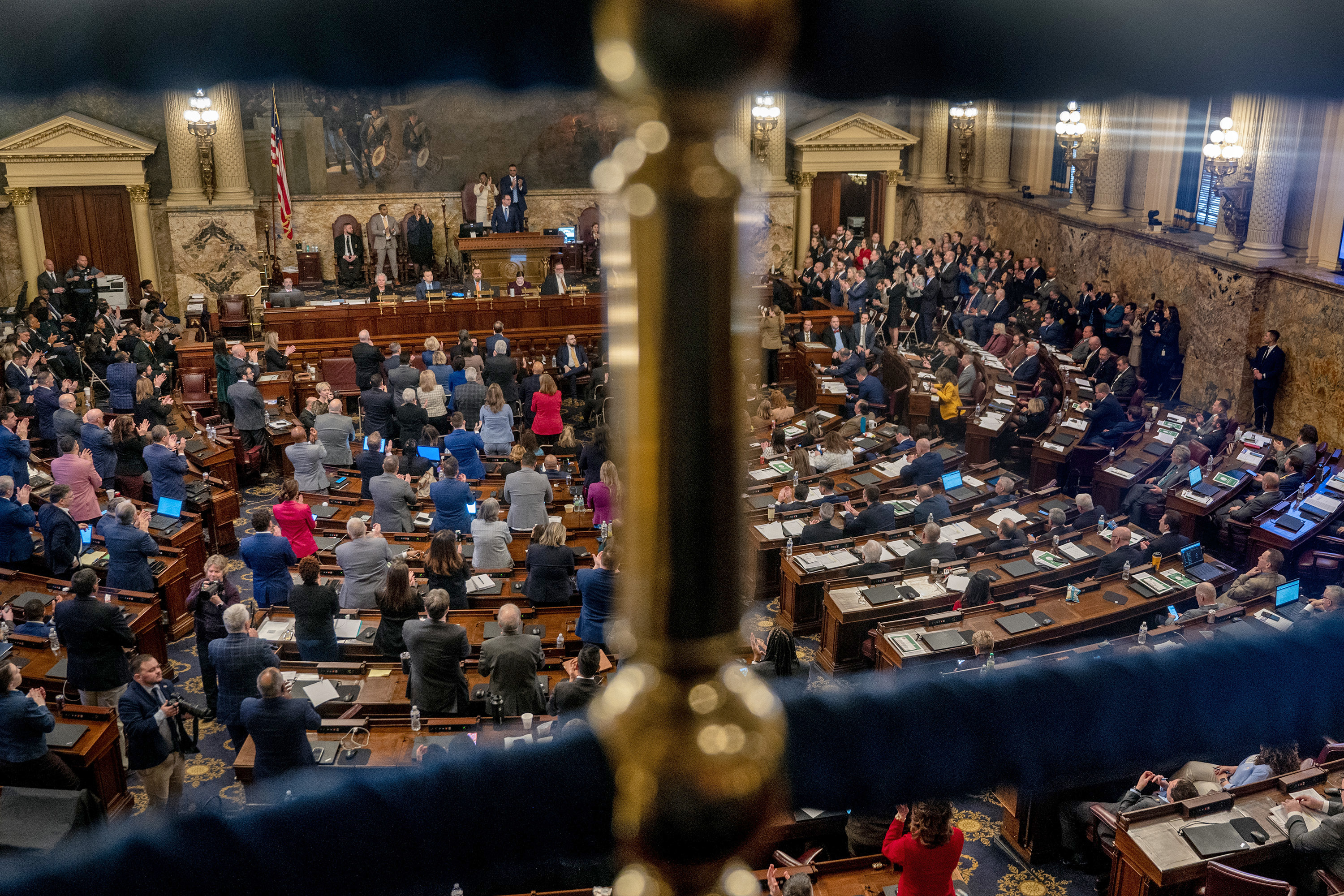
Democrats (left) stand to applaud a tax cut proposal while Republicans (right) remain seated as Gov. Josh Shapiro delivers his third budget address to a joint session in the House chambers at the State Capitol Tuesday, Feb. 4, 2025. Shapiro, a Democrat, will need to negotiate with a split legislature.
Both Republican and Democratic leaders celebrated the budget’s passage as a “true compromise,” noting that neither party got everything it wanted in the final deal. The spending plan includes significant energy and permitting changes cheered by Republicans and an earned-income tax credit and revisions to cyber charter funding long sought by Democrats, among other policy wins revealed Wednesday.
“Today is a good day,” Shapiro said, opening his remarks before signing the budget bills into law in the Capitol building, flanked by Democratic lawmakers.
“I would have loved to have stood here in this room with all of you on June 30, but as you know, Pennsylvania is just one of only three states in the country with a divided legislature,” Shapiro, a Democrat, said. “It requires all of us to compromise, to have tough conversations, and, ultimately, to find common ground.”
Several leaders said the budget deal approved Wednesday would not have been possible months ago, as debate had devolved into partisan finger-pointing over who was responsible for the budget deadlock and who might benefit politically from it.
Big GOP win: An end for RGGI
Among the top wins for Senate Republicans is the end of the state’s efforts to join the Regional Greenhouse Gas Initiative, which former Democratic Gov. Tom Wolf entered without legislative approval in 2019 and has been tied up in litigation ever since. The program has drawn the ire of Republicans, and in floor remarks Wednesday, House Minority Leader Jesse Topper (R., Bedford) called it the “No. 1 issue holding Pennsylvania back from economic growth.” The 12-state program, known as RGGI, is an interstate cap-and-trade initiative that charges power plants for the amount of carbon emissions they release into the air.
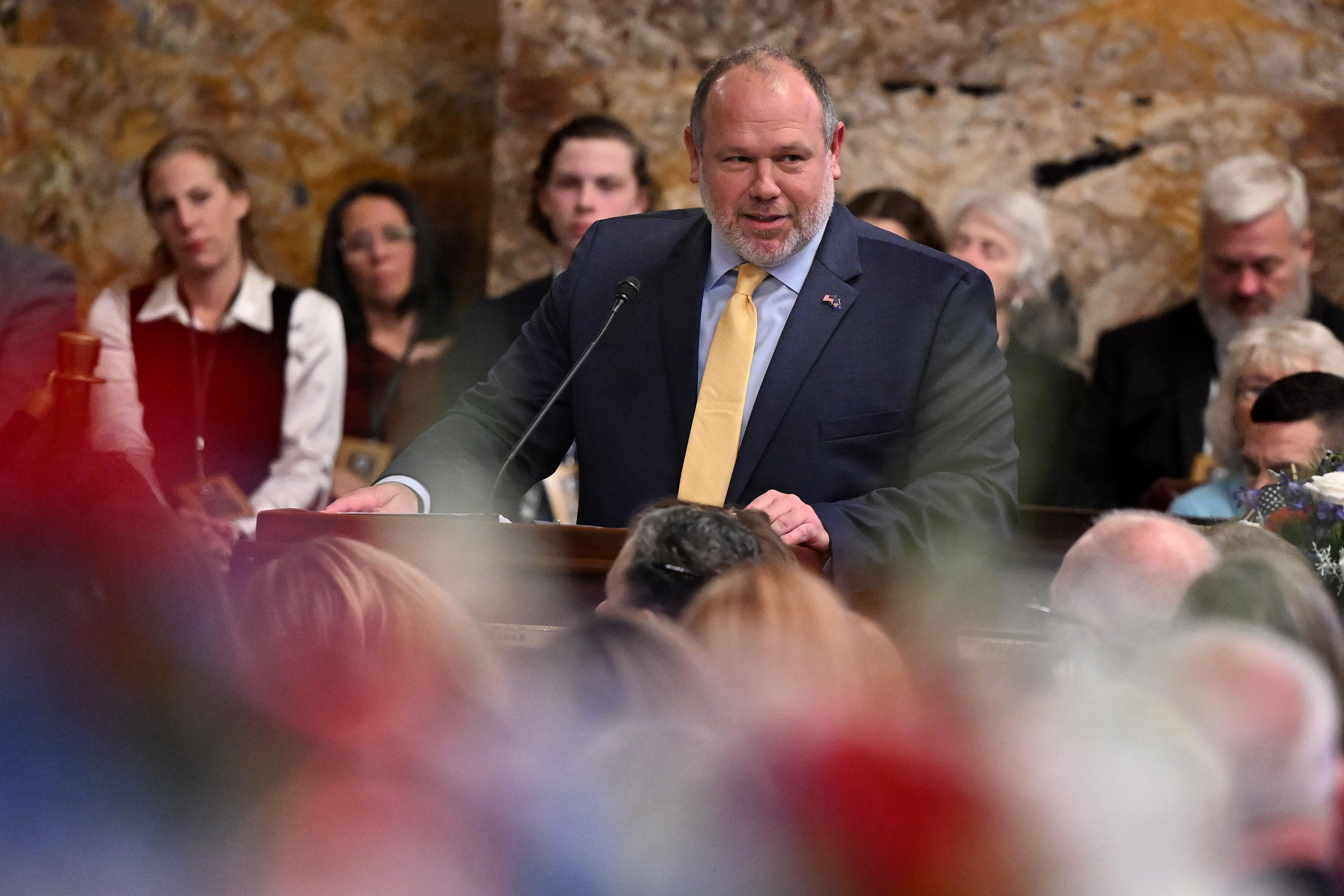
House Minority Leader Jesse Topper (R., Bedford) speaks on Jan. 7, 2025, on the first day of the 2025-2026 legislative session.
Ahead of a final budget deal, some Democratic lawmakers and environmental groups spoke out against ending Pennsylvania’s involvement in RGGI as a threat to the environment. In the end, most Democratic lawmakers voted in favor of the omnibus budget bill that ended the state’s pursuit to join the initiative.
House Majority Leader Matt Bradford (D., Montgomery), a top negotiator of the budget deal, told The Inquirer on Wednesday that Democrats’ agreement to leave RGGI was part of a broader compromise to end the impasse.
“I’m one who believes there should be a price on carbon, but I recognize the reality of the situation and compromise is required,” Bradford added.
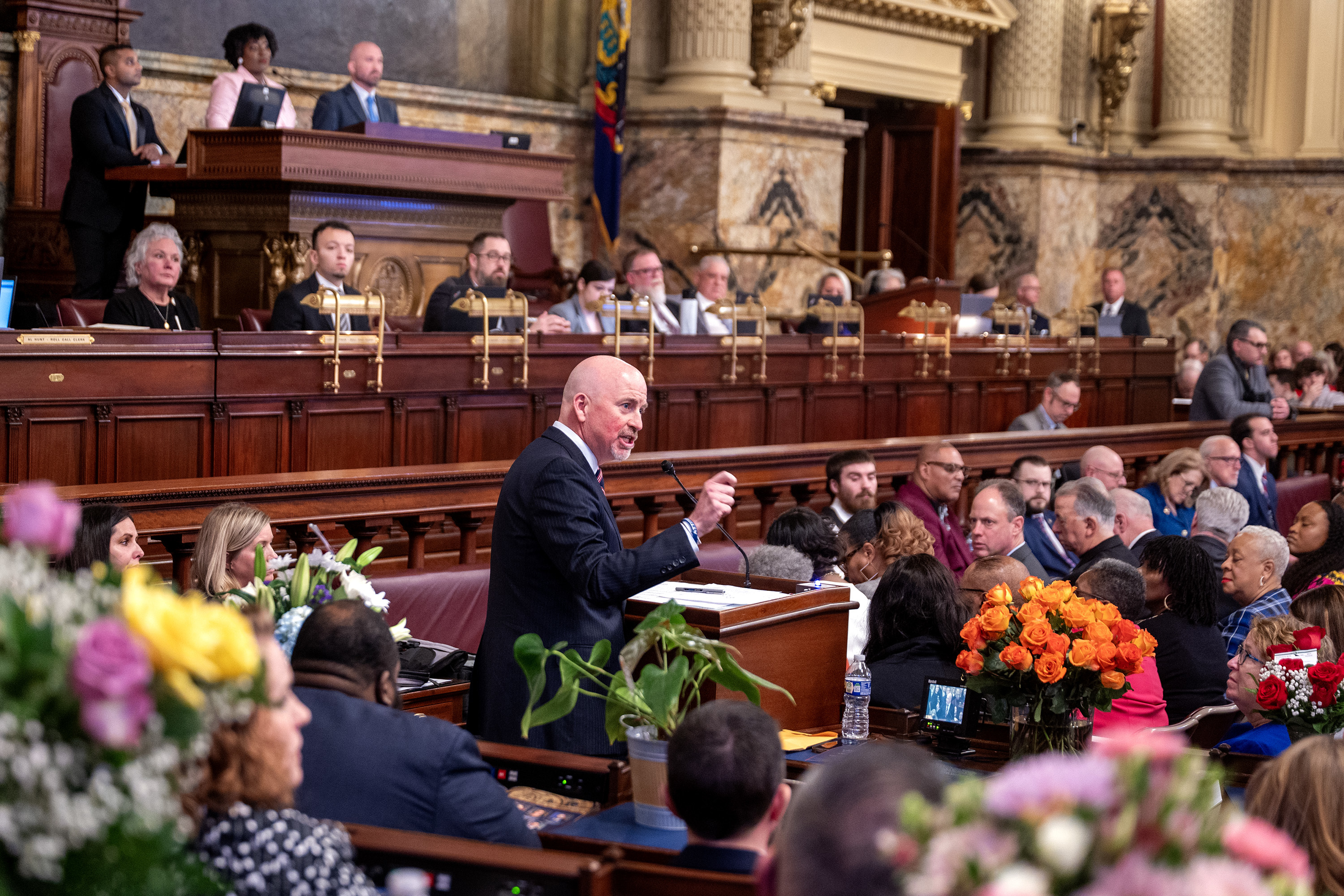
House Majority Leader Matt Bradford (D., Montgomery) speaks on the first day of the 2025-2026 legislative session.
Shapiro and Democratic leaders were able to persuade Republicans, in turn, to spend more than they had wanted to this fiscal year. That additional spending allowed Democrats to invest more in public education, a new earned-income tax credit targeted toward working Pennsylvanians, and more.
“It’s much more money than we want to spend, and it took a lot longer than we wanted, but I think it was worth the wait,” said Senate President Pro Tempore Kim Ward (R., Westmoreland) in floor remarks Wednesday. “I am actually excited to vote for this budget.”
Dems win new funding for schools, but not mass transit
The budget deal includes more than $665 million in new funding for public schools, approximately $562 million of which would be funneled through the state’s adequacy and tax equity formulas as part of an effort to close what experts call a $4 billion “adequacy gap.“ These formulas were created last year in response to a 2023 court ruling that found Pennsylvania’s public education funding system unconstitutionally deprives students from poorer districts of an adequate and equitable education.
Senate Minority Appropriations Chair Vince Hughes (D., Philadelphia) applauded the budget agreement for its investments in public school funding, gun violence prevention, and the student-teacher stipend, among other things.
“This budget has good work in it that helps address … the issue of affordability, which sang loud and clear in the most recent election as a predominant issue that Pennsylvanians want us to address,” Hughes said on the Senate floor Wednesday.
In addition, the budget includes changes long sought by Democrats to how Pennsylvania funds and oversees its cyber charter schools. Cyber charter school leaders warned that the changes might lead to closures and mass layoffs for the virtual schools, which often serve the state’s most vulnerable populations, but they were resoundingly celebrated by Democrats and public education experts.
“We finally reformed our cyber charter school system,” Shapiro said to boisterous applause. “If a parent wants to send their child to a cyber school, that’s fine. That’s their prerogative. But we shouldn’t be overfunding them at the expense of Pennsylvania’s public schools.”
The deal, however, does not include any additional funding for mass transit, another major Democratic priority. Democrats removed mass transit from the budget negotiation table in September, after a lawsuit required SEPTA to undo its service cuts and Senate Republicans appeared unwilling to make a long-term investment in mass transit. Instead, Shapiro approved SEPTA’s use of its capital funds to help fill the budget deficit of the state’s largest mass transit agency for the next two years.
Bradford told reporters thatsecuring a long-term revenue stream for transit agencies remains a top priority for his caucus in future budgets.
Inflamed, in part, by the mass transit debate, negotiations over the budget had been stalled for months until the end of October, when Shapiro convened top legislative leaders to return to talks. The renewed budget negotiations included House Speaker Joanna McClinton (D., Philadelphia) and Ward, who are the highest-ranking officials in their respective chambers but had usually stayed out of the budget talks led by Bradford and Senate Majority Leader Joe Pittman (R., Indiana).
Counties are still hurting from the late budget
Unlike the federal government, Pennsylvania’s state government does not entirely shut down when a budget has not been approved. Lawmakers and state employees continued to be paid throughout the 135-day impasse. But the late budget had significant impacts on school districts, counties, and social service providers — all of which are awaiting billions in expected state payments that should begin flowing again soon.
The lack of state funding has required schools, counties, and service providers to cut jobs, take out expensive loans, or stop services altogether.
Over the course of the more than four-month impasse, Pennsylvania’s counties spent millions to make up for the loss of state dollars. In Montgomery County, officials estimated the county had spent between $40 million and $50 million from budget reserves to maintain services. Chester County officials estimated they spent $40 million in reserves, while Delaware County officials spent $12 million each month until October, when they had to reduce payments on some of their bills in the absence of state funding. Counties expect to be reimbursed for those expenses, but it is unclear when the reimbursements will come.
“Counties are at the breaking point, financially speaking,” said Kyle Kopko, the executive director of the County Commissioners Association of Pennsylvania. If reimbursements are not delivered swiftly, Kopko added, it could force additional nonprofits that provide social services to shutter.
Even as county leaders were grateful for an end to the impasse, some expressed frustration over the contents of the final budget deal. The agreement, Kopko said, included a 2% cut to mental health services statewide, though he said the cut likely would not affect payments to counties. And it left other funds counties rely on to pay their bills — like 911 fees — stagnant, despite inflation.
Counties in Pennsylvania can increase their revenue only by raising property taxes. By failing to provide additional funds for social services, county officials argued Wednesday, lawmakers had created a situation in which counties would immediately or eventually have to raise property taxes.
The combination of the cuts and the failure to increase funds for public transit and other needs, Delaware County Councilmember Christine Reuther said, meantthe state had essentially passed the buck to the counties.
“They’re not solving problems. They’re not saving people from tax increases,” she said. “They’re just making somebody else do their dirty work.”
This suburban content is produced with support from the Leslie Miller and Richard Worley Foundation and The Lenfest Institute for Journalism. Editorial content is created independently of the project donors. Gifts to support The Inquirer’s high-impact journalism can be made at inquirer.com/donate. A list of Lenfest Institute donors can be found at lenfestinstitute.org/supporters.
NEW YORK — As a group of Columbia women’s basketball players struggled to break a press defense and advance the ball up the court, Megan Griffith’s voice rang through the gym.
“I need more active participation with your voice!” the coach said. “Can you please get back to playing like us?”
That is one of the go-to phrases that Griffith, a King of Prussia native, reinforces during this October preseason practice. They are all designed to “make things sticky” and keep the team process-focused, Griffith said.
“How you do anything, is how you do everything,” Griffith and standout guard Perri Page will both rattle off within the same hour.
Those callbacks have fueled a remarkable turnaround as Griffith enters her 10th season as the head coach at her alma mater.
Columbia was one of women’s college basketball’s worst programs for decades before clinching at least a share of three consecutive Ivy League regular-season championships and winning its first NCAA Tournament game in school history last season.
And it received an at-large bid to the Big Dance in each of the past two seasons, typically unheard of for Ivy League programs. The Lions are 2-0 to begin the 2025-26 season, heading into a marquee home opener against reigning Atlantic 10 regular-season champion Richmond Saturday night.
Griffith, a finalist last season for the Women’s Basketball Coaches Association’s Coach of the Year award, has displayed her Philly roots while making breakthrough after breakthrough during this rebuild.
There’s the influence of her high school coach, Villa Maria Academy’s Kathy McCartney, whose motivational style Griffith describes in a way that her current players now talk about her. And her childhood being raised by a father from Delaware County and a mother who immigrated from Hong Kong, before they met at Villanova. The emphasis on running a high-powered offensive system spearheaded by dynamic guard play? A no-brainer for a 40-year-old who grew up watching the Allen Iverson Sixers era.
That culture has already elevated Columbia to historic heights, and a stability Griffith and players now strive to protect. Now, the coach has the Lions believing they can — again — become the best team in program history.
“She’s a force,” Page said. “Honestly, do not mess with her. She is going to go out and get whatever she wants. … I can’t see myself playing for any other coach in the country.”
‘A determined little bugger’
Diane and Bob Griffith still are in awe when they watch their daughter coach, or when she speaks during news conferences. She actually was a shy kid in everyday life, taking hold of Dad’s pant leg whenever the family was out in public.
But as soon as there were competitive stakes, Megan turned into “a determined little bugger,” Bob said. Diane remembers a T-ball game when a young Megan rounded third base, and the umpire told Bob, who coached Megan’s youth sports teams, that “this kid can slide better than most adult men can.”
“Once that light turned on or that game clock started, she was tenacious, even as a small kid,” Bob said. “ … When you look back on it, she was probably one of the most aggressive kids out there on the court.”
Megan concedes today that she probably should have pursued soccer (“Look at me. I’m 5-5,” she quips). But she gravitated toward the intimacy of smaller basketball rosters and how the game never stops moving.
Neither did she, because she was fast. When Griffith first arrived at Villa Maria, McCartney remembers the teenage point guard could not always control her dribble in transition … because she literally outran the ball.
King of Prussia native Megan Griffith played her high school ball at Villa Maria Academy.
So McCartney told a steely eyed Griffith that she was not ready to play on the varsity team as a freshman. She needed to learn how to mold those natural athletic gifts into a ballhandler who could anticipate the defense’s next move. Griffith clocked that, while being coached by a woman for the first time, she was receiving a similar combination of intensity and care that her father provided in those settings.
“When I started getting [that tough love] from somebody else, it was like, ‘Oh, this is also how other people do this,’” Griffith said. “And it just really resonated with me. … That allowed me to really gain the confidence as a young woman, to then take that next step in my career and play college.”
By her senior high school season, Griffith was the point guard and defensive menace for a team that won its first 21 games. She had chosen to play for Columbia, which does not offer athletic scholarships, over an offer from LIU-Brooklyn.
And the hug McCartney and Griffith shared as she walked off the court for the final time as a high schooler has “stuck with me for years,” the coach said.
“It kind of solidified in my head the difference a coach can make,” McCartney said. “And I think — I hope — it has helped her in some way. I remember whispering in her ear, ‘You’ve got big things ahead of you, girl.’”
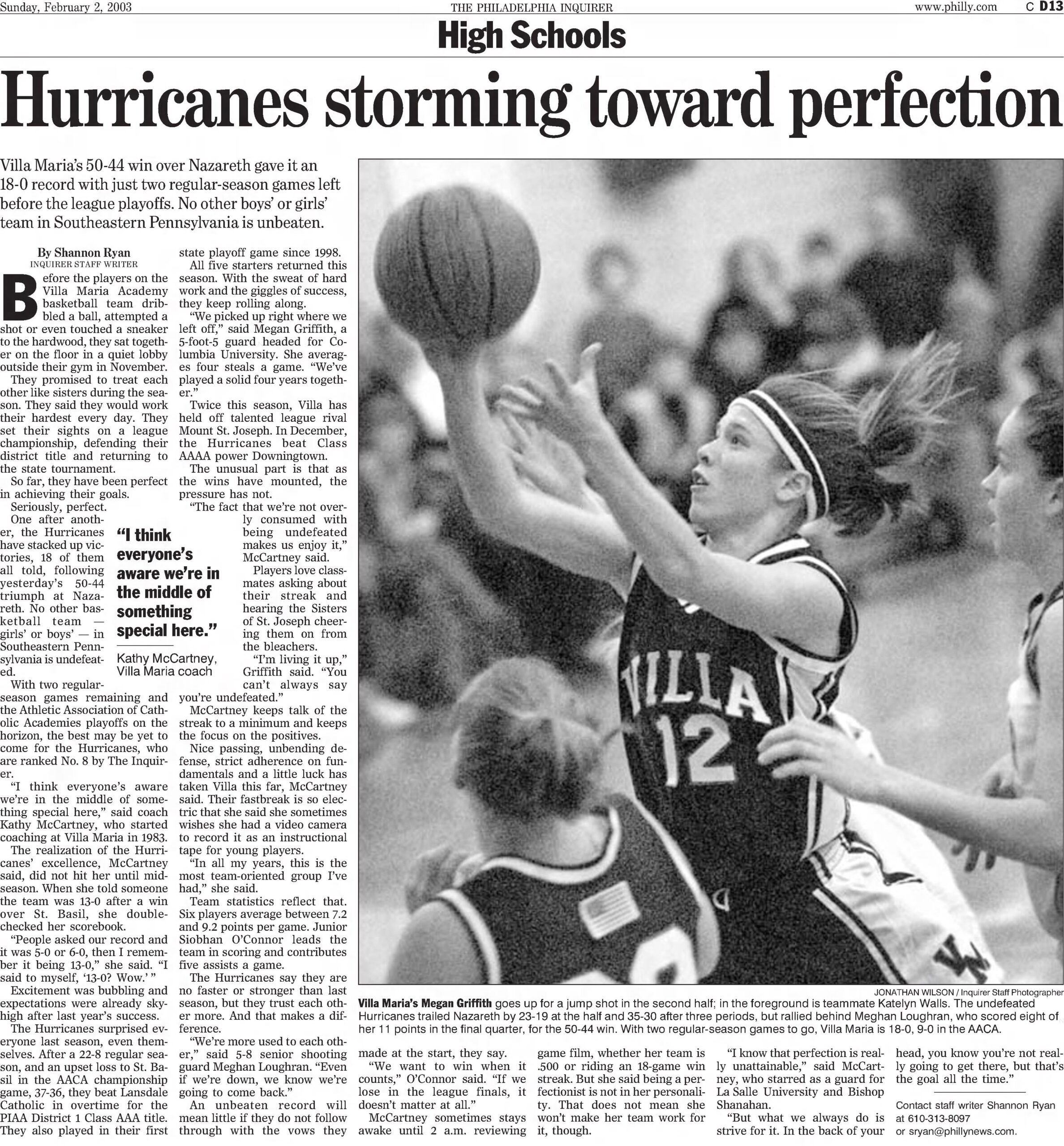
A clipping from the Philadelphia Inquirer sports section of February 2, 2003, showing Megan Griffith driving to the basket for Villa Maria Academy high school. Griffith is now the head women’s basketball coach at Columbia University.
‘I can go prove everybody wrong’
Columbia’s program was in a tumultuous state during Griffith’s playing career, from 2003 to 2007. She had four coaches in four seasons. The Lions’ record during that span was 38-70.
But that is where Griffith learned how to “stack days,” not just with her on-court training but in daily habits such as nutrition and sleep. Bob watched his daughter morph from a “very predictable” freshman who was “trying to please her coach too much,” to a 1,000-point scorer and two-time all-Ivy League selection.
“I was like, ‘Wow, I’ve had it the complete wrong way,’” Megan said. “I was so focused on the results all the time. Starting. Trying to come in as a freshman and change the program. I was like, ‘Wow, if I can just focus on what I can control …’”
Megan Griffith was an 1,000-point scorer at Columbia. The King of Prussia native now coaches her alma mater.
She also had an Ivy League education and a job lined up at Lincoln Financial in Philly upon graduating with an economics degree. She turned that offer down to continue playing overseas in Finland and then the Netherlands.
Griffith called that experience “transformational.” She leaned into exploring her new surroundings and connecting with her local teammates. An assistant coach began involving her in game-planning and strategizing, which she said “channeled my competitive energy very differently.” She learned enough Dutch to help coach kids. When she came home during off-seasons, she held youth skills clinics.
“I could see just how these kids just looked up to her,” Diane said. “ … I think that was probably the first glimpse of her maybe, possibly becoming a coach.”
When Megan no longer found as much satisfaction in that daily grind, she knew it was time to pivot from playing. She was hired as the director of basketball operations at Princeton, and was intrigued by then-coach Courtney Banghart, who led the program to its first Ivy League title.
Banghart, now the coach at 11th-ranked North Carolina, quickly made Griffith the Tigers’ recruiting coordinator. Griffith was hesitant at first, instead wanting more tactical responsibilities. But she was organized and a people person.
“What I learned there is that, actually, the most important thing is relationships,” Griffith said. “You have to know things and be smart. But at the end of the day, everybody can learn an offense. But what do you do with talent? How do you get talent? How do you get people that are bought into a common language, and an ethos, and a culture?”
In 2016, Columbia’s head-coaching job came open. Griffith, then 30, went to athletic director Peter Pilling with a detailed plan on how she would run her alma mater. And she thought back to conversation in the car with her father, while she was still playing overseas.
“[I said], ‘Dad, I feel I’m meant for something, like, big and different,’” she said. “I didn’t know what that meant at that time. So when this opportunity came up it was like, ‘Wow, I can go prove everybody wrong.’
“And I love that. I love the underdog. That’s who I am at my core.”
Megan Griffith played professional basketball in Finland.
‘It’s why you do it’
Tyler Cordell was “a little intimidated” the first time she spoke to Griffith. While interviewing for a job as Princeton’s director of basketball operations when Griffith was promoted to assistant coach, Cordell left the phone conversation thinking, “I don’t know if I’m smart enough to follow up in her footsteps.”
Now, Griffith and Cordell have worked together for 14 years. Cordell said it was a “no-brainer” to join Griffith’s staff at Columbia. Griffith calls Cordell an example of the “builders” the program needed.
“You start with the people,” Griffith said.
That meant thorough — and unconventional — recruiting.
The coaching staff went into southern states, such as Florida and Georgia. And internationally, to Spain and Australia. Today, nine players on Columbia’s 2025-26 roster are from outside the United States.
And there was perhaps nobody better to pitch Columbia than Griffith, who experienced the top-tier academics, limited athletic resources, and basketball struggles firsthand.
“It’s not like we’re in the same sandbox as a lot of schools,” Griffith said. ” … But we’ve never been.”
Griffith needed to power through the early on-court woes as a coach, including back-to-back eight-win seasons from 2017 to 2019 that left Diane worried about Megan’s health. Still, accolades began to surface. Their first victories over programs from the Atlantic Coast Conference (Boston College) and Big East (Providence). Their first Ivy League Rookie of the Year in Sienna Durr. The commitments of Abbey Hsu and Kaitlyn Davis, who became “young, hungry freshmen” and, eventually, conference champions and WNBA draft picks.
Those players could emulate an on-court style — with athletic, guard-heavy rosters that could pressure defensively and get out in transition — that led to sustained success for other mid-majors. It evolved into a system that, from 2022 to 2025, averaged more than 70 points per game.
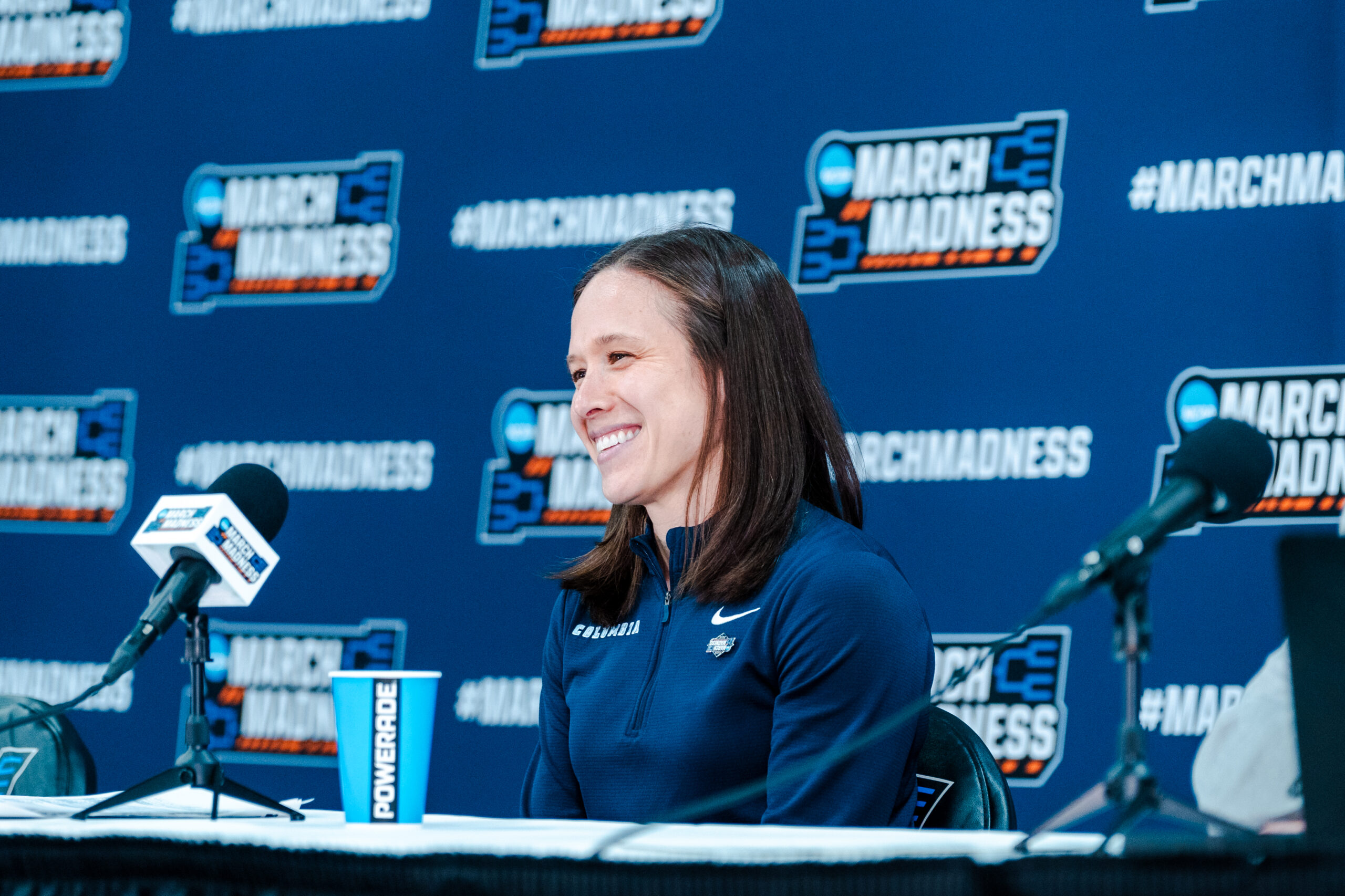
King of Prussia native Megan Griffith has built Columbia women’s basketball into an Ivy League power.
Griffith, meanwhile, strives to make people feel important, even when demands are high. She will get on a player’s case during practice, but then help them make their first resumé or ask about their dog. During the COVID-19 pandemic, when Columbia’s 2020-21 season was canceled, the staff created a space for players to talk. Page actually took her recruiting “visit” on Zoom and was blown away by the staff’s energy and attention to detail in less-than-ideal circumstances.
“That’s what made me say, ‘Wow, they put a lot of thought and effort into everything that they do,’” she said. “ … I was like, ‘If you can make this look good, imagine what it looks like on the court, too.’”
Once the Lions returned to to play, the avalanche of checkpoints continued.
A 2021 signature comeback win at Clemson? Check.
Qualifying for the four-team Ivy League tournament for the first time? Check.
Four consecutive 20-win seasons? Check.
Advancing to the WNIT quarterfinals in 2021, then the championship game the following season? Check.
First Ivy League regular-season titles, as co-champions in 2023 and 2024 and then as the outright winner last season? Check.
First NCAA tournament appearance in 2024, when they lost a tight First Four matchup against Vanderbilt? Check.
“That’s what’s been so cool about our journey,” Cordell said. “Because we haven’t skipped one step.”
The most recent: Last season’s NCAA First Four. The Lions at halftime flipped how they were guarding Washington’s post players, and rallied from 13 points down to win and advance to the round of 64.
“It was just the next thing we had to do in our journey,” Griffith said. “I feel like we manifested it, but at the same time, it was supposed to happen. …
“When the buzzer sounded, it’s why you do it. It’s why I’ve coached the last nine years — to be in that moment and be able to share that with my staff and this team.”
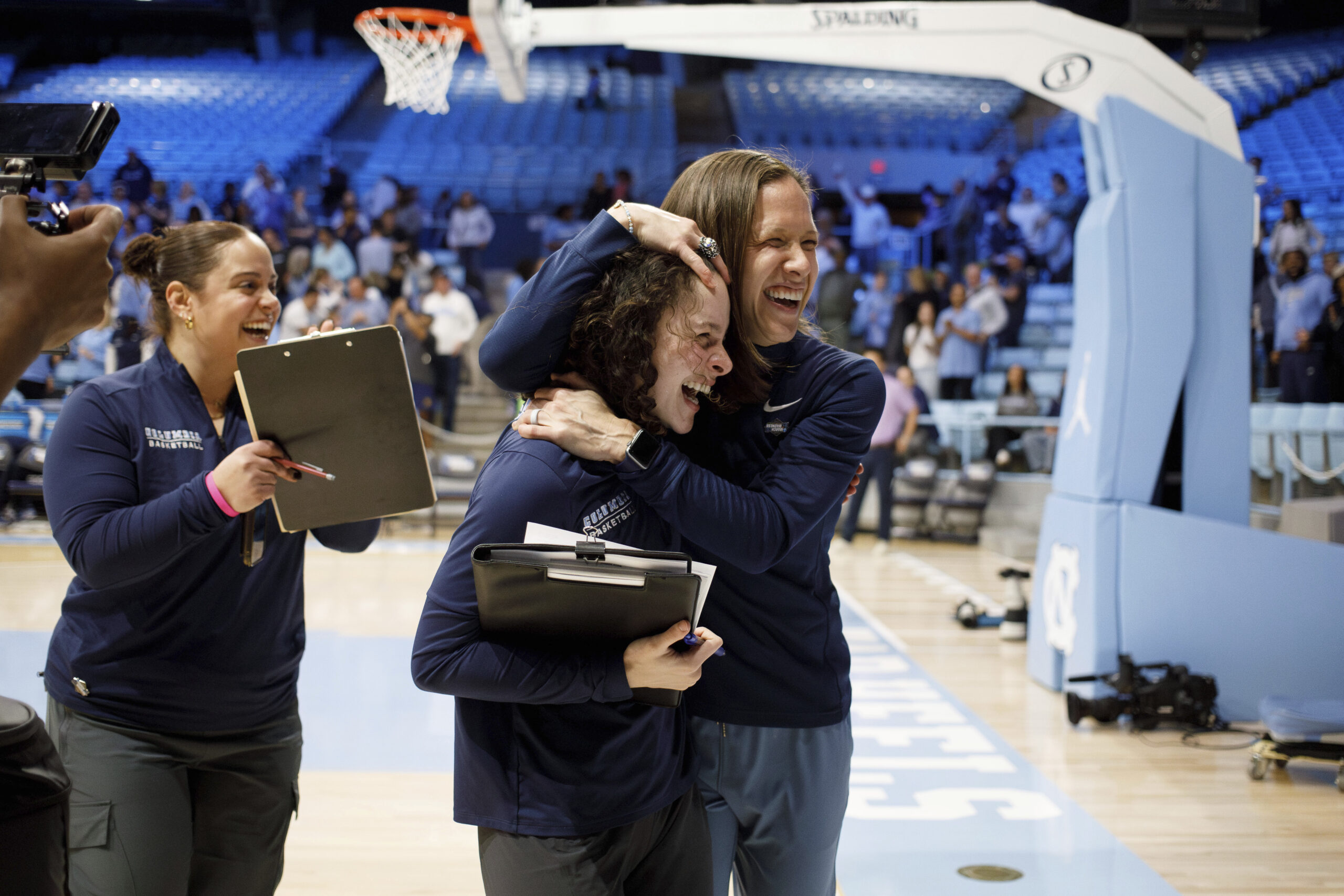
Columbia head coach Megan Griffith (right) celebrates with assistant coach Cy Lippold after beating Washington in a First Four game in last season’s NCAA Tournament.
‘Coach-led, player-fed’
Those back home also have relished in Griffith’s rise.
McCartney still texts Megan and her parents, and loves telling friends “that’s one of my kids” while watching Columbia play. Megan’s godmother, who lives in Australia, wakes up at 4 a.m. to tune in to games. Supporters are in the stands whenever Columbia plays Penn in Philly, where Griffith takes pride in those who knew her as a player recognizing similar qualities in her teams.
And Diane and Bob are regular visitors to campus. While watching a recent scrimmage, they noticed Megan being “really tough” on the freshmen. Up in the coach’s offices, a veteran told one of those first-year players, “She’s tough, but you have to listen to Coach. She knows what she’s talking about.”
“Yes, she yells at you a lot,” Diane said. “She screams in your face. You think she hates you. But she really does care about you, and she wants to make you a better player and person.”
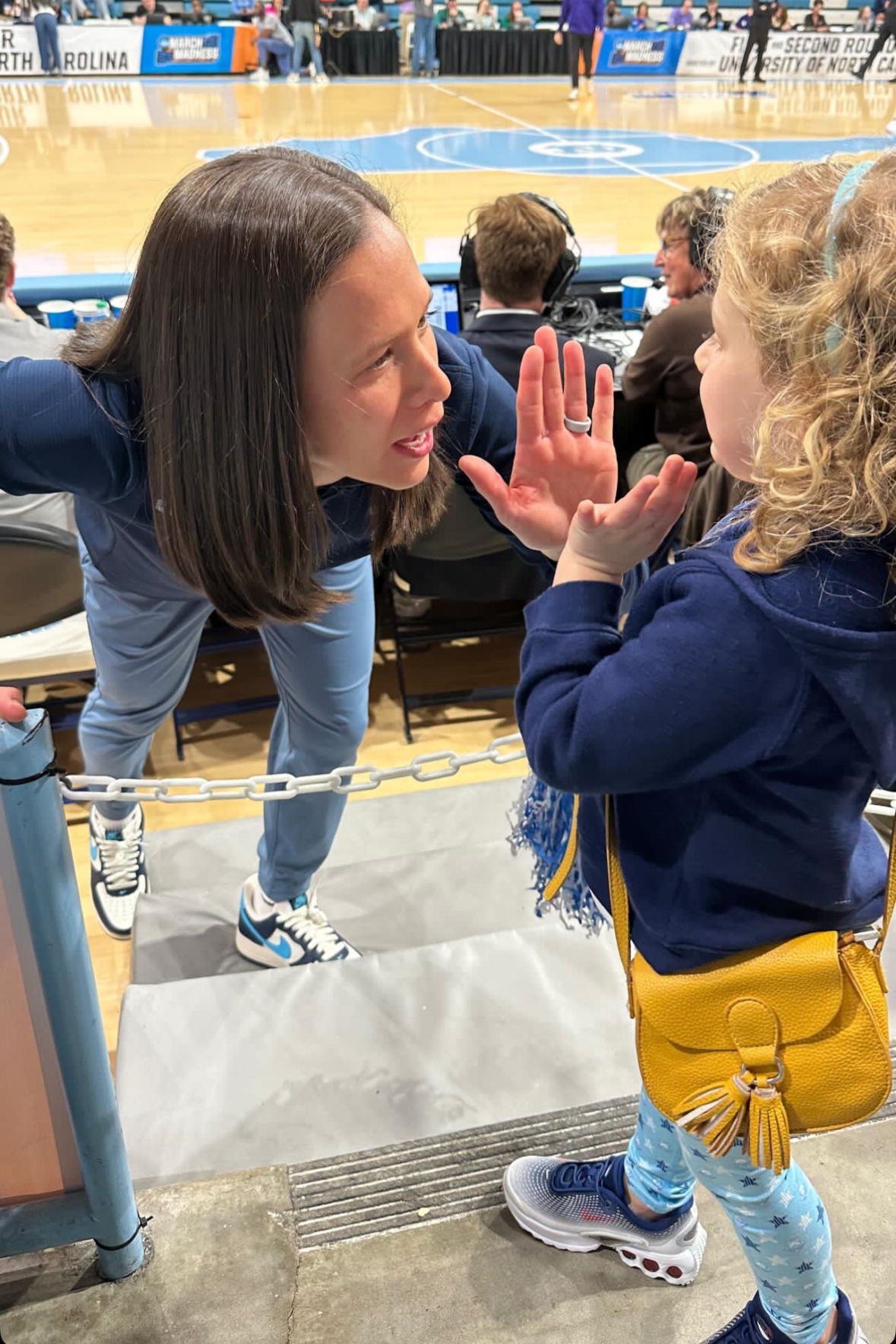
Columbia women’s basketball coach and King of Prussia native Megan Griffith (left) high-fives her niece, Carmen, who calls her Titi.
Like during that October practice, when new assistant coach Kizmahr Grell needed to tell Griffith to take a deep breath. The Lions have a taller roster and fewer ballhandlers this season, forcing some tweaks to their on-court identity. That was particularly apparent with Page sitting out this practice, prompting a direct challenge from Griffith to be a better leader from the sideline.
“It just gets me so fired up, too,” Page said of those interactions. “ … I take it, like, this is my program. This is my baby. When she gives a task, I am ready to attack it, always. Because I want to do right for her, but I want to do right for this program, as well.”
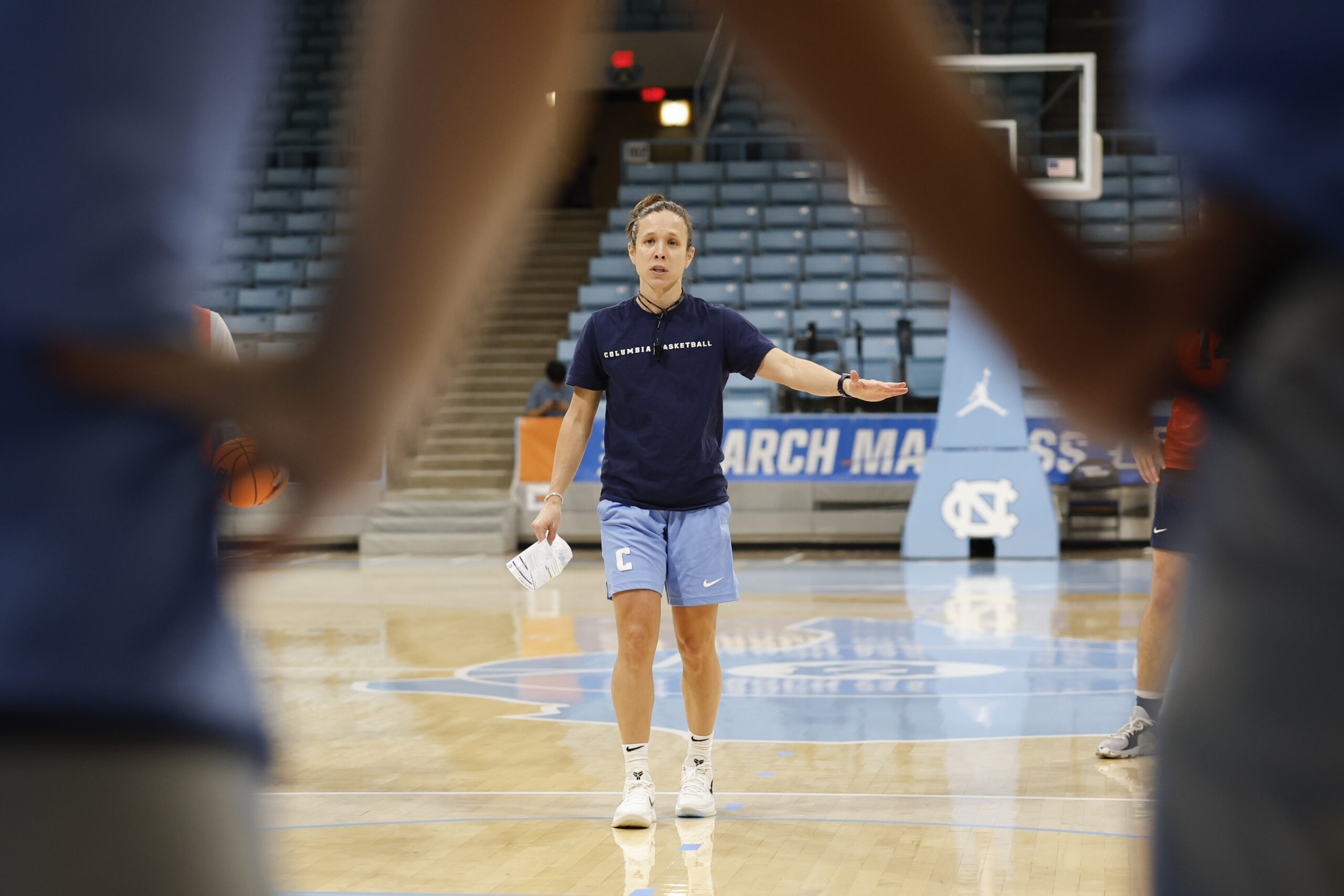
Columbia coach Megan Griffith talks to her team at practice last season.
That’s an example of another Griffith callback: “Coach-led, player-fed.” It’s why a practice that began with harsh words ended with everybody gathering at midcourt for a calm circle, where players individually spoke up to encourage and hold each other accountable. They snapped in agreement of each player’s input. When Griffith asked who got better today, every player raised their hand.
Those mantras have become sticky, establishing Columbia’s foundational culture. They have fueled the Lions’ historic rise.
So what is the next breakthrough, with Griffith’s 10th season underway?
“That’s my big challenge right now, is just continue to teach when the expectations are higher — and self-imposed,” Griffith said. “Nobody here is like, ‘Hey, you need to win more.’ Everybody is like, ‘Look at everything you’ve done,’ but that’s just not who I am.
“I don’t just think we can continue to win Ivy League championships. I think we can make deep runs into March. As long as we keep getting the right people here, why couldn’t we go to the Elite Eight?”
The Eagles will play their first game in 15 days when they take on the Green Bay Packers tonight on ESPN’s Monday Night Football.
Unfortunately, some fans in Philly and across the country won’t be able to tune in.
An ongoing dispute between YouTube TV and Disney has left ESPN, ABC, and a handful of other channels dark on the so-called “skinny bundle” for more than a week, with no end in site.
The two sides continued to negotiate throughout the day Monday but remained far apart on dollars — Disney wants more money than parent-company Google wants to pay.
On Sunday, hopes of a potential deal got dimmer when YouTube TV announced a $20 credit for customers due to the continued outage of Disney’s channels.
YouTube TV has grown into the third-largest cable distributor in the country with about 10 million subscribers, trailing only Comcast and Charter. Not surprisingly, ESPN’s college football and Monday Night Football ratings were down slightly last week, which most experts attribute to the blackout.
Networks ending up blacked out over carriage disputes is rare, and ones lasting this long are even rarer, though they happen. TelevisaUnivision has been dark on YouTube TV since late September, and Disney-owned Fubo hasn’t had TNT or TBS since April 2024 due to a carriage dispute with Warner Bros. Discovery.
It’s the first of two Monday Night Football appearances this season for the Eagles. Hopefully, this dispute is settled before the Birds take on the Los Angeles Chargers on ESPN Dec. 8.
Here’s everything you need to know to watch or stream Eagles-Packers.
How to watch Eagles at Packers
Where: Lambeau Field, Green Bay, Wisc.
When: 8:15 p.m., Monday
TV: ABC, ESPN (Joe Buck, Troy Aikman, Lisa Salters, Laura Rutledge)
Radio: 94.1 WIP (Merrill Reese, Mike Quick, Devan Kaney)
Streaming: ESPN Unlimited
How to stream Eagles at Packers
There are plenty of options to stream Eagles-Packers tonight.
While ESPN will likely remain blacked out on YouTube, there are a host of services that will stream tonight’s Monday Night Football game.
The most obvious is ESPN Unlimited, the network’s new subscription streaming service that includes every game that airs on all 12 ESPN networks. The service runs $29.99 a month.
You can also stream tonight’s game on a host of other skinny bundles, including Hulu + Live TV ($64.99 a month for three months), Sling ($4.99 for one day pass, $60.99 a month), Fubo ($84.99 a month with a free trial), and DirecTV Stream ($94.99 a month with a free trial).
If you’re just planning to watch the game on your phone or tablet, you can stream it on NFL+, the league’s mobile subscription streaming service. NFL+ runs $6.99 a month.
Because the game is simulcasting on ABC, most fans who live in and around Philadelphia and other cities should be able to stream the game for free using a digital antenna.
6abc’s signal in Philadelphia can be finicky. The station suggests an all-band antenna that covers Low-VHF, High VHF and UHF with long elements (rabbit ears for those of you old enough) that should be fully extended.
The Channel Master website has specific information about what channels are available using your address.
Jason Kelce takes a serious turn on tonight’s Monday Night Countdown
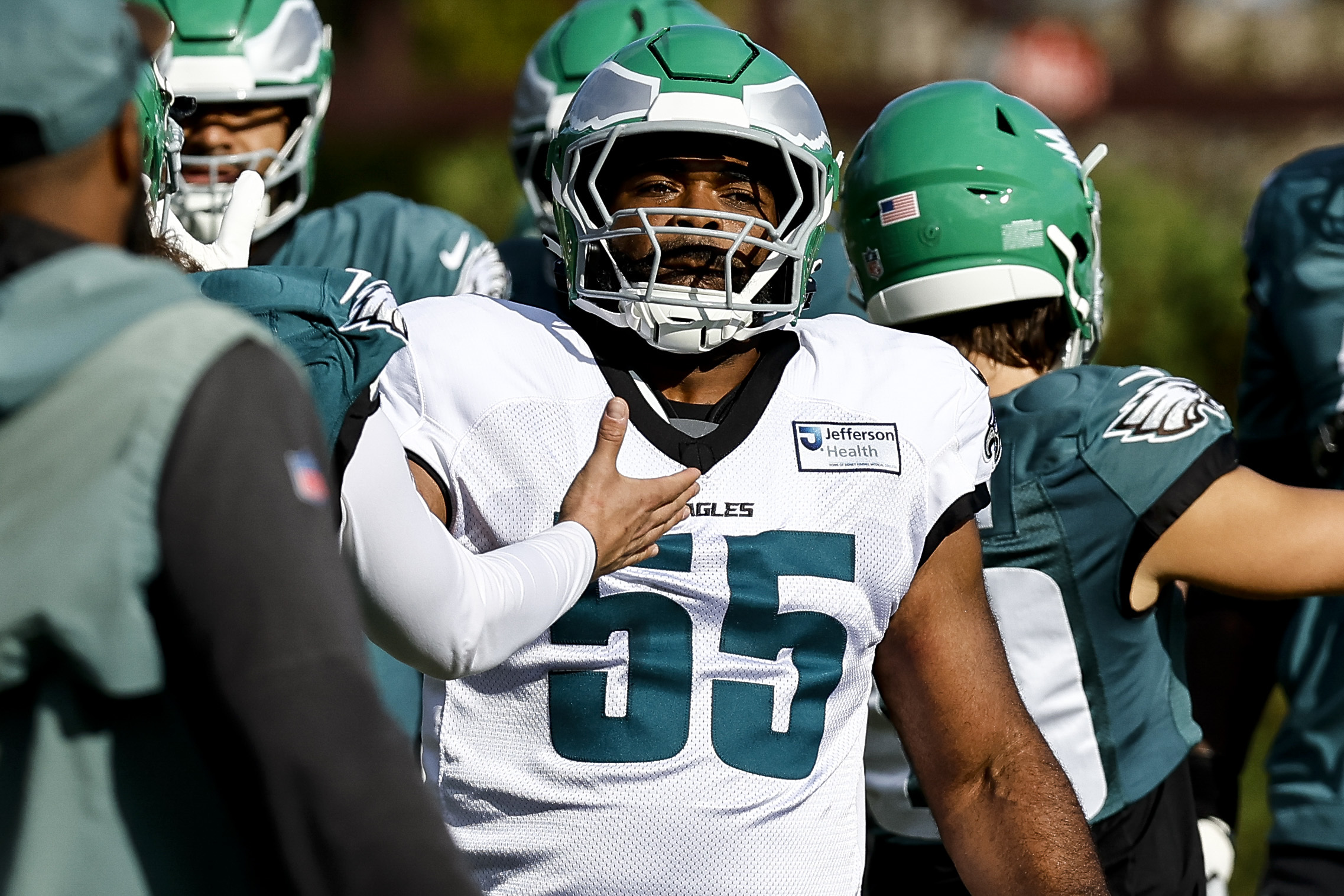
Eagles offensive lineman Tyler Steen (left) was interviewed by Jason Kelce for “Monday Night Countdown” ahead of Birds-Packers.
In his second season with ESPN, former Eagles star Jason Kelce has become known for his crowd-pleasing antics and fun-loving outfits, from his “South Philly tuxedo” to a Bills Mafia getup inspired by Fred Flintstone.
For tonight’s game, Kelce took a more serious tone for a featured story about Rodney Davis, the grandfather of Eagles offensive lineman Tyler Steen, whose heroic death during the Vietnam War saved the lives of several members of his platoon.
Davis was posthumously awarded the Medal of Honor after jumping on a grenade that landed in a bunker where he and five other soldiers were pinned down by enemy fire in 1967. He was 25, the same age Steen is now.
“He gave his life for his, for his …” said an emotional Samantha Steen, Davis’ daughter and Steen’s mother. “He gave up his life for other Marines.”
Quinta Brunson, Shane Gillis will be guests on the Manningcast
“Abbott Elementary” star Quinta Brunson at a Phillies game in August.
Peyton and Eli Manning will be back on ESPN2 tonight for the Manningcast, and they’ll be welcoming some Philly star power to their Monday Night Football alternative broadcast
Quinta Brunson, the star and creator of Abbott Elementary, and comedian Shane Gillis will appear as guests tonight. It’s unclear when either will join the show.
Also joining the show will be Disney CEO Bob Iger, a lifelong Packers fan whose appearance coincided with the company’s dispute with YouTube TV.
It’ll be the sixth time the Eagles have appeared on the Manningcast, which is quietly in its fifth season at ESPN. Last season, Peyton and Eli turned to Downingtown native Miles Teller during the Eagles’ loss to the Atlanta Falcons in Week 2.
Eagles quarterback Jalen Hurts — who attended the Mannings’ quarterback camp while a sophomore at Alabama — was a guest in 2022, where he revealed he liked to watch game tape of former San Diego Chargers quarterback Philip Rivers and wore a hoodie with the phrase, “God bless whoever hating on me.”
“Other teams, it’s a copycat league, and if you can copycat it, you will. If you can’t, then you probably complain that it’s not fair,” Manning told The Inquirer. “So I’m on the Eagles’ side of it. I think it’s their niche, and it works, and they make it happen.”
How to “tush push” according to @JasonKelce: Head 👇, a$$ 👆. Got it.
The Eagles were overtaken Sunday by the Seattle Seahawks, who moved into the top spot in the NFC thanks to their blowout win against the Arizona Cardinals.
If the Eagles win tonight, they’ll move back into first place because they’d hold the tiebreaker against the Seahawks with a better conference record.
NFC standings
window.addEventListener(“message”,function(a){if(void 0!==a.data[“datawrapper-height”]){var e=document.querySelectorAll(“iframe”);for(var t in a.data[“datawrapper-height”])for(var r,i=0;r=e[i];i++)if(r.contentWindow===a.source){var d=a.data[“datawrapper-height”][t]+”px”;r.style.height=d}}});
NFC East standings
!function(){“use strict”;window.addEventListener(“message”,function(a){if(void 0!==a.data[“datawrapper-height”]){var e=document.querySelectorAll(“iframe”);for(var t in a.data[“datawrapper-height”])for(var r,i=0;r=e[i];i++)if(r.contentWindow===a.source){var d=a.data[“datawrapper-height”][t]+”px”;r.style.height=d}}})}();
Philadelphia will host its largest marathon yet this year, as about 15,000 runners take on the 26.2-mile race through the city’s scenic and historic neighborhoods.
The Philadelphia Marathon Weekend runs Nov. 21-23 and includes a half marathon (13.1 miles) and an 8K race. The first marathon was held in 1994 with just 1,500 participants; this year, organizers expect roughly 30,000 athletes across all races.
With that many runners and spectators, expect road closures, parking restrictions, and heavy traffic.
“We want to make sure people give themselves ample time to get there,” said race director Kathleen Titus. “We have new security screenings that will speed things up, but if you’re waiting until 15 minutes before the race, you might be standing in a line for about an hour.”
Runners on Walnut Street in Center City during the 2024 Philadelphia Marathon on Sunday, Nov. 24, 2024.
Titus said the marathon has a new website and updated app. The app allows runners to schedule packet-pickup times at the expo to cut down on lines, track live race results, and receive weather and safety alerts.
Race start times and locations for the Philadelphia Marathon
All races follow the same course layout as in previous years and — except for the Nemours Children’s Run — start at 22nd Street and Benjamin Franklin Parkway, near the Philadelphia Museum of Art. The Nemours Children’s Run begins at Von Colln Memorial Field, 2276 Pennsylvania Ave., adjacent to Eakins Oval.
Each race follows a unique route, with the marathon and half-marathon winding through Center City, Chinatown, Old City, Queen Village, Rittenhouse, and University City, with significant portions covering Fairmount Park, Kelly Drive, and the Benjamin Franklin Parkway.
The Expo is filled with vendors showcasing apparel, shoes, gear, free product samples, and educational booths on health and fitness. Friday and Saturday bring a speaker series to the Expo and meet-and-greets with some of the country’s top runners. On Friday evening, there will be activities for children.
For spectators of the Philadelphia Marathon
Spectators are welcome to line the race routes to cheer on runners but will be restricted from the starting lines and in secure running areas until after 8 a.m. on Saturday and Sunday to ensure smooth race starts.
Large umbrellas, coolers, and animals (except ADA service dogs) are not allowed. The marathon also discourages bringing large blankets, backpacks, or cameras.
William Loevner of Pittsburgh is embraced by his wife, Emma Loevner, after finishing first in the mens in the 2024 Philadelphia Marathon on Sunday, Nov. 24, 2024.
Road closures
All-weekend closures
Saturday, Nov. 22, through 5 p.m. Sunday, Nov. 23
Benjamin Franklin Parkway (all lanes) between 22nd Street and Eakins Oval
Kelly Drive (inbound) closed at 25th Street, with local traffic permitted to Anne d’Harnoncourt Drive
Spring Garden Street Bridge and MLK Drive (inbound) traffic detoured onto 24th Street
Spring Garden Street
Saturday, Nov. 22
2 a.m. closures
2000—2400 Benjamin Franklin Parkway (inner and setup areas as posted)
Spring Garden Street, from Pennsylvania Avenue to Benjamin Franklin Parkway
23rd Street, from Pennsylvania Avenue to Benjamin Franklin Parkway
22nd Street, from Winter Street to Park Towne Place (local access to Park Towne Place maintained)
21st Street, from Pennsylvania Avenue to Winter Street
4 a.m. closures
Interstate 676 off-ramp at 22nd Street (westbound)
Interstate 76 off-ramp at Spring Garden Street (eastbound)
6 a.m. closures
17th Street, from Arch Street to Vine Street
18th Street, from Arch Street to Callowhill Street
19th Street, from Arch Street to Callowhill Street
20th Street, from Arch Street to Callowhill Street
21st Street, from Arch Street to Spring Garden Street
22nd Street, from Arch Street to Spring Garden Street
Benjamin Franklin Parkway, from 16th Street to 20th Street
Market Street, from Sixth Street to 16th Street
Chestnut Street, from Fifth Street to Eighth Street
Sixth Street, from Market Street to Chestnut Street
Fifth Street, from Chestnut Street to Race Street
South Penn Square
Juniper Street, from Chestnut Street to Market Street
John F. Kennedy Boulevard, from Juniper Street to 17th Street
15th Street, from Race Street to Chestnut Street
16th Street, from Chestnut Street to Race Street
Race Street, from Sixth Street to Columbus Boulevard
Columbus Boulevard (southbound lanes), from Vine Street to Washington Avenue
Interstate 95 southbound off-ramp at Washington Avenue
Washington Avenue, from Columbus Boulevard to Front Street
Front Street, from Washington Avenue to South Street
South Street, from Front Street to Seventh Street
Sixth Street, from Bainbridge Street to Locust Street
Lombard Street, from Fifth Street to Broad Street
13th Street, from Bainbridge Street to Chestnut Street
Walnut Street, from 12th Street to 34th Street
34th Street, from Chestnut Street to Girard Avenue
Spring Garden Street, from 32nd Street to 34th Street
Girard Avenue, from 33rd Street to 38th Street
33rd Street, from Girard Avenue to Cecil B. Moore Avenue
Reservoir Drive, from 33rd Street to Diamond Drive
Mt. Pleasant Drive
Fountain Green Drive
Kelly Drive
Access and reopening
Local access for residents and businesses will be maintained at police-controlled points.
Access to the Philadelphia Museum of Art will be available via Spring Garden Street (Bridge and Tunnel) to Anne d’Harnoncourt Drive.
Police will allow traffic through intersections when possible, depending on runner flow.
All streets (except Eakins Oval and the Parkway) are scheduled to reopen by 2 p.m. Saturday; many Center City roads will reopen earlier as they are cleared and serviced.
Sunday, Nov. 23
As part of enhanced security for the AACR Philadelphia Marathon, “No Parking” regulations will be strictly enforced. Vehicles on the race route will be relocated beginning at 1 a.m. Sunday.
2 a.m. closures
2000—2400 Benjamin Franklin Parkway
Spring Garden Street, from Pennsylvania Avenue to Benjamin Franklin Parkway
23rd Street, from Pennsylvania Avenue to Benjamin Franklin Parkway
22nd Street, from Winter Street to Park Towne Place (local access maintained)
21st Street, from Pennsylvania Avenue to Winter Street
4 a.m. closures
Interstate 676 off-ramp at 22nd Street (westbound)
Interstate 76 off-ramp at Spring Garden Street (eastbound)
6 a.m. closures
17th Street, from Arch Street to Vine Street
18th Street, from Arch Street to Callowhill Street
19th Street, from Arch Street to Callowhill Street
20th Street, from Arch Street to Callowhill Street
21st Street, from Arch Street to Spring Garden Street
22nd Street, from Arch Street to Spring Garden Street
Benjamin Franklin Parkway, from 16th Street to 20th Street
Arch Street, from Third Street to 16th Street
Fourth Street, from Arch Street to Vine Street
Race Street, from Sixth Street to Columbus Boulevard
Columbus Boulevard (southbound lanes), from Vine Street to Washington Avenue
Interstate 95 southbound off-ramp at Washington Avenue
Washington Avenue, from Columbus Boulevard to Front Street
Front Street, from Washington Avenue to South Street
South Street, from Front Street to Seventh Street
Sixth Street, from Bainbridge Street to Market Street
Chestnut Street, from Sixth Street to 15th Street
15th Street, from Chestnut Street to Walnut Street
Walnut Street, from Broad Street to 34th Street
34th Street, from Chestnut Street to Girard Avenue
Lansdowne Drive, from Girard Avenue to South Concourse Drive
South Concourse Drive, from Lansdowne Drive to West Memorial Hall Drive
East Memorial Hall Drive, from South Concourse Drive to Avenue of the Republic
Avenue of the Republic, from East Memorial Hall Drive to Catholic Fountain
Belmont Avenue, from Montgomery Drive to Parkside Avenue
States Drive, from Lansdowne Drive to Girard Avenue
Girard Avenue Bridge, from Lansdowne Drive to 33rd Street
33rd Street, from Girard Avenue to Reservoir Drive
Reservoir Drive, from 33rd Street to Edgley Drive
Edgley Drive, from Reservoir Drive to Fountain Green Drive
Fountain Green Drive, from Edgley Drive to Kelly Drive
Kelly Drive
Falls Bridge
Ridge Avenue, from Schoolhouse Lane to Manayunk Avenue
Main Street (Manayunk), from Ridge Avenue to Conarroe Street
Access and reopening
Local access for residents and businesses will be maintained at police-controlled points.
Access to the Philadelphia Museum of Art will be available via Spring Garden Street (Bridge and Tunnel) to Anne d’Harnoncourt Drive.
Expect delays at crossings along the course; police will allow traffic through when possible.
All streets (except Eakins Oval and the Parkway) are scheduled to reopen by 3 p.m. Sunday; many Center City roads will reopen earlier as they are cleared and serviced.
Transportation to the races
🚌 Bus
Lines 7, 32, 38, 43, 48, and 49 drop riders within a two-minute walk from the Art Museum. But, due to the race, there will most likely be detours. Check SEPTA’s system status for the latest schedules.
The race’s starting line is within a 10-minute ride from the City Hall area and subway stop and other locations. Check the map of Indego bike share stations to rent bikes and return them at a station near the Art Museum.
16th & Race St. (Sheraton Hotel), Standard Parking, (215) 196-0293
1815 JFK Boulevard, Central Parking System, (215) 568-8030 (Entrance on 1850 Cuthbert St.)
1901 JFK Boulevard, Central Parking System, (215) 557-3821 (Entrance on 19th Street)
1700 Benjamin Franklin Parkway, the Windsor Suites, (215) 569-0899
36 S. 19th St., Central Parking System, (215) 561-1187
Where does the money go?
Revenue earned and money raised from the Philadelphia Marathon goes to various charities and nonprofits, including local ones like B Inspired Philadelphia and the Mazzoni Center.
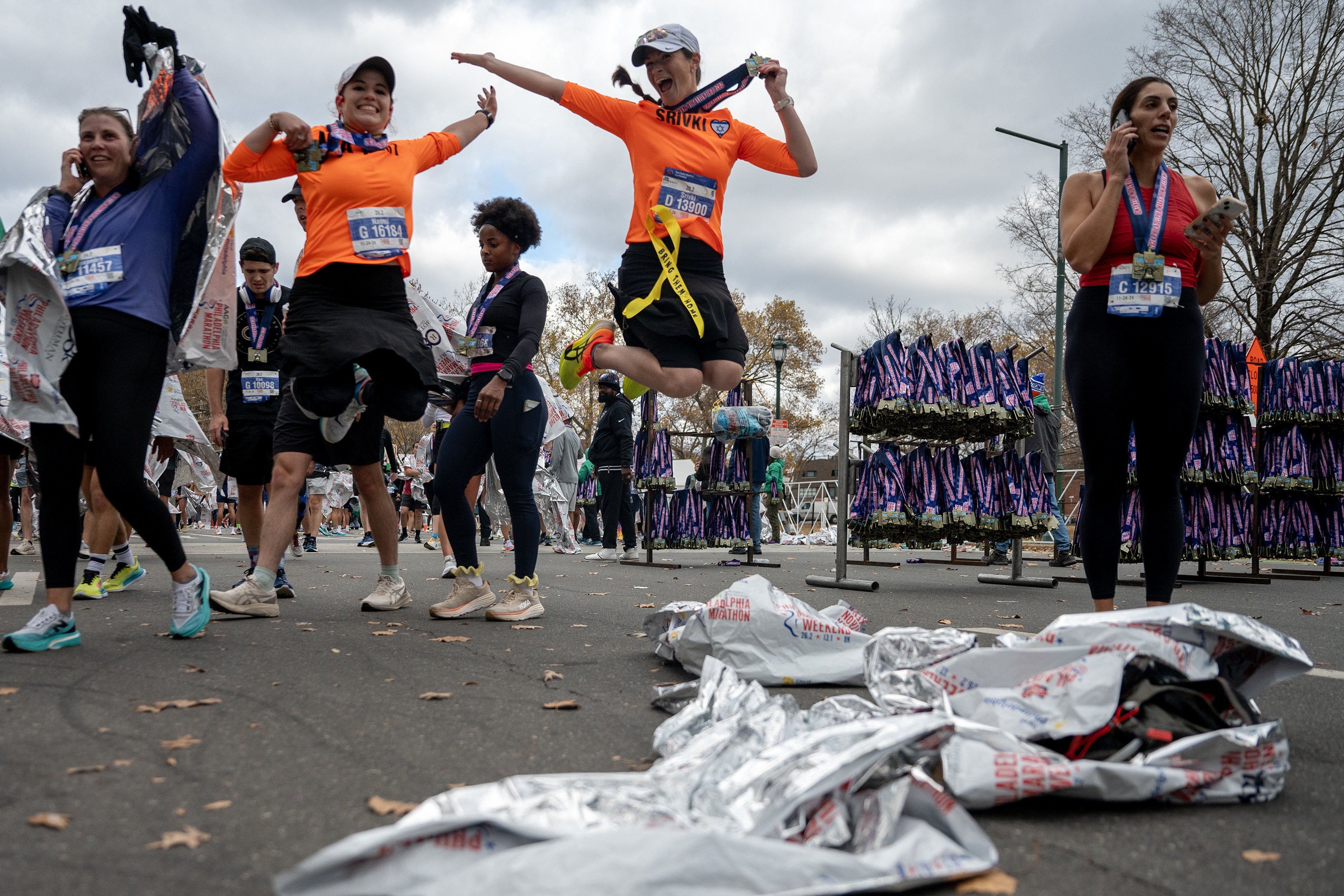
Naomi Peker (left) and Srivki Weisberg (right) jump to celebrate their finish in the 2024 Philadelphia Marathon on Sunday, Nov. 24, 2024. They run with a club in Suffern, N.Y., and this was Peker’s first marathon.
Awards & prize money
Monetary prizes range from $225 to $10,000 depending on the race, with the Philadelphia Marathon’s Elite Division being the most competitive.