Tag: topic-link-auto

  • Lincoln thought its football season was over, until an overturned suspension presented another chance

    Lincoln thought its football season was over, until an overturned suspension presented another chance

    The entrance to Lincoln High School’s football field was locked last Saturday morning for the Railsplitters’ regular-season finale against defending Philadelphia Public League champion Imhotep Charter.

    Spectators had to be preapproved for entrance into the gates, then checked by a Philadelphia police officer on a list. There were three camera crews there, too, taking sporadic shots of the field and video of the 50 or so parents scattered in the concrete stands.

    Lincoln hasn’t played a game since Oct. 4, after the team received a three-game suspension — which would have ended its season — following a brawl that broke out after its game against Northeast High School. However, last week, the School District of Philadelphia overturned Lincoln’s suspension after video evidence revealed players, parents, and coaches from both schools were involved in an altercation as Lincoln’s team attempted to leave the Northeast Supersite.

    The Railsplitters forfeited two games, including their 39-8 victory over Northeast, before the suspension was amended. But none of that mattered against Imhotep. Lincoln just wanted another chance to play.

    In a 26-25 thriller, the Railsplitters snapped the powerhouse Panthers’ 35-game league winning streak and became the first Public League team to beat Imhotep in six years.

    If the Railsplitters (5-4) had lost, their season was over. Lincoln persevered, despite having 12 players suspended due to the altercation, and will advance to the Public League quarterfinal round of the playoffs. They will play Central at 11 a.m. on Saturday at the Germantown Supersite.

    Another chance

    As the game was winding down on Oct. 4, Lincoln coach Hakeem Cooper and Northeast coach Nick Lincoln agreed to skip the traditional postgame handshake down the middle of the field, Cooper said, due to the in-game chatter that was stirring between the teams.

    Instead, Northeast went back to its locker rooms, located up a ramp and behind the stadium field house. Cooper gathered his team in the far end zone to address the group for 15 minutes after the game. Cooper said he sent assistant coach Joe DiGrazio to get the Lincoln team buses over to the visitor’s side of the field.

    DiGrazio then went up the steps on the Northeast home side, where a verbal altercation ensued, Cooper said.

    DiGrazio, who is shown on a video from the incident, had his back to the steps and extended his arms trying to hold back Lincoln’s players from going up the steps. The video also showed shoving and jostling before the altercation was settled.
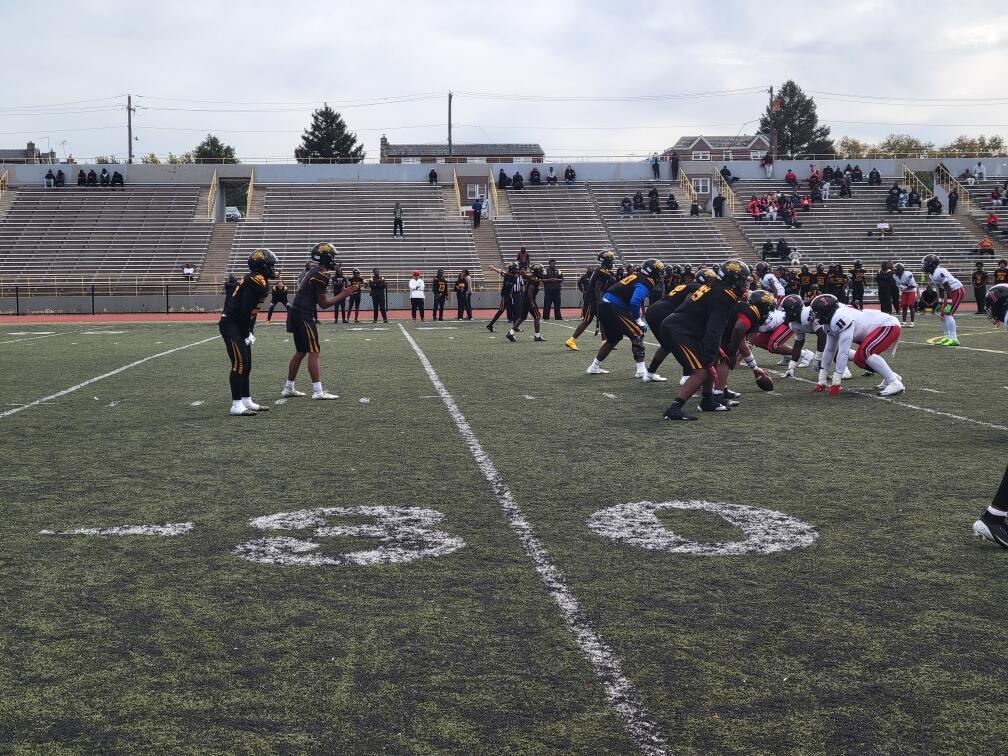
    Lincoln High School plays against Imhotep Charter on Oct. 18.

    Northeast interim principal Peggy DeNaples, Northeast athletic director Phil Gormley, and Vikings coach Nick Lincoln could not comment about the matter.

    The school district wrote in a statement: “After an additional review of video footage, statements from coaches, parents and OSS (Office of School Safety) officers on-site and reports from PPD (Philadelphia Police Department), the PPL (Philadelphia Public League)’s investigation concluded that student-athletes and coaches from the Abraham Lincoln high school football team engaged in unsportsmanlike conduct after the conclusion of the game … . Individuals who were not directly involved in the altercation from Lincoln were eligible to return to play for their final regular season game on Oct. 18.”

    On Oct. 8, Lincoln principal Jack Nelson was informed by the district that the Railsplitters’ season would be canceled. Cooper gathered his team in a study hall to tell them the news, which was greeted with a swell of emotion.

    It also happened to be on Cooper’s 34th birthday.

    “Yep, it was not a good birthday present, because it was highly emotional,” said Cooper, who is in his fifth season as the Railsplitters’ head coach and guided Lincoln to a 2023 PPL Class 6A championship, its first league title since 1979. “It’s probably one of the hardest things I ever had to do as a coach. I got emotional, seeing all my boys breaking down after we lost a championship that we should have won [last November to Imhotep on a blocked punt in the Public League championship].

    “It’s been a roller coaster these last two weeks. I was holding out hope that we would be able to salvage the season. I just wanted the kids to have one more chance. We appealed the suspension when more video came out, and the school district gave us our season back.”

    ‘Never gave up hope’

    A week later, in the same room that Lincoln thought its season was over, Cooper told his 47 players to grab their helmets and shoulder pads and get ready for practice. They had a 90- minute session last Wednesday and a two-hour practice on Thursday, before finishing the week with a Friday walk-through.

    It was not an ideal way to prepare for a team like Imhotep, which beat Lincoln 35-6 last year during the regular season. The Panthers also squeezed by the Railsplitters, 28-26, for the Public League Class 6A title on a blocked punt with less than a minute left in regulation and a touchdown by Jabree Wallace-Coleman (who’s now at Penn State) on the final play of the game.

    Last Saturday, Lincoln’s 6-foot-1, 193-pound senior quarterback KJ Moore was brilliant. He extended plays. He found sophomore Nazir Holley in the corner of the end zone for a 20-19 lead with 1:48 to play.

    It looked like the Railsplitters would seal the win when defensive end Koi Muse took an interception 35 yards and added a 26-19 lead. But Imhotep kept coming.

    On the ensuing kickoff, Imhotep scored a touchdown on a fumbled return and had Cooper feeling cursed by the football gods that another odd special team’s breakdown would end Lincoln’s season. But the Railsplitters held, as Imhotep’s two-point conversion was stopped.

    Cooper’s lower lip quivered after the game. The whole experience seems to have galvanized the Railsplitters. The suspension made a tight team a tighter team.

    “I never gave up hope that we would play again, and I never felt so happy going to practice last Wednesday,” Moore said. “I was angry. We had to play behind a locked gate. Me, Jamir Duncan, and Nymir Marable, the team captains, called a players-only meeting the day after we were told our season was over. We were determined to get our season back. … On the outside, we had a lot of ignorance coming at us.

    “We’re going to be tough to beat. We are getting our guys back, and Alvin Yates is eligible to play. I saw the cameras there. I also saw that they left. They didn’t stick around. They covered their story. They missed the story: us beating a team no one thought we could beat. This adversity has made us closer. … I learned how this coaching staff cares about us. They are always there for us. It’s why we push, because our coaches push.”

    Marable, a senior receiver who is getting attention from West Chester, Delaware State, Gettysburg, and West Virginia State, added: “We had to prove everyone wrong. We were supposed to lose 50-0. I think we all got a gift in this — we had something taken away and then given back. We learned not to take anything for granted. Everyone was ready to play. No one was going to stop us.”

    When Cooper showed up at Lincoln at 8 a.m. Saturday, he was greeted by 20 of his players waiting in front of the locker room door.

    Yates, a 6-5, 260-pound defensive lineman and cousin of former St. Joe’s Prep star Samaj Jones and Imhotep’s Zahir Mathis, had to wait 21 days before his eligibility kicked in after transferring into Lincoln from Imhotep.

    “I can’t wait to play after being on the sideline,” said Yates, who is getting attention from Syracuse, Temple, Monmouth, and Penn State. “We have some dogs on this team. The mindset of this team is to win everything, especially with everything we have been through.”

    If Lincoln and Northeast win this weekend, the two teams will advance to the Public League semifinals, which will be played at the South Philadelphia Supersite on Nov. 1 at 11 a.m. According to sources from Lincoln and Northeast, there will likely be no fans permitted to attend.

    “I won’t forget my son coming home [on Oct. 8] crying like he lost an aunt and I knew something was not right,” said Kareem Moore Sr., KJ Moore’s father. “I was there when the fight broke out. The animosity was high between the two teams. These were adults acting poorly. It’s too bad this was taken out on these kids. It will feel real good when Lincoln wins the Public League title. These kids are filled with a lot of energy. They can do it.”

  • Charles Barkley and Shaq mock Joel Embiid, praise VJ Edgecombe in ESPN debut

    Charles Barkley and Shaq mock Joel Embiid, praise VJ Edgecombe in ESPN debut

    In their ESPN debut, Charles Barkley and Shaquille O’Neal didn’t waste any time mocking Sixers star Joel Embiid.

    “What’d your boy do tonight, Chuck?” Shaq asked.

    “Not a lot,” Barkley dryly responded.

    While the Sixers topped the Boston Celtics Wednesday night, Embiid struggled during his 20 minutes on the court, finishing with just four points and six rebounds.

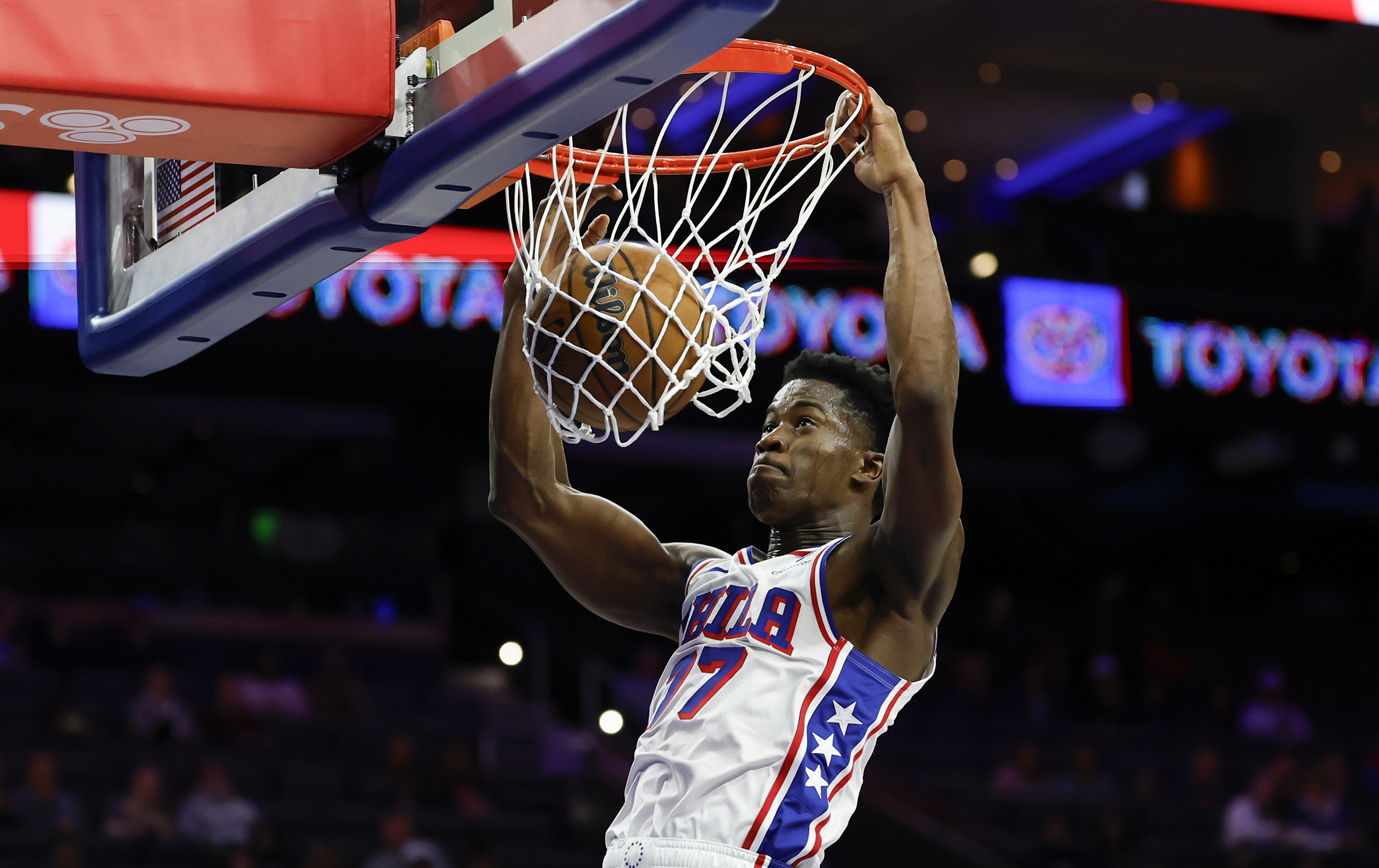
    The stars of the night were Tyrese Maxey and first-round pick VJ Edgecombe, who scored 34 points, the third-best debut for a rookie in NBA history.

    Barkley used Edgecombe’s eye-opening debut to jokingly take a shot at his college coach, Baylor’s Scott Drew. In reality, the two are close, and Barkley played with Drew’s brother, Bryce Drew, with the Houston Rockets.

    “Scott Drew can’t coach. He’s been holding this kid back,” Barkley joked.

    Barkley and Shaq have been hard on Embiid over the years, including blasting him at the start of last season for not playing in back-to-back games. But Barkley’s expectations have shifted due to Embiid’s injury struggles, including two knee surgeries over the past 14 months.

    “I was asked a thousand times this summer about the Sixers. I said I can’t give a fair prediction,” Barkley said. “As much as I love Edgecombe and Maxey, if Embiid and Paul George can’t play, [the Sixers] are not a contender.”

    “He only gave your four points,” Shaq added.

    So yeah, while Barkley, Shaq, Ernie Johnson and Kenny Smith have jumped from TNT to ESPN, nothing changed about the chemistry of Inside the NBA, one of the most beloved sports shows in TV history.

    Who else would ESPN let compare new Wizards guard CJ McCollum to convicted felon and former New York U.S. Rep. George Santos, who was released from prison by President Donald Trump?

    “Man, I don’t know what CJ McCollum did to someone” to end up on the Wizards, Barkley said. “We freed George Santos, let’s free CJ McCollum.”

    The foursome, now in their 15th season working together, mocked their new home relentlessly, joking that Barkley will appear on every ESPN show, from Get Up to First Take to NFL Live.

    “One thing I’m not going to be is Stephen A. Smith — everywhere,” Barkley said.

    Much later in the evening — ESPN let Inside the NBA roll past 1 a.m. Philly time — Johnson quizzed Barkley on which networks a handful of NBA personalities worked for. Barkley got two right, but missed on TNT colleague Allie LaForce.

    And for those keeping score, Barkley picked the New York Knicks to win the Eastern Conference, a prediction that will likely change at least seven times before the end of the season.

    TNT had broadcast NBA games since 1989, but the NBA rejected the network’s offer in favor of new 11-year deals NBC and Amazon. Despite that, the show is still produced by TNT out of their Atlanta studio. It’s just the name on front of the desk that’s ultimately different.

    Barkley and company will be back on the network tonight for another doubleheader: Oklahoma City Thunder at Indiana Pacers at 7:30 p.m. Philly time, followed by Denver Nuggets and Golden State Warriors at 10 p.m.

    “Ernie, that’s today!” Barkley said shortly after midnight.

    Once the NFL season is over, Amazon will stream NBA games on Prime Video Thursday nights. Until then, the evening is wide-open, allowing ESPN to swoop in to broadcast two national games tonight.

    After that, Inside the NBA will have a light schedule on ESPN until the end of the year, though they’ll appear more frequently during the second half of the season.

    Here’s when Inside the NBA will appear on ESPN though the end of December:

    • Thursday, Oct. 23: ESPN
    • Wednesday, Oct. 29: ESPN
    • Wednesday, Nov. 12: ESPN
    • Thursday Dec. 25: ESPN and ABC

    Mark Sanchez still recovering from stabbing as trial date set

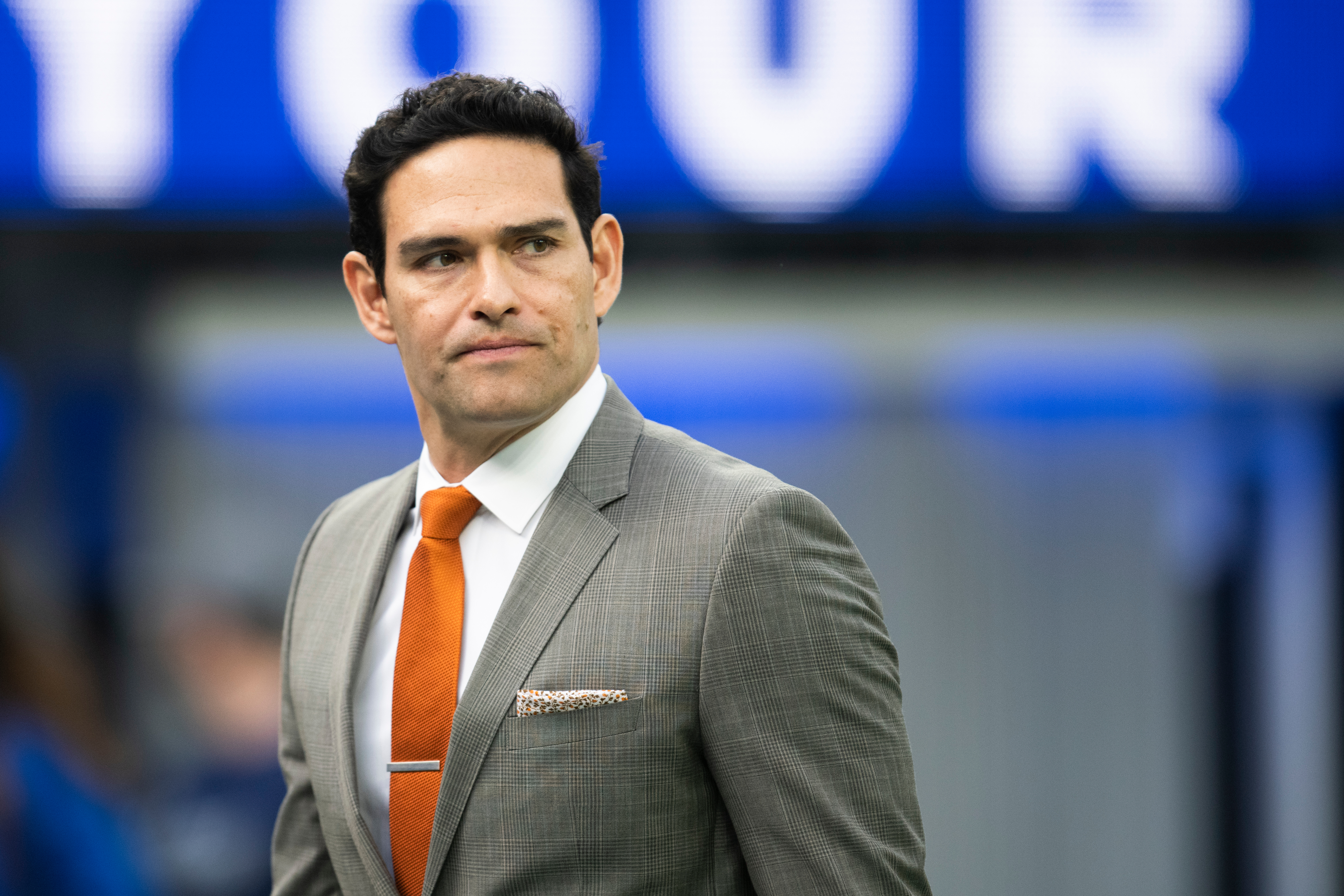
    Mark Sanchez has called NFL games for Fox since 2021.

    Mark Sanchez won’t be returning to a broadcast booth anytime soon.

    The Fox Sports announcer and former Eagles quarterback is scheduled to go on trial next month to face accusations he attacked and injured a delivery driver in Indianapolis Oct. 4 ahead of calling an NFL game.

    Sanchez, 38, was also seriously injured in the assault, and his recovery could force a delay in the trial, which is scheduled to begin Dec. 11.

    Sanchez is accused of drunkenly assaulting a delivery driver in a fight stemming from an argument over a parking space. Police said the driver, Perry Tole, 69, pepper sprayed Sanchez, then pulled out a knife and stabbed him multiple times in self-defense.

    “We are literally talking about people fighting over a parking space and-or a dispute about where people are parking, and it resulted in someone receiving just incredibly significant injures,” Marion County prosecutor Ryan Mears told reporters a few days after the incident.

    In a lawsuit filed against both Sanchez and Fox Sports, Tole claimed the fight left him with “severe permanent disfigurement, loss of function” and other injuries.

    Fox Sports has declined any further comment on the incident beyond a brief statement issued in the immediate aftermath of the fight: “Our thoughts and prayers are with Mark, and we ask that everyone please respect his and his family’s privacy during this time.”

    Quick hits

    Sixers rookie VJ Edgecombe impressed the Celtics’ announcers.
    • Barkley and Shaq weren’t the only ones impressed by Edgecombe’s debut — announcers on NBC Sports Boston were amazed by his first-quarter jam:
    • Amazon announced the Eagles’ Black Friday matchup against the Chicago Bears on Nov. 28 will stream for free on its Prime Video platform, welcome news for Birds fans that live around the world (unless you live in Canada, where it will remain behind the paywall). The game will air for free in the Philadelphia TV market on Fox 29.
    • Tom Brady is back to broadcast his third Eagles game of the season Sunday, when the Birds take on the New York Giants at 1 p.m. on Fox. It won’t be his last — Brady is slated to call the Eagles Week 12 matchup against the Dallas Cowboys and the Birds Week 17 trip to Buffalo to play the Bills.
    • Say goodbye to ESPN’s Monday Night Football doubleheaders. NFL owners approved the league’s deal to sell the NFL Network to Disney Wednesday. As a result, the four extra games slotted to ESPN will return to the NFL, according to Sports Business Journal’s Ben Fischer.
  • This cutting-edge red blend bucks winemaking norms — and tastes delicious

    This cutting-edge red blend bucks winemaking norms — and tastes delicious

    The wine trade is one where true innovations are few and far between, and understandably so. Experimentation with new ideas is simply more complicated when your product takes years to make and is expected to age gracefully for a decade more. The slow pace of due diligence — even on common sense modernizations like the introduction of screw caps — leads vintners to be risk-averse and helps explain why the revival of historical winemaking practices is more common than truly new methods.

    Intrinsic Wine Co., out of Washington state, are exceptions to this rule because this label was created to be an established winemaker’s idea lab. This passion project was created in 2016 by the then-head winemaker of one of Washington’s largest wineries, Columbia Crest. Intrinsic wines are expressly designed to challenge the status quo and explore the kinds of innovations that smaller wineries with fewer resources are unlikely to pursue.

    This unusual cabernet sauvignon-based blend — made in a way that steps outside the norm on many fronts — serves as a good example of Intrinsic’s work. First, a heaping helping of malbec replaces the merlot that would typically be used in a Bordeaux-inspired recipe, adding a vivid violet hue and a suggestion of earthy sweetness like glazed carrots. Next, the winemaker keeps the grape skins and solids in contact with the wine for a remarkable nine months — far longer than the few weeks that are normally considered an “extended maceration.” Finally, it employs a wholly fresh idea during this process called “skin swapping,” where the cabernet wine ages on the malbec skins and vice versa, in a process intended to build harmony between the varietals long before the individual components are blended together.

    Stylistically, the result is a seamless and lush red wine that tastes quite intense. Its blueberry and blackberry flavors have amplified floral and herbal notes, and while the wine is not fully dry, it features far less of the “vanilla frosting” effect imparted by traditional aging in new oak barrels. All in all, what the winemaker has achieved is a post-modern flavor profile that is more sensual than intellectual and that younger audiences will embrace.

    Intrinsic Red Blend

    Intrinsic Red Blend

    Columbia Valley, Wash.; 14.6% ABV

    PLCB Item #96329, on sale through Nov. 2 for $19.99 (regularly $23.99)

    Also available at: Wine Warehouse in Voorhees ($17.98; voorhees.winewarehousenj.com), Total Wine & More in Claymont, Del. ($19.99; totalwine.com), Hopewell Super Buy Rite in Pennington ($19.99; buyrite.wine).

  • Philadelphia has lost a great journalist and a kind spirit

    Philadelphia has lost a great journalist and a kind spirit

    We buried my father on a bitterly cold day in Washington, D.C., in 2010. As I followed his casket out of the church, I spotted journalist Michael Days in the crowd of mourners. I didn’t get to speak with him, but I was deeply touched, not to mention honored, that my editor at the Daily News was there.

    He didn’t have to do that. But Days, who died suddenly on Saturday at the age of 72, was a deeply empathetic man who genuinely cared about people. As former Daily News columnist Howard Gensler wrote on Facebook recently: “He celebrated the wins and keenly felt the losses in his newsroom. He knew when to step in and when to step back and he could go Philly on you when he had to — and then later ask you how your parents were doing.”

    I met the pioneering journalist when he was business editor for the Daily News, and I was applying for a job. During my interview, I got so excited at the prospect of earning twice my salary in D.C. at the time that I didn’t bother to negotiate. But Days kindly arranged for me to have two weeks’ vacation during my first year of employment instead of my having to work an entire year, as stipulated by the terms of the union contract.

    That was my first experience with the kind of leader Days was. He was more than just a boss. He was an editor, mentor, and friend who looked out for his staffers, which engendered our intense loyalty. We used to joke that when Days said, “Jump,” our response was, “How high?”

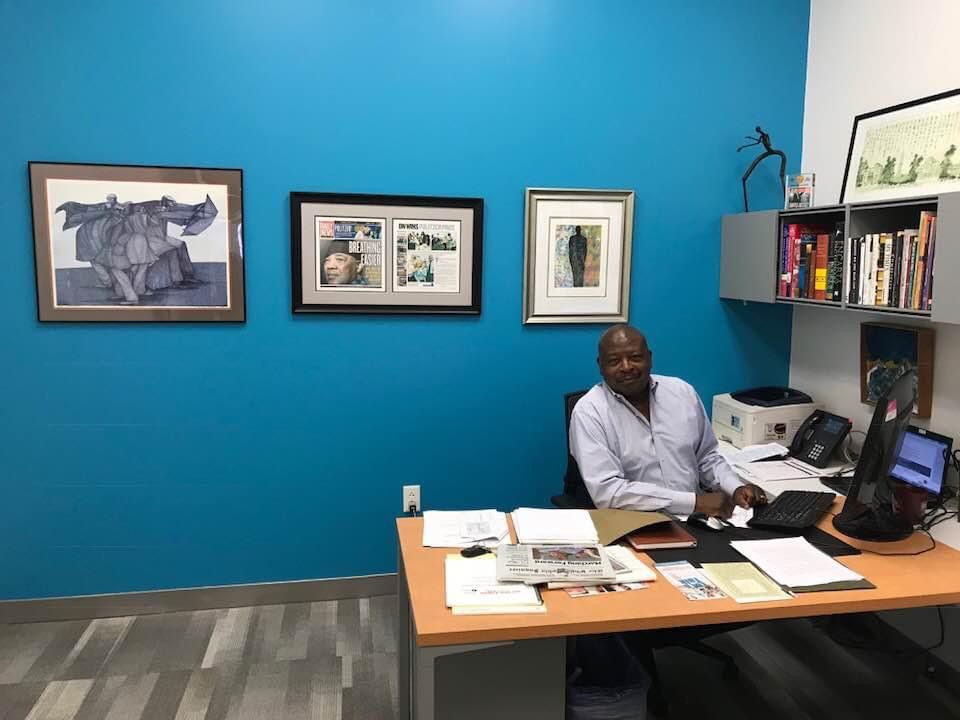
    This is how I’ll always remember Michael Days: sitting in his office with a smile on his face, always ready to talk or just listen.

    As amazing as he was as a newsroom leader, Days was an even better person outside of work. A fellow Catholic, he was a man of great faith who not only attended Mass regularly but whose life exemplified his deeply held Christian beliefs. He and his wife, Angela Dodson — then an editor at the New York Times — adopted not one child, but four brothers all at the same time.

    Once, I had the good fortune of being invited to a holiday party at his home in Trenton — a location picked because it was between his wife’s job in NYC and his own in Philly. Shortly after I arrived, I recall glancing outdoors and spotting four shiny, new bicycles in the backyard. I was in awe. His beautiful home was decorated with a huge tree. I watched as Days’ wife handed each boy a matching Christmas plate. Lunch was a warm, cozy affair with lots of Southern favorites.

    Days’ career took off, as he went on to hold a number of leadership positions in the newsroom. The first time he was in line to make history — as the first African American managing editor of the Daily News — I felt for certain he would get the job. Days had grown up in North Philly and graduated from Roman Catholic High School. Not only did he know the city, he understood the paper’s operations inside and out, and was adept at dealing with its motley crew of reporters and photographers.

    I was outraged when he was passed over for an outsider. But when I stuck my head in his office to check on him, I was startled when he met my gaze with a smile. Days was unflappable like that. Calm. Steady. No matter what happened, he always kept his cool. That’s not easy in a newsroom full of strong personalities, but Days did it.

    Looking back, he had the right idea. Management eventually woke up and named him managing editor, and later executive editor, of the Daily News. Under his leadership, the Daily News excelled journalistically, winning a Pulitzer Prize in 2010 for a series exposing corruption in the Philadelphia Police Department.

    The following year, Days was named managing editor of The Inquirer and left the Daily News for a brief time. When then-publisher Bob Hall announced his return, and Days strode back into the newsroom, we all stood and cheered. Some even cried. Time passed, the papers consolidated, and Days went on to hold other management roles at The Inquirer. Even as he became less involved in the day-to-day newsroom operations, we still streamed in and out of his office, seeking advice about stories we were working on or grabbing a piece of chocolate from his candy dish.

    After he retired in 2020, we continued to seek him out. He would take our calls as if he were still on the clock.

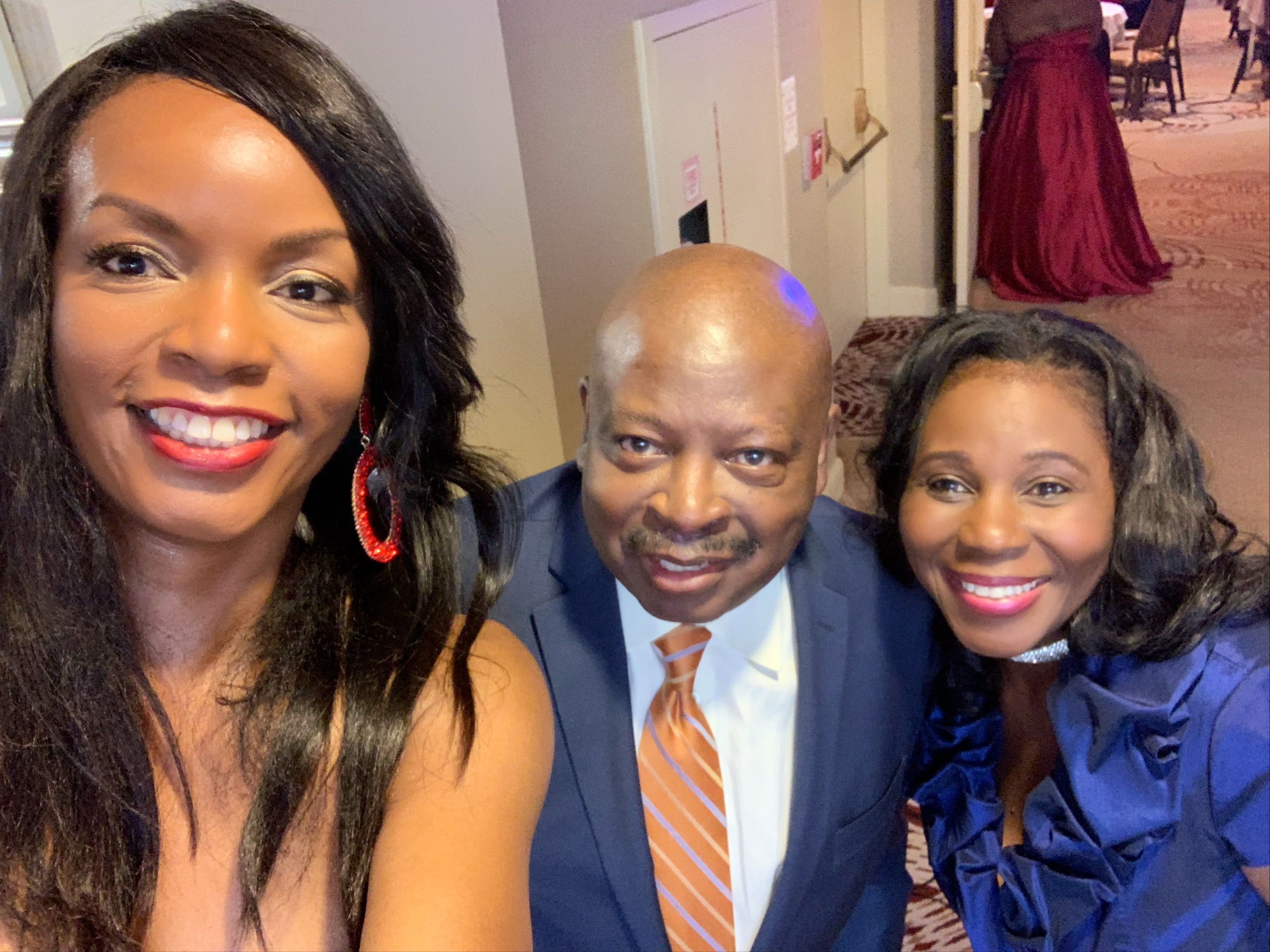
    The author (left) at a WDAS Women of Excellence Luncheon where she was being honored. The late Inquirer Vice President Michael Days is to her immediate right, and former Deputy News Editor Yvette Ousley is next to him.

    Two years ago, a group of Black journalists decided to form a new local affiliate branch of the National Association of Black Journalists after the Philadelphia Association of Black Journalists broke off from the nationwide group. Days, then 70, graciously agreed to serve as NABJ-Philadelphia’s inaugural president, and helped the new group find its footing.

    In September, the group hosted a reception at the Free Library of Philadelphia honoring NBC contributor Trymaine Lee, author of the new book, A Thousand Ways to Die: The True Cost of Violence on Black Life in America. When it was his turn to speak, Days praised Lee, who had been a Daily News intern, and told him, “You are a talent, and nobody is surprised that you have done so well.”

    Afterward, former Daily News reporter Mister Mann Frisby posted on social media: “The way he spoke about Trymaine at his book signing, I have also heard him speak of me the same way. Always encouraging. That makes me know that he was CONSISTENT for decades in regards to how he supported and mentored journalists.”

    When I woke up early Sunday and discovered numerous “call me” texts, I knew something really bad had happened. Days’ death sent a seismic jolt through journalism circles nationwide.

    “He was kind and gentle,” recalled Inquirer columnist Elizabeth Wellington. “I lost my own father earlier this year. And this feels as if I’ve lost a second.”

    I feel the same way. Before Days, I’d never met any man I considered anywhere close to being in the same league as my dad, who was a giant among men.

    Inquirer reporter Melanie Burney, who will finish out Days’ term as president of NABJ-Philadelphia, told me she has found herself in the days after his death asking, “What would Michael do?”

    That’s a question I’ve asked myself a few times recently, as well. Days had been just a quick phone call away. Going forward, we will have to rely on the many lessons he has already taught us.

  • Joel Embiid talks about his first love — soccer — and more with Men in Blazers’ Roger Bennett

    Joel Embiid talks about his first love — soccer — and more with Men in Blazers’ Roger Bennett

    Joel Embiid says he did not start playing basketball until age 16. A young Embiid had dreams of being a footballer until the 7-footer grew too tall for that to be in the cards.

    Even though he can’t play anymore, he’s still a passionate fan of Real Madrid and, of course, the Cameroonian national team. With the World Cup set to come to Philadelphia in 2026, there might not be anyone more excited than Embiid.

    Soccer “is already huge, but having a World Cup here, it’s going to be even bigger,” Embiid said on the Switch the Play podcast with Roger Bennett of Men in Blazers. “I’m excited. I’m going to be all over the place. I’ve never been to a World Cup game before, so I’m going to go to a lot of them, especially to follow some of the best teams. Hopefully Cameroon makes it. Right now it doesn’t look likely.”

    Cameroon is in second place in its qualifying group and is tied for fourth in points for a group runner-up spot. The top four runners-up advance to a playoff that gives them a second chance to qualify for the World Cup. If Cameroon can’t make it, Embiid is also intrigued to follow England, but he expects that team to “choke again.”

    Embiid said he thinks his experience playing soccer growing up helped improve his footwork for basketball.

    “Hakeem [Olajuwon] was another one that started so late and made it into basketball, and he credits his football skills to be able to get better so fast. I think there’s a lot of similarities where — I’ve always been a type of guy to observe, and then you show me one thing, and I’m able to do it after one or two tries, and just pick stuff up so fast. If you’re not coordinated enough, or if you don’t have good footwork, that’s not going to be possible, and that goes back to football, using your feet and having soft feet.”

    His experiences growing up playing other sports before getting into basketball have him encouraging his young son to do the same. So Embiid won’t push him to specialize in any one sport — except for soccer, which he plays every Sunday. But Arthur is already enjoying following in his father’s footsteps.

    “He seems to be in love with basketball, but that’s where I struggle,” Embiid said. “I started at 16, and maybe I was lucky. It takes a lot of work to be able to make it to the NBA within three years of starting playing basketball, maybe a little bit of luck, but it took a lot of work. That’s where you’re like, if I started at 16, why should any kid start playing basketball at 6 years old? That’s where you’ve got to find that balance.”

  • The clash between the federal government and states over vaccine policy is ‘unprecedented,’ Villanova health law professor says

    The clash between the federal government and states over vaccine policy is ‘unprecedented,’ Villanova health law professor says

    Villanova professor Ana Santos Rutschman would describe the current state of vaccine policy as a game of chess.

    When the federal government does something, some states — primarily Democratic-led states including Pennsylvania respond immediately to counter.

    A prime example followed the federal government’s move, through the Food and Drug Administration, in August to limit eligibility for the updated COVID-19 vaccine. Previously, the annual shot was recommended for all Americans 6 months and older. The new guidance was for people 65 or older and those at high risk of complications from COVID-19.

    Pennsylvania’s regulatory body for pharmacists opened up access by allowing pharmacists to follow the broader recommendations of professional medical societies.

    “It’s kind of [like] ‘Harry Potter’ chess. Remember when they climb on the gigantic pieces and then try to kill one another?” Rutschman said, referring to the fictional scene where chess pieces violently smash the opposing side’s pieces.

    “There’s a certain violence to this from a political perspective,” she added.

    States are allowed to diverge from the federal government on vaccine policy because our system of government, known as federalism, divides power between the federal government and the states.

    With vaccines, states historically have chosen to align in large part with the federal government’s recommendations.

    Rutschman says recent actions by Health and Human Services Secretary Robert F. Kennedy Jr. have ushered in a new era of what’s being called “vaccine federalism.” Kennedy is a longtime anti-vaccine activist now serving as President Donald Trump’s top health official.

    Many states, especially those with Democratic governors, including Pennsylvania and New Jersey, saw recent changes under his leadership as a sign that they “need to do something in direct opposition to the federal government,” Rutschman said.

    Now it’s a “head-on collision,” she added.

    The Inquirer spoke with Rutschman, who researches vaccine federalism as a health law professor and director of the Health Innovation Lab at Villanova University, to learn more about this new era and its possible consequences in a conversation lightly edited for length and clarity.

    What is vaccine federalism?

    For vaccination and everything else, our system is split in two. You have the states and then you have the federal government.

    There is room for tension between the federal level and the state level. Historically, that tension has been, I would argue, limited. It has existed, but it’s not been the defining feature. Now, particularly in the context of vaccines, it has become probably the most salient feature.

    How are states allowed to differ from the federal government as far as vaccine policy?

    States don’t have the power to authorize a new vaccine to come to market.

    But then you have a lot of things that the Centers for Disease Control have done that are more informational. The federal government recommends which shots children or adults should get, and the time frame for most children to get these shots.

    The federal government offers this kind of informational support, and then states set their own policy.

    How has vaccine federalism played out in the past?

    Examples from the past are not as salient or blatant as the ones you’re seeing right now.

    There was a lot of variability around the country, but the overall message was harmonious. Everybody was trying to get, by and large, most of the population vaccinated past herd immunity.

    What is happening now?

    Now it’s a head-on collision.

    States are saying, ‘We’re not going to implement requirements to restrict access to these vaccines.’ The Board of Pharmacy in Pennsylvania decided not to be bound by the CDC’s recommendations. This is a direct clash. We hadn’t had this before between the federal government and the states in the field of vaccines.

    What are examples of this new era of vaccine federalism?

    One example would be the formation of state clusters. These are a lot of neighboring states in agreement. They’re trying to share data and think of best practices, which is almost that informational function that traditionally fell to the [federal health agencies].

    The states are saying, ‘Well, you’re not doing that, so we will.’

    ‘We will pull resources and information to come up with our own advisory role.’ That’s unprecedented.

    You have sort of two speeds in the country. Some states are collaborating and very active in setting regional vaccine policy. And then you have a bunch of states that go completely the other way. You have the, for now, isolated case of Florida saying, ‘We’re going to just basically do away with all vaccination mandates,’ which is going further than the federal government.

    Now it’s a much messier situation, legally, philosophically, politically, etc.

    How effective are these regional coalitions?

    They are accomplishing something. You see fewer restrictions in access to vaccines in a place like Pennsylvania than other states.

    Whereas states who are not part of these kinds of coalitions — typically excluding the likes of Florida — a lot of them are waiting to see what happens, because this has never happened in the history of vaccination in the United States.

    In the meantime, there are a lot of people falling through the cracks who would have been indicated for a vaccine last year. Now they’re wondering what to do, and their providers are not entirely sure.

    There’s a lot of confusion about what happens now that federal policy has taken a completely different direction.

    What impacts do you see coming from this new era of vaccine federalism?

    People hearing one thing out of the CDC and another one out of the state of Pennsylvania may think, ‘Who’s correct? Who should I listen to?’ You start aggregating all the people who might forgo vaccination just because they don’t understand what’s going on.

    I think it continues to accelerate the overall phenomenon of vaccine mistrust, and we’re already seeing levels of herd immunity come down for many vaccine-preventable diseases.

    If I were a provider, I would be similarly confused and concerned, because nobody takes lightly the idea that from now on, ‘I’ll be doing something that’s in direct opposition to what the federal regulators are suggesting I should be doing.’ So I think there’s a fear factor and confusion.

    Lastly, I think there’s an overall chilling effect with regard to vaccines. Yes, some vaccines make money, but they don’t make a whole lot of money to begin with. They’ve never been one of the preferred products for manufacturers. These are not the most profitable things they can be doing.

    I think that we will see much less focus on vaccine development in years to come, because that’s the logical position for pharmaceutical companies, and for some funders even to take, which is unfortunate.

    What do you think of Pennsylvania’s response?

    I think it’s to Pennsylvania’s credit, and I think it’s to some degree reassuring for Pennsylvanians. Although it obviously makes me sad that we have sort of this two-speed mode in the country. Some part of this national fabric has ruptured.

    For now, Pennsylvania has protected itself as it can, but states alone don’t control everything. You have Pennsylvanians going to other states where you may have an outbreak of a vaccine-preventable disease. We don’t have real borders. We cross them all the time.

  • Eagles Week 8 film preview: Key to a big day for Jalen Hurts, stopping Giants’ rookie duo, and more

    Eagles Week 8 film preview: Key to a big day for Jalen Hurts, stopping Giants’ rookie duo, and more

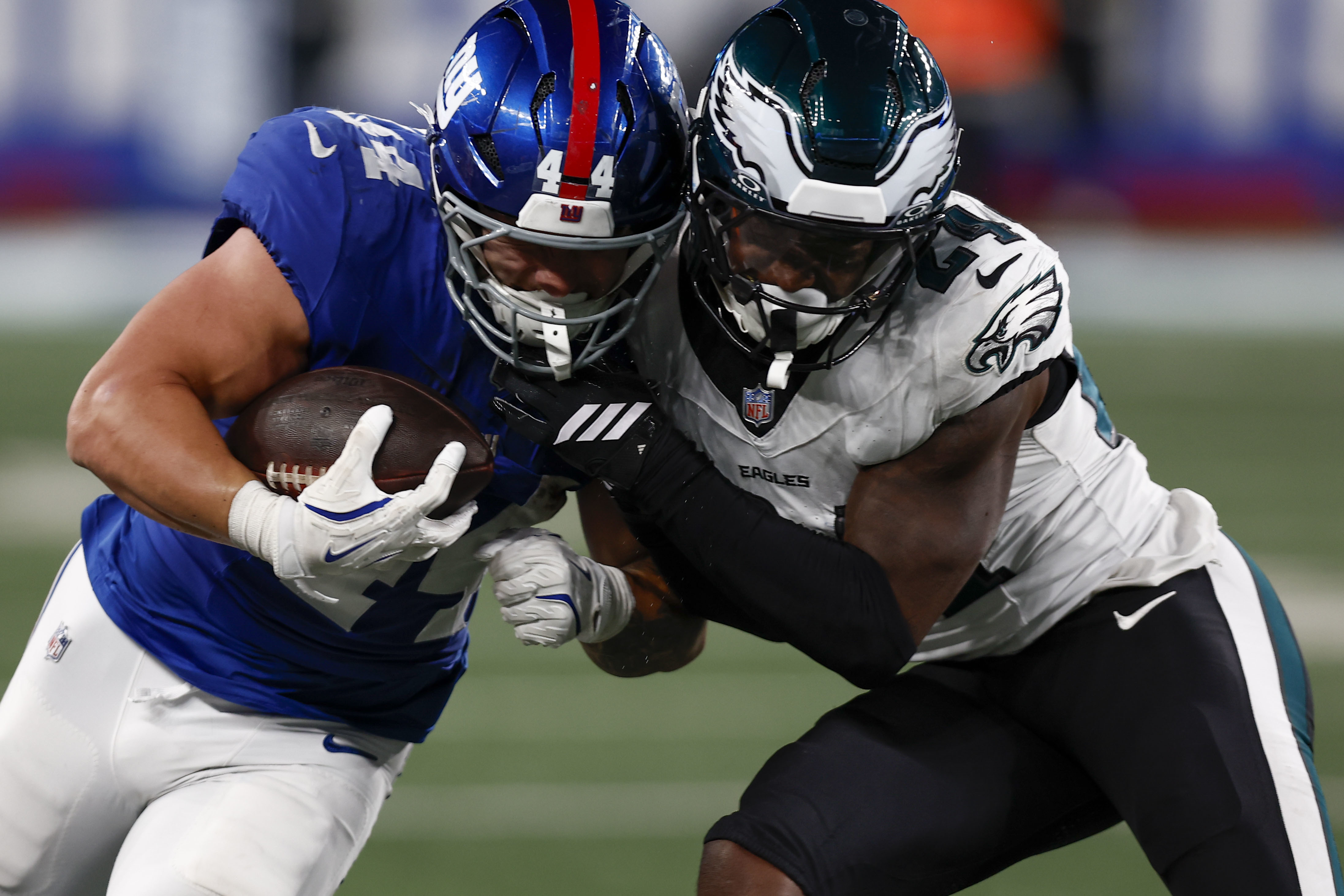
    Breaking tendencies on offense for the Eagles played a big role in their Week 7 win over the Minnesota Vikings. With a rematch looming with the New York Giants on Sunday, that formula will likely be put to good use again.

    Jalen Hurts finished the Vikings game with a perfect passer rating (158.3) and continued his trend of exploiting zone coverage for a second straight game. But the influx of under-center play-action and connecting on his deep shots with A.J. Brown and DeVonta Smith made all the difference.

    Can the offense carry that momentum against the Giants, while figuring out its running-game issues? Here’s what we learned from the film ahead of Sunday’s rematch between the division foes:

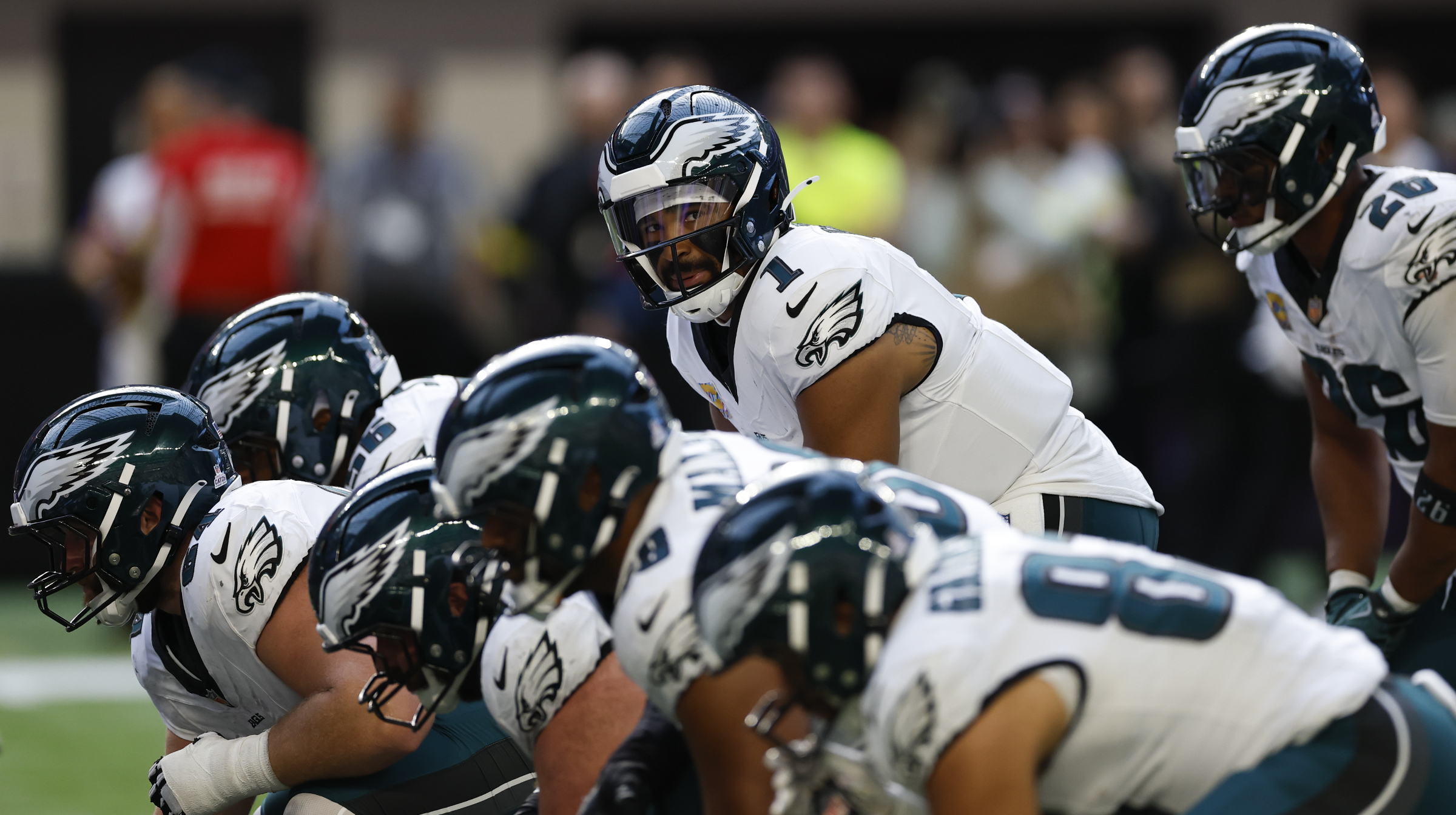
    Eagles quarterback Jalen Hurts thrived passing from under center against the Vikings in Week 7.

    More under-center play-action

    Of Hurts’ 326 passing yards against Minnesota, 121 of them came on play-action, under-center throws downfield. Entering that game, the Eagles averaged just 0.8 yards from under center, which ranked 30th in the NFL, according to Fantasy Points Data.

    Hurts completed all four of those pass attempts, including the 79-yard touchdown strike to Smith. The play-action also opened up the middle, allowing the Eagles offense to attack an area of the field it has often neglected.

    The Giants, according to Next Gen Stats, are giving up the eighth-highest total of passing yards on throws traveling 10 to 19 air yards, yielding 71.9 yards per game. Hurts has completed four of six passes in that range of the field in each of his last two games.

    There are also examples of the Giants defense giving up explosive plays off play-action passes from under center. New York yielded a 33-yard gain to CeeDee Lamb during a matchup with Dallas in Week 2, and surrendered an 87-yard touchdown connection from Spencer Rattler to Rashid Shaheed in Week 5 against New Orleans.

    In their Week 6 matchup, Hurts, who has typically thrived against man coverage in his career, completed just six of 12 passes against New York’s man looks on defense, according to Next Gen Stats. And he threw his lone interception of the season, which all but ended the game.

    Hurts’ early touchdown pass to Brown against Minnesota was proof of his improvement as a passer, making plays with his arm rather than taking off and scrambling. According to Next Gen Stats, Hurts had his first game with a positive expected points added (which measures team performance on a play-by-play basis) per drop back on scrambles without actually taking off and running.

    If Hurts can continue that trend, the Eagles should be in for another big passing day — the Giants are giving up the seventh-highest total of passing yards per game in the NFL (245.3) and the second-most passing yards on throws that travel 20 or more air yards (62.9), according to Next Gen Stats.

    Giants rookie running back Cam Skattebo rushed for 98 yards and three touchdowns against the Eagles in Week 6.

    Keeping Dart and Skattebo in check

    In Week 6, rookies Jaxson Dart and Cam Skattebo ran wild over the Eagles defense, which was without defensive tackle Jalen Carter and cornerback Quinyon Mitchell, who left the game with a hamstring strain. And the pairing hasn’t slowed down after accounting for 156 of the Giants’ 172 rushing yards in that game.

    Skattebo was a little more subdued against Denver, rushing for 60 yards on 3.1 yards per carry. But Dart continued to make plays downfield and on the move, hurting the Broncos defense with his arm. Dart is coming off his best passing day, throwing for 283 yards and three scores.

    His connection with wide receiver Wan’Dale Robinson continues to grow. When he escapes the pocket and extends plays, Dart has consistently found Robinson outside the numbers or over the middle of the field for big gains — first against the Eagles in Week 6, then Denver last week.

    Tight ends continue to be among Dart’s favorite targets. He threw two more to that position group Sunday in Denver, finding Daniel Bellinger (44 yards) and Theo Johnson (41 yards) for touchdowns.

    Of Dart’s seven touchdown passes, five have gone to tight ends, and Johnson has four of them. Because of the high tight end usage, the Giants could look to attack downfield and utilize double moves against the Eagles’ secondary to spring Johnson or Bellinger.

    Against Minnesota, a double move from Jordan Addison created a 32-yard completion between Mitchell and Drew Mukuba in zone coverage. The Giants completed a pass on similar action to Bellinger, albeit against man coverage.

    But the most important thing the Eagles need to do to prevent New York from taking shots downfield is to stop the run. The Birds defense has allowed 26 runs of 10 or more yards, tied for the seventh-most in the NFL, and it particularly struggles on outside runs.

    The Giants made the Eagles pay in their previous matchup, with three of the five rushes that went 10 yards or more coming from runs outside the tackles, according to Next Gen Stats. The running-back toss play to Skattebo has been effective over their last two games.

    Although his status for Sunday’s game is in question, defensive end Brandon Graham, now back with the Eagles, could provide a huge boost in the run defending department. Graham’s reps before his first triceps injury last season showed a promising trend of setting a firm edge and knifing through offensive lines.

    He would be a major boost to a run defense that ranks 22nd in the NFL in rushing yards allowed per game (127.9).

    Encouraging signs for Barkley

    For the last two games, Eagles opponents entered the game struggling to defend the run but were still able to hold Saquon Barkley to 58 and 44 total rushing yards. Looking beyond the numbers, though, tells a different story.

    The Eagles are trying to get Barkley out in space and last week’s game that featured under-center play-action passing showcased an evolved plan for the running game. After finding some success earlier in the season on Barkley pitch plays to the left side of the offensive line, the Eagles called four outside toss plays against the Vikings that yielded 14 yards. It also provided some new run scheme looks from under center that can be paired with play-action passes.

    Denver ran a similar play that popped a big gain against the Giants’ defense in Week 7, with J.K. Dobbins rumbling for a 32-yard gain. Expect the Eagles to keep the toss play as a run scheme option for Barkley on Sunday.

    In addition to the toss play, the Eagles have found success in getting Barkley some daylight on split-zone runs against the Giants and Vikings that created 18-, 8-, and 9-yard gains. The action allows a backside tight end (Dallas Goedert) or motioning receiver across the formation to keep a defensive end or edge rusher from crashing down the play for a loss.

    Barkley’s rushing numbers could be even worse if not for his elusiveness in the backfield. Twice last week he had to force someone to miss right after he got the handoff to turn a potential negative play into a positive one.

    With center Cam Jurgens’ status for Sunday in question, the Eagles must continue to find ways to give Barkley room to run. Mixing in variations of run schemes should help aid a potential breakout performance.

  • Owen Tippett is setting the tempo for the Flyers, both on the ice and with the aux cord

    Owen Tippett is setting the tempo for the Flyers, both on the ice and with the aux cord

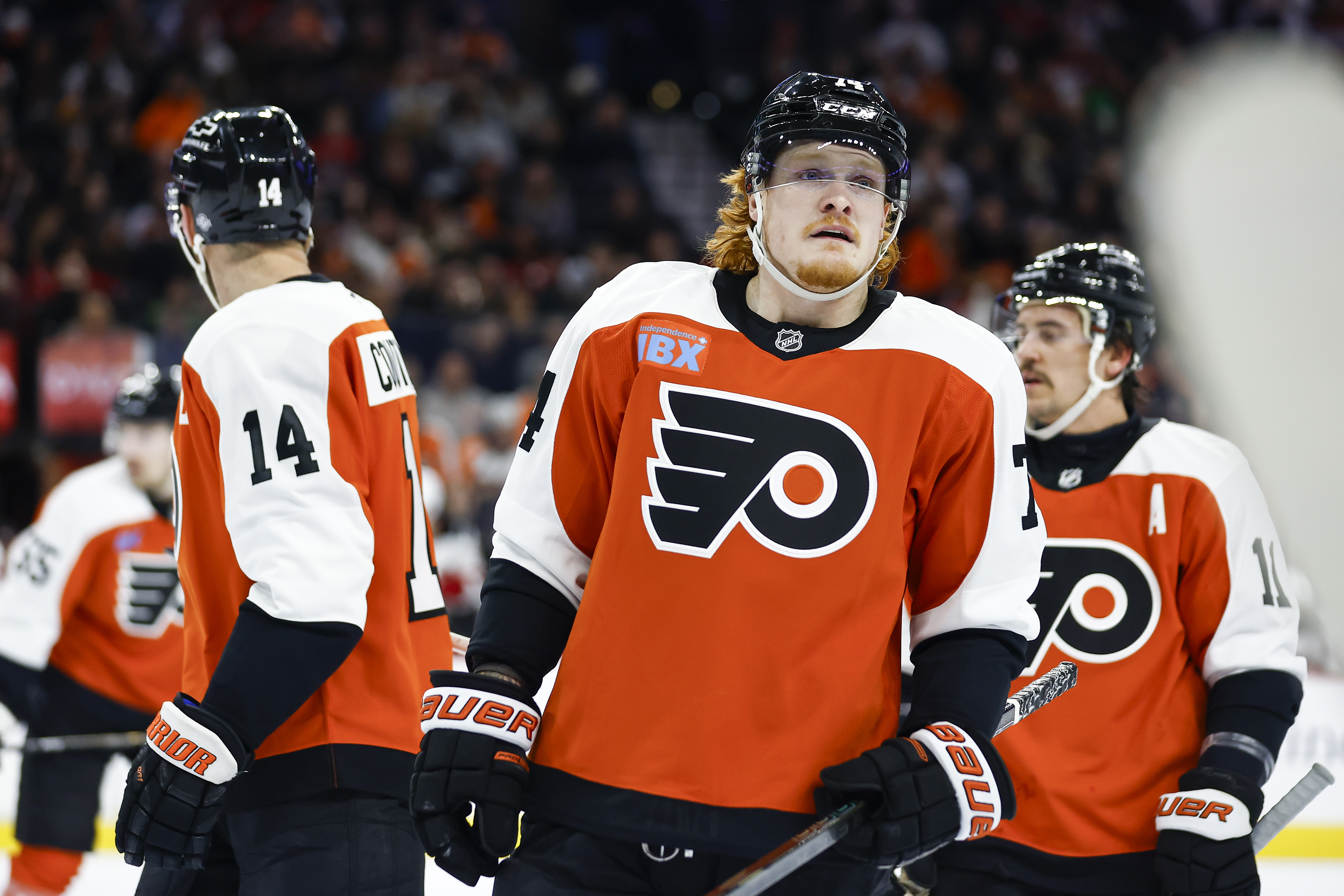
    Owen Tippett may have had a smile on his face when chatting in the locker room in Voorhees recently. But the big grin hid some of the anxiety he had heading into the Flyers’ home opener on Oct. 13.

    It wasn’t about scoring. At that point, the winger already had his first goal of the season under his belt — a power-play one to boot.

    No, this was a different kind of pressure.

    Tippett is now in charge of setting the tone. He is the new vibes guy. So, after months of preparation, of picking the right songs, of sending them to the Flyers game presentation group for the proper mix, his warmup playlist was making its debut.

    The Flyers’ aux cord now belongs to No. 74.

    For years, the playlist had been closely guarded by Scott Laughton, with Joel Farabee assisting. But both were traded last season: Farabee at the end of January to the Calgary Flames, and Laughton in early March to the Toronto Maple Leafs.

    Tippett took charge of the aux afterward, saying last season that he did it because he’s the “closest guy that kind of offered up for the Bluetooth not to cut out.” However, he didn’t really change much from the 105-song playlist he was handed in the group chat.

    Until now.

    “I’m always one who’s kind of looking for new music,” said Tippett, who ran the aux a handful of times playing for Mississauga and Saginaw of the Ontario Hockey League.

    “Obviously, there’s some staples that you can kind of keep in [the playlist] from years past, but I think anything that’s new, you kind of throw it in the playlist and hopefully guys catch on to it.”

    Note: Some songs on the playlist embedded below may be offensive to certain audiences or contain explicit content. Use caution while enjoying this playlist by making sure you’re aware of your surroundings.

    ‘T.N.T.’ – AC/DC

    Tippett hasn’t just set the mood in the locker room — there are several playlists, one has “slower songs” and “more of an easy vibe” for morning skates, and another before they get on the ice — but his on-ice presence has been setting the tone, too.

    During game action, he’s been like song No. 2 in warmups, AC/DC’s “T.N.T.,” and playing “dynamite.” Just six games into the new season, Tippett has collected five goals. Last season, when he finished with 20 tallies, it took him 25 games to hit that mark.

    The dip in production came after two consecutive seasons with at least 27 goals — it took him 15 games in 2023-24 and 13 in 2022-23 to score No. 5 on the season — and expectations that he would crack the 30-goal mark in his third full season with the Flyers.

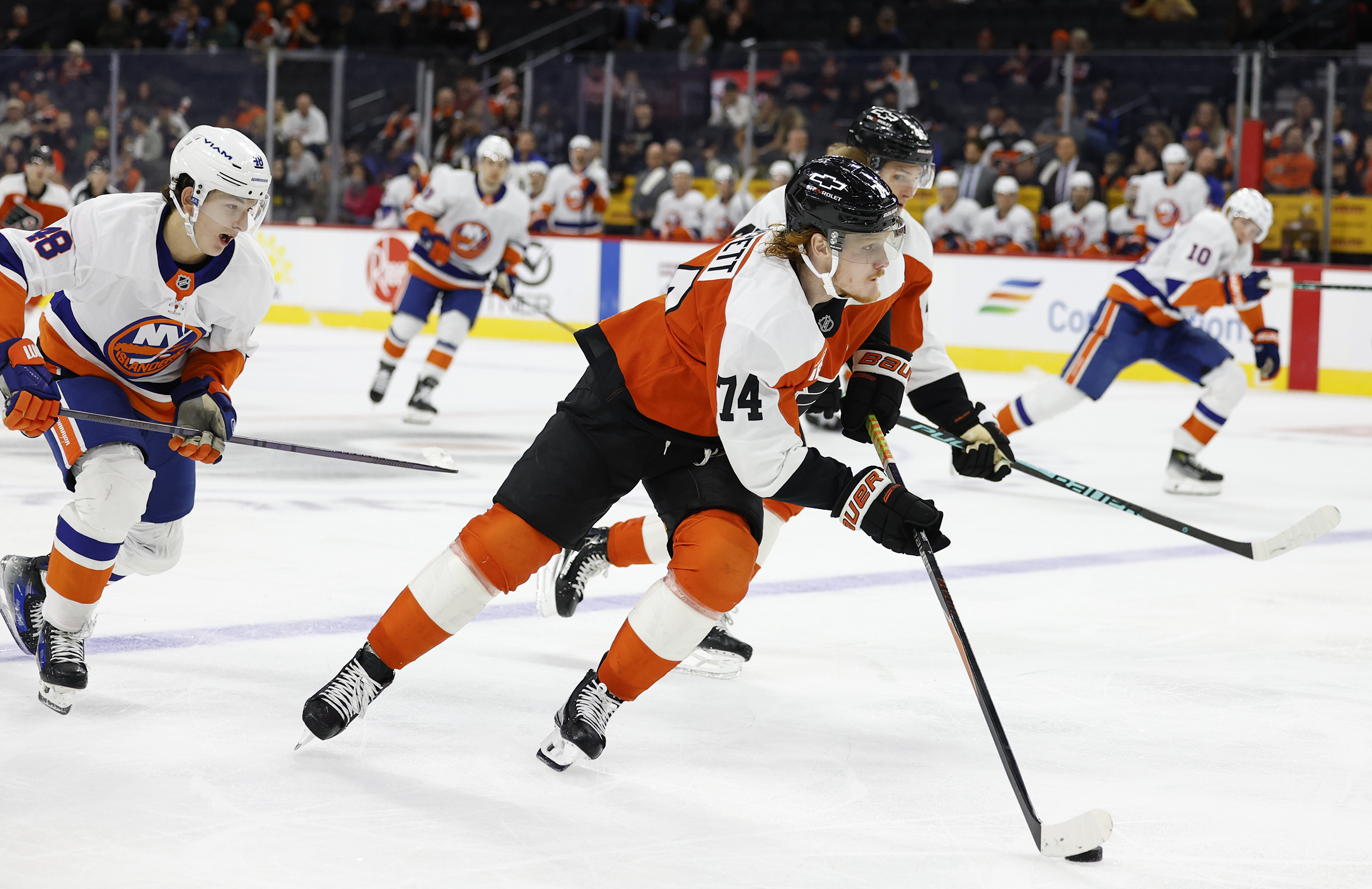
    Flyers right wing Owen Tippett is really using his speed and strength to get to the middle more. The early results have been promising.

    “I think it’s just getting reset and looking back onto those years and what worked and what made me kind of more successful than I was last year,” he told The Inquirer on Oct. 6. “End of the day, everyone has those years; it’s going to happen and not get too frustrated with the dips and just trying to regroup as quick as you can.”

    And he is using it all as motivation.

    “I think it’s just take that next step,” he said about his ambitions during training camp. “Obviously, a bit older now, and more games played, and I think it’s time that I kind of take that step and take on that bigger role. … That comes with little things within the game, but as a player, just kind of round out my game.”

    Tippett sounds like a grizzled veteran, but the 26-year-old winger has only 353 regular-season games under his belt — 94 with the Florida Panthers and 259 with the Flyers after being acquired in the Claude Giroux trade.

    And this year, he has taken on a bigger role, averaging 16 minutes, 31 seconds a night, while being put into more situations by the new coaching staff led by Rick Tocchet.

    Under new head coach Rick Tocchet, Owen Tippett (left) looks poised for his first 30-goal season.

    ‘Because You Move Me’ – Helsloot & Tinlicker

    Tippett has always played on the power play, but this season he has been moved into a rotating spot between the net-front and the bumper. It’s different than his previous spot on the flank, but he likes that it “gives you more options.”

    His one power-play goal came from being atop the crease — he was screening Carolina Hurricanes goalie Frederik Andersen — when he pounced on a shot that caromed off the glass behind the net.

    Tippett has become an all-around special teams threat. In his first 253 games with Philly, he was on the ice killing penalties for an average of nine seconds per game (36 minutes, 3 seconds total). This season, he’s up to 24 seconds per game for a total of 2:24. Former coach John Tortorella always said Tippett played better with more ice time, and it’s showing.

    And the additional responsibilities play into what the Flyers wanted to see from Tippett this season. The winger is in Year 2 of an eight-year, $49.6 million extension that he signed in January 2024, and before the season, Flyers general manager Danny Brière said he wanted to see Tippett take the next step and work on “developing his all-around game.”

    “He is becoming even more of a true threat. … We hope he becomes a 30-, 35-goal scorer,” Brière said on Oct. 2. “That’s what we hope from him. I mean, what he brings is more than just goals, too. The size, the speed, the powerful explosiveness that he has is tough to find.

    “So that’s what we want to keep seeing from him. Evolving, finding ways to take advantage of the best time to use those assets that he has that not a lot of players have.”

    The Flyers have high hopes for Owen Tippett and believe he is just scratching the surface of his potential.

    ‘Walk It Talk It’ – Migos (feat. Drake)

    Recently given the title of “the fastest skater I’ve ever seen” by new teammate Trevor Zegras, Tippett is a dynamic, speedy winger packed into a 6-foot-1, 210-pound power forward’s body. He crunches guys with ease — as noted by his big hit on Seattle Kraken forward Tye Kartye on Monday — and also keeps defenses on their heels because they cannot predict when he will turn on the jets.

    He is known for highlight-reel goals, but when he mixes his speed, shiftiness, and big shot, Tippett can resemble a freight train. According to NHL Edge, Tippett’s max speed last season was 23.89 mph — Miles Wood’s 24.82-mph burst was the NHL’s fastest last season — and he recorded 38 bursts of 22 mph, ranking fourth in the NHL. Two seasons ago, he was clocked as the fastest skater in the NHL — yes, faster than Connor McDavid — by hitting a max of 24.21 mph, and was ranked fourth in the league with 46 trips at 22-plus mph.

    This season, his max speed is 22.89, with Bobby Brink the fastest Flyer at 23.30. But Tippett has hit at least 22 mph seven times already, putting him right behind McDavid’s 11.

    Just because he has dropped a little speed doesn’t mean anything. It’s actually a good sign because, while “it’s obviously exciting when you look up and see no one in front of you … and you start turning the legs,” he also has realized that he doesn’t need to be going 100 miles an hour all the time.

    “I know my speed’s always going to be there,” he said. “So it’s focusing on the other little things and then letting my game take over from there. There’s definitely going to be times where it fits in, and we’re still trying to figure that out. … It’s just a matter of finding times, and then letting the game kind of open up and not force things.”

    ‘Can’t Stop’ – Red Hot Chili Peppers

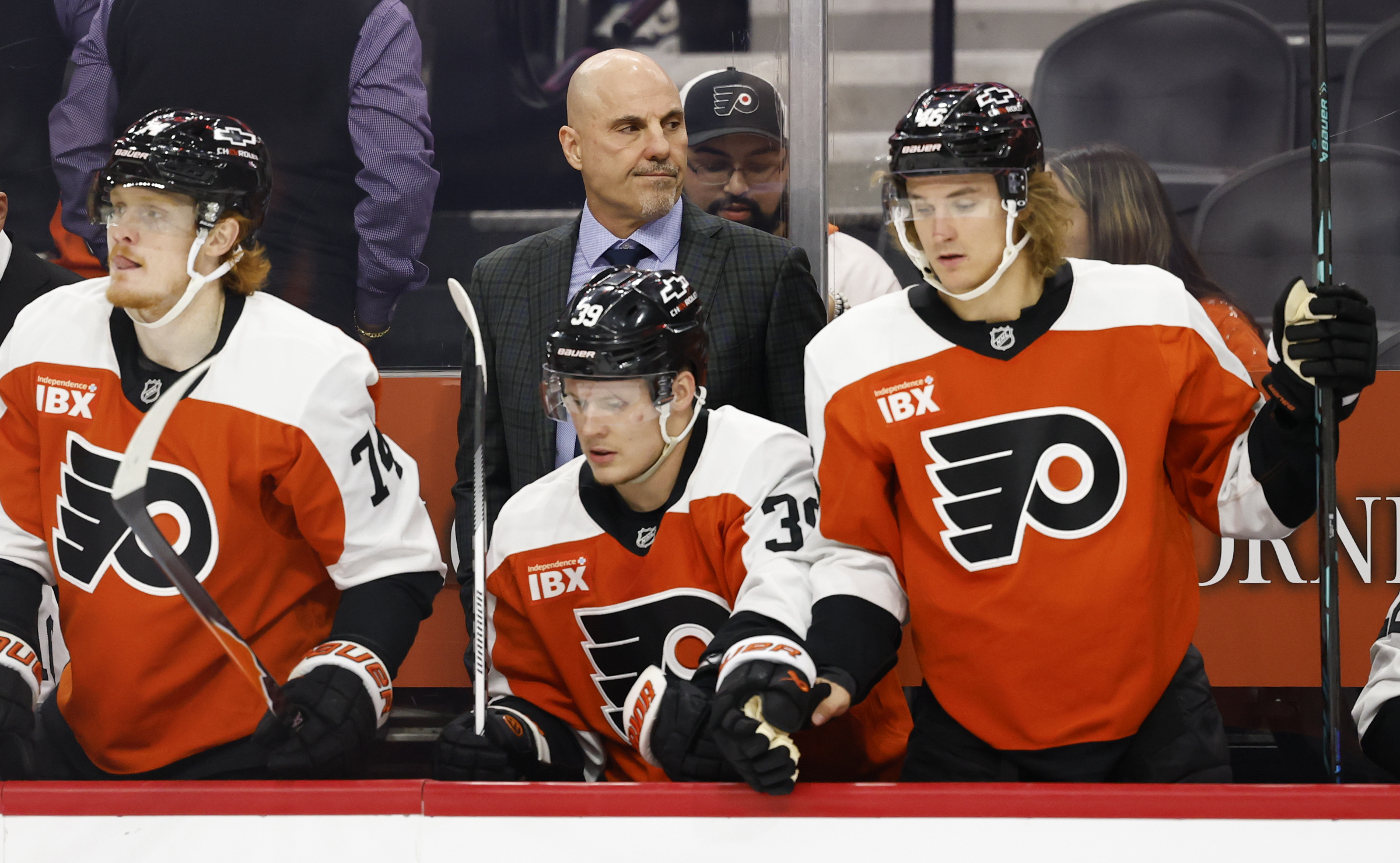
    After he was hired as the Flyers’ coach in May, Tocchet told The Inquirer, “I think Owen Tippett is a guy who I feel has another level in him. I think he’s a prototypical big, fast winger. Can we unleash him?”

    Well, it looks like the collar is off.

    The bench boss noticed early on that the winger had a habit of exposing the puck; Tippett has been working on it. Tocchet mentioned his “incredible” speed and how he is a “great off-the-rush guy,” but wanted to see him go to the inside more. One of his two goals Monday came because he positioned himself in the slot, and he combined his newfound inside game with his trademark speed to beat two-time defending Vezina Trophy winner Connor Hellebuyck on Oct. 16.

    “In the short time I’ve been here, [and] this coaching staff, he’s been a pleasure to coach,” Tocchet said. “He’s been in the room. He’s asking questions. He’s in the video room. He’s taking the information. He’s really taken ahold of the game like a leader-type of role. That’s what I see. I don’t know what happened in the past, but he looks like a guy who’s dialed in.”

    Indeed.

    Like the music he listens to — EDM (electronic dance music) to house to rap to remixes — Tippett is adding variety to his game while burying five goals on 19 shots. For someone notoriously criticized for missing the net, Tippet is ranked sixth in the NHL with an eye-popping 26.3% shooting percentage (minimum 15 shots).

    Of course, Tippett’s taste in music isn’t for everyone, but as Cam York said, “It’s been good. If he keeps scoring like that, keep going.”

  • A vacant South Philly Walgreens is set to become a supermarket

    A vacant South Philly Walgreens is set to become a supermarket

    South Philadelphia is set to get a new supermarket in early 2026.

    New York-based Met Fresh is on track to open its first Philly location in January inside the former Walgreens at Broad and Snyder Streets, said owner Omar Hamdan.

    The 13,000-square-foot supermarket will include a pharmacy, a fresh-cut produce department, and a deli counter, Hamdan said, and will offer free grocery and prescription delivery to area seniors. It is also applying for a license to sell beer and wine.

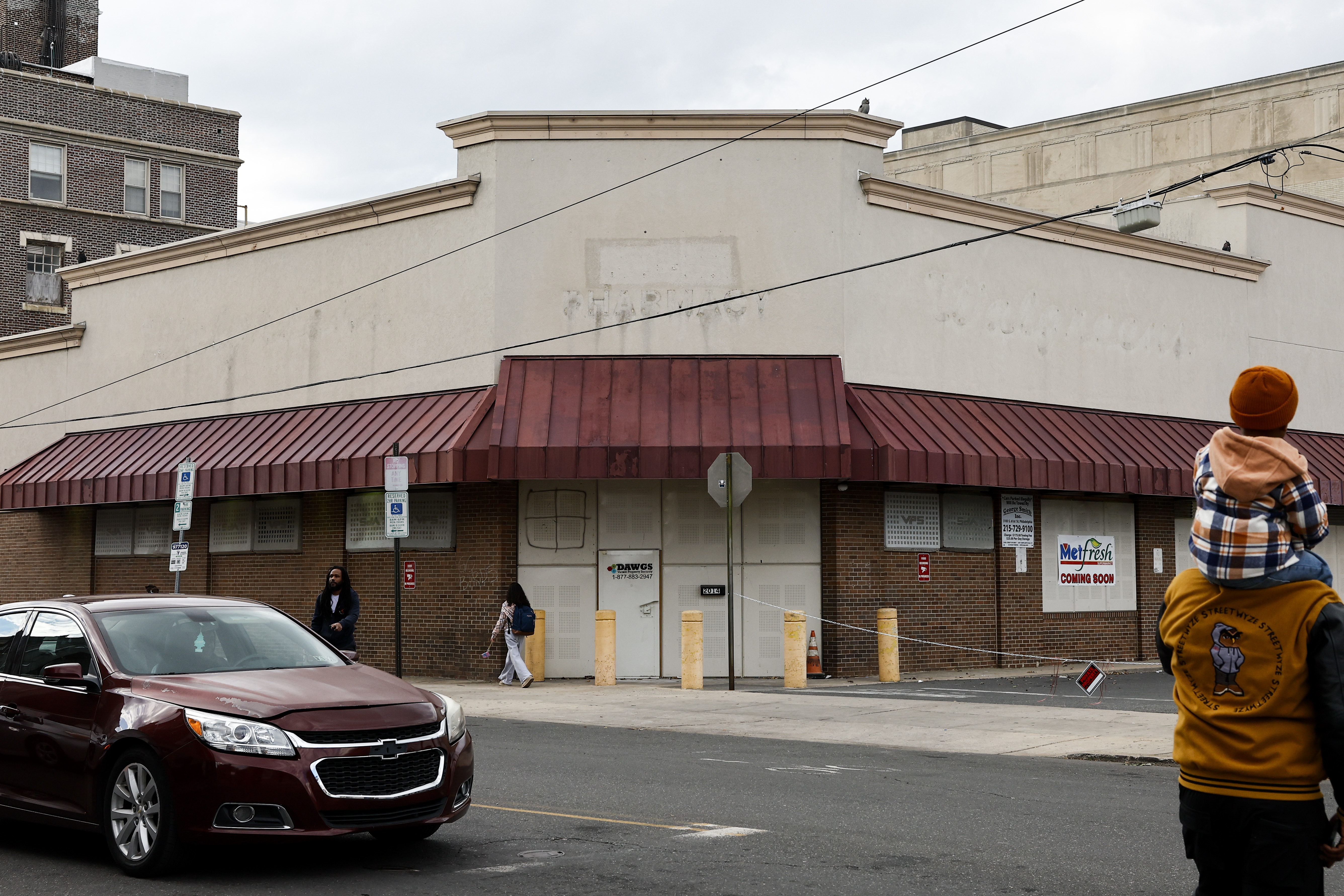
    The former Walgreens at 2014 S. Broad St., where Met Fresh’s first Philly location is set to open in early 2026, photographed on Wednesday.

    “We try to bring the human factor back into the market,” Hamdan said, adding that the company’s philosophy hearkens back to a simpler time: “That store owner who had the apron and was sweeping outside of his store, who said ‘good morning’ to everyone? That is what we do.”

    Met Foods, a family-owned company, has been operating markets in New York City for 15 years, Hamdan said. It currently has locations in the Bronx, Brooklyn, Queens, Staten Island, and northern New Jersey.

    When the South Philly grocer opens, it will mark Met Fresh’s first location outside the New York City area, Hamdan said.

    In 2019, Met Fresh had been in talks to move into a mixed-use development in Philadelphia’s Mantua section, but Hamdan said those plans fell through.

    Since then, Hamdan said they continued to look for potential Philadelphia locations. The store at 2014 S. Broad Street seemed like “a perfect fit,” he said, due to the area’s walkability, dense population, and a demand for more grocery stores and pharmacies.

    The “pharmacy” lettering is seen on a former Walgreens on South Broad Street, where Met Fresh plans to open a supermarket in early 2026 after “extensive” renovations, its owner said.

    From the Broad Street store, the nearest supermarket is seven-tenths of a mile away. As for chain pharmacies, the Walgreens closed last year, and a Rite Aid across the street shuttered this summer as the Philly-based company went out of business. So the nearest large drugstore is a CVS off Passyunk Avenue, also seven-tenths of a mile away.

    The Met Fresh will soon start hiring in South Philly, with Hamdan noting that his stores typically need 30 to 40 part- and full-time employees from the surrounding communities. The new location will open after “extensive” renovations, Hamdan said, and once the team gets ahold of refrigeration equipment, which has been impacted by tariffs on steel and aluminum.

    Hamdan said he’s excited for Philly consumers to be introduced to Met Fresh, calling the Broad Street spot “a test pilot to see how we do in the Philly market.”

  • How the ‘different personalities’ of Acaden Lewis and Tyler Perkins will guide Villanova

    How the ‘different personalities’ of Acaden Lewis and Tyler Perkins will guide Villanova

    NEW YORK — Tuesday morning was going to be an unfamiliar experience for any player who joined Villanova coach Kevin Willard at Madison Square Garden for the annual Big East media day.

    The Wildcats have 11 new players on the roster, all of them new to the Big East, and just one returning player who saw the floor last season, junior guard Tyler Perkins. Which players would Willard opt to put in the spotlight at the conference’s kickoff event and why? Perkins was an obvious choice “because he’s the only player that scored in a Big East game,” Willard said.

    The second choice could have been a few people. Villanova has multiple seniors or graduate students. Any of them — Long Beach State transfer Devin Askew, Grand Canyon transfer Duke Brennan, and Maryland transfer Tafara Gapare — would have been a reasonable second option. So would Matthew Hodge, the redshirt freshman who was forced to sit out last season at Villanova.

    But Willard chose to pair Perkins with freshman point guard Acaden Lewis, the consensus top-35 prospect Willard landed in May when the Washington native decided to reopen his recruitment after originally committing to Kentucky last fall. It is a sport sometimes dominated by upperclassmen and a conference that leans a little older. Braylon Mullins was named the conference’s preseason freshman of the year, but he wasn’t one of the players Dan Hurley brought with him to represent UConn.

    To be fair, Willard’s roster is not laden with the same type of talent as UConn’s, but Lewis, who will be relied on heavily to be the engine that makes Villanova’s offense go, was chosen by Willard for a reason.

    “Acaden is a big-time freshman recruit,” he said. “I know this is good for his career.”

    This basketball season will bring a lot of firsts in Lewis’ life, and this week was the start of it all in some ways. Villanova’s media day traveling party arrived Monday in New York. While Willard had some other things to attend to — including a meal with Jay Wright — Lewis, Perkins, and another Villanova staff member dined at TAO, the popular upscale Asian fusion chain. On Tuesday, Lewis was in Madison Square Garden fulfilling various media obligations, shaking hands, smiling for the cameras.

    “Most freshmen don’t get the chance to do this, not even sophomores,” he said. “This definitely isn’t normal. I’m just really thankful that I get to be in opportunities like this, and that’s why I’m here to experience some of these things. I’m here with a lot of talented guys, amazing coaches, legendary coaches, and we’re in New York. This is amazing.”

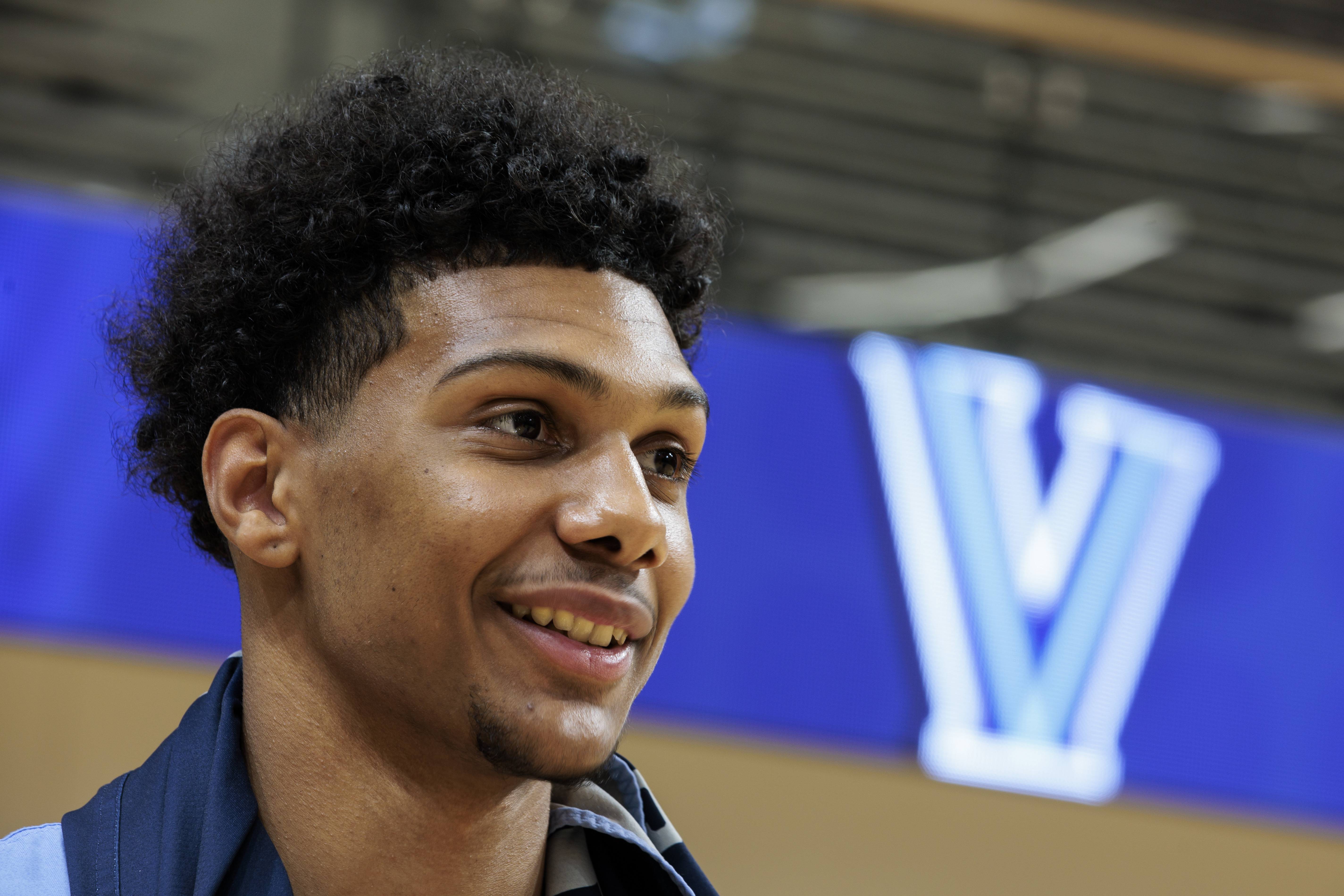
    Villanova freshman Acaden Lewis got a talking to from coach Kevin Willard after a flashy play in an exhibition game.

    The Wildcats were picked to finish seventh among 11 teams in the Big East’s preseason poll. The conference is a “guard league,” Willard said, and while Villanova has a couple of other traditional guards — like Askew and Bryce Lindsay — who will factor largely in where the 2025-26 season goes, the dynamic between Lewis and Perkins will be a big one.

    Lewis is a self-described “flashy” player, and his big and mature personality was on display for a larger audience Tuesday. Perkins is an off-ball guard whose defensive intensity might be the loudest thing about him. He’s quiet but steady, and Villanova will need that to stabilize what could be a bumpy early portion of the season as all the new pieces try to fit together.

    Willard will rely on that steadiness from Perkins, too, to help Lewis navigate his first college basketball season.

    That much has been communicated to Perkins.

    “[Willard] just said it’s not going to be easy for him and us as a team,” Perkins said.

    And the dueling dispositions?

    “We definitely do have two different personalities, but they mix, though,” Perkins said.

    How will Perkins help Lewis in Willard’s mind?

    “Tyler’s the only guy we have that has experience,” Willard said. “He’s the only guy that’s scored in the Big East so far. So what I rely Tyler on is to teach Acaden the intensity that you have to play in this league. It’s such a big transition. … Every night, he’s going to face physicality. Every night, he’s going to have to be on. Tyler has been really good in, not only in practice, but just talking to Acaden about ‘You can’t be cute. You can’t be casual. You have to be on the go at all times.’ I think Acaden’s really taken that message and ran with it.”

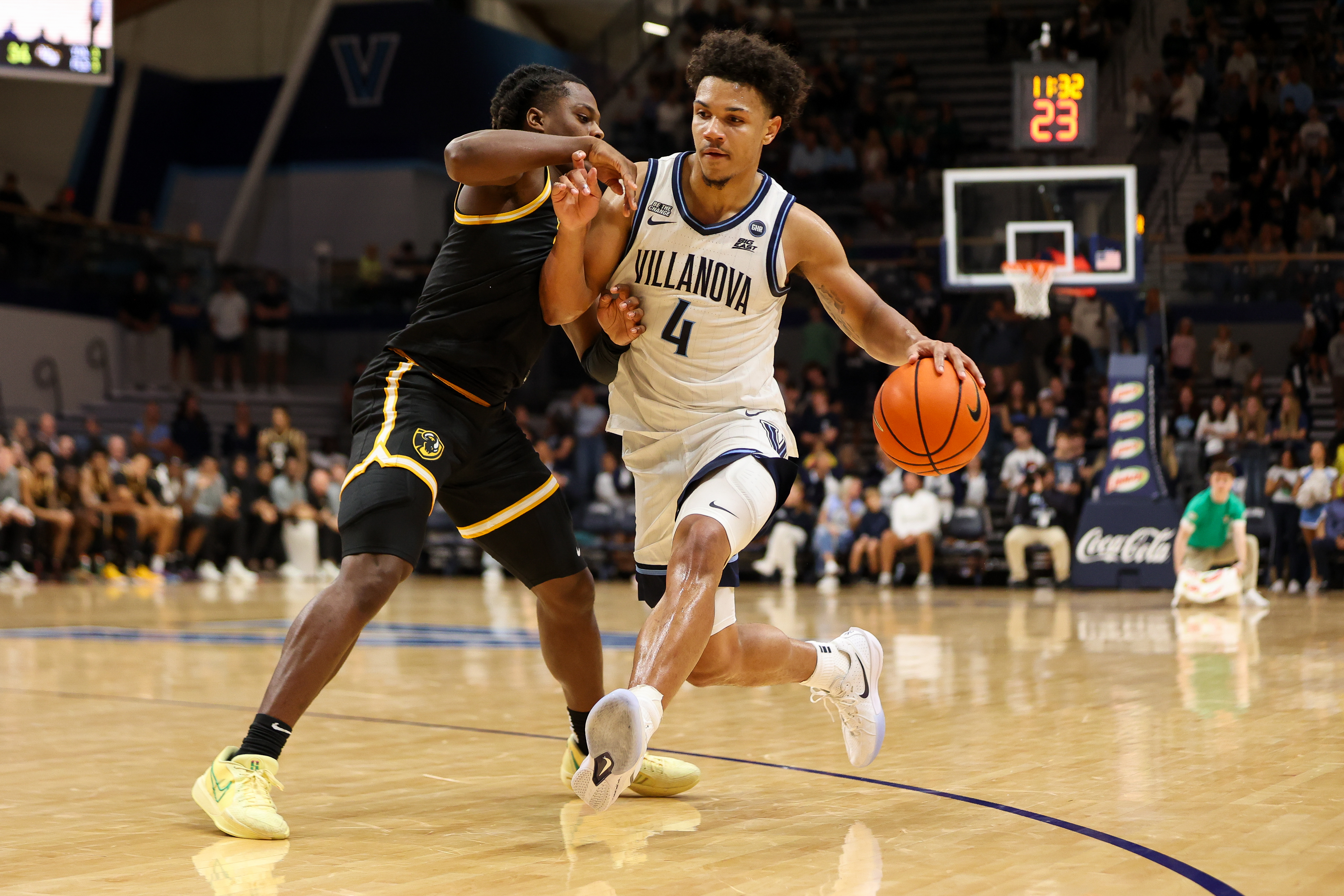
    Wildcats guard Tyler Perkins drives to the basket against VCU’s Ahmad Nowell during an exhibition game on Sunday.

    Not always. Villanova won its first exhibition game Sunday vs. Virginia Commonwealth. Lewis led all scorers with 15 points while adding three assists (against three turnovers). Perkins had 14 points, five rebounds, and five steals. But Lewis’ flashiness was on display. Near the end of the first half, the freshman tossed an underhanded pass deep down the court. It worked, but his new coach wasn’t a big fan.

    Most of Villanova’s players and coaches traveled one way to get back to the locker room for halftime, but Willard and Lewis took a different route.

    “He cursed me out the whole time there,” Lewis said. “It just wasn’t the best play. He told me I could beat the big [man], so there was no need to do all of that. He just gave me a little bit of words of encouragement.”

    That’s one way to put it.

    “It did work, so I couldn’t really argue with him as we were walking off the court,” Willard said. “But I think I told him, ‘If you ever … do that again, I’m going to kill you.’ He kind of said, ‘OK, I’m going to go with your message and not my message.’”

    Another new experience, and another lesson learned in a season when there will be many — some from a fiery coach, others from a quiet teammate.