Tag: topic-link-auto

  • City Controller Christy Brady is facing a challenge from Republican Ari Patrinos

    City Controller Christy Brady is facing a challenge from Republican Ari Patrinos

    City Controller Christy Brady, seeking her first full term as Philadelphia’s independently elected fiscal watchdog, is being challenged by Republican Ari Patrinos in the Nov. 4 general election.

    The controller’s office is charged with auditing the city’s finances and investigating fraud, waste, and abuse.

    But despite that critical role, there hasn’t been much drama in this year’s race.

    Patrinos, a former stockbroker and Philadelphia public school teacher, acknowledged the odds are against him in heavily Democratic Philadelphia and said he has no particular complaints about Brady’s performance.

    Instead, he said, he ran because “it was important that somebody run on the ticket.”

    “The truth is nobody wanted to run, and my ward leader asked me if I would run,” said Patrinos, who has not reported raising any money for his campaign. “I didn’t have any specific attacks on Brady. My concern is that the city is too single-party, and I think the city functions better when you have a two-party system.”

    Brady, a Democrat who has a $250,000 campaign war chest she likely won’t need to use this year, has the support of much of the local political establishment, including the Democratic City Committee and the building trades unions.

    A 30-year veteran of the controller’s office, Brady has struck a notably conciliatory tone during her tenure, striving to work collaboratively with Mayor Cherelle L. Parker’s administration rather than butt heads with the executive branch, as many of her predecessors have done.

    “Because of my experience when I took office two years ago, I hit the ground running,” she said.

    She pointed to her office’s audit that uncovered that the Philadelphia School District had made about $700,000 in payments to fake vendors as part of a cyber scam and to her investigation finding that fraudulent use of the property tax homestead exemption was costing the city and school district about $11.4 million per year.

    Brady was appointed acting controller in 2022 by then-Mayor Jim Kenney when Rebecca Rhynhart resigned from the post to run for mayor. Brady then won a 2023 special election to finish Rhynhart’s term, which ends in January.

    Seeking a full four-year term for the first time, Brady this year ran uncontested in the Democratic primary.

    “The biggest question I get [on the campaign trail] is: What does a controller do?” she said. “And so I’m getting out there and spreading the word of what we’re currently working on and what we do in the office.”

    The controller earns an annual salary of $171,000 and oversees an office with more than 120 employees and a budget of about $11.8 million.

    Patrinos also had no opponent in the May primary. He said he has been spending much of his time on the campaign trail promoting Pat Dugan’s campaign for district attorney.

    Dugan, a self-described “lifelong Democrat,” lost to District Attorney Larry Krasner in the Democratic primary but has accepted the GOP nomination to take a second swing at the incumbent in the general election.

    “I spend like half my time when I campaign advocating for Dugan because I’m very concerned about the crime,” Patrinos said.

    From Philly to Harvard and back

    Patrinos, who lives in Chestnut Hill, said he was a Democrat until about four years ago, adding that he voted for Joe Biden in the 2020 presidential election.

    His conversion was prompted primarily by his alma mater, Harvard College, which he felt had too enthusiastically embraced a “woke” stance.

    “The immediate driving factor was on the cultural front. It was what was going at Harvard,” he said. “I’m a little bit of an anti-woke warrior. … 2020 was peak woke.“

    Academia’s leftward trajectory and the Biden administration’s “terrible” handling of the pandemic combined to leave Patrinos with the feeling that he had no place in the Democratic Party, he said.

    “These Ivy League liberal types who really don’t have a sense of what’s going on in the lives of average Americans — they seemed to be so indifferent to the negative effects of their policies,” he said.

    He became involved in local Republican politics and helped boost President Donald Trump’s Philadelphia campaign in 2024.

    “I’m not a MAGA guy, so I didn’t join [the GOP] because of Trump,” he said, “but honestly I’m very happy with the higher education stuff, the hardcore stand he’s taken with Harvard.”

    Patrinos, a Central High School graduate who also has a master’s degree in political science from the University of Chicago, was a stockbroker in New York City before moving back to Philly about 15 years ago.

    He then became a math and history teacher and worked at West Philadelphia High School and Strawberry Mansion High School. Patrinos said he suffered a seizure several years ago that temporarily limited his employment opportunities, but is now seeking other jobs should he come up short against Brady.

    If elected, Patrinos said, he would audit the Philadelphia Department of Licenses and Inspections (L&I), examine whether SEPTA could do a better job preventing fare evasion, and push the school district to prepare more students for careers in information technology.

    Controller and mayor on the same page

    Brady’s approach to the mayor’s administration is the exception when it comes to the recent history of her office.

    A decade ago, then-City Controller Alan Butkovitz’s relationship with Mayor Michael A. Nutter became so toxic that Nutter at one point issued a statement calling Butkovitz “a sad and sick person.”

    Their successors, Kenney and Rhynhart, started off with widespread expectations that they might have a better working partnership, given that Rhynhart served as a top executive branch official under Nutter and, briefly, Kenney. But the relationship soured in a matter of months after Rhynhart publicly criticized the administration’s bookkeeping, prompting a call from Kenney that reportedly “got personal” and the cancellation of their planned monthly meetings.
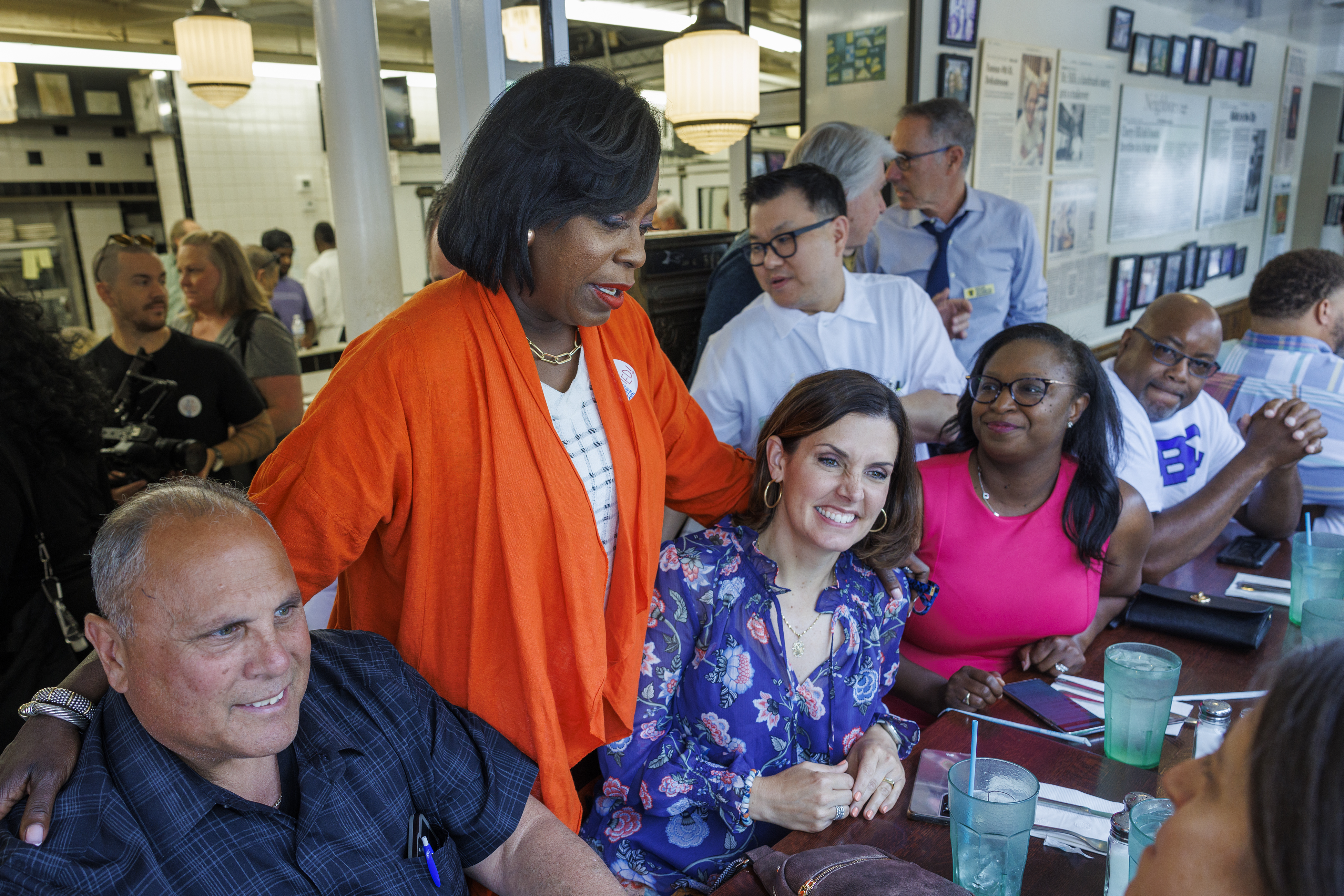
    Cherelle L. Parker, then a candidate for mayor of Philadelphia, stops to greet a group, including Christy Brady,(center seated), during election day lunch at Famous 4th Street Deli in Philadelphia on Tuesday, May 16, 2023.

    That outcome does not appear likely with Brady and Parker.

    Brady shares many political allies with Parker, especially the Philadelphia Building and Construction Trades Council, a coalition of unions that spends big on elections and has reason to be pleased with both Brady and Parker’s tenures so far.

    Brady, for instance, touts her office’s audit of L&I that revealed inspectors often failed to confirm that construction sites were being run by licensed contractors — providing ammunition to the trades unions, which often rail against “fly-by-night” contractors that do not employ their members. And the mayor last year split the department into two agencies, with one focused largely on enforcing construction regulations.

    Brady said her healthy relationship with the Parker administration should not be confused with a reticence to call out fraud and waste.

    “I am an independently elected official. I am not afraid to stand up for what’s right,” she said. “I believe in the rules and regulations in city government.”

    Her approach to the executive branch, she said, is designed to advance the aim of any auditor: ”getting management to implement your recommendations.”

    “In my experience in the controller’s office, when you fight, they’re not going to listen to your recommendation,” said Brady, a certified public accountant who graduated from the Philadelphia College of Textiles and Science, now Jefferson University. “When we issue our reports, the mayor has been thanking me for the recommendations. And I really appreciate that relationship because I believe that we can make change.”

    Staff writer Ryan W. Briggs contributed to this article.

  • Jalen Carter, Landon Dickerson, Nakobe Dean among five reasons Eagles will win the rematch vs. Giants

    Jalen Carter, Landon Dickerson, Nakobe Dean among five reasons Eagles will win the rematch vs. Giants

    Nobody saw it coming. Not even the Giants.

    “Quite honestly, nobody really expected us to put up a performance like this,” Giants quarterback Jaxson Dart said afterward.

    Maybe we should have.

    One of the more shocking upsets in recent Eagles history happened at MetLife Stadium on Oct. 9, when the 1-4 Giants got their second win over the 4-1 Eagles, who were defending Super Bowl champions and the winners of the last seven truly meaningful games against their closest NFC East rivals.

    Should it have been so shocking?

    After all, the Giants’ losses came at the Commanders, who had the services of since-injured quarterback Jayden Daniels; at the Cowboys, who have the No. 1 offense; at home against the Chiefs, a current dynasty; and at the Saints, where Dart, in his second start, committed three of the Giants’ five turnovers.

    Further, the Eagles played without two Pro Bowl players, defensive tackle Jalen Carter and guard Landon Dickerson, and they lost top cornerback Quinyon Mitchell in the second quarter.

    So, maybe the Giants weren’t so bad, and, clearly, the Eagles weren’t as deep as they needed to be.

    A lot has changed in two weeks. That should make all the difference come Sunday afternoon.

    1. Dickerson is healthy

    Dickerson was the seventh-best guard in the league last season, according to Pro Football Focus, when he was named to his third straight Pro Bowl and played in his second Super Bowl in three seasons. He has dealt with knee surgery that cost him most of training camp, a back injury that limited him in September, and an ankle injury that cost him the Giants game. He’s still ranked in the middle of the pack.

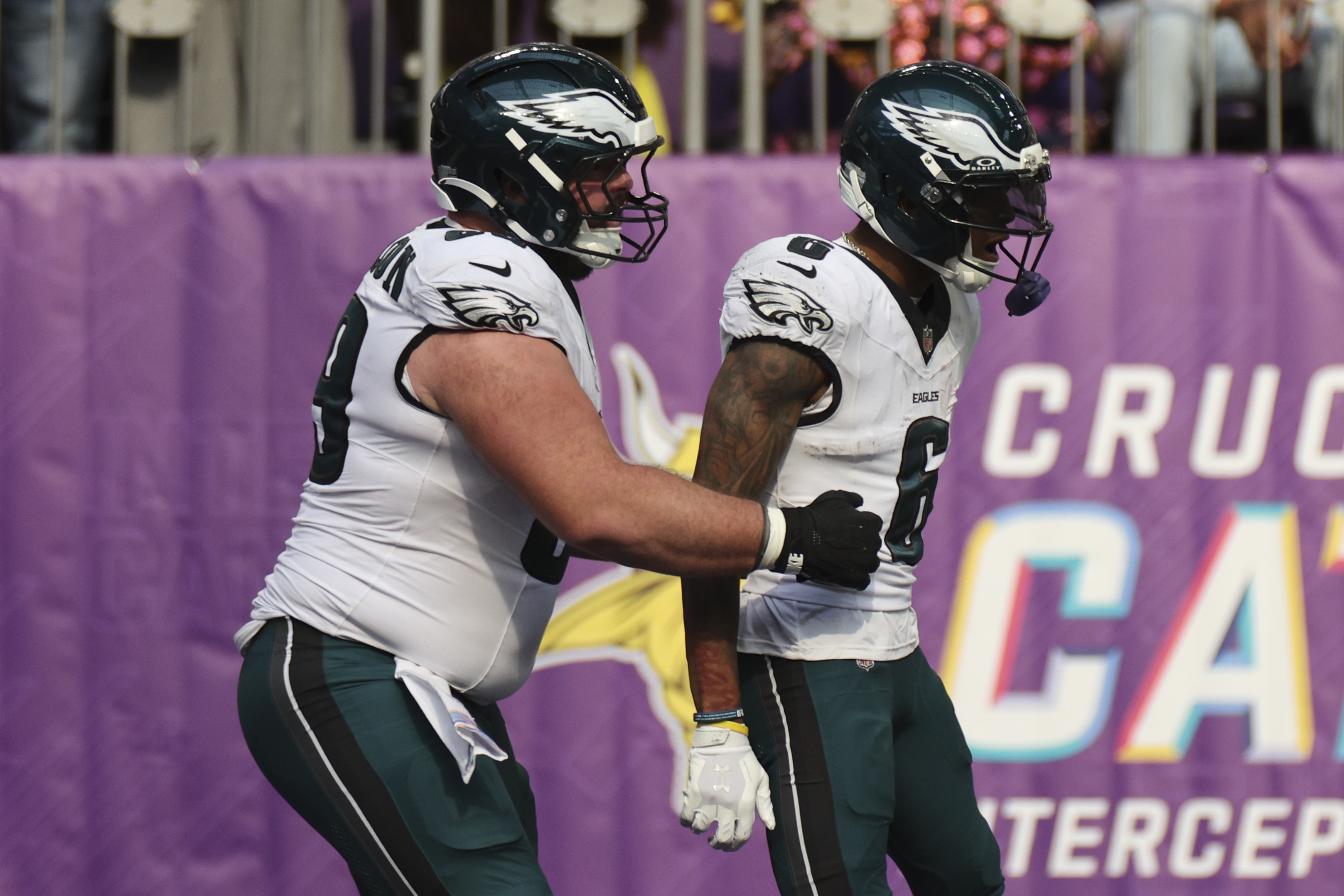
    Eagles guard Landon Dickerson celebrates with wide receiver Devonta Smith after Smith’s touchdown in Minnesota on Sunday.

    Dickerson was his healthiest this season last Sunday in Minneapolis, and the resulting grade showed it. Even with fifth-year backup Brett Toth playing at center for the first time next to him, Dickerson dominated.

    Toth was Dickerson’s replacement in the loss to the Giants. Things did not go well.

    2. Carter is healthy

    The Eagles built their defense around Carter, who has succeeded Fletcher Cox as the franchise’s core defensive player. Carter’s injured heel cost him the game against the Giants, but the 10 days between the Giants game and the trip to Minnesota not only gave the heel time to heal (heh heh), it also allowed his sprained right shoulder to strengthen.

    The shoulder cost him time in training camp and, intermittently, during the regular season. It also made him a horrific tackler: the worst, in fact, among all NFL defenders, according to PFF.

    Also, he’s finally in good enough shape to be effective for more than half an NFL game. Of course, there’s no viable reason he should not have been in better shape to start the season.

    You don’t run on your shoulder.

    3. Jalen Hurts found his rhythm

    In Minnesota, Hurts and his top three receivers, A.J. Brown, DeVonta Smith, and Dallas Goedert, finally appeared to be in sync. Hurts threw for 326 yards and had a perfect 158.3 passer rating for the first time in his career.

    Much had been made about the ineffectiveness of the passing game through the first six games, but, as we warned when the season began, injuries to Brown and Smith kept the passing attack from practicing as a complete unit the entire preseason, which is why the preseason (and preseason games) exist. Hurts is always gun-shy. He’s much more gun-shy when he’s not comfortable. Last Sunday, for the first time, he looked comfortable.

    Also, the team changed offensive coordinators for the third consecutive season.

    Also, the offensive line has played just one of seven games from start to finish with its starters intact, and that’s why the Eagles won at Kansas City.

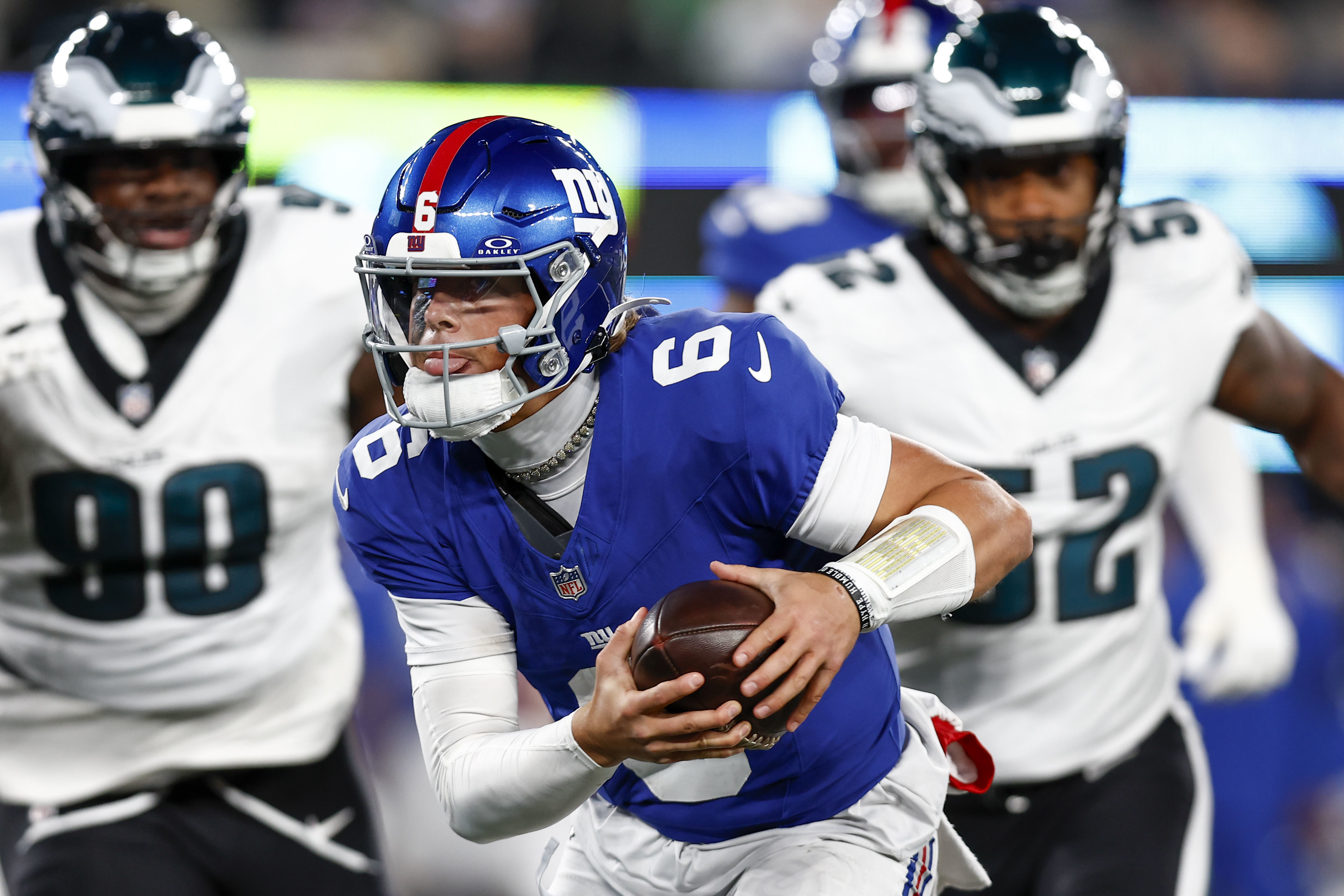
    New York Giants quarterback Jaxson Dart scrambles during an Oct. 9 matchup with the Eagles.

    4. Familiarity

    There’s a little more tape on Dart, whose elusiveness and fearlessness are a formidable combination. Combine that with unpredictability, and you get a kid who will make a lot of plays but will also make a lot of mistakes.

    A lot of the tape on Dart shows Eagles defenders getting roasted.

    Don’t expect much more of that sort of tape from Sunday’s game.

    5. Return of the Macks

    Nobody commanded more respect in the Eagles locker room last season than 15-year veteran defensive end Brandon Graham. His return from retirement Tuesday will resound whether or not he takes a snap on Sunday.

    A close second: third-year linebacker Nakobe Dean. Before he injured his pectoral muscle in the playoffs last season, he ranked 10th among all linebackers in overall defense, seventh as a pass rusher, according to PFF, and his impact as a tackler in his return Sunday was dynamic: He had six tackles, three solos, and a tackle for loss … on just 23% of the defensive snaps.

  • Phillies 2026 infield outlook: Free-agent options, prospect forecast, and more

    Phillies 2026 infield outlook: Free-agent options, prospect forecast, and more

    While the Phillies are poised for some roster changes in 2026, at the moment it doesn’t seem like those will occur in the infield.

    The Phillies’ outfield has been a revolving door for the last few seasons, but the infield continues to run it back. And according to Dave Dombrowski, that seems to be the plan again. At least, for now.

    “The infield is pretty well solidified,” the Phillies’ president of baseball operations said at his end-of-season news conference on Oct. 16.

    And indeed, Trea Turner and Bryce Harper are under contract into the 2030s, while Bryson Stott, Edmundo Sosa, and Alec Bohm are arbitration eligible. Barring a trade, there isn’t much room for movement or change.

    Here’s an overview of the Phillies’ infield outlook next season and beyond.

    Trea Turner had his best overall season as a Phillie in 2025, winning the NL batting title with a .304 average and stealing 36 bases.

    Turner’s improvement

    This time last year, there were questions raised about Turner’s long-term future at shortstop after another below-average defensive season. But those questions have been all but put to rest after Turner made significant strides in 2025. His 17 outs above average were the highest of his career and tied for third among shortstops.

    On the offensive side, Turner bought into the Phillies’ plan for him as their new leadoff hitter. Manager Rob Thomson wanted him to focus on using his athleticism and getting on base, rather than hitting homers. Turner did just that, stealing 36 bases and posting a .355 on-base percentage, his best since arriving in Philadelphia. With a .304 batting average, Turner also became the first Phillie to win the batting title since Richie Ashburn in 1958 and was named a Silver Slugger finalist.

    He may have sacrificed some power to do it, hitting just 15 home runs compared to 21 last season. But overall, Turner did exactly what the Phillies wanted out of him in the regular season, both offensively and defensively.

    “He’s tough on himself,” Dombrowski said. “He’s like one of these guys, if he doesn’t hit 40 home runs and 40 doubles and 40 stolen bases, and lead the league in hitting, he’s probably going to think that he needs to do more.

    “That’s how he is, which is great. That’s a great quality and attribute, but he doesn’t have to hit with any more power for us. He really did a fine job.”

    The Phillies plan to keep Bryce Harper, a Gold Glove finalist for a second straight season, at first base.

    Harper to the outfield?

    Don’t expect Harper to change positions, either, despite the first baseman expressing some willingness last offseason and ahead of the trade deadline to return to the outfield.

    Harper, who earned his second straight Gold Glove nomination at first base this season, has said he would be open to making a position switch if needed for an offensive upgrade. But it doesn’t sound as if the Phillies will consider moving him back to the outfield to add, say, Pete Alonso, who plans to opt out of his contract with the Mets after a 38-homer season.

    “I think Bryce is a first baseman at this time,” Dombrowski said. “I mean, that’s where we look at him as, and he has asked to go out into the outfield. He would be willing to do so, but I think it would be more for the short term if we had done something at the trading deadline, but it’s been a while since he’s been out [there].

    “I’m sure he’d be fine, but he’s a really good first baseman, and I think for us, that’s the position we look at him playing for us.”

    Harper finished the season with an OPS of .844. Though that still ranked 11th in the National League, it was his lowest since 2016 (.814).

    Dombrowski seemed to lay down a challenge to Harper at his year-end news conference.

    “He’s still an All-Star-caliber player. He didn’t have an elite season like he has had in the past. And I guess we only find out if he becomes elite or he continues to be good,” Dombrowski said. “… He’s the one that will dictate that more than anything else, and that’s what it comes down to.”

    Bryson Stott hit .310 with an .880 OPS from Aug. 1 through the end of the regular season, but still struggled against lefties.

    Second and third base

    Stott continued to be elite defensively at second base, but had a roller-coaster offensive season. He struggled over the first half, but a midyear adjustment to his hand placement led to improved at-bats overall. Stott went from hitting .194 with a .637 OPS in July to a .307 batting average and .864 OPS in August.

    However, Stott’s .575 OPS against lefties kept him in a platoon with Sosa. When called upon, the Phillies’ utility man provided a spark of energy and clutch hits, plus an .895 OPS against left-handers.

    “I view Stott as an everyday player, but Sosa’s numbers are so good against left-handed pitching that you’ve got to fit him someplace, whether it’s at third base when Bohm was hurt or mixed in for Stott against the lefties,” Thomson said. “So I view Stott as an everyday hitter. I think if he played every single day against left-handed pitching, he’d get better and put up pretty good numbers.”

    On the other hand, Bohm spent last offseason amid a tornado of trade rumors. He will reach free agency in 2027, and his name will likely be floating around this winter, too, as one of the few ways the Phillies can change up their infield. The third baseman was afflicted by injuries — a rib fracture in July and shoulder inflammation in August — and slashed .287/.331/.409.

    While Bohm and Harper were on the injured list at different points this season, Otto Kemp was a key fill-in. He hit .234 with 28 RBIs in his first 62 major-league games, most of which he played through knee and shoulder injuries that he will address with offseason surgery.

    Kemp, 26, saw the bulk of his playing time at third but also appeared at first and second and in left field.

    The Phillies believe Aidan Miller can stick at shortstop, but that’s blocked by Trea Turner for now.

    Down on the farm

    The Phillies’ top infield prospect, Aidan Miller, is rising quickly. The 21-year-old posted an .825 OPS this year and stole 59 bases between double-A Reading and triple-A Lehigh Valley. But the question remains as to where he will play in the majors.

    Miller, who finished the season in triple A after a September promotion, has played shortstop throughout his minor-league career. Similar to the situation with top outfield prospect Justin Crawford, the Phillies believe that when Miller reaches the major leagues, he will need to be an everyday player.

    A Miller breakthrough next season would require some changes to the current infield configuration. And Turner, who is under contract through 2033, doesn’t appear to be on the move from shortstop anytime soon. Dombrowski said the Phillies are still having conversations about Miller’s long-term position.

    “When I talked to people in our organization, they feel he can play shortstop. Of course, we have an All-Star shortstop at this point,” he said. “… [Miller has] played some second, he’s played some third, but he’s primarily been a shortstop, so we’d have to make sure that we properly prepare him to do that, and that’s still a discussion that we’ll have to have.”

    Miller initially planned to participate in the Arizona Fall League, but the Phillies decided to prioritize rest instead.

    Further down the pike, second baseman Aroon Escobar is the Phillies’ No. 5 prospect, according to MLB Pipeline. Escobar, 20, ascended three levels in 2025 to finish the season at double A. He hit 15 homers and had 62 RBIs in 120 games.

    Also in double A to end the year is Phillies No. 13 prospect Carson DeMartini. In his first full professional season after being drafted in 2024 out of Virginia Tech, the third baseman posted a .707 OPS and stole 45 bases.

    Kazuma Okamoto has slashed .277/.361/.521 with 248 homers over 11 seasons in Nippon Professional Baseball in Japan.

    Free agency

    The Phillies don’t have a pressing free-agent need to fill in the infield, though that could change if a trade is made. (The battery will be covered later in this series.)

    Currently, one of the top available names on the market is righty third baseman Alex Bregman, who is set to opt out of his contract with the Red Sox after an All-Star season in which he slashed .273/.360/.462 with 18 homers.

    Third baseman Eugenio Suárez was one of the most coveted offensive trade deadline acquisitions this year and was linked to the Phillies before ending up with the Mariners. Suárez saw a dip in production in the second half, but he still had some big postseason moments for Seattle, such as a game-winning grand slam in Game 5 of the American League Championship Series.

    Gleyber Torres, 28, had an overall bounce-back year with the Tigers after the Yankees let him walk in 2024. The right-handed-hitting second baseman was named an All-Star for the first time since 2019. Torres saw diminished production later in the season, with a .812 first-half OPS compared to .659 in the second half, but revealed that he had been playing through a sports hernia late in the year.

    There are also international options. In recent years, the Phillies have attempted to expand their outreach in Japan in the hopes of attracting top stars there, but have yet to break through.

    The Yomiuri Giants of Nippon Professional Baseball have announced that they will be posting corner infielder Kazuma Okamoto. The right-handed 29-year-old has hit .277/.361/.521 with 248 homers over 11 seasons in NPB.

    According to an MLB.com report, Munetaka Murakami is also expected to be posted this winter. Murakami, 25, is a left-handed-hitting corner infielder with a career .951 OPS across eight seasons in NPB. He was named Most Valuable Player of the Central League in 2021 and 2022.

  • Massive Bucks data center spurs call to protect consumers from getting hit with power grid costs

    Massive Bucks data center spurs call to protect consumers from getting hit with power grid costs

    An independent monitor has asked federal officials to ensure consumers don’t get stuck with the bill if the electric grid can’t handle power needs of a massive data center planned for Bucks County.

    The monitor, Joseph Bowring, filed comments with the Federal Energy Regulatory Commission (FERC) last week, asking that a Sept. 23 transmission service agreement between Peco and Amazon Data Services be rejected.

    The agreement is regarding the 2 million-square-foot “digital infrastructure campus” Amazon plans for the Keystone Trade Center, an 1,800-acre property once owned by U.S. Steel, according to Falls Township. The data center, meant to handle computing needs of the wildly increasing demand for AI, has been heralded by Pennsylvania Gov. Josh Shapiro and the Trump administration.

    But Bowring, the independent market monitor for the region’s grid operator PJM, questioned the agreement, which is designed to protect power customers from economic risks associated with the cost of upgrading systems to handle the new load.

    In the agreement, Peco sought to ensure, among other things, that consumers don’t get stuck with the bill for grid upgrades if Amazon never builds the data center.

    However, Bowring said that the agreement does not “address the key question of whether there is sufficient capacity to serve the identified large new data center load without imposing significant and unacceptable reliability- and capacity-related cost impacts on all PJM customers.”

    He’s not alone in concerns about the cost data centers could impose on homeowners and other power customers. Many have already seen utility bills rise rapidly in the past few months.

    PJM, Peco, and the grid

    Montgomery County-based PJM manages the electric grid for all or parts of 13 states and the District of Columbia. PJM is responsible for maintaining grid reliability, coordinating electric flow, and assessing capacity. It is the largest regional transmission organization in the U.S.

    The data center lies in Peco’s service territory within the PJM grid.

    The capacity and reliability of electrical grids across the United States has emerged as a major issue as data centers rush to go online.

    David Mills, chair of the PJM Board of Managers, wrote in an August letter to stakeholders that PJM is forecasting peak load growth of 32 gigawatts by 2030. Of that, 30 gigawatts is projected to come from data centers.

    Grid operators and power companies like Peco are scrambling to evaluate whether they can provide continuous electricity with the massive new loads without expensive upgrades such as new transmission lines and substations — costs that advocates fear will be passed onto consumers.

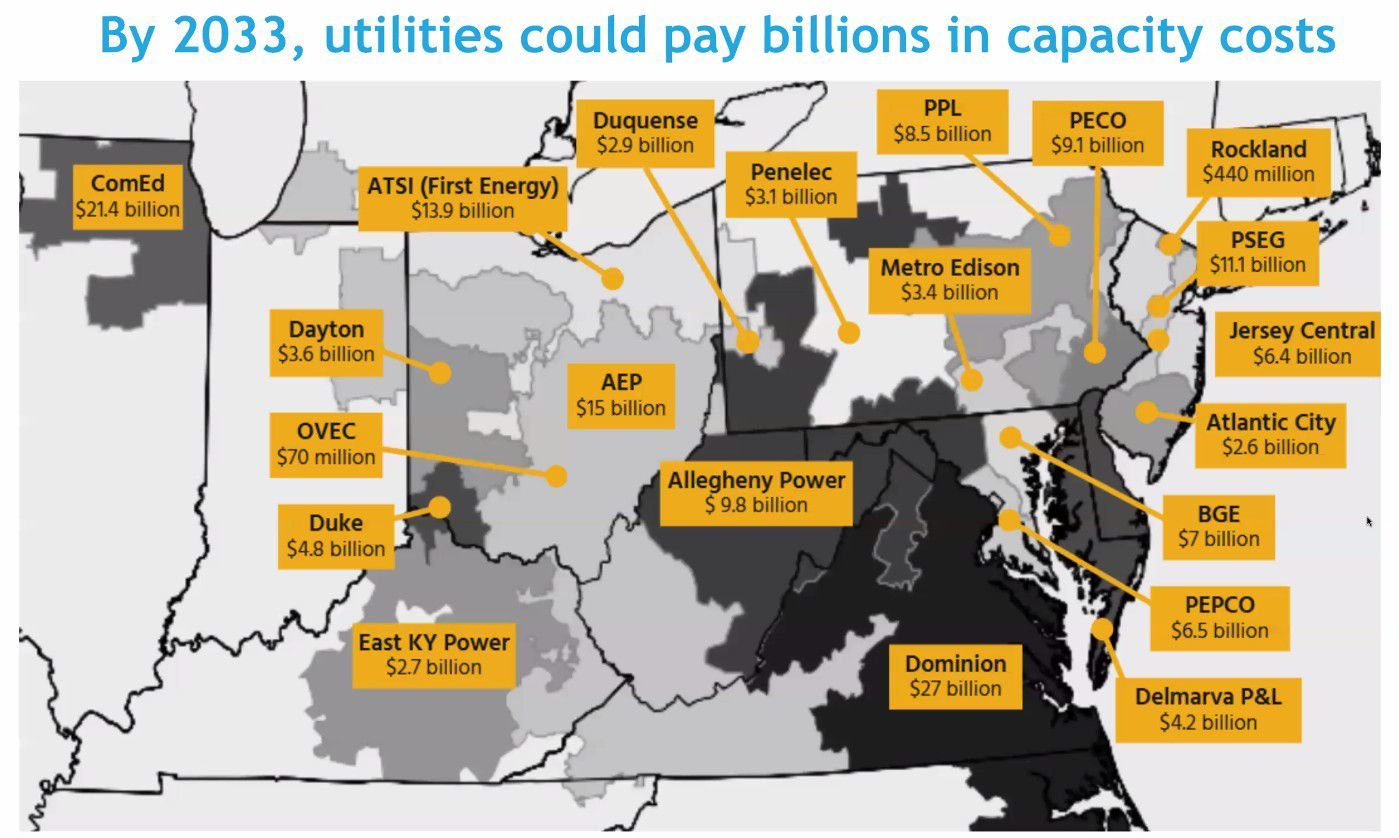
    Map produced by the National Resources Defense Council estimates electricity capacity costs to utility companies based on PJM forecasts through 2032.

    Protecting consumers

    Making sure power consumers don’t get stuck with the cost of upgrades has been a key point of consumer advocates.

    Bowring wrote that while the agreement does include some important provisions to protect energy customers from risk, it does not go far enough.

    “The Market Monitor recommends that the agreement not be approved unless Peco can demonstrate that the referenced new data center load can be served reliably and economically,” Bowring wrote to FERC.

    The Falls Township data center is one of two big projects Amazon has planned in Pennsylvania, Shapiro announced in June.

    The company plans to invest at least $20 billion in the construction of data center complexes in Pennsylvania, in what officials called the largest private-sector investment in the state’s history. The second complex would be built alongside a nuclear power plant in Luzerne County.

    Both would require enormous amounts of power.

    For example, FERC has already rejected one Amazon “behind-the-meter” power connection of 480 megawatts for the Luzerne County data center. That’s more power than is consumed by some small cities.

    Bowring addressed the data centers during a summit on PJM at the National Constitution Center in September that was attended by multiple governors, including Shapiro.

    “PJM has a problem: Capacity,” Bowring said at the summit. “There’s no extra capacity, and there’s lots of data centers that want to join. … It cannot be handled by the market as it exists.”

    PJM has said it does not have the authority to deny the interconnection of new data center loads even if it does not have the capacity. Bowring disagrees but is asking FERC to clarify the matter.

    Peco’s ‘extensive planning’

    Greg Smore, a Peco spokesperson, said the utility is working with Amazon.

    “We have done extensive planning to ensure we can deliver the energy needed to power this data center through our transmission and distribution system,” Smore said. “That data center, like any other large customer, is responsible for procuring electric supply, through an energy supplier or the existing PJM energy market.”

    Smore said that knowing there’s “an adequate supply of energy to serve all our customers at a reasonable price is a real concern.”

    So Peco, which is owned by Exelon, is working with stakeholders, he said, to add more generation to the grid while ensuring reliability and help address rising energy supply costs.

    He said the agreement with Amazon “protects all customers in Southeastern Pennsylvania from bearing greater transmission service costs if the data center does not make the sizable contribution to our system costs that would be expected.”

    Advocates fear costs to public

    The nonprofit Natural Resources Defense Council (NRDC), an environmental advocacy group, estimates Peco could pay $9.1 billion in costs by 2033 related to the need for greater capacity.

    “The projected demand from data centers is vastly outstripping the amount of new supply in PJM,” said Claire Lang-Ree, an advocate with NRDC.

    “It will cause power bills to rise and stay high for the coming decade, mainly through capacity cost increases,” Lang-Ree said.

    The NRDC estimates cumulative costs could result in a $70 monthly rise in average electric bills in coming years across the PJM grid.

    In addition, she said it would lead to a decline in reliability and an increased risk of blackouts for the general public. And, she said, the power demand could undermine states’ clean energy and air quality goals.

    “It’s really hard to overstate what’s at stake here,” Lang-Ree said.

    Clara Summers of Consumers for a Better Grid, a nonprofit watchdog, said states should impose tariffs to be paid by data centers to support the large power loads they require and ensure that costs of new utility infrastructure doesn’t fall unfairly on consumers. And data centers should provide their own electric supply.

    Summers likened not taking action to allowing the wealthiest acquaintances at a restaurant gathering to order the most expensive food, then, “dining and dashing.”

    “Unless something is done, everyday people will be left holding the check for some of the wealthiest companies in the world, and that’s unacceptable,” Summers said.

    This story has been updated to reflect comments from Peco.

  • Gov. Josh Shapiro will campaign for Democratic governor hopefuls Mikie Sherrill and Abigail Spanberger this weekend

    Gov. Josh Shapiro will campaign for Democratic governor hopefuls Mikie Sherrill and Abigail Spanberger this weekend

    Gov. Josh Shapiro is hitting the campaign trail in two key states this weekend.

    With less than two weeks left until Election Day, Shapiro will campaign and raise cash for U.S. Reps. Mikie Sherrill (D., N.J.) and Abigail Spanberger, (D., Va.), two Democratic hopefuls in high-stakes gubernatorial races that could preview the national mood ahead of next year’s midterms.

    Shapiro will campaign with Sherrill Saturday morning in Monroe Township at an event to mark the start of early in-person voting in the Democratic-leaning state which has grown increasingly red. The pair will then attend a Souls to the Polls event at a church in New Brunswick, Shapiro For Pennsylvania spokesperson Manuel Bonder said.

    The governor is also expected to hold a fundraiser for the New Jersey Democratic State Committee to benefit Sherrill’s campaign later in the day.

    On Sunday, Shapiro will head to Virginia to attend events in Portsmouth and Norfolk with Spanberger.

    Sherrill has amped up her campaigning in recent weeks, and she’s brought out big Democratic names to help her. In the last three weeks, she’s campaigned with New Jersey Sens. Cory Booker and Andy Kim, and with Maryland Gov. Wes Moore. Former Secretary of Transportation Pete Buttigieg is planning a visit to New Jersey next weekend, and Sherrill’s campaign curtain call the Saturday before Election Day will feature a rally with former President Barack Obama.

    National Democrats see the Garden State governor’s race as a must-win, and despite polling showing Sherrill up in the race, nerves are high after President Donald Trump lost the state by only four points in November.

    This combination photo shows candidates for governor of New Jersey Republican Jack Ciattarelli, left, and Democrat Mikie Sherrill during the final debate in governors race, Oct. 8, 2025, in New Brunswick, N.J. (AP Photos/Heather Khalifa)

    Why Shapiro is involved in the New Jersey governor’s race

    Shapiro is a big draw on the campaign trail as he continues to build a national profile, and gears up for his own reelection campaign next year. The first-term governor, who is seen as a potential 2028 presidential candidate, announced the 2026 release of a memoir this week.

    His multi-state gubernatorial stumping follows investments in races in Pennsylvania. He donated $250,000 from his campaign fund to the Pennsylvania Democratic Party last month. And he’s appeared in ads for the judicial races in Pennsylvania, in which Democrats hope to retain three judges there.

    In a September poll by Quinnipiac University, 61% of respondents said they viewed Shapiro favorably, an unprecedented figure among recent Pennsylvania governors at the same point in their terms, pollsters noted.

    The poll also found that Shapiro is viewed favorably by some Republicans, an across-the-aisle appeal that appears to extend across the Delaware River.

    Shapiro’s been lauded by Sherrill’s Republican opponent in the New Jersey race, Jack Ciattarelli, a trend chronicled recently by Politico.

    Ciattarelli commended Shapiro’s willingness to criticize New York City mayoral candidate Zohran Mamdani’s past comments on Israel, and praised his handling of small businesses, energy and property taxes in Pennsylvania, contrastingly saying New Jersey faces a “crisis” in all three.

    Sherrill has said frequently that she wants to mimic Pennsylvania’s success in cutting the time it takes business owners to get permits from state government.

    This story has been updated to correct the location of Gov. Josh Shapiro’s first stop with U.S. Rep. Mikie Sherrill on the campaign trail Saturday.

  • Preserving older properties drives housing affordability, population growth, and investment, says study by historic preservation group

    Preserving older properties drives housing affordability, population growth, and investment, says study by historic preservation group

    For years, the Preservation Alliance for Greater Philadelphia has heard the same arguments: Preservation is a barrier to development. It reduces density. It restricts the housing supply.

    “And we knew in our gut that that wasn’t true, but we didn’t have the data to support it,” said Paul Steinke, executive director of the Preservation Alliance, which works to protect historic properties from demolition. “Now, we do.”

    The Preservation Alliance commissioned its most comprehensive analysis of how historic preservation affects the city’s economy and housing. The report, released Wednesday, found that preservation of Philadelphia’s older properties protects housing affordability, drives investment, preserves housing density, and supports population growth.

    In Philadelphia, $4 billion has been invested in historic rehabilitation projects, which have created thousands of jobs each year.

    Steinke said the Preservation Alliance commissioned this study now because of current debates about Philadelphia’s growth and affordability, the need to increase the housing supply, and development policy as Mayor Cherelle L. Parker rolls out her Housing Opportunities Made Easy, or H.O.M.E., initiative to build or preserve 30,000 homes.

    “We wanted to develop some data to demonstrate preservation’s role in those conversations,” said Steinke, who is on the H.O.M.E. advisory committee. “And the reality is the data show that historic preservation is a powerful engine … for investment, jobs, affordability, and inclusive growth.”

    The study was completed by PlaceEconomics, a Washington-based firm that analyzes the economic impacts of historic preservation in cities across the country. The purpose of the analysis in Philadelphia was to understand the economics of the preservation of older properties in general and not only those properties that are historically designated, Steinke said.

    Preservation debates

    Historic designation is a divisive topic, and preservationists have found themselves clashing not only with developers who want to demolish properties but also with homeowners and pro-housing groups.

    Historic designation shields properties from demolition and means owners have some restrictions on what they can do to the outside of their properties. Decisions about doors and windows, for example, are subject to the scrutiny of preservation officials. And owners who fight the designation of their properties argue that regulations can be a burden.

    Residents have challenged in court three historic districts that Philadelphia recently created — the most significant pushback against the city’s preservation ordinance in 15 years.

    In response to the Preservation Alliance’s study, 5th Square, a Philadelphia-based urbanist political action committee, said it supports efforts to rehabilitate older buildings and that “Philadelphia’s dense, historic neighborhoods are a beloved feature of the city.”

    “However, we remain concerned about the proliferation of historical preservation districts across the city,” Brennan Maragh, cochair of the group’s housing committee, said in an emailed statement. “These districts … impose real costs on families, small businesses, and owners attempting to maintain or improve their properties.”

    Almost 5% of Philadelphia is historically designated

    Almost 5% of the city’s land area is a historic district or is property individually designated as historic outside of historic districts, the study found.

    The share of properties historically designated by the city has increased from 2.2% to 4.4% since 2016, when the city started ramping up its historic designations. Philadelphia has caught up with other large cities.

    In 2023, about 56,000 residents lived in a local historic district.

    Tax credits have created jobs and revenue

    Between 2010 and 2024, 295 projects that used state and/or federal historic preservation tax credits were completed in Philadelphia, according to the study. This ranks Philadelphia first in the nation.

    Projects that use historic tax credits have created an average of 1,777 direct jobs and 729 indirect jobs each year in Philadelphia over the last 15 years. Each year, they have created an average of about $95 million in direct income and about $47 million in indirect income.

    If historic rehabilitation were a single industry, it would be the city’s 25th-largest employer.

    Historic tax credit activity also has generated about $8 million in local tax revenue.

    Older homes are more affordable

    Two-thirds of Philadelphia’s residential buildings and half of the city’s housing units were built before 1950, according to the study. This older housing tends to be smaller in size and lower in cost.

    So preserving older homes helps preserve housing affordability. The study did not consider the historic designation status of these homes.

    “While it is true that Philadelphia’s older housing stock remains affordable compared to new construction,” said Maragh at 5th Square, “historic preservation districts can also have the unintended consequences of excluding low-income residents from large parts of the city, raising lifetime housing costs on owners and creating unnecessary regulations that slow down the process of adaptive reuse.”

    The study found that the city’s historic districts have higher shares of high-income households and lower shares of low-income households compared to the rest of the city.

    Outsize population growth in historic districts

    Donovan Rypkema, principal and CEO at PlaceEconomics, said a “myth” of historic preservation is if “you create those historic districts, you just set neighborhoods in amber and nothing can ever change.”

    The firm’s study found that population growth in historic districts outpaced growth in the rest of the city.

    In historic districts created before 2010 — so before the recent push for more districts and ones that are more geographically and racially inclusive — the population grew by about 27% between 2010 and 2020. Over the same time, the rest of the city’s population grew by less than 5%.

    More than 79% of the homes in historic districts are in buildings with two or more units, compared to 32% in the rest of Philadelphia. Historic districts also offer a wider range of housing types.

    The densest areas of the city are in historic districts, according to the study. There are 10,000 more people per square mile in historic districts than in the rest of the city’s residential areas.

    These statistics speak to the “inherent attractiveness” of historic districts and also that “they can accommodate that growth,” Rypkema said.

  • Fewer killings, more homicide cases solved is good news for Philadelphia | Editorial

    Fewer killings, more homicide cases solved is good news for Philadelphia | Editorial

    Philadelphia has lost 187 people to homicide this year. With just over two months left in 2025, this represents a marked improvement over the pandemic era, a time when the city experienced more than 500 killings annually.

    This reduction — along with an increase in the number of homicide cases detectives are solving — is worth celebrating. But, as evidenced by the horrific killing of Kada Scott and far too many other calamities, there is still much more to be done. Even if homicides remain under 240 killings this year, which would be the lowest number since the 1960s, it would still leave the city with a homicide rate that is triple that of New York or Boston.

    That’s not to say there hasn’t been important progress.

    In 2020, when gun violence was beginning to surge, City Council authorized the “100 Shooting Review,” which identified weaknesses in the criminal justice system and outlined a series of recommendations to cool the violence.

    In 2021, Philadelphia invested more than $150 million in violence prevention and intervention programs. The disbursement of those funds was marked by instances of disorganization and insufficient oversight. However, according to those who study urban violence, the money served its purpose.

    A report from the Coalition to Save Lives credited community programs, including city-funded initiatives, with helping to reduce gun violence. Community leaders like the Rev. Carl Day, pastor of the Culture Changing Christians Worship Center, also stepped up, even without city support.

    Thanks, in part, to new technology and the installation of high-definition cameras across the city, police are now solving between 85% and 91% of homicide cases, a 40-year high.

    The clearance rate — or the percentage of homicides that have been solved — had dipped as low as 42% in recent years, meaning killers were more likely than not to get away with murder in Philadelphia.

    Beyond providing closure for families and accountability to perpetrators, solving cases and prosecuting offenders can also help deter future acts of violence. According to crime researchers, certainty of punishment is one of the most effective deterrents for those who are likely to kill. This effect is particularly strong for younger offenders, who tend to act impulsively. Given that gun violence among teens continued to rise despite the progress made in other age groups, continuing to improve the clearance rate is essential.

    Solving cases also helps to prevent cycles of retributive shootings by gang members. These days, experts say, it is song lyrics and social media beefs that drive many conflicts between rival gangs, not territorial clashes. Solving cases, and doing so quickly, can help intervene before these groups become the next Young Bag Chasers.

    Despite the drop in the murder rate, Philadelphia still often feels beset by misdemeanors and lower-level felonies that contribute to an overall sense of disorder. Reckless driving permeates nearly all corners of the city, many transit stations reek of smoke and urine, illegal dumping plagues communities, blighted buildings like the former Ada H.H. Lewis Middle School attract crime, and police can take hours to respond to calls.

    Many Center City businesses feel the need to employ armed security due to regular incidents involving thieves or emotionally disturbed people. In August, a security guard at a women’s clothing store fired a warning shot at a man who was harassing the staff. Earlier this month, a security guard at an IHOP in Center City was charged with murder after shooting a man who allegedly spat on her. Buying clothes and eating pancakes should not feel like a trip to the Wild West, nor should crossing the street feel like a game of Frogger.

    Philadelphia’s leaders, including Police Commissioner Kevin J. Bethel, deserve credit for the progress the city has made in providing justice and reducing gun violence. But the job is far from over.

  • In ‘Fire!!,’ Quintessence Theatre brings 1920s Harlem to Mount Airy

    In ‘Fire!!,’ Quintessence Theatre brings 1920s Harlem to Mount Airy

    After the success of its world premiere adaptation of James Baldwin’s Giovanni’s Room, Quintessence Theatre Company is back. In collaboration with the New Classics Collective, it’s now presenting the world premiere of Fire!! by Paul Oakley Stovall and Marilyn Campbell-Lowe.

    The play seeks to reimagine the 1927 quarterly publication Fire!!, the first all-Black magazine in the country, as a stage production. Throughout the show, audiences are treated to staged performances of plays, stories, and poems by some of the great writers of the Harlem Renaissance, including Zora Neale Hurston and Langston Hughes.

    Seeking to offer audiences a more immersive experience, director Raelle Myrick-Hodges begins the play in the historic Sedgwick Theater’s lobby, with performers in suits and flapper dresses. The 1928-built lobby throbs with life, making you believe you are in 1920s Harlem. Wallace Thurman (Kaisheem Fowler-Bryant), one of the editors of Fire!!, introduces himself and his fellow editors and explains that the night’s performances are part of a fundraiser to raise money for the magazine.

    From left: Taylor J. Mitchell (as Gwendolyn Bennett) and Alicia Thomas (as Zora Neale Hurston) in Quintessence Theatre’s “Fire!!”

    Zora Neale Hurston (Alicia Thomas) introduces herself soon after, but it’s hard to hear her over the rumbling of a wheeled platform stage being ushered into the lobby. This later serves as the train for the first scene of Hurston’s play Color Struck.

    While it is admirable for Quintessence to use the Sedgwick in new and different ways, the echoing sound quality of the lobby leaves things feeling under-produced.

    The audience eventually makes its way into the house. The theater’s arching pillars remain visible as a “backstage” space throughout the play — without the black curtains, this adds to the echo in the lobby.

    Charlie Bay (as Richard Bruce Nugent) and Imani Lee Williams (as Melva) in Quintessence Theatre’s “Fire!!”

    Inside, the play continues, flipping between staged presentations of pieces that were published in Fire!! and the imagined drama of the editors hoping to appeal to patrons and fund the publication.

    This invented drama is interesting but feels under-realized. For one thing, this is the actual conflict of the play, but all the action happens upstage of the “stage” and presents a myriad of sight line issues depending on where audiences are seated in relation to the pillars on stage. The audibility issues persist, making it difficult to hear actors, especially when they are fighting over any sound cues or underscoring.

    The conflict of the play boils up when Thurman voices hesitancy toward presenting his lover Richard Bruce Nugent’s novel, which features queer characters. This conflict, while seeming to be the crux of the entire play, easily resolves itself within the performance of Nugent’s story, and is barely addressed later.

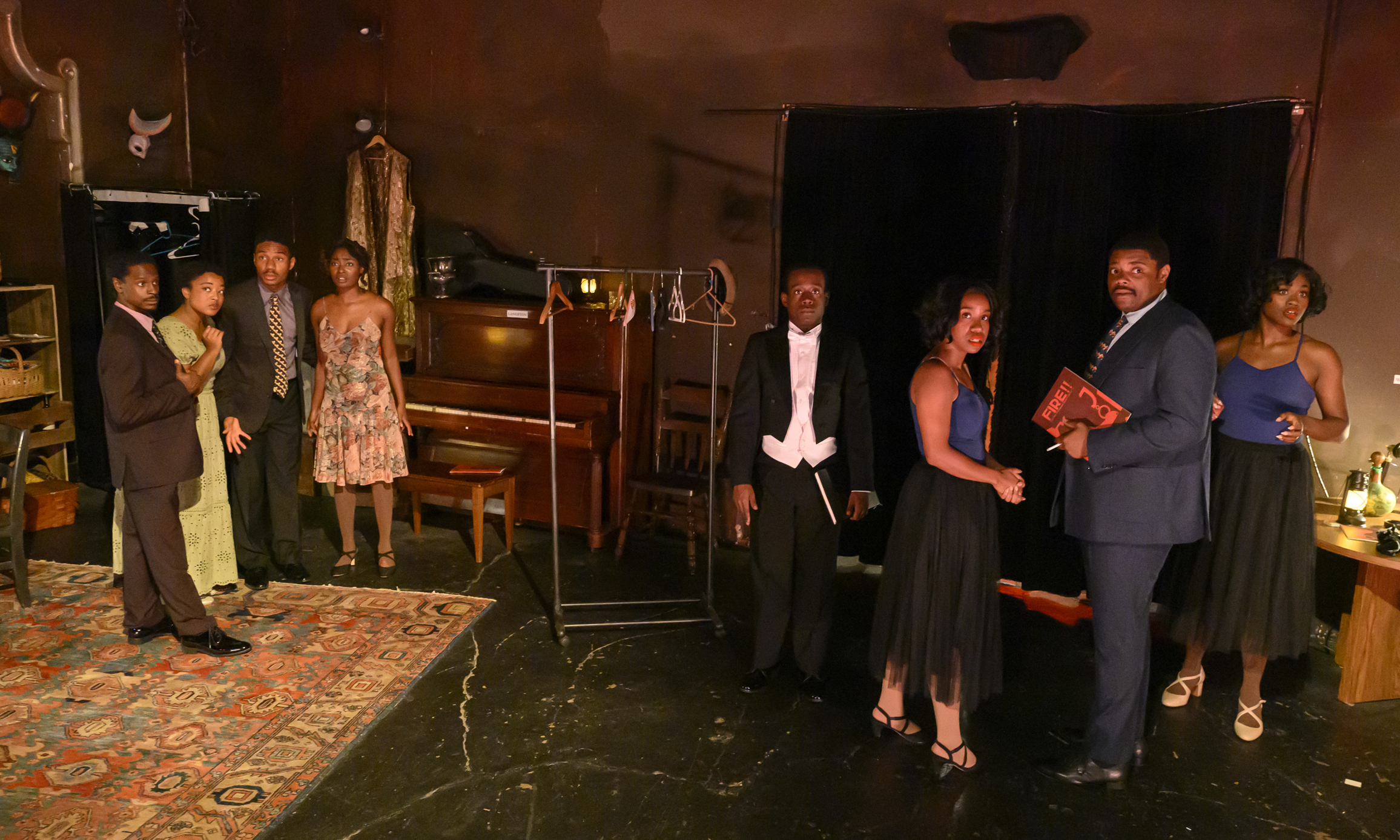
    From left: Imani Lee Williams, Taylor J. Mitchell, Nichalas Parker (as Paul Watson), Alicia Thomas, and Ivana R. Thompson in Quintessence Theatre’s “Fire!!”

    The behind-the-scenes tension, which is the through line of the plot, feels almost forgotten by the time the house lights are back up.

    The staged presentations of works from Fire!! are, however, alive and well-executed.

    At a time of extreme political division, it is important to celebrate joy — especially Black joy. It is timely to witness Quintessence recall the Harlem Renaissance and its resistance with fondness.

    The stagings are ripe with music and dance. Xavier Townsend, who plays Aaron Douglas, in particular dazzles the audience with high kicks and spins, and Jordan Fidalgo’s Helene Johnson blows the audience away with her musical rendition of Johnson’s poem “A Southern Road.” The poems of Langston Hughes and Gwendolyn Bennett speak for themselves and are well orated by Nicholas Parker and Taylor J. Mitchell, respectively.

    From left: Xavier Townsend (as Aaron Douglas), Ivana R. Thompson (as Dorothy West), Tyler Bey (as Arthur Huff Fauset), Imani Lee Williams (as Georgia D. Johnston), Kaisheen Fowler-Bryant (as Wallace Thurman), Alicia Thomas (as Zora Neale Hurston), Nichalas Parker (as Langston Hughes), and Taylor J. Mitchell (as Gwendolyn Bennett) in Quintessence Theatre’s “Fire!!!”

    Quintessence and the New Classics Collective are, as usual, impeccable with their selection of source material. The selected works from Fire!! are dynamic and fascinating stories that investigate the issues of the 1920s and today.

    Audiences seeking to hear works of the Harlem Renaissance will be overjoyed by this production, if a bit confused by the subplot.

    ‘Fire!!’

    (Community/Arts)

    The story of the country’s first all-Black magazine, and the fight to keep it afloat, gets told in this 1920s Harlem Renaissance-set play. With Zora Neale Hurston and Langston Hughes making an appearance, Fire!! is a celebration of Black joy and resistance, and a delight to witness.

    ⌚️ Through Nov. 2, 📍 7137 Germantown Ave. (Mount Airy), 🌐quintessencetheatre.org

    Theater reviews are produced independently by The Inquirer without editorial input by their sponsor, Visit Philadelphia.

    The article has been updated with the correct name for the actor who plays Aaron Douglas.

  • Horoscopes: Thursday, Oct. 23, 2025

    ARIES (March 21-April 19). You can’t solve every problem in the group, nor should you. What you can and will do is bring levity, ideas and perspective. Your originality is a cue to others who will feel freer to be themselves, too.

    TAURUS (April 20-May 20). Not every adventure involves transportation tickets. Trains, planes and automobiles are mind-expanders for sure, but so are walks, conversations and new chapters of a book. Follow your curiosity somewhere new.

    GEMINI (May 21-June 21). Love shows up steadily, not just when it’s convenient. If their attention, kindness or presence is spotty, you feel the gap. You’re putting energy into relationships of reciprocity today — not just with people but with other interests and endeavors, too.

    CANCER (June 22-July 22). People speak in code, rarely saying what they mean, and yet their meaning often reads loud and clear to those who pick up on things like body language, tone, gestures and patterns of behavior. Today you’re a masterful decoder.

    LEO (July 23-Aug. 22). Sensitivity doesn’t have to be fragility. Use it as radar. You pick up signals of all kinds today. The key is filtering: not every vibration deserves your full attention. Tune in to the frequencies that give you something positive to work with.

    VIRGO (Aug. 23-Sept. 22). The way you fold a towel, brew your tea or arrange your desk can become a meditation. These repeated motions, seemingly trivial, remind you that order is possible even when life feels chaotic. Small rituals bring grounding.

    LIBRA (Sept. 23-Oct. 23). Comparison to others is tempting, but it rarely works in your favor. Today, focus on contrasts that have to do with you and you. Your life is different today from yesterday. How? People have grown from knowing you. How? These examinations build self-respect.

    SCORPIO (Oct. 24-Nov. 21). You’re unstoppable. Where others might see a dead end or give up, you spot the hidden path if there is one. And if no such path exists, you have the courage to forge ahead and blaze one.

    SAGITTARIUS (Nov. 22-Dec. 21). If the environment itself is toxic, matching your tone to the room makes you complicit in the problem. In that case, authenticity and boundaries are more important than diplomacy. When in doubt, use your feet. Sometimes the best thing to do is leave.

    CAPRICORN (Dec. 22-Jan. 19). The most responsible thing you can do is to pause. Rest can be a kind of labor, too, the invisible work of renewal that makes your other efforts sustainable and strong. Trust that much is going on beneath your consciousness.

    AQUARIUS (Jan. 20-Feb. 18). People aren’t tasks to be managed. They are complex and best understood with a flexible kind of attention that spans the shallows and the depths. Listen and notice. Your attentiveness is more valuable than any quick fix.

    PISCES (Feb. 19-March 20). A small change in environment alters your whole outlook. Take the work on the road. Move the furniture. Call in help from someone you’ve never talked to before. What’s needed is to shake loose those stuck ideas.

    TODAY’S BIRTHDAY (Oct. 23). Welcome to your Year of Generous Mischief. Your playful side will get you into situations that end up being extraordinarily beneficial to you and yours. You’ll stumble into the ideal business or mentor and work on projects that bring excellent income. More highlights: a big family celebration, the rediscovery of an old passion you thought was lost and a change in scenery that feels like a whole new life. Cancer and Leo adore you. Your lucky numbers are: 4, 15, 23, 30 and 49.

  • Dear Abby | Sister flips out over intended name for unborn nephew

    DEAR ABBY: I am pregnant with the first-born grandson on both sides. My husband and I plan to use my husband’s middle name for our son’s first name and my father’s middle name for his middle name. My father is “the III” but has no sons, so we thought this would be a way to honor him and represent my side of the family.

    My sister is the first person we shared our son’s name with. The following day, she called me to express her displeasure, because she always planned to use our father’s middle name as a first name for a son. I knew this, but I didn’t think using it as a middle name would be an issue. Additionally, she’s younger than I am, unmarried and childless. She was so upset with me that I had to end the phone call because it escalated to yelling.

    During the call, she suggested I forgo using the name but honor our father by changing the baby’s middle name to our father’s first name (which my husband and I don’t think flows well) or use my maiden name for my son’s middle name. Must I change my son’s intended name because my sister wants to be the first to use our father’s middle name for a potential future son?

    — PICKING A NAME IN THE EAST

    DEAR PICKING: How your sister got into the middle of what you and your husband decide about your baby’s name is beyond me. Of course you don’t have to alter your plans to suit your sister. Stop being a people-pleaser, particularly where your offspring is concerned. Name your baby boy what you think is best, and do not look back.

    ** ** **

    DEAR ABBY: I am a 40-year-old woman dating a wonderful man my age. I purchased a house in my 20s, earned several degrees, own my own business and have achieved success. However, I haven’t had the best luck with the last few guys I’ve dated. The man I’m dating now doesn’t seem to grasp some of life’s necessities. He doesn’t shower often, wears the same attire several days in a row, drinks daily and stays out all night every weekend. When we met, he had no job and no car and was living with a friend.

    It’s been three months, and he has secured a job. He has practically moved himself into my home and is helping with the finances, but he still doesn’t shower. (He does do housework, though.) I have had several conversations with him about his hygiene, and he makes promises but doesn’t deliver. My family thinks I’m desperate for love and that I should let this guy go. What do you think?

    — LOSING HOPE IN PENNSYLVANIA

    DEAR LOSING HOPE: More important than what your family thinks about this is what do YOU think? Because your wonderful man’s body odor is offensive, give him an ultimatum. Tell him that as much as you are beginning to care for him, this is a deal-breaker, and if he wants to continue living with you, he’ll have to shower regularly. Then give him a schedule or show him the door. (Whew!)