Tag: topic-link-auto

  • AI’s memories of Philly sports fans, Jason Kelce’s ‘humbling’ workout with the Eagles, and more from ‘New Heights’

    AI’s memories of Philly sports fans, Jason Kelce’s ‘humbling’ workout with the Eagles, and more from ‘New Heights’

    Eagles legend Jason Kelce and his brother, Travis, broke down the Eagles’ Week 8 resurgence, yet another Tush Push-related controversy, Brandon Graham’s unretirement, and more on the latest episode of their podcast, New Heights, which featured 76ers legend Allen Iverson. Here’s what you missed:

    Enjoying an Eagles win

    The Eagles (5-2) snapped a two-game losing streak with a 28-22 victory over the Minnesota Vikings on Sunday. Jason, who spent 13 seasons as the Birds’ center, addressed the frustration from fans leading into the matchup, speaking from experience.

    “In Philly, when you’re struggling, they’re going to let you know, especially when the expectations are high,” he said.

    But he had little sympathy for his former teammates, insisting that pressure from fans would push the team to climb out of the midseason struggles. He also addressed concerns about the running game, encouraging listeners to trust in “inevitable” running back Saquon Barkley.

    “Jalen Hurts has been under a lot of scrutiny,” he said. “I like it. Bring it on. I feel like the Eagles, when everybody doubts them early on, I would rather the fans get on them. It’s like, ‘We’re going to have to hunker down together and figure this thing out.’ Nine times out of 10, it makes the team better.”

    The brothers look forward to the Eagles’ rematch with the New York Giants on Sunday (1 p.m., Fox29) at Lincoln Financial Field. They emphasized the opportunity for vengeance after Jaxson Dart led the Giants to a 34-17 win on Oct. 9.

    Allen Iverson joins as a guest

    The Kelce brothers brought on another retired local sports legend in Iverson as a special guest. Iverson discussed his upcoming docuseries on Prime Video, Allen Iv3rson, and the emotional process of looking back on his career in Philadelphia.

    “I became a man in Philadelphia,” the former point guard said. “I was 21 years old when I went there. But they were with me throughout my turbulent life. … [The fans] always stood beside me, and that’s why that sentiment is everlasting.

    “[Philadelphia fans] are the most loyal, beautiful fans in the world. I just feel like there’s no other relationship between players and fans like it is there.”

    The Kelce brothers praised Iverson’s dedication and work ethic, which was emphasized in the docuseries.

    “In the doc, they said they had to hide your jersey to prevent you from playing while you were hurt,” Jason said.

    Minnesota’s Tush Push strategy

    The Vikings debuted a new way to defend against the Eagles’ infamous Tush Push — by having defensive lineman Tyler Batty lie down on the line of scrimmage.

    Travis, the Kansas City Chiefs’ star tight end, brought up a viral X post depicting the controversial play. It ultimately was unsuccessful as the Eagles converted an attempt on third-and-1.

    Jason, however, was open to it.

    “I just liked watching the creativity of it,” he said. “[The Eagles] still got the first down. I understand their strategy, take out the guy’s legs and have the other guy go over the top. It’s a good strategy, and they didn’t get another opportunity to do it, so I would be curious to see what it would look like the more times they executed it.”

    BG is back

    The brothers also discussed a different athlete’s podcast.

    On Tuesday morning, defensive end Brandon Graham, 37, announced his decision to return to the NFL on his podcast, Brandon Graham Unblocked.

    Jason congratulated his former teammate as he embarks on his 16th season in Philadelphia.

    “I’m just happy that Brandon is doing what he wants to do,” he said. “He wants to continue playing, and the opportunity is there. To be honest, the Eagles can use him in multiple ways. Not just as a player, but his personality, he brings a lot to that locker room that I think would be awesome.”

    Travis responded with the natural question of whether Jason, also 37, would consider following in Graham’s footsteps. As for coming out of retirement, it was a hard no. But that did not stop Jason from completing a “humbling” three-hour workout with the Eagles last week.

  • K.C. Keeler earned his 275th career win. The first-year Temple coach recounts how he got there.

    K.C. Keeler earned his 275th career win. The first-year Temple coach recounts how he got there.

    After Temple’s 49-14 win against Charlotte on Saturday, quarterback Evan Simon decided he wanted to give out a game ball to someone who stood out. Usually, that’s the coach’s job.

    This time, it was K.C. Keeler’s turn to get recognized.

    Simon exclaimed that the victory was Keeler’s 275th, which puts him in the top 20 all-time in wins among college coaches. The team erupted and mobbed Keeler.

    In honor of reaching 275 career wins, Keeler took a trip down memory lane, recounting some victories that stood out and the people who helped him along the way.

    “This is not just business to me,” said Keeler, who’s in his 32nd year as a head coach. “I truly want to be successful so [my players] are successful. I truly do want to help them through life. I explained this to our staff, if this is just a business arrangement, your cap is only so high. But, like, if this is truly like something where you’re in this thing together and there’s love and trust between the players and the coaches, it takes your ceiling so much higher.”

    Success at Rowan

    Keeler was named the head coach at Rowan before the 1993 season. He had been the offensive coordinator and was promoted when his predecessor, John Bunting, left for a job with the Kansas City Chiefs.

    The Profs beat Newport News, 54-7, in Keeler’s debut as head coach, and the victories did not stop there. Rowan won 10 more games that season and played for a Division III national championship. Although Keeler’s squad lost to Mount Union in the final, it was a banner first year for him.

    “First game, there’s funny things that I can remember like stopping at a rest stop on the way home with the fellas and just kind of hanging with the players and just enjoying being with them,” Keeler said. “I remember my wife made it down for the game also. And so it was a big deal. It took a lot of pressure off getting that first win. It really did.”

    Keeler continued to stack wins and Rowan won at least 10 games from 1995 to 1999 under his guidance. As Rowan continued to build momentum under Keeler, there was one program that had its number, Mount Union.

    The Purple Raiders beat the Profs in the national championship in 1993, 1996, and 1998. They brought a 54-game winning streak into a matchup with Keeler and Rowan in 1999 in the playoff semifinals. In that game, however, Rowan was on the right side of the outcome.

    “Larry Kehres is a legend, a phenomenal football coach,” Keeler said. “We beat him in overtime out there to break the longest win streak ever.”

    K.C. Keeler took over as head coach at Delaware in 2002.

    Keeler won 88 games in nine years at Rowan, which set him up to land a job at his alma mater, Delaware, in 2002. That job meant more to him than just being a head coach. Keeler played linebacker at Delaware from 1978 to 1980 and described it as his dream job.

    Without Rowan, he never would have ended up at Delaware.

    “I show up at a [Rowan] team meeting,
and I get a standing ovation. What I realize is those kids realize they got me my dream job,” Keeler said. “They knew how much I loved Delaware. … I got really emotional. And I’m like, ‘Oh my God, they’re giving me permission to leave.’ They got me this job. It was so powerful. There’s a couple of moments in your life you remember forever. I wasn’t expecting it. It wasn’t something that was on my radar. That was something that I’ll always remember about Rowan. They didn’t want to lose me, but they felt good. They were turning me over to my alma mater.”

    Taking Division I-AA by storm

    Keeler went 6-6 his first year at Delaware. It was the first time in his career he did not finish above .500. That one season was all Keeler needed to turn the Blue Hens into a national power.

    At Rowan, Keeler was in a “do it all” role and got involved in everything football-related. That was not the case for him at Delaware. He moved into more of a “CEO” role in which he was more of a manager.

    Once Keeler realized he needed to change his approach as a coach and trust his coaching staff, Delaware took off.

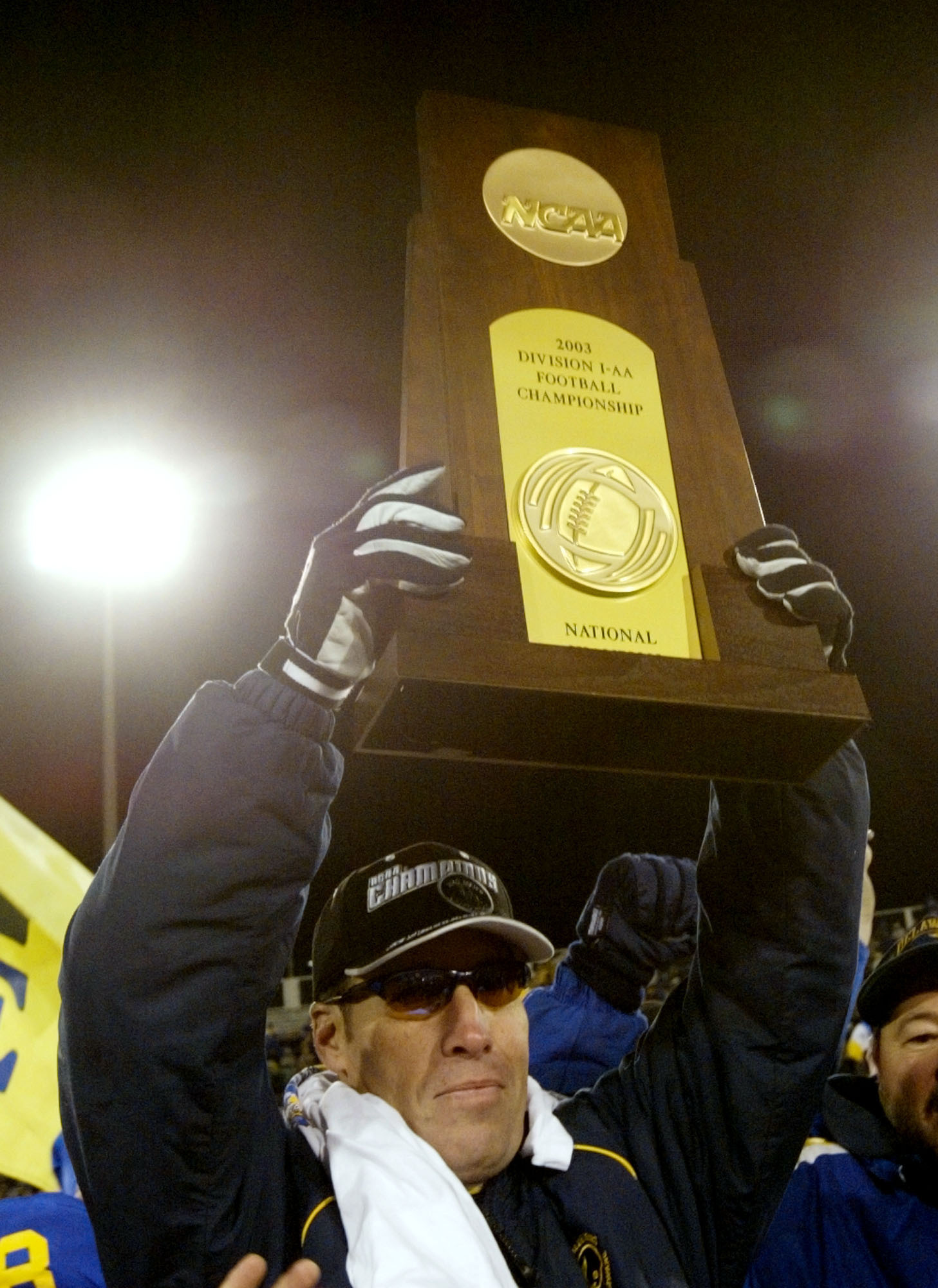
    K.C. Keeler holds the trophy after his Delaware squad defeated Colgate, 40-0, in the NCAA Division I-AA championship on Dec. 19, 2003.

    In his second season, Keeler guided the Blue Hens to a 15-1 record. Delaware cruised through the playoffs in Division I-AA (now known as the FCS) and faced Colgate in the national championship. Keeler lost five national championships with Rowan, but his luck finally turned at Delaware.

    “We went out and won, 40-0, and had the biggest point differential in the history of a national championship game,” Keeler said. “They had me, and the energy level we came out with was off the charts. They say you take a championship, that team took a championship. That would be my most memorable win just because it’s a national championship at your alma mater and they had never won a FCS national championship.”

    Keeler spent nine more seasons with the Blue Hens and amassed 86 wins, ranking second in school history behind Tubby Raymond. He was fired after the 2012 season when the Blue Hens went 5-6 and decided to take a year off from coaching.

    He worked as a commentator for ESPN and for NFL Matchup. It did not take long for Keeler to realize he missed being around the game. The Sam Houston State job opened in 2014, and it was the last job available in the cycle. Keeler took it.

    Once Keeler was back on the sideline, it was like he never left.

    He won double-digit games in his first four years with the Bearkats, then in 2020, he won the FCS national title.

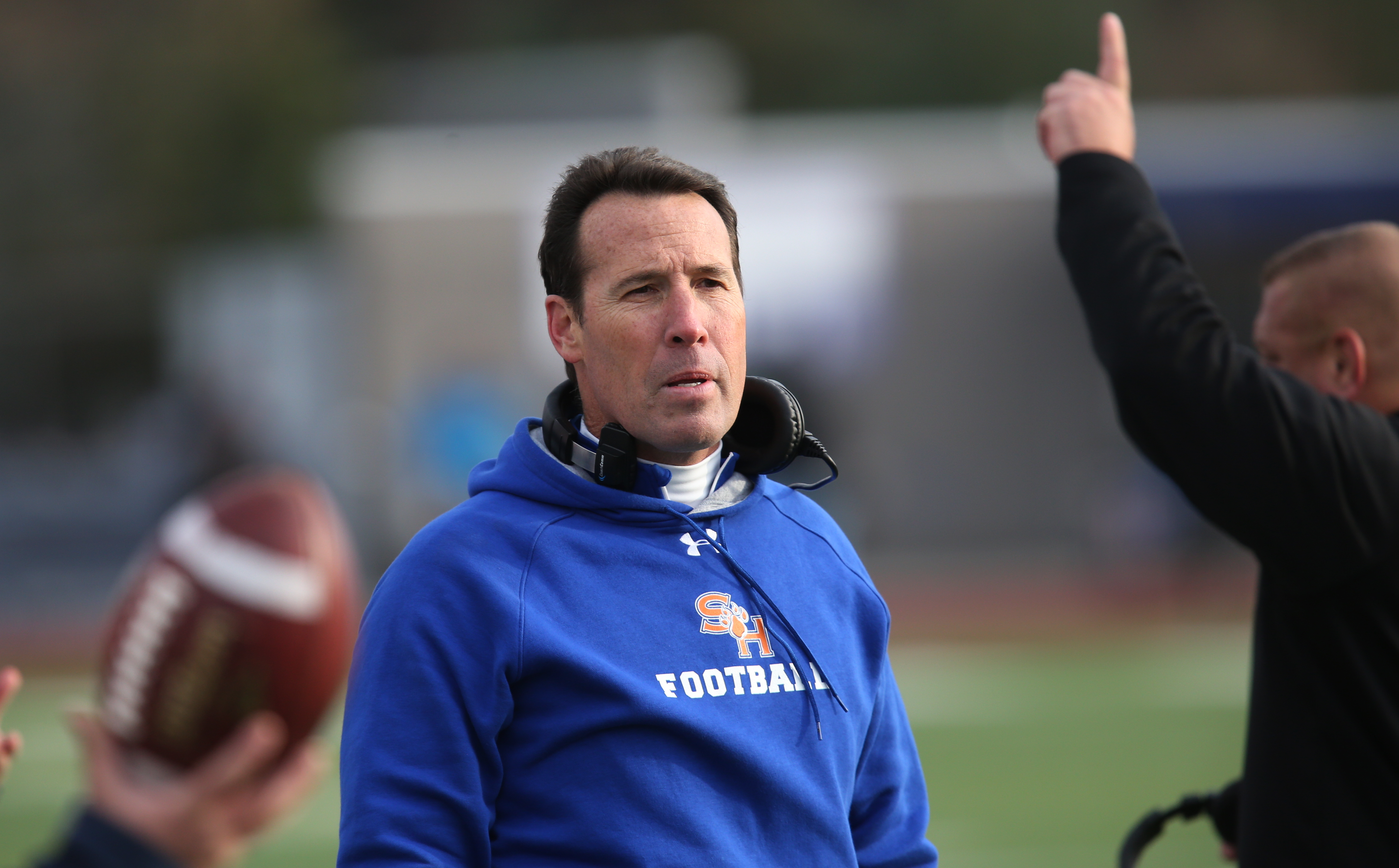
    Sam Houston State coach K.C. Keeler watches during an FCS quarterfinal against Villanova on Dec. 13, 2014. Sam Houston State won, 34-31.

    “We ended up beating the only three teams to win an FCS national championship in the last decade in 16 days,” Keeler said. “We beat
North Dakota State, James Madison, and South Dakota State in 16 days. All three of those are the only teams besides Sam Houston now that have won national championships in a decade. Some people said there should have been an asterisk because of COVID. There should have been an asterisk because of how we did it. We had to do it during COVID and we beat the best three teams in the last decade in 16 days.”

    Sam Houston’s success under Keeler boosted the program to the FBS in 2023. The Bearkats won only three games in their first year but won 10 in 2024.

    On Sept. 28, 2024, Bearkats squared off with Texas State in a battle to “take back Texas.” Texas State led, 22-0, before Sam Houston stormed back to win, 40-39.

    “Their whole thing was take back Texas,” Keeler said. “So when we played them, we took back Texas. That was really a cool moment for the program and for a rivalry that had not been played in 10 or 11 years.”

    Keeler left as the second-winningest head coach in Sam Houston State history with 97 victories. He decided it was time to head back home.

    Writing a new chapter

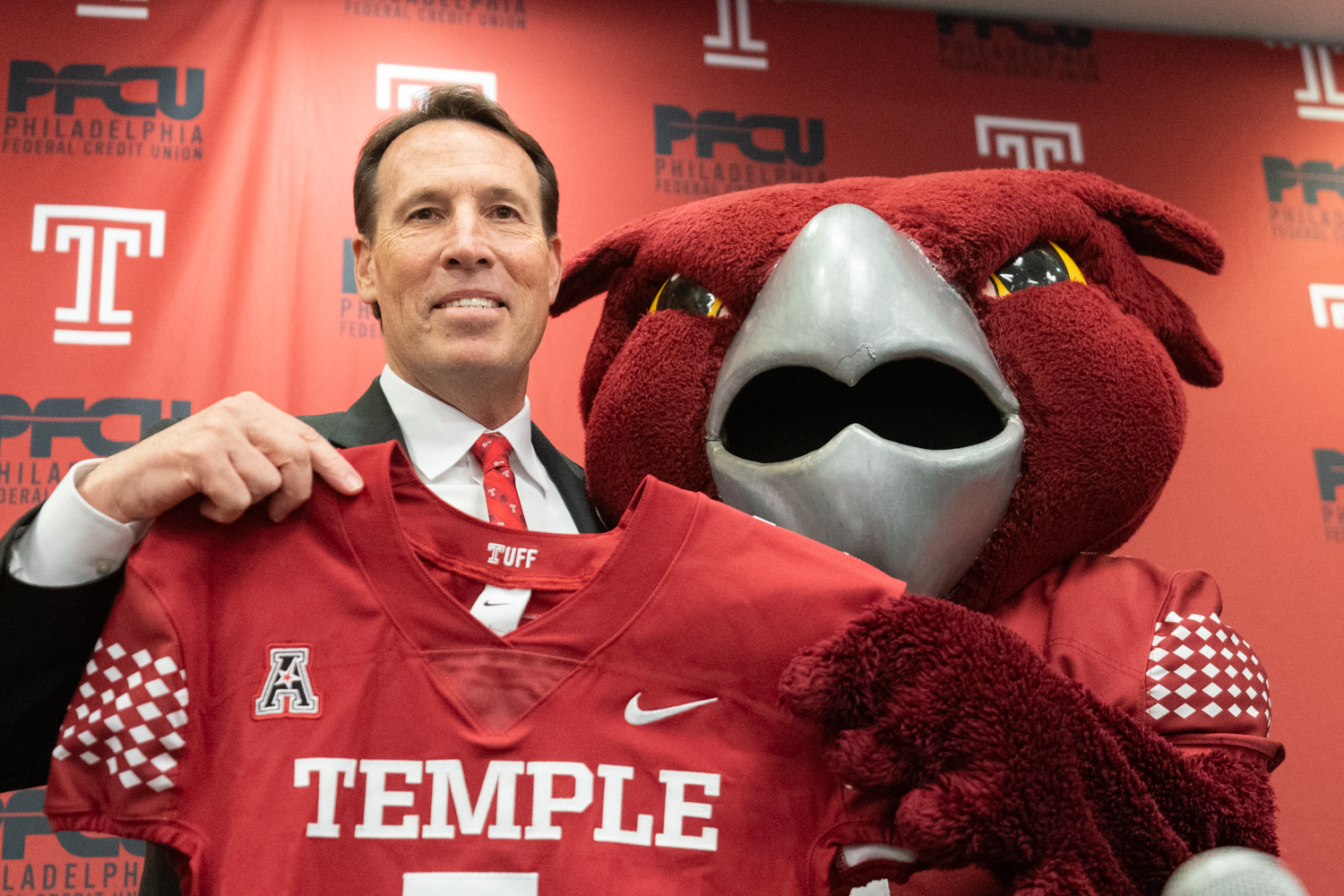
    Keeler was hired at Temple on Dec. 1, 2024, and tasked with turning around a program that finished 3-9 for four consecutive seasons. Keeler needed seven games to surpass the three-win mark, doing so in the milestone victory over Charlotte.

    Entering a road matchup against Tulsa, Temple is 4-3. Each win this season has meant a great deal to Keeler, especially the Owls’ 42-10 victory against UMass in the season opener.

    “That obviously is a really memorable game because [the players] put their trust in myself and the staff, and they had results that they really hadn’t had in a while,” Keeler said. “I think we all felt really good about that, and it was a great way to start the building.”

    K.C. Keeler led Temple to its fourth victory of the season Saturday after the Owls finished 3-9 in four straight seasons.

    Keeler is tied with Monte Cater for 20th all-time in wins among college football coaches. He had plenty of people to look up to on the way to 275, especially his father, Ralph Keeler, and Raymond, his coach at Delaware whom he replaced.

    While the milestone is special, it’s just another win in Keeler’s eyes.

    “That 275 is just a symbol of the fact that I’ve done this a long time,” Keeler said.
”I coach a lot of great players, and I put together really good coaching staffs. And that’s how I got to that number. Every one’s significant. I am going to be as happy for 276 as I was for 275.”

  • ‘We all failed Coach Franklin:’ Penn State enacts some of the philosophies of its former coach

    ‘We all failed Coach Franklin:’ Penn State enacts some of the philosophies of its former coach

    STATE COLLEGE, Pa. — Former Penn State coach James Franklin recruited every player, hired every staffer, and had a say in nearly every decision within the football program since 2014.

    So after his firing, the players with whom he developed relationships, whose homes he visited, whose families he befriended, were devastated.

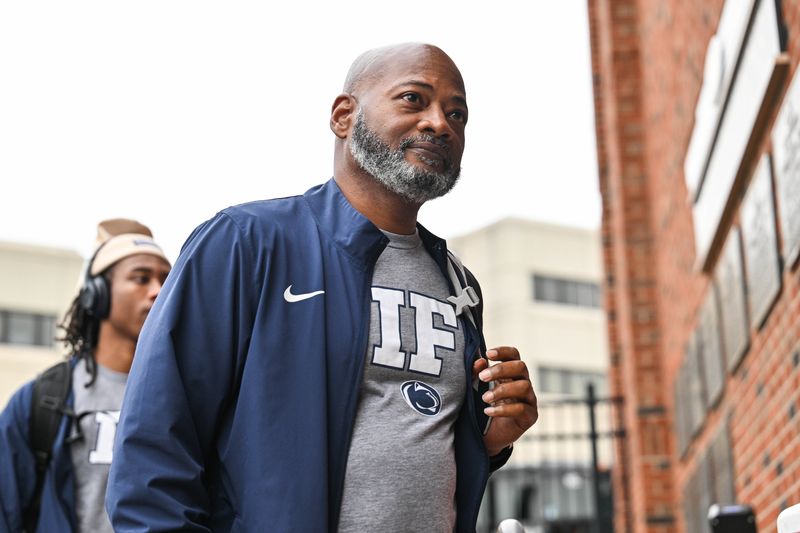
    “We all failed Coach Franklin,” interim coach Terry Smith said. “Sunday was traumatizing to [the players]. They are all hurt and torn, disappointed in what happened.”

    Penn State interim coach Terry Smith says he feels like the team failed former coach James Franklin.

    Franklin may no longer patrol the team’s sidelines or walk arm-in-arm with his offensive linemen as the Nittany Lions take the field, but his philosophies remain entrenched within the program, notably his “1-0” mantra.

    The saying still is etched on the team’s locker room doors at Beaver Stadium. It still graces the video board outside Holuba Hall, the site of the team’s practice field. And it remains ingrained in the minds of Penn State players.

    “[The 1-0 standard] is all I know. Since I’ve been here, that’s what we do,” defensive tackle Zane Durant said. “How can we win this one rep? How can we win this day? I’m going to continue to have that mindset, and Coach Terry preaches it, too. So we just keep pushing it throughout the team.”

    Who’s under center

    After a much-needed bye week, the Nittany Lions (3-4, 0-4 Big Ten) will seek to go “1-0″ against No. 1 Ohio State on Nov. 1 (noon, Fox 29).

    Again, they will have Ethan Grunkemeyer under center.

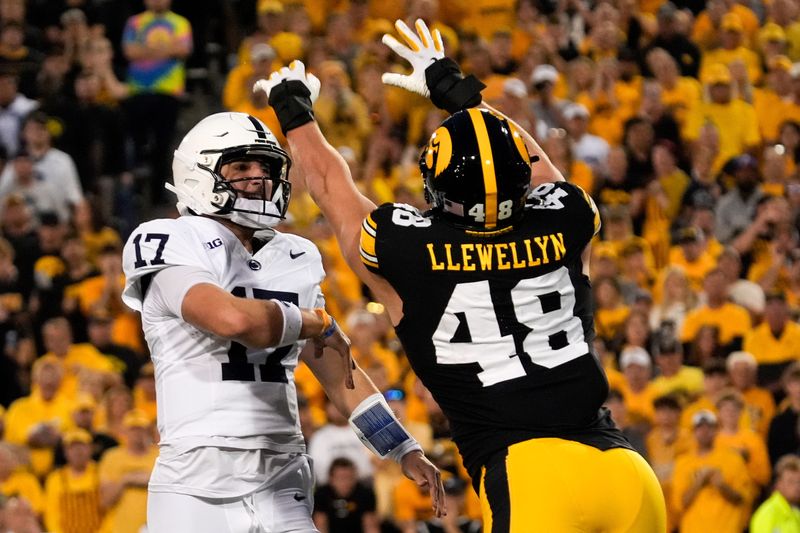
    Penn State quarterback Ethan Grunkemeyer performed under a good deal of pressure all night from Iowa’s defense.

    The redshirt sophomore quarterback replaced Drew Allar, who is out for the season after suffering a broken ankle against Northwestern. Grunkemeyer, who threw for 98 yards without a touchdown in last Saturday’s 25-24 loss to Iowa, inherits a sputtering offense searching for answers.

    Center Nick Dawkins, a team captain in his sixth season, said he has “all the confidence in the world” in Grunkemeyer. Durant said the quarterback can “make all the throws.” Zakee Wheatley called him “100% ready.”

    Grunkemeyer will need the backing of his teammates when Penn State battles Ohio State (7-0, 4-0), which allows just 5.9 points per game, the fewest in the FBS. Entering that environment could be daunting to some, but not to the 6-foot-2 quarterback, who, before the Nittany Lions’ game against Iowa, noted that he just wants to play ball.

    “I definitely feel prepared. … It is a bigger role, but the preparation has been the same,” Grunkemeyer said. “I’m a guy that likes to go out there and just play, so whatever [offensive coordinator Andy Kotelnicki] dials up, I’m ready for it.”

    ‘Do it for your brother’

    Smith has been in charge for less than two weeks, but his fingerprints are visible throughout the program. He tells players to “check their feelings at the door.”

    The Nittany Lions entered last Saturday with a 3-3 record. After losses to UCLA and Northwestern, they had a 0.1% chance to make the College Football Playoff, according to ESPN. Now, with the loss to Iowa, that vision is all but obliterated. And with two of Penn State’s five remaining games against Associated Press Top 25 opponents, clinching bowl eligibility is not even a given.

    But two-time captain Dom DeLuca remains motivated. The fifth-year linebacker said Franklin took a chance on him when no one else would, which is all the inspiration he needs to go 1-0 in the next game.

    “Do your job,” DeLuca said. “Do it for Coach Franklin. Do it for the guy to the left and right of you. Do it for all the Penn Staters who love the game and love the Nittany Lions.”

    Durant added: “Do it for your brother. Do it for your goals. Do it for each other. [We’ve] got a lot of ball left.”

  • The NBA’s debut on NBC gets rave reviews, despite glitches and a bad use of AI

    The NBA’s debut on NBC gets rave reviews, despite glitches and a bad use of AI

    NBC managed to do the unthinkable — making a regular-season NBA game feel big.

    Broadcasting their its NBA game in 23 years, NBC made the league’s season opener between the Oklahoma City Thunder and Houston Rockets feel like a playoff game. The crowd was loud, the camera work and graphics were crisp, and enough can’t be written about John Tesh’s “Roundball Rock.”

    The opening was just about perfect, balancing nostalgia for the NBA of the 1990s with current stars like LeBron James and Joel Embiid, who had “no idea” when asked about his memories of the league during that era. (Embiid was 2 years old when Jordan won his fourth NBA championship in 1996.)

    “TNT — as good as it was, as comfortable as it was — never made Opening Night feel as much as an event as tonight,” wrote Sports Media Watch’s Jon Lewis, adding “the moments leading up to tipoff felt bigger than during the Finals last year. And that’s not me taking shots at ESPN, it’s just kind of obvious to me.”

    Then there’s Mike Tirico, who has developed into an announcer whose voice makes a game feel bigger.

    Other than practice games with the Sixers and Boston Celtics last season, it was Tirico’s first time calling a national basketball game since 2016. You would have never known it — Tirico knew the rules and was on top of every call. Officials missed Kevin Durant’s call for a timeout when the Houston Rockets had none during the closing seconds of overtime, but Tirico was all over it.

    “Tirico doesn’t miss much in terms of intricacies,” wrote the Athletic’s Andrew Marchand.

    Tirico was part of an entertaining three-person crew alongside Reggie Miller and Jamal Crawford, which is likely a preview of how NBC will handle this season’s Western Conference Finals.

    “We don’t really have a lead crew,” NBC Sports president Rick Cordella said on a recent episode of the Sports Media Watch Podcast. “Jamal and Reggie are equals, and so you’ll see us going two-man crews and three-man crews at different times. And then we’ll see how the season goes.”

    There were also nice touches during the broadcast, like NBC’s scorebug showing an animated hand after three pointers and shaking following a slam dunk.

    The question is whether it will all be enough. NBC is reportedly paying $2.5 billion a year over the next 11 years for its NBA package, and the Wall Street Journal reported parent-company Comcast is projecting losses between $500 million and $1.4 billion during the first few years of the deal.

    “It’s a long-term deal. We’re not trying to measure this based on quarters but the next 10 years,” Matt Strauss, chairman of NBCU’s media group, told the Wall Street Journal.

    Hopefully we’ll get more from Michael Jordan

    The idea of Michael Jordan, NBA pundit is interesting. After all, who wouldn’t want arguably the greatest player in the history of the game dishing on the league’s current players and situations?

    Viewers, apparently. Jordan appeared via a pretaped segment for three minutes during halftime, where he told a nice story about the last time he shot a basketball and not much else.

    “I wish I could take a magic pill, put on shorts, and go out and play the game of basketball today,” Jordan said.

    Is it an improvement over quick-hit segments where studio analysts hurry through banal comments so networks can squeeze in as many sports gambling ads as possible? Yes, but that’s a pretty low bar to clear.

    The good news is NBC plans to air more segments featuring Jordan’s interview with Tirico in the weeks to come. NBC said he’ll be back next Tuesday to discuss load management, a subject Jordan — who played 82 games nine times in his career — has strong views about.

    Beyond that, it’s unclear how often Jordan, promoted as a special contributor, will appear on NBC this season.

    NBC should ditch their AI deepfake of Jim Fagan

    Older NBA fans probably felt something was off with Jim Fagan’s voice during the opening of Tuesday night’s broadcast.

    That’s because the longtime NBA on NBC narrator died eight years ago.

    NBC got permission from Fagan’s family to create a deepfake version of Fagin’s voice to intro games and provide promos for upcoming NBA games, as well as on other sports airing across NBC.

    Just because you can doesn’t mean you should.

    It isn’t the first time NBC has leaned into using artificial intelligence. During last year’s Olympics, NBC used a deepfake version of veteran announcer Al Michaels for personalized recaps on Peacock. But Michaels, who currently handles play-by-play on Amazon’s Thursday Night Football, is still alive.

    Pregame show marred by glitches

    As for NBC’s pregame show, it was largely forgettable. Despite featuring three NBA hall of famers — Carmelo Anthony, Vince Carter, and Tracy McGrady — nothing memorable was said.

    In fact, the most notable part was the technical issues that plagued the first few minutes, including some audio issues and a couple of bad microphones. At one point, host Maria Taylor slammed her microphone down on the desk after McGrady asked her to repeat a question, causing static to overrun the broadcast for a few seconds.

    “Hey, this is the first night, so it’s not going to be perfect NBC family, but we’re going to get it right,” McGrady said.

    While the pregame show lacked much interest or excitement, at least NBC decided to take the high road and avoided sideshow antics involving shouting pundits and LeBron James vs. the world debates.

    It is just the first game of 82, after all.

    When will the Sixers play on NBC?

    Embiid and the Sixers open their season Wednesday against the Boston Celtics on NBC Sports Philadelphia, with Kate Scott and Alaa Abdelnaby back calling the bulk of the team’s games.

    The Sixers are scheduled to appear exclusively on NBC five times, beginning with their Nov. 11 matchup against the Boston Celtics at the newly named Xfinity Mobile Arena. They’ll also play exclusively on Peacock on Jan. 5 against Nikola Jokic and the Denver Nuggets.

    Here’s when fans will see the Sixers on NBC and Peacock:

    • Nov. 11: Celtics at Sixers, 8 p.m. (NBC, Peacock)
    • Nov. 25: Magic at Sixers, 8 p.m. (NBC, Peacock)
    • Dec. 30: Sixers at Grizzlies, 8 p.m. (NBC, Peacock)
    • Jan. 5: Nuggets at Sixers, 8:30 p.m. (Peacock)
    • Jan. 27: Bucks at Sixers, 8 p.m. (NBC, Peacock)
    • March 3: Spurs at Sixers, 8 p.m. (NBC, Peacock)
  • Mayor Parker shakes up the Philadelphia Land Bank board to try to further her housing plan

    Mayor Parker shakes up the Philadelphia Land Bank board to try to further her housing plan

    Mayor Cherelle L. Parker is shaking up the board of the Philadelphia Land Bank, which helps control the sale of city-owned land but hasn’t been moving fast enough to advance her housing priorities.

    Parker’s first land bank board chair, Herb Wetzel, has been asked to step down as well as board member Majeedah Rashid, who leads the Nicetown Community Development Corp. The board has 13 members.

    Angela D. Brooks, who serves as the city’s chief housing officer, will be joining the board. Earlier this year Parker appointed Brooks to lead the mayor’s campaign, Housing Opportunities Made Easy, or H.O.M.E., to build or renovate 30,000 houses over the course of her administration.

    The mayor has long championed the Turn the Key program as part of that plan, a policy that depends on getting inexpensive city-owned land to developers so they can build houses that are affordable to working and middle-class families.

    Rashid is being replaced by Alexander Balloon, who formerly served on the Land Bank’s board and is the executive director of the Passyunk Avenue Revitalization Corp.

    “It is clear from the Land Bank’s success with its Turn The Key program: A strong and effective Land Bank is essential for reaching the H.O.M.E. initiative’s goal to produce and preserve 30,000 homes,” Parker said in a statement.

    Several Turn the Key proposals have been held up by the Land Bank board, which has been riven between factions that are either more or less friendly to private-sector developers.

    Rashid and other board members who come from a nonprofit development background have argued that scarce city-owned land should be earmarked for affordable housing, community gardens, and similar projects.

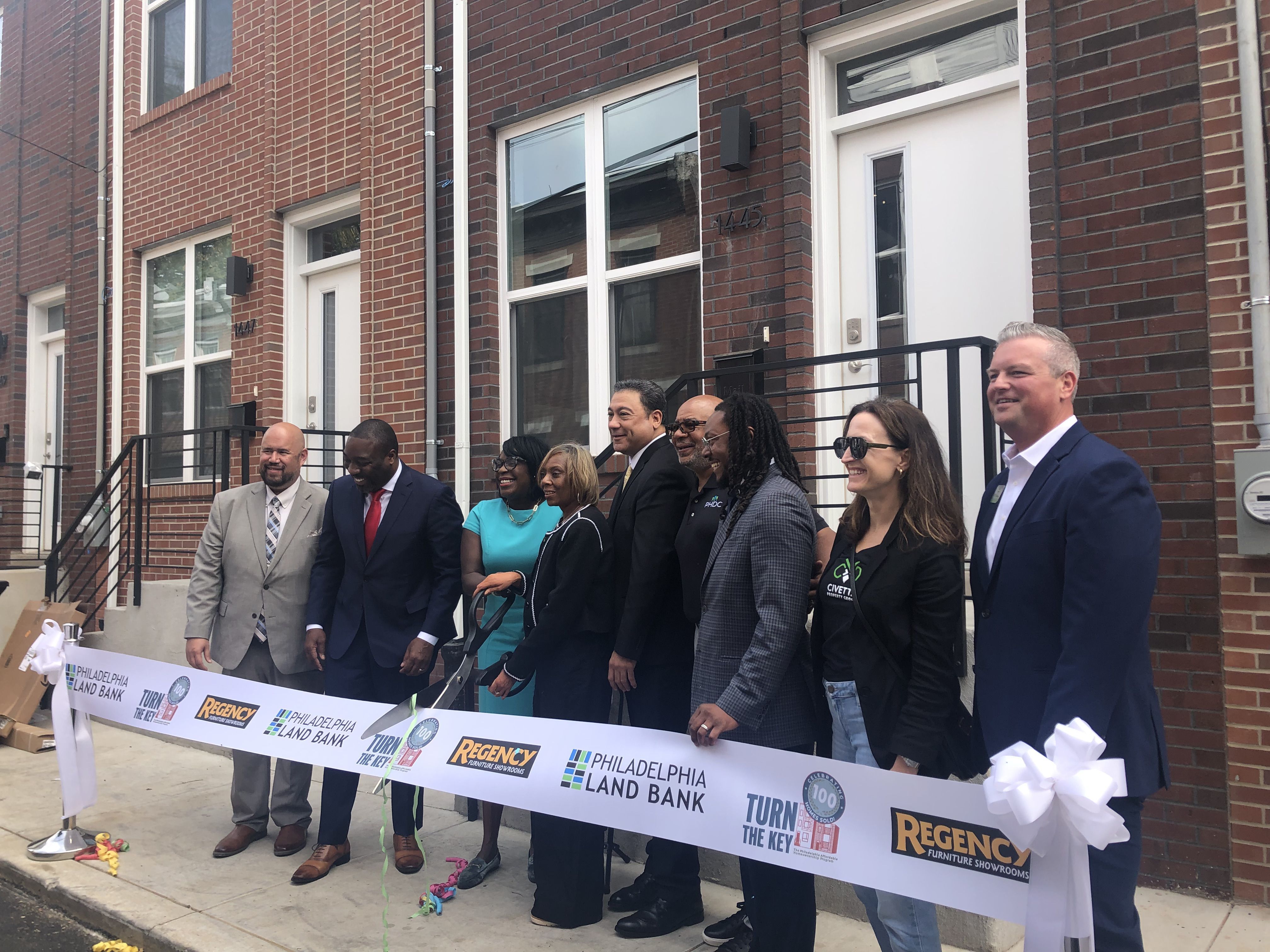
    Mayor Cherelle L. Parker and Turn the Key’s 100th homebuyer hold giant scissors as they prepare to cut a ceremonial ribbon.

    Although the Turn the Key program produces units that are more affordable than market-rate homes, many of the projects are built by private-sector developers and still unaffordable to Philadelphians with low incomes.

    “Majeedah Rashid has worked with me on economic development issues dating to my time in the Pennsylvania General Assembly, and her advice has been invaluable,” Parker said in a statement. “Our city is stronger for Herb’s and Majeedah’s public service.”

    Rashid did not respond to a request for comment.

    During Balloon’s previous tenure on the board, he was among members who pushed for vacant city-owned land to be put back into productive use as quickly as possible because empty lots attract crime and litter and are a drag on city services.

    Private-sector developers often can build more — and faster — than their nonprofit counterparts because they are less reliant on public funds, which are increasingly unreliable from the federal level.

    “I’m excited to rejoin the Philadelphia Land Bank and help Mayor Parker deliver on her bold vision to build and preserve 30,000 homes across our city,” Balloon said in an email statement. “This is an inspiring moment for Philadelphia’s growth and the success of the Turn the Key program and other initiatives.”

    Wetzel’s role as Land Board chair was the latest in a long tenure of municipal housing policy positions, including his lengthy service as a close aide to former Council President Darrell L. Clarke, who created the Turn the Key program and was one of its most enthusiastic proponents.

    “Herb Wetzel has been a subject matter expert for me on any housing issue that I’ve worked on throughout my career as an elected official, and I have always relied on his counsel,” Parker said in a statement. “He will continue to be part of my circle of advisers on housing issues, just in a different capacity.”

    But according to three City Hall sources, who did not have permission to speak to the media, Parker’s team felt Wetzel sought to play peacemaker between the factions and was not always able to get their favored Turn the Key projects moving. As a recent arrival to the city and leader of the administration’s housing initiative, Brooks is expected to pursue the mayor’s priorities.

    Brooks said in an interview that her appointment was no reflection on Wetzel’s performance and that he would continue to serve on the H.O.M.E. advisory board.

    “I don’t have any thoughts on what he didn’t do or didn’t other than he’s been a great supporter of both the mayor and me and this housing plan,” Brooks said. “He’ll continue to be a part of that as we move it forward. [It’s just that] historically, we have had a city staff person to sit on the Land Bank board, and since I’m spearheading the H.O.M.E. Initiative, it seemed to be time.”

    Frequent stalemates on the board were not the only challenge facing Turn the Key projects. Under the tradition of so-called councilmanic prerogative, the Land Bank requires action from City Council to release property for development even if the mayor backs a particular proposal.

    For example, the administration sent over a 50-unit Turn the Key proposal in North Philadelphia to City Council last November, and District Councilmember Jeffery Young simply never introduced it, effectively killing the deal.

    Or in Kensington, Councilmember Quetcy Lozada declined to endorse several Turn the Key proposals, leading developers to abandon them.

    Parker sought to loosen Council’s grip on some city-owned land during budget negotiations earlier this year, but the campaign was largely unsuccessful. National land bank experts have long argued that land banks like Philadelphia’s are much less effective than counterparts that do not have political veto checkpoints.

    During budget hearings this year, Council asked for an organization assessment of the Land Bank, and some members questioned why its staff wasn’t more robust.

    Brooks said that an assessment will be released soon from the consultant group Guidehouse and that the Land Bank “is in the process of filling positions.”

  • How the Inquirer and Daily News covered the 1990s mafia power struggle seen in Netflix’s ‘Mob War’

    How the Inquirer and Daily News covered the 1990s mafia power struggle seen in Netflix’s ‘Mob War’

    More than 30 years ago, Philadelphia was the battleground in a brutal mob war as a group of young mafia upstarts challenged the rule of the established La Cosa Nostra leadership.

    Known as the Young Turks, that group consisted mostly of younger men who were the sons, brothers, and nephews of former crime family members who were dead or in prison, and was purportedly led by Joseph “Skinny Joey” Merlino and Michael “Mikey Chang” Ciancaglini. They believed that mob boss John Stanfa, a Sicilian immigrant who preferred to keep a low profile, was an outsider who was not fit to lead. Instead, their bloodlines and connections gave them the right to rule their hometown neighborhoods.

    Now, a new docuseries from Netflix, Mob War: Philadelphia vs. The Mafia, examines that conflict, complete with interviews from the law enforcement agents and former mobsters who were there, vintage 1990s Philly TV news footage, and the perspective of a hitman-turned-informant who made headlines. The goal, said director Raïssa Botterman, is to show the human element behind the violence.

    “They’ve committed crimes, but they’re still humans, and understanding who they were and having their versions of events” is important, she said. “Whether it’s fighting against crime or it’s committing crimes, [we’re] trying to get a more holistic picture of what’s going on.”

    Notably missing from the series is Merlino, who Botterman said declined to participate. Merlino has long denied having been behind a faction of the city’s mob and has never been convicted of mob-related violence.

    Likewise, Merlino declined through a representative to comment about Mob Wars.

    Throughout the ’90s, mob violence regularly dominated Inquirer and Daily News headlines, and resulted in several high-profile deaths and criminal trials, and a new mob leader in the city.

    Here is how we covered it:

    30 Jan 1992, Thu Philadelphia Daily News (Philadelphia, Pennsylvania) Newspapers.com

    The war begins

    By most accounts, the first strike in the brewing mob war happened in January 1992 with the killing of Felix “Tom Mix” Bocchino, a Stanfa loyalist, on the 1200 block of Mifflin Street. Bocchino, 73, was shot four times in his 1977 Buick, and authorities believed he was targeted by members of the Young Turks faction, according to an Inquirer report from the time.

    Retaliation was swift. Two months later, gunmen attempted to assassinate Michael Ciancaglini at his home near 12th and McKean Streets — just steps south of where Bocchino was killed. In that incident, the Daily News reported, Ciancaglini was returning home from a basketball game when two men carrying shotguns began chasing him. He made it inside, and the gunmen fired shotgun blasts through the front door and window.

    Ciancaglini was not injured, and neither were his wife and two children, who were inside the house. Law enforcement sources told the People Paper that Ciancaglini “had something to do with Bocchino’s death,” but Ciancaglini’s attorney maintained his client was in the dark about the attempt on his life.

    “He don’t know why. He don’t know who. And he don’t know what,” attorney Joseph C. Santaguida told The Inquirer following the shooting.

    06 Aug 1993, Fri The Philadelphia Inquirer (Philadelphia, Pennsylvania) Newspapers.com

    All-out war

    In March 1993, almost exactly a year after the attempt on Michael Ciancaglini’s life, older brother Joseph Ciancaglini, 35, was shot at the Warfield Breakfast and Lunch Express in Grays Ferry. The attempted hit on Stanfa’s underboss was captured on FBI surveillance video.

    Though he survived, Joseph Ciancaglini became permanently paralyzed.

    On Aug. 5, 1993, the warfare arrived on the 600 block of Catharine Street with an afternoon shooting that injured Merlino and killed Michael Ciancaglini. The pair were walking down the block when two gunmen began firing, striking Merlino in the leg and buttocks, and Ciancaglini in the heart, reports from the time indicate. Ciancaglini died at Thomas Jefferson University Hospital, while Merlino was placed in stable condition at the Hospital of the University of Pennsylvania.

    window.addEventListener(“message”,function(a){if(void 0!==a.data[“datawrapper-height”]){var e=document.querySelectorAll(“iframe”);for(var t in a.data[“datawrapper-height”])for(var r,i=0;r=e[i];i++)if(r.contentWindow===a.source){var d=a.data[“datawrapper-height”][t]+”px”;r.style.height=d}}});

    The car used in the shooting, meanwhile, was found some 35 blocks away, burned to a crisp. It had been leased to Philip Colletti, a mob associate who later admitted his role in the crime.

    Hundreds attended Ciancaglini’s viewing at the Carto Funeral Home at Broad and Jackson days later; some neighborhood residents were not surprised by his killing, The Inquirer reported.

    “Why’d he get killed? The same reason the rest of these hoods in South Philly do,” said one South Philly hairdresser. “Most Italians are good, hard-working people, and these people give us a bad name.”

    01 Sep 1993, Wed Philadelphia Daily News (Philadelphia, Pennsylvania) Newspapers.com

    An attempt on Stanfa

    By the end of August 1993, the Young Turks struck back — this time with a botched assassination attempt on Stanfa himself that ended up wounding the mob boss’ son, Joseph, who was 23 and not involved with mafia activities.

    That attempt took place during the morning rush hour as Stanfa and his son traveled from their home in Medford to their food importing business in South Philadelphia. As they drove toward the Vare Avenue off-ramp on the Schuylkill Expressway, gunmen ambushed them from a van that had been modified with makeshift gunports, allowing the assailants to fire from concealment.

    The attackers, police later learned, had not cut eye holes in the van, and fired on the Stanfas wildly, missing their intended target. The younger Stanfa, however, was struck in the face, leaving a bullet lodged in his neck though he survived.

    The van was found near 29th and Mifflin Streets as police attempted to reconstruct possible escape routes. It was littered with spent cartridges, and had “a number of punctures in it,” leading police to believe that a shooter lost control of his weapon, tearing bullet holes into the vehicle.

    Stanfa’s vehicle, meanwhile, was heavily damaged, with at least 10 bullet holes running from the front hood to the right rear fender. A tire was shredded, and a window panel in the rear-passenger side — where Joseph had been sitting — was shattered. Stanfa, The Inquirer reported at the time, had his driver hide the car in the garage of the restaurant where Joseph Ciancaglini had been shot, requiring police to obtain a warrant to examine it.

    “You’ve got to understand: This is an all-out mob war,” said Col. Justin J. Dintino, superintendent of the New Jersey State Police. ”They’re going to take their shot whenever the opportunity presents itself.”

    18 Sep 1993, Sat Philadelphia Daily News (Philadelphia, Pennsylvania) Newspapers.com

    Murder at the Melrose

    In September 1993, the opportunity presented itself at the Melrose Diner, where Frank Baldino Sr., a reportedly low-level associate of the Young Turks, was shot to death in his car. His last meal was a $6.95 chopped steak dinner, the Daily News reported.

    Gunmen approached Baldino’s vehicle, investigators said, and “pumped several bullets” through its closed window, striking him in the head and torso. The assailants fled west on Passyunk Avenue in a rainstorm, and Baldino died while en route to the hospital.

    Baldino was not considered to be a major player in the local mob. His killing, friends and investigators said, was something of a shock — even former mobster Nicholas “Nicky Crow” Caramandi, who was in hiding at the time, denounced it.

    “This guy was not a gangster,” Caramandi told The Inquirer. “He wouldn’t hurt anybody. He was not a threat. It should never have happened.”

    19 Jan 1994, Wed Philadelphia Daily News (Philadelphia, Pennsylvania) Newspapers.com

    A mafia hitman turns informant

    Though mob violence cooled as 1993 wore on, it didn’t fully stop, and late one Friday in January 1994, police found John Veasey near Sixth and Sigel Streets, grievously injured.

    He had three bullet wounds to his head, one to his chest, and seven stab wounds, having fought off his attackers in an assassination attempt in the apartment above a nearby meat store. Somehow Veasey, then 28, had survived, and was placed in critical but stable condition at Jefferson Hospital.

    “He’s a tough kid,” one underworld source told The Inquirer. “He knows a lot, and what he knows can hurt a lot of people.”

    Veasey, it turned out, had gone to the FBI days before and copped to the Ciancaglini and Baldino killings at the behest of his brother, William “Billy” Veasey, who had told him there was a contract out on John Veasey’s life.

    His assailants, Veasey told police, were Stanfa loyalists Frank Martines and Vincent “Al Pajamas” Pagano, both of which later surrendered.

    The pair, John Veasey said, had lured him to a mob-run “numbers house” under the guise of protecting him. But once inside, Martines pulled a gun and shot him in the head and chest, telling him, “Bye, John-John.” When that failed to kill Veasey, a battle ensued in which Veasey wrestled a knife away from Pagano, and used it to slash Martines in the eye.

    “I have a real powerful neck, real, real big,” Veasey later said of his survival, according to a Daily News report. “I was not knocked out. It wasn’t sending any messages to the brain.”

    06 Oct 1995, Fri The Philadelphia Inquirer (Philadelphia, Pennsylvania) Newspapers.com

    The killing of Billy Veasey

    Following the attack on Veasey, Stanfa and 23 associates were indicted on federal racketeering charges and imprisoned by March 1994. As the legal proceedings wore on, mob violence in the city trickled almost to a stop — with one notable exception.

    On Oct. 5, 1995, just hours before Veasey was set to take the witness stand against Stanfa and his codefendants, his brother Billy was shot and killed on the 1700 block of Oregon Avenue.

    Veasey was distraught, but his resolve to testify was hardened by the killing, law enforcement sources said. Five days later, he did just that.

    Delivering his testimony in what The Inquirer called “South Philadelphia tough-guy jargon,” Veasey made the federal government’s case clear — in some cases, graphically so — for jurors. Calling himself a triggerman for Stanfa, he testified that the mob boss had given orders in 1993 to kill anyone who was aligned with Merlino and the Young Turks faction, and that a hit list with more than a dozen names had been circulated to mob members.

    “A couple of [defense] lawyers tried to catch him up in semantics,” one federal source told The Inquirer of Veasey. “John doesn’t even know what semantics means.”

    22 Nov 1995, Wed The Philadelphia Inquirer (Philadelphia, Pennsylvania) Newspapers.com

    The war’s end

    By November 1995, Stanfa and his associates were convicted on all counts, including murder, extortion, gambling, and kidnapping. Stanfa received five life sentences, and, at 84, remains in prison.

    With that, the Young Turks had officially won the war. According to Inquirer and Daily News reports from the time, Ralph Natale had been installed as the head of the Philadelphia mob but focused his efforts on South Jersey, allegedly leaving Merlino and his cohorts to run South Philadelphia.

    Following Natale’s arrest on a parole violation in 1998, Daily News and Inquirer reports from the time indicate, Merlino purportedly took over as acting mob boss, and later cut out Natale completely. Merlino himself was arrested on drug conspiracy charges in 1999, and Natale served as a government witness against him.

    Ultimately, Merlino received a 14-year sentence after being convicted of racketeering. He was acquitted of drug trafficking and murder charges, the latter for which prosecutors initially considered pursuing the death penalty. With credit for two and a half years served, he was to spend nine more years in prison.

    “It ain’t bad,” Merlino said of the verdict, according to an Inquirer report. “Nine’s better than a death penalty.”

    “Mob Wars” is a three-part series on Netflix. Its release date is Wednesday, Oct. 22.

  • What to know about John Veasey, the hit man-turned-informant in Netflix’s ‘Mob War’

    What to know about John Veasey, the hit man-turned-informant in Netflix’s ‘Mob War’

    Hit man-turned-government informant John Veasey, whose testimony helped bring down mob boss John Stanfa and a dozen of his top associates in the 1990s, says he’s on the road to redemption.

    The new Netflix docuseries Mob War: Philadelphia vs. The Mafia, now streaming, chronicles a violent 1990s power struggle in the local La Cosa Nostra through the eyes of investigators and former crime family members who were there.

    Veasey, a South Philly native, was a central figure in the ’90s Philly mob, having admitted to participating in two high-profile murders. He went on to serve nearly 11 years in prison after becoming a government witness against Stanfa and other top mob associates in a federal racketeering trial, and was released in 2005. He has since denounced the mob life, and, in the Netflix series, calls joining the mafia the “worst decision” he ever made.

    While he became a feared killer, Veasey was also something of a folk hero after Stanfa’s 1995 trial. The jury, according to Inquirer and Daily News reports from the time, was enamored with his frank and sometimes graphic testimony, which was a key component of federal prosecutors’ case against Stanfa and others.

    Here is what you need to know, based on Inquirer and Daily News coverage from the time:

    13 Jun 1994, Mon Philadelphia Daily News (Philadelphia, Pennsylvania) Newspapers.com

    An admitted hit man

    Veasey agreed to become an FBI informant in January 1994 after his brother, William “Billy” Veasey, told him Stanfa had taken a contract out on his life, reports from the time indicate. In agreeing to work with federal authorities, Veasey admitted to being one of the shooters behind two then-recent mob killings: Michael “Mikey Chang” Ciancaglini and Frank Baldino Sr.

    Ciancaglini was killed in August 1993 in a shooting that also wounded Joseph “Skinny Joey” Merlino. The pair were the purported leaders of the so-called “Young Turks” faction who opposed the rule of Stanfa, reports indicated. Merlino has long denied having been behind a faction of the city’s mob and has never been convicted of mob violence.

    Ahead of that shooting, Veasey testified, Stanfa had given orders to “kill anybody aligned with Merlino” and circulated a list of about a dozen people who were to be killed. Veasey undertook the hit with fellow mob enforcer Philip Colletti in a white Ford Taurus that, shockingly, was leased in Colletti’s name.

    Veasey also admitted to burning the vehicle, badly burning his hand in the process. Knowing he needed an explanation to have his injury treated, Veasey returned to his house and poured lighter fluid into a barbecue grill, and intentionally lit his injured hand on fire.

    “I screamed and told the neighbors I had burned it trying to light the grill,” he told jurors during the Stanfa trial. The cover, he says in the Netflix docuseries, wasn’t a great one — the grill he used was electric, arousing the suspicion of police.

    15 Oct 1995, Sun The Philadelphia Inquirer (Philadelphia, Pennsylvania) Newspapers.com

    The Melrose Diner killing

    Likewise, Veasey was the triggerman in the killing of Frank Baldino Sr., a then-suspected low-level mob associate who was killed outside the Melrose Diner in September 1993.

    Baldino was shot multiple times in his car in the diner’s parking lot, and died en route to Thomas Jefferson University Hospital. Veasey later tipped off authorities to the location of the murder weapons, which divers found in a pond at FDR Park in April 1994, reports from the time indicate.

    The attempted murder of John Veasey

    In January 1994, police found Veasey grievously injured near Sixth and Sigel Streets, having somehow survived a brutal assassination attempt in which he was shot four times and stabbed seven. The attempted murder, he later testified, was undertaken by Stanfa associates Frank Martines and Vincent “Al Pajamas” Pagano in an apartment above a meat store near where Veasey was found.

    “One bullet fragmented in the back of my head. One went in the back and out through my forehead,” Veasey later said of the shooting. ”One hit the back of my head and bounced into my neck. And one is still in my chest, in my rib cage.”

    His assailants, Veasey said, had targeted him because they believed he was working with the FBI — which he had been for a few days by the time the attack happened.

    11 Feb 1994, Fri The Philadelphia Inquirer (Philadelphia, Pennsylvania) Newspapers.com

    The shots failed to kill Veasey, who in the struggle wrestled a knife away from Pagano and used it to stab Martines near the eye. The ordeal lasted about 18 minutes, according to a Daily News report, and ended with Martines and Pagano letting Veasey go in exchange for their lives.

    After he escaped, Veasey attempted to stop a car for help. But because of the way he looked, he said, no one would help him.

    Eventually, police arrived but believed Veasey would die.

    “I could hear them talking, saying I was DOA,” Veasey said. “I’m saying, ‘I’m alive, I’m alive. Everyone is giving up on me tonight.’”

    Veasey later said he left the mob that night, putting his time in the mafia at just over five months, the Daily News reported. He had been recruited in August 1993, days before the Ciancaglini murder, after landing a job at a construction company owned by Stanfa’s brother-in-law.

    “I wouldn’t recommend this life to an enemy,” he later said of the mob.

    06 Oct 1995, Fri The Philadelphia Inquirer (Philadelphia, Pennsylvania) Newspapers.com

    A fallen brother

    Hours before Veasey was set to take the stand for Stanfa’s trial in October 1995, his brother, Billy, was shot and killed on the 1700 block of Oregon Avenue. The killing, authorities speculated, could have been ordered by Stanfa as a way to silence Veasey, or by suspected Young Turks leader Merlino as revenge for the Ciancaglini and Baldino murders.

    Ultimately, it only delayed Veasey’s testimony by five days.

    From the stand, Veasey referred to himself as a triggerman and divulged his involvement with the murders of Ciancaglini and Baldino.

    Veasey’s testimony at trial

    In total, Veasey testified for about two and a half days, which he wrapped up with two pieces of information: That he refused to kill kids, and he did not like gambling. He also mocked Sergio Battaglia, a would-be Stanfa hit man who, despite going on a number of hits, never actually killed anyone, according to an Inquirer report.

    Battaglia “went on a hundred hits and didn’t shoot nobody,” Veasey said.

    He quickly became well-liked by the jury, who seemed to hang on his every word, The Inquirer reported. Among his more graphic accounts from the witness stand was the “drilling” of Joseph “Joe Fudge” DeSimone, a mob associate who had wanted to kill Veasey, to which Veasey took less-than-kindly.

    12 Oct 1995, Thu Philadelphia Daily News (Philadelphia, Pennsylvania) Newspapers.com

    Veasey testified that he had warned Stanfa of a coming altercation with DeSimone, and at one point persuaded another mob associate to bring DeSimone over to Veasey’s house to settle their dispute. Veasey was on house arrest at the time.

    DeSimone arrived, kicking off a violent encounter with an electric drill.

    “I smacked him in the face with the drill. I stuck the drill in his chest and in his legs. I stuck it in his head, and from the rotation of the drill, clumps of hair was going out,” Veasey testified. “Then I hit him in the knee with a baseball bat. I chambered the gun … gave it to him and asked, ‘Do you still want to kill me?’”

    Veasey said that DeSimone declined.

    The testimony was not only well received by jurors, but it was considered a success by prosecutors. Though violent, Veasey appeared relatable to the jury and seemed to have a secret weapon against the defense.

    Former mob hit man John Veasey’s biography details his work for one of the city’s mob organizations, the hits he carried out, the attempt on his life, and more.

    The reformed hit man

    Stanfa was ultimately found guilty and sentenced to five consecutive life terms. Veasey, meanwhile, spent almost 11 years in prison, and was released in 2005. By 2012, he was back in the news, this time for a detailed account of his story in The Hit Man: A True Story of Murder, Redemption and the Melrose Diner, a book by former Inquirer reporter Ralph Cipriano.

    By then, Veasey was working as a car salesman in the Midwest, and claimed to have turned over a new leaf.

    “I never respected the Mafia or what it stood for,” Veasey said in an interview with The Inquirer in 2012. “My only regret was being dumb enough to join … I always said they either rat or kill each other.”

  • In the 1990s mob wars, John Stanfa didn’t have a nickname. The Daily News tried to change that.

    In the 1990s mob wars, John Stanfa didn’t have a nickname. The Daily News tried to change that.

    Convicted former Philadelphia mob boss John Stanfa made headlines as part of a bloody mafia power struggle in the 1990s, which is now being chronicled in the newly released Netflix docuseries, Mob War: Philadelphia vs. The Mafia.

    He was missing one thing that many of his contemporaries had — at least in the papers.

    A nickname.

    Don of the Philadelphia La Cosa Nostra from 1990 to 1995, when he was convicted on racketeering, murder, and conspiracy charges that netted him five life sentences, Stanfa went without an official street name during his time at the top. In September 1993, the Daily News set out to change that with a “Name the Don” contest encouraging readers to send in their best handles for Stanfa.

    “Philadelphia mobsters have had nicknames since there’s been a Philadelphia mob,” the People Paper wrote in a contest announcement. “But poor John Stanfa, the acknowledged leader of the local Cosa Nostra, has suffered long enough. Our godfather needs a nickname — and fast.”

    03 Sep 1993, Fri Philadelphia Daily News (Philadelphia, Pennsylvania) Newspapers.com

    A classic Daily News stunt, yes — but its timing was somewhat, well, insensitive. Just days before the contest was announced, Stanfa was the target in a brazen morning rush-hour shooting on the Schuylkill Expressway in Grays Ferry. His then-23-year-old son, Joseph, was seriously injured with a gunshot wound to the face.

    That shooting, the Daily News reported, signaled an “all-out war” for control of the local mafia, escalating the then-ongoing feud between Stanfa’s crew and a group of young upstarts referred to by the press as the “Young Turks,” purportedly led by Joseph “Skinny Joey” Merlino. The month before, Merlino was injured in a shooting on the 600 block of Catharine Street, and his friend Michael “Mikey Chang” Ciancaglini was killed.

    (Merlino, who opened Skinny Joey’s Cheesesteaks on South Broad this year, has long denied having been behind a faction of the city’s mob.)

    Stanfa was uninjured in the expressway shooting. His son survived and was never implicated in Stanfa’s underworld dealings.

    Still, some of the Daily News’ audience was game to participate in the contest, though the total number of submissions was not reported. Some of the potential monikers were directly inspired by the attempt on his life, including “Nine Lives,” “The Dodger,” and “Johnny Wheels.”

    Others poked fun at his appearance, like “Sourpuss,” “Stoneface,” and “Big Baldy.” And some — such as “Johnny Meatballs,” “The Grocer,” and “Sticky Buns” — focused on Stanfa’s work in the food business, thanks to his involvement in a South Philly-based Italian food importer.

    01 Sep 1993, Wed Philadelphia Daily News (Philadelphia, Pennsylvania) Newspapers.com

    The contest, however, was not without its detractors. It was, after all, a controversial move — this was a mob boss being roasted, and one who was nearly killed only days before the Daily News began soliciting jokes at his expense. And it didn’t help that the paper went directly to some law enforcement officials to ask for their suggestions.

    “I don’t think I should be in the business of characterizing Mr. Stanfa,” said Joel Friedman, then-head of the U.S. Organized Crime Strike Force in Philly. ”I am in the business of investigating criminal activity, and prosecuting it.”

    Regular folks were upset, too — largely over the perception that the contest mocked Italian Americans at large. One reader, retired high school principal Richard Capozzola, took particular umbrage, postulating that the Daily News “wouldn’t have done it if [Stanfa] weren’t Italian.”

    “How much more insulting can your paper be to the Italian-American community of Philadelphia?” said Arthur Gajarsa, of the National Italian-American Foundation. “Would you dare run a contest involving any other ethnic criminal element?”

    The outcry became so significant that after almost two weeks, the Daily News’ editor at the time, Zachary Stalberg, addressed it in a note to readers. The message: Relax.

    “I think people understand that nothing in our handling of the contest mocked those of Italian descent,” Stalberg wrote. “And I think people know it’s OK to be intrigued by the mob, even if you hate their business.”

    13 Sep 1993, Mon Philadelphia Daily News (Philadelphia, Pennsylvania) Newspapers.com

    By mid-September, the Daily News had a winner with John “Tightlips” Stanfa. That entry came from South Philadelphia resident Brian Baratta, who won, of course, a videotape box set of The Godfather I, II, and III for his effort.

    “‘Tightlips’ certainly is descriptive of this strong and silent guy,” the Daily News wrote of the winning entry. “John Stanfa doesn’t talk to the cops, the feds, or the press.”

    With that, the contest was over — but it wasn’t so quickly forgotten, and not just in Philadelphia.

    In 1995, ahead of Stanfa’s trial, the Daily News sent reporter Kitty Caparella to Italy to investigate the mob boss’ family tree. While in Caccamo, on Sicily’s Tyrrhenian coast, Caparella was approached by a police officer, editor Stalberg wrote in a note that year.

    The officer, Stalberg said, pulled out the 1993 Daily News issue advertising the “Name the Don” contest.

    “What do you know about this?” he asked.

  • Democratic vets in Congress blast Scott Perry’s comment that Democrats ‘hate the military’

    Democratic vets in Congress blast Scott Perry’s comment that Democrats ‘hate the military’

    Democratic veterans in Congress, including two from Pennsylvania, are taking personally comments U.S. Rep. Scott Perry made to a conservative radio station asserting that Democrats in Congress “hate the military” — and the lawmakers are hitting back.

    “That’s only a credential that they get when they want to run for office,” Perry said, of Democrats, during an interview last week on The Chris Stigall Show.

    ”They join the military, they serve a little bit, they get the credential and then they run for office and wear the uniform and say, ‘Look at me — I support America.’ But let’s face it, all their votes say they don’t support America.”

    Perry made the comments last week, but a report this week from the New York Times prompted backlash from Perry’s colleagues on the other side of the aisle, including U.S. Rep. Chris Deluzio, a Democrat who represents the Pittsburgh suburbs and served six years in the Navy.

    On Wednesday, members of the Democratic Veterans Caucus, cochaired by Deluzio and U.S. Rep. Pat Ryan (D., N.Y.) called the remarks “insulting to their service,” in a statement shared with The Inquirer.

    “It’s disgusting to see a sitting member of Congress attack the integrity and honor of veterans and servicemembers due to their political party,” the veterans wrote. “He should immediately apologize to his constituents for insulting their service and questioning their patriotism.”

    The statement blasted Perry as an “oathbreaker,” noting he was part of an effort to throw out Pennsylvania’s electoral votes after President Donald Trump’s loss in the 2020 election. The lawmakers also criticized Perry’s unwillingness to hold in-person town halls, something very few Republican lawmakers have been doing since Trump’s first administration.

    “If he had a spine he’d stand in front of the Democratic veterans he represents and say this garbage to their faces, but Scott Perry doesn’t have the guts,” his House colleagues wrote.

    The statement from the caucus was co-signed by 13 other Democratic veterans in the House, including U.S. Rep. Chrissy Houlahan, a Democrat who represents Chester County. The Air Force Veteran has challenged the Trump administration’s rhetoric and policies regarding female service members.

    Perry, in a statement, pushed back clarifying his remarks were not about “all Democrats,” but “Leftists in Congress who served in the military and use that as a shield to insulate themselves from accountability for their radial and corrosive ideologies.”

    He said the Times story “cherry-picked” one line in a broader six-minute interview with Stigall about the government shutdown and funding the Pentagon.

    “The leftists now stomping their feet about my response are the same leftists who caused our government to shut down,” Perry said in his response.

    Still, the comments from Perry about his colleagues and their jilted response illustrate the ways in which political insults have accelerated. Lawmakers who have served in the military had long been one of the few bipartisan groups bonded through service. A group of Democratic and Republican former service members serving in Congress called For Country Caucus still meets for early morning breakfasts on the Hill.

    Perry, a House member since 2013, served in the U.S. Army and has been a staunch conservative voice, unabashed with his criticism of Democrats. Perry retired from the Army National Guard in 2019 with the rank of brigadier general after 39 years of service.

    He could face a tight reelection contest next year after narrowly winning his Central Pennsylvania district by just one point in 2024. Democrat Janelle Stelson, a former local news anchor who narrowly lost to Perry that year, is running again. She is currently the top-funded House challenger in the country.

  • As Trump limits federal college loans, a new private lender specializes in lending to families desperate for a student to graduate

    As Trump limits federal college loans, a new private lender specializes in lending to families desperate for a student to graduate

    Colleges and universities expect the Trump administration’s new limits on government-backed student loans will drive more families to higher-cost private lenders. John Witter, CEO of industry leader Sallie Mae, expects his company will attract around $5 billion in new private loans, thanks to lifetime limits on taxpayer-backed student borrowing in President Donald Trump’s Big Beautiful Bill.

    Investors, meanwhile, are betting that private college loans will balloon under the Trump rules. But less than half of families who apply qualify for mainstream lenders’ private student loans.

    So a group of executives who used to work at Sallie Mae, which is based in Wilmington, have organized a start-up company, GradBridge, to make loans at higher interest rates to students who max out on scholarships and government loans but still hope to finish college or graduate school.

    On Wednesday, GradBridge said it had raised $20 million to speed its growth before the new loan limits begin next summer.

    The money was raised from private investors led by Acorn Investment Partners, which is managed by Los Angeles-based Oaktree Capital Management. Oaktree’s investors include the Pennsylvania public schoolteachers’ (PSERS) and state workers’ (SERS) pension funds.

    GradBridge will be a “second-look” lender for families turned down by mainstream private college lenders, said Jen O’Donald, GradBridge founder and CEO.

    O’Donald, who lives in Chester County, is a former head of products for Sallie Mae and the mother of two college students. Her top lieutenants include chief financial officer Brian Carp and chief operations officer Lisa Kaplan, also Sallie Mae veterans. Advisers include Sallie Mae Bank’s former president, Paul Thome, and former chief credit officer Dan Hill.

    After Trump’s election last year, O’Donald said, she and former colleagues reviewed the “massive disruption” the Trump platform promised in college financing and looked for business opportunities.

    Even if only some of the changes were enacted, “only about 35% to 45% of private college loans get approved,” and many students’ families are not able to get a private student loan after they have exhausted federal grant and loan programs, she said in an interview.

    With the lifetime limits on student loans enacted by the Trump administration, O’Donald sees an “overwhelming shift” away from government programs to private loans over the next few years, as students grandfathered under earlier programs graduate and new students borrow up to the new program limits.

    GradBridge expects to get referrals from colleges and mainstream lenders of borrowers who don’t fit the high-end ability-to-pay profile.

    While mainstream lenders could charge an annual interest rate from the mid-single digits to as much as 18% a year, GradBridge might charge less-bankworthy borrowers an additional 3% or 4% on top of the mainstream rate, driving monthly payment up by $30 or $40 for every $10,000 owed.

    O’Donald said GradBridge offers an alternative to “credit cards, personal loans, parents’ 401(k) accounts, home equity loans” and other costly alternatives families use to help their children stay in college.

    Federal student loans are made to applicants who apply to government-approved, mostly four-year colleges, without the kind of traditional loan underwriting used to evaluate if borrowers are likely to repay home, auto, or small-business loans.

    Not surprisingly, those student loans suffer a high loss rate, the justification lenders used to get the government to agree to prevent federal student loan debtors from having their loans discharged in bankruptcy.

    But private lenders like Sallie Mae and GradBridge consider family income and other factors that affect whether the loan will likely be paid, O’Donald said.

    Most private college loans require adult cosigners. Because they rely mostly on family income to ensure they get paid back, lenders typically don’t worry about what majors or graduate degrees a borrower pursues, she added.

    “GradBridge’s approach addresses a real market gap” for students who “fall just outside of traditional credit underwriting models,” Yadin Rozov, Acorn’s chief investment officer, said in a statement.

    GradBridge employs around half a dozen people. It plans to increase to around 30 by 2027.

    O’Donald said the Wilmington area is a national center for student lending and a good place to hire for a loan start-up.

    Besides Sallie Mae, it is home to College Avenue, another student lender founded by Sallie Mae veterans; Navient, a student-loan servicing company; and other consumer payment companies.

    With college enrollments flat or declining, O’Donald said schools are eager to forge ties with private lenders.

    “The first big impact will be next summer,“ she said. ”It will take a few years before the full impact will be seen, but schools are starting to be concerned about how they will keep kids enrolled.”