A 39-year-old man was stabbed during a fight on a SETPA bus in West Philadelphia early Monday, authorities said.
The incident began around 2:44 a.m. when two men got on theL1 Owl bus at 15th and Market Streets and began fighting, police said.
The bus driver flagged down a nearby Philadelphia police officer for assistance.
After an unsuccessful attempt to separate the men, the officer deployed a Taser on the 39-year-old man, whom police did not identify.
While taking him into custody, the officer saw that the man had been stabbed. He was taken to Jefferson Hospital, where he remained in stable condition late Monday morning.
Investigators are looking for a the second person they said was involved in the fight and fled the scene.
Officers recovered a knife. Police gave no motive for the stabbing which remains under investigation.
Comcast is planning to split itself into two publicly traded companies, one focused on media that would include NBCUniversal and Sky and the other focused on broadband and wireless services.
The company said Monday that its board and management team think each company will be better positioned to pursue its own strategic priorities, invest for growth and create long-term shareholder value as independent entities.
The planned move comes after Comcast announced in November 2024 that it was spinning off cable networks such as USA, Oxygen, E!, SYFY and Golf Channel, as well as CNBC and MSNBC into a new company. Movie ticketing platform Fandango and the Rotten Tomatoes movie rating site were also included.
Like other cable companies, Comcast in recent years has shifted its business emphasis away from traditional cable toward streaming and other sources of revenue, such as its movie studio, theme parks and home wireless and internet services.
Media and entertainment company NBCUniversal includes a theme parks division, Universal film and television studios, NBC and Telemundo networks, Peacock, and Bravo. Its portfolio will now include European media business Sky.
Comcast, based in Philadelphia, will continue providing internet services to residential and business customers.
Comcast co-CEO Mike Cavanagh will become the CEO of NBCUniversal. Comcast’s former Chief Financial Officer Michael Angelakis will become the CEO of Comcast, following completion of the separation. In the interim, he will serve as a strategic adviser.
Comcast Chairman and co-CEO Brian Roberts will continue to be actively involved in the leadership of Comcast and NBCUniversal, working in partnership with the CEOs of both companies.
“Comcast will continue to build on its leadership in connectivity, while NBCUniversal, together with Sky, will have the scale, brands, content and financial resources to compete as a premier global media and entertainment company,” Cavanagh said in a statement.
Once the transaction is complete, Comcast shareholders will own shares in both Comcast and NBCUniversal. The separation is expected to be completed in about a year. It still needs final approval from Comcast’s board and is subject to regulatory approvals.
Comcast expects to keep a stake of up to 19.9% ownership position in NBCUniversal for up to one year after the spinoff is complete.
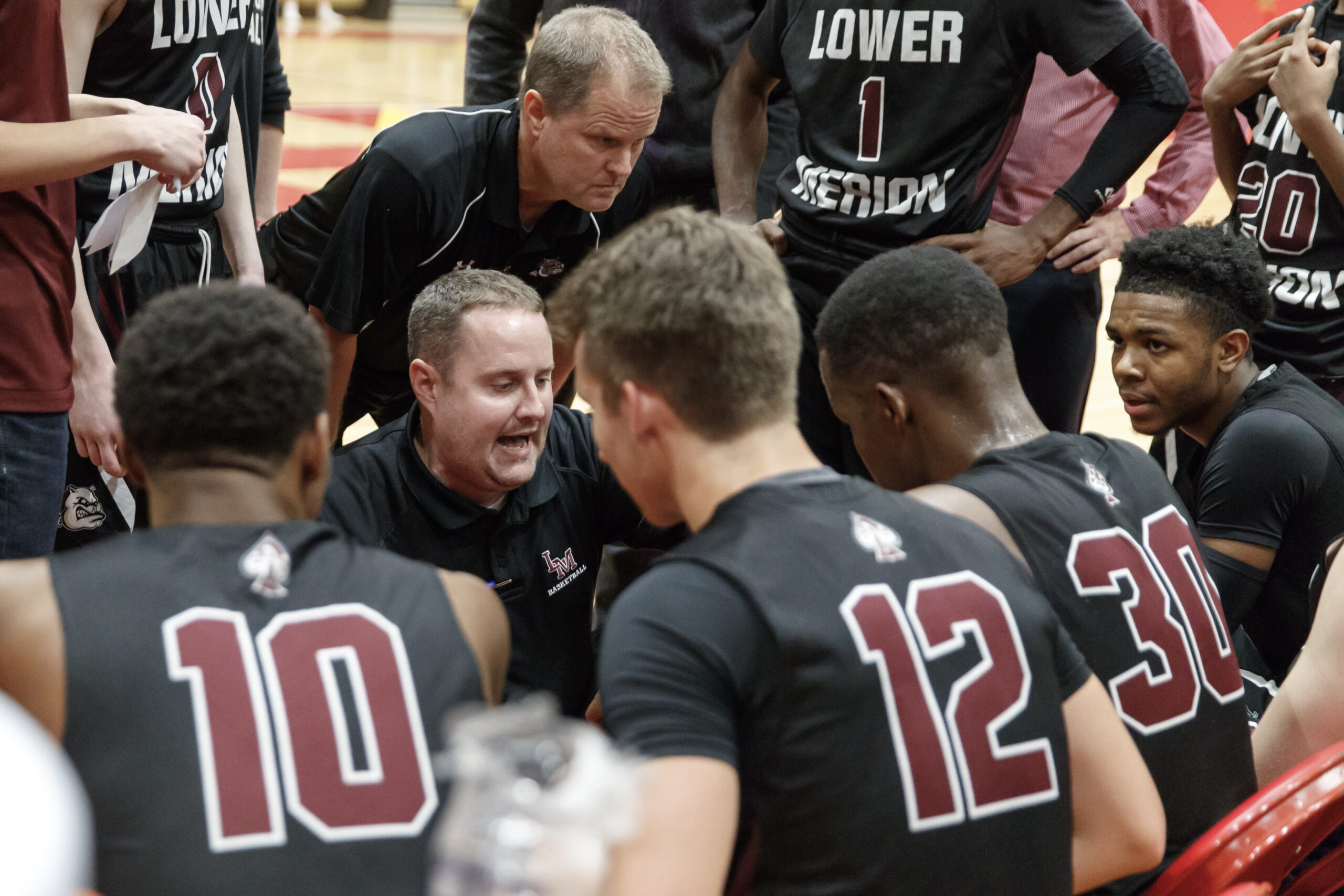
Philadelphia Catholic League basketball was a fixture for Kevin Grugan — a mild obsession, even — throughout his childhood. Growing up in Rhawnhurst, he had deep and natural ties to Father Judge’s program in particular. His uncle, Ron Zawacki, was an assistant under legendary head coach Bill Fox, and Grugan competed in Judge’s summer basketball camps, went to the Crusaders’ games on Friday nights and Sunday afternoons in the winter, and graduated from the school in 1996.
“I would watch the games,” he said, “and be enthralled.”
His fascination had faded by 2007, when Lower Merion High School’s administration hired him to teach math and assist Gregg Downer, the school’s longtime boys’ basketball coach. The subsequent years have not reignited his nostalgia for the old days of Northeast Philly hoops. In fact, in his role as a coach at a suburban public school, Grugan has come to resent what he perceives as an uneven playing field throughout Pennsylvania sports. Parochial, private, and charter schools, after all, don’t have borders; they can draw their students, and their student-athletes, from anywhere. Public schools can’t.
Kevin Grugan is a longtime boys’ basketball assistant at Lower Merion.He believes competing against private schools has presented an uneven playing field throughout Pennsylvania sports: “High school athletics is about building a team, building a culture.”
“High school athletics is about building a team, building a culture,” Grugan said recently. “You’re devising competition. You’re learning from that competition. You’re trying to improve on the next game. But you go into those events, and suddenly standing across from you are multiple if not five Division I athletes. You can’t watch enough film to find that very secret flaw that nobody else has found.”
Grugan’s complaints have become common among Pennsylvania’s public school coaches, administrators, parents, and players since the Catholic League and Public League moved under the jurisdictional umbrella of the PIAA in the fall of 2008. And that fierce debate about fairness could soon be cast in stark relief.
In April, the Pennsylvania State House of Representatives passed, by a 178-23 vote, House Bill No. 41, which would allow the PIAA to “establish separate playoffs and championships for athletics for boundary schools and non-boundary schools.” The Pennsylvania Senate can vote on the bill at any time but has not yet. A spokesperson for Gov. Josh Shapiro said that “the Shapiro administration is monitoring the bill as it moves through the legislative process” but did not have a position on it.
Shapiro and his aides might be the only people connected to Pennsylvania’s high school sports who don’t have a position on the bill or the public-private divide.
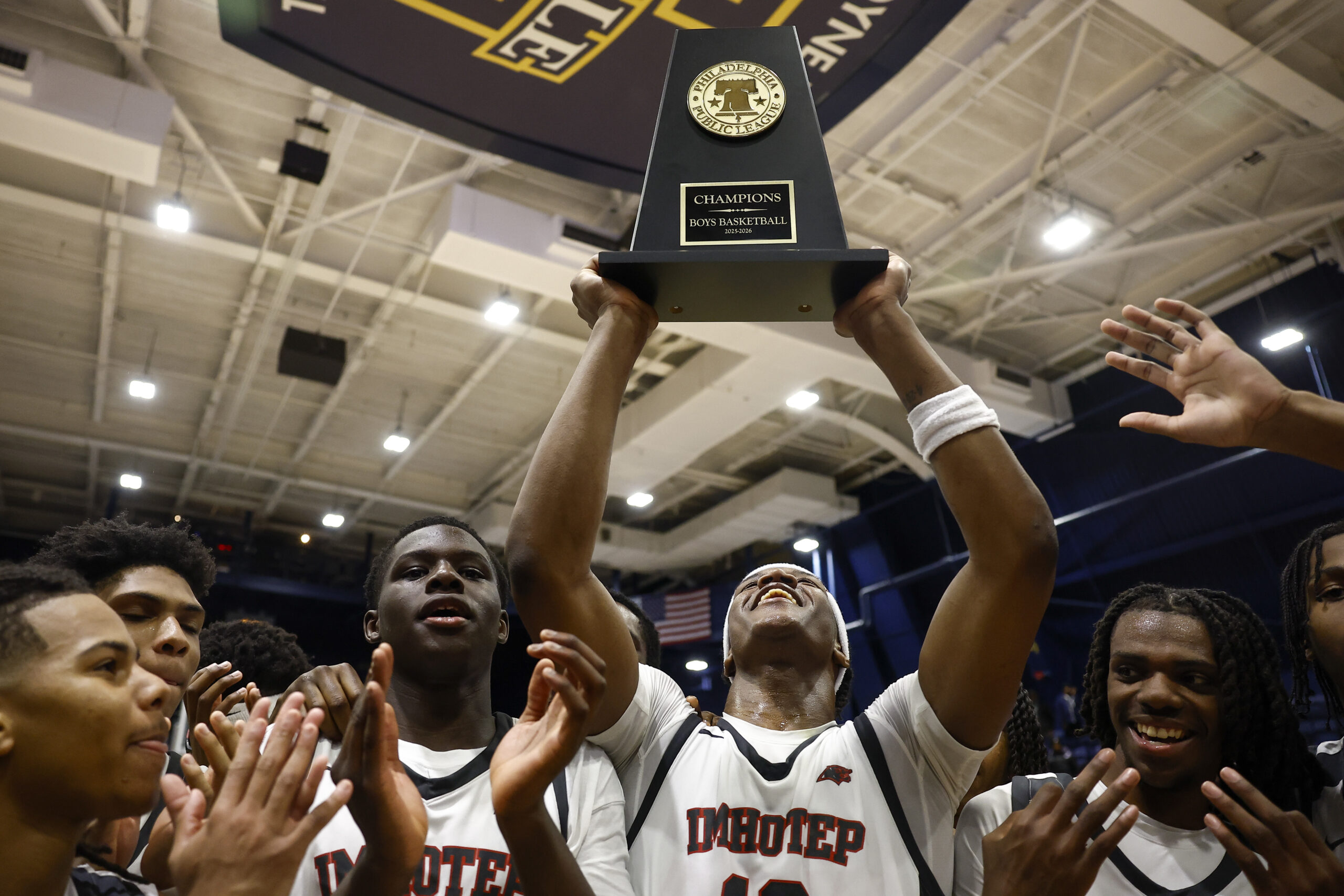
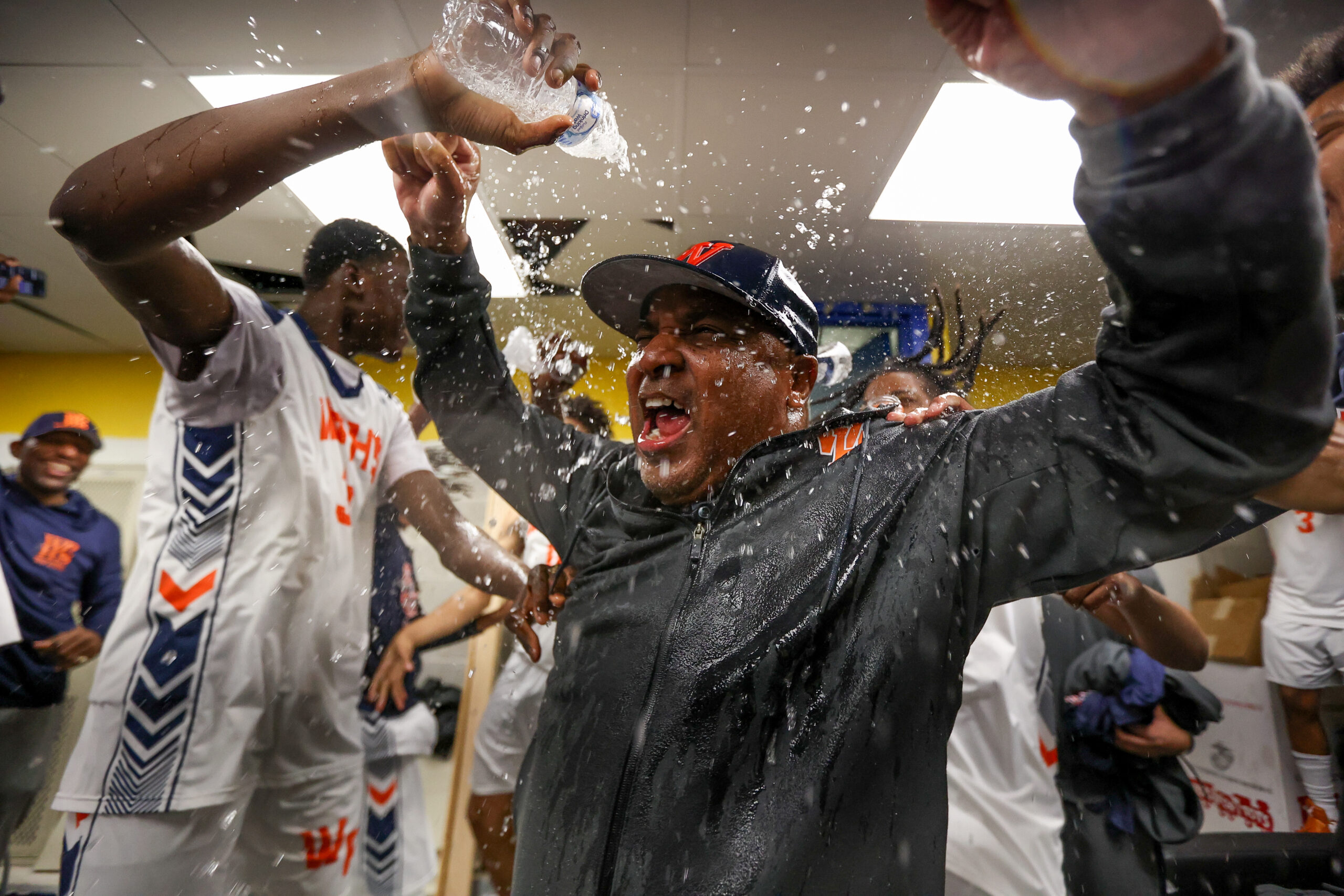
Imhotep Charter has won six consecutive Public League boys’ basketball titles.
It’s difficult to find a state issue that provokes such strong viewpoints and often-strident opinions. And this issue has plenty of big-picture and hyper-local tentacles, including the professionalization and commodification of high school sports, the question of athletics’ appropriate purpose and role in secondary education, and accusations that some non-boundary schools violate PIAA bylaws by recruiting student-athletes for the sole purpose of having them play sports.
“All we’re trying to do is say that part of high school sports is teaching kids how to play a fair game,” Rep. Scott Conklin (D), who introduced House Bill No. 41 and represents the 77th district, in State College, said in a phone interview. “It’s something they can use for the rest of their lives. We don’t want to teach them that there are two sets of rules: one set for a boundary school, one for a non-boundary school.”
The traditional city and neighborhood rivalries within the Catholic League mean more to some coaches, players, and fans than the district and state tournaments do.
Conklin cited player safety, particularly within football, as a primary reason for House Bill No. 41, arguing that non-public schools can attract more athletes — and more athletes who are bigger, stronger, and faster — than their public opponents can.
“The boundary school may have 18 really good players; they play offense and defense,” he said. “By the second quarter, those kids are tired, and that’s when children get hurt: when they’re gassed.”
He did not provide any statistical evidence to support this claim, and in a Dec. 3, 2024, memo he circulated to state House members to introduce the bill, he made it clear another factor was just as important, if not more so.
“When it comes to competition in team sports, especially football and basketball,” Conklin wrote, “the private, charter, and parochial schools have been dominant in state playoffs in recent years.”
Among the highest-profile sports, that dominance hasn’t been quite as severe as Conklin suggested. Consider these results since the beginning of the fall 2008 sports season:
Boundaryschools have won 54of the 92 football state championships.
Non-boundary schools have won 63 of the 86 boys’ basketball state championships, including 16 of the last 18.
Non-boundary schools have won49 of the 86 girls’ basketball state championships.
(function(){function e(){window.addEventListener(`message`,function(e){if(e.data[`datawrapper-height`]!==void 0){var t=document.querySelectorAll(`iframe`);for(var n in e.data[`datawrapper-height`])for(var r=0,i;i=t[r];r++)if(i.contentWindow===e.source){var a=e.data[`datawrapper-height`][n]+`px`;i.style.height=a}}})}e()})();
In an attempt to achieve and maintain competitive balance, the PIAA does use a formula, based on non-boundary schools’ success and the number of transfer students they accept, that can allow teams to move up in enrollment classification. Still, St. Joseph’s Prep, with an all-male enrollment of roughly 900 and without a football stadium on its North Philadelphia campus, has won seven PIAA Class 6A championships in the last 10 years while competing alongside the state’s biggest public schools, including North Penn, which has more than 3,000 students. What’s more, a recent donation of $74 million from Prep alumnus and billionaire entrepreneur Nick Howley is likely to help the Hawks separate themselves further from the 6A field.
“They’re just two different structures,” Prep president John Marinacci said. “All our student-athletes, whether it be football or anything else, come from the same geographic locations that our whole student body comes from. I know there are allegations out there that we have students from all over America. You know where the Prep is. It’s 15 minutes from Jersey. Do we have kids who play football who come from Jersey? We do. We also have a lot of kids who play other sports or don’t play sports who come from Jersey. The geographic reach of the school is what it is. We’re a regional school.”
St. Joe’s Prep has won seven PIAA Class 6A football championships in the last 10 years.
‘We’re coming’
Intrastate athletic competition among different types of Pennsylvania high schools is nothing new. In 1972, the state legislature amended the Public School Code to allow non-public schools to participate in postseason and championship events with public schools, and some private and parochial institutions have been members of PIAA leagues and conferences for years. When eight Delaware Valley schools came together to found the Pioneer Athletic Conference in 1985, for example, two of them were Lansdale Catholic and St. Pius X, and the members of the all-girls Catholic Academies League have long competed against suburban Philadelphia public schools within PIAA District One.
The issue took on increased salience both in the region and throughout Pennsylvania, though, when the Catholic and Public Leagues entered the PIAA 18 years ago. At the time, association members who might have raised questions about competitive fairness were cautioned against making any such case, according to a source who was directly involved in negotiating and implementing the expansion. If they did, the legislature would take steps to strip the PIAA of much of its power, oversight, and relevance.
The Public League has 73 member schools. But nearly half of them — 34 — are charters, including football and boys’ basketball powerhouse Imhotep.
“Almost every legislator’s child went to a non-public school,” the source said, “and everybody wants to have that state-championship medal. … They said, ‘Don’t try us, ’cause we’re coming.’”
So the Catholic and Public Leagues formed District 12, and the inclusion of the Public League counterbalanced the injection of private-school strength into the association only so much. The Public League today has 73 member schools. But nearly half of them — 34 — are charters, among them football and boys’ basketball powerhouse Imhotep, and the School District of Philadelphia’s open-enrollment policy can allow exceptional athletes to attend just about any high school and compete for any coaches or programs they want.
For the two leagues, the ostensible reasoning that justified joining the PIAA still stands up. It would lead to more fulfilling experiences for student-athletes: better (or at least more diverse) competition, travel outside the limits of the city and the suburbs that ring it, perhaps more exposure to and interaction with recruiters — and, of course, the opportunity to call themselves state champions.
(function(){function e(){window.addEventListener(`message`,function(e){if(e.data[`datawrapper-height`]!==void 0){var t=document.querySelectorAll(`iframe`);for(var n in e.data[`datawrapper-height`])for(var r=0,i;i=t[r];r++)if(i.contentWindow===e.source){var a=e.data[`datawrapper-height`][n]+`px`;i.style.height=a}}})}e()})();
“I’d go to college and hear somebody say, ‘We beat Neshaminy in a state championship game,’” said Father Judge basketball coach Chris Roantree, who won a Catholic League boys’ championship as a player with the Crusaders in 1997 before guiding them to back-to-back PCL titles and a PIAA Class 6A championship over the last two years. “I’d be like, ‘We played Neshaminy and beat them by 50. Are you really a state champion?’
“Here’s the thing: Philly is Philly. So if you want all the Philly kids to go to public schools, they’re still going to dominate. There’s so much talent in Philadelphia that it doesn’t matter where it goes. That’s a disadvantage for us. There are six, seven, eight, 10 good teams in the Catholic League. If they’re in the playoffs, they’re going to make some noise in the states. There’s a lot of good players spread out. I laugh at it sometimes, but we can only control what we can control.”
The Catholic and Public Leagues, loaded with student-athletes who have chosen to attend and play for their respective schools, have another advantage over the publics: They are in alignment with the generational shifts and trends throughout youth sports, as young athletes and their parents crave more freedom and place greater importance on AAU, club, and travel teams.
“We need to be looking at increasing the opportunities for kids,” District One chairman Mike Barber said. “If not, they’re going to find other places to play.”
It’s difficult to deny that, in this modern landscape, the PIAA benefits from the presence of private, parochial, and charter schools, that these programs infuse the association’s competition with more talent and prestige.
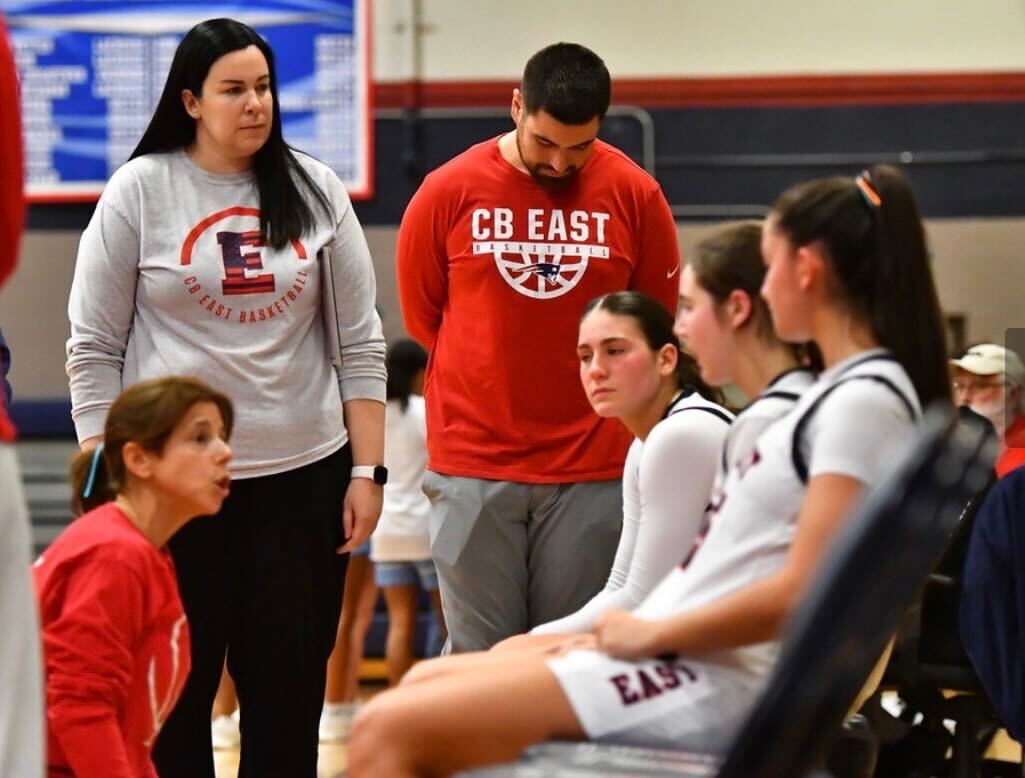
Liz Potash is the Central Bucks East girls’ basketball coach.She says “when I have to compete for the same championship [as a private school], there’s a disparity there, and I think obviously everyone is aware of that.”
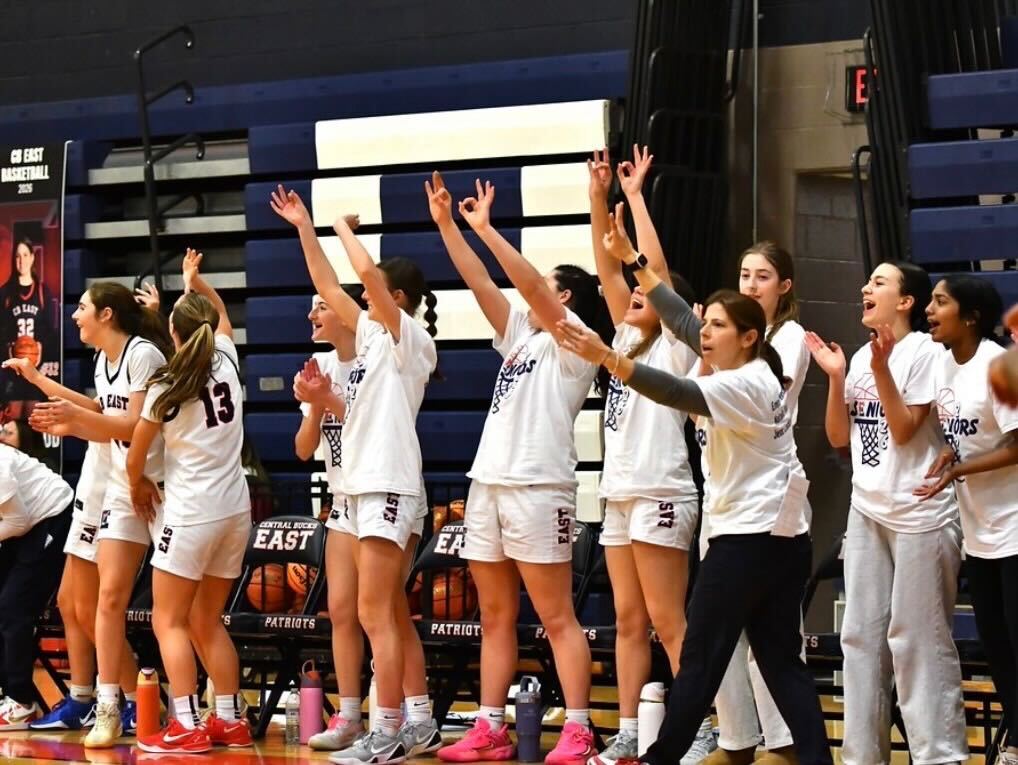
“What they do is unbelievable,” former Central Bucks East girls’ basketball coach Liz Potash said. “We played Archbishop Carroll in our Christmas tournament, and you watch that scout film, and you’re like, ‘Oh, my gosh! This is unbelievable.’ I have all the respect in the world for those programs. Where it gets me is in the postseason, when I have to compete for the same championship. Then it’s just not a level playing field. … I’ll play them in-season. I have no issue with that. But when I have to compete for the same championship, there’s a disparity there, and I think obviously everyone is aware of that.”
The reality that non-boundary schools can and do pull students from New Jersey, Delaware, and the suburbs that feed District One’s public schools has stoked plenty of us-vs.-them tension. Potash herself admitted to rooting for Perkiomen Valley during its run to the 2025 Class 6A girls’ hoops championship, and when CB East beat Germantown Academy — a private, non-PIAA program — last season, one of Potash’s fellow public school coaches called to tell her, Man, there’s nothing I like to see more than when one of us knocks off a team like that.
In 2025, Grace Galbavy, Quinn Boettinger, and Bella Bacani led Perkiomen Valley girls’ basketball to its first state title. The Vikings beat Archbishop Carroll to get there.
“District One and District 12 hate each other,” one area athletic director said, though Starr Davenport, the Philadelphia School District’s director of finance for athletics, tried to soften that assertion by drawing on a familiar rivalry as an analogy.
“You can compare it to almost Dallas vs. the Eagles,” she said. “We don’t really hate them. It’s a healthy, quasi-toxic athletic approach to, ‘We’re better than District One.’ It’s the proximity. It’s the ongoing battles that are close. It gets to the point where it’s one vs. the other, but I think there’s harmony and respect across both districts.”
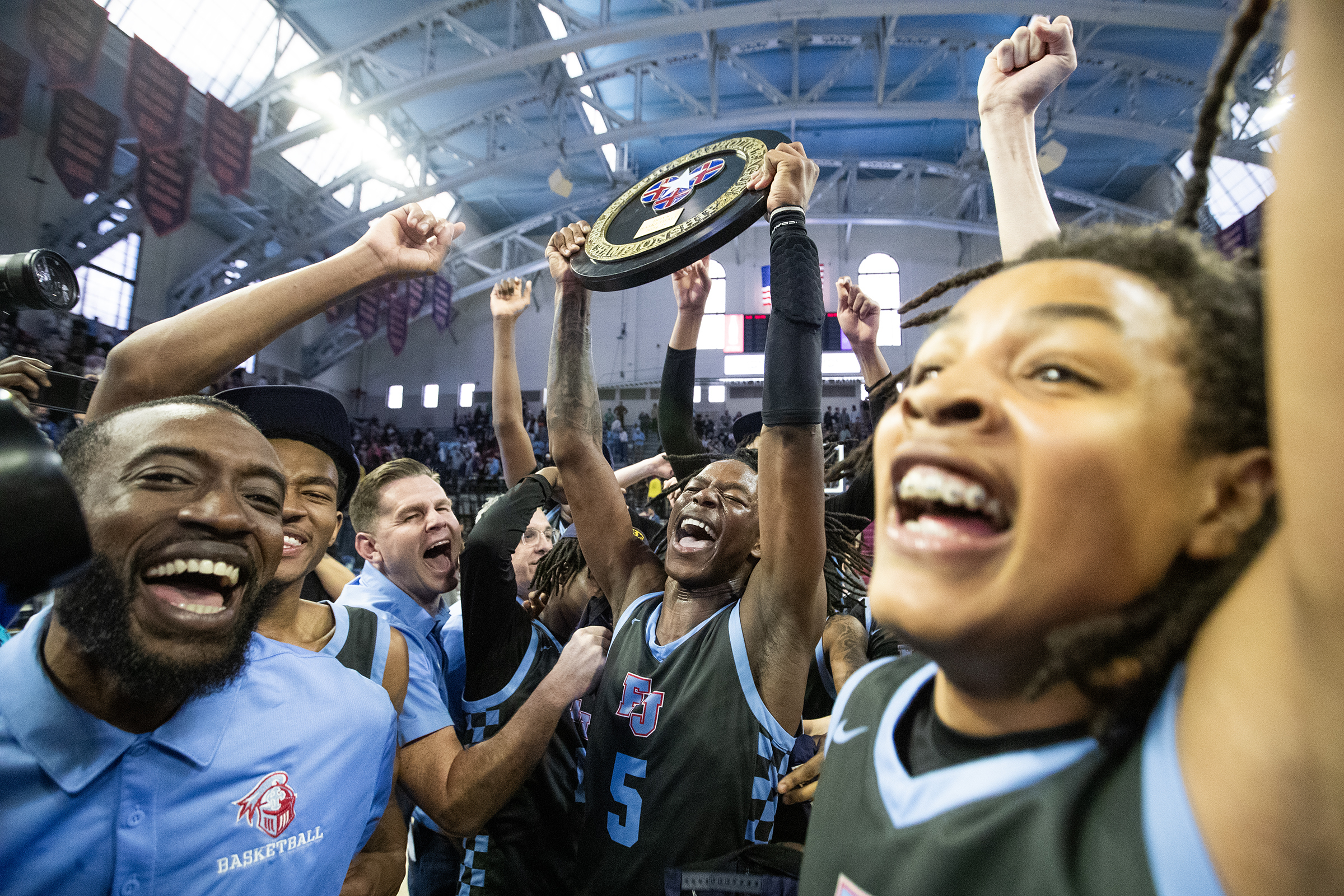
The irony — and, for many public school coaches, the frustration — is that the traditional city and neighborhood rivalries within the Catholic and Public Leagues mean more to some coaches, players, and fans than the district and state tournaments do. The rollicking sellout crowds filling the Palestra every year for the PCL boys’ basketball semifinals and the boys’ and girls’ championship games have been just the most obvious example.
West Philadelphia coach Adrian Burke values the history of the Public League, and winning the title carries more weight compared to other championships.
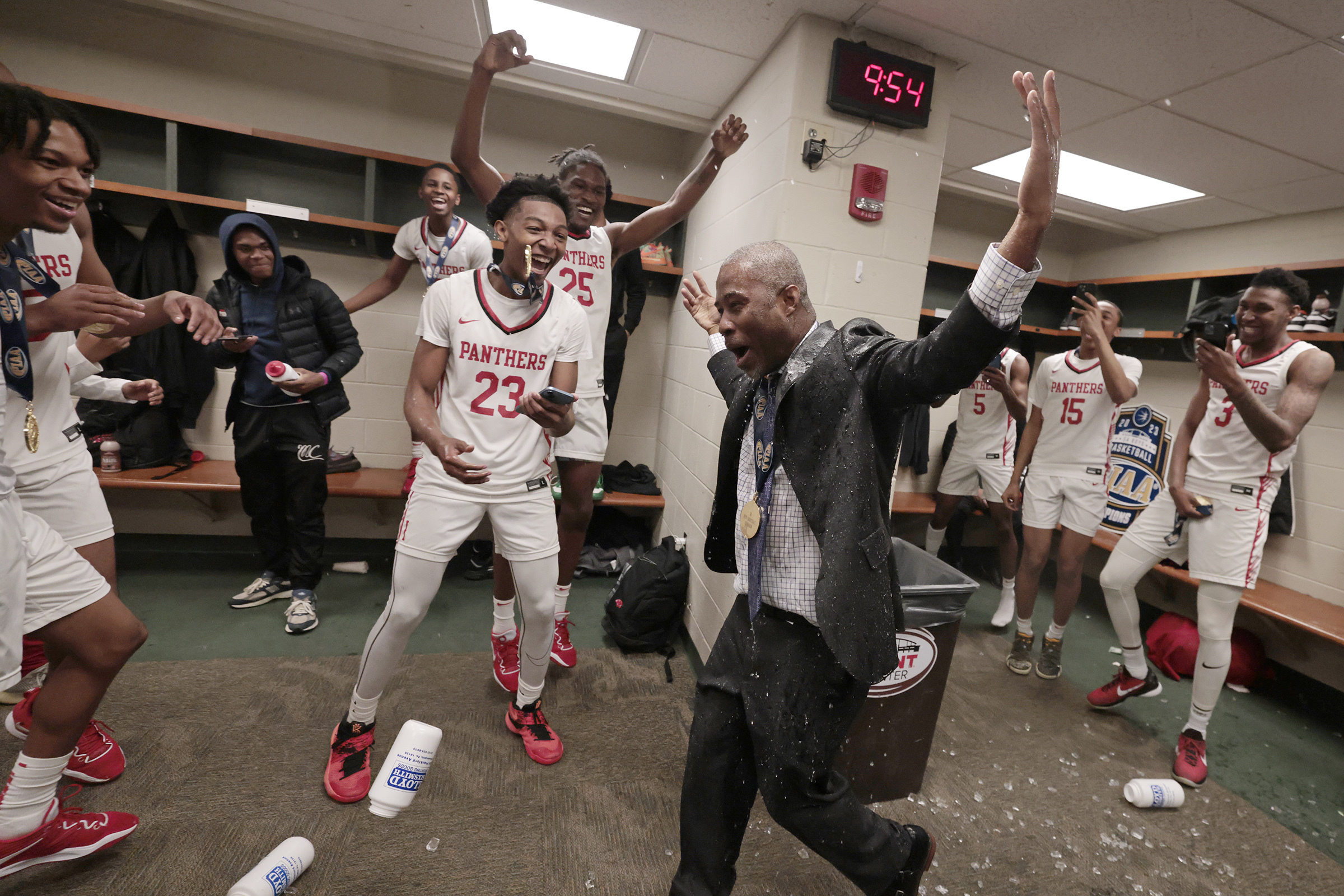
“We want to win the Pub,” West Philly High boys’ basketball coach Adrian Burke said in February, before his team lost to Imhotep in this year’s Public League championship game. “It’s legendary. You’re talking about some of the greatest basketball players ever. You’re talking about Wilt Chamberlain, Gene Banks. I could [go] on and on and on. When you think about the Public League, you think about all those guys who paved the way for us to play.
“We don’t care too much about districts. States is good. But we want to win the Pub.”
Father Judge won back-to-back PCL boys’ basketball titles and a PIAA Class 6A championship over the last two years.
A solution?
Splitting the PIAA playoffs into boundary and non-boundary brackets would not be unprecedented, but it would be unusual. New Jersey is one of four states that allows public and private schools to compete during regular seasons but keeps them separate for postseasons, according to a survey conducted earlier this year by the USA Today Network. Another four states, including Maryland, don’t permit boundary and non-boundary schools to play against each other.
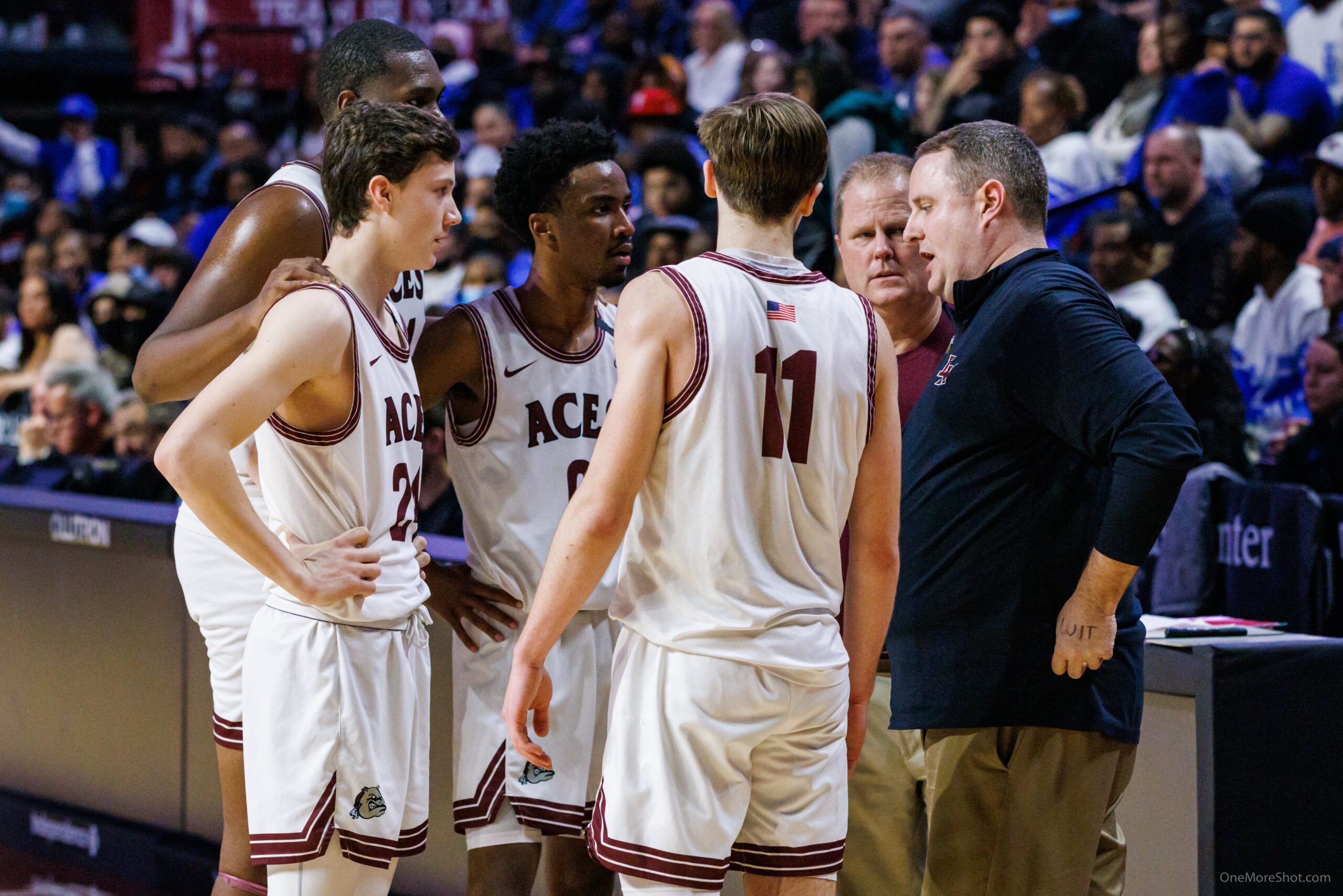
Grugan wouldn’t mind such a measure, wouldn’t mind seeing House Bill No. 41 signed into law and put into effect. Lower Merion won its last state title in 2013, and in 2019 and every year from 2021 through 2025, it lost in the state playoffs to either Roman Catholic or Archbishop Wood. The question that he, Rep. Conklin, and everyone involved or interested in Pennsylvania high school sports has to ask and answer is this: Is it better to have lost to these non-boundary teams or never to have played them at all?
“We keep making these decisions based on the idea that all high school athletes are performing at this high Division I level,” Grugan said, “and my thing is, most of the high school athletes you’re coaching are going to have a high school basketball experience and that’s it. And by the way, that’s a great thing. That is going to teach them so many lessons, and they’ll be able to thrive in other situations in their lives with amazing memories. We still celebrate big games by getting pizza. That’s as good a moment as anything we’re going to produce on the court.”
Staff news developer Chris A. Williams contributed to this article.
This summer, the largest sporting event in human history is moving across three countries, 16 cities, and 104 matches. Millions of people from every continent are passing through the same stadiums, the same airports, the same fan zones. As an infectious disease physician, I can tell you exactly what this is in epidemiological terms. It is a stress test.
Mass gatherings do not create new pathogens. They reveal the weaknesses present in the systems that receive them. I learned this in Ebola wards and in refugee camps, and I learned it again as the first chief medical officer for New York City during the first COVID-19 surge. The virus did not invent the cracks in our response. It found them, widened them, and poured through them.
So the right question about the 2026 World Cup is not “what new disease might appear.” It is “what is already broken, and what happens when we run a max-capacity crowd straight through it.”
Start with measles. The United States recorded its worst year for measles in more than three decades in 2025, and 2026 is on pace to be even worse. We have already crossed 2,000 confirmed cases this year. The country that declared measles eliminated in 2000 is now, by the assessment of its own scientists, likely to lose that status.
This is not a tropical import. This is a homegrown failure of vaccination, accelerated by official messaging that treats a settled question as an open debate. Measles is one of the most contagious pathogens known to medicine. A stadium is, by design, the most efficient room we have ever built for spreading it.
Now layer the rest. Three host nations means three health systems, three surveillance capacities, and three sets of rules that do not automatically talk to each other. Fans are crossing the Tijuana and El Paso corridors in volume. We will have a kaleidoscope of variable immunity without any uniform vaccine requirements or compliance, and thereby radically divergent vulnerability to infection.
Moreover, these systems are not connected. These countries rarely speak to one another and the current political climate has exacerbated it. A case detected in one country is only useful if the next country hears about it in time to act. During COVID-19, our data systems were often a week behind the virus. A week is a lifetime in an outbreak.
A clinic in Brownsnville, Texas, offers measles inoculations. Measles is just one of the infectious diseases that could be spread as people gather in large groups during the World Cup, writes Tyler B. Evans.
Then there is geography. Several Mexican host cities sit in dengue-endemic zones, and summer is peak mosquito season. Southern Hemisphere visitors are arriving mid-influenza season carrying strains our summer was not expecting. West Nile virus peaks in exactly the Southern U.S. cities hosting matches, in exactly these weeks.
None of this is exotic. All of it is predictable — whichshould worry us, because predictable means preventable, and preventable means that whatever goes wrong will be a choice, not an accident.
There is also what screening cannot see. Ebola is remembered as a disease of blood and isolation wards, but the virus can persist in survivors for months after recovery and can transmit sexually long after a patient is declared cured. Outbreaks have been seeded this way, quietly, by transmission that no fever check at an airport would ever catch. Record crowds could spread disease we have not thought to look for.
Here is the part that the risk charts miss. The people who will suffer most are not the ticket holders. They are the workers. The food handlers, the stadium cleaners, the hotel staff, the rideshare drivers, the street vendors. They are disproportionately low-income, often uninsured, frequently undocumented, and the least able to take a sick day or see a doctor.
When transmission runs through a city, it does not stop at the stadium gate. It follows the bus lines home to the neighborhoods with the least health infrastructure and the most people sharing the least space. This is the pattern of every modern pandemic. The pathogen is universal. The suffering is sorted by income.
The same sorting applies to the infections we never put on a risk chart. Sexually transmitted infections rise wherever large numbers of people gather, travel, and disperse, and they fall hardest on the people with the least access to testing and treatment. Syphilis is already at its highest level in the United States in decades. A surveillance system built around fevers and symptoms will miss these. What we fail to look for, we fail to find.
We know how to prevent this. The tools are not mysterious. Real-time, trinational surveillance that shares data across the CDC, Canada’s public health agency, and Mexico’s IMSS. Vaccination campaigns that meet visitors and workers before they gather, not after they fall ill. Mosquito control in the cities where the vectors are already breeding. Food and water safety enforcement scaled to the size of the crowd. Medical teams embedded at venues, and clear, accurate public health messaging that treats people as adults rather than as a constituency to be managed.
None of that is expensive compared to the alternative. It is, however, unglamorous, and it requires a federal posture that takes infectious disease seriously rather than treating vaccine science as a matter of opinion. That is the variable none of us can predict. The mosquitoes will behave as mosquitoes do. The viruses will behave as viruses do. The open question is whether our institutions will behave as public health institutions are supposed to.
I have spent nearly three decades working in global health across dozens of countries, and I have watched leaders in resource-poor settings mount more coherent outbreak responses than wealthy nations that simply chose not to. Capacity is not our problem. Will is our problem.
The World Cup is a celebration. I want it to be one. But it is also a mirror, and it is going to show us exactly what we have built and exactly what we have neglected. We still have time to act on what it reveals. The kickoff has already happened. The reckoning is still a choice.
Jamaaladeen Tacuma isn’t particularly interested in dwelling on the fact that he has just turned 70. It may be one of the few things the veteran bassist, with a seemingly limitless capacity for fascination, isn’t interested in.
“I was always the kind of person that looked ahead,” Tacuma said. “I like to say, ‘What am I going to be doing in the future? How will I be thinking in the future?’”
He marked his June 13 birthday not with old friends, but performing at South,leading a never-before-assembled, multigenerational quintet with Pulitzer-winning drummer Tyshawn Sorey, saxophonist and Snacktime cofounder Yesseh Furaha-Ali, guitarist Keyanna Hutchinson, and pianist Yoichi Uzeki.
On July 18, he’ll celebrate the release of a new all-star album with 102-year-old saxophonist Marshall Allen at Grounds for Sculpture in New Jersey. Two months later, he’ll be back at South with Quantum Blues, an unlikely quartet teaming him with longtime Pharoah Sanders guitarist Tisziji Munoz, Living Colour drummer Will Calhoun, and former Late Show with David Letterman keyboardist Paul Shaffer.
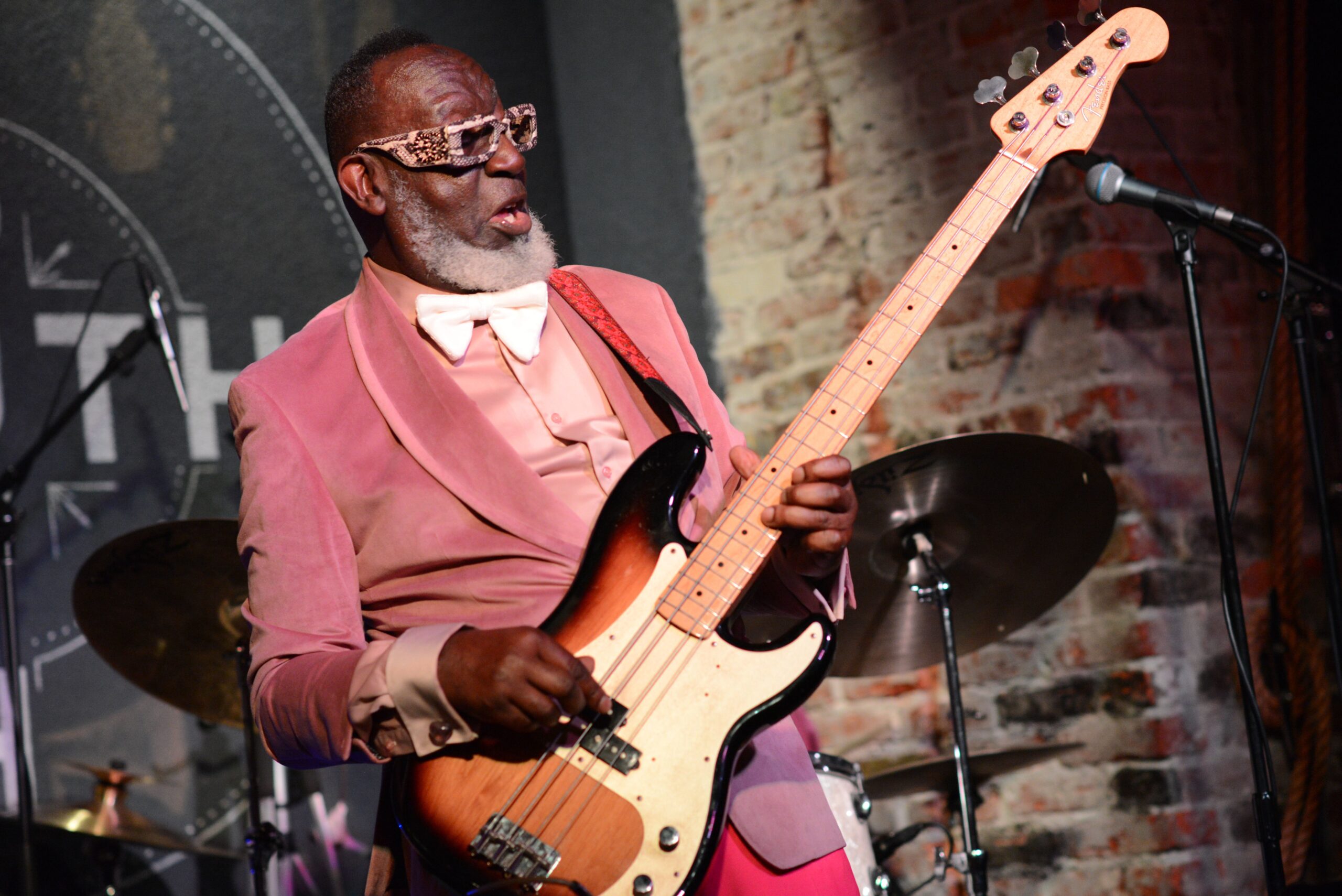
Jamaaladeen Tacuma on stage at South. The bassist celebrated his 70th birthday at the club in a quartet featuring drummer Tyshawn Sorey.
But it’s not just music that captures his imagination. Before settling in for our interview in May at a Mexican restaurant on Passyunk, Tacuma was gushing about his recent viewings of vintage films from Japan’s Toho studio, giant monster movies like the original Godzilla and The Mysterians.
The lunch, he said, evoked memories of a visit to Mexico City, where he learned of the country’s lucha libre wrestling tradition. This, in turn, prompted the recording of an upcoming album, Bajo Libre.
That sort of thing happens constantly with Tacuma, who has a Zelig-like ability to find himself in unexpected musical situations.
On a recent trip to London, he was being shown around by drummer Sean Noonan, a frequent collaborator. While passing though the Liverpool Street tube station, his ear was caught by the guitar playing of a young busker. He immediately tasked Noonan with finding a studio and enlisted the 18-year-old guitarist, Michael Asukyle, to record an impromptu album he called Mind the Outsiders, which was released last February.
Jamaaladeen Tacuma on stage with the Wiggles in Boston’s Wang Theater in 2023, where he presented band member Tsehay Hawkins with a special DiPinto bass.
After taking his grandson to see the Australian children’s group the Wiggles a few years ago, he bumped into the band over breakfast at Sabrina’s Cafe the next morning. By the time he got home, they’d invited him into the studio to write and record the song “Play the Bass Guitar.”
He’s since joined them on stage and on television, and plans to reunite with the band this summer at the Miller Theater.
Tacuma’s friendship with Rolling Stones drummer Steve Jordan — they met, he recalls, copresenting an award to the Red Hot Chili Peppers — led to an eight-year gig in the house band for the Michael J. Fox Foundation’s annual gala fundraiser, where he’s played with the likes of Sheryl Crow, Stevie Nicks, Jackson Browne, and Bob Weir.
Almost in spite of his compulsion to move perpetually forward, Tacuma’s 70th birthday year has occasioned a number of opportunities for revisiting the past, as well.
In January, the bassist returned to the Norris Apartments housing project, where he grew up as Rudy McDaniel.
Joined by a group of local singers and musicians, many of whom he’d known since his early days in North Philly, he presented his “The Dream Then & Now” suite, dedicated to the Rev. Dr. Martin Luther King Jr. As Lawrence “Weas” Newton recited the civil rights leader’s words, Tacuma struck up a funk groove in the complex’s community center, a poster board nearby displaying photos of him playing in the same room as a teenager.
Bassist Jamaaladeen Tacuma on stage with vocalist Lawrence “Weas” Newton in January at the Norris Homes Community Center.
“It was surreal,” Tacuma said with a laugh. “Weas and I grew up in the area. We used to play ball in the basketball courts right next door. A lot of groups came from that area, like Harold Melvin & the Blue Notes, the Stylistics, McFadden and Whitehead, Brenda & the Tabulations. And the Uptown Theater was right around the corner, so I saw everybody there whenever those shows would come to town — the Temptations, James Brown.”
The neighborhood not only nurtured Tacuma’s passion for music but also inculcated his love of fashion.
“If folks had money, they would go downtown and go to Boyds,” he explained. “But for the most part, we would go to the Avenue, Germantown and Lehigh. There you had all the stores, like Leo’s or Al Schaeffer’s Red Carpet Room.”
Tacuma later borrowed the name of one of those shops for his boutique, the Redd Carpet Room. There he sells the finds he brings home from his travels; he can often be found at flea markets and vintage shops in the hours prior to a performance.
“I don’t take bass guitars on tour anymore,” he said. “I just bring a suitcase to fill with clothes. I’m serious about helping guys look a bit better.”
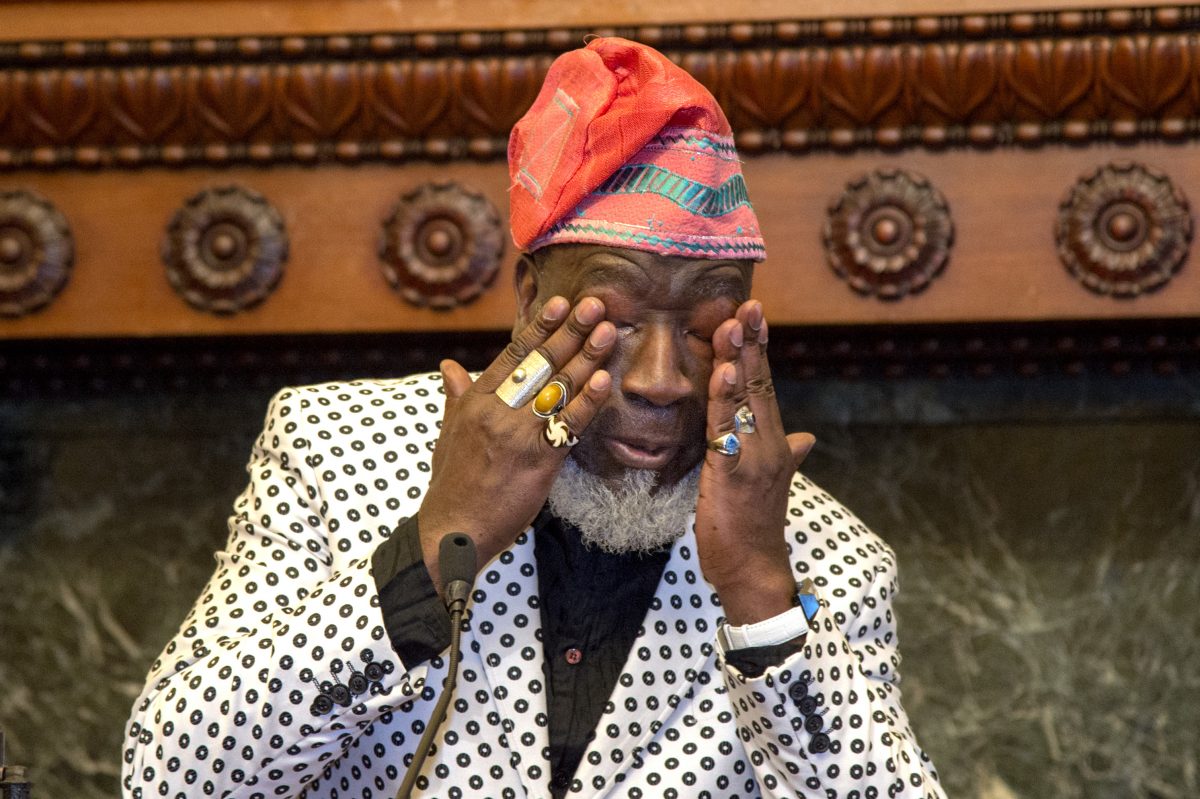
Bassist Jamaaladeen Tacuma wipes away tears after he was presented with the 2018 Benny Golson Award by the mayor at City Hall on March 29, 2018.
A month after his MLK Day performance, Tacuma played the Sons d’Hiver festival in Paris, where he revisited the hotel that had become the home base for Ornette Coleman’s Prime Time band 50 years earlier, during Tacuma’s first tour of Europe.
“We were supposed to go to Paris for two weeks, and we wound up staying for three months,” he recalled. “I hadn’t been back to that place since that time. The same family owned it. We had lunch right next door, at the same restaurant where Ornette and I used to have lunch, sitting at the same table. It brought back a lot of memories.”
Coleman played a foundational role in Tacuma’s musical life. After high school, he received a scholarship to attend Berklee School of Music but declined.
“Because I wanted to be a musician that played on the road.”
Instead of college, he joined organist Charles Earland’s band but was fired after a year. He moved home, wondering what to do next, until a week later he received a call to audition for Coleman’s band.
Tacuma gives an impromptu solo performance in the Mayor’s Reception Room on March 29, 2018.
“I learned so many things from Ornette,” he said. “As a bandleader, he wasn’t dictatorial, but he knew what he wanted and he knew how to extract that from the members of the band. Also there was a seriousness about sound, the idea that if you really, truly hear something different, then you should express it. You don’t have to follow a trend.”
Those are lessons that Tacuma has carried with him over a remarkably diverse and unpredictable career spanning more than half a century. He has collaborated not just with a staggering variety of musicians but with visual artists, filmmakers, architects, and scientists.
When asked to take a moment to look back over it all, even he has to marvel.
“I think I’ve looked into the future so much,” he concluded, “that I have a lot of stuff now to look back on. I feel blessed that the creator has given me all this.”
WASHINGTON — Fifty years ago this week, President Gerald Ford’s helicopter arrived at Valley Forge in a dense fog.
After a speech to 15,000 people, he designated the Revolutionary War landmark as a national park before heading to Philadelphia, where an estimated crowd of 1 million gathered outside Independence Hall. Ford spoke soberly, recounting the story of a nation that, on its 200th birthday, should find confidence in its ability to both celebrate its founding ideals and ask “hard questions” in the pursuit of something better.
“The American adventure,” Ford said on July 4, 1976, “is a continuing process.”
Philadelphia’s 250th anniversary celebrations this week are set to feature no appearances from the president. No reflections on self-improvement from the commander-in-chief at the birthplace of American democracy, no luncheons with the Philadelphia mayor near City Hall, as Ford also did after his speech.
President Donald Trump has said he will instead use the occasion to throw “the most spectacular TRUMP RALLY” on the National Mall — one of several ways the president’s critics have said he has injected partisanship and self-serving events into what should be a unifying moment.
Trump’s stamp on “America 250” has been clear.
A UFC fight on the White House lawn branded as “Freedom 250” overlapped with the president’s 80th birthday and featured adulations directed at him. The Great American State Fair, which some Democratic-led states declined to participate in, opened last weekwith a campaign-style speech in which the president railed against DEI and transgender athletes. It also featured the U.S. Marine Band playing the Village People’s “Y.M.C.A.,” a Trump campaign rally staple. Transportation Secretary Sean Duffy, using an offensive term that combines liberal with a slur for people with intellectual disabilities, said the band was better than the “libtards” who canceled their performances because of concerns over Trump’s partisan behavior.
“This is really, more than anything else, an opportunity to attempt to bring us all together as Americans. That’s what past celebrations have done,” said U.S. Rep. Brendan Boyle, a Democrat whose district includes Independence Hall. “It’s just so tragic that for this anniversary, the president we have is Donald Trump, someone who is completely not capable of doing any sort of national unity-type event.”
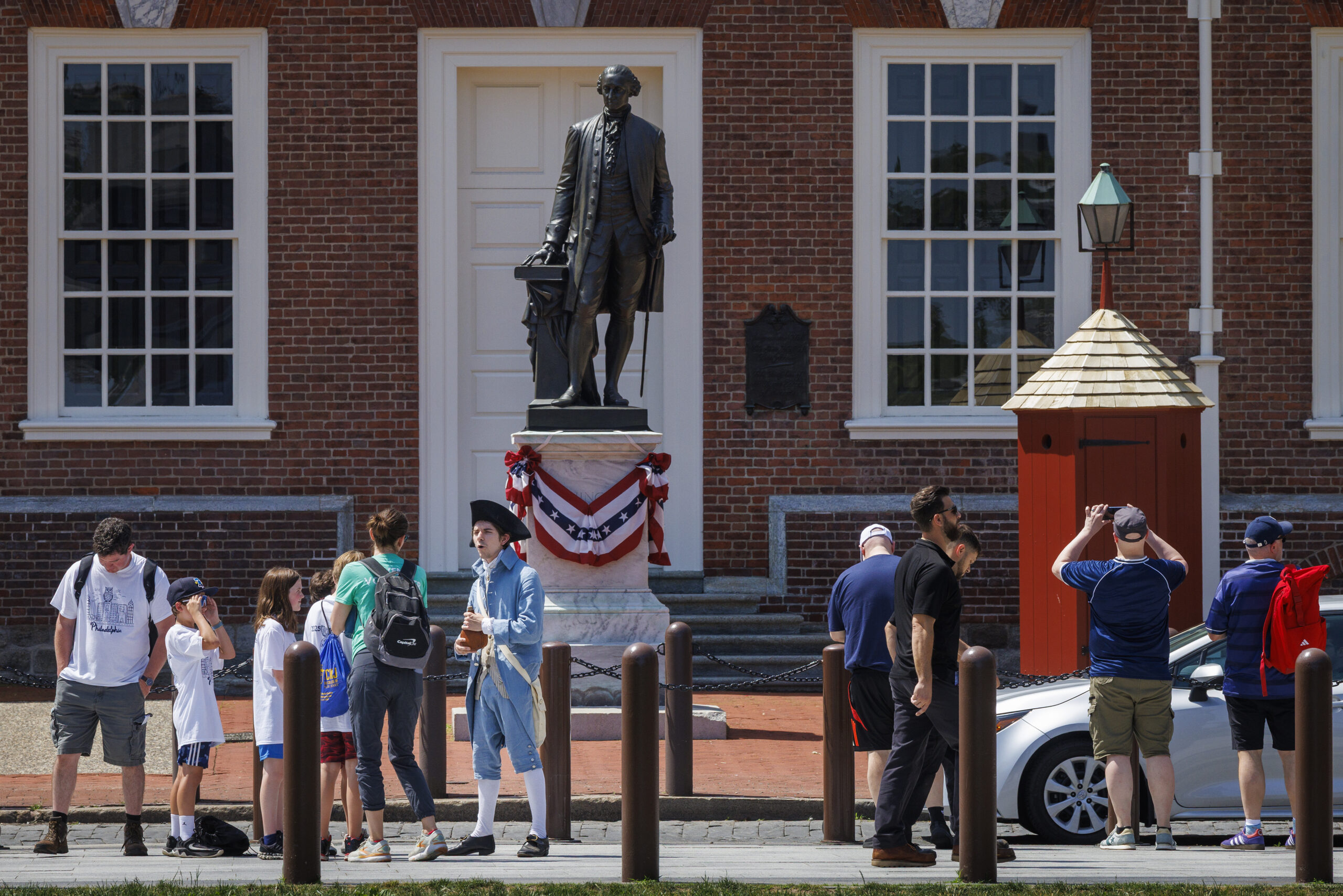
Historic Interpreter, Lane Norris, as Alexander Hamilton, speaks with tourists outside Independence Hall in Philadelphia.
Boyle worked for years to arrange a ceremonial gathering of Congress at Independence Hall for the 250th, which is set for Thursday. Though not officially a joint session outside of Washington — which has only occurred two other times since the capital relocated from Philadelphia — the event will mark the moment on July 2, 1776, when the Second Continental Congress voted to adopt a resolution for independence.
The commemorative moment “just gives me chills to think about it,” said U.S. Rep. Mary Gay Scanlon, a Delaware County Democrat who represents part of Philadelphia and plans to attend Thursday. Scanlon said she was hopeful the event will be bipartisan at a time when the president’s divisiveness was “taking an edge off the celebratory aspect” of the 250th.
Both Scanlon and Boyle described the president’s lack of plans to mark the moment in Philadelphia as disappointing. The White House did not respond to questions for this article, including whether it made any attempts to plan an event with the president in the city.
“I always just kind of assumed that the president of the United States would, at some point in the days leading up to the Fourth of July or even on Fourth of July itself, be in Philadelphia,” Boyle said. “But obviously this president has different priorities.”
Injecting polarization into apolitical events
Matthew Levendusky, a University of Pennsylvania political science professor who has studied how JulyFourth celebrations affect sentiments about national identity and polarization, said previous presidents participated in “patriotic, but not political,” events like concerts, fireworks, and parades.
Trump has taken a distinctly different path since his first term, Levendusky said, noting the military parade in 2019 and a speech at Mount Rushmore in 2020 when, after the murder of George Floyd in Minneapolis, he used the moment to criticize the removal of monuments that symbolized racial oppression.
The 250th events are an example of how Trump, a “conflict entrepreneur,” makes such events more political at a time when American society has already become more partisan, Levendusky said.
“There’s more debate over the meaning of American identity than there was a decade or 15 years ago — in part because there’s been more polarization,” said Levendusky, the director of Penn’s Institutions of Democracy at the Annenberg Public Policy Center. “But he’s also done things that inject polarization into that process.”
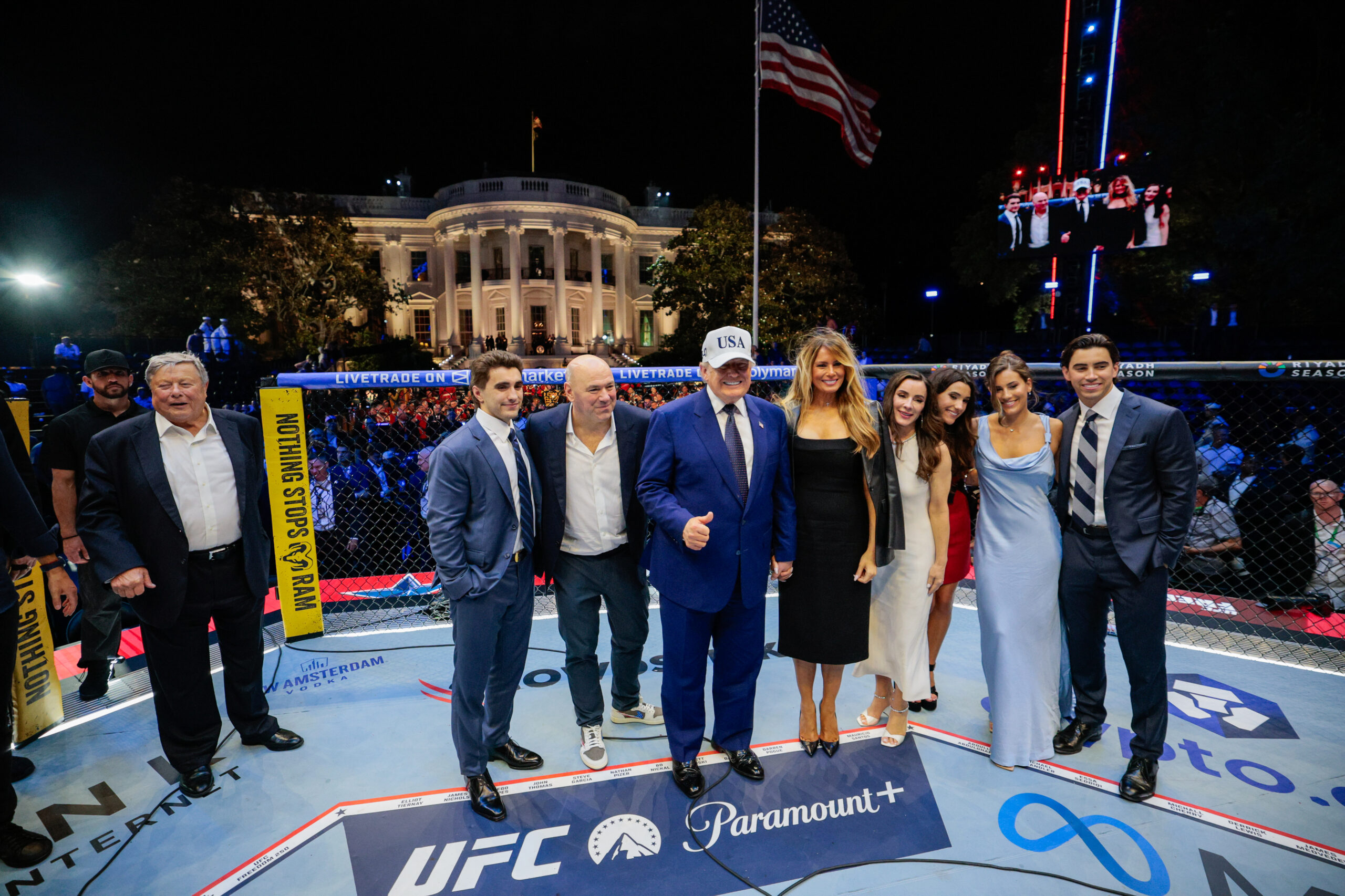
President Donald Trump, first lady Melania Trump, UFC president and CEO Dana White, and other guests pose inside the octagon after UFC Freedom 250 on the South Lawn of the White House, Monday, June 15, 2026, in Washington. (Evan Vucci/Pool Photo via AP)
Those actions appear to have affected how voters feel about America’s democracy 250 years in — at least among Philadelphia’s largely Democratic electorate.
According to a new Suffolk University/Philadelphia Inquirer poll that surveyed 500 city residents, 70% of Philadelphians believe Trump’s presidency has made them feel less confident in the country’s democracy. The answers were strongly correlated to political party, with more Republicans than Democrats saying that Trump’s presidency made them feel more confident in democracy or that it made no difference.
Tourists flocking to the city have reflected those ideological divides but also a bipartisan desire to set politics aside for a historic milestone.
“We’re all Americans, I don’t care who the president is,” said Greg Sage, 55, a Republican from Michigan who voted for Trump and toured the city’s historic sites this month. “I try not to politicize it, you know? But I believe we’ve been around 250 years. Maybe we’ll make another 250.”
Phyllis Ahnberg, 68, a Democrat from California, said that it was “empowering” to visit Philadelphia’s sites and that she would not let one person or administration change how she celebrated a moment for unity. Still, it was hard to ignore Trump’s impact during a recent trip to Washington.
“We were up at [the] Washington Monument, and we were looking, and it was disgusting to see the White House and this, like, fight thing,” Ahnberg said, referencing the towering structure built to host the UFC fight on June 14. “And to see the East Wing torn down … I mean, it was disgusting. Nobody hired this man to do that.”
U.S. Sen. Dave McCormick, Pennsylvania’s highest-ranking Republican and a close Trump ally, attended the fight and posted on social media that it was an “incredible evening” that honored “the strength, resilience and spirit of the American people.” His office did not grant a request for an interview for this article.
Pennsylvania’s empty booth at the Great American State Fair on Thursday in Washington. On Saturday, Sens. David McCormick (R., Pa.) and John Fetterman (D., Pa.) announced that they had secured private-industry sponsors for the booth at no cost to taxpayers.
A debate over past and future America
Other Republicans on Capitol Hill have defended Trump’s role in the anniversary while using the moment to say they believe left-leaning Democrats are the primary threat to America’s democracy.
“We are in a fight right now to save the republic, and every American needs to take this seriously. You need to wake up,” an animated House Speaker Mike Johnson (R., La.) said at a news conference last week after three insurgent candidates backed by New York Mayor Zohran Mamdani, a democratic socialist, won competitive congressional primaries.
“Are we going to maintain our status as a constitutional republic on our 250th anniversary?” Johnson continued. “Or are we going to make a new choice and go down some road toward a communist utopia?”
A democratic socialist and state legislator, Rabb has been adamant about what he sees as a need for “radical” change. After speaking at an event titled “The Next American Revolution: Breaking Oligarchy and Making a New Democracy” in Washington last week, he said in an interview that Trump’s presidency has in some ways been a “valuable distraction.”
It is a particularly meaningful opportunity for him personally. A longtime family genealogist, Rabb has spoken often about his heritage as the descendant of both a signer of the Declaration of Independence — the slave-owning Philip Livingston — and Black abolitionists.
“I am an embodiment of the hypocrisy and the complexity of choices and systems that have never really been addressed … [and] that are very similar to what we had 250 years ago,” Rabb said. “Unless and until we have a real public, ongoing, and substantive conversation, it will be more of the same.”
Staff writer Andrea Padilla contributed to this article.
WASHINGTON — Americans have grown less proud of their country’s history or the way its democracy works over the past decade, according to a new AP-NORC poll.
Americans’ pride in the U.S. on several key attributes has dropped since 2017 — including the nation’s military and its political influence around the globe — according to the survey from the Associated Press-NORC Center for Public Affairs Research. This poll was conducted in April, as the United States and Iran fought over the Strait of Hormuz in a prolonged war that started with the U.S. and Israel launching strikes on Iran.
New Gallup polling also finds that only 53% of U.S. adults are “extremely” or “very” proud to be an American, the lowest reading in the trend dating back to 2001.
The findings point to a broad decline in patriotic sentiment over a tumultuous period that included most of President Donald Trump’s first term, the COVID-19 pandemic and rising inflation that contributed to a backlash against President Joe Biden. That timeframe also covers Trump’s return to the White House, where he’s taken more aggressive actions on immigration and issues abroad.
Much of the falling positivity comes from Democrats, who have become increasingly disenchanted with the country since Trump’s first term.
At the same time, most U.S. adults say that being an American is “extremely” or “very” important to their identity, highlighting an enduring connection, even as some become increasingly critical of the country’s past or the government’s current actions.
American pride declines on the armed forces, democracy
Americans’ pride in the way democracy works in the U.S. has declined 14 percentage points, falling from 42% in February 2017 to 28% now.
In addition, Americans’ pride in their armed forces has dropped 19 percentage points since 2017, and pride in the U.S.’s history has declined 14 percentage points. In each case, the drop is largely driven by Democrats, with some movement among independents as well.
Karla Galdamez — a 48-year-old Democrat who used to teach U.S. history — believes America has regressed under the Trump administration. While the Californian is not proud of Trump, she is pleased with how far the U.S. has come in 250 years.
“It’s a country that really wanted to be different and really wanted to be better,” she said. ”Despite some of the very ugly history that we have of segregation and slavery … if you look at the trajectory of the last 250 years, we’ve done nothing but get better and move toward a more egalitarian nation.”
Only 14% of Democrats and 28% of independents say they are “extremely” proud to be an American, according to Gallup’s new poll, compared with 70% of Republicans.
The AP-NORC poll found that Republicans are especially likely to be proud of the nation’s armed forces. About 9 in 10 Republicans say the military makes them “extremely” or “very” proud, compared with about 6 in 10 U.S. adults.
Samantha Fulks, a 40-year-old in San Antonio, Texas, says she’s proud to be an American and doesn’t hide it. The Texas Republican showcases that pride with an American flag in her front yard — as well as Trump flags in the back yard — and she plans to wear red, white, and blue on the Fourth of July. Fulks comes from a military family, and while she believes the country’s involvement in Iran is unnecessary, she remains a proud supporter of the military.
“I still support our troops no matter what they do,” Fulks said.
Being an American matters more for identity among Republicans, older adults
Matt Stafford, a 39-year-old in Massachusetts, is proud of being an American, even if the U.S. political system frustrates him.
He has a bald eagle tattooed on his back to represent the United States, its freedoms, and “all the things we’re supposed to stand for as a country.” But despite that national pride, he often finds himself frustrated by politicians on both sides. Stafford — a centrist who identifies as “politically homeless” — wants Democrats and Republicans to come together to look out for their constituents in middle America.
“I love America, but our biggest problem is how we’re pushing both sides — like the left and the right — to the extremes,” he said.
For many Americans, their partisanship is often intertwined with their national identity. The poll finds that Republicans are much likelier than Democrats or independents to say being an American is “extremely” or “very” important to their personal identity.
Younger people are also much less likely than older people to say being an American is highly important to their personal identity. About three-quarters of Americans ages 60 and older say being an American is highly important to them, compared with only about one-third of U.S. adults under 30.
Race or ethnicity matters more to Black Americans
The AP-NORC survey found that the vast majority of Black Americans — 73% — say their race or ethnicity is “extremely” or “very” important to how they see themselves, higher than the share that say that about being an American.
Vincent Harris, a 60-year-old in California, says his identity as a Black man rises above other attributes for him because of how Black men are treated in America.
“A lot of people are scared of Black men just because we are Black and we are male. And that’s crazy,” Harris said. “People don’t even take you for who you are as a person; they just look at your race.”
About half of Hispanic Americans say their race or ethnicity is highly important to them, compared with 22% of white Americans.
Black and Hispanic adults are also more likely than white adults to say their family’s ancestry or country of origin is highly important to their personal identity.
Harris, who identifies as a gay man, says being an American is “a wonderful thing” because of the freedoms that Americans have, despite the obstacles he’s had to overcome.
“It’s great to be an American — regardless of race, gender, sexual orientation, religion, or whatever. As long as you have that freedom of choice as an American, that’s a great thing,” Harris said. “Right now, I wouldn’t live in any other country in the world. I’m here. I love it.”
Beginning Wednesday, Medicare will cover GLP-1 drugs for weight loss for the first time, with patients responsible for a $50-a-month co-payment that makes it far cheaper than cash prices without insurance.
The move will unleash a surge in prescriptions for patients 65 and older and younger people with disabilities who are covered by the government health insurance program.
Generally, insurance coverage has been spotty for the revolutionary weight-loss drugs, largely because of the budget-busting impacts of high costs and huge demand. Coverage under Medicare, which covers 70 million Americans through the traditional insurance and privatized Medicare Advantage, will go a long way to plugging gaps.
But there are important considerations under the Trump administration’s initiative. The coverage is temporary, set to expire at the end of 2027. It is not known whether, or how, Medicare will continue coverage after its 18-month pilot, which is called the Bridge program.
“It’s certainly good news for Medicare beneficiaries who have been essentially shut out of the market for GLP-1s for weight loss if they wanted to use insurance coverage,” said Juliette Cubanski, vice president and director of Medicare policy at KFF, the nonprofit health care research organization. “However, it is a temporary program. It is not a permanent change in Medicare coverage.”
Unless the coverage is extended, millions of patients who are expected to benefit will face a choice beginning in January 2028 of paying higher cash prices for the drugs or stopping taking them ― which, based on the current GLP-1s, would probably cause their weight to rebound.
Additionally, coverage is not automatic. It is subject to preapproval under a process known as “prior authorization,” which can slow down access even for patients who qualify. The Centers for Medicare and Medicaid Services has outlined a process requiring multiple steps between providers and pharmacies and its insurance contractor for the project, Humana.
“I think that is going to cause a bit of friction in the process,” Cubanski said.
CMS said it expects preapprovals to take under 72 hours. Here are answers to essential questions about how the program will work.
What drugs will be covered?
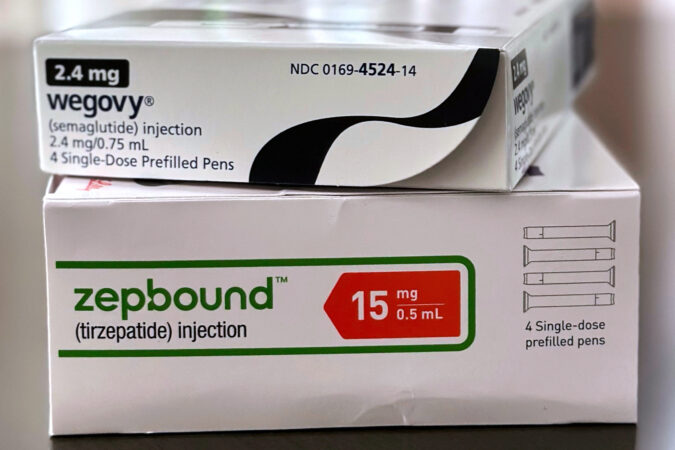
Eli Lilly and Novo Nordisk, the manufacturers of brand-name GLP-1 drugs, are the suppliers through a deal with President Donald Trump’s administration. Eli Lilly’s weekly Zepbound injection and Foundayo daily tablet will be covered, as will Novo Nordisk’s Wegovy, both in weekly injection and daily pill form.
“These treatments are a major medical advancement, but too many seniors are currently unable to access them due to high cost,” CMS Administrator Mehmet Oz said, announcing the plan last month.
People taking Zepbound on average lost 21 percent of their body weight over 72 weeks in clinical trials. Wegovy injection patients lost 15 percent over 68 weeks, and Wegovy pill patients lost 13.4 percent after 64 weeks. Foundayo patients attained 11.1 percent weight loss over 72 weeks.
Who qualifies?
The government’s criteria for coverage is aimed at making sure beneficiaries whose health is at risk because of obesity get access through Medicare. Patients looking to lose weight for lifestyle or cosmetic reasons won’t qualify.
The criteria is based on an individual’s “body mass index,” which is a calculation that takes into account height and weight. People will qualify if their BMI is equal to or greater than 35.
Someone with a BMI of 30 or above will qualify if they also have one or more of these other health conditions that puts them at risk: heart failure, uncontrolled high blood pressure or kidney failure.
A person can qualify with a BMI as low as 27 — which is considered overweight, not obese — if they also have prediabetes, a history of heart attack, a previous stroke or symptomatic peripheral artery disease.
Crucially, even if someone’s BMI is below the threshold, if they started one of the weight-loss drugs before the CMS program started when they were within the qualifying range, they still will be covered.
For example, if patient had a BMI of 38 when they began taking Zepbound, but are now at 31, they will still qualify for the benefit.
Who handles prior authorization?
Winning coverage approval could prove to be an ordeal, and doctors are bracing for bottlenecks — especially with a huge volume of prescriptions flooding the system starting Wednesday.
“It’s going to be a lot all at once: the number of prescriptions, the paperwork, the prior authorizations, the work for the clinics, patients and pharmacies,” said Christopher Weber, medical director of bariatric services at Ascension Wisconsin and a board member of the Obesity Medicine Association.
CMS is expecting prior authorization requests to be approved within 24 to 72 hours.
“I would not be surprised if it’s substantially longer,” Weber said.
The 18-month pilot is being operated outside the Medicare Part D drug benefit, so the private health insurance companies that offer Part D plans are not involved. Instead, the Centers for Medicare and Medicaid Services has selected Humana to serve as the central processing point for deciding coverage. Humana declined to comment.
CMS said in response to questions that it is working to avoid delays.
“CMS has disseminated educational materials and will provide ongoing support to pharmacies and providers on the Medicare GLP-1 Bridge to ensure that clinicians and pharmacies have the resources that they need to engage with beneficiaries,” the agency said.
Why is this program temporary?
Federal law prohibits Medicare from covering weight-loss drugs, so the Trump administration is doing it under its authority to conduct a temporary “demonstration” project.
The relatively short-term nature of the benefit — called the Bridge program — is raising practical and policy questions.
“When it expires, it is unclear how beneficiaries will access GLP-1 medications at an affordable price,” Stacie B. Dusetzina, a health policy professor at Vanderbilt University wrote in a New England Journal of Medicine article published Saturday. That raises the prospect, she said, that patients will stop taking the drugs and regain weight, which will lead to “poor clinical outcomes.”
“The Bridge program could result in substantial additional governmental and beneficiary spending without providing longer-term health benefits,” she wrote.
Will the co-payment apply to my Part D deductible?
The $50-a-month co-payment cost will not count toward annual deductibles in Medicare Part D prescription drug plans, because the pilot program is separate from Part D. It also will not count toward the $2,100 Medicare out-of-pocket spending cap for drug coverage.
The Trump administration had planned another pilot where Part D plans would have managed the coverage, but not enough of the private plans expressed interest, because they were concerned about exposure to unknown costs with the anticipated burst of new prescriptions, Cubanski said.
“There is no evidence right now for making assumptions about how many additional beneficiaries will come into this market,” she said. “It left them with a lot of uncertainty.”
What if I was already getting the drug for diabetes under Medicare?
Patients who are already receiving Medicare coverage for one of the GLP-1 drugs for diabetes, cardiovascular disease and sleep apnea will continue to be covered by their Part D plan. They are not eligible to switch to the weight-loss pilot.
How much will covering these drugs cost taxpayers?
Eli Lilly and Novo Nordisk have agreed to sell the drugs to the government for $245 a month. That is in the middle of the range of what drug companies charge consumers without insurance, depending on dosage.
The Centers for Medicare and Medicaid Services has not released estimates of the total numbers of patients expected to take advantage of the program, or the expected spending.
Some clues are contained in a previous estimate released by the Biden administration, which proposed offering similar, long-term coverage in late 2024. It said the cost would be $25 billion over 10 years. That would equal $2.5 billion a year, which is likely to be a low estimate, given the explosion in national demand.
The Congressional Budget Office estimated it could cost $35 billion over eight years, with 12 million newly eligible people in 2026. That estimate has more generous criteria than what Medicare has adopted.
Medicare spending on the new breed of weight-loss drugs has been skyrocketing already, without weight-loss coverage, according to an analysis by KFF. It reached $27.5 billion in 2024, although that gross spending was reduced by up to 50 percent by manufacturer rebates.
Cubanski estimated that weight-loss coverage could add another $4 billion to $5 billion a year to Medicare’s tab. “It’s essentially all additional spending by the federal government,” she said.
Of course, the hope is that helping millions of Medicare beneficiaries lose weight will reduce diseases linked to obesity, ultimately lowering costs. But when those savings will be realized, and how large they might be, remains unknown. The CBO estimated the savings for a longer-term program at $1 billion a year by 2034, a small fraction of the new spending.
Immigration is complicated. That makes polling on the topic difficult, as the same Americans who will tell you they support mass deportation one day will turn around and say they back a path to citizenship the next. So, which is it? Well, it depends.
As crowded scenes of immigrants clustering at the southern border were endlessly repeated on TV, many Americans felt the Biden administration was not taking national security seriously and had flung open the golden door to anyone with a pulse and a sob story.
Then, as U.S. Immigration and Customs Enforcement agents descended on Minneapolis, masked, heavily armed, and dangerously encouraged to ignore people’s constitutional rights — ultimately killing two U.S. citizens because they dared to question authority — even many Donald Trump supporters rose up to say this is not what they voted for.
Unsurprisingly, most Americans fall somewhere in the middle — where balancing immigration control with humanitarian values looks at what makes the most sense for the country and for the people who are looking for a better life here.
But that’s illegal immigration. On legal immigration, most Americans are all in, with only one in five opposing it. Why, then, is the Trump administration hell-bent on making life miserable for legal immigrants?
Earlier this month, a court ruled against an administration decision that froze processing of immigration benefits like work permits and green-card applications for nationals of 39 countries targeted by a travel ban. These are people already in the United States legally who found themselves in limbo for months — many losing their jobs and risking deportation — after U.S. Citizenship and Immigration Services determined in January it would keep the $1 billion in fees these immigrants paid and give them nothing in return.
Meanwhile, renewals under the Deferred Action for Childhood Arrivals (DACA) program for immigrants brought here as children have been hit with delays, and approvals of legal permanent residency applications, known as green cards, have fallen by around 16% — all part of the administration’s strategy of bureaucratic sabotage in the guise of “enhanced security.”
The administration has also banned permanent legal residents from qualifying for government-backed small-business loans, while some immigrants, including DACA recipients, can no longer hold commercial driver’s licenses, regardless of possessing a legal work permit.
Two U.S. Supreme Court decisions released last week will only continue to embolden the administration’s anti-legal immigrant push.
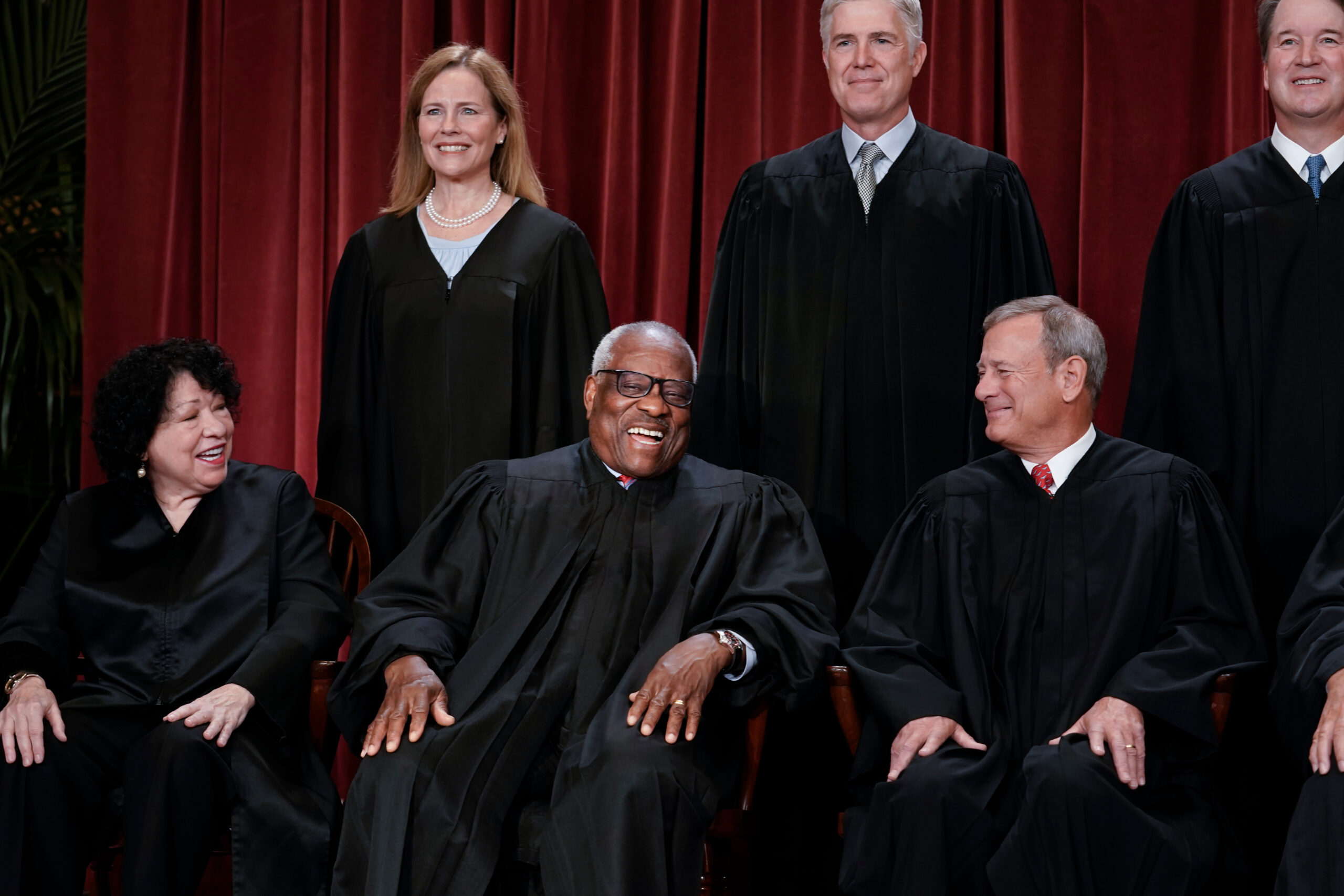
Members of the Supreme Court sit for a group portrait in 2022. Bottom row, from left, Associate Justice Sonia Sotomayor, Associate Justice Clarence Thomas, and Chief Justice of the United States John Roberts. Top row, from left, Associate Justice Amy Coney Barrett, Associate Justice Neil Gorsuch, and Associate Justice Brett Kavanaugh.
On Tuesday, the court’s conservative justices affirmed that border officers do not need “clear and convincing evidence” that a green-card holder seeking to reenter the U.S. has committed a crime to deny them entry. While I hope that one day the Clarence Thomas “border vibe check” joins the “Kavanaugh stop” in the annals of legal ignominy surrounding immigration enforcement, the court’s 6-3 decision makes a mockery of the idea that someone is innocent until proven guilty.
Perhaps even more immediately concerning is the high court’s ruling Thursday allowing the president to end Temporary Protected Status, or TPS, for roughly 350,000 Haitians and 6,000 Syrians.
The TPS program, a bipartisan congressional creation under President George H.W. Bush, gives immigrants work permits and protection from deportation if they come from countries determined to be too dangerous to go back to. While the word temporary is right there in the name, some program participants have been in the country for decades and have built lives here. For others, the nations they fled are still unsafe to return to, including Haiti, which is in the grip of gang violence and widespread hunger.
That the conservative justices also found that Trump’s comments against Haitians were not “overtly racial” is absurd. Trump infamously referred to Haiti and African nations as “shithole countries” in the same 2018 meeting in which he wondered aloud why America couldn’t have more immigrants from places like Norway. For context, this is the same administration that considers white South Africans the only persecuted minority worthy of asylum in the U.S.
For the moment, the court’s decision applies only to Haitian and Syrian immigrants with TPS, but it has opened the door for the president to do what he has wanted to do since his first term, which is to end the program wholesale. That would impact the 1.3 million TPS holders from around 17 nations and their families, many of whom are U.S. citizens.
While the human impact on communities of this mass de-legalization effort is immeasurable, the economic damage of Trump’s anti-immigrant policies is not.
The 500,000 or so DACA recipients, for example, contribute nearly $17 billion to the U.S. economy annually, also paying into federal social safety net programs they are not legally able to access themselves, according to the immigration rights group FWD.us. TPS recipients contribute about $29 billion a year to the economy and pay $7.8 billion in combined federal, payroll, state, and local taxes.
An immigration policy calculator produced by the Manhattan Institute finds that the kind of policies favored by the administration would add $618 billion to the national debt over 10 years, and leave every American poorer.
Reasonable people can disagree on immigration, but at the very least, Trump’s exclusionary ideas are an economic dead end.
Bill Meury got the call early last year after the last company he ran got sold for $3 billion. Billionaire biotech investor Julian C. Baker asked Meury: Would you be interested in running Incyte, a 2,800-person, publicly traded drug developer in Wilmington with $5 billion in yearly sales?
Under its previous CEO, Hervé Hoppenot, Incyte had multiplied sales of its breakout drug Jakafi (“JACK-ah-fye”), which treats blood cancers and transplant conditions. The company plowed revenues into hiring scientists, building labs, buying smaller businesses, and testing new products against the day Jakafi’s key patent runs out in 2028.
But new Incyte products were coming to market slowly. Shares peaked at over $130 in 2017, then fell into the $50s by early 2025, when Meury took over that June.
Meury’s signing-year compensation at Incyte was valued at over $30 million, mostly in stock grants and in options vesting over six years. (Hoppenot was given $17 million for his retirement year.)
With Meury as CEO — and Baker, whose firm is its largest investor, succeeding Hoppenot as board chair — Incyte shares have again topped $100 a share. Investors are hoping that Incyte delivers the drugs it has been readying for market — or that the company gets sold at a premium price like Meury’s previous employers Anthos, Karuna, Allergan, and Forest Labs.
Baker is also a director and investor in Madrigal Pharmaceuticals, a $1 billion (yearly sales), $12 billion (stock value) company based in Conshohocken, best known for Rezdiffra, which treats liver disease.
Meury, who has been building a top management team with new chief financial, human-resources, and strategy officers,took questions from The Inquirer in his office atop Incyte’s glass-fronted hillside headquarters near U.S. Route 202.
The interview has been edited for clarity and brevity.
Why did you take this job?
I did a great deal of diligence. I found their pipeline [of new therapies] was fundamentally under-appreciated. The company has excellent R&D and commercial capabilities. It has excellent potential products in three of the strongest areas of biotech — oncology, hematology, immunology — really good areas for long-term growth.
That’s ultimately what companies solve for. When you have products, you win.
Incyte has top-10 pharma scientists without the bureaucracy. Our researchers punch above our weight. Incyte is not a diversified giant, but it’s not a small start-up either. We avoid the downsides of both.
Just for one example, Patrick Mayes, our chief scientific officer, is out of the University of Pennsylvania. We have a very capable group of scientists — biologists, chemists, translational researchers, drug developers. We are able to colocate here in Wilmington, which results in faster iteration.
We have a lot to prove over the next couple of years. If we can advance half our assets through Phase 3 [clinical trial] to FDA approval of some scientifically and medically important products, Incyte will be much larger.
I believe we have the potential to double or triple [sales] in five to seven years.
For example?
We are developing the first oral-targeted treatment for pancreatic cancer, which has been considered an undruggable target for decades.
This is the Everest of oncology. Our scientists designed a small molecule to target KRAS G12D, a protein that causes [cancerous] cells [to reproduce uncontrollably]. We are in a race to be No. 1 with an approved treatment.
And we have therapies for a group of blood cancers and for colorectal cancer. These are first-in-class molecules that can make a pronounced difference for those cancers.
How can anyone avoid the ‘bureaucracy’ you say slows successful organizations?
You can’t solve bureaucracy through structure and process. You have to solve through the attitudes of exceptional leaders. Hervé built a great culture on good hiring decisions. You have a bunch of people that trust each other.
Failure is always right around the corner. Management has to be self-aware, to know the strengths and weaknesses of the employees. We are not running the company from 30,000 feet.
Do you expect your board and major shareholders will want you to sell Incyte, like your previous companies?
In general, companies can have two value-creation paths: There’s the independent path, and then there’s merger and acquisition.
The only path that a management team controls is the independent path. We are focused on running the company, building a great business for the employees, customers, physicians, and patients — and for the shareholders.
It hurts companies when there is a merger and acquisition theme all around them. If [buyers with offers] approach us, we have to listen. But we are building this company for the next decade. Most people want to work with a company that wants to be around in 10 years.
Vega has a novel compound [a treatment for an inherited blood disease] that we believe has potential sales of over $1 billion. If we can do several deals like this that fit one of our categories, in this case hematology, we will do them. These will never be more important than internal R&D, but each can be a multiplier for our business, with the right risk-and-reward profile.
By the time Jakafi loses exclusivity in December 2028 — and it may go beyond that — we will have $3 billion to $4 billion in non-Jakafi revenues.
Americans aren’t happy with the cost and availability of medical care, including drugs. Do you see any hopeful signs?
Three things have to be in place for biopharma to thrive: First, patent and trademark laws have to be predictable. Second, pricing policy has to be balanced. Third, FDA has to run effectively. There have been headwinds, but I think those pillars will be in place as disruption settles.
Are U.S. consumers and employers subsidizing world drug development with our high prices?
It’s true there’s an imbalance. But Americans have access to the best medical care in the world, such as novel cancer treatments.
But we have to get a better framework for global pricing. You’d like to see prices outside the U.S. come up, if they are going to moderate inside the U.S.
Can the U.S. compete with China?
China will be a source of innovation and competition. We have four or five major biotech centers in the U.S. They have 15. China is here to stay. For the U.S. to remain the leader, we have to create an environment where biotech can continue to thrive.
Incyte was founded in 2002 by scientists from Wilmington-based DuPont, but recent plans to grow your space stalled. Will Incyte keep growing here?
In the last two years we have added more than 150 [in Delaware] and anticipate adding another 250 [by 2031]. We will be here for as long as I’m here. The biotech labor market is not as strong as Boston, but it is strong here, with Thomas Jefferson and Penn in Philadelphia, and Johns Hopkins in Baltimore.
We’ll grow somewhere else if we have to. I’m not religious about it. But the base of this company is here in Wilmington.