Two men — an uncle and a nephew — were fatally wounded Sunday morning in Abington Township, Montgomery County, in what police said was a “murder-suicide.”
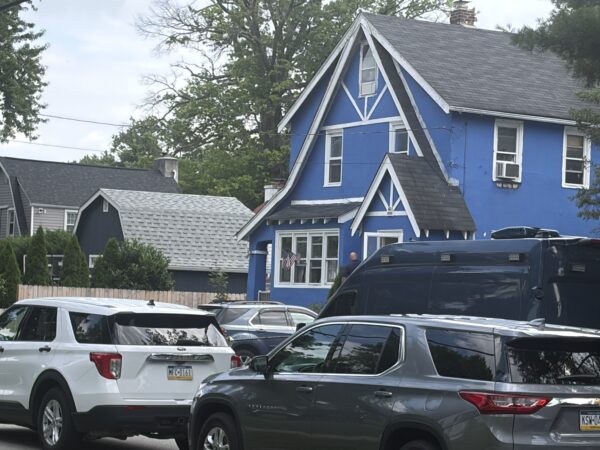
Responding to a 911 call of a shooting around 11 a.m., Abington Township Police discovered William “Billy” Mauer, 54, dead from a gunshot wound inside a home on the 3000 block of Spruce Avenue.
The two had been quarreling, police said.
The nephew, Brandon Maurer, 28, was also found in the house, suffering from a self-inflicted gunshot wound, police said. He was taken to Jefferson Abington Hospital and pronounced dead at 11:39 a.m.
At the time of the double shooting, police said, other unidentified family members were inside the home and were not injured. The nephew’s gun was recovered by police.
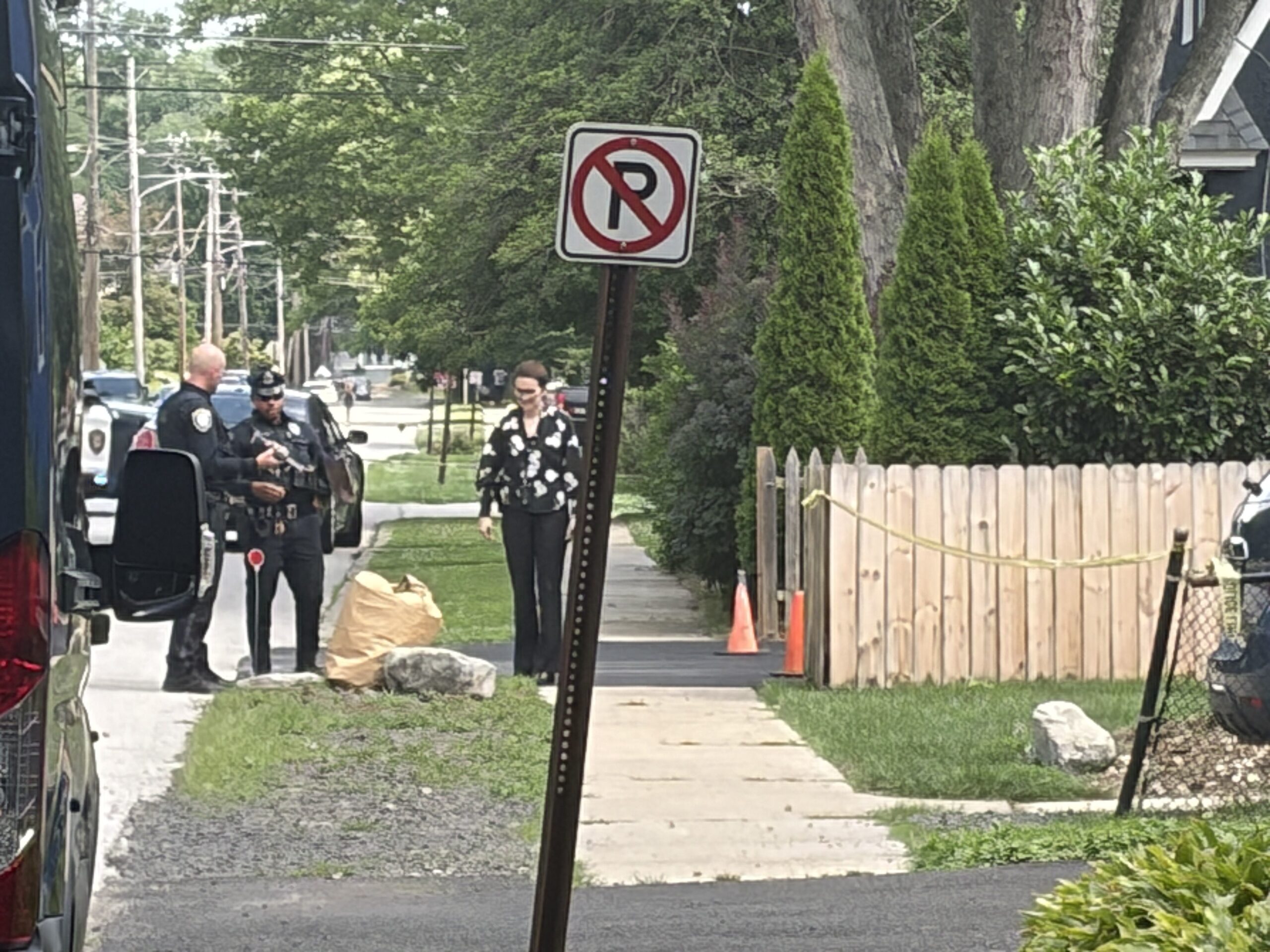
Abington Township police closed down the 3000 block of Spruce Avenue after the shootings.
With neighbors looking on, the block remained sealed off by police SUVs and caution tape Sunday afternoon while Montgomery County detectives and police continued to investigate.
It may be sweltering outside, but there is ice in our future.
Fresh off drafting the next generation, the Flyers will be in action, beginning on Monday and wrapping up with a five-on-five scrimmage Thursday night and a three-on-three tournament Friday morning.
Here’s what you need to know about Flyers’ development camp.
What is the schedule for development camp?
All on-ice sessions are free and open to the public at the Flyers Training Center in Voorhees. There will not be any on-ice activities on July 1, the first day of free agency. Instead, fans can attend an autograph session at The Franklin Institute from 3:30 to 5:30 p.m. A museum ticket is required to attend.
On Tuesday, Team Jones and Team Brière will skate from 4-5 p.m. on the Phantoms and Flyers’ Rinks, respectively. Thursday at 6 p.m. on the Flyers Rink, the two teams will square off. On Friday, a three-on-three tournament will wrap up the week at 10 a.m. on the Class of ‘67 Arena rink.
Who will be attending?
Among the 41 players in attendance, fans will get a chance to see the entire 2026 draft class don Flyers gear for the first time at development camp. But while everyone will be clamoring to see 6-foot-7 defenseman Maksim Sokolovskii, the 27th pick on Friday, there are several familiar faces to get an up-close look at.
Fresh off their first tastes of the NHL — regular season and the playoffs — Porter Martone, Denver Barkey, Alex Bump, and Oliver Bonk will participate in camp.
Centers Jack Berglund and Jett Luchanko will be at camp, but will not participate in on-ice sessions. Berglund has played a lot of hockey this past year between regular season and playoffs for Färjestad BK of the SHL, Sweden’s top men’s league, and World Juniors and World Championships for Sweden.
Ilya Pautov, a member of the 2024 draft class who signed an entry-level contract this spring, will make his development camp debut. He is expected to be playing for Lehigh Valley of the American Hockey League this season.
Of the last five draft classes, the only players still with the organization not attending are Matvei Michkov (2023), Yegor Zavragin (2023), Austin Moline (2024), and Max Westergård (2025). Forward Karsen Dorwart, who was signed as an undrafted college player, will be a restricted free agent on July 1 and is expected to get a qualifying offer by June 29. Every member of the 2026 class will be at development camp.
Forwards: Denver Barkey, Samuel Beauchemin, Jack Berglund,Alex Bump,Alex Čiernik, Christopher Duclair, Grady Deering, Sawyer Dingman, Matthew Gard,Devin Kaplan, Jack Kernan, Cole Knuble, Jett Luchanko,Ryan MacPherson,Porter Martone,Jack Murtagh, Jack Nesbitt, Noah Powell,Nathan Quinn, Heikki Ruohonen, Ilya Pautov, KJ Sauer,Riley Thompson, Shane Vansaghi
Defense: Carter Amico, Oliver Bonk, Matthew Desiderio, Jackson Edward,Spencer Gill, Alonso Gosselin, Leo Gruba, Max Laatikainen, Brek Liske, Maksim Sokolovskii, Riley Steen,Luke Vlooswyk
Goalies: Carson Bjarnason, Mathis Langevin, Martin Psohlavec, Marek Sklenička, Shane Soderwall
Things to keep an eye on
The Flyers have invited 11 players to attend camp this season.
Samuel Beauchemin is a winger who just put up 66 points in 64 games for Rouyn-Noranda of the Quebec Maritimes Junior Hockey League. His father, François Beauchemin, played 903 NHL games, and Samuel played his youth hockey for the Anaheim Jr. Ducks.
Swift Current of the Western Hockey League winger Sawyer Dingman, who was eligible to be drafted this weekend, is the son of former NHLer Chris Dingman. Forward Christopher Duclair, the shortest player in camp at 5-8, is the younger brother of New York Islanders forward Anthony Duclair.
Defenseman Matthew Desiderio is from North Jersey, and his fellow blueliners, Alonso Gosselin, who is 17 and played for Chicoutimi of the QMJHL, and Riley Steen, who played with the Ruck Twins for Medicine Hat of the WHL, were eligible to have been selected in the 2026 draft.
Keeping with the theme of having a tall team, of the 46 players attending camp, only 10 players are under 6 feet tall. The tallest is camp invitee Jack Anderson, a defenseman who stands 6-6. He just wrapped his third season at Lindenwood University and is committed to Michigan Tech in the fall.
The Cathedral Basilica of Saints Peter and Paul was a center of resilience Sunday, as dozens of Philly Venezuelans gathered to collect aid for folks affected by two earthquakes that struck the South American country on Wednesday.
Emilio Buitrago, 52, was driving home when his brother called, telling him a 7.2 magnitude earthquake had decimated their home city of La Guaira, about 18 miles north of Caracas, the capital. Less than a minute later, a second tremor took place, this time reaching a magnitude of 7.5.
One of his cousins was unaccounted for, for two days before being located on Friday morning.
“My three cousins lost their homes; they are alive by a miracle. My uncle managed to get out, but he’s injured,” Buitrago said. “They are sleeping in the street because it feels safer [in case buildings collapse] and they said it’s starting to smell like decomposing bodies.”
Since the earthquakes, Buitrago’s brother has been working nonstop, he said, removing rubble with his bare hands due to the lack of tools and machinery.
Thousands of miles away from home, Buitrago thought the best way to help was to go to the cathedral and help with collecting donations and praying.
By 1 p.m., 15 boxes sat on the area outside of the Cathedral’s chapel, being filled with donated masks, first aid supplies, medicine, electrolytes, nasal relief products, and more.
Alex Moreno, president of the local nonprofit Gente de Venezuela, said the donations will be sent to Caracas, where their contacts are connecting with on-the-ground rescuers.
“It has to be now, when we still have a chance to try to help get the people who are still trapped under the rubble out alive,” Moreno said.
So far, the death toll has risen to 1,430 people, according to CNN, with many Venezuelans taking to social media to ask for help moving the structural debris to rescue their loved ones.
Besides collecting physical donations, both Gente de Venezuela and another nonprofit, Casa de Venezuela, are raising funds through an umbrella group, the Venezuelan Organizations Network in the United States. By late Sunday afternoon, $16,310 had been donated for the effort, which has a goal of $75,000.
That money, Moreno said, is destined for buying tools to help rescuers dig through the rubble. A first batch of hammers, gloves, drills, masks, and other supplies has been purchased with that money and sent to Venezuela, Moreno said.
For future physical donations, he recommends following Gente de Venezuela and Casa de Venezuela to see where they will be receiving donations next.
“The hope is to try and help rescue as many people as possible, because the rescuers on the ground are saying that the tragedy is too big for the number of hands able to help back home,” Moreno said.
Despite the pain, the community is sticking together and his group plans plan to continue with their planned participation in the July 3 Salute to Independence parade in Philadelphia, to honor both the lives lost and the rescuers, Moreno said.
“Above all, we are people of resilience, and we will continue to be here to support our community,” Moreno said.
IRVINE, Calif. — Right now is a good time to remember that the U.S. men’s soccer team has won just one World Cup knockout game in its history.
In fact, every day for the rest of this tournament is a good time to remember that, especially leading up to Wednesday’s round of 32 contest with Bosnia & Herzegovina (8 p.m., Fox29, Telemundo 62).
This is the moment that the players have dreamed of, whether since growing up or since leaving Qatar four years ago. This is the moment Mauricio Pochettino was hired for, with U.S. Soccer bringing in hedge fund billionaires to help fund the famed manager’s salary.
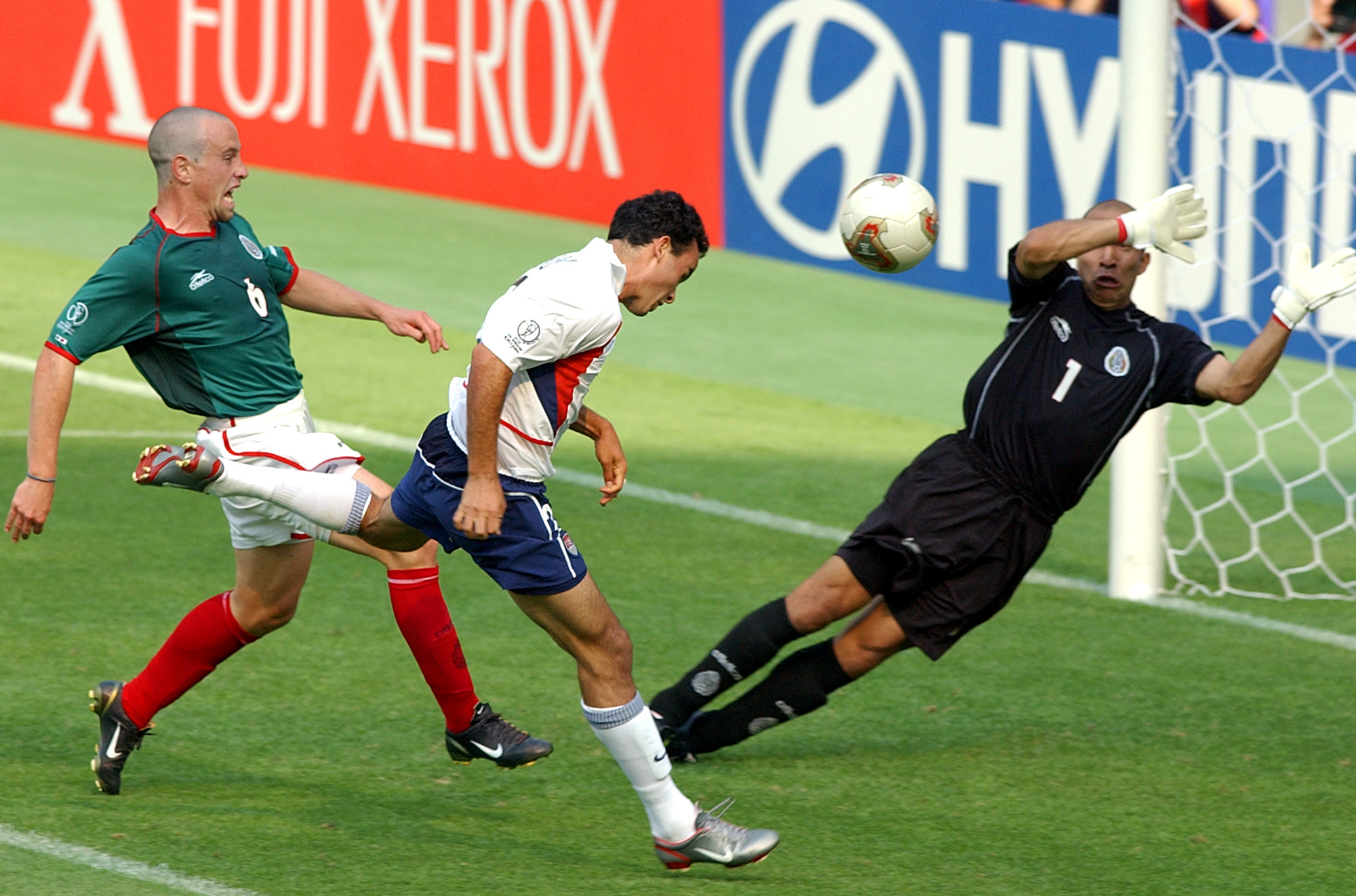
And this is the moment when history echoes. The U.S. men have played eight World Cup knockout games all-time, from their first in 1930 (a 6-1 loss to Argentina) to their latest in 2022 (a 3-1 loss to the Netherlands). Their lone victory came in 2002, 2-0 over Mexico.
Landon Donovan (center) heads in one of the U.S.’ goals in its win over Mexico in the 2002 World Cup round of 16.
Beyond that? 7-1 to Italy in 1934, 1-0 to Brazil in 1994 (more on that in a moment), 1-0 to Germany in the 2002 quarterfinals, 2-1 in extra time to Ghana in 2010, and 2-1 in extra time to Belgium in 2014.
If reading that opens some old wounds, apologies. But it’s necessary to explain why one of the most tense moments of any World Cup, the start of the knockout rounds, is especially tense for this program. There is no sterner test of a national team’s quality than whether it can win the do-or-die contests that live longest in the memory.
The last time the U.S. men played a World Cup knockout game on home soil was 1994 at the old Stanford Stadium — just down the road from the 49ers’ NFL palace in Santa Clara where Wednesday’s game will take place.
It was a stroke of coincidence, if not quite fortune, that the Americans landed in a July 4 matchup with Brazil after finishing third in their group. Finishing second would have sent them to Washington to play Spain, and finishing first would have had them at the Rose Bowl (where they already were) to play Argentina.
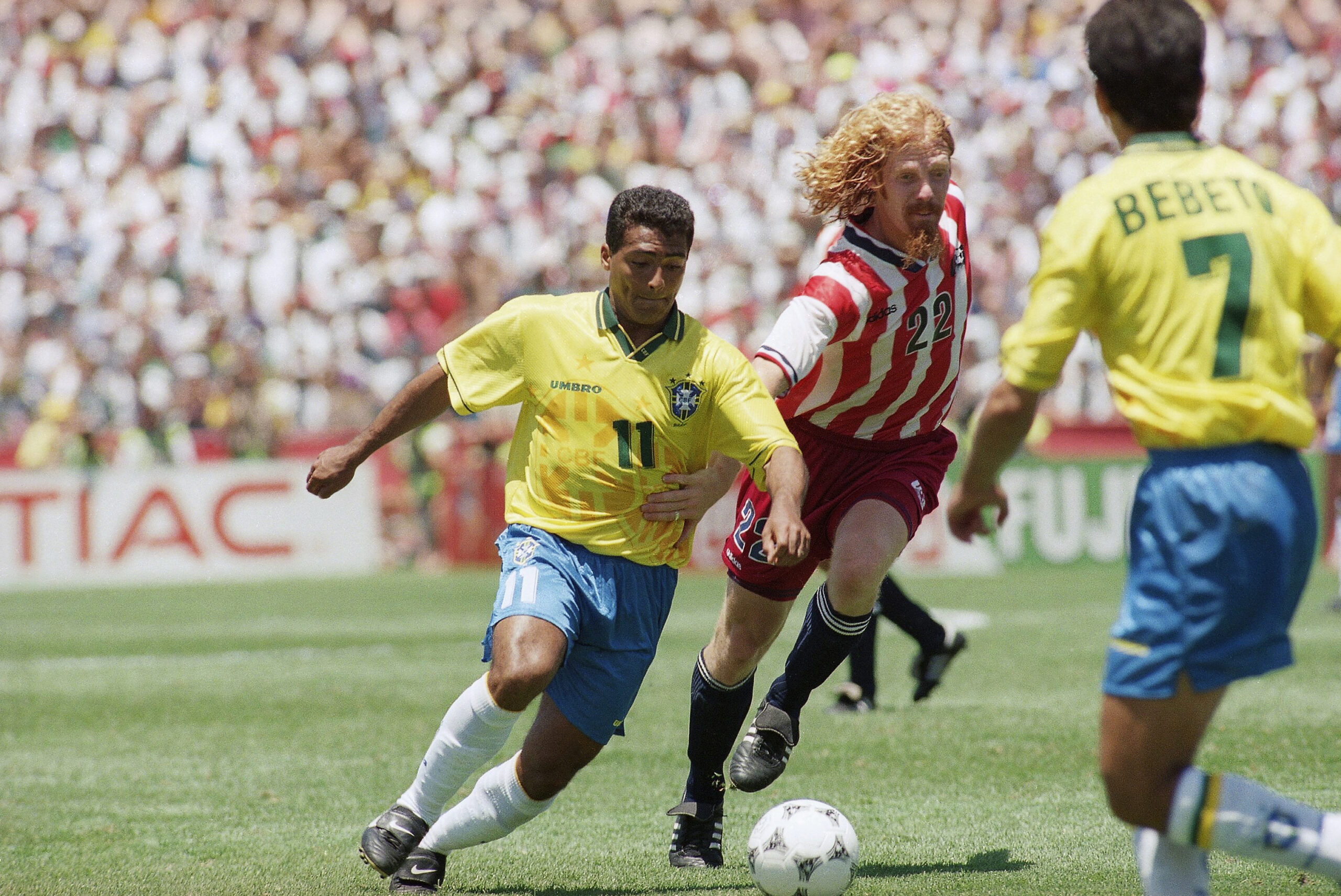
Brazilian superstar Romário (left) dribbling past Alexi Lalas in the 1994 U.S.-Brazil World Cup game.
Challenging the team that would go on to win the title was always going to be a mountain of a task. But the U.S. battled gamely, losing 1-0 to a Seleçao squad that saw defender Leonardo sent off in the first half for a nasty elbow to American star Tab Ramos.
This time, the U.S. is favored, and not just by the bookies. Bosnia & Herzegovina is No. 64 in FIFA’s global rankings, well below the U.S.’ No. 17.
The Dragons are also the lowest of the five third-place teams across the field that the U.S. could have faced, depending on which eight groups’ third-place finishers advanced. The opponent could have been from Group E, F, I, or J in other circumstances, and those teams turned out to be No. 23 Ecuador, No. 38 Sweden, No. 15 Senegal, and No. 28 Algeria.
On top of that, Bosnia is the second-lowest-ranked team of all eight. Only No. 73 Ghana is lower. (The others not named yet are No. 28 Paraguay and No. 46 Democratic Republic of the Congo.)
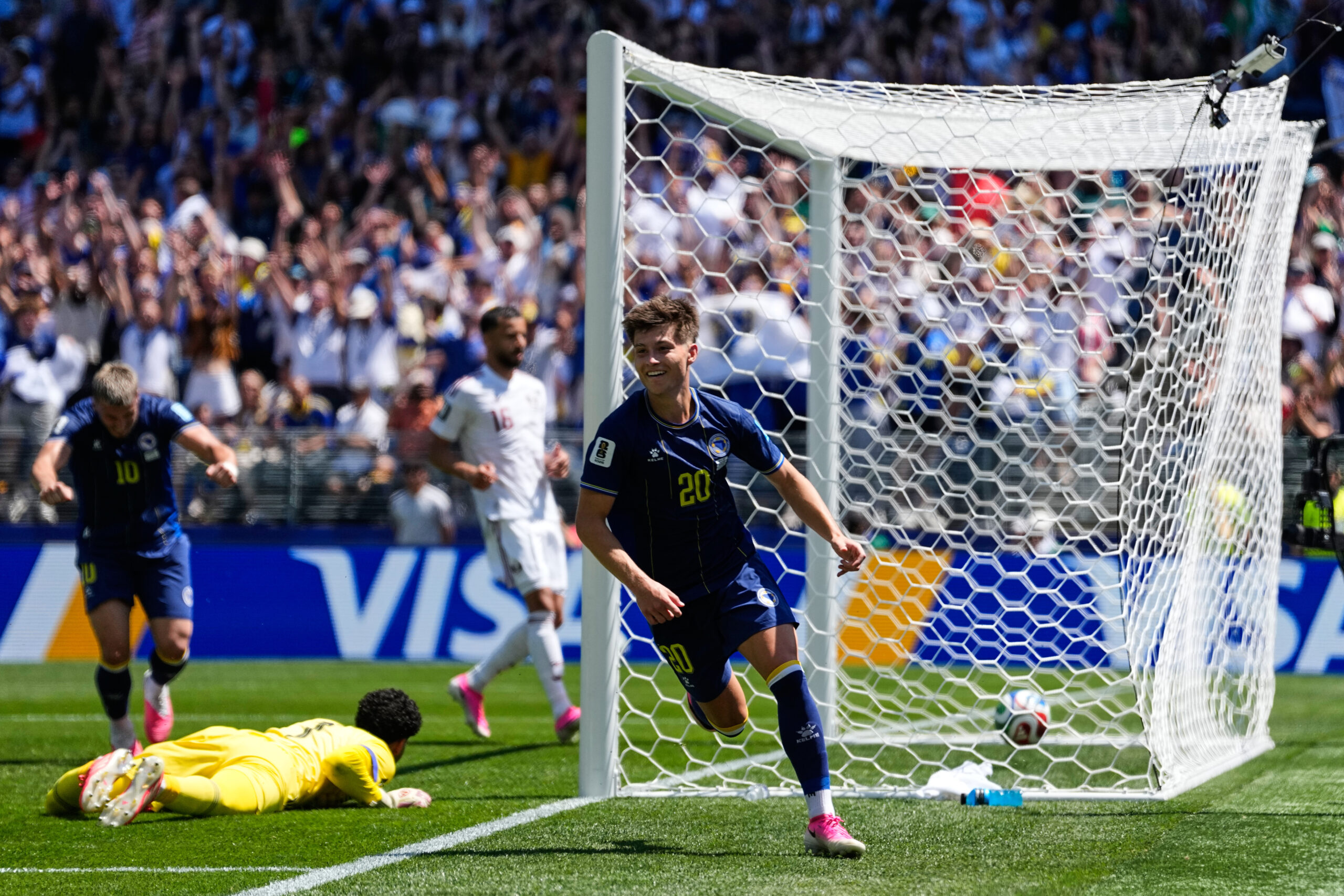
Bosnia & Herzegovina’s Esmir Bajraktarević was born in Appleton, Wisconsin, to parents who emigrated to the United States after escaping the Bosnian war of the 1990s.
Still, an American sports fan watching soccer in the summer needs only to think of any given March to know it’s never so easy.
The players know this, even someone like Balogun who has spent almost his entire life in Europe.
“I can feel the difference in the atmosphere,” he said. “So for me, there’s a change in my mindset and mentality as well. Not that I wasn’t taking it seriously before, but you can go to another gear. Because you want it more, and I don’t want the journey to end.”
Another point he made about himself might feel especially resonant to a U.S. fan base that has seen Balogun prove his worth as the striker the program long craved.
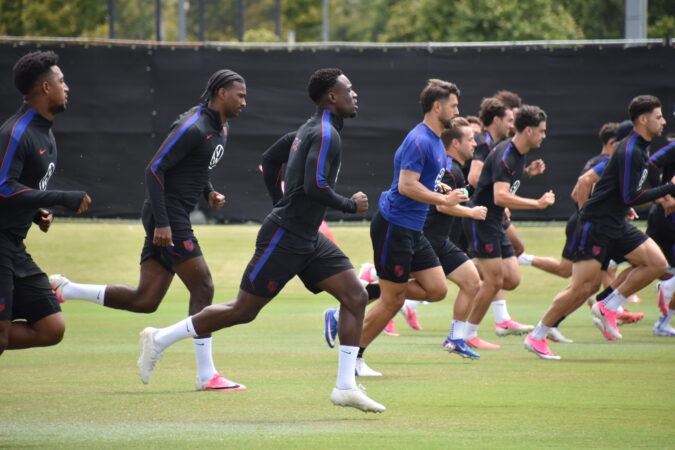
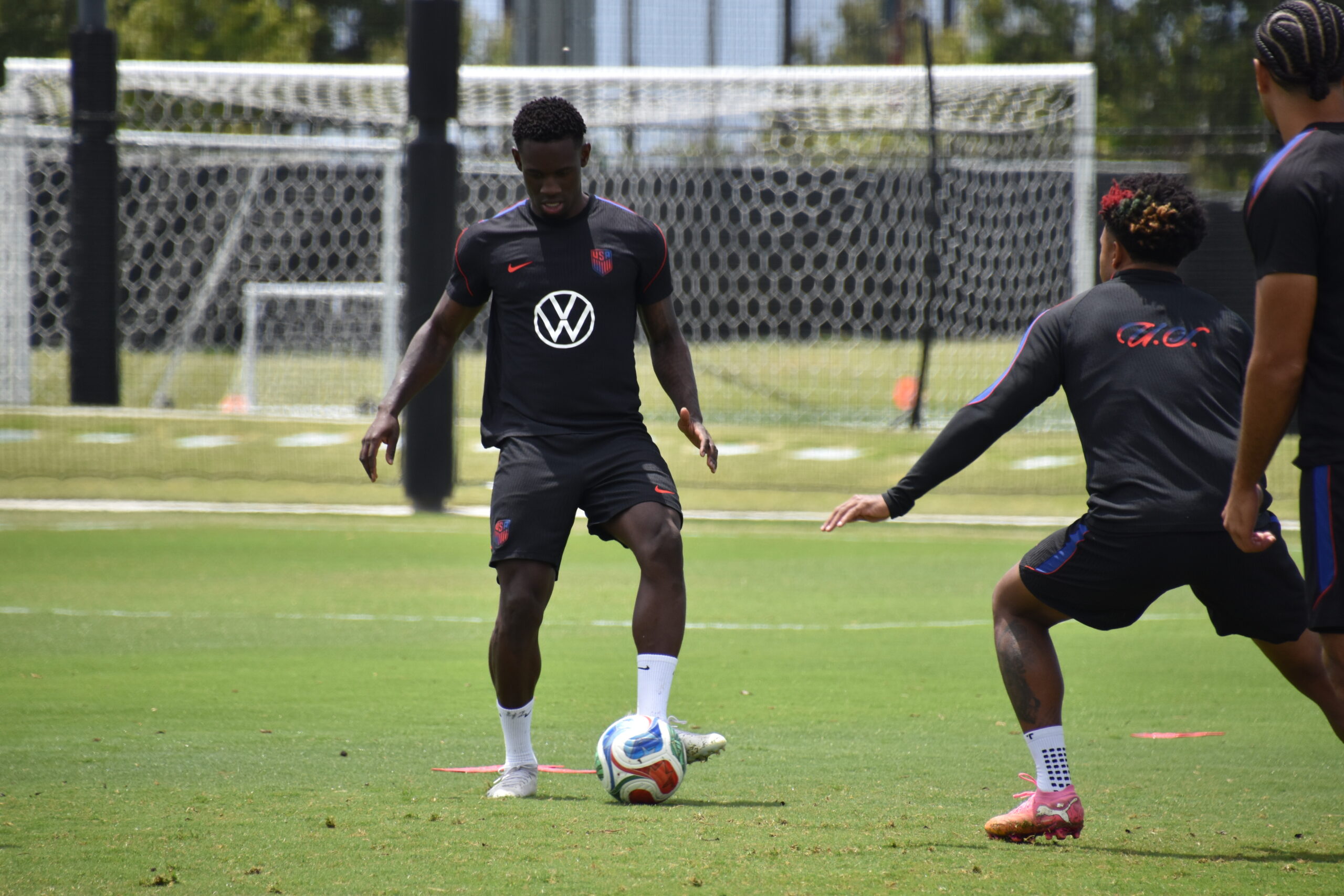
Folarin Balogun (left) during a United States men’s national soccer team practice at Great Park in Irvine, California on Sunday.
“This the business end,” he said, “and this is the stage where, in my opinion, the big players step forward and the big players carry the pressure and make things happen.”
The growing strength of the U.S. player pool is a project that has taken decades to fulfill, and could still take many more years to deliver a true World Cup contender. But a tournament on home soil is an opportunity unlike any other to make a statement, whether to the soccer world or to the non-soccer American public.
So while it may feel cliché to say this is one of the biggest moments in U.S. men’s program history, it’s also true.
“From my personal experience, the best way to break history is not to think about what hasn’t been done,” Balogun said. “It’s just to think about what you need to do and just to think about what needs to be done in order to progress. And as I said, that’s just to win on Wednesday.”
As the Phillies finished a series against the Mets here Sunday, Andrew Painter faced New York’s JV club in his first start for triple-A Lehigh Valley. The games were played only 109 miles apart along Interstate 78, and the Phillies hope Painter’s road back to the majors isn’t much longer.
That remains to be seen. But for starters, Painter got better results, especially with his fastball, in allowing one run in four innings against Syracuse.
When the Phillies demoted Painter 10 days earlier, the instructions were clear. They wanted him to focus on his fastball, which got hit hard in his first 14 major-league appearances. Opponents batted .404 and slugged .660 against it.
Painter threw 44 four-seam fastballs out of 80 pitches for Lehigh Valley, while sprinkling in 11 sliders, seven sinkers, six curveballs, six sweeping sliders, and five splitters. The hits came off his slider and sinker.
The Phillies haven’t outlined a timetable for Painter to return. It’s intentional. But with scant depth in the rotation, they are counting on the 23-year-old to get back.
But interim manager Don Mattingly also isn’t waiting breathlessly for daily updates on Painter’s progress.
“From my standpoint, he’s just down there working and getting himself [right],” Mattingly said. “It’s not like a rehab-type situation where you think, ‘Oh, he’s going to get one start and he’s coming back.’ I think it’s more like, ‘Hey, let’s get this guy on the right track and don’t put a timetable on it.’
“It’s really important moving forward, to the organization, that he becomes what he’s capable of. So, I just look at it more like he’s down there working, and then we’ll hear periodically how it’s going.”
Phillies rookie outfielder Gabriel Rincones Jr. has struggled since getting called up from triple A.
Rincones sits
As the Phillies anticipated, the Mets brought in righties Tobias Myers and Kodai Senga behind lefty opener Cionel Pérez to cover the bulk of the innings Sunday.
But Gabriel Rincones Jr. wasn’t in the lineup.
Rincones, a left-handed hitter who plays against most righties, was in a 3-for-30 skid with seven strikeouts since hitting his first career homer June 15 in his first at-bat at Citizens Bank Park. Overall, he was 4-for-34 with nine strikeouts.
“I felt like Rinco needed a day to think about it just a little bit,” Mattingly said. “Sometimes I feel like, with young guys, you kind of pay attention to when the at-bats aren’t going good. What are they [like]? How are they dealing with that? So, [it’s] a day just to watch a game.”
Besides, righty-hitting Derek Hill was on an 8-for-19, two-homer roll. Hill started in right field in Rincones’ place.
The Phillies are scheduled to face four righty starters this week against the Pirates. It will be interesting to see how many games Rincones starts.
“In general, I’d just like him to stay aggressive and not really get where he’s thinking too much about the at-bats just one to the other,” Mattingly said. “I’d say it’s been spotty as far as feeling like he’s making quality contact a lot. It’s another thing that we’ll keep an eye on.”
Phillies reliever Brad Keller has been on the injured list since June 16 with right forearm tendinitis.
Extra bases
Reliever Brad Keller, sidelined since June 16 with right forearm tendintis, threw from the slope of a mound and is expected to progress to a bullpen session this week. After that, Mattingly said Keller may face hitters, then make a minor-league appearance before rejoining the Phillies’ bullpen. … Knicks playoff star OG Anunoby threw the ceremonial first pitch to former Mets shortstop José Reyes. … The Phillies will return home at 6:40 p.m. Monday to begin a four-game series with the Pirates. Aaron Nola (3-4, 5.58 ERA) is slated to start against Pittsburgh righty Braxton Ashcraft (7-3, 3.07).
Universities should not need permission from sports conference administrators to engage with Congress on legislation that will shape their future. That statement should be obvious.
As what had been a slow-brewing crisis in college athletics comes to a boil, Washington is finally paying attention.
For years, universities have struggled to manage a system increasingly shaped by sweeping court rulings, a patchwork of often-contradictory state laws, and endlessly competing commercial interests rather than any coherent national policy. Athletes navigate a tangle of name, image, and likeness rules, which govern the compensation they can receive and whichvary widely by state. Administrators make decisions without knowing what the rules will look like six months from now. And fans watch their favorite players transfer from campus to campus with few reliable guardrails in place.
Yet as Congress considers the Protect College Sports Act, the most significant attempt in years to establish a national framework for college athletics — many universities appear reluctant to engage publicly while conference administrators increasingly position themselves as the primary voice speaking on behalf of their members.
That should concern every university trustee, president, donor, alumnus, college athlete, and policymaker.
This is not a debate about whether the Protect College Sports Act is perfect. It isn’t. Nor is it a debate about whether conference commissioners are talented leaders. Many are.
This is a debate about who should speak for universities when the future of higher education and intercollegiate athletics is being decided.
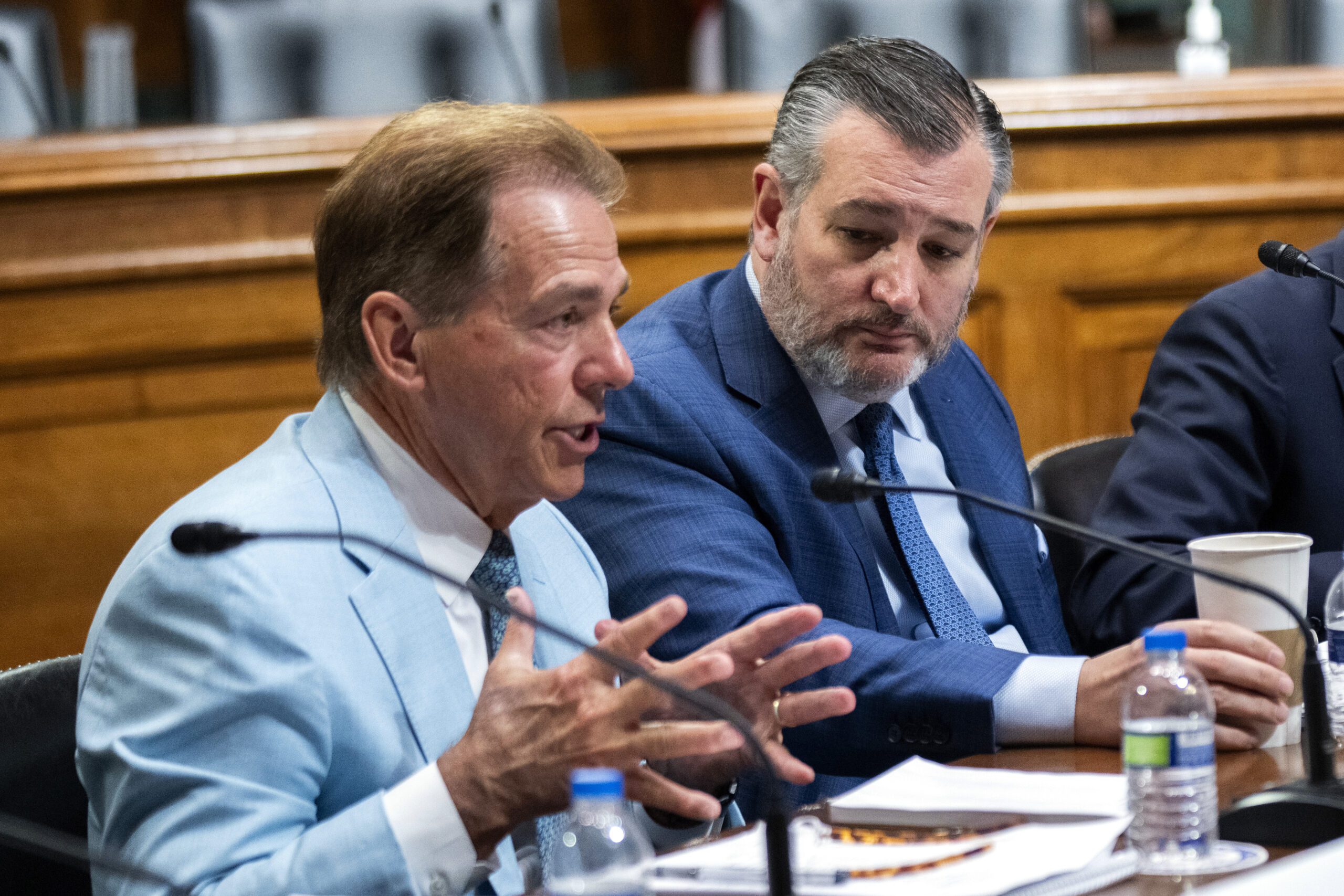
Nick Saban (left), the former University of Alabama football coach, speaks as Sen. Ted Cruz (R., Texas) listens during a roundtable on the future of college athletics on Capitol Hill in March 2024.
The current system is broken — and there are only two realistic options for what comes next: a federal framework that restores stability and national standards, or the continuation of today’s chaos. There is no option three.
What troubles me most is not opposition to the Protect College Sports Act. Reasonable people can disagree. What troubles me is the notion that universities should remain silent while others speak for them.
As a Penn State graduate, two-time NCAA All-American wrestler, donor, parent of a future Penn State athlete, and someone who has spent four decades building businesses and advising organizations throughout college athletics, I have watched this moment unfold from nearly every angle.
My perspective comes from life as an athlete, entrepreneur, executive, adviser, and parent. From the wrestling mat to the boardroom, I have never seen college athletics facing greater uncertainty than it does today.
Congress is not asking the Big Ten what is best for Penn State. Congress is asking stakeholders what is best for college athletics.
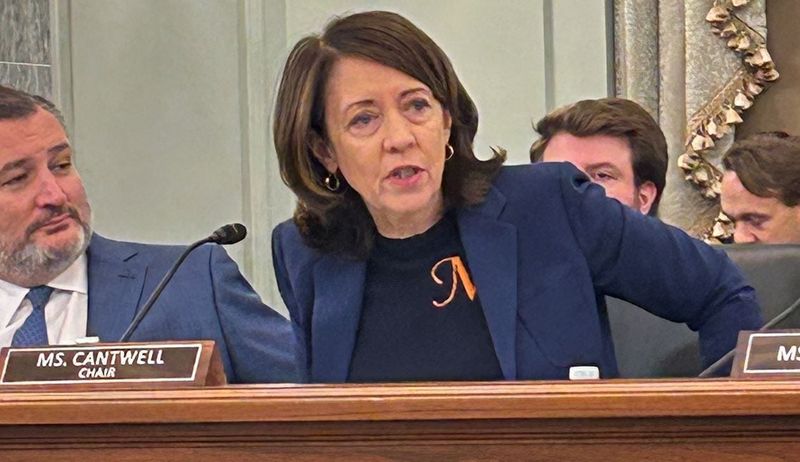
Sen. Maria Cantwell (D., Wash.) recently challenged the growing influence of conference administrators in the debate over the Protect College Sports Act.
Lawmakers are finally engaging. They are asking questions. They are seeking input from universities, athletic leaders, and stakeholders across the country. Penn State should be part of that conversation.
If conference administrators are prohibiting university leaders, trustees, athletic directors, donors, and other stakeholders from engaging directly with lawmakers or expressing support for legislation, then conference employees are attempting to silence the voices of the institutions that created them. That is not their role.
Universities created the conferences. Conferences exist to serve universities — not to control them.
If institutions with Penn State’s stature are unwilling to engage directly with lawmakers, then the future of college athletics will increasingly be shaped by others.
The stakes extend far beyond football. As a former student-athlete, I know firsthand that the value of college athletics goes well beyond the sports that generate the largest television audiences. Wrestling, volleyball, gymnastics, swimming, track and field, soccer, softball, lacrosse, and dozens of other sports depend on a healthy and sustainable collegiate model.
The opportunities those programs create changed my life, as they have changed the lives of countless others. They deserve to exist for future generations as well. That is what is at stake.
The decisions being made in Washington will affect every university in the nation. They will shape opportunities for college athletes for decades to come.
Pennsylvania’s universities deserve a voice in that discussion. Penn State certainly does — and it should take its seat at the table and speak with its own voice, as should other institutions that have recently voiced independent concerns, including Michigan, Ohio State, and USC.
Not because the legislation is perfect. Not because every stakeholder agrees. But because leadership requires engagement.
Penn State has never been a follower. It shouldn’t start now.
Chris Bevilacqua is a veteran of four decades in sports, media, and technology as an entrepreneur, operator, investor, and adviser, including founding the nation’s first 24-hour college sports television network. He is a 1986 graduate of Penn State where he was a two-time NCAA All-American on the wrestling team and also competed internationally for USA Wrestling.
Did Pope Leo XIV actually go to a Villanova University fraternity party?
That’s what one user on X purported when he posted an aged photo of the leader of the Catholic Church standing with a group of young men — one wearing a Villanova T-shirt and holding a small dog — in front of a brick bungalow. “The future Pope Leo XIV at a Villanova frat party in 1976,” the caption read.
The tweet had 1.4 million views and more than 15,000 likes as of Sunday.
But internet sleuths were suspicious:
“Not one of them is holding even a beer. That’s one tame frat party,” one of nearly 150 comments read.
“Doesn’t this look more like a step ranch in/near Chicago than anything on the Main Line?” another user smartly deduced.
The photo was actually taken at a fellow Wildcat’s house on the South Side of Chicago, where the pontiff is from, according to a classmate who has a copy. The classmate, who declined to be named for privacy reasons, assured The Inquirer it was not a frat party and dated the photo to the mid-’70s.
A few months back, the Donald Trump-fried chair of the Federal Communications Commission, Brendan Carr, urged broadcasters to air patriotic programming for America’s 250th birthday — including regular on-air recitations of the Pledge of Allegiance.
I couldn’t find any reports about TV or radio stations that have actually done this. Maybe they’ve figured out that the bit at the end — that stuff about “liberty and justice for all” — has been rendered into utter baloney by Carr’s strongman boss.
For anyone who still believes the myth that the United States’ criminal justice system is the envy of the world, I say: Let them come to Fort Worth. In northern Texas, a crime committed by one man with the “wrong” politics gave the Trump regime the ammunition it craved for a free-speech crackdown that makes a mockery of America’s birthday bash.
Ironically, it was on July 4, 2025, that a crew from the small but tight-knit left-wing community in the Dallas-Fort Worth (DFW) metroplex ventured 30 minutes south to the Prairieland Detention Center run by U.S. Immigration and Customs Enforcement to protest the squalid conditions and overcrowding there.
The protesters dressed in black; some brought fireworks or medical supplies. The evidence shows they committed some minor crimes — vandalizing a vehicle, for example. But when local police were called, one man — Benjamin Song, an ex-Marine known to local activists as “Champagne” — committed a serious offense, firing a gunshot that wounded a town police officer in the neck. The officer later acknowledged he was pointing his gun at a fleeing protester when Song fired his weapon.
The Prairieland incident came right as the Trump regime was striving to brand “antifa” — a loose ideology that fascism should be resisted by any means necessary — as some kind of highly organized terrorist cell. FBI agents fanned out across DFW, ultimately building a riot-and-terrorism case against nearly two dozen leftists, including the group — now known as the Prairieland 9 — that stood trial this winter at the Fort Worth federal courthouse.
Among the evidence prosecutors presented to bolster their contention that the protesters were part of some kind of terror cell included their black garb, their Signal chats in which they discussed plans for a “noise protest” at Prairieland, or their decision to bring medical supplies with them to the demonstration, which occurred at a time when anti-ICE protests were meeting violent responses. One of the alleged coconspirators wasn’t even at the protest; he’d moved a box of anti-fascist magazines before agents visited his home after his wife called from jail.
Tamera Hutcherson, a local activist who attended much of the trial as a paralegal for defendant Savanna Batten, told me by phone Saturday that the case against Batten “was based on the fact that she showed up to the protest wearing black, she had medical supplies on her, which included a tourniquet, and that she was there for a noise demonstration to set off fireworks.”
Batten, Song, and the other seven were convicted in March, and their sentencing was decided by the trial judge — Mark Pittman, a Trump appointee — and his colleague, Reed O’Connor, a federal jurist so well known for his right-wing rulings that the Trump regime and allies like trillionaire Elon Musk look for excuses to bring cases before him.
In this case, O’Connor was happy to say the quiet part out loud: that a repressive government is seizing on this case to send a message to anyone who wants to aggressively protest mass deportation or other abuses. He called the protest “an assault on democracy,” adding, “The need to deter this type of conduct is high.”
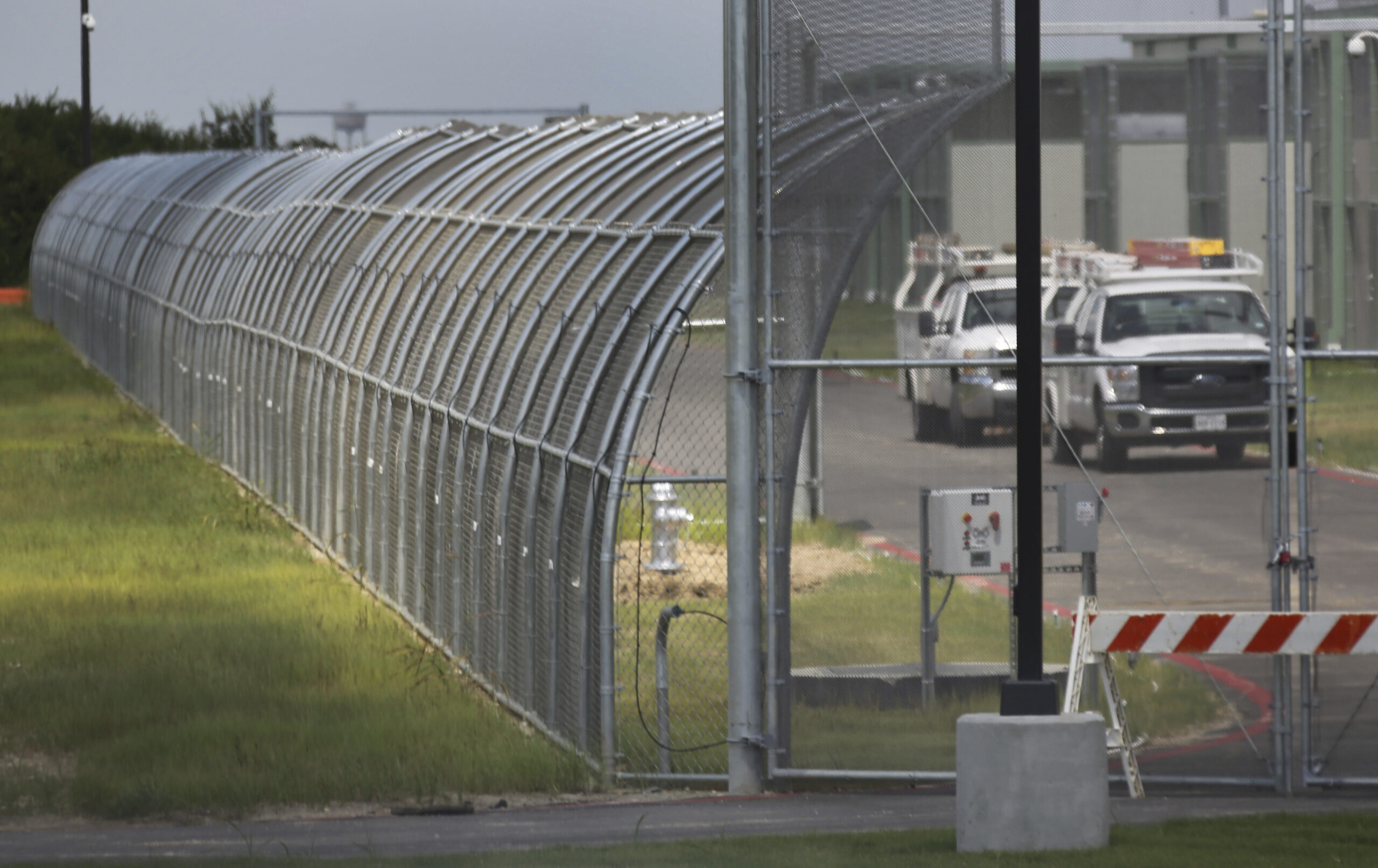
Trucks drive at the Prairieland Detention Center in Alvarado, Texas, in September.
Still, courtroom observers were stunned when the sentences came down. It wasn’t a total shock when Song, convicted of attempted murder, was given 100 years, but Batten, the black-clad medic, got 50 years — a virtual life sentence for dissent — as did several others. Daniel Sanchez Estrada, the magazine mover, got 30 years.
Hutcherson, who was in the courtroom for last week’s sentencing, called O’Connor’s comments “chilling … to have the judge say this out loud, it really sunk in.”
What’s sunk in is that the federal government is pouncing on the Prairieland 9 convictions to unleash a crackdown on left-wing protest that will make America’s past sins like the Palmer raids, McCarthyism, and the trial of the Chicago 7 look like child’s play.
In recent days, we’ve seen federal charges against the Minneapolis 15 protesters who monitored the Minnesota ICE raids in Signal chats, and an indictment against two Atlanta protesters against the “Cop City” police training center — even after a local judge had essentially laughed state charges against them out of his court. When a state prosecutor offered evidence of criminality that the Cop City demonstrators wore black clothes and masks, Judge Robert Flournoy said, “Oh, that sounds like ICE.”
There’s a lot going on here. The Trump regime — which last fall designated “antifa” (again, not an actual group) as a terrorist organization, abusing its vast post-9/11 powers as many of us feared it would — is aggressively clamping down on the First Amendment-protected right of dissent ahead of the November midterms, when its dictatorial-minded leader will stop at nothing to keep his party in power.
But these 50-year prison sentences, which carry the sauerkraut stench of German cooking, circa 1933, are also an exclamation point on the death of even pretending there is anything resembling impartial criminal justice in America. We are now a land where left-wing dissenters will spend decades behind bars reading about the latest millionaire fraudster or Republican apparatchik to get out of jail free.
Look, we’ve always been more than delusional about praising U.S. justice as the supposed envy of the free world despite the reality that rich kids or celebrities like the late O.J. Simpson who hire the best lawyers can walk free after people die, and white-collar crime is treated as a sport, while Black, brown, and poorer defendants form the backbone of one of the planet’s highest incarceration rates.
But the Prairieland most-of-your-life sentences didn’t happen in a vacuum. They are the counterweight to Trump’s Day One pardons for theroughly 1,500 right-wing rioters on Jan. 6, 2021, who stormed and vandalized the U.S. Capitol in an insurrection blamed for five immediate deaths, with more than 140 police officers injured.
At the same time the Prairieland 9 were getting frontier justice, the New York Times reported that Trump’s Justice Department quashed a criminal probe into the circumstances behind the president’s clemency for a multimillionaire named David Gentile. The private equity executive had been sentenced to seven years in prison and ordered to pay $15.5 million in restitution for a $1.6 billion scheme that defrauded small investors. Many lost their life savings — arguably a greater harm than anything that happened at the Texas ICE detention center.
But Trump granted clemency to Gentile after just two weeks in prison. Prosecutors were looking into the relationship between Gentile and a retired priest from Queens who has become a top supporter and personal friend of Trump and who lobbied the president for Gentile’s release. But higher-ups reportedly told New York mid-level prosecutors to end their probe into questions like whether the priest was paid.
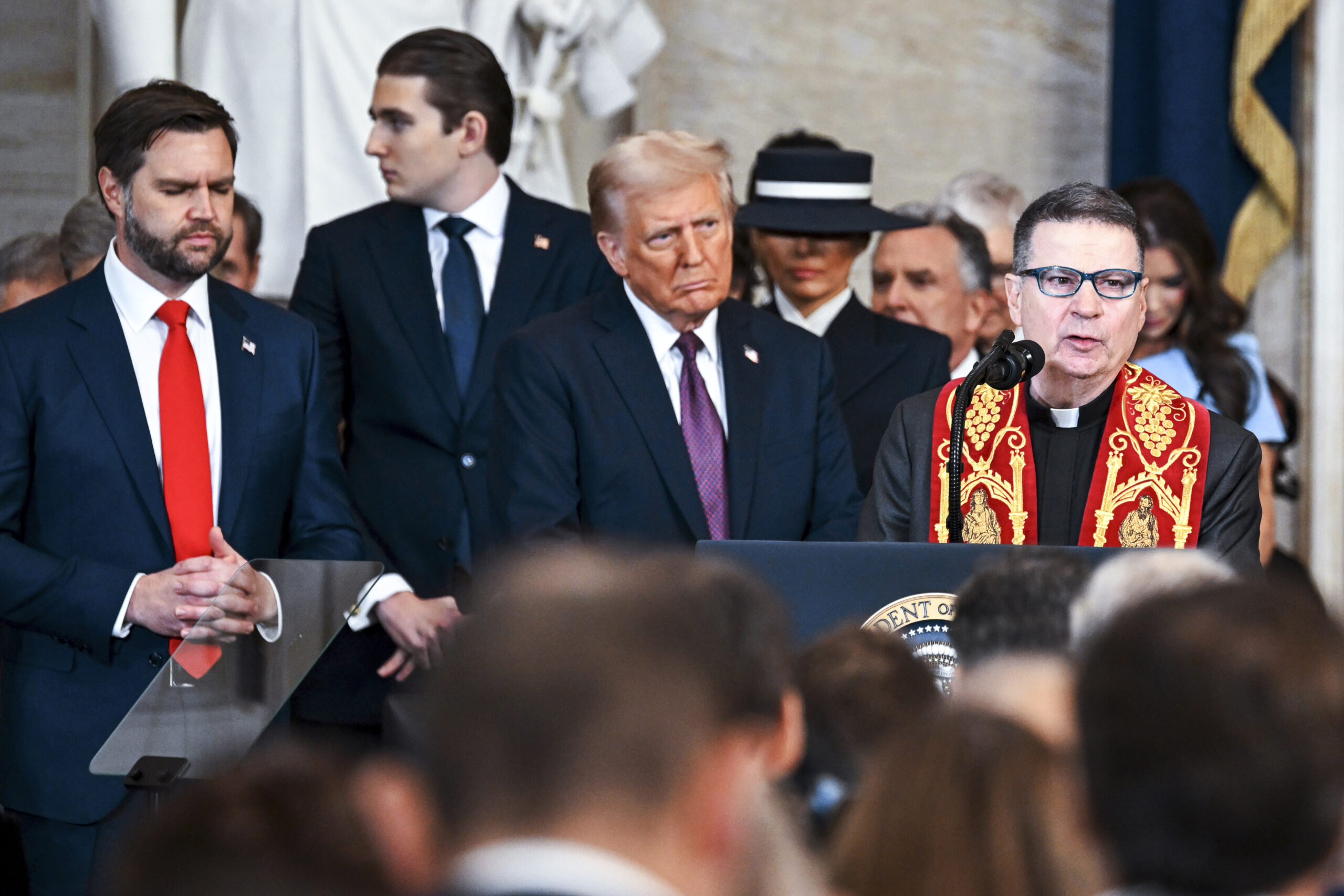
The Rev. Frank Mann speaks next to Donald Trump during Trump’s second inauguration at the U.S. Capitol on Jan. 20, 2025.
In a matter of months, Trump has exploited the existing cracks in the federal justice system to make it a blunt instrument of personalist dictatorship — a “purge” for his criminal friends or bad guys willing to make a donation, while depriving those who dissent of their liberty.
I’m just barely scratching the surface, as Trump’s injustice department also conducts high-profile investigations into law-abiding political opponents, including top Democrats or people likeformer FBI chief James Comey. Or consider this: No action has been taken against Jonathan Ross, the ICE agent who’s been publicly identified as the killer of unarmed Minneapolis motorist Renee Good. When a Syracuse, N.Y., woman ID’d Ross and asked why he had not been indicted in an Instagram post, federal agents entered a voting place where she was working as a poll worker and ordered her to take the inarguably true post down.
The nation’s founders, who declared American independence 250 years ago this week, strongly believed that justice was the backbone of their experiment in democracy. The Bill of Rights they’d enact in 1791 is largely about the right to a fair trial, avoiding unlawful searches and seizures, and the essential liberty of protesting an unjust government. More than two centuries later, the White House seems more governed by George Orwell’s 1984, as they criminalize left-wing “thoughtcrime.”
“I think it’s very symbolic … that this protest happened on theFourth of July,” the Texas activist Hutcherson told me. “This year is the 250th year of America being America. And when we think about the inception of this nation, it was because of protest; it was because of dissent. And so it feels very contradictory that because someone has leftist or anti-fascist views that now they can be deemed criminal or a terrorist to the U.S. government. You know, we’re not seeing the same energy given toward people that have right-wing views.”
The firecrackers of dissent that went off on Independence Day 2025 over an ICE gulag in Texas were much more of a tribute to what America was supposed to be than whatever Trump detonates over his morally empty National Mall on this July Fourth. In a United States with liberty for billionaires and justice for none, what are we even celebrating?
NEW YORK — Jaron Ennis’ head tilted back Saturday night and his feet wobbled after a right hand from Xander Zayas snuck through Ennis’ guard and rocked his face.
Ennis won his previous 35 fights but this — appearing hurt in a ring surrounded by a Brooklyn crowd roaring for him to be finished — was uncharted territory.
The fighter from Germantown has long been considered to be a future superstar of boxing. He had all the skills — defense, footwork, and power — to make it happen. And he never seemed to be in danger in the ring, often outclassing foes who could not match his talent.
Now, he was in the deep end. And everything — the career that started with a kid wanting to be like his older brothers who became a world champion under the tutelage of his dad — was on the line with more than 60 seconds left in the third round at the Barclays Center.
Ennis had to find a way to survive the bigger Zayas, who was pushing for a knockout. He did just that.
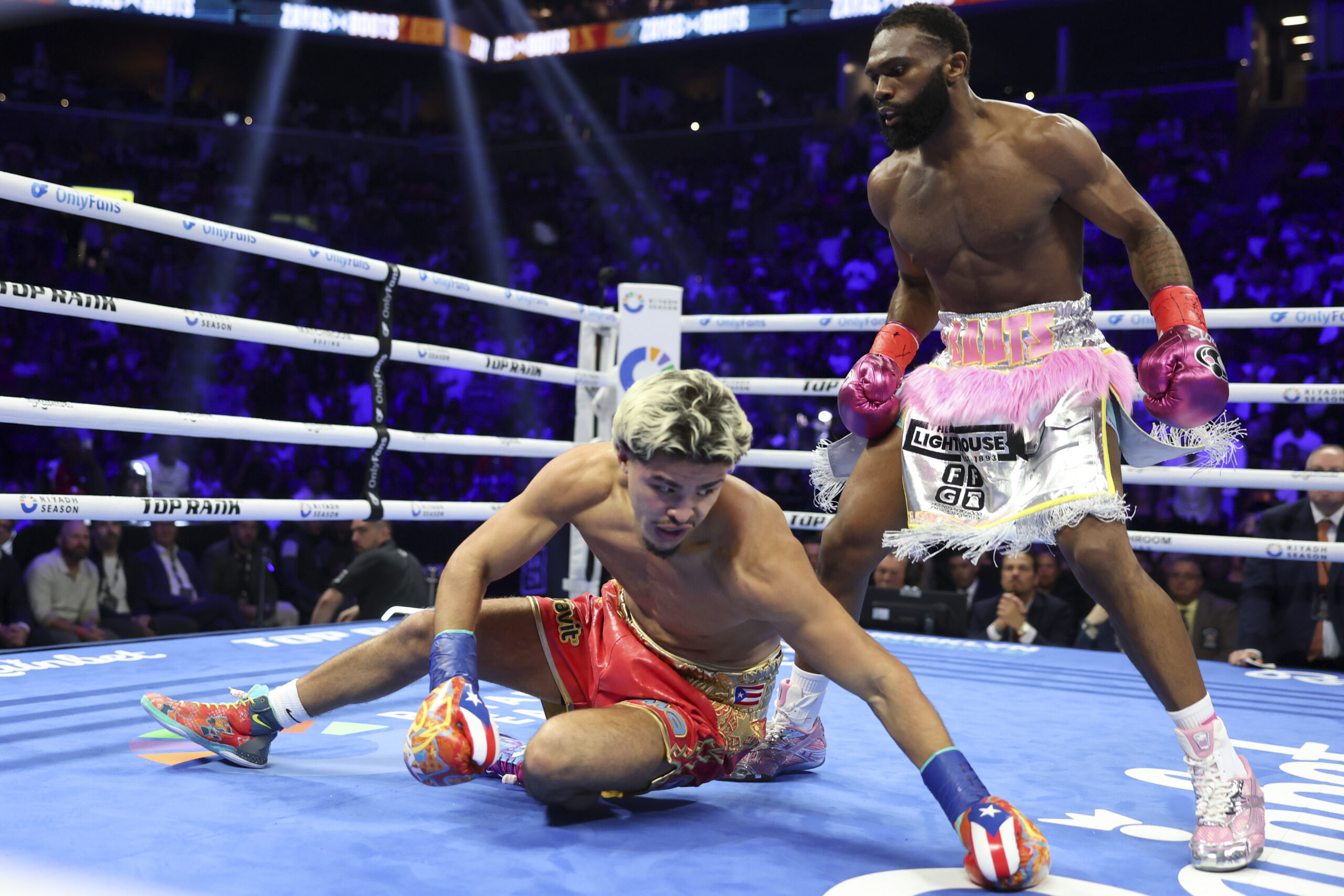
Ennis didn’t just escape the danger but rallied from that stomach-churning round to deliver an all-time Philly boxing performance. He regained control, knocked down Zayas in the fifth round, and then again in the seventh before the Puerto Rican’s corner stopped the fight as Ennis became the WBO and WBA junior middleweight champion.
“I think this is the one that takes it to the next level,” Ennis said. “We’re just getting started. I’m a pay-per-view superstar and the face of boxing.”
It was hard to doubt Ennis’ skills before Saturday night, which was the first time he headlined a pay-per-view event. But he had yet to enter a fight where the result seemed in question when the bell rang. This was the biggest test of his career, and it was his resilience — the ability to take a punch and keep moving — that was most impressive.
Ennis wants to be the “face of boxing.” Now it’s obvious that his face has the chin to make that happen.
“I came back to the corner and he was like ‘Yo man, stop playing,’” Ennis said, imitating his father and trainer Bozy. “I was chilling. I’m cool, calm, and collected. When there’s madness going on, I just get calm and be patient.”
“They might have thought I was hurt. But I was calm and relaxed. I was catching a lot of shots, too.”
Ennis was booed by the partisan crowd, who waved Puerto Rican flags for the island’s 23-year-old star. Ennis joked that they weren’t booing him but yelling “Boots.” He’s never been jeered before and didn’t mind being the foil, holding his hand to his ears when the boos drowned out the ring announcer when he was introduced.
“Give Boots credit, it changed quickly,” said Ennis’ father, Bozy, who trains his son. “But we don’t care about the boos. We just do our job.”
Ennis (36-0, 32 knockouts) came out throwing as he pushed the pace against Zayas (23-1, 13 KOs) and knocked him down with a right less than two minutes into the first round.
He controlled the ring in the second round before Zayas found his shot in the third round. The building rocked but Ennis dug deep. Thirty seconds after being dazed, he was already bobbing his head away from Zayas’ onslaught. It was as if he had been revived in the ring.
“Boots was dazed? He wasn’t dazed,” Bozy Ennis said. “He wasn’t dazed. How are you going to be dazed and come back like he came back? If you’re dazed, you’re going to be done. You know what I mean? That’s what dazed is.”
Undeterred, Ennis started the fourth-round by dragging Zayas into the center of the ring. The fighters exchanged phone-booth punches, giving the crowd the action they came to see.
Ennis was not hurt again after that third round. He used a perfectly placed hook to score another knockdown in the fifth and a left-right combination to drop Zayas to a knee in the seventh. The fighter looked to his corner, who decided Ennis had inflicted enough punishment and stopped the fight.
“I was being lazy on the inside,” Ennis said of the punch he took in the third round. “That’s on me. I have to sharpen that up. I’m going to sharpen that up. Don’t worry about that. It was a cool, little performance but I give myself a ‘C.’ I’m just getting started. I’m way better than that.”
Ennis, according to Compubox, landed 148 punches while Zayas landed just 90. Some questioned how Ennis would combat the bigger opponent as perhaps he would have to be crafty to win. The Philadelphian simply went right at him. Ennis was already a boxing star. But he left the ring as a superstar while Zayas was taken to the hospital as a precaution.
“I knew I would be too strong and I was the faster guy,” Ennis said. “He wouldn’t be able to see my shots.”
Ennis will likely return to the ring later this year against WBC champ Sebastian Fundora (24-1-1, 16 KOs) as the boxer wants to become the undisputed champ at 154 pounds. A fight with Vergil Ortiz Jr. (24-0, 22 KOs) was supposed to happen earlier this year before litigation between Ortiz and his promoter squashed the bout. That fight remains in play.
The next year could be career defining as Ennis will have the stage to prove himself as a pound-for-pound boxer and flag bearer of the sport. The journey to those fights started long ago in the gritty Philadelphia gyms his dad calls “dungeons.” He watched his older brothers train in a church basement with neighborhood kids in Germantown and dreamed of doing the same thing.
Jaron Ennis landed 148 punches while Xander Zayas landed just 90.
Ennis was there every afternoon, waiting for his dad to finish work so they could train in a gym without air conditioning. Boxing is all Ennis ever wanted to do since he was a boy in the “Brickyard” neighborhood.
And it was those dungeons that prepared Ennis for what happened on Saturday night when the walls appeared to be closing in. But everyone who knows where Ennis came from knew the Philadelphian was never in danger.
“He likes to fight,” Bozy Ennis said. “He can box. You can see he can box. You see what he’s doing with that jab. Pop. Pop. But then he likes to fight. I told everyone that Boots is going to stop him. They said Boots was the bully at 147 but he would be the bully at 154. I said ‘It doesn’t make a difference because he can knock heavyweights out.’”
For nearly as long as American courts have existed, they have extended the federal government a quiet courtesy. It is called the presumption of regularity. It holds that when government officials act, judges should assume they did so lawfully and in good faith, absent clear evidence otherwise. It rests on a simple bet: that the people enforcing the law are trying to follow it.
That bet no longer looks safe, and the people best positioned to know are saying so out loud.
A new survey from Bright Line Watch and the Safeguarding Democracy Project at UCLA Law asked more than 300 legal experts — sitting federal judges, elite lawyers, and law professors — to assess the state of the rule of law in America. The findings should unsettle anyone who assumes the system will police itself. Only one in five legal experts agreed that the federal government still merits the presumption of regularity in court. Among elite lawyers, the figure was 24%. Among law professors, 17%. Even among federal judges, less than half, just 41%, said the presumption was still warranted.
The doctrine that courts should trust the government’s word is now rejected by a majority of the legal professionals who built their careers inside that system, and by most of the judges who apply it.
The reasons are not mysterious. Nine in 10 legal experts said the current administration has used the Department of Justice to target enemies and reward allies. Likewise, 86% said political appointees at the DOJ mislead federal judges. And 80% said federal officials fail to comply with court orders. More than 90% viewed the prosecutions of New York Attorney General Letitia James and former FBI Director James Comey as politically motivated. These are not the impressions of activists. They are the considered judgments of people who have clerked at the Supreme Court, run U.S. Attorney’s Offices, and served as general counsels to major institutions.
Judges are not just saying this in response to a survey. They are saying it from the bench.
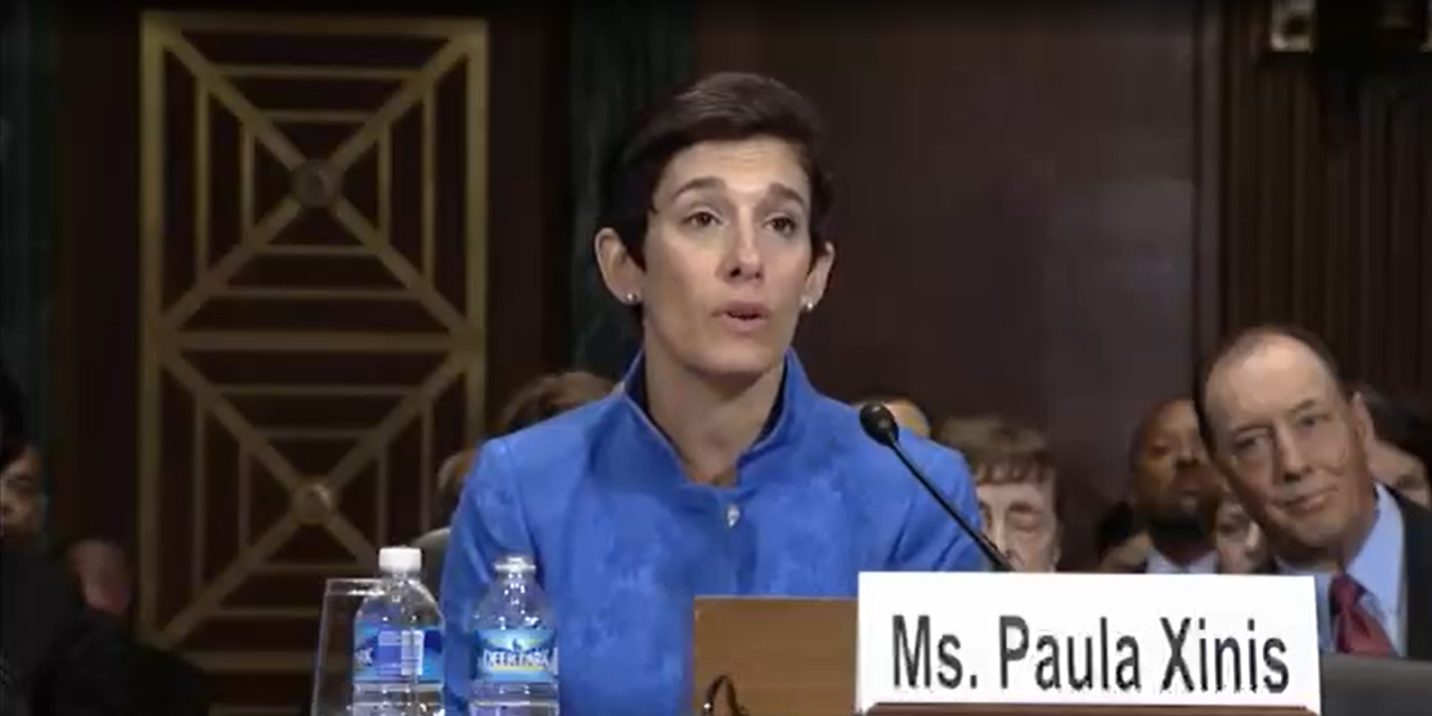
In a Maryland courtroom this past summer, a federal judge,Paula Xinis, told a government lawyer, “You have taken the presumption of regularity, and you’ve destroyed it.” A judge in Washington, D.C., wrote that “blind deference to the government” was “no longer a thing,” explaining that “trust that had been earned over generations has been lost in weeks.” By March 2026, three New Jersey and Oregon judges had separately declared, in unrelated cases, that the deference long extended to the U.S. Attorney’s Office had been “undeniably eroded.”
Judge Paula Xinis, seen in a video image during her Senate confirmation hearing in 2015 for U.S. district judge for the District of Maryland. In 2025, she excoriated government lawyers, saying they had “destroyed” the legal “presumption of regularity.”
Pattern of bad behavior
A study by the legal publication Just Security has now cataloged more than 200 instances in which courts have voiced concern over the government’s noncompliance with orders, distrust of its representations, or findings that its actions were arbitrary and capricious. One judge, surveying six months of the administration’s conduct, concluded the president “may have forfeited the right to such a presumption of regularity.”
When the watchdogs of the legal system conclude that the government can no longer be taken at its word, the question stops being abstract. It becomes practical. What are the rest of us supposed to do?
Consider what happened to the Southern Poverty Law Center. In April, the Justice Department indicted the civil rights organization on charges of wire fraud and money laundering, alleging it concealed payments to informants who had infiltrated extremist groups. The SPLC denies the charges and outside experts have called them weak and politically motivated. Members of Congress have pointed to whistleblower reports that the DOJ pressed prosecutors to rush the indictment despite doubts about its strength. No court has weighed the evidence. The organization remains in good standing with the IRS. An indictment, as more than one community foundation has had to remind the public, is an allegation, not a verdict.
And yet the consequences arrived immediately, delivered not by a judge but by three financial institutions. Fidelity Charitable, Vanguard Charitable, and DAFgiving360, the philanthropic arm of the investment bank Charles Schwab, together three of the largest sponsors of donor-advised funds in the country, blocked their account holders from sending grants to the SPLC.
Donors who rushed to support the group’s legal defense found their requests denied, in some cases learning of the freeze only when the transaction failed. The sponsors cited internal policies permitting them to pause grants to organizations under investigation.
Weaponizing the law
Each firm acted within its legal rights. The money in a donor-advised fund, or DAF, is legally controlled by the sponsor, not the donor. Yet the result is troubling. Three private companies, applying a rule that treats a politicized indictment as if it were a finding of guilt, did to the SPLC what no court has done: They cut off its lifeline at the moment it most needed resources to defend itself. The sponsors of the DAF extended the SPLC’s accuser precisely the deference that judges, in case after case, have been withdrawing.
The mechanism this creates for the weaponization of the rule of law is worth understanding. The administration does not need to win in court to inflict the punishment. It only needs to bring the charge and then rely on a web of private institutions to treat the charge as conclusive. The indictment becomes the sentence. The presumption of regularity, eroding inside the courtroom, is being smuggled back in through the side door, as private actors continue to defer to government accusations that the legal profession itself no longer trusts.
We do not believe the Fidelity, Vanguard, and Schwab affiliates acted in bad faith. We believe they applied old rules to new circumstances without recognizing that the circumstances had changed. A policy that pauses grants to indicted organizations can make sense in a world where indictments reflected the impartial judgment of career prosecutors. It makes far less sense in a world where the leading scholars and judges of American law have concluded that the same Justice Department weaponizes its charging power against political targets.
The norms that govern civil society and industry were built on an assumption that is no longer reliable. They assumed regularity. They now need to account for its absence.
This does not mean private institutions should ignore genuine wrongdoing or bankroll proven fraud. It means they need standards calibrated to the actual environment rather than an imagined one.
A donor-advised fund sponsor could, for instance, distinguish between an indictment and a conviction, maintain grant-making to organizations that retain their tax-exempt status, and reserve suspension for cases where independent evidence, not a government press release, establishes a real problem. Banks, law firms, insurance companies, and professional associations face versions of the same choice. Each can decide whether to be an instrument of political pressure or a check against it.
Strained guardrails
The financial industry already has standard procedures for exercising independent judgment. It conducts due diligence. It weighs reputational and ethical risk. We are asking it to extend that same judgment to a new kind of risk: the risk of becoming the enforcement arm for accusations that the legal profession has flagged as suspect.
The Bright Line Watch data tell us that the formal guardrails, the courts, the separation of powers, the presumption of good faith, are strained. The legal experts surveyed do not expect this to change materially over the next several years — if the current trajectory holds, it likely may get worse.
That is sobering. But it also clarifies the assignment. When official institutions falter, the informal ones, the norms and standards that private actors set for themselves, become load-bearing.
Civil society and industry cannot restore the rule of law on their own. But they can refuse to be the means by which it is dismantled. They can decline to treat an accusation as a conviction. They can ask, before they act on a government charge, whether that government still deserves the benefit of the doubt.
The legal profession has given its answer. It is time for the rest of our institutions to listen.