ARIES (March 21-April 19). People are complex, and you can’t predict how they’ll react to what you consider a very normal and ordinary exchange. If someone gets upset, you don’t have to match their energy. Give the moment a little room to settle.
TAURUS (April 20-May 20). In the same way that silence changes depending on who sits beside you, the emotional atmosphere around a person tells you more than their words do. Pay attention to how your body feels in someone’s company.
GEMINI (May 21-June 21). You intend to motivate and inspire, but do you have the right words to do it? You don’t need to. The words are the least of your tools. When you’re living the example, explanation and instruction are but a small part of the equation.
CANCER (June 22-July 22). It is safe — fortuitous even — to dream unlimited. However improbable the dream may be, dream it with abandon. It’s not your job to represent reality, it’s the world’s. Leave the world’s work to the world while you mentally soar.
LEO (July 23-Aug. 22). You don’t think about your strengths because they are so innate you assume they’re just part of being human. Of course, that’s not so. What’s ordinary to you is remarkable to others. Honor your gifts and they’ll open doors.
VIRGO (Aug. 23-Sept. 22). Creative confidence is the belief that you can make something worthwhile even when you don’t know exactly how it will turn out. It’s different from confidence in the finished product. Today, you believe you can figure it out, then you do.
LIBRA (Sept. 23-Oct. 23). You can never be completely objective about yourself, but you can learn a lot by looking at yourself from different angles. The better you understand your own patterns, strengths and blind spots, the easier and more enjoyable life becomes.
SCORPIO (Oct. 24-Nov. 21). Leave some empty space in your schedule because that’s where the good stuff is likely to happen. You’ll accomplish what needs doing, but the most memorable parts of the day may come from things you didn’t plan.
SAGITTARIUS (Nov. 22-Dec. 21). You used to feel compelled to share, and now you place a higher value on your own mystery than you do on the need to be completely known and understood. People will come to their own understanding anyway.
CAPRICORN (Dec. 22-Jan. 19). The mind is wonderful at generating ideas, not for storing them. Writing helps you process and understand things. Contradictory thoughts can coexist in the mind, but on paper they can be scrutinized. Ink makes the ideas earn their place.
AQUARIUS (Jan. 20-Feb. 18). Being included feels physically different from being tolerated. You shouldn’t have to bend and work and dance to belong. Today reminds you of this. Genuine friends make you wonder why you ever settled for less.
PISCES (Feb. 19-March 20). You have this sly way of leading others without them knowing it. You’re not in it for the glory. You want what’s best for the group and everyone feels that intent. You’ll start today, and others will join in with enthusiasm.
TODAY’S BIRTHDAY (June 28). It’s your Year of the Living Key in which you are the one who snugs into a role and then turns the lock to open your own destiny. It’s the friction of life that’s refined you to fit the opportunity. Everything before has brought you to this moment. More highlights: A special relationship that requires translation and adjustment but pays off in joy. Savvy investing. Increased physical strength. Pisces and Libra adore you. Your lucky numbers are: 3, 19, 7, 28 and 9.
The Navy Yard got a new boat this month. It isn’t a military ship and won’t be setting sail.
The decommissioned 1977 tugboat, now painted in Urban’s signature yellow and marked by its logo, is now permanently stationed outside the company’s headquarters — as a sort of mascot, to company cofounder and CEO Dick Hayne.
The tugboat’s arrival coincides with a momentous anniversary for Urban: the company’s 20th year at the Navy Yard. Urban staff started relocating 500 employees there in 2004, and the headquarters was fully operational by 2006. Now it has 15 buildings and just over 2,500 employees.
And the company is continuing to grow.
Urban Outfitters chief development officer Dave Ziel stands with a retired tugboat the company acquired for display at its Navy Yard headquarters.
Urban’s newest addition at the Navy Yard is a 117,000-square-foot photo studio building, which opened in April.
Urban announced earlier this month that it plans to hire at least 450 workers at the Navy Yard and at least 600 at a new Bucks County facility, which is set to open by 2028. Gov. Josh Shapiro joined Hayne for the news conference, and lauded the business as a home-grown global company bringing jobs to Pennsylvania.
“We intend to stay here,” said CEO Hayne. “We have no thought of leaving.”
How Urban grew from Philly roots to global retailer
Urban was founded in 1970. The company’s roots are in West Philadelphia, where it opened its first store, a Free People. It now has almost 800 stores across the globe under the brand names Urban Outfitters, Free People, FP Movement, and Anthropologie.
Walking into an Urban store doesn’t feel like stepping into a Macy’s where there are racks of clothes and bright fluorescent lighting, said senior analyst Gerard Machado at RetailStat.
“It’s not like you’re running an errand to get something,” said Machado. “You might want to spend a little time looking at things. That’s a unique feature of Urban Outfitters.”
Similarly, customers who wander into Anthropologie find artfully arranged dinner plates and glassware amid scented candles — not just items stacked in rows on shelves.
Analysts say Urban is one of the more successful names in retail today, with strong sales numbers, loyal customers, and the ability to market to different audiences with its multiple brands. The company competes with the likes of J.Crew, Abercrombie & Fitch, Uniqlo, Ralph Lauren, Zara, and H&M.
The company grew profits by more than 15% in its most recent fiscal year, with nearly $465 million in net income in the year ending Jan. 31.
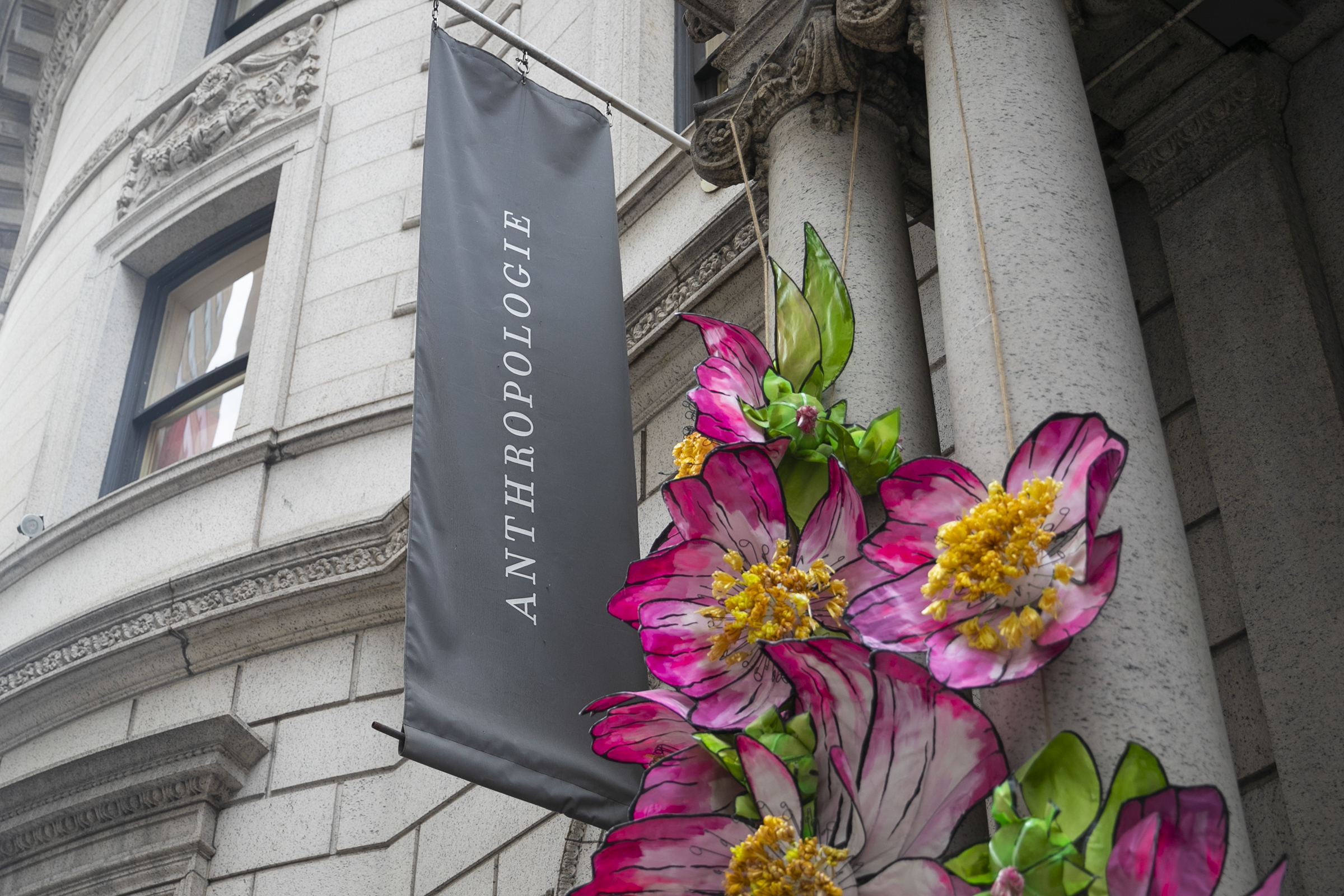
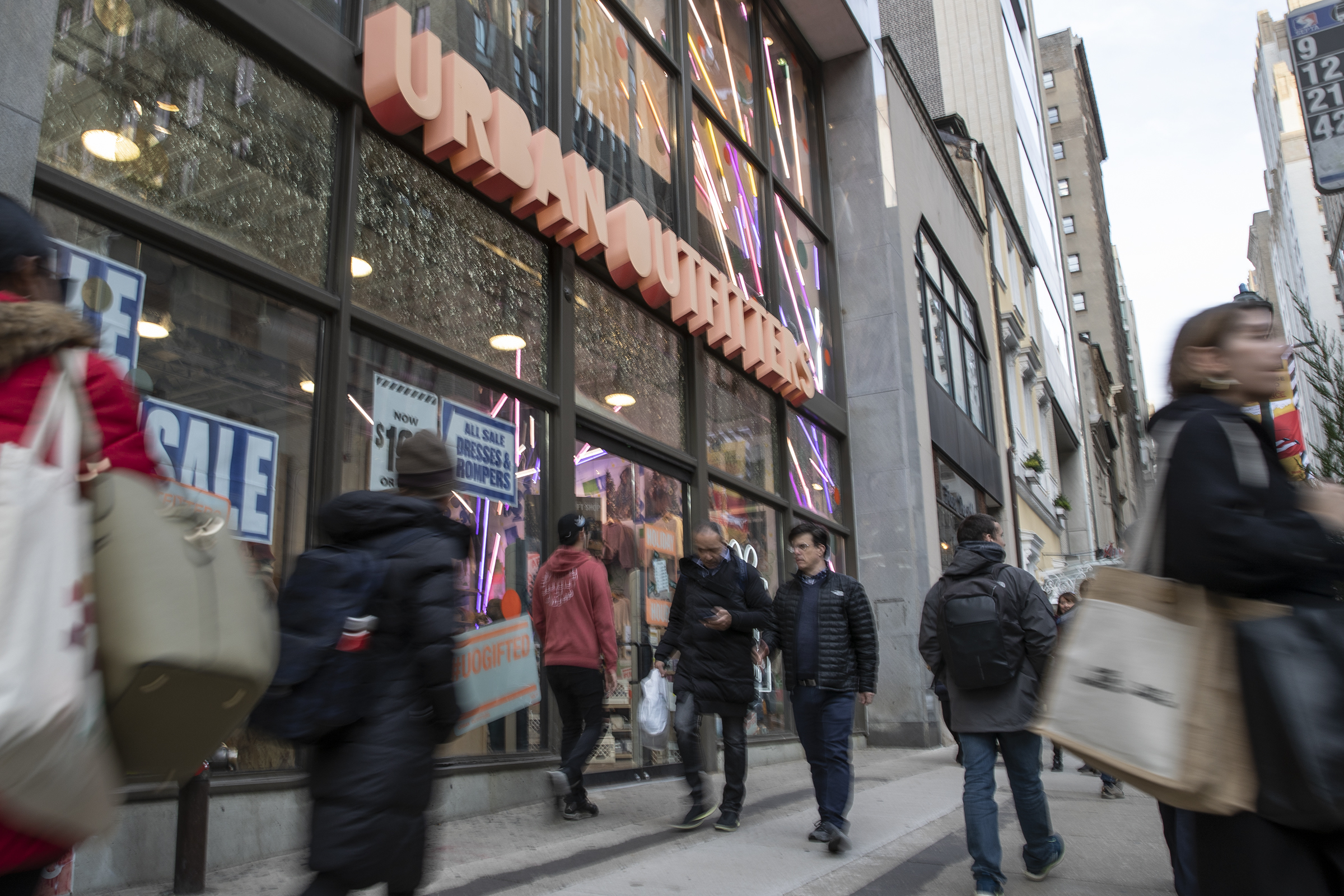
The Anthropologie store at 18th and Walnut Streets in Center City is shown in this 2020 file photo. People walk outside the Urban Outfitters store near 16th and Walnut Streets in Center City in November 2019.
One key feature of Urban is that it’s experimental and innovative, said Neil Saunders, a retail analyst and managing director at GlobalData. Nuuly, the company’s clothing rental platform, which launched in 2019, is one of the “very few players that’s really successful” in that industry, he said. For $98 a month, subscribers get six fashionable items delivered to their door, which they can wear for a month and then ship back.
But there have been financial hurdles, too.
The Urban Outfitters brand struggled with declining sales in recent years. Gen Z consumers migrated “heavily into ultra fast fashion,” said Machado, and the brand didn’t adapt quickly enough. As merchandise piled up in inventory, Urban cut prices, which consumers grew to expect.
To turn the brand around, the company set out to rebuild relationships with customers, bring on more items attractive to Gen Z, and engage with customers on platforms they were already on, like TikTok and YouTube, The Inquirer reported in 2023. The company hired a new president to helm the brand in 2024, and it returned to profitability last year.
(function(){function e(){window.addEventListener(`message`,function(e){if(e.data[`datawrapper-height`]!==void 0){var t=document.querySelectorAll(`iframe`);for(var n in e.data[`datawrapper-height`])for(var r=0,i;i=t[r];r++)if(i.contentWindow===e.source){var a=e.data[`datawrapper-height`][n]+`px`;i.style.height=a}}})}e()})();
Tariffs have also pushed the company to adapt in part by negotiating better terms with vendors, shipping items by sea instead of air, and slightly adjusting pricing.
There have been workforce challenges too. In 2020, when a racial reckoning erupted in the country and seeped into corporate offices following the killing of George Floyd, Urban saw criticism from within its own workplace. Reports emerged of employees allegedly racially profiling customers as potential shoplifters, and some employees said people of color faced challenges to advancing their careers at the company, or reporting discrimination.
“Since 2020, we have prioritized creating a culture of inclusion and belonging at our home office, in our stores, and at our facilities,” said Meaghan Condon, Urban’s director of communications and impact, in an emailed statement this month. She said that includes training for new hires and managers focused on inclusivity.
Another key ingredient in the company’s culture: the Hayne family.
Pennsylvania Gov. Josh Shapiro (left) with Urban Outfitters CEO Dick Hayne at the company’s newest building, which houses photo studios. They held a press conference in June to announce Urban Outfitters’ plans to hire over 1,000 new employees.
Cofounder and CEO Dick Hayne’s son, Dave, is chief technology officer and president of Nuuly, and his nephew, Azeez Hayne, is chief administrative officer. His wife, Meg, is Urban’s co-president and chief creative officer.
Frank Conforti, chief operating officer and co-president at Urban, said the family ties are an asset and part of the culture.
Having a cofounder still at the helm has allowed Urban to focus on long-term strategy and take calculated risks, said Conforti, such as launching Nuuly. Investors weren’t all in on the idea to begin with.
Now Nuuly has over 450,000 active subscribers — more than doubling that number since 2023.
“We sort of don’t rest on what we did yesterday,” said Conforti. “It’s not about yesterday’s bestsellers.”
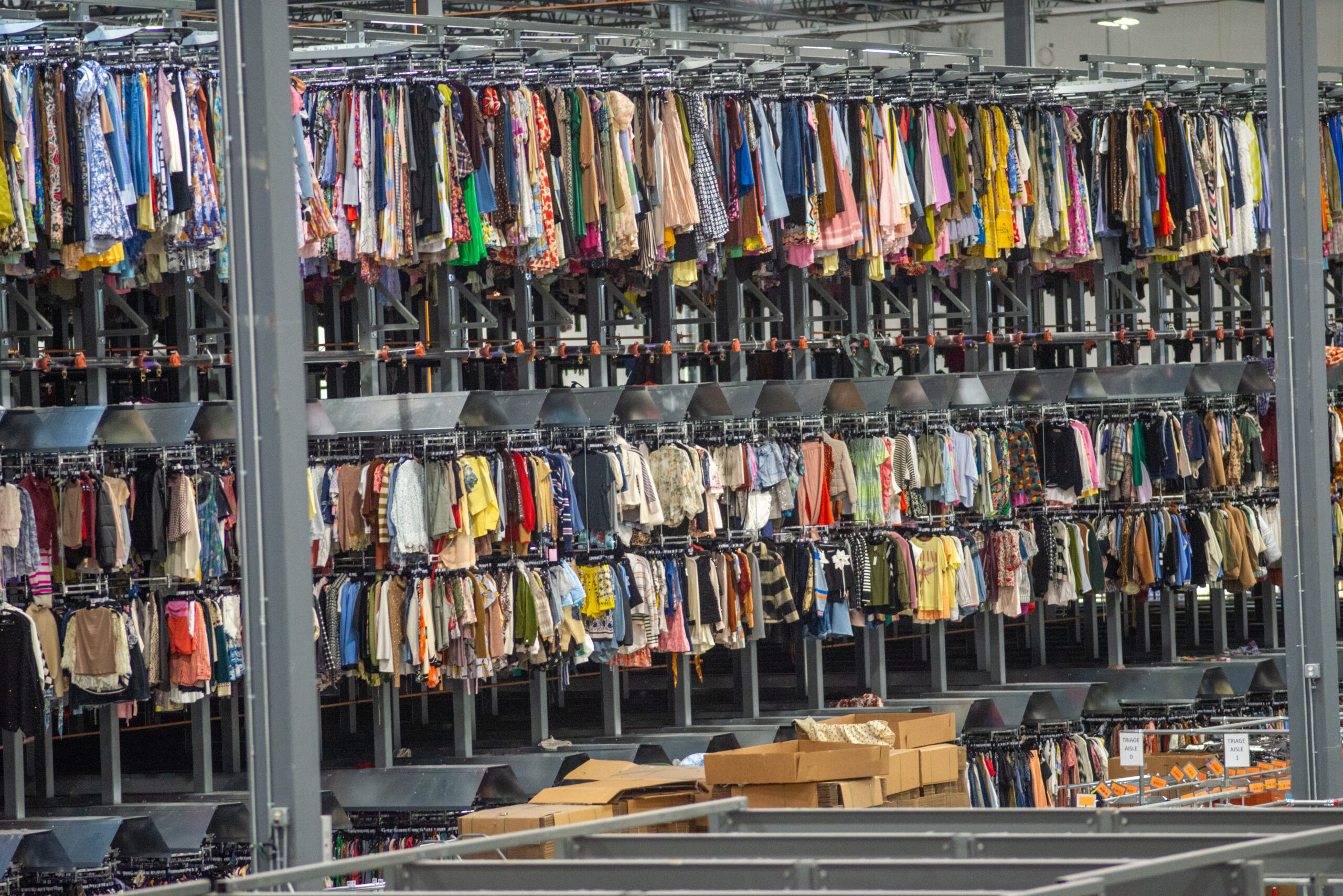
Racks of clothing inside the Nuuly warehouse in Levittown, Pa., last year. Nuuly is a clothing rental subscription service that offers a variety of styles, sizes, and brands.
A more efficient process
In Urban’s newest building at the Navy Yard, rows and rows of wheeled clothing racks are spread across several rooms. Industrial metal shelves are filled with sneakers, sandals, and handbags. Lamps and armchairs wait to be photographed for e-commerce.
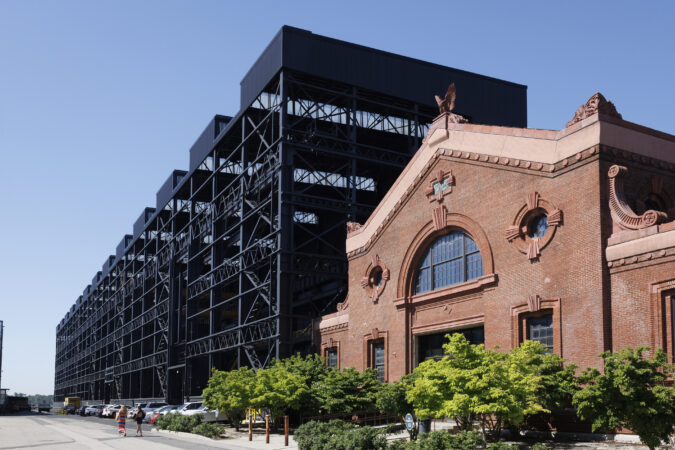
The space was once used for building and housing ship components, noted Jennifer Calliagas, Urban’s North America director of planning, who led the new building’s development. Urban bought it from Rhoads Industries in 2016 for an undisclosed sum.
Urban spent about $40 million to fit the space for its needs, which included stripping the building down to its structure, said chief development officer Dave Ziel. Construction started last year, and Urban employees began working in the space by mid-April.
Inside the new building are adjoining rooms to seamlessly carry out the photography process: Clothing, shoes, and accessories are received in one room, then moved into the next room to be styled, and finally to the studio where they’re photographed. Staging areas are set up to portray bedrooms and bathrooms, functioning kitchens were built for cooking food to show in photos, and plants are on hand to finish off the staged living spaces.
The Inquirer was not permitted to photograph the studios because the merchandise had not yet been released publicly.
Not long ago, the company’s photo work was done in rented studios in New York City, Calliagas said, or scattered across the company headquarters.
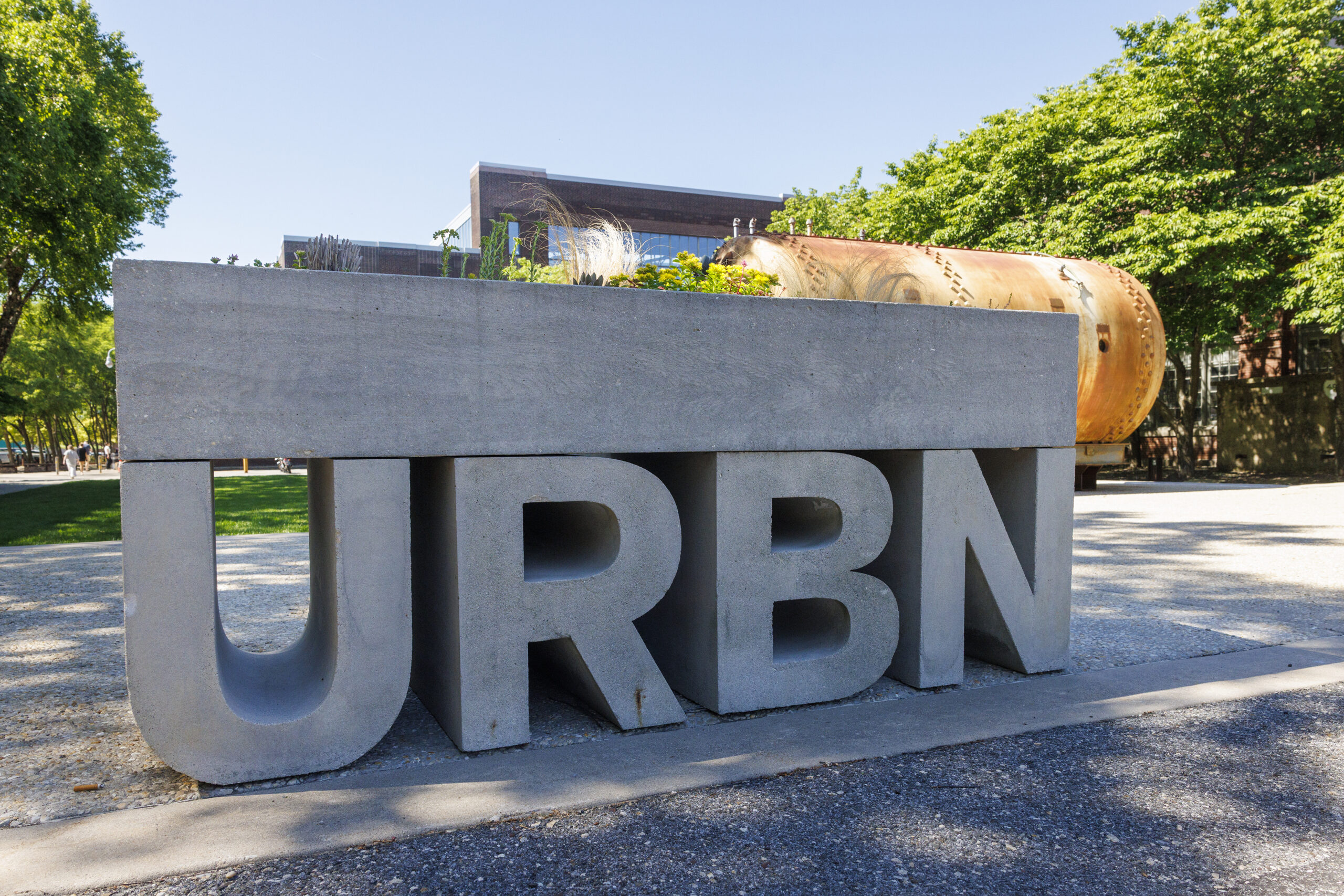
Vintage signage from the early days of Urban Outfitters, now displayed in the company’s Navy Yard headquarters.Massive outdoor signage marks Urban Outfitters’ presence at the Navy Yard.
“Anthropologie, for instance … would be receiving in one area and then going to another building for style-outs, and then sometimes going back into another building for shooting,” Calliagas said. “It was a really inefficient process.”
At the Navy Yard, the company’s brands are housed in separate buildings, in part because they each “speak to their customer” in a different way, said Oona McCullough, executive director of investor relations. She called this kind of separation “states’ rights.”
Consolidating the photo work under one roof has freed up space in other buildings, said Ziel, which is helpful for the continued growth of brands.
“The brands are still growing pretty aggressively,” said Calliagas.
Jennifer Calliagas, director of planning for North America, discusses how the company will use its photo studios at its newest building in the Navy Yard.
A campus with more possibilities
Conforti refers to the headquarters as a “campus,” with a “youthful” and “very collegiate” atmosphere. When bankers or investors visit the headquarters, “we tell them to dress down casual,” he said. “They drop their tie.”
In keeping with standards set long ago by Google and other Silicon Valley tech companies, the campus is full of amenities. The newer ones include pickleball courts, a basketball court, and a walking track. And there’s plenty of green space for employees to walk their dogs, which are welcome in the workplace.
Most people work in the office at least three days a week, said Conforti.
“We’re not the most red-tape, bureaucratic company,” he said. “There’s just nothing like being here on campus getting things done. There’s an efficiency to it — and there’s a community.”
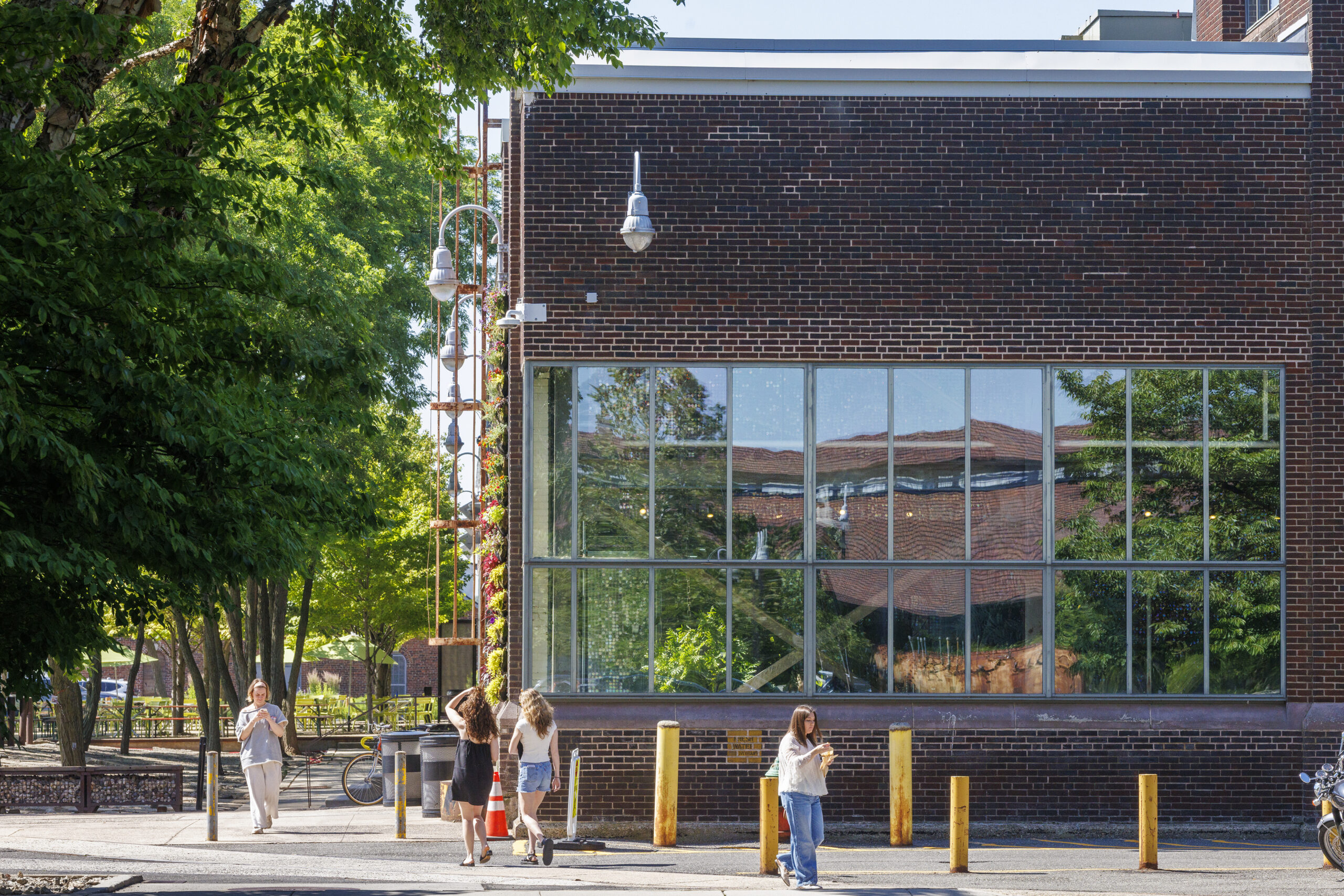
People walk to and from the building that houses Urban Outfitters’ cafeteria, which is open to employees and the public.
On a recent Monday, Urban’s cafeteria was just about to start serving warm lunches, and a few dozen people waited in line, while others roamed the large building with its decorative pools. Some wore U.S. Navy uniforms — the cafeteria is open to the public. Options included pizza, Teriyaki beef rice bowls, and grab-and-go items like ice cream bars and boxed sushi.
CEO Hayne stopped in for a bag of chips and a wrap, seemingly unnoticed.
At the June news conference, he recalled his first impression of the Navy Yard over 20 years ago: “I drove down Broad Street, came in Kitty Hawk [Avenue], looked at all these beautiful old brick buildings from the turn of the 20th century, and I said ‘sold!’”
Then & Now: Building 18 in 1917 and in 2024. Built in 1908 and used as a machine shop, it is now part of the URBN campus. Building 16 in the background was also used as a machine shop and is now a another example of an adaptive reuse project. #discovertheyard#navyyardhistorypic.twitter.com/VutWsQwrUc
HARRISBURG — Three years after a bitter budget standoff over allowing state funding to be used for private school tuition, top Democrats in Harrisburg are ready to engage on school choice.
Legislative action and comments from a top House Democrat this week expressing openness to a federal school-choice program marked a notable change from 2023, when a fight over school vouchers put Democratic lawmakers at odds with both Republicans and Gov. Josh Shapiro, a member of their own party.
House Majority Leader Matt Bradford (D., Montgomery) said this week that some of the uses of Trump’s tax credits, which are opposed by the country’s largest teachers unions, are “intriguing.” And he noted he is proud of some money the state now pours into one of thetax credits to fund private-school scholarships for low-income families in low-achieving districts. Those comments from Bradford, a top leader in Harrisburg, suggested a public softening on an issue that was previously a non-starter for his party— and signaled the school-choice debate may once again factor into state budget negotiations.
“For our members of our caucus who want to see alternatives for the poorest kids in the poorest schools, we’re being responsive to the needs of those constituents,” he said in an interview, referencing growing support for school choice among some House Democrats, particularly those from Philadelphia.
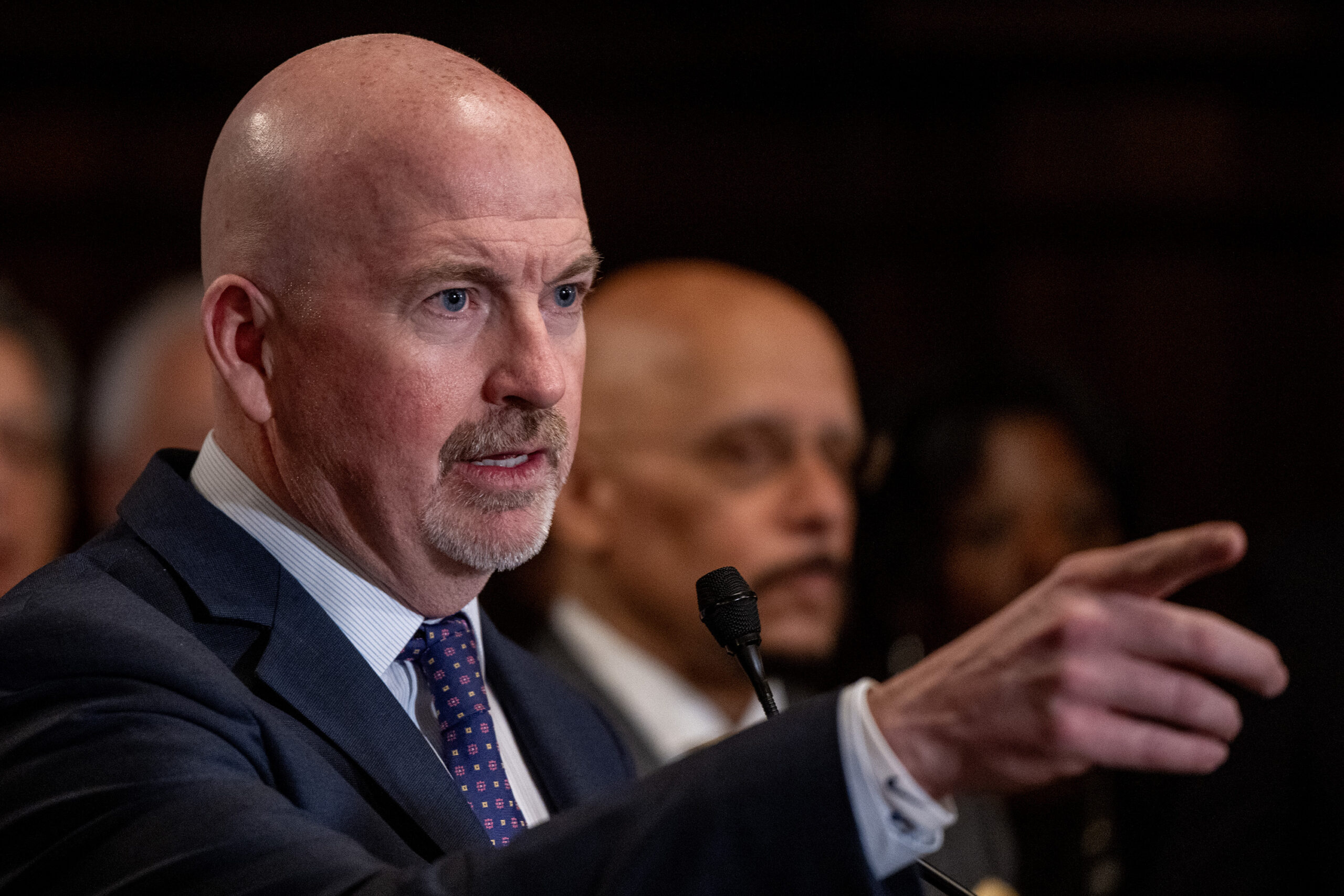
State Rep. Matt Bradford (D., Montgomery County) during a press conference at the Capitol in Harrisburg Feb. 3, 2026.
The school-choice movement, a largely Republican-backed effort to allow public dollars to go to private schools, faces strong opposition from education advocates who say such programs can take money from public schools.
And that debate is sure to continue. Bradford said more oversight — and an overall reform of the current tax credits — is needed to make sure the state tax dollars are actually reaching poor students.
Earlier this week, House Democrats fast-tracked an overhaul to the state’s current $680 million school-choice tax-credit programs to require additional reporting from private schools in order to secure funding. The legislation is likely to face opposition in the GOP-led Senate, where Republicans on Thursday advanced a $25 million increase to the programs ahead of a June 30 deadline to pass a state budget.
Senate Republicans called the tax credits a “priority for empowering parents,” while the Archdiocese of Philadelphia said the House bill would be “devastating” to local Catholic schools and lead to fewer scholarships for students.
A spokesperson for Shapiro said his office is reviewing the House bill, and declined to comment on whether his position on school choice has changed. Shapiro, who has sent his own children to private school in Montgomery County, has previously said he supports school choice, including school vouchers.
Shapiro has until the end of the year to decide whether to opt in to the federal program. But the signal of openness from Bradford, who is close with the governor, offers potential insight into his path forward.
That program, enacted last year under Trump’s “One Big Beautiful Bill Act,” would offer federal tax credits to donors for giving to organizations that grant private school scholarships. Many GOP-led states have already signed on, while some Democratic governors have declined to participate.
Pennsylvania Governor Josh Shapiro taking questions from media on election day, Tuesday, May 19, 2026. He voted today at Rydal Elementary (West) 1231 Meetinghouse Road Rydal, PA. At left is Jamila H. Winder, Chair, Montgomery County Commissioners.
Shapiro will also likely face questions about school choice on the campaign trail.
He is running for reelection in November against Republican Treasurer Stacy Garrity. Garrity’s platform focuses, in part, on expanding school-choice options in Pennsylvania and she has the support of Commonwealth Partners, a political action committee largely funded by Pennsylvania’s richest man, Jeff Yass, which has poured money into supporting school choice.
The issue will also likely surface a national stage if Shapiro enters the 2028 Democratic presidential primary race. His support for vouchers drew criticism from fellow Democrats in 2024, when he was a potential vice presidential nominee.
Debate over state tax credits
Pennsylvania does not have a direct school voucher program. Instead, the state sets aside $680 million each year for tax credits that allow businesses and individuals to write off charitable giving that supports private school scholarships.
House Democratic support for those credits has quietly grown in recent years. In a June 2025 letter recently obtained by The Inquirer, 10 House Democrats, including five from Philadelphia and the head of the Pennsylvania Legislative Black Caucus, asked their leadership to expand a portion of the tax credits forstudents in the lowest-achieving school districts — revealing more Democratic support for the programs than was previously known.
Public education advocates who oppose voucher programs say the state is funneling money to private schools with little accountability.
“It’s just a pot of money that a bunch of people get, and nobody really knows where it goes or what happens to it,” said Susan Spicka, executive director of Education Voters PA.
New requirements approved by the state legislature last year are set to take effect in November andwill require scholarship organizations to report the dollar amount of each award, the recipient’s district of residence, and where they attend private school.
The bill advanced by the House in a 105-97 vote this week would also require organizations to report each scholarship recipient’s income level — reducing the currentlimit to $144,000 for a family of four — and the amount of remaining tuition charged to a student. Advocates, including Spicka, called that information key to gauging whether scholarships are going to families who otherwise could afford private school.
Bradford said he’s proud of the $110 million earmarked in existing state tax credits to provide additional money to kids attending schools where a majority of students are getting scholarships. House Democrats say their newest proposal would steer more money toward those students.
But the proposed legislation — which would also reduce the tax credit donors could claim for some contributions, and require scholarship organizations to set 2% of funding aside for state oversight of the programs — drew swift backlash from private school advocates.
Philadelphia Archbishop Nelson J. Pérez is “deeply concerned that this legislation would have a devastating impact,” said spokesperson Ken Gavin. “The clear intent is to lead to the dilution or elimination of the programs, which are vital.”
Schools affiliated with the Philadelphia archdiocese educate nearly 44,000 students across 117 schools in the region, according to its website.
Bradford, who is Catholic, said the Archdiocese’s response “missed the mark,” arguing that this legislative effort is trying to achieve a similar goal of serving students from poor families who attend the roughest schools.
“I’m proud of my own Catholic faith. I love when my Catholic Church stands for those communities,” Bradford added. “No one should ever fear transparency, especially when you’re talking about three-quarters of a billion dollars of state tax dollars.”
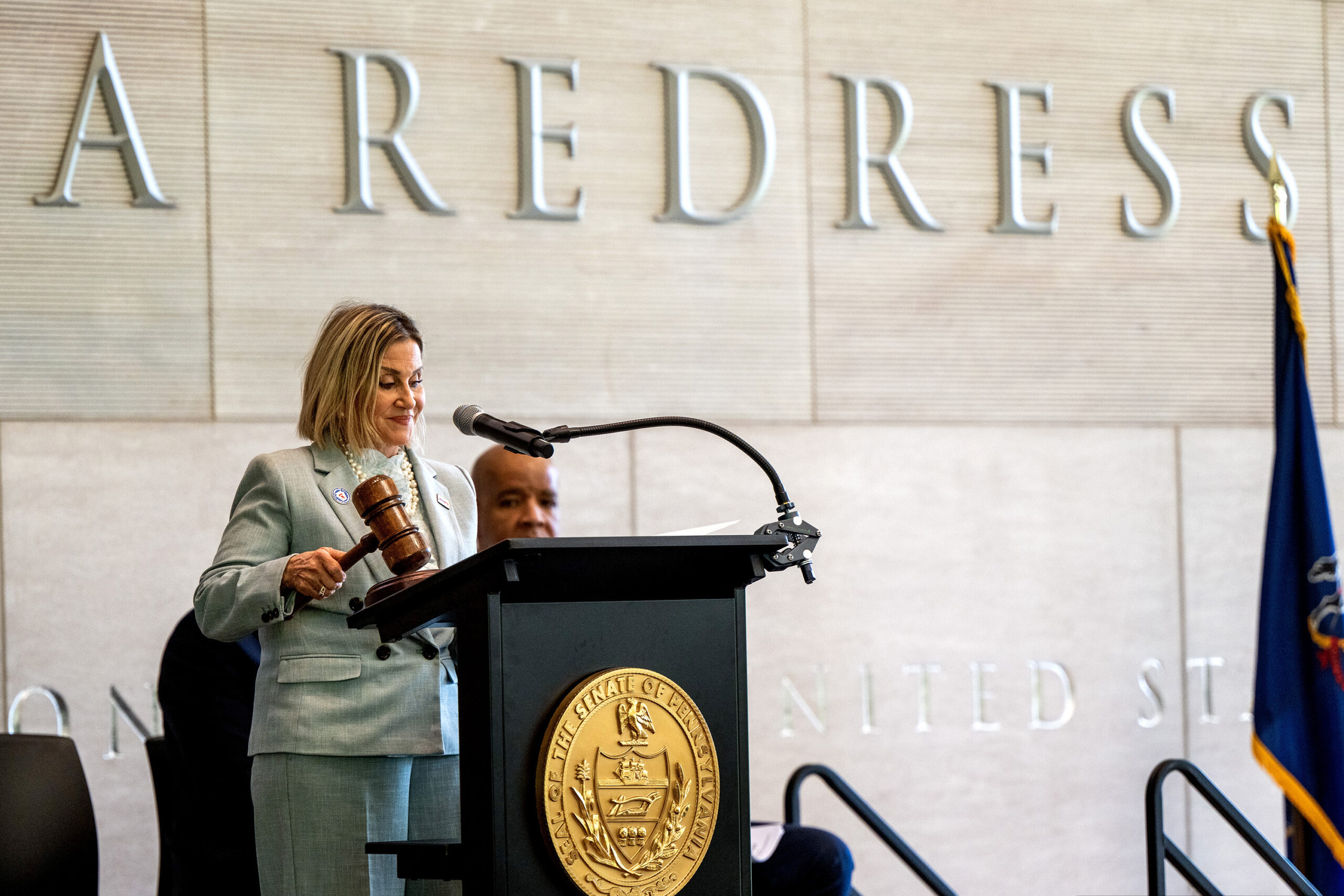
President Pro Tempore Kim Ward gavels the opening as the Pennsylvania Senate hosts a ceremonial meeting at the National Constitution Center Tuesday, May 5, 2026.
Meanwhile, Senate Republicans on Thursday amended another House bill to increase the state’s current tax credit programs to $705 million.
President Pro Tempore Kim Ward (R., Westmoreland), a staunch supporter of school vouchers, said in a statement that Bradford‘s attention to school choice is disingenuous, criticizing the House Democrats’ bill as “overly burdensome auditing requirements disguised as ‘transparency.’”
The 2023 budget breakdown, where Shapiro ultimately vetoed the school voucher program he‘d helped draft with Senate Republicans because it couldn’t pass the Democratic-controlled House, continues to tarnish his relationships with top GOP leaders, including Ward. He and Ward have hardly spoken since.
“While Senate Republicans have consistently advanced legislation to provide scholarships to disadvantaged students, the track record for Gov. Josh Shapiro and House Democrats has been nothing more than a case of whiplash as their words and actions rarely align,” Ward said. “To me, it seems like the support for school choice by the House Democrat Leadership is more of a façade as they continue to cater to political special interests.”
Bradford, in response, said he is open to conversation about accountability and transparency, but that debate needs to include private schools benefiting from taxpayer dollars.
“We shouldn’t carve out any portion of our K-to-12 education,” Bradford added. “That conversation needs to be uniform.”
A choice for states on Trump’s tax credits
Shapiro has previously said he would wait for more details before making a decisionon whether to participate in the new federal tax credit program. The U.S. Department of the Treasury earlier this month released additional details, including that itwill allow individuals to receive up to $1,700 in credits for making donations to private school scholarships that can cover tuition, tutoring, and more. In Philadelphia, families making $368,100 annually, or 300% of the county’s gross median income,would be eligible to receive the scholarship.
Shapiro’s press secretary Rosie Lapowsky said the governor appreciates the guidance, but continues to await information on “how this will affect use of our existing tax credits, how states will be expected to administer the program, and how eligibility will be determined.”
Twenty-eight states have opted in to the program, most of which are led by Republicans. And Democrats are facing pressure to stay out of the program.
In a letter sent to Democratic governors this week, American Federation of Teachers President Randi Weingarten and National Education Association President Becky Pringle called the program “a Trojan horse carrying near-universal K-12 private school vouchers into every state that participates.”
So far, Democratic governors elsewhere have taken differing approaches to the program. New York Gov. Kathy Hochul has said her state will participate but is waiting for final guidance before officially signing on. Other governors like Minnesota Gov. Tim Walz and Oregon Gov. Tina Kotek have announced that their states will not participate. Democratic governors in Arizona and Wisconsin have vetoed legislative efforts to force their states to opt in, while governors’ similar vetoes in North Carolina and Kentucky were overridden by legislators.
Bradford said it’s “an abomination” that funding for Trump’s program came from Republicans making other cuts to the federal budget, and emphasized that stateDemocrats remain committed to increasing public education funding.
“Here in Pennsylvania,” he said, “we are a humble 102 [Democrats] in the Pennsylvania House and we are nimble and pragmatic.”
America stands on the brink. The ultimate question of independence hangs over Philadelphia.
And Thomas Jefferson has a declaration to draft.
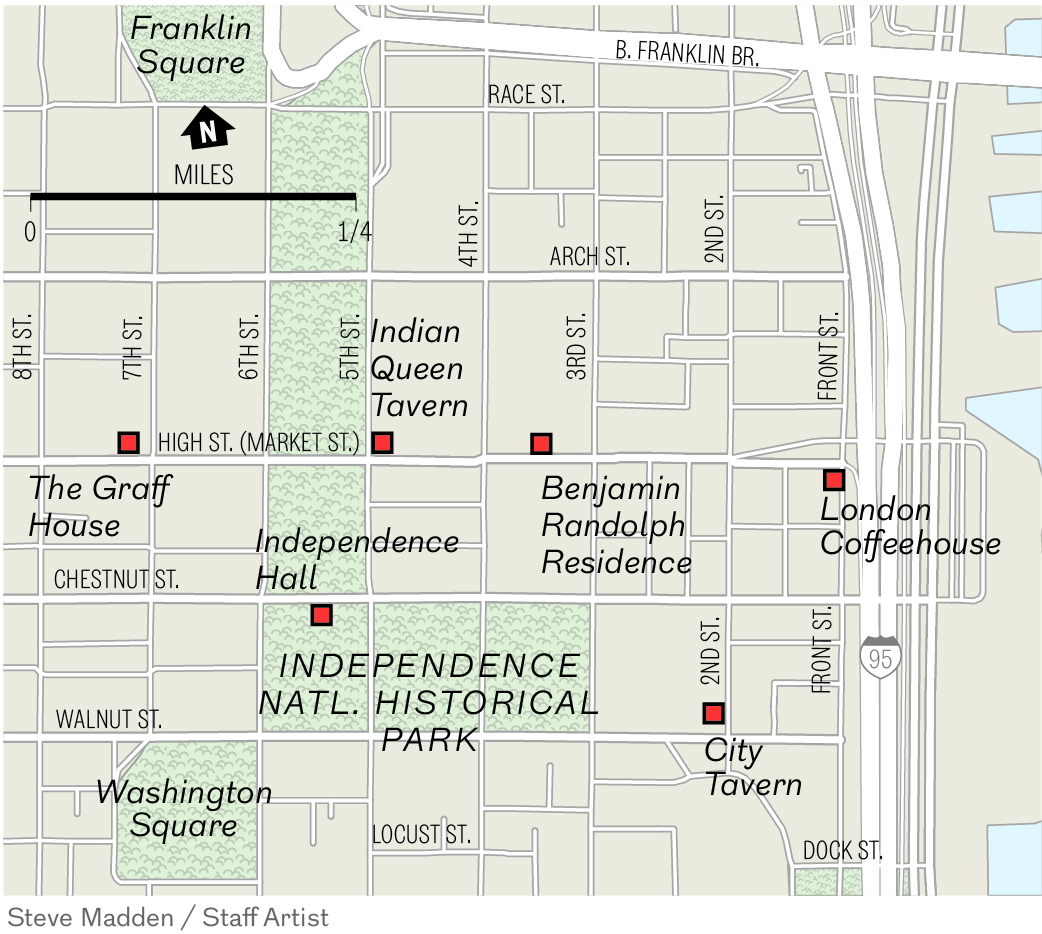
His heart is in Virginia. His “country,” as he calls it. But here he is at Seventh and High Streets, 33 years old, living in two sweltering rooms, with his chance to make his mark on history.
Unlike his fellow delegates, lodged in rooms along Philadelphia’s booming riverfront, Jefferson takes quarters along the city’s rural western edge, two blocks from the Pennsylvania State House, where the rebels conspire. The orchards and pastures bordering the downtown of British America’s largest and wealthiest city offer an escape from Philadelphia’s stifling summer heat and foul smells. Its stinking creeks, rotting trash, and unchoked illness. The verdant outpost, elsewise occupied by a bricklayer and his family, provides “the Squire,” as his friends back home call him, some small semblance of his mountaintop mansion, Monticello.
Thomas Jefferson’s Philadelphia in 1776.
He is living out of leather-bound trunks. Fresh air and sunlight stream through a window overlooking High Street — Philadelphia’s main thoroughfare, busy even on the outskirts. Hinterland farmers’ wagons clatter over cobbles, headed for the market. The sweet scent of fresh loaves drifts from a shopfront bakery. Jefferson’s thoroughbred — Caractacus, perhaps, his favored bay stallion, whose regal appellation derives from a first-century British chieftain — nickers in a nearby stable.
Robert “Bob” Hemmings, Jefferson’s 14-year-old enslaved valet — and half brother of Jefferson’s future paramour, Sally — attends his every need in Philadelphia, sleeping in a garret off the writing parlor.
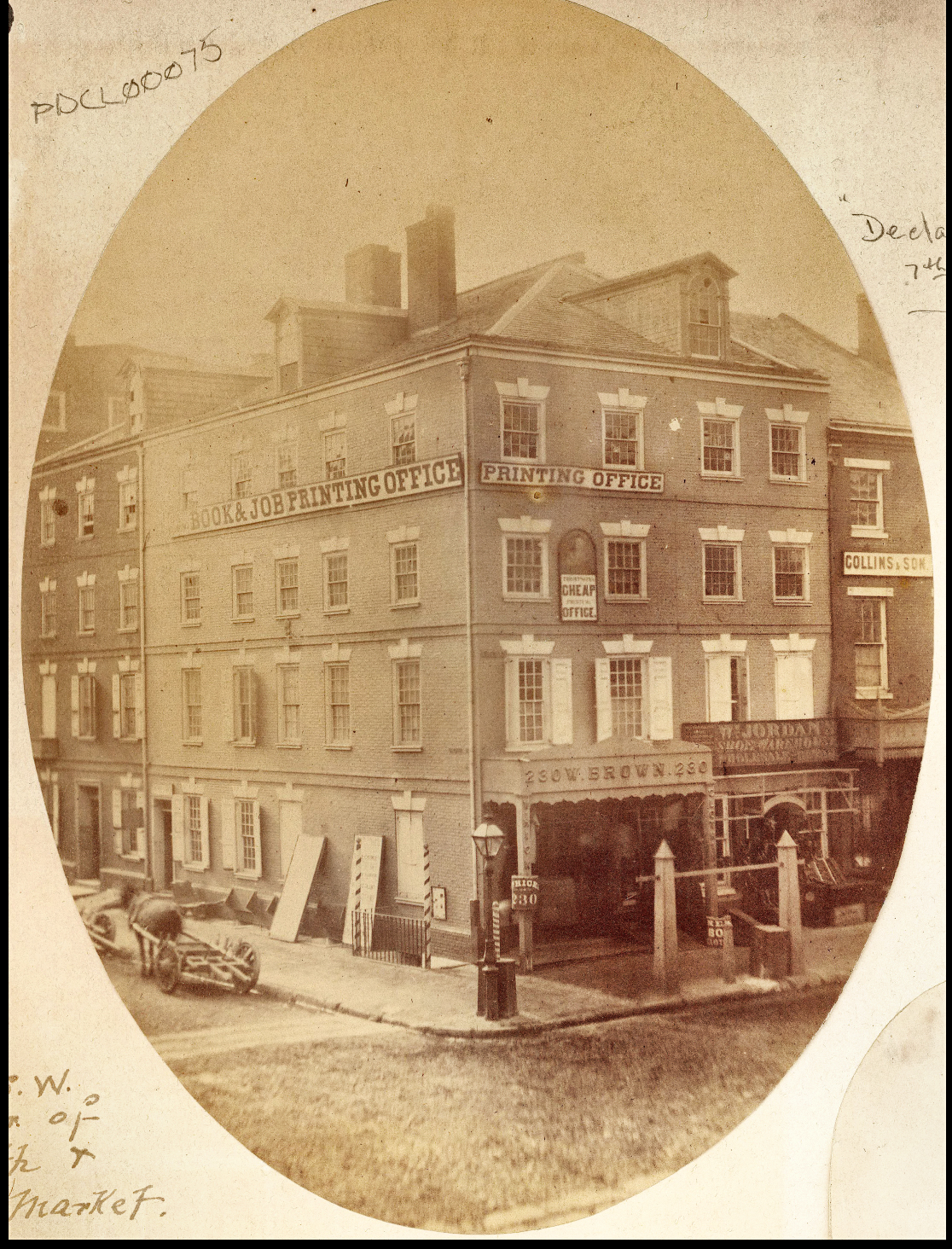
The Declaration House, 7th and Market Streets, in 1856.
The rag paper resting on Jefferson’s mahogany travel desk — a small, portable lap device of his own design that the inveterate tinkerer had commissioned from a Chestnut Street cabinetmaker upon his arrival in Philadelphia a month earlier — remains blank. His quill is still. In the shadows, a grandfather clock ticks a stately rhythm.
Tick … tock … tick … tock.
The master of Monticello is working on a deadline.
Just weeks earlier, more than four thousand Philly patriots braved driving rains to gather in the brick-walled yard of the State House. Celebrating the Second Continental Congress’ decree to form new governments apart from King George III — the masterstroke of John Adams, 40 — the drenched Philly masses thunder for independence.
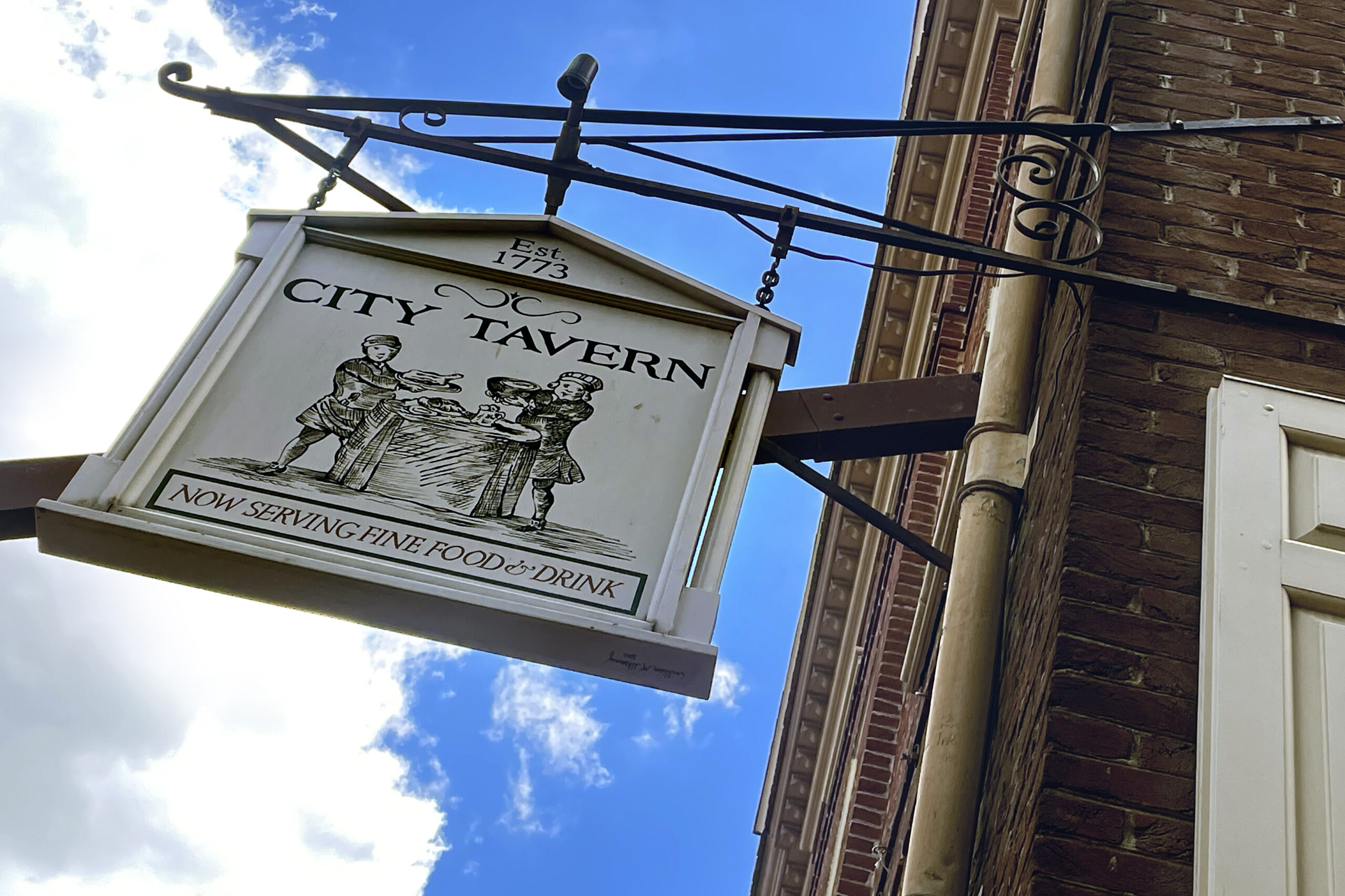
City Tavern Monday, June 15, 2026. The original building was demolished in 1854 and reconstructed in 1975.
George Washington himself takes brief leave of his embattled army, digging in for an expected British assault on New York, to update the 56 congressional delegates in Philadelphia. The general’s tidings are lost to the centuries. But hear the lusty huzzahs that greet the stoic warrior at the representatives’ nightly repast at City Tavern, their unofficial headquarters.
“George Washington, and victory to the American arms!” goes the toast.
Inside the locked chamber, radicals like Adams and his older cousin, and backroom operator, Samuel, 53, lead the fight for liberty. Jefferson, whose resolve for popular government in America is unquestioned, but who detests public speaking, rarely rises.
In early June, it is Jefferson’s fellow Virginian, the passionate patriot Henry Lee, who delivers a decisive stroke, boldly uttering words hitherto unsaid in Congress: “That these United Colonies are, and of right ought to be, free and independent.”
The thunderclap is met by delay. Delegates from powerful colonies, including Pennsylvania’s own reluctant son of liberty, John Dickinson, are hesitant to cut the cord. Radicals work furiously to build unanimity.
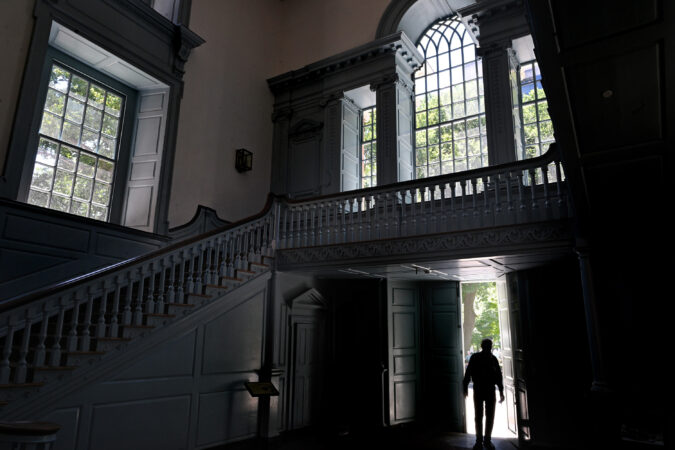
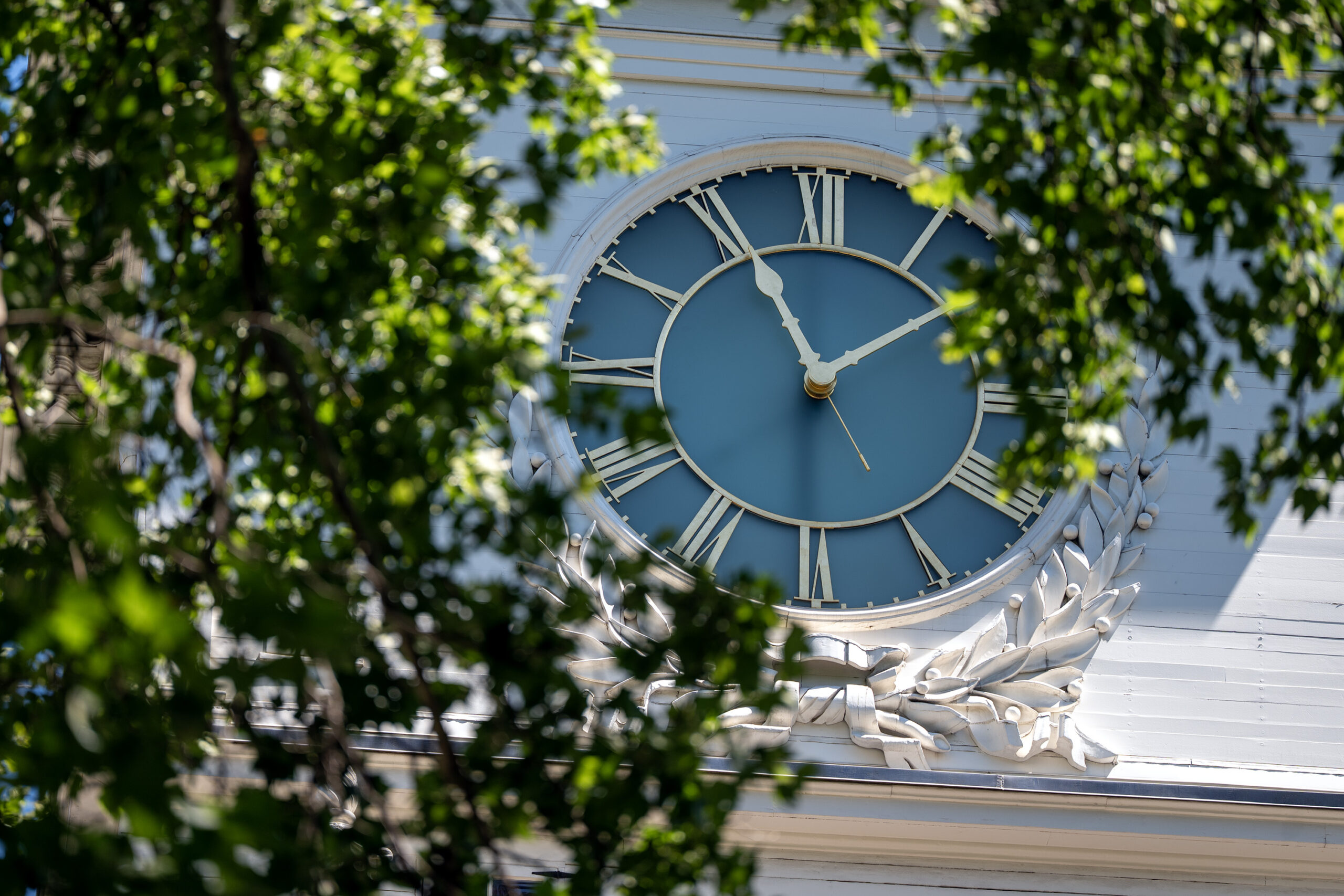
Clock tower at Independence Hall (Pennsylvania State House) Monday, June 15, 2026.
Philly headlines — in the same papers publishing fugitive slave ads and notices for the sale of Black children far younger than Bob Hemmings — decry “our mortal enemy the King of Great Britain.”
“The people wait for us to lead the way,” Jefferson will note.
During the delegates’ fiery, closed-door debates, his long legs folded underneath his desk, Jefferson stays mum.
But now the poet-philosopher and slaveholder, whose bright brilliance and dark contradictions mirror perfectly the promise and sins of the nation he seeks to author, must find all the words.
A renaissance figure among the rebels
It is John Adams, in characteristically gruff fashion, who appoints Jefferson first quill. The good gentleman from Virginia is but one of five men appointed to draft America’s creed — including Adams and Franklin, home sick with gout and other ailments — but Adams argues it is Jefferson, with his “peculiar felicity for expression,” who should do the writing.
“Reason first, you are a Virginian, and a Virginian ought to appear at the head of this business,” Adams recalls telling Jefferson in the committee’s first convocation. “Reason second, I am obnoxious, suspected, and unpopular. You are very much otherwise. Reason third, you can write 10 times better than I can.”
Adams is right.
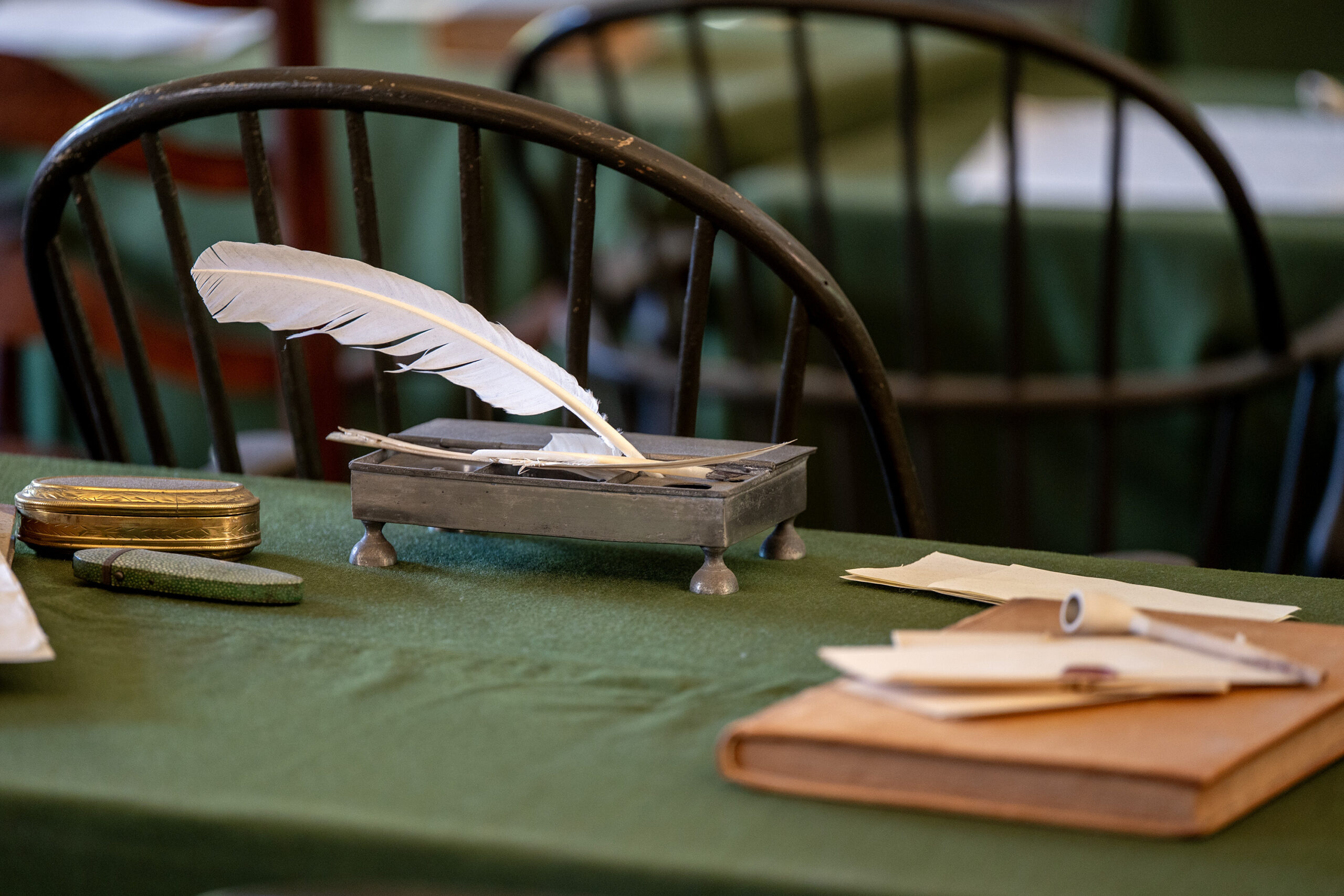
Replica desks in the Assembly Room in Independence Hall (Pennsylvania State House) Monday, June 15, 2026.
Both drawn to the flame of American independence — the noblest cause of their age, and any other, they believe — the freedom fighters cut an odd coupling.
Adams, short, plump, balding, cantankerous. Jefferson, tall, lean, formidable, a shock of copper hair, freckled in the Philly heat, his illusive eyes described as blue or hazel or light gray. The Southern planter and legislator who matriculated at the College of William & Mary is soft-spoken and painfully gracious and polite, charming, flirtatious. He abhors confrontation.
Behold this true renaissance figure among the rebels.
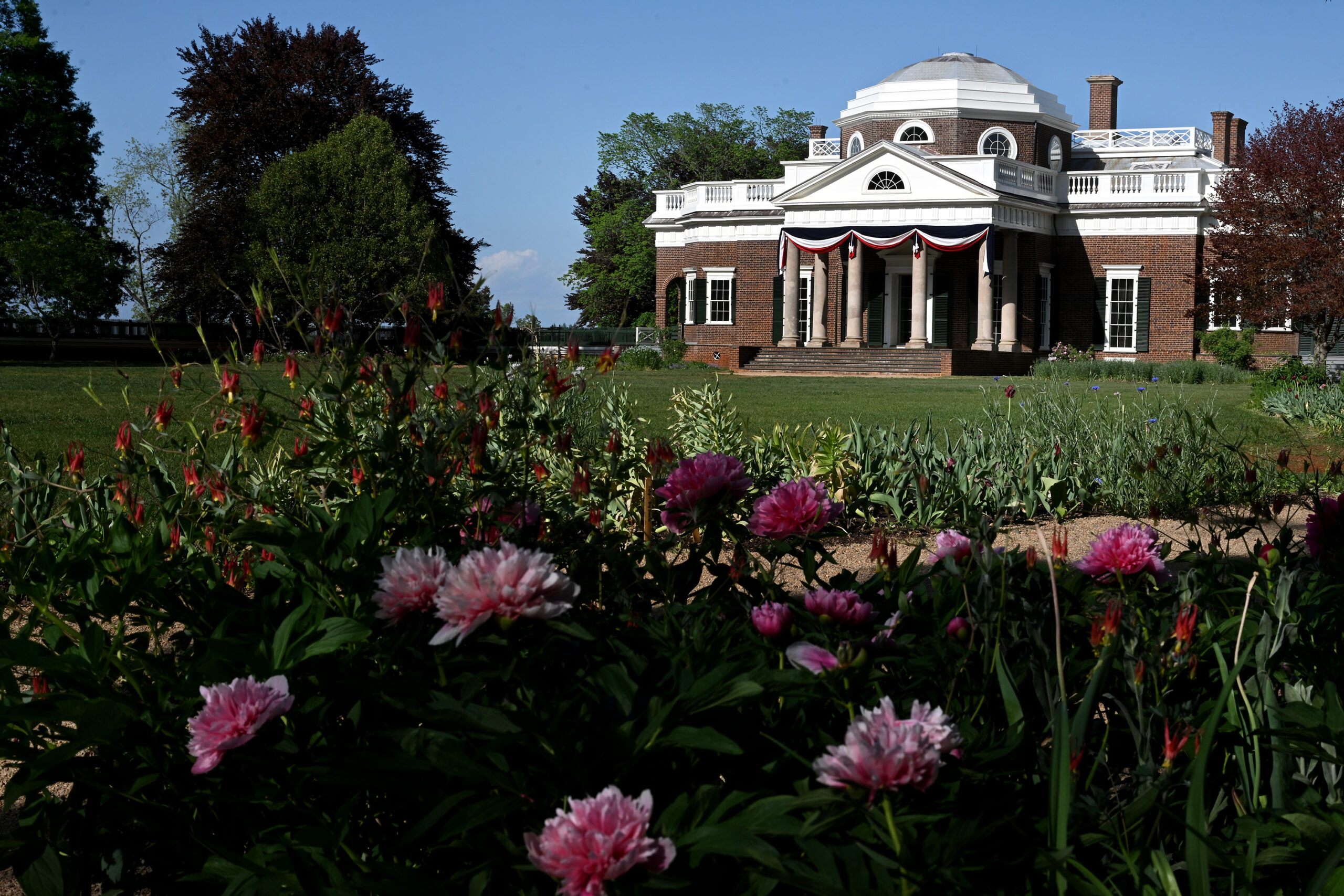
Monticello, the primary residence and plantation of Thomas Jefferson in Charlottesville, Virginia, April 22, 2026.
A lover of food and wine and fine things, he studies art and history, philosophy and mathematics, science, botany, astronomy. He speaks four languages and can aptly read ancient Greek. He has been building his Palladian plantation house — situated on land more than five times bigger than the core of Philadelphia, the makeshift colonial capital city, and toiled by more than 100 chained souls — since the age of 14.
Adams, obsessive even in his sightseeing, catalogs and compares the marvels of Philadelphia — its spacious thoroughfares, leafy green spaces, commanding skyline, including Christ Church’s heaven-kissing steeple, the tallest structure Washington had ever laid eyes on, its booming ports, gleaming institutions, exotic foods, and bottomless wine, porter, and punch.
During his few hours free from the rigors of revolution, Jefferson shops.
With Bob touting bulging bundles, the Squire strolls Philadelphia’s abundant artisanal shops, buying maps and books across all his tastes — so many volumes, he commissions his favorite Philly cabinetmaker to make a specialized bookcase to ship them home — and tools for Monticello. He buys fine fabrics for his wife, Martha, whom he is heartsick for. An elegant doll for his 4-year-old daughter, Patsy. He buys a straw hat for himself, and shoes and socks for Bob. At a market stall, he pays a shilling to gaze upon a merchant’s exotic monkey.
Along with his compatriots, he sups at the City Tavern most nights, enjoying as many as three glasses of wine, but also favors the regal rusticity — and punch — of the Sign of the Conestoga Wagon Tavern on High Street.
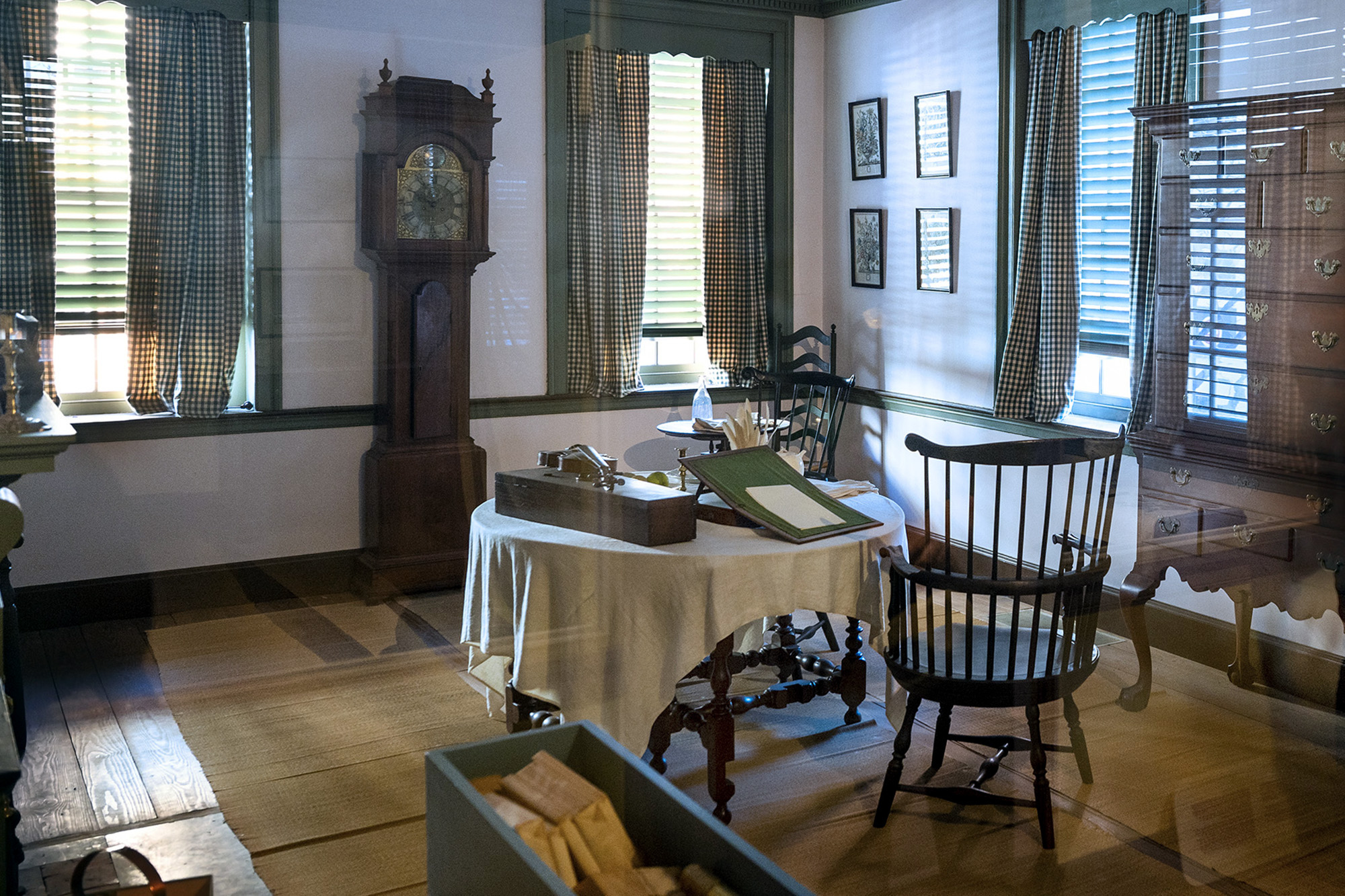
A replica of the room where Thomas Jefferson wrote the Declaration of Independence, inside Declaration House (home of Jacob Graff, Jr.) Dec. 20, 2023.
Envision him, this sun-freckled Moses of American history, in flesh and bone, a living, breathing man, donning a sun hat, whose first memory is being held on a pillow by an enslaved worker, and who will within days pen the most revolutionary, if fatally flawed, manifesto ever put to parchment, walking among, but set apart from, the working classes of Philadelphia. The laboring, the indentured, and the enslaved — all those he would conversely see lifted to the altar of democracy or sold at the auction block.
See this man. And understand America.
An expression of the American mind
He envisions his task to “place before mankind the common sense of the subject.” A justification for revolution, yes. A litany of proof that King George was a tyrant — and among other things, in an epic, and ultimately unsuccessful, act of blame-shifting, responsible for the entirety of the slave trade. But not a wholly original document. Rather, a soaring summation of the American revolutionary zeitgeist.
“Neither aiming at originality of principle or sentiment, nor yet copied from any particular and precious writing, it was intended to be an expression of the American mind, and to give to that expression the proper tone and spirit called for by the occasion,” he will later explain.
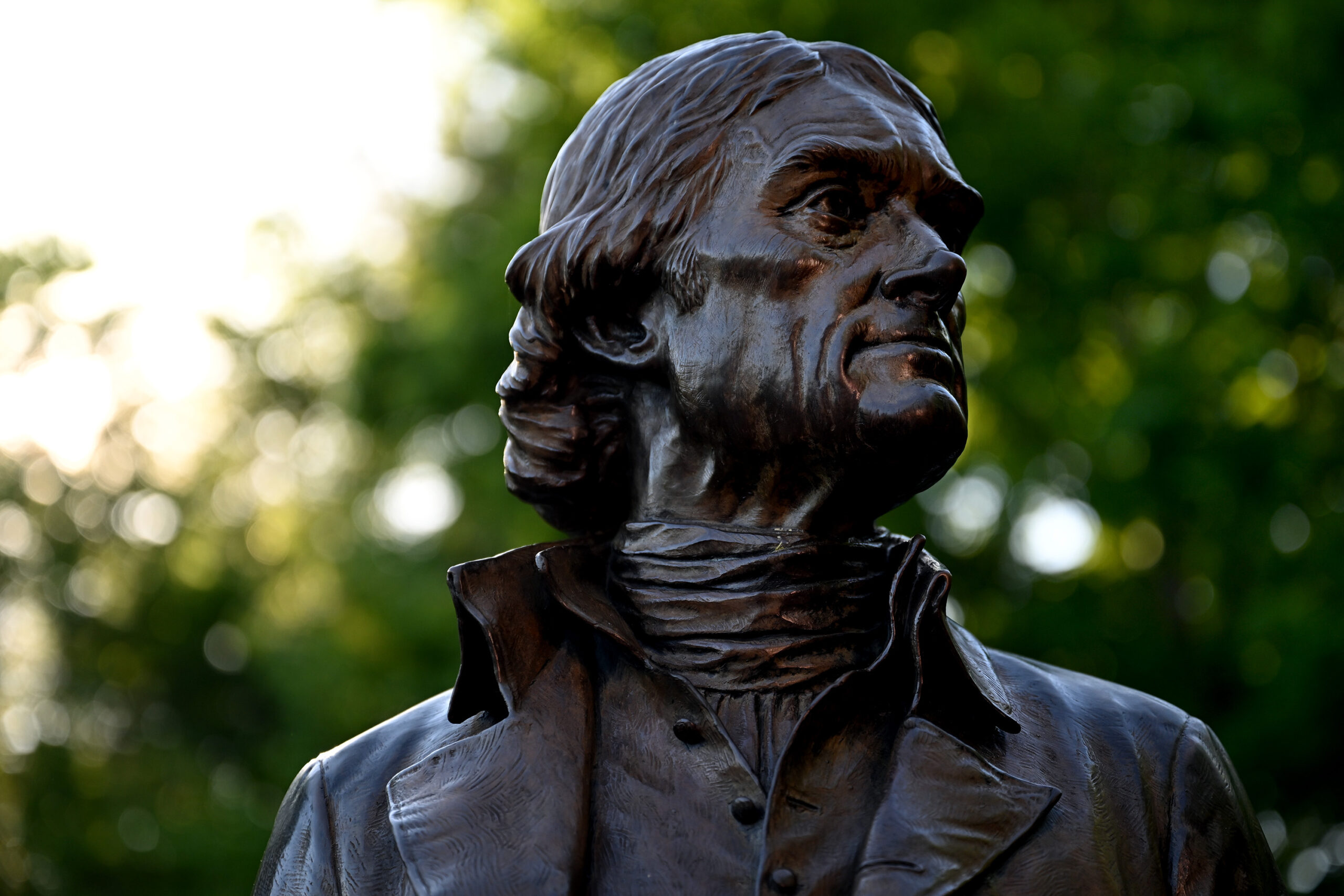
Statue of Thomas Jefferson at Monticello, his primary residence and plantation of in Charlottesville, Virginia, April 22, 2026.
In his parlor, with the tall clock ticking and Bob tending to tea, Jefferson works fast, pulling from his own writing — including his recent draft for a new Virginia constitution — and also from a declaration of rights for Virginia, penned by pal George Mason. From the whirling stream of his intellect, he plucks at will the inspirations and ideals of the seminal works of enlightened thinkers like John Locke and David Hume, whose writings on natural rights and freedom (“Life, liberty, and property,” Locke wrote, before Jefferson amends it for the better) provide the bedrock for the revolution.
Quickly, he begins to find his words. The rag paper fills.
“We hold these truths to be self-evident,” writes the man from Monticello.
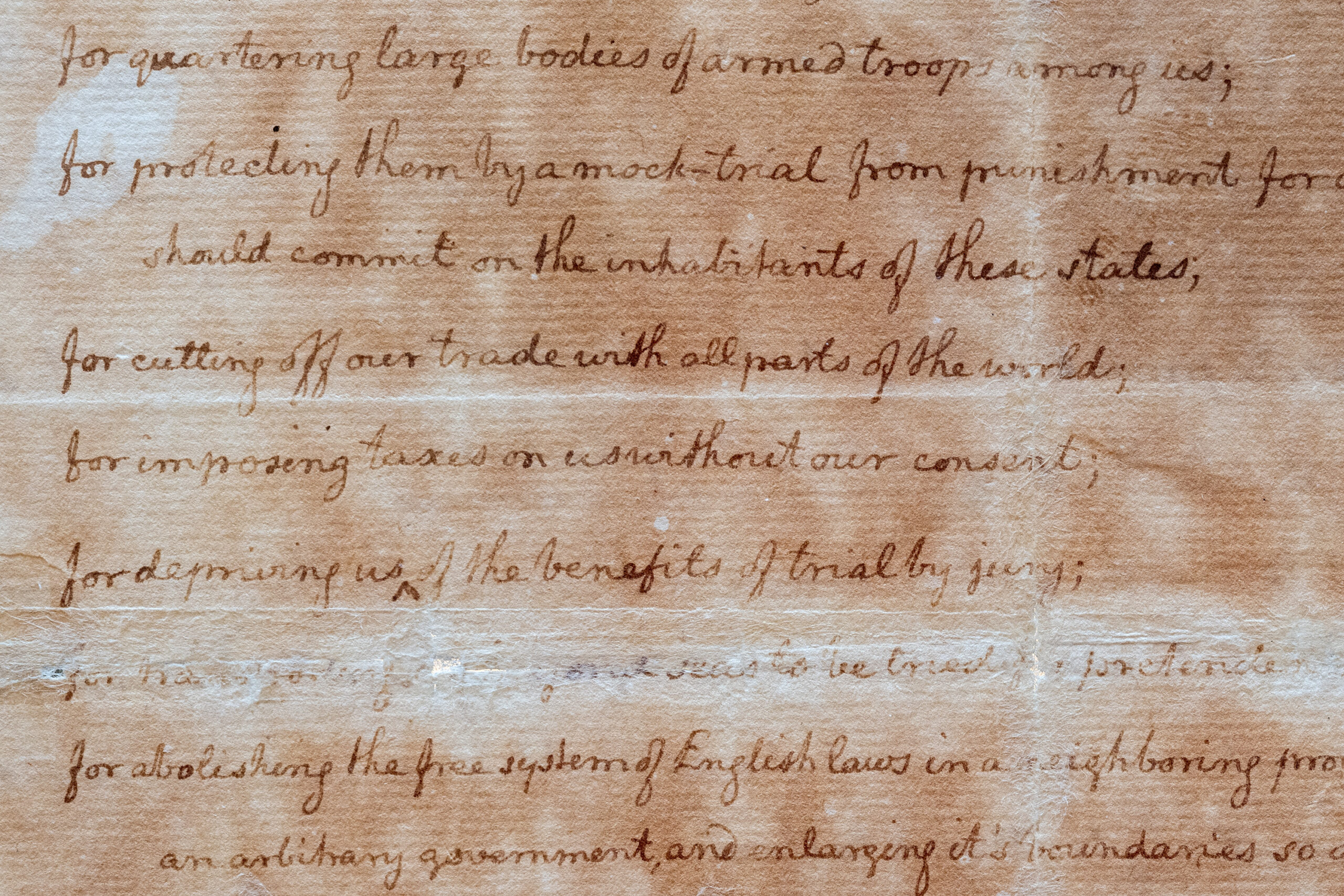
A faded copy of a draft of the Declaration of Independence handwritten by Thomas Jefferson, known as the “Fair Copy,” on display at the American Philosophical Society Monday, June 15, 2026.
Dispatches from 1776, Part III will be published online on July Fourth. Read Part I here.
This historical sketch is based on interviews with Tyler Putman, manager of gallery interpretation at the Museum of the American Revolution, and Michael Idriss, manager of the African American interpretive program at the Museum of the American Revolution, as well as J.M. Duffin, assistant archivist at Penn Libraries, historian and author Michelle Craig McDonald, and Stephen Nepa, history professor at Pennsylvania State University’s Abington campus. The author also based this series on historical newspaper accounts and research from “John Adams,” by David McCullough (Simon & Schuster, 2001), “Declaration: The Nine Tumultuous Weeks When America Became Independent, May 1-July 4, 1776,” by William Hogeland (Simon & Schuster, 2010), “American Scripture: Making of the Declaration of Independence,” by Pauline Maier (Random House, 1997), “The Revolutionary: Samuel Adams,” by Stacy Schiff (Little, Brown & Co., 2022), “Cocked and Boozy: An Intoxicating History of the American Revolution,” by Brooke Barbier (Chicago Review Press, 2026), “Thomas Jefferson: The Art of Power,” by Jon Meacham (Random House, 2012), “Rum Punch and Revolution: Taverngoing and Public Life in Eighteenth Century Philadelphia,” by Peter Thompson (University of Pennsylvania Press, 1999), “The Thomas Paine Reader” (Penguin Books, 1987), and “1776,” by David McCullough (Simon & Schuster, 2005).
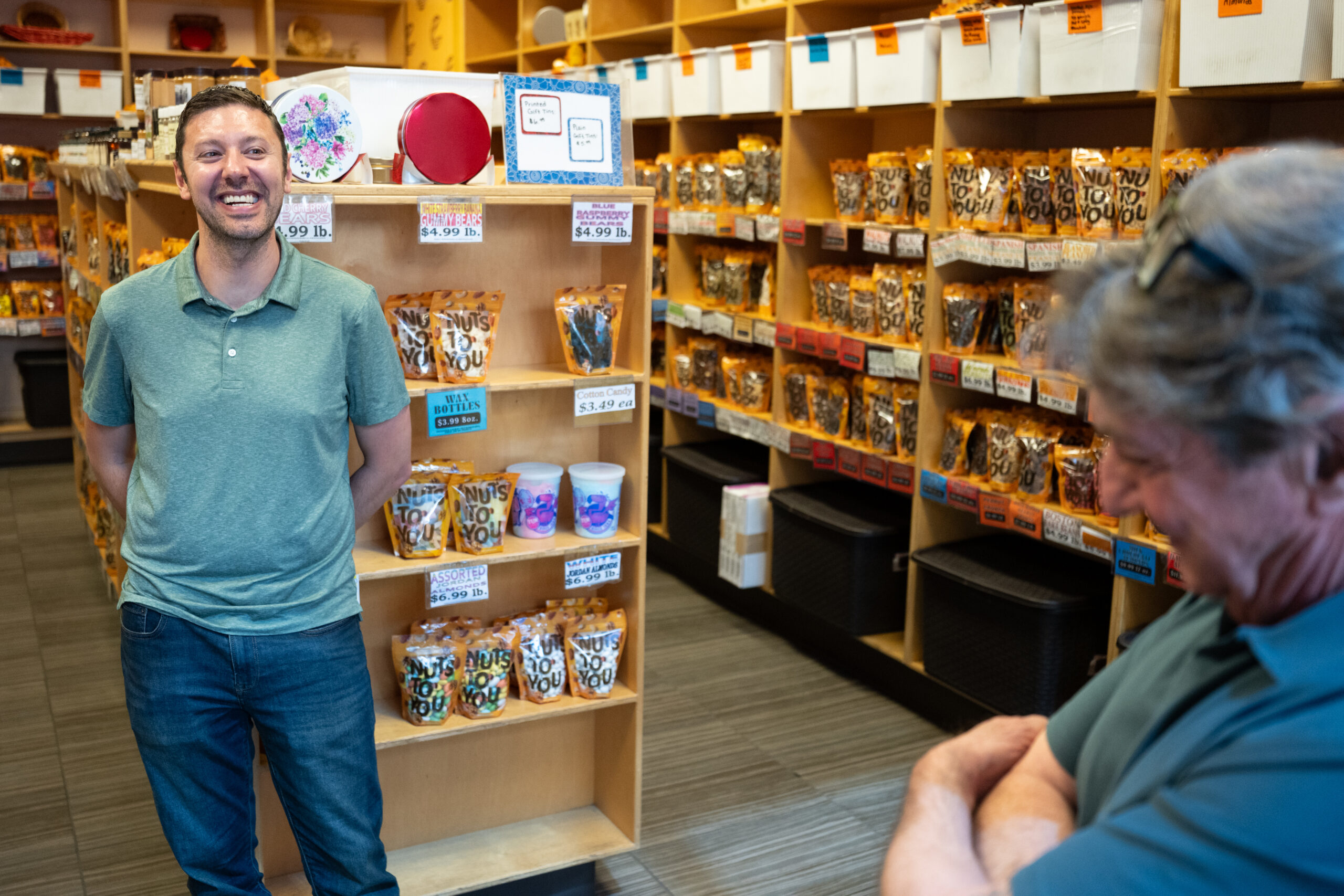
On 20th Street between Market and Chestnut, much has changed in the past 50 years. One tenant that hasn’t: Nuts To You. The snack shop, wrapped in yellow wallpaper speckled with walnuts, remains packed with shelves of nuts, candy, and dried fruit galore.
Nuts To You, a snack haven owned by the same family for three generations, is celebrating 50 years in Center City. Since its first location opened in 1976, Nuts To You has survived the rise of the internet, and the emptying of the business district in a post-pandemic Philadelphia, building decades-long customer relationships on the way.
Pulling off such a feat is “rare, and it’s really hard,” according to Erika Tapp Duran, director of Temple University’s Small Business Development Center.
Nuts To You freshly roasts their nut products at a warehouse in Frankford. Over the years they have broadened their inventory to include freshly popped popcorn (also made in-house), as well as chocolates, candy, dried fruit, and almost anything else one could find in a kitchen pantry.
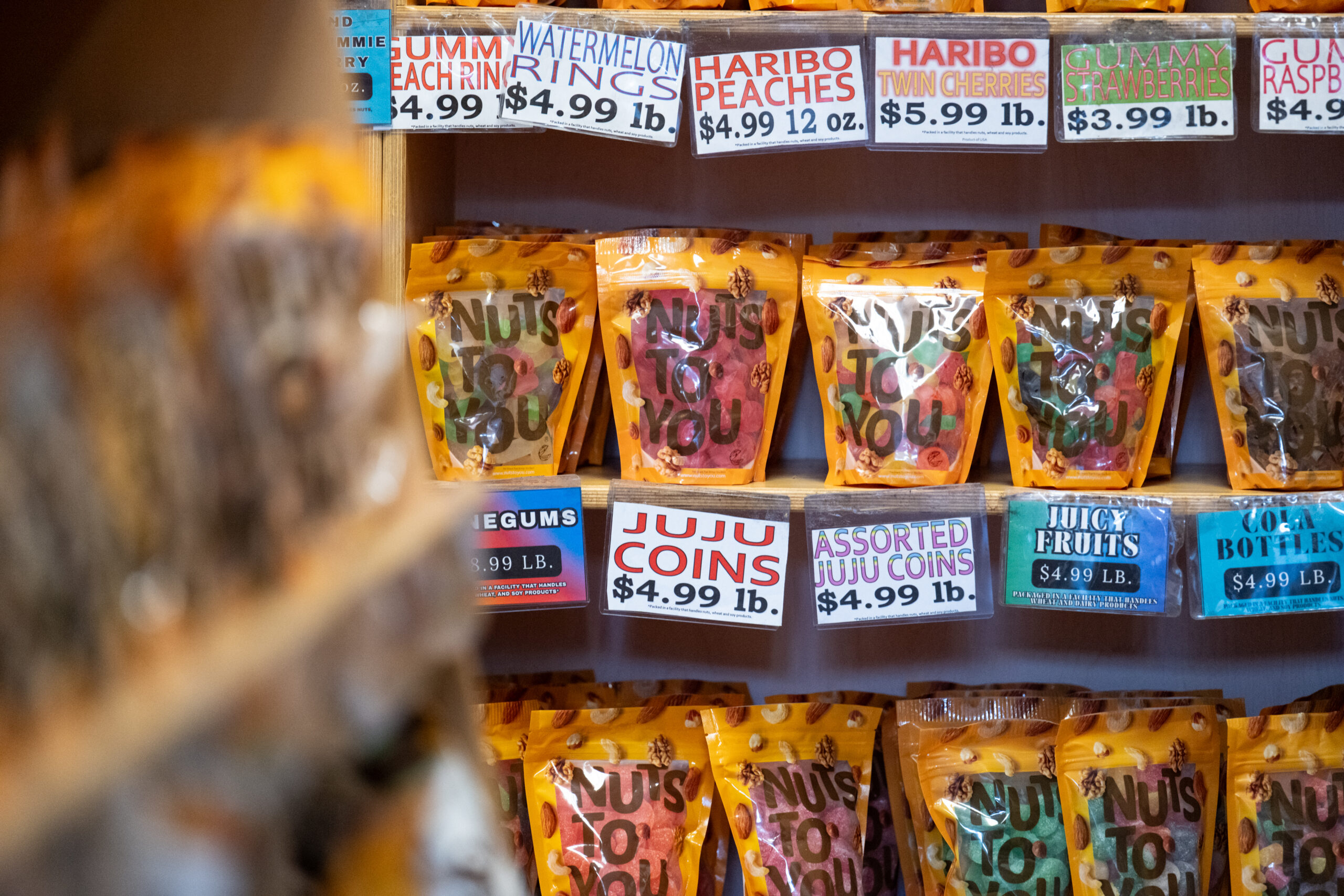
Gummy candies sold at Nuts To You, a family-owned and operated snack store.
They sell those products out of three city storefronts: on 20th Street near Rittenhouse Square, 16th and Market Streets on the ground floor of Centre Square; and Seventh and Walnut Streets in Washington Square West.
But the brick-and-mortar business has changed. In 2018, Nuts To You had six physical stores, and its leaders were considering expanding into Washington, D.C.
“We used to have lines during lunch rush,” said Justin Bernstein, who co-owns the business with his father, Howard Bernstein. “That just doesn’t exist anymore.”
The location beneath Centre Square has a front-row seat to the evolution. At the end of 2025, the office building had the highest vacancy rate in Center City. Developers are now planning to convert it into a mixed-use complex with apartments and luxury hotel rooms. With three years left on that lease, Nuts To You is uncertain about the 16th and Market store’s future.
But for now, “We’re still here,” said Justin, who has spent most of his life as part of Nuts To You. “We’re still going.”
Fewer walk-ins and a digital pivot
James Troutman, 77, a regular at the Seventh and Walnut Street location, piled bags of rolled oats, cashews, peanuts, walnuts, and sunflower seeds into his gray backpack as he left the store on a Tuesday morning. He’ll later combine those ingredients into his daily homemade cereal, which he has been making from Nuts To You products for decades.
“That’s why I’m so young looking!” Troutman joked.
Employees said this location, the company’s most popular, draws an estimated 100 customers a day. But Nuts To You is not immune to the struggles facing brick-and-mortar businesses. In-person sales are down 30% to 40% from pre-pandemic levels, which the owners attribute to less foot traffic as more people have remote or hybrid work arrangements.
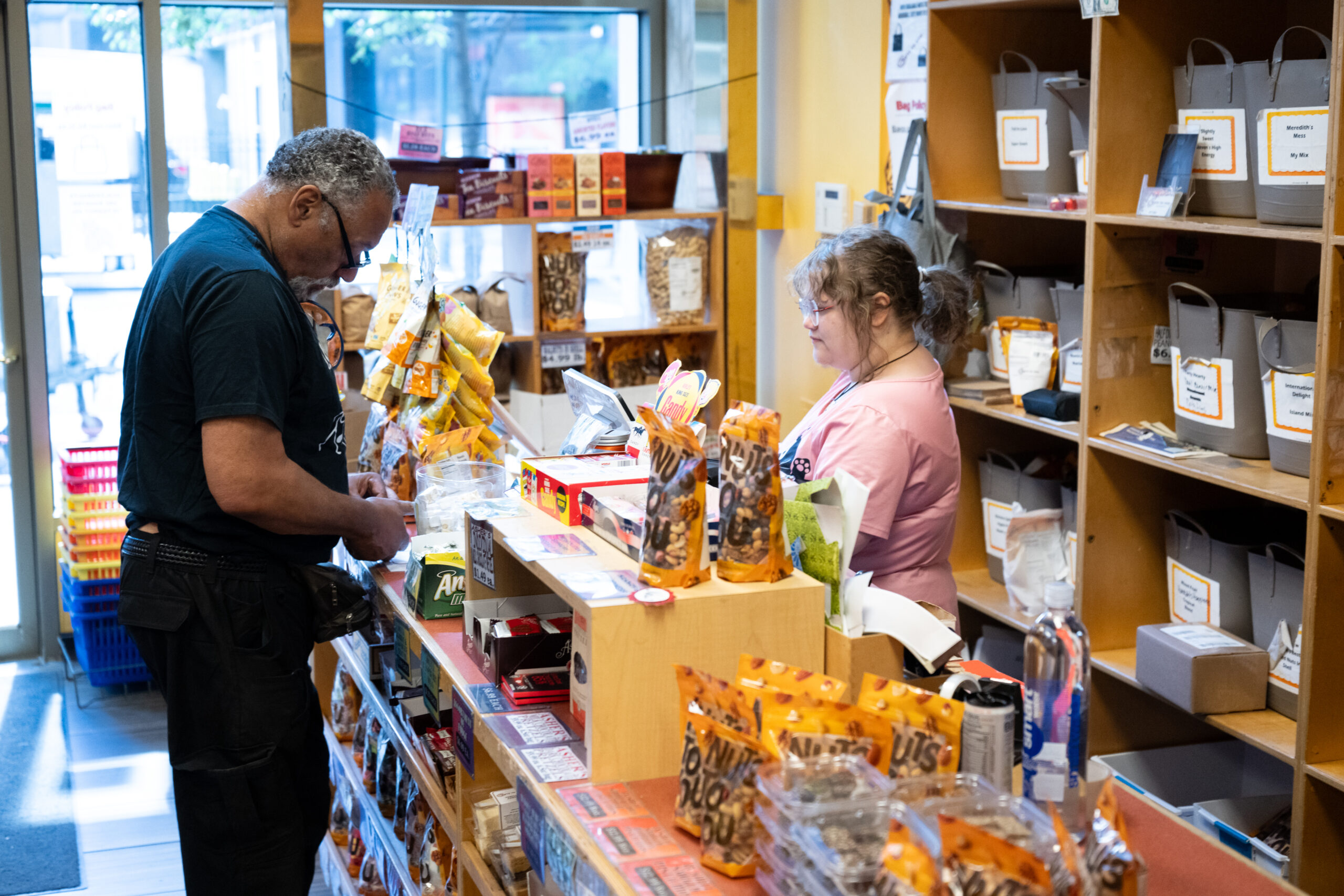
Anthony Feaster (left) makes a purchase with the help of employee Brianna Boyko at the 16th and Market Streets Nuts To You.
The entry of big retail competitors into Center City has also changed the business.
“Fifty years ago, there was nobody selling this product,” said Howard. “CVS and all those drug stores didn’t have full lines of nuts and candy.”
For Nuts To You, the decline in foot traffic has been offset by an increase in online sales. The company launched its website in 2010, but was only making about $100 to $200 a day online before the pandemic. Within two days of COVID-19-related lockdowns taking effect, sales increased to $3,000 a day.
Now, 40% of Nuts To You’s sales come from its website, and the company has forayed into selling on TikTok. As of June, only about 1% of their sales come from TikTok Shop, but Justin said that’s already more than expected.
In lieu of the nuts and oats that traditional walk-in customers buy, online customers tend to purchase sugar-free products or nostalgic novelties like wax bottles or Sugar Daddies.
“Think about all the things that have changed for consumers in the last five or six years, and then multiply that out over 50 years,” said Temple’s Tapp Duran. “You have to be able to pivot.”
Howard says that Nuts To You’s popularity has stemmed from its business strategy, which he defines as “largest variety, lowest prices, highest quality.” This may have been true for many years. Though, with larger retailers’ entry into Center City — Justin cited Trader Joe’s in 2003 and Target in 2016 — it has been difficult to beat corporate giants on prices.
However, the owners say what they can still ensure is quality — “That’s what our customers expect,” Justin said. They source their walnuts and pistachios from small growers in California, with whom they’ve maintained yearslong connections.
“We don’t want to switch to another brand, even though I could save a dollar,” said Howard. “Most customers appreciate that.”
In addition to greater competition and a changing retail landscape, Nuts To You has faced challenges common among small businesses in 2026.
Within the past few months, they’ve joined the ranks of small businesses who were sued for violating the Americans With Disabilities Act, based on allegations that the Nuts To You website relied on a visual interface that was inaccessible to individuals who are blind or use screen readers. Another lawsuit came out of a Proposition 65 claim — a law that requires products sold in California to warn consumers for potential exposure to dangerous chemicals — leading Nuts To You to adopt a disclaimer on its website.
“You think you’re OK, we’re running smooth, we know our expenses, then all of a sudden you get served papers,” said Justin. “And it’s like, what?”
Generations of work
For years, Basheer Ali, 65, has been traveling from Southwest Philly to the Center City Nuts To You stores for his fresh nuts and candy. Employees there have helped him navigate a diabetic diet, introducing him to sugar-free chocolate pretzels.
“The people need these kinds of stores,” Ali said.
The company sees very little employee turnover, Justin said. At least half its 19 employees worked at the company for more than a decade.
Regina DeLeon, manager of the Washington Square West location, has been with the company for 26 years. When prompted by a customer, she recalled Nuts To You’s founder and first-generation owner, Manny Radbill.
Radbill predicted in 1975 that nuts were going to be the next health craze. He wasn’t wrong: In 1992, a study found an association between nut consumption and a lower risk of coronary heart disease, which kicked off decades of research on the health benefits of eating nuts.
With the help of Radbill’s daughter, Caryn, and her then-husband Howard, they opened that first store on South 20th Street, which is still in operation today.
Justin first entered the family business when he was 2 years old, pushing buttons on the cash register. Howard required him to gain outside experience first, but Justin said, “I always kind of knew this is what I wanted to do.”
Justin Bernstein smiles at his father, Howard Bernstein, inside one of their three Center City Nuts To You stores.
So, after his college graduation and a brief stint at Boscov’s, about 20 years ago Justin joined Nuts To You and has since become co-owner.
As iconic family businesses like Di Bruno Bros. have been acquired, buyers have approached the Bernsteins, but Howard and Justin decided against it. They entertained one offer, but the deal-breaker was a requirement to close all of the physical stores — the owners refused to put their staff out of jobs.
Over their 50 years in business, Justin said he is most proud of staying family owned.
“We’ll see what happens, what the future holds,” said Justin. “At least another 20 years, call it.”
The scale of the corruption in Washington would make even the world’s most notorious kleptocracies blush. The president thinks the U.S. Treasury is his treasury, and the money in the Treasury belongs to him. It’s his money. He can spend as much as he wants, on whatever he wants, for whatever reason he wants — and he doesn’t need approval from anyone. Neither Congress, taxpayers, nor the rule of law can stop him.
How about destroying public property? Donald Trump’s latest accusation is that “vandals” working in the “dark of night” destroyed public property, sabotaged his $16 million Lincoln Memorial Reflecting Pool renovation project, and should be locked up. How about Trump demolishing the East Wing of the White House?
How about $1 billion of taxpayer money for his ballroom? How about a $400 million airplane as a gift, plus another $1 billion of taxpayer money to retrofit the aircraft? How about the allegations of rampant insider trading in the White House? How about the Reflecting Pool no-bid contract? Or the pledge by the U.S. Department of Justice to never audit Trump or the Trump family or the Trump businesses, forever. I could go on, but you get the point.
It was an unspoken way to assert his views on the separation of church and state.
Fast-forward to today. Religious “instruction” clubs — aimed at indoctrinating youngsters in the values of Christian nationalism — are making their way into our public schools. While supposedly promoting “religious instruction,” these programs disguise the corporate entities funding them.
This “wolf in sheep’s clothing” approach coerces children into accepting a political authoritarian value system under the guise of “God’s will.”
What would Adams say to us now?
Karen Fraley, Kimberton
Join the conversation: Send letters to letters@inquirer.com. Limit length to 150 words and include home address and day and evening phone number. Letters run in The Inquirer six days a week on the editorial pages and online.
DEAR ABBY: My husband and I have been married for 35 years. The week we were to celebrate our 34th anniversary, he invited a female friend to our vacation home for an overnight rendezvous. He was unaware that our adult children had placed a trail cam in the woods — and he was caught red-handed. He was called out for his behavior, forcing him to tell me.
I was shocked but not surprised at this. I believe they’d been having an emotional affair for many years. I had warned him that he was getting sucked in and that it could be costly to his career, but he did it anyway. After it happened, I asked him to go to marriage counseling with me and to apologize to our children. He did neither. I went to counseling for six months. We are still married and live under the same roof. What the affair did was open my eyes wide to the person he is — a liar, cheater and betrayer. I see all of his faults, and I don’t like him. He isn’t a nice person. He also blamed me for his cheating.
I’m not sure I can be married to him any longer. Cheaters think they are only cheating on their spouse. Actually, they cheat on the whole family. I don’t think he is sorry for his behavior. I have much invested in the marriage and I’m retired. I am not sure I can start over. I’m also not sure I can live being so desperately unhappy. Any suggestions would be greatly appreciated. I have suffered mental anguish for too long.
— DESTROYED IN WISCONSIN
DEAR DESTROYED: You have a lot to figure out. That’s why it’s time for you to go back to your therapist (or find a new one) for help in determining how you want to live the rest of your life. From what you have written, you now live with a nasty man you no longer trust or respect who blames you for his cheating.
As you enter therapy, please line up appointments with several attorneys who specialize in family law. These individuals can educate you about what your rights are as a wife of 35 years in Wisconsin which, I believe, is a community property state. Once you know where you stand financially, starting over again may not seem so frightening.
P.S. Normally under these circumstances, I would advise the cheated-upon spouse to make an appointment to be checked for STDs, but because the relationship you have with your husband since he strayed is so frosty, it may not be necessary in your case.
** ** **
DEAR ABBY: I love my wife. We’ve been married for 34 years. She watches more sports events than I do, no matter who is playing. I only like to watch the teams I like. I couldn’t care less about other teams. What can I do for a little peace besides having to leave the room? I am the only one working — and I work more than 50 hours a week. All I want sometimes is some peace and QUIET.
— GAMED OUT IN ARIZONA
DEAR GAMED OUT: If you need peace and quiet during your off time, buy a second television set and put it in another room of the house. That way, your wife can enjoy her sporting events, and you can have the peace and quiet you need in order to recharge.
After 72 games over 17 days in the group stage, the first 48-team World Cup has officially reduced to the 32 that will contest the knockout rounds.
If that doesn’t feel like much of a reduction, you aren’t alone. The old adage that the World Cup is really two tournaments in one, the group stage and the knockouts, feels more true than ever this summer.
But now the drama kicks up another gear, as it’s win or go home for every team left standing. Here’s what to know about the 32 games remaining before the July 19 final in North Jersey.
All games are televised on Fox29 in English and Telemundo 62 in Spanish, except for two in the round of 32 on FS1: Belgium vs. Senegal on July 1 and Switzerland vs. Algeria on July 2. All times listed are local to Philadelphia.
Lionel Messi hopes to help Argentina become the first back-to-back men’s World Cup champion since Brazil in 1958 and 1962.
Round of 32 schedule
The number and letter next to each country denotes where it placed in its group during group stage games.
Sunday
3 p.m.: 2A. South Africa vs. 2B. Canada in Inglewood, Calif.
Noon: Argentina or Cape Verde vs. Australia or Egypt in Atlanta
4 p.m.: Switzerland or Algeria vs. Colombia or Ghana in Vancouver, B.C.
If the U.S. can make the round of 16, it will hope for another big home-field advantage in Seattle.
Quarterfinals
July 9
4 p.m.: Germany, Paraguay, France, or Sweden vs. South Africa, Canada, Netherlands, or Morocco in Foxborough, Mass. (winner goes to semifinal 1)
July 10
3 p.m.: Portugal, Croatia, Spain, or Austria vs. United States, Bosnia & Herzegovina, Belgium, or Senegal in Inglewood, Calif. (winner goes to semifinal 1)
The Meadowlands will host a World Cup final for the first time, after the 1994 men’s and 1999 and 2003 women’s finals were played in the Los Angeles area.
Philly’s bundle of group stage matches ended Saturday night as Croatia battled to a 2-1 win against Ghana that saw them leapfrog the Black Stars to finish second in Group L, culminating a thrilling two and a half weeks of soccer.
Now, Philadelphia Stadium gets a week’s respite before the final game the city will house, one that could shape up to be the biggest soccer match in the history of the Lincoln Financial Field; which is saying a great deal considering the building opened with a massive match between European giants Barcelona and Manchester United in 2003, and has hosted other memorable club and national team games in the years since.
When Philly plays host to the round of 16 match on July 4, it will host the winners of two matches between Germany and Paraguay, who face off in the round of 32 on Monday (4:30 p.m., Fox29), and the winner of France and Sweden who play In the round of 32 on Tuesday (5 p.m., Fox29).
Both Germany and France, who won Group E and Group I, respectively, are the presumed favorites, which would make for a massive showdown in a push for the quarterfinal rounds beginning July 9-11.
“I won’t be here for it, but that would be a fantastic game if it were to work out that way, especially to have the chance to have France back here one more time,” said Susan Richman, 43, who grew up in Philly, but now lives in Chicago and has stayed with her “soccer-crazy” relatives all week. Saturday’s game was the second inside the stadium for Richman, who works in finance and was in the house for last Monday’s rain-delayed match between France and Iraq.
After storms caused a delay that lasted over two hours, it was France that put that match to bed, behind two goals from Kylian Mbappé and cherry on top from Ousmane Dembele for a 3-0 win.
Nikola Vlasic (13), celebrates after scoring Croatia’s second goal against Ghana during the second half on Saturday at Philadelphia Stadium.
“It’s been an expensive summer,” laughed Richman, who was there on Saturday with her sister and their family. “I think all in all we’ve spent close to $15,000 [on tickets]? But for us to say that we’ve attended the World Cup in America is something that personally, I’ll always remember.”
Ticket prices on FIFA’s official marketplace have yet to go on sale, but on secondary markets like StubHub, cheap seats as of Saturday night began at $1,986. There’s been a bit of trepidation with secondary markets tickets as fans have purchased only to find out at the gate that their tickets won’t scan.
Did Croatian fans debunk the Rocky curse?
The red and white of Croatia’s colors spilled throughout Center City on Friday night as the biggest demonstration saw fans take over a large stretch of the Parkway, singing, dancing and even setting off a few smoke bombs.
However, following Croatia’s win, a supporters group called Mi Hrvati (We Croats), alongside the support of Arena Casino, held a secret gathering on the steps of the Art Museum and claimed to have placed a jersey on the statue of Rocky at the top of the steps on Friday evening in advance of the game.
A bold strategy, considering that it’s been widely reported that fans placing their team’s jersey onto Rocky historically hasn’t worked out in their team’s favor. Ecuador fans found that out before Philly’s opening match on June 14. The word was so widespread that in the match that followed, Brazilian fans brought their own partition and security detail to deter anyone who attempted to do the same before its match against Haiti.
However, Mi Hrvati claims its decision test the theory came “in secret” as they “did not want to create the story before the match,” a release supplied to The Inquirer claimed, adding, “We believed in Croatia and waited for the result. After the victory, we can say that the Rocky Curse has been broken. This is a fan story to remember.”
Croatia will face Portugal in its round of 32 match on July 2 in Toronto.
Another announced sellout crowd of 68,324 packed Philadelphia Stadium for Saturday’s Group L finale between Croatia and Ghana.
Croatia-Ghana brings the crowd
Saturday’s match boasted another sellout crowd of 68,324 at Philadelphia Stadium, the fourth announced sellout by FIFA in the five matches that have come through Philly. The game, a very pro-Croatian crowd, still had a sizable contingent of Ghana fans.
It was yet another match that would ensure FIFA sets a new all-time attendance record for the World Cup, a feat it announced Friday it had already surpassed by the time Thursday’s match in Philly between the Ivory Coast and Curaçao took place.
Saturday’s match result dropped Ghana into a third-place slot and it will face Group K winner Columbia on July 3 in the round of 32 in Kansas City.
That notion was an interesting potential matchup for Ghana fan Quinton Ayton, who attended Saturday’s match. Ayton, who sat in Ghana’s raucous supporters section between sections 110-111, said that he’s ecstatic that his team was headed into the knockout phase.
“Hey man, we’re here and win or lose it’s just great that this team is doing what they’re doing,” said Ayton, who lives in the Elmwood Park section of the city, said. “To get the opportunity to see my country play so close to home was a dream. An expensive dream, but a dream.”
When asked how much he spent on his tickets, Ayton said, laughing: “I can’t give a price, my wife will kill me, just know it was worth it to see them play in Philadelphia.”