Tag: UniversalPremium

  • CHOP was Southeastern Pa.’s most profitable nonprofit health system in first quarter of fiscal 2026. Four systems lost money.

    CHOP was Southeastern Pa.’s most profitable nonprofit health system in first quarter of fiscal 2026. Four systems lost money.

    Children’s Hospital of Philadelphia was the most profitable nonprofit health system in Southeastern Pennsylvania during the three months that ended Sept. 30, according to an Inquirer review of financial filings.

    CHOP reported $70 million in operating income in the first quarter of fiscal 2026, up from $67 million the same period a year ago. The nonprofit’s revenue climbed nearly 9% to $1.3 billion.

    The biggest loss in percentage terms was at Redeemer Health, the region’s smallest health system and the only remaining operator with a single hospital. Redeemer had an $11.7 million operating loss on $103.4 million in quarterly revenue. That was an improvement over an $18.9 million loss last year.

    Jefferson Health had the most patient revenue following its acquisition last year of Lehigh Valley Health Network. The 32-hospital system had $2.9 billion in patient revenue, $100 million more than the $2.8 billion at the University of Pennsylvania Health System, which has seven hospitals.

    window.addEventListener(“message”,function(a){if(void 0!==a.data[“datawrapper-height”]){var e=document.querySelectorAll(“iframe”);for(var t in a.data[“datawrapper-height”])for(var r,i=0;r=e[i];i++)if(r.contentWindow===a.source){var d=a.data[“datawrapper-height”][t]+”px”;r.style.height=d}}});

    Here’s a recap of selected systems’ results for September quarter:

    Jefferson Health

    Jefferson Health reported a $104 million operating loss, as its insurance business continued to drag down results. The loss included $19.4 million in restructuring charges for employee severance related to earlier job cuts and moves designed to make the system more efficient.

    University of Pennsylvania Health System

    University of Pennsylvania Health System had an operating gain of $109.3 million, up from $49.3 million in the same period a year ago. This year’s results include Doylestown Health, which Penn acquired April 1. Total revenue was $3.3 billion, up from $2.8 billion a year ago.

    Temple University Health System

    Temple University Health System’s loss in the quarter was $15 million, an improvement over a $17 million loss last year. Total revenue was $800 million, up 13% from $712.5 million a year ago. Outpatient revenue increased by nearly $62 million, much of it from the health system’s specialty and retail pharmacy business.

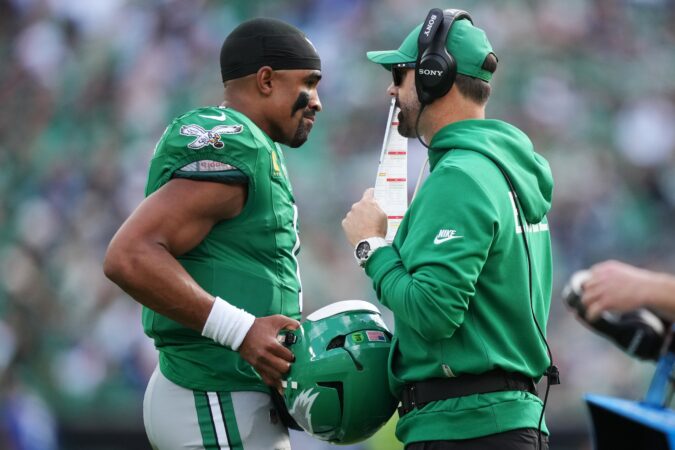
  • Nick Sirianni: Sitting Jalen Hurts ‘ridiculous’? Hardly. Bench him if he struggles Sunday.

    Nick Sirianni: Sitting Jalen Hurts ‘ridiculous’? Hardly. Bench him if he struggles Sunday.

    Early during Nick Sirianni’s weekly interrogation by Eagles flagship station 94-WIP on Wednesday morning, he was asked about Jalen Hurts by host Joe DeCamara: “Is there a possibility later this season, if he continues to struggle, that you could make a change at the quarterback spot?”

    Sirianni replied:

    “I think that’s ridiculous.”

    You know what’s ridiculous?

    Saying you would never replace a quarterback in the middle of a horrible performance — that’s ridiculous. Saying you would never bench a quarterback who’s slumping worse than the economy — that’s ridiculous.

    It’s more than ridiculous. It’s malpractice.

    It’s not as if Sirianni is averse to benching people.

    He benched defensive coordinator Sean Desai late in the 2023 season.

    Hell, he benched himself in 2021, when, as a rookie head coach, he found the burden of play-calling too onerous, and ceded it to then-offensive coordinator Shane Steichen.

    Don’t be afraid to do unto others, Nick.

    There are two reasons a coach has not only the right, but the responsibility, to bench a quarterback who is playing losing football. This is doubly true of a coach whose team has the weapons to make another deep postseason run, which is exactly the sort of team Sirianni has.

    First, the coach owes it to the rest of the team to give them the best chance to win. He doesn’t just owe the players. He owes his coaching staff, his support staff, the administrators, the scouts, the janitors — everybody.

    Because everybody’s livelihood suffers when the team doesn’t win, and if Hurts continues to play this poorly, the team cannot win.

    Second, when you’re in a tailspin like Hurts, you’re very unlikely to dig your way out of it. Defensive coordinators are using a very clear formula to beat Hurts: Load the box to stop the run, force the receivers inside, give up nothing deep, and don’t bother with a spy, since Hurts doesn’t want to run anymore, and he has lost a step, anyway. And blitz, blitz, blitz.

    This is the third time since Hurts became the unquestioned starter that he has lost three straight regular-season games. However, it is, by far, his worst performance of any three-game slide, and the first time he has been the biggest reason for the losing. Hurts has a lower passer rating (69.9), more total turnovers (seven), and fewer rushing yards (72) than in previous losing streaks. He’s been bad before, but never this bad.

    The Eagles are 8-5. A loss Sunday to the visiting Las Vegas Raiders combined with a Dallas Cowboys win against the Minnesota Vikings would shrink the Eagles’ lead in the NFC East to a half-game and put even a wild-card berth in peril.

    This is no time to worry about Jalen Hurts’ feelings.

    It might sound heretical to say of the Super Bowl MVP, but if Hurts continues to struggle, he damn well should be benched. He is not sacred.

    Also: Do you believe Sirianni?

    Liar, Liar

    Can you believe Sirianni? He lies all the time to protect players. He admitted this in 2023: “That’s something I’ve always done.”

    With that in mind, if, by halftime Sunday, Hurts has thrown two interceptions, fumbled the ball away, and he’s 3-for-11, I think we‘ll see Tanner McKee.

    I guess Sirianni needs to say that Hurts is untouchable in order to fortify Hurts’ confidence. Sad.

    The Eagles were burned the last time they benched a starter. In 2020, Carson Wentz, who already was angry that the Eagles drafted Hurts in the second round, was benched with 4½ games to play. The benching infuriated Wentz. He first got coach Doug Pederson fired, then forced a trade. The trade hung the Eagles with a then-record $33 million salary-cap hit and left them with Hurts, a talented, raw, flawed quarterback.

    Four years later, Hurts has gone to two Pro Bowls, two Super Bowls, and won a Super Bowl, and signed a $255 million contract. Nevertheless, Hurts remains raw and flawed — less so, but still.

    It’s rare that franchise quarterbacks get benched on merit, but that’s a phenomenon almost exclusive to NFL QBs. Hurts is on a five-game slump, which is about 30% of his season. If Bryce Harper hit .150 over 54 games and made 10 errors or if Tyrese Maxey shot 20% for 27 consecutive games and averaged seven turnovers, you can bet your britches they’d get a day or two off.

    Hurts understands that he’s a big part of the problem. He acknowledged that he’s in a slump, and it’s a granular slump. And when he says he needs to be more “detailed,” it means he needs to get back to the basics in practice so they translate during games.

    “How can I have the right technique?” he said. “How am I playing with the fundamentals? To run the way I want to run? To throw the way I want to throw?”

    It comes. It goes.

    “For whatever reason, that’s a part of the game,” Hurts said. “Success or greatness — those things aren’t linear. You have your ups, you have your downs.”

    When athletes in other sports have their downs, they get sat down.

    But not quarterbacks.

    They’re special.

    Whatever.

    Tradition!

    It’s more than a little ironic that the analytically driven Eagles have, in Sirianni, a pocket-protector spokesman who is essentially telling us that he wouldn’t bench his quarterback because “This is the way it’s always been done.“

    Listen: If you want to go for it on fourth-and-4 from your opponent’s 32-yard line with 3 minutes, 30 seconds to play, when a field goal would put you up seven or eight points, then you don’t get to use the “This is the way it’s always been done” defense.

    I understand the concerns with going to McKee — concerns independent of how it affects Hurts. There are concerns about offensive timing. You know Raiders defensive coordinator Patrick Graham will show McKee exotic looks on every snap. McKee will be baited by defensive backs.

    McKee might fail catastrophically, and then, where are you?

    You are no worse off, that’s where.

    It’s not as if Hurts hasn’t been benched before. He lost his job as Alabama’s starter at halftime of the 2018 College Football Playoff national championship, which his replacement, Tua Tagovailoa, won. Instead of transferring, Hurts returned the next season, served as a backup, and, 11 months later, replaced Tagovailoa in the SEC title game and led a comeback win.

    If anybody can handle a benching, it’s Jalen Alexander Hurts.

    There’s no debating that there’s a contingent of folks, especially in the Philadelphia area, who would love to see Hurts fail. You can debate their motives, but he’s not nearly as appreciated as he should be.

    This has led to a cycle of protectionism inside the NovaCare Complex. That’s not good for anybody.

    However, most folks don’t want any scenario to surface in which Hurts gets benched. He has played wonderful football at times.

    But to dismiss his benching out of hand isn’t just ridiculous.

    It’s coaching malpractice.
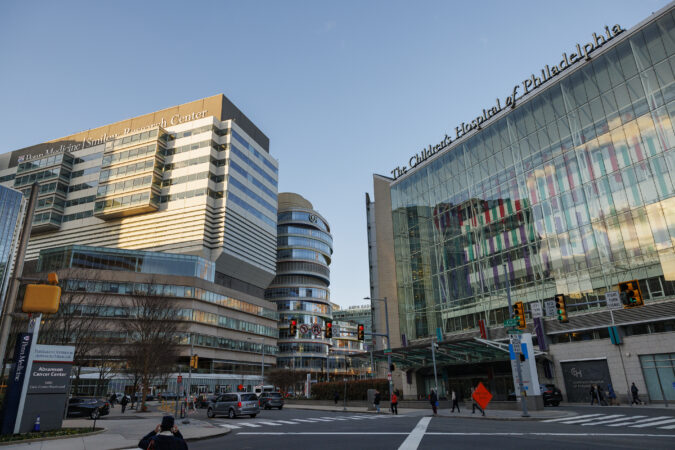
  • Hospital-based anti-violence programs get $3 million in state funding

    Hospital-based anti-violence programs get $3 million in state funding

    Several Philadelphia-area violence prevention efforts will benefit from nearly $3 million in newly released state funding to help hospitals address a leading cause of death and injury.

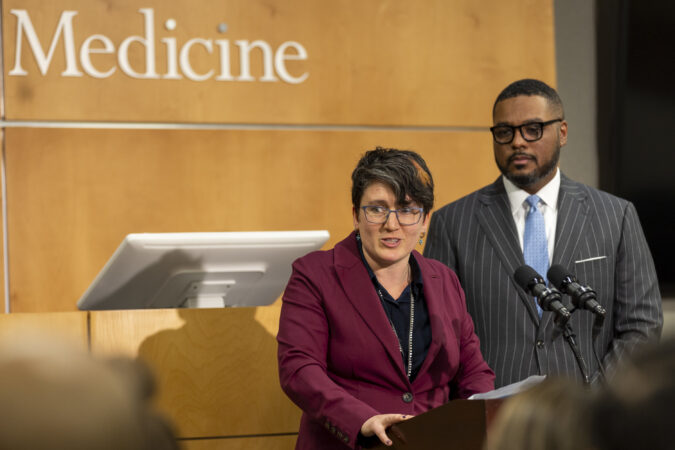
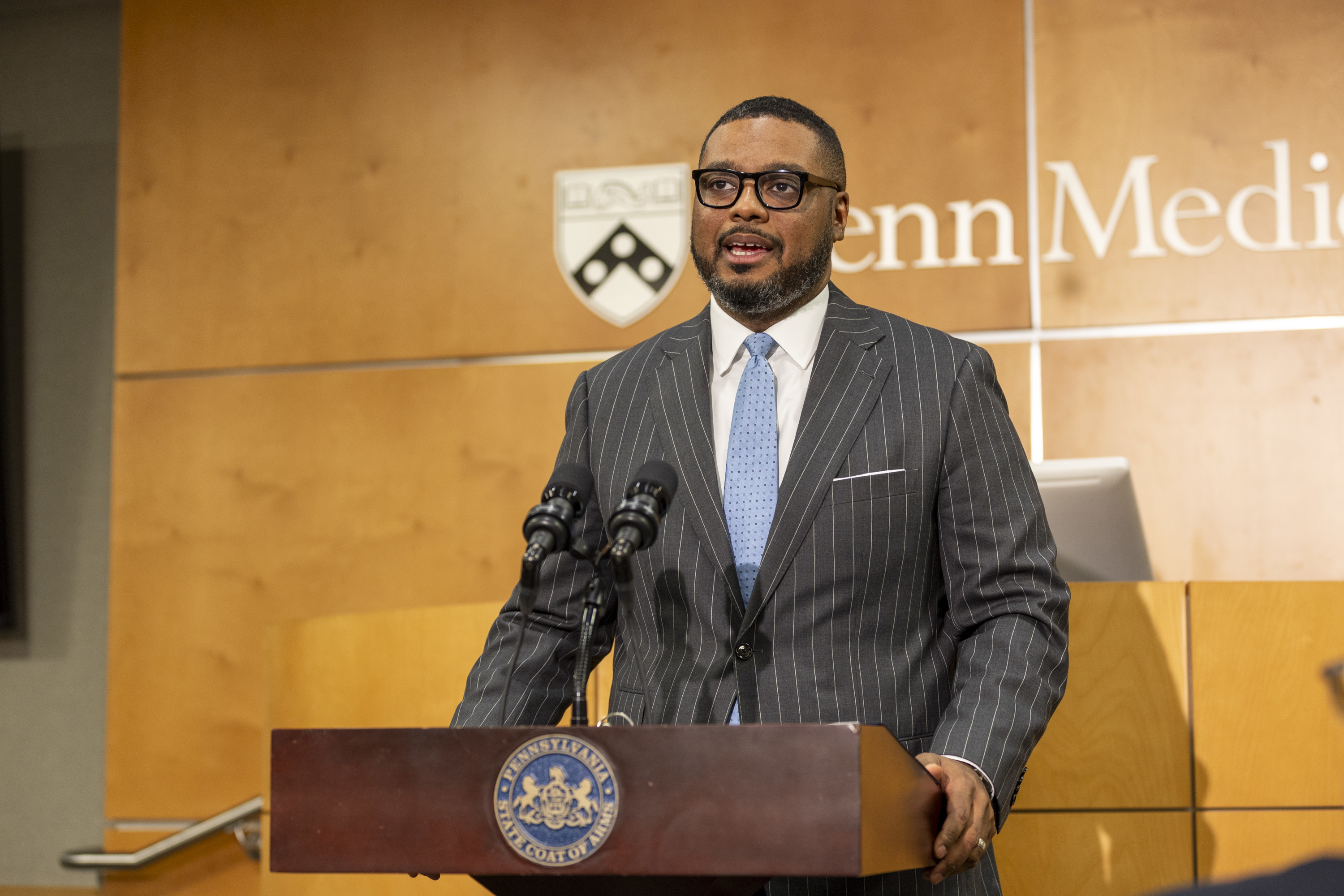
    The new funding for hospital-based violence intervention programs (HVIP) was announced by Pennsylvania Lt. Gov. Austin Davis on Wednesday at Penn Presbyterian Medical Center. One of the recipients, the Penn Trauma Violence Recovery Program, is based at the Penn Medicine hospital in University City.

    Other local awardees include Temple University Hospital in North Philadelphia and the Philadelphia-based nonprofit Urban Affairs Coalition. The coalition received funding on behalf of the Chester Community Coalition to relaunch a program that had been at the now-shuttered Crozer-Chester Medical Center.

    The University of Pittsburgh Medical Center also received funding. The amounts awarded to each program were not announced.

    The Pennsylvania Commission on Crime and Delinquency, which Davis chairs, received 15 applications in total seeking nearly $12 million in funding — four times what was available.

    “Addressing the epidemic of gun violence is a top priority for our administration,” Davis said.

    Lieutenant Governor Austin Davis speaks at a press conference announcing the $3 million in grants for hospital-based violence intervention programs.

    The programs aim to connect patients at risk of repeat violence with resources while they are in a hospital, so they leave with a safety plan. Services can include long-term community-based case management, mentoring, and home visits.

    Since the first HVIP was established in the mid-1990s, dozens have spread around the country and abroad, including in Philadelphia.

    Several local institutions have these programs, including Temple Health, Children’s Hospital of Philadelphia, Penn Medicine, Jefferson Health, and Drexel University. The City of Philadelphia, in conjunction with the area’s Level 1 trauma centers, launched an HVIP Collaborative in 2021.

    Studies have shown these programs reduce rates of repeat violent injuries and recidivism among participants.

    After shootings spiked during the COVID-19 pandemic, gun violence is now declining in Philadelphia. As of July, shootings for the year were at their lowest total since at least 2015.

    Davis noted that Philadelphia has seen a 15% decrease in homicides this year, with roughly four in five gunshot victims surviving their injuries.

    The new funding will allow the Penn Trauma Violence Recovery Program to increase its community presence and mental health programming, said its director, trauma surgeon Elinore Kaufman.

    Through her experience treating victims of violence, she has learned that injuries can be deeper than the physical wounds.

    The program was launched to address social factors often involved in violence by providing psychosocial support and connecting patients with services to help with education, job training, and housing.

    “We’ve worked with patients long enough now that we have high school graduation photos, we have baby pictures,” Kaufman said. “We have patients who want to give back and have joined our patient advisory board to help push us forward.”

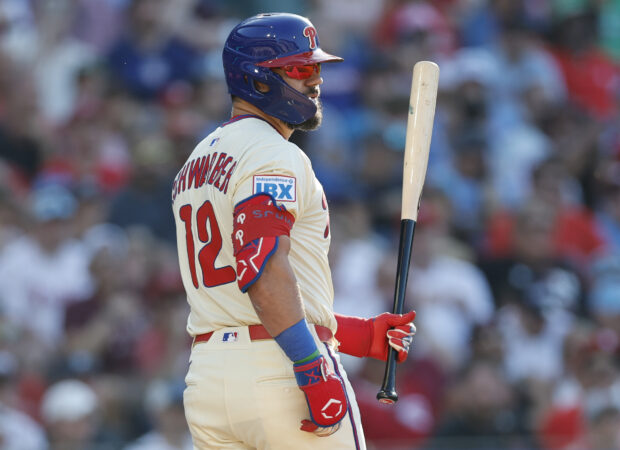
  • Kyle Schwarber found his way back to the Phillies, and he hopes J.T. Realmuto does the same

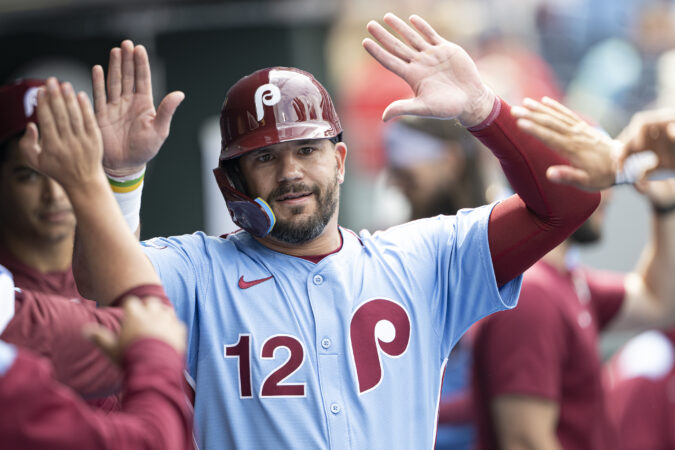
    Kyle Schwarber found his way back to the Phillies, and he hopes J.T. Realmuto does the same

    ORLANDO — Any day now, Kyle Schwarber’s wife, Paige, will go into labor with their third child.

    First, though, there was a contract to sign.

    So, after reaching a five-year, $150 million agreement with the Phillies late Monday night, Schwarber hopped a flight early Tuesday to Philadelphia to take a physical and finalize the deal. By lunchtime Wednesday, he was back home in Ohio.

    “I’m happy they were able to accommodate that, get me up there and get me back,” Schwarber said on a Zoom call. “So now, whenever our little girl comes into the world, I will be here.”

    Indeed, the week has been a whirlwind for Schwarber, and it’s only getting started. But between signing the largest contract ever for a designated hitter and racing home ahead of the baby, Schwarber found time to deliver a recruiting pitch to a good friend.

    “I’d be lying that I didn’t send a text to J.T. [Realmuto],” Schwarber said, “trying to see where he’s at and try to coax him.”

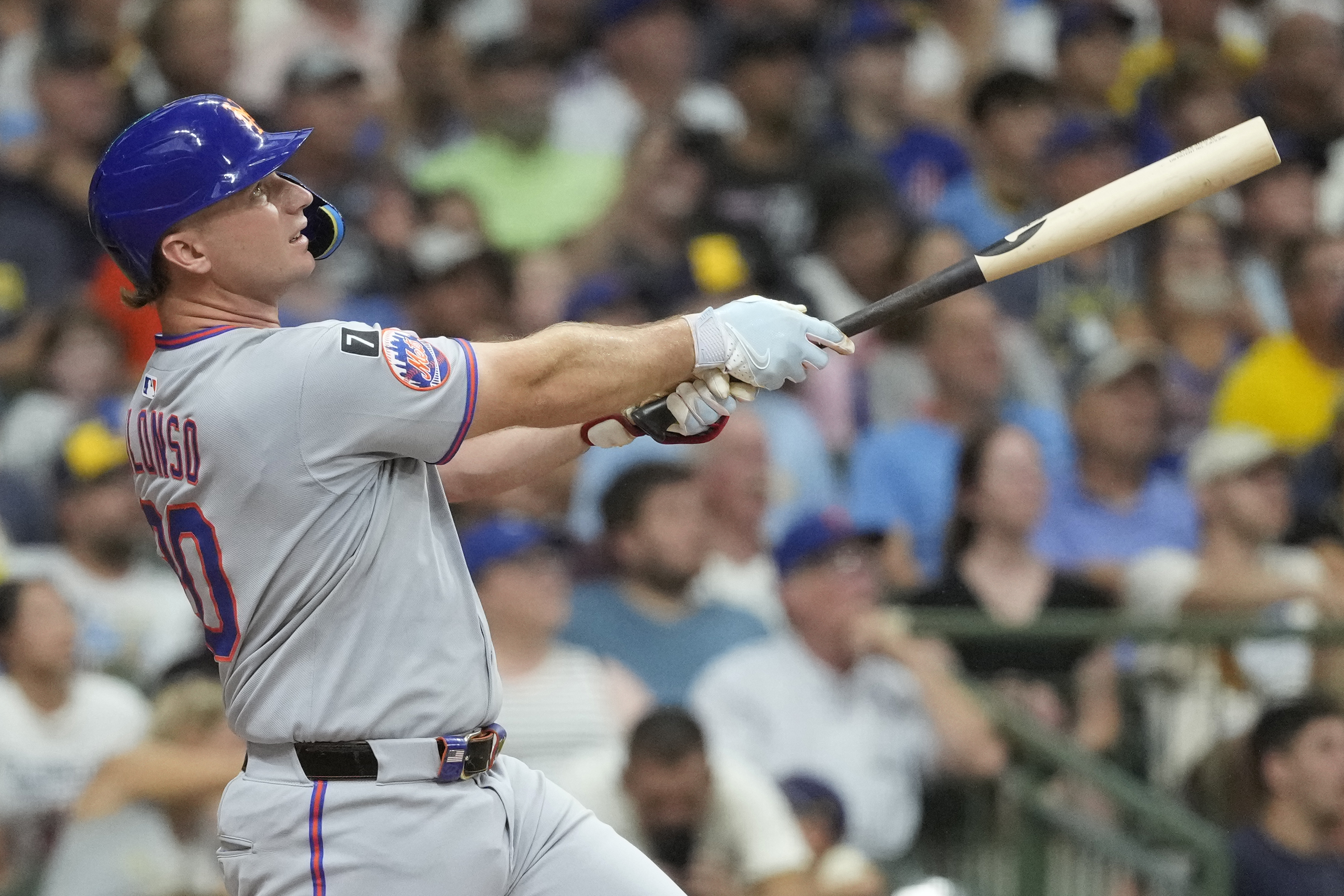
    If Schwarber was Priority No. 1 for the Phillies, Realmuto is 1-B. While the rival Mets lost core pieces Edwin Díaz and Pete Alonso in free agency on back-to-back days, the Phillies are proudly trying to bring back the band from 95- and 96-win teams that were a Tush Push — or maybe a youth infusion from Justin Crawford, Andrew Painter, and, eventually, Aidan Miller — away from getting over the top.

    Schwarber said he’s “trying to be respectful” of Realmuto’s free-agent process. And surely he can relate.

    In finding his way back to the Phillies, Schwarber cited the “respect” he received during his 37-day free agency from the organization that helped him evolve into one of the most prodigious sluggers in the sport.

    Because as much as Schwarber wanted to stay with the Phillies, he also welcomed the chance to explore his market before the biggest payday of his career.

    Schwarber had been a free agent before. Twice, actually. But the first time came in 2020, with his value at its nadir after the Cubs didn’t tender him a contract. A year later, the owners locked out the players and shut down the sport for 99 days. When the stoppage ended, the Phillies signed Schwarber for four years and $79 million, among the best free-agent deals in franchise history.

    This time, Schwarber hit the market with the force of a 56-homer season — and 187 home runs over four years, tied with Shohei Ohtani for second among all hitters and trailing only Aaron Judge.

    Few names were more prominent on the free-agent menu.

    “When you reach free agency, you want that opportunity to go out and listen and make sure all your bases are covered,” Schwarber said. “You want to hear all different types of information and make sure that you’re making a really great, informed decision. I appreciate the whole process and don’t take it lightly.”

    The Phillies gave Schwarber space to hear pitches from the Orioles, Pirates, and his hometown Reds, among other teams, with the understanding that he would circle back to them when he began receiving offers.

    But they didn’t send him into the free-agent wilds without making clear what he meant to them.

    The owner even made a house call.

    First, Schwarber had what he described as a “really, really good conversation” with president of baseball operations Dave Dombrowski a few days after the divisional series loss to the Dodgers. Then, before he and Paige packed up their two sons and returned to Ohio, John Middleton knocked on the door of their South Jersey home.

    Phillies owner John Middleton made it clear to Kyle Schwarber that he wanted to re-sign him.

    “We were able to spend a really good amount of time just sitting down and talking about the Phillies and his family and talking about what’s the future looking like for us here,” Schwarber said. “Those were conversations that I just never forgot, right?

    “Like, you start having different conversations with different teams, and just because those conversations were fresh, it doesn’t mean that anything was forgotten. That was an important time and important conversations that Dave and Mr. Middleton, that we had.

    “Trust me, I took notes. Once I had everything all said and done, you can look at everything and know that John is committed to winning and wants our organization to continue to keep pushing for a world championship. What else is there for a player to ask for, you know?”

    The Phillies sent Realmuto into free agency with a similar message. The veteran catcher, who will be 35 next season, is weighing multiple offers, a source said Wednesday, the final day of the winter meetings at the Signia by Hilton. It’s unknown whether any of the offers are for more than two years. MLB.com reported that the Phillies have made a bid.

    After re-signing Schwarber, the Phillies can focus on remaking the outfield, filling out the bullpen, and adding overall pitching depth. With 2026 payroll commitments totaling approximately $286 million, as calculated for the luxury tax, some of those pursuits may involve clearing payroll space by trading, say, Alec Bohm or Matt Strahm.

    But Realmuto could be their next domino to drop. And Schwarber hopes the catcher will follow the path that led back to the corner of Pattison and Darien.

    “Selfishly, I think that we would all love to have J.T. back,” Schwarber said. “Because we know what he brings to the table and how important he is to, not just our clubhouse but what he means to Philadelphia. … He should be highly sought-after, and I’m hoping that, at the end of the day, he’s back in Philadelphia.”

  • A former Daily News sportswriter’s toy drive gives South Philly kids the ‘Christmas they deserve’

    A former Daily News sportswriter’s toy drive gives South Philly kids the ‘Christmas they deserve’

    The thought returns early every December as Ed Barkowitz asks himself why he still does it. He has organized a toy drive for 23 years, a task that feels more arduous each December. He’s 55 years old, teaches a college course, works with his family business, stays active as a freelance writer, and has to deal with the ever busy — and ever growing — holiday season.

    “I’m thinking I must be nuts,” Barkowitz said.

    But the donation boxes throughout his South Philadelphia neighborhood soon fill with toys. His friends — especially the ones he worked with for more than 30 years at the Daily News — soon pack a corner bar on a Friday night. And then he watches his nieces and nephews use the money collected to buy enough gifts for more than 50 South Philly families to have presents on Christmas morning.

    His tradition started on a whim one December when Barkowitz found himself behind the bar at Downey’s, the since-closed Irish pub on South Street. Barkowitz made $100 but didn’t feel right keeping the cash so close to Christmas. So he bought toys and dropped them into a donation box. A tradition was born.

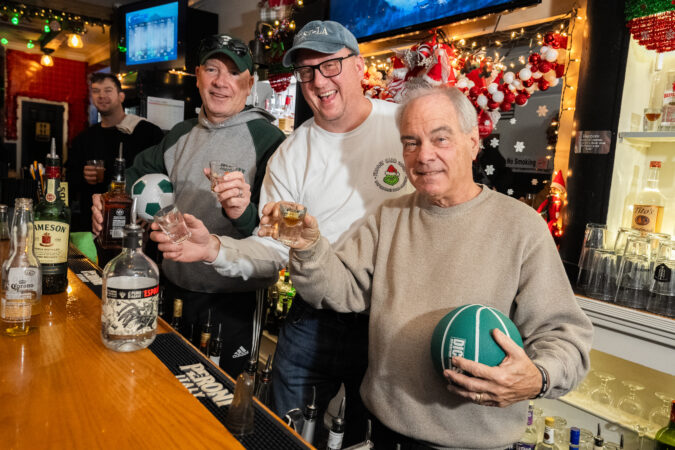
    Enjoying the festivities at Wolf Burger, from left: Emma O’Hara, Madden Wilson, Eden McLaughlin, Gabriel McLaughlin, Mike Kern, Luke Polchenko, Brian Burkhardt, Ed Barkowitz, Colin Pooler, and Carter Wilson.

    A year later, he held a fundraiser at Downey’s to raise money for a toy drive. It became a thing, a packed event every December where former Daily Newsers get together and tell old stories. Other people filter in — neighborhood guys, Big 5 basketball coaches, even Chase Utley once — and everyone knows that the tips are for the kids.

    It’s easy then for Barkowitz to remember why he still does it.

    “The parents come in to pick up the toys and they’re crying,” said Nicole Holt of Whitman Council, the neighborhood group that helps Barkowitz deliver the toys. “Or after Christmas, we’ll get phone calls because we made their kids cry and how appreciative everyone is. It’s like, ‘Oh my God, my kid had an unbelievable Christmas’ or ‘You made my daughter cry because you gave her this.’ We get thank-yous the whole month of January. It’s for the kids who deserve a Christmas but their parents can’t give them a Christmas.”

    A Daily News friendship

    Barkowitz’s father served in the Army with Frank Dougherty, who wrote for the Daily News under the byline the Phantom Rider.

    “He would break SEPTA’s [chops] when an escalator wasn’t working or service was bad,” Barkowitz said. “He was terrific.”

    The Phantom Rider helped Barkowitz get an entry-level gig on the paper’s news desk after he graduated from St. Joseph’s Prep. It didn’t take long for Barkowitz, who grew up at 4th and Porter, to find his way to the sports department.

    He became a valued utility player as he could create a graphic, write a headline, cover a Phillies game, and write 50 interesting things about an athlete you didn’t know were interesting.

    The People Paper with the back-page headlines had can’t-miss writers like Phil Jasner, Rich Hofmann, Dick Jerardi, Ted Silary, and Stan Hochman. They also had guys like Barkowitz, who could fill in anywhere.

    “You couldn’t have a better friend than Eddie,” said Pat McLoone, Barkowitz’s former sports editor. “I remember when we moved the offices to Center City, and you couldn’t walk down the block at lunchtime without someone stopping Eddie. He has his hands in everything. He’s just friends with everyone and so well-connected.”

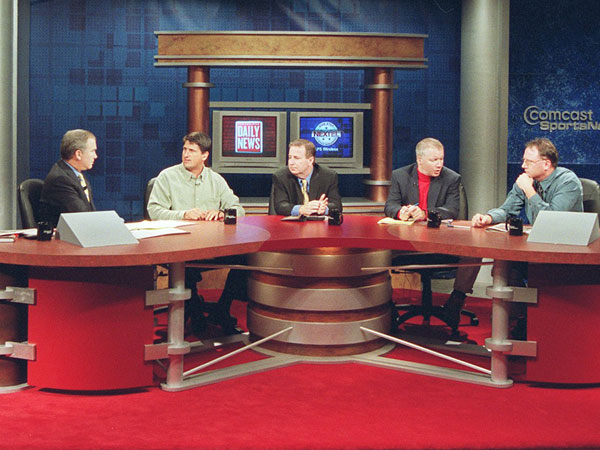
    The “Daily News Live” broadcast on Oct. 10, 2002. From left are Michael Barkann, Keith Jones, Dick Jerardi, Bob Cooney, and Ed Barkowitz.

    Barkowitz’s desk at Broad and Callowhill was next to Mike Kern, who covered college sports and has the Northeast Philly-est of Northeast Philly accents. Kern complained one Monday morning about his son’s T-ball team — “They friggin’ stink,” he said — and a friendship was born. “That’s my kind of guy,” Barkowitz thought.

    So it makes sense that Kern is behind the bar every December with Barkowitz, pouring Guinness for Jay Wright after they tell the coach he would be crushed for drinking red wine in an Irish spot. They became the perfect pair when the place was packed and the donations were flowing.

    “Eddie has a kind heart and soft spot for kids and this is his way of giving back,” McLoone said. “But it comes off as just another Friday night for him at a bar surrounded by people who know him.”

    ‘We did it again’

    The toy drive used to collect enough toys to fill a small pickup truck.

    “Now I have to use a 20-foot truck,” said Barkowitz, who freelances for The Inquirer.

    Barkowitz places boxes in South Philly bars and diners for people to drop in toys. More toys — even bikes — are brought to the bar on fundraiser night. The tips that night are used for more gifts, and everything is dropped off to Holt, who makes sure they get under the right trees.

    “Look, I’m a Northeast Philly person. But South Philly knows how to do some things,” Kern said. “They just know how. And this is one of those things. I’m not saying Northeast Philly or North Philly or West Philly [people] don’t. I’m sure there’s people in all these neighborhoods who are doing things for people. But I’m sure there’s a lot of families and kids who are touched by what Eddie does.”

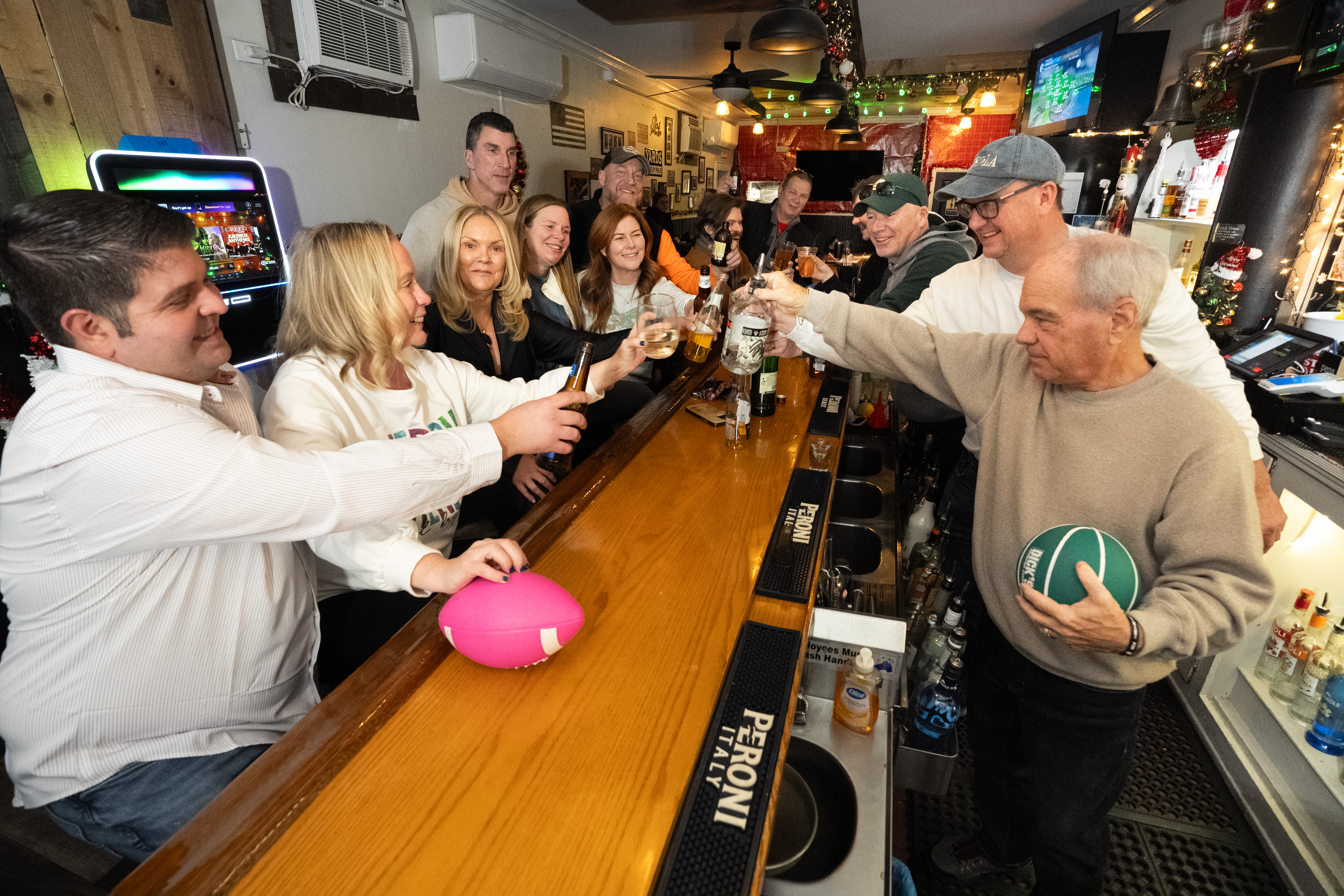
    Raising a toast at Wolf Burger, from left, are John Thomas, Jen Barkowitz, Amy Reilly, Russell Wilson, Leigh-Ann Wilson, Ashleigh Renzi, Chris Wray, Joe Ferretti, Bob Cooney, Ed Barkowitz, and Mike Kern.

    The toy drive was Barkowitz’s idea, but he takes little credit. He says Kern helps draw people to the bar, his girlfriend, Amy Reilly, keeps it churning by “doing the things that don’t show up in the box score,” and his nieces and nephews do the shopping before Holt takes it to the finish line.

    Barkowitz said he has plenty of “elves.” But none of this would have happened if he pocketed the money he earned years ago at Downey’s.

    “It’s a wonderful thing Eddie does, but he just does it so naturally,” McLoone said. “Kern with him is the perfect wingman. He has these Christmas balls hung around his neck. People are asking for drinks. Eddie knows his way around the bar, and Kern has no clue but he’s laughing through it and throwing out crazy lines. It’s one of those only-in-Philly things.”

    This year’s event is Friday at Wolf Burger at Front and Wolf Streets. The bar will be packed, and old stories will flow. Bob Cooney, another former Daily News scribe, will be behind the bar because Kern is on vacation.

    “It’s almost like one of those things that you can’t miss,” said the guy who is missing it. “I’ll never cease to be amazed by the generosity of people who come, give you a $20, and say, ‘Give me two beers.’ I go to give them the change and they say, ‘No, put it in the thing.’ That happens 50 times a night. People want something to feel good about.”

    The event is a chance to see people you may only see once a year.

    “It’s sort of like an annual Christmas party for the misfits, which is what we were,” Barkowitz said. “We were a tabloid littered with talent. We were always competing against The Inquirer, and we had a little bit of a bunker mentality. We didn’t have the resources, perhaps, but that worked in our favor. We didn’t get every story, but we never got outworked. We really enjoyed being that Island of Misfit Toys.”

    The best part comes at the end of the night when the bar is nearly empty. Barkowitz will sit at the bar and count the money collected. Another record year, he tells Kern. No longer does he need to ask himself why he still does it.

    “We sat there and looked at each other and said, ‘Man, we did it again,’” Kern said. “It’s just a great feeling that all of these people came out and gave stuff to people they didn’t know. Then two days later, Eddie sends the photo of his nieces and nephews with all the gifts. You sat there and you said, ‘You know what? That’s pretty cool.’ No kid should have a bad Christmas.”

  • Bouncing between Montreal, Warsaw, and Vienna, star countertenor Jakub Józef Orliński is squeezing in his Philly debut

    Bouncing between Montreal, Warsaw, and Vienna, star countertenor Jakub Józef Orliński is squeezing in his Philly debut

    Countertenor Jakub Józef Orliński is mobilized for operatic stardom, and then some.

    Microphones love his richly colored falsetto voice, magazine covers like his looks. And behind a dense schedule of multiple trans-Atlantic flights, lies a supportive private life that has him rooted in his native Warsaw with fiancée, family, and Labrador retriever.

    The Kimmel Center performances of Handel’s Messiah, Dec. 12-14, come as a curious break from solo concerts and high-profile opera productions. Here, Orliński is an equal partner with three high-caliber soloists plus the Philadelphia Orchestra under Yannick Nézet-Séguin.

    But does he really need to do this?

    Countertenor Jakub Józef Orliński will be making his Philadelphia debut with the Philadelphia Orchestra in Handel’s “Messiah.”

    “‘Tis the season. I love singing Messiah. It’s one of the best things. That’s why I jumped on the opportunity to sing it with Maestro (aka Nézet-Séguin),” said Orliński, (whose friends call him J.J.) in a Zoom interview from the Montreal airport.

    “This is the third time [the Philadelphia Orchestra] invited me to do something. Two years ago it was the Bach Mass in B Minor, but I was too busy. Now I have the time.” Sort of.

    Within a two-week period, he will bounce between Montreal, Vienna, and Philadelphia. The precedent of a student visa, dating back to his Juilliard School years (2015-2017), makes the immigration process a little easier, saving him from the kind of entry snafus plaguing many Europe-based artists now.

    Passport officials, he says, can’t help chatting him up about Juilliard, even though he has gone on to win numerous awards, is regularly seen in European fashion magazines, has two Grammy Award nominations (among his eight recordings, most of which are on the Warner/Erato label), and generates much comment for appearing shirtless at seemingly every opportunity. And that included his 2021 Metropolitan Opera debut in Eurydice, playing Orpheus’ alter ego.

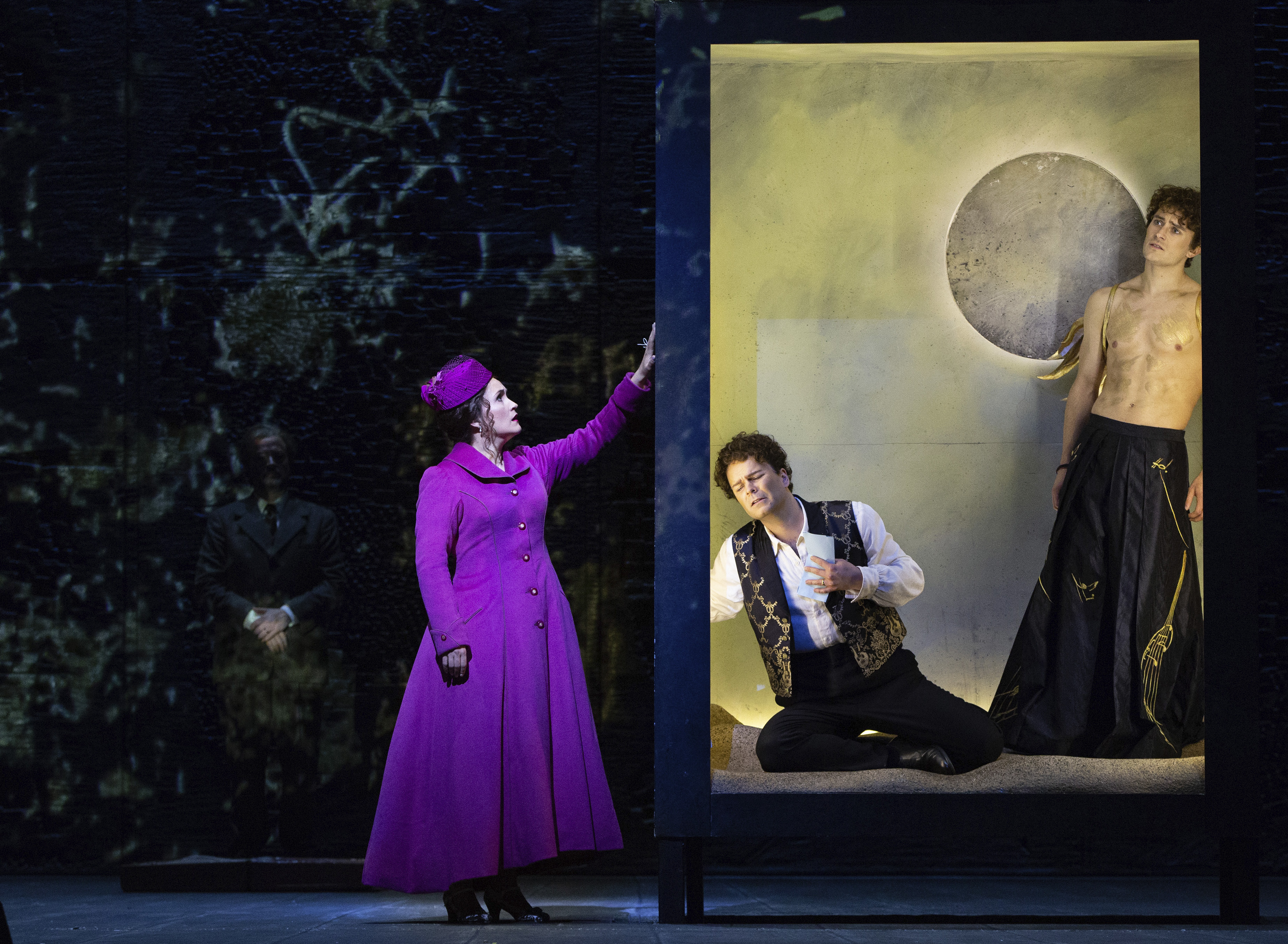
    Erin Morley as Eurydice, from left, Joshua Hopkins as Orpheus and Jakub Józef Orliński as Orpheus’s Double appear during a performance of Matthew Aucoin’s “Eurydice” at the Metropolitan Opera in New York in November 2021. (Marty Sohl/Met Opera via AP)

    Orliński’s physique gets discussed among concertgoers and critics, much in the spirit of pianist Yuja Wang’s concert attire. Countertenor Anthony Roth Costanzo, now Opera Philadelphia chief, has also appeared similarly exposed at the Met in years past.

    Is this a possible smoke screen for lack of talent? No, because in all their cases, their artistry wins out.

    Lingering criticism stings though, Orliński admits. But his legions of social media followers do generate ticket sales. Shirt or no shirt, he would always have mixed reactions among chronically opinionated operagoers.

    “It’s OK. I am feeling good with what I’m doing and how I‘m doing it,” he said.

    His life resembles that of a rock star but doesn’t sound like one. Well, maybe a little bit on his 2024 album, #LetsBaRock, which has Monteverdi bathed in modern electronic sound. “In the time of Monteverdi, they would change the instrumentation,” he said, “and that’s exactly what we did.”

    Countertenor Jakub Józef Orliński who will be making his Philadelphia debut with the Philadelphia Orchestra in Handel’s “Messiah.”

    He’s good to his word: The vocal tracks could be lifted out of the electronic context and transplanted exactly into a traditional Monteverdi recording. His recordings (so far) stick close to his home ground in the 18th century, often with worthy pieces previously buried by history.

    Orliński’s Philadelphia stage debut returns him to the scene of an early-career heartbreak when he was fresh out of Warsaw’s Fryderyk Chopin University of Music. “I did audition for the Curtis Institute in 2014,” he said. “Curtis has this incredible focus on the individual because it’s such a small school. Amazing faculty.”

    He didn’t get in for lack of a slot for countertenors — a specialized male-falsetto voice type that has only entered U.S. mainstream opera in the past 30 years, partly thanks to the outreach efforts of fellow countertenor Roth Costanzo.

    Baroque opera, the usual launching point for countertenors, wasn’t often performed in Philadelphia at that time.

    In Juilliard, he studied with the noted soprano Edith Wiens. During his New York years, he sang some of his first Messiah performances in Carnegie Hall. Only a year out of Juilliard, he released his first album, Anima Sacra, in 2018 with a cover showing him with bare shoulders.

    Only a year out of Juilliard, Jakub Józef Orliński released his first album, “Anima Sacra,” in 2018 with a cover showing him with bare shoulders.

    At times, one worries he’ll catch a cold.

    But not Orliński, whose health regimen helps him keep up a daunting schedule that, in the first two months of 2026, has 15 performances in two Handel operas. Among them is a cross-Europe tour in the titular role in Giulio Cesare in Egitto.

    The Philadelphia concerts boast of star soloists Lucy Crowe, Frédéric Antoun, and Quinn Kelsey. Orliński is fine with being a member of this larger ensemble. Though Handel offers no character portrayals to the individual singers, he sees himself and his colleagues as co-conspirators in telling the central story of the Messiah.

    “It’s not just re-creating what was written,” he said. “There are places… where you can write your own cadenzas and ornaments.” Like being a rock star from another century.

    Philadelphia Orchestra performs Handel’s “Messiah.” Through Dec. 14, Marian Anderson Hall, 300 S. Broad St., Phila. $43-$240. philorch.ensembleartsphilly.org

  • Phillies opt to stretch their competitive window with Kyle Schwarber and Co., and baseball seems to agree

    Phillies opt to stretch their competitive window with Kyle Schwarber and Co., and baseball seems to agree

    ORLANDO — Did anyone really think the Phillies would let Kyle Schwarber leave?

    Really?

    Sure, they could’ve gone in another direction, especially as Schwarber began getting offers this week. The Pirates — yes, you read that right — made a four-year, $120 million whopper, a league source said Tuesday. The Orioles and Reds offered five years, The Athletic reported, with Baltimore willing to go to $150 million.

    And as the market took off for a 33-year-old designated hitter, the Phillies could’ve tapped out.

    But if you’ve paid attention, you know the Phillies believe Schwarber is unrivaled, as a slugger and certainly a leader. Dave Dombrowski said all along that Schwarber, not younger free agents such as Cody Bellinger or Pete Alonso, was the priority. Hitting coach Kevin Long emerged from organizational meetings in October and told The Inquirer’s Phillies Extra podcast that losing Schwarber would be “devastating.”

    Even owner John Middleton said this about Schwarber in July: “We love him. We want to keep him.”

    Middleton doesn’t usually get outbid for players he wants, least of all by the Pirates. Or the Orioles. Or even by Schwarber’s hometown Reds. And so it was, before lunch Tuesday, that the Phillies made the most predictable news at the winter meetings.

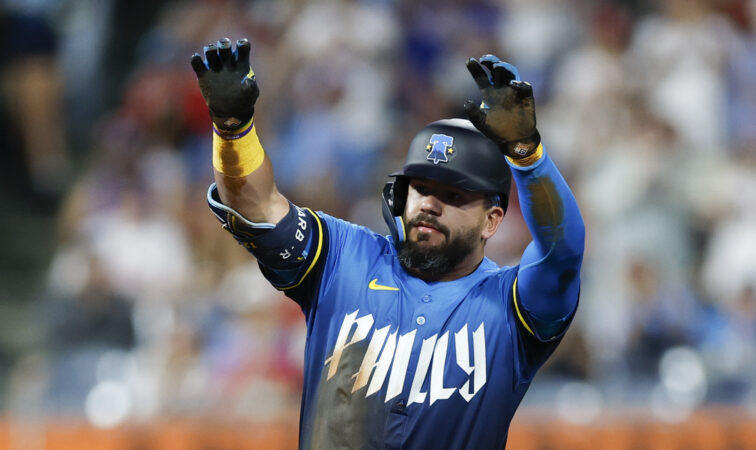
    Schwarber back to Philly. Five years, $150 million, sources said.

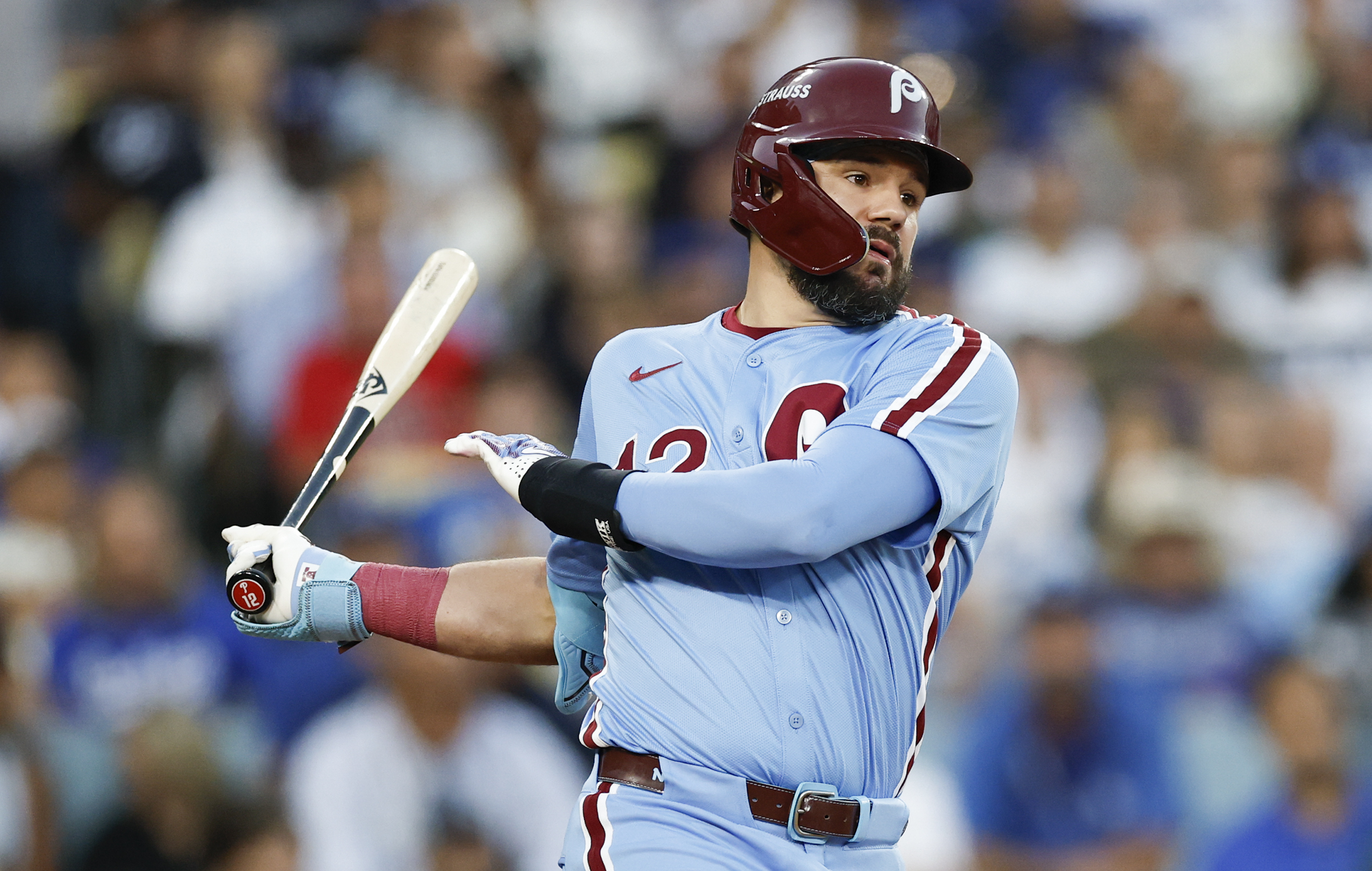
    Kyle Schwarber hit a career-high 56 homers for the Phillies this year.

    “I had a pretty good idea that was going to be the route,” Red Sox manager Alex Cora said. “Talking to Dave throughout the season, he knew that [Schwarber] was a huge part of what they were trying to accomplish and moving forward. So, not surprised that it’s with them.”

    The agreement was pending a physical and wasn’t announced by the Phillies until Tuesday night. But sources said the team’s confidence in Schwarber’s ability to stay productive through his mid-30s stems from his consistent bat speed. He’s also a more complete hitter now than when he signed a four-year, $79 million deal with the Phillies in 2022, one year removed from being non-tendered by the Cubs.

    Team officials have likened Schwarber to David Ortiz, who hit more than half his 541 homers after turning 32 and played through age 40. Schwarber’s contract will run through his age-37 season.

    “He’s so different than most of the guys I’ve ever been around because he’s a great player, one, and he knows how to bring the heartbeat of the clubhouse down when things are going rough,” manager Rob Thomson said. “And not only the clubhouse but individuals as well. He’s just a huge part of our ballclub.”

    Lest anyone forget, it’s a club that won 96 games this year — and 95 the year before. The Phillies are tied with the Dodgers for the most wins in baseball over the last two seasons. But the Dodgers also won back-to-back World Series and made news Tuesday by signing star closer Edwin Díaz.

    So, while the Phillies did what was necessary to bring back Schwarber, and extended Thomson’s contract through 2027, and remained optimistic about re-signing J.T. Realmuto, the perception, at least in Philly, is that they’re merely bringing back the band.

    And given the players’ ages and contract terms, the band might start looking like the Rolling Stones in a few years.

    But if the goal is to stretch the competitive window and take as many whacks as possible at the World Series, rival club officials surveyed in the lobby of the Signia by Hilton and baseball observers/insiders believe the Phillies are right to not make sweeping changes.

    The Phillies re-signed Kyle Schwarber (right) on Tuesday. Is J.T. Realmuto next?

    “Getting there is really hard to do, and improving in the season each year is really hard to do,” former major league general manager Jim Duquette said. “What the Phillies have accomplished is really, really difficult. If I’m the Phillies, I would be very careful with how many adjustments you make with that team.”

    The Braves kept most of their core together through their run of 11 consecutive division championships in the late ‘90s and early 2000s. Former Atlanta general manager John Schuerholz famously believed in changing about 10% of the roster in the offseason during those years.

    Including Schwarber’s deal, the Phillies have roughly $285 million in payroll commitments for 2026. They ended this year at about $312 million and expect to be in a similar range next year.

    Even as they try to get Realmuto back behind the plate, the Phillies expect to make changes to other areas of the roster, notably the outfield. Touted rookie Justin Crawford is ticketed to be in the opening-day lineup, either in left field or center. Nick Castellanos will be traded or released. Top prospect Andrew Painter is almost sure to be in the season-opening rotation.

    Dombrowski pushed back, then, on the idea that the Phillies are merely running it back, as if that would be a bad thing after 87-, 90-, 95-, and 96-win seasons and four playoff appearances in a row.

    “I don’t think we ever just run it back. We’re not running our club back,” Dombrowski said, citing Crawford’s arrival and possibly an expanded role for Otto Kemp as examples of changes. “And when I say that, I’m not so sure where you win 96 games that you should really look to have to do a lot of things differently.”

    Said Thomson: “We won 96 games last year. It’s not like we’re not doing well. We’ve got a good club. No matter what happens, we’re still going to have a good club.

    “Even if we sign both [Schwarber and Realmuto] back, there’s still going to be some changes. And there might be some change within the lineup as far as the order, which could infuse a little bit of energy.”

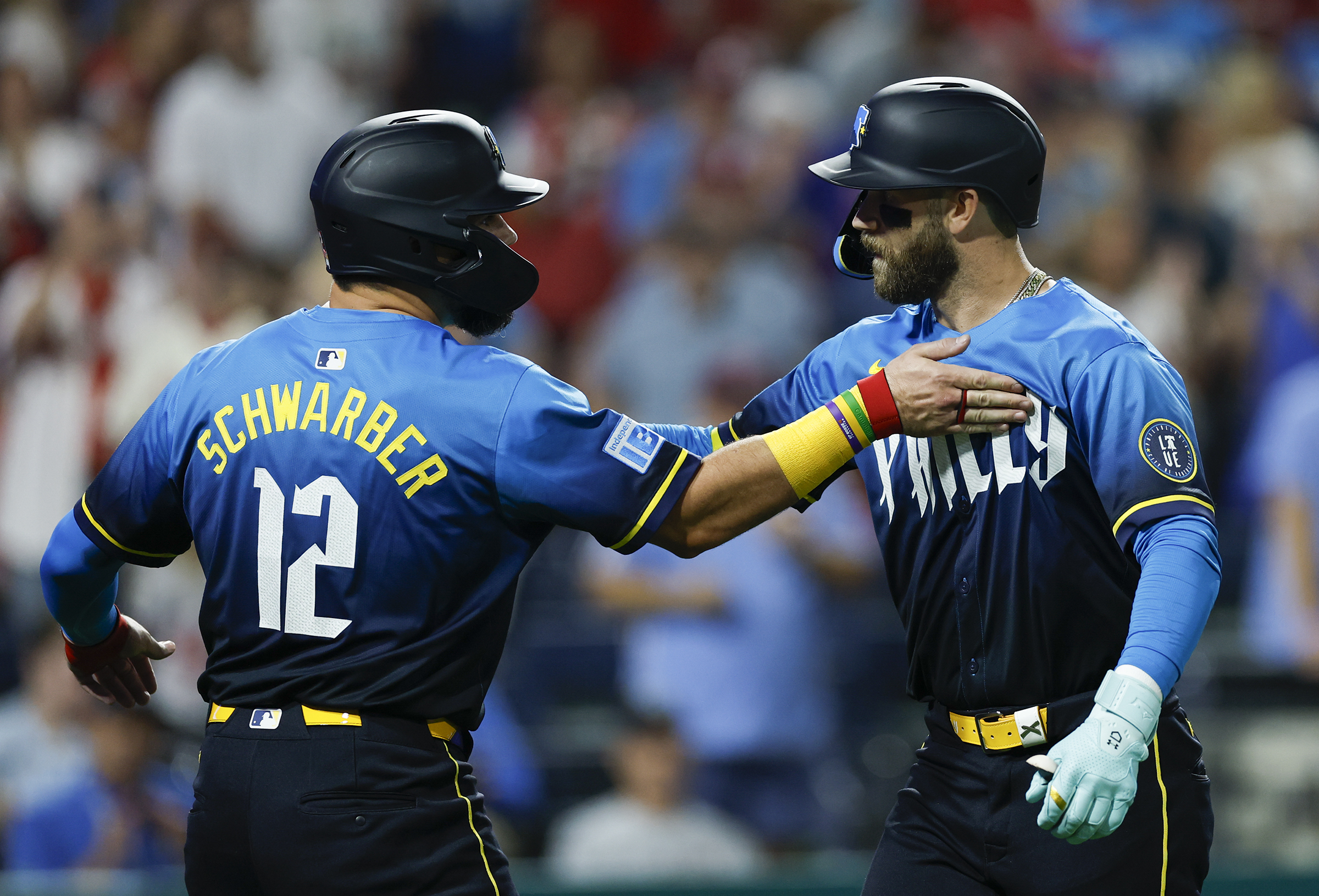
    Bryce Harper batted behind Kyle Schwarber in 2025, but their order could switch next season.

    More specifically, Thomson hinted at flipping Schwarber and Bryce Harper in the batting order.

    Schwarber batted behind Harper for a month early in the season before the latter missed a month with an inflamed right wrist. When Harper returned, he batted third, with Schwarber cemented in the No. 2 spot. And while Harper faced a lower rate of pitches in the zone (43%) than any hitter in baseball, Schwarber hit a career-high 56 homers.

    “Harper was protecting Schwarber,” Thomson said, “and Schwarber is having at that point a career year. I just didn’t want to mess with it.”

    Upon further review, maybe it would be better the other way around?

    “Yeah,” Thomson said. “I’ve got some ideas. But I haven’t talked to the players yet, so I don’t want to talk much more about that. But yeah, I’ve thought long and hard about it.”

    Those are the changes Phillies officials believe could make the difference in a 96-win team getting knocked out in the divisional round and finally winning the World Series.

    Moving on from Schwarber was nothing they ever cared to contemplate.

  • Phillies give the incomparable Kyle Schwarber an incomparable contract, still need another big bat behind him

    Phillies give the incomparable Kyle Schwarber an incomparable contract, still need another big bat behind him

    Kyle Schwarber was going to finish his career in a Phillies uniform. They’d been saying it without saying it since October. On Tuesday, they said it explicitly.

    Five years, $150 million.

    It is a remarkable sum of money on many levels. But, then, Schwarber is a remarkable hitter on many levels. Only three players in major league history have hit more home runs in the first three years of their 30s. Aaron Judge is the only player who has done it since the height of the steroid era. Sammy Sosa and Jim Thome are the other two. Schwarber’s 141 home runs between 30 and 32 years old are nine more than Babe Ruth hit at the same age.

    You can bet that Thome was on John Middleton’s mind when the Phillies owner signed off on his latest megabucks deal. Heading into his age-33 season, Schwarber is older than most free agents who sign contracts like his. But he is only one year older than Thome was when the latter signed his six-year, $85 million contract with the Phillies in December 2002.

    That deal aged well. Thome remained one of the game’s elite power bats well into his late 30s. He averaged 28 home runs and 484 plate appearances per season between the ages of 34 and 38. That was a significant drop-off from the 45 and 651 he averaged between 29 and 33. But no matter. The Phillies will be thrilled to be paying Schwarber $30 million in 2030 dollars if they can pencil in 30 home runs from him at the age of 38.

    Mostly, though, that fifth year is the cost of doing business. Schwarber’s elite-elite power would have meant a dramatic upgrade to virtually any lineup in the majors. There was a market for his services. And the Phillies would have been devastated to lose him.

    Middleton surely will tell you that a deal like this is bigger than dollars and cents and on-field statistics.

    The Phillies feel like they need Schwarber in the middle of their lineup, yes. That much is obvious. He has scored or driven in 21.7% of the 3,105 runs they’ve produced in the last four regular seasons. But the Phillies also feel they need Schwarber in the clubhouse and on the team charter and on the Wall of Fame when all is said and done. Certain players belong with certain franchises. The Phillies were willing to pay to cement that association.

    They also were willing to bear the risk that Schwarber ages like so many sluggers who came before him. There really isn’t a recent comparable for giving a 33-year-old designated hitter a five-year, $150 million deal. Schwarber’s representation probably pointed to the six-year, $162 million contract Freddie Freeman signed with the Dodgers in 2022. Freeman was one year younger than Schwarber, and he plays the field.

    (function() { var l = function() { new pym.Parent( ‘schwarbucks__graphic’, ‘https://media.inquirer.com/storage/inquirer/ai2html/schwarbucks/index.html’); }; if(typeof(pym) === ‘undefined’) { var h = document.getElementsByTagName(‘head’)[0], s = document.createElement(‘script’); s.type = ‘text/javascript’; s.src = ‘https://pym.nprapps.org/pym.v1.min.js’; s.onload = l; h.appendChild(s); } else { l(); } })();

    So, yes, there is plenty of risk. Over the last 15 years, only three players have had more than two seasons of 30-plus home runs between the ages of 33 and 37. Eight had two or more. That’s not exactly a bankable track record. In 2030, the Phillies will be paying a combined $115-plus million to 37-year-old Schwarber, 37-year-old Bryce Harper, 37-year-old Trea Turner, and 37-year-old Aaron Nola.

    Free agent Pete Alonso is an impact bat that could transform the Phillies lineup.

    There also is some risk on the front end. The Phillies have never shown a blatant disregard for luxury tax spending the way the Dodgers and Mets have. All indications are that they live in a world that has limits. Every dollar they pay to someone is a dollar less they can pay to someone else. In such a world, $30 million is a lot to commit each year to a player who is locked into the designated hitter position. If the Phillies intend to match their spending pattern of previous offseasons, they already are running out of disposable funds. Schwarber’s deal puts them at a projected $288 million in payroll commitments for 19 players.

    If ever there was a time to go for broke, that time is now. While Schwarber may have been the biggest question of the offseason, nearly as big is the questions of where he hits and who hits behind him. The Phillies have been missing a third power bat in the middle of the order ever since Rhys Hoskins suffered a torn ACL in 2023 and then left via free agency.

    In Alex Bregman and Pete Alonso, there are a couple of marquee free-agent bats available who would push the Phillies lineup much closer to reaching its potential. Dodgers slugger Teoscar Hernández is rumored to be available via trade, although at $22 million a year, he wouldn’t offer much of a discount on an annual basis over the top of the free-agent market.

    In short, Schwarber was a given. Only something drastic and unforeseen would have prevented him from wearing red pinstripes in 2026 and beyond. Any judgment of the Phillies’ offseason will depend on what happens next.

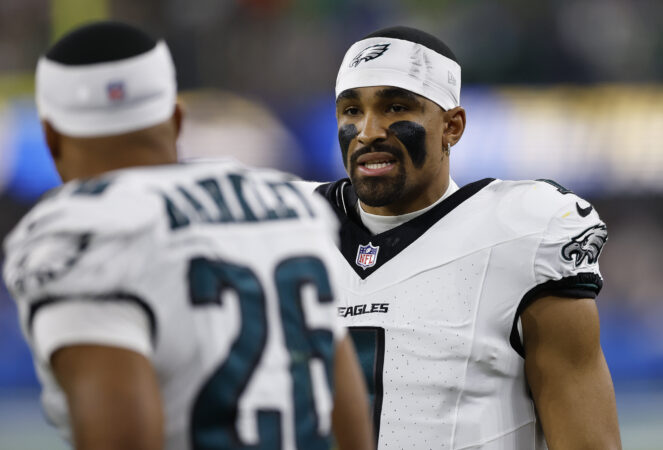
  • Eagles’ Jalen Hurts hits his low point, which begs the question: Should he be benched for Tanner McKee?

    Eagles’ Jalen Hurts hits his low point, which begs the question: Should he be benched for Tanner McKee?

    INGLEWOOD, Calif. — It was all there for Jalen Hurts.

    Despite the turnovers, missed throws, and maybe the worst four quarters of his NFL career, the quarterback had an opportunity to drive the Eagles to victory in overtime.

    He did not.

    Instead, Hurts tossed an interception — his career-high fourth of the game — that was deflected and caught at the 1-yard line and gave the Los Angeles Chargers a wild 22-19 win over the Eagles on Monday night at SoFi Stadium.

    “As frustrating as the night was, we had an opportunity to win the game,” Hurts said. “In the end, I had the ball in my hands driving down the field, having everything on our terms to a sense, and I didn’t bring it home.”

    It probably was the best decision and throw of Hurts’ four picks. But Chargers cornerback Cam Hart somehow got his hand on a pass intended for wide receiver Jahan Dotson, and safety Tony Jefferson snagged the deflection to seal the outcome.

    That Hurts would succumb seemed destined, however.

    The loss, by no means, was all on the sixth-year quarterback. The offense was disjointed and produced just one touchdown, on a fake Tush Push. Receiver A.J. Brown had a pass bounce off his hands to a Chargers defender and two deep Hurts teardrops that he failed to pull in could have resulted in scores.

    There were penalties that brought back successful plays. A missed field goal. And even the defense, which kept the Eagles alive with repeated stops and forced field goals, had the occasional breakdown.

    But Hurts’ imperfections as a dropback passer again were glaring. He threw over and behind his intended targets. He made the wrong reads and missed receivers schemed open downfield or on check downs. He was in a fog and couldn’t see the field, especially over the middle.

    There undoubtedly were some good moments. But not close to enough. It seems unimaginable that Eagles coach Nick Sirianni would consider benching Hurts for backup Tanner McKee. Opening that can of worms may cause more harm than good — especially in the long term — but the idea has some merit.

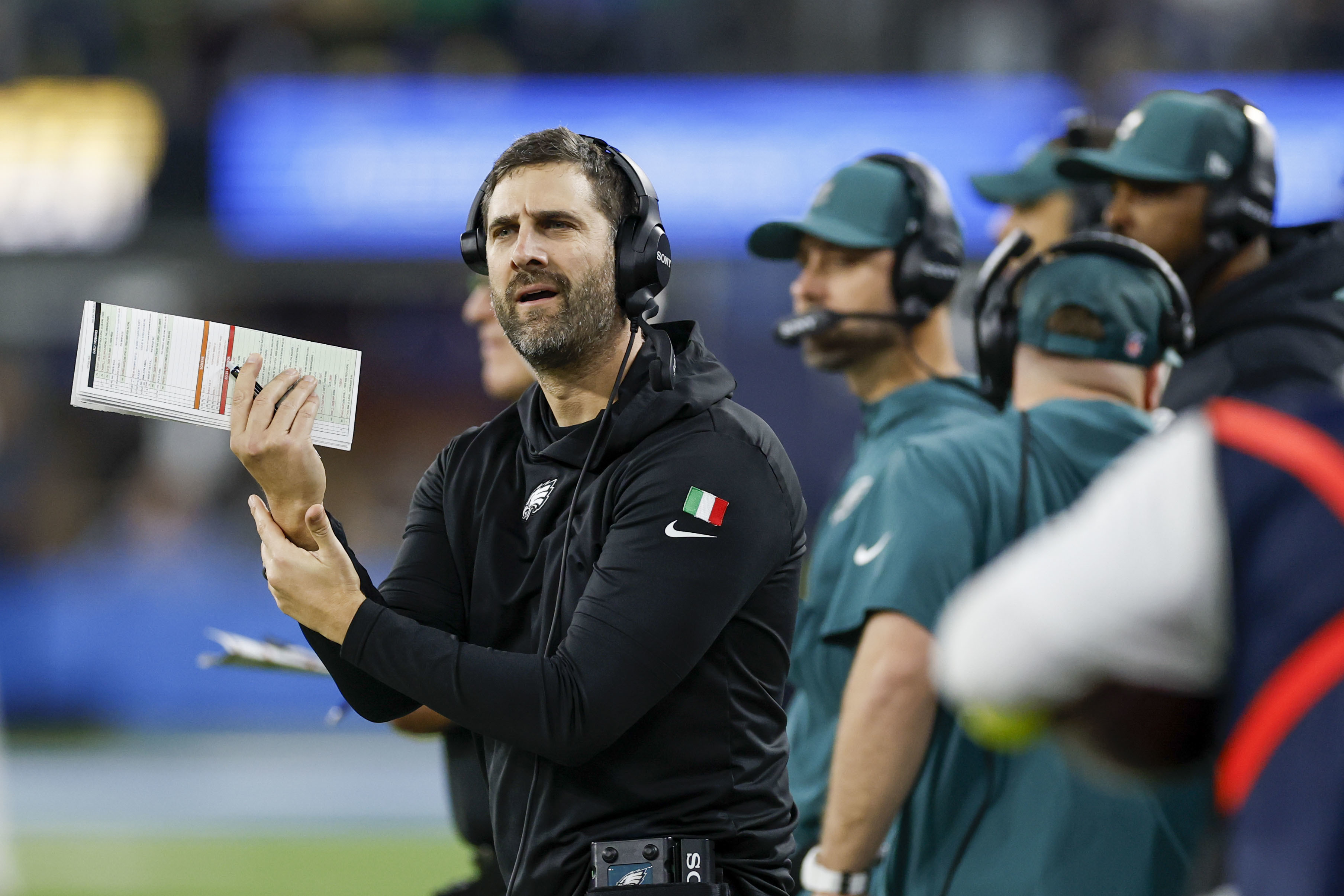
    Eagles coach Nick Sirianni lamented the turnovers. “Tonight was a little uncharacteristic of us.”

    Not just the quarterback

    Hurts has been in a free fall since the Week 9 bye. Each week has seemingly been worse, with the quarterback uncharacteristically turning the ball over at a high rate. Sirianni can’t dismiss all that Hurts has accomplished. And he and offensive coordinator Kevin Patullo have to take ownership, as well.

    But something likely has to change if the reeling 8-5 Eagles don’t want to repeat their collapse from just two years ago.

    “It’s never just on execution,” Sirianni said when asked about Hurts. “We look at ourselves as coaches first to help them be in position to succeed and execute. Obviously, you never want to turn the ball over. We’re pretty good at that, and tonight was a little uncharacteristic of us.”

    But turning the ball over has become more the norm during the Eagles’ three-game losing streak. They committed nine turnovers over that span after having just four in their first 10 games. Hurts wasn’t involved in two, but the other seven have come from five interceptions and two of his fumbles.

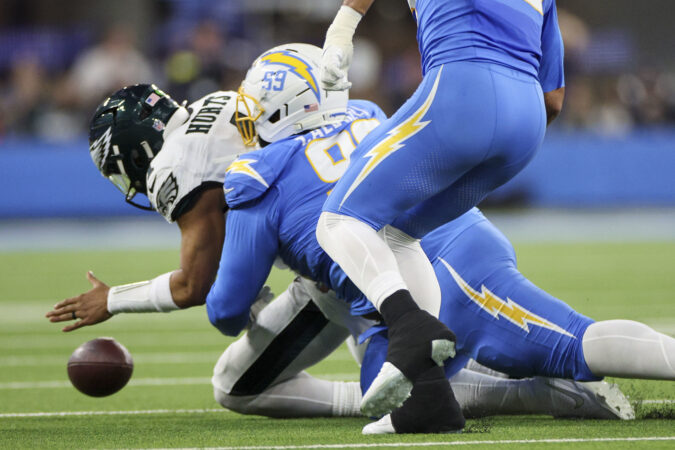
    The fumble vs. the Chargers was fluky and came after his first pick. Hurts didn’t see defensive lineman Da’Shawn Hand drop into coverage on a simulated third-down pressure. He forced a throw to Brown when it appeared that Dotson was open over the top.

    Eagles running back Will Shipley knocked the ball out of Hand’s grasp, and Hurts picked it up. But he, too, lost it for the rare double turnover. How rare? It had been at least 48 years since it last happened.

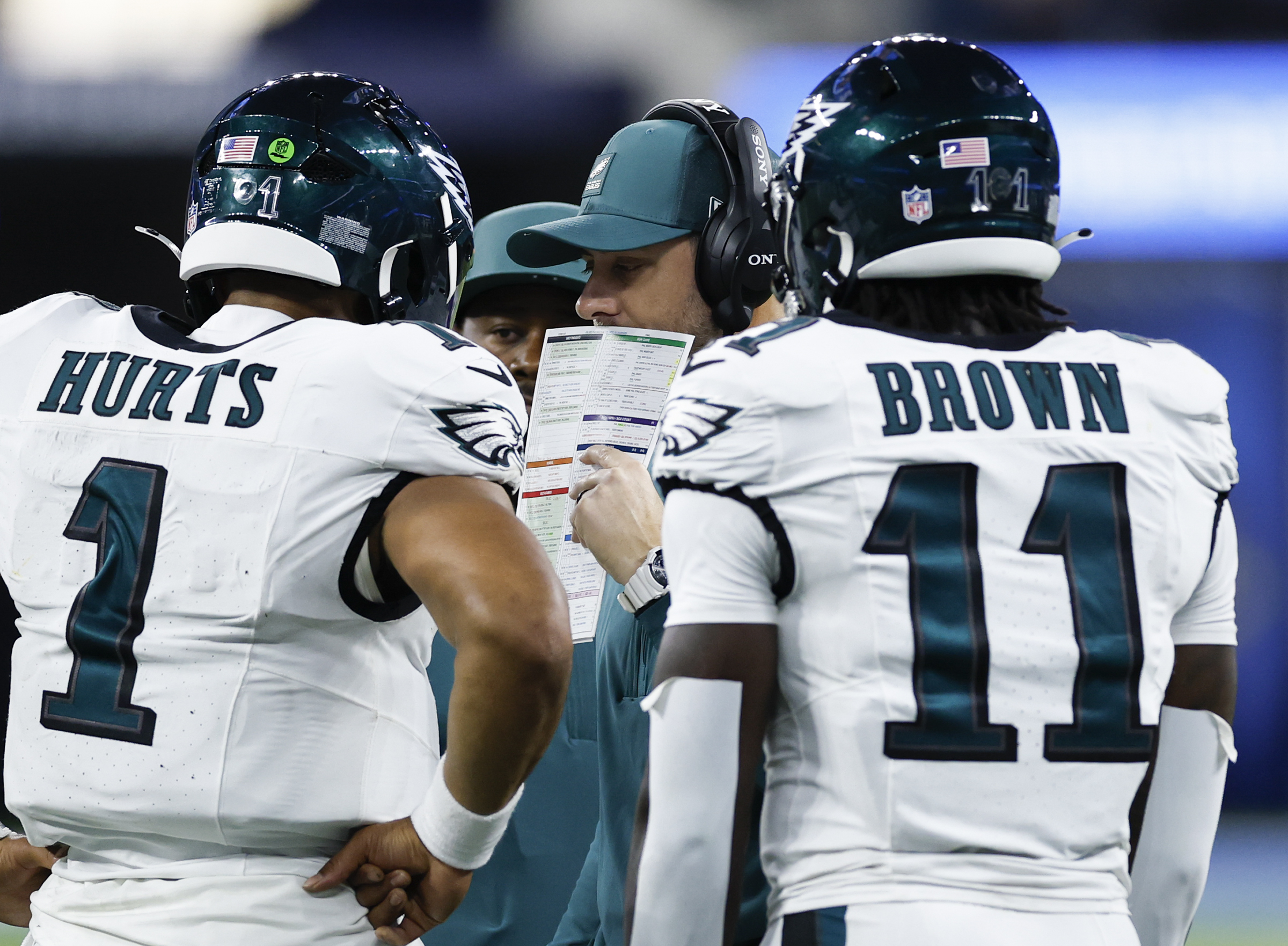
    Eagles offensive coordinator Kevin Patullo with A.J. Brown and Jalen Hurts.

    On the next series, Hurts was intercepted again when he threw behind DeVonta Smith. He settled down as the teams exchanged field goals until Saquon Barkley broke through on the fake Tush Push and scored a 52-yard touchdown early in the fourth quarter.

    But with the Eagles finally ahead, 16-13, a high Hurts dart to Brown over the middle went off the receiver’s hands and into Hart’s.

    “The ball over the middle — no, it wasn’t perfect,” Brown said, “but I’m more than capable to make that catch.”

    Brown, who finished with six catches for a team-high 100 yards, said he also wanted back Hurts’ deep shot to him on the first play from scrimmage and a dime the quarterback dropped into his bucket in the end zone.

    “I know there’s definitely some that he wants back,” Hurts said of Brown. “There’s some that we all want back.”

    Hurts walked over to the receiver on the bench after the third interception and gave him a fist pump. Brown, whose chemistry with his quarterback on and off the field has come under question, defended Hurts after his rough night.

    “You can’t just point a finger,” Brown said. “I think all of us have our hand in that pot and we’re trying to get better. Obviously, he’s the quarterback, he’s going to get a lot of stuff for it.

    “But we in this thing together.”

    Eagles quarterback Jalen Hurts tries to pick up a fumble after throwing an interception in the second quarter.

    Still looking for answers

    Sirianni, who got more involved in the offense after the Eagles’ mini-bye, has to find a formula that doesn’t require Hurts to drop back as often as he has the last three games. The run-pass ratio favored the latter 45 to 21. Hurts completed just 21 of 40 attempts.

    The tinkering of the offense resulted in more motion and passing concepts in the middle of the field. Hurts had some impressive throws in those scenarios, but there were as many bad ones. Against a good defense, the odds weren’t in his favor.

    “Nick stepped in, and I think he played a very good role this week, provided some structure and kind of organized some things for us,” Hurts said. “Obviously, we still have ways and room for improvement. But I look at myself first. I look at the man in the mirror first.”

    After the Chargers settled for a 54-yard field goal on the opening possession of overtime, Hurts ripped a 28-yard pass to Smith on third-and-16 early in the next drive. Then he avoided a fourth-and-4 test when Chargers pass rusher Odafe Oweh jumped into the neutral zone.

    But after two completions to tight end Dallas Goedert, Patullo dialed up a run-pass-run option play that had proved successful earlier in the game and a week ago vs. the Chicago Bears. Rather than have Smith as the read in a high-lo concept route, though, it was Dotson.

    “I knew it was going to be a tight-window throw,” Hurts said. “I’d have to watch the film to see it from the film’s point of view. Ultimately, it’s a play that I didn’t make.”

    Stunned

    The Eagles locker room, when it finally opened to reporters, was full of players and coaches with blank stares. As Hurts sat silently on his stool, Smith was in the next stall over with his arms crossed and his head bowed for what seemed like eternity.

    “It’s not nowhere close to 2023,” Smith said later when asked about this Eagles’ late-season swoon.

    Brown was across the aisle, catty-corner to Hurts. He chatted with rookie Darius Cooper until receivers coach Aaron Moorehead came over and offered consolation.

    There were no overt displays of anger for public consumption. The players who didn’t perform took accountability. No one pointed blame. But frustrations with Hurts behind the scenes have been mounting, according to team sources, and may have reached a precipice.

    The lowly Las Vegas Raiders offer a chance for the quarterback to get right next week. It’s not all on Hurts. But he keeps showing that he can’t shoulder too much of the offense.

    “It starts with me and how I play, how I lead, and how I go out there and do my job,” Hurts said. “So when I look at it at any point, it’s about how I respond to a test, and what level of resilience and resolve I have to push forward and figure things out.”

    The division title and more are still there. Can Hurts get the job done?

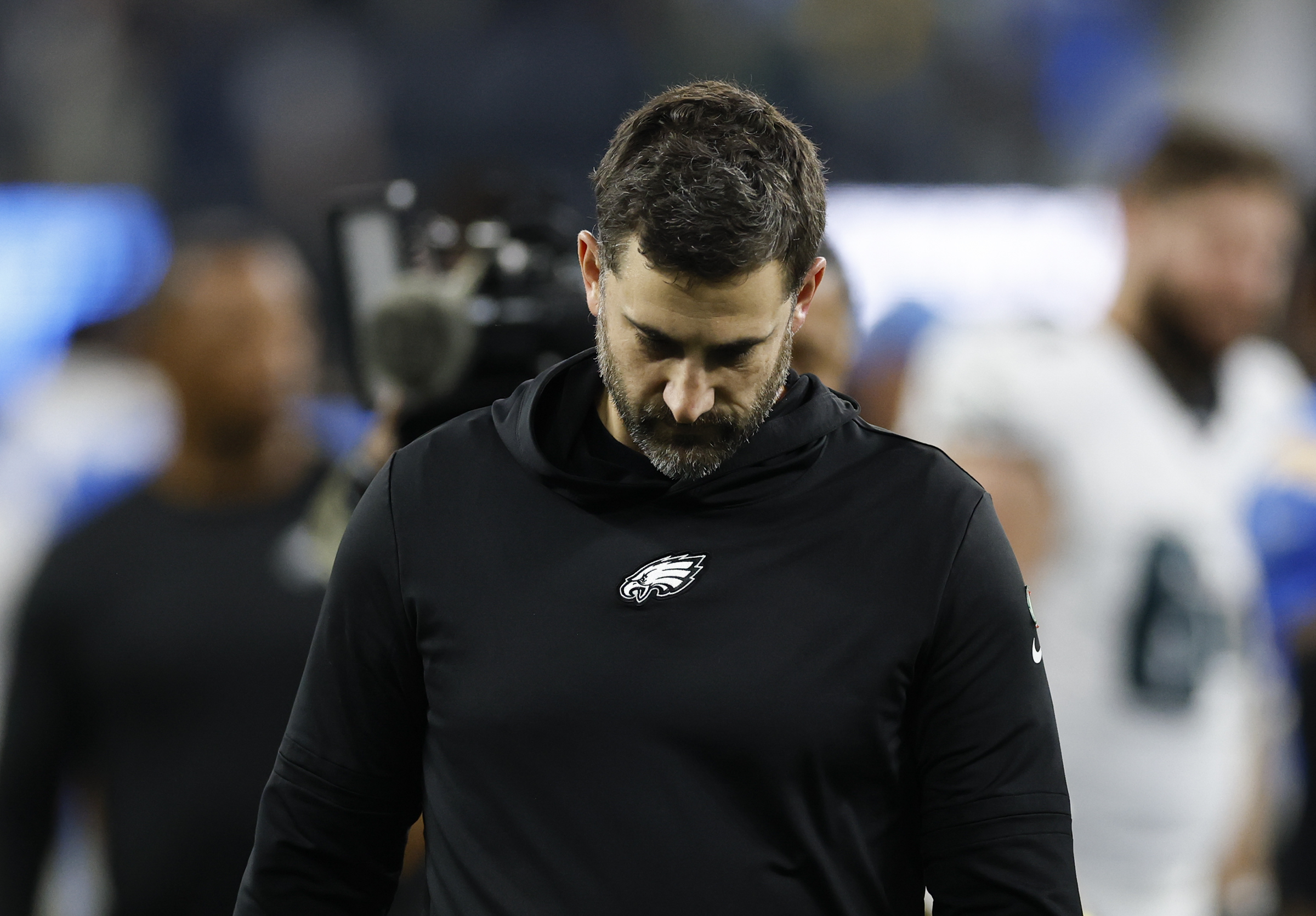
  • Forget 2023. The Eagles are in bigger trouble now after their loss to the Chargers.

    Forget 2023. The Eagles are in bigger trouble now after their loss to the Chargers.

    INGLEWOOD, Calif. — So we know what kind of team the Eagles are now. It took 13 games, and to watch most of them was to experience the same amount of pleasure as when you slam your fingers in a door. But they have revealed themselves, and there’s no use disputing the diagnosis.

    The Eagles are an excellent defensive team, and that is all, and that is not enough, not even close. Not with an offense like this. Not with this team’s tendency to commit untimely and inexcusable penalties. Not with so many questions that don’t get answered and so many problems that don’t get solved.

    They lost Monday night to the Los Angeles Chargers, 22-19 in overtime, and we know now that the most basic assessment of their status is deceiving. They still are 8-5, still in first place in the NFC East, still on track to make the playoffs and, in theory, have a shot at winning another Super Bowl in a conference without a dominant team. But anyone who has watched them can see through that spin, that false representation of who they are and how the rest of this season could play out.

    Coach Nick Sirianni complains to the officials after the Eagles were called for holding late in the second quarter at SoFi Stadium.

    They have lost three straight games, and they are poised for a breakdown as bad or worse than their collapse in 2023. That was six losses in seven games and a franchise that faced an inflection point with its head coach. This is different. This disintegration, if it continues, will be harder and graver, because it will mean their season is transforming from an attempt to defend a championship into a referendum on the coach, the quarterback, and any number of players who were presumed to be part of a talented and tested team’s core.

    “Who said it was going to be easy?” Brandon Graham said. “This year, coming off a Super Bowl, man, all we got to do is make sure we stay together.”

    Easy to say. Challenging to do. The dynamic within the Eagles right now, the divide in performance between one side of the ball and the other, is fertile ground for dissension to bloom. Anyone who has paid attention to them over the last five games could tell you what Monday made clear: that they are regressing on offense, that some of their best and highest-compensated players are letting them down, and that there’s little or no reason to believe that anything about the unit is going to improve in the short term.

    Since their bye five weeks ago, the Eagles have played one good stretch on offense, and that stretch was brief. In their loss to the Cowboys on Nov. 23, they scored 21 points in the game’s first 18½ minutes, then didn’t score again. Those 18½ minutes seem like a mirage now. They marked the only game in a month and a half that the Eagles put up more than 19 points, and the offense’s performance against the Chargers only reinforced the reality that something about it has to change.

    Jalen Hurts was a mess. Kevin Patullo’s play calls are too predictable too often, the offensive line didn’t help Hurts much, and A.J. Brown helped him even less, dropping a deep ball on the game’s first play, then T-Rex-arming an over-the-middle pass in the fourth quarter that led to an interception. But even with those excuses or extenuating circumstances, Hurts was still a mess.

    He threw four interceptions. He failed to see some open receivers and threw wildly to others. His play this season is raising the question of whether, assuming he remains their starting quarterback for several more years, the Eagles will be able to win another Super Bowl, or even come close again, if they don’t surround him with the best roster in the NFL.

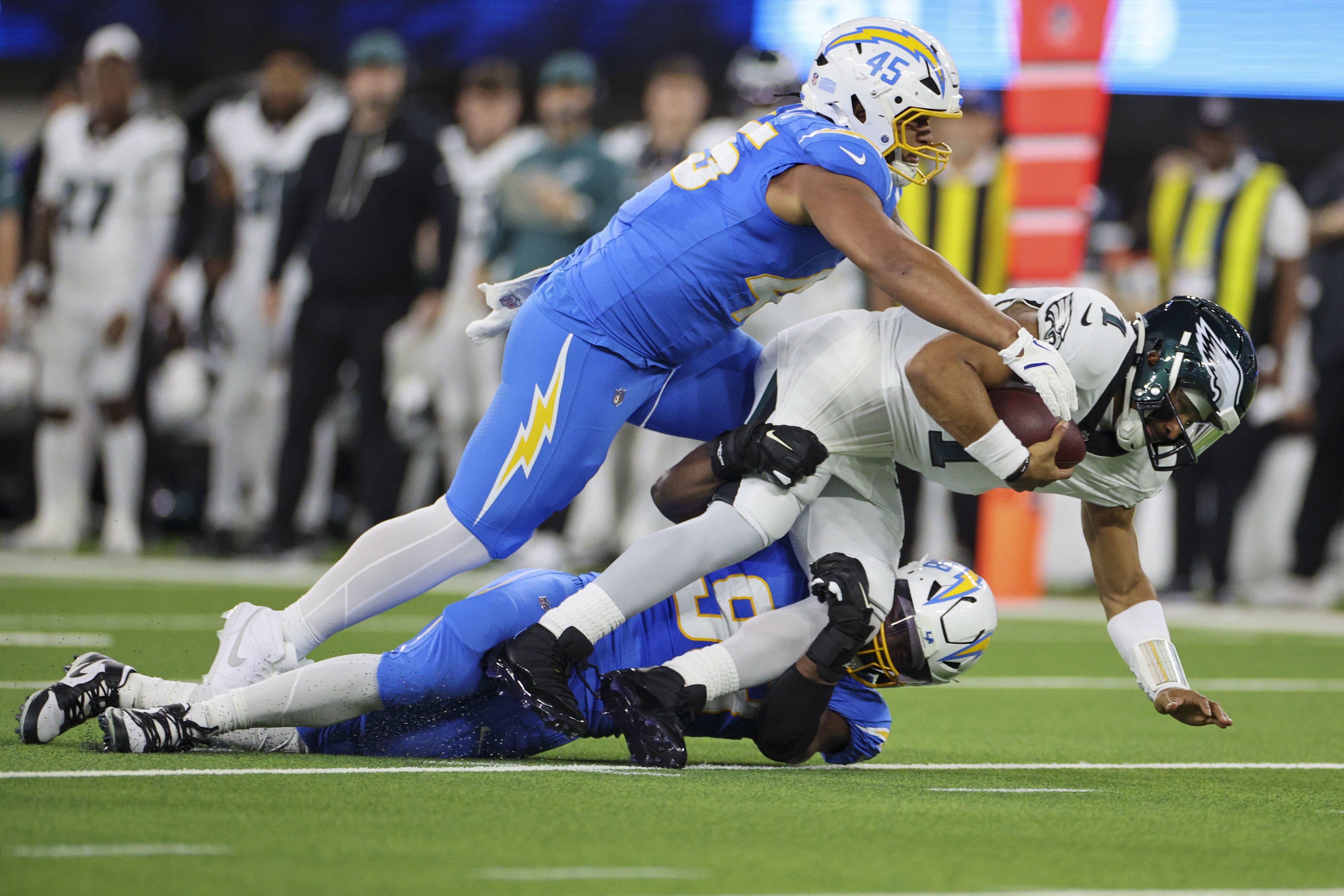
    Jalen Hurts is sacked by Chargers linebackers Tuli Tuipulotu and Odafe Oweh during the first quarter.

    We’re getting to the point where removing Hurts and inserting Tanner McKee would be helpful, just to create a control in this ugly experiment that is the Eagles offense. It’s unlikely to happen, and it’s possible, even probable, that such a change would do more harm than good. It would create an instant controversy, no doubt. Hurts might take the demotion as an insult, in the same way Carson Wentz viewed the decision to draft Hurts in 2020, and demand to be traded. There are an infinite number of scenarios that could play out from such a seismic move. One of them, though, could be that the Eagles would acquire some certainty about who and what have been the real problems with the offense all along.

    That decision would come with enormous risk for the man who presumably would make it. Nick Sirianni would be acknowledging that he and his handpicked offensive coordinator can’t fix Hurts, can’t help him get back to being someone who at least didn’t hurt the Eagles’ chances of winning. Once Sirianni crosses that bridge, there’s no going back, and there’s nothing Jeffrey Lurie is less willing to forgive than a head coach who fails to allow the franchise quarterback to thrive.

    “The people we have in there have won a lot of football games,” Sirianni said. “Right now, we’ve lost three in a row. Again, I saw a great, great week of preparation, and I’m confident in the coaches that we have, the players that we have, the owner that we have, the front office that we have — that we’re built to overcome. We know how to do that.”

    Then they’d better get to doing it. Fast. No, this wasn’t just another loss for the Eagles, and this is no small slump. This is a test for everyone in that locker room. And let’s be honest here: Have they given anyone any reason to believe that they’re going to pass it?