Tag: UniversalPremium

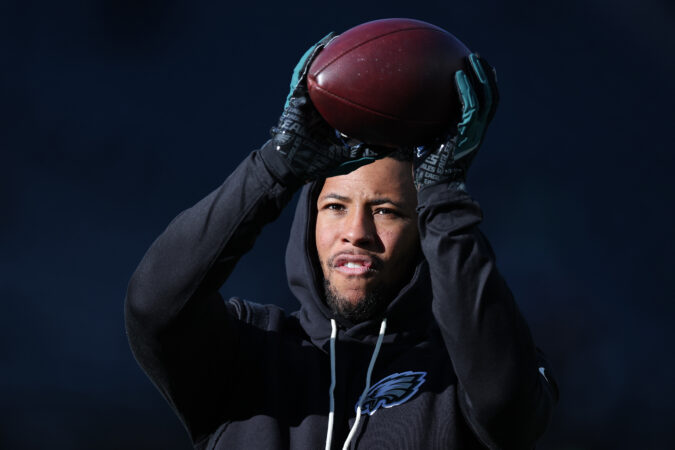
  • Saquon Barkley’s uncomfortable truths, plus the Eagles rooting for the Lions and another replay fail

    Saquon Barkley’s uncomfortable truths, plus the Eagles rooting for the Lions and another replay fail

    “They wanted it more.” — Saquon Barkley, after the Eagles blew a lead and lost at Dallas.

    “Honestly, I think it’s been awful.” — Saquon Barkley, assessing the Eagles’ game-day juice, after the Eagles lost the following game on Black Friday to the Bears.

    What will Saquon say if the Eagles lose a third straight game when the visit the Chargers on Monday Night Football?

    Whatever it is, believe it. It’s the truth. His truth.

    What we’ve learned in Barkley’s 32 games as an Eagle is he speaks his truth. It is a refreshing and unvarnished truth, and not everyone always agrees with that truth.

    Eagles coach Nick Sirianni “saw the effort sky-high” all game long in Dallas and has emphasized that the effort level remains high.

    Lots of folks criticized Barkley in April when he not only attended the Eagles’ White House reception (several teammates, including quarterback Jalen Hurts, conveniently discovered scheduling conflicts), he also golfed and lunched with President Trump the day before, even as Trump advanced his scurrilously racist agenda.

    Barkley didn’t care.

    He didn’t care that Nick clapped back. He didn’t care that I clapped back.

    Barkley is 28. One day he might regret his words or actions. One day he might speak and act with greater discretion.

    For now, even while living as a celebrity in a world of unprecedented scrutiny, he’s saying what he feels and doing what he wants.

    For that, he should be commended.

    Go, kneecap-biters

    In 2021, Sirianni’s disastrous introductory press conference was largely overshadowed by comparisons to Dan Campbell’s outrageous presser, in which he promised his Lions would bite off kneecaps.

    Since their memorable arrivals, Campbell has been nearly as successful as Sirianni. Many Eagles players and coaches expected to face the Lions in the NFC Championship game, and they were quietly pleased as the Lions stumbled through the season.

    Now, they’re rooting for the Lions.

    The Bears’ loss to the Packers on Sunday helped the Eagles’ chances to secure the No. 1 seed and a bye in the NFC. The Packers are 9-3-1 and atop the NFC North. The Bears are 9-4, and the Eagles can move to 9-4 with a win Monday night, through the Bears hold that tiebreaker.

    However, after they play the Browns next week, the Bears face the Packers again, then the 49ers, and finally, Campbell and the Lions to end the season. The Lions blew out the Bears in Week 2.

    The Rams’ win at Arizona put them at 10-3 and they remain atop the conference with the best chance at the bye, but they face the Lions and the Seahawks, who they barely beat at home, as well as the Falcons and Cardinals.

    The Packers face the Broncos, Bears, Ravens, and Vikings.

    The Eagles will face the Raiders, Commanders, Bills, then the Commanders again. The only game they won’t be favored in will be at Buffalo. If they finish 4-1, a 12-5 record could secure the top seed. Don’t scoff: The Chargers, Raiders, and Commanders all have injured starting quarterbacks.

    What’s the Eagles’ most likely path to the No. 1 seed?

    First, they would need the Rams to lose the next two weeks. One of those losses would be to the Lions. That would leave the Rams at 12-5, but the Birds have the tiebreaker since they beat the Rams.

    Second, they would likely need the Bears to beat the Packers, then lose to the 49ers … and Lions. That would leave the Bears at 11-6.

    Third, they would need the Packers to lose to the Broncos and, probably, the Ravens. That would leave the Packers at 11-5-1.

    Where would all of that Lions winning leave the Lions? At 12-5, that’s where. The Eagles beat the Lions on Nov. 17, and so hold that tiebreaker.

    So, go, knee-biters.

    The curse of replay

    Replay stinks.

    My stance: Review every play or review nothing, and do so with replay officials located in the booth rather than forcing coaches to challenge.

    My point: Too often, reviewing plays to the letter of the law robs us of plays that follow the spirit of the game. Just ask the Ravens.

    Leading, 27-22, midway through the fourth quarter Sunday, Steelers quarterback Aaron Rodgers appeared to catch his own batted pass — but he also appeared to lose possession as he fell to the ground and to have the ball snatched from him. The initial call awarded the Ravens an interception at the Steelers’ 31-yard line with 6:26 to play. However, upon mandatory turnover review, Rodgers was ruled down by contact, even though his possession seemed far too flimsy to reverse the call. The Steelers kept the ball and punted.

    Certainly, the Rodgers ruling was much more convincing than another play that was reversed upon review four minutes later.

    Ravens tight end Isaiah Likely caught a go-ahead touchdown pass, took one step, took another as he extended the ball away from defender Joey Porter Jr., but before he landed a third step, Porter knocked the ball from his hands. The initial ruling of a touchdown was overturned, and, two plays later, the Ravens turned the ball over on downs.

    Likely didn’t tuck the ball away, and he didn’t get a third step down, so it was ruled incomplete. The call might have been right, but the rule is dumb, and its enforcement Sunday was ridiculous.

    These plays happened minutes apart in the same game that, for the moment, gave the 7-6 Steelers the AFC North lead and bumped the 6-7 Ravens out of the playoff picture.

    Replay slows the game. It also it affords officials the chance to interpret plays in a counterintuitive manner. Officials are terrified to not apply the letter of the law, even when the spirit of the law aligns better with common sense.

    Zach Ertz, humanitarian, might be done

    Zach Ertz, one of the Eagles’ heroes in Super Bowl LII, ended a possible Hall of Fame career when he suffered a torn ACL on Sunday. Ertz planned to retire after this, his 13th season. Ertz only went to three Pro Bowls, from 2017-19, but he ranks in the top 10 in receptions (5th), yards (8th) and TDs (10th) for a tight end.
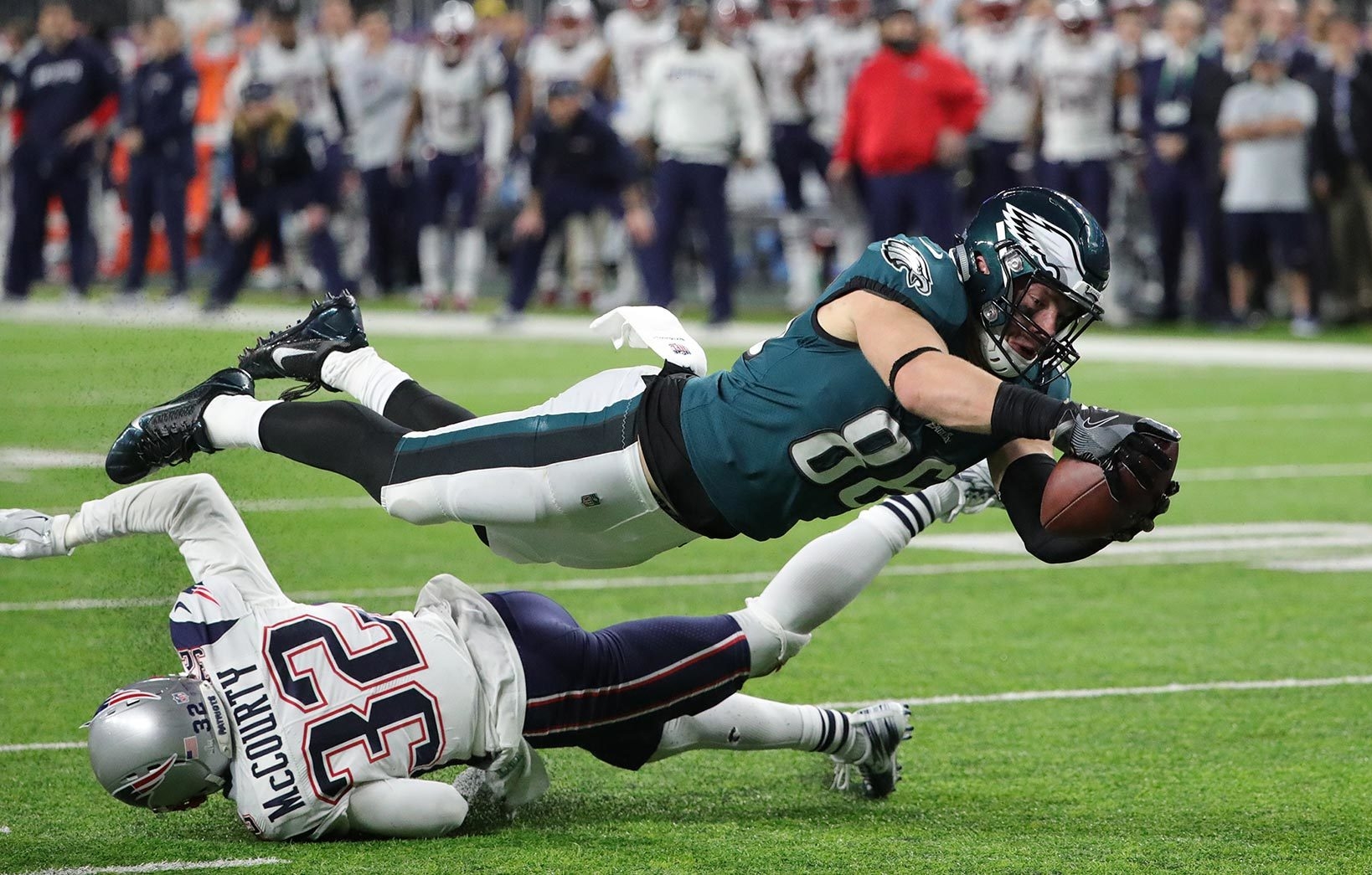
    Zach Ertz dives over the Patriots’ Devin McCourty to score the go-ahead touchdown in the fourth quarter of the Super Bowl LII.

    Ertz and his wife, Julie, a soccer star for the U.S. Women’s National Team, spread goodwill wherever they played and lived, be it in Pennsylvania/New Jersey, Arizona, or the Washington, D.C. area. He might never get into the Pro Football Hall of Fame, but he’s become a Hall of Fame person.

    Too tough?

    Before Sunday, Colts quarterback Daniel Jones was in the middle of a career resurrection, but he also had played three games with a broken bone in his left leg. He was one of several quarterbacks playing with what appeared to be significant injuries to non-throwing appendages: Aaron Rodgers’ left wrist, Jayden Daniels’ left elbow, and Justin Herbert’s left hand, which was surgically repaired just a week ago but was not expected to keep Herbert out of Monday’s game against the Eagles.

    Daniels played with the aid of a brace from a company called Protect3D, begun by two clever former Duke teammates who helped Jones play in college with a broken collarbone by 3-D printing a similar protective device. It was a cool story.

    On Sunday, however, Jones collapsed with a non-contact injury to his right Achilles tendon. This brings into question whether playing on the broken left leg created stress on the right Achilles, and whether Jones should have been playing at all.

    Indianapolis Colts quarterback Daniel Jones (17) grabs his leg after an injury during the first half against the Jacksonville Jaguars.

    He was anticipating a massive free-agent contract extension in 2026. Now, he’s looking at unemployment and a season lost to rehab.

    Extra points

    On Sunday night, the Chiefs lost to the Texas in Kansas City to fall to 6-7, with possible losses to the Chargers and Broncos on the horizon. After reaching five of the past six Super Bowls and winning three of them, the Chiefs are likely to miss the playoffs for the first time in 10 seasons. … Browns rookie Shedeur Sanders, who played under Deion Sanders at Colorado before falling to the fifth round of the draft, threw for 364 yards and with three touchdowns, an interception, and a rushing touchdown in a 31-29 loss to the Titans. It was his third start. He’d thrown for 358 yards in his first two starts combined. … The NFL has enjoyed the careers of running quarterbacks like Randall Cunningham, Cam Newton, Steve Young, and Steve McNair, but in less than eight seasons Josh Allen holds the rushing TD record, which he extended Sunday to 77. That’s two more than Newton, who played 11 seasons. Notably, Hurts is in third place with 63 rushing TDs, and he’s played less than six seasons.
  • Eagles need nothing short of domination from Nolan Smith, Jaelan Phillips, and Jalyx Hunt against vulnerable Justin Herbert

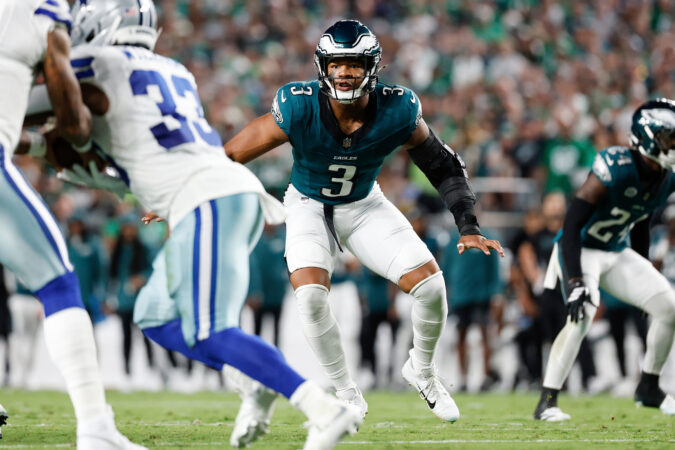
    Eagles need nothing short of domination from Nolan Smith, Jaelan Phillips, and Jalyx Hunt against vulnerable Justin Herbert

    It won’t be Jalen Hurts or Saquon Barkley.

    It won’t be Nick Sirianni or Kevin Patullo.

    It won’t even be Jordan Davis or Moro Ojomo.

    All will have plenty to prove against the Chargers. But none will have more than the guys whose primary responsibility is putting the quarterback on his back. The most important players on the field Monday night will be the Eagles edge rushers.

    The pressure is on the pressure.

    Or, rather, the pressure-ers.

    Jaelan Phillips, Nolan Smith, Jalyx Hunt. These are the names you will need to hear with regularity against the Chargers. We haven’t heard them nearly enough this season.

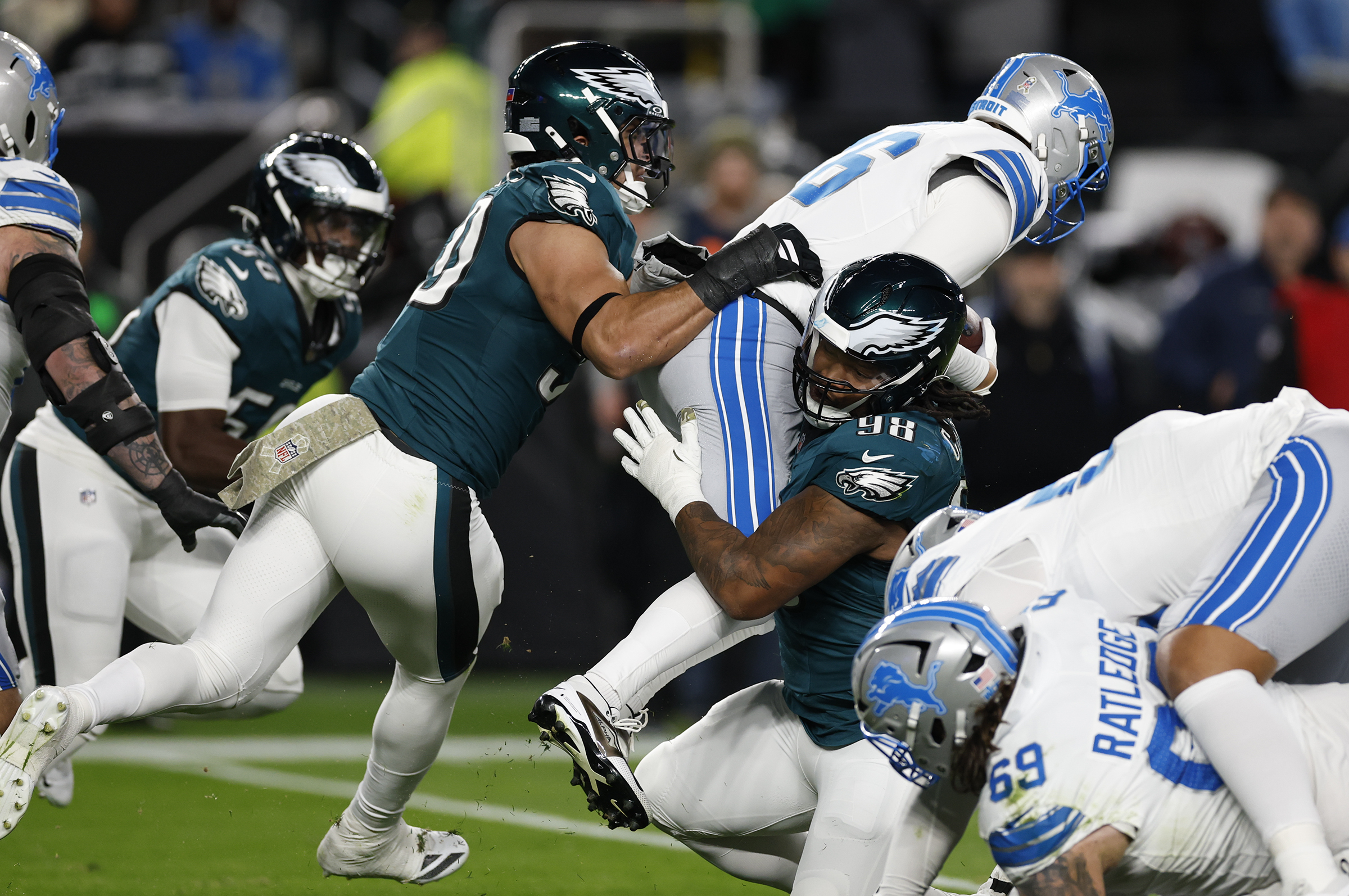
    Eagles defensive tackle Jalen Carter (right) and edge rusher Jaelan Phillips stop Lions quarterback Jared Goff on Nov. 16.

    Through 12 games, the Eagles have gotten just eight sacks combined out of their edge rushers.

    True, five of them have come in the last five games, a stretch that has seen Smith return from injured reserve and Phillips arrive via trade from the Dolphins. But it still isn’t enough. Three years ago, Haason Reddick, Josh Sweat, and Brandon Graham combined for 38 sacks, an average of more than two per game. That’s the kind of output the Eagles should be expecting on Monday night.

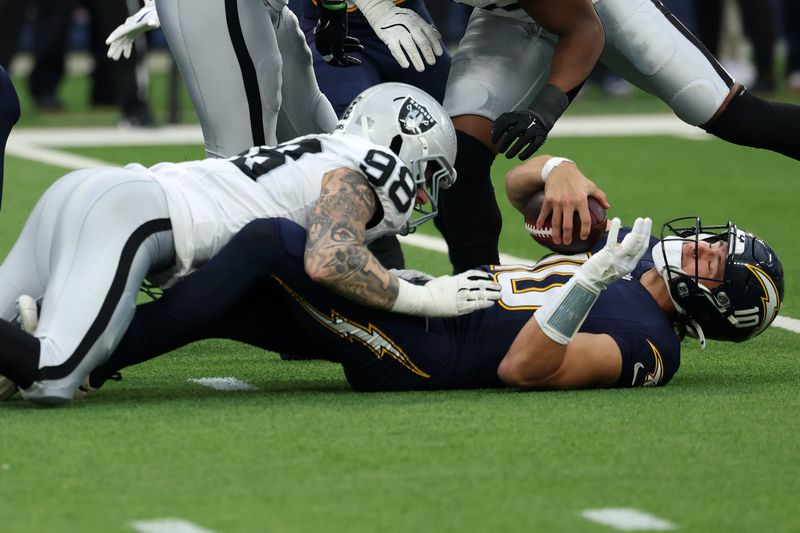
    Rarely have the Eagles faced an opponent so ripe for the picking. The Chargers have been a mess up front all season. In late August, they lost starting left tackle Rashawn Slater to a season-ending knee injury. A month ago, they lost All-Pro right tackle Joe Alt to a season-ending ankle injury. In the four games since Alt went down, the Chargers have allowed a remarkable 17 sacks. That included three last week against the Raiders, a game that ended with Justin Herbert nursing a broken non-throwing hand.

    Chargers quarterback Justin Herbert is expected to play against the Eagles.

    This should be a get-right game for the Eagles’ most underperforming unit. That’s true regardless of who is under center — or in shotgun, or in the pistol — on the other side of the line of scrimmage. It will be especially true if that player is Herbert, who is reportedly preparing to play despite undergoing surgery to repair a broken bone in his left hand early last week.

    The Eagles have already seen firsthand what Herbert can do when given an ample amount of time to throw. The Chargers veteran shredded them during Sirianni’s first season as coach, completing 32 of 38 passes for 356 yards and two touchdowns in a 27-24 win in Week 9. That afternoon was one of the 11 times in Herbert’s career that he was not sacked. The Chargers are 9-2 with a plus-110 point differential in those 11 games.

    It goes without saying that none of those games has occurred this season. Herbert has been sacked multiple times in 11 of 12 of his starts in 2025, with three-plus sacks in eight. Heading into Sunday, the Chargers were one of five teams in the NFL to allow five-plus sacks in at least four games. At 8-4, they are the only one of those teams with a winning record. The other four have combined to go 10-38.

    The Eagles need to take advantage. Whatever the overall numbers say, they have more than enough talent on the edge to be a deciding factor Monday night. We’ve seen flashes of dominance from the group. Apart from maybe the cornerbacks, the Eagles’ edge rushers were the best unit on the field in back-to-back victories over the Packers and Lions. In a 10-7 win over Green Bay in Week 10, the group combined for two sacks, three tackles for losses, and five quarterback hits against Jordan Love. The following week, Phillips and Hunt combined for five hits on Lions quarterback Jared Goff, including Phillips’ first sack in an Eagles uniform. The pressure on Goff was one of the biggest reasons the veteran completed just 14 of 37 passes with an interception.

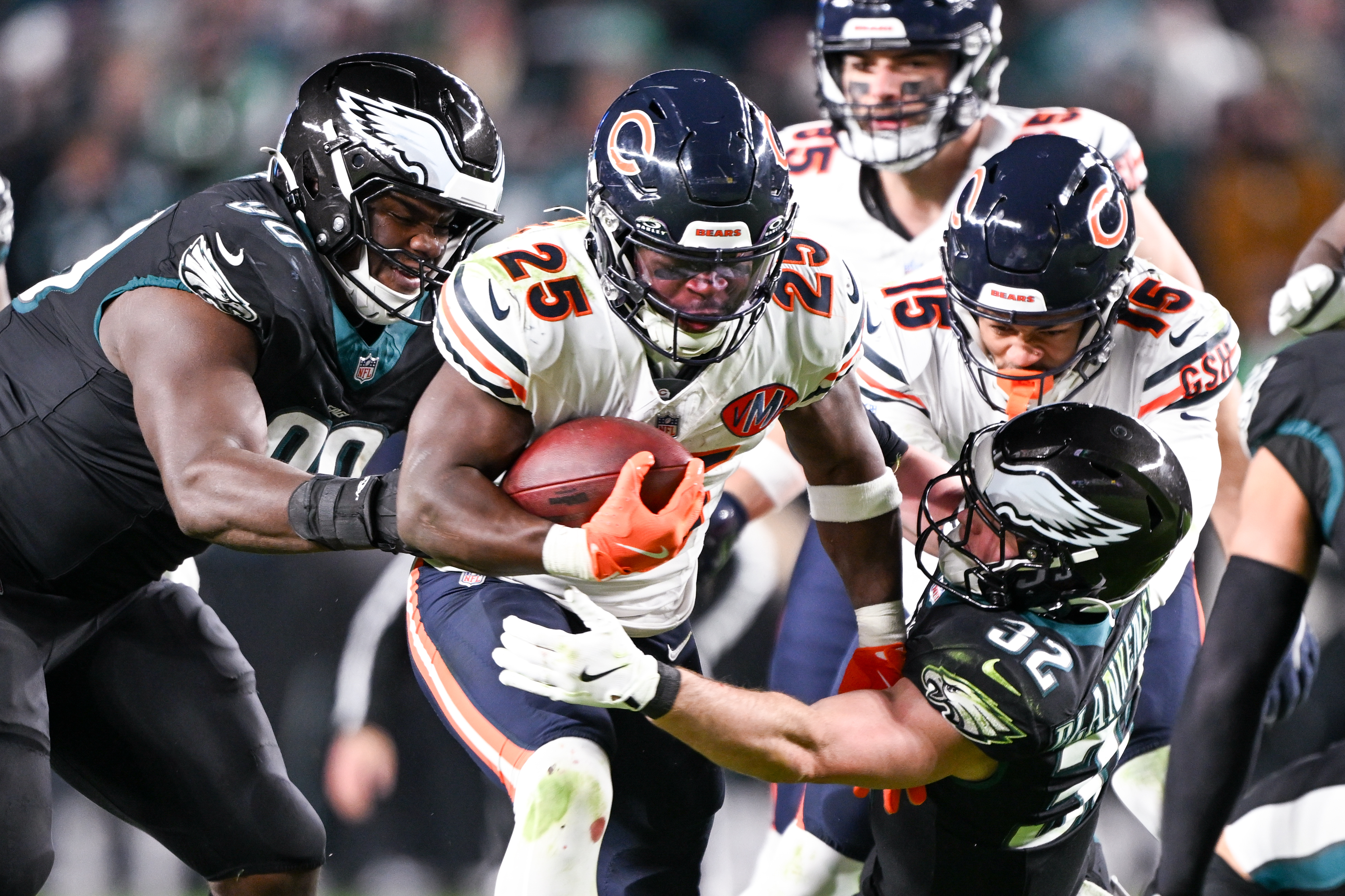
    But those two wins feel like a distant memory, don’t they? For the first time in the Vic Fangio era, the Eagles are coming off back-to-back games of 400-plus yards of total offense allowed. Two weeks ago, Dak Prescott was way too comfortable while completing 23 of 36 passes for 354 yards. Last week, the Bears gashed them for a ridiculous 281 rushing yards, with running backs D’Andre Swift and Kyle Monangai combining for 255 yards on 40 carries.

    The Bears gained 281 yards on the ground against the Eagles.

    The four truest words in the NFL came out of Jordan Davis’ mouth earlier this week.

    “It’s a copycat league,” the Eagles defensive tackle said.

    With Herbert ailing and the Chargers pass protection in shambles and the Eagles taking the field without All-World defensive tackle Jalen Carter, we should expect to see Greg Roman do as Sean McVay and Ben Johnson did before him.

    “We’ve got to play the run well enough to where they just don’t run it a bunch,” Fangio said. “They run it, and like most teams that run it well, they have a good play-action game, and not give up the shots in the play-action passing game, which they do a good job of.”

    But stopping the run can only carry you so far against a quarterback like Herbert. The Eagles need to put themselves in a position to pummel him as thoroughly as the rules allow. They need Smith to be the guy he was down the stretch last season, when he recorded 10½ sacks in his last 16 games, including four in the playoffs. They need Phillips to be the guy he was against the Packers.

    The best offense is a good defense. And the best defense is a great pass rush.

  • Wistar scientists pinpoint a new approach to ovarian cancer treatment

    Wistar scientists pinpoint a new approach to ovarian cancer treatment

    Wistar Institute scientist Maureen Murphy wants to solve a decades-long mystery: Why is ovarian cancer often resistant to hormone therapy?

    In a recently published study, she shared a new theory as to why treatments designed to block or remove hormones, known as hormone therapy, often fail in ovarian cancer — and a potential approach to make them more effective. Such therapies have cut the risk of death from certain breast cancers by a third and reduced the odds of a recurrence by half.

    She pinpointed a problem facing hormone therapy — the vast majority of ovarian cancer cases have mutations in a key protein called p53.

    Her study, published last month in the medical journal Genes and Development, suggests that mutations in p53, a protein that normally works to stop tumors from growing, drive resistance to hormone therapy and that their effects could be reversed.

    Ovarian cancer is notoriously deadly. The most common form of ovarian cancer, high-grade serous ovarian cancer, has an 80% relapse rate after initial treatment and a five-year survival rate of 34%. It’s also highly resistant to immunotherapy.

    “There are very few drugs that treat it,” Murphy said.

    Her p53 mutation discovery led to her identifying a drug currently in clinical trials that’s promising in a small number of cases. Murphy wants doctors to start testing the combination of the drug and hormone therapy in ovarian cancer.

    If the approach makes it into a clinical trial, it would still take years to evaluate the safety and efficacy of the combination. Most treatments tested in clinical trials do not become standard practice.

    “For ovarian cancer, the treatment hasn’t changed much in the last 20 years, and so we really do need new treatments,” Murphy said.

    How does hormone therapy work?

    Hormones are like the body’s mail service.

    These chemicals carry messages to cells throughout the body, controlling mood, growth, reproduction, and development.

    Tumors can co-opt hormones for their own purposes using proteins called receptors, which act like mailboxes to receive the messages.

    Breast cancers, for example, often have estrogen receptors so that they can receive more of a hormone called estrogen. Similar to how bodybuilders use steroids to build muscle, tumors use estrogen to grow and divide.

    “Breast and ovarian tumors love estrogen. They grow on it,” Murphy said.

    Hormone therapy works by either blocking the receptors from receiving the hormones, or reducing the amount of hormones in the body altogether.

    One of the first hormone therapy drugs for cancer, tamoxifen, was approved in the U.S. in 1977 to target the estrogen receptor in metastatic breast cancer.

    In this study, Murphy looked at fulvestrant and elacestrant, two anti-estrogen drugs approved for breast cancer.

    More than 70% of cases of the most common type of ovarian cancer express estrogen receptors, making them theoretically a good target for hormone therapy, if the p53 problem can be fixed.

    Solving the mystery

    In her first professor job at Temple’s Fox Chase Cancer Center in 1998, Murphy chose to study the tumor suppressor protein p53, with a focus on genetic variants in women of African and Ashkenazi Jewish descent that put them at risk of cancer.

    Decades later, Murphy expanded her focus at Wistar to look at hundreds of genetic variants of the protein found in the general population, in an effort to predict people’s risk of cancer.

    Murphy started to wonder whether mutant p53 controlled the function of the estrogen receptor, and how it might affect the response of tumor cells to hormone therapy.

    That led her team to look at ovarian cancer because of its high prevalence of p53 mutations. They used cell lines and a lab model to mimic stage 3 and 4 tumors.

    The researchers found that when mutant p53 was bound to the estrogen receptor in these models, it inhibited part of the estrogen receptor’s activity, driving resistance to hormone therapy.

    By simply removing the mutant protein, tumors “responded great” to the hormone therapy, Murphy said.

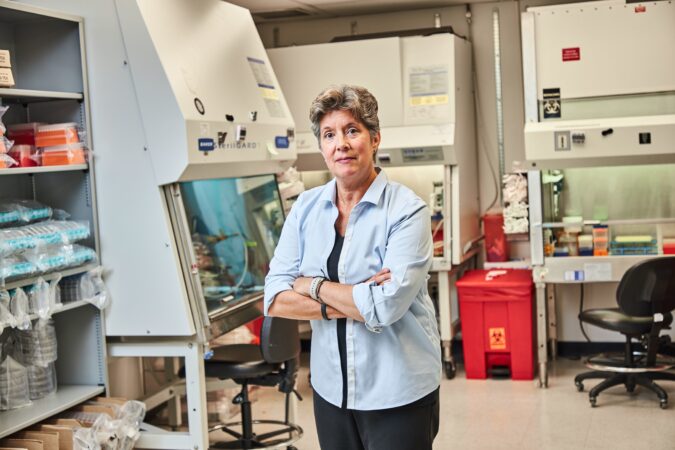
    A lab at the Wistar Institute in Philadelphia.

    Hope for hormone therapy?

    While it’s easy to take away p53 in the lab, it’s not as easy in a patient.

    There is, however, a promising drug currently being tested in clinical trials. Called rezatapopt, it can convert mutant p53 into a normal-functioning version of the protein.

    It works for one particular mutation, Y220C, found in roughly 4% of ovarian cancers.

    Murphy’s team found administering rezatapopt alongside hormone therapy led to 75% shrinkage of ovarian tumor models, versus 50% shrinkage when the hormone therapy was given alone.

    This finding lined up with rezatapopt’s early data from clinical trials.

    “For reasons we didn’t understand, women with ovarian cancer were responding best to this drug,” Murphy said.

    Nineteen out of 44 women treated with rezatapopt alone saw their tumors shrink, with one even having a complete response, according to recent interim results from a phase 2 trial.

    Murphy hopes this paper will prompt clinical trials to test rezatapopt in combination with anti-estrogen therapy.

    However, since rezatapopt only targets one p53 mutation, this approach is limited to a small subset of patients. Murphy hopes that more drugs can be developed that fix other mutant forms of p53 seen in ovarian cancer.

    Murphy’s findings make sense conceptually and present a “promising avenue for future clinical trials,” said Tian-Li Wang, the head of the Molecular Genetics Laboratory of Female Reproductive Cancer at Johns Hopkins University, who was not involved in the Wistar study.

    A caveat is that the study looked at a limited number of cell lines, she said.

    She thinks the results should be confirmed in cases of ovarian cancer that have other types of p53 mutations to see if it could be applied more broadly.

    “[I’m] really interested to see if the approach can benefit patients,” Wang said.

  • How Kaytron Allen broke out of his shell to emerge as a star in Penn State’s backfield

    How Kaytron Allen broke out of his shell to emerge as a star in Penn State’s backfield

    STATE COLLEGE, Pa. — It has been a breakout 2025 season for Kaytron Allen, who etched his name into Penn State history as the program’s all-time leading rusher.

    But the senior running back’s path to stardom was bumpy.

    Allen rushed for 1,769 yards and 16 touchdowns across his first two seasons in Happy Valley. He thrived next to Nicholas Singleton, his fellow Class of 2022 running back. But he was missing a key element, the final hurdle to becoming a true No. 1 running back.

    While Allen’s runs were loud, his voice and presence within the Lasch Building were nonexistent. He attended team meetings and film sessions, but a simple head nod was the only interaction he had with most teammates and coaches.

    That was, until one kind gesture changed his demeanor.

    When Allen had nowhere to go for Thanksgiving during his sophomore year, Terry Smith, who then was Penn State’s associate head coach and cornerbacks coach, invited him to join his family for Thanksgiving in Pittsburgh. Allen got to see his coach in a different light, as a family man.

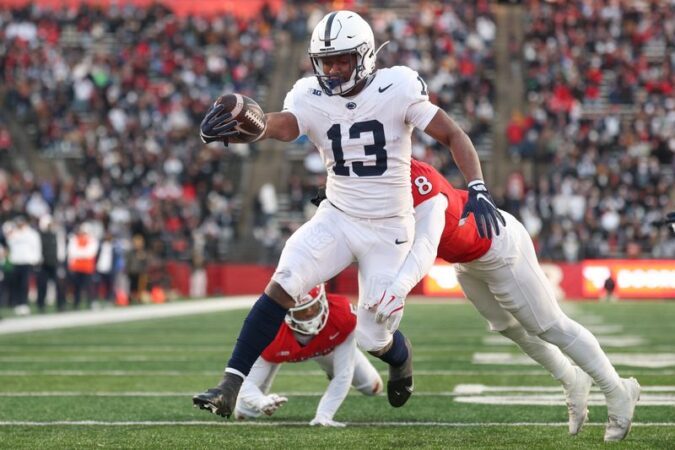
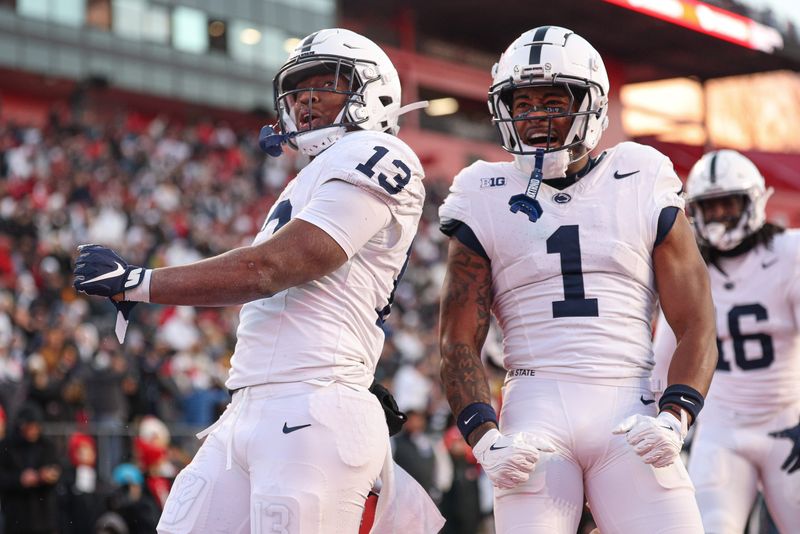
    Kaytron Allen (13) reacts after scoring a rushing touchdown against Rutgers.

    It marked the start of a bond between the shy running back and the now-interim coach known as “the truth teller” inside the program. And it marked the beginning of Allen’s ascent.

    “Kaytron is a man of very few words,” Smith said. “Up until that point, I would see him in the building and say, ‘Hey, what’s up?’ And he gave me one of those [head nods] and kept it moving. Then we had Thanksgiving with him, and he saw me in a different light. And from that day forward, Kaytron and I became [close].”

    Smith’s friendship seemed to unlock a new side of Allen, one that was more open and honest, not only with his teammates and coaches, but also with himself. And with that honesty came increased production.

    The Norfolk, Va., native rushed for 1,108 yards and eight touchdowns in his junior campaign. He saved his best football for the College Football Playoff, when he rushed 47 times for 286 yards and two touchdowns in three games as Penn State finished with a program-best 13 wins.

    While Allen’s breakout season mirrored that of Singleton’s, who rushed for 1,099 rushing yards and 12 touchdowns, the latter remained Penn State’s prized running back. It was Singleton who made ESPN and CBS Sports’ 2025 preseason All-America teams.

    But through the first six games of the 2025 campaign, Allen’s production took center stage. While the duo split carries at 70 apiece during that stretch, Allen’s 467 rushing yards far outpaced Singleton’s 259. He ran for seven touchdowns to Singleton’s six behind the same offensive line, same blocking, and same play calls.

    James Franklin’s firing on Oct. 12 signaled a drastic shift in Penn State football. Smith took over as interim head coach and quickly made a promise to Allen: He would do everything to get his star running back the program’s rushing record.

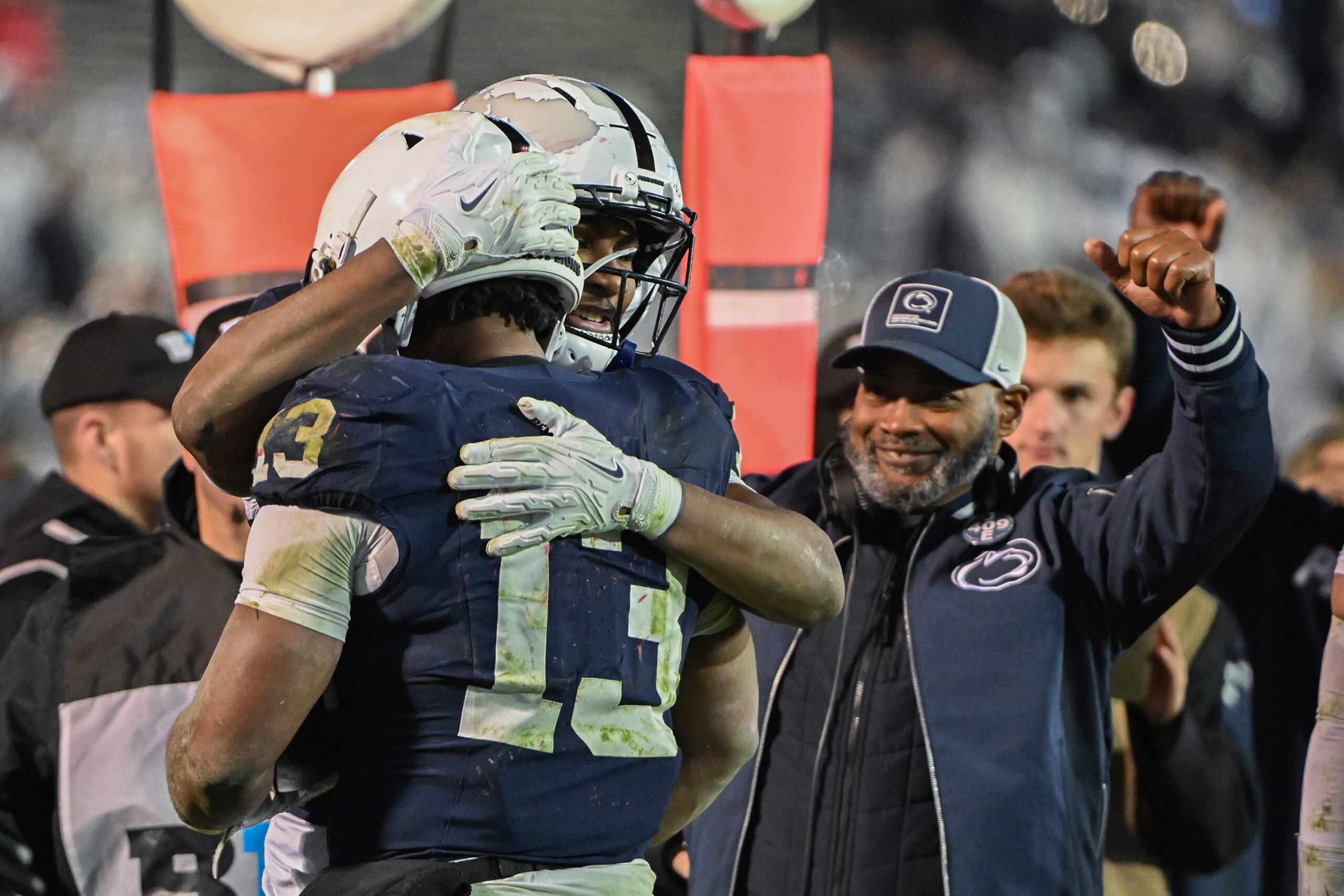
    Penn State running back Kaytron Allen (13) celebrates with Nicholas Singleton and head coach Terry Smith after breaking the all time rushing record for Penn State.

    “It means a lot when you have a coach who believes in you. It makes you want to go hard for him, gets [me] going,” Allen said. “I appreciate [Smith] a lot for giving me that boost in confidence.”

    Smith made good on his promise in his first contest as interim head coach. Against Iowa, Allen rushed a career-high 28 times for 145 yards and two touchdowns while Singleton tallied just six carries (15 yards). And despite the Nittany Lions’ 25-24 loss, one thing was certain: Allen was the team’s RB1.

    His uptick in production didn’t stop in Iowa City, Iowa. Over the team’s next five games, Allen rushed 112 times to Singleton’s 47. His confidence was building with every carry, every broken tackle, every touchdown.

    After years of sharing a backfield but not the praise or spotlight associated with his production, it was fitting that Allen’s signature touchdown celebration — kicking down an imaginary door — encapsulated this moment in his career. And the best part: His best games were still ahead.

    “Kaytron is my guy. We’re roommates, we’ve been through a lot, we stuck together,” Singleton said. “We made each other better. He made me better every day just by competing with him.”

    Allen rushed for 181 yards and two touchdowns in his team’s 28-10 victory over Michigan State. The next week, he had 25 carries for 160 yards against Nebraska to set the program’s all-time rushing record, surpassing Evan Royster’s mark of 3,932 yards. Allen’s total stands at 4,180.

    He could add to that total since Penn State qualified for a bowl game with its 6-6 record, but Allen has not indicated if he would play at the risk of an injury that could impact his NFL potential.

    Allen said his goal as a freshman was simply to make a difference and help his team win football games. Mission accomplished.

    “We’re just so proud of him,” center Nick Dawkins said. “We wanted to get this done for him. We knew preseason that this was an accolade that we wanted to achieve for him as an offensive line, and for him to get his flowers is amazing because he works so hard.”

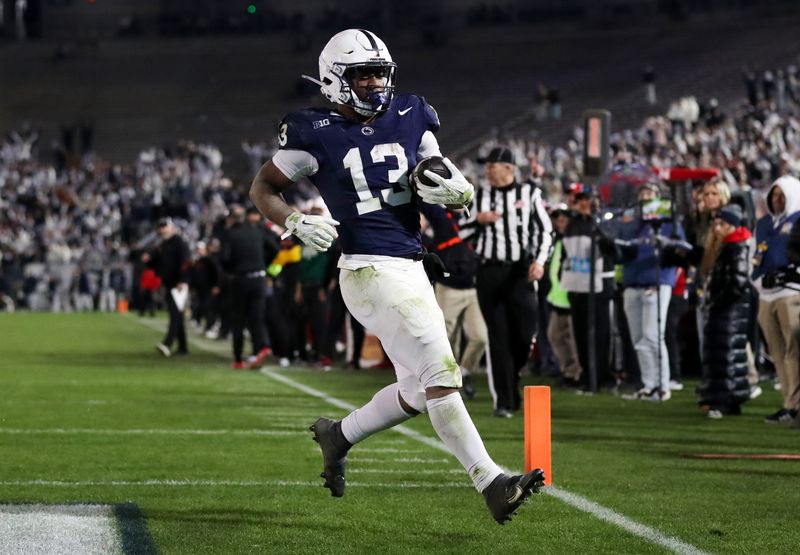
    Kaytron Allen (13) runs the ball into the end zone against Nebraska.

    In a fitting end to his final college regular season game, Allen rushed 22 times for 226 yards and a touchdown in Penn State’s 40-36 win over Rutgers. He earned three consecutive Big Ten Player of the Week awards after averaging 189 rushing yards per game over his final three contests.

    Allen finished the regular season with career highs in rushing yards (1,303) and yards per carry (6.2). He rushed for more touchdowns (15) than he had in his previous two seasons combined (14). At last, his ascent to becoming Penn State’s top running back was complete.

    “There have been a lot of ups and downs, more downs than ups,” Allen said. ”The adversity I had to come through, I learned a lot off the field just trying to buy in, trying to open up and do things differently from what I’m used to. I appreciate everyone [at Penn State].”

  • Philadanco’s Winter Residency boasts of stunning revisions and a soaring premiere

    Philadanco’s Winter Residency boasts of stunning revisions and a soaring premiere

    Philadanco is currently celebrating its 25th anniversary in residence at the Kimmel Center’s Perelman Theater with a mixed bill that showcases the company’s extraordinarily skilled dancers in works by a quartet of award-winning choreographers.

    “Then and Now!,” as the program is called, includes revised productions of pieces by Donald Byrd and Tommie-Waheed Evans, plus a company premiere from Ronald K. Brown and a brand-new work by up-and-comer Juel D. Lane.

    Friday’s opening-night audience was large and enthusiastic, giving an extended ovation to Lane’s Heirborne, a pun on its theme of literal and metaphorical flight.

    In the printed program, Lane cites among his inspirations Bessie Coleman, the first Black woman to hold a pilot’s license, and Mae Jemison, the first African American female astronaut.

    While those specific sources weren’t clear to this viewer, the dancers’ outstretched arms, perfectly controlled suspensions, and quicksilver entrances and exits clearly evoked the sensation of flying.

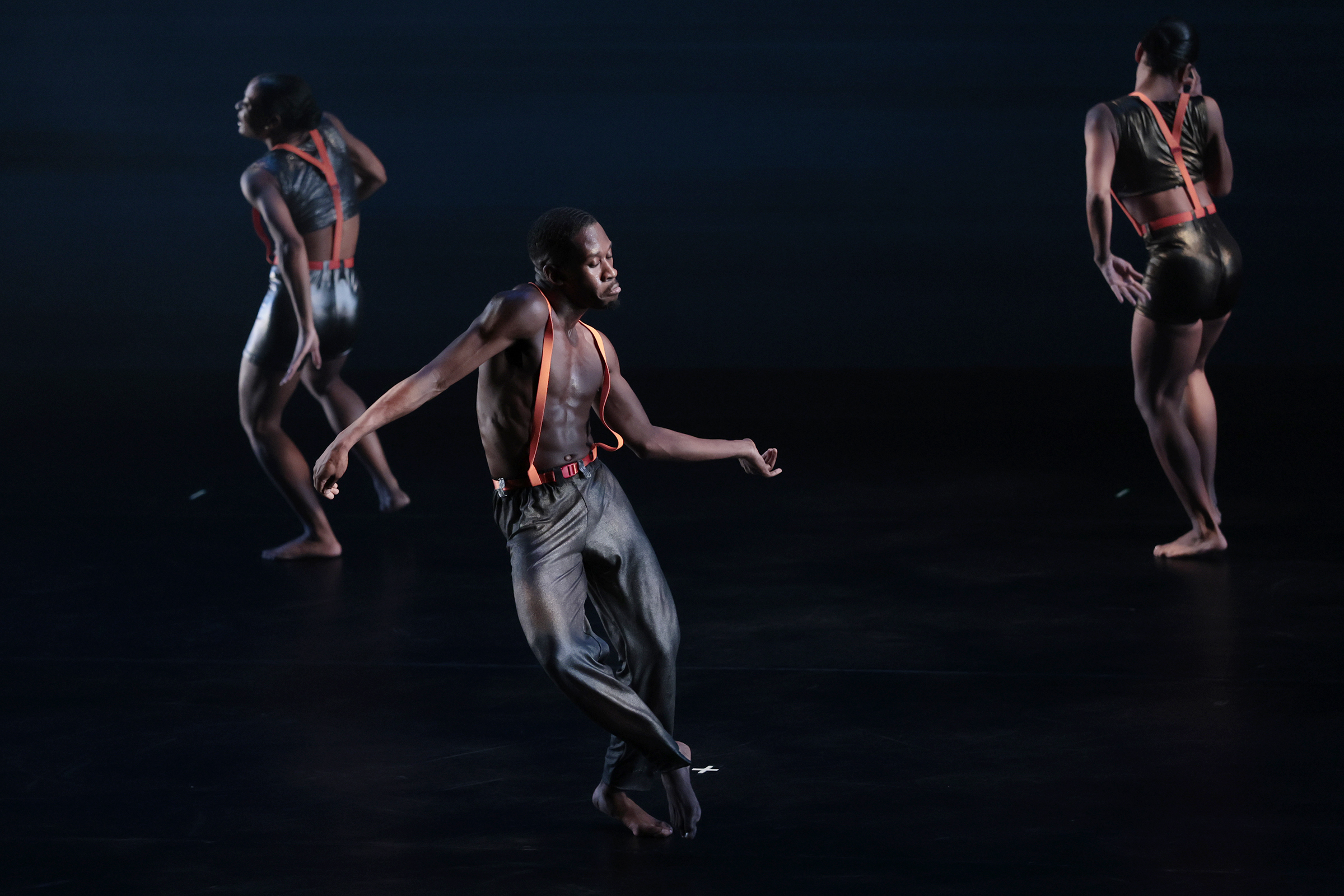
    Philadanco dancers during their Then & Now performance at the Kimmel Center’s Perelman Theater in Philadelphia on Saturday, Dec. 6, 2025.

    It is difficult to single out individuals in this — or, in fact, in any of the works on the program, which frequently had 10 dancers onstage at a time, performing in expert unison. But long-limbed Aliyah Clay began Heirborne with an exquisite solo, moving inside a dramatic shaft of light (designed by Nick Kolin). The piece ended on an even stronger — and unexpected — note when all eight dancers suddenly leaped forward, disappearing into the darkness.

    The music, for this and the other items on the bill, was recorded, favoring mixtures of rap, gospel, and jazz. For Heirborne, Atlanta native Lane chose pieces by several Georgia-based artists: RAHBI, Bryce Raburn, and Leo Ra Soul. Costume designer Anna-Alisa Belous dressed the women in shiny black shorts, a somewhat curious choice, and everyone wore neon-orange suspenders (a nod to airport safety equipment?).

    From Exotica Back to Us, Brown’s contribution to the program, was originally choreographed for Philadanco in 1999 and revised this year.

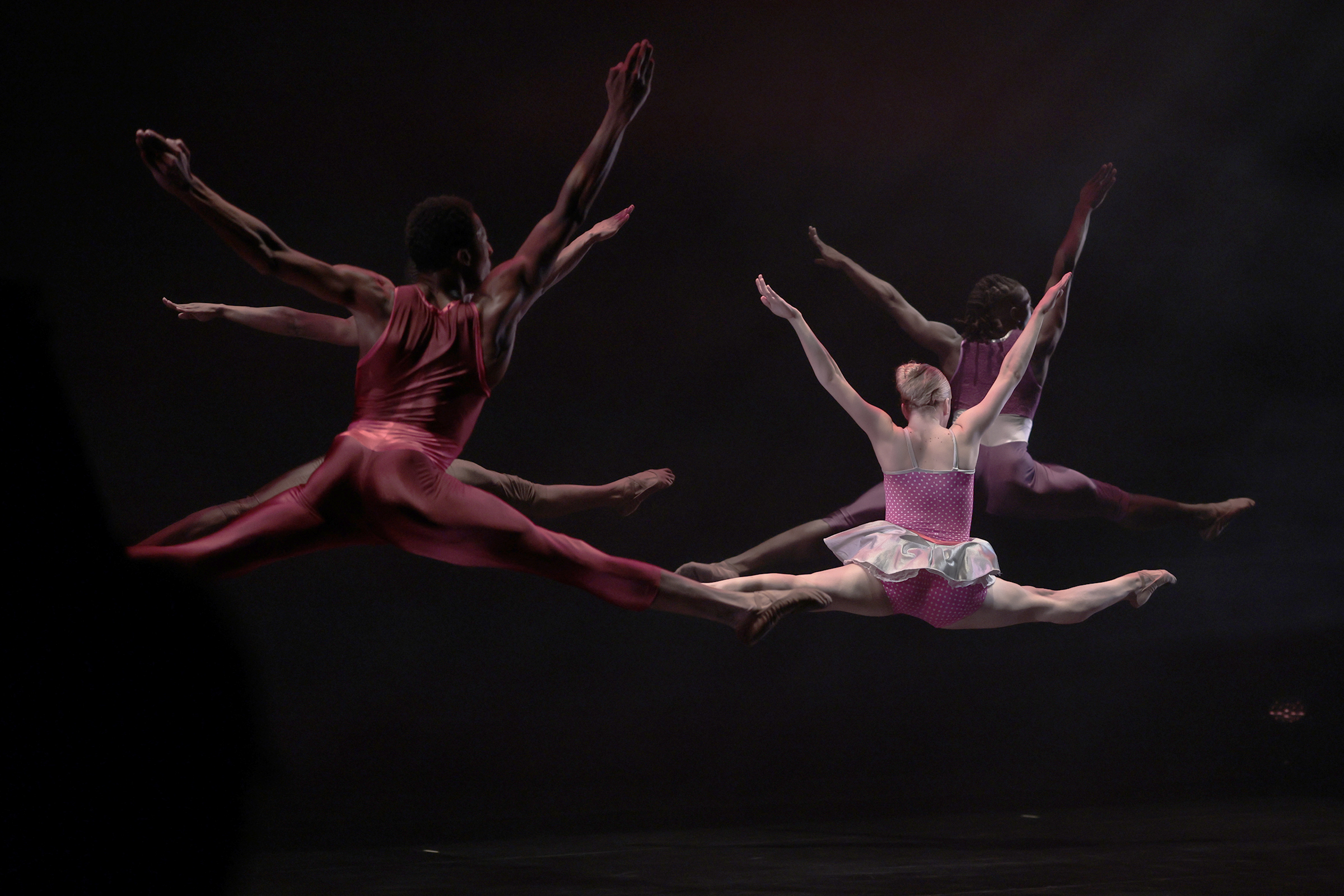
    Philadanco dancers during their Then & Now performance at the Kimmel Center’s Perelman Theater in Philadelphia on Saturday, Dec. 6, 2025.

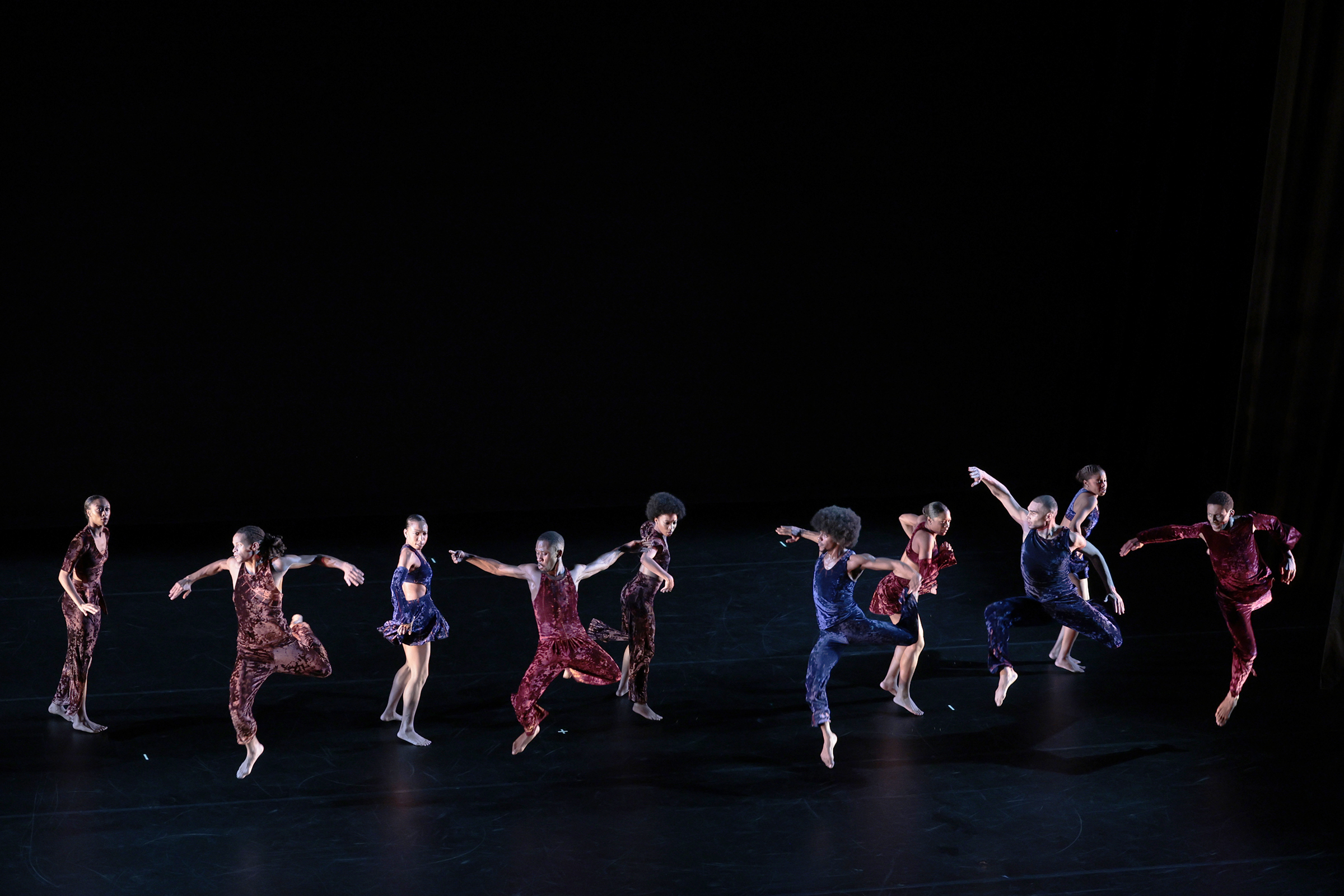
    Not having seen the earlier version, I can’t comment on how the work has changed. However, its current iteration is stunning: from the richly colored and textured costumes by Wunmi Oliya (a British Nigerian singer, dancer, and fashion designer who also provides part of the score for this piece) to Brown’s seamless combination of traditional West African dance and percussion with his own, distinctive movement vocabulary.

    There is an obvious spiritual and emotional dimension to these short vignettes — as the dancers raise their arms, hide their faces in their hands, or kneel as though in prayer. This powerful effect is enhanced, at several points, by the outstanding work of dancer William E. Burden.

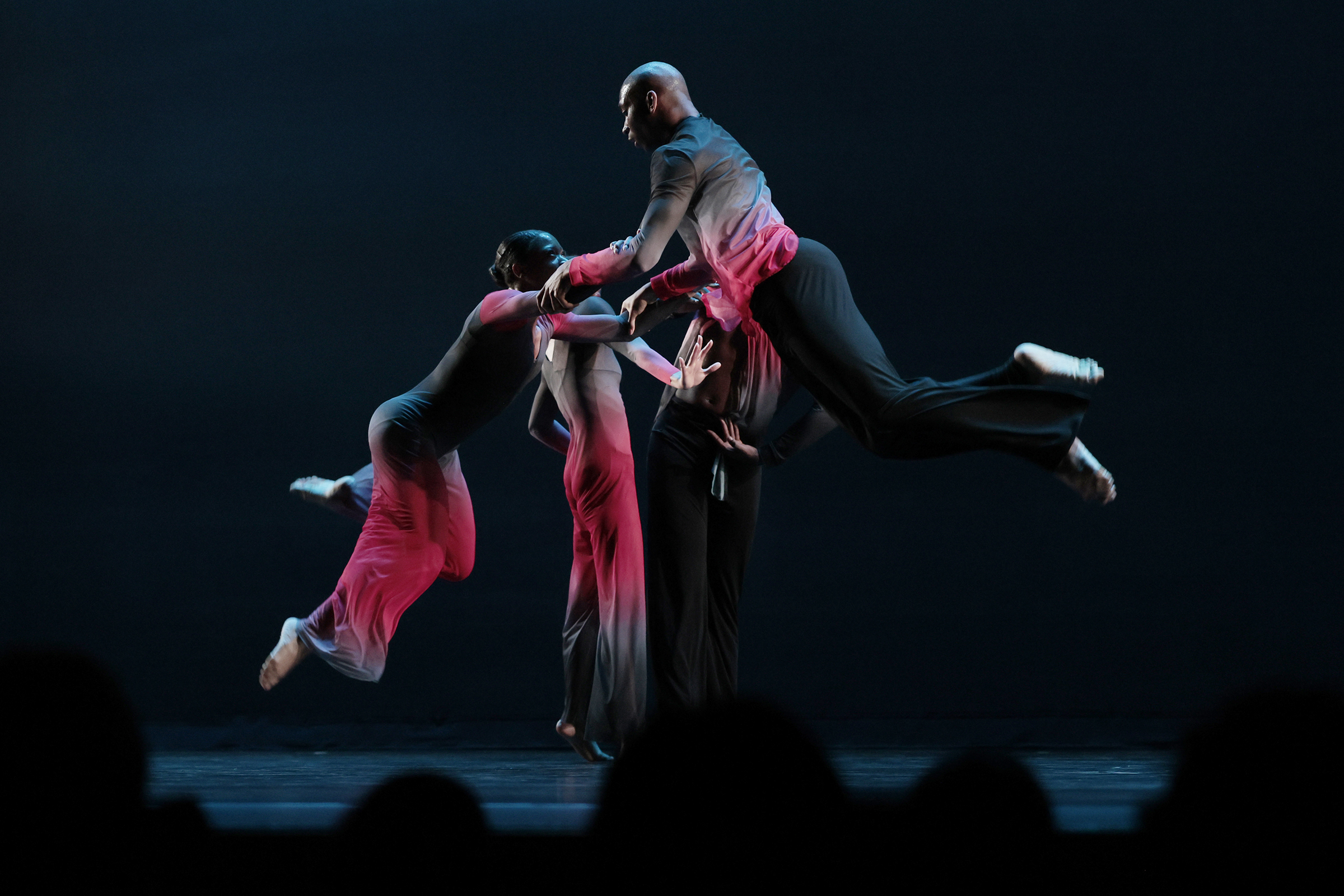
    Tommie-Waheed Evans created Withinverse… in 2018. In Friday’s “refreshed” version, dancer Kaylah Arielle embodies the deep emotions mentioned in the program. Sometimes she and her fellow dancers appear as supplicants, responding to sad, slow gospel music. Yet at other points they seem frantic, their bodies reflecting the heavy, insistent beat of electronic club music.

    Philadanco dancers during their Then & Now performance at the Kimmel Center’s Perelman Theater in Philadelphia on Saturday, Dec. 6, 2025.

    Evans has included a series of complicated and innovative lifts, which the dancers execute seemingly without effort. They are equally expert when performing challenging passages in unison.

    The evening begins with Everybody by Donald Byrd. Billed as a parody, it seems more like an uneasy hybrid than, say, the comedic works of Mark Morris or Les Ballets Trocadero de Monte Carlo.

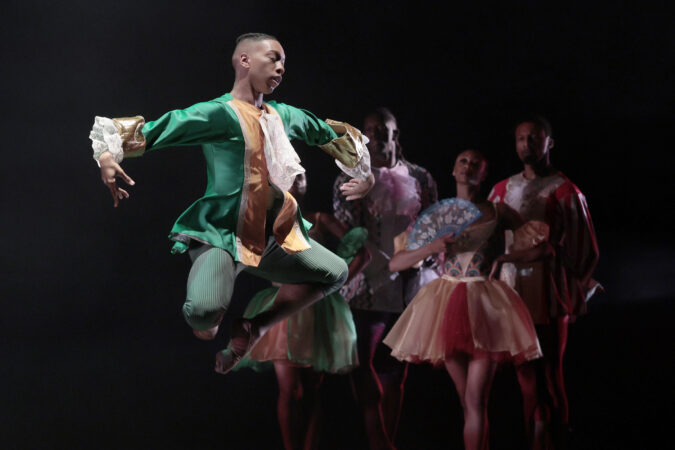
    This work contrasts a harpsichord piece by J.S. Bach with hip-hop music by Ruffhouse, and Natasha Guruleva’s costumes reveal foppish men (notably the statuesque Yasir Jones) dressed in ruffled tunics, while the women wear tutus. Yet everyone is barefoot, alternating between impeccable ballet technique and decidedly non-classical body language.

    Philadanco dancers during their Then & Now performance at the Kimmel Center’s Perelman Theater in Philadelphia on Saturday, Dec. 6, 2025.

    The comparison is amusing, and — as a classically trained flutist who, in his youth, spent six years studying with the celebrated ballerina Mia Slavenska — Byrd knows his way around both Baroque music and classical dance. He enjoys himself by inserting sly touches of physical humor, here and there, and excels at creating intricate and unusual partnering sequences for two or more individuals.

    In a brief pre-performance introduction, Tommie-Waheed Evans (who is also the company’s co-artistic director, along with Kim Bears Bailey) noted that Philadanco had just returned from a successful, multicity tour of Germany. This troupe, which the indomitable Joan Myers Brown established 55 years ago, has many reasons to be proud. But, next time, I hope that ’Danco will include the work of at least one female choreographer.

    Philadanco, “Then and Now!” through Dec. 7, Perelman Theater, 300 S. Broad St. Tickets $43-$63. 215-387-8200, ensembleartsphilly.org

  • ‘Lord of the Rings’ lands at the Philadelphia Orchestra, but the magic remained in the music

    It was the kind of night at the orchestra when any good hobbit could show up in a Bilbo Baggins waistcoat and feel right at home. Previously-human ushers had suddenly sprung elven ears. And the action on stage involved a twisty, unlikely tale of a magical gold ring whose purpose seemed to be to exploit the flaws and weaknesses of those who encounter it.

    The Philadelphia Orchestra’s presentation of The Lord of the Rings: The Fellowship of the Ring Friday night in Marian Anderson Hall was one of those cross-cultural experiences that ricocheted with surprising power. Two subcultures, each with its own specialized language — classical music, and the fandom around J. R. R Tolkien’s world of wizards, dwarfs and the dark forces — intensified the other.

    The Philadelphia Orchestra, Singing City and Philadelphia Boys Choir on stage in Marian Anderson Hall for ‘Lord of the Rings: The Fellowship of the Ring.’

    For anyone keeping score in the ongoing battle for younger audiences in classical music, Friday was a night when it seemed everyone in the hall was 31 years old and deeply engaged. Never at an orchestra performance have I heard the audience break in so many times with applause and hoots of approval.

    Of this happy synergy, the orchestra sold out all three performances, with tickets topping out at more than $250 a pop.

    Lead usher Ryan Viz, in elven ears, in the Kimmel Center lobby Friday night.

    Not all of the orchestra’s live-to-screen presentations have justified themselves musically, but here, Howard Shore’s score was a canvas both vast (about three hours of music) and colorful.

    If there’s a single label for Shore’s musical language, it’s Celtic Craggy — with notable excursions into the bellicose, sentimental, and moods more subtle. The great value of hearing a great orchestra live in dialogue with the screen is in the emotional epiphanies, moments where the music tells you something the dialogue and action alone can’t.

    The sound engineering on this night favored the music over the dialogue, and smartly so.

    Ian McKellen as Gandalf looms over members of Singing City Friday night in Marian Anderson Hall during a Philadelphia Orchestra live-to-screen presentation of ‘Lord of the Rings: The Fellowship of the Ring.’

    The other beautiful dynamic at play: You didn’t have to walk into the hall with any prior knowledge of classical music or Middle-earth nomenclature to feel the experience. This level of communication is simply embedded deep in being human.

    The definition of human becomes hazy in the 2001 installment of Peter Jackson’s film trilogy. But time and time again, the musical score honed in on the universal goodness and country-folk sincerity embodied in instruments. Two different soprano tin whistles (one in C, the other in D), whose very pitch and story-telling inflection were skillfully stretched by orchestra flutist Erica Peel. Hornist Jennifer Montone perfectly conveyed what it feels like to be a lonely leader in the Council of Elrond scene.

    The percussion section was a city in itself, conjuring folk sounds on the bodhrán drum, and the anvils of war (struck by musicians on, essentially, flat sheets of steel).

    Brian Johnson sits rapt with attention at the Philadelphia Orchestra’s live-to-screen presentation of ‘Lord of the Rings: The Fellowship of the Ring’ Friday night.

    Anvils? The quest for a magical ring? Dwarfs, warriors and flawed characters? Tolkien drew on some of the same sources as Wagner did in his Ring Cycle, and while Shore’s score might have a Wagnerian touch here or there, the larger influence was Carl Orff, whose Carmina Burana became the musical DNA of video games and car commercials.

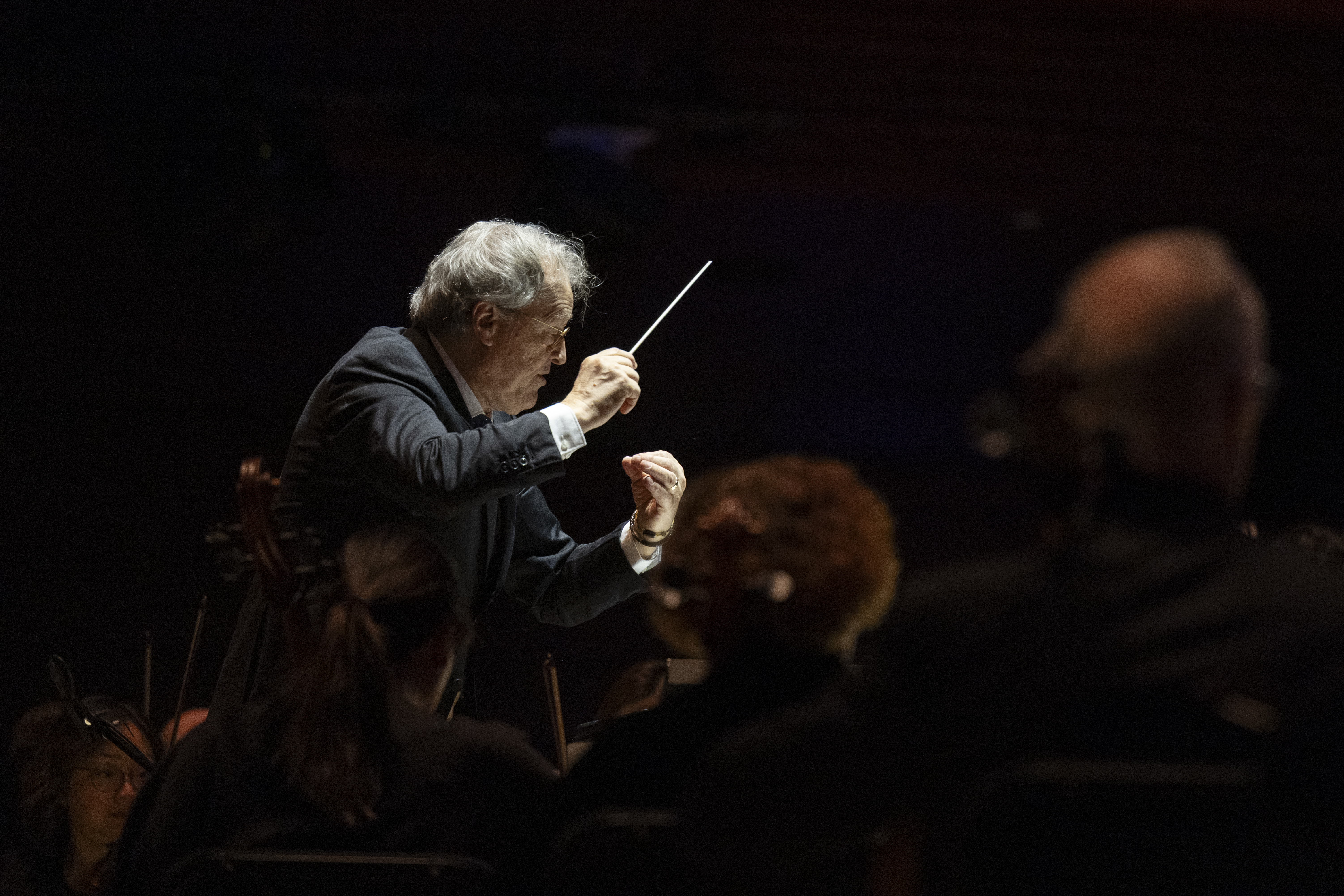
    Conductor Ludwig Wicki leading the Philadelphia Orchestra and other musical forces in Marian Anderson Hall.

    Colossal forces brought both precision and brutality, particularly in the repeating combination of driving percussion, screaming brass and blocs of choral sound amassed for battle. With Ludwig Wicki conducting, the Singing City Choir and Philadelphia Boys Choir — both quite strong — provided chaos and balm. Vocalist Kaitlyn Lusk and chorus were the gentle healing we needed to hear after Gandalf’s death.

    The good thing was, when you tired of watching yet another wave of fiendish Orcs getting clobbered, you could always turn your eyes to the stage, decode the instrumentation and imagine for yourself an entirely different narrative. This is the enduring promise of orchestral sound on any night at the orchestra.

    No additional magic needed.

  • Roman Catholic makes football history with first state crown: ‘We were on a mission’

    Roman Catholic makes football history with first state crown: ‘We were on a mission’

    MECHANICSBURG, PA — Eyan Stead Jr. blamed himself. The Roman Catholic 5-foot-10, 180-pound senior two-way star carried it with him for months. It bothered him to the point where he lost sleep over the pass that glanced off his hands in last year’s state championship that would have been a touchdown.

    Stead also knew something else. He would get another chance. Fortunately, on Friday night, he did, against the same team, in the same stadium, in the same game.

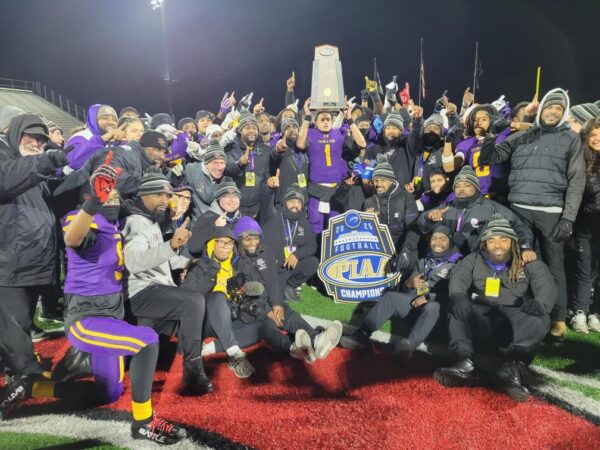
    This time, Stead made it right, and was a big part in making Roman Catholic football history, catching a game-high nine passes for 102 yards and a touchdown in leading the Cahillites to their first PIAA state football championship, beating District 3 champion Bishop McDevitt, 28-6, in the Class 5A championship at Cumberland Valley High School.

    Late in last year’s state championship, won by McDevitt, 34-31, in overtime, Stead was wide open down the middle of the field when Roman quarterback Semaj Beals unfurled a bomb. It looked like Stead would run right under it when it bounced off his hands.

    The drop plagued Stead for a while.

    “Every day, every day after that game last year I thought about it,” admitted Stead, who’s bound for Temple. “I beat myself up over it. That stayed with me for two months after that game. I had to make it right. I started to stack days and prepare. I lost sleep over that play. I lost weight. I didn’t eat for two weeks. I didn’t start letting it go until late January. I put it on me. I let my team down, and it bothered me.

    “I believe in second chances. I believe in third chances, and when this chance came to play McDevitt again, in this game, I wasn’t going to let anyone down this time.”

    The state championship was the culmination of what Cahillites’ head coach Rick Prete had been building since he was named head coach in 2019. He built the program up from scratch, taking considerable time to take players to summer seven-on-seven camps, vanning them to various skills camps, and gradually building the talent of the program.

    “I have to process all of this,” Prete admitted. “It feels great being the first to do this. We’re going to celebrate on Saturday, and I may not feel one bump on the turnpike on the way home. I want to make sure I tip my cap to [McDevitt] coach [Jeff] Weachter and his team. I learned a lot from him.”

    Prete’s supreme find was Beals, who is heading to Akron and has thrown for over 12,000 yards as a four-year starter.

    Beals completed 18 of 26 for 231 yards and three touchdowns, getting Roman out to a big first-half lead before McDevitt scored.

    “I was on a mission, we were on a mission, and we were all motivated from what we went through losing last year,” Beals said. “I know Eyan went through. I know he blamed himself for the drop, but we were all to blame. And we all took it on ourselves this offseason to get back here and do something we felt we should have done last year — win the state championship. It feels great making history as the first Roman team to ever win a state title in football, but this is a brotherhood, and it’s something we all did together. No one was going to stop us this year.”

    Roman had the game won at halftime, holding a 21-0 lead. The Cahillites scored on three of their first five possessions, outgaining McDevitt, 197 to 120. The separation should have been more, with Roman only converting one of McDevitt’s three first-half turnovers into points.

    Beals scored on Roman’s first drive with a seven-yard run. Beals found Hanif Sheed on a short, seven-yard touchdown pass early in the second quarter for a 14-0 advantage. The score was created by a fumble recovery by Roman’s Julian Enoch at the McDevitt 33.

    Roman squandered a second-quarter interception by junior linebacker Walter Hudson, who brought the ball back to the McDevitt 22. But a fumble, which was recovered, pushed the Cahillites back to the 24, followed by an illegal shift flag that put the Cahillites in a fourth-and-13 at the McDevitt 25.

    Defensively, Hudson came spearing through to stop a McDevitt fourth-and-one at the Roman 46, which the Cahillites turned into a 40-yard touchdown pass from Beals to Ash Roberts to take a 21-0 lead with 1 minute, 53 seconds left in the first half. Hudson led all defenders with 11 tackles, which included four tackles for losses.

    “We had to stop the run, and we knew our defensive backs would stop their pass game,” Hudson said. “On the fourth-down play, I knew what they would do by watching film. I ran through the A-gap and I stopped it. On the interception, I dropped back in my zone, and I knew the ball would come to me. I tried to score, but everything started giving up. We didn’t do last year, and were determined this year to finish the job.”

    It was Stead who tacked on the last score, when Beals hit him with a short 1-yard pass with 1:16 left in the third quarter.

    “Eyan beat himself up over last year, but we made sure he knew we would not have been in that position without him,” Prete said. “He made sure. Eyan, he will always be our guy, and I keep saying it, he’s the best player in the state. He showed it tonight. I’ve been pounding that table for two years now how good Eyan Stead is. There is not a better football player in Pennsylvania than Eyan Stead.”

  • Jalen Carter’s injury only increases the pressure on Eagles quarterback Jalen Hurts

    Jalen Carter’s injury only increases the pressure on Eagles quarterback Jalen Hurts

    Now that the truth is known, it falls to Jalen No. 1 to compensate for the absence of Jalen No. 2.

    Now that the drop-off in Jalen Carter’s play in 2025 compared with 2024 has been explained by his deteriorating shoulders, the responsibility for a late-season surge falls more squarely on the shoulders of embattled quarterback Jalen Hurts.

    He’s got to throw better passes. He’s got to run the offense more efficiently. He’s got to start using his legs as a weapon, because the main weapon on defense is gone.

    Carter as an NFL sophomore last season fueled the best defense in the league. That defense allowed an average of 19.3 points to the No. 5, No. 7, No. 15, and No. 17 offenses in four playoff games. Zack Baun, Milton Williams, and Josh Sweat made $231 million in new contracts after that Super Bowl run. They owe about 25% to Carter.

    Now, though, Carter is taking time off to heal his aching shoulders. According to Dr. David Chao, Carter likely received PRP injections — platelet-rich plasma — a procedure that is minimally invasive and intended to have the patient’s own plasma speed healing at the injection site.

    In the best-case scenario for the team, Carter will miss no more than two games. In the best-case scenario for Carter, he will miss the last five games before the playoffs begin. He needs to be pain-free, fit, and strong if the Eagles hope to defend their title.

    To his credit, Carter tried to play through the injury all season. He reported the injury in the offseason and missed time during training camp, but as the games got colder the dam finally broke.

    Carter was bad in the second half at Dallas two weeks ago, when the Cowboys came back and won. He was even worse last Friday, when the visiting Bears rushed for 281 yards. Still, Dallas and Chicago scored just 24 points apiece. Carter is that effective at half-strength.

    That’s about the level at which Jalen Hurts has been playing … for quite a while, to be honest.

    Jalen Hurts’ steely resolve will be tested during a stretch when the Eagles are at less than full strength.

    The Challenge

    As well as Carter played last season he wasn’t the Eagles’ best player, because Saquon Barkley had the best year any running back ever had. This season, however, defenses have sold out to stop Saquon, and it’s working.

    It’s working, in part, because Hurts and his coaches have decided to reduce his designed quarterback runs. Hurts is on pace for only 119 runs, about 47 fewer than his average over the past four seasons.

    Exacerbating the matter: The poor health, inconsistent play, and key absences on the offensive line, usually an unstoppable force, have diminished that unit’s effectiveness.

    The biggest blow: Right tackle Lane Johnson, one of the best players in franchise history, hurt his foot against the Lions. He missed both the loss at Dallas and Friday’s loss, and he won’t be back for at least two more games, more likely four. Without Johnson, the Eagles wouldn’t have won Super Bowl LII or LIX. Hurts and Barkley wouldn’t be under contracts worth more than $300 million. He’s just that good.

    So, yes, as they enter the homestretch of the season, the 8-4 Eagles will play without their best defensive lineman and their best offensive lineman. With Carter and Johnson either limited or absent, they’ve lost their last two games.

    Still, things aren’t all that bad.

    The Road to the Top

    They hold the No. 3 overall seed in the NFC. They again hold a 2½-game lead in the NFC East over the Cowboys, who lost Thursday night in Detroit. They’ve given themselves a buffer, and they have a runway — as long as Hurts starts playing to his $51 million average annual value.

    First, the Chargers, in Los Angeles, on Monday Night. Right-handed Chargers quarterback Justin Herbert will be playing with a surgically repaired left hand, so the balanced attack might be less balanced, and the offense should run exclusively out of shotgun or pistol sets, and adversity along the Chargers’ line has mirrored that of the Eagles’.

    However, the Chargers have the No. 2 passing defense and 11 interceptions, which is tied for eighth. The Eagles have the 24th-ranked offense and the 23rd-ranked passing offense, despite weapons like A.J. Brown and DeVonta Smith. They’re getting open, and they’re running the plays called by first-year coordinator Kevin Patullo.

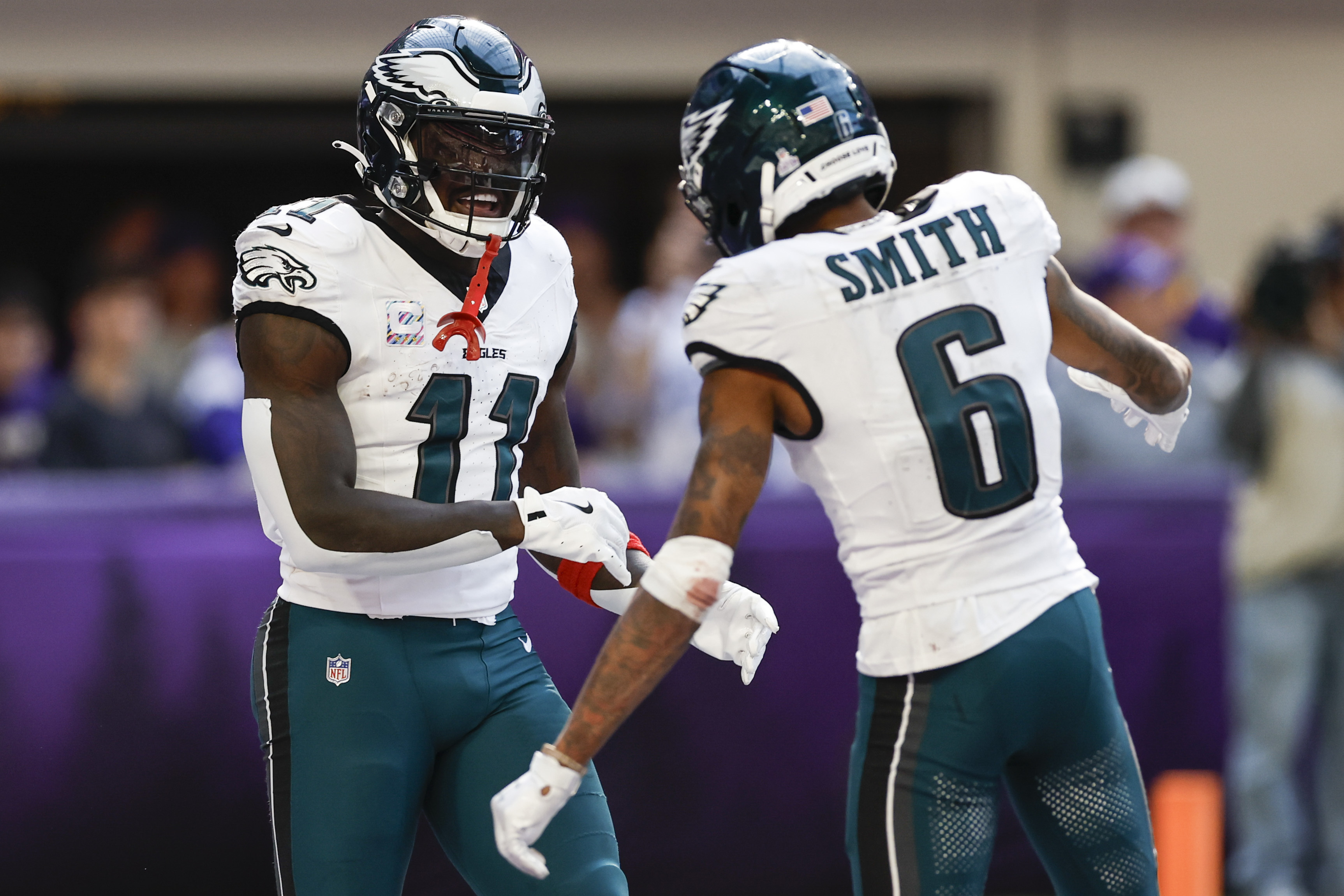
    Will receivers A.J. Brown and Devonta Smith, with the necessary assistance of their quarterback, have a big Monday night in L.A.?

    Hurts has been a problem all season. Hurts can turn that narrative around Monday night, and beyond.

    The two-win Raiders visit the next week, and the season ends with home-and-home games against the three-win Commanders, who have the second-worst defense in the league, sandwiching what likely will be a brutal trip to Buffalo.

    The Eagles can win three of their remaining games, four if they win Monday night. That would give them 12 wins and a chance at the No. 1 seed in the NFC, since they’ve beaten the Rams and Lions, and since the Bears have a much more challenging schedule left to play.

    But no longer can the Eagles expect their defense to win games for them, as Hurts squeezes the football and stares, mystified, into opposing secondaries.

    He’s averaging just 209.5 passing yards. That’s fewer than Geno Smith, Mac Jones, and Jacoby Brissett.

    That has to change.

  • The narrative around A.J. Brown, Tyrese Maxey vs. Allen Iverson, and other thoughts …

    The narrative around A.J. Brown, Tyrese Maxey vs. Allen Iverson, and other thoughts …

    First and final thoughts …

    It has been a few weeks since A.J. Brown has been a major topic of consternation and conversation around the Eagles. The easy explanation for the relative quiet is that Brown hasn’t posted anything on social media lately that would get people to raise their eyebrows. The even easier explanation — and maybe so easy that it’s a cheap shot against Brown — is that he caught 18 passes for 242 yards and three touchdowns against the Bears and the Cowboys, and even though the Eagles lost both of those games, Brown must be content that he’s finally getting his numbers again.

    That narrative — that Brown is only about Brown, and his selfishness damages the Eagles — has never held up under much scrutiny. Should he stay off social media more? Of course he should. But they have a 53-18 record (in regular-season and postseason games), have won a Super Bowl, and reached another since acquiring him. At least 29 other teams in the NFL would sign up for that level of damage.

    What’s more, there’s nothing inherently wrong with Brown wanting the ball more in the name of benefiting himself and benefiting the Eagles. The two goals aren’t mutually exclusive, and it’s understandable that Brown would raise a stink with Jalen Hurts, Kevin Patullo, or both if he didn’t believe he was being used properly or frequently enough.

    Think of it like this: Brown is to the Eagles’ offense as an outstanding reporter or writer is to a news organization, and Patullo and Hurts are his editors. If the editors relegated that reporter to the least important and relevant assignments — when he has produced and is capable of producing well-read, Pulitzer-caliber journalism — he would be within his rights to tell them, Hey, you aren’t maximizing my skills, and it’s hurting the whole news operation, too.

    Would that make him selfish? Maybe. Would it make him self-interested? Yeah. Would it make him right? Absolutely.

    Maybe tap the brakes on the Trevor Zegras anointment?

    Have you forgotten Andrew MacDonald?

    Trevor Zegras has been terrific so far, but before anyone starts thinking about making him a Flyer for life, can he get through half a season here first?

    Kyle and the cash register

    The very simple reason to be optimistic that the Phillies will re-sign Kyle Schwarber comes down to three words.

    Butts in seats.

    Yes, Schwarber has improved as a hitter over the last two years, putting the ball in play more often and raising his batting average without sacrificing any of his power. Yes, he’s an outstanding clubhouse leader. And yes, his presence is necessary if the Phillies are to get over their October bugaboos, get back to the World Series, and win it. Those factors make him vital to the franchise.

    But a baseball season, despite the attention and excitement that the playoffs generate, is not the playoffs alone. The 162-game march to the postseason matters too. It matters a lot. And Schwarber has overtaken Bryce Harper as the player on the Phillies roster whose at-bats are true can’t-miss theater. If you’re at Citizens Bank Park on a chilly night in early May, waiting to get your hot dog and beer, the chance to see Schwarber blast one 450 feet is probably one of the reasons you’re at the ballpark in the first place. And if he comes up and you’re still waiting, you might just hop out of that long line to make sure you don’t miss one of his lighting bolts. He’s the guy who makes you stop and watch.

    Sports is still first and foremost an entertainment product, and Schwarber provides more entertainment night to night than any other Phillies player. John Middleton isn’t likely to let someone steal such an asset away, for any price. He’d be a fool if he did.

    Allen Iverson was a 40-plus-minute man before the term “load management” entered the NBA vernacular.

    Maxey and A.I. as iron men

    Ahead of the 76ers’ matchup in Milwaukee against the Bucks on Friday night, Tyrese Maxey was leading the NBA in minutes played per game. His average: 40.0.

    All kudos to Maxey for bringing it every night for as long as he does. But just for some perspective, it’s worth noting that for a 10-year period, from the 1998-99 season through the 2007-08 season, Allen Iverson never averaged fewer than 40.8 minutes. And over his six seasons from 2001 through 2007, he averaged 42.5 minutes and led the league in minutes five times. When the man said he played every game like it was his last, he meant it.

  • The Philadelphia theater shaped by late, legendary playwright Tom Stoppard

    The Philadelphia theater shaped by late, legendary playwright Tom Stoppard

    Theater communities across the globe have been mourning Tony Award-winning playwright Tom Stoppard, the beloved Czech writer who died last week at his home in Dorset, England, at 88.

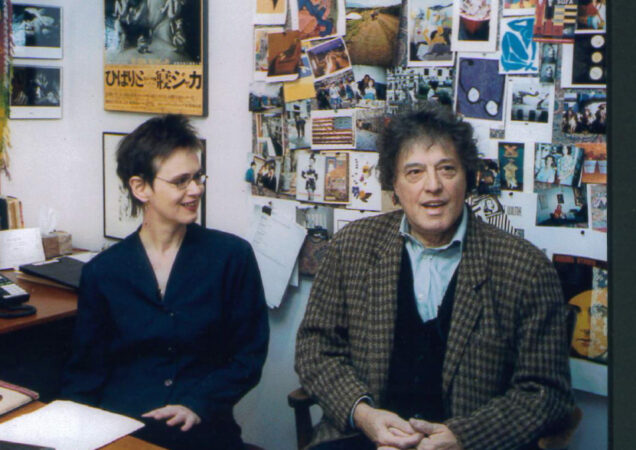
    Stoppard’s acclaimed dramas graced countless stages over six decades, but he had a special place in his heart for Philadelphia’s Wilma Theater, where he formed deep, longstanding friendships with founders Blanka Zizka and her late husband, Jiri.

    The prolific playwright, known for irreverent, cerebral dramas with dense and rather dizzying rhetoric, was often compared to William Shakespeare and George Bernard Shaw. Some of his most popular works include Rosencrantz and Guildenstern Are Dead (a clever take on Hamlet), The Real Thing, The Coast of Utopia, and the screenplay for the 1998 Oscar-winning rom-com Shakespeare in Love.

    He made Tony Award history and broke his own records, winning best play five times between 1968 (Rosencrantz and Guildenstern Are Dead) and 2023 (Leopoldstadt).

    The latter beat out Pulitzer Prize-winning Fat Ham — also a clever take on Hamlet, in wildly different ways — from former Wilma co-artistic director James Ijames. (The Wilma coproduced the Broadway production that earned five Tony nominations.) A year later, the Wilma received the 2024 Regional Theatre Tony Award, becoming the first theater in Pennsylvania to earn the recognition.

    But beyond his international fame, Stoppard is an integral part of the Wilma’s history and, in turn, Philadelphia theater history.

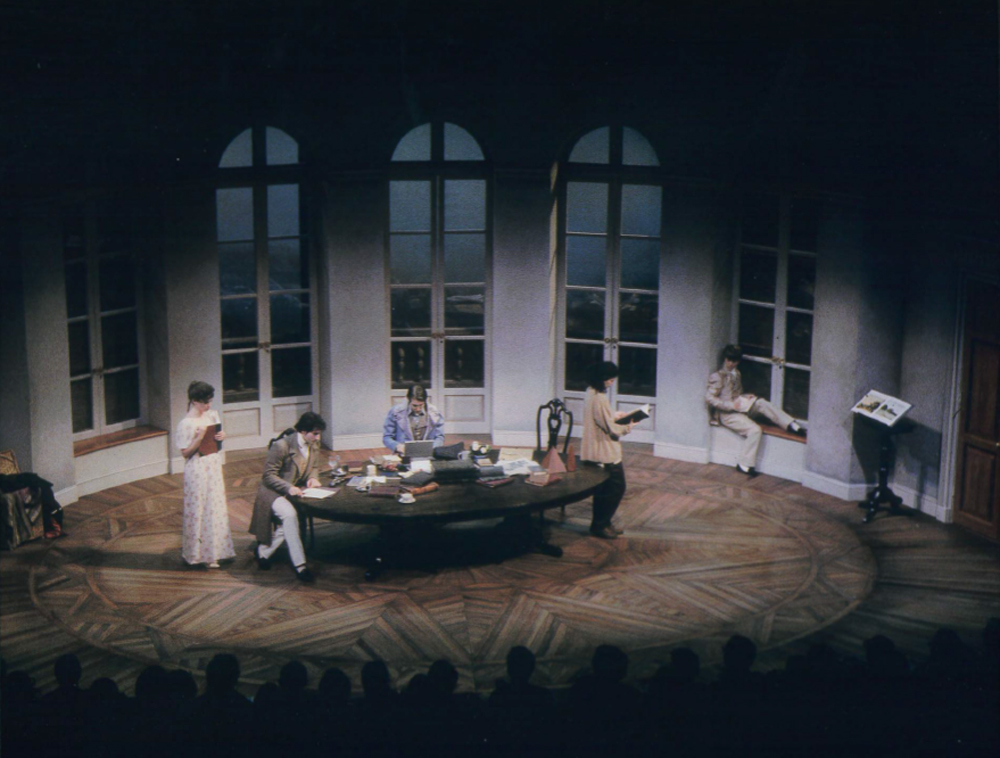
    The Wilma Theater’s 1997 production of Tom Stoppard’s “Arcadia.”

    Blanka Zizka first met Stoppard in 1996, when they both participated in a panel discussion at the University of Pennsylvania. The dramatist was visiting the city for a three-day residency on Penn’s campus following a symposium dedicated to his play Arcadia.

    At the time, the Zizkas, political refugees also from the Czech Republic, were in the process of moving the Wilma from a small Sansom Street theater to its current larger venue on Broad Street. The first play of the season at the new location happened to be Arcadia, which they had chosen before meeting Stoppard. (The Wilma had produced his 1974 play Travesties as well.)

    “He was very impressed by the fact that Jiri and I were from Prague, and we came all the way to the United States, to Philadelphia, and that we were creating a new theater,” said Zizka, who now lives in New York’s Catskills region. “He’s from Czech Republic, originally. He left when he was 2 years old, and he doesn’t speak too much Czech, but he still had a very strong connection to the country. … So for him, [ours] was just a very impressive story.”

    From left: Wilma managing director Leigh Goldenberg, coartistic director Morgan Green, playwright Tom Stoppard, coaristic director Yury Urnov, and founder Blanka Zizka in 2022.

    Stoppard came to the Arcadia opening and became a frequent Wilma visitor over the years as the theater went on to produce 12 of his plays; he made his way to town for nearly every show and often attended rehearsals, too. He even helped with fundraising for the Wilma by visiting the homes of board members.

    Zizka has happy memories of Stoppard’s visits, as well as the times he invited her to join him in New York for tea parties. Whenever she and her son traveled to England, Stoppard let them stay at his apartment and set them up with tickets to whatever shows they wanted to see. He would send her books to read and ask about not only her theater work but her other passions, like painting.

    Stoppard was generous with his time, Zizka said, especially with younger theater artists and organizations like the Belarus Free Theater, which was forced to flee to England after facing political persecution for their work.

    His plays provided a thrilling challenge for Zizka as a director and for the Wilma actors. She spent months preparing for brainy Stoppard shows, which the playwright meticulously researched as his characters included historical figures like Oscar Wilde, Vladimir Lenin, James Joyce, and Mikhail Bakunin.

    “A lot of people consider him this intellectual playwright, but I think Tom is also full of emotions that are covered by those intellectual ideas. And for me, as a director, I didn’t have to look for the intellect … because it was there, but I had to always look for the world that is underneath the words,” she said.

    The Wilma Theater’s 2000 production of Tom Stoppard’s “The Invention of Love.”

    That effort proved particularly difficult in the 2000 production of The Invention of Love, which centered on poet A.E. Housman. There’s a scene in which Housman meets a younger version of himself and the two engage in a lengthy debate over the placement of a comma — not typically the most entertaining of topics.

    “It was two or three pages of dialogue, and it was so intense. … I just could not sleep over it. I felt we were in our heads, and it was boring,” said Zizka.

    She had the actors try speaking in their own words to get the idea across but ultimately had a breakthrough when she asked them to perform in gibberish. The result was “an amazing, intense and exciting scene” in one of the most successful productions in Wilma history.

    Gibberish helped them crack Stoppard’s code again in 2016, when the Wilma staged the U.S. premiere of The Hard Problem, which Zizka also directed. It followed a psychology student at a neuroscience research center attempting to understand the root of human consciousness.

    Lindsay Smiling, now a co-artistic director at the theater, performed in the play and remembers meeting the famous dramatist in rehearsal, when they replaced Stoppard’s dialogue with nonsense words.

    “It was nerve-wracking to do that in front of this playwright who is a legend,” said Smiling. “His work is so much about the language and his plays are very talky. … He was like, ‘I don’t know what you all did, but that is the scene with none of my words.’ And he was thrilled.”

    As exciting as it was to discuss the work, Smiling marveled even more at Stoppard’s friendliness. After rehearsal, a group, including Zizka, went to Caribou Cafe for burgers and beer.

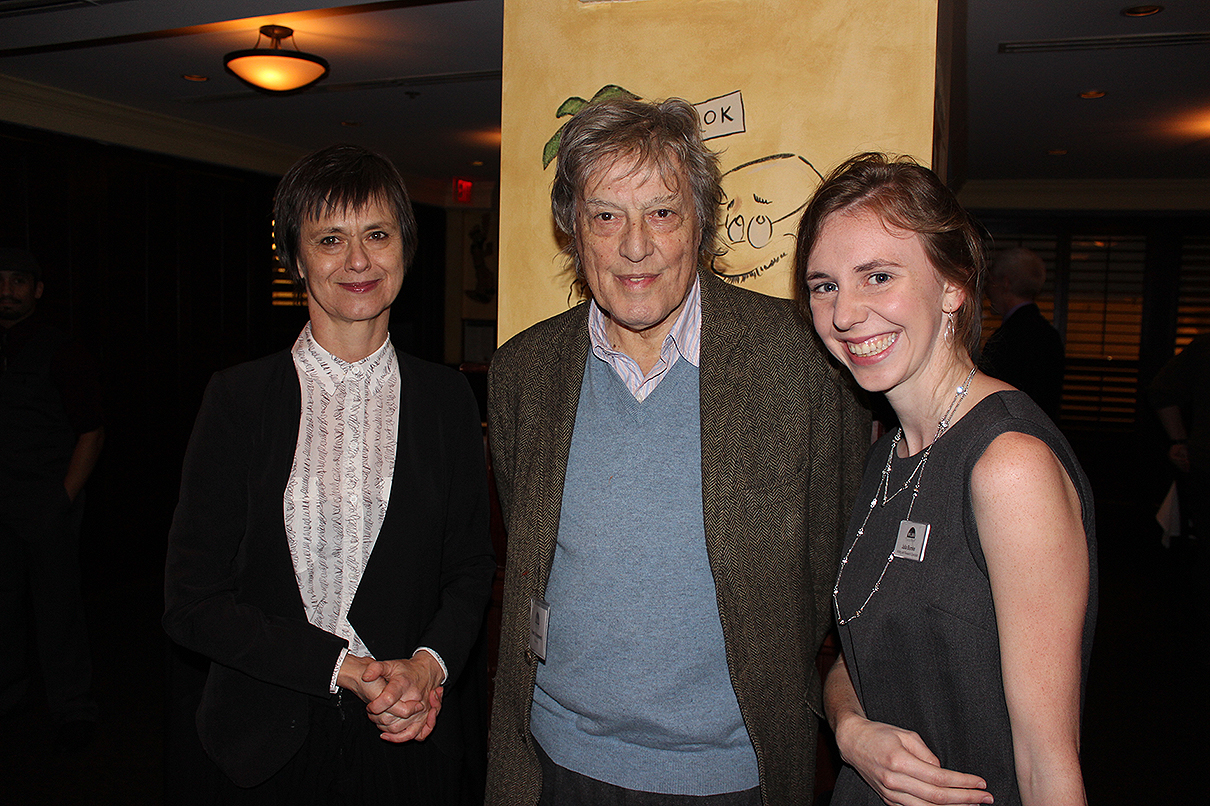
    Wilma cofounder Blanka Zizka, playwright Tom Stoppard, and former Wilma staffer Julia Bumke in 2015.

    “We sat outside on the sidewalk on Walnut Street and we talked about beer, we talked about history, we talked about Philadelphia,” said Smiling. “He was interested not just in theater makers and our lives … I remember him just coming back with all these conversations he’s had with random people on the street around Philadelphia.”

    Though Stoppard did not spend too much time in the city, his contributions were profoundly meaningful to Philadelphia artists — and of course his work will continue to be produced across the region. Earlier this year, the Pennsylvania Shakespeare Festival staged Rosencrantz and Guildenstern Are Dead alongside Hamlet.

    Of course, he’ll always be part of Wilma history.

    “He was very much a strong part of what the Wilma was,” said Zizka. “We have not done any other playwright in such a big measure as we did his work.”

    This article was updated with the correct release year for ‘Travesties.’