STATE COLLEGE, Pa. — Former Penn State coach James Franklin recruited every player, hired every staffer, and had a say in nearly every decision within the football program since 2014.
So after his firing, the players with whom he developed relationships, whose homes he visited, whose families he befriended, were devastated.
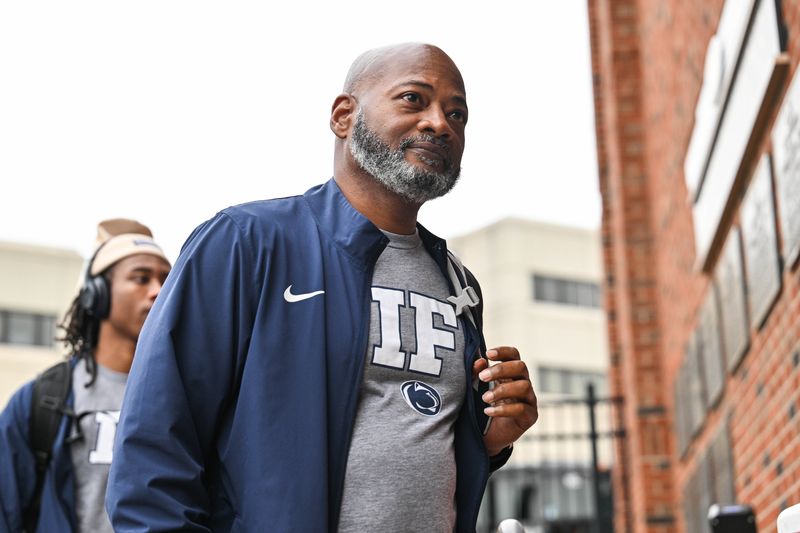
“We all failed Coach Franklin,” interim coach Terry Smith said. “Sunday was traumatizing to [the players]. They are all hurt and torn, disappointed in what happened.”
Penn State interim coach Terry Smith says he feels like the team failed former coach James Franklin.
Franklin may no longer patrol the team’s sidelines or walk arm-in-arm with his offensive linemen as the Nittany Lions take the field, but his philosophies remain entrenched within the program, notably his “1-0” mantra.
The saying still is etched on the team’s locker room doors at Beaver Stadium. It still graces the video board outside Holuba Hall, the site of the team’s practice field. And it remains ingrained in the minds of Penn State players.
“[The 1-0 standard] is all I know. Since I’ve been here, that’s what we do,” defensive tackle Zane Durant said. “How can we win this one rep? How can we win this day? I’m going to continue to have that mindset, and Coach Terry preaches it, too. So we just keep pushing it throughout the team.”
Who’s under center
After a much-needed bye week, the Nittany Lions (3-4, 0-4 Big Ten) will seek to go “1-0″ against No. 1 Ohio State on Nov. 1 (noon, Fox 29).
Again, they will have Ethan Grunkemeyer under center.
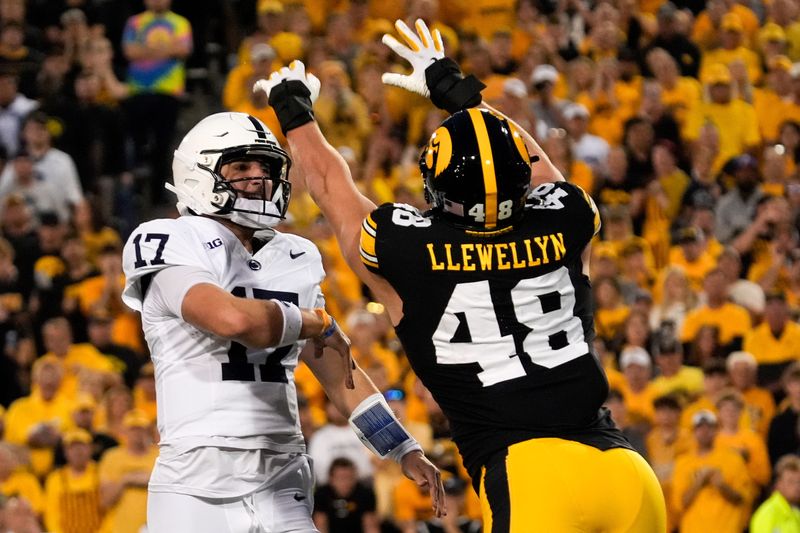
Penn State quarterback Ethan Grunkemeyer performed under a good deal of pressure all night from Iowa’s defense.
The redshirt sophomore quarterback replaced Drew Allar, who is out for the season after suffering a broken ankle against Northwestern. Grunkemeyer, who threw for 98 yards without a touchdown in last Saturday’s 25-24 loss to Iowa, inherits a sputtering offense searching for answers.
Center Nick Dawkins, a team captain in his sixth season, said he has “all the confidence in the world” in Grunkemeyer. Durant said the quarterback can “make all the throws.” Zakee Wheatley called him “100% ready.”
Grunkemeyer will need the backing of his teammates when Penn State battles Ohio State (7-0, 4-0), which allows just 5.9 points per game, the fewest in the FBS. Entering that environment could be daunting to some, but not to the 6-foot-2 quarterback, who, before the Nittany Lions’ game against Iowa, noted that he just wants to play ball.
“I definitely feel prepared. … It is a bigger role, but the preparation has been the same,” Grunkemeyer said. “I’m a guy that likes to go out there and just play, so whatever [offensive coordinator Andy Kotelnicki] dials up, I’m ready for it.”
Smith has been in charge for less than two weeks, but his fingerprints are visible throughout the program. He tells players to “check their feelings at the door.”
The Nittany Lions entered last Saturday with a 3-3 record. After losses to UCLA and Northwestern, they had a 0.1% chance to make the College Football Playoff, according to ESPN. Now, with the loss to Iowa, that vision is all but obliterated. And with two of Penn State’s five remaining games against Associated Press Top 25 opponents, clinching bowl eligibility is not even a given.
But two-time captain Dom DeLuca remains motivated. The fifth-year linebacker said Franklin took a chance on him when no one else would, which is all the inspiration he needs to go 1-0 in the next game.
“Do your job,” DeLuca said. “Do it for Coach Franklin. Do it for the guy to the left and right of you. Do it for all the Penn Staters who love the game and love the Nittany Lions.”
Durant added: “Do it for your brother. Do it for your goals. Do it for each other. [We’ve] got a lot of ball left.”
Amid persistently higher costs, three Philadelphia-area health systems have cut expenses over the last two years by changing how they account for investments in facilities and equipment. The change significantly boosted operating income in all three cases.
ChristianaCare and Main Line Health are now spreading the cost of buildings and building improvements over as many as 80 years, they said in their fiscal 2025 audited financial statements. That is double the maximum number of years they previously used to calculate what accountants call depreciation expense. Thomas Jefferson University made a similar change last year.
All three health systems use PricewaterhouseCoopers LLP as their auditor. The firm, which did not respond to a request for comment, also has Philadelphia health-system clients that have not extended their depreciation schedules.
The term depreciation expense refers to the way hospitals and other businesses allocate the cost of a building, a piece of equipment such as an MRI machine, or even software to manage patient records across the number of years the asset is likely to be used.
It’s a noncash expense because the money used to make the purchase is recorded elsewhere in the financial statements. Several financial and accounting experts said the change could be seen as cosmetic.
“It’s not affecting operations. It’s not increasing their revenues. It’s not decreasing their cash expenditures. It is purely a bookkeeping entry,” said Steven Balsam, a professor of accounting at Temple University’s Fox School of Business.
Main Line Health
At Main Line, the extended depreciation schedule reduced the expense by an estimated $37.5 million. That helped the system achieve a small, $4 million operating profit for the first time since fiscal 2021, when federal COVID-19 aid buoyed hospitals.
Without the depreciation savings, Main Line would have had an operating loss of $33.5 million in the year that ended June 30, compared to a $61 million operating loss in fiscal 2024.
Asked for comment, Main Line’s chief financial officer Leigh Ehrlich noted that the system’s financial performance had improved, thanks to “increased patient volumes and continued focus on expense management.”
Excluding noncash depreciation and amortization in each of the last two years, Main Line’s operating income improved to $127.8 million from $96.7 million.
ChristianaCare
ChristianaCare reviewed the depreciation schedules of fixed assets “as part of our ongoing commitment to maintain accurate and reliable financial reporting,” the nonprofit’s chief financial officer Rob McMurray said in an email. The result was a $24.4 million reduction in depreciation expense.
The review also resulted in a $9 million write-off of unspecified assets, which meant that in fiscal 2025 the benefit to operating income was $15 million, McMurray said.
ChristianaCare’s operating income in the year that ended June 30 was $35.5 million, or $20.5 million without the accounting change. The organization had $126.2 million in operating income in fiscal 2024.
Thomas Jefferson University
Last year, Thomas Jefferson University opened its $762 million Honickman Center in Philadelphia. Normally, taking a building like that into service would increase depreciation expense.
Instead, Jefferson’s depreciation expense fell by $68 million, according to its audited financial statement for the year that ended June 30, 2024. The decline happened after Jefferson opted to spread the cost of all buildings and building improvements over as many as 70 years, according to the depreciation schedule in its financial statement.
Even with the depreciation change, Jefferson’s operating income in fiscal 2024 was extremely narrow, at $1.34 million on nearly $10 billion in revenue that year.
The benefit of lower depreciation expense continued in fiscal 2025, as it will in future years for ChristianaCare and Main Line.
Depreciation expense at other local systems
Most Philadelphia-area health systems use a schedule for depreciating buildings and building improvements that maxes out at 40 years, an Inquirer review of financial statements found.
“You’re constantly modernizing your facilities to allow for the delivery of medicine based on current times,” Temple University Health System chief financial officer Jerry Oetzel said in an interview. “Who knows 15 years from now? We don’t have clear insight, but it’s probably going to be more home care.”
That’s why Temple hasn’t adopted a longer depreciation schedule. “It’s just a savings in operating expenses without the benefit of any cash behind it,” Oetzel said.
Editor’s note: This article has been updated to remove a reference to American Hospital Association guidelines.
The Sixers have figured out the key to a stress-free life.
You can’t let anybody down if they don’t have any expectations.
It would be a fitting twist if this was the year the Sixers finally lived up to the hype of the last decade. They spent eight years as a Snapchat-filter contender, entering each season with the unsubstantiated energy of a team that desperately wants to speak its self-image into existence but at the same time understands that the teams that win NBA titles usually aren’t the ones trying to channel Ben Affleck in Boiler Room. The problem with the whole “act as if” mindset is that you need to stop acting at some point or else you just become an act.
The tricky thing about the Sixers is that it is tough to pinpoint when, exactly, they became that act, given the preponderance of options. I would argue that it was when James Harden held a birthday party at which women held signs that said, “Daryl Morey is a liar.” But you could just as easily argue that it happened a year earlier, when the Sixers traded a guy who was too scared to throw down an open dunk in a decisive playoff game for a guy who showed up to a playoff press conference wearing a designer coat that looked like it was constructed from the pelt of a Teletubby.
Morey has taken the brunt of the blame for the last couple of seasons, mostly because it was his name on the marquee. If you don’t like the circus, you either blame Barnum or you blame Bailey. In selling Harden and then Paul George, Morey’s message was the classic “Don’t believe your eyes.” The scariest part of Dave Dombrowski’s press conference last week was when he channeled Morey and suggested that older players don’t get old the same way they used to. Whatever truth there is to it — and I could lay out a very strong case that there isn’t much — the marvels of modern sport science still haven’t managed to solve a conundrum that each of us encounters at some physiological age. Once you get old, there is no getting un-old. The only question is whether you can slow down the decay.
Funny thing about Morey, though. While his more vocal critics have written him off as little more than a salesman, they are giving his sales proficiency way too much credit. He has been much better at his actual job, which, let’s not forget, began five years ago with inheriting a roster that was assembled on the premise that Al Horford and Josh Richardson could be the missing pieces that would enable Joel Embiid, Ben Simmons, and Tobias Harris to win a title. Back then, people felt a lot like they did by the end of last season. The Sixers’ best chance had already passed them by.
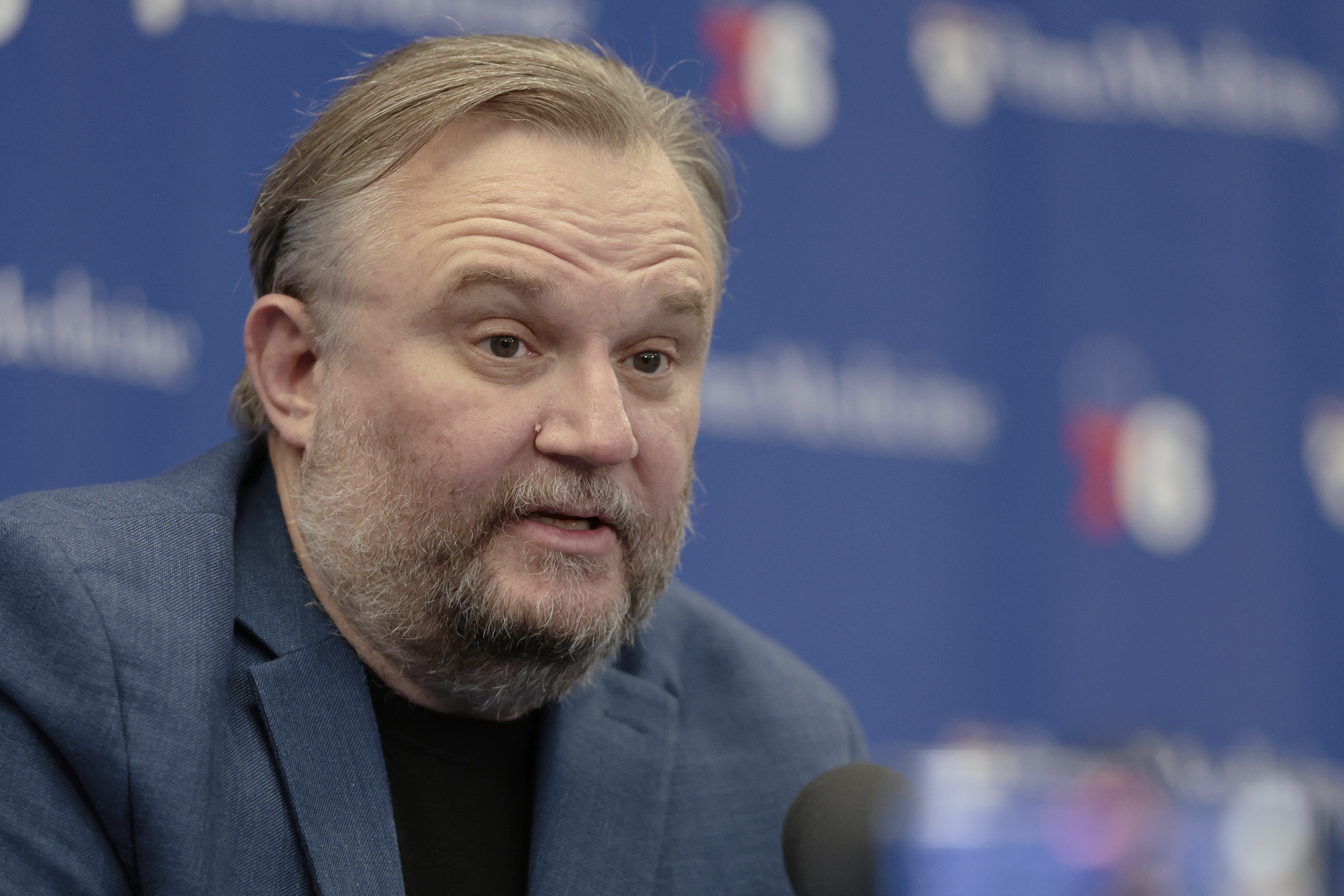
Sixers president Daryl Morey is entering his sixth season with the franchise.
What the interim has wrought is in the eye of the beholder. It has been easiest to focus on Morey’s yearly quest to push the Sixers over the top, his annual reshuffling of the deck, from Simmons to Harden to George, each one falling short of even reaching the conference finals. The Sixers have not come close to achieving the ultimate goal, but they have made a sport of it, taking the Celtics to Game 7 in 2023 and the Knicks to Game 6 in 2024 before landing George as part of a free-agent bonanza last summer. Yet even as they have tried and failed — and flailed — they somehow manage to enter 2025-26 with a roster that actually looks like the one the Sixers thought they had in those first post-Process years, long before Morey arrived. Morey drafted Tyrese Maxey and then Jared McCain and just five months ago VJ Edgecombe, who may have the most potential of them all.
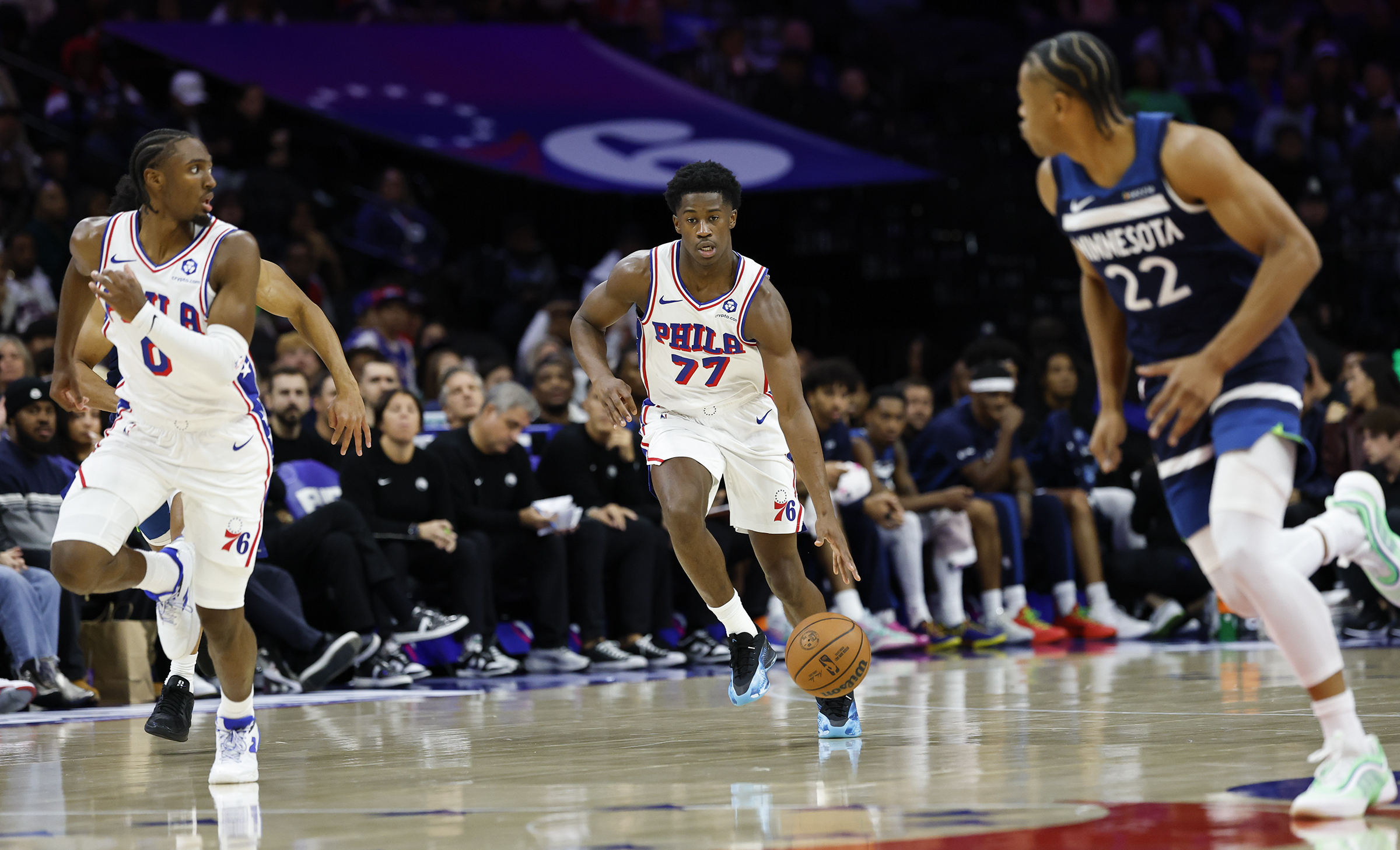
You watched the Sixers this preseason and you saw the makings of the team they never actually had. The first quarter of their 126-110 win over the Timberwolves on Friday was eye-opening. Early in the quarter, Edgecombe crashed the weak-side glass and corralled a Kelly Oubre miss for an easy putback. Edgecombe and Maxey spent the period running the court like it was crumbling behind them, pushing the pace after makes as well as misses, displaying an uncanny connection for teammates whose partnership can be measured in months.
After going hard to the basket and finishing his textbook footwork with a contested layup off a fastbreak pass from Maxey, Edgecombe stole the ball from Johnny Juzang at the other end of the court, sparking another break that resulted in a free-throw trip for Quentin Grimes. But the most instructive play might have been one that failed: a cross-court, alley-oop pass from Maxey near the hash to Edgecombe on the weak-side block. They did not convert, but they came close enough to project that they will finish plenty of them.
Even without McCain, who quickly worked his way to the top of the rotation last season and who will be there again soon, the Sixers looked a lot like the kind of team people always wished they would be instead of steadily growing older, slower, and more difficult to watch.
For the first time in a long time, the Sixers have the makings of a team that is, at the very least, a fun team to root for. It remains to be seen how well it will translate into wins. It will translate into more than people think if Embiid can consistently be the guy he was in his preseason debut. Healthy. Light on his feet. Knocking down elbow jumpers and charging to the rim. Whatever they get from George will be a bonus.
And, who knows, maybe that will be enough in a wide-open Eastern Conference where two top contenders are taking gap years. Injuries to the Celtics’ Jayson Tatum and the Pacers’ Tyrese Haliburton have created a power vacuum. You can’t completely discount the Sixers’ chances of filling it.
Sixers guard VJ Edgecombe brings the ball upcourt alongside Tyrese Maxey during Friday’s preseason game against the Timberwolves.
For now, the reason to watch this team is for an early look at what the future will look like. Edgecombe has a chance to become the Sixers’ most electric star since Allen Iverson. Maxey is Maxey, and McCain is almost as fun to watch. It is a fascinating dynamic, one that complicates the more cynical narratives about the Sixers’ trajectory over the last five years.
The safe play is to not expect much out of the Sixers. But you can expect them to be fun.
Tom Brady was 44 when he retired for 40 days before he changed his mind and went back to the playoffs one more time with Tampa Bay in 2022.
In 1974, former Eagles linebacker Maxie Baughan left his defensive coordinator gig at his alma mater, Georgia Tech, to go back to the NFL as a player-coach with Washington. He was a backup and played in two games.
Brett Favre was 40 when he decided to come out of retirement for the second time and join the Minnesota Vikings in 2009. He stuck it twice to his old team, Green Bay, won the NFC North, then led the Vikings all the way to the NFC title game.
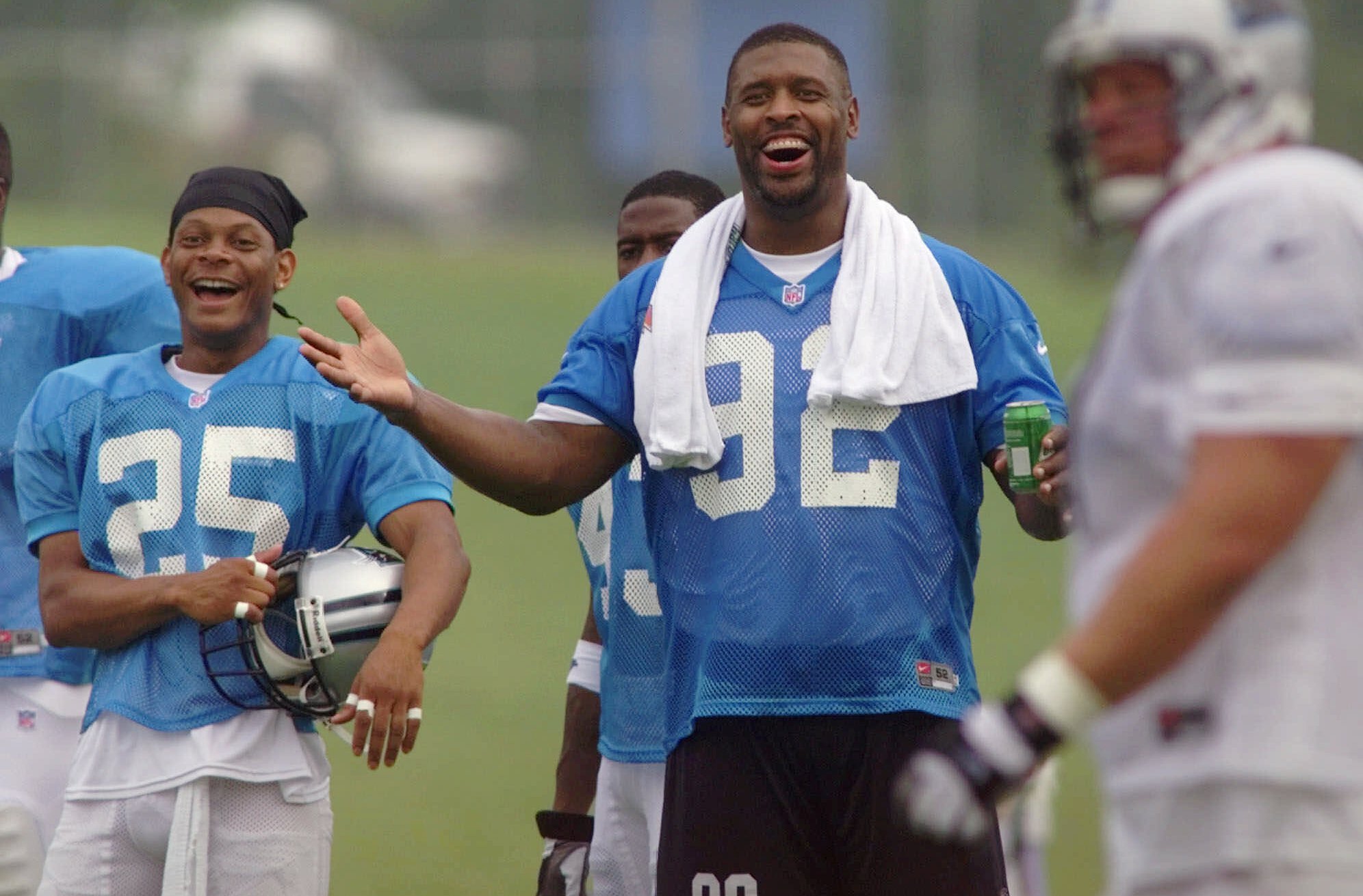
Reggie White returned from retirement at 38 with the Carolina Panthers in 2000. He played in all 16 games but recorded his lowest single-season sack total (5½) in a Hall of Fame career.
Then there’s Bronko Nagurski, who, in 1943, came out of retirement to play with the Chicago Bears, who needed players because many of theirs were fighting in World War II.
All of this is to say not all unretirements are created equal.
What does the historical data mean for Brandon Graham, who is back with the Eagles after retiring from football seven months ago? Maybe nothing — human bodies aren’t created equal, either. Or maybe something, as there may be relevant context.
Former Eagle and Packer Reggie White (92) came out of retirement to sign with the Panthers in 2000.
Is Reggie White’s case similar?
White was 38 when he decided to end his one-season retirement to join the Panthers, and Graham turned 37 a few weeks after retiring in mid-March.
But White, one of the best defensive ends of all time, was coming off a 16-sack, first-team All-Pro, Defensive Player of the Year 1998 season when he retired. Graham was playing well with the Eagles last year, but his season was cut short by injury, and his sack numbers dropped off a cliff one year earlier in 2023.
White still was disruptive to opponents, but he wasn’t his normal high-production self in a more limited role in Carolina. It is a physical and demanding position, not that Graham needs any reminder of that.
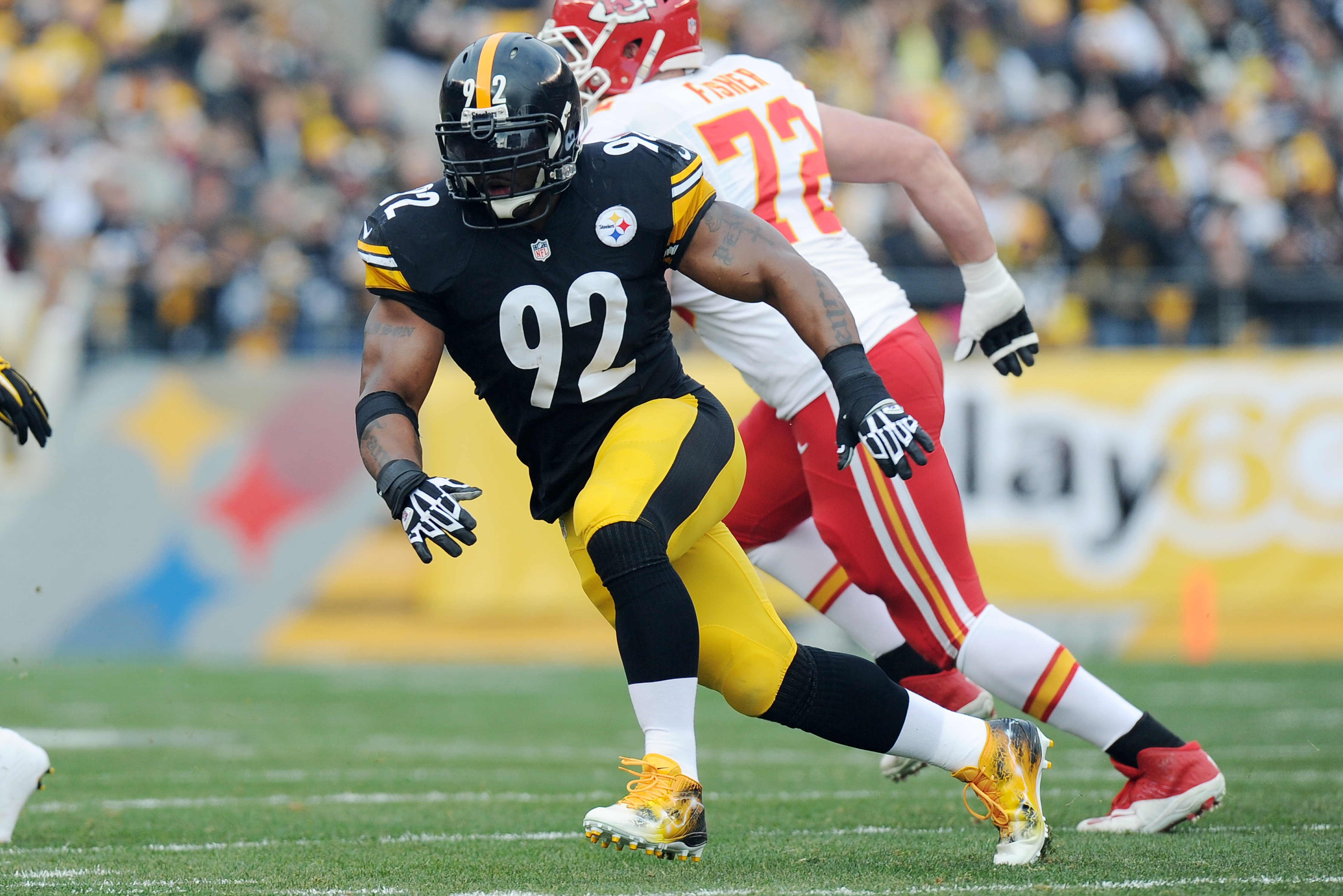
James Harrison went back to the Steelers for a second stint at age 36 in 2014.
The Harrison comparison
James Harrison officially retired in August 2014, but his retirement essentially lasted a similar length as Graham’s. Harrison played the 2013 season with Cincinnati and wasn’t in a training camp in the summer of 2014.
But after the Steelers suffered some injuries early in the 2014 season, the linebacker was back with his former team at the age of 36. He was still productive, too, with 45 tackles and 5½ sacks in 11 games.
Harrison then signed a two-year contract with the Steelers and ended up playing three more seasons after returning in 2014. Don’t expect the same from Graham, but Harrison’s effectiveness as a pass rusher might be a good comparison for him.
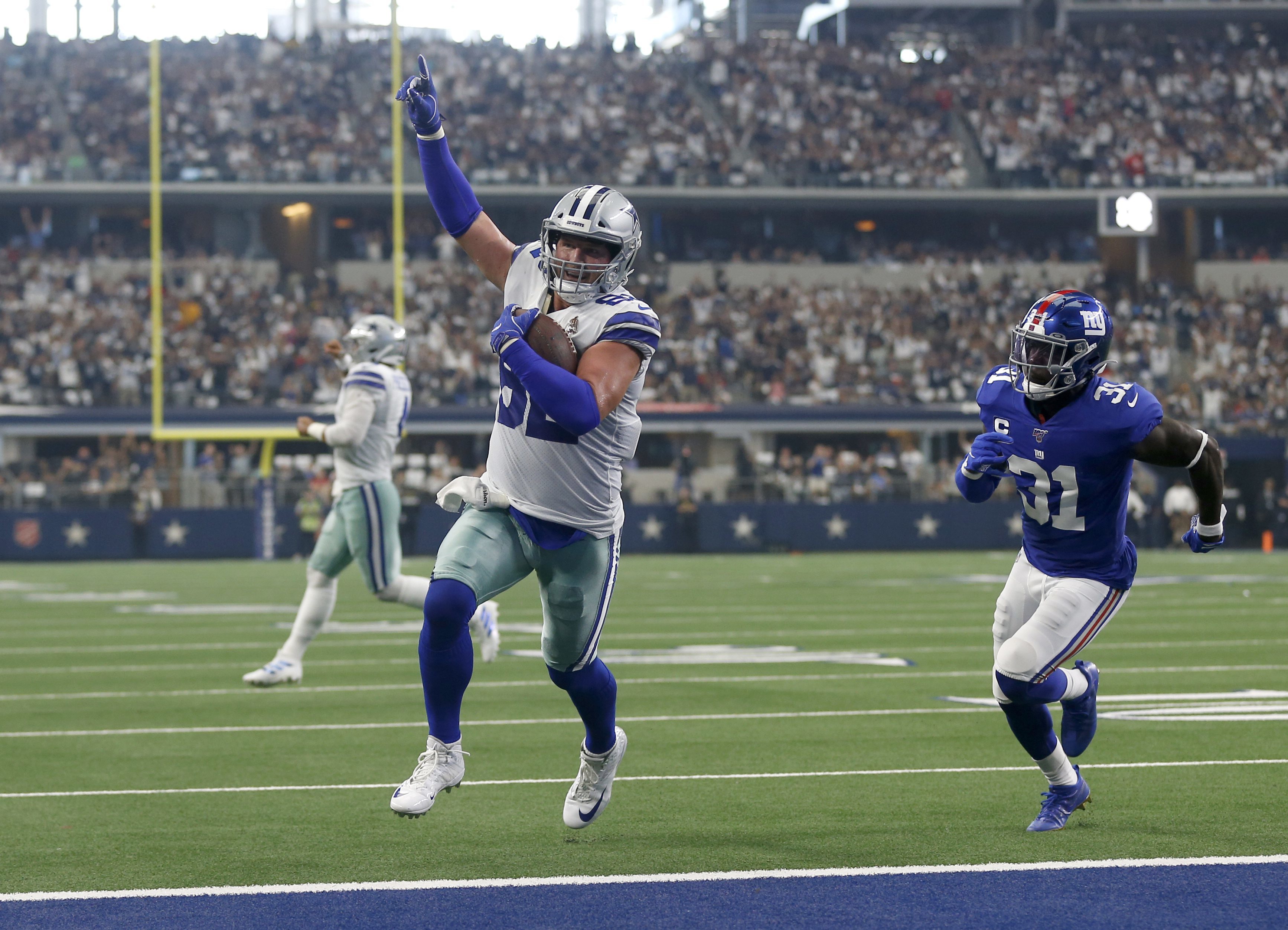
Tight end Jason Witten left the “Monday Night Football” broadcast booth to play for the Cowboys again in 2019.
Witten still had a little in the tank
Graham will go from the podcast studio to the locker room, similar to how Jason Witten went from the broadcast booth back to football.
Witten, like Graham, was 37 years old when he rejoined the Dallas Cowboys in 2019 after one year of retirement. The tight end still had it. He caught 63 passes, four of them for touchdowns, and accumulated 529 yards in 16 games. His 2017 season line: 63 catches, 560 yards, five touchdowns.
37 is popular
Lucky No. 37? Deion Sanders was also 37, and he chose that number for the back of his jersey when he came out of retirement to play with Baltimore in 2004 after three seasons away from the game.
Sanders played nine games in 2004, mostly as a nickel cornerback, and still had a knack for the football. He had three interceptions and returned one of them for a touchdown. He played all 16 games in 2005 and registered registering two interceptions and 30 tackles. He was fine, but he wasn’t Prime Time.
Graham may be fine
All of this is mostly a fun trip down memory lane. It’s unclear what kind of shape Graham is in or whether he has lost a step after being away for a short time. Every body is different.
But Graham’s 2024 season can, at least, be a little instructive. He was an energy booster on the field, a veteran presence off it, and a really capable edge setter who helped the Eagles vs. the run.
They could use that right now, and it’s not hard to imagine him being like Witten or Harrison in that he still can do what a team asks him to do.
Graham is the biggest of the edge rushers at 265 pounds, and he could be useful helping a defense that is allowing 4.6 yards per carry, the ninth-highest average in the NFL.
The Eagles also could use some more volume from their pass rushers, and Graham was making an impact there before a torn triceps ended his regular season in Week 12 vs. Los Angeles. He sacked Rams quarterback Matthew Stafford before the injury, his fourth time getting home in 11 games (3½ sacks). Graham still could make an impact there, even if the Eagles aren’t asking for a large snap count out of him.
The Eagles needed Graham, and it seems like he needed them, too. Time will tell if the play matches up to the presence.
Plus, sources say that Chief Vibes Officer Brandon Graham is on his way back to the Eagles, too, to bolster an edge rusher corps that is navigating the surprise retirement of Za’Darius Smith last week.
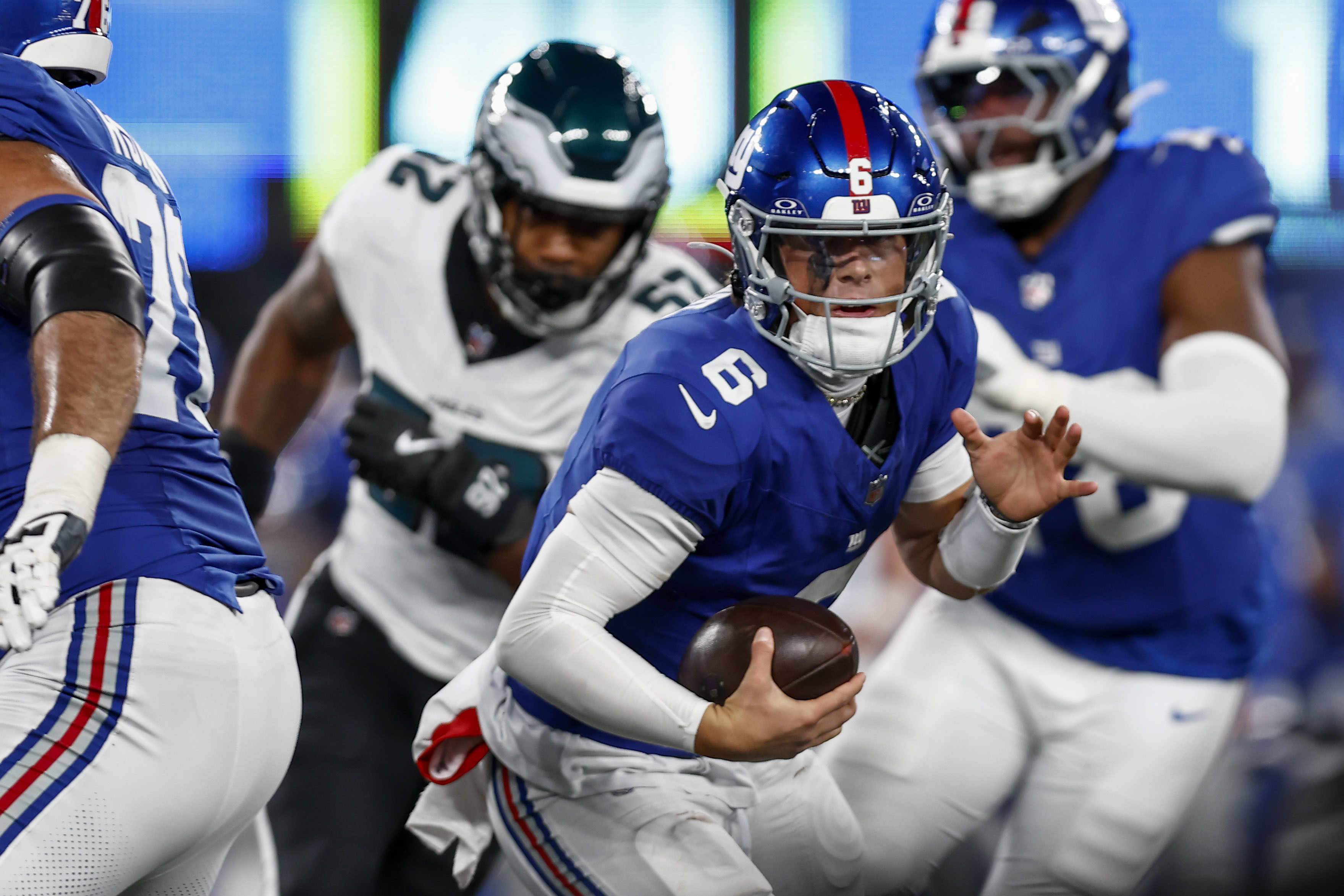
But to enter the bye week on a high note, the Eagles must face the New York Giants, their division rivals who handed them a blowout loss two weeks ago. The Giants will try to bounce back after a fourth-quarter collapse against the Denver Broncos on Sunday, leading to a 33-32 loss.
Here’s what we know (and what we don’t) about the Eagles entering their Week 8 matchup against the Giants:
Lights, camera, play-action
The Eagles came out of the mini-bye week wanting to establish the running game. That didn’t work. Brian Flores’ defense limited Saquon Barkley to just 44 yards on 18 carries, good for a 2.4 yards per attempt (his second-lowest clip this season).
Still, the Eagles utilized the threat of the running game successfully against the Vikings, which is a step in the right direction. The offense incorporated play-action passes from under center on Sunday more frequently than in the previous six weeks of the season.
In Weeks 1-6, the Eagles had five under-center play-action drop backs, according to Next Gen Stats. One of them resulted in a scramble. Another went for 1 yard. The others resulted in incompletions or penalties.
Sunday was different. Hurts had four play-action dropbacks from under center, which resulted in four completions for 121 yards and a touchdown. Why was it so effective? For one, the Eagles had established a tendency of running the ball when Hurts is lined up under center before the snap. Entering Sunday’s game, 42 of the Eagles’ 48 plays from under center were carries (87.5%).
By establishing that tendency (and continuing to do so with 15 under-center runs on Sunday), the Vikings aligned a safety in the box in anticipation of the run, especially when the Eagles utilized Fred Johnson as an extra offensive lineman. The Eagles made them pay by occasionally breaking that tendency, especially on the 79-yard touchdown pass to DeVonta Smith, which occurred when the offense was in that jumbo package.
“We had an answer for it,” Barkley said of Smith’s touchdown play. “We called it at the right time. That’s the beauty of this game. They can do whatever they want, but we should always have answers. I think that’s the mentality we’ve got to continue to get back to.”
Could we see more play-action passes from under center? And could the Eagles’ success in doing so on Sunday thwart defenses from loading up the box when Hurts lines up under center? That would benefit Barkley, who is averaging just 3.3 yards per carry this season, far behind the league’s average of 4.3.
Nick Sirianni noted Monday that the uptick in under-center plays was a byproduct of the self-scout from the mini-bye week. He emphasized the importance of meshing the running and play-action passing games seamlessly, as it challenges the defense to convert from run to pass on the fly.
“We will see how things move forward as far as the ways we want to attack,” Sirianni said. “Every game calls for different things. This is what this game called for, and these are some of the things that came off our self-scout. We’ll continue to work and find ways to get better.”
Feel the Burns
Barkley hasn’t been getting a consistent boost in the running game from the Eagles’ offensive line this year. The group has been reeling from injuries. Cam Jurgens suffered the latest, exiting Sunday’s game after the second drive with a knee injury.
With Jurgens’ status in question for the rematch against the Giants, the Eagles could turn to a backup at center, which could present all sorts of challenges against a formidable defensive front.
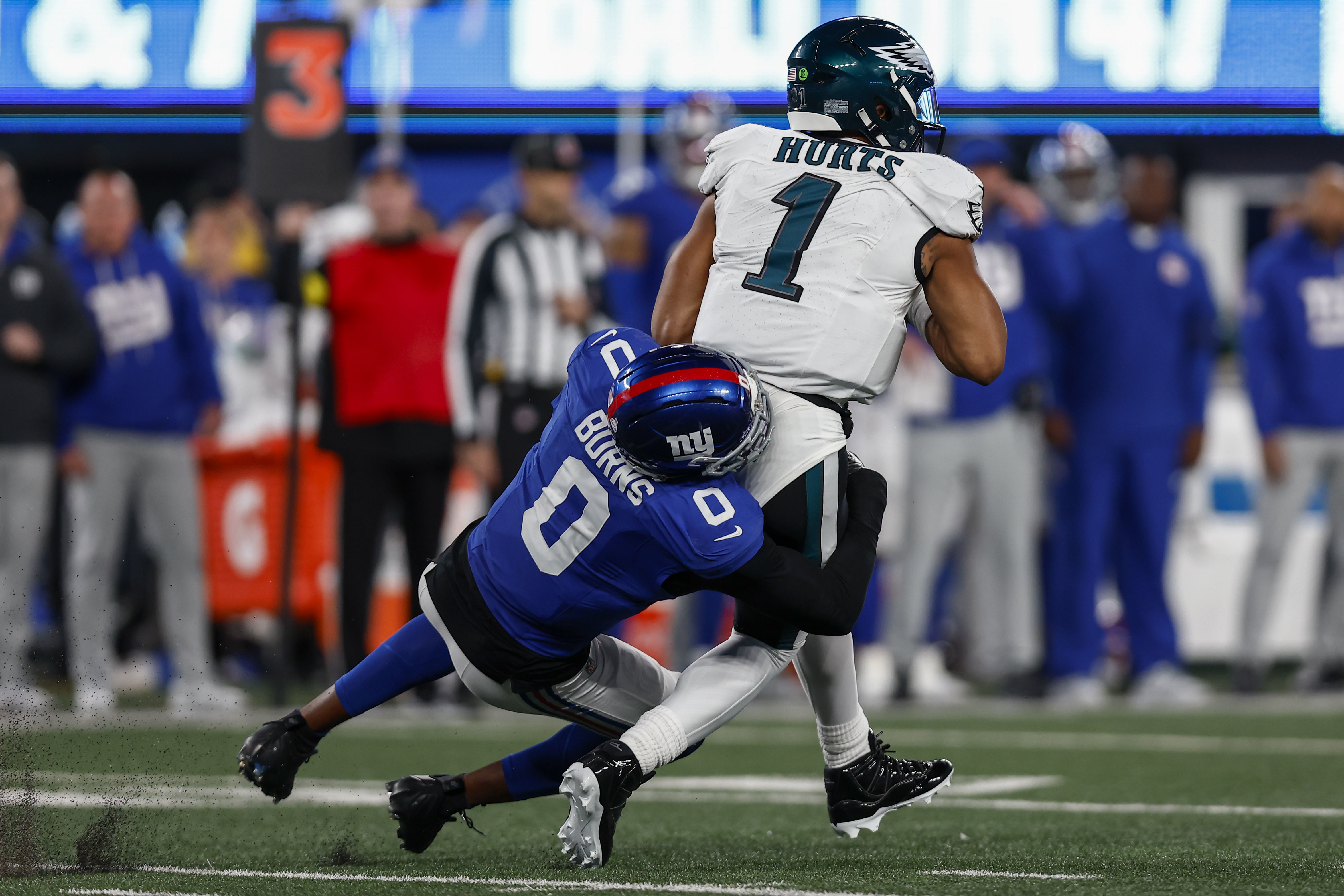
Giants edge rusher Brian Burns had four sacks over the last two games, including dropping Jalen Hurts twice on Oct. 9.
The Giants exploited the Eagles’ weaknesses on the offensive line in their last matchup. Brett Toth started at left guard in place of the injured Landon Dickerson (ankle). Brian Burns notched two sacks against the left side of the offensive line, once on a stunt and another from 3 yards off the line of scrimmage.
Burns has four sacks in his last two games, after adding two more in their loss to the Broncos. The good news for the Eagles is that Dickerson started and finished Sunday’s game against the Vikings. His presence against the Giants would help stabilize the left side of the line and minimize Burns’ impact when he lines up on that side.
But if Jurgens can’t play, the Eagles could turn to Toth at center. He would be tasked with keeping Dexter Lawrence, the three-time Pro Bowler, at bay.
Lawrence hasn’t been as disruptive as a pass rusher as he was last season and hasn’t posted a sack this year. Still, Lawrence is an important part of the Giants’ defensive front, ranking fourth on the team with 15 “stops,” which Next Gen Stats defines as tackles that result in a successful play for the defense.
Scramblin’ man
The last time the Eagles faced the Giants, rookie quarterback Jaxson Dart got his legs going. He scrambled five times for 42 yards and a touchdown, which helped him reach career highs of 58 rushing yards and 13 attempts.
Vic Fangio’s defense has struggled at times to prevent quarterbacks from breaking loose. Unsurprisingly, Patrick Mahomes did the most damage against the Eagles this year (seven scrambles for 66 yards), but even Wentz, 32, had a couple of long third-down scrambles totaling 28 yards late Sunday as the Vikings attempted a comeback.
Improved tackling would be a good place for the Eagles to start. Dart forced three missed tackles against the Eagles, according to Pro Football Focus. That was a new achievement for Dart, who didn’t force a missed tackle in any of his three other starts this season.
New York Giants quarterback Jaxson Dart finished with 42 yards on five scrambles against the Eagles on Oct. 9.
The rookie quarterback did not scramble against the Broncos, although he made passing plays on the move. According to Next Gen Stats, Dart completed four of six passes for 101 yards and a touchdown when running over 8 mph. Keeping Dart contained will take a group effort from the Eagles, in terms of the pass rush and coverage.
Carter’s return
Speaking of keeping Dart contained, Jalen Carter returned to action Sunday after missing the Week 6 game against the Giants with a heel injury.
Wentz certainly felt his presence. In the second quarter, a simulated pressure left Carter one-on-one with Blake Brandel, the third-string center. Carter breezed past Brandel and launched himself toward Wentz, forcing the quarterback to make an ill-advised throw over the middle to Jalyx Hunt, who snagged the ball and returned it for a pick-six.
Even though Carter has been banged up this season, between heel and shoulder injuries, the Eagles could have used his talent and physicality against the Giants. In his absence, the group finished with a 26.5% pressure rate against New York two weeks ago, its lowest of the season, according to Next Gen Stats.
Carter attempted to make up for lost time on Sunday. He led the team with six pressures against the Vikings, according to Next Gen Stats. His fourth-quarter stunt with Jordan Davis provided the initial pressure on Wentz that helped Joshua Uche register his first sack with the Eagles.
University of Pennsylvania professor E. John Wherry is good friends with Fred Ramsdell, who was recognized earlier this month with a Nobel Prize for his research in immunology.
Wherry recalled sitting with Ramsdell, a scientific adviser for the California-based biotech company Sonoma Biotherapeutics, in a meeting two months ago and picking his brain about the future of autoimmunity research.
“What are the opportunities? Where is the field going?” Wherry recalled asking.
He said Ramsdell’s advice — to stay focused on supporting the foundational academic research — is helping to inform the scientific direction and programming at Penn’s Colton Center for Autoimmunity, which Wherry directs.
Wherry was happy to see Ramsdell awarded a 2025 Nobel Prize in Physiology or Medicine, shared among three scientists, for his research into peripheral immune tolerance, a process that prevents the immune system from attacking the body.
“It could not have happened to a nicer guy,” he said.
The Nobel Prize-winning discovery is especially important for understanding autoimmunity, he emphasized, and could be leveraged to treat autoimmune diseases.
“We now have the power to push the immune system in different directions, not only to treat those diseases, but also to tell us about where the diseases are going,” Wherry said.
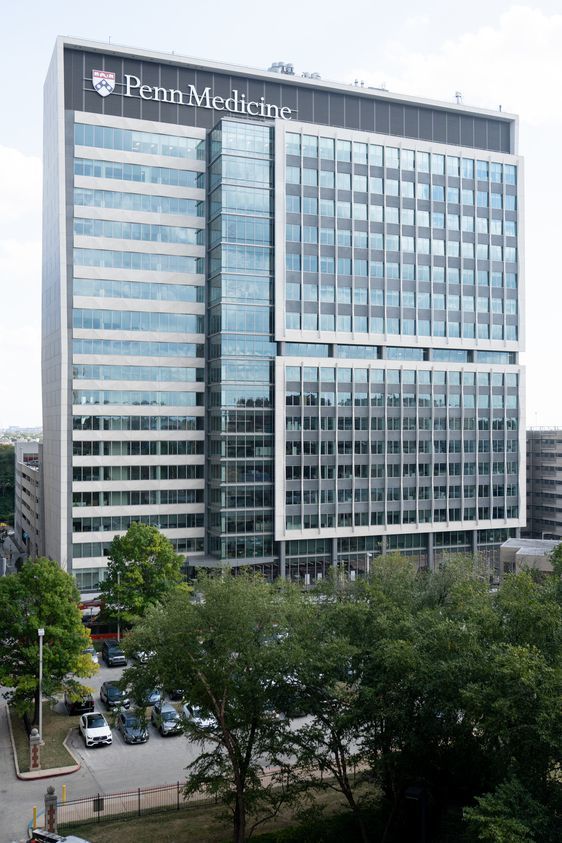
Penn’s new research facility, which will span seven floors of an office building at 3600 Civic Center Blvd. in University City, is focused on using immunology to diagnose, treat, and prevent diseases.
Wherry’s lab is moving into the space this month.
“We are in the most exciting time in my lifetime for immunology,” he said.
The Inquirer spoke with Wherry to learn more about the future of immunology research at Penn in a conversation lightlyedited for length and clarity.
How will this new center change how immunology research is carried out at Penn?
We have the Colton Center for Autoimmunity, with really wonderful philanthropic support from Judy and Stewart Colton. They’re giving us resources to make bets on high-risk, high-reward science, and to do that at a pretty good scale. We made some big bets on CAR-T cells and autoimmunity, on mRNA therapeutics, on high-throughput screening, and on AI drug discovery.
We have this Immune Health Platform lab. The idea is that we should be capturing samples theoretically from every patient we treat, ideally around the time they get a new treatment or there’s some change in their disease.
Once we’ve built a model using this data and understand the rules by which the immune system functions, we can separate the model from the primary data. You can fine-tune the model and make predictions about other diseases, clinical trials that a company might want to do, and other health systems data.
Our large database contains about 3,000 patients’ worth of data. We hope to get to 10 or 20,000 patients’ worth.
Who will be part of this new research facility?
There are about 25 immunology labs moving in. They include disproportionately younger labs, people who have just arrived at Penn in the last two to three years. We have enough space for probably around 35 to 37 labs, so we would like to recruit and bring new ideas in.
The way things happen in science is because people talk. We’ve created a physical workspace that’s going to force people to interact in new and different ways and just create more opportunities for serendipity.
The University of Pennsylvania opened a $376 million, 217,000-square-foot wet lab, office, and research facility at 3600 Civic Center Blvd. The seven-story facility was built on top of an active 250,000 square-foot office tower that opened in 2019.
What are some of the new projects that have been funded?
We have someone funded to work on the way the immune system recognizes our own DNA or RNA. lf the DNA in the nucleus of any cell in your body gets out of the nucleus, it’s a really bad thing, because that looks like a bacteria or a virus [to your immune system]. It triggers massive inflammation. The sensors for that can get miswired, and when they do, it can often lead to really devastating autoimmune disease, sometimes a fatal autoimmune disease within just a few years.
We have a great researcher named Jonathan Miner who’s identified what happens when those proteins get mutated, and has also developed drugs that basically adapt the mutation to not be as pathogenic.
We have some other really interesting studies on being able to regulate the way our bodies make antibodies, since that can be the pathogenic event in autoimmunity. If you make an antibody against proteins in your nerve ending, you can have diseases that end up causing muscle weakness. We’re starting to identify the way the immune system gets triggered to make antibodies against the wrong things.
And then we have some really cool projects on CAR-T cells and autoimmunity, where we’re using standard CAR-T cells from cancer to get rid of B cells, which are cells that make antibodies in autoimmune diseases. We also have people inventing new kinds of CAR-T cells to help address other challenges in autoimmunity.
What is the focus of your lab’s research?
In the late 1990s and early 2000s, I became very interested in how the immune system deals with chronic infections. When you can’t fully eradicate an infection, what does the immune system do? Why doesn’t the immune system clear things like HIV or hepatitis B, and what are the mechanisms behind that failure?
During our studies, we identified a process called T cell exhaustion. T cells are the part of the immune system that fights viruses and also tumors.
Our core is always to understand this idea of immune exhaustion. It plays a role in infectious disease, it plays a role in cancer, and it definitely plays a role in autoimmunity.
What are some of your current projects?
We’re trying to understand the heterogeneity in different autoimmune diseases.
To give an example, one is a really challenging kind of blistering inflammatory skin disease called Hidradenitis suppurativa, where there’s just massive inflammation of immune cells in your skin, and it causes really hard-to-treat skin lesions. We now are profiling all of the immune cells in the tissue in the skin and identifying new targets for therapeutics.
We’re also interested in this idea that the immune system sees everything that’s happening in your tissues, meaning it acts like a biosensor. If we understand the things the immune system is seeing, we can start to predict trajectories of disease. The inspiration for our study on infant health[not yet published] came from a neonatologist who came to the lab and said, ‘These really premature infants have this kind of lung inflammation that we don’t understand.’
We realized that somewhere around 10 or 20% of those really premature infants get infected while they’re in the ICU. And we were able to identify what those infections look like early in life.
We think we can start to piece together ways that we might be able to use the immune system more effectively, or at least treat the damaging inflammation that might come from an early-life infection.
What bets are you making on AI drug discovery?
We’re very excited about an AI-based approach for drug discovery and drug repurposing that is being led by David Fajgenbaum, the physician who had Castleman disease and essentially cured himself.
He has a big infrastructure to basically look at all FDA-approved drugs and identify ways to repurpose them for diseases they weren’t originally intended for. We can do AI predictions, take the top list of drugs from that, and then put that into a high throughput screening facility where Sara Cherry, who is brilliant and amazing, can now screen to identify which of those drugs might be able to provoke the effect we want from cells involved in autoimmunity.
Carson Wentz’s passer rating against the Eagles fell to 68.0 Sunday. That is his worst passer rating against any team that he’s faced at least twice. He has faced the Eagles twice, first as a Commander, Sunday as a Viking.
He is 0-2.
Jalen Hurts was the opposing quarterback in both games.
That should deliver a degree of satisfaction to any Eagles fan who still resents Ginger Jesus for whining his way out of town because, in 2020, the Eagles drafted Hurts to act as his long-term backup, then inserted Hurts for the last four games of the season.
Instead of coming to training camp and winning his job back, thereby justifying the four-year, $128 million contract extension he’d been awarded but had not yet begun earning, Wentz first got coach Doug Pederson fired, then forced GM Howie Roseman to trade him, specifically, to Frank Reich and the Colts, where he then sabotaged Reich’s career.
Things worked out well for the Eagles. Hurts became the better quarterback.
But don’t think that Hurts doesn’t relish these matchups after Wentz treated him with resentment and jealousy during their shared season in Philly.
It’s no coincidence that, in their first meeting on Sept. 25, 2022, Hurts had his best game as a passer to that point: 22-for-35, 340 yards, three touchdowns, no interceptions, and a 123.5 rating.
The draft capital from the Wentz trade eventually helped the Eagles, often tangentially. It was part of deals that landed DeVonta Smith, A.J. Brown, Jalen Carter, and Cooper DeJean.
At the time, though, what mattered most was that:
The Eagles appeared to have lost their long-term franchise quarterback because his feelings were hurt.
The Eagles were saddled with about $34 million in dead cap money for the 2021 season, crippling the club and essentially wasting the year.
Since Wentz’s disgraceful departure, the Eagles have gone to two Super Bowls and have won one. If that salves the wound for you, that’s healthy, I guess.
However, if you still feel resentful, you have every right.
‘Just throw me the [bleeping] ball’
On Thursday, after hearing his coaches and teammates swear for six weeks that he’d just have to wait his turn, A.J. Brown, the best receiver in Eagles history, playing at the height of his abilities, watched Ja’Marr Chase catch 16 passes on 23 targets in a Bengals win over the Steelers.
Brown hasn’t had 16 receptions in any three consecutive games this season.
Chase’s quarterback? Forty-year-old Joe Flacco, who’d been benched by the Browns, then traded by the Browns. It was Flacco’s second start with the Bengals.
Imagine if Flacco had been, say, a 27-year-old reigning Super Bowl MVP?
Hurts is a 27-year-old reigning Super Bowl MVP, and on Sunday, Brown watched Hurts hit Eagles teammate DeVonta Smith nine times for 183 yards. That yardage total not only is Smith’s career high, it also would have been Brown’s career high.
Meanwhile, while sitting on the bench, Brown watched Vikings receiver Jordan Addison catch nine passes for 128 yards. His quarterback: five-time retread Carson Wentz.
Brown caught four passes for 121 yards and two touchdowns. But for about 14 months, Brown has been insisting that he needs more chances to make more catches, because he’s just that good.
And he’s right.
If Joe Flacco and Carson Wentz can force-feed their beasts, why can’t Hurts force-feed his?
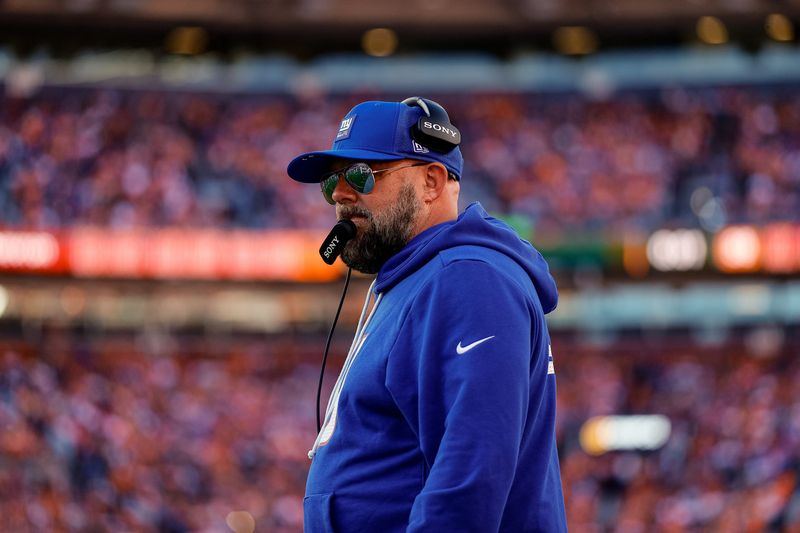
Brian Daboll’s Giants gave up 33 fourth-quarter points to lose to the Broncos.
Bucking Bronco
The Giants will hit Philly on Sunday nursing a massive hangover after their historic, 19-point, fourth-quarter, mile-high collapse at Denver, a game that featured several weird plays and outcomes.
The craziest scene among the crazy scenes was, just before the Giants’ last touchdown, the spectacle of Broncos coach Sean Payton losing his mind and running into the middle of the field at the goal line to protest a pass interference penalty on his defense. Like, all the way to the 2-yard line. Right in the middle of the action. It was like something out of an awful Oliver Stone football movie.
Payton drew an unsportsmanlike conduct penalty, which was inconsequential, considering the ball was at the 2-yard line and could only be moved one yard. It will be less consequential when he gets that $15,000 fine from the league.
Broncos flagged for defensive pass interference near the goal line, and Sean Payton picks up a personal foul 🤯 pic.twitter.com/dea5mYPQo8
At any rate, the TD gave the Giants a 32-30 lead, but kicker Jude McAtamney — a Northern Irishman with Gaelic football roots whose tortuous journey to Sunday included, while in college, a demotion from Rutgers’ full-time kicker to its kickoff specialist — flubbed the second of two missed PAT tries. The Broncos drove to field-goal range, and kicked the winner.
Payton was happy then.
Shut ’em down. Finally.
Before Sunday, former Eagles coach Andy Reid had 304 NFL wins, including playoffs. He’d won three Super Bowls and he’d coached in three more.
But he’d never had a shutout.
Then on Sunday he faced Pete Carroll and the injury-depleted Raiders in Kansas City and won, 31-0.
Kansas City Chiefs wide receiver Hollywood Brown scores as Las Vegas Raiders cornerback Darnay Holmes defends.
This is remarkable, considering the four coaches near Reid’s win total — Don Shula, George Halas, Bill Belichick, who are ahead of him, and Tom Landry, whom he passed two years ago — all have at least a dozen shutouts.
Granted, Shula, Halas, and Landry coached in an era in which scoring was less prolific, but Belichick is a contemporary. And anyway, when you coach teams as successful as the Eagles and Chiefs, you’d expect more than one shutout among 305 wins.
Extra points
Packers edge Micah Parsons, the biggest offseason name to change teams, finally went off Sunday. He delivered the last of his career-high three sacks with 27 seconds to play in Arizona. He’d had just 2½ sacks in his first five games since being traded by the Cowboys just after preseason, then signing a four-year, $186 million extension. … At this point, Shane Steichen is the runaway leader in the Coach of the Year race. The Colts are 6-1, and while all of their wins aren’t impressive — Titans, Raiders, Cardinals, Dolphins — they beat Justin Herbert’s 420-yard effort on the road Sunday against the L.A. Chargers. Steichen also has turned Giants bust Daniel Jones into an MVP candidate.
MINNEAPOLIS — The Eagles wanted to run the ball. They wanted to emerge from the mini-bye — just like they had after breaks in previous seasons — with a ground-focused offensive attack.
They just couldn’t.
But it didn’t matter, ultimately, at least on this day. Jalen Hurts and the drop-back passing game delivered the kind of explosive performance that has mostly been lacking from the offense this season, the kind needed after a two-game losing streak had even the Eagles doubting themselves.
The Eagles quarterback confirmed his quote that was videoed and posted on social media by an NBCSports reporter.
“That’s all I could think about throughout these last two weeks,” Hurts said. “Having opportunities to finish the game, to finish the fourth quarter. I really think this is the first time we’ve finished the fourth quarter and then finished in the second half. …
“There was some fire there, but within that fire you have to be the calm.”
Hurts sparked a dormant offense with a career-best statistical outing in which he completed 19 of 23 throws for 326 yards and three touchdowns. And he was a steely-eyed presence against a Vikings pass defense that entered first in expected points added (EPA) per drop back.
Hurts’ passer rating might have been a perfect 158.3, but the Eagles were far from flawless. The defense surrendered nearly 400 total yards. Special teams missed a field goal and had other miscues.
But it was the offense that again confounded. An opening drive that set the tone for under center-heavy play calling and resulted in an A.J. Brown 37-yard touchdown catch was followed by four futile possessions before the half.
It was the 2025 Eagles offense redux all over again. They couldn’t get Saquon Barkley going on the ground. An injury — this time to center Cam Jurgens — compounded the run-blocking issues. And the Birds kept finding themselves behind the sticks.
And there was nothing Hurts, Brown, and receiver DeVonta Smith could do in the passing game to turn it around.
But the Eagles still led at the half, 14-6, partly due to Jalyx Hunt’s pick-six and Vic Fangio’s red zone-stingy defense. But also because the guy who preceded Hurts in Philly, Vikings quarterback Carson Wentz, kept making bad decisions and throws.
During the break, Smith told anyone within earshot to get to a certain deep shot play that was in the game plan.
“He had a lot of confidence in that play,” Hurts said, “And he was chirping about it.”
Eagles tackle Jordan Mailata said Smith found a willing listener in guard Landon Dickerson.
“Landon went and figured out the play that he was talking about because [Smith] doesn’t know what we’re doing up front, what protection it is. He just knows his routes,” Mailata said. “And they got on the same page and Landon advocated for him.”
Eagles wide receiver Devonta Smith celebrates his third-quarter touchdown reception.
Offensive coordinator Kevin Patullo dialed the shot up on the Eagles’ second play from scrimmage in the second half. He had set the call up with two earlier running plays with similar personnel (Fred Johnson as the sixth offensive lineman) and a similar formation (Hurts under center).
Smith said he noticed the Vikings had a safety in the box and that there would be no help over top if he ran a deep post. He got former Eagles cornerback Isaiah Rodgers to bite on a corner route deke, and Hurts dropped the ball in his bucket for a 79-yard score.
Hurts was under center for 20 of 49 offensive plays (40.1%). Coming into the game, the Eagles ranked 30th in the NFL in under center usage (14%). Hurts has never thrived in that world, but the offense needed more diversity if the Eagles were to set up play-action.
Lane Johnson spoke about the running game’s predictability after the 34-17 loss to the New York Giants on Oct. 9. Ten days later, the Eagles tackle declined to talk with assembled reporters at U.S. Bank Stadium because he said he didn’t want his comments to become headline news again.
But Johnson’s public message was heard by coach Nick Sirianni and his staff.
“I think it frees up the passing game a lot more,” Mailata said of being under center. “You don’t know if it’s going to be a run, you don’t know if it’s going to be play-action, or you don’t know if it’s going to be a shot play. So I think it gives us versatility and definitely helps us a lot up front with our [blocking] angles.”
Barkley under wraps
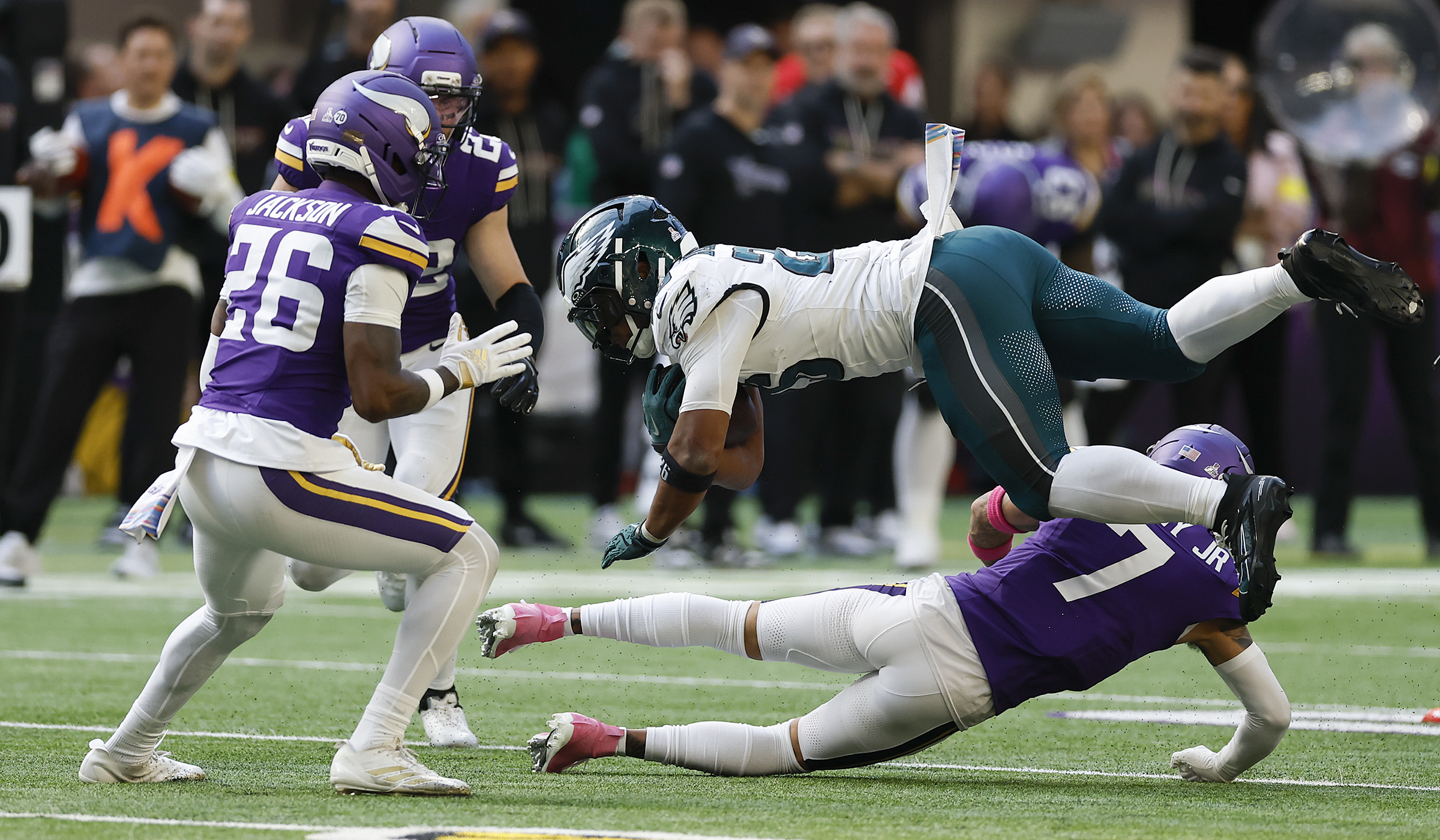
Barkley had some early success Sunday on under-center runs. But it wasn’t sustained. It was tough going from the shotgun and pistol, as well. He was held to just 2.4 yards on 18 carries. Backup running back Tank Bigsby had one rush for 11 yards.
The Vikings employed an inordinate number of six-man fronts to corral Barkley. Overall, he’s averaging just 3.3 yards and has seen fewer yards before contact than last year. But he said he didn’t agree with the narrative of defenses selling out to stop him.
“We’re just not getting a job done. I’m not getting the job done,” Barkley said. “That’s just the case. I own the run game. That’s my responsibility.”
Eagles running back Saquon Barkley has struggled to break loose all season, and Sunday at Minnesota continued that trend.
He has missed holes, but the interior of the O-line has also struggled. Brett Toth got tossed into the barrage for Jurgens even though he has mostly played guard this season. Dickerson is clearly not 100%. And right guard Tyler Steen’s performance has been up and down.
“Saquon is the best and I don’t want him to feel like he’s carrying that by himself,” Hurts said. “It is a group effort.”
Hurts still hasn’t factored as much in the running game. He had an early keep that netted no gain. He used his arm instead to offset what the ground attack lacked. It wasn’t as if Patullo dropped Hurts back an exorbitant amount. The run-pass ratio was a relatively balanced 45-55.
But the Vikings’ aggressive defense offered opportunities downfield that the Eagles took advantage of in the second half.
“The thing was to come in and establish the run,” Hurts said. “That’s what we wanted to come in and do, and the game just flowed the way it did, and we were able to be efficient in the pass game. KP was very timely, and I think we were able to doctor up some things on the sideline and work through some things, but those guys made big-time plays.”
Those guys — Smith and Brown — had been clamoring for more deep shots. Hurts throws the long ball as well as any quarterback, but he’s had a few uncharacteristic misses this season. But he connected on all five deep passes for a career-high 215 yards when the Vikings had allowed only three deep completions all season, according to NextGen Stats.
Smith finished with a career-high 183 receiving yards on nine grabs, while Brown had four catches for 121 yards and two touchdowns. Both receivers caught passes on scramble drills when Hurts extended plays. But there were also completions within structure, like Brown’s 26-yard seam route score.
“You see it sometimes on the sideline. Sometimes in the huddle. Sometimes he’ll call the play, he’ll say a little slick remark,” Smith said. “And, OK, he sees it. He knows what’s coming.”
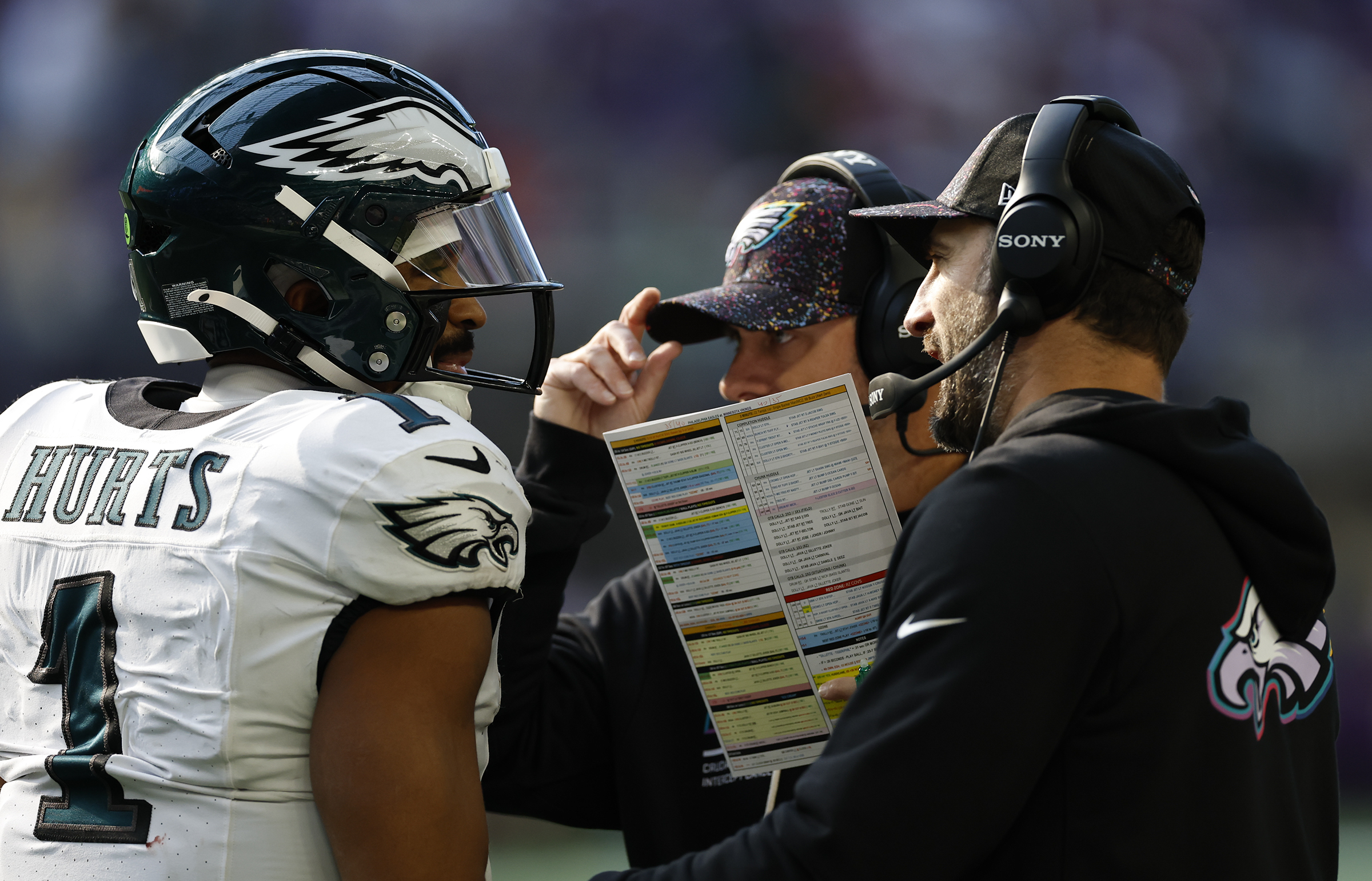
Eagles head coach Nick Sirianni (right) talking to quarterback Jalen Hurts with offensive coordinator Kevin Patullo.
Hurts knew what was coming on third-and-9 and the game on the line. Barkley had already been stopped on first down, and a second-down toss to Brown fell incomplete. A run would have forced Minnesota at least to take a timeout.
But Hurts’ pre-snap read indicated Brown would be matched up in man coverage. He singled his receiver to run a “sluggo” route. Brown got Rodgers to sit on the slant and pulled in the 45-yard kill shot to cement what was one of Hurts’ best-ever games.
Mailata said it was second to Super Bowl LIX, when Hurts similarly had to step up when Barkley was kept in check. The 27-year-old seems to play his finest when public doubt seeps in about his capabilities.
“It was just a matter of trying to find ways to get it done,” Hurts said. “It’s not a time to hope. It’s not a time to want or wish something can happen. It’s the time to make it happen. And I think that was a collective thing by everybody.”
Eagles offense still lopsided
The Eagles collectively didn’t suggest they solved all their problems. The running game issues aren’t going away, although having under-center play-action on film could make opponents alter how they defend Barkley.
And one outstanding outing does not make Hurts a drop-back maestro. Sirianni and Patullo likely don’t want an offensive identity that has him throwing as much as he did in losses to the Denver Broncos and Giants.
He can do it, but if the 5-2 Eagles are to have any hope of making a postseason run, they have to be multiple on offense.
“Identity is important. Don’t get me wrong,” Hurts said. “But for a long time now we find ways to win games in a ton of different ways.”
The University of Pennsylvania Health System, the Philadelphia region’s biggest provider of cancer care and a national leader in developing new treatments, is spending more than $500 million on two new cancer facilities in Philadelphia and central New Jersey to keep growing.
“What we’ve seen pretty consistently is that demand is there to meet any capacity increases,” Julia Puchtler, the health system’s chief financial officer, said in an interview about fiscal 2025 financial results.
Penn is not alone in its push to expand cancer services. Jefferson’s Sidney Kimmel Cancer Center, Temple’s Fox Chase Cancer Center, and the MD Anderson Cancer Center at Cooper are pushing into the suburbs to reach more patients.
The same thing is happening nationally as financially pressured health systems are looking for ways to increase revenue in a growing and lucrative market for cancer care.
Penn stands out locally for the scale of its investment in a strategy to deliver cancer care seamlessly across its seven hospitals and a growing network of outpatient clinics, with the expectation that patients will keep coming back for their ongoing health needs.
Penn sees an opportunity to expand its market share even more, as cancer diagnoses rise. The U.S. is expected to see a nearly 40% increase in cancer diagnoses between 2025 and 2050, according to the Philadelphia-based American Association of Cancer Research.
Experts attribute the rise to a wide variety of factors, from better early detection, to longer life spans, and to environmental exposures that are poorly understood.
Much of Penn’s investment is in outpatient facilities, including a $270 million center being built in Montgomeryville that will have radiation oncology and an infusion center. “More and more patients want to receive care closer to home,” according to Lisa Martin, a senior vice president at Moody’s Rating. “All of that is really what’s behind all of this investment.”
Cancer treatment overall is profitable. At Penn, cancer services account for up to 60% of the system’s operating margin by one simple measure that subtracts direct costs from direct revenue and excludes back-office expenses and other centralized costs.
Puchtler attributed the profitability of cancer care to the prevalence of drugs, such as chemotherapy, that Penn can buy at a discount, while getting the full price from insurers, and the higher percentage of younger cancer patients with better-paying private insurance than is typical for many healthcare services.
The expansion efforts are expensive in an industry where the consumers both benefit from advances and pay ever-rising healthcare costs. Proton therapy, in particular, costs more, but has not yet been proven to have better outcomes across a wide range of cancers.
The intensifying competitive landscape
Penn treats about one-third of adults with cancer in its market area, which stretches from central New Jersey to the Susquehanna, according to Robert Vonderheide, who is director of Penn’s Abramson Cancer Center and leads all of Penn’s efforts in oncology treatment and research.
Penn counted 47,053 new cancer patients in the 12 months that ended June 30, up 40% from five years ago, according to Penn. The system has 14 locations where patients can receive chemotherapy and even more radiation oncology sites.
Competitors are also trying to expand their reach, and Temple’s Fox Chase Cancer Center is succeeding.
window.addEventListener(“message”,function(a){if(void 0!==a.data[“datawrapper-height”]){var e=document.querySelectorAll(“iframe”);for(var t in a.data[“datawrapper-height”])for(var r,i=0;r=e[i];i++)if(r.contentWindow===a.source){var d=a.data[“datawrapper-height”][t]+”px”;r.style.height=d}}});
Fox Chase had 21,442 new patients in fiscal 2025, up 148% from 2020, the nonprofit said. Fox Chase has added suburban offices in Voorhees and Buckingham, Bucks County, and is expanding its infusion capacity at its main campus on Cottman Avenue. Fox Chase has a significantly smaller footprint than Penn, with six locations for infusions and four for radiation.
The MD Anderson Cancer Center at Cooper said it had 4,326 new patients last year, up 27% over the last five years. Cooper has taken the MD Anderson Cancer Center brand to the former Cape Regional Medical Center, which it acquired last year and which used to be part of the Penn Cancer Network. Cooper also offers cancer services at its new Moorestown location.
Jefferson Health’s Sidney Kimmel Cancer Center did not respond to requests for patient data, but has in recent years opened cancer center locations at its Torresdale and Bucks County Hospitals. Jefferson’s cancer center also attained the highest designation from the National Cancer Institute last year — the Philadelphia region’s third comprehensive cancer center, matching Penn and Fox Chase.
Lancaster County resident Susan Reese, 56, said she experienced smooth cooperation between her doctor at Penn’s Lancaster General Hospital and the team at HUP during her treatment for non-Hodgkin lymphoma.
“I never had any question in my mind that one doctor didn’t know what the other doctor was doing,” said Reese, who received CAR-T therapy at HUP in September 2022. Penn has since started offering CAR-T at Lancaster General.
After she relapsed in early 2023, she came back to HUP for a stem cell transplant. She could have gone to Penn State Health’s Hershey Medical Center for that. It’s significantly closer to her home in Willow Street, but she wanted to stay within the Penn system.
Reese’s experience of integration of services at HUP and Lancaster General is what Penn is aiming for in a territory that stretches from central New Jersey to central Pennsylvania.
Oncologist Robert Vonderheide, director of Penn Medicine’s Abramson Cancer Center, oversees all Penn’s cancer services and research.
Electronic medical records help with the integration needed to ensure the thousands of cancer patients Penn physicians treat annually get the most advanced care possible, according to Vonderheide, whose research focuses on cellular immunotherapies.
“We treat patients’ cancers now in a very precise way; the precise mutation, the precise type of chemotherapy, the precise dose” are the focus for doctors, Vonderheide said. “This is no longer appropriate for the telephone game. This has to be data-driven.”
Reese’s decision to stay within Penn is part of a broader trend of patients tending to receive all their care within one health system, according to Rick Gundling, a healthcare expert at the Healthcare Financial Management Association in Washington, D.C.
That’s particularly important in oncology, which typically involves multiple specialties, such as medical oncology, radiation oncology, and surgical oncology, he said.
“Seamless coordination across all those disciplines really makes it a better patient experience and clinical experience because it reduces delay, improves access,” Gundling said.
Taking advanced treatments from HUP to the network
Part of Penn’s strategy is to begin offering advanced services at locations beyond HUP. That’s where Penn pioneered CAR-T cell therapy, which harnesses the immune system to attack cancer, and for years that was the only place Penn offered it.
HUP still performed the bulk of the CAR-T treatments for blood cancers, 123 inpatient cases and 14 outpatient cases last year, but now CAR-T is also available at Lancaster General and at Penn’s Pennsylvania Hospital in Center City.
Fox Chase was the next biggest center in the region for the relatively new treatment that Penn scientist Carl June and his research teams helped develop. For the fiscal year that ended June 30, 2025, Fox Chase had 21 inpatient cases and 67 outpatient cases, the center said.
In the Penn system, certain kinds of bone marrow transplants also used to be available only at HUP. “Now we do them at HUP and Pennsylvania Hospital,” Vonderheide said.
Even the most complicated pancreatic surgeries are going to be done at Princeton, in conjunction with experts at HUP, Vonderheide said. Penn held a ceremonial groundbreaking Monday for the hospital’s $295 million cancer center.
Remaining only at HUP are bone marrow transplants that use another person’s cells to treat blood cancers, Vonderheide said. HUP performed 118 of those so-called allogeneic bone marrow transplants on the top floor of its $1.6 billion patient pavilion, now known as the Clifton Center.
Pennsylvania’s next-biggest provider of the treatment was Hershey Medical Center, near Harrisburg, with 71, according to state data.
window.addEventListener(“message”,function(a){if(void 0!==a.data[“datawrapper-height”]){var e=document.querySelectorAll(“iframe”);for(var t in a.data[“datawrapper-height”])for(var r,i=0;r=e[i];i++)if(r.contentWindow===a.source){var d=a.data[“datawrapper-height”][t]+”px”;r.style.height=d}}});
Penn started offering proton therapy at HUP in 2010, and expanded its availability in the last three years to Lancaster General and Voorhees, through a joint venture with Virtua Health. Those two centers only have one proton machine each, compared to five at HUP.
It’s a type of radiation that is designed to precisely target tumors and do less damage to surrounding tissues. That makes the treatment, which costs more, particularly helpful for children, and it is proving beneficial for treating certain neck and throat cancers.The use of proton therapy for the more common prostate cancer has been more controversial.
Penn’s fourth proton center, with two machines, is under construction and is expected to open at Presbyterian in late 2027. When that $224 million center opens, Penn will have more proton treatment rooms than the entire West Coast, said Jim Metz, chair of radiation oncology at Penn.
Currently about 10% of Penn’s roughly 10,000 annual radiation oncology patients are treated with protons, though it’s a higher percentage at locations with proton machines, Penn said.
Penn officials have noted that some cancer patients come to Penn for proton therapy. Even when it’s not appropriate for them, they tend to stay within Penn. “We have seen, when we build protons, our market share increases, ” Metz said.
Editor’s note: This article has been updated with more recent Fox Chase data.
Jalen Hurts was fantastic. He seems to always play his best when doubt seeps in about his abilities. He completed 19 of 23 passes for 326 yards and three touchdowns and iced the game when he lofted a 45-yard strike to A.J. Brown. Hurts finished with a perfect 158.3 passer rating.
He may not always be great within structure, but he killed the Vikings when forced to extend plays in the second half. Hurts found receiver DeVonta Smith once for 28 yards, later for 21 yards, and Brown for 13 in between. The first two completions came on long third downs.
window.addEventListener(“message”,function(a){if(void 0!==a.data[“datawrapper-height”]){var e=document.querySelectorAll(“iframe”);for(var t in a.data[“datawrapper-height”])for(var r,i=0;r=e[i];i++)if(r.contentWindow===a.source){var d=a.data[“datawrapper-height”][t]+”px”;r.style.height=d}}});
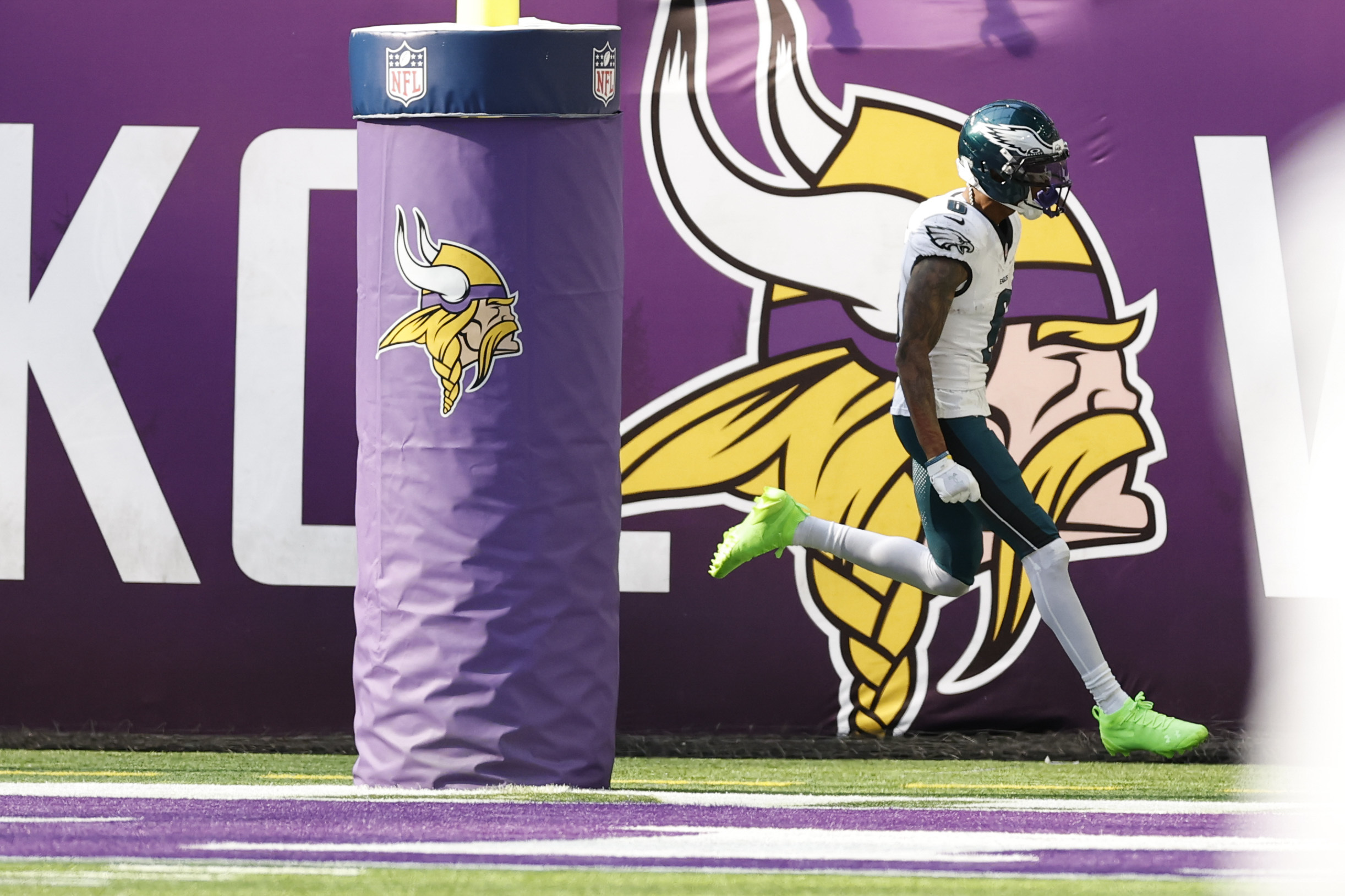
Hurts followed the last scramble drill completion with a dart to Brown for a 26-yard touchdown. He hooked up with him to open the game on another scramble drill that resulted in a 37-yard score. There was a lull after that, but Hurts did what he does best with a 79-yard touchdown bomb to Smith to open the second half.
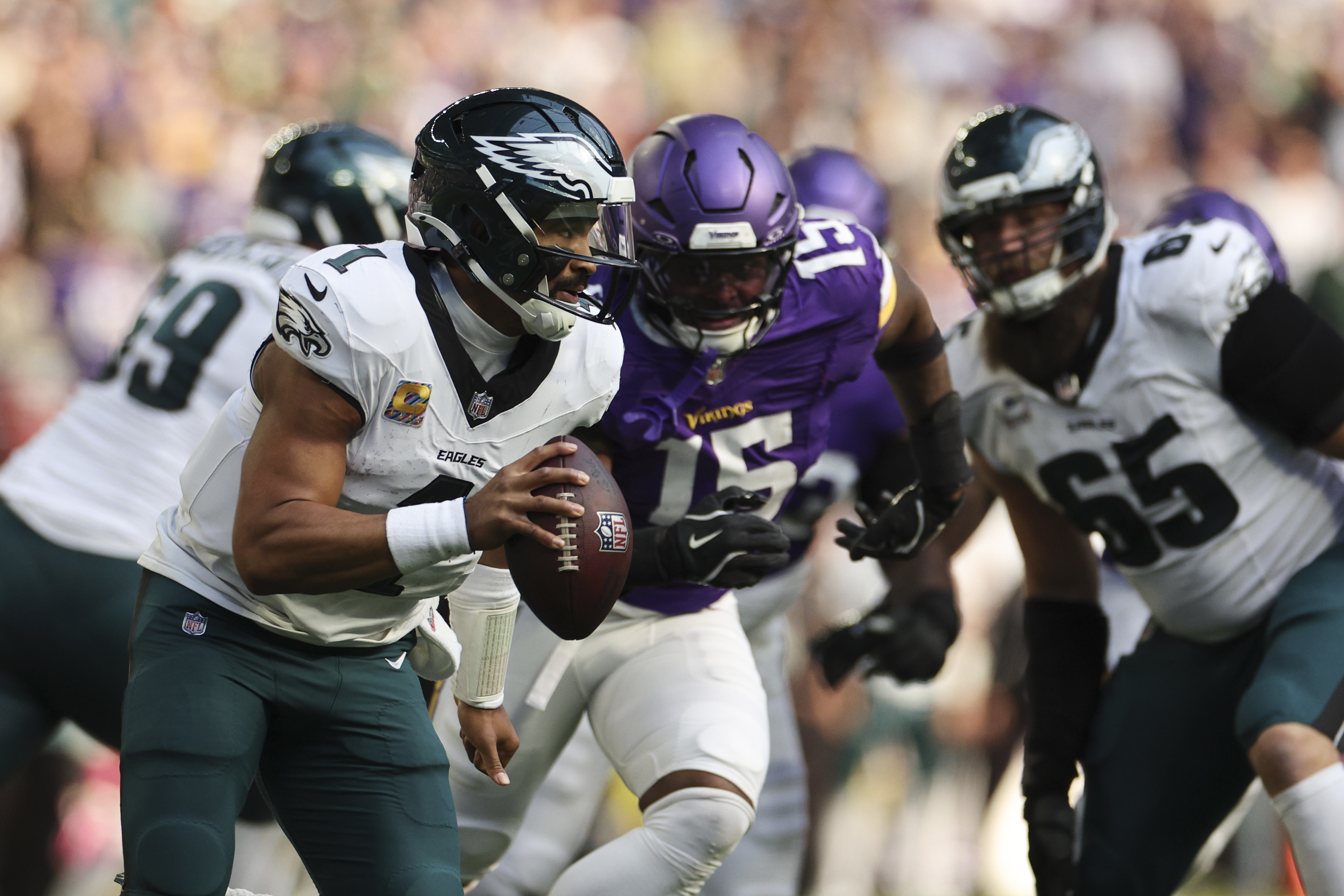
Eagles quarterback Jalen Hurts completed 19 of 23 passes for 326 yards and three touchdowns against Minnesota.
Running back: B
It was another tough day on the ground for Saquon Barkley, but he ran hard. He finished with 44 yards on 18 carries. Barkley had a couple of shifty moves on a 7-yard rush in the second quarter. He also had his longest rush of 13 yards brought back by a holding penalty.
Barkley’s blitz pickup remained a problem. He got run over by Vikings linebacker Eric Wilson — and still held him — before Hurts got sacked in the second quarter. Will Shipley did better a series later, and Hurts was able to throw for a first down. Tank Bigsby had a carry on the Eagles’ first series that went 11 yards off tackle. AJ Dillon, a game after he fumbled, was inactive for the first time this season.
Cameron Latu was the lead blocker on a Barkley 5-yard run in the third quarter.
DeVonta Smith produced his second 100-yard receiving game of the season. He caught nine passes for a career-high 183 yards and a touchdown. He toasted former Eagles cornerback Isaiah Rodgers with a double move on the 79-yard touchdown.
Earlier, Smith failed to pull in a third-down jump ball over Rodgers in the first quarter, but it was high on the scale of difficulty.
A.J. Brown’s early touchdown was his lone target until the third quarter. He took advantage of great pass protection and released up field beyond man coverage for a 37-yard touchdown on the game’s first possession. Brown caught a 26-yard touchdown on an in-breaking route in the fourth quarter. His 45-yard grab at the end put him over 100 yards for the second time this season.
Tight end Dallas Goedert had a relatively quiet day as a receiver, catching three passes for 18 yards. With Grant Calcaterra (oblique) out, Kylen Granson, EJ Jenkins, andLatu handled second and third tight end blocking.
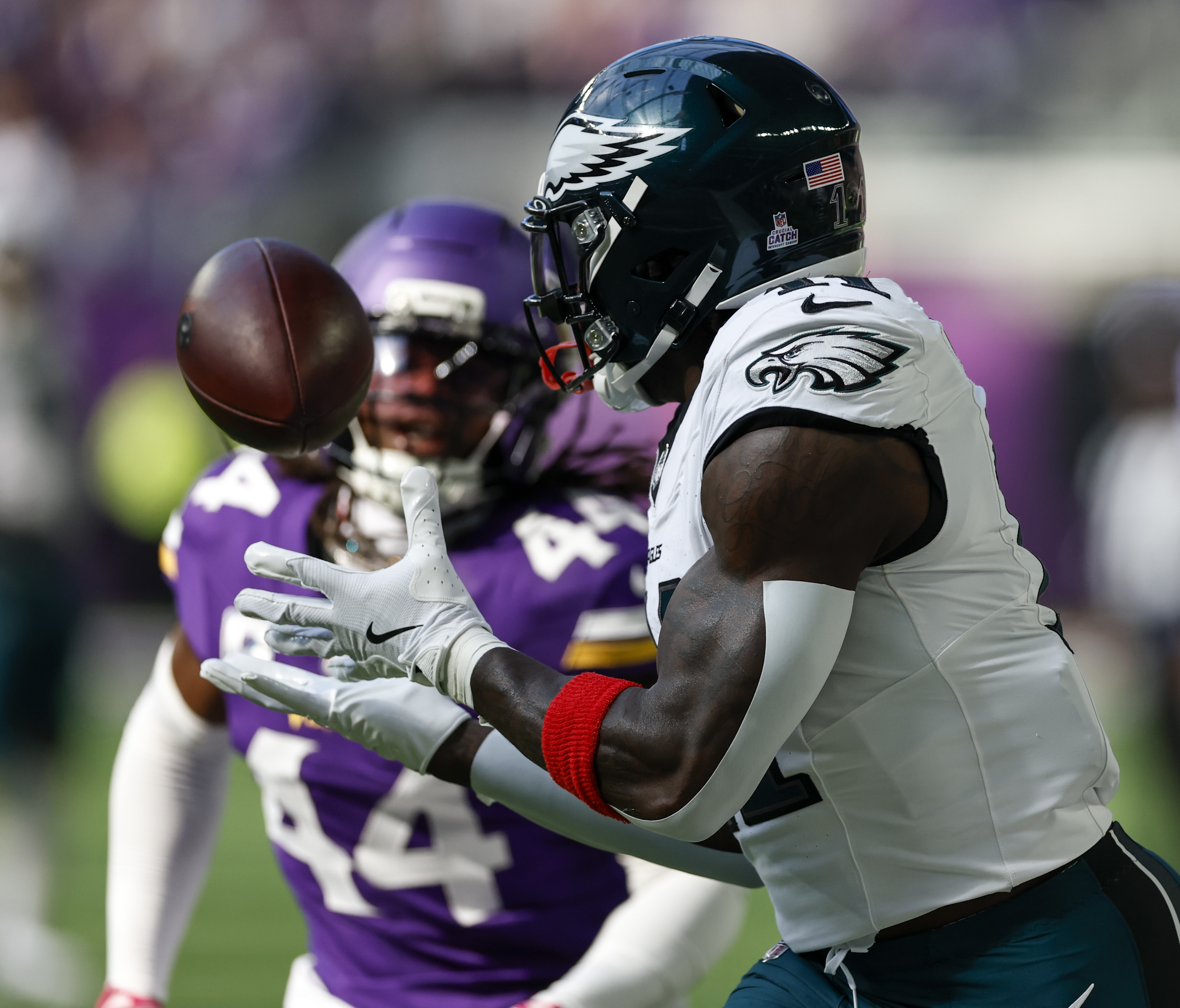
Eagles wide receiver A.J. Brown catches the ball on his first-quarter touchdown reception.
Offensive line: B
Center Cam Jurgens was sidelined in the second quarter with a knee injury and was replaced by Brett Toth. Rookie center Drew Kendall was inactive as he has been for most of the season. Toth got bowled over on one of his first snaps and Barkley was dropped in the backfield. He couldn’t hold his block on a Barkley third-down run in the fourth quarter.
Landon Dickerson was back at left guard after missing the New York Giants game with an ankle injury. He had a clear-out lead block on an early Barkley carry and held up despite multiple nagging injuries. Right guard Tyler Steen’s holding penalty in the third quarter brought back a Barkley 13-yard run.
Tackles Jordan Mailata and Lane Johnson didn’t allow much edge pressure in pass protection. Mailata did appear to get beaten on the blind side once in the fourth quarter. He also committed an early first-half holding penalty.
The O-line led the way on a successful fourth-down Tush Push on the opening drive, despite the Vikings laying a defender on the ground behind the ball. Brown’s false start denied a second try a drive later.
Fred Johnson was the sixth O-lineman on a couple of early runs, later setting up the bomb to Smith.
Defensive line: B+
The Eagles held Vikings running backs to just 3.2 yards a carry. The defense allowed running back Jordan Mason to rush five times for 34 yards to open the second half, but the group tightened the hatches down the stretch. The pass rush was effective early, then not-so-much for a period, until Moro Ojomo‘s third-down sack early in the fourth quarter forced the Vikings to settle for a field goal.
Jalyx Hunt had the early defensive play of the game with a second-quarter pick-six. The outside linebacker dropped into coverage and Vikings quarterback Carson Wentz threw it right to him. Hunt didn’t do as well the next time he was targeted in coverage, when some Minnesota trickery resulted in him committing pass interference.
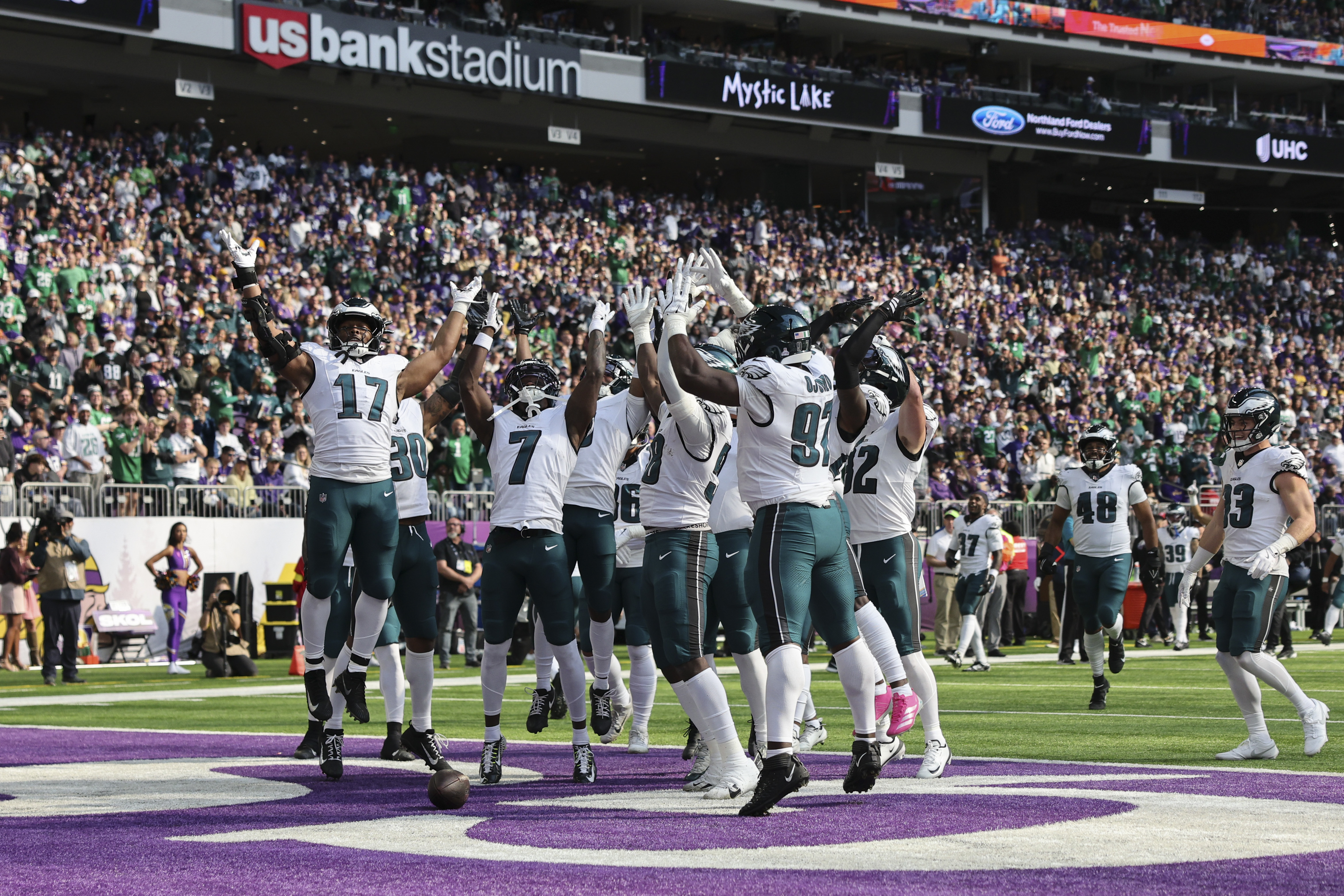
The Eagles celebrates Jalyx Hunt’s interception return for a touchdown in the second quarter.
Jalen Carter,who returned to the lineup after a one-game absence, hurried Wentz on the interception with an inside rush. He was credited with another hit just before the half. He broke through and forced Wentz out of the pocket before he threw his second pick in as many drives. Jordan Davis held up Vikings blockers before making two run stops near the line in the second quarter.
Azeez Ojulari went inside early with a hamstring injury, which forced an already-depleted edge rush corps to lean on Hunt, Joshua Uche, and Patrick Johnson. Uche delivered with a late sack.
Linebacker: A-
Rookie Jihaad Campbell played some outside linebacker for the first time this season. It allowed Nakobe Dean to take his first defensive snaps of the season at off-ball linebacker. Campbell had some edge-rush chances but didn’t get home. He finished with three tackles.
Dean finished with six tackles, including a run tackle for loss in the third quarter. He was behind only Zack Baun (10) in tackles. Baun was all over the field. He made a tough open-field tackle on a pass to the flat in the second quarter.
Jeremiah Trotter Jr. injured an ankle on punt duty and never returned.
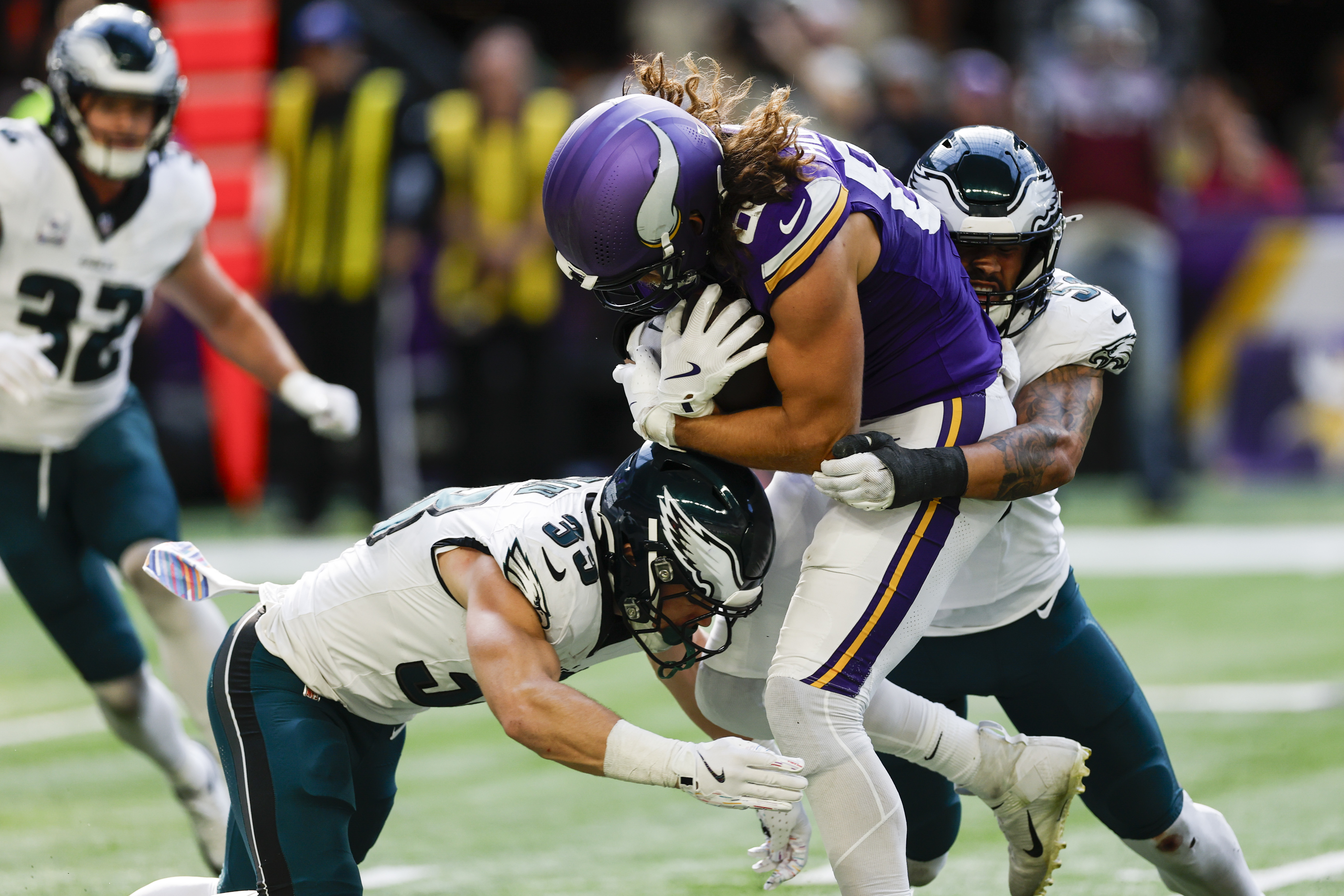
Eagles cornerback Cooper DeJean (left) and linebacker Zack Baun stop Minnesota tight end T.J. Hockenson during the third quarter.
Cornerback: B
Adoree’ Jackson got the nod ahead of the benched Kelee Ringo. He didn’t allow much until Vikings receiver Jalen Nailor converted a third down in the third quarter. Jackson got up slowly and a play later suffered a game-ending concussion. That forced the embattled Ringo into action. A drive later, Vikings receiver Jordan Addison toasted Ringo on a 25-yard crossing route.
Quinyon Mitchell didn’t follow elite receiver Justin Jefferson. He wasn’t targeted much by Wentz, but his soft coverage in the fourth quarter allowed Addison a relatively easy 20-yard reception.
Cooper DeJean was up and down. He had tight coverage on Addison in the end zone on a Wentz my-guy-or-no-one overthrow in the first quarter. Playing on the outside, DeJean gave Jefferson too much space on an 18-yard slant route. He let Nailor get behind him for a 26-yard gain in the second quarter. He rebounded later in the possession, though, and broke up an end-zone corner fade to Jefferson.
Drew Mukuba notched his second career interception — another Wentz gift — when he played center field on an ill-advised, up-for-grabs toss. He later whiffed on a sideline tackle attempt and Jefferson turned what should have been a short catch into a 40-yard pickup.
Reed Blankenship played well. He got beaten by Addison on a third-down conversion in the red zone in the third quarter, but he kept the deep middle secure and chipped in with four run stops. The Eagles had a busted coverage when Addison got behind Mitchell in zone coverage for a 37-yard completion in the first quarter.
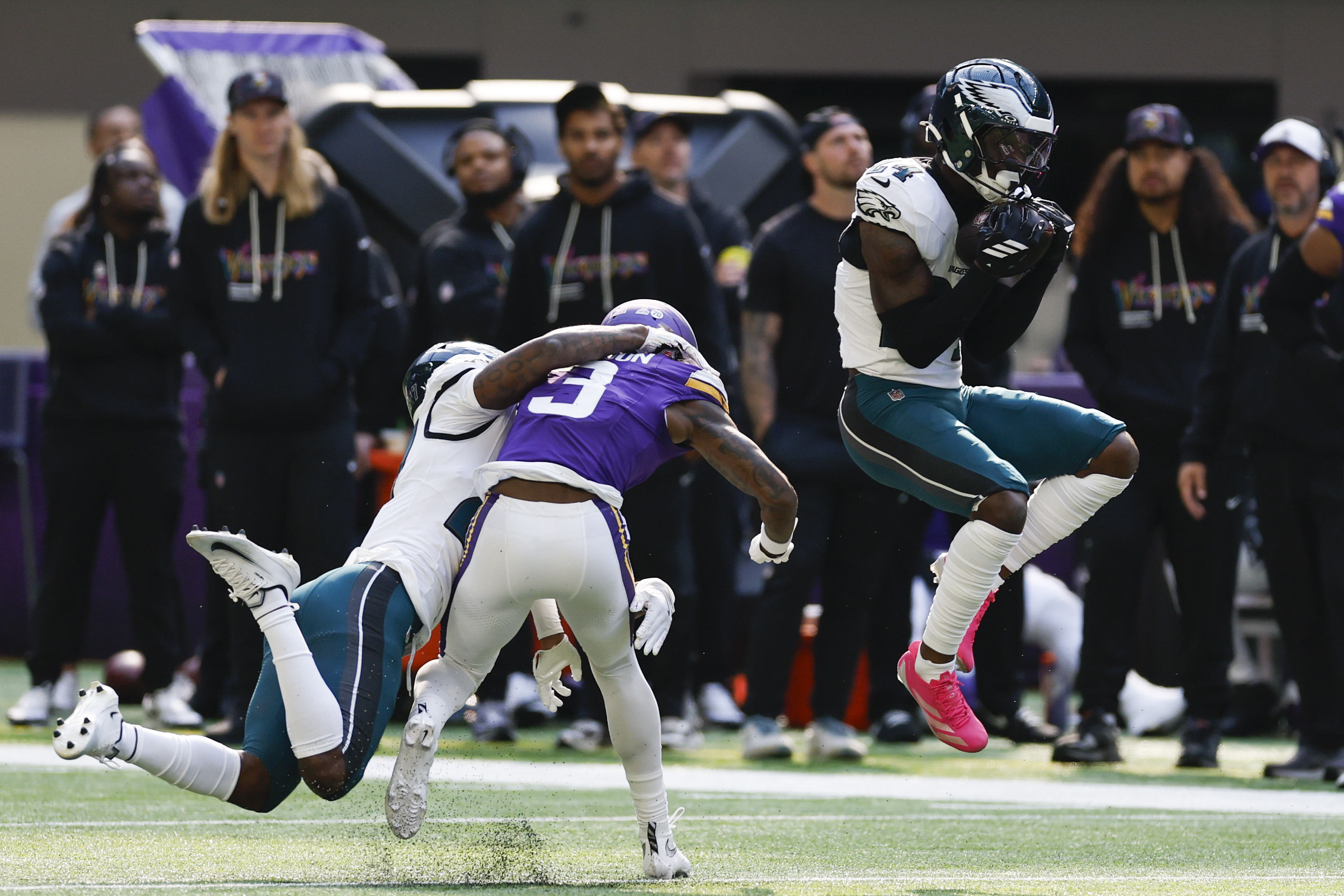
Eagles safety Andrew Mukuba picks off a pass by Minnesota’s Carson Wentz in the second quarter.
Special teams: B-
Xavier Gipson was active for the first time since he was acquired last month. He had five kick returns for a 25.6-yard average, while Shipley averaged 29 yards on two returns.
Kicker Jake Elliott was wide right on a 42-yard field-goal attempt for his first miss of the season. He made all of his extra points. Punter Braden Mann averaged 40 net yards on three boots. The Eagles didn’t have a single punt return.
Latu was flagged for an illegal combo block on a third-quarter Eagles kick return. The Eagles’ kick coverage unit allowed a 38-yard return to open the second half. Elliott’s next kickoff landed short of the landing zone and the Vikings had good field position at the 40.
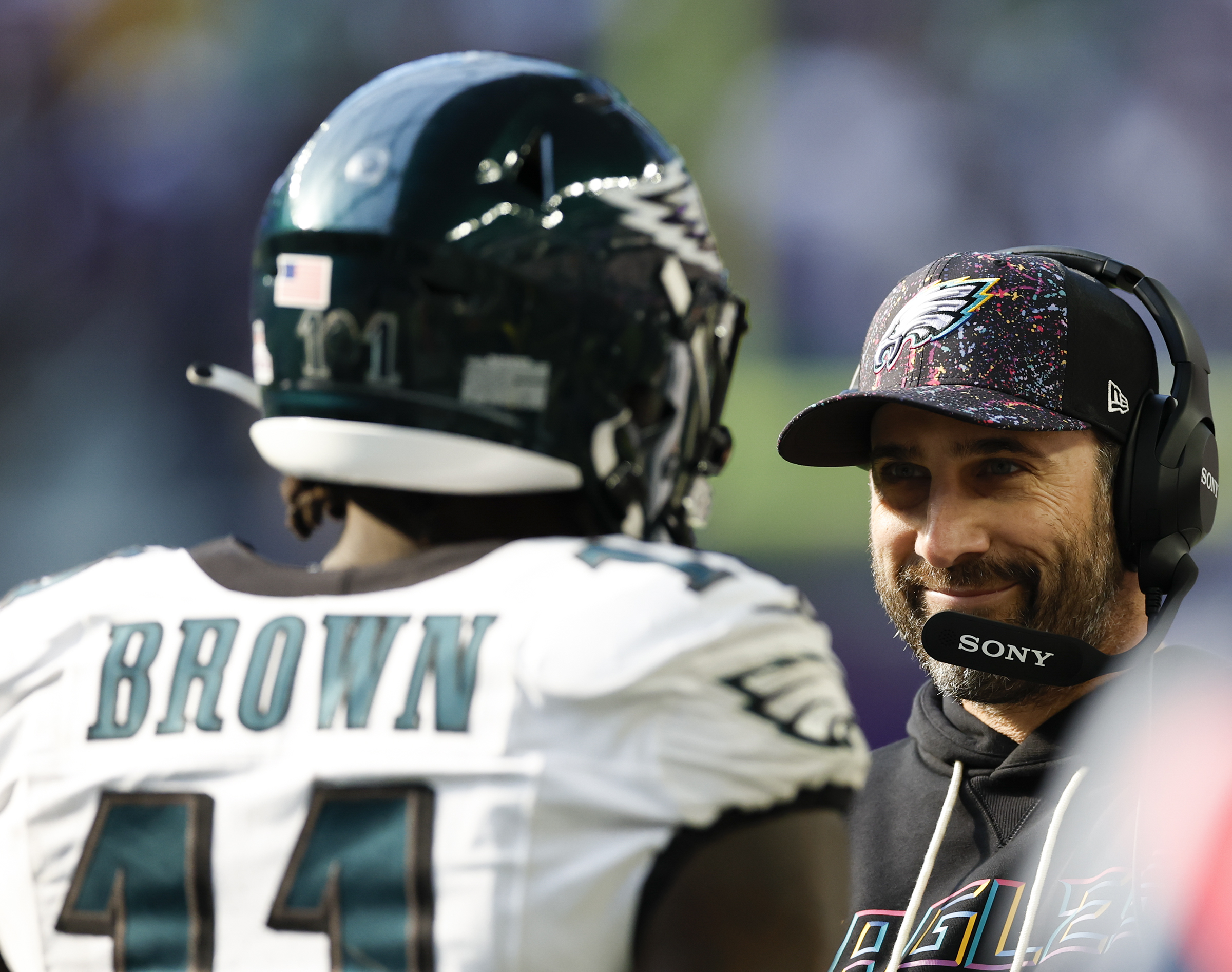
Eagles wide receiver A.J. Brown with coach Nick Sirianni late in the fourth quarter against the Vikings.
Coaching: B+
Coach Nick Sirianni has his team back in the winner’s circle after a two-game losing streak. It wasn’t pretty, but Eagles football during the Sirianni era rarely is. And that’s OK for now as the 5-2 Eagles continue their search for an offensive identity. It may just be relying on Hurts and the passing game.
Offensive coordinator Kevin Patullo dialed up a strong opening script, with plays under center and a fourth-down dagger vs. single high man coverage that resulted in Brown’s 37-yard touchdown. But after that 12-play, 75-yard drive, the offense did very little before the half. The Eagles went three-and-out on their next three possessions, and Hurts was sacked twice before the break came.
Patullo had one of his better moments when he set up the Vikings with six O-linemen and used under-center play action to free up Smith on his 79-yard connection with Hurts. And he just let Hurts roll with it down the stretch and it worked, especially in crunch time.
Vic Fangio’sdefense did a lot of bending and benefited from Wentz’s miscues. But the Eagles were great in the red zone and forced the Vikings to kick five field goals on six possessions inside the 20.