MINNEAPOLIS — Jalen Hurts was rolling to his right, and he continued that way until the slice of available space for him to keep rolling got precariously thin. It was third-and-13 midway through the fourth quarter Sunday, the Eagles leading by two and one failed play away from handing the ball — and maybe the game — back to the Vikings. Two Minnesota defenders, tackle Javon Hargrave and linebacker Dallas Turner, were chasing Hurts, right at his heels, when he zipped a pass to A.J. Brown right at the marker. Thirteen yards. A first down. Just what the Eagles needed, just when they needed it.
That was Hurts all day, all throughout the Eagles’ 28-22 victory. Whatever they needed, he gave them. And they needed a lot.
They had lost their previous two games. One team leader, Lane Johnson, had called the offense predictable. Another, Brown, was pleading publicly for change, for improvement. Their offensive line is as leaky and damaged as the Titanic post-iceberg. Center Cam Jurgens, who already was playing through pain while still recovering from offseason back surgery, left Sunday’s game with a knee injury. Brett Toth replaced him, and the line, which was rarely opening holes for Saquon Barkley as it was, pretty much stopped generating push on any run plays. Those struggles have done more than just render Barkley mortal. They have made him practically a nonfactor. That ought to be impossible, and it certainly ought to be impossible for the Eagles to win when it happens.
But it did, and they won anyway. They won because Vic Fangio’s defense kept holding the Vikings to field goals in the red zone, and because Carson Wentz — as anyone who remembers his Eagles career knows — remains a maddeningly inconsistent quarterback: glorious individual plays one moment, inexplicable mistakes the next. He threw two interceptions, one of which edge rusher Jalyx Hunt (who played safety in college) returned for a touchdown.
Mostly, though, the Eagles won because their quarterback was as good as he’s ever been for them. Hurts was 19-of-23 for 326 yards, three touchdowns, and a perfect passer rating of 158.3. When has he been better? Perhaps in Super Bowl LIX. This one was a close second, though, at least. A championship wasn’t at stake Sunday, of course, but given the current state of this team, this was as meaningful as a regular-season game gets, and Hurts met the moment.
“Definitely, there was some fire there,” he said. “But within that fire, you have to be the calm.”
window.addEventListener(“message”,function(a){if(void 0!==a.data[“datawrapper-height”]){var e=document.querySelectorAll(“iframe”);for(var t in a.data[“datawrapper-height”])for(var r,i=0;r=e[i];i++)if(r.contentWindow===a.source){var d=a.data[“datawrapper-height”][t]+”px”;r.style.height=d}}});
He did it by feeding his two playmakers on the outside often. Brown and DeVonta Smith combined for 304 receiving yards and all three of those scores, the first of which came when Hurts and Brown improvised on a fourth-and-4 play on the Eagles’ first possession. Brown was supposed to go short. But when Hurts pointed downfield for Brown to go long, their old teammate Isaiah Rodgers, charged with covering Brown, never had a chance.
“He’s got so much swag, a swagginess to him,” tackle Jordan Mailata said. “When he’s in control, you can see the look in his eye … that sharpness to his eye.”
Offensive coordinator Kevin Patullo even broke from what had been par for his play-calling course over the season’s first six weeks by putting Hurts under center and having him throw, and throw deep, from that formation, including on Smith’s 79-yard TD catch in the third quarter. The play marked, according to the research firm Tru Media, the first passing yards that the Eagles had gained all season on a play-action pass in which Hurts had been under center.
“It frees up the passing game a lot more,” Mailata said. “You don’t know if it’s going to be a run. You don’t know if it’s going to be play-action. And you don’t know if it’s going to be a shot play. It gives us versatility.”
Hurts’ final completion again was to Brown — and just as vital as his previous one. Third-and-9 with 1 minute, 45 seconds to go, the sound rising inside U.S. Bank Stadium, the Eagles needing a first down to force the Vikings to burn their timeouts, and Hurts lofted a rainbow to Brown for 45 yards, for that all-important first down, for a chance to finish the Vikings off, finally.
“He’s always clutch in those moments,” coach Nick Sirianni said. “It’s why I have the confidence to go for it on the first drive, on a fourth-and-4, because you know the guys will make plays. Sometimes you watch a game, and it’s like, ‘Analytics say you should go for it here.’ Do you trust your players in those moments? That’s what you lean on.”
It’s maybe the most reliable aspect of Hurts’ game and career. He can be inconsistent. His passing numbers can be sickly. Yet he seems to save his best games for the biggest games. Stability restored, back-to-back losses now buried, he sauntered through the stadium back to the visiting locker room and said, loud enough to be heard but to no one in particular, “We ain’t [obscenity] losers no more.” The Eagles can thank him for that.
STATE COLLEGE, Pa. — Penn State didn’t play scared in its 25-24 loss to Iowa on Saturday.
Interim head coach Terry Smith, who took over after James Franklin’s dismissal last Sunday, trusted his first-time starting quarterback in a hostile environment. He allowed Kaytron Allen to be a workhorse running back. He went for it on several fourth downs, including one at his team’s 40-yard line.
Most importantly, he showed belief in a group searching for some confidence amid an emotional coaching change and a three-game slide.
His team repaid that trust against the Hawkeyes (5-2, 3-1 Big Ten), enough to earn a chance to win late. But Ethan Grunkemeyer’s fourth-down heave fell incomplete, and so did the Nittany Lions’ comeback bid.
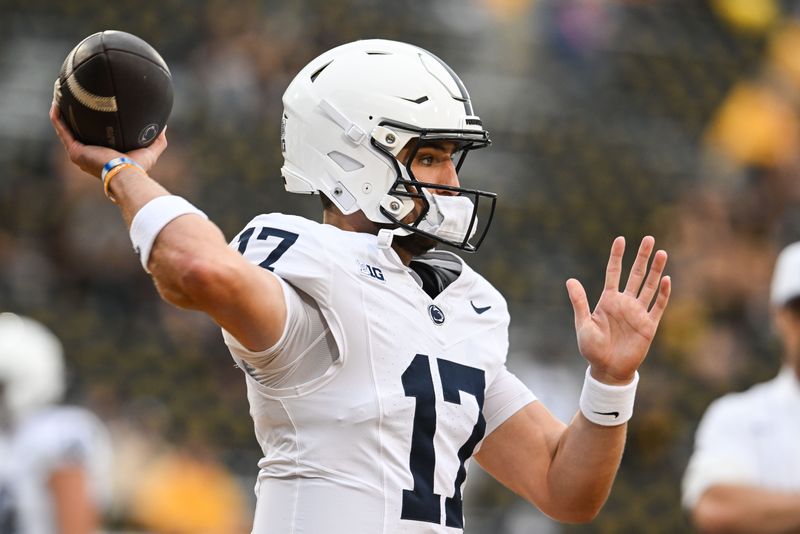
Penn State quarterback Ethan Grunkemeyer performed well in his first start in place of the injured Drew Allar.
Smith asked his players to leave it all on the field. His message was well received.
“I think our guys played hard. I think our guys left it out there,” Smith said. “They gave everything they had. There was no one who didn’t give great effort. We just have to execute.”
Penn State (3-4, 0-4) fell under .500 for the first time since 2021, the same year it last lost four straight games.
Under Franklin, Penn State stuck to a script. It played the same players, no matter their production, and rarely gambled on fourth down or in end-of-half situations.
Saturday showcased Smith’s differing approach, one that asked his team to “empty the clip.”
Penn State converted two fourth downs on its first scoring drive and later attempted two more. Its offense aggressively pushed to score at the end of the first half rather than worrying about handing its opponent an extra possession, which Franklin did against UCLA earlier this season.
“We knew coming into the game we wanted to be aggressive,” Smith said. “You’re on the road at night in a place like this. You have to come to win. You can’t try to just lose your way into victory.”
Smith played several players who rarely, if ever, saw action through the first six games. Notably, Koby Howard and Jaxon Smolik, who both had not played since Sept. 13.
Howard, a freshman wide receiver, caught a 14-yard pass in the opening quarter for his first collegiate reception. Smolik, Penn State’s speedy backup quarterback, ran several option plays, an added element to Andy Kotelnicki’s offense. He finished with four carries before exiting with an injury and returning with an air cast on his left arm.
Smith also relied heavily on Allen, who entered Saturday tied in total carries with Nick Singleton despite averaging nearly 3 more yards per carry. Against Iowa, Allen rushed a career-high 28 times for 145 yards and two touchdowns. Singleton rushed six times for 15 yards, both season lows.
When Smith assumed the interim title, he said no one would question his team’s effort. That included Allen, who refused to quit amid Penn State’s four-game slide.
“I’m all about playing football for my team,” Allen said. “I would never quit on my team, never quit on anybody. That’s just who I am. Whatever I start, I’ve got to finish.”
Getting used to QB1
Grunkemeyer’s inexperience showed in his first collegiate start.
In a hostile environment, he seemed to rush his decisions. And against the nation’s No. 8 scoring defense, his two interceptions proved costly.
The redshirt sophomore completed 15 of his 28 pass attempts for 93 yards. He pushed Penn State to midfield on its final drive but couldn’t march farther.
“Not good enough,” Grunkemeyer said. “We lost the game, so [we’ve] got to get better and learn from it.”
His biggest blunder came late in the first half when he tossed a third-down pass off Luke Reynolds’ face mask and into an awaiting Iowa defender’s grasp. The Hawkeyes followed with a touchdown to take the lead. Smith said Grunkemeyer forced his throw to Reynolds but praised his overall performance.
“I thought [Grunkemeyer’s] game was solid,” Smith said. “I thought he managed the line of scrimmage, the calls at the line of scrimmage, and handled the crowd.”
It wasn’t all bad for Grunkemeyer, who led two 10-play scoring drives and completed five straight passes in the second quarter.
Up next
Penn State gets to regroup on a bye week before its road clash with No. 1 Ohio State (7-0, 4-0) on Nov. 1.
The Eagles travel to face the Minnesota Vikings in a Week 7 matchup at U.S. Bank Stadium at 1 p.m. on Sunday. Here’s what you need to know about the game:
Vikings defensive coordinator Brian Flores is known for blitzing a lot.
When the Eagles have the ball
We’ve seen Nick Sirianni switch it up offensively coming out of mini-byes or byes before, with the emphasis often placed on the run game. The guess here is that he will take the same approach this season. The Eagles desperately need to get Saquon Barkley going on the ground. There have been glimpses in the last few games, but play caller Kevin Patullo hasn’t stuck with it enough for various reasons.
The Vikings’ run defense offers an opportunity to get on track (of course, so apparently did the New York Giants last week). They rank 24th in the NFL in expected points added (EPA) per rush and have allowed 132.2 yards a game. The Eagles haven’t won as much at the point of attack, but Minnesota is light on its defensive line. Landon Dickerson (ankle) could return at left guard, but playing at far less than 100% hasn’t helped.
The Eagles don’t major in under-center plays. They ranked 30th in snaps there. But I think we may see more of Jalen Hurts in that formation. It would conceivably help get Barkley downhill, and if successful, open up play action. They just can’t tip off defenses with their tendencies and may need to throw from under center a few times early on.
Vikings defensive coordinator Brian Flores is likely willing to give up yards on the ground because his No. 1 EPA-ranked pass defense has been stingy. Flores is a master of creating chaos. Yes, he blitzes a lot — a second-most 35.8% rate — but it’s his simulated pressures and disguised coverages that have given quarterbacks the most fits. The Eagles have struggled mightily against the latter two, partly because they’re often late to the line.
Flores leans heavily on zone coverages (77%) and employs a lot of two-high safety shells, often in Cover 2 or 6. The Eagles have seen zone more than ever and have had trouble working the intermediate part of the field.
Only 9.9% of Hurts’ attempts have traveled 10 to 19 yards, less than half the NFL average of 20.1%. Sirianni, Patullo, and Hurts have to do a better job of getting the ball to receivers A.J. Brown and DeVonta Smith in space. Eagles receivers are averaging only 4 yards after the catch, which ranks 32d — last — in the league.
Carson Wentz will make his second career start against his former team, this time with the Vikings.
When the Vikings have the ball
The Eagles will face former franchise quarterback Carson Wentz for the second time since he was traded in 2021. It didn’t go well for Wentz in the first round. Then, with Washington, he got overrun by the Birds’ pass rush and was sacked nine times and fumbled twice. He still holds the ball too long and wants to play the hero.
But the Eagles’ front isn’t as ferocious and he has a solid offensive line, assuming that most of the starters are playing. Christian Darrisaw and Brian O’Neill (sprained MCL) are plus tackles. Rookie left guard Donovan Jackson is back from a wrist injury, but backup center Michael Jurgens (hamstring) and O’Neill are questionable.
Wentz, despite his flaws, can still make throws many quarterbacks can’t. And he has arguably the best receiver in the NFL. Justin Jefferson will draw additional attention from Vic Fangio’s defense. Cornerback Quinyon Mitchell has followed top receivers this season, but his recent hamstring injury could hamstring Fangio’s coverage plans.
If opposite-side corner Adoree’ Jackson, who steps back into the starting role after Kelee Ringo’s benching, is matched up against Jefferson, Fangio will likely cloud his side. Jefferson alone, for context, has matched Hurts’ 10 intermediate-length completions this season for 205 yards. Jordan Addison is a potent No. 2 receiver.
The Eagles’ run defense has been leaky. They rank 20th in EPA per rush and 26th in success rate. With defensive tackle Jalen Carter (heel/shoulder) out last week, the Giants ran it down their throats. Minnesota running back Jordan Mason (4.7 yards per rush) has been effective in Aaron Jones’ absence.
It’s been an 11-man problem in stopping the run, but the Eagles have been susceptible on the edges. That isn’t just an outside linebacker issue, but a suspect pass rush that can be traced to the ineffectiveness of the Eagles’ edges. The current group, after Za’Darius Smith’s retirement, has just one collective sack.
Jalyx Hunt, Joshua Uche, Azeez Ojulari, and Patrick Johnson (owner of said sack) have gotten pressure at times, but if Wentz has an extra click in the pocket, you can be sure he’ll often find an open Jefferson downfield.
Eagles beat writers Olivia Reiner and Jeff McLane will provide a preview of the game before the Eagles face the Minnesota Vikings on Sunday.You can tune in here.
Extra point
I don’t know what to make of this Eagles team through six games. I thought there would be early-season struggles, and predicted a 4-2 start. I just didn’t think it would look like this. Fangio’s unit has not played well over the last five quarters, but the offense’s second-half malaise against the Denver Broncos led to a fourth-quarter meltdown. And losing Carter and Mitchell clearly affected the Eagles at the Meadowlands. It shouldn’t have looked that pathetic.
There are still concerns at corner, edge, and safety. And where has defensive tackle Jordan Davis been the last three games? But it’s the pains on the other side of the ball that are more disconcerting. I keep expecting talent to win out, but the Sirianni-Patullo-Hurts trinity has had more holes than holiness. I foresee a tough, grind-it-out outcome, so the game could go either way. But I have a hard time riding with Wentz.
When he looks up from assembling the Phillies’ roster, Dave Dombrowski watches sports. One thing recently caught his eye. The Golden State Warriors are poised to open the NBA season with four starters who are 35 or older.
“It’s never happened before,” he said.
Dombrowski, the team’s president of baseball operations, brought this up Thursday, midway through his 54-minute news conference in Citizens Bank Park, to make a point: Aging teams can contend for titles.
It’s relevant because if the Phillies achieve their offseason priority of re-signing free agents Kyle Schwarber and J.T. Realmuto, who will be 33 and 35 next season, at least four of the top hitters in the projected opening-day lineup will be 32 or older and locked up to multiyear contracts. It would be so uncommon that Schwarber joked about it several months ago.
“We would love to all finish our careers together,” he said. “But who would want to come out and want to watch a bunch of 40-year-old dudes play baseball? Right?”
Warriors fans might not mind the basketball version, but there’s a notable difference. Whereas Stephen Curry and Draymond Green won four championships together before teaming with Jimmy Butler and Al Horford, the Phillies’ core — Bryce Harper (33), Trea Turner (32), Schwarber, Realmuto, and pitchers Zack Wheeler (35) and Aaron Nola (32) — is still title-less.
The Phillies are coming off 96 wins, 95 last season, and 90 the year before. It would be irrational to blow it all up based on one bad week in each of the last three Octobers and impractical given all the long contractual commitments made by Dombrowski and owner John Middleton.
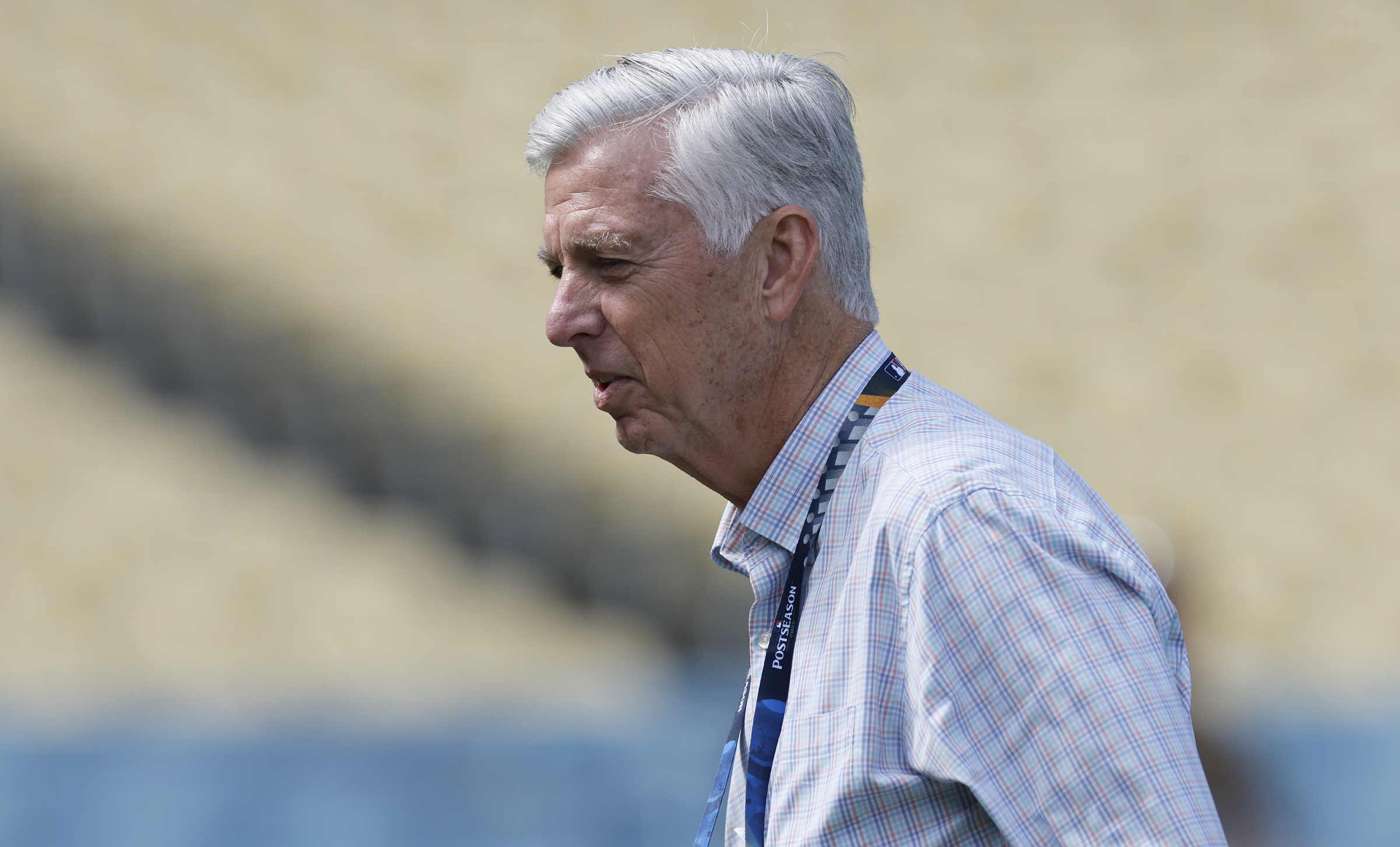
Phillies president of baseball operations Dave Dombrowski must balance blending an aging core with young players from the farm system.
But in addition to an eyebrow-raising challenge to Harper — “I guess we only find out if he becomes elite or if he continues to be good. … I’ve seen guys at his age that level off, or I’ve seen guys rise again. We’ll see what happens” — the takeaway from Dombrowski’s end-of-season gab session was that he realizes the need for an infusion of youth, even as the Phillies prepare a nine-figure offer to Schwarber and discuss how far to go to retain Realmuto.
To extend the NBA comparison, the Phillies must incorporate their Moses Moody and Jonathan Kuminga, the 23-year-olds among the Warriors’ graybeards.
“We have some young players that we’re going to mesh into our club,” Dombrowski said. “I’m not going to declare that anybody has a job. But there will be some people that we’re really open-minded to being with our big league club next year, coming out of spring training.”
Unsurprisingly, Dombrowski mentioned outfielder Justin Crawford and right-hander Andrew Painter. He also name-checked Otto Kemp, who made his major-league debut in June and could fit next season as a right-handed bench bat.
But Dombrowski said he “wouldn’t even preclude [infielder] Aidan Miller from being that type of guy” to contribute in 2026, an indication that the Phillies are ready to push down harder on the prospect pedal.
They were conservative this season, consistent with their recent philosophy. A recent Fangraphs study showed that only 24 players have made their major- league debut with the Phillies since 2022, the third-fewest in baseball after the Yankees and Braves.
The trend must change.
“It’ll be very interesting next spring training because those guys, they’re on the doorstep, and a couple of them are ready to go,” manager Rob Thomson said of Crawford, Painter, and Miller. “So we’ll see. I love young players because they always bring energy. But they have to perform, too.”
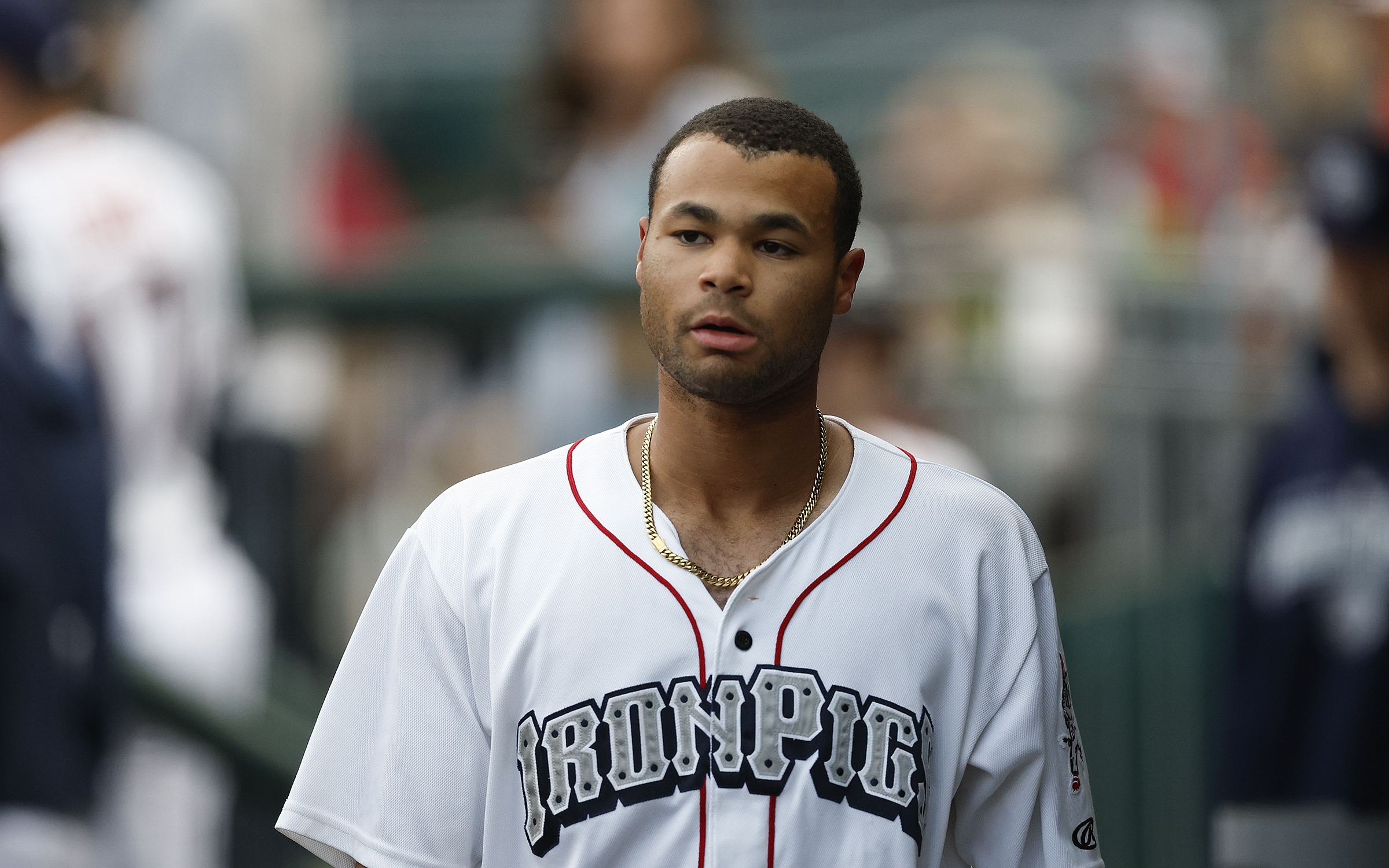
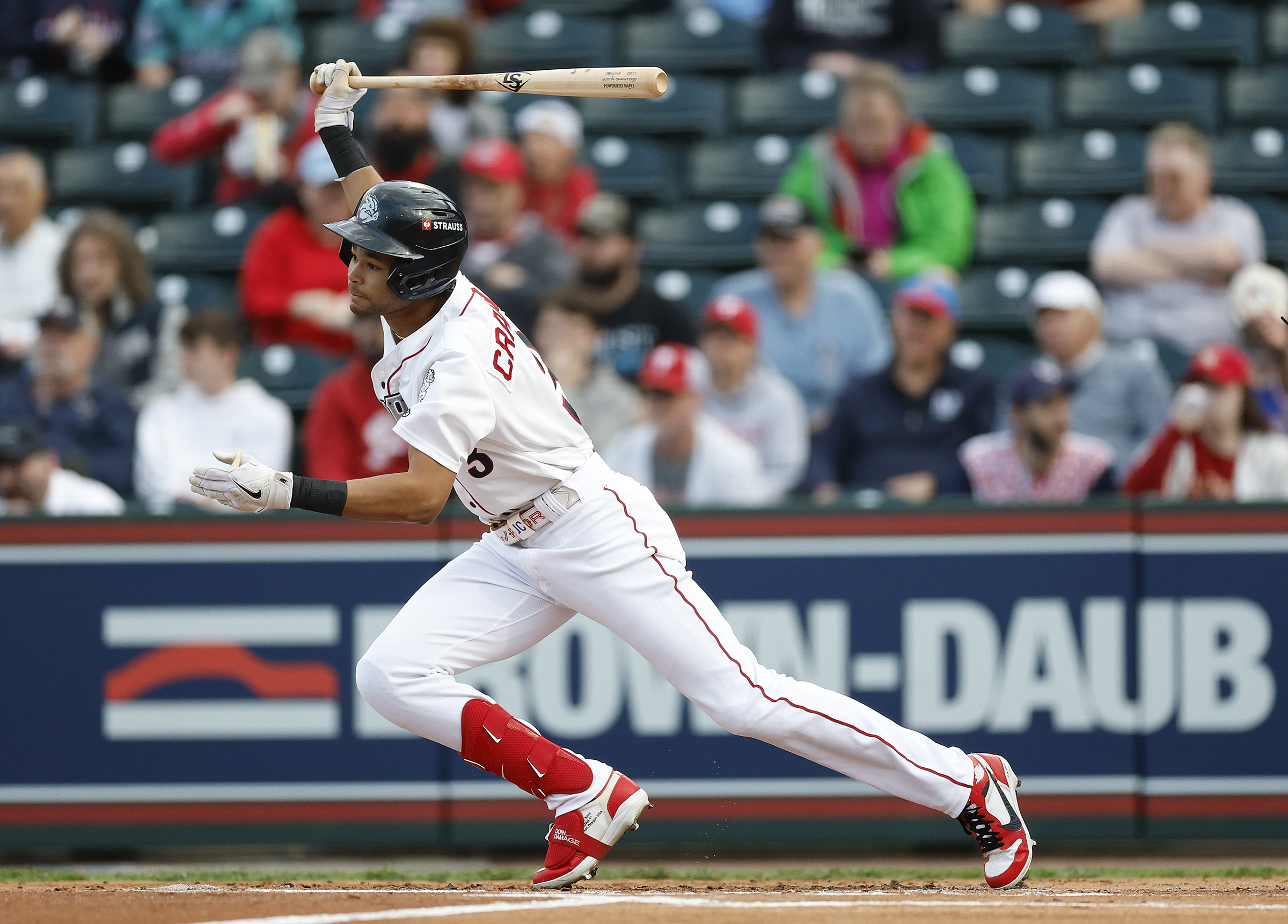
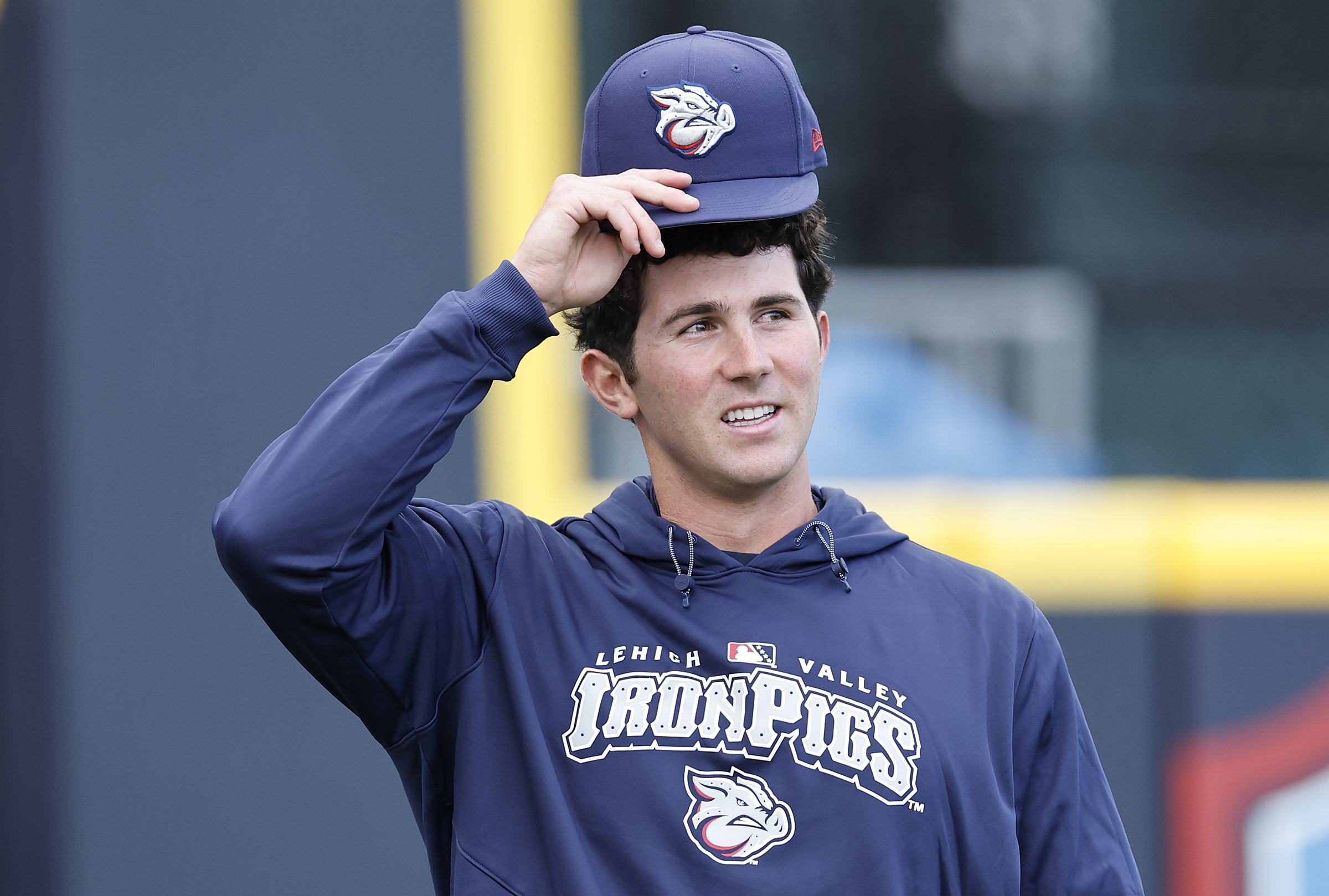
Phillies outfield prospect Justin Crawford won the triple-A International League batting crown with a .334 average.
Front and center, or stage left?
At times this summer, the Phillies got “very close,” a team source said, to calling up Crawford.
Instead, they left the 21-year-old in triple A.
Never mind that left fielder Max Kepler was drowning, with a .201 average and .661 OPS through July 25. Rather than releasing the $10 million veteran and replacing him with Crawford, the Phillies gave Kepler a longer rope. And after trading for Harrison Bader at the deadline, there wasn’t an opportunity for Crawford to play every day in the majors.
But Crawford reached base at a .411 clip for Lehigh Valley and won the International League batting crown with a .334 average. He stole 46 bases and led the farm system with 147 hits.
“I don’t know what else he really does at the minor-league level at this point,” Dombrowski said. “He’s led leagues in hitting. He steals bases. He’s a good energy guy. He’s a solid outfielder.”
Go ahead, then, and pencil in Crawford for a spot in the season-opening outfield.
Differences of opinion about Crawford once focused on his offense, notably his extreme tendency to hit the ball on the ground. Now, it’s more whether he’s best suited for center field or left.
Crawford got drafted as a center fielder and played there exclusively for three years. He shifted to left field more often late this season, especially once Johan Rojas got sent back to triple A. Crawford’s dad, Carl, played left field for 15 years in the majors.
Dombrowski might have hinted at the Phillies’ thinking by saying Kepler is “not going to most likely be back because he’s a free agent and we have Justin Crawford coming.” And Thomson said Crawford is “maybe a little better in left than he is in center,” based on internal reports.
Other team officials don’t fully concur.
Some Phillies officials believe Justin Crawford is best suited to play left field. Others think he can handle center.
“I see Justin as a center fielder,” minor-league director Luke Murton said. “We’re very confident in his ability to play center field. It’s just a matter of, he’s played less left field over the course of his career, so give him exposure to that so when the opportunity comes, if he has to go to the big leagues and play left field, then he’s prepared to do that.
“But I think, as an organization, we see him as a center fielder.”
It would simplify the outfield picture if Crawford is able to handle center field.
Bader, who stabilized center field after the trade, is expected to decline his $10 million mutual option. The Phillies would feel less urgency to bring him back in free agency off his career-best season at the plate.
And they could commit to Brandon Marsh, also a better defender in left field than center, as at least the lefty-hitting side of a corner outfield platoon, which would enable them to focus on finding a replacement for malcontented right fielder Nick Castellanos, all but certain to be traded or released.
Regardless, it will be Crawford’s time. At last.
“I don’t expect him to carry our club in the very beginning of the season, but you also don’t want to put him in where you think it would be a bit too much for him,” Dombrowski said.
“I don’t think that’s going to happen. He has never been overwhelmed when he’s been with us at any level, and we keep moving him up. You want to just see that he just continues to handle himself the same way that he has,” Dombrowski said.
Phillies top pitching prospect Andrew Painter struggled in triple A in his first season back from Tommy John elbow surgery.
‘He’s going to be fine’
Don’t look now, but there will probably be a spot for Painter in the season-opening starting rotation.
Really. It’s true this time.
In 2023, a few team officials predicted that Painter would make the team out of camp even though he was 19 and hadn’t pitched above double A. He injured his elbow and wound up needing Tommy John surgery.
Last winter, in outlining the plan to build Painter’s workload in his return to the mound, Dombrowski infamously said he could be ready for the majors by “July-ish.” Instead, the top prospect had a 5.40 ERA in triple A.
It’s doubtful, then, that Dombrowski will pin yet another timetable on Painter. But with Ranger Suárez headed to free agency and Wheeler recovering from thoracic outlet decompression surgery, Painter’s long-awaited debut could come early next season.
“I think he’s going to be better the second year out after the Tommy John [surgery],” Thomson said. “The command’s going to get better. The quality of stuff’s going to get a little bit better. He’s going to be fine.”
Rival talent evaluators generally agree. One NL scout said last month that he has “appropriate concern” about the decline in Painter’s command but is inclined to “cut him some slack” after not pitching for two years.
There were encouraging signs last month. In his second-to-last start, Painter tossed five scoreless innings. He shut out Syracuse for three innings before allowing three runs in the fourth in his final start.
Even if Suárez bolts, Cristopher Sánchez, Jesús Luzardo, Nola, and Taijuan Walker are rotation holdovers. The Phillies are optimistic that Wheeler will return. They can’t say for sure that he will still be elite.
Painter’s time is coming. Maybe even in April.
“He still throws his fastball in the upper-90s, touches 100, still has quality breaking stuff,” Dombrowski said. “Most importantly, he remained healthy. So, those things are the encouragement. He used to have great command. It wasn’t quite as good this year. And normally, when you trace back to a lot of people that have had Tommy John, that’s the last thing that comes back. We’re optimistic that he’ll be able to regain that.”
Phillies infield prospect Aidan Miller went 9-for-27 with two doubles and a homer in an eight-game triple-A cameo to end the season.
Miller time?
Murton was skeptical in spring training when minor-league baserunning coordinator Gary Cathcart recommended that Miller be among the players who got a green light to run.
“I was like, ‘Hey man, I don’t think Aidan Miller’s going to steal a ton of bases in the big leagues. That’s just me,’” Murton said. “He’s like, ‘Well, I think he’s going to.’ I’m like, ‘Yeah, I don’t.’”
Murton relented. A few months later, he marveled that Miller already swiped more than 20 bases. Miller finished with 59, including seven steals in eight games at triple A to end the season.
In hindsight, even Miller didn’t see it coming.
“Honestly, no,” he said last month. “I don’t really know if I’m faster this year. Maybe a little bit. But I think I’m just being more aggressive on the bases.”
Miller’s path to the majors might be accelerated, too.
After a slow start, he batted .356 with a 1.099 OPS in his last 36 games. If the Phillies trade Alec Bohm this winter, after dangling him in talks last offseason, Miller could be in the wings at third base, even though he has played shortstop so far throughout the minors.
“He’s played some second, he’s played some third, but he’s primarily been a shortstop, so we’d have to make sure that we properly prepared him to do that,” Dombrowski said. “That’s still a discussion that we’ll have to have. But he’s a really good player and a good athlete. And he can hit.
“If Miller’s coming up here, he’s going to be an everyday player at the beginning of his career. We’re not going to bring him up and not play the majority of time.”
Miller was scheduled to play in the Arizona Fall League, but the Phillies decided that it was better if he rested after a long season. Besides, he could be in for a big spring training.
If it seems fast, consider this: When Dombrowski ran the Red Sox, he called up Andrew Benintendi from double A in 2016 and Rafael Devers a year later after only six triple-A games, two fewer than Miller played this season.
Penn believes it has all the right pieces to be a competitive women’s basketball program in the Ivy League.
Now the Quakers just have to put it all together.
After a season in which Penn lost in the first round of the conference tournament for the third straight year, the Quakers find themselves only a month away from opening tip at the Palestra with plenty of questions still left to answer.
Having to reinvent the offense to make up for the loss of first-team All-Ivy forward Stina Almqvist — who led the team in total minutes, points, and rebounds — coach Mike McLaughlin recognizes that the starting rotation needs a lot of ironing out .
Penn will miss the production of Stina Almqvist, who led the team in total minutes, points, and rebounds.
“I think we need a little more in the post. … We need to see who’s going to be three, four, and five in that rotation,” McLaughlin said. “ … That is the area that I need to see more of because that’s been inconsistent so far.”
Katie Collins, last year’s Ivy League Rookie of the Year, is the only other front court player to log significant minutes for Penn — and is preparing to adapt to playing next to a more traditional center in Tina Njike.
“Little different from last year with Katie and Stina,” McLaughlin said. “They could both play inside and out. Katie is going to need to adapt a bit because Tina’s ball skills away from the basket are not where Stina’s were.”
With McLaughlin believing Njike to be capable of playing only 20 minutes a game because of her physical style of play, the team will have to find valuable minutes from players eager to make an impact.
Katie Collins (center), last season’s Ivy League Rookie of the Year, will be relied on even more in her sophomore season.
Kate Lipatova, a 6-foot-3 stretch forward from Moscow, rounds out the frontcourt group alongside fellow international freshman Ari Paraskevopoulou (Greece).
“[Lipatova] hasn’t played, unfortunately, she got hurt 10 minutes into practice, and will be out at least a couple more weeks, which is going to impede her growth,” McLaughlin said. “She had a nice preseason. … This is definitely a setback.”
Figuring out the rotation
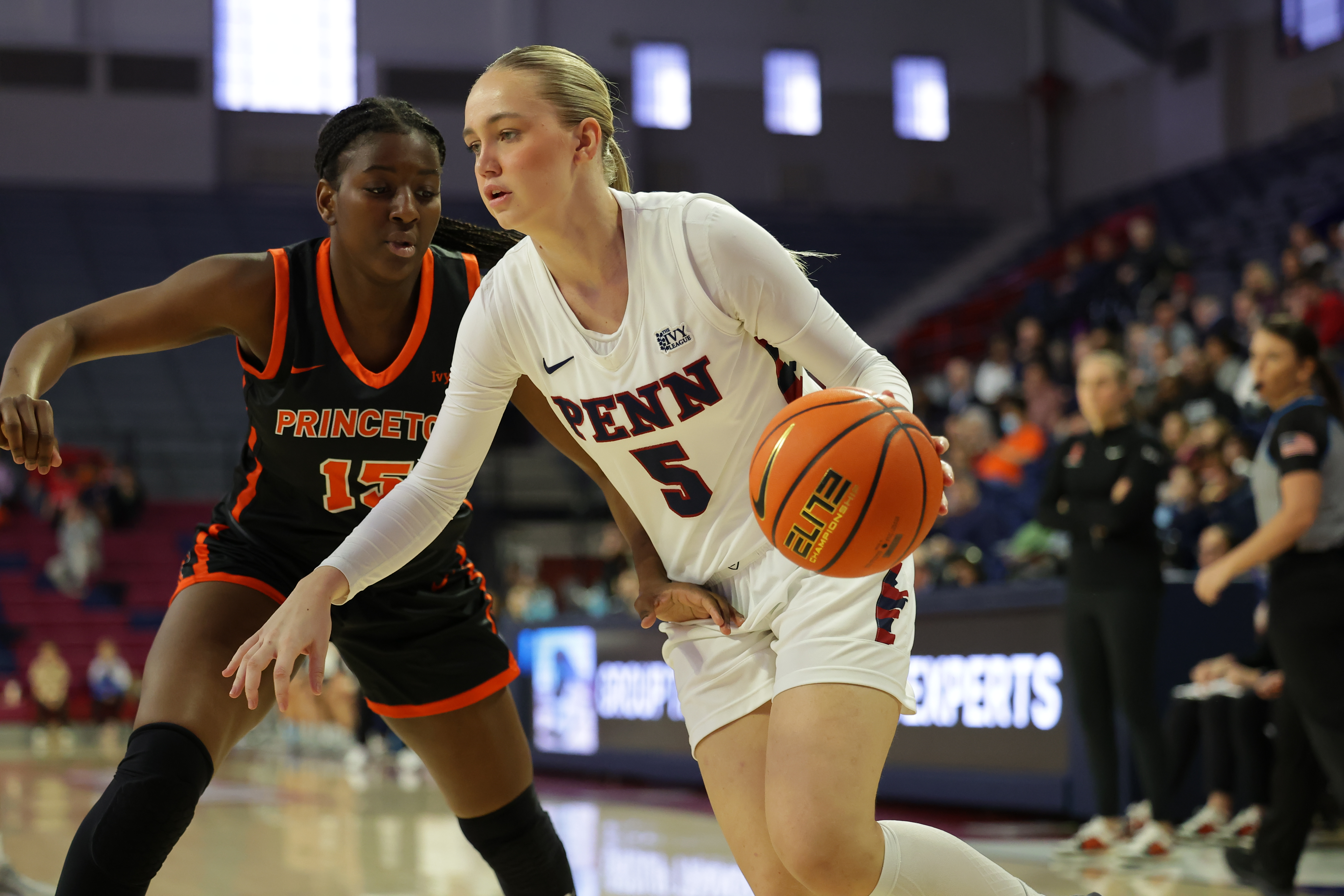
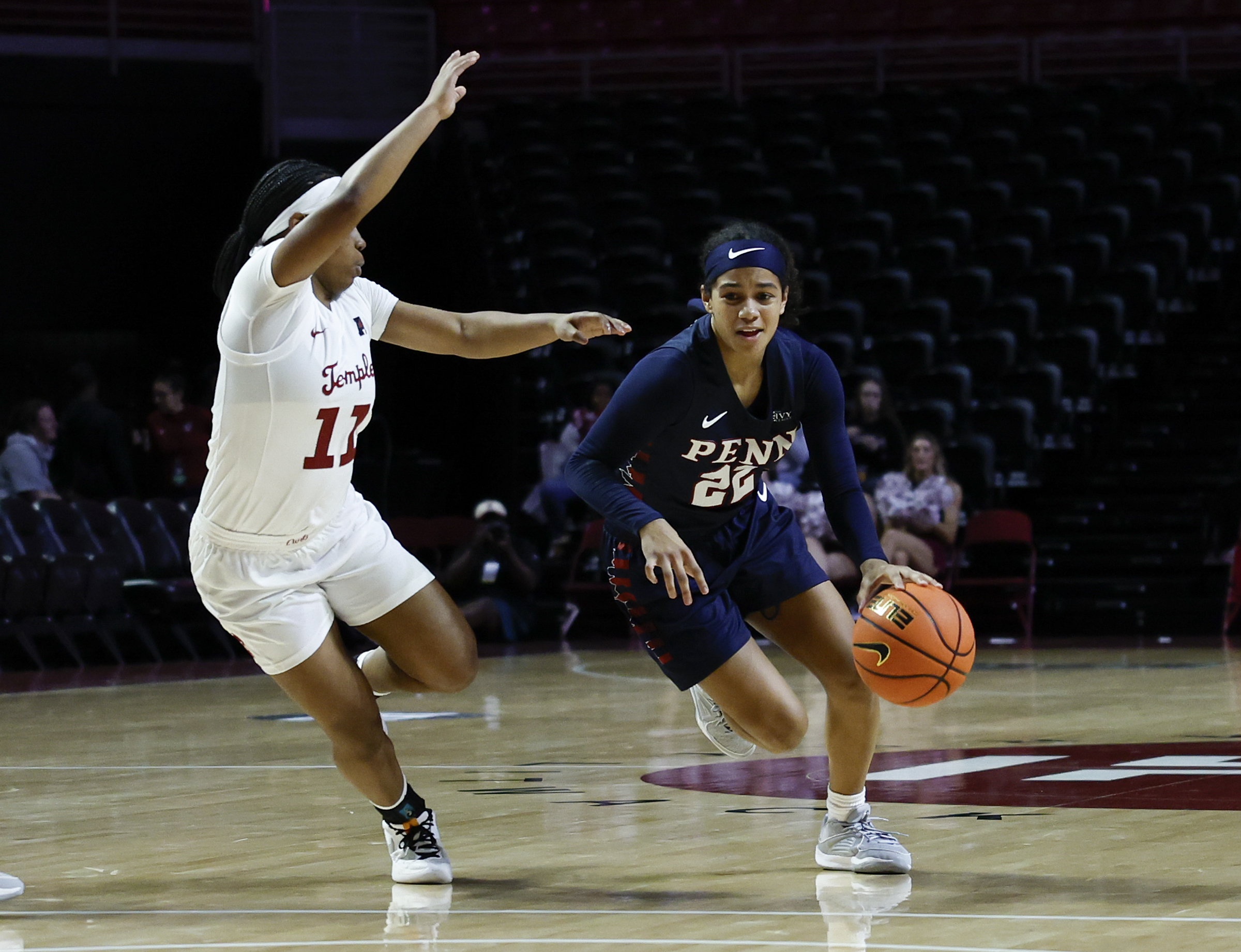
Point guard Mataya Gayle is set to take center stage for the first time with the Quakers. After being a strong No. 2 to Almqvist in 2024 and former first-team All-Ivy forward Jordan Obi in 2023, Gayle will be Penn’s go-to player when it comes to scoring.
“This kid is ready,” McLaughlin said. “She’s going to have a huge year. She’s going to score it, she’s going to assist it, you’re going to see her rebound the ball better, you’re going to see her in big spots being significantly further along.
“I think for someone with her stature after the first two years, she’s taken massive growth, [and] I just love where the kid is mentally — I just think she’s doing it the right way.”
Which players get to fill out the rotation, besides Gayle and Collins, is still up in the air. Stalwart guards Saniah Caldwell and Abby Sharpe, who played significant minutes last year, are battling injuries already — leaving the door open to establish a larger rotation of guards.
“If we can add 10 players that can actually get out there and play at our level every day, I think this team has a chance” of competing for a championship, McLaughlin said.
Roster overturn and injuries will always lead to uncertainty. Gayle, though, is confident that this is the roster that will bring Ivy glory back to the Palestra.
“This is the most excited I’ve been about a season — I see us taking this to the next level,” Gayle said. “We’ve had a lot of team conversations, internal work, and I think we are all on the same page this year, which is obviously winning an Ivy League championship.”
Penn guard Mataya Gayle (right) enters as one of the team’s leaders on offense.
With the season growing closer by the day, McLaughlin feels as though this squad has the ability to rise to the occasion by the end of the season.
“If a couple of these kids take a bigger step before we get to league play, anything can happen from there,” McLaughlin said. “ … We have a ways to go to get to where we were last year, but our ceiling couldn’t be higher.”
Shay Barker wouldn’t describe his relationship with his older brother Ryan as instant best friends. They fought as children and were competitive with each other, but Shay secretly wanted to do whatever his big brother was doing.
“I was kind of like a crybaby as a kid, and he was the one who just found that super annoying,” said Shay, three years younger than Ryan. “We would get in a lot of fights and stuff. But I’m a lot more mature now. I don’t really get upset about things. I think that’s probably the biggest reason why we’re so close now: We connect on a different level than we used to.”
Part of their connection also stems from the bond that the two Chester County natives share in the same sport.
Ryan is the starting kicker at Penn State. The redshirt sophomore, once a preferred walk-on, is now on scholarship. Shay, a senior at Kennett High School, will also head to a high-major program to kick and punt next fall. He earned a scholarship offer to Syracuse and made his pledge in June.
Ryan is considered one of the best to come through Kennett’s program. He holds the school record for longest field goal (45 yards) and was the first in program history to play Division I football. With the Nittany Lions this season, Ryan’s longest field goal is 49 yards, and he ranks eighth on Penn State’s all-time list in extra-point percentage (98.6%), while carrying the top percentage (86.7%) in field goals made in program history.
Shay felt he had high expectations to live up to. He has been compared to Ryan before. But Shay brushed those comments to the side because the only way to silence those remarks is on the gridiron.
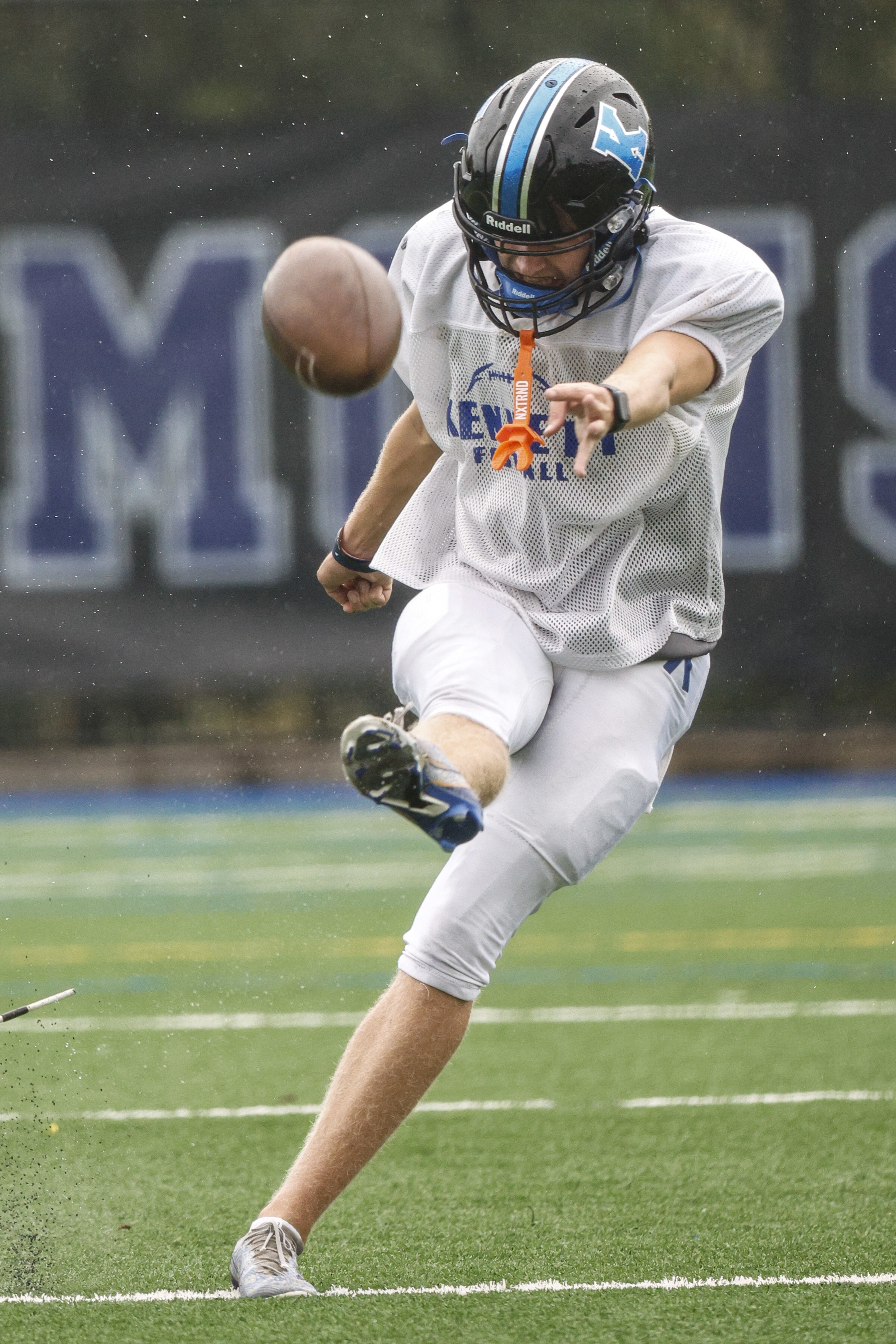
The 6-foot-2, 190-pounder is ranked among the top 10 high school kickers in the country, according to 247Sports. He has kicked field goals as far as 63 yards in practice, and his in-game career-long is 44 yards. So far, Shay has made 8 of 10 field goal attempts for a 7-2 Kennett team.
“Kicking has brought us closer than I ever thought we would be,” Ryan Barker said. “It’s such an individualized thing that we’re both trying to work just as hard as each other to get better at whatever we need to improve on, and to be able to have each other there for the mental and physical aspect, it’s just awesome. I love helping him. I love coaching him, and I can see that he’s listening.”
Soccer turned football
The Barkers grew up in a soccer family.
Their mother, Sally, used to visit her parents’ native England during the holidays. In the early days of their relationship, her future husband came along. The two decided to go to a championship match a tier below the Premier League, and “my jaw hit the floor,” Chris Barker said.
From the atmosphere to the game itself, Barker was hooked and became a supporter of Manchester United. The Barkers even named Ryan after Ryan Giggs, one of the most decorated footballers of all time, who spent the majority of his career with United.
And it didn’t take long for Ryan Barker to pick up the sport.
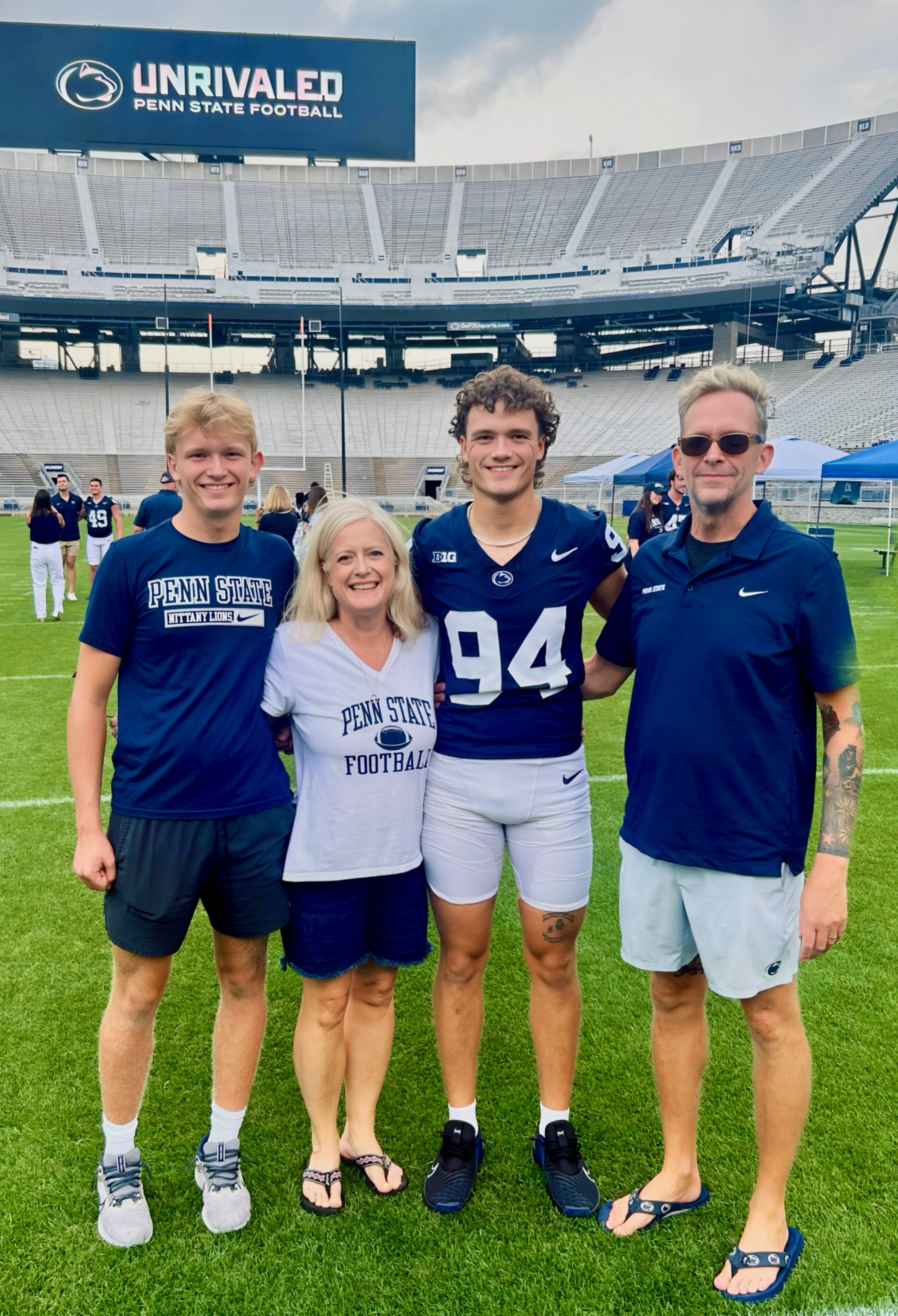
Shay, Sally, Ryan, and Chris Barker together on the field at Penn State.
“We have video of Ryan barely walking but kicking a soccer ball,” his father said. “Ryan went on to achieve a lot of success in soccer. We thought that was going to be the pathway. We thought that soccer would be their ticket to maybe a scholarship in college. But little did we know that there’s an influx of Europeans now in the American collegiate soccer system, and it became pretty clear early on that it was going to be a lot more competitive for our boys to earn a scholarship, let alone play at a high level.”
Both brothers started soccer around age 3. They played for the Delaware Rush Football Club in Hockessin and the Southern Chester County Soccer Association in Kennett Square. However, before Ryan entered high school, he sat on the idea of kicking in football.
One day in the summer, he asked his father to drop him off at Kennett’s football field. He brought a football and tried to kick a field goal. After each attempt, he would jog over to the ball to do it again. A custodian at the school saw Ryan and went to find coach Lance Frazier to tell him, “‘There’s a freshman on the field kicking 50-yard field goals,’” Frazier recalled.
“I’m like, ‘Get out of here, that’s not possible,’” said Frazier, in his eighth season as Kennett’s head coach. “I go up there and I see this tall, slender kid. I can hear him before I can see him, because he’s kicking the [stuff] out of the ball. … I knew he was going to have to make a really big decision here in the future: Is he a soccer player or is he a football player?”
Through three years, Ryan played on Kennett’s soccer team and kicked for the football team. In his senior year, he decided to put his full commitment into kicking. He had some interest from smaller soccer programs to play collegiately, but he wanted to go Division I.
Football could give him that opportunity.
“That was probably one of the most difficult decisions that I ever had to make for myself,” Ryan said. “Just in terms of soccer being my first love and playing it for 17 years. … When I realized I could potentially play Division I football, that was kind of the main factor in my decision.”
Kennett’s Shay Barker kicked his longest field goal of 41 yards last season.
Shay’s journey was a bit different. He started to fall out of love with soccer in the eighth grade. Due in part to a growth spurt, Shay had patellar tendinitis in his knees, which made it painful to run. He decided to try kicking as a freshman while learning alongside his brother, then a senior.
“He had seen how fun it was for his brother to play on Friday nights and to be part of the football team at school,” their mother said. “I think he was really excited to join [Ryan] and kind of be his understudy.”
Kicking came naturally to Shay, but he was uncertain what he wanted from the sport. Then, something changed.
Carving his own path
During his junior year, Shay competed in a few camps and showcases through Kohl’s Kicking, a program for athletes who play specialized positions of kicker, punter, and long snapper to gain exposure to college coaches. He had a rough showing during the January showcase, which led him to question whether this was what he wanted to do.
“Growing up, Shay always wanted to go to hang out with his friends,” his mother said. “He wanted to play this sport, this club. Last winter, he said, ‘I think I’m going to try to play basketball my senior year.’ [Chris and I] would look at each other like, ‘What is he talking about?’ He just could not say no. … The biggest question mark was maybe not whether he could do it, but whether he would choose to do it because of the sacrifice.”
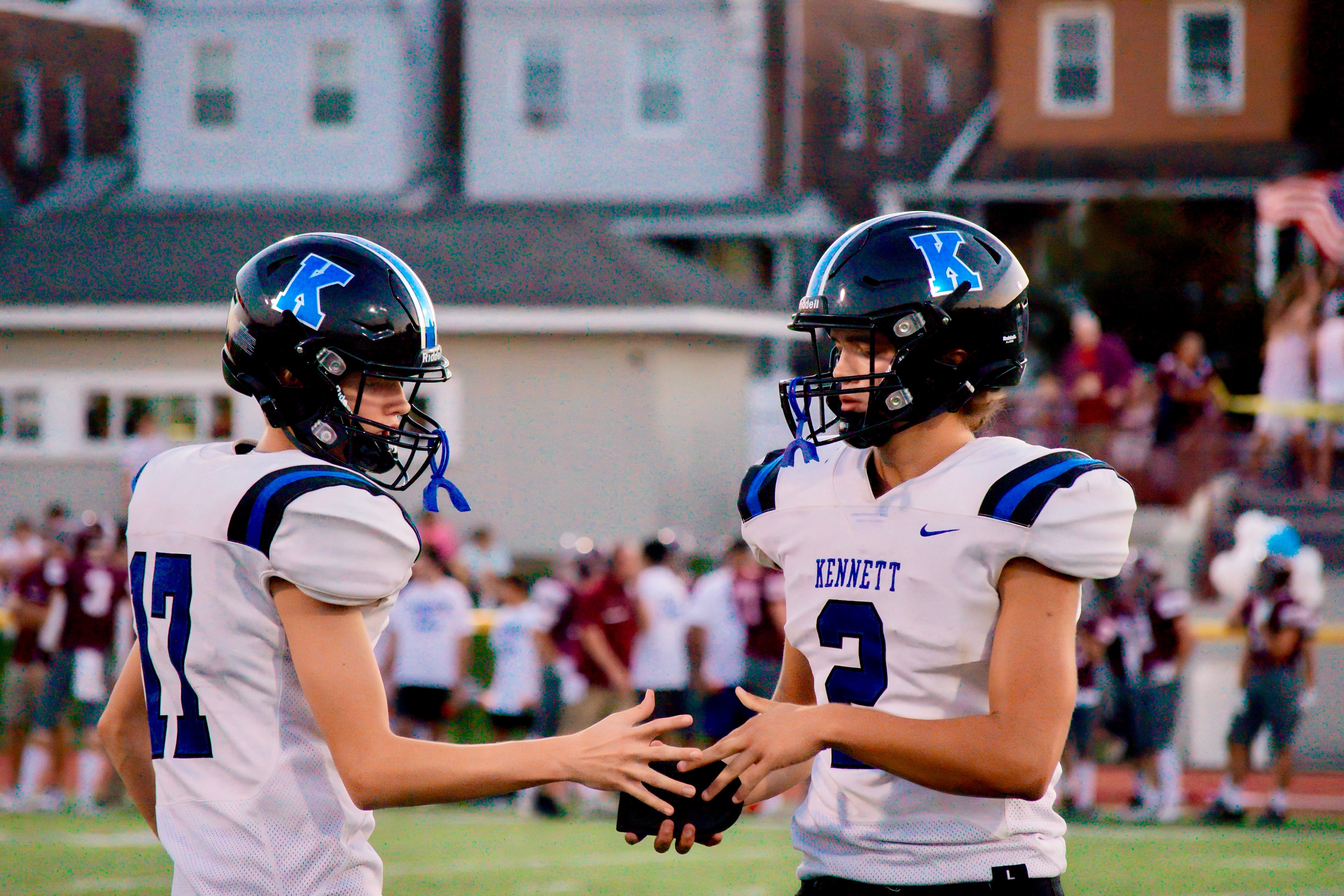
Shay and Ryan Barker shown together while they played at Kennett High School.
That performance fueled his desire to get better.
Shay began seeing a personal trainer to get stronger and sought out advice from Ryan, who reminds his younger brother that “the only kick that matters is the next one.”
In June, Shay attended a camp at Syracuse, where he won the field goal competition and backed up to about 58 yards. He also was a finalist in the kickoff competition.
A few days later, Syracuse came calling to offer Shay a full ride.
“They saw something in me that I didn’t even see in myself,” Shay said. “I was kind of an underdog a lot of my career. I just got in the right mental space and did what I needed to do. … I’m honored to have this opportunity, especially coming from a small school like Kennett, where not many kids get these kinds of opportunities. I just want to make the most of it.”
And even when Ryan and Shay aren’t together, they are still competing.
Last year, when Penn State faced Southern California on Oct. 12, Ryan hit the game-winning field goal in overtime to secure a 33-30 win for the Nittany Lions. Later that evening, Shay hit a career-long 41-yard field goal against Unionville.
Ryan and his younger brother Shay during a Penn State football game.
“That was probably one of the proudest and special moments for us as parents,” their father said. “Both our boys, at their various levels, did something quite remarkable on the same day.”
Shay has hopes of surpassing Ryan’s program record. Last weekend, he broke his career-long with a 44-yard field goal against Avon Grove. He told his big brother about those aspirations and has his support.
“Ever since I went to college, Shay is finally able to find his identity and what he brings to the table in terms of football,” Ryan said. “It’s great seeing him succeed. He, without a doubt, has the capability to beat that record, so I hope that he gets that opportunity.”
Frazier believes Ryan and Shay could be the next brother duo to kick in the NFL.
The two already have Sept. 4, 2027, circled on their calendars, when the Nittany Lions host the Orange at Beaver Stadium. This journey isn’t what Shay would have expected, he said, but kicking has given him the chance to play college sports, while forming a lifelong bond with his brother.
“It’s definitely something I don’t take for granted,” he added. “I wouldn’t be here without Ryan.”
LOS ANGELES — Inside a North Hollywood police precinct late on March 9, 1977, before the cops began questioning her about her father, Carol Steindler noticed a young woman sitting outside an office. The word HOMICIDE was stripped across the room’s pebbled-glass door, but Steindler didn’t think anything of it, didn’t see the straight line linking those three things: the word and the woman and her father. How could she see it? She didn’t know yet that he was dead.
What she did know was that Howie Steindler, 72, the owner of the Main Street Gym and a respected boxing manager, had not come home that night. Her mother, Ann, had telephoned her in a panic. Your daddy still isn’t here. Howie often stopped at his favorite bar, the Redwood, after a long day of work, but something this time made Ann “insanely upset,” Carol said recently, “more upset than usual.” Ann was so unsettled that she also called boxing promoter Don Fraser, Howie’s best friend. Fraser in turn called the police, who told him to get himself and at least one member of the Steindler family to the precinct.
The nature and timing of Howie’s disappearance were strange. Over the previous month, Ann, who tended toward the eccentric, had become convinced that something terrible was going to happen to her husband, telling Carol and others, My Howie’s gonna die. My Howie’s gonna die. Carol had stopped by her parents’ condominium in Encino, Calif., one day in February to find Howie, who had always handled the couple’s finances, teaching Ann how to write checks. “Are you sick?” Carol asked him, fearing that her father might be suffering from a fatal disease. No, he replied. It was just time for Ann to learn.
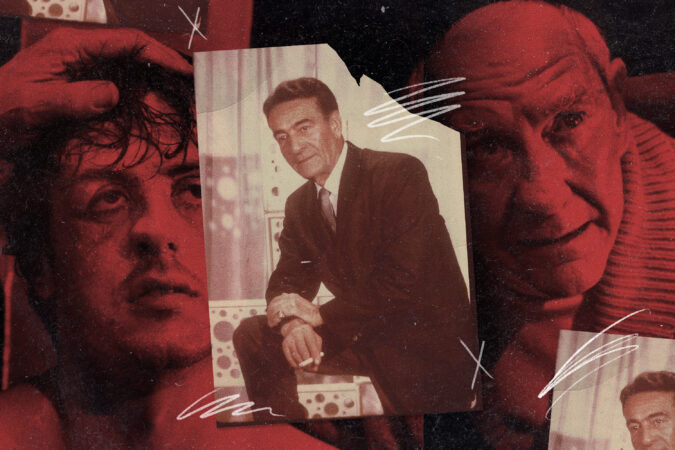
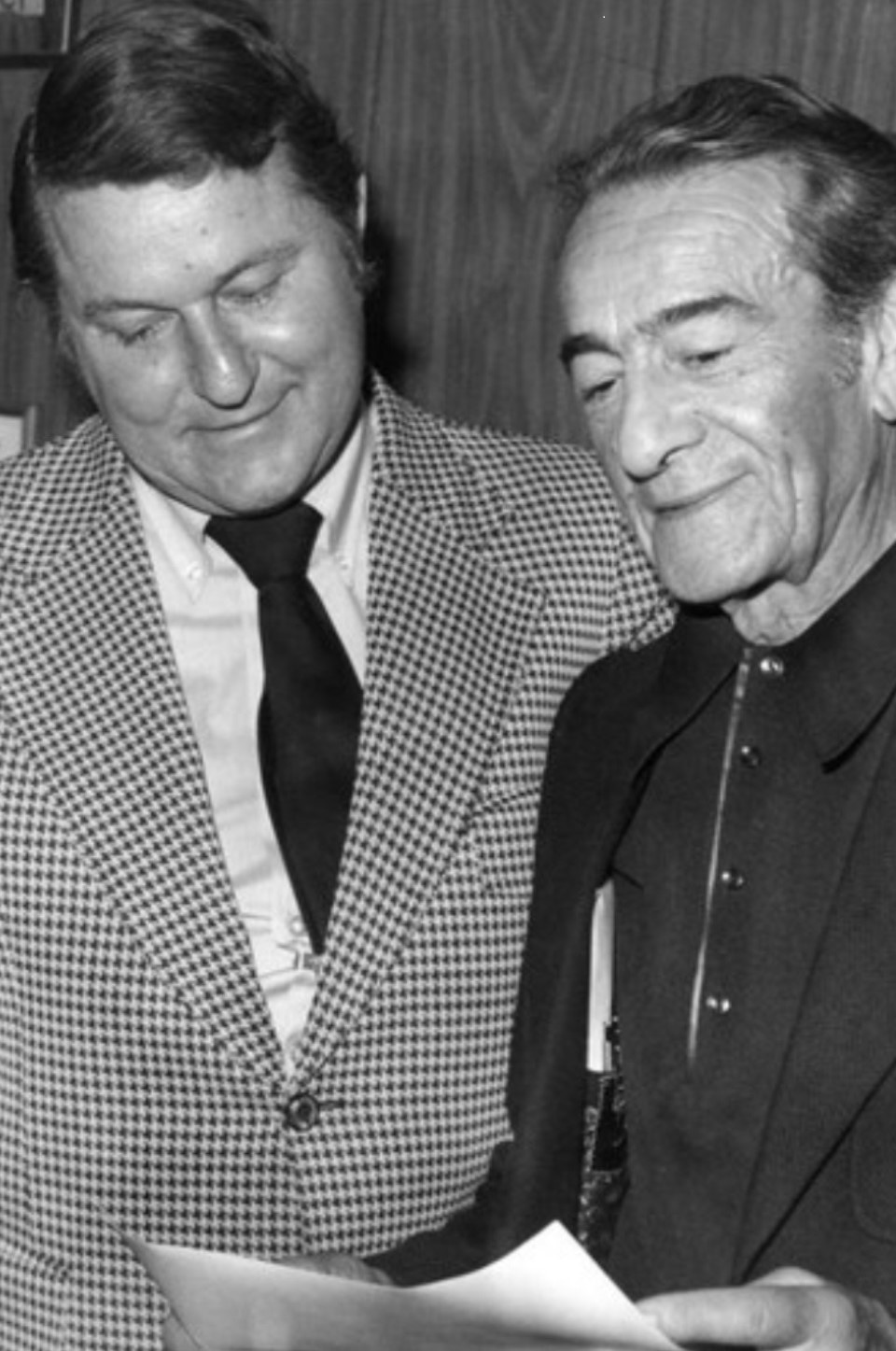
Those puzzling incidents were piling up while Steindler was approaching what promised to be the apex of his career in boxing. Looming over LA’s skid row neighborhood, the Main Street Gym was an institution, and Steindler was a popular member of the sport’s community, 5-foot-6 and slim but tough, hot-tempered yet softhearted, with few apparent enemies if any at all. He was so well regarded, in fact, that when the cast and crew of a low-budget movie — about an underdog Philadelphia fighter who gets an improbable shot at the heavyweight title — decided to use the gym as a location to shoot several scenes, one of the film’s stars had sought him out.
For two weeks in 1975, Burgess Meredith had shadowed Steindler, observing how he spoke to fighters and ran the gym, soliciting insights and advice from him, so he could better portray Mickey Goldmill, the wise and grouchy trainer who prepares Rocky Balboa to go the distance against Apollo Creed in Rocky. The Academy Awards would be held on March 28, 1977, and among the film’s 10 nominations was Meredith’s, for best actor in a supporting role. If he won, the chances were good that Meredith, in front of millions of viewers on ABC, would thank Steindler in his acceptance speech.
That moment of worldwide recognition for Steindler would never materialize, and not merely because Jason Robards, for playing Washington Post editor Ben Bradlee in All the President’s Men, won the best supporting actor Oscar that year and Meredith did not. Instead, Howie Steindler’s name would be left, for those who remember it, cloaked in sadness and mystery. Fraser picked up Carol and drove to the police station. The two of them sat together, waiting for an answer about his whereabouts, as the clock ticked toward midnight.
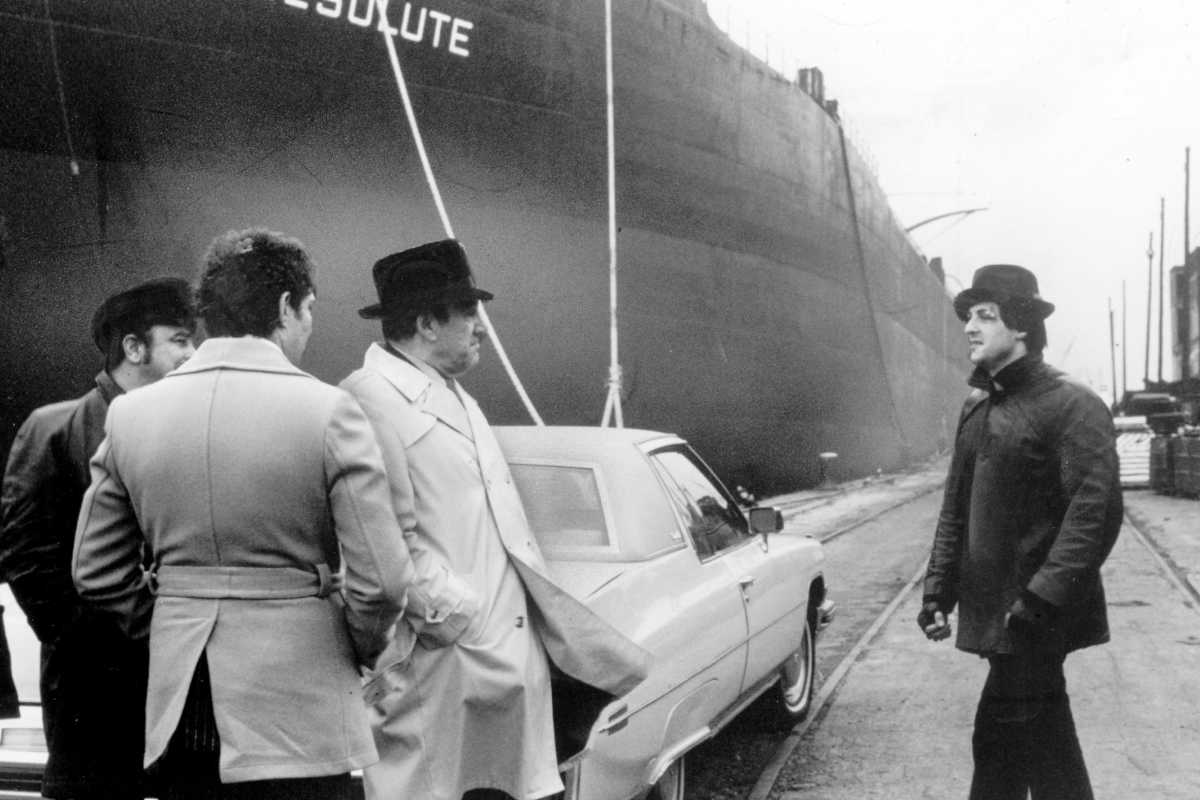
Sylvester Stallone on location while filming the original “Rocky” in Philadelphia.
A troubled heart of gold
Sylvester Stallone was anonymous in Hollywood, with just $106 to his name, before writing the script for Rocky and insisting, at the risk of scuttling the entire project, that he play the titular character. Rocky’s true star, the biggest name in the movie at the time, was Meredith.
He had earned an Oscar nomination for best supporting actor the previous year for his performance as a salesman/ex-vaudevillian in The Day of the Locust, and his lengthy career as a stage and screen actor, coupled with his deserved reputation as a ladies’ man, had made him a frequent source of copy in newspaper entertainment sections and gossip pages. (“Showgirl is 4th Wife of Burgess Meredith” was the headline of a brief United Press International story in January 1951.)
He was one of 41 actors who either auditioned or was considered for the role of Mickey; Lee J. Cobb, Art Carney, and George Burns were among the others. When producer Bob Chartoff approached him about the part, though, Meredith was skeptical.
“Chartoff came to Dad’s house,” Meredith’s son Jonathan said. “‘Look, we’re making a film about a boxer with Sylvester Stallone, and we’d like you to be in it. We think it’s really going to be a great film, so what we’d like to do is give you a piece of the production and then pay you less.’ And Dad says, ‘Well, I don’t know. I’d rather have the money because no one’s gonna watch a film about a boxer.’ And then, of course, it became a hit.”
Meredith accepted the role for a salary of $20,000, and the Main Street Gym was an obvious choice for Stallone, Chartoff, coproducer Irwin Winkler, and director John Avildsen as an essential location for Rocky, its grimy interior and creaky floors lending Stallone’s training scenes with Meredith an atmosphere fit for any Philly neighborhood.
The gym, on the second floor of an old concrete theater, hovered above a parking garage at the intersection of Third and Main Streets. Its entrance adorned with a sign that read “World Rated Boxers Train Here Daily,” it shared the building with a luggage store. Jim Murray, the renowned Los Angeles Times sports columnist, described the gym’s setting as “losers’ turf, the crossroads of hopelessness and despair, the home base of a lot of guys who have quit in their corners of life.”
It was the perfect place for the hardest men on earth to harden themselves. Rocky Marciano, Muhammad Ali (when his name was Cassius Clay), Jack Dempsey, Floyd Patterson, Joe Louis, George Foreman: All of them and more trained there. Steindler himself managed Danny Lopez to the World Boxing Council featherweight championship in November 1976 — the same month that Rocky premiered. Lopez’s title fight was held in Ghana, and Steindler, sick at the time, couldn’t accompany him on the trip.
Still, he was so proud of his contribution to Lopez’s championship that he invited several friends and reporters to the Redwood one night, then had them listen to a recording of the radio broadcast of the bout. He’d sip a bottle of brandy immediately after Lopez’s fights to calm his nerves, and having taken over the gym in 1960, he kept a ledger, on a yellow notepad, of all the money he had loaned to fighters — two dollars here, three dollars there, 10 dollars sometimes — and never collected.
“Even with the gruff exterior,” Carol said recently, “he had a heart of gold.”
Jimmy Gambina, who played Mike, Mickey’s assistant, and whose father, Ralph, was an accomplished manager, spent weeks teaching, or trying to teach, Stallone proper boxing technique for the film. “I got him in condition to be a tough guy,” Gambina said, “not a good boxer, just a banger, a Joe Frazier type who weighed less.” Steindler served a different function, simply by being himself. He was Meredith’s model.
Jimmy Gambina, who played Mike, Mickey’s assistant in “Rocky.”
The first time he met Steindler, at the gym, Meredith was dressed in what he called his “broken-down outfit” to play Mickey: ratty sweatshirt, pilled cardigan, cotton balls stuffed in his cheeks, makeup cauliflowering his ears, 17 fake stitches zigzagging near his eyes. He asked Steindler if he could use the phone. The costume fooled Steindler, who told him, You think I’m running a hotel here? There’s a phone down on the street. I got other things to do.
“He thought I was one of the bums, and he gave it to me,” Meredith once told the Los Angeles Times. “Later, when I went out, one of the rather slow-minded pugs around there must’ve got to his ear and said, ‘That’s one of the stars of this thing.’”
Meredith wasn’t much of a boxing fan. Loving the sport required a “love of the brutal,” he once said, that he didn’t possess. But Steindler “gave me the mind of the man,” meaning Mickey. “I’d stay around that office and listen to him crack. He’s quite a fella.”
Rudy Tellez, who apprenticed under Steindler before becoming a longtime trainer and manager himself, said that Meredith and Steindler would sit down for long conversations, and Meredith would watch Steindler’s facial expressions intently: “That’s where he picked up all that dialogue and persona.”
There’s no public record of Steindler ever saying, Women weaken legs or You’re gonna eat lightning, and you’re gonna crap thunder, as Mickey did. But it wouldn’t have been out of character if he had. “He used to call me ‘schmuck’ or ‘putz’ or all other kinds of crazy Jewish names,” Tellez said. “He meant it with love, though.” He kept a wad of cash, as much as $400, on him at all times because he didn’t trust banks. He wore a special 14-karat-gold diamond ring and drove a gold ’76 Cadillac. His office was barely big enough to store a couple of brooms, and he decorated it with photos of chimpanzees with people’s names under them. He refused to list the gym’s phone number because he didn’t want to be bothered with “too many annoying calls.”
Homeless men, their bottles of wine and beer wrapped in paper bags, sometimes slipped inside the foyer and staggered up the staircase, following the aromas of fresh sweat, dried blood, and liniment. On those occasions, Steindler might grab the billy club that hung on one of the walls.
“I run this place, y’see,” he told an LA writer in February 1976; by then, his health deteriorating, he was carrying an oxygen tank with him. “I pay the rent, and this is the most famous gym in the world. Y’might hear remarks that this is a dingy neighborhood, but no gym in the world has a tenth the traffic or a hundredth of the number of fighters.
“Sure, we got troubles sometimes, but it’s nothing. Everybody’s being hit by the same trouble. We got characters floating around — the screwballs find their way up here — but I run a strict place. This is one establishment that stays the way it was established.”
Some of those characters were more dangerous, and some of the potential troubles more serious, than Steindler implied. Crime boss Mickey Cohen, who as a teen had trained at Main Street and fancied himself a budding featherweight contender, was a presence in the LA boxing scene until his death, from complications from stomach cancer surgery, in July 1976. Fraser tried to keep Cohen and the rest of his kind at a distance, according to his daughter Denise.
“Dad would say, ‘Don’t ever have the mob do anything for you because you’ll owe them for the rest of your life,’” she said. But boxing has always been seamy, stained with corruption. There’s no cleaning it. There never has been. All you do is live with it, if you can.
“Ex-gangsters, Mafia, I met a few,” Tellez said. “They’d come up and see Howie.”
Howie Steindler (right), who was Burgess Meredith’s model for the character Mickey in the movie “Rocky,” had a close friendship with promoter Don Fraser.
A critical error
The day of Steindler’s death began in its ordinary way: the click of a key into a lock, the clomping of feet up steps. Tellez had been worried about Steindler for a while, had heard him arguing on the phone frequently. The previous afternoon, in fact, Steindler had called a state senator to talk about problems he was having with the state athletic commission. He had another loud, anxious phone conversation that morning; with whom, Tellez didn’t know. When Steindler hung up the phone, Tellez asked him, Are you OK?
Yeah, schmuck, he mumbled. I’m all right.
Tellez wouldn’t let Steindler lock up the gym alone. They left together that night. He never saw his mentor again.
At the precinct, Carol thought perhaps her father had gotten into an argument or fight with another motorist, a road-rage-style incident, or maybe he had been arrested on DUI charges. The word murder didn’t cross her mind until the police separated her and Fraser and brought her into an office to question her.
“When I got in the room there,” she said, “you would have thought I killed my father. They treated you like that. ‘What time do you get home? What time did your husband get home? Where were you?’ And yet, they haven’t told me anything about my father. Finally, I said to the guy, ‘You’d better’ — and I used some not-so-nice words — ‘tell me what’s going on or I’m not telling you another thing.’”
So they told her: A highway patrol officer had come across Howie’s Cadillac on the shoulder of Ventura Freeway, five miles from the Steindlers’ house. His body was in the backseat, his feet dangling out an open door. He had sustained a horrible beating. Three of his ribs and a vertebra were broken. He had bruises on his head, chest, and right leg and a puncture wound to his right temple. Fraser identified the body to spare Carol the sight. The official cause of death was “suffocation by apparent smothering”; the police speculated that the killers had pushed Steindler’s face into the car-seat cushion.
His wallet, his keys, his identification papers, and his gold diamond ring were missing. There was a dent on the back of Steindler’s car and a hole slicing through the bumper, indications that someone had rear-ended him.
A witness had told police that two men had attacked Steindler as he stood near his Cadillac a block from his home, punching him before shoving him in the back of the car and driving away. At first, the observer had thought the victim was female, because Steindler was so small and slight. The witness drove past the scene once, then again, then left when one of the assailants started to approach her, but she described the men’s car as being older and gray.
The young woman. Carol now understood why the young woman had been sitting near the HOMICIDE door. She was the witness. And she had made one critical mistake: Instead of noticing the license plate of the old, gray car, she remembered the license plate of Steindler’s: HOWIE-5.
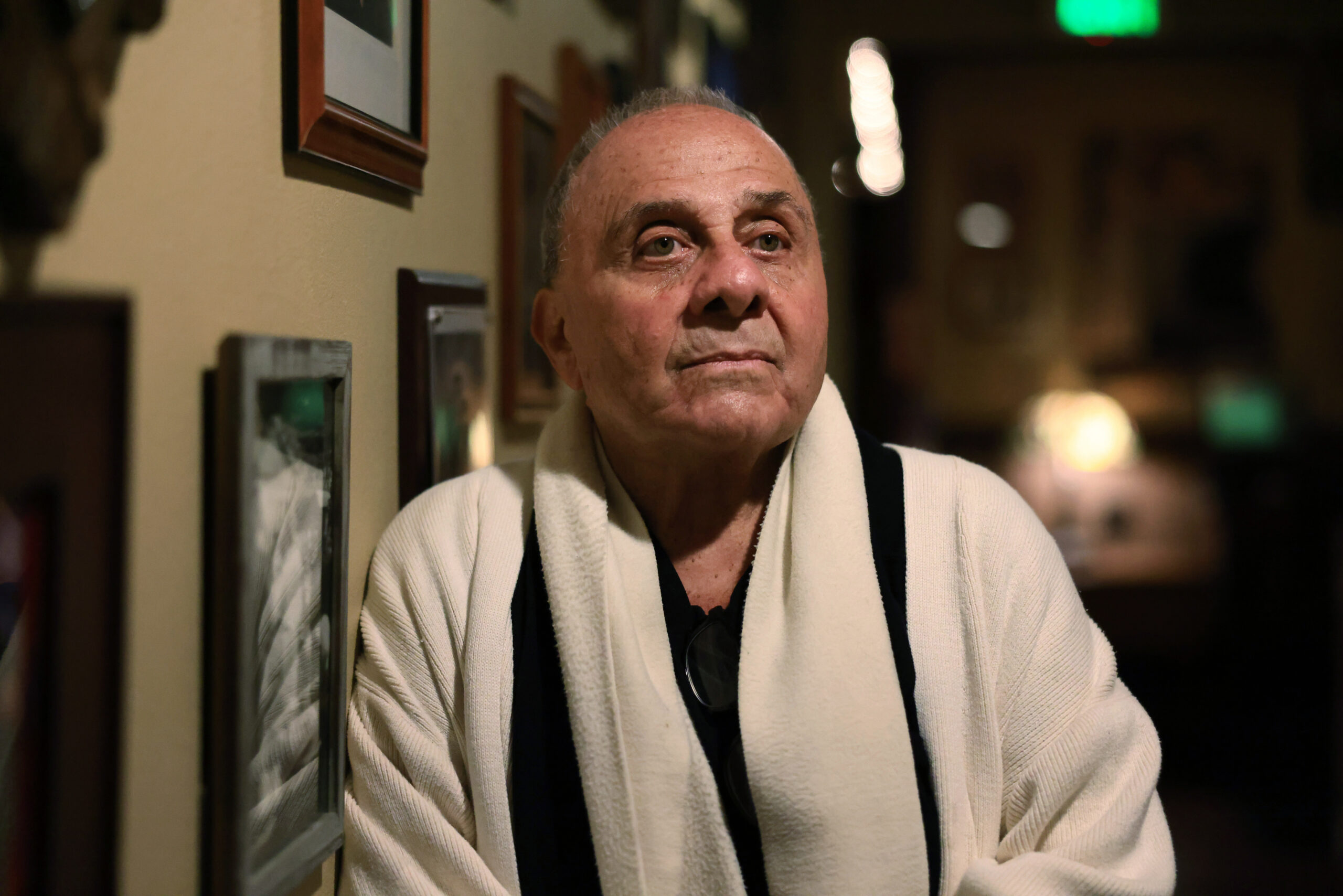
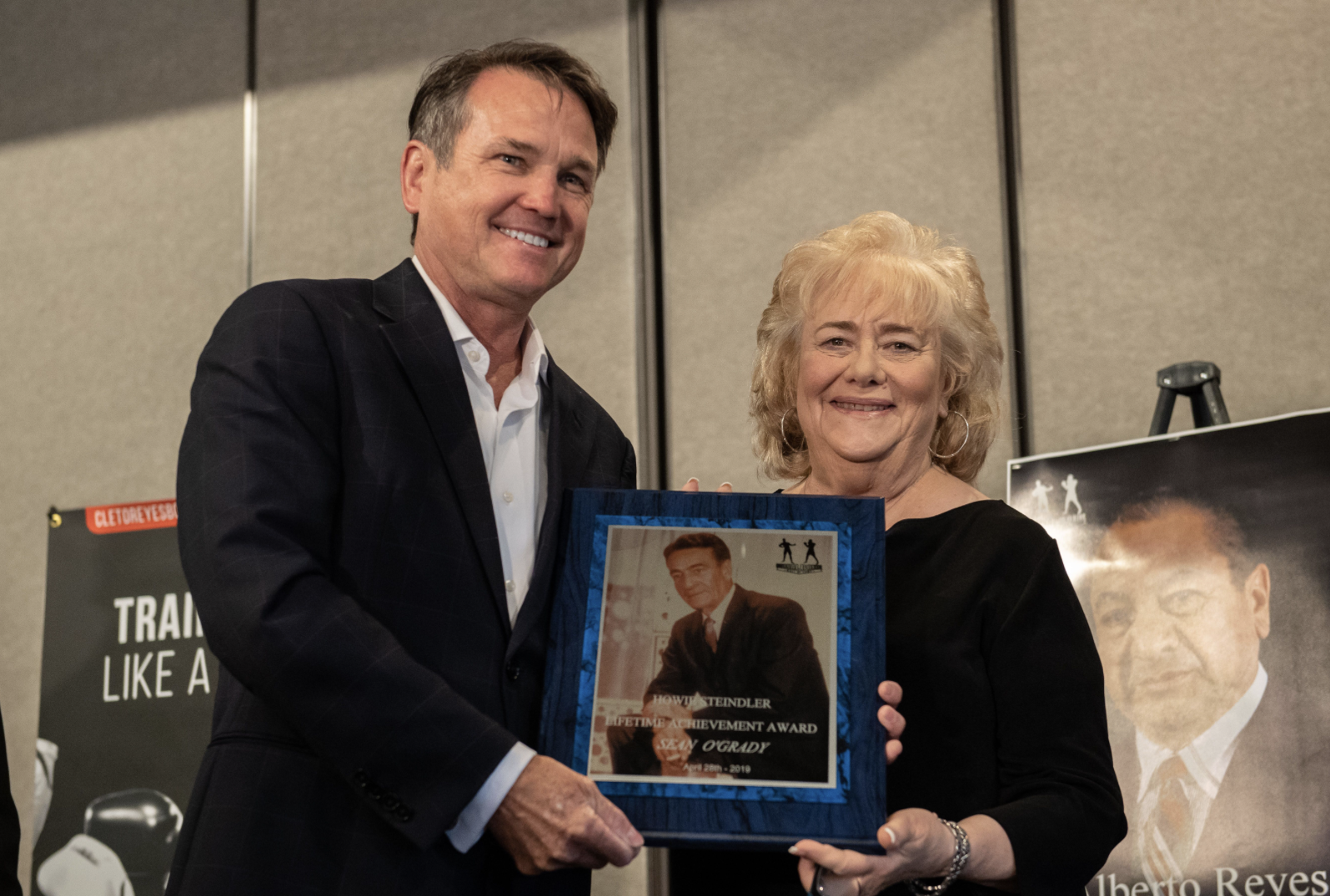
Carol Steindler, with former lightweight champion Sean O’Grady, has maintained a close connection to the National Boxing Hall of Fame, which gives out an award in her father’s honor.
‘You never know’
From that beginning, a lack of evidence — and competing theories of the crime — made the case difficult to solve. Marv Engquist, the detective who led the investigation, believed that Steindler had been a random victim, that the killers had collided with his Cadillac to draw him into a confrontation and rob him. The MO fit other unsolved murders in the same vicinity and time frame, and Steindler’s feistiness, his refusal to back down from anyone, could have escalated a robbery into something more deadly.
Carol has long been skeptical of that theory. “The police, the homicide detectives, all thought it was a bump-and-run,” she said, “and I kept saying, ‘No, it’s something else. My father and mother were acting really strange for two weeks.’ I don’t think it’s just a bump-and-run. I think they knew something.”
Gambina and Tellez still believe that the mob was responsible for Steindler’s murder. They raised and discussed that possibility in hushed tones and with measured words. “The fight game,” Gambina said. “You never know what’s going to happen with people.”
Carol took over the Main Street Gym and ran it until 1984, when it was razed to build a parking lot. She and her sister, Bobbi Beatty, would from time to time speak to a newspaper or TV reporter, usually on the anniversary of their father’s death, to reawaken interest in and awareness of the case. But the odds that it will be solved are less than slim. Detectives compiled suspects but never made an arrest. Carol, who lives in Thousand Oaks, Calif., is 86. Bobbi died of cancer in 2004. Those who were involved or might know what happened — even the killers themselves — have either died or aged into inertia.
“Unfortunately,” William Beatty, Bobbi’s widower, said in a phone interview, “it’s like you’re trying to find out if there are any witnesses to the Civil War.”
After 48 years, with so many questions still lingering unanswered and unanswerable, one detail remains especially haunting. Nine months after her husband’s car and body were discovered, Ann Steindler received a strange package in the mail: Howie’s wallet, Howie’s keys, Howie’s credit cards. No cash, no return address, no fingerprints.
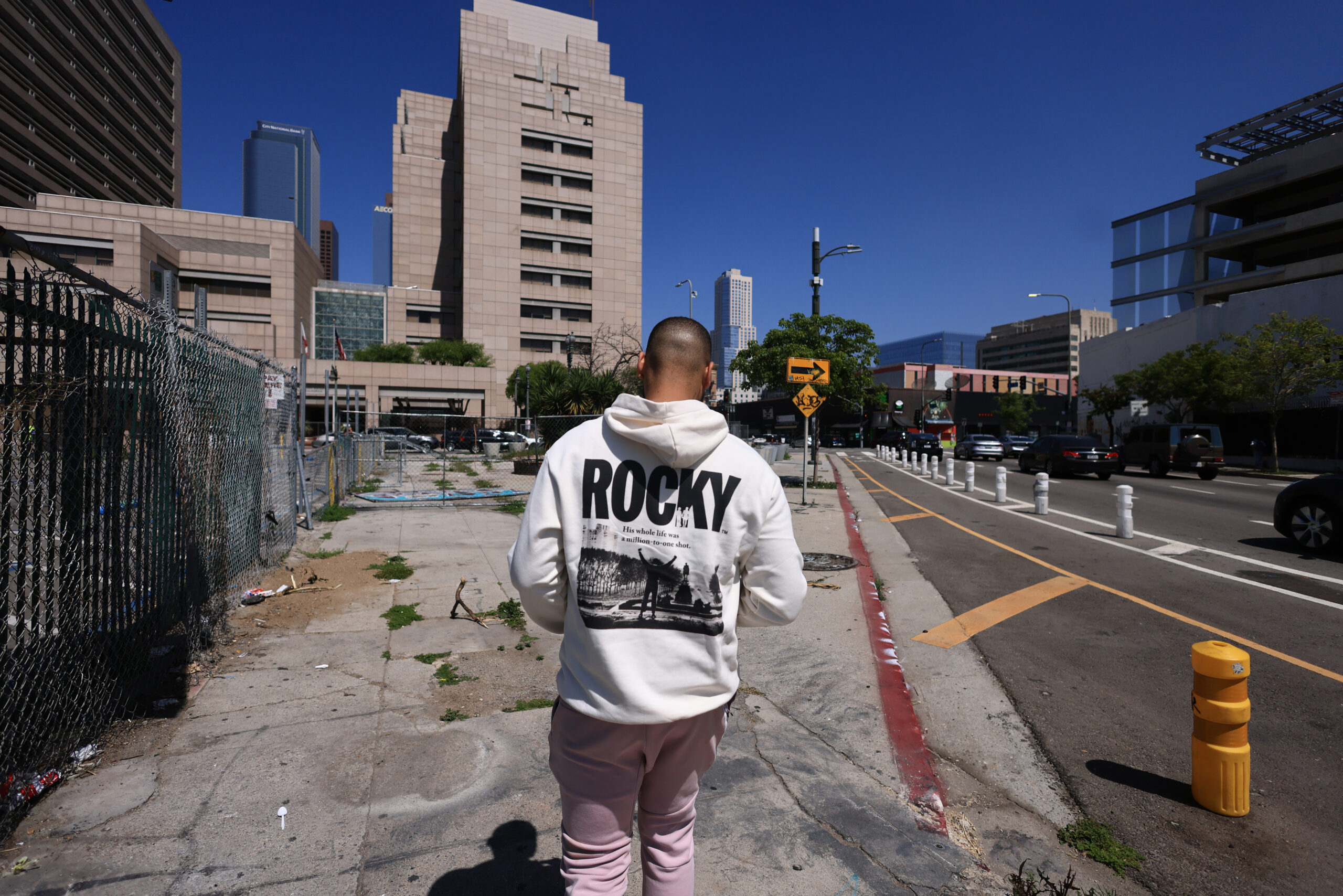
True Rice, a Los Angeles transplant from Baltimore, walks by a site where “Rocky” was filmed, coincidentally wearing an appropriate hoodie.
What has changed and what hasn’t
Three hundred parking spots, give or take, cover the piece of land where the Main Street Gym once stood. In some ways, little has changed about the neighborhood. Weeds and tufts of grass burst up from the concrete. Walls and telephone poles are psychedelic with graffiti.
On a recent morning, a man in a red plaid shirt stretched out on a ledge near a palm bush and slept. A few feet away, another man, dressed in ratty black, crouched down, put his hands on the sides of his head, and began screaming. A pair of white sneakers dangled from a wire stretched above, giving the lot a Philadelphian flavor. Around the corner, a dog had dropped something in the middle of the sidewalk that its owner, if the animal even had an owner, hadn’t bothered to scoop up.
There was no historical marker commemorating the gym. No artwork invoking Rocky, Stallone, or Meredith. No acknowledgment of one of the most inspirational films ever made … or the dark story connected to it.
Then, as if by magic, there was something. There was someone. True Rice strolled through the lot, heading back to his apartment after grocery shopping. Twenty-nine and a native of West Baltimore, he moved to Los Angeles in 2020 to try to make it in modeling and music.
“Came out here with 60 dollars in my pocket,” he said, “looking for a change.”
The striking aspect about him wasn’t what he did but what he wore: a white, hooded sweatshirt that he had bought the day before. Plastered across the back were the words “ROCKY: His whole life was a million-to-one shot” and a depiction of Stallone atop the Art Museum steps.
Did Rice have any idea about the history of where was walking and what that history represented? The lot … the gym … the men … the movie … the murder … the stories and the scenes, exhilarating and evil.
He said what anyone would have expected him to say. He said what even those few who remember Howie Steindler and his death would have to admit. He stood in the middle of a grim city block with no memory, and he said he didn’t know.
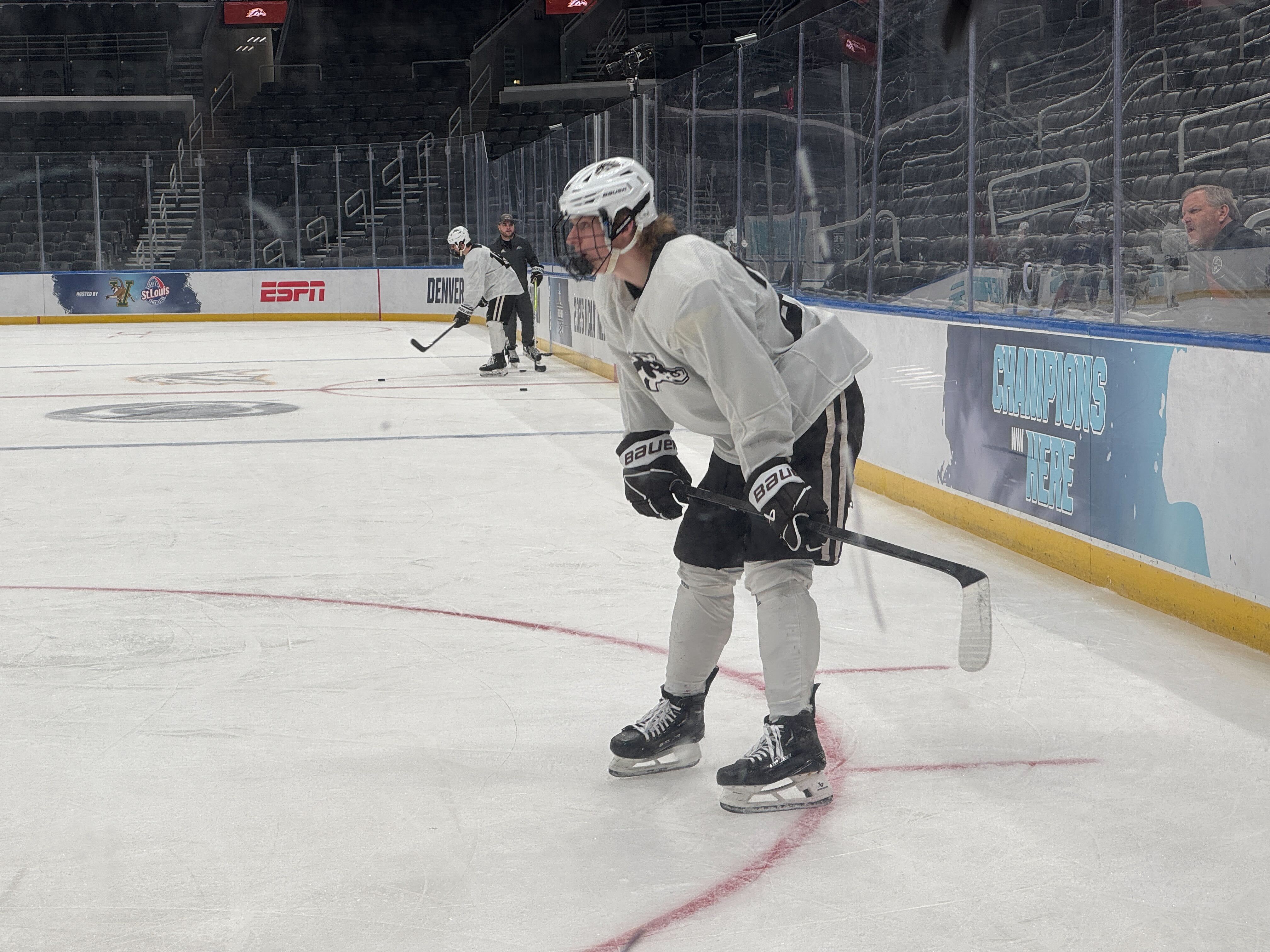
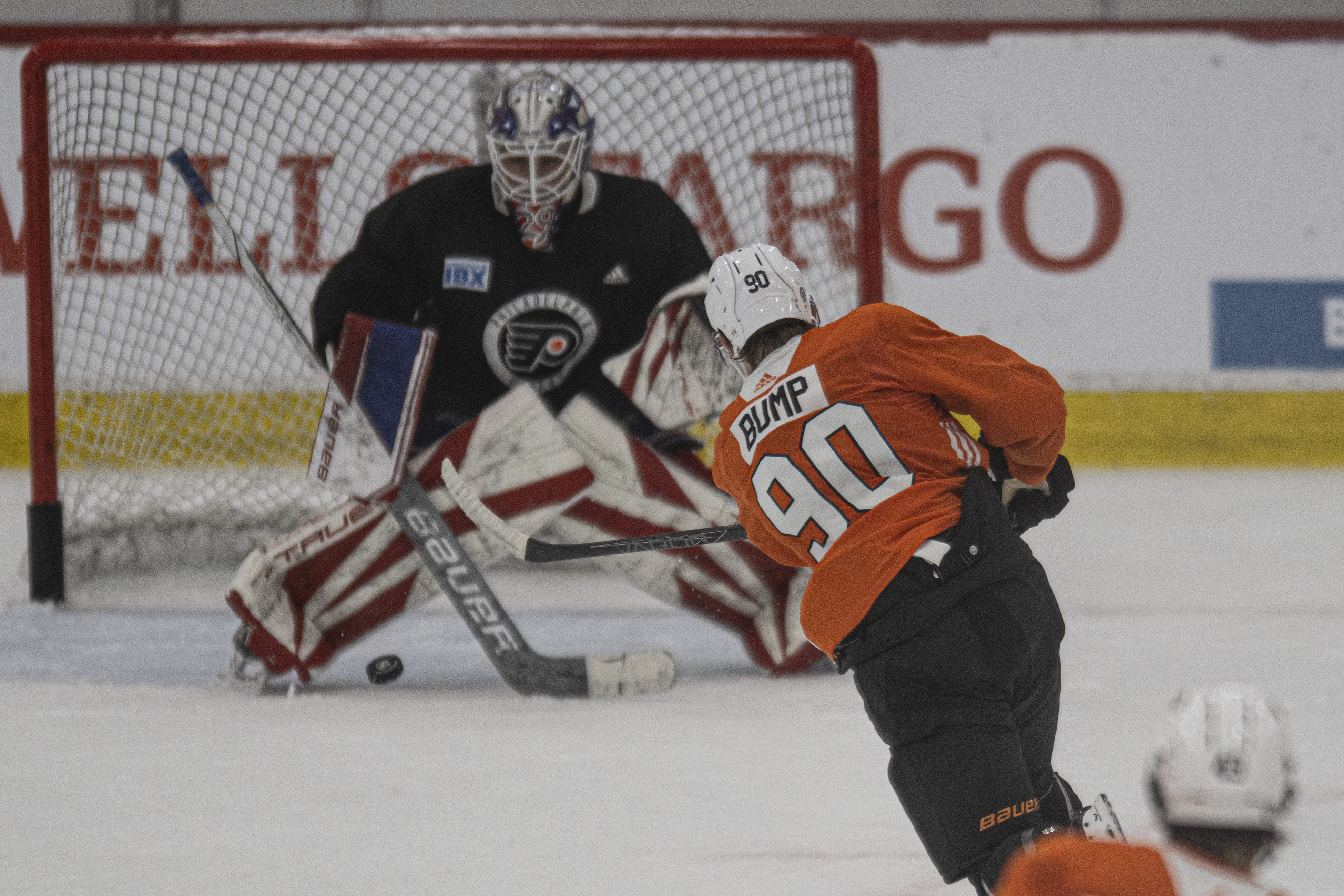
ST. LOUIS — Skating around the Enterprise Center with his blond hair flowing out of his helmet, Flyers prospect Alex Bump potted a quick wrister from the slot as his linemate Matteo Costantini let out a big yelp.
Were they celebrating a goal like the double-overtime winner that sent Western Michigan to the NCAA regional finals? No. Was it one of his team-leading 23 tallies this season? Nope. It was instead at Western Michigan’s final practice before the university’s first-ever appearance in the Frozen Four.
While the goal came as he skated around in a white practice jersey with a black Bronco on it, it encompassed what Bump, 21, does best now, and what he will look to replicate when he suits up for the Flyers in the no-longer-distant future.
“A lot of guys are not confident in their shooting,” Flyers director of player development Riley Armstrong said. “A lot of guys don’t think they can beat a goalie, or they have to get to a certain area on the ice to be able to beat the goalie. I think Alex is a very confident shooter, he knows where to shoot the puck. He’s always known how to find the net.”
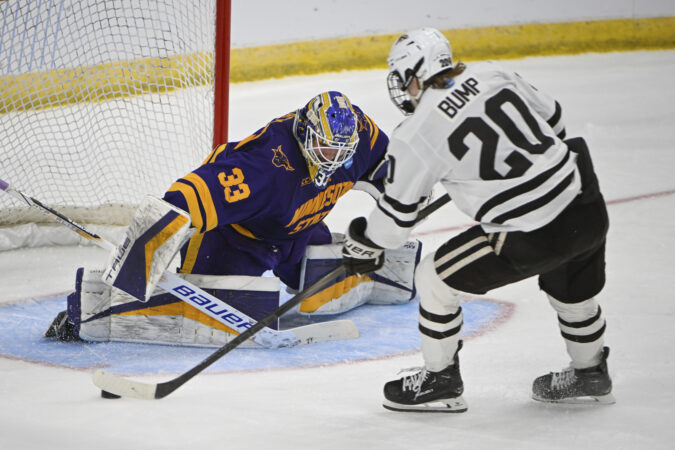
Flyers prospect Alex Bump is tied for eighth in the nation with 23 goals this season.
Hometown hero
Joe Pankratz remembers Bump being at the rink, even before he starred for him at Prior Lake High School. Bump’s two older brothers played hockey for the school’s longtime coach, and a young Bump — who at the age of 8 and 9, “was a good squirt”— developed a reputation as a rink rat.
“The biggest thing is, he absolutely loves hockey,” Pankratz told The Inquirer. “You can’t get him off the ice.”
It was in his hometown of Prior Lake, Minn., where Bump developed that lethal shot of his. He scored 48 goals during his senior season as the Lakers’ captain, including 12 in the section and state tournament playoffs; five came in one playoff game.
“It’s a lot of snapshots, and he protects it and hides it really well. He changes the angle on his shot. … A lot of that is he’s got amazing hands, but he has a lot of poise with the puck, so he isn’t in a rush,” Pankratz said. “He doesn’t panic with it.”
And he is a volume shooter. This season, the left-shot winger has fired 236 shots on goal with 23 goals, a 9.7% shooting percentage.
But it’s not just his shot that’s impressed the Flyers.
“He’s very elusive of checks. He’s slippery, as you would call it in hockey,” Armstrong said. “He always finds a way to get around guys, get through guys, and then when he doesn’t have the puck, he always finds a way to get open. He has a really good stick. He’s physical. He engages with and without the puck into contact, which is something that you need to play at the NHL level.”
Alex Bump’s skill has popped at multiple Flyers development camps. Next year, he hopes to crack the NHL out of main training camp.
The NHL could come as soon as the Broncos’ season ends, either Thursday against the University of Denver (5 p.m., ESPN2) or after Saturday’s national championship game (7:30 p.m., ESPN2). And it sounds like Bump will be coming with an ax to grind.
“Our guys, Brent [Flahr, assistant general manager] and [amateur scout] Shane Fukushima in Minnesota, had seen him play a lot [in high school], and they were very comfortable with him. They couldn’t believe that he had fallen this far,” Flyers general manager Danny Brière said this week.
At the time, Brière was an adviser to then-GM Chuck Fletcher. He jokes that his nephew Zaac, the team’s runner at the Montreal draft, “still claims he made the pick for us” after seeing Bump’s name high on the team’s draft board and saying they should take the Minnesotan.
Bump was eventually selected by the Flyers in the fifth round with pick No. 133 — and it lit a fire.
“He came up to the suite after. He had his brothers there, his family, and he came in and he was [ticked] off that he went so late. He felt he should have went earlier in the draft,” added Armstrong, then an assistant coach with Lehigh Valley.
“I think he’s proven a lot of people wrong, or for our sake, right.”
Why Bump, the 2022 USA Today High School Hockey Player of the Year, fell is irrelevant now. Just like the round he was drafted. As Flahr always says, it’s all about what you do after that matters. And what Bump, 21, has done has been impressive.
But first, Bump had to face some adversity. He played USHL hockey wrapped around his senior year but didn’t put up the biggest numbers the year after he graduated. A University of Vermont commit, he had to make a last-minute pivot when the Catamounts’ coach was fired, and found a home at Western Michigan in Kalamazoo, Mich.
Alex Bump, pictured at Western Michigan’s Frozen Four practice on Wednesday, was the NCHC’s top forward this year.
“I think that we’ve seen over the last two years is that his development has seemingly gone into hyperdrive. I think he’s ahead of schedule where we thought he would be this time two years ago,” FloHockey’s prospect analyst Chris Peters told The Inquirer. “So that’s a pretty positive development, because he was good in the USHL, but he wasn’t dominant. And now this year, you could say he was one of the best players in college hockey.”
Broncos coach Pat Ferschweiler, who was a linemate at Western Michigan with Flyers president Keith Jones, and the Flyers organization work in lockstep. Armstrong speaks with the coaching staff and Bump consistently, and goes over videos with the player to make sure they are all on the same page as far as his development and making sure he is NHL-ready.
How it will translate at the NHL level is to be determined. Ferschweiler says the Flyers got “an absolute steal.” He notes Bump’s “incredible hockey sense and incredible vision,” but feels what will really separate him and “what the Flyers fans are going to love, is, he’s got incredible compete.”
“Alex does not lack for confidence,” he said. “He’s got inner belief, because he works really hard, and that’s how belief is earned. He does that every day. So he’s not a cocky kid, but he does have self-belief, which I think there’s a fine line there and he walks on the right side of it.”
A pure goal scorer, Bump does need to continue to work on his skating. But those who know him best have seen improvement. This past winter break, Bump skated with his old high school team and Pankratz noted “how much stronger, more powerful of a skater he is.”
And they all know he will put in the work because he wants to succeed.
“I don’t think he’s ever really been a passenger.” Peters said. “He’s a driver, and especially at his age, and that program, and based on what they have surrounding him, like they needed him to be that, and he’s delivered. So he’s risen to the occasion.”
The Flyers and their fans will love to hear that because maybe, just maybe, he becomes another game-changer for a team that needs more of them to take that next step.
“I really do,” Armstrong said, when asked if Bump could be that type of guy. “I think, with Matvei [Michkov] as well. … You just have to have a little bit of patience to kind of see the rebuild through and wait for these kids to get there.
“Once they do, you’re going to have a couple of game-changers sitting right in front of you.”
Alex Bump’s shot is his No. 1 attribute but the Flyers see more than just that in the 21-year-old.
PITTSBURGH — And just like that the NHL’s trade deadline is almost here.
After a rambunctious two weeks focused on the 4 Nations Face-Off, all eyes are now turned to the league’s annual wheelin’ and dealin.’
Flyers general manager Danny Brière could be busy before the clock strikes 3 p.m. on March 7 as he continues to shape the roster in his long-term vision. He already traded homegrown forwards Joel Farabee and Morgan Frost at the end of January, as he, and the brass, decide who is on the bus.
So who is next to go, if anyone? We broke down the Flyers roster one week out from the trade deadline.
Scott Laughton, C/LW: Every year Laughton is rumored to be on the trade block. The forward is well-equipped to handle the chatter by now, but could this be the year he is finally moved? A reliable two-way center who can also be productive on the wing and as a penalty killer, Laughton has versatility that is attractive to teams looking to make a Stanley Cup run. He also has one year left after this season at a $3 million cap hit and would not just be a rental for rumored landing spots, including Winnipeg, which the Flyers play on Saturday, and his hometown Toronto Maple Leafs. He also would bring value to any locker room.
Rasmus Ristolainen, D: If coach John Tortorella had his way, the Flyers would keep the blueliner because, “If you trade him Friday, then on Saturday, you say, [expletive], I need a big, right-handed defenseman.” Ristolainen also has term — two years beyond this season at a $5.1 million clip — and, what Tortorella considers, a favorable contract. But there is no denying Ristolainen is a marquee trade chip for the Flyers as teams look to get bigger for the postseason.
Erik Johnson, D: Johnson, who turns 37 next month, is a pending unrestricted free agent and could be a good option for a playoff team looking to add depth to its defensive core. Although he hasn’t played much this season, he has looked steady when called upon and has the postseason experience — i.e., a Stanley Cup — teams look for in a sixth or seventh blueliner.
The Flyers have a decision to make with Rasmus Ristolainen, who is signed for two seasons beyond this one.
Which Flyers could be traded if the price is right?
Bobby Brink, RW: Tortorella recently said Brink, in a good way, “plays every game worrying about … just staying in his spot.” The forward has played well and is setting career highs while playing a better defensive game. He shouldn’t get moved, but his stock is on the rise.
Nick Deslauriers, LW: The veteran enforcer has one more year after this season at $1.75 million. A good guy in the room, he hasn’t played much this season — he did miss a good chunk with an injury — but could be utilized for a team as a fourth liner who protects guys during the rough-and-tumble postseason.
Garnet Hathaway, RW, and Nick Seeler, D: Every team, including the Flyers, wants guys like this. Should they be moved? No, but it may make sense if the return is well above the asking price.
Andrei Kuzmenko, LW: Now on his third team in three years, the Russian winger comes with question marks. He has the skill but seems to start strong with clubs before stalling. Tortorella likes what he has seen in a few short weeks, and Kuzmenko’s coachability. But there could be suitors for a guy who can find the back of the net, so the Flyers could flip him. If they do, he is an unrestricted free agent this summer and could always return on a cheaper deal if both parties were so inclined.
Egor Zamula, D: Is the defenseman going to be on the bus? That is the big question right now. He has shown growth at times but is still struggling to find his game and could be a good fit for a team looking to rebuild its blue line.
Ivan Fedotov/Aleksei Kolosov, G: Although there is rampant speculation as to why Kolosov is still on the NHL roster, the Flyers cannot persist with the three-headed monster in net. One of the guys should either get sent down to the American Hockey League — Kolosov is waiver-exempt — or one should be traded.
Which Flyers are unlikely to get traded?
Sean Couturier, C: It’s no secret the former Selke Trophy winner hasn’t been the same since undergoing two back surgeries in 2022. The injuries came just after he had signed an eight-year, $62 million ($7.75 million average annual value) contract to become the face of the Flyers. Couturier is still a responsible defensive center, but no team is trading for a 32-year-old whose best hockey looks to be behind him, and who has five years remaining at his hefty cap hit.
Emil Andrae, D: Limited in stature but not in heart and drive, Andrae is ready to become an NHL regular now. It should be with the Flyers, who need his puck-moving ability. The one exception would be if he’s part of a larger package to land the big-time center the Flyers need.
Jamie Drysdale, D: Teams need guys like Drysdale, with his ability — like Andrae — to move the puck and generate offense from the back end. That said, he is still very much a work in progress. If they were to move him, the only positive for the Flyers is that he looked fantastic against the Pittsburgh Penguins on Tuesday night, especially when he broke up a pass intended for Sidney Crosby and then delivered the primary assist up the ice.
Could Cam York be a surprise trade candidate ahead of March 7?
Cam York, D: He was once thought to be untouchable, but York’s status is not as defined with the Flyers. After a stellar 2023-24, in which Tortorella called him the team’s best defender, he has struggled to find that level this season. He did deal with a shoulder injury early in the year that seemed to stunt his growth but has played better of late.
Noah Cates, C, and Tyson Foerster, LW/RW: Highly unlikely, but they are both restricted free agents who are expected to earn big raises this summer after the seasons they are having. The Flyers need centers and Cates has finally emerged as a top-three pivot, so there’s a low probability he will be moved. Foerster’s chances are a bit higher as teams would love his defensive game with a big shot brimming under the surface.
Ryan Poehling, C, and Owen Tippett, LW/RW: Very unlikely. When confident, Tippett is becoming the guy everyone expected with his speed and skill. He should score 30 goals consistently. Like Tippett, Poehling adds speed to the lineup and is the solid bottom-six center the Flyers have use for, especially if Laughton dealt.
Jakob Pelletier, LW: The Flyers just got the winger, who has some upside as a former first-round pick. He’s a restricted free agent this summer and will be signed for cheap, so no reason to make a rash move — unless he’s part of that big center package we talked about it.
Who on the Flyers is untouchable?
Travis Konecny, RW: Signed to an eight-year extension last summer, the All-Star winger is just hitting his prime and his stride. Konecny has established himself as a bona fide top-line player and is on pace for a career-high 86 points.
Matvei Michkov, RW: Obviously.
Travis Sanheim, D: The other half of “The Travii” is having a breakout season, becoming one of the NHL’s top defensemen in terms of stamina and versatility. The top-pair blueliner boasts a rare combination of size (6-foot-4, 222 pounds) and skating ability, which he just showcased on the international stage. Sanheim, who turns 29 next month, also has a full no-trade clause through the 2026-27 season.
Sam Ersson, G: People want to question whether he is a No. 1 goalie. Why? The Swede continues to prove he can carry the load of games and the weight of being among the NHL’s best. Just look at his stats since the Christmas break — 11-4-2 with a .912 save percentage — and that doesn’t include his stellar performance vs. the United States at the 4 Nations Face-Off.
Goalie Samuel Ersson has played himself into untouchable status, according to Jackie Spiegel.