Jefferson Health oncologist Jennifer Johnson had exhausted all the standard treatment options for her 49-year-old patient with esophageal cancer, who was likely to die within months.
Surgery, chemotherapy, radiation, and immunotherapy had kept the Northeast Philadelphia woman alive for six years after her diagnosis, but no longer were enough to stop her cancer from spreading.
Johnson knew her patient needed something novel. She recalled a presentation several years prior at a conference for head and neck cancers, where a doctor discussedan experimental treatment called T-cell receptor (TCR) therapy.
This type of cancer immunotherapy works by engineering the immune system to fight cancer, and falls into the same family of treatments as CAR-T, or chimeric antigen receptor (CAR) T cell therapy, an approach pioneered at the University of Pennsylvania that has revolutionized treatment for blood cancers.
She thought TCR therapy’s clever approach could work against solid tumors, where CAR-T had not been effective.
“I just remember sitting in the room and watching him present, thinking, I’m gonna use that one day,” the oncologist and cancer researcher recalled.
As it would happen, the approach was being tested in a phase II clinical trial at Rutgers Cancer Institute against tumors just like her patient’s: metastatic cancers driven by a virus called human papillomavirus 16. One of the most common strains, HPV16 causes roughly half of cervical cancer cases worldwide, as well as cancers of the head and neck area, anus, and genitals.
Cases that reach the metastatic stage like Johnson’s patient often run out of treatment options. Whether T-cell receptor therapy would work was unknown, but the alternatives were expected to fail.
“Anything that you might offer them would definitely not be expected to make their cancer go away completely and do it for a long time,” said Christian Hinrichs, the oncologist and scientist heading the trial whose presentation Johnson saw.
But interim results from the first half of the trial showed improvement in six out of 10 patients, whose tumors at least partially shrank. And two of them had no evidence of cancer after treatment.
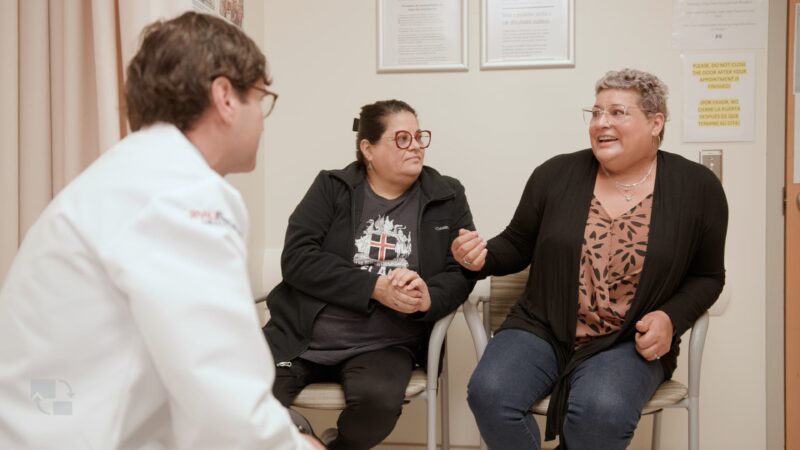
Johnson’s patient, Maria Pascale, was one of thetwo whose promising early results were presented at a medical conference and highlighted in a research abstract in the Journal for ImmunoTherapy of Cancer in November.
She arrived at the health system in New Jersey in the summer of 2024 in such poor health thather lungs were starting to collapse.
The therapy has enabled her to celebrate two birthdays, start martial arts classes, reunite with old friends visiting from Argentina, and see her 23-year-old son get engaged.
“Imagine the wedding, then later the grandkids, I’m always thinking about [that],” she said.
What is a T-cell receptor therapy?
In the immune system, T cells act as frontline defenders against viruses, bacteria, and other threats.
Sometimes, these cells aren’t great at their jobs.
In the face of cancer, T cells can become exhausted over time, and fail to recognize invaders or mount attacks.
The idea behind immunotherapy is to transform these regular immune cells into cancer-fighting super-soldiers.
The Rutgers approach, an engineered TCR therapy, involves collecting T cells from a patient’s blood and genetically engineering them to better target a cancer cell for attack.
Afterward, the scientists grow more of the enhanced T cells in the lab and infuse them back into the patient.
The “prototype” for this style of therapy is CAR-T, a treatment that has saved tens of thousands of lives since the first FDA approval in 2017. Scientists have not yet been able to replicate the therapy’s success in blood cancers in solid cancers, although some early stage trials have shown potential.
TCR therapy is thought to be more promising against the latter cancer type — which is what’s being treated in the Rutgers trial — due to differences in the way the engineered T cells identify cancer cells.
CAR-T therapy uses what’s called a chimeric antigen receptor, a protein that recognizes a cell as cancer based on what’s on the outside of the cell.
It’s like knowing you’re at your friend’s house because of a specific doormat or set of house numbers on the exterior.
TCR therapy uses what’s called a T-cell receptor, which can recognize cancer cells based on what’s inside the cell.
It’s like knowing you’re at your friend’s house because you can see your friend inside.
Sometimes cancer cells have more unique identifiable elements on the outside, but other times they don’t. Imagine if multiple houses had the same doormat.
“That target would be on other cells that aren’t cancer cells and cause lots of toxicity,” said Carl June, the pioneering cancer scientist at Penn who developed the first FDA-approved CAR-T therapy and was not involved in the Rutgers trial.
That’s been the problem that’s held back CAR-T’s use in solid tumors.
The target in the Rutgers trial is a protein called HPV16 E7, found inside the cell. In tumors driven by the virus HPV16, it plays a key role in turning a cell into cancer.
“That’s like going after its Achilles’ heel,” June said.
Swarming the cancer
Pascale first arrived at Thomas Jefferson University Hospital in Center City in 2018 after suffering injuries in a car accident.
Doctors found a mass in the 43-year-old’s neck that turned out to be cancer.
Surgeons removed the mass,and she was fine until 2021 when doctors, including Johnson, found the cancer at the top of her esophagus.
They treated her with a combination of chemotherapy and radiation, which worked until March of 2022, when the cancer started appearing in Pascale’s lungs.
“All bets were off,” Johnson said.
Doctors gave Pascale chemotherapy and immunotherapy over the next couple of years, but in the spring of 2024, she developed an allergy to one of her chemotherapy drugs.
Around the same time, the cancer spread to the skin on Pascale’s back.
That’s when Johnson transferred her care to Hinrichs’ team at Rutgers.
Pascale started preparations for the treatment in July 2024, spending a couple weeks in the hospital.
The Rutgers team took T cells from her blood, gave her chemotherapy to knock her immune system down, and then transfused the engineered cells back into her body.
Within 48 hours, Pascale started feeling horrible.
“It was painful. It was my whole body, like I had pneumonia,” she said.
She had trouble breathing as the cells fought the cancer in her lungs. Hinrichs described it as “the T cells swarming the cancer,” leading to an inflammatory reaction.
The same thing occurred on her back. When Pascale’s sister came over, she saw one of the tumors in her skin was suddenly the size of a lemon.
Another one appeared red and felt like someone was burning a cigarette on her back.
The pain continued for three days, and then she felt well enough to go home. Pascale and her sister could see and feel the nodules on her back get smaller, until eventually they were gone.
Roughly five months later, Pascale’s scans showed no evidence of cancer. As of last month, a year and a half after she received the treatment, that was still true.
“What’s three days of pain compared with the opportunity that I have to live a lot of beautiful things with my family and friends?” Pascale said.
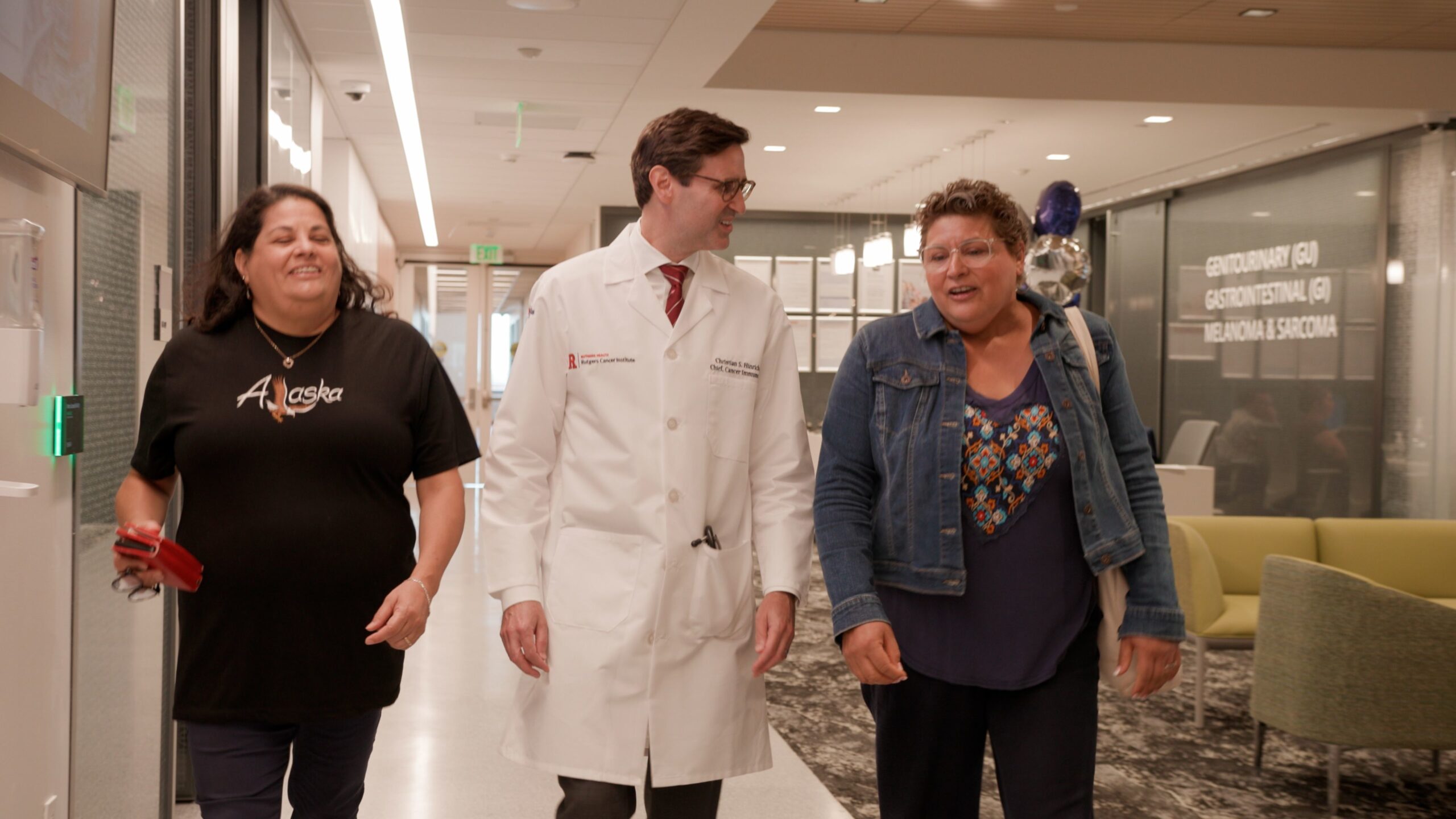
Maria Pascale walks with her sister Maria Durante and her doctor Christian Hinrichs at Rutgers.
The future of the treatment
Hinrichs said his team is working to figure out why two of the patients, including Pascale and a patient with anal cancer, responded better to the treatment.
He cautioned that it’s too early to draw sweeping conclusions since the sample size is small. (Researchers will seek to recruit another 10 patients for the ongoing trial.)
The patients who had complete responses will need follow-up scans every few months to make sure their cancers have not returned.
It will still take years to finish evaluating safety and efficacy. Treatments tested in clinical trials often do not advance to become standard practice.
June, the Penn scientist, called the trial’s early results promising and noted that there weren’t any major safety problems reported.
Adverse effects seen in the trial were mainly those caused by the chemotherapy.
However, the drawback of using TCR therapy is that patients need a certain genetic background for it to work, June said. This is similar to how not every organ donor would be a good match for a recipient.
The genetic profile chosen for the Rutgers therapy is the most common in America. However, it is less common in Black and Asian people compared to white people.
Scientists hope it could one day be possible to manufacture the therapy witha warehouse approach, where TCR therapies that work across genetic backgrounds could be mixed and matched.
“It’s a practical issue that the drug companies face,” June said.
CAR-T, in comparison, canbe used more broadly across different genetic backgrounds.
What matters most, since the treatment is expensive to make, is that the responses hold up over time, June said.
(The TCR therapy’s cost has not yet been set, Hinrichs said, since it is currently manufactured individually for each patient.)
“If they’re long lasting, then it’s really going to be a huge advance because nothing else works in the patients he’s treated,” June said.
At Jefferson, Johnson is cautiously optimistic about the treatment that has kept her patient alive.
If the therapy makes it through the rest of the trial process and proves effective, she hopes it could become “another thing in our armamentarium against this type of cancer.” (A type that doctors would hope to see less of since the introduction of the HPV vaccine in 2006.)
“I can’t tell you how wonderful it is to have a patient responding and living well when you saw things going the wrong way,” Johnson said.
Editor’s note: This story has been updated to clarify where the research has been presented and a reference to the prevalence of the genetic profile used in TCR therapy.
Family Practice & Counseling Services Network won a $3.4 million federal health center grant that will allow the nonprofit to continue providing medical and mental healthcare in Southwest Philadelphia and other low-income Philadelphia neighborhoods, officials confirmed this week.
The clinic had been part of Resources for Human Development, a Philadelphia human services agency that a fast-growing Reading nonprofit called Inperium Inc. acquired in late 2024. As a federally qualified health clinic since 1992, the clinic had received an annual federal grant, higher Medicaid rates, and other benefits.
Federal rules prohibited the clinic from continuing to retain that status and those benefits under a parent company. That meant Family Practice & Counseling Network had two options: close or spin out into a new entity that would reapply to be a federally qualified clinic.
With financial and operational help from the University of Pennsylvania Health System, Family Practice & Counseling formed a new legal entity last July and reapplied for the grant. Last week, the organization’s CEO Emily Nichols learned that the federal agency that oversees federal health centers awarded it the grant.
Democratic Gov. Josh Shapiro is racking up contributions from out-of-state billionaires as well as thousands of individual donors across the country.
His likely Republican challenger, State Treasurer Stacy Garrity, meanwhile, is capturing small-donor donations from Pennsylvanians.
That’s according to an analysis of the latest campaign finance filings in the Pennsylvania governor’s contest, as a clearer picture of the race emerges nine months out from Election Day. Shapiro entered 2026 with $30 million on hand — money raised over several years as he has built a national profile — while Garrity raised $1.5 million in her first five months on the campaign trail as she tries to unseat the popular Democratic incumbent. Last year, Shapiro brought in $23.3 million.
Here are three takeaways from the first campaign finance filings in the race, tracking fundraising heading into 2026.
Almost all of Stacy Garrity’s contributors are from Pennsylvania, while 62% of Shapiro’s are in state
Nearly all of Garrity’s individual 1,155 contributors — more than 97% — live in Pennsylvania, and on average gave $889 each.
Shapiro — who has amassed a national following and is a rumored 2028 Democratic presidential contender — had a much further reach and attracted many more donors from around the country. He received contributions from 4,981 individual donors, 62% of whom are from Pennsylvania. The average individual donor to Shapiro contributed $3,461, a number buoyed by multiple six- and seven-figure contributions.
Shapiro received most of his remaining individual donations from California (7.1%), New York (6.3%), New Jersey (2.5%), Florida (2.5%), and Massachusetts (2.4%), according to an Inquirer analysis.
(The analysis includes only donors who contributed more than $50 in 2025. Campaigns are required to list only individual donors who contribute above that threshold.)
(function() { var l = function() { new pym.Parent( ‘shapiro-garrity3__graphic’, ‘https://media.inquirer.com/storage/inquirer/ai2html/shapiro-garrity3/index.html’); }; if(typeof(pym) === ‘undefined’) { var h = document.getElementsByTagName(‘head’)[0], s = document.createElement(‘script’); s.type = ‘text/javascript’; s.src = ‘https://pym.nprapps.org/pym.v1.min.js’; s.onload = l; h.appendChild(s); } else { l(); } })();
Shapiro’s broad donor base is a result of his status as a popular incumbent governor who is liked among people of both political parties, saidRobin Kolodny, a Temple University political science professor who focuses on campaign finance.
“These amounts that you’re seeing is a very strong signal that ‘This is our guy,’” Kolodny said. “That underscores he is a popular incumbent.”
Kolodny also noted that Shapiro’s state-level fundraising cannot be transferred to a federal political action committee should he decide to run in 2028.But his war chest shows his ability to raise money nationally and his popularity as the leader of the state, she added.
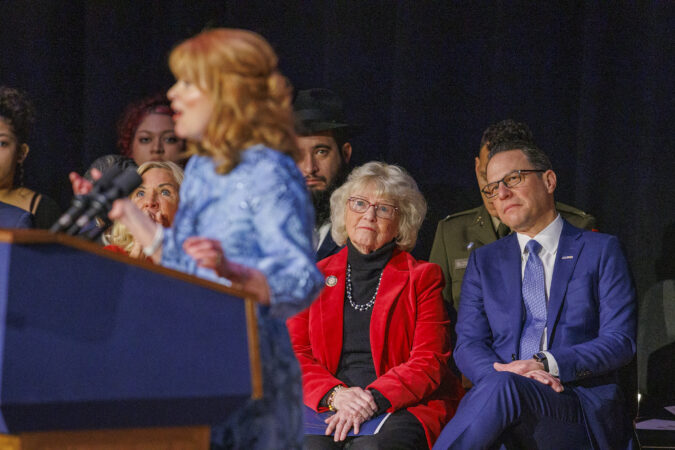
Governor Josh Shapiro during a reelection announcement event at the Alan Horwitz “Sixth Man” Center in Philadelphia on Thursday, Jan. 8, 2026.
Only a small percentage of the population contributes to political campaigns, Kolodny said. And sometimes, it’s the smallest contributions that pay off the most, she said. Small-dollar donations suggest grassroots support that can translate into a person assisting the campaign in additional ways to get out the vote, she said.
Both Shapiro and Garrity have received a significant number of small-dollar donations that illustrate some level of excitement in the race — though Shapiro’s more than 3,000 in-state donors outnumber Garrity’s total by nearly 3-1.
“Think of fundraising as not just a money grab, but also as a campaign strategy,” Kolodny said.
Since announcing his reelection campaign in January, Shapiro has run targeted social media ads and sent fundraising texts, asking for supporters to “chip in” $1 or $5. The strategy worked, bringing in $400,000 in the first two days after his announcement, with an average contribution of $41, according to Shapiro’s campaign. This funding is not reflected in his 2025 campaign finance report.
Most of Shapiro’s money came from out-of-state donors, including billionaire Mike Bloomberg and a George Soros PAC
While Shapiro garnered thousands of individual contributions from Pennsylvania in all 67 counties, according to his campaign, the latest filings show it was the big-money checks from out-of-state billionaires that ran up his total.
Approximately 64% of the $23.3 million Shapiro raised last year came from out-of-state donors.
And more than half — 57% — of Shapiro’s total raised came from six- or seven-figure contributions by powerful PACs or billionaire donors.
By contrast, only 31% of Garrity’s total fundraising came from six-figure contributions.
The biggest single contribution in the governor’s race came from billionaire and former New York City Mayor Michael Bloomberg, who gave Shapiro $2.5 million last year.
Shapiro also received $1 million from a political action committee led by billionaire Democratic supporter George Soros; and $500,000 from Kathryn and James Murdoch, from the powerful family of media mogul Rupert Murdoch.
Kolodny noted that big contributions from people like Bloomberg are a drop in the bucket of his total political or philanthropic spending.
window.addEventListener(“message”,function(a){if(void 0!==a.data[“datawrapper-height”]){var e=document.querySelectorAll(“iframe”);for(var t in a.data[“datawrapper-height”])for(var r,i=0;r=e[i];i++)if(r.contentWindow===a.source){var d=a.data[“datawrapper-height”][t]+”px”;r.style.height=d}}});
“This is not something extraordinary,” Kolodny said. “He’s got nothing but money.”
In Pennsylvania, Shapiro received notably high contributions from Philadelphia Phillies owner John Middleton, who gave $125,000, and Nemacolin Resort owner MaggieHardy, who gave $250,000, among others. He also received a number of five-figure contributions from private equity officials, venture capitalists, and industry executives in life sciences, construction, and more.
Garrity’ssingle biggest donation was $250,000 from University City Housing Co., a real estate firm providing housing near Drexel University and the University of Pennsylvania. Her largest contributions from individuals included $50,000 from her finance chair, Bob Asher of Asher Chocolates, and another $50,000 from Alfred Barbour, a retired executive from Concast Metal Products.
Garrity has served as Pennsylvania’s state treasurer since 2020 and has led the low-profile statewide office with little controversy. She did not join the race for governor until August and raised only a fraction of the funds Shapiro did in that same time. Meanwhile, Shapiro spent 2025 at the political forefront as a moderate Democrat trying to challenge President Donald Trump in a state that helped elect him. Shapiro also benefited from his national name recognition after he was considered for Vice President Kamala Harris’ running mate in 2024.
Shapiro has so far outraised Garrity 30-1, and top Pennsylvania Republicans have said they want to see Garrity fundraising more aggressively nationally.
Kolodny said Garrity’s low fundraising is a reflection of the state of the race: Republicans put up a weak candidate in 2022 against Shapiro during his first run for governor, and now many powerful donors want to keep the relationship they have formed with Shapiro over the last three years.
“That will reflect as a lack of enthusiasm for her,” Kolodny said. “Now she could turn that around, but from what I see, I don’t see her that much, only recently. She had the last six months; she could have done a lot more.”
Controversy over donations tied to associates of Jeffrey Epstein
Shapiro’s top contributions from individual donors also included a $500,000 check from Reid Hoffman, the Silicon Valley-based billionaire cofounder of LinkedIn. His name showed up thousands of times in the trove of documents recently released by the U.S. Department of Justice related to the investigation into financier and convicted sex offender Jeffrey Epstein.
Garrity has highlighted the donations Shapiro received from Hoffman, and has publicly called on Shapiro to return the tech billionaire’s campaign contributions from last year and prior years, totaling more than $2 million since 2021.
Hoffman has claimed he had only a fundraising relationship with Epstein, but publiclyadmitted he had visited his island. He has not been charged with wrongdoing.
A spokesperson for Shapiro said Garrity should “stop playing politics with the Epstein files.”
“Donald Trump is mentioned in the files over 5,000 times. Is she going to ask him to rescind his endorsement?” asked Manuel Bonder, Shapiro’s spokesperson.
Garrity has previously downplayed Trump’s appearance in the Epstein files, and argued that Democrats would have released them much sooner if there was clear evidence of Trump partaking in any inappropriate behavior.
GOP candidate for Pennsylania Governor, Stacy Garrity and Jason Richey hold up their arms in Harrisburg, Pa., Saturday, February 7, 2026. The PA State Republican Committee endorsed the two in their quest for the governor’s mansion. (For the Inquirer/Kalim A. Bhatti)
If Shapiro were to return the funds from Hoffman, it would be bad for Garrity, Kolodny said, because she has made very few other political attacks against him.
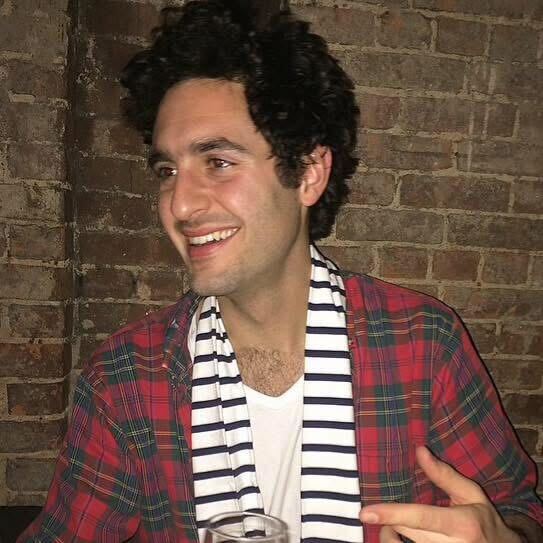
Each night, Louis-Hunter Kean spiked a fever as high as 104.5. He would sweat through bedsheets and shiver uncontrollably. By morning, his fever wouldease but his body stillached; even his jaw hurt.
He had been sick like this for months. Doctors near his South Jersey home couldn’t figure out why a previously healthy 34-year-old was suffering high fevers plus a swollen liver and spleen. In early 2023, they referred Kean to Penn Medicine.
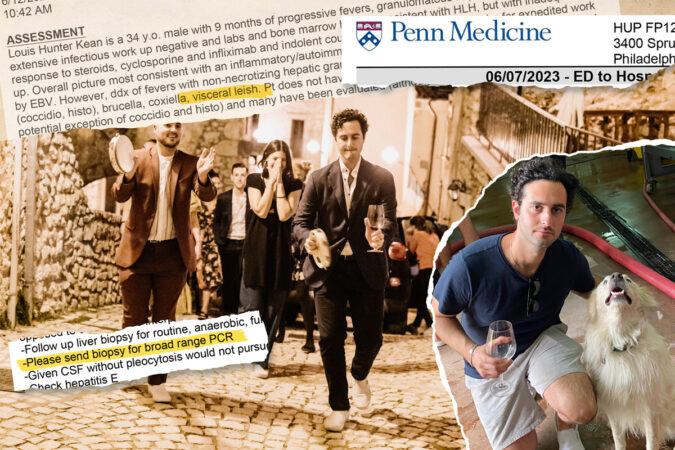
Louis-Hunter Kean visiting a winery in the Tuscany region of Italy in September 2021. He first spiked a mysterious and persistent fever about a year later in August 2022.
“These doctors are very sharp, and there are a lot of teams working on it,” Kean texted a friend after being admitted to the Hospital of the University of Pennsylvania (HUP) in West Philadelphia.
Was it an infection? An autoimmune disease? A blood cancer? Over the next six months, at least 34 HUP doctors — rheumatologists, hematologist-oncologists, gastroenterologists, infectious disease and internal medicine specialists — searched for an answer.
Kean was hospitalized at HUP five times during a six-month period in 2023. His electronic medical chart grew to thousands of pages.
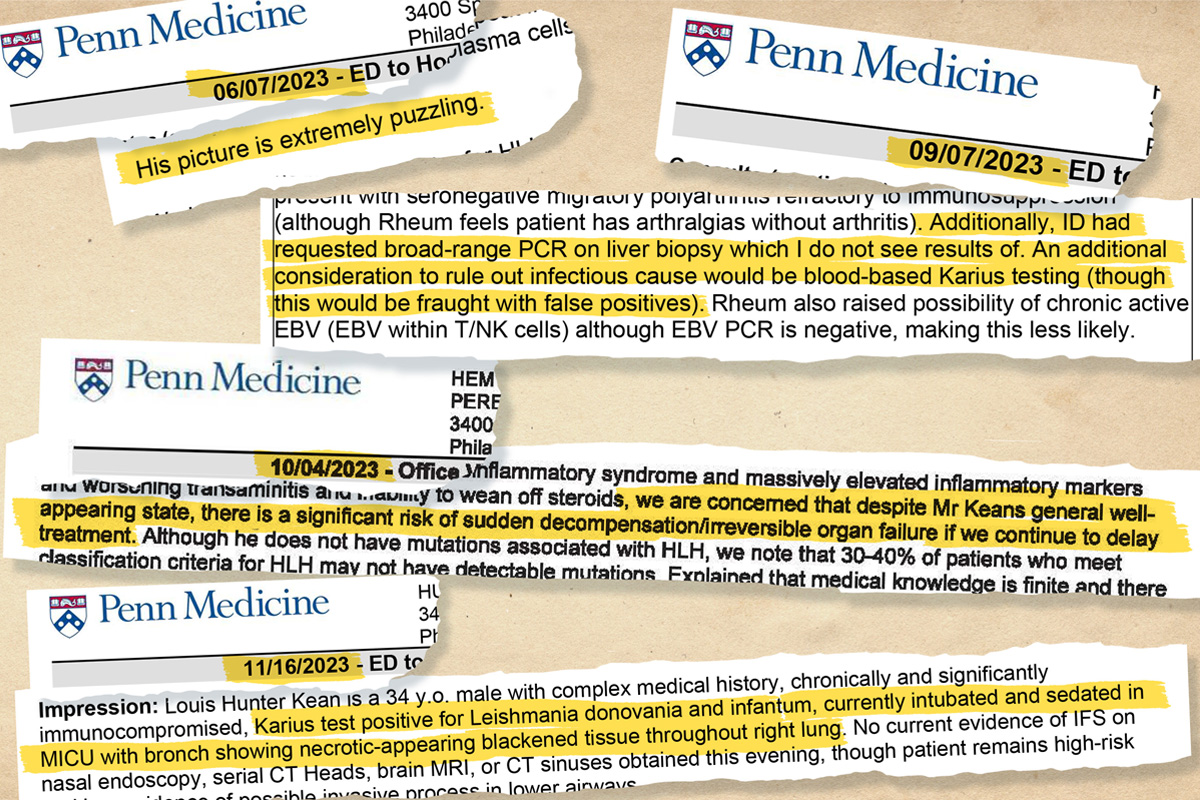
Along the way, doctors missed critical clues, such as failing to obtain Kean’s complete travel history. They recommended a pair of key tests, but didn’t follow up to make sure they got done, medical records provided to The Inquirer by his family show.
Doctors involved in Kean’s care, including at Penn, prescribed treatments that made him sicker, said four infectious disease experts not involved in his care during interviews with a reporter, who shared details about his treatment. Penn doctors continued to do so even as his condition worsened.
Louis-Hunter Kean receives a kiss from bride Ashley Greyson at the October 2021 wedding of his close friend, Joshua Green. Green and Kean graduated from Haddonfield High School in 2007.
“No one was paying attention to what the doctor before them did or said,” Kean’s mother, Lois Kean, said.
“They did not put all the pieces together,” she said. “It was helter-skelter.”
Kean’s family is now suing Penn’s health system for medical malpractice in Common Pleas Court in Philadelphia. The complaint identifies nearly three dozen Penn doctors, accusing them of misdiagnoses and harmful treatments. These physicians are not individually named as defendants.
In court filings, Penn says its doctors did not act recklessly or with disregard for Kean’s well-being, and his case is not indicative of any systemic failures within its flagship hospital. A Penn spokesperson declined further comment on behalf of both the hospital and the individual doctors involved in Kean’s care, citing the pending lawsuit.
The puzzle of Kean’s diagnosis finally came together in November 2023 after a Penn doctor, early in his career, sought help from the National Institutes of Health (NIH).
An NIH doctor recommended a test that identified the cause: a parasite prevalent in countries bordering the Mediterranean Sea. Kean likely got infected while vacationing in Italy, four parasitic disease experts told The Inquirer.
The infection, which is treatable when caught early, is so rare in the U.S. that most doctors here have never seen a case, the experts said.
By the time Penn doctors figured it out, Kean’s organs were failing.
Louis-Hunter Kean and his then-girlfriend Zara Gaudioso at a friend’s wedding in Tuscany in September 2021. Kean and Gaudioso got engaged in early 2023. Gaudioso was smitten by Kean’s good looks and sense of humor.While vacationing in Italy in September 2021, Louis-Hunter Kean and his friends hiked in the foothills of the Apennine Mountains and visited Gran Sasso and Monti della Laga National Park.
A missed clue
When a patient has an ongoing and unexplained fever, an infectious disease doctor will routinely start by takinga thorough travel history to screen for possible illnesses picked up abroad.
A medical student took Kean’s travel history during his initial workup at HUP in June 2023. An infectious disease specialist reviewed the student’s notes and added a Cooper University Hospital doctor’s earlier notes into Kean’s electronic medical chart at Penn.
Those records show Kean had traveled to Turks and Caicos with his fiancée in May 2022. The next month, he took a work trip out West, including to California, where he visited farms, but didn’t interact with livestock.
This was not unusual for Kean, who worked with fruits and vegetables imported from around the world at his family’s produce distribution center on Essington Avenue in Southwest Philadelphia.
Kean’s fiancée, Zara Gaudioso, said she repeatedly told doctors about another trip: In September 2021, about a year before his fevers began, they traveled to Italy for a friend’s wedding in Tuscany.
The couple hiked remote foothills, danced all night in a courtyard, dined by candlelight surrounded by a sunflower farm, and slept in rustic villas with the windows flung open.
“We told everybody,” Gaudioso said. “A lot of Americans go to Italy — it’s not like a third-world country, so I could see how it could just go in one ear and out the other.”
But notes in Kean’s medical record from the Penn infectious disease specialist don’t mention Italy. Neither do the ones the specialist copied over from Kean’s infectious disease doctor at Cooper.
Kean “does not have known risk factors” for exposure to pathogens, the Penn specialist concluded, except possibly from farm animals or bird and bat droppings.
Still, the specialist listed various diseases that cause unexplained fever: Tick-borne diseases. Fungal infections. Tuberculosis. Bacteria from drinking unpasteurized milk.
The possible culprits included a parasitic disease, called visceral leishmaniasis, transmitted by a bite from an infected sandfly. It can lie dormant for a lifetime — or, in rare cases, activate long after exposure, so it’s important for doctors to take extensive past travel histories, parasitic experts say.
The parasite is widely circulating in Southern European countries, including Spain, Greece, Portugal, and Italy.
“Mostly, people living there are the ones who get it. But it’s just a lottery sandwich, and there’s no reason that travelers can’t get it,” said Michael Libman, a top parasitic disease expert and former director of a tropical medicine center at McGill University in Canada.
But few cases become severe. Hospitals in Italy reported only 2,509 cases of active infection between 2011 and 2016, affecting fewer than one in 100,000 people. Infections requiring hospital care in Italy began to decline after 2012, according a 2023 European study by the Public Library of Science (PLOS) journal Neglected Tropical Diseases.
Caught early, visceral leishmaniasis is treatable. Without treatment, more than 90% of patients will die.
In addition to fever, other telltale symptoms are swelling of the liver and spleen and low blood cell counts. Kean had all of those.
A missed test
The infectious disease specialist requested a test to examine tissue biopsied from Kean’s liver, which was damaged and enlarged. Lab results showed that immune cells there had formed unusual clusters — another sign that his body might be fighting off an infection.
In her notes, the specialist identified “visceral leish” as a possible diagnosis, which repeated — via copy and paste — seven times in his medical record. Her request to “please send biopsy for broad-range PCR” repeated five times.
That is a diagnostic (polymerase chain reaction) test that looks for the genetic fingerprint of a range of pathogens.
The test comes in different versions: One looks broadly for bacteria. The other is for fungi. The broad fungal test candetect leishmania, even though it’s not a fungus. However, it’s not always sensitive enough to identify the parasite and can produce a false negative, experts said.
The specialist’s chart note doesn’t specify which type she wanted done.
It’s not clear if anyone asked. The test wasn’t done.
Louis-Hunter Kean (right, with wine glass and tambourine) leads a wedding procession through the small stone village of Santo Stefano di Sessanio in Italy’s Abruzzo region in September 2021.
She did not order a low-cost rapid blood test that screens specifically for leishmaniasis by detecting antibodies made by the immune system after fighting it. She also didn’t order a leishmania-PCR, which is highly targeted to detect the exact species of the parasite.
Nor did the medical record show that the specialist followed up on the results of the broader test she requested, even though she saw Kean on nine of the 13 days of his first hospitalization at HUP in June 2023.
Penn has a policy that a lead doctor on the patient’s case is responsible for making sure that recommended tests get done. The specialist was called in as a consultant on Kean’s case. During that June hospitalization alone, his medical chart grew to 997 pages.
Patient safety experts have warned for years that electronic medical record systems — designed for billing and not for care — can become so unwieldy that doctors miss important details, especially with multiple specialists involved, or repeat initial errors.
A seemingly innocuous step in charting — copying and pasting previous entries and layering on new ones— can add to the danger, patient safety experts say.
That’s how the specialist’s mention of “visceral leish” and her test recommendation got repeated in Kean’s chart.
Marcus Schabacker, president of ECRI, a nonprofit patient-safety organization based in Plymouth Meeting, said “copy and paste” in electronic medical records puts patients at risk of harm.
“The reality is if you are reading something over and over again, which seems to be the same, you’re just not reading it anymore. You say, ‘Oh, yeah, I read that, let’s go on,’” said Schabacker, speaking generally about electronic medical record systems and not specifically about Kean’s case.
Louis-Hunter Kean plays guitar in his younger years. He loved music and shared eclectic playlists with his friends.
When treatments harm
Penn doctors believed Kean had a rare,life-threatening disorder, known as hemophagocytic lymphohistiocytosis (HLH), in which the immune system attacks the body. Instead of fighting infections, defective immune cells start to destroy healthy blood cells.
In most adults, the constellation of symptoms diagnosed as HLH gets triggered when an underlying disease sends the body’s immune system into overdrive. Triggers include a blood cancer like lymphoma, an autoimmune disease like lupus, or an infection.
Penn doctors across three specialties — hematology-oncology, rheumatology, and infectious disease — were searching for the cause within their specialties.
“His picture is extremely puzzling,” one doctor wrote in Kean’s chart. “We are awaiting liver biopsy results. I remain concerned about a possible infectious cause.”
As HUP doctors awaited test results, they treated Kean’s HLH symptoms with high doses of steroids and immunosuppressants to calm his immune system and reduce inflammation.
The treatments, however, made Kean highly vulnerable to further infection.And defenseless against another possible trigger of HLH: visceral leishmaniasis.
At the time, a Penn rheumatologist involved in Kean’s care before his first hospitalization warned about steroids “causing harm” to Kean if it turned out he had an infection. He wrote, “please ensure all studies requested by” infectious disease are done, medical records show.
Steroid treatments would allow the parasites to proliferate unchecked, experts said.
“It’s unfortunately exactly the wrong treatment for parasitic disease,” said Libman, the leishmania disease expert at McGill University.
As Kean grew sicker, he was readmitted to HUP for a third time in September 2023. He texted a friend: “I’m on more medications than I’ve ever been on and my condition is worse than it’s ever been.”
A sampling of Louis-Hunter Kean’s electronic medical records, which ballooned to thousands of pages over five HUP hospitalizations within six months in 2023.
Handoffs between doctors
No single doctor seemed to be in charge of Kean’s care, his family said. And the number of specialists involved worried them.
“Everyone just kept being like, ‘We don’t know. Go see this specialist. Go see that specialist,’” Kean’s sister, Priscilla Zinsky, said.
By fall 2023, rheumatologists hadn’t found a trigger of Kean’s symptoms within their specialty. They turned to doctors specializing in blood cancer.
During the handoff, three doctors noted that they didn’t see the results of the test requested by the infectious disease specialist back in June. They still thought it was possible that Kean had an infection, records show.
“An additional consideration to rule out infectious cause would be blood-based Karius testing (though this would be fraught with false positives),” wrote that doctor, who was still training as a hematologist-oncologist.
A supervising physician reviewed the Sept. 8, 2023, note and signed off on it. The medical records don’t show any follow-up with infectious disease doctors, and the test wasn’t done at the time.
In the coming days, blood cancer specialists struggled to find a link between Kean’s symptoms and an underlying disease.
They thought he might have a rare form of leukemia, but tests weren’t definitive, Kean texted friends.
Untreated HLH symptoms can lead to rapid organ failure, so doctors often start patients on treatment while trying to figure out the underlying cause, said Gaurav Goyal, a leading national expert on HLH, noting that it can take days to get test results.
“You have to walk and chew the gum. You have to calm the inflammation so the patient doesn’t die immediately, and at the same time, try to figure out what’s causing it by sending tests and biopsies,” said Goyal, a hematologist-oncologist at the University of Alabama at Birmingham.
Medical records show that Penn doctors feared Kean was at “significant risk” of “irreversible organ failure.”
They suggested a more aggressive treatment: a type of chemotherapy used to treat HLH that would destroy Kean’s malfunctioning immune cells.
In his medical record, a doctor noted that beginning treatment without a clear diagnosis was “not ideal,” but doctors thought it was his best option.
Four parasitic disease experts told The Inquirer that chemotherapy, along with steroids and immunosuppressants, can be fatal to patients with visceral leishmaniasis.
“If that goes on long enough, then they kill the patient because the parasite goes out of control,” Libman said, explaining that ramping up the HLH treatments weakens the immune system. “The parasite has a holiday.”
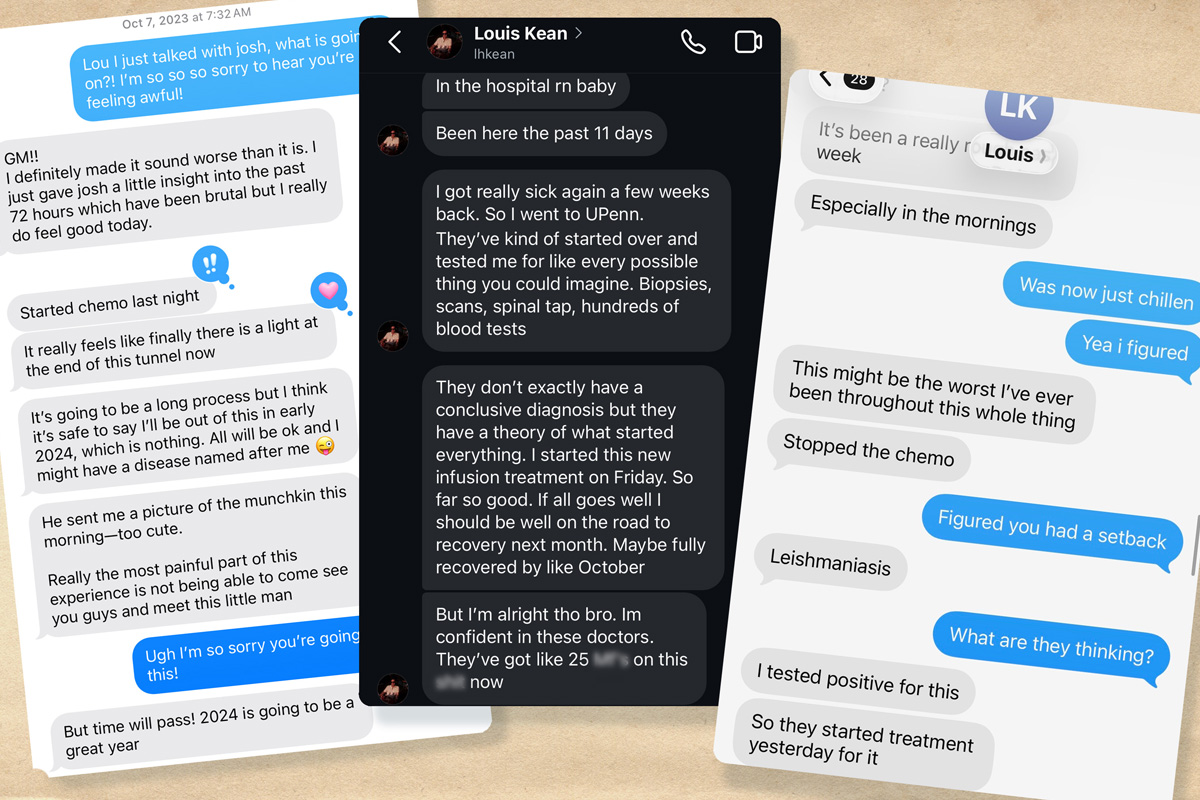
A sample of text messages from Louis-Hunter Kean to friends during separate HUP hospitalizations over a six-month period in 2023.
Chemo as last resort
Kean banked his sperm, because chemo infusions can cause infertility. He told friends he trusted his Penn team and hoped to make a full recovery.
“Started chemo last night. It really feels like finally there is a light at the end of the tunnel,” he texted a friend on Oct. 7, 2023.
“I’m gonna get to marry my best friend, and I think I’m going to be able to have children,” Kean wrote in another text to a different friend.
Kean spent nearly all of October at HUP getting chemo infusions. He rated his pain as a nine out of 10. His joints throbbed. He couldn’t get out of bed. He started blacking out.
Doctors added a full dose of steroids on top of the IV chemo infusion. By the end of the month, Kean told a friend he feared he was dying.
A year had passed since Kean first spiked a fever. He no longer could see himself returning to his former life — one filled with daily exercise, helping run his family’s produce store, nights out with friends at concerts and bars, and vacations overseas.
Lethargic and weak, he could barely feed himself. His sister tried to spoon-feed him yogurt in his hospital bed.
He started texting reflections on his life to friends and family, saying his illness had given him a “polished lens” through which he could see clearly. He wrote that their love felt “like a physical thing, like it’s a weighted blanket.”
“I’ve lived an extremely privileged life. I don’t think it’s possible for me to feel bad for myself,” he said in a text. “And I don’t want anyone else to either.”
Louis-Hunter Kean enjoying dinner out with his sister, Jessica Kean, in Manhattan in 2014. Friends and family described him as a “foodie” and health food advocate prior to the onset of his illness in August 2022.
Puzzle solved
One doctor involved in Kean’s care had seen him at Penn’s rheumatology clinic in early June 2023, just before his first HUP hospitalization. The doctor, a rheumatology fellow,urged him to go to HUP’s emergency department, so he could be admitted for a medical workup.
The fellowremained closely involved in Kean’s care, medical records show. Also in his 30s, this doctor shared Kean’s interests in music, fashion, and the city’s restaurant scene, according to Kean’s family.
“They had a rapport,” Kean’s father, Ted Kean, said. “Louis thought a lot of him, and he seemed to think a lot of my son.”
By early November 2023, the rheumatology fellow was extremely concerned, medical records show.
The chemo infusions weren’t helping. Kean still was running a fever of 103. The fellow wrote in his chart that he was worried Kean needed a bone-marrow transplant to replace his failing immune system.
And doctors still didn’t know the root of his symptoms.
The fellowcontacted the NIH, medical notes show.
An NIH doctor recommended a test to check for rare pathogens, including parasites that cause visceral leishmaniasis,according to family members present when the testing was discussed.
The NIH-recommended Karius test was the same one suggested two months earlier by the Penn hematologist-oncologist in training, but with no follow-up.
File of sign on front of Hospital of the University of Pennsylvania (HUP) taken on Tuesday, March 19, 2024.
On Nov. 16, the fellow got the results. He went to Kean’s bedside.
After five HUP hospitalizations over six months, a single test had revealed the cause of his illness: visceral leishmaniasis.
Kean cried with relief and hugged the fellow, joined by his mother and sister.
“‘You saved my life,’” Kean’s sister, Jessica Kean, recalled her brother telling the doctor. “‘Finally, we know what this is, and we can treat it.’”
Kean’s medical chart was updated to note that he traveled to “Italy in the past,” also noting he had visited Nicaragua and Mexico. A HUP infectious disease doctor consulted with the Centers for Disease Control and Prevention on antiparasitic medications.
Meanwhile, Kean’s nose wouldn’t stop bleeding. He felt light-headed and dizzy, with high fever. Even on morphine for his pain, his joints ached.
“I’ve been struggling, buddy,” he texted a friend on Nov. 20. “This might be the worst I’ve ever been.”
By Nov. 22, he stopped responding to text messages. He began hallucinating and babbling incoherently, family members recalled. “Things went downhill very, very quickly, like shockingly quickly,” his sister, Priscilla Zinsky, said.
When she returned on Thanksgiving morning, he was convulsing, thrashing his head and arms. “It was horrifying to see,” Zinsky said.
Her brother had suffered brain bleeds that caused a stroke. His organs were failing. He had a fungal infection with black mold growing throughout his right lung, medical records show.
Kean was put on life support, with a doctor noting the still-preliminary diagnosis: “Very medically ill with leishmaniasis.”
“Prognosis is poor,” read the note in his Nov. 29, 2023, medical records.
A few hours later, Kean’s family took him off life support. He died that day.
“All of his organs were destroyed,” said Kean’s mother, Lois Kean. “Even if he had lived, he had zero quality of life.”
Portraits of Lois and Ted Kean’s four children decorate a wall at their home in Haddonfield. Their son, Louis-Hunter, died after contracting visceral leishmaniasis, a parasitic infection he likely picked up in Italy. When caught early, it’s treatable with medication. It’s deadly without treatment.
It’s not clear why the parasites began to attack Kean a year after his return from Italy. Healthy people rarely develop severe disease from exposure to the deadly form of the parasite circulating outside the U.S., experts said.
Most people infected by a sandfly “are probably harboring small amounts of the parasite” in their organs, according to Naomi E. Aronson, a leishmania expert and director of infectious diseases at the Uniformed Services University of the Health Sciences in Bethesda, Md.
“Most of the time, you don’t have any problem from it,” Aronson said.
Children under age 5, seniors, and people who are malnourished or immunodeficient are most susceptible to visceral leishmaniasis. Aronson said she worries about people who might harbor the parasite without problems for years, and then become immunocompromised.
Libman, the parasitic expert from McGill, said he’s seen six to 10 patients die from visceral leishmaniasis because doctors unfamiliar with the disease mistakenly increased immunosuppressants to treat HLH during his 40 years specializing in parasite disease.
“That’s a classic error,” he said.
Kean’s case “should be a real clarion call” for infectious disease specialists and other doctors in the U.S., said Joshua A. Lieberman, an infectious disease pathologist and clinical microbiologist who pioneered the leishmania-PCR test at the Washington state lab.
“If you’re worried about an unexplained [fever], you have to take a travel history that goes back pretty far and think about Southern Europe, Iraq, Afghanistan, India, and maybe even Brazil,” Lieberman said.
In the wake of Kean’s death, his family was told that Penn doctors held a meeting to analyze his case so they could learn from it.
An infectious disease doctor called Zinsky, Kean’s sister, to let her know about the postmortem review and shared that doctors discussed that Kean had likely picked up the parasite in Tuscany.
“Why didn’t you guys have this meeting,” she asked, ”while he was alive?”
Editor’s note: This story has been updated to clarify that ECRI President Marcus Schabacker was not speaking specifically on Kean’s case.
Twin brothers Larry and Kelly Ganges grew up outside of Trenton with people constantly mispronouncing their last name. “Grange, Grain, Ganger,” they’ve heard it all.
So they developed a standard reply: “It’s Ganges like the river [in India].”
Decades on, they’d find out the deep Philadelphia story behind it.
When the brothers, now 72, got older and traveled, they’d grab the phone book in whatever town they were in to see if anybody with their last name was listed. Then they’d call and ask if they knew anybody in their family; they often did.
“So we all thought, no matter where we were,” said Larry, “we were connected with somebody,”
But they were also connected with something — a ship, a travesty, and a providence.
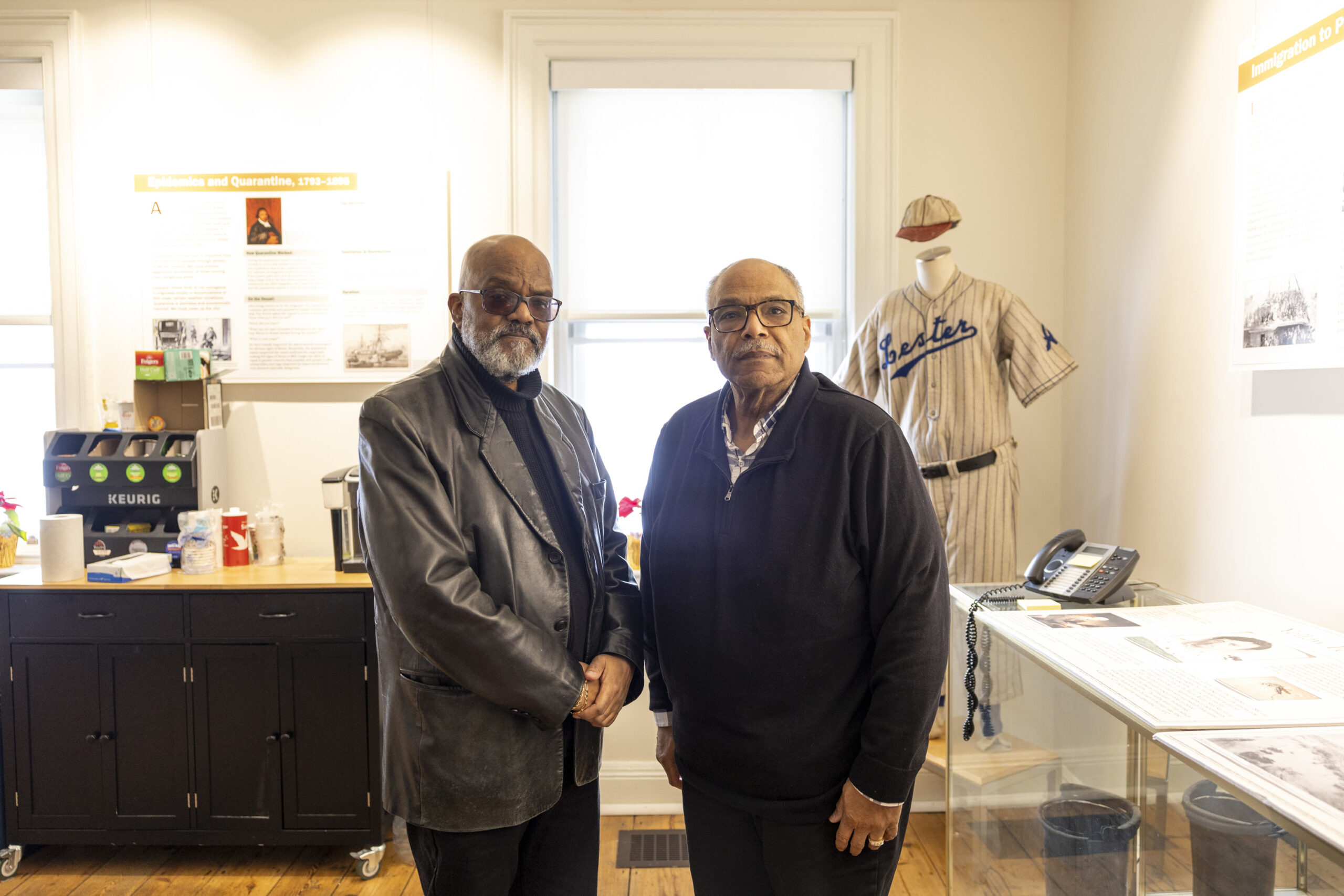
(From left to right) Twin brothers Larry Ganges, and Kelly Ganges, pose for a portrait at the Lazaretto in Tinicum, Pa., on Friday, Feb. 6, 2026. “It allows us to view and experience Black history,” Kelly said. “Pride in knowing our family was in this journey.”
The brothers’ first clue of their extended heritage arrived in 1975, when Kelly, was a student at Trenton State College. His journalism teacher, familiar with Bucks County cemeteries, asked if Kelly knew about the gravestones of two soldiers buried there.
Torbert and William Ganges had fought in the Civil War’s colored regiment, but Kelly couldn’t be sure if they were his relatives.
Nearly 30 years later, the brothers still don’t know if they are related to the soldiers, but they have discovered that their heritage is, as Kelly describes, “bigger than us, [it] extends beyond the continental United States and involves potentially the world.”
That information came in a phone call.
In the early aughts, Larry was working as the New Jersey Department of Health’s assistant commissioner for the HIV/AIDS division. His secretary told him that David Barnes, a University of Pennsylvania professor of history and the sociology of science, was on the line to talk about a different epidemic.
72-year-old twin brothers Kelly Ganges (left) and Larry Ganges, pose at the Lazaretto in Tinicum, Pa., on Friday, Feb. 6, 2026.
Barnes, who was seeking anyone with the Ganges name, had found Larry by chance in a New Jersey state employees directory. He wanted to discuss the 135 Africans who arrived in Philadelphia in 1800 and were detained at the old Lazaretto along the Delaware River.
At the time, every vessel arriving in Philadelphia was required to stop and be inspected at the Lazaretto — a hospital and quarantine station — where patients with yellow fever were treated.
Later, a brick facility replaced the old Lazaretto. Downriver from the original, the “new” Lazaretto, operational from 1801-1895, stands near present day Tinicum. It is the oldest surviving quarantine station in the Western Hemisphere and one of the 10 oldest in the world.
By the call’s end, Larry had learned not just the origin of his name but how his ancestors arrived in America.
“Wow, we had never heard about it. We just didn’t know,” he said.
The story goes: In 1800, the United States naval ship Ganges intercepted two schooners (the Phoebe and the Prudence) off the coast of Florida, near Cuba. Despite a new federal law banning the carrying of human beings for enslavement, the schooners, which experts believe disembarked from near Sierra Leone, contained 135 people from Africa, imprisoned as slaves, bound for the New World.
Ganges’ naval officers boarded the schooners — the Phoebe on July 19, 1800, and the Prudence on July 21, 1800 — took the enslaved into custody, and delivered them to the Ganges’ home port: Philadelphia.
A NPS worker removes an interpretive panels – “The Dirty Business of Slavery” – at the President’s House site in Independence National Historical Park Thursday, Jan. 22, 2026.
When the schooners’ owners sued to reclaim their “property,” a Philadelphia judge ruled that the 135 aboard were people (not property) and ordered them freed. The Africans were remanded to the old Lazaretto for quarantine where they remained for up to three months.
Subsequently Sambo, Milnor, Yelle, and Culico Ganges and the rest of the 123 survivors were indentured to Pennsylvania Abolition Society members and others.
After Barnes’ phone call, the twins and their (late) older brother, Tendaji Ganges, visited the Lazaretto. At that time, the dilapidated building was locked. But Kelly returned with Barnes and gained access inside.
“I saw all of the little rooms … it was interesting to touch a piece of history, and know that that’s the genesis of how our family came to the United States,” he said.
“These modern-day heirs carry the legacy of resistance and survival into today’s conversations around justice, identity, and belonging,” said filmmaker Rah Crawford, whose documentary The Art of Brotherly Love focuses on the Ganges’ story.
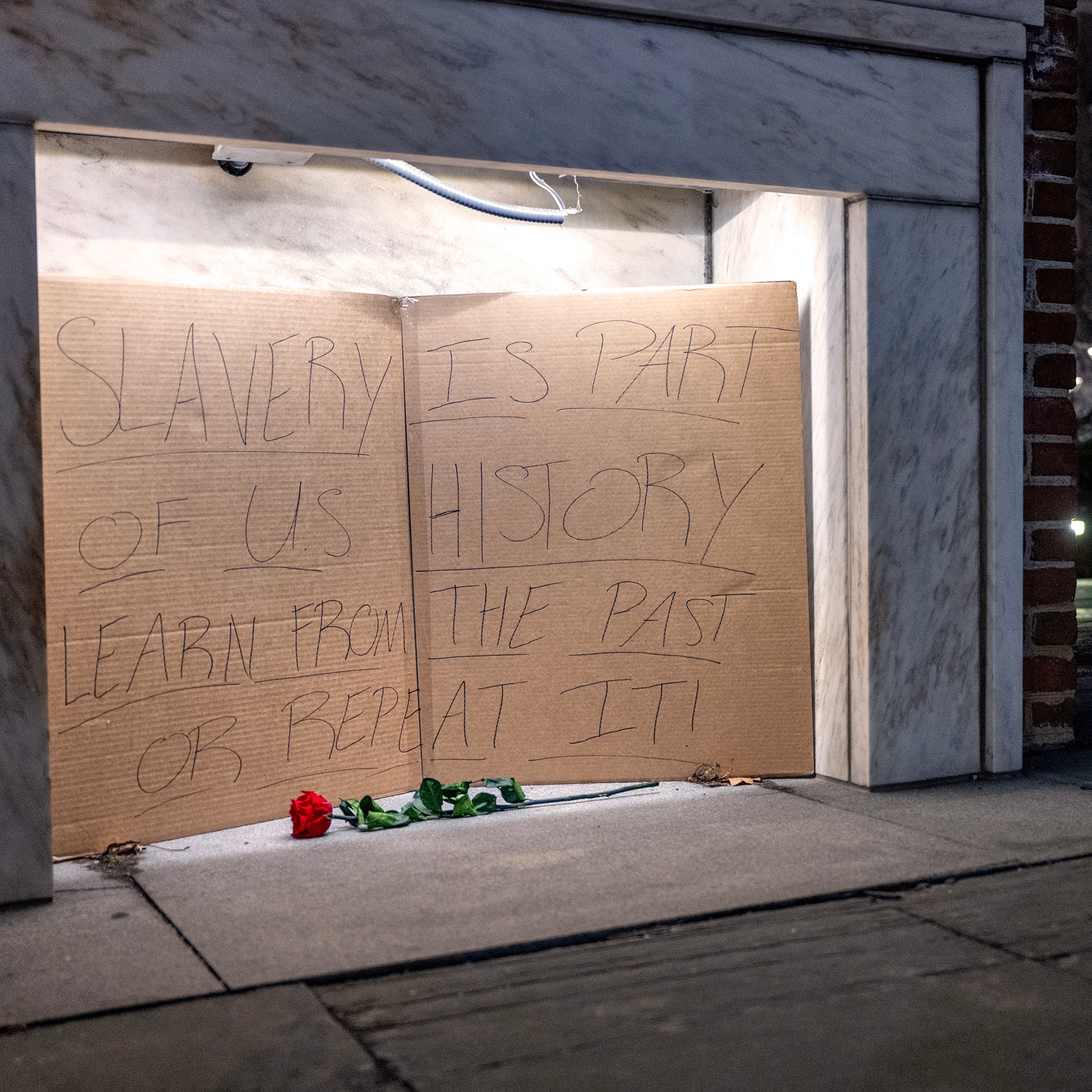
A single rose and a handwritten cardboard sign (“Slavery is part of U.S. history learn from the past or repeat it”) are inside an empty hearth at the President’s House site in Independence National Historical Park late Thursday, Jan. 22, 2026 after workers removed display panels about slavery.
When the film premiered in Brooklyn last year, Larry said that as he sat in the audience watching, he was shaking, almost in tears. His wife asked, “Are you OK? Are you cold?”
He was overcome with emotions: “I was sad, I was happy, I was mad.”
Although, as the brothers say, “we’ve got the generic connection to the name,” they don’t have a connection to identify individual family members that came through the old Lazaretto; they can’t yet determine how their bloodline was carried to them.
But thanks to the efforts of family historian Michael Kearney, who is tracking descendants of the Ganges’ survivors, Larry is confident that “my children and my children’s children [are going] to know what the story is, and to know how to access it, and know who the players are …. And hopefully this movie is not the last of what’s going to occur.”
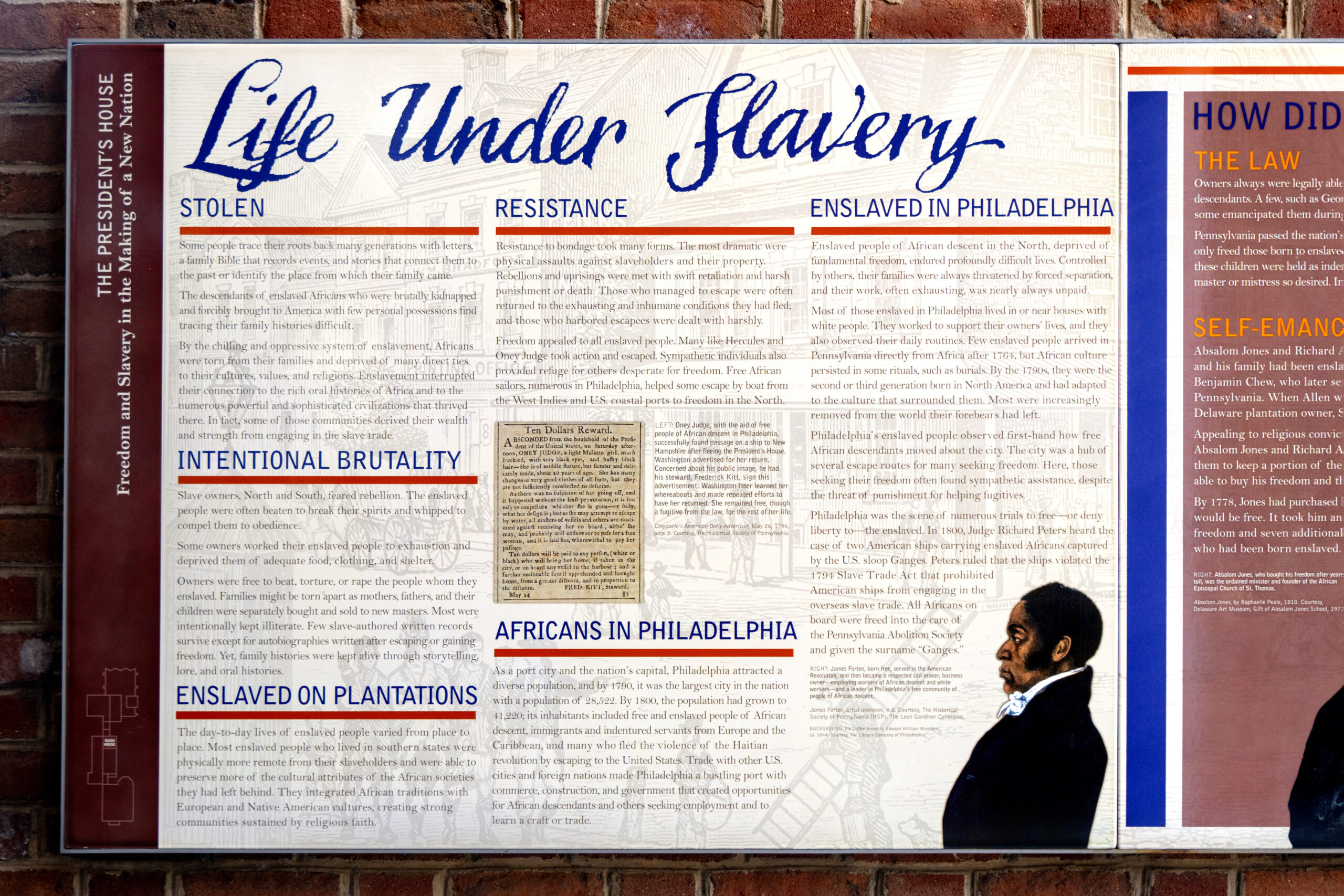
The “Life Under Slavery” sign at the President’s House in the Independence National Historical Park. The sign has since been removed. Photo from Sunday, Aug. 3, 2025.
“People made it through the troubled journey, the Middle Passage, and landed on American soil and contributed to make America a great nation,” said Kelly, “And nobody can ever deny that, and people can try and whitewash it and try to erase it, but it’s not going to work, because it’s real. Our contribution is documented.”
Prior to the opening of the President’s House in 2010, filmmaker Crawford was commissioned to create storyboards for a video installation at the site. Through his research, he first learned of the Ganges’ story, launching a 15-plus-year journey to produce the documentary.
Filmmaker Rah Crawford’s documentary “The Art of Brotherly Love” documents the story of the long-forgotten rescue of 135 enslaved Africans by the “Ganges” in the 1800s,
The Art of Brotherly Love, presented in partnership with Creative Philadelphia, is both a documentary and a trailer for a forthcoming animated feature. The Philadelphia premiere is slated for Feb. 14 at Ritz Five.
After the documentary screens, Kelly Ganges hopes that, “it just continues to cascade out — to inspire more genealogists and historians, and to reach more descendants and the next generation.”
“The Art of Brotherly Love,” Feb. 14, 11:30 a.m., Landmark’s Ritz Five, 214 Walnut St., eventbrite.com
At Roxborough Memorial Hospital in Philadelphia, surgeon Piotr Krecioch has his hands full launching a program offering surgical interventions to treat obesity.
One in three Philadelphians are living with obesity, putting them at higher risk of chronic conditions like diabetes and heart disease, but these days fewer are seeking the bariatric surgical procedures long considered a leading medical treatment for the condition.
“I’m trying to start a bariatric program at probably the worst possible time you can ever imagine because everybody’s losing patients, and I don’t even have a patient to begin with,” Krecioch said.
Tower Health’s Reading Hospital recently closed its bariatric surgery program, and other local health systems have seen declines in weight-loss operations approach 50%.
Independence Blue Cross, the Philadelphia region’s largest insurer, said the number of bariatric surgeries it paid for dropped by half in the five years ended June 30.
Those shifts in the bariatric surgery landscape have followed the meteoric national rise in the use of GLP-1s and related drugs for weight loss.
So far, the drugs havebenefited patients by allowing them to avoid an invasive surgery.With bariatric surgery, people lose weight because the procedures restrict the amount of food a person can eat. Drugs in a class known asGLP-1s make people feel full longer.
For hospitals, the upheaval in treatment options cuts into a profitable business line and adds to the financial pressure health systems have been experiencing since the pandemic.
Despite the ever-increasing popularity of GLP-1s for weight loss like Novo Nordisk’s Ozempic and Wegovy and Eli Lilly’s Mounjaro and Zepbound, it’s too soon to write off bariatric surgery as an option, some doctors say.
Insurers are imposing limits on coverage because of the long-term cost of the drugs compared to surgery, and doctors are watching for side effects that may emerge as more people take the drugs for longer periods of time.
It’s not the first time a new technology has reduced surgical volumes.
Whenever a less-invasive treatment has come along, “surgical volumes always have taken a beating,” said Prashanth R. Ramachandra, a bariatric and general surgeon at Trinity Health Mid-Atlantic’s Mercy Fitzgerald Hospital. Declines in peptic ulcer and open heart surgeries are past examples of the phenomenon, he said.
Such industrywide moves away from profitable procedures can create financial challenges for individual clinics or independent hospitals, said Daniel Steingart, who leads the nonprofit healthcare practice at Moody’s, a major credit ratings agency.
“But I also see it as an opportunity, because there’s other patients out there, there’s other services that can be provided. This is a matter of the management team being nimble,” he said.
Sharp decline in bariatric surgeries
National data show a 38% decline in bariatric surgeries from the beginning of 2024 through September, according to data firm Strata Decision Technology. Comparable local data were not available.
A substantial portion of the drop is from patients who previously had bariatric surgery but regained weight, physicians say. In the past, they would have had a type of surgery called a revision. Now, those patients are more likely to start taking GLP-1s, local doctors said.
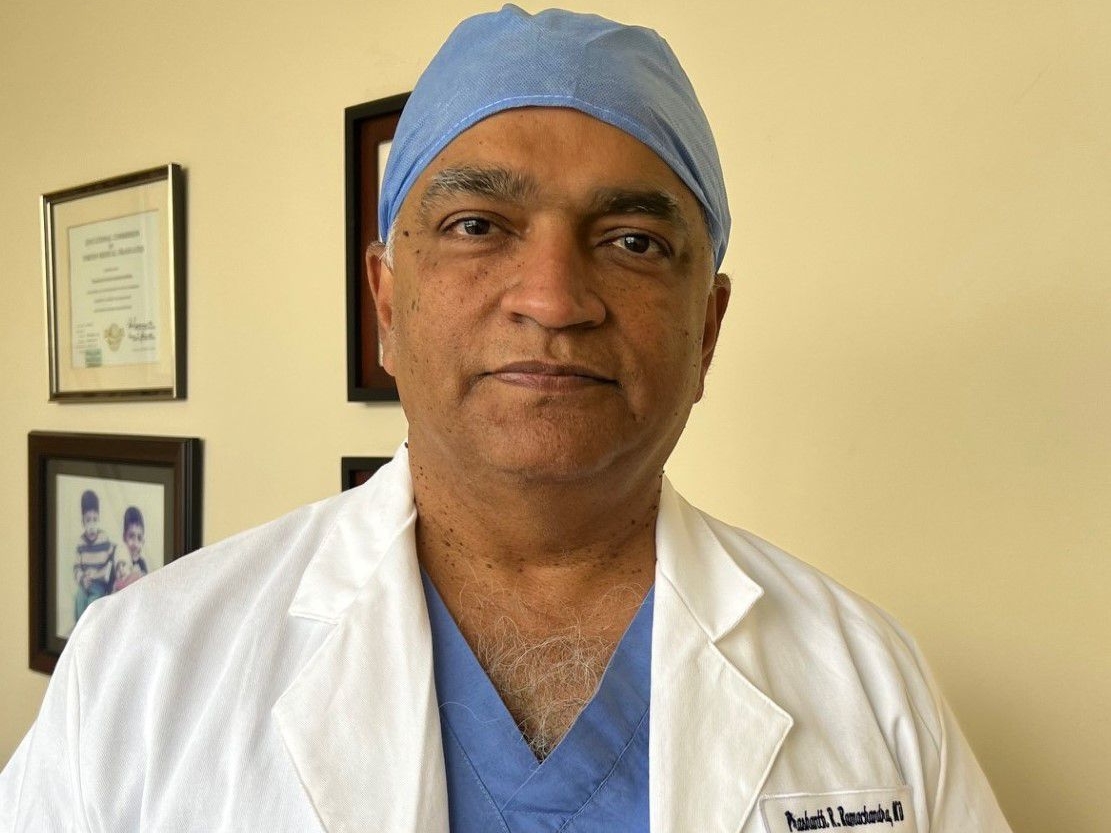
Prashanth R. Ramachandra is a general and bariatric surgeon at Trinity Health Mid-Atlantic’s Mercy Fitzgerald Hospital in Darby.
Only two Philadelphia-area health systems provided details on changes in bariatric surgery volumes in recent years as GLP-1s for weight loss took off.
At the University of Pennsylvania Health System’s three Philadelphia hospitals, the annual number of bariatric surgeries has fallen by more than half, from a peak of 850 three or four years ago to around 400 in the year that ended June 30, said Noel Williams, a physician who leads Penn’s bariatric surgery program.
At Mercy Fitzgerald in Darby, the number fell from an annual peak in the 220-230 range to about 125 last year, Ramachandra said.
The volume at Mercy Fitzgerald was likely buoyed by the closure of the bariatric surgery program at nearby Crozer-Chester Medical Centerin Upland.
Tower did not provide details on the Reading closure, which was part of cutbacks Tower announced in early November. The program closed last month after a 60-day notice tothe state health department.
Main Line Health, which only offers bariatric surgery at Bryn Mawr Hospital, said surgeries have declined, but provided no details.
Virtua Health did not provide comparable data but said that its Virtua Complete Weight Management Program, which opened in spring 2024 to expand into medication treatments, experienced a 35% increase in visits last year.
The number of bariatric procedures is also down at Temple University Health System, but patients with complex conditions and more severe obesity are still coming to Temple for surgery, said David Stein, who is surgeon-in-chief at Temple University Hospital.
To adapt to this rapid change in medicine, Temple is adopting a multidisciplinary approach to the disease, building on what is done in cancer care, Stein said.
Jefferson Health did not respond to requests for information about its bariatric surgery program.
How health systems are responding
While full-scale closures like Reading’s are unusual, cutbacks are occurring broadly.
When the bariatric surgeon at Penn Presbyterian Medical Center retired amid declining numbers of surgeries across the entire system, Penn did not replace him, Williams said.
Penn does the procedures locally at the Hospital of the University of Pennsylvania and at Pennsylvania Hospital.
“If the numbers were to continue the way they are now,” Williams said, “we may want to consolidate into one of our hospitals in the city.”
Outside of Philadelphia, Penn has bariatrics programs at Lancaster General Hospital and Penn Princeton Medical Center.
After Jefferson Health acquired Einstein Healthcare Network in late 2021, it consolidated bariatric procedures at Jefferson Abington Hospital, according an Inquirer analysis of inpatient data through 2024 from the Pennsylvania Health Cost Containment Council.
Jefferson did not respond to a request for information about the changes.
Piotr Krecioch is a bariatric and general surgeon at Roxborough Memorial Hospital in Philadelphia.
Not the end for bariatric surgery
GLP-1s don’t mean the end of bariatric surgery, even though the procedures are not likely to return to previous peaks, physicians said.
Some patients don’t respond to GLP-1s and others can’t tolerate them, which means they remain candidates for surgery, Williams said. Surgery is still recommended forpatients who are considered severely obese,with body-mass indexes over 50,he added.
Outcomes cannot yet be compared over the long-term. Ramachandra and other doctors are keeping their eye on the ratio of fat loss and muscle loss in patients taking GLP-1s compared to those who have bariatric surgery. Losing muscle can lead to falls and fractures.
A study published last month in the Journal of the American Medical Association found that bariatric surgery is associated with a favorable ratio of fat loss.
At Roxborough Memorial Hospital, Krecioch, who also works as a general surgeon, sounds optimisticas he works on his new program.He became a Roxborough employee in April 2024 after eight years at Mercy Fitzgerald, where he worked with Ramachandra.
Krecioch’s strategy for years has been to offer weight management services in addition to surgery. Patients come for a GLP-1, giving him a chance to build a long-term relationship.
“I have a feeling that these people are going to come back to my office,” he said. ”I’m gonna keep seeing them, and that they will actually convert to bariatric surgery at some point.”
Editor’s note: This article has been updated with information from Temple University Health System.
Marketed as a ticket to deeper sleep, the soft hum of pink noise has become part of millions’ nightly routines.
However, its use may come at the cost of sleep quality, a University of Pennsylvania study suggests.
Published this month in the medical journal Sleep, the study found that the presence of pink noise at night reduced REM sleep — the stagewhen most vivid dreams occur and memory, emotional regulation, and learning are supported. This was based on a sample size of 25 healthy adults assessed over seven days in a sleep lab.
To Mathias Basner, a Penn professor of psychiatry and lead author on the study, it’s evidence that background noise may not be risk-free.
“The negative consequences of the pink noise far outweigh the positive ones that we saw,” he said.
Pink noise vs. white noise
Pink noise is what’s called a “broadband noise,” meaning sounds made up of a wide range of frequencies. The most well-known example of this, white noise, is considered the sound equivalent of the color white, which contains all colors combined.
Pink, brown, and other colored noises differ based on the frequencies they boost.
Pink noise, for example, emphasizes lower frequencies — making it sound similar to steady rainfall or ocean waves. It’s often used for sleep, although uses for focus and tinnitus have also been reported.
These types of background noise can mask unwanted sounds — an appealing quality in an increasingly noisy world.
Since the first white noise machine for sleep was released in the 1960s, hundreds of variations have spawned. Today, 10-hour videos of pink noise, which is often preferred over white noise for sleep due to its softer sound,pick up millions of views on YouTube.
“So many people are using it, and it’s really indiscriminate use,” Basner said.
Putting pink noise to the test
Having studied the effects of noise his whole career, Basner was surprised to learn several years ago that some people used it as a sleep aid.
That led him down a rabbit hole of research, where he found dozens of studies assessing the effects of broadband noise on sleep. However, most of them were considered to be low quality — sample sizes were small and the assessments were usually subjective.
“We don’t know whether it’s working, whether it’s harmful or not,” he said.
He designed his study to occur in the hypercontrolled environment of a sleep lab at the Hospital of the University of Pennsylvania,where participants were measured using polysomnography, a test that looks at brain waves, eye movements, and muscle tone.
This allowed his team to differentiate sleep stages and figure out what was happening biologically as participants were exposed to a variety of conditions: no noise, environmental noise, pink noise, pink noise and environmental noise combined, or environmental noise with ear plugs.
Each night, the 25 participants, comprised of 18 women and seven men,were given an eight-hour window to sleep. (Lights were out at 11 p.m. and back on at 7 a.m.)
His team found that environmental noise — which ranged from the sound of a helicopter to a sonic boom — led to a 23.4-minute decrease in stage 3 sleep. This so-called deep sleep phase where recovery occurs is important for physical repair and immune function, as well as memory.
And while pink noise didn’t affect deep sleep, it was associated with an average decrease of 18.6 minutes in REM sleep.
“REM sleep is extremely important for a lot of things like memory consolidation, emotion regulation, brain plasticity, and neurodevelopment,” Basner said.
Though the study didn’t look at children, he cautioned that babies spend around half of their time sleeping in REM, compared to a quarter in adults.
Based on his findings, he would discourage parents from using broadband noise machines in the bedrooms of newborns.
For adults who don’t want to forgo the noise, he would recommend using the lowest volume and setting a timer so it eventually turns off.
However, the best option would be to use foam ear plugs, he said. When paired with environmental noise in the study, they were able to block out noise and recover 72% of the deep sleep time that had been lost — although they did start losing effectiveness at higher noise levels, around 65 decibels.
“You didn’t get the REM sleep reduction because they didn’t play anything back,” Basner said.
A limitation of the study is that it had a relatively small sample size comprised of younger, healthy people without sleep disorders or hearing loss. It also only looked at the short-term effects of pink noise, and was conducted in a lab setting, versus the participants’ homes.
In the future, Basner hopes to study the long-term effects of pink noise on sleep, as well as test other types of broadband noise.
“We need to do the proper research to make sure that it is actually, at least, not harmful,” he said.
As Chris Scafario sees it, Philadelphia’s reputation as an “eds and meds” region, referring to its plethora of colleges and hospitals, could grow a third leg.
It could also become the defense industrial base region,said Scafario, CEO of the Delaware Valley Industrial Resource Center.
President DonaldTrump wants to increase defense spending, with $1.5 trillion proposed for 2027. This could mean more research and workforce development training opportunities — and local universities are positioned to take advantage of it, Scafario said.
Chris Scafario, CEO of the Delaware Valley Industrial Resource Center
“A lot of that investment is going to be targeted toward university and innovation-based relationships because they need help getting stuff done,” said Scafario, who is talking to local colleges to help get them ready to capitalize. “They need access to brilliant people, whether they’re faculty or the faculty’s work products, the students.”
The move comes as colleges face potential cuts in research funding under the Trump administration in other areas, such as the National Institutes of Health. Both Princeton University and the University of Pennsylvania in the last month announced cutbacks to cope with potential financial fallout from federal policies.
Scafario’s center, which is based at the Navy Yard and was founded in 1988, aims to foster economic development and local manufacturing.
The Philadelphia region has been involved in defense contracting on and off for years, with major hubs in naval and aerospace manufacturing, and local universities say they worked with the Department of Defense in the past. Rowan University in New Jersey says it has $70 million in defense-related research projects underway.
But Scafario sees the opportunity for major expansion.
Drexel University, Temple University, Penn, Rowan, and Villanova University, which is already a top producer of naval engineers, are among the schools that are “in a great spot to leverage the opportunities that are going to be coming through the defense industrial base,” Scafario said. “In the next year, people are going to start realizing that we are meds, eds, and a defense industrial base region. It’s going to bring a lot of investment, a lot of economic opportunities, and some really, really great employment opportunities in the region.”
The Philadelphia region could become a national anchor for shipbuilding or other maritime industrial-based activities, he said.
Scafario hopes to bring colleges together with other partners for more discussions in the spring when the timeline for those federal investments starts to become clearer, he said.
Amanda Page, Warfighter Technologies Liaison for the Delaware Valley Industrial Resource Center
Colleges could help with efforts to accelerate production capacity of naval ships and work on initiatives such as how to make submarines less traceable and more durable. Or they could help improve medical equipment and training for the battlefield. The treatment standard in the military used to be the “golden hour”; now it’s about “prolonged field care,” said Amanda Page, a retired active-duty Army medic who serves as warfighter technologies liaison for the center.
“Medical personnel need to be prepared mentally, physically, emotionally, and electronically to keep those patients for 96 hours,” Page said. “That’s going to require a ton of research and technology.”
Page was hired by the center in October to help build relationships between the center, the Department of Defense (which the Trump administration has rebranded the Department of War), local higher education systems, and the city.
“I’m super excited about what it will bring to the region and what the region can prove to the Department of War about its legitimacy,” she said, “as a manufacturing and technology powerhouse.”
Local colleges say they are reviewing potential collaborations.
“There are a lot of opportunities we are looking at,” said Aleister Saunders, Drexel’s executive vice provost for research and innovation, declining to provide specificsfor competitive reasons.
In addition to opportunities with the Navy and the Navy Yard, he noted major local companies involved with aerospace and aviation, including Lockheed Martin and Boeing. There are also opportunities around materials and textiles with the Philadelphia-based Defense Logistics Agency Troop Support, which provides many of the supplies to the military.
“Those are really valuable assets that we should find a way to leverage better than we are,” he said.
Key opportunities are available in advanced manufacturing and workforce development, he said.
“There could be folks who are already working in manufacturing who need [upgraded skills] in advanced manufacturing techniques,” he said.
Temple University president John Fry said increasing research opportunities and impact — the school’s research budget now exceeds $300 million — is a priority in the school’s strategic plan. Temple offers opportunities around medical manufacturing, healthcare, and health services, he said.
“The key to doing that is going to be partnerships,” he said.
Josh Gladden, Temple’s vice president for research, said he has met with folks from Scafario’s group and they are talking about some opportunities, but declined to discuss them because they are in early development.
He noted that the Navy is interested in working with Temple’s burn unit.
Temple has also been getting to know the workforce needs of businesses at the Navy Yard and looking at how to align its educational programs, Fry said.
“Those are relationships I would love to pursue,” he said. “Part of our mission is to develop the future workforce and grow the regional economy, and that’s one way of doing it.”
Rowan has been a longtime research partner with the U.S. military, said Mei Wei, the school’s vice chancellor for research.
“It’s encouraging to know there could be more funding available for research,” Wei said. “These projects give our undergraduate and graduate students the opportunities they need to develop their research skills with close guidance from our faculty and our external partners.”
One of the lasting images of President Donald Trump’s mass deportation campaign will be the masks worn by federal immigration agents.
The widespread use of facial coverings by U.S. Immigration and Customs Enforcement officers is among the suite of tactics — agents dressed in plainclothes, wearing little identification, jumping out of unmarked cars to grab people off the street — that have fueled immigration advocates’ use of terms like “kidnappings” and “abductions.”
Now Philadelphia lawmakers appear poised to pass legislation that would ban all officers operating in the city — including local police — from concealing their identitiesby wearing masks or conducting enforcement from unmarked cars.
The question is whether the city can make that rule stick.
Legal hurdles loom for municipalities and states attempting to regulate federal law enforcement. Local jurisdictions are generally prohibited from interfering with basic federal functions, and Trump administration officials say state- and city-level bans violate the constitutional provision that says federal law reigns supreme.
There are also practical concerns about enforcement. Violating the mask ban would be a civil infraction, meaning local police would be tasked with citing other law enforcement officers for covering their faces.
“No doubt this will be challenged,” said Stanley Brand, a distinguished fellow at Penn State Dickinson Law. “This ordinance will be a protracted and complicated legal slog.”
Councilmember Kendra Brooks speaks during a news conference at City Hall to announce a package of bills aimed at pushing back against ICE enforcement on Jan. 27.
Advocates for immigrants say that unmasking ICE agents is a safety issue, and that officers rarely identify themselves when asked, despite being required to carry badges.
Mask use can also spur impersonators, they say. At least four people in Philadelphia have been arrested for impersonating ICE officers in the last year.
“You see these people in your community with guns and vests and masks,” said Desi Bernette, a leader of MILPA, the Movement of Immigrant Leaders in Pennsylvania. “It’s very scary, and it’s not normal.”
Democrats in jurisdictions across America, including Congress and the Pennsylvania General Assembly, have introduced legislation to ban ICE agents from concealing their faces. California is the furthest along in implementing a mask prohibition, and a judge is currently weighing a challenge filed by the Trump administration.
Senate Democrats negotiating a budget deal in Washington have asked for a nationwide ban on ICE agents wearing masks in exchange for their votes to fund the Department of Homeland Security.
And polling shows getting rid of masks is popular. A recent Pew Research Center survey found that 61% of Americans believe federal agents should not wear face coverings to conceal their identities while on duty.
ICE officials say agents should have the freedom to conceal their faces while operating in a hyperpartisan political environment.
Last year, ICE head Todd Lyons told CBS News that he was not a proponent of agents wearing masks, though he would allow it. Some officers, he said, have had private information published online, leading to death threats against them and their families.
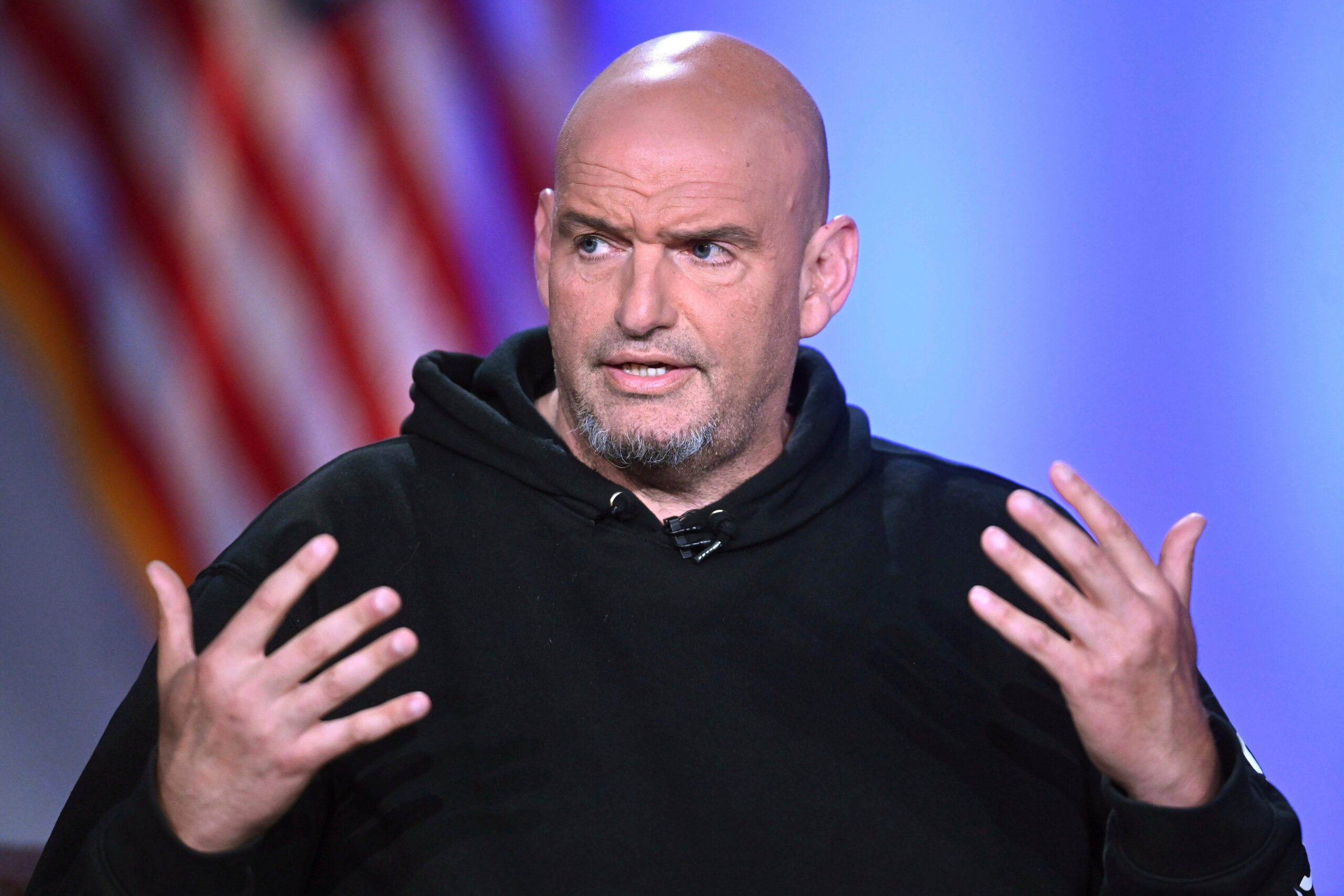
“They could target [agents’] families,” Fetterman said in an interview on Fox News, “and they are organizing these people to put their names out there.”
Sen. John Fetterman, D-Pa., participates in a debate on June 2, 2025, in Boston.
The Council authors of the Philadelphia bills say they are responding to constituents who are intimidated by ICE’s tactics, and they believe their legislation can withstand a legal challenge.
“Our goal is to make sure that our folks feel safe here in the city,” said City Councilmember Kendra Brooks. “We are here to protect Philadelphians, and if that means we eventually need to go to court, that’s what would need to happen.”
The constitutional limits on unmasking ICE
The bill introduced last week by Brooks and Councilmember Rue Landau is part of a package of seven pieces of legislation aimed at limiting how ICE operates in Philadelphia. The proposals would bar Philadelphia employees from sharing information with ICE and ban the agency from using city property to stage raids.
Fifteen of Council’s 17 members signed on to the package of legislation, meaning a version of it is likely to become law. Passing a bill in City Council requires nine votes, and overriding a mayoral veto takes 12. Mayor Cherelle L. Parker has said her team is reviewing the legislation, which can still be amended before it becomes law.
Anti-ICE activists demonstrate outside U.S. Sen. John Fetterman’s Philadelphia office, Jan. 27, calling for an end to federal immigration enforcement policies.
One of the two members who did not cosponsor the package was Councilmember Mike Driscoll, a Democrat who represents parts of Lower Northeast Philadelphia. He indicated that he had concerns about whether the “ICE Out” legislation would hold up in court.
Brooks said Council members worked with attorneys to ensure the legislation is “within our scope as legislators for this city to make sure that we protect our folks against these federal attacks.”
Brand, of Dickinson Law, said the legislation is a classic example of a conflict between two constitutional pillars: the clause that says federal law is supreme, and the 10th Amendment, which gives states powers that are not delegated to the federal government.
He said there is precedent that the states — or, in this case, cities — cannot interfere with laws enacted by Congress, such as immigration matters.
“If I were betting, I would bet on the federal government,” Brand said.
But there is a gray area, he said, and that includes the fact that no law — or even regulation — says federal law enforcement agents must wear masks.
Kermit Roosevelt, a law professor at the University of Pennsylvania who is an expert on the Constitution and conflict of laws, said if there is no agency policy, that is “free space” for states and cities to regulate.
Roosevelt said Brooks’ legislation steers clear of other constitutional concerns because it applies to all police officers, not just federal agents.
“If they were trying to regulate only federal agents, the question would be, ‘Why aren’t you doing that to your own police officers?’” he said. “If you single out the federal government, it looks more like you’re trying to interfere with what the federal government is doing.”
Applying the law to local police
Experts say part of the backlash to ICE agents covering their faces is because Americans are not used to it. Local police, sheriff’s deputies, and state troopers all work largely without hiding their faces.
“Seeing law enforcement actions happening with federal agents in masks, that’s extremely jarring,” said Cris Ramon, an immigration consultant based in Washington. “Why are you operating outside of the boundaries of what every other law enforcement agency is doing?”
Protesters march up Eighth Street, toward the immigration offices, during the Philly stands with Minneapolis Ice Out For Good protest at Philadelphia City Hall on Jan. 23.
The Council legislation includes exceptions for officers wearing medical-grade masks, using protective equipment, or working undercover. It also allows facial coverings for religious purposes.
However, the federal government could still raise First Amendment concerns, said Shaakirrah R. Sanders, an associate dean at Penn State Dickinson Law.
The administration, she said, could argue that the city is only trying to regulate law enforcement officers and claim that would be discriminatory.
Sanders said defending the legislation could be “very costly” and the city should consider alternatives that fall more squarely within its authority. She pointed to efforts like New Jersey Gov. Mikie Sherrill’s announcement that the state would create a database for residents to upload videos of ICE interacting with the public.
“It looks like the city wants to wield big legislative power,” Sanders said. “My alternative is more in the grassroots work, where you are the first ear for your citizens, not the regulator of the federal government.”
When you hear the word faith in relation to the history of African Americans in the United States, what do you imagine? Do you see a preacher, or a gospel choir, or imagine a church mother in a resplendent hat?
These images, while valid depictions of the Black church, are not the only measures of how faith informs and shapes the history of African American life.
For African Americans, faith has not been simply about belief in a deity. By necessity, it has also been about having the faith to fight for freedom, faith in showing the shortcomings of democracy, faith in finding hope during struggle, and protecting the community. It was also the only way, for many years, to organize and establish places of worship or set up businesses.
In the American context, many equate African American religion with Protestant Christianity. Yet, faith isn’t limited to a particular religious tradition or organized religion. It is an intentional practice of believing. The history of African Americans’ personal faith and organized faith traditions is what has sustained them in their tumultuous history in America.
It is impossible to speak about the history of faith and African American life without speaking of the brutal realities of the Atlantic slave trade and slaveholding in America. Africans who were captured and sold into slavery from ports in West Africa came to the Americas from rich traditions steeped in different African religious practices, like Vodun.
Some of the enslaved, like Omar Ibn Said, were Muslim, and still others were from places like Congo and had been introduced to Christianity in Africa. Examples of the longevity of these religious traditions can be seen in the practices of the Gullah people in South Carolina, who have shared their traditions like rice growing, ring shouts, and burial practices from enslavement to the 21st century.
Portraits of Mother Bethel AME Church founder, the Rev. Richard Allen, and his wife, Sarah, are displayed on a wall at the church’s museum in Philadelphia.
Faith also defined the involvement and influence of African Americans in the struggle for equality and freedom. Richard Allen and Absalom Jones, both important members of the freed Black community in Philadelphia, left St. George’s United Methodist Church over the racism there. Both Allen and Jones would establish churches: Allen starting Mother Bethel African Methodist Episcopal Church and Jones establishing the African Episcopal Church of St. Thomas.
The Rev. Absalom Jones was a priest in the African Episcopal Church of St. Thomas.
To wrest Mother Bethel from the attempts of the white Methodist group to gain control over it, Allen would use the legal system, incorporating the church in 1796 and then fighting to keep control of it from the larger white Methodist denomination. Faith, as well as acumen, would give him the determination to see the legal process through to incorporation in Pennsylvania.
Today, the AME denomination is a worldwide church, estimated to have more than two million members.
Faith would also play a role in establishing organizations within the African American community.
Schools in the 19th and early 20th century found their formation in religious organizations post-Civil War. Clergy would pair with white denominations to form schools such as Spellman and Morehouse. Other organizational structures formed by religious communities would include insurance organizations, funeral homes, fraternities, and sororities. The best-known organization, the National Association for the Advancement of Colored People, would also find pastors and religious figures in the initial call for its formation.
Faith leaders from various religious communities were also instrumental in reminding and challenging white leadership of the promises of democracy and freedom in our founding documents.
In the 20th century, new religious movements such as Garveyism, Moorish Science Temple, the Nation of Islam, and Father Divine’s peace movement would all organize as a counternarrative to the harsh conditions of racism and Jim Crow in American life. All these movements offered an alternative narrative of not only uplift but also promoted different visions of race through religion that drew followers who questioned the merits of white Protestantism for African Americans.
Of course, we cannot forget the role of faith in the civil rights movement. While it is obvious to think of the Rev. Dr. Martin Luther King Jr., it is important to remember that King not only found his voice through Christianity, but through the principle of satyāgraha, soul force, coined by Mohandas Gandhi, the famous Hindu leader who promoted nonviolent struggle that formed the foundations of the civil rights movement. Diane Nash, who was Catholic and considered being a nun before becoming an activist while at Fisk College in Nashville, would become an important part of the movement — along with figures like the late U.S. Rep. John Lewis, who was enrolled in divinity school before joining the movement.
All of these are very brief examples from a very diverse history of faith in the African American community that was not only about individual belief, but many times served as a counter to the racism of religious communities in America that treated African Americans as second-class citizens.
Suppressing this history by altering it or calling it DEI does an injustice to the history of faith-based organizing in America.
African Americans’ faith, and the challenges they brought to bear on the racial issues of America, highlighted the promises of the Declaration of Independence and the Constitution. Now, more than ever, we need that faith to sustain us during the 250th anniversary of America.
Anthea Butler is the Geraldine R. Segal Professor in American Social Thought at the University of Pennsylvania.