Tag: Weekend Food

  • Philly is in festive mode: The holiday bars are here.

    Philly is in festive mode: The holiday bars are here.

    With the winter holiday season seeming to start before Thanksgiving turkey has even been served, it’s easy to feel like the Grinch. But if there’s one thing that can cure those early holiday blues, it’s over-the-top decorations and a novelty cocktail.

    Luckily, these Philadelphia-area bars have already begun to their deck their halls (or booths) with garlands, nutcrackers, and more string lights than we can count.

    One tip: Regardless of which holiday bars you chose, plan ahead and snag a reservation. The only thing worse than a stocking full of coal is waiting in the cold for a seat at the bar.
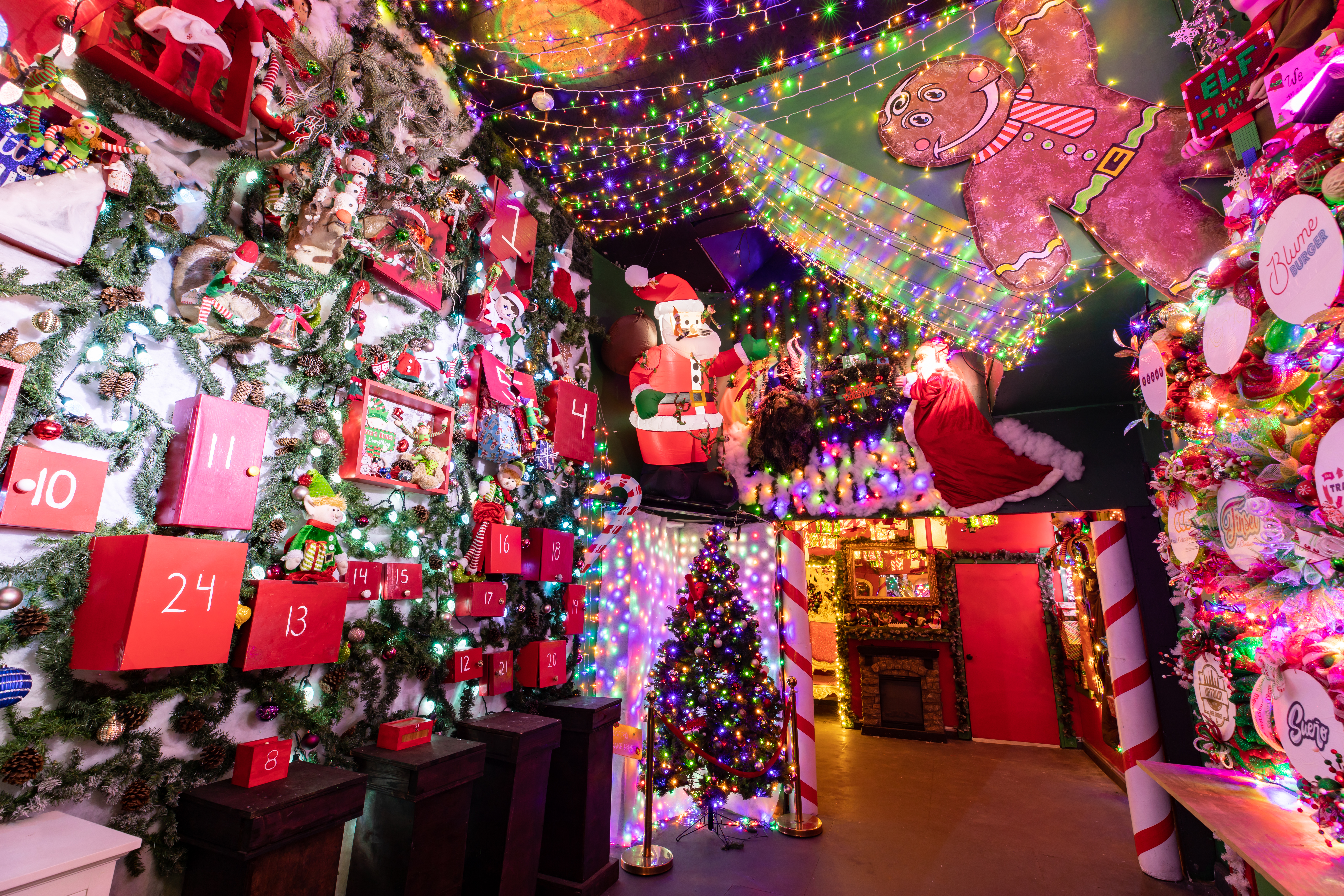
    Tinsel — the annual pop-up holiday bar that takes over 114 S. 12th St. — returns for 2025.

    Diamond and Pearls at Suburban Station by the Wine Garden

    Wine Garden co-founders Nazaret Teclesambet and Favian Sutton are taking over three rooms inside Suburban Station through Dec. 31 for a luxe limited-edition holiday bar, not unlike last year’s at the Divine Lorraine. This go-round, the theme is diamond and pearls: Think gold-mirrored walls, grand Christmas trees, and enough bows and pearls for a tea party. Guests can sip on spiked hot chocolates rimmed with crushed candy canes, bourbon and apple cider holiday punches, and marshmallow-topped espresso martinis, among other cocktails. General admission is $14.64 per person for a 90-minute reservation. A $42.39 VIP ticket includes a welcome glass of sparkling rosé and a mini vintage cake. All other food and drinks are pay-as-you-go.

    1617 John F. Kennedy Blvd., 215-625-0988, instagram.com/winegardenwest

    Ever Eve in the Back Bar by High Street

    Unfortunately, Santa cannot call in favors to get you a table at High Street, one of Philly’s first-ever Michelin-recommended restaurants. The big guy, however, does recommend you spend $5 per person to snag a reservation at High Street’s holiday pop-up inside the Franklin Residence’s grand lobby. Ever Eve in the Back Bar runs Saturdays only through Dec. 27, and features a cocktail partnership with specialty spirits purveyor BOTLD alongside a menu of upscale bar snacks like crispy oysters, brown butter shoestring fries, and deviled eggs topped with trout roe.

    834 Chestnut St., 215-625-0988, highstreetonmarket.com
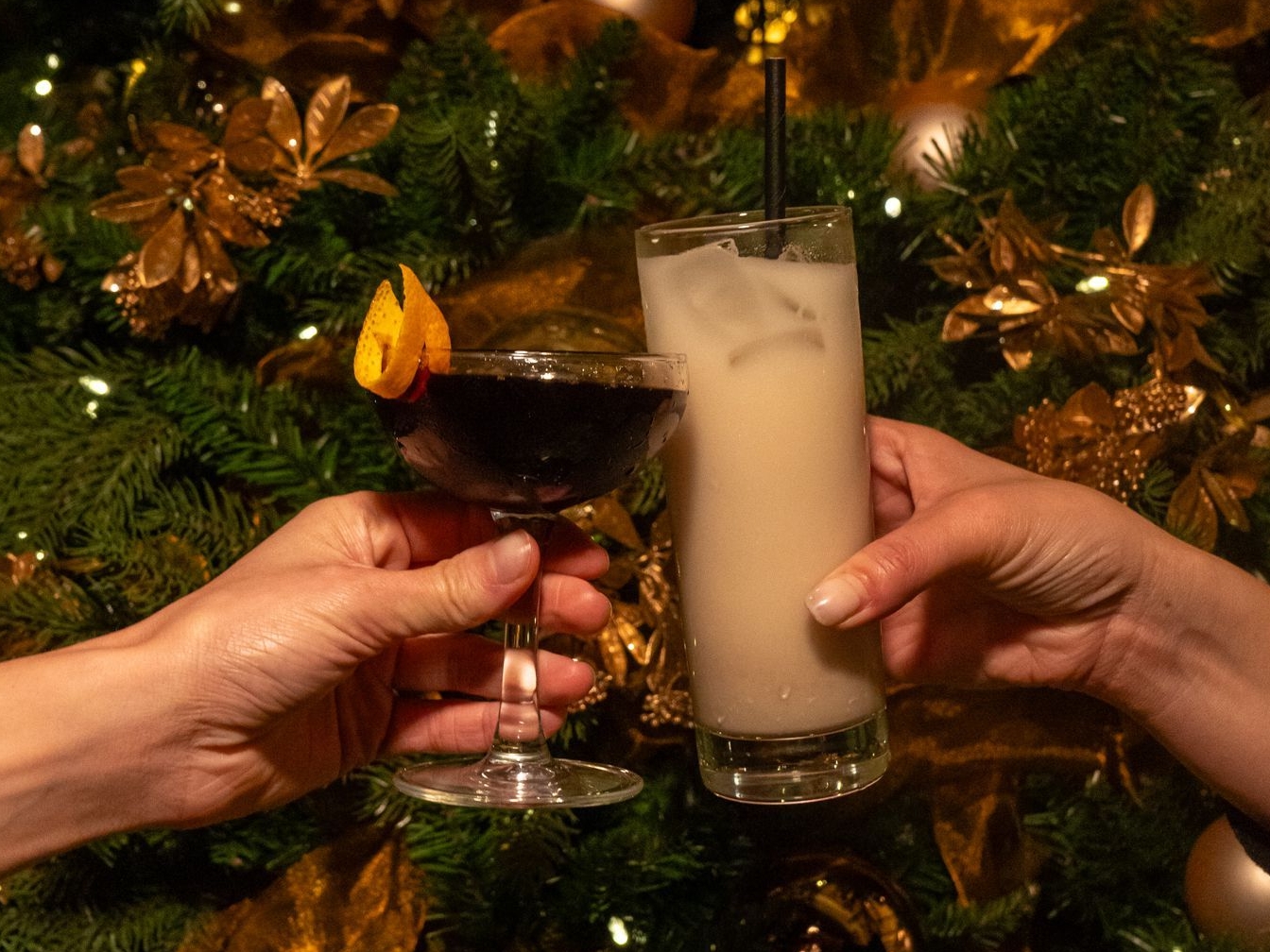
    Cocktails from a partnership with BOTLD will be served at Ever Eve in the Back Bar, a holiday pop-up from High Street taking over the lobby bar inside the Franklin Residences on Saturdays through Dec. 27.

    Harper’s Garden

    Dining at this indoor-outdoor restaurant near Rittenhouse Square is far more low-key than most of the city’s holiday bars — mostly because it’s not marketed as a holiday bar at all. Instead, diners can spend two hours inside one of Harper Garden’s private heated outdoor cabins, which can seat four to six people. Something about eating warm bowls of pasta under woodsy garlands screams cozy.

    31 S. 18th St., 267-886-8552, harpersgardenphilly.com

    Harry’s Jingle Bar

    There’s something about snow on the beach, at least according to that one Taylor Swift song. For a dose of holiday spirit down the shore, shoobies can check out the Jingle Bar inside Harry’s Ocean Bar & Grille. The beloved holiday pop-up bar inside the Montreal Beach Resort will run through Dec. 31 this year, with some new additions, like outdoor fire pits overlooking the ocean and a $90 Christmas tree cocktail tower that comes with six libations of your choosing.

    1025 Beach Ave., Cape May, N.J., 609-884-2779, harryscapemay.com
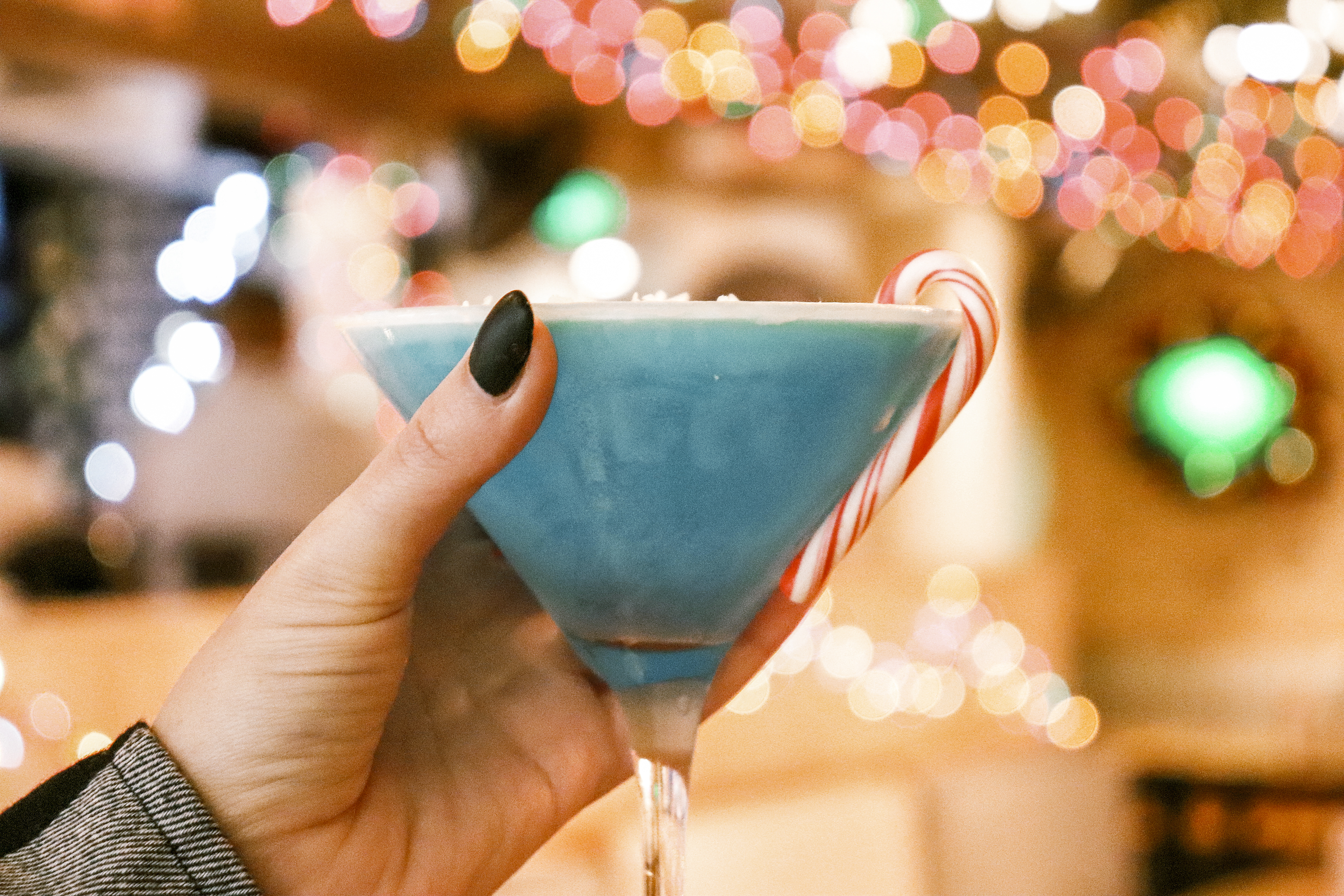
    The Blue Christmas from Harry’s Jingle Bar in Cape May, N.J. is a sweet coconut cream martini garnished with a candy cane.

    Holly Jolly Bar at Juno

    Juno’s Holly Jolly Bar is a collaboration with events company Bucket Listers that converts an outdoor summertime hot spot into a winter wonderland — with a roof. From Nov. 26 to Dec. 28, Juno’s patio will be draped in rows upon rows of string lights and ornaments designed as Instagram bait. Don’t expect any Mexican inspiration on the menu beyond a winter marg and some sangria. Tacos and ceviches have been swapped for giant french fries, chicken tenders, and a charcuterie-inspired snack board. Tickets cost $22.50 for a 90-minute seating and a welcome drink. All other food and beverage is pay-as-you-go.

    1033 Spring Garden St., 267-639-2892, junophilly.com/holly-jolly

    Holiday Rewind at The Prime Rib

    Is nostalgia on your Christmas list this year? The Library Bar inside The Prime Rib at South Philly’s Live! Casino and Hotel has transformed into a swanky-yet-quirky holiday pop-up with drinks inspired by classic holiday movies ranging from Elf to Die Hard. Guests can sip on an Ovaltine espresso martini and spiked sea salt caramel eggnog, among other cocktails, while cozying up by the fireplace through Jan. 10.

    900 Packer Ave., 267-682-7500, philadelphia.livecasinohotel.com

    Prime Rib inside the Live! Casino & Hotel at 900 Packer Ave. has been transformed into a cozy living room for Holiday Rewind, a pop-up inspired by nostalgic Christmas movies.

    Jingle Jawn at Libertee Grounds

    Philly’s first minigolf bar has also partnered with Bucket Listers to overload their course with a hefty dose of Philly-ified holiday spirit. From now through Jan. 31, guests can play nine or 18 holes of holiday-themed putt-putt with decor like a greased North Pole, snow globes, and a golf cart covered in Philadelphia Parking Authority tickets (of course). Libertee Ground’s seasonal menu features a standout tomato soup and grilled cheese duo alongside several holiday cocktails, including a cranberry and cinnamon mule and an orange-plum punch made with Stateside Vodka. Those looking to tee off can expect to pay $20 for nine holes of minigolf, plus a cocktail in a souvenir cup.

    1600 W. Girard Ave., 267-324-3487, liberteegrounds.com

    McGillin’s Olde Ale House

    It’s a gift from Santa himself: A walk-ins only holiday bar. Every holiday season, McGillin’s covers itself in floor-to-ceiling Christmas decorations. (That’s roughly 1,200 feet of lights and 1,000 feet of garlands for number-crunchers.) Holiday barflies can expect a lineup of festive drinks that include an eggnog martini and a spiced rum hot apple cider. Just around the corner from the bar at Sansom and Juniper Streets is holiday pop-up shop that sells McGillin’s merch (stocking stuffers, anyone?). The shop is open noon to 6 p.m. daily.

    1310 Drury St., 215-735-5562, mcgillins.com

    All 18 holes of mini golf at Libertee Grounds have been updated with string lights, ornaments and other holiday decor for a collaboration with Bucket Listers that runs through Jan. 31, 2026.

    Miracle on 8th Street at Craftsman Row Saloon

    It takes roughly 60,000 ornaments and 20,000 lights to transform Craftsman Row Saloon into the Miracle on 8th Street, its annual holiday pop-up bar best known for over-the-top milkshakes. This year’s shake lineup includes the seasonally confused Pumpkin to Talk About — blended pumpkin ice cream topped with a whole slice of pumpkin pie — and Santa’s cookies, a chocolate chip cookie dough variety rimmed with chipwiches. Reservations are recommended for Miracle on 8th Street, which runs through mid-January.

    112 S. Eighth St., 215-923-0123, craftsmanrowsaloon.com

    North Pole on South Street at Bridget Foy’s

    For the first time since its 1978 opening, Bridget Foy’s will transform into the aptly titled North Pole on South Street, a Christmas bar that will run from Nov. 28 through Jan. 4. The devil (or Santa) is in the details: The bar’s new Instagram account shows footage of craftsmen freezing tiny nutcrackers into custom ice cubes for a lineup of cocktails that includes a peppermint tea-infused negroni and honey-chili margarita floated with aperol. Reservations also include access to several holiday-themed photo backdrops.

    200 South St., 215-922-1813, bridgetfoys.com
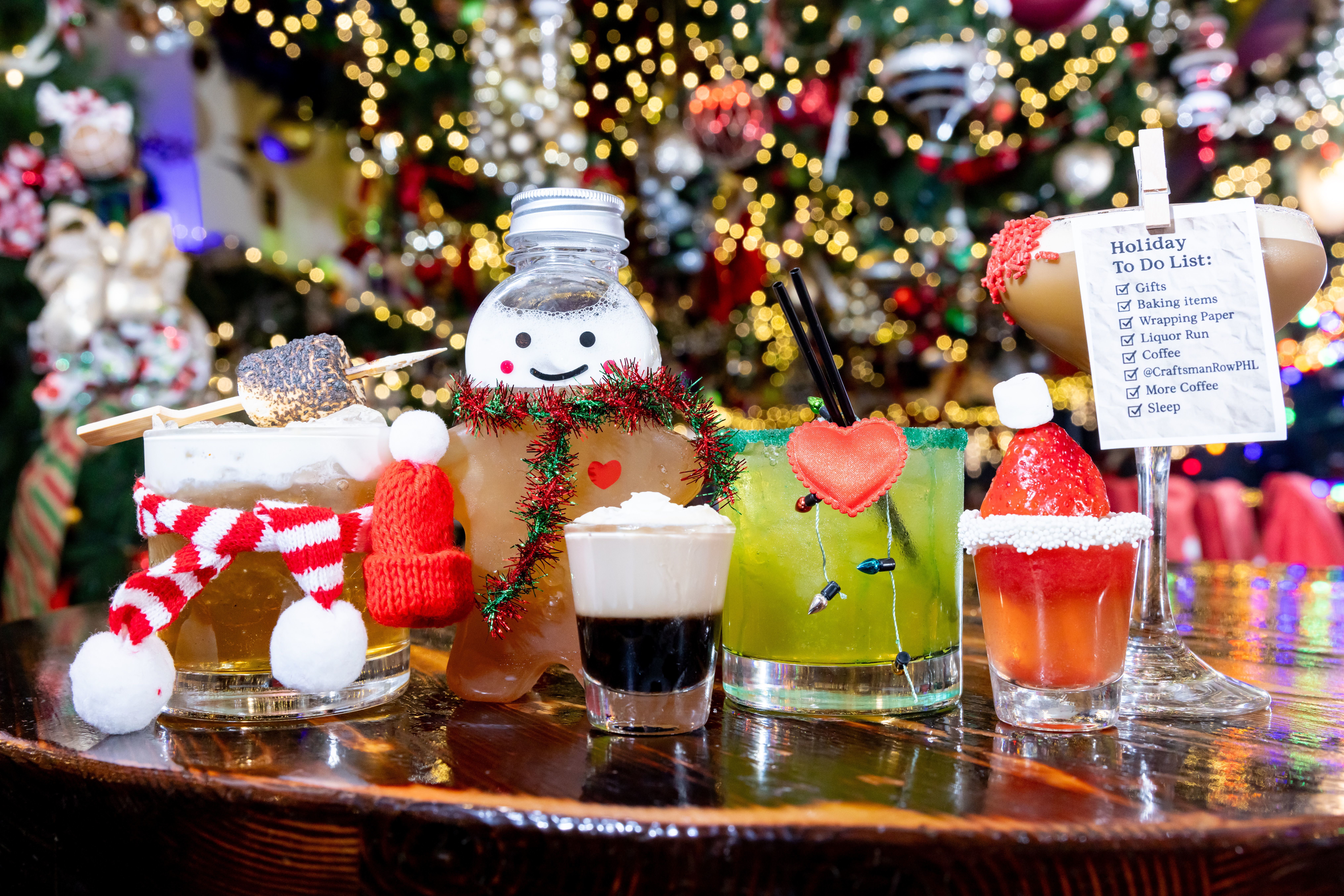
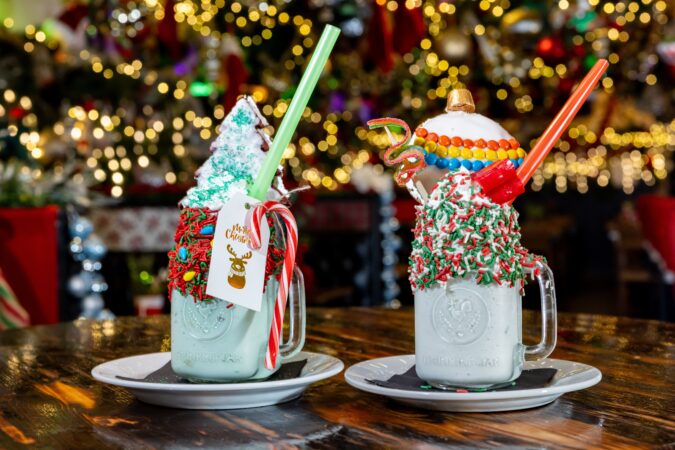
    A line-up of holiday cocktails wrapped in scarves and topped with ornaments from Craftsman Row Saloon at 112 S. 8th St.

    The Lodge at Independence Blue Cross RiverRink Winterfest

    Take in views of the ice skating rink and the Delaware River from the lodge inside the Independence Blue Cross RiverRink Winterfest, a festival of all things festive that runs from Nov. 28 to March 1. Guests can choose to warm up inside the pop-up ski lodge or sip spiked hot chocolates and ciders around private fire pits or cabins available for rent.

    101 S. Columbus Blvd., 215-925-7465, delawareriverwaterfront.com

    Tinsel

    Annual pop-up bar Tinsel runs from Nov. 28 through January with the same over-the-top shtick in new dressing. Sip on cocktails in novelty cups (that you can take home!) under a blinking neon Santa tracker, oversized ornaments, and illustrations of pop culture’s wackiest holiday characters. This year’s naughty beverages include punch served in an adult juice pouch and a duo of festive red and green shots.

    116 S. 12th St., 215-398-1685, facebook.come/Tinselphilly
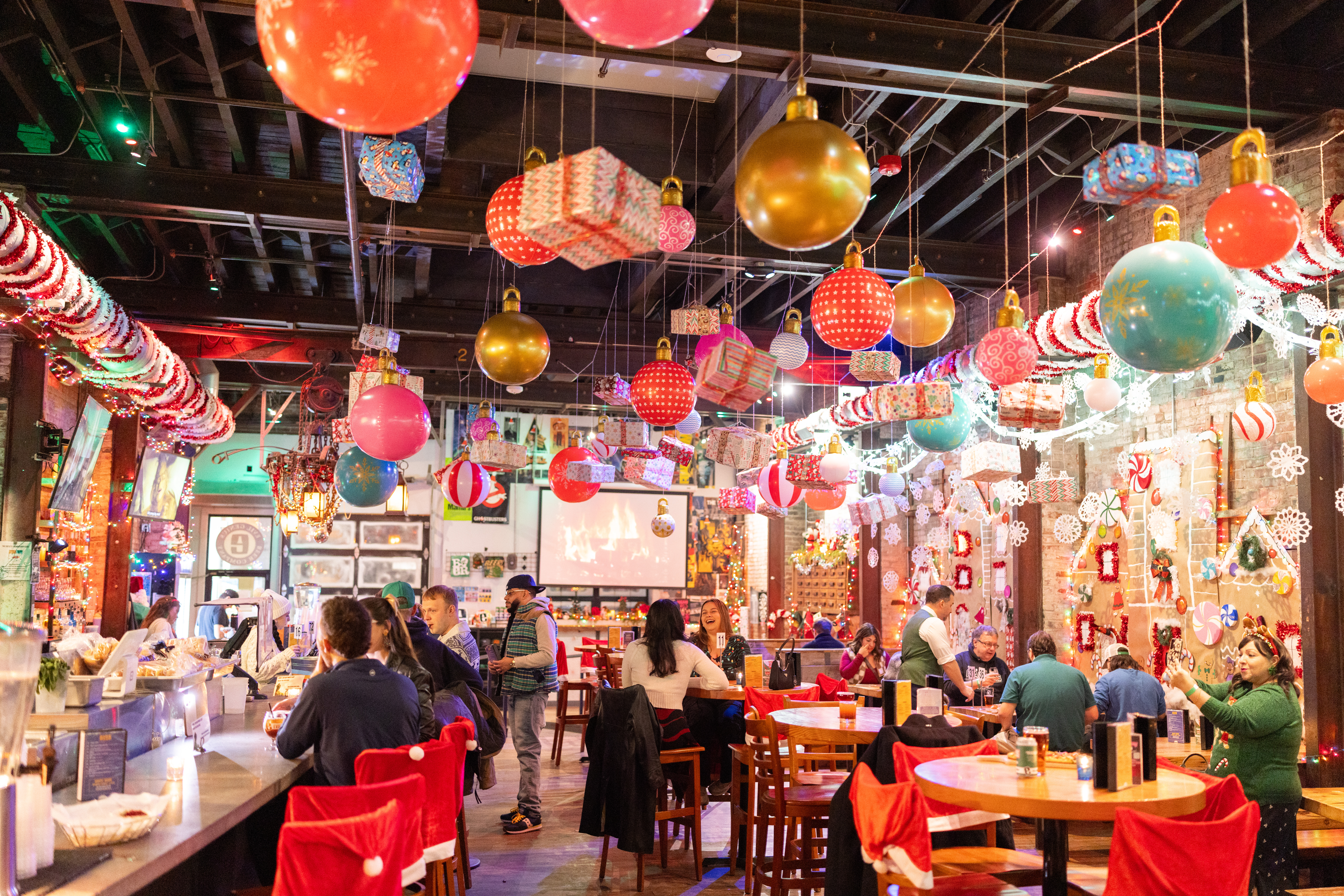
    Regulars at Evil Genius Beer Co. helped decorate the bar for the holidays by painting gingerbread houses and cutting paper snowflakes.

    Twas an Evil Christmas at Evil Genius Beer Co.

    Evil Genius regulars secured their spot on Santa’s nice list by painting larger-than-life gingerbread houses and cutting hundreds of paper snowflakes for the bar’s Twas an Evil Christmas holiday pop-up. Ornaments and wrapped presents hang from the ceiling while guests can sip on the brewery’s signature holiday saison Santa! I Know Him!, a 7.5% ABV Belgian-style brewed with rose hips, dark candy syrup, and chamomile.

    The brewery is hosting a 0.5K (a run around the block) on Dec. 3, where $30 scores runners free beer and a Santa Hat. All proceeds will go toward buying Christmas gifts for families in need.

    1727 Front St., 215-425-6820, evilgeniusbeer.com/our-taproom

    Señor Grinch Pop-up at Taqueria Amor

    This Manayunk Tex-Mex restaurant will dress up for any occasion, and the winter holidays are no exception. Taqueria Amor has transformed into its signature Señor Grinch pop-up for the sixth year in a row, playing classic holiday movies via projector every evening through New Year’s Eve, no reservations required. Taqueria Amor’s very-merry cocktail lineup includes a shot that purportedly tastes just like a gingerbread cookie and several margaritas the color of Rudolph’s nose or the Grinch.

    4410 Main St., 267-331-5874, taqueriaamor.com
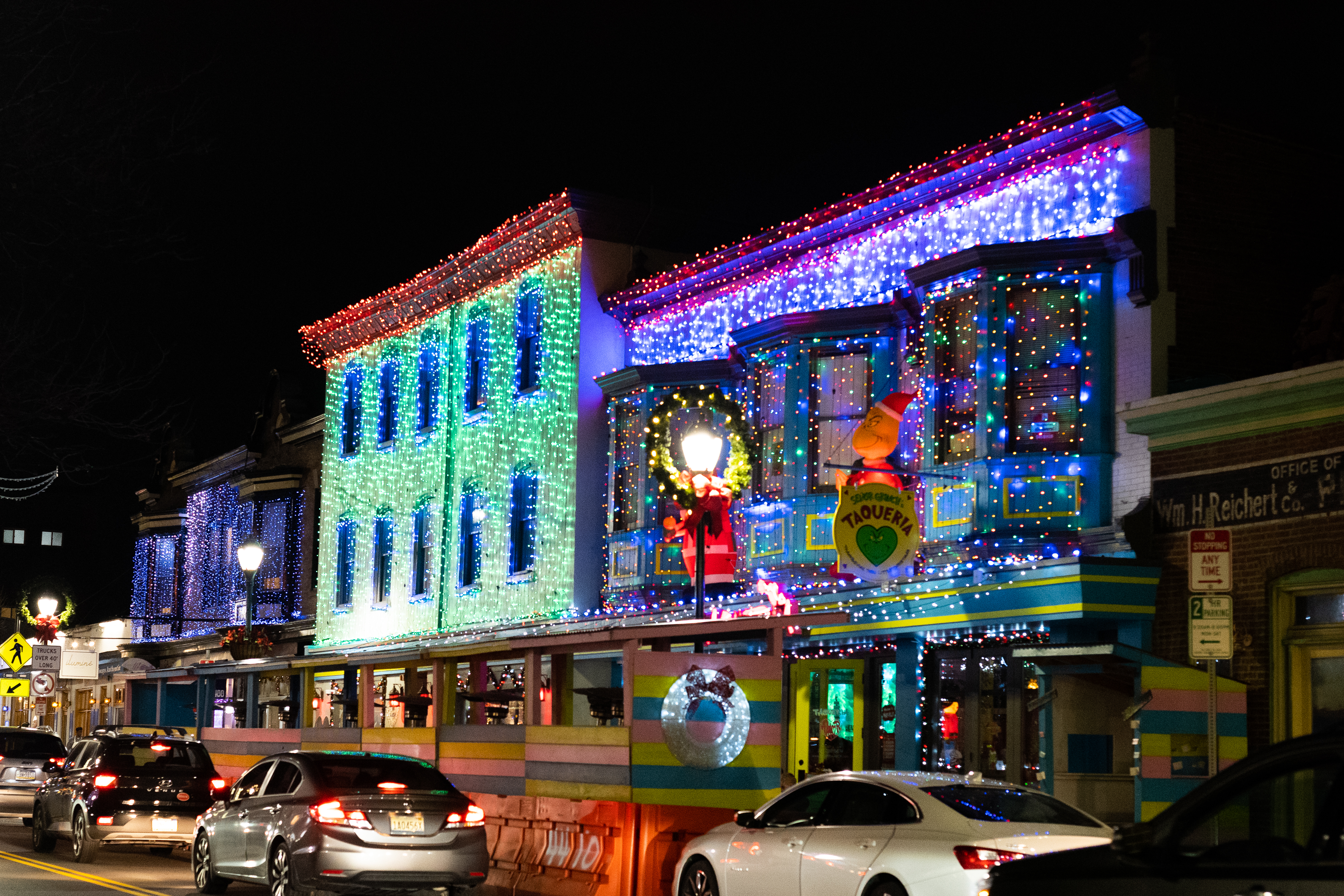
    Thousands of string lights hang from the facade of Taqueria Amor at 4410 Main St. in Manayunk for their Señor Grinch holiday bar pop-up.

    Uptown’s Little Workshop at Uptown Beer Garden

    Santa’s workshop is taking over Center City’s Uptown Beer Garden through the end of 2025, and with it comes inflatable elves, oversized nutcrackers, snow globes, and fire pits for s’mores. All of the pop-up’s holiday cocktails are served in souvenir cups, including the Polar Espress-o — a peppermint bark-flavored cold brew martini — and the Apple Spice and Everything Nice, a caramel apple mule.

    1500 John F. Kennedy Blvd., 267-639-4493, uptownbeer.com

    Walnut Wonderland at Walnut Garden

    This popular Rittenhouse Square beer garden is winterized through Dec. 31 and features a 22-foot tall Christmas tree alongside plush life-sized penguins, a playhouse pulled by reindeer, and lots of neon lights. Also included inside Walnut Wonderland: make-your-own gingerbread house and s’mores kits for $9 each, plus $12 holiday drink specials that include a maple whiskey sour and a banana-flavored vodka and hazelnut liqueur number that’s meant to taste like banana bread.

    1708 Walnut St., walnutphl.com
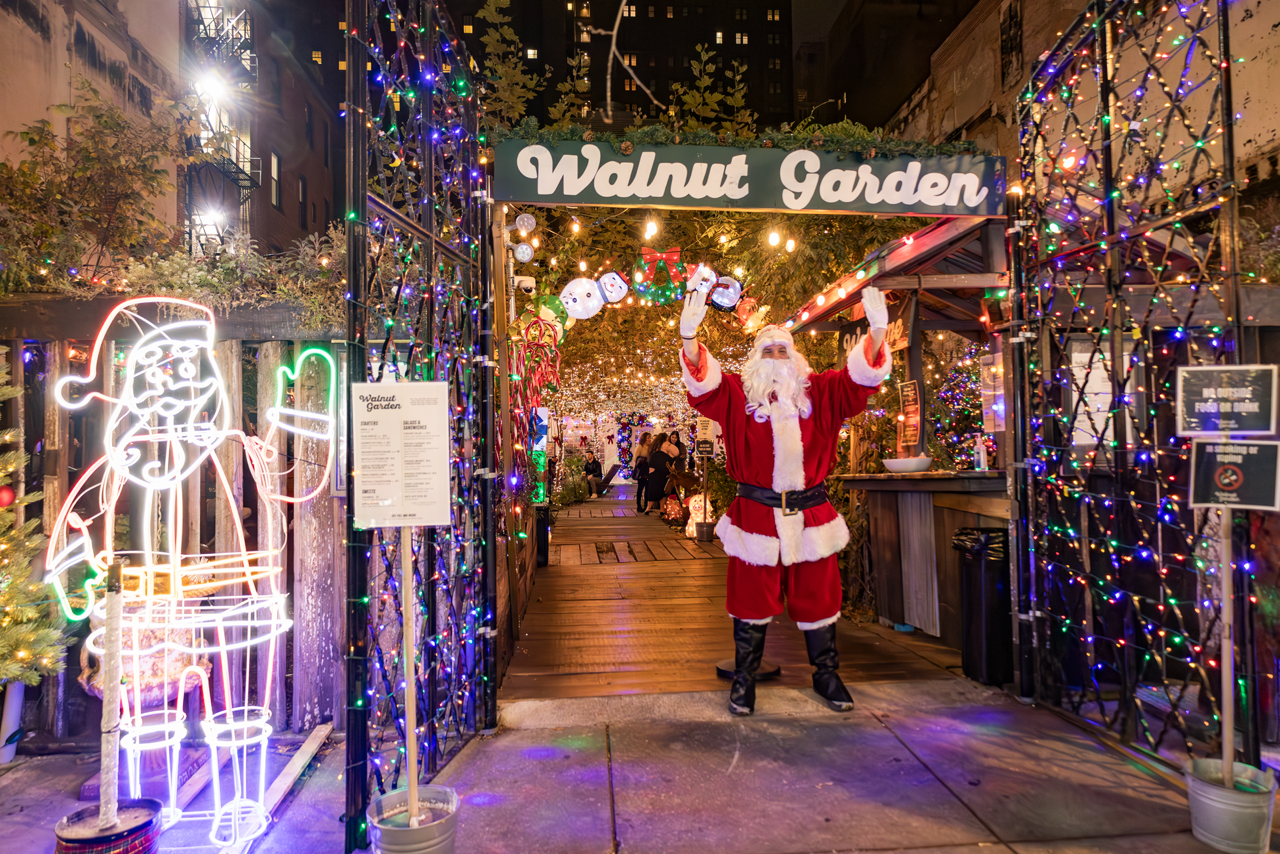
    Santa greets guests at Walnut Garden at 1708 Walnut St., which is offering table side s’mores and gingerbread house decorating kits this holiday season.

    Yule Lodge at Butcher Bar

    Spend the winter inside Butcher Bar‘s heated covered patio, which looks kind of like a man cave inside a contemporary ski cabin. Butcher Bar’s seasonal cocktails make up for the macho decor. This reporter’s favorites include the Die Hard is a Christmas Movie (rye whiskey, sweet potato, marshmallow, toasted almond bitters) and the Christmas in Paradise (citrus almond spiced rum, mango, lime, herbal liqueur topped with a teeny drink umbrella).

    2034 Chestnut St., 215-563-6328, butcherbarphilly.com
  • You asked, Craig LaBan and co. answered: The Inquirer’s food team fields readers’ questions

    You asked, Craig LaBan and co. answered: The Inquirer’s food team fields readers’ questions

    Last week was a busy one for our food desk: Michelin announced its first-ever stars and honorees in Philadelphia’s food scene, a much-anticipated reveal sandwiched between The Inquirer’s inaugural food festival and Thanksgiving week. To cap it all off, we solicited subscribers’ questions on our site. No surprise, there were lots of Michelin questions, along with a slew of requests for restaurant recommendations.

    Our team had answers. Read on for our musings on Michelin, where Philly’s restaurant scene is going, and staff picks for red gravy joints, BYOBs, and Philly’s best roasted duck.

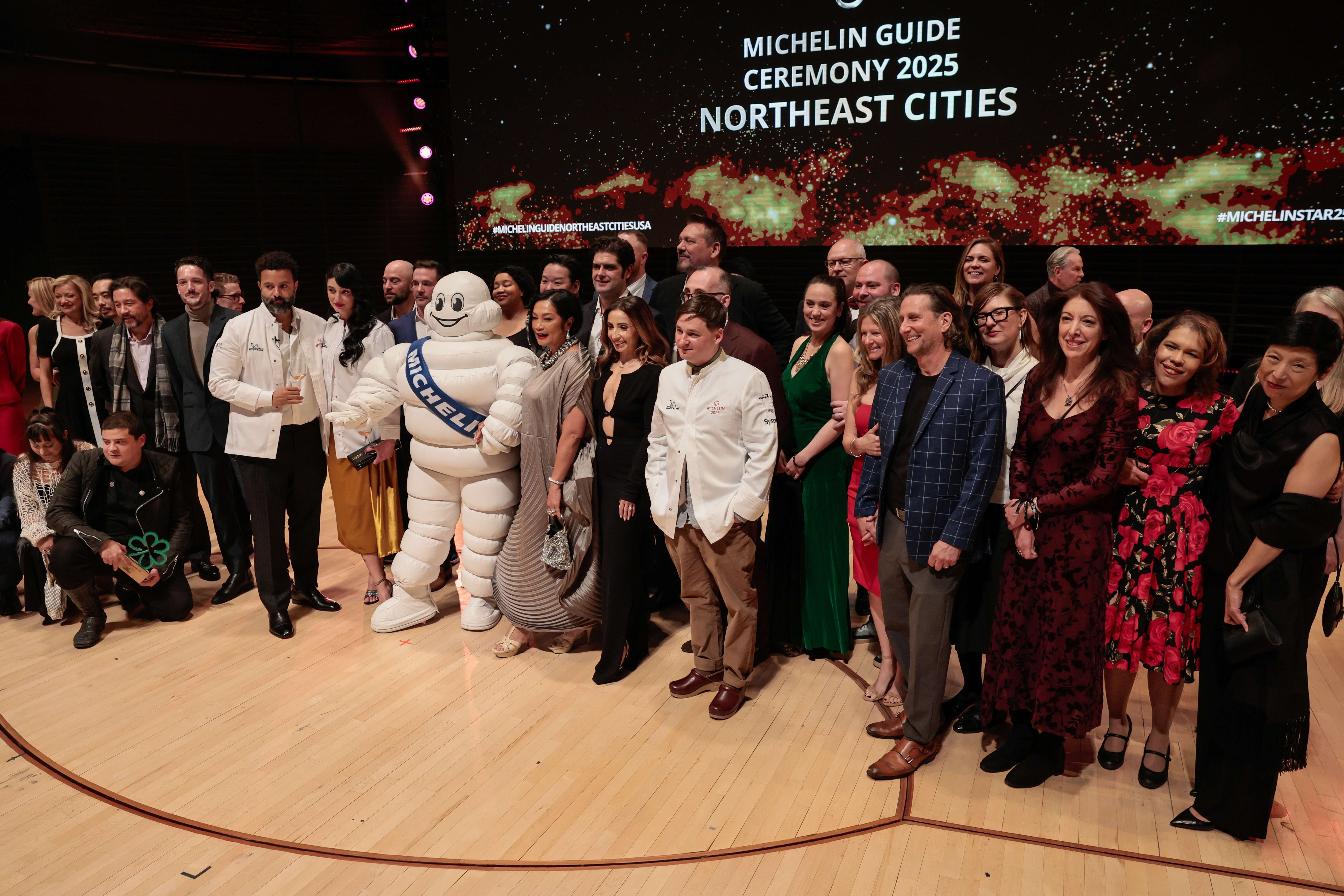
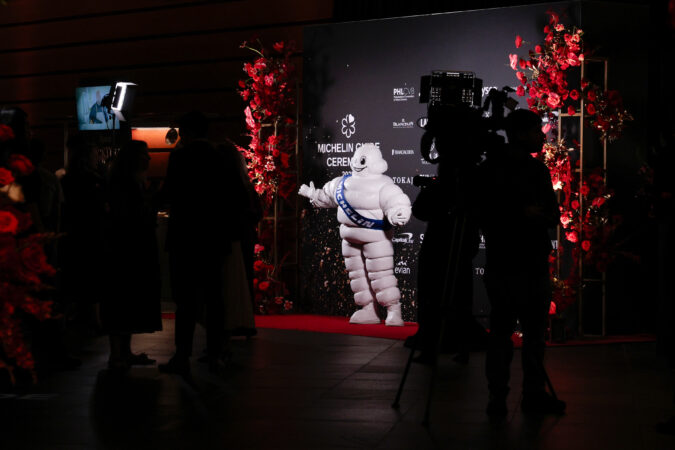
    The Philadelphia chefs acknowledged at the Michelin Guide announcements at the Kimmel Center Tuesday, Nov. 18, 2025, in Philadelphia.

    Michelin machinations

    Can you give us an idea how much the [Philadelphia Convention and] Visitors Bureau had to pay Michelin to come to Philadelphia? It was shocking to find out these awards are “pay to play,” but now I understand why decades of world-class dining in Philadelphia have never garnered a Michelin star until now. Is it possible James Beard awards are more highly regarded, which I doubt, since they are not pay to play.

    Michael Klein, food & dining reporter: We don’t have any idea how much Michelin was paid. As a private nonprofit, the Philadelphia Convention & Visitors Bureau does not have to release that. It’s rolled into its budget, and it likely will be rolled into unspecified marketing fees. Its most recent tax return, which covered July 1, 2023, to June 30, 2024, was filed in February 2025. The deal for this year’s other new Michelin city, Boston, also was not made public; one report pegged it as over $1 million for the three-year partnership. Typically, small markets and individual cities pay $70,000 to $300,000 per year, typically in three-year deals. For the 2025 American South regional guide that came out Nov. 3, cities and states across the South collectively are contributing $1.65 million per year for three years (about $4.95 million total).

    Why wasn’t Mawn recognized by the Michelin Guide? Are you surprised by fact there was no recognition for Mawn?

    Jenn Ladd, deputy food editor: Michelin’s decision-making is famously secretive, but we are operating with an informed assumption that an inspector could not get a table/reservation there (or perhaps couldn’t get more than one, since they are supposed to make repeated visits) and so did not include it. You can find more thoughts in our writers’ reactions to the Michelin picks.

    As a team, we definitely were surprised by that choice. While it’s understandable (to at least some on the food desk) that Royal Sushi’s omakase wasn’t considered due to how difficult it is to get a reservation there, Mawn’s lunch is walk-ins only. Will you have to arrive early and wait in line? Yes, but it’s not impossible to dine there without connections. Hopefully next year, Michelin’s inspectors have a longer timeline during which to consider our city’s food scene.

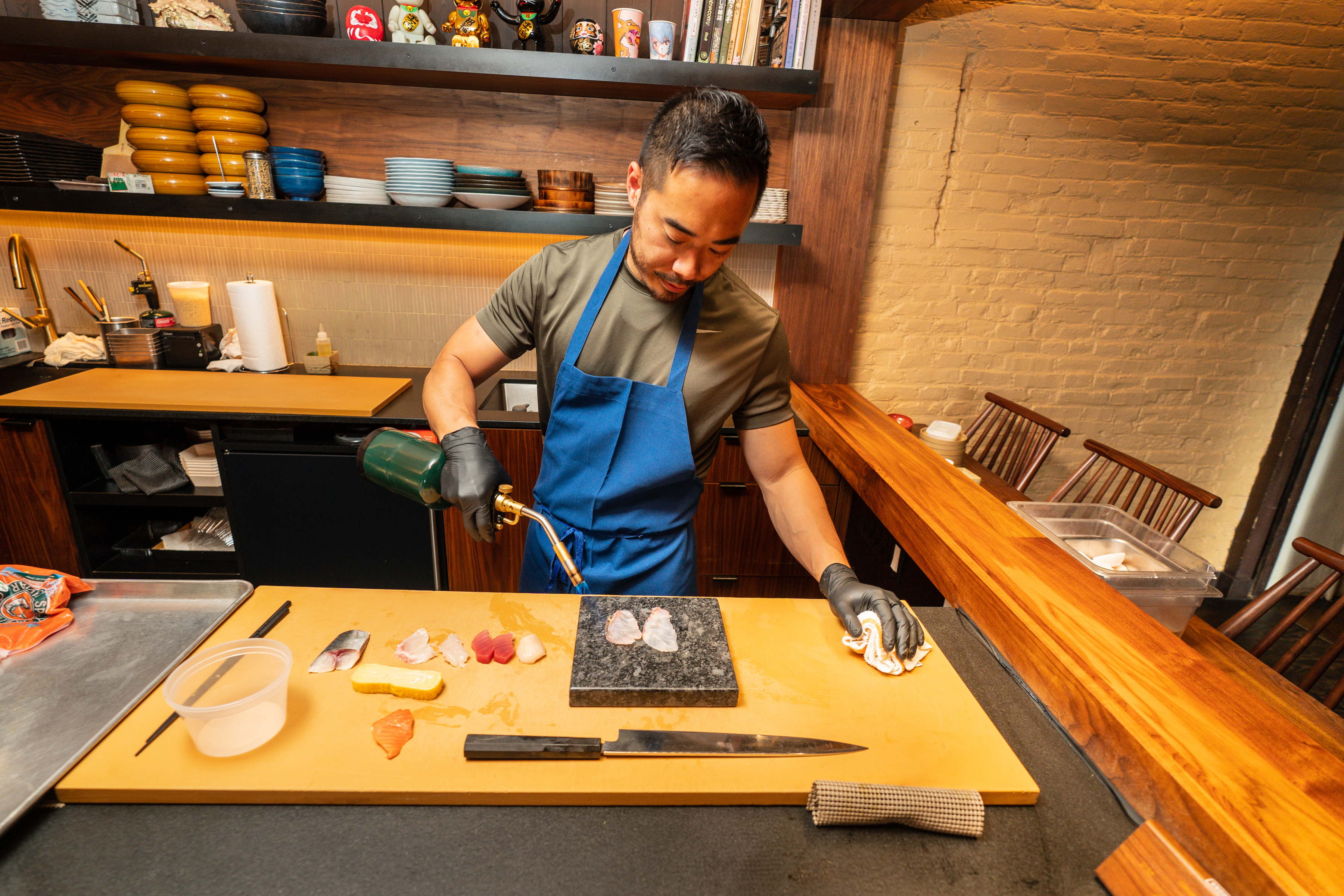
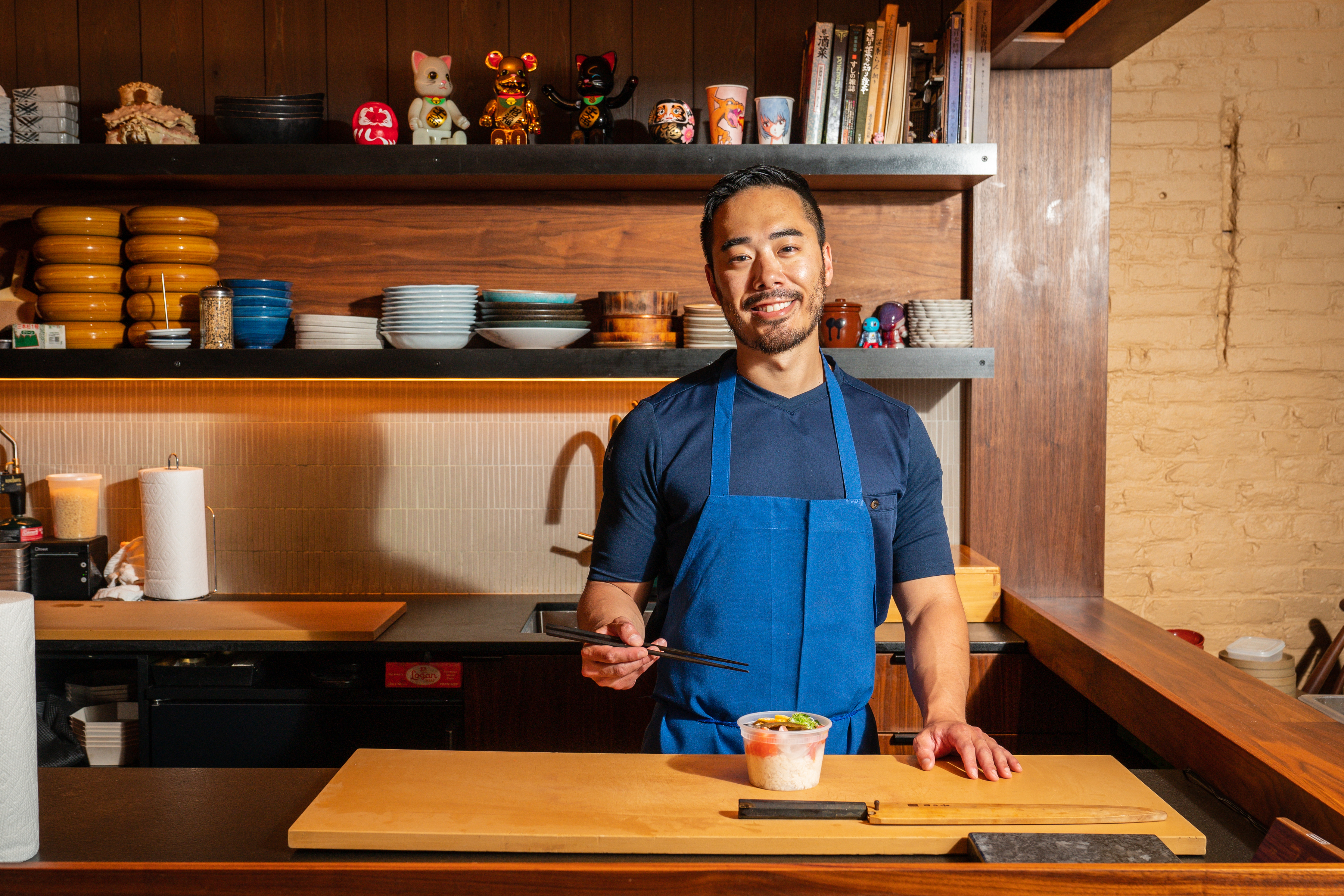
    Chef-owner Jesse Ito makes “Industry Chirashi” (a late night bargain chirashi they make in a plastic tub with scraps from the nigth’s omakase, at Royal sushi and Izakaya, in Philadelphia, Friday, August 11, 2023.

    Is there a general concern that higher-end restaurants will get even more expensive and perhaps “one-dimensional” in a way in striving to impress Michelin with more tasting menus and the like? What do we not want to see in prospective changes?

    JL: This is a concern we share. As Craig wrote earlier, “My only hope is that restaurateurs keep cooking from the heart, and that they don’t alter what they do simply in pursuit of a star.”

    We were heartened by the fact that Michelin gave such a spotlight to Her Place Supper Club, which had a characteristically Philly start (from Penn dorm room to BYOB pop-up residency to full-fledged restaurant). I also think there are plenty of restaurant chefs and owners in Philadelphia who aren’t aspiring to Michelin-star status, who just want to cook good food for people. I’m an admitted Michelin skeptic, but even I would have to say, I don’t think Philly will lose its restaurant-scene identity anytime soon, even if we do see more awards-bait menus.

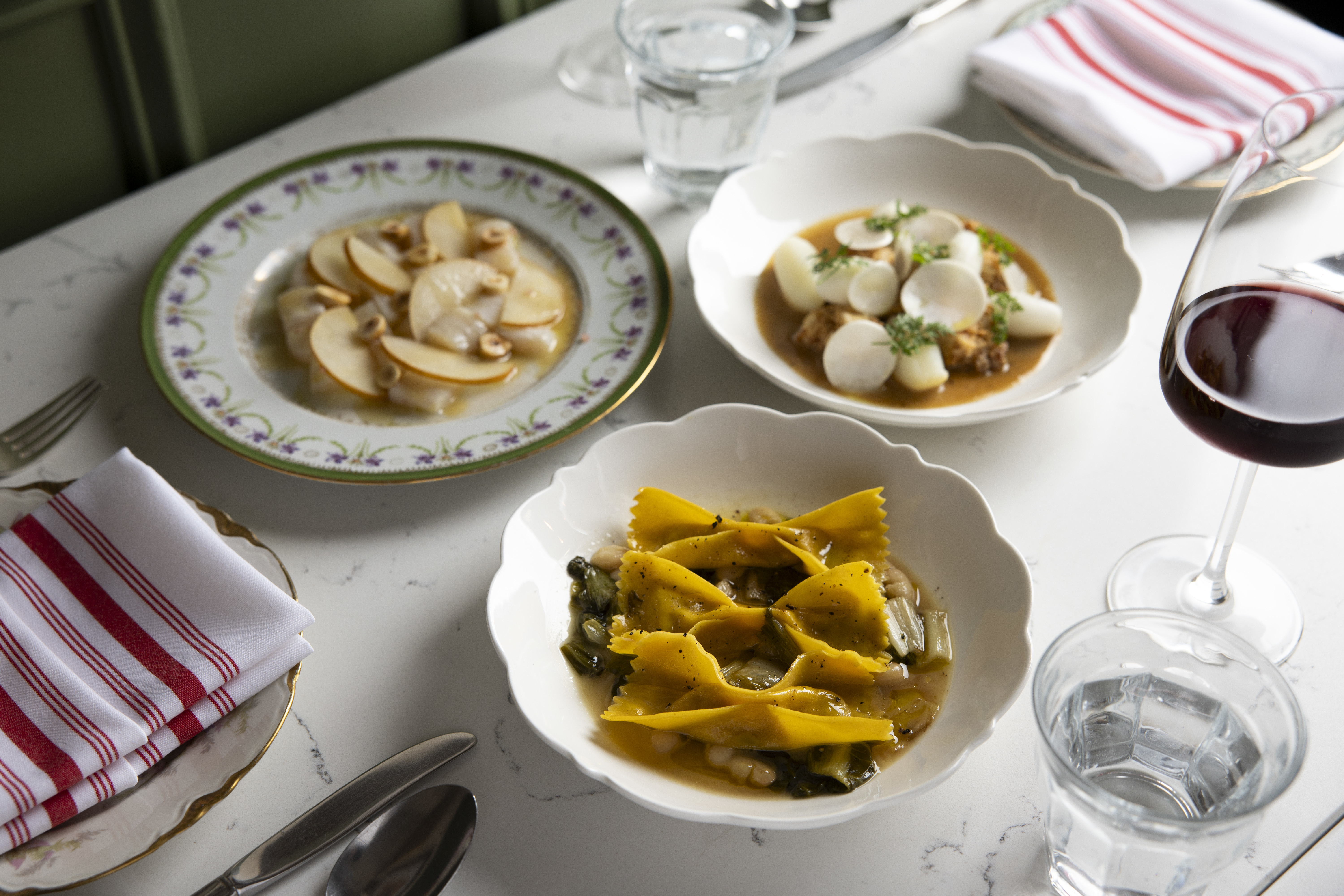
    The bean and prosciutto-stuffed farfalle, center, at Her Place Supper Club on Tuesday, Nov. 26, 2024 in Philadelphia. Her Place is located at 1740 Sansom Street in Center City.

    If each of you could pick your top 5 restaurants that didn’t make any of the Michelin Philly selections, what would they be?

    Bea Forman, food & dining reporter: First off: There’s a lot more than five restaurants I wish Michelin would’ve selected. All the honorees are so deserving, but I couldn’t help but feel like the Bib Gourmand selection especially painted a white-washed version of Philly’s dining scene. They hit up at least three cheesesteak places but couldn’t find it in their hearts (or stomachs) to find a gem in Chinatown? Or a Vietnamese restaurant? Or more restaurants that speak to Philly’s rich tradition of excellent Mexican, Latino, and African food? Lame. Tomato. Tomato. My five picks for Bibs or recommendations would be:

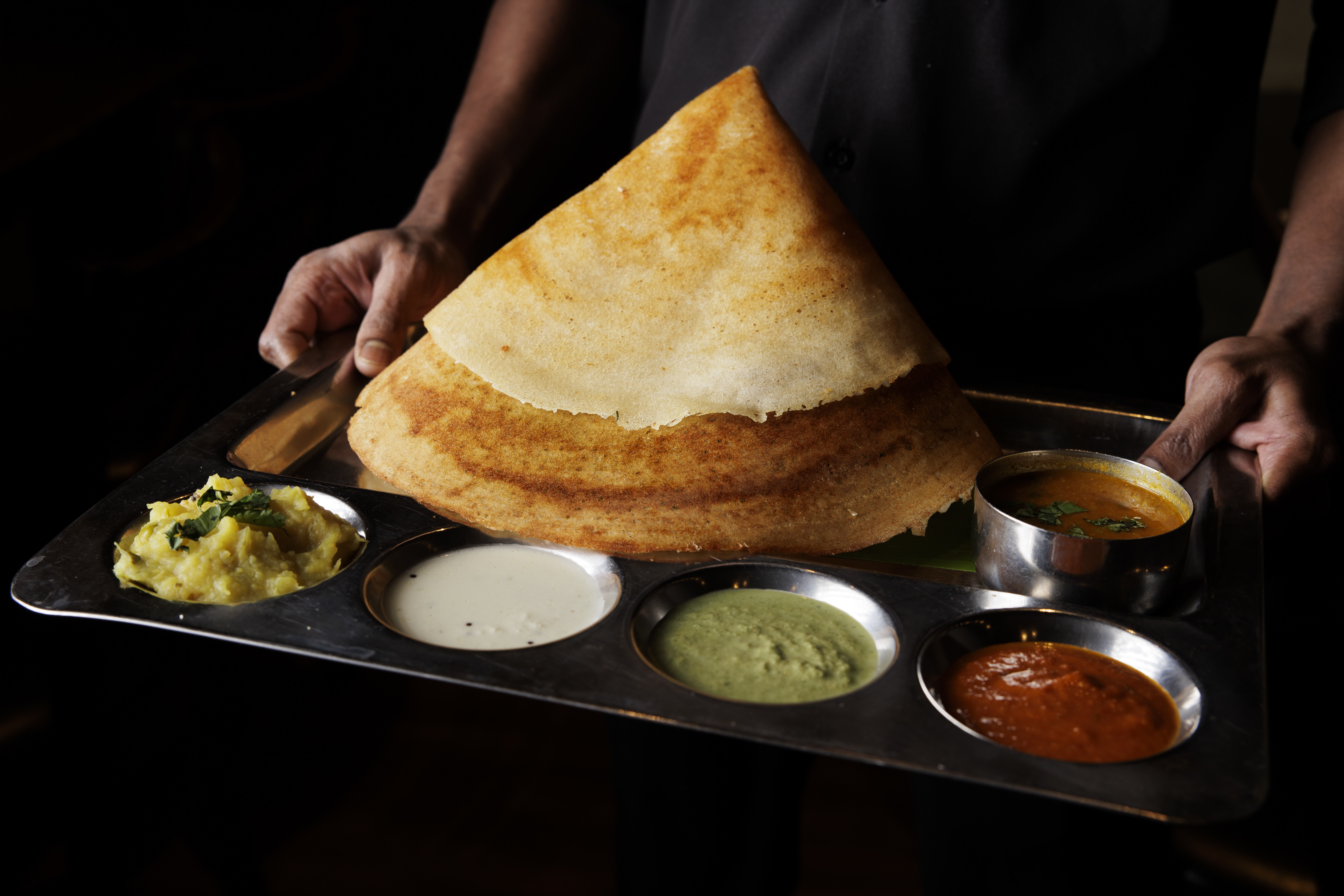
    The Ghee Roast Dosa at Amma’s on Chestnut Street in Philadelphia on Wednesday, Aug. 21, 2024.

    Hira Qureshi, food & dining reporter: I’d love to have seen these five/six restaurants get a Bib or Recommended: Amsale Cafe for their beautiful injera-lined platters with kitfo and gomen wat; Samson Kabob House for their insane chapli kababs alone; and Kabobeesh for their mutton karahi that’s just as good as my mom’s. Apricot Stone or Al-Baik Shawarma & Grill have the best hummus and falafels in Philly. And Black Dragon Takeout really does nail personality like no one else in the city.

    A saturated restaurant scene?

    There are so many good and great restaurants in the city — many moving into neighborhoods that are still deep into renovation/gentrification (i.e. near the York/Dauphin station for example), and there are quite a few empty seats especially on non-prime evenings. Is the Philly restaurant scene reaching a point of saturation?

    JL: Hard to speak for our entire team on this one, but my best guess — from years on the food beat here and from reading my colleagues’ work very closely over the past 7 years — is not a chance. Year after year, there have been more restaurant openings than the last, even post-pandemic. There IS more out-of-town interest in opening in Philadelphia (a theme that’s been building all year and is sure to play out more in 2026), which could affect our restaurant scene in all sorts of ways.

    We are seeing fewer BYOBs open and more capacious, expensive restaurants, but there are plenty of neighborhoods left in Philadelphia — I live in one! — that could use more restaurants. I for one hope that as the rents go up in the saturated neighborhoods, the scrappy entrepreneurs and chefs that have defined our culinary scene start to consider properties in those pockets of town.

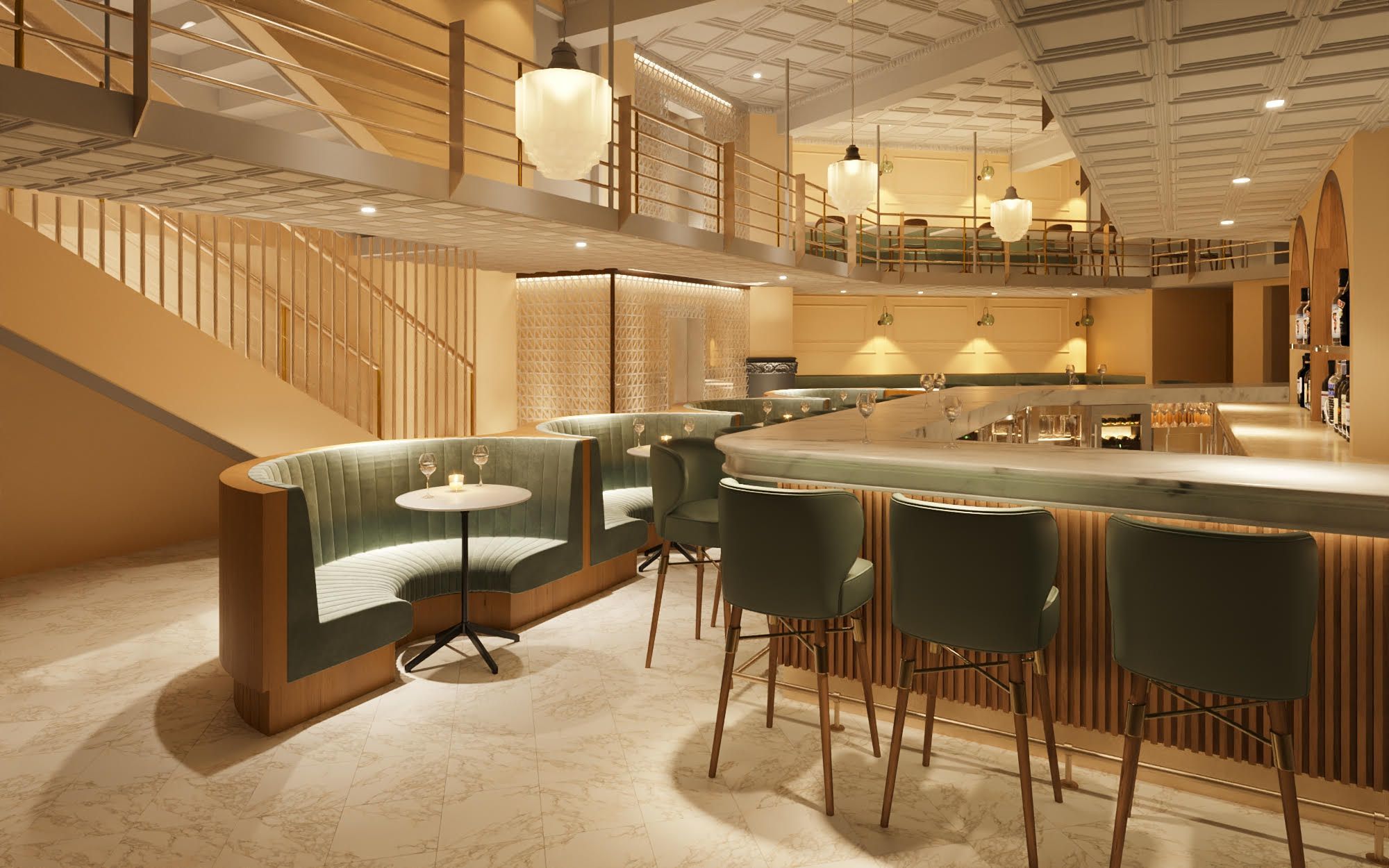
    A rendering of the bar at Flueur’s, 2205 N. Front St.

    Craig LaBan, restaurant critic: I think only time will tell on this question. There is a lot of new construction going up in these very neighborhoods, and some extremely ambitious restaurants to match. I’m thinking of Fleur’s, for example, which is farther north than many of the earlier Fishtown hits. It was quite the midweek night I visited, but that is totally normal for a new restaurant. Once it starts to get press and social media buzz, if it is positive, that will change. They have to be well-capitalized to weather the storm of early months as they build their audience. If they do a good job, Philly diners will come. Restaurant-goers’ enthusiasm for excellent new places, in fact, almost always helps boost gentrification.

    Helm, for example, was one of the few destinations on its block, save for a good neighboring taqueria, when it opened there… Now it is completely surrounded by new development. Same for Que Chula es Puebla at Second and Master. The new Honeysuckle is dealing with the same dynamic on North Broad Street. It is very much a residential neighborhood in progress of being built. It’s all about timing, capitalization, and performance. So far the quality the food is there for Honeysuckle. Hopefully the business will follow.

    Restaurant recommendations

    As an old-timer, I go back to the days of the great Django with BYOs. Are there some underrated BYOBs that didn’t make your 76 list?

    JL: There are quite a few — 76 spots gets awful tight when you’re considering the full range of the Philly region’s restaurants! Illata in Grad Hospital, Little Fish in Queen Village, Helm in Kensington, and Elwood in Fishtown, not to mention a slew of suburban gems like Spring Mill Cafe in Conshy, Maize in Perkasie, Charcoal in Yardley, for starters.

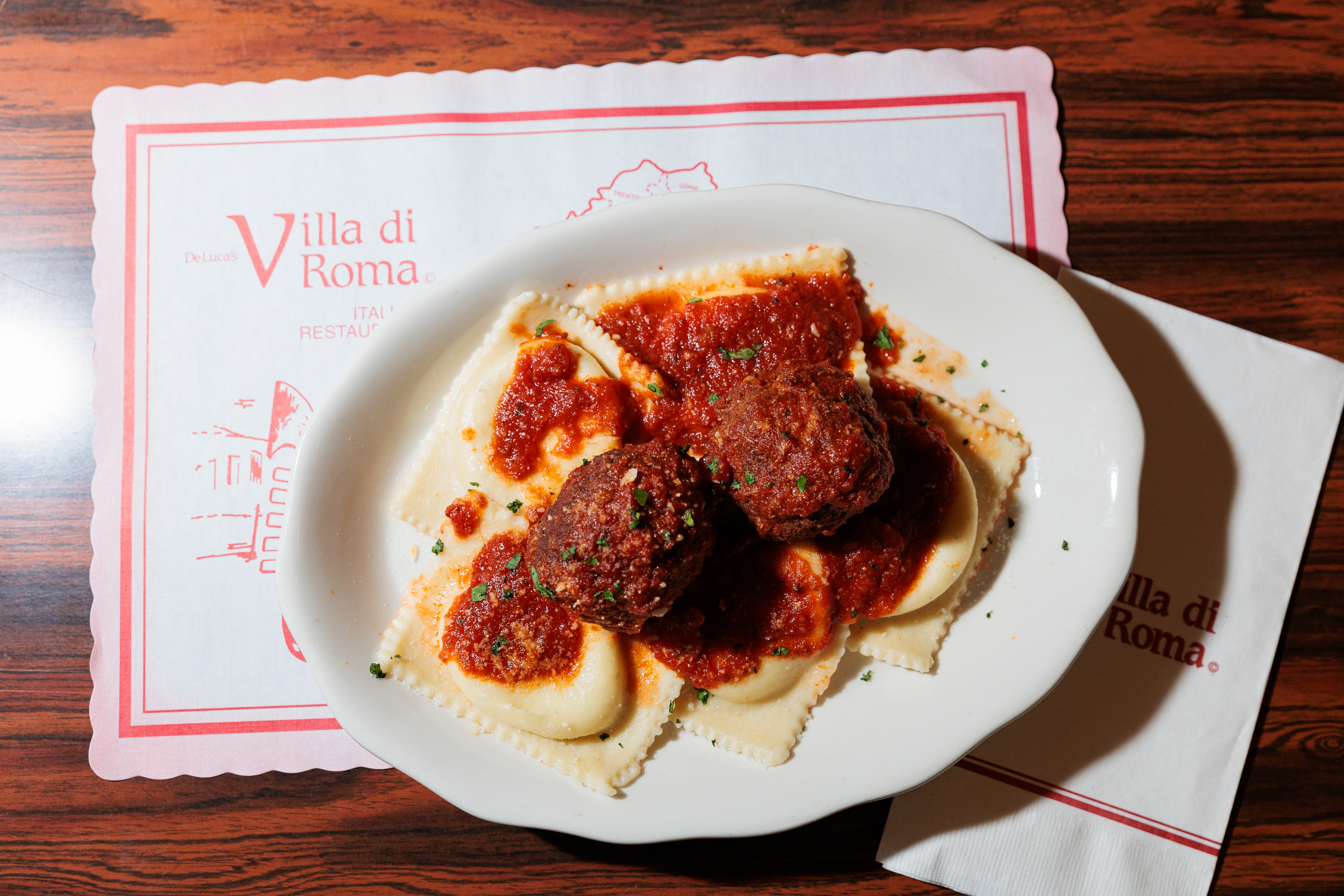
    Ravioli with meatballs from Villa Di Roma on Wednesday, Sept. 11, 2024, in Philadelphia .

    In addition to Dante and Luigi’s, what other old school “red gravy” joints have best survived the passage of time?

    MK: Ralph’s, Victor Cafe, Villa di Roma. You might also count Ristorante Pesto, whose owner Giovanni Varallo had the long-ago Io E Tu on Passyunk. (Craig LaBan adds: “Scannicchio’s! But technically a ‘post-red gravy’ generation restaurant, not unlike Pesto.”)

    Where are the best places in Philly for college students to eat at? (Besides food trucks)

    BF: Penn class of ’22 grad here, so I would be silly to not shout out our campus bar Smokey Joe’s for having sneakily excellent and oversized pizza and burgers. If you go for lunch or dinner early in the evening, it’s kind of the platonic ideal of a dive bar.

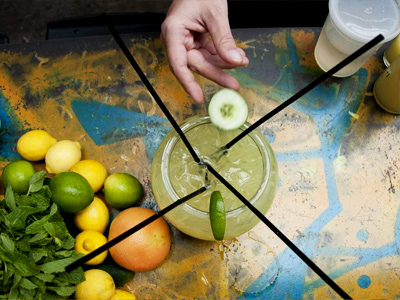
    Michael Wirzenberger, managing partner at Sampan Philly, mixes a scorpion bowl of cucumber margarita at the restaurant’s Graffiti Bar. Wirzenberger came up with the recipe. ( Abi Reimold / Staff Photographer )

    Otherwise, you and your friends should be taking advantage of happy hour deals throughout Philly and far, far away from your campuses. Food is cheaper that way. My faves:

    • Rosy’s Taco Bar: Happy hour is 3 – 5 p.m so it’s always been mostly other college students. Everything is $5, and deeply reliable.
    • Sampan: Very yum pan-Asian small bites all under $10. Split a scorpion bowl with your friends if everyone is of drinking age.
    • La Chinesca: This is for when you want to feel classy and cool and adult, eating tacos from a retrofitted mechanic’s shop.
    • Harp & Crown, Giuseppe & Sons, and Bud & Marilyn’s all felt the right amount of fancy for a college student for happy hour. Very solid small bites, lots of young people.

    If you are actually looking for places to to eat and not experiences with good enough food like I wanted in college, I would recommend just exploring Reading Terminal Market and a lot of the mom-and-pop or hole-in-the wall restaurants in Chinatown and the Italian Market. You’ll feel like you actually live here.

    Is it fair to say that the very best roasted duck in Philly is sold at Ting Wong on 11th Street in Chinatown??

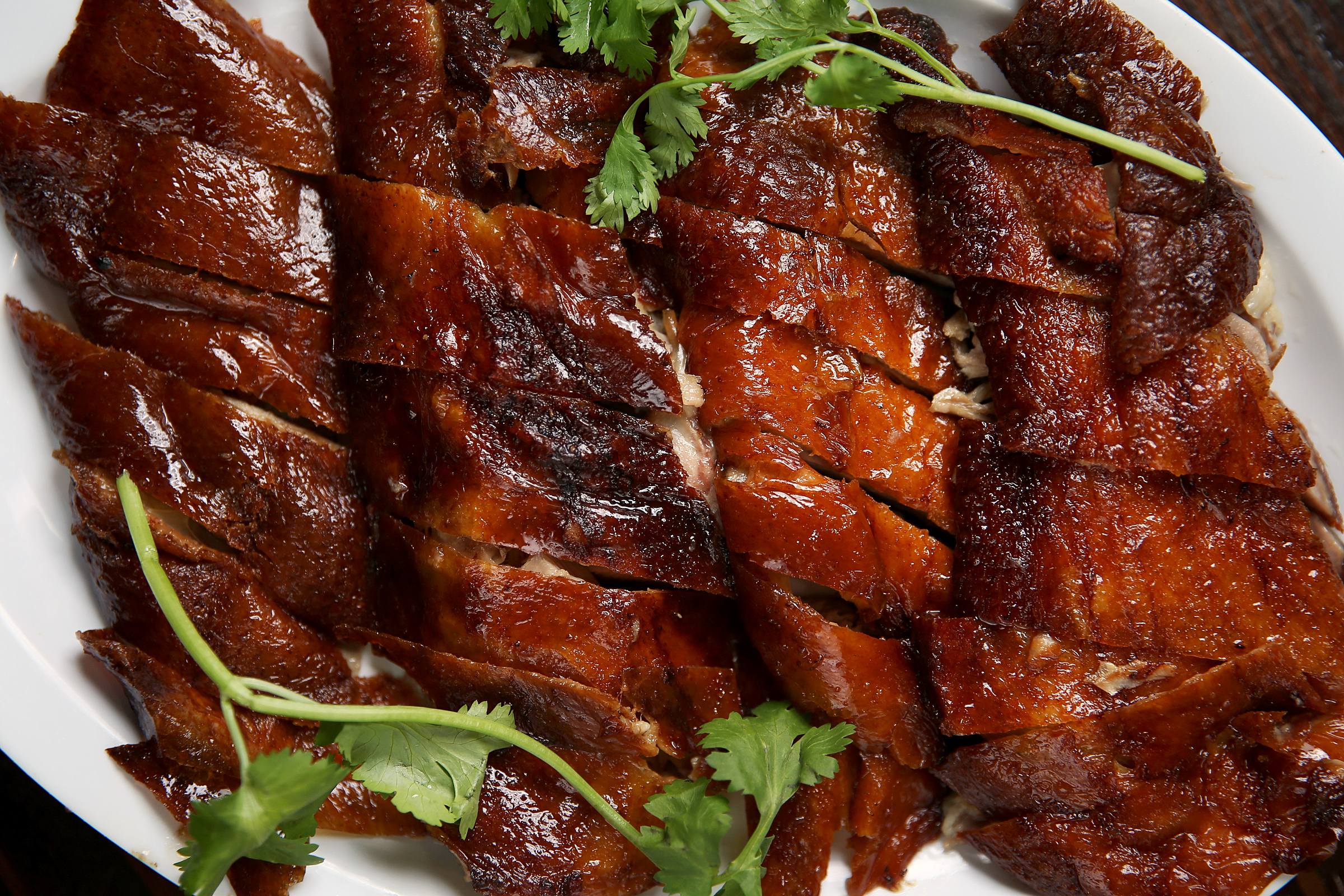
    CL: Ting Wong reopened earlier this year after a short closing and everyone rejoiced because it’s such a neighborhood standby for Hong Kong-style noodles, soups, and BBQ meats — including a stellar roast duck. It’s still very good, but I’ve long been a bigger fan of two others in Chinatown: Siu Kee, the takeout-only duck shop just across 10th Street from Ting Wong, which supplies many of the best restaurants in Chinatown with their ducks (including Tai Lake, which I revisited this year), but also Lau Kee, a cozy little storefront on the 900 block of Race Street owned by the longtime former duck chef of Sang Kee. It’s great!

    The Peking duck is pictured at Lau Kee in Philadelphia’s Chinatown on Thursday, April 1, 2021.

    One more: While these previously mentioned shops are examples of the savory, marinated Hong Kong duck style, a newer entry called Beijing Peking Duck and Seafood Restaurant on Arch Street makes one of the best Peking-style ducks I’ve had — with a cracker-crispy golden skin that gets carved dramatically tableside. You have to order a whole duck, but it is an event worth the splurge.

    I miss Gigi Pizza and Nomad Pizza so much. Are there any casual pie spots with great sides and salads like them in Center City or in the works? Vetri Pizza is missing something lately and Pietro’s is good but Rittenhouse gets SO crowded anymore…

    MK: Gigi and Nomad had a good thing going. A little fancier is Sally at 23rd and Spruce Streets, which just was awarded a Bib Gourmand by the Michelins. Charcuterie boards, fab meatballs, really nice salads (the green salad with miso and pickled shallot), and crispy pies, like the Loud Red, whose arrabbiata sauce is perfect for the spice fans… Wilder at 20th and Sansom has a raw bar, a few salads, and seasonal wood-fired pies, like the lamb bacon…. Clarkville at 43rd and Baltimore has a warm cauliflower salad that supplements the pizza list… I’m also really fond of the new-ish Corio at 37th and Market, not only for the pizza, pasta, and salads, but the inviting vibe.

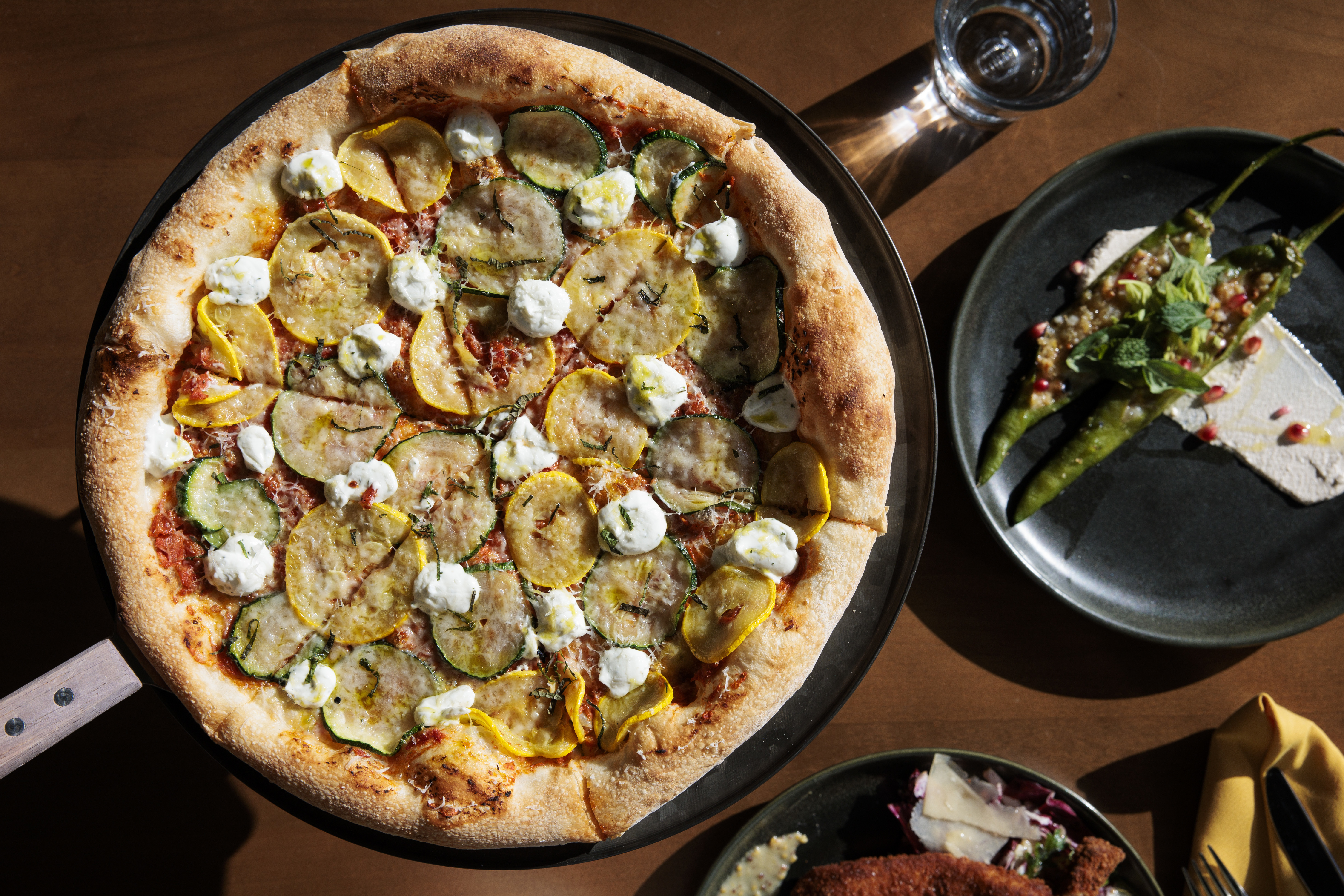
    The Zucchini Pizza and Stuffed Long Hots at Corio on Thursday, Sept. 18, 2025 in Philadelphia.

    When I lived and worked in Philly in the ’90s, Caribou was near the top of my dining list. The menu still looks fine. What is your take on this restaurant?

    CL: Caribou is still kicking! This Center City standby — going on 33 years in its current Walnut Street location — had a change of ownership over a year ago, with chef Townsend Wentz’s group taking it over. I’ve not been since a solid lunch in the early weeks of Wentz’s takeover, but here’s a few basic observations: They’ve largely kept the classic brasserie vibe intact, including that fantastic long bar with its art deco statuettes, and they’ve simply made an effort to update and improve some of the classic French bistro fare. Wentz is good at that, and I loved the initial French onion soup I tasted there. But I’d like to return for a check-in. As the weather gets cold, a good stewy plate of boeuf bourguignon or a hearty choucroute garnie sounds good to me. But you never know until you go. With the unfortunate closing of Bistrot La Minette last year, Center City needs all the great French bistros it can hold onto.

  • One of Philly’s most acclaimed bakeries has permanently closed

    One of Philly’s most acclaimed bakeries has permanently closed

    Facing mounting personal, legal, and financial pressures, acclaimed baker Tova Du Plessis has permanently closed Essen Bakery and said she is considering filing for bankruptcy protection, six months after she and her husband announced unexpectedly that they were “hitting pause for a few days.”

    The four-time James Beard Award nominee’s shops, on East Passyunk Avenue in South Philadelphia and Berks Street in Kensington, never reopened after the announcement on May 31, which blindsided her estimated two dozen employees.

    In late July, Tova Du Plessis told The Inquirer that she and her husband, Brad, were “navigating deeply personal challenges” and hoped to reopen in September. Meanwhile, disgruntled former employees and investors had been left in the dark.

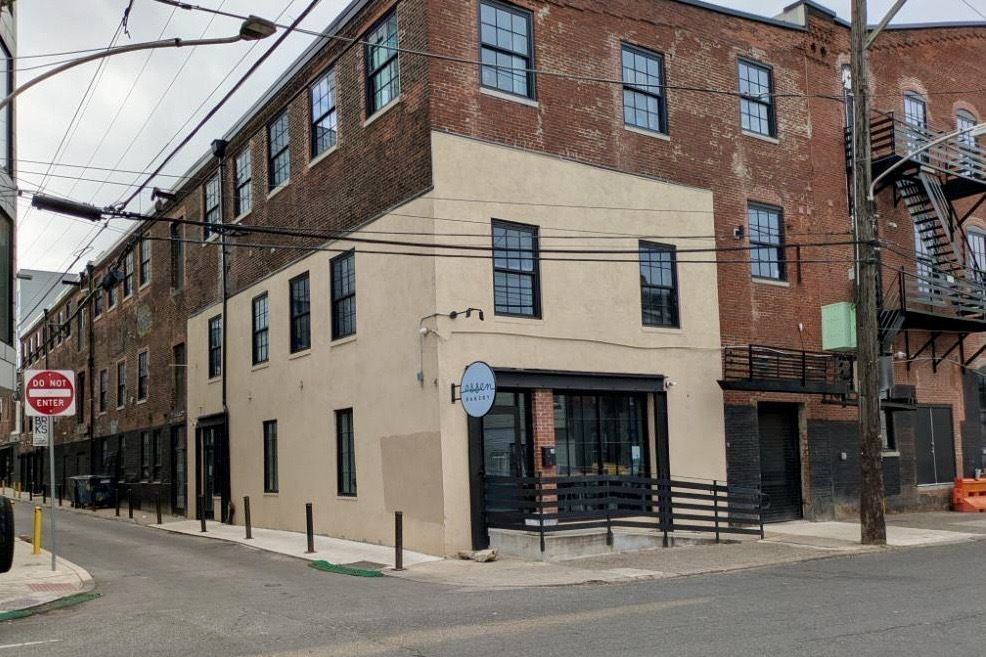
    Essen Bakery’s location at 110 W. Berks St. on Oct. 29, 2025.

    Du Plessis said it took a long while before she realized that reopening was not an option. “I don’t think that I can really pull off what I need to — not just to be open, but to make it financially sustainable,” she said. “There always was that potential, but after what I experienced, I just don’t have the confidence, the head space, and the people in place.” She also said her struggle with narcolepsy, the chronic interruption of the sleep cycle, had worsened.

    Du Plessis said she had explored different plans to relaunch or restructure Essen but couldn’t make any of them work. “I think I just needed to come to terms with that,” she said.

    The early days

    Du Plessis, who turned 40 last summer, grew up in a kosher home in Johannesburg, baking challah for Shabbat each week. She and Brad, her high school sweetheart, relocated to the United States while she pursued a biology degree at the University of Houston with a goal of becoming a doctor. Following a trip to Paris, she pivoted toward cooking. They headed to California, and she enrolled at the Culinary Institute of America’s Greystone campus in Napa Valley, where she specialized in baking and pastry arts.

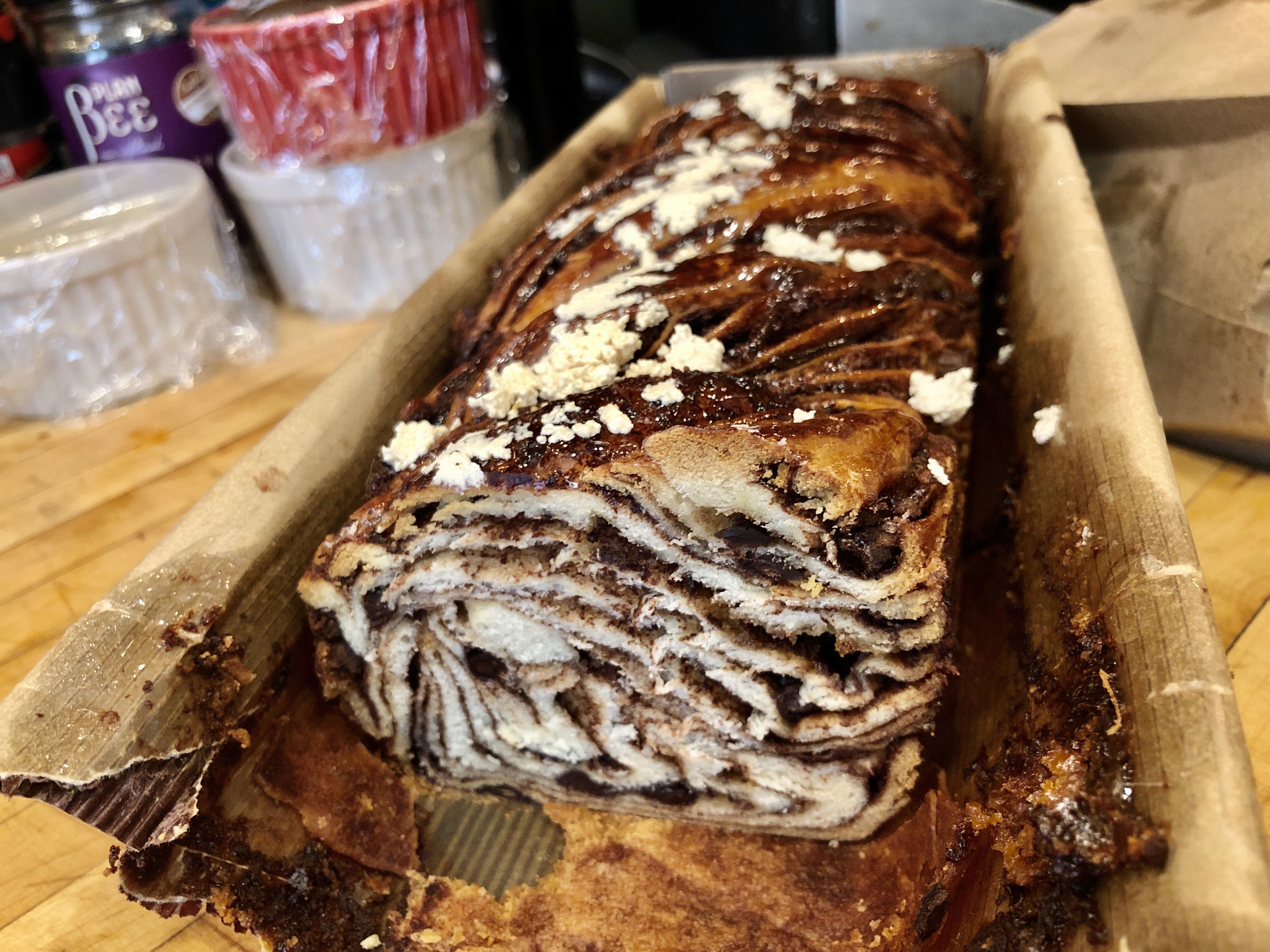
    Chocolate-halva babka, one of the specialties at Essen Bakery.

    While working at the Restaurant at Meadowood in Napa, she met chef Michael Solomonov during his visit as a guest chef in December 2011. Soon after, she and her husband moved to Philadelphia, where she worked as a line cook at Zahav before becoming sous chef at Citron & Rose, the Main Line kosher restaurant that Solomonov and Steve Cook briefly consulted on. She then served as executive pastry chef at the Rittenhouse Hotel.

    In 2016, she leased a storefront on East Passyunk Avenue near Dickinson Street to launch Essen, which became known for its challah, babka, laminated pastries, and seasonal breads. Great reviews followed, including four James Beard Award semifinalist nominations for Outstanding Baker between 2017 and 2020.

    By 2022, with Essen outgrowing Passyunk Avenue, Du Plessis began looking for a second, larger location. In January 2023, she signed the lease on a newly constructed building on Berks Street, a half-block from the Market-Frankford El near Norris Square, at the corner of Berks and Hope.

    Brad du Plessis and Tova du Plessis at the Kensington location of Essen Bakery, 110 W. Berks St.

    Financial strain

    Tova Du Plessis said financial pressures began mounting last spring. She is facing a lawsuit filed by their Berks Street landlord over unpaid rent, and the space, just off Front Street, is being shown to prospective tenants. The landlord of Essen’s East Passyunk Avenue location has found a new tenant, Du Plessis said last week.

    The Du Plessises are also in arrears on a loan repayment to Frank Olivieri, owner of Pat’s King of Steaks. Olivieri said he and his wife, Nancy Schure, had provided a “substantial” amount of money last year to help fund the Berks Street shop, which opened in November 2024 after nearly a year of delays Du Plessis attributed to contractor issues and permitting. Initially investors, Olivieri and Schure later converted their ownership stake to a loan, he said.

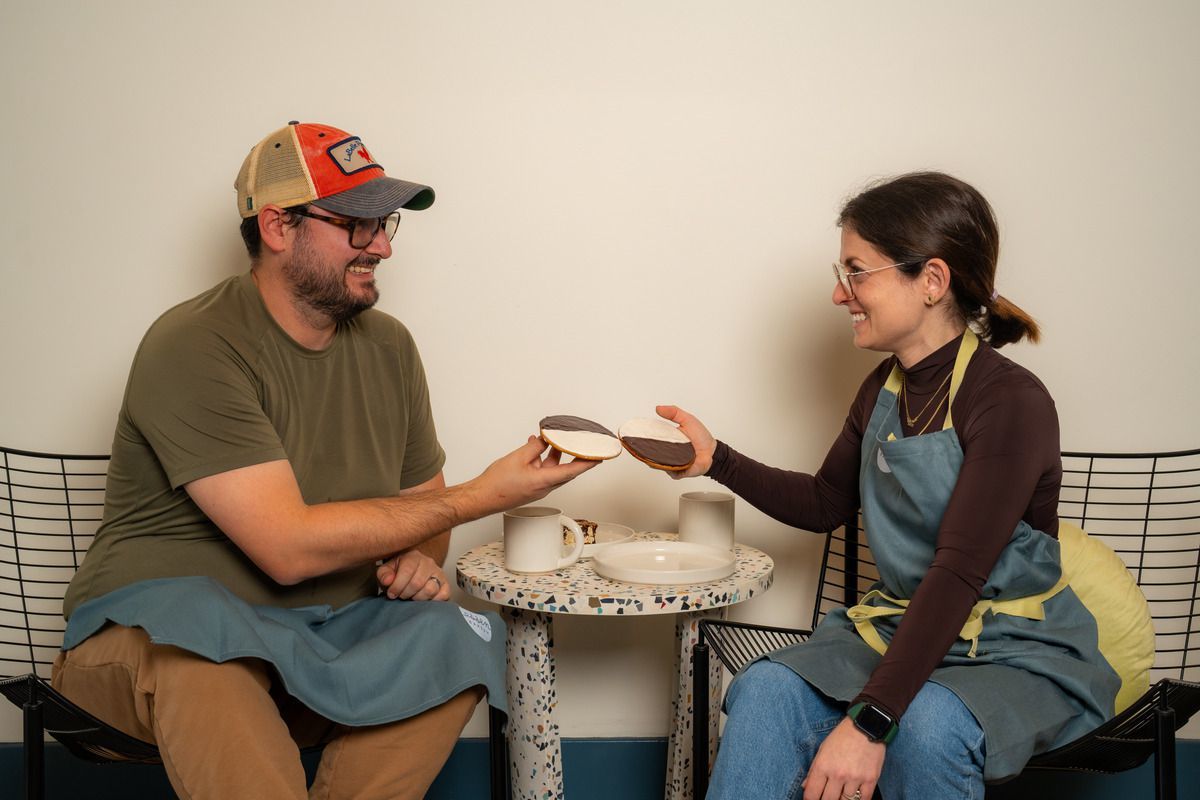
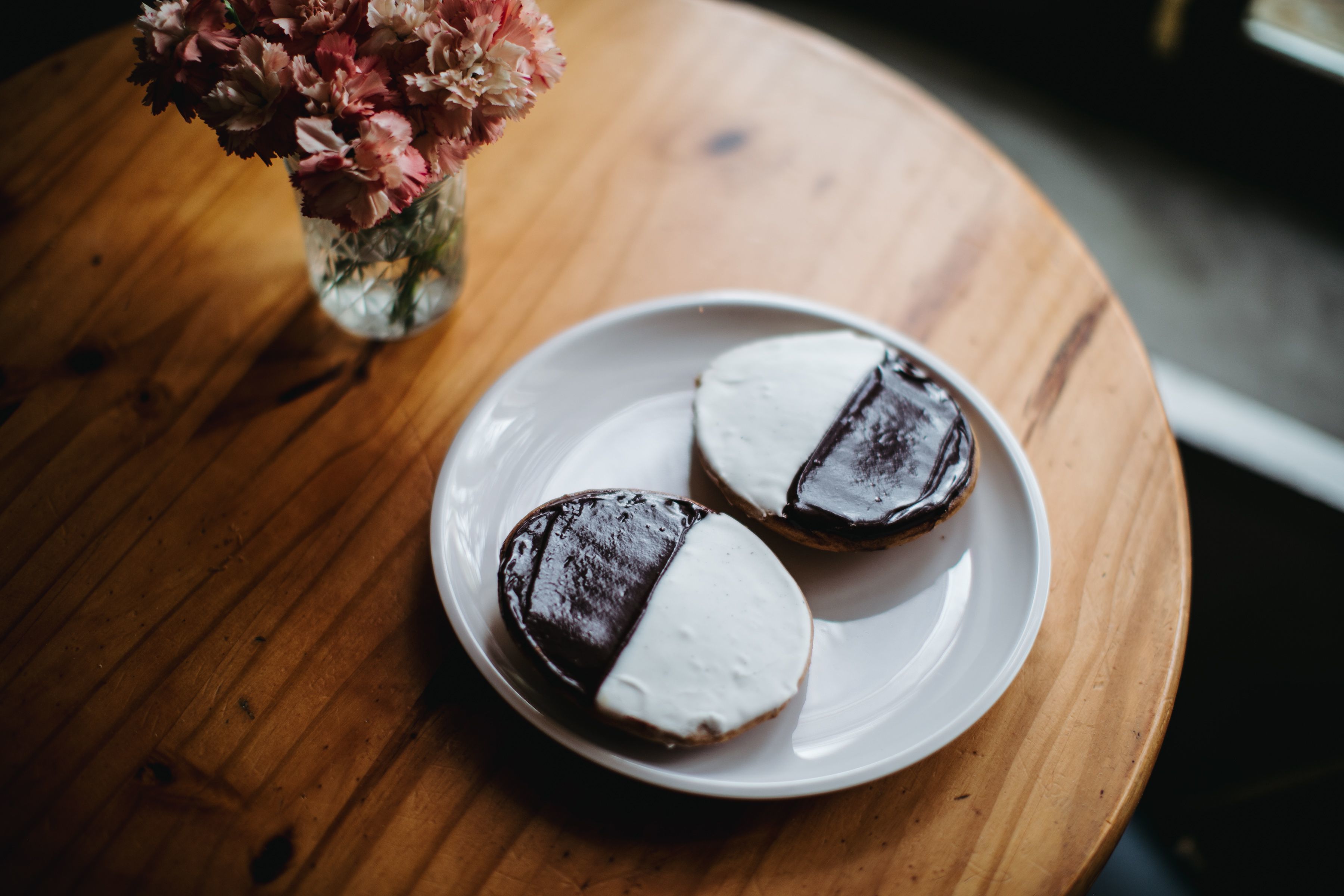
    Essen Bakery’s signature black-and-white cookies.

    Olivieri said they had been customers of the Passyunk Avenue location when Brad Du Plessis contacted them last year to ask if they would be interested in investing. Olivieri said he noticed issues with day-to-day operations, and eventually, he said, “It just seemed like we were becoming more like counselors rather than investors.”

    Later, Olivieri said, the couple ignored his advice and grew silent. “You have to have an open line of communication to be successful, and unfortunately that’s one of the components that was missing,” he said.

    Employee fallout

    It was the silence that distressed the idled Essen employees, too. They told The Inquirer over the summer, after its July report that the bakery owners hoped to reopen, that they were given no clues about the business’ future. Several former employees disputed the couple’s assertion to the newspaper that they had been taken care of during the shutdown.

    In the days after the closing, one former employee said, workers messaged the couple to say that they couldn’t pay their rent and were desperate to learn when they would be able to work again. “After several promised reopening dates came and went with no opening, they simply stopped responding to staff,” said the worker, who asked for anonymity because they wanted to move on with their life.

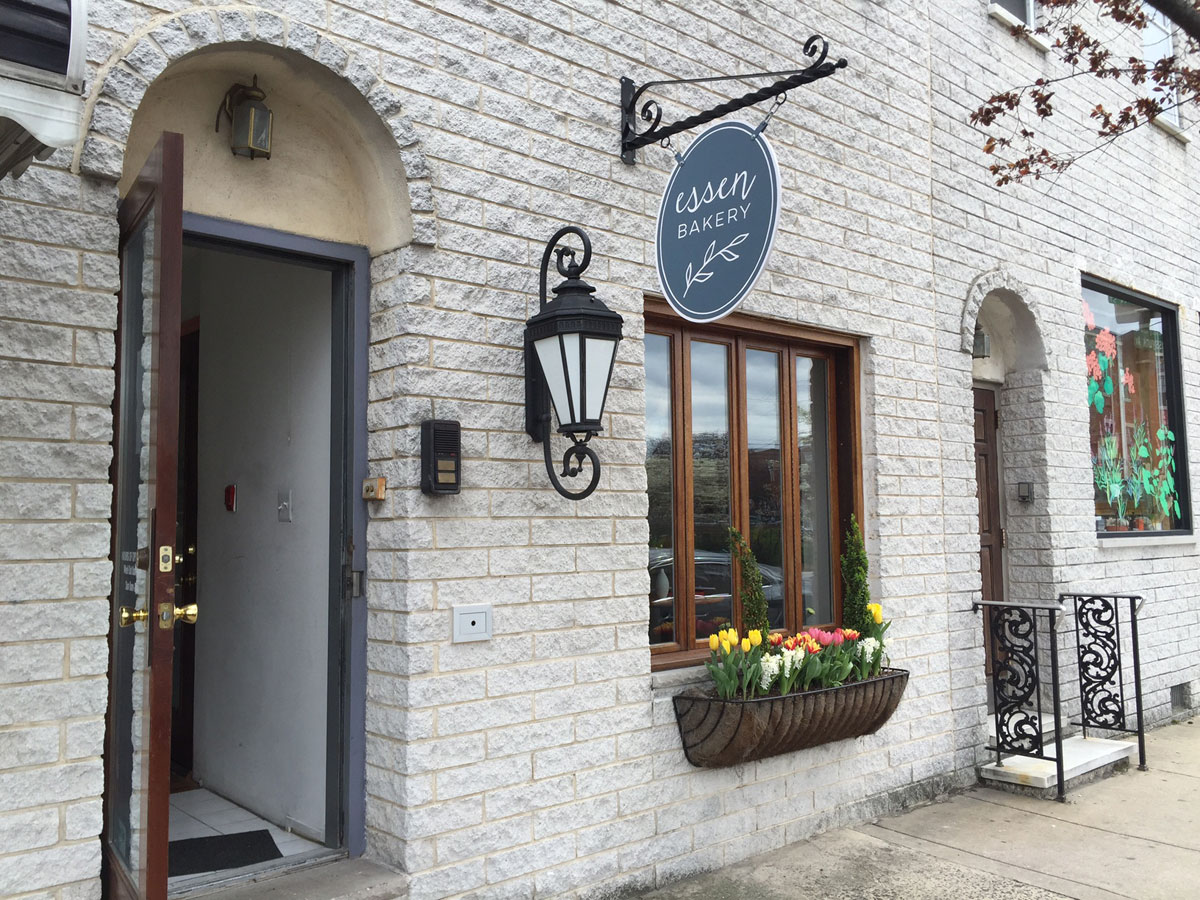
    Essen Bakery’s first location opened in 2016 at 1437 E. Passyunk Ave.

    Another employee, who had worked at Essen from September 2024 until the shutdown, aired her grievances in a TikTok video. Others told PhillyVoice, in an article published Aug. 13, that they were suffering and that the Du Plessises were blocking the accounts of people who discussed the situation on social media.

    Personal strain

    Tova Du Plessis said that just before the shutdown, she and her husband were “discovering issues in our relationship that we didn’t understand, and it was impacting the business in such a drastic way. Running the business was our escape from dealing with our issues.”

    The stress in their marriage “was just magnified because we were running a business together,” Du Plessis said. “It was undeniable — it was a problem we had to face head-on.”

    Initially, they thought that a brief shutdown would suffice, “but as we tackled those issues, we were discovering how deep and difficult they were,” she said.

    The loss of income added further stress. Brad Du Plessis, who had left his job in wine sales in April 2024 to work with his wife, got a new job over the summer. “But then I had to face the reality that I didn’t have another partner or investor,” she said. “I didn’t feel I could do it on my own.”

    Looking ahead

    Last week, Du Plessis said she was attempting to sell all of Essen’s baking equipment. She said she believed that bankruptcy was the next step.

    Despite Essen’s failure, Du Plessis said she remains proud of what it accomplished. “It made me really feel like I’m part of a community,” she said.

    She said she wants to take several months before making her next move. “I’m still too affected by the burnout and the loss,” she said. “It’s not just giving up the business. It’s a whole bunch of family and relationships.” Du Plessis said she wants to return to baking, possibly even for someone else. Brad Du Plessis, who declined to comment for this article, is working again in the wine business. “He’s really in the position he should be in,” she said.

    “For a long time, I was afraid I’d be looking at bankruptcy and divorce — and I’m happy to say I’m probably just looking at bankruptcy,” Du Plessis said last Friday. “To me, that’s a happy ending, or a beginning, depending on how you want to see it. I actually feel like this experience may have saved our marriage.”

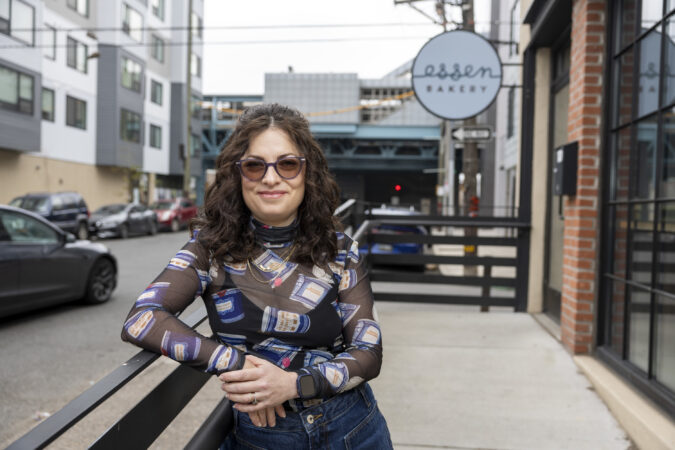
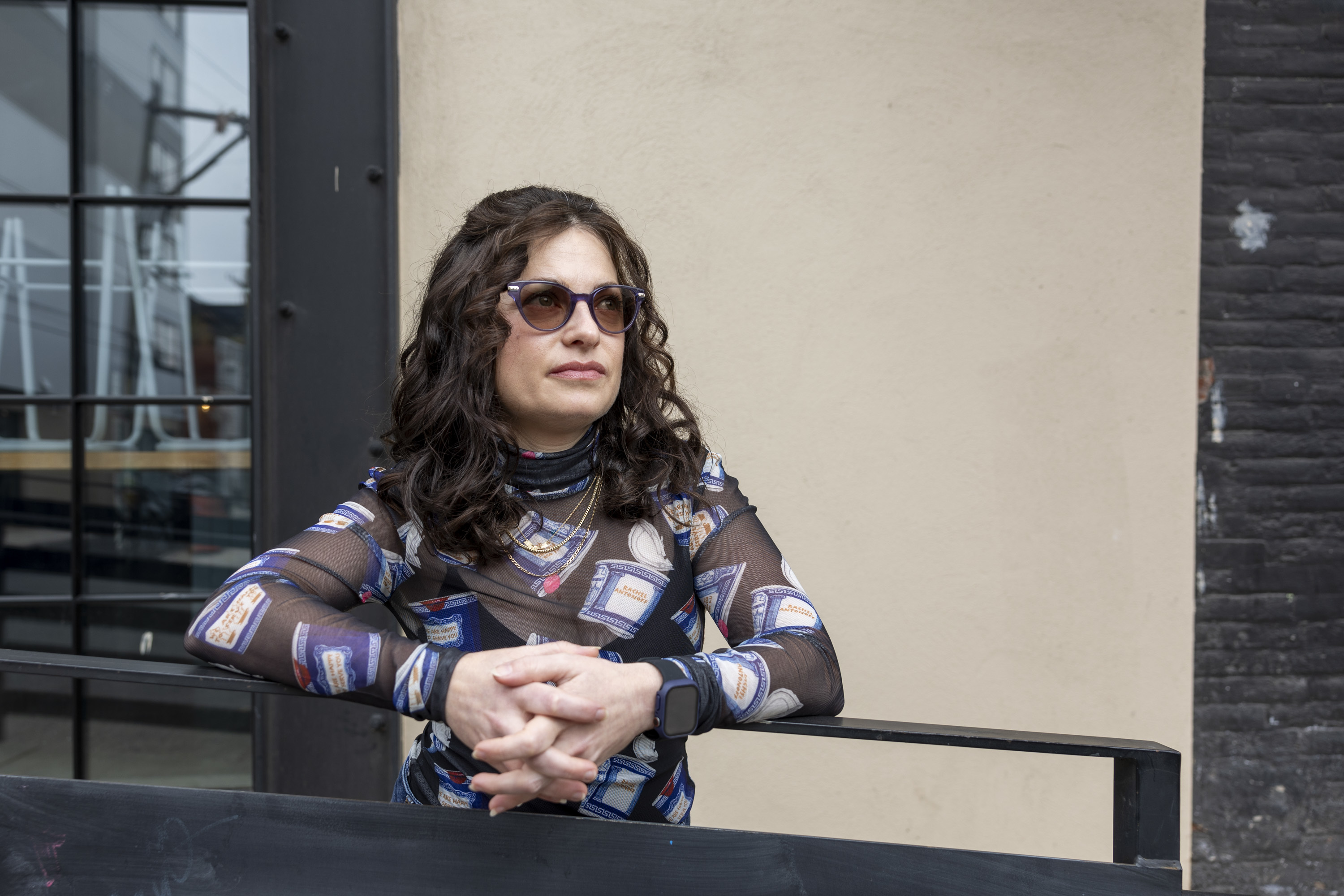
    Tova Du Plessis, owner of Essen Bakery, poses for a portrait in front of her former bakery in Philadelphia, on Friday, Nov. 21, 2025.
  • A new BYOB looks to bring the flavors of Mexico to Media

    A new BYOB looks to bring the flavors of Mexico to Media

    Editor’s note: Taquero has pushed back its opening date and now plans to open on Dec. 1.

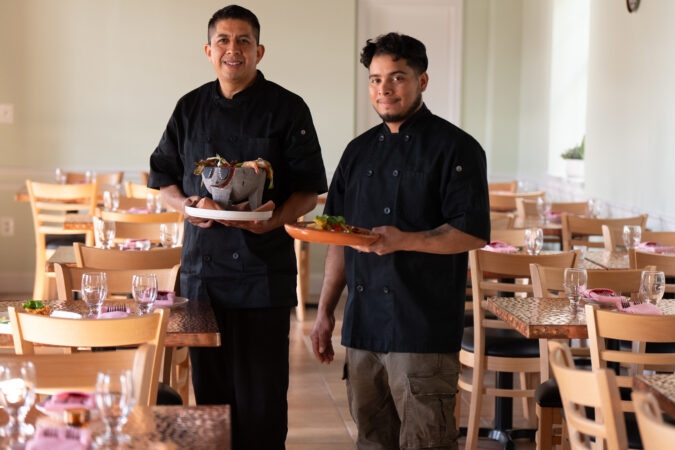
    The longtime chef of Italian restaurant Ariano in Media is readying to open his own eatery on the same block, where he’ll turn his attention to paying homage to his Mexican roots.

    Chef Antonio Garcia began dreaming up Taquero about three years ago and set the plans in motion for his restaurant at 111 Veterans Square last spring. After more than 18 months of work to convert part of a former office building, Taquero will open Nov. 24.

    The BYOB will look to set itself apart from other Mexican eateries in the borough by showcasing a mix of traditional and modern Mexican cuisine, with an emphasis on authentic dishes. The menu will give a nod to Garcia’s hometown of Toluca, while also sampling from elsewhere in the country.

    In conceptualizing his restaurant, Garcia said he wanted to do “something that’s going to make me proud, for me and my family.”

    Some of the restaurant’s offerings are dishes his grandmother made when Garcia was a child, while others borrow from the street food scene in Mexico City, where he spent time before coming to the U.S. nearly 25 years ago.

    “Everybody says their grandma is the best cook. My grandma was, like, insane,” Garcia said. “Everything she cooked was so delicious.”

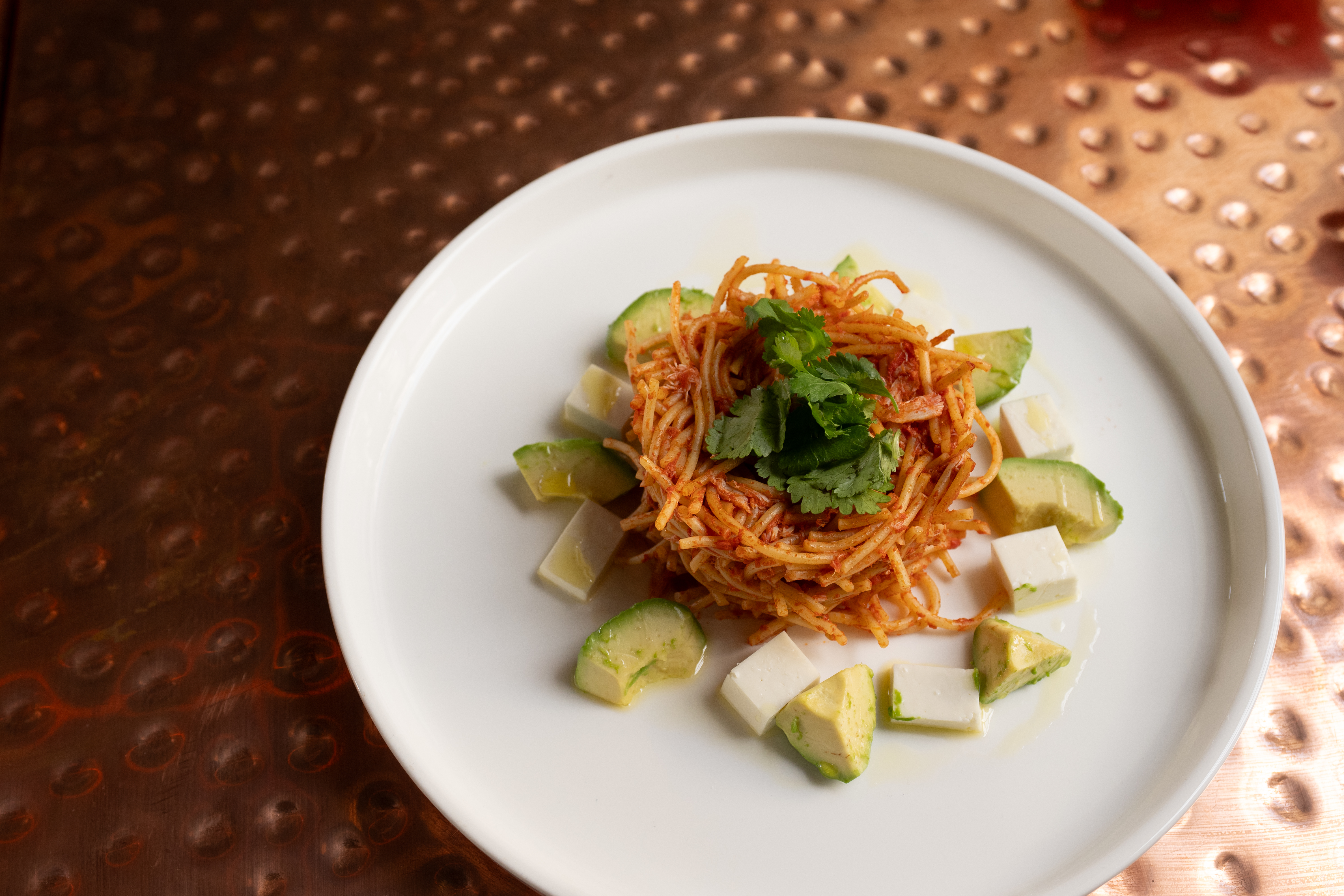
    Fideo seco is made with toasted pasta, lump crab, chipotle broth, avocado, crema, and queso fresco.

    One nod to her is fideo seco, a traditional Mexican pasta dish made with spaghetti-like noodles in a chipotle broth and served with queso fresco, crema, lump crab, and avocado.

    Other entrées include carne asada, enchiladas, a Mexican-style pork chop, and Mexican-style paella, a spicier take on the Spanish version that’s more chipotle-forward.

    Appetizers will include guacamole; the popular street corn, elote; empanadas; and sopesitos, a tortilla-like base formed into a small bowl to hold toppings like beans. There will be soups, like pozole, made with seafood and hominy, and salads, including a beet-forward option and Garcia’s take on the Caesar salad. Taquero — which translates to taco-maker — will also have a selection of five tacos: fish, birria, carne asada, shrimp, and vegetarian, each served in housemade corn tortillas.

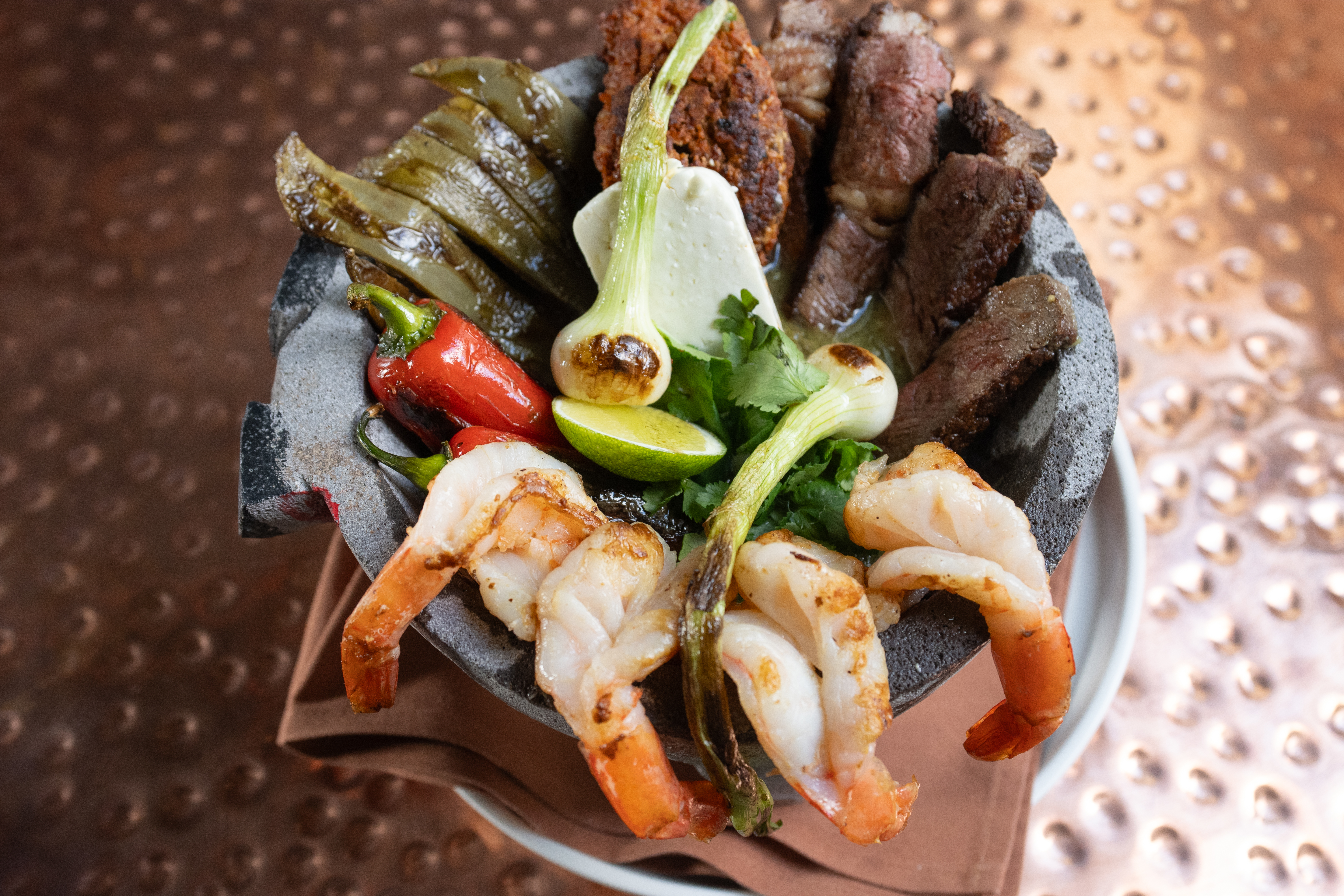
    Some dishes will be served in a classic molcajete, like this one with steak, shrimp, chorizo, salsa tatemada, and panela cheese.

    Desserts, including flan and xangos, a tortilla-wrapped cheesecake served with ice cream, round out the food offerings, which will change seasonally.

    The BYOB will also offer three mixers: a traditional margarita, a paloma, and a daily special. Diners can bring beer, wine, or champagne, with no corkage fee, or sip on a selection of Mexican sodas or the fruit-forward agua fresca.

    The restaurant will launch with lunch and dinner service, with a goal of adding breakfast in the new year.

    In keeping with his desire to make authentic dishes, Garcia is using goods imported from Mexico, including various types of chorizo.

    Garcia plans to split his time between the kitchen and the floor, tapping Jose Rigoberto, who’s been working in the kitchen at Fellini Cafe for years, as his sous chef.

    While Garcia has been focused on Italian cuisine, Media residents may have already sampled some of his Mexican dishes during Ariano’s Mexican Monday nights.

    Ariano’s former owner, Anthony Bellapigna, encouraged Garcia to pursue dishes that were true to his roots, which helped lay the groundwork for him to open his own restaurant. Fittingly, Bellapigna also helped create the copper-topped tables in Taquero, which he, Garcia, and Rigoberto hammered by hand to create their dimpled designs.

    The restaurant has been a labor of love for Garcia, who has been hands-on in the redevelopment of the space, including ripping up the drywall.

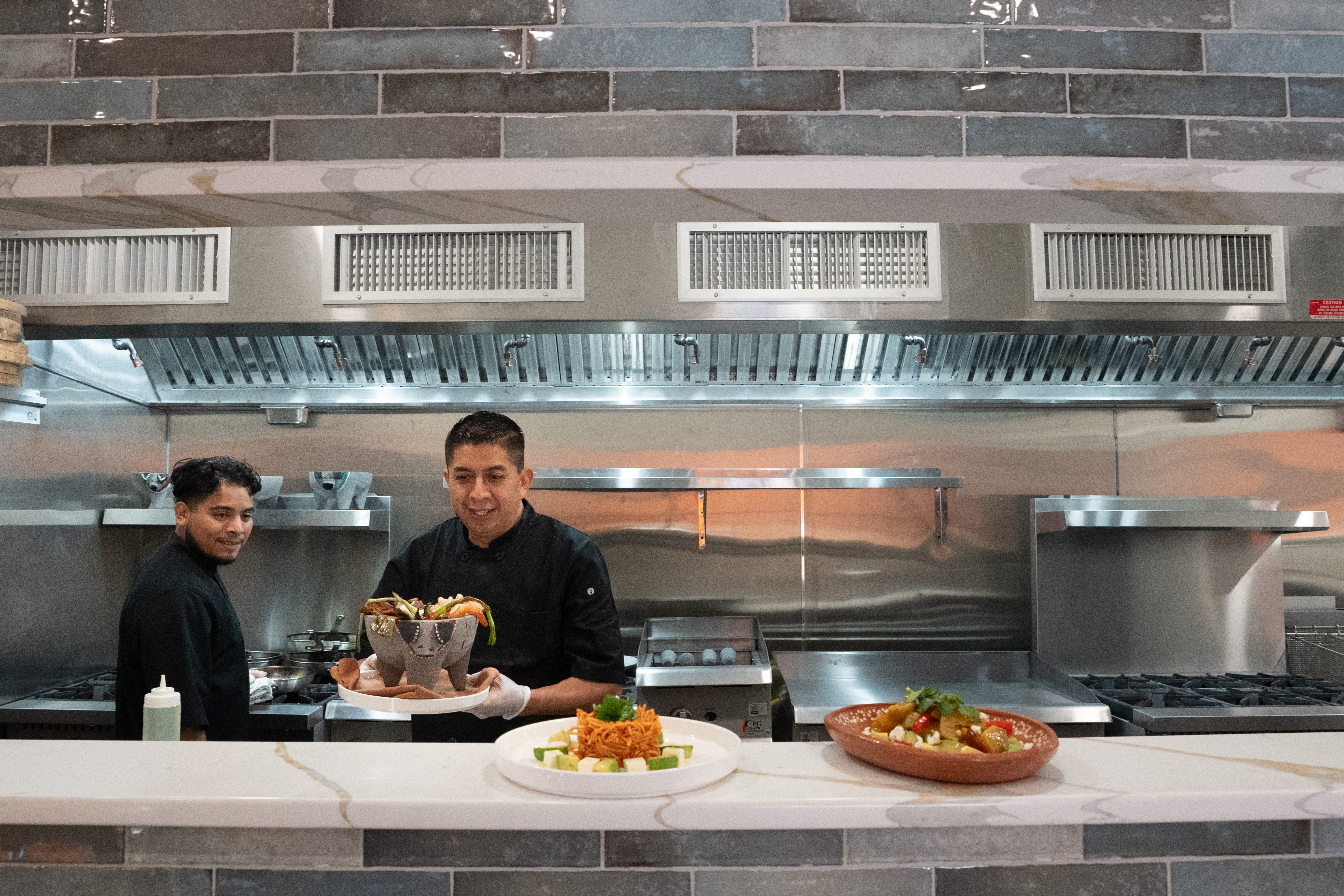
    The restaurant spans roughly 1,200 square feet across the first and second floors of the three-story building. It has 14 seats on the ground floor, where diners can see into the kitchen, while the main dining room is on the second floor and features a selection of ceramic Mexican plates on one wall.

    Diners seated on the first floor can see the action in the kitchen.

    Seeing it all come together, Garcia said he’s both nervous and happy, but with the opening on the horizon, he’s more happy than anything.

    Taquero will be open six days a week, from 11 a.m. to 9 p.m. on Mondays, Wednesdays, and Thursdays, and 11 a.m. to 10 p.m. on Fridays, Saturdays, and Sundays, with dinner service starting at 4 p.m.

    This suburban content is produced with support from the Leslie Miller and Richard Worley Foundation and The Lenfest Institute for Journalism. Editorial content is created independently of the project donors. Gifts to support The Inquirer’s high-impact journalism can be made at inquirer.com/donate. A list of Lenfest Institute donors can be found at lenfestinstitute.org/supporters.

  • Popular Bucks County steakhouse was forced to close amid landlord dispute, its owner says

    Popular Bucks County steakhouse was forced to close amid landlord dispute, its owner says

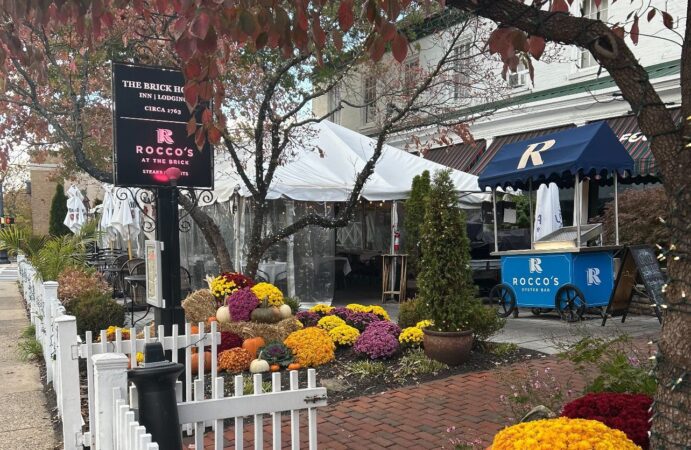
    With hundreds of reservations on the books and the holidays approaching, Rocco’s at the Brick Hotel in Newtown, Bucks County, abruptly closed last weekend. The closure, which left about 50 employees out of work overnight, was not the restaurant’s decision, according to the owner.

    The sudden closure was prompted by a dispute between the steakhouse’s ownership and the property’s landlord, who also controls the liquor license, said David Gelman, son of Rocco’s owner Marc Gelman.

    David Gelman said that Rocco’s was forced out of business because the landlord, Verindar Kaur, had filed a change on Friday with the Pennsylvania Liquor Control Board to remove Rocco’s LLC, Marc Gelman’s corporation, from its liquor license.

    The ability for Rocco’s to sell alcohol was part of the business’ operating agreement, in effect since the restaurant opened in January 2018. Kaur owns the liquor license while Marc Gelman operated the restaurant, paying her a fixed monthly fee and a percentage of proceeds in addition to what David Gelman described as “Center City-level” rent.

    Contacted Sunday by email, Kaur said she was “unable to speak with anyone.” She did not reply to a follow-up email Monday.

    David Gelman said his first inkling of imminent trouble was Thursday night, when Kaur emailed him and his father to say that she would terminate the agreement unless a new financial arrangement was reached by the following day. The PLCB confirmed to The Inquirer that on Friday, it received a notice that the license’s corporate structure and officer were being changed. This move nullified the management agreement, David Gelman said.

    “This is not something we wanted to do,” Gelman said. “But we can’t operate without the liquor license [per the agreement]. There was no way to rectify the situation.”

    Rocco’s last night was Saturday.

    Gelman said that Kaur’s actions constituted a breach of both the lease and the management agreement and said his father planned to file a lawsuit seeking damages.

    “There’s a clause in the lease that [operating a restaurant] is contingent on having a liquor license from her, so by interfering with that license, she’s breaching her own contract,” said Gelman, a lawyer.

    The restaurant had “hundreds of reservations” on the books for Thanksgiving and corporate holiday parties, he said.

    Gelman said the restaurant was informing customers that they could be accommodated at the Pub in Pennsauken and Library II in Voorhees, other steakhouses operated by the Gelman family in South Jersey. Those who hold Rocco’s gift cards can call Rocco’s number or contact it through the website for a refund.

    Remaining inventory, including seafood, meat, and produce, was relocated to the Pub and Library II to prevent waste.

    Rocco’s, named after the son of chef-partner Cole Caprioni, occupies the ground floor of the Brick Hotel, parts of which date to 1763.

    The Mercer-Bucks-Central Jersey Eateries Facebook group was trying to help Rocco’s employees find new jobs.

    Kaur previously operated the restaurant at the hotel, featured in 2016 on the Gordon Ramsay television show Hotel Hell, before Gelman’s company took over. On camera, Ramsay declared, “I want to shut this place down,” over cleanliness and customer-service issues.

    “Ninety five percent of what was on the show did not happen that way,” Kaur told the website NewtownPANow.com in 2016, adding the producers drummed up drama for ratings.

  • Philly’s wine renaissance is in full swing thanks to indie bottle shops

    Philly’s wine renaissance is in full swing thanks to indie bottle shops

    For years, shopping for wine in the Philly area felt like a choice between the bland or the expensive. Over eight years spent building a major retail wine program — I worked as the wine buyer at Di Bruno Bros. until recently — I strived to offer customers a different path by focusing on high-quality offerings from smaller independent makers. Happily, this has since become the local status quo for independent bottle shops. Our region has enjoyed a retail wine renaissance since the 2016 passage of Act 39 (which allowed businesses beyond the Fine Wine & Good Spirits stores to sell wine to go), with diverse, vibrant shops popping up all over.

    If you know where to look, excellent value can even be part of the deal. The only trick? Being open to a label you don’t recognize. Here are four affordable favorites available around town.

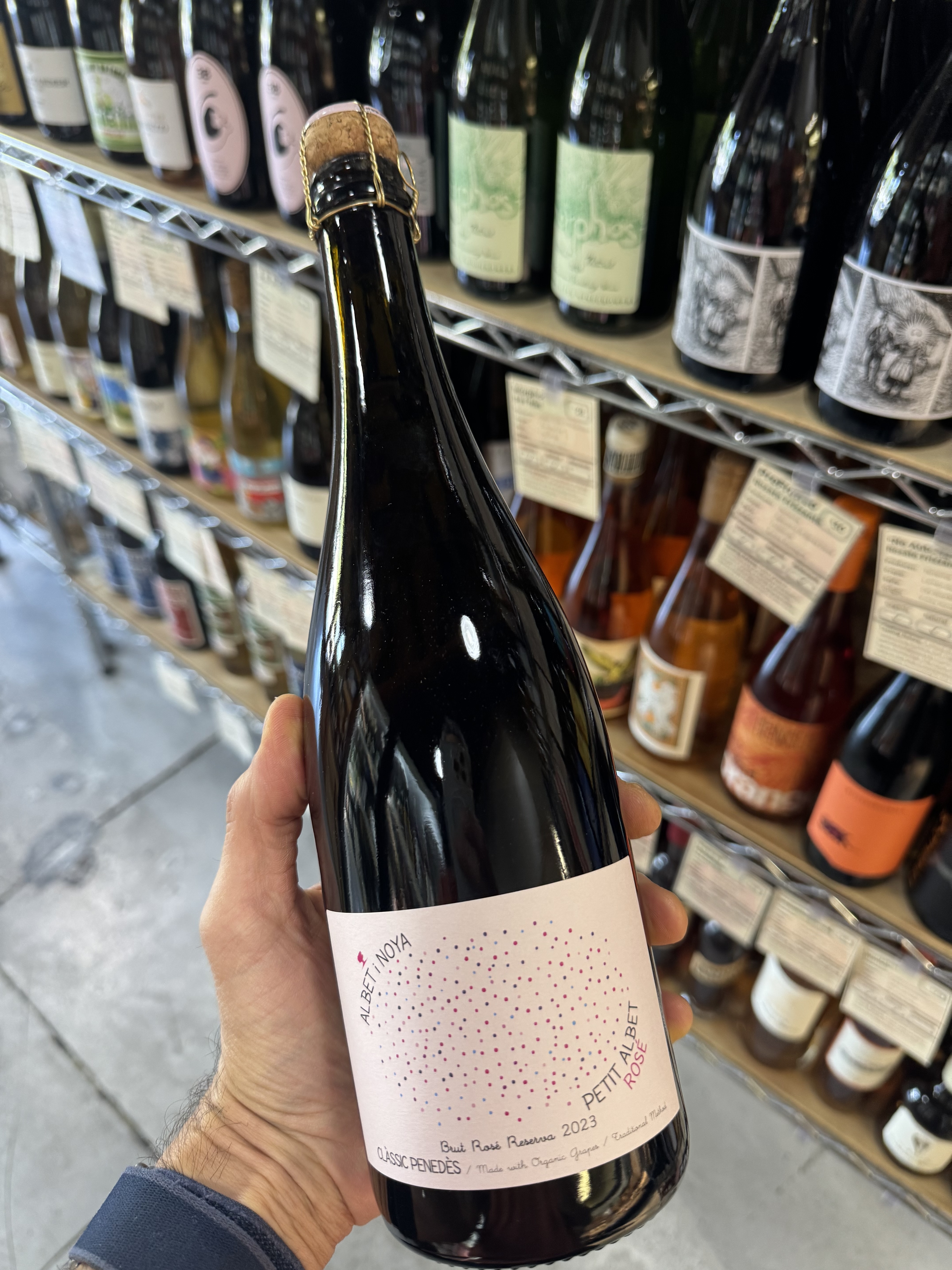
    An excellent sparkling rose — Albet i Noya Petit Albet Brut Rosado Reserva — by way of Penedès, Spain.

    Sparkling isn’t just for special occasions

    Albet i Noya Petit Albet Brut Rosado Reserva (Penedès, Spain)

    Repeat after me: You may enjoy bubbles without a particular reason. From gentle Italian frizzante (Prosecco-ish, but more sparkle than big bubble) to old-school pétillant naturel from pretty much anywhere, a little fizz can make anything fun. A bubble in your beverage also helps scrape your mouth clean when paired with food, leaving you refreshed for your next bite. Hot wine tip: Bottles without the obvious words on the label (Prosecco, Champagne, etc.) tend to be some of the more interesting values around.

    Everything about this bottle of sparkling rose is just so joyful. A friendly blend of organic pinot noir and garnacha, it sings with fresh fruit, flowers, and herbs, intermingled with refreshing tiny bubbles. A cheese wine, an olives and almonds wine, there’s no need to sit on this great value — just enjoy it.

    $20 at 320 Market, 211 W. State St., Media, 610-565-8320; 713 S. Chester Rd., Swarthmore, 610-328-7211; the320marketcafe.com

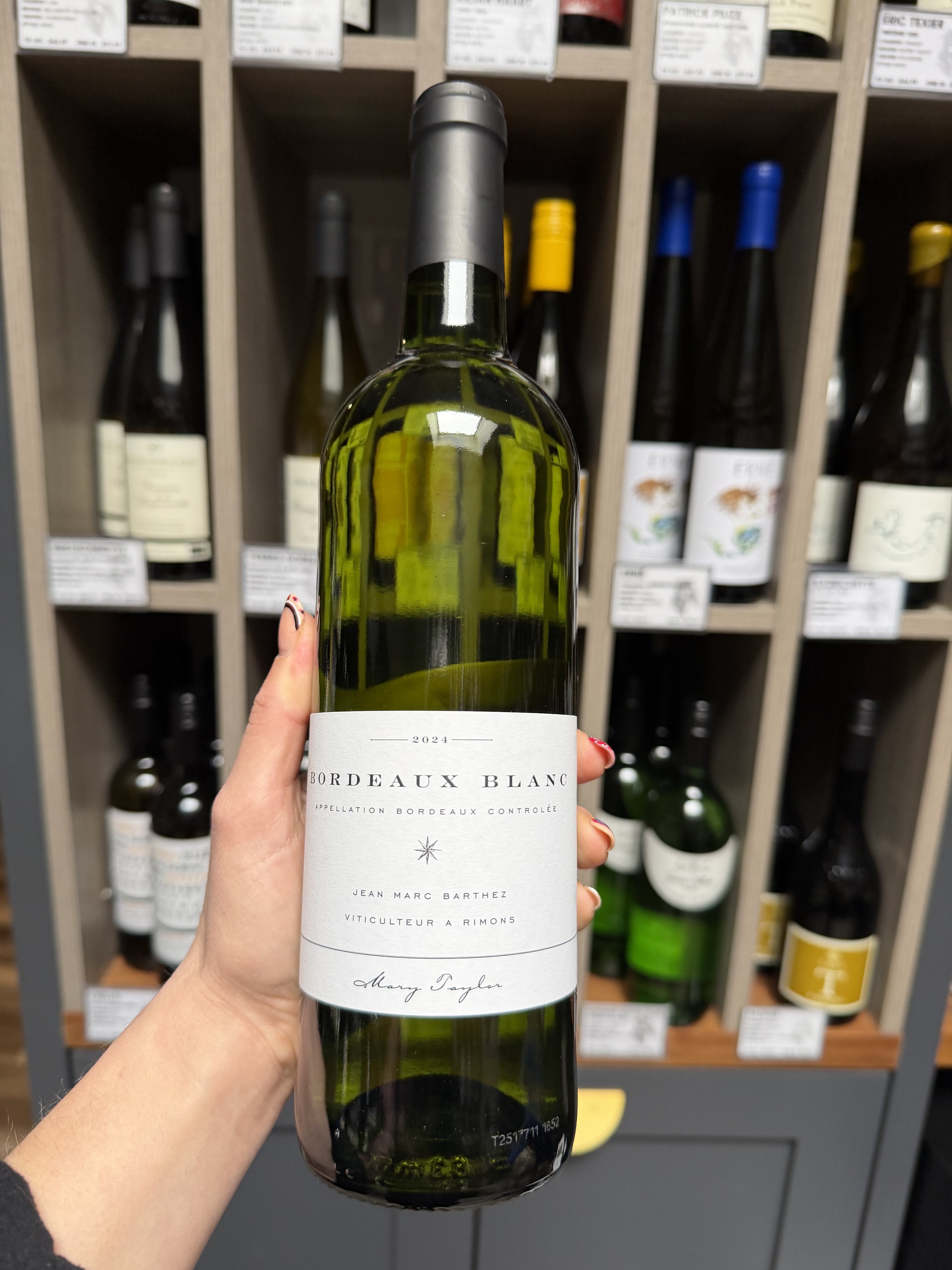
    Mary Taylor Bordeaux Blanc from Bordeaux, France.

    White wine is wonderful, even in cooler seasons

    Mary Taylor Bordeaux Blanc (Bordeaux, France)

    If you find the suggestion of drinking white wine, from stoic Bordeaux, in the late fall / early winter, to be absolutely insane … that’s fine. Do it anyway. You can wear white jeans after Labor Day — they’re a very cute fall staple, in my humble fashion opinion — and you can drink white wine year-round.

    The Mary Taylor white label project is a dream for value hunters. Mary isn’t the winemaker; she facilitates distribution under her namesake label for smaller makers who may not have the means to reach a larger market otherwise. The labels are simple, the bottles are affordable, and the wines are reliably excellent. Consider Mary Taylor’s line an affordable pathway to try off-the-beaten-path wines from Spain, Portugal, Italy, and beyond. In particular, this Bordeaux blanc — mostly sauvignon blanc with a hint of honeyed Sémillon — is a light, bright delight. Technically a natural wine, but as clean and classic as they come.

    Word to the wise: Have you checked out the updated Bloomsday retail section lately? There are a great handful of sub-$20 gems; get after them!

    $20 at Bloomsday, 414 S. Second St., 267-319-8018, bloomsdayphilly.com
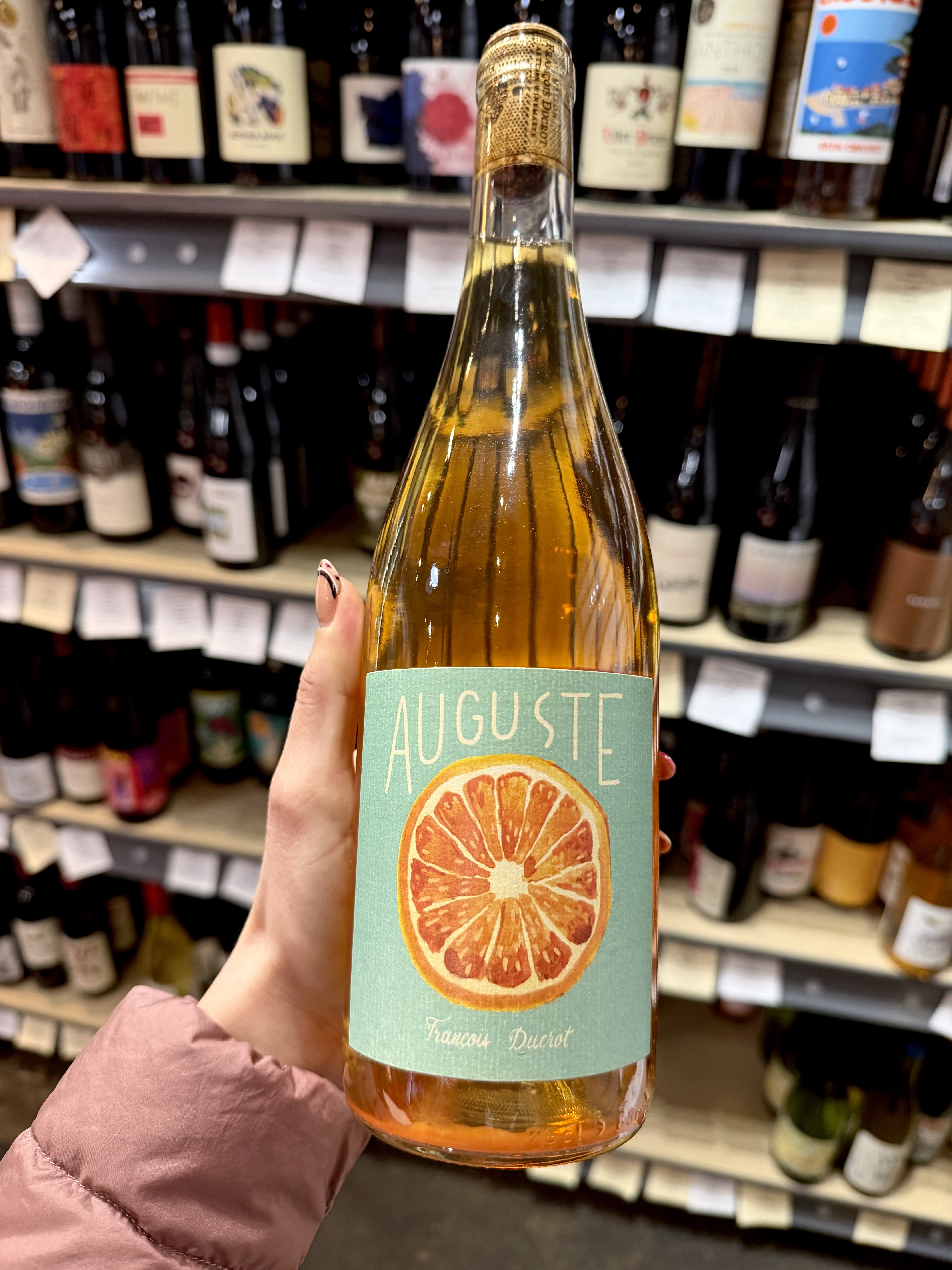
    François Ducrot “Auguste” Orange VDF from Languedoc, France.

    Of course, an orange wine

    François Ducrot “Auguste” Orange VDF (Languedoc, France)

    If you’re an orange wine enthusiast, and you’re ready to enjoy something beyond Gulp Hablo liters, try this instead. Orange wines have been flooding the market lately — with Gulp breaking sales barriers everywhere — but orange wines require a more time- and labor-intensive process. This generally results in a higher price tag.

    It’s tough to find a good orange wine (one of the few flourishing areas in an otherwise diminishing wine market) without a steep price tag. This under-the-radar bottle blending grenaches blanc and gris from the Languedoc — a great region for French wine values — delivers everything that you want it to: texture, aromatics, the whole shebang. The cute label doesn’t hurt either.

    $17 at Herman’s Coffee, 1313 S. Third St., hermanscoffee.square.site

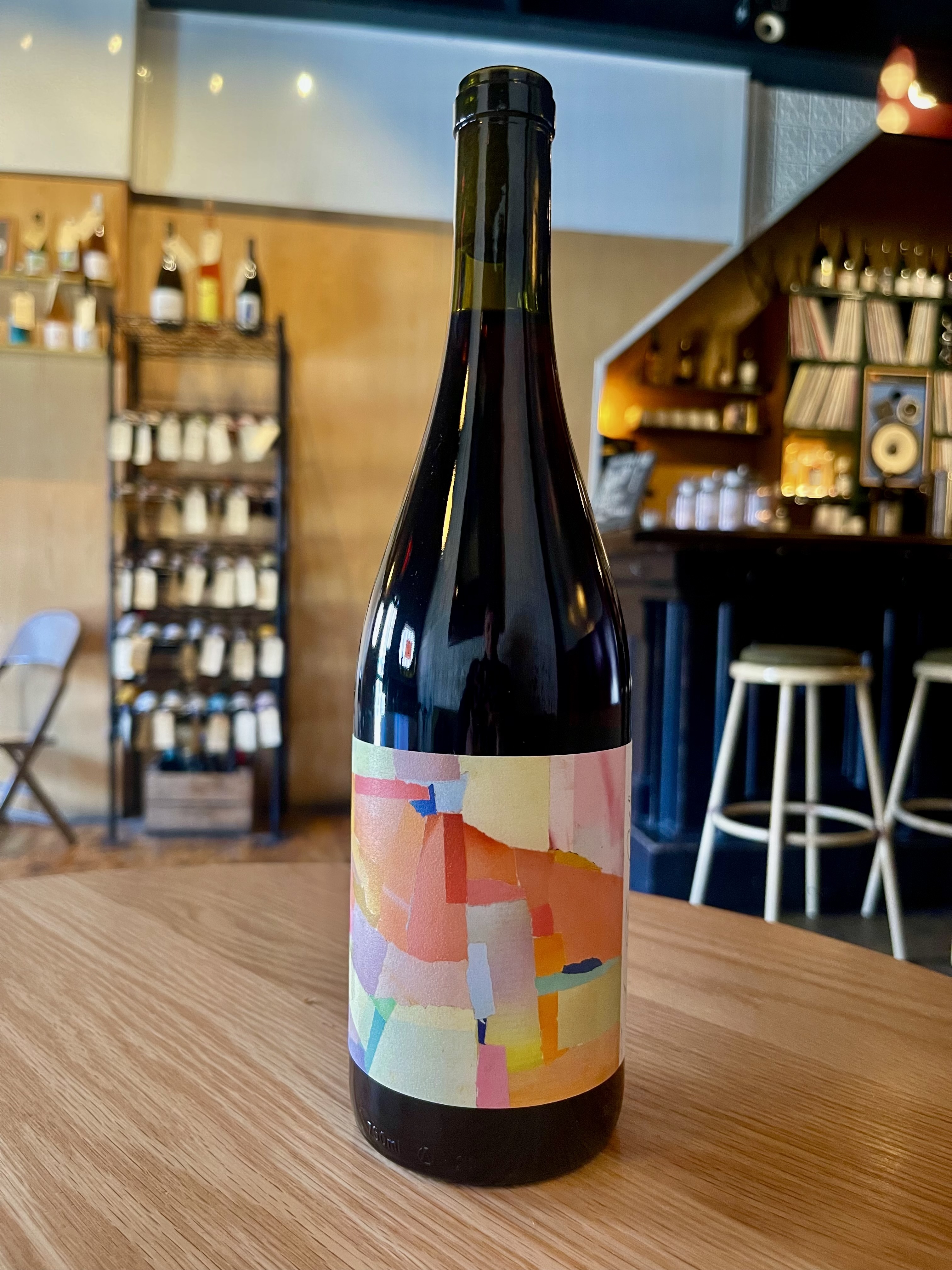
    Ann Faure Pinot Noir from Stellenbosch, South Africa.

    Righteous red wine with a romantic edge

    Ann Faure Pinot Noir (Stellenbosch, South Africa)

    Stunning pinot noir for $20 should be a no-brainer. This bottle in particular packs a punch of value, quality, and ethereal flavor all in one.

    Ann Faure is a newish sub-label from Mick and Jeanine Craven of Craven Wines. It combines their children’s middle names, Ann and Faure, and is a nod to ‘amphorae,’ a traditional clay vessel used to ferment, store, and age delicate wines like this. Mick arguably holds the title of most frequent visitor from South Africa to Philadelphia, popping up around town several times a year thanks to his longtime relationships with many Philly wine bars. All of the wines the Cravens produce are lively, food-friendly, and flat-out delicious. The gorgeous label on this bottle doesn’t boast the grape — a prime example that it is possible to have a cute label and great wine inside.

    Solar Myth may not come to mind as a retail destination, but if you find yourself on South Broad, do pop by. They’ve been quietly rotating a small selection of $20ish bottles for takeout that are well worth the stop.

    $20 at Solar Myth, 1131 S. Broad St., solarmythbar.com
  • Fully booked: The ‘Michelin effect’ is being felt at Philly’s honored restaurants

    Fully booked: The ‘Michelin effect’ is being felt at Philly’s honored restaurants

    As chef Nicholas Bazik climbed into bed late Tuesday night, he checked the reservations at Provenance, his posh restaurant in Society Hill. Business at Provenance, with its 25 seats and $225 French-meets-Korean tasting menu, had been respectable especially since September, when it appeared on Bon Appétit’s list of the country’s best new restaurants.

    Bazik discovered that Provenance was fully booked, 30 days out. The next day at noon, the next round of tables was snapped up in six minutes, he said.

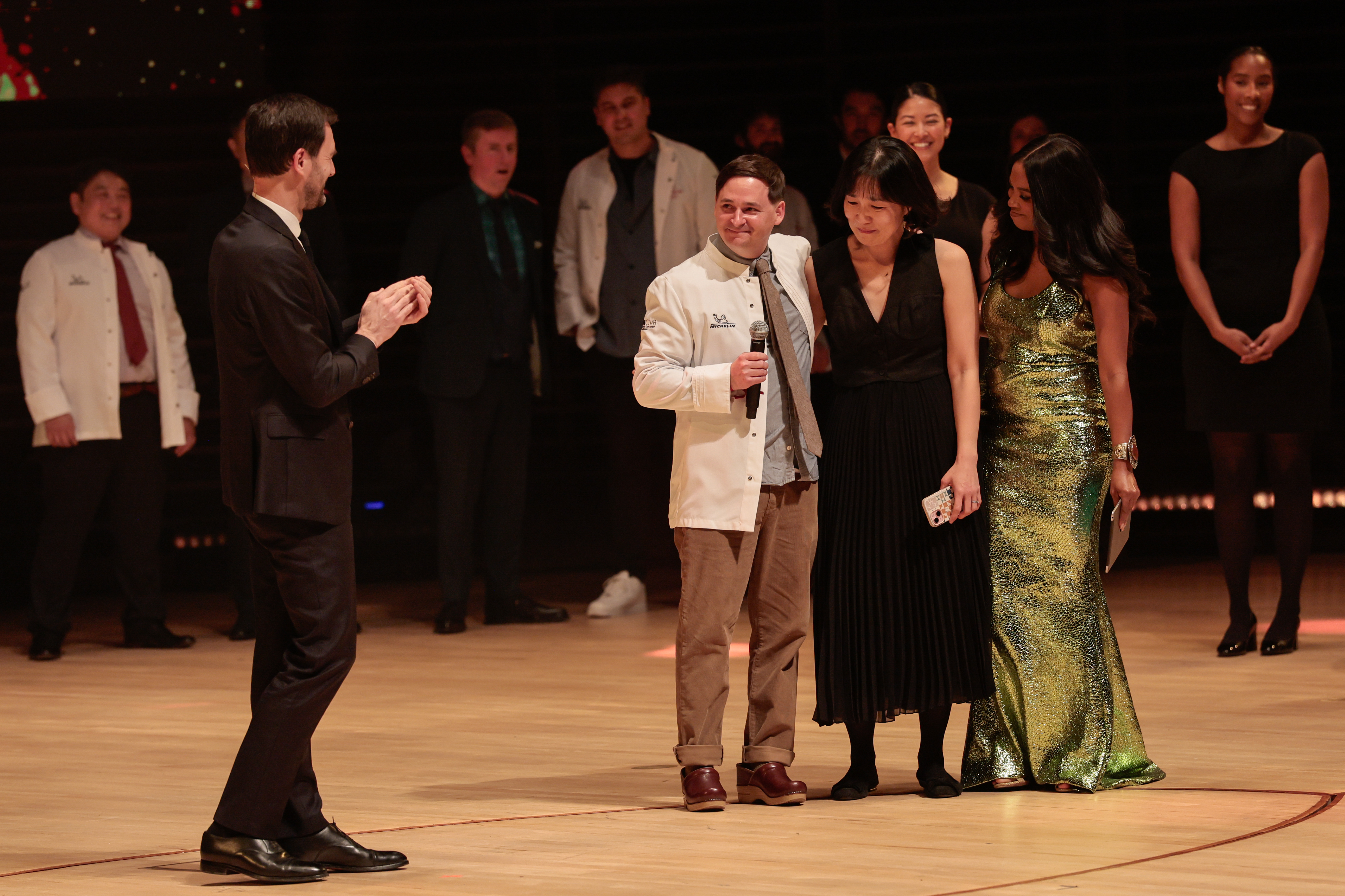
    Chef Nicholas Bazik of Provenance, with wife Eunbin Whang, accepts a star at the Nov. 18 Michelin Guide ceremony.

    The so-called Michelin effect was at work. Provenance — as well as Her Place Supper Club and Friday Saturday Sunday, both in Rittenhouse — received one star from the Michelin Guide at Tuesday’s Northeast Cities ceremony, placing them in a rarefied league of 280 so-honored U.S. restaurants.
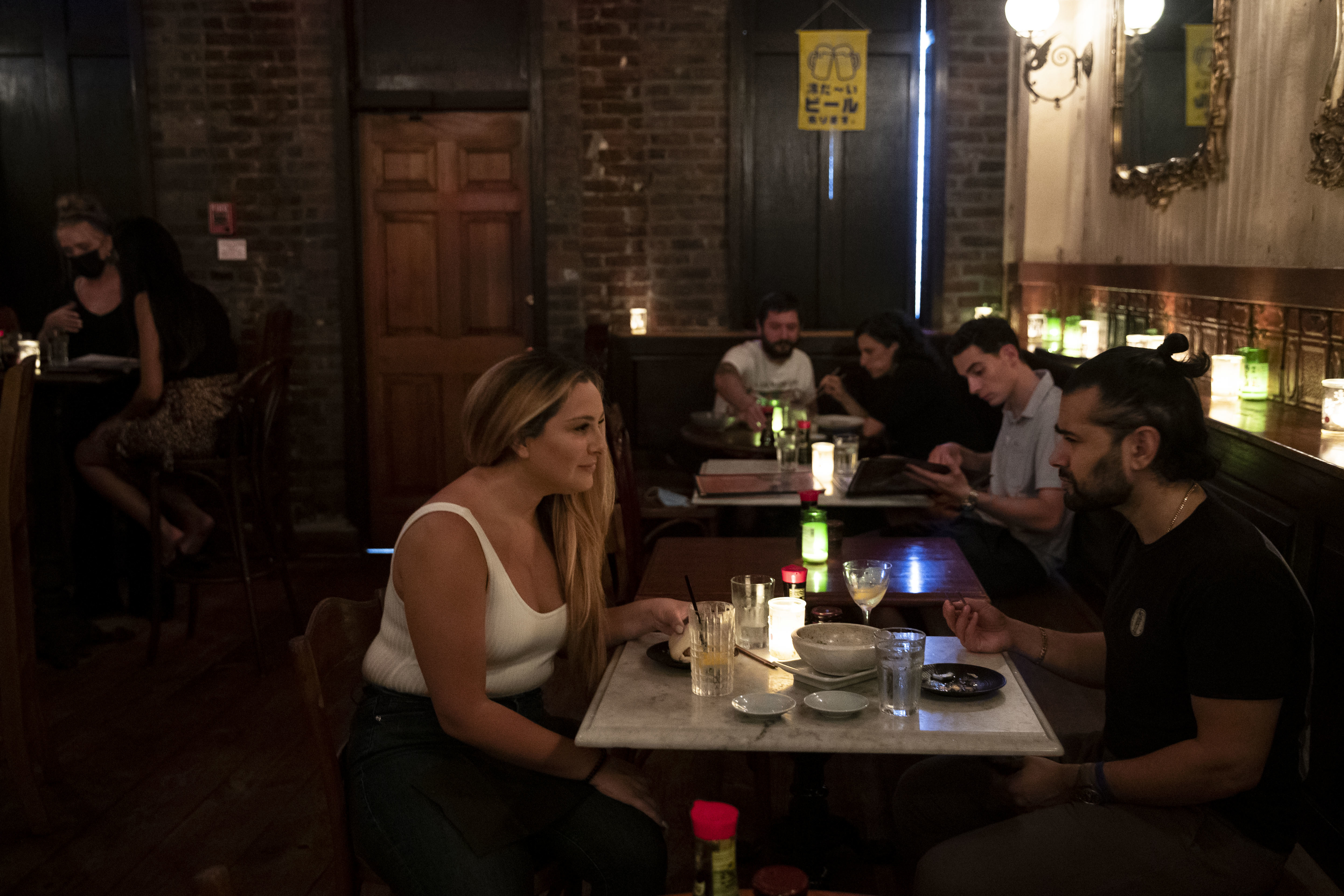
    In city after city since Michelin’s arrival in the United States two decades ago, newly starred restaurants report full books, wait lists stretching weeks or months, and in some cases double- or triple-digit growth in reservations. Winning a Michelin star — one or especially two or three — is no small task, and customers are known to travel to dine at a starred restaurant.

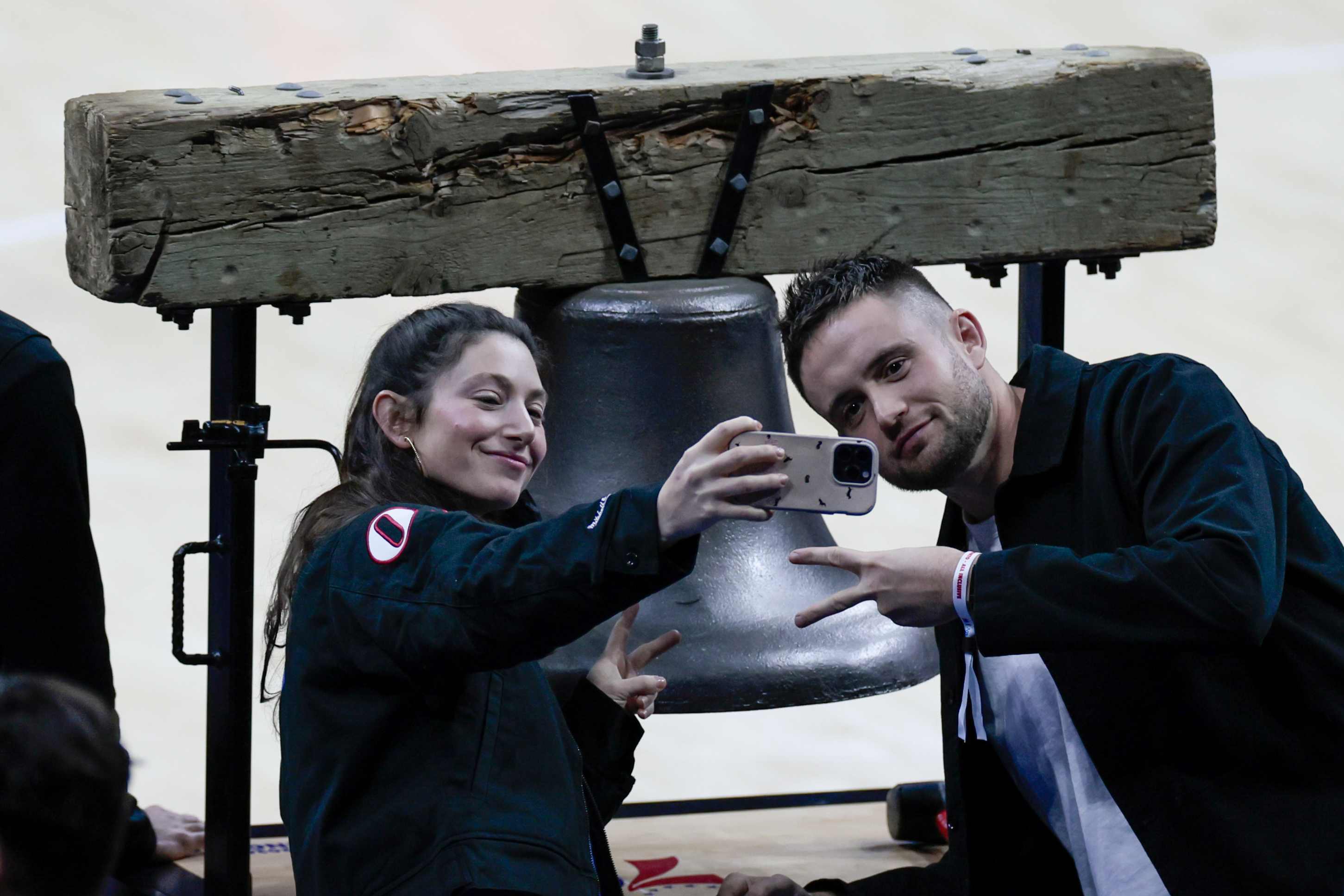
    Her Place Supper Club chef Amanda Shulman (left) and husband Alex Kemp take a photo at the Sixers game Wednesday. Shulman rang the bell at the start of the game.

    At Her Place, where it’s been what chef-owner Amanda Shulman called “a whirlwind of a week,” it’s difficult to determine Michelin’s impact. “We’re a small restaurant to begin with, but we’ve definitely seen a jump in email inquiries that are keeping our reservationist/administrative queen Natalie busy, along with a bump in social following. Truly a surreal experience and we’re just excited to welcome in more new faces.” (The Sixers invited Shulman to ring the bell before Wednesday’s game.)

    Friday Saturday Sunday already was one of Philadelphia’s hardest reservations, even before it won the James Beard Award for best new restaurant in 2023, and owners Chad and Hanna Williams are planning an expansion to the rowhouse next door.

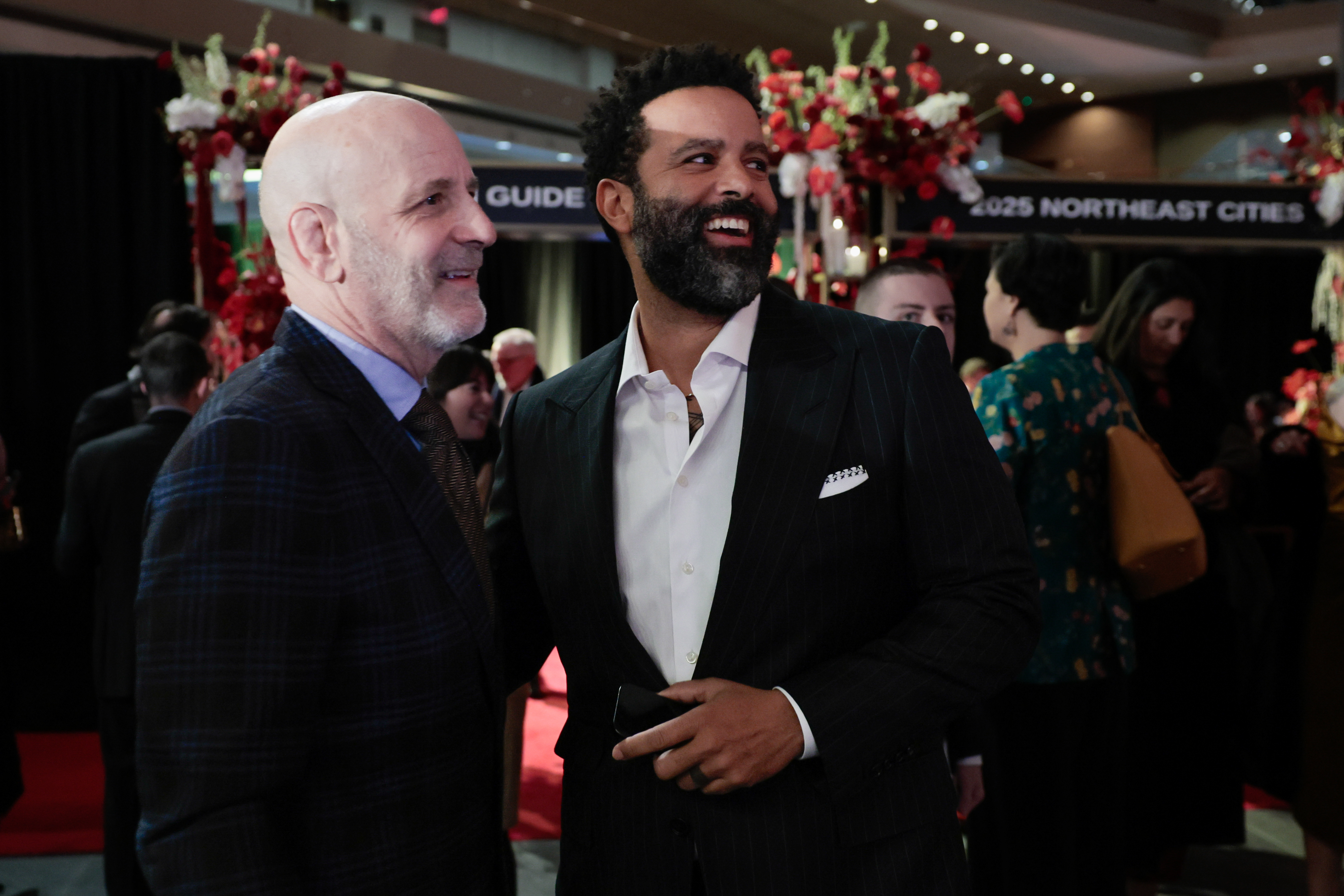
    Chefs Marc Vetri (left) and Chad Williams during the cocktail hour, at the Michelin Guide announcement at the Kimmel Center.

    Restaurants that were included in Michelin’s Bib Gourmand (best value) and “recommended” categories also reported an uptick in business.

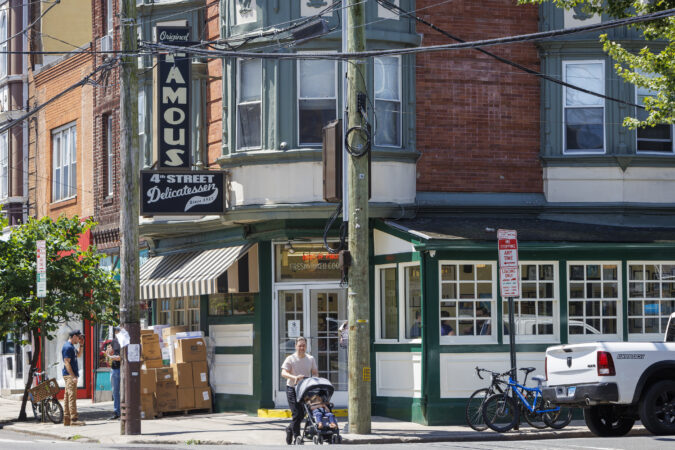
    “It’s been an outpouring of positivity,” said Louis Novak, general manager at Famous 4th Street Deli in Queen Village, a Bib Gourmand recipient where all business is walk-in. He reported “exceptional” sales. “It’s also a ‘Day 1’ mentality moving forward. It’s a responsibility to live up to being a Michelin award winner.”

    At chef Jesse Ito’s Royal Izakaya in Queen Village, a Bib recipient, the line is longer and the weekday wait list is growing earlier than usual, said Daisy Zeijlon, who handles the restaurant’s publicity.

    At Sally (Bib), a pizzeria near Fitler Square, business was up 10% since the announcement, said owner Cary Borish.

    At Mish Mish (recommended), Alex Tewfik was ebullient on Sunday: “Being in South Philly, and the Eagles being the last monoculture we have left as a city, our Sundays have been brutal. Today, they are no longer brutal, which is, in ways, a sort of godsend situation.”

    Although hard numbers were hard to come by so far, the good vibes are everywhere as the restaurant industry enters its typically busy period between Thanksgiving and New Year’s.

    Chef Chris Kearse of Forsythia with his wife, Lauren, at the Michelin Guide announcement.

    “We have received such amazing support from the culinary community,” said Chris Kearse, chef-owner of Forsythia (recommended). “It feels like the whole city has come together to celebrate the excitement of the awards, and we’ve been touched by how many guests have stopped in to sit at the bar and share a celebratory drink with our team.”

    Al Lucas — a partner at Defined Hospitality, which operates Suraya (recommended), Kalaya (recommended), and Pizzeria Beddia (Bib) — said reservations “have already been very robust so we really cannot tell the impact quite yet. We have, however, seen a lot of anecdotal positive responses through Instagram, emails, and DMs.”

    Ellen Yin, who owns High Street (recommended), said it was too early to tell Michelin’s long-term recognition; “however, the energy is palpable.”

    Study after study has cautioned that Michelin acclaim does not always translate to success.

    A report in the Strategic Management Journal challenges the assumption that Michelin stars only help restaurants, finding that starred establishments are actually more likely to close due to increased operational pressure.

    Daniel B. Sands of University College London examined New York restaurants deemed “at risk” of earning a star by tracking those that received favorable New York Times reviews and later Michelin recognition. His analysis and interviews with owners revealed that while stars boost prestige, they also intensify strain along the value chain. Landlords, suppliers, and employees often demand higher compensation, while staff may leverage the star to seek better opportunities or launch competitors.

    At the same time, customer dynamics shift: New diners arrive with heightened expectations or tourist motivations, and regulars may visit less often. Some restaurants make costly adjustments to accommodate new guests without increasing revenue. Sands concludes that Michelin stars can bring mixed outcomes, with some businesses thriving but others buckling under the added pressure.

    Can the good vibes last? “Having seen bumps from things like being on lists [and] getting accolades in the past, the ‘pop’ doesn’t always last,” said Tewfik, at Mish Mish. “I’m aware that we’re in uncharted territory with Michelin, but usually it dies away in a few weeks. So we’ll see, but for now, we’re so so so thrilled.”

    Philadelphia chef Marc Vetri, who took Michelin nods for Fiorella (Bib Gourmand) and Vetri Cucina (recommended), tempers exuberance through experience. His first major award was in 1999, when Food & Wine named him one of its best new chefs. “These awards, while exciting and give the city a big boost, are not a magic pill,” Vetri said.

    “Lists, awards, Beards, Michelin — it’s all the same,“ he said. ”Over time, they will bring more visitors, and if you have a good reputation and you are consistent, if you keep putting in the work and [are] evolving, more people will come. That’s the award: The customers who keep coming back. People are going to be very sorry if they think a nod from anyone is going to validate them and make them super busy. That’s just not how it works.”

  • Another thing Philly has over Dallas: Michelin acclaim

    Another thing Philly has over Dallas: Michelin acclaim

    On the eve of another Eagles-Cowboys game, let me tell you a few ways Philadelphia is superior to Dallas.

    The sports teams, of course. There’s the downtown walkability, the history, and the overall gritty culture (as in “this might be the best show of my life in a room that’s maybe not up to code” energy)

    Philly’s food scene is superior, too. And now we have proof.

    The Michelin Guide’s awards for Texas were announced last month, and Dallas — how do we put this? — underperformed, not only against Philly but even against the rest of Texas.

    Tatsu, an omakase experience, retained its one star from last year’s Michelin awards. This year, Mamami, a French-Italian bistro, scored a star. That’s two stars total for the Big D, compared with Austin’s seven, Houston’s six, and San Antonio’s three.

    Philly was awarded three one-stars on Nov. 18 in its very first showing: Friday Saturday Sunday, Her Place Supper Club, and Provenance. (Boston received only one, but that’s another rivalry for another day.)

    Apparently, everyone in Dallas seems to know that the food scene is lacking — even D Magazine, which headlined its Michelin predictions story: “Dallas, prepare to be underwhelmed.”

    While the post-Michelin food mood in Philadelphia has been generally celebratory, they’re crying in their beer in Dallas. Drew Stephenson, an observer of the Metroplex food scene who says he has eaten at all 18 Texas Michelin-starred restaurants, addressed the local shock, indignation, and outrage over Michelin’s selections on his Instagram, @drewthefoodguy.

    According to Stephenson, the reactions show that Dallas diners and Michelin inspectors speak different languages. Dallasites prioritize vibes, service, decor, portions, and price, while Michelin judges ingredient quality, technique, cuisine personality, fair value, and consistency. “We’re just new to Michelin’s framework,” he said.

    For the record, Stephenson — who calls himself “a very big Cowboys but not a proud one” because of the ownership — thinks the Eagles will win a close one Sunday.

  • Is Michelin’s Bib award for Royal Sushi a snub? Chef Jesse Ito takes the izakaya’s honors in stride.

    Is Michelin’s Bib award for Royal Sushi a snub? Chef Jesse Ito takes the izakaya’s honors in stride.

    There were chef tears of joy, stunned looks from some unexpecting winners, and the silent sting of award-show snubs as the Michelin Guide announced its first-ever round of accolades for the Philadelphia restaurant scene Tuesday night.

    But there was also some lingering confusion that followed the much-anticipated Kimmel Center ceremony. One of the biggest gasps of baffled surprise rippled through the crowd when Royal Sushi & Izakaya, a favorite predicted by many to earn a star, was instead awarded a Bib Gourmand.

    The Bibs are widely coveted as Michelin’s nod to restaurants with “exceptionally good food at moderate prices.” Ten Philly restaurants were awarded Bib Gourmands, including Angelo’s, Dizengoff, and Pizzeria Beddia.

    But how does Royal Sushi & Izakaya — where a seat at chef Jesse Ito’s omakase counter now clocks in at a city-high $355 — qualify? Is it now the world’s most expensive Bib Gourmand?

    Chef-owner Jesse Ito at Royal Sushi & Izakaya on Aug. 11, 2023.

    Michelin, which is renowned for secrecy, would not clarify its reasoning: “The Michelin Guide doesn’t reveal specifics,” said spokesperson Carly Grieff.

    The answer, most logically, is that Royal has always been two distinct restaurants under a single name and roof, and the Bib most logically applies to the more casual one: the lively izakaya-style tavern that anchors the front of the Queen Village building, where a relatively affordable a la carte menu of cooked Japanese classics and sushi is served to a walk-ins-only crowd, with cooked items ranging from $6 to $38.

    Ito’s luxury sushi tasting counter, meanwhile, hums along in a separate room in back, where Ito handcrafts every bite with artistry using some of the world’s most expensive ingredients. Such omakase counters are prime candidates for Michelin stars, including at least two (Boston’s one-star 311 Omakase and New York’s three-star Sushi Sho) that picked up accolades at the recent ceremony in Philadelphia.

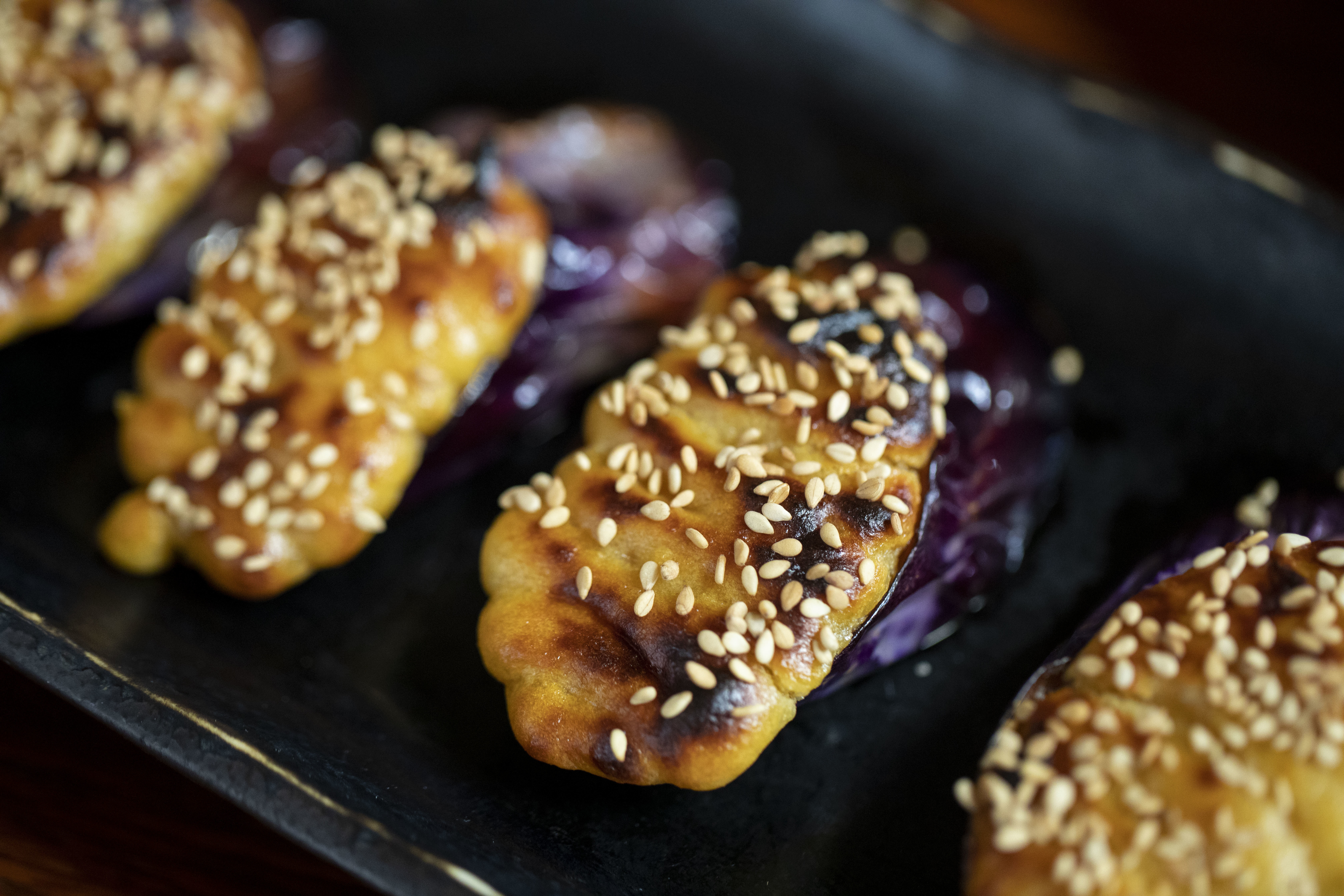
    The sesame-crusted eggplant at Royal Izakaya on Aug. 18, 2022. Royal Izakaya is located at 780 South 2nd St.

    But the 16 nightly seats of Ito’s omakase counter are so locked down with devoted regulars — who can rebook their seats for another meal before leaving their dinner — that even Michelin’s anonymous inspectors, it appears, could not score a reservation.

    “They only ate at the izakaya,” surmises Ito from Michelin’s review, a glowing assessment of the izakaya’s menu range and high-quality ingredients, with only a passing mention acknowledging its “exclusive” omakase counter.

    Ito was hardly a loser at the Michelin ceremonies, even if he didn’t win a star, because he was thrilled with the Bib acknowledgment: “I’m super-proud of the izakaya and this is very fitting for what it does … The stars are really great and obviously every chef wants that, but the Bibs will also prove useful once tourists come, especially next year for the FIFA World Cup and Philadelphia’s 250th anniversary.”

    Diners inside Royal Izakaya on Aug. 18, 2021.

    Nonetheless, the uncertainty of how Michelin might handle his dual-concept space has weighed on the chef, who knows the roller-coaster emotions and anxiety of awards program recognition more than most.

    He’s experienced tremendous highs, such as this fall when his restaurant was named the 32nd best restaurant in North America by World’s 50 Best. He’s also repeatedly dealt with the disappointment of coming up just short with the James Beard Foundation, being named a finalist eight times — only to miss out every year, including once again this spring.

    Ito said he’s considered various ways to more clearly separate the two concepts, or at least make the reservation process for the omakase more accessible.

    “But I wouldn’t even know how to do that,” said Ito, who’s worked through some alternatives and fears that bots would ultimately snap up seats for scalping. “I’m able to have regulars this way, and we have the best guests with whom we’ve created real relationships over time. But I love having new people, too, and that definitely still happens.”

    The exclusive nature of the omakase, and the unintended fallout from such limited reservations — especially with hopeful guests, including possibly judges for potential awards — was never intended. It just happened.

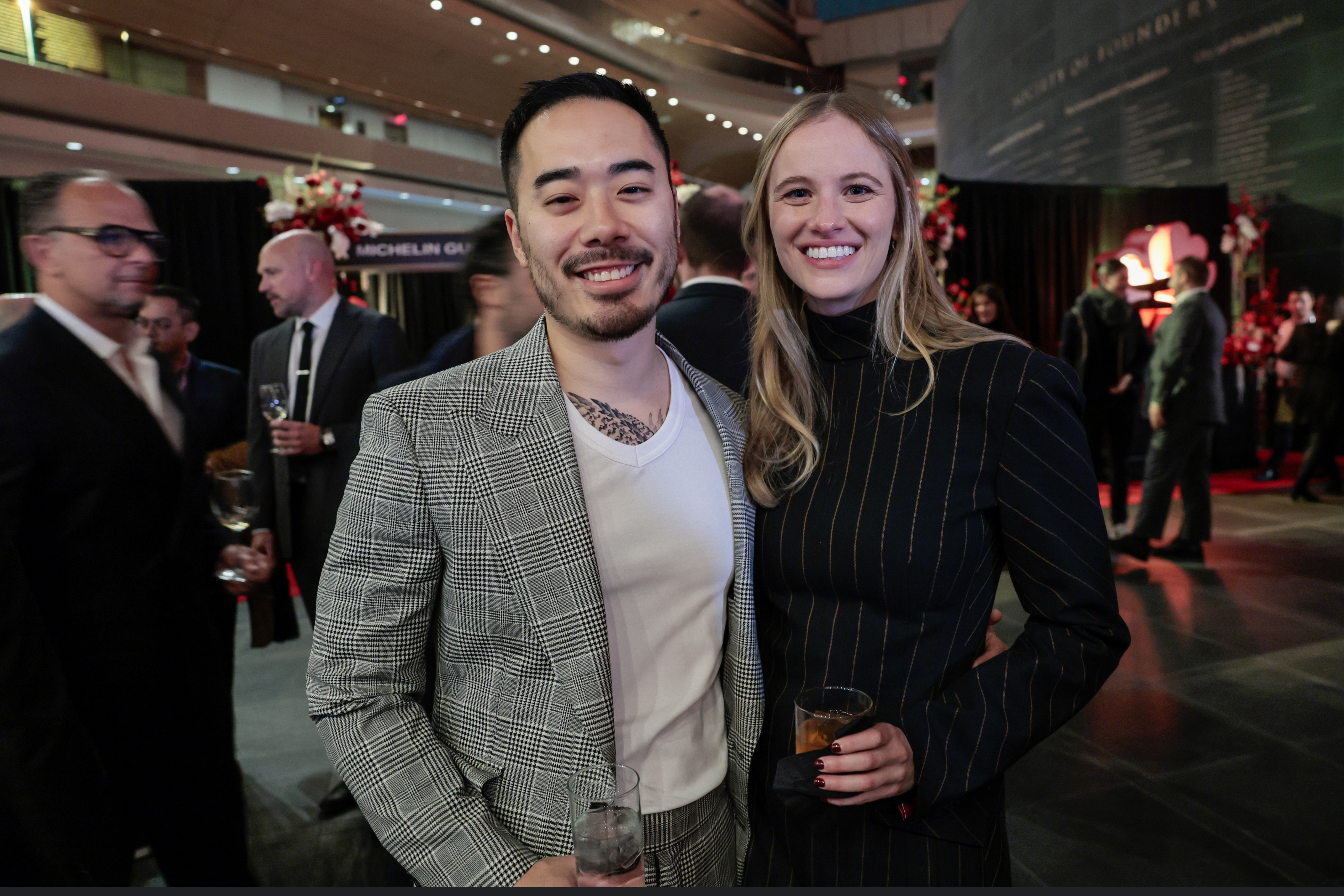
    Chef Jesse Ito and Mia Colona at the Michelin Guide announcements at the Kimmel Center on Nov. 18.

    “I didn’t think about any of this award stuff when I was opening this restaurant nine years ago at age 27 on limited resources,” said Ito, whose initial goals were to support his parents and create something for himself.

    As the restaurant continued to evolve and garner national attention, however, he’s had to learn to cope with the anxiety of increasing acclaim. And no matter how veteran the chef, the nerves always tighten the gut at an awards ceremony, when the announcement draws near. He’s learned the hard way to find a silver lining in whatever the results.

    “Just because you’re not [ultimately] a winner doesn’t mean you’re not deserving,” says Ito. “That’s part of losing the Beard award eight times! You come away with the ability to enjoy the moment of just being recognized.”

    The Royal Toast from the Royal Sushi Omakase at Royal Izakaya on Aug. 18, 2022.

    Ito says he owes much of his current attitude to getting sober five years ago.

    “Beforehand, I used to always crave that external hit, that numbing sensation of having fun. But now in my life, I find happiness in my routine and relationships, my business and personal journey. The awards? I’m happy to be a part of them — but they are not what defines us.”

    What drives Ito is his passion for turning raw fish into edible art for the devoted customer base he values, and “to improve myself and the omakase a little bit each day,” he says, citing the Japanese philosophy of kaizen.

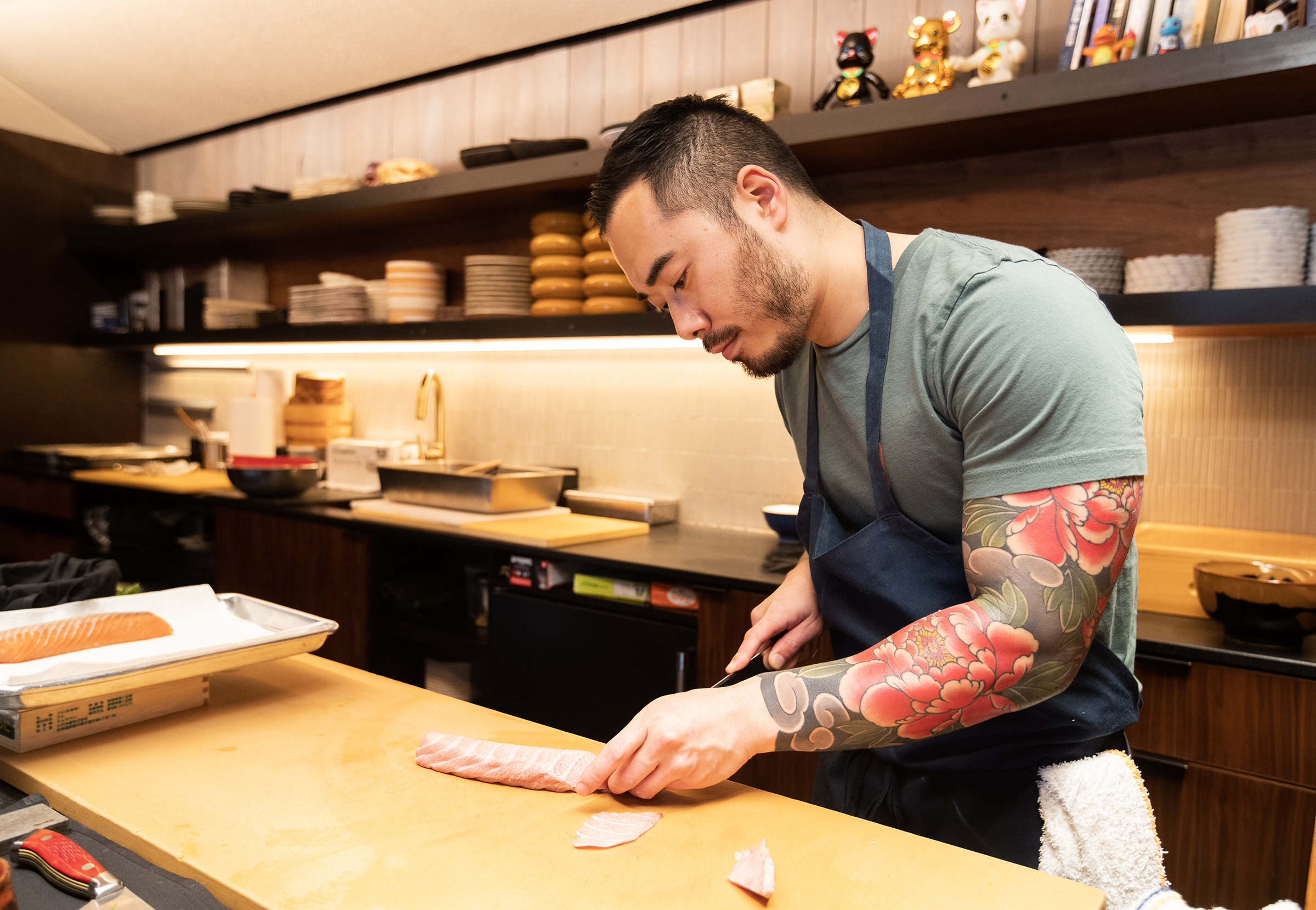
    Chef-owner Jesse Ito at work at Royal Sushi & Izakaya on May 31, 2024.

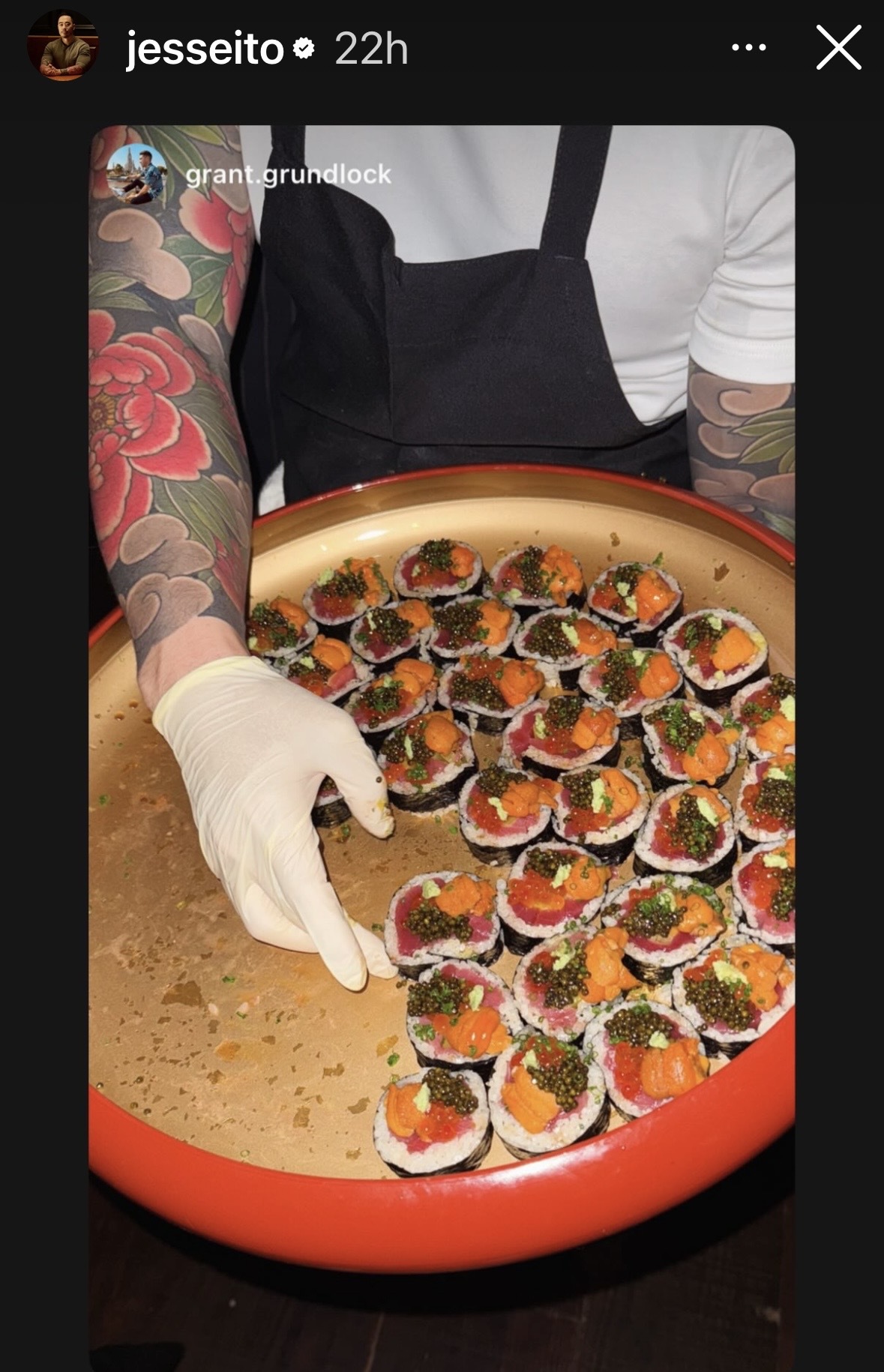
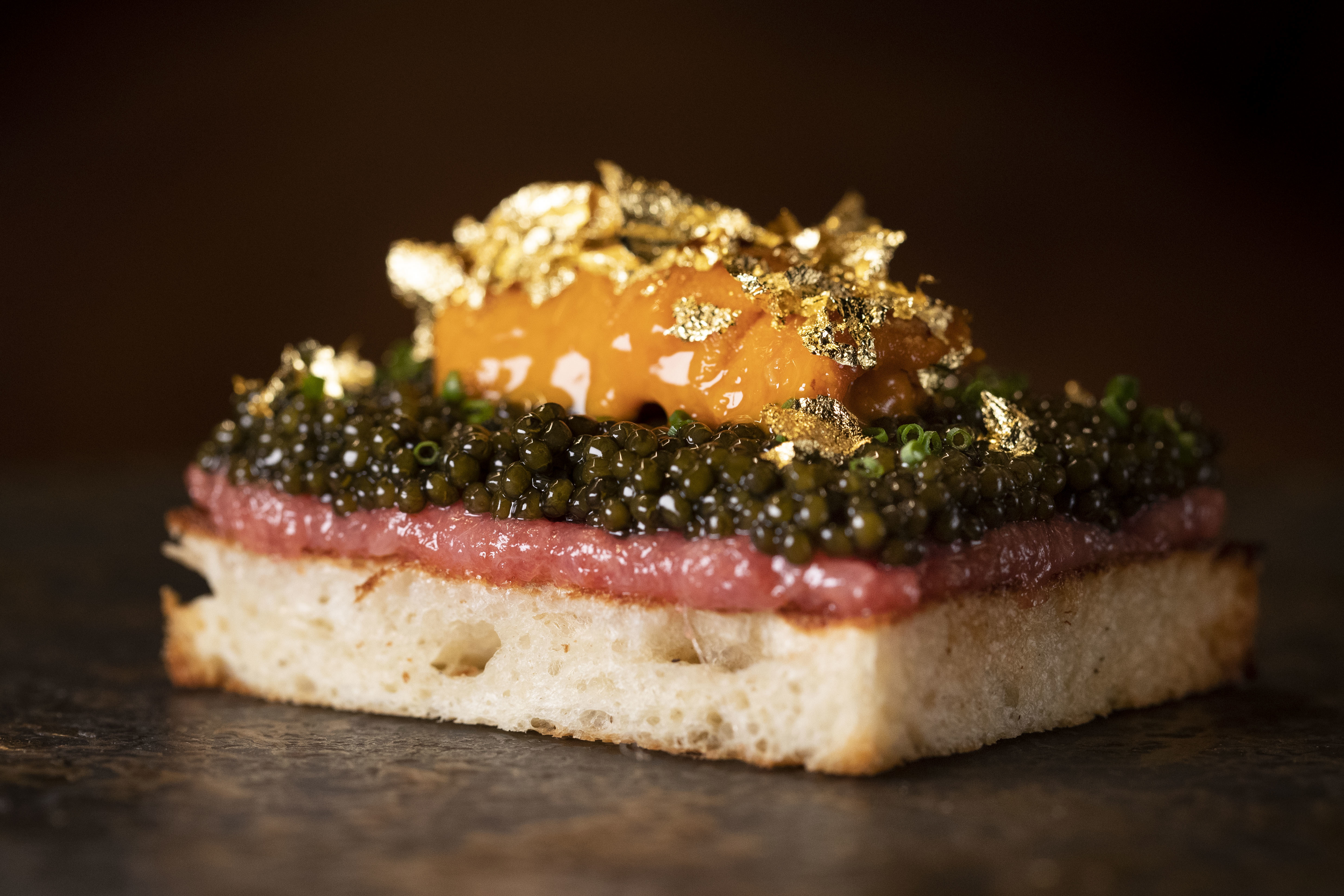
    So, once the Michelin ceremony concluded — “a weight was lifted from my shoulders,” he says — and it was back to what he loves most. He went straight to dancerobot, his new restaurant in Rittenhouse Square where a Resy-sponsored after-party was in full bloom. He put on his apron and immediately busted out the premium uni and caviar to top hundreds of aka-taka toro rolls brought in from the izakaya, and strolled through the crowd with a tray, handing out $75 bites for free.

    “Everyone was so relieved [it was over], we were just celebrating and having fun,” he said.

    And then out came his secret weapon: the karaoke mic, an important Ito ritual for every post-awards party, no matter the result.

    “I sang ‘Creep‘ by Radiohead,” he said, his usual song. “Then I left when the party was still bumping, because I didn’t want to go to bed too late.”

    He had another busy day to prep for service at Royal Sushi & Izakaya ahead.

    Chef Jesse Ito of Royal Sushi & Izakaya hands out aka-taka tuna belly and pickled radish rolls topped with salmon roe, uni, and caviar to guests at an afterparty for the Michelin awards held at his new restaurant, dancerobot.
  • The boozy business of the American Revolution went down in Philly bars

    The boozy business of the American Revolution went down in Philly bars

    The Founding Fathers never suffered sobriety. When they weren’t sweating out independence at Independence Hall, they were bending elbows at City Tavern — pretty much around the clock.

    George Washington developed such a hankering for a rich, malty, Philly-brewed Robert Hare’s porter, he had kegs of the stuff shipped to Mount Vernon.

    John Adams, once virulently anti-tavern, effusively extolled the Philly bar scene in letters to his wife, Abigail. At one “most sinful feast,” Adams recalled sipping what would become his favorite Philly cocktail, the “Whipped Sillabubs.” A popular choice of the colonial-era Philly cocktail set, the boozy, creamy concoction was made from sherry, wine, and lemons.

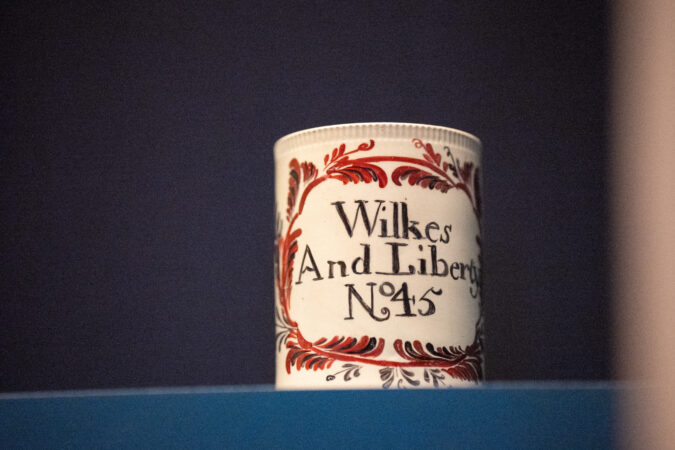
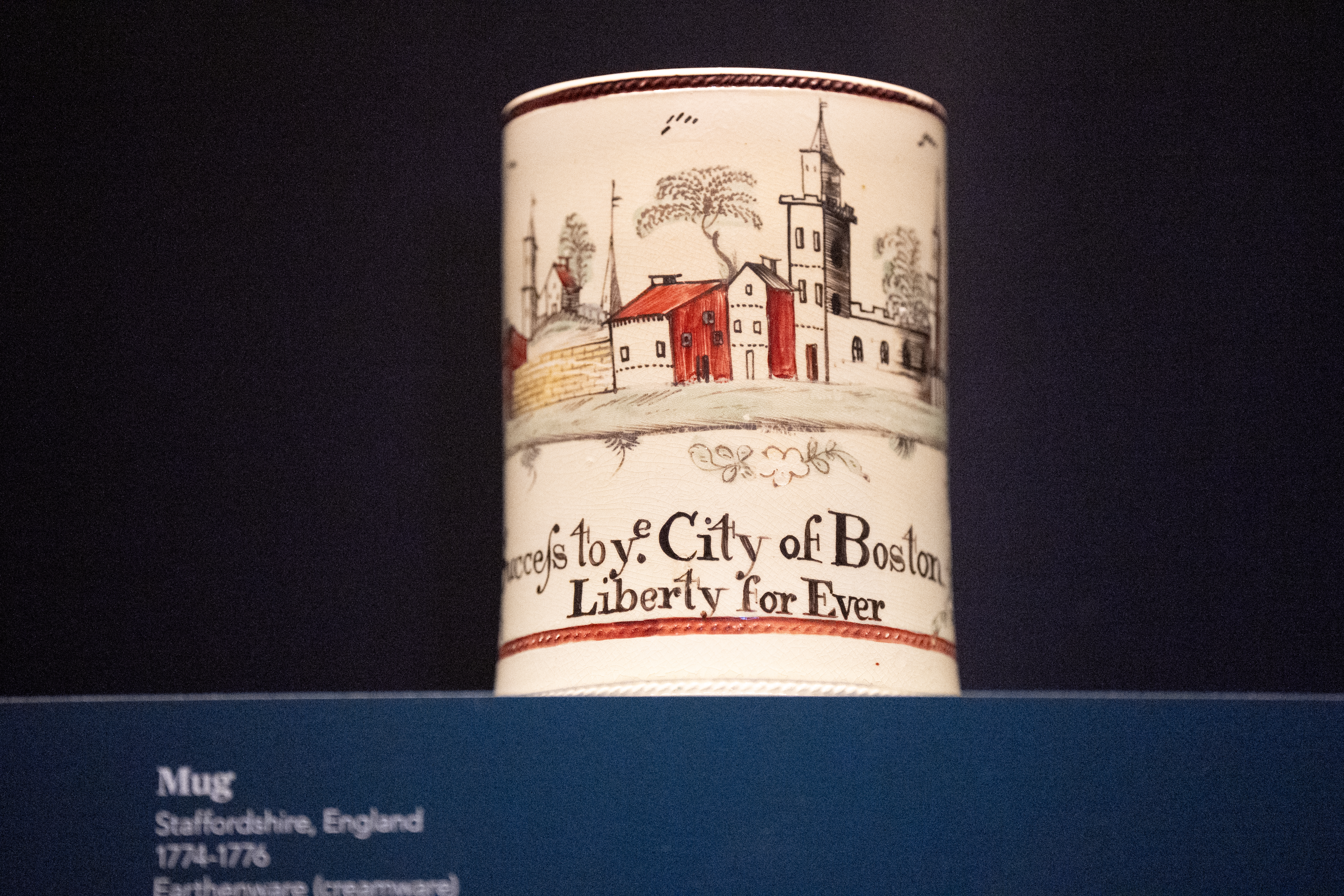
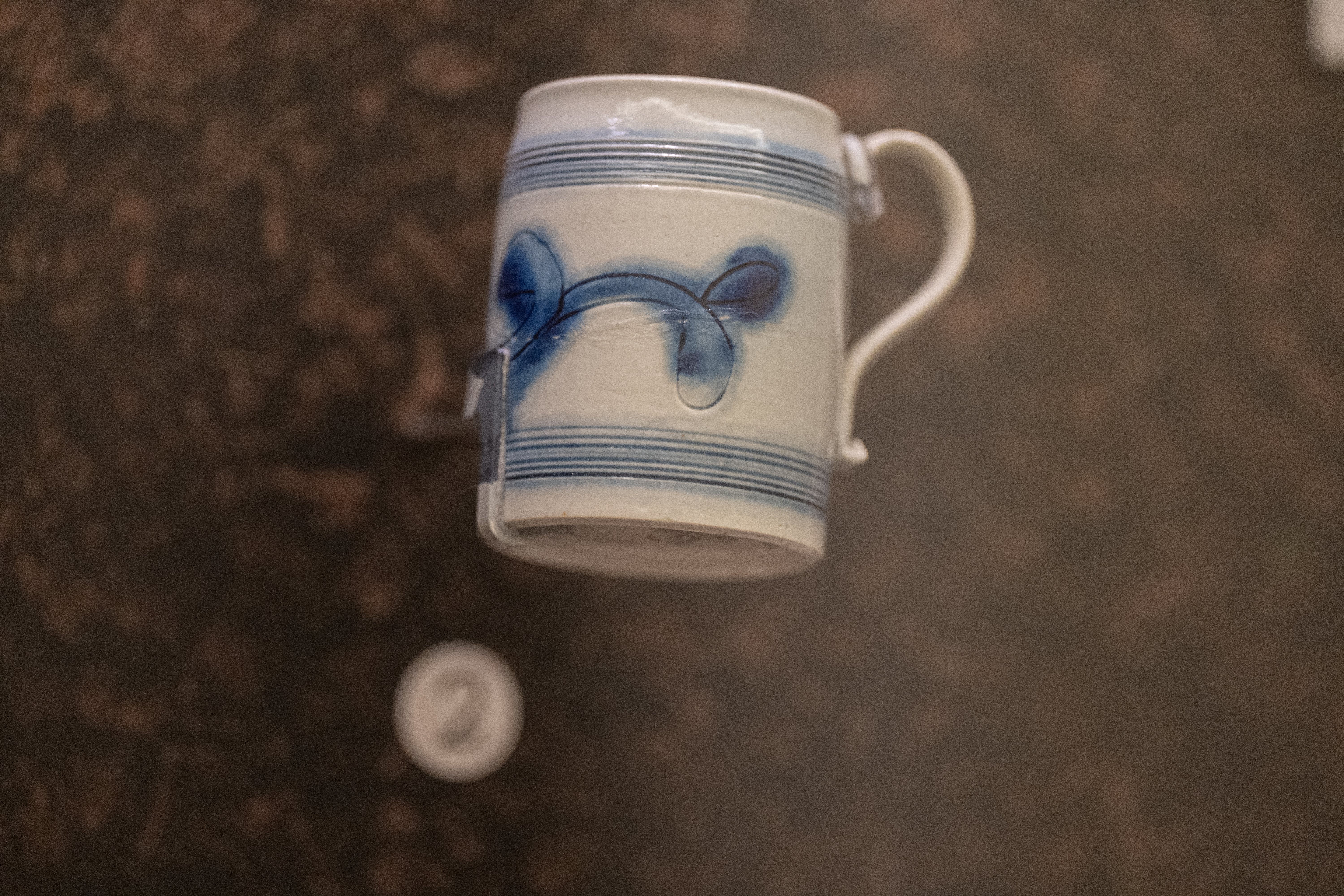
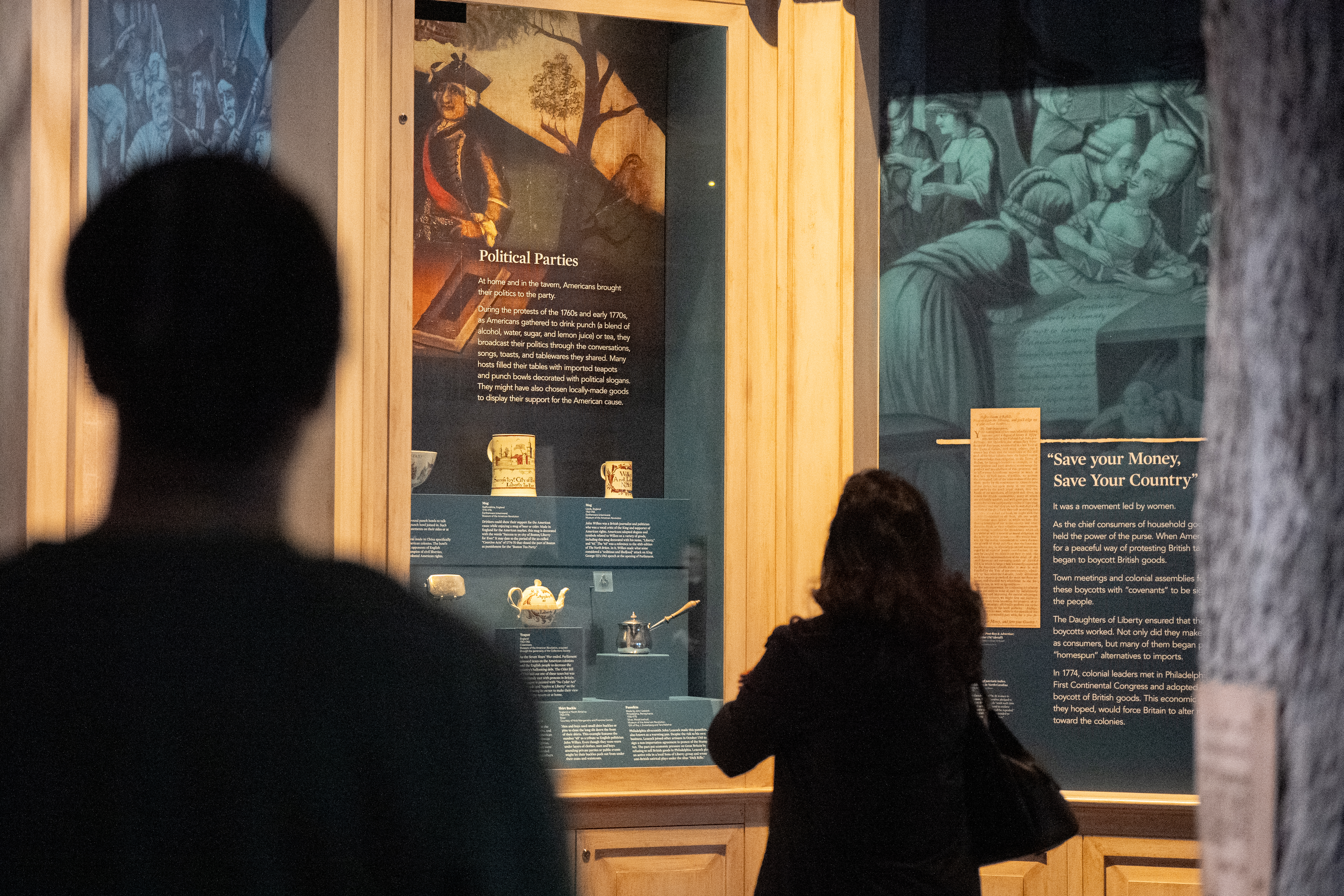
    Items related to drinking at the Museum of the American Revolution, in Philadelphia, PA, November 18, 2025,

    Thomas Paine, the working-class poet, whose thunderous pamphlet Common Sense helped roar in a revolution, oiled up his writing hand with Philly rum.

    It has long been accepted that Thomas Jefferson spent those sweltering summer weeks of 1776 drafting the Declaration from the favored Windsor chair of his Market Street lodgings. But records show he actually spent more time than ever at City Tavern at Second and Walnut. A minor, if tantalizing, historical development, which hints that perhaps the world’s most famous freedom document came fortified by fortified wine.

    Benjamin Franklin, polymath of the Revolution, inventor, scientist, printer, statesman, and lover of French wine (if in moderation), affectionately penned a Drinker’s Dictionary. The tippling tome contained 229 of Franklin’s favorite phrases for drunkenness, including buzzy, fuddled, muddled, dizzy as a goose, jambled, halfway to Concord, and Wamble Cropped.

    ‘Boozy business of revolution’

    Franklin and his ilk were not ringing up 18th-century expense accounts for the hurrah of it. They were doing the boozy business of revolution.

    Revolutionary-era Americans consumed staggering amounts of alcohol compared with today, said Brooke Barbier, historian and author of the forthcoming book Cocked and Boozy: An Intoxicating History of the American Revolution.

    By the end of the 18th century, when beer and spirits were a staple of daily life, the average colonist swilled about 3.7 gallons of hard liquor per year. A dizzying amount, not counting beer and cider, that must’ve set many a patriot’s tricorn hat spinning.

    By comparison, Americans now consume about 2.5 gallons of all alcohol, from beer to whiskey to wine, per year, said Barbier.

    Historians believe booze and bar life played an outsize role in stoking the embers of insurrection.

    Items related to drinking at the Museum of the American Revolution, in Philadelphia, PA, November 18, 2025,

    “Tavern culture was essential to the American Revolution,” said Barbier. “It was not a part of the sideshow. It was part of where the discussions about revolutionary ideas happened. Where spies met. And where others, who weren’t directly involved in politics, gathered to discuss the growing political crisis. Opinions were formed in taverns.”

    Nowhere was this work done more than in Philadelphia.

    By 1776, Philadelphia boasted roughly 200 licensed and illegal watering holes — or about one for every 150 citizens, said Tyler Putman, senior manager for gallery interpretation at the Museum of the American Revolution.

    Revolution with a twist

    The fare of colonial-era drinking spots was as diverse as the budding port town.

    There were posh spots like the newly constructed City Tavern, located blocks from the waterfront, and where the delegates of the First and Second Constitutional Congress drank nightly like fish. Ensconced in an upstairs space, known as the “Long Room,” the Founding Fathers debated liberty over libations late into the night, while imbibing copious amounts of Madeira, whiskey, punch, and everybody’s favorite Robert Hare porter.

    There were taverns and flophouses, where tradesmen and sailors learned of Britain’s newest outrage from newspapers read aloud, or the latest traveler. And there were scores of unlicensed disorderly houses, grungy forebears of the modern dive bar.

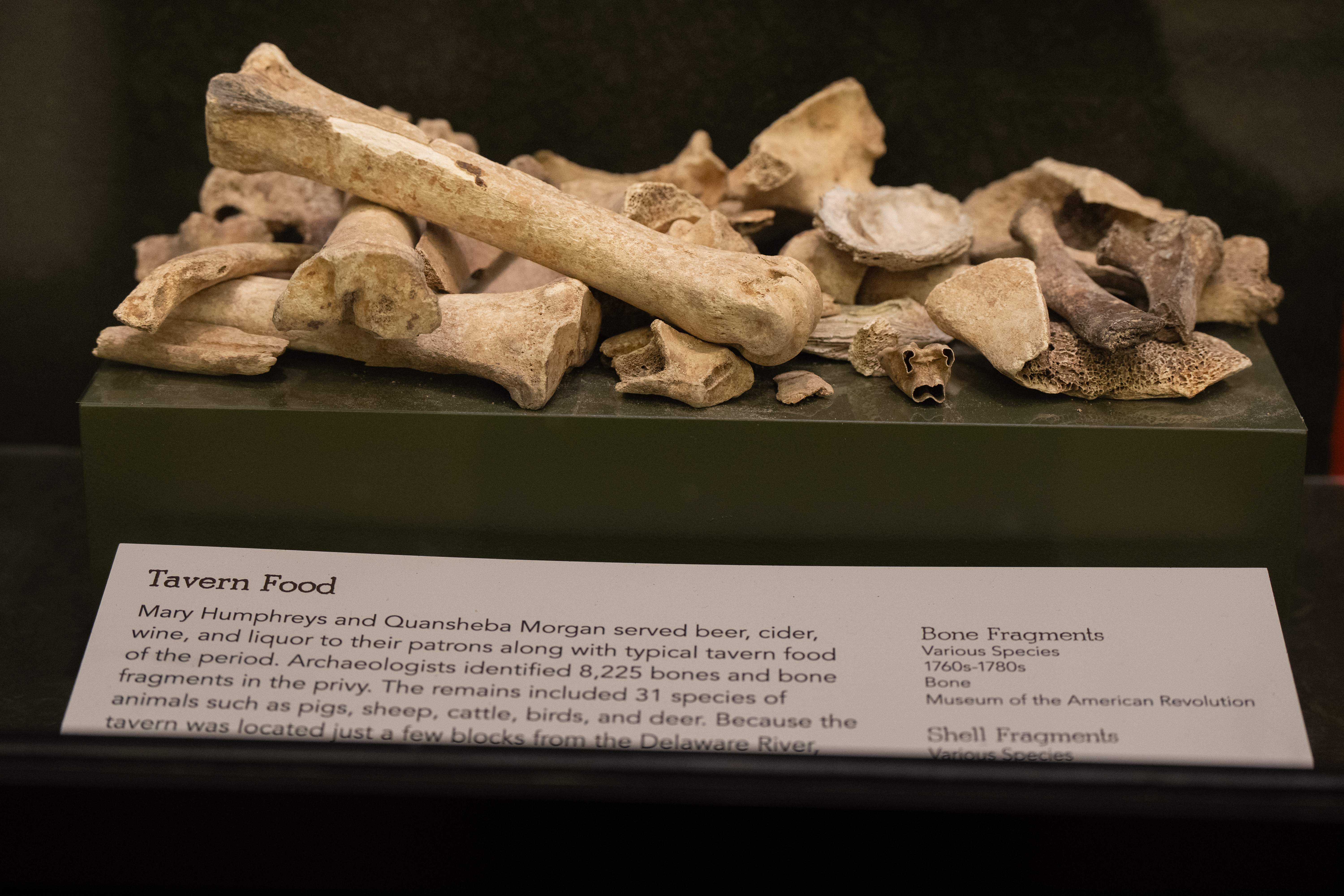
    In 2014, three years before opening, the Museum of the American Revolution conducted a large archaeological dig, discovering thousands of artifacts from a Revolutionary-era disorderly house buried beneath its future Old City home. Among the mounds of mutton bones, glassware, and broken bottles unearthed from the privy of Benjamin and Mary Humphreys’ living room tavern was a broken windowpane inscribed with the initials and names of customers.

    Bones from Tavern food at the Museum of the American Revolution, in Philadelphia, PA, November 18, 2025,

    In what can only be the earliest example of Philly barroom graffiti, one dreamy patriot etched a quote attributed to the ancient Roman senator Cato into the clouded glass: “We admire riches and are in love with idleness.” The etching was meant as a barb toward the British, Putman said.

    “They were obsessed with ancient Rome,” he said, of the American revolutionaries. “They were thinking a lot about, ‘How do you go back to some sort of idealized republic?’”

    A nation born in taverns

    Just as the nation strived to become democratic, its taverns became more undemocratic.

    “In Philadelphia, the elites who are cooking up one version of the revolution are not drinking with the rabble who are cooking up what maybe would become a different version,” Putman said.

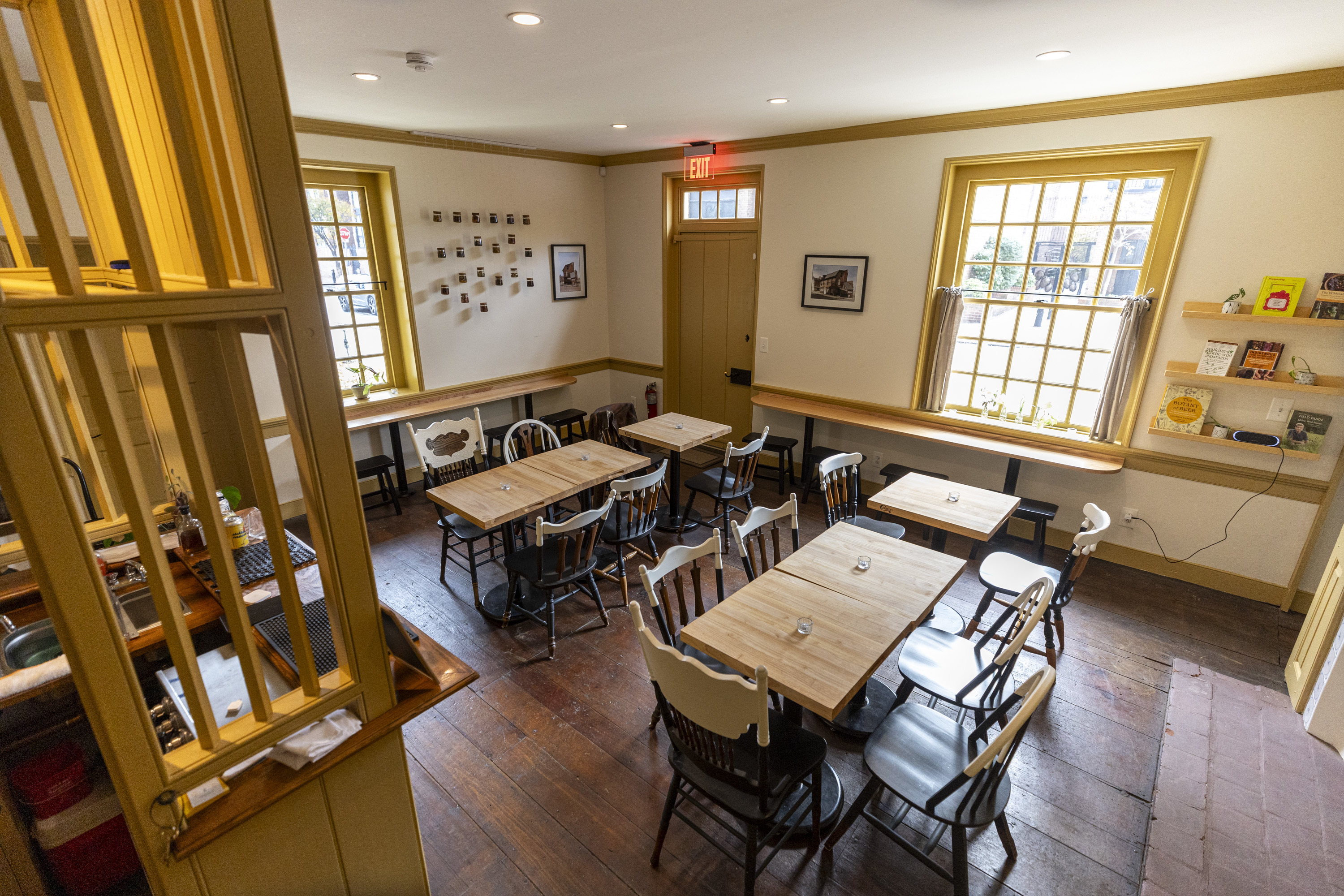
    The newly-renovated Man Full of Trouble Tavern in Society Hill on Saturday Dec. 7, 2024.

    Revolutionary-era drinking and tavern life, and its role in America’s founding 250 years ago, will be explored in full at a Nov. 21 after-hours event at the Museum of the American Revolution. Dubbed “Tavern Night,” the sold-out cocktail reception and boozy symposium serves as a twist to the museum’s grand exhibition celebrating the national milestone, also known as the Semiquincentennial, “The Declaration’s Journey.”

    “Unlike today’s bars, taverns were meeting places at a time when few others were available,” said Dan Wheeler, who last year reopened Philly’s only remaining colonial-era tavern, A Man Full of Trouble, and will join Barbier in speaking at the event. “Revolutionary thoughts were conceived and refined in taverns, and a nation was born.”

    Colonial keggers and the bonds of liberty

    Booze was the social lubricant of the Revolution, said Barbier, a Boston-based historian who also runs tours of Revolutionary-era taverns, who pored over the Founding Fathers’ diaries and account books in recreating their raucous time in Philly.

    The historical record provides no evidence that the nation’s founders were fully loaded — or “cock-eyed and crump-footed,” as Franklin might’ve said — as they went about forming the republic, she said.

    “When you hear someone accusing someone of being drunk, it’s in an overly negative way,” she said.

    Still, she was surprised by just how much the Founding Fathers drank.

    Items related to drinking at the Museum of the American Revolution, in Philadelphia, PA, November 18, 2025.

    Hard cider and small beer, the 18th-century version of light beer, more or less, accompanied breakfast, she said. The midday meal, known as dinner, boasted cider, toddy, punch, port, and various wines. When their workday wrapped up in the late afternoon, the delegates’ drinking began in earnest.

    “There’s certainly a lot of drinking happening in these taverns,” said Barbier, whose book includes recipes of the Founding Fathers’ preferred aperitifs. “I don’t drink and not eventually feel tipsy. Certainly the same would be true for people in the past.”

    Barbier notes the downside of all the drinking, like booze-fueled mob violence that spilled into the streets. And neither will she say that Jefferson, who kept all his receipts, actually penned the Declaration at City Tavern.

    “He was there more frequently than ever during this time,” she said. “Maybe he needed to take a break from his writing, and go there. And sometimes when you’re on break, you develop your best ideas.”

    The Founders’ endless toasting of tankards — including a rager for the ages marking Paul Revere’s arrival in Philly, and held in 1774, the night before a critical vote toward independence — provided crucial trust-building, Barbier said.

    The men who founded America arrived in Philly as strangers, agreeing on little. After so much boozing, they bonded as brothers in liberty, and left a new nation in their wake.

    “Ultimately, this comradery and social bonding leads to the consensus that leads to the Declaration of Independence,” Barbier said.