There was a time — back when The Inquirer had multiple suburban bureaus — that photographers like myself who were assigned to the main newsroom on North Broad Street worked only in the city. (We’re now more like ride share drivers, going everywhere.)
So I walked a lot more to cover news and events in Center City, and more often stumbled into things and sights that piqued my curiosity.
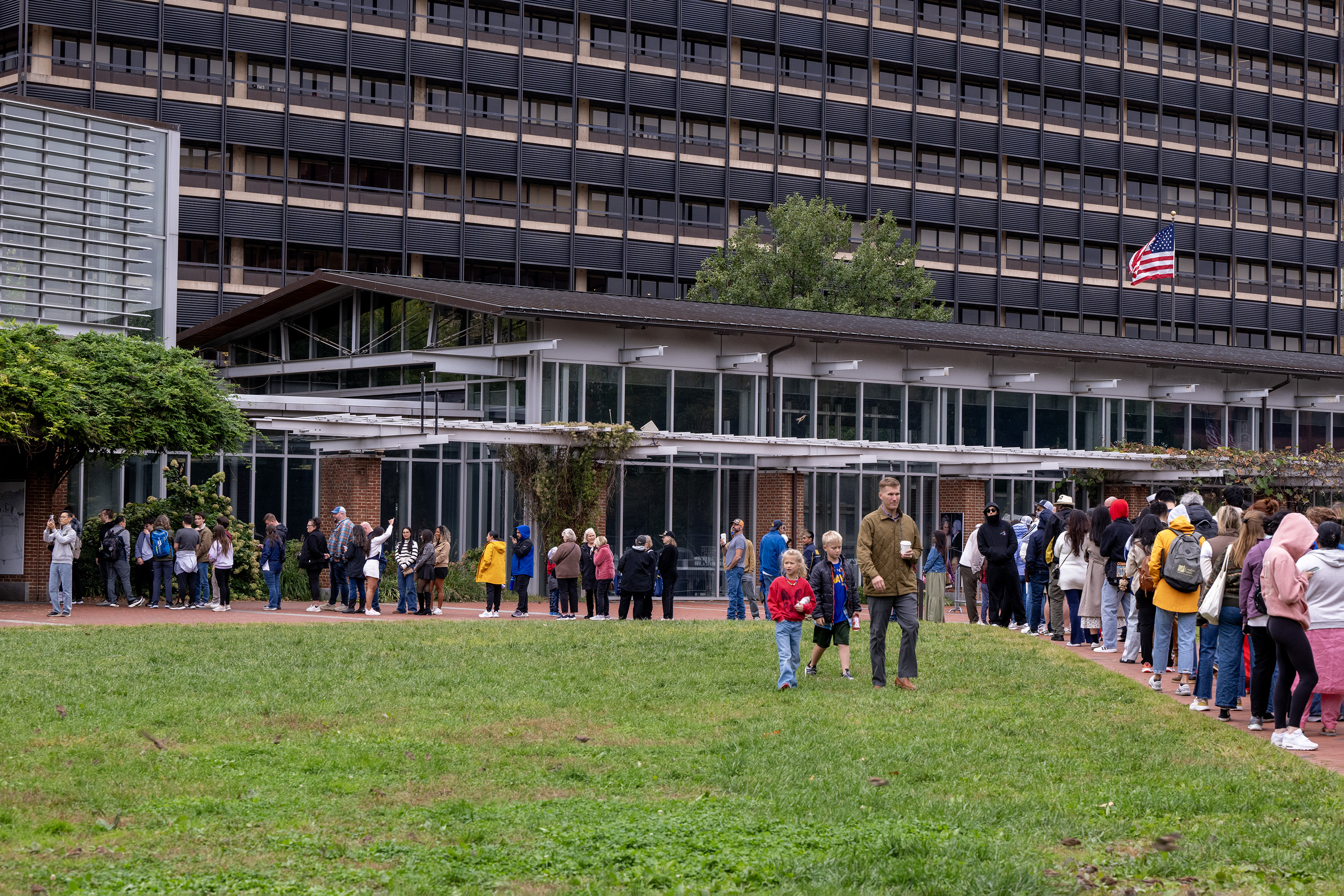
Things like a long line.
Visitors queue up to get a glimpse through a single window in the Liberty Bell Center Oct. 12, 2025 while the building is closed due to the federal government shutdown.
Years ago seeing one likely meant unhoused people were waiting as church folks or outreach advocates served dinner on the street. Or they were waiting for concert tickets or movie premiers (Beanie Babies?).
I remember once questioning someone standing in a blocks-long line along Walnut Street and was flabbergasted to learn a new sneaker was dropping.
Or for a device that combined a portable media player, a cell phone, and an internet communicator.
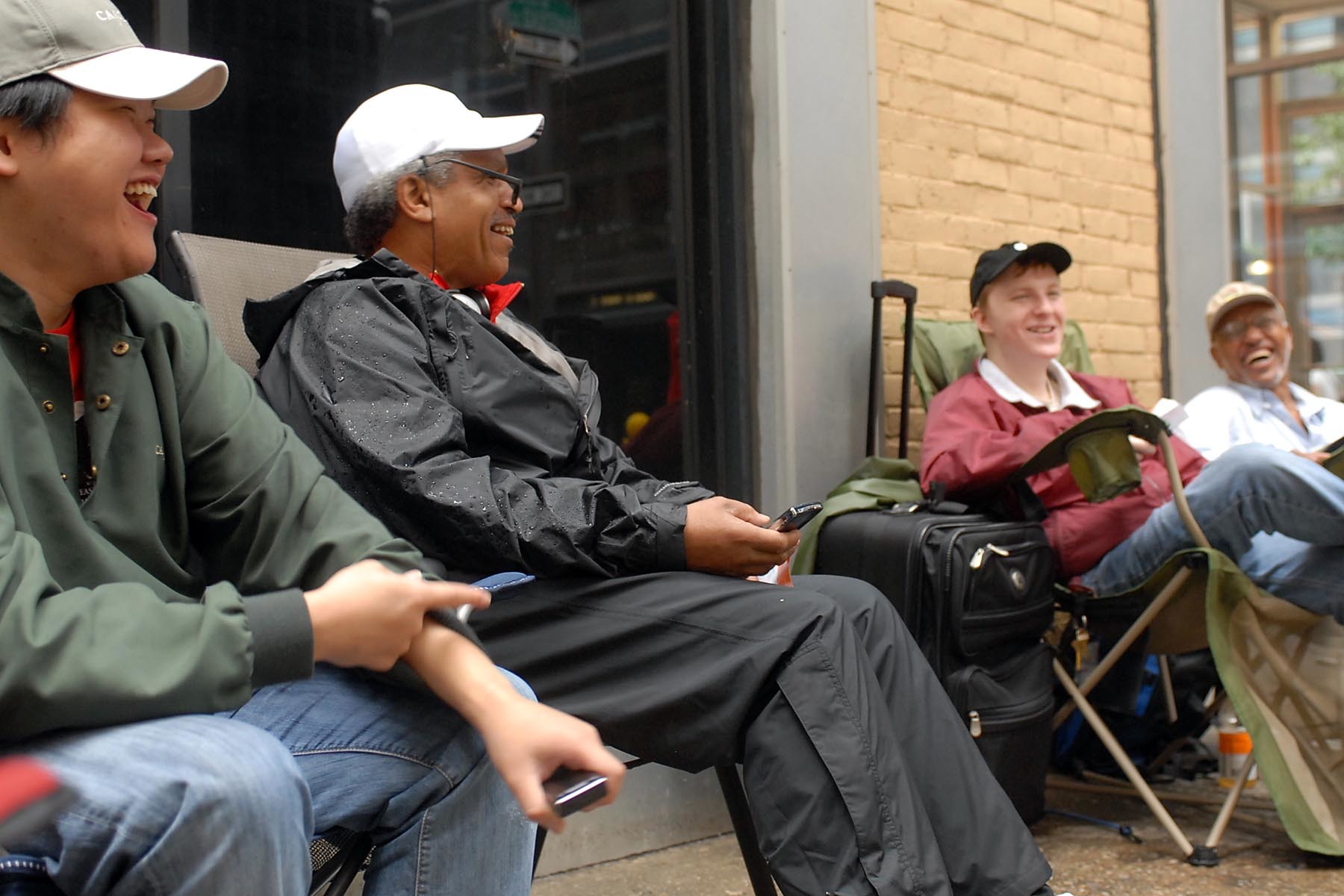
Mayor John F. Street reads jokes aloud from his Blackberry as he waits with fellow technology enthusiasts in an alley off 16th Street to purchase an iPhone at the At&T store Jun. 29, 2007. There were two models available that day: a 4GB for $499 and the 8GB for $599.
Mayor Street was the third in line to buy the first-generation iPhone 2G launched that day. He said he arrived around 3:30 a.m. Leonard F. Johnson (far right) at the front of the line, arrived 36 hours ahead of the 6:00 p.m. official release.
Hizzoner defended the time he spent in line, saying he got work done and kept in touch with city officials on the issues of the day using his Blackberry to send emails and make phone calls.
I had no idea what the yellow shipping container was when I saw it next to City Hall last weekend. Even after I walked over and watched those at the front of the long line take their selfies inside a retro Philly diner-esque booth tableau.
I watched it all unfold, along with others, asking ourselves what was going on. Nobody knew. Except those in line.
It was the last stop on the Pleasing Express Line that ended its nation-wide tour in Philadelphia.
Followers on social media were invited to, “Climb on to immerse yourself in the worlds of Pleasing Fragrance, Big Lip, and exclusive treasures,” including a spin of the “Freebie Wheel,” for products of the unisex lifestyle brand Pleasing, created by former One Direction singer Harry Styles.
A spontaneous walk around Center City can build for me the same kind of excitement felt by those waiting in lines. Except they know their eventual reward. Mine comes from the anticipation of not knowing what’s around a corner.
And that is exactly what makes street photography worth the walk – and sometimes even the wait.
Since 1998 a black-and-white photo has appeared every Monday in staff photographer Tom Gralish’s “Scene Through the Lens” photo column in the print editions of The Inquirer’s local news section. Here are the most recent, in color:
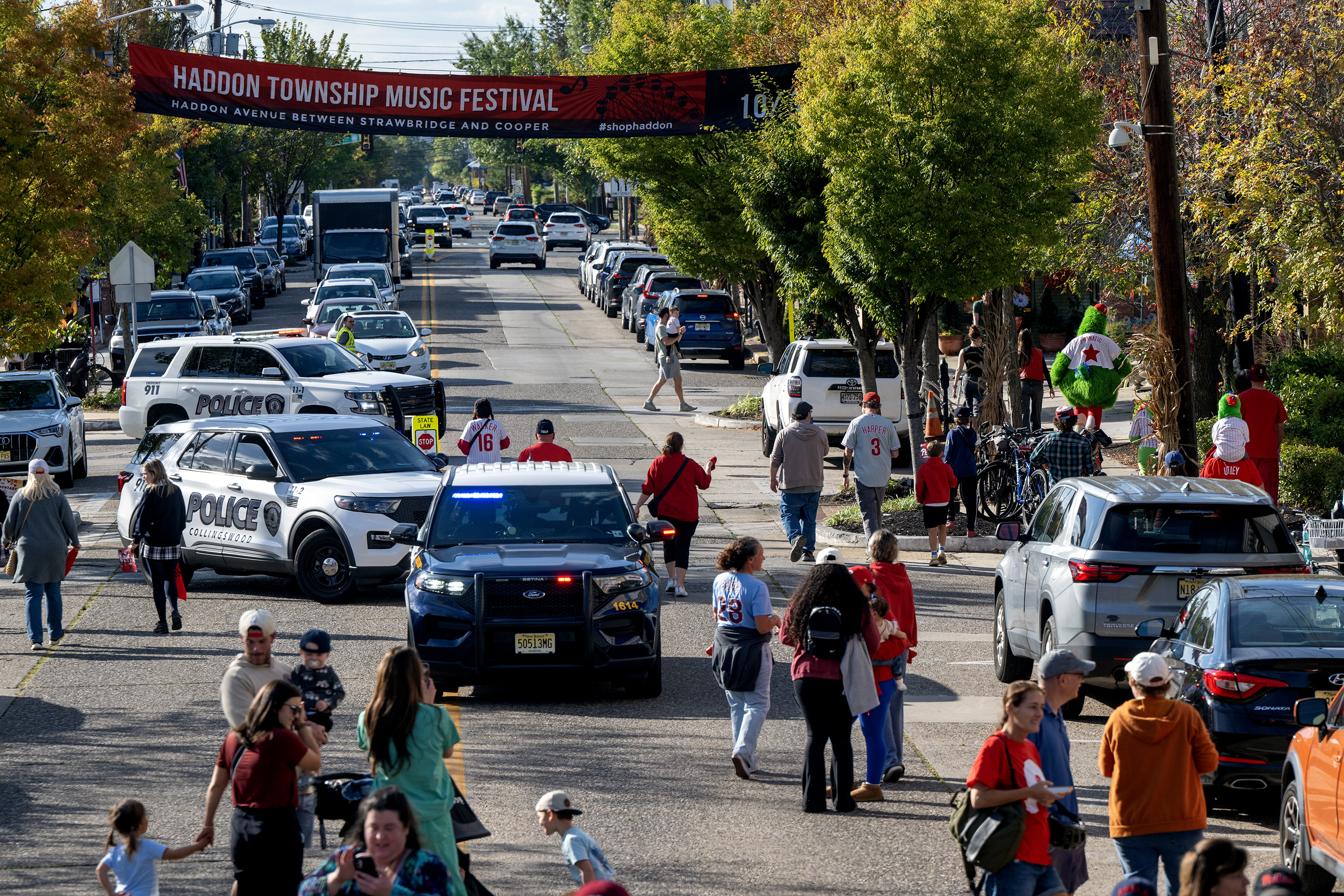
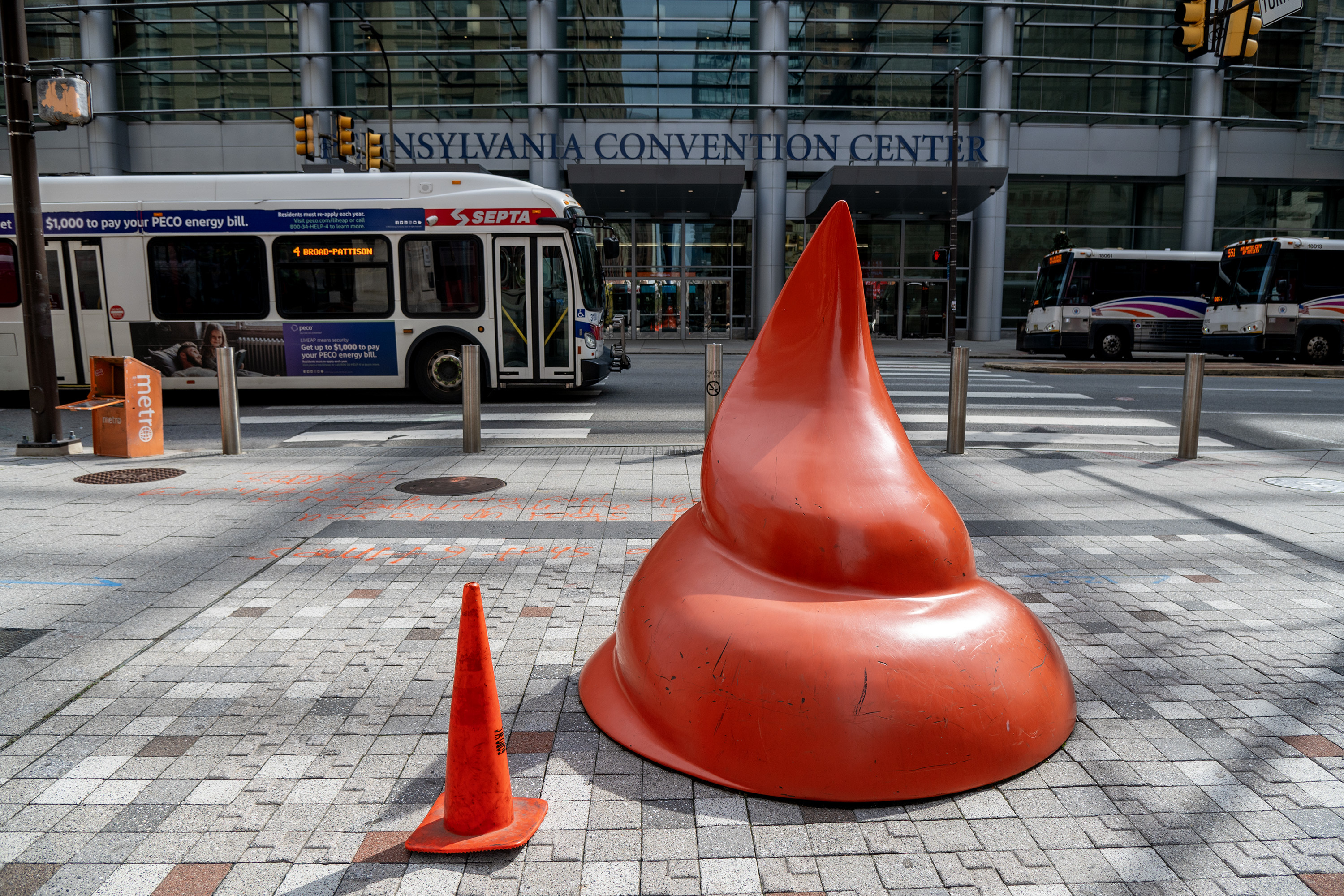
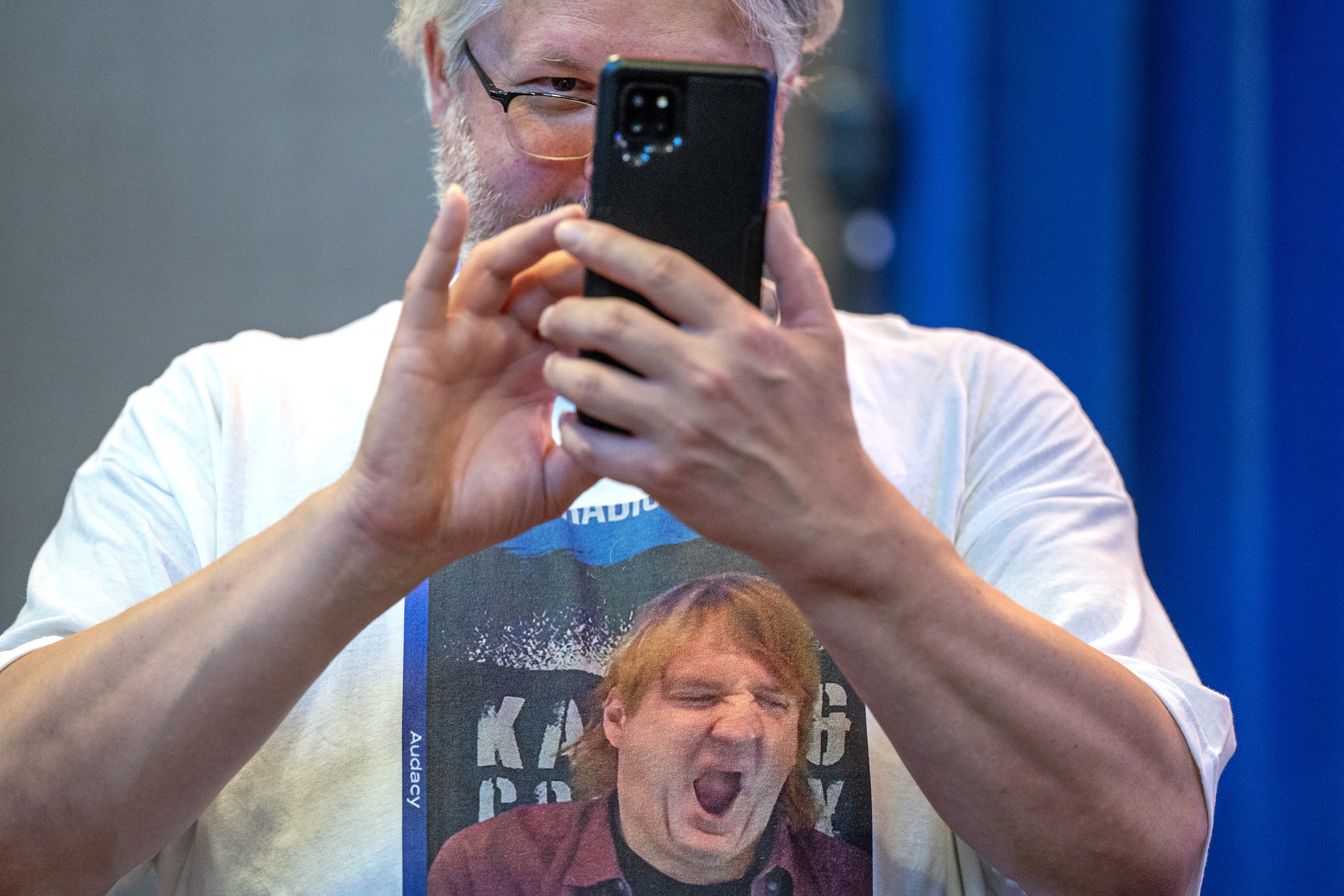
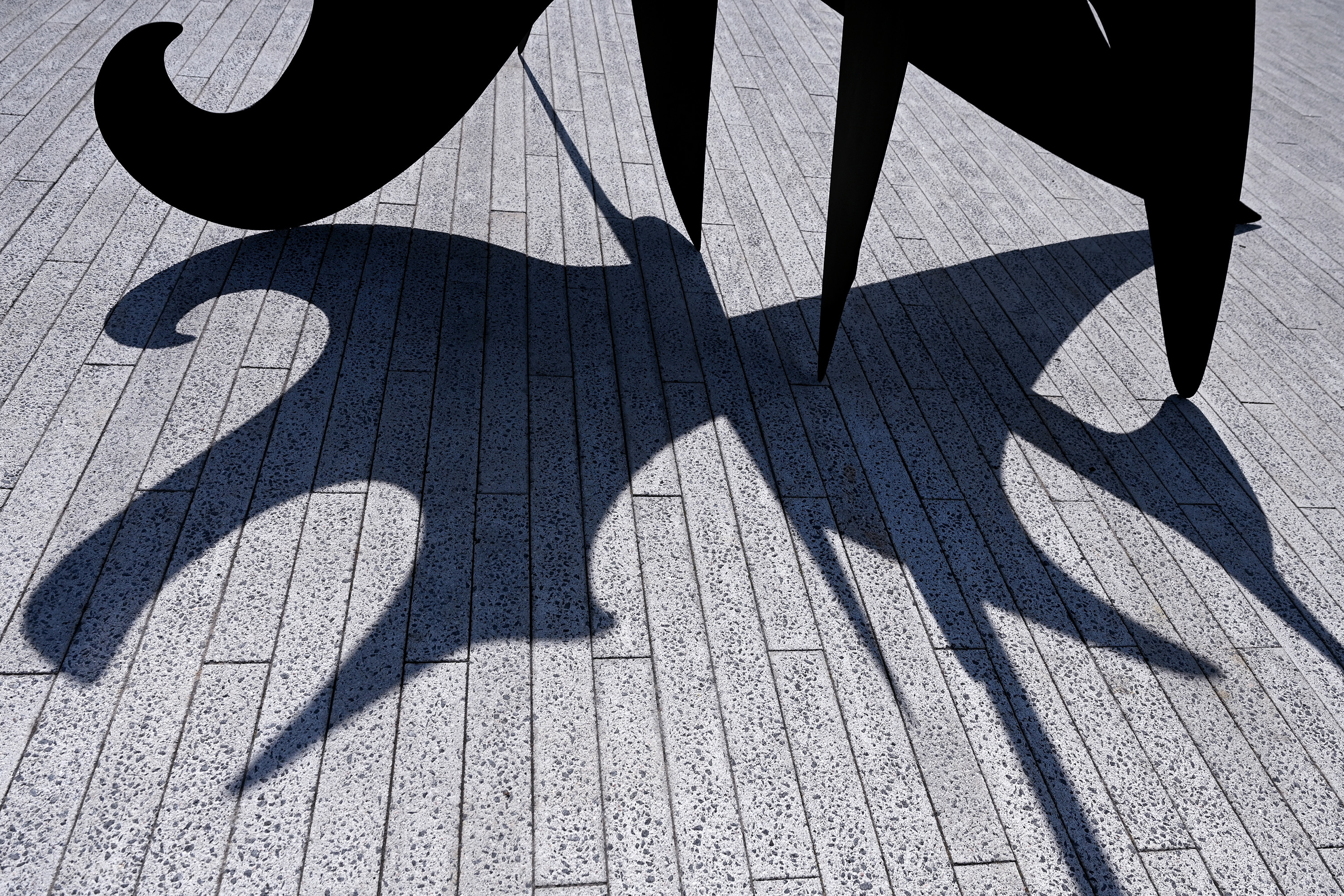
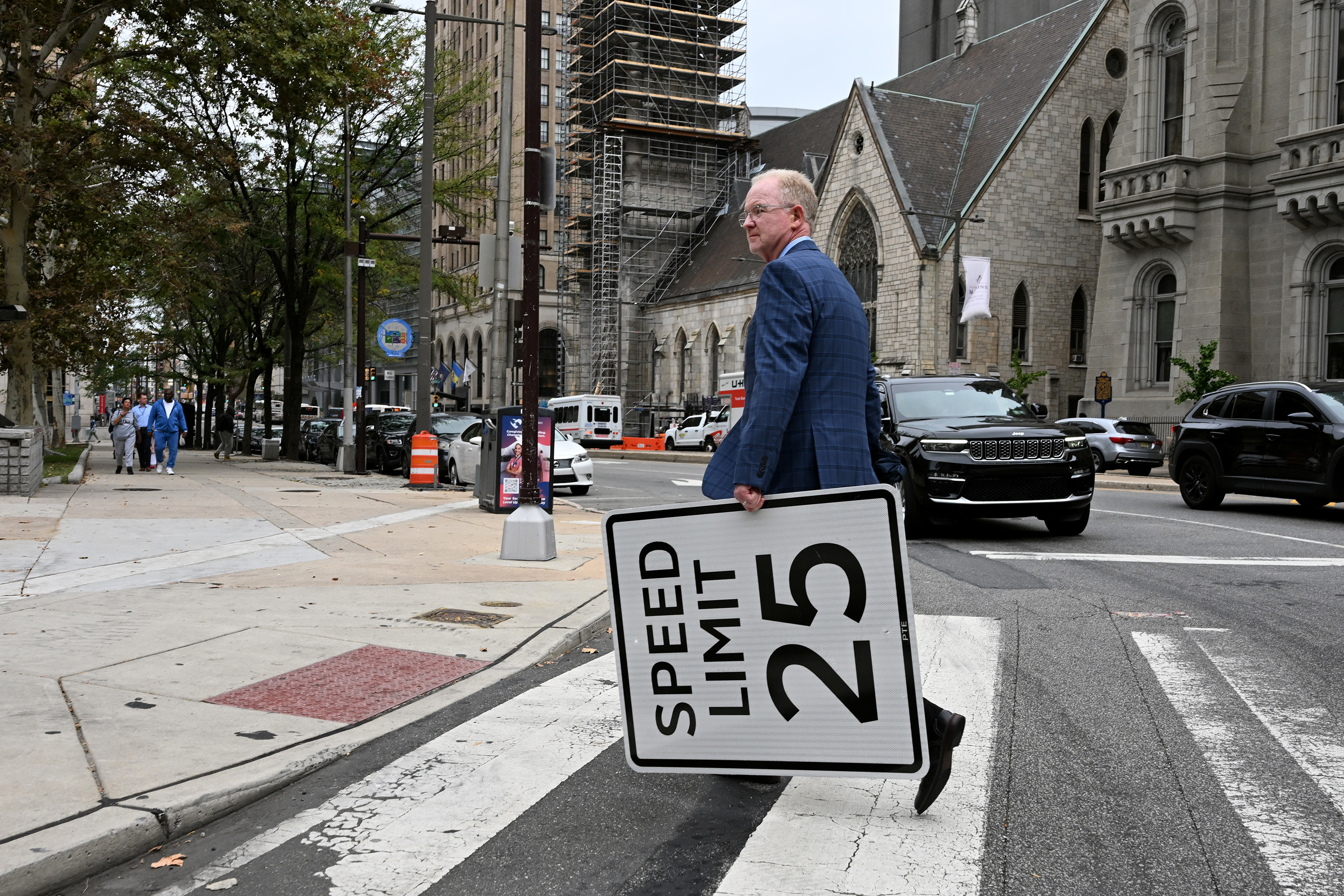
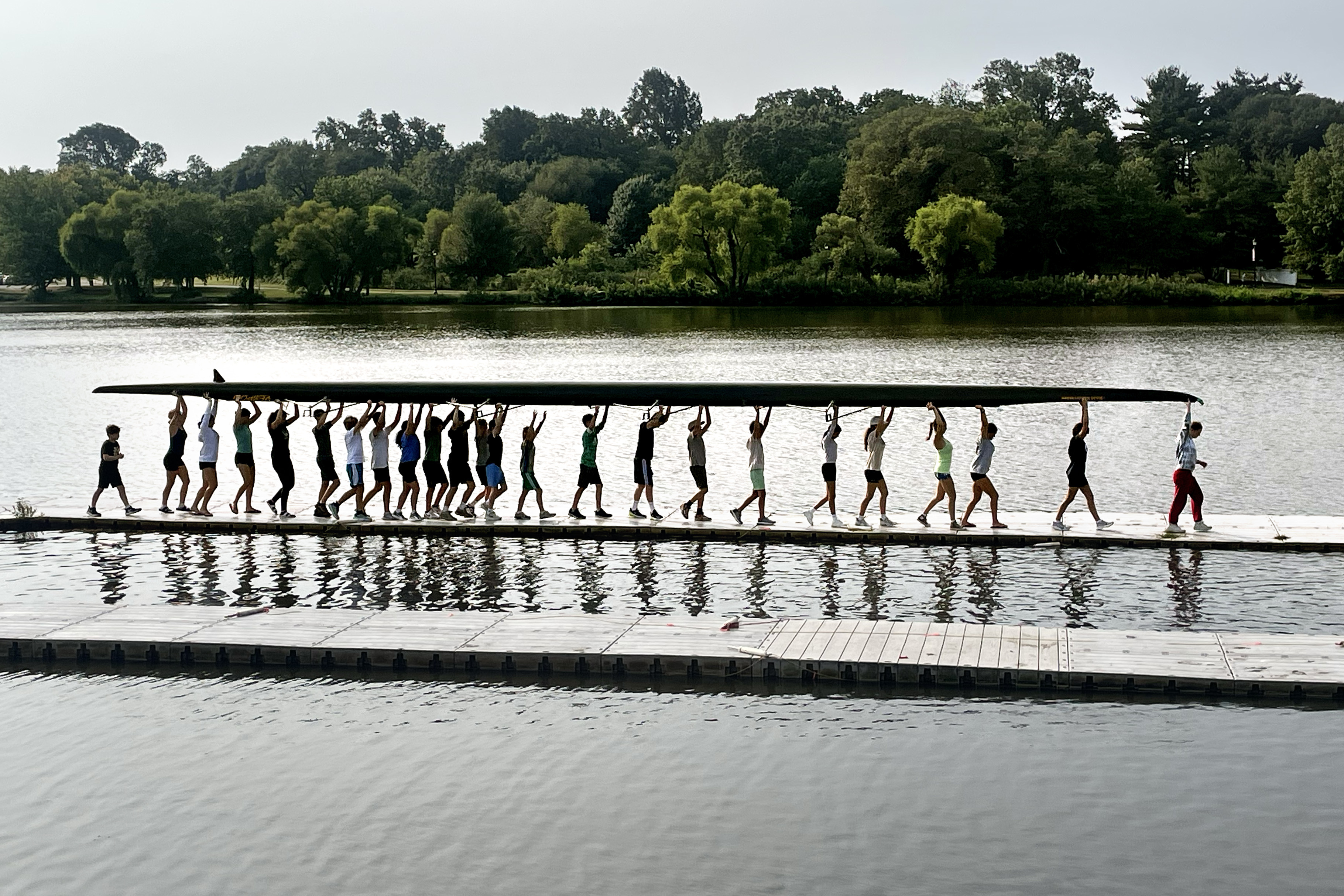
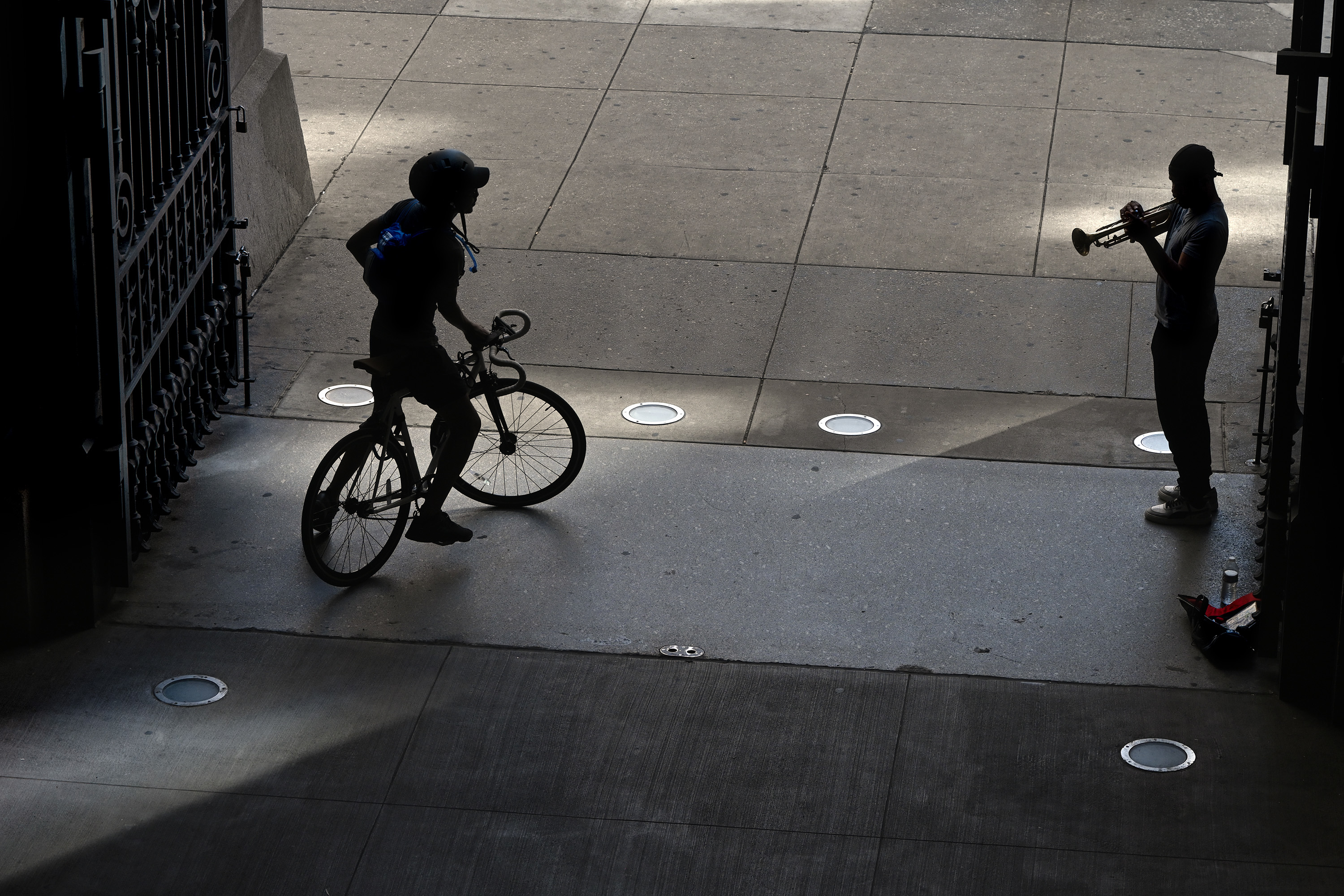
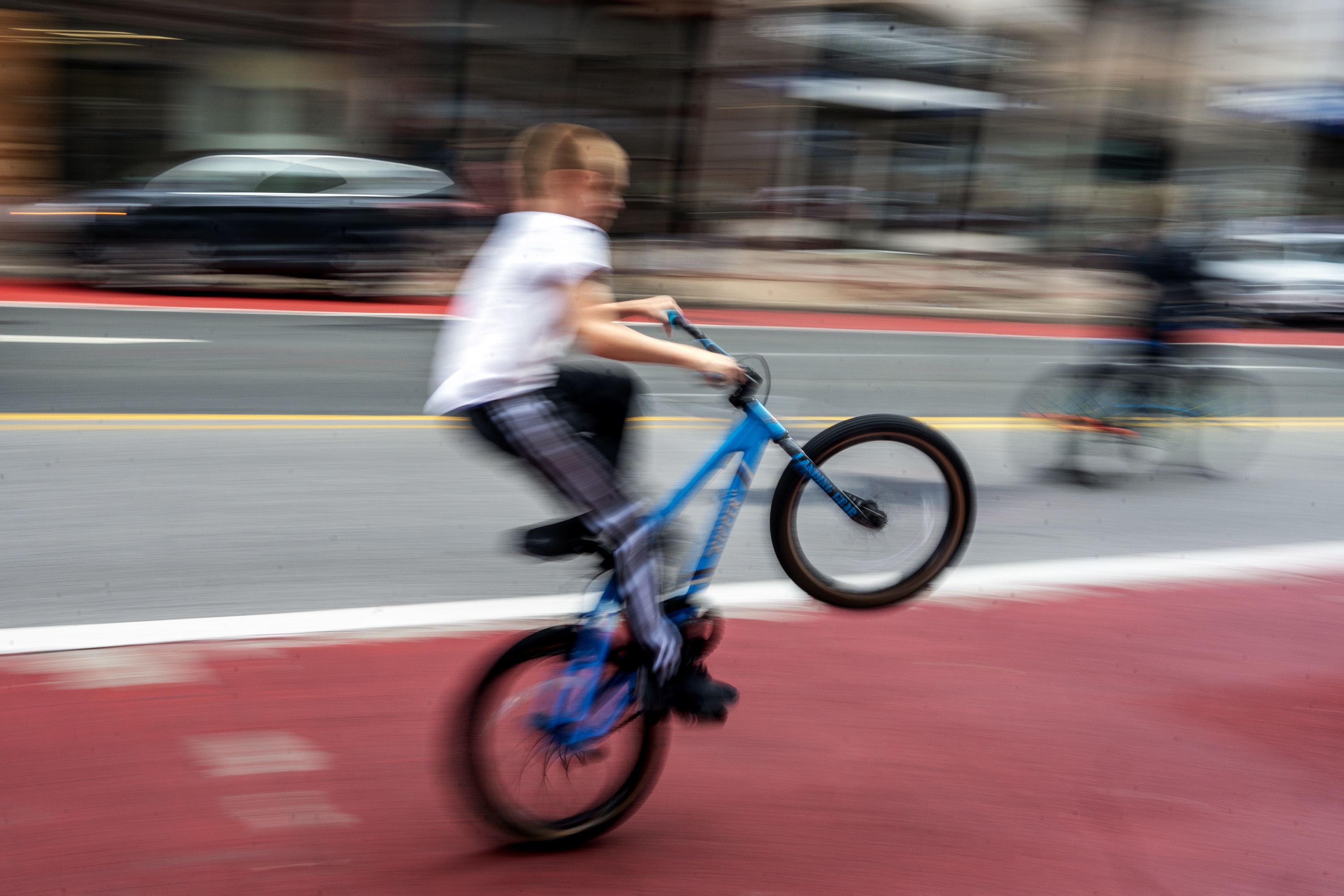
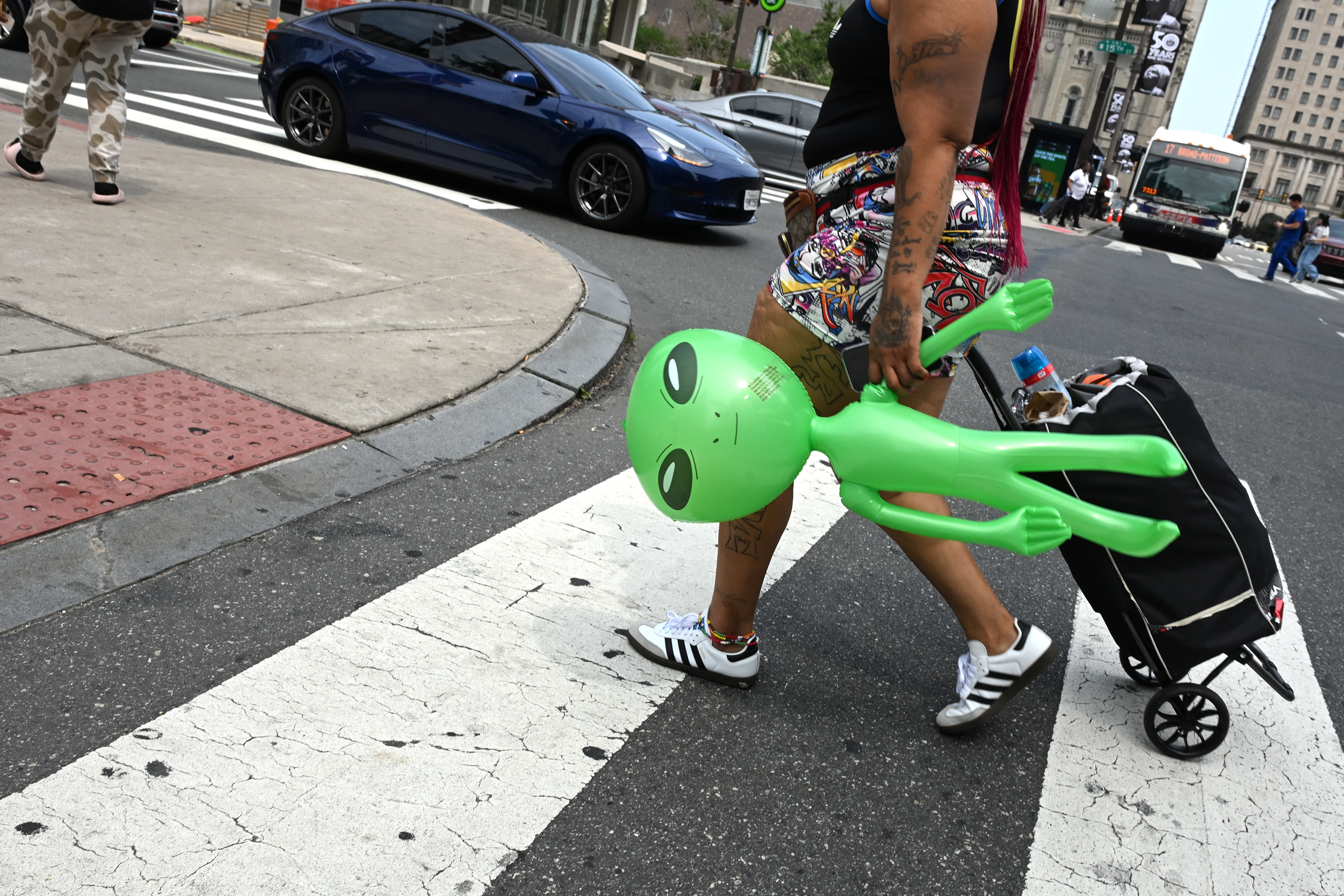
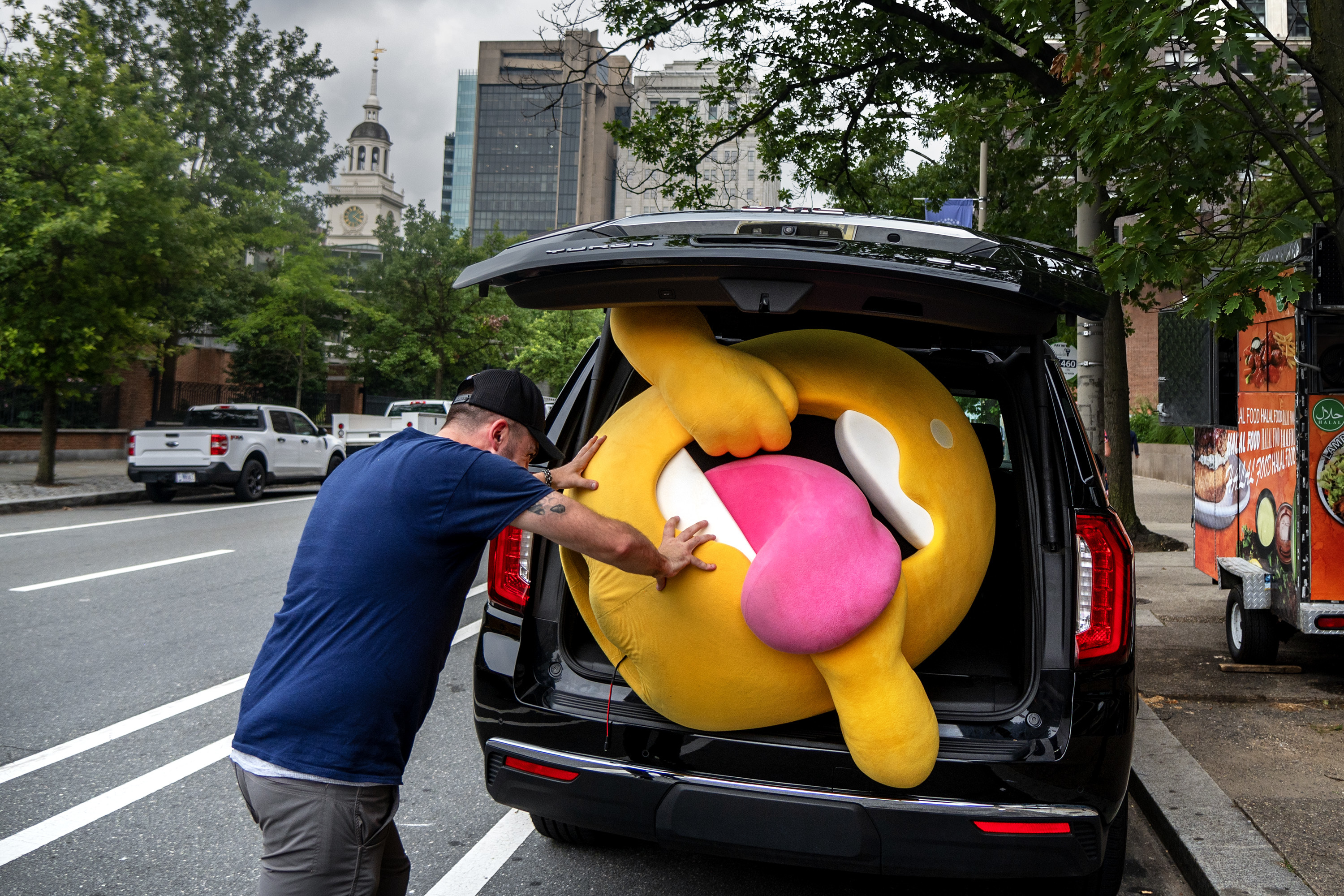
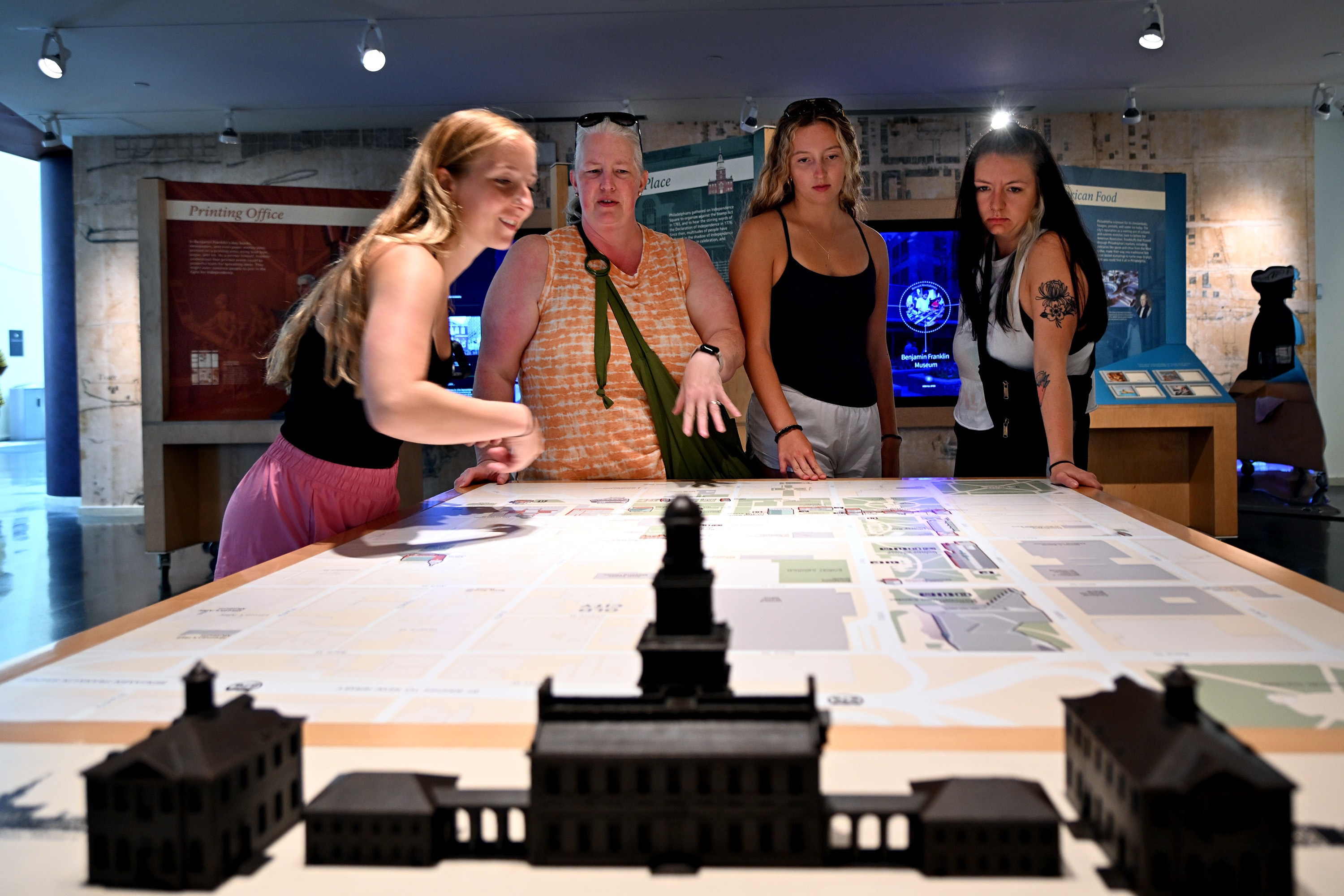
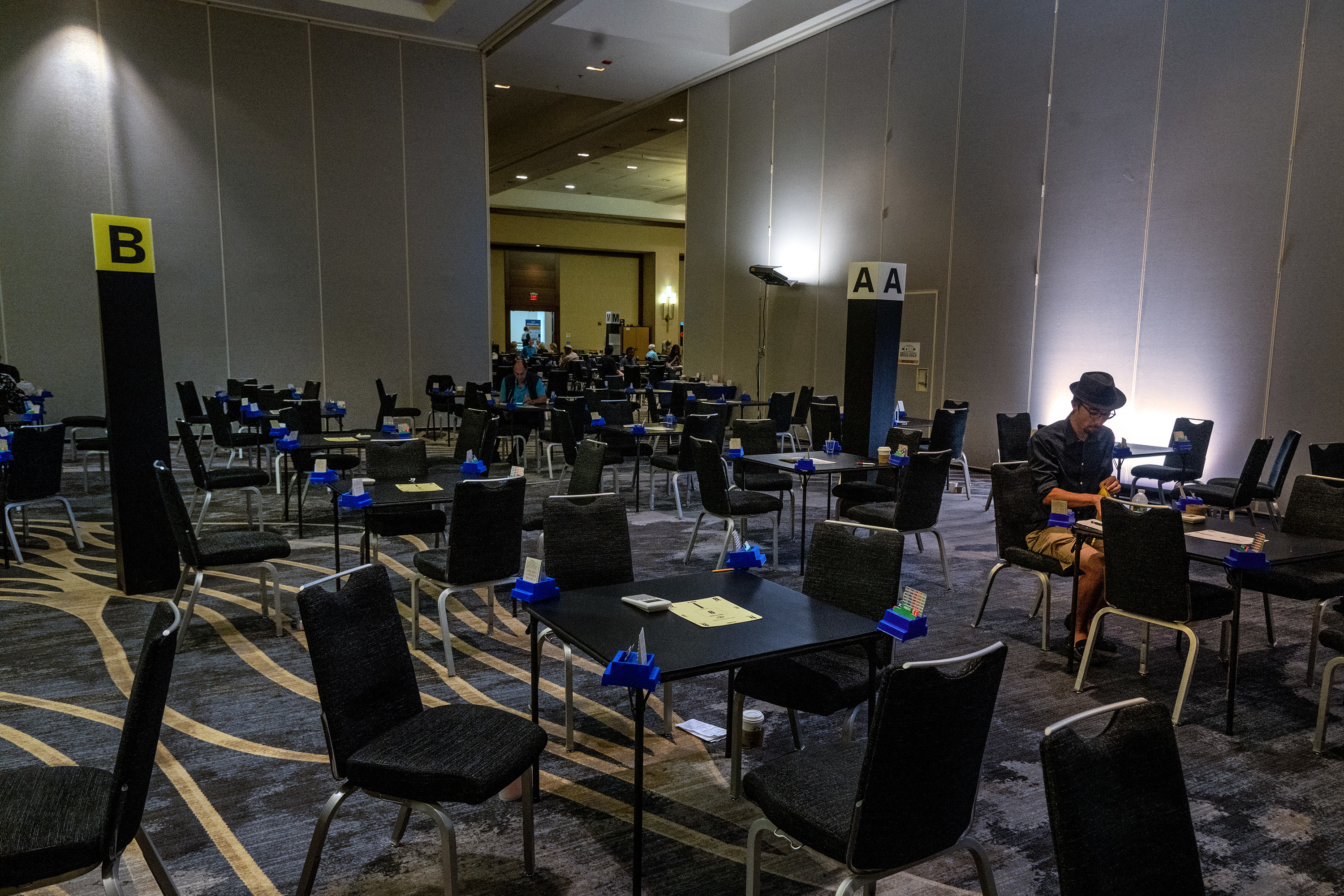
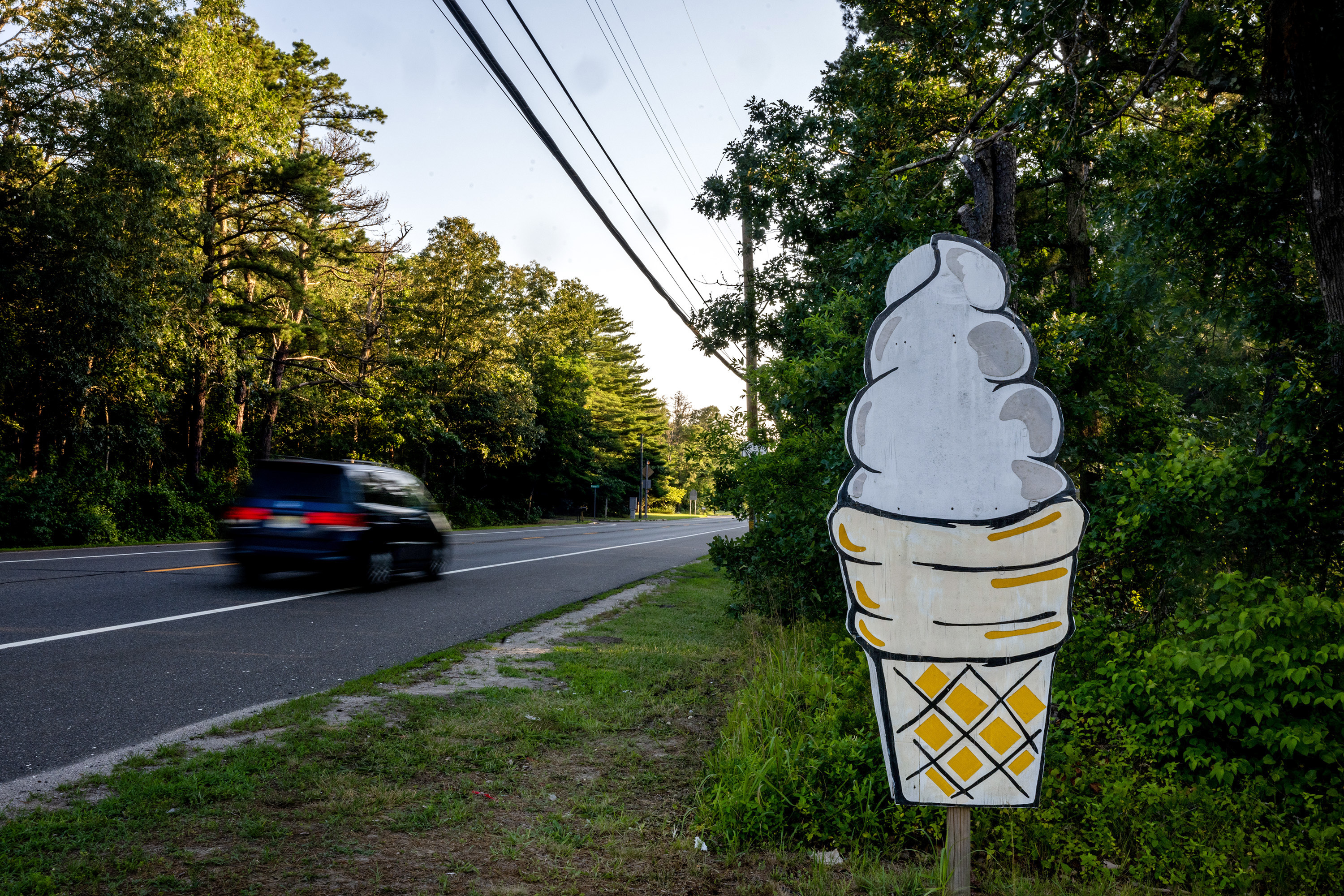
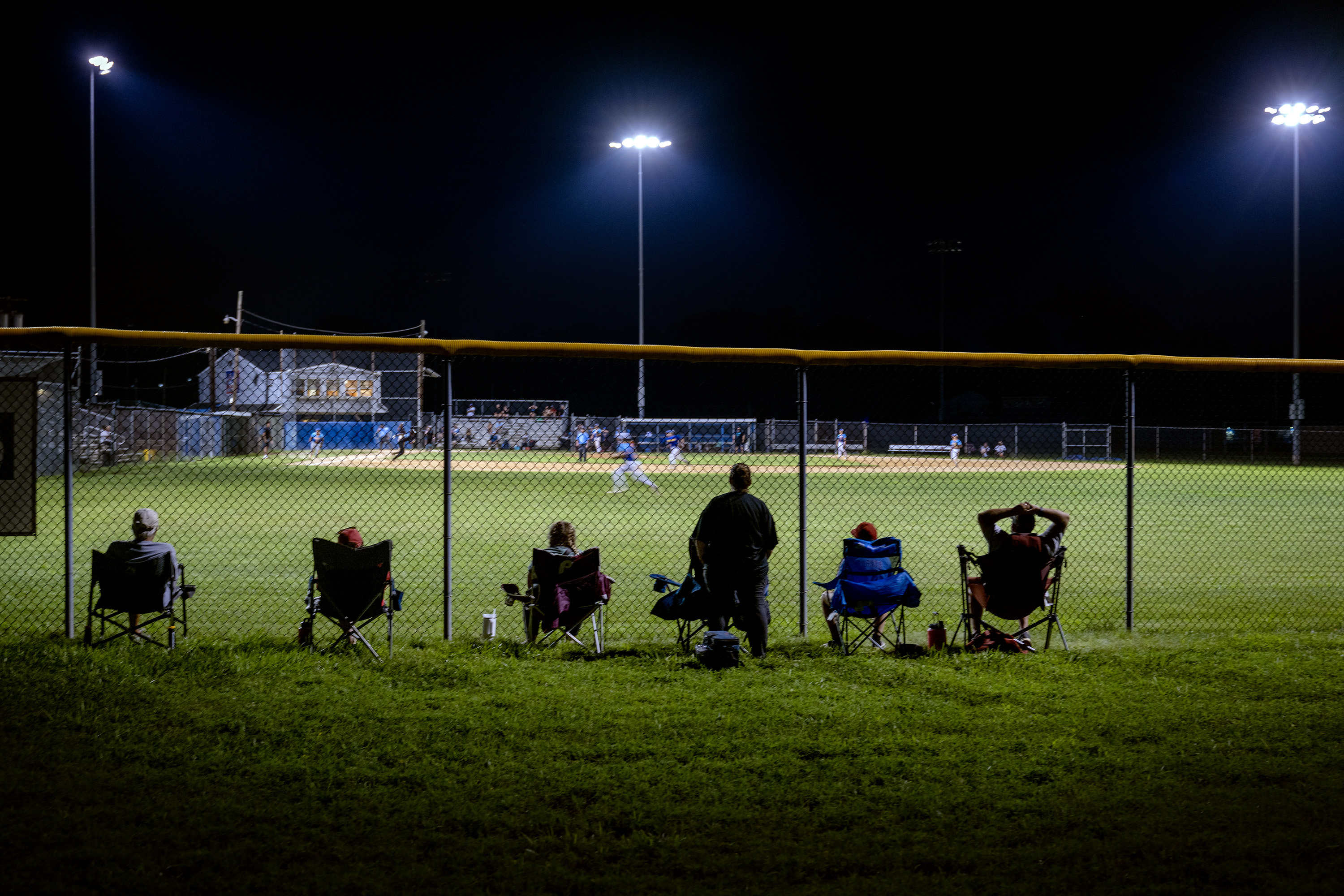
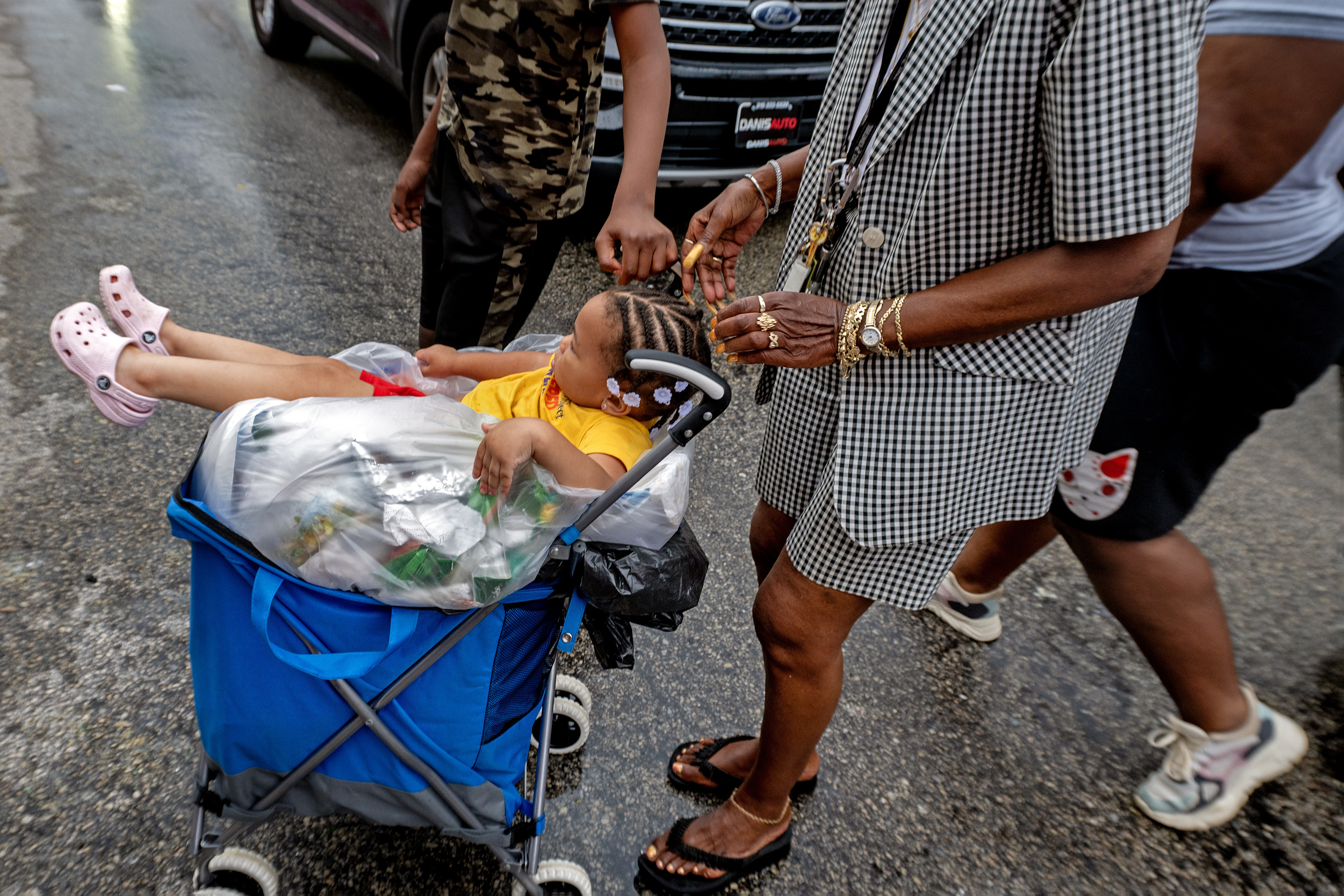
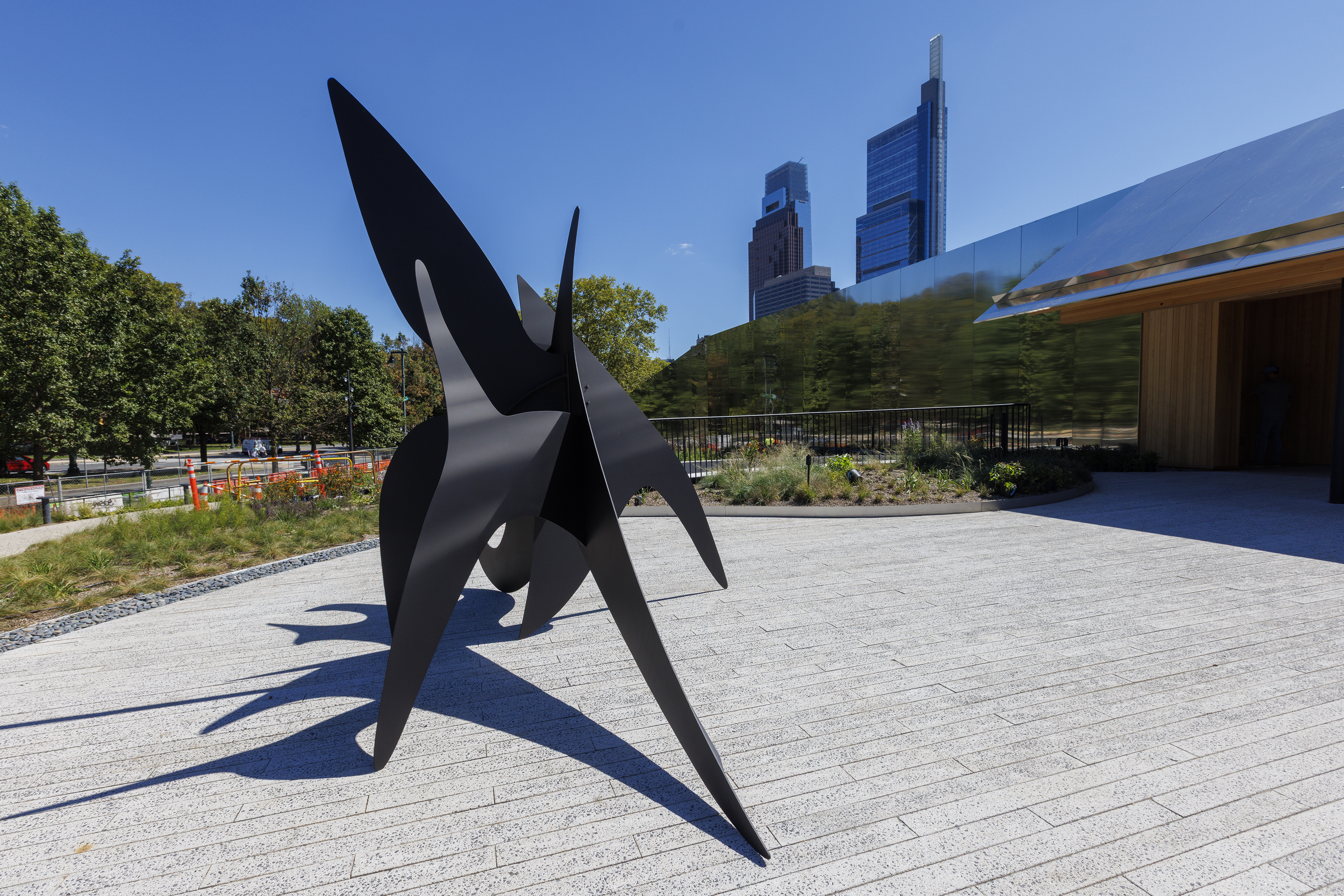
October 11, 2025: Can you find the Phillie Phanatic, as he leaves a “Rally for Red October Bus Tour” stop in downtown Westmont, N.J. just before the start of the NLDS? There’s always next year and he’ll be back. The 2026 Spring Training schedule has yet to be announced by Major League Baseball, but Phillies pitchers and catchers generally first report to Clearwater, Florida in mid-February.October 6. 2025: Fluorescent orange safety cone, 28 in, Poly Ethylene. Right: Paint Torch (detail) Claes Oldenburg, 2011, Steel, Fiberglass Reinforced Plastic, Gelcoat and Polyurethane. (Gob of paint, 6 ft. Main sculpture, 51 ft.). Lenfest Plaza at the Pennsylvania Academy of the Fine Arts on North Broad Street, across from the Convention Center.September 29, 2025: A concerned resident who follows Bucks County politics, Kevin Puls records the scene before a campaign rally for State Treasurer Stacy Garrity, the GOP candidate for governor. His T-shirt is “personal clickbait” with a url to direct people to the website for The Travis Manion Foundation created to empower veterans and families of fallen heroes. The image on the shirts is of Greg Stocker, one of the hosts of Kayal and Company, “A fun and entertaining conservative spin on Politics, News, and Sports,” mornings on Talk Radio 1210 WPHT.September 22, 2025: A shadow is cast by “The Cock’s Comb,” created by Alexander “Sandy” Calder in 1960, is the first work seen by visitors arriving at Calder Gardens, the new sanctuary on the Ben Franklin Parkway. The indoor and outdoor spaces feature the mobiles, stabiles, and paintings of Calder, who was born in Philadelphia in 1898, the third generation of the family’s artistic legacy in the city.September 15, 2025: Department of Streets Director of Operations Thomas Buck leaves City Hall following a news conference marking the activation of Automated Speed Enforcement (ASE) cameras on the Broad Street corridor – one the city’s busiest and most dangerous roads. The speed limit on the street, also named PA Route 611, is 25 mph.September 8, 2025: Middle schoolers carry a boat to the water during their first outing in a learn-to-row program with the Cooper Junior Rowing Club, at the Camden County Boathouse on the Cooper River in Pennsauken. September 1, 2025: Trumpet player Rome Leone busks at City Hall’s Easr Portal. The Philadelphia native plays many instruments, including violin and piano, which he started playing when he was 3 years old. He tells those who stop to talk that his grandfather played with Billie Holiday, Duke Ellington, Nina Simone, and Dizzy Gillespie. August 25, 2025: Bicycling along on East Market Street.August 18, 2025: Just passing through Center City; another extraterrestrial among us. August 11, 2025: Chris Brown stows away Tongue, the mascot for a new hard iced tea brand, after wearing the lemon costume on a marketing stroll through the Historic District. Trenton-based Crooked Tea is a zero-sugar alcoholic tea brand founded by the creator of Bai, the antioxidant-infused coconut-flavored water, and launched in April with former Eagles defensive end Brandon Graham as a partner.August 4,2025: Shanna Chandler and her daughters figure out their plans for a morning spent in Independence National Historical Park on the map in the Independence Visitor Center. The women (from left) Lora, 20; Shanna; Lenna, 17; and Indigo, 29, were stopping on their way home to Richmond, Virginia after vacationing in Maine. The last time they were all in Philadelphia Shanna was pregnant with Lenna. July 28, 2025: Louis-Amaury Beauchet, a professional bridge player from Brittany, France, takes a break between game sessions in an empty ballroom during the North American Bridge Championships at the Center City Marriott with some 4000 people in town over week of the tournament. The American Contract Bridge League is hosting the week of meetings and tournaments with bridge players from all over the world. The ACBL is the largest bridge organization in North America, with over 120,000 members (down from around 165,000 before COVID). Bridge draws players of all ages and walks of life – fictional characters James Bond and Snoopy both played as do billionaires Bill Gates and Warren Buffett (who sometimes play as partners).July 21, 2015: Signage for the Kustard Korner in Egg Harbor City, on the way to the Jersey Shore. President Ronald Reagan designated July as National Ice Cream Month and the third Sunday of the month.July 14, 2025: Fans watch a game at the Maple Shade Babe Ruth Field, part of the 20th Annual Franny Friel Summer Classic, on a cool(er) night with a refreshing breeze, the weekend before the MLB All-Star Game (with Kyle Schwarber the lone Phillies representative).July 7, 2025: Caroline Small wheels her two year-old great-granddaughter atop a bag of garbage as she carts it to a drop-off site at the Tustin Playground at 60th St. and W Columbia Ave. as residential trash collection stopped when a strike was called by District Council 33. Small lives just around the corner and said of the toddler, “she was just walking too slow.”
The house: a 1,380-square-foot 1950s twin with three bedrooms and 2½ baths
The price: $255,000
The ask: Kim Sephes didn’t want to live in a house attached to her father’s church anymore. It “felt strange,” she said, living there after he passed away in 2019.
So in 2022, she and her husband, Matthew, began searching for a home for their family of eight. Safety, location, and a driveway were top priorities. They needed four bedrooms and dreamed of a backyard.
The search: At first, the couple searched in Northeast Philadelphia, where they found a lot of nice houses, but were worried about their kids walking around safely without supervision. They expanded their search to Mount Airy, but the competition was stiff. They made offers on four houses only to get outbid every time.
“It was a crazy housing market where people were offering cash offers left and right,” Sephes said.
Soon after, the family “stepped on the gas” with their search and found a house they loved in August 2022.
The appeal: The house was move-in ready. Only the kitchen needed updating.
But they had to make a few compromises.
It was three bedrooms, not four — but it had a finished basement that Sephes says could be converted. It was a twin, not their preferred single, home — but it was attached to the corner house.
“At least we weren’t in the middle of the block,” said Sephes. Most importantly, it was in a great section of Mount Airy, and it had a back patio.
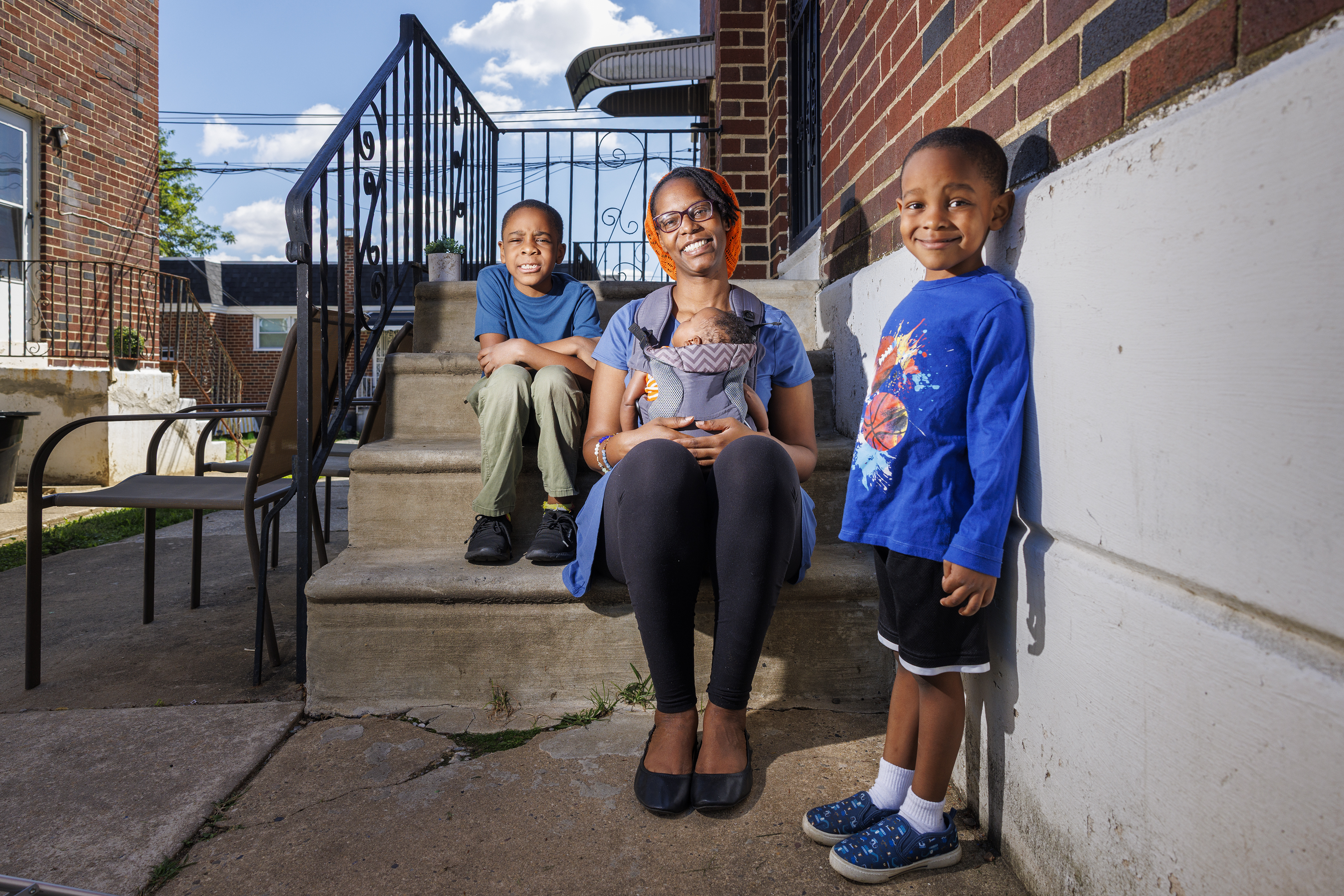
Kim Sephes with children (from left) Darius, 8, and Solomon, 4, on the steps of their home. She is carrying 1-month-old Adam.
The deal: They offered $5,000 over the asking price of $250,000. The house attracted several offers from investors but “the sellers really wanted to sell it to a family,” said Sephes. “Our real estate agent went hard trying to convince them to sell it to us, because they did have a cash offer on the table for more than what we were going to offer.”
In the end, the Sepheses’ offer was accepted and, after a little back and forth about the inspection, they sealed the deal with a $5,000 non-refundable earnest money deposit.
The money: The couple saved $18,000 for a down payment, socking away the previous two years’ tax returns and parts of their paychecks. For three years, they put a little bit away every time they got paid.
“I was so determined,” said Sephes.
They also got a $15,000 forgivable loan through the Neighborhood Lift program, which they do not have to pay back as long as they stay in the house for 10 years.
Through their lender, Fulton Bank, they secured an additional $2,000 grant and a Federal Housing Authority (FHA) mortgage with a 5% interest rate.
The Neighborhood Lift grant “helped get us in the home,” Sephes said. Without it, they “would’ve qualified for something way less.”
The move: The Sepheses closed on Sept. 26 and started moving right away.
To ensure they had enough time to move, they paid October rent. However, they were officially out of the house within the first week, so the church gave them the full month’s rent back. “I really appreciated that because they didn’t have to do that,” Sephes said.
Any reservations? The only issue with the house is that “it’s a little small,” Sephes said. But the garage has extra space for storage.
More than anything, Sephes is grateful they were able to move.
“We were ready to leave the church house,” she said.
Life after close: Sephes says the best thing about their new home is the neighborhood.
“It’s a beautiful block, very quiet, and it’s wide, too, so we don’t have to worry about traffic.”
And we’re back with another Very Philly Question. I asked back two Philly natives for their take on the forever-Philly issue.
.inno-chat__body {
border-radius: 12px;
}
Evan Weiss
Deputy Features Editor
The question is: Can I move the cones my neighbor places to save his parking spot?
Tommy Rowan
Programming Editor
You absolutely can and should.
Sam Ruland
Features Planning and Coverage Editor
10000%
Sam Ruland
You don’t own the street — it’s public parking! If you want guaranteed parking, get a driveway.
Tommy Rowan
Now, if you shoveled out a spot for your car and put work into it, I'm OK with you claiming that spot for that snow day.
Tommy Rowan
But never should someone ever save a spot with a cone, folding chair, bucket, nada.
Sam Ruland
Exactly, if it’s mid-blizzard and you just spent two hours digging out your car, fine, take a victory lap. But by the next morning when everything's melted away, cones are getting tossed.
Tommy Rowan
And for extra credit, you could also return said cone to the Water Department, which most likely owned the cone first before this concerned party stole them.
Sam Ruland
But in all reality, I hate the whole saving-spots-with-cones thing. It’s entitled — that’s not your spot, it’s A SPOT.
Tommy Rowan
Amen
Evan Weiss
In the moment you're removing that cone, are you at all nervous that the neighbor will see you?
Sam Ruland
Yeah, you feel a little nervous. That's why you move it like it's a lit bomb. Quick hands, no eye contact, and sprint to the car.
Tommy Rowan
Also, I'm a big fan of the "others see it, too," approach. Your other neighbors on your block already know who the conehead is.
Tommy Rowan
Safety in numbers.
Sam Ruland
Half the block’s in silent agreement every time someone finally moves it.
Tommy Rowan
Yup!
Sam Ruland
I’m not circling the block three times when there’s an open spot right there. Cone or not, I’m parking.
Tommy Rowan
I came here to chew gum and park. The cone is in the way, and I'm all out of chewing gum.
Evan Weiss
What do you do if your neighbor comes out mid-cone removal?
Sam Ruland
You commit. You’re already in too deep. Smile, wave, and park like you belong there.
Tommy Rowan
Tell them you're reclaiming the property of the Philadelphia Water Department.
Sam Ruland
Or pickup your cellphone and pretend to be on the phone.
Tommy Rowan
Or, if you're really in the mood, give 'em a smile and say, "Thanks for saving it for me!"
Sam Ruland
Bonus points if you follow it up with, “Go Birds!” while stepping out of the car.
Tommy Rowan
Yeah! And look, nobody likes circling blocks. But suck it up, find an ACME or a shopping center and park there for the night and move it in the morning before the tow trucks come. Like the rest of us!
Tommy Rowan
And for God's sake leave the Water Department alone!
This conversation has been edited for length.
What other Very Philly Questions should we address?
The advent of spooky season brings endless options for driving-distance getaways packed with U-pick orchards, twisting corn mazes, and high-tech haunts. But only Sleepy Hollow, at the gateway to New York’s Hudson Valley, has a reputation so perfectly tied to the macabre.
As the setting for Washington Irving’s The Legend of Sleepy Hollow, the town and its neighboring villages blend American history, small-town autumn charm, and an enduring flair for the supernatural. It’s about a two and a half hour drive from Philly — or take Amtrak to Penn Station, get to Grand Central, and hop on Metro-North’s Hudson Line.
Once you’ve arrived, the mix of colonial history, Halloween pageantry, and riverfront beauty makes it easy to fall under Sleepy Hollow’s spell.
If you’re making a weekend of it, check into Tarrytown House Estate, a historic retreat on a hill above Sunnyside. The estate is home to Goosefeather, chef Dale Talde’s acclaimed Cantonese-inspired restaurant, and combines classic mansions with modern touches — think terraces, firepits, and lounges. It’s one of the few local hotels that’s both stylish and (relatively) affordable. During fall, the property leans into the season with festive touches like pumpkin displays and glowing jack-o’-lanterns scattered across the grounds. It’s an ideal base for exploring Sleepy Hollow’s haunted happenings — close to the action, but tucked away once the lanterns dim.
However you choose to travel, make a morning pit stop at Irvington Station. Grab a matcha latte or flat white from the Australian-accented Ludy Café, and a sage-scented apple-cheddar scone from Red Barn Bakery, walking distance from one another right along the train tracks.
📍 Ludy Café, 7 N. Astor St., Irvington, N.Y. 10533
📍 Red Barn Bakery, 4 S. Astor St., Irvington, N.Y. 10533
Learn: Blue Hill at Stone Barns
Continuing north, head into the woods of Tarrytown to chef Dan Barber’s famous Blue Hill at Stone Barns for a guided Explore Tour of their elysian farm and agricultural center. Take a spin through the market, admiring the hand-thrown ceramics and exquisite preserves, and stay for lunch at the cafeteria. Reservations required.
After arriving in Sleepy Hollow proper, ease into the spookiness at Sleepy Hollow Cemetery, where the one-hour guided tour (in full daylight) leans more history than horror. Not only is the cemetery beautiful, it’s also a great context-setter for the region, providing all the background on its most famous storyteller, Washington Irving, who rests here among other notable figures.
📍 540 N. Broadway, Sleepy Hollow, N.Y. 10591
Solve: The Headless Horseman Files
At the Headless Horseman Files, collect clues from costumed townspeople to unravel what really happened to Ichabod Crane. This live theater-meets-interactive whodunit at Philipsburg Manor is part mystery, part museum experience — and yes, you can exit through the gift shop for a Horseman snow globe.
Bask in the flickering glow of candles and Gothic drama at the Lyndhurst After Dark, the spooky (but not scary) experience at the Lyndhurst Mansion. Guests walk through the riverfront estate, decked in its Halloween best, and encounter live actors in period dress, who share unnerving tales of the mansion’s history.
Pot stickers plumped with dry-aged beef, char siu Berkshire pork belly, and blueberry cheesecake mochi waffles grace the menu at Goosefeather. The free-spirited Cantonese-ish joint comes from Dale Talde, known for his appearances on Top Chef.
On the way back to the office from an assignment about pet bakeries, my colleague and I stumbled upon a true ice cream lover’s paradise: a rare brick-and-mortar Mister Softee.
While the trucks and their iconic jingles are a dime a dozen in the summertime, a free-standing Mister Softee is about as common as two Philly sports teams winning on the same night. (Too soon?) This one is cash only and open year-round, with a menu that spans ice cream swirls and floats to milkshakes and chocolate-covered bananas. My cup of strawberry and banana soft serve was thick, silky smooth, and anything but artificial-tasting. The roadside stand also gets bonus points for on-season sprinkles. It really is about the little things. Mister Softee of Pennsauken, 3605 Haddonfield Rd., Pennsauken, N.J., 856-662-3787, Facebook page
— Beatrice Forman
Francobolli at Fiorella
On a recent girls’ night out, my friends and I sat at the bar and took it upon ourselves to try four plates of pasta from Fiorella. A noble task, I know! There were no misses, and the current agnolotti dish — stuffed with a sweet polenta and topped with chanterelles — was exceptional.
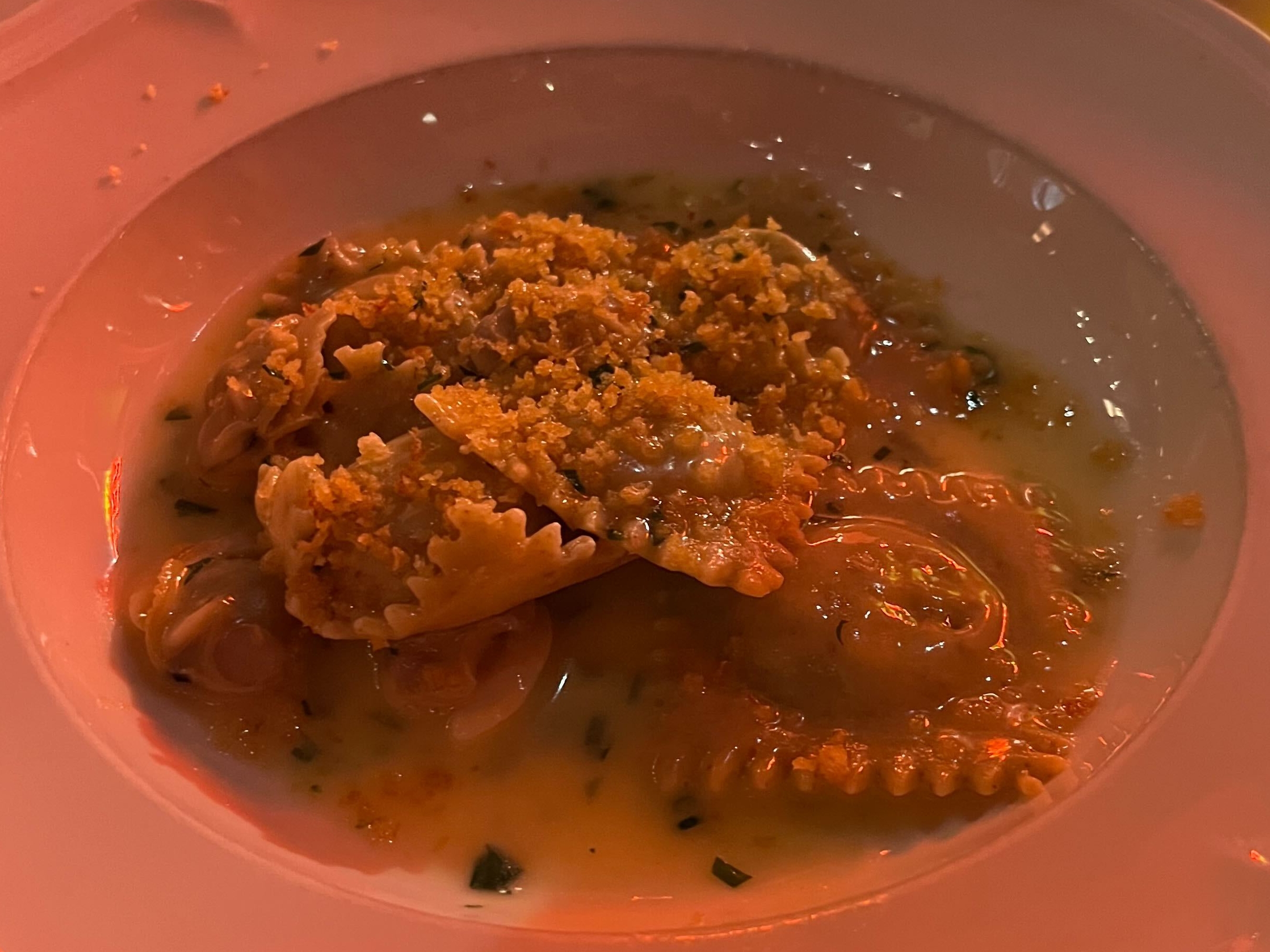
But the dish that lives rent free in my head nearly a week later is the Francobolli clam pasta. We almost didn’t order it, but the bartender insisted; a man has never been more right on a girls’ night out. A pasta-fied take on vongole su crostini aka clam toast, the postage stamp-shaped pasta was stuffed with breadcrumbs and served in a white, brothy sauce topped with littleneck clams. It’s worth seeking out. Fiorella, 817 Christian St., 215-305-9222, fiorellaphilly.com
— Emily Bloch
The Francobolli at Fiorella, a pasta-fied version of clam toast.
Gourmet lamb sampler (for two!) at Zorba’s Taverna
I don’t need a fancy restaurant for my birthday. I prefer the comfort of a neighborhood favorite, and few are as wonderfully reliable as Zorba’s, the 28-year-old taverna that is one of Fairmount’s cornerstone restaurants. To begin with, a flaming platter of ouzo-splashed saganaki cheese beats a birthday candle every time. But Zorba’s also delivers a wide array of some of the most consistent traditional Greek cooking in the region, and the “gourmet” lamb platter for two is a true celebratory feast. (This is not to be confused with the also-delicious charcoal-grilled platter for two, which includes some fantastic lamb chops.)
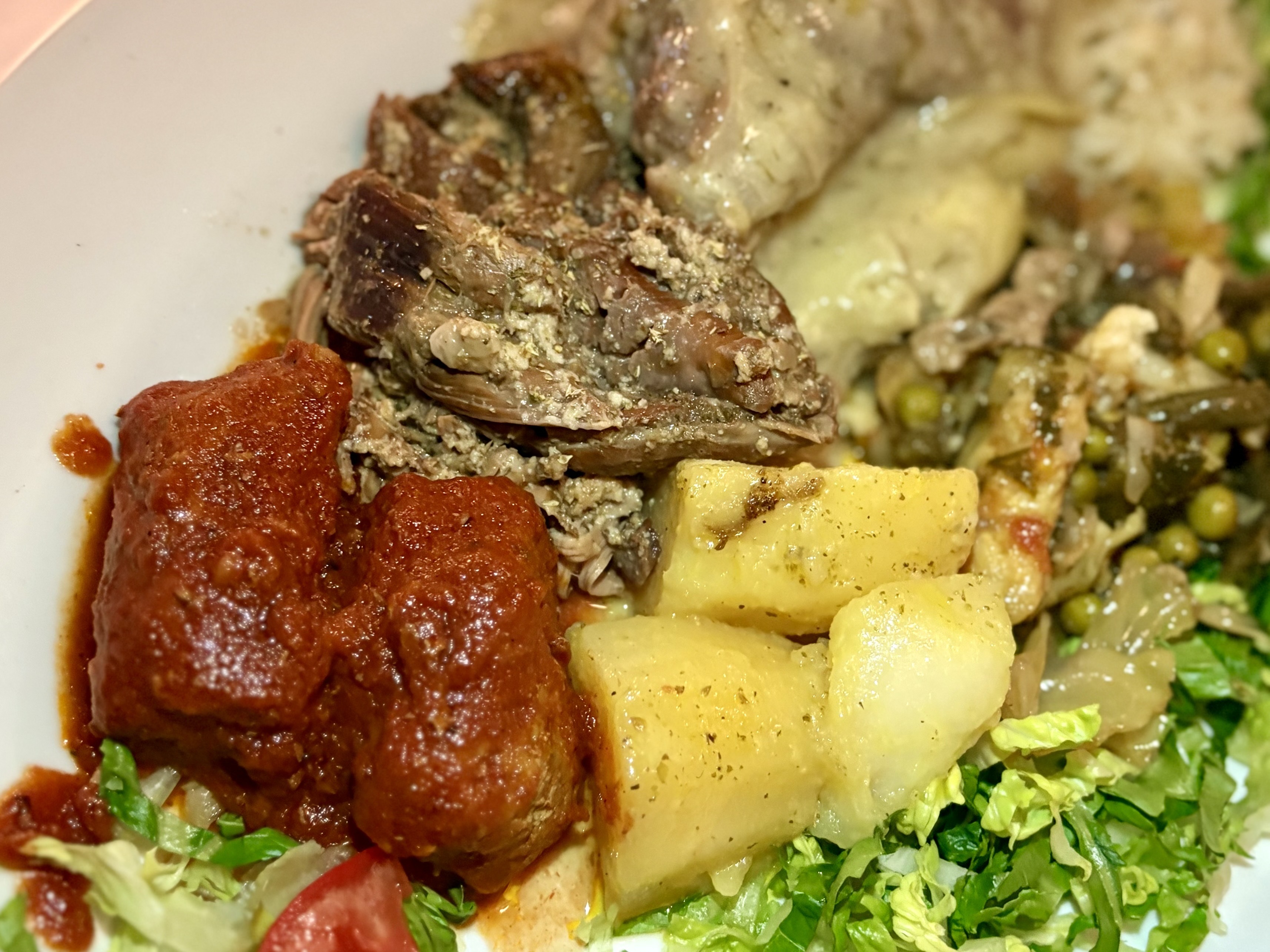
The platter I chose is a tribute to the slow-cooked pleasures of lamb in three different styles: slices of tender roasted leg seasoned with garlic and herbs, Smyrna-style meatballs simmered in a cumin-scented red wine and tomato sauce, and finally, a meltingly soft mallet of lamb shank glazed in a lemony white avgolemono sauce with artichokes (a distinctive dish I sometimes order solo). This is rustic home cooking at its best, with deep flavors prioritized over fancy presentation. The platter’s aroma is entrancing, and, the tangy potatoes and mixed well-cooked veggies on the side make it extra hearty. My fork wouldn’t stop roaming until I savored every bit. Zorba’s Taverna, 2230 Fairmount Ave., 215-978-5990, zorbastavern.com
— Craig LaBan
The gourmet lamb platter for two at Zorba’s in Fairmount includes Smyrna-style meatballs, roasted leg, and a lamb shank in avgolemono sauce with artichokes.
Fried skate cheeks at My Loup
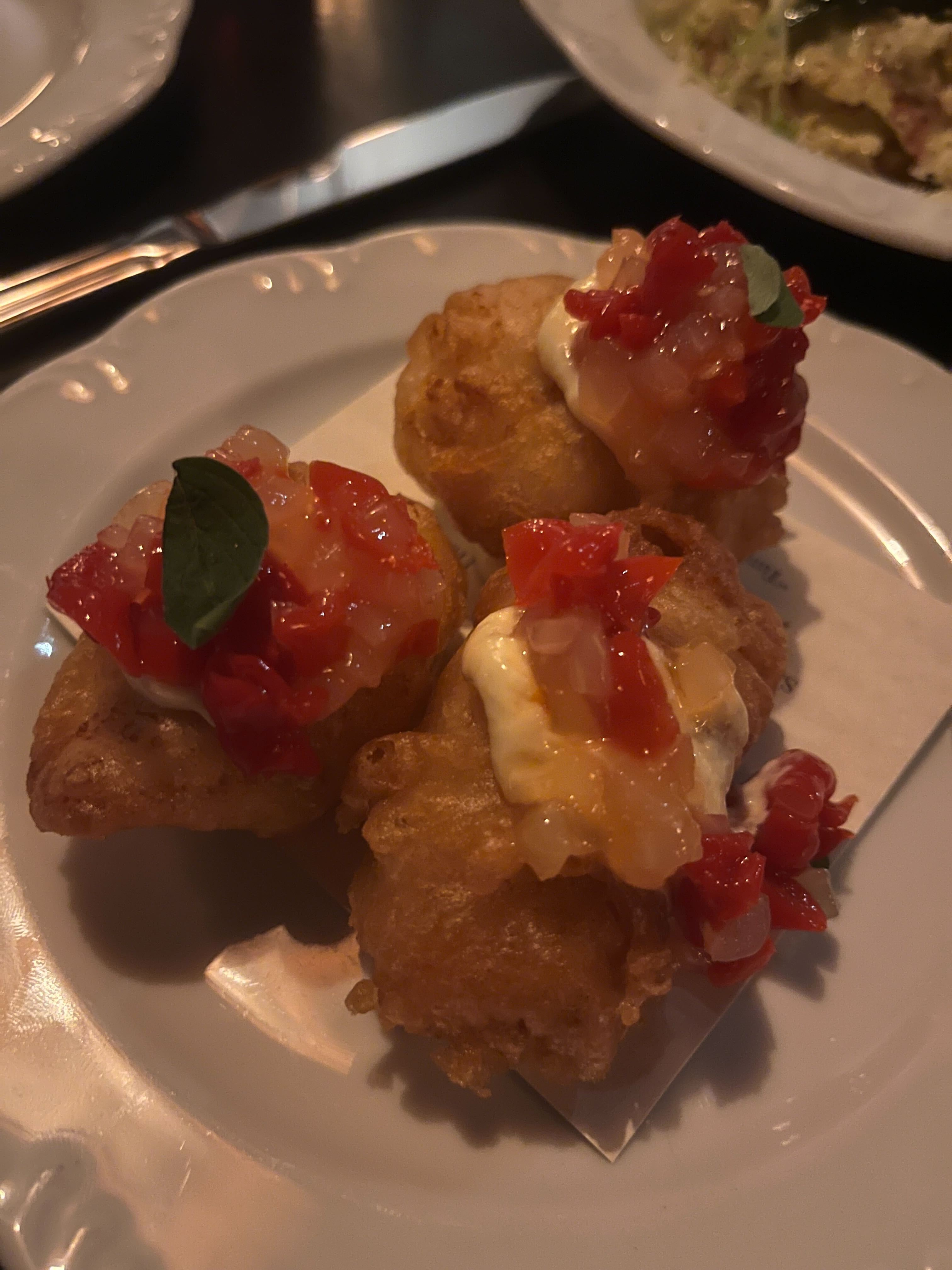
Bacalao who? My Loup’s fried skate cheeks are an elevated take on cozy fish fritters. The crispy fried batter works perfectly with the sweet, tender, puffed-up fish meat. The three balls are finished off with ají dulce peppers and a subtle horseradish sauce. My Loup, 2005 Walnut St.,(267) 239-5925, myloupphl.com
— Emily Bloch
Fried skate cheeks from My Loup in Rittenhouse Square.
Smash burger at American Sardine Bar
When I moved into my new apartment, my first priority was clear: Scout the neighborhood for my bar— a place where I will eventually be on a first-name basis with the bartenders. American Sardine Bar is well on its way to being that place. I’ve been four times since moving.
My first meal was top-notch: a Caesar salad with a side of French fries and a martini. A stellar way to begin this journey. This week, however, I sank my teeth into one of the best burgers I’ve had. American Sardine Bar’s smash burger (the best kind of burger, in my opinion) is a perfectly cooked beef patty nestled between pickled shallots, pickle slices, a 10K sauce, and a butter-toasted brioche bun. I’m not on a first-name basis yet, but I will go back and order as many smash burgers as I need to to make my dream a reality. American Sardine Bar, 1800 Federal St., 215-334-2337, americansardinebar.com
For more than quarter century, Greta Greenberger ended her tours of Philadelphia City Hall at the tower, just below the bronze buckled shoes of William Penn (1892), the shady colossus that Alexander Milne Calder sculpted.
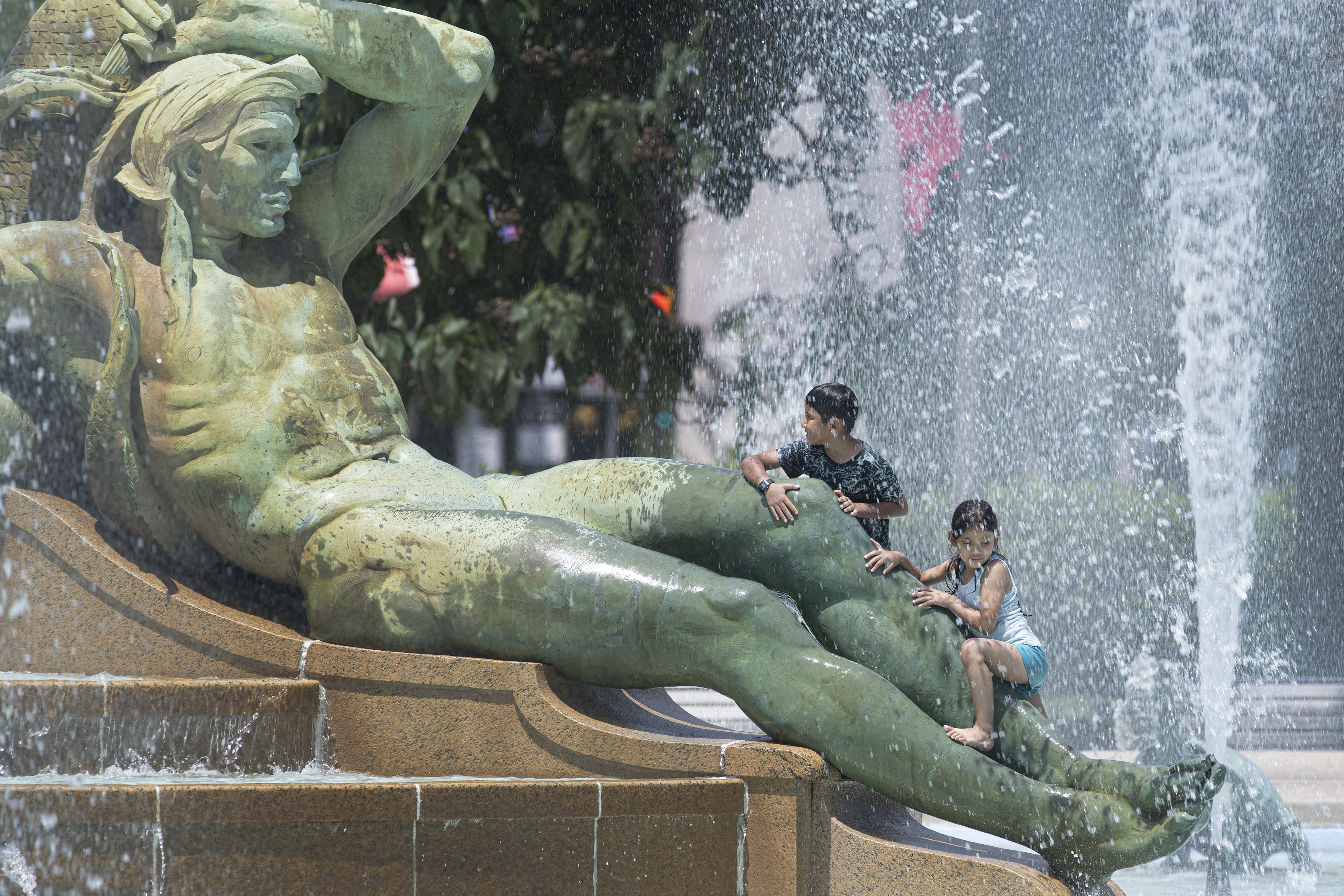
From there, she’d point up the Parkway to Logan Square, where on hot days children sneak into The Fountain of Three Rivers (1924), created by Calder’s son, Alexander Stirling Calder, to honor the Schuylkill, the Delaware, and the Wissahickon.
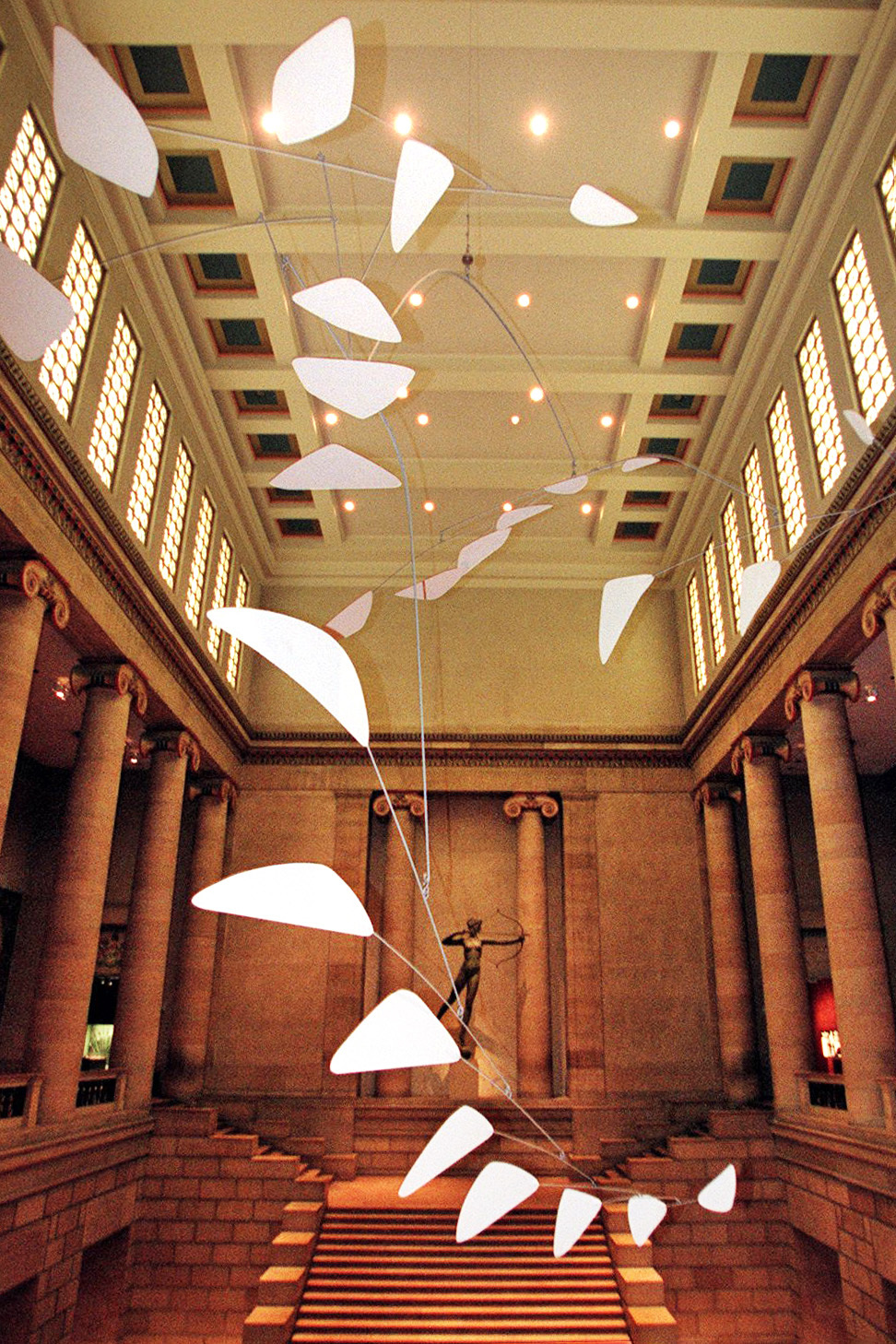
She’d finish her lesson at the Philadelphia Art Museum, where an unearthly, white mobile, Ghost (1964), designed by the third generation of Alexander Calders, Sandy, sways ever so slightly in the Great Stair Hall.
“Sometimes, I’d refer to this as ‘The Father, the Son and the Holy Ghost,’” she says. “It tells such a wonderful story.”
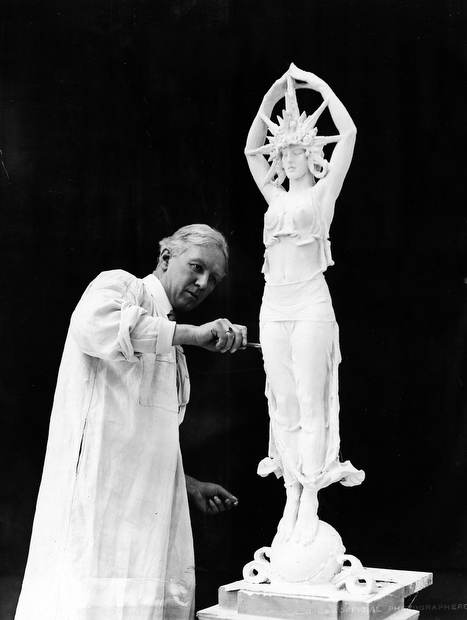
That story will be easier to tell now, with the opening of Calder Gardens at 21st Street and the Ben Franklin Parkway. The Gardens, focused on the work of the youngest Calder, known asSandy, brings another opportunity to celebrate the family dynasty’s in Philadelphia: three sculptors named Alexander Calder who have shaped the look of the city and beyond.
Exterior of the new Calder Gardens on the Ben Franklin Parkway.
“The Calder family is incredibly important to Philadelphia,” said Anna O. Marley, the former chief curator at the Pennsylvania Academy of Fine Arts (PAFA), where so many Calders studied. “They tell us so much about what it means to be an artist in the United States and how an American artistic identify was created in Philadelphia.”
And their work here offers “a pocket history of art,” in the view of Kathleen A. Foster, the Art Museum’s senior curator of American art.
“Between the three of them, you really go from the academic realism of the grandfather through kind of shift into Art Deco and modernism in the `20s with Stirling Calder, and then all the way into modern forms, completely abstract shapes and bright colors.”
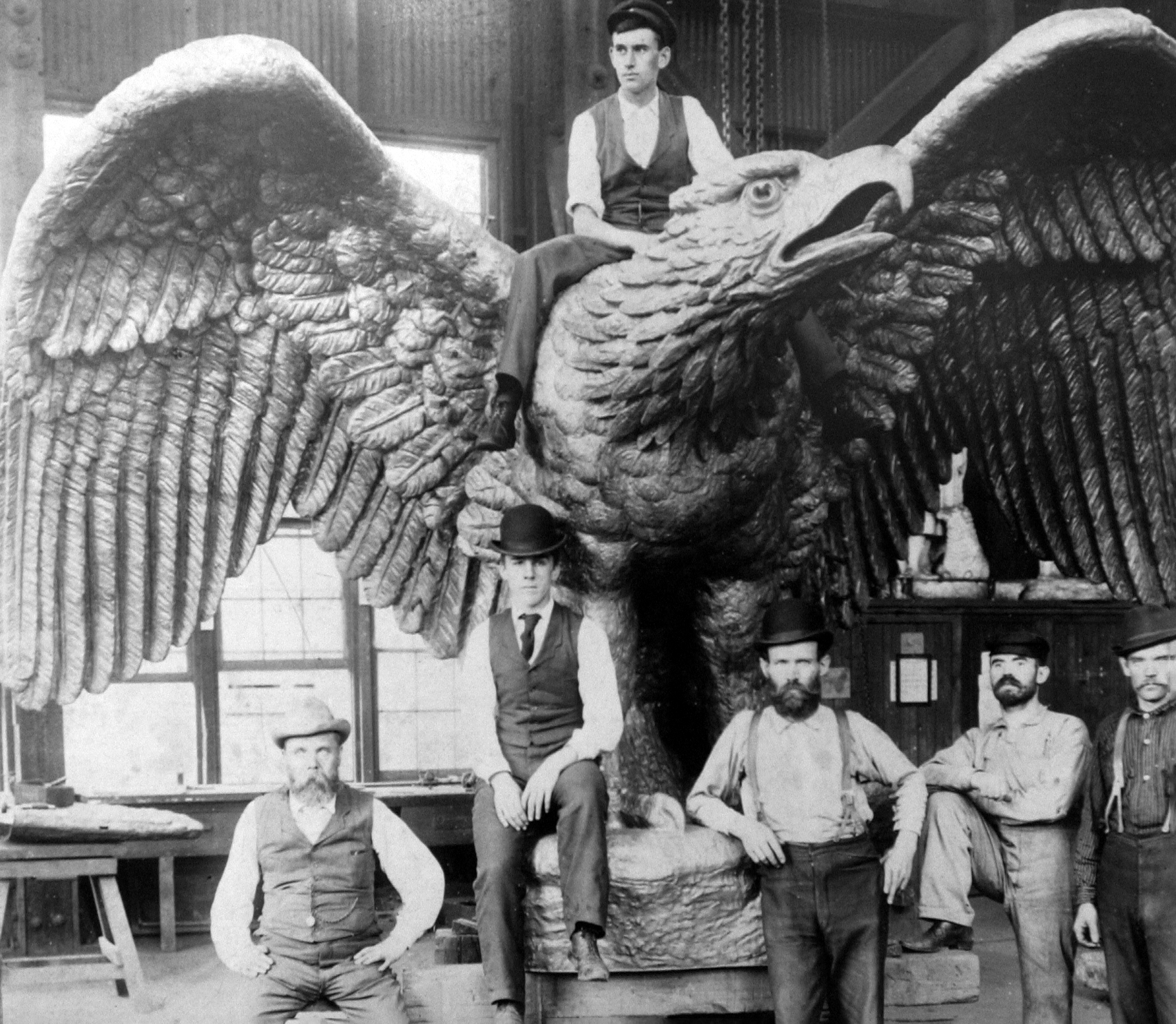
A photograph of workers and an Alexander Milne Calder eagle sculpture before installation around 1894, on display in the tower at City Hall. Calder created the statue of William Penn atop Philadelphia City Hall — and over 250 other works of sculpture on the exterior and interior of the building — from 1871-1901.
‘One of the greatest’
The Philadelphia that Alexander Milne Calder, a Scottish stonecutter’s son from Aberdeen, first saw in 1868 was sorely in need of a makeover. The sprawling metropolis was known for building big things like ships and rail engines and a wealth of small manufacturers that earned it the nickname “Workshop of the World.”
It was also filthy.
“It’s clear that there is no future for a city that is just increasingly based on its industrial might, on the dirt-producing, noise-producing, the squalor,“ says David Brownlee, emeritus professor of the history of art at the University of Pennsylvania.
The boundaries of Fairmount Park had just been established the year before and plans would soon begin for a giant celebration of the country’s 100th birthday, the 1876 Centennial, which would show the world the city’s cultural achievements. The Benjamin Franklin Parkway was unfolding, a broad boulevard lined by art and leading to what Brownlee calls “one of the greatest monumental ensembles of sculpture ever created.”
That would be City Hall, the émigré Calder’s workplace for 22 years as he presided over the creation of more than 250 sculptures from his first floor office in the building’s southwest corner — and the towering figure of the colony’s founder.
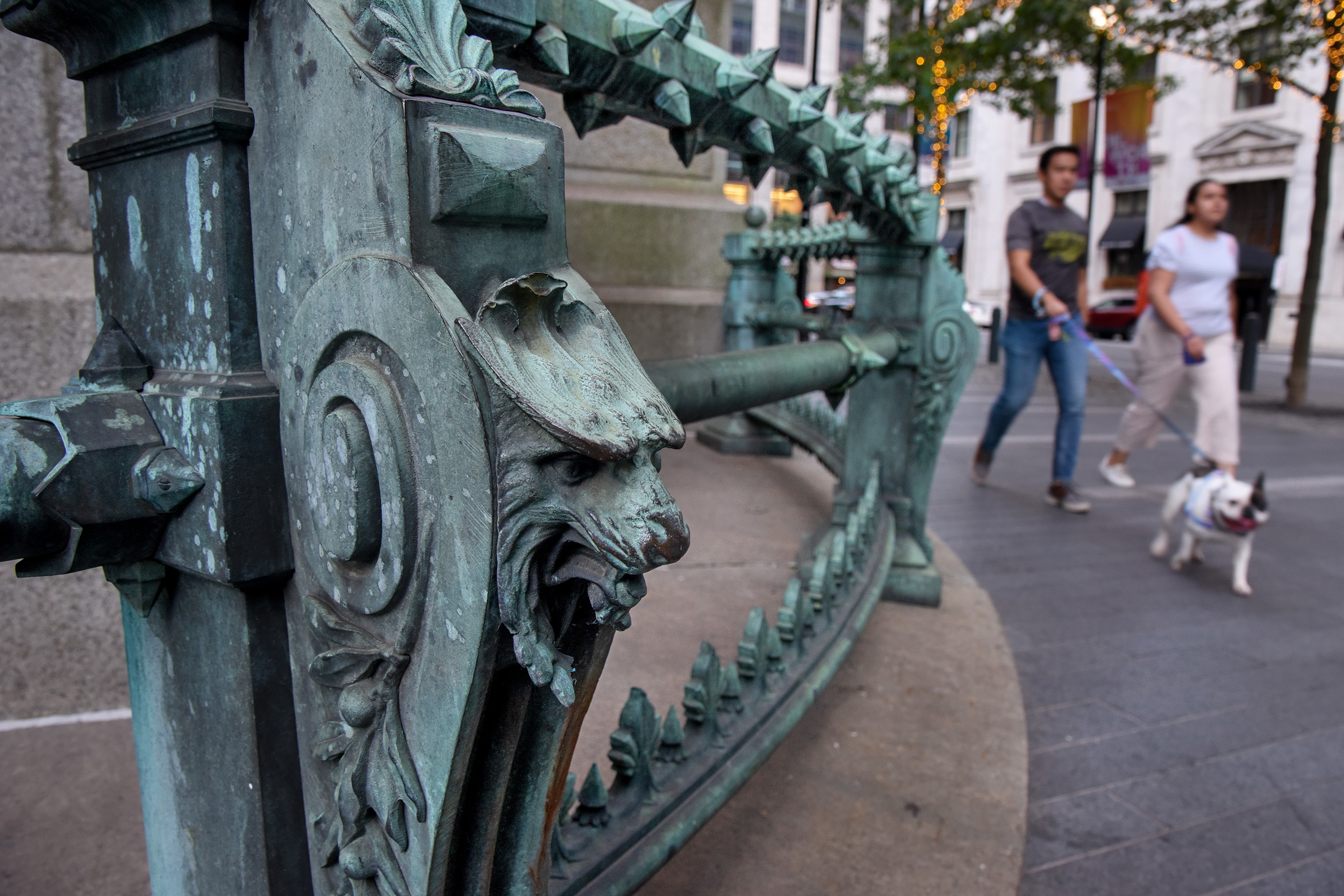
There were once almost 150 small lion heads on the ornate bronze spiked railing that surrounds City Hall. They, like most of the statuary on the building — including the big one of William Penn — were designed by Alexander Milne Calder. Less than two dozen of the lions remain after 100 years.
Calder had worked at the Royal Academy in Edinburgh and on the Albert Memorial in London before sailing to America. He stopped in New York, but chose Philadelphia, armed with a letter of introduction to the city’s most eminent sculptor, Joseph A. Bailly, and to the scion of a monument business, William Struthers. Calder was 22.
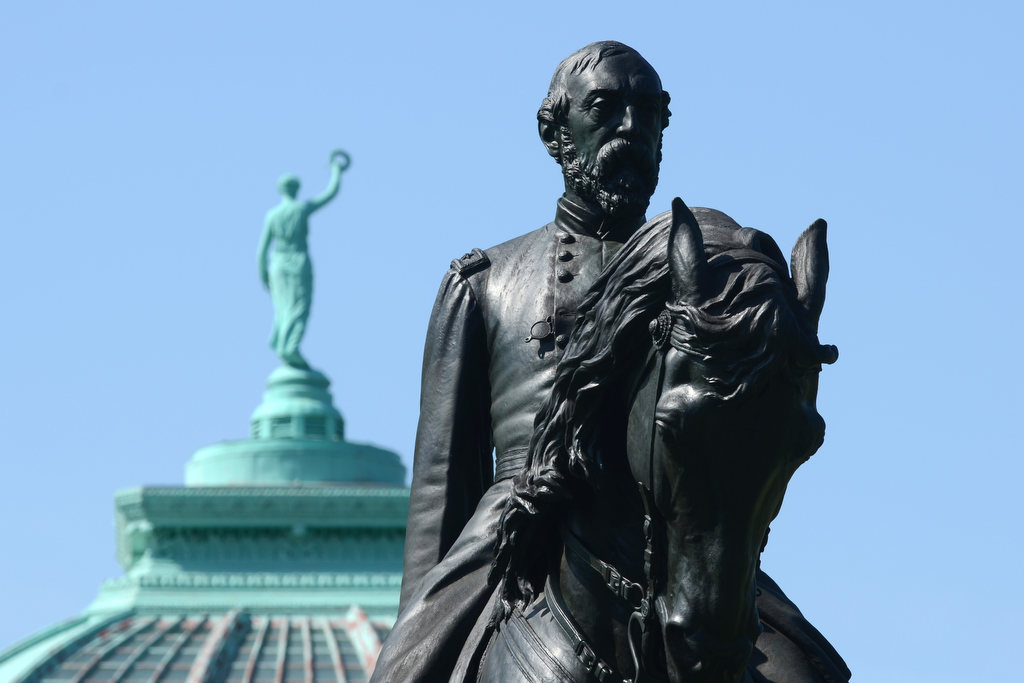
He registered that year at Pennsylvania Academy of the Fine Arts, the nation’s first art school and museum, and studied “antiques,” drawing from plaster casts of classic sculptures. It was not long before Calder won a prized commission over one of his instructors, to sculpt the likeness of Major Gen. George G. Meade atop his horse, Baldy. Meade, who’d defeated Robert E. Lee at Gettysburg, later designed many of the paths and drives of Fairmount Park. His statue stands now behind the Please Touch Museum on Lansdowne Drive.
Alexander Milne Calder’s Meade Equestrian Monument in the rear of Memorial Hall. It was cast using captured Confederate cannon for the bronze. Calder rendered Gen. Meade reining in his horse at a moment of crisis during battle.
When Greenberger gives tours of City Hall — though retired, she still volunteers one day a week — she likes to start in the north portico, where one can sample his expansive vision. Look up to the south, and there are Africans, surrounded by tobacco leaves, a lion. To the east, people from China, Japan, India, and an Asian elephant. West are the Native Americans and pioneers, and a bear. And north is Europe, people from Germany, England, France, maple leaves, and cattle. (She isn’t sure why cattle.)
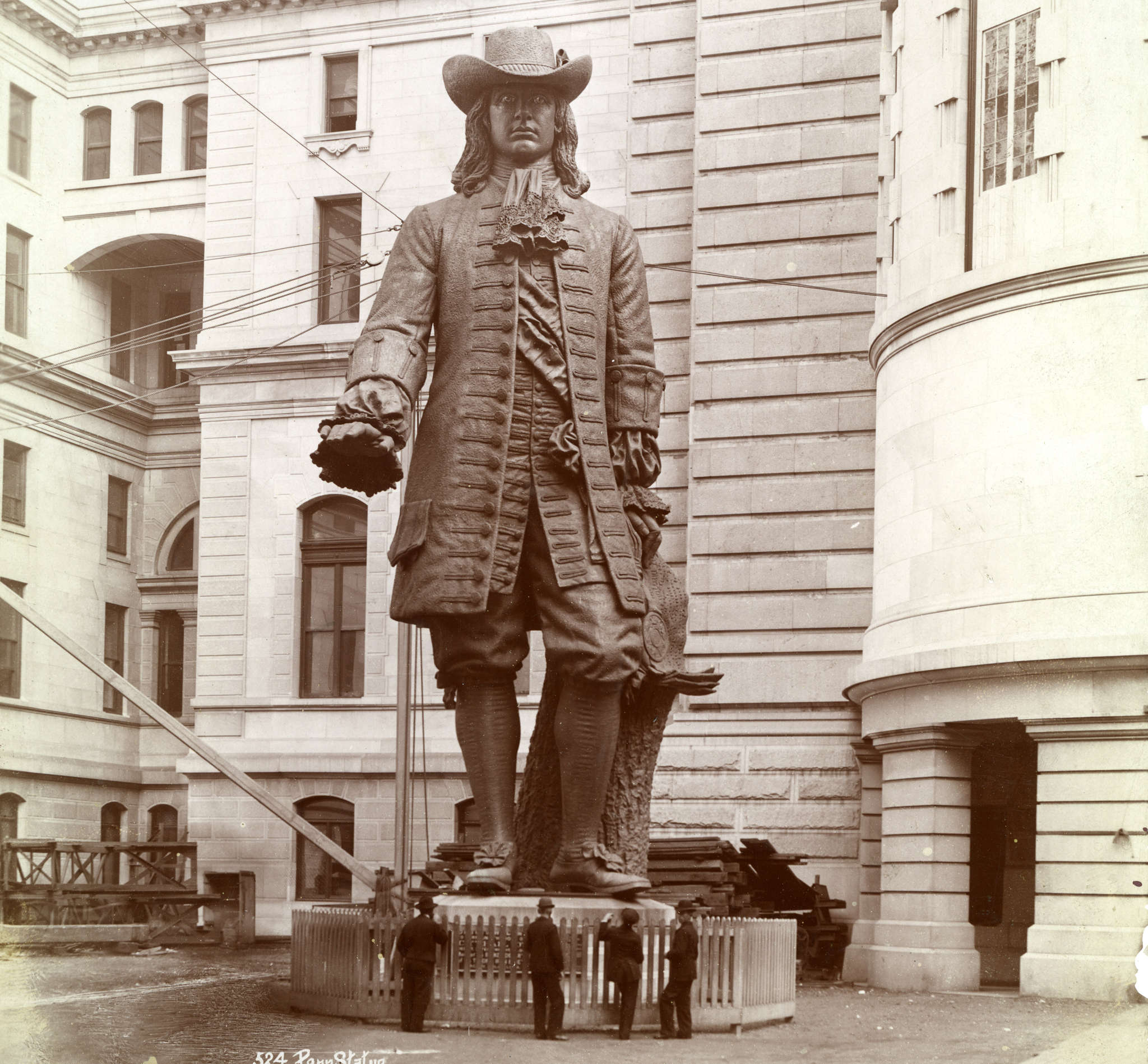
Calder started on the Penn sculpture in 1886. The iconic figure, now visible from miles away, was the fourth version of the colony’s founder that the sculptor created. Calder’s models were one-tenth the size of the 37-foot high statue. His goal, according to an article at the time in The Inquirer, was to create “William Penn as he is known to Philadelphians; not a theoretical one or a fine English gentleman.”
The William Penn statue on display in the City Hall courtyard in 1893, the year before it was hoisted, bit by bit, to the top.
Four teams of horses drew massive plaster sections of the statue up Broad Street to the Tacony Iron & Metal Works. It wasn’t until Thanksgiving 1894 that the head was lifted onto the statue atop the tower, completing Calder’s colossus.
He was not happy with the result.
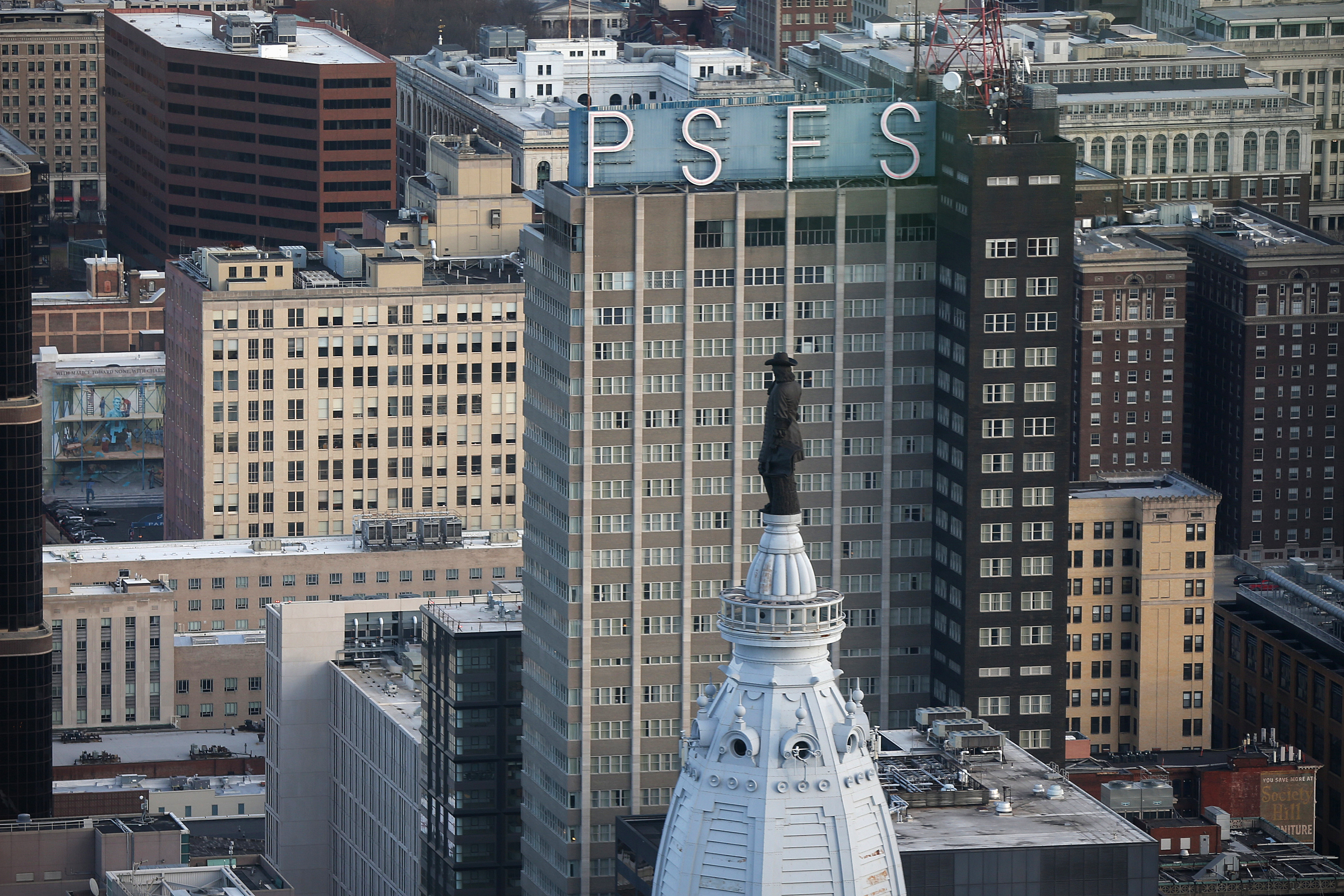
For most of the day, William Penn’s face is shadowed. That was not the artist’s intent. Calder had wanted Penn facing south, where the sun would light his youthful face and the intricate detail of his garb would be visible for all to admire.
But members of the Public Buildings Commission wanted Penn facing northeast, toward Penn Treaty Park, the site of the 1683 peace agreement with the Lenni-Lenape.
In a letter quoted in the Dec. 14, 1894 Inquirer, Calder wrote “I think that you will agree that is very disappointing from every point of view.”
Calder’s William Penn statue atop City Hall as seen from the Comcast Technology Center in Center City.
While Calder lived in a number of homes around the city — a home at 2020 Bainbridge St. and a studio at 337 Broad — when he registered at PAFA, the address listed was 1903 N. Park Ave., now on Temple’s campus. Decades later, his granddaughter, Margaret Calder Hayes, would remember the North Philadelphia house as “gloomy” — four floors with Empire furniture, a long dark hallway leading to a parlor where children were not welcome unaccompanied.
Calder had met his wife, Margaret Stirling, soon after his arrival in Philadelphia and married her after a brief courtship.
Three of their sons would study at PAFA and become artists — Ralph Milne Calder, and Norman Day Calder, and Alexander Stirling Calder. But it was “Stirling,” the eldest who left the biggest mark on Philadelphia.
A portrait of A. Stirling Calder.
‘An idealist, somewhat withdrawn’
In a remembrance kept in the PAFA archives, Alexander Stirling Calder describes art as a fallback. Ever since he was 6 and saw the great Edwin Booth play Hamlet, Stirling Calder wanted to be an actor. But he was too shy. In 1885, he enrolled in art classes at the academy’s new building at Broad and Cherry, and years later recalled the first criticism of his teacher, the artist Thomas Eakins: “Attack all of your difficulties at once.” Eakins urged sculptors to paint, painters to sculpt, and to dissect cadavers to learn anatomy.
After studying at the École des Beaux-Arts in Paris, he returned home and won a commission to immortalize Samuel Gross with a statue that first stood on the National Mall in Washington, D.C. (It’s since been moved to the Center City campus of Thomas Jefferson University). At 25, he married a fellow PAFA student, Nanette Lederer, a painter.
To the critic Malcolm Cowley, Stirling Calder was “an idealist, somewhat withdrawn, wholly impractical, creating symbolic figures while brooding on the cruelty of nature.”
Foster says that looking at the allegorical figures in Logan Square’s Swann Fountain, you can see how Stirling inherited his father’s traditions.
Children cool off at the Swann Memorial Fountain in 2023.
“But the figures have a kind of sleek, modern simplicity to them,” she said. “They’re more stylized. So by the 1920s the Swann Fountain represents a kind of moving from the academic past into a more expressive and abstract style.”
The fence came off the Swann Fountain on a hot July day in 1924. The next evening, 10,000 revelers danced to tangos from a police band. Not everyone was pleased — some wondering if the average Philadelphian would grasp the significance of all that Calder had created.
He was unbothered.
“The meaning of works of art is just as mysterious as life itself. It can be explained in many ways by people of different philosophies. …,” he was quoted in the Evening Bulletin as saying. “There are lots of things in life we do not understand; art is no exception.”
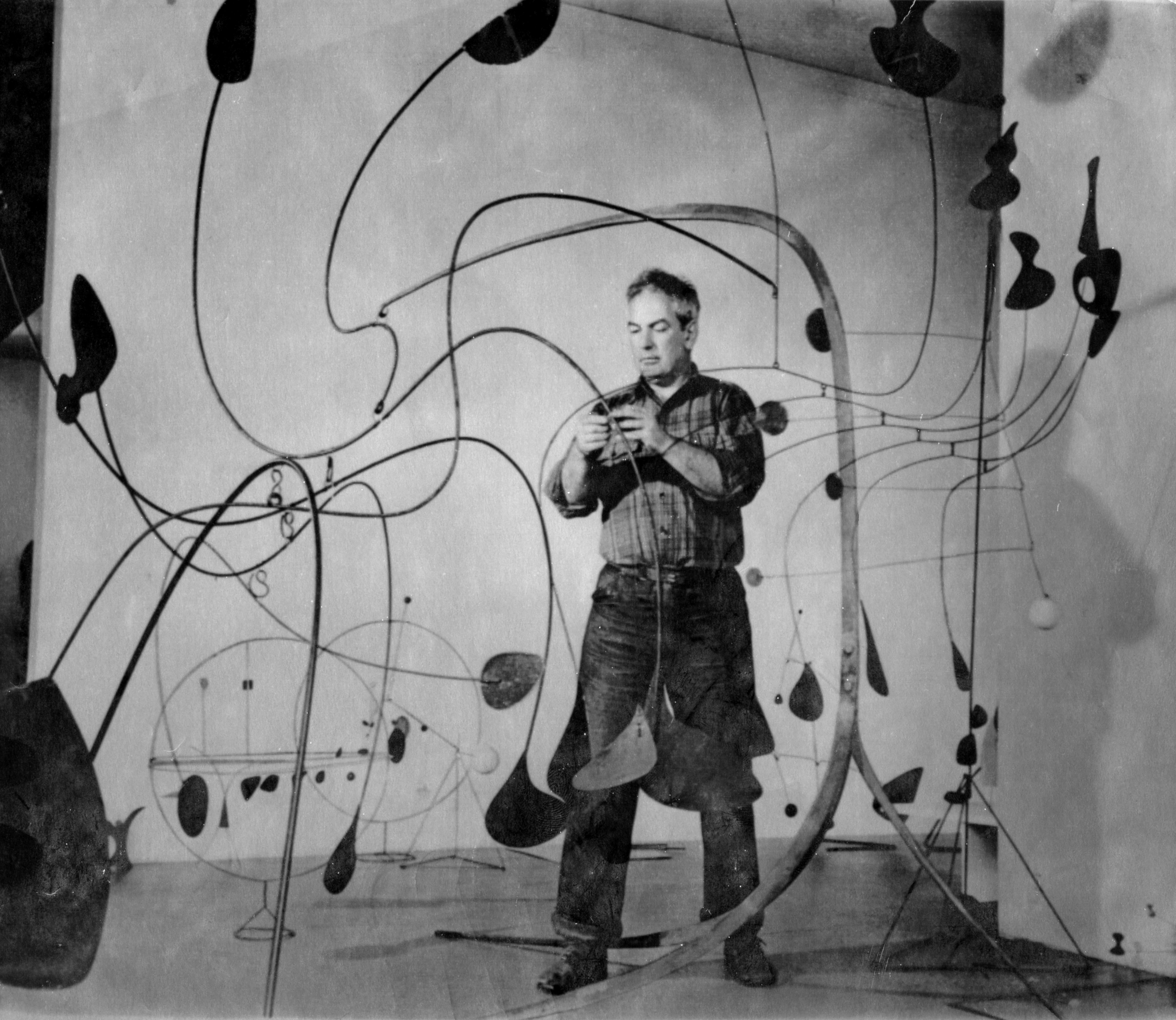
Alexander “Sandy” Calder installs his “Big Spider” mobile at New York’s Museum of Modern Art in 1943.
‘A big child’
In his autobiography, Sandy Calder included a photograph of the sprawling mansion in Philadelphia where he says he was born. He called the place Lawnton. In 1898 when Calder was born, Lawnton was a neighborhood in East Oak Lane, served by the Reading Line and lined with grand homes where the wealthy went to escape the summer heat.
It’s unlikely Calder was born there. David Brownlee has dug into the mystery of the third and most famous Calder’s birthplace. While his family doctor lived in Lawnton, and it is possible that his mother delivered her son nearby, more likely, he was born near the edge of the growing city, at 1203 East Washington Lane in Germantown. City records showed that Stirling Calder rented that country place, while the family still owned a home on North Park Avenue.
In Margaret Calder Hayes’ memoir, she described how Sandy, two years younger, went to school in Buster Brown suits his mother had sewn and by 8 had built a Noah’s Ark of animals. He enrolled in Germantown Academy, when it was still in the city, but left at age 9 before moving to Croton-on-Hudson, N.Y.
“We love to claim him, but he only went to school here as a child,” Foster said of the youngest Calder’s time in Philadelphia.
Yet in some ways, he’s the essence of the city he was born in: practical, playful, unpretentious, no pushover.
He worked as a fireman on a steamer bound for San Francisco, spent a year keeping time in a Washington state logging camp. Trained as an mechanical engineer, he moved to New York City at age 25 to paint.
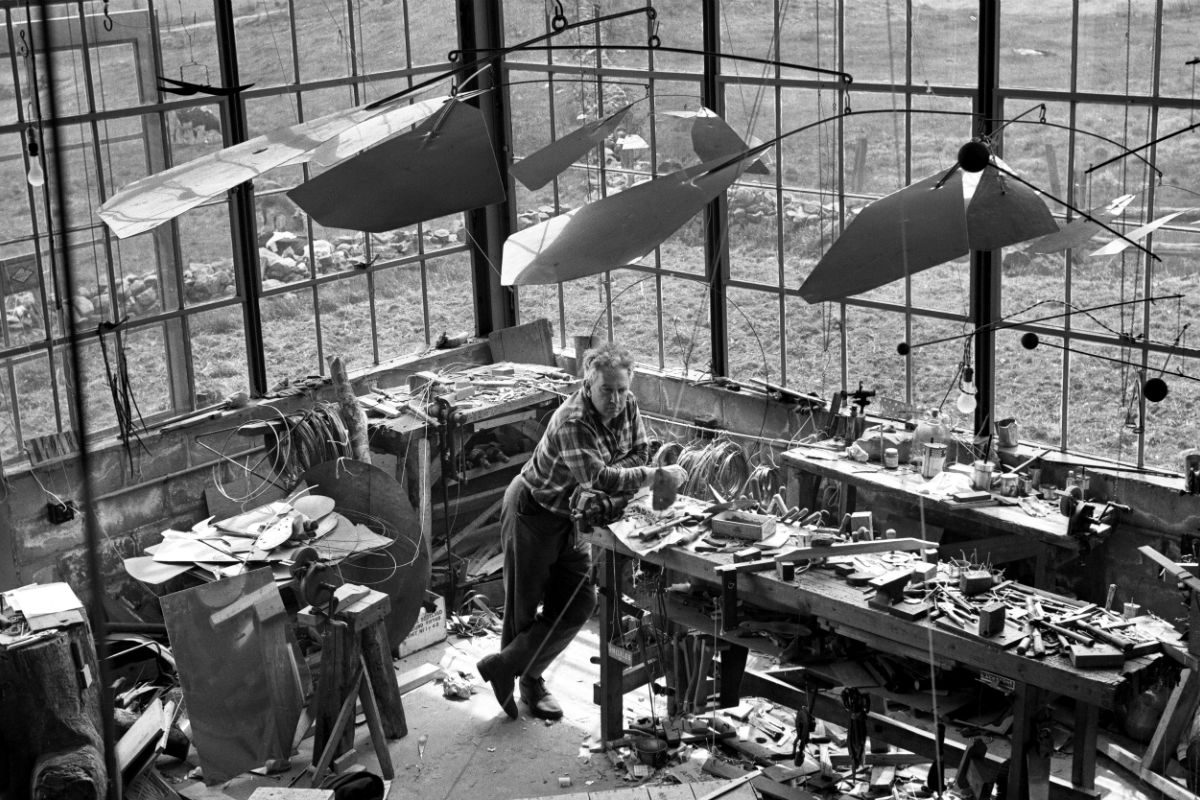
Calder with Mobile in his Roxbury, Ct., studio in 1941.
He is known as a 20th century modernist, the artist who put sculpture in motion.
After visiting Calder’s Paris studio in 1931 and marveling at his sculptures that relied on little motors, Marcel Duchamp coined the word “mobiles” for these kinetic marvels.
Parisians took to him, while they scoffed at other American artists. Cowley, in an introduction to Hayes’ Three Alexander Calders had a theory:
”Of course his work in itself, continually inventive, playful, and enchanting, was his ticket of admission.” But Sandy and his wife Louisa, “a beauty,” Cowley wrote, entertained generously and simply. Calder was in the tradition of the Noble Savage, “who disregards social conventions and judges everything by his instinctive standards.”
“A big child,” as his friend the playwright Arthur Miller once put it.
Sandy Calder created Ghost in 1964 for a retrospective at the Guggenheim in New York City, that included 400 examples of his mobiles, stabiles, toys, jewelry, carvings, tapestries, etc. The Art Museum bought the 34-foot-long showpiece a year later and brought it to the city of his birth.
Ghost, in the Great Stair Hall at the Philadelphia Museum of Art (now, Philadelphia Art Museum). It was created to hang in the center of the Guggenheim Museum in New York for Calder’s exhibition there in 1964.
“It’s a colossal example of the mobile and it’s majestic,” Foster said. “When it moves, it’s just breathtaking, because it, it almost moves like a giant dinosaur or something. In other words, it’s got long spines and fins, and it moves very slowly and grandly in the air currents in the Great Stair Hall. … It’s delightful.”
“When every baby has a mobile hanging over their crib, you don’t think about Calder as being the genesis of this. I think he would be delighted to know that … because he was such a child at heart. He managed to keep that imagination.”
Now, Philadelphia will be home to an institution that celebrates that imagination. It’s a fitting homecoming for an artist whose life and legacy was so shaped by his family, who in turn both shaped and were shaped by Philadelphia.
The weight of a name
Tú Huynh was working at the National Gallery of Art in Washington, D.C., when he told a job applicant to look for him under the giant Calder mobile that hangs in the East Building.
That was in 1997. The applicant,Kaleo Bird, landed the job — and later, his heart. Three years later they moved as a couple to Philadelphia, where she started grad school. Soon they married.
In 2008, when their son was born, they didn’t take long to decide on a first name:
Calder.
He’s now 17, a senior at Penn Charter School.
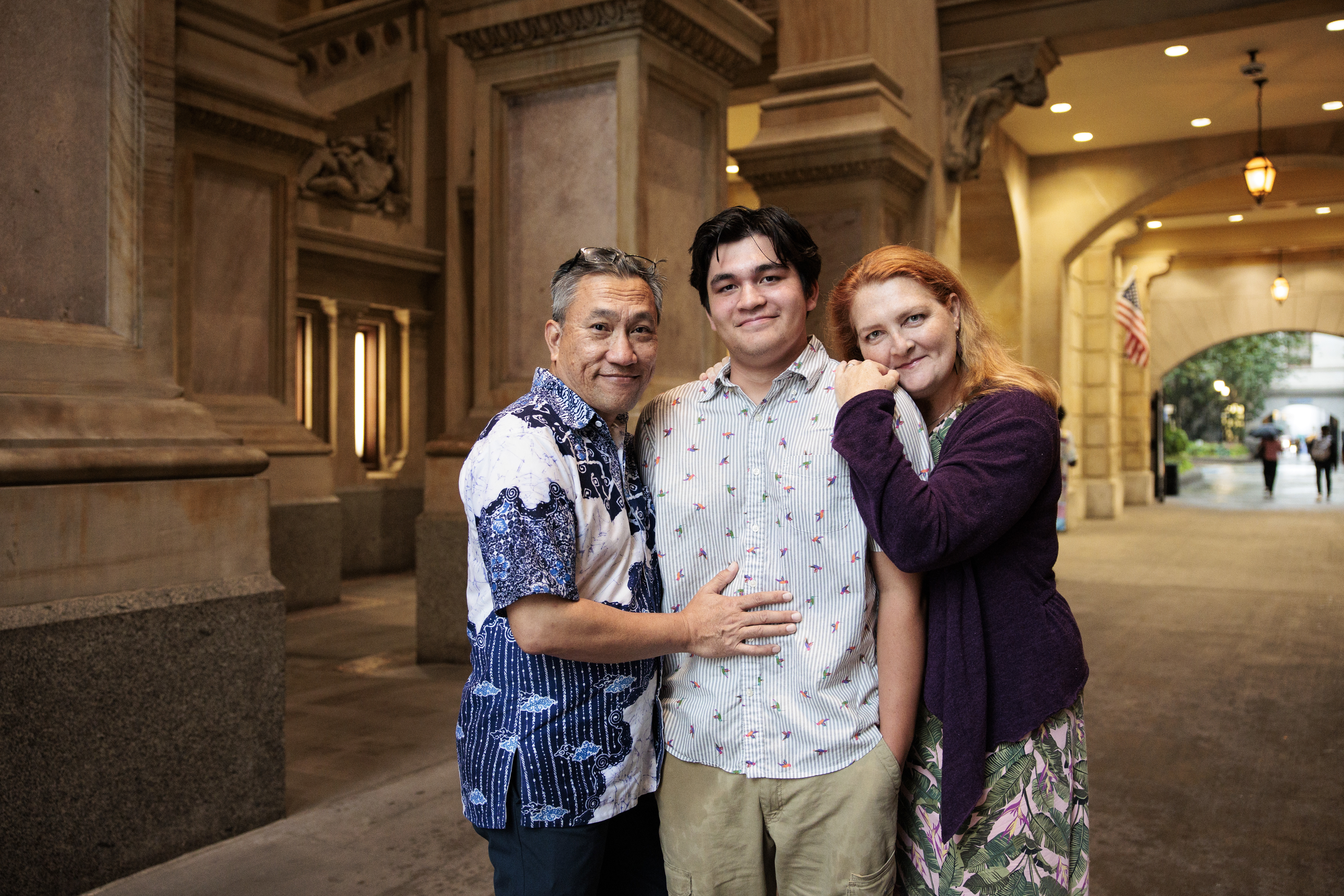
Tú Huynh, Calder Huynh, 17, and Kaleo Bird at Philadelphia City Hall where more than 250 of Alexander Milne Calder’s sculptures adorn the building, topped by his statue of William Penn.
“I have yet to meet anyone my age who knows who the whole Calder family was, which is a shame because I feel they’ve had such an impact here, particularly with City Hall,” said the teen. “So many people think Ben Franklin is atop City Hall and don’t know anything about these beautiful sculptures.”
His father now runs the Art in City Hall program.
“I tell people that the true art of City Hall belongs to Alexander Milne Calder,” says Tú Huynh. “This was his Sistine Chapel. There are over 250 sculptures, leafs, busts all over this building. And that’s an homage to his ideal of what this city, state and country is supposed to be about. And he doesn’t sugarcoat anything. There are enslaved Africans, Indigenous populations, Europeans. It tells you the folks who’ve contributed to this extraordinary country.”
Calder Huynh says he feels the weight of his name — in a way that the two generations named after Alexander Milne Calder must have felt.
He paints, draws in charcoal, creates his own comic books — exploring themes with super heroes and Westerns, always with an eye on his father’s works that line the walls of their home.
“Naming me after them is such a big thing to put on someone. For me, it is a weight that Alexander Sandy Calder must have felt. A weight to achieve and create something that differs from what his family members had created, which is kind of cool. … Put something in this world that hasn’t been done yet.”
“The Magic of Calder Gardens” is produced with support from Lisa D. Kabnick and John H. McFadden. Editorial content is created independently of the project’s donors.
To support The Inquirer’s High-Impact Journalism Fund, visit Inquirer.com/giving
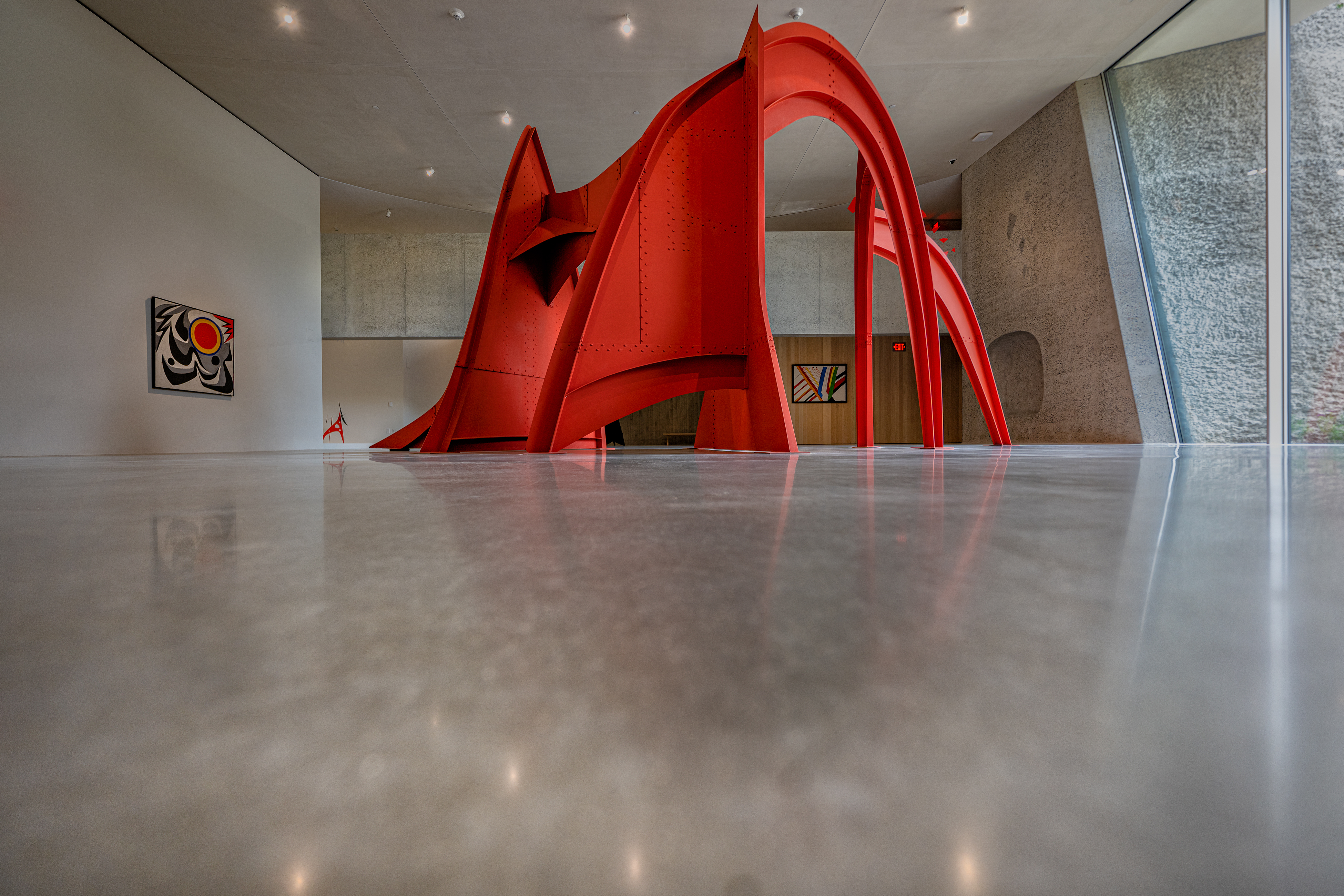
Jerusalem Stabile II, 1976 by Alexander Calder is shown on display at the Calder Museum in Philadelphia.