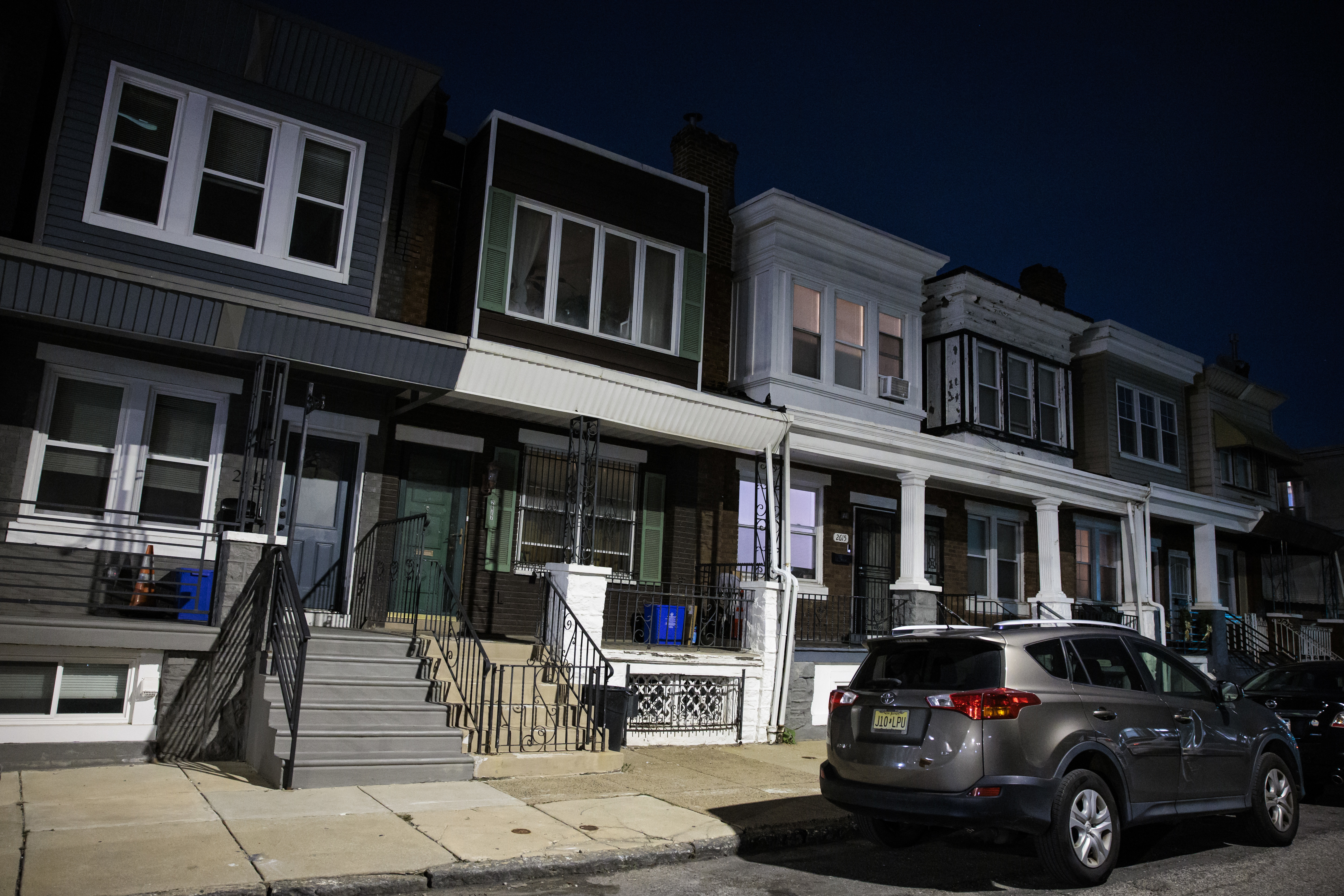
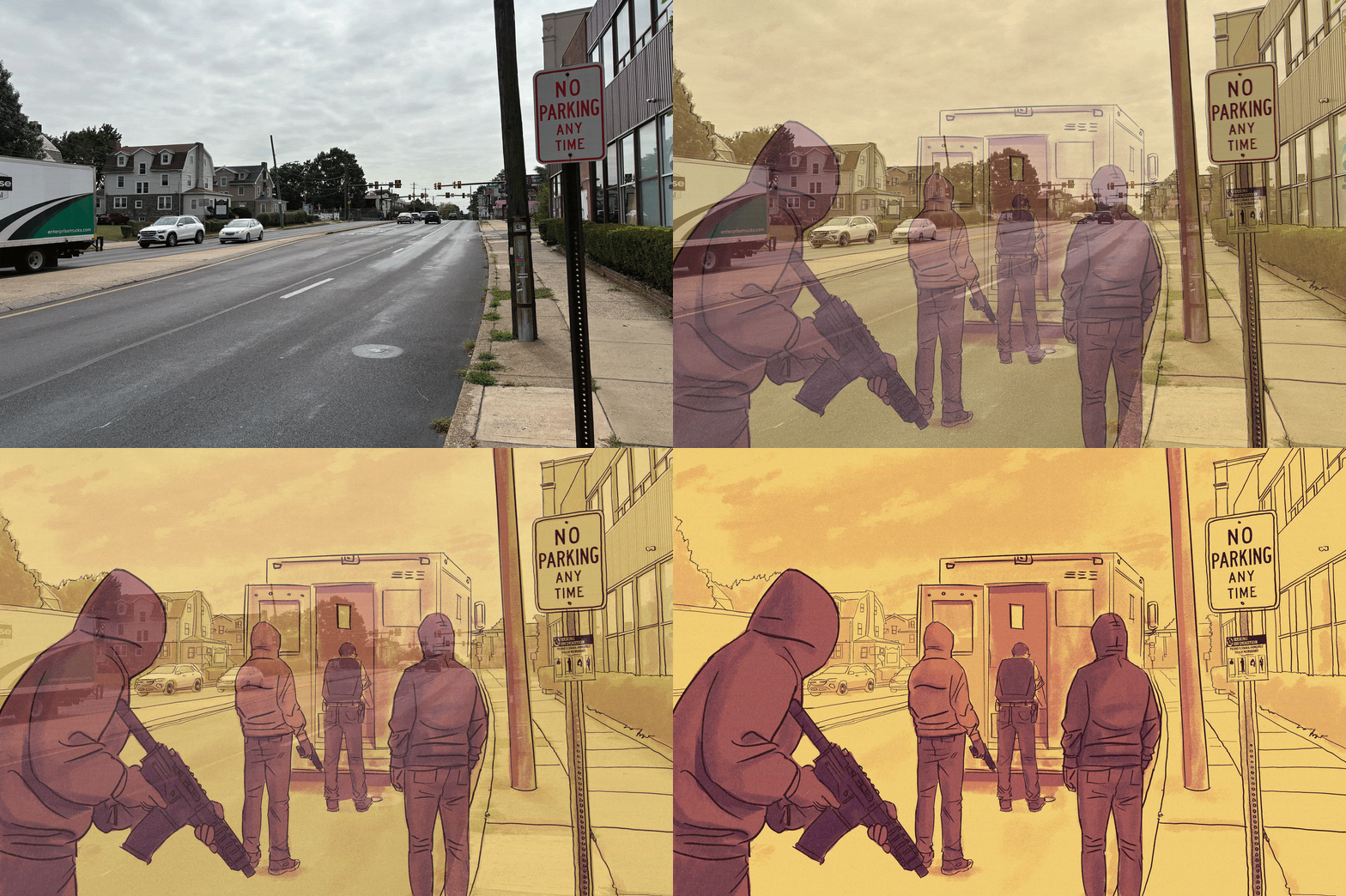
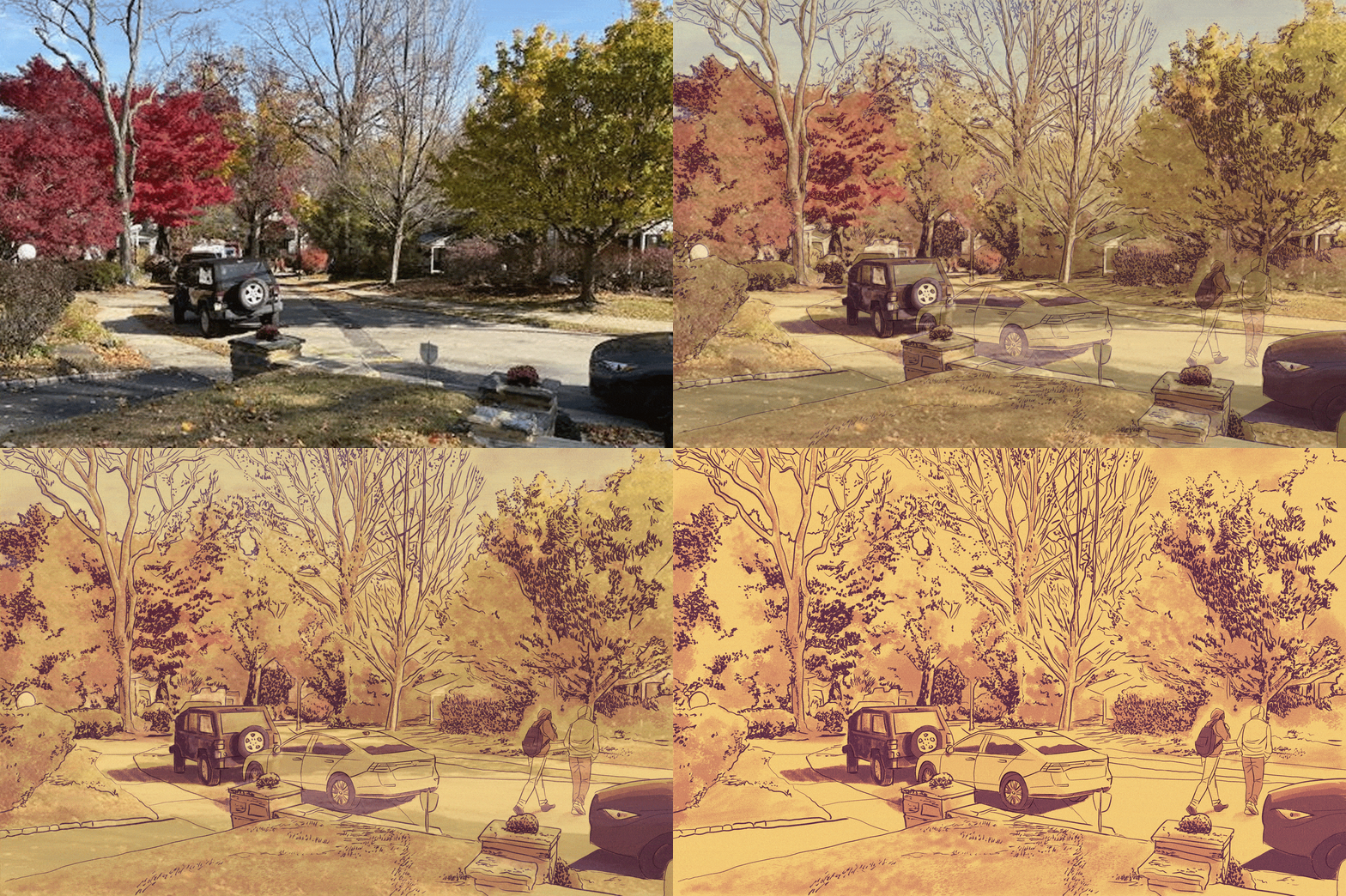
Follow the Delaware River north, past the Jersey border, past the Poconos and the Water Gap, and in about three hours, you’ll arrive in Callicoon, at the foot of New York’s Catskill Mountains.
The region has been an iconic American resort destination since the late 19th century, most famously during its Borscht Belt heyday, when Jewish families filled sprawling summer resorts to play tennis, lounge by the pool, and stir up trouble with dirty dancers. Riding the popularity of the neighboring Hudson Valley, the Catskills’ recent revival offers easy access to nature without requiring you to rough it. Think vintage shopping, natural wine, and cedar saunas between snowy walks through the woods.
The Catskills are huge (about 6,000 square miles), so for the purposes of this getaway, you’ll focus on the Western Catskills, which rise from the Delaware River and are less rugged than their eastern counterparts. Nothing on this itinerary is more than 30 minutes apart. Start the car.
There are more than a dozen cool places to stay in the Western Catskills, four of which come from locals Kirsten Harlow Foster and Sims Foster of Foster Supply Hospitality. Their properties blend the idiosyncratic architecture and fine craftsmanship of historical buildings with the luxury finishes and playful amenities you want on a weekend escape.
At Kenoza Hall, perched above the lake of the same name, rooms are split between the Victorian inn and a cluster of cottages with front porches, gas stoves, and arched armoires. Inside, there are plenty of cozy corners for reading or cocktails as snow falls outside. Don’t miss the spa, with its pebble-floored relaxation room and cedar barrel sauna.
📍 5762 Route 52, Kenoza Lake, N.Y. 12750
Shop: Downtown Callicoon
Hugging the New York side of the Delaware River, the riverside village of Callicoon has evolved from its past lives (hunting grounds, timber town) into an artsy retail refuge for Catskills visitors. Browse groovy lamps at Callicoon Vintage, elevated tableware at Spruce Home Goods, hand-dyed yarn at Wool Worth, and more at the new and old boutiques along Lower Main Street. Tucked behind Callicoon Caffé, at the Shell gas station of all places, is an excellent photo op: the Callicoon Bridge spanning the Delaware.
📍 Lower Main Street, Callicoon, N.Y. 12723
Eat: Annie’s Ruff Cut
Rightly famous for its roast beef, Annie’s Ruff Cut in nearby Cochecton might consider a name change to Annie’s Exquisitely Cut. The beef is sliced paper-thin, piled high in cold sandwiches or served open-faced and drenched in warm gravy. The vibe is classic country tavern: old wood, beer swag, and locals mildly surprised you found the place.
📍 90 Forman Rd., Cochecton, N.Y. 12726
Snack: North Branch Cider Mill
Warm apple cider, cinnamony cider doughnuts, and the smell of a smoldering wood stove pull you into North Branch Cider Mill, a rust-red outpost along the North Branch Callicoon Creek. This historic operation has been around since 1942 (and under new ownership since 2022) and while they’re not pressing their own apples yet, it makes an atmospheric stop for a snack and shop along the old-timey general store-style shelves: New York maple syrup, sweet dill pickles, candles, ceramics, and more.
📍 38 N. Branch Callicoon Center Rd., North Branch, N.Y. 12766
A block off Callicoon’s main commercial drag, the Callicoon Theater hides a 35-seat, barrel-ceilinged auditorium behind its art deco façade. Catching a first-run movie here is worth it for the architecture alone. Dating to 1948, it’s the oldest movie theater in Sullivan County.
📍 30 Upper Main St., Callicoon, N.Y. 12723
View: Catskills Art Space
Though the Catskills cachet is a relatively recent phenomenon, its status as an arts haven goes back decades, with the founding of Catskills Art Space in 1971. Housed in a converted theater in the cute downtown of Livingston Manor, half an hour northeast of Callicoon, since 2007, the dynamic gallery features a mix of up-and-comers and heavy hitters — Sol LeWitt and James Turrell both have site-specific exhibits here through 2027.
Another stylish Foster Supply property, the DeBruce sits in the scenic Willowemoc Valley, about 10 minutes east of downtown Livingston Manor. You could stay here — original wood doors and claw-foot tubs make a compelling case — but the award-winning tasting menu is the real draw. In the tranquil, forest-view dining room, bergamot scents a matsutake raviolo, and coal-baked pears meet scallops and parsnips. Cross the storybook bridge over the Willowemoc River to arrive, and if you have time, explore the five miles of trails that wind through the woods behind the property before dinner.
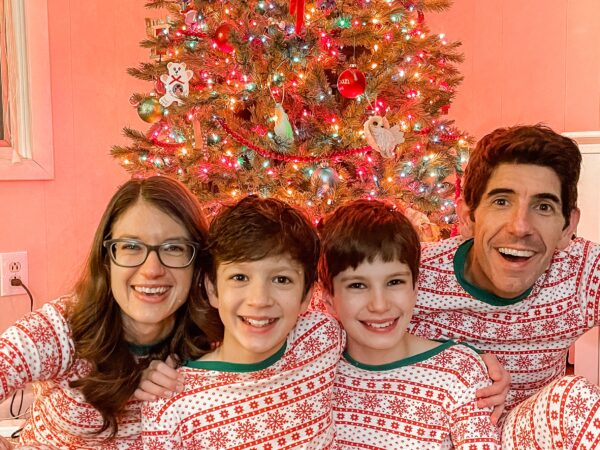
Greg and Becky Wimmer believe their Christmas tree is the best lit tree in the state.
The confidence, the couple from York, Pa., said over Zoom, comes from Greg spending almost all his life perfecting the art.
He grew up in Lancaster in a single-parent household with his mother, Judy Wimmer, and a sister who was 10 years older. Judy was the executive housekeeper at the historic Yorktowne Hotel, which was founded in 1925 and provided a lot of unique opportunities for the young Greg.
“She was the matriarch of tree decorating,” Greg said of Judy, who died last year. “Leading up to the Christmas season, she would use the basement of the hotel as her staging area, and would put up three 12-foot trees and five eight-foot trees around the property.”
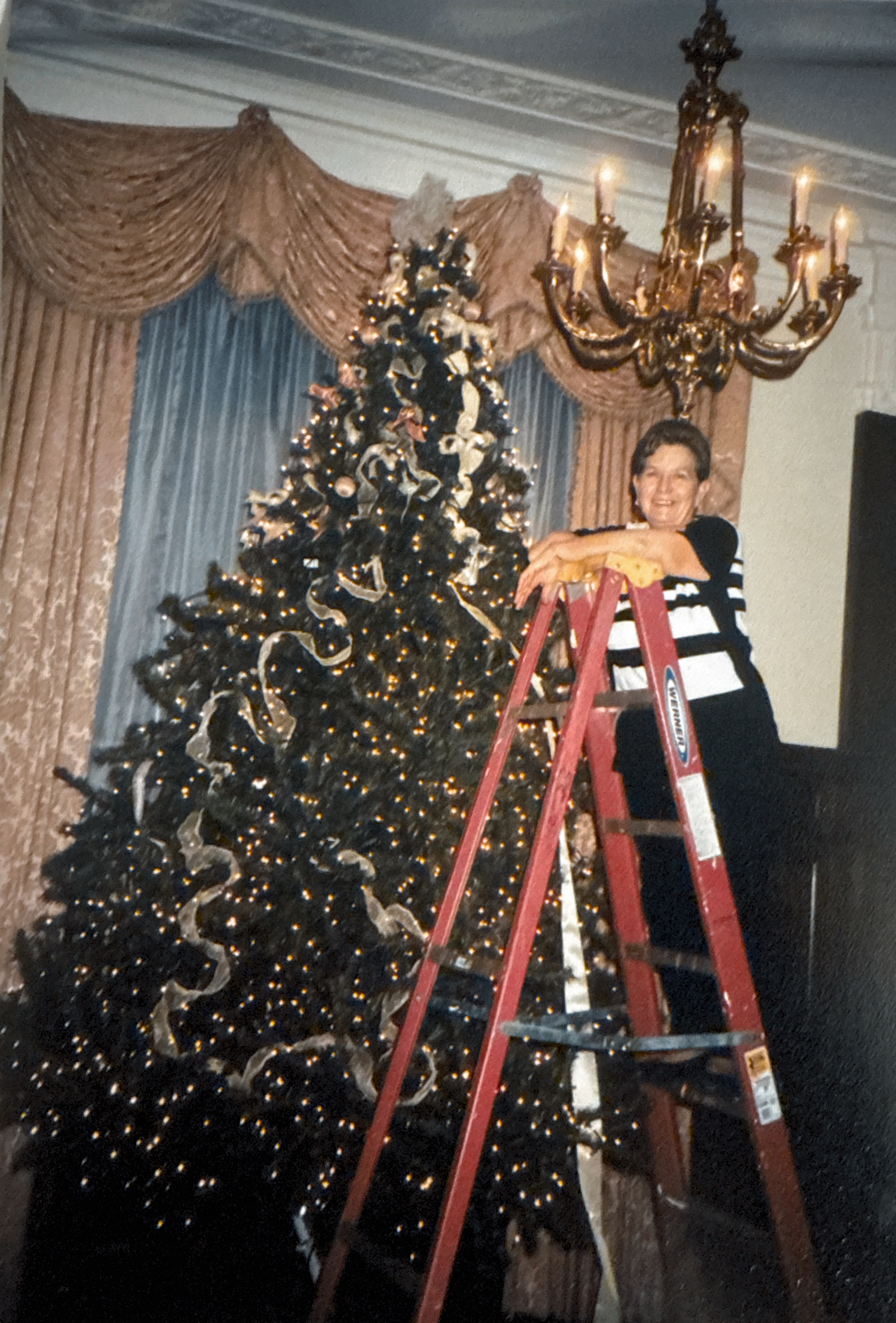
Judy Wimmer atop a ladder decorating a 12-foot Christmas tree at the Yorktowne Hotel in the late 1990s, where she was the executive housekeeper.
Greg and his sister would go up to the hotel on the Saturday after Thanksgiving every year and help their mother decorate. First, they’d take on the 12-foot lobby tree before moving on to the other rooms. They’d work late into the night, stay over, and spend Sunday decorating.
“I became so accustomed to knowing everything, she had me instruct adults by the time I was a teenager,” Greg said.
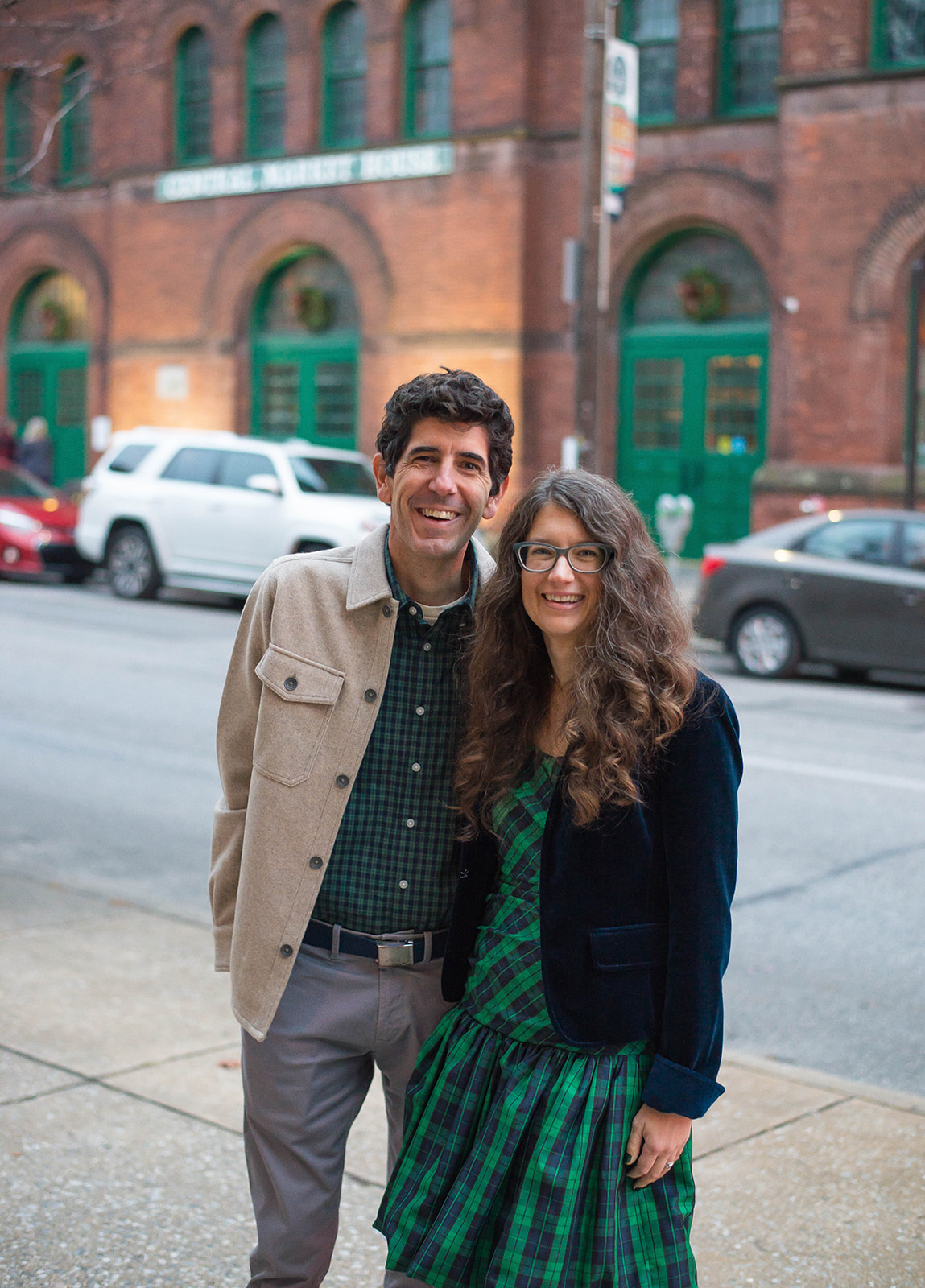
Becky, 42, who teaches first grade, appeared on Zoom wearing a festive red sweater, weeks before Christmas. (Greg, 45, who teaches social studies to high schoolers, wore a plaid shirt, and their dog Jingle barked in the background.)
“I always loved Christmas,” she said. “I love to have a Hallmark house and feel cozy and comfy. But I was very intimidated by Greg’s mom and her decorating when I became a part of the family.”
Greg and Becky Wimmer were among the Pensylvannia social media creators invited to Gov. Josh Shapiro’s reception.
The two, both public schoolteachers, met at Elizabethtown College studying for their teaching degrees, and run an Instagram account called the Class Couple. Here, they share content about, of course, holiday decorating but also more serious stuff like voter engagement and clips from them attending a “No Kings” march, anti-ICE protests, and a Kamala Harris rally. Recently, the couple were invited to attend a holiday reception for content creators hosted by Gov. Josh Shapiro.
“We spent quite a few years sharing teaching things, and then COVID hit. We as teachers had to go back to work before the vaccine was out, and because we didn’t get that choice, our kids didn’t, either,” Becky said.
After their oldest son, Grayson, became deaf in his left ear from COVID, “our ‘why’ for sharing online quickly changed,” she said.
They started posting content on health and safety, and sharing Grayson’s journey from hearing loss to cochlear implant to attending a school for deaf students on the campus of Gallaudet University in Washington, D.C.
“We had always been passionate about those types of things, but we felt the need to speak on that a little bit more, especially since it had impacted us directly in such a big way,” Becky said.
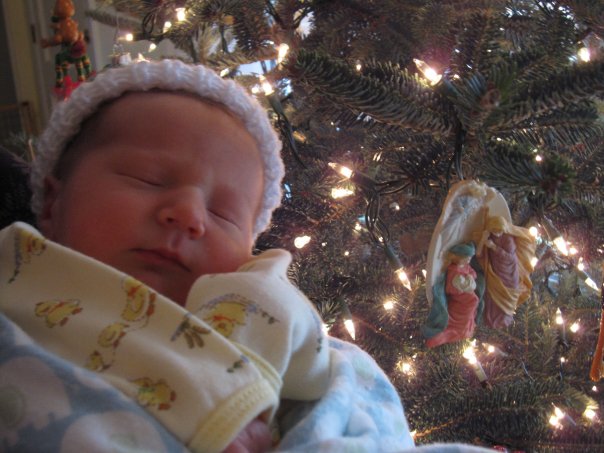
Grayson Wimmer was born on Christmas Eve in 2009. He is one big reason behind the family’s knack for going big on Christmas celebrations.
Grayson, who was born on Christmas Eve and is turning 16 this year, is one big reason behind the family’s knack for going big on Christmas celebrations. The family’s first tree goes up on Halloween.
“Only the first one. It’s usually a skinny accent tree,” Greg said.
“Halloween is like the gateway to get us to Christmas. We host Thanksgiving, but by then it’s like a Christmas wonderland,” Becky said. “We have a lot of skinny trees throughout the house.” One of those, she said, belonged to her mother, who is now in hospice with dementia.
“Then there’s the main family tree, two taller skinny trees, and three smaller 3½-foot ones, and a small one in our bedroom.”
Their younger son, Urban, 13, also has one in his room.
But the Wimmers are not hoarders, Greg insists. “My goal is to always fit everything under the stairs in the basement,” he said.
The family uses plastic trees — Grayson is allergic to real ones — and has been using the same ones for more than five years. Although it’s hard to find plastic trees that are not pre-lit, they are happy to take the trouble of finding those. The couple’s go-to stores are always the local home and garden shops.
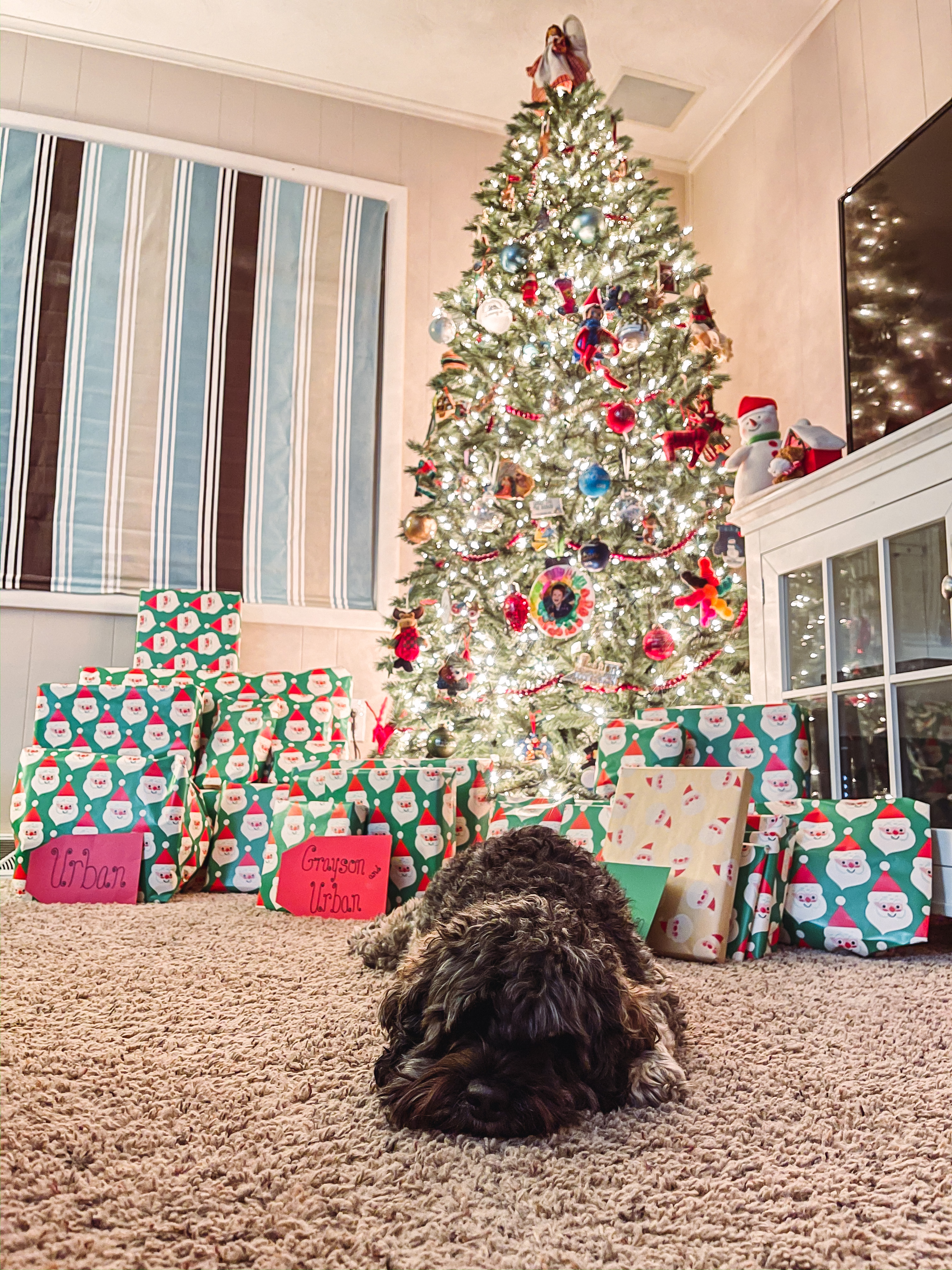
Lighting the tree is a bit of an Olympic sport for the household and it falls squarely on Greg’s able shoulders. He uses 1,700 lights (17 strands of 100 lights) and buys them months before Christmas. The claim to having the best lit tree in the state is only half in jest, bolstered by social media comments and a new title bestowed upon Greg by the internet: Christmas Lights Man.
A 2020 photo of the family dog, Huck, inf ront of the family’s Christmas tree in York, Pa.
Every year, Grayson and Urban pick and choose which ornaments to put up.
“That’s the key to Christmas,” said Greg. “How do you make it special for you? For me it’s putting 1,700 lights. But whatever your tradition is, lean into it and embrace what the season is about.”
Here are the Wimmers’ best tips so you can lay claim to having the second-best lit tree(s) in all of Pennsylvania.
Measure your space
“Most importantly, get a tree that fits in your space, don’t overpower your room,” Becky said.
Start at the top
Judy used a ladder; Greg uses a stepladder. “The branches are so close together [on top] that it’s the easiest to go up and over each branch,” Greg said.
Don’t wrap, loop
“Build depth by looping the wire around the individual branches and then work your way out from the base of the branch,” Greg said. “This way, I can control the cord more. Going around the tree. … I don’t see how people do it, because I think that you’re then just dancing around.”
“My mom did this,” Greg said of working in sections and his reasoning behind using 17 strands of 100 lights. “So if a strand went out on the main lobby tree, she could just take the ornaments and lights down in one section and replace the lights, instead of taking everything apart.”
No LED lights
Greg uses “the older incandescent lights because I feel like LEDs just don’t give the same glow.”
Always backlight
Greg puts lights on the back end of the tree because “I don’t want a dark corner. It ends up giving off a really neat glow when the other lights are off in the room.”
Check your extension cords
“They can’t all be on one. Use multiple cords and be aware of your breakers’ capabilities, especially with live trees,” Greg said.
It’s going to take time, that’s OK
Greg said he takes about 90 minutes to light the main family tree, which is seven feet tall.
ATLANTIC CITY — The journey through Atlantic City is bumpy these days, and not only because Atlantic Avenue is desperately in need of paving.
Ducktown Tavern owner John “Johnny X” Exadaktilos has one wish for Atlantic City that has nothing to do with the gut-jarring avenue that runs in front of his bar.
“Just normal,” says Exadaktilos. “I just want things to be normal.”
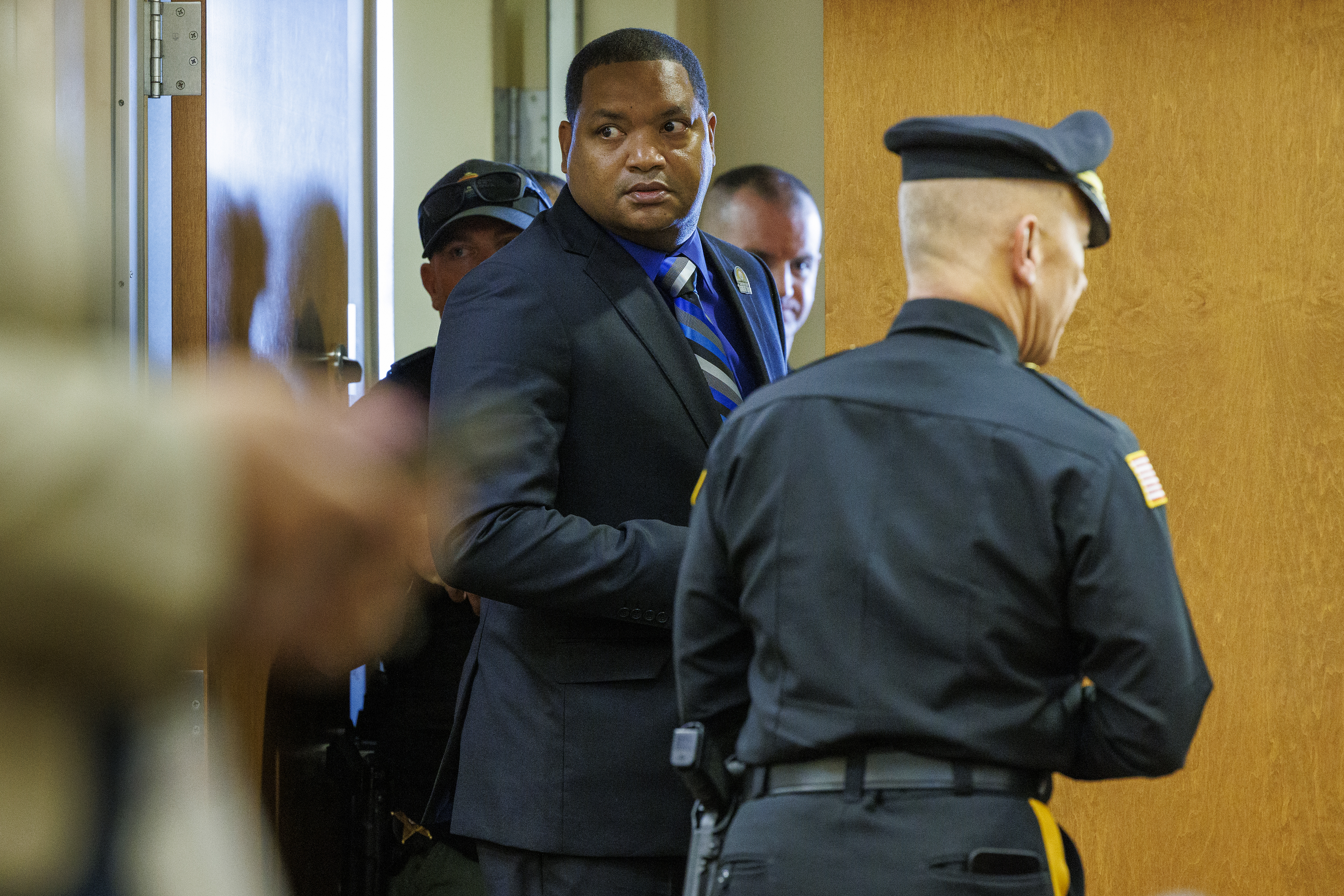
Atlantic City, a place of historic mayoral misdeeds, multimillionaire overreach, and chronic unwanted attention, has managed in this waning year, even as its workers string up holiday decorations, to come up with a new plot twist: Its newly reelected Democratic Mayor Marty Small Sr. is on trial for alleged physical abuse of his teenage daughter.
The trial has left Small untethered from his cell phone as new casinos have been green lit in New York City, and the state moves to tighten its authority over the town. Another trial, of Small’s wife, La’Quetta Small, who is the superintendent of schools, is set for Jan. 12.
With Small reporting to an Atlantic County courthouse each day to face his daughter, who spent seven hours testifying against him on Tuesday, a bit of a hush has fallen on the city as it awaits the outcome, which could come this week.
The sentiment in City Hall, where many employees owe their jobs to Small, leaned toward the assumption that Small would beat this charge like he’s beaten two previous indictments on voter fraud charges.
But will the city emerge unscathed?
“Every day, people who live in Atlantic City want to know what those of us are elected are doing to make their lives better and respond to their issues and concerns,” said council member Kaleem Shabazz, who was going from a planning board meeting to a mayor-less City Hall last week. “Whatever will happen will happen. The city still has to function. People have to be responsible.”
On Dec. 1, as Small readied for jury selection in Mays Landing, New York City approved three casinos, two for Queens and one for the Bronx, a development long feared in Atlantic City.
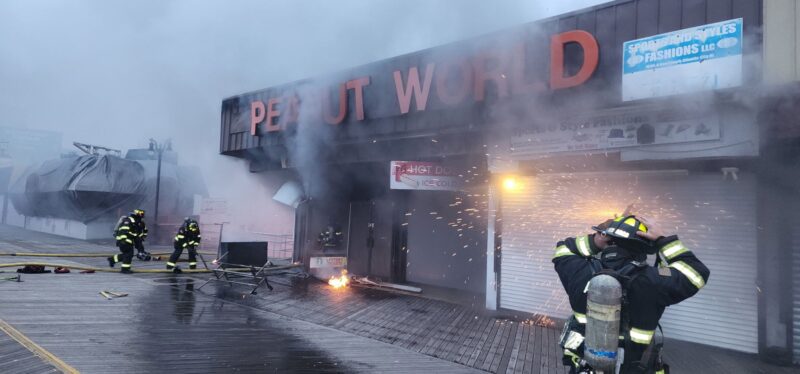
On Dec. 5, with the jury picked, the iconic Peanut World on the Boardwalk erupted in flames. On Dec. 9, with the mayor listening to his daughter, legislators in Trentonwere proposing more state oversight of A.C. including a surprise provision that would give the state the power to pick developers for major projects.
The biggest threat may come from the New York casinos, which some in the industry estimate could threaten as much as 30% of A.C.’s business and lead to the shuttering of one casino, if not more.
Small could face jail time and be forced to step down as mayor under New Jersey law, if convicted. He and his wife, who has been attending her husband’s trial, taking notes in the back, have resisted calls to relinquish their powerful roles as mayor and superintendent.
“It’s not ideal obviously,” said Shabazz. “If you had to pick a multiple choice question what would you want to be happening in your public schools, that wouldn’t be something you would pick, if you’re a parent or a taxpayer.”
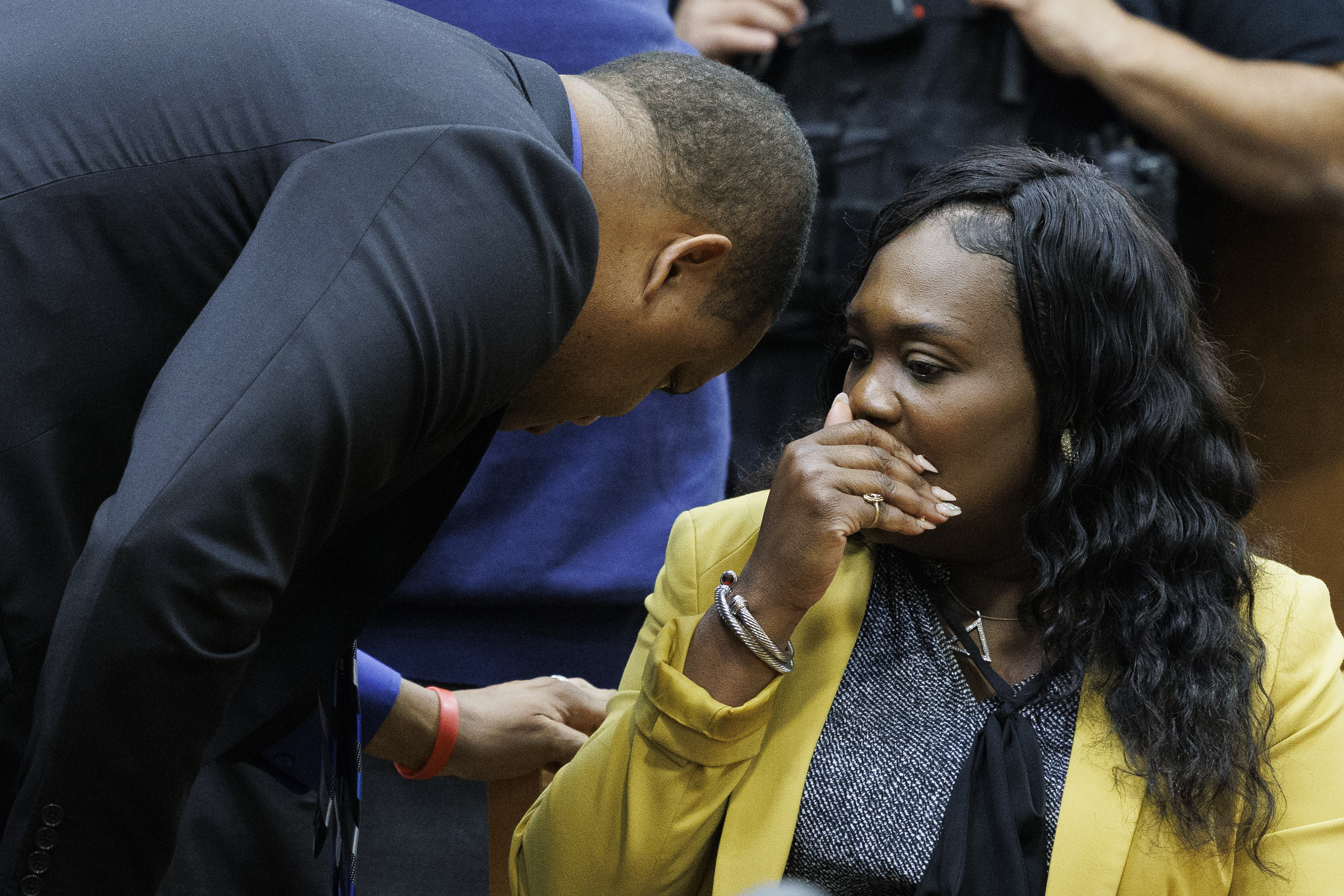
Atlantic City Mayor Marty Small and his wife, Superintendent of Schools La’Quetta Small, chat before the start of arraignment on Oct. 10, 2024. Mayor Small stood trial last week in Mays Landing. Cameras were barred from the courtroom during the trial.
‘A wake-up call’
Early one morning last week, having just come from a planning board meeting, Shabazz said the city was going about its business. “I’m not at the trial, I’m on my way to City Hall,” he said. “The work of government has to go on.”
Shabazz, who’s been focused for years, even decades, on some of the same intractable problems of the resort, remains optimistic. It’s a city where it can be hard to read the scorecard: progress seems to be there, but not there, at the same time.
The city’s only full-size supermarket, the beleaguered Save A Lot is under new management, and the adjacent nuisance liquor store is expected to close. High-profile developers like Jared Kushner and K. Hovnanian appear to be going forward with residential projects in the city’s Inlet section. There are new restaurants, like the Byrdcage in Chelsea and Simpson’s, relocating next month to Atlantic Avenue.
Shabazz is hoping the state will return zoning authority back to the city after years of the Casino Reinvestment Control Authority overseeing planning and zoning in the city’s tourism district.
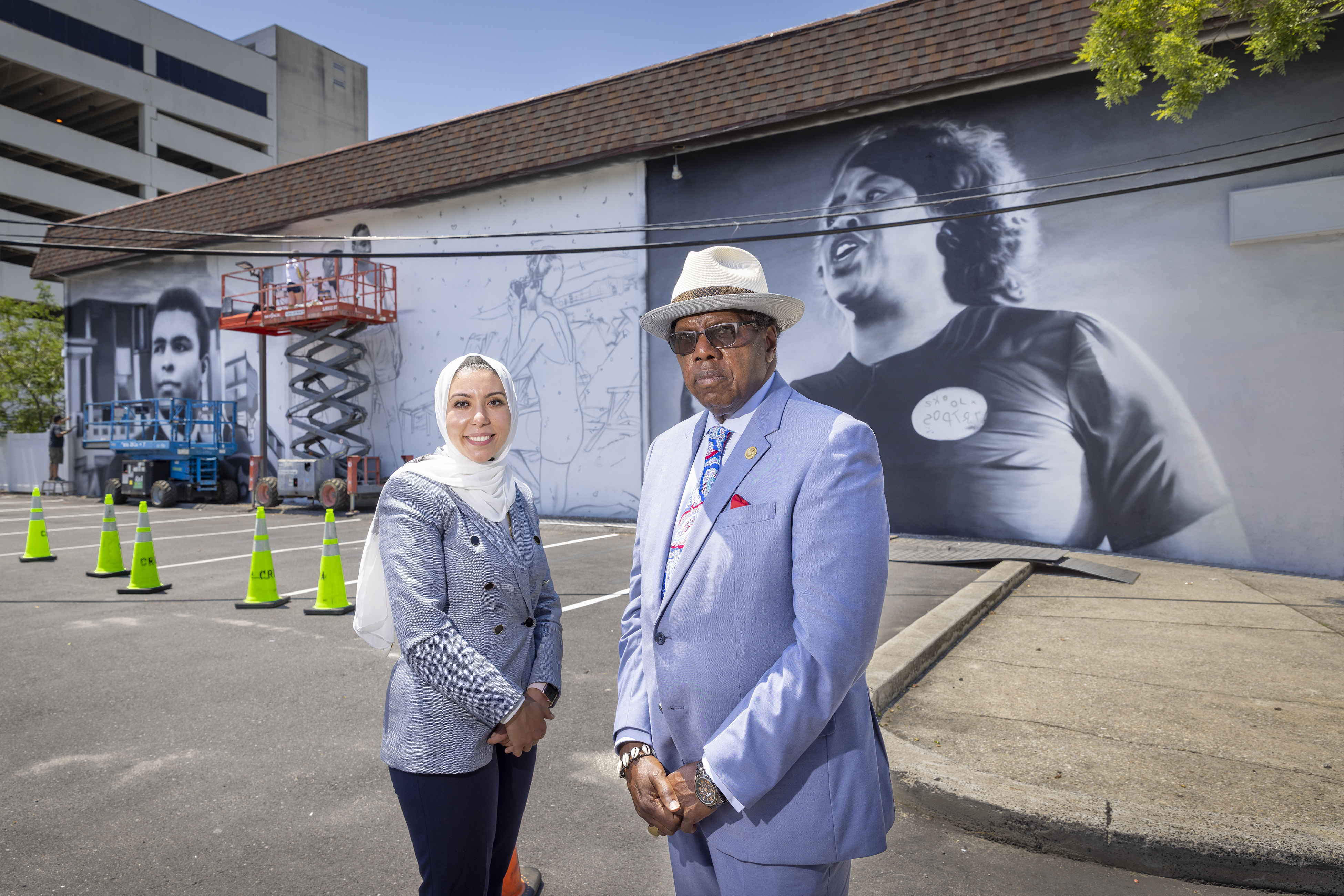
Kaleem Shabazz, president of the local chapter of the NAACP in Atlantic City, and Maryam Sarhan, a community organizer, stand in front of mural honoring civil rights leaders. “The city still has to function,” he said, while its mayor is on trial for alleged child abuse. “People have to be responsible.”
But last week, as the mayor listened to his daughter testifying that he struck her in the head with a broom, after she threw detergent at him and refused to go to a community march, the state went in the opposite direction: a bill to renew the state’s takeover of Atlantic City for another six years that would allow the state to pick a “master developer” to oversee big projects, the Press of Atlantic City reported.
“We have to be competitive,” Shabazz said. “We have to let people know that we’re open for business and we’re safe and secure. Crime is down significantly.”
Like others interviewed, he believes Atlantic City can sell itself as a safe and affordable seaside destination. “We still have a free beach,” he said. “We have to let people know what we have.”
Atlantic City Mayor Marty Small arriving for his arraignment before Judge Bernard DeLury at the Atlantic County Criminal Courthouse in Mays Landing on Oct. 10, 2024. Small testified in his own defense Friday during his trial. Cameras were barred from the courtroom.
Small has defended himself by describing this latest situation as a private family problem, not related to his job performance. He has called the prosecution politically motivated and an overreaction. A jury will now weigh in.
John Boyd Jr., a principal in the Boyd Co., which advises companies on where to locate, said many developers (and homeowners) continue to balk at Atlantic City, despite the upward pressure on Jersey Shore real estate that has left the city as arguably the last affordable seashore town in the entire Northeast.
He called the three New York City casino licenses “a wake-up call” for New Jersey, and advocates a plan where the state allows casinos at the Meadowlands and/or Monmouth Park but shares the revenue with Atlantic City.
“If you ask national developers their opinion of Atlantic City, it wouldn’t be a very positive one for a myriad of reasons,” he said.
“Good governance is fundamental to economic development success. Companies want to minimize risk. It’s more than the mayor being on trial. It’s the uncertainty.”
Meanwhile at the slots
Inside Hard Rock casino during a blustery stretch last week, people were three deep at the holiday-branded Mistletoe Bar in the lobby, and nine guitars had become a menorah in the atrium.
Gamblers were locked in as names were called for a random spin-the-wheel drawing every half hour. A convention of real estate agents brought lines to the check-in desk. The trial was off in the distance, invisible to most.
“I do love coming to Atlantic City,” said Adam Druck, 33, a Realtor from York, Pa. “I hope the trial doesn’t make too much difference to what’s going on here.”
Asked about New York casinos, Joe Pendle, 71, a retired police officer from North Jersey, said he was comfortable with his routines at Hard Rock, where free rooms and meals anchored his pleasant stays. (Hard Rock itself has one of the three licenses in New York City, an $8.1 billion project near Citi Field in Queens, which it projects will result in $1 billion a year in tax revenue.)
“I have a three-room suite upstairs,” noted Pendle. “I like the beach.”
Arthur Austin, 70, of Old Bridge, said he had worked for decades on Wall Street and had no desire to travel to New York for a casino weekend.
“I worked in the city for 20 years,” he said. “I only go into the city if I have to.”
Adam Druck, 33, of York, Pa., and Eric Moeller, 36, of Reading, inside Hard Rock casino on Dec. 9, where they were staying as part of Triple Play Realtor Convention and Trade Expo in Atlantic City.
Out-of-towners like Austin hadn’t heard about Small’s trial, but the local gamblers at Hard Rock sure had.
“Atlantic City is a crooked place, and it’s always gonna be crooked because of what everybody’s into,” said a 57-year-old woman who lives locally and was playing the slots. She did not want her name used so that she could speak her mind in a small town.
“People want their guy to stay in there,” said the woman. “He gives everybody a job. You could flourish, but only if you are with the right people.”
“I don’t think that it hurts Atlantic City,” said Seng Bethia, 40, of Atlantic City, who was at the slots. “His daughter is such a sweet girl. It was bad, just the whole thing.”
‘Are you kidding me right now?’
Exadaktilos, the Ducktown Tavern owner who is Small’s loudest detractor, said he had taken things down a notch of late, putting aside his popular weekly Facebook live rants that he said had started consuming him.
Still, last week, as the prosecution wound up its case, the city sent out a contractor to do some temporary filling in of cracks on Atlantic Avenue in advance of the city’s holiday parade, and Exadaktilos found himself back on Facebook live.
“Are you kidding me right now?” he said over footage of the roadway. “What happened to Atlantic Avenue is going to be paved? Horrible.”
Boyd, the location consultant, points to bright spots. The national developers are a vote of confidence, as is the Septemberopening of the SeaHaus boutique hotel on the Boardwalk, a Marriott property. Showboat and the Sheraton near the Convention Center are converting rooms to residences.
Boyd sees potential for Atlantic City to follow the likes of Coney Island, which has seen a renaissance, to attract film business, to market itself as a live-work-play destination.
Outgoing council member George Tibbitt looks at the Kushner plan, a 180-unit apartment complex, as another missed opportunity. “No vision there,” he said. “That’s desperate development.”
“New York City definitely makes me afraid,” said Tibbitt. “There’s only so many gambling dollars to go around. Adding more casinos is going to be devastating. We have to clean the city up. We have to get the neighborhoods filled back up.”
One industry the city bet heavily on was cannabis: Its midtown quickly filled with 16 dispensaries. But after complaints from the cannabis entrepreneurs themselves, city council capped the number at 16, leaving many that have been approved but have yet to open (including one that necessitated the demolishing of a historic church) in limbo.
Atlantic City is a place where things can seem to be finally coming together, while simultaneously unraveling. Big plans vaporize, like the highly touted gym and nightclub outside Showboat, where last summer, the owner set up couches, DJ booths, and exercise machines, got stalled by permitting issues, and quietly dismantled them.
Miguel Lugo, general manager at AC Leef, which held out for a strategic spot on Albany Avenue, said his cannabis business has been good. He looks forward to the dispensary running financial literacy classes for the community, and getting its cultivation license.
“On this side of the town, everything’s been phenomenal,” Lugo said. “I’m super focused on AC Leef. I don’t know what’s going on with the mayor.”
This week I have invited two reporters to help answer one of the many SEPTA questions we hear.
Have your own thoughts or other questions? Fill in the box at the end!
.inno-chat__body {
border-radius: 12px;
}
Evan Weiss
Deputy Features Editor
Before we get to the question at hand, can you both describe your backgrounds with taking SEPTA?
Beatrice Forman
Food & Dining Reporter
I've been carless since I moved to Philly seven years ago, and take SEPTA pretty much everywhere unless I'm with my boyfriend, who drives. Then I'm a passenger princess.
Henry Savage
Now Reporter
I ride SEPTA bus and subway every week to The Inquirer offices, plus when I’m going out at night. Cheap, and fairly quick travel!
Beatrice Forman
Food & Dining Reporter
“Fairly quick” is doing a lot of heavy lifting.
Henry Savage
You're not wrong lol.
Evan Weiss
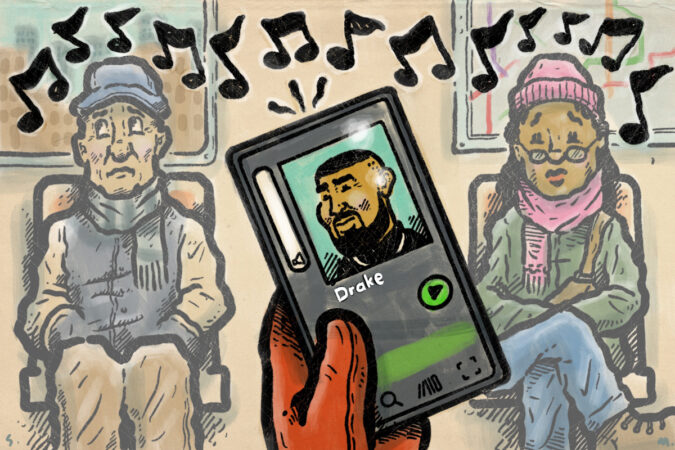
Okay, the question is… What’s the etiquette when someone is blasting music on the El with no headphones — speak up or suffer?
Beatrice Forman
I think it's one of those things where it's well within your rights to speak up about someone blasting music on the El (especially in the morning), but do you really want to be known as the curmudgeon who chastised someone over something like this? I'd be so afraid of getting sniped and posted on TikTok.
Beatrice Forman
Have you ever spoken up about this IRL?
Henry Savage
I’ve seen full-blown phone calls on speaker and people smoking out of glass instruments, but to be honest with you, I haven't said anything.
Henry Savage
What's your go-to solution when this happens to you? I'm partial to blasting my headphones.
Beatrice Forman
I wish I was the type of person who could just turn my AirPods up full volume to drown it out, but I am also a 5-foot-tall woman alone on public transit, so the head has to stay on a swivel. Also, sometimes those things die!
Beatrice Forman
I was recently on the BSL home from an assignment in South Philly around the time classes let out, and this kid was blasting Kendrick Lamar loud enough for all the train car to hear, so I ended up politely offering him a pair of corded earbuds to use to see if he'd take the hint.
Henry Savage
Nice work!
Beatrice Forman
He did not take the hint, but I was proud of myself for trying.
Beatrice Forman
Do you think there's a right way to nudge a person to, perhaps, not smoke on the train? Or blast their playlist?
Henry Savage
I think going the solutions-oriented approach of, "Hey, looks like you could use some headphones?" is a good call.
Henry Savage
In reality, what's the right way? Probably being as polite as possible while knowing the person will likely rebuff you. That being said, sometimes all it takes is for one person to call someone out!
Henry Savage
Or should we just invoke "Think of the children and older riders!" Smoking in front of children is the worst look.
Evan Weiss
Smoking is really the most annoying. I've been on the train with my daughter and we just had to move cars — not worth the possible contention with her there.
Henry Savage
Yeah, if things go dicey with your kid there… good call.
Beatrice Forman
I do think sometimes a very pointed and pissed off "Can you not? There's people around" would probably be soooo cathartic though, and would get the point across. Especially for smoking. No one likes that but the smoker.
Henry Savage
The moments you think about an hour afterward and say, "Dang! I wish I said that back there!"
Beatrice Forman
I think it's tough because so much of the issues with these things on SEPTA can be brushed off as just the side effects of living in a city and can feel kind of elitist to complain about, but also, counterpoint: none of this should be happening enough to warrant an Inquirer column.
Evan Weiss
True! FWIW I do think it's far better on the bus than the train — probably because you have the driver upfront to tell people off.
Henry Savage
Yes, I will say that taking the bus there's more enforcement in my opinion. Some SEPTA bus drivers are known to pull the bus over and not leave until the issue is resolved, like smoking, fare evasion, or loud speakers!
Beatrice Forman
I've also seen this happen on the bus, Evan. Mostly music though, not the smoking.
Evan Weiss
Bea, I'm still impressed you said something! I don't think I've ever seen that happen
Henry Savage
Yeah, that's a true Philly move.
Beatrice Forman
It was like exposure therapy for my anxiety.
Beatrice Forman
I will probably never do it again though. Not the hero we quite need.
Henry Savage
In a perfect world? Every single smoker and to a lesser extent music blaster would be confronted, and realistically fined or reprimanded for the behavior. In this economy? I’m keeping it moving and cranking my music.
Henry Savage
If my headphones die, I suffer in — well, not silence — but the blaring sounds of AI voice over TikTok slop videos.
Evan Weiss
Any last words, Bea?
Beatrice Forman
Be the change you wish to see in the world and don't smoke or make me listen to your bad taste in TikToks on SEPTA.
This conversation has been edited for length.
What other Very Philly Questions should we address?
We’ll show you a photo taken in the Philly-area, you drop a pin where you think it was taken. Closer to the location results in a better score. This week’s theme is all about Hanukkah. Good luck!
Round #11
Question 1
Where is this synagogue?
Loading…
ClickTap on map to guess the location in the photo
ClickTap again to change your guess and hit submit when you're happy
You will be scored at the end. The closer to the location the better the score
Levi Jiang / Staff
Pretty good/Not bad/Way off! Your guess was from the location.Spot on! Your guess was exactly at the location. Here's also where a random selection of Inquirer readers guessed.
This is Temple Beth Zion-Beth Israel on South 18th Street. The synagogue was formed through the 1964 merger of Beth Zion (created in 1946) and Beth Israel (created in 1840).
Quiz continues after ad
Question 2
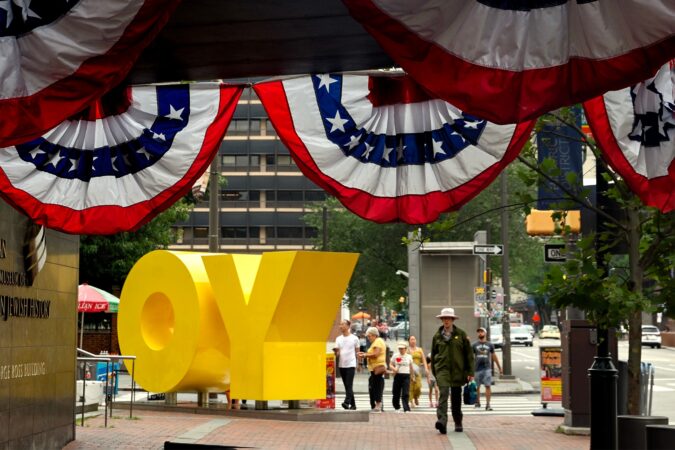
Where can you find this yellow statue?
Loading…
Tom Gralish / Staff Photographer
Pretty good/Not bad/Way off! Your guess was from the location.Spot on! Your guess was exactly at the location. Here's also where a random selection of Inquirer readers guessed.
The OY/YO Statue is located outside the Weitzman National Museum of American Jewish History. According to the museum, “YO” references the greeting, while “OY” is a common Yiddish phrase.
Quiz continues after ad
Question 3
Where is this deli?
Loading…
Michael Klein / Staff
Pretty good/Not bad/Way off! Your guess was from the location.Spot on! Your guess was exactly at the location. Here's also where a random selection of Inquirer readers guessed.
This is Koch's Deli located on Locust Street in West Philly. The deli was created in 1966 by Sidney and Frances Koch and is known for its stacked sandwiches.
Your Score
ARank
Amazing work. You've achieved the miracle of the eight days!
BRank
Good stuff. You've lit most of the candles.
CRank
C is a passing grade, but most candles remain unlit.
DRank
D isn’t great. You just missed all eight nights!
FRank
We don’t want to say you failed, but you didn’t not fail.
You beat % of other Inquirer readers.
We’ll be back next Saturday for another round of Citywide Quest.
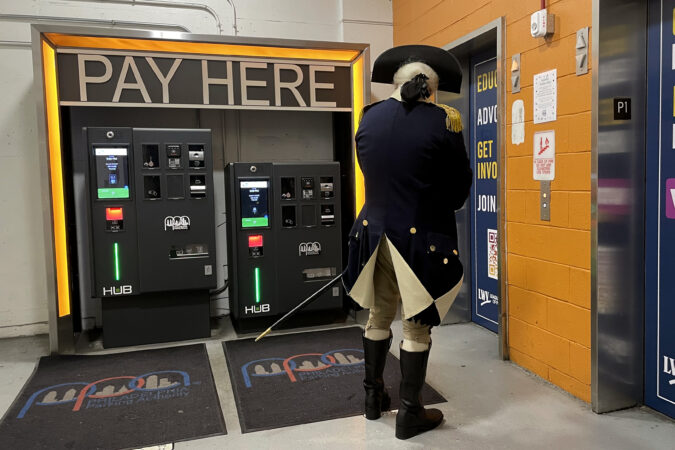
I was so close. If I had made it through one or two more green lights while driving from my last assignment… Or if I had not waited so long for the “right” car to pass in front of the building I was photographing for a real estate story…
Then I might’ve been there seconds earlier when Gen. Washington stood at the back of his SUV placing his sword on the hip of his dress uniform. Or photographed him walking through the empty parking garage.
Instead, I arrived at the elevators seconds after he did.
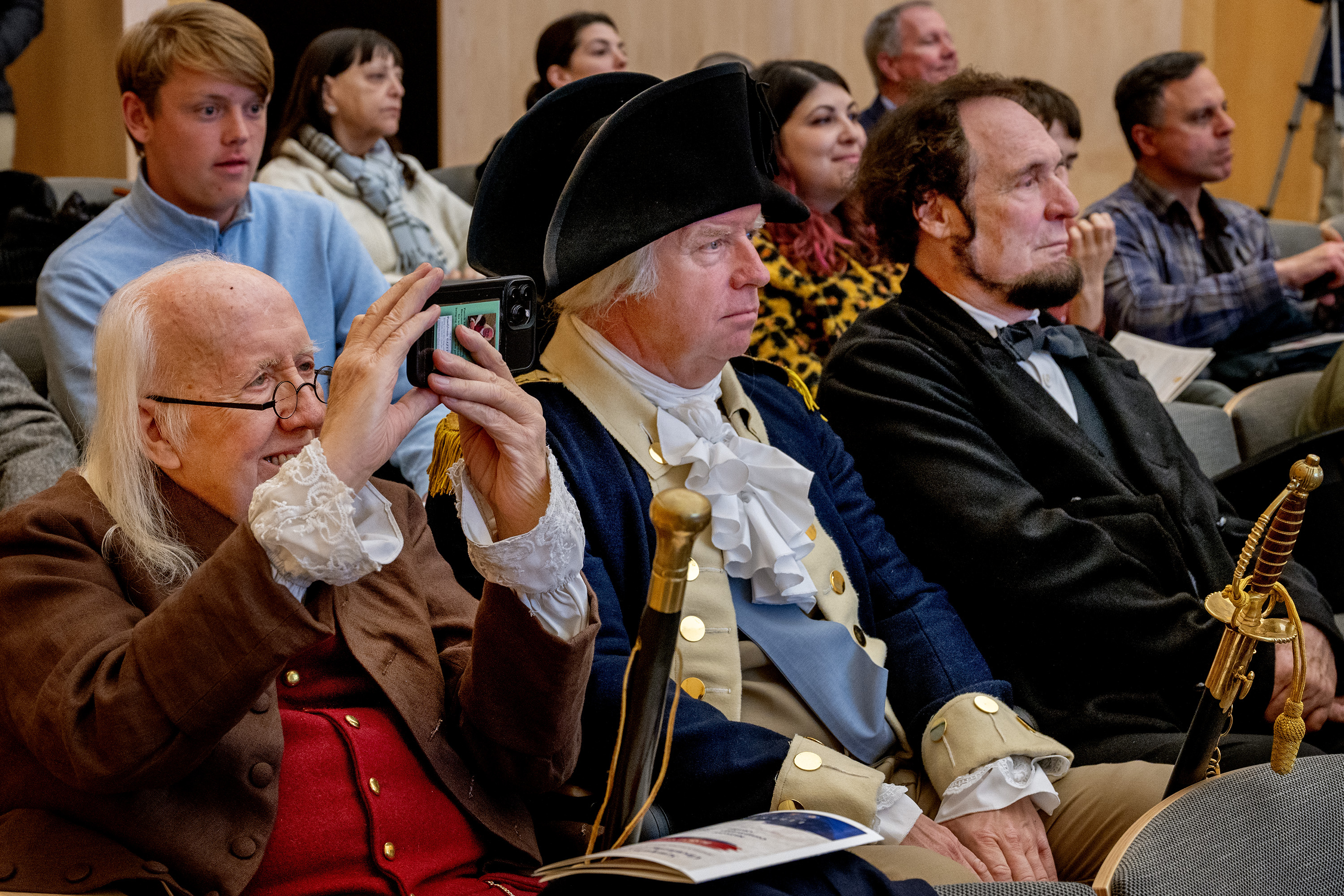
Historical interpreters Benjamin Franklin (from left) Gen. George Washington and President Abraham Lincoln are in the audience as the U.S. Mint unveils new coins for America’s 250th birthday.
There isn’t a day that goes by that I am not reminded how photography is all about the timing. And I don’t mean just the 1/500th of a second your camera shutter is open.
There is an expression “f/8 and be there” often attributed to legendary photographer Arthur “Weegee” Fellig. The “there” has come to mean not fussing over the technical aspects — an f-stop/lens aperture — of taking pictures but instead being “in the moment.”
Weegee, however, meant it literally. He was a New York crime scene photographer in the 1930s and 1940s famous for arriving before the police and made his living getting there and taking a picture before his competition (there were a dozen newspapers and tabloids in Manhattan back then).
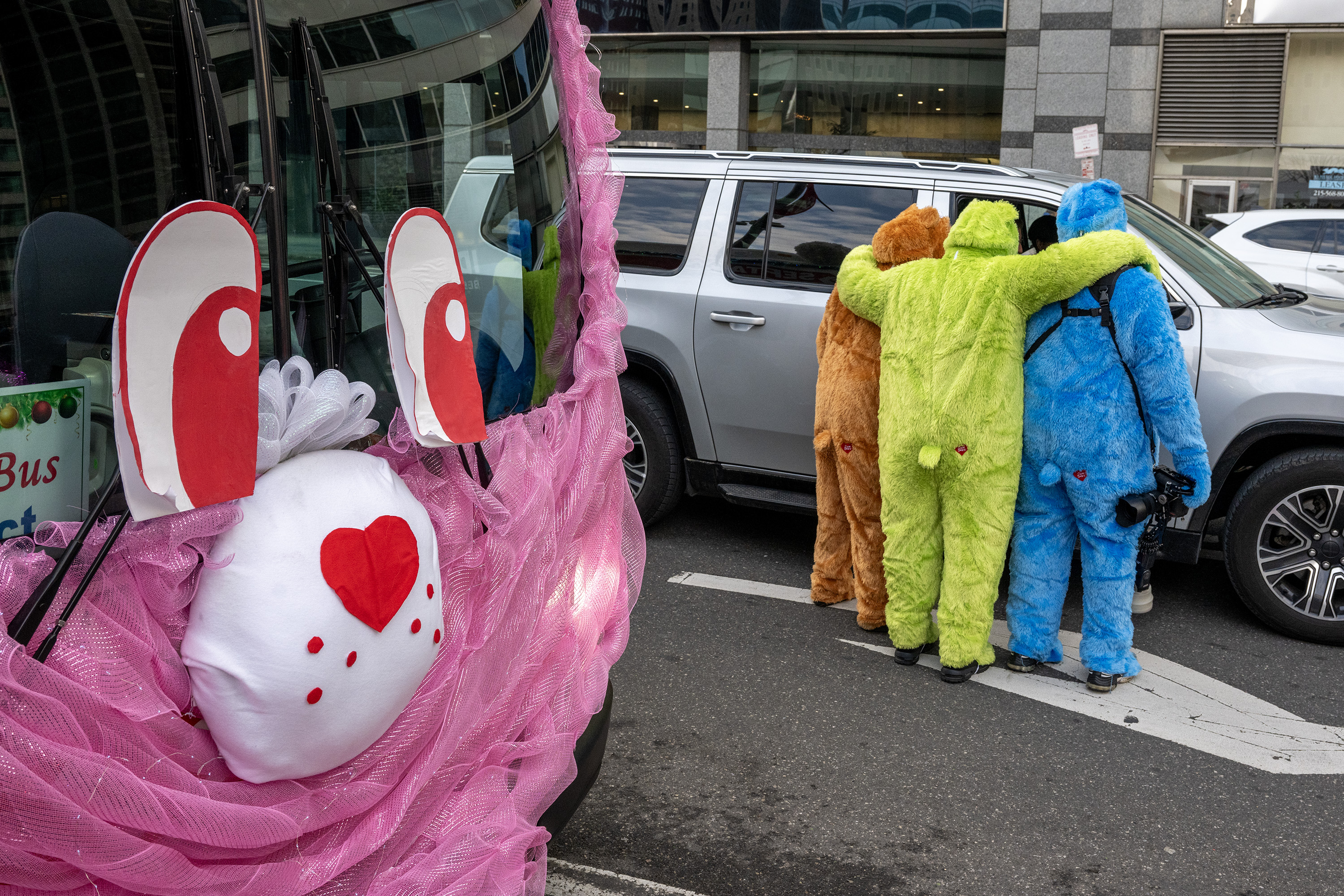
Another “good timing” came for me last Saturday. I was in Center City with my family on my day off. There were so many people in the Christmas Village in LOVE Park we walked along the outskirts, where we found the annual Festibus competition. That’s where SEPTA employees volunteer their time to decorate buses for the holidays and compete for bragging rights. And let riders vote for their favorites among the eight decorated buses parked along JFK Boulevard and 15th Street.
I made a fast photo of SEPTA workers costumed as Care Bears who went over to a passing coworker stopped in traffic. But I couldn’t leave with only a photo of the backsides of mechanic Raymond Borges and operators Jose DeCos and James Smith.
So I stayed behind to document more of their greeting visitors and some of the other buses.
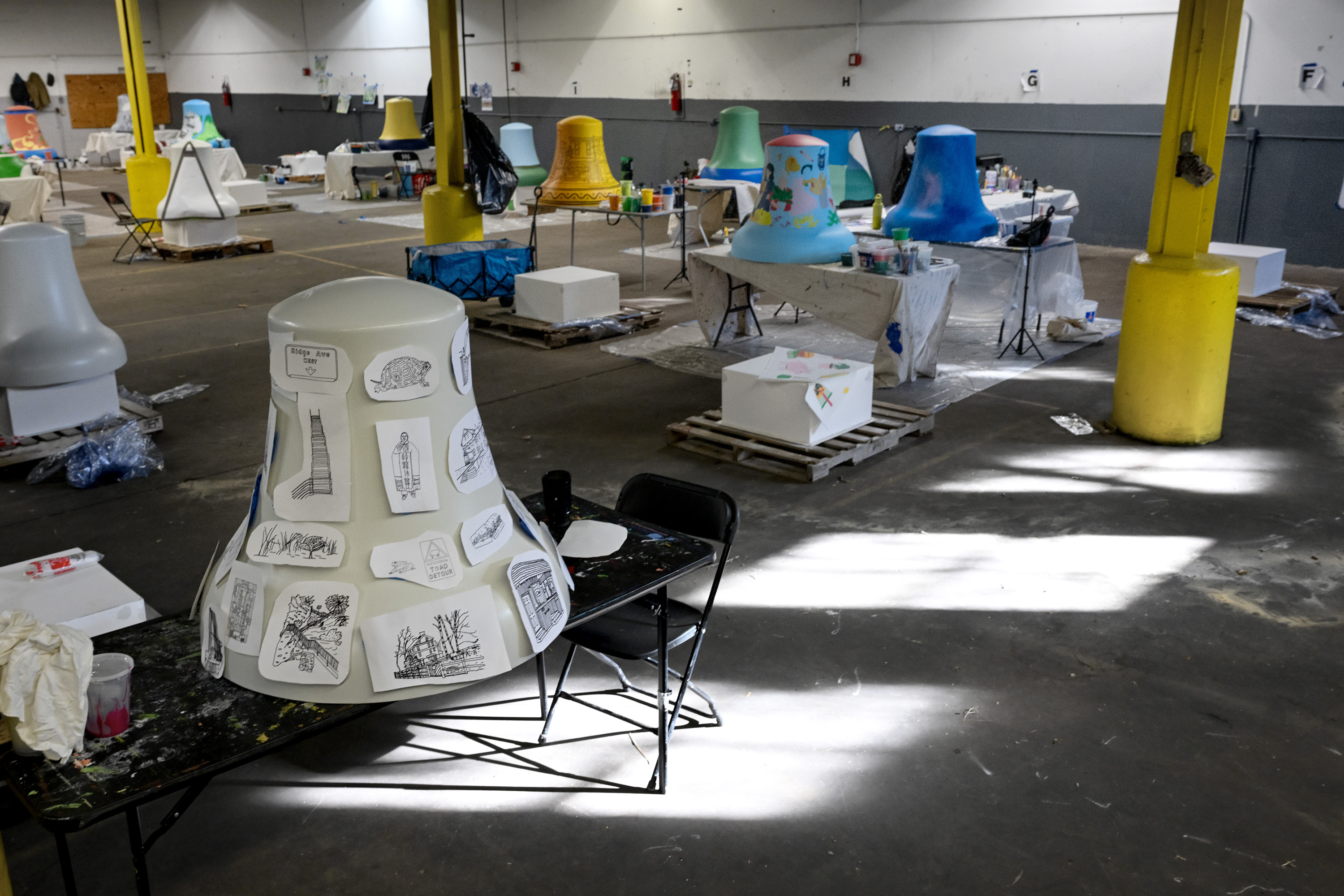
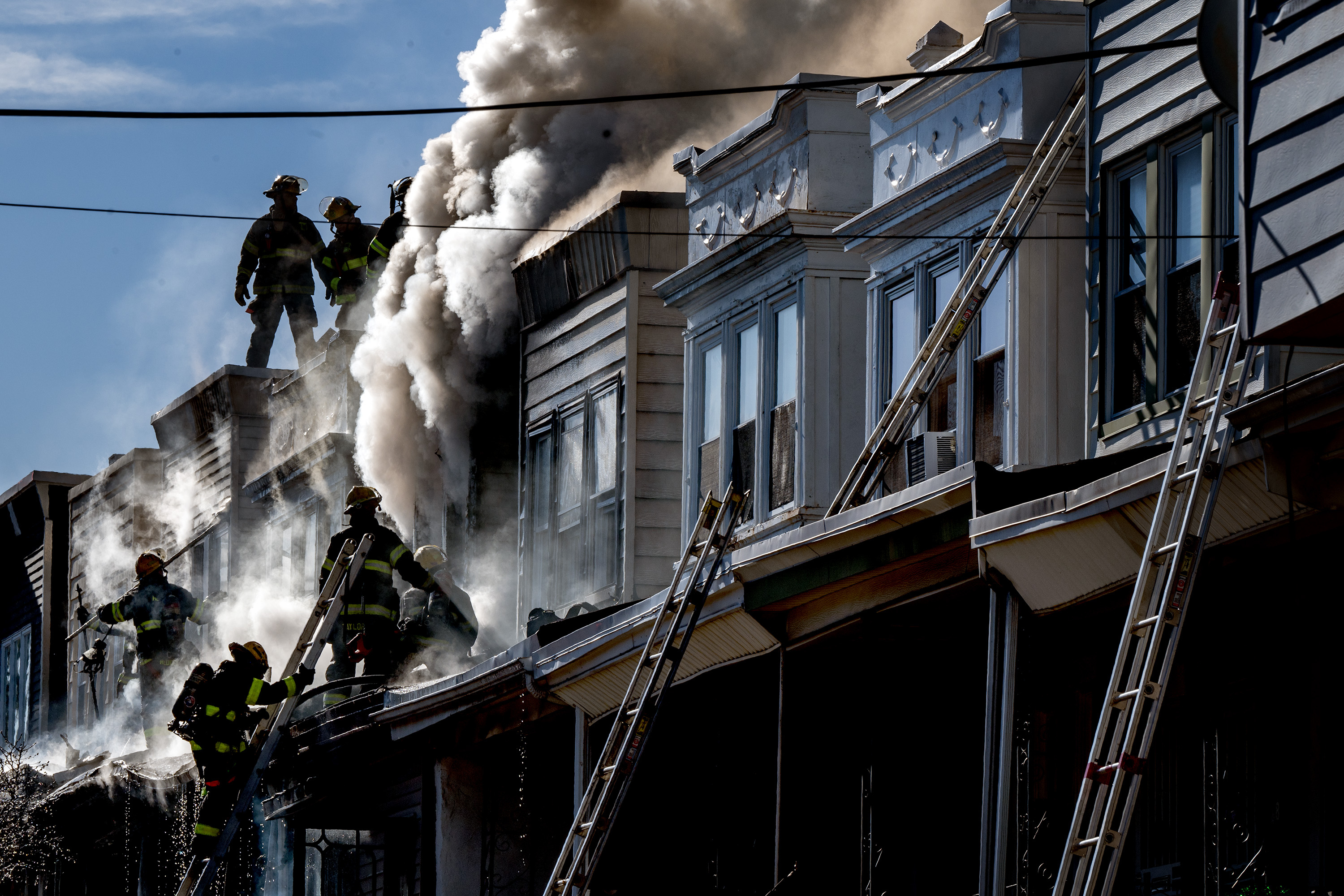
Walking out of the garage where the artists were working, I heard a news helicopter and looked up, then over to see a column of smoke rising to the north.
I got there as firefighters were just starting to climb up to the rowhouse roofs on North Lambert Street.
The fire, near La Salle University, was placed under control within an hour. But sadly, a 70-year-old mother of three did not get out in time and died in the blaze.
Since 1998 a black-and-white photo has appeared every Monday in staff photographer Tom Gralish’s “Scene Through the Lens” photo column in the print editions of The Inquirer’s local news section. Here are the most recent, in color:
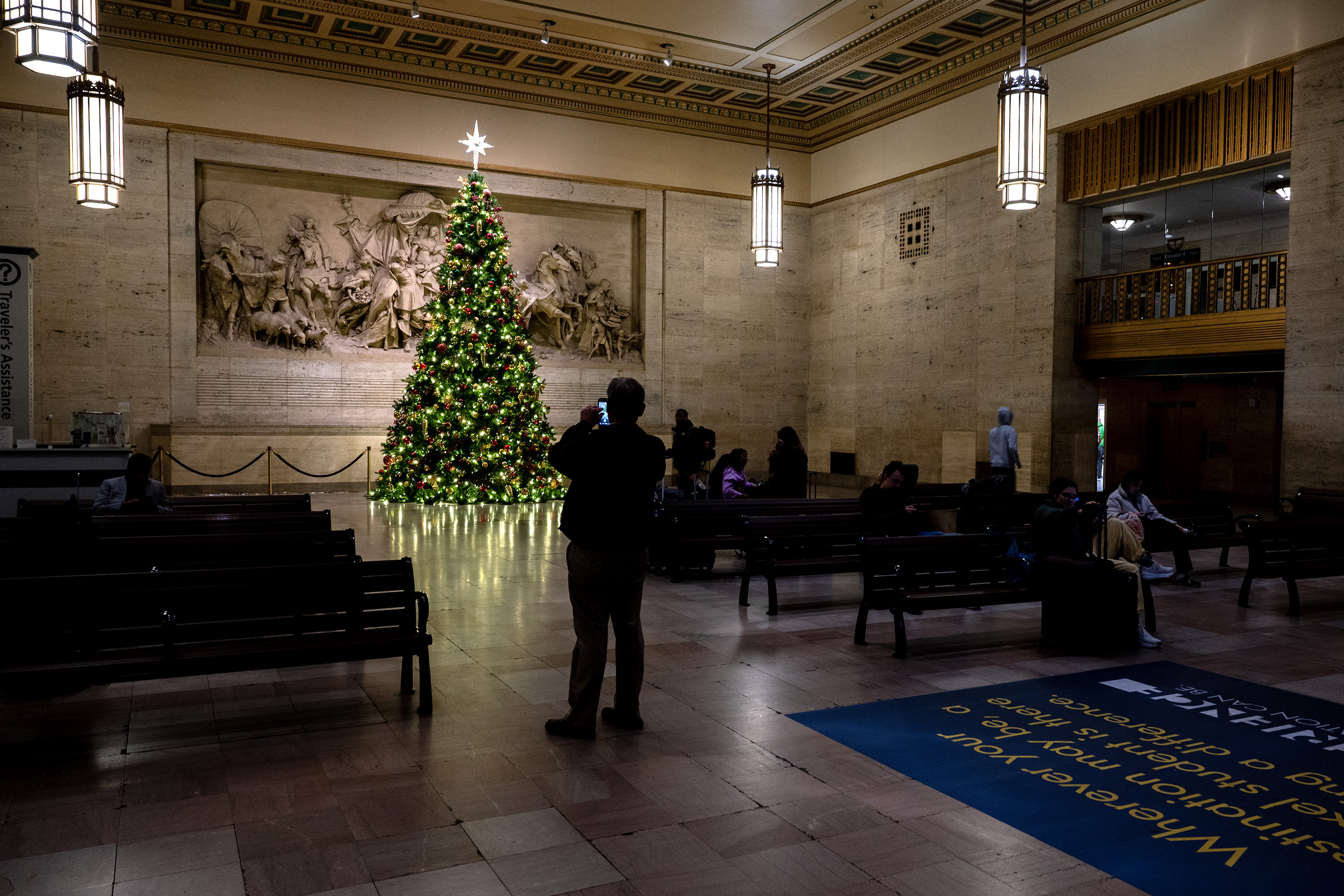
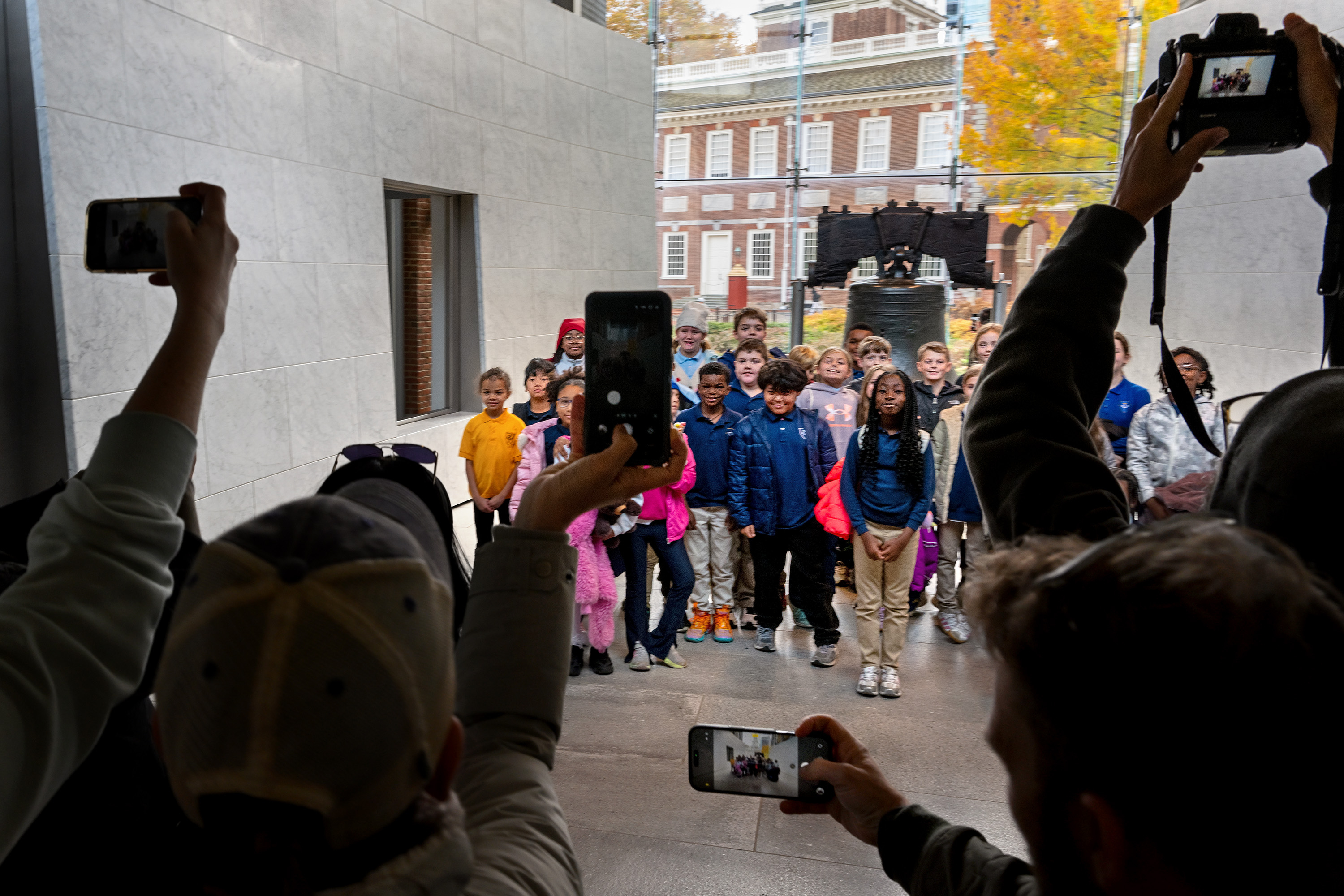
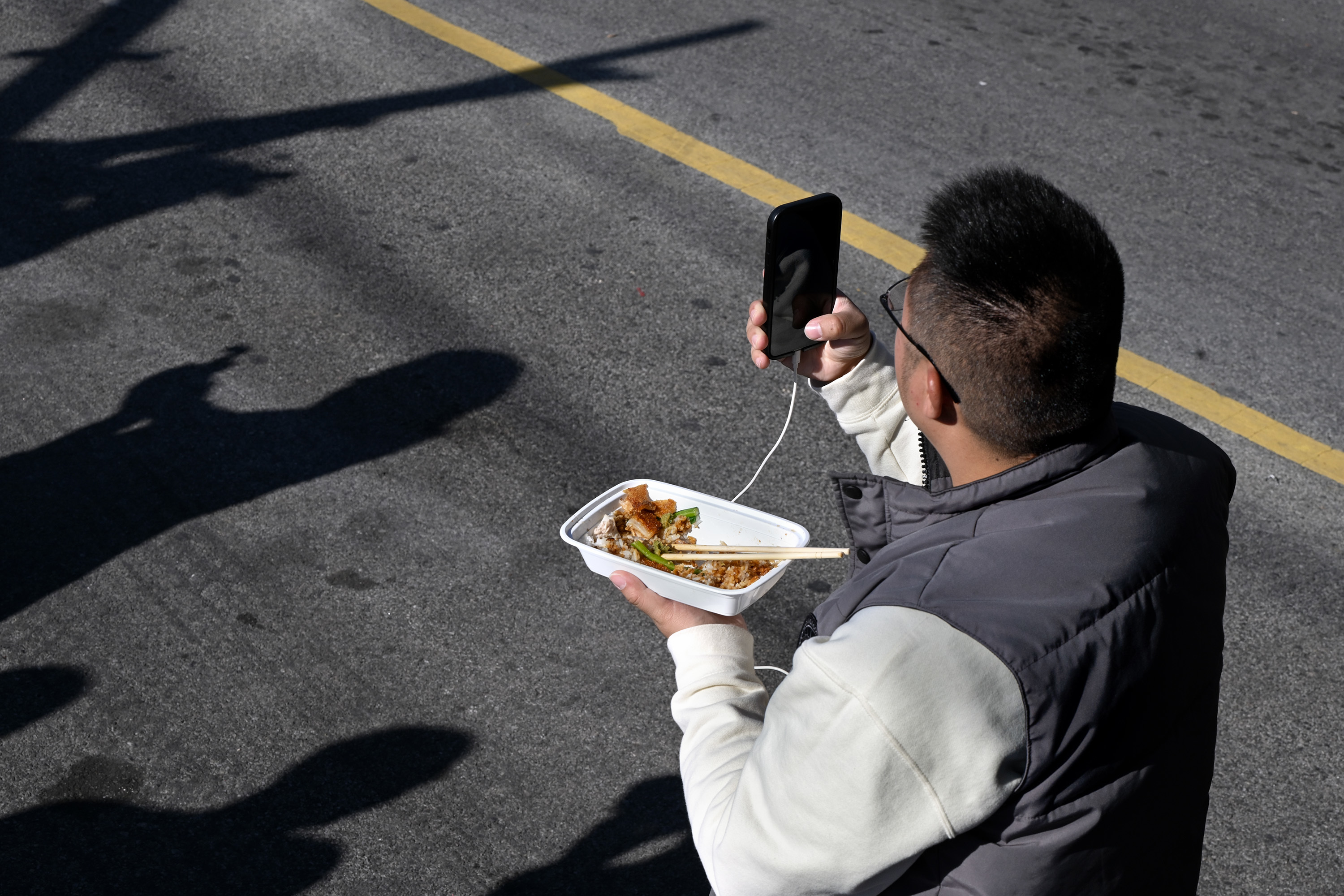
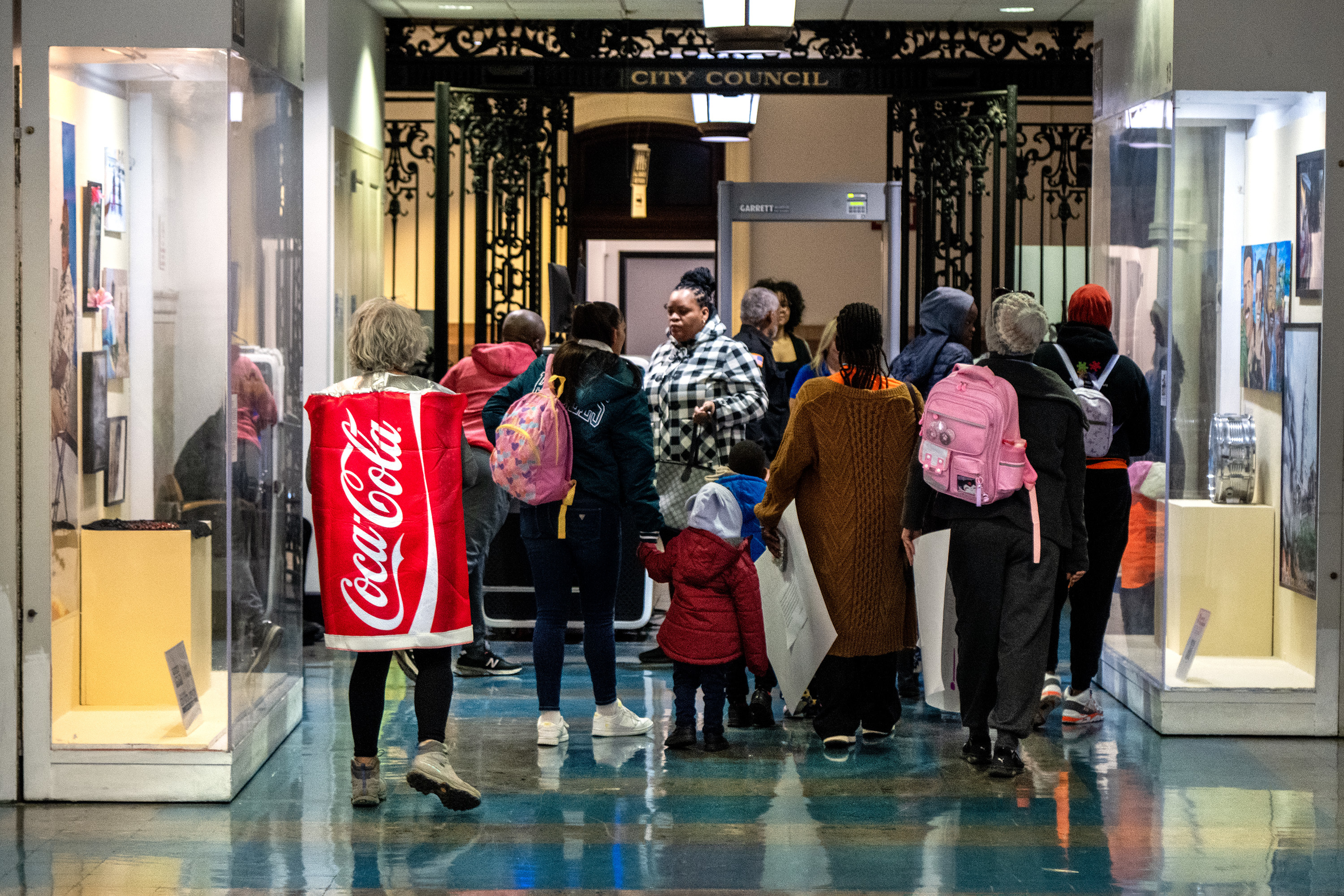
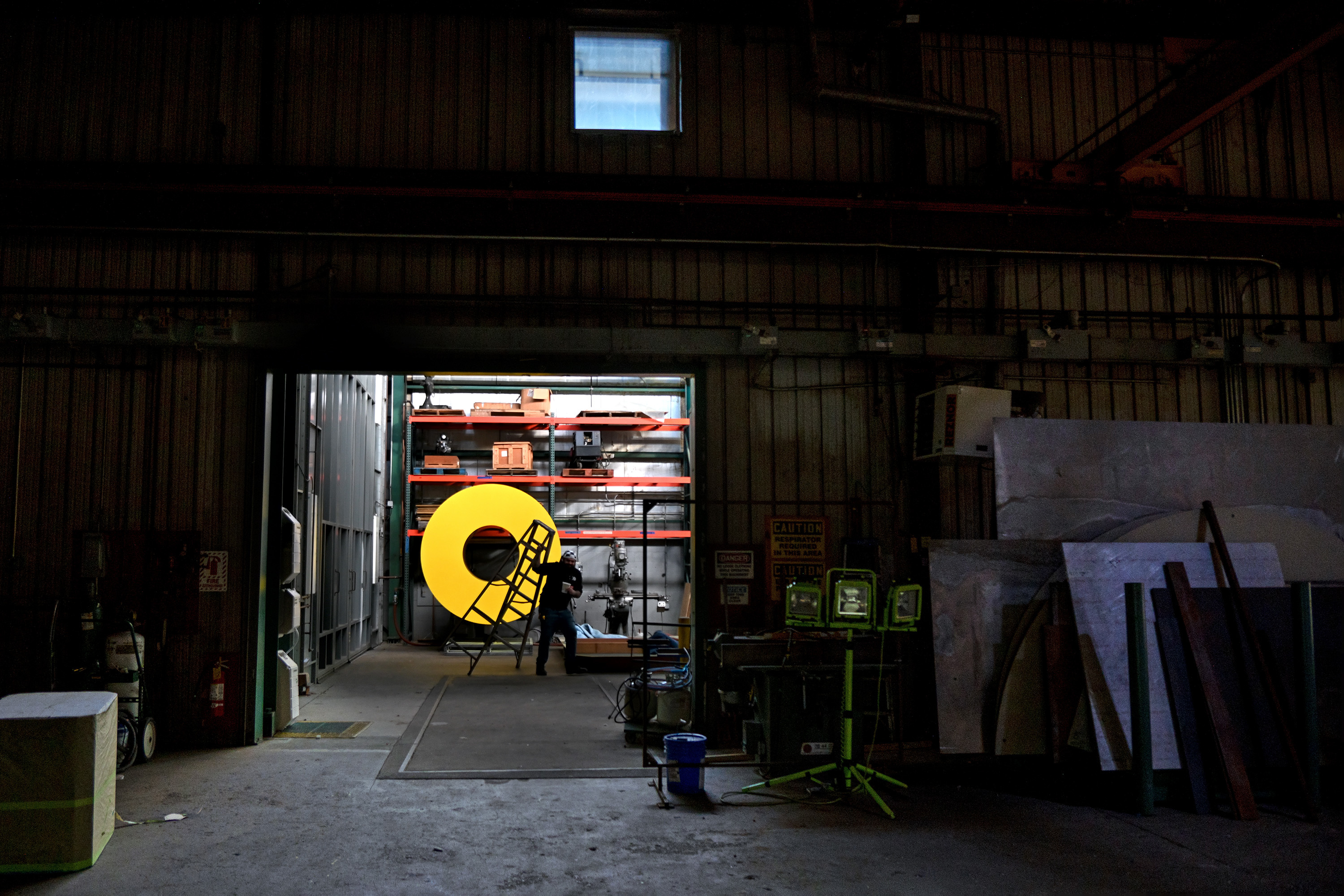
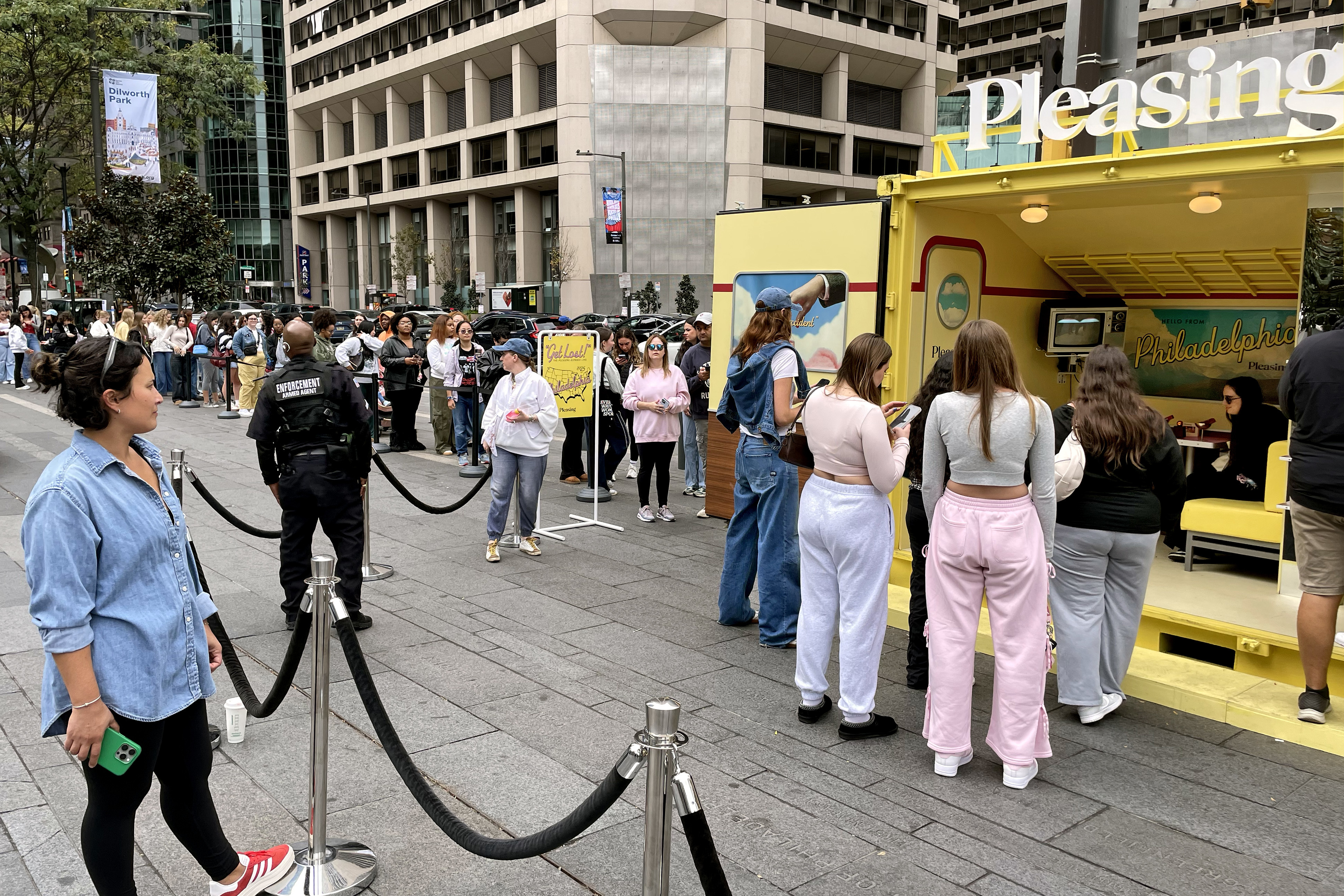
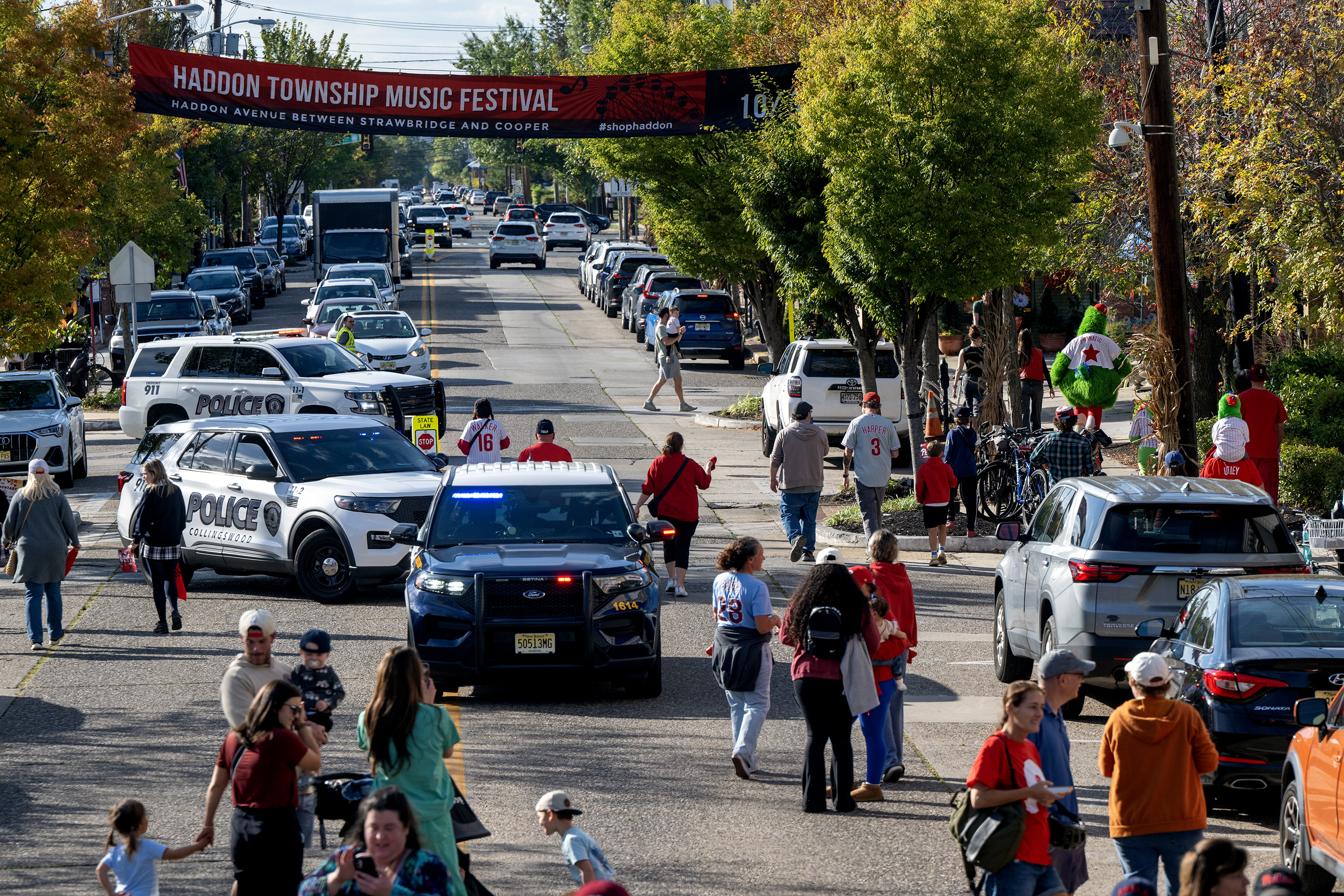
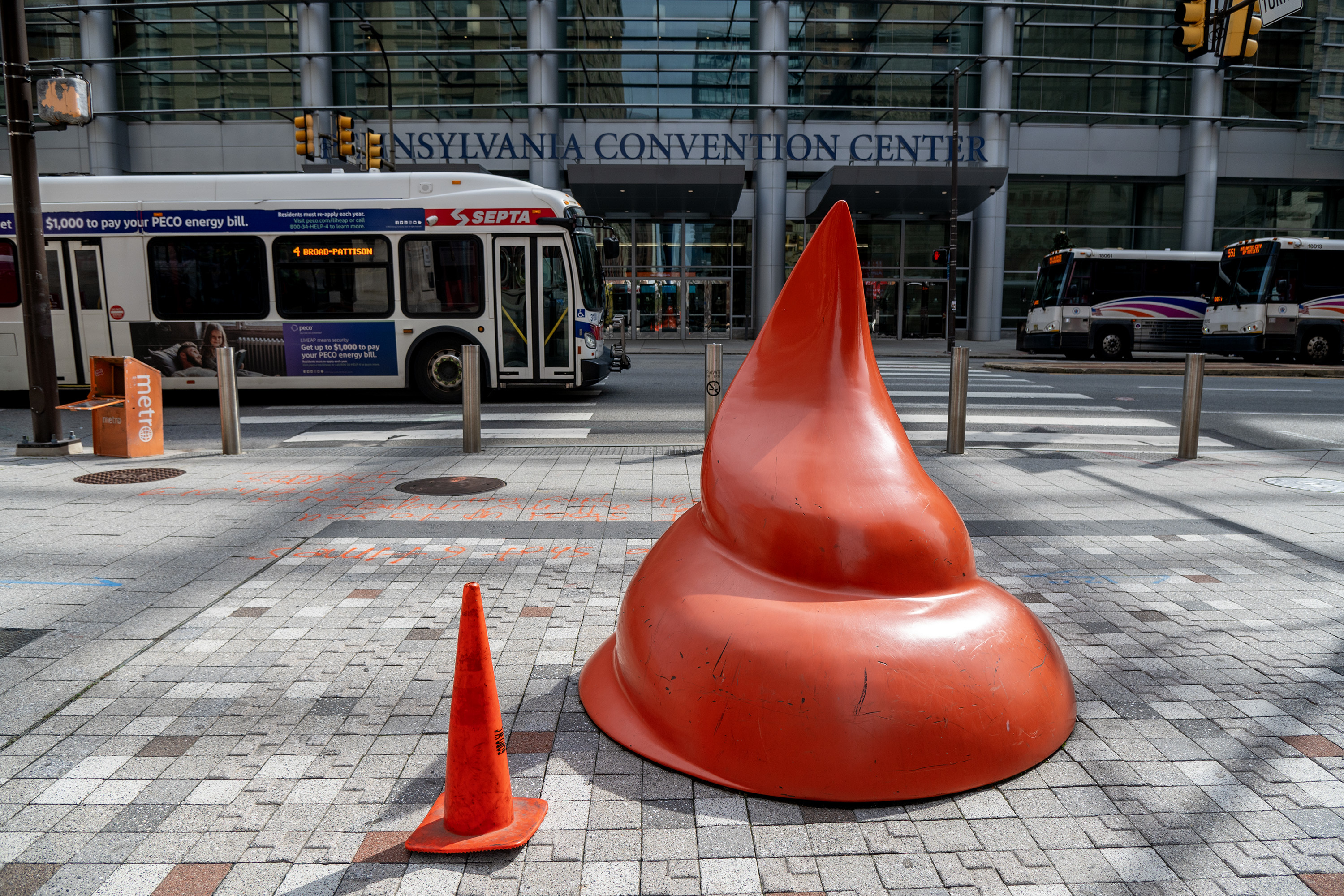
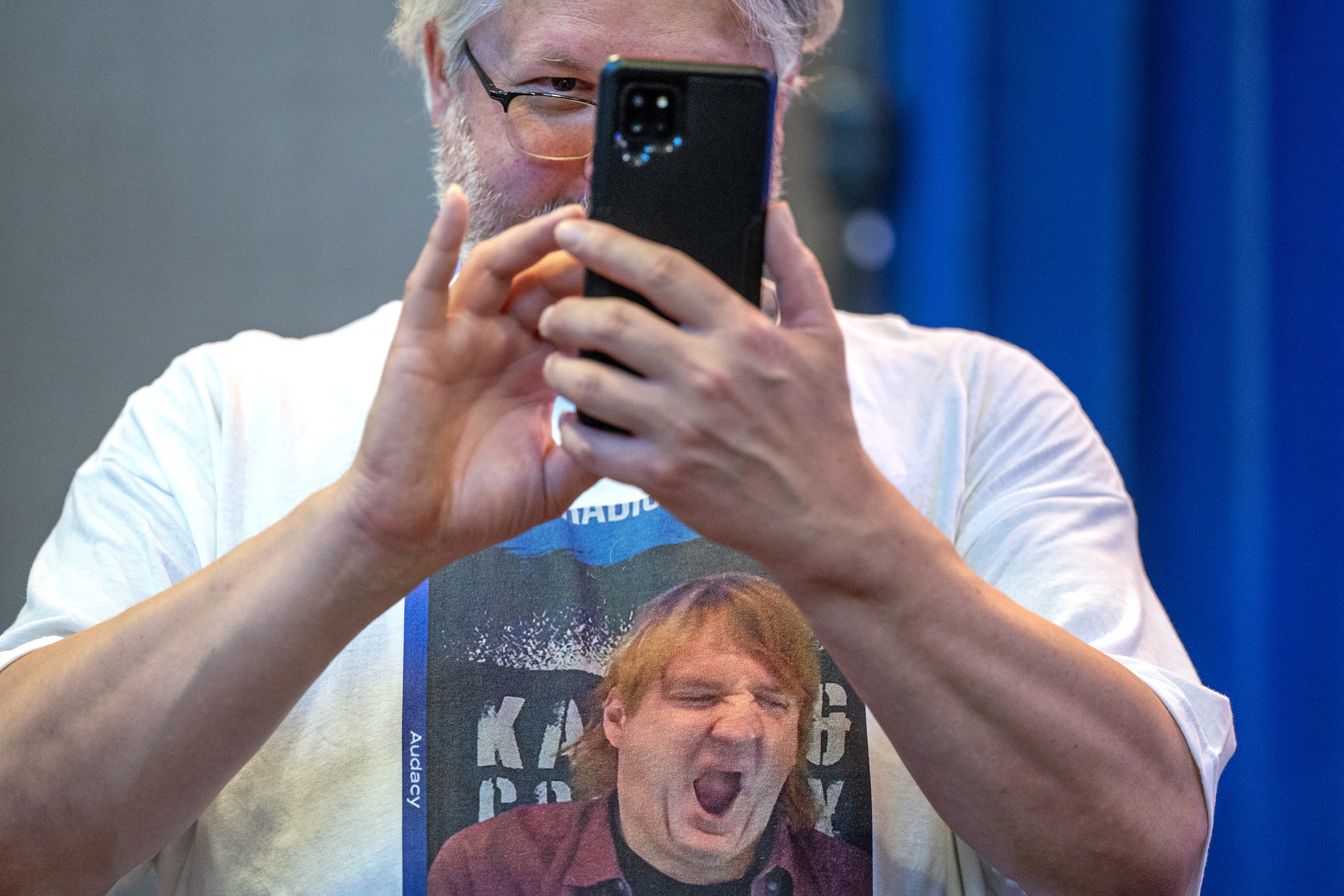
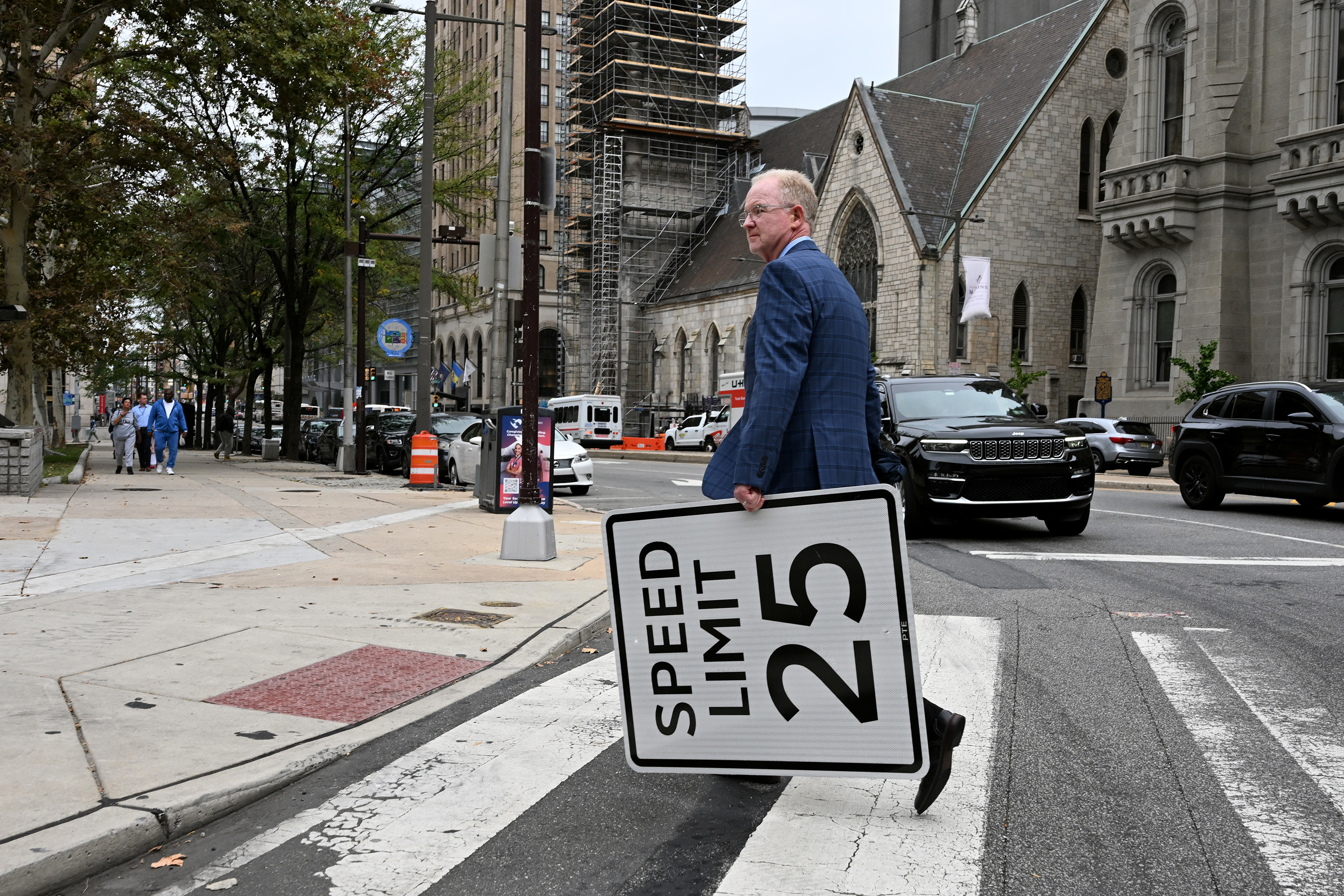
December 8, 2025: The Benjamin Franklin Bridge and pedestrians on the Delaware River Trail are reflected in mirrored spheres of the “Weaver’s Knot: Sheet Bend” public artwork on Columbus Boulevard. The site-specific stainless steel piece located between the Cherry Street and Race Street Piers was commissioned by the City’s Public Art Office and the Delaware River Waterfront Corporation and created and installed in 2022 by the design and fabrication group Ball-Nogues Studio. The name recalls a history that dominated the region for hundreds of years. “Weaver’s knot” derives from use in textile mills and the “Sheet bend” or “sheet knot” was used on sailing vessels for bending ropes to sails. November 29, 2025: t’s ginkgo time in our region again when the distinctive fan-shaped leaves turn yellow and then, on one day, lose all their leaves at the same time laying a carpet on city streets and sidewalks. A squirrel leaps over leaves in the 18th Century Garden in Independence National Historical Park Nov. 25, 2025. The ginkgo (Ginkgo biloba) is considered a living fossil as it’s the only surviving species of a group of trees that existed before dinosaurs. Genetically, it has remained unchanged over the past 200 million years. William Hamilton, owner the Woodlands in SW Phila (no relation to Alexander Hamilton) brought the first ginkgo trees to North America in 1785.November 24, 2025: The old waiting room at 30th Street Station that most people only pass through on their way to the restrooms has been spiffed up with benches – and a Christmas tree. It was placed there this year in front of the 30-foot frieze, “The Spirit of Transportation” while the lobby of Amtrak’s $550 million station restoration is underway. The 1895 relief sculpture by Karl Bitter was originally hung in the Broad Street Station by City Hall, but was moved in 1933. It depicts travel from ancient to modern and even futuristic times. November 17, 2025: Students on a field trip from the Christian Academy in Brookhaven, Delaware County, pose for a group photo in front of the Liberty Bell in Independence National Historical Park on Thursday. The trip was planned weeks earlier, before they knew it would be on the day park buildings were reopening after the government shutdown ended. “We got so lucky,” a teacher said. Then corrected herself. “It’s because we prayed for it.” November 8, 2025: Multitasking during the Festival de Día de Muertos – Day of the Dead – in South Philadelphia.November 1, 2025: Marcy Boroff is at City Hall dressed as a Coke can, along with preschoolers and their caregivers, in support of former Mayor Jim Kenney’s 2017 tax on sweetened beverages. City Council is considering repealing the tax, which funds the city’s pre-K programs. October 25, 2025: Austin Gabauer, paint and production assistant at the Johnson Atelier, in Hamilton Twp, N.J. as the finished “O” letter awaits the return to Philadelphia. The “Y” part of the OY/YO sculpture is inside the painting booth. The well-known sculpture outside the Weitzman National Museum of American Jewish History was removed in May while construction continues on Market Street and has been undergoing refurbishment at the Atelier at the Grounds for Sculpture outside of Trenton.October 20, 2025:The yellow shipping container next to City Hall attracted a line of over 300 people that stretched around a corner of Dilworth Park. Bystanders wondered as they watched devotees reaching the front take their selfies inside a retro Philly diner-esque booth tableau. Followers on social media had been invited to “Climb on to immerse yourself in the worlds of Pleasing Fragrance, Big Lip, and exclusive treasures,” including a spin of the “Freebie Wheel,” for products of the unisex lifestyle brand Pleasing, created by former One Direction singer Harry Styles.October 11, 2025: Can you find the Phillie Phanatic, as he leaves a “Rally for Red October Bus Tour” stop in downtown Westmont, N.J. just before the start of the NLDS? There’s always next year and he’ll be back. The 2026 Spring Training schedule has yet to be announced by Major League Baseball, but Phillies pitchers and catchers generally first report to Clearwater, Florida in mid-February.October 6. 2025: Fluorescent orange safety cone, 28 in, Poly Ethylene. Right: Paint Torch (detail) Claes Oldenburg, 2011, Steel, Fiberglass Reinforced Plastic, Gelcoat and Polyurethane. (Gob of paint, 6 ft. Main sculpture, 51 ft.). Lenfest Plaza at the Pennsylvania Academy of the Fine Arts on North Broad Street, across from the Convention Center.September 29, 2025: A concerned resident who follows Bucks County politics, Kevin Puls records the scene before a campaign rally for State Treasurer Stacy Garrity, the GOP candidate for governor. His T-shirt is “personal clickbait” with a url to direct people to the website for The Travis Manion Foundation created to empower veterans and families of fallen heroes. The image on the shirts is of Greg Stocker, one of the hosts of Kayal and Company, “A fun and entertaining conservative spin on Politics, News, and Sports,” mornings on Talk Radio 1210 WPHT.September 22, 2025: A shadow is cast by “The Cock’s Comb,” created by Alexander “Sandy” Calder in 1960, is the first work seen by visitors arriving at Calder Gardens, the new sanctuary on the Ben Franklin Parkway. The indoor and outdoor spaces feature the mobiles, stabiles, and paintings of Calder, who was born in Philadelphia in 1898, the third generation of the family’s artistic legacy in the city.September 15, 2025: Department of Streets Director of Operations Thomas Buck leaves City Hall following a news conference marking the activation of Automated Speed Enforcement (ASE) cameras on the Broad Street corridor – one the city’s busiest and most dangerous roads. The speed limit on the street, also named PA Route 611, is 25 mph.
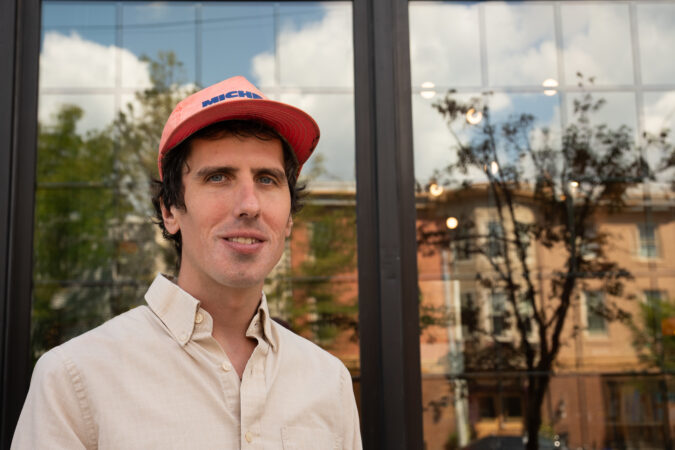
Russell Edling has been in Philly long enough to remember when Fishtown was quiet — “pretty sleepy,” he said. That was more than a decade ago, when he was a fresh Temple grad.
Things have changed a lot since then, both for Fishtown and Edling. A musician who records under the name Golden Apples, Edling just released his fourth album, Shooting Star, in September. It’s a “record of songs about writing songs,” he said — and about trusting your creative instincts.
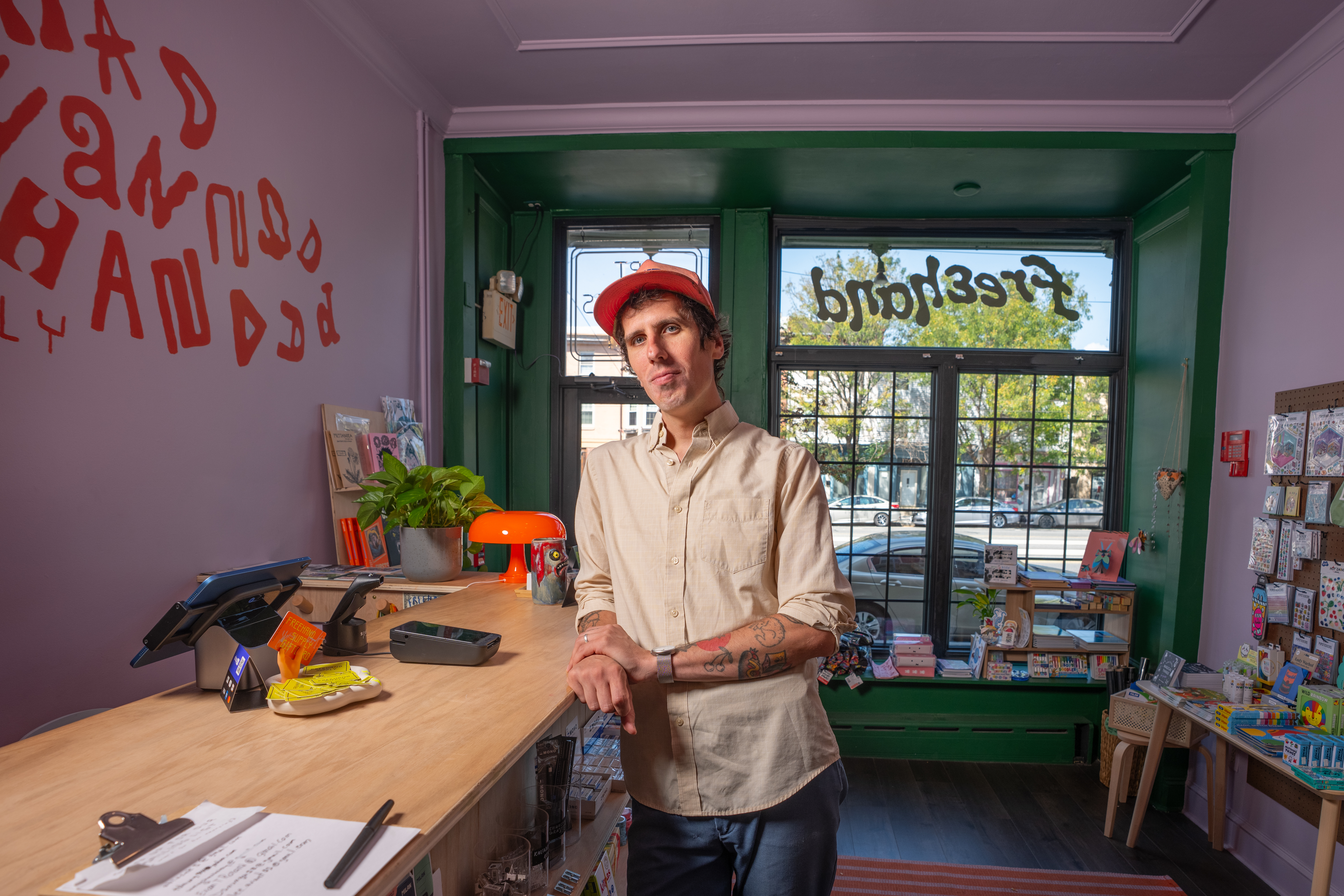
Edling’s own instincts extend beyond music. He also dabbles in design and helps run Freehand Supply, the art shop he and a friend opened in the neighborhood earlier this year.
“When I first moved here for college in 2008, there was nothing like that in Fishtown,” he said. “I used to bike up to Temple just to get art supplies. It feels good to be able to offer that to people now.”
Here’s how Russell Edling would spend a perfect day in Philadelphia.
7 a.m.
I get up around 7 and I like to go running. I do a casual jog through the neighborhood and loop through Penn Treaty Park, then run around the casino and come home. It feels special to wake up and, in like 15 minutes, be running by a river through a park.
9 a.m.
My wife and I have a favorite spot to get breakfast. It’s this place in South Philly called Comfort Floyd. It’s wonderful. I think it’s the best pancake I’ve ever had. All their food is so good. The ambience is very chill and pleasant, too. We will ride our bikes down there and hang out as long as we want.
After that, we will bop around South Philly a little bit. I really like Brickbat Books. It’s a great spot. They have a lot of art books, a lot of used books, a really great curated selection. They also have some records.
We will probably go to Retrospect on South Street, too. My partner, Mimi, really loves thrifting. I have less of an appetite for it. I get exhausted by the experience sometimes and have to dissociate.
Russell Edling, a musician who goes by the moniker Golden Apples, in his art supply store, Freehand, in Fishtown.
2 p.m.
On our way back up to the neighborhood, we might stop at Freehand just to make sure everything’s going all right there. Then we’ll head home to walk the dog. We have a wonderful black German short hair–pointer–lab mix. We live right by a soccer/baseball field that he loves to run around. You’re not supposed to bring your dogs in there, but everybody does anyway.
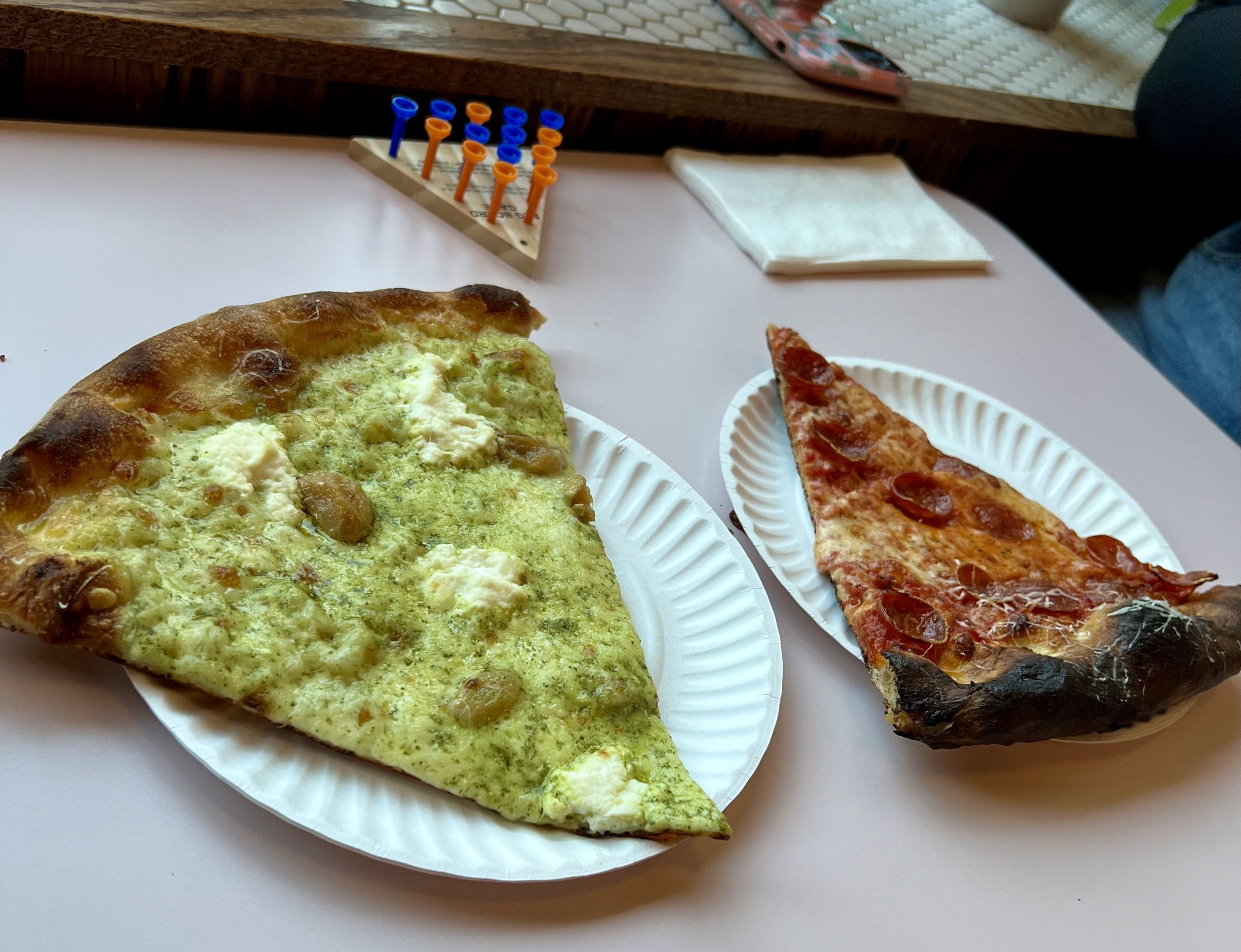
Basil cream, confit garlic, ricotta, fontina, and mozzarella atop a white pizza at Pizza Richmond.
3:30 p.m.
If it happens to be a weekend when the Richmond Street Flea is happening, we’ll definitely go to that.
There are a bunch of little shops on Richmond Street, and they all open their doors. Everybody’s out on the street. They have vendors, food, and pop-ups. Even live music.
We’ll end up popping into different shops. There’s a vintage store called Big Top. There’s Launderette Records, which is an incredible record store. There’s a jewelry store called Tshatshke, where my partner and I got our wedding bands. And there’s a great pizza spot — Pizza Richmond. They also have soft-serve ice cream. We’ll hang out at the flea market for a while. Maybe see some music, talk to some friends, and just hang out.
6:30 p.m.
If we’re still out for the day after the flea market, we’re going to see a show. Our favorite venue is Khyber Pass Pub. It’s been around for a really long time. I think Nirvana played there. Guided By Voices played there. So many legendary people have played there over the years. It’s a small, intimate space, but they have great shows all the time, and they have an incredible menu.
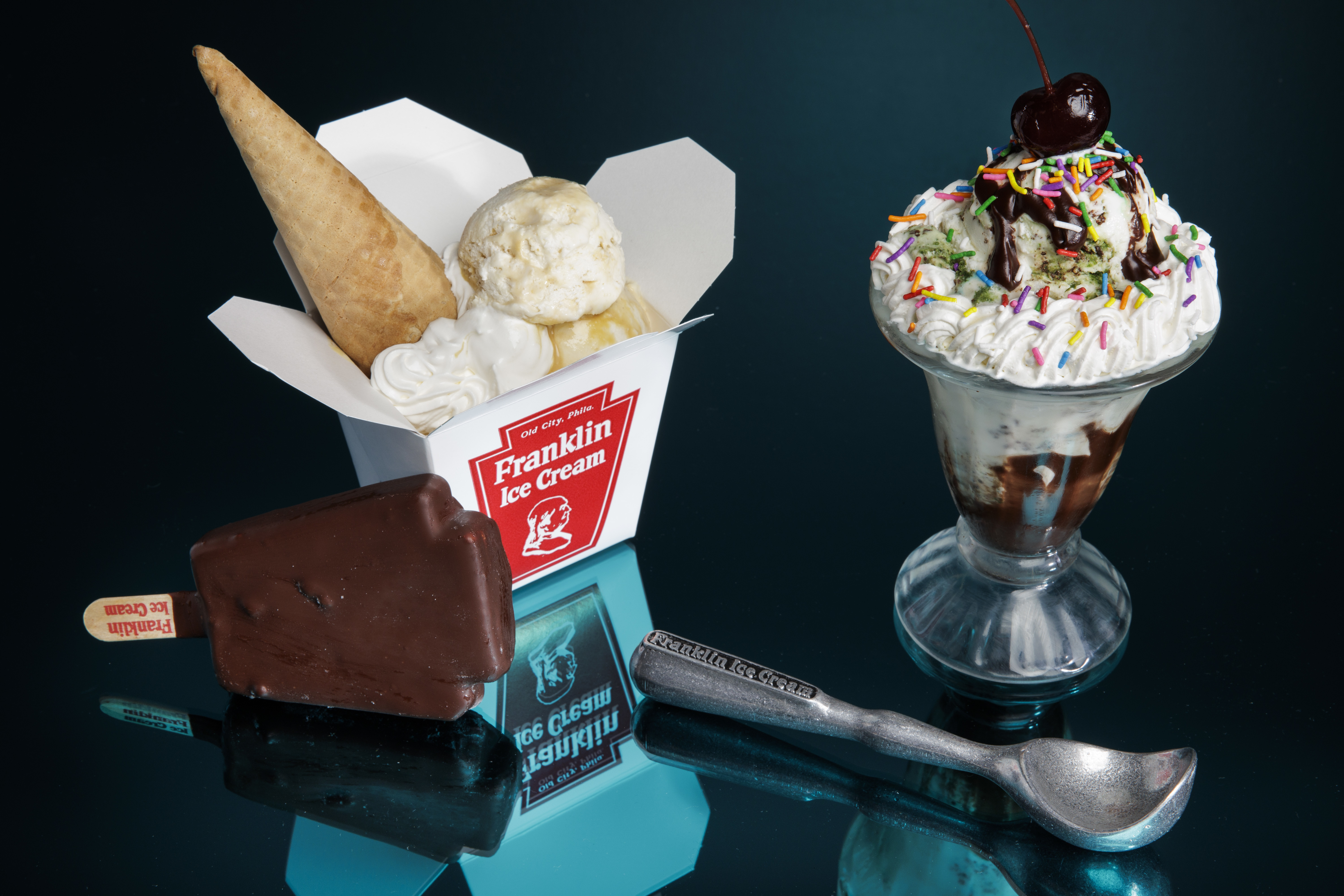
Franklin Fountain ice cream: “Our equivalent of a nightcap.”
11 p.m.
Our equivalent of a nightcap is ice cream at Franklin Fountain because they are open until midnight.
There are two Franklin Fountains in the same building. One is 1920s style. The other is 1950s style. No one goes to the 1950s one for some reason, so we go to that one to skip the line. I know it’s very touristy, but I have worked in ice cream throughout my life, and I think it’s the best ice cream in the city.
The Phillies resigning Kyle Schwarber (and extending Rob Thomson): B-
Look, we love Kyle Schwarber. The city loves Kyle Schwarber. Dogs wearing tiny Schwarber jerseys love Kyle Schwarber. The man hits baseballs into orbit, leads the clubhouse, and has basically willed this team to look alive some Septembers when vibes were bleak. Him staying in Philly always felt inevitable.
But here’s the uncomfortable truth we’re all circling: We’ve seen this movie before.
Schwarber is now locked in through age 37. Harper, Turner, Nola — all extended into their late 30s too. The Phillies are doubling (and tripling) down on the same aging core that keeps putting up big regular seasons and then… evaporating in October.
Yes, Schwarber smashed 56 homers in 2025. Yes, he’s historically elite. Yes, Rob Thomson deserved his extension, four straight postseasons don’t grow on trees. But also: This team has repeatedly stalled in the playoffs, and running it back with the same core isn’t exactly a bold correction.
Dombrowski insists they’re “not just bringing the band back,” but right now it feels a lot like the band tuning up the same setlist and we already know how ends: a killer eighth-inning rally in June, a heartbreaking NLDS in October.
If the Phillies really want a different result, they still need a third true power bat behind Schwarber and Harper — the Rhys Hoskins void has been haunting them for three seasons. Until they fill it, this roster is basically an expensive version of “just try that again.”
FanDuel, DraftKings, and other online gambling apps are displayed on a phone in San Francisco, Sept. 26, 2022.
Philly is the No. 1 market for online gambling: D-
Philly finally beat New York and Vegas at something — unfortunately, it’s being the top target for online gambling ads. Companies dropped $37 million this year convincing us that our phones are tiny casinos that fit in our pockets and aren’t ruining our credit scores.
And guess what? It worked! Calls to 1-800-GAMBLER about online betting have nearly tripled since 2021. Penn State says 30% of Pennsylvanians now bet regularly, and about 785,000 people in our commonwealth of 13 millionare estimated to be problem gamblers, which, coincidentally, is also the number of people who think the Sixers will “definitely cover tonight.”
The hotline stories are brutal: drained retirements, missed mortgages, broken marriages, people betting on Russian table tennis at 3 a.m.
Yes, Harrisburg pockets tax money. No, that does not offset the fact that some folks are blowing entire paychecks faster than a Broad Street Line train skips your station.
The Eagles have installed the “positivity rabbit” into the locker room
It showed up today and the offensive line stressed to me they are not sad they just wanted a good vibes bunny 👍 pic.twitter.com/zJi0M93SEr
The Eagles’ positivity rabbit: B for bunny (but trending toward D if they keep losing)
Only in Philadelphia could a three-game skid lead to the installation of a giant inflatable “positivity rabbit” in the Eagles’ locker room, the kind of holiday décor your aunt buys at Lowe’s, except this one is supposed to fix the offense.
According to NBC Sports Philly, the O-line wanted “good vibes.” So the Eagles brought in a five-foot inflatable bunny. Reddit immediately turned it into a full-blown prophecy, a meme, and possibly a new religion. Some fans think it’s the 2025 answer to the underdog masks; others think it looks like the guy who egged Patullo’s house finally got caught.
And then Jason Kelce stepped in with the dagger: “To be honest, I don’t really like the rabbit. It’s a little hokey… It didn’t work. You have to ditch the rabbit.”
The vibes bunny now sits at a dangerous crossroads. If the Birds win out: parade float. Philly embraces it forever. Etsy shops explode. If they don’t: that thing gets thrown on I-95 like HitchBOT.
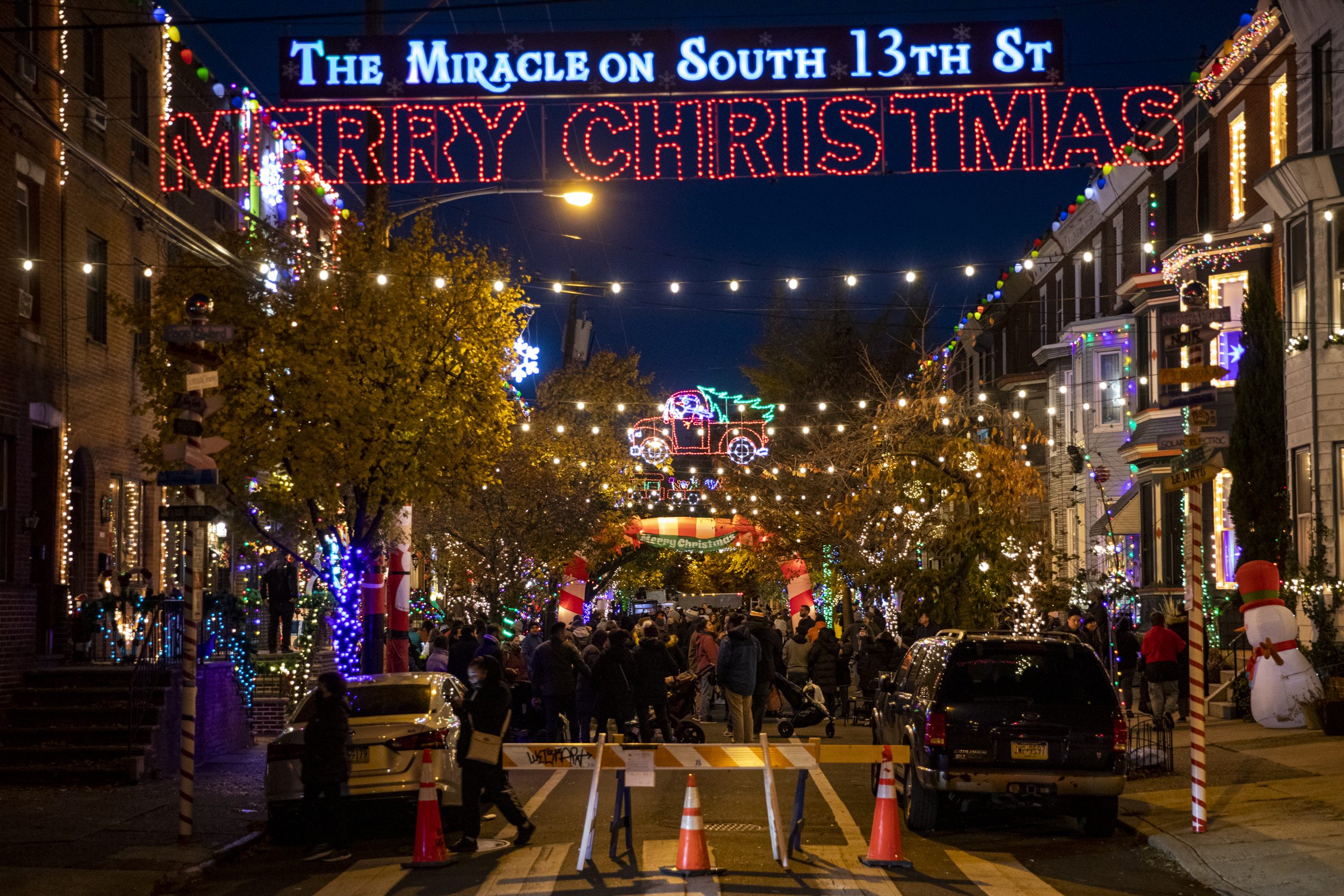
The Miracle on South 13th Street block party is filled with Christmas lights and decorations in 2021.
Miracle on South 13th Street traffic chaos: C+
South Philly’s favorite holiday tradition is back — and so is the gridlock, horn-honking, and pure, uncut neighborhood rage that comes with funneling half the region down a street roughly the width of a rowhouse hallway.
This year, 6abc reported that Morris Street briefly closed and pushed even more cars onto 13th, turning a beloved Christmas display into a live reenactment of Uncle Frank screaming “Look what you did, you little jerk!” Residents are understandably asking the city the obvious South Philly question: How exactly is an ambulance supposed to get through when Karen from Cherry Hill parks her Highlander on a diagonal to get the perfect photo?
Neighbors want more open-street hours, as in let people walk, let cars chill. Councilmember Squilla says he’s willing to talk about it, which is Philly for “maybe… if everyone stops yelling.”
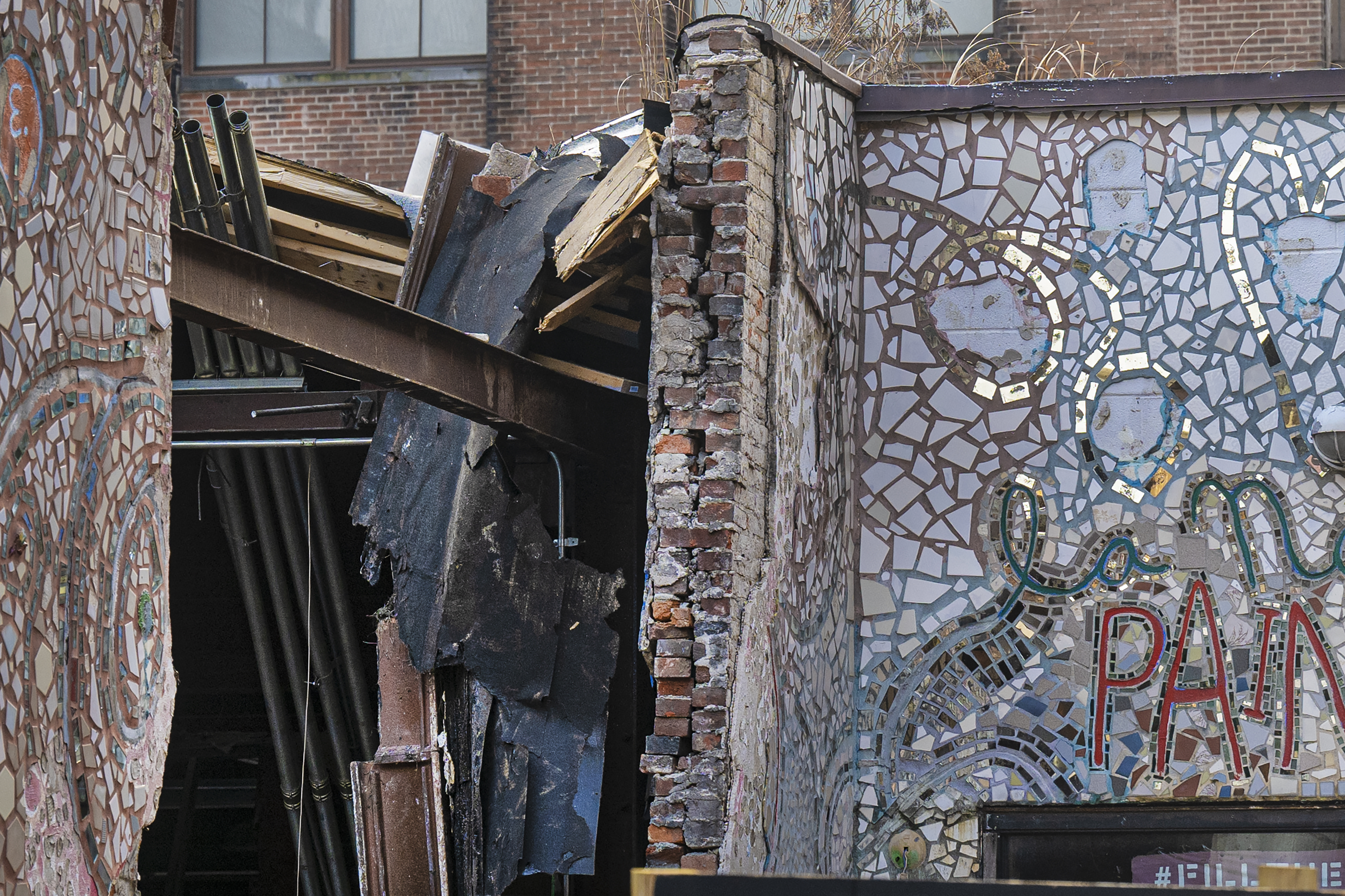
The former Painted Bride Art Center at 230 Vine St. is shown Thursday, Dec. 11, 2025, during demolition to make way for new apartments and commercial space.
The Painted Bride’s long fall: D
The demolition of the Painted Bride isn’t just another development story. It’s the slow, painful end of something that felt uniquely, defiantly Philadelphia. After nearly six years of lawsuits, appeals, zoning wars, neighbor fights, preservation pleas, and enough public testimony to qualify as its own Fringe Festival show, the Old City building that once held Isaiah Zagar’s 7,000-square-foot mosaic is officially coming down.
If you grew up here, walked past it, or just have a pulse, the loss hits hard. The Painted Bride wasn’t a blank canvas waiting for a luxury building. It was already the art. It was the kind of place tourists would stumble upon, go “What is this?” and locals would answer, “Oh, that’s just Philly being weird and beautiful.” Now it’ll be dust, plywood fencing, and a future apartment building trying its best to pretend a few salvaged tiles can replace an entire iconic facade.
Neighbors didn’t want height. The Bride didn’t want the building. The city didn’t want to officially call it historic. The developer wanted to preserve it until a court told him he couldn’t.
This is the kind of loss that feels bigger than one building. Philly’s magic is fragile. Sometimes it’s protected (hello, Wanamaker Organ), and sometimes it’s chipped away, boxed up, and repurposed as lobby decor.
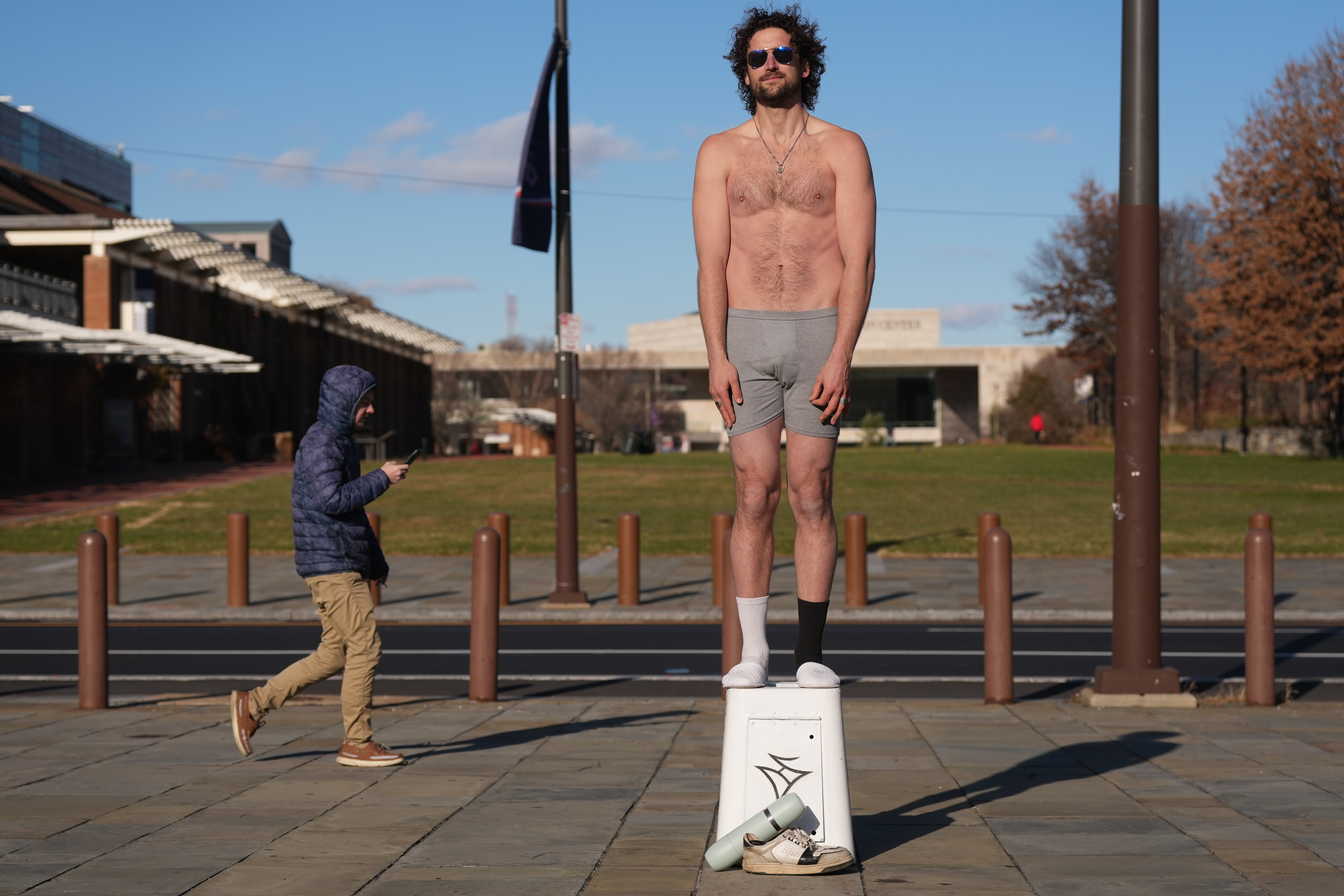
An artist named Ham, the architect of this cold weather performance piece, in Philadelphia, December 11, 2025.
A nearly-naked man standing on a box by the Liberty Bell: A+
Tourists stared. Rangers grew concerned. Locals did what locals always do — tried to figure out if this was art, a bet, or a fantasy-football punishment gone horribly wrong.
Turns out it was art. The man, an artist from Baltimore named Ham (“like the sandwich”), calls the whole thing a commentary on social media. Instead of posting content, he becomes the content.
Ham has done this in New York, Berlin, and even a Norwegian village but claimed Philly gave him the best interactions: confused tourists, National Park rangers offering him clothing, a police officer checking in, and Philadelphians who stopped just long enough to ask, “Buddy… why?”
In a very Philly twist, he’s putting the money people hand him toward an engagement ring, which somehow makes the whole thing feel less like performance art and more like a South Street side quest.
No matter how you interpret it, it’s peak Philadelphia: a nearly naked man shivering by one of America’s most sacred monuments, and the city responding with equal parts curiosity, concern, and “yeah, that tracks.”
Ham planned to stand out there through the weekend — but only until around 4:30 p.m., because even performance artists know better than to be half-naked in Center City after dark.
The buyer: Lulu Tunis, 39, communication specialist
The house: A 1,060-square-foot rowhouse in Brewerytown, with three bedrooms and one bathroom, built in 1925
The price: Listed for $270,000; purchased for $240,000
The agent: Rachel Shaw, Philly Home Girls
The ask: For Lulu Tunis, it was simply time to buy a house. She had been living in Brewerytown for a decade. Her one-bedroom apartment on Girard Avenue was fine, but she wanted more space. More importantly, she felt financially prepared to buy. “I think I was just ready,” Tunis said.
Her needs included three bedrooms, easy street parking, and a backyard large enough for the dogs she often pet sits. Proximity to Girard Avenue was also important. “I didn’t want to be too far off where I normally hang out,” Tunis said. She was OK with only one bathroom and also a fixer-upper. “I’m pretty handy,” she said.
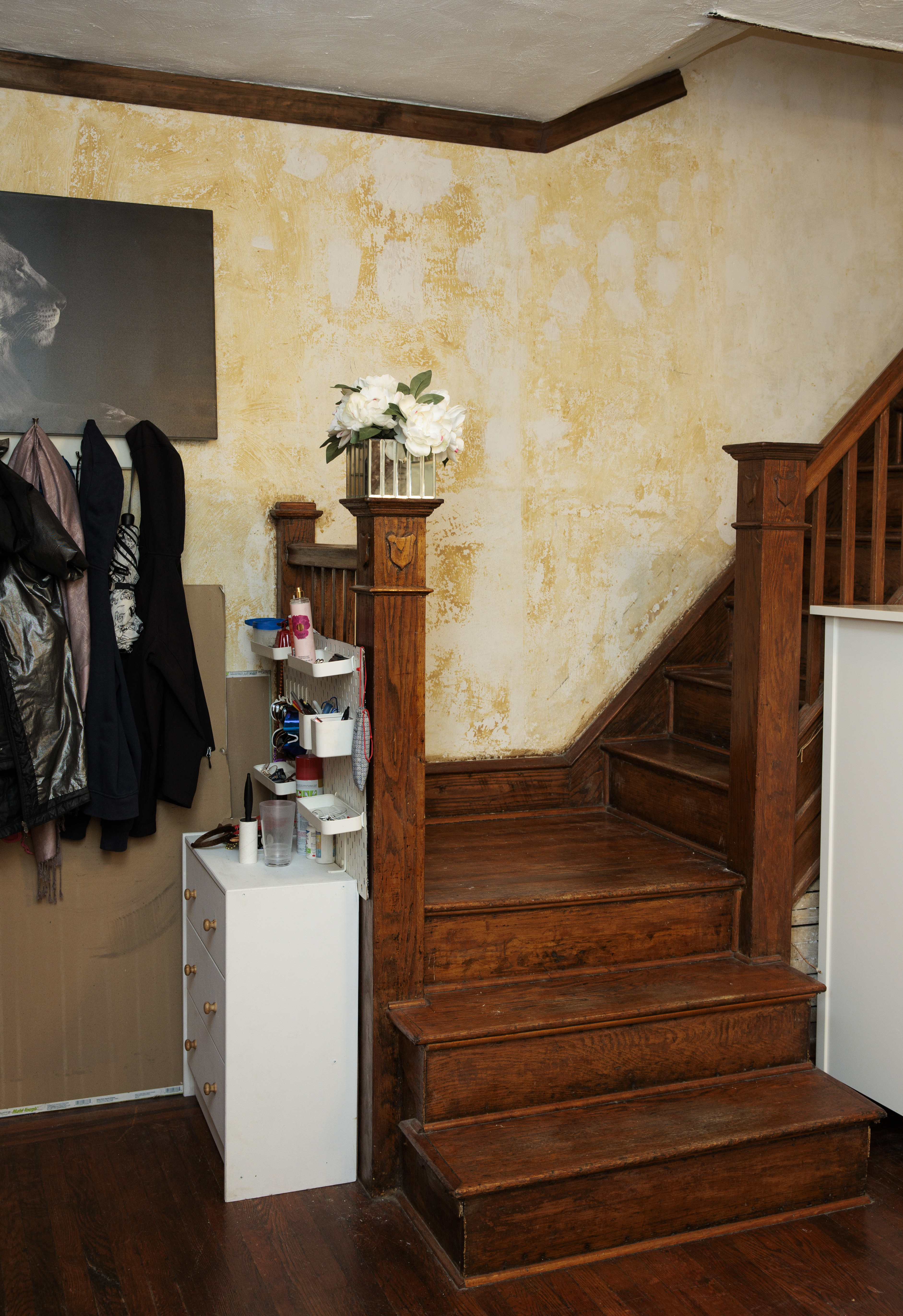
The hardwood staircase leads to three large bedrooms upstairs.
The search: Tunis began looking in April 2024 and narrowed her search to a four-block radius. “There were actually a lot of options,” she said. Her budget was $250,000.
In the 10 homes she saw, she ran into all kinds of strange layouts. Some of the third bedrooms were the size of a closet. Others didn’t have closets. Neither situation would do. Nor would the house with the extra narrow hallways upstairs, or the one that smelled like cat pee. She considered a couple of duplexes in case her family moves in with her down the road, but they needed too much work.
Tunis was OK with just one bathroom but has enjoyed having a remodeled half bath on the first floor.
She fell in love with a house on a corner lot that had great light and tried to make an offer, but someone beat her to it. “I still walk by it all the time,” said Tunis, “and I get a little jealous.”
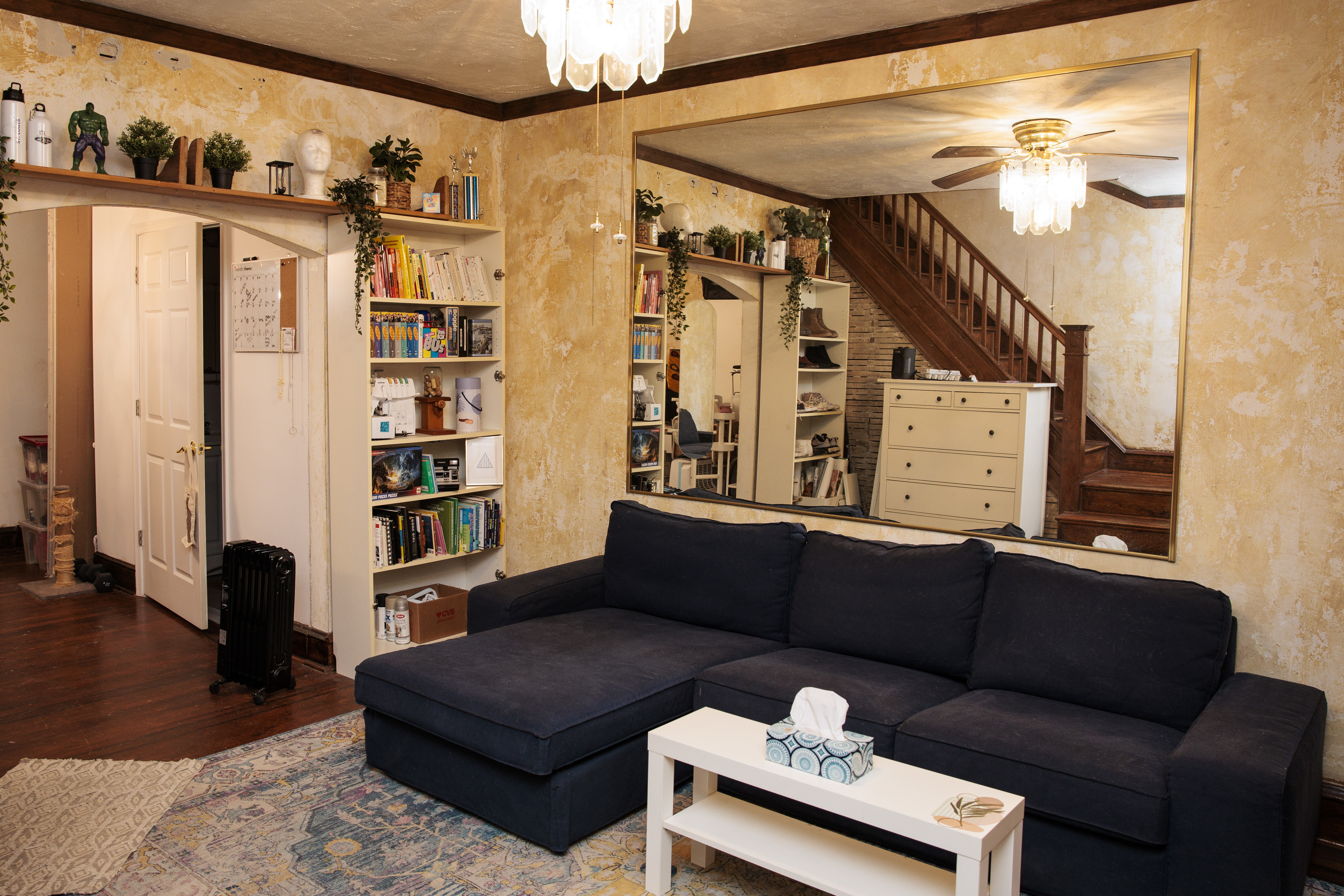
The appeal: The house Tunis bought charmed her immediately. There was a large, golden mirror near the entrance. “It’s great for ‘fit shots,’” Tunis said. She liked how open the downstairs was and that the laundry was right off the kitchen. The unfinished basement needed some work, but it had plenty of room for storage. Upstairs, Tunis was delighted to find three relatively large bedrooms (each one can easily fit a bed and a desk) and recently redone hardwood floors. It also has 1½ bathrooms.
The large gold mirror that Tunis immediately fell in love with when she stepped inside the house for the first time.
The downstairs floors weren’t in great condition, but Tunis liked that they were original to the home. Despite being dated, the house was full of great features. “I could see the potential,” said Tunis.
The deal: The house was above Tunis’ $250,000 budget, but it had been on the market for 80 days, so her real estate agent suggested they submit a bid under the asking price. Tunis offered $240,000 and the seller accepted immediately.
During negotiations, Tunis asked the seller to pay for termite treatment and a home warranty, which covers the cost of repairing or replacing major appliances and systems. The inspector warned Tunis that the heater would probably have to be replaced within the year. Everything else looked good.
The money: Tunis had a little under $5,000 saved for her home purchase. Her aunt gave her another $5,000. She also received a Keys to Equity grant for $20,000 and a Philly First Home grant for $10,000. She used $17,000 for the down payment and shelled out $16,000 for closing costs. With a 6.375% interest rate, her monthly mortgage payment is $1,392.
The move: Tunis officially closed on Nov. 15 but waited until the end of December to move in. She wanted to tear down the wallpaper in the living room. The process took longer than she expected and forced her to abandon her other pre-move-in home-improvement plans. “I just lost motivation,” Tunis said.
The house has plenty of places for Tunis’ cat, Huey, to nap.
Because Tunis’ new house was only a block from her old apartment, she moved gradually at first, carrying small loads on foot. Her family arrived the day after Christmas to help move bigger stuff. They rented a U-Haul and moved everything in two trips. Tunis’ first night in her new house was Dec. 29. She started a new job the next day.
Any reservations? The biggest disappointment in the house has been the lack of natural light. It’s blocked most of the day by a five-story school across the street. “I only get sun first thing in the morning and then around sunset,” Tunis said. Her plants are suffering.
Tunis’ house is in the middle of the block and across the street from a tall building, so it doesn’t a lot of light.
Life after close: So far, Tunis is happy with the way her bedroom looks, and that’s about it. The rest of the house remains a work in progress. “There’s always some half-built furniture somewhere,” she said.
Her next big project will be replacing the drywall in the back room downstairs. She took a class at West Philly Tool Library and plans to do it herself — or at least try. “I’m not ready to pay anyone yet,” she said. Once the walls are complete, she’s going to paint the kitchen, which is currently bright blue. She’d prefer terra-cotta or dark tan.
Tunis says that even though her space is currently a “hot mess,” she likes coming home to it. “Coming to an apartment was fine. But coming to my house? It’s like ‘OK, this is my home.’ I’ve always got little projects to do.”
They had moved with surgical precision, the two masked thieves and their getaway driver. Their MO was simple: ambush an armored truck guard, seize his service weapon, grab his delivery bag, then go.
In the space of six early summer days, they executed two robberies, each in broad daylight, in busy Philadelphia shopping centers.
Each heist had taken only a few moments, and no one had been injured. But an unexpected wrinkle — a flinch, a scream, a jumpy truck guard with more bullets than sense — could easily escalate a robbery into a tragedy.
To members of the crew, though, this was all high comedy.
In a group chat after the second stickup, four men — two of whom authorities would later identify as members of the robbery ring — joked about a Fox 29 Instagram post that detailed the heists.
“Don’t say my name lol,” wrote one man.
Another suggested that law enforcement would set a trap for the thieves.
The tone of the group chat is breezy, dotted with laugh-crying emojis.
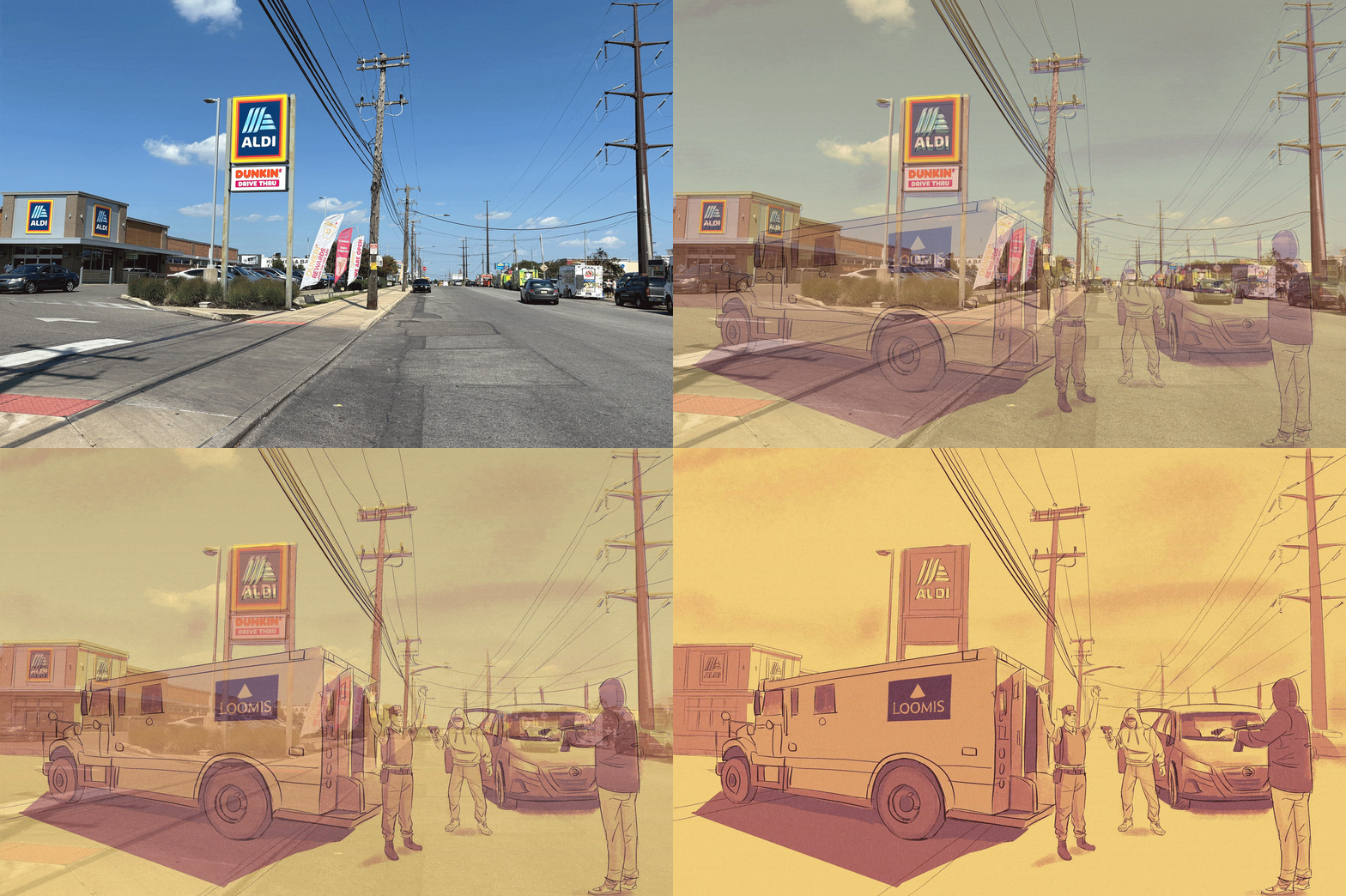
On June 26, as Philadelphia recovered from three consecutive days of 99-degree heat, armed thieves robbed a Loomis driver outside a Crescentville Aldi.
A federal agent would later recount this exchange, and several others, in a 29-page affidavit that details how an alphabet soup of agencies — the FBI’s Violent Crime Task Force, Philadelphia police, Cheltenham police, the District Attorney’s Office, the Bureau of Alcohol, Tobacco, Firearms and Explosives — worked to identify, track, and ultimately arrest members of the crew that allegedly attempted to rob five armored truck drivers between June 26 and Aug. 12.
This was not a simple whodunnit, solved with TV-drama efficiency.
It took a mélange of elements — old-fashioned detective work, high-tech digital surveillance, an anonymous tip, and a seemingly unrelated probe into automobile thefts — to help authorities zero in on the armored truck thieves.
Among the information that investigators collected along the way was the conversation about the Fox 29 post, which was sent to two members of the robbery crew and a third man by Tykee Smith, a Tampa Bay Buccaneers safety.
Smith, 24, grew up in West Philly, but his connection to the crew is unclear. He has not been accused of committing a crime. The FBI did not redact his Instagram handle from the affidavit, but did elect to hide the identities of other figures in the case.
Asked about Smith, an FBI spokesperson wrote in an email: “I would have to defer to the public documents.”
Representatives for Smith and for the Buccaneers declined to comment.
For a while, after their busy summer, the thieves seemingly went underground.
Then, in early fall, investigators learned that the crew had obtained a stolen white Honda Accord with a paper license plate tag.
On Oct. 3, police officers spotted the Accord outside a City Avenue Target — lurking near a Brinks truck.
The Accord peeled off, igniting a heart-thumping chase that spilled into Lower Merion Township, where the driver and his passenger ditched the sedan on a leafy, horseshoe-shaped road.
Police and news helicopters were soon thrumming over the area’s million-dollar properties. Some curious residents ventured outside and were met by teams of rifle-wielding cops who hollered to get back in their homes.
The officers’ radios hissed with speculation: Had the men fled along the nearby Cynwyd Heritage Trail, which leads to Manayunk?
By early afternoon, the suspense — and the manhunt — had drawn to a close.
Officers apprehended one individual, Mujahid Davis, hiding in the basement window well of a house on Colwyn Lane.
His partner managed to evade the dragnet in Lower Merion Township with the help of someone who picked him up in a Dodge Charger.
The escape was short-lived: Police caught up to the Charger soon after in West Philly and arrested the passenger, Dante Shackleford.
On Oct. 16, a federal grand jury charged Shackleford, 26, with one count of Hobbs Act robbery for stealing more than $100,000 from a Brinks driver on Aug. 12, attempted robberies on July 22 and Oct. 3, and brandishing a firearm in relation to a crime of violence.
It was Shackleford who had joked to not say his name when Smith shared the Instagram post about the robberies. Cell tower data showed that his phone was at the scene of some of the summer heists.
If convicted, Shackleford’s sentence could range from seven years to life in prison. He has pleaded not guilty. His attorney, Angela Levy, declined to comment.
Davis, 24, was charged with the Oct. 3 attempted robbery. He has pleaded not guilty.
More indictments might follow in January, when trial dates for Shackleford and Davis will be set, the records show.
Vito Roselli, a retired FBI agent who once worked on bank and armored car robbery investigations in Philadelphia, called the phone evidence in the affidavit “devastating.”
“A lot of robbery crews wise up with cell phones, and just use burner phones. It’s spy tradecraft,” he said. “This crew is not doing that. They’re pretty open about what they’re doing, and they’re running their mouths.”
‘Take all the tracking s— out’
While the FBI tried in early July to generate leads on Philly’s armored truck bandits, other law enforcement agencies were busy in the city with the seemingly unrelated pursuit of an alleged car thief and gun dealer.
Salim Sutton, 31, had been on the run since February. A Common Pleas Court judge had placed Sutton on house arrest while he awaited trial on firearms and theft charges. But Sutton had other plans, and allegedly cut off an ankle bracelet monitor, then absconded.
In June, police officers began investigating a series of complaints about cars having been stolen or broken into near Front and Callowhill Streets. Surveillance footage gave them a look at the alleged culprit: Sutton.
Investigators determined that Sutton had been selling firearms that he’d stolen from vehicles. Given the widening scope of Sutton’s alleged offenses, police and the District Attorney’s Office’s Gun Violence Task Force sought the assistance of the ATF.
The added manpower almost immediately yielded results. On July 10, ATF agents nearly captured Sutton, but he slipped beyond their grasp while riding in a black Nissan Maxima with tinted windows, black rims, and a blacked-out rear emblem.
Afterward, Sutton joked about the encounter on Instagram.
The next day, Sutton traded text messages with a man who wanted to purchase a stolen car.
“I’m bout to hurry up and take all the tracking s— out of it now,” Sutton wrote, according to the records.
“Got you send a cash app,” replied the man, whom the FBI refers to only as “Suspect 1.”
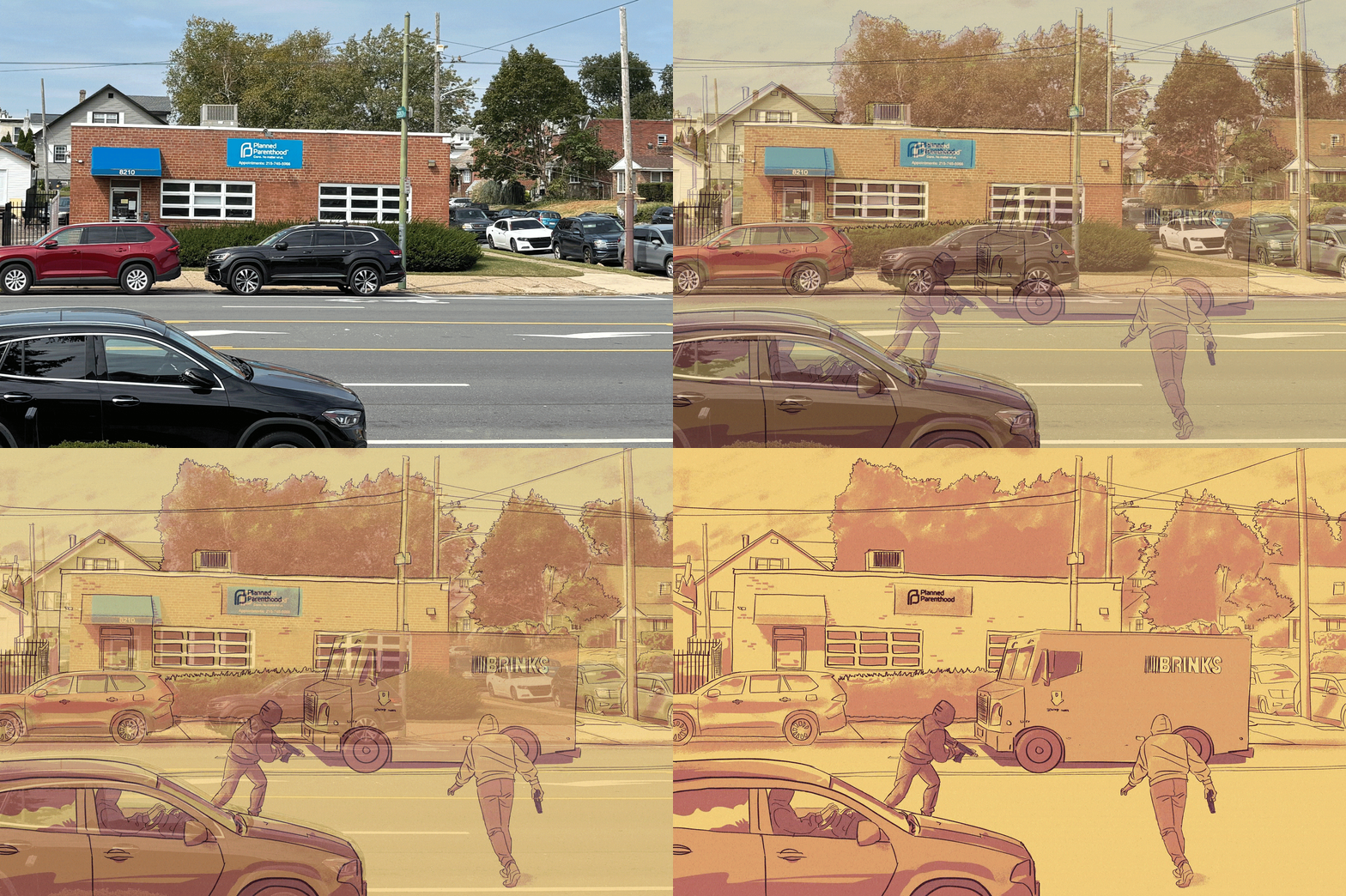
Four days later, on July 15, a Brinks guard parked on Castor Avenue in Rhawnhurst to make a delivery to a Planned Parenthood office.
A Brinks driver opened fired when armed thieves tried to rob him near a Planned Parenthood office on Castor Avenue.
The guard noticed that he was being approached by a man who was wearing a black facemask, a black hoodie, and latex gloves — and brandishing a handgun.
A second man, armed with an AR-style rifle, lurked near the intersection of Castor and Emerson.
The guard drew his service weapon and opened fire, getting off eight shots but not hitting anything.
One of the would-be robbers ran away. Surveillance cameras recorded his partner fleeing in a getaway car: a black Nissan Maxima with tinted windows, black rims, and a blacked-out rear emblem.
Hours after the attempted heist, photos of the getaway began to circulate across social media. Sutton saw one such image on social media, a clear look at the Nissan’s trunk — and its license plate.
He took a screen shot, then messaged the man to whom he had sold the Nissan and asked whether he had switched the car’s license plate.
The two men began discussing more vehicle transactions. Sutton said he had a black 2015 Mercedes-Benz S550 that he could sell for $800.
For the buyer, the price was too steep. He explained that he needed something cheaper, maybe in the $200 to $300 range, just so long as its windows were tinted.
“…we use em for bouncing,” he wrote, “that’s it[,] not to have[.]”
Eyes in the sky
As Philadelphia fell deeper into an uncomfortable, humid summer — punctuated by an eight-day garbage strike — the FBI was still trying to identify the men responsible for the armored truck heists.
They knew that after the first robbery, of a Loomis guard on June 26, two masked thieves and a driver escaped with a meager haul — the guard’s handgun, and a canvas bag that contained $1,000 — in a gray or brown Nissan Altima with tinted windows.
Philadelphia police stopped the Altima on July 2. Its license plate had been stolen from another car.
Officers determined that the driver had nothing to do with the heists. But he did share a valuable piece of information: He had rented the Altima, he said, from someone on Instagram.
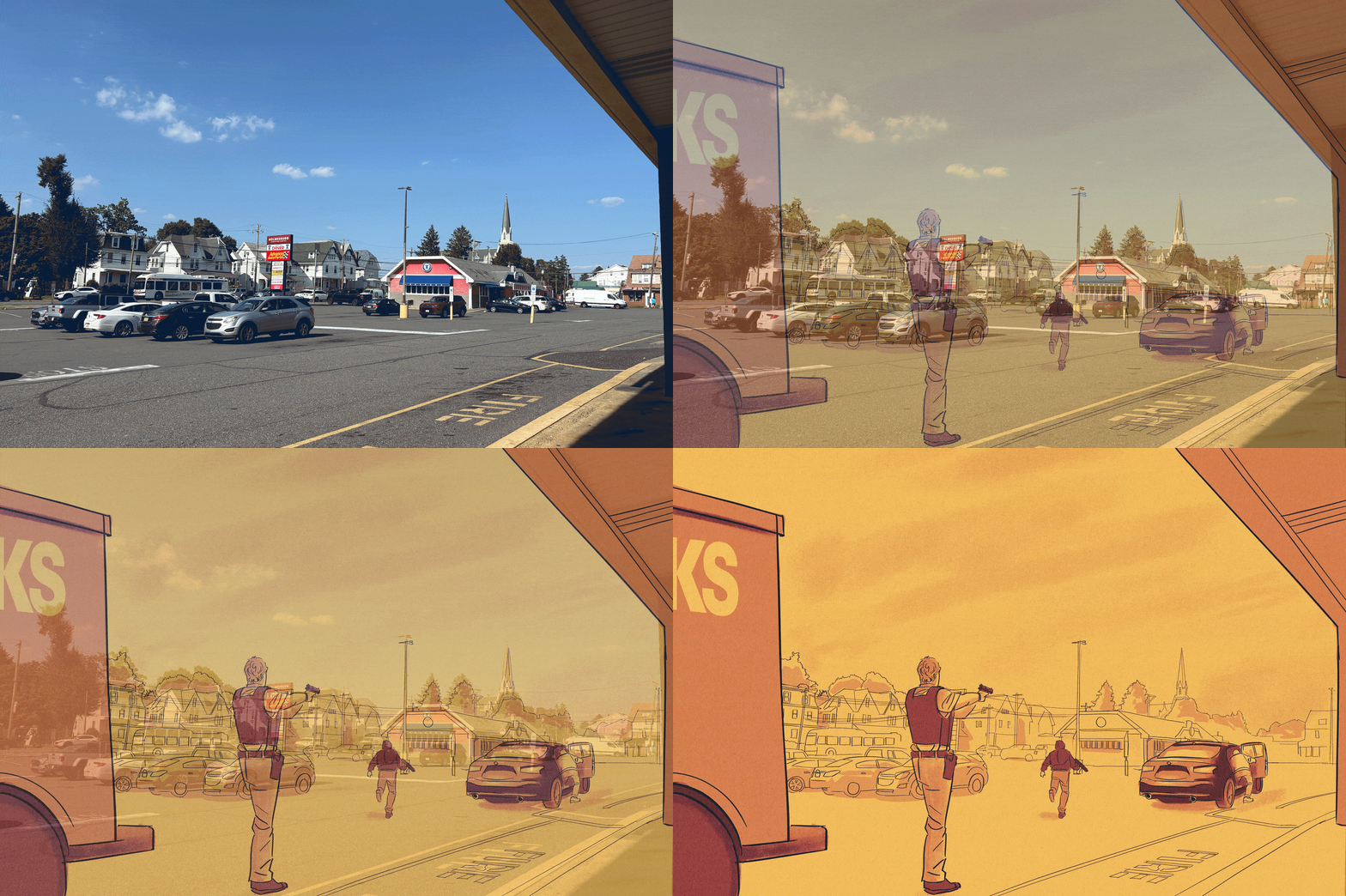
Eyewitnesses watched as three armed men ambushed a Brinks guard outside a Dollar General in Holmesburg on July 2.
On July 22, the stick-up crew struck again.
A Brinks driver climbed out of his truck to make a delivery to an H Mart grocery store in a Cheltenham Township shopping center. He realized he was being watched by three people in a black Dodge Durango.
Each of the occupants was masked. Two appeared armed with what the Brinks driver said he thought was a long gun.
The driver darted into H Mart and called police.
For the crew, there was only one sensible option: they had to drive away before patrol cops could reach the H Mart.
But the getaway was not entirely clean. Surveillance cameras recorded footage of the Durango arriving at the shopping center’s parking lot at 8:57 a.m.
Unbeknownst to the thieves, an automated license plate reader had also captured a clear look that morning at the Durango — and its license plate — riding on North Broad Street.
‘Don’t f— move’
The two parallel investigations — the ATF’s pursuit of a car thief and the FBI’s hunt for the armored truck bandits — would soon dovetail.
On Aug. 5, through a combination of physical and video surveillance, investigators saw Sutton driving a sport utility vehicle: a black Dodge Durango. Its license plate matched the Durango that had stalked a Brinks driver at the More Shopping Center two weeks earlier.
On Aug. 7, the ATF arrested Sutton. Investigators quickly obtained state and federal warrants to begin extracting data from Sutton’s phone.
The DA’s Office filed more than a dozen charges against Sutton, including theft, receiving stolen property, conspiracy, and firearms violations, and set his bail at $6.7 million. His attorney could not be reached for comment.
Authorities now had an extensive record of Sutton’s interactions with members of the armored heist crew, who were about to resurface.
The heist grew ambushed a Brinks driver near an H Mart on Old York Road — and escaped with more than $100,000.
On Aug. 12, at 10:22 a.m., a female Brinks driver carried a delivery satchel towards the same H Mart that the thieves had targeted in July.
When she was mere steps from the store’s entrance, two robbers pounced.
One pressed the barrel of an AR-style rifle against her neck, according to court records.
“Don’t f— move, don’t f— move,” he said. “Give it to me.”
The other assailant pressed a handgun against the woman’s back. They took her service weapon and the satchel, which held $119,100, then fled into a waiting black Acura sedan.
Two days later, a Cheltenham Township police detective opened a letter that had been mailed to the department’s headquarters. The handwritten message claimed that a paralyzed man was responsible for planning the recent H Mart robberies. The writer also divulged the identity of one of the alleged thieves.
His name was Dante Shackleford.
Fresh lead in hand, the FBI began collecting every digital footprint that it could trace to Shackleford: cell phone records, social media activity, a newly opened bank account.
The records showed that Shackleford and the paralyzed man — whom the FBI referred to as “Suspect 1” — were indeed associates and had shared Instagram posts and messages with one another.
Among the exchanges that would be recounted in a later affidavit was the Fox 29 post that Smith — the Tampa Bay Buccaneers defensive back, who attended Imhotep Institute Charter High School in Philadelphia — had sent through Instagram to Shackleford, “Suspect 1,” and another man.
In a bid to gather even more evidence, the FBI on Aug. 26 announced a $10,000 reward for information that could lead to the arrests and convictions of the crew’s members.
Investigators found Shackleford’s number, meanwhile, in Sutton’s phone.
And cell tower data indicated that Shackleford’s phone was at the scene of three of the heist crew’s crimes, during the same window of time that the robberies occurred.
City surveillance cameras and cell phone location data provided another crucial piece of information: As of Oct. 2, Shackleford was likely operating or a passenger in a stolen white Honda Accord.
‘Get back inside!’
A day later, when Philadelphia police chased Shackleford and Mujahid Davis into Lower Merion Township, investigators were tracking Shackleford’s cell phone location data.
With law enforcement close behind them, Shackleford and Davis ditched the Accord on Snowden Road, a gently curving, tree-lined block in Bala Cynwyd.
Christine Weatherwax was getting ready to make a late morning supermarket trip when she heard helicopters hovering over her house on Snowden.
She stepped outside and saw that someone had parked a sedan — a white Accord — against her husband’s Jeep.
Residents on Snowden Road in Bala Cynwyd found helicopters and scores of police outside their homes on Oct. 3 — and a stolen Honda Accord that had been abandoned by the suspects on their block.
“My husband thought someone had forgotten to put on their parking brake,” said Weatherwax, 51. “He started walking around, looking for the owner.”
Another neighbor, John Wuetig, ventured outside and fixed on an unusual sight: 10 cops, rifles in hand, marching down the street, accompanied by eager police canines.
“The officers yelled, ‘Get back inside!’” Wuetig, 51, recalled.
Later, Wuetig reviewed his Ring camera footage and saw a sequence that he and the officers had missed: two individuals running from the Accord.
As they attempted to flee, the men shed some of their clothes, the Honda’s key fob, and a Glock handgun in neighbors’ yards, according to court records.
In the Accord, police would find an AR-style pistol.
Some residents spotted Davis on Colwyn Lane, a 14-minute walk from Snowden Road.
Police swept down the block, and found a house with an unopened front door.
The property owner, Todd Miselis, 50, had left to run to a store. Inside, a friend of his slept in a guest bedroom.
“I got a text from my friend that said, ‘911. Cops are all over!’”
Miselis wondered if his friend was joking.
He returned home and found his closet doors ajar. It appeared that someone had rummaged under his beds. His friend then explained that five armed cops had barged into Miselis’ house and woken him by pointing flashlights in his face.
Soon after, the officers found Davis hiding in the basement window well of Miselis’ neighbor.
But where was Shackleford?
A day earlier, the FBI had learned through surveillance footage that Shackleford had been riding in a white Dodge Charger.
That information was shared across police radio. Officers soon spotted the Charger in West Philadelphia, where it came to a stop at 52nd and Parrish Streets.
Shackleford and the driver, whose name has not been released, were arrested without incident.
At the scene, one investigator decided to dial a number that had helped unlock a significant portion of the case.
Inside the Dodge Charger, Shackleford’s phone began to ring.