Tag: Weekend Reads

  • Meg Kane was the perfect face of Philly’s World Cup campaign. Her family, and its tragedy, shaped her message.

    Meg Kane was the perfect face of Philly’s World Cup campaign. Her family, and its tragedy, shaped her message.

    One person after another shuffled toward her from the funeral line snaking down the center aisle, through the vestibule of St. Anthony of Padua Catholic Church, out to Forest Avenue in Ambler, and I wondered as I approached her how long Meg Kane could keep this up. The sad, grateful smile. The long, tight hugs. The posture she maintained, straight as a soldier, when the shock and grief simmering within her should have sent her to her knees.

    It was Friday, April 12, 2024. Eight days had passed since the house fire that killed her parents — the kind of unbelievable tragedy that interrupts a local newscast, helicopters hovering over the smoldering ruins. Unbelievable, too, because it had happened to Meg. Over the quarter-century that we have been close, she has risen through the public relations industry to a place of power and influence within Philadelphia without compromising the qualities that made her, above all else, a decent human being. It always seemed that her intelligence and drive, her character and achievements, melded to form a shield that would protect her from catastrophe. Something like this doesn’t happen to someone like Meg, I thought that day, as if such a thought were anything other than a mind trick, a weak attempt to reconcile how and why my friend’s mother and father were dead.

    The line stretched to more than 200 people, perhaps more than 300. No one standing in it should have been surprised at its length. Meg had relationships and connections throughout the Delaware Valley, of course, but more than that, she and her family had embodied the blending of some beautiful and long-conflicted aspects of Philadelphia’s history and culture. They had learned to live with and revel in the tensions inherent in certain traditions here. Their roots were that deep. Their hearts were that open. Hers most of all.

    That background is one reason Meg has been the ideal face of the campaign to bring the World Cup to Philadelphia and promote it once it was here, to play up and celebrate the happy marriage of soccer and the city. It also is the reason that — through every match, every publicity event, every meeting, every long and restless night before and during this tournament, all while the eyes of the globe had been on Philadelphia — she has been holding all that pride in the same palm as so much pain.

    Meg Kane looks at a photo of her mother among old family photos in her Philadelphia apartment in May. The photos were recovered from the scene of an April 2024 house fire in Ambler that killed both of her parents.

    Everything essential in life

    There she is again. Another quickie interview on Fox29. Another guest spot on a PHLY Sports panel. Another four paragraphs of insightful quotes to us at The Inquirer. Another Amtrak ride up to New York or 14-hour flight to Doha, Qatar, to see what she could learn, then another debrief with her colleagues at Philadelphia Soccer 2026. Here’s what they did. Here’s why it did or didn’t work. Here’s what we can and should do.

    Nothing new for Meg Kane. Nothing out of the ordinary. Revitalizing Tastykake’s brand and business when its headquarters relocated from Hunting Park to the Navy Yard … making ready the way for Pope Francis’ visit to town in 2015 … counseling the Philadelphia Orchestra and the archdiocese … all this at the tenderest of ages, all this before she turned 45 in January.

    “When the odds are against us,” said her friend Christopher Pinto, the development lead of the Philly Pops, “this city calls Meg Kane to make the impossible possible.”

    Meg Kane (center) speaks at a press conference about preparations for the FIFA World Cup in May at Lincoln Financial Field.

    Who was better to evangelize about Philadelphia, to make the case that it was an ideal location for the biggest event in the world’s most popular sport? Who else had the requisite combination of local expertise and enthusiasm to share the multitudes that the city contained? Meg’s mother, Debbie, and biological father, Richard, had divorced not long after Meg was born. Debbie then married Steve Wood in September 1983 — a Little Flower alumna and a North Catholic graduate reconnecting 15 years after they’d met as teenagers on the Wildwood boardwalk.

    Meg wasn’t yet 3 when Steve became her stepfather, but the word was appropriate only in its most literal sense. He was Dad, too, and she was his daughter, full stop, and everything that was essential in his life became essential in hers …

    … and everything included their early-afternoon car trips together starting when Meg was 7, when Steve would pick her up after another half-day at St. Martin of Tours School and drive down I-95 to 13th and Walnut, to the bar that Steve and his brother, Bill, had opened in 1980, to Woody’s — to the best-known gay social establishment that Philadelphia has ever known. While Steve balanced the books, Meg — still in her Catholic school uniform, her plaid skirt and saddle shoes — sat at the bar, the daytime bartenders fixing her fresh cherry Cokes, making them the right way, muddling the fruit and filling her glass with fountain soda, the little girl chatting up the customers and playing Ms. Pac-Man on the arcade machine upstairs and remaining mostly oblivious, never thinking anything there was strange or sinful, her parents never suggesting anything was.

    As a child, Meg Kane’s afternoons sometimes included stops at her dad and uncle’s bar, Woody’s.

    The cognitive dissonance might have caused constant friction in one family or torn another apart. It didn’t exist within Meg’s. Steve had one rule about the visits that Meg, her younger sister, Liz, and their younger brother, Stephen, made to Woody’s: If you see someone there you know, keep it to yourself. “It was important we never outed anybody,” Meg said. “At that time, there were people for whom Woody’s was an oasis, an escape, the one place they could be themselves.”

    The bartenders there picked up extra work at Liz’s and Stephen’s christening parties. Bill’s partner, Lee Mallon, showed up to the family’s annual Christmas party dressed as Santa. Debbie, who became a principal at Norwood-Fontbonne Academy in Chestnut Hill after years of teaching in the archdiocese, loved to tell the story about the earnest couple who made an appointment to tell her something troubling … except the delicate topic had nothing to do with the couple’s children. The husband had been downtown, and he and his wife had been praying about whether to share what he saw with Debbie, and, well … Your husband walked into Woody’s. And Debbie let out a belly laugh. Oh, I know … By the way, have you forgotten what my last name is?

    At the height of the AIDS crisis in the 1980s and ’90s, Steve and Bill kept employees on the payroll even though they couldn’t work anymore, held celebration-of-life luncheons at the bar, and covered the cost of memorial services and burials when no one else would. Those trips to hospitals and funeral parlors were rarely, if ever, spoken of within the Wood family. Steve’s mother had died when he was 4 and his father when he was 13. His siblings had raised him, and he considered business associates to be friends and friends to be family, and maybe a young woman who later would be charged with uniting a diverse but territorial city behind a common mission had to grow up immersed in such acceptance, such label-free loyalty.

    There was Meg, riding with Steve every morning during her high school years from their new home in the Montgomery County suburbs to Academy of Notre Dame in Villanova — a school with a great speech-debate program for a teenager who knew she’d end up talking for a living — the two of them listening to WIP throughout those 45-minute commutes. “It’s how I learned to be a sports fan,” she said. “My passion was cultivated because of our relationship.” There was Liz, going her own way at Mount St. Joseph Academy. There was Stephen, heading off to St. Joseph’s Prep. But it wasn’t until Meg’s freshman year at La Salle, when a male student she didn’t know knocked on the door of her dorm room to thank her — Your family owns Woody’s, right? I don’t know what I would have done without it — that she perceived her family as resting at the center of every Venn diagram of Philadelphia, sharing something in common with every group and subgroup.

    I met her during the first semester of her junior year at La Salle, when she took a journalism class I was teaching in the fall of 2001. It is an intimidating thing to be a 26-year-old adjunct professor, to have taught for just two years, and to suspect immediately that one of your students is smarter and wiser and more sophisticated than you are. Ten days into the term, on Tuesday, Sept. 11, she proved she was.

    Class began at 9 a.m. I tried to get 20 minutes worth of lecture time in as black smoke billowed from the World Trade Center towers and my students, a few of whom hailed from New York and North Jersey, chewed their fingernails and fidgeted in their chairs. Finally, Meg shot me a look that said, I know you mean well, but … please, we gotta get out of here. When the class reconvened later that week, I asked for the students’ forgiveness for my stupid officiousness, for my failure to read the classroom, and we spent the rest of the period discussing and venting about the terrorist attacks and their aftermath. In September 2011, Meg sent me a letter — not an email, not a direct message, a letter, on paper, more permanent — recalling that week. You did what a teacher is supposed to do, she wrote. You earned our trust, and you never lost it. It remains a treasured gift, that letter and its contents, that benefit of the doubt, that measure of grace that I hadn’t earned and didn’t deserve.

    By then, Steve and Bill had sold Woody’s and opened another bar, Knock, and Meg had lifted off and would continue climbing in her career: from La Salle — she was her class’s commencement speaker — to graduate school at Maryland; from earning a master’s degree to planning and publicizing some of the city’s biggest events; from getting a text message in November 2019 from Angela Val, who was the CEO of the city’s convention and visitors bureau at the time, to meeting her that night at the Ritz Carlton. We need you, Val told her. We’re going to bid on the World Cup.

    It was the project of a lifetime. It gave her the runway and credibility to open her own PR firm, Signature 57, in 2021. It put her front and center as the captain of the city’s World Cup cheerleading squad — “the Pied Piper of Philly soccer,” someone called her. And she still could be the daughter and sister and friend she’d always been, ready at a moment’s notice to give whatever had to be given. Drive five hours one way to attend the funeral of a colleague’s parent? It’s a day. What’s a day? Get off a plane after a week of work in Ireland and head straight to a chamber of commerce dinner that night? Work an 80-to-100-hour week? Of course. How else would she be there for her family if she didn’t excel in her professional life, if she didn’t squeeze her responsibilities and extra efforts into the smallest possible windows of time?

    Yes, she thought it, too: Something like this doesn’t happen to someone like me. But things did happen. Debbie retired and, without her work in education, struggled in the void, losing weight, chain-smoking so much that her favorite blanket became pocked with holes where fallen ashes — and even the still-lit tip of one of her Merit Menthols, as she was dozing off — had burned through the wool. Stephen moved back in with his parents after finishing at Penn State and stayed with them for nine years, teaching English at Norwood, helping Steve care for Debbie. Liz and her husband, Michael McCabe, both faculty members at La Salle College High School, lost a baby daughter, Eleanor, and one night, Steve sat with Meg at his dining room table, a Phillies game on TV in the background. He had grown up without a mother and father. He had watched dear friends waste away to a deadly virus. Yes, these things and more did happen, but “my dad,” Meg said, “had an incredibly positive view of the world,” and at the table, he described to her how he had tried to comfort Liz.

    Don’t despair, he said. Don’t despair. It’s the only way to keep going.

    The horror of a ticking clock

    On Thursday, April 4, 2024. Meg was in a room at the Fairmont in Washington, D.C., already awake for close to two hours, writing and rewriting speeches and teleprompter scripts for the Horatio Alger Association Awards, a three-day event for the philanthropic juggernaut that had become a signature project for Signature 57: a CEO’s retirement, the introduction of 12 new members, two major dinners, an undertaking so massive that Meg and four coworkers bunkered for a week in the hotel to complete it.

    Still in her pajamas, she was trudging to the bathroom to wash her face when her phone buzzed and lit up pink, the color that meant Liz was calling. She assumed something was wrong with Francis, Liz and Mike’s 4-month-old son.

    Meg looked at her phone. It was 6:42 a.m.

    Liz?

    Meg, she shrieked, I’m watching the house burn down!

    What?

    I’m watching the news. I’m holding the baby, feeding the baby, and the house is on fire!

    Meg told Liz to call the police. She put her phone down and walked to the bathroom, violently shaking, and did not wash her face. She called her boyfriend, Keith Audit, and told him, I need you to find out if my parents’ house in on fire, and Liz called back and said that the police had told her that someone would be in touch and she had tried calling Steve’s phone but it had gone right to voicemail and Liz kept saying, It’s definitely the house, and I don’t know what to do, and then Meg said out loud an irrational thing: We have to call Norwood. Stephen’s a teacher. Stephen’s not going to make it to school. Someone has to let Norwood know to get a sub. And Meg hung up with Liz and called Shannon Craige, Norwood’s curriculum director, who told her the students were on spring break and Norwood was closed.

    Meg looked at her phone. It was 6:53 a.m.

    She called Stephanie Bambach, the vice president of Signature 57, who was in a room above her. When she arrived at Meg’s room, Bambach was surprised that Meg’s demeanor was as measured as it was. She was not surprised that Meg’s voice was trembling.

    I have to finish writing the remarks for Saturday night, Meg said. I’m only halfway done. I can’t leave.

    It doesn’t matter, Meg.

    Meg reopened her laptop and emailed every document and every draft of every unfinished document to Bambach. She grabbed a black striped sweater and a pair of black leggings, went into the bathroom, and got dressed.

    “I remember looking at myself in the mirror,” she said later, “and saying, ‘You will never wear these clothes again.’”

    Bambach arranged for a car service to pick up Meg at the hotel and drive her back to Philadelphia. The two of them rode an elevator down to the lobby. Meg held her room key. She tried to hand it to Bambach.

    In case, Meg said, someone needs to use my room.

    Bambach didn’t take the key. Keep it. Good thoughts. It’s going to be OK. You might come back.

    I’m not coming back, Meg said. It’s not going to be OK.

    In the back seat of a black sedan, Meg’s phone rang again.

    I’m at the house, Liz said. I just spoke with a detective. Mommy and Daddy didn’t make it.

    Meg took a deep breath. Where. Is. Stephen?

    He’s OK, Liz said. He got out.

    Meg looked at her phone. It was 7:43 a.m.

    The black sedan pulled up to her apartment. Keith was waiting for her. She threw her bags in his car, and they drove to Temple University Hospital’s burn unit. Stephen was there, in a bed in a room in the back, his face and body covered in soot. That acrid, sickening odor. Physically, somehow, he was fine.

    “We were the luckiest people on that floor,” Meg said later. “He was going to get out of that bed and go home. That day couldn’t have been worse, but my God, it could have been.”

    She looked at her phone. It wasn’t yet 11 a.m.

    Miles away

    Two months. That’s how long she stepped away. From the World Cup campaign. From Signature 57. From everything except what was gone and what remained.

    The fire’s official cause was undetermined. Its damage was incalculable. Steve and Debbie had no wills. Their birth certificates and Social Security cards were gone. Meg had to pick up the mail and pay the mortgage and pay other bills and access both their personal bank account and the finances for Knock and show up for every meeting with every lawyer and builder and contractor, everything moving incredibly fast and in slow motion at the same time, so many dear memories now coldly cataloged on an Excel spreadsheet.

    She did not talk about the fire at all in public and only rarely in private. Her last name was not Wood; few strangers, if any, knew her connection to the tragedy. The relative anonymity was meager relief from the pressure she piled on herself. Who else could handle the fallout? Who else could inch everyone a little closer to normal again? It had to be her.

    She didn’t have a newborn to raise, like Liz and Mike did. She hadn’t awakened in the dead of night to dodge flames and hold her breath to keep smoke from seeping into her lungs, like Stephen had. Hell, her poor brother couldn’t even cradle his baby nephew two months after their parents’ deaths: A potent combination — a crackle of July 4 fireworks and a quick post-traumatic contemplation of the fragility of human life — compelled him to hand Francis off to someone, anyone, before something terrible happened again. Nothing she was dealing with came close. Hell, she had been 150 miles away when the house went up. She hadn’t even been there.

    Her friends worried that she was pushing herself to the brink of a breakdown and beyond. “She’s really not someone who leans on people,” Bambach said. “I wish she had leaned on us more in the aftermath. So much of her identity is who she is as a leader of Signature, of Philly Soccer, and accepting help from people was a position she was really uncomfortable with. As her friend, I had moments when I wished she would just ask for help.”

    Two months. She couldn’t bring herself to take more time away from work. She ping-ponged between her guilt over what she had to do for her family and her guilt over her desire to return to her career. “I really struggled with that,” she said. “Everyone is replaceable at work. If I’m not there, does it run better without me? Are people doing better? Philadelphia World Cup 2026 — is it running better and smoother? Are they finding this to be easier without me? I thought about that even with Signature 57. I’m the founder and CEO, and I still grapple with that. You can go to dark places.”

    Meg Kane was out of town the night a house fire killed her parents.

    The things that remain

    On the kitchen table of her Fairmount apartment, Meg Kane reached into a box to handle the delicate pieces of her parents’ past and her present. Three pages from a memoir by talk-show host Mika Brzezinski, their edges singed black, survived the fire; Meg found them when she first returned to the house’s site. A couple of old family photo albums, the pictures mounted under sticky plastic, the books stashed in a sealed Tupperware container, seem untouched, save for their smoky smell. “It’s really hard to …” she said. “It takes you back there.” So does a black magnetic card that she lifted out of the box. The key to her room at the Fairmont. She kept it.

    There’s a vision she can’t shake: Steve waking Stephen up, making sure he got out of the house, then remaining at Debbie’s side, knowing he could not leave her, his children knowing he never would. He had to be so scared in those final moments. He had to be so brave.

    “At the end, there’s just grief,” Meg said. “I’m not sure I’ve dealt with the grief. I don’t know I’ve felt it all the way. I don’t know that I’ve allowed it to be something I fully felt.”

    So she stores it away, lets it out only during the brief and rare breaks in her schedule, when the events and interviews have paused and some stillness and quiet return to her life. In May, Stephen proposed to his girlfriend, and at the engagement party, Meg pulled him aside for a conversation. It lasted 15 minutes. “It was the talk that everybody was avoiding all night,” he said, a talk about how much he had grown over the last few years, “the kind of talk you would want from your mom or dad.”

    It was the happiest moment in a spring and summer that have had many happy ones. She partied on Lemon Hill in Fairmount Park and marched with several hundred Croatian soccer fans from Center City to Old City and rode a subway train quaking from the chants and songs of Brazil’s futbol fanatics, and she saw Philadelphia reveal itself as a world-class sports showcase. They are just Band-Aids, to be sure, covering the paper cuts of knowing that her parents never got to meet their son’s fiancée or hear their grandson speak his first word. But for those of us fortunate enough to call her a friend, they are the answer to the question we were asking as we stood in that church two years ago. How would she get through each day? How would she keep this up?

    She did it by holding on to something a father told his daughters. She did it in the only way any of us can. She remembered that she has loved and is loved, and she did not despair.
  • Philly stores routinely violate the plastic and paper bag law, environmental group says

    Philly stores routinely violate the plastic and paper bag law, environmental group says

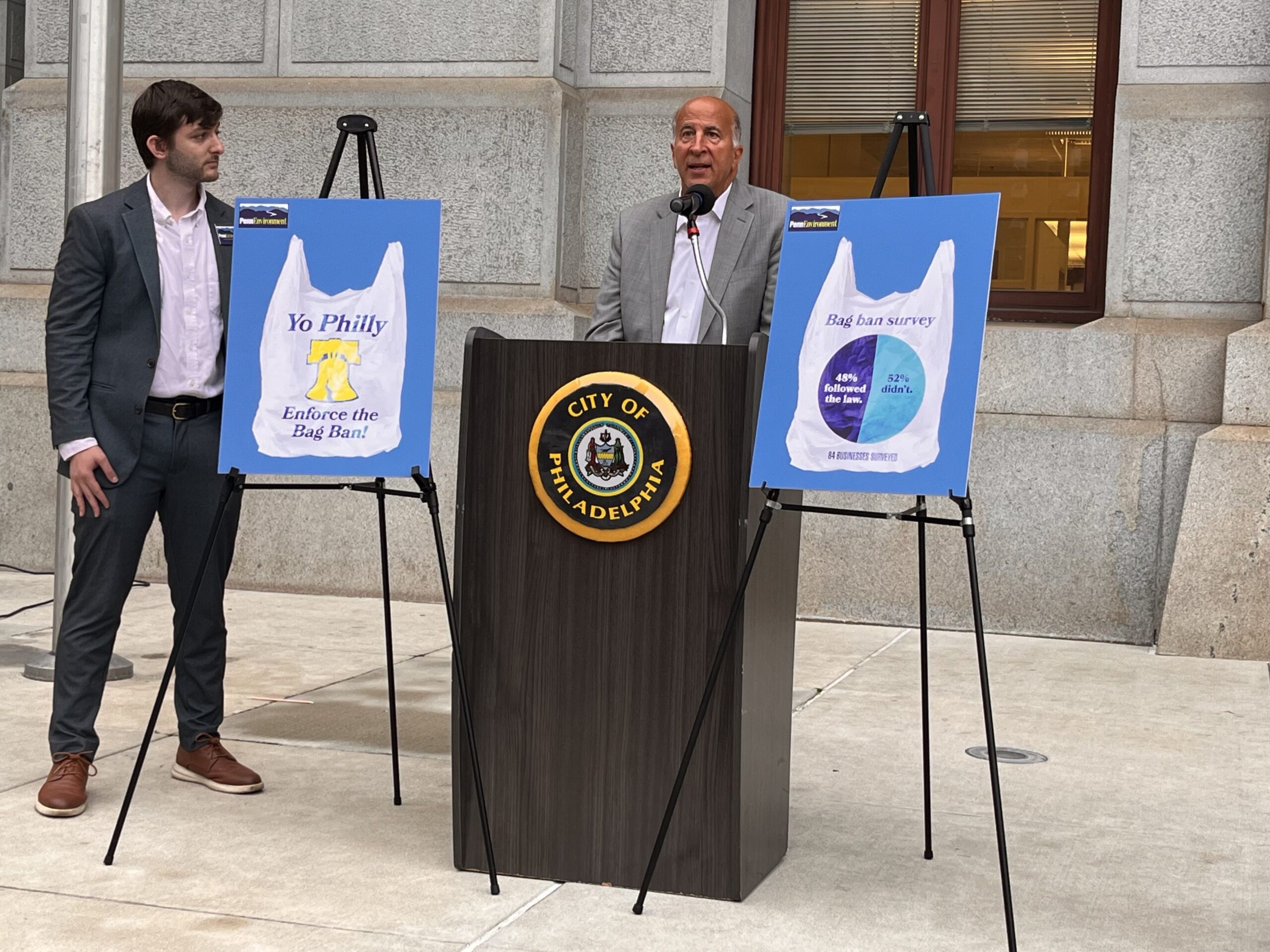
    A sampling of retailers, takeout businesses, pharmacies, convenience stores, and food stores shows half are violating Philadelphia’s ordinance that bans plastic bags and requires a fee on paper bags.

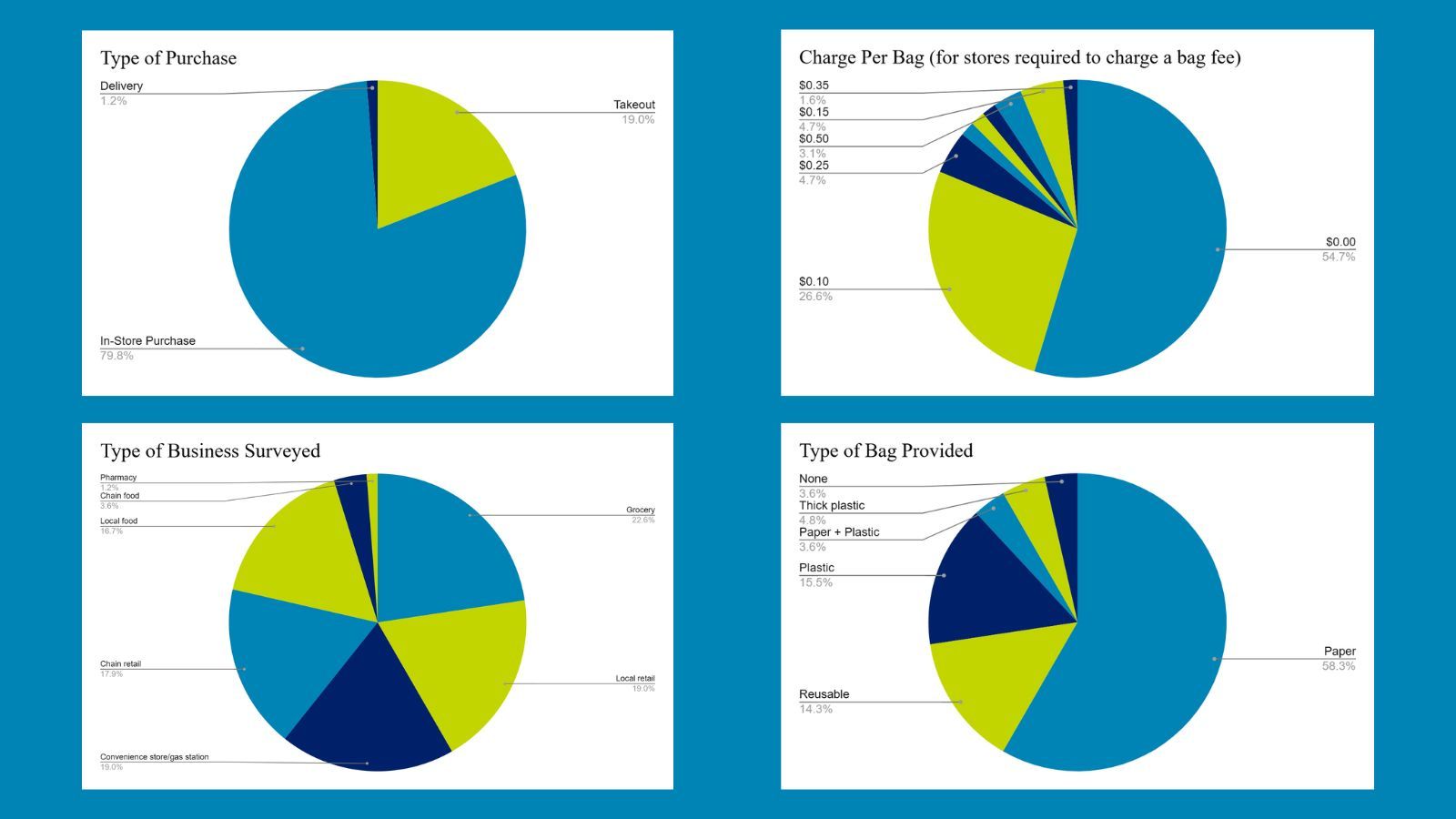
    That’s according to the PennEnvironment Research & Policy Center, which sent members to purchase items in 80 stores across the city and in neighborhoods with varying demographics.

    The nonprofit advocacy group’s survey found:

    • 55% of businesses violated at least one key provision of the law.
    • 50% of businesses failed to charge a 10-cent fee on paper or reusable bags.
    • 20% of businesses provided plastic bags that have been illegal for years. 

    Faran Savitz, a zero-waste advocate for PennEnvironment, said during a news conference Thursday outside City Hall that the group didn’t just scrutinize chain stores like Wawa, although those larger operations were generally compliant.

    He said the 80 stores surveyed were chosen to represent multiple types in all neighborhoods, although they amount to only a fraction of businesses in the city,

    “We wanted to look at as many different types of businesses and hit as many different neighborhoods in the city as possible, so we could get a sense of is this concentrated on one neighborhood or is it spread geographically everywhere,” Savitz said. “We found that this is a pretty widespread problem.”

    Charts from a survey of stores conducted by the nonprofit advocacy group PennEnvironment show what the report calls widespread noncompliance of Philadelphia’s revised plastic bag law that went into effect in January 2026.

    Savitz said that chain stores tend to know the law and its requirements. Many small businesses remain unaware.

    However, the survey did highlight some positive momentum. Currently, three-quarters of surveyed businesses no longer distribute plastic bags. That’s a significant improvement from the group’s previous investigations that caught half of all stores providing them.

    The city’s updated bag ordinance

    Philadelphia’s original plastic bag law, introduced by Councilmember Mark Squilla, was passed in 2019 but was phased in slowly. It went into full effect in 2021.

    After that, paper bag usage skyrocketed, said Squilla, who represents the 1st District, including parts of South Philadelphia, Center City, and the River Wards. Although paper bags are biodegradable, they require more energy to produce and the cutting down of trees.

    Squilla introduced an updated bag ordinance last year, which was approved by City Council, and went into effect in January. It required a 10-cent fee on paper bags.

    The goal of the fee, Squilla said, is to change shoppers’ behavior and get them to bring reusable bags to the store.

    Squilla called the violations found by PennEnvironment “disappointing,” but said he knew compliance would be a challenge.

    “Our goal is to end single-use plastic bags in our waste stream and in the city of Philadelphia,” Squilla said.

    To close the compliance gap, PennEnvironment is urging Licenses and Inspections to improve education and enforcement, and asking residents to report noncompliant businesses to the city’s 311 system.

    Faran Savitz (left) of PennEnvironment Research & Policy Center and Philadelphia Councilmember Mark Squilla, at lectern, discuss PennEnvironment’s findings outside City Hall on July 9.

    Plastic bags

    Ryan Rabenold, environmental program coordinator at the Pennsylvania Resources Council, said the city’s law is key to reducing waste, noting that most reusable plastic bags do not get recycled.

    Plastic bags contribute to litter, require fossil fuels to produce, and become microplastics in the environment when they break down.

    “They either get lost in the system, are contaminated with food or grease, which makes them unrecyclable, or they simply get blown away when we’re trying to collect them,” Rabenold said. “When they do end up in our recycling system … they contaminate materials that are recyclable and force them to be removed from the system.”

    Rabenold noted that microplastics have been detected in human blood and tissue.

    “We are feeling the impacts of something that we may not be able to see, Rabenold said.

    “It’s better for our health and the environment to use one thing 1,000 times,” Rabenold said of reusable bags, “rather than use 1,000 things once.”

  • The state system that runs West Chester and 9 other Pa. colleges votes to raise tuition 4.3%

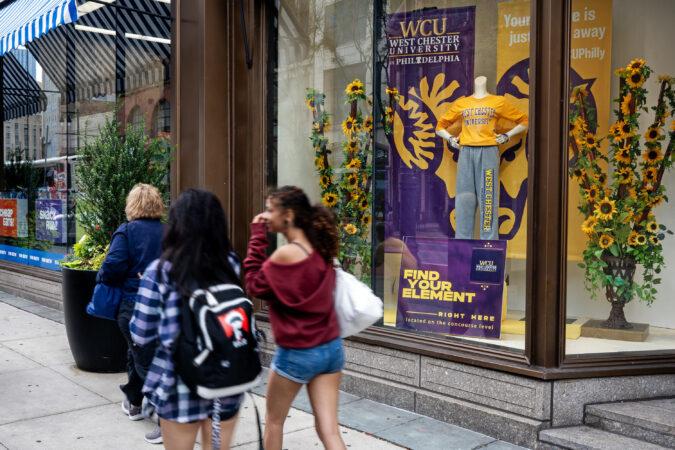
    The state system that runs West Chester and 9 other Pa. colleges votes to raise tuition 4.3%

    Students in the Pennsylvania State System of Higher Education will face a 4.3% tuition hike — the largest percentage increase in a decade — if the system does not get a boost in state funding.

    PASSHE’s board of governors voted unanimously Thursday on the plan, which would enact the tuition increase if the system does not receive a 5%, or $31 million, increase in its state appropriation, which currently stands at $625 million. Gov. Shapiro has proposed flat funding for the system, and budget negotiations are continuing.

    Tuition would rise to $8,338 annually, up $344 from $7,994.

    “We’re all disappointed to … have to make this motion,” board chair Cynthia Shapira said. “We hope we do get the increase.”

    The 10 universities in the system are Cheyney, West Chester, Commonwealth, East Stroudsburg, Indiana, Kutztown, Lock Haven, Millersville, Penn West, and Shippensburg. Collectively, they enrolled 83,005 students last academic year, when the system experienced its first enrollment increase in 15 years. About 90% of students are Pennsylvania residents.

    The vote to increase tuition came one day after Temple University approved a budget that increased tuition an average of 3.4% for next year.

    Rutgers University also on Thursday voted to increase tuition 3% for in-state and out-of-state students, which the school touted as its lowest increase in four years. Tuition for a typical in-state, full-time arts and sciences undergraduate will increase on average $448 for the year, rising from $14,933 to $15,381, the school said. Meals and housing on average will rise 4%, from $15,332 to $15,945.

    Earlier this year, the University of Pennsylvania increased its total costs by 3.8% for 2026-27. Pennsylvania State University, which approves tuition increases a year in advance, hiked tuition 2% for in-state students at University Park for 2026-27 and froze it for those attending Commonwealth campuses.

    The resolution approved by the PASSHE board calls for the increase to be rolled back “if sufficient funding in state appropriation is received.”

    System chancellor Christopher Fiorentino said the tuition increase would cover the $31 million gap if the system does not get the increase. The board of governors took the same action last year and did not roll back a 3.6% tuition hike because the state held its funding flat.

    “We’re still really the most affordable four-year option that’s out there,” Fiorentino said in an interview before the meeting, comparing PASSHE schools to state-related universities like Temple and Penn State where tuition is more than twice that amount.

    Until 2025, the system had kept tuition at the same rate for seven years; if it had enacted inflationary increases, tuition would be $1,800 higher now, Fiorentino said. Preceding the freeze, tuition hikes were 2.5% in 2016-17, 3.5% in 2017-18, and 3% in 2018-19.

    Fiorentino said he continues to make the system’s case to legislators for more funding.

    “Our graduates earn 65% more over their careers than people without college degrees, which is about a million dollars in lifetime earnings,” he said. “Ninety percent of our students are from Pennsylvania, and 80% of them take their first job in Pennsylvania after they graduate. Investing in the PASSHE system … is truly an investment in the workforce of the Commonwealth of Pennsylvania.”

    System to launch new ‘last dollar’ scholarships

    The system also announced that beginning in fall 2027, it would provide “last dollar” scholarships to all Pennsylvania students who receive federal Pell and state Pennsylvania Higher Education Assistance Agency grants. For many students from the lowest-income families, the grants cover full tuition, but some families in the middle range who receive smaller amounts of aid are still on the hook for part of the cost, the chancellor said.

    “They’re the ones that tend to get caught in a bind, and they’re the ones that we’ve been worried about,” he said. “We’re going to cover the balance of their tuition” and make sure they are not affected by future tuition increases.

    Fiorentino said he hopes that donors will want to contribute to the effort so the level of aid can be expanded.

    The new scholarship program, called the PASSHE Pledge, will not cover room and board or fees.

    He did not have an estimate of how many students would qualify, but said system officials have been worried about losing them. And that would add to the enrollment decline at a time when the system, like other colleges, already is challenged by a shrinking pool of available high school students.

    “We’re hoping this is going to increase our enrollment numbers,” Fiorentino said.

    It is too early to predict fall enrollment, he said, but some of the system’s 10 universities are doing better with deposits than last year, some the same, and some a little worse.

    “We’re cautiously optimistic that we’re going to be stable,” he said.

    The system is partnering with community colleges to streamline the transfer process and concentrating on bringing students with some college credits and no degree back into the system, he said.

    “We will continue to work hard to maintain and grow our enrollments,” he said.

  • The first week of July is typically Philly’s most violent. This year, the holiday weekend was markedly calmer.

    The first week of July is typically Philly’s most violent. This year, the holiday weekend was markedly calmer.

    The first week of July has typically been one of Philadelphia’s most violent, with recent Independence Day weekends marked by mass shootings, police officers shot, and bursts of violence that left a dozen dead.

    But this year, amid a dramatic decline in violence and a flood of visitors to the city, the holiday weekend was noticeably calmer than in years past, offering another encouraging sign that the dramatic decline in shootings held through one of its toughest tests.

    Twenty-three people were shot from July 1 through July 7 — a slightly higher total than most weeks in 2026, but nearly half the average number of shooting victims during the same period over the last decade, according to city data. In 2021, at the height of the city’s gun violence crisis, more than 70 people were shot in that week alone.

    If the current pace continues, Philadelphia is on track to record fewer than 200 homicides for the first time since the 1960s, a remarkable turnaround from just five years ago, when nearly three times as many people were killed.

    (function(){function e(){window.addEventListener(`message`,function(e){if(e.data[`datawrapper-height`]!==void 0){var t=document.querySelectorAll(`iframe`);for(var n in e.data[`datawrapper-height`])for(var r=0,i;i=t[r];r++)if(i.contentWindow===e.source){var a=e.data[`datawrapper-height`][n]+`px`;i.style.height=a}}})}e()})();

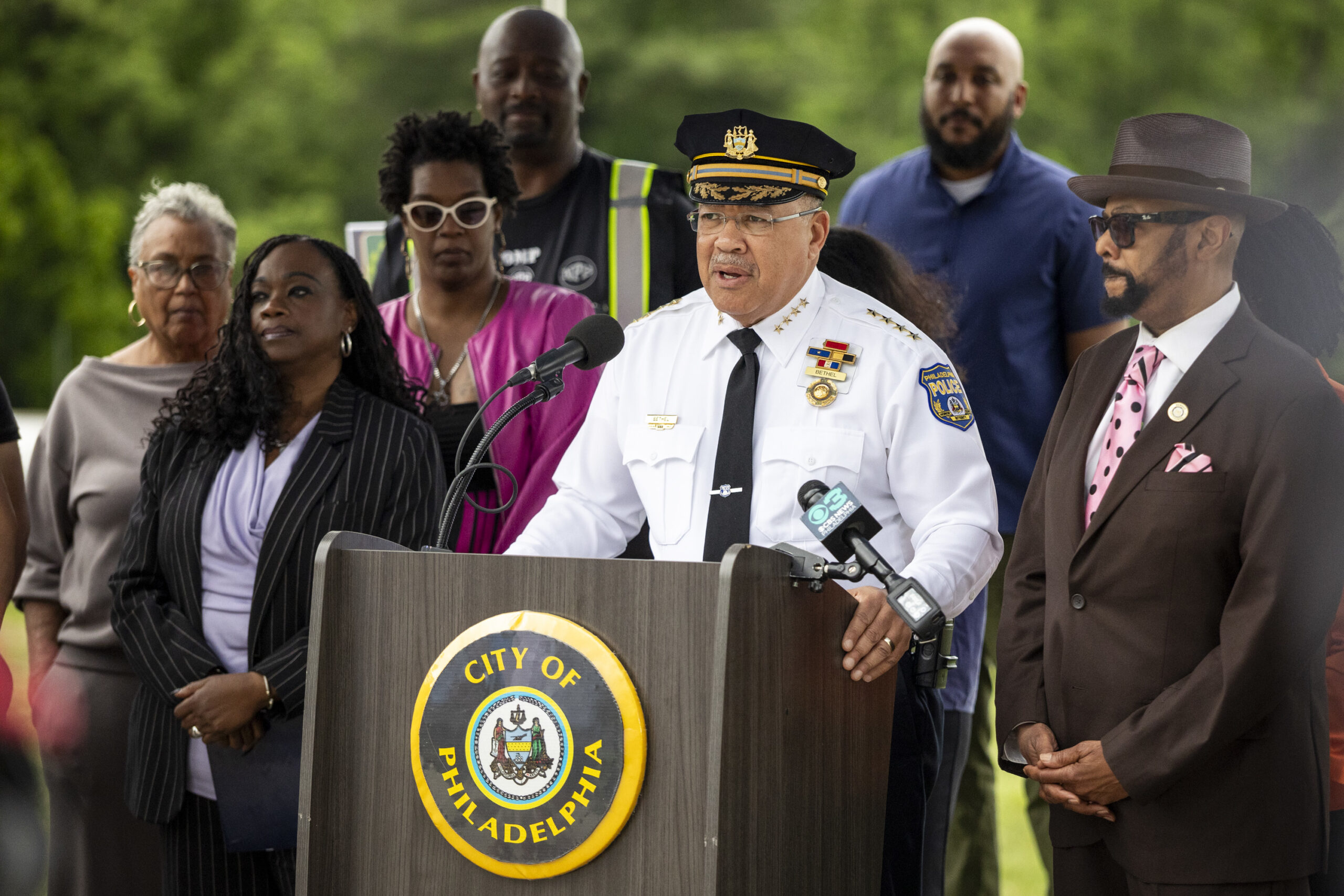
    Philadelphia Police Commissioner Kevin Bethel said in an interview that the July Fourth weekend is historically one of the most challenging for urban police departments.

    In each of the last four years, Philadelphia’s celebrations were overshadowed by violence: Last year, 13 people were shot in South Philadelphia; nine people were struck by bullets at a teen party in Southwest Philadelphia in 2024; five people were killed at random by an armored gunman in Kingsessing the year before; and in 2022, two officers were grazed by bullets on the Benjamin Franklin Parkway, sparking a stampede of fireworks spectators.

    Bethel said he and other city, state, and federal law enforcement officials spent about two years planning for this holiday weekend, preparing for potential crises that never came.

    Anticipating hundreds of thousands of visitors for FIFA Club World Cup events and the nation’s 250th birthday celebrations, the department canceled many officers’ vacation requests over the last month and, on the Fourth, deployed more than 2,000 members of local and state law enforcement across the city, he said.

    Philadelphia Police Commissioner Kevin J. Bethel, speaks at a press conference on the details for the Roots Picnic in May 2026.

    Reinforcements from the Pennsylvania State Police and neighboring municipalities helped the city maintain staffing levels in neighborhoods that have historically seen more violence, Bethel said. Officers worked in the record-breaking heat, he said, with some starting their shifts at 7 a.m. and clocking out only after the concert on the Parkway ended at 3 a.m.

    The FBI took the lead on monitoring the skies, Bethel said, intercepting several drones that were flying illegally. (None of the drones, he said, was flying with “nefarious” intent.)

    He called the weekend a validation of the city’s planning and broader work that has contributed to the decline in gun violence.

    “I can’t tell you how many people grabbed me and said they felt welcomed and felt safe,” he said of the events over the last month. “Let’s own the win. Let’s not hide from it.”

    Bethel also said there had been no acts of violence around the approximately two dozen bars that were approved to stay open until 4 a.m. from June 11 to July 19 to accommodate crowds attending the FIFA, July Fourth, and MLB All-Star celebrations.

    “We’re seeing zero issues,” he said.

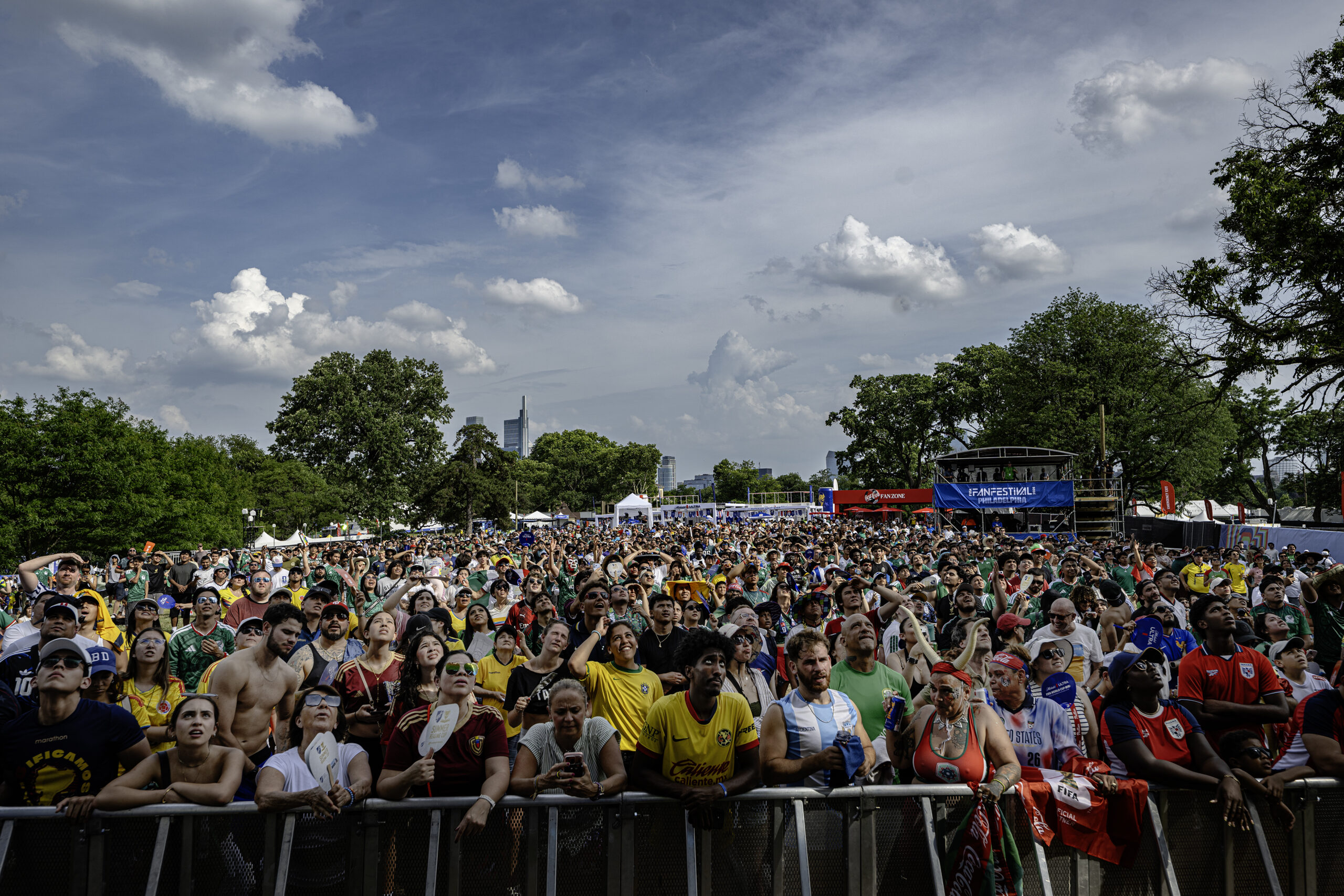
    Soccer fans gather to watch Mexico play South Africa on a giant screen during the opening day of the FIFA Fan Festival at Lemon Hill on Thursday, June 11, 2026, in Philadelphia.

    The reduction in violence over the holiday weekend fits a broader pattern. Shootings and homicides in the city began to decline in 2023, mirroring a national trend, and have continued to fall. So far this year, 90 people have been killed in homicides — less than a third of the number recorded at the same time three years ago, according to police data.

    Just as there was no clear explanation for the spike in crime that began in 2019, criminologists and law enforcement officials say, it is similarly difficult to pinpoint the reasons for its decline. But there are theories: an overall return to normal life after the pandemic, expanded community-based violence prevention programs, more arrests in shootings and homicides, and targeted prosecutions of some of the city’s most violent gangs.

    One measurable change has been the police department’s improved clearance rates, which researchers have long viewed as a potential deterrent to future violence.

    The homicide clearance rate — the share of killings solved, including arrests made this year in both new and older cases — has climbed to nearly 99%, up from about 47% in 2022. The clearance rate for nonfatal shootings has risen to about 41%, roughly double what it was in 2021.

    Bethel said those arrests take would-be shooters and victims off the streets and interrupt cycles of violence.

    “We’re impacting retaliation, we’re impacting somebody being shot again, we’re impacting someone who may shoot and kill somebody,” he said.

    Jeff Asher, a New Orleans-based national crime analyst, said because the decline is likely driven by many programs and societal changes, it is hard to know what will sustain the progress.

    “I keep expecting [the crime rate] to stop falling, and it’s just not,” he said in an interview. “So, maybe this is the new normal. We just can’t say with a ton of confidence.”

    Still, the quieter weekend was not wholly peaceful.

    Three men were killed between Friday and Monday morning, leaving families and neighbors to mourn loved ones even as the city showed signs of sustained progress.

    On Monday morning, Shawn Caddell, 32, was killed during a robbery inside a Logan beer deli, police said. And on Sunday, two men were slain in areas that have long been hot spots for shootings: Emanuel Aguirre, 27, was fatally shot in the Hunting Park section of North Philadelphia, and Donald McPhaul, 51, was gunned down on Salford Street in West Philadelphia.

    A 16-year-old in South Philadelphia was among more than a dozen people who were shot and survived.

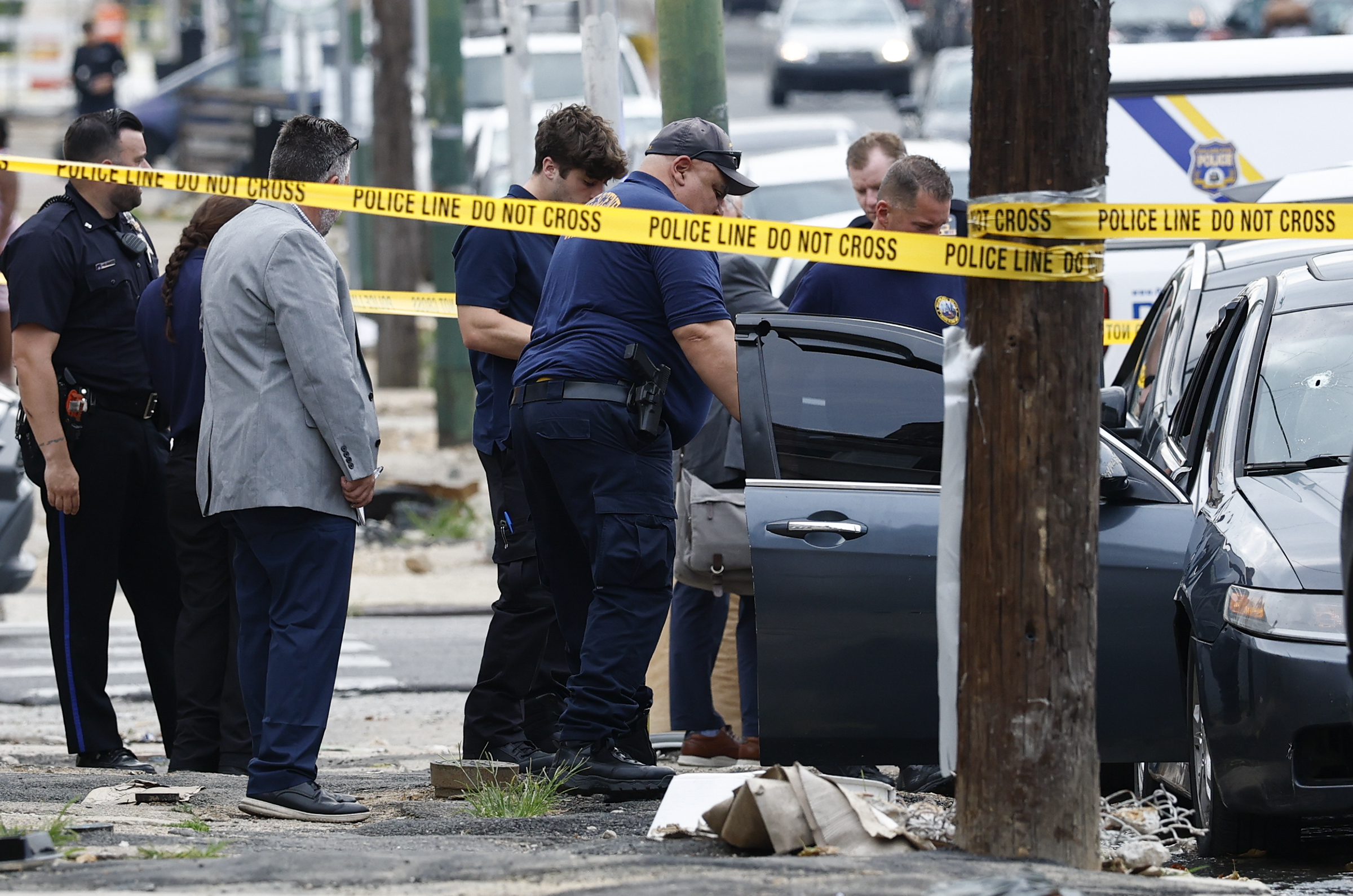
    Philadelphia police examine a car with a bullet hole after a man was fatally shot along the 500 block of East Wyoming Avenue on July 5, 2026.

    Bethel said the pockets of the city that have long experienced higher rates of violence — and that continue to see shootings, albeit fewer, today — remain a priority.

    “We are never going to give up in those communities,” he said. “We are going to keep working in those areas.”

    Recent polls have found that a majority of Philadelphians have noticed the decline and feel safer. But for residents on blocks where shootings remain a recurring threat, a citywide trend line can feel distant from daily life.

    Chantay Love, president of the victim-advocacy organization EMIR Healing Center, said the communities seeing recurring violence are still grappling with “the trauma and collateral damage that is left behind” from the last six years.

    Along the stretch of Market Street near where McPhaul was killed, more than 100 bullets were fired into a party on July 4, 2021, leaving two men dead. Earlier this year, 20-year-old Imani Ringgold was walking down the block with a slice of pizza when she was caught in the crossfire of an escalating gang feud and killed.

    Linda Days, 72, who lives in the area, said the shooting that killed McPhaul was another reminder of the violence she has come to expect since moving there seven years ago from Olney.

    Standing in her doorway on Tuesday, Days said it feels as if gunfire has become part of the soundtrack outside her home. But during the Fourth of July weekend, she said, she is especially careful to stay inside.

    “I don’t even come out to watch the fireworks,” she said.

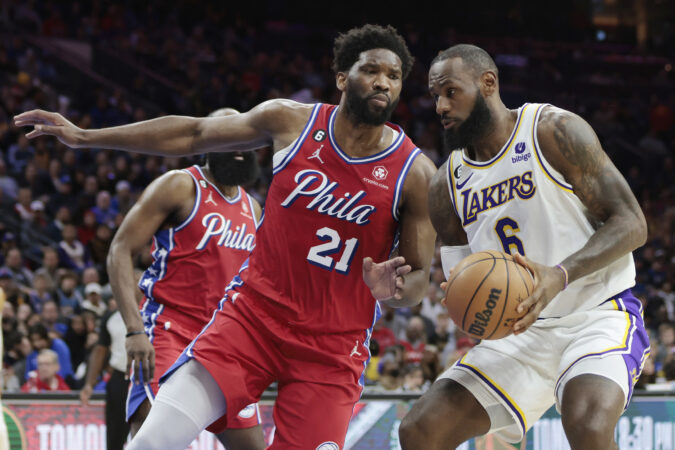
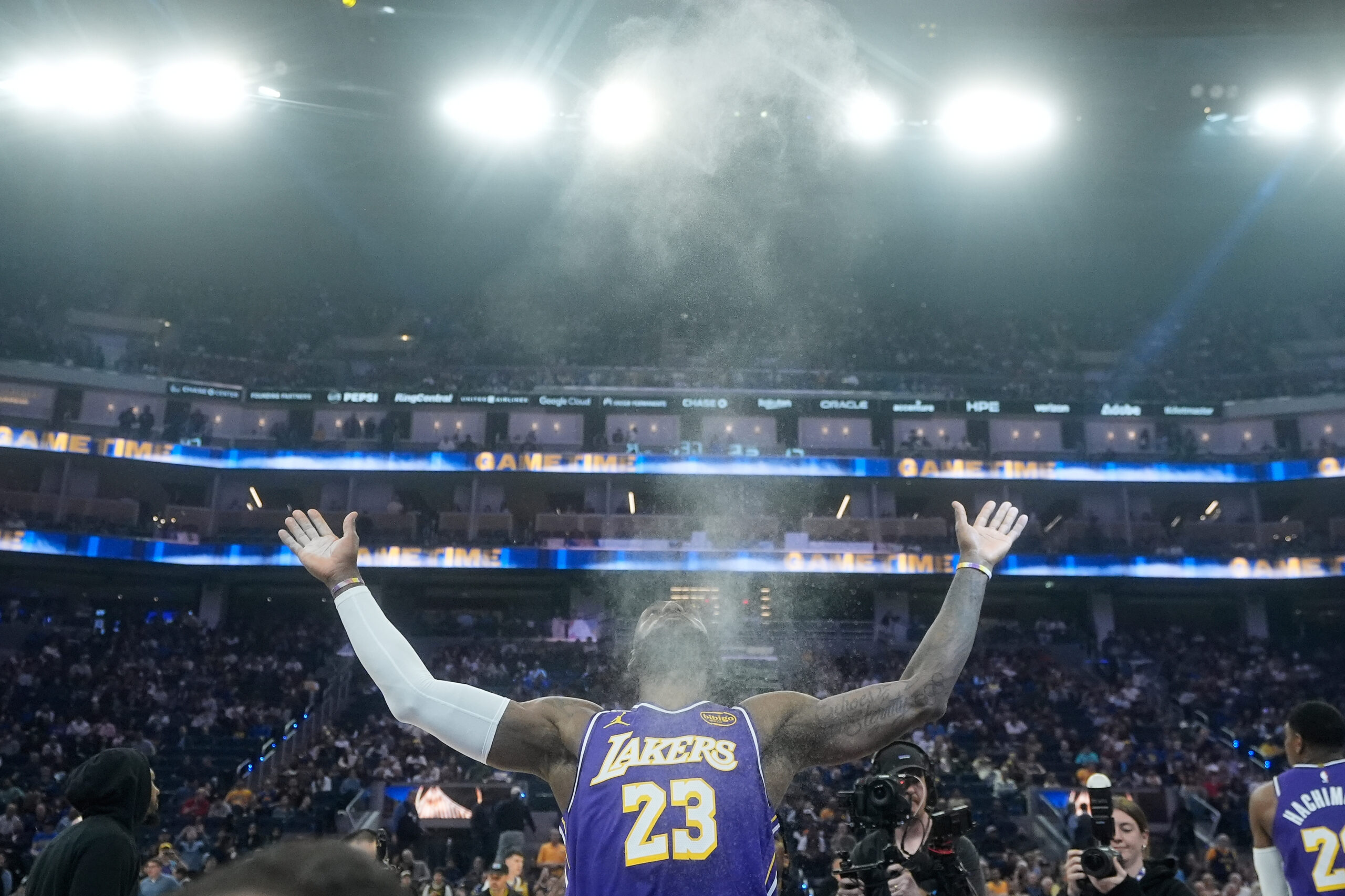
  • LeBron James signing with the Sixers could save Joel Embiid’s career

    LeBron James signing with the Sixers could save Joel Embiid’s career

    Biblical references seem to find a home with the Philadelphia 76ers.

    Moses Malone arrived in 1982 and immediately led the team to the promised land.

    Allen Iverson arrived in 1996 and, five years later, took the Sixers to the NBA Finals. For fans of gospel music, his nickname, “The Answer,” recalled a 1970s hit by Andraé Crouch and the Disciples: “Jesus is the Answer.”

    And, now, LeBron, who was nicknamed “King James” while still a princeling high school star in Akron, Ohio. His namesake, England’s James I, commissioned a translation of the Bible in the early 17th century, the one with all the “Thee’s” and “Ye’s” and my personal favorite, “believeth.”

    Of course, LeBron isn’t a Sixer. Not yet.

    But if, by some miracle, he does agree to a tiny free-agent contract this summer, LeBron surely would make the Sixers a favorite to win their first Larry O’Brien Trophy since Larry O’Brien actually was the NBA commissioner.

    This has not been the case largely because the sole benefit of “The Process,” the disastrous, failed rebuilding strategy that began in 2013, is Joel Embiid. He has MVP talent, and he won the award just three years ago, but his rank unprofessionalism — a refusal to commit to fitness, too much energy focused on extracurriculars, an obsession with personal milestones — has kept Embiid and the Sixers from reaching their potential.

    And, while King James might not save Embiid’s mortal soul, with his special brand of tough love, LeBron very well could save Embiid’s mortally afflicted career.

    Come on, man

    Before this goes any further, I don’t believe LeBron is interested in playing basketball for the Philadelphia 76ers. Yes, the Sixers somehow traded Paul George and picks for Jaylen Brown — Celtics president Brad Stevens must’ve lost either a bet or his mind — which instantly turned the Sixers into a viable Eastern Conference contender. Nevertheless, I think it’s likely that LeBron’s representatives are using this (feigned) interest as leverage to land the King elsewhere.

    I don’t think he wants to be in Philadelphia, which is a much tougher city than anywhere else he’s played. I don’t think he wants to deal with an organization with an absentee owner and a first-time top executive. I don’t think he wants to be associated or represent one of the most dysfunctional organizations in major league sports over the past 14 years, and with the NFL’s Jets, Raiders, and Browns in that mix, that’s quite an accomplishment. I don’t think he wants to play for the NBA veteran minimum, which is all he’d get at this point.

    Would LeBron James be willing to play for the veteran minimum?

    There is a chance, though, that his desire to be worshipped will override his desire to give himself the best chance to win a fifth title, because nowhere would worship him the way Philadelphia fans would worship him, just as they worship Moses for leading them out of the wilderness.

    LeBron already did that in Cleveland and Miami. And, as my colleague David Murphy pointed out on Monday, his agent, Rich Paul, said the Knicks disqualified themselves from the LeBron sweepstakes when they won a championship. Murphy’s logic: He could not end their drought, and therefore could not be seen as their savior, so why bother?

    Now that Jalen Brunson did what Patrick Ewing failed to do, LeBron can’t do it. But he damn sure could help Embiid do what Embiid will be paid an average of $62.6 million a year to do over the next three seasons.

    The Answer

    Winning a title, even with James on board, requires getting the most of whatever’s left out of Embiid, who has bad knees and a bad attitude. Getting the most out of Embiid is something that championship-winning coaches Doc Rivers and Nick Nurse abjectly failed to do, and they had three years apiece.

    This is different.

    LeBron, who is 41 with the body of a 32-year-old, is entering his 24th season. He has gotten the best out of his teammates everywhere he’s gone, whether it’s fellow Hall of Fame-caliber players like Dwyane Wade, Chris Bosh, and Kyrie Irving or lesser lights such as Kevin Love and Mo Williams. He has won four championships because of it. You think Austin Reaves — an undrafted tweener guard who averaged 10.8 points in four years of college — would have been offered $185 million by the Lakers for the next four years if LeBron hadn’t been his teammate for the past five years?

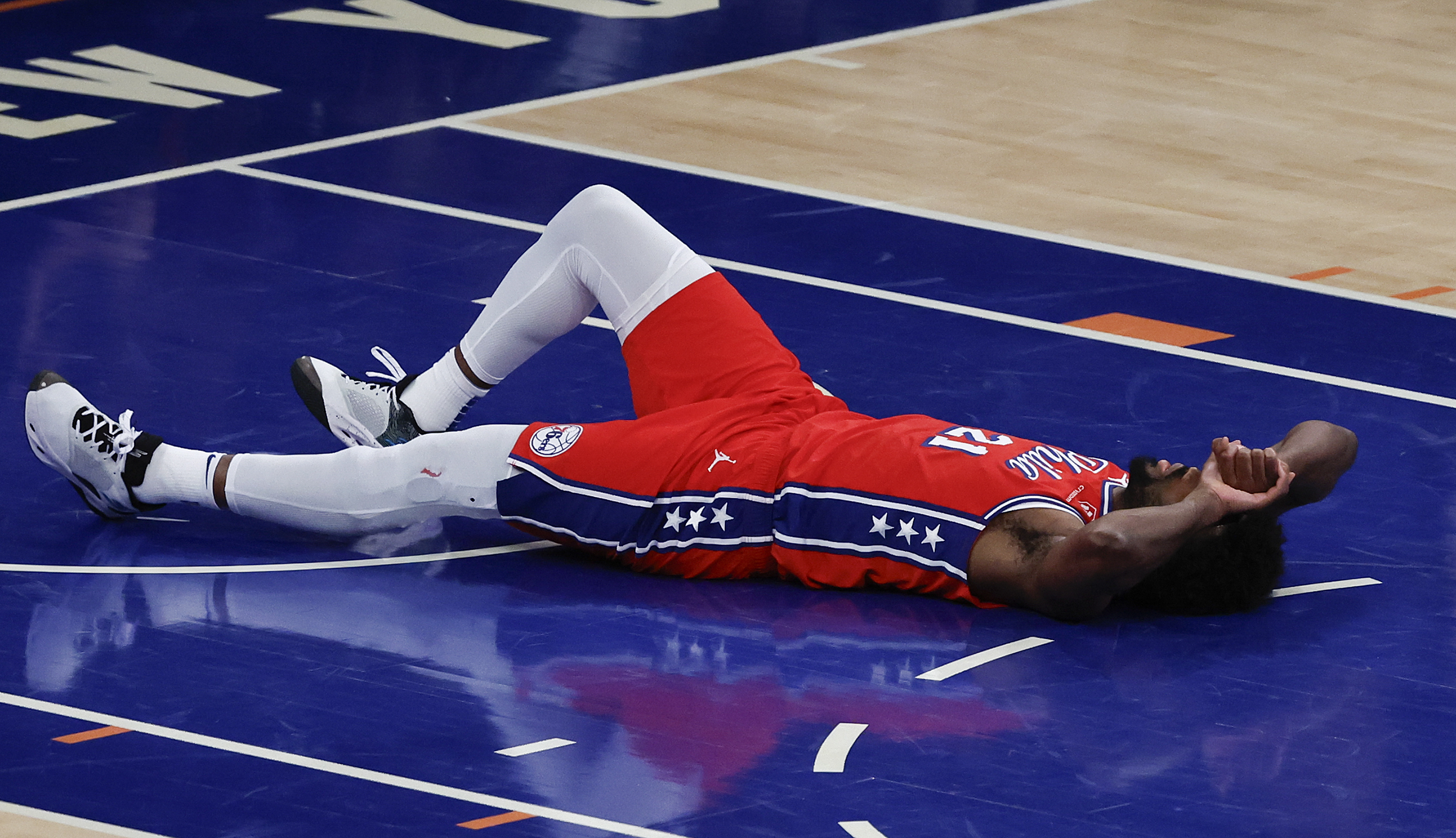
    Injury issues have plagued Joel Embiid throughout his career.

    Embiid, who is 32 with the body of a 42-year-old, is entering his 11th season since being drafted, though he missed the first two seasons with injuries. On the day the Sixers season ended in a playoff sweep (at the hands of those Knicks) he announced that the 2025-26 season had been a success for him. That’s because his left knee no longer impeded him to the degree it had him impeded him for the past several years.

    Embiid then swore that, at the end of this summer, when training camp begins, since his body feels better, he will be better prepared than in recent years to finally get the Sixers … past the second round of the playoffs?

    Talk about aiming low.

    At any rate, no Sixers since Moses himself is better equipped to make sure Embiid follows through on his latest promises. It worked on “big-boned” Charles Barkley.

    Filling a void

    Since trading cornerstone All-Stars Andre Iguodala in 2012 and Jrue Holiday in 2013, the closest the thing the Sixers have had to a real leader was Jimmy Butler, whose headstrong attitude and routine insubordination were less an example of leadership than a display of self-aggrandizement. Embiid was in his third year of actually playing NBA basketball during the Season of Jimmy, and he certainly got that message.

    Who’s the leader now?

    Embiid blew his chance years ago when it became clear that he was less interested in chasing championships than he was in seeking MVP trophies, Olympic gold medals, milkshakes, and Shirley Temples.

    Tyrese Maxey is an ebullient, well-spoken workaholic, but he lacks the gravitas to lead a championship-caliber team, especially when the roster includes more accomplished players like Embiid and Brown.

    As for Brown — well, he might find it hard to lead a bunch of dummies; last week, he called most pro athletes morons when compared to him after unnamed sources accused him of thinking he was the smartest person in the room: “Let’s keep it a buck [100] … The bar is f— low.”

    James might not be a budding chess master like Brown, but he’s smart enough to know how to win a title and how to run a team. After all, the bar is low.

    Do you think LeBron is going to let Joel make his teammates wait for 2½ hours to leave for the plane after road games? Do you think LeBron is going to sit around and wait for Embiid to come to meetings and shootarounds? No. The answer is, simply, no. If you’re James’s teammate, you will be professionalized or you will be marginalized.

    If LeBron James comes to Philly, you will see a fitter, tougher, more committed Joel Embiid.

    James’s habits aren’t contagious, they’re compulsory. It’s a trait he shares with Kobe Bryant. James is kinder than Kobe, and he’s more deferential, but compared to the typical laissez-faire NBA star, he’s neither kind nor deferential.

    He is desperate to win, and if you can’t help him do that, then he doesn’t have time for you.

    Again, I don’t think it’s a realistic outcome. But King James in Philly would be the best medicine for Embiid’s ailing legacy.

  • Long vilified graffiti art finds an unlikely gallery in Suburban Station

    Long vilified graffiti art finds an unlikely gallery in Suburban Station

    On entering Suburban Station from the 16th Street entrance, one is welcomed by a vast, bare-walled concourse punctuated by empty retail spaces.

    And then you turn right.

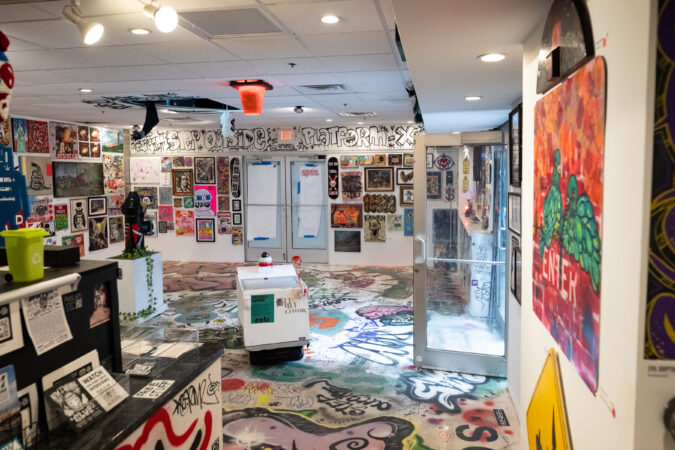
    A painting made to look like a subway car stands out against the blank concourse. The inside is entirely covered in graffiti, along with paintings, drawings, and mosaics. Not an inch of space is bare.

    Organizers and artists greet people as they come in and share stories about their street art journey.

    A room in the exhibit looks like the inside of a SEPTA BSL train car, orange seats and all.

    This is “Platform X,” a new era of graffiti art, organized by Step Outside, an artist-led program that transforms existing spaces into graffiti havens.

    Exhibition curator and fashion designer Zucati Zuce poses for a photo at Platform X.

    “We’re all street artists and we care about this more than anything,” said the artist who goes by the name Doomed Future. “There’s not much opportunity in galleries to showcase graffiti and street art here in Philly. We want to have our own thing here.”

    Doomed Future works alongside Step Outside organizers Philmadelphia, Inphltrate, Zucati Zuce, Raw G Zero, Ianismymiddlename, and RoboQ4. Because graffiti is considered criminal mischief under Pennsylvania law, the artists did not want to share their real names for this article.

    SEPTA representatives reached out to Doomed Future in January and asked them to take a look at the vacant spaces for rent in Suburban Station for a potential exhibit. The artist decided to rent a space from a real estate agent.

    Artwork showcased in the Platform X art exhibition, in which the back room was made to look like a subway car.

    “Street art’s grimy — it’s real, gritty, dirty,” Doomed Future said, “and so is the subway.”

    A more rebellious Semiquincentennial

    “USA 250″ is the theme around which 250 artists imagined their graffiti art.

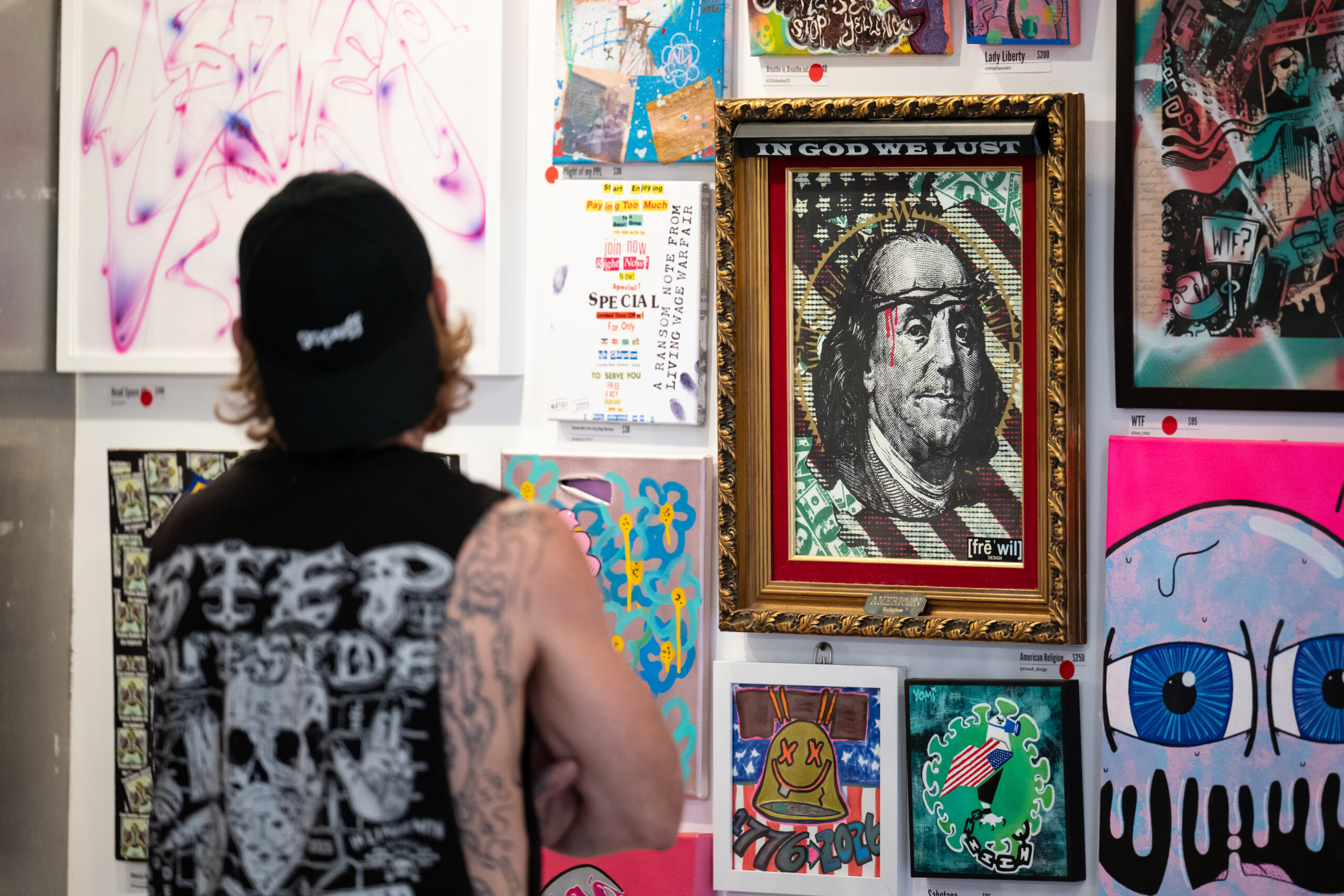
    One piece, American Religion, depicts Benjamin Franklin with a crown of thorns and the words “In God We Lust” above his head, certainly a switch from the patriotic depictions of the Founding Father we’ve seen for the Semiquincentennial.

    Exhibition organizer Ianismymiddlename looks at artwork at Platform X, including “American Religion” by @Frewil_design.

    Other pieces present a more rebellious yet optimistic view. Love Is Not Dead by Banjax the Balaclava depicts a bunch of angry figures holding anarchist flags in front of City Hall, with a match burning between two traffic cones at the center.

    “The thinking behind it was that there’s been a lot of burnout and frustration, particularly with folks that have been active in the street, fighting against injustices,” said Banjax. “I think it’s important to bring the message of love into these spaces as much as there is rage. As things get harder, continue to heat up, I want to remind people of that love is at the core of what we do.”

    Artist Banjax the Balaclava poses with “Love Is Not Dead” at Platform X.

    “Platform X” is Step Outside’s fourth showcase after a year of operation, with this one put on in collaboration with the nonprofit United Street Art (USA). United Street Art is dedicated to advancing and highlighting street art and graffiti. Most of the artwork is for sale, with all profits going directly to the artists.

    “Supporting the artists is our main mission. We’ve been doing free shows before, and this is our biggest one,” said RoboQ4 aka Robb Quattro, executive director of USA. “This is a big, long-term investment for us and we’re ready to continue doing more shows beyond this one.”

    Establishment vs. antiestablishment

    Graffiti, as an art form, is inherently antiestablishment, and the establishment still does not receive it well.

    At the start of the year, the city announced the Gateways to Philadelphia project. In collaboration with Mural Arts and Pennsylvania Horticultural Society, it invests $11.5 million toward beautification initiatives, including landscaping, new murals, and graffiti removal.

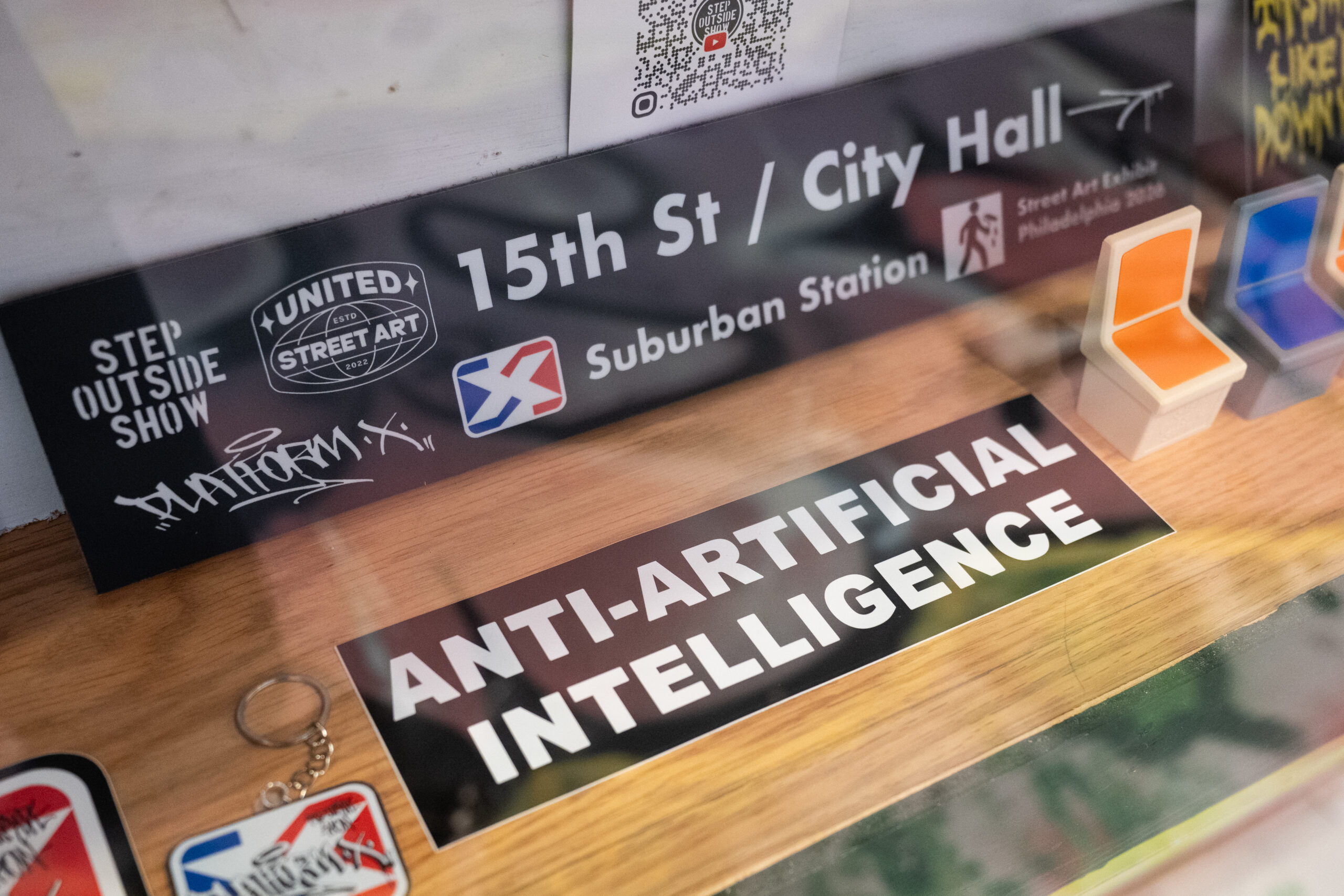
    A sign for the Step Outside art exhibition with a sticker that says “Anti-Artificial Intelligence.”

    “I can understand some people saying some graffiti is an eyesore, but there’s a lot that’s not,” said contributing artist Satan, who has been making graffiti art for over 40 years. “This is helping me as an artist grow.”

    The show has been received glowingly by visitors, who have been invited to add to the art themselves. People have drawn on the walls with chalk, spray painted their own tags, and left stickers anywhere there was room.

    On Father’s Day, there was a father-son duo putting their own graffiti on the wall, said artist and organizer Inphltrate. “That was really cool to see,” she said. “This is a safe haven for not only street art and graffiti, but for any person who is creative who needs an outlet. You are safe and accepted here.”

    Artwork by the artist, who wishes to be identified with their Instagram username, @shrpy_ (top), and Elizabeth Fiend (bottom) is pictured at Platform X.

    “Writing our names, I didn’t look at it as art. We were vilified,” said wallwriter Lewis Pittman, also known as Lewis or King Lewis in the street art scene. “I’m glad I’m still above ground to see the evolution of this culture. I’m glad it’s accepted as an art form.”

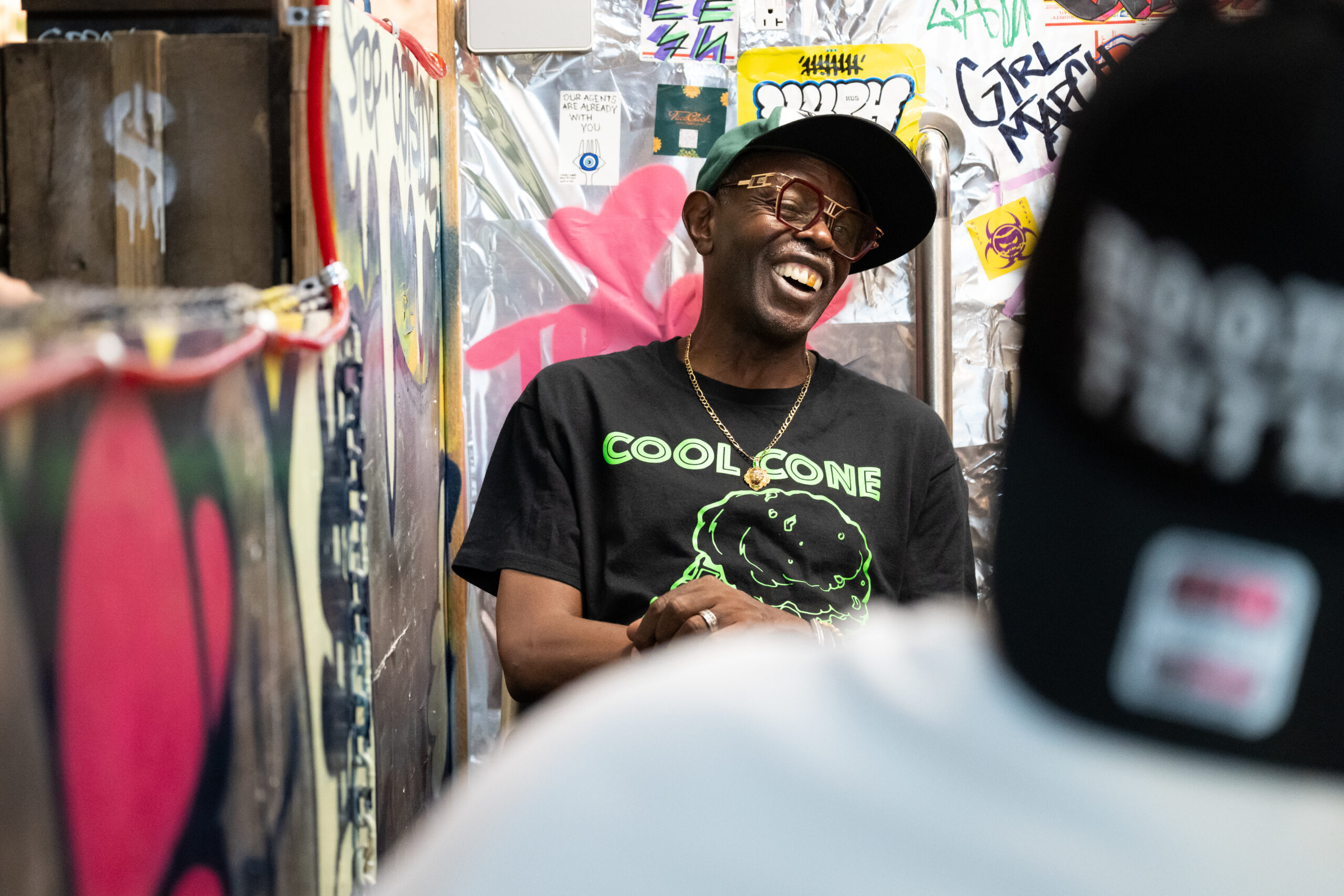
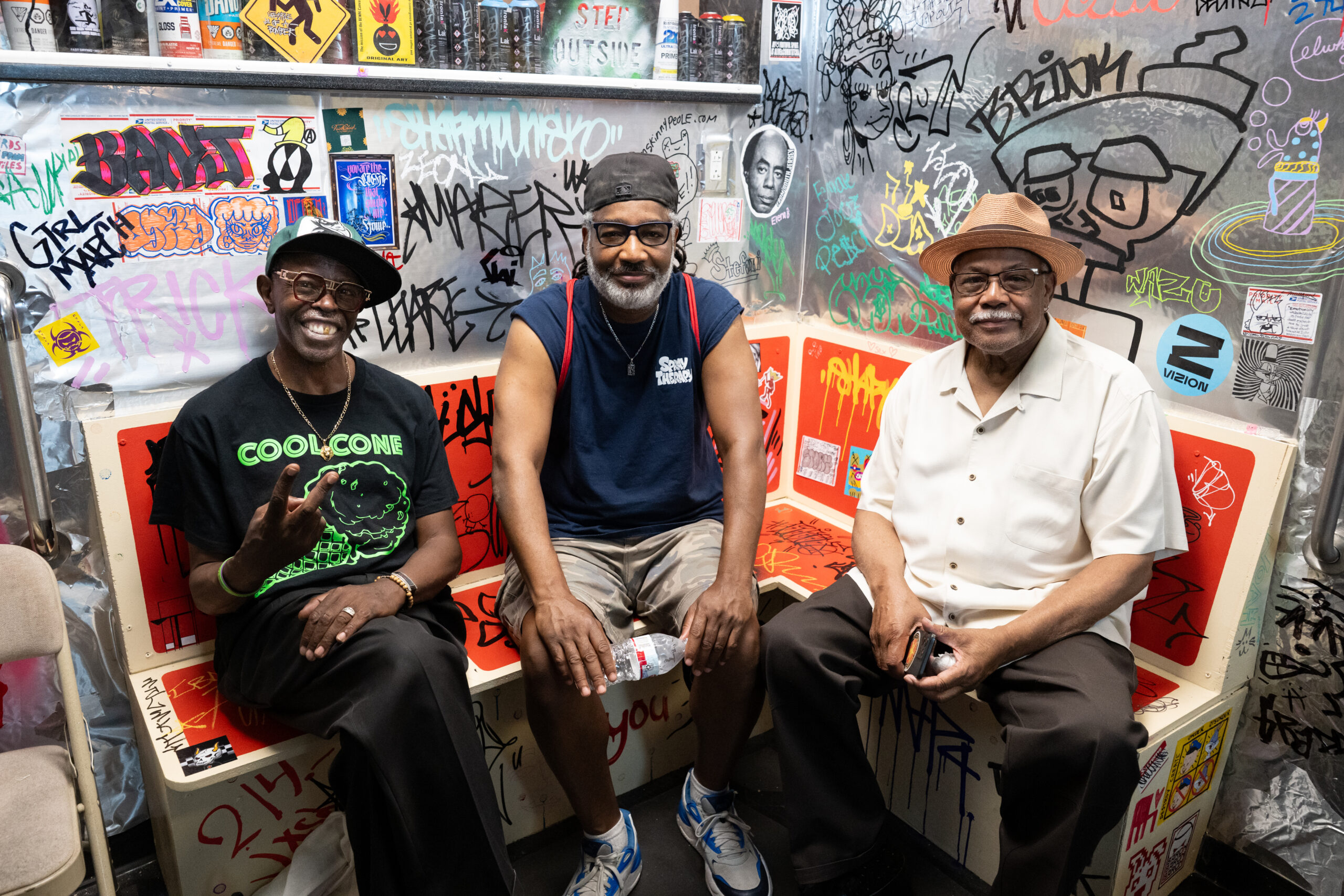
    Pittman is one of Philadelphia’s original “wallwriters,” which is what graffiti artists called themselves in the 1970s. Pittman, along with wallwriters like Cool Cone and Cornbread, helped popularize the now iconic Philadelphia “gangster” handstyle, defined by tall, condensed letters.

    “I remember Sunday nights going to Fern Rock, writing on all the buses and trains,” Cone, aka Cone ICP, said. “On Monday morning, nothing but my name came down Broad Street.”

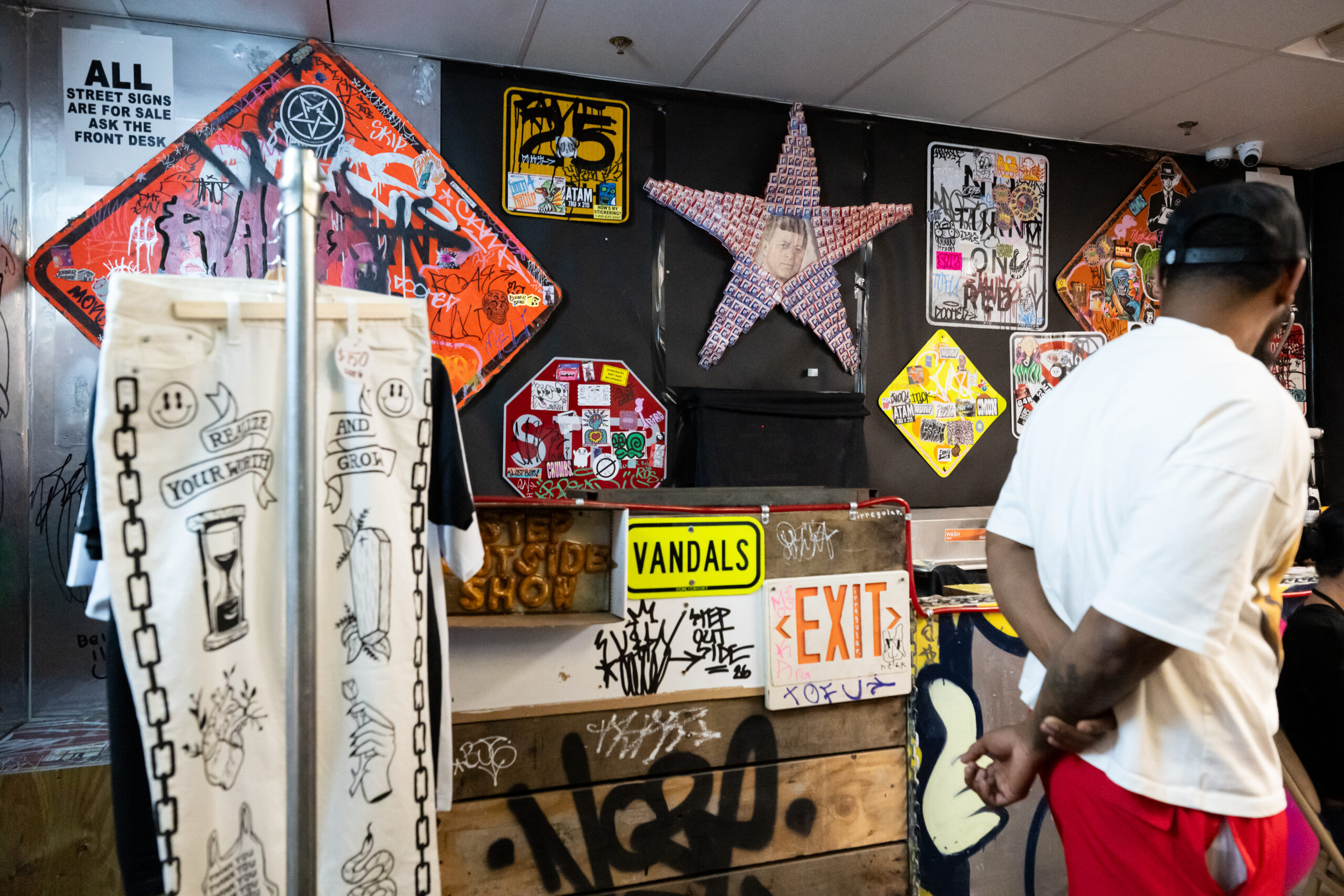
    Curator and fashion designer Zucati Zuce stands in front of street signs with graffiti, all of which are for sale.

    After the USA 250 show closes, Step Outside plans to put on a Then and Now-themed showcase in August at Platform X, showing the evolution of street art. Incorporating and paying respect to the OGs who popularized the art form is a necessity for their exhibits.

    The deep history of Philly graffiti

    As a teenager, Cone founded Imperial Casanova Persuaders (ICP), one of the country’s original graffiti clubs, known for tagging public transportation. They helped originate the “wicked” variant of the Philly gangster handstyle, which puts a more wild, energetic spin on the lettering.

    “They could look at us as being the start of murals, too, since a lot of stuff started in Philly. But we don’t get the recognition because a lot of people don’t speak on it,” he said. “In American history, we’re one of the best kept secrets.”

    Contributing artist and self-styled wallwriter, who wishes to be identified as Cool Cone, is interviewed by a reporter. As a teenager, he founded graffiti club ICP.

    Philadelphia, with its thousands of murals, is billed as the “Mural Capital of the World.” Mural Arts Philadelphia, the country’s largest public arts program, started off being a part of Philadelphia Anti-Graffiti Network in 1984.

    Cone, like many graffiti artists, had several run-ins with police officers in the 1970s, getting targeted for wallwriting. Today, he travels the nation, speaking at museums and various art events, recognized as a trailblazer in street art history.

    From left: Artists Cool Cone, Satan, and Lewis Pittman pose for a portrait at Platform X. The three are trailblazers in Philadelphia’s street art scene, going back to the 1970s and 1980s.

    ICP’s symbol, a capital “I” with two dots on the side, can still be seen tagged around the city and even in Platform X.

    “You’re not going to stop the wallwriters,” Pittman said.

    Closing receptions for the “Platform X” USA 250 show are Friday, July 10, from 5 to 10 p.m. and Saturday, July 11, from 1 to 10 p.m. The exhibit will stay open for the rest of the summer.

    Platform X is located in Suburban Station down the steps on 16th Street between Market Street and JFK Boulevard in Center City, Philadelphia. More information on stepoutsideshow.com and @stepoutsideshow.

  • FanDuel sent a personal message from Phillies star Bryce Harper to a customer with a gambling addiction

    FanDuel sent a personal message from Phillies star Bryce Harper to a customer with a gambling addiction

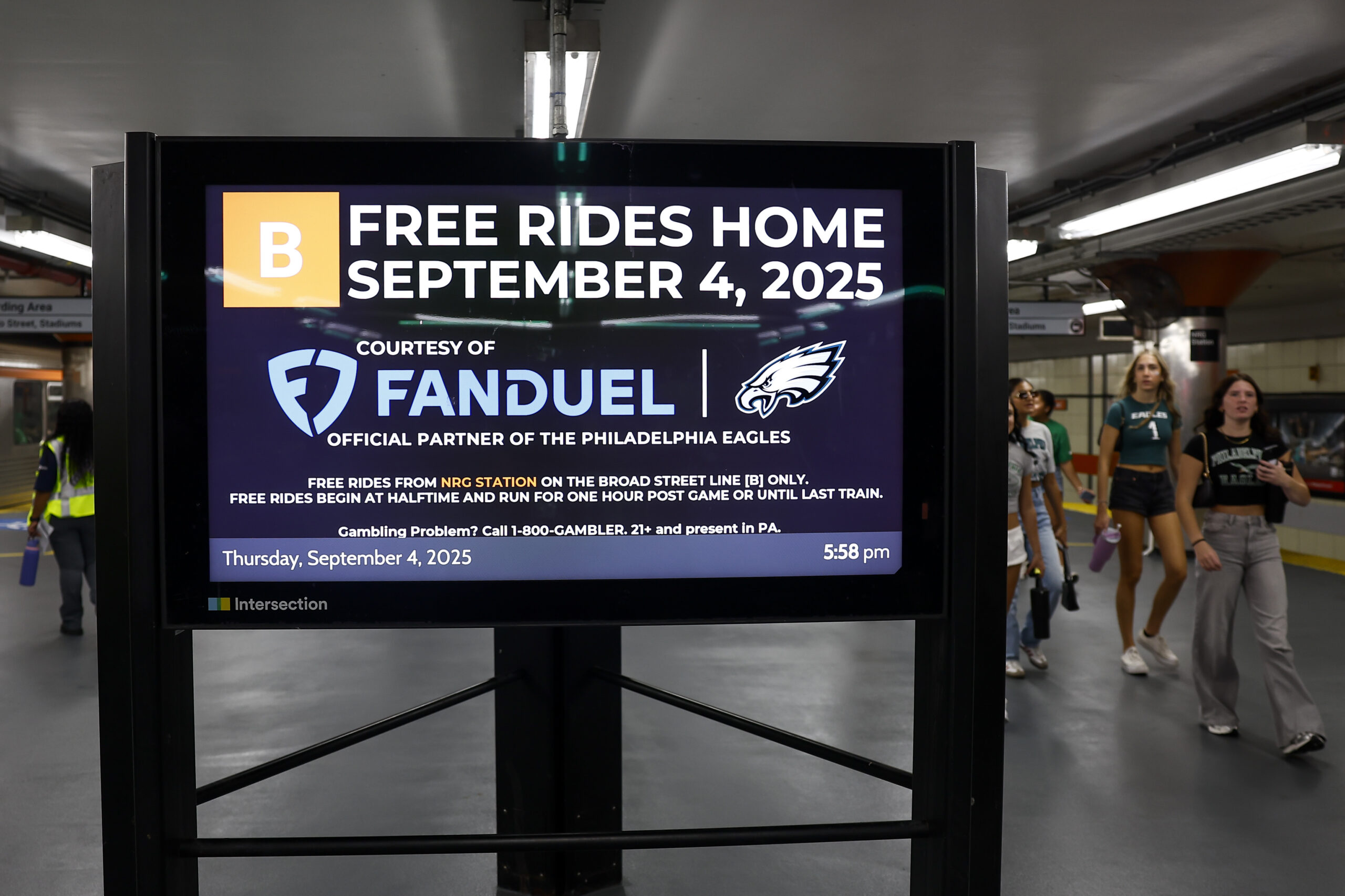
    As the 2020 NFL season kicked off, Terry Thompson picked up his phone and placed a wager with FanDuel Sportsbook on his favorite team, the Philadelphia Eagles.

    It was his first time gambling through an app, and he soon started placing microbets, which are in-game wagers on something as small as whether the next play would be a pass or run.

    He grew addicted to the effortless, rapid-fire action. Every game, every quarter, every play — click, click, click. Thompson would ultimately wager $18.5 million with FanDuel, earning him VIP status with the company. That meant exclusive perks, from champagne to Super Bowl tickets, which made him feel important and enticed him to continue gambling.

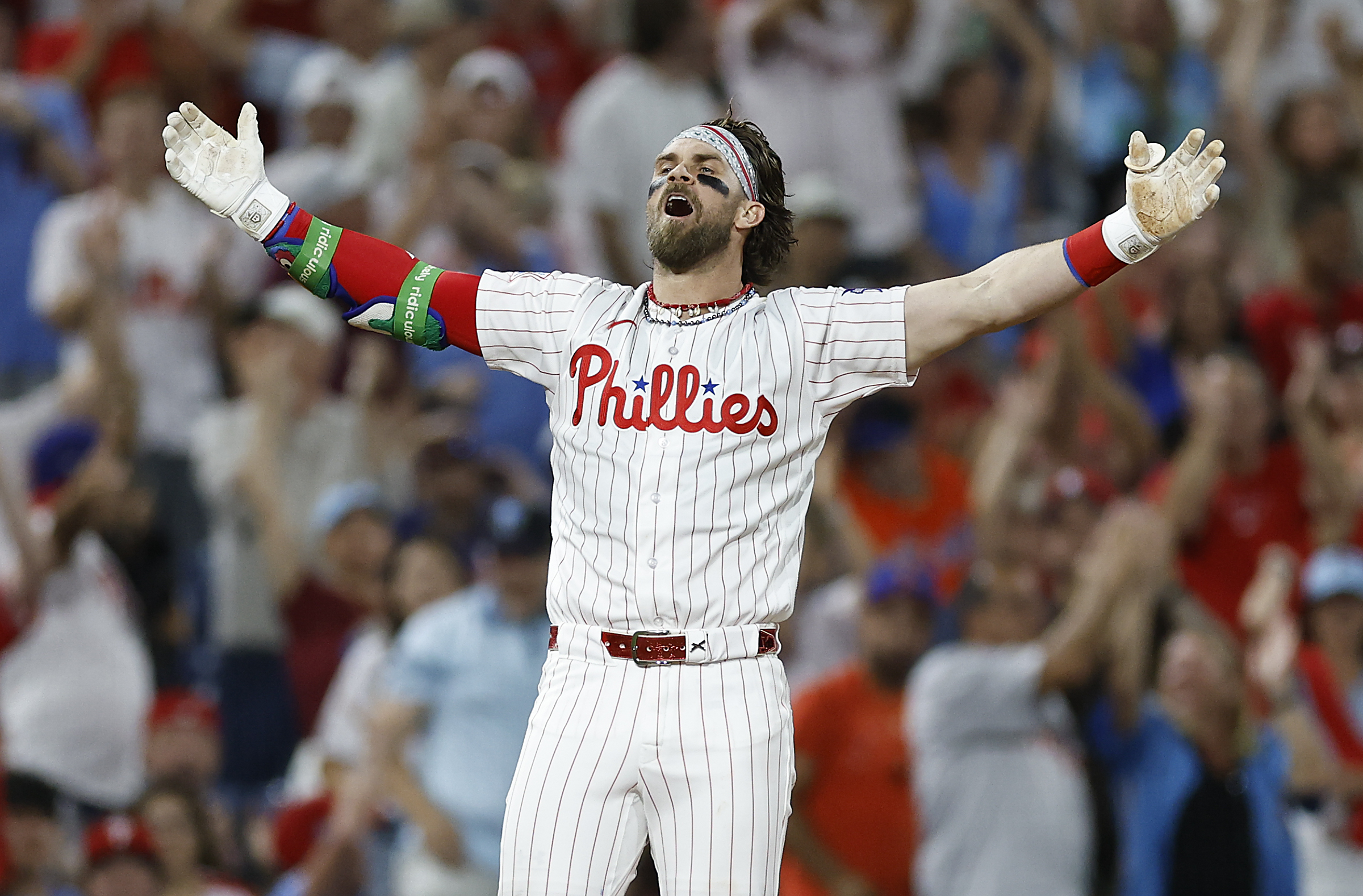
    By late November 2024, Thompson had incurred steep losses and resorted to desperate measures to fund his addiction. Then, one afternoon, he flicked open his phone and received a FanDuel reward that momentarily distracted him from his debts: a personalized video message from Philadelphia Phillies superstar Bryce Harper.

    The Inquirer obtained a copy of the 21-second video. In it, Harper addresses Thompson by name and acknowledges Thompson’s young son. Harper ends by thanking Thompson for his support.

    Harper is not wearing any FanDuel merchandise, but the video is marked with the company’s logo, and Harper mentions that he was reaching out at the request of Thompson’s VIP manager, “your host Bryttanni at FanDuel,” who wanted to ensure that Thompson had an “extra special Thanksgiving.”

    Professional sports leaders had long recoiled at having any association with gambling. But the U.S. Supreme Court ruled in 2018 that states could legalize sports betting, and each league now has lucrative partnerships with sportsbook companies, whose advertisements can be easily found in stadiums and arenas, and during game broadcasts.

    Still, league officials preach about the importance of protecting the integrity of their games and have rules that are designed to maintain distance between professional athletes and bettors. Although Major League Baseball’s policy does not explicitly reference interactions with VIP gamblers, Harper’s personal message to a bettor — apparently arranged by an employee of a major sportsbook — is a unique test of how cozy the league will allow players to get with gambling companies.

    There is no evidence that Harper has an official partnership with FanDuel, or was aware that Thompson had an addiction.

    The Inquirer could find no other examples of an active athlete recording a personal message to a sportsbook VIP customer who, by definition, had to be regularly betting large sums of money.

    The Inquirer shared the video with Scott Boras, Harper’s longtime agent, and asked if he or Harper would discuss how FanDuel had obtained the video.

    Boras declined to comment.

    The Inquirer also shared the video with the Phillies and MLB. Both declined to comment, and the players union did not respond to a request for comment.

    Multiple experts familiar with the fraught intersection of professional sports and the gambling industry said that while Harper does not explicitly encourage gambling in the video, it still raises concerns.

    Danny Funt, who researched sportsbook VIP programs for his 2026 book, Everybody Loses: The Tumultuous Rise of American Sports Gambling, said in an email that VIP bettors sometimes get to hang out with former athletes. He cited former San Diego Charger LaDainian Tomlinson, who worked in retirement for DraftKings, as one example.

    But the Harper video is entirely different, he said.

    Harper, a nine-time All-Star and two-time MVP, has been one of baseball’s most marketable stars throughout his 15-year career.

    “I’ve never heard of an active player, let alone a former MVP, doing something like this,” Funt said.

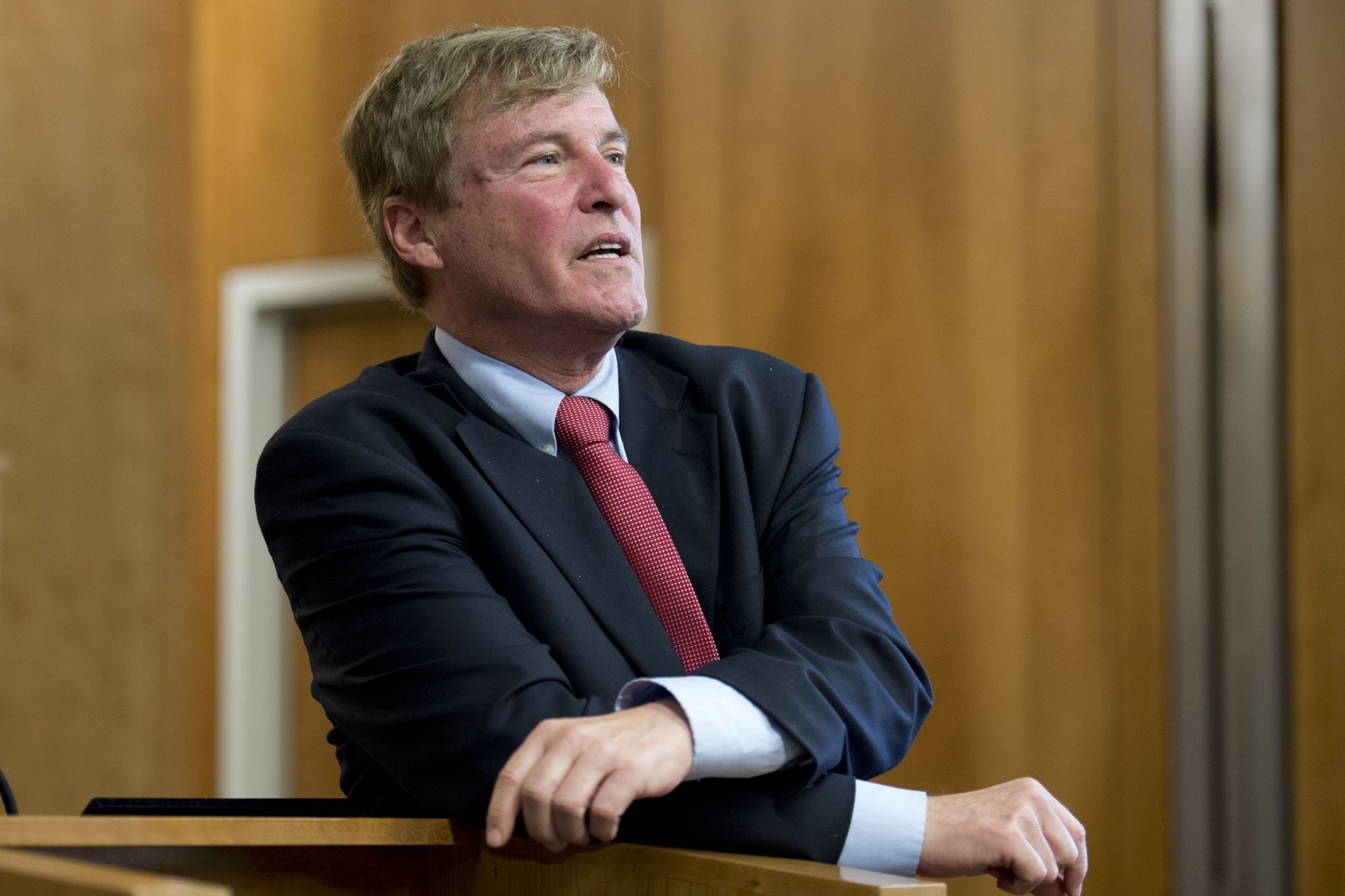
    Leigh Steinberg — an agent who represents Kansas City Chiefs quarterback Patrick Mahomes, and whose past clients included MLB All-Stars Manny Ramirez and Will Clark — called the Harper video “bad for sports.”

    Steinberg said if one of his clients approached him about doing promotional work of any kind for a sportsbook company, he would advise them to walk away.

    “It’s not good for your brand,” he said. “It’s exploitative and it’s not the sort of activity you want to be associated with.”

    MLB’s collective bargaining agreement, which is set to expire in December, allows athletes to appear in advertisements or make personal appearances for casinos, racetracks, or sportsbook companies, so long as the ballplayers do not encourage betting on baseball.

    NFL players are prohibited from marketing or promoting “any form of gambling” under the league’s current collective bargaining agreement.

    The NBA, meanwhile, allows its players to own a passive ownership stake — less than 1% — in sportsbook and prediction market companies, and engage in promotional work for gambling companies, provided they do not encourage betting on basketball. As a member of the Los Angeles Lakers, LeBron James appeared in advertisements for DraftKings.

    Harper, 33, has been one of baseball’s most marketable players throughout his 15-year career. He has had endorsement deals with many companies, including Under Armour, Gatorade, Dairy Queen, and Blind Barber, a chain of barbershops and lounges of which Harper owns an equity stake.

    He has also been famously unafraid of the spotlight, openly discussing everything from his Mormon faith — which prohibits gambling and alcohol use — to perceived criticism from his boss.

    Professional sports leagues that once vehemently opposed any association with gambling enterprises have now embraced lucrative partnerships with sportsbook operators.

    Jodi Balsam, a former NFL attorney who is now a sports law professor at Brooklyn Law School, said even if Harper’s video does not violate baseball policy, it raises ethical questions about the league’s relationship with gambling companies, whose business practices are facing increasing scrutiny from state and federal lawmakers.

    “The first question I would have is, was [the Harper video] done by the sportsbook company precisely because they know they have an addicted gambler on their hands, and they’re trying to wring every cent out of him that they can?” Balsam asked.

    FanDuel did not respond to a request for comment.

    Balsam’s question is at the center of a lawsuit that attorneys for the nonprofit Public Health Advocacy Institute filed in March in Common Pleas Court in Philadelphia on behalf of Thompson and another plaintiff. The suit alleges that FanDuel and DraftKings, another sportsbook company, use their products and VIP services to intentionally maximize addiction.

    Harper is not named in the lawsuit.

    Thompson, whose attorneys declined to make him available for this story, details the depths of his gambling addiction in his lawsuit.

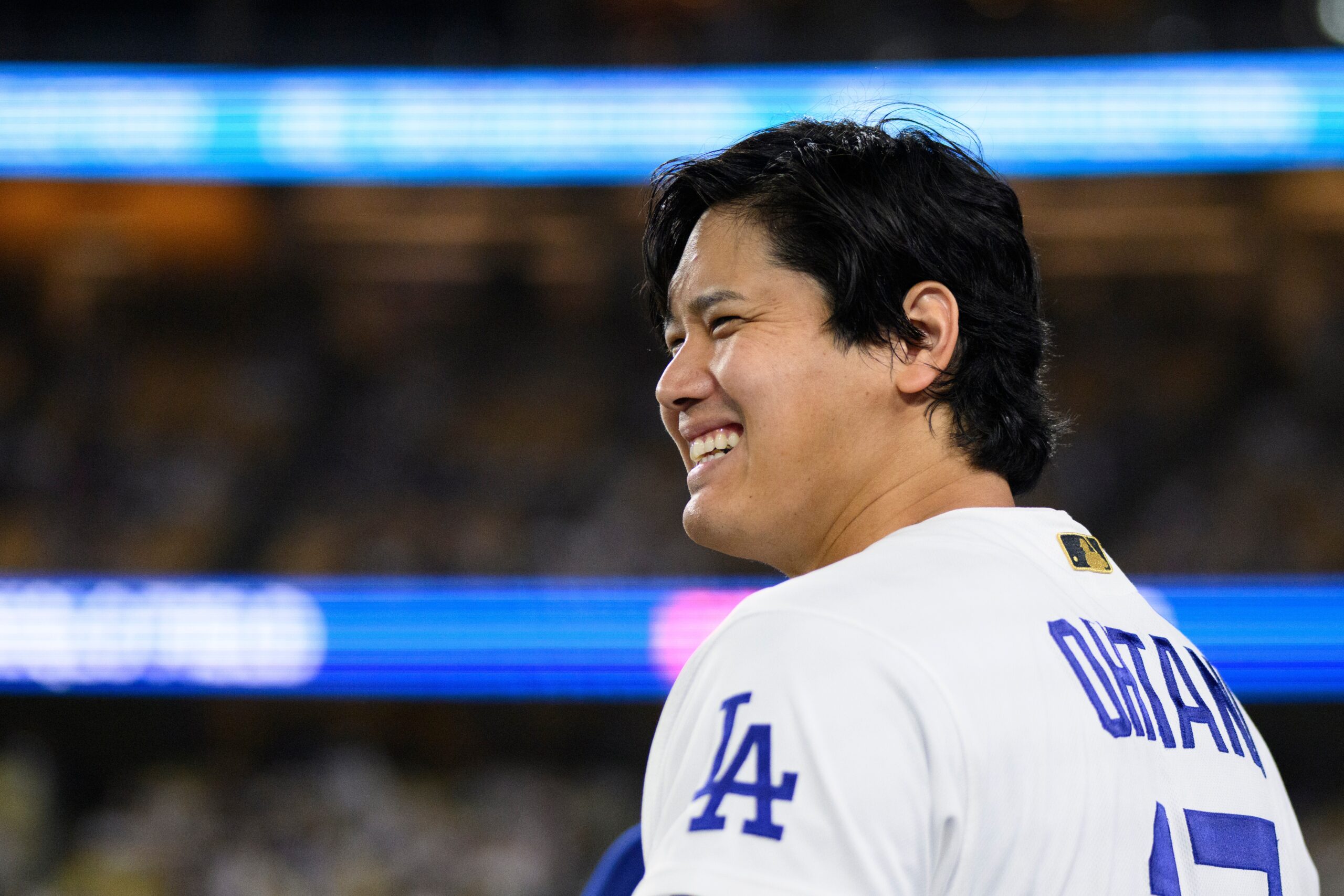
    Los Angeles Dodgers star Shohei Ohtani’s former interpreter, Ippei Mizuhara, was sentenced in 2025 to 57 months in federal prison for illegally transferring nearly $17 million from Ohtani’s bank accounts to pay off gambling debts.

    He alleges that he covered his losses by taking out second and third mortgages on his home, which later fell into foreclosure, and then sold his shares of an investment company that he had run for two decades.

    By late February, Thompson’s suit claims, he wagered and lost his last $10,000 on a DraftKings parlay bet.

    His losses totaled nearly $2 million, according to the lawsuit. Desperate and feeling like he could not confess the scope of his financial ruin to his family, Thompson texted his therapist, who then contacted the police. Officers raced to Thompson’s home and prevented him from harming himself.

    Balsam said Thompson’s tragic story should give sports leagues and its players pause.

    “Is this the kind of activity that either the union or the league want their players to be associated with,” Balsam said, “if it leads to addictive and self-destructive behaviors by a fan?”

    How MLB’s betting stance changed

    “People know gambling is deadly,” Allan H. “Bud” Selig said. “I don’t have to conduct focus groups.”

    It was November 2012, and Selig, then MLB’s commissioner, was being deposed for nearly three hours in Milwaukee. A lawsuit instigated by then-New Jersey Gov. Chris Christie sought to overturn a longstanding federal law that restricted legal sports betting to just four states.

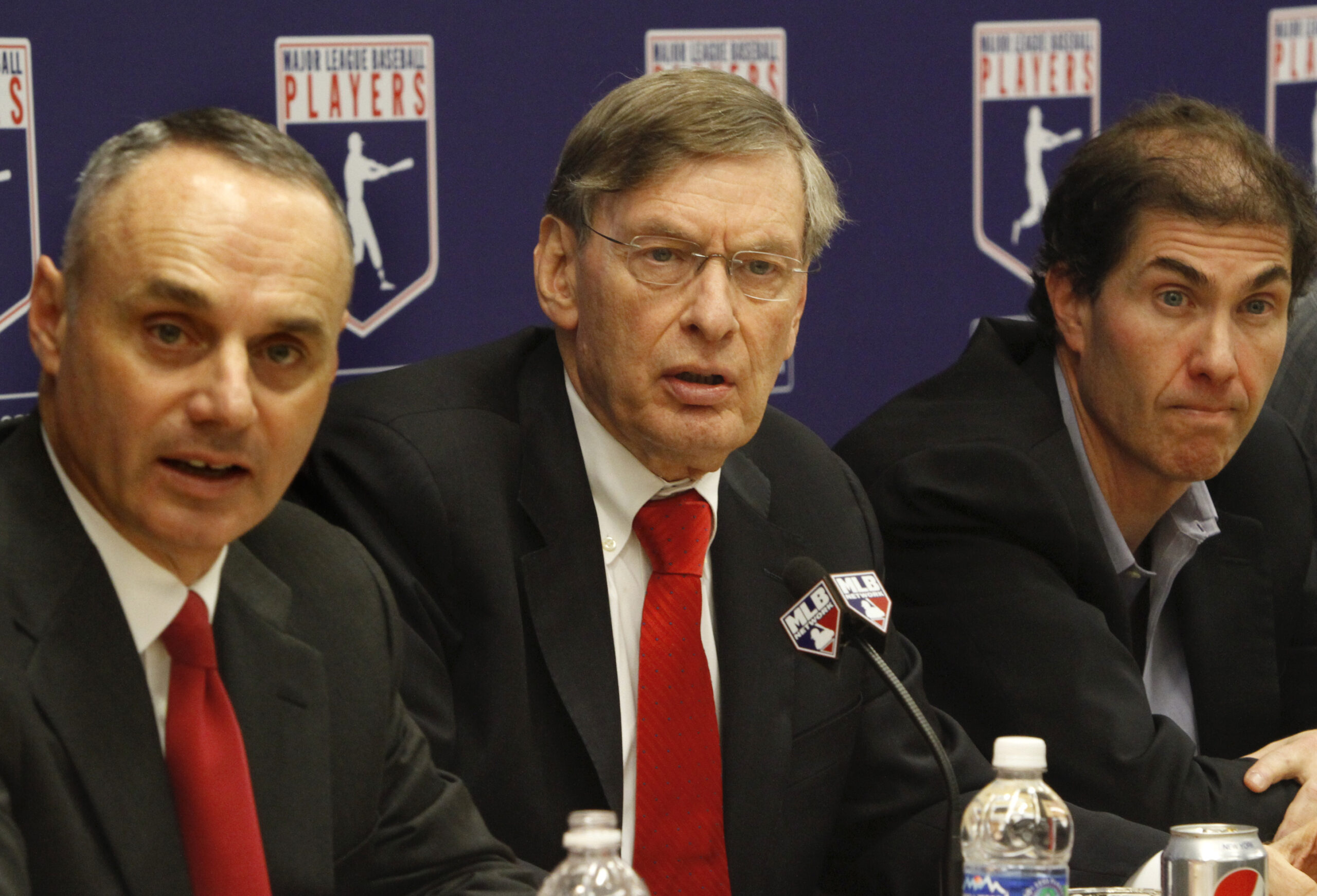
    Major League Baseball longtime commissioner Bud Selig (center) argued in a 2012 deposition that widespread legalized sports gambling would be harmful to baseball. He was later succeeded by Rob Manfred (left), who has overseen partnerships between the league and sportsbook companies.

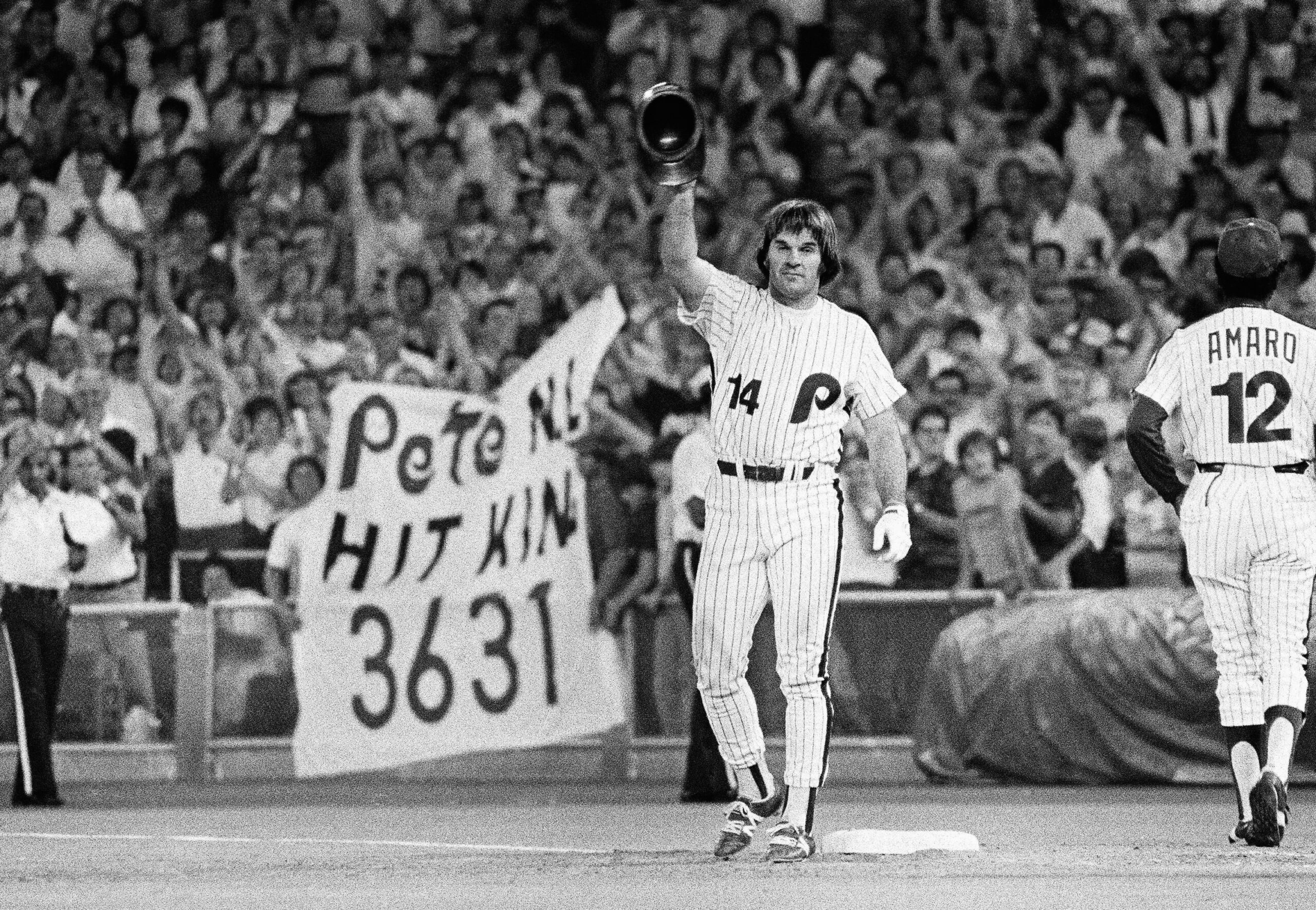
    Baseball’s leaders had sought for decades to avoid recurrences of past gambling scandals that had threatened the integrity of the sport. Selig had maintained the hard line of his predecessors, perhaps most notably by upholding the league’s 1989 lifetime ban of former Phillies first baseman Pete Rose, who was found to have bet on baseball while managing the Cincinnati Reds.

    Selig said he understood why state lawmakers would welcome the tax revenue that widespread legalized sports gambling could generate. But he argued such a development could only increase the odds of new baseball betting crises, which would be “the end of your sport.”

    “I’m just — guess I have to say to you that I’m appalled,” Selig said in the deposition. “I’m really appalled.”

    In 2019, MLB — led by a new commissioner, Rob Manfred — entered into its first partnership agreement with FanDuel.

    Manfred sent a memo to players outlining the league’s gambling policy. At that time, it prohibited players from performing services “in any capacity involving sports betting for any third party,” a categorization that included “promoting or endorsing sports betting products or services.”

    A new collective bargaining agreement, reached in 2022, allowed players to do promotional work for sportsbooks. Colorado Rockies outfielder Charlie Blackmon soon became the first professional baseball player to secure a deal as a brand ambassador for a sportsbook company.

    Not everyone affiliated with MLB has welcomed the new relationships between the league and gambling entities.

    “We’re entering a very delicate and, dare I say, dangerous world here,” Tony Clark, then president of the players union, told reporters in 2022.

    MLB gave a lifetime ban in 1989 to former Phillie Pete Rose for betting on baseball while he was the manager of the Reds.

    Two years later, MLB Players Inc. — a licensing and marketing subsidiary of the players union — filed a lawsuit that accused DraftKings of using without permission or compensation photos of MLB stars on its betting app and in social media posts. FanDuel and Bet365 were also named as defendants in the suit.

    Harper figured prominently in the lawsuit. The complaint against DraftKings, filed in U.S. District Court in the Eastern District of Pennsylvania, included images of Harper’s face on the DraftKings app and a reference to a hypothetical wager on Harper hitting two home runs in a game. Attorneys also mentioned Harper in later courtroom arguments.

    Being able to control how their names, images, and likenesses are used is a “crucial return on their substantial career investment,” the players’ attorneys wrote in the complaint. “It also enables athletes to avoid being associated with companies, commercial products, and industries that they do not wish to be perceived as supporting and endorsing.”

    (The union ultimately dropped its case against FanDuel, and the lawsuit was settled earlier this year for undisclosed terms.)

    In May 2024 — five months before FanDuel sent Harper’s video message to Terry Thompson — Manfred fired umpire Pat Hoberg for sharing a sportsbook account with a professional poker player who placed bets on baseball.

    An investigation found no evidence that Hoberg himself had bet on baseball, Manfred later said. But the existence of the shared account — and the fact the umpire had deleted Telegram messages between himself and the poker player — created the “appearance of impropriety that warrants imposing the most severe discipline.” Hoberg appealed his dismissal but lost.

    A year later, Bud Selig’s stark warning materialized.

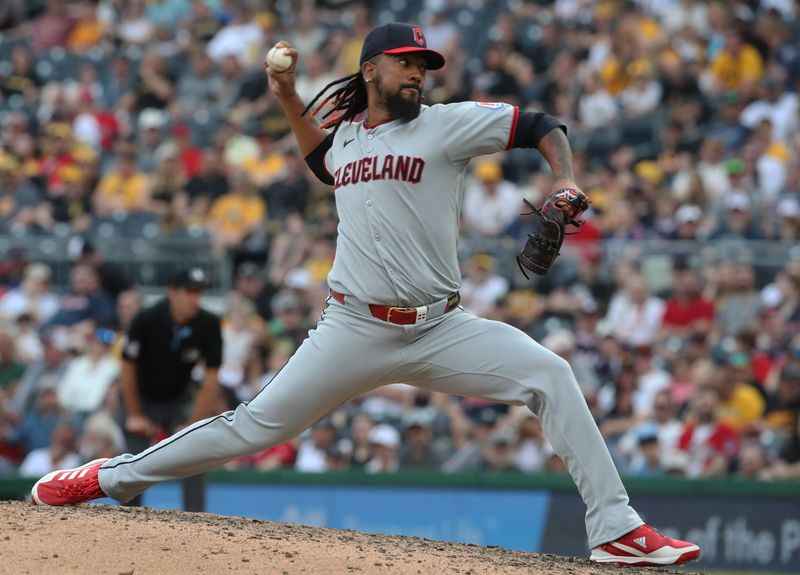
    Former Cleveland Guardians pitcher Emmanuel Clase has been accused by federal investigators of conspiring with bettors in exchange for financial kickbacks.

    Federal authorities indicted Cleveland Guardians pitchers Emmanuel Clase and Luis L. Ortiz, and accused each of conspiring with bettors.

    Clase and Ortiz “agreed to throw specific types and speeds of pitches” prior to games, and bettors wagered on those pitches, the indictment states. In exchange, the bettors wired thousands of dollars to the pitchers through a third party in the Dominican Republic. Clase and Ortiz have each pleaded not guilty to wire fraud conspiracy and related charges and are awaiting trial. MLB has placed them on paid nondisciplinary leave.

    That same year, Ippei Mizuhara, a former translator for Los Angeles Dodgers star Shohei Ohtani, was sentenced to 57 months in federal prison for illegally transferring nearly $17 million from Ohtani’s bank account to pay Mizuhara’s gambling debts.

    Those episodes have not resulted in baseball’s demise, as Selig had once imagined. But they also did not rupture MLB’s relationship with gambling entities, which collected a record $165 billion in sports wagers in 2025.

    As part of negotiations over a new collective bargaining agreement with MLB, the players union recently asked the league for to grant players more freedom to seek endorsements from sportsbook operators and prediction markets, ESPN reported.

    The VIP treatment

    FanDuel awards five points for every dollar that a bettor pays on a contest entry fee. To achieve VIP status, bettors must amass 600,000 points, which expire after a year of inactivity.

    “But don’t worry,” the company explains on its website, “it’s easy to stay active.”

    Terry Thompson earned a FanDuel VIP manager, Bryttanni Morgan, in 2021, court records show.

    Morgan texted Thompson often about the fortunes of the Eagles, commiserating over the team’s ups and downs. Their conversations also veered into more personal terrain — favorite restaurants, travel plans, and family.

    A FanDuel VIP manager allegedly offered tickets to Super Bowl LVII to bettor Terry Thompson, an Eagles fan who had a gambling addiction.

    FanDuel’s intention, Thompson’s attorneys allege, was for Thompson to believe that Morgan was his friend.

    Their exchanges often returned to Thompson’s betting activity. Morgan encouraged him to place more wagers, even when he showed signs of financial strain, the lawsuit states.

    Morgan is named as a defendant in Thompson’s lawsuit. Her attorney could not be reached for comment.

    In late December 2022, after Thompson had suffered more losses, Morgan texted him: “Are we gonna take a little break and start fresh in the New Year?”

    “I’ll try,” Thompson wrote back, adding a smiley face symbol.

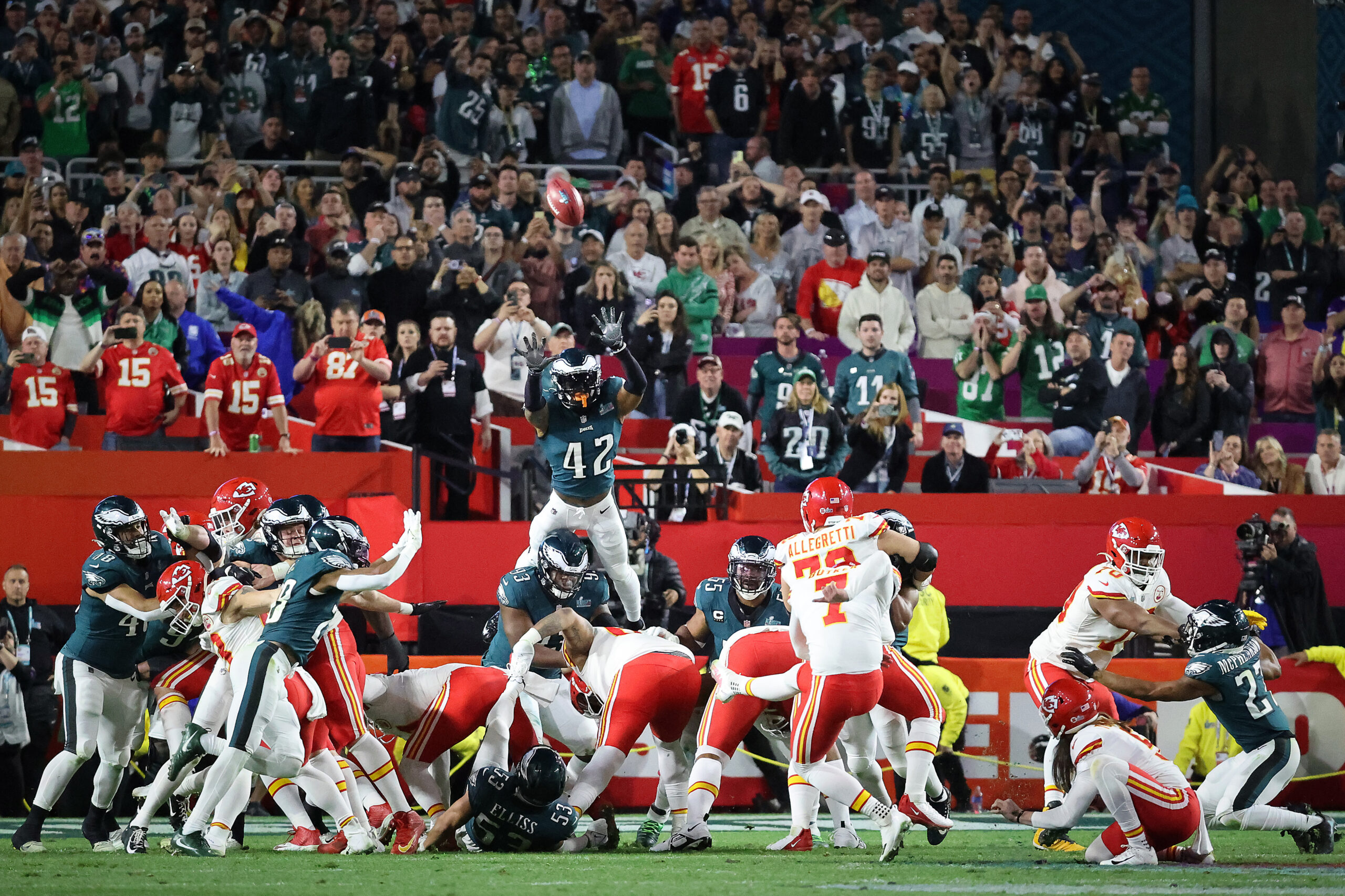
    A few weeks later, on Jan. 13, 2023, Morgan offered a FanDuel VIP perk: two tickets to Super Bowl LVII in Arizona — where Thompson’s beloved Eagles would face the Kansas City Chiefs — along with free transportation, and tickets to Sports Illustrated and FanDuel parties.

    On other occasions, Morgan provided Thompson with tickets to Eagles, Flyers, and Sixers games. FanDuel also flew Thompson and his son to Super Bowl LVI in California, with pregame access to the playing field and celebrities like Chris Rock.

    Funt, the author, said he has major concerns about how the VIP programs are used to ensnare gamblers.

    “They exist to egg on a reckless and potentially dangerous style of betting, using perks and other incentives that would be borderline irresistible for many sports fans,” he said. “I can only imagine how someone who loves Bryce Harper would feel indebted (no pun intended) to a sportsbook that facilitated a personalized video from him.”

    Leigh Steinberg said he had not heard of other instances of sportsbook companies using active athletes to send greetings to a bettor.

    “Because it’s not public, it’s hard to understand whether it’s ubiquitous or an exception,” he said.

    Leigh Steinberg has represented numerous NFL stars, from Chiefs quarterback Patrick Mahomes to NFL Hall of Famers Troy Aikman and Steve Young.

    But Steinberg, who publicly struggled with an addiction to alcohol, argues that interactions between athletes and bettors who wager heavily on sports are inherently problematic.

    “Getting a phone call or a zoom or a Cameo from a highly placed player is so flattering,” he said. “It’s stacking the deck unfairly in favor of continuing addicting behavior.”

    The glamour of Thompson’s Super Bowl trips and brushes with celebrities had long since faded when he reached the nadir of his gambling earlier this year.

    There were no more offers of free betting credits to be had, or microbets to chase.

    Broke and broken, Thompson entered a psychiatric facility to undergo treatment for gambling addiction.

    The Inquirer will continue to report on issues related to the growth of gambling addiction — among teens and adults — across Pennsylvania. If you, or someone you know, wants to speak with a reporter, please contact David Gambacorta or William Bender at dgambacorta@inquirer.com and wbender@inquirer.com

    Correction: An earlier version of this story misstated the university where Jodi Balsam works as a law professor. She works at Brooklyn Law School.

  • Gov. Shapiro can’t be sued by his Abington neighbors over a property dispute, judge rules. But Josh Shapiro, a homeowner, can.

    Gov. Shapiro can’t be sued by his Abington neighbors over a property dispute, judge rules. But Josh Shapiro, a homeowner, can.

    A federal judge had some good news this week for Josh Shapiro, governor of Pennsylvania, but not so much for Josh Shapiro, resident of Montgomery County.

    Shapiro, as governor, cannot be sued in his official capacity in a dispute over a strip of yard between his and his Abington Township neighbors’ adjoining properties, U.S. District Judge Harvey Bartle III ruled Tuesday.

    But Shapiro and his wife, Lori, will still have to face their neighbors in federal court as homeowners, Bartle also determined.

    The conflict came into public view in February, when Jeremy and Simone Mock, whose backyard abuts the Shapiros’ lawn in a tree-lined neighborhood near Pennsylvania State University’s Abington campus, sued Shapiro — both as governor and in his individual capacity — and George Bivens, acting Pennsylvania State Police commissioner. The lawsuit alleged the officials were illegally occupying part of the Mocks’ yard to build an eight-foot security fence last summer in what they claimed was an “outrageous abuse of power” that violated their constitutional rights. Bartle dismissed those claims in his ruling Tuesday, in what Shapiro’s administration called a major win.

    But while Shapiro and Bivens are immune from the federal lawsuit as state officials, Shapiro as an individual and his wife are not, Bartle’s opinion said.

    “We are pleased that the court has dismissed the claims against the office of the governor and the Pennsylvania State Police, and recognize that the allegations against these officials are without merit,” said Rosie Lapowsky, a spokesperson for Shapiro. “The Shapiros are confident that the facts will ultimately show that the Mocks’ remaining claims are meritless and politically motivated and will fail.”

    The dispute in federal court over the 2,900-square-foot strip of land disrupted the otherwise sleepy suburban neighborhood and led to a separate lawsuit in Montgomery County Court filed by the Shapiros, in their personal capacities, against the Mock family. Shapiro’s office has called the Mocks’ legal effort a political stunt, in addition to other efforts by Republican officials to scrutinize the safety measures state police say are needed to keep Shapiro and his family safe.

    The dueling lawsuits came in the wake of the attempted murder of Shapiro in April 2025 at the state-owned governor’s residence in Harrisburg, when a man firebombed the mansion on the first night of Passover while the governor and his extended family slept inside.

    The attack prompted more than $33 million in security upgrades to the state-owned governor’s residence, in addition to $1 million in upgrades and landscaping to Shapiro’s personal home in Abington Township, where he and his family live part-time.

    Shapiro’s safety remains a priority for state police, as one of the nation’s most prominent Jewish elected officials. A Delaware County man was arrested Wednesday for threatening to burn down the governor’s residence, state police said.

    But the Mocks’ attorney, Wally Zimolong, said the lawsuit at hand is about property rights and due process, and called Bartle’s ruling a “strong decision.”

    “Make no mistake about it,” Zimolong said, “a federal court has said that the sitting governor of Pennsylvania can be held liable for damages over constitutional violations.”

    The Delaware County lawyer who has represented high-profile Republican officials and candidates, including President Donald Trump, said it is “nonsense” to call the litigation political. Zimolong added that he hopes the Shapiros reconsider and attempt to resolve the case amicably.

    The conflict’s origins

    The dispute between the Shapiros and Mocks began last summer when, as part of a plan to build a security fence at the Abington house, a surveyor learned that a sliver of yard that the Shapiros had used for over two decades was actually on property belonging to the Mocks.

    After the Mocks rejected the Shapiros’ offer to buy the land, court fillings said, Pennsylvania’s first couple invoked a state law that allows a person to gain ownership of a property they have actively used for at least 21 years. The Shapiros have lived in their Montgomery County home for 23 years.

    “What followed was an outrageous abuse of power by the sitting Governor of Pennsylvania and its former Attorney General,” the Mocks’ February lawsuit said.

    (function() { var l = function() { new pym.Parent( ‘shapiroyard__graphic’, ‘https://media.inquirer.com/storage/inquirer/ai2html/shapiroyard/index.html’); }; if(typeof(pym) === ‘undefined’) { var h = document.getElementsByTagName(‘head’)[0], s = document.createElement(‘script’); s.type = ‘text/javascript’; s.src = ‘https://pym.nprapps.org/pym.v1.min.js’; s.onload = l; h.appendChild(s); } else { l(); } })();

    A security fence was purchased but never installed, SpotlightPA reported. Instead, contractors hired by the state began planting arborvitae-type trees and other plants on the Mocks’ property. State police also flew drones over the Mocks’ property, threatened to remove healthy trees, and chased away contractors, the Mocks alleged in the suit.

    The complaint also accused Shapiro of directing state police to patrol the property, and instructing the Mocks to leave the “security zone.”

    The Shapiros’ countersuit in Montgomery County asks a judge to find that they are the “legal and equitable owners” of the area in dispute, having tended to the land that borders their front yard for 23 years. That suit is pending and a judge is expected to rule on preliminary objections filed by Zimolong.

    Separately, the Shapiros and state attorneys filed motions asking Bartle to dismiss the federal complaint against them.

    This week, the judge partially obliged, finding the state officials to be immune from the lawsuit while allowing the case against the Shapiros to proceed.

    The judge also refused to freeze the federal case while the lawsuit in Montgomery County plays out, determining that the two cases are different enough to proceed.

    “The claims here extend far beyond a disagreement between neighbors over the metes and boundaries of their properties,” Bartle wrote.

  • Temple University will lay off employees and raise tuition for the second consecutive year

    Temple University will lay off employees and raise tuition for the second consecutive year

    Temple University approved a $1.3 billion operating budget Wednesday that includes an average 3.4% tuition hike for both in-state and out-of-state students and plans for about 40 layoffs.

    Both the average tuition increase — which is for undergraduate and graduate students — and the number of layoffs are smaller than those implemented last year. The university raised tuition an average of 3.6% in 2025 and laid off 50 employees.

    The layoffs, which will occur this week, constitute less than 1% of the university’s workforce. Temple officials did not elaborate on who was affected or which positions but said jobs across the university from senior levels to the operational ranks were considered. An effort was made to limit the impact on “student-facing” roles, said chief strategy officer and former interim provost David Boardman.

    “The decision-making overwhelmingly was made at the local level, at the schools, colleges, and administrative units,” said Boardman, who is also dean of Temple’s College of Media and Communication.

    Fry said last month that layoffs were “inevitable” as the university works to close a projected $85 million budget deficit for 2026-27. Temple, along with many peer institutions, faces enrollment declines and financial pressures as the available pool of high school students drops, public attitudes toward higher education change, and the number of international students declines following changes in federal policy.

    The budget, approved without public discussion by the executive committee of Temple’s board of trustees, includes a projected deficit of $25.5 million.

    “We have met our savings target, which is obviously imperative,” Fry said in an interview after the board meeting.

    Fry had asked schools, colleges, and administrative units to cut a total of $60 million, a significant portion of which was accomplished through the elimination of 236 positions, he said. That is on top of 190 positions that were eliminated last year.

    More than 80% of the positions cut this year came through voluntary retirements, including a faculty program that netted more than 70 takers, as well as resignations and the elimination of vacant positions. Layoffs accounted for the rest.

    “Implementing these targeted budget reductions and undertaking other organizational realignments is a critical first step toward returning the university to a balanced budget over the next three years,” Fry said in a message to the campus community.

    The university is working under a new budget model that will “allow us to better align our resources with our strategic plan,” Fry said.

    While the majority of the $60 million reduction was due to the position eliminations, schools, colleges, and administrative units are implementing other efficiencies. Some of the colleges, for example, have reduced doctoral student admissions, Boardman said.

    The university’s 27% decline in domestic enrollment since 2017 and increased financial aid costs have been the most significant factors causing the school’s budget pressures, Fry said. The loss of students has amounted to an average of more than $200 million in lost revenue annually, according to an internal Temple report obtained by The Inquirer in April.

    That report said the school anticipated falling below an 80% retention rate this fall.

    Temple’s U.S. enrollment stood at 29,503 last fall; projections for this fall are not yet available.

    But Fry said in his campus message that the school has received a record number of deposits for first-year enrollment compared with last year and that deposits from transfer students are up over last year.

    The school also plans to roll out a new “first-year experience” program to help improve the school’s freshman-to-sophomore retention rate, which fell from a high of 90% about a decade ago to 82% last fall.

    Employees from student affairs, enrollment management, and academic affairs have worked on the redesign with support from the National Institute for Student Success diagnostic, Fry said.

    “The teams have taken a comprehensive look at how students transition to Temple and identified where we can better support their success,” he said. “This work has helped us identify barriers and create a more coordinated approach to orientation, advising, communication, and student support.”

    The efforts already are having an impact. Because of changes to orientation, 3,268 first-year students were registered for the fall as of July 5, compared with 560 students the same time last year, Fry said.

    With the tuition increase, the new base rate for full-time students from Pennsylvania will rise to $20,376 annually and to $36,600 for out-of-state students. (Excluding Temple’s Japan campuses, 62% of students are Pennsylvania residents.) While the average increase is 3.4%, percentage increases fluctuate across Temple’s schools and majors, from a low of 2.9% to a high of 3.9%.

    Tuition increases are typical; the University of Pennsylvania increased its total costs by 3.8% for 2026-27. Pennsylvania State University, which approves tuition increases a year in advance, hiked tuition 2% for in-state students at University Park for 2026-27 and froze it for those attending Commonwealth campuses.

    At Temple, fees will rise $42, or 3.9%, to $1,098 annually. And room and board will increase 4%. Students in a typical double-occupancy room at Johnson and Hardwick residence hall with 12 meals per week will pay $15,094 for the year.

    Temple said it also would increase its financial aid budget by nearly 7% over last year, to $196.1 million, to help students with need afford the university.

    “We know that financial barriers can impact our students and prevent them from persisting,” David Marino, interim chief operating officer, said in a statement. “This year’s historic investment in financial aid is an investment in the success of our students.”

  • Trump’s DOJ said Pa. election officials could be criminally charged if they let noncitizens vote

    Trump’s DOJ said Pa. election officials could be criminally charged if they let noncitizens vote

    The Justice Department sent a letter this week threatening criminal charges against Pennsylvania’s top election officials if they allow votes by noncitizens to be counted in forthcoming elections — a largely nonexistent phenomenon that is already prohibited by law.

    The letter, addressed to Pennsylvania Secretary of State Al Schmidt and obtained by The Inquirer, was part of a nationwide effort by the Justice Department to say it is cracking down on what President Donald Trump has inaccurately described as a variety of problems with how ballots are cast and counted across the country. Similar letters were sent to election officials in all 50 states this week, the Justice Department said in a statement.

    An agency spokesperson said the letters were “asking for voluntary compliance in a timely manner with [officials’] obligations under federal law to ensure only citizens vote in federal elections.”

    The outreach came after Trump’s administration, during his second term, took other steps to target states’ election practices or voter rolls.

    A spokesperson for the Pennsylvania Department of State said in a statement that the state “is in compliance with federal and state election law.”

    “We will continue our nonpartisan work to ensure elections in the commonwealth remain free, fair, safe, and secure,” said Geoff Morrow, the department’s deputy communications director.

    Last month, a federal judge in Pittsburgh dismissed a Justice Department lawsuit that sought to obtain Pennsylvania’s entire unredacted voter database. Federal judges have rejected similar efforts by the Trump administration in at least 10 other states, although the Justice Department recently filed an appeal of the decision in Pennsylvania.

    The FBI, meanwhile, is reportedly assisting with a sweeping investigation into alleged irregularities in the 2020 election in Fulton County, Ga. — a key jurisdiction that contributed to Trump’s loss in that year’s presidential contest.

    Trump has repeatedly refused to acknowledge his defeat to Joe Biden that year, and he has long fueled evidence-free conspiracy theories about widespread and brazen fraud in elections, particularly in jurisdictions that tend to vote for his opponents. Experts generally agree that although voter fraud does happen, it has not historically occurred at rates that would tip the scales in high-profile contests.

    The effort also comes as Trump has been again pressuring congressional Republicans to pass the so-called SAVE America Act, a controversial bill that could require voters to provide proof of citizenship when registering or to show approved forms of identification when voting. Prior efforts to pass the bill into law have failed amid bipartisan resistance.

    As for the subject of the Justice Department’s most recent letter — which was signed by Assistant Attorney General Harmeet K. Dhillon — noncitizens are already barred from voting in federal and state elections under a law passed by Congress 30 years ago.

    Studies in a variety of states since then have found some instances of noncitizens being registered to vote or voting, but almost no evidence that the issue is widespread or common. In Utah, for example, officials said earlier this year that they had reviewed records of the state’s more than 2 million voters and found one person who was confirmed as a noncitizen.

    And in 2024, the director of U.S. Citizenship and Immigration Services wrote in a letter to Ohio’s secretary of state that “it is extremely uncommon for noncitizens to vote in Federal elections,” and that many of those who do are identified by authorities and prosecuted.

    Dhillon, in her letter, acknowledged that noncitizen voting is already illegal. But she nonetheless listed several provisions under which election officials could be criminally charged if it occurred.

    And she said Schmidt should reply within five days to describe “how the state of Pennsylvania intends to ensure it is complying with these federal laws,” a deadline the Pennsylvania Department of State said it intends to meet.

    Schmidt, a Republican who was chosen by Democratic Gov. Josh Shapiro to serve as the state’s top election official, has been at the forefront of addressing noncitizen voting dating back to his time as a Philadelphia city commissioner.

    In 2017, when he worked for the city, Schmidt discovered that the Pennsylvania Department of Transportation’s so-called motor voter system, which allows eligible citizens to register to vote when they get or renew a driver’s license, had a glitch dating back to the 1990s and was allowing legal residents who were noncitizens to register to vote, too.

    Schmidt found that the glitch had allowed at least 168 noncitizens in Philadelphia to register to vote. And he found that an additional 52 noncitizens in the city had registered by other means.

    Collectively, that group of people cast a total of more than 225 ballots in Philadelphia during the years they were registered, Schmidt’s office reported at the time. Schmidt said it was critical to rectify the issue, and all of the improper registrations were canceled. PennDot fixed the glitch in 2017.

    Still, the largest number of votes cast by noncitizens in the city during the affected time period occurred in the 2008 general election, when 47 such people submitted ballots — representing about .0065% of the city’s vote tally that year.

    “One thing that became very clear through that research and all evidence suggests that noncitizens voting in elections in the United States occurs very rarely,” Schmidt told Votebeat earlier this year. “It doesn’t mean that it’s not important. Like I said before, every vote is precious, and we want to make sure that we do everything we can to safeguard and strengthen election integrity. But there’s no evidence to suggest that it happens in any widespread way whatsoever.”

    Lauren Cristella, president of the Committee of Seventy, a Philadelphia-based nonprofit that advocates for good governance, said the Justice Department’s letter “represents another attempt to undermine faith in our elections without presenting any evidence or even allegations of wrongdoing.”

    The country’s elections have routinely been shown to have been conducted freely and fairly, Cristella said. And in Pennsylvania, she said, Schmidt has been “the person who’s been leading the charge to clean up our voter rolls.”

    State Auditor General Tim DeFoor, a Republican, found in an audit released earlier this year that the reforms made to the motor voter system after Schmidt’s exposures of PennDot’s systemic failures had been largely successful.

    The Justice Department’s effort to threaten election officials not only clouds that reality, Cristella said, but it “completely lacks integrity and is part of the distrust that is leading to the erosion of our democracy.”