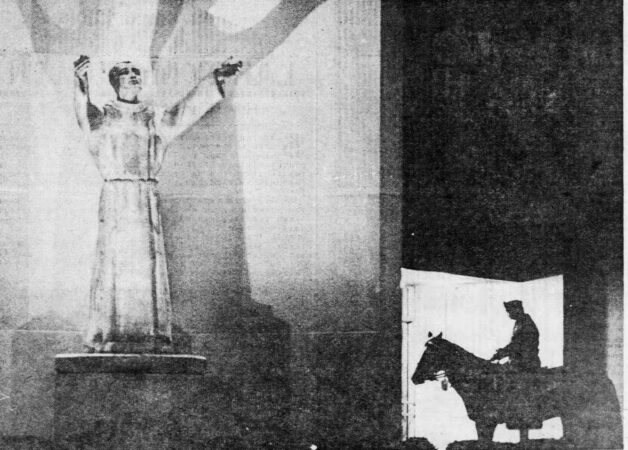
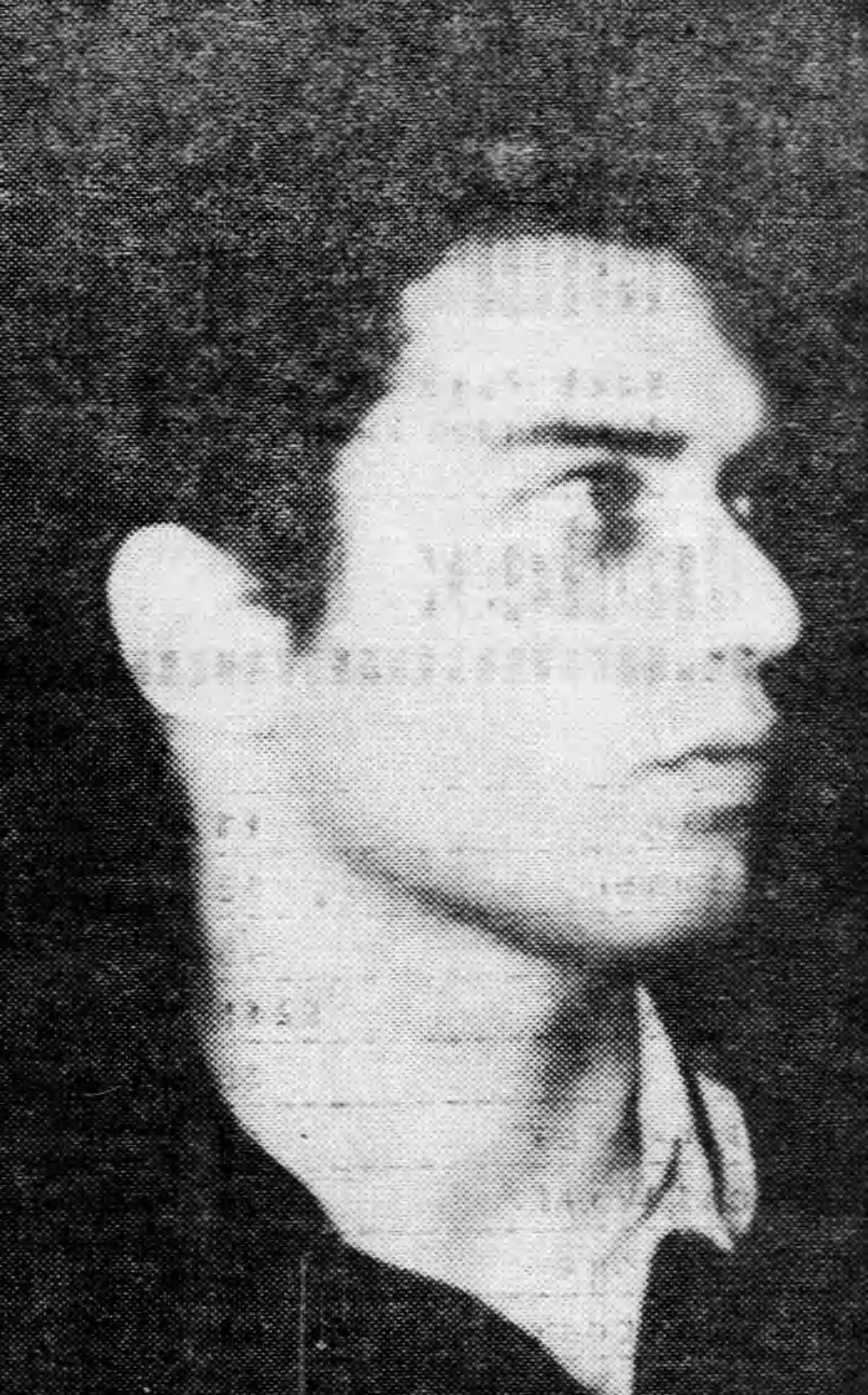
Around 2 p.m. Gold spoke with police by phone, and demanded President Ronald Reagan — who first ran on the Make America Great Again campaign slogan — resign from office.
And turn over leadership of the country to Gold,who said he wanted to be called the Antichrist.
In a statement that was read to the press, Gold wrote:
“Either choose my leadership, or accept the death of America.”
Back then, the Catholic high school was separated into two segregated schools: the boys’ school in the south wing, and the girls’ school in the north wing.
Gold took the hostages in the boys’ wing. Shortly afterward, the 1,950 male students were dismissed. They walked out just as the 2,150 female students were leaving for the day on a shortened schedule. Together, boys and girls filed calmly out of the massive, three-story school building at Academy Road and Chalfont Drive.
About an hour into the standoff, Gold let the secretary go after learning she was a mother of four. Shortly afterward, he traded the assistant dean for a food order, leaving only three male students as hostages.
Around 7 p.m., a police negotiator briefly entered the disciplinarian’s office.
As student hostages (from left) Patrick Hood, 15, Raymond Smith, 16, and Mike Wissman, 17, meet the press, Smith estimates the size of the captor’s knife.
Gold told the negotiator on the phone that he would let two of the students go, and then the officer heard “a commotion and a lot of screaming” on the other end of the phone.
The students decided the gun Gold was brandishing was a fake.
So in good, old-fashioned Northeast Philly fashion, they jumped him. And it turned out they were right: The gun was a starter’s pistol, and it was loaded with blanks.
The students overpowered Gold, and held him down until the stakeout officers rushed in and put an end to the more than seven-hour standoff.
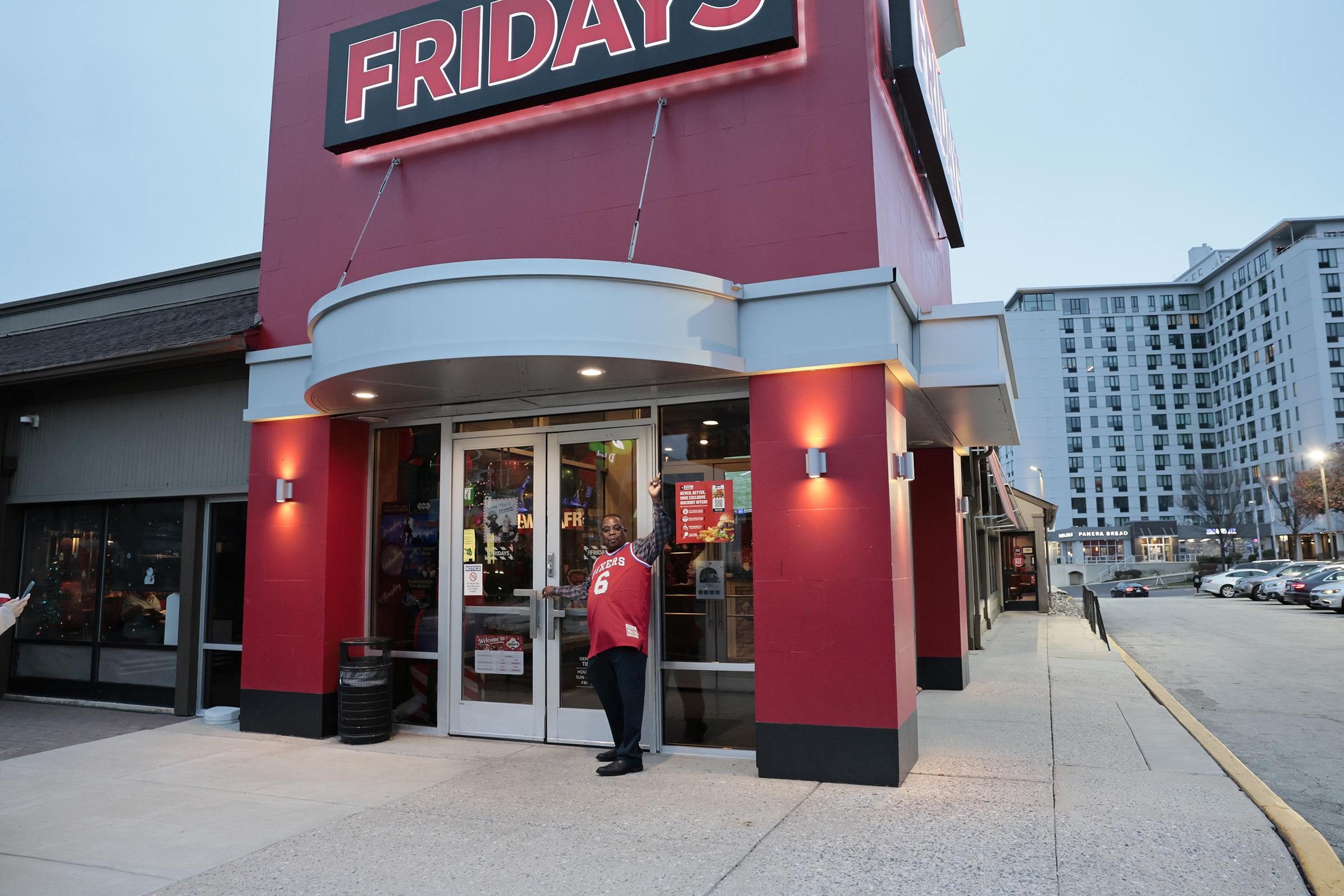
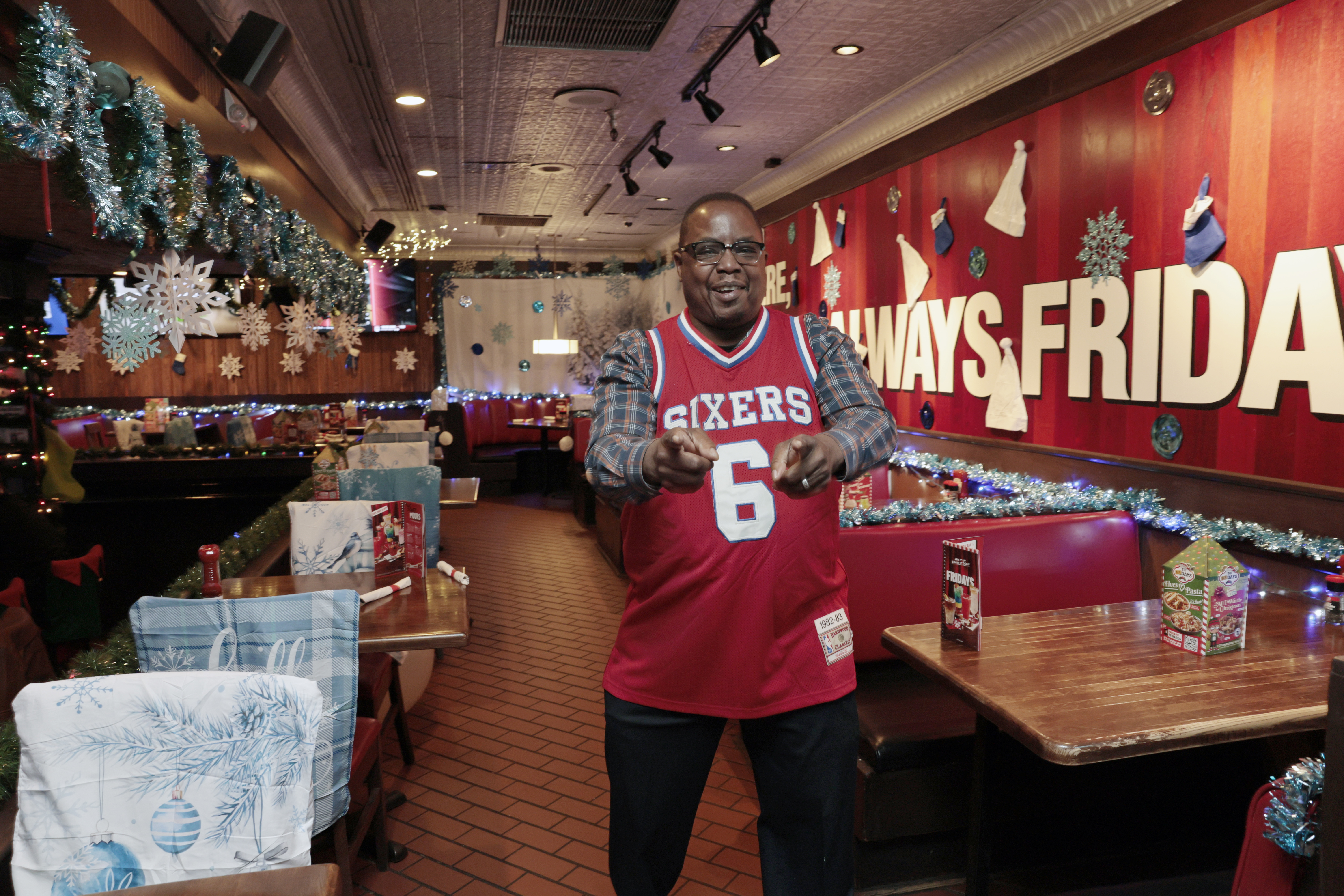
In July 2024, Tim Hampton was working his shift at TGI Fridays when he spotted a familiar face.
It was longtime Sixers player and coach Billy Cunningham. He was eating lunch with La Salle coach Fran Dunphy and two other Sixers alumni: former forward and coach Doug Collins, and former executive John Nash.
Hampton smiled. Seeing the group brought back memories. There was a time, not long ago, when the chain restaurant on City Avenue hosted everyone from Charles Barkley to Maurice Cheeks to Moses Malone.
This particular Fridays, which opened in 1981, was down the street from where the Sixers practiced, first at St. Joseph’s, and eventually, at Philadelphia College of Osteopathic Medicine. It became the team’s unofficial hangout spot, a place where they could grab meals in the afternoon or dinner and drinks at night.
By the late 1990s, when Hampton was hired as a host, it had a long list of NBA clientele. Then, a rambunctious rookie named Allen Iverson came to town, and everything changed.
TGI Fridays was incorporated into Philadelphia’s nightlife scene. People called it “Club Fridays.” Women would wear their shortest dresses and their highest heels. Men would don collared shirts and expensive jeans.
Allen Iverson’s famous booth became part of the City Avenue TGI Fridays lore.
At the center of it all was Iverson, who had a designated booth — “Table 70” — a special back entrance, and his own security detail.
“It was exactly like a club,” said former Sixers forward Jumaine Jones. “They would come there with their best outfit on, like they was going to a party.
“We gave Allen the nickname Mick Jagger. Because he was like a rock star. People wanted to be around him.”
There were nights when wait times lasted for hours. Fans would line up around the block, all the way to the bus stop on City Avenue and Presidential Boulevard, just to catch a glimpse of the superstar. Those who were lucky enough to enter would hand napkins to their servers in the hopes that Iverson would sign them.
And most of the time, he did. Despite the chaos, Hampton said that Iverson treated the employees and patrons of TGI Fridays with respect. He became friendly with the general manager, Jeff Tretina, the kitchen manager, Jerry Shott, and the rest of the staff.
When the point guard was traded to the Nuggets in 2006, the longstanding relationship between the Sixers and the chain restaurant faded. But Iverson never forgot it. And neither did his Fridays “family.”
“He could’ve chosen anywhere else to go,” Hampton said, “but he chose us.”
TGI Fridays manager Tim Hampton remembers a time when “Club Fridays” would produce lines around the block.
‘Club Fridays’
Hampton grew up at 33rd and Diamond in North Philadelphia, raised on Dr. J and George McGinnis. He studied business administration atBurlington County College in New Jersey and started working at the restaurant in 1999.
The lifelong Sixers fan climbed his way from a host to a waiter to a cook, and eventually, to a general manager. He quickly realized that this was no ordinary Fridays.
Employees would share stories of Barkley, Darryl Dawkins, Bobby Jones, and more. Players who’d patronized the restaurant during their careers, like Cheeks, would return after they’d joined the Sixers’ coaching staff.
A big part of this was convenience. Fridays was an easy place to stop after practice, and had plenty of parking for big groups.
There also wasn’t as much of a social barrier between players and fans as there is now. This was true even among some of the team’s celebrities.
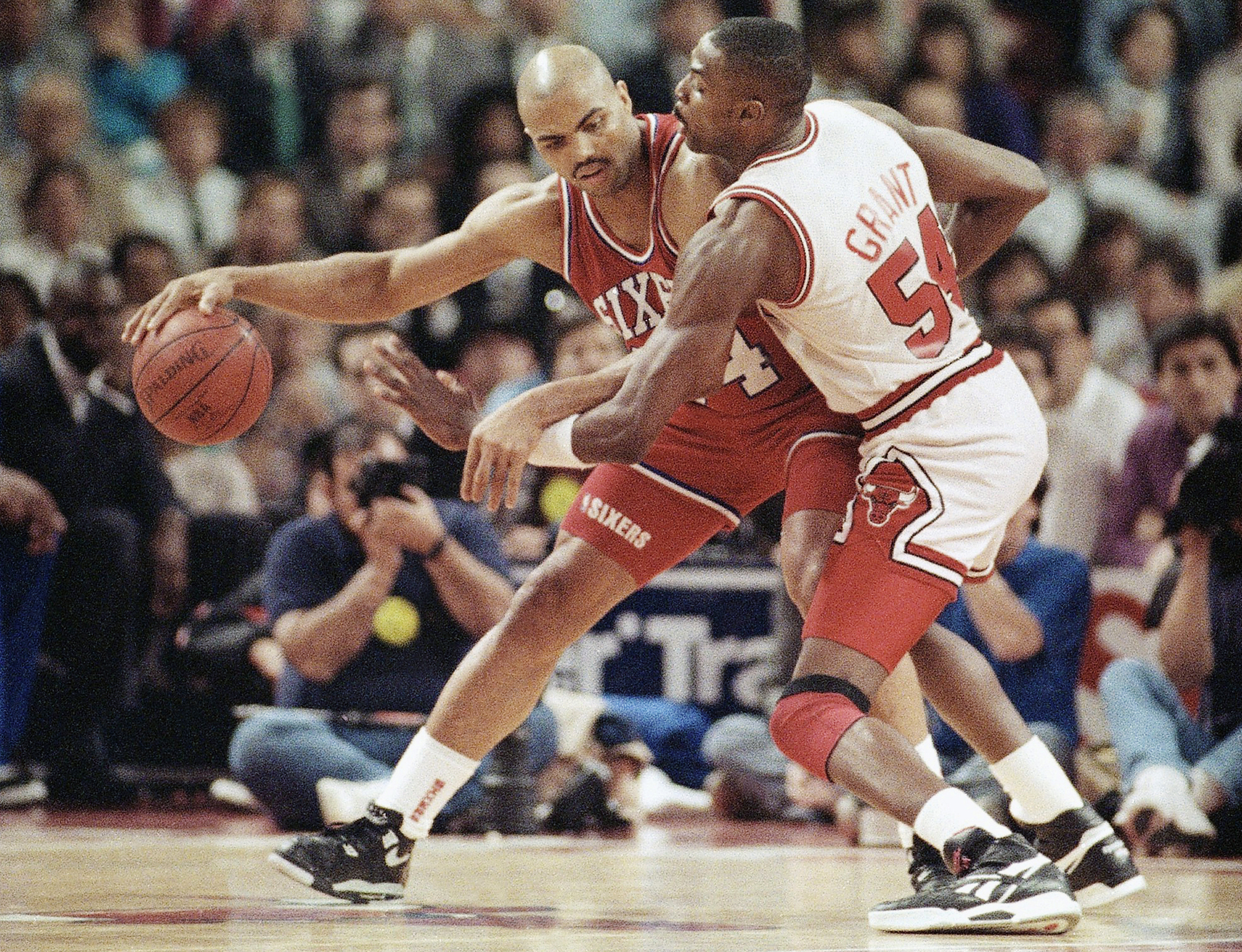
While Allen Iverson gets much of the credit for launching the Sixers-Fridays legend, Charles Barkley was a loyal patron of the establishment first.
Barkley and center Mike Gminski would go to the movies together in Philadelphia. They’d attend Phillies games and would sit out in the open, rather than a suite.
Eating at a chain restaurant was not uncommon. And in the 1980s and 1990s, it looked a lot different from it did when Iverson was in town.
There was no security at Fridays, no separate entrance, and no reserved table; just a group of extraordinarily tall men, squeezed into a four-person booth.
“Pretty much everybody on the team used to go there or go somewhere,” Gminski said. “If anybody, it was probably Charlie [who went the most].
“And after a while, it wasn’t really a thing seeing us. There were no cell phones. There were no pictures, no selfies.
“We never really thought about shying away. We ate where everybody else ate.”
Most of the players and staff would go to Fridays for lunch, and Bridget Foy’s in Society Hill for postgame drinks.
It wasn’t until Iverson arrived in 1996 that Fridays turned into a nightly haunt. At first, people barely noticed he was there. Iverson would sit in his booth, eat his favorite dish — Cajun shrimp and chicken pasta — and lay low.
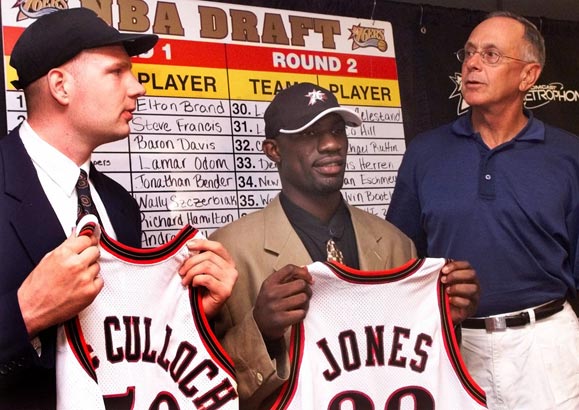
Jumaine Jones, who was drafted by the Hawks in 1999 and traded to the Sixers shortly after, usually accompanied him. Iverson quickly gravitated to the small forward, loudly proclaiming that Jones was his “rookie.”
Jumaine Jones (with fellow draft pick Todd MacCulloch and coach Larry Brown) was a familiar face at the City Line Fridays.
They started hanging out off the court. Jones estimated that the two players went to Fridays “every day for two years.” Sometimes, he would go home to take a nap, and wake up a few hours later, only to realize that Iverson was still at the restaurant.
“We probably spent more time at Fridays than we did at the gym,” Jones said.
The rookie wasn’t complaining. If anything, it made Iverson seem more relatable.
“I’d just come from being this broke college student,” he said. “So, to go to Fridays, it was like, ‘Oh, OK, that’s cool. He likes Fridays too!’
“But it was funny that somebody who was making so much money liked Fridays. The fact that he didn’t change what he ate, and the things that he enjoyed doing, really made him human to me.”
After the 2001 NBA Finals, when Iverson famously stepped over Lakers point guard Tyronn Lue, his celebrity grew to new heights. People started flocking to Fridays not to eat, but to see Iverson.
The restaurant had to hire its own security for crowd management (in addition to Iverson’s detail). It changed its hours and staffing arrangements to accommodate the influx of people.
“If it was a game day on a weekend, you pretty much figured he was coming,” said former manager Elan Walker. “We were closing at like 1 a.m. on weekends. So we were open late.
“At most businesses your dinner is from 5 p.m. to 7 p.m., and you’re down to a skeleton crew by 10 o’clock. That wasn’t the case for us. We still had a full staff on at midnight. Because we were expecting a crowd.”
Even though it was a foregone conclusion that Iverson would be at Fridays after a home game, he still liked to give the staff a heads up.
So, he’d call the restaurant, or Tretina and Shott directly, to let them know he was coming.
The point guard would roll up in his Rolls-Royce or his blue Bentley and step out with anyone from Jadakiss to Fat Joe.
Allen Iverson’s magnetic presence helped make the City Line Fridays a destination.
“You never knew who was going to be with A.I.,” said Jamilah Lawry, a friend of Iverson’s. “So that was really a huge element of surprise. Who does he have with him? Who’s going to get out of that car?
“You didn’t know who was going to be in there. And you had to look good, because the man of your dreams could walk in. You know?”
Lawry’s uncle, Jeff Lawry, owned Luxe Lounge and Club Roar at the time. Jamilah was familiar with Philadelphia nightlife.
But to her, Fridays was the best of both worlds; a place where they could be themselves, in an exciting environment, without too many rules and regulations.
“We’d watch the game, we’d talk loud,” she said. “We’d play too much. Those type of things. You know, you can’t go to Ocean Prime and do that. They’ll be like, ‘Hey, get out.’”
“It was more of what we would call a Greek picnic type thing,” Lawry added. “There was nothing like Club Fridays. Except for Club McDonald’s on Broad Street. And that’s a whole other story.
“If you didn’t want to go to the club, you’d go to Fridays, and that’s what would be going on.”
TGI Fridays manager Tim Hampton is presiding over an establishment that might be undergoing a renaissance in the days ahead.
‘City Line Love’
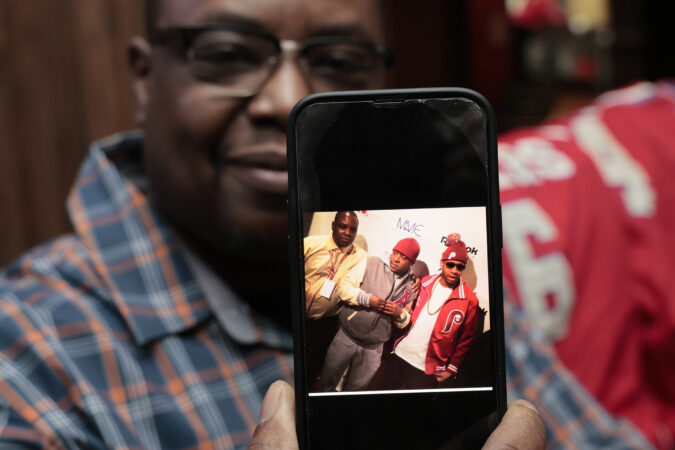
After Iverson retired in 2013, he rolled out a special-edition sneaker, in collaboration with Reebok and the Philadelphia-based retailer Ruvilla. It was called A Day in Philly.
The tongue had a maroon and gray stripe along the top, as a nod to his favorite restaurant. He held the release party in November 2014 at TGI Fridays on City Avenue.
The staff rolled a red carpet onto the sidewalk. Fifteen security guards roamed the grounds as police officers stood nearby.
At one point, employees had to close the doors, because the restaurant had reached its occupancy level (475 people).
Jadakiss and Styles P gave a surprise performance and a DJ held court after that. To Hampton, it felt like old times.
“It was like a Renaissance moment,” he said. “I felt like I was part of history.”
Now, over a decade later, he’s trying to recapture the magic. In November, Fridays’ corporate branch introduced a membership program called “Club Fridays,” that offers discounts and other perks.
Hampton has asked Iverson if he’ll help the restaurant promote it. He has also reached out to a few current Sixers players to forge some new relationships.
“We’re working on trying to get VJ Edgecombe and Tyrese Maxey to come here,” Hampton said. “Because we want to extend that City Line Love.
“That’s our goal. To get the new Sixers in. We want them to know about the legendary 4000 City Line Avenue, because it is a legendary location.”
Blustery winds propelled the giant blades of five turbines at the Jersey-Atlantic Wind Farmon a recent day. Set on a back bay island, they were once contested over fears of noise, aesthetics, and worries of threats to Shore birds.
But two decades later, they have emerged as a spinning landmark to Atlantic City.
The 380-foot turbines silently rotate in clear view of motorists streaming to casinos. Some visitors have even requested hotel rooms facing the structures, which are taller than the Statue of Liberty.
The embrace of the land-based wind farm contrasts sharply with the more recently divisive battle over offshore wind projects, an effort stalled by economics and the Trump administration.
Together, the Jersey-Atlantic Wind Farm turbines produce 63% of the energy for the Atlantic County Utilities Authority’s wastewater treatment plant, which serves 14 municipalities. Officials calculate the farm has saved ratepayers $8.8 million since its grand opening on Dec. 12, 2005.
It is one of only two wind farms operating in New Jersey. The other is a much smaller farm in Bayonne.
“This was a total home run for everybody involved,” said Richard Dovey, president of the ACUA at the time it was built. “It’s been nothing but successful, environmentally and economically … [an] inspiration for many other entities, whether they’re public or private.”
How the wind farm came to be
The idea for a wind farm near Atlantic City came from a worker in the energy industry who passed the idea onto Dovey in the early 2000s. With Dovey’s help, it picked up support in former Gov. Jim McGreevey’s administration.
Dovey believed in renewable energy and thought it could power the ACUA’s regional wastewater treatment plant on City Island in Absecon Bay, about two miles from the Atlantic Ocean. He thought Atlantic City’s ample breezes from land and seawould make it an ideal location.
Atlantic City’s ample breezes from land and sea made an ideal location for a wind farm.
Community Energy Inc., a developer of wind power based in the Philadelphia suburbs, played a significant role in the project’s development and received a $1.7 million grant from the New Jersey Board of Public Utilities.
The New Jersey Sierra Club backed the project.
Construction began in mid-2005. The project cost $12 million and included driving pilings into an island of upland surrounded by wetlands and installing intricate concrete bases to support the turbines made by GE.
Currently, the wind farm is owned by Texas-based Leeward Energy. Leeward rents the land for the wind farm from ACUA.
In return, ACUA has a 20-year agreement to purchase the power produced by the turbines from Leeward for 7.9 cents a kilowatt-hour, which was cheap even then. Now, the rate is about half the market rate for energy.
It has helped ACUA keep some of the lowest sewer rates in the state.
However, that agreement is expiring, and the two sides are in negotiations to renew a contract, which could change the rate the ACUA pays for its wind power.
window.addEventListener(“message”,function(a){if(void 0!==a.data[“datawrapper-height”]){var e=document.querySelectorAll(“iframe”);for(var t in a.data[“datawrapper-height”])for(var r,i=0;r=e[i];i++)if(r.contentWindow===a.source){var d=a.data[“datawrapper-height”][t]+”px”;r.style.height=d}}});
Community concerns
Initially, the wind farm faced resistance. Residents in the neighboring Venice Park section of Atlantic City were concerned primarily about potential noise from the turbines.
To allay their fears, Dovey organized a bus trip that took residents to visit a wind farm in Somerset County in Pennsylvania.
“Their major concern was noise,” Dovey, now 73, recalls. “We drove literally underneath the turbine. One neighborhood leader took one step out and said my air conditioner is louder than this; let’s go home. They thought the turbines were beautiful, even inspiring.”
In addition, there were apprehensions regarding how the turbines would affect birds and marine life. The wind farm is just below the Edwin B. Forsythe National Wildlife Refuge, a 48,000-acre area of coastal habitat. New Jersey Audubon agreed to monitor the impact on the bird population as part of its support for the project.
According to the ACUA, a three-year study by NJ Audubon found “a small number of bird deaths which could be attributed to collisions with turbines.” It found more fatalities were caused by raccoons, feral cats, and collisions with wires and trucks.
People were also concerned about the visual impact, fearing they might spoil scenic views, affect property taxes, and hurt tourism. However, the wind farm has since become an iconic part of the landscape.
The concerns were part of a broader debate at the time regarding the emerging push among some New Jersey leaders for offshore wind farms, which had faced a moratorium by the state.
Even though the moratorium was lifted, and Gov. Phil Murphy backed a large offshore wind program that would have powered millions of homes, the debate continued. This year, President Donald Trump issued an executive order to stop offshore wind, making any project in the near future unlikely.
However, a federal judge recently ruled that Trump exceeded his authority with the order, a ruling the administration is likely to challenge. It is unclear whether renewable energy companies still have the political will for a renewed push to build an offshore wind farm off the coast of New Jersey.
Taking advantage of wind
The Jersey-Atlantic Wind Farm is an example of how wind power can work, even if on a smaller scale. The farm is ideally located because of consistent land and ocean breezes. If winds exceed 45 mph, the turbines, each equipped with a weather station, switch off to protect the machinery. That happens only a few times a year.
Matt DeNafo, current president of the ACUA, says the wind farm has been a “huge project” for his organization. The ACUA is operating a pilot project that would store energy captured by the turbines in a battery. A solar array on site also provides about 3% of the facility’s power.
DeNafo said the arrangement with Leeward brought significant economic stability through the 20-year fixed rate. He said it allows the agency to offer the lowest wastewater rates in the region.
At the same time, the ACUA does not have to pay for maintenance of the turbines, while still collecting rent from Leeward.
If winds exceed 45 mph, the turbines, each equipped with a weather station, switch off to protect the machinery.
“It’s really been a great partnership for us. It’s been a beacon for our organization,” DeNafo said. One casino was “getting a lot of requests for windmill-view rooms because it’s got a calming effect.”
Harrah’s, MGM, and Borgata casino hotels all are in view of the windmills.
Amy Menzel, a spokesperson for the ACUA, said summer tours of the wind farm and treatment plant are popular.
“We give open house tours in the summer on Wednesdays,” Menzel said. “People can just drop in. We have a lot of curious people who are visiting the Shore. The tours are really a mix of locals and out-of-town visitors, people who just want to get a little closer and learn more.”
Editor’s note: This article has been corrected to note that the wind farm is on an upland, not a wetland.
The vote does not bind the district to hand anything over, but it certainly opens the door to transferring properties in accordance with the wishes of Mayor Cherelle L. Parker, who has promised her administration will build or restore 30,000 units of housing during her first term.
Exactly how many vacant buildings the district is contemplating giving to the city is not clear; the board did not vote on a list of schools, though officials have said in prior months the number of surplus schools is about 20. A school board spokesperson has said the list is still subject to internal discussion.
The resolution only covers the district’s current closed buildings, not any that might be closed in the upcoming facilities master planning process expected to wrap up before the end of the school year.
Board president Reginald Streater has said the city partnership makes sense, and would allow the district to focus on education, while relying on the city’s real estate expertise. The buildings all have carrying costs too, which the city would assume.
Six board members voted for the resolution authorizing Superintendent Tony B. Watlington Sr. and the district’s legal department to begin talks with the city. Two board members — Crystal Cubbage and ChauWing Lam — voted no.
Lam’s hesitation came, she said at Thursday’s special action meeting, because of the district’s budget issues.
The vacant-building portfolio was recently valued at $80 million, Lam said.
The mayor’s housing goals are laudable, Lam said, but “given the district’s structural budget deficit, which includes spending nearly half of our fund balance this year to balance our budget, I encourage consideration of additional opportunities before rushing into an agreement as set forth in this resolution.”
Cubbage, too, said she worried that the resolution “limits us to exploring the conveyance of our school buildings to the city without financial compensation when we are facing a $300 million structural deficit and are constantly underresourced.”
Instead, Cubbage said, she wished the board would delve into actions that could give short- and long-term revenue and still accomplish Parker’s housing goals by selling the properties “with deep restrictions and affordability requirements.”
Board member Wanda Novalés supported the resolution, but noted that the district needs to get the whole picture — including enrollment projections and long-term capital priorities — before it moves forward.
“I support the resolution as long as it calls for a thorough business plan that clearly outlines the benefit to the School District of Philadelphia,” said Novalés.
Watlington, in a statement issued after the vote, supported the move.
“By responsibly evaluating how to put these unused properties back into productive use, the district can stay focused on educating children while supporting broader city efforts that ultimately aim to strengthen neighborhoods,” Watlington said. “This exploration aligns with our commitment to both fiscal stewardship and community partnership.”
Parker, in a statement issued earlier this week, said the transfer would mean the buildings would improve residents’ quality of life.
Officials “cannot let blighted buildings in the middle of residential neighborhoods lie vacant — many of which have been vacant for many years — from two years to over 30,” Parker said in the statement. “It’s unconscionable to me that we are in the middle of a housing crisis and we have government buildings sitting vacant for years or even decades. That cannot continue.”
Chief Deputy Mayor Vanessa Garrett Harley said in a statement that the city looks forward to working with the board on this issue.
“This action will help the city to more effectively move blighted properties to productive use, addressing a longstanding concern of neighborhood leaders and residents across the city, and contribute to the mayor’s goal of creating or preserving 30,000 units of housing,” Garrett Harley said.
A potential buyer for at least one vacant school
Several speakers suggested it was a bad move to simply give buildings to the city.
Cecilia Thompson, a former school board member, said she’s OK with selling schools to the city. But “can we sell it to the city for market value, and not a dollar or something nominal, just to say it was a sale? Just to be respectful … for the worth of the properties?”
Several members of the community made it clear that there are potential buyers.
Angela Case, a staffer at West Oak Lane Charter, indicated that the school wants to buy Ada Lewis Middle School in East Germantown.
(Lewis is a prominent part of the potential portfolio — a large building on a sprawling campus and, this fall, the site where Kada Scott’s body was discovered.)
“Our school is growing, but our current space is limited,” Case said. “Ada Lewis would give our students safe classrooms, outdoor areas and room for strong academic enrichment programs. It would also return a vacant property to a productive use, and benefit the surrounding community.”
President Donald Trump professed his admiration of miners Tuesday night at his Poconos rally, contending the brave workers are so enamored of their profession that Trump wouldn’t be able to convince them to swap jobs with anyone — including himself.
“I love miners. … They wouldn’t trade jobs with me if I gave them a beautiful, magnificent penthouse in the middle of Manhattan, where I used to live — if I gave them the most beautiful penthouse — they wouldn’t take it,” Trump told the crowd at the Mount Airy Casino Resort in Mount Pocono.
“They’d rather go 10,000 feet underground and dig. That’s what they want.”
Can that be true?
Trump has long extolled the virtues of “beautiful, clean coal,” as he calls it, during nearly a decade of campaigning in the Keystone State.
President Donald Trump makes his first stop on an “economic tour,” in Mt. Pocono Pa., Tuesday, December 9, 2025 .
But would miners really prefer to toil in the damp darkness, somewhere between the buried dead and the devil, rather than run the free world in a clean blue suit, with access to a lavish high-rise in the gorgeous sunshine they forsake eight hours a day?
“Yes, of course,” said Edmund Neidlinger, 75, a fourth-generation coal miner who dug black Pennsylvania anthracite in Schuylkill County and its environs for 40 years. He now works as mine foreman at the Lackawanna Coal Mine Tour, a Scranton tourist attraction.
“If I was offered any other job when I was mining, I would have turned it down,” he said. “And I wouldn’t have traded the life I led for a penthouse. No way.”
There is, Neidlinger believes, a passion just a few special people hold toward working with a band of headlamped brothers, risking entrapment, methane explosions, black lung from dust, and cave-echoing machine noise down in an inky coal seam to perform the ninth-most-dangerous job in the world (logging is the riskiest), as the Occupational Safety and Health Administration tells it.
“You fall in love with this job,” Neidlinger said. “Very few people can do it. Most miners feel like it’s in their blood.”
While it’s not in his veins, Trump has made coal mining a big part of his energy policy. The industry is declining, experts say, but he has signed executive orders to expand it, and has opened up new land for mining while directing agencies to scotch regulations that “discriminate against coal production or coal-fired electricity generation,” as one presidential order reads.
Not everyone agrees that tempting miners to abandon their coal mines would be all that difficult.
“I’m sure the average miner would turn down a jet plane, private island, and gold-plated toilet, too!” said a sarcastic Mark Ferguson, cofounder of Woodshed: An Appalachian Joint, an online magazine dedicated to the culture of the region responsible for an immensity of U.S. coal mined over the centuries.
Cautioning people not to romanticize the lore and lure of mining, Ferguson pointed out that “folks here literally had to go war with mining companies to be paid in real U.S. currency, not scrip that could only be used at the company store.
“They know the value of a dollar, and sure as hell wouldn’t turn a penthouse down.”
The thing about mining you have to understand is, for most people, it starts out as a job you have to do, said Bob Black, 68, who dug coal for half a century in Allegheny County.
As a young man, Black wanted to be a teacher, but after his father died, Black set the dream aside and descended into the earth to work at the higher-paying job to support the family.
“You go into the mine, blink your eyes, and you’ve been doing it for 30 years,” Black said. “By then, you can’t imagine doing anything else.”
There were “days you hate, and days you love,” said Black, who ultimately became a mine manager. “Every ex-miner would tell you they miss fighting Mother Nature — like when the roof falls in, or when you’re dealing with water coming in,” he said. “You can’t run to Ace Hardware for help. You find solutions.”
What you remember most, though, is the company of soot-faced guys, he said.
“It’s like a city down there, with 250 men working, spread out over 15 miles,” Black said.
“The camaraderie. That’s what I miss most.”
So does Black think Trump was right? Would he have refused to trade 50 years of fellowship and labor in perpetual midnight for anything in the world?
“Oh, no,” Black said. “I’d have taken the penthouse. For sure.”
Staff writer Julia Terruso contributed to this article.
Philadelphia lawmakers voted Thursday to ban mobile outreach groups that provide medical care and support services to people in addiction across a swath of Kensington, the epicenter of the city’s drug crisis.
The vote came just days after the city began enforcing controversial new regulations in a different part of the neighborhood, where the same providers may operate only if they have a permit to do so and park in areas designated by the city.
Taken together, the actions spearheaded by City Council members who represent Kensington and Mayor Cherelle L. Parker’s administration amount to a major shift in how transient people who use drugs obtain medical care and basic needs like food, water, and clothing.
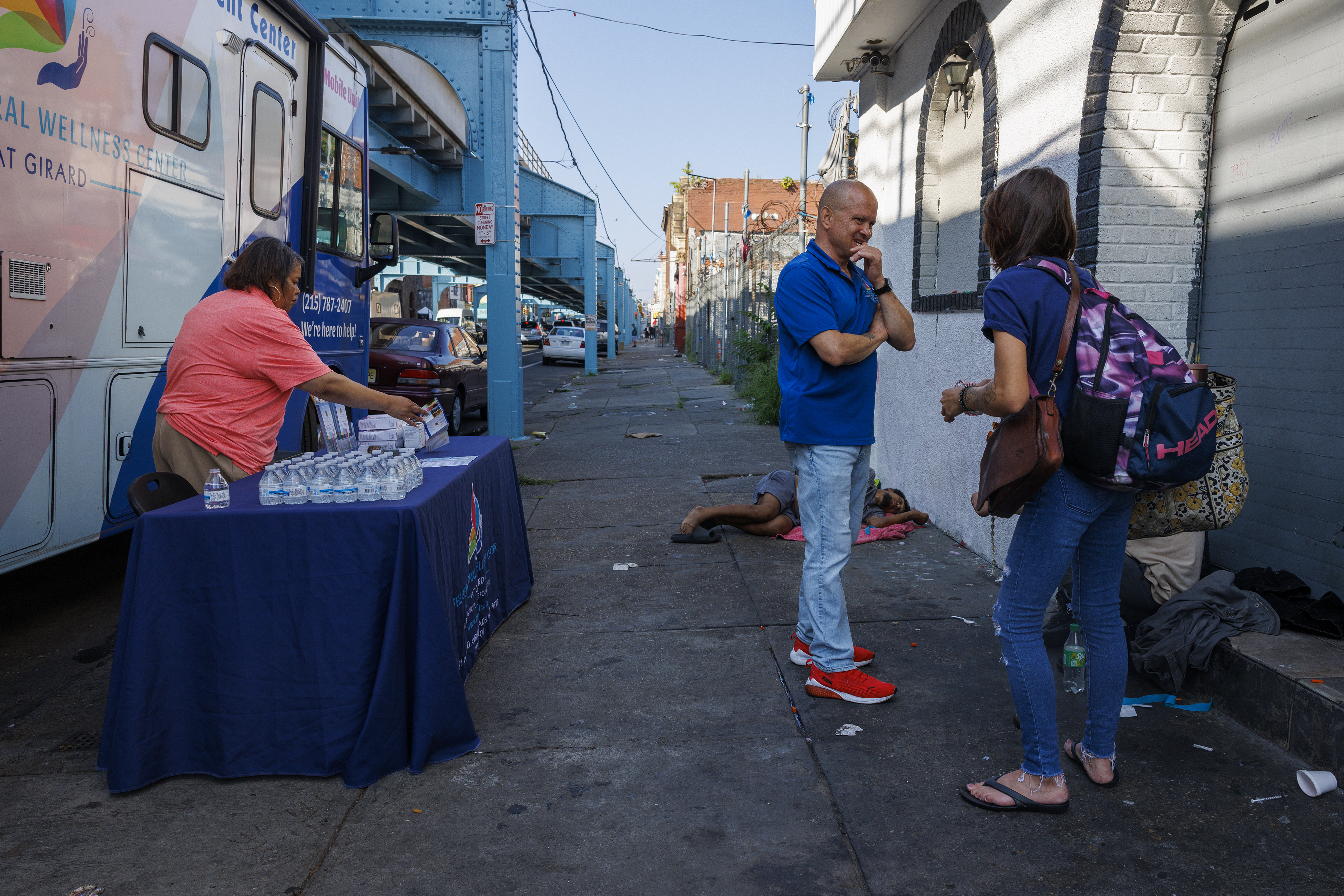
Many have long relied on mobile outreach services that met them on the street. Those same providers can now park only in designated areas or serve people for limited amounts of time.
Council members who support the legislation say residents in the neighborhood do not want people in addiction lining up for medical care or support services near their homes.
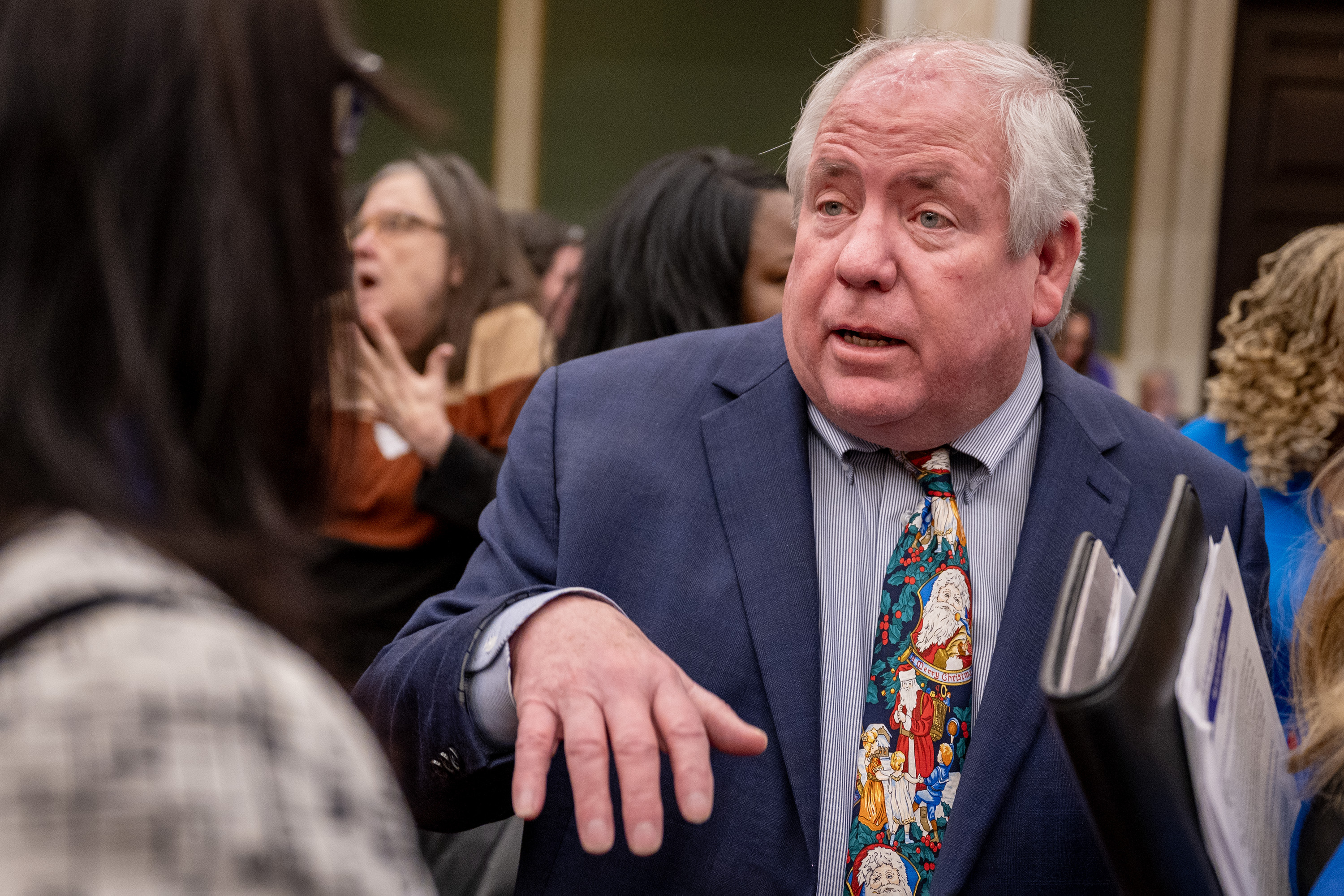
Councilmember Mike Driscoll authored the bill banning mobile service providers entirely from his 6th District, which includes parts of the neighborhood that are northeast of the infamous open-air drug market at the intersection of Kensington and Allegheny Avenues.
Driscoll said his bill, which passed Council 14-3 on Thursday,is not aimed at punishing providers. He said he is open to finding a location in his district where they can operate with the city’s permission.
“I just don’t want the service providers picking where they want to go at the expense of the kids and the neighbors,” he said.
Councilmember Michael Driscoll in chambers as City Council meets Thursday, Dec. 11, 2025, on the last day of the 2025 session.
But advocates for people who use drugs slammed the bill, and said reducing access to care will not help people in addiction.
“Restrictions like these will not end the opioid crisis. They will not make anyone in Kensington or District 6 safer,” said Katie Glick, a nurse who treats people in addiction and lives in the neighborhood. “These restrictions will disable and kill people.”
In Kensington, inconsistent rules for providers
If Parker — who has never issued a veto — signs Driscoll’s bill, it would result in a patchwork of rules for mobile service providers in Kensington, which is represented by three different Council members.
The western side of Kensington is in the 7th District, where Councilmember Quetcy Lozada’s legislation that required the permitting system applies. Organizations that do everything from handing out water to providing medical care now face a $1,000 fine for operating without a permit.
In the southern parts of Kensington that fall in the 1st District, represented by Councilmember Mark Squilla, no legislation applies to mobile providers.
(function() {
var l2 = function() {
new pym.Parent(‘kensington_districts’,
‘https://media.inquirer.com/storage/inquirer/projects/innovation/arcgis_iframe/kensington_districts.html’);
};
if (typeof(pym) === ‘undefined’) {
var h = document.getElementsByTagName(‘head’)[0],
s = document.createElement(‘script’);
s.type = ‘text/javascript’;
s.src = ‘https://pym.nprapps.org/pym.v1.min.js’;
s.onload = l2;
h.appendChild(s);
} else {
l2();
}
})();
The inconsistency is the result of councilmanic prerogative, the unwritten rule that gives Council members who represent geographic areas a large amount of sway over what happens in their districts. Lawmakers largely approve legislation offered by a district Council member when it affects only that member’s district.
Some of Council’s progressive members who represent the city at-large have bucked that practice several times on matters related to Kensington, where Parker and her allies in Council have placed an intense focus on improving quality of life.
In this 2023 file photo, the mobile home belonging to the Behavioral Wellness Center at Girard parked along Kensington Avenue. It is one of the city’s so-called mobile service providers that have faced increasing regulation from City Council.
The progressives — who favor an approach to the crisis called harm reduction that aims to keep people alive until they are ready to enter treatment — argue that placing restrictions on mobile service providers will make it harder for them to reach vulnerable people in addiction and ultimately reduce the number of providers on the street.
“When human beings are trying to provide help,” said Councilmember Nicolas O’Rourke, “the attitude should never be ‘how can we limit them.’”
O’Rourke and Councilmember Kendra Brooks, both of the Working Families Party, and Democrat Rue Landau voted against Driscoll’s measure.
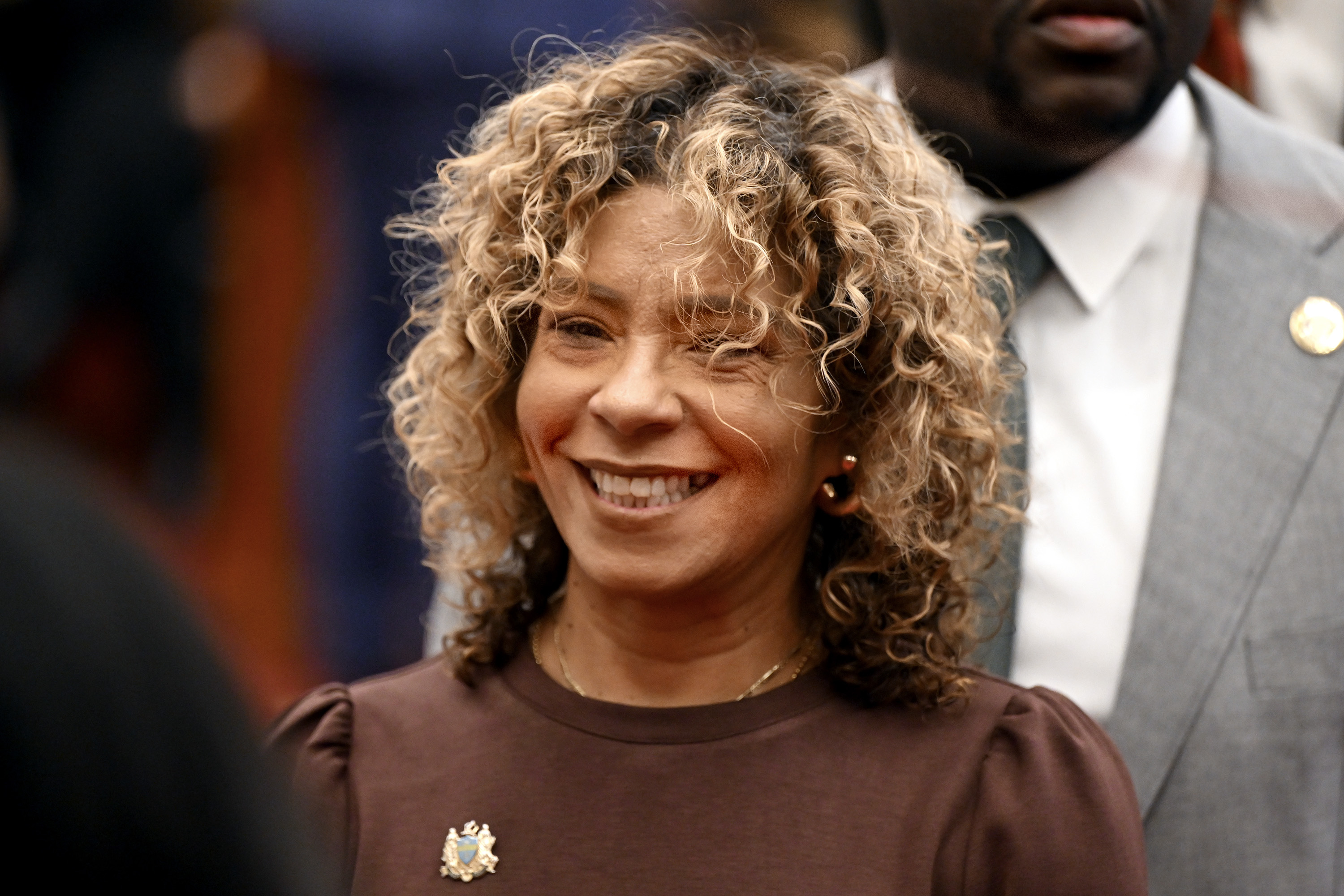
But Lozada said implementing new regulations was not about restricting care.
“We’re hoping that services continue,” she said. “People have just moved to other spaces to find a way to be able to continue to provide the services that people need.”
And Parker administration officials said the goal is not to reduce the number of providers, but to better coordinate them and ensure safety, especially for people receiving medical services.
Councilmember Quetcy Lozada in chambers as City Council meets Thursday, Dec. 11, 2025, on the last day of the 2025 session.
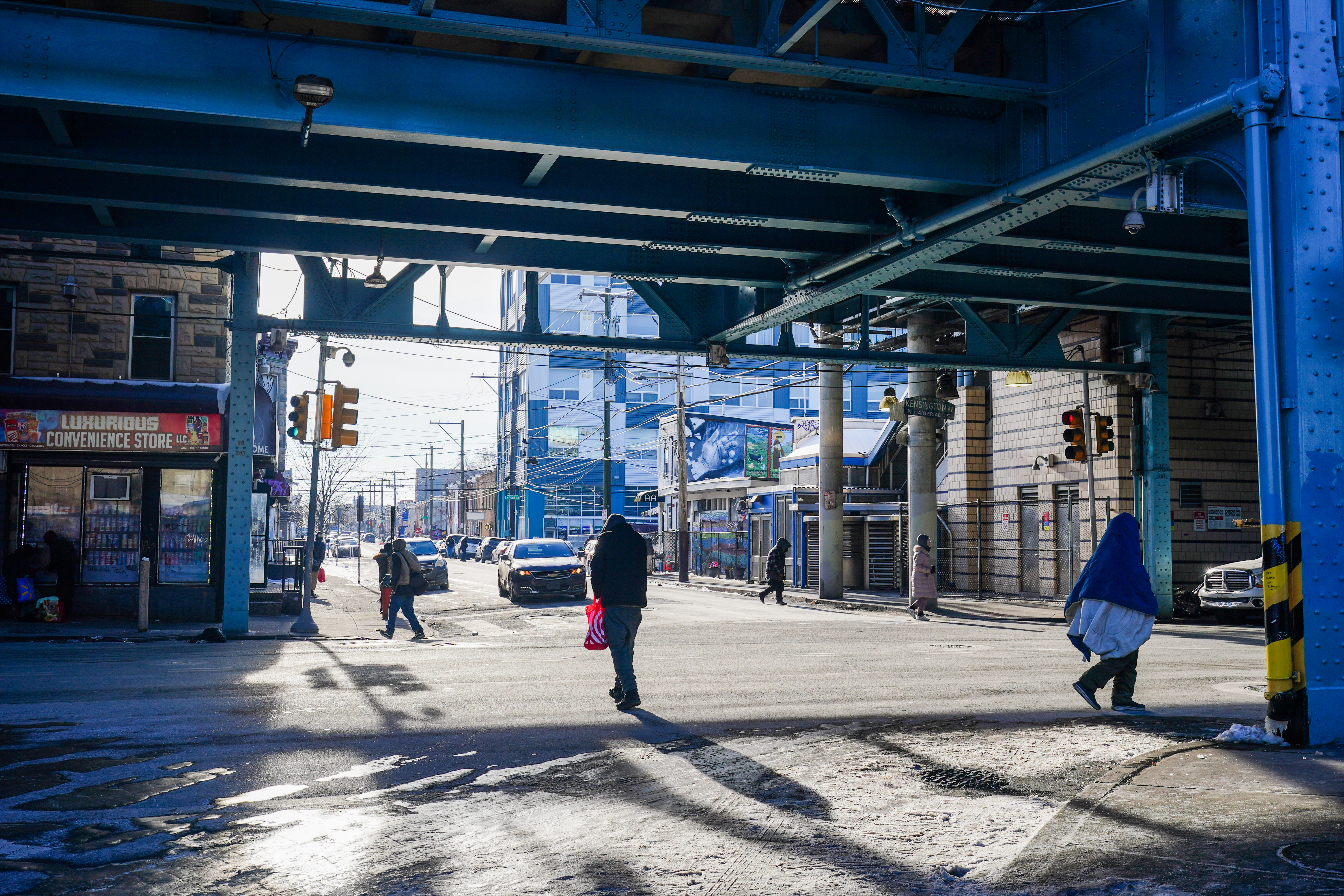
Kensington has been a key issue for the Parker administration and Council members who have pushed for more law enforcement in the neighborhood, where sprawling homelessness, open drug use, and violent crime have been commonplace for years. There have been some signs of progress, including a reduction in the number of people living on the street.
The city has tried new tactics, including opening its own recovery house and expanding police foot patrols. The local government has also at times operated its own mobile medical services and contracts with organizations that do so.
So far, the city has issued nine permits to providers who perform mobile medical services and 40 to organizations considered “nonmedical,” like those that distribute food. Some of those organizations also operate in other neighborhoods.
“We don’t have a problem if there’s five or 500 providers,” said Crystal Yates-Gale, deputy managing director for health and human services. “As long as they’re qualified to provide the care, and as long as we can help coordinate the care.”
Despite the changes, city says ‘people are still coming’
Under the new rules, nonmedical providers are prohibited from staying in one place for more than 45 minutes. Medical providers can station on a two-block stretch of Allegheny Avenue at nighttime or at a designated parking lot at 265 E. Lehigh Ave. during the day.
That lot, which is managed by the city and addiction service provider Merakey, is connected to the city’s Wellness Support Center.
Inside, people can access first aid, showers, and food, as well as get directed to treatment, legal aid, housing assistance, and other services.
People walk near Kensington Ave. in January 2025.
In the parking lot, two mobile medical service providers run by Merakey and Kensington Hospital are currently stationed, according to Kurt August, executive director of the Philadelphia Office of Public Safety’s Criminal Justice Division. He said officials are looking to expand the number of providers that operate there.
In late October, Merakey began dispensing methadone out of an RV parked in the lot. The tightly regulated opioid medication is a popular treatment for people experiencing withdrawal because it helps stave off cravings.
Raymond Bobb, a medical director at Merakey, said he has seen promising results in just a few weeks, including starting people on methadone and getting them stable enough to transition to inpatient drug treatment. Merakey offers to transport people on the street to the RV to enroll them in medication-assisted treatment.
“We’ve been able to take everything right to the heart of the epidemic and engage people the way you would treat your brother, or your sister, or your family,” said Bobb, who is also in recovery and became emotional when speaking about the program.
“Our goal,” he added, “is to build people up and motivate them to want treatment for themselves.”
August said retention has been high, despite the police presence at the support center. The officers, he said, were “handpicked” to be stationed alongside behavioral health professionals.
“It’s not a secret that police are on site, and people are still coming,” August said.
Still, other providers have expressed concern that requiring people to travel to the lot adds an additional barrier to care, especially for those who were used to mobile services coming to them.
Sarah Laurel, who runs the addiction outreach program Savage Sisters and has a nonmedical permit, said she fears that providers who offered medication-assisted treatment on the street will now be less accessible.
However, she said, some clients greeted the news of service limits with a shrug.
“The friends we serve are so used to not being heard that when they realize that services are going away, they adjust quickly to not having things,” Laurel said. “They just say, ‘No one cares about us. They hate us anyway.’ That is how people feel seen in this city.”
Staff writer Ellie Rushing contributed to this article.
LOS ANGELES – Golden State Warriors Coach Steve Kerr sparked a moment of introspection for the NBA last month when he said his team’s medical staff believed modern basketball’s fast pace and heavy mileage were contributing to a rash of injuries. After bemoaning the lack of practice and recovery time, Kerr demurred when asked whether he thought the league would consider shortening its 82-game schedule in an attempt to protect player health.
“The tricky part is all the constituents would have to agree to take less revenue,” Kerr said. “In 2025, in America, good luck in any industry. … That’s not happening.”
Kerr’s doubt was well founded, because the NBA’s business is booming: Commissioner Adam Silver recently struck new media rights deals worth $76 billion over 11 years, the league’s 30 teams combined to generate a record $12.25 billion in revenue last season, and a record 16 players will earn at least $50 million in salary this season.
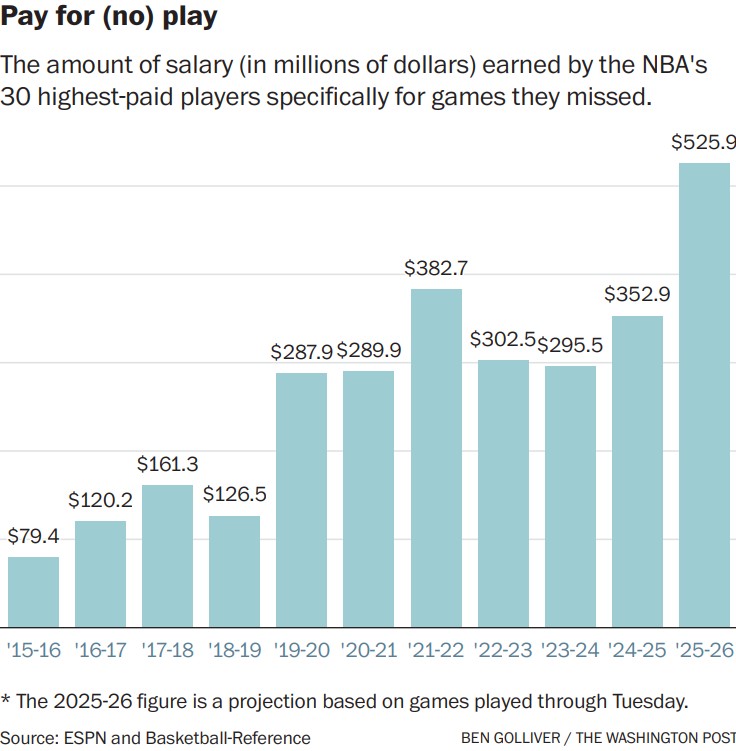
But as the NBA’s top-line financial metrics continue to increase, so, too, do the skyrocketing costs associated with lost productivity for injured stars. Remarkably, if early trends hold, the NBA’s 30 highest-paid players, according to salary data compiled by ESPN, could combine to cost their teams more than $525 million in empty salary associated with games they do not play this season.
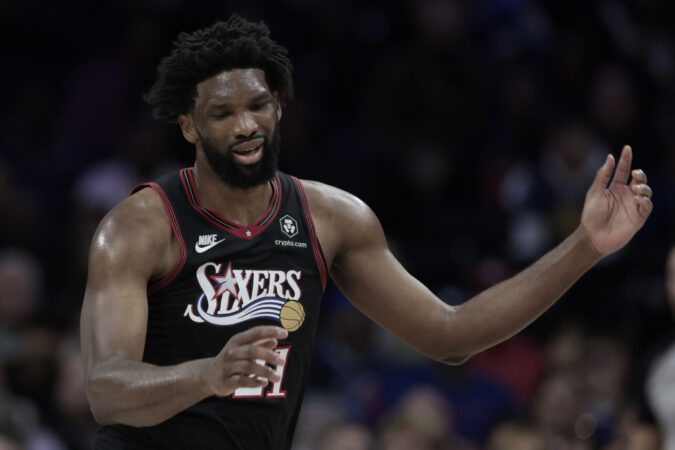
Stephen Curry (who will earn $59.6 million) is sidelined with a quadriceps injury. Joel Embiid ($55.2 million) has missed more games than he has played because of recurring knee problems, Kawhi Leonard ($50 million) has already missed 10 games because of a foot injury, and Bradley Beal ($53.7 million including a contract buyout) played only six games before suffering a season-ending hip injury. LeBron James ($52.6 million) and Anthony Davis ($54.1 million) missed the first four weeks of the season because of injury, and Giannis Antetokounmpo ($54.1 million) and Ja Morant ($39.4 million) are out with muscle strains.
Jayson Tatum, Damian Lillard, Tyrese Haliburton and Kyrie Irving are on the books for $204.4 million combined but have yet to play because of major injuries suffered last season. During one recent loss, the New Orleans Pelicans took the court without their five highest-paid players, who will combine to earn more than $140 million.
Stephen Curry is currently sidelined with a quadriceps injury.
Many of those absences have directly led to trouble in the standings. Haliburton’s Indiana Pacers, who reached the NBA Finals in June, have dropped to 14th in the Eastern Conference. Antetokounmpo’s Milwaukee Bucks are at risk of missing the playoffs for the first time since 2015-16 and must pay Lillard $113 million over the next five seasons after waiving him using the league’s stretch provision. And the Los Angeles Clippers, wobbly with Leonard and Beal missing time, are on track for their first losing season since 2010-11.
“When you lose your best player and a top-10 player when he’s on the floor, it’s hard to make up for that,” Clippers Coach Tyronn Lue said last week. “I know a lot of people say ‘next man up,’ but if [Leonard] is making [$50] million and your next man up is making $400,000, it’s not really the same.”
In two notable cases, star injuries have already contributed to major personnel changes. Without Davis and Irving, the Dallas Mavericks struggled out of the gate and fired general manager Nico Harrison less than a month into the season. And well before Zion Williamson’s latest injury, a hip strain that will keep him out for weeks, the Pelicans had crashed into the Western Conference’s basement and fired Willie Green after he coached just 12 games.
“We have a lot of guys that are in street clothes,” Mavericks Coach Jason Kidd said shortly after Harrison’s firing. “We’ve got over, I think, $100 million sitting on the sideline.”
More injuries, more problems
The rise in star injuries goes well beyond this season’s most extreme examples of the Pacers, Clippers, Mavericks and Pelicans.
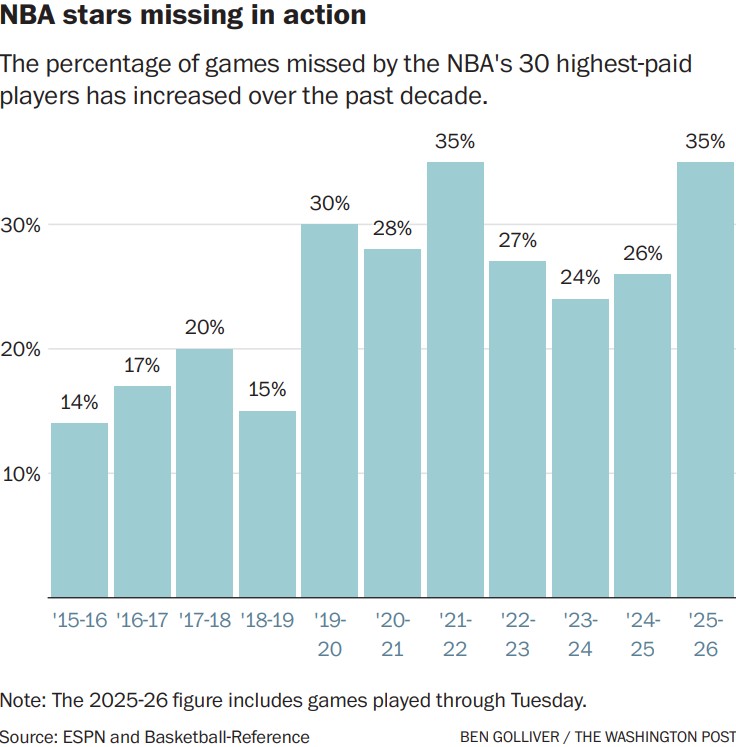
Flash back one decade: During the 2015-16 season, NBA teams averaged 102.7 points, 24.1 three-point attempts and 95.8 possessions per game. That year, the league’s 30 highest-paid players combined to miss just 14 percent of their teams’ games.
This season, teams entered Wednesday averaging 116.6 points, 36.9 three-point attempts and 100 possessions per game. The league’s highest-paid players have combined to miss 35 percent of their teams’ games. A faster, higher-scoring and more rigorous sport appears to be taxing players like never before.
John DiFiori, the NBA’s director of sports medicine, said the league views the 2019-20 season as an “inflection point” for star injuries. During the four seasons before that campaign, which was interrupted by the coronavirus pandemic, the NBA’s 30 highest-paid players missed between 14 and 20 percent of their teams’ games. Since 2019-20, that number has jumped, ranging from 24 percent to 35 percent. The missed games rate has remained elevated in the years after the NBA stopped requiring players to sit out if they tested positive for the coronavirus.
“Injury rates are going up,” DiFiori said. “When we look back at what we’ve been doing the last 10 or 12 years, it’s a moving target. The game doesn’t stay the same. We’re trying to reduce injuries, and the game is also changing. All these other factors, the pace of play and what players are doing in training, those are all moving targets. To wrap our arms around that is a challenge. It’s something we’re quite focused on. … [Teams are] spending a lot of time and money and bringing in a lot of expertise. Despite all of that, we’re seeing an increase in injuries. It’s not for teams’ lack of focus on it.”
The percentage of games missed by the NBA’s 30 highest-paid players has increased over the past decade.
The NBA instituted the Player Participation Policy (PPP) before the 2023-24 season to address what it calls “a statistically significant increase” in star absences and to curb “load management,” a strategy used by some teams to rest players throughout the season. With the NBA negotiating new media rights deals and debuting the NBA Cup in-season tournament to spark interest, then-league executive Joe Dumars met with all 30 teams to remind them that the NBA is an “82-game league.” To reinforce that message, the PPP mandated that players appear in at least 65 games to be eligible for end-of-season awards, and the league began fining teams if they rested healthy players for nationally televised games.
The PPP enjoyed some initial success: The 30 highest-paid players missed just 24 percent of games in 2023-24, the league’s best mark since the pandemic. That progress proved short-lived, however; the availability of the NBA’s highest-paid players has regressed noticeably over the past three seasons. During the 2025 playoffs, Tatum, Lillard and Haliburton all suffered season-ending Achilles tendon injuries during a span of less than two months.
Muscle strains have been another point of immediate concern. The Mavericks shocked the basketball world by trading franchise player Luka Doncic last season while he was recovering from a calf strain; Antetokounmpo, Davis, Morant and Victor Wembanyama are among the stars who have been sidelined by the same injury this season. Haliburton was still recovering from a calf strain when he tore his Achilles during Game 7 of the NBA Finals, but the NBA’s medical staff has yet to identify clear evidence that suggests a prior calf injury increases the risk of an Achilles tear.
“When you have a small prevalence of injury, it’s hard to scientifically study that,” DiFiori said. “Typically over the last 15 years, we average about two Achilles tendon injuries per year. Last year, we had seven. That’s a lot. One year prior, also with a high pace of play, we had zero. We’re taking it very seriously. We’re concerned about it, but I don’t think we have our finger on what’s the driver here or what factors may have led to last season’s unusually high number.”
More injuries, more money
Kerr is hardly the only voice in the basketball and medical communities raising the alarm about the increase in injuries. A range of theories abound.
The NBA cut its preseason to three weeks in 2017, reducing the amount of time players have to ramp up for game action to spread out the regular season more evenly and eliminate instances of four games in five nights. The league changed its shot clock reset to 14 seconds and emphasized greater freedom of movement for players to encourage faster and less restrictive play in 2018. The pandemic created calendar disruptions and shortened schedules in 2020-21 and 2021-22, and the NBA has tweaked its regular season schedule in each of the past three seasons to accommodate the NBA Cup in November and December.
Aside from those legislative moves and the possibility of unintended consequences, the use of analytics has swept through the league and transformed the sport into a perimeter-dominated endeavor. Playing at a fast pace and shooting a high volume of three-pointers are now generally viewed as optimal strategies for underdogs hoping to increase variance against more talented opponents.
The Pacers’ unexpected Finals run, driven by a breakneck offense and high-pressure defense, has spawned copycats. The results haven’t always been positive: The Portland Trail Blazers made waves by regularly deploying a full-court press to start the season, only to endure injuries to their guards in recent weeks.
It’s also worth noting that a cohort of superstars such as Curry and James has remained highly productive late into their lengthy careers. While these older players have remained among the league’s biggest earners, their durability has tended to decrease as they proceed through their late 30s.
On the flip side, a younger generation of high draft picks – such as Williamson, Morant, LaMelo Ball and Ben Simmons – has encountered recurring injuries before they reach their late 20s, which have typically been viewed as the prime years for basketball players. NBA executives have long expressed serious concerns that the modern generation of players is arriving to the NBA with preexisting injuries or risks that result from playing too many games at the youth level and specializing in only one sport.
The amount of salary (in millions of dollars) earned by the NBA’s 30 highest-paid players specifically for games they missed.
As the NBA and its fans continue to debate possible solutions, the injury epidemic has reached staggering heights when it comes to lost productivity. Back in 2015-16, the 30 highest-paid players combined to earn roughly $560 million. Because those players only combined to miss 14 percent of their teams’ games, their teams combined to pay roughly $79 million in empty salary.
Last year, the empty salary mark reached more than $352 million. This season, with the 30 highest-paid players combining to earn more than $1.49 billion and missing 35 percent of their teams’ games entering Wednesday, the number is on pace to exceed $525 million.
That would easily set a record for lost productivity. As Lue and Kidd might say, NBA teams could soon have a half-billion dollars sitting on the sideline.
After a nearly six-year legal battle between artists, preservationists, and neighbors, the Old City building and its celebrated mosaic were demolished.
The former Painted Bride Art Center building, once home to world-renowned artist Isaiah Zagar’s 7,000-square-foot mirror-and-tile mosaic, has started to come down.
The demolition equipment and growing dust at 230 Vine St. closes the book on a yearslong saga over the distinctive Old City building’s future.
Founded in 1969 as a gallery on South Street, the Painted Bride helped transform Old City into an artists’ corner of Philadelphia when it moved to the neighborhood in the ‘80s.
story continues after advertisement
Decades later, Zagar’s mosaic, titled Skin of the Bride and wrapped around the exterior of the building, became a point of contention when the organization tried to sell the building in 2017. The debate led to a nearly six-year legal battle involving artists, real estate developers, city government officials, and neighbors.
As demolition of the celebrated building begins, take a look back at the complicated legal battles that led to its razing.
Using grants and donations for a down payment, the Painted Bride moved to 230 Vine St. from its initial digs in South Philadelphia. The former elevator factory in Old City spanned 15,000 square feet and sold for $300,000.
Alley Friends Architects, a local firm, drew up plans for the space, which included a 225-seat performance venue and galleries.
Artist Ruth McCann arrives with her paintings at the new Painted Bride at 230 Vine St. on December 2, 1982..James L. McGarrity / Staff Photographer
"There's never been an Academy of Music for people who weren't famous, and now Philadelphia has one. We've deserved this for many years. New York has a dozen such spaces,” said Keith Mason, the Bride’s program director at the time.
1991
Isaiah Zagar begins installing his mosaics
Zagar worked on the Bride’s distinctive mural for nine years.
“Isaiah woke up at 5 a.m. each morning and drove down to 230 Vine St.,” recalled his wife, Julia Zagar. “He dreamed of it as being his masterpiece and worked 10-12 hours a day until he collapsed with exhaustion.”
Artist Isaiah Zagar working on his giant mosaic at the Painted Bride Art Center on Vine Street in the 1990s.Courtesy of Philadelphia Magic Gardens
story continues after advertisement
November 2017
Vine Street property goes on the market
After 35 years on Vine Street, the Painted Bride announced the building would be sold. Executive director Laurel Raczka said the organization was not in financial distress but chose to ditch the building so the Bride could explore new ways to present the arts.
The following month, Raczka also noted the changing vibes of Old City: "We don't feel like we belong here anymore,” she told The Inquirer.
The entrance to the Painted Bride Art Center, covered in Zagar’s mosaics.Tom Gralish / Staff Photographer
Many in the arts community were perplexed. Performance artist Tim Miller, a founder of artistic spaces in New York City and Santa Monica, Calif., said, "Once [the Painted Bride] is gone, it will never be replaced. To discard it, to me, it feels reckless, unless it's the only way to survive."
March 2018
Painted Bride building is nominated for historic preservation
"The Painted Bride is one of his masterpieces," Smith said. "The building itself is a treasure."
Zagar, photographed for The Inquirer in the fall of 2017.Margo Reed / For The Inquirer
April 2018
Arts leaders beg the Bride to suspend sale plans
More than 30 of the city's most prominent artists, performers, and arts officials cosigned a three-page public letter calling for "a reexamination" of the Bride's situation and community-wide discussion about the organization's future.
Signers included: Joan Myers Brown, founder and executive artistic director of Philadanco; hip-hop dance sensation Rennie Harris; architect Cecil Baker; and Wilma Theater cofounder and director Blanka Zizka. The city’s chief cultural officer offered to facilitate a community conversation between the Bride’s leadership and local artists and art patrons.
The Bride’s leaders rebuffed the offer and said that they would continue to pursue "a sustainable business model."
June 2018
Historical designation passes the first hurdle
A committee of the Philadelphia Historical Commission unanimously agreed the Painted Bride building should be protected.
September 2018
Historical designation is denied
After a three-hour, public debate, Philadelphia’s Historical Commission voted 5-4 to reject designation, a move that opened the door for developers to acquire and demolish the building.
A few days earlier, Lantern Theater Company made a bid of over $2 million for the building, which would have preserved it as an arts space. The offer was rejected.
Lawyers for the Bride said that the law did not require approvals from the court but that the Painted Bride sought them nonetheless.
Architect and developer Shimi Zakin of Atrium Design Group poses with a sign on an interior mosaic in the Painted Bride Art Center building before closing on the sale.Courtesy of Shimi Zakin
The Bride’s petition stated that “given the history” of the building, the Bride “wishes to obtain approval of the sale from both the Pennsylvania Office of the Attorney General and the Philadelphia Orphans’ Court.”
August 2019
City allows townhouses
Philadelphia’s Department of Licenses and Inspections issued a zoning permit to allow Atrium Design Group to build 16 townhouses at the site.
September 2019
Court blocks the sale, citing ‘priceless’ mosaic facade
Philadelphia Orphans’ Court blocked the sale, citing the likely destruction of the Bride’s “priceless” mosaic facade. Judge Matthew D. Carrafiello said the sale would "all but ensure the destruction of what many individuals consider to be a true treasure.”
“It is the sale of its property, including the mosaic, that will result in the liquidity necessary for Painted Bride to continue to fulfill its charitable purpose,” wrote Judge J. Andrew Crompton.
January 2021
Neighborhood group opposes proposal that would save the mosaics
The Zoning Board of Adjustments approved Zakin’s proposal, paving the way for him to move forward with the apartment building.
Shortly after, neighborhood groups appealed the decision.
March 2022
Building officially sold for $3.85 million
Despite the looming appeals hearing, many involved with the Bride and supporters of preserving Zagar’s artwork believed the mural had been saved when the building was sold to Zakin.
A Philadelphia Common Pleas Court judge agreed with some neighbors that the mosaic in Old City could be preserved without allowing the developer to build taller and more densely than local zoning rules allow.
This rendering shows a potential design of the building proposed to replace the Painted Bride Art Center in Old City.Courtesy of Atrium Design Group
Emily Smith, executive director of Philadelphia’s Magic Gardens, which preserves and provides access to Zagar mosaics, said the planned destruction of the Painted Bride mosaic was a case of “NIMBY-ism at its most tragic.”
Over several weeks, the Magic Gardens Preservation Team used chisels, hammers, and small power tools to remove as much as they could from the facade. The mosaic was well-adhered to the brick, and this was a difficult process physically and emotionally. The crew was able to remove approximately 30% of the tiles for reuse in new mosaics.
Magic Gardens’ representatives attempt to save pieces of the iconic Zagar mosaic on all the exterior walls of the former Painted Bride before the building is demolished.Tom Gralish / Staff Photographer
September 2025
Demolition permit granted
Zakin received a demolition permit from the city and told The Inquirer that he plans to start demolition in late October. He said he anticipates that his building will be completed in about 2½ years.
Late November/Early December 2025
Demolition begins
Workers began to take down the interior of the building.
A digger works to demolish the inside of the former Painted Bride building on Dec. 8, 2025.Alejandro A. Alvarez / Staff Photographer
Lil’ Filmmakers, a Roxborough-based nonprofit, was supposed to have $170,000 in the bank.
The mission of helping young people become storytellers through film and media had caught the attention of major donors in 2025. The city awarded it a $28,000 anti-violence grant, and one of Michael Jordan’s charitable organizations issued a separate $35,000 grant. Funding should not have been a problem, according to CEO Janine Spruill, who started the program in 1999.
But on Aug. 27, neither she nor her fourstaffers, nor her summer program participants, had gotten paid by the Federation of Neighborhood Centers, the Philadelphia nonprofit that managed their money.
She remembers FNC staff telling her they had decided not to processpayroll because they were trying to “figure some things out.” Without specifics, Spruill walked away suspecting the worst.
“I went into a bit of a panic mode,” Spruill said, upset that she hadn’t even been given a heads-up. “I ended up crying my eyes out because I said, ‘Oh, my God, I raised all this money, and they’re telling me they don’t have it.’”
Other organizations that had contracts with FNC soon realized that they, too, were having issues accessing their funds. They reported overdue invoices, payroll issues, and spotty communication with FNC.
As the weeks turned into months, Spruill said, FNC would not let her access the money she had raised. She had to launch emergency fundraisers.
The announcement many of the groups dreaded arrived in November. FNC’s grant management services — known as a fiscal sponsorship program in the nonprofit world — would shut down Dec. 31.
“This choice does not come lightly,” said FNC’s announcement on its website. “It comes after years of carrying work that we believed in wholeheartedly — often beyond our capacity — because we care deeply about every project, every leader, and every community member who trusted us with their mission.”
FNC’s collapse, by its own admission, is a story of an organization that grew too quickly and let basic accounting principles go by the wayside. Demir Moore, the nonprofit’s new CEO as of Aug. 26 and a former Lil’ Filmmakers intern, insisted FNC’s collapse was due to a “lapse of management” and “absolutely not attributable to malfeasance or embezzlement.”
FNC spent itself into a deficit over the course of years, continuously using money belonging to one group to pay for another, according to Thaddeus Squire of Social Impact Commons, an organization aiding FNC as it winds down.
“That deficit started to become unrecoverable,” he said. “Money that was borrowed was not put back.”
Moore declined to say how much money FNC has or how many groups are affected by the end of the fiscal sponsorship program. FNC has about 50 groups on its rolls, he said, but some have not been active or have no funds with the nonprofit.
Still, it is unclear how the nonprofit was able to operate the way it did for years. Sorting out just how FNC’s fiscal sponsorship program unraveled is going to take time, Moore said, declining to comment on leadership turnover in the last year.
Attempts to reach past FNC leadership for insight on what transpired were unsuccessful.
And while Moore described a round-the-clock effort to sort out how much every group should have in its account, he would not say for certain whether groups would get all their funds back by the time FNC shuts down.
When the ‘safe approach’ loses control
When run right, a fiscal sponsor can be a boon to newer community groups that do not have a tax-exempt status. By contracting with fiscal sponsors, which are registered as 501c3s, these smaller groups can apply for grants.
Donors are left assured that a more established nonprofit is guiding the smaller or newer group, said Brian Mittendorf, the H.P. Wolfe Chair in Accounting at Ohio State University, who specializes in nonprofit accounting.
“Financial difficulties at fiscal sponsors are much less frequent just because their position … is typically an indicator that they have strong financial controls and other infrastructure in place,” he said, adding that signing with a fiscal sponsor is “often viewed as the safe approach.”
Fiscal sponsors can also be of much help to registered nonprofits that would rather focus on providing services than on managing administrative tasks.
In exchange for a fee, the sponsor signs on to manage and distribute grants, offer reports, and take on a range of tasks, such as payroll or legal questions, giving community groups peace of mind.
For Lil’ Filmmakers, the promise of back-office support led it to contract with FNC nearly a decade ago. Spruill said the monthly accounting report FNC sent her would sometimes require adjustments, but she cited no major issues until this year.
The first red flag came in March. Spruill said FNC did not pay the rent for Lil’ Filmmakers’ studio in Roxborough. FNC ultimately took care of the late fees and cut the rent check, so Spruill said she chalked it up as a one-time occurrence.
Teens at the Lil’ Filmmakers nonprofit learn the ins and outs of filmmaking.
What Spruill and other community group leaders could not see was an organization Moore said could not keep up with its own expansion. The nonprofit recorded a revenue of $774,000 in 2019 taxfilings, which peaked at $4.76 million in 2023.
A years-old message from then-CEO Jerry Tapley remained on the FNC website until this summer, touting more than 50 projects ranging from urban farming and the arts to animal rescue work. The organization’s work affected 250,000 people annually in “Philadelphia and beyond,” he wrote.
Moore said that as the nonprofit grew, FNC was not always collecting key documentation, such as receipts. Community groups were allowed to draw checks for funds they did not have, and balance statements given to groups were out of date or inaccurate.
When Moore stepped down as FNC board president and took over as CEO, the first thing he did, in an attempt to take stock of finances and accounts, was freeze outgoing payments.
While Moore described the move as a necessary first step, community groups struggled to pay for basic overhead, and some sought outside help. Soon, Philanthropy Network Greater Philadelphia and Social Impact Commons, an organization that supports fiscal sponsors, were working with FNC — but it was too late.
There did not appear to be any nefarious intent behind the mismanagement, Social Impact Commons’ Squire said, but FNC’s system allowed some projects to spend into the negative and for debt to snowball.
Social Impact Commons recommended FNC shut down its fiscal sponsorship program and “stop trying to catch up,” according to Squire.
Clarity may not come for at least several more weeks
Sharon Wilson, Lil’ Filmmakers’ attorney, said one of her biggest frustrations is what she finds to be a general lack of transparency as FNC winds down operations, despite her repeated requests for updates in writing.
“All of the information that was learned about FNC’s internal problems, and the fact they were failing other nonprofits other than Lil’ Filmmakers, was all gleaned outside of them,” she said.
The way Moore explains it, the reason FNC has not outright said all community groups would be made whole is that figuring out who is owed what will take at least several more weeks. He said FNC does have funds available, but until the reconciliation process is complete, “no final conclusions can be made about individual project balances or what each project’s final financial position will be.”
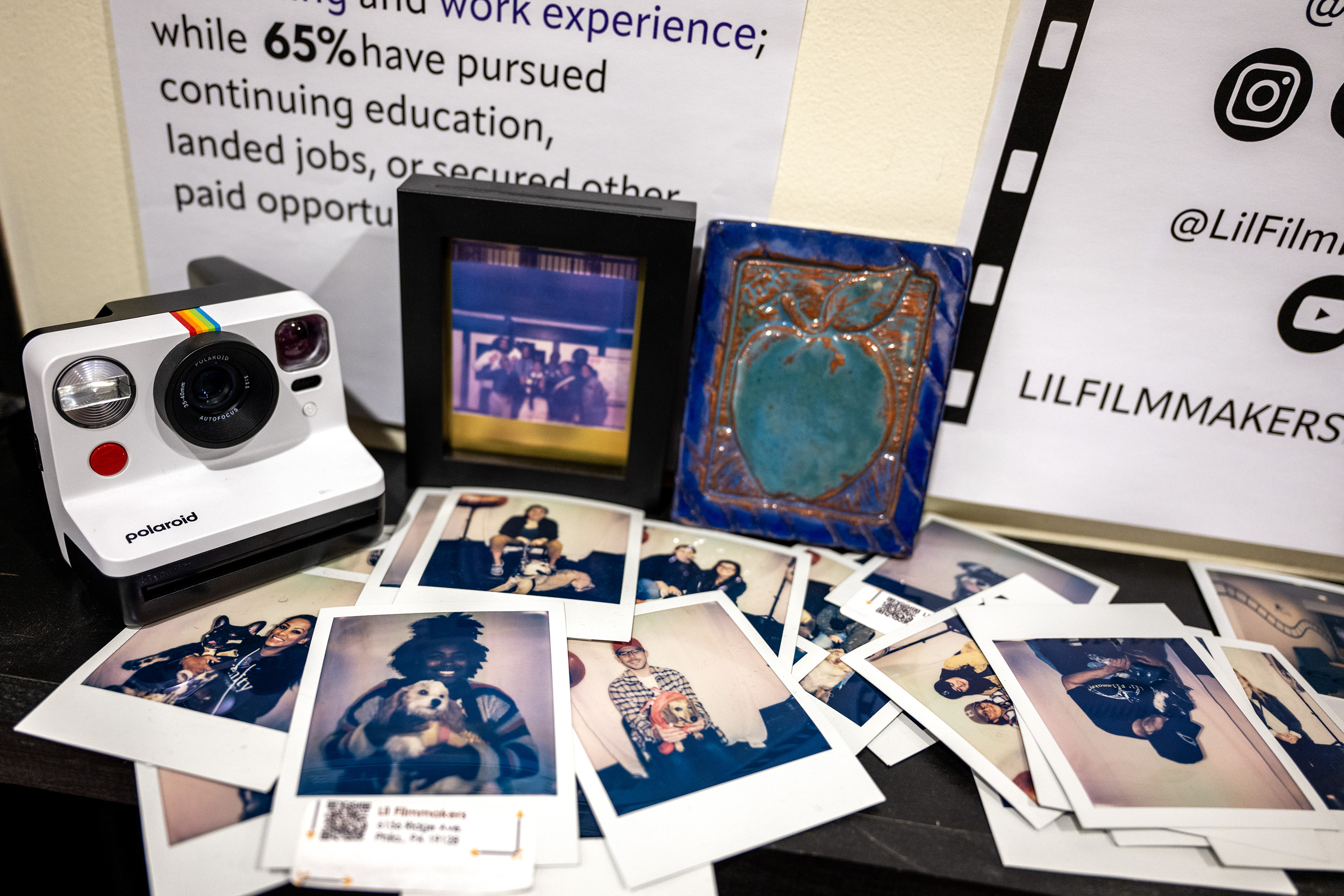
Polaroids from a community pet day at Lil’ Filmmakers Thursday, Dec. 4, 2025. The Roxborough based nonprofit and other community groups claim they have been unable to access their funds managed by FNC, which insists it’s not a case of embezzlement or financial malfeasance
For now, multiple third parties, including the city, are working to move the process along.
The Philadelphia Office of Public Safety, for example, said Lil’ Filmmakers and three other anti-violence grant recipients with awards managed by FNC are in different parts of the process. Together, the groups had roughly $380,000 in city-issued funds awarded, which the city said are largely accounted for.
Though the final spending report for Lil’ Filmmakers remains in dispute, it might be resolved by the end of the month, according to the city.
In the meantime, a public safety office spokesperson said staffers were working with organizations to help close their accounts with FNC and offering technical assistance to its grant recipients, including bookkeeping and fiscal sponsor matchmaking.
Still, the office said, there is not much it can do for other grants awarded by other donors.
Complicating moneymatters further, some organizations used a California-based fundraising platform called Flipcause to collect donations. Last month, California’s attorney general sent a cease-and-desist order to the company, ordering it to halt operations after more than a dozen nonprofits in the state accused Flipcause of withholding funds. The platform also faces a class-action lawsuit in federal court.
In all, Moore said, FNC organizations have about $100,000 being withheld by Flipcause; Lil’ Filmmakers is not one of them.
Moore did not rule out that some groups might have less in their accounts than they were initially told in their FNC financial statements because of accounting discrepancies.
Squire went a step further, adding that philanthropic fundraising would be necessary.
“We’re cautiously optimistic that despite a lot of genuine harm that’s been done, that we can at least get people sorted out and back on their feet in the next few months,” Squire said.
The goal, he said, is that each of the groups needing to be placed with a new fiscal sponsor to access their money will have a new one by the end of the first quarter of 2026.
The results of the internal audits will likely determine any legal recourse or investigations. For example, the Pennsylvania Bureau of Corporations and Charitable Organizations, part of the Department of State, can impose fines against charities and revoke their registrations if they are found to be violating the state laws that govern them.
But Spruill, her staff, and her teaching artists cannot afford to keep waiting.
Lil’ Filmmakers has launched another fundraising campaign, this time for $50,000, so programming can continue uninterrupted.
When speaking about the financial setback, Spruill remains defiant.
“We refuse to let this stop the stories that need to be told,” reads her plea to donors.
When Adam Sawyer and his wife, Marissa Tan, moved to Philadelphia in 2024 from Baltimore, they were attracted to Center City by its proximity towork and mass transit.
The couple figured if they sold their car, they could even afford to rent in one of the thousands of new, high-rise apartments that have been built across Center City over the last 10 years.
Tan had just gotten a new job with the Cooper University Hospital in Camden, and Adam needed access to 30th Street Station for work. They eventually settled on the PMC Property Group’s Riverwalk North at 23rd and Arch Streets and have been impressed by the city, its transit system, and life without a car.
Adam Sawyer and his wife, Marissa Tan, moved to Philadelphia in 2024 from Baltimore.
“One of the things I love about living in a city is that you’ll be walking down the street and there are five different events you didn’t even know about,” Sawyer said. “Festivals, farmers markets, just activity, people doing things. I love that Philadelphia has so much energy.”
In many ways Sawyer and Tan — who are both 35 — are representative of the people who have taken up residence in the new apartment buildings across Center City. Between Pine and Vine Streets, river to river, 3,500 new apartments have opened since 2023.
Center City District (CCD) set out to learn more about who is calling these apartments home, with a survey of more than two dozen buildings constructed since 2015.
Like Sawyer and Tan, the vast majority of respondents to CCD’s survey are under 45 (83%), more than half don’t own a car (55%), and close to half moved from outside the Philadelphia area (44%). Sawyer works remotely like 21% of respondents, and Tan works in healthcare like 32% of them.
window.addEventListener(“message”,function(a){if(void 0!==a.data[“datawrapper-height”]){var e=document.querySelectorAll(“iframe”);for(var t in a.data[“datawrapper-height”])for(var r,i=0;r=e[i];i++)if(r.contentWindow===a.source){var d=a.data[“datawrapper-height”][t]+”px”;r.style.height=d}}});
In a city where a fifth of all residents live in poverty, the respondents aren’t representative of the average Philadelphian in many ways. The buildings surveyed have an average rent of $2,645, well above the median of $1,387.
But the results show that there is a market for the kind of new buildings that are still being proposed. They alsohighlight that many people are attracted to the most central parts of Philadelphia because it offersmore density, walkability, and other urban characteristics that few other American cities can boast.
“People actively choose Philadelphia over other cities and metropolitan areas because we outperform them in some ways,” said Clint Randall, vice president of Economic Development with CCD, which is funded by downtown property owners and provides advocacy and services like additional security and cleaning downtown.
“The city spent so many decades shrinking,” Randall said. “When you see this entire skyline of high-rise apartment buildings emerge, it contradicts what longtime Philadelphians think they know about this place, which is that it does not grow or attract residents.”
Reversing reverse commuting
Center City District’s survey confirmed a longtime finding of the organization’s other research reports: People who live downtown are likely to work there or very close by.
In Philadelphia, reverse commuting is common, a testament to the fact that many private-sector employers have remained outside the city to avoid wage and business taxes. But among survey respondents, only 12% commuted to the suburbs for work compared to almost 40% citywide.
Over half of respondents work in either Center City or University City, and a similar proportion work in either healthcare (32%) or in the jobs more typically associated with office towers: “business, professional, or financial services” (27%). Twenty-one percent work from home.
“A lot of people are in medicine, in healthcare. I see a lot of scrubs,” said Kaz Rivera-Gorski, about her building One Cathedral Squareat 17th and Race Streets.
window.addEventListener(“message”,function(a){if(void 0!==a.data[“datawrapper-height”]){var e=document.querySelectorAll(“iframe”);for(var t in a.data[“datawrapper-height”])for(var r,i=0;r=e[i];i++)if(r.contentWindow===a.source){var d=a.data[“datawrapper-height”][t]+”px”;r.style.height=d}}});
“I would imagine there’s a good amount of people that work remotely, too,” said Rivera-Gorski, who is a management consultant who works from home. “I see people on their laptops in the shared spaces during the day.”
Seventy percentof respondents said their jobs are within walking, biking, or transit distance from their homes, while 80% of them said that owning a car was not necessary to enjoy daily life in Philadelphia.
That’s part of what attracted Sawyer and Tan, even though another part of Philadelphia’s allure was that it was closer to family in central and eastern Pennsylvania (the couple have a Zipcar membership).
“While I do drive, I really, really dislike driving,” Sawyer said. “I’ve lost people. Everybody has, to either accidents or crashes or DUIs. So we were open to selling our car and became more and more convinced it was a good idea.”
window.addEventListener(“message”,function(a){if(void 0!==a.data[“datawrapper-height”]){var e=document.querySelectorAll(“iframe”);for(var t in a.data[“datawrapper-height”])for(var r,i=0;r=e[i];i++)if(r.contentWindow===a.source){var d=a.data[“datawrapper-height”][t]+”px”;r.style.height=d}}});
Retaining out-of-towners
Randall said that he was surprised by the proportion of CCD’s respondents who reported having moved to Philadelphia from outside the region. (A recent Realtor.com report showed that Philadelphia switched from having mostly local interest in rental listings before the pandemic to mostly out-of-towners today.)
The survey also found that the majority of Center City dwellers planned to be living in Philadelphia inthree to five years, with 45% planning to continue renting and 16% hoping to buy.
“You hear about the transience of other places like D.C. or Boston, and it seems like people are here [in Philadelphia] and they intend to stay,” Randall said.
That is certainly the goal of Annika Verma, a student at Temple University who lives in the Logan Lofts in Callowhill.
“I am already calculating: Can I get an entry-level job? What salary would work for the rent in this area?” Verma said. “I would love to stay. The area seems ideal for me in terms of commuting or walking. Anything, everything is a 15-20 minute walk or bus ride away.”
Sawyer and Tan are hoping to stay in Philadelphia, too. They are currently searching Center City for a condo to buy. They may try to stay in their current Logan Square neighborhood for its proximity to the Schuylkill River Trail and 30th Street Station.
“We love it,” said Sawyer, who notes that they’ve lived in three cities in Texas, Cooperstown in New York, and Baltimore before this. “But our favorite place we’ve ever lived is here in Philadelphia.”