Last year, the council voted to increase taxes 23% as federal COVID-19 relief dollars that had filled the county’s longstanding structural deficit began to run dry. That hike took effect in January.
The new 19% increase, which will take effect next month, will place Delaware County on stable financial footing, members of the council argued.
“Our primary responsibility is to ensure that this county is on solid financial footing. Make no mistake, absent this increase tonight that would not be the case. We would run out of money,” said Councilmember Kevin Madden, whose term on the board runs out this year.
The budget, Council Chair Monica Taylor said, would be the first truly balanced budget for the county in more than a decade.
The tax increase will translate to an additional $188 annually for the county’s average assessed home value of $255,000.
Taylor and the other council members said they didn’t take the increase lightly, but that it was a necessary step. Their Republican predecessors, they argued, went too long without substantially increasing taxes and left the county in dire straits when Democrats took control in 2020.
Amid inflation and shrinking federal funds, they said the last two years of increases were needed. And after increasing taxes 19% in 2026, they predicted taxes could be kept level in the future.
“If it comes down to it, next year rather than raise taxes I am going to be looking at cutting discretionary spending,” Councilmember Christine Reuther said Wednesday.
The proposed budget increased spending by just under 6% with the majority of new spending attributed to increased costs for employee health benefits, increased court costs, employee pay, and increases to the county’s SEPTA contribution.
“Our strategy is not just to increase revenue but to decrease expenses,” County Executive Barbara O’Malley said.
Over the course of several meetings and hearings ahead of the vote Delaware County residents showed frustration with the increase and doubt that 2026 would be the end of the hikes. They urged council members to find ways to cut the budget or to spread the increases out over more years.
“I own my home but I’m behind on my taxes because the taxes are so high,” resident Maureen Mitchell said in a Monday budget hearing. “Something’s gotta give for the seniors, we’re losing our homes.”
Although Democrats inherited a deficit when they took control of the council, residents pointed out that they also made significant expenditures in recent years, including the decision to deprivatize the prison, spending more on legal fees, and launching a health department. The majority of the health department is funded by state and federal dollars.
“Find some cuts and give taxpayers a break, then hold the line on future spending,” said Michael Straw, the chair of the Media Borough Republican Committee.
Cynthia Sabatini, an Upper Providence resident, asked council members to release a full list of what spending is discretionary and to spread the increase out over several years.
“Why does it have to be done in one fell swoop?” she asked Monday.
Councilmember Elaine Schaefer voted against the increase because she said she couldn’t justify such a steep hike during hard economic times.
“We do need to raise the revenue but in my opinion it’s too abrupt and causes too much of a hardship to do two really significant increases in a row,” Schaefer said Wednesday.
Delaware County is one of three of Philadelphia’s collar counties considering a tax increase this year. Montgomery County is poised to vote on a 4% tax increase next week while Bucks County is contemplating a tax increase to fill a $16 million deficit.
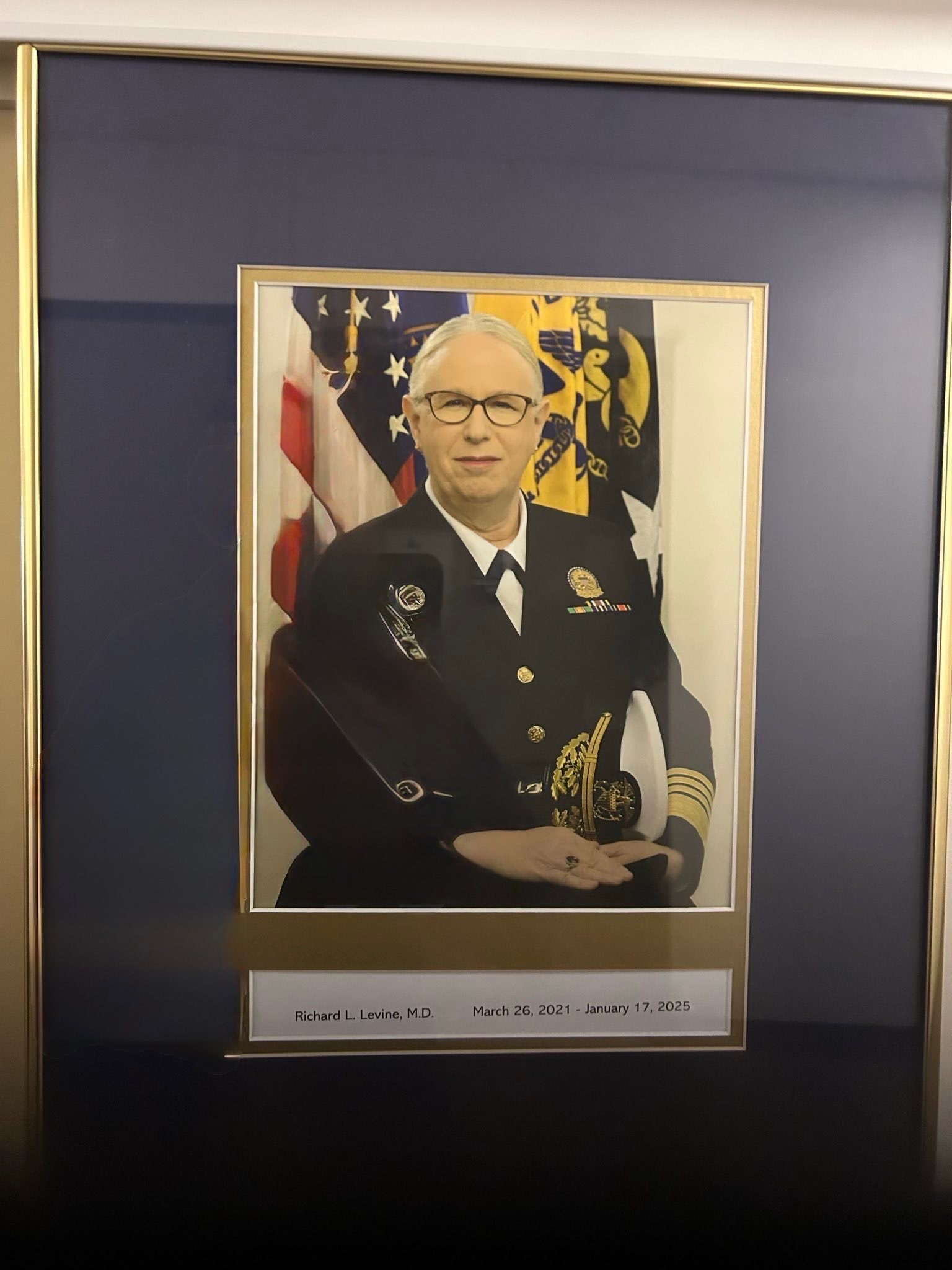
While the federal government was shut down, the U.S. Department of Health and Human Services altered the name under the official portrait of Admiral Rachel Levine, a Pennsylvania doctor who served as the agency’s assistant secretary under former President Joe Biden, to her birth name or “dead name.”
Levine, who had previously served as Pennsylvania physician general and secretary of health under Gov. Tom Wolf, was the first openly transgender official confirmed by the U.S. Senate.
This photograph shows the official portrait of Admiral Rachel Levine, former assistant secretary for health. The portrait hangs in the hallway of the Humphrey Building in Washington, D.C., where Levine served under President Joe Biden at the U.S. Department of Health and Human Services. Someone in the Trump administration changed Levine’s name to her birth name or deadname. The photographer does not want to be identified.
“Deadnaming” — using a transgender person’s birth name rather than the one they chose — is “a horrible thing to do to vilify a group of people,” said Deja Alvarez a LGBTQ community leader. “It’s beyond reprehensible.”
Levine has not spoken publicly about the action, which was first reported Friday by National Public Radio. In a brief statement delivered by her former deputy assistant secretary for health policy Adrian Shanker, Levine described the name change as a “petty action” and said she wouldn’t comment. Shanker, a fellow at the Lehigh University College of Health, manages Levine’s public engagements.
Levine, 68, has received expressions of “sympathy and outrage” since Friday,Shanker said.
Condemning the alteration of Levine’s portrait, he said, it was “hard to understand that this was a priority under a government shutdown.”
”What do you expect from people acting more like high school bullies than federal officials?”
HHS didn’t respond to requests for comment. Agency officials told NPR in a written statement: “Our priority is ensuring that the information presented internally and externally by HHS reflects gold standard science. We remain committed to reversing harmful policies enacted by Levine and ensuring that biological reality guides our approach to public health.”
As Pennsylvania’s health secretary, Levine led the state’s response to COIVID-19 and became a familiar figure in 2020, standing at a lectern in Harrisburg, answering questions about the deadly pandemic.
Prior to the pandemic, Levine led the state’s response to the opioid epidemic. She also helped establish Pennsylvania’s medical marijuana program.
Under Biden, Levine also worked on issues related to HIV, syphilis, climate change, and long COVID.
Levine was a pediatrician who worked at Penn State Health Milton S. Hershey Medical Center for 20 years before moving into public life.
Throughout her career, Levine “earned … recognition through decades of expertise and leadership,” said State Rep. Dan Frankel (D., Allegheny) in a statement Tuesday. HHS’s decision to “strip [her legal] name is an act of political malice.”
The Trump administration has made numerous efforts to counter civil rights gains transgender and LGBTQ Americans had previously won.
These include issuing an executive order on Jan. 20 that redefined the word “sex” in federal programs and services to refer only to biological characteristics “at conception” as well as restricting gender-affirming medical care for people under age 19, banning trans Americans from military service and eliminating protections for transgender people.
Staff writer Gillian McGoldrick contributed to this article.
It’s December, by far the coldest week of the season to date and due to get colder, but to Jeff Hulbert, the Brandywine Valley these days evoke July — July at the Jersey Shore, that is.
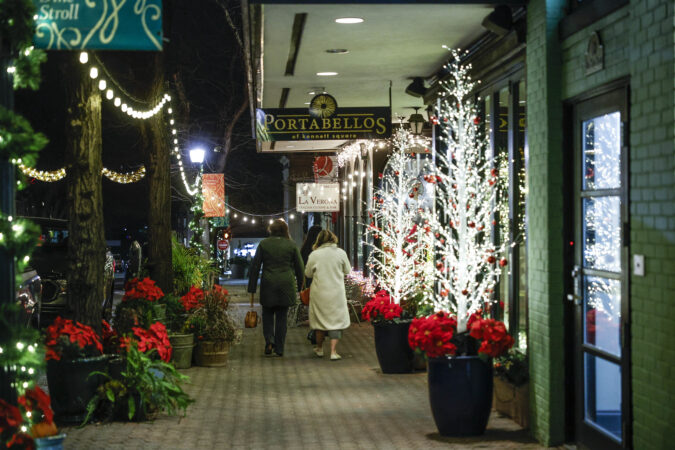
Business has been brisk, and the human traffic thick along State Street, where he and partner Sandra Morris own and operate the popular Portabello’s of Kennett Square restaurant.
Like the peak summer weeks at the Shore, where Hulbert used to work in Atlantic City, this time of year, the Kennett Square area “is twice as busy.” The reason, in a word, is “Longwood.”
Specifically, the annual “Longwood Christmas” festival, an “economic engine” not only for Kennett but for other towns in the region, said Cheryl B. Kuhn, CEO of the Southern Chester County Chamber of Commerce.
Longwood has played a “significant role in the area’s growth,” said Nancy Toltain, director of hotel operations at the Hilton Garden Inn in Kennett. Some guests book their reservations a year in advance, she said.
This year, the merchants on Kennett Street got a jump on the season by turning on the holiday lights and staging the July Fourth-style parade — complete with Mummers and a marching band — on Nov. 22, a week earlier than usual.
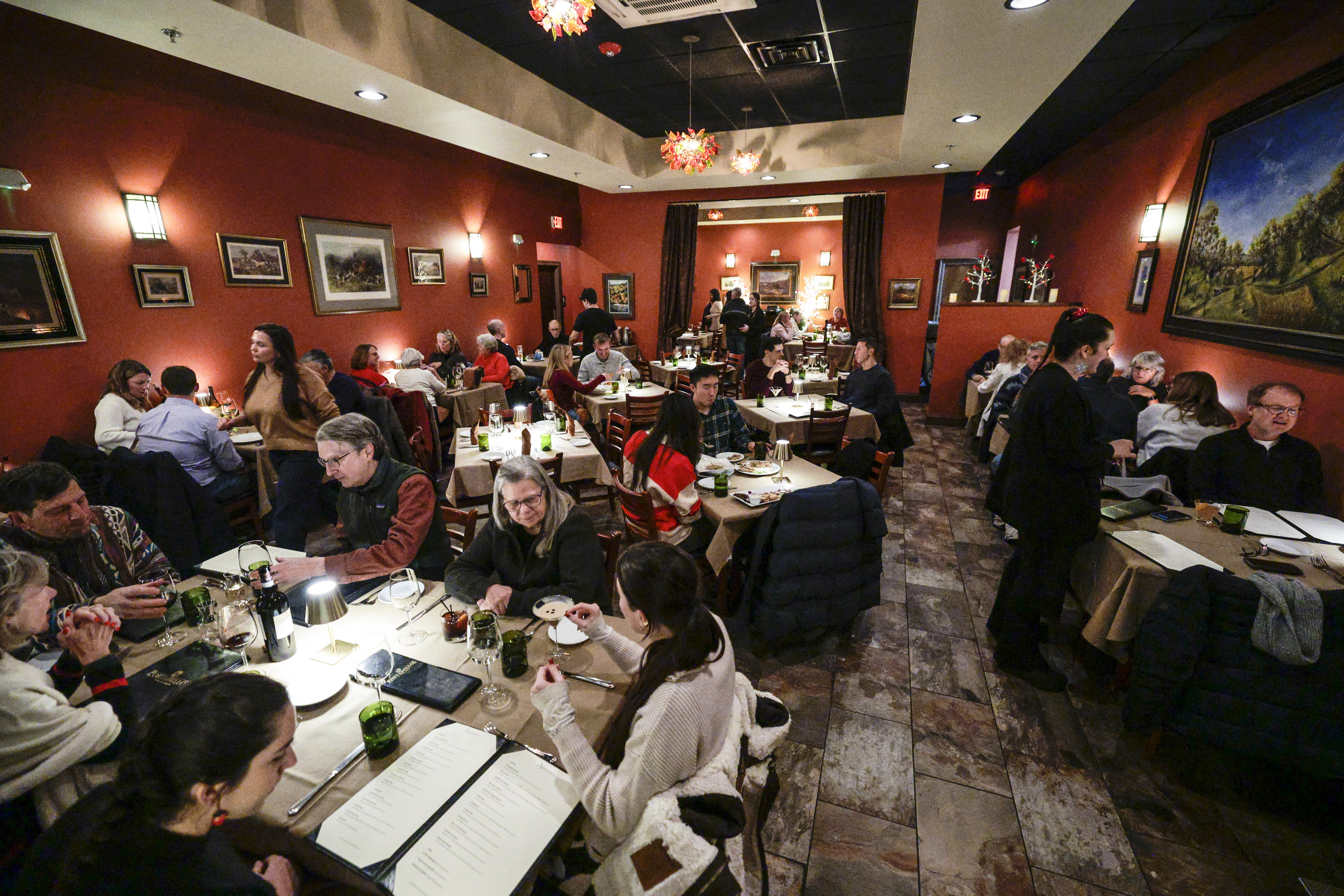
Diners at Portabello’s on Friday evening.
It was no coincidence that the event coincided with the first weekend that Longwood, four miles to the northeast and about twice the size of the borough, was throwing the switch to illuminate about 500,000 lights for its annual “Longwood Christmas” festival.
The exuberance is understandable. The Longwood light show is a cause for celebration among the merchants in downtown Kennett Square, a time when business, shall we say, mushrooms in the so-called Mushroom Capital of the World.
Longwood Christmas is a huge draw — 650,000 people visited last season, which ran from Nov. 22, 2024, to Jan. 11, 2025 — one-third of the annual total. And a whole lot of those who bonded with the plants and the lights ended up in downtown Kennett eating or shopping.
Moving up the Kennett fest paid immediate dividends, said Daniel Embree, executive director of the Kennett Collaborative, a nonprofit development group that works with Kennett businesses.
Downtown merchants reported “record-breaking” sales Thanksgiving week, he said, and it gave them five pre-Christmas weekends to make hay, rather than four. They’re planning an encore early start next year.
Sandra Morris said she and Hulbert will be ready, that in the run-up to the Longwood Christmas, “We know that we need to be staffed up and ready.”
Local business people and tourism officials say the region’s diverse population and attractions, in addition to Longwood, are tourist draws.
The Brandywine Museum in Chadds Ford, famous for its Wyeth family paintings, not to mention its elaborate toy train set, and northern Delaware’s Winterthur, with a museum renowned for its Americana collection and its walking paths winding through 1,000 pastoral acres, have long lured holiday crowds.
But if the area could be likened to a decorated room, Longwood would be the lighted tree with the star on top.
“If there were no Longwood Gardens, there would be no Portabello’s,” said Hulbert.
About the Gardens and the Longwood effect
The theme for Longwood Christmas in 2021 was Fire and Ice, a study in contrasts.
Longwood Gardens, located on land that Pierre DuPont opened to the public in 1921, is one of the nation’s preeminent horticultural attractions.
It covers about 1,100 acres, the majority of which is in East Marlborough Township, with the rest in Kennett and Pennsbury Townships. (It has a Kennett Square postal address, but none of it is in the borough, popular perception notwithstanding.)
About 1.78 million people visited in the fiscal year that ended Sept. 30, said spokesperson Patricia Evans, more than double the total of 15 years ago. According to its tax filing for the previous fiscal year, it generated about $35 million in admission and restaurant revenue.
Longwood’s $250 million investment in new buildings and landscaping, part of the “Longwood Reimagined” project, was completed just before last season’s Longwood Christmas, and that likely contributed to a 7% increase in the holiday traffic, compared with last season, Evans said.
All the land and its building are worth about $160 million, according to Chester County tax records.
Close to 90% of that is tax exempt, Longwood having won a landmark case in the late 1990s, but local officials and business people say the region has reaped significant economic benefits from the gardens.
“Longwood is an excellent regional partner,” said Chester County Tourism’s Nina Kelly.
While the biggest impacts have been on local tourism and hotels, the presence of Longwood probably has given a boost to property values in the area, at least indirectly, said Geoffrey Bosley owner of the local real estate concern LGB Properties & The Market at Liberty Place, a food court and event space on State Street.
In Kennett Square, aggregate commercial property values have increased nearly 30% in the last 20 years, adjusting for inflation,state tax records show.
Longwood and Kennett Square
Portabello’s Restaurant with the owners, Sandra Morris and Brett Hulbert.
Kennett Square, literally a square mile, is home to many of those who work in the local mushroom industry. Latino residents constitute about half the borough’s population.
Its median household income, about $75,000, according to Census figures, is among the lowest in Chester County and about half that of some of its wealthier neighboring towns.
Tourism, particularly Longwood-related, has been a huge boon to the businesses by any measure.
While the town has just under 6,000 residents, it has a total restaurant seating capacity of 2,000, said Hulbert.
In all, the downtown has about 150 businesses, said Embree. Part of the allure is Kennett Square’s quaintness and unaffected small-town atmosphere, but Longwood is a huge factor. “That’s why they want to be here,” he said.
Said Hulbert, “When Longwood Gardens is slow, we are slow. When they are busy, we are busy.”
While moving up the Kennett Square’s holiday parade gave sales a healthy boost, “I don’t want to overstate the significance of the date,” Embree said.
Longwood has supported the Kennett Collaborative financially and in other ways, said Embree. The illuminated decorative bunting on State Street was donated by Longwood, a highlight in the conservatory during the 2023 display.
Said Geoffrey Bosley, “I don’t think you would have as robust a town if we didn’t have a Longwood that would drive so much traffic, especially during the holiday season.”
One man, buried under $20,000 in online gambling debt, became homeless. A woman lost $13,000 and missed her last five mortgage payments. A mother gambled away her son’s college tuition, piling up over $100,000 in debt.
Such dire stories — shared with gambling helplines in Pennsylvania and New Jersey in recent years — are on the rise. And for the growing number of people, the problem isn’t the casino, but the apps on their phones that let them gamble anywhere, 24-7.
“My family is hosting fundraisers for my son who had a stroke, and here I am, gambling on my phone,” one caller said. “What’s wrong with me?”
The Philadelphia media market — which encompasses the city, Southeastern Pennsylvania, and central and southern New Jersey — has become an epicenter of online gambling in the United States. In 2024, internet gaming and sports wagering revenues alone topped $6 billion in Pennsylvania and New Jersey, up from about $3.6 billion in 2021.
In the same period, the number of calls and texts to 1-800-GAMBLER rose in both Pennsylvania and New Jersey, two of only six states in the U.S. where both sports betting and online casino games are legal. But calls about online gambling problems rose significantly more — 180% in Pennsylvania and 160% in New Jersey in that period. In 2019, only about one in 10 Pennsylvania callers said online gambling was the main issue. By 2024, it was every other caller.
window.addEventListener(“message”,function(a){if(void 0!==a.data[“datawrapper-height”]){var e=document.querySelectorAll(“iframe”);for(var t in a.data[“datawrapper-height”])for(var r,i=0;r=e[i];i++)if(r.contentWindow===a.source){var d=a.data[“datawrapper-height”][t]+”px”;r.style.height=d}}});
The Inquirer analyzed anonymized helpline call logs, state revenue reports, and advertising data to shed light on how the Philadelphia-area market has become a hub for the online gambling industry. An increasing volume of gamblers face financial devastation as they struggle to get off the apps.
As of this fall, the Philadelphia media market outpaced New York City and Las Vegas as the No. 1 market for internet gambling advertisement, with companies spending more than $37 million on ads between January and September, according to data provided by Nielsen Ad Intel.
As many as 30% of Pennsylvania adults now gamble on online sports with some regularity, according to researchers at Pennsylvania State University who conduct an annual, state-funded survey of online gambling. And as many as 6% of Pennsylvanians, or 785,000 people, are estimated to be problem gamblers, according to the most recent survey, which is not yet published.
While problem gambling has a range of severity, the American Psychiatric Association recognizes it as a mental health condition. A gambling disorder is defined by a persistent pattern of problematic betting with an inability to limit or stop, leading to emotional, financial, and or relational distress.
For many, the losses are crushing. In New Jersey, helpline callers reported a combined $28 million in debt at least among people who disclosed this financial information, averaging about $34,000 for each of these callers. In Pennsylvania, 60% of those people willing to share said they owed money, though the state does not track totals.
Across both states, callers reported they had drained entire retirement accounts, lost homes to bank foreclosure, or blown through entire paychecks. One anonymous caller in New Jersey reported losing $400,000 in a single night — his life savings.
“We [also] have people who call us and say, ‘I think I’m doing this too much. I think I need a little bit of help,’” said Josh Ercole, executive director of the Council on Compulsive Gambling of Pennsylvania, the state-funded nonprofit that runs the hotline for the commonwealth’s residents.
Four calls made in New Jersey between 2023 and 2024 were about children under the age of 12 struggling with gambling problems, according to the state’s fiscal year report. Ten other calls were about children under the age of 18. In Pennsylvania, 10 calls involved children between the ages of 13 and 17.
Experts say the explosion of sports betting and casino apps has fueled what is increasingly seen as a public health crisis, as gambling profits and state tax revenues derived from them have soared since sports betting’s legalization in 2018. And Philadelphia is now viewed as something of a promised land for e-gambling boosters.
window.addEventListener(“message”,function(a){if(void 0!==a.data[“datawrapper-height”]){var e=document.querySelectorAll(“iframe”);for(var t in a.data[“datawrapper-height”])for(var r,i=0;r=e[i];i++)if(r.contentWindow===a.source){var d=a.data[“datawrapper-height”][t]+”px”;r.style.height=d}}});
Uttara Madurai Ananthakrishnan, an economics professor at the University of Washington who has studied the psychology of gambling, said lawmakers have struggled to keep pace with the industry’s meteoric growth.
“I don’t think people expected it to explode at this level,” said Madurai Ananthakrishnan, who previously worked in Pennsylvania. “All of this is going to slowly add up and cause a ton of issues downstream.”
Harrisburg also benefited handsomely from the high rollers, drawing $165 million last year in gambling taxes, up from $46 million five years prior. About $10 million was earmarked for gambling addiction helplines and treatment programs, which came directly from industry profits.
Online betting now accounts for nearly half of all gambling revenue in Pennsylvania, according to an Inquirer analysis of state reports. Pennsylvanians wagered a staggering $8.3 billion during the 2024-25 fiscal year in online sports betting alone, making it by far the most popular gambling method. Total revenue for sportsbook and iGaming sites rose past $2.9 billion last year.
window.addEventListener(“message”,function(a){if(void 0!==a.data[“datawrapper-height”]){var e=document.querySelectorAll(“iframe”);for(var t in a.data[“datawrapper-height”])for(var r,i=0;r=e[i];i++)if(r.contentWindow===a.source){var d=a.data[“datawrapper-height”][t]+”px”;r.style.height=d}}});
In New Jersey gaming revenue was nearly $6.3 billion in 2024 — $3.3 billion of which came from internet gaming and sports wagering, according to the state’s Casino Control Commission’s annual report.
Yet the amount spent online is almost certainly higher than what states can track — as is the number of people who have developed online problems.
Caron Treatment Center, a Pennsylvania-based substance use treatment facility, said 160 people in their inpatient treatment problem were struggling with gambling this year — a 162% increase from five years ago.
“I’ve been getting call after call about gambling,” said Eric Webber, a behavioral health specialist and gambling counselor at Caron. “It’s a national crisis that doesn’t have a national solution.”
Fewer than two dozen gambling sites are technically legal in Pennsylvania. But thanks to pervasive online advertising, many gamblers now use so-called offshore gambling sites that are not regulated by the state.
As of last year, more than 20% of online gamblers were using these illegal or unregulated sites, according to the 2024 Penn State report. Such sites often lack state-mandated guardrails like easily allowing users to set weekly betting limits or request a “self-exclusion” — avoluntary ban from licensed casinos, internet-based gambling, video gaming terminals, and fantasy sports wagering.
Self-exclusions in Pennsylvania are higher this year than last year — 8,315 people have already opted out compared with the 7,489 people who requested a ban through Dec. 31 of last year.
Major online sportsbooks say they are going above and beyond.
Beyond self-imposed spending limits, FanDuel, one of the largest sports betting advertisers in the Philadelphia market, introduced a dashboard to allow gamblers to track their spending habits. The company also began tracking betting patterns on its platform and alerting customers when they bet more than their normal wager.
“When users attempt to deposit significantly more than their predicted amount, we surface that information to them and prompt them to reduce their deposit or to set a go-forward deposit limit,” a FanDuel spokesperson said.
DraftKings, in a statement, said it works closely with a gambling company alliance to support responsible betting, “leveraging technology to help detect signs of potentially problematic behavior.”
Some lawmakers want to see more regulation.State Rep. Tarik Khan, a Democrat who represents parts of Montgomery County and Philadelphia, has called for hearings to examine best practices to rein in an industry that he said heavily targets youth.
“More and more people, especially young people, are getting addicted to it, and blowing large portions of their paychecks on feeding this addiction,” Khan said. “It’s already pervasive, and it’s going to get worse.”
‘I’ve gambled everything away on FanDuel’
In New Jersey, more than half of the callers to gambling hotlines who disclosed their age were under 35. In Pennsylvania, people under 35 accounted for 41% of callers.
“Things have shifted to a younger crowd,” said Ercole, of the Council on Compulsive Gambling of Pennsylvania. “Typically our highest call volume used to be in the 35 to 55 ranges.”
People from all professions are affected — nurses, construction workers, software engineers, chefs, attorneys, postal workers, microbiologists, and tattoo artists. Some are students, retirees, or unemployed.
Regardless of one’s income level, online gambling can put serious strain on personal and professional lives. Some people told of losing contact with their parents, getting divorced, or being cut off from friends.
Others lost jobs or had their homes and cars repossessed.
“I have nothing,” a 30-year-old caller told a New Jersey helpline operator in 2023. “I’ve gambled everything away on FanDuel.”
Most people are calling about their own gambling problems. But dozens of family members called to ask for help with their loved ones’ betting. In one case, a woman asked if she could use her father’s Social Security number to ban him from online betting apps.
Many gamblers do not call the hotlines or seek professional help until they face financial ruin or they are confronted by family members.
At the height of his problem, one man from New Jersey started gambling on Russian table tennis matches and Australian basketball games. His wife, who spoke to The Inquirer on condition of anonymity to discuss a sensitive family matter, said his compulsion had grown so severe that he needed a fix to hold him over between sports seasons.
“He was betting $1,000 on a sport he knows nothing about, played by people he’s never heard of before,” his wife said.
The husband kept his gambling hidden for her years, until she found his secret bank account — along with two dozen maxed-out credit cards and records of tribal loans he had taken out, one of them with a 300% interest rate. She also learned that, in 2021, he had quietly lost $70,000 while the newlyweds were on their honeymoon in France.
“It’s horrifying,” she said.
FanDuel, DraftKings and other online gambling apps are displayed on a phone. (AP Photo/Jeff Chiu, File)
The casino-to-app pipeline
Across Pennsylvania, as of 2024, people sought help for addiction to internet games more than any other type of gambling, especially in the suburbs.
In Montgomery County, the most common type of gambling problem cited was internet slots — with 47 calls. In Bucks, internet sports had the highest volume with 34 calls.
In Philadelphia, home to both Live! Casino and Rivers Casino, in-person games remain the largest reported problem for struggling gamblers, according to call center logs.
Some brick-and-mortar casinos, however, have seen business drop as bettors migrate to their phones. At Rivers Casino Philadelphia, sports-betting revenue fell from $29 million in fiscal 2019 — the first full year of legal wagering — to $11 million in 2024, according to state records.
But even in Philadelphia, a county with two casinos, the number of calls and texts for online gambling shot up in recent years. And experts say that people who gamble exclusively online show heightened risk.
“You can get cut off at the casino. You could walk away from the machine,” said Gillian Russell, an assistant Penn State professor who works on the annual online gambling survey. “Those things that maybe cause breaks, a lot of those things are removed.”
About 13% of people who gamble both online and in person were classified as problem or pathological gamblers, according to the 2024 Penn State survey. Online-only gamblers, though just 3% of the total gambling population, showed even greater risk: 37% fell into problem categories.
Prop bets, the practice of betting on various occurrences within a game rather than just the outcome, are a pointed concern. Such wagers have come under scrutiny as bet-fixing schemes ensnare athletes from the NBA, MLB, the NCAA, and even niche sports like table tennis.
Among normal gamblers, however, prop bettors are far more likely to develop problems, Russell said. Webber, the gambling counselor, likened in-game prop betting to a constant stream of small dopamine hits, which create a kind of withdrawal.
And with gambling sites offering bonus cash and rewards points, he said, the temptation can feel constant.
“DraftKings says, ‘Hey, I haven’t seen you in a couple weeks, here’s $50.’ The local beer distributor doesn’t say, ‘Hey, you haven’t been here in a while, here’s a cold six-pack,’” he said. “That doesn’t help somebody who’s struggling.”
A smattering of people pushed their luck Tuesday at the Mount Airy Casino Resort, tapping neon slot buttons, flipping dice onto felt craps tables, and wandering the rows of glowing, dinging machines.
A floor below, President Donald Trump was set to speak in a sprawling ballroom, where event staff hung a huge blue banner: LOWER PRICES, BIGGER PAYCHECKS.
Trump picked this casino in the Pocono Mountains to deliver the first big economic speech of his presidency as polls show Americans are feeling the pain of high prices — and many are blaming him.
But the contrast at the casino was hard to miss: the steady slot machine chimes of financial risk and uncertainty above and a president’s promises of stability and revival on the floor below.
How’s the economy working for Rosemary Migli?
“It could be better,” saidthe 73-year-old retired bartender from Tobyhanna, taking a puff of a cigarette before winning 35 cents on a spin.
Despite a frenzy of police and Secret Service, many gamblers, focused on their own troubles or celebrations, did not realize the president was coming. An older retired couple enjoyed an afternoon together with no obligations. Nearby, a recently widowed woman said the monotony of the slots helps her cope with her loss.
Peter Jean-Baptiste celebrated his 33rd birthday at the casino with his fiancee. The Philadelphia-based couple are saving for a wedding next year.
“It’s tough for everyone just trying to make a living, honest people trying to make a living,” Jean-Baptiste said. “One day you feel like [Trump’s] got your back, the next day he doesn’t.”
Jean-Baptiste, who works in property insurance, said he has also seen housing prices rise. And, as a child of Haitian immigrant parents, he is struggling with how Trump’s anti-Haitian verbal attacks and immigration crackdowns have affected his family.
“He does a bunch of hot takes and causes division between American citizens,” Jean-Baptiste said. “When, I feel, we really all just want to get along and get by.”
Mount Pocono is a region with mixed fortunes: Wealthy retirees have second vacation homes here, while lower-income workers are employed in warehouses and hold up the tourism industry. The area is also a hub for New York City commuters who moved here for more affordable housing.
“We live on a fixed income. We watch what we spend,” said Julie Dietz, sitting beside her husband, Glenn, as she played a buffalo-themed slot game. The Toms River, N.J., couple gamble for a few hours every now and then. She was a paralegal and he worked evaluating industrial facilities for safety before they retired.
“We know what our limitations are,” Dietz, 71, said. “Yes, food prices have gone up, but I’ve also seen some things come down — gas prices in our area. And the economy took so many years to get to this point.”
Dietz, who supported Trump in the last election, thinks an economic rebound is just going to take more time.
“He’s been in office 11 months. Eleven months. So I feel full confidence that he is going to do what he said he’s going to do. Everybody wants things immediately.”
Kathy F., who didn’t want to give her last name talking about politics and gambling, joined her husband at the casino Tuesday, despite her misgivings about losing money at a time when prices are going up.
“I go to Costco and everything is $5 more than it used to be. That’s a lot,” she said, bundled in a puffy black coat as her husband gambled nearby.
“I really don’t understand politics,” said the retired New York City civil servant, who voted for then-Vice President Kamala Harris last year. “It seems like they just fight with each other nonstop when all people want is to be able to afford to live.”
As he stretched his legs between games, Stephen Miller — “not that Stephen Miller,” he clarified — laughed off the notion of going to see Trump in person a floor below.
“If I want to see him, all I have to do is turn on the TV. He’s on at 12, he’s on at 3, he’s on at 5, seven days a week.”
The 75-year-old retired contractor supports Trump, though, and called the economy “half-decent.” He said food prices are high but eggs have gone down.
“The economy is glacial, so it moves slow. Democrats are definitely locked onto the affordability. But affordability means, what? It means whatever you want it to mean.”
Miller glanced down at a few vouchers in his hand to set off for the next set of machines.
“I’m not winning yet, but I will be and the Donald will be,” he said. “Give it time.”
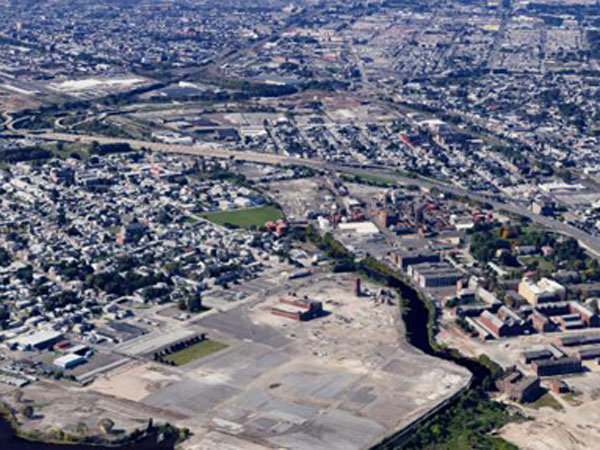
Joseph Cooney joined the Philadelphia Police Department’s narcotics unit in 1998. For eight years, the officer began and finished each workday at the unit’s headquarters on the site of the old Frankford Arsenal in Philadelphia’s Bridesburg section, where munitions were manufactured and tested from the Civil War through the Vietnam War.
Cooney, 53, said he would joke with his colleagues that “we’ll all be glowing in the dark someday” because of the materials left behind in the ground and the chemical plants across the Frankford Creek. In 2024, that joke became a dark reality for Cooney when he was diagnosed with glioblastoma, an aggressive and incurable brain cancer.
In a lawsuit, filed along with lawsuits by the families of two narcotics officers who died of the disease, Cooney links his cancer to radioactive and toxic materials that had not been properly remediated when the munitions factory shut down and the site was converted to a business park.
The lawsuit, filed Monday in Common Pleas Court, accuses the Philadelphia Authority for Industrial Development, developer Mark Hankin, and Hankin’s businesses of having known about risks of exposure but failing to warn those working in the location or properly remediate the harm.
“This type of cancer, at the end of the day, it’s a death sentence,” Cooney said. “When you go to work every day, you don’t expect to be dealing with this.”
The Philadelphia Authority for Industrial Development declined to comment. Hankin did not respond to requests for comment.
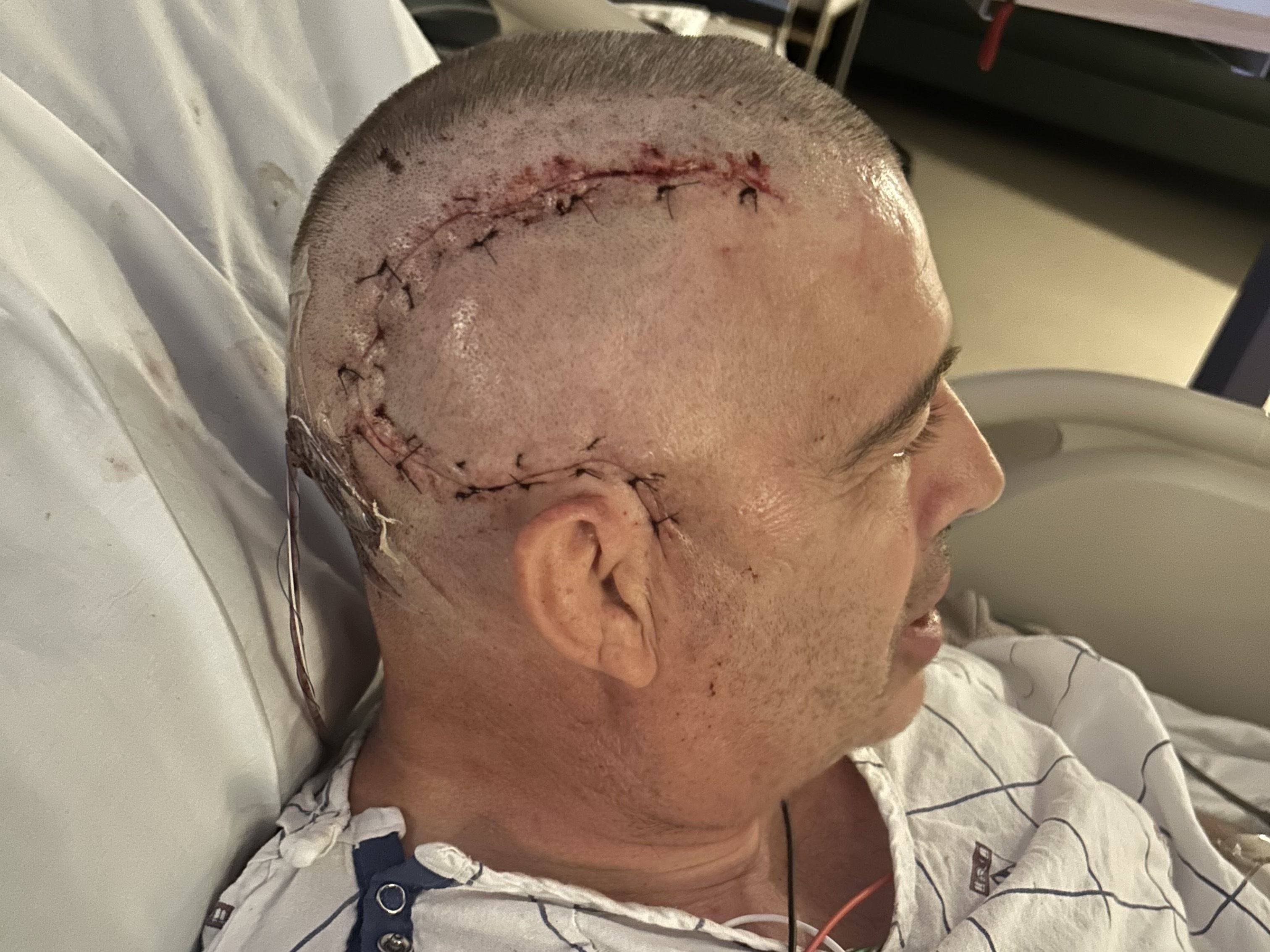
Joseph Cooney, a police officer who was diagnosed with glioblastoma in 2024, seen after his third surgery in July 2025.
‘The street that beat Hitler’
The Frankford Arsenal opened in 1816 as a weapons storage and repair shop for the U.S. Army, and in 1849 became the country’s largest developer and manufacturer of small arms and artillery shells. The arsenal’s campus grew over the years, including a massive expansion during World War II. By the end of the war, workers fondly referred to it as “the street that beat Hitler.”
Each war throughout the century-plus of the arsenal’s existence brought its own challenges, and the complex between Bridge Street, Tacony Street, and the Frankford Creek adapted to support the nation’s military needs.
This woman is loading powder into cartridges of .30 caliber tracer bullets in the assembly division of the Frankford Arsenal in Philadelphia, Penn., on July 27, 1940 during World War II. (AP Photo)
The arsenal closed in 1977 and the authority for industrial development, an agency with a mayor-appointed board, became the campus’ steward. Hankin, a Montgomery County developer, bought the campus in the 1980s and transformed it into a business park, which included the narcotics unit headquarters from the early 1990s until 2015.
As soon as the arsenal closed, decontamination needs were discussed, newspaper articles from the time show. An official report found the existence of dangerous materials in buildings in 1981, before the property was converted to civilian use, the lawsuits say.
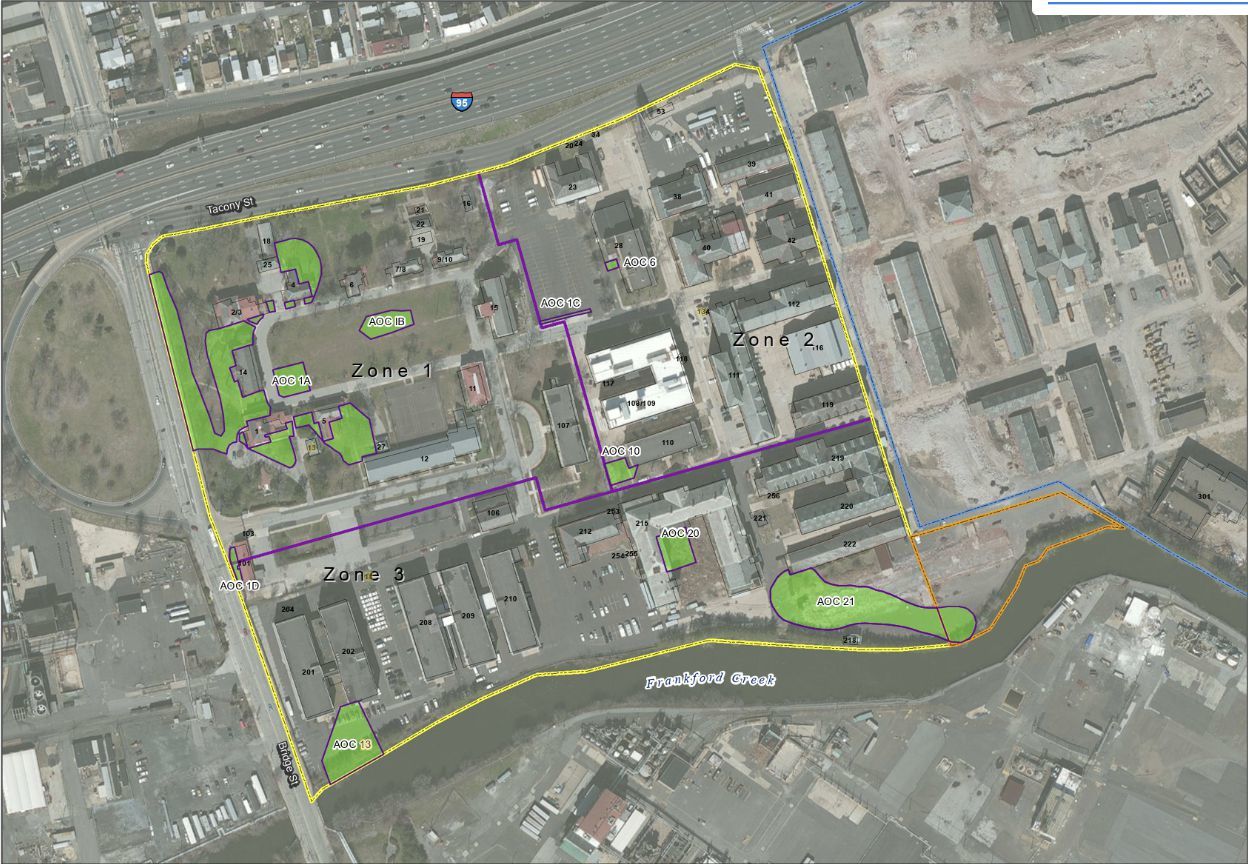
Throughout the 2000s, the U.S. Army Corps of Engineers, in a series of reports, flagged concerns over dangers in the old arsenal’s ground. A 2016 report found elevated concentrations of lead and potentially cancer-causing substances in six areas that posed “unacceptable risk or potential concerns to future human receptors.”
One of the areas of concern noted in the report sits atop building 202 — the narcotics unit’s former home.
A map showing areas of concern for hazardous materials at the Frankford Arsenal site, from a 2016 report on a feasibility study conducted by the U.S. Army Corp of Engineers.
The common denominator
Cooney has been hearing over the past decades about colleagues from his narcotics unit days who have gotten sick.
Michael Deal, who spent 37 years on the police force and joined the narcotics unit in 1994, was diagnosed with glioblastoma in 2018 and died the next year at age 64. Then, in 2023, Andrew Schafer, a 20-year veteran who worked at narcotics from 2002 to 2015, also was diagnosed with the brain cancer. He died in March at age 51.
The families of Deal and Schafer also filed lawsuits similar to Cooney’s.
Cooney heard through the grapevine about other cases. And then he was diagnosed.
“Everyone sat down, started talking,” Cooney said. “The only common denominator was everybody worked in the same building.”
Adding to their concern were the adjacent chemical plants, Cooney said.
Fifty-four employees of the Rohm & Haas chemical plant, right across the Frankford Creek from the arsenal, died of lung cancer in the 1960s and early ’70s, the Philadelphia Daily News reported in 1981.
The current suits allege that the contaminants in the arsenal ground were not properly cleaned up, and that those working at the site were not warned despite a series of reports.
“The remediation was not done to the extent that it eliminated the risk,“ saidWilliam Davis, the attorney who filed the suits. ”Up until now we have no evidence that there was any warning to any tenants.”
Cooney still works as a police officer, with a desk job supporting the city’s SWAT team. He has lost much of his independence to the disease, which can be slowed but not cured. He can no longer drive or coach youth sports, and relies on a cane to walk.
The officer is concerned about who will take care of his wife and their seven children once he is gone, and Cooney is especially worried for the health of one of his daughters— a biology teacher at Franklin Towne Charter High School, which sits on the arsenal’s old site.
Typical Philadelphia-area retail workers would need to make more than twice their annual wages to afford the region’s median-priced apartment, according to Redfin.
Retail workers in the Philadelphia metropolitan area, which includes Camden and Wilmington, made a median of $35,006 in 2024. But to comfortably afford the median monthly rent for an apartment in the area in October — $1,783 —they would need to make a median of $71,331, according to a report Redfin published last month.
In all 40 of the major areas Redfin analyzed, typical retail workers make less money than they need to afford the median rent for an apartment.
“As the cost of living has increased, so have the sacrifices renters must make to afford a place to live,” Daryl Fairweather, Redfin’s chief economist, said in a statement. “Since most retail workers don’t earn enough to afford the typical apartment, many are opting to share rent with a family member or friend, move far away from their job, or live in a very small space.”
A typical U.S. retail worker would have to work 83 hours per week to afford the typical apartment alone.
Renters struggling
Rents are considered affordable if they are no more than 30% of a renter’s income. A growing number of Philadelphia renters are spending more than 33% of their income and struggling to pay rent, according to Census Bureau data.
In a nationwide survey in May of about 1,600 renters, almost one in four said they regularly or greatly struggle to afford housing costs, Redfin found. Renters said they were diningout less, taking fewer vacations, and borrowing money from family and friends to pay their rent.
In Redfin’s November report, even retail workers with wages in the top 25% earn 44% less than they need to afford the median-priced apartment.
Data on rent affordability for retail workers in the Philadelphia metro area closely mirror national trends.The typical U.S. retail worker made $34,436 in 2024 but would need to make $71,172 to afford the typical apartment, priced at $1,779 in October.
Rents have gotten slightly more affordable for the typical retail worker in the last few years. Prices aren’t rising as much because of all the apartments that have been built in recent years.
window.addEventListener(“message”,function(a){if(void 0!==a.data[“datawrapper-height”]){var e=document.querySelectorAll(“iframe”);for(var t in a.data[“datawrapper-height”])for(var r,i=0;r=e[i];i++)if(r.contentWindow===a.source){var d=a.data[“datawrapper-height”][t]+”px”;r.style.height=d}}});
Bigger gaps in New York
Redfin analyzed wage data from the U.S. Bureau of Labor Statistics, and retail workers fell into three categories: cashiers, retail salespersons, and first-line retail supervisors.
The New York regionhad the biggest gap between what retail workers make and what they need to make to afford an apartment. Workers’ median annual wage was $39,185 in 2024. Workers would need to make $134,896 — almost 3½ times as much. The median apartment rent in October was $3,372.
The affordability gap for retail workers was smallest in Cleveland’s metro area — $31,982 vs. $47,654.
Editor’s note: A previous version of this story misstated the definition of the study’s metro area.
Alternative Middle Years at James Martin, in Port Richmond, is all but finished and ready for students to occupy after winter break.
Community members, district officials, and dignitaries gathered Tuesday to take tours and trumpet the new construction, a bright spot in a district grappling with a large stock of aging and sometimes environmentally troubled buildings.
“This is what growth looks like,” said Paula Furman, AMY at James Martin’s principal. The middle school educates 200 students in grades 6, 7, and 8.
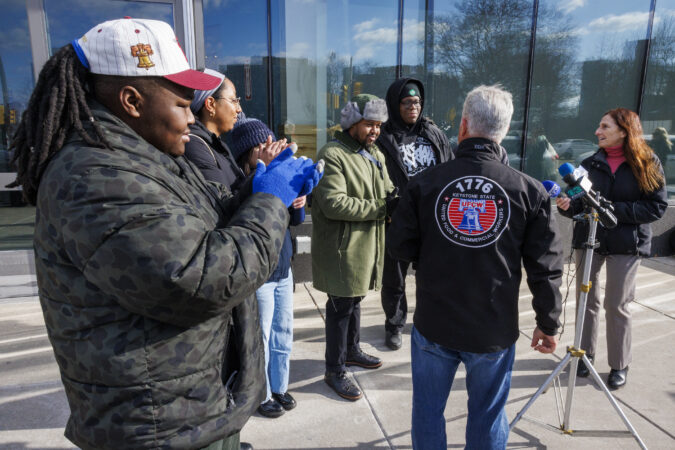
Superintendent Tony B. Watlington Sr. and Debora Carrera, the city’s chief education officer, applaud a student performance Tuesday at AMY at James Martin, a new middle school in Port Richmond.
Sarah-Ashley Andrews, the school board vice president, noted that of the district’s roughly 300 buildings, more than 200 were built before 1978.
“Projects like this underscore why continued investment is essential,” said Andrews.
On time, on budget
Inside, the 88,000-square-foot, four-story structure at Richmond and Westmoreland Streets just off I-95 is a marvel: all light and flexible seating, makerspace, “digital flex lab” (think: computer lab), and “gymnatorium” (spiffy gym and auditorium). It has modern science labs, dedicated spaces for instrumental and vocal music, and a killer view of Center City from its rooftop outdoor classroom.
The outdoor space with a view of the Center City skyline at the new AMY at James Martin school.
The school replaces an 1894 structure razed to make way for new construction. It is the Philadelphia School District’s sixth new building in 10 years.
“It is kind of crazy, just the giant leap forward that students will be taking, just in terms of furniture, not to mention the technology,” said Melanie Lewin, a district school facilities planner who led tours of the new building. AMY at James Martin students, who have been temporarily learning in classrooms at Penn Treaty High School, used to learn in a 19th-century building; they’re relocating to a building with built-in charging outlets and “noodle chairs” that let them fidget securely while in class.
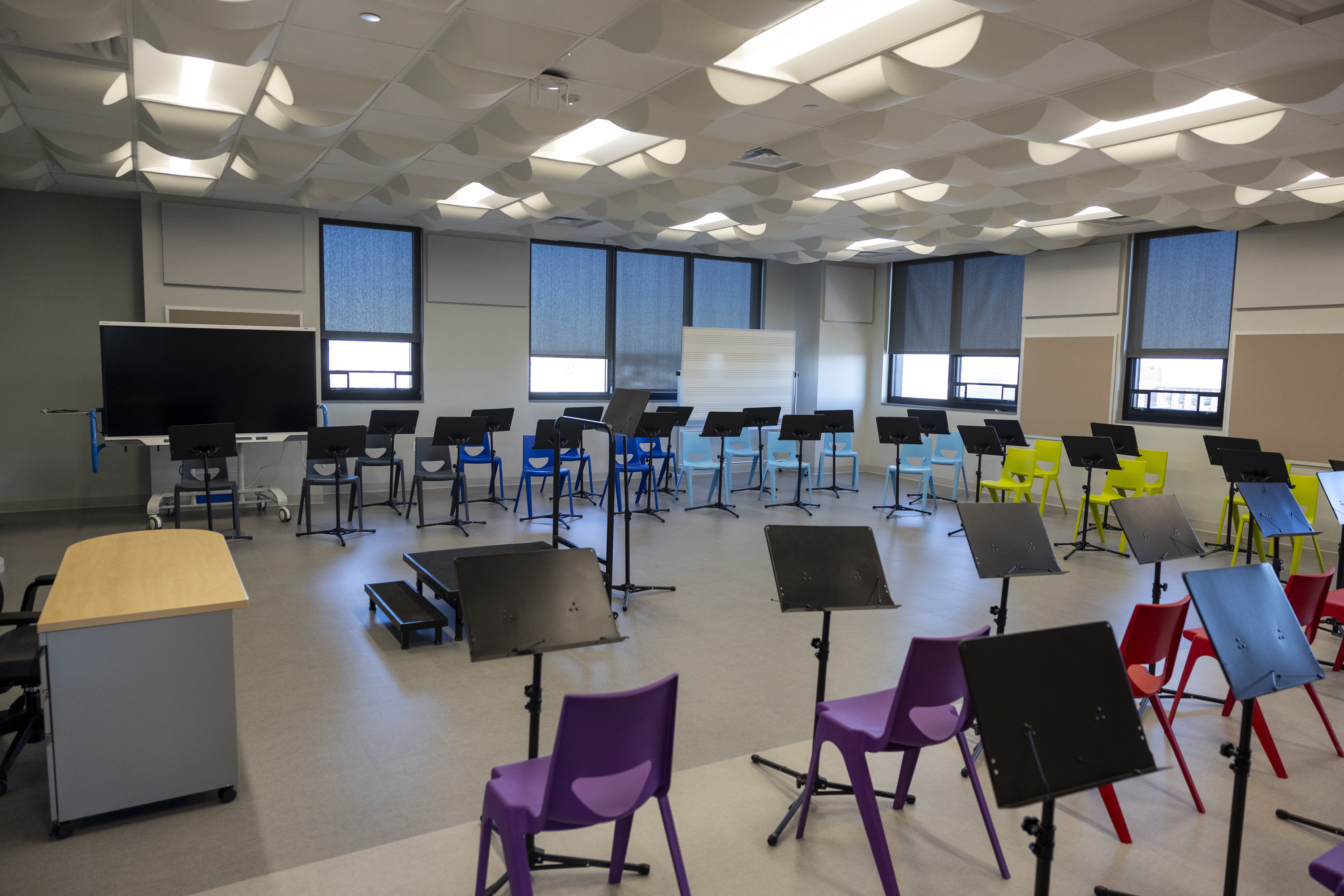
The instrumental music classroom at the new Amy at James Martin School in Philadelphia.
“This school was not just built to look fantastic,” Watlington said. “I want everyone to know that it was built on time and on budget. That is no easy feat when the price of everything is going up — inflation, tariffs, everything.”
Some neighbors showed up at Tuesday’s ribbon-cutting to celebrate. But the process was controversial at first — some protested the loss of the old AMY at James Martin historic site.
City Councilmember Mike Driscoll alluded to the past pain on Tuesday.
“It’s been a struggle, I’ll admit that,” Driscoll said. But, he said, the new school is lovely. “When you see the plans on paper, it doesn’t do it justice.”
A looming facilities master plan
AMY at James Martin’s opening comes with the district approaching a crossroads: Officials are awaiting a years-in-the-making facilities master plan, the first in decades.
While schools in the Northeast and in a few other spots are overcrowded or nearing capacity, schools in many parts of the city are dramatically underenrolled.
Custom cushioned seats in a classroom at the new Amy at James Martin School in Philadelphia.
Officials have said that some schools will likely cease to exist as part of the process, now expected to culminate early next year with Watlington making recommendations to the school board for grade reconfigurations, closures, co-locations, significant renovations, and new construction.
AMY at James Martin, in its current form, is likely to come in under the district’s minimum recommended school size, at 200 students. The school’s capacity is 500, officials said.
But Casey Laine hopes the school count grows by two in January.
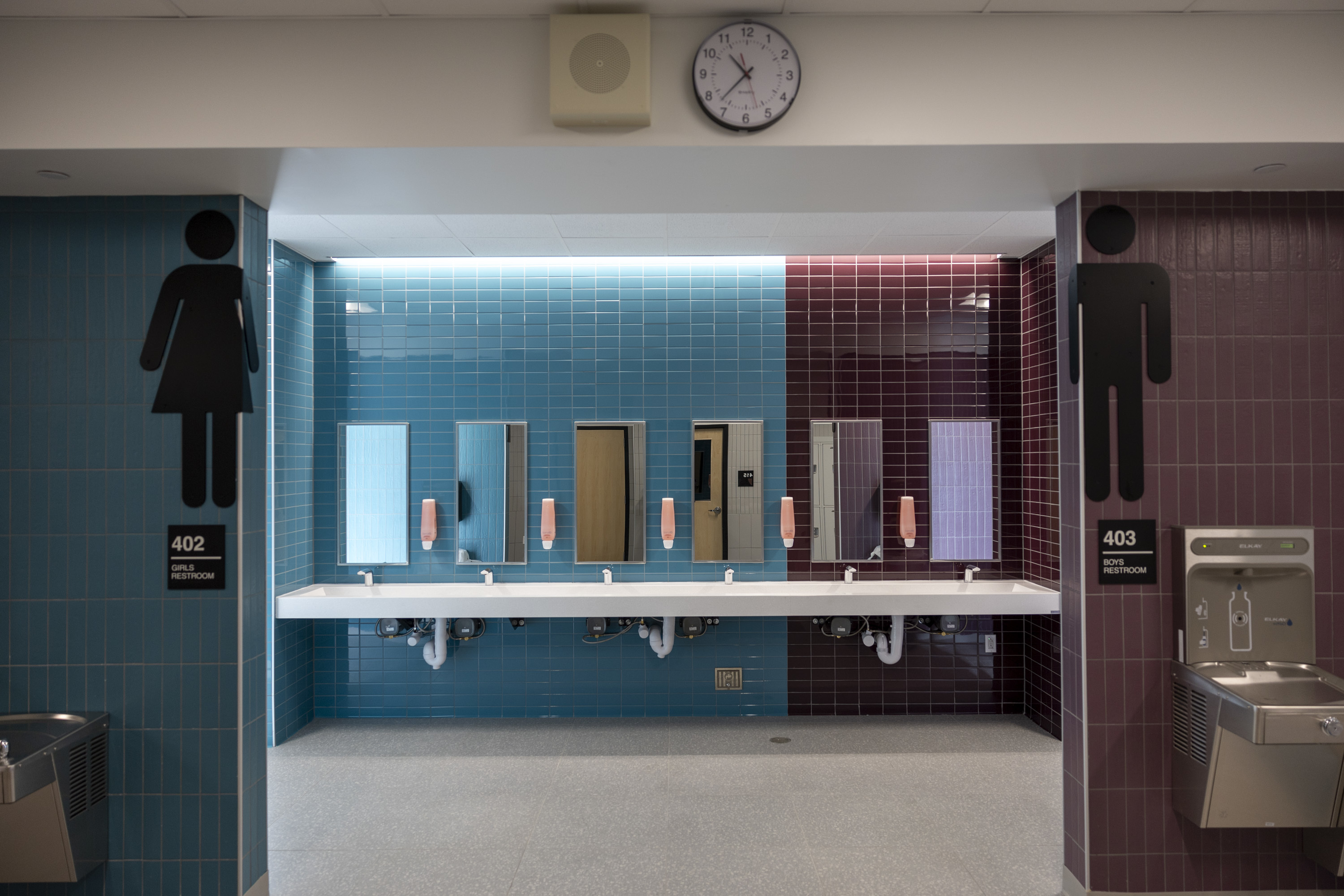
One of the bathrooms for students at the new Amy at James Martin School in Philadelphia.
Laine, who lives around the corner from the new AMY at James Martin and attended Tuesday’s ribbon-cutting, is the mother of a sixth and seventh grader who currently attend Bridesburg Elementary.
She’d like her kids, a son and daughter, to transfer to AMY at James Martin if possible.
“This is beautiful,” Laine said. “I’m so excited.”
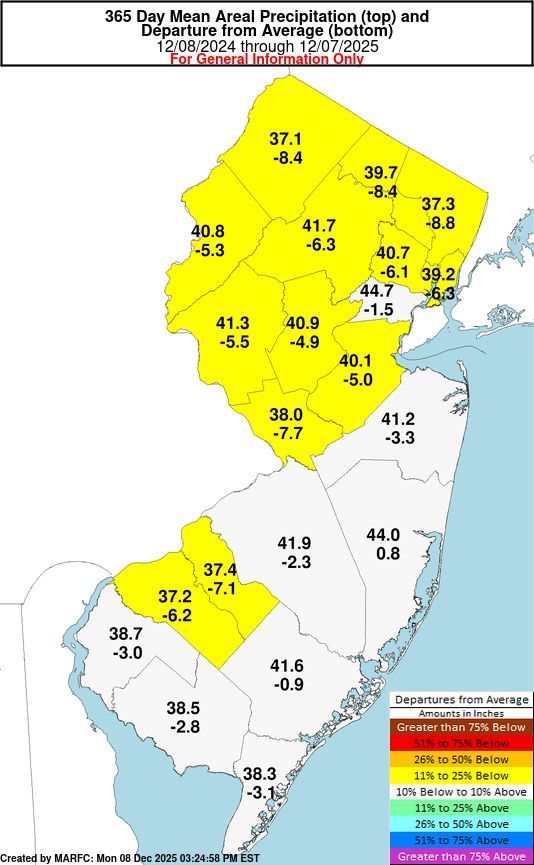
In some regions, rainfall has plunged as much as eight inches below average for the past year, straining reservoirs, streams, and aquifers enough that the state Department of Environmental Protection has issued a drought warning — a notch shy of an emergency.
As a result, officials are asking residents to voluntarily curtail water use. Should conditions deteriorate, officials may impose mandatory restrictions on certain uses of water, though such measures are rarely invoked.
Map shows precipitation well below normal over the 365 days ending Dec. 7, 2025.
DEP Commissioner Shawn LaTourette said in a statement on Friday’s announcement that there is an “urgency of the need to conserve water.”
“The precipitation and water supply uncertainty we’ve experienced over the past year is a symptom of the impacts of climate change here in New Jersey,” LaTourette said.
It’s the second year the state is looking at a drought.
The last drought warning was issued in November 2024. That declaration came as firefighters had fought multiple simultaneous wildfires, one deadly, that broke out across the state amid dry, windy conditions.
That warning was lifted in June following record rainfall for some parts of the state in May.
Up to 8 inches below normal
However, the state overall has experienced below-average precipitation for more than a year, officials said.
New Jersey officials cited data from the Middle Atlantic River Forecast Center operated by the National Weather Service.
That data shows that Burlington, Camden, and Gloucester Counties are all running nearly four inches below average over the past 90 days.
Burlington County is running more than seven inches below normal for the past 365 days, and Camden County is running more than six inches below normal for the same period.
Northwestern New Jersey is running more than eight inches below normal over the past year.
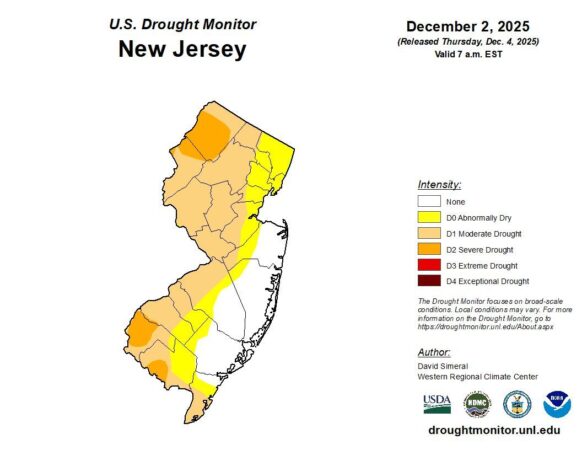
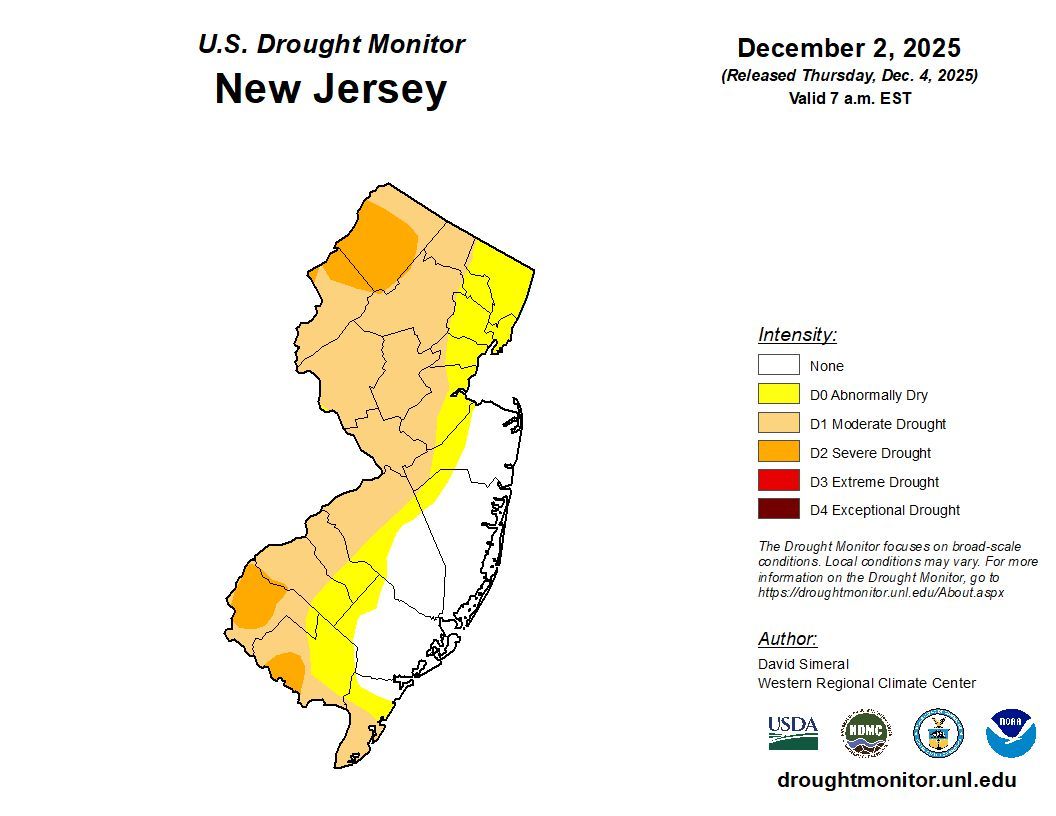
Likewise, the U.S Drought Monitor, a partnership of the University of Nebraska-Lincoln’s National Drought Mitigation Center and multiple federal agencies, shows the South Jersey counties along the Delaware River in either a moderate or severe drought.
About 3.5 million residents of New Jersey live in a drought-impacted area.
Officials said recent rains have not made much difference, considering the size of the gap. Ocean County is one of the few areas of the state with near-normal precipitation levels.
Map by the U.S. Drought Monitor shows that multiple counties in South Jersey are in a moderate to severe drought.
An update on rainfall and drought data is expected Wednesday.
State officials use multiple sources to determine the impact of rainfall on water supplies. Those include reservoir levels, stream flows, and groundwater (aquifers).
South Jersey counties, such as Burlington, Camden, Gloucester, and Salem, rely primarily on groundwater but also use water from the Delaware River and other rivers and streams.
Drought indicators for groundwater levels in South Jersey are designated as extremely dry while precipitation and stream flows are severely dry.
Officials say the persistent dryness has resulted in “observable stress across all specific indicators.” Nearly all regions of the state are classified as being severely or extremely dry.
Pennsylvania is also dry. Last week, the Commonwealth Drought Task Force said 37 counties are under a drought watch, although none in Southeastern Pennsylvania. A drought watch means an area has received 25% less rain over three months than normal. It is the lowest of three levels of drought declarations in Pennsylvania.
How to conserve
In New Jersey, officials have issued some tips on conserving water, such as:
Run dish and clothes washers only when full.
Turn off and winterize outdoor pipes and irrigation systems.
Check pipes for leaks.
Use a commercial car wash that recycles water.
Compost vegetable food waste instead of running the garbage disposal.
Installing a low-flow toilet can save up to 1,000 gallons per year.
Installing a low-flow shower head can save 7,700 gallons per year.
Installing newer faucets and aerators can save 16,000 gallons per year.
Kevin Bean was a frail 125 pounds last February when he entered a brand-new recovery house, a facility where he landed after spending four years in the throes of addiction — at times on the streets of Kensington, the epicenter of the city’s drug crisis.
The Frankford native was one of the first residents to enter the Riverview Wellness Village, the 20-acre recovery facility that Mayor Cherelle L. Parker’s administration opened in Northeast Philadelphia nearly a year ago as part of City Hall’s efforts to address opioid addiction and the Kensington drug market.
Bean, now 46 and boasting a healthier frame, just celebrated one year of sobriety and is preparing to move out of Riverview early next year.
He described his transition simply: “whole new life.”
Much of the mayor’s agenda in Kensington has been visible to the neighborhood’s residents, such as increased law enforcement and a reduction in the homeless population. But the operations and treatment outcomesat Riverview, located down a winding road next to the city’s jail complex, happen largely outside of public view. Last spring, some city lawmakers complained that even they knew little about the facility operations.
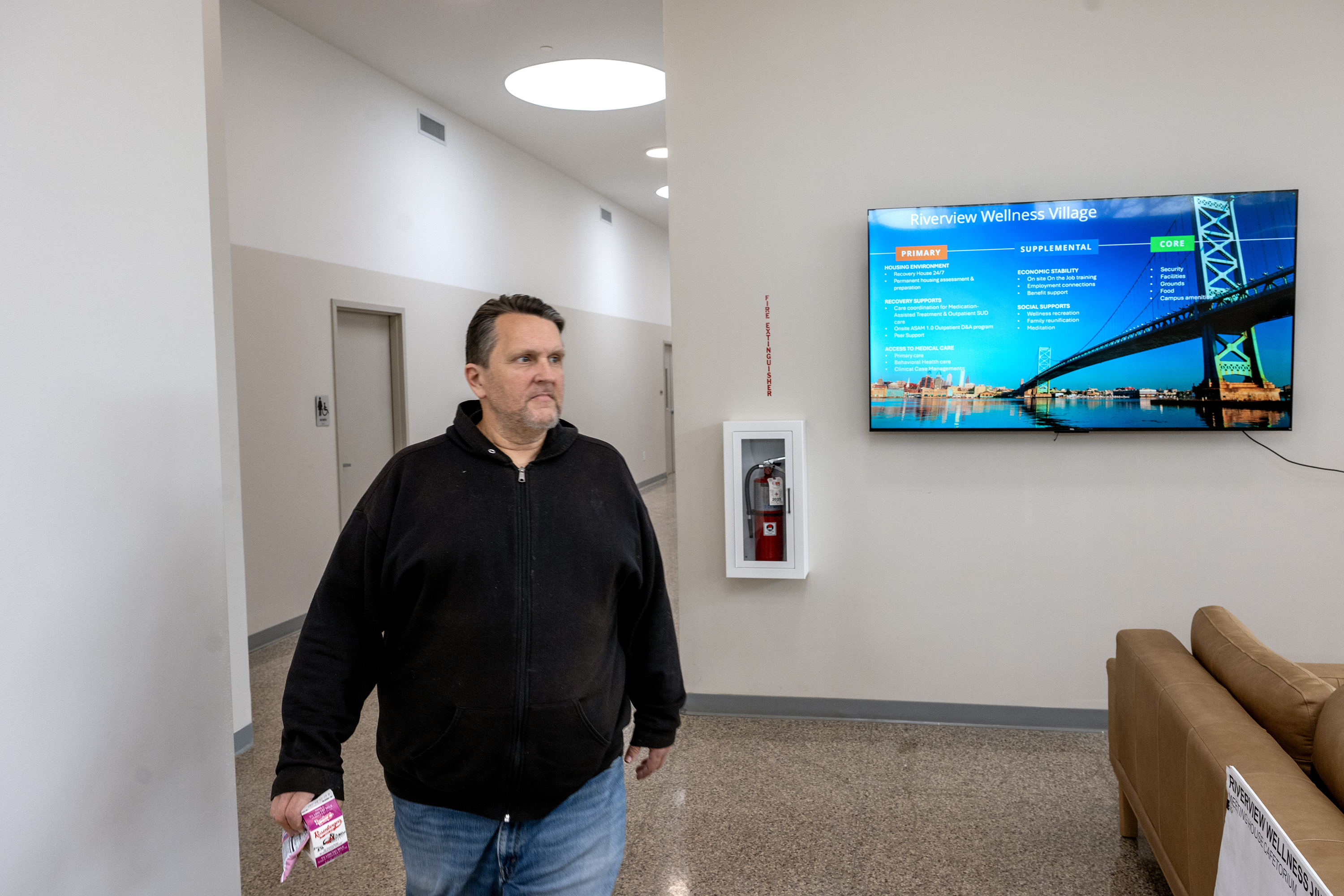
An inside look at the Riverview complex and interviews with more than a dozen residents and employees showed that, over the last year, the city and its third-party healthcare providers have transformed the facility. What was recently a construction zone is now a one-stop health shop with about 75 staff and more than 200 residents, many of whom previously lived on Kensington streets.
Those who live and work at Riverview said the facility is plugging a hole in the city’s substance use treatment landscape. For years, there have not been enough beds in programs that help people transition from hospital-style rehab into long-term stability. The recovery house industry has been plagued with privately run homes that are in poor condition or offer little support.
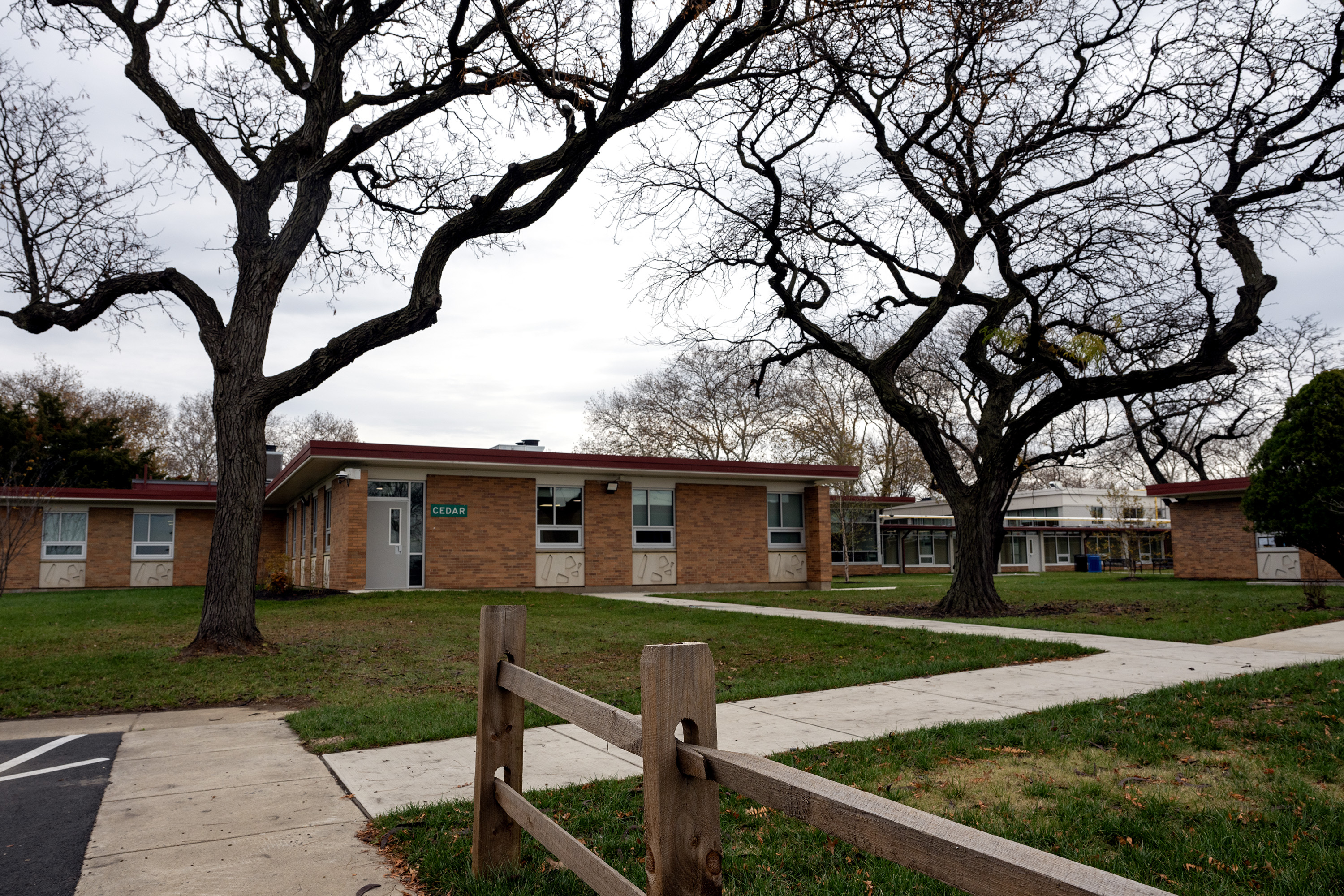
The grounds and residence buildings at Riverview Wellness Village, a city-owned drug recovery home in Northeast Philadelphia.
At its current capacity, Riverview has singularly increased the total number of recovery house beds in the city by nearly 50%. And residents — who are there voluntarily and may come and go as they please — have much of what they need on the campus: medical care, mental health treatment, job training, and group counseling.
They also, as of last month, have access to medication-assisted treatment, which means residents in recovery no longer need to travel to specialized clinics to get a dose of methadone or other drugs that can prevent relapse.
Arthur Fields, the regional executive director at Gaudenzia, which provides recovery services to more than 100 Riverview residents, said the upstart facility has become a desirable option for some of the city’s most vulnerable. Riverview officials said they aren’t aware of anywhere like it in the country.
“The Riverview Wellness Village is proof of what’s possible,” Fields said, “when we work together as a community and move with urgency to help people rebuild their lives.”
While the facility launched in January with much fanfare, it also faced skepticism, including from advocates who were troubled by its proximity to the jails and feared it would feel like incarceration, not treatment. And neighbors expressed concern that the new Holmesburg facility would bring problems long faced by Kensington residents, like open drug use and petty theft, to their front doors.
But despite some tenets of the mayor’s broader Kensington plan still facing intense scrutiny, the vocal opposition to Riverview has largely quieted. Parker said in an interview that seeing the progress at Riverview and the health of its residents made enduring months of criticism “well worth it.”
“I don’t know a Philadelphian who, in some way, shape, or form, hasn’t been touched by mental and behavioral health challenges or substance use disorder,” said Parker, who has spoken about how addiction shaped parts of her own upbringing. “To know that we created a path forward, to me, I’m extremely proud of this team.”
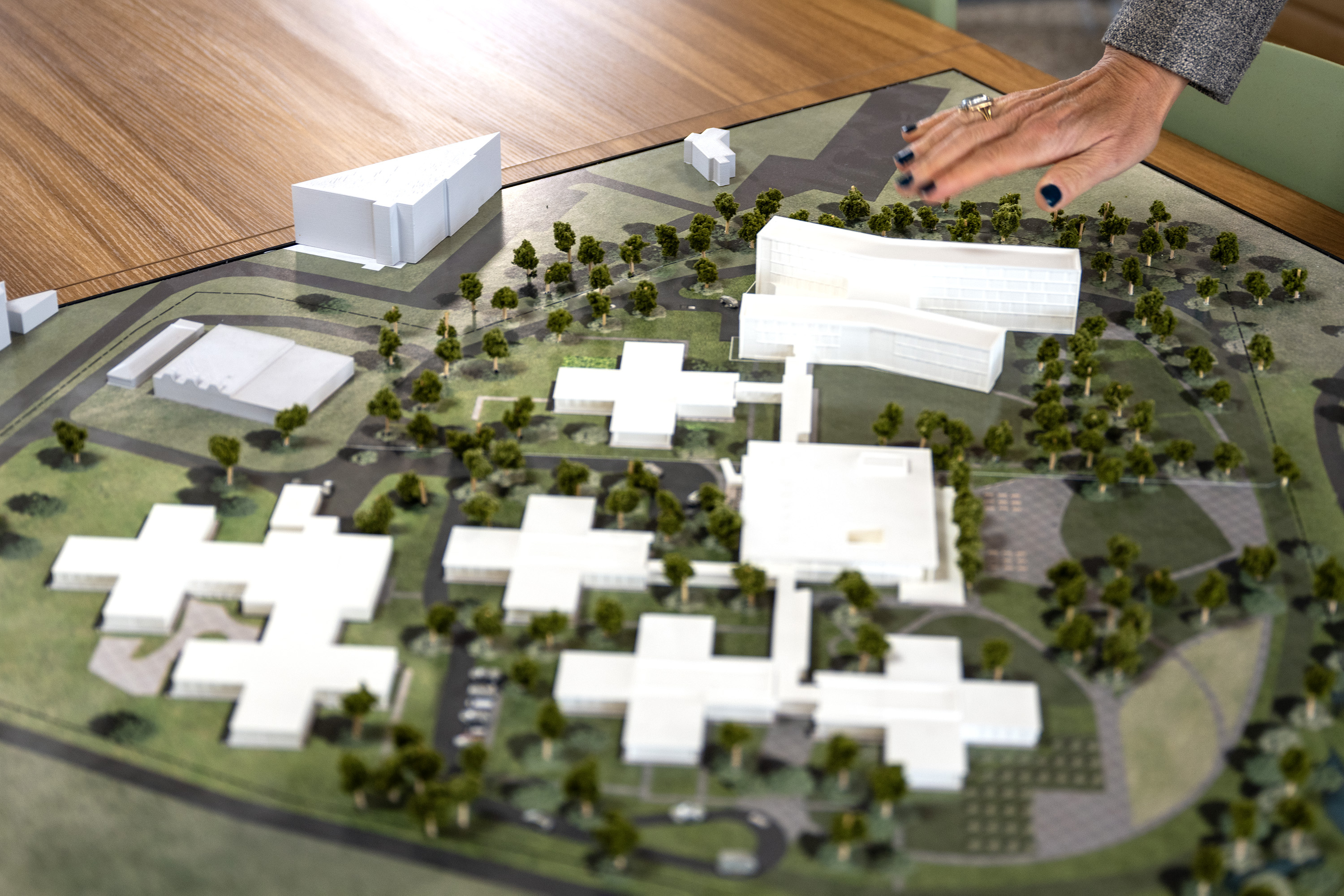
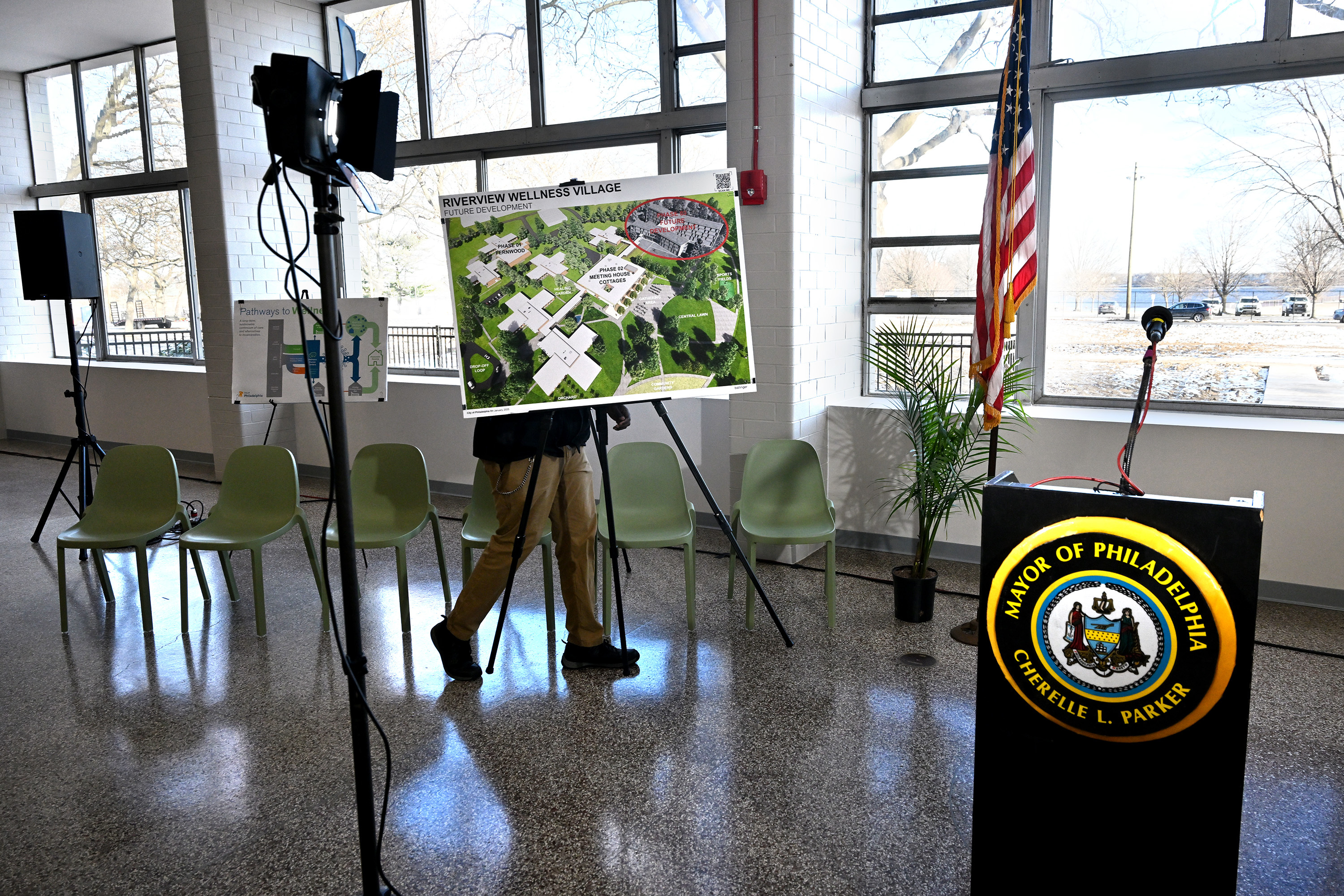
Mayor Cherelle L. Parker places a new block on the scale model of the Riverview Wellness Village on Wednesday, Jan. 8 during the unveiling of Philadelphia’s new city-operated drug treatment facility. At left is Managing Director Adam Thiel. City Councilmember Michael Driscoll is at right.Isabel McDevitt, executive director of the Office of Community Wellness and Recovery, points to a model with upcoming expansion at Riverview Wellness Village, a city-owned drug recovery home in Northeast Philadelphia on Nov. 25.Staffers move photos into place at the Riverview Wellness Village on Jan. 8 before the unveiling of Philadelphia’s new city-operated drug treatment facility.
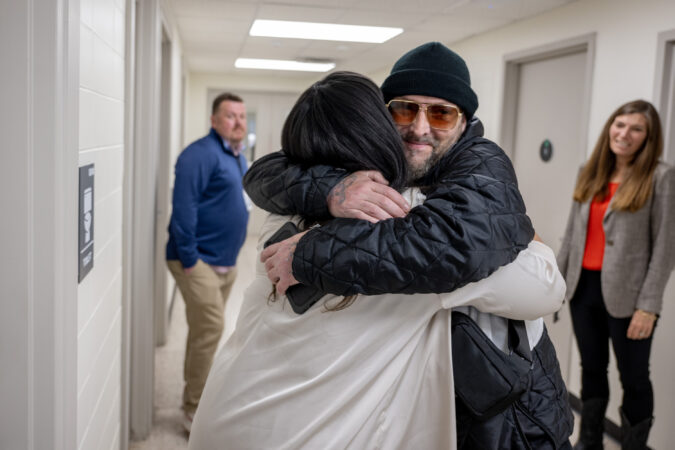
Meanwhile, neighbors who live nearby say they have been pleasantly surprised. Pete Smith, a civic leader who sits on a council of community members who meet regularly with Riverview officials, said plainly: “There have been no issues.”
“If it’s as successful as it looks like it’s going to be,” he said, “this facility could be a model for other cities throughout the country.”
Smith, like many of his neighbors, wants the city’s project at Riverview to work because he knows the consequences if it doesn’t.
His son, Francis Smith, died in September due to health complications from long-term drug use. He was 38, and he had three children.
Getting a spot at Riverview
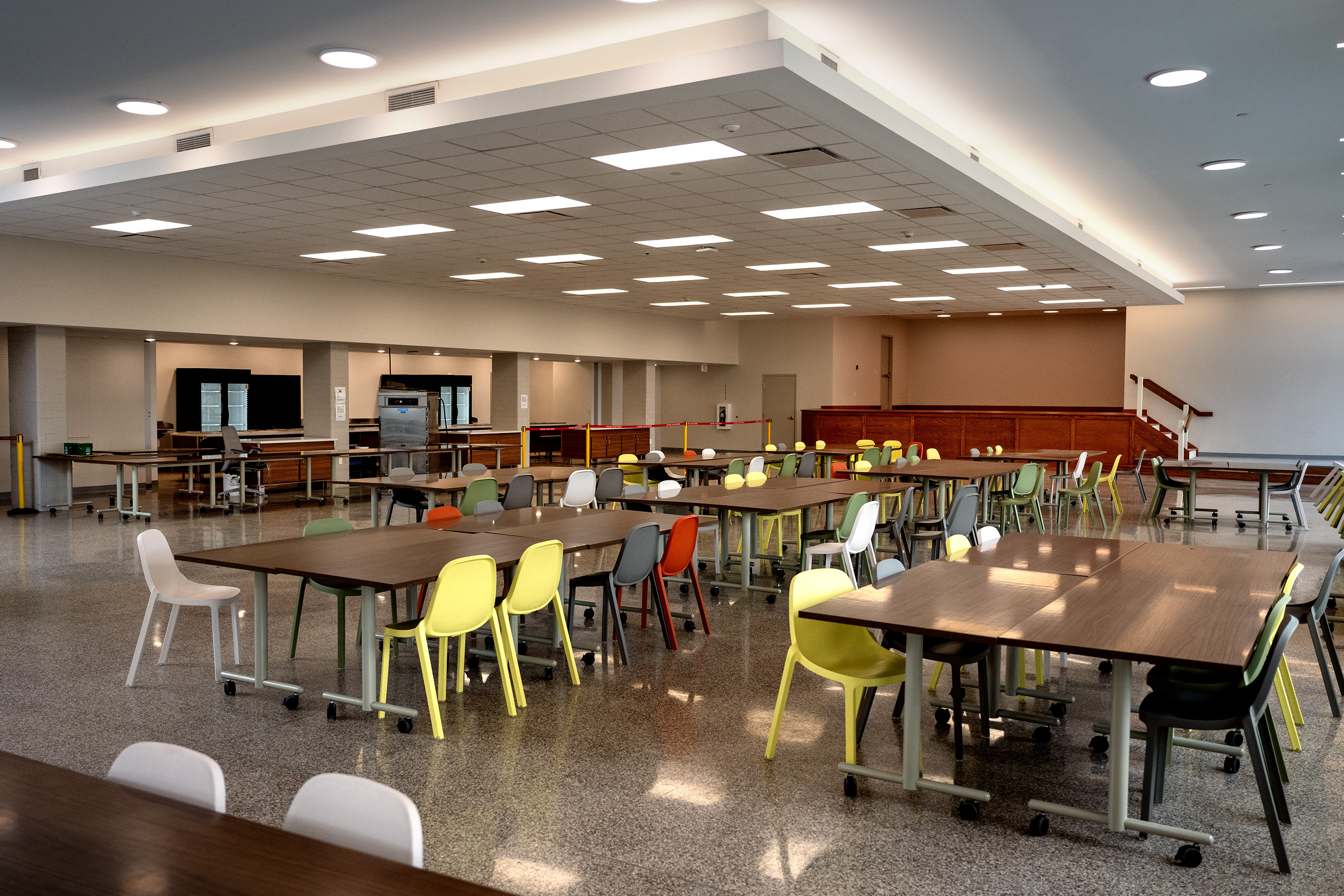
The sprawling campus along the Delaware River feels more like a college dormitory setting than a hospital or homeless shelter. Its main building has a dining room, a commercial kitchen, a gym, and meditation rooms. There are green spaces, walking paths,and plans for massive murals on the interior walls.
Katherine Young, director of Merakey at Riverview Wellness Village, talks with a resident at the city-owned drug recovery home in Northeast Philadelphia on Nov. 25.
Residents live and spend much of their time in smaller buildings on the campus, where nearly 90% of the 234 licensed beds are occupied. The city plans to add 50 more in January.
Their stays are funded through a variety of streams. The city allocated $400 million for five years of construction and operations, a portion of which is settlement dollars from lawsuits against pharmaceutical companies that manufactured the painkillers blamed for the opioid crisis.
(function() {
var l2 = function() {
new pym.Parent(‘RIVERVIEW_MAP2.html’,
‘https://media.inquirer.com/storage/inquirer/projects/innovation/arcgis_iframe/RIVERVIEW_MAP2.html’);
};
if (typeof(pym) === ‘undefined’) {
var h = document.getElementsByTagName(‘head’)[0],
s = document.createElement(‘script’);
s.type = ‘text/javascript’;
s.src = ‘https://pym.nprapps.org/pym.v1.min.js’;
s.onload = l2;
h.appendChild(s);
} else {
l2();
}
})();
To get in to Riverview, a person must complete at least 30 days of inpatient treatment at another, more intensive care facility.
(function() { var l = function() { new pym.Parent( ‘riverview-flowchart__graphic’, ‘https://media.inquirer.com/storage/inquirer/ai2html/riverview-flowchart/index.html’); }; if(typeof(pym) === ‘undefined’) { var h = document.getElementsByTagName(‘head’)[0], s = document.createElement(‘script’); s.type = ‘text/javascript’; s.src = ‘https://pym.nprapps.org/pym.v1.min.js’; s.onload = l; h.appendChild(s); } else { l(); } })();
Still, residents at Riverview have come from more than 25 different providers, according to Isabel McDevitt, the city’s executive director of community wellness and recovery. The bulk were treated at the Kirkbride Center in West Philadelphia, the Behavioral Wellness Center at Girard in North Philadelphia, or Eagleville Hospital in Montgomery County.
They have ranged in age from 28 to 75. And they have complex medical needs: McDevitt said about half of Riverview’s residents have a mental health diagnosis in addition to substance use disorder.
She said offering treatment for multiple health conditions in one place allows residents to focus less on logistics and more on staying healthy.
“Many of the folks that are at Riverview have long histories of substance use disorder, long histories of homelessness,” she said. “So it’s really the first time a lot of people can actually breathe.”
When new residents arrive, they go through an intake process at Riverview that includes acute medical care and an assessment for chronic conditions. Within their first week, every resident receives a total-body physical and a panel of blood work.
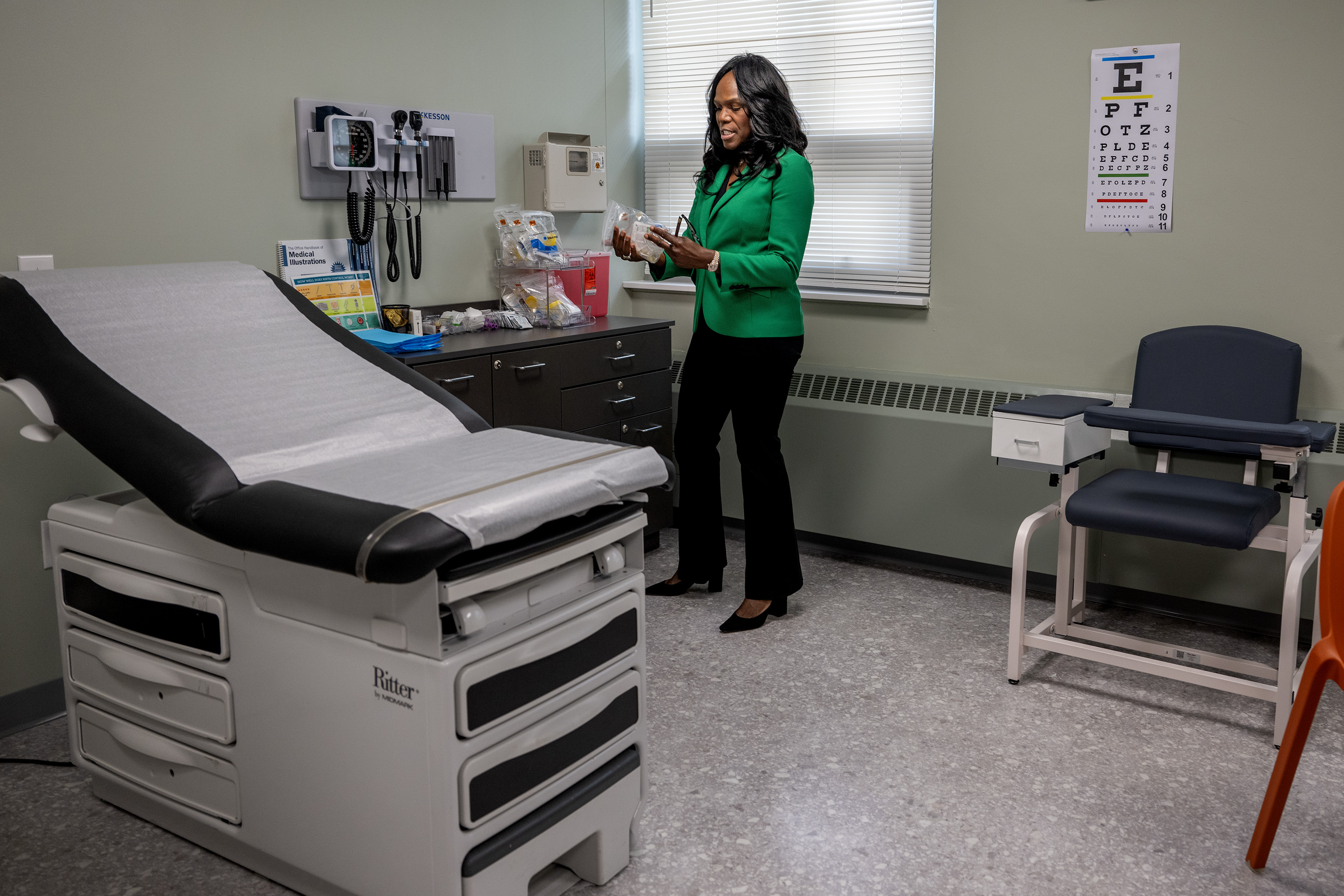
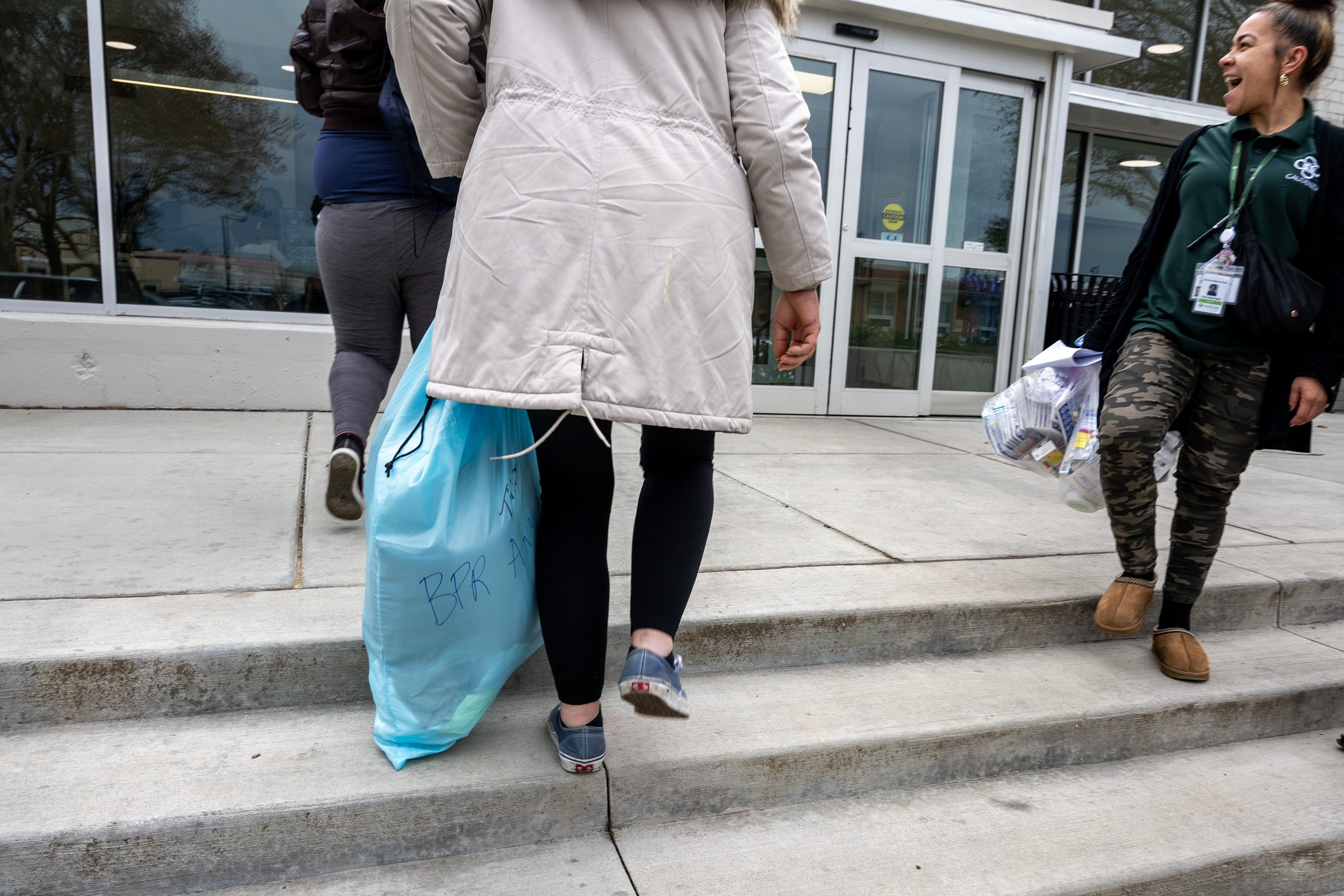
“They literally arrive with all of their belongings in a plastic bag and their medications and some discharge paperwork,” said Ala Stanford, who leads the Black Doctors Consortium, which provides medical services at Riverview. “We are the ones who greet them and help get them acclimated.”
Stanford — who this fall announced a run for Congress — said doctors and nurses at Riverview have diagnosed and treated conditions ranging from drug-related wounds to diabetes to pancreatic cancer. And patients with mental health needs are treated by providers from Warren E. Smith Health Centers, a 30-year-old organization based in North Philadelphia.
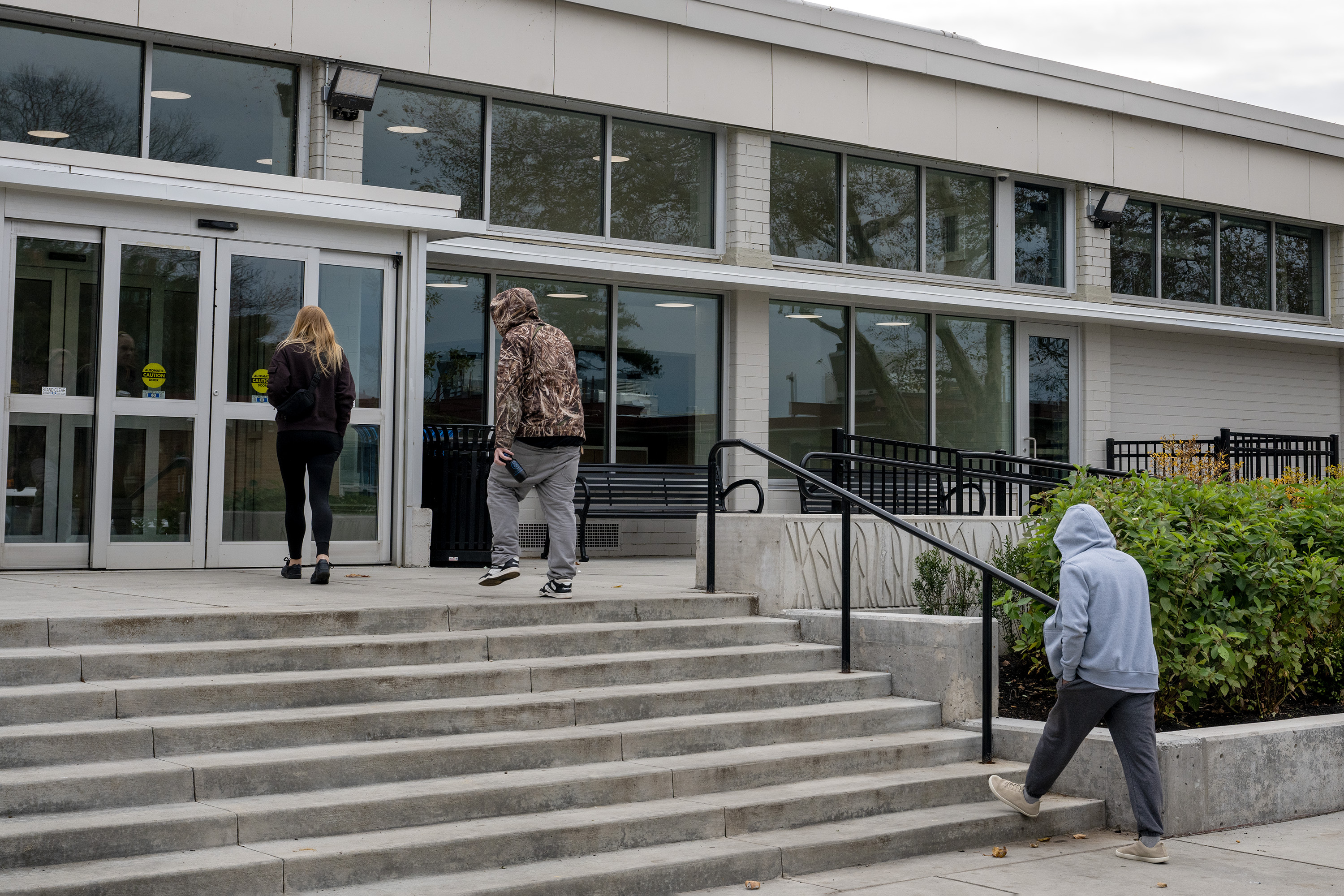
Physician Ala Stanford in an examination room at the primary medical care center run by her Black Doctors Consortium at Riverview Wellness Village, a city-owned drug recovery home in Northeast Philadelphia, on Nov. 25.Francesca Colon (right), a recovery support professional with Gaudenzia, brings people in recovery to the main entrance of the Meetinghouse at Riverview Wellness Village on Nov. 25.
Residents’ schedules are generally free-flowing and can vary depending on their wants and needs. About 20% have jobs outside the campus. Culinary arts training will be available in the next month or so. And residents can meet with visitors or leave to see family at any time.
They also spend much of their time in treatment, including individual, family, and group therapy. On a recent day, there were group sessions available on trauma recovery, managing emotions, and “communicating with confidence.”
Vernon Kostic, a 52-year-old Port Richmond native who said he has previously been homeless, has been in and out of drug treatment facilities for years.
He said he’s been content as a Riverview resident since July, and called it “one of the smartest things that the city has ever done.”
“We have the doctor’s office right over here,” he said. “They’ve got counseling right here. Everything we need. It’s like a one-stop recovery place.”
Resident Vernon Kostic heads to a group meeting at Riverview Wellness Village on Nov. 25.The dining room and meeting room in the Meetinghouse at Riverview Wellness Village. At rear left is a brand-new, industrial, restaurant-quality kitchen that was not operational yet on Nov. 25.
Finding ways to stay at Riverview
Finding success in recovery is notoriously hard. Studies show that people who stay in structured sober housing for at least six months after completing rehab see better long-term outcomes, and Riverview residents may stay there for up to one year.
But reaching that mark can take multiple tries, and some may never attain sobriety. McDevitt said that on a monthly basis, about 35 people move into Riverview, and 20 leave.
Some who move out are reunited with family and want to live at home. Others simply were not ready for recovery, McDevitt said, “and that’s part of working with this population.”
Fields said a resident who relapses can go back to a more intensive care setting for detoxification or withdrawal management, then return to Riverview at a later time if they are interested.
“No one is punished for struggling,” he said. “Recovery is a journey. It takes time.”
Providers are adding new programming they say will help residents extend their stays. Offering medication-assisted treatment is one of the most crucial parts, said Josh Vigderman, the senior executive director of substance use services at Merakey, one of the addiction treatment providers at Riverview.
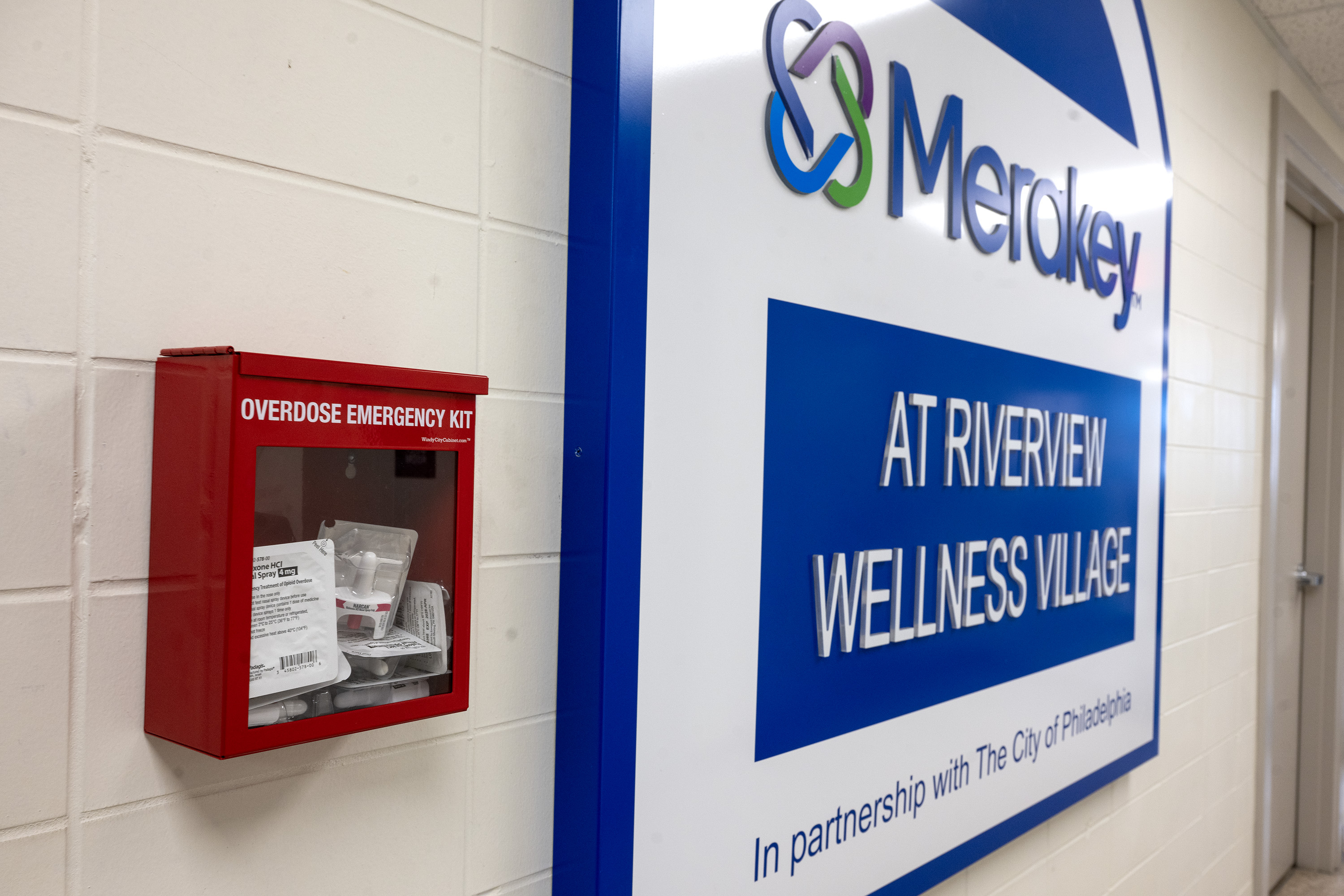
Entry to the primary medical care center run by the Black Doctors Consortium at Riverview Wellness Village.The main entry Meetinghouse at Riverview Wellness Village.Naloxone (Narcan) in an “overdose emergency kit” at Riverview Wellness Village.
In the initial months after Riverview opened its doors, residents had to travel off campus to obtain medication that can prevent relapse, most commonly methadone and buprenorphine, the federally regulated drugs considered among the most effective addiction treatments.
Typically, patients can receive only one dose of the drug at a time and must be supervised by clinicians to ensure they don’t go into withdrawal.
Vigderman said staff suspected some residents relapsed after spending hours outside Riverview, at times on public transportation, to get their medication.
This fall, Merakey — which was already licensed to dispense opioid treatment medications at other locations — began distributing the medications at Riverview, eliminating one potential relapse trigger for residents who no longer had to leave the facility’s grounds every day.
Interest in the program has been strong, Vigderman said, with nearly 80 residents enrolling in medication-assisted treatment in just a few weeks. Merakey is hiring more staff to handle the demand.
What’s next at Riverview
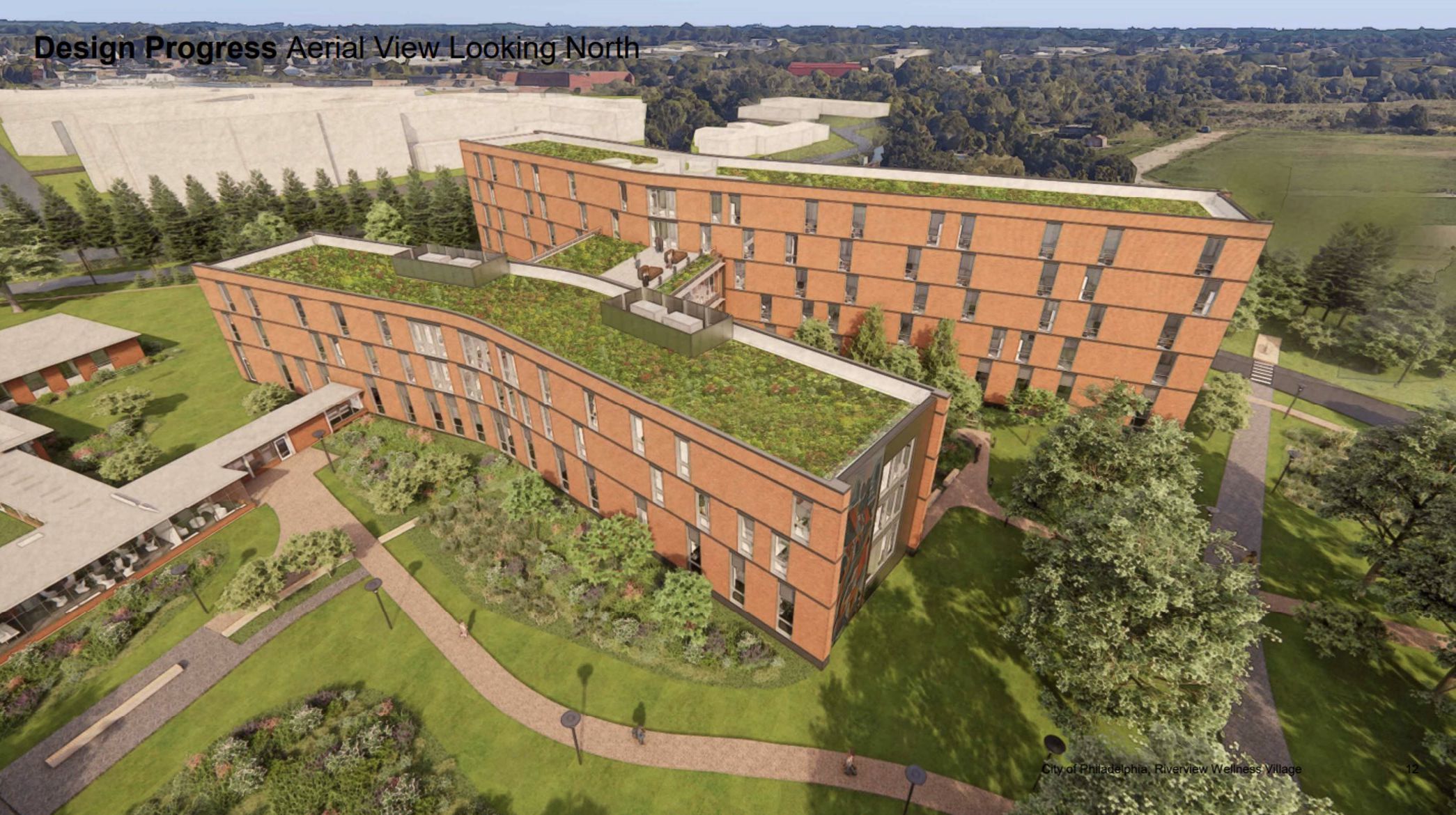
The city is eying a significant physical expansion of the Riverview campus, including a new, $80 million building that could double the number of licensed beds to more than 500. That would mean that about half of the city’s recovery house slots would be located at Riverview.
Parker said the construction is “so important in how we’re going to help families.” She said the process will include “meticulous design and structure.”
“The people who come for help,” she said, “we want them to know that we value them, that we see them, and that we think enough of them to provide that level of quality of support for them.”
In the meantime, staff are working to help the center’s current residents — who were among the first cohort to move in — plot their next steps, like employment and housing.
A rendering of the new, $80 million five-story building to be constructed on the campus of Riverview Wellness Village. It will include residences and medical suites.
That level of support, Vigderman said, doesn’t happen in many smaller recovery houses.
“In another place, they might not create an email address or a resumé,” he said. “At Riverview, whether they do it or not is one thing. But hearing about it is a guarantee.”
Bean is closing in on one year at Riverview. He doesn’t know exactly what’s next, but he does have a job prospect: He’s in the hiring process to work at another recovery house.
“I’m sure I’ll be able to help some people,” he said. “I hope.”