The silence in the Himalayan Institute’s shrine redefines silence, quiet enough to hear your heartbeat, to pick up a whisper from across the room, and, perhaps most importantly, to feel every breath, in and out, while you meditate.
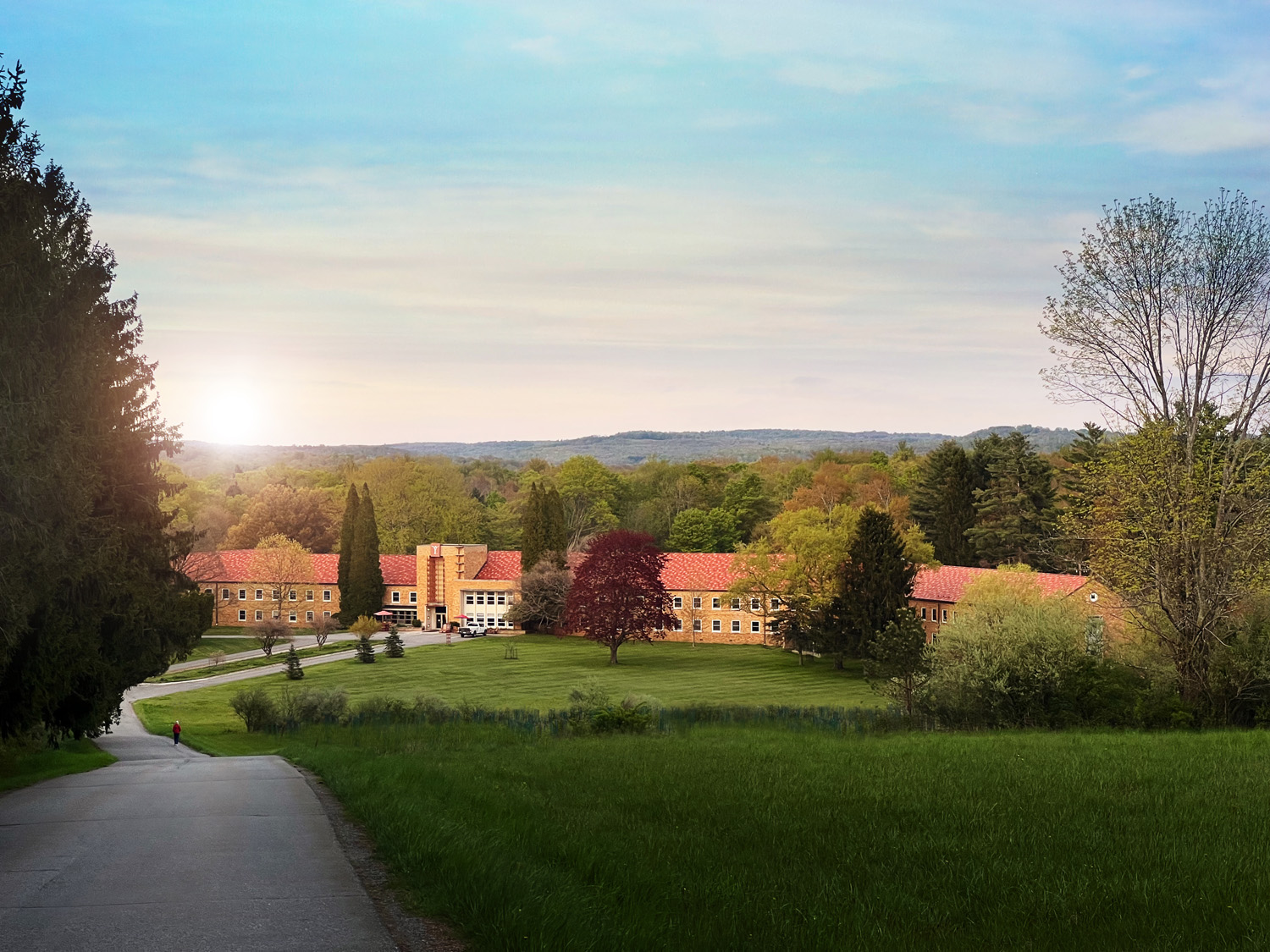
The institute, founded in 1972, moved into the massive, former seminary on 400 hilly, forested acres in Honesdale, Wayne County, in 1977, a time when yoga was still a niche practice. For more than 50 years, the institute has been offering yoga training, spirituality, meditation, and holistic health practices, along with getaways and retreats.
“It’s for anyone, for any creed, religion, sex, or gender,” said Greg Capitolo, a California native who became the institute’s president after attending retreats there. “There’s really no religious affiliation at all.”
As yoga exploded in popularity and modern meditation apps abound, the Himalayan Institute has seen growing interest worldwide. It hasn’t hurt that downtown Honesdale has seen its own popularity grow over the last decade as Philadelphia and New York City residents look for properties and business opportunities outside of traditional urban escapes, like upstate New York.
“I like to sat this is the best-kept secret in Wayne County,” Capitolo said. “I hope we become less of a secret to the people here. ”
The Inquirer went to Honesdale during a frigid weekend last December and confirmed it: even in single-digit temps, the town’s gift shops, bakeries, buzz-worthy restaurants, art galleries, and book stores were alive with tourists and locals up and down Main Street.
Afterward, several readers mention the Himalayan Institute as a “must-visit.”
The Himalayan Institute, In Honesdale, Pa.
On a Monday in late November, the main, dormlike building was abuzz with “residents” who were doing volunteer work in the kitchen for access to classes, yoga training, and other programs the institute offers. Capitolo said the institute can house up to 80 residents, who commit to staying for a year as part of the $800 per month “Residential Service Program.”
Meals are vegetarian, and on this afternoon, lunch was beet subzi and kimchari. The Himalayan Institute follows Ayurvedic principles, which discuss balance and digestion, among other things.
“The Ayurvedic system says you should eat your biggest meal around lunchtime, when the sun’s at its highest, point, because your digestion will be optimally ready to break down food,” Capitolo said.
There’s also a gift shop and a trail network at the Institute, along with a popular Wellness Center that offers several types of massage, including hot stone. One of the Wellness Center’s most popular offerings is an Ayurvedic therapy known as Shirodhara Treatment, which includes “streaming warm oil onto the forehead to clear and calm the mind.”
The Himalayan Institute, In Honesdale, Pa.
The simplest structure and offering at the Himalayan Institute may be the Sri Vidya Shrine, a simple, domed building that sits behind the former seminary on the campus. The shrine is the twin of the Sri Vidya Shrine at the Himalayan Institute’s Khajuraho campus in central India, and its meditation hall is not so simple: that unique silence was part of the design.
The shrine’s meditation hall is referred to as the mandapa, literally “the canopy for seekers to gather.”
Capitolo sat silently in the hall for several minutes, hands folded, focusing on his breath. He, too, was a seeker, leaving a lucrative job in Silicon Valley to head east to Honesdale, before it was hip.
“I was happy and seemingly had everything I needed,” he said outside the shrine. “But something was missing. This place satisfied what was missing.”
Tony Lupien drove to Philadelphia in February of 1946, just a few weeks before the Phillies were scheduled to begin spring training. Lupien missed most of the previous season after being drafted into the Navy during World War II and still didn’t have a contract for the new season.
There was a good reason: Phillies general manager Herb Pennock told Lupien he was being traded to the Hollywood Stars, a minor-league team.
Lupien was livid. He believed his job in the majors was guaranteed to him for a year after returning from the service and hired a lawyer to challenge the team’s decision.
“Who the hell are you to think that you’re above the federal government?” Lupien told Pennock.
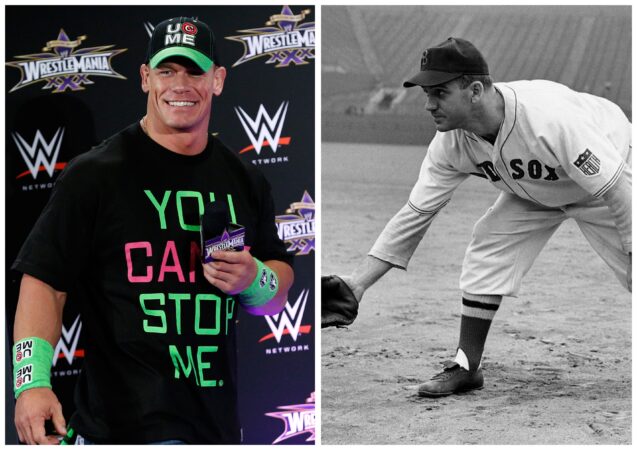
Lupien’s grandson would become one of the biggest stars in professional wrestling before embarking on a Hollywood career. But John Cena’s grandfather didn’t want to be a Hollywood Star. He wanted to play first base for the Phillies.
“Lupien, guaranteed a year’s job with Phils under selective service law, gets kick in pants instead,” wrote a headline in The Boston Globe.
Ulysses “Tony” Lupien graduated from Harvard and joined the Phillies in 1944 after being waived by the Red Sox. He hit .283 in 1944 before being sworn into the Navy in March of 1945. Lupien spent six months on a Naval base in New York before returning to the Phillies in September, just in time for the final stretch of a 108-loss season.
The Phillies were so bad in 1945 that their manager quit in June. Lupien, a smooth fielder, was a bright spot when he returned at the end of the season, hitting .315 over 15 games.
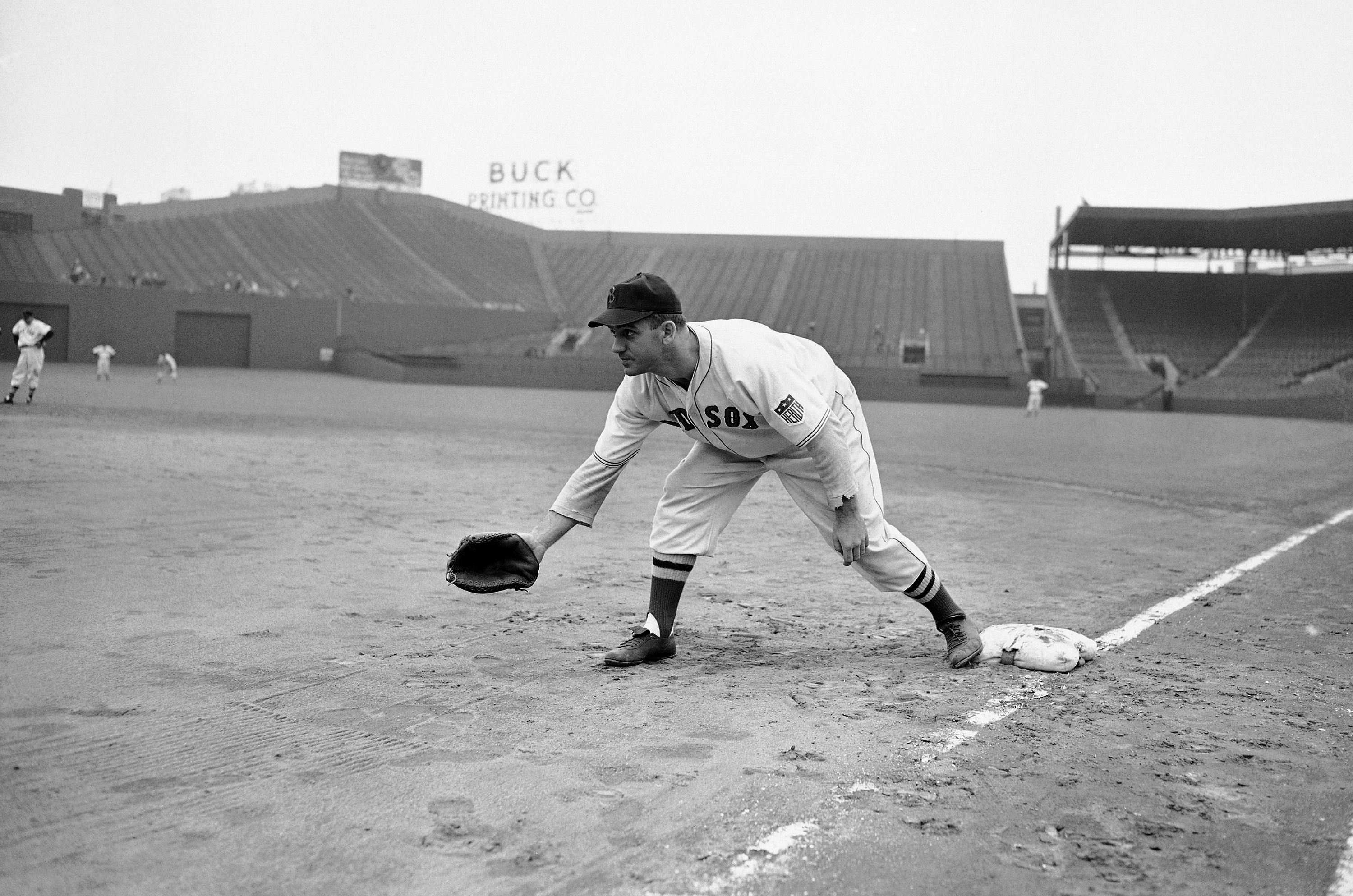
Tony Lupien played six major league seasons, including two with the Phillies.
The Phils ranked last that season in nearly every statistical category, even attendance. The Phils wanted to clean house, declaring that any player who was in the lineup for the final game of 1945 would not be in the lineup for the first game of 1946. So that meant Lupien was gone.
“The G.I. Bill was designed to protect for at least one year the jobs of men who entered the service. Now that bill either applies to ballplayers or it doesn’t,” Lupien told The Sporting News. “That’s what I am trying to find out, and if it means that I am the goat or the ball carrier, I am perfectly willing to assume that role. If the G.I. Bill does apply, then I may help many other veterans in the months to come by following through with my action.”
The Phillies disagreed with Lupien as Pennock said the G.I. Bill didn’t apply to baseball. They had signed Frank McCormick, a 35-year-old power hitter, to play first base and the 29-year-old Lupien had a minor-league gig waiting in California.
“I think the least the Phils might have done is give me a chance to show what I have,” Lupien said.
Lupien wrote a letter to the National League commissioner. He hoped to become a free agent or at least get invited to spring training. Lupien already played three years in the minors and didn’t want to go back.
His letter was returned unopened. Lupien’s lawyer, a former Harvard classmate, said he had a case. The Massachusetts Selective Service Board said the case would have to be heard in Philadelphia since it involved the Phillies.
The Hollywood Stars sent him a contract for $8,000, which made him the highest-paid player in the minor leagues. He learned the Phillies were kicking in $3,000. The Phillies, Lupien believed, were circumventing the G.I. Bill by making sure he still earned his prewar salary despite not giving him his old job.
John Cena has said next Saturday night will be the final wrestling match of his career.
Lupien already had two children and knew it would be too expensive to travel back and forth to Philadelphia to fight his case. He reported to Hollywood at the end of spring training and became a Star.
Lupien played two seasons with the Stars before returning to the majors in 1948 with the White Sox. He then bounced around the minors as a player/manager and coached basketball at Middlebury College before being hired in 1956 to coach Dartmouth College. He managed the team to the College World Series in 1970 and co-wrote a book in 1980 about the history of baseball’s labor movement. Lupien remained outspoken about labor, believing the sport’s contract structure railroaded his career.
He died in 2004, two years after Cena debuted in the WWE. Cena, whose mother, Carol, is Lupien’s daughter, said next Saturday night will be the final match of his career.
Cena, 48, once wore a Phillies jersey to the ring and is one of the most popular performers in wrestling history. His celebrity has long crossed over into popular culture as he’s starred in movies and TV shows.
He spent the last year balancing his WWE farewell with the filming of a new movie. After wrestling, Cena is expected to fully become a Hollywood star. His grandfather, begrudgingly, was one first.
Theater communities across the globe have been mourning Tony Award-winning playwright Tom Stoppard, the beloved Czech writer who died last week at his home in Dorset, England, at 88.
Stoppard’s acclaimed dramas graced countless stages over six decades, but he had a special place in his heart for Philadelphia’s Wilma Theater, where he formed deep, longstanding friendships with founders Blanka Zizka and her late husband, Jiri.
The prolific playwright, known for irreverent, cerebral dramas with dense and rather dizzying rhetoric, was often compared to William Shakespeare and George Bernard Shaw. Some of his most popular works include Rosencrantz and Guildenstern Are Dead (a clever take on Hamlet), The Real Thing, The Coast of Utopia, and the screenplay for the 1998 Oscar-winning rom-com Shakespeare in Love.
He made Tony Award history and broke his own records, winning best play five times between 1968 (Rosencrantz and Guildenstern Are Dead) and 2023 (Leopoldstadt).
The latter beat out Pulitzer Prize-winning Fat Ham — also a clever take on Hamlet, in wildly different ways — from former Wilma co-artistic director James Ijames. (The Wilma coproduced the Broadway production that earned five Tony nominations.) A year later, the Wilma received the 2024 Regional Theatre Tony Award, becoming the first theater in Pennsylvania to earn the recognition.
But beyond his international fame, Stoppard is an integral part of the Wilma’s history and, in turn, Philadelphia theater history.
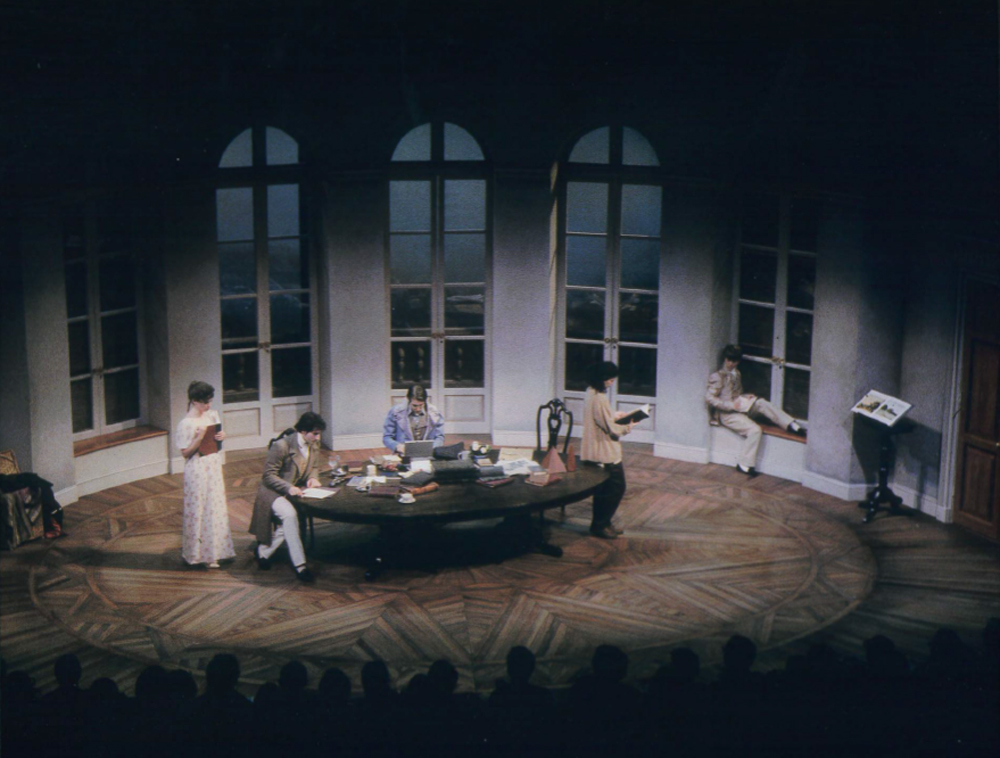
The Wilma Theater’s 1997 production of Tom Stoppard’s “Arcadia.”
Blanka Zizka first met Stoppard in 1996, when they both participated in a panel discussion at the University of Pennsylvania. The dramatist was visiting the city for a three-day residency on Penn’s campus following a symposium dedicated to his play Arcadia.
At the time, the Zizkas, political refugees also from the Czech Republic, were in the process of moving the Wilma from a small Sansom Street theater to its current larger venue on Broad Street. The first play of the season at the new location happened to be Arcadia, which they had chosen before meeting Stoppard. (The Wilma had produced his 1974 play Travesties as well.)
“He was very impressed by the fact that Jiri and I were from Prague, and we came all the way to the United States, to Philadelphia, and that we were creating a new theater,” said Zizka, who now lives in New York’s Catskills region. “He’s from Czech Republic, originally. He left when he was 2 years old, and he doesn’t speak too much Czech, but he still had a very strong connection to the country. … So for him, [ours] was just a very impressive story.”
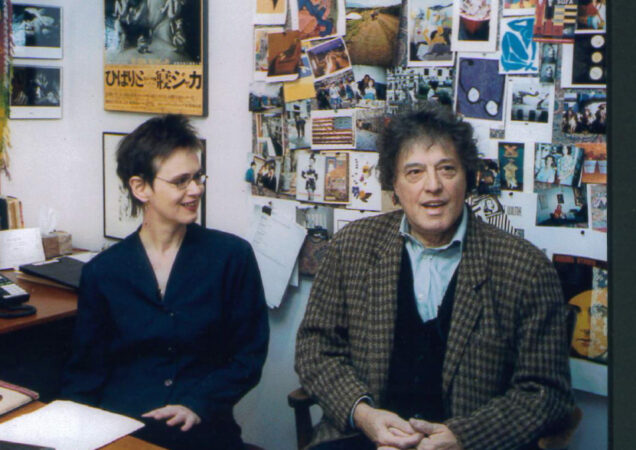
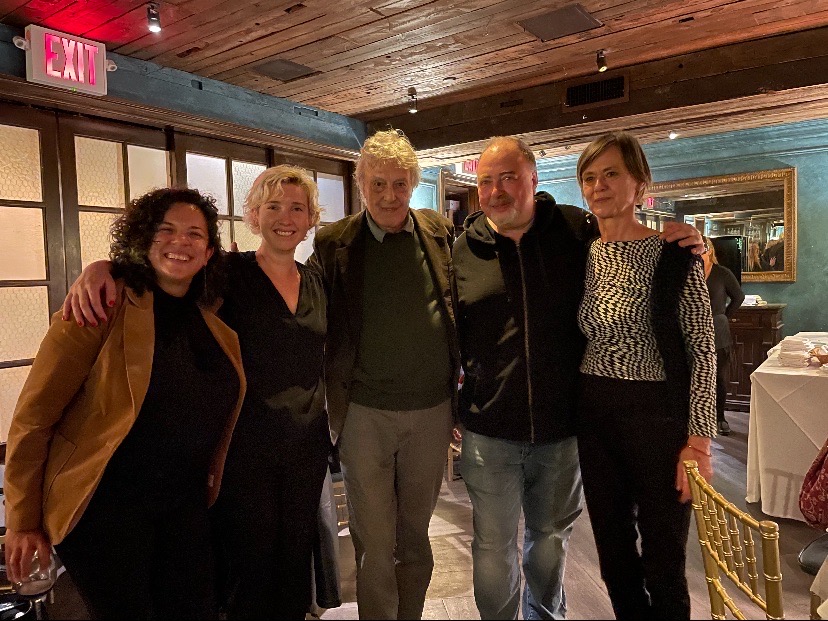
From left: Wilma managing director Leigh Goldenberg, coartistic director Morgan Green, playwright Tom Stoppard, coaristic director Yury Urnov, and founder Blanka Zizka in 2022.
Stoppard came to the Arcadia opening and became a frequent Wilma visitor over the years as the theater went on to produce 12 of his plays; he made his way to town for nearly every show and often attended rehearsals, too. He even helped with fundraising for the Wilma by visiting the homes of board members.
Zizka has happy memories of Stoppard’s visits, as well as the times he invited her to join him in New York for tea parties. Whenever she and her son traveled to England, Stoppard let them stay at his apartment and set them up with tickets to whatever shows they wanted to see. He would send her books to read and ask about not only her theater work but her other passions, like painting.
Stoppard was generous with his time, Zizka said, especially with younger theater artists and organizations like the Belarus Free Theater, which was forced to flee to England after facing political persecution for their work.
His plays provided a thrilling challenge for Zizka as a director and for the Wilma actors. She spent months preparing for brainy Stoppard shows, which the playwright meticulously researched as his characters included historical figures like Oscar Wilde, Vladimir Lenin, James Joyce, and Mikhail Bakunin.
“A lot of people consider him this intellectual playwright, but I think Tom is also full of emotions that are covered by those intellectual ideas. And for me, as a director, I didn’t have to look for the intellect … because it was there, but I had to always look for the world that is underneath the words,” she said.
The Wilma Theater’s 2000 production of Tom Stoppard’s “The Invention of Love.”
That effort proved particularly difficult in the 2000 production of The Invention of Love, which centered on poet A.E. Housman. There’s a scene in which Housman meets a younger version of himself and the two engage in a lengthy debate over the placement of a comma — not typically the most entertaining of topics.
“It was two or three pages of dialogue, and it was so intense. … I just could not sleep over it. I felt we were in our heads, and it was boring,” said Zizka.
She had the actors try speaking in their own words to get the idea across but ultimately had a breakthrough when she asked them to perform in gibberish. The result was “an amazing, intense and exciting scene” in one of the most successful productions in Wilma history.
Gibberish helped them crack Stoppard’s code again in 2016, when the Wilma staged the U.S. premiere of The Hard Problem, which Zizka also directed. It followed a psychology student at a neuroscience research center attempting to understand the root of human consciousness.
Lindsay Smiling, now a co-artistic director at the theater, performed in the play and remembers meeting the famous dramatist in rehearsal, when they replaced Stoppard’s dialogue with nonsense words.
“It was nerve-wracking to do that in front of this playwright who is a legend,” said Smiling. “His work is so much about the language and his plays are very talky. … He was like, ‘I don’t know what you all did, but that is the scene with none of my words.’ And he was thrilled.”
As exciting as it was to discuss the work, Smiling marveled even more at Stoppard’s friendliness. After rehearsal, a group, including Zizka, went to Caribou Cafe for burgers and beer.
Wilma cofounder Blanka Zizka, playwright Tom Stoppard, and former Wilma staffer Julia Bumke in 2015.
“We sat outside on the sidewalk on Walnut Street and we talked about beer, we talked about history, we talked about Philadelphia,” said Smiling. “He was interested not just in theater makers and our lives … I remember him just coming back with all these conversations he’s had with random people on the street around Philadelphia.”
Though Stoppard did not spend too much time in the city, his contributions were profoundly meaningful to Philadelphia artists — and of course his work will continue to be produced across the region. Earlier this year, the Pennsylvania Shakespeare Festival stagedRosencrantz and Guildenstern Are Dead alongside Hamlet.
Of course, he’ll always be part of Wilma history.
“He was very much a strong part of what the Wilma was,” said Zizka. “We have not done any other playwright in such a big measure as we did his work.”
This article was updated with the correct release year for ‘Travesties.’
More than 130 drug cases were dismissed Friday — and hundreds more are expected to collapse in the coming months — after prosecutors said three Philadelphia narcotics officers repeatedly gave false testimony in court.
Common Pleas Court Judge Lillian Ransom vacated 134 cases during the first in a series of hearings that could see nearly a thousand criminal prosecutions collapse because the testimony of three officers on the Narcotics Strike Force has been deemed unreliable.
Philadelphia Police Officers Ricardo Rosa, Eugene Roher, and Jeffrey Holden were found to have repeatedly given false testimony against people suspected of selling drugs after lawyers with the Defender Association of Philadelphia recovered video footage that contradicted their statements, the district attorney’s office said.
The defenders said the officers regularly watched surveillance cameras to monitor suspects in drug investigations in real time, then didn’t disclose it to prosecutors or defense attorneys in court, officials said. The video footage later showed they also testified to things that never happened or that they could not have seen from where they were positioned, according to court filings.
Prosecutors later conceded that they could no longer vouch for the officers’ credibility and are expected to dismiss scores of cases built on their testimony.
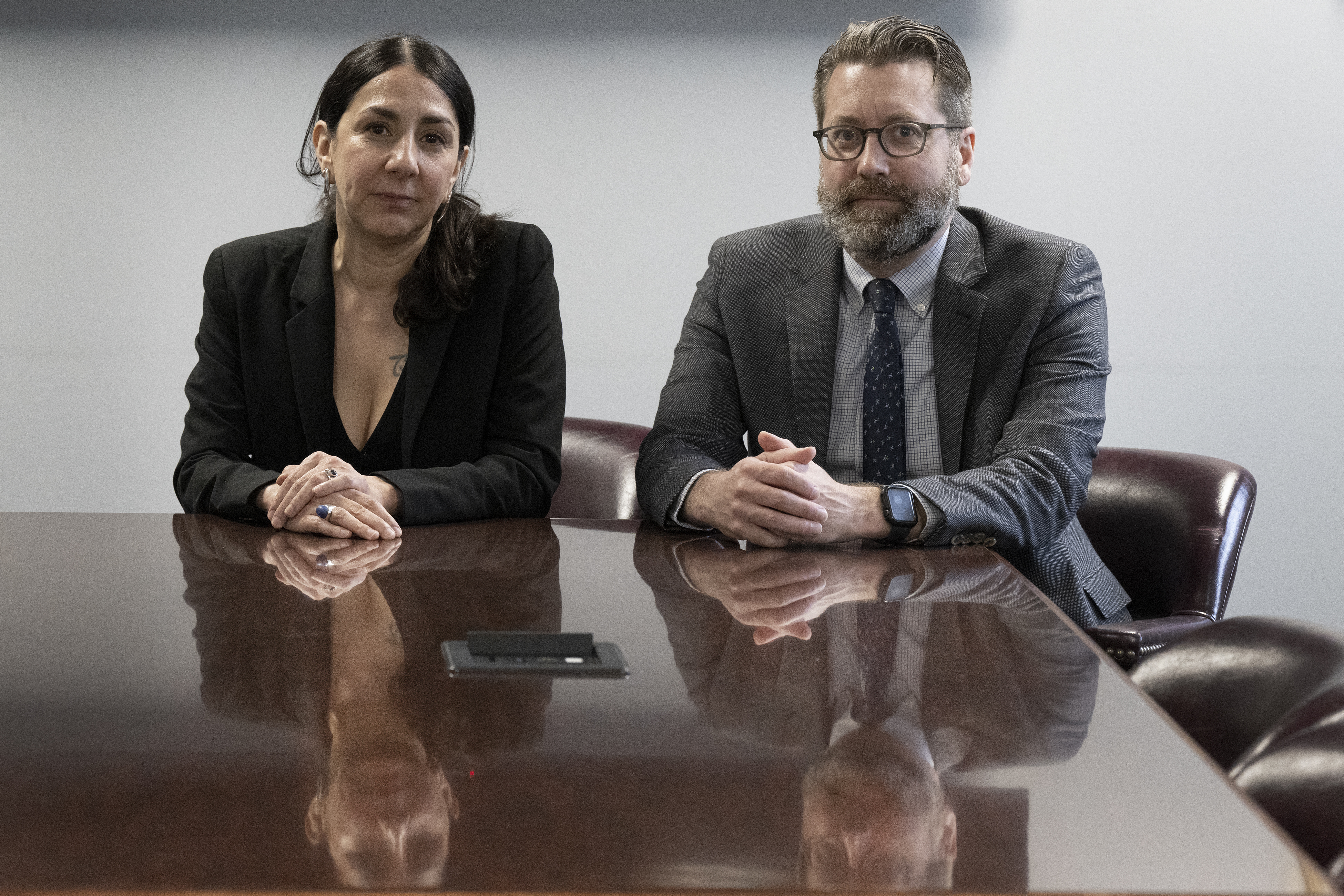
Michael Mellon and Paula Sen, of the Defender Association, began looking into whether officers on the narcotics squad were lying in court starting in 2019.
After a review of cases and convictions involving the officers’ testimony, lawyers for the defender association and prosecutors identified more than 900 cases and expect to ask the judge to dismiss them over the next year. It was not immediately clear how many people, if any, served time in jail, or are still in custody, as a result of the prosecutions that are now in question.
Holden, reached by phone Friday, said he was shocked to learn that his cases and testimony were under scrutiny, and said he had not been told of the move to end the cases at Friday’s hearing. He declined to comment further.
Rosa and Roher did not immediately respond to requests for comment. The officers remain assigned to their narcotics squads.
The district attorney’s office said it provided the police department’s internal affairs unit with details of the officers’ false statements in multiple cases last March.
Police Commissioner Kevin Bethel, in a statement, said the department takes “potential credibility issues with our officers extremely seriously.”
An internal affairs investigation into the matter was launched last March and remains ongoing, he said.
The department requested and reviewed cases flagged by prosecutors, he said, but “thus far we have not identified any evidence that would raise concerns of misconduct or criminal behavior on the part of those officers.”
He added: “We will, as always, take appropriate action if and when evidence supports such action, but we will not preemptively sideline officers absent some verified findings.”
Bethel said he learned of the plans to dismiss the cases on Thursday, and has asked prosecutors to provide additional information to assist with their review. He also said the police department has been working with the district attorney to develop a clearer protocol on how officers can use surveillance cameras during investigations.
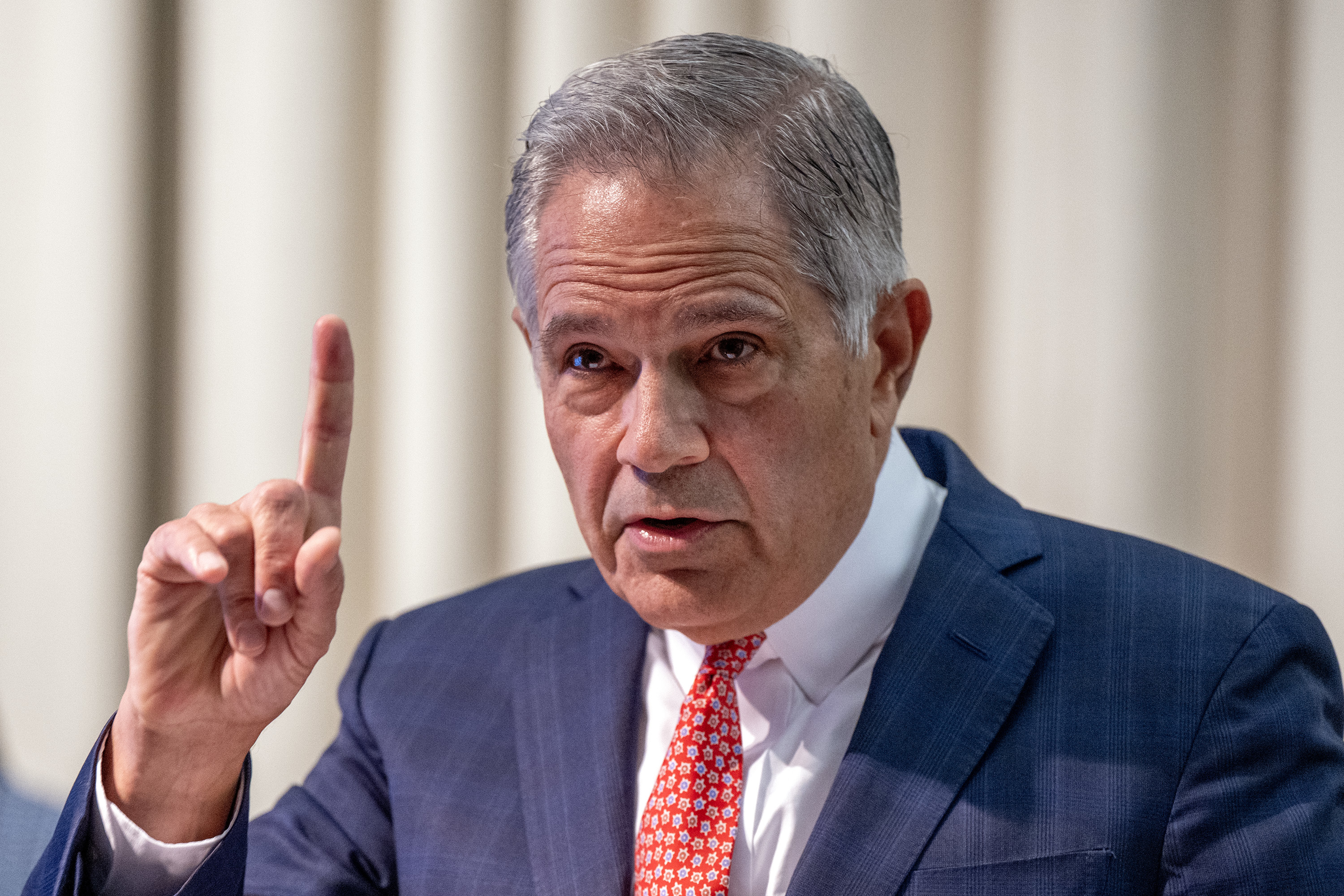
District Attorney Larry Krasner on Friday declined to say whether his office was investigating the officers’ conduct, but noted that “the statute of limitations for police officers in their capacity is much longer than the statue of limit for other offenses.”
“I have dealt extensively with Commissioner Bethel. I know he and the mayor are committed to rooting corruption, lying, stealing, and cheating out of the police department,” he said.
District Attorney Larry Krasner declined to say whether his office was investigating the officers’ conduct as criminal in nature.
‘They’re lying’
Assistant District Attorney David Napiorski, who reviewed the cases for the office, stopped short of accusing the officers of lying, but said “there’s enough of a pattern of inconsistencies across testimony that we can’t rely on them as critical witnesses in court.”
But Paula Sen and Michael Mellon of the Defenders’ Police Accountability Unit disagreed.
“It’s a fancy way of saying they’re lying,” said Sen, who has worked with Mellon to uncover the officers’ credibility issues since 2019.
The unfolding scrutiny is the latest in a series of large-scale conviction reversals in Philadelphia tied to misconduct in the narcotics unit. Over the past three decades, judges have thrown out thousands of drug cases after officers were found to have fabricated evidence, lied on the stand, or stolen money from dealers.
Bradley Bridge, a longtime public defender, was often the driving force behind those reviews and estimates he’s worked to overturn about 2,500 drug convictions since 1995.
In 2015, Bridge filed a petition to vacate more than 1,400 drug convictions tied to six ex-narcotics cops after they were charged with robbing and beating drug dealers, then altering police paperwork to cover their tracks. The officers were later acquitted by a jury and got their jobs back through arbitration, but more than 950 cases were thrown out after officials agreed they couldn’t trust their testimony.
Bridge, who returned from retirement to handle the cases tied to Rosa, Roher, and Holden, said, “Tragically, nothing is unique about this. It’s exactly the same problems that keep arising since 1995, including the lack of supervision and oversight of police officers on the street.”
A video camera used by Philadelphia police located at Somerset Street in Kensington.
Sen and Mellon said they first noticed a pattern of false testimony in 2019 after they reviewed surveillance footage that contradicted statements Rosa gave about drug cases. As time passed, they said, they continued to monitor his narcotics squad, and found inconsistencies with Holden and Roher’s testimony, too.
They said the officers used the city’s surveillance camera systems to monitor suspected drug activity in real time, but didn’t disclose it as part of their investigation — a violation of due process because the evidence wasn’t shared with defense attorneys.
In court, the officers denied using the cameras, Mellon said, and often said they witnessed hand-to-hand drug transactions that video later showed either never happened or that they could never have seen because the suspect was out of sight.
“They just straight up lied and invented acts of criminality,” Sen said.
‘Who are they gonna believe?’
In one case, Roher said he was seated in an unmarked police car when he saw Darrin Moss sell drugs to two people near Somerset and Helen Streets in Kensington in April 2022. He said he could see Moss inside the fenced lot retrieve drugs, then hand them to a buyer and accept money in return.
Prosecutors later said in court filings that video footage captured by a surveillance camera on the end of the block showed that one drug deal never happened, and the other supposed deal was behind a building and would have been impossible to see.
The charges against Moss were withdrawn.
When prosecutors learned of the discrepancies, they asked Roher to meet and discuss the case, but he failed to appear in court twice without explanation, they said in a court filing.
Prosecutors said this became a pattern — once the officers seemed to learn their testimony was under scrutiny, they stopped showing up to court.
Court filings identify at least nine cases in which the three officers allegedly gave false testimony. Napiorski, of the district attorney’s office, said prosecutors reviewed a few dozen videos from other cases that suggested a systemic pattern of false information in court.
Sen, of the defenders association, said it was troubling that the officers remained assigned to the narcotics squad and have been able to continue making arrests.
“How is the public supposed to have trust in a department that continues to employ people who have so clearly proved themselves to be liars, that has resulted in thousands of people being arrested and jailed?” she asked.
Most of the cases dismissed Friday were drug crimes that led to a sentence of probation, prosecutors said. Seven included a gun charge.
The drug charge against Ramoye Berry was among them.
Berry, 29, from North Philadelphia, said that in April 2023, he was standing on the 1300 block of West Boston Street talking to some friends when a group of officers tackled him and accused him of selling drugs.
When they searched his car, he said, they found a small amount of weed, but he wasn’t selling it. He was charged with possession with intent to sell drugs.
Berry couldn’t recall which officer testified against him in court, but he said he remembered telling his lawyer that the officer wasn’t telling the truth.
He said he pleaded guilty to drug possession and accepted a year of probation because he didn’t think he could prove his innocence, and the court dates were challenging to keep up with. It kept him from being able to get a job, he said.
When he learned on Friday that the officer had a history of giving false information and that his conviction would be vacated, he said he felt vindicated — but frustrated by the time and jobs he lost to the case.
“This is what I was saying from the beginning,” he said, shaking his head. “But who are they gonna believe? The cops, or me?”
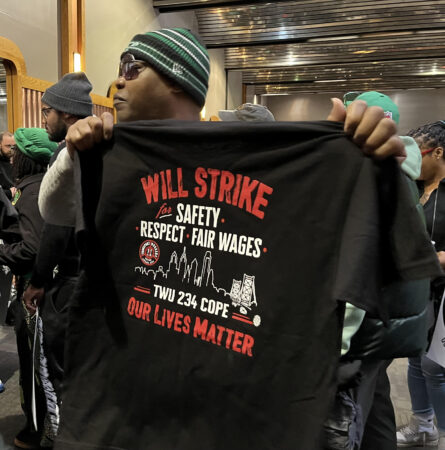
Transport Workers Union Local 234, SEPTA’s largest union, may soon strike, according to president Will Vera.
At a Friday afternoon news conference at TWU headquarters in Spring Garden, Vera said his “patience has run out,” and he said the union’s executive committee was meeting to decide when to call a strike.
“I’m tired of talking, and we’re going to start walking,” said Vera, who was elected president in October.
Local 234’s latest contract expired Nov. 7, and the 5,000-member local voted unanimously on Nov. 16 to authorize leaders to call a strike if needed during contract negotiations.
The union represents bus, subway, and trolley operators, mechanics, cashiers, maintenance people, and custodians, primarily in the city.
John Samuelsen, president of TWU International and former president of NYC’s local, joined Vera at the news conference.
“A strike is imminent,” Samuelsen said. “SEPTA is the most incompetent transit agency in the country … SEPTA is triggering a strike.”
In an email sent Friday evening, Samuelsen called on leaders and staff members of TWU locals to travel to Philadelphia to help Local 234 in the event of a strike.
Andrew Busch, spokesperson for SEPTA, said negotiations were “at an impasse,” noting that the negotiating committees met only twice this week. He said SEPTA’s leaders hoped TWU would “take us up on the offer to continue to talk so we can avoid a strike and the massive service disruption it would cause.” No meetings are scheduled for the weekend as of Friday evening.
Vera agreed there was room for the two groups to keep talking, if SEPTA provided “a fair and reasonable” contract proposal.
The union says it is looking for a two-year deal with raises and changes to what it views as onerous work rules, including the transit agency’s use of a third party that Vera said makes it hard for members to use their allotted sick time.
SEPTA officials have signaled they are open to a two-year deal as a step toward labor stability.
In recent weeks, TWU and SEPTA have been negotiating contributions to the union’s healthcare fund. Pensions have arisen as a sticking point.
Union sources told The Inquirer that TWU leaders are increasingly frustrated with the pace of negotiations.
Vera said the executive board meeting began at 4:30 p.m. on Friday. He hoped the board would reach a decision on when members would walk off the job.
TWU last went on strike in 2016. It lasted for six days and ended the day before the general election. Democrat Hillary Clinton’s presidential campaign was worried about voter turnout, and the city sought an injunction to end the strike. It proved unnecessary.
SEPTA’s financials
TWU’s contract negotiations are happening as SEPTA is emerging from what it has called the worst period of financial turmoil in its history.
Like many transit agencies, SEPTA was facing a recurring deficit due to inflation, fewer federal dollars, and flat state subsidies. It reported a $213 million recurring hole in its operating budget.
Following a prolonged and contentious debate over mass transit funding in the state budget, Gov. Josh Shapiro in September directed PennDot to allow SEPTA to tap $394 million in state money allocated for future capital projects to pay for two years of operating expenses.
And last month, he allocated $220 million to SEPTA, the second time in two years he’s flexed state dollars to support the financially beleaguered transit agency. While the $220 million is expected to go primarily toward capital expenses related to Regional Rail, the move helps SEPTA’s overall balance sheet.
What riders should know
SEPTA riders are no strangers to service disruptions.
A former top Philadelphia labor official claims in a lawsuit that she was passed over for a promotion because she’s a woman, and was later fired afterraising concerns about gender-based discrimination spanning two mayoral administrations.
Monica Marchetti-Brock, the former first deputy director of the Department of Labor, said in a federal lawsuit filed Wednesday that Mayor Cherelle L. Parker fired her last year, days after Marchetti-Brock had reiterated complaints about gender bias at the top rungs of the city government that had occurred before Parker took office.
Marchetti-Brock had worked for the city since 2013. Under former Mayor Jim Kenney, she rose to the city’s No. 2 labor role.
The man hired for the position was Basil Merenda, a former top state labor official whom Marchetti-Brock claims “had a problem with women.”
What started as a change in boss under then-Mayor Jim Kenney culminated in spring 2024 with Parker firing Marchetti-Brock after she complainedof sex-based discrimination, according to the suit. The lawsuit says an outside investigator probed Merenda’s behavior and in 2023 recommended he undergo implicit bias training.
The lawsuit accuses the city of minimizing the results of that investigation and of terminating Marchetti-Brock and a second woman who was mistreated by Merenda.
“When [Marchetti-Brock] asked if her termination had anything to do with her sex discrimination complaints, [the city] refused to answer the question,” the complaint says.
Merenda is currently one of two commissioners of the Department of Licenses and Inspections. Parker announced his appointment in February 2024, a few weeks before Marchetti-Brock says she was fired. It is common for there to be significant turnover in personnel at the beginning of a new mayoral administration.
A city spokesperson declined to comment, citing the pending litigation.
Attempts to reach Kenney were unsuccessful. The former mayor appointed many women to his top staff through his more than two decades in City Hall. When he took office as mayor in 2016, the majority of his cabinet were women.
Marchetti-Brock began reporting to Merenda in January 2023. He ignored his deputy, excluded her from meetings and communications, yelled, and “unjustly” criticized her, the suit says.
Marchetti-Brock says she complained of sex discrimination in the labor department to a long list of officials, some of whom still work for the city, including City Solicitor Renee Garcia and Chief Administrative Officer Camille Duchaussee. Marchetti-Brock “described how she was treated compared to how male employees were treated, including that Merenda ignored what female employees said and focused on what male employees said,” according to the lawsuit.
The city opened an investigation in the spring of 2023, the suit says.
After Parker was elected in November 2023, Marchetti-Brock again expressed her interest in the top labor role. However, the incoming mayor ultimately tapped Perritti DiVirgilio, who was previously the city’s director of labor standards. Marchetti-Brock described DiVirgilio in the suit as a “noncomplaining, male employee.”
In February 2024, Marchetti-Brock received a letter summarizing the findings of the investigation into Merenda. The letter said that the probe concluded that “no violation” of the city’s sexual harassment prevention policy occurred. According to the complaint, Marchetti-Brock was told that Merenda had received a warning and the investigator recommended he undergo implicit bias training.
The policy says city employees are protected from sexual harassment regardless if it’s “unlawful,” and it prohibits retaliation against employees who raise concerns or complain. Marchetti-Brock had a role crafting the policy following a critical 2018 City Controller report that said the city’s sexual harassment reporting protocols were inadequate.
According to the suit, Marchetti-Brock pushed back on the summary letter in an email to Andrew Richman, a city attorney, saying that even though no unlawful behavior was found, “there were findings of bias toward me and other women.”
“As you are aware, our policy holds our leaders to a higher standard than the law,” Marchetti-Brock wrote, according to the complaint. “It is misleading to say there are no findings under our policy.”
Three days later, in early March 2024, top officials from Parker’s administration informed Marchetti-Brock that her employment would be terminated, according to the complaint. The suit states that another female employee who had complained about Merenda was terminated as well.
The lawsuit asks the federal court to find that the city violated antidiscrimination laws and award Marchetti-Brock an unspecified amount of damages.
Philadelphia could soon become the first American city to establish its own retirement savings program for residents whose employers don’t offer one.
City Council is poised to pass legislation that would enable the plan, called PhillySaves, which is modeled on similar state-facilitated “auto-IRA” programs that have been increasingly established across the country.
The idea is that workers would be automatically enrolled in the city-managed plan and would contribute through payroll deductions at no cost to their employer. The plan would then follow employees, even as they change jobs.
Council President Kenyatta Johnson, a Democrat, said during a committee hearing on the legislation last week that the program is an anti-poverty measure aimed at generating wealth for more than 200,000 Philadelphians who do not have access to a retirement savings plan through their job.
“We want to make sure we are lifting all Philadelphians out of poverty, building generational wealth, and ensuring our seniors are financially stable in retirement,” Johnson said.
A Council committee approved the legislation following a hearing last week, and the full Council is expected to pass it. Voters would have to approve the creation of an investment management board through a ballot question, which could come as early as the May primary election.
Councilmember Cindy Bass, a Democrat who represents parts of North and Northwest Philadelphia, called the plan a “game changer.”
“There was a time when you could retire just on Social Security alone,” she said. “That day has come and gone.”
How would the program work?
Workers would be automatically enrolled in the plan with a default contribution rate of 3 to 6% of their wages, however they can opt out or change their contributions at any time.
Employers that do not offer their own retirement plans would be required to sign up. Their only responsibility would be facilitating the payroll deductions for their employees. There is no matching program for employers or the city.
City Councilmember Mike Driscoll, a Democrat who represents parts of Northeast Philadelphia and is sponsoring the legislation, emphasized last week that there is “no cost” to employers and no fiduciary liability.
“The goal is to make it easy for employees who want to save,” he said, “and not burden employers who are already managing their many responsibilities.”
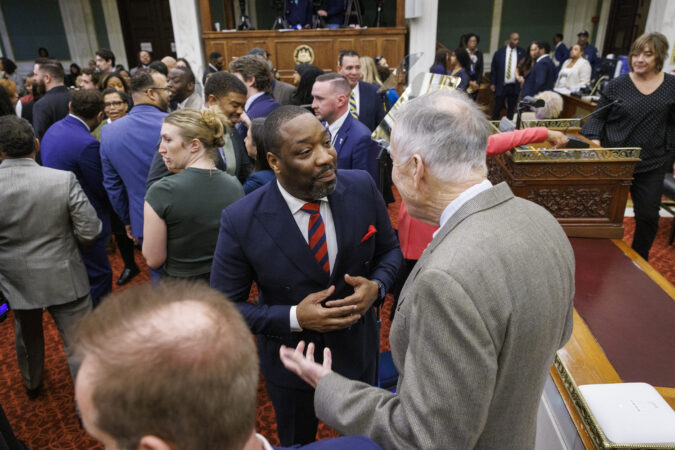
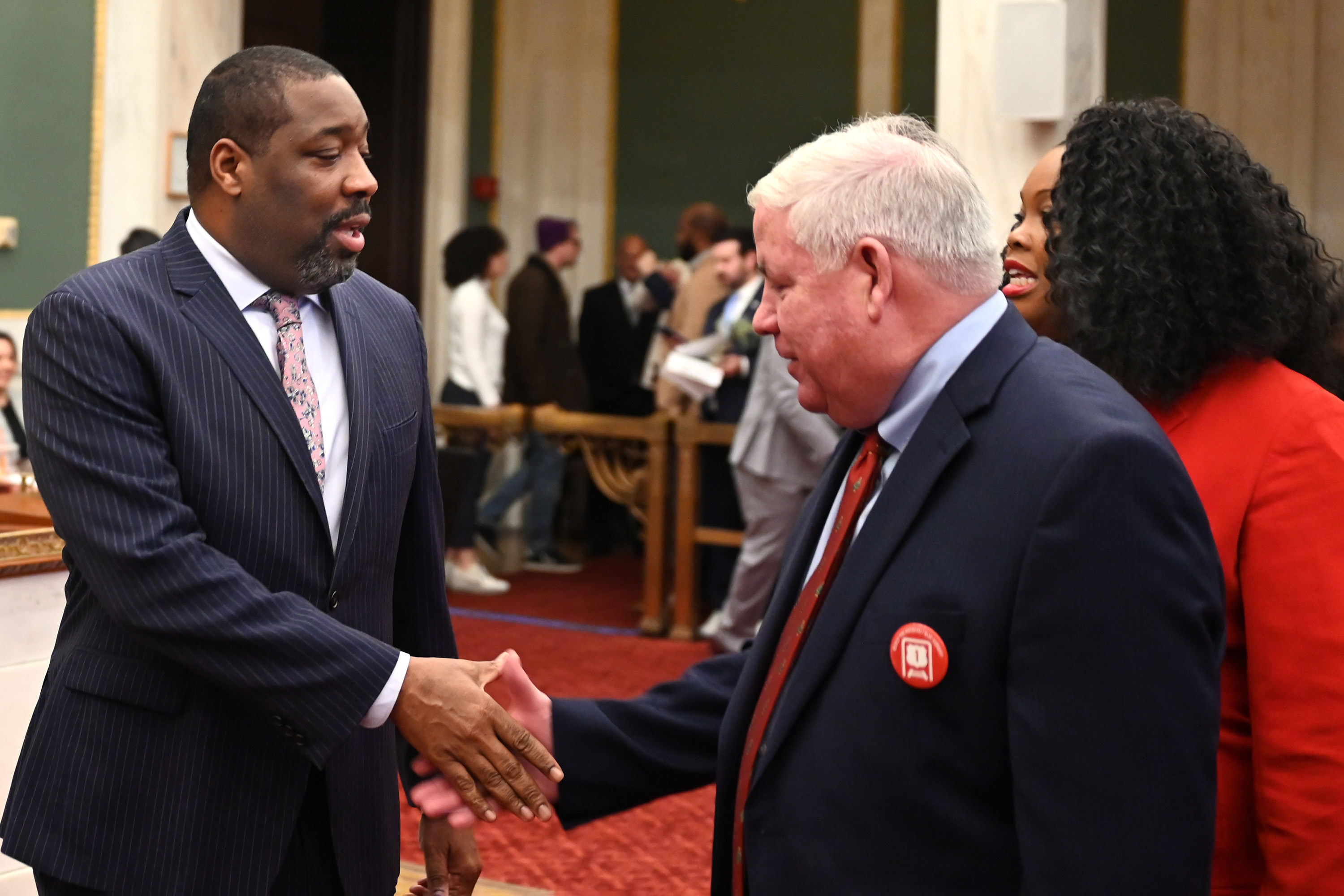
In this 2023 file photo, Council President Kenyatta Johnson (left) greets 6th District Councilmember Michael J. Driscoll (center) and Councilmember At-Large Katherine Gilmore Richardson (right) before the last City Council meeting of the year.
The legislation includes minimal fines for employers who don’t enroll employees. But Council members said the city will launch a significant public education and outreach campaign before levying fines.
Who is the program for?
Under the current version of the legislation — which could still be amended — the program applies to businesses with at least one employee. It must have been operating in Philadelphia for at least two years.
Auto-IRA plans are especially geared toward hourly workers who generally have fewer employer-covered benefits, such as 401(k) plans, as well as people who work for small businesses that can’t afford to provide retirement benefits.
Pennsylvania is not among them, but New Jersey launched a state-run retirement savings program last year. That plan, called RetireReady NJ, was first established in 2019 and signed into law by Gov. Phil Murphy, a Democrat.
It is more limited than Philadelphia’s would be, in that it only applies to businesses with at least 25 employees. Philadelphia’s would apply to businesses with just one.
Gov. Phil Murphy speaks with members of the media after meeting with Governor-elect Mikie Sherrill at the governor’s office in Trenton on Nov. 5.
Two other cities — New York and Seattle — passed legislation enabling auto-IRA programs, but neither was implemented because both New York and Washington states enacted state-run programs that include the cities.
The Democratic-controlled Pennsylvania State House passed legislation in 2023 along party lines enabling a similar program called Keystone Saves, but it stalled in the Republican-controlled Senate.
The city would create a nine-member Retirement Savings Board, which would include four appointees by the mayor, four by the City Council president, and one by the city controller.
That board would be responsible for facilitating the program and may contract third-party consultants, financial advisers, actuaries, and other experts to manage the investments.
The program defaults to a Roth IRA, though people covered can elect to switch to a traditional IRA.
John Scott, director of the retirement savings project at Pew Charitable Trust, said during the Council hearing last week that Roth IRAs are often the default in auto IRA programs because participating employees can pull money out of those accounts at any time without taxes or penalty.
He said that’s especially appealing to workers “who sometimes have fluctuations in their work schedule or they might have a financial shock.”
“For many of these workers in these programs, this is really the first opportunity to save money,” Scott said. “So, you know, life happens. And sometimes they do need to pull that money out, and the Roth IRA is really the best vehicle to do that.”
When will this become reality?
Creating the board that will oversee the investments requires a change to Philadelphia’s Home Rule Charter, the city’s governing document.
If Council passes legislation and Mayor Cherelle L. Parker signs it — both are expected to support it — then voters could approve the change through a ballot question as early as May.
The legislation says the program must be launched by July 2027, however there are exceptions in the case of legal challenges or a state-level program superseding the city’s.
The banner made its way to the bottom of the student section, and a crew of security guards soon was hovering. Everyone had to go, they said.
“We were like ‘What?,’” said Luke Butler, who led the crew of Temple students that night at La Salle.
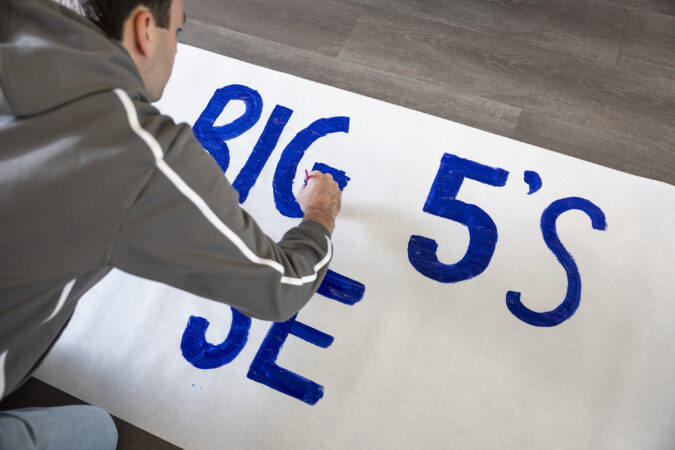
The fans — the Cherry Crusade — spent a few days crafting one-liners to paint onto 30-foot banners that would be rolled out during the Temple-La Salle basketball game. The “rollouts” have been a Big 5 tradition since the 1950s, even surviving a brief ban when the schools thought the messages had become too racy.
The rollouts often are a play on words or innuendoes that make light of the opposing school. You roll out your banner and then hold your breath while the other school shows theirs. Each student body takes turns dissing each other like kids in a schoolyard. The best rollouts, Butler said, are the ones that “twist the knife” just a little.
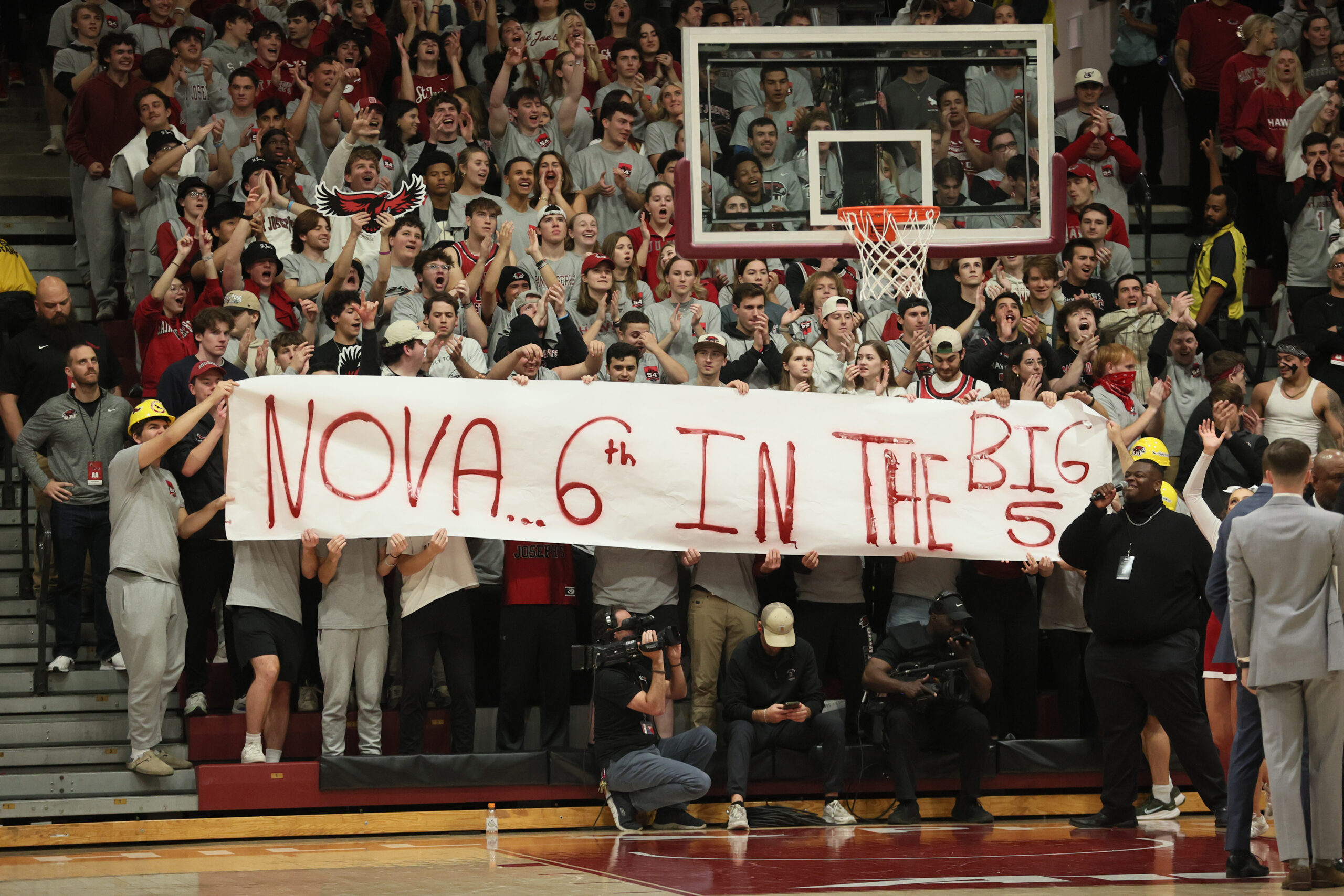
St. Joe’s students unveil a banner referring to Villanova finishing last in the Big 5 Classic last year.
But this one, Butler learned, twisted a little too much.
The Explorers entered that game in February 2010 on a seven-game losing streak, and Ash Wednesday had been two weeks earlier. Temple, down a point at halftime, raced away in the second half. And here came the rollout: “LA SALLE GAVE UP WINNING FOR LENT.”
The Temple students — the same crew who held a “funeral” a year later for the St. Joe’s Hawk — thought it was good banter. But a priest was offended, and security had instructions.
“They were like ‘Father is pissed. You basically affronted their faith, and they don’t want you in the building,’” Butler said. “That was a good example of a rollout where we said ‘This will get a good reaction.’ It did. It just wasn’t the reaction we were thinking of.”
70 years of rollouts
The rollouts trace back to the Palestra, when the building was the home of the Big 5 and basketball doubleheaders. The bleachers were filled, the basketball was good, and the crowds were lively. Philly was the center of the college basketball universe, and the Palestra was a scene.
The “rooters” who sat behind the baskets would roll out banners during the games about opposing schools. The messages were a chance for a student body to take a shot at their rivals from across the court. When La Salle students hung a dummy of their coach in the early 1960s from a campus flagpole, St. Joe’s rolled out a banner a week later that said “We Fly Flags on our Flagpole.”
The messages became more pointed, as the Daily News wrote in January 1966 that “the rollouts wandered from the realm of good taste.” The Big 5 athletic directors agreed to ban them, saying that “certain rollout subject matter has been offensive and detrimental to the best interests and continued success of the Palestra program.”
The president of the St. Joe’s student section protested the decision at the Big 5’s weekly luncheon, telling the athletic directors that they were ruining “the greatest spectator participation event in sports” and the rollouts were part of the “spectacular” that was basketball at the Palestra.
“It’s not a spectacular,” said Jack Ramsay, then the coach and athletic director for St. Joe’s. “We’re down there to play basketball. If the students want to join in, that’s fine.”
No longer allowed to roll out their messages, students at the Palestra began to shout what they would have written. Banner Ball gave way to Chorus Ball, the Daily News wrote. A year later, the students won, and rollouts were welcomed back to the Palestra as long as messaging was preapproved by the school’s athletic office.
The banners became as integral to a Big 5 game as a soft pretzel from the Palestra concession stand. You didn’t miss a basket during a doubleheader, but you also made sure you caught the dig the opposing students made during a timeout about your school.
The banners were the game within the game as the student sections planned their rollouts like a comedian preparing a stand-up skit. The jokes had to be fresh. How many times can you call the other coach ugly before it’s no longer funny? They had to be timely and tap into current events. That scandal involving a prominent alumni from the other school? Fair game. The football team stinks? That’ll work. A basketball player got arrested? There’s a rollout to be made.
And they had to be timed just right. You can’t come out swinging with your best bit. You have to build up the crowd with a few decent banners and then roll out the one you know will hit.
“You could tell from the other alumni if they were like, ‘Whatever,’ or if it really pissed them off,” Butler said. “Ultimately, that’s what you’re looking for. From brainstorming, to the making of them, to rolling them out, you’re looking for that reaction of them saying ‘Ugh.’”
A fading tradition
The rollouts, just like the Big 5, seem to be waning. Student attendance at local games is no longer what it was. The basketball programs have been down, the transfer portal has made players hard to identify, and conference realignment has introduced games with unfamiliar opponents.
Villanova — the lone Big 5 school to make an NCAA Tournament in the last five years — is the only team that regularly draws a large swath of students. Most schools fill up a student section for the marquee games but attract just a small group on most nights. Attracting students to a once-integral aspect of campus life has become a challenge.
Each school is trying to confront the decline of student participation, and Temple decided last year to revamp its student section. The Cherry Crusade does not have a student president, and the rollouts are made by athletic department staffers.
A banner made by the Olney Outlaw’s La Salle Student Section on Thursday.
They sold out their tickets two years ago when they reached the final of the Big 5 Classic and still fill the student section for a big game. The challenge has been to build a consistent presence.
“We want to find those passionate fans to bring back what the Cherry Crusade was,” said Katie Colbridge Ganzelli, Temple athletics’ marketing coordinator for on-campus initiatives. “They’re still there. We’re just trying to find those passionate students who want to be in charge of the student section like it used to be.”
Villanova’s rollouts earlier this week vs. Temple — “Rocky would’ve gone to Villanova,” one said — didn’t twist the knife. Penn’s student section is dormant, forcing the band to provide rollouts. The tradition seems to be fading across the Big 5, but credit La Salle for trying to keep the edge.
The school revived its student section this season, and the Olney Outlaws took aim at a Big 5 coach for being follically challenged and used another rollout to dunk on Villanova and St. Joe’s. They’re twisting the knife in Olney.
“We had noticed a lack of student engagement and thought this would be a fun way to get kids involved,” said Paige Mitchell, a senior marketing major who founded the Olney Outlaws. “I was working in the athletic department, and my boss at the time gave me a project to come up with something that would get everyone more engaged. It’s grown from there.”
Get your rollouts ready.
The road to the Toyota Big 5 Classic starts Saturday and ends at Xfinity Mobile Arena on December 6! 🏀 #Big5IsPhilly
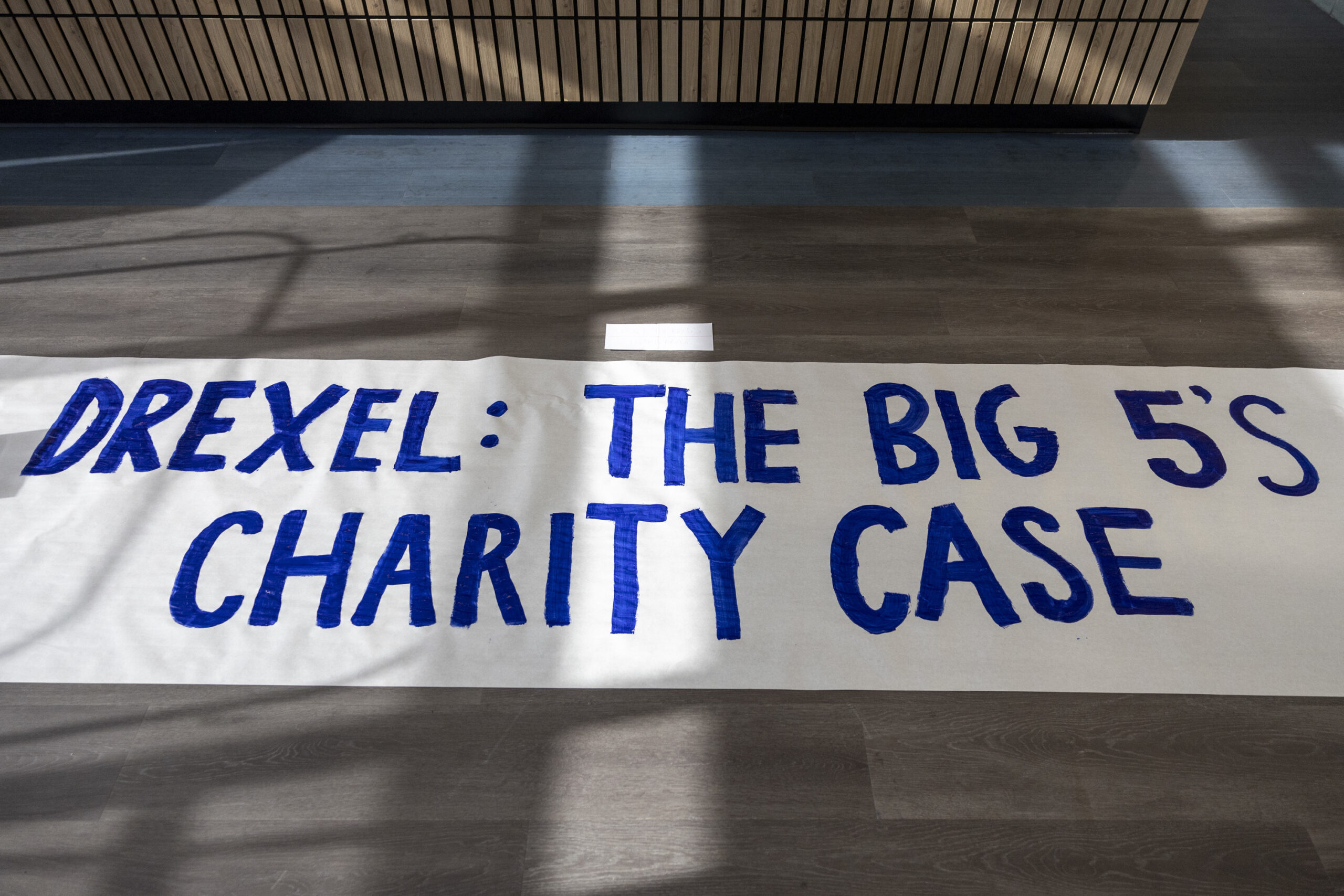
The group of students — “I have a couple guys in the group who are pretty clever,” Mitchell said — brainstorm ideas for the rollout before they meet to paint their signs. They’re ready for Saturday, when La Salle plays Drexel in the Big 5 Classic.
“It’s stressful making sure they get rolled out at the right time,” said Mitchell, who’s also a center forward on the Explorers’ water polo team. “But I love seeing the way the students react. I have a couple friends who were sitting behind the rollout, and they’re blowing up my phone like, ‘What did it say?’ It’s just exciting.”
Perfectly Philly
Butler asked the La Salle security guard if he could talk to the priest, hoping he could ask for absolution. The priest was still steaming as Butler told him it was a misunderstanding. It was just some college kids making a joke, he said. The priest offered Butler penance: the Temple students could stay, but they had to hand over the rest of their banners.
But the Owls were going to clinch the Big 5 title that night, and the Cherry Crusade brought a rollout to celebrate it. Butler pleaded with the priest to allow them to keep that sign. He rolled it out to show the priest and security guard what it said. “Fine,” said the priest. The rollouts, once again, would not be banned. A perfectly Philly tradition lived on.
“There’s something in the Philly culture that rollouts hit a perfect vein,” Butler said. “The thing about people from here is that there is respect if you can dish it and you can take it. People love to twist that knife. When people did good rollouts against us, you were angry, but there was respect there.
“It’s making fun of people who appreciate it, but also hate it, and it gives you an opportunity to be a little bit of an a—. At the end of day, it’s all love. We all love Philly basketball, even though I’ll never root for St. Joe’s and I’ll never root for Villanova. But I still want them around. I want everyone to do well, so then the hate means something.”
In March of 2013, La Salle pulled off the improbable. The Explorers hadn’t been to the NCAA Tournament since 1992. They hadn’t advanced past the Round of 64 since 1990.
But here they were, on a chilly night in Kansas City, edging out Kansas State, 63-61, to earn a spot in the Round of 32.
As players danced in the middle of the locker room, with the music blaring, an unlikely figure emerged.
Donning a black suit with a blue dress shirt, the visitor walked through the chaos, straight to La Salle’s head coach, John Giannini.
It was Jay Wright.
His team had a game in a few hours, against North Carolina, but the Villanova head coach wanted to congratulate his dear friend.
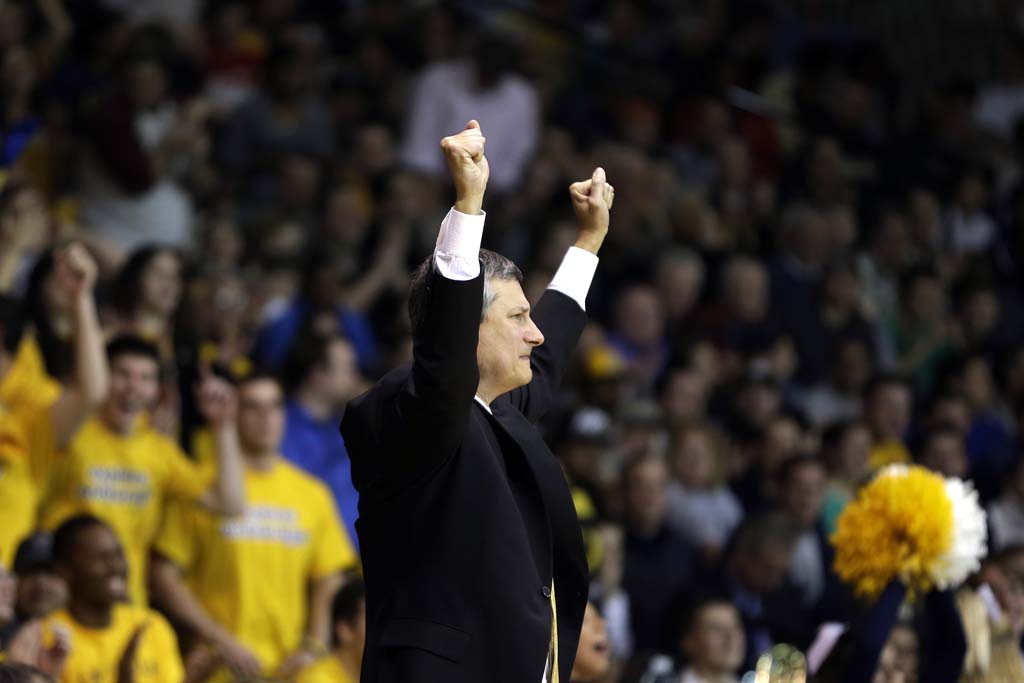
Former La Salle head coach John Giannini during a game against Butler on Jan. 23, 2013.
“Once we got to the tournament, we were always rooting for each other,” Wright said of the Big 5 programs. “It was always about Philadelphia basketball.”
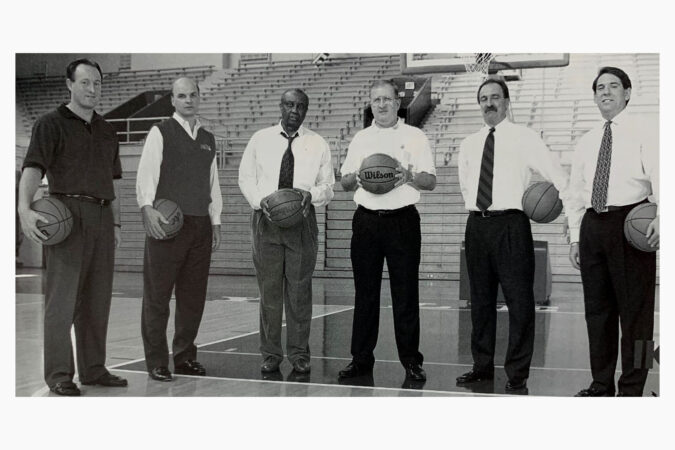
This was the way he and his Big 5 counterparts had been taught. When Wright was an assistant at Villanova in the late 1980s and early 1990s, he watched as head coach Rollie Massimino battled with Temple’s John Chaney.
The games were intense, and often heated, but they always showed each other respect. Sometimes, Big 5 coaches would go to dinner afterwards. It wasn’t uncommon for them to get together during the offseason.
The coaches would celebrate each other’s wins, even though they were technically competitors. Every time Wright advanced in the NCAA Tournament, he’d get a call from Chaney.
When Martelli reached the Elite Eight in 2004, he heard from Wright and longtime La Salle coach Speedy Morris.
The men who preceded them practiced the same habits, from Temple’s Harry Litwack, to Villanova’s Al Severance, to St. Joseph’s Dr. Jack Ramsay.
“The initial [Big 5] group was so together, and so tight, that when the rest of us joined, it was just the way it was done,” said Fran Dunphy, who spent a combined 33 seasons at the helm of Penn, Temple, and La Salle. “The culture was already set.”
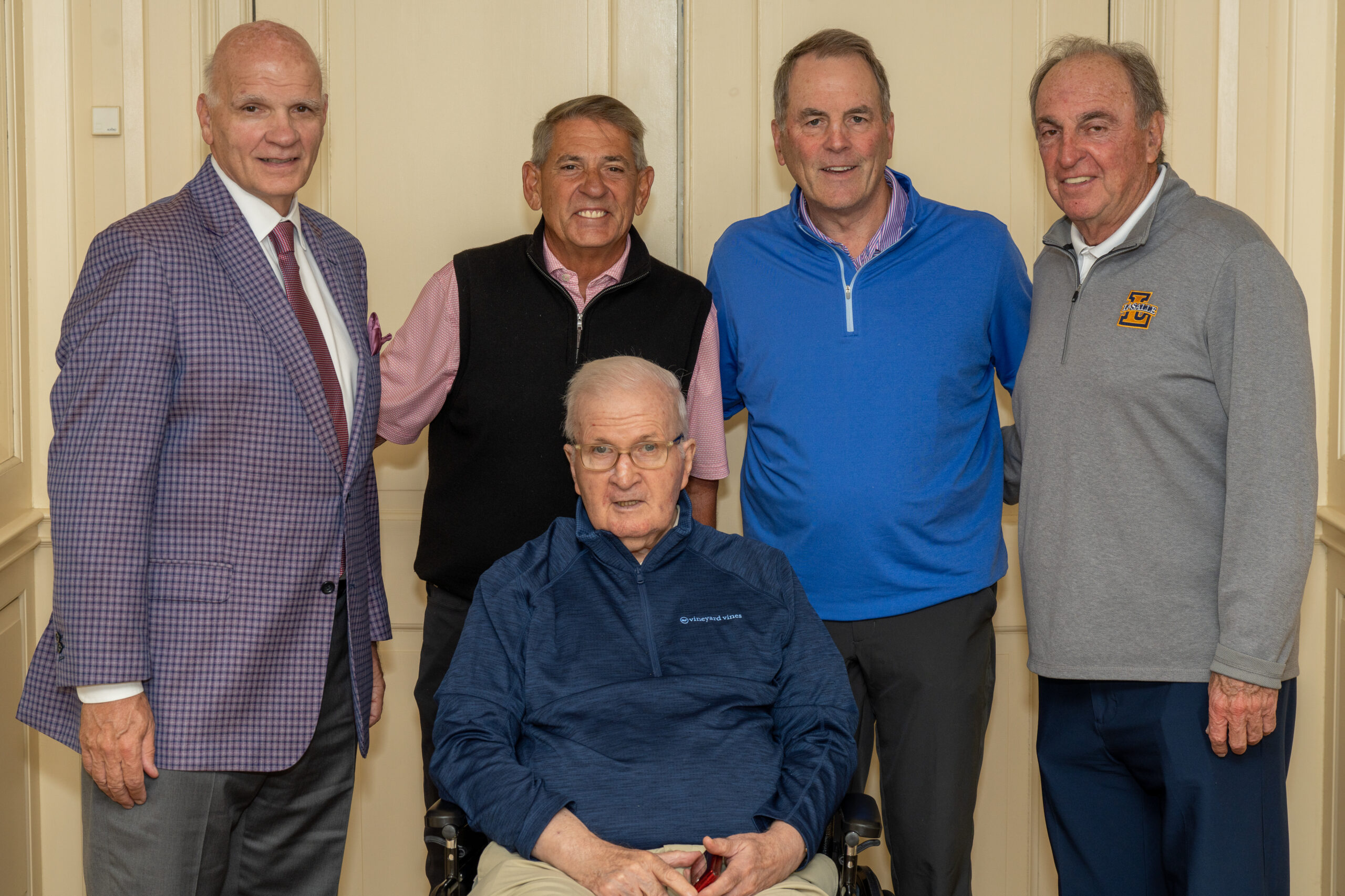
Former Big 5 coaches Phil Martelli, Steve Lappas, John Griffin, Speedy Morris, and Fran Dunphy.
For former Big 5 coaches in the area, that culture is still intact. Martelli, Dunphy, and Wright remain good friends. They visit with Morris, and are in regular contact with other former colleagues, like Giannini, Steve Lappas, and John Griffin.
The coaches believe this brotherhood is unique to Philadelphia, a city rich with basketball lore.
“On the court, you wanted to kill each other,” Wright said, “and off the court you were like brothers.”
A ‘different’ kind of bond
Dunphy was born and raised in Drexel Hill, only a few years before the founding of the Big 5 in 1955.
Back then, it was an association of five Division I schools: Villanova, Penn, St. Joe’s, Temple, and La Salle (Drexel was added in 2023).
The future coach rooted for them all, without prejudice. He’d often spend his Wednesdays, Fridays, and Saturdays at the Palestra, watching Big 5 teams square off.
“There were three nights of doubleheaders,” Dunphy said. “It was an amazing experience.”
When he was hired as the head coach of Penn in 1989, Dunphy felt a deep sense of pride. He also felt respect for his peers, many of whom had toiled through the same high school and assistant coaching ranks.
Their connections went far back. In 1976, when Wright was in the ninth grade, he attended a basketball camp in the Poconos. His camp counselor was a young Martelli.
A few years later, Martelli coached his first high school game for Bishop Kenrick in Norristown, which closed in 2010. His opponent was Dunphy, who was leading Malvern Prep at the time.
Morris and Chaney were introduced during their tenures at Roman Catholic and Simon Gratz in the late 1960s and 1970s. Lappas was an assistant at Villanova when Martelli assisted at St. Joe’s in the 1980s.
All of this only fortified the “brotherhood.”
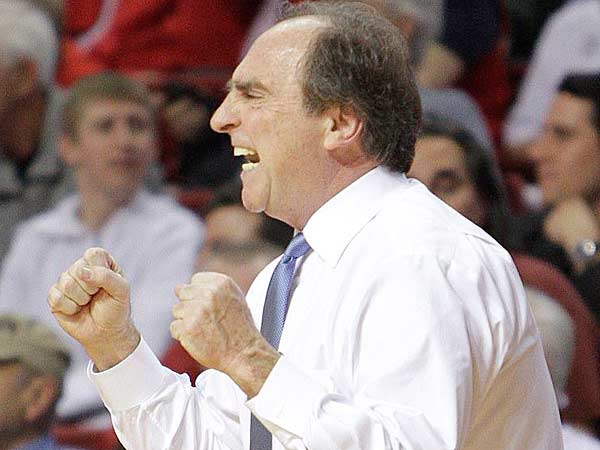
Fran Dunphy spent a combined 33 seasons at the helm of Penn, Temple, and La Salle.
“It was different than going to an ACC school or a Big Ten school or whatever the major conferences are,” Dunphy said. “Let’s say we went to Orlando for an AAU tournament. There might be three or four of us sitting together as Philly coaches, because that’s what we did. And we might be recruiting the same guy.
“And there would be coaches from other leagues, and they’d say, ‘What are you guys doing?’ Well, that was just the way it was.”
Added Martelli: “You never said, ‘I’m going to talk bad about this guy or that guy, just so we can get a recruit.’ Because you knew [the other coaches] weren’t doing it. So we were not going to do it.
“People from the outside marveled at it. They’d say, ‘Seriously, this is what you guys do?’ And I’m like, ‘Yeah.’”
Despite this unspoken pact, the coaches were not thrilled when a Big 5 rival would scoop up a promising player. Martelli, for example, was very frustrated when Dunphy earned local star Lavoy Allen’s commitment in late 2006.
“I would say that in a complimentary way,” Martelli said. “I was like, ‘I can’t believe we didn’t get him. And to make matters worse, Temple got him. We’ve got to deal with him for four years?’”
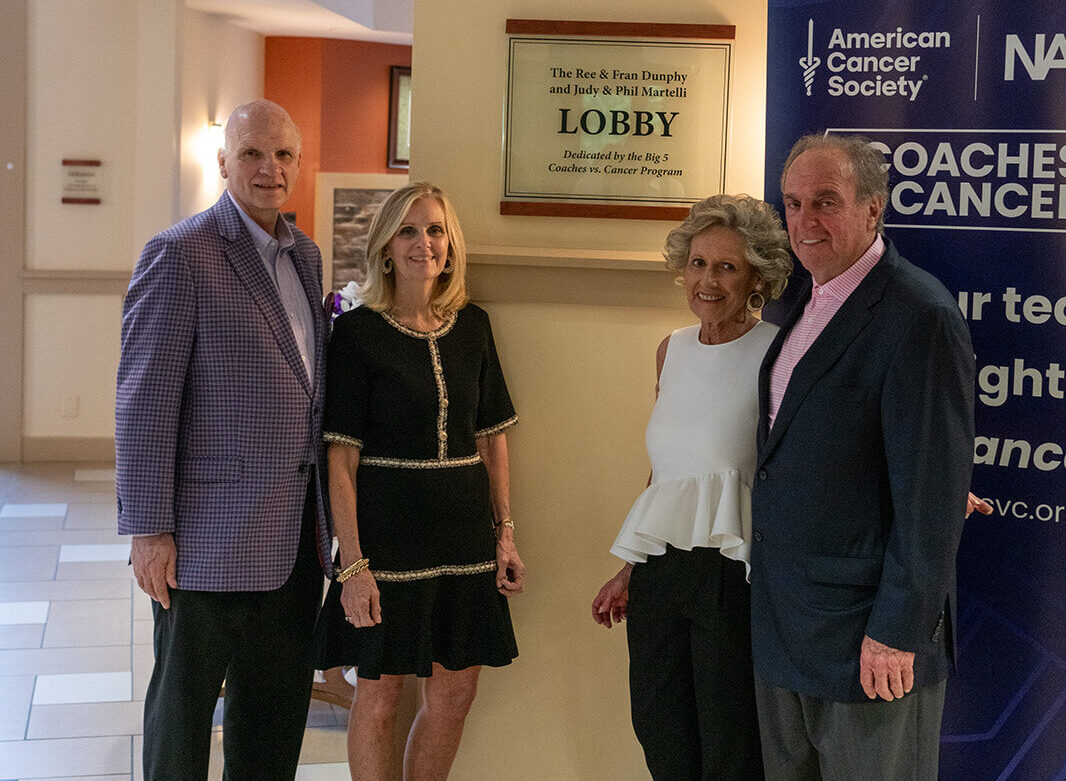
Even at the height of their competitive prowess, the coaches would band together for the betterment of the sport and the world around them. In 1996, Martelli and Dunphy started the Philadelphia chapter of Coaches Vs. Cancer, a nonprofit that raises awareness and funds for cancer research.
They looped in their fellow Big 5 coaches: Lappas, Morris, Chaney and Bill Herrion (who was at Drexel). Not long after Wright was hired as head coach of Villanova in 2001, he accompanied Martelli and Dunphy to meet the CEO of Blue Cross/Blue Shield, Fred DiBona, for lunch in Center City.
Former Big 5 coaches Phil Martelli and Fran Dunphy with their wives at a Coaches Vs. Cancer event.
The insurance company offered them $50,000, and became the group’s first corporate sponsor. That donation helped lift the chapter off the ground.
“The three of us were really competing against each other, right then,” Wright said. “And we all went together during basketball season, up to his office, and got that thing spearheaded.”
Wright, Martelli, and Dunphy are still very involved with Coaches vs. Cancer. The Philly chapter has since become the most successful in the country, raising over $22 million.
It is not the only legacy they’ve left behind. Over recurring breakfasts at Overbrook Golf Club, the coaches would talk about everything from scheduling to the format of the Big 5 round-robin.
Some of those ideas will be implemented on Saturday, in the third-annual Big 5 classic. Wright said that the triple-header format was discussed as far back as “15-20 years ago.”
He and peers wanted to put on a big event, one that didn’t cause scheduling conflicts.
“It was healthy, because we were from different leagues,” Martelli said. “Fran was in the Ivy League, I was in the Atlantic 10, and Jay was in the Big East.
“It was always for the greater good. It wasn’t about, ‘What’s best for St Joe’s? It was, ‘What’s best for college basketball?’”
‘The elder statesmen’
Wright, Dunphy, and Martelli have a reverence for Morris and the late Chaney, “the elder statesmen” of the group.
Chaney took special interest in Dunphy, who replaced him at Temple in 2006. The former head coach liked to share his thoughts after games. This was especially true if Temple had too many turnovers.
The next day, Dunphy’s phone would ring. He always knew who was calling.
“The conversation would go, ‘Franny, what the hell is going on out there?’” he recalled. “‘Why are we turning the ball over?’
“‘I know, Coach. We’re working on it. We’ve gotta get better.’”
Speedy Morris and John Chaney developed a friendship while serving as Big 5 coaches.
Like their younger counterparts, Morris and Chaney were contemporaries. They both grew up in the city; Morris in Roxborough and Chaney in North Philly.
The coaches also shared a flair for the dramatic. Neither man was above throwing his coat, or screaming at a referee, or stomping up and down the court.
They found kindred spirits in each other.
“He was tough,” Morris said of Chaney. “But I enjoyed him, very much.”
One day, in the late 1990s, the La Salle coach came up with an idea. The Temple coach was known for his expensive clothes, especially his ties. He’d often give them away as gifts.
So, Morris decided to pay it forward. He grabbed a few dozen of the ugliest 70s-era ties he could find, and asked his wife, Mimi, to wrap them up in a box. She sent it to Temple, with a note.
“It read, ‘You’ve been so kind to share some of your beautiful ties with me,’” Morris’s son, Keith, recalled. “‘I’d like to share a few of mine with you.’
“Chaney opened it up, and he was like, ‘What is this [expletive]?’”
After Chaney retired from coaching in March of 2006, he became an occasional attendee at Morris’ practices and games at St. Joe’s Prep. There was one, in particular, that stuck out in Morris’s mind.
It was 2006, and the two coaches had just paid a visit to Tom Gola, who was dealing with a health scare. They headed back to the Prep, where they’d parked their cars. As Morris said goodbye, Chaney made an impromptu announcement.
He would be coming to practice, too.
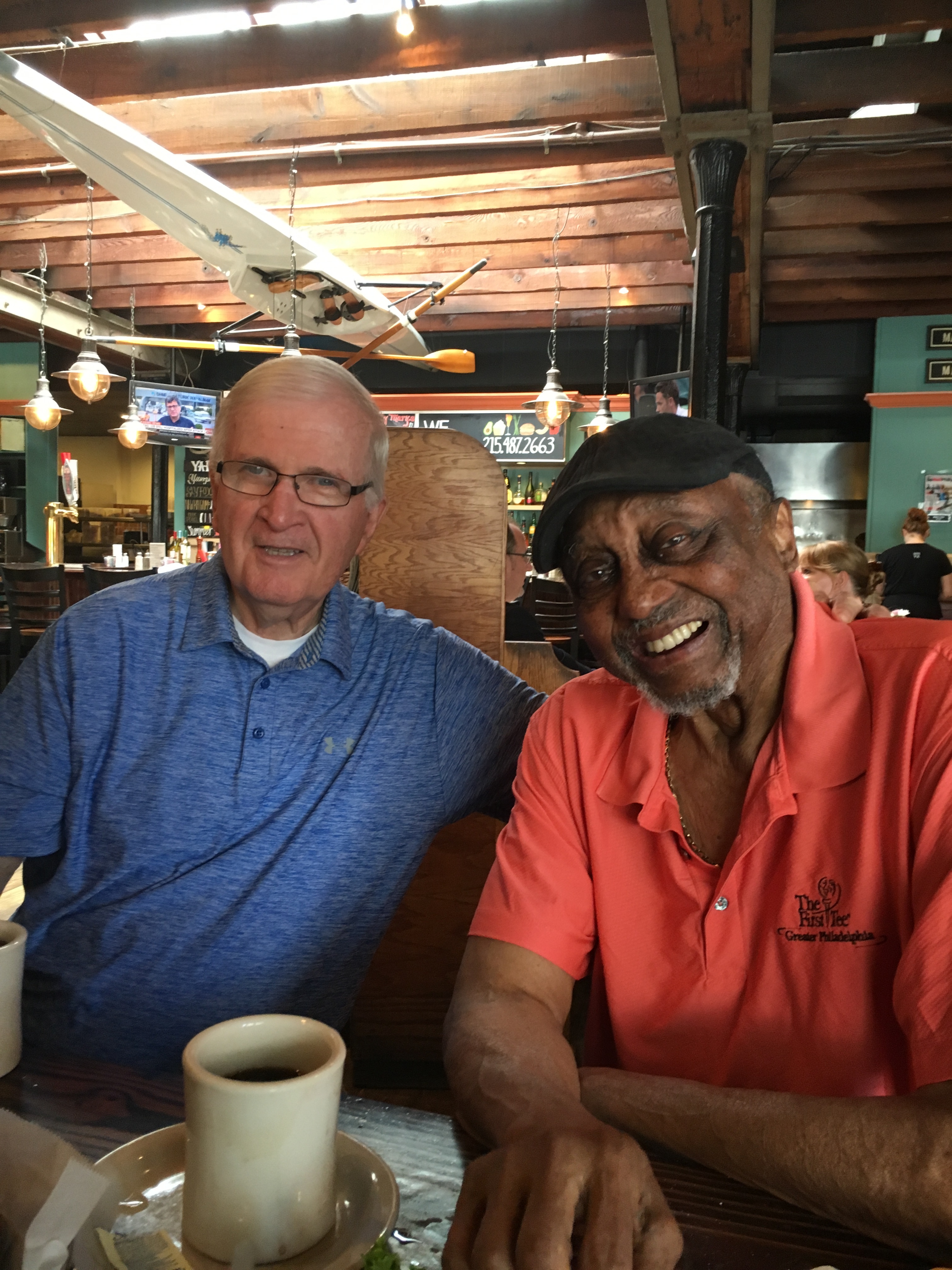
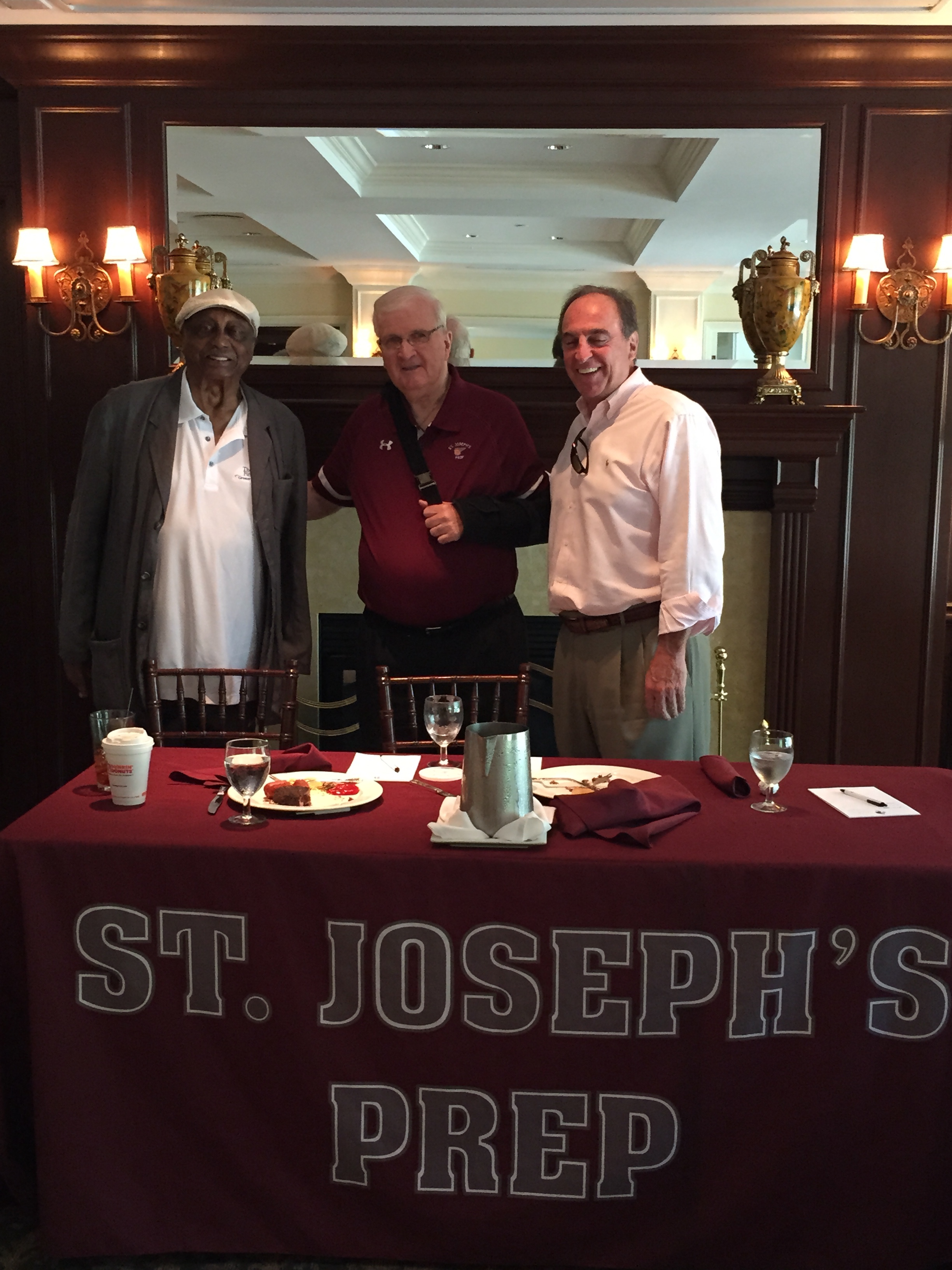
John Chaney, Speedy Morris, and Fran Dunphy.
Morris was thrilled. The high school coach asked his friend if he wanted to take the lead. Chaney insisted he didn’t. But once Morris started running a defensive drill, that quickly changed.
It was a 2-3 matchup zone, and a Prep player missed a weak-side box-out. Chaney jumped out of his chair, as if he was still at Temple.
He ran from midcourt to the paint.
“He said, ‘No!’” Morris recalled. “‘That’s not how we do it!’”
Chaney proceeded to give the student a 10-minute, expletive-laden lesson on rebounding and positioning. Keith Morris, an assistant coach at the time, nervously looked around to make sure there weren’t any Jesuit priests in the gym.
The two coaches stayed close until Chaney died in 2021. They’d talk on the phone at least once a week. They’d get lunch together in Manayunk, discussing basketball and life.
“They called each other brothers,” Keith said.
‘The caretakers’
This level of camaraderie is more challenging in today’s game. When Wright, Dunphy, and Martelli were coaching, the idea of having a player transfer from one Big 5 school to another was unfathomable.
Now, it is commonplace, with much more relaxed rules. The advent of NIL has pushed programs to generate more revenue, so they can remain competitive and pay their players. It has led to a corporate, less familial environment.
But despite these challenges, the coaches still believe that upholding the Big 5 brotherhood is worth the effort.
“Because the guys who are coaching now, they didn’t create the Big 5,” Martelli said. “They don’t own the Big 5. But they are the caretakers. And the same goes for all of us.”
A second woman is accusingPhiladelphia doctor John Smyth Michel, the medical director and owner of Excel Medical Center, of sexual abuse. She said Michel touched her inappropriately when she worked for him several years ago, according to a recent court filing by the Philadelphia District Attorney’s Office.
Prosecutors charged Michel with felony rape and sexual assault earlier this yearafter a female patient said he raped her during an October 2024 office visit.
Michel, 55,of Jenkintown, told police and state medical licensing authorities that he had sex with the 39-year-old patient, but he claimed it was consensual, criminal and state licensing records show.
The new accusations involve a former female employee who worked for Michel as a medical assistant from 2015 to 2019 at his East Mount Airy office on Stenton Avenue and at another location in Germantown on Chelten Avenue.
She recently told law enforcement authorities that beginning in 2018 Michel touched her breasts over her clothing on multiple occasions while she was working in the office. He additionally groped her vagina over her clothing before she quit in 2019.
The accusations have not resulted in new charges at this time, but the investigation remains ongoing, according to Marisa Palmer, a spokesperson for the DA’s office.
Prosecutors are seeking to introduce the groping accusations as evidence to bolster its sexual assault case against Michel, given there were no witnesses to the alleged rape.
“The incidents reveal a common plan, scheme or design on the part of the defendant to engage in unlawful and similar nonconsensual sexual conduct with vulnerable women in his medical offices,” Assistant District Attorney Eamon Kenny wrote in a Nov. 24 court motion.
The judge presiding over the criminal case must decide whether to grant Kenny’s motion and put the 34-year-old former employee’s accusations before jurors at trial.
The Inquirer does not identify alleged victims of sexual assaultwithout their permission.
Michel did not return phone calls and emails from The Inquirer this week. His criminal defense lawyer, Andrew Gay Jr., declined to comment Wednesday.
Michel founded Excel Medical Center, whichgrew to more than a dozen medical clinics located throughout the city, with about 20,000 patients and 200 employees.
Last month, Excel’s general manager wrote a letter to patients informing them the practice “will be ceasing operations” as of Dec. 1. “We truly value the trust you have placed in us for your care,” the manager stated in the Nov. 11 letter obtained by The Inquirer.
A woman who answered the phone at Excel’s main location in West Mount Airy on Thursday said the practice was not taking any new patients in preparation of closing. She said the practice might resume operations and accept new patients after the new year. Michel’s lawyer declined to comment when asked about the practice’s status.
The criminal case, which is pending in Common Pleas Court, involves a then-38-year-old patient.
According to police and court records, she accused Michel of kissing her during a May 2024 exam at his East Mount Airy location.
She told him “no,” left the office, and did not report the kissing incident.
About five months later, she went to an appointment at Michel’s North Philadelphia office on West Diamond Street. During the Oct. 14, 2024, visit, she says Michel raped her with such force that her head banged twice against the exam room wall.
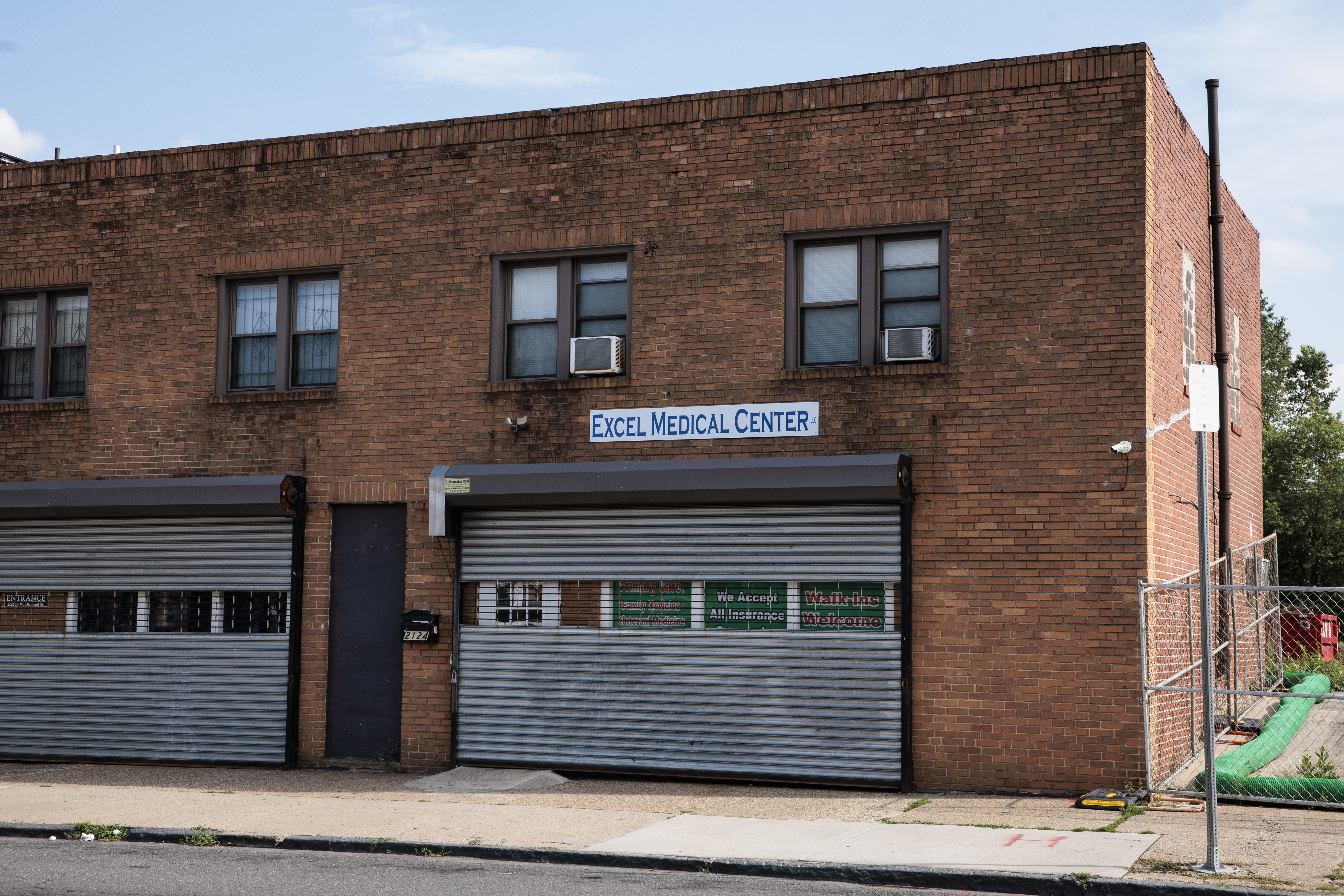
The exterior of Excel Medical Center at 2124 Diamond Street in Philadelphia.
In early November 2024, she told her husband what had happened and subsequently filed a police report. Michel was arrested and charged about three months later.
Michel’s trial was initially slated for Dec. 9, but during a hearing on Monday, a judge postponed it until Feb. 17 after the DA’s office asked for more time to investigate, court records show.
Michel’s suspension nears end
In June, the State Board of Osteopathic Medicine, which regulates and oversees licensure of osteopathic doctors like Michel, disciplined him for having sex with a patient — a violation of state regulations.
He apologized to the board in a letter, saying, “I fully acknowledge that I crossed a professional boundary” and is “profoundly contrite.”
The board suspended his medical license for six months, followed by 18 months of supervised probation, and fined him $4,000. Michel’s suspension is set to end on Dec. 11.
If convicted in the criminal case, Michel could permanently lose his medical license.
In an e-mailed statement on Thursday, the Pennsylvania Department of State, which oversees professional licensing boards, said its prosecution division “continues to closely monitor Dr. Michel’s criminal charges and review his compliance with the terms of the consent agreement.”
Abuse in office hallways
The accusations outlined in Kenny’s motion include new details of sexual misconduct. The former employee said Michel approached her from behind to “grab her breast over her shirt.”
She was stunned and “hated the feeling,” but she feared losing her job so she didn’t say anything to him.
Once, he simultaneously “cupped” her breast and vagina over her clothes with his hands. She turned around and screamed at him to stop touching her, according to the motion. He replied, “`You know you want it and you know you like it,’” she recounted.
She said she couldn’t quit because she needed the income and told her co-workers about the abuse. Those colleagues helped her “avoid him” while at work. She also told her husband, though she persuaded him not to confront Michel.
She resigned in 2019 after landing a new job. They had no contact until this year when he texted her.
When she asked why he wanted to talk to her after so much time had passed, Michel texted nevermind, the former medical assistant told prosecutors. She then wrote back, “explaining how she felt about his abuse all these years later, that the thoughts of it still traumatized her.”
Inquirer staff writer Chris Palmer contributed to this article.