The snow rumors notwithstanding, the Philadelphia region and most of the rest of the Northeast can pretty well rule out a white Thanksgiving, nor will Black Friday turn white.
However, the upper atmosphere evidently is in a state of upheaval with a potentially rare event unfolding, and forecasters say something resembling winter may arrive around here before the holiday weekend ends.
The National Oceanic and Atmospheric Administration’s Climate Prediction Center has chances favoring below-normal temperatures and above-normal precipitation from Thanksgiving Day through Dec. 1.
However, the meteorologists who have grappled with longer-range outlooks are cautioning against taking social media snow forecasting too seriously.
“The observed snowfall is inversely proportional to the hype,” said Judah Cohen, research scientist with the Massachusetts Institute of Technology. He is among those who have noticed the snow mentions that have popped up on X accounts and popular websites.
The next week should generally be uneventful save for rain Tuesday night possibly into getaway Wednesday, when highs are forecast to reach the 60s.
Then a developing pattern change is predicted to import colder air into the Northeast. “I do believe it will get colder as the Thanksgiving week wears on,” said Bob Larson, senior meteorologist with AccuWeather Inc.
A rare event may chill December
What has the attention of Cohen and others in the meteorological world is the potential for a “major” stratospheric warming event in the upper atmosphere over the Arctic sometime in the next several days, a disruption that could allow significant cold air to pour into the United States.
Major events have occurred on average about six times a decade, according to NOAA researchers; however, having one so early would be a rarity.
If one occurred, it would be only the second time in records dating to the early 1950s that it has happened this early, said NOAA meteorologist Laura M. Ciasto.
While computer models have been debating over just what is going to happen, Cohen, chief of seasonal forecasting for the Janus Research Group, said that such an early date has given him pause about forecasting it will happen.
What causes a stratospheric warming event?
On occasion, upward-moving waves from the troposphere, 5 to 9 miles over the Arctic, crash into the stratosphere, 10 to 30 miles up. That has the effect of compromising the polar vortex, the west-to-east winds that lock cold air in the places where the sun disappears for the winter, Ciasto said.
When the winds slacken, the vortex can weaken and allow frigid air to spill southward. In some cases it might “stretch,” or split into pieces that deliver cold air to regions of the Northern Hemisphere.
A major disruption would have longer-lasting impacts, Cohen said.
The European forecast model has consistently predicted a major event, Ciasto said, while the U.S. model has not been as impressed.
What is likely to happen if the warming event occurs?
A major warming in January 2021, when temperatures in the stratosphere suddenly jumped 65 degrees Fahrenheit, resulted in quite a snowy February in the Philadelphia region.
After a warming event, “there’s a greater chance that the jet stream will become more disrupted and dip down” over the continuous United States, Ciasto said, “bringing cold air with it.”
As for timing, the effects may show up anywhere from two to several weeks after the event.
In the meantime, she noted that “several other factors,” including patterns over the North Pacific, favor a chilling for the Northeast.
Don’t be surprised to see snow appear in an actual forecast, but not necessarily on the ground.
Philadelphia developers may soon benefit from a 20-year property tax abatement to convert large, underutilized properties into residences.
Buried among the litany of provisions in the state budget and fiscal code in Harrisburg, which both passed last week, new language was included that allows Philadelphia to exempt “improvements that convert deteriorated property into residential housing units” from property taxes for up to 20 years.
If a building is deemed too difficult to convert to housing, the new legal language will allow a developer to demolish a building and still get the abatement.
The legislation defines “deteriorated property” as “any industrial, commercial or other business property, or property previously used for government purposes, including a school” that is located in what the legislation calls “a deteriorating area.”
It isnow up to City Council and Parker’s administration to craft a local law within the confines of what the state government newly allows. According to state law, local officials must also define what geographic areas under their purview qualify as “a deteriorating area.” Council President Kenyatta Johnson says he supports the 20-year abatement.
The abatements would “ensure that there are no vacant office buildings here in the city, and …incentivize the building of affordable housing,” said Parker in an interview. “That’s where I think it’s going to matter the most.”
Shuttered schools and the Roundhouse
Currently, the city has a10-year abatement that applies to all residential properties for renovations — which includes conversions — and a half-strength abatement for new construction that begins with a 100% break on a project’s property taxes and then tapers by 10% annually over a 10-year period.
Parker said that her administration worked with State Sen. Vincent Hughes (D., Philadelphia), State Rep. Jordan Harris (D., Philadelphia), and State Sen. Joe Picozzi (R., Philadelphia) to get the new language into the contentious Harrisburg budget.
The administration is now working on crafting legislation to present to Council early next year. She sees it as a crucial incentive in her H.O.M.E. effort to build or preserve 30,000 units of housing.
Parker emphasized that while the new legislation is meant to help solve the office market crisis in Center City, she is most excited for it to be applied to shuttered public schools and other large, underused buildings in outlying neighborhoods.
“We have a menu of options, and this tool, this puts our efforts on steroids to build affordable housing in the city of Philadelphia,” Parker said. It is a “public good [that is] underproduced and has to be incentivized, and not just in Center City.”
Lewis Rosman, the city’s chief deputy solicitor, pointed to the architecturally unique former police headquarters known as the Roundhouse as a property that could possibly benefit from the 20-year abatement as a way to demolish the existing structure and build a new one.
“If you have a property like the Roundhouse that you can’t directly turn into housing, you got to take it down,” said Rosman, who helped write the statelegislation. “It will be a new development, but presumably under enabling legislation from Council that will be implemented, it would be subject to the abatement.”
Impact on affordable housing?
Real estate groups in the city hailed the new legislation out of Harrisburg as a tool to fight blight and reactivate historic buildings.
“For years, [we have] advocated for tools that make it possible to convert blighted, deteriorated properties into vibrant residential communities, and this expanded abatement authority does exactly that,” said Sarah Maginnis, executive director of the Commercial Real Estate Development Association’s (NAIOP) Philadelphia chapter.
Mayor Parker said she plans to include provisions in thecity’s abatement legislation to support affordable homes.
“This is not a blanket windfall for billionaires,” Parker said.
Councilmember Jamie Gauthier, who chairs City Council’s housing committeeand has been a champion of affordable housing, said she also supported the concept of a 20-year property tax abatement for residential conversion with the proviso that the city requiresome housing for lower-income residents in exchange for the tax incentive.
“Construction costs are really high right now, and we need more housing, so I’m not against an abatement that would generate more housing,” said Gauthier. “At the same time, if we’re going to incentivize developers through a vehicle like this, it needs to have an affordability component.”
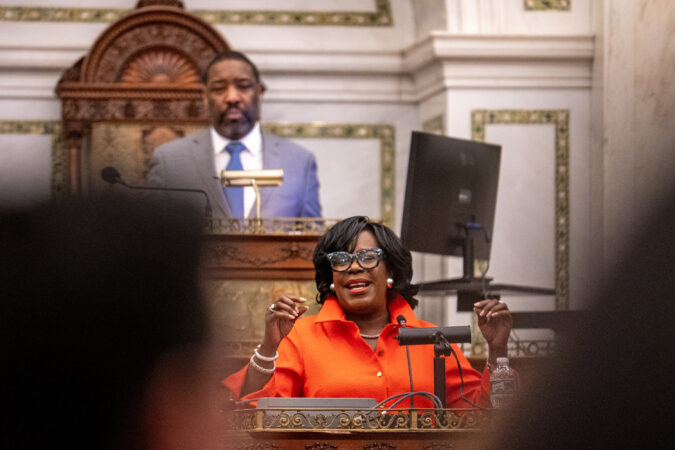
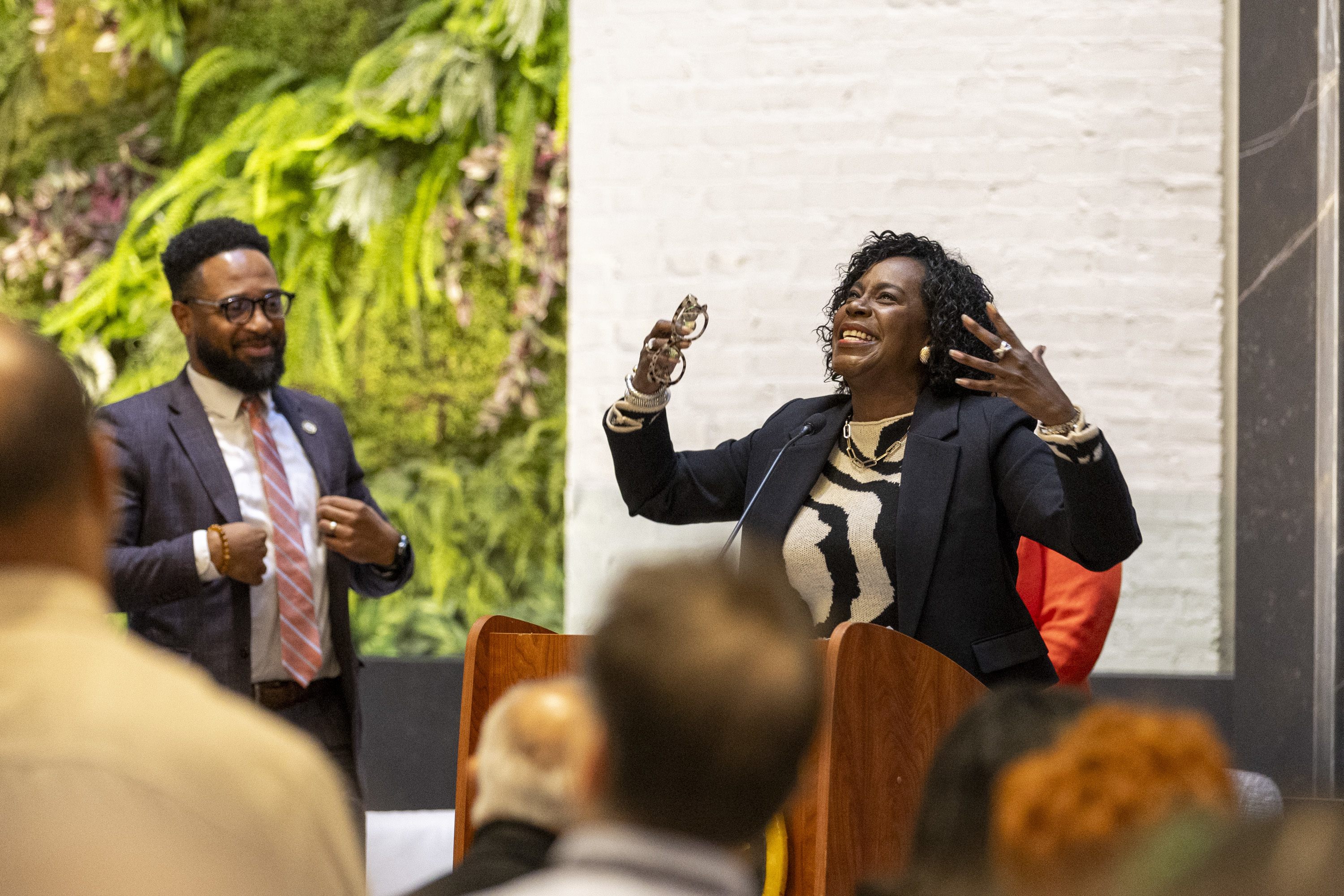
Mayor Cherelle L. Parker speaking at a press conference on the future of Market East earlier this month. Jessie Lawrence, Philadelphia director of planning and development, is pictured left.
But developers with expertise in residential conversions warned against adding additional requirements, saying that the incentive is not generous enough to support below-market-rate rents.
“A 20-year abatement without any strings attached will make a difference in Philadelphia,” said Leo Addimando, managing partner with Alterra Property Group, which has successfully executed many office-to-residential conversions in the city. “But if you attach any strings to it, you neuter it.”
Addimando said a 20-year tax abatement could make some conversion projects viable by allowing developers to qualify for better financing, lowering their borrowing costs. But he argues those cost savings are not enough to pay for housing that would be affordable to low-income renters.
Addimando said the subsidy could probably allow fordevelopers to create lower-priced units for households who earn 120% to 80% of area median income — less than $123,000 to $85,000 for a family of three — but he assumed city policy would want to help lower-income families.
The Philadelphia Art Museum, seeking to calm the waters after a turbulent six-week stretch, has named an experienced hand, Daniel H. Weiss, as director and CEO.
Weiss, 68, was president of Haverford College starting in 2013 and left the post in 2015 to lead the Metropolitan Museum of Art in New York, staying eight years. Prior to Haverford, he was president of Lafayette College.
The decision was approved Friday morning by the Art Museum’s trustees with a unanimous vote, a spokesperson said.
Weiss’ appointment comes as something of a surprise. The museum had been expected to name an interim director while it searched for a permanent one. Right now, Weiss is set to remain in the post only through the end of 2028, though his tenure could be extended.
Weiss said Friday that despite the recent turmoil, the museum had all of the important required ingredients it needed for its future — a great collection, staff, buildings, and mission.
“What we have to do is clean things up and reaffirm our commitment to that mission,” he said. “I don’t think the challenges are so steep. They have to be addressed, they are real, but they are not overwhelming.”
The first thing he will do, he said, is to sit down with the staff, board, donors, and other constituents, and through these conversations the museum’s priorities would emerge.
“I know less about these issues than anybody else does at this point, so I need to listen and to learn,” he said.
Art Museum board chair Ellen T. Caplan was not available for comment, a spokesperson said, but she said in a statement that the museum was “extraordinarily fortunate to have someone of Dan Weiss’s caliber and experience step into this critical role.”
His proven track record of museum leadership, along with his “deep understanding of the field, and his ability to navigate complex institutional challenges,” she said, “make him ideally suited to provide stability and strategic direction during this critical period for the art museum.”
Weiss comes to his new post with both substantial art and business credentials. An art historian, he holds a master’s degree in medieval and modern art and a Ph.D. in western medieval and Byzantine art, both from Johns Hopkins University. He previously earned an MBA from Yale School of Management and worked for consulting giant Booz Allen Hamilton.
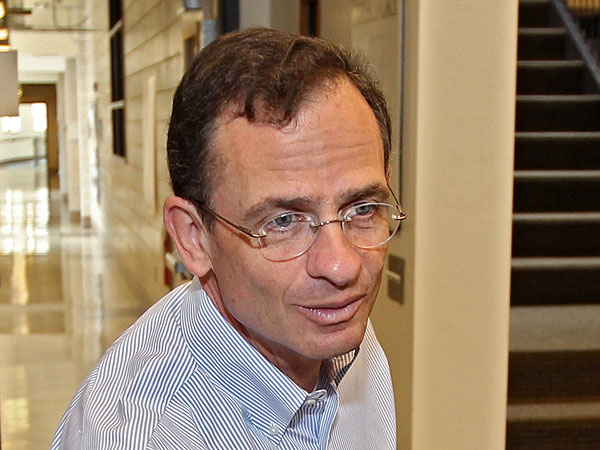
Daniel Weiss at Haverford College after being named the college’s president in 2013.
He was at Haverford College for a little less than two years before being hired away to lead the Met along with director Thomas P. Campbell. With Campbell’s departure in 2017, he took on the title of chief executive. He worked alongside Max Hollein after Hollein became director in 2018. Weiss left the Met in 2023.
He was the head of Haverford College in 2014 when it received its largest single gift to date at the time — $25 million from Howard Lutnick, then-chairman of the college’s board of managers and a Haverford graduate. (Lutnick is currently U.S. secretary of commerce.)
Weiss brings to the Art Museum another storehouse of knowledge. He recently worked as a consultant to the museum’s board, a museum spokesperson said.
He is no stranger to controversy. At the Met, he helped the museum grapple with decisions such as the end of its longtime pay-as-you-wish admission policy, as well as the question of whether to cut ties with the Sackler family, whose company, Purdue Pharma, manufactured and marketed the opioid painkiller OxyContin.
Weiss was also at the Met when the museum faced a set of circumstances not unlike some of those the Philadelphia Art Museum is facing now. In 2017, struggling with a deficit, the Met decided to pause plans for a $600 million expansion. Instead, it focused on more mundane, if important, projects, like work on the roof and skylights.
Howard Lutnick (left) with Haverford College then-president Daniel Weiss for the 2014 announcement of Lutnick’s $25 million gift to the school.
Most recently, for the past two years, Weiss has been a humanities professor and senior advisor to the provost for the arts at Johns Hopkins University.
Suda filed a lawsuit on Nov. 10 against her former employer. Her lawyer said that she was the victim of a “small cabal” from the board that commissioned a “sham investigation” as a “pretext” for her “unlawful dismissal.”
The Art Museum on Thursday responded to the lawsuit in Philadelphia Court of Common Pleas with a petition saying Suda was dismissed after an investigation determined that she “misappropriated funds from the museum and lied to cover up her theft.” Her lawyer called the museum’s accusations false. “These are the same recycled allegations from the sham investigation that the museum manufactured as a pretext for Suda’s wrongful termination,” he said.
The Art Museum has a list of short- and long-term challenges with which it must grapple. Among them is the question of whether to roll back the recent name change and rebrand, which have been widely mocked and disliked.
It also has several big pieces of the operational, facilities, and financial puzzle to prioritize. The Perelman annex was closed to the public during the pandemic and has not reopened; a planned expansion of gallery space beneath the museum’s east steps is in limbo; deferred maintenance on the main building awaits attention; the endowment is considered inadequate for an institution of its size.
In addition, the museum is challenged by an operating deficit and visitorship numbers that have not recovered post-pandemic.
Weiss — who is expected to take over the museum Dec. 1 — is the author of several books, including a recent one that explores the place of the art museum in society throughout history and examines its challenges today in the larger culture. Its title suggests the case he will need to make as the museum’s 15th director: Why the Museum Matters.
“This is a great museum with a bright, important future,” said Weiss, “and our ability to fulfill our mission requires everyone’s involvement.”
Rape crisis centers in the Philadelphia region are sounding the alarm that the slight increase in funding in the recently passed state budget won’t be enough to sustain or improve crucial services for survivors of sexual assault.
The Pennsylvania Coalition to Advance Respect (PCAR), which funds rape crisis centers via the state allocation, estimates centers will only see an average increase of $5,300 from the state to support their work assisting victims of sexual violence.
The Philadelphia Center Against Sexual Violence had to lay off most of its staff and reduce services due to the nearly five-month state budget impasse. And while leaders in the region appreciate the funding — the first increase for rape crisis centers in years — it’s only a fraction of what Philly’s only rape crisis center says it needs to survive.
“Even with the budget now passed, the funding increase is minimal compared to the overwhelming need,” said LaQuisha Anthony, senior manager of advocacy at the center, in a news release last week. The center is known as WOAR, the initials of its former name, Women Organized Against Rape.
Now advocates in Philadelphia and the suburbs are turning their focus to next year’s budget, pushing for an $8 million increase in state funding to rape crisis centers, which, among other services, offer victim advocacy, legal services, and crisis hotlines. A surge in funding will help provide stability for survivors and adequately compensate staff who dedicate their lives to this work.
“An $8 million increase would help ensure that every survivor across the Commonwealth, urban, suburban, and rural, has access to care, advocacy, and prevention,” said Joyce Lukima, coalition director and chief operating officer at PCAR, in a statement.
More than $12 million of a $50.1 billion state budget was allocated to rape crisis this year, a $250,000 increase from last year. Lukima said this $250,000 will be split among 47 rape crisis centers in the state.
In a statement, a spokesperson for the Pennsylvania Department of Human Services, which oversees rape crisis center funding, highlighted Gov. Josh Shapiro’s history of support for survivors of sexual violence.
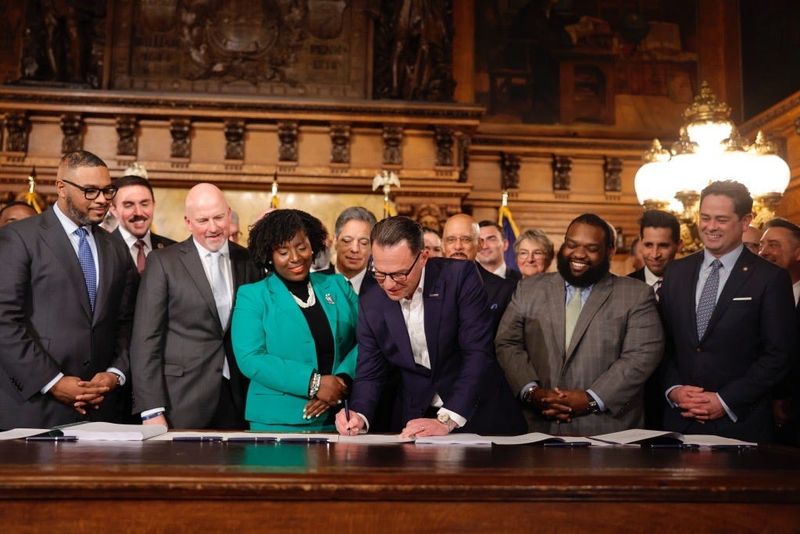
Gov. Josh Shapiro signs the fiscal year 2025-26 budget surrounded by General Assembly members on Nov. 12 at the Capitol in Harrisburg. The state budget had been due June 30, and Pennsylvania is the final state in the country to approve a funding deal.
“The final budget reflects the realities of working with one of the only divided legislatures in the entire country – but Gov. Shapiro will continue to fight for survivors and the Commonwealth’s rape crisis centers,” said Ali Fogarty, the DHS spokesperson.
Victim services centers in the suburbs, which also offer rape crisis services, are echoing WOAR and PCAR’s message, highlighting the urgent need for greater funding. These suburban centers receive funding from additional sources because they support victims of other crimes.
“For now, we’re doing OK, but another year of no increase in funding while the cost of living is going up has a significant impact on our staff as well as our organization,” said Penelope Ettinger, executive director of Network of Victim Assistance – Bucks County.
Trying to stay afloat
While Pennsylvania lawmakers were failing to come to an agreement on a far overdue state budget last month, rape crisis centers in Philadelphia and the suburbs were trying to make ends meet and provide services to survivors of sexual violence.
For instance, the Victim Services Center of Montgomery County had to use a line of credit, delay bill payments, institute a hiring freeze, increase the number of interns, and commit to “triaging services,” said Mary Onama, executive director.
“If they hadn’t passed the budget the time that they did, by December or January, we would have had to close, because we couldn’t go much longer,” Onama added.
At the Crime Victims’ Center of Chester County, it “added a layer of stress to an already very stressful job,” though the center did not have to reduce services, said Christine Zaccarelli, the organization’s CEO.
WOAR’s release last week said the closure of therapy and counseling services left “106 individuals wait-listed, 33 group clients waiting for services to resume, and eight child clients referred elsewhere for care.”
The center has been serving Philadelphia since 1971 and was one of the first rape crisis centers in the United States, according to the organization. Between January and October, the center said it responded to 3,820 calls on its crisis hotline.
The dysfunctional approval of the state budget, though, will have lingering effects on WOAR, warning in the news release that without a “long-term, sustainable investment,” the center won’t be able to meet a rising demand for resources.
The Bridge Loan, from the Pa. Treasury Department, provided WOAR funding owed for July through September, but it still wasn’t enough to return WOAR to full capacity, said Demetrius Archer, PCAR’s communications director. The center also brought back two employees this month, but it’s still in need of community support and is hoping to bring back more staff when possible.
“When services are underfunded, survivors and entire communities feel the impact,” said Fontan in the news release. “In a city as large and diverse as Philadelphia, every minute counts when someone is in crisis. Survivors deserve to know that when they reach out for help, someone will be there to answer.”
All eyes on Harrisburg
At Temple University’s campus Tuesday, student advocates bundled up in their coats, hats, and scarves and gathered at the Bell Tower to discuss an anti-sexual violence state bill they helped develop.
The Every Voice Bill, which primarily focuses on sexual violence prevention resources on college campuses, is even more important now that survivor services from WOAR are “unstable,” said Bella Kwok, a senior criminal justice major and president of Temple’s Student Activists Against Sexual Assault, in an interview prior to Tuesday’s event
“This bill would ensure that stability at least on an institutional level,” Kwok said.
Temple University students Emma Wentzel, left, and Bella Kwok speak at a podium on Polett Walk on Tuesday, Nov. 18, 2025, about campus sexual assault and a state bill they helped craft to strengthen protections against sexual violence at colleges.
Kwok is not the only one who is turning their attention to Harrisburg. PCAR and other rape crisis centers are continuing their push for next year’s budget to include an $8 million increase in the Pa. DHS line item for rape crisis.
As the first increase for rape crisis centers in a few years, the new budget’s funding gives advocates “hope,” even if the amount is “disappointing,” said Zaccarelli, of the Crime Victims’ Center of Chester County.
“Maybe our advocacy is making a little bit of a difference and shining a light on survivors and their needs and how important our centers are in the community,” Zaccarelli said.
Ettinger said that Bucks County’s state lawmakers have been supportive of NOVA Bucks, which had to place a hiring freeze on some positions and issue “significant” restrictions on spending due to the impasse, but that a lack of increased funding from the state is “very telling.”
“I believe that the fact that the state did not allocate a significant increase is very telling to what they believe, where they put it on the priority list,” Ettinger said.
For his part, Shapiro signed Act 122 in October 2024, which aimed to increase transparency by requiring a statewide electronic system to track evidence kits for sexual assaults, Fogarty, the DHS spokesperson said. And in December 2023, he signed Act 59, which aims to improve access to treatment for survivors of sexual assault.
It’s a “societal” problem, not a government problem, said Vincent Davalos, interim executive director of the Delaware County Victim Assistance Center.
“When we talk about sexual violence, the first thought is, of most people, is to say ‘Maybe this didn’t happen,” Davalos said. “And even if they do believe it happens… it’s just a really difficult topic for people to engage and talk about it plainly.”
This week, victim services leaders across Pennsylvania will gather in Harrisburg for an annual conference to address funding challenges among other concerns, Davalos said, noting that with more funding, his center could improve staff retention.
But this year, the newly passed state budget is likely to be top of mind.
“I think money is going to be a big topic,” Davalos said.
The package was mailed from New Jersey, which should have been the first clue.
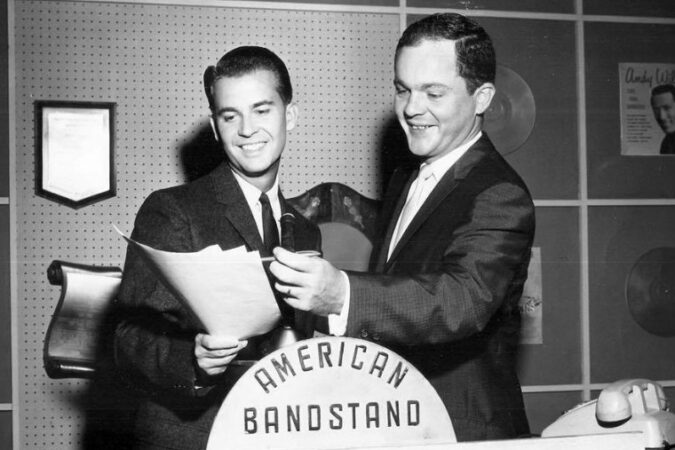
Inside was a cigar box rigged to resemble a bomb, and it was delivered on the afternoon of Nov. 21, 1960, to the office of TV host Dick Clark.
Clark, a week away from his 31st birthday, was the star of the nationally televised ABC program American Bandstand, which was filmed at WFIL-TV studios at 46th and Market Streets. He was filming his afternoon program when the parcel arrived shortly after 3 p.m.
His secretary received the package, and as she started to untie the brown-paper wrapping, the cigar box became visible. One side of the box had been removed, and she spotted a net of wires and a five-inch piece of copper tubing.
Police quickly arrived and inspected the device, and took it to their headquarters for further evaluation. And while it looked like a crudely constructed explosive device, police and postal leaders told The Inquirer that it was missing two key components: powder and a fuse.
There were no actual explosives in the box, and the device couldn’t have set any off.
It contained what at first appeared to be a blasting cap, but after closer examination was identified as a piece of tree bark.
“The package was obviously the work of a crank,” the officials told The Inquirer.
Philly Police, the U.S. Postal Service, and the FBI took part in the investigation, but no culprit was ever publicly identified.
TV staffers were still jumpy a few weeks later when an unmarked gift package that resembled the faux bomb arrived at Clark’s office.
Responding police, taking no chances, carried it across the street and into the middle of Drexel University’s athletic field.
When they finally got the courage to open it, out popped a shaggy, stuffed dog.
All packages from then on, The Inquirer quipped, should carry a notation:
Two new studies on New Jersey’s rising sea levels predict potentially serious environmental outcomes in the Garden State, from the flooding of numerous toxic sites to significant erosion.
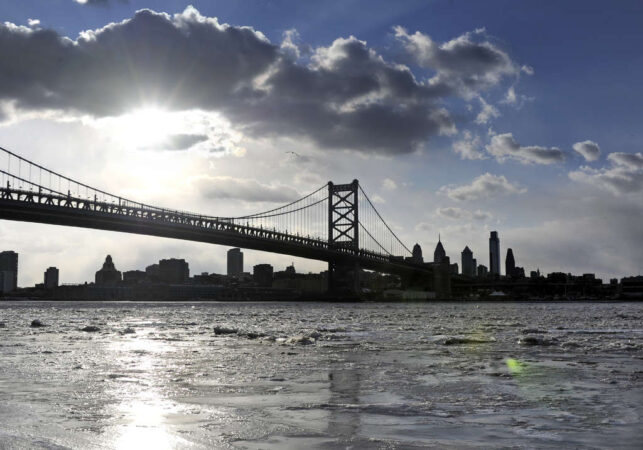
Multiple coasts, spanning from the Delaware Bay to the Hudson River, increase New Jersey’s vulnerability to sea-level rise.
When combined with the state’s abundance of big industry, that means New Jersey has the nation’s second-highest exposure to potential flooding at industrial, toxic, and sewage treatment sites, according to a new peer-reviewed study led by Climate Central, a nonprofit run by scientists.
Meanwhile, a separate new study by RutgersUniversity says that the state faces a sea-level rise nearly three times faster than the global average over the coming decades.
Taken together, that means New Jersey faces more rising waters rimmed by chemical plants, Superfund sites, fossil fuel ports, and wastewater treatment plants.
“Flooding from sea level rise is dangerous on its own — but when facilities with hazardous materials are in the path of those floodwaters, the danger multiplies,” Lara Cushing, an associate professor at UCLAwho assisted with the Climate Central study, said in a statement.
Flooding near hazardous facilities
The Climate Central paper, published Thursday in the journal Nature Communications, analyzed and mapped 47,646 hazardous facilities along America’s coastlines. Researchers from UCLA, Nanjing University, and UC Berkeley assisted.
The researchers project that 3,740 facilities in the United States are at risk of a 100-year coastal flood within the next 25 years under a moderate greenhouse gas emissions scenario for sea-level rise (a 100-year flood has a 1% annual chance of occurring). And 5,138 facilities will be at risk by 2100.
Scientists usually consider three scenarios of greenhouse gas emissions when forecasting sea-level rise. A low-emissions scenario means basically no more rise in greenhouse gases. In an intermediate, or moderate, scenario, emissions rise slowly until 2050 and then decline. Under a high-emissions scenario, emissions rise through 2100. Each has an associated impact, with higher emissions resulting in higher sea levels.
More facilities would be flooded if emissions of greenhouse gases, which help trap heat in the atmosphere, go unchecked and continue to climb, the authors found.
Seven states — Louisiana, Florida, New Jersey, Texas, California, New York, and Massachusetts — account for nearly 80% of projected sites at risk of flooding by 2100.
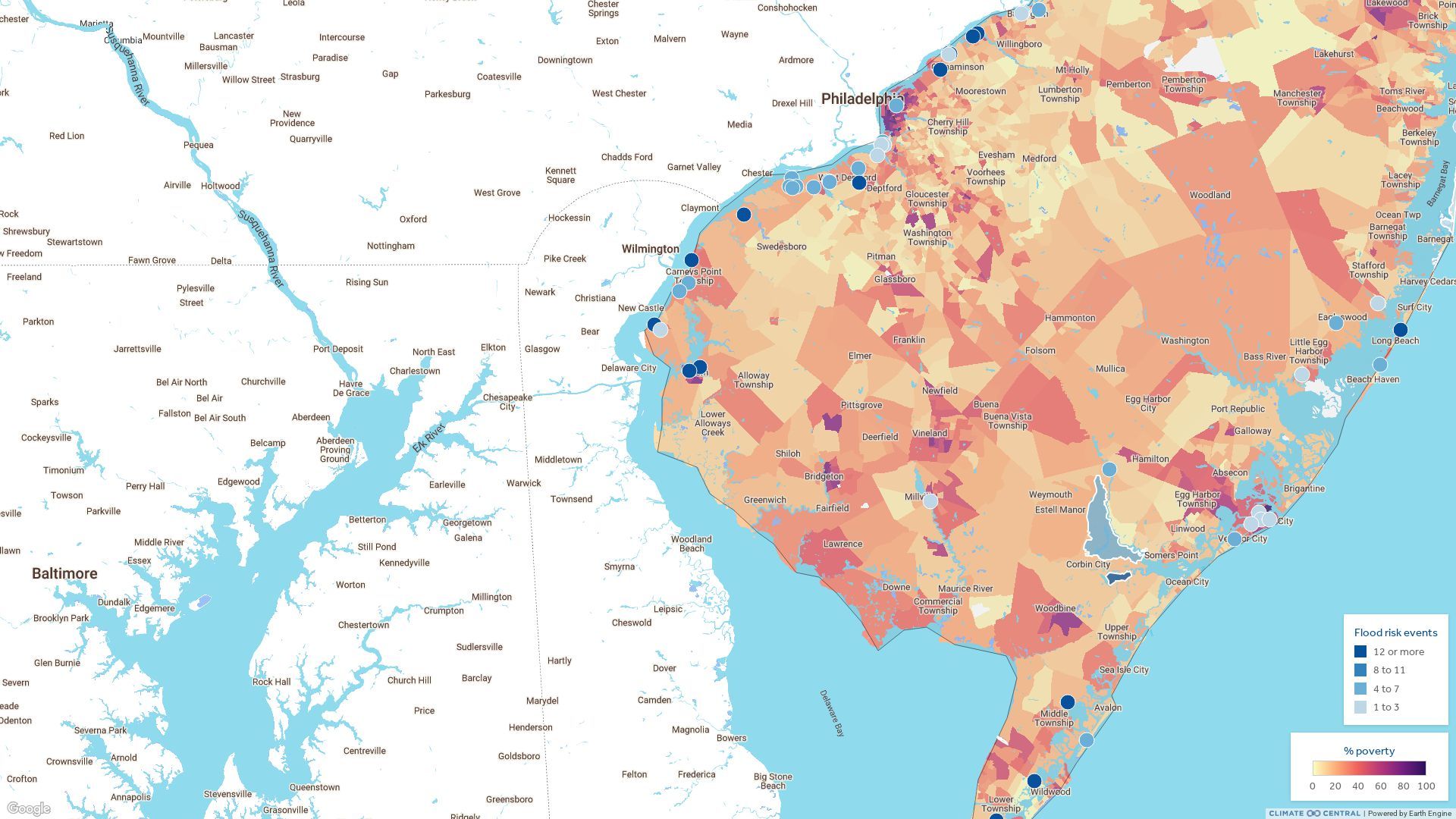
Screen capture of a map from Climate Central’s coastal risk screening tool shows toxic facilities, such as industrial sites and sewage treatment plants, at risk of a 100 year flood by 2050.
New Jersey’s industrial legacy
According to Climate Central,New Jersey has 420 at-risk facilities that will be exposed to flooding by 2050, with the number rising to 492 facilities by 2100. The state is second only to Louisiana, which will have 1,632 facilities at risk by 2050.
Middlesex, Bergen, and Essex Counties have the most exposure, given their proximity to densely populated areas near major ports such as Newark and New York.
However, industrial facilities in Burlington, Camden, and Gloucester Counties also have exposure to flooding, some potentially multiple times, given their positions along the Delaware River. So, too, do facilities in Philadelphia.
Chemical and petroleum giants such as ExxonMobil, DuPont, and Chemours have facilities in Gloucester County just off the river, for example. Avient, a maker of specialized polymers, and Riverside Metals have facilities along the river in Burlington County.
InPhiladelphia, the Clearview Landfill Superfund site off Darby Creek, Ashland Chemical, and the city’s Southwest wastewater treatment plantare at risk of flooding in a major storm.
Indeed, the Delaware River is lined with wastewater treatment plants. Some, such as those in Philadelphia and Camden County, have older systems that together overflow millions of gallons of raw, diluted sewage into the river during storms, though the biggest proportion is from Philly.
Some of the industrial, wastewater treatment, and other facilities are at risk of 12 or more floods annually in decades to come as sea levels rise, according to the Climate Central study.
The authors found that certain communities are more likely to live near at-risk sites, such as those with a higher proportion of renters, households living in poverty, residents who identify as Hispanic, linguistically isolated households, households without vehicles, seniors, and nonvoters.
“This analysis makes it clear that these projected dangers are falling disproportionately on poorer communities,” Cushing said, noting that the people in thesecommunities often lack the resources to prepare for, or recover from, flooding.
Rising seas
Separately, a technical advisory panel at the New Jersey Climate Change Resource Center at Rutgers released a report last week focused on rising seas and coastal storms.
The report, commissioned by the New Jersey Department of Environmental Protection, found that under a moderate rise in emissions:
The state is likely to see a sea-level rise between 2.2 and 3.8 feet by 2100.
Between 2005 and 2020, sea level at tide gauges rose by about 4 inches. That ranged from around 3.7 inches at Atlantic City to around 4.4 inches at Cape May.
In the near term, New Jersey is likely to experience between 0.9 and 1.7 feet (11 and 20 inches) of sea-level rise by 2050.
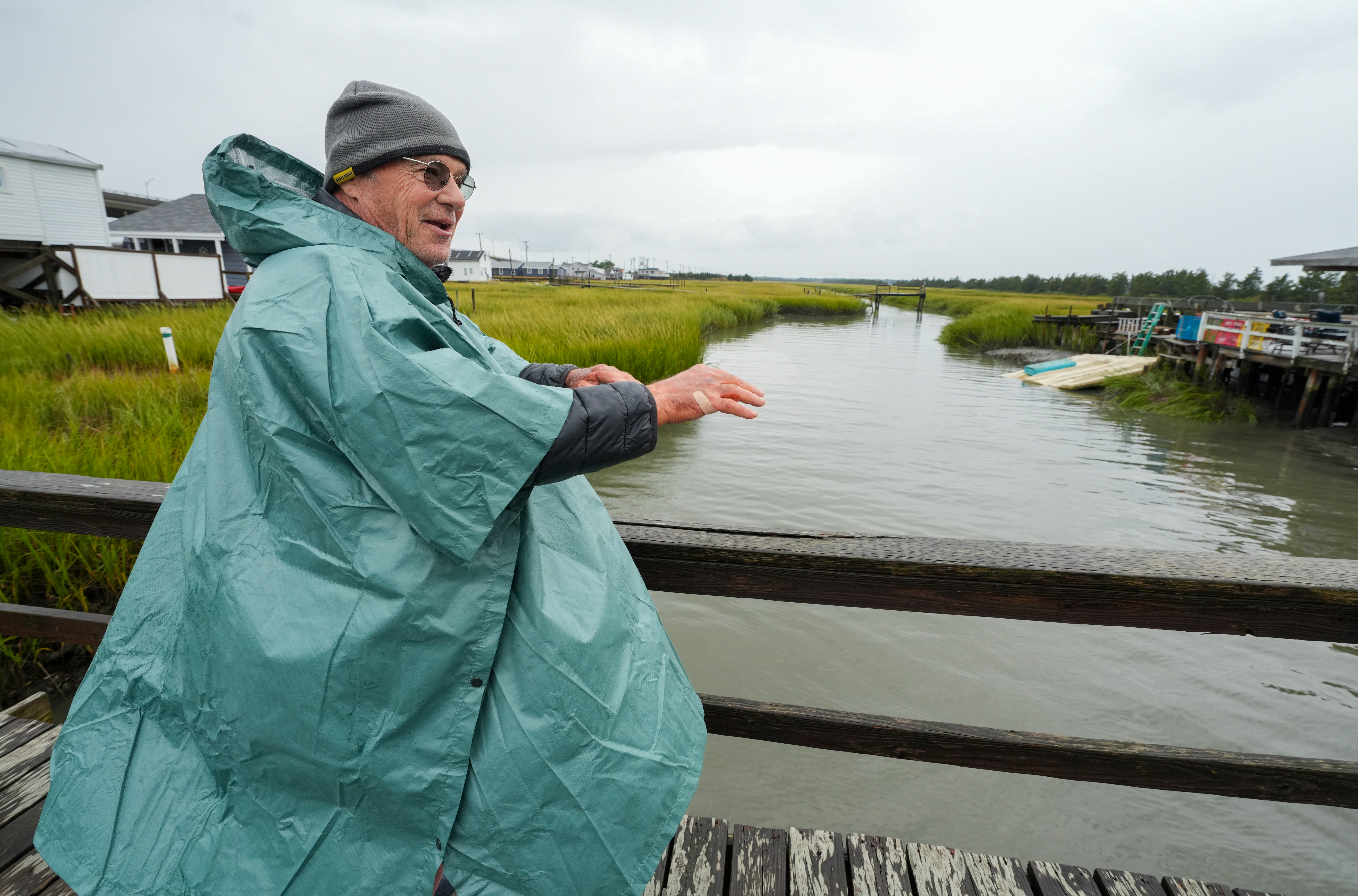
In this file photo, Haldy Gifford talks about the dead grass along the Grassy Sound, a roughly 120-acre spit of marshland off the back bay in Wildwood in Middle Township. Grassy Sound is beset by erosion.
“New Jersey’s shorelines have experienced and will continue to experience significant erosion driven by sea level rise and storms,” a summary of the report states. “While current levels of intervention have successfully reduced erosion rates in some places, these efforts may become economically unsustainable in the future, particularly for lower-income communities.”
Further, wetlands, which serve to protect wildlife habitats and the coastline from storm surges, will be greatly impacted.
“Even under a low emissions scenario, future projected rates of sea-level rise in coastal New Jersey may exceed the pace at which many coastal wetlands are able to adapt.”
Robert Kopp, a climate scientist and distinguished professor in Rutgers’ Department of Earth and Planetary Sciences, said in a statement that the world is on track to experience about 2.7 degrees Celsius of atmospheric warming by 2100 because of human-caused climate change.
Kopp cautioned that could increase given the change in U.S. climate policies.
Added Janine Barr, a Rutgers senior research specialist: “Sea-level rise is happening now in New Jersey and will continue into the future.”
Activists rallied outside the Philadelphia Criminal Justice Center on Thursday to press their assertion that ICE has been allowed to turn the courthouse into “a hunting ground” for immigrants.
The noon demonstration crystalized months of contention between activists and lawyers who say the courthouse must be a place to seek and render justice ― not to target immigrants ― and federal authorities who insist that making arrests there is legal, safe, and sane.
No ICE Philly, the rally organizer, says agents have been enabled to essentially hang out at the Center City courthouse, waiting in the lobby or scouring the hallways, then making arrests on the sidewalks outside, a pattern they say has been repeated dozens of times since President Donald Trump took office in January.
“ICE is kidnapping immigrants who are obeying the law and coming to court,” said Ashen Harper, a college student who helped lead the demonstration, which targeted Sheriff Rochelle Bilal. “She is capitulating and cooperating with ICE.”
Many people who go to the courthouse, the group noted, are not criminal defendants ― they are witnesses, crime victims, family members, people dealing with alleged offenses like shoplifting or trespassing, and others who are already in diversionary programs.
Organizers said ICE has arrested about 90 people outside the courthouse since January, a dramatic increase over the previous year. And they pledged to return on Dec. 4 ― lugging a podium for Bilal so that, organizers said, she can explain changes she intends to make, including barring ICE.
The sheriff did not immediately reply to a request for comment Thursday.
Members of No ICE Philly rally outside the Criminal Justice Center on Thursday, calling on the sheriff to cut off Immigration and Customs Enforcement access to the building.
“We want to put the sheriff on notice that we’re watching,” said Aniqa Raihan, a No ICE Philly organizer. “We want to raise awareness of the fact … that ICE is using the courthouse as a hunting ground.”
As word of plans for the demonstration spread, Bilal issued a statement aimed at “addressing public concerns” around ICE activity.
“Let me be very clear: the Philadelphia Sheriff’s Office does not partner with ICE,” the sheriff said. “Our deputies do not assist ICE, share information, or participate in immigration enforcement.”
Deputies verify the credentials of ICE agents entering the courthouse ― and those agents are not permitted to make arrests in courtrooms or anywhere else inside, she said.
Raihan and other advocates say that is no protection. ICE agents linger in the lobby, they said, then follow their target outside and quickly make the arrest.
A police department spokesperson said at the time that the Spanish-speaking officer offered to walk with the man to help translate, but did not detain him. The Defender Association of Philadelphia and others questioned how the incident squared with the city’s sanctuary policies.
U.S. Immigration and Customs Enforcement officials in Philadelphia did not reply to a request for comment.
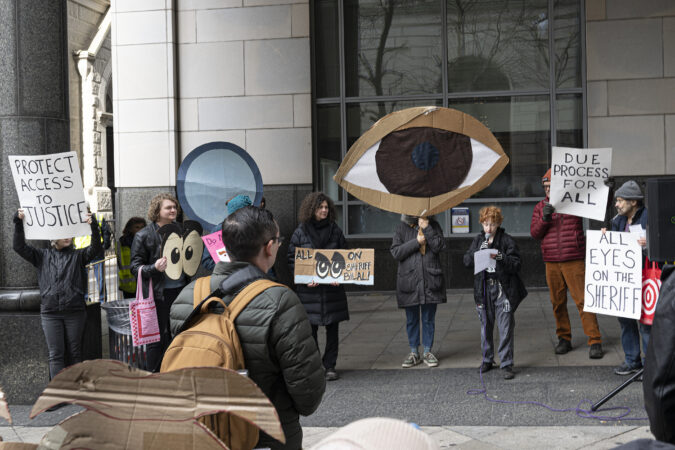
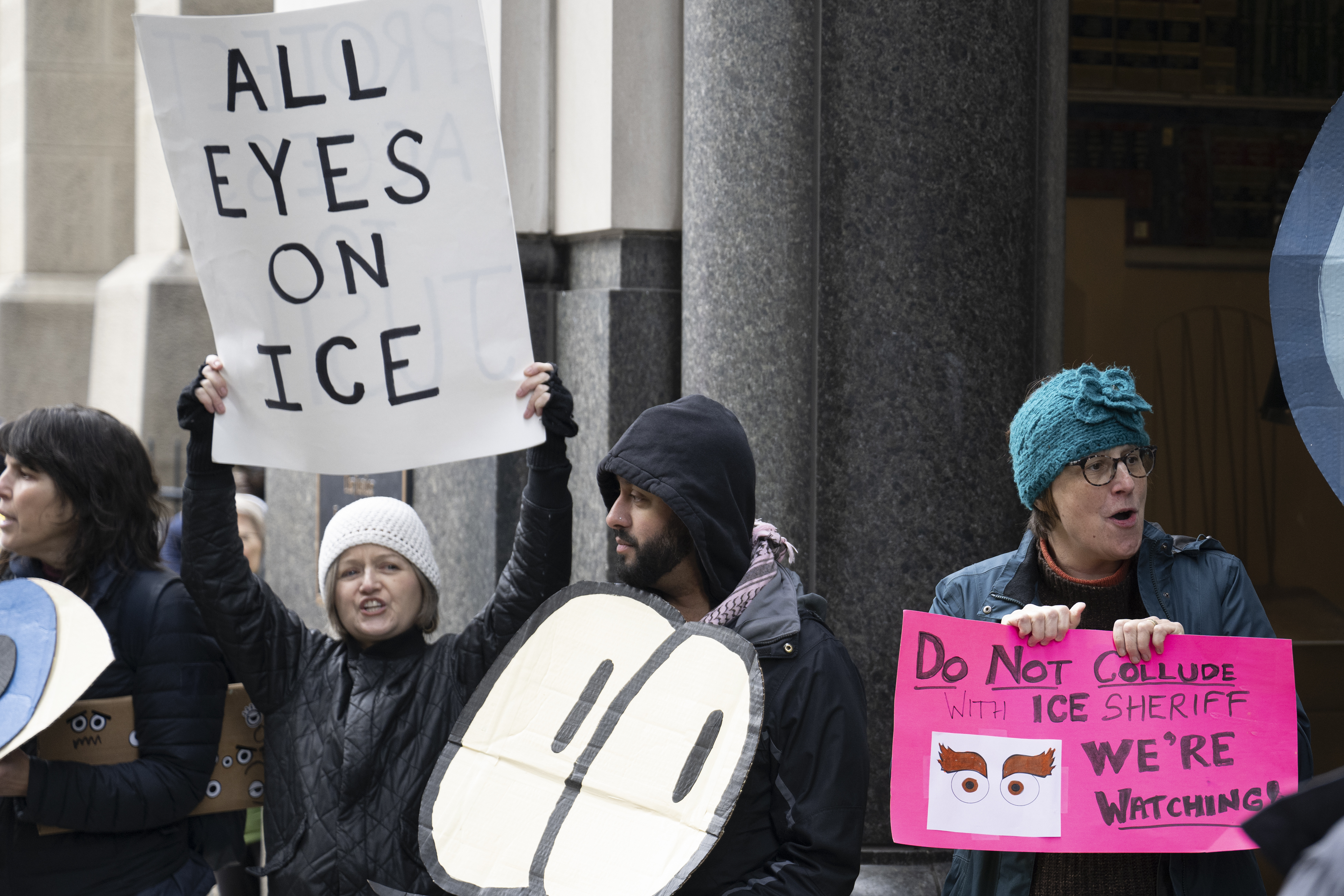
On Thursday, about 40 demonstrators gathered outside the courthouse, chanting and singing under the watchful eye of city police officers and sheriff’s deputies. No ICE agents were visible. Protesters carried signs to indicate that they, too, were watching, raising colorful cardboard eyeballs, eyeglasses, and magnifiers.
Lenore Ramos, the community defense organizer with the Juntos advocacy group, called on the sheriff and city government officials to protect immigrants at the courthouse. Proclaiming Philadelphia a welcoming city, she said, is not just a slogan ― it’s a promise, one that local government must fulfill.
“The city is not standing behind our immigrant communities,” Ramos said. “It is walking all over them.”
In an interview earlier this week, Whitney Viets, an immigration counsel at the Defender Association, said ICE agents are at the courthouse almost every day, and arrests occur there almost daily.
The government does not publicly release data detailing where most immigration arrests occur, but Viets estimated that dozens of arrests have taken place at the courthouse since the start of the year. Masked plainclothes agents are seen outside the building, in the lobby, in courtrooms, and in hallways, she said.
“Agents are effectively doing enforcement in the courthouse, through identification,” she said.
She explained that agents may identify a person they are seeking in or near a courtroom, then either follow them outside or alert other agents who are already waiting on the sidewalk.
It is unclear where ICE is obtaining information on who will be at the courthouse on any particular day, although some details about ongoing criminal cases are available in public records.One result of ICE enforcement, she said, is people are afraid to come to court.
“This is about whether our justice system operates effectively,” Viets said. “The actions of ICE have gotten brazen. … What we need at this time is public engagement against this activity.”
No ICE Philly decried “kidnappings” by the agency and demanded the sheriff “protect everyone inside and outside the courthouse,” including “immigrants targeted by ICE as well as citizens observing and documenting ICE arrests.”
The Philadelphia Sheriff’s Office is in charge of courthouse security. However, Bilal said in her statement, her office has no authority to intervene in lawful activities that are conducted off the property.
“Inside the courthouse, everyone’s rights and safety are protected equally under the law,” she said. “We are law enforcement professionals who follow the law.”
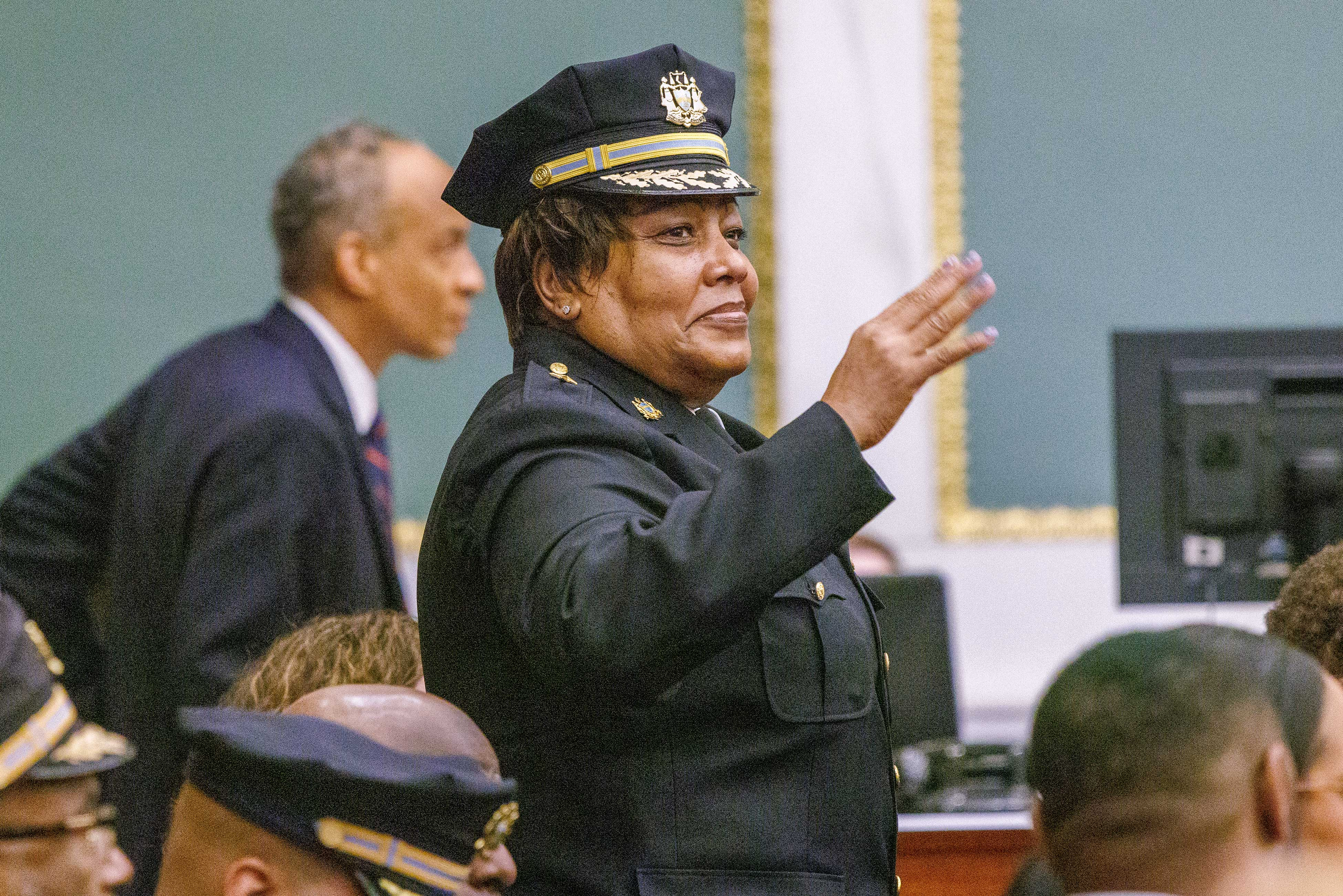
Philadelphia Sheriff Rochelle Bilal stands to be recognized at City Hall in March.
In Philadelphia and places around the country, courthouses have become disputed locales as the Trump administration pursues ever-more-aggressive arrest and deportation policies.
Under President Joe Biden, limits were set on what ICE could do at courthouses. Agents were permitted to take action at or near a courthouse only if it involved a threat to national security, an imminent risk of death or violence, the pursuit of someone who threatened the public safety, or a risk of destruction of evidence.
Even then, advocacy groups accused ICE of violating the policy by arresting people who were only short distances from courthouses.
The Biden restrictions on ICE vanished the day after Trump took office.
The new guidance said agents could conduct enforcement actions in or near courthouses ― period. The only conditions were that agents must have credible information that their target would be present at a specific location and that the local jurisdiction had not passed laws barring such enforcement.
The guidance said that, to the extent practicable, ICE action should take place in nonpublic areas of the courthouse and be done in collaboration with court security staff. Officers should generally avoid making arrests in or near family or small-claims courts.
The Department of Homeland Security said that the Biden administration had “thwarted law enforcement” from doing its job, that arresting immigrants in courthouses is safer for agents and the public because those being sought have passed through metal detectors and security checkpoints.
“The ability of law enforcement to make arrests of criminal illegal aliens in courthouses is common sense,” Assistant Secretary Tricia McLaughlin said earlier this year. “It conserves valuable law enforcement resources because they already know where a target will be.”
Philadelphia city officials have said repeatedly that they do not cooperate with ICE, and that the sanctuary city policies created under former Mayor Jim Kenney remain in place under Mayor Cherelle L. Parker.
Protesters Elias Siegelman, right, with No Ice Philly, who also works with the groups Indivisible, Jewish Voice for Peace, and Progressive Victory, outside the ICE office, in Philadelphia on Oct. 30.
Nationally, 10 months into the Trump administration, some Democratic jurisdictions are acting to tighten ICE access at courthouses.
In Connecticut this month, state lawmakers passed a bill to bar most civil immigration arrests at courthouses, unless federal authorities have obtained a signed judicial warrant in advance.
The Senate bill, already approved by the House, also bans law enforcement officers from wearing face coverings in court, Connecticut Public Radio reported. Democratic Gov. Ned Lamont is expected to sign the measure.
Last month in Chicago, which has faced weeks of controversial immigration enforcement, the top Cook County judge barred ICE from arresting people at courthouses. That came as federal agents stationed themselves outside courthouses, drawing crowds of protesters, CBS News reported.
On Monday, a federal judge dismissed a Trump administration challenge to a New York law that barred the immigration arrests of people going into and out of courthouses. New York passed the Protect Our Courts Act in 2020, during Trump’s first term, a law the administration said had imposed unconstitutional restrictions on enforcement, the Hill reported.
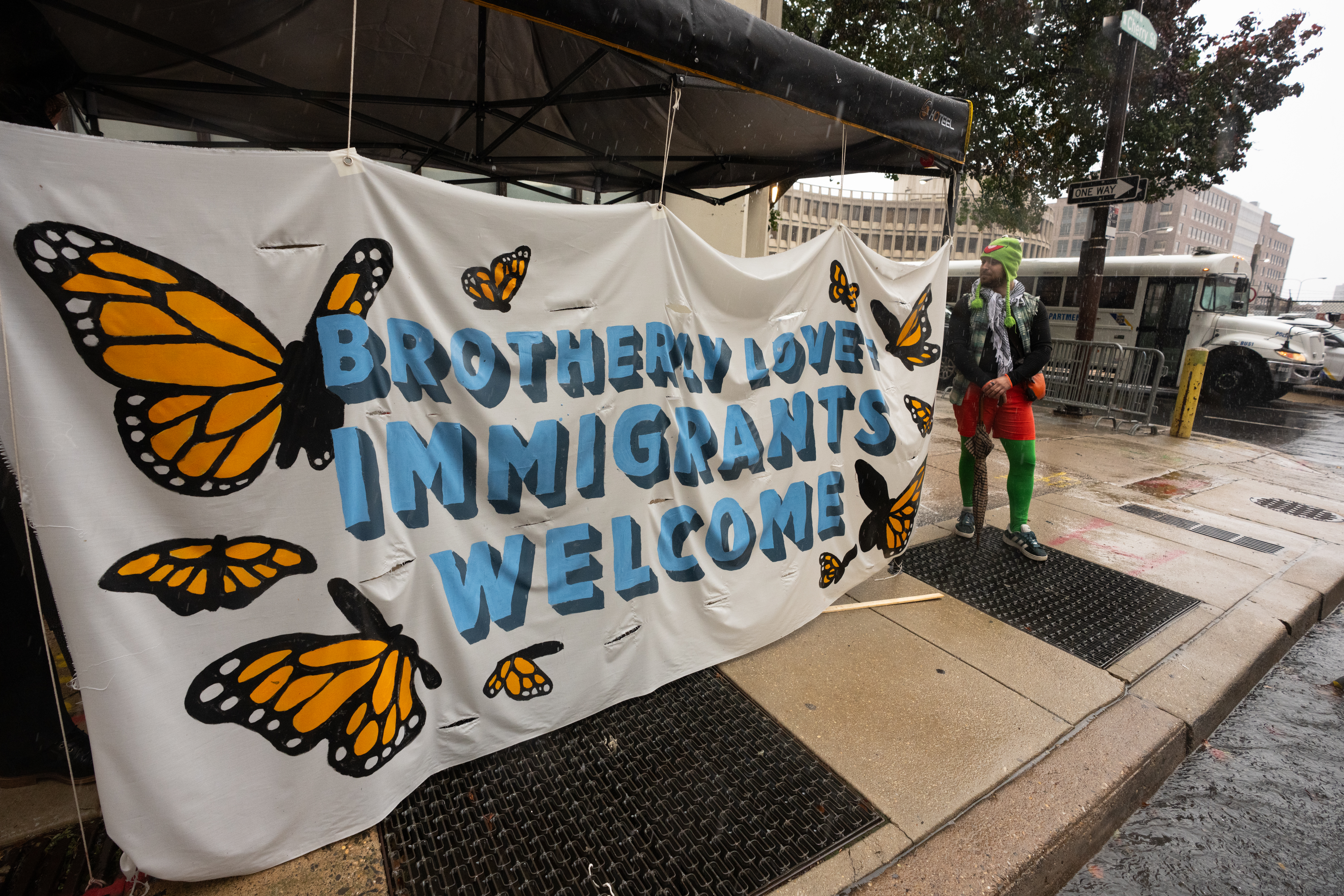
The Thursday rally marked the third recent protest by No ICE Philly, which seeks to stop agency activity in the city. The organization’s Halloween Eve demonstration outside the ICE office erupted into physical confrontations with police, with several people pushed to the ground and four arrested.
The arrests came after some demonstrators attempted to stop ICE vehicles from leaving the facility at Eighth and Cherry Streets.
No ICE Philly organizers said Thursday that they will continue to scrutinize ICE activity at the courthouse.
“There are people watching. We have eyes on this,” Raihan said, adding that ICE is “allowed to hang in the lobby, sometimes in the courtrooms.”
“Somehow they seem to know when somebody vulnerable is in the courthouse. … We’re concerned with how they’re finding out that information.”
U.S. Rep. Chrissy Houlahan was in her Washington office when she saw attacks directed at her and other military veteran members of Congress from President Donald Trump, days after they urged members of the military and intelligence community to “refuse illegal orders.”
Trump called the Democrats “traitors” in a Thursday post on Truth Social and, in a second post, accused them of sedition that he said is “punishable by DEATH.”
Houlahan, a Chester County Democrat and an Air Force veteran, was one of six Democratic members of Congress who released a video Tuesday contending that Trump’s administration is “pitting” service members and intelligence professionalsagainst American citizens and urging them not to “give up the ship.”
All six lawmakers are either veterans or members of the intelligence community.
“The idea that the most powerful man on the planet, who wields the power of the United States military and should be emblematic of all the things we value in this republic, would call for the death and murder of six duly elected members of the House of Representatives and the Senate — I’m speechless and I’m devastated,” Houlahan told The Inquirer on Thursday afternoon.
Houlahansaid she had anticipated there might be a response from the president after Stephen Miller, Trump’s deputy chief of staff and homeland security adviser, spent much of Wednesday railing against the lawmakers in the video. But Trump’s comments went beyond anything Houlahan imagined even from a president known for extreme and sometimes violent rhetoric.
“I’ve been struggling with the right words for this,” she said. “‘I weep for our nation’ would be an understatement.”
U.S. Rep. Chris Deluzio, a Navy veteran who was also featured in the video, called Thursday “a dark day in America” in an interview with The Inquirer.
“It tells me who he is and it tells me exactly why we should be talking about the rule of law and the Constitution,” said Deluzio, an Allegheny County Democrat.
In the video that set Trump off, the lawmakers, finishing one another’s sentences, reminded service members of their oath to the Constitution and instructed them to refuse to follow any order that would violate it.
“Right now, the threats to our Constitution aren’t just coming from abroad,” Deluzio says in the video.
“But from right here at home,” adds U.S. Rep. Jason Crow (D., Colo.) a former paratrooper and Army Ranger.
The video was shared by U.S. Sen. Elissa Slotkin (D., Mich.), a former CIA officer, and also included U.S. Sen. Mark Kelly (D., Ariz.), a former Navy captain, and U.S. Rep. Maggie Goodlander (D., N.H.) a former intelligence officer.
Houlahan said she considered the video “innocuous.”
“It literally talked about the fact that you should follow only lawful orders, an obvious reminder that those of us who served have grown up on,” she said.
On Thursday morning, Trump shared a Washington Examiner article about the video with the headline “Dem veterans in Congress urge service members to refuse unspecified unlawful orders,” saying their message “is really bad, and Dangerous to our Country.”
“Their words cannot be allowed to stand. SEDITIOUS BEHAVIOR FROM TRAITORS!!! LOCK THEM UP???” the president wrote on Truth Social, his social media platform.
About an hour later, Trump added in his second post: “SEDITIOUS BEHAVIOR, punishable by DEATH!”
Sedition and treason cases in modern U.S. history are very rare.
Democratic condemnations of Trump’s comments poured in from across the country Thursday. Republicans were more muted. House Speaker Mike Johnson (R., La.) defended Trump’s claim that the Democrats had engaged in “sedition,” describing the video as “wildly inappropriate.”
“It is very dangerous. You have leading members of Congress telling troops to disobey orders,” he told CNN.
Sen. Dave McCormick, a Pennsylvania Republican and U.S. Army veteran, who has called out political violence in the past, both after Charlie Kirk’s killing and an arson at Gov. Josh Shapiro’s residence, defended the president’s verbal attacks on the lawmakers. “Not a single unlawful order is cited in this video — because there aren’t any,” he said in a statement.
“The video is inappropriate and unwarranted, and I didn’t hear any of these calls to defy orders when Democrats were using lawfare against President Trump,” he added, “Giving outlandish pardons, or intimidating tech companies to stop free speech.”
About an hour later McCormick’s spokesperson sent a second comment from him, adding: “President Trump can speak for himself, but as I’ve said repeatedly, there is no place in either party for violent rhetoric and everyone needs to dial it down a notch.”
One of the few Republicans to offer any criticism of the president was U.S. Rep. Brian Fitzpatrick, a former FBI agent, who said in a statement that in the FBI he saw “how inflamed rhetoric can stoke tensions and lead to unintended violence.”
Fitzpatrick, a moderate from Bucks County who has butted heads with Trump in the past, did not name him in the statement but said the “exchange” was “part of a deeper issue of corrosive divisiveness that helps no one and puts our entire nation at risk. Such unnecessary incidents and incendiary rhetoric heighten volatility, erode public trust, and have no place in a constitutional republic, least of all in our great nation.”
Houlahan and Deluzio respond
Houlahan served three years on active duty as an Air Force engineer and an additional 13 years as a reserve, and reached the rank of captain. She has been outspoken against the Trump administration on military issues, particularly surrounding women serving in combat roles.
The lawmakers did not refer to any specific orders from the president in their video, but they had numerous concerns in mind.
Houlahan said it was sparked, in part, by military troops being deployed to U.S. cities and lethal strikes against suspected drug boats in the Caribbean.
Trump has suggested that American cities should be “training grounds” for the military, and targeted Los Angeles, Chicago, Washington, and Portland for National Guard deployments. His administration’s boat strikes, which have led to protests in Philadelphia, have come under scrutiny by experts who say they are illegal, per the New York Times, which found Trump’s claims justifying the attacks to be questionable.
“What we were speaking to is the future, those who are currently serving, and making sure they remember who they serve and what they serve,” Houlahan said.
She said the lawmakers felt “a responsibility to … make sure people understood there are people in Congress who have your back.”
Deluzio said he learned about the oath the first day of boot camp and trained sailors on it when he gained rank.
“This is something that is fundamental to how our military works and the respect we show our service members,” he said.
Deluzio served six years in the Navy including three deployments. He cofounded the Democratic Veterans Caucus in June, which was formed in opposition to the Trump administration.
He said he has heard from people on both sides of the aisle and encouraged Republican colleagues to speak out publicly against the president’s remarks.
“Republican officials should be stepping up loudly and clearly and saying the calling of death by hanging to members of Congress is out of bounds,” he said.
James Markley, a spokesperson for the Pennsylvania Republican Party, declined to comment on Trump’s remarks and said in a text that “the woke left continues to attempt to rip apart the fibers of our communities and our country.”
“Our party will continue focusing on making our country safer, prosperous and more affordable,” he added.
A spokesperson for Pennsylvania Treasurer Stacy Garrity, an Army veteran who is running for governor next year with the state GOP’s endorsement, did not respond to a request for comment.
Sen. John Fetterman, a Pennsylvania Democrat who has made a name for himself working across the aisle, said in a post on X that threatening members of Congress is “deeply wrong” without exception, regardless of political party.
“I strongly reject this dangerous rhetoric,” he said.
Gov. Josh Shapiro also quickly denounced Trumpforcalling for violence against Houlahan and Deluzio, describing them in a post on X as “two outstanding members of Congress from Pennsylvania who have fought for our country.”
U.S. Rep. Scott Perry, a Trump ally who represents parts of central Pennsylvania, told a conservative radio station in October that Democrats in Congress “hate the military,” based on their voting records.
Deluzio and Houlahan, both members of the House Armed Services Committee, also banded together then to push back on Perry’s comments, calling them “garbage.”
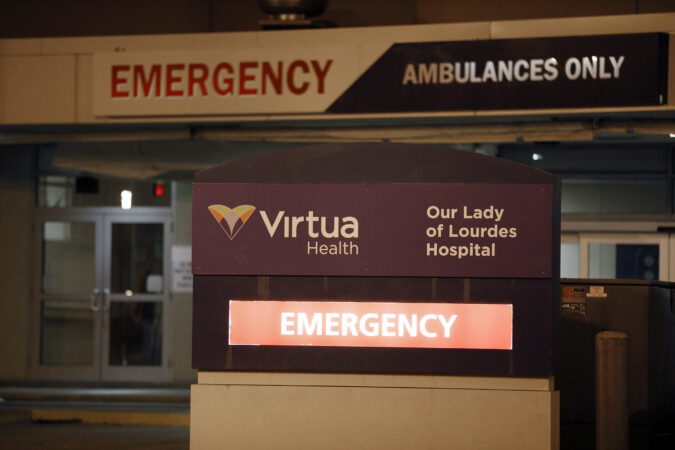
The president of a major New Jersey organ donation nonprofit told a subordinate at a Camden hospital to continue procuring organs from a patient thought to be dead — after that person “reanimated” during the organ recovery process, federal lawmakers alleged in a letter made public Wednesday.
Instead, hospital staff at Virtua Our Lady of Lourdes Hospital intervened to stop the procedure, members of the House Committee on Ways and Means said in the letter, dated Nov. 19.
The committee, which has been investigating malpractice among organ donation nonprofits, said it was probing allegations that the New Jersey Organ and Tissue Sharing Network, or NJ Sharing Network, engaged in a number of questionable practices.
The letter said whistleblowers accused the organization of disposing of organs meant for research, pressuring families to donate organs from patients who had revoked their organ donor status, and skipping over patients on a waiting list for donated organs.
The committee said that, in some cases, NJ Sharing Network could be violating federal law.
NJ Sharing Network and Virtua Health did not immediately return requests for comment Thursday.
The House’s probe into NJ Sharing Network’s practices comes after years of scrutiny for the nation’s organ donation system and amid investigations into several other organ donation organizations by the committee. The Washington Post reported that as early as 2022, Senate investigators found 70 people had died after organ donation organizations failed to screen donated organs for cancer and other diseases.
This year, the federal Department of Health and Human Services said it had found evidence that an organ donation organization in Kentucky, West Virginia, and Ohio had initiated organ procurement procedures on at least 28 patients who might not have been dead. The organ donations ultimately did not continue.
In September, the Post reported, a former NJ Sharing Network staffer named Patrek Chase filed a lawsuit against the nonprofit and two other organ donation organizations, alleging that they had collected organs that weren’t appropriate for transplants in order to pull in more Medicaid reimbursements.
Organ donation organizations are under intense pressure to find healthy organs for a growing population of people who need them, said Arthur Caplan, a bioethics professor at New York University who previously worked at the University of Pennsylvania.
“A lot of these pressures may lead to some bad behavior,” he said.
He advised Congress as it set up the nation’s organ donation system in the 1980s, but said certain aspects of the system need to be examined now. For one, it may be too big — fewer organ procurement organizations might result in a more efficient system with better-trained staff, he said.
Some organizations do not obtain enough organs to serve patients in need, he said.
“It’s been tolerated for a while, and it needs to be explained,” he said. “And for the ones that are doing well, what are they doing well? Are any of them pushing too hard? We want to protect grieving families and make sure people who want to be donors have their wishes honored.”
Still, he said, Congress’ scrutiny of malpractice in the industry comes alongside a reluctance to spend more money to improve the system.
“There are also congressional inquiries saying, ‘Why aren’t you getting more organs? And we’re not giving you any more money for training or anything else,’” he said. “The pressure is coming in both directions.”
Given the need for organs, he said, he was concerned that news of malpractice could turn people away from donating organs.
“We need more organ donors. It sounds bananas, in context,” he said. But, he said, if more people donated their organs — and the donation system undergoes necessary reforms — pressures to procure organs might ease.
Allegations of malpractice
The House committee wrote in its letter to NJ Sharing Network that the organ procurement case at Our Lady of Lourdes took place in summer 2025, about two weeks before the committee informed the organization it was investigating allegations of malpractice there.
The patient was on “life-sustaining” therapy, the committee wrote, and NJ Sharing Network asked the person’s family for consent to remove the organs for donation. Though pronounced dead before the “organ recovery process” began, the patient “reanimated” during the process, the committee wrote.
The committee did not specify at what point the person reanimated, what signs of life were exhibited, or whether the patient was injured during the process.
The NJ Sharing Network administrator on call contacted the nonprofit’s president, Carolyn Welsh, and asked what to do, the committee wrote.
The committee said it had “obtained information” that Welsh told her staff to go ahead with the organ recovery process. Hospital staff, however, stepped in and stopped the process, the committee said — though, afterward, Welsh’s staff kept pressuring hospital staff to continue.
Whistleblowers also told the House panel that emails linked to the donation case were deleted and that the donor’s record may have been tampered with, the committee wrote.
Caplan said it was difficult to comment on the case without more information on the patient or the person’s condition.
Patients who are candidates for organ donation are seriously ill or injured, and “reanimation” does not necessarily mean that a person instantly regained consciousness, he said. It could mean that a person’s heart regained some electrical activity and pumped for several more hours, he said.
It is crucial for doctors to be properly trained on when and how to declare a patient dead, Caplan said, and sometimes making that call can be difficult. Conditions like a drug overdose or a drowning in very cold water can make it difficult to gauge brain death or heart stoppage.
Allocating organs
Citing public records from federal health agencies, the committee said that, about a quarter of the time, NJ Sharing Network allocated organs for transplant “out of sequence” — skipping over people on waiting lists for organ transplants, and doing so more often than some peer organizations.
Sometimes, allocating organs out of sequence is necessary, the committee wrote, such as when an organ is reaching the maximum amount of time that it can be preserved outside a person’s body and must be implanted as soon as possible. But a staffer at the New Jersey organization allegedly sent organs to “friends in the industry” at a list of “aggressive centers,” the committee wrote.
It was unclear what was meant by “aggressive centers.”
The committee said that it had received information that skirting typical allocation procedures for just one case meant that “several individuals” waiting for organs had died, several had been removed from the organ wait list because their medical conditions worsened, and more than 100 people who were skipped over are still on the list.
The committee said that it was also concerned NJ Sharing Network had kept information from the panel after an earlier request for documents. The committee asked for more documents and communications from the organization and requested interviews with more than two dozen staff.
Bill Piccinni, 67, was riding his bike by the Franklin Institute when something halted his pedaling. The lunar module looked as if King Kong had ripped it in half, he said.
Concerned, he asked Curious Philly, The Inquirer’s forum for questions about the city and region: What is going on with the Apollo-era lunar module? Is the Franklin Institute getting rid of it?
“It’s been there for so long; it’s like a part of the city almost,” Piccinni said. “If it disappears, it would just be a shame.”
Sadly for Philly space lovers, the disjointed module does signal a farewell. After 49 years at the museum, it is returning to its previous orbit — Washington.
Neil Armstrong’s ride look-alike, a prototype used in preparations for several Apollo missions, was loaned by the Smithsonian’s National Air and Space Museum in 1976, according to Derrick Pitts, the Franklin Institute’s chief astronomer. Now, that museum has asked for the module’s return.
“All museums, when they are keeping track of their artifacts … set a period of time for how long it’s gonna be borrowed, and then they will ask for it back,” Pitts said.
The Lunar Module was loaned by the Smithsonian’s National Air and Space Museum in 1976.
The chief astronomer is not sure what awaits the Grumman structural engineering test module near D.C. The engineering prototype served to test how the parts and pieces would fit together in preparation for the real Apollo 11 lunar module that took Armstrong to the moon.
To Pitts, that doesn’t make it any less special. On the contrary, he views the equipment as an epitome of the height of space exploration technology at the time. It’s proof that “we successfully sent explorers to the moon and brought them back safely,” Pitts said.
For future generations of Philadelphians, this means no longer being able to see the module up close without leaving the city. People in Washington won’t be seeing this particular module either. There are currently no plans for it to be displayed at the National Air and Space Museum, according to spokesperson Marc Sklar.
For now, the Franklin Institute is considering an array of options for replacing the module in the backyard, but nothing is set in stone, Pitts said. In the meantime, the museum’s Wondrous space continues to be an option for folks wanting to learn about space.
“I am just really appreciative that people have paid attention to the lunar module enough to wonder what is going on with it,” Pitts said. “We are really very glad that you are aware that it has been here and that you are going to miss it.”