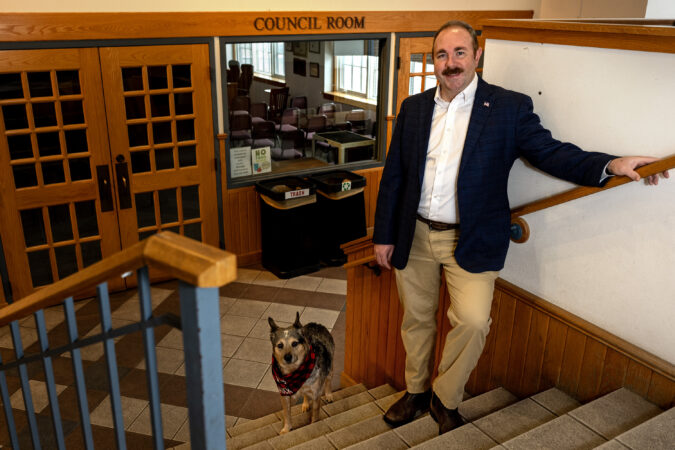
Conlen Booth doesn’t typically like to be in the spotlight.
Booth considers himself a “behind-the-scenes” guy who typically shies away from the limelight. Yet on Jan. 6, surrounded by friends, family, and colleagues, Booth was sworn in as Swarthmore’s mayor.
Booth, 42, brings more than two decades of emergency management experience to the job, including overseeing emergency services for major hospitals and governments. He’s also spent the past 25 years with Swarthmore’s fire department, most recently as chief. Booth is Delco-bred — a Nether Providence kid, a graduate of Strath Haven High School, and a cheerleader for his home borough of Swarthmore.
As the borough contends with the fallout of last year’s shuttering of Crozer-Chester Medical Center and Taylor Hospital, budget shortfalls, and potential fire department consolidation, Booth believes his background in emergency services and deep ties to Swarthmore make him the right guy for the job.
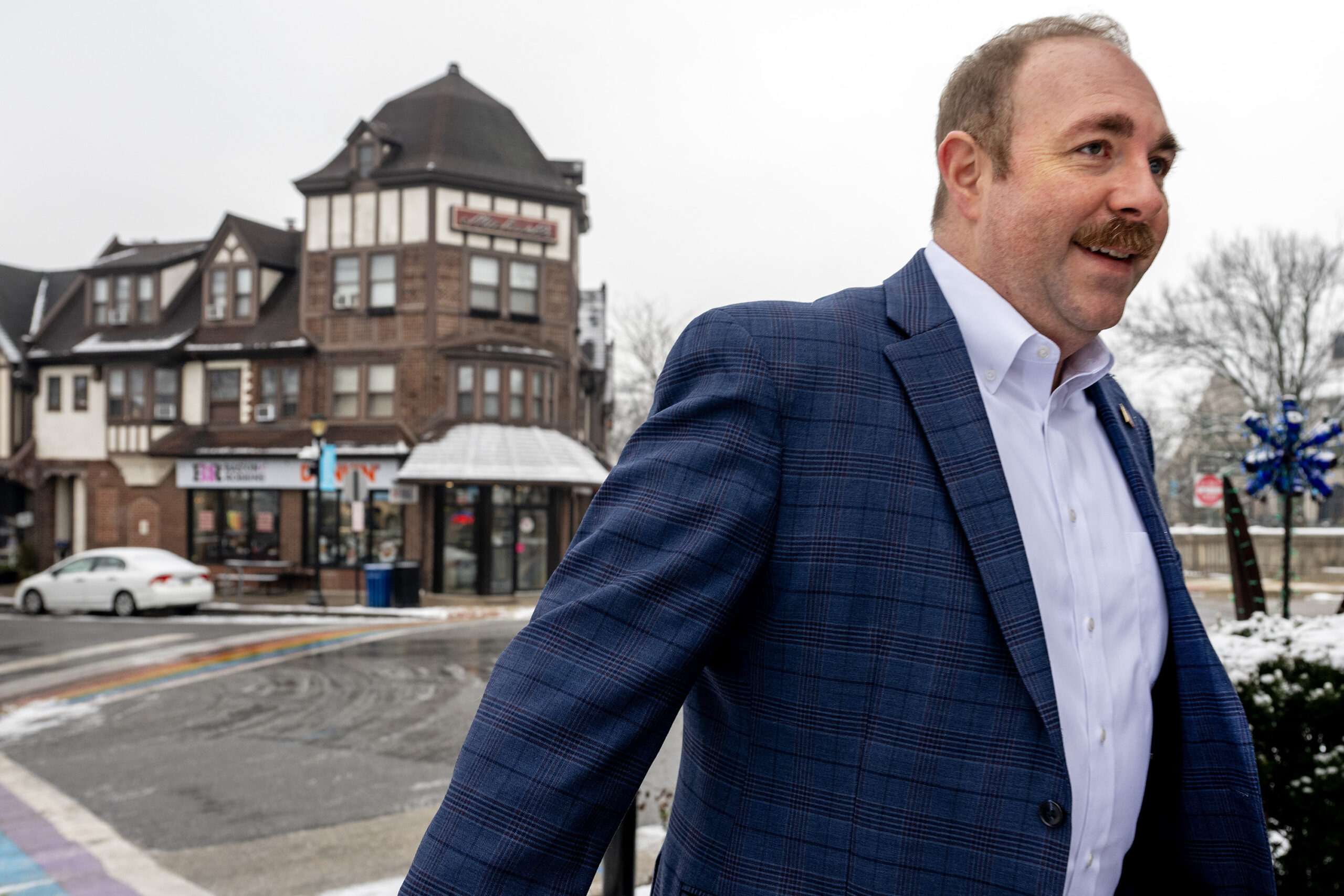
Mayor Conlen Booth in downtown Swarthmore on Sunday, Jan. 18, 2026.
‘If not me, then who?’
Booth got into local politics the way many do — reluctantly.
It took nudging from friends and family to step into the mayoral race. But the COVID-19 pandemic revealed a need for municipal leaders who understand emergency management and can govern in a crisis, Booth says.
An age-old phrase kept circulating in his mind: “If not me, then who?”
Booth competed against borough council members Kristen Seymore and David Boonin in the Democratic primary. Boonin dropped out of the race in January 2025. In February, the borough’s Democratic committee voted to endorse Booth’s candidacy 15-4, and Seymore dropped out.
The committee’s endorsement is powerful in Swarthmore. Democratic candidates who do not receive an endorsement are discouraged from running, and in the liberal-leaning town, there are seldom competitive general elections. Booth replaced Marty Spiegel, who had led the borough since 2019.
Who is Mayor Booth?
Booth was born in Harrisburg and moved to Delaware County at age 2. He grew up down the street from Nether Providence Elementary School and spent summers down the Shore with his close-knit extended family and collection of family dogs.
His maternal grandfather, Joseph Labrum, was a longtime judge and attorney in Media. Booth remembers visiting him in his chambers and watching him in the courtroom.
“I think seeing him in his role as a judge was always something that fascinated me,” he said.
Booth and his partner, Tracy, met working in healthcare and have been together for around 15 years. They live with Huckleberry, their Australian cattle dog.
Booth became interested in emergency services in high school. He set his sights on becoming a doctor and spent his teenageyears working on an ambulance.
Four days before he moved into his freshman dorm at the University of Pittsburgh, he watched a good friend die in front of him. The goal changed from enrolling in medical school to just making it through college.
“It just sort of rattled things,” he said.
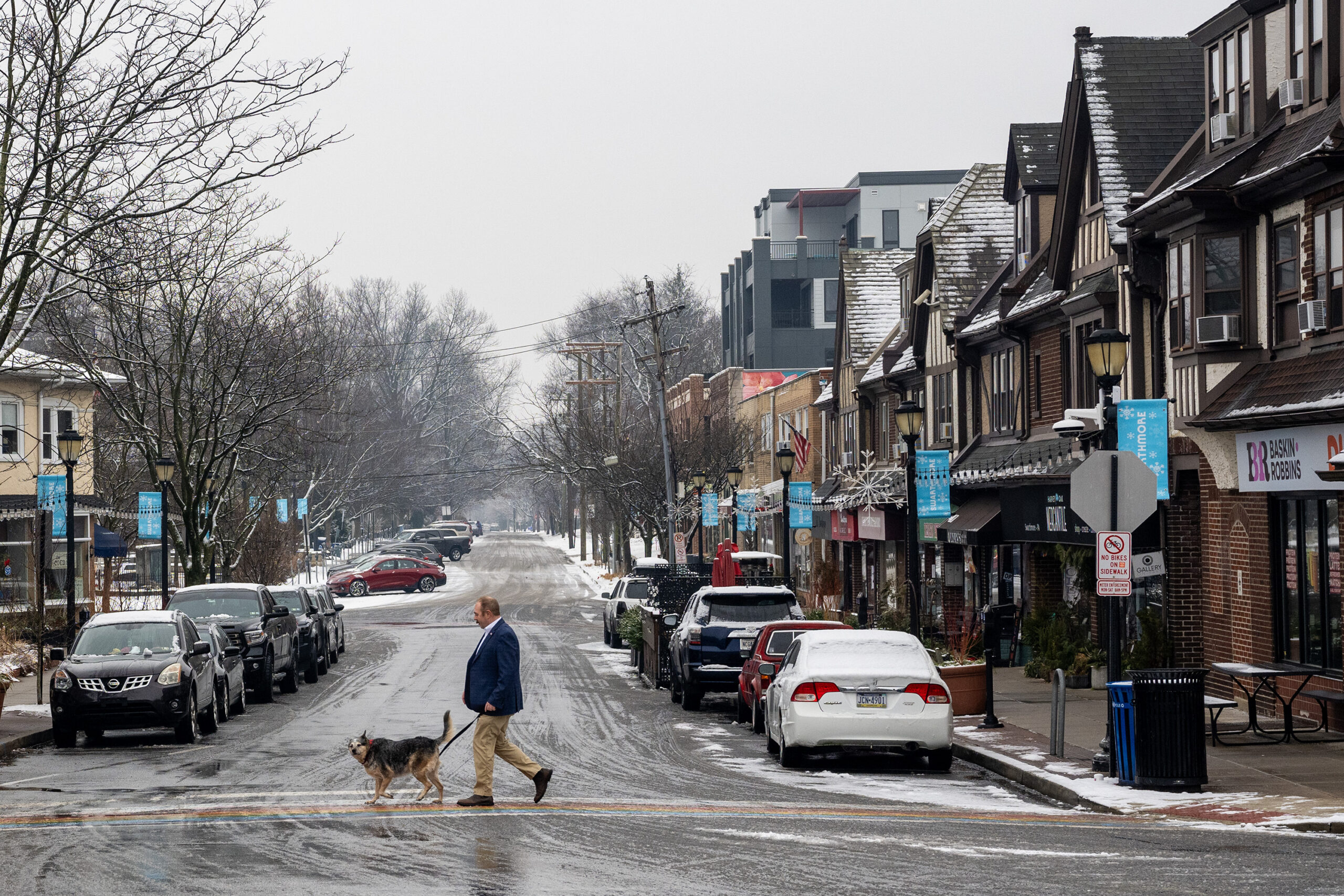
Mayor Conlen Booth with his dog, Huckleberry, in downtown Swarthmore on Sunday, Jan. 18, 2026.
Booth graduated from Pitt in 2005 with a bachelor’s degree in emergency medicine, an emerging field at the time. He earned his paramedic certification and learned the business-side of managing emergency medical teams.
He returned home and took a job with the now-shuttered Delaware County Memorial Hospital, his first role in what would become a long career in emergency medicine. In 2019, he was anemergency response shift supervisor at the Philadelphia Energy Solutions refinery during the massive explosion that left five people hurt and ended up shuttering the facility (Booth describes it as a “pretty insane period” in his life). Booth later spent four years as the senior director of emergency preparedness and emergency medical services at Crozer. He most recently worked as a consultant helping get supplies and meals to recently arrived refugees and asylum-seekers in New York City.
In tandem with his career in emergency management, Booth has served as a volunteer in Swarthmore’s fire department since 2000, working his way up from rookie firefighter to chief. Last year, hehelped developthe Advanced Life Support ambulance partnership with neighboring communitiesthat has filled gaps for residentsafter the Crozer closures.
Pat Francher, a longtime Swarthmore resident and community organizer, said Booth has the “awareness and perspective” that comes from a “real in-depth involvement in community welfare.”
“I’m terrible about saying no to people when they ask me to do something,” Booth joked.
This summer, Booth suffered a serious, non-work-related injury. He’s been in recovery since, and has come a long way.
“It could have been so much worse,” Booth said. “I have a lot to be thankful for.”
The SEPTA Regional Rail station in Swarthmore on Sunday, Jan. 18, 2026, during the second snowfall of the weekend. The station is between downtown Swarthmore and Swarthmore College and serves the Media/Wawa Line.
What’s next for Swarthmore?
Booth sees educating borough council about the community’s emergency medical needs as a large part of his job as mayor.
Jill Gaeski, borough council president, called Booth “the perfect guy” to help the 6,200-person borough navigate the challenges that lie ahead.
The shuttering of Crozer’s hospitals continues to impact access to medical care. At the same time, the Garden City (Nether Providence and Rose Valley), South Media, and Swarthmore fire companies are in discussions about a possible merger.
“[Booth] can really help us understand the pain points and where the sweet spots are,” Gaeski said.
Booth says he wants to be a cheerleader for the borough, bringing in tourism and economic growth in a way that maintains Swarthmore’s small-town feel.
He also hopes to reengage Swarthmore College’s student body, which he says has become less civically involvedas the years have passed.
“I already feel sentimental about this town,” Booth said, citing the people, restaurants, traditions, and community events that make his hometown special.
“How do we bolster all of these things and how do we engage more people?”
This suburban content is produced with support from the Leslie Miller and Richard Worley Foundation and The Lenfest Institute for Journalism. Editorial content is created independently of the project donors. Gifts to support The Inquirer’s high-impact journalism can be made at inquirer.com/donate. A list of Lenfest Institute donors can be found at lenfestinstitute.org/supporters.
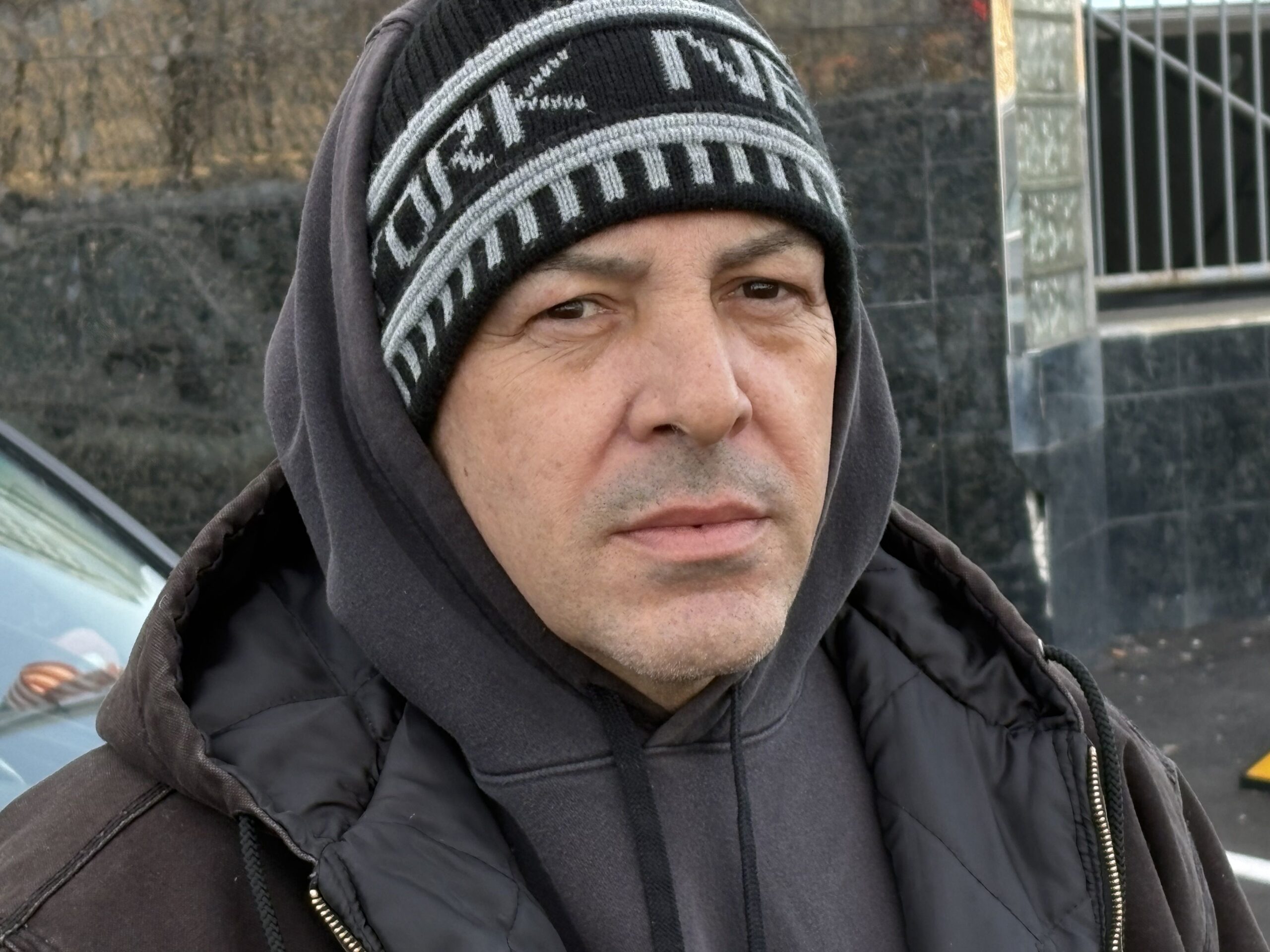
Scowling under a wool cap and a hood, Robert DeJesus stood in the bitter wind outside the Sunrise Diner in Allentown last week and confessed his “big mistake”: voting for President Donald Trump in 2024.
“The guy makes ‘cookie promises,’” said DeJesus, 57, a retired construction worker and independent voter from Allentown in Lehigh County. “They’re easy made and easy broken.”
Trump’s biggest gains in the state in 2024 were concentrated in the Lehigh Valley and in Northeastern Pennsylvania. But a year into his second presidency, there are signs that his winning coalition is splintering.In interviews across five counties in the region, some voters shared their disappointment with rising grocery prices and what they see as Trump’s failure to keep his commitments.
Even while hailing some of Trump’s policies, several Republicans interviewed said they were put off by his manner as well as his stance on key issues. That disillusionment could spell trouble for Pennsylvania Republicans as they look to hold onto two key swing congressional seatsin this region in November.
Robert DeJesus of Allentown voted for President Donald Trump in 2024, but he now regrets that decision.
Explaining his problems with Trump, DeJesus said the president pledged “but didn’t deliver” lower grocery prices. And at the same time DeJesus and his family are contending with “insane” supermarket costs, he said, Trump cut taxes for billionaires with the sweeping domestic policy package he signed last year. It has made DeJesus feel overlooked and overwhelmed.
“He left nothing for the working man,” DeJesus said. “People say it’s good the price of gas went down under Trump. But how we have to live, with high food and high rent, makes no sense.”
Diana Kird, 58, a Republican who also pulled the lever for Trump, is experiencing buyer’s remorse much like DeJesus.
“I don’t know what we’re doing in Venezuela,” said the nurse from Lehighton in Carbon County as she stood outside a Giant supermarket in town.
“We need to stop getting into foreign wars,” a promise Trump made and “ignored,” Kird added.
Kird said she has not seen Trump come through on his commitments. “He’s wash-rinse-repeat for me,” she said, “saying the same things over again,” such as promising cheaper groceries, “yet doing nothing.”
Trump’s “refusal to release all the Epstein files” after saying he would was another disappointment that makes her wish she had not supported the president, she added.
Republican U.S. Reps. Ryan Mackenzie (left) and Rob Bresnahan (right)
Mackenzie and fellow freshman U.S. Rep. Rob Bresnahan, a Republican who won his neighboring Northeastern Pennsylvania district by less than a point, are among the top targets for Democrats in November as the party hopes it can win back the House with a focus on affordability.
In a statement Wednesday, Mackenzie blamed the Biden administration for high prices and described Trump as “a vital partner” in efforts to improve the cost of living.
“We have made real progress,” he said, “reducing gas prices to their lowest level since COVID, keeping inflation below 3%, and delivering real tax relief for every American.”
Bresnahan’s office did not respond to a request for comment.
Both Trump and Vice President JD Vance barnstormed throughthe regionlast month, seeking to counteract Democrats’ affordability message, which Trump has bemoaned as a “hoax.”
But recent moves by Mackenzie and Bresnahan show the two Republicans are giving the issue more weight and seeking to distance themselves from Trump on the high cost of living ahead of tough contests in November.
“The break with the president on healthcare wasn’t surprising. Both men are feeling the heat from constituents,” said Chris Borick, director of the Muhlenberg College Institute of Public Opinion.
Borick noted that Trump’s 2024 win in the state was due in large part to his gains with voters of color, younger voters, and independents. Those same voters could be crucial to determining how Pennsylvania votes in the next election.
“But now they’re disappointed.”
Trump is ‘fearless’ and ‘honest’
There were warm feelings for Trump at the Coop, a popular diner in Coopersburg, a town just outside Allentown in Lehigh County.
“Trump’s a confident and honest man who knows business, and made a lot of money. I so admire him. And we need him,” saidTiffany Osmun, 27, who works as a host at the restaurant.
“He’s fearless, and not afraid of what he has to do,” Osmun said.
She plans to vote for Mackenzie in November, she said, adding, “I won’t be voting for any Democrat in the midterms.”
And if Trump ever popped up in another election, Osmun said, “I’d vote for him again.” In his Pennsylvania speech last month, Trump referenced running for a third term, despite constitutional barriers.
(function() {
var l2 = function() {
new pym.Parent(‘TRUMP_NE_PA.html’,
‘https://media.inquirer.com/storage/inquirer/projects/innovation/arcgis_iframe/TRUMP_NE_PA.html’);
};
if (typeof(pym) === ‘undefined’) {
var h = document.getElementsByTagName(‘head’)[0],
s = document.createElement(‘script’);
s.type = ‘text/javascript’;
s.src = ‘https://pym.nprapps.org/pym.v1.min.js’;
s.onload = l2;
h.appendChild(s);
} else {
l2();
}
})();
Other Trump voters, however, acknowledged frustrations withthe first year of his second presidency — even if they are pleased with most of Trump’s policies.
“I don’t like his personality,” saidBud Hackett, 72, a semiretired construction business owner who lives in Bethlehem.
Hackett praised Trump’s moves to curtail immigration and shrink the size of the federal workforce, but he bristled at other actions.
“I’d say over the last year, he’s done maybe 100 things, 70 of which will result in people’s lives being better off. The other 30 have to do with stuff like building a huge ballroom [after tearing down the East Wing of the White House] for his giant, weird ego that I can’t buy into.”
Trump may have generated a few problems on the home front, conceded soft-drink merchandiser Bobby Remer, a 31-year-old resident of Palmerton in Carbon County. But the president more than compensates by reminding the world just how powerful the United States can be, he said.
Remer supports the president’s attacks on boats allegedly carrying drugs from Venezuela, as well as Trump’s capture of Venezuelan President Nicolás Maduro and his wife.
“He’s done great militarily, throwing our swag around,” Remer said. “It’ll show China, which floods America with fentanyl to wipe out our military-aged men with addiction, that we have a hammer that we’ll use against any nation trying to destroy us.”
But pocketbook issues could matter more in November to other voters — especially after Trump made attacking Democrats on inflation a major theme of his 2024 campaign.
An October pollfrom Franklin and Marshall College asked voters in the Lehigh Valley and Northeastern Pennsylvania how they would compare their financial status with a year ago. Around 29% of Republicans said they were better off, while 34% said they were worse off, with 37% saying they were in the same position.
Among voters listed as independents “or something else” (such as a third party), 14% said they were better off, 32% said they were worse off, and 55% said they remained the same. Nearly half of Democrats said they were worse off, with 9% saying things were better and 43% saying they were the same.
“Things definitely got bad under Trump. He’s heading us toward dictatorship,” said Malinda Brodt, 65, a Democrat who lives in Saylorsburg in Monroe County, which had the biggest shift to Trump in the state in 2024.
Several Trump voters who were interviewed heaped praise on the president for lowering prices — despite mixed results — and a few quoted Trump’s speech in Mount Pocono that referred to affordability as a hoax.
“He’s gotten down the cost of living, that’s for sure,” said Carol Solt, 80, retired from working in a bait-and-tackle shop in Lehighton. “He keeps his promises.”
While gas and egg prices have decreased in the last year, the cost of food overall rose 3.1% last month compared with December 2024. Increased prices for beef (1%), coffee (1.9%), and fruits and vegetables (0.5%) led the way, according to consumer price index data released earlier this month.
Ultimately, Kird, the Lehighton voter, concluded before she entered her Giant supermarket that the good times the president assured Americans they would see have yet to materialize.
“Life is just more expensive under Trump,” she said.
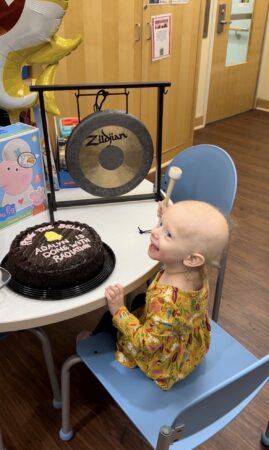
Adalyn Hetzel had just celebrated her second birthday in the spring of 2024 when doctors at Children’s Hospital of Philadelphia diagnosed her with an aggressive soft tissue cancer.
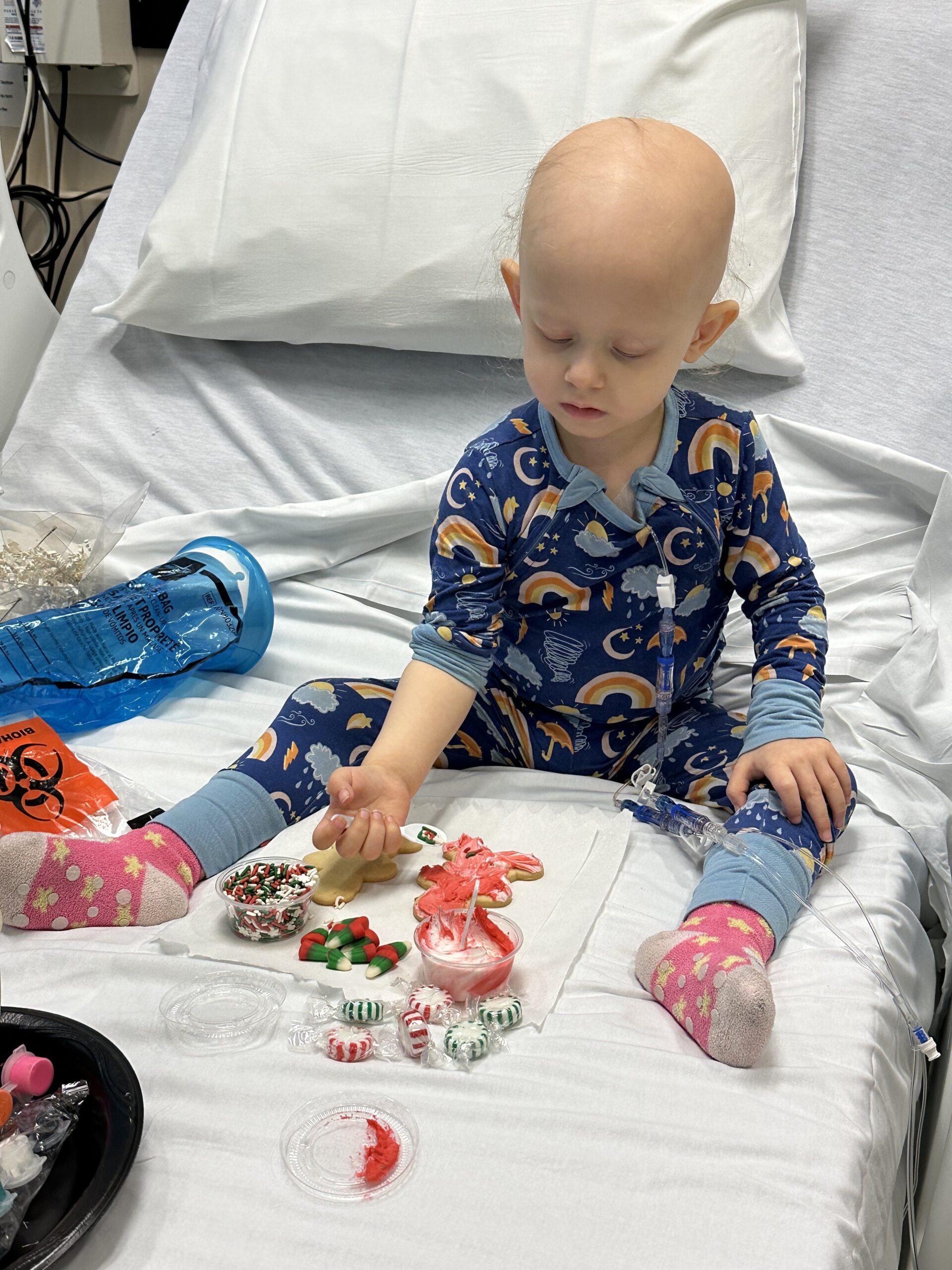
She endured 40 weeks of aggressive chemotherapy and a month of daily proton radiation therapy on her road to remission.
Now, the Bucks County toddler will spend the next year sharing her story as one of five ambassadors for the St. Baldrick’s Foundation, one of the nation’s largest childhood cancer charities.
The California-based organization has awarded more than $369 million in research grants since 2005, with $18 million going to Philadelphia-based institutions.
The selected children and their families will attend advocacy days in D.C., to appeal to lawmakers, share their stories with the public, and spread awareness on social media.
Kristopher Hetzel, Adalyn’s father, said their goal will be to advocate for research into more effective, less toxic treatments.
While more than 80% of kids diagnosed with cancer in the United States now survive the disease, many sustain long-term side effects due to the harsh therapies. One study found that by age 45, 95% of survivors had at least one chronic health condition, and 80% had one that was disabling or life-threatening.
Adalyn will likely have severe dental issues, limited jawbone growth, and an increased risk of developing secondary cancers due to the treatment later in life.
The threat of recurrence also still looms.
“It can’t be like that for these kids. We got to come up with better treatment,” Hetzel said.
Hetzel first noticed a small nodule on Adalyn’s tongue in April 2024.
After appointments with her pediatrician, dentist, and two oral surgeons left the family without a diagnosis, they went to CHOP, where a biopsy confirmed she had a highly aggressive form of soft tissue cancer called rhabdomyosarcoma.
“All of a sudden your world becomes so small and it’s just your kid. Nothing else matters,” Hetzel said.
Adalyn and her parents, Kristopher Hetzel and Allison Verdi.
Doctors started Adalyn immediately on an intense chemotherapy regimen combining three drugs. She also received a month’s worth of daily proton beam radiation, requiring general anesthesia each session due to her age.
By the end of the 40 weeks of chemotherapy, Adalyn dropped down to the 0.4th percentile of weight. She was so immunocompromised due to the treatment that when she contracted the flu, a critical response team at CHOP had to rush in.
Doctors withheld her final chemotherapy session for fear it could be life-threatening.
Adalyn Hetzel, a 3-year-old from Southampton, Pa., received 40 weeks of chemotherapy to treat her rhabdomyosarcoma.
Being an ambassador
In April, nearly a year after her diagnosis, Adalyn was declared to be in remission. She still receives scans every three months due to the potential for recurrence.
“[Adalyn] turned back into this playful, happy, joyful toddler who finally has the energy to be herself,” Hetzel said.
Her family decided to get involved with St. Baldrick’s after benefiting from their services firsthand. Right after Adalyn’s diagnosis, Hetzel recalled being given a binder with their logo on the front that laid out a “game plan of what our life was going to look like.”
That resource, called the Children’s Oncology Group Family Handbook, is funded by St. Baldrick’s and is given to newly diagnosed families around the country.
The St. Baldrick’s Foundation funds the Children’s Oncology Group Family Handbook.
Given her age, her father said he is cautious of not crossing the line in their advocacy and making her uncomfortable, and hopes that when she is older, she will understand the importance of sharing what she went through.
Jane Hoppen, director of family relations at St. Baldrick’s, said the family always has veto power. The foundation focuses on highlighting each child’s unique personality and interests to “serve as the face and voice of the foundation.”
For example, Adalyn, who loves chocolate-dipped croissants, will be featured on its social media for National Croissant Day.
“What we want for every kid who’s diagnosed is the ability to just go back and enjoy being a kid again,” Hoppen said.
Adalyn Hetzel, a 3-year-old from Southampton, loves croissants.
Frank Seravalli was standing behind the players’ bench at Bucks County Ice Sports Center when his phone buzzed. He didn’t reach for it — which is not his usual instinct.
Seravalli, a former Daily News reporter, is one of only a handful of NHL insiders. His job is to talk to athletes and decision makers around the league. Missing a call or a text can mean missing a story, and in a competitive media environment, in which quick, accurate information comes at a premium, being “late” isn’t ideal.
But on Jan. 12, in the midafternoon, Seravalli was busy. He was coaching Germantown Academy’s varsity hockey team. It was the third period and the Patriots were up, 6-2, in a rematch against Episcopal (5-2 on the aging scoreboard, which was missing a number).
Despite their lead, Seravalli’s players didn’t relent. With 35.6 seconds remaining, sophomore Mick Tronoski fired another shot into the net. A smattering of fans cheered.
After the two groups shook hands, Seravalli walked off the ice. He pulled his phone from his pocket, and read that the Columbus Blue Jackets had fired their head coach, Dean Evason.
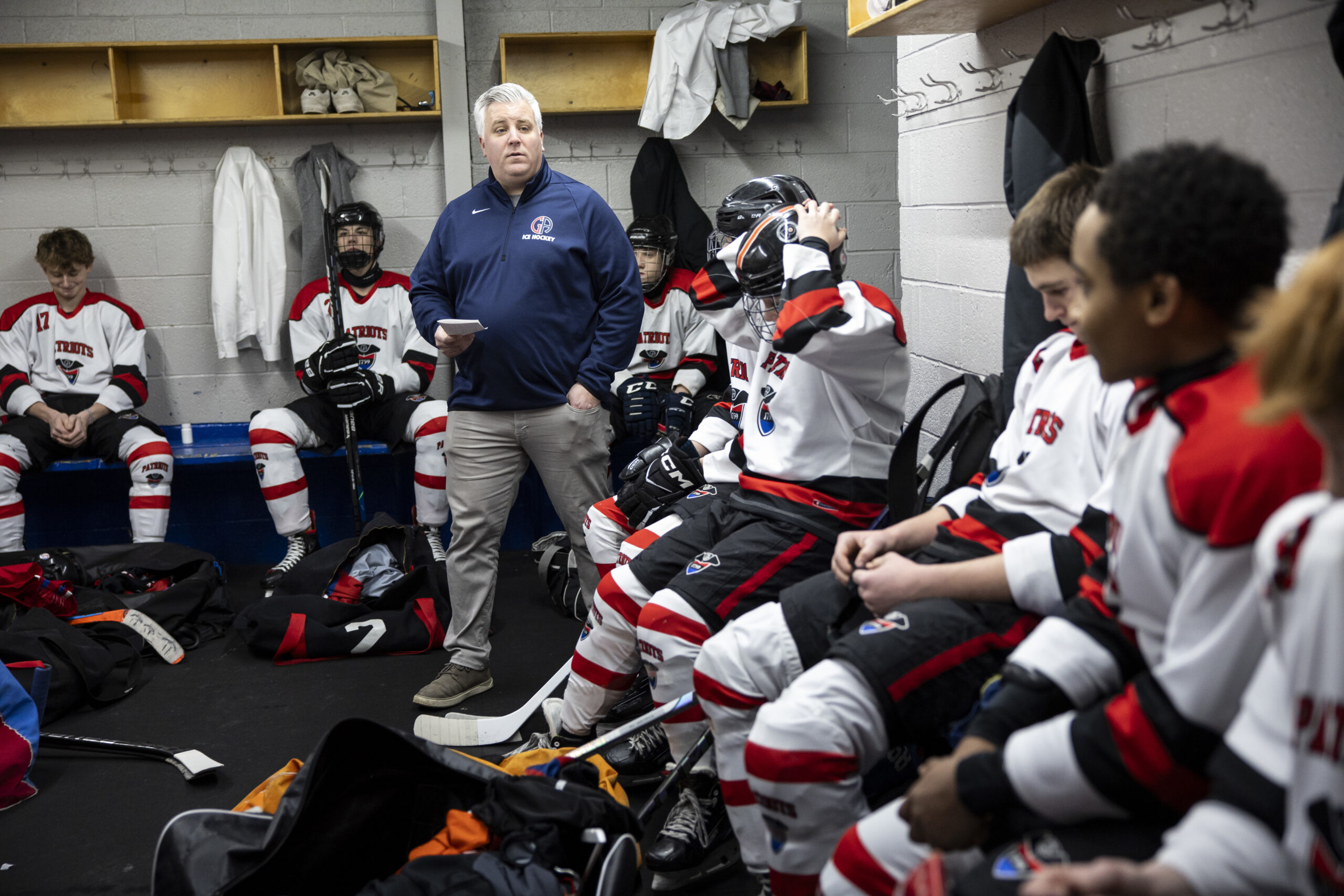
Coach Frank Seravalli talks with his Germantown Academy team in the locker room at the Bucks County Ice Sports Center on Jan. 12.
He retweeted a team statement, 27 minutes late. The NHL insider shrugged.
“I mean, it’s just life, right?” he said. “What are you going to do?”
Since July, Seravalli, 37, has served as GA’s head hockey coach. It is a daily commitment, one that he takes as seriously as his podcast and TV hits for various outlets. Five times a week, Seravalli oversees hourlong practices, and coaches hour-and-a-half games, with some 7 a.m. morning lifts mixed in.
He is not above doing the grunt work, either, like ordering gear, setting the schedule, and keeping the team’s stats. He reviews film, plans workouts, and runs the middle school program, all while keeping an eye on promising players in the area.
NHL insiders do not have an abundance of free time, so when Seravalli first told his family that he’d be coaching high school hockey, they thought the idea was absurd. And maybe it is a little absurd. Seravalli is not an alumnus of Germantown Academy. He is not doing this for the small stipend he gets halfway through the year.
But he is doing it for a reason. Just over two years ago, Seravalli’s cousin, Anthony Seravalli, died unexpectedly. He was 41 and left behind a wife and three sons.
Frank always looked up to him. Anthony was mature for his age, even as a teenager. He was a team captain and a star defenseman at Germantown Academy in the late-1990s, back when the school was winning Flyers Cups and producing NHL-caliber talent.
GA hockey’s stature has diminished since then. New York Rangers goalie great Mike Richter once played for the Patriots, but for years, the program was essentially dormant. Local recruiting wasn’t a priority. It was unclear whether there would be enough players to field a team in 2025-26.
Until Seravalli arrived. He has told the school he’s willing to make a five-to-10-year commitment to restore the program to what it was. In his mind, this is the best way to honor his late cousin.
“I thought of him, and how big high school hockey was 25 to 30 years ago, and how I could help make that big again,” Seravalli said. “And I was like, ‘Maybe, this was supposed to happen.’”
A ‘fixture’ of GA hockey
Germantown Academy was an unlikely hockey powerhouse in the 1980s, ’90s, and 2000s. The coed school had an enrollment of only 1,200 students, from kindergarten through 12th grade. These numbers allowed the Patriots to fill only one varsity team most years.
It paled in comparison to some of the bigger programs in the area, like La Salle College High School, which was able to fill four teams (one varsity and three junior varsity).
Nevertheless, GA found success. Players took pride in its underdog identity, especially while playing local behemoths like Council Rock and Malvern Prep. Germantown Academy won two Flyers Cups — the hockey championship for eastern Pennsylvania high schools — in 1982 and again in 1983, and a state championship later that year.
The team won three more Flyers Cups in 1991, 1994, and 1995, and went 100-0-6 in regular-season league play for over five seasons in the mid- to late-1990s.
Anthony Seravalli was a key part of GA’s team. He joined thevarsityas a freshman in 1996, and quickly established himself as a leader. Dan McDonald, a defenseman who was two years older, would drive him to school every morning.
Anthony Seravalli (right) was a critical part of GA’s program in the late 1990s.
The underclassman would rarely — if ever — call out sick with an injury or illness. His teammates estimated that he’d be on the ice for about 70% of Germantown Academy’s games (a hefty workload for a young player). Seravalli was a physical presence, standing at 6-foot-2, with a big windup slap shot that was hard to miss.
He carried no ego, despite his abilities. Anthony was inclusive with all of his teammates, including those who spent more time on the bench. In 1999, a few players got injured, and Seth Gershenson, a self-described “bench guy,” was asked to play some shifts.
Before Gershenson took the ice, Seravalli pulled him aside to give a few words of encouragement.
“He respected my effort and willingness to go out there and get beat up a little bit,” Gershenson said.
Many local players also participated in club hockey. They saw it as a way to get noticed in eastern Pennsylvania, which was not exactly a hotbed for the sport. As a result, club teams often took precedence over high school teams.
But this was not the case for Seravalli. GA always came first. Gershenson referred to him as a “fixture.”
“He took being a captain really, really seriously,” Gershenson said, “and he took the success of GA really seriously. He took pride in our success much more than whatever his club team was doing.”
Frank Seravalli grew up in Richboro, Bucks County, just a few minutes from the Face Off Circle, where Germantown Academy played at the time. By age 6, he was attending games and practices to watch Anthony and another cousin, Jason Jobba.
The elementary school student would stand in the same spot, behind the net, with a fizzy Coke in hand, and his face pressed up close to the glass.
“Watching your cousins who are a bit older, those are your heroes,” Seravalli said. “And for me, that’s part of where my love for the game came from.”
The Seravallis were a big, tight-knit group. Almost everyone played hockey, and almost everyone went to work at the family construction business. This was the path Anthony took, but he also found time to give back to his alma mater.
Frank Seravalli fondly remembers watching his older cousins play hockey when he was a child.
In 2004, while Frank was playing at Holy Ghost Prep, Anthony returned to GA as an assistant coach. He had a knack for connecting with the players, most of whom were familiar with his high school career.
One example was Brian O’Neill, a GA alum and former U.S. Olympian who is now playing pro hockey in Sweden.
O’Neill was a talented skater, but he lacked defensive fundamentals. This was one of Anthony’s strengths, and when O’Neill was moved to defense in his sophomore year, he began to work with the assistant coach.
Seravalli constantly reminded him to keep “stick on puck.” It was a message that O’Neill had heard for years but never fully understood. That changed when the coach stepped in.
“It was easy for him to sell me on what he was trying to teach, because I had a lot of respect for him as a player and a person,” O’Neill said. “He didn’t really have to earn my trust. That was already there.”
The goal was to put pressure on his opponent, in a way that didn’t involve hitting or cross-checking. The coach ran drills in which O’Neill would hold a puck in his right hand, and the stick in his left, to focus on keeping the stick down.
“It’s amazing,” O’Neill said. “You would think, ‘OK, I can’t grip the stick with my other hand, so I pretty much am playing with one hand,’ and all you can do with that is pretty much stick on puck.
“You would think you would be way worse at defending, but it’s actually the opposite, because all you’re focused on is stick on puck. And you’re not focused on hitting.”
The concept finally clicked. O’Neill, who went on to play in the NHL, still uses it to this day.
“[Anthony] was the guy that gave me the most advice on defense,” he said, “and that definitely made a huge impact on my career.”
Germantown Academy players celebrate after a goal against Episcopal Academy at Bucks County Ice Sports Center.
‘Please help save our program’
When he was young, Frank Seravalli would visit his family’s construction business in Northeast Philadelphia. He’d often notice workers perusing thick copies of the Daily News over lunch, and dreamed about having a byline someday.
In 2009, that dream became a reality, when the paper hired Seravalli out of Columbia University’s journalism school to cover the Flyers. He stayed for six years, before leaving for the Canadian television network TSN, where he worked as a senior writer and NHL insider.
In 2021, Seravalli started his own business, the Daily Faceoff, which was sold to a media group in Denmark in 2024. He’s now building a hockey network at the streaming service Victory+.
A typical day includes a radio interview in the morning, a podcast taping at noon, and more radio and television hits at night. Interspersed are hours spent texting and calling sources throughout the league.
It is a frenetic lifestyle, one that requires Seravalli to be glued to his phone. Finding time to coach a high school hockey program seemed impractical, if not impossible. But Seravalli was drawn to the idea. So, when he saw the job opening last year, he decided to apply.
The school’s athletic director, Tim Ginter, could only laugh when he read the insider’s resumé. Among his references were two NHL general managers, an executive with the league, and a former NHL head coach.
“He’s like, ‘Call [former Anaheim Ducks head coach] Dallas Eakins,’” said Ginter. “And I’m like, ‘You’ve got to be kidding me.’”
Seravalli interviewed for the position in the spring. He talked to two of the team’s captains, J.P. McGill and Joey Lonergan, who explained that their program was in jeopardy.
Coach Frank Seravalli talks with his team during the game against Episcopal Academy.
GA had lost five playersin 2025. School officials didn’t know how they were going to fill those spots. McGill and Lonergan had heard stories about the 1990s and 2000s teams, but returning to that level seemed like a long shot.
The Patriots hadn’t played in a Flyers Cup since 2009. After years of shrinking rosters and coaching changes, the team was moved for 2009-10 from the Suburban High School Hockey League to the lesser Independence Hockey League, which isn’t eligible for Flyers Cup entry.
“Essentially their plea was, ‘Please, help save our program,’” Seravalli said. “‘We’re not even sure we’re going to have a team next year.’
“I couldn’t say no at that point. I knew I was hooked.”
Seravalli met with Ginter shortly after. He made a succinct but powerful pitch.
“If you don’t have interest in changing your program, and really tearing it down and rebuilding it, I’m not your guy,” the insider told him. “But if you are interested, I’m willing to make a five-to-10-year commitment to build this the right way.”
He was hired in July. Seravalli rarely mentioned his full-time job, but it didn’t take long for the teenagers to figure it out. One day, while McGill was “doomscrolling” on the internet, he spotted his high school coach on Bleacher Report Open Ice.
His reaction: “Oh [expletive].”
“I texted some of my teammates,” McGill said. “I’m like, ‘He’s the Adam Schefter of the NHL!’”
Germantown Academy’s players were not aware at first that their new coach was an NHL insider.
Added junior defenseman Jack Stone: “He’s a reporter, so obviously he knows what he’s talking about.”
The insider started to use his connections behind the scenes. He’d ask current and former NHL head coaches for advice, among them Eakins, who now works for Adler Mannheim in Germany.
Eakins encouraged Seravalli to model the behavior he wanted to see in his team. He emphasized how important it was to show not only that he cared about the program, but about the players as people.
He also shared some mistakes he’d made in his own coaching career, with the hope that Seravalli could learn from them.
“Sometimes people [will] say, ‘OK, I’m a coach, now I have to take on a different persona,’” Eakins said. “And I told him, don’t do that. Don’t go in there and pretend to be [Florida Panthers head coach] Paul Maurice.
“You’ve got to go in there and be Frank Seravalli. Because as soon as you step outside of that, you’re cooked. You can only pretend to take on this other persona for so long.”
The tenor of the program changed almost immediately. Before Seravalli’s arrival, on-ice practices and team lifts were optional. Sometimes, as few as two or three players would show up. Now, they were mandatory, and everyone was expected to arrive on time.
The teenagers learned this the hard way. In October, during preseason workouts, Seravalli organized morning weightlifting. Two players — who will remain anonymous — slowly waltzed into the gym, 15 minutes late.
Coach Frank Seravalli brought a disciplined approach to the Germantown Academy hockey team.
Seravalli didn’t say anything in the moment. But after the workout, he brought the team down to the field house to run sprints. The two late arrivals were put on the sideline, so they could watch their peers suffer on their behalf.
“And I just said, ‘Look, we have a standard here,’” said Seravalli. “‘You have to make the commitment that everyone else is to show up on time and be ready.’
“And I’ll tell you what: Since then, no one’s been late.”
The players have embraced the newfound discipline. Stone said it’s something that they didn’t realize they needed, but they’re grateful to have. McGill agreed.
“He’s way more intense than what we’ve had in the past,” McGill said. “Which, to some people, can be intimidating. But if you want to play at a high level, that can’t be intimidating.
“There’s no getting away with anything around here anymore. Frank has done a great job of holding us accountable to what the new standard needs to be.”
A different type of connection
Not long after he was hired, Seravalli moved the team from the Hatfield Ice Arena to the Bucks County Ice Sports Center (formerly known as the Face Off Circle). The building looks just like it did when Anthony was in high school.
The white-and-blue paint is faded, but intact, and so is the thermostat, set to the coldest possible temperature. Five days a week, Seravalli walks past the spot where he stood as a child, watching his cousins with wide eyes, as they swept across the ice.
Anthony’s death was a shock to the entire family. He no longer roams the halls of the construction firm. He is no longer behind the bench at the Face Off Circle.
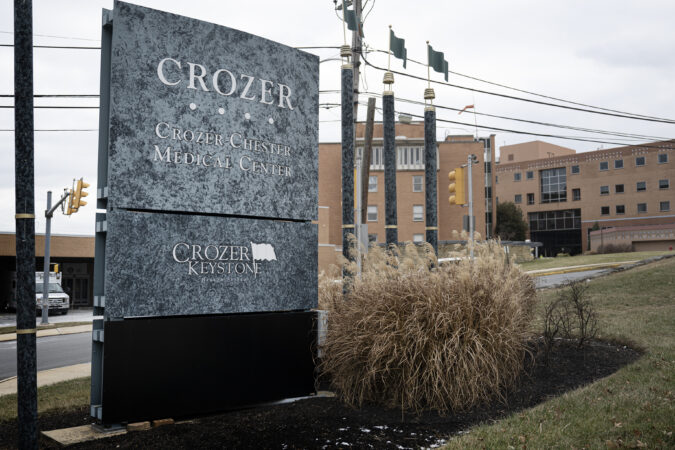
The new owner of the defunct Crozer-Chester Medical Center wants to restore hospital and emergency services to the 64-acre campus that straddles Chester and Upland Township in Delaware County.
Newly formed Chariot Equities completed the $10 million purchase Wednesday. The for-profit entity said it expected within six months to have an agreement with a health system that would operate a “right-sized” hospital and emergency department at the facility that had been the county’s largest provider of those services before closing last year.
The idea is then to open the first phase within two years, Chariot said in a statement.
Chariot did not say how much it would spend on refurbishing Crozer-Chester, which had suffered from years of neglect under its two previous owners.
Chariot’s partner at Crozer-Chester is Allaire Health Services, a Jackson, N.J.-based for-profit operator of nursing homes.
The partners said they are in talks with regional and national nonprofit health systems regarding an operating partnership, but provided no details. The amount of money needed for the project would likely depend on what prospective tenants would want to do at the property.
“Our belief in Delaware County’s future, and the community’s need for sustainable healthcare access, made this an effort worth committing to well before the finish line,” said Yoel Polack, Chariot’s founder and principal.
Little is known about the new owners. Polack worked in healthcare real estate in the New York City area before setting his sights on redeveloping Crozer-Chester.
Federal records list Allaire’s CEO Benjamin Kurland as an owner of 20 nursing homes, including three in the Philadelphia area. Chariot’s statement said Allaire owns a total of 29 facilities in five states.
Main Line Health has been involved in discussions about reopening emergency services at three former Crozer hospitals — Crozer-Chester Medical Center, Springfield Hospital, and Taylor Hospital — at the request of state lawmakers and the property owners, Ed Jimenez, CEO of Main Line Health, said Wednesday at a Riddle Hospital event.
Jimenez said he would “entertain the concept” of restoring emergency services at one of the hospitals as part of a partnership with other health systems, but only if it can be done on a break-even basis.
All three of the former hospital buildings visited by Main Line officials are in poor condition and were stripped of medical equipment after the closures. Main Line’s experts estimated it would cost between $15 million and $20 million just to make the emergency department at Taylor functional, Jimenez said.
ChristianaCare, Delaware’s largest health system, considered acquiring Crozer in 2022. Instead, it took a different path to expansion in Southeastern Pennsylvania. It is planning to open two micro-hospitals in Delaware County. The nonprofit system also took over five former Crozer outpatient locations. Its credit rating was recently downgraded by one notch because of lower profitability.
The importance of Crozer-Chester
Crozer-Chester closed in early May during the bankruptcy of owner Prospect Medical Holdings Inc., a for-profit company based in California, and after the failure of government-supported efforts to form a new nonprofit owner for Crozer-Chester and other Crozer Health facilities.
Crozer-Chester was particularly important as a safety-net provider for a low-income area of Delaware County that has few other nearby options. The Crozer system, which had four hospitals, was the county’s largest health system and largest employer for many years.
Two local Democratic officials, State Rep. Leanne Krueger and Delaware County Council member Monica Taylor, said they were encouraged by the approach being taken by Chariot and Allaire.
At Taylor Hospital, the other Crozer hospital that closed last year, new owners are also looking for healthcare tenants. Local investors bought the Ridley Park facility for $1 million. It is less than four miles from Crozer-Chester.
The same group agreed last week to pay $1 million for Springfield Hospital, another facility that had previously shut down under Prospect ownership.
A warehouse developer’s proposal to trade land with the state in Limerick Township and beyond has blindsided local officials — and ignited fierce opposition from residents who fear the deal could clear the path for a data center.
The state would gain 559 acres across three counties, including what would become Delaware County’s first state game lands,according to the proposal on file with the Pennsylvania Game Commission.
In return, the developer, Limerick Town Center LLC, would secure a 55-acre property in Limerick. That landadjoins an industrial tract the developer already owns, which was formerly the site of the Publicker distillery.
(function() {
var l2 = function() {
new pym.Parent(‘LANDSWAP1-22-26.html’,
‘https://media.inquirer.com/storage/inquirer/projects/innovation/arcgis_iframe/LANDSWAP1_22_26new.html’);
};
if (typeof(pym) === ‘undefined’) {
var h = document.getElementsByTagName(‘head’)[0],
s = document.createElement(‘script’);
s.type = ‘text/javascript’;
s.src = ‘https://pym.nprapps.org/pym.v1.min.js’;
s.onload = l2;
h.appendChild(s);
} else {
l2();
}
})();
Collapse
Residents flooded an hourslong Board of Supervisors meeting Tuesday night to oppose the land swap, prompting officials to open a second room fortheoverflow.
“I’m against the swap,” resident Jeff Schmidt told the board. “It’s a terrible idea, and I need to stop now because a lot of bad words want to come out of my mouth.”
Connie Lawson, board chair, said that ultimately the state controls the land involved in theswap, not the township.
Township manager Daniel Kerr told the crowd that the township had little information and hadjust learned of the proposal last week. But, he said, plans for land involved in the swap would have to go through the township for zoning and planning.
After hours of listening to residents, the board voted to send a “strongly worded” letter of opposition to the Game Commission.
Although the developer has not proposed building a data center, theidea has been widely circulated on social media, including inposts by state Sen. Katie Muth. Sheurged residents who oppose the swap to attend the township meetingTuesday, as well asa state Game Commission meetingonSaturday.
Data centers, whichhouse servers used for artificial intelligence, have become a hot topic in recent months, as residents in multiple towns have voiced concerns over their use of land, energy, and water. Meanwhile, political and labor leaders have embraced them as job creators.
Those twolocations are within two milesof the land Limerick Town Center would acquire in the swap.
“If this swap goes through, we are one step closer to turning our communities into Data Center Alley 2.0,” Muth wrote on Facebook last week. “This land is publicly owned wildlife habitat and forest. It should not be traded away so Big Tech and AI corporations can maximize profits at the expense of our environment and quality of life.”
What’s involved with the land swap?
Limerick Town Center LLCis already proposing to build two warehouses totaling 1.9 million square feet in Limerick’s Linfield section. That would be off Main Street and Longview Road, not far from Constellation Energy’s Limerick Clean Energy Center, a nuclear power plant.
The proposed swap would give Limerick Town Center LLC state-owned landand a 200-foot right-of-way adjoining the warehouse site, in exchange for the company giving the state property inLimerick and other counties.
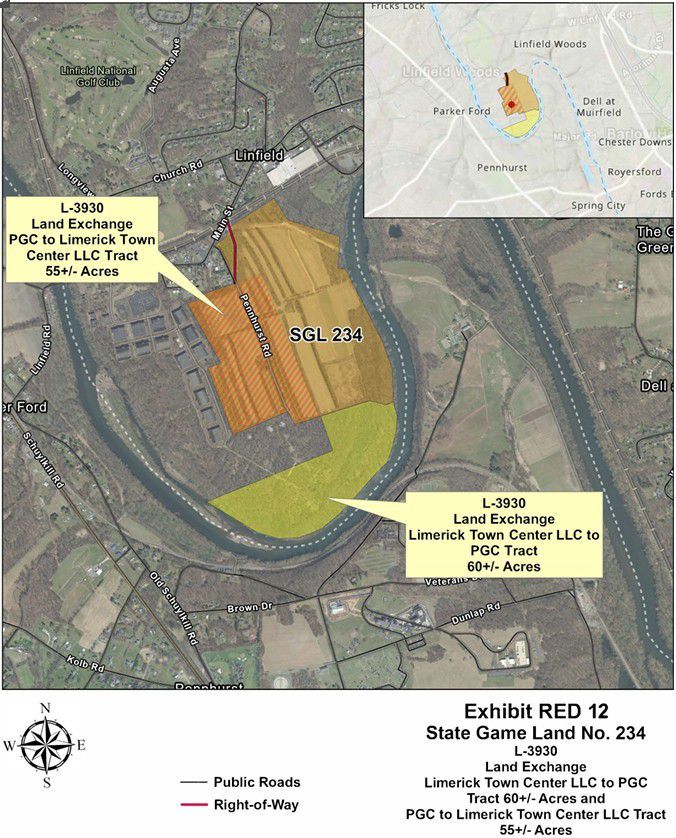
Overall, the company would give the state a total of 614 acres in return for a 55-acre chunk of Game Land 234.
Included in the 614 acres is a 60-acre parcel it already owns in Limerick that adjoins the southern portion of Game Land 234 near the river.
Map shows a proposal by Limerick Town Center LLC to give the state 60 acres it owns in Limerick Township in return for the state giving the company 55 acres of State Game Land 234.
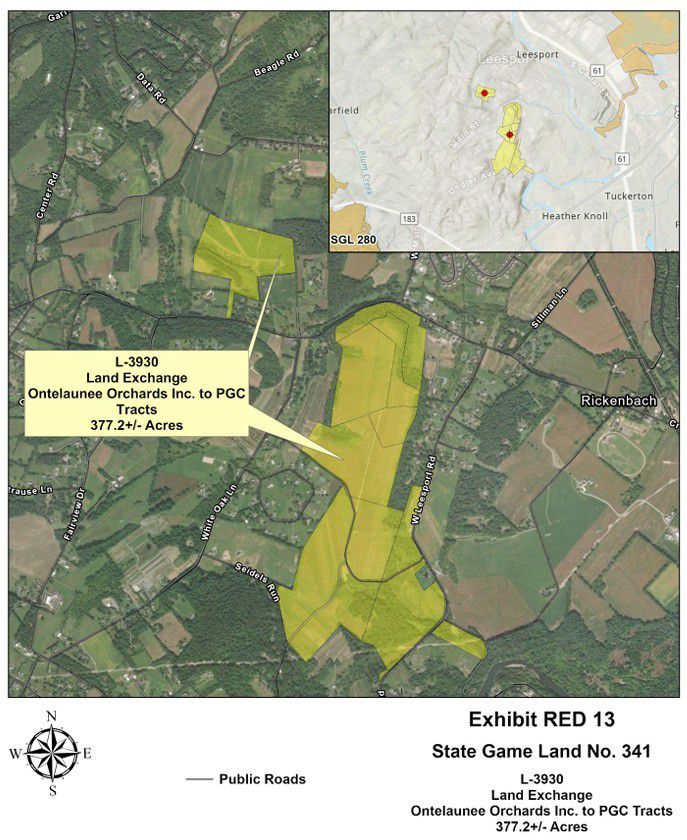
The company would alsogive 377 acres in Bern Township, Berks County, to be managed by the state.
Map shows part of a land swap being proposed by Limerick Town Center LLC. The company is proposing to give the state 377 acres of Ontelaunee Orchards in Bern Township, Berks County, in return for 55 acres of State Game Land 234 in Limerick Township, Montgomery County.
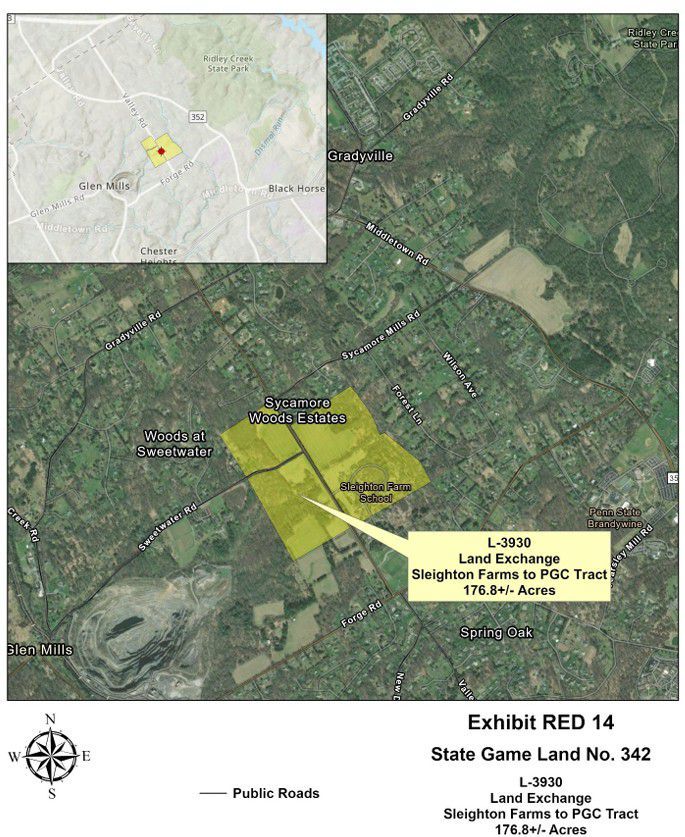
And the company would give the state 177 acres in Edgmont Township that would become the first state game land in Delaware County.
Map shows part of a land swap being proposed by Limerick Town Center LLC to acquire 55 acres of state Game Land 234 in Limerick Township, Montgomery County. In return, Limerick Town Center would give the state hundreds of other acres including 177 acres in Edgmont, Delaware County that could be used for a new state Game Land.
Local concerns
At Tuesday night’s meeting, resident after resident opposed the plan, citing overdevelopment, traffic, a change in the character of the community, and an impact on wildlife and the environment. Only one man from Berks County, who said he was a hunter, supported the swap.
Limerick resident Jennifer Wynne told the board she opposes the swap, saying the public hasn’t been given enough information that it would provide “a clear public benefit.”
“I am also concerned that this transfer may function as a precursor to future high-intensity or industrial development,” she said.
Michael Poust said he moved to Limerick to escape overdevelopment, and he opposes the land swap.
“My land is surrounded by the state game lands,” he said. “I bought it there for a reason.”
Muth, the state senator, lives in neighboring East Vincent and has been part of the fight against a data center proposed for Pennhurst.
“I highly recommend that you review the path forward to change the zoning in that area,” Muth told the board.
A view of the former Publicker Distillery tract now owned by Limerick Town Center LLC, which is proposing to build two warehouses on the land. The company is also proposing a land swap with the state to gain 55 acres of adjoining land.
Edgmont’s response
Meanwhile, Edgmont Township, Delaware County, could gain new state game land near, but not connected to, Ridley Creek State Park.
Pennsylvania Game Lands, supported by hunting and trapping fees, are widely used for hunting, hiking, fishing, and birdwatching.
Ken Kynett, Edgmont Township’s manager, said officials only learned of a land swap on Jan. 16.
“We got an email from the game commission last week saying we’re interested in acquiring property in your township,” Kynett said. “It was as much a surprise to us as anyone else.”
Under the land-swap proposal, Limerick Town Center LLC would give the state a 177-acre portion of the old Sleighton Farm School grounds.
The school, originally set on 300 acres and run by Quakers, was founded to serve “troubled children.” In 1931, it split into two separate schools: the Glen Mills School for boys and the Sleighton Farm School for girls. Eventually, the schoolbecame coed and was called simply Sleighton School.
The school closed in 2001 because of financial difficulties, and the grounds were sold. Elywn, a large nonprofit, owns the land.
Kynett said heassumed Limerick Town Center LLC is working with Elwyn on the deal. Part of the land is zoned for agriculture, and part is zoned residential.
He said that keeping the land as open space could be a positive, but the township doesn’t have enough information to know whether to support or oppose the swap.
“We haven’t really had a chance to discuss it with the board,” Kynett said.
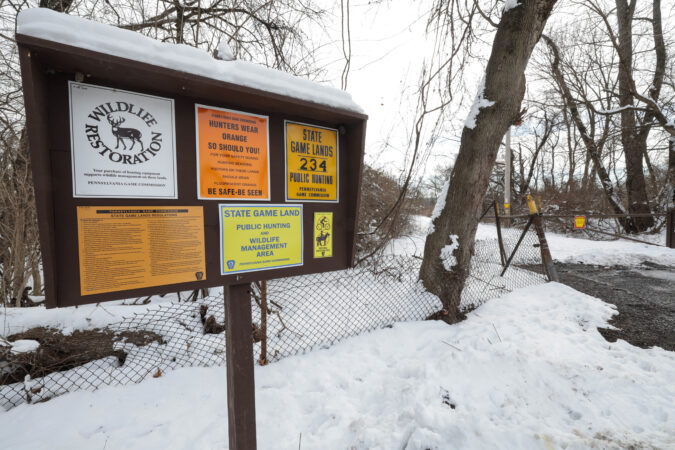
State Game Lands 234, Main Street and Pennhurst Road, Limerick Twp., Montgomery County.
Who’s behind Limerick Town Center LLC?
Limerick Town Center LLChas an address in Madison, Conn., according to Montgomery County land records. The address is linked to a company registered by Christine Pasieka, who is a business partner and the wifeofChris Rahn. The two have made development deals throughout the Philadelphia area for years.
Pasieka could not be reached immediately for comment on Wednesday.
Property records show that Limerick Town Center LLC purchased the 197-acre parcel in 2022 for $17 million.
In 2023, the company applied to build on the Publicker tract, according to county records. The registered agent for Limerick Town Center LLC was Sandra DiNardo, whose family owns a large trucking and cement business.
DiNardo could not be reached immediately for comment.
Regina Robinson isn’t used to being asked what she wants out of her home.
But for about a year, architects and designers had detailed discussions with her and other tenants at the Susquehanna Square subsidized apartment community in North Philadelphia about how to transform the look and feel of the development.
Robinson and her now 8-year-old daughter, Faith, went to every meeting. Residents talked about their love of graphic novels and the inspiration they found in superheroes — not just those who can fly, but real people they saw making a difference in their own families and communities.
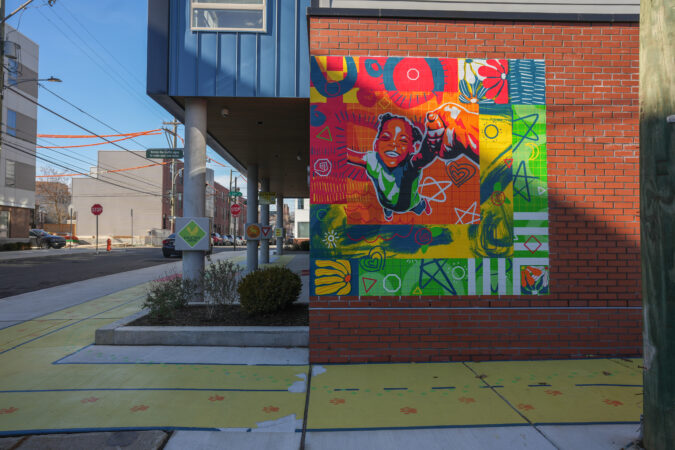
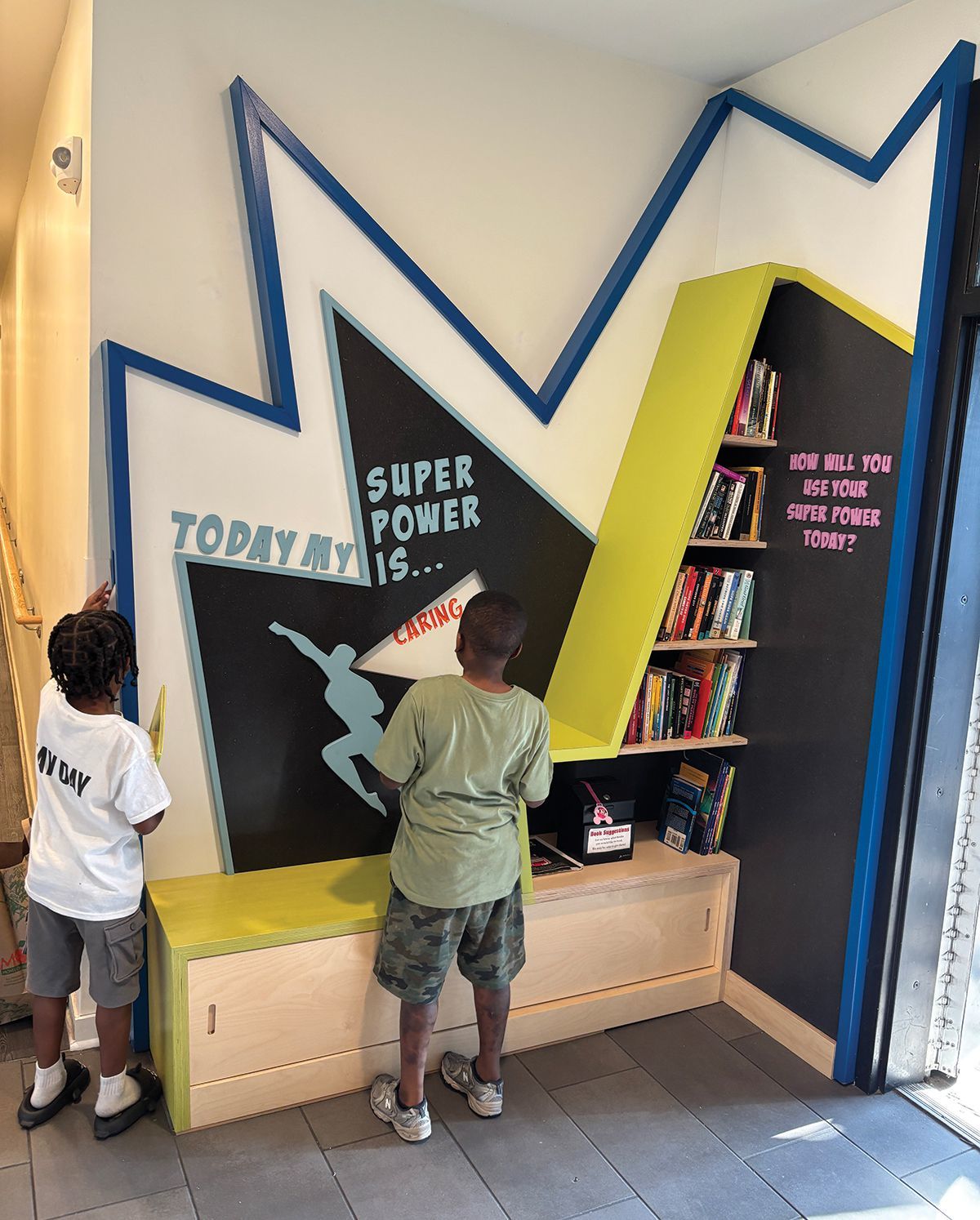
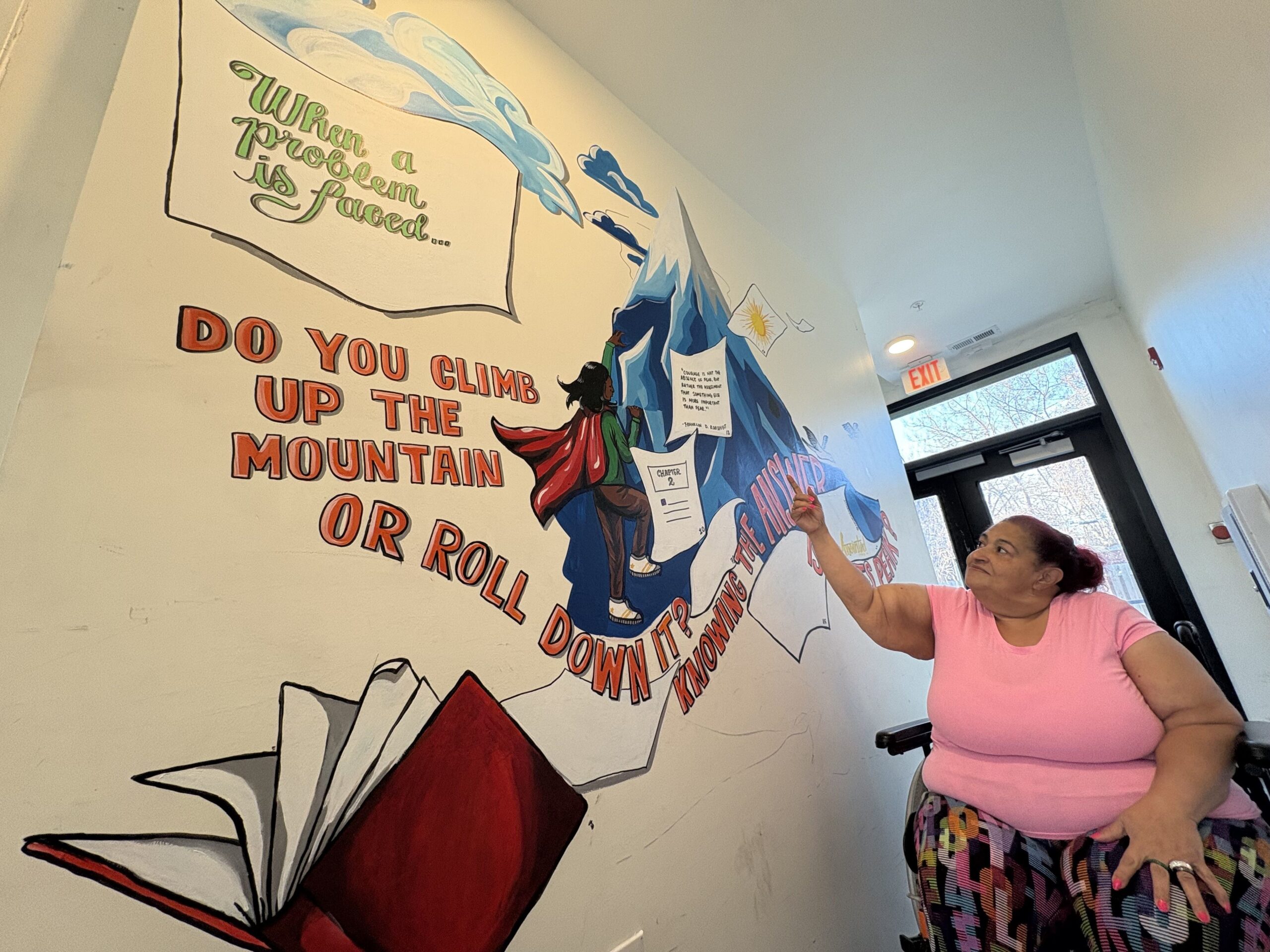
Blank white walls in apartment hallways became canvases for colorful murals of people in capesmeant to inspire children and adults to have self-confidence and set goals. A previously unused bike shed now stores bikes but is also a stage for acting out stories and a puzzle wall for spelling words. In courtyards, residents got new places to sit that double as little libraries. Prompts ask them to think about the books they read and create characters and stories of their own.
“They really listened to us. … They were taking our ideas and they actually brought it to life,” Robinson, 52, said. “It really brought tears to my eyes.”
A mural asks “What is your superpower?” in the hallway of an apartment building in the Susquehanna Square development in North Philadelphia.
The project was an initiative of Playful Learning Landscapes, cofounded in Philadelphia in 2009 by Temple University professor Kathy Hirsh-Pasek and University of Delaware professor Roberta Michnick Golinkoff. The organization has brought the concept of playful learning — engaging children and their caregivers in skill-building lessons through play — to spaces such as laundromats, parks, grocery stores, sidewalks, and subway stops.
But installations at two sites in North Philadelphia are the organization’s first that bring playful learning to subsidized housing. And the organization and its partners hope the Live and Learn pilot will lead to similar projects across the country that help vulnerable children catch up to peers who have access to more educational opportunities.
The goal is to incorporate playful learning into all subsidized housing developments, said architect Heidi Segall Levy, project manager of the Live and Learn initiative and an associate at Watchdog, a Philadelphia-based real estate consulting firm.
“We were really trying to increase educational equity,” she said. “And the way to do that is to really bring it into [people’s] homes.”
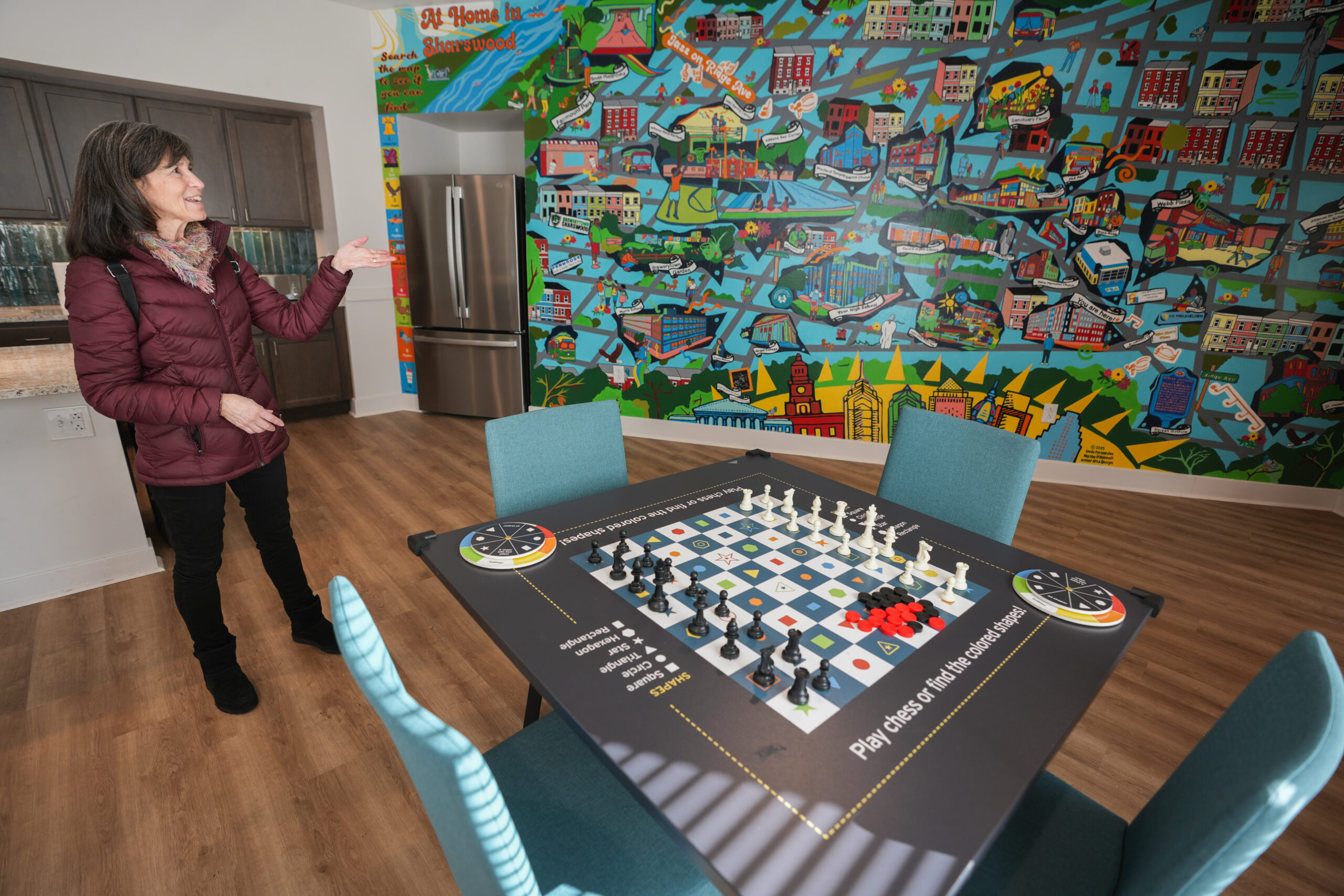
Architect Heidi Segall Levy, manager of the Live and Learn project, shows a mural by Linda Fernandez and Martha O’Connell from Amber Art & Design, at one of the educational play spaces at 2000 Ridge Ave.
About playful learning
Adults might not immediately understand what playful learning is until they’re reminded of childhood games.
Take Simon Says, for example. Children learn to retain information, evaluate the directions they’re given,and follow through. I Spy helps children learn how to describe their surroundings. Matching games strengthen memory and help kids recognize patterns.
Playful Learning Landscapes wants to transform any space where children and caregivers spend time into somewhere they can engage with each other. The organization has dozens of installations in Philadelphia and projects in about 30 U.S. cities and about 10 countries.
Now an activity hub, this transformed bike shed invites children and caregivers to draw, act, and tell stories together. Interactive puzzles, a chalkboard, and a small stage surround a multi-seat bench that doubles as a learning prompt and bookshelf.
One goal of the Live and Learn pilot was to train housing providers to continue the work.
“Our hope in the future is that developers and designers will be thinking about how to build playful learning into the architecture,” Segall Levy said. And eventually, “playful learning will just be included in public space design.”
Most of the pilot’s funding came from the William Penn Foundation, which contributed $647,250.
The foundation has invested about $26 million in playful learning projects in Philadelphia over the last decade and wants to see playful learning elements become standard in recreation centers, parks, libraries, and other places, said executive director Shawn McCaney.
“We believe every neighborhood should have access to high-quality public spaces” that can support community building, safety, and children’s development, McCaney said. “These kinds of spaces can become really important points of pride and engagement in communities.”
Super at Susquehanna Square
David La Fontaine, whorecently retiredasexecutive director of the nonprofit housing developer Community Ventures, was immediately interested when he was approached about adding playful learning to his Susquehanna Square apartment complex.
“A program that helps young kids in school was really what made me most interested,” La Fontaine, the son of a public schoolteacher, said.
Residents at Susquehanna Square spin the wheel to discover their superpower — a feature of the Book Nook. This custom Playful Learning installation is designed to create a sense of arrival while encouraging reading and social connection.
Community members’ vision came to life with the help of KSS Architects.
Susquehanna Square resident Merlyn DeJesus, 61, likes to sit in her building’s backyard and take in what the space has become. Young residents now have things to do when they go outside. They draw on a chalkboard, spin the letter tiles of a puzzle, and turn wheels to create their own superheroes.
DeJesus and her 8-year-old granddaughter read books together from the little library, where community members can take and leave titles. Her granddaughter also helped paint superhero murals, which are on each of her building’s three floors.
It all makes the space feel “more homey,” DeJesus said.
“I feel proud inviting people to come to my home,” she said.
Merlyn DeJesus, a resident of the Susquehanna Square subsidized housing development in North Philadelphia, points to one of the murals painted in her apartment building as part of the Live and Learn project.
Transforming community spaces
Playful Learning Landscapes focuses on tailoring projects for specific communities based on extensive outreach.
For example, residents in the Sharswood area of North Philadelphia noted that nearby Ridge Avenue has lots of fast-moving traffic. So they said they wanted their children to learn about street safety in the Live and Learn project that was focused on subsidized homes developed by Pennrose in partnership with the Philadelphia Housing Authority.
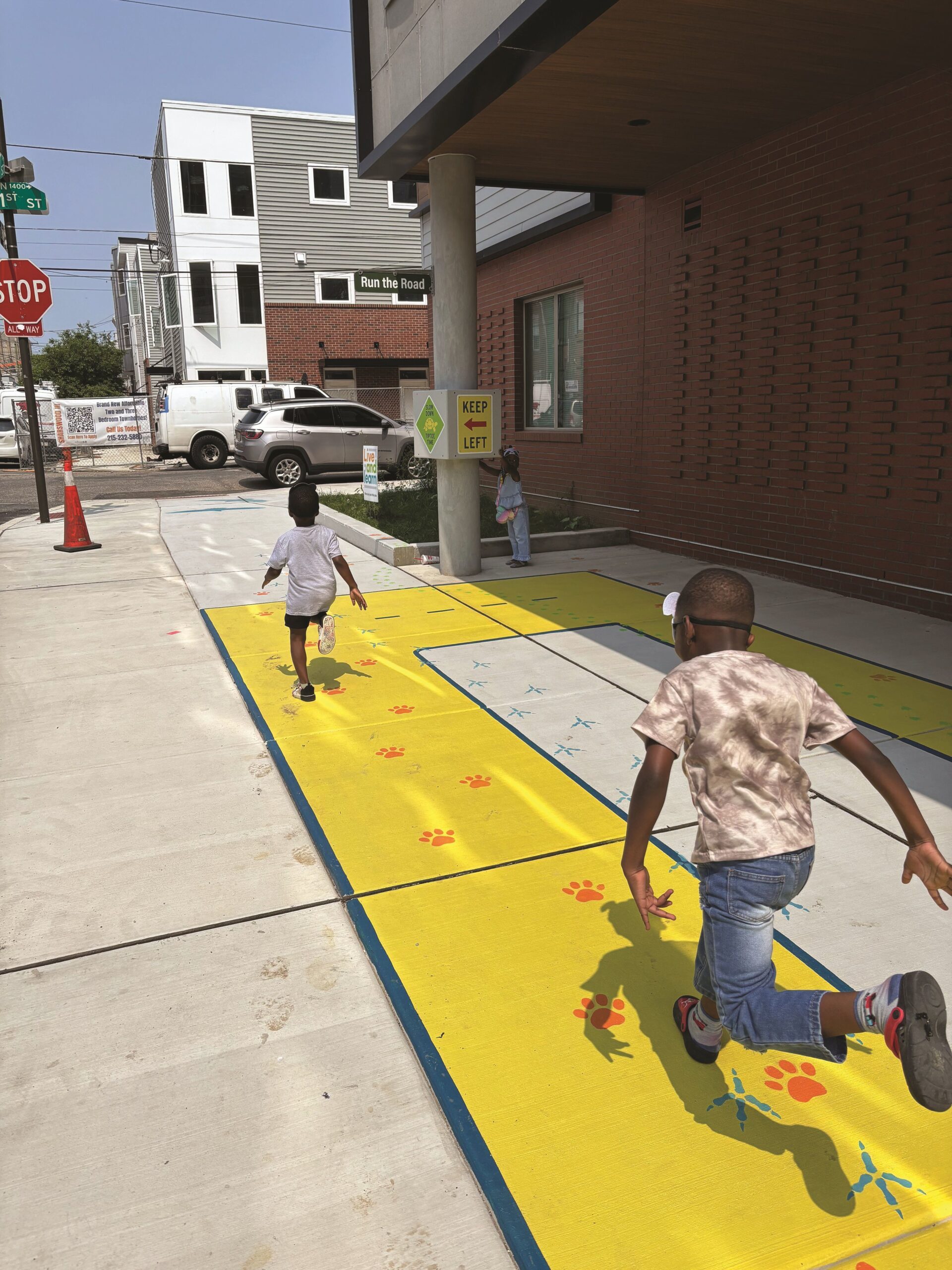
Children in Sharswood “run the road” along a new Playful Learning track painted on the sidewalk of a Pennrose housing development.
At the “Run the Road” installation, a colorful street is painted on a sidewalk. Children can spin traffic signs and learn what “yield,” “keep right,” and “one way” mean. They learn about crosswalks. They can step on animal prints and walk like the creatures.
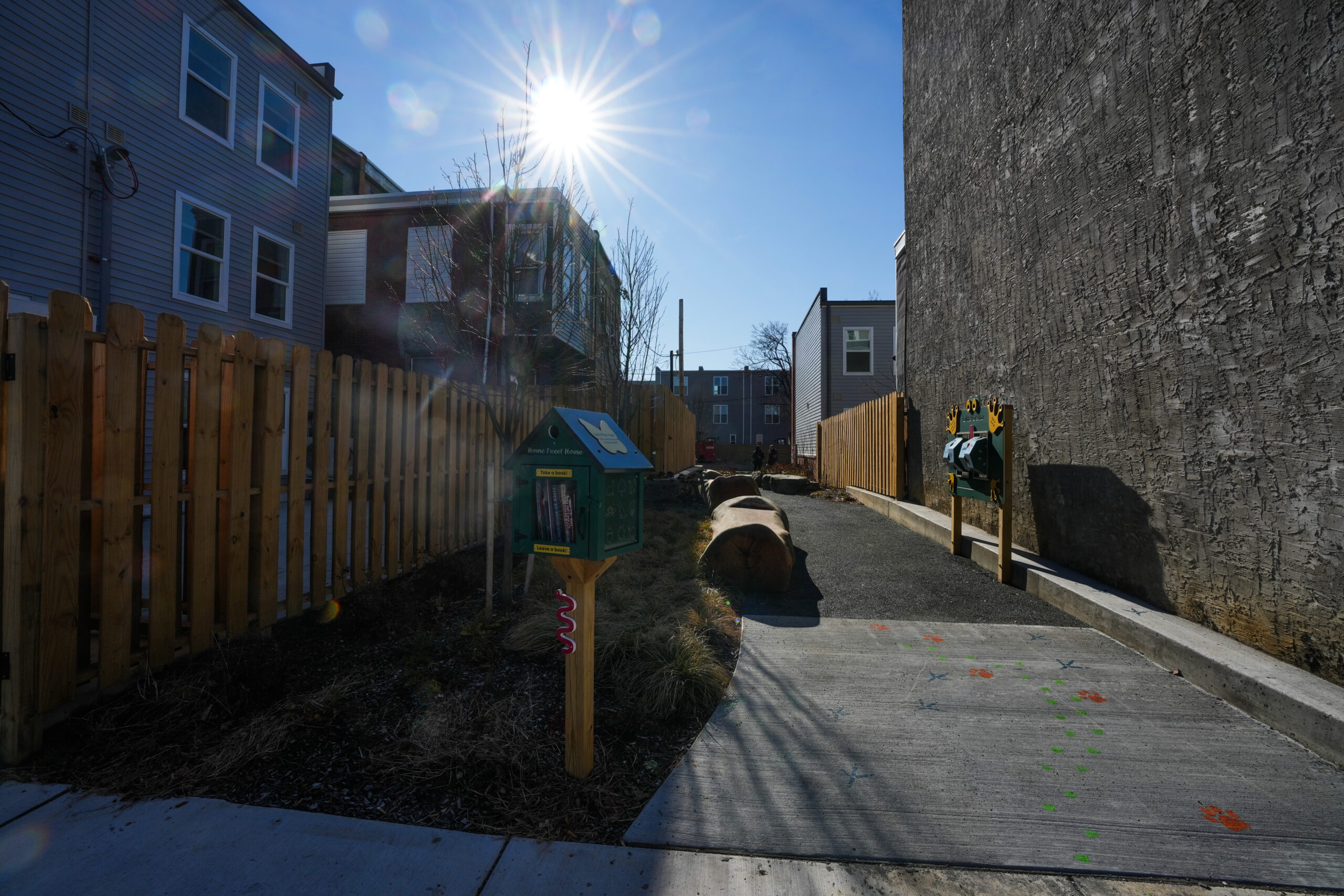
Residents also said they didn’t have open space they could enjoy. So the Live and Learn project transformed a small strip of unused land into a pocket park. It has seating anda little library. There’s a puzzle and matching game and wheels children can turn to create their own animals and tell stories based on their creations.
A pocket park is one of the educational play spaces that the Live and Learn initiative brought to a subsidized housing community in the Sharswood area of North Philadelphia.
“Anytime you take blighted property and change it into a beautiful play and sitting area, I think that’s great,” she said. “There is no longer an eyesore in this community.”
Inside the community room of a new subsidized apartment building at 2000 Ridge Ave., what was originally going to be a blank white wall became a mural featuringa map of the neighborhood with cultural landmarks. The room also features tabletops with activities, such as chess, matching games, word games, and storytelling prompts.
A young Sharswood resident explores a custom-designed Playful Learning chess table in the community room of a Pennrose housing development. The table is one of six navigation stations that help children build skills through play where they live.
Architecture firm WRT worked on the installations. Associate Lizzie Rothwell has been an architect for more than 15 years and said she doesn’t usually get so much breathing room to collaborate with community members.
“Within my professional career, it was a pretty unique opportunity,” Rothwell said. “It was one of the more rewarding experiences I’ve had working with a community on a design.”
A forgotten strip of land wedged between housing developments on 22nd Street between Ingersoll and Master Streets in Sharswood is now “The Backyard,” designed with Playful Learning installations, including this Critter Creator, two nature-themed standing puzzles, and a little library with a built-in I Spy game.
Looking ahead
Now, Playful Learning Landscapes wants to pursue public policies that support the expansion of playful learning projects and provide incentives for developers and architects to incorporate this work into their plans, said Sarah Lytle, the organization’s executive director.
Playful learning advocates briefed City Council members this fall about their work. In September, the city’s Department of Planning and Development issued a call for proposals to create or preserve affordable housing and encouraged developers to include art or design elements that foster children’s development.
“We’re starting to see some traction,” Lytle said.
More than seven months after the opening of the play spaces at Susquehanna Square, Robinson and her daughter now live in South Philadelphia, but they’ve come back to visit the murals they helped paint and the installations they helped develop.
“To see it and to know it’s going to always be there,” Robinson said, “it brings a lot of joy to me.”
The “Run the Road” installation on a sidewalk at 2045 Master St. teaches children in Sharswood about traffic rules.
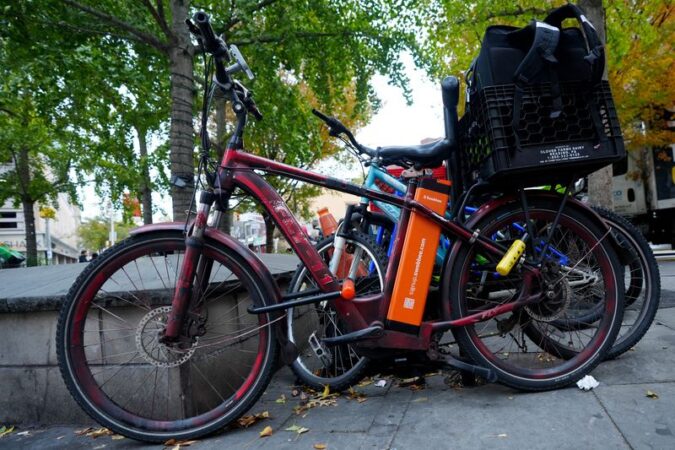
With a flick of his pen, outgoing Gov. Phil Murphy signed a bill Monday that makes New Jersey one of the most restrictive states for e-bikes, much to the dismay of cycling enthusiasts within and beyond the Garden State’s borders.
Under the new regulations, all e-bikes must be registered and insured, whether they are low-speed e-bikes, which require pedaling and cannot exceed 20 mph, or high-speed bikes, called motorized bicycles or e-motos, that can go up to 28 mph.
Riders will need to be at least 15 years old and they will need a motorized bicycle license to ride. People 17 and older can ride an e-bike using a driver’s license.
The New Jersey law treats all e-bikes as the same, whereas most other states that regulate e-bikes tend to focus on e-motos when it comes to license and insurance requirements. The slower pedal-assist bikes face a patchwork of regulations across the country, with some restrictions on where they can go. By requiring insurance for the pedal-assist bikes people use for exercise and commuting, New Jersey now has some of the toughest regulations in the country for e-bikes, and cycling enthusiasts across the country fear their states might follow suit.
The new regulations mark a dramatic shift in how New Jersey sees e-bikes. It was only in 2019 that state leaders, including Murphy, touted them as an alternative to cars with the potential to cut emissions and congestion in the state, allowing them to operate on streets, highways, and bicycle paths.
Introduced in the legislature in November, the bill with e-bike restrictions traveled quickly across both chambers as lawmakers felt moved to action by fatalities in the state, including that of a Scotch Plains 13-year-old boy who collided with a landscaping truck while riding his e-bike in September and died.
“It is clear that we are in an age of increasing e-bike use that requires us to take action and update regulations that help prevent tragedies from occurring,” Murphy said Monday.
This is a point that even the most ardent critics of the new law have long agreed with. It had been six years since the last update to e-bike laws, and they agree that reckless riders abound.
If New Jersey Facebook groups are any indicator, the law has plenty of supporters, sick of fast e-bikes taking up sidewalk space and e-motos zipping through residential neighborhoods.
Ocean City Mayor Jay A. Gillian said in a statement Tuesday that the city had long called for the change.
“Nobody likes more red tape, but the benefits of the new law far outweigh the inconvenience of the new registration requirements,” he wrote.
Still, cycling advocates maintain the law is creating an unnecessary insurance requirement on a slew of people, such as tourists going down the Shore with their low-speed e-bikes, delivery drivers, and people who use pedal-assist bikes for exercise.
Critics worry the law is not addressing some of the main issues plaguing the industry, such as misleading advertisements marketing e-motos as e-bikes and the sale of modification hardware that makes bikes go faster.
State Sen. President Nicholas Scutari, a Democrat whose district includes Scotch Plains, introduced the bill in November, arguing that the increase in e-bikes created dangers for riders, motorists, and pedestrians.
“Requiring registration and licensing will improve their safe use, and having them insured will protect those injured in accidents,” he said Monday.
The 2019 e-bike laws did include insurance requirements for e-motos, which had to be registered and titled with the New Jersey Motor Vehicle Commission, but cycling advocates say these have never been enforced.
Debra Kagan, executive director of the New Jersey Bike Walk Coalition, said she has asked for state data on e-moto registration and there does not seem to be any.
The MVC did not immediately respond to a request asking for e-moto registration data.
A fiscal analysis by the New Jersey Office of Legislative Services anticipated an increase in administrative costs for the MVC to update its technology systems, for communications, and to prepare an annual registration report for all e-bike classes. It did not give an estimate of how much that could cost the state. The law comes with no money attached.
“Now this new legislation will require that all e-bikes, even the lowest speed e-bikes that don’t have throttles, would require licensing and registration, and there is no system and no funding to implement that across the state there,” Kagan said.
The new law, critics add, will also carry a negative economic impact for the state, despite the expected fees the OLS says will be collected through registrations and eventual penalties for violations.
While low-speed e-bikes can exceed $2,000, budget models can start at around $400, making them a suitable affordable transportation alternative.
Patrick Cunnane, who sits on the board of directors of the trade organization People for Bikes and is an adviser to a bike shop in Gloucester County, worries that may no longer be the case for many with the new added costs of registration and insurance.
Shore town boosters and small bike-rental businesses also feel threatened, Cunnane said. He said it was not out of the realm of possibility that the ability to travel on e-bikes could be what tips the scales between a stay in Ocean City, N.J., or one in Ocean City, Md., or at the Delaware beaches.
“It’s just crazy for New Jersey to isolate themselves from an activity that’s really a lot of fun and safe,” he said.
Niclas Elmer, owner of Tuckahoe Bike Shop, which has a handful of locations in Atlantic and Cape May Counties, said even as the threat of added regulation loomed, parents balked at buying their children low-speed e-bikes.
“It was hard for us because we couldn’t give a straight answer [regarding regulations],” said Elmer, who has been in the retail business for more than 20 years.
Further worrying Elmer is the status of bike rentals, a key part of his business model. He doesn’t know if these will be exempt from the new laws.
To Elmer and others, cycling advocates say the fight over e-bike regulations is not over.
Cunnane said People for Bikes has already been in touch with the administration of new Gov. Mikie Sherrill on the matter. The hope is that in the year the state has to set its new registration framework, advocates will be able to influence new legislation that walks back some of the restrictions.
Cunnane was encouraged by the comments of the legislators who supported the law. They clearly want to tackle what they perceive to be a large problem, he said. Cycling advocates are not against all regulation; they simply want more targeted ways to address safety concerns.
“We think we can really help make it better,” he said.
If the question of who gets to call the shots at the Philadelphia Art Museum was a major source of friction between its former chief and board and staff, the museum’s new director and CEO arrives as something of a salve.
Eight weeks on the job, Daniel H. Weiss is signaling a philosophy that is anything but authoritarian.
“I believe very strongly in the idea of shared governance,” Weiss said in a recent interview that represents his most extended public comments since taking over the troubled museum. “Any mission-driven institution is almost axiomatically in service to all of the people who have an interest in what it does. So I don’t really have a lot of executive authority as the director of this institution.”
And yet, Weiss obviously understands that he is the one being tasked with the turnaround of one of the city’s flagship cultural groups. He also knows he must take action quickly.
“I don’t have the luxury of saying, ‘I’m going to spend the next 12 to 18 months meeting with people and then we’ll figure out what needs to happen.’ We need to get after it.”
Daniel H. Weiss, director and CEO of the Philadelphia Art Museum, walks through galleries with museum staffer Laura Coogan on Jan. 7.
The listening tour
Weiss, 68, the former leader of the Metropolitan Museum of Art, is well into his listening tour, talking to staff, board members, and others about the museum’s last three years with Sasha Suda at the helm and the messy split with her still playing out in courts both legal and of public opinion.
He says the next few months are about him getting a sense for “the most present problems that need to be addressed.”
“We need to sort out the rebrand and determine whether we change it or stay with it. And we’re looking at that,” said Weiss, who has put together a task force of staff and board to consider the question.
Earlier this week, the museum confirmed that it was parting ways with the marketing chief who oversaw the rebrand.
The financial picture remains challenging.
“We have a deficit. It is not sustainable and we need to fix it. In order to do that, we need to take a larger look at the organization and build a healthy model.”
There are facilities needs that are complex and very much rooted in the reality of how to pay for them. Like, what form a proposed new education center should take; what to do about the Perelman annex, the former office building across the street that opened in 2007 after a $90 million renovation and has been closed to the public since the pandemic; and where and how to address deferred maintenance to the main building.
“We need to prioritize our list so that we can begin a thoughtful plan of following up on all the work that was done before on the core project to figure out the next chapter.”
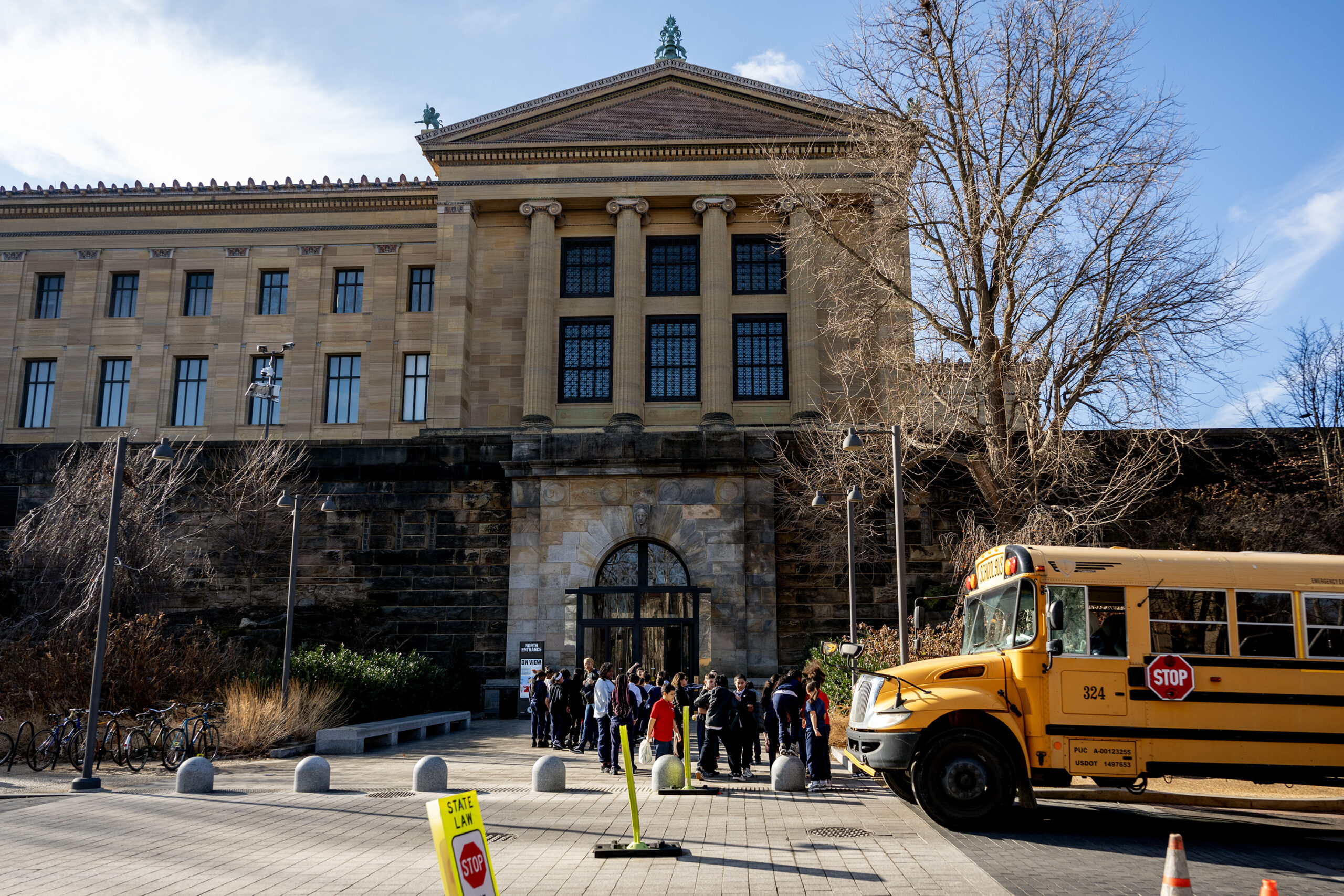
School groups at the North Entrance to the Philadelphia Art Museum on Jan. 7.
A strategic plan
The “next chapter” will eventually take shape in a new strategic plan.
In the spring and summer, Weiss hopes, conversations with board and staff will give the museum a “better sense of what our resources could be as we work our way to balance and health. And then next year, maybe early next year, we begin the process of putting together a plan.”
Weiss’ credentials in both business and art seem suited to the moment. He holds an MBA from Yale School of Management and has worked for Booz Allen Hamilton. His master’s degree in medieval and modern art and Ph.D. in Western medieval and Byzantine art were earned at Johns Hopkins University, where he is finishing up his teaching at the end of the semester.
Weiss, who has moved to Philadelphia with his wife, Sandra, sees his immediate job as reminding everyone what Philadelphia has in its museum.
The events of the last few months — the widely ridiculed rebrand, Suda’s mid-contract ouster, and the dramatic language used in her subsequent wrongful-dismissal lawsuit against the museum — have often eclipsed the art and made the main message coming out of the museum one of acrimony.
The new director is eager to change the message.
“What I’d like to do over the next six months to one year is to get everybody excited about what’s possible, what we already have. How, by supporting each other and investing excitedly in our mission, we can do something really important.”
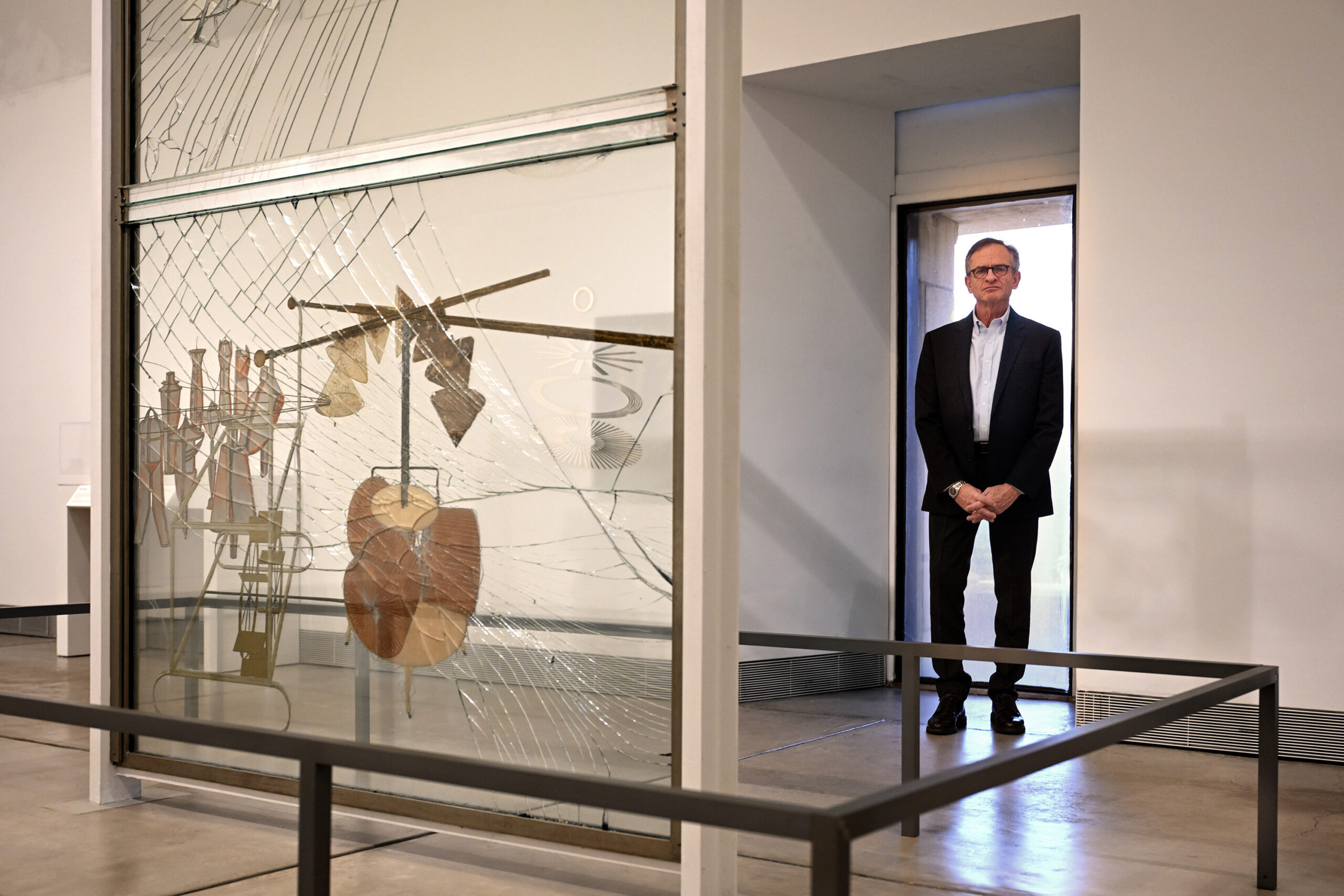
Daniel H. Weiss, director and CEO of the Philadelphia Art Museum, with “The Bride Stripped Bare by Her Bachelors, Even” (1915–1923, also called “The Large Glass”) by Marcel Duchamp.
The role of the board
Weiss also needs to consider the role of the Art Museum board, which, on the one hand, was not informed that the rebrand was final, according to some board members. On the other hand, it has been accused in Suda’s initial court filings of being overinvolved in museum matters.
“I don’t think our board needs radical restructuring … and this may seem counterintuitive in light of what you’ve been reading about in the newspapers, I think our board needs to be embraced as a real partner,” Weiss said. “And I do believe deeply in shared governance and that means the director and the senior administration have a job to do and the board has a job to do.”
“They’re different jobs but when they’re working in concert, you get much more for the institution than you do if they’re at odds with each other.”
How much of board-CEO relations is about structure, and how much is it the function of the personality of the person whose job it is to be the connective tissue? “Almost always it is more a function of the personalities than it is the structure,” he said.
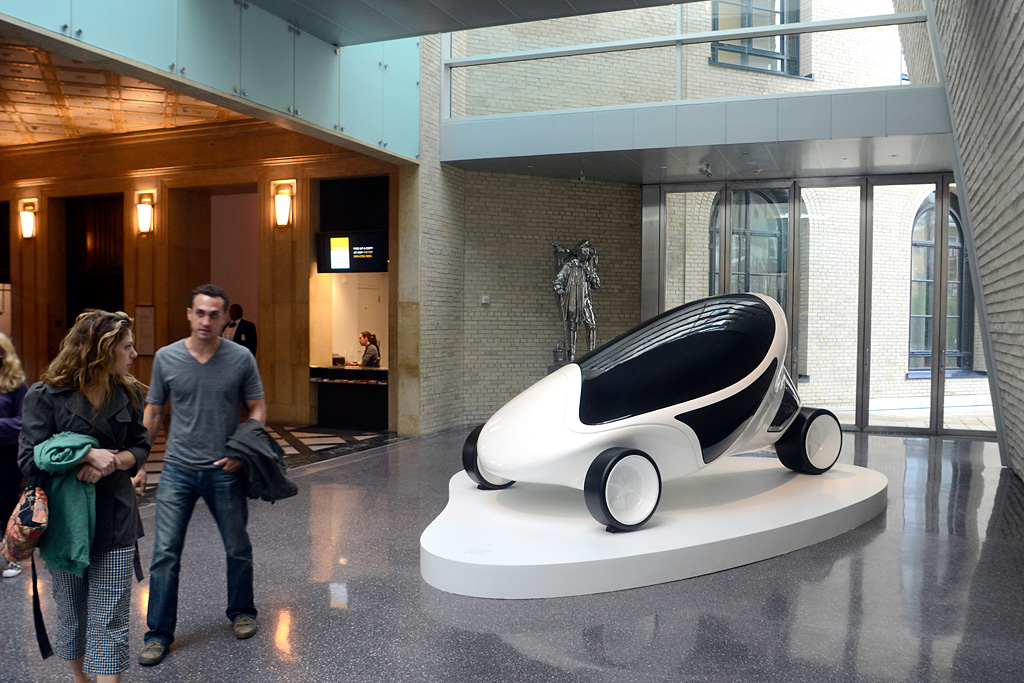
In 2011, when the museum’s Perelman building was still open to the public, visitors view a three-wheel car.
As for the involvement of one emeritus board member, Julian A. Brodsky, Weiss has to determine the future of an unannounced, but reported by Philadelphia Magazine, $20 million pledge from the Comcast cofounder toward a dreamed-of education center.
“It’s an incredible gift and we’re enormously grateful for that. I’m in the process of talking about the timing of that and all of that,” he said.
The art itself
Weiss does not dispute that the museum needs changing. But a host of questions beckon.
What about the art itself? Is the museum’s pipeline of shows — some of which are years in the planning — the right mix for the audience the museum wants to attract? Why are doors open only five days and past 5 o’clock one day a week? Is a general admission ticket of $30 too high for this city?
Daniel H. Weiss, director and CEO of the Philadelphia Art Museum, is well into his listening tour.
“Every great art museum faces the same challenge, which is that these are intimidating places by design. So how do you, on the one hand, celebrate this great magnificent institution sometimes called a castle on the hill? And at the same time [be] welcoming to schoolchildren who have never been here before? That’s not easy. We faced the same issue at the Met.”
He sees the shifting societal context in which the museum finds itself as an opportunity.
“The world is a mess,” he said. He would like the museum to be an answer to that turmoil — though clearly, given the last few months, Philadelphia’s major art museum is not cloistered from conflict.
“There are very few places in the world that are entirely to the good, and art museums are among them. We are here to enrich, to enlighten, to inspire, to build community, to invite difference to come together, to have shared learning experiences for everyone,” Weiss said.
“The world is a lot bigger, more complicated, richer, and inspiring than just the world you live in on a day-to-day basis. If everybody can have that experience, we are incrementally a more civil society than we were before people came into the institution. Those are all great things.”
As he standsoutside the Narberth Bookshop on a frigid January afternoon, it’s clear Dana Edwards has a vision.
Imagine, he says, as he sweeps his hands toward the borough’s downtown corridor, getting off the train and stopping into a small grocery for a bite to eat before heading home on foot. Maybe you buy a gift, or an ice cream cone, or a bottle of wine.
Like anywhere, Narberth “could use a little bit of revitalization here and there,” Edwards said. But you can “see the potential.”
Edwards, 53, was sworn in as Narberth’s mayor earlier this month. The longtime financial technology officer moved there from Pittsburgh five years ago with his wife, Miranda. They have a 2-year-old son, and Edwards has two older children, 19 and 22, from his first marriage. Edwards had never run for office before, but after falling in love with the borough (and being encouraged by neighbors), he stepped into the public eye last year. He won the local Democratic Party’s endorsement, then ran unopposed in the primary and general election. This month, Edwards replaced Andrea Deutsch, who had served as Narberth’s mayor since 2017.
As the 0.5-square-mile, 4,500-person borough faces infrastructure challenges and debates over development, Edwards says he is ready to steer Narberth in the right direction through communication, thoughtful growth, and a social media presence he calls “purposely cringey and fun.”
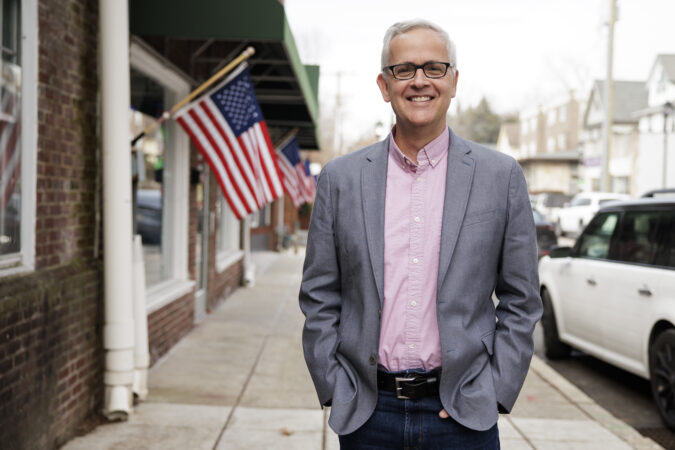
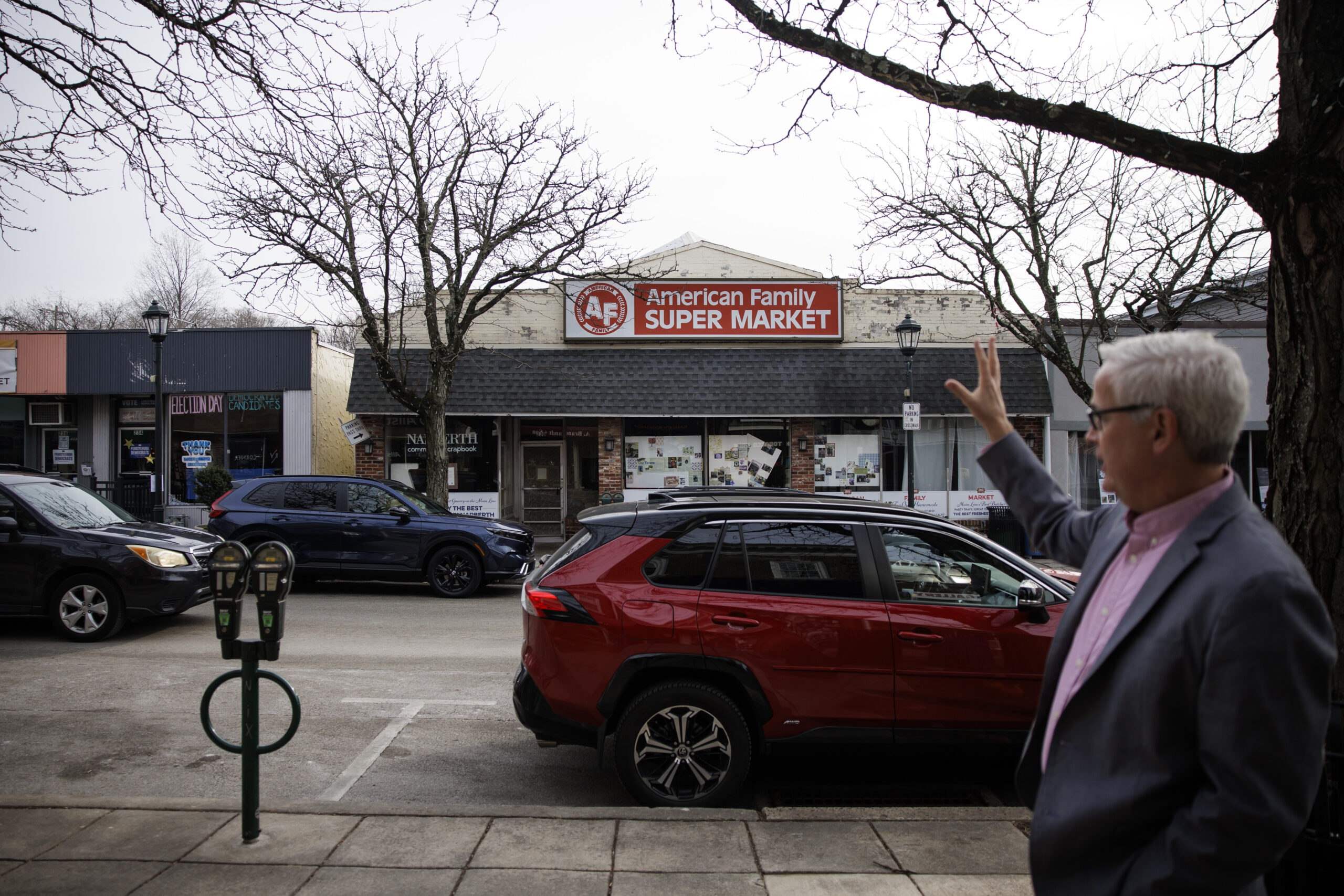
Narberth Mayor Dana Edwards talks about the empty storefronts on Haverford Avenue on Tuesday, Jan. 6, 2026 in Narberth, Pa.
From San Juan to Narberth, with stops in between
Edwards grew up in San Juan, Puerto Rico. There, Edwards says, he saw power outages, infrastructure issues, and food shortages. It was a formative experience that taught him about the collective — what it means to come together in the face of persistent challenges.
He earned a degree in chemistry in 1994 from the College of Charleston in South Carolina. Though the goal was to become a doctor, Edwards was drawn to technology. He went back to school, and in 1997 earned a degree in computer science, also from the College of Charleston. Edwards has a master’s in business administration from Queens University of Charlotte in North Carolina.
Edwards has spent three decades in the world of information technology, working mostly for major banks. He was the chief technology officer of the Mitsubishi UFJ Financial Group, then for PNC Bank. He is now the group chief technology officer for Simply Business, a London-based online insurance broker. He has lived in Puerto Rico, South Carolina, Los Angeles, Pittsburgh, and now Narberth. He has over 18,000 followers on LinkedIn.
By his own admission, Edwards’ civic background is “a little bit light.” He has given to various causes over the years, and said he was involved in the ACLU in the early 2000s. He helped organize Narberth’s first Pride in the Park event in 2022 and said he has joined the Main Line NAACP chapter.
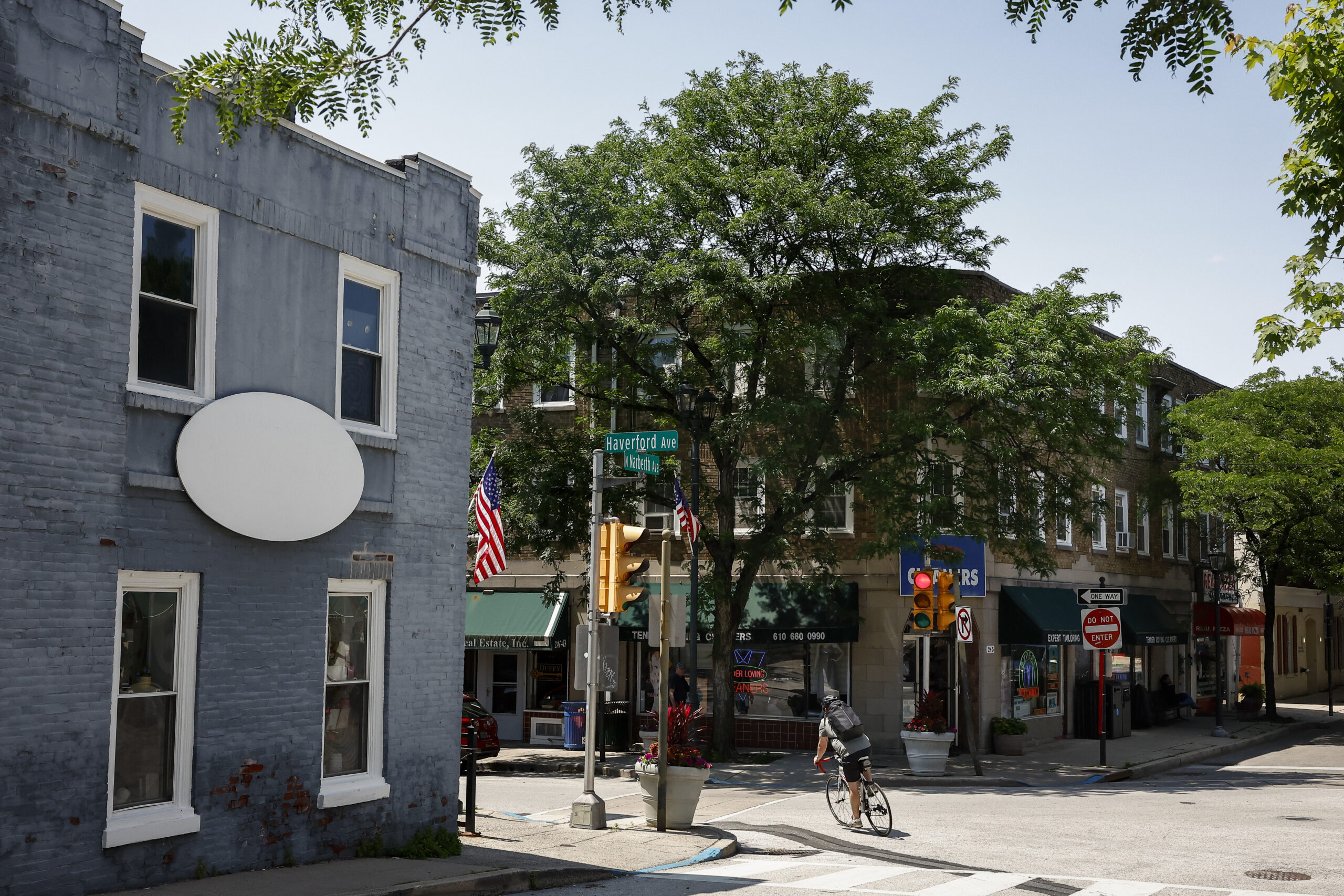
The corner of Haverford and North Narberth Avenues on Monday, June 2, 2025 in downtown Narberth, Pa.
Polarization happening ‘in our little town’
Edwards started thinking about running for office “when the national scene changed dramatically.”
He described beginning to sense a deep polarization both between and within America’s political parties.
“I felt like I saw it happening locally. I saw it happening in our little town,” he said.
As the mayoral race approached, neighbors began telling Edwards he had the right “thing” to run. He could build a strategic plan, lead an organization, and understand financials. At a candidate forum last year, Edwards said he originally planned to run for mayor in 2029, but decided to move his campaign up to 2025.
Edwards earned the backing of Narberth’s Democratic committee people last April, beating out attorney Rebecca Starr in a heated endorsement process.
During a March 2025 meeting, local Democrats squabbled over whether or not to endorse a candidate, citing “animosity” in the race (candidates are discouraged from running as Democrats if they do not receive the endorsement of the local committee). The committee ultimately voted to make an endorsement, which went to Edwards.
“I think [in] any good race, at some point, you have to have more than one candidate. Because otherwise, people are just getting selected, not elected,” Edwards said, referencing the endorsement process. “I do think that she would be a great candidate also, and I hope she runs again.”
Edwards believes the community has largely moved on from any division that colored the primary. Really, he added, it’s more important to get people talking about the issues the mayor can solve — streets, garbage pickup, infrastructure.
“I’m just really focused on Narberth,” he said.
The SEPTA train station on the Paoli/Thorndale Line on Monday, June 2, 2025 in Narberth, Pa.
There are two extremes, Edwards says. On one end, the borough could leave everything as it is. The buildings might fall apart, but they would be the same buildings that everyone knows and loves. On the other end, there is rapid growth, like bringing a Walmart Supercenter to Haverford Avenue.
“It’s that thing in the middle that we’re looking for,” he said — a “hometown feel” with “community-oriented” businesses.
Edwards is eager to get the 230 Haverford Ave. development across the finish line. The long-awaited project plans to bring 25 new apartment units and ground-floor retail to Narberth’s commercial core. The project, helmed by local real estate developer Tim Rubin, has been in the works for over five years, but faced pandemic-era setbacks that have left a number of vacant storefronts downtown.
Edwards plans to write a regular newsletter, hold town halls, and host coffee chats. He hopes to put together an unofficial advisory group to bring together people, and opinions, from across the small borough.
Edwards believes “the DNA of Narberth is alive and kicking,” from the Dickens Festival to the Narberth Outsiders baseball team. To keep it alive, though, the borough needs to bring business in and remind people why they love to live, shop, and work in Narberth.
“It’s all about relationships and commerce,” he said. “[That] is going to be what brings us together.”
This suburban content is produced with support from the Leslie Miller and Richard Worley Foundation and The Lenfest Institute for Journalism. Editorial content is created independently of the project donors. Gifts to support The Inquirer’s high-impact journalism can be made at inquirer.com/donate. A list of Lenfest Institute donors can be found at lenfestinstitute.org/supporters.