Tag: Weekend Reads

  • Johnny Doc played a pivotal role electing his brother to the Pa. Supreme Court. Ten years later, things are different.

    Johnny Doc played a pivotal role electing his brother to the Pa. Supreme Court. Ten years later, things are different.

    As Pennsylvania Supreme Court Justice Kevin Dougherty knocked on doors in Northeast Philadelphia last month, a voter made a connection.

    Peering out his front door on a sunny September day, the man asked if the mild-mannered and smiling white-haired justice standing on his front porch was related to former labor leader John Dougherty. Widely known as “Johnny Doc,” the former head of Local 98 of the International Brotherhood of Electrical Workers and a onetime kingmaker in state and local politics was sentenced last year to six years in federal prison on embezzlement and bribery convictions.

    Despite the public fall from grace, the voter said he missed John Dougherty’s leadership in Philadelphia, adding that he believed Dougherty had been good for workers in the city. They are brothers, Kevin Dougherty confirmed.
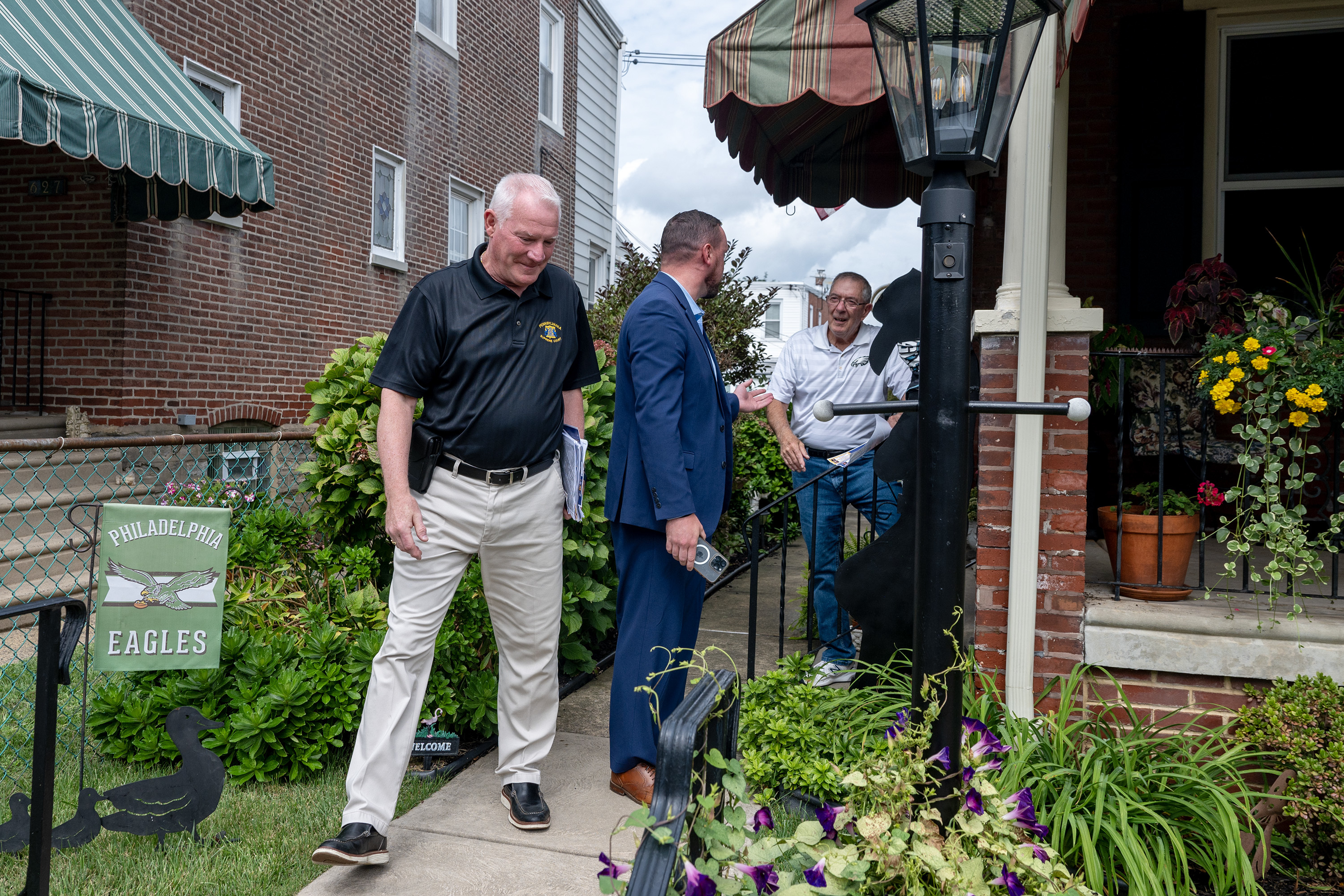
    Justice Kevin Dougherty (left) canvasses with his son, State Rep. Sean Dougherty (center) in Fox Chase Sunday Sept. 7, 2025, stopping at the home of a voter. The elder Dougherty is one of three Pennsylvania Supreme Court justices up for retention.

    The justice had spent the day asking voters in his neighborhood to keep him and two other justices on the state’s Supreme Court for an additional 10-year term. At that stage, many voters were not even aware of the typically sleepy and nonpartisan contest on which both parties are spending millions in the lead-up to the Nov. 4 election.

    But in this year’s unusually high-profile state Supreme Court retention race, the connection has, in some circles, become unavoidable. Republicans seeking to oust Kevin Dougherty and two of his colleagues, all initially elected as Democrats, have sought to tie the judge to his brother’s misdeeds. The justice, a son of South Philadelphia who previously led Philadelphia’s Family Court, has sought to distance himself, and has seen the continued support of labor unions in his retention campaign.

    “Over the course of 25 years as a judge, including ten years as a Justice on the Supreme Court, Justice Dougherty has had the privilege and the benefit of meeting a multitude of Pennsylvanians including the working men and women of organized labor,” Shane Carey, Kevin Dougherty’s campaign manager, said in a statement. “Our campaign is proud to receive their support, as well as the support from almost 5,000 other individual donors.”

    How Johnny Doc helped elect his brother to the Supreme Court in 2015

    Kevin Dougherty didn’t choose to be related to one of the city’s most prominent power brokers, but he certainly benefited from his brother’s former union’s help, with significant support from the politically powerful Local 98 during his 2015 campaign for the state bench.

    Local 98, where John Dougherty was the longtime business manager, contributed more than $620,000 during Kevin Dougherty’s 2015 campaign for the Pennsylvania Supreme Court. Local 98’s spokesperson at the time also served as Kevin Dougherty’s campaign manager and appears from campaign finance filings that year to have been paid by Local 98. The union also spent more than $480,000 on in-kind contributions for “professional services,” mailers, merchandise, and more.
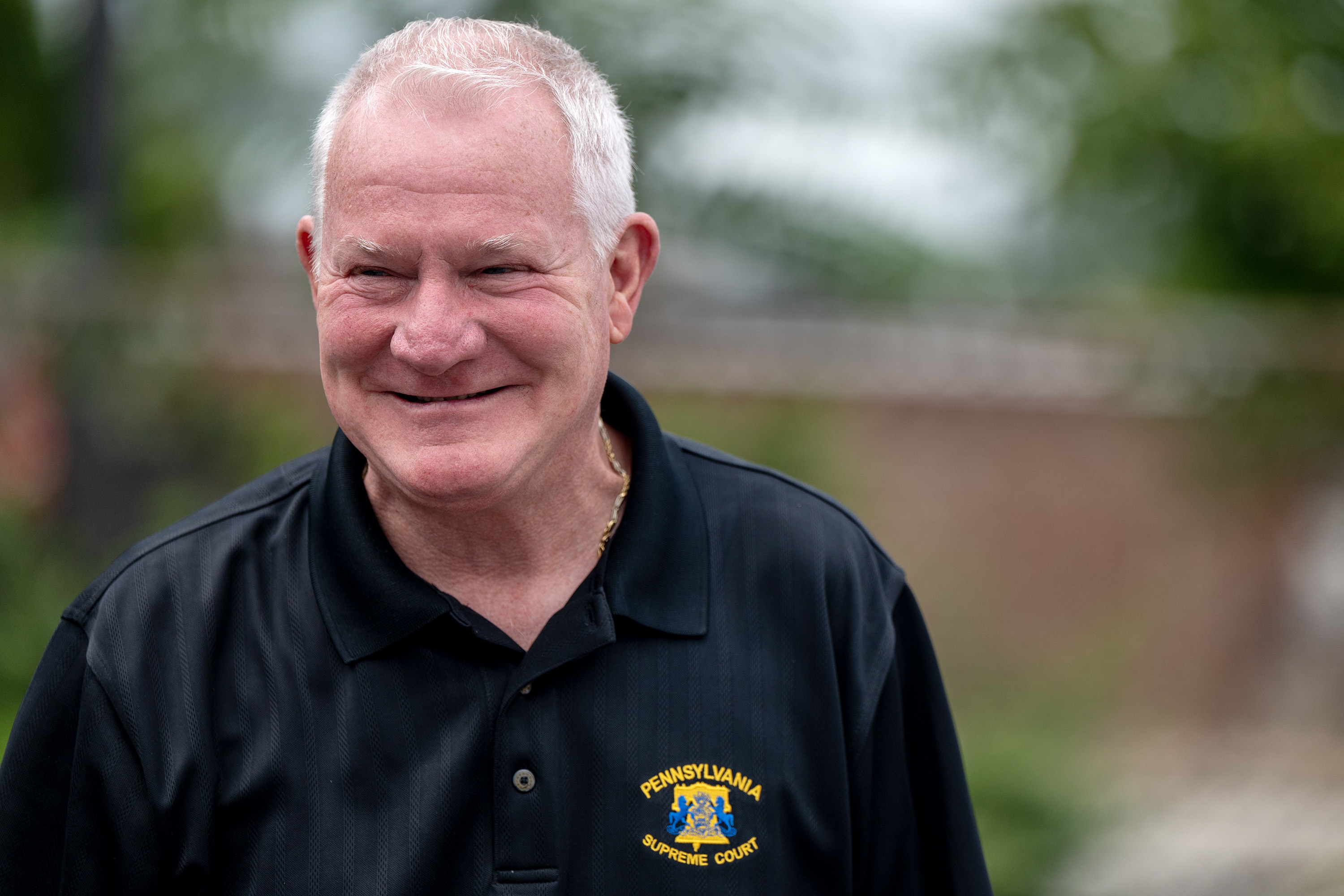
    Justice Kevin Dougherty talks with volunteers before they head out the canvass in Fox Chase Sunday Sept. 7, 2025. Dougherty is one of three Pennsylvania Supreme Court justices up for retention.

    Kevin Dougherty is the only justice up for retention from Southeastern Pennsylvania. The other justices, Christine Donohue and David Wecht, live in Pittsburgh. They will each appear on the November ballot with no party and no home county. Voters will simply be asked “yes” or “no” whether each individual justice should be retained for another term.

    Republicans working to oust the three justices this year have tried to leverage Kevin Dougherty’s past support from his brother to encourage voters to oppose his retention.

    Scott Presler, an influencer aligned with President Donald Trump who has more than 2.4 million followers and runs a political action committee aimed at registering Republican voters, posted an AI-generated image of John Dougherty behind bars, tying, without evidence, Local 98’s contributions to Kevin Dougherty’s 2015 campaign to his brother’s convictions.

    “Coincidence?” Presler wrote.
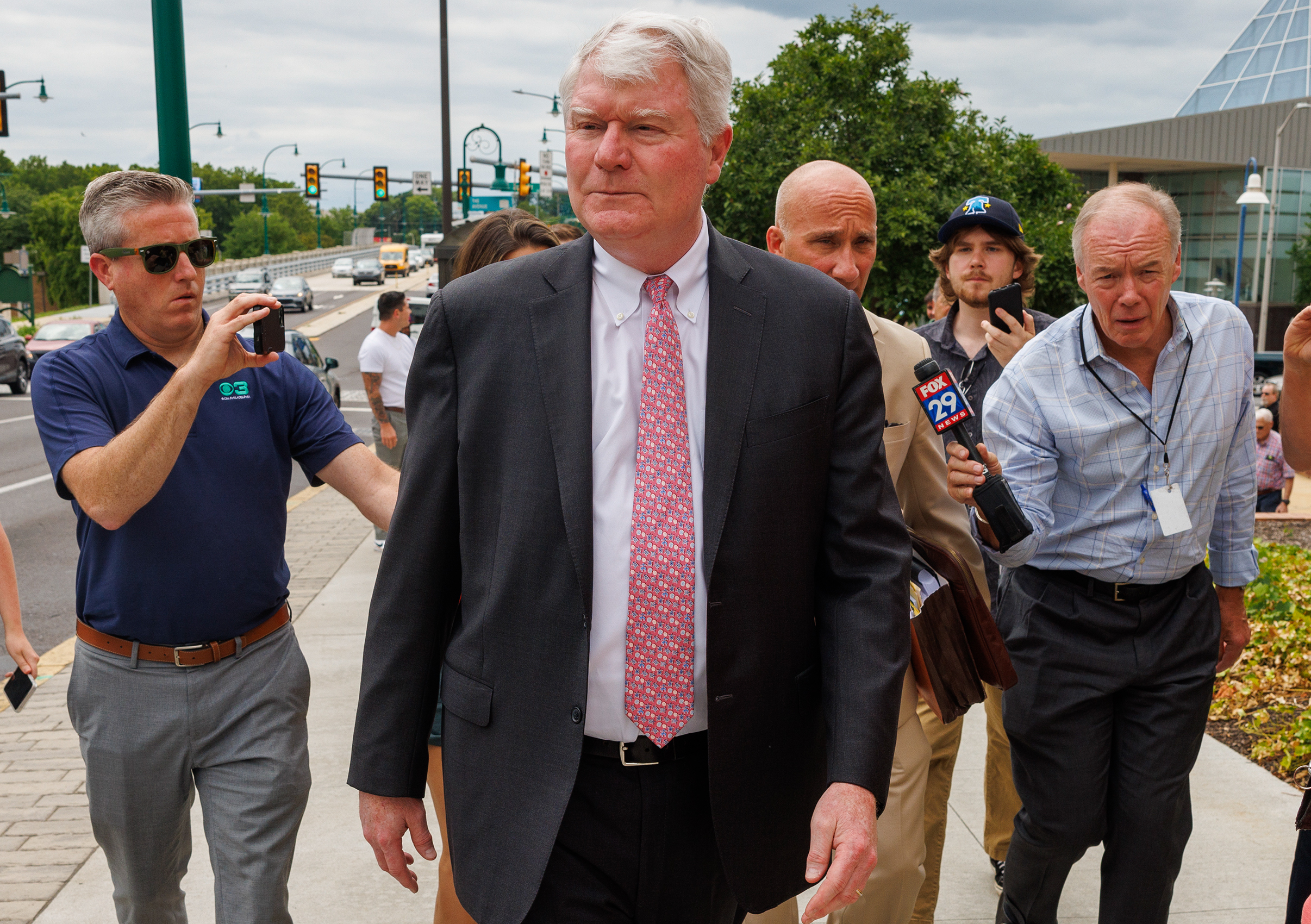
    Johnny Dougherty, the former IBEW business manger, and his attorney Gregory J. Pagano as they leave the U.S. District Court, Reading, Pa. on the day he was sentenced to 6 years in prison Thursday, July 11, 2024.

    For months, the conservative influencer has posted on social media urging followers to vote against retaining Kevin Dougherty and his colleagues, citing the times his name was mentioned during John Dougherty’s trials, such as when prosecutors alleged the justice received free home repairs or snow removal on the union’s dime. Kevin Dougherty’s lawyer at the time of the embezzlement trial said the judge never knowingly accepted services paid for with union funds.

    While door-knocking in September, Kevin Dougherty dismissed attacks against him related to his brother as “misinformation,” noting his decades-long career as a judge.

    Kevin Dougherty, 63, spent more than a decade as a Common Pleas Court judge in Philadelphia before his election to the state Supreme Court. During his tenure on the state’s highest court, he has authored majority opinions and is leading a statewide initiative to improve how Pennsylvania’s judicial system interacts with people with behavioral health issues.

    “I spent close to a quarter of a century being a judge,” Dougherty said on a sidewalk in Northeast Philly. “I just don’t accept people’s comments and judgment. I want to know what the motive behind those comments are. Some of these comments are just partisan … and I believe in my reputation.”

    The justice should be vetted on his own merits, said John Jones, a former U.S. District Court judge for the Middle District of Pennsylvania who was appointed to the bench by former President George W. Bush.

    “You can pick your friends, but you can’t pick your relatives,” Jones, now president of Dickinson College, added. “You have to judge the justice on his own merits. This is not a country where we favor guilt by association.”

    This time on the campaign trail, Kevin Dougherty has new familial support. State Rep. Sean Dougherty, a Democrat who was elected last year to represent parts of Northeast Philadelphia, has joined his dad to stump for his retention.

    Kevin Dougherty still has broad union support, including from Local 98

    With John Dougherty no longer at the helm of Local 98, labor unions in Pennsylvania this year still overwhelmingly supported the justice for retention, contributing $665,000 to Kevin Dougherty’s campaign as of September. While trades unions contributed the most of any interest group to all three justices — for a total of $903,000 as of the latest filings — Kevin Dougherty is the largest beneficiary of that support.

    Among those contributors: Local 98. The union, which has reorganized and distanced itself from John Dougherty since he was first convicted in 2021, gave $70,000 to Kevin Dougherty’s retention campaign.

    “IBEW Local 98 does not support candidates based on personal relationships,” said Tom Lepera, Local 98’s political director, in a statement. “We support candidates who understand and stand up for the needs of working men and women in organized labor. Justice Dougherty, along with Justices Donohue and Wecht, have consistently demonstrated their commitment to protecting the rights and interests of middle-class workers across this commonwealth.”

    Kevin Dougherty’s campaign did not respond to several questions this week about his brother’s role in his 2015 campaign or whether his brother’s reputation has influenced the retention campaign.

    Anti-retention material featuring President Donald Trump as Uncle Sam was on display at Republican rally in Bucks County last month headlined by Treasurer Stacy Garrity, a candidate for governor. The material is from Early Vote Action, a group led by GOP influencer Scott Presler.

    Union leaders insist their support for Kevin Dougherty this year has nothing to do with his brother and is a reflection of his quality work in the judiciary. Labor unions often support Democratic candidates, who are often seen as more beneficial to unions and their priorities.

    “It’s about keeping good judges on the bench,” said Ryan Boyer, leader of the Philadelphia Building and Construction Trades Council, an umbrella organization of local trades unions once commanded by John Dougherty. This year, the building trades gave just over $33,000 to each justice.

    “We don’t live on Mars where we don’t know that sometimes familial connections can be there,” Boyer said, “and they try to exploit those things.”

    Nonpartisan and Democratic groups favor Dougherty’s tenure on the bench

    Like his colleagues running for retention, Kevin Dougherty has earned broad support from nonpartisan and partisan groups alike.

    Dougherty was recommended for retention by the Pennsylvania Bar Association, which is a rigorous, nonpartisan decision based on a jurist’s behavior on the bench, and endorsed by several law enforcement organizations.

    Lauren Cristella, CEO of the Committee of Seventy, the Philadelphia-based good-government group, noted that the justice was never charged or found guilty of wrongdoing.
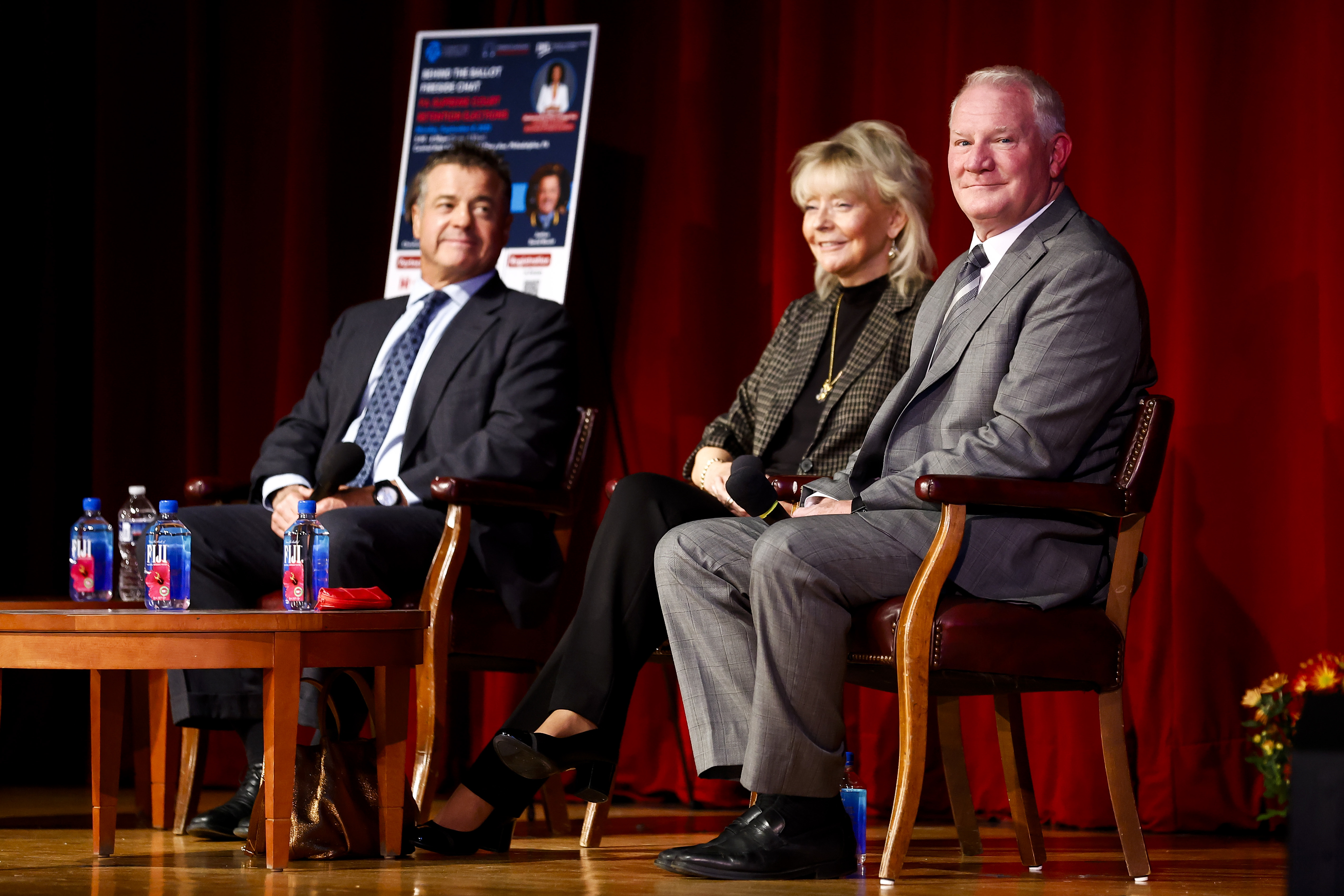
    Justices David Wecht, Christine Donohue and Kevin Dougherty sit onstage during a fireside chat at Central High School on Monday, Sept. 8, 2025 in Philadelphia.

    “The Committee of Seventy relies on the findings of law enforcement and professional oversight organizations, such as the Bar Association, when evaluating judicial candidates. This year, the Pennsylvania Bar Association has evaluated Justice Dougherty and recommended him for retention. Our focus remains on transparency, accountability, and maintaining public trust in Pennsylvania’s courts,” Cristella said in a statement.

    Dougherty and his fellow justices have also gained the support of Gov. Josh Shapiro, Pennsylvania’s popular Democratic governor, who in a fundraising email to Pennsylvania Democrats on Thursday urged voters to mark “yes” on retaining Dougherty, Donohue, and Wecht.
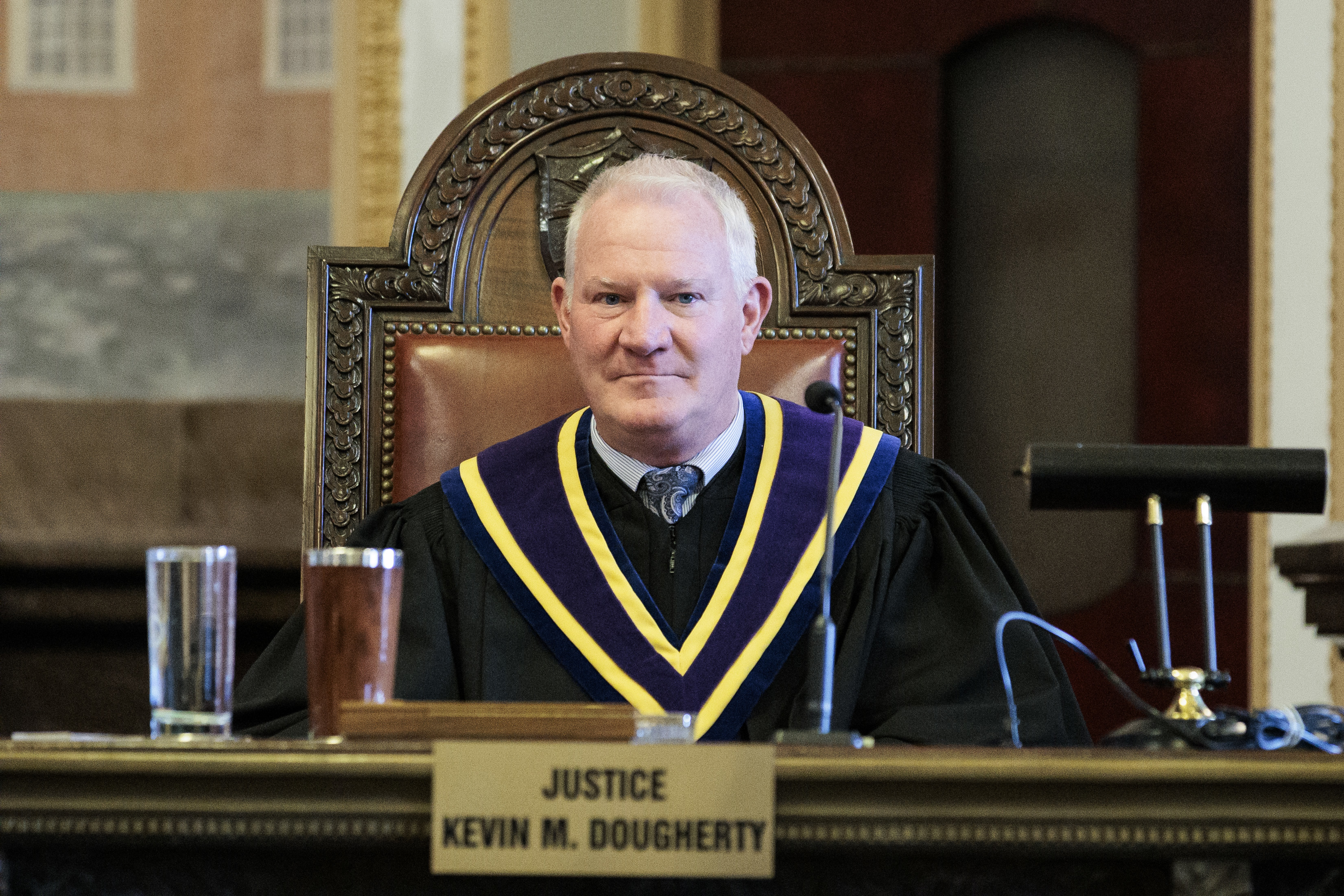
    Justice Kevin M. Dougherty listens during a Courtroom Dedication Ceremony at the Supreme Court Courtroom in Philadelphia City Hall on Tuesday, Sept. 9, 2025 in Philadelphia.

    “The threats to our freedoms are coming from all directions, and we need a Court that stands up for what’s right,” Shapiro said in the email. “Justices Donohue, Dougherty, and Wecht have proven that we can count on them to protect freedom, reproductive rights, and the rule of law.”

    In a statement to The Inquirer, Kevin Dougherty didn’t mention his brother by name.

    “With regard to my personal relationship I love my big brother. For obvious reasons, my brother is not participating in my Retention campaign,” he said.


  • Months before Kada Scott’s killing, Keon King was wanted for kidnapping his ex, but no one arrested him — even in court

    Months before Kada Scott’s killing, Keon King was wanted for kidnapping his ex, but no one arrested him — even in court

    A month after Keon King was charged with breaking into his ex-girlfriend’s home and attempting to strangle her, police say, his violence escalated: In January, he returned to her home with a gun, then kidnapped and assaulted her.

    A warrant for his arrest was issued days later.

    In the weeks that followed, King twice appeared in Philadelphia court and stood before a judge in the initial strangulation case. But no one in the courtroom seemed to know he was wanted for kidnapping.

    So both times, King walked out.

    In February, despite the warrant for King’s arrest, prosecutors — seemingly unaware that police said he had recently attacked their key witness — withdrew the burglary and strangulation case when the victim failed to appear in court.

    Police did not go to either hearing to take him into custody, and do not appear to have alerted the prosecutor about the new arrest warrant.

    And King was not formally charged with the kidnapping until April, when, for reasons that are unclear, he turned himself in.

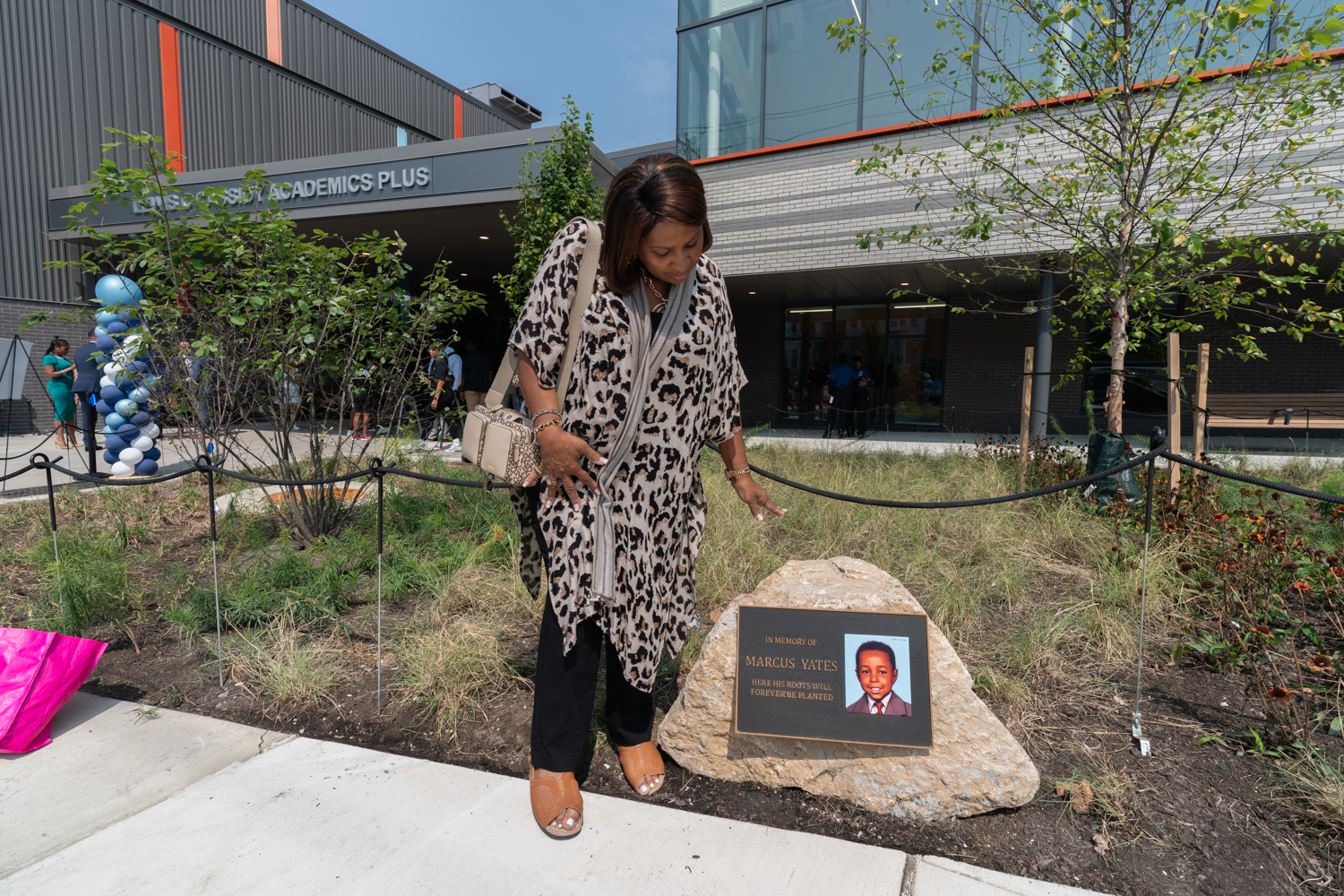
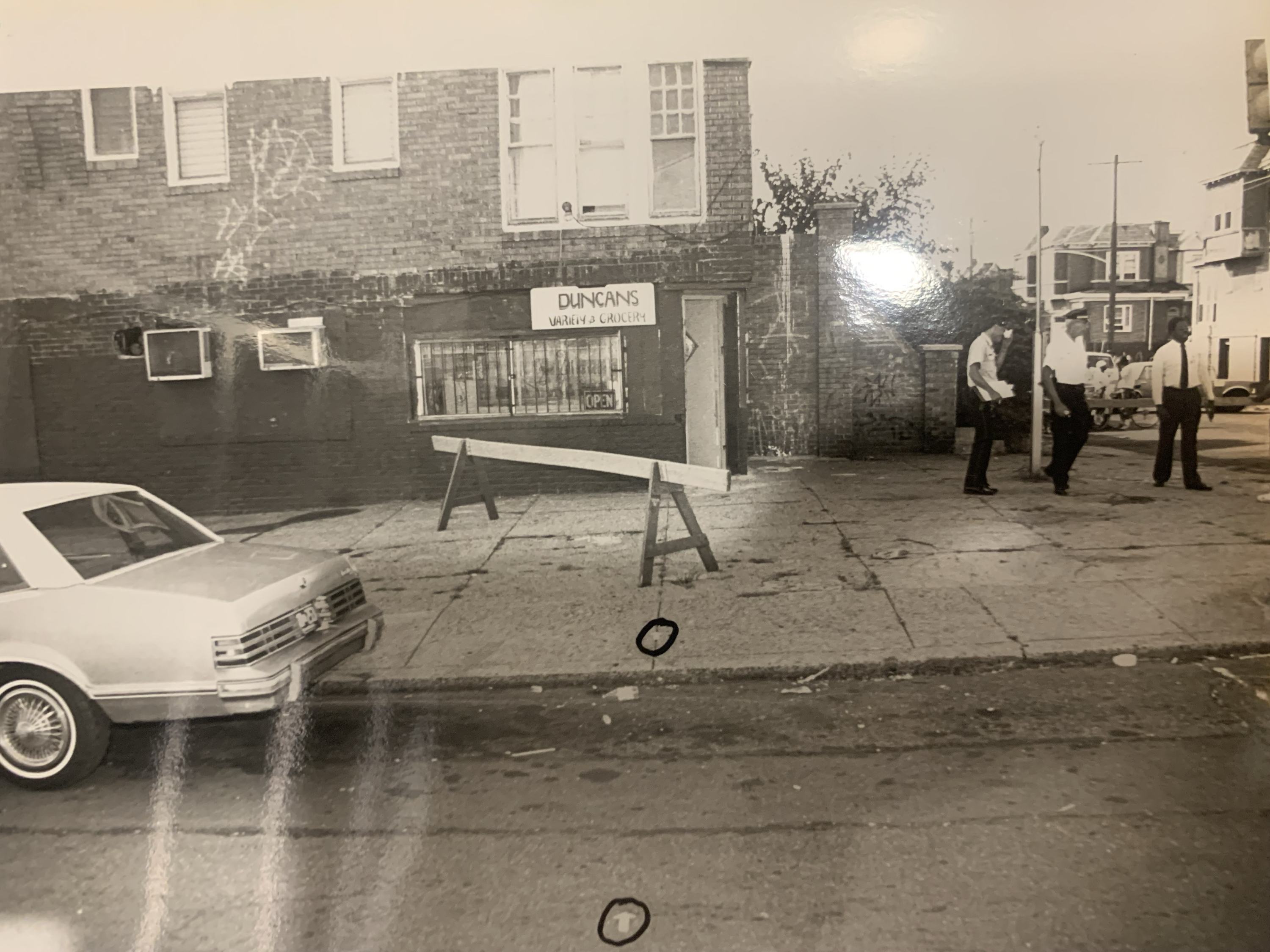
    The shortcomings in those earlier cases came into focus this month after police said King abducted Kada Scott from outside her workplace Oct. 4, then killed her and buried her body in a shallow grave behind an East Germantown school. The death of Scott, 23, of Mount Airy, has unnerved a community and drawn national attention.

    Kada Scott, 23, was abducted from outside her workplace on Oct. 4, police said.

    A review of King’s previous criminal cases raises questions about whether police and prosecutors could have been more vigilant in holding him accountable for the earlier crimes they say he committed.

    City Council has since vowed to hold a hearing examining how the city’s criminal justice system handles cases of domestic violence.

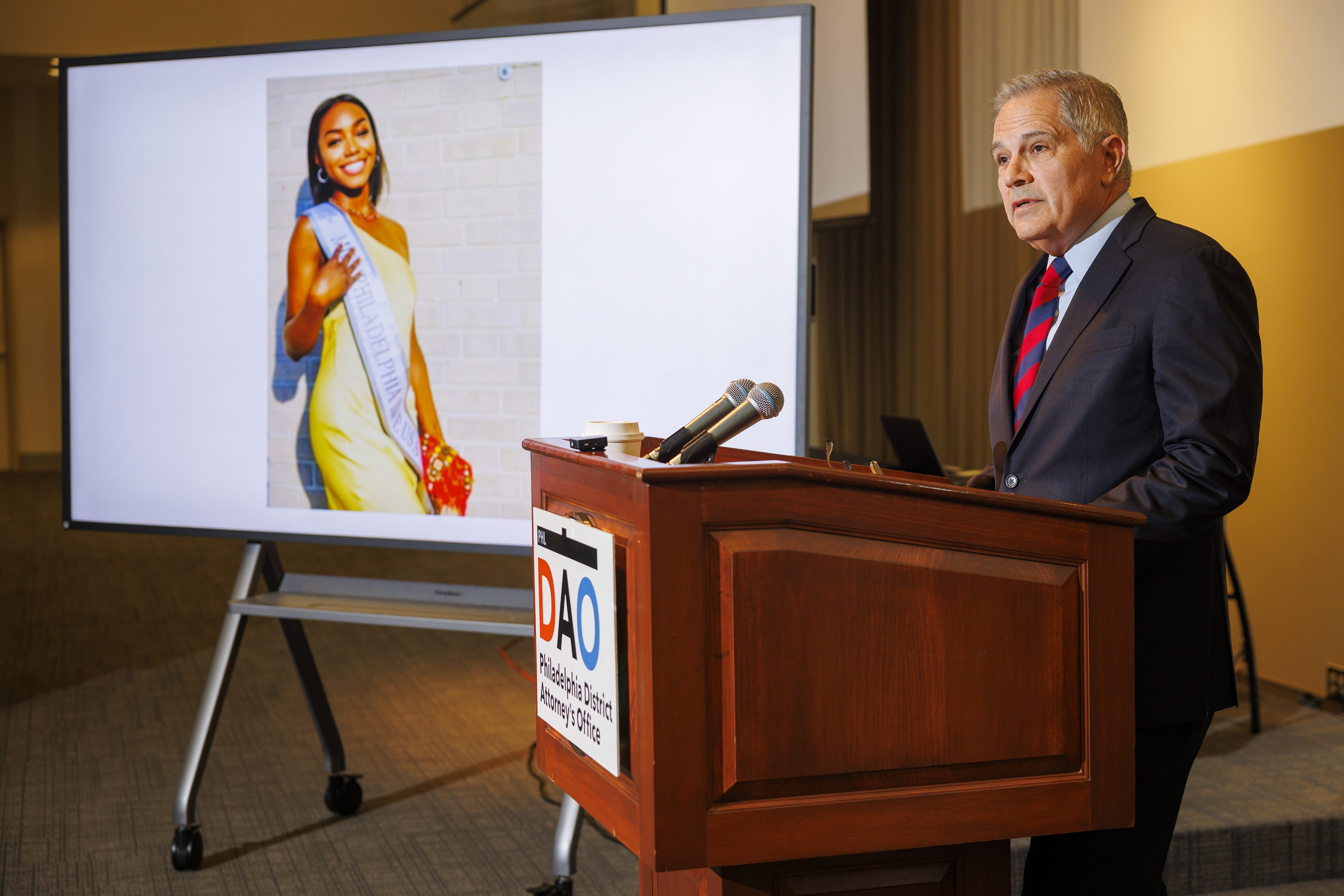
    District Attorney Larry Krasner has said it was a mistake for prosecutors to withdraw the charges in the alleged kidnapping of King’s ex — and his office has since refiled them. He said the decision not to proceed with the case was made by a young assistant district attorney who was new at handling such prosecutions and who saw the victim’s absence as a fatal flaw, even though there was video evidence of the attack.

    But even before the charges were withdrawn, police and court records show, there were missteps.

    Marian Grace Braccia, a former Philadelphia prosecutor who is a law professor at Temple University, said she found it alarming that law enforcement failed to take King into custody when he twice stood before them in court while wanted for a violent felony.

    “If this is supposed to be a collaborative effort — if there is a shared mission of public safety and victim advocacy — it sounds like everyone dropped the ball,” she said.

    Detectives and prosecutors, she said, should have been aware of the arrest warrant and had officers take him into custody.

    Then, she said, prosecutors could have cited the alleged kidnapping to ask a judge to increase King’s bail and keep him behind bars.

    Instead, she said, “it passed by everybody, and he came in and walked out, and slipped through the cracks of the Philadelphia legal court system.”

    Philadelphia District Attorney Larry Krasner discusses the killing of Kada Scott at a news conference earlier this week.

    Krasner said there is no system to automatically notify prosecutors when a defendant in one of their cases is arrested anew.

    Similarly, there is no system to let police know that suspects in new cases have outstanding criminal matters, said Philadelphia Police Department spokesperson Sgt. Eric Gripp.

    “Detectives are not automatically notified when a wanted subject is physically present in court on a different active case,” he said.
    Krasner said the issues in the case underscore a lack of communication among law enforcement agencies that happens in part because their digital information systems are decades old. He said his office and other law enforcement agencies should work to update those systems.

    “That is something that we can all improve together if we have the will and if we have the resources,” he said.

    A wanted man walks free

    Police said King first attacked his ex-girlfriend in early November of last year. He broke into her Strawberry Mansion home, then tried to strangle her, according to the affidavit of probable cause for his arrest.

    He was taken into custody in December and charged with burglary and strangulation, and bail was set at $50,000. King immediately posted the necessary 10%, $5,000, and was released.

    About a month later, police said, King returned to the woman’s home and tried to break in. When he could not gain entry, they said, he waited for her to step outside, then grabbed her by the hair and dragged her into his car. He drove for at least four miles, beating her along the way, before dropping her off in Fishtown, according to the affidavit for probable cause for his arrest.

    A judge approved the warrant for King’s arrest on charges of kidnapping, strangulation, and related crimes on Jan. 19, court records show.

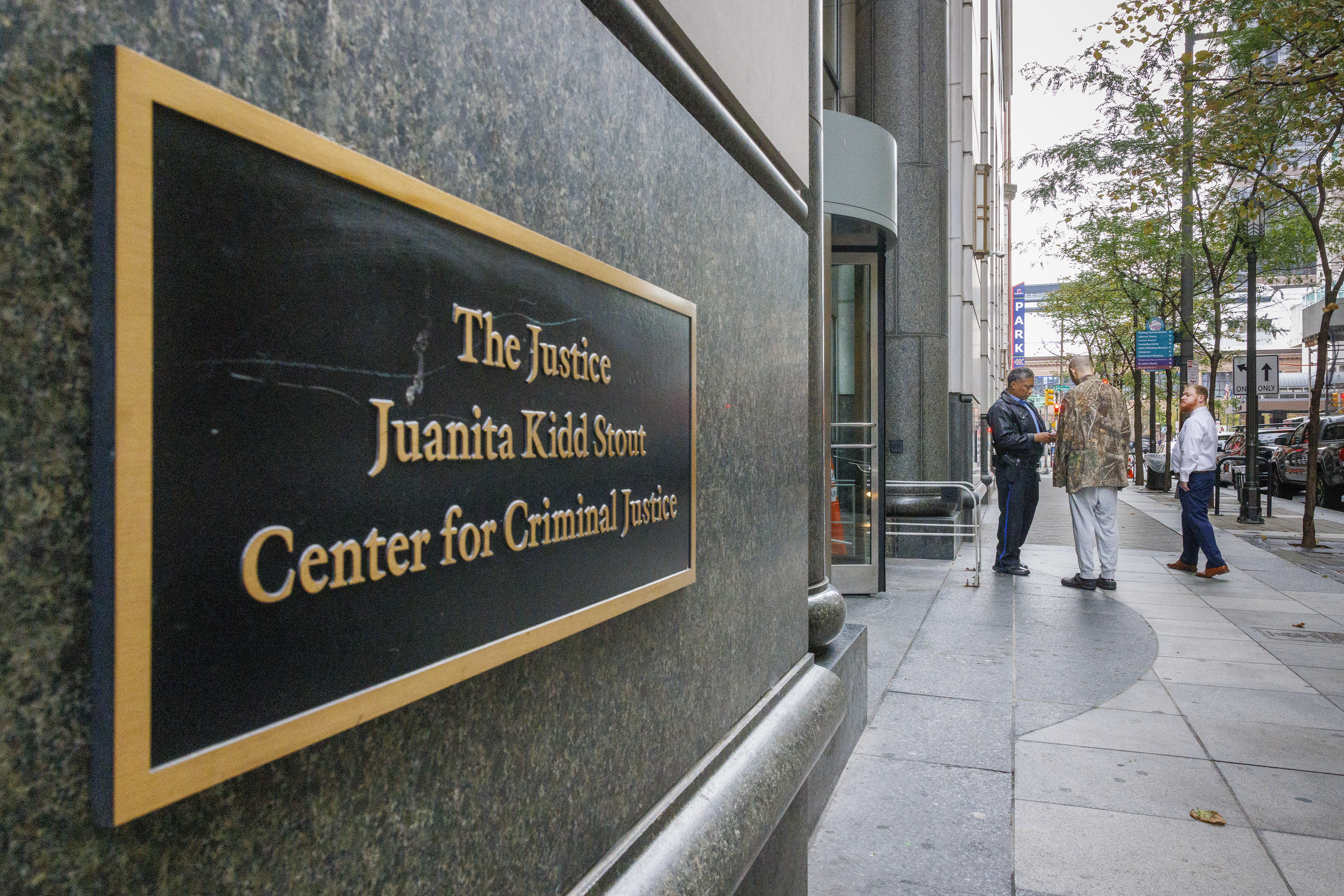
    The Justice Juanita Kidd Stout Center for Criminal Justice in Philadelphia.

    King — now wanted for a violent felony — appeared in court the following week for a preliminary hearing in the earlier burglary case, records show. But when the victim did not show up in court a second time, Municipal Court Judge Jacquelyn Frazier-Lyde ordered that the case had to proceed at the next listing. Prosecutors agreed.

    King left court.

    Meanwhile, police said, officers tried at least once to arrest him. On Feb. 11, Gripp said, police went to a home where they thought King might be, but he was not there.

    Two weeks later, King was again in court for the burglary case — but police did not go there to arrest him. Once again, the victim did not show up, and prosecutors withdrew the charges

    King walked out of court a free man.

    Braccia, the Temple law professor, said the detective assigned to the case should have been aware of the hearing. When seeking to charge King for the kidnapping, she said, the detective should have pulled up King’s arrest history and noticed the ongoing case. He then could have flagged it to the prosecutor in the first case and gone to the hearing to arrest him.

    At the same time, she said, the prosecutors who approved the kidnapping charges against King should have noticed the earlier case and told the prosecutor — particularly because it involved the same victim.

    In April, King turned himself in to police to be charged with kidnapping, strangulation, and related crimes in connection with the January attack. Prosecutors asked for bail of $999,999, but the magisterial judge, Naomi Williams, set bail at $200,000, court records show. King posted the necessary $20,000 and was released.

    The following month, after the victim again did not appear in court at two hearings, the kidnapping charges were also withdrawn.

    Since prosecutors have refiled the charges, Krasner’s office said it has been back in touch with the woman and hopes she will testify. She declined to comment about King’s alleged crimes and the previous handling of the cases by police and prosecutors.

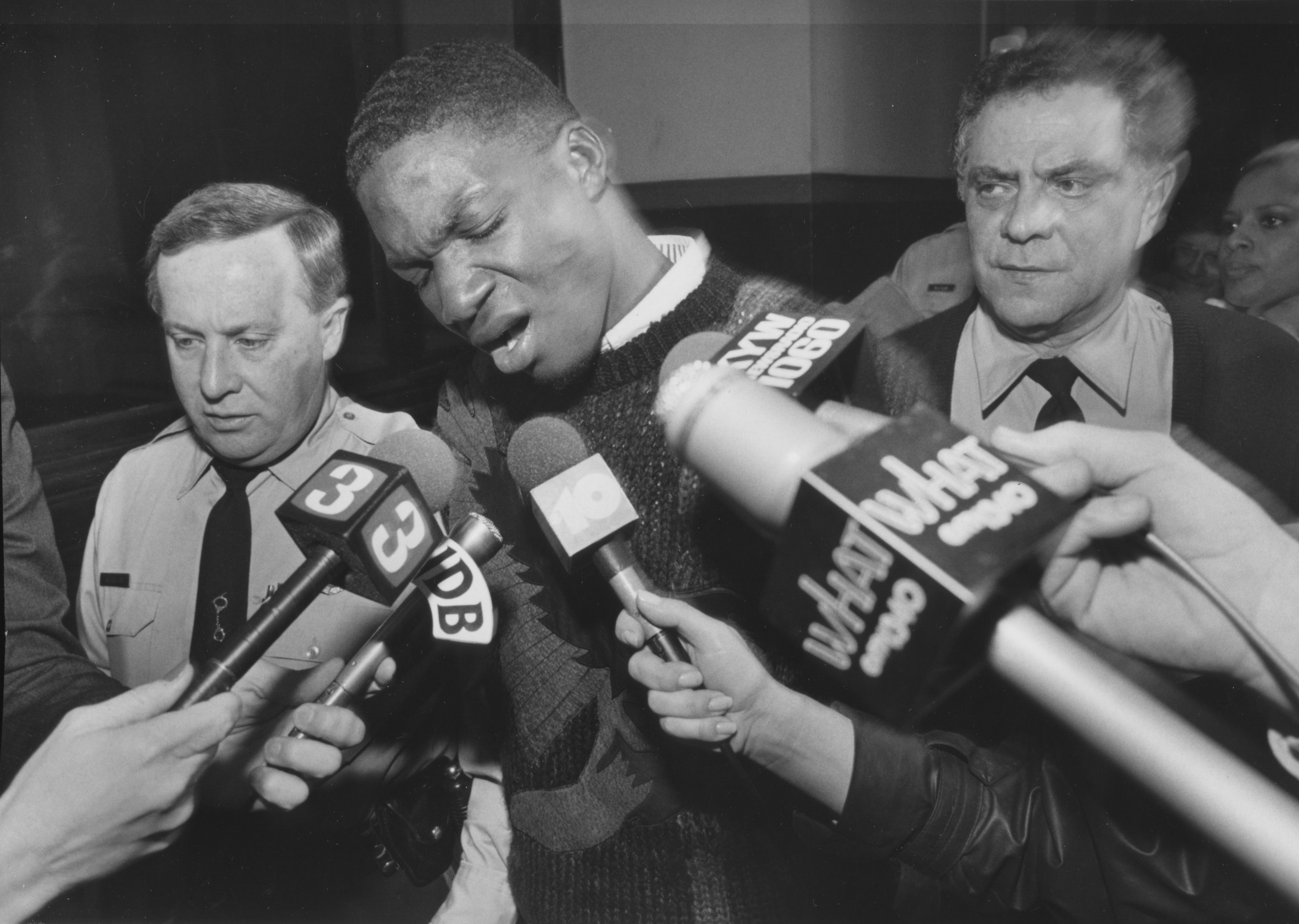
    Six months later, King is back in custody, this time charged with murder. He is being held without bail.

  • Carousel House will be Philly’s ‘flagship’ rec center. But people with disabilities will have to wait until 2028 to reunite.

    Carousel House will be Philly’s ‘flagship’ rec center. But people with disabilities will have to wait until 2028 to reunite.

    In March 2023, Kathryn Ott Lovell, then Philadelphia’s parks and recreation commissioner, announced that the plan to build a new Carousel House in West Philly was finally coming together.

    The city’s only recreation center dedicated to people with disabilities had closed its doors temporarily in 2020 during the coronavirus pandemic, then permanently in 2021. City officials said years of deferred maintenance had made it unsafe.

    “I’m excited to stop talking and start doing,” Ott Lovell said during the 2023 presentation at the Please Touch Museum.

    The city’s disability community was also excited to reunite at Carousel House. To many, the rec center on Belmont Avenue had become like a second home, with dances, movies, swimming, arts and crafts, and summer camp.

    The city’s youth wheelchair basketball team was looking forward to returning to its home base. Since the rec center closed, the squad has been practicing in New Jersey.

    Two and a half years later, however, Ott Lovell has moved on to a new job, Mayor Cherelle L. Parker has replaced Jim Kenney, and the Carousel House plan is still in the design phase.

    The new ribbon-cutting date: summer 2028.

    “I know this is a point of pain for many people, the timeline associated with this project,” Aparna Palantino, a deputy city managing director, acknowledged at a meeting Tuesday night announcing the “relaunch” of the project.

    The previous plan called for Carousel House to reopen this year.

    Palantino, who heads the city’s capital program office, said the expected cost of the project had risen from $35 million to $40 million. The work will still be funded primarily with beverage-tax proceeds, but the city had to line up grants to cover the difference, as well as conduct additional environmental and structural analyses.

    “The result of all that is this amazing space that will provide so many more opportunities than the former one did,” Palantino told an audience of several dozen.

    Aparna Palantino, deputy managing director of Capital Program Office, speaks with attendees during the Carousel House Rebuild Community Relaunch at the Please Touch Museum on Tuesday, Oct. 21, 2025, in Philadelphia. The Carousel House project is estimated to be completed in Summer 2028.

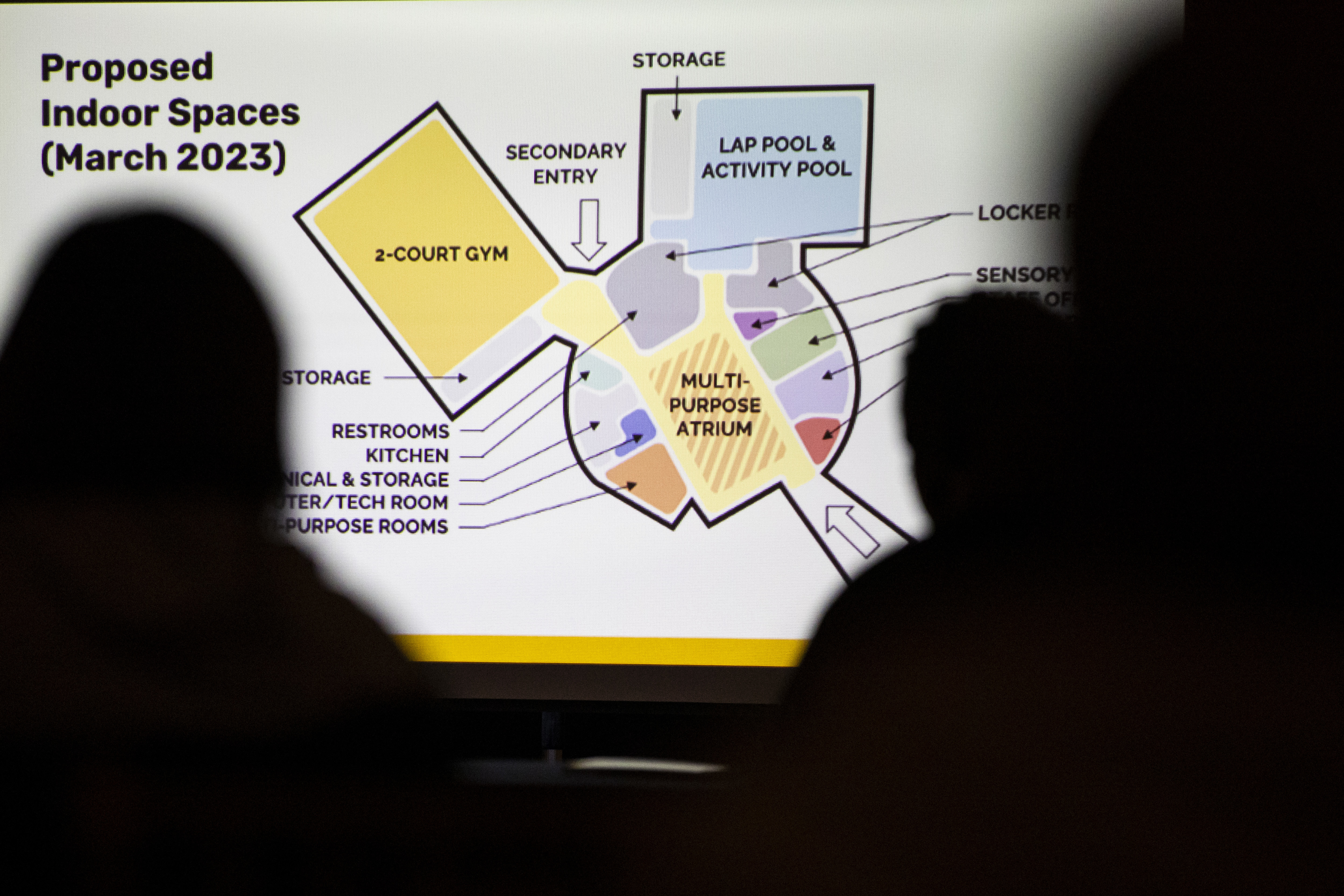
    The state-of-the-art rec center will preserve some parts of the iconic Carousel House building and include two basketball courts, a heated lap pool and an activity pool with a zero-entry sloping entrance, a computer lab, a gym, a sensory room, and other amenities.

    That all sounds great to people like Mike Martin, who has used a wheelchair for the last 30 years and has been going to Carousel House since the late 1990s. Such a place is needed in Philadelphia, where an estimated 17% of residents have a disability.

    But the lengthy delays in the project have Martin, 74, questioning whether he will ever see the vision become a reality.

    Martin and others would have preferred for the city to fix the existing building four years ago, when rec centers were reopening after the COVID-19 shutdown. A 2021 “Save the Carousel House” protest failed to sway city leaders.

    “The design is way more than I think we expected, not that we’re complaining at all,” said Martin, who serves on the Carousel House advisory committee. “We’ll see what kind of political will there is to push this through. I just don’t want to get my hopes up is what it comes down to.”

    Once a model

    Carousel House was considered a milestone when it opened in 1987: a city-funded rec center, specifically for people with physical and cognitive limitations, three years before the Americans with Disabilities Act would be signed into law.

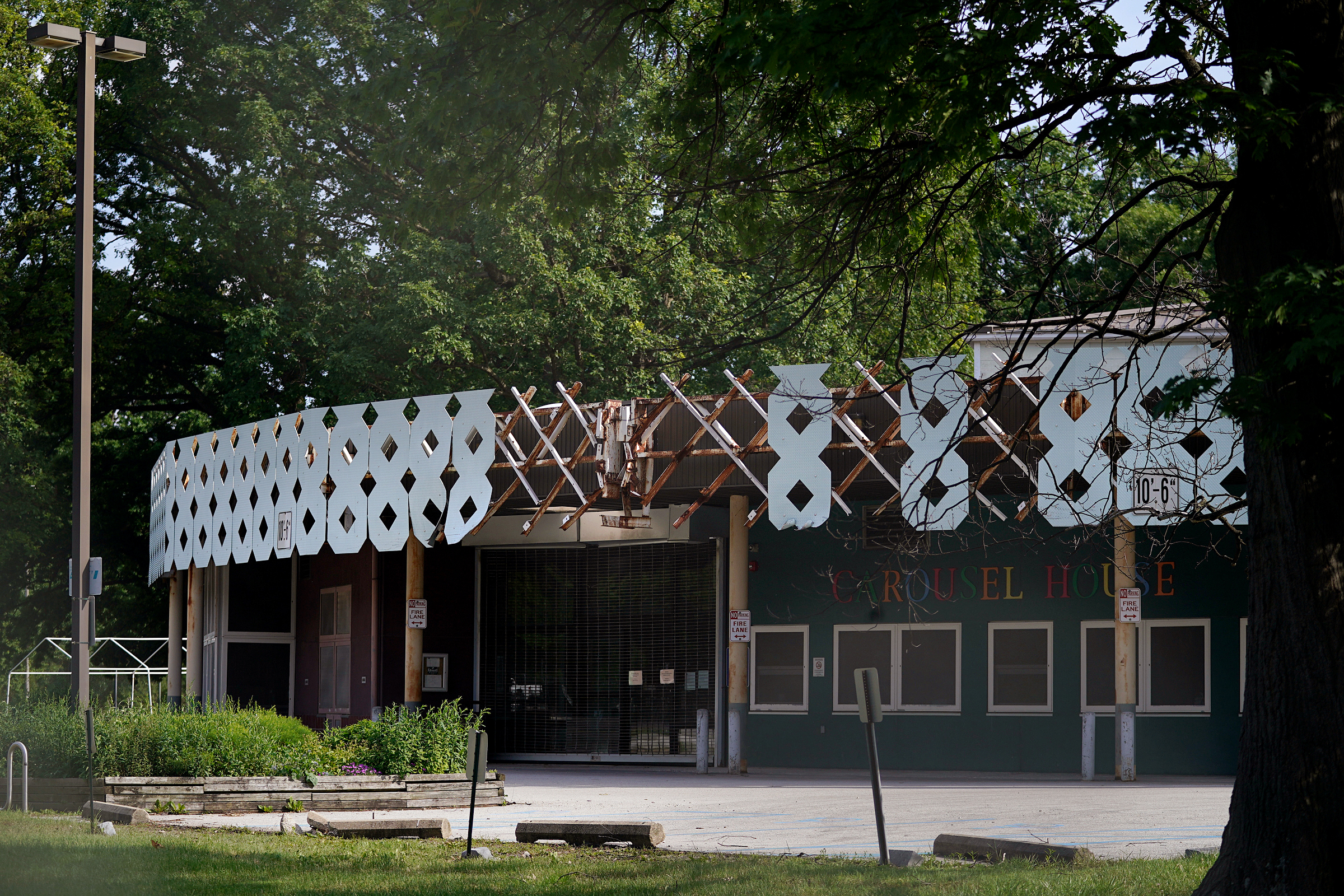
    The Carousel House is pictured in Philadelphia’s West Fairmount Park on Wednesday, June 2, 2021. The city said it was permanently closing the recreation center for disabled people due to the facility’s deterioration.

    But in recent years, disability-rights advocates, both locally and nationally, have come to view that approach as outdated and even discriminatory. How is telling people with disabilities to go to one center, they ask, any different from designating centers for Black people, LGBTQ+ people, or other identity groups?

    “People with disabilities shouldn’t have to go to one place. That’s segregation, no matter how you look at it,” Fran Fulton, the late Philadelphia disability-rights activist, told The Inquirer in 2022. “There is no doubt having people who know how to work with children and adults with different types of disabilities is an advantage. But it doesn’t have to be just Carousel House.”

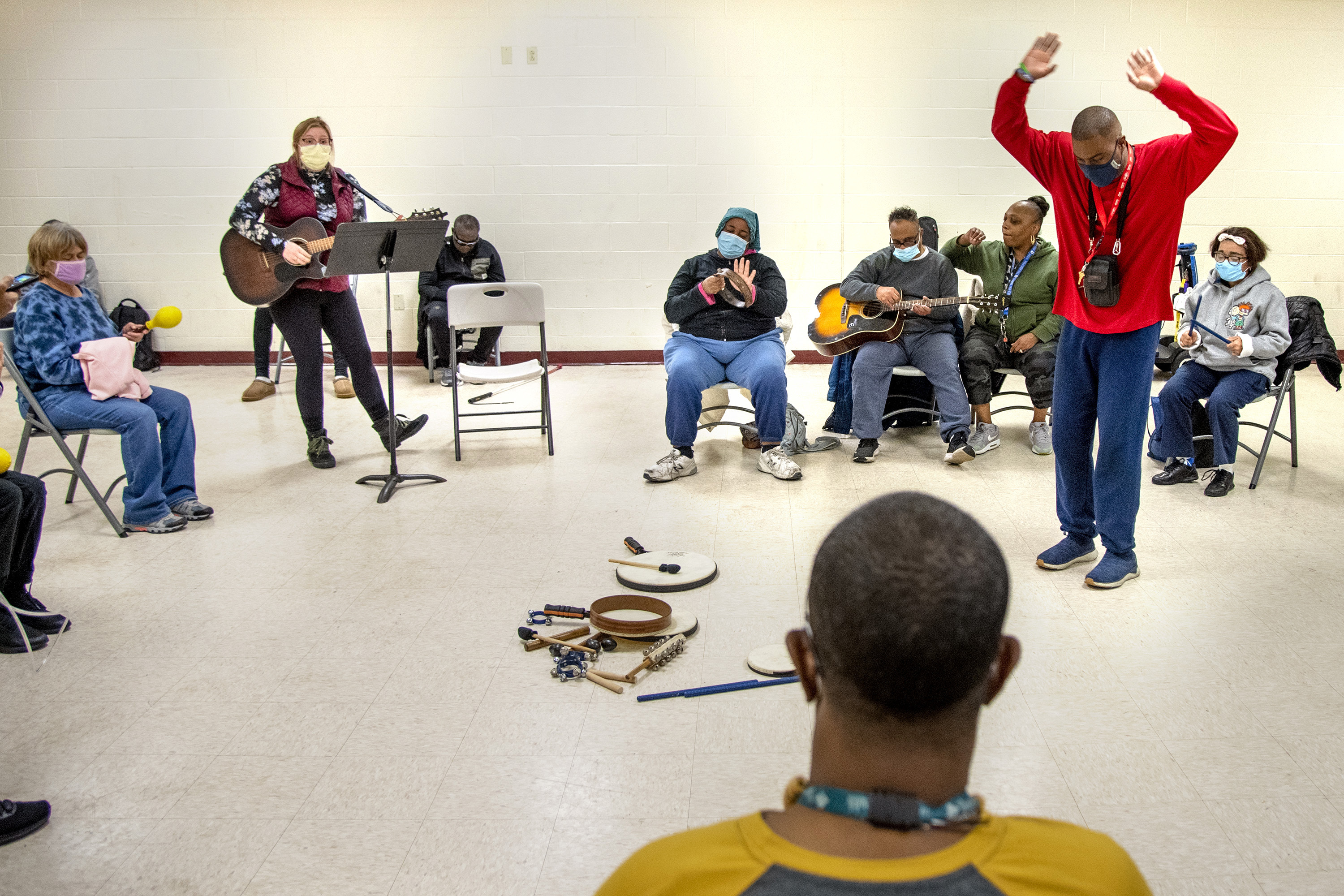
    Sadiki Smith (right) stands to dance as music therapist Madison Frank (left) with her guitar leads a music therapy session at Gustine Recreation Center Tuesday, November 29, 2022. Since the closing of the Carousel House, the city’s only rec center for people with physical and intellectual disabilities, many of the programs have moved to Gustine.

    The city was already moving in that direction before the pandemic with its long-term Rec for All inclusion plan. The goal is to eventually make the city’s 150 rec centers accessible to all residents. The new Carousel House will be open to all people in the surrounding neighborhoods, not just those with disabilities.

    That is welcome news for Lucinda Hudson, president of the Parkside Association of Philadelphia, who attended Tuesday’s meeting.

    “It’s well needed, and I think the community is pleased with how it’s coming together,” Hudson said. “We need a facility to be inclusive for all, and to support the handicapped community.”

    Worth the wait?

    Palantino said that while the Carousel House project has faced significant delays, city officials have continued to work behind the scenes. It is the largest project in the city’s beverage-tax funded Rebuild program, which has so far committed or spent $470 million.

    She believes the new building will be worth the wait.

    “It will be a universal space, so an entire family can come here and enjoy the amenities. The former Carousel House was a little more restrictive in the population it served,” Palantino said in an interview. “This will be the flagship rec center in the city when it’s completed.”

    Attendees look at blueprints during the Carousel House Rebuild Community Relaunch at the Please Touch Museum on Oct. 21.

    Families that frequented the Carousel House, however, are running out of patience.

    The Gustine Recreation Center in East Falls has continued some of the programs for people with disabilities, including music therapy, basketball, and social groups. But that center doesn’t have the space and amenities that Carousel House provided.

    “It’s just not the same,” said Tamar Riley, whose 43-year-old son had been going to Carousel House since he was 12.

    “Hopefully we can get this off the ground,” Riley, president of the advisory council for Carousel House, said of the plans presented this week. “It’s been a really long time. I know it’s going to be a beautiful place once the city gets it up and running.”

    The closure of Carousel House also forced Katie’s Komets, Philadelphia’s team in the National Wheelchair Basketball Association, to move its weekly practices to RiverWinds Community Center in West Deptford, Gloucester County.

    As a result, there is only one Philly player on the team, according to Joe Kirlin, who with his wife, Roseann, created a fund to support the team. The team is named after their late daughter.

    “The problem is city kids just can’t get over there,” Joe Kirlin said.

    Caroline Fitzpatrick (right), 14, of South Jersey, talks with friends during the Philadelphia Parks & Recreation’s 24th Annual Katie Kirlin Junior Wheelchair Basketball Tournament in Philadelphia on Sunday, Jan. 23, 2022. Fitzpatrick plays on Katie’s Komets team from Philadelphia.

    He said wheelchair athletes in the city are missing out on potential college opportunities. This year, all three high school graduates on Katie’s Komets received scholarships to play college wheelchair basketball.

    “That wouldn’t have happened if they didn’t start as kids playing wheelchair basketball,” Roseann Kirlin said.

    Lorraine Gomez, a community activist and president of the Viola Street Residents Association in East Parkside, said after Tuesday’s meeting that she appreciated the city’s efforts to keep the surrounding neighborhoods informed about the project.

    Gomez is looking forward to being able to use the indoor pool and walking track in the winter, and said people with disabilities also deserve “to have their space back.”

    “This is what the community needs,” Gomez said. “It’ll be a place where we can stay in touch with each other.”

    For Hudson, of the Parkside association, the most important thing now is to break ground.

    “So many things get put on the books, but don’t happen,” Hudson said. “This has got to be built.”

  • The clash between the federal government and states over vaccine policy is ‘unprecedented,’ Villanova health law professor says

    The clash between the federal government and states over vaccine policy is ‘unprecedented,’ Villanova health law professor says

    Villanova professor Ana Santos Rutschman would describe the current state of vaccine policy as a game of chess.

    When the federal government does something, some states — primarily Democratic-led states including Pennsylvania respond immediately to counter.

    A prime example followed the federal government’s move, through the Food and Drug Administration, in August to limit eligibility for the updated COVID-19 vaccine. Previously, the annual shot was recommended for all Americans 6 months and older. The new guidance was for people 65 or older and those at high risk of complications from COVID-19.

    Pennsylvania’s regulatory body for pharmacists opened up access by allowing pharmacists to follow the broader recommendations of professional medical societies.

    “It’s kind of [like] ‘Harry Potter’ chess. Remember when they climb on the gigantic pieces and then try to kill one another?” Rutschman said, referring to the fictional scene where chess pieces violently smash the opposing side’s pieces.

    “There’s a certain violence to this from a political perspective,” she added.

    States are allowed to diverge from the federal government on vaccine policy because our system of government, known as federalism, divides power between the federal government and the states.

    With vaccines, states historically have chosen to align in large part with the federal government’s recommendations.

    Rutschman says recent actions by Health and Human Services Secretary Robert F. Kennedy Jr. have ushered in a new era of what’s being called “vaccine federalism.” Kennedy is a longtime anti-vaccine activist now serving as President Donald Trump’s top health official.

    Many states, especially those with Democratic governors, including Pennsylvania and New Jersey, saw recent changes under his leadership as a sign that they “need to do something in direct opposition to the federal government,” Rutschman said.

    Now it’s a “head-on collision,” she added.

    The Inquirer spoke with Rutschman, who researches vaccine federalism as a health law professor and director of the Health Innovation Lab at Villanova University, to learn more about this new era and its possible consequences in a conversation lightly edited for length and clarity.

    What is vaccine federalism?

    For vaccination and everything else, our system is split in two. You have the states and then you have the federal government.

    There is room for tension between the federal level and the state level. Historically, that tension has been, I would argue, limited. It has existed, but it’s not been the defining feature. Now, particularly in the context of vaccines, it has become probably the most salient feature.

    How are states allowed to differ from the federal government as far as vaccine policy?

    States don’t have the power to authorize a new vaccine to come to market.

    But then you have a lot of things that the Centers for Disease Control have done that are more informational. The federal government recommends which shots children or adults should get, and the time frame for most children to get these shots.

    The federal government offers this kind of informational support, and then states set their own policy.

    How has vaccine federalism played out in the past?

    Examples from the past are not as salient or blatant as the ones you’re seeing right now.

    There was a lot of variability around the country, but the overall message was harmonious. Everybody was trying to get, by and large, most of the population vaccinated past herd immunity.

    What is happening now?

    Now it’s a head-on collision.

    States are saying, ‘We’re not going to implement requirements to restrict access to these vaccines.’ The Board of Pharmacy in Pennsylvania decided not to be bound by the CDC’s recommendations. This is a direct clash. We hadn’t had this before between the federal government and the states in the field of vaccines.

    What are examples of this new era of vaccine federalism?

    One example would be the formation of state clusters. These are a lot of neighboring states in agreement. They’re trying to share data and think of best practices, which is almost that informational function that traditionally fell to the [federal health agencies].

    The states are saying, ‘Well, you’re not doing that, so we will.’

    ‘We will pull resources and information to come up with our own advisory role.’ That’s unprecedented.

    You have sort of two speeds in the country. Some states are collaborating and very active in setting regional vaccine policy. And then you have a bunch of states that go completely the other way. You have the, for now, isolated case of Florida saying, ‘We’re going to just basically do away with all vaccination mandates,’ which is going further than the federal government.

    Now it’s a much messier situation, legally, philosophically, politically, etc.

    How effective are these regional coalitions?

    They are accomplishing something. You see fewer restrictions in access to vaccines in a place like Pennsylvania than other states.

    Whereas states who are not part of these kinds of coalitions — typically excluding the likes of Florida — a lot of them are waiting to see what happens, because this has never happened in the history of vaccination in the United States.

    In the meantime, there are a lot of people falling through the cracks who would have been indicated for a vaccine last year. Now they’re wondering what to do, and their providers are not entirely sure.

    There’s a lot of confusion about what happens now that federal policy has taken a completely different direction.

    What impacts do you see coming from this new era of vaccine federalism?

    People hearing one thing out of the CDC and another one out of the state of Pennsylvania may think, ‘Who’s correct? Who should I listen to?’ You start aggregating all the people who might forgo vaccination just because they don’t understand what’s going on.

    I think it continues to accelerate the overall phenomenon of vaccine mistrust, and we’re already seeing levels of herd immunity come down for many vaccine-preventable diseases.

    If I were a provider, I would be similarly confused and concerned, because nobody takes lightly the idea that from now on, ‘I’ll be doing something that’s in direct opposition to what the federal regulators are suggesting I should be doing.’ So I think there’s a fear factor and confusion.

    Lastly, I think there’s an overall chilling effect with regard to vaccines. Yes, some vaccines make money, but they don’t make a whole lot of money to begin with. They’ve never been one of the preferred products for manufacturers. These are not the most profitable things they can be doing.

    I think that we will see much less focus on vaccine development in years to come, because that’s the logical position for pharmaceutical companies, and for some funders even to take, which is unfortunate.

    What do you think of Pennsylvania’s response?

    I think it’s to Pennsylvania’s credit, and I think it’s to some degree reassuring for Pennsylvanians. Although it obviously makes me sad that we have sort of this two-speed mode in the country. Some part of this national fabric has ruptured.

    For now, Pennsylvania has protected itself as it can, but states alone don’t control everything. You have Pennsylvanians going to other states where you may have an outbreak of a vaccine-preventable disease. We don’t have real borders. We cross them all the time.

  • Grieving Roman Catholic coach and his family find solace in their football community

    Grieving Roman Catholic coach and his family find solace in their football community

    When Rick Prete returned from Iraq in 2009, he had just one focus: his family. Throughout his yearlong deployment as an infantryman in the Army, he could speak to his wife and daughter only sparingly over Skype.

    Once he was home in Audubon, Montgomery County, he tried to spend as much time with them as possible. He took on day-to-day tasks with glee, like doctor’s appointments and school drop-offs. Prete didn’t see these as mundane. To him, they were opportunities.

    “How can I be around my kid more?” he said. “That’s all I really cared about.”

    It was this mentality that brought Prete to youth cheerleading practice in Conshohocken in the summer of 2010. For four nights a week, he would sit and watch 6-year-old Arianna’s routines as the 15-and-under football team did drills nearby.

    Prete, a former wide receiver at Norristown High School and East Stroudsburg University, barely noticed that the players were there. But the Conshohocken Bears’ coaches noticed him, and quickly asked if he’d consider joining their staff.

    Prete declined at first. The veteran was battling depression, he said, and worked late nights as an emergency room technician. Any free time he had, he wanted to spend with Arianna and his wife, Gabriela.

    But after a few weeks, Prete warmed up to the idea. He would observe the team’s practices and suggest different defenses and coverages. Conshohocken added him as an assistant coach in August 2010, and he dove right in.

    Rick Prete has been the head football coach at Roman Catholic since 2019.

    Gabriela noticed that Rick was happier and more talkative at home. She’d catch him poring over film and scribbling plays on napkins and notepads. Instead of thinking about what he’d seen in Iraq, he was thinking about how to help his players.

    “I definitely saw a shift in him,” she said. “This was something that he loved, but he was also good at it. It was like an outlet.”
    Prete’s coaching career took off from there. He was hired as a wide receivers/defensive backs coach at Plymouth Whitemarsh High School in 2012, and joined Malvern Prep’s staff as the freshman head coach in 2015. He was named the school’s varsity wide receivers coach in 2016, and Imhotep Charter hired Prete to serve as offensive coordinator in 2017.

    In 2019, he became head coach of Roman Catholic High School’s football program, where he remains.

    Prete has always said that he wouldn’t have found his calling without Arianna. Now the sport is healing him in her absence.

    In the early morning of July 11, 2024, Arianna and a friend were riding in another friend’s Honda Odyssey when their vehicle collided with a tow truck at K Street and East Hunting Park Avenue in North Philadelphia.

    According to the Philadelphia Police Department, the truck driver was speeding and blew through a red light. The minivan entered the intersection just as the traffic signal was turning from yellow to red.

    Arianna was ejected forward from the backseat. She suffered severe injuries and was taken to Temple University Hospital, where she was pronounced dead less than an hour later.

    She was 19, and the only fatality from the crash.

    Court records show that the driver of the tow truck, Omar Morales, was charged with homicide by vehicle, involuntary manslaughter, and four related offenses.

    Charlie Payano, the friend driving the Odyssey, was charged with homicide by vehicle, involuntary manslaughter, and three related offenses.

    The trial is scheduled to start soon.

    Prete’s initial instinct was to quit football altogether. He barely had enough energy to get out of bed, let alone handle a group of teenagers.

    But Gabriela urged him to return to Roman Catholic. More than a year since the crash, he’s glad he did.

    “I don’t know if I’d be able to sit here right now, and go forward throughout a day,” Prete said, “if I didn’t have those kids.”

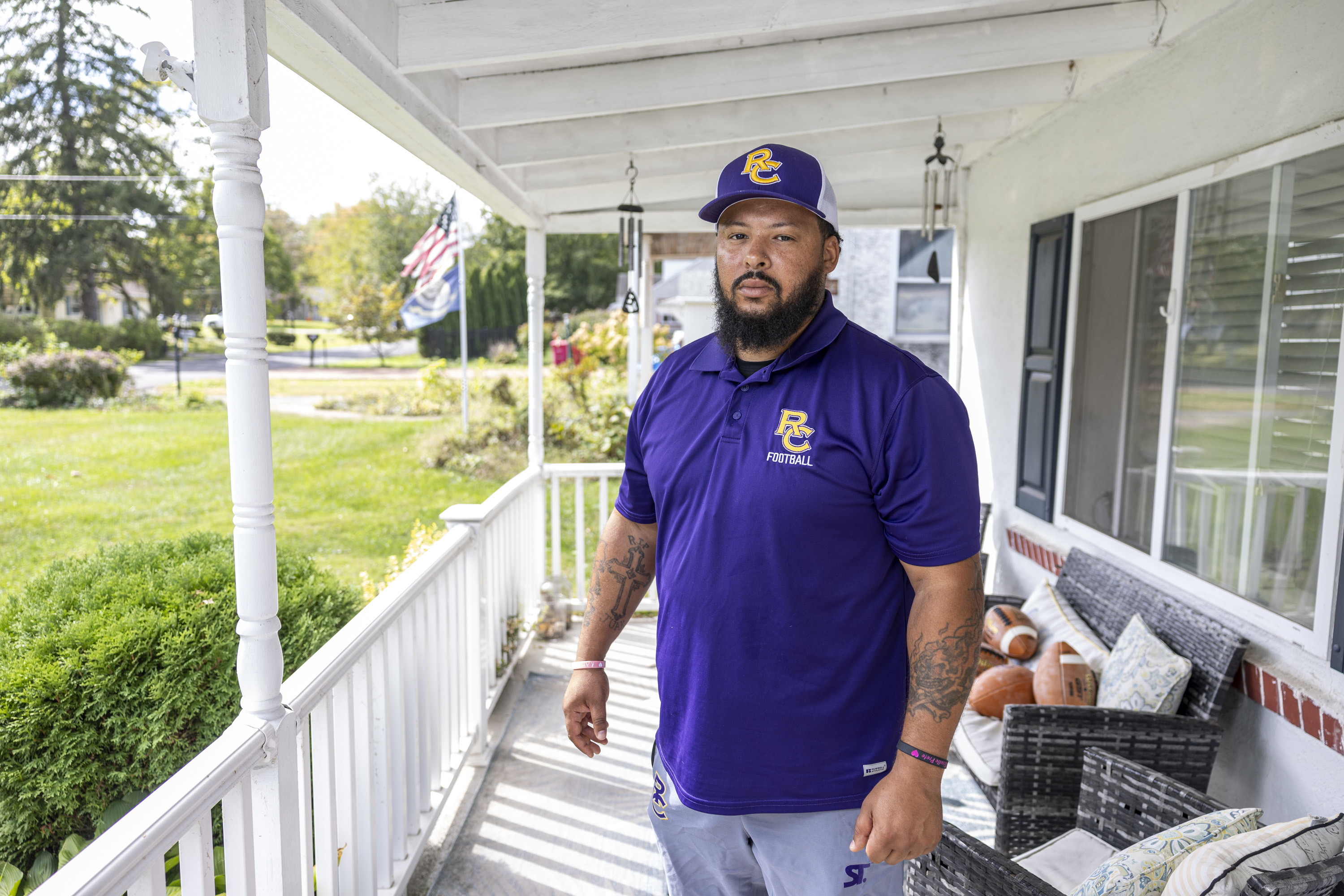
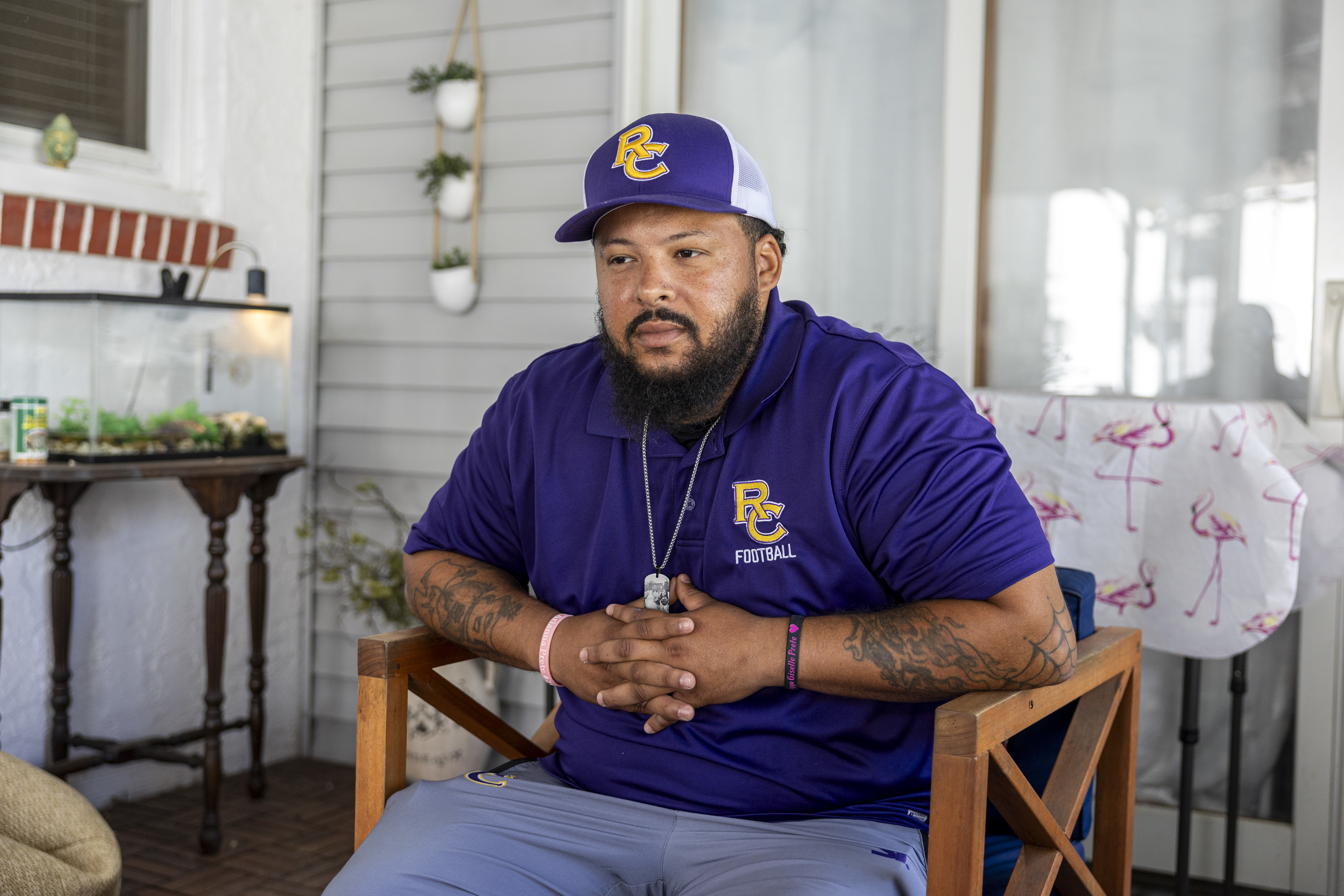
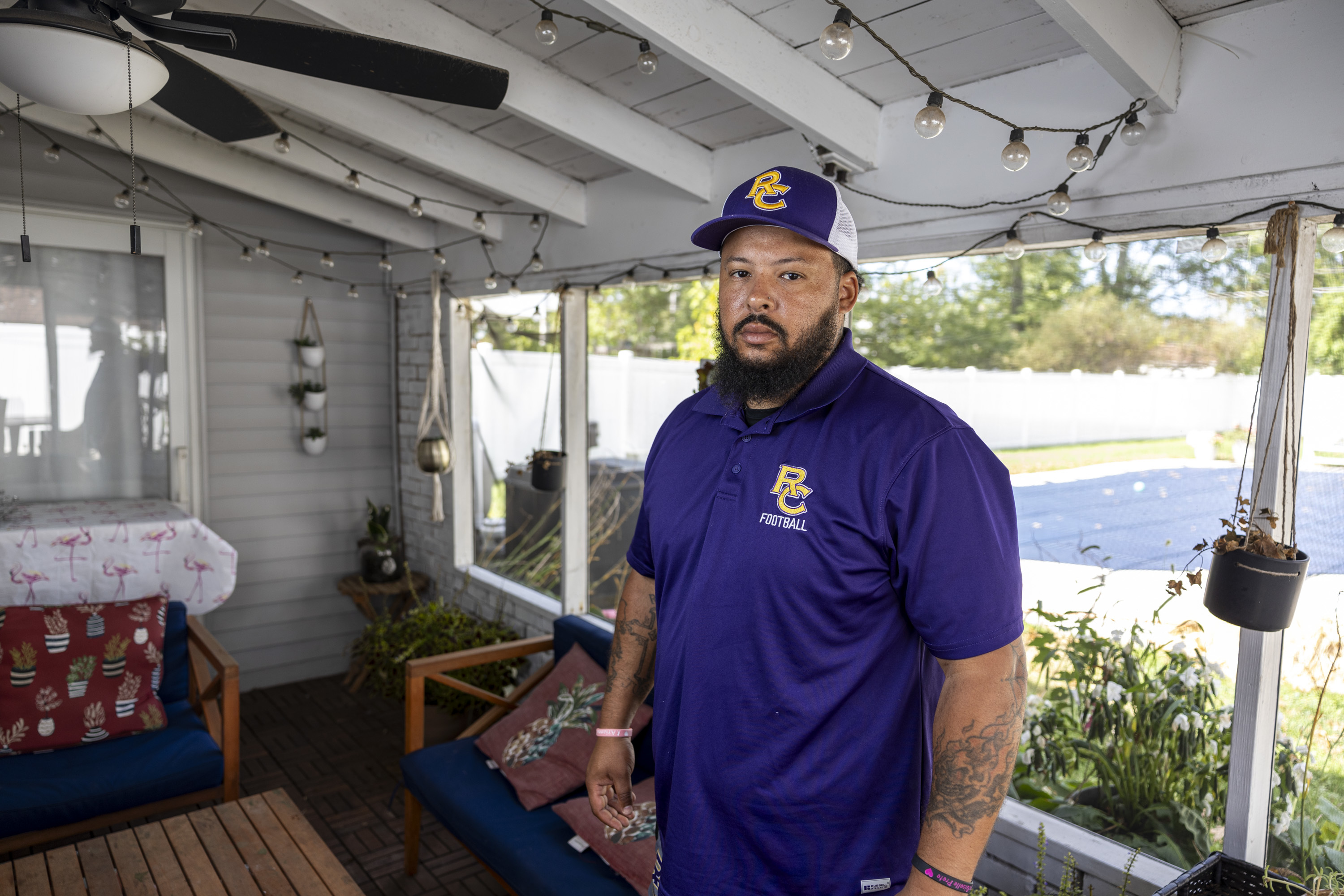
    Rick Prete at his home in Audubon, Montgomery County, on Oct. 2.

    A football and softball bond

    Arianna and Rick always connected over sports. She was a self-described “girly girl” who loved the color pink, romantic comedies, and Bruno Mars, but also a natural athlete like her father.

    She signed up for T-ball when she was 6 and switched over to travel softball not long after. Norristown Recreation didn’t have an under- 10 team at the time, so Arianna played with 10-, 11-, and 12-year-olds.

    Despite facing pitchers far older, she made contact regularly and quickly emerged as a hitter to watch. Rick, who played baseball in high school and college, began to train with her.

    Arianna would take 100 swings off the tee every day. Sometimes, her father would throw soft toss in the backyard. When she switched from third base to catcher at age 10, Rick started challenging her behind the plate.

    He’d spike softballs in the dirt, or pitch them high above, forcing his daughter to shift and block. By age 12, they were flipping tires and swinging sledgehammers in the driveway.

    “[Softball] was a huge part of our relationship,” he said. “That was my avenue to learn how to be her dad.”
    Arianna felt equally invested in Prete’s coaching career. When she was a student at Methacton High School, from 2019 to 2023, she would spend Friday nights with the football team at Roman Catholic.

    Rick Prete’s wife, Gabriela, with daughters Nylah and Arianna at a Roman Catholic game.

    In the school’s 2019 season opener, on Aug. 24, the Cahillites found themselves down 26-0 in the first quarter to Pope John Paul II. By halftime, they’d narrowed their deficit to 11 points.

    The team kept chipping away, and with 1 minute, 30 seconds to go, quarterback Jayden Pope threw a 50-yard touchdown pass to earn Roman a 47-46 comeback win.

    Prete still has the film from that night. In the background, Arianna is on the sideline, sprinting toward wide receiver Malachi Harris, who made the game-winning catch.

    “You couldn’t tell that girl that she wasn’t an assistant coach,” Gabriela said. “She liked the energy. Running up and down the field with the other coaches. You would always find her there.”
    Prete’s teams went 10-28 over his first four seasons, but over time, he built a strong program. The Cahillites posted a 9-3 record in both 2022 and 2023.

    In 2023, in the District 12 Class 5A championship game, Roman Catholic lost to Imhotep Charter, the eventual state champion, by only 4 points.

    With more success came more commitment, so Prete would always check to make sure that Arianna and her younger sister, Nylah, were comfortable with him coaching. After a while, the question became redundant. The answer was always yes.

    “They’d both say, ‘No, you go coach,’” Prete said. “‘We want you to.’”
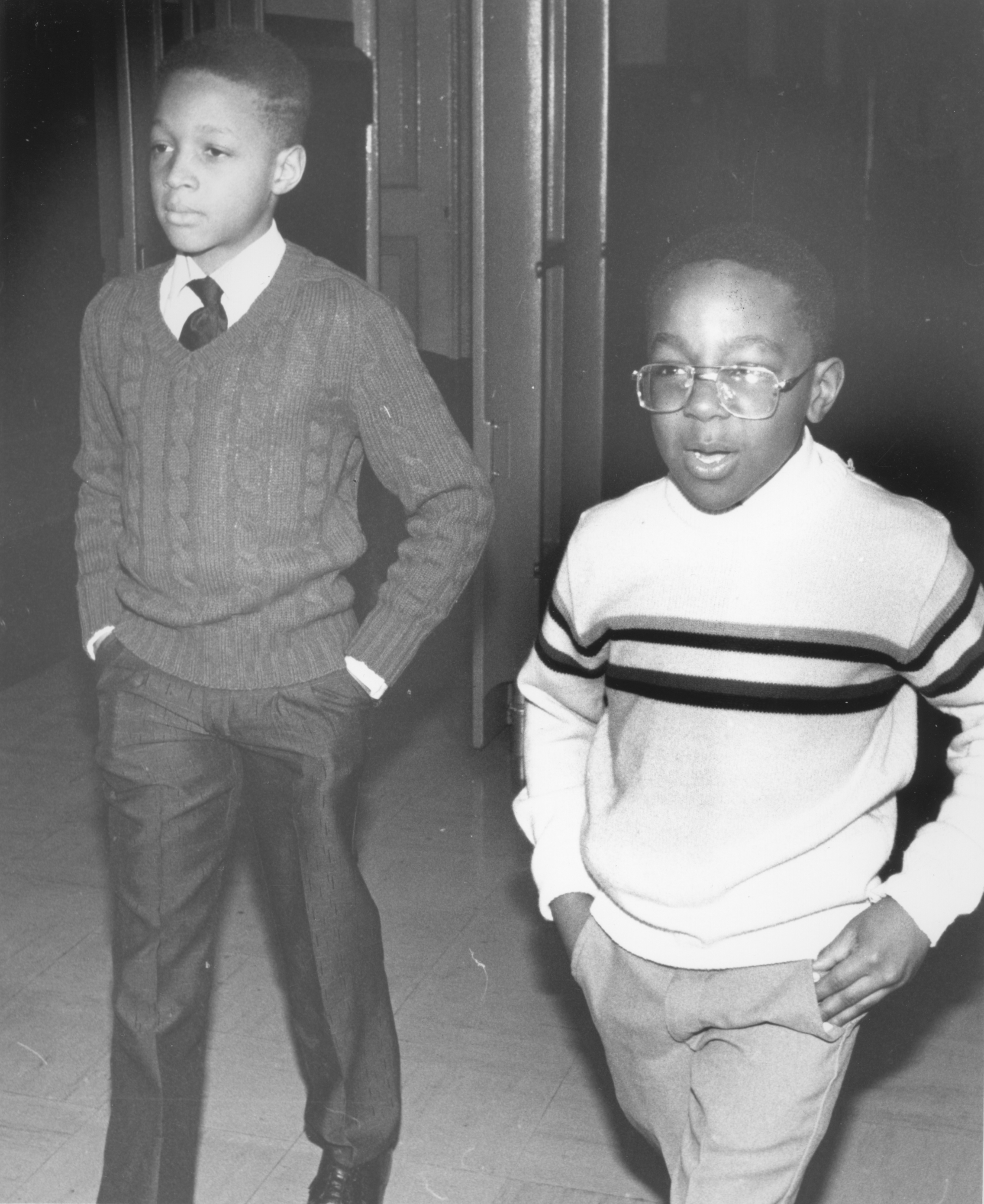
    Arianna graduated from Methacton in 2023. She enrolled at Montgomery County Community College in the fall of that year, and took a real estate course in the spring, but was unable to pass the state exam. She planned to return to Montco in September.

    The former softball player had always loved working with kids, so she thought about becoming a teacher. Or maybe going back to real estate school, to retake her test. But these possibilities, once filled with promise, came to an abrupt halt on July 11, 2024.

    Rick and Gabriela heard a knock at about 3:30 a.m. Two Lower Providence Township police officers were standing outside their door.

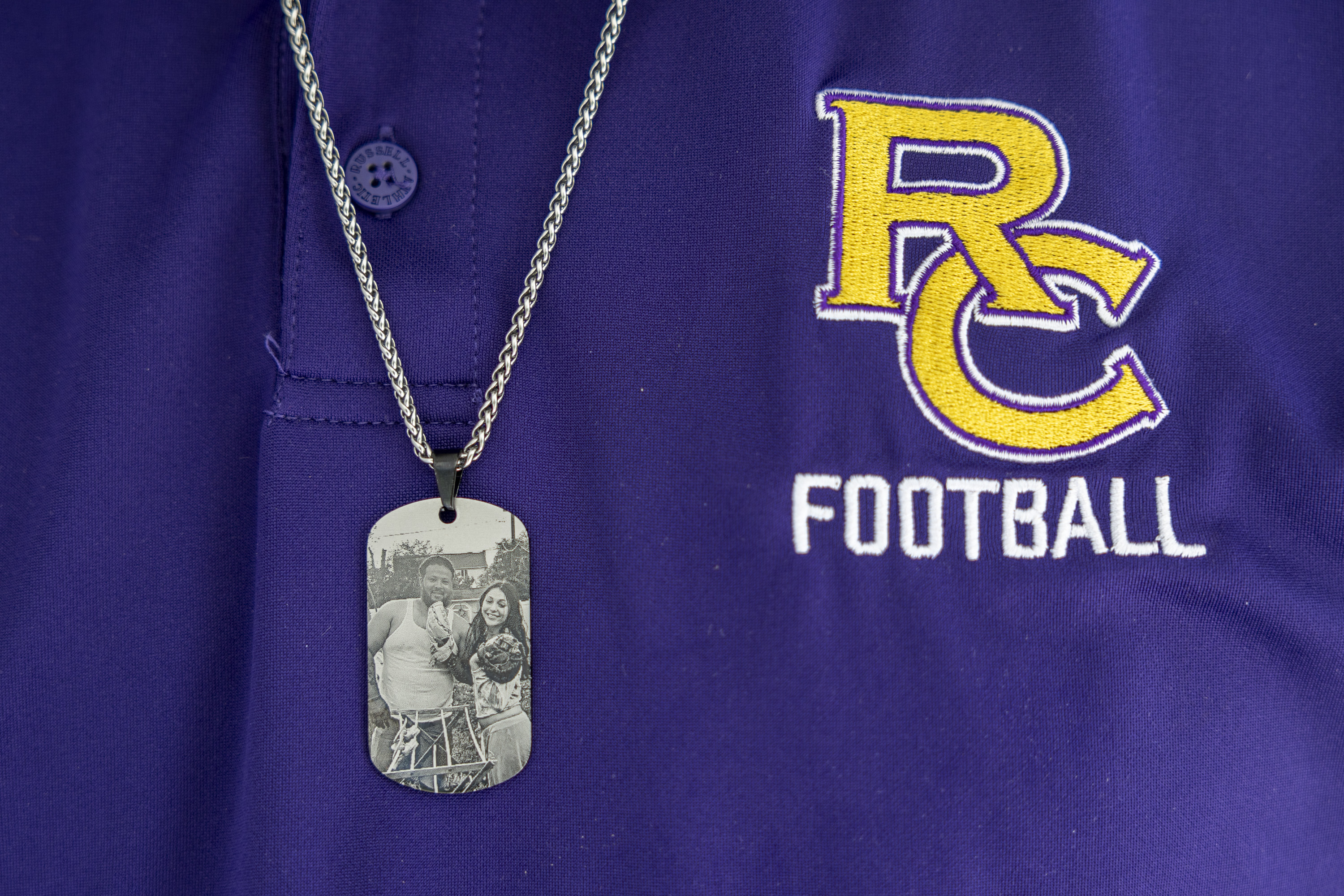
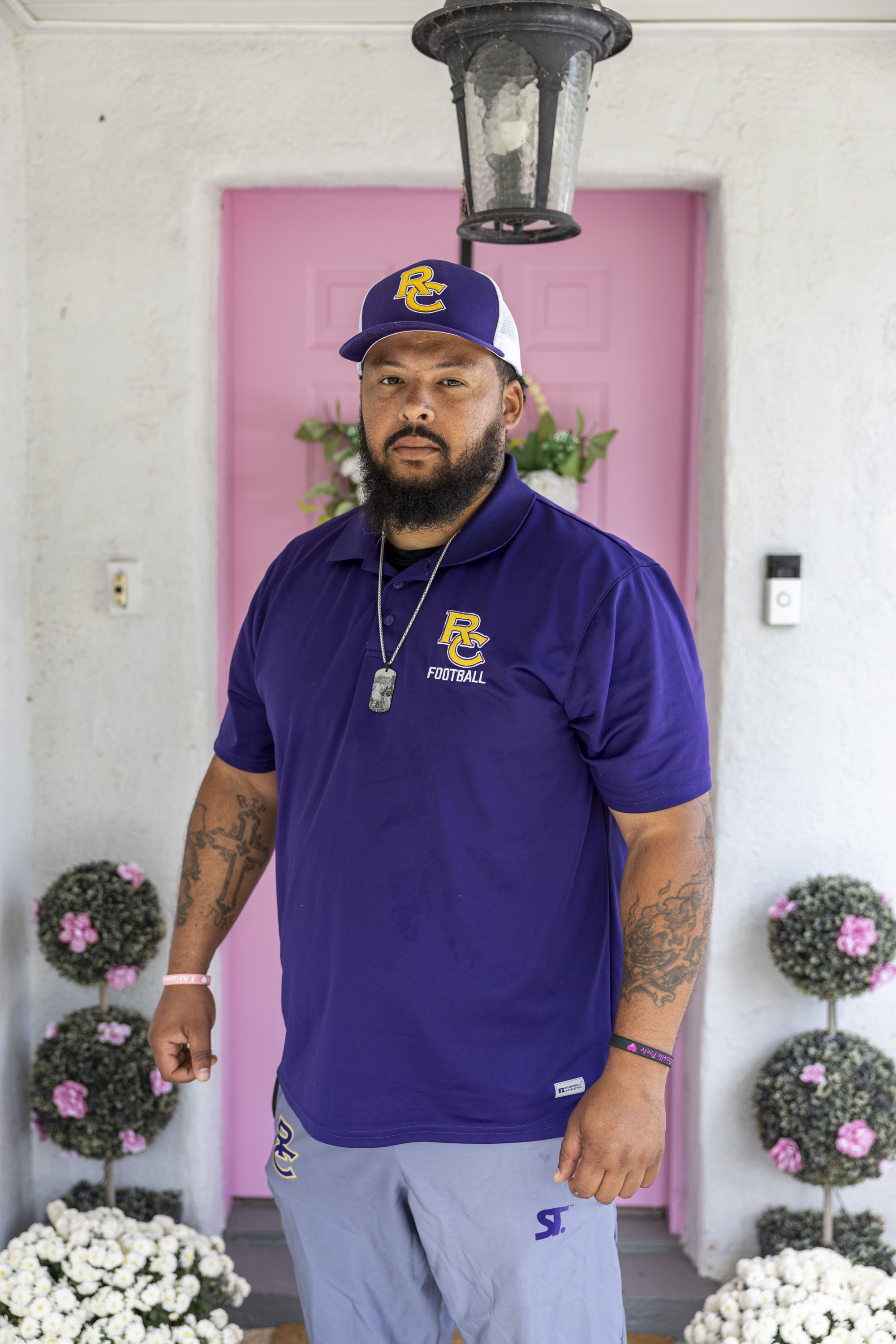
    Rick Prete wears a necklace with a photo of him and his daughter Arianna, who died in a 2024 car crash.

    They told the Pretes about the collision and instructed them to go to Temple University Hospital Jeanes Campus, in Fox Chase, to identify Arianna’s body.

    But once they arrived, their daughter wasn’t there.

    “It gives you a glimmer of hope,” Gabriela said. “Maybe they got this wrong.”

    In an email, Lower Providence Police Chief Michael Jackson said that the officers received their information from a victims’ advocate at Temple University Hospital.

    The parents finally reached Temple’s main hospital, on North Broad Street, at about 7 a.m., and realized that the victim was indeed their daughter.

    “Your body shuts down,” Rick said. “Your mind goes numb. It’s your worst nightmare being realized.”

    Rick Prete poses for a portrait at his home in Audubon, Montgomery County, on Oct. 2.

    ‘I feel your pain, Coach’

    The next few days were a blur. The Pretes called as many family members as they could. A steady stream of visitors came through the house to share condolences, with flowers and food in hand.

    Roman Catholic was scheduled to go to a three-day team camp at East Stroudsburg on the day of Arianna’s passing. But Prete was not in any shape to attend and arranged for offensive coordinator Marcus Hammond to take the team instead.

    Two days later, the Cahillites finished their visit and piled into two yellow school buses. The drivers were supposed to head back to campus, but the students had a different idea.

    The team went to the coach’s house in Audubon. More than 50 players gathered on his lawn, took a knee, and began to sing Roman Catholic’s fight song.

    Prete stood on his porch, buried his head in his hands, and cried.

    “Thank you,” he said. “Now, give me a … hug.”

    Gabriela ordered some pizzas. A few players pulled Rick aside to say a prayer. One student, 17-year-old quarterback Semaj Beals, shared that he’d lost his sister Dymond in 2014. She was 8, and died by suicide.

    “I feel your pain, Coach,” Beals said. “And if you need anything, if you need to talk to me, I’m here.”

    Prete hugged him tight.

    Lou Gaddy hugs his coach, Rick Prete, at Roman Catholic’s senior day in 2024.

    “I know you do,” he replied.

    For many of the Cahillites, Prete has been like a second father. He’d lend them food and gas money. If they lived far away from the school, at Broad and Vine, he’d arrange for alternate transportation.

    The coach would regularly check on his players’ mental health and always made sure their grades weren’t slipping. There were conversations about schemes and formations, but also about how to treat a young woman, how to plan for their future, and how to handle a difficult situation at home.

    Lou Gaddy, a Roman Catholic graduate who is now a freshman safety at Stony Brook University, is the first person in his family to go to college. He received a full scholarship.

    Gaddy grew up in Burlington County in South Jersey and is unsure if he would have made it if he hadn’t played for Roman Catholic.

    “Who knows if I’d develop the way I did,” he said. “The [Philadelphia Catholic League] is a much stronger conference than where I live. It’s way more work. It requires more out of you. Long days, late nights.

    “But Coach Prete definitely knew what he was doing. He’s sent countless amounts of kids to college. Countless.”

    Because of this connection, the players felt Arianna’s death on a deeper level. Some saw Prete, overwhelmed by grief, and felt as if they were watching their own parent cry for the first time.

    Their coach was the one who fixed problems for them. Now, he was distraught. He struggled to focus. His attention to detail wasn’t the same.

    Prete was reluctant to return to Roman Catholic. He struggled to just get through a day. But Gabriela insisted he go back. The couple had already been robbed of their daughter. She didn’t want him to lose his career, too.

    He rejoined his team in August 2024. It was a challenging adjustment. There were days when players asked if Prete was OK, only to hear him say, “No.” The coach began wearing sunglasses during games and practices, day and night, because he couldn’t hold back his tears.

    Rick Prete was reluctant to return to Roman Catholic after his daughter died in a car crash last summer. Now, it’s helping him heal.

    Prete was in charge of the defense, but at times, he struggled to call plays. So, his players would call them for him.

    “They’d bail me out,” Prete said. “Lou [Gaddy] would literally line the defense up. And he would just make sure the defense had the plays that they needed. And he’d do it right.

    “All of the kids did that, because they knew that I’d be gone sometimes.”

    Gaddy would also make sure that his teammates understood the playbook and handled any adjustments that needed to be made on defense. Beals compared him to a “coach on the field.”

    “It was just to take the stress off,” Gaddy said. “Semaj made sure the offense was in check. And that’s kind of how I was with the defense. Making sure people were attacking the field the right way.”

    Players who previously sat out practices became regular participants. They were more efficient in their workouts and pushed themselves harder than before.

    The team discovered a greater purpose beyond competing for district titles or a state championship. The season was no longer about them. It was about their coach.

    “Sometimes, when things happen like that, a head coach will step away,” Beals said. “But Coach Prete was there the whole way. So, we just felt like that was special. We needed to do something for him.”

    Roman began to win — a lot. The Cahillites didn’t lose until Week 5 when the team played DeMatha, a high school powerhouse out of Hyattsville, Md.

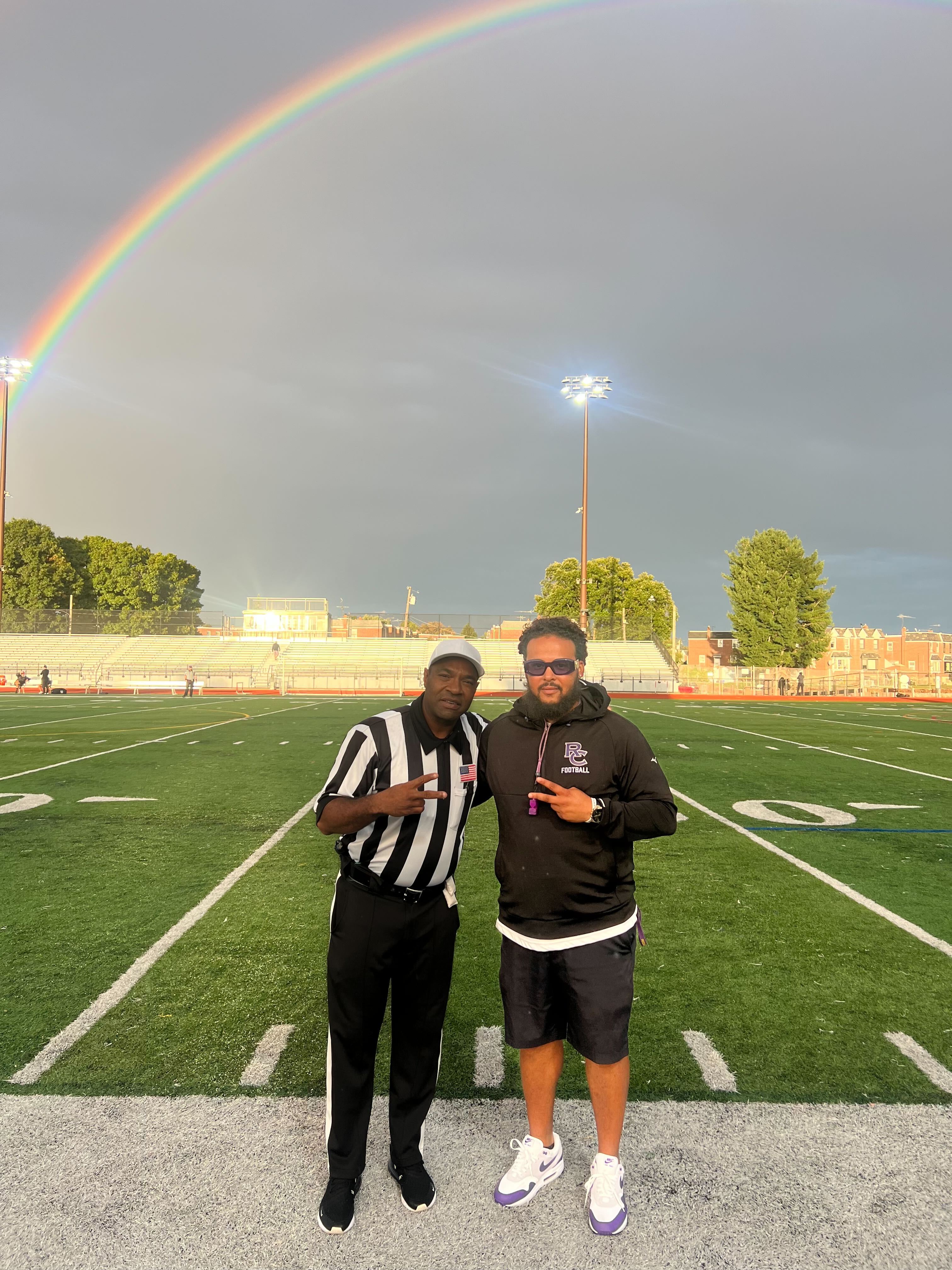
    Rick Prete (right) with a referee who approached him before a game in 2024. The referee had also lost a child, and expressed his condolences, when a rainbow appeared over both of them.

    The games were competitive, but with soulful moments of humanity throughout. Opposing coaches would give Prete prayer cards when they shook hands. In September 2024, before Roman Catholic played A.P. Randolph Campus High School in New York, a referee walked up to him.

    He told Prete that he’d also lost a child. As they talked, a rainbow appeared over the field. To Rick and Gabriela, the 2024 campaign was full of moments like these. Moments that felt as if their daughter was with them.

    It could be as subtle as a seeing a butterfly on the field. Or hearing a song on the way to a game. Or noticing that the players had written “LLA” — Long Live Arianna — on their helmets, compression sleeves, and wristbands.

    An already special season reached a new height in December, when Roman Catholic advanced to the state championship for the first time in school history. With an 11-4 record, the Cahillites had plowed through the district playoffs to face Bishop McDevitt of Harrisburg in the final.

    On a brisk night in central Pennsylvania, Roman Catholic rallied from a 21-3 deficit to tie the score at 31 and push the game into overtime. The Cahillites fell just short of a championship, losing to McDevitt on a field goal, but Prete was filled with pride.

    “I don’t want to say it was magical,” he said, “but that team became so close. And it really felt like my kid was right there. Like my kid was literally right next to me.”

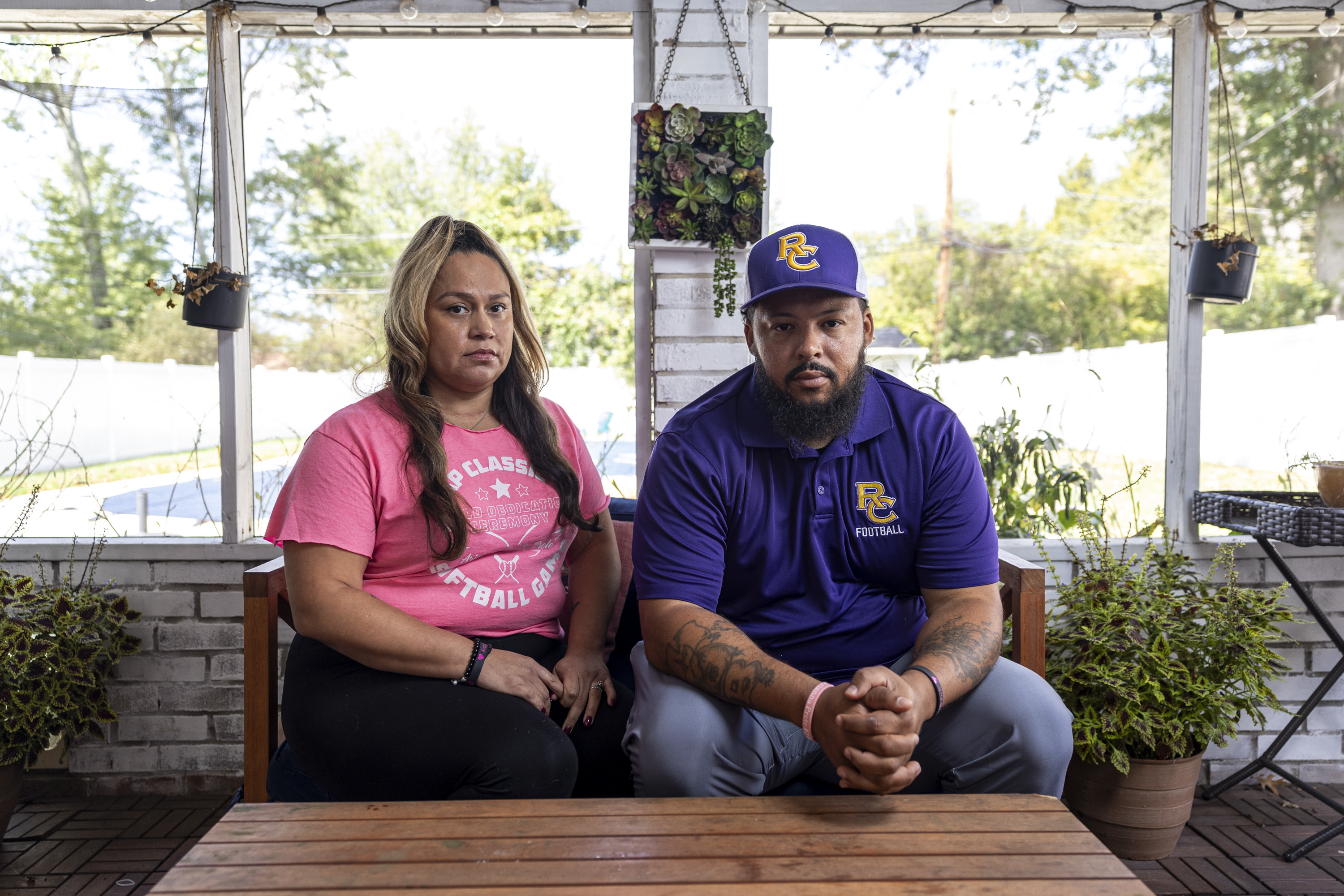
    Rick and Gabriela Prete at their home in Audubon, Montgomery County, on Oct. 2.

    Coaching with purpose

    The Prete house is quiet now. Arianna’s laugh is no longer ringing through the halls. Her parents don’t hear her feet stomping along the floor upstairs, or her shrill voice singing to Bruno Mars.

    Gabriela thinks about her daughter constantly. Sometimes, when Rick is sitting in his living room chair, late at night, he looks toward the door, expecting Arianna to open it.

    There are little signs of normalcy. Last year, Gabriela started seeing Rick’s trail of football plays again. He would leave them all over the house, on napkins and notepads, just like he did before his daughter’s passing.

    Football won’t bring her back. It won’t diminish the family’s grief. But Roman Catholic gives them a community. It gives Gabriela and Nylah a place to be on Friday nights.

    It gives Rick a task; three or four hours that aren’t spent asking questions he can’t answer. A task that fills him with purpose.

    “I didn’t know how much energy I have left to give anybody,” Prete said. “But [the players] help get me out of bed. They put things in perspective. That we still have a family, that our family still does have a future.

    “That we need to pour into what’s here, and to be present, for Arianna. We can’t live in a standstill. And seeing people accomplish their goals. … It’s always been something we’ve wanted, but now that is what it’s all about. You know?”

  • City Controller Christy Brady is facing a challenge from Republican Ari Patrinos

    City Controller Christy Brady is facing a challenge from Republican Ari Patrinos

    City Controller Christy Brady, seeking her first full term as Philadelphia’s independently elected fiscal watchdog, is being challenged by Republican Ari Patrinos in the Nov. 4 general election.

    The controller’s office is charged with auditing the city’s finances and investigating fraud, waste, and abuse.

    But despite that critical role, there hasn’t been much drama in this year’s race.

    Patrinos, a former stockbroker and Philadelphia public school teacher, acknowledged the odds are against him in heavily Democratic Philadelphia and said he has no particular complaints about Brady’s performance.

    Instead, he said, he ran because “it was important that somebody run on the ticket.”

    “The truth is nobody wanted to run, and my ward leader asked me if I would run,” said Patrinos, who has not reported raising any money for his campaign. “I didn’t have any specific attacks on Brady. My concern is that the city is too single-party, and I think the city functions better when you have a two-party system.”

    Brady, a Democrat who has a $250,000 campaign war chest she likely won’t need to use this year, has the support of much of the local political establishment, including the Democratic City Committee and the building trades unions.

    A 30-year veteran of the controller’s office, Brady has struck a notably conciliatory tone during her tenure, striving to work collaboratively with Mayor Cherelle L. Parker’s administration rather than butt heads with the executive branch, as many of her predecessors have done.

    “Because of my experience when I took office two years ago, I hit the ground running,” she said.

    She pointed to her office’s audit that uncovered that the Philadelphia School District had made about $700,000 in payments to fake vendors as part of a cyber scam and to her investigation finding that fraudulent use of the property tax homestead exemption was costing the city and school district about $11.4 million per year.

    Brady was appointed acting controller in 2022 by then-Mayor Jim Kenney when Rebecca Rhynhart resigned from the post to run for mayor. Brady then won a 2023 special election to finish Rhynhart’s term, which ends in January.

    Seeking a full four-year term for the first time, Brady this year ran uncontested in the Democratic primary.

    “The biggest question I get [on the campaign trail] is: What does a controller do?” she said. “And so I’m getting out there and spreading the word of what we’re currently working on and what we do in the office.”

    The controller earns an annual salary of $171,000 and oversees an office with more than 120 employees and a budget of about $11.8 million.

    Patrinos also had no opponent in the May primary. He said he has been spending much of his time on the campaign trail promoting Pat Dugan’s campaign for district attorney.

    Dugan, a self-described “lifelong Democrat,” lost to District Attorney Larry Krasner in the Democratic primary but has accepted the GOP nomination to take a second swing at the incumbent in the general election.

    “I spend like half my time when I campaign advocating for Dugan because I’m very concerned about the crime,” Patrinos said.

    From Philly to Harvard and back

    Patrinos, who lives in Chestnut Hill, said he was a Democrat until about four years ago, adding that he voted for Joe Biden in the 2020 presidential election.

    His conversion was prompted primarily by his alma mater, Harvard College, which he felt had too enthusiastically embraced a “woke” stance.

    “The immediate driving factor was on the cultural front. It was what was going at Harvard,” he said. “I’m a little bit of an anti-woke warrior. … 2020 was peak woke.“

    Academia’s leftward trajectory and the Biden administration’s “terrible” handling of the pandemic combined to leave Patrinos with the feeling that he had no place in the Democratic Party, he said.

    “These Ivy League liberal types who really don’t have a sense of what’s going on in the lives of average Americans — they seemed to be so indifferent to the negative effects of their policies,” he said.

    He became involved in local Republican politics and helped boost President Donald Trump’s Philadelphia campaign in 2024.

    “I’m not a MAGA guy, so I didn’t join [the GOP] because of Trump,” he said, “but honestly I’m very happy with the higher education stuff, the hardcore stand he’s taken with Harvard.”

    Patrinos, a Central High School graduate who also has a master’s degree in political science from the University of Chicago, was a stockbroker in New York City before moving back to Philly about 15 years ago.

    He then became a math and history teacher and worked at West Philadelphia High School and Strawberry Mansion High School. Patrinos said he suffered a seizure several years ago that temporarily limited his employment opportunities, but is now seeking other jobs should he come up short against Brady.

    If elected, Patrinos said, he would audit the Philadelphia Department of Licenses and Inspections (L&I), examine whether SEPTA could do a better job preventing fare evasion, and push the school district to prepare more students for careers in information technology.

    Controller and mayor on the same page

    Brady’s approach to the mayor’s administration is the exception when it comes to the recent history of her office.

    A decade ago, then-City Controller Alan Butkovitz’s relationship with Mayor Michael A. Nutter became so toxic that Nutter at one point issued a statement calling Butkovitz “a sad and sick person.”

    Their successors, Kenney and Rhynhart, started off with widespread expectations that they might have a better working partnership, given that Rhynhart served as a top executive branch official under Nutter and, briefly, Kenney. But the relationship soured in a matter of months after Rhynhart publicly criticized the administration’s bookkeeping, prompting a call from Kenney that reportedly “got personal” and the cancellation of their planned monthly meetings.

    Cherelle L. Parker, then a candidate for mayor of Philadelphia, stops to greet a group, including Christy Brady,(center seated), during election day lunch at Famous 4th Street Deli in Philadelphia on Tuesday, May 16, 2023.

    That outcome does not appear likely with Brady and Parker.

    Brady shares many political allies with Parker, especially the Philadelphia Building and Construction Trades Council, a coalition of unions that spends big on elections and has reason to be pleased with both Brady and Parker’s tenures so far.

    Brady, for instance, touts her office’s audit of L&I that revealed inspectors often failed to confirm that construction sites were being run by licensed contractors — providing ammunition to the trades unions, which often rail against “fly-by-night” contractors that do not employ their members. And the mayor last year split the department into two agencies, with one focused largely on enforcing construction regulations.

    Brady said her healthy relationship with the Parker administration should not be confused with a reticence to call out fraud and waste.

    “I am an independently elected official. I am not afraid to stand up for what’s right,” she said. “I believe in the rules and regulations in city government.”

    Her approach to the executive branch, she said, is designed to advance the aim of any auditor: ”getting management to implement your recommendations.”

    “In my experience in the controller’s office, when you fight, they’re not going to listen to your recommendation,” said Brady, a certified public accountant who graduated from the Philadelphia College of Textiles and Science, now Jefferson University. “When we issue our reports, the mayor has been thanking me for the recommendations. And I really appreciate that relationship because I believe that we can make change.”

    Staff writer Ryan W. Briggs contributed to this article.

  • Massive Bucks data center spurs call to protect consumers from getting hit with power grid costs

    Massive Bucks data center spurs call to protect consumers from getting hit with power grid costs

    An independent monitor has asked federal officials to ensure consumers don’t get stuck with the bill if the electric grid can’t handle power needs of a massive data center planned for Bucks County.

    The monitor, Joseph Bowring, filed comments with the Federal Energy Regulatory Commission (FERC) last week, asking that a Sept. 23 transmission service agreement between Peco and Amazon Data Services be rejected.

    The agreement is regarding the 2 million-square-foot “digital infrastructure campus” Amazon plans for the Keystone Trade Center, an 1,800-acre property once owned by U.S. Steel, according to Falls Township. The data center, meant to handle computing needs of the wildly increasing demand for AI, has been heralded by Pennsylvania Gov. Josh Shapiro and the Trump administration.

    But Bowring, the independent market monitor for the region’s grid operator PJM, questioned the agreement, which is designed to protect power customers from economic risks associated with the cost of upgrading systems to handle the new load.

    In the agreement, Peco sought to ensure, among other things, that consumers don’t get stuck with the bill for grid upgrades if Amazon never builds the data center.

    However, Bowring said that the agreement does not “address the key question of whether there is sufficient capacity to serve the identified large new data center load without imposing significant and unacceptable reliability- and capacity-related cost impacts on all PJM customers.”

    He’s not alone in concerns about the cost data centers could impose on homeowners and other power customers. Many have already seen utility bills rise rapidly in the past few months.

    PJM, Peco, and the grid

    Montgomery County-based PJM manages the electric grid for all or parts of 13 states and the District of Columbia. PJM is responsible for maintaining grid reliability, coordinating electric flow, and assessing capacity. It is the largest regional transmission organization in the U.S.

    The data center lies in Peco’s service territory within the PJM grid.

    The capacity and reliability of electrical grids across the United States has emerged as a major issue as data centers rush to go online.

    David Mills, chair of the PJM Board of Managers, wrote in an August letter to stakeholders that PJM is forecasting peak load growth of 32 gigawatts by 2030. Of that, 30 gigawatts is projected to come from data centers.

    Grid operators and power companies like Peco are scrambling to evaluate whether they can provide continuous electricity with the massive new loads without expensive upgrades such as new transmission lines and substations — costs that advocates fear will be passed onto consumers.

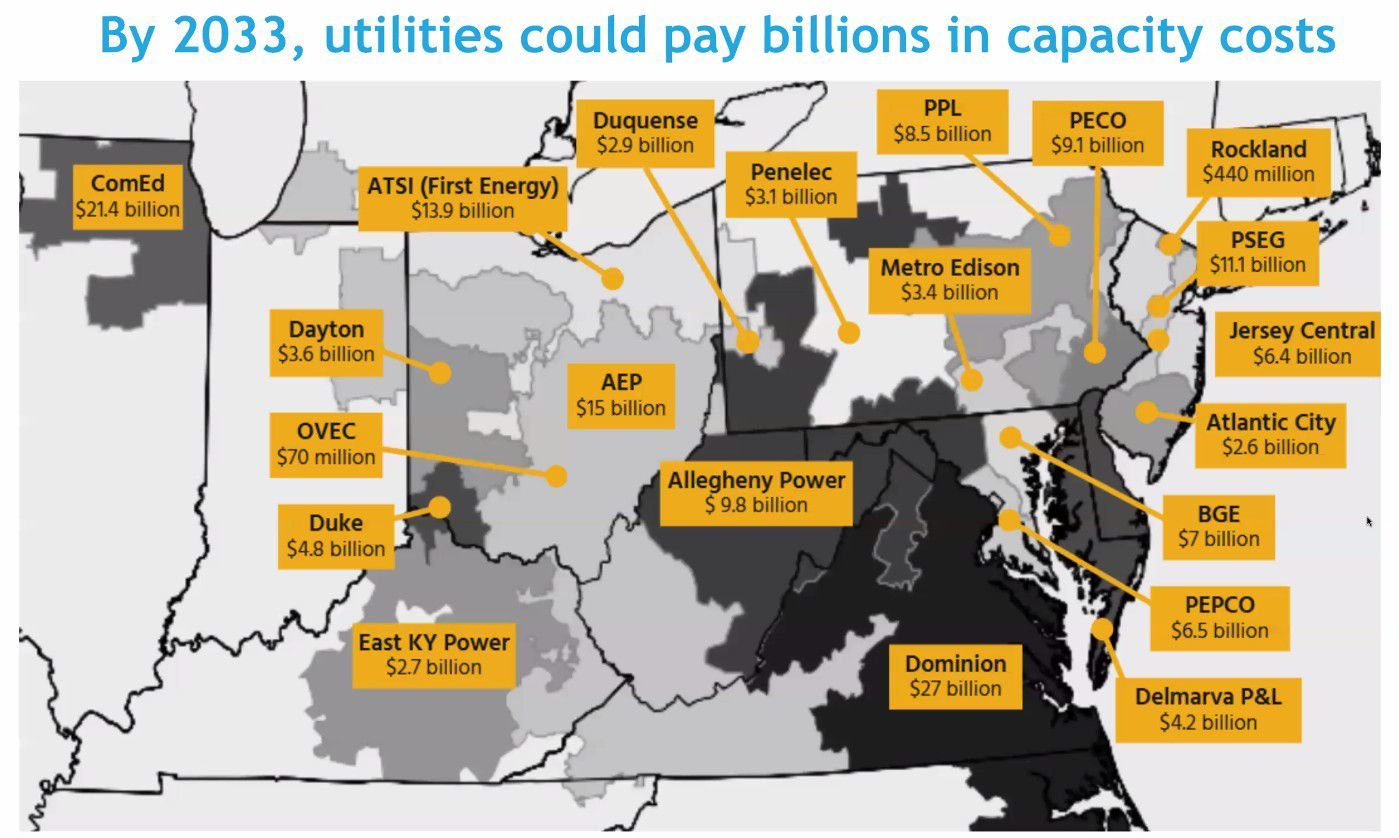
    Map produced by the National Resources Defense Council estimates electricity capacity costs to utility companies based on PJM forecasts through 2032.

    Protecting consumers

    Making sure power consumers don’t get stuck with the cost of upgrades has been a key point of consumer advocates.

    Bowring wrote that while the agreement does include some important provisions to protect energy customers from risk, it does not go far enough.

    “The Market Monitor recommends that the agreement not be approved unless Peco can demonstrate that the referenced new data center load can be served reliably and economically,” Bowring wrote to FERC.

    The Falls Township data center is one of two big projects Amazon has planned in Pennsylvania, Shapiro announced in June.

    The company plans to invest at least $20 billion in the construction of data center complexes in Pennsylvania, in what officials called the largest private-sector investment in the state’s history. The second complex would be built alongside a nuclear power plant in Luzerne County.

    Both would require enormous amounts of power.

    For example, FERC has already rejected one Amazon “behind-the-meter” power connection of 480 megawatts for the Luzerne County data center. That’s more power than is consumed by some small cities.

    Bowring addressed the data centers during a summit on PJM at the National Constitution Center in September that was attended by multiple governors, including Shapiro.

    “PJM has a problem: Capacity,” Bowring said at the summit. “There’s no extra capacity, and there’s lots of data centers that want to join. … It cannot be handled by the market as it exists.”

    PJM has said it does not have the authority to deny the interconnection of new data center loads even if it does not have the capacity. Bowring disagrees but is asking FERC to clarify the matter.

    Peco’s ‘extensive planning’

    Greg Smore, a Peco spokesperson, said the utility is working with Amazon.

    “We have done extensive planning to ensure we can deliver the energy needed to power this data center through our transmission and distribution system,” Smore said. “That data center, like any other large customer, is responsible for procuring electric supply, through an energy supplier or the existing PJM energy market.”

    Smore said that knowing there’s “an adequate supply of energy to serve all our customers at a reasonable price is a real concern.”

    So Peco, which is owned by Exelon, is working with stakeholders, he said, to add more generation to the grid while ensuring reliability and help address rising energy supply costs.

    He said the agreement with Amazon “protects all customers in Southeastern Pennsylvania from bearing greater transmission service costs if the data center does not make the sizable contribution to our system costs that would be expected.”

    Advocates fear costs to public

    The nonprofit Natural Resources Defense Council (NRDC), an environmental advocacy group, estimates Peco could pay $9.1 billion in costs by 2033 related to the need for greater capacity.

    “The projected demand from data centers is vastly outstripping the amount of new supply in PJM,” said Claire Lang-Ree, an advocate with NRDC.

    “It will cause power bills to rise and stay high for the coming decade, mainly through capacity cost increases,” Lang-Ree said.

    The NRDC estimates cumulative costs could result in a $70 monthly rise in average electric bills in coming years across the PJM grid.

    In addition, she said it would lead to a decline in reliability and an increased risk of blackouts for the general public. And, she said, the power demand could undermine states’ clean energy and air quality goals.

    “It’s really hard to overstate what’s at stake here,” Lang-Ree said.

    Clara Summers of Consumers for a Better Grid, a nonprofit watchdog, said states should impose tariffs to be paid by data centers to support the large power loads they require and ensure that costs of new utility infrastructure doesn’t fall unfairly on consumers. And data centers should provide their own electric supply.

    Summers likened not taking action to allowing the wealthiest acquaintances at a restaurant gathering to order the most expensive food, then, “dining and dashing.”

    “Unless something is done, everyday people will be left holding the check for some of the wealthiest companies in the world, and that’s unacceptable,” Summers said.

    This story has been updated to reflect comments from Peco.

  • Coalition rallies against Philly’s plan to close schools, and says district should halt the process

    Coalition rallies against Philly’s plan to close schools, and says district should halt the process

    Pause the city’s facilities master planning process, a grassroots coalition said Wednesday, weeks before the Philadelphia School District has said it would release a draft of that plan — which will include school closures.

    Superintendent Tony B. Watlington Sr. and school board president Reginald Streater have said the long-promised planning process would be different than the 2013 incarnation, that they would consider the harm done then, and would use an equity lens.

    Watlington in September said “there are no fixed decisions at this point, and the short answer is we can’t answer any of those questions right now about which schools will close, but we can surely say some will.”

    Officials have also said the document — which they promise is on track for delivery sometime this fall, with a school board vote by the end of the calendar year — would also include major renovations, new school construction, and joining some schools into a single building.

    But Councilmember Kendra Brooks, who was a school activist fighting the closures on the front lines 12 years ago, said this process feels similar, despite officials’ assertions that their aim is to organize city schools in a way that best advantages children.

    Philadelphia has complex facilities needs — 70,000 excess seats in schools across the city, some schools that are more than half-empty, and some bursting at the seams. Its buildings are old, and many have environmental problems.

    “This seems like a school closure process,” Brooks said in an interview. “We’ve been here before, and the conversation should be about the future we want for our children — it should include plans for investment, not just closure.”

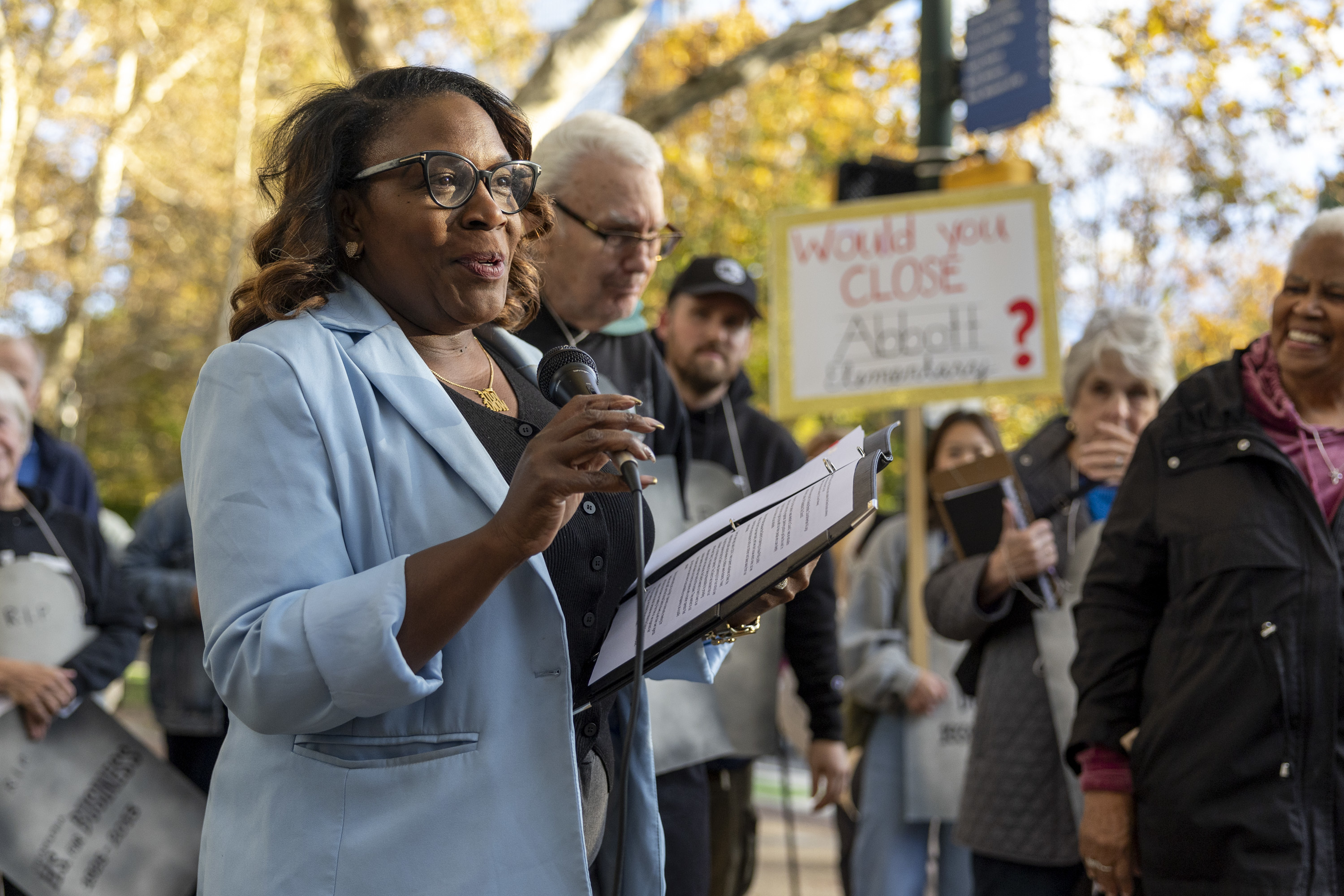
    City Council woman at large Kendra Brooks, speaks in front of parents, teachers, and public school advocates during a Stand Up for Philly Schools event in Philadelphia, on Wednesday, Oct. 22, 2025.

    Brooks joined members of Stand Up for Philly Schools — a coalition of organizations including Parents United for Public Education, the Philadelphia Home and School Council, and Asian Americans United — outside the Barnes Foundation on the Benjamin Franklin Parkway Wednesday night, where members of the Council for Great City Schools met for an opening reception.

    “We are being given an extremely limited set of options about the future of our schools. We are being told that school closures are a foregone conclusion. We’re being told to sign off on a plan that we haven’t even seen,” Brooks said to the crowd of dozens of educators, parents, students and other supporters gathered for the cause.

    “We don’t know how many, we don’t know which ones, but we know that every school closure hurts a community,” she said.

    ‘A big contraction of the school district’

    Those who rallied Wednesday made several demands of the district, which is playing host to the Council for Great City Schools conference. Those asks included pausing the planning process, creating a new strategy for public engagement, and committing at least $250 million annually to keeping district schools well-maintained.

    So far, the process has played out poorly, members of Stand Up for Philly Schools say. There’s been engagement on paper, but many in advisory groups said they felt their work was merely lip service, and community meetings have been sparsely attended.

    The school board has authorized spending over $5 million on contracts for community engagement, the planning process itself, and the construction and hosting of a data warehouse for all facilities information.

    “We feel like we’re not getting the whole picture, we feel like whatever ideas and feedback we gave are not being heeded, and we don’t think there’s enough time in this process,” said Adam Blyweiss, a district parent and teacher who sat on an advisory committee.

    Laurie Mazer, a member of Parents United for Public Education, said the process feels “weird, and rushed.”

    Getting information has ”been a real teeth-pulling exercise,” Mazer said.

    ‘When schools close, communities pay the price’

    It appeared like an early Halloween celebration at the Stand Up for Philly Schools rally.

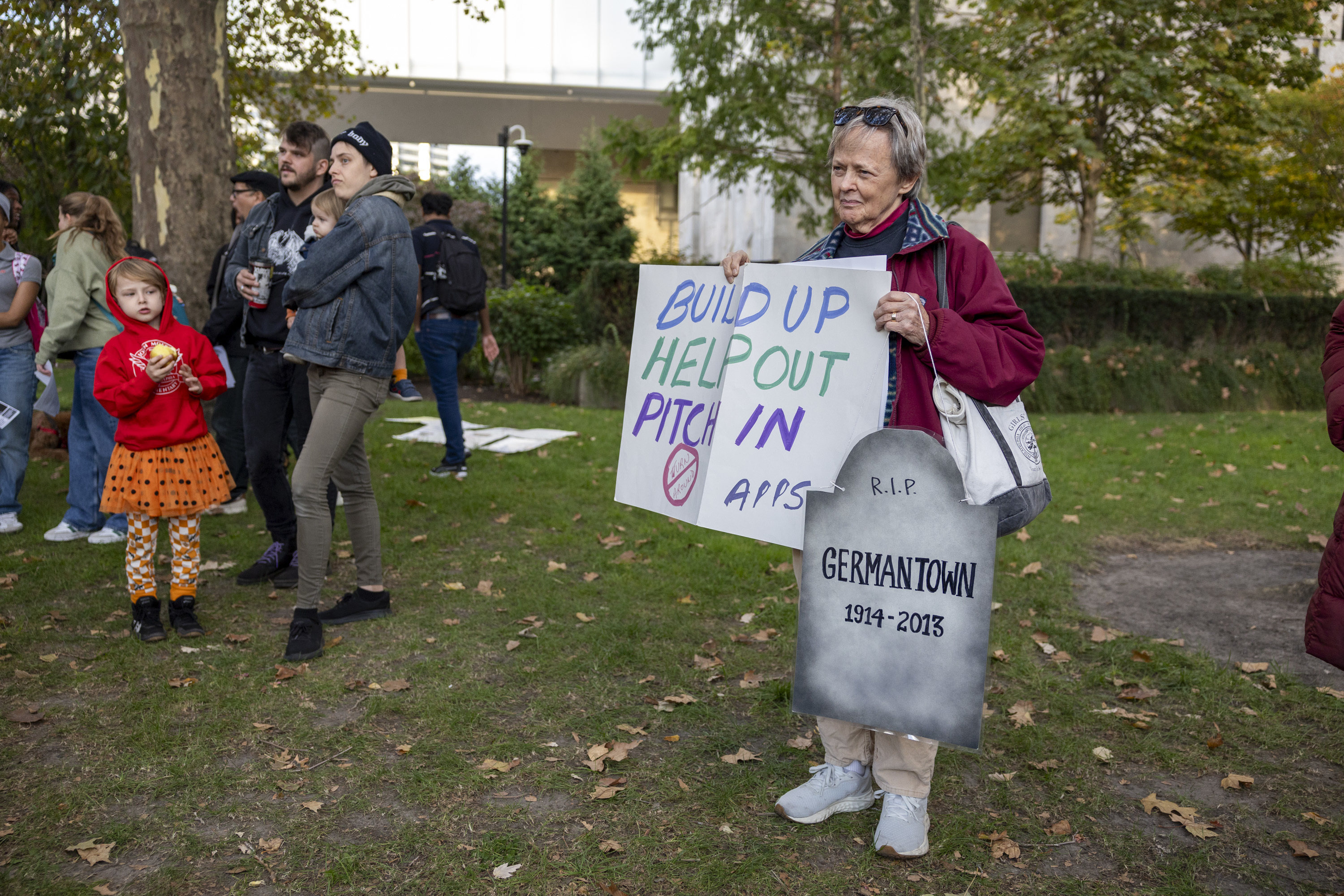
    Coalition members wore tombstone signs around their necks, each representing a Philadelphia public school that was closed during the district’s last closure plan.

    “After months of delays and missing data, it’s clear why so many families don’t trust this process,” said Melanie Silva, the mother to a fourth grader at Rhawnhurst Elementary School in Northeast Philly and a member of 215 People’s Alliance.

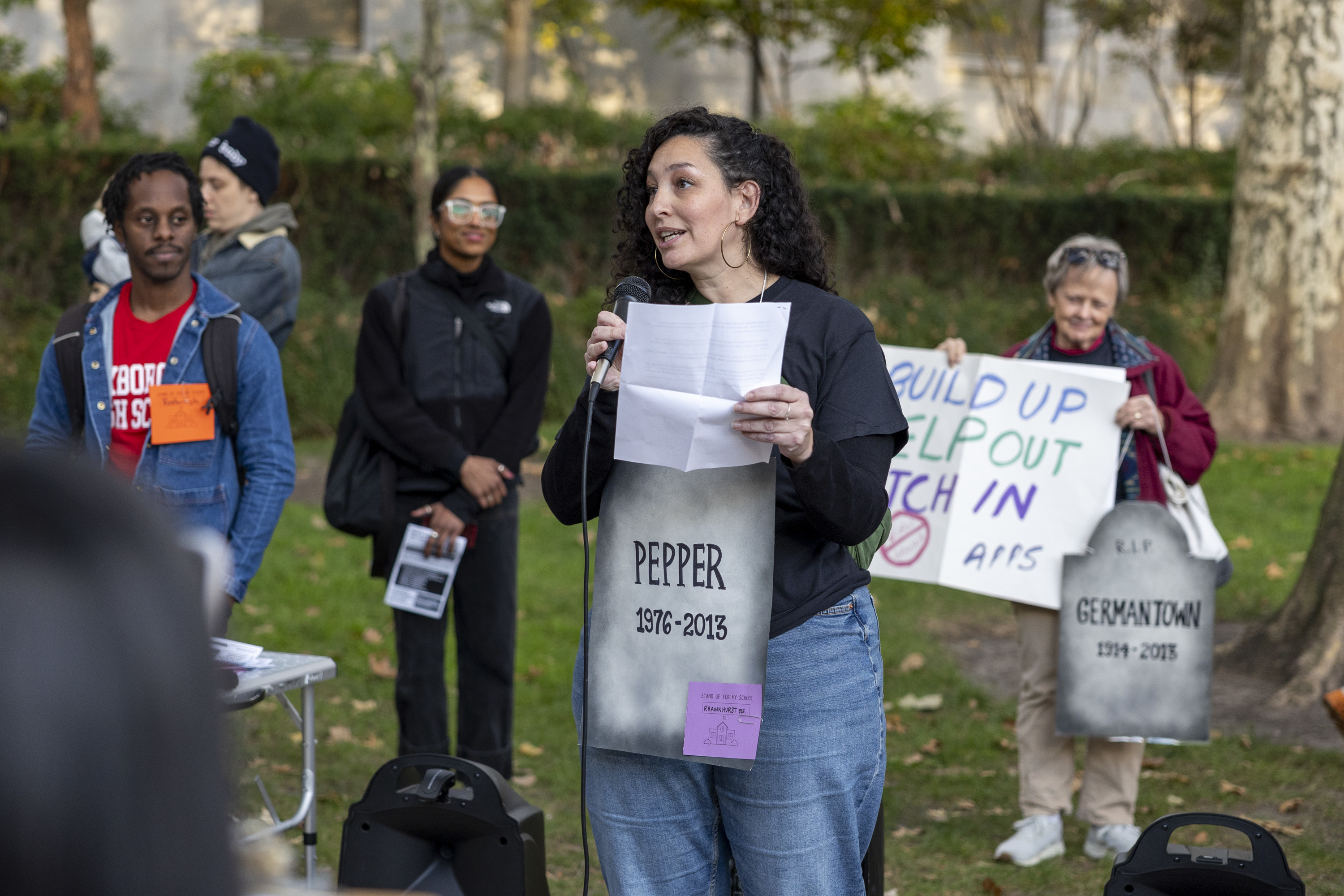
    Melanie Silva, mom to a fourth grader at Rhawnhurst Elementary School, speaks during a Stand Up for Philly Schools event in Philadelphia, on Wednesday, Oct. 22, 2025.

    Wearing a tombstone sign around her neck representing George Wharton Pepper Middle School and its closure in 2013, Silva described the overcrowded and under-resourced conditions at her daughter’s school. She said the school’s library was a meeting room, and classrooms were so full there was “no room to breathe.” She said the district ought to invest in its schools rather than close them.

    “We deserve transparency, we deserve trust, and real investment, not excuses,” she said.

    Charles Hudgins, an algebra teacher at Abraham Lincoln High School in Northeast Philly, warned that the district would make problems that schools face today worse by closing more of them. He said that some of his students already travel more than an hour.

    Barbara Dowdall, of Germantown, Retired teacher of 36 years, holds up a sign to show her support for Philadelphia public schools during a Stand Up for Philly Schools event in Philadelphia, on Wednesday, Oct. 22, 2025.

    “The potential and talent of students is being lost every single day because our school system is focused on quality and numbers. The numbers we care about are the number of excellent schools where our children have opportunities to thrive, to think creatively and to pursue their passions,” said Ruth Kuriloff, 17, a senior at Science Leadership Academy at Beeber.

    She and her classmates said students would only be hurt by closing schools to save money.

    “These obvious inequities will not get better by closing schools,” said Jordyn McGriff-Laduna, 17, also a senior at the school. “Quality education should not be a privilege. It should be a promise for all students in all areas.”

  • Why Delaware County’s council race is focused around rising property taxes

    Why Delaware County’s council race is focused around rising property taxes

    Democrats have dominated Delaware County government since the 2019 election.

    As suburban communities across the nation flipped from red to blue, Democrats took control of the county council for the first time since the Civil War — the result of long-term shifts accelerated by President Donald Trump’s first administration. The party has held all five seats on the governing board ever since, easily retaining seats in 2021 and 2023.

    But on the heels of a double-digit property tax increase last year, Republicans see an opening to regain representation.

    Two seats on the five-member board are on the ballot in November. Democrats argue tax increases were necessary to make up for decades of underinvestment by Republicans.

    But Republicans insist spending is out of control. While they cannot take control of the board this year, they are asking voters to give them a voice to push back against the Democrats.

    “The money tree in the backyard does not exist,” said Brian Burke, one of two Republicans running for council.

    Who is running?

    Republicans nominated Burke, the former president of the Upper Darby Township Council, and Liz Piazza, a former county employee, for the two seats.

    Burke, a union steamfitter, was first elected to Upper Darby’s township council in 2019 as a Democrat. He became a Republican to unsuccessfully run for mayor of the township in 2023 following years of feuds with the Democratic administration. While on the township council, Burke worked in conjunction with Republicans on the board as well as two other Democrats to challenge Democratic leadership in Upper Darby. He said this experience would aid him as he worked to hold Democratic leadership in Delaware County accountable.

    Piazza worked for decades in Delaware County Court’s domestic relations department, where she ran the warrant division and served as a liaison for judges and attorneys. Running for council, Piazza has been vocal about wanting to devote opioid settlement funds toward grandparents caring for the children of those struggling with addiction.

    Democrats nominated incumbent Councilmember Richard Womack and County Controller Joanne Phillips.

    Womack was first elected to the council in 2021 after spending 10 years on the Darby Township Board of Commissioners. Womack spent years as an advocate in the labor movement, including serving as an adviser on community and religious affairs for the national AFL-CIO.

    Phillips was elected controller in 2017, the first year Democrats swept county-level positions. In the controller role, she has been responsible for auditing county offices and advising on council spending matters.

    What is the Republican platform?

    Burke and Piazza are urging voters to elect them to “stop the spend.”

    After the council raised property taxes by 23% last year, the pair of Republicans argued the taxes were a result of out-of-control spending in the county. They say there needs to be a voice on the council acting as a check on spending.

    “There’s a lot that needs to be cut. There’s a lot of spending,” Piazza said.

    If elected, the two Republicans would not have control over county spending, but they would have votes on the five-member board to oppose new spending and work to sway their Democratic counterparts.

    What is the Democratic platform?

    Womack and Phillips are largely defending the actions of the Democratic council over the last five years. Republican leadership, they argue, did not raise taxes for 12 years and allowed county infrastructure to fall into disrepair. As a result, they say, Democrats had to increase taxes to fund county services and infrastructure improvements.

    No one wanted to increase taxes, Womack said, but it was unavoidable.

    “Our county has really been underserved for many decades,” Womack said. “In the long run, it costs you a lot more money to repair than if you had taken care of things gradually.”

    If elected, Phillips says she would like to do more public vetting of contracts and work to increase development in Delaware County so that the local tax base can be increased without more tax hikes. Womack has said he wants to work on expanding affordable housing options in the county.

    Why were taxes raised? Will there be another hike?

    The county council voted last year to increase property taxes by 23%, which comes out to roughly $185 annually for the owner of a home assessed at the county average. The county had used pandemic relief funds to stave off significant tax increases in prior years, but those funds were running dry and additional dollars were needed to cover employee salaries amid inflation, council members said at the time.

    Piazza and Burke insist that another double-digit tax increase is on the way. Too much of the current budget, they argue, still depends on short-term federal pandemic relief funds or transfers from other county funds.

    “They’re going to come out after November 4th election and basically tell the residents of Delaware County, ‘You’ve got another 20% increase,’” Burke said.

    Womack, the sole member of the county council who voted against the increase, said that he anticipated another tax hike but that he could not imagine it would reach 20%.

    The incumbent spearheaded a citizens budget task force that has spent the year seeking areas to cut spending.

    “It’s kind of hard to really project what we’re looking at right now,” Womack said. He noted that, amid a federal government shutdown, details on state and federal aid are unclear.

    However, the county is not expecting to release its preliminary budget until mid-November, after the election. Last year, the county did not release its proposed budget until Dec. 3.

    Where do Republicans want to cut?

    Republicans have identified three primary areas they argue represent overspending: the county health department, the prison, and outside legal assistance.

    Delaware County, the largest county in Pennsylvania without a health department at the onset of COVID-19, launched its health department in 2022.

    Republicans in the county have long argued it was an unnecessary expense. Though the $18 million department is currently funded entirely by state and federal grant dollars, Burke argued it will eventually cost taxpayers.

    “In my eyes, that [money] could have been used somewhere else,” Burke said.

    In 2020, the council voted to explore options to retake control of the county prison from the private firm that had run it. Phillips, who was controller at the time, argued the decision was in the county’s best interest and has better served inmates and staff.

    The prison was de-privatized after a series of complaints of mismanagement and mistreatment of prisoners. The prison’s superintendent resigned in 2019 after an Inquirer investigation revealed allegations of racism and abuse of employees.

    But Republicans argued that the county’s costs have gone up too much and that the county opened itself up to litigation that it would not have been vulnerable to if the prison had remained privately run. The union representing prison employees often clashed with the first warden the county chose to lead the prison.

    In an interview, Burke argued the county could find significant savings if it put the prison back in private hands. In 2025, the prison cost the county over $59 million. The county’s last contract with GEO, which managed the prison privately, paid the company $259 million over five years.

    Phillips said the health department and public prison, while significant expenses, will save the county and its residents in the long run. Even when the prison was run privately, she said, infrastructure repairs were on the county and the private operators sought to maximize the number of inmates in the building.

    “Government should take care of its people,” Phillips said.

    Finally, Republicans point to the ballooning cost of legal counsel to the county. Last year, the county paid more than $4.4 million to outside legal counsel, including a firm that once employed Phillips and County Councilwoman Christine Reuther. Republicans argue this represents misuse of funds and political cronyism.

    Phillips and Womack instead point to the county’s small in-house legal team and the growing number of cases brought against the county, including defending against frivolous suits filed by election deniers, as well as managing complex legal issues, such as the Prospect Medical Holdings bankruptcy filing that closed two major hospitals in the county.

    Even if they won both seats, Republicans would hold the minority on the council for at least the next two years. This means they would have to persuade Democrats to come along with them on any policy changes or budget cuts.

    “I would love to win the seat and get in there and get into the nitty-gritty and kind of see what goes on behind closed doors and have a voice for the residents and be there for them,” Piazza said.

    This suburban content is produced with support from the Leslie Miller and Richard Worley Foundation and The Lenfest Institute for Journalism. Editorial content is created independently of the project donors. Gifts to support The Inquirer’s high-impact journalism can be made at inquirer.com/donate. A list of Lenfest Institute donors can be found at lenfestinstitute.org/supporters.

  • Prosecutors hid evidence in 1988 murder case that sent Michael Gaynor to prison, lawyers say

    Prosecutors hid evidence in 1988 murder case that sent Michael Gaynor to prison, lawyers say

    After 37 years in prison, Michael Gaynor — who was convicted of killing a 5-year-old boy in a Southwest Philadelphia candy store — could soon be released.

    Lawyers from the McEldrew Purtell firm on Oct. 15 filed a petition under Pennsylvania’s Post-Conviction Relief Act (PCRA), saying that police and prosecutors suppressed crucial evidence pointing to another suspect, coerced witnesses, and relied on false testimony to convict Gaynor in 1988.

    Gaynor is “wholly innocent,” lawyer Daniel Purtell told The Inquirer on Tuesday. “We request speed and transparency toward his exoneration.”

    The District Attorney’s Office Conviction Integrity Unit (CIU) has also been investigating the case since late last year. The office is expected to file a brief with the court in response to the petition.

    The petition to free Gaynor relies on information detailed in The Inquirer’s six-part investigative series “The Wrong Man,” published late last year. The stories uncovered evidence that Gaynor was not the gunman or even in the store where a shootout between two men took the life of little Marcus Yates. The Inquirer’s investigation was based on thousands of pages of court transcripts and police paperwork, 21 witness statements, and interviews with more than four dozen people.

    For more than a year, Gaynor, now 58, has had the most unlikely supporter: Marcus’ family.

    Marcus’ mom, Rochelle Yates-Whittington, remained tormented by the tragedy decades later. She said she could find peace only by telling Gaynor and Ike Johnson, who was one of the convicted gunmen, that she forgave them.

    Rochelle Yates- Whittington, mother of Marcus Yates, at the new memorial for Marcus, at the .Lewis C. Cassidy Elementary Academics Plus School, in Philadelphia in 2024.

    But after speaking with each of them in prison video calls last year, she said, she no longer believed the police and prosecutors’ account of the crime and told her family Gaynor was not guilty.

    “I am just so overwhelmed with happiness,” Yates-Whittington said this week after hearing about the court filing. “I just want to let Michael know I’ll be there for him once he’s released. I really hope this moves fast and his release is expedited.”

    On the afternoon of July 18, 1988, Marcus, his two older brothers, and seven other children were crammed inside the tiny Duncan’s Variety & Grocery store, where they played three video games and eyed penny candy. Suddenly, two men blasted guns at each other, and the children were caught in the crossfire.

    On the afternoon of July 18, 1988, police gather outside Duncan’s Variety and Grocery store in Southwest Philadelphia to start investigating the shooting death of 5-year-old Marcus Yates, and his brother and another boy, who were shot, yet survived.

    Marcus, who took a bullet to the head, died at the hospital later that day. His brother Malcolm survived being shot, as did another boy.

    Gaynor lived around the corner from the store and was a low-level crack dealer. He was from Jamaica, and witnesses had told police that both shooters were Jamaican.

    As part of the investigation, police seized a number of cars parked near the store, including Gaynor’s 1988 Nissan 300ZX. Four days after the shooting, he called the police to claim his car and spoke to Paul Worrell, lead investigator on the case. Worrell told Gaynor to come to Police Headquarters.

    Gaynor said Worrell took him into an interrogation room, placed him in handcuffs, sat him in a chair bolted to the floor, and accused him of killing the 5-year-old boy. Worrell put a plastic bag over his head, Gaynor said, held it tight, and told him he had to admit to the killing. Gaynor said he told him he would talk but wouldn’t confess to a crime he didn’t commit.

    Worrell has been linked to seven murder cases in the 1980s and 1990s in which defendants allege he and his partners coerced false confessions, falsified statements, slapped suspects while handcuffed to chairs, kicked their genitals, and threatened witnesses with criminal charges if they didn’t testify. Four men in those cases have since been exonerated, and another conviction was vacated.

    Worrell, now retired, declined to comment.

    In an interview last year,he told The Inquirer: “I hope Michael Gaynor rots in jail.”

    Gaynor and Johnson, also known as Donovan “Baby Don” Grant, were convicted of first-degree murder and sentenced to life without parole. Johnson and other witnesses had always maintained Gaynor was not the other shooter.

    In this Feb. 20, 1990 Daily News file photograph, Michael Gaynor is escorted by sheriff deputies after receiving a life sentence from the jury.

    In fact, witnesses had told police the other shooter was a man known on the street as “Harbor.” But detectives did not properly or substantively investigate Harbor.

    When asked during the murder trial why police had not tried to find Harbor, Worrell replied: “I had investigated that name early on in the investigation, in the fall of 1988. …That name was a nickname. That name has never been attached to any human being that is in my capability to find nor within the New York Police Department’s capability to find. Our determination was that that person did not exist.”

    The Inquirer determined that he was Paul Jacobs, also known as Peter J. Jacobs, a career criminal who was born in Jamaica and had lived in New York and Los Angeles.

    Years after Gaynor and Johnson were locked up, Jacobs was shot dead on March 12, 1996, in a small ramshackle home in a South Los Angeles neighborhood wrought with street gangs and drug wars. He was 34.

    Investigators knew Jacobs had faced criminal charges in New York and had an associated address that was part of the investigative records, according to the petition. Those details were concealed from the defense, the document says.

    “The Philadelphia District Attorney’s Office has recently produced previously undisclosed documents confirming that Jacobs was identifiable through the New York prison system,” according to the petition.

    Gaynor’s lawyers contend that suppressing that evidence amounted to misconduct that undermines the integrity of the conviction. Had it been disclosed, the petition said, “there is a reasonable probability the outcome of the trial would have been different.”

    During the trial, the prosecution relied heavily on the testimony of traumatized children who identified Johnson and Gaynor in court. But three of the five children, now adults, said detectives and prosecutors had directed or coached them to do so, The Inquirer found. And police coerced Christopher Duncan, the son of the candy store owner, into recanting his original statement and adopting a false account implicating Gaynor, the petition said.

    In this Feb. 6, 1990 Daily News file photograph Toney Yates, 12, and brother Malcolm Yates, 8, walk through the hall at City Hall outside of the hearing for the shooting of their brother Marcus Yates.

    No forensic or physical evidence linked Gaynor to the murder.

    “This was not a major lapse in judgment but a conscious decision to ignore leads that pointed away from Gaynor and toward the actual perpetrator,” his lawyers said in the court filing.

    Since District Attorney Larry Krasner took office in January 2018, the convictions of 48 people have been overturned, according to data compiled by his office.

    Many of the overturned cases date to the 1980s and 1990s, and police misconduct, fabricated statements, coerced confessions, and the withholding of exculpatory evidence were later cited as key factors in the wrongful convictions.