Tag: Weekend Reads

  • CHOP lawyers defend transgender care in blistering response to Trump administration seeking patient information

    CHOP lawyers defend transgender care in blistering response to Trump administration seeking patient information

    The Children’s Hospital of Philadelphia called new evidence presented by President Donald Trump’s administration weak and untrustworthy in a blistering legal response to federal efforts to investigate its doctors providing gender-affirming care.

    CHOP’s response, filed late Monday in federal court in Philadelphia, came in defense of accusations by the U.S. Department of Justice that it’s investigating “fraudulent billing practices“ at the hospital. Federal officials say they’re looking into whether CHOP doctors were fudging or lying about diagnoses to get private and public health insurance companies to cover off-label drug prescriptions used to treat patients with gender dysphoria — a medical condition in which a person’s body does not match their gender identity.

    In its filing, CHOP lawyers called the DOJ’s allegations “unreliable,” and urged U.S. District Court Judge Mark A. Kearney to disregard claims that are “threadbare, of dubious origin, and so heavily qualified and caveated as to offer the court no meaningful information.”

    CHOP and the DOJ are locked in a legal battle over a sweeping federal subpoena sent to the hospital in June. The subpoena seeks patient names, Social Security numbers, addresses, diagnoses, and treatment notes, in addition to doctor emails and encrypted text messages.

    In July, CHOP filed a motion to limit the scope of the subpoena to protect patient privacy. Judge Kearney is now weighing CHOP’s motion.

    In the latest filing, CHOP’s lawyers argued the DOJ’s “new evidence” against the hospital was unfairly “shoehorned” into a separate but related case filed last month by a group of CHOP patients and their families who also want Kearney to block the release of private medical records to the DOJ.

    “That new evidence should not be considered because it is not before the Court in this case and is unreliable in any event,” CHOP lawyers wrote in the filing. “The government (still) cannot establish that its need for extraordinarily sensitive and personal patient information outweighs the highest-order privacy interests on the other side of the ledger.”

    The DOJ did not immediately respond Tuesday to a request for comment.

    Feds seek patient information from CHOP

    In April, U.S. Attorney General Pam Bondi issued a memo, entitled “Preventing the Mutilation of American Children,” in which she tasked the DOJ with enforcing measures targeting gender-affirming care for youth.

    About two months later, the DOJ sent subpoenas to CHOP and at least 19 other hospitals nationally that are under scrutiny for treating transgender youth. The subpoenas sparked legal opposition playing out in federal courts in Pennsylvania and across the nation.

    The DOJ’s key focus is how doctors are prescribing puberty blockers and hormones “off-label,” meaning for a condition not specifically approved by the U.S. Food and Drug Administration.

    Once a drug is approved by the FDA, it is legal for doctors to prescribe it to treat other conditions that could benefit from the medication. Off-label prescribing is a common and widely accepted medical practice, especially in pediatrics.

    Gender-affirming care for children and adolescents has been deemed medically appropriate by the American Academy of Pediatrics and other major medical and mental health organizations. Research shows young people with gender dysphoria suffer higher rates of suicide, self-harm, depression, and anxiety.

    CHOP’s Gender and Sexuality Development Program, created in 2014, is one of the nation’s largest such clinics and provides medical care and mental health support to hundreds of new families each year.

    CHOP’s legal fight for patient privacy

    Late last month, families and patients joined in CHOP’s fight against the federal subpoena by filing a separate motion to protect their privacy rights. That motion was filed on behalf of five parents with transgender children and one adult who received care at CHOP.

    In response to that case, the DOJ filed a “Declaration,” or sworn statement, from Lisa Hsiao, acting director of the DOJ’s Enforcement and Affirmative Litigation Branch, formerly known as the Consumer Protection Branch. In it, Hsiao said the government has new evidence “particular to CHOP that raises concern that federal healthcare offenses may be occurring there.”

    Hsiao said the government analyzed CHOP’s insurance claims and found that between 2017 and 2024, CHOP providers diagnosed 250 minors with central precocious puberty at age 10 or older, “including numerous teenagers aged 14 to 18.”

    “This is well beyond the age at which children are typically diagnosed with precocious puberty,” Hsiao stated. The government, she said, suspects doctors are improperly using the precocious puberty diagnosis to get insurance coverage for treatment of gender dysphoria.

    In Monday’s court filing, CHOP lawyers accused the DOJ of attempting to “shoehorn its new evidence into CHOP’s case” through the other case.

    CHOP also argued Hsiao’s declaration provides nothing to support its contentions surrounding precocious puberty diagnosis.

    “Moreover, the government fails to contextualize the findings of its rudimentary analysis, offering no comparator for the use of the code for precocious puberty at peer hospitals, let alone hospitals that, like CHOP, have providers who specialize in treating endocrine disorders,” CHOP lawyers wrote.

    The source of “the data set is entirely unknown,” CHOP’s lawyers noted, adding the declaration never says how many patients were treated for gender dysphoria during that time frame.

    The CHOP lawyers also criticized Hsiao for writing in her sworn declaration that the government was aware of a lawsuit filed against CHOP that alleges doctors hastily prescribed puberty blockers and hormones to a minor who later regretted it.

    Hsiao later refiled the declaration to remove any reference to a lawsuit after learning that it hadn’t been filed.

    CHOP lawyers wrote they believe the lawsuit reference came from a news article about a former CHOP patient. The article said the patient “was suing the hospital.” However, CHOP was unaware of any such lawsuit.

    “The similarities between the report and the allegations in the Hsiao Declaration — including the reference to a lawsuit — raise suspicions that, in looking to justify its investigative interest in CHOP, the government simply searched the internet for stories fitting its narrative and presented the one it found as fact without adequately scrutinizing its veracity.”


  • Before the Day of the Dead, a time to welcome departed dogs and cats as families create ‘pet ofrendas’

    Before the Day of the Dead, a time to welcome departed dogs and cats as families create ‘pet ofrendas’

    The spirits of the pets come first, treading home on soft, shadowy paws, making their way by the light of altar candles and guided by the eternal tie of love.

    They are welcomed with offerings of favorite treats and fresh water, and by the careful placement of old toys and worn collars that have become cherished mementos.

    It’s a new tradition connected to the Day of the Dead, the ancient Mexican holiday where people honor and celebrate the lives of family members at a time when the wall between worlds melts.

    Now, in Philadelphia and elsewhere, people have begun to recognize not just human relatives but those with wings and whiskers, the departed dogs, cats, birds, and other animals that enriched their lives. And who, like family, continue to be mourned and missed.

    The souls of pets are said to return on Oct. 27, a few days before the Dia de Muertos on Nov. 1 and 2.

    “The day,” said Gerardo Coronado Benitez, manager of the Association of Mexican Business Owners of Philadelphia, “is not about death, but about celebrating and remembering people, keeping memories alive. Of course many people want to keep alive the memories of their pets.”

    He is helping organize a big Day of the Dead event at the Italian Market on Nov. 2, where people will be able to place photos of relatives and pets on a community ofrenda ― a decorated altar ― at Ninth Street and Washington Avenue.

    A crowd gathers at last year’s Day of the Dead celebration at the Italian Market in South Philadelphia.

    Others have set up altars in their homes. These ofrendas may be adorned with traditional marigolds, with candy skulls, paper skeletons, and photographs. But they may also feature a snatch of fur or a whisker left behind.

    Genesis Pimentel-Howard created an ofrenda for her cat, Mobi, on a bedroom shelf of the West Philadelphia home she shares with her husband, Yaphet Howard.

    It’s hard for her to talk about Mobi, who died suddenly in May at only 4 years old.

    He was, she said, an adorable menace. Mobi loved to poke at and play with the couple’s other cat, Sannin, though Sannin didn’t always appreciate the attention.

    Mobi sometimes stole food from the trash. And he managed to push over and break Pimentel-Howard’s flat-screen TV. Still, she said, he followed her everywhere. She couldn’t even use the bathroom without him trailing her inside.

    “A sweet momma’s boy,” she said. “Always next to me.”

    On the ofrenda, Pimentel-Howard placed her grandmother’s pearls. And photos of her family dogs, Ella and Red, and her hamster, Shia LaBeouf. She added a shadow box that holds Mobi’s collar and an impression of his paw.

    “I’ll stay up as late as I can to welcome him,” she said. “I like to think he’ll be around.”

    Genesis Pimentel-Howard lights a candle for her late cat, Mobi, beside a lovingly crafted ofrenda in her Philadelphia home on Monday. The altar glows with candlelight, welcoming the spirits of her beloved departed pets. The ritual is part of a growing tradition tied to Día de los Muertos.

    The roots of the Day of the Dead go back 3,000 years, to Aztec and Mayan traditions. It is celebrated not only in Mexico but also in wider Latin America and in communities across the United States.

    Dogs have always played an important role. The ancients considered them sacred, guides that led souls through the afterlife. They revered the Mexican Hairless dog, the Xoloitzcuintle, or Xolo for short.

    It’s a Xolo dog, Dante, that guides Miguel to meet his ancestors in Coco, the popular animated Disney movie. And it’s a song from the movie, “Remember Me,” that has become the soundtrack for countless social media posts about departed pets.

    In Philadelphia, the Italian Market festival welcomes all who wish to take part in its Day of the Dead event to South Ninth Street between Federal and Christian Streets from 11 a.m. to 5 p.m. on Nov. 2

    The Fleisher Art Memorial in South Philadelphia also will hold a big Day of the Dead celebration. Everyone is invited to help with final preparations for the ofrenda from 2 to 9 p.m. on Oct. 31, and to come to the Day of the Dead event the next day.

    “The animals, that’s family, too,” said María De Los Angeles Hernández Del Prado, the artist who led the creation of the Fleisher’s large, three-part ofrenda, which includes a section devoted to pets. “They’re the same as us, they just don’t talk the same language.”

    Pimentel-Howard knew after Mobi died that she would find a way to honor him, along with the other animals she has loved.

    “You don’t know what it’s like to lose an animal,” she said, “until you’ve lost one.”

  • Discovery of Kada Scott’s body at Germantown middle school has reignited debate over the vacant building

    Discovery of Kada Scott’s body at Germantown middle school has reignited debate over the vacant building

    When it opened in 1973, Ada H.H. Lewis Middle School was a source of deep pride for East Germantown, the kind of state-of-the-art educational facility that only suburban kids had at the time.

    But on Saturday, when police found Kada Scott’s corpse buried in a shallow grave in the woods of the long-ago vacated school grounds, ending a two-week search for the missing 23-year-old Mount Airy woman, the Rev. Chester H. Williams saw only decades of failure.

    “It’s a disgrace,” said Williams, a pastor who runs a neighborhood civic group. “We were very hurt to hear that this happened.”

    Community members gather for a candlelight vigil in memory of Kada Scott on Monday at Ada H.H. Lewis Middle School.

    On top of the shock, Scott’s kidnapping and murder has renewed animus in some quarters about the Philadelphia School District‘s failure to repurpose the blighted property, one of dozens of schools shuttered by the district over the last 20 years.

    Since Lewis closed in 2008, local officials and civic leaders said the sprawling seven-acre campus has become a magnet for squatting, illegal dumping, and other criminal activity. City officials have cited the school district 10 times since 2020 for overgrown weeds, graffiti, and piles of trash that blanketed the property, public records show. And four years ago, the district passed on an opportunity to reverse course on the blight.

    A proposal to redevelop the land into new homes, championed by neighborhood leaders like Williams, sat before the school board for approval. But the district abandoned the plan at the eleventh hour without public explanation, which the developer alleged was due to meddling by City Councilmember Cindy Bass — a contention Bass denies.

    “The school district, for some reason, we don’t know why, they put a block on anything being built there,” Williams said.

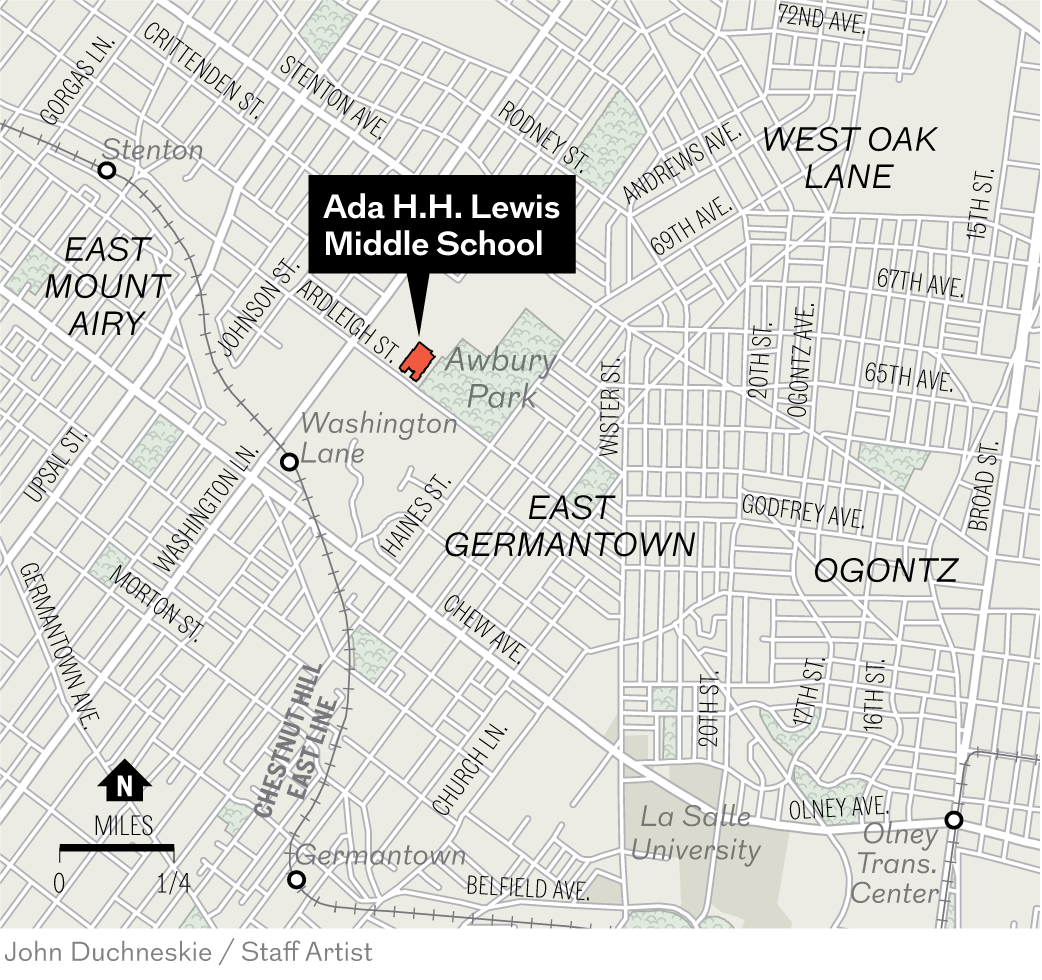
    Map of the former Ada H.H. Lewis Middle School in East Germantown

    Philadelphia Superintendent Tony B. Watlington Sr. extended “deepest sympathies” to Scott’s family and friends in a statement, and said the district’s operations and safety departments will review the vacant-property portfolio “to create and maintain safe and healthy spaces in every neighborhood.”

    While some call Lewis “abandoned,” the district is careful to call the building “vacant,” one of 20 such properties in the district’s portfolio. It says maintenance and inspection logs are kept about work on vacant properties; details were not immediately available.

    The debate over Lewis comes at a crucial time for the district: It is preparing to release recommendations about its stock of 300-plus buildings — and likely add to the list of decommissioned schools-turned-vacant public buildings. The district’s master planning process will contain recommendations for school closures and combining schools under one roof, officials have warned.

    Police at Ada H.H. Lewis Middle School.

    A fizzled redevelopment

    In 2011, then-City Controller Alan Butkovitz said the district’s vacant buildings were “catastrophes waiting to happen.

    Butkovitz, in a report released that year, said district inaction around such structures was dangerous and noted that the schools were magnets for criminal activity.

    Just before the pandemic hit in 2020, after years of pushback over Ada Lewis, the school district began accepting applications to redevelop the crumbling middle school. Germantown developer Ken Weinstein was one of three developers to place bids. He sought to buy the property for $1.4 million and build 76 new twin homes, at a density that neighbors felt complemented the surrounding area and resolved concerns about density brought by apartment buildings.

    Weinstein said he gathered letters of support from 60 neighborhood residents and elected officials, including U.S. Rep. Dwight Evans and then-State Rep. Stephen Kinsey. The school board seemed eager to move ahead and set a final vote for the proposal in May 2021.

    The vote never happened. The only explanation given that day was that “the Board had concern” about “what the long-term plan is for developing schools for the 21st century,” according to a district spokesperson.

    According to Weinstein, some school board members received calls from Bass asking them to table the vote. Bass has faced criticism for interfering in development projects, including other proposals made by Weinstein, as vacant properties languished for years in her district. Her district includes the Lewis property and parts of North and Northwest Philadelphia, where Weinstein has focused his development work.

    Bass, in an interview Monday, denied meddling in the vote. She acknowledged that she did not support Weinstein’s proposal because of the price of the homes — averaging around $415,000 — which she said would have triggered “immediate gentrification in the neighborhood.” But she said she had no involvement in the board’s reversal.

    “That was up to the school district,” Bass said. “I don’t sit on the school board.”

    While community groups in her district supported Weinstein’s project in 2021, Bass said she objected to market-rate housing as the sole alternative for East Germantown, arguing that it amounted to the district and developers saying “you should just take any old thing just so it’s not vacant.”

    City workers clean up in front of the vacant Ada H.H. Lewis Middle School Monday, just minutes before the start of a community candlelight vigil in memory of Kada Scott.

    A tragic turn for the property

    In a letter dated Friday, Bass called on the school district to demolish the vacant school, saying she was troubled by the evidence that led investigators to the property during the search for Scott.

    “The continued presence of this unsecured and deteriorating structure is simply unacceptable,” the Council member wrote in a statement, noting the site is now associated with “tragic violence.”

    Cell phone records and tips from the public first led police to the former Ada Lewis school last week, where they found Scott’s pink phone case and debit card, but nothing else. Then, late Friday, police received a new tip saying that they had missed something on their first search of the grounds, and that they should look along the wooden fence that divides the school from the neighboring Awbury Recreation Center. Officers returned to the property Saturday and found Scott’s body, buried in a shallow grave in a wooded area behind the school.

    Prosecutors expect to charge Keon King, 21, with the murder, though police continue searching for others who they believe may have helped dispose of evidence.

    Bass took office in 2012, when the school was already vacant. She said she pushed the school district for several years to take action, as nuisances piled up at the property. She said she still hopes that another “institution” could replace Lewis.

    “I think that having something that the community wants is not hard to figure out,” Bass said. “This is what the community’s interested in — they’re interested in another institution.”

    She said a proposal for a charter school is now in the works, though she said she was unable to provide details.

    Julius Peden, 5, and Jaihanna Williams Peden (right), 14, pause at a memorial for Kada Scott on Monday.

    A glut of vacant schools

    The school district still views Lewis as a potential “swing space” — a building that could be used to house students if another district building is closed due to environmental problems.

    There is precedent: The district has used other school buildings for such purposes, like Anna B. Pratt in North Philadelphia, which was also closed in 2013, to house early-childhood programs, and then students from other North Philadelphia schools whose buildings were undergoing renovation.

    Still, it remains unclear how much it would cost to bring the Lewis building back to an inhabitable state.

    The school system currently has about 70,000 more seats throughout the city than students enrolled. Though officials have said their first preference is to have closed schools reused for community benefit, it’s unlikely that all will be able to serve that purpose. And the timetable will surely be slow.

    City officials at times have expressed frustration with the pace at which the district is making decisions about how to manage its buildings. School leaders have said the wait is necessary given the district’s capacity and the need to make correct choices and not rush the process.

    Weinstein said the tragedy that culminated at Lewis reflected the conventional wisdom that blight breeds crime.

    “There’s always consequences to shutting down a proposal that the community supports,” Weinstein said. “In most cases, nothing bad happens. In this case, something very bad happened.”

    Staff writer Ellie Rushing contributed to this article.

  • The Rev. Carolyn Cavaness, Mother Bethel A.M.E.’s first female pastor, reflects on her first year

    The Rev. Carolyn Cavaness, Mother Bethel A.M.E.’s first female pastor, reflects on her first year

    The Rev. Carolyn Cavaness is adjusting to her new life as a celebrity.

    Any pastor of the historic Mother Bethel A.M.E. Church might get stopped and asked for a picture while walking down the street, as she sometimes does. The church is a national historic landmark, long celebrated for its role as a hub for Black activism and the oldest church property in the United States to be owned continuously by Black people.

    But in November, Cavaness, 42, was appointed as the first female pastor in the church’s 238-year history. She is a fourth-generation A.M.E. preacher from Newark, N.J., and previously led the Bethel A.M.E. Church of Ardmore for 10 years, also serving as its first woman pastor. Cavaness took over for the Rev. Mark Kelly Tyler, who had left Mother Bethel after 16 years.

    “Some days I have this moment where I say, ‘Wow, Carolyn, you are the pastor of Mother Bethel. You’re in the big chair. What if somebody else was in this spot? What would they be doing in this moment?’” she said.

    While Cavaness brings a new perspective, she is also focused on honoring the legacy of the 52 pastors and their congregations who came before. She said that the church’s first members knew immediately that they were “a big deal” who would matter greatly to the Black community. Two centuries later, that is still the case.

    “Here I am in this 21st century and having to be the caretaker, but also being called to action,” Cavaness said.

    “So what becomes our contribution?”

    Cavaness spoke with The Inquirer about her first year at Mother Bethel, what it has meant to take on her trailblazing role, and how the church’s tradition of resilience inspires her and the congregation.

    This conversation has been edited for clarity.

    Your first sermon at Mother Bethel was an emotional one, about your family’s deep Philly roots and great achievements born out of the Black struggle, even though you were only notified about your appointment just the day before. What do you remember about that day? What have you learned about what Mother Bethel means to people over the past year?

    It was surreal. I mean I literally found out less than 24 hours before. But that is being an itinerant preacher [of] Methodist tradition. You’re here to serve.

    I had very much the sentiment of “I wish my dad and my grandmothers were here to see this.”

    I think about when I walked into the pulpit for the first time, how the congregation stood up. I think about the smiles, the hugs. I think about the flowers they gave me. And the sacred trust that I’ve been given.

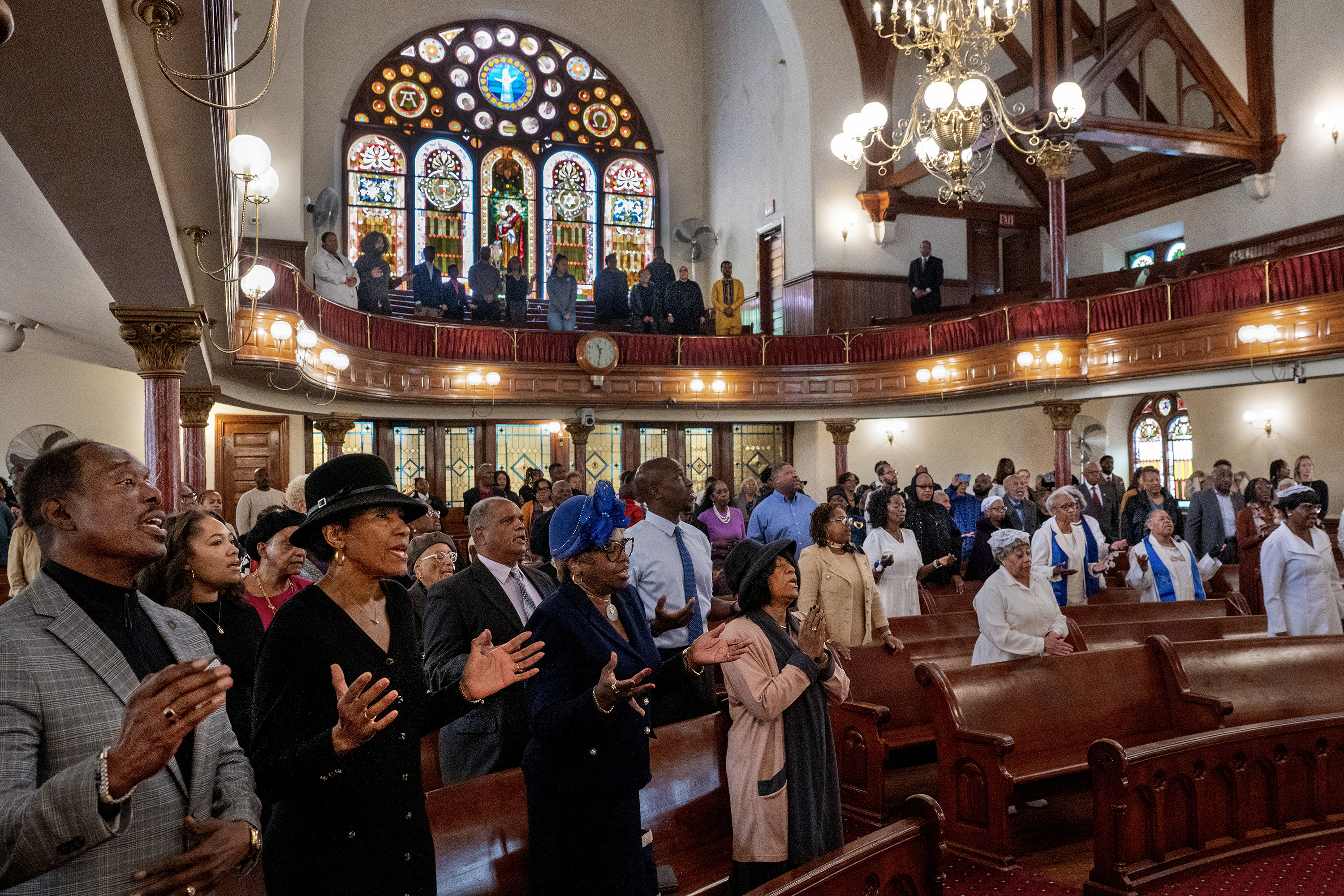
    The congregation sings as Rev. Carolyn Cavaness (not shown) celebrates her first worship service on Nov. 10, 2024.

    It’s been an amazing first year, definitely life-transforming, being entrusted with this national, this international treasure. I have just been captivated by the testament and the hope that she bears.

    There’s this connection, this affinity for her. We’ve gotta be intentional about being the light, about being a place of love, sanctuary, refuge, that people feel safe. That’s a real thing for me.

    The people I’ve come to know, the smiles, their new sense of hope — it is possible, you know? People have a sense of joy, and you can feel that and see that. Sometimes when you’re a leader, you’re in a vacuum. And so to hear and to see people smiling more, that does something. As a pastor, that’s a gift. You feel that you’re making a difference.

    You are the first woman pastor at Mother Bethel A.M.E. How has it felt to hold that distinction, and how have people received you?

    People have been very supportive. It’s about building trust and relationships. All I knew, I could only be Carolyn. I can’t be anybody I’m not. I like to laugh, I like to joke. I think I have surprised people by being accessible.

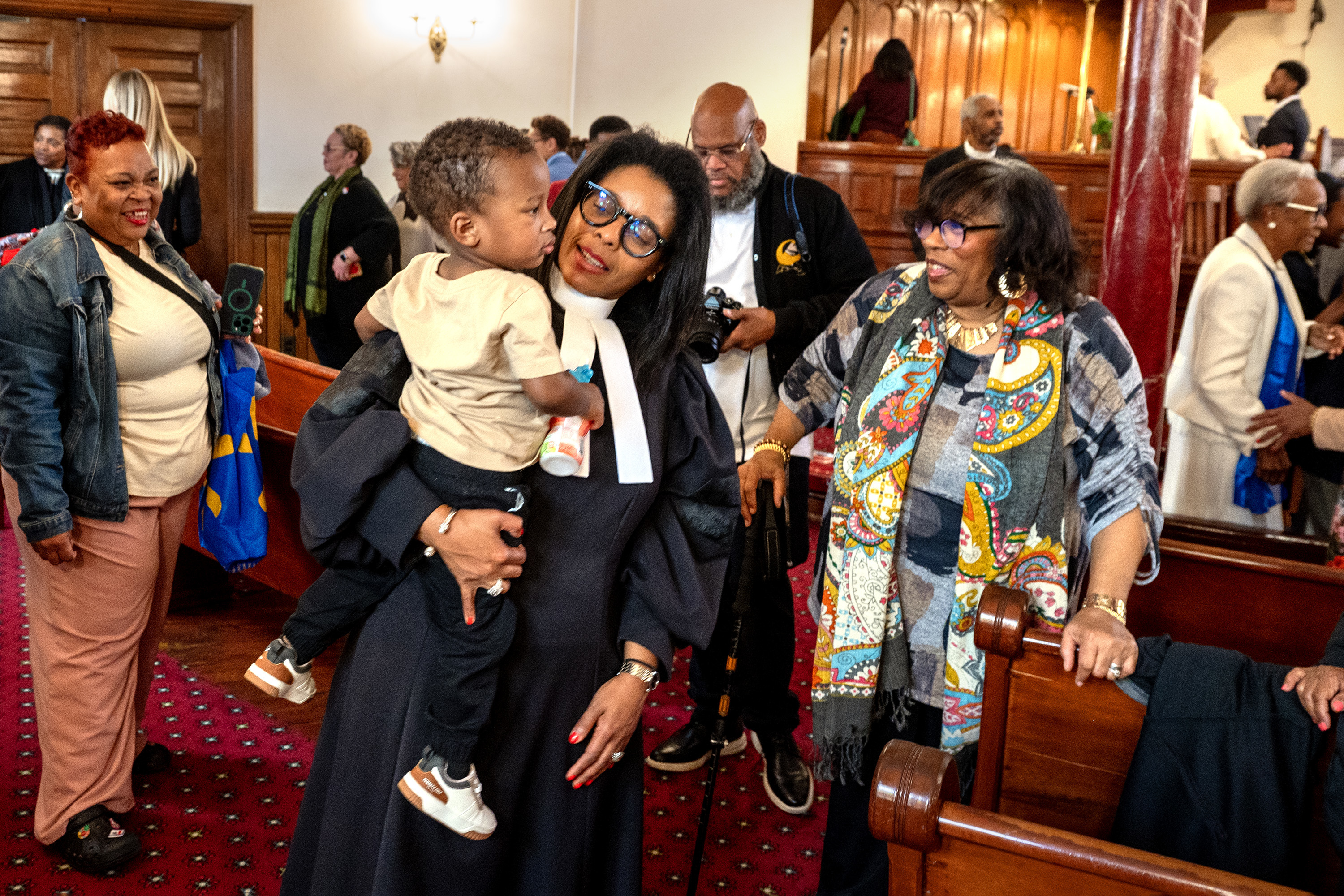
    Rev. Carolyn Cavaness holds 2-year-old Kylo Banks as she greets members of the congregation after her first service.

    Many people have reminded me, “You know, reverend, you’re a historical figure. Amongst the 53, there’s gonna be that picture of you.” It’s very humbling.

    I went to New Orleans and an older gentleman walked up and he said, “Hello, good to meet you. You’re pastor of Mother Bethel.” Fifty years ago, that would have been a different conversation.

    I have two twin nephews. They had a women’s history project, and they wrote about me being the pastor of Mother Bethel. My 5-year-old nephews are esteeming me. That was special.

    When you were appointed last year, Donald Trump had just won the election, and many of your congregation were fearful of what was to come. What is Mother Bethel’s role during this time?

    We are resilient people. This is not the first time that we have had pharaohs and tyrants and dictators.

    Here is an institution providing, a way in which government ought to, esteem and affirm and care for [people]. Democracy has ideals, but here, this place, Mother Bethel, is where it’s realized. Where you’re a safe haven and a sanctuary. The principles and the ideals of the Free African Society. We come from that legacy, from that line where we have always taken care. We have always filled a gap. We’ve always been out front.

    The Rev. Carolyn Cavaness celebrates her first worship service.

    Another has definitely been around how we honor our history and legacy. I was honored to give the eulogy for Ruby Boyd — she was the first African American librarian in the city of Philadelphia. She lived to be 105, and she’s one noted for putting into a book, On This Rock, of Mother Bethel, the history of many of the stained glass window collection, pictures and little vignettes about the pastors. And so in my eulogy, I talked about that we have a responsibility to tell the story and to make it accessible.

    This regime of erasure has really amplified my efforts as the spiritual leader and also just how important Mother Bethel is.

    What are you looking forward to in year two?

    I’m looking forward to the [Semiquincentennial], the 250th. Definitely the larger preservation plan, there are some conversations that we as a congregation are gonna be having about her preservation and how accessible [it is]. And to continue to tell this story.

    I think also around community engagement. Just seeing people becoming more strengthened in their sense of witness.

    The Rev. Carolyn Cavaness (center) at the Independence Visitor Center during a September Semiquincentennial event.
  • This Philly charter has been roiled by upheaval and turnover. Now, its renewal is on hold.

    This Philly charter has been roiled by upheaval and turnover. Now, its renewal is on hold.

    For years, Northwood Academy Charter School was a stable Philadelphia charter — the kind of place where teachers and administrators stayed for decades, and children thrived.

    But in the last few years, the school, on Castor Avenue in Frankford, has cycled through dozens of administrators and teachers and test scores have dropped. Academics have suffered, according to interviews with a number of parents and staff, who say the school feels less safe, and staff morale is low.

    The school’s five-year charter expires this year, but Northwood’s renewal is on hold, The Inquirer has confirmed, because the district’s Inspector General’s Office is reviewing information about Northwood. The exact nature of the investigation is unclear.

    The Inquirer spoke to and reviewed testimony from more than a dozen parents and current and former Northwood staff. Nearly everyone interviewed requested anonymity for fear of reprisal; some who spoke out at meetings have received cease and desist letters threatening litigation from a consultant who provides human resources services to Northwood.

    “When we first got there, there was stability at the school — everyone was there since almost the beginning,” one parent said. “Now, in the last five years, we have had 20 administrators change over. The kids can’t get comfortable with the teachers, because they don’t know if they’re going to be there a long time.”

    Northwood, which opened in 2005, educates 800 students in grades K through 8. As a charter, it’s independently run but publicly funded; the Philadelphia school board authorizes its funding but does not manage its operation.

    School officials say the Northwood turnover is not excessive, but rather a function of its board of trustees’ move to steer the school to better outcomes.

    “Our goal here is to just move forward and help our students achieve,” said Kristine Spraga, a longtime board of trustees member who now serves as the board’s treasurer.

    The board’s challenge, human resources consultant Tracee Hunt said, “is getting the person who has that strategic focus, who doesn’t necessarily operate more like a principal than a CEO. What happens is we’ve hired what we thought were great hires, and then if they decide, ‘This is a little bit too much for me, the board doesn’t have any control over that.’”

    The board this month hired former Central Bucks School District Superintendent Steven Yanni to lead the school.

    A pivot point

    Northwood handled human resources in-house in its early days. When a principal left in 2018, there was some unrest among faculty after a number of teachers were shifted around.

    Shortly thereafter, one board member suggested bringing in Total HR Solutions, a New Jersey-based provider that had worked with some other Philadelphia charters, to manage those services.

    That was a pivot point for the school.

    Hunt was charged with examining the school’s practices. She found “a lack of fair and equitable hiring practices,” she said in an interview last week, “a massive amount of nepotism,” and inadequate staff diversity — the school educates mostly Black and Latino students but its staff was mostly white.

    “Through natural attrition, we have the opportunity to have fair and equitable hiring practices so that then you improve in your areas of diversity in just a natural way, versus feeling like you have to displace people,” said Hunt.

    Some current and former staff see things differently. The earlier version of Northwood wasn’t perfect, they said, but it was cohesive, and under Total HR, that changed.

    Adam Whitlach, a longtime Northwood school counselor, said Total HR “came in with the idea of ‘demolish, and re-create something from nothing.’ They were mixing it up for the sake of mixing it up. They treated it like it was a turnaround school, but it wasn’t, there was an existing community. They attempted to sell them a story that our school was failing and racist, but people didn’t believe that.”

    In 2021, the school’s longtime CEO, Amy Hollister, abruptly left Northwood with no notice to the staff and families with whom she had built a strong rapport.

    “It was out of the blue, and then everybody else started leaving,” another Northwood parent said. As with others, the parent asked not to be identified for fear of blowback. Parents began attending board meetings — at one, Hunt stood up, the parent said, “and began to tell us how the teachers want a more diverse school, and that’s the reason why all this upheaval was happening.”

    The parent, who is a person of color, said they were not bothered by the staff’s demographic balance. “Those teachers loved our children. Everybody knew you, you didn’t have to go past security, and they welcomed every parent, every child. There weren’t a lot of discipline issues, because they had relationships with our kids,” the parent said.

    More departures

    Changes accelerated after Hollister left.

    “Parents were grabbing me by the arm and saying, ‘Whitlach, tell me what’s going on here,’” the former counselor said. “The bullhorns came out, the security guards dressed all in black came out.”

    (Whitlach was ultimately fired after 15 years at the school after, he said, he complained publicly about the school pushing staff out. Students walked out in protest of his departure.)

    The departures affected academics too. A third parent said she was frustrated by “no curriculum, no books.”

    Administrations came and went. Audrey Powell came to Northwood as an assistant principal in 2023, following then-CEO Eric Langston, who has since left; Langston left this summer, and Powell resigned soon after.

    The reason for her departure?

    “I just didn’t agree with the direction or the choices of the board,” Powell said. She repeatedly brought concerns to the board that were ignored, she said. In particular, she was alarmed by the board’s relationship with Total HR and Hunt’s “overreach” at Northwood, Powell said.

    “I don’t think there were enough checks and balances,” Powell said. “I feel like [Total HR’s] contract incentivizes there to be turnover — she directly financially benefits from there being turnover.”

    Northwood paid Total HR $1.4 million between 2020 and 2023, according to public records. That included base fees for Total HR’s services, including an HR generalist who works at Northwood but is paid by Total HR, and also per-position search fees for administrative positions and board seats.

    “The constant turnover is a misuse of taxpayer dollars, and it’s a disservice to kids, to the teachers,” said Powell. “There can’t be progress when there is that much turnover. It’s two steps forward and four steps back.”

    Hunt dismissed the notion that she was simply out to make money.

    “We have these contracts that are negotiated,” said Hunt, whose firm works across industries. “Everything that I bring to Northwood, I bring below market rate.”

    The school district’s charter chief, Peng Chao, said Northwood’s spending on human resources appears to be more than is typical.

    “This level of spending is not what we usually see for this type of scope of work,” Chao said. “While we recognize the staffing challenges that schools are navigating, it is important for schools to remain mindful of fiscal constraints as we all work through an uncertain budget environment.”

    Yanni, who began as Northwood’s CEO Oct. 6, said while Total HR provides services, ultimately, hiring and firing decisions rest with the CEO.

    “HR is an adviser to us, so HR doesn’t make the hiring and firing decisions, they provide the guidance from the place of compliance and the law,” said Yanni.

    ‘Beyond frustrated’

    Staff and parent concerns about Northwood are not new. At board of trustees meetings, speakers often give impassioned testimony on the subject.

    At last week’s trustees’ meeting, kindergarten teacher Emily Parico told the board that “something nefarious is going on at Northwood, and you sit by, silent and complicit. Northwood used to be a learning sanctuary. It wasn’t perfect, but it was a place where students, staff, and families felt safe and loved.”

    Parico is the Northwood teachers union’s vice president. Most city charter teachers are not unionized; Northwood’s voted to form a union in 2023 amid turmoil at the school.

    Kim Coughlin, a fourth-grade teacher and the union president, said the school continues to be roiled.

    “Every day, teachers and staff are thinking of walking away, and two just did yesterday,” said Coughlin. “And our families are beginning to look elsewhere, because they feel the shift. The school that we once knew and loved has become unrecognizable.”

    Questions and threats of legal action

    When Langston, the CEO prior to Yanni, left suddenly in August, dozens of families and staff asked the board for answers, but none were forthcoming, said Kevin Donley, the school’s psychologist.

    “I’m beyond frustrated,” said Donley, who’s secretary of the union. “And deeply disappointed by the manner in which the board of trustees has governed our school in recent months and years.”

    At least 50 people sent letters to the board of trustees expressing concern about further turmoil after Langston’s departure, Donley said. As far as he knows, not one person heard back, either in a letter or any kind of message.

    Both Hunt and the board have sent letters threatening some who speak out with legal action; Hunt said she won a legal challenge against one parent who falsely said she had been fired by a previous client. (The client, Hunt said, moved HR services in-house and did not fire her.)

    “It’s not uncommon to have a few naysayers, but eventually when you start seeing the fruit of all this board’s labor, the reason I stick in here is because I watch them stay so focused on the kids,” Hunt said.

    School officials told The Inquirer that the staff and parents who have spoken out represent “a very small number of people who are quite passionate,” but not representative of all staff and parents.

    “I don’t see that the vast majority feel the same,” said Spraga, the board treasurer. “Otherwise, we would have those indicators in things like the engagement surveys, right?”

    Spraga, Hunt, and board president Warren Young said staff and community engagement surveys do not match the sentiments expressed at board meetings.

    New leadership under Yanni

    The Northwood CEO job is Yanni’s first foray into the charter sector; he was previously superintendent in the Lower Merion, Upper Dublin, and New Hope-Solebury school systems. Yanni was terminated as the Central Bucks superintendent last week over allegations that he mishandled child abuse allegations in a special education classroom — a contention he denies.

    Yanni said he’s thrilled to be at Northwood, where class sizes are small — 23, typically — and there’s a feeling of welcome.

    “There’s passion here,” Yanni said. “And it’s not just the staff, it’s the kids too — this is their school. Kids really feel like Northwood is their home, and we have engaged families.”

    Northwood is completely full, with a waitlist of 200 students per grade level, Yanni said, and applications are already coming in for the 2026-27 school year.

    In the 2018-19 school year, 64% of Northwood students met state standards in reading, and 30% in math; in the 2024-25 school year, the last year for which scores are publicly available, 31% of Northwood students hit the mark in reading and 11% in math. In 2018-19, Northwood beat Philadelphia School District scores (35% proficiency in reading, 20% in math) and in 2024-25, the district did better (34% proficiency in reading, 22% in math).

    Yanni said Northwood is a school on the rise and is beginning to implement positive behavioral supports to improve school climate. It’s also in the early days of an academic intervention process to identify and target individual students’ skill gaps.

    “I think we’re going to see dramatic gains this year,” said Yanni.

    Northwood “is a school that people stick with,” he said. And though the city has plenty of choices for families, “we’re going to start a strategic planning process, and really kind of blow the doors off. You hear about KIPP, and you hear about these large charter networks and then there’s little tiny Northwood. How do we make it the beacon, the flagship?”

  • Medicare coverage for telehealth suspended as result of government shutdown

    Medicare coverage for telehealth suspended as result of government shutdown

    Steve Hirst relies on virtual visits with his urologist, whose office is an hour away from his Broomall home, to stay on top of his treatment plan and renew medications.

    But earlier this month Hirst, 70, got a notice from his doctor’s office informing him that it could no longer schedule telemedicine visits for patients like him who have Medicare because of new federal policy changes.

    Medicare began covering telemedicine services during the COVID-19 pandemic and has maintained the popular offering through temporary waivers approved by Congress since. But the most recent of those waivers expired at the end of September when Congress failed to reach a budget deal and the government shut down.

    The change specifically affects traditional Medicare, which is administered by the government for people 65 and older and some with disabilities. People with Medicare Advantage plans, which are administered by private insurers, should check with their plan.

    Medicare coverage for virtual visits for mental health was made permanent after the pandemic and are not affected by the shutdown.

    Some of the Philadelphia area’s leading health systems, including Temple Health and Penn Medicine, have said they are continuing to provide telehealth services to people with Medicare and temporarily suspending billing for those services, with hope that coverage will be reinstated when a budget deal is eventually reached.

    But smaller provider practices may not have the luxury of delaying payment for thousands of dollars in services for an indefinite period of time.

    With the government shutdown in its third week, Republicans and Democrats seem no closer to reaching a deal. The next vote is scheduled for Monday evening, though no deal is expected.

    Another health policy issue — tax credits for people who buy insurance through Affordable Care Act marketplaces, including Pennie in Pennsylvania — has been a major sticking point in the ongoing federal budget debate. Democrats want the enhanced subsidies extended permanently as part of the budget deal, and Republicans have refused, arguing that lawmakers could address the issue separately, before the subsidies expire at the end of the year.

    Meanwhile, the waiver’s expiration has left Hirst and others who are covered by Medicare unsure how they will access needed health services.

    Telehealth’s rise

    Telehealth rose in popularity during the COVID-19 pandemic, when people were urged to avoid hospitals unless they were having an emergency and when most routine procedures were canceled.

    The approach was especially helpful to older adults and people with disabilities, who needed to stay in contact with doctors for ongoing treatment and who were considered particularly vulnerable to severe illness from COVID-19.

    After the pandemic ended, many private insurers, Medicaid, and Medicare permanently adopted telehealth coverage for certain services, such as mental health, because of its popularity during the pandemic.

    Medicare has used temporary waivers to continue telehealth coverage for other types of doctors’ visits.

    Beyond patient popularity, research has found that telehealth visits can be as effective as in-person visits for certain types of care, such as palliative care for cancer patients, while improving access to patients with transportation challenges.

    Philadelphia health systems respond

    Philadelphia’s largest health systems said they are optimistic that coverage will be reinstated — either by a new temporary waiver or a permanent change — when Congress reaches a new budget agreement and the shutdown ends.

    Temple Health will continue to provide telehealth services to Medicare patients for the next three weeks, in anticipation of Congress reaching a deal.

    Penn Medicine has not billed Medicare patients for telehealth visits since the shutdown began and has paused its process for filing claims until the government reopens, a spokesperson said.

    “Congress has been vocal in its support of telehealth and its value, and we are hopeful that legislation will be passed to ensure permanent Medicare telehealth coverage and flexibilities once the government reopens,” Penn said in a statement.

    Main Line Health has been reaching out to affected patients to help them change previously scheduled virtual visits into in-person appointments or reschedule virtual visits that can be put off.

    Jefferson Health did not respond to a request for comment in time for publication.

    Patients in limbo

    Hirst drives into Philadelphia to see his urologist in person once a year. Every three months, he has a virtual visit to check in and renew prescriptions.

    Driving to Philadelphia for every appointment would be inconvenient, but Hirst will probably do it “for now,” he said.

    But he worries about older adults and people with disabilities who can’t safely drive to the doctor’s office, and for whom virtual care is a lifeline. They could end up putting themselves or others at risk being on the road when they shouldn’t be. Or they may end up skipping needed care because they don’t have a ride.

    “It makes no sense,” Hirst said.

  • New Jersey’s first Hispanic federal judge retires after 40 years on the bench

    New Jersey’s first Hispanic federal judge retires after 40 years on the bench

    After graduating law school in the 1950s, Joseph H. Rodriguez was told he wouldn’t go far and should consider changing his last name.

    He ignored that advice and went on to become New Jersey’s first Hispanic federal judge — and its longest serving. He recently retired after 40 years as a jurist.

    Rodriguez, 94, began his career as a community activist during a tumultuous time in Camden in the ‘60s and as a trial lawyer at a prominent law firm. He later was involved in landmark cases, including the Mount Laurel affordable housing decision before the state Supreme Court.

    He was among the first Hispanic lawyers in Camden, and New Jersey as a whole. He also served as the state’s public defender and advocate.

    Rodriguez mentored countless aspiring lawyers and judges, and as his stature rose nationally he never forgot his humble roots. Associates dubbed him “a gentle giant.”

    “He served with humility, grace, wisdom, and humor,” said Chief U.S. District Judge Renee M. Bumb, who met Rodriguez as a federal prosecutor. “We all looked up to him.”

    U.S. District Judge Joseph H. Rodriguez, 94, sits for an interview at his daughter’s law office in Cherry Hill, N.J. U.S. District Judge Joseph H. Rodriguez, 94, was the first Hispanic federal judge in New Jersey. His father, Mario Rodriguez, survived the 1918 sinking of the SS Carolina.

    Rodriguez became a senior judge in 1998, which reduced his workload, but he continued to preside over trials and write opinions, filing his last decision about three weeks before he retired.

    ‘I just wanted to slip into the shadows’

    Rodriguez decided last month to quietly retire. He left the Mitchell Cohen Courthouse in downtown Camden after an emotional send-off with fellow judges and friends.

    “I just wanted to slip into the shadows.” he said in a recent interview. “What I’ve done some people were in favor of it, some were not. It’s there as a public record. I stand by it.”

    Rodriguez was born in 1930 in Camden and grew up a few blocks from the courthouse where he would later preside.

    His father, Mario, a Cuban national raised in Puerto Rico, was aboard the passenger ship SS Carolina when it was torpedoed by a German U-boat off the coast of New Jersey in June 1918.

    The New York Times front page story about the sinking of the SS Carolina in 1918. U.S. District Judge Joseph H. Rodriguez has a copy of the paper because his father survived the sinking.

    The Germans targeted six ships on what was known as Black Sunday. The Carolina sunk, and Mario Rodriguez spent two days on a lifeboat before swimming ashore in Atlantic City.

    Rodriguez would later have a full circle moment, when scuba divers made a claim in federal court to salvage the vessel. He said he granted sole rights after the divers presented a brass “C” from the ship’s name on the stern and a china dinner plate with its logo.

    Mario raised four sons and a daughter in Camden with his wife, Carmen, and worked in a tobacco factory.

    The couple, among the first Hispanic families to settle in Camden, was highly respected in the community, and often served as interpreters and gave advice to other Hispanic residents.

    As a youngster, Rodriguez recalled hearing his father recite the U.S. Constitution to study to become a citizen, which he did in 1939 — in the same courtroom where his son later became a judge.

    The memory stuck with Rodriguez and became a guiding principle in his legal career. His parents and sister were killed in a car accident in 1973.

    Camden’s first Hispanic lawyer

    Rodriguez graduated from what is now La Salle University in 1955. After spending three years in the military, he obtained his law degree in 1958 from Rutgers Law School in Camden.

    When he landed his first job at a real estate firm, the agent urged Rodriguez to change his name to Joe Roddy.

    “I was told with that name I could never go far,” he recalled. “I would never change my name.”

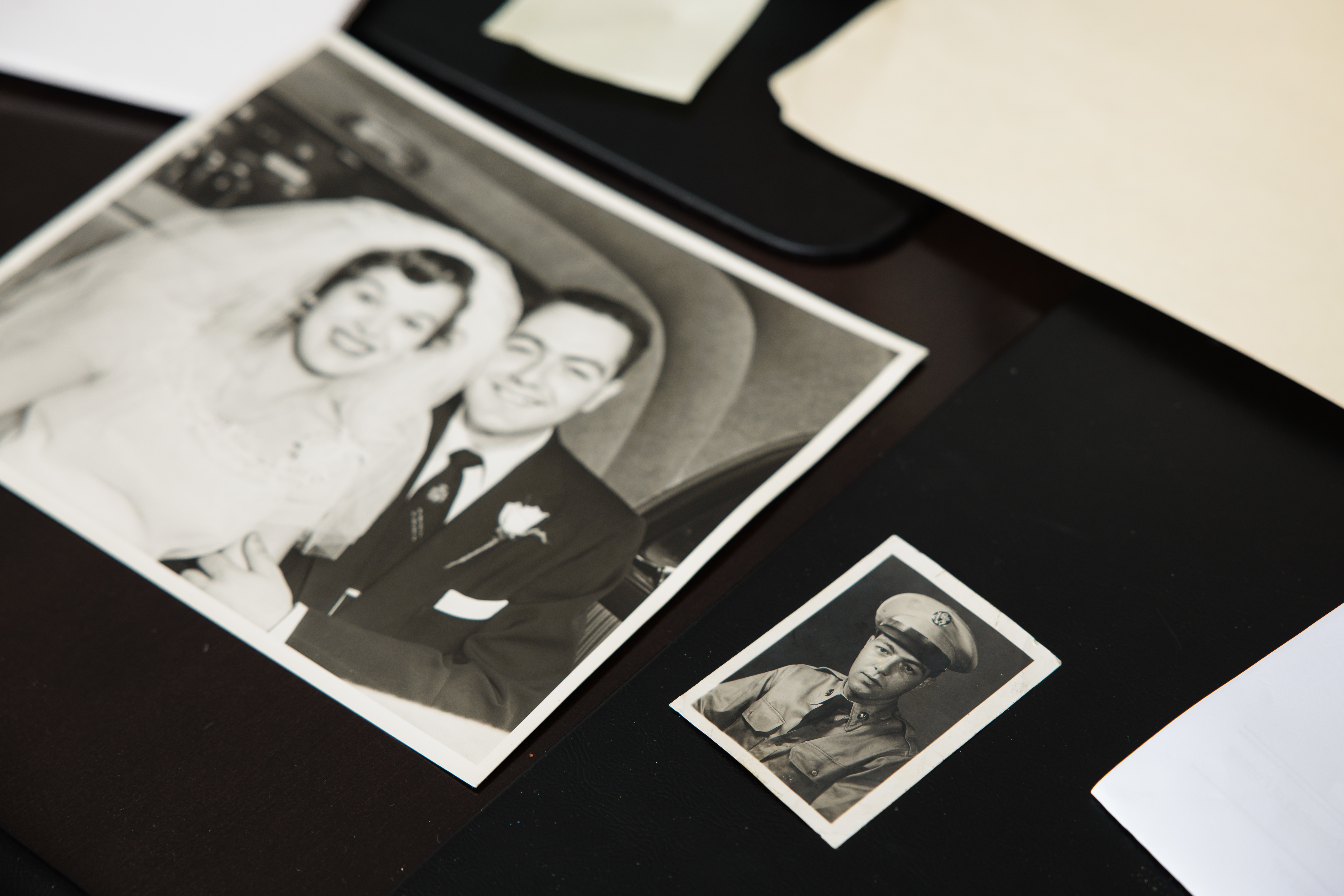
    An undated Army photograph of Joseph H. Rodriguez, now 94, and his wedding photo.

    Rodriguez was hired as an attorney at Brown & Connery, one of the oldest law firms in South Jersey. He earned a reputation as a tough trial lawyer and specialized in medical malpractice. He later became the first Hispanic president of the New Jersey Bar Association.

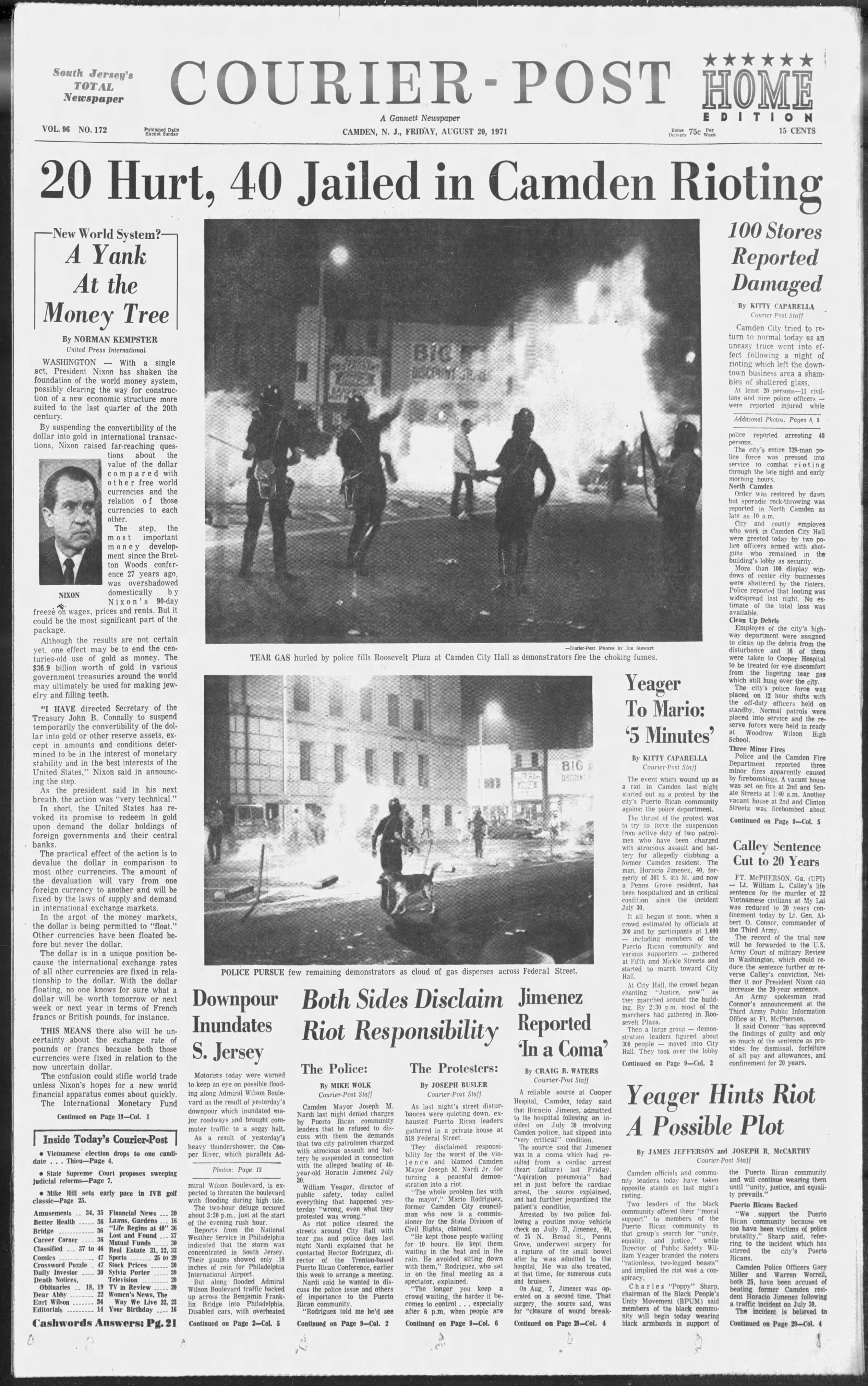
    Rodriguez was pressed into action when unrest erupted in Camden in 1971, after a Hispanic man was killed while in police custody. The Hispanic community demanded an investigation. A protest turned into days of rioting in front of City Hall.

    Then the only known Hispanic lawyer in Camden, Rodriguez met with then-Mayor Joe Nardi to negotiate a settlement. The police officers were eventually indicted by a grand jury, but acquitted.

    The Courier-Post edition pictures a riot at Roosevelt Plaza at Camden City Hall Aug. 20, 1971.

    “He was the calm in the eye of the storm,” said Gualberto “Gil” Medina, who organized a student protest at the time. “He made it clear that the cause was just but the means had to be tempered.”

    Rodriguez eventually left Camden for the suburbs but remained connected to the city. He was one of the original organizers of Camden’s San Juan Bautista Parade.

    “He became the respected patriarch of the Hispanic community,” said Medina.

    `A public conscience’

    Rodriguez advocated in many precedent-setting cases for New Jersey’s disenfranchised residents. They include a landmark product liability case that resulted in the state Supreme Court ruling in 1965 that a mass builder could be held liable for a defective hot water system that severely scalded a child.

    As chairman of Camden Legal Services, he brought a lawsuit that resulted in a requirement for municipal judges to appoint a lawyer to represent defendants facing possible jail time. Another case established tenant rights.

    Then-Gov. William T. Cahill named Rodriguez chairman of the State Board of Higher Education in 1972, and later chairman of the State Commission of Investigation, where he investigated organized crime.

    Although Rodriguez was a Democrat, former Republican Gov. Thomas Kean appointed him as the state’s Public Advocate in 1982.

    In that role, Rodriguez filed the complaint that lead to Mount Laurel doctrine, through which the New Jersey Supreme Court outlawed local discriminatory zoning regulations and required municipalities to provide affordable housing.

    “He always had a public conscience,” said Carl D. Poplar, a lawyer and longtime friend.

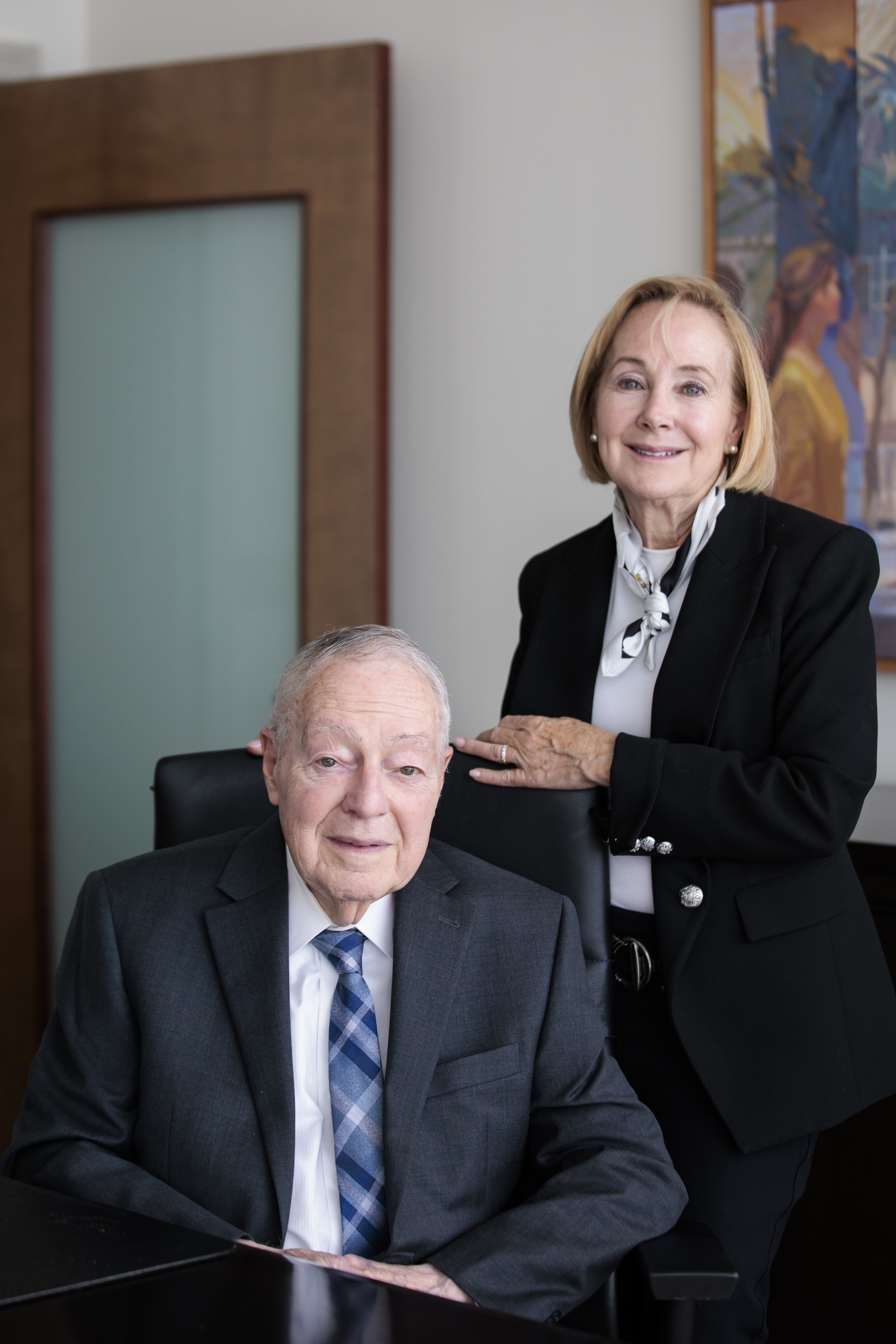
    Judge Joseph H. Rodriguez, 94, posed for a portrait with his daughter Lisa Rodriguez at her law office in Cherry Hill this month.

    Rodriguez also was involved in the landmark right-to-die case of Karen Ann Quinlan, whose parents waged a fight to have her removed from a respirator.

    “We didn’t go around looking for trouble. If it had to be done and people had to be helped, you help them,” Rodriguez said.

    President Ronald Reagan appointed Rodriguez to the federal bench in 1985.

    Rodriguez was known as an easygoing and fair judge. U.S. Supreme Court Chief Justice William Rehnquist dispatched Rodriguez to Montgomery, Ala., in 1999 to preside over a desegregation case.

    “It was like going to heaven working for him,” said Carl Nami, his court reporter for 18 years. “I don’t how I was so fortunate.”

    Nicknamed “Joe Rod,” Rodriguez was a role model for other judges, said retired U.S. Magistrate Joel B. Rosen. He could always be counted on for jokes and bad puns at their weekly lunch gatherings, he said.

    “He’s always been a gentleman and what in my view what a judge should be: knowledgeable and fair,” Rosen said.

    Said Robert Kugler, another retired federal judge: “He kept the courthouse going.” The jury room was named in honor of Rodriguez.

    “His judicial demeanor and temperament are unrivaled,” said civil rights attorney Stanley O. King. “The likes of him I don’t know if can ever be replaced or replicated.”

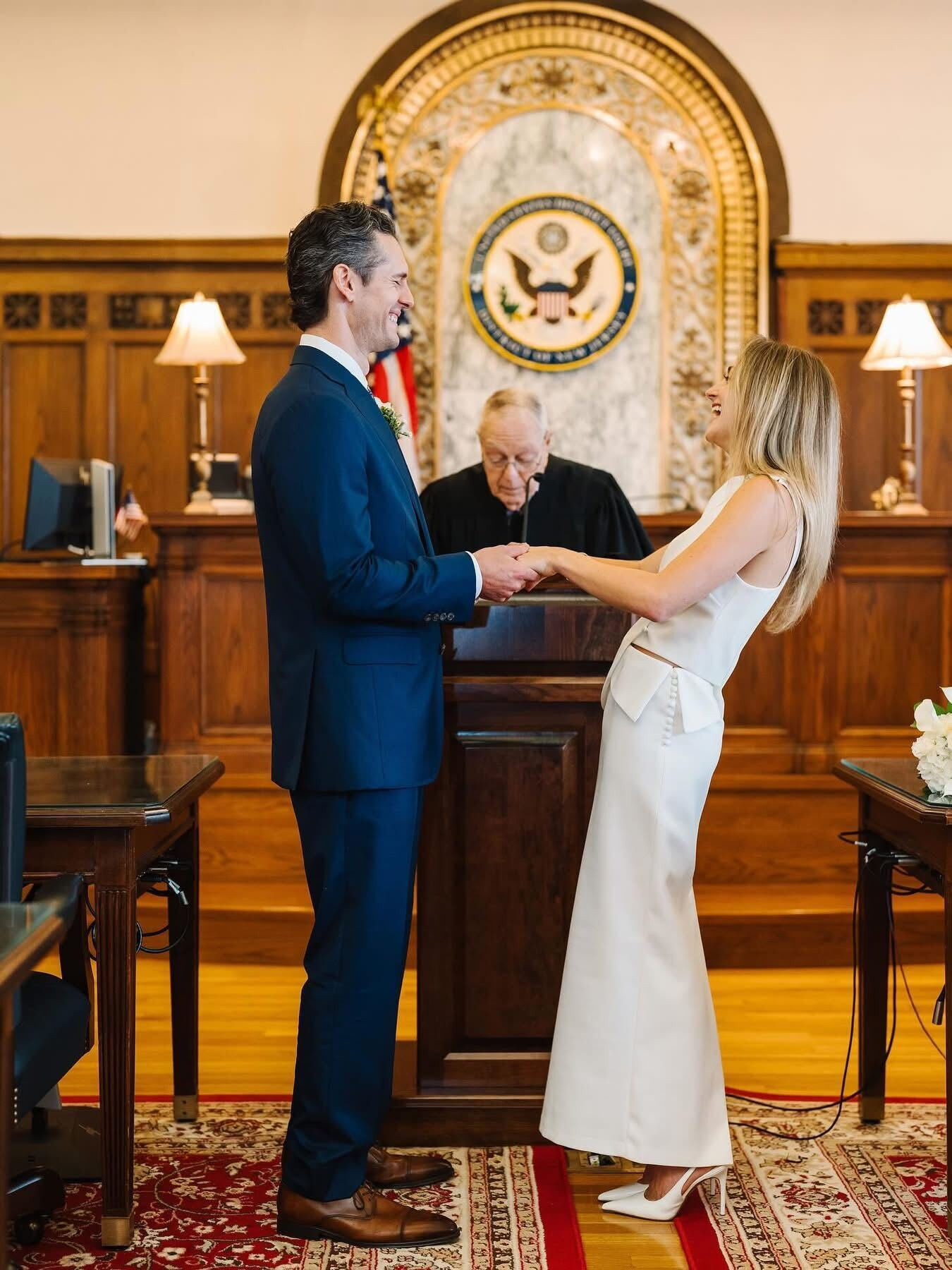
    U.S. District Judge Joseph H. Rodriguez performed the marriage ceremony of his granddaughter Taylor Jacobs to Cole Sutliff. It was held in the same courtroom where Rodriguez presided in federal court in Camden for years.

    Before stepping down, Rodriguez performed a final act as a sitting judge. He performed the wedding ceremony for a granddaughter, Taylor, in his courtroom. He also recently married a grandson, Quinn, in a beach ceremony.

    Rodriguez said he plans to spend more time with his wife of 71 years, Barbara, and his four daughters, 10 grandchildren, and seven great-children. He enjoys cooking for them, especially paella, his specialty dish.

    U.S. District Judge Joseph H. Rodriguez performed the marriage ceremony of his grandson Quinn Jacobs and Brittany Peters at the Jersey Shore.

    Asked what he would like his legacy to be, Rodriguez choked back tears. His daughter, Lisa Rodriguez, an attorney with Dilworth Paxson, passed him a tissue.

    “You can’t do it all, but you should never stop trying,” he said. “If everyone backs away you’re just giving up.”

  • ‘Philly crime’ and the specter of Donald Trump are dominating two Bucks County law enforcement races

    ‘Philly crime’ and the specter of Donald Trump are dominating two Bucks County law enforcement races

    Bucks County Republicans are stoking fears about crime in Philadelphia even as violent crime in the city steadily drops from its high during the pandemic.

    Digital ads Republicans have circulated for the county’s sheriff and district attorney races since August tell voters to “keep Philly crime out of Bucks County,” borrowing a tactic from President Donald Trump, who regularly promotes exaggerated visions of crime-ridden liberal cities.

    Republicans in the purple collar county hope the message will boost the GOP incumbents, District Attorney Jen Schorn and Sheriff Fred Harran, as they face off this fall against their respective Democratic challengers, Joe Khan and Danny Ceisler.

    “We’re letting anarchy take over our country in certain places, and that’s not something we want in Bucks,” said Pat Poprik, the chair of the Bucks County Republican Party.

    Meanwhile, Democrats are eager to tie the GOP incumbents to Trump, portraying them as allies of a president whose nationwide approval rate is dropping.

    Khan, a former county solicitor and former federal prosecutor who unsuccessfully ran for attorney general last year, is seeking to portray himself as less politically motivated than Schorn, a veteran prosecutor who is running for a full term as district attorney after being appointed to the position last year.

    Ceisler, an Army veteran and an attorney who worked for Democratic Gov. Josh Shapiro’s administration, has taken a similar approach in his race against Harran, the outspoken Republican sheriff who has sought a controversial partnership with U.S. Immigration and Customs Enforcement.

    “Democrats are far more enthusiastic about voting precisely because they see what’s happening on the national level. They are really infuriated by what Donald Trump is doing,” State Sen. Steve Santarsiero, who chairs the Bucks County Democratic Party, said. “They’re going to make their displeasure heard by coming to the polls.”

    The local races in the key county, which Trump narrowly won last year, will be a temperature check on how swing voters are responding to Trump’s second term and will gauge their enthusiasm ahead of the 2026 midterms, when Shapiro stands for reelection.

    As the Nov. 4 election approaches, early signs indicate Democrats’ message might be working — polling conducted by a Democratic firm in September found their candidates ahead, and three weeks before Election Day, Democrats had requested more than twice as many mail ballots as Republicans.

    “I think the Republican Party has the same problem it always does. … They turn out when Trump’s on the ticket, but when he’s not, there’s less enthusiasm,” said Jim Worthington, who has run pro-Trump organizations in Bucks County. “Truth be told, the Democrats do a hell of a job just turning out their voters.”

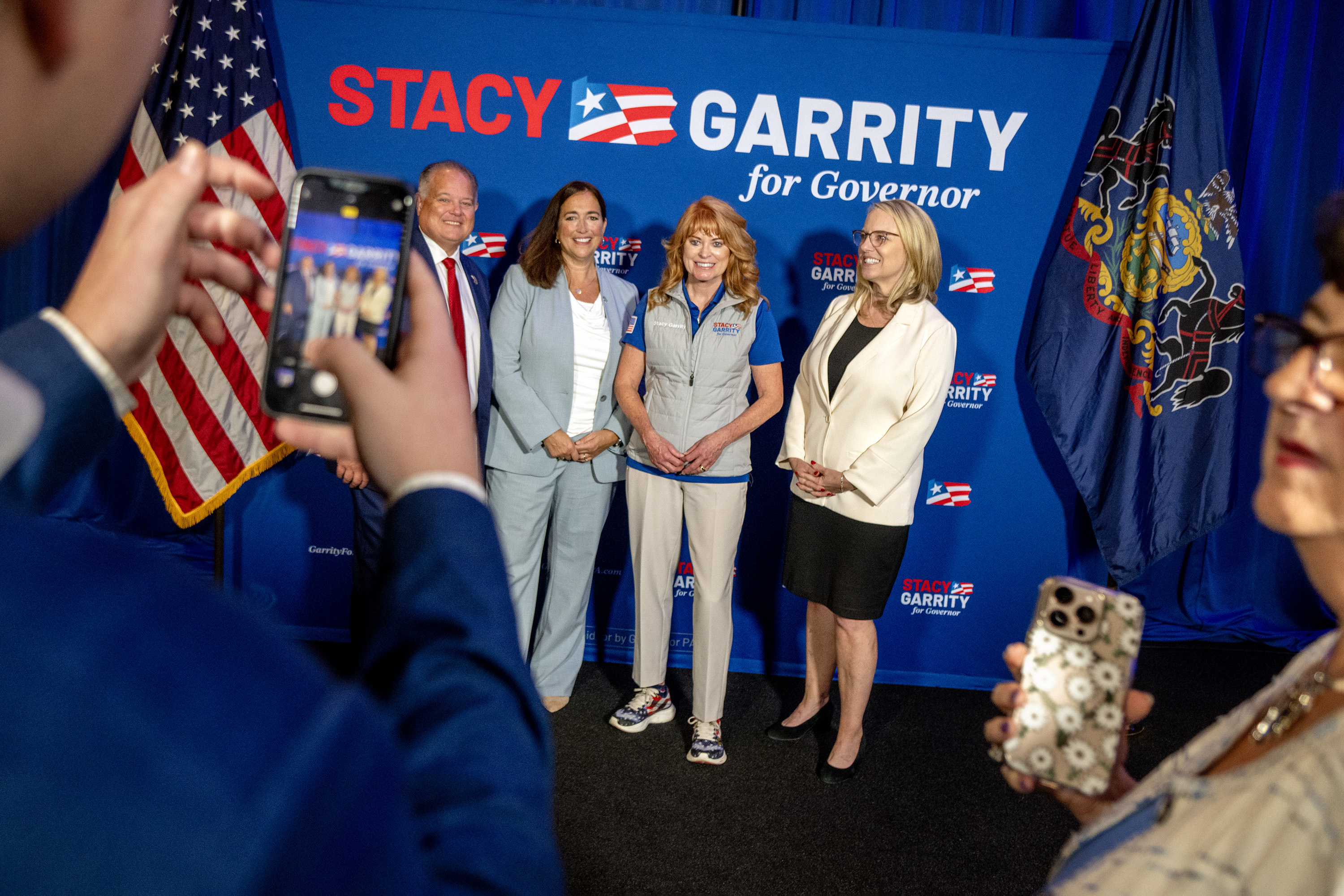
    State Treasurer Stacy Garrity, a Republican running for Pa. governor, poses with Bucks County elected officers following her campaign rally Sat the Newtown Sports & Events Center. From left: Bucks County Sheriff Fred Harran; Bucks County District Attorney Jennifer Schorn; Garrity; and Pamela Van Blunk, Bucks County Controller.

    GOP warns of ‘dangerous’ policies

    Republican messaging in the two races focuses on the idea that Bucks County is safe, but its neighbors are not.

    GOP ads, which have run over the course of four months, suggest that Khan and Ceisler would enact “dangerous” policies in Bucks County such as “releasing criminals without bail” and “giving sanctuary to violent gang members.”

    Democrats reject these ads as scare tactics. The ads make implicit comparisons to Philly’s progressive District Attorney Larry Krasner, who is poised to win a third term in the city but remains a controversial figure in the wider region even as violent crime rates have fallen in the city.

    They frame Harran and Schorn in stark contrast to their opponents as lifelong Bucks County law enforcement officers with histories of holding criminals accountable.

    “I think it resonates beyond the Republican base,” said Guy Ciarrocchi, a Republican analyst, who contended frequent news coverage of Krasner makes the message more viable.

    Khan, a former assistant Philly district attorney who unsuccessfully ran against Krasner in the 2017 primary, has noted that he campaigned “very, very vigorously” against Krasner and challenged his ideas on how to serve the city.

    “I accept the reality that I didn’t win that election,” said Khan, whose platform in 2017 included a proposal to stop prosecuting most low-level drug offenses. “Unlike my opponent, who seems to basically enjoy the sport of scoring political points by sparring with the DA of Philadelphia.”

    Schorn, however, is adamant that politics has never played a role in her prosecutorial decisions. Her mission, she said, is “simply to get justice.”

    A lifelong Bucks County resident who has been a prosecutor in the county since 1999, Schorn handled some of the county’s most high-profile cases and spearheaded the formation of a task force for internet crimes against children.

    Bucks County District Attorney Jennifer Schorn speaks at a Republican rally at the Newtown Sports & Events Center in September.

    “This has been my life’s mission, prosecuting cases here in Bucks County, the county where I was raised,” she said. “I didn’t do it for any notoriety. I didn’t do it for self-promotion. I did it because it’s what I went to law school to do.”

    Harran spent decades as Bensalem’s public safety director before first running for sheriff in 2021. He is seeking reelection amid controversy caused by his decision to partner his agency with ICE, a move that a Bucks County judge upheld last week after a legal challenge.

    “Being Bucks County Sheriff isn’t a position you can learn on the job. For 39 years, I’ve woken up every day focused on keeping our communities safe,” Harran said in an email to The Inquirer in which he criticized Ceisler as lacking experience.

    Although Ceisler has never worked directly in law enforcement, he argues the sheriff’s job is one of leadership in public safety. That’s something he says he’s well versed in as a senior public safety official in Shapiro’s administration who previously served on the Pentagon’s COVID-19 crisis management team.

    Harran, who described his opponent as a “political strategist,” criticized “politicians” for bringing “half-baked ideas like ‘no-cash bail’” into law enforcement. The concept, which is repeatedly derided in the GOP ads, sets up a system by which defendants are either released free of charge or held without the opportunity for bail based on their risk to the community and likelihood of returning to court.

    Khan and Ceisler each voiced support for the concept in prior runs for Philadelphia district attorney and Bucks County district attorney, respectively.

    Both say they still support cashless bail. Neither, however, would have the authority to implement the policy if elected, though Khan as district attorney could establish policies preventing county prosecutors from seeking cash bail in certain cases.

    Joe Khan, a Democratic candidate running for Bucks County DA, walks from his polling place in Doylestown, Pa. in April 2024 when he was running for attorney general.

    “When a defendant is arrested and they come into court, every prosecutor answers this question: Should this person be detained or not?” Khan said. “If the answer is yes, then your position in court is that this person shouldn’t be let out, and it doesn’t matter how much money they have. And if the answer is no, then you need to figure out what conditions you need to make sure they come to court.”

    Democrats claim to ‘keep politics out’

    Even as Democrats view voter anger at Trump as a key piece of their path to victory, they are working to present themselves as apolitical.

    Democratic ads attack Schorn for not investigating a pipeline leak in Upper Makefield and Harran as caring about nothing but himself. Positive ads highlight Ceisler’s military background and Khan’s career as a federal prosecutor.

    Khan and Ceisler, the Democratic Party’s ads argue, will “stop child predators, stand up to corruption, and they’ll keep politics out of public safety.”

    Khan has described Schorn as a political actor running her office “under Trump’s blueprint.” He has focused on her decisions not to prosecute an alleged child abuse case in the Central Bucks School District or investigate the company responsible for a jet fuel leak into Upper Makefield’s drinking water.

    The jet fuel case was turned over to the environmental crimes unit in Pennsylvania Attorney General Dave Sunday’s office. And prosecutorial rules bar Schorn from discussing the alleged abuse.

    “During the last, I don’t know, 13 years when [Khan] has been pursuing politics, I’ve been a public servant,” Schorn said. “For someone accusing me of putting politics first, he seems to be using politics to further his own agenda.”

    But Schorn appears in GOP ads alongside Harran, a figure who has frequently invited political controversy in fights with the Democratic-led Bucks County Board of Commissioners, his effort to partner with federal immigration authorities, and his early endorsement of Trump last year.

    At a September rally in Newtown for Treasurer Stacy Garrity, a Republican running for governor, Harran cracked jokes about former President Joe Biden’s age as he climbed onto the stage and falsely told voters that they will “lose [their] right to vote” if they don’t vote out three Pennsylvania Supreme Court justices standing for retention.

    Harran has long contended that his decision to partner with ICE was not political.

    “I’m a cop who ran to keep being a cop. This isn’t about politics for me — it’s about doing everything I can to keep my community safe,” Harran said.

    Harran’s opponent, Ceisler, paints a different picture as he draws a direct line between the sheriff and the president.

    Danny Ceisler, a Democrat, is running for Bucks County sheriff.

    Trump, Ceisler said, has inserted politics into public safety in his second term, and he contended that Harran has done the same.

    “[Harran] used his bully pulpit to help get the president elected, so to that extent he is linked to the president for better or worse,” Ceisler said in an interview.

    Ceisler has pledged to take politics out of the office and end the department’s partnership with ICE if elected.

    At an event in Warminster last month, voters were quick to ask Ceisler which party he was running with. Ceisler asked them to hear his pitch about how he would run the office first.

    “Don’t hold it against me,” he quipped as he ultimately admitted to one voter he’s a Democrat.

    Staff writer Fallon Roth contributed to this article.

    This suburban content is produced with support from the Leslie Miller and Richard Worley Foundation and The Lenfest Institute for Journalism. Editorial content is created independently of the project donors. Gifts to support The Inquirer’s high-impact journalism can be made at inquirer.com/donate. A list of Lenfest Institute donors can be found at lenfestinstitute.org/supporters.

  • Pennsylvania state government relies on H-1B workers. Trump wants to charge employers $100,000 for those visas.

    Pennsylvania state government relies on H-1B workers. Trump wants to charge employers $100,000 for those visas.

    Government contractors are among the big employers grappling with President Donald Trump’s plan to charge employers $100,000 for new H-1B visas, which allow hundreds of thousands of workers from foreign countries to work in the United States every year.

    Leading contractors such as Amazon Web Services at the federal level and Deloitte Consulting in Pennsylvania rely on H-1B visas to bring in foreign skilled professionals for their U.S. workforces.

    Once a supporter of the 35-year-old program, Trump said in a September executive order that he now agrees with critics that “systemic abuse” of the visas has displaced U.S. workers, “discouraging Americans from pursuing careers in science and technology,” and driving down wages. He announced a fee of $100,000 for new H-1B visas, which would significantly boost costs for government contractors and other employers that continue to use the visas.

    U.S. immigration officials issue up to 85,000 new H-1B visas a year. Generations of engineers and technical workers have moved to the United States to work for government agencies using these visas. Some remain as permanent residents and become citizens.

    window.addEventListener(“message”,function(a){if(void 0!==a.data[“datawrapper-height”]){var e=document.querySelectorAll(“iframe”);for(var t in a.data[“datawrapper-height”])for(var r,i=0;r=e[i];i++)if(r.contentWindow===a.source){var d=a.data[“datawrapper-height”][t]+”px”;r.style.height=d}}});

    About 50% of all U.S. H-1B visa holders arrive from India, and the percentage is higher in technical fields. More than 80% of Deloitte H-1B visa holders stationed in the Harrisburg area from 2022-2024 originated in India, according to federal visa data. These professionals earned a median of around $100,000 a year.

    Recruiters promoted the visas extensively in 2000 to help U.S. companies update systems under Y2K programs, said Akanksha Kalra, an immigration attorney in Philadelphia who has represented many H-1B visa holders. Since then the program became so popular among employers and applicants that H-1B visas have been awarded through a lottery.

    Here’s what you need to know about H-1B visas.

    Who are the largest employers of H-1B workers in Pennsylvania?

    Among Pennsylvania-based employers, Deloitte Consulting is by far the top H-1B contractor. More than 3,000 of the 9,930 H-1B visas the government granted in Pennsylvania last year were for Deloitte Consulting and its tax and accounting affiliates. The company ranked among the 10 largest H-1B visa users across the U.S. last year. Pennsylvania was a major Deloitte client, paying $260 million for its services to state health, labor, and transportation programs, among others.

    window.addEventListener(“message”,function(a){if(void 0!==a.data[“datawrapper-height”]){var e=document.querySelectorAll(“iframe”);for(var t in a.data[“datawrapper-height”])for(var r,i=0;r=e[i];i++)if(r.contentWindow===a.source){var d=a.data[“datawrapper-height”][t]+”px”;r.style.height=d}}});

    How long can people with H-1B visas work in the U.S.?

    Employers can apply to have H-1B visas extended for a total of six years, boosting the total of H-1B workers in the country at any one time to hundreds of thousands. Spouses of H-1B visa professionals often apply for H-4 work visas.

    Another program popular with employers, the Optional Practical Training work authorization, is available to foreign students entering the workforce, for up to three years; more than 400,000 were granted in 2024.

    Which states have the most H-1B workers?

    Six states — California, Texas, New York, New Jersey, Virginia, and Pennsylvania — account for more than half the 283,000 new and returning H-1B visas approved by the federal government for fiscal year 2024, the most recent data available.

    window.addEventListener(“message”,function(a){if(void 0!==a.data[“datawrapper-height”]){var e=document.querySelectorAll(“iframe”);for(var t in a.data[“datawrapper-height”])for(var r,i=0;r=e[i];i++)if(r.contentWindow===a.source){var d=a.data[“datawrapper-height”][t]+”px”;r.style.height=d}}});

    The largest H-1B employers include Amazon’s Virginia operations, whose clients include the Pentagon and other U.S. security, surveillance, and technology agencies; other Big Tech employers such as Meta, Oracle, and Google; banks such as J.P. Morgan and Goldman Sachs; and manufacturers, such as automakers General Motors, Ford, and Tesla. Hospitals use the visas to bring in doctors, universities for professors.

    How does Pennsylvania state government rely on H-1B workers?

    Besides Deloitte, the visas are popular among small firms that specialize in IT contracting for Pennsylvania state government, according to a check of information technology firms contracted to Pennsylvania state departments under the no-bid Information Technology Supplemental Assistance (ITSA) program, which started in 2010 as a way to add short-term technical project assistance.

    Payments to ITSA contractors rose from $24 million in 2010 to $188 million last year, spread among hundreds of mostly small and specialized firms, according to data The Inquirer obtained in a Right to Know request.

    In each year, more than half of ITSA spending went to firms that were granted at least one H-1B visa. Together ITSA firms were awarded 171 H-1B visas last year, not counting Deloitte.

    What do Pennsylvania officials say about Trump’s $100,000 plan?

    A spokesperson for Gov. Josh Shapiro’s administration said state officials are studying Trump’s proposal.

    State agencies don’t themselves sponsor H-1B visa applicants, and the state “does not have information hired by suppliers through the federal H-1B visa program,” said Dan Egan, a spokesperson for the state Office of Administration.

    However, OST Inc., the state contractor that oversees hundreds of information technology contractors to more than 30 Pennsylvania state agencies, requires them to report H-1B visa holders, as well as participants in other foreign guest worker programs such as the OPT visa. OST didn’t respond to inquiries.

    Is a scarcity of Pennsylvania tech talent forcing employers to bring in staff from abroad?

    The National Bureau of Economic Research says H-1B has reduced employment and wages for U.S. citizen data scientists but also cut technology costs, benefiting the economy. American workers have testified in Congress about being laid off by employers who hired visa holders.

    Pennsylvania legislators who held hearings on the ITSA program in 2017 did not dispute that the state faced a shortage of tech talent in the Harrisburg area. Contractors said the state should verify visa holders’ education and work experience to avoid overpaying.

    The Shapiro administration says it has created technology apprenticeship, internship, and fellowship programs that help Pennsylvanians without a college degree qualify for state tech jobs and help fill IT positions.

    Several publicly traded companies formerly based in central Pennsylvania, including TE Connectivity, Enviri, and Rite Aid moved their headquarters from the Harrisburg area to the Philadelphia metropolitan area in recent years. Each cited the difficulty finding American tech workers and managers willing to live in Central Pennsylvania.

    Why is Trump so interested in H-1B visas?

    In his Sept. 19 executive order, Trump noted that the visas are supposed to go to people who could do “high-skilled” jobs that Americans aren’t doing — but, he said, technology employers “have abused the H-1B statute and its regulations to artificially suppress wages” to the disadvantage of U.S. workers.

    That’s a switch for Trump, who last December defended H-1B. “I’ve always liked the visas. I have always been in favor of the visas. That’s why we have them,” Trump told the New York Post last December. “I have many H-1B visas on my properties. I’ve been a believer in H-1B. I have used it many times. It’s a great program.”

    How are business and labor reacting to Trump’s H-1B plan?

    Though labor groups have long called for employers who use H-1B staff to pay higher wages, the United Auto Workers and American Association of University Professors have joined in a lawsuit to stop Trump from imposing what they call an illegal fee. On Oct. 16, the U.S. Chamber of Commerce also sued, calling Trump’s action “unlawful.”

  • Philadelphia’s immigration court now rejects three in four asylum cases under Trump

    Philadelphia’s immigration court now rejects three in four asylum cases under Trump

    Asylum denials in Philadelphia’s immigration court have spiked through the first seven months of President Donald Trump’s administration, according to an Inquirer analysis of the latest available government data.

    The court has denied 74% of asylum claims in the first seven months of Trump’s second term, compared with a 61% denial rate during the last seven months of the Biden administration, mirroring national trends.

    The data were published by the Transactional Records Access Clearinghouse (TRAC), a data gathering and research organization that regularly acquires and analyzes such data from the Executive Office for Immigration Review (EOIR), the agency responsible for overseeing the nation’s immigration courts system.

    window.addEventListener(“message”,function(a){if(void 0!==a.data[“datawrapper-height”]){var e=document.querySelectorAll(“iframe”);for(var t in a.data[“datawrapper-height”])for(var r,i=0;r=e[i];i++)if(r.contentWindow===a.source){var d=a.data[“datawrapper-height”][t]+”px”;r.style.height=d}}});

    And it’s not just that denials are up: The volume of cases has risen substantially as well. The Philadelphia court heard twice as many cases over Trump’s first seven months, compared with Biden’s final seven: 1,059 vs. 513.

    Local immigration attorneys say that’s no coincidence.

    “Absolutely. They’re pushing cases to go forward,” said Brennan Gian-Grasso, founding partner of Philadelphia’s Gian-Grasso & Tomczak Immigration Law Group, when asked whether the two trends may be connected. “Additionally — and I think this is probably the big difference — prosecutorial discretion.”

    Under the Biden administration, Gian-Grasso said, immigration officials often gave asylum seekers who may not have necessarily qualified for asylum the opportunity to remain in the United States by putting a case on hold or otherwise allowing individuals to continue to stay in the United States so long as they did not have a criminal record or other derogatory characteristics.

    “That’s gone,” said Gian-Grasso. “Every case is going forward now.”

    The administration has been open about its efforts to push cases through the system. Last month, EOIR issued a news release trumpeting a shrinking backlog of immigration court cases — claiming a decrease of 450,000 pending cases since Trump’s inauguration. TRAC data indicate a slight decrease for Philadelphia’s backlog since the start of the current fiscal year last October.

    Emma Tuohy, a partner at Philadelphia’s Landau, Hess, Simon, Choi & Doebley and a recent past president of the American Immigration Lawyers Association’s Philadelphia chapter, suggested the rising number of decisions and denial rates were connected to another recent trend: surging arrests and detentions by Immigration and Customs Enforcement (ICE).

    “Denials in detained settings have always been higher,” Tuohy said, explaining that attorneys face particular obstacles when representing detained clients.

    The Inquirer reported in August that the number of people detained in ICE custody in New Jersey and Pennsylvania was up about 68% in July compared with figures at the start of Trump’s administration.

    Historically, asylum denial rates are vastly higher for those individuals who were in custody at the time a decision was rendered in their cases. Since the start of the 2000 fiscal year, about 99% of detained individuals in Philadelphia’s immigration court were denied asylum, compared with 63% of individuals who were detained at some point but later released and 58% of those who were never detained since the start of fiscal 2000. Similar, though smaller, gaps exist nationally.

    window.addEventListener(“message”,function(a){if(void 0!==a.data[“datawrapper-height”]){var e=document.querySelectorAll(“iframe”);for(var t in a.data[“datawrapper-height”])for(var r,i=0;r=e[i];i++)if(r.contentWindow===a.source){var d=a.data[“datawrapper-height”][t]+”px”;r.style.height=d}}});

    “[Cases] move much, much quicker — within just a couple months — as opposed to non-detained cases which can take a few years. It’s a much shorter timeline to put together extensive documentation and it’s obviously quite a bit harder to work with clients, given they are not as accessible as normal,” said Tuohy. “It’s much harder for individuals in detention to collect documents, to call people they need to speak with, to prepare their statements, to request letters from witnesses. We’re relying mostly on families that are outside and they may not have all the information nor access.”

    Officials at EOIR did not respond to requests for comment.

    A flurry of policy changes have made winning cases tougher

    The substantial increase in denial rates since Trump’s inauguration has been accompanied by a succession of policy changes at EOIR.

    The first came in a February memo issued by Sirce Owen, the Trump-appointed acting director of EOIR. Unlike typical federal judges, immigration court judges are not independent judicial branch officials but executive branch employees within EOIR. The directive rescinded a 2023 memo meant to better ensure that individuals in asylum proceedings are provided with adequate interpretation and translation services.

    Gian-Grasso explained that access to interpretive services can be critical to an asylum seeker’s ability to properly plead their case.

    “Just in my own experience, I’ve had clients who could not speak a word of English — and were illiterate even in their own language — but in translation during testimony could very, very effectively and intelligently articulate their fear of return to their country and their asylum case,” he said.

    Gian-Grasso worried the policy shift would put some asylum seekers at a severe disadvantage.

    “Limiting that kind of access dooms asylum cases because if you can’t tell your story, what does the judge have to go on?” he said.

    Historically, asylum denial rates are significantly higher for those individuals who don’t speak English. In Philadelphia’s immigration court, about 62% of non-English speakers were denied asylum, compared with 51% of English speakers, since the start of fiscal 2000.

    window.addEventListener(“message”,function(a){if(void 0!==a.data[“datawrapper-height”]){var e=document.querySelectorAll(“iframe”);for(var t in a.data[“datawrapper-height”])for(var r,i=0;r=e[i];i++)if(r.contentWindow===a.source){var d=a.data[“datawrapper-height”][t]+”px”;r.style.height=d}}});

    Attorneys have cited a second memo, issued in April, as likely to have an even greater effect on asylees.

    That memo essentially encouraged immigration judges to order an asylum seeker removed before providing them with an opportunity for a full hearing of their case — an action known as pretermission — if a judge believes that an applicant has failed to present sufficient corroborating evidence at the outset of their proceedings.

    Tuohy described the practical effect of the policy as telling judges to throw out cases over paperwork errors.

    “These [cases] are not being pretermitted because there’s not corroborating evidence or there’s not an affidavit or there’s a credibility issue where they don’t believe a person’s story on the merits,” Tuohy said. “This is just because someone has not fully filled out a form.”

    Gian-Grasso said the new memo will likely be particularly difficult on individuals navigating the immigration system without an attorney.

    “Asylum is highly technical. It’s very difficult to put together an asylum case,” Gian-Grasso said. “You can have a valid asylum case, but if you don’t know how to put it together legally — now judges are being told to look to pretermit in these situations.”

    Historically, asylum denial rates are markedly higher for those individuals who don’t have access to an attorney. In Philadelphia’s immigration court, about 82% of asylum applicants without representation were denied asylum, compared with 57% of those who did. An even larger gap exists nationally.

    window.addEventListener(“message”,function(a){if(void 0!==a.data[“datawrapper-height”]){var e=document.querySelectorAll(“iframe”);for(var t in a.data[“datawrapper-height”])for(var r,i=0;r=e[i];i++)if(r.contentWindow===a.source){var d=a.data[“datawrapper-height”][t]+”px”;r.style.height=d}}});

    Denial rates vary by president, and, locally, by judge

    While recent denial rates are the highest on record, increases and decreases in the rate of asylum denials are nothing new.

    While Philadelphia’s recent denial rate marks the highest since data became available a quarter century ago, rates have fluctuated over time, with notable shifts depending on who’s in the White House.

    window.addEventListener(“message”,function(a){if(void 0!==a.data[“datawrapper-height”]){var e=document.querySelectorAll(“iframe”);for(var t in a.data[“datawrapper-height”])for(var r,i=0;r=e[i];i++)if(r.contentWindow===a.source){var d=a.data[“datawrapper-height”][t]+”px”;r.style.height=d}}});

    In addition to notable partisan gaps, the data reveal another factor in success for an asylum speaker: the judge assigned to the case.

    From the 2019 through 2024 fiscal years, the Philadelphia judge with the lowest denial rate denied asylum in 33% of cases, compared with the judge with the highest denial rate, 85%.

    Tuohy expressed frustration over that chasm in case outcomes.

    “There’s just absolutely no way that those judges are being assigned such fundamentally different cases that their grant rates should be so different so unfortunately yes, it makes a huge difference what judge you get assigned to,” Tuohy said.

    Gian-Grasso agreed, arguing it’s one more reason that asylees without an attorney are penalized.

    “You know as an attorney what you’re getting when you go in with these judges and how to structure your case,” said Gian-Grasso. “But, again, that goes back to our [unrepresented asylum seekers]. They have no idea and they’re similarly disadvantaged for having this lack of knowledge at the end of the day.”