Voters will decide whether the Pennsylvania Supreme Court should be transformed for years to come when they are asked next month whether they should retain three justices for another 10-year term or oust them.
Now the justices will appear individually on Pennsylvania ballots, where voters will be asked “yes” or “no” on whether each should be retained for another 10-year term.
The GOP has spent millions to try to oust the three justices, while Democrats have spent even more to try to keep them on the bench. As of Friday, Republicans had spent or reserved nearly $2.5 million in ad buys, while Democrats had spent more than $7 million.
The Inquirer spoke with the justices about their last 10 years on the bench, what it has been like to campaign in a hyper-partisan environment for what is intended to be a nonpartisan election, and more.
Kevin Dougherty
A small group of volunteers gathered in aNortheast Philadelphia parking lot on a gloomy Saturday afternoon in early September to knock on doors and urge residents to retain the current members of the Pennsylvania Supreme Court.
Milling among the volunteers was Dougherty. Despite having been on the ballot for local or state office three times, Dougherty, of Philadelphia, never knocked on voters’ doors until this year.
And he was disgusted by the fact that it was necessary.
“Judges shouldn’t have to canvass,” Dougherty said several times over the course of the afternoon.
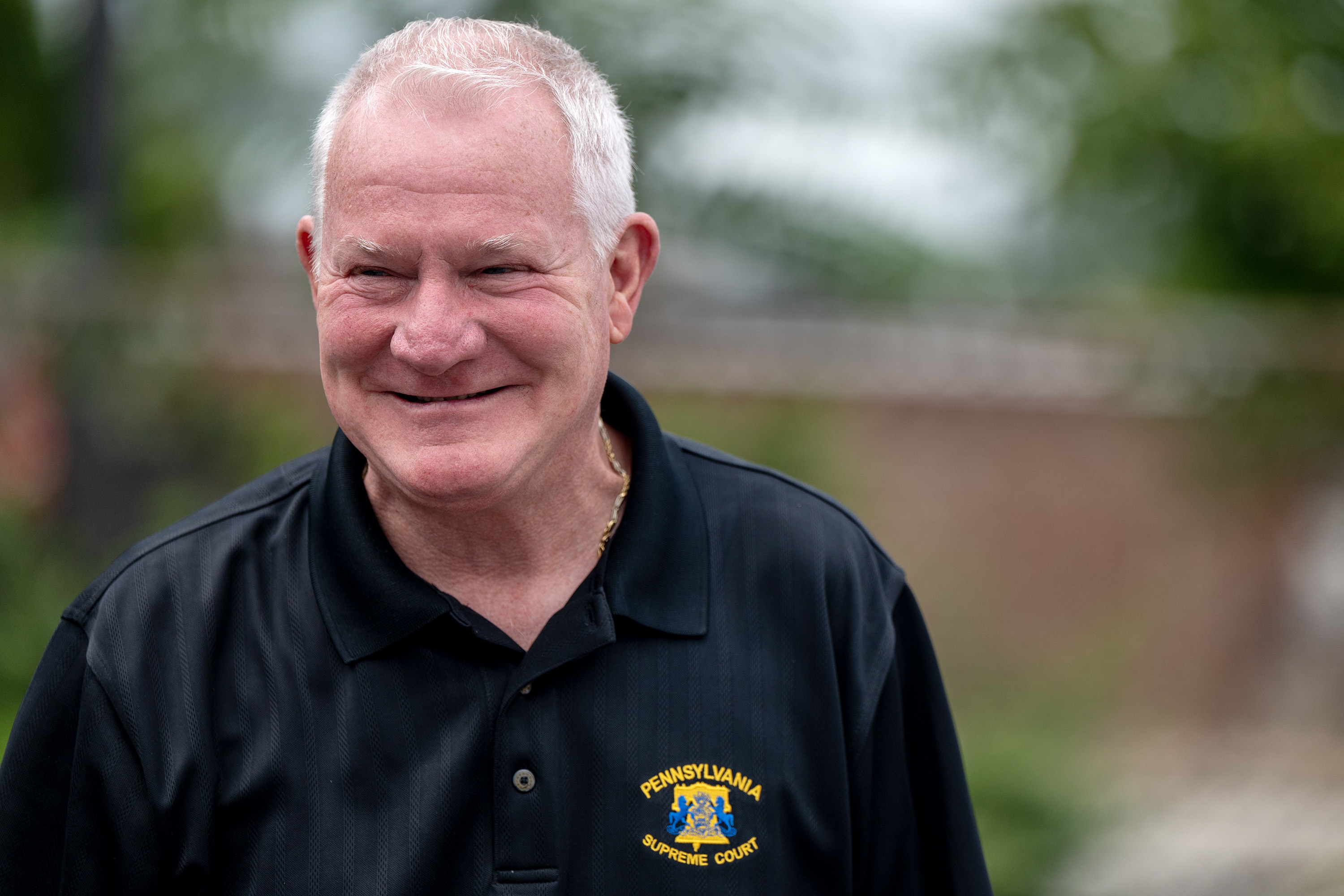
Justice Kevin Dougherty talks with volunteers before they head out the canvass in Fox Chase Sunday Sept. 7, 2025. Dougherty is one of three Pennsylvania Supreme Court justices up for retention.
He then proceeded to walk a Northeast Philly neighborhood alongside his son, State Rep. Sean Dougherty, a first-term Democrat who represents the area, and a family friend.
Before running for the Pennsylvania Supreme Court, Dougherty spent nearly 15 years on the Common Pleas Court bench in Philadelphia, with much of that time spent serving in the family division.
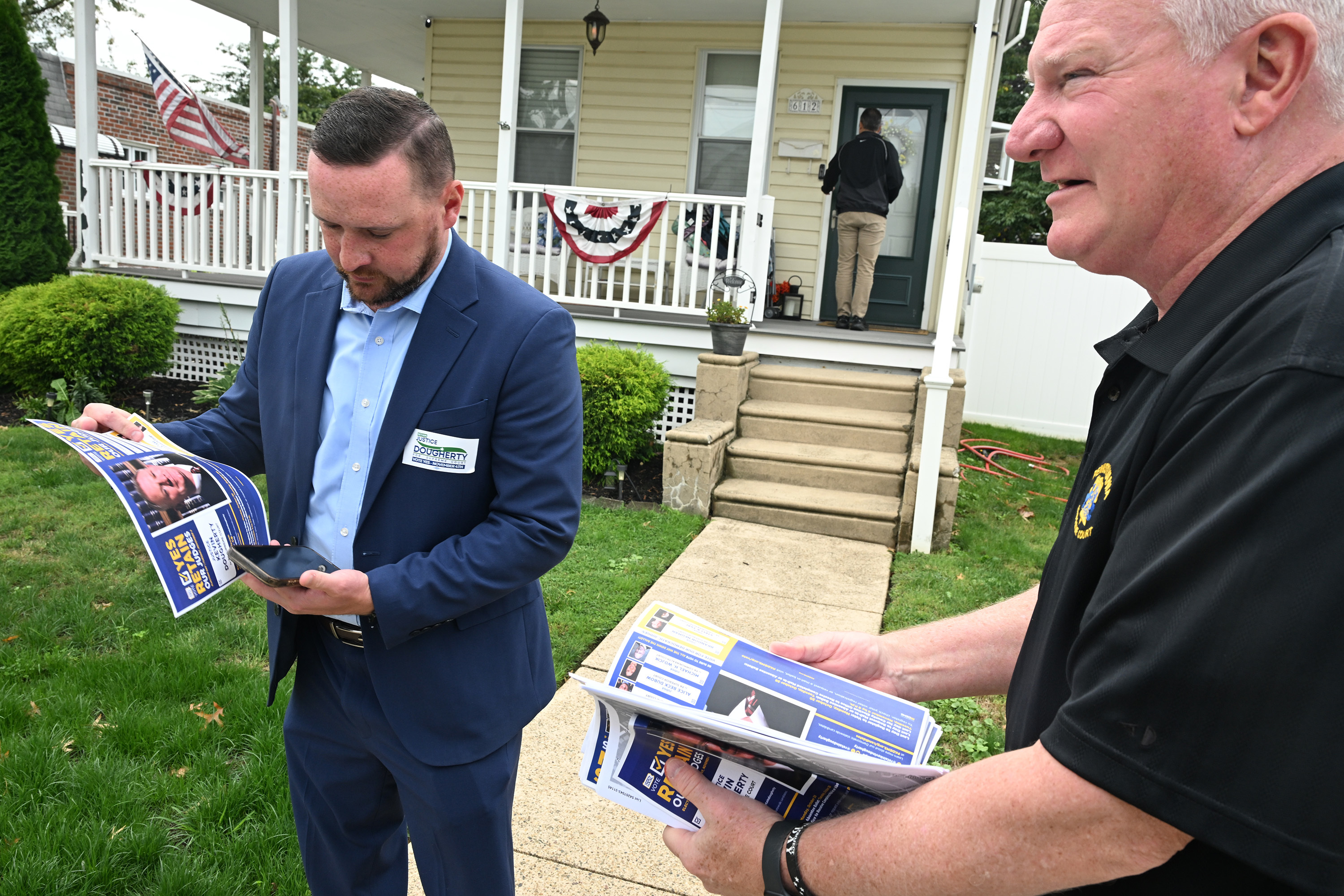
Justice Kevin Dougherty (right) canvasses with his son, State Rep. Sean Dougherty (left), in Fox Chase Sunday Sept. 7, 2025.
As a Supreme Court justice, Dougherty has highlighted his work on the autism in courts initiative as a key accomplishment. This program works to educate judges about the particular challenges people with autism spectrum disorder may face when dealing with the justice system, and has grown further into sensory-friendly courtrooms in more than a dozen counties.
The program, Dougherty said, was inspired by his own experience on the bench when a child stood in his courtroom for a delinquency case showing “all the signs of an incorrigible person.” Then, Dougherty said, the child’s mother pulled him aside and told him her son was on the autism spectrum.
“It was like a punch in my mouth because I had never been exposed,” Dougherty said. “You’re only ignorant once.”
Dougherty said he self-educated and began working in Philadelphia to reform the way the court interacts with individuals with autism and brought those efforts to a statewide focus as a justice.
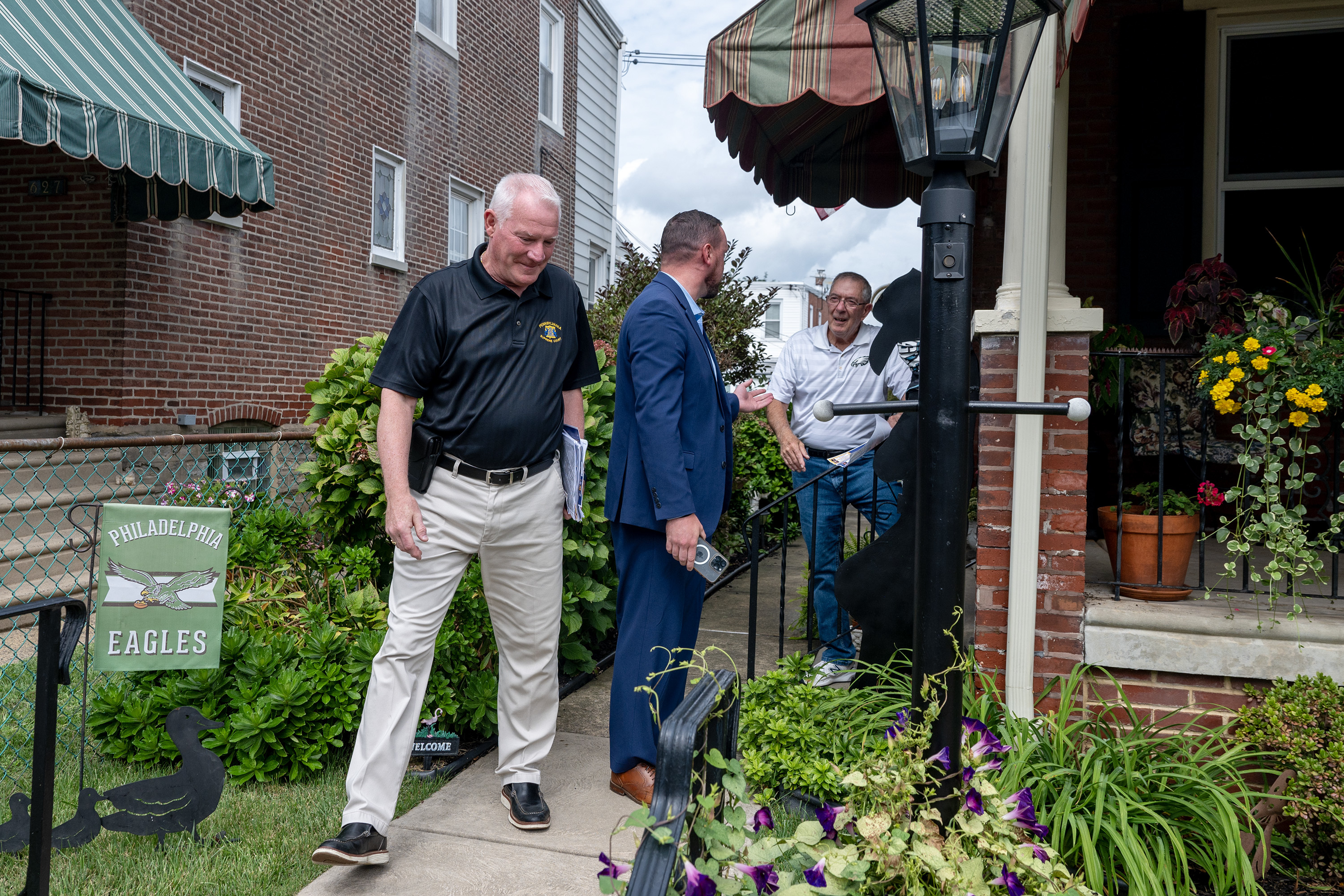
Justice Kevin Dougherty (left) canvasses with his son, State Rep. Sean Dougherty (center), in Fox Chase Sunday Sept. 7, 2025, stopping at the home of voter Skip Nelson (right).
“You need to make the system fair,” Dougherty said.
On the court, Dougherty has often sided with the liberal majority. He recently wrote the majority opinion in a case that allowed local governments to use zoning law to limit where gun ranges could be located. In oral arguments, when attorneys get a chance to argue their cases before the Supreme Court’s seven justices, Dougherty often presses lawyers to refine their arguments.
Christine Donohue
Donohue is often the first justice to ask questions during oral arguments.
Her quick interjections are because of her 27 years as a trial attorney prior to her career on the bench, she said. She cannot help but be inordinately prepared when she puts on her judicial robes and sits on the state’s highest court.
“Thoroughness is one of my ‘things,’” she said, with a laugh.
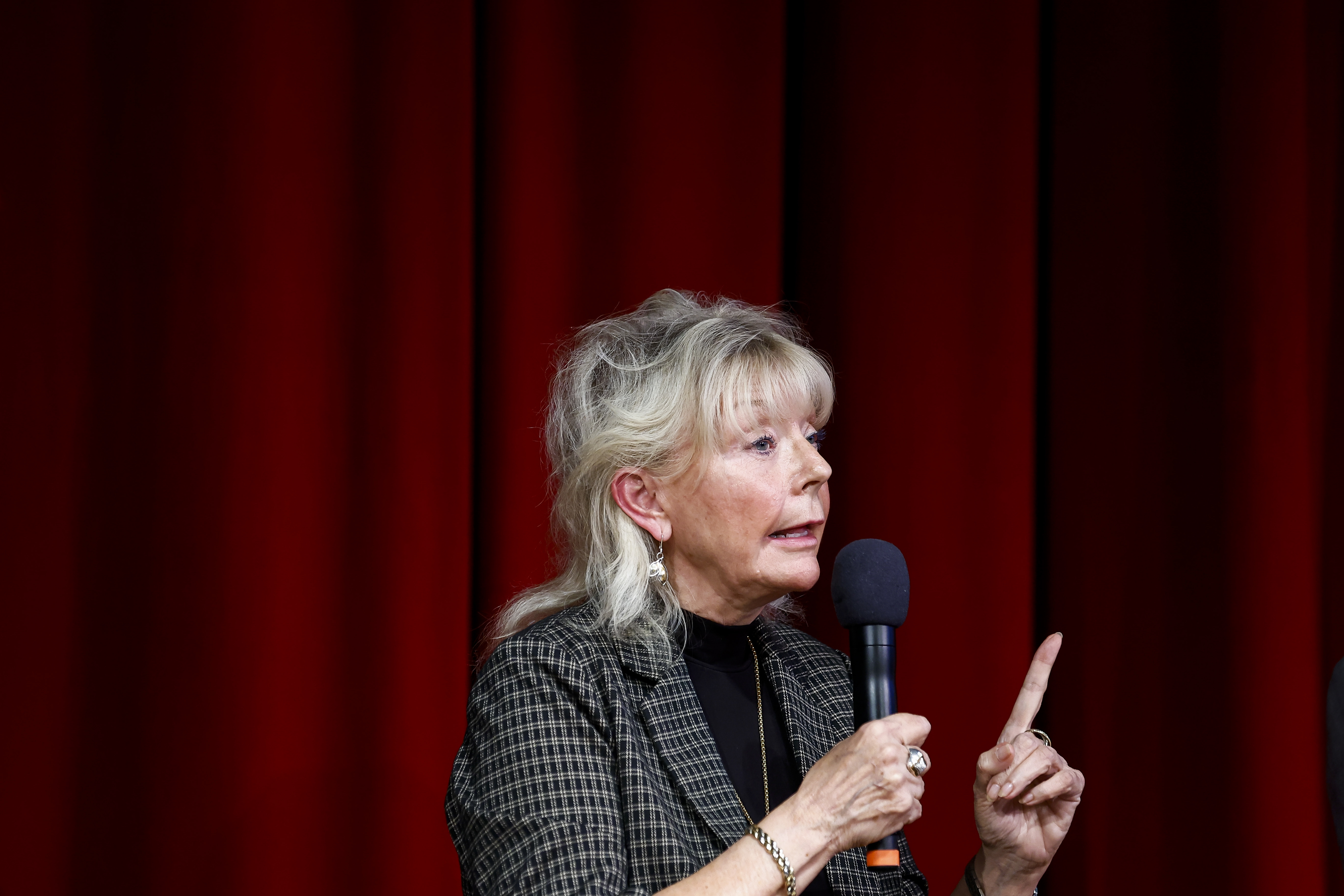
Justice Christine Donohue speaks during a fireside chat at Central High School.
Donohue, 72, would be able to serve for only two years of another 10-year term. But it wasn’t even a question to her whether she should step aside sooner. She believes she has fulfilled her duty as a justice, and she is prepared to do so until she hits the voter-set maximum age for a justice, 75.
Donohue authored the court’s ruling last year that signaled some members of the court are prepared to find that the Pennsylvania Constitution secures the right to an abortion. But less discussed from that same opinion, Donohue said, she is proud to have shored up the state’s Equal Rights Amendment.
Pennsylvania was the first state in the nation to amend its constitution to enshrine that every person has equal rights that cannot be “denied or abridged” because of an individual’s sex in 1971, and the first state to show support for amending the U.S. Constitution to guarantee the same.
But a 1984 ruling by the state Supreme Court “diluted” the ERA in Pennsylvania, Donohue said. It wasn’t until the justices decided the Allegheny Reproductive Health case 40 years later that the court revisited the state’s Equal Rights Amendment to make it “perfectly clear that a biological difference cannot serve as the basis for a denial or an abridgment of a right,” she said.
“To me, I’m very proud of many of the decisions I’ve been able to be involved with, but that one really sort of sets the record straight,” Donohue said.
Outside her legal work on thestateSupreme Court, she has been an advocate to offer more young lawyers the opportunity to try a case before a jury, which has become less and less frequent in recent years. Ensuring that the next generation of lawyers knows how to try a case before a jury is critical to guaranteeing the right to a fair trial, and would prevent a potential competency gap for future lawyers.
David Wecht
Like many of the justices on the Pennsylvania Supreme Court, Wecht spends much of his free time thinking about legal questions or ethical dilemmas. Or going on walks and listening to podcasts that deal with the same issues. (He recommends Amarica’s Constitution by Yale Law professor Akhil Amar or any of the podcasts by Jeffrey Rosen at the National Constitution Center, among others.)
He works from his chambers in Pittsburgh each day, unless the court is at one of the state’s many satellite courtrooms for oral arguments. There are times when he is in his chambers reading and writing all day long, which he described as “very, very fun, and very, very interesting and exciting.”
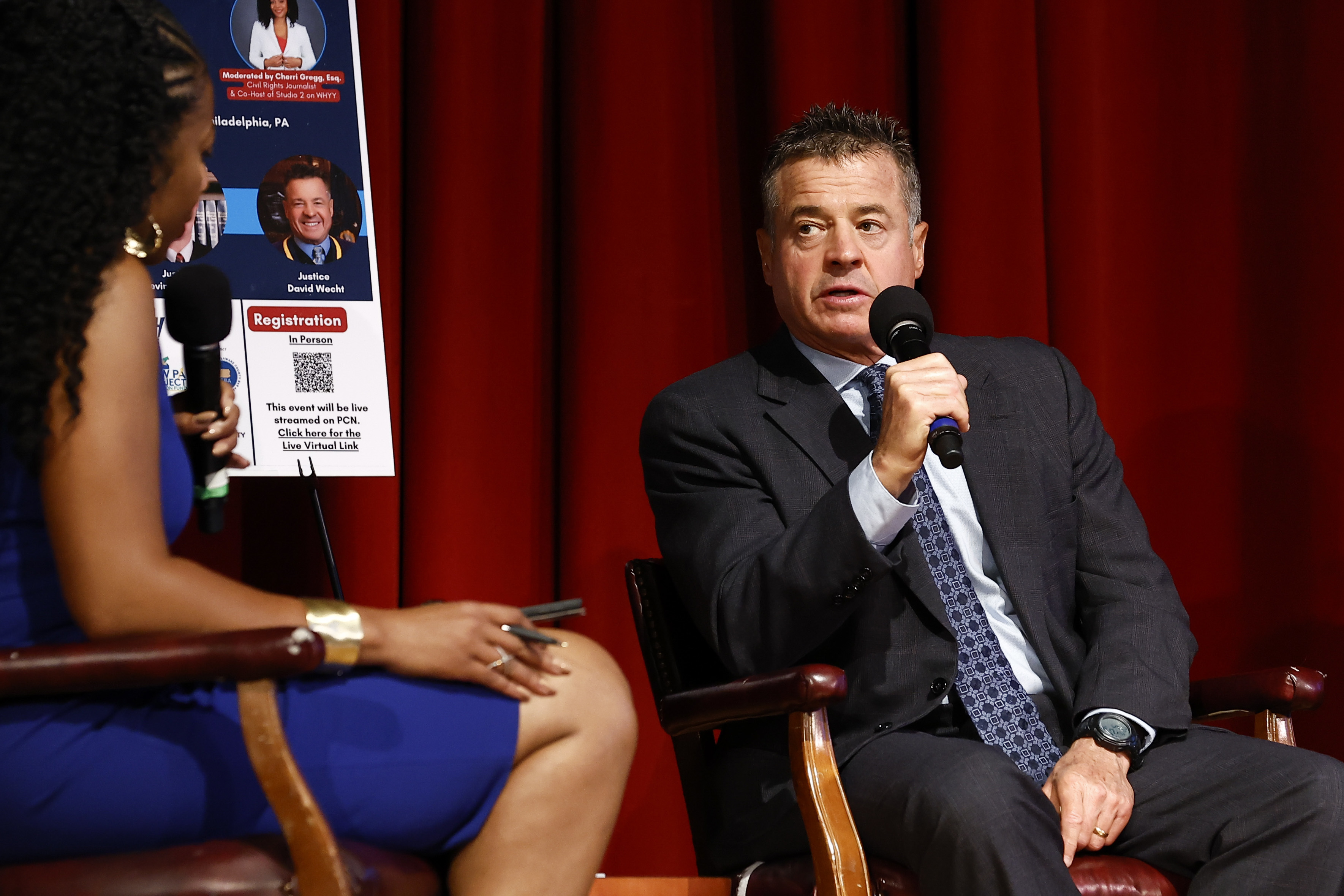
Justice David Wecht speaks with moderator Cherri Gregg during a fireside chat on retention at Central High School.
“The work is interesting. It is varied, It is never stagnant. We deal with all areas of the law,” Wecht said. “I’m very grateful that the voters gave me this job 10 years ago, and I hope they’ll see fit to provide me an additional term.”
Wecht is a true student of the law and said he enjoys probing attorneys’ arguments and the back-and-forth between justices on the bench.
He sees his role on the court as to decide cases. “Nothing grander, and nothing more,” he said.
He and the whole court, he said, operate under a “philosophy of judicial restraint.”
The court’s liberal majority has faced criticism from Republicans during the last 10 years — especially during the COVID-19 pandemic — for decisions they claimed were made by an “activist court.”
But those rulings, Wecht said, were the justices’ best attempts at deciding what a law passed by the General Assembly means when the lawmakers left it ambiguous, or their best attempt to understand what the framers of the state constitution intended, even if he doesn’t agree with it.
“It’s not our business whether we like them,” he said.
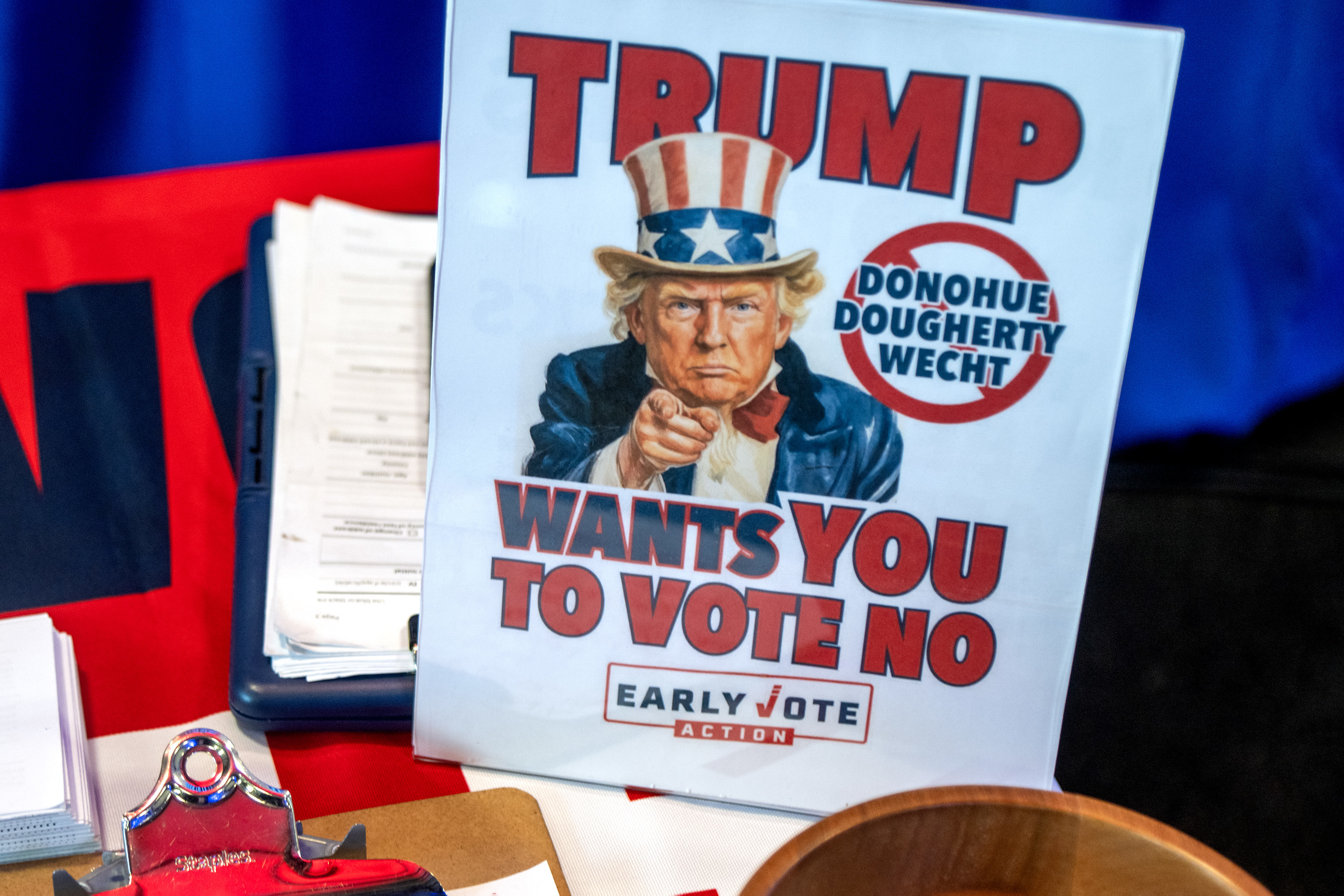
Early Vote Action, a Republican group, urges voters to vote against retaining the justices at a Republican rally in Bucks County on Sept. 25, 2025 at the Newtown Sports & Events Center. The event was headlined by Treasurer Stacy Garrity, a Republican running for governor.
Republican groups have attempted to mislead voters in mailers, Wecht has said, about the justices’ role in a 2018 decision that found Pennsylvania’s congressional maps were unconstitutionally gerrymandered. The GOP groups have had similarly misleading ads about the court’s actions on abortion and voting rights, even recently invoking the anti-Trump “No Kings” language to try to sway voters to vote “no.”
Wecht is a professor at Duquesne School of Law and the University of Pittsburgh, where he has been teaching for years. He is also a visiting professor at Reichman University in Israel each year, and regularly teaches continuing legal education courses for attorneys, which are courses that all lawyers must complete on an annual basis to maintain their active attorney’s license in Pennsylvania.
The decision was looming in June 2021 for the National League to adopt the designated hitter when Rick Wise thought that meant his night — pairing a no-hitter in 1971 with the Phillies with two homers — would never be matched.
“If they do the DH, no one is ever going to break the record,” Wise said. “Maybe it might work out with Ohtani.”
And maybe Wise is right. But Shohei Ohtani didn’t break it yet. Ohtani hit three homers on Friday night and struck out 10 in six shutout innings as the Dodgers swept the Brewers with a 5-1 win in Game 4 of the NL Championship Series to reach the World Series.
Ohtani may be the greatest player ever, and his latest epic feat already is being called the “greatest game in baseball history.” Perhaps it is.
But let’s not forget what Wise did in June of 1971 at Riverfront Stadium against a lineup of Hall of Famers days after having the flu.
“I didn’t really know if I could pitch that day, but it was my turn to take the ball, so I knew I was going to pitch,” Wise recalled four years ago. “It was just a matter of how long I was going to last.
“I felt very, very weak. It was in Cincinnati, and those cookie-cutter stadiums with AstroTurf, man, I’m telling you it was 130 degrees there, even though it was a night game. Warming up, it seemed like the ball was stopping halfway to the plate. I didn’t have any pop.”
Rick Wise hit two homers and threw a no-hitter in June 1971 at Riverfront Stadium in Cincinnati.
Wise reached the majors as an 18-year-old “bonus baby” in 1964, pitching in 25 games for those star-crossed Phillies. He pitched in a rotation with Jim Bunning and Chris Short and took batting practice every afternoon when the team was home.
“We only got 20 minutes when the team was home,” Wise said. “On the road, the starting pitcher hit with the lineup. That was the extent of it.”
Maybe that’s all Wise needed. He hit 11 homers from 1968 to 1971 with an OPS that was near league average. Wise was Ohtani-like every fifth day.
“I was a good hitter when I was 8 or 9 years old starting in Little League,” said the 80-year-old Wise, who lives in Washington. “That’s what we did. We played sports. We weren’t in front of a TV. We were outside playing whatever that season was. Baseball, football, basketball. That’s what we were doing as kids growing up. In Little League, Babe Ruth, Legion ball, and high school, I always hit third, fourth, or fifth. Pick a number.”
The Phillies pitchers played a game every afternoon — “50 cents a man,” Wise said — where each hit had to clear the infield dirt. The batting practice pitcher would be the umpire and decided if the ball was a hit or out. The money was pooled together every day.
“At the end of the year, the pitchers went out for a party,” Wise said.
And that’s how he prepared for his memorable night. Wise — who later was the winning pitcher when Carlton Fisk waved his home run fair at Fenway Park in 1975 — homered off Reds left-hander Ross Grimsley in the fifth and worked a 2-0 count in the eighth against Clay Carroll.
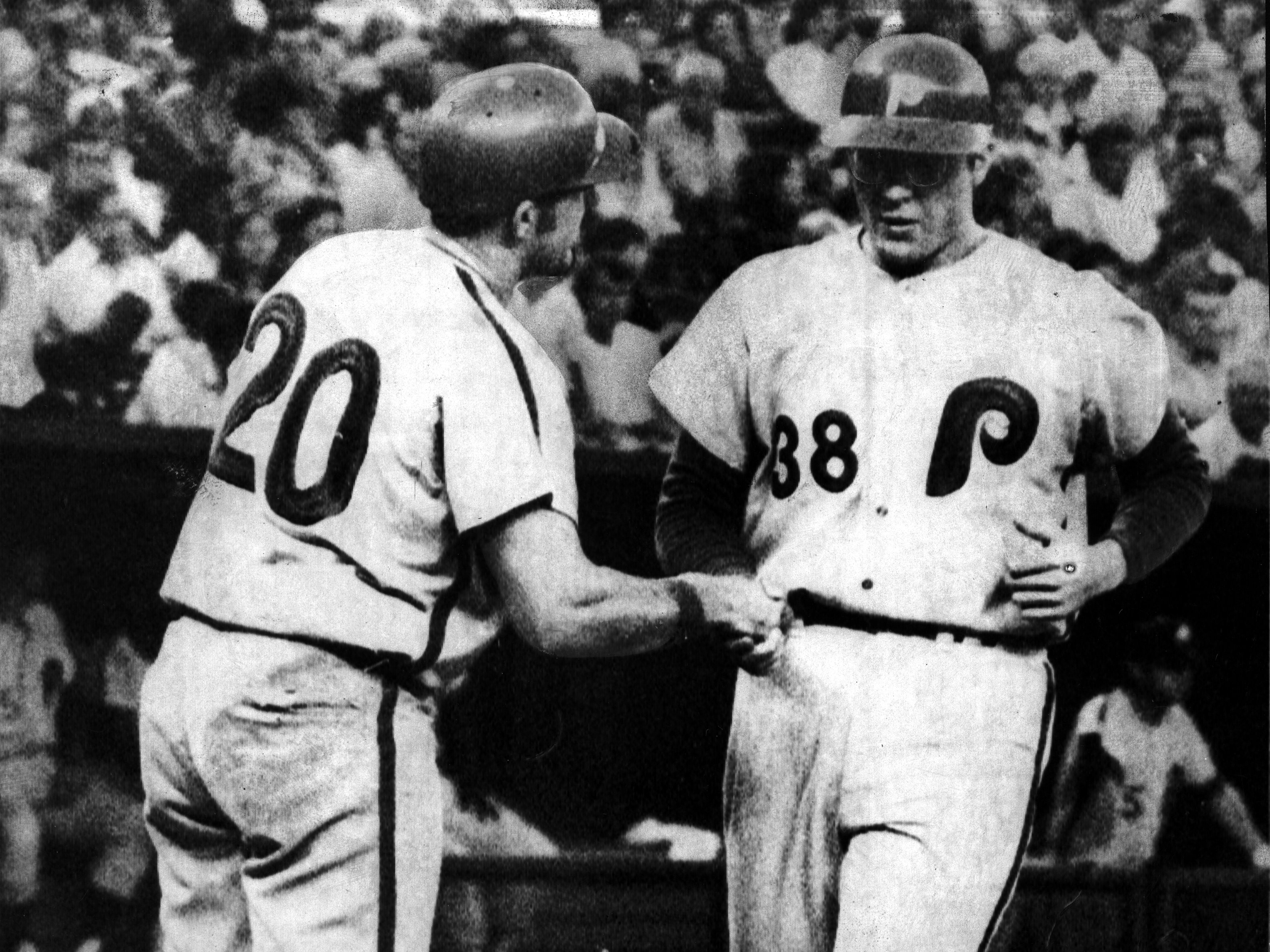
“I stepped out of the box and looked down at George Myatt and he turned his back on me,” Wise said of the team’s third-base coach. “So that meant the green light was on for me. I got a cripple fastball. I mean it was right down the middle to a pitcher. And I was ready for it. I took my hacks when I was up there. If I saw something I liked, I was swinging.”
Roger Free greets Rick Wise after his first homer in the fifth inning at Cincinnati in June 1971.
Wise had his two homers and was six outs away from no-hitting a lineup that featured Pete Rose, Johnny Bench, Tony Pérez, George Foster, Lee May, and Dave Concepcion. He ended the 4-0 no-hitter by retiring Rose, who Wise called “the last guy you want to see to get the 27th out.” Third baseman John Vukovich grabbed Rose’s liner, and the Phils mobbed Wise at the mound before they celebrated in the clubhouse.
“It’s not that easy against any team because all it takes is a chopper or a bunt or a blooper or whatever, and there goes the no-hitter,” Wise said. “But against that team under the conditions that I felt, it was tremendous. That lineup was tremendous.”
Wise was traded after that season to St. Louis for Steve Carlton, one of the most significant trades in Philadelphia sports history. Wise wanted a bigger contract from the Phillies, and Carlton wanted more money from the Cardinals.
“Back then, I didn’t have any agent or anything. I was making, at that time, after seven years in the big leagues, $25,000,” Wise said. “I’d be a multimillionaire these days, but then, a lot of pitchers from those days would be, too. You can’t miss what you never had.
“John Quinn was giving it to the veteran players, but he was lowballing the younger players. He wouldn’t give in. He wouldn’t budge. The same thing happened with Carlton. He went to Philly and got what he wanted, and I went to St. Louis and got what I wanted. They doubled my salary, and that’s what I was looking for.
“[The Phillies] had a record attendance that year, and we didn’t have a real good team, per se [67-95 in Veterans Stadium’s first season]. Just the type of year I had, to really become the ace of the staff, I thought I deserved more than he offered. I never got anything for throwing the no-hitter. They didn’t give me a bonus, or anything like that. But then, to be traded after all that.
“I was down in spring training when I was traded, and the traveling secretary was the one who came to my door, knocked on my door, and told me I’d been traded. It wasn’t from John Quinn. It wasn’t from the president of the Phillies. It was the traveling secretary.”
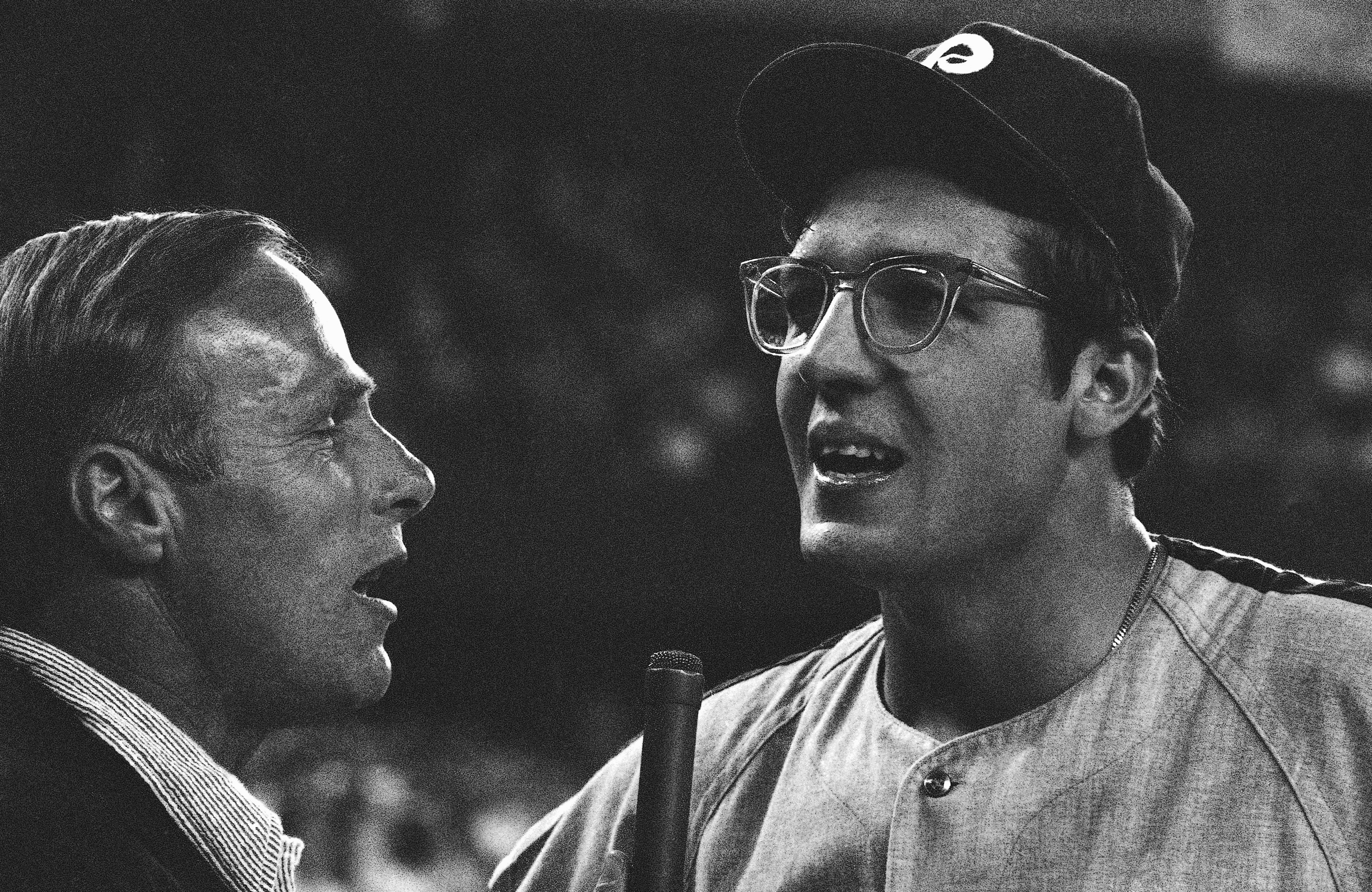
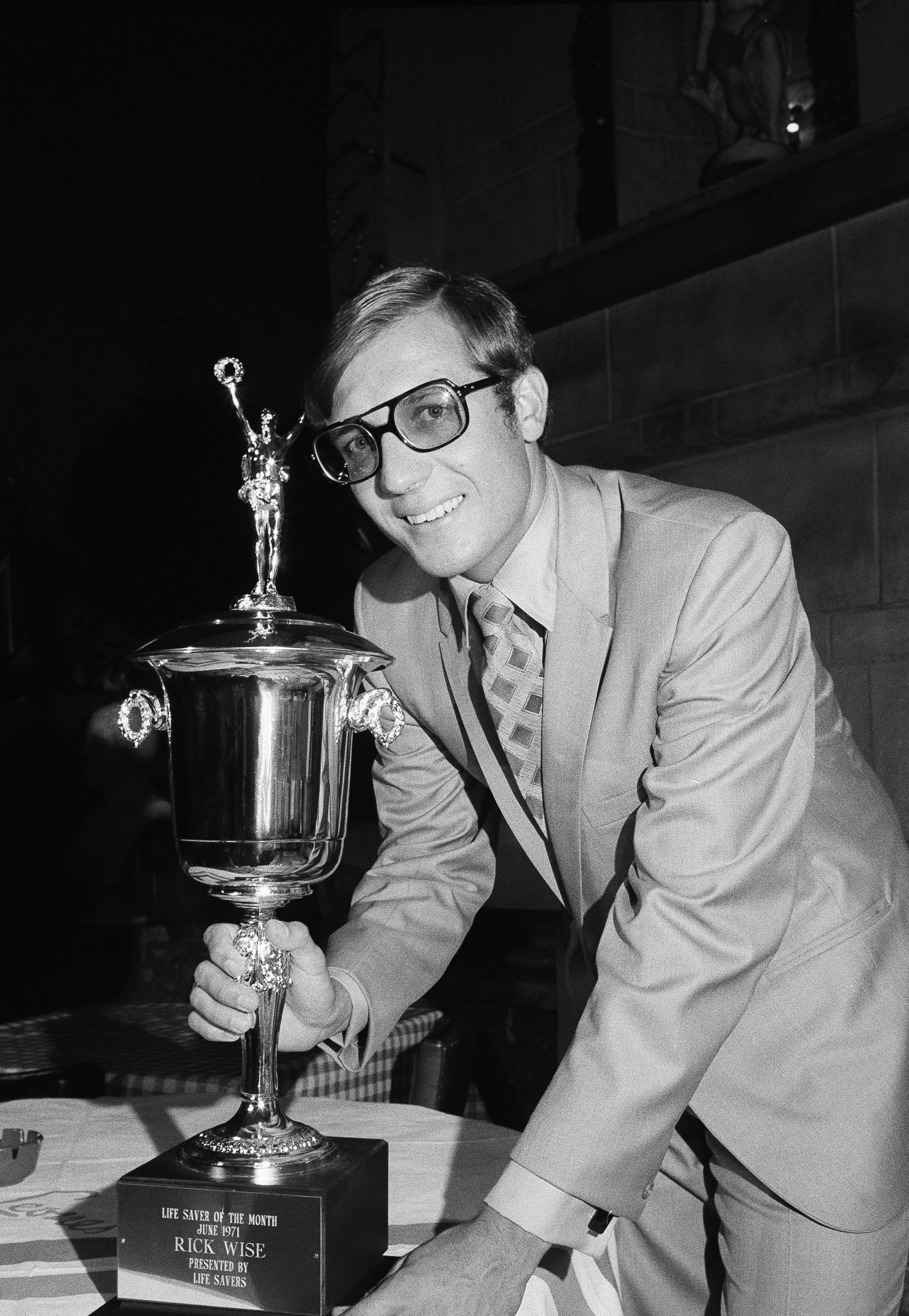
Rick Wise holds the Life Saver of the Month Trophy awarded in July 26, 1971. He was honored for his performance against the Cincinnati Reds.
Ohtani was named the MVP of the NLCS and likely will be named the National League’s MVP next month for a second straight year. He will pitch next week for the Dodgers in the World Series, something Wise did twice with Boston. And Ohtani will have a chance to write another October chapter.
“That was probably the greatest postseason performance of all time,” Dodgers manager Dave Roberts said of Ohtani after Friday’s win. “There’s been a lot of postseason games. And there’s a reason why he’s the greatest player on the planet.”
It often seems that there’s nothing Ohtani can’t do on a baseball field, from throwing triple-digit fastballs to hitting 500-foot homers. But there’s still something Wise did that Ohtani has yet to match.
“What he’s doing right now is captivating the baseball world, and I imagine Japan follows every single game he plays,” Wise said in 2021. “He has such a unique capability.”
The Eagles travel to face the Minnesota Vikings in a Week 7 matchup at U.S. Bank Stadium at 1 p.m. on Sunday. Here’s what you need to know about the game:
Vikings defensive coordinator Brian Flores is known for blitzing a lot.
When the Eagles have the ball
We’ve seen Nick Sirianni switch it up offensively coming out of mini-byes or byes before, with the emphasis often placed on the run game. The guess here is that he will take the same approach this season. The Eagles desperately need to get Saquon Barkley going on the ground. There have been glimpses in the last few games, but play caller Kevin Patullo hasn’t stuck with it enough for various reasons.
The Vikings’ run defense offers an opportunity to get on track (of course, so apparently did the New York Giants last week). They rank 24th in the NFL in expected points added (EPA) per rush and have allowed 132.2 yards a game. The Eagles haven’t won as much at the point of attack, but Minnesota is light on its defensive line. Landon Dickerson (ankle) could return at left guard, but playing at far less than 100% hasn’t helped.
The Eagles don’t major in under-center plays. They ranked 30th in snaps there. But I think we may see more of Jalen Hurts in that formation. It would conceivably help get Barkley downhill, and if successful, open up play action. They just can’t tip off defenses with their tendencies and may need to throw from under center a few times early on.
Vikings defensive coordinator Brian Flores is likely willing to give up yards on the ground because his No. 1 EPA-ranked pass defense has been stingy. Flores is a master of creating chaos. Yes, he blitzes a lot — a second-most 35.8% rate — but it’s his simulated pressures and disguised coverages that have given quarterbacks the most fits. The Eagles have struggled mightily against the latter two, partly because they’re often late to the line.
Flores leans heavily on zone coverages (77%) and employs a lot of two-high safety shells, often in Cover 2 or 6. The Eagles have seen zone more than ever and have had trouble working the intermediate part of the field.
Only 9.9% of Hurts’ attempts have traveled 10 to 19 yards, less than half the NFL average of 20.1%. Sirianni, Patullo, and Hurts have to do a better job of getting the ball to receivers A.J. Brown and DeVonta Smith in space. Eagles receivers are averaging only 4 yards after the catch, which ranks 32d — last — in the league.
Carson Wentz will make his second career start against his former team, this time with the Vikings.
When the Vikings have the ball
The Eagles will face former franchise quarterback Carson Wentz for the second time since he was traded in 2021. It didn’t go well for Wentz in the first round. Then, with Washington, he got overrun by the Birds’ pass rush and was sacked nine times and fumbled twice. He still holds the ball too long and wants to play the hero.
But the Eagles’ front isn’t as ferocious and he has a solid offensive line, assuming that most of the starters are playing. Christian Darrisaw and Brian O’Neill (sprained MCL) are plus tackles. Rookie left guard Donovan Jackson is back from a wrist injury, but backup center Michael Jurgens (hamstring) and O’Neill are questionable.
Wentz, despite his flaws, can still make throws many quarterbacks can’t. And he has arguably the best receiver in the NFL. Justin Jefferson will draw additional attention from Vic Fangio’s defense. Cornerback Quinyon Mitchell has followed top receivers this season, but his recent hamstring injury could hamstring Fangio’s coverage plans.
If opposite-side corner Adoree’ Jackson, who steps back into the starting role after Kelee Ringo’s benching, is matched up against Jefferson, Fangio will likely cloud his side. Jefferson alone, for context, has matched Hurts’ 10 intermediate-length completions this season for 205 yards. Jordan Addison is a potent No. 2 receiver.
The Eagles’ run defense has been leaky. They rank 20th in EPA per rush and 26th in success rate. With defensive tackle Jalen Carter (heel/shoulder) out last week, the Giants ran it down their throats. Minnesota running back Jordan Mason (4.7 yards per rush) has been effective in Aaron Jones’ absence.
It’s been an 11-man problem in stopping the run, but the Eagles have been susceptible on the edges. That isn’t just an outside linebacker issue, but a suspect pass rush that can be traced to the ineffectiveness of the Eagles’ edges. The current group, after Za’Darius Smith’s retirement, has just one collective sack.
Jalyx Hunt, Joshua Uche, Azeez Ojulari, and Patrick Johnson (owner of said sack) have gotten pressure at times, but if Wentz has an extra click in the pocket, you can be sure he’ll often find an open Jefferson downfield.
Eagles beat writers Olivia Reiner and Jeff McLane will provide a preview of the game before the Eagles face the Minnesota Vikings on Sunday.You can tune in here.
Extra point
I don’t know what to make of this Eagles team through six games. I thought there would be early-season struggles, and predicted a 4-2 start. I just didn’t think it would look like this. Fangio’s unit has not played well over the last five quarters, but the offense’s second-half malaise against the Denver Broncos led to a fourth-quarter meltdown. And losing Carter and Mitchell clearly affected the Eagles at the Meadowlands. It shouldn’t have looked that pathetic.
There are still concerns at corner, edge, and safety. And where has defensive tackle Jordan Davis been the last three games? But it’s the pains on the other side of the ball that are more disconcerting. I keep expecting talent to win out, but the Sirianni-Patullo-Hurts trinity has had more holes than holiness. I foresee a tough, grind-it-out outcome, so the game could go either way. But I have a hard time riding with Wentz.
There was a time — back when The Inquirer had multiple suburban bureaus — that photographers like myself who were assigned to the main newsroom on North Broad Street worked only in the city. (We’re now more like ride share drivers, going everywhere.)
So I walked a lot more to cover news and events in Center City, and more often stumbled into things and sights that piqued my curiosity.
Things like a long line.
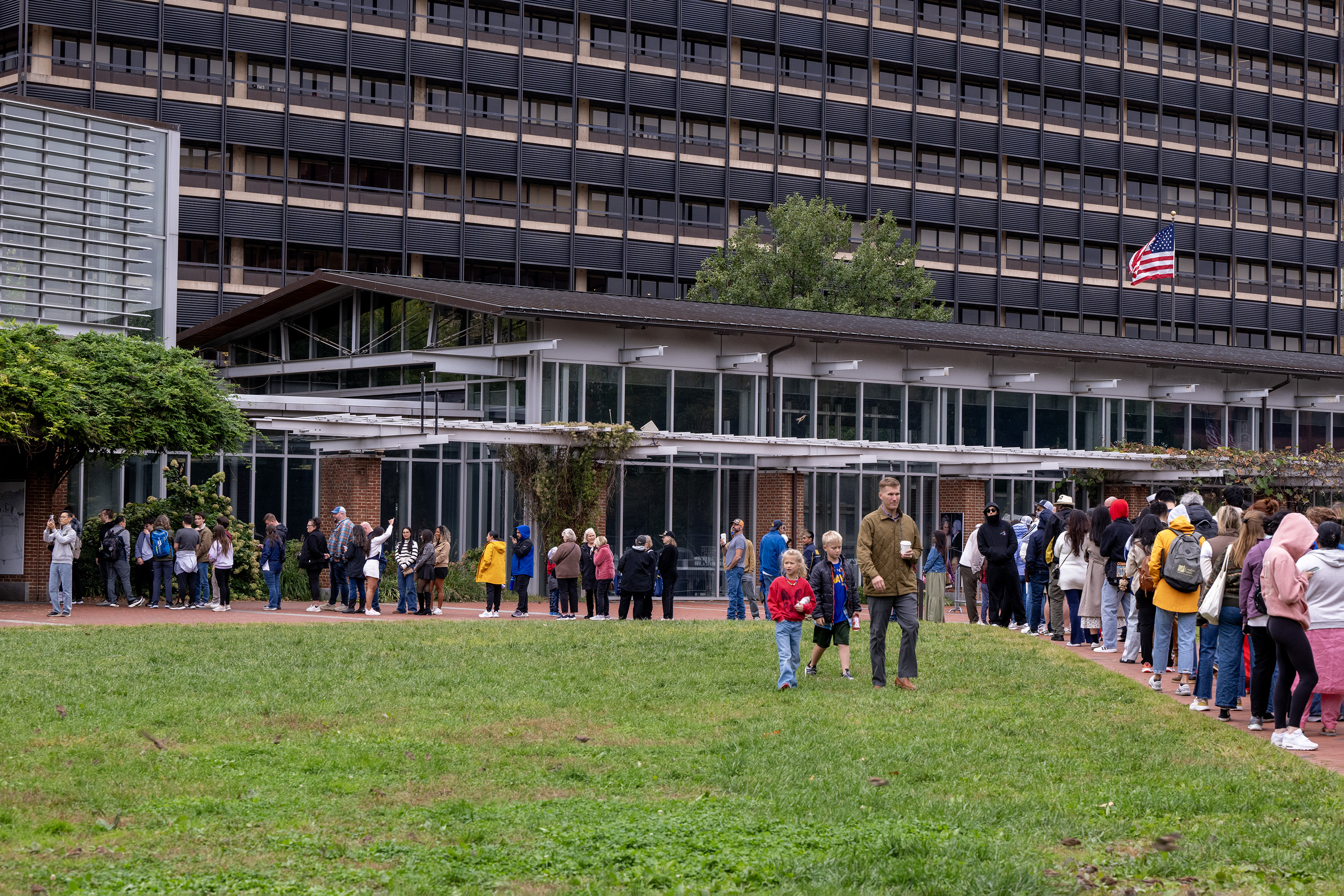
Visitors queue up to get a glimpse through a single window in the Liberty Bell Center Oct. 12, 2025 while the building is closed due to the federal government shutdown.
Years ago seeing one likely meant unhoused people were waiting as church folks or outreach advocates served dinner on the street. Or they were waiting for concert tickets or movie premiers (Beanie Babies?).
I remember once questioning someone standing in a blocks-long line along Walnut Street and was flabbergasted to learn a new sneaker was dropping.
Or for a device that combined a portable media player, a cell phone, and an internet communicator.
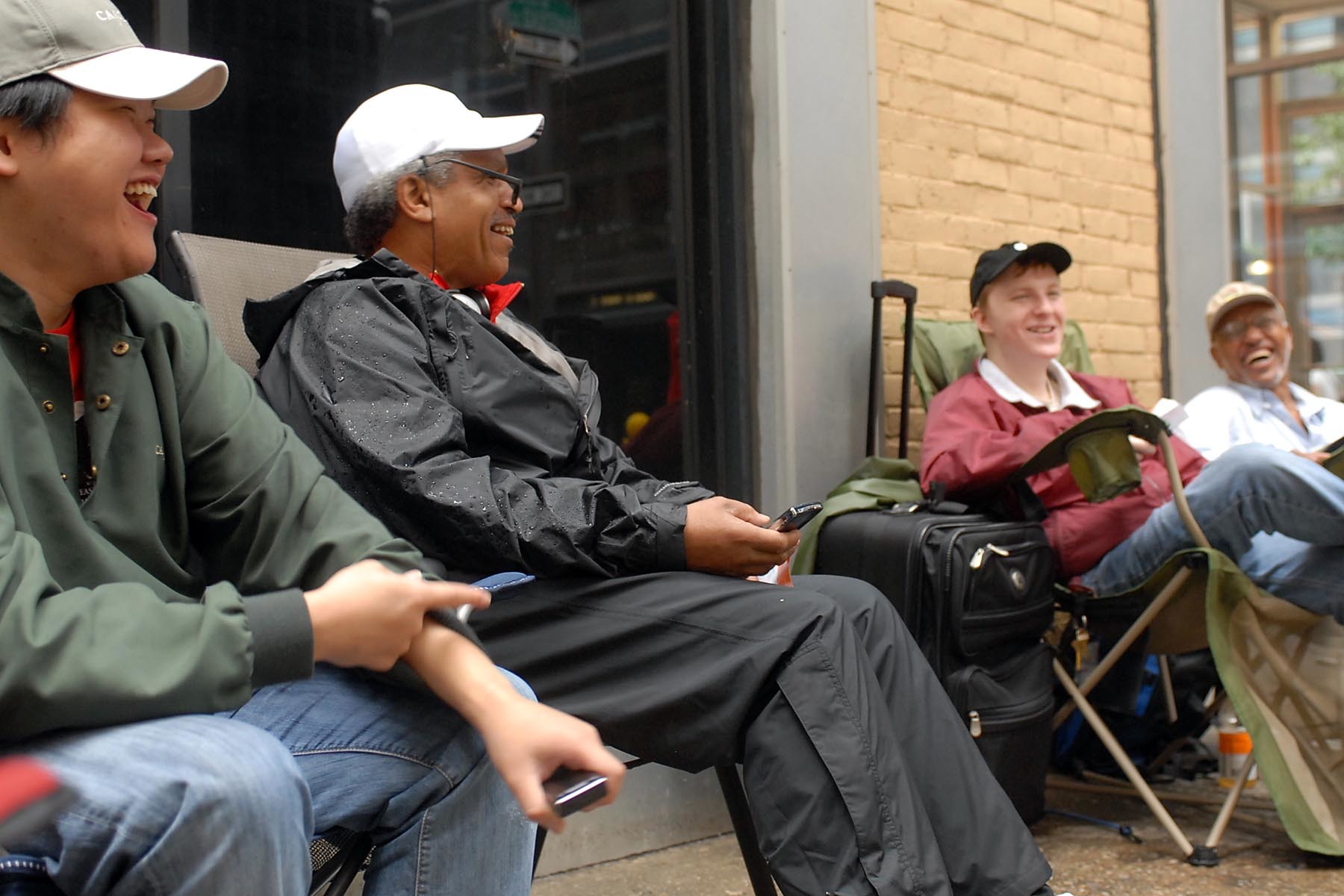
Mayor John F. Street reads jokes aloud from his Blackberry as he waits with fellow technology enthusiasts in an alley off 16th Street to purchase an iPhone at the At&T store Jun. 29, 2007. There were two models available that day: a 4GB for $499 and the 8GB for $599.
Mayor Street was the third in line to buy the first-generation iPhone 2G launched that day. He said he arrived around 3:30 a.m. Leonard F. Johnson (far right) at the front of the line, arrived 36 hours ahead of the 6:00 p.m. official release.
Hizzoner defended the time he spent in line, saying he got work done and kept in touch with city officials on the issues of the day using his Blackberry to send emails and make phone calls.
I had no idea what the yellow shipping container was when I saw it next to City Hall last weekend. Even after I walked over and watched those at the front of the long line take their selfies inside a retro Philly diner-esque booth tableau.
I watched it all unfold, along with others, asking ourselves what was going on. Nobody knew. Except those in line.
It was the last stop on the Pleasing Express Line that ended its nation-wide tour in Philadelphia.
Followers on social media were invited to, “Climb on to immerse yourself in the worlds of Pleasing Fragrance, Big Lip, and exclusive treasures,” including a spin of the “Freebie Wheel,” for products of the unisex lifestyle brand Pleasing, created by former One Direction singer Harry Styles.
A spontaneous walk around Center City can build for me the same kind of excitement felt by those waiting in lines. Except they know their eventual reward. Mine comes from the anticipation of not knowing what’s around a corner.
And that is exactly what makes street photography worth the walk – and sometimes even the wait.
Since 1998 a black-and-white photo has appeared every Monday in staff photographer Tom Gralish’s “Scene Through the Lens” photo column in the print editions of The Inquirer’s local news section. Here are the most recent, in color:
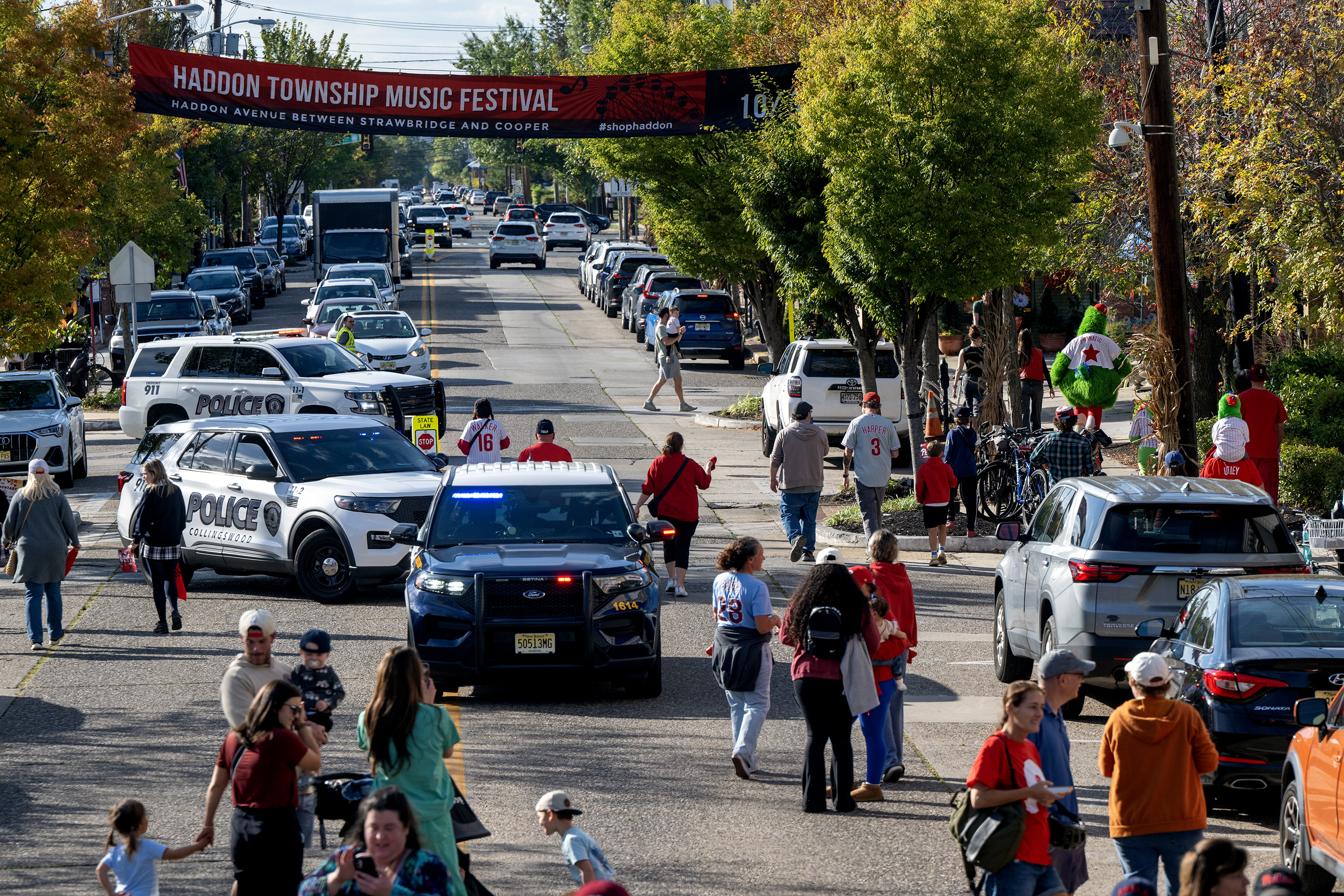
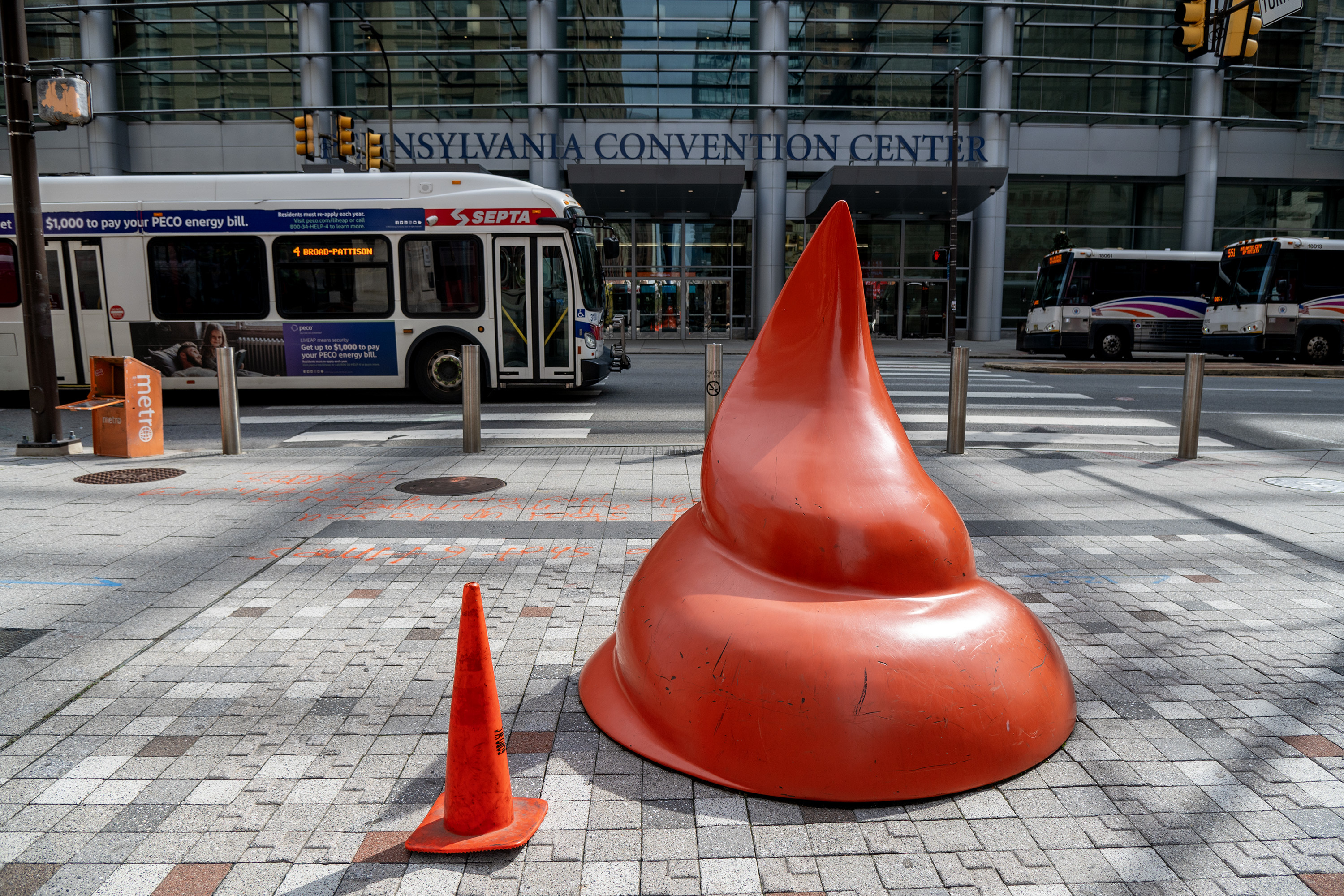
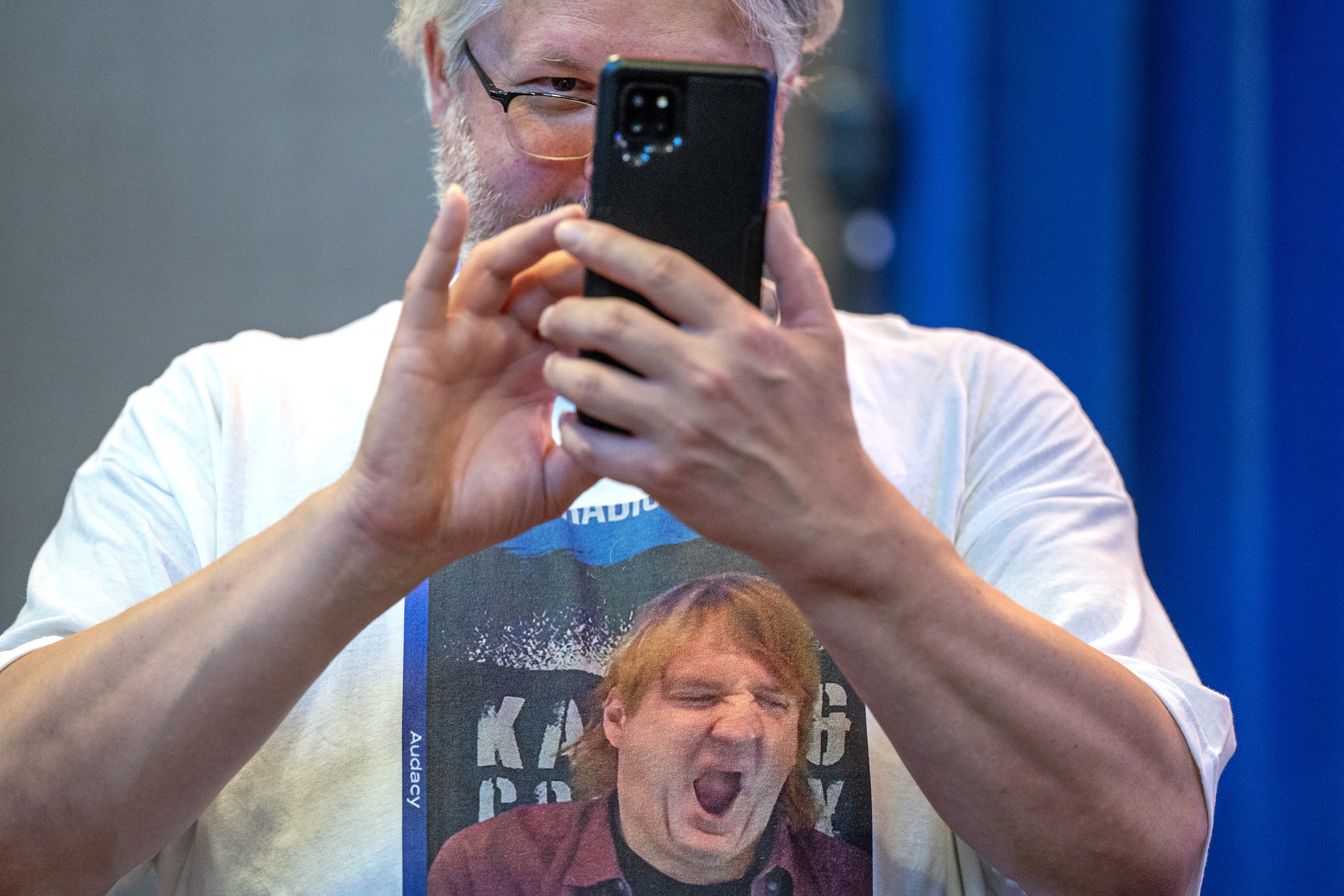
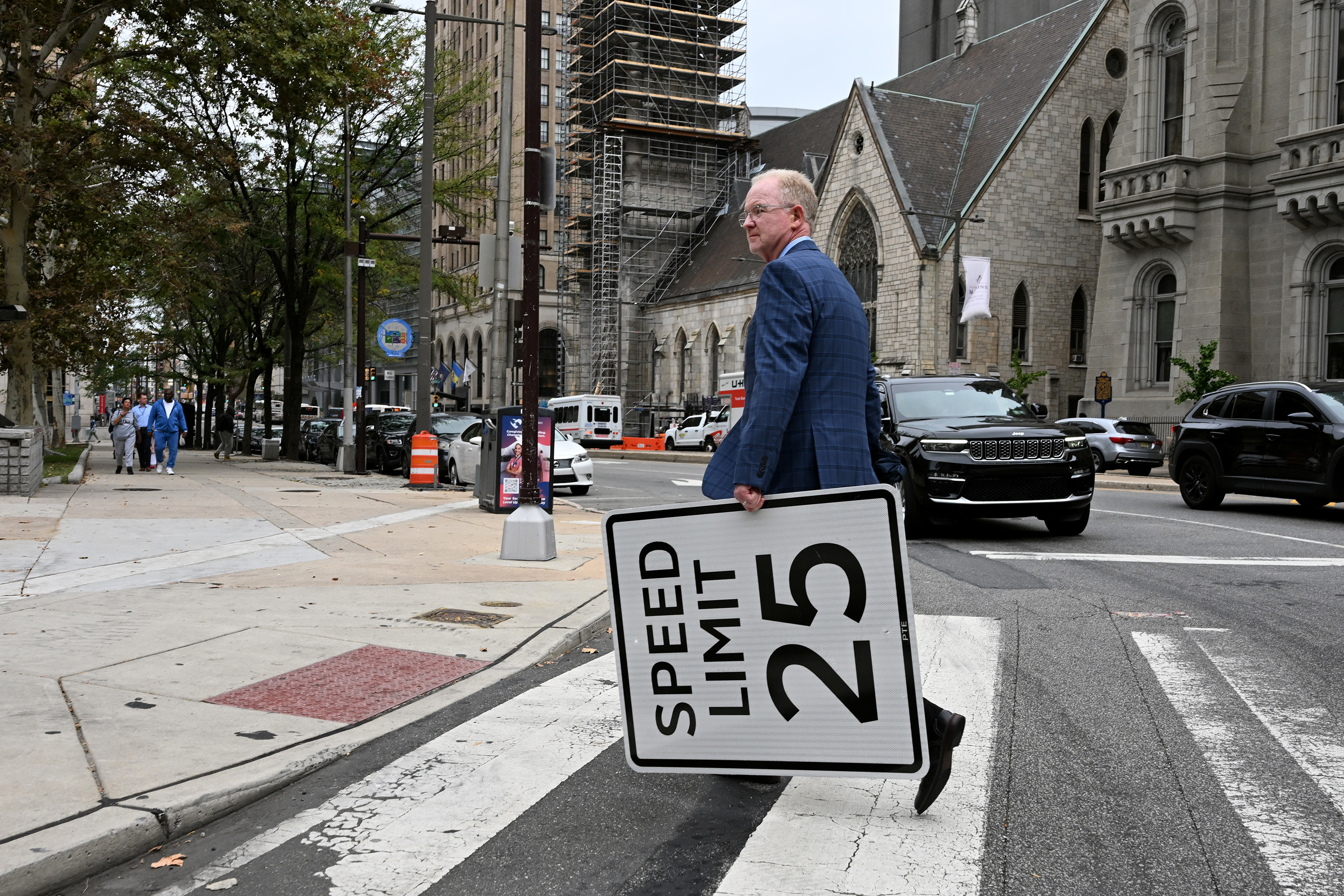
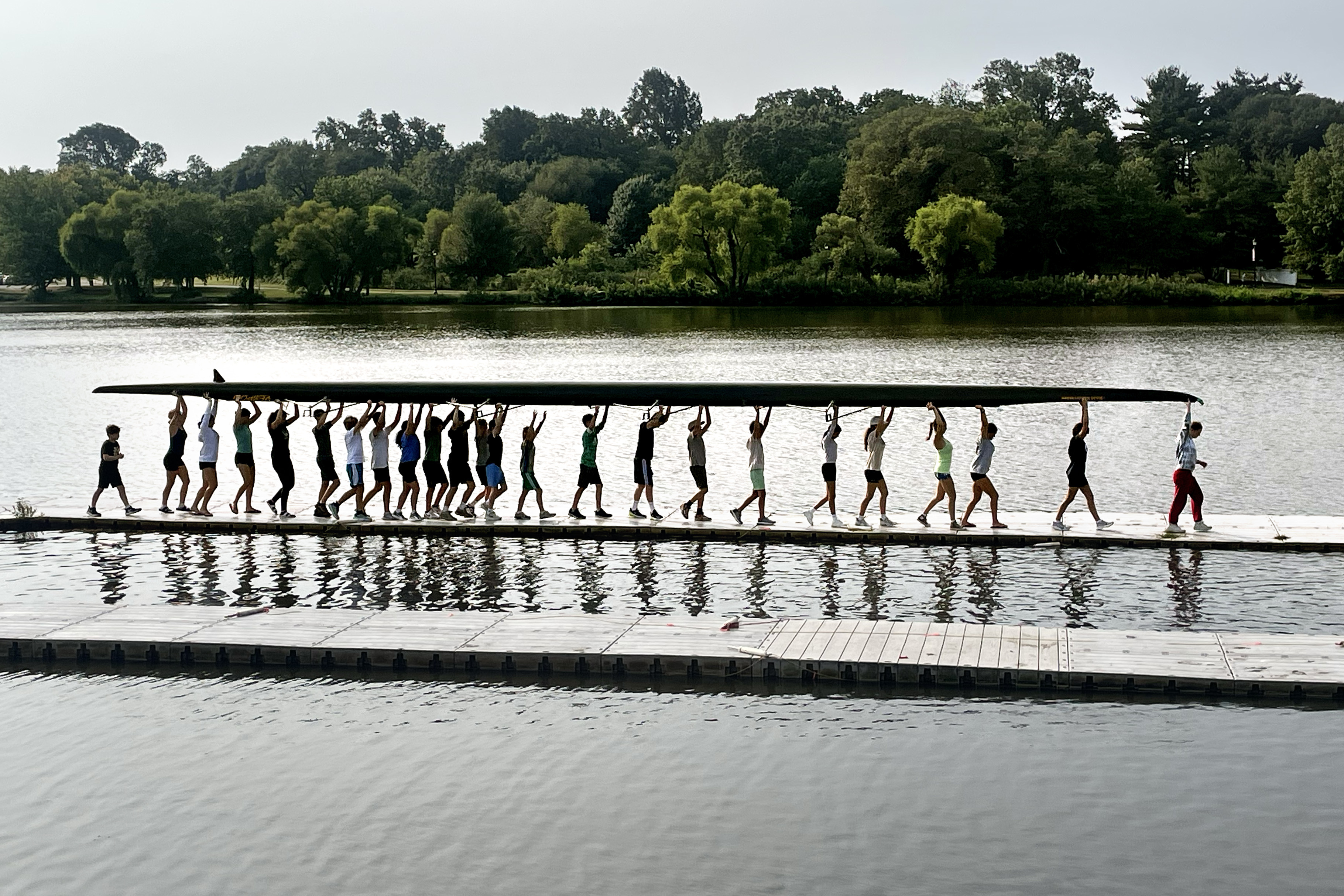
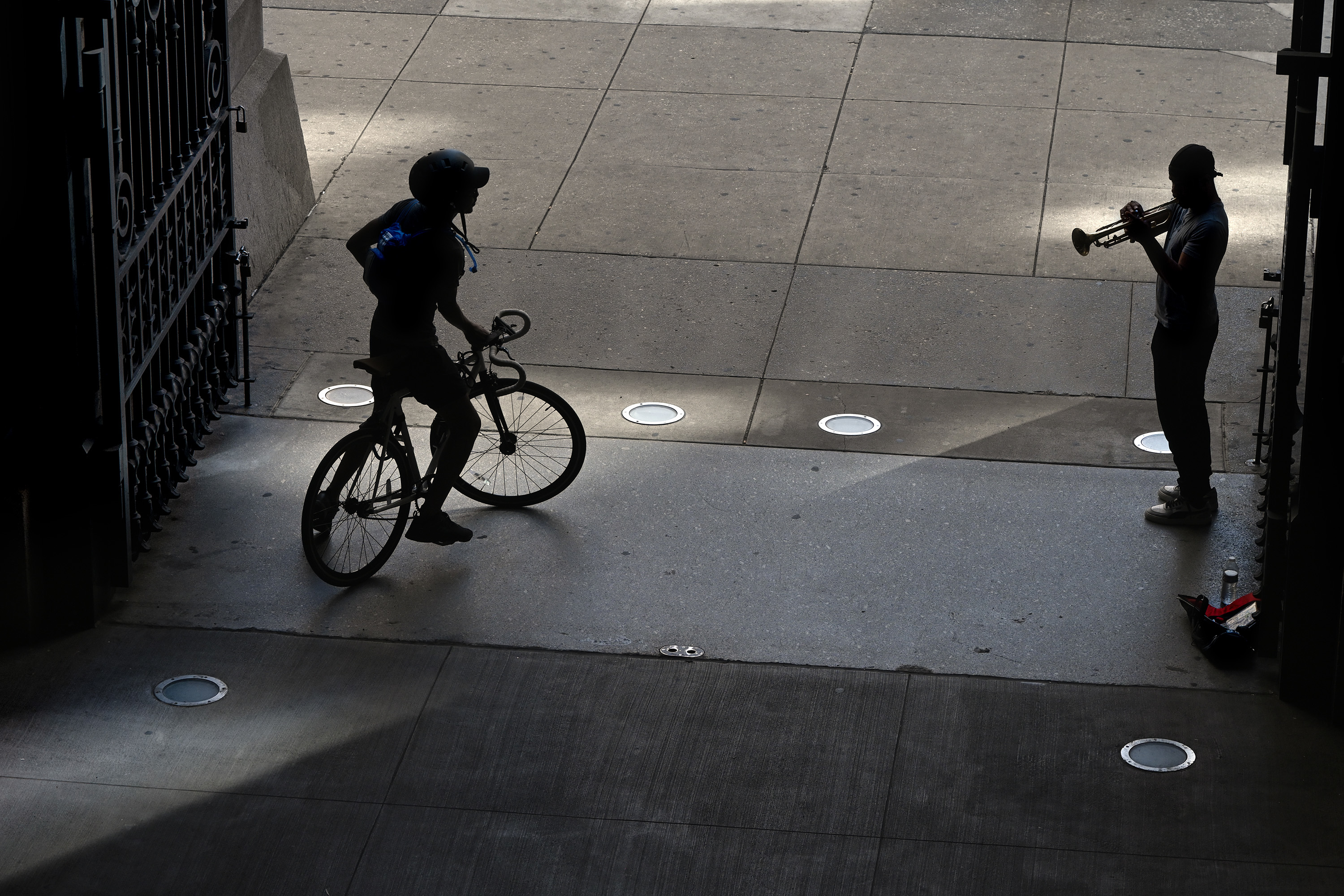
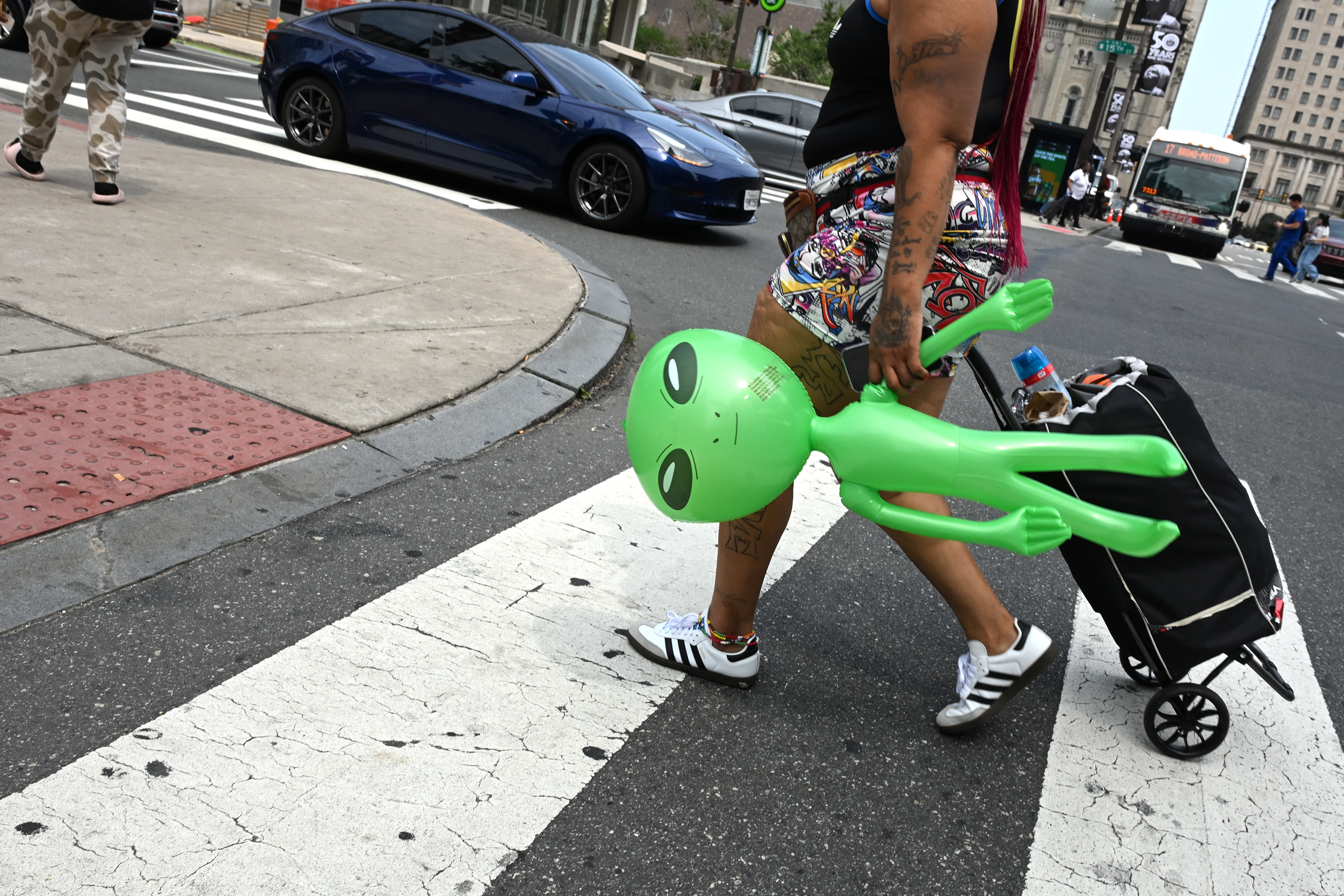
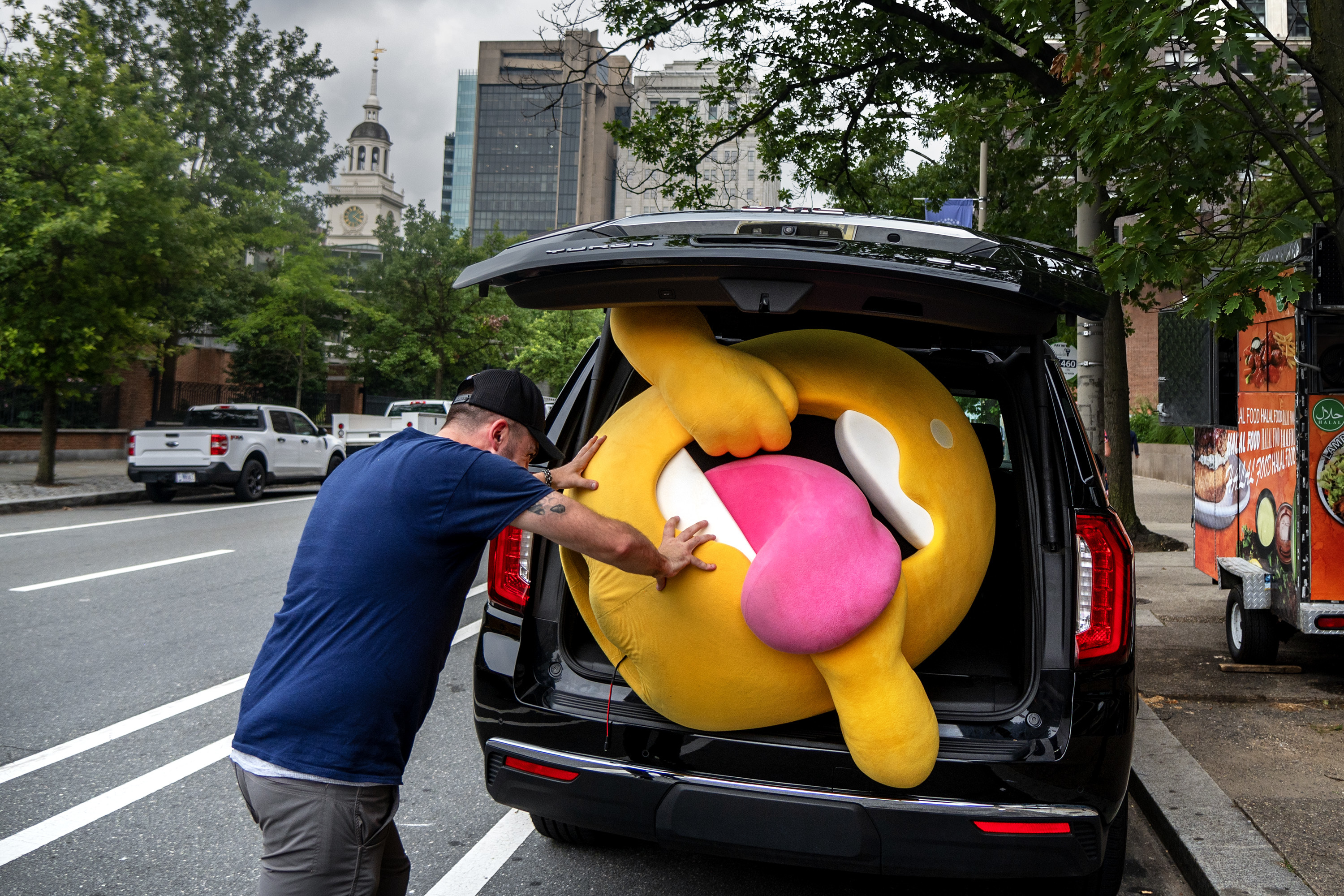
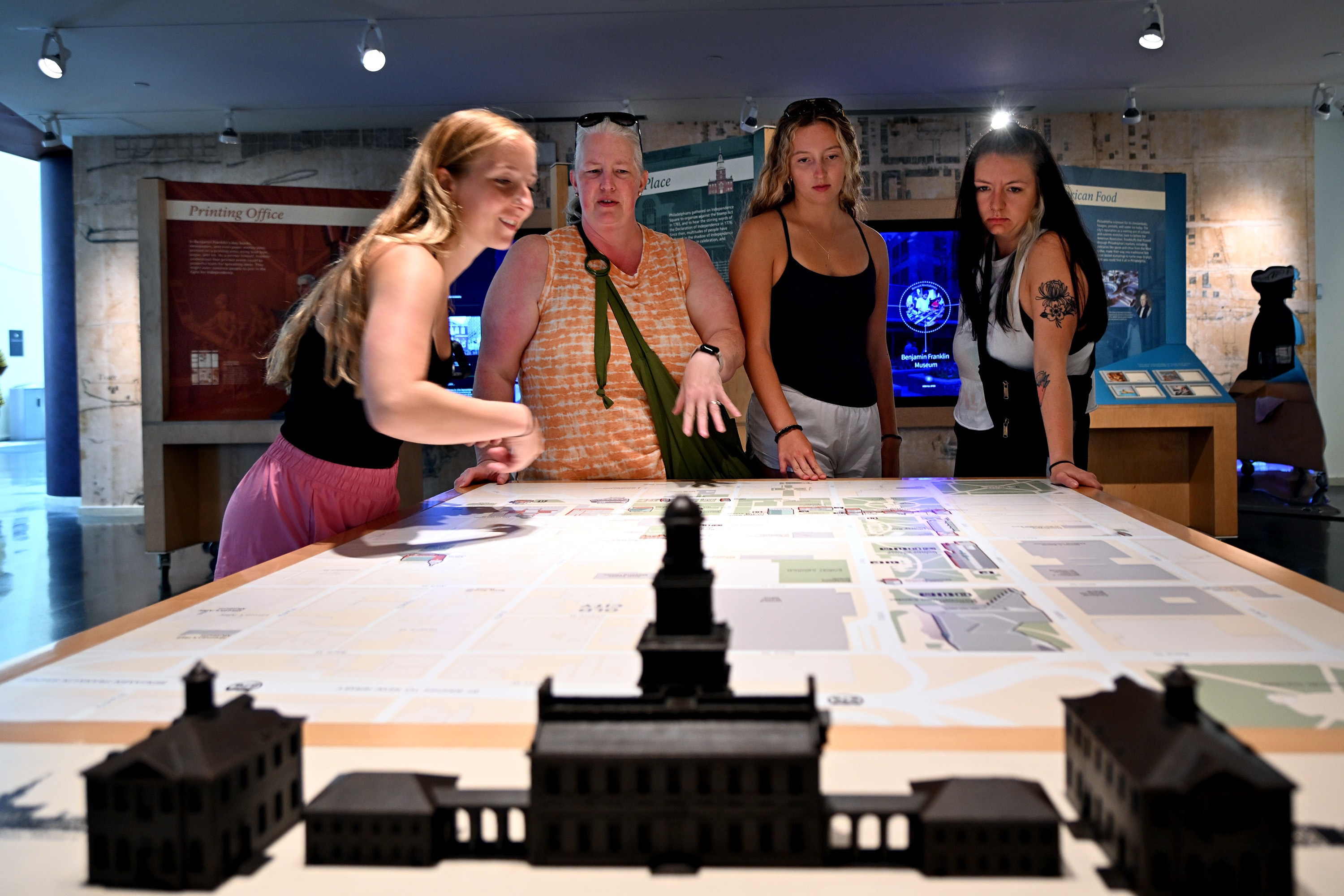
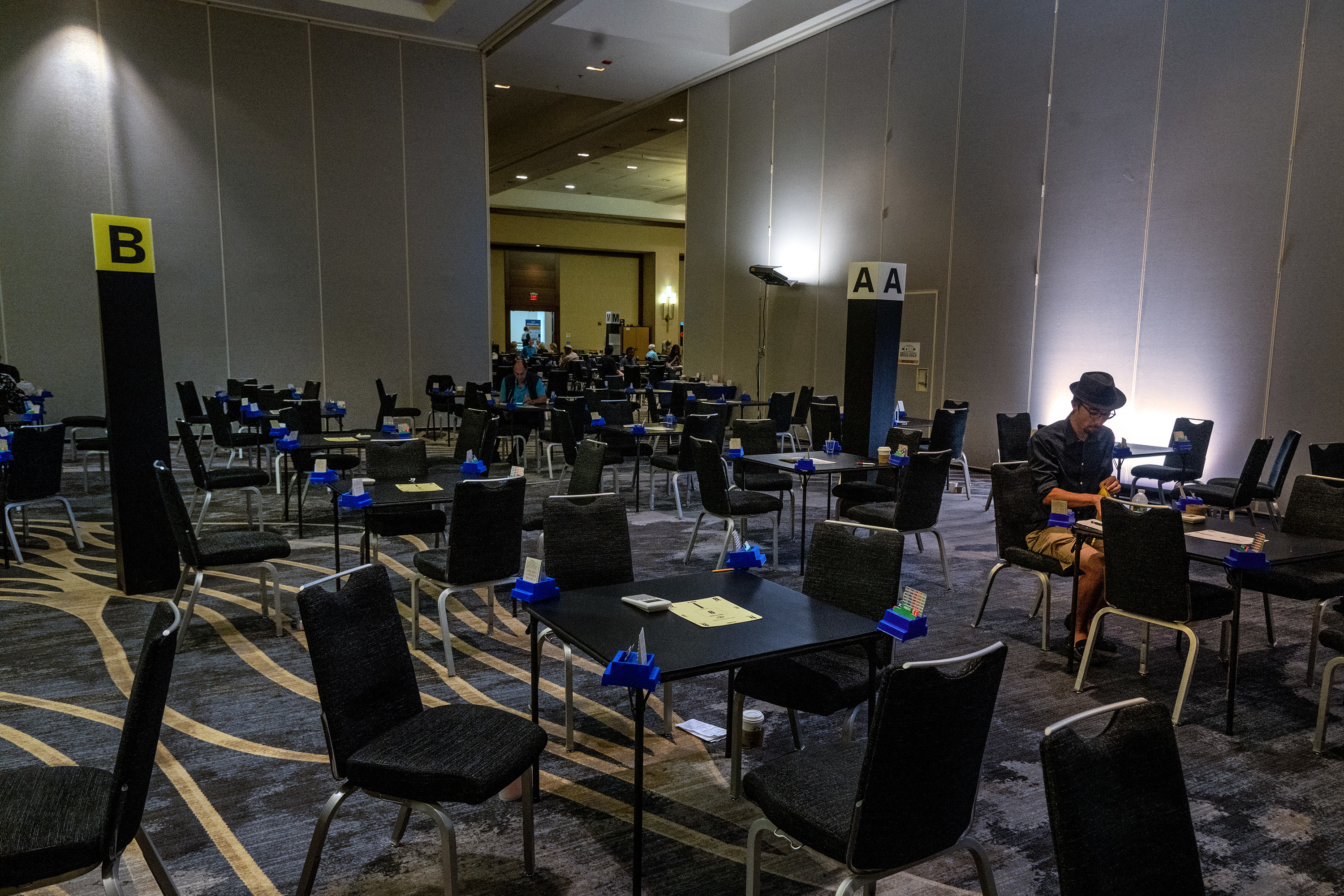
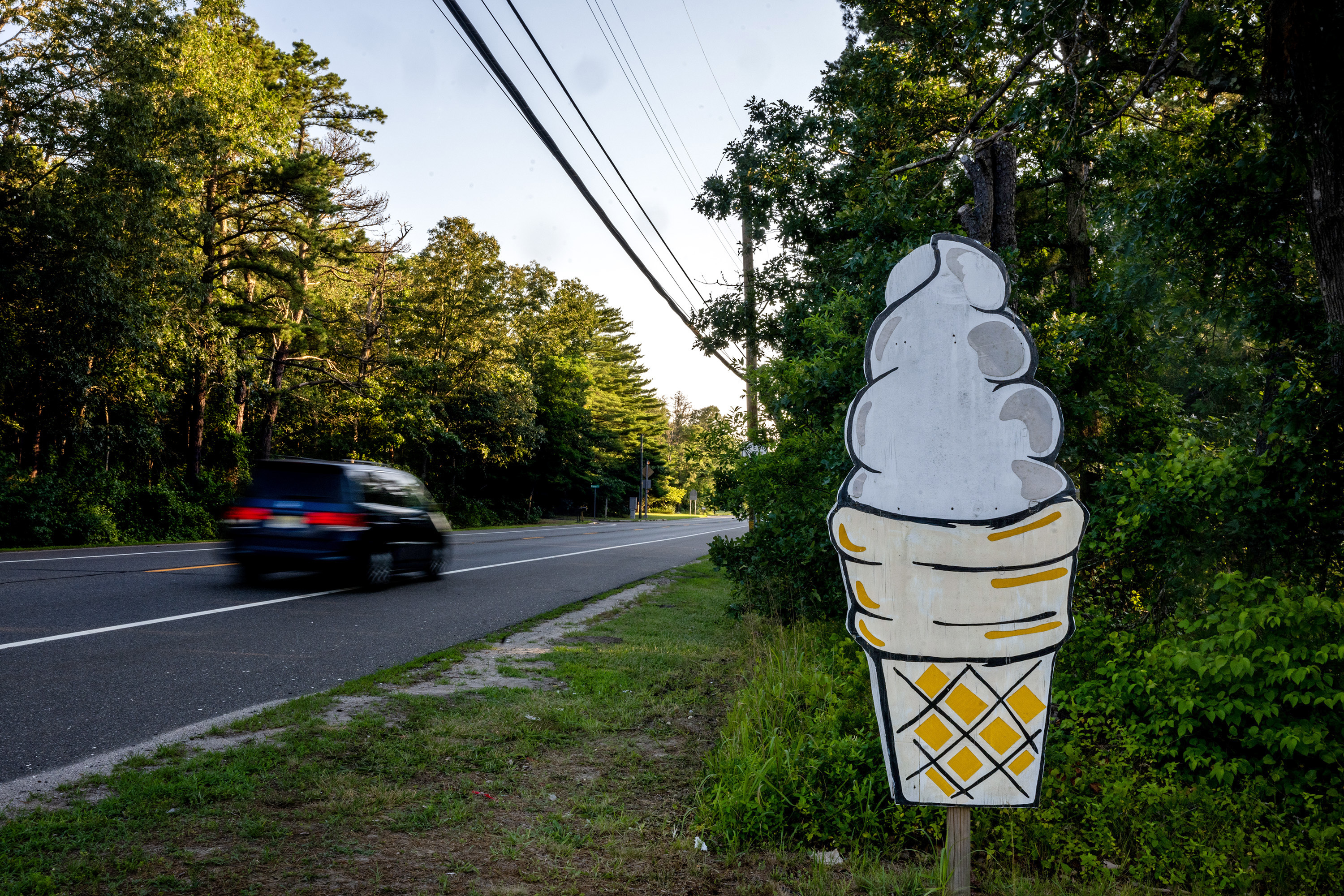
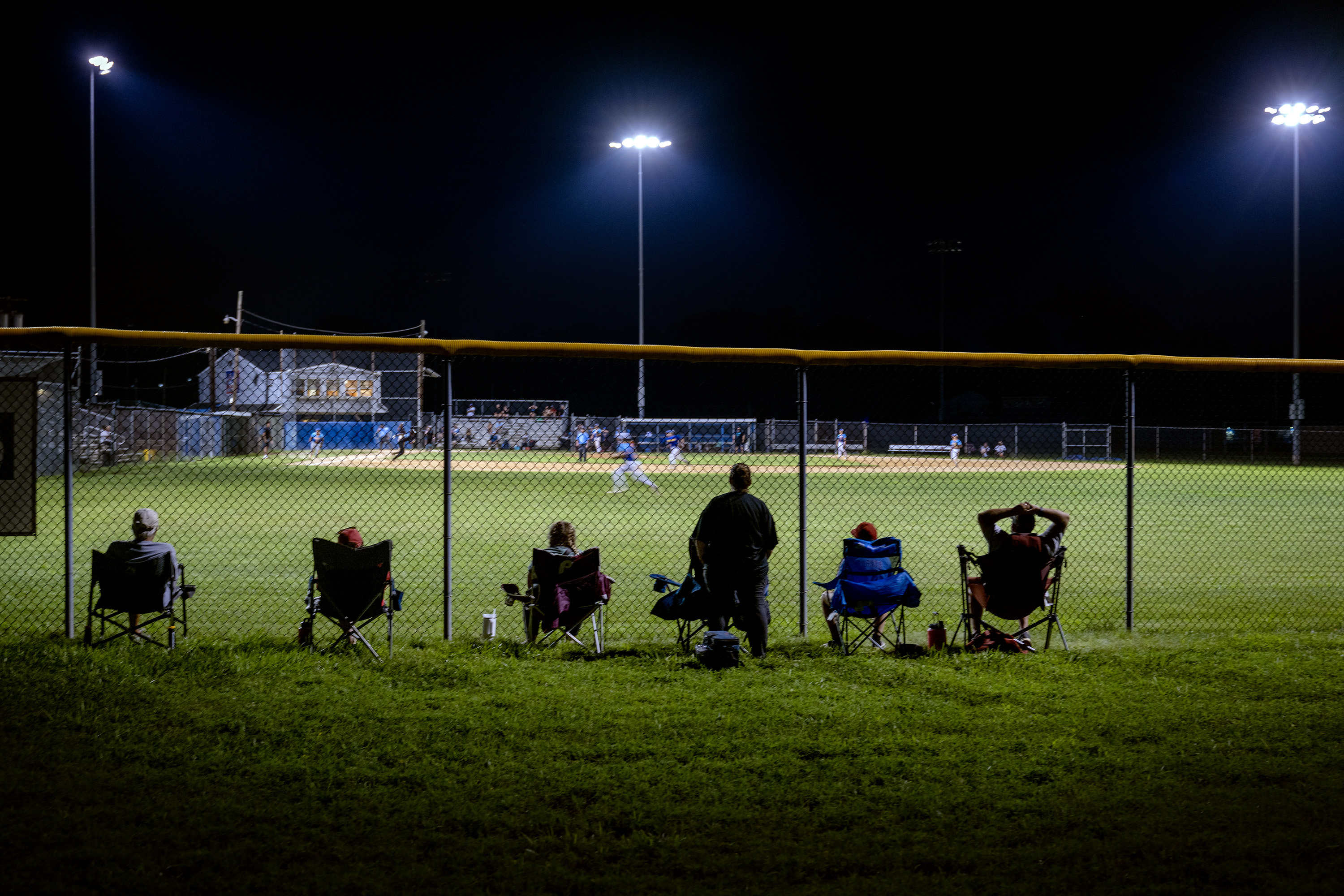
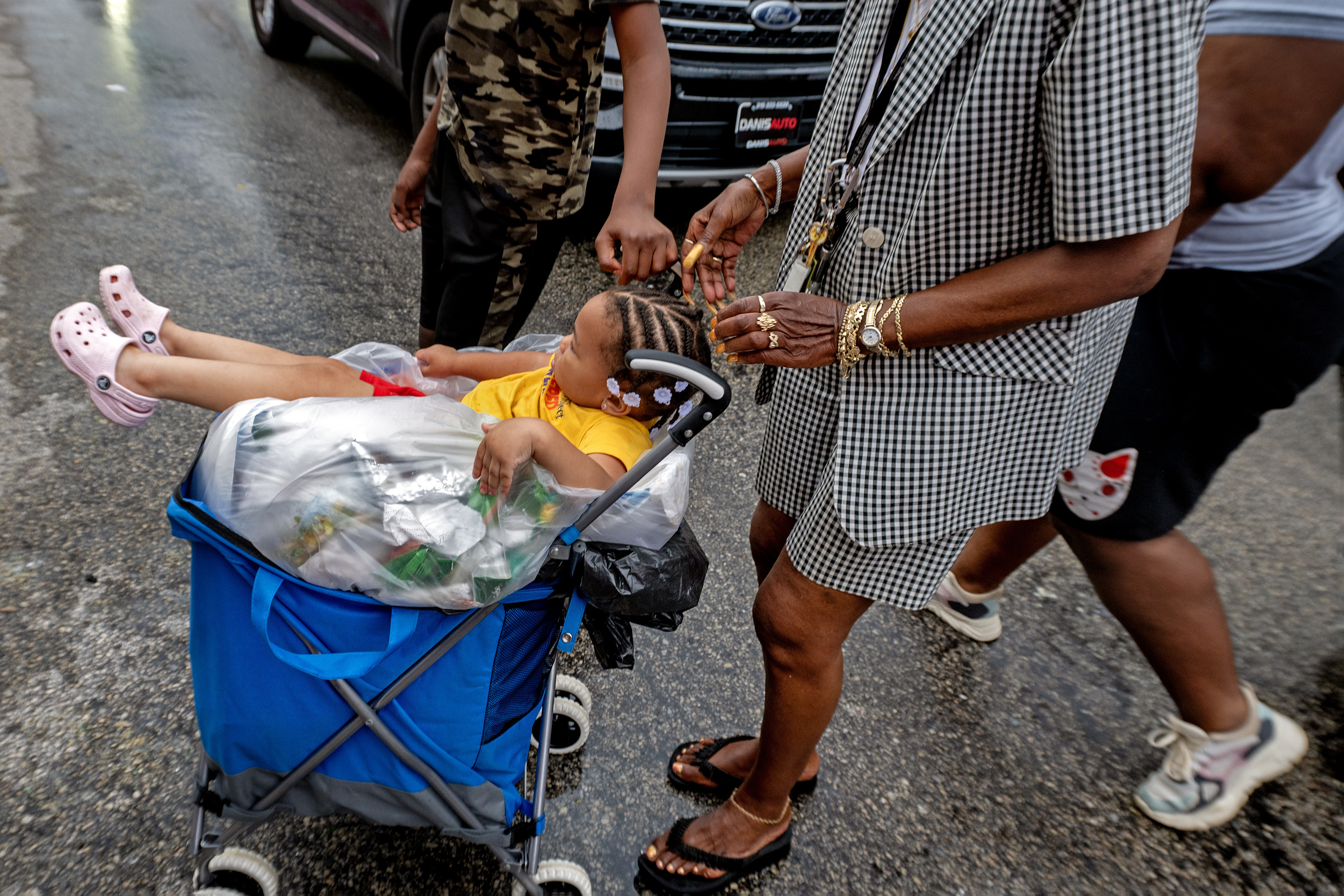
October 11, 2025: Can you find the Phillie Phanatic, as he leaves a “Rally for Red October Bus Tour” stop in downtown Westmont, N.J. just before the start of the NLDS? There’s always next year and he’ll be back. The 2026 Spring Training schedule has yet to be announced by Major League Baseball, but Phillies pitchers and catchers generally first report to Clearwater, Florida in mid-February.October 6. 2025: Fluorescent orange safety cone, 28 in, Poly Ethylene. Right: Paint Torch (detail) Claes Oldenburg, 2011, Steel, Fiberglass Reinforced Plastic, Gelcoat and Polyurethane. (Gob of paint, 6 ft. Main sculpture, 51 ft.). Lenfest Plaza at the Pennsylvania Academy of the Fine Arts on North Broad Street, across from the Convention Center.September 29, 2025: A concerned resident who follows Bucks County politics, Kevin Puls records the scene before a campaign rally for State Treasurer Stacy Garrity, the GOP candidate for governor. His T-shirt is “personal clickbait” with a url to direct people to the website for The Travis Manion Foundation created to empower veterans and families of fallen heroes. The image on the shirts is of Greg Stocker, one of the hosts of Kayal and Company, “A fun and entertaining conservative spin on Politics, News, and Sports,” mornings on Talk Radio 1210 WPHT.September 22, 2025: A shadow is cast by “The Cock’s Comb,” created by Alexander “Sandy” Calder in 1960, is the first work seen by visitors arriving at Calder Gardens, the new sanctuary on the Ben Franklin Parkway. The indoor and outdoor spaces feature the mobiles, stabiles, and paintings of Calder, who was born in Philadelphia in 1898, the third generation of the family’s artistic legacy in the city.September 15, 2025: Department of Streets Director of Operations Thomas Buck leaves City Hall following a news conference marking the activation of Automated Speed Enforcement (ASE) cameras on the Broad Street corridor – one the city’s busiest and most dangerous roads. The speed limit on the street, also named PA Route 611, is 25 mph.September 8, 2025: Middle schoolers carry a boat to the water during their first outing in a learn-to-row program with the Cooper Junior Rowing Club, at the Camden County Boathouse on the Cooper River in Pennsauken. September 1, 2025: Trumpet player Rome Leone busks at City Hall’s Easr Portal. The Philadelphia native plays many instruments, including violin and piano, which he started playing when he was 3 years old. He tells those who stop to talk that his grandfather played with Billie Holiday, Duke Ellington, Nina Simone, and Dizzy Gillespie. August 25, 2025: Bicycling along on East Market Street.August 18, 2025: Just passing through Center City; another extraterrestrial among us. August 11, 2025: Chris Brown stows away Tongue, the mascot for a new hard iced tea brand, after wearing the lemon costume on a marketing stroll through the Historic District. Trenton-based Crooked Tea is a zero-sugar alcoholic tea brand founded by the creator of Bai, the antioxidant-infused coconut-flavored water, and launched in April with former Eagles defensive end Brandon Graham as a partner.August 4,2025: Shanna Chandler and her daughters figure out their plans for a morning spent in Independence National Historical Park on the map in the Independence Visitor Center. The women (from left) Lora, 20; Shanna; Lenna, 17; and Indigo, 29, were stopping on their way home to Richmond, Virginia after vacationing in Maine. The last time they were all in Philadelphia Shanna was pregnant with Lenna. July 28, 2025: Louis-Amaury Beauchet, a professional bridge player from Brittany, France, takes a break between game sessions in an empty ballroom during the North American Bridge Championships at the Center City Marriott with some 4000 people in town over week of the tournament. The American Contract Bridge League is hosting the week of meetings and tournaments with bridge players from all over the world. The ACBL is the largest bridge organization in North America, with over 120,000 members (down from around 165,000 before COVID). Bridge draws players of all ages and walks of life – fictional characters James Bond and Snoopy both played as do billionaires Bill Gates and Warren Buffett (who sometimes play as partners).July 21, 2015: Signage for the Kustard Korner in Egg Harbor City, on the way to the Jersey Shore. President Ronald Reagan designated July as National Ice Cream Month and the third Sunday of the month.July 14, 2025: Fans watch a game at the Maple Shade Babe Ruth Field, part of the 20th Annual Franny Friel Summer Classic, on a cool(er) night with a refreshing breeze, the weekend before the MLB All-Star Game (with Kyle Schwarber the lone Phillies representative).July 7, 2025: Caroline Small wheels her two year-old great-granddaughter atop a bag of garbage as she carts it to a drop-off site at the Tustin Playground at 60th St. and W Columbia Ave. as residential trash collection stopped when a strike was called by District Council 33. Small lives just around the corner and said of the toddler, “she was just walking too slow.”
The house: a 1,380-square-foot 1950s twin with three bedrooms and 2½ baths
The price: $255,000
The ask: Kim Sephes didn’t want to live in a house attached to her father’s church anymore. It “felt strange,” she said, living there after he passed away in 2019.
So in 2022, she and her husband, Matthew, began searching for a home for their family of eight. Safety, location, and a driveway were top priorities. They needed four bedrooms and dreamed of a backyard.
The search: At first, the couple searched in Northeast Philadelphia, where they found a lot of nice houses, but were worried about their kids walking around safely without supervision. They expanded their search to Mount Airy, but the competition was stiff. They made offers on four houses only to get outbid every time.
“It was a crazy housing market where people were offering cash offers left and right,” Sephes said.
Soon after, the family “stepped on the gas” with their search and found a house they loved in August 2022.
The appeal: The house was move-in ready. Only the kitchen needed updating.
But they had to make a few compromises.
It was three bedrooms, not four — but it had a finished basement that Sephes says could be converted. It was a twin, not their preferred single, home — but it was attached to the corner house.
“At least we weren’t in the middle of the block,” said Sephes. Most importantly, it was in a great section of Mount Airy, and it had a back patio.
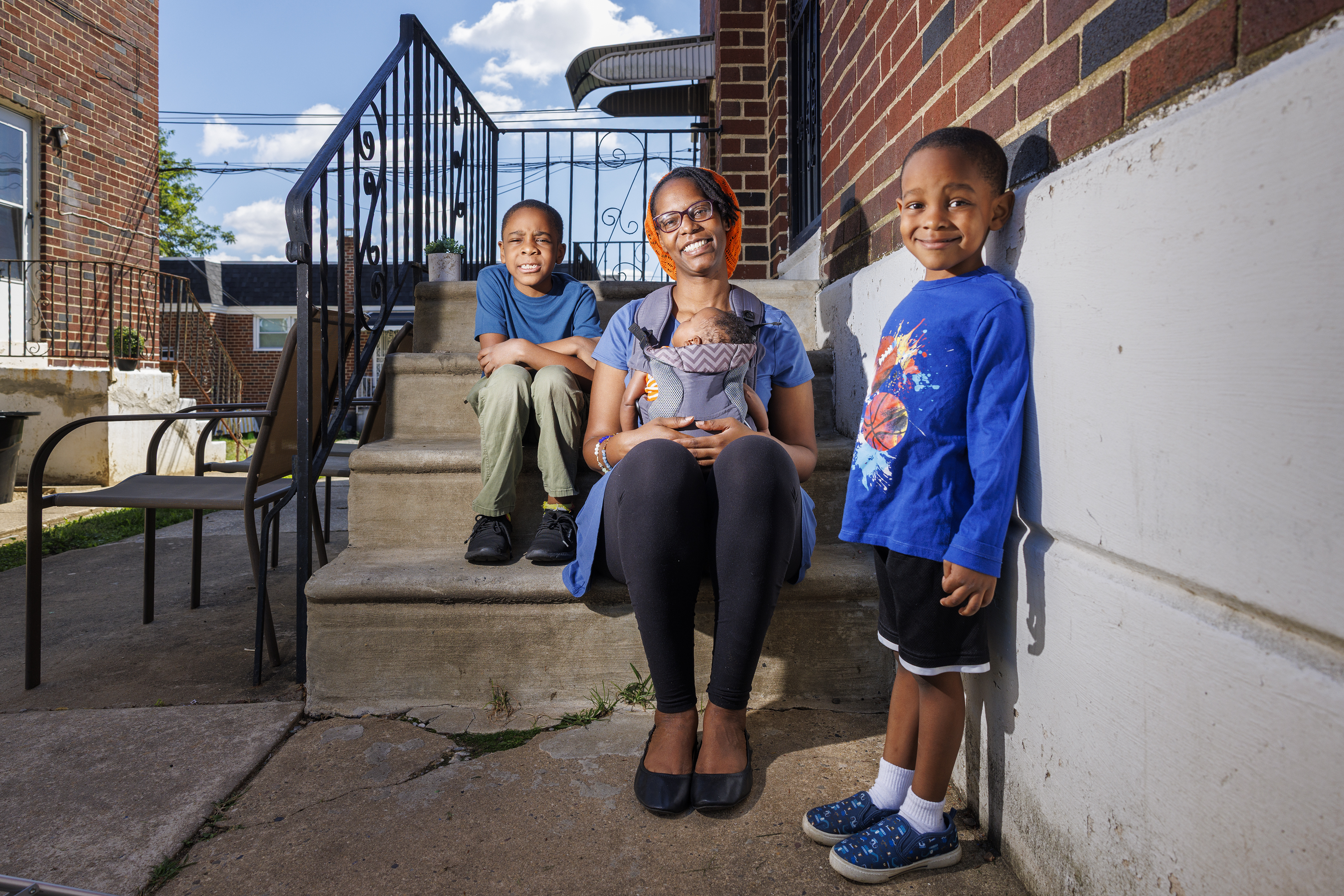
Kim Sephes with children (from left) Darius, 8, and Solomon, 4, on the steps of their home. She is carrying 1-month-old Adam.
The deal: They offered $5,000 over the asking price of $250,000. The house attracted several offers from investors but “the sellers really wanted to sell it to a family,” said Sephes. “Our real estate agent went hard trying to convince them to sell it to us, because they did have a cash offer on the table for more than what we were going to offer.”
In the end, the Sepheses’ offer was accepted and, after a little back and forth about the inspection, they sealed the deal with a $5,000 non-refundable earnest money deposit.
The money: The couple saved $18,000 for a down payment, socking away the previous two years’ tax returns and parts of their paychecks. For three years, they put a little bit away every time they got paid.
“I was so determined,” said Sephes.
They also got a $15,000 forgivable loan through the Neighborhood Lift program, which they do not have to pay back as long as they stay in the house for 10 years.
Through their lender, Fulton Bank, they secured an additional $2,000 grant and a Federal Housing Authority (FHA) mortgage with a 5% interest rate.
The Neighborhood Lift grant “helped get us in the home,” Sephes said. Without it, they “would’ve qualified for something way less.”
The move: The Sepheses closed on Sept. 26 and started moving right away.
To ensure they had enough time to move, they paid October rent. However, they were officially out of the house within the first week, so the church gave them the full month’s rent back. “I really appreciated that because they didn’t have to do that,” Sephes said.
Any reservations? The only issue with the house is that “it’s a little small,” Sephes said. But the garage has extra space for storage.
More than anything, Sephes is grateful they were able to move.
“We were ready to leave the church house,” she said.
Life after close: Sephes says the best thing about their new home is the neighborhood.
“It’s a beautiful block, very quiet, and it’s wide, too, so we don’t have to worry about traffic.”
And we’re back with another Very Philly Question. I asked back two Philly natives for their take on the forever-Philly issue.
.inno-chat__body {
border-radius: 12px;
}
Evan Weiss
Deputy Features Editor
The question is: Can I move the cones my neighbor places to save his parking spot?
Tommy Rowan
Programming Editor
You absolutely can and should.
Sam Ruland
Features Planning and Coverage Editor
10000%
Sam Ruland
You don’t own the street — it’s public parking! If you want guaranteed parking, get a driveway.
Tommy Rowan
Now, if you shoveled out a spot for your car and put work into it, I'm OK with you claiming that spot for that snow day.
Tommy Rowan
But never should someone ever save a spot with a cone, folding chair, bucket, nada.
Sam Ruland
Exactly, if it’s mid-blizzard and you just spent two hours digging out your car, fine, take a victory lap. But by the next morning when everything's melted away, cones are getting tossed.
Tommy Rowan
And for extra credit, you could also return said cone to the Water Department, which most likely owned the cone first before this concerned party stole them.
Sam Ruland
But in all reality, I hate the whole saving-spots-with-cones thing. It’s entitled — that’s not your spot, it’s A SPOT.
Tommy Rowan
Amen
Evan Weiss
In the moment you're removing that cone, are you at all nervous that the neighbor will see you?
Sam Ruland
Yeah, you feel a little nervous. That's why you move it like it's a lit bomb. Quick hands, no eye contact, and sprint to the car.
Tommy Rowan
Also, I'm a big fan of the "others see it, too," approach. Your other neighbors on your block already know who the conehead is.
Tommy Rowan
Safety in numbers.
Sam Ruland
Half the block’s in silent agreement every time someone finally moves it.
Tommy Rowan
Yup!
Sam Ruland
I’m not circling the block three times when there’s an open spot right there. Cone or not, I’m parking.
Tommy Rowan
I came here to chew gum and park. The cone is in the way, and I'm all out of chewing gum.
Evan Weiss
What do you do if your neighbor comes out mid-cone removal?
Sam Ruland
You commit. You’re already in too deep. Smile, wave, and park like you belong there.
Tommy Rowan
Tell them you're reclaiming the property of the Philadelphia Water Department.
Sam Ruland
Or pickup your cellphone and pretend to be on the phone.
Tommy Rowan
Or, if you're really in the mood, give 'em a smile and say, "Thanks for saving it for me!"
Sam Ruland
Bonus points if you follow it up with, “Go Birds!” while stepping out of the car.
Tommy Rowan
Yeah! And look, nobody likes circling blocks. But suck it up, find an ACME or a shopping center and park there for the night and move it in the morning before the tow trucks come. Like the rest of us!
Tommy Rowan
And for God's sake leave the Water Department alone!
This conversation has been edited for length.
What other Very Philly Questions should we address?
The advent of spooky season brings endless options for driving-distance getaways packed with U-pick orchards, twisting corn mazes, and high-tech haunts. But only Sleepy Hollow, at the gateway to New York’s Hudson Valley, has a reputation so perfectly tied to the macabre.
As the setting for Washington Irving’s The Legend of Sleepy Hollow, the town and its neighboring villages blend American history, small-town autumn charm, and an enduring flair for the supernatural. It’s about a two and a half hour drive from Philly — or take Amtrak to Penn Station, get to Grand Central, and hop on Metro-North’s Hudson Line.
Once you’ve arrived, the mix of colonial history, Halloween pageantry, and riverfront beauty makes it easy to fall under Sleepy Hollow’s spell.
If you’re making a weekend of it, check into Tarrytown House Estate, a historic retreat on a hill above Sunnyside. The estate is home to Goosefeather, chef Dale Talde’s acclaimed Cantonese-inspired restaurant, and combines classic mansions with modern touches — think terraces, firepits, and lounges. It’s one of the few local hotels that’s both stylish and (relatively) affordable. During fall, the property leans into the season with festive touches like pumpkin displays and glowing jack-o’-lanterns scattered across the grounds. It’s an ideal base for exploring Sleepy Hollow’s haunted happenings — close to the action, but tucked away once the lanterns dim.
However you choose to travel, make a morning pit stop at Irvington Station. Grab a matcha latte or flat white from the Australian-accented Ludy Café, and a sage-scented apple-cheddar scone from Red Barn Bakery, walking distance from one another right along the train tracks.
📍 Ludy Café, 7 N. Astor St., Irvington, N.Y. 10533
📍 Red Barn Bakery, 4 S. Astor St., Irvington, N.Y. 10533
Learn: Blue Hill at Stone Barns
Continuing north, head into the woods of Tarrytown to chef Dan Barber’s famous Blue Hill at Stone Barns for a guided Explore Tour of their elysian farm and agricultural center. Take a spin through the market, admiring the hand-thrown ceramics and exquisite preserves, and stay for lunch at the cafeteria. Reservations required.
After arriving in Sleepy Hollow proper, ease into the spookiness at Sleepy Hollow Cemetery, where the one-hour guided tour (in full daylight) leans more history than horror. Not only is the cemetery beautiful, it’s also a great context-setter for the region, providing all the background on its most famous storyteller, Washington Irving, who rests here among other notable figures.
📍 540 N. Broadway, Sleepy Hollow, N.Y. 10591
Solve: The Headless Horseman Files
At the Headless Horseman Files, collect clues from costumed townspeople to unravel what really happened to Ichabod Crane. This live theater-meets-interactive whodunit at Philipsburg Manor is part mystery, part museum experience — and yes, you can exit through the gift shop for a Horseman snow globe.
Bask in the flickering glow of candles and Gothic drama at the Lyndhurst After Dark, the spooky (but not scary) experience at the Lyndhurst Mansion. Guests walk through the riverfront estate, decked in its Halloween best, and encounter live actors in period dress, who share unnerving tales of the mansion’s history.
Pot stickers plumped with dry-aged beef, char siu Berkshire pork belly, and blueberry cheesecake mochi waffles grace the menu at Goosefeather. The free-spirited Cantonese-ish joint comes from Dale Talde, known for his appearances on Top Chef.
On the way back to the office from an assignment about pet bakeries, my colleague and I stumbled upon a true ice cream lover’s paradise: a rare brick-and-mortar Mister Softee.
While the trucks and their iconic jingles are a dime a dozen in the summertime, a free-standing Mister Softee is about as common as two Philly sports teams winning on the same night. (Too soon?) This one is cash only and open year-round, with a menu that spans ice cream swirls and floats to milkshakes and chocolate-covered bananas. My cup of strawberry and banana soft serve was thick, silky smooth, and anything but artificial-tasting. The roadside stand also gets bonus points for on-season sprinkles. It really is about the little things. Mister Softee of Pennsauken, 3605 Haddonfield Rd., Pennsauken, N.J., 856-662-3787, Facebook page
— Beatrice Forman
Francobolli at Fiorella
On a recent girls’ night out, my friends and I sat at the bar and took it upon ourselves to try four plates of pasta from Fiorella. A noble task, I know! There were no misses, and the current agnolotti dish — stuffed with a sweet polenta and topped with chanterelles — was exceptional.
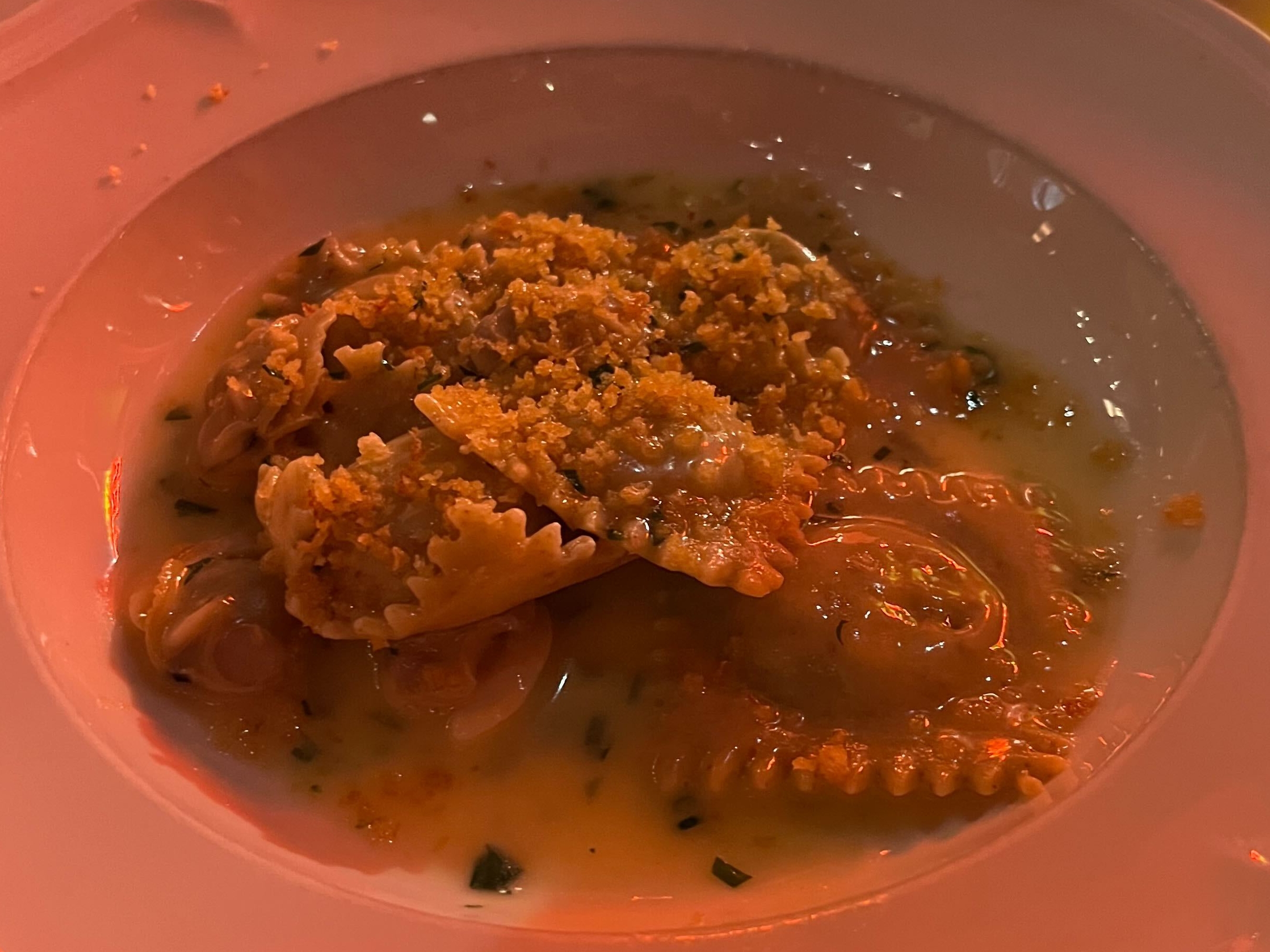
But the dish that lives rent free in my head nearly a week later is the Francobolli clam pasta. We almost didn’t order it, but the bartender insisted; a man has never been more right on a girls’ night out. A pasta-fied take on vongole su crostini aka clam toast, the postage stamp-shaped pasta was stuffed with breadcrumbs and served in a white, brothy sauce topped with littleneck clams. It’s worth seeking out. Fiorella, 817 Christian St., 215-305-9222, fiorellaphilly.com
— Emily Bloch
The Francobolli at Fiorella, a pasta-fied version of clam toast.
Gourmet lamb sampler (for two!) at Zorba’s Taverna
I don’t need a fancy restaurant for my birthday. I prefer the comfort of a neighborhood favorite, and few are as wonderfully reliable as Zorba’s, the 28-year-old taverna that is one of Fairmount’s cornerstone restaurants. To begin with, a flaming platter of ouzo-splashed saganaki cheese beats a birthday candle every time. But Zorba’s also delivers a wide array of some of the most consistent traditional Greek cooking in the region, and the “gourmet” lamb platter for two is a true celebratory feast. (This is not to be confused with the also-delicious charcoal-grilled platter for two, which includes some fantastic lamb chops.)
The platter I chose is a tribute to the slow-cooked pleasures of lamb in three different styles: slices of tender roasted leg seasoned with garlic and herbs, Smyrna-style meatballs simmered in a cumin-scented red wine and tomato sauce, and finally, a meltingly soft mallet of lamb shank glazed in a lemony white avgolemono sauce with artichokes (a distinctive dish I sometimes order solo). This is rustic home cooking at its best, with deep flavors prioritized over fancy presentation. The platter’s aroma is entrancing, and, the tangy potatoes and mixed well-cooked veggies on the side make it extra hearty. My fork wouldn’t stop roaming until I savored every bit. Zorba’s Taverna, 2230 Fairmount Ave., 215-978-5990, zorbastavern.com
— Craig LaBan
The gourmet lamb platter for two at Zorba’s in Fairmount includes Smyrna-style meatballs, roasted leg, and a lamb shank in avgolemono sauce with artichokes.
Fried skate cheeks at My Loup
Bacalao who? My Loup’s fried skate cheeks are an elevated take on cozy fish fritters. The crispy fried batter works perfectly with the sweet, tender, puffed-up fish meat. The three balls are finished off with ají dulce peppers and a subtle horseradish sauce. My Loup, 2005 Walnut St.,(267) 239-5925, myloupphl.com
— Emily Bloch
Fried skate cheeks from My Loup in Rittenhouse Square.
Smash burger at American Sardine Bar
When I moved into my new apartment, my first priority was clear: Scout the neighborhood for my bar— a place where I will eventually be on a first-name basis with the bartenders. American Sardine Bar is well on its way to being that place. I’ve been four times since moving.
My first meal was top-notch: a Caesar salad with a side of French fries and a martini. A stellar way to begin this journey. This week, however, I sank my teeth into one of the best burgers I’ve had. American Sardine Bar’s smash burger (the best kind of burger, in my opinion) is a perfectly cooked beef patty nestled between pickled shallots, pickle slices, a 10K sauce, and a butter-toasted brioche bun. I’m not on a first-name basis yet, but I will go back and order as many smash burgers as I need to to make my dream a reality. American Sardine Bar, 1800 Federal St., 215-334-2337, americansardinebar.com
It always figured to be an emotional day when the Alter family gathered at Har Jehuda Cemetery in Upper Darby. They were commemorating their mother’s first yahrzeit, the anniversary of death in the Jewish tradition.
But when the family arrived at her grave, they found it in devastating condition.
Beatrice Reina Alter, 93, was buried last year next to her husband, Milton Alter, in plots that the couple bought in the Jewish cemetery in the 1990s. When their family came together for her yahrzeit in August, they expected there to be a new headstone to match Milton’s.
Instead, her grave was covered in a fresh mound of dirt. The corner of a plywood board stuck out. And there was no headstone to be seen.
“We were shaken and appalled,” said Daniel Alter, one of the couple’s five children.
Yet issues at the cemetery — and for the burial industry — extend beyond placing headstones on time. Har Jehuda reflects an industry facing serious challenges to its longevity, where sometimes small, antiquated businesses must reinvent themselves. The country’s relationships with cemeteries and burials are changing, putting a seemingly timeless business at risk.
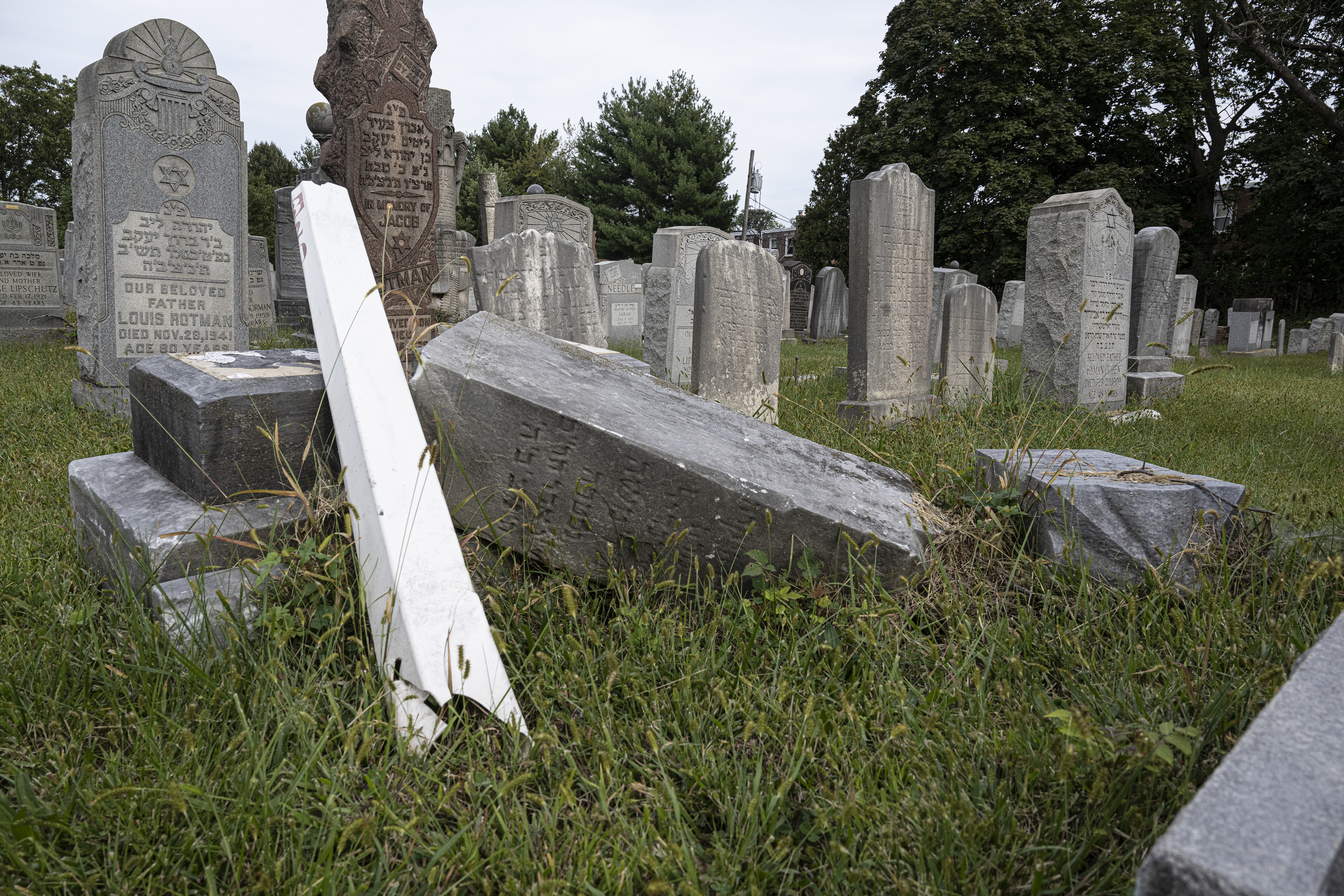
Har Jehuda, for instance,has been an important institution for the region’s Jewish community since its founding in the 1890s, holding more than 20,000 graves. But today, its grounds are largely overgrown and unkept, and numerous gravestones have fallen into disrepair. A volunteer group has stepped in to cover some of the maintenance and landscaping costs but fears it cannot sustain the cemetery for long.
Overgrown weeds and displaced headstones at Har Jehuda Cemetery in Upper Darby.
“The reality is that there are not enough staff or funds to maintain the cemetery, and there hasn’t been for years,” Randi Raskin Nash, a member of the Friends of Har Jehuda Cemetery group, said by email.
The cremation boom
A hundred years ago, cremation was an unusual choice in the United States. Things started to shift in 1963, when the Catholic Church lifted its prohibition of the practice and Jessica Mitford’s book The American Way of Death, an exposé of the death industry, was published. Before then the cremation rate was reported to be in the single digits, and even as it rose, by 1999 only about 25% of Americans were cremated. But that is changing.
Cremations are expected to double the number of burials in 2025, according to a report from the National Funeral Directors Association. By 2045, the cremation rate in Pennsylvania is projected to reach over 82%, with burials dropping to just under 14%.
Several factors appear to be driving the shift, according to Christopher Robinson, the president of the association’s board of directors. Those include costs, environmental concerns, declines in religious affiliation, and growing cultural acceptance of cremation.
window.addEventListener(“message”,function(a){if(void 0!==a.data[“datawrapper-height”]){var e=document.querySelectorAll(“iframe”);for(var t in a.data[“datawrapper-height”])for(var r,i=0;r=e[i];i++)if(r.contentWindow===a.source){var d=a.data[“datawrapper-height”][t]+”px”;r.style.height=d}}});
But that is not the business model that most cemeteries were built upon.
When folks secure a plot for interment, they are really buying an easement for burial rights, or essentially a license to use the cemetery’s land. Plots can cost thousands of dollars and areoften nonrefundable.
Once it comes time for a person to be buried, the cemetery may charge for other parts of the process, like digging and closing the plot, creating a headstone monument, or supplying a vault for the casket.
Most cemeteries sustain themselves for the future by putting a portion of that revenue into an endowment fund, where the return on investment can be used for maintenance and repairs. Friends of Har Jehuda estimates that it requires roughly $50,000 to$75,000 just to cover lawn mowing and weeding per season.
Cremations are much less profitable, particularly if a cemetery does not actually perform it — a walled recess with an engraved cover for a loved one’s urn may cost only a few hundred dollars.
It’s unknown exactly how many cemeteries have formally closed or been abandoned in recent years, since the statistic does not appear to be widely tracked. What is clear is that cremation trends and dwindling space for future burials have left cemeteries struggling.
“There’s going to be a lot of cemeteries going out of business in the next 20 years,” said Tanya Marsh, a law professor at Wake Forest University who teaches funeral and cemetery law, in an episode of The Economics of Everyday Things podcast last year.
Would you get married at a cemetery?
Some cemeteries have embraced the changes and creatively diversified their offerings.
“We’re an outdoor museum. We’re a sculpture garden, we’re an arboretum … we’re more than just a cemetery,” said Nancy Goldenberg, CEO of Laurel Hill Cemeteries in Philadelphia.
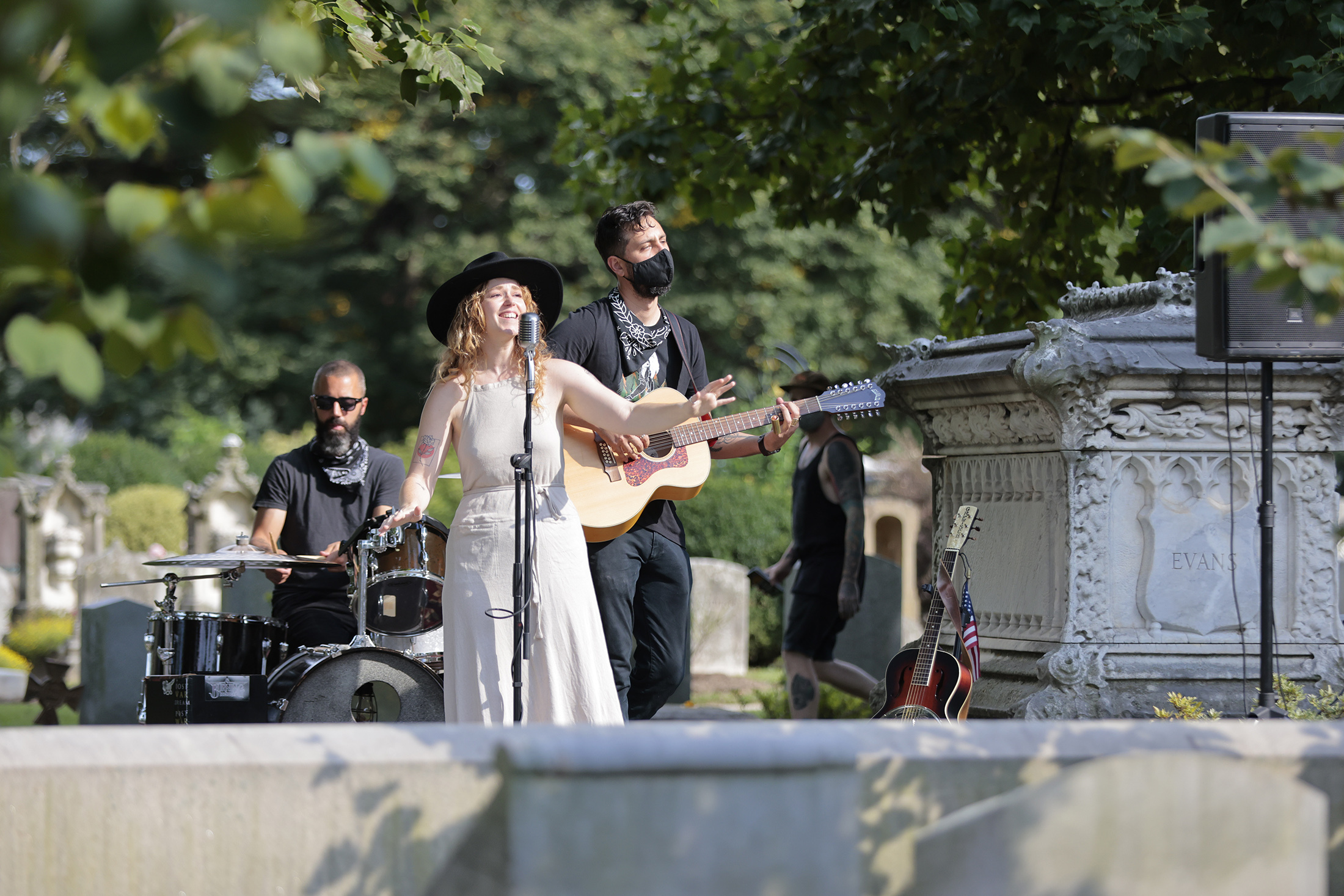
Laurel Hill uses its combined 265 acres on both sides of the Schuylkill to its advantage. On a given day at the historic cemetery, you might see visitors on a history tour, stretching out to watch a movie screening, attending a wedding, or meeting with the official book club, Boneyard Bookworms.
The 49 Burning Condors singer Kimber Dulin, Christopher Tremogile on guitar and Jason Gooch on drums play as folks shop for unusual antiques, vintage items, artwork and handmade wares at the Market of the Macabre at the Laurel Hill Cemetery in 2021.
Goldenberg said the extensive offerings are meant to build connections between people and the cemetery: They will be more likely to contribute money, or when they eventually need a resting place for their loved ones, they will look therefirst.
This all used to be more common — the first U.S. cemeteries in the mid-19th century also served as the country’s first public parks, with open grassy fields fit for a picnic. Before then, people buried their dead in smaller graveyards that eventually became overcrowded and sources of disease.
Laurel Hill is readying itself for a changing death industry, too. Goldenberg said she anticipates a rise in “green burials,” in which a person is buried without embalming or a casket, and said the cemetery was designating a section for them.
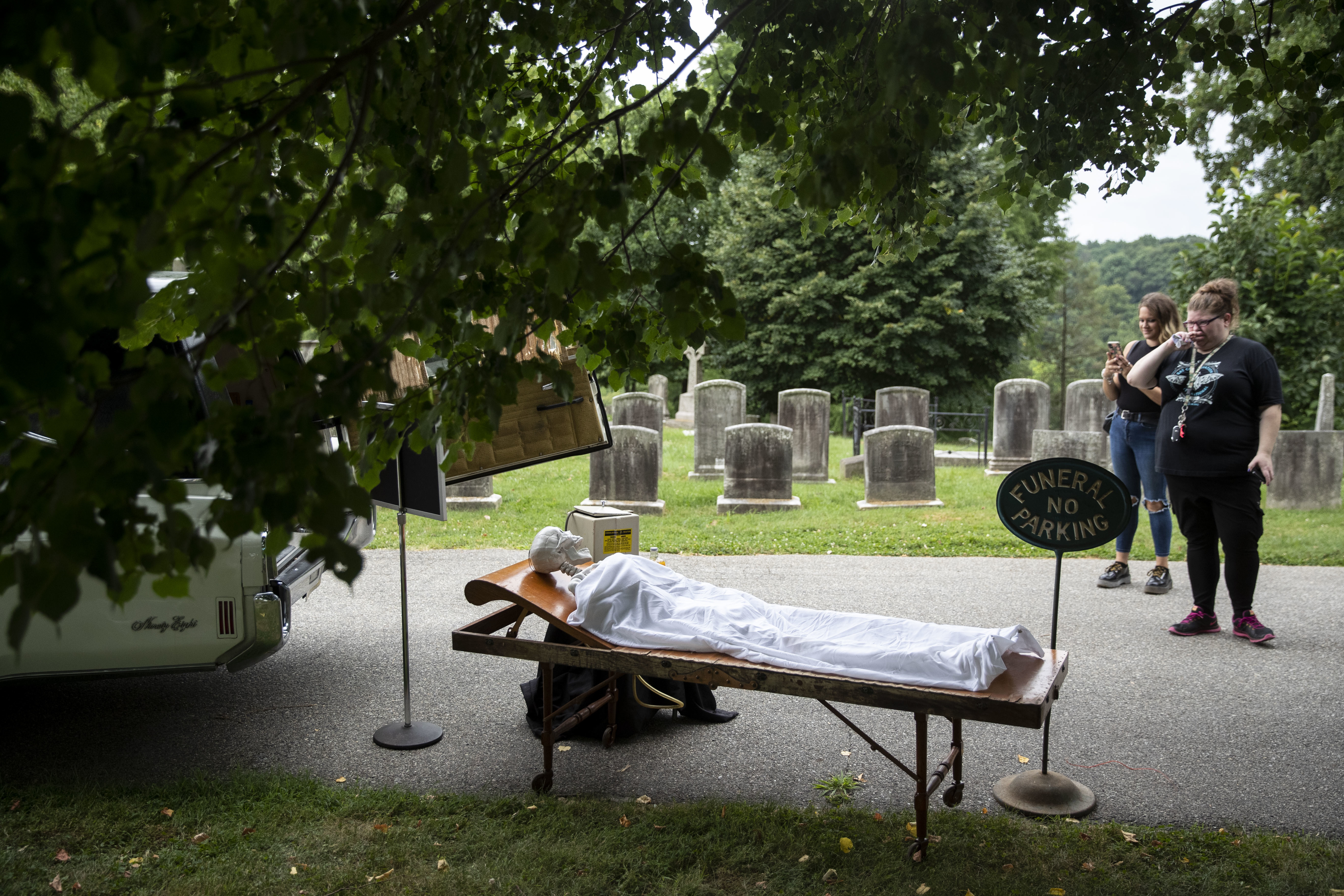
Visitors view a display behind a hearse during the 13th Car & Hearse Show presented by the Mohnton Professional Car Club at Laurel Hill Cemetery in 2021.
And while Goldenberg said she would be long gone before the cemetery runs out of space for new burials, it is a reality officials are planning for.
Laurel Hill is adding space for an additional 225 niches for cremated remains.
“There are small cemeteries, and once they fill up, that’s the revenue stream. … You have to be prepared for that,” she said.
“If you don’t, that’s when you fall on hard times.”
If a cemetery reachesthe point of closure or abandonment, it’s not alwaysclear what would happen to it. Last year, Gov. Josh Shapiro signed into law a bill sponsored by StateRep. Tim Brennan (D., Bucks) that would give financial relief to municipalities that take over abandoned cemeteries, since doing so can be a costly burden that local governments want to avoid.
Uncertain futures for cemeteries
Days after the Alter family made it through the prayers and memorial they planned, the emotional weight of the experience hit them even harder.
Daniel Alter later confirmed with Har Jehuda that a fresh grave had been dug where he believed his mother was buried. Recently, he hired a ground-penetrating radar company to examine the burial site, which determined the freshly dug grave was directly adjacent to where his mother was buried. While Alter was relieved to learn his mother’s grave had not been disturbed, he said Har Jehuda could have prevented the anguish he and his family have felt over the last few months.
Har Jehuda Cemetery’s owner, Larry Moskowitz, declined to comment for this article. Moskowitz was previously prosecuted by the state attorney general’s office over allegations that his other business, Wertheimer Monuments, had failed to deliver headstones to people who had paid for them. Complaints like these against the burial industry happen occasionally — the attorney general’s office also sued another Philadelphia monuments company in 2023 for failing to deliver headstones. There are multiple organizationsdedicated to protecting consumers against predatory burial providers.
The Alters, like other families, continue to visit and bury their loved ones at Har Jehuda, but they hope that no one else goes through their experience.
“Our collective wish is that it never, ever, ever happens again to anyone in the Philly area,” Daniel Alter said.
State Sen. Sharif Street has an early fundraising lead over his competitors in next year’s Democratic primary for a storied Philadelphia congressional seat, according to new campaign finance reports.
But the race is in its early stages, and candidates who entered the race after Street still have plenty of time to catch up before the May 2026 primary.
Street, the son of former Mayor John F. Street, entered the race for Pennsylvania’s 3rd Congressional District in early July,days after U.S. Rep. Dwight Evans (D., Philadelphia) announced he would not seek reelection. Street’s campaign launch coincided with the beginning of the campaign finance reporting period, allowing him three full months to solicit contributions and seek endorsements.
He took in about $352,000 from July 1 through Sept. 30, according to the Federal Election Commission. His campaign spent $33,000 during that time, and he finished the period with $372,000 in cash on hand, which is also the most of any candidate in the race. (Street’s cash reserves are higher than his fundraising because he carried over money from a previous campaign account.)
“Our strong fundraising results put us in a commanding position,” Street campaign manager Josh Uretsky said in a statement. “We’re building a strong campaign that will hit every neighborhood in the Third District by leveraging our broad-based coalition.”
window.addEventListener(“message”,function(a){if(void 0!==a.data[“datawrapper-height”]){var e=document.querySelectorAll(“iframe”);for(var t in a.data[“datawrapper-height”])for(var r,i=0;r=e[i];i++)if(r.contentWindow===a.source){var d=a.data[“datawrapper-height”][t]+”px”;r.style.height=d}}});
Rabb’s haul was notable for a candidate with little support among Philadelphia’s established political organizations, such as the deep-pocketed building trades unions that endorsed Street this week. As he has in past runs, Rabb said he is eschewing contributions from corporate-backed political action committees, and tapping into a national network of progressive small-dollar donors.
“This is a robust, grassroots campaign that’s fueled and funded by a growing movement of Philadelphians and citizens far & wide who want a bold, independent-minded and accountable Democrat to represent the bluest congressional district in the nation,” Rabb said in a statement.
His campaign spent $76,000, and carried forward $181,000.
State Rep. Morgan Cephas, a West Philly Democrat who chairs the Philadelphia delegation to the state House, collected $156,000 in contributions, a respectable sum given that she entered the race about a month before the reporting deadline. Her campaign spent $37,000 and had $119,000 in cash.
In a statement, Cephas said “the excitement about our campaign is palpable.”
“I understand the problems of Philadelphia because I’ve lived them for the last 41 years,” Cephas said. “Together we can deliver real results for our community.”
“Since day one, this campaign has been fueled by healthcare professionals, small business owners, and working families across Philadelphia who are ready to take power back from leaders bought by corporate interests,” Oxman said in a statement.
David Oxman, an intensive care doctor and medical school professor at Thomas Jefferson University Hospital, is running for Congress. Oxman, 58, of Bella Vista, joins a race that includes State Reps. Sharif Street and Chris Rabb to replace retiring U.S. Rep. Dwight Evans.
“As a scientist, teacher, and a non-politician running an outsider campaign, my focus is on connecting with everyday Philadelphians,” Morris, a computer scientist, said in a statement. “Career politicians and the donor class want politics as usual. I’m prepared to make sure everyone in Philadelphia receives equal benefits and equal protections.”
“In just a few weeks in the race, Dr. Stanford has generated significant momentum — in contributions, volunteer engagement, and community enthusiasm,” Stanford campaign manager Aaron Carr said in a statement.
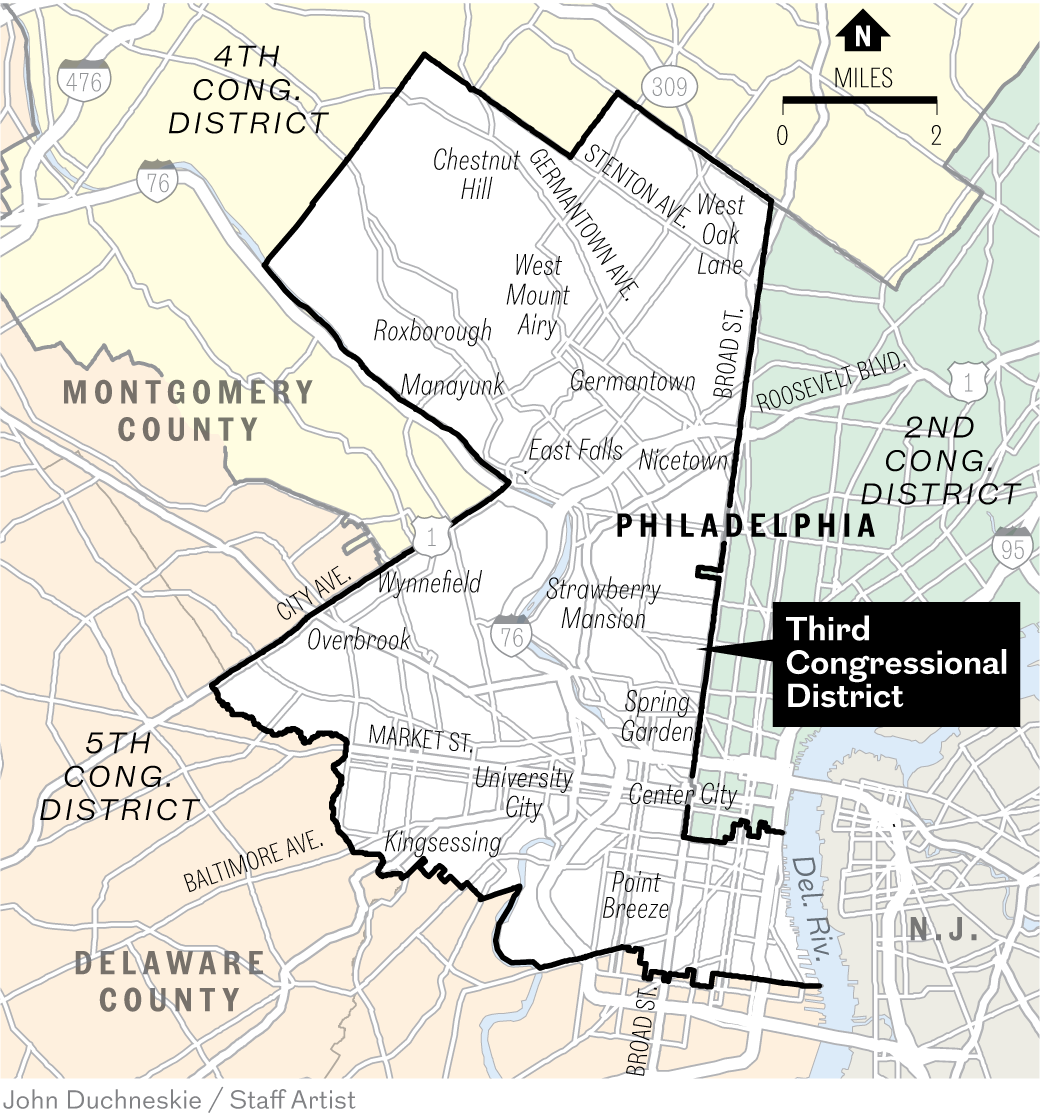
Pennsylvania’s 3rd Congressional District, which includes parts of North, Northwest, West, and South Philadelphia, is one of the most Democratic seats in the nation. With Evans retiring from the seat he has held for nearly a decade, the field could still be in flux as more Philly politicians eye the potentially once-in-a-generation ticket to Washington.
Map of Pennsylvania’s Third Congressional District.
While the race remains competitive, Street’s early fundraising lead will help cement his status as the favorite of the local political establishment. Democratic City Committee chair Bob Brady said this week that party ward leaders will likely vote to endorse Street after this year’s election cycle wraps up next month.
“We’re fully prepared to take advantage of this early lead,” Uretsky said.
Brian Fitzpatrick outraises competitors in Bucks County congressional race
Rep. Brian Fitzpatrick (R., Bucks and Montgomery) speaks during the opening session of the National Treasury Employees Union (NTEU) Legislative Conference in Washington in March.
Unlike the deep-blue 3rd District, the fate of the 1st District will likely be decided in next year’s general election, and not the primary. The district, which includes all of Bucks County and a part of Montgomery County, is the only Philadelphia-area congressional seat represented by a Republican.
Harvie, viewed as the favorite to win the Democratic nomination, raised $217,745 last quarter. The other Democrat in the race, attorney Tracy Hunt, raised $36,692.
This suburban content is produced with support from the Leslie Miller and Richard Worley Foundation and The Lenfest Institute for Journalism. Editorial content is created independently of the project donors. Gifts to support The Inquirer’s high-impact journalism can be made at inquirer.com/donate. A list of Lenfest Institute donors can be found at lenfestinstitute.org/supporters.