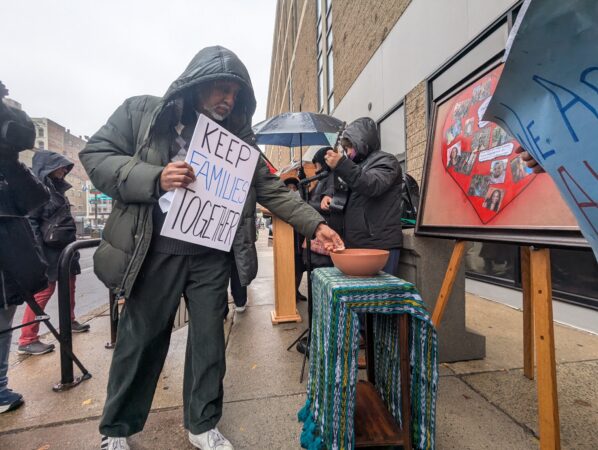
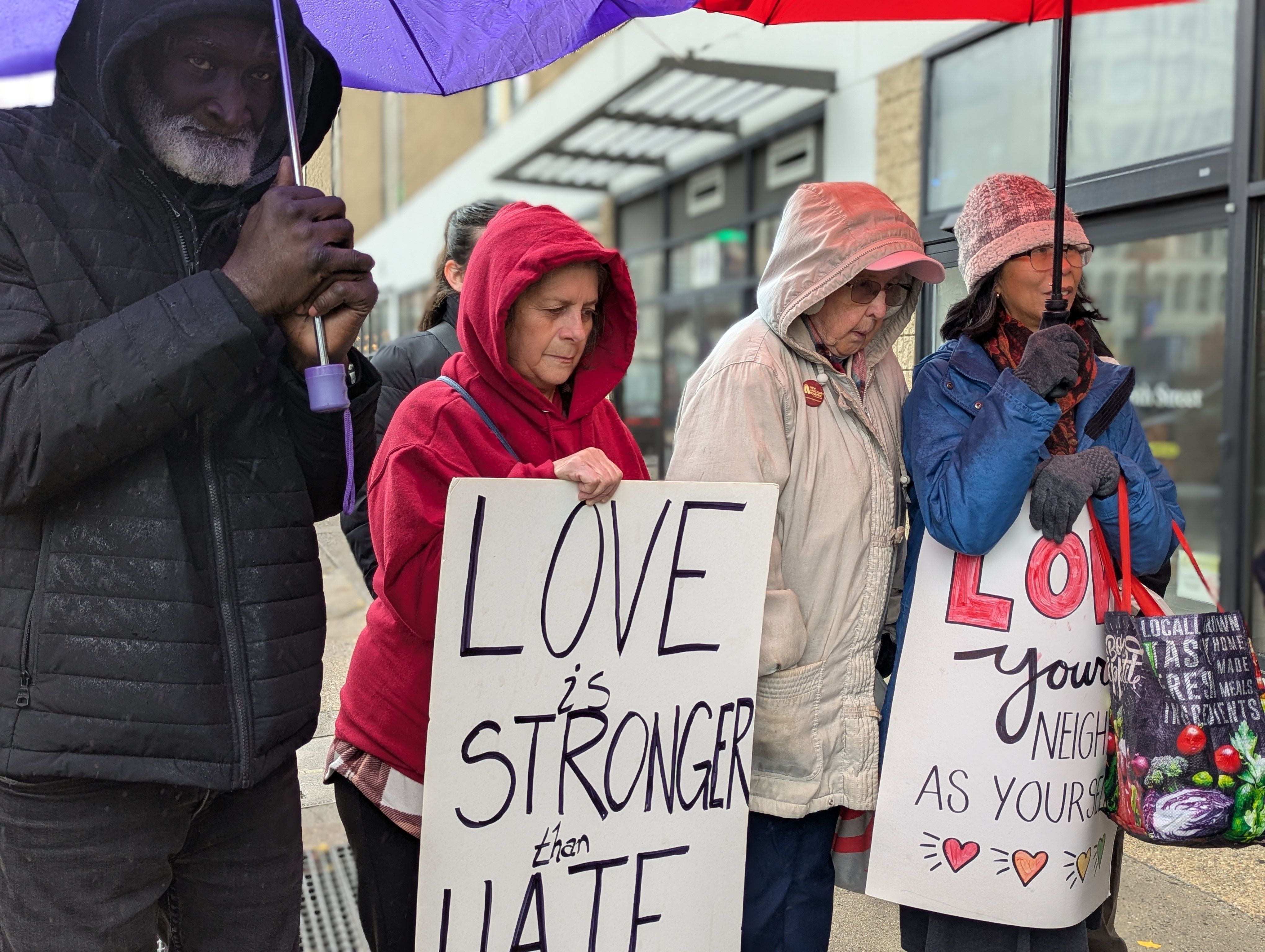
On a rainy Wednesday a week before Thanksgiving, members of the congregations of the Roman Catholic parishes of Holy Innocents and St. Joan of Arc gathered in front of the U.S. Immigration and Customs Enforcement office in Center City.
Another religious group appeared at ICE’s door near Eighth and Cherry Streets on the day before Thanksgiving. This time, it was an interfaith mix of folks led by Christianity for Living Ministries.
And there will be more. On Wednesdays to come, members of Mennonite Action, a couple of United Methodist churches, a Quaker meeting, two synagogues, a Presbyterian church, the Sisters of St. Joseph of Philadelphia and more Catholic parishes have all pledged to take part in a recurring demonstration that Neilson calls ICE Profest 40 — an ecumenical and interfaith action to oppose the government’s pitiless anti-immigrant crackdown slated to take place over 40 weeks. The word profest was coined by Neilson to mean “an amalgamation of faith expressed through proclamation, prayer, and protest.”
Members of the congregations of Holy Innocents and St. Joan of Arc parishes gathered Nov. 19 for an interfaith prayer vigil outside the ICE office in Center City. It was the kickoff of 40 weeks of vigils planned by faith communities across Philadelphia.
But organizers are hopeful that whatever their movement might lack in numbers, it more than makes up for in the power of their spiritual conviction — a conviction that is grounded in the Bible and other sacred texts.
“We proclaim God’s word of justice, mercy, and humility (Micah 6:8),” Neilson told me via email. “We pray for ICE agents and authorities (St. Matthew 5:44-45; St. Luke 3:24; 6:27-28; I Timothy 2:1-4), many of whom are conflicted and have crises of conscience. [We pray] for their courage, transformation, and turning, and for the protection and provision of the detainees and deportees, who are traumatized, from family separation and living in constant fear (Isaiah 1:17; Psalm 10:17-18; 82:3; St. Luke 4:18-19).”
“And,” he added, “we protest ICE activity, i.e., the orders ICE agents are given and the ways in which they are carried out, that dehumanizes and victimizes those created in the image and likeness of God [who] are our neighbors, and [which] disobeys and violates God’s command to welcome and love the stranger and alien (Leviticus 19:33-34; Deuteronomy 10:18-19; St. Matthew 25:31-46).”
The Rev. Christopher Neilson said that demonstrators at the protests pray for detainees and deportees who have been traumatized by family separation and are living in fear. They also pray for the safety of ICE agents and that the organization’s leaders might change their policies.
The number of weeks — 40 — during which this will happen has biblical significance, Neilson said, as a period of transition from trial to transformation. (Think of the 40 days and 40 nights Jesus traveled in the wilderness before the crucifixion.)
For me, the timing of when ICE Profest 40 is gearing up is especially resonant.
We’re moving from Thanksgiving — a secular holiday which, in good years, I get to celebrate with a family that includes foreign-born and U.S.-born folks — into Advent.
The beginning of the liturgical year is when Christians like me move from anticipation to action as we wait to celebrate the birth of Christ into a humble, migrant human family. I love the hush that precedes a world on the brink of transformation. I suspect that is why the quiet power of ICE Profest 40 actions moves me so deeply.
“The tone of these vigils is different,” Peter Pedemonti, the codirector of New Sanctuary Movement of Philadelphia, told me via email.
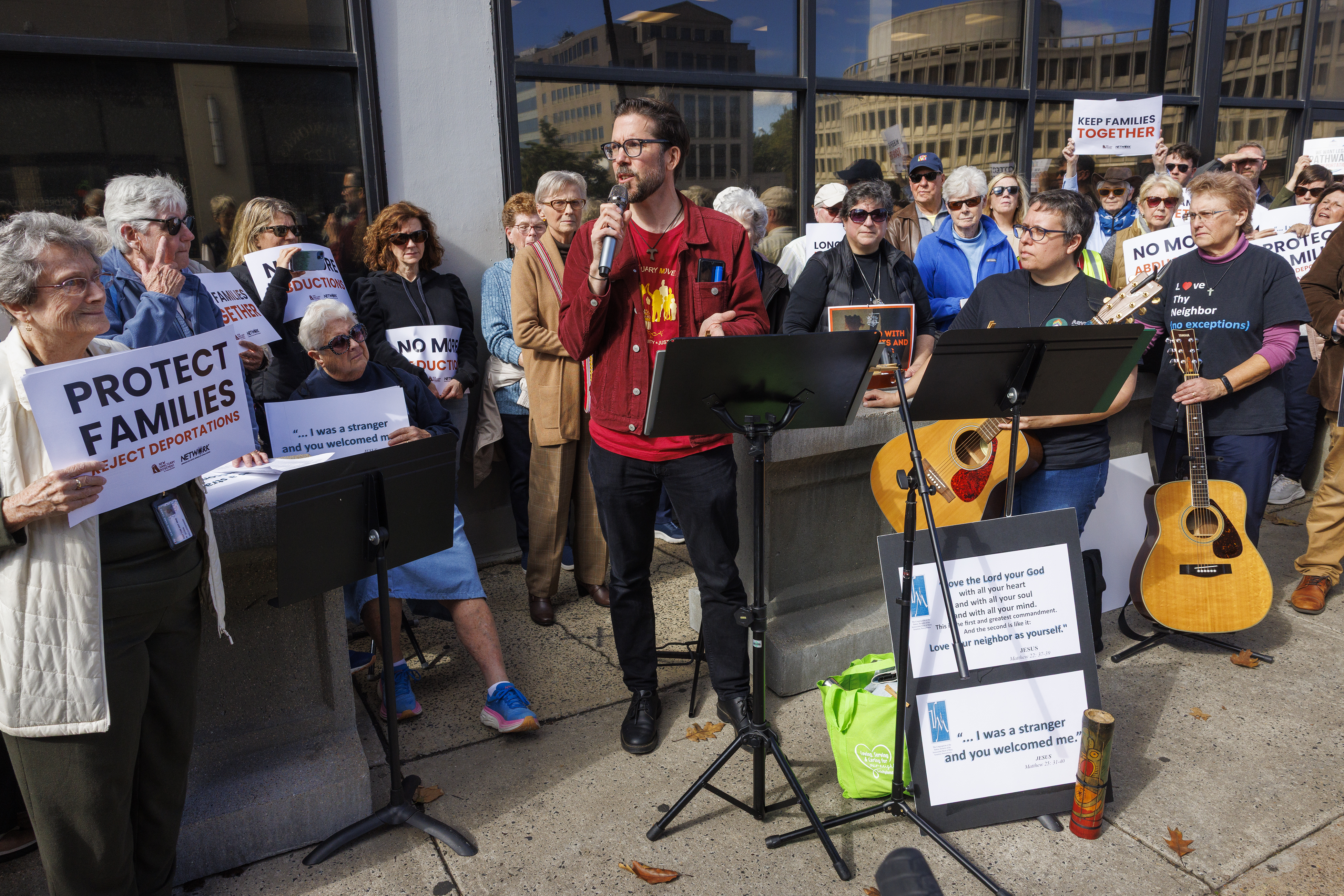
Peter Pedemonti, codirector of the New Sanctuary Movement, addressing Catholics gathered outside the ICE office at Eighth and Cherry Streets, in October.
“They are not as loud as a protest, but they have the potential for big impact,” he said. “We are seeing people sign up who are new to public witness, and so they serve as an entry into collective action. This is important as we fight not only the attacks on immigrant communities, but also Trump’s rapid steps toward authoritarianism. We need everyone right now, and it is really important we have paths for new people to get involved.”
“I have been doing faith-rooted organizing for nearly 20 years. These spiritual tools we have work. We can’t always see the immediate impact, but I have seen them help win campaigns. And so I believe that when we bring them to ICE, we are engaging in something powerful,” Pedemonti added. “The religious community has an important role right now. We are the moral voice, and when we see Trump trample our faith teachings and our democracy, it is critical [that] faith communities speak out.”
While my own faith tradition has long had priests, religious men and women accompanying immigrants and advocating for their rights, the United States Conference of Catholic Bishops has been pretty circumspect about commenting on the Trump administration’s policies.
But for Catholics who supported Trump — 55% overall (62% of white Catholics, 41% of Hispanic Catholics), according to the Pew Research Center — the Catholic bishops’ statement could serve as a come-to-Jesus (heh!) moment.
It is certainly a clear call for transformation during this most transformative of seasons.
I won’t speak for other people of faith, but for me, those are questions that go beyond political affiliation or temporal power, and touch on the “act justly, love mercy, and walk humbly” core requirements Neilson referenced.
On the first Sunday of Advent, one of the readings will be Isaiah’s proclamation that the people “shall beat their swords into plowshares, and their spears into pruning hooks; one nation shall not raise the sword against another, nor shall they train for war again,” and that throws me right back into the fact that both the Catholic bishops in their statement, and the Rev. Neilson in his description of the ICE Profest 40 vigils, reference ICE agents.
ICE agents aren’t wielding swords, of course, but they do carry firearms and other implements with which they smash the windows and doors of terrified immigrants. And with the proposal that military members could be “trained” by deployment to U.S. cities to support ICE and U.S. Customs and Border Protection agents, it’s not that much of a stretch to make Isaiah fit the moment.
I’m going to confess something now. I’ve prayed often for immigrants, never for ICE agents. In fact, I bristled a bit when I heard the bishops equating the vilification immigrants have experienced with the vilification of ICE agents — no one has accused ICE agents of eating pets, or separated them from their families, or turned them from legally residing to unauthorized in a moment.
But, as we saw with this week’s shooting of two National Guard members in Washington, D.C., those who have been asked to carry out the administration’s ill-conceived and oppressive policies may also be endangered by them.
The shooting reminded me of what Pedemonti told me: “If we want ICE to see the humanity of those they are persecuting, then we need to model that and see the humanity of ICE agents.”
“The religious community has an important role right now. We are the moral voice, and when we see Trump trample our faith teachings and our democracy, it is critical [that] faith communities speak out,” Peter Pedemonti said.
“We believe all people can change,” he added, “and so in the tradition of St. Óscar Romero, who called on soldiers in El Salvador’s authoritarian regime to put down their arms, we call for ICE agents to follow their conscience and refuse to follow orders, to leave people with their families, to leave the people in peace.”
I guess it’s time to broaden my prayers. Don’t get me wrong, my rosary (the one which, along with its crucifix and Our Lady of Guadalupe medallion, has monarch butterfly beads representing migrants) will still be in regular rotation with prayers for immigrant justice. But maybe the Romero quote with which I open my prayers using a niner that has his medallion will be different: I want to make a special appeal to soldiers, National Guard members, and policemen: Each of you is one of us.
The first candle we light at Advent represents hope, after all, and no matter how far away or unlikely the desired outcome appears, hope always leads to transformation.
Think you know your news? There’s only one way to find out. Welcome back to our weekly News Quiz — a quick way to see if your reading habits are sinking in and to put your local news knowledge to the test.
Question 1 of 10
This nearly 1,000-member Philadelphia union has a tentative deal after months of negotiations with the local school district:
CorrectIncorrect. XX% of other readers got this question right.
Philadelphia School District principals have a contract and raises. The tentative, four-year deal was struck Monday night, nearly three months after an August contract deadline for the Commonwealth Association of School Administrators, Teamsters Local 502. The union represents nearly 1,000 Philadelphia principals, assistant principals, climate managers and other workers.
Question 2 of 10
A beloved stone statue in Manayunk’s Bridge Garden named Bridget was vandalized with its head smashed off. Bridget is a:
CorrectIncorrect. XX% of other readers got this question right.
Bridget the Dino, a 3-foot-tall costume-sporting stone Tyrannosaurus rex, was ruthlessly beheaded in the garden she calls home. Bridget’s head, still wearing a scarf, was lying at the foot of her stone body in the photo posted by the Manayunk Bridge Garden, the dinosaur’s caretakers. Holod’s, the Lafayette Hill home and garden store, donated a brand new stone dinosaur. Their name is still being decided on.
Subscribe to The Philadelphia Inquirer
Our reporting is directly supported by reader subscriptions. If you want more journalism like this story, please subscribe today.
Facing mounting personal, legal, and financial pressures, Essen Bakery is closing. What treat was the James Beard-nominated bakery particularly known for?
CorrectIncorrect. XX% of other readers got this question right.
Tova Du Plessis, the owner of Essen Bakery, says she couldn’t find a way back after announcing a ‘pause’ in baking operations six months ago. By closing, she says, she has saved her marriage. The bakery was known for its challah, babka, laminated pastries, and seasonal bread.
Question 4 of 10
The Pennsylvania Film Office announced that this TV show will receive a record $49.8 million tax credit, the largest amount the state has granted to a single production:
CorrectIncorrect. XX% of other readers got this question right.
Task received the largest tax credit awarded to a single film production, the state film office announced Monday. The tax credit is part of Gov. Josh Shapiro’s efforts to bring more TV and film productions to Pennsylvania. The effort is expected to bring about 3,700 jobs to Pennsylvania as HBO estimates investing $194.1 million into the state economy, including hiring local crews and paying for hotel accommodations.
Question 5 of 10
What color uniform are the Eagles set to wear for Friday’s game against the Chicago Bears?
CorrectIncorrect. XX% of other readers got this question right.
The team announced it will don its all-black alternate uniforms for the first time this season. As part of the Black Friday matchup, the Eagles are encouraging fans to ditch their green and instead dress in black for a proper blackout at the Linc.
story continues after advertisement
Question 6 of 10
Bridal fashion designer and Say Yes to the Dress star Randy Fenoli visited Cherry Hill bridal shop Dress 2 Impress’ new location. He strongly advised potential brides against this one thing:
CorrectIncorrect. XX% of other readers got this question right.
Fenoli said the world of bridal fashion has changed “completely” from his mid-2000s Say Yes to the Dress days. Brides show up to appointments with screenshots from Instagram and TikTok videos, asking to try on dresses from unknown designers. Others come with AI-generated images that are impossible to match. He added, “Don’t ever, ever, ever, ever order a wedding dress online.”
Question 7 of 10
Northeast vs. Central High School is one of the longest-running rivalries in the country, but the Thanksgiving game is no longer the spectacle it once was. The halls of the schools don’t buzz in the weeks leading up to it, the parade down Cottman Avenue was canceled years ago, the bleachers aren’t filled, and the trophy is falling apart. What figure is at the top of the trophy?
CorrectIncorrect. XX% of other readers got this question right.
The trophy is a wooden horse. Last year, Northeast High won — and broke the horse’s tail in celebration. It was repaired and sat in the school’s trophy case for the year until the anticipated rematch this week.
Question 8 of 10
A group of South Philly dads on Iseminger have organized a weekly activity to improve the neighborhood families’ day-to-day experience. What are they doing?
CorrectIncorrect. XX% of other readers got this question right.
The dad trio invested in their own German personal-sized street sweepers and maintains the stretch of street to help with dust, litter, and broken glass. Their block has 18 kids under the age of 14 and eight under the age of 3. The weekly street-sweeping has turned into a community spectacle.
Question 9 of 10
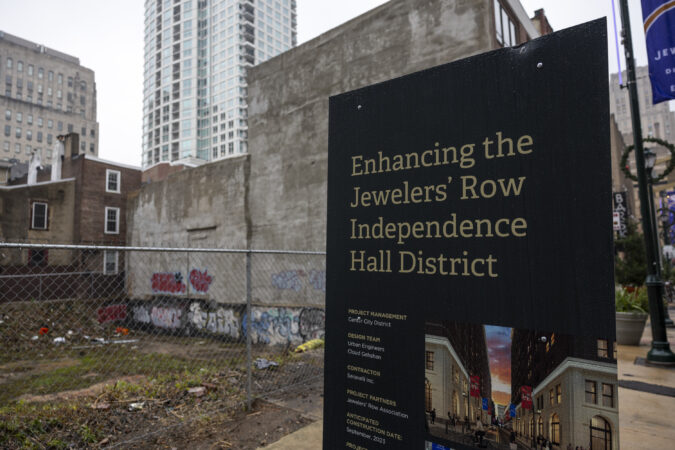
A vacant lot along Elfreth’s Alley will soon be named after Dolly Ottey. What was she best known for championing?
CorrectIncorrect. XX% of other readers got this question right.
Plans call for the lot at North Second Street and Elfreth’s Alley to be reborn as Dolly Ottey Park, honoring the woman who first championed preservation of the narrow cobblestone passage starting in the 1930s. Ottey, a resident and owner of The Hearthstone restaurant at 115 Elfreth’s Alley, formed the Elfreth’s Alley Association in 1934 to protect the unique street and save it from destruction.
Question 10 of 10
What major event in 1986 nearly caused the Philadelphia Thanksgiving Parade to be canceled?
CorrectIncorrect. XX% of other readers got this question right.
The 1986 edition of the country's oldest Thanksgiving Day parade was imperiled by Gimbels' liquidation. But the community pleaded for it to continue, and eventually, WPVI (Channel 6), better known today as 6abc, saved the day.
Your Results
You have skipped .
You scored XX out of 10.
The average reader scored XX out of 10
Seems like you’ve been skimming more than reading there, buddy. There’s always next week.
You’ve read some articles (or made some educated guesses) but we wouldn’t come to you first for our local news recaps. Better luck next week!
Do you work here? You’re a local news stan with the latest updates on Philly happenings. Your friends definitely ask you for summaries on what’s going on and it shows.
As a kid growing up in Philly’s northeast suburbs, filmmaker Dan Trachtenberg was obsessed with movies. In fact, he spent so much time at the local video store in Willow Grove Mall that the manager eventually hired him, even though he was only 15.
“I wasn’t really allowed to work,” said Trachtenberg. “But because I frequented the store so much and would advise people on what movie they should get, they gave me a job.”
After his shift, he’d often take the train to Market Street station and walk over to Chinatown where he would pick up a new Hong Kong action movie. He even learned Mandarin so he could speak to the woman at the pharmacy who rented Chinese movies on the side. He may have purchased a few bootlegs from the adult film store down the street, too.
“Hong Kong action movies really ignited my fire for filmmaking,” said Trachtenberg. He has since transformed that passion into a successful career as a major Hollywood director. His most recent film, Predator: Badlands, hit theaters in November and earned rave reviews from audiences and critics alike.
“I am thrilled to have made the kind of movie that I would have devoured as a kid growing up,” said Trachtenberg.
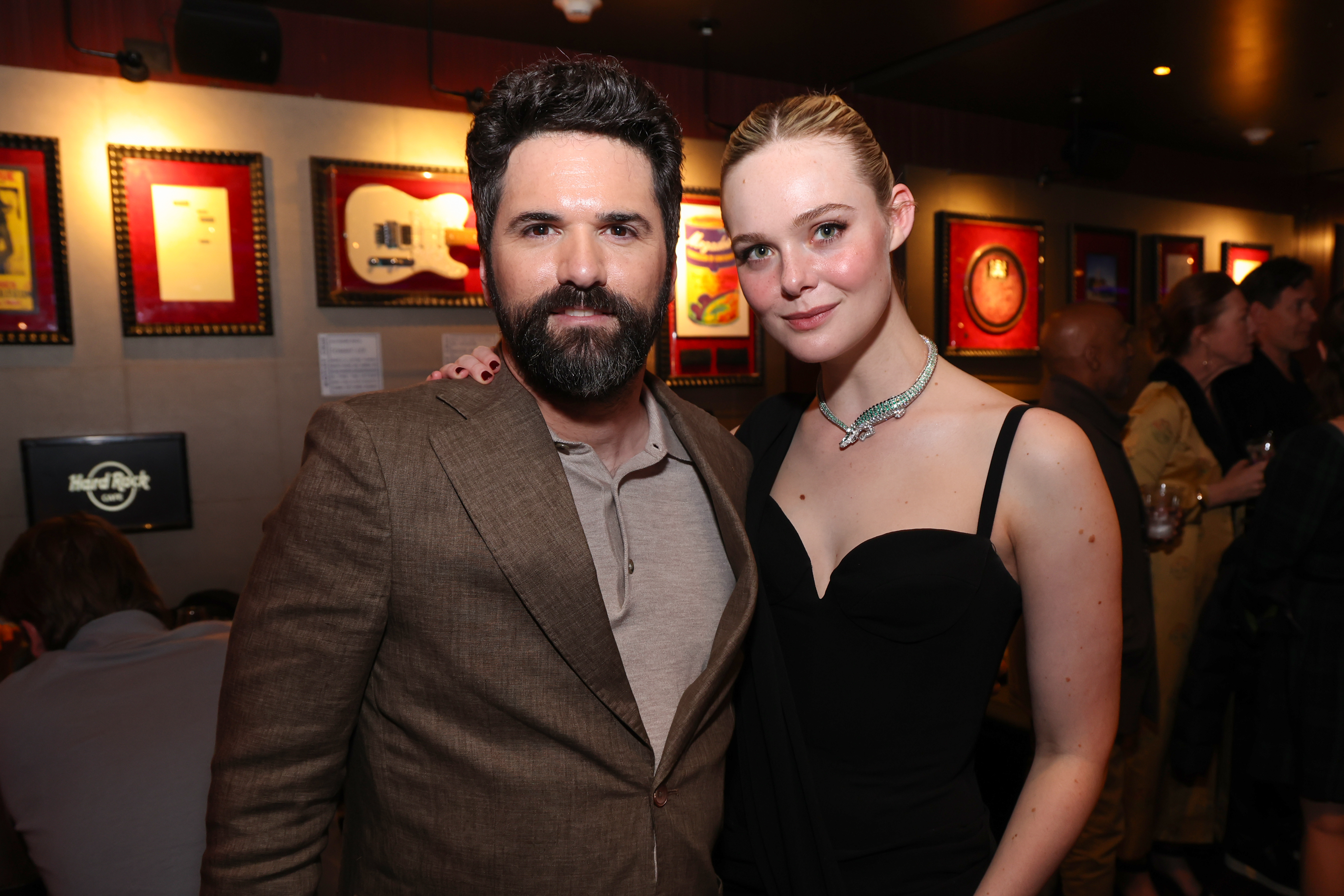
Dan Trachtenberg and Elle Fanning attend the premiere after-party for “Predator: Badlands” at Hard Rock Cafe on Nov. 03, 2025, in Los Angeles.
Here’s how Trachtenberg, who now lives in Los Angeles, would spend a perfect Philly day — or afternoon, rather — based on his time as a student at Temple University in the early aughts. His perfect day requires a bit of time travel.
4 p.m.
I spent so much time on South Street because I was really big into pop-punk and emo music. I would go to Tower Records where you could listen to music on the headsets. It was the only way to hear something before you bought it.
[Editor’s note: Tower Records closed in 2006, unfortunately.]
6 p.m.
Then I would go to Jim’s and get a cheesesteak. Sometimes I would have two cheesesteaks in a row. I don’t know how I did it. Then I’d walk two blocks up and go to Lorenzo’s and get a slice of pizza. They have these giant slices, literally pizza the size of your chest, and it’s incredible.
8 p.m.
Two pretty treasured movie experiences were going to the Ritz and seeing movies that didn’t normally come to the movie theaters where I grew up in the suburbs. And then also going to the Riverview for a very interactive experience — people yelling, throwing popcorn, and getting fired up. There was no better crowd than seeing something at the Riverview.
I saw a Jackie Chan movie called Jackie Chan’s First Strike. It’s the one that had this iconic ladder fight in it where he fought off a bunch of guys using a ladder. At the end of that sequence, I started clapping. I initiated the clap that became a standing ovation in the theater. No one was there to receive the standing ovation. All of us were so taken by what we had just experienced that we had to erupt in a standing ovation. That was a truly incredible moment.
11 p.m.
Late at night my friend and I would often go to Melrose Diner [Editor’s note: the diner was demolished in 2023]. It was a staple, but it was the most annoying diner because the way the seats were, they forced you to sit facing other people. They would cut a booth in half and seat three people on one side and three other people on the other side. We would get grilled cheese and mozzarella sticks and a bunch of marinara sauce and just dip it all. It was my favorite late-night food.
I also loved going to Wawa. There was a meatball sub there that I devoured. When you leave Philly, you realize how ridiculous the word Wawa is. When you grow up with it, it’s just normal. You don’t think about it. But when you leave, you realize how silly you sound when you say it. No one believes you that it’s actually a store that really exists.
The holiday is over but that doesn’t mean the drama has ended. I’ve pulled in two Inquirer Features staffers to help answer the familial conundrum.
Evan Weiss, Deputy Features Editor: Okay, the question is…
My sister brought her new boyfriend to Thanksgiving and asked if we like him. Should I tell the truth? (Which is no.)
Stephanie Farr, Staff Columnist: I think honesty is always the way to go, but when it comes to your loved one’s partners, you must tread carefully.
I definitely think you shouldn’t say no flat-out, but you could turn it around and ask questions of her: How do you feel he did? What do you like about him? What did he think of us?
Jason Nark, Life & Culture Reporter: This is a tough one because I’ve learned, after the fact, what people thought of partners. It would have been helpful to know their opinions ahead of time.
Stephanie Farr: I definitely brought a stinker of a boyfriend to Thanksgiving once, and while I didn’t ask what my father’s opinion of him was, I didn’t have to. My dad didn’t say anything about the dude and I didn’t ask because I knew and he knew and he knew I knew. If he liked him, he would have said it, there would be no need to ask.
Jason Nark: My mom has said “Would it have mattered?” It probably wouldn’t have. lol
Stephanie Farr: And I think that’s exactly the point! When you’re in a relationship with someone that you don’t want to leave — for whatever reason, good or bad — very little anyone says is going to change your mind. And if it’s your family, well then you start to think they just don’t want your happiness or understand you.
Jason Nark: I feel like there needs to be a devil’s advocate in life situations, the one relative who will get you the straight story. I would like to be that person but it’s hard.
Stephanie Farr: DRUNK UNCLE FTW!
Jason Nark: Yes, I’ll be the drunk uncle.
Stephanie Farr: Haha! I got one, he’s great.
Jason Nark: Then again, I would never want to be “I told you so” kind of person.
I think, if my theoretical sister was looking for a life partner and was very serious, I would express my concerns if I saw red flags. What if the guy rooted for the Cowboys?
But if it’s less serious, I’d probably hold back.
Evan Weiss: You really don’t want to be in the situation where you disparage the person so heavily and then they end up marrying them and it’s awkward forever.
Stephanie Farr: I think if you’re genuinely concerned about your sister’s partner, maybe pointing out specifics instead of disparaging the entire person is the way to go. For example: “I didn’t like that Brad didn’t say ‘Thank you’ to you for clearing his plate. Is he usually better about such things?” or “I noticed Brad spent the entire trip home watching football instead of hanging with the family. Was it us or is that how he usually is?”
Sow the seeds of doubt, if warranted, but don’t pull out the entire weed because you don’t know how far his roots have grown.
Jason Nark: Mostly, I’d want to see how he treats her in little moments. Does he ask her if she needs something? Does he laugh at her jokes? Is he family-oriented and not a curmudgeon?
We’re reporters after all, we’re great observers.
Evan Weiss: I think a big question for Thanksgiving specifically: Does he help out?
If he isn’t cooking… does he clean?
Stephanie Farr: 110%. I think that’s a big question when considering a life partner overall too, but if you want to impress someone’s family, offer to do chores! I can’t cook, but I wash all the dishes at my in-laws’ holiday gatherings (Bonus: It also gives me alone time. Shhhh!)
Jason Nark: I guess my takeaway is this: If you express your concerns, do it gently, with grace, knowing your opinion could be ignored.
Stephanie Farr: Yes, do it sneakily!
Evan Weiss: And don’t get mad if things don’t go your way.
Stephanie Farr: For sure, you have to be prepared to be the bad guy if you want to be brutally honest.
Restaurant gift cards begin as a thoughtful gesture — a birthday envelope, a holiday token, a “you deserve a night out.” So often, however, they migrate to a junk drawer or coat pocket, resurfacing in a moment of hopeful nostalgia:
“Hey, remember this place?”
But that cool restaurant has become a vape store, a Pilates studio, or a bubble-tea shop with a plastic vine selfie wall accented by the phrase “Let’s Make Pour Decisions.” written in neon.
That $75 that you thought would buy a roasted half chicken and a glass of natural wine from a “carefully curated” list has become a relic of a business that thrived briefly and then disappeared.
If you’re receiving a restaurant gift card this holiday season, there’s one important thing to bear in mind:
Use it. Fast. Not “soon.” Not “when it feels right.” Not after you’ve coordinated three calendars and a celestial alignment. Treat it like arugula, not heirloom jewelry. And if you’re giving one, attach an affectionate nudge: Go immediately.
Gift card horror stories
One-off, independent restaurants — the mainstay of Philadelphia’s mighty restaurant scene — depend on gift card sales. Ben Fileccia, senior vice president with the Pennsylvania Restaurant & Lodging Association, calls restaurant gift cards “one of the best ways to support the local businesses that bring our communities together.” He considers them a “direct investment in the neighborhood restaurants that show up for our schools, charities, and local events. Most restaurants honor every card they sell, and gift cards continue to be a reliable, meaningful way to support the hospitality businesses you love.”
But temper that with the idea that restaurants come and go.
Some restaurants wind down operations and stop selling gift cards months before the shutdown, publicly advising customers to use them promptly. One case in point is Laurel in South Philadelphia this year, which enjoyed a six-month countdown. Just last week, Rocco’s at the Brick shut down without warning during a dispute with the landlord; the owner graciously is refunding outstanding gift cards.
Others are not so ethical. On Christmas Eve 1994, a popular Center City bistro called Odeon was selling gift certificates — they were paper back then. Odeon never reopened after New Year’s and the gift certificates became bookmarks. The rumor was that the reservationist sold them, not knowing that the restaurant was closing.
Buying from a restaurant chain can be safer. But just two months ago, Iron Hill Brewery & Restaurant — a pillar of the region for three decades — shuttered three locations and, two weeks later, closed the remaining 16 and then filed for bankruptcy protection. If you have an Iron Hill gift card, you’re at the very back of the line.
J. Alexander’s, a contemporary steakhouse chain, shut down its King of Prussia location without notice last year. Gift cards can be honored at the closest remaining locations in Clifton, N.J., or Annapolis, Md. Grand Lux Cafe’s Cherry Hill location closed in 2020, directing customers to its King of Prussia location, which closed a year later. If you still have a Grand Lux Cafe card, plan a day trip to Paramus, N.J., or Garden City, N.Y. (Cheesecake Factory owns Grand Lux but does not accept its cards.)
Bertucci’s is slowly, quietly exiting: The suburban locations in Bryn Mawr, Langhorne, Marlton, Mount Laurel, and beyond went dark, leaving only Springfield, Delaware County, and Newark, Del. Houlihan’s vanished from Philadelphia and its suburbs altogether, and Ruby Tuesday has done the same slow fade, retreating from malls and roadside plazas that once seemed permanent.
The numbers
Total gift card spending is expected to reach $29.1 billion, up from $28.6 billion in 2024, according to the National Retail Federation. Consumers plan to purchase between three to four gift cards and expect to spend an average of $171.32 per person. Restaurants remain the most popular gift card type (27%), followed by bank-issued cards (25%), department stores (25%), and coffee shops (20%).
As you might imagine, restaurants do not mind selling cards. By industry estimates, 5% to 15% of restaurant card value is never used — a concept known as “breakage.”
In Pennsylvania, the law prohibits gift cards from expiring in less than two years and bans dormancy fees; after five years without redemption the value is presumed abandoned and may be sent to the state. In New Jersey, the law requires that gift card value remain fully available for at least 24 months and restricts inactivity fees during that period.
What else to do
Universal gift cards, like those issued by Visa and Mastercard, are the safest bet if you want to give something other than cold, hard cash. Although there’s usually an upfront fee with their purchase, they travel with the recipient, not the business. They survive concept changes, closures, disputes, and chef departures. Perhaps give the recipient one of these gift cards with a list of suggested restaurants. (For inspiration, I might suggest including a copy of The Inquirer’s 76 Magazine, our guide to the restaurants that are defining dining in the region, available through The Inquirer’s online store.)
Or consider a donation in your friend’s name to a Philadelphia hunger-relief nonprofit, such as Share Food Program, Sunday Love Project, and People’s Kitchen, which work magic turning even modest gifts into many meals.
Of course, you could skip giving a gift card altogether. Instead, pick a date, make a reservation, and treat the recipient to a meal — and to your company.
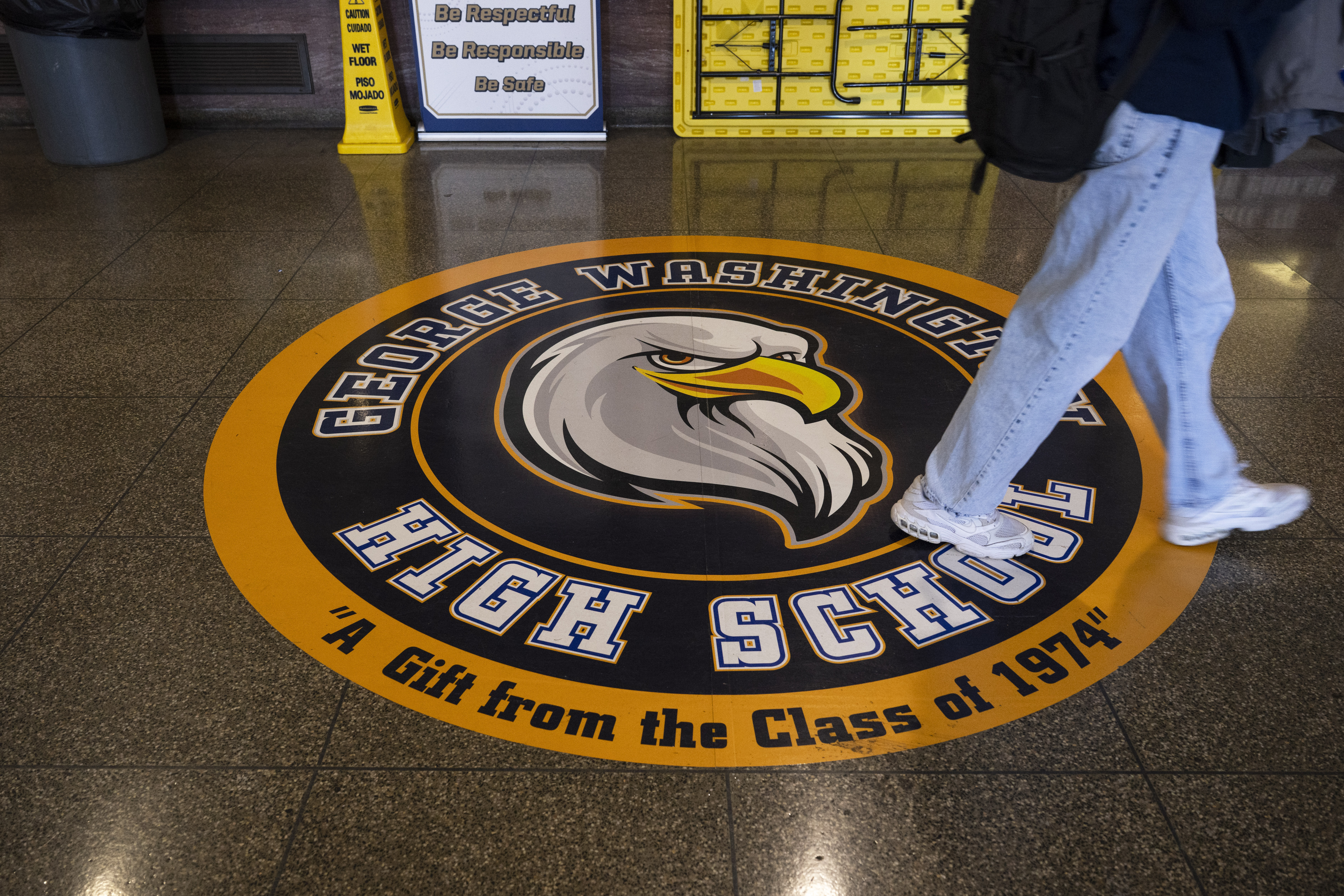
Kateryna Sobolevska’s life is full: classes, homework, and activities at George Washington High School, managing an ambitious college search, serving as her mother’s English translator, sometimes picking her younger brother up from school.
But part of the 17-year-old’s mind is often 4,500 miles from Philadelphia — in her former home along the Stryi River in Western Ukraine, in Zhydachiv, where Sobolevska’s father and extended family still cope with the realities of a yearslong war.
She speaks to her father daily.
Emergency services personnel work to extinguish a fire following a Russian attack in Kyiv, Ukraine, Tuesday, Nov. 25, 2025. (AP Photo/Dan Bashakov)
“He’s at risk every single day,” said Sobolevska, now a 12th grader. “They keep bombing the power plant, so he doesn’t have electricity all the time. He has to do laundry at a certain time. He has difficulties with work; it’s really overwhelming. There’s sirens every day.”
Still, Sobolevska is more than managing in her new home.
Less than four years after arriving in the United States, Sobolevska is at the top of her class at George Washington, with an Ivy League summer program under her belt, waiting to hear from a bevy of stellar colleges — and recently named to a select list of Philadelphia School District students.
When Sobolevska arrived in the U.S. at 14, American traditions were unfamiliar — something from a story or a book. She had never celebrated Thanksgiving.
This year, she’ll be sitting down to a turkey dinner with family, a little incredulous at the recognition that is beginning to come her way.
“But,” she said, “I am very thankful.”
‘Everything is so different’
In 2022, as war closed in, Sobolevska’s parents made a quick decision: Things were too dangerous in Ukraine. Sobolevska, her mother, Oleksandra, and her brother, Oleh, had to flee.
Her father, Rostyslav, could not join them — men between the ages of 18 and 60 were forbidden from leaving the country.
“All of us hoped that it would only be a couple of months,” Sobolevska said.
The three traveled first to Prague, then to New York, then on to Philadelphia. Every move felt unsettling, Sobolevska said.
Sobolevska had been a strong student in Zhydachiv — class president three times, a member of her student government, chosen to represent her school at language competitions.
But she had to start over at age 14. She began ninth grade at George Washington High in sheltered English classes, learning the language with other newcomers.
George Washington High School on Monday, Nov. 24, 2025 in Philadelphia.
With more than 1,800 students, George Washington is imposing; it felt forbidding. It was tough to navigate, and her class schedule was changed three times.
“Everything is so different here,” Sobolevska said. “In ninth grade, it was really hard to get used to the language, to expectations, to all those processes. Ninth and 10th grade were really difficult for me.”
One of her teachers flagged Sobolevska to Billy Marchio, the coordinator of George Washington’s International Baccalaureate program, a rigorous academic course of study.
“She told me, ‘She’s really bright, she’s really improved her English. Give her a shot, I think she can do it,’” said Marchio, who agreed.
Making an impression
Entering IB in her 11th-grade year was a revelation for Sobolevska.
“I was excited,” she said. “IB is more close to what is expected from students in my country. It just gives me more stability — it’s very difficult courses, and a lot of expectations.”
Sobolevska met the expectations and then some. She was one of just 14 students nationwide — chosen from a pool of hundreds — who won a place in a summer journalism program at Princeton University.
Living on a college campus and learning from top professionals and peers from around the country provided more challenges that Sobolevska slayed. She publishedtwo stories, one about her frustration with comparisons between the conflicts in Ukraine and Gaza, a call for global solidarity. She felt at home inthe Ivy League environment.
Senior year has been a blur — applying to a laundry list of colleges, including Harvard, a top choice, and, most recently, being honored as one of the district’s seniors of the month, singled out for her “courage, perseverance, and quiet strength” as well as for her academic skills.
Teacher Billy Marchio in his classroom on Monday, Nov. 24, 2025 at George Washington High School in Philadelphia.
Marchio has been wowed by Sobolevska — both as a student and as a leader, serving as an IB officer, tutoring peers in the National Honor Society.
“Through all of her anxieties and all of her stress, she produces spectacular work,” Marchio said. “She’s so critical and analytical. She makes an impression on everyone.”
Shouldering significant responsibility
Sobolevska is quiet, unassuming. When she talks about her college search, she mentions that she’s applying to schools in “Boston, Connecticut, New York,” not Harvard, Yale, and Columbia.
She grows more animated when she talks about her family: her father, who works in sales management, her mother, who works at a grocery store, and even her brother — they argue, as siblings do, but are still very close.
“We’re really close with my mom, especially since she moved here,” said Sobolevska, who has significant responsibility on her shoulders. “I’m the main translator in the family. I help her with English; all the doctor’s appointments are on me.”
When she won the district’s Senior of the Month honor, her mother bragged to relatives and coworkers. Thousands of miles away, her father “was really excited. He was just so proud. But it was weird for him, difficult to understand because I’m very far away.”
Sobolevska, who now goes by Kate, longs to be reunited with her father, the rest of her family, and the friends she left behind, but living and learning in the U.S. have changed her, she said.
Here, “I think people here are not as stressed,” Sobolevska said. “They’re just more easygoing. It’s really warming to see how people can listen to music outside or talk loudly outside, or just say hi to everyone. In Ukraine, we don’t really have that. It’s nice to see how people are really friendly here.”
Her father “doesn’t want us to go back” home now, she said. “It’s not safe; it’s really stressful.”
Looking ahead to her future, “I would like to visit” Ukraine, Sobolevska said. “I’m not sure if I would want to live there. When I grow up, I would love to travel a lot — I don’t want to stay in place.”
Sobolevska’s rise is remarkable, but that’s who she is, Marchio said.
“She’s just trying to make her father proud, to make her father’s sacrifice worth it,” Marchio said. “She’s putting a lot on her plate to make everyone happy and proud of her, and I couldn’t respect that more.”
Mayor Cherelle L. Parker unveiled her planning process for the future of Market East earlier this month to a room packed with many of the city’s top developers, lobbyists, and business leaders.
Her news conference followed the announcement that the alliance between the Philadelphia 76ers and Comcast had plans to demolish buildings on the 1000 block of Market Street, without saying what they plan to do with the soon-to-be vacant space.
A Comcast executive’s promise to “turbocharge” development on the beleaguered corridor did not quiet dissent in the packed room from a group of historic preservationists who stood solemnly holding signs reading “No More Holes On Market Street” and “No Plan, No Demo.”
The moment captured a recurring dynamic in modern Philadelphia, a city where over 70% of buildings reportedly date to before 1960 but only 4.4% of them have a degree of protection from demolition by the Historical Commission.
Now two bills in City Council would require property owners to get a building permit for a new structurebefore they move forward with demolition.
“This bill is about putting commonsense guardrails in place,” said Councilmember Jeffery “Jay” Young, who represents much of North Philadelphia and part of Center City.
His bill, which covers his entire district, requires a building permit before a property owner can demolish a structure, with exceptions for dangerous buildings.
“It ensures property owners are prepared to move forward responsibly and that residents aren’t stuck living beside another empty lot with no timeline or plan,” Young said in a statement.
“This isn’t about slowing down development; it’s about preventing speculative demolition that destabilize blocks. This is about preserving communities,” Young said.
Councilmember Jamie Gauthier’s bill would enact similar rules for parts of University City, where higher education institutions are dominant, as part of a larger package of land-use regulations.
Builder and developer advocacy groups say the legislation is a potential new burden on a key economic sector that’s been flagging in recent years.
The Building Industry Association (BIA), the trade association for residential developers, cautioned that new regulations were especially unwelcome in a time of higher interest rates and high construction material prices, especially as Parker makes housing a centerpiece of her agenda.
“I’m not sure why Council would create more barriers for delivering new homes,” said Sarina Rose, president of the BIA and an executive with the Post Brothers development firm. “It’s a really bad time to do that. Unfortunately, some old buildings simply are not good fits for adaptive reuse.”
The BIA and its allies are backing legislation that would make it easier to demolish some older buildings for new construction.
Councilmember Mark Squilla introduced legislation the week before Thanksgiving that would weaken protections for structures nominated to the Philadelphia Register of Historic Places.
At the same time, Parker promises to pursue legislation in the next year to prompt adaptive reuse or demolition of underused buildings by offering a 20-year property tax abatement.
Demolition policy in other cities
In a city as old as Philadelphia, razing buildings is often a fraught process.
Currently the only safeguards against demolition come with a successful nomination to the Philadelphia Register of Historic Places, and in the handful of neighborhoods protected by conservation zoning overlays, property owners have to get building permits before demolition (a template for Gauthier and Young’s bills).
But given the city’s economic and demographic doldrums in the second half of the 20th century, municipal government enacted most of the demolitions of unsafe and abandoned buildings, usually in lower-income neighborhoods.
Mayor John F. Street’s Neighborhood Transformation Initiative, the centerpiece of his administration, spent half its $300 million (in George W. Bush-era dollars) on demolishing thousands of buildingsin the early 2000s.
That dynamic changed in the last decade, as low interest rates and a surge of new residents juiced real estate development to levels not seen in the city for generations. The private sector began to regularly outpace city government in demolition permits, as developers cleared the way for new projects.
Preservationists pushed back. Under Mayor Jim Kenney’s administration (2016-24), the movement demanded new policies such as a demolition review requirement. Before an applicable building could be razed, municipal authorities reviewed its historic merits and adaptive potential.
Similar policies of varying strength exist in cities from Santa Monica, Calif., to Chicago. In the latter case, it applies to buildings from before 1940 that were included in a citywide survey of historic places.
Demolition of New Light Beulah Baptist Church at 17th and Bainbridge Streets, a block below South Street.
During Kenney’s administration, a preservation task force called for a survey and demolition delay as in Chicago, but no elected officials championed the ideas.
Laws like the ones Gauthier and Young are proposing are less common but are used in municipalities like Spokane, Wash., and Pasadena, Calif. Similarregulationsexist for properties in Philadelphia’s conservation districts.
In Spokane, the regulations apply to buildings in the downtown core, those along commercial corridors and buildings on the National Register of Historic Places, which is more of an honorary designation that affords protections.
“You have to have that building permit in hand, plus you have to show us that you have the financial backing to build that replacement building,” said Megan Duvall, Spokane’s historic preservation officer. “If you also can’t show us that you have the construction loan in hand, we won’t allow you to demolish that building.”
Why City Council is acting now
The sudden renewal of interest in demolition policy began when St. Joseph’s University sold much of its West Philadelphia campus, acquired through a merger with University of the Sciences in 2022, to a charter school operator founded by student housing mogul Michael Karp.
After the sale, Gauthier proposed placing controls on the sprawling higher education footprint in her district.
As higher education comes under acute financial and demographic pressure, she fears that building sales by struggling universities could result in demolition and resale of newly vacant lots to developers without the wherewithal to complete projects or speculators with no desire to build quickly.
“The safety and quality-of-life in our neighborhoods should not be disrupted by incomplete or uncertain projects,” Gauthier said in a statement. “I believe requiring responsible development practices is a commonsense approach in today’s uncertain development market.”
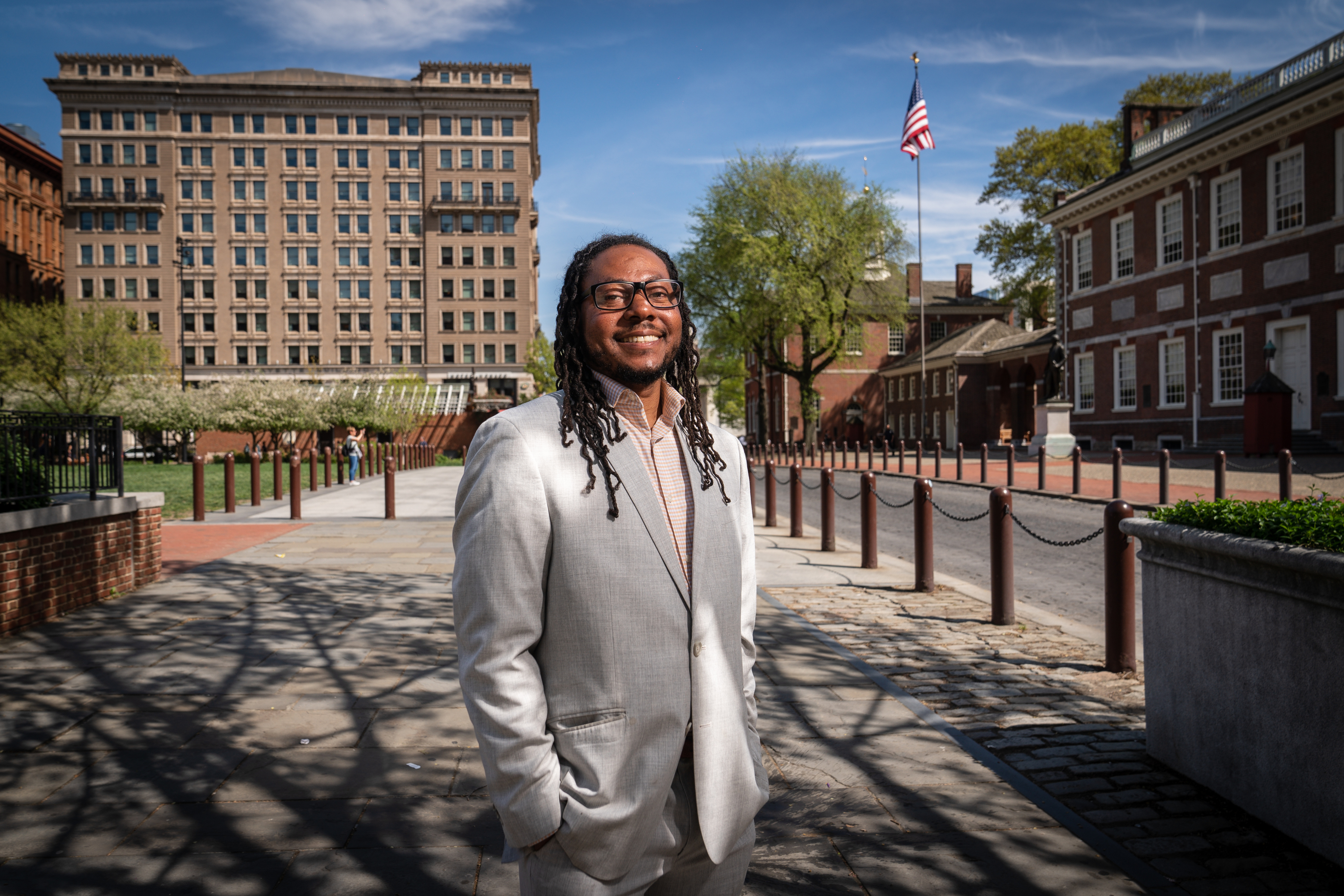
Jeffery “Jay” Young outside Independence Hall.
Young’s bill covering much of North Philadelphia and parts of Center City followed the introduction of Gauthier’s legislation. Neither bill has been passed by City Council.
According to the Philadelphia Planning Commission, from January 2022 through November 2025 approximately 580 demolition permits were issued in Young’s district. The Department of Licenses and Inspections said that with a few tweaks, his proposed bill would be enforceable.
Young says his legislation was inspired by frequent calls from constituents who hate the vacant lots that dot their neighborhoods and are frustrated with promised development that never comes to fruition. Both bills exempt buildings in poor condition that are considered dangerous.
While welcoming this spate of demolition regulation, preservationists would prefer citywide policies, not district by district.
“These bills are important first steps, and this is the moment to build them into a modern, citywide framework consistent with approaches already used in several peer cities,” said RePoint, the preservation advocacy group that protested the mayor’s Market East announcement, in an unsigned statement.
Real estate industry backlash
At the same time, Philadelphia’s development industry is embarking on its own campaign to ease existing preservation rules and to push back against these new bills. Both Gauthier’s and Young’s bills have been critiqued by business groups and by the zoning lawyers who often represent developers.
“This is one-tenth of the city of Philadelphia, just based upon a political subdivision [that] changes every 10 years,” Matthew McClure, a prominent zoning attorney, said in testimony about Young’s bill before the Planning Commission. “It’s the exact opposite of planning.”
Groups including the Building Industry Association are backing a new bill from Squilla that the Preservation Alliance for Greater Philadelphia fears will stoke more demolitions.
It would require a new 30- to 60-day window before a building nominated to the local register of historic places could be given protection, which critics believe will incentivize owners to tear down empty buildings quickly.
The mayor’s proposed 20-year property tax abatement proposal for adaptive reuse projects also allows room for demolition if buildings are considered unadaptable, which preservationists fear will bring back the wrecking ball-forward incentives of the city’s earlier abatement policies.
In the last week, groups like the Preservation Alliance have pivoted from thinking about new demolition regulations to playing defense.
“We’re still trying to wrap our heads around it all,” said Paul Steinke, the Preservation Alliance’s executive director. “It’s a lot to take in, and it’s happening after a decade or so of a building boom where we lost a chunk of the historic fabric.”
The Philadelphia Police Department is forming an “auxiliary” unit that may be ready as early as next year, according to a department spokesperson, adding to its ranks volunteer members who will assist officers at large public gatherings.
Auxiliary police will not carry weapons and will not be assigned typical law enforcement duties, according to Sgt. Eric Gripp, a department spokesperson. They will not be authorized to make arrests.
But the department wants the unit to act as a link between the public and police, participating in community engagement and, according to Gripp, serving as additional “eyes and ears” for officers on the ground.
As Philadelphia prepares to host a series of widely attended events in 2026 — the country’s 250th July Fourth anniversary celebration, FIFA World Cup matches, and more — the police department will be tasked with maintaining order amid an influx of visitors.
An auxiliary unit would assist police during those types of events, according to Gripp. He said the department had tasked its academy recruits with similar duties during citywide celebrations after the Eagles’ Super Bowl victory in February.
It is unclear whether the auxiliary unit will be ready in time for the summer.
The department does not have an official estimate on when it plans to introduce the unit; the idea is still in the planning stages and targeted for 2026, Gripp said. The only confirmed requirement is that recruits must be 18 years old to apply.
Police departments in municipalities large and small have used auxiliary units, sometimes called reserve units, for years.
The New York Police Department has maintained its auxiliary unit for more than half a century; major cities like Baltimore also have reserve officers, as do smaller townships like Cranford, N.J.
Criminologists and former law enforcement officers say police departments use these units to assist with traffic management, crowd control, and community engagement, and for reporting more serious issues to officers who have the authority to intervene.
Experts say the units are a boon to departments facing recruitment and retention issues, providing unpaid assistance from those who are already curious about life as a police officer and who often hail from the communities they are assigned to.
But departments must invest time, money, and adequate training into auxiliary units for them to be successful.
Joseph Giacalone, a retired NYPD sergeant and criminal justice instructor at Pennsylvania State University’s Lehigh Valley campus, said the New York department often uses its 3,700-member auxiliary unit for crowd control during “fun events” like parades and street fairs.
Most importantly, Giacalone said, departments should not view their auxiliary unit as a crime-fighting tool; members should be provided uniforms that are recognizable to the public, he said, distinct from those of actual police officers.
“We’re not talking riots,” Giacalone said of situations in which auxiliary officers are useful. “We don’t want them really identifying things such as drug dealing, dens of prostitution, things like that. We can get that from ordinary intelligence — we don’t want ordinary citizens doing that.”
Still, auxiliary members may help officers with other duties.
During Giacalone’s tenure with the department, the NYPD’s auxiliary unit proved beneficial when members reported quality-of-life issues such as abandoned vehicles and broken traffic lights, he said.
Given the potential danger that accompanies police work, Giacalone said, he hopes the Philadelphia department’s plan includes extensive training for auxiliary recruits — as well as protective gear.
The former sergeant still recalls a harrowing day in 2007 when two unarmed New York auxiliary officers were shot and killed by a gunman in the city’s Greenwich Village neighborhood while out on patrol.
Gripp, the Philadelphia department spokesperson, said the city’s auxiliary unit would not conduct foot patrols. He said members would be trained by the department’s internal staff.
Meanwhile, New York auxiliary officers must pass hours of training courses in first aid, self-defense, and patrol technique; in Giacalone’s experience, those trainings require more experienced officers to sacrifice time and energy to the project.
By the former sergeant’s estimate, for Philadelphia, “it’s going to take a while to get this up and running.”
In his second term, Donald Trump has turned a campaign pledge to punish political opponents into a guiding principle of governance.
What began as a provocative rallying cry in March 2023 — “I am your retribution” — has hardened into a sweeping campaign of retaliation against perceived enemies, reshaping federal policy, staffing and law enforcement.
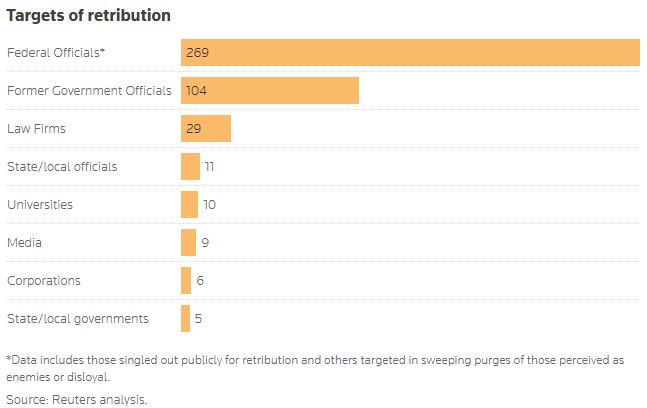
A tally by Reuters reveals the scale: At least 470 people, organizations and institutions have been targeted for retribution since Trump took office — an average of more than one a day. Some were singled out for punishment; others swept up in broader purges of perceived enemies. The count excludes foreign individuals, institutions and governments, as well as federal employees dismissed as part of force reductions.
The Trump vengeance campaign fuses personal vendettas with a drive for cultural and political dominance, Reuters found. His administration has wielded executive power to punish perceived foes — firing prosecutors who investigated his bid to overturn the 2020 election, ordering punishments of media organizations seen as hostile, penalizing law firms tied to opponents, and sidelining civil servants who question his policies. Many of those actions face legal challenges.
At the same time, Trump and his appointees have used the government to enforce ideology: ousting military leaders deemed “woke,” slashing funds for cultural institutions held to be divisive, and freezing research grants to universities that embraced diversity initiatives.
Reuters reached out to every person and institution that Trump or his subordinates singled out publicly for retribution, and reviewed hundreds of official orders, directives and public records. The result: the most comprehensive accounting yet of his campaign of payback.
The analysis revealed two broad groups of people and organizations targeted for retaliation.
Members of the first group – at least 247 individuals and entities – were singled out by name, either publicly by Trump and his appointees or later in government memos, legal filings or other records. To qualify, acts had to be aimed at specific individuals or entities, with evidence of intent to punish. Reuters reporters interviewed or corresponded with more than 150 of them.
Another 224 people were caught up in broader retribution efforts – not named individually but ensnared in crackdowns on groups of perceived opponents. Nearly 100 of them were prosecutors and FBI agents fired or forced to retire for working on cases tied to Trump or his allies, or because they were deemed “woke.” This includes 16 FBI agents who kneeled at a Black Lives Matter protest in 2020. The rest were civil servants, most of them suspended for publicly opposing administration policies or resisting directives on health, environmental and science issues.
Most common were punitive acts, such as firings, suspensions, investigations and the revocation of security clearances.
Reuters found at least 462 such cases, including the dismissal of at least 128 federal workers and officials who had probed, challenged or otherwise bucked Trump or his administration.
The second form was threats. Trump and his administration targeted at least 46 individuals, businesses and other entities with threats of investigations or penalties, including freezing federal funds for Democratic-led cities such as New York and Chicago.
Trump openly discussed firing Federal Reserve Chair Jerome Powell for resisting interest rate cuts, for instance. Last week, he threatened to have six Democratic members of Congress tried for sedition – a crime he said is “punishable by DEATH” – after the lawmakers reminded military personnel they can refuse “illegal orders.” This week, the Defense Department threatened to court-martial one of them, U.S. Senator Mark Kelly, a former Naval officer.
The third form was coercion. In at least a dozen cases, organizations such as law firms and universities signed agreements with the government to roll back diversity initiatives or other policies after facing administration threats of punishment, such as security clearance revocations and loss of federal funding and contracts.
It’s a campaign led from the top: Trump’s White House has issued at least 36 orders, decrees and directives, targeting at least 100 individuals and entities with punitive actions, according to the Reuters analysis.
Trump openly campaigned on a platform of revenge in his latest run for the presidency, promising to punish enemies of his Make America Great Again movement. “For those who have been wronged and betrayed, I am your retribution,” he said in a March 2023 speech. Weeks later, while campaigning in Texas, he repeated the theme. “I am your justice,” he said.
Today, the White House disputes the idea that the administration is out for revenge. It describes recent investigations and indictments of political adversaries as valid course corrections on policy, necessary probes of wrongdoing and legitimate policy initiatives.
“This entire article is based on the flawed premise that enforcing an electoral mandate is somehow ‘retribution.’ It’s not,” White House spokesperson Abigail Jackson said. There is no place in government for civil servants or public officials “who actively seek to undermine the agenda that the American people elected the president to enact,” she added. Trump is abiding by campaign promises to restore a justice system that was “weaponized” by the Biden administration, Jackson said, and “ensure taxpayer funding is not going to partisan causes.”
Trump’s actions have been cheered by his staunchest backers. Right-wing commentator and former Trump advisor Steve Bannon told Reuters the use of government power to punish Trump’s enemies is “not revenge at all” but an attempt to “hold people accountable” for what he said were unfair investigations targeting Trump. More is on the way, he said.
“The people that tried to take away President Trump’s first term, that accused him of being a Russian asset and damaged this republic, and then stole the 2020 election – they’re going to be held accountable and they’re going to be adjudicated in courts of law,” he said in an interview. “That’s coming. There’s no doubt.” There’s no evidence the 2020 election was stolen.
Trump’s allies point to actions former President Joe Biden took upon taking office. After Trump’s supporters attacked the U.S. Capitol on January 6, 2021, in a failed bid to overturn his election loss, Biden revoked Trump’s access to classified information, a first for any former president. Biden also won a court battle to dismiss Senate-confirmed directors of independent agencies serving fixed terms, such as the Federal Housing Finance Authority, and removed scores of Trump-era appointees from unpaid advisory boards.
Yet the scale and systematic nature of Trump’s effort to punish perceived enemies marks a sharp break from long-standing norms in U.S. governance, according to 13 political scientists and legal scholars interviewed by Reuters. Some historians say the closest modern parallel, though inexact, is the late President Richard Nixon’s quest for vengeance against political enemies. Since May, for instance, dozens
of officials from multiple federal agencies have been meeting as part of a task force formed to advance Trump’s retribution drive against perceived enemies, Reuters previously reported.
“The main aim is concentration of power and destruction of all checks against power,” said Daron Acemoglu, Nobel laureate in economics and a professor at the Massachusetts Institute of Technology, which faces an ongoing federal investigation for embracing diversity and equity programs. “Retribution is just one of the tools.”
Dozens of Trump’s targets have challenged their punishments as illegal. Fired and suspended civil servants have filed administrative appeals or legal challenges claiming wrongful termination. Some law firms have gone to court claiming the administration exceeded its legal authority by restricting their ability to work on classified contracts or interact with federal agencies. Most of those challenges remain unresolved.
Investigating foes of Trump
The administration has moved aggressively against officials in the government’s legal and national security agencies, institutions central to investigations of Trump’s alleged misconduct during and after his first term.
At least 69 current and former officials were targeted for investigating or sounding alarms about Russian interference in U.S. elections. U.S. intelligence agencies concluded soon after the 2016 election that Moscow sought to tilt the race toward Trump, a finding later affirmed by a bipartisan Senate Intelligence Committee report in August 2020. Acts of retribution tied to the Russia probe include the September 25 indictment of former FBI Director James Comey, a break from Justice Department norms meant to shield prosecutions from political influence.
Comey, who led the FBI’s investigation into Trump’s 2016 campaign, was charged after Trump demanded his prosecution. The Justice Department has cast the case as a corruption crackdown. Comey and his lawyers said in court documents that the case was “vindictive” and motivated by “personal animus.” Comey, who pleaded not guilty, declined to comment. A federal judge dismissed the case on Monday, ruling that Trump’s handpicked prosecutor had been unlawfully appointed.
Acts of retribution tied to the Russia probe include the indictment of former FBI Director James Comey. His lawyers say he is the target of a “vindictive” prosecution.
At least 58 acts of retribution have targeted people Trump viewed as saboteurs of his election campaigns, including Chris Krebs, the top cybersecurity official during his first term. Trump fired him in 2020 for disputing claims that the election was rigged. In April, Trump stripped Krebs’ security clearance and ordered a federal investigation into his tenure. Krebs, still asserting that Trump’s defeat was valid, has vowed to fight the probe. He did not respond for this story.
Reuters documented 112 security clearances revoked from current and former U.S. officials, law firms and state leaders – credentials needed for work that involves classified information. In August, Director of National Intelligence Tulsi Gabbard announced she was revoking 37 clearances.
In a response to Reuters posted on X, an agency spokesperson said Gabbard and Trump are working “to ensure the government is never again wielded against the American people it is meant to serve.” She added: “President Trump said it best, ‘Our ultimate retribution is success.’”
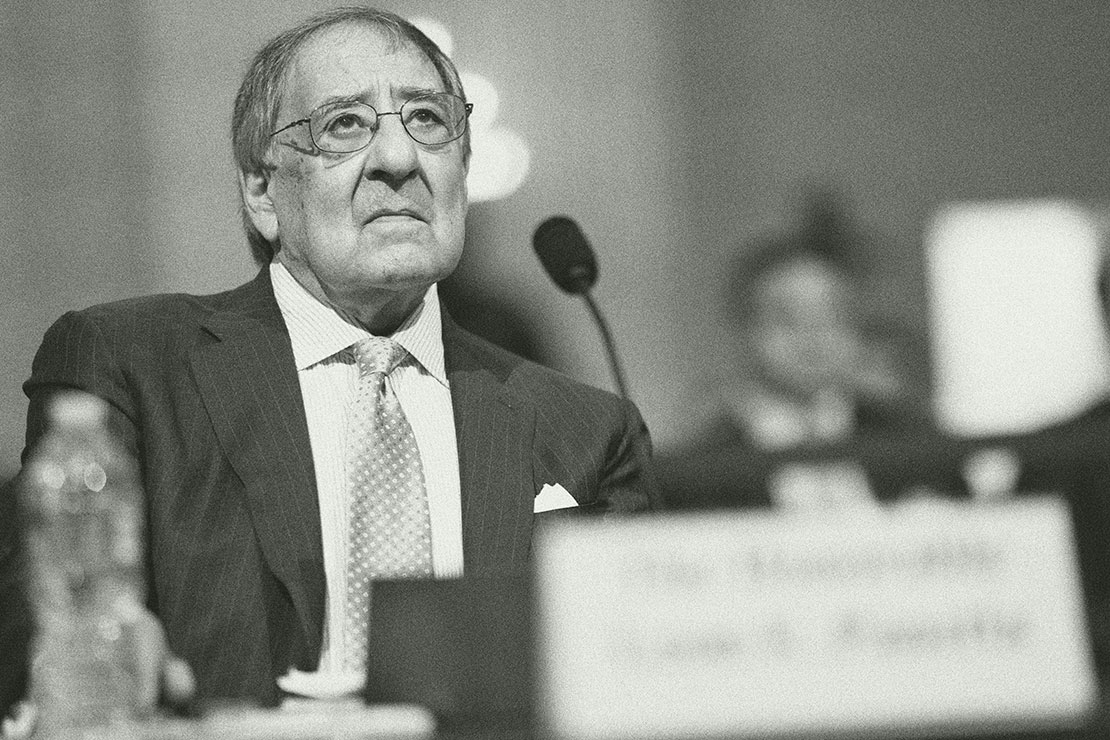
Leon Panetta, CIA director and defense secretary under former President Barack Obama, had his security clearance revoked in January along with others who signed an October 2020 letter suggesting Russia may have been behind reports about emails on Hunter Biden’s laptop. At the time, Joe Biden — Hunter’s father — was Trump’s Democratic rival in the 2020 election. An executive order Trump signed in January claimed: “The signatories willfully weaponized the gravitas of the Intelligence Community to manipulate the political process and undermine our democratic institutions.” Panetta has said he stands by signing the letter.
Panetta told Reuters he had already surrendered his clearance after leaving government nearly a decade ago. Trump’s retribution campaign is hurting CIA morale and wrecking the bipartisan trust that allows Washington to function, Panetta said. “What I worry about is that our adversaries will look at what’s happening and sense weakness,” he said. “This kind of political retribution leads to a loss of trust, which ultimately leads to a failure of governing.” The CIA did not respond to a request for comment.
Former CIA director Leon Panetta had his security clearance revoked along with others who signed a letter suggesting Russia may have been behind reports about emails on Hunter Biden’s laptop.
The revenge effort also reaches deep into the civil service, punishing employees who speak out against Trump’s policies and turning forms of dissent that were tolerated by past administrations into grounds for discipline.
This summer, hundreds of Environmental Protection Agency staffers wrote an open letter protesting deep cuts to pollution control and cleanup programs. The fallout was swift. More than 100 signers who attached their names were placed on paid leave. At least 15 senior officials and probationary employees were told they would be fired. The rest were informed they were under investigation for misconduct, leading to at least 69 suspensions without pay. Many remained out of work for weeks.
“They followed all the rules” of conduct for civil servants, said Nicole Cantello, one of the signers and an officer with the American Federation of Government Employees, a union that represents many affected workers. She called the punishments an attempt to “quell dissent,” stifle free speech and “scare the employees.” In a statement, the EPA said it has “a zero-tolerance policy for career officials using their agency position and title to unlawfully undermine, sabotage, and undercut” administration policy.
At the Federal Emergency Management Agency, about 20 staffers were put on leave and now face misconduct investigations after signing a letter criticizing the agency’s decision to scrap bipartisan reforms adopted years ago to speed disaster relief.
Cameron Hamilton, a Republican who served briefly as acting head of FEMA, was fired in May, a day after telling Congress he didn’t believe the agency should be shut down, contradicting the administration.
Hamilton told Reuters he still supports Trump. But he said too many senior officials are firing people in the name of retribution, trying to impress the White House. “They want to find ways to really launch themselves to prominence and be movers and shakers, to kick ass and take names,” said Hamilton. “They’re trying to show the president ‘look at what I am doing for you.’”
In a statement to Reuters, the Department of Homeland Security, which includes FEMA, said it is building a “new FEMA” to fix “inefficiency and outdated processes.” Employees “resisting change” are “not a good fit,” the statement said.
Dr. Jeanne Marrazzo, former head of the National Institute for Allergy and Infectious Diseases, sees her firing in October — three weeks after filing a whistleblower complaint alleging politicization of research and vaccine policy — as a warning shot. She told Reuters the administration’s purge of dissenting health officials is breeding “anticipatory obedience” — a reflex to comply before being asked. “People know if they push back … this is what happens,” she said. The effect, she says, is an ecosystem of fear: those who stay in government self-censor; those who speak out are branded “radioactive, too hot to handle.”
The Department of Health and Human Services, the agency that oversees NIAID, did not respond to a request for comment.
Federal agency leaders have dismissed a wide array of officials they deemed out of step with Trump’s MAGA agenda, including employees involved in diversity, equity and inclusion initiatives and those working on transgender issues.
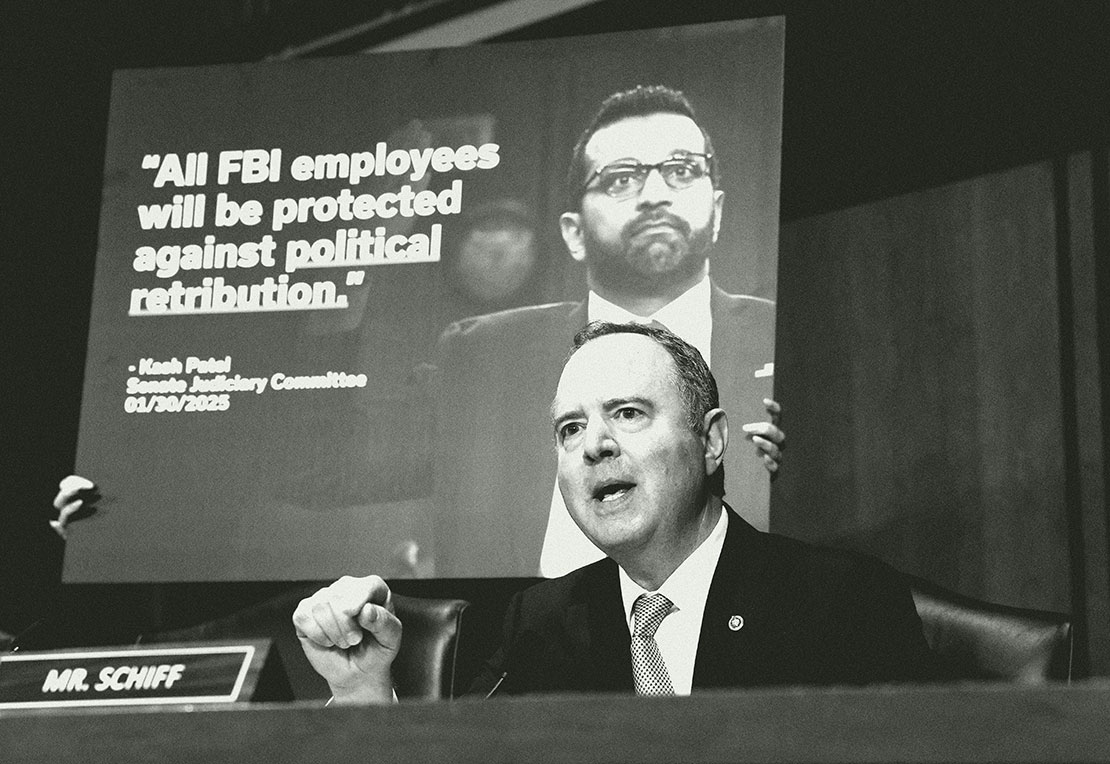
David Maltinsky, a Federal Bureau of Investigation employee, says he was fired by Director Kash Patel for displaying a Pride flag at work — one of at least 50 bureau personnel dismissed on Patel’s watch. Maltinsky sued the FBI and Justice Department, alleging violations of his constitutional rights and seeking reinstatement. The Justice Department has yet to file a formal response.
In his 2023 book, “Government Gangsters,” Patel named 60 people that he said were members of an “Executive Branch deep state” that opposed Trump, including former Democratic government officials and Republicans who served in Trump’s first administration but eventually broke with him. He called for firings and said that anybody who abused their authority should face prosecution. In his 2025 confirmation hearing before Congress, Patel denied that it was an “enemies list.”
Under FBI Director Kash Patel’s watch, at least 50 FBI personnel have been dismissed. In this photo, U.S. Senator Adam Schiff speaks in front of an image of Patel at a Senate hearing on FBI oversight.
Reuters found that at least 17 of the 60 people on Patel’s list have faced some sort of retribution, including firings and stripping of security clearances. The FBI did not respond to a request for comment.
Against perceived foes in the private sector, the administration has wielded financial penalties as leverage. At least two dozen law firms faced inquiries, investigations or restrictions on federal contracting, often for employing or representing people tied to past cases against Trump. Eight struck deals to avoid further action.
Nine media organizations have faced federal investigations, lawsuits, threats to revoke their broadcast licenses and limits on access to White House events. Trump has also suggested revoking broadcast licenses for networks whose coverage he dislikes.
The targets include universities, long cast by the president and his allies as bastions of left-wing radicals.
Officials froze more than $4 billion in federal grants and research funding to at least nine schools, demanding policy changes such as ending diversity, equity and inclusion programs, banning transgender athletes from women’s sports and cracking down on alleged antisemitism amid pro-Palestinian protests. Five universities have signed agreements to restore funding. Harvard University successfully sued to block a freeze on $2.2 billion in federal aid for the school, which Trump accused of “pushing political, ideological, and terrorist inspired” dogma. Harvard declined to comment.
The administration has described the funding freezes and other efforts to force policy changes at colleges and universities as a necessary push to reverse years of leftward drift in U.S. education. “If Reuters considers restoring merit in admissions, reclaiming women’s titles misappropriated by male athletes, enforcing civil rights laws, and preventing taxpayer dollars from funding radical DEI programs ‘retribution,’ then we’re on very different planes of reality,” said Julie Hartman, a spokesperson for the U.S. Education Department.
A historical parallel: Nixon’s enemies
It’s impossible to predict, of course, how far the Trump revenge campaign will go, or whether it will be affected by a recent slide in popular support. Trump has been hurt by public frustration with the high cost of living and the investigation into late convicted sex offender Jeffrey Epstein.
Nixon resigned in 1974 over the Watergate scandal, in which aides to his re-election campaign broke into Democratic Party headquarters and the president himself later directed a cover-up. While in office, he kept a list of more than 500 enemies. But while Trump has conducted his retribution campaign in the open, historians note, Nixon’s enemies list was conceived as a covert tool.
John Dean, chief counsel in the Nixon White House, wrote a confidential memo in 1971 addressing “how we can use the available federal machinery to screw our political enemies.” The planned methods included tax audits, phone-tapping, the cancellation of contracts and criminal prosecution. Yet the execution faltered: IRS Commissioner Donald Alexander refused to conduct mass audits, and most targets escaped serious punishment.
Other recent presidents, to be sure, have been accused of seeking to punish opponents, though on a smaller scale. The Obama administration pursued “aggressive prosecution of leakers of classified information,” the Committee to Protect Journalists said in a 2013 report. Two IRS employees alleged they were retaliated against during the Biden administration for raising concerns about the handling of the tax-compliance investigation of Hunter Biden.
Nixon’s plotting remained a secret until the Watergate hearings exposed it, turning his enemies list into a symbol of presidential abuse. The secrecy reflected a political culture in which retaliation was whispered, not broadcast, and where institutional checks blunted many of Nixon’s ambitions.
Trump’s approach reverses that pattern, historians say. He has openly named his perceived enemies, urged prosecutions in public and framed vengeance as a campaign vow. Some say today’s “enemies list” politics are in that sense farther-reaching than Nixon’s, possibly signaling a shift toward a normalization of retribution in American political life.
Corey Brettschneider, a political science professor at Brown University who has written a book on power grabs by American presidents, said Nixon was ultimately checked and forced to resign by Congress, including members of his own Republican Party. “That’s just not happening now,” he said.
In his prime, Steve Sillman worked nights, Thursday through Monday.
And he was usually late coming in, despite only a 10-minute walk separating the front door of his impeccably preserved Fox Chase twin and the double red doors of Joseph’s Pizza Parlor.
The dayside managers would be tapping the toes of their dark work shoes, and Mr. Sillman would just glide in. He’d start turning radio dials in search of disco hits or a 1970s station, resetting the vibe with work-appropriate dancing to classic hits from Carole King and James Taylor. He’d remind anyone listening that he wanted disco played at his funeral.
And at the end of the night, hours after the other staff members had gone home, he’d pour himself a glass of red wine and close out the register, and then he’d call a few of the staffers and leave a message. He’d tell them to call back: “It’s important.” And when they called back, he’d say they missed a spot sweeping.
“You work with people so long,” said current Joseph’s co-owner Matt Yeck, “that you become like family.”
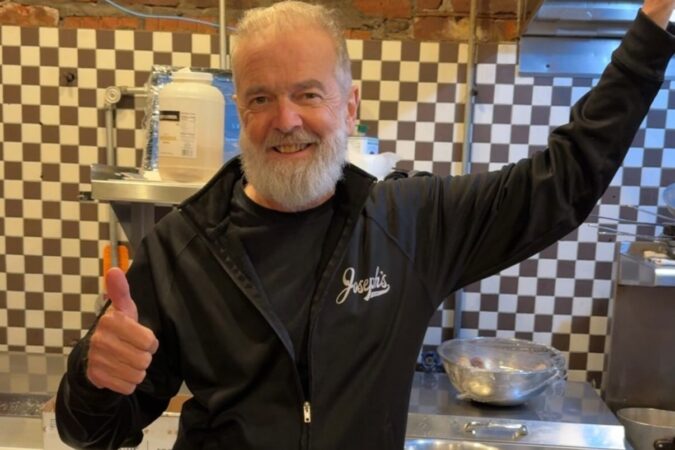
For the better part of four decades, and until the 70-year-old received a terminal brain cancer diagnosis earlier this year, Mr. Sillman was the face of the neighborhood’s trademark pizza place.
He started working there shortly after graduating from Northeast High School in the 1970s, and floated among the pizza parlor, neighboring Italian restaurant Moonstruck, and the once-wild Ciao nightclub above it.
He’d often speak of waiting on entertainment icon Elizabeth Taylor. (He would say he got lost in her transfixing blue eyes.) Over the course of those 40ish years, he became intimately familiar with the building’s quirks, and attended to its every need, from fixing broken faucets to decorating it for Christmas.
At the front of the house, he was the manager who would chat up customers before their order was ready. They always remembered his name, and sometimes he’d have to pretend to know theirs. In the back of the house, he was a peacekeeper, confidant, psychiatrist, dance partner, friend, and brother.
It was Mr. Sillman who raised an entire generation of neighborhood kids who came to Joseph’s for work. He watched them grow up, and then he folded them into his restaurant family.
He met his best friend of 40 years, Jane Readinger, through her siblings. They worked with Mr. Sillman at the restaurant, and over the years they folded him into their wider familial unit.
“A lot of his friendships came through that building,” said Jane, who is eight years younger. “And he had those friendships for life.”
It started with “P.L.P.’s,” or parking lot parties, after Joseph’s closed for the night. It grew into group ski trips and shared shore houses.
As his friendsstarted getting married and having kids and growing up, Mr. Sillman, a lifelong bachelor, bought a Sea Isle house so they all had a place to stay.
But it was the twin on the corner of Jeanes Street and Solly Avenue that was his legacy. His grandparents built the house in 1914, and only his family — three generations — had called it home. He maintained its original layout and finishes and flourishes from the turn of the 20th century.
The home was a marvel at Christmas, as Mr. Sillman would decorate his and the adjoining twin together. Draping them in handmade ribbons, and bestowing showstopper wreaths made of fresh fruit.
After he was diagnosed in the spring with glioblastoma, members of that restaurant family would stop and see him on Jeanes Street, even as Mr. Sillman could no longer climb the three flights of stairs, and after he transitioned from the recliner to a bed setup in the dining room.
Even the new owners came. Yeck and his partner, Jimmy Lyons, awkwardly inherited Mr. Sillman when they bought Joseph’s in 2021. But it didn’t take long for both to see his indistillable value.
“Steve came with the building,” Yeck said.
As Mr. Sillman took his last breaths on the morning of Sunday, Nov. 23, with Jane cradling his head in her arms, Carole King’s 1971 classic played through the house:“You’ve Got a Friend.”
The outpouring of support in person and on social media was a nice reminder to Jane that people don’t need to be blood to be family. There’s family you’re born with, and then there’s family you collect along the way.
“He was never alone during this fight,” Jane said. As a registered nurse, she volunteered to help attend to Mr. Sillman as he entered hospice care at home.
Mr. Sillman is survived by his sister-in-law, Harriet Sillman; nieces and nephews; great nieces and nephews; and generations of former co-workers. His neighbors are planning to decorate the twin Jeanes Street houses in his absence this holiday season.
Services for Mr. Sillman will be held Saturday, Nov. 29, at the Wetzel and Son Funeral Home, 419 Huntingdon Pike in Rockledge. The viewing will be held from 8 to 10 a.m., followed by a funeral ceremony.
And then his extended family will honor Mr. Sillman’s wishes with an appropriate send-off: They’re throwing a disco party.
Donations in his name may be made to the American Cancer Society, Box 970, Fort Washington, Pa. 19034, or to the Alex’s Lemonade Stand Foundation, 333 E. Lancaster Ave., Suite 414, Wynnewood, Pa. 19096.