The driver, Jamal McCullough, assessed his vehicle for damage before fleeing the scene without helping her or calling police, prosecutors said. He turned himself in to authorities after reports of the collision — and his photograph — aired across local news outlets.
On Friday, McCullough was sentenced in Montgomery County Common Pleas court to serve three to six years in a state prison, the mandatory minimum for such a crime. While prosecutors said he was not at fault in the fatal collision because Cary was crossing outside of a posted crosswalk, they said his actions after the crash were criminal.
For Cary-Irvine, the hearing was a chance to offer the public a more complete image of her late sister.
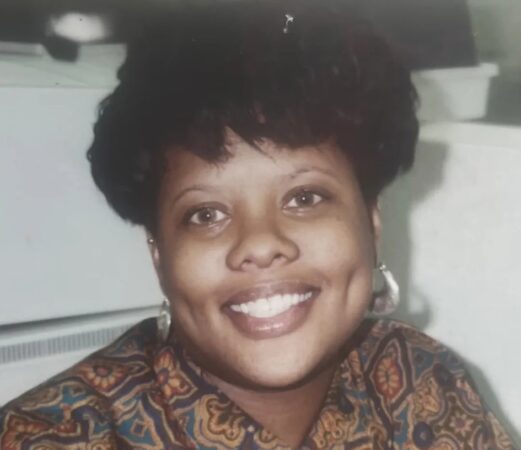
Cary, 61, was an avid reader who loved children, traveling, and the outdoors, according to Cary-Irvine. She was a fan of spelling bee competitions, and she had a sense of humor: she was known for calling up her nieces and nephews and speaking to them as Cookie Monster, her sister said.
“She had a love of people — babies were her specialty,” Cary-Irvine said. “She was the favorite Auntie. To know Tracey was to love Tracey.”
Cary was also a mother to a son who is in his 20s, her sister said, and she held a variety of jobs throughout her life, working for the Philadelphia School District, St. Joseph’s University, and later UPS.
She was a singer of gospel songs, and grew up attending Union Tabernacle Baptist Church in West Philadelphia.
Before Cary’s death, the siblings’ father died from COVID-19, leading Cary to struggle with mental illness, her sister said. Soon she was living on the street.
It was on the street where McCullough struck Cary shortly after 2 a.m. on Nov. 11, 2024.
Surveillance footage showed that McCullough, of East Germantown, struck Cary with enough force to eject her from her wheelchair. After checking on his vehicle, he walked within feet of Cary’s body but did not stop to help her, prosecutors said.
The father of two was en route to a shift as a sanitation worker with Waste Management.
During his sentencing, McCullough apologized for the incident, which he said was an accident.
“I want to apologize for my ignorance, apologize for maybe how I went about things,” McCullough said.
“If I could take it back, I definitely would.”
Minutes earlier, Cary-Irvine read a victim impact statement aloud, telling the court that, in her view, McCullough acted “entitled and without remorse” that morning.
“This sentence is not about revenge — it’s an opportunity, perhaps your last, to reflect honestly on your life,” Cary-Irvine told McCullough.
“If you do not learn from your mistakes,” she continued, “you will repeat them.”
City Councilmember Jamie Gauthier said the Philadelphia School District showed “just a complete lack of thought and consideration for really important programs” when crafting its long-anticipated facilities plan, released Thursday.
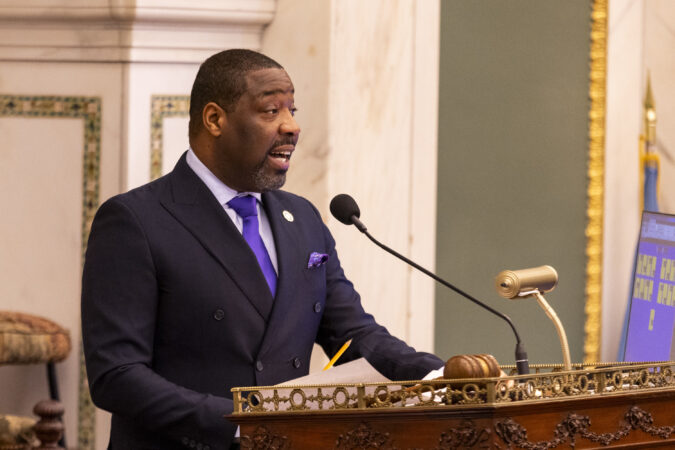
Council President Kenyatta Johnson said his members had “a lot of concerns.”
And City Councilmember Jeffery “Jay” Young Jr. went so far as to propose amending the city Home Rule Charter to allow Council to remove the school board members who will consider the proposed closures.
“If you are closing schools during a literacy crisis, then you should be held directly accountable to the people you serve,” Young said.
In many ways, it’s unsurprising Council members would speak out against a plan that would close or consolidate schools in their districts. But the pushback from lawmakers Thursday was notably strong, and Young’s proposal to allow Council to remove school board members could dramatically reshape the politics of the district.
(function() {
var l2 = function() {
new pym.Parent(‘school_closing1’,
‘https://media.inquirer.com/storage/inquirer/projects/innovation/arcgis_iframe/school_closing1.html’);
};
if (typeof(pym) === ‘undefined’) {
var h = document.getElementsByTagName(‘head’)[0],
s = document.createElement(‘script’);
s.type = ‘text/javascript’;
s.src = ‘https://pym.nprapps.org/pym.v1.min.js’;
s.onload = l2;
h.appendChild(s);
} else {
l2();
}
})();
Currently, the mayor appoints the nine members of the school board, and Council votes to confirm them. Allowing lawmakers to remove board members would shift the balance of power toward the legislative branch and effectively leave the district’s leaders with 18 bosses — the mayor and the 17 Council members.
Significantly, Johnson immediately endorsed Young’s plan, which would have to be approved by city voters in a ballot question.
“It’s a good check-and-balance in terms of the process, and also allows us to have the ability and the opportunity to make sure that anything that the school board does is done with transparency,” Johnson told reporters. “I‘m always for, as members of City Council and this body in this institution, having the opportunity to provide accountability.”
Left unsaid was that the long-awaited facilities plan did not come from the school board — its members have yet to approve the proposal, which was presented to lawmakers this week by Superintendent Tony B. Watlington Sr.
Still, the pushback was notable in part because it came from lawmakers who are often on opposite sides of debates about education policy. Johnson is an advocate for charter schools, while Gauthier is a progressive ally of the teachers union who is often critical of the so-called school choice movement.
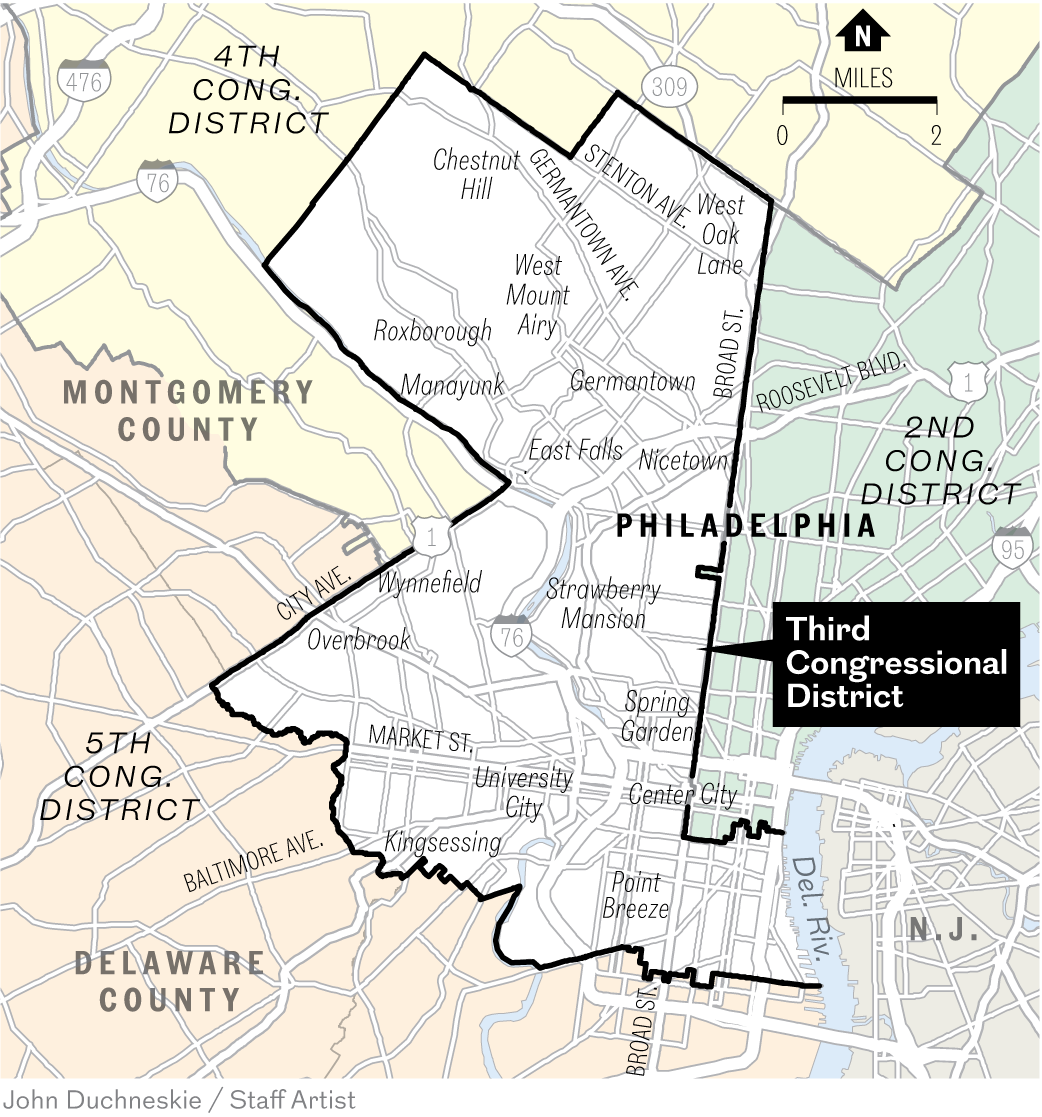
Gauthier said the plan would limit opportunities in her West Philadelphia-based 3rd District. She pointed to changes including Robeson High School and Parkway West ceasing to exist as standalone schools (Robeson would merge into Sayre and Parkway West into SLA Beeber), and the Workshop School colocating with Overbrook High. (The Workshop, however, would remain a distinct school, just in a new location.)
“What are people supposed to do for good high school options in West Philadelphia?” Gauthier said in an interview.
Jamie Gauthier. First day of fall session, Philadelphia City Council, Thursday, September 11, 2025.
Gauthier added that while Watlington has talked at length about the district avoiding the mistakes of its widely criticized 2012 school closure plan, it appears doomed to repeat that history.
“That’s a great thing to hold up every time we have this conversation, but how are you solving for it?” Gauthier said. “You can’t state all of the things that went wrong and then present a plan that seems to lack care in the same way as the plan in 2012.”
Johnson said the discussion over the plan was far from complete.
“I’m sure it’s going to be a very, very robust process,” he said. “These are only recommendations. This isn’t the final product.”
Watlington’s plan will touch every part of the city. It includes 20 school closures, six colocations, with two separate schools existing inside a single building, and more changes. It also includes modernizing more than 150 schools over 10 years, though officials have not yet revealed which buildings will get the upgrades.
In total, the blueprint would cost $2.8 billion — though the district is proposing funding only $1 billion of that with capital borrowing. The rest of the money would come from the state and from philanthropic sources, and if those dollars don’t come through, fewer repairs could happen.
Nearly all Council members on Thursday said they understood the need to consolidate schools, but each had concerns about how individual closures would affect the communities they serve.
Councilmember Curtis Jones Jr., whose district includes parts of West and Northwest Philadelphia, said some of the changes are encouraging, including an expansion of career and technical education planned for some schools, including Overbrook High.
But, he said, others could combine students who come from different neighborhoods and backgrounds, and the district must consider the social impacts of merging those populations.
“The places where the kids come from, that is always a dynamic that is under-considered,” Jones said. “If I live in this neighborhood and got to travel to that neighborhood, what are the historical dynamics?”
And Councilmember Cindy Bass, who represents parts of North and Northwest Philadelphia, said two of the schools in her district slated for closure — Fitler Academics Plus School and Parkway Northwest High School — “are models of great public education.”
“I don’t understand why they are targeted when they are very well-regarded and lots of kids want to go there,” Bass said. “If it’s not broken, why are we trying to fix this?”
It’s unclear how much sway members will have over where the district ultimately lands. Councilmember Isaiah Thomas, who chairs the Education Committee and represents the city at-large, warned of a “long and emotional” journey ahead.
“There’s always an emotional attachment to schools,” he said. “They are a pillar in a lot of neighborhoods.”
Staff writer Jake Blumgart contributed to this article.
Wholesale changes are coming to the Philadelphia School District, with Superintendent Tony B. Watlington Sr. poised to propose a massive reshaping of the system, including closing 20 schools.
The plan, years in the making, would touch the majority of the district’s buildings and bring change to every part of the city: over a decade, 159 would be modernized, six colocated inside existing schoolbuildings, 12 closed for district use, and eight closed and given to the city.
At least one new building would be constructed.
The 20 closures, which would not begin to take effect until the 2027-28 school year, would be scattered through most of Philadelphia, with North and West Philadelphia hardest hit.
Watlington released some details of the blueprint Thursday — including the list of proposed school closures—and acknowledged that the changes will roil some communities.
Watlington is scheduled to present his proposal to the school board next month, with a board vote on the plan expected this winter.
(function() {
var l2 = function() {
new pym.Parent(‘school_closing1’,
‘https://media.inquirer.com/storage/inquirer/projects/innovation/arcgis_iframe/school_closing1.html’);
};
if (typeof(pym) === ‘undefined’) {
var h = document.getElementsByTagName(‘head’)[0],
s = document.createElement(‘script’);
s.type = ‘text/javascript’;
s.src = ‘https://pym.nprapps.org/pym.v1.min.js’;
s.onload = l2;
h.appendChild(s);
} else {
l2();
}
})();
Philadelphia, the nation’s eighth-largest school system, now has 216 schools in 307 buildings, the oldest of which was constructed in 1889. It has 70,000 empty seats citywide, though some of its schools, especially those in the Northeast, are overcrowded.
But, Watlington said, “this is not just about old buildings.” Philadelphia’s academics are improving, and faster than most big-city districts, but most of its students still fail to meet state standards — just 21% hit state goals for math, and 35% for English.
“We must find ways to more efficiently use all of our resources so that we can push higher-quality academic and extracurricular programming and activities into all of our schools across all the neighborhoods of Philadelphia, while at the same time addressing under- and overenrolled schools,” the superintendent said.
If the school board adopts Watlington’s plan as proposed, the number of empty space in school buildings would decrease, with district schools going from a 66% utilization rate to 75%. The changes would also allow for the district to offer more students prekindergarten, algebra in eighth grade, and career and technical education and Advanced Placement courses, officials said.
“Part of the problem here is there’s so much disparity in the School District of Philadelphia,” said Watlington, who suggested the plan will improve equity.
Every building judged in “poor” or “unsatisfactory” condition — there are now 85 citywide — would either close or be upgraded within a decade, though the information released Thursday did not include details on upgrade plans.
There are no guarantees, however. The plan comes with a $2.8 billion price tag — only $1 billion of which the district will cover with its capital funds. The rest of the money is dependent on state and philanthropic support, neither of which is a given.
If the extra funding does not come through, Watlington said, fewer schools in disrepair could be modernized, or the district would have to make other revisions to the plan.
Officials said a backup plan would take longer to complete — 16 years, instead of a decade. The $1 billion version would not allow the school system to upgrade all schools currently rated unsatisfactory or poor. Instead, it would have 45 buildings in the those categories in 2041.
A possible closure list
Watlington indicated he wants to close these schools: Blankenburg, Fitler, Ludlow, Robert Morris, Overbrook Elementary, Pennypacker, Waring, and Welsh elementary schools; Conwell, AMY Northwest, Harding, Stetson, Tilden, and Wagner middle schools; and Lankenau Motivation, Parkway Northwest, Parkway West, Penn Treaty, and Robeson high schools. (Some of those schools, like Lankenau and Robeson, would become programs inside other schools — Roxborough High would use Lankenau, and Sayre would useRobeson. Others would close outright, with students assigned elsewhere.)
And he named six schools that would move into other school buildings while maintaining their individual structure and identity: Martha Washington, Building 21, the Workshop School, the U School, a new Academy at Palumbo Middle School, and a new K-8 year-round school.
Students at the affected schools will all move into schools with similar or better academic outcomes or building conditions, or schools that are better by both measures, Watlington said. Transition resources will be available for schools, students, and families from closing schools and for schools that take in new students.
The changes will also affect far more students than those in the 20 schools being shut down or in those sharing locations; closures mean the district would eventually need to redraw at least some school catchment boundaries, which dictate the neighborhood school each child attends.
Watlington said he did not anticipate job losses as a result of the closures.
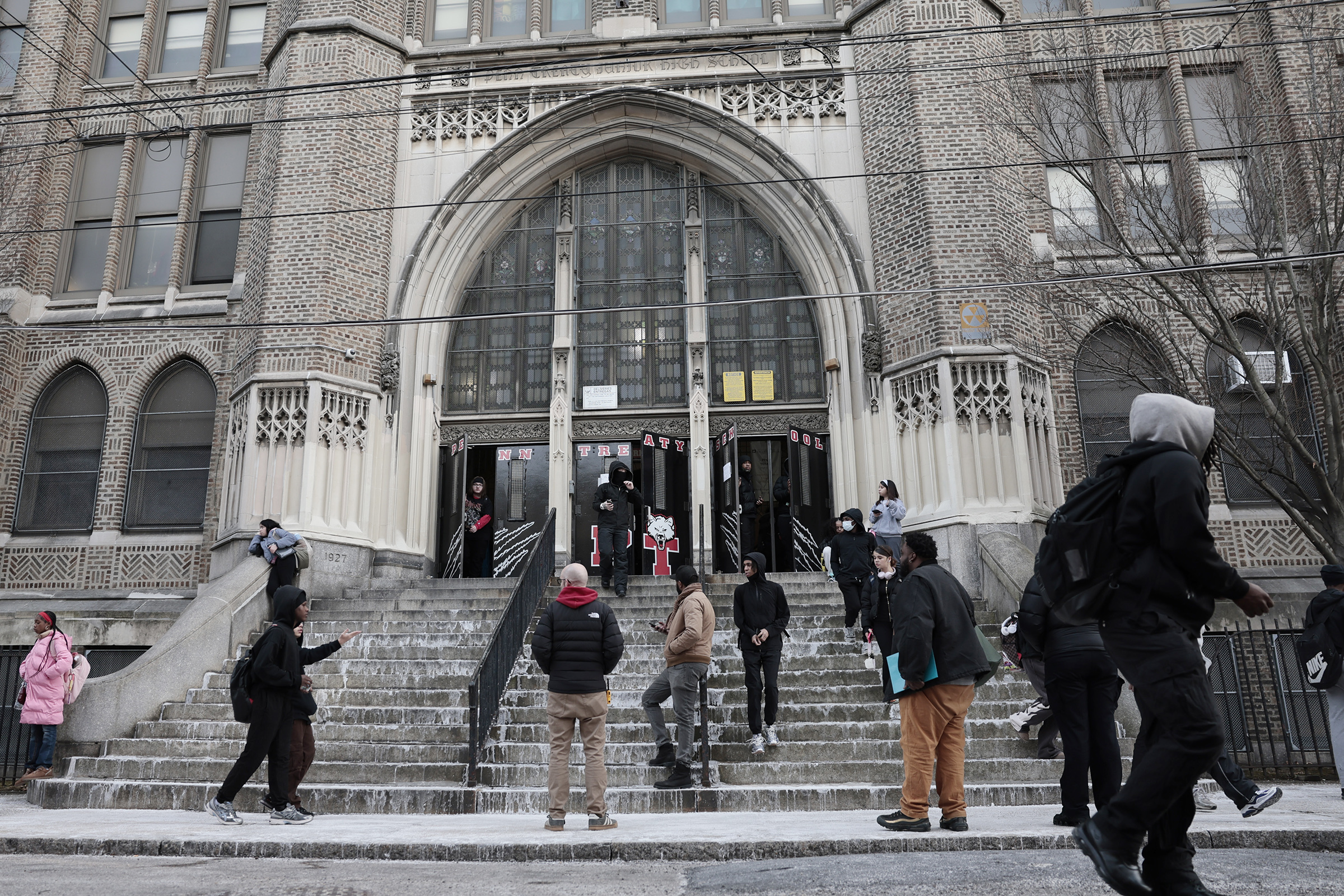
School officials stand by outside for afternoon dismissal at Penn Treaty Middle School, 600 East Thompson Street, in Philadelphia on Thursday, Jan. 22, 2026.
Fewer transitions, more standard grade configurations
Officials said they arrived at the blueprint after analyzing data and gathering feedback across the city — in meetings and surveys, and based on wisdom from advisory panels and a planning team. (Some advisory panel members said they had real concerns about the process, felt they got too little information, and saidtheir input was not seriously considered. Some had called for a pause in the process and a plan with no closings.)
Parents, staff, and community members identified four main themes that informed the recommendations, Watlington said: strengthening K-8 schools, reinvesting in neighborhood high schools, reducing school transitions for students, and expanding access to grades 5-12 criteria-based high schools.
The plan dramatically shrinks the number of grade spans in the district.
Currently, there are 13 different kinds of school configurations. Going forward, there be just six grade bands: K-4, K-8, K-12, 5-8, 5-12, and 9-12. (Six schools will be exceptions, however.)
Philadelphia is leaning into a “strong K-8 model,” Watlington said. He recommended closing six middle schools, with some elementary schools adding grades to accommodate.
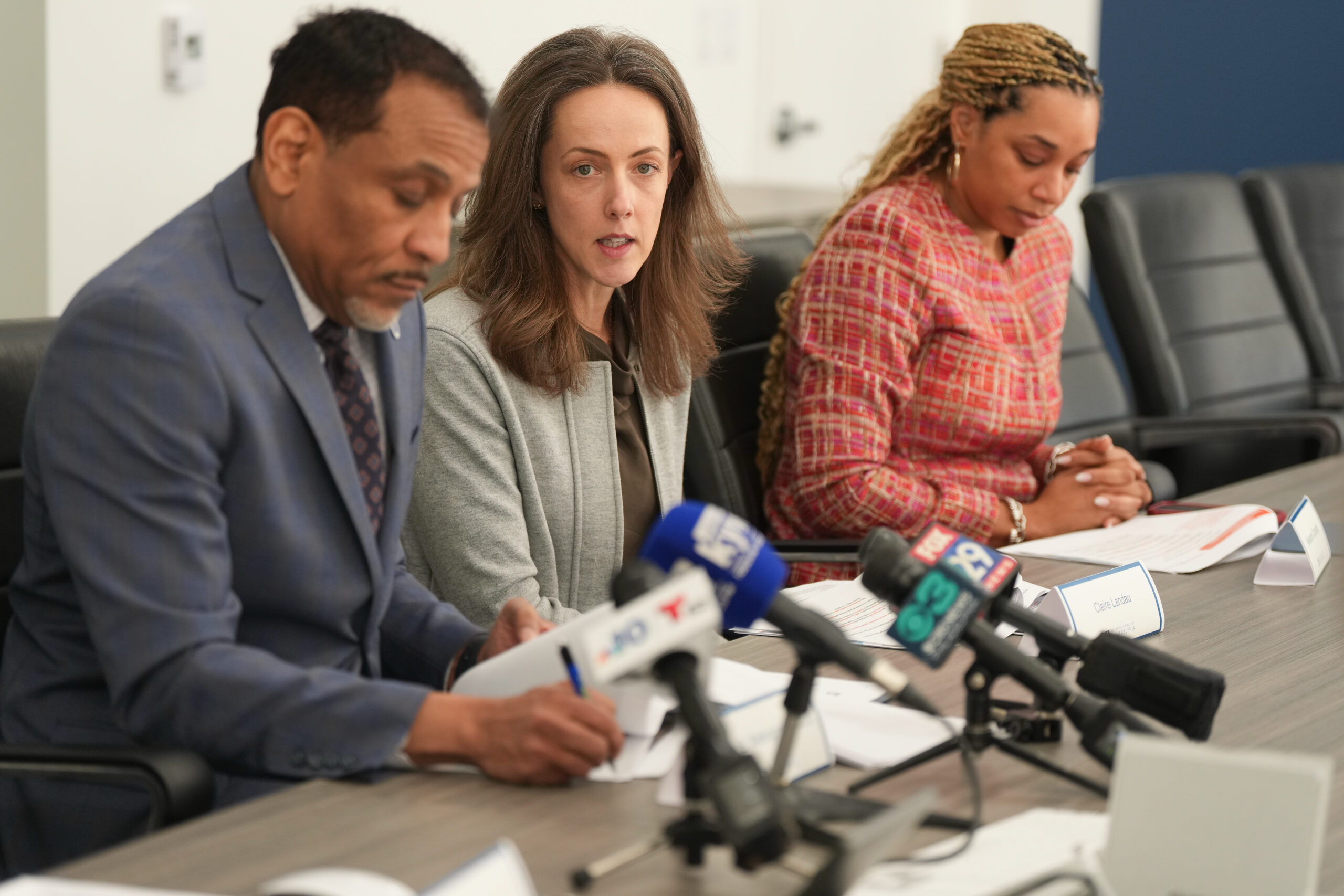
From left to right, Superintendent Tony B. Watlington, senior adviser Claire Landau, and chief of communications and customer service Alexandra Coppadge speak to reporters on Tuesday about their proposed master plan for Philadelphia schools.
It is also turning some high schools that now house four grades into middle-high schools, with 5-12 spans. South Philadelphia High will get investments to its career and technical education space and add fifth through eighth grades, for instance. A new Palumbo Middle School will open, colocated with Childs Elementary in Point Breeze; its students will get preference for admission to the Academy at Palumbo, a South Philly magnet.
Investments in the Northeast, and elsewhere
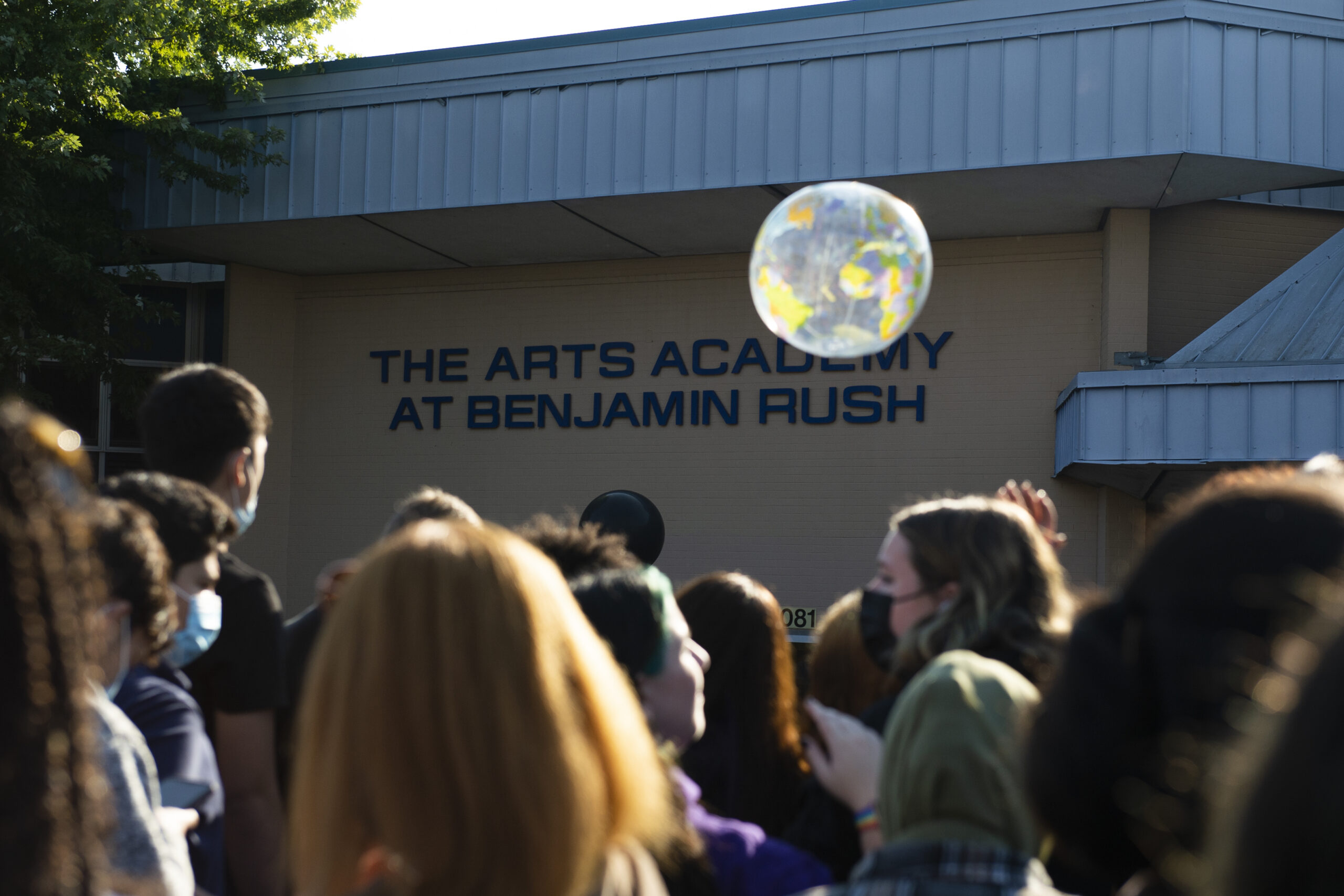
The single from-scratch construction announced will be in the Lower Northeast — a new Arts Academy at Benjamin Rush, a popular magnet now in the Far Northeast. That new building, which will house students in fifth through 12th grades, would rise on the site of the old Fels High School in Oxford Circle.
A new neighborhood high school will open in the current Rush Arts building, if the plan is approved.
The Arts Academy at Benjamin Rush, shown in this 2022 file photo, will move to a new building constructed in the lower Northeast under the facilities master plan now under consideration. A new catchment high school would open in the Rush Arts building.
Comly, Forrest, and Carnell — all Northeast schools — would be modernized and get additional grades to relieve overcrowding.
Masterman, one of the city’s top magnets, has long been overcrowded — its middle school would move to Waring, in Spring Garden, one of the closing schools.
“It’s really important to note this is not a plan to just funnel resources into the Northeast part of Philadelphia, where the population is increasing faster or in a different way than other parts of the city,” Watlington said. “This is not just build out, invest in some areas, divest in others.”
Learning from past mistakes
Watlington said he knows the plan will be difficult for some to swallow, and does not achieve every aim.
But, he said, “we are not going to make good the enemy of perfect.”
Still, Watlington and others vowed this closure process — the first large-scale closures in more than a decade — would not repeat the mistakes of 2012 and 2013, when 30 schools were shut to save money.
A new transition team will focus on what students and schools need, from social and emotional supports to safety and academic help.
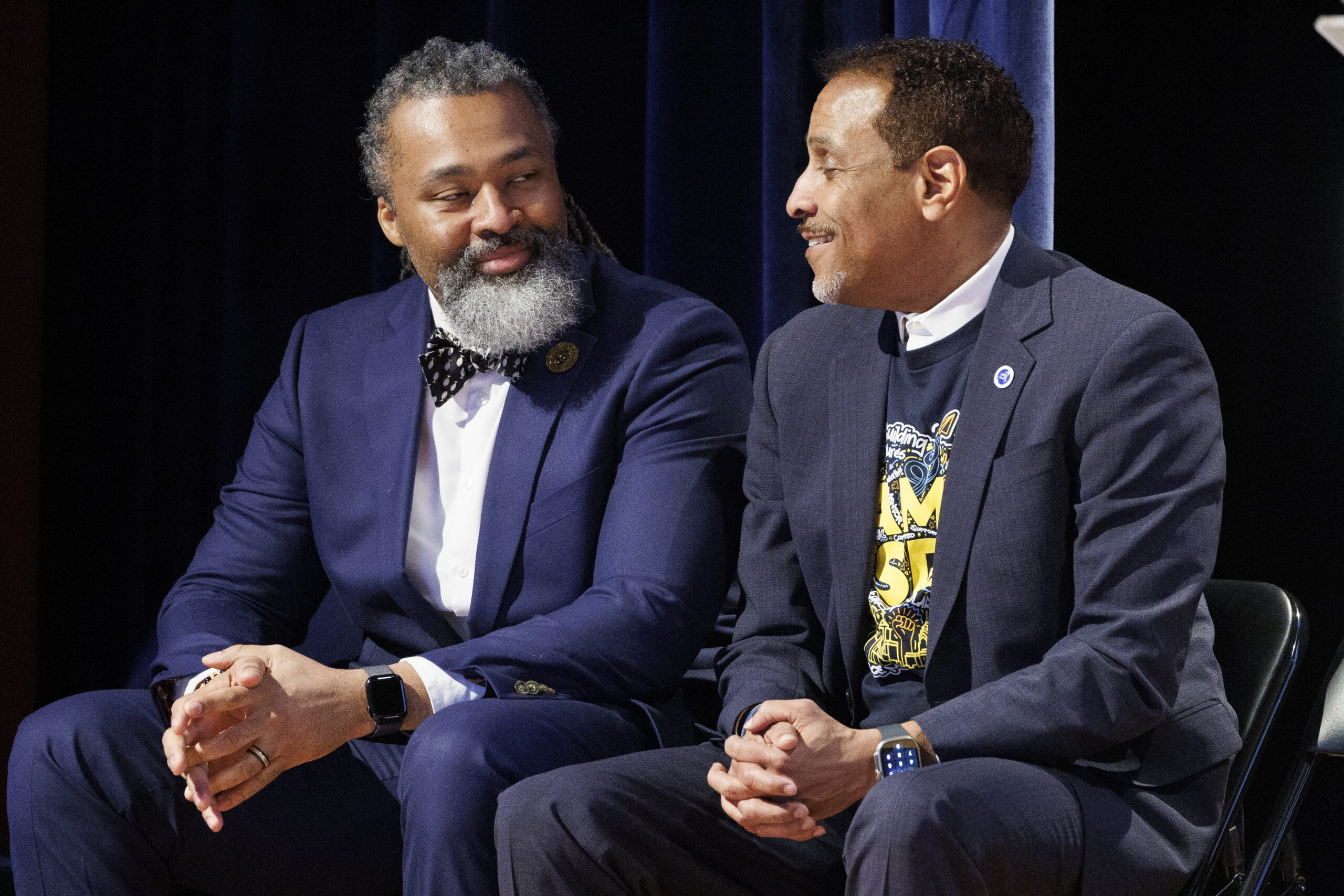
School board president Reginald Streater and Superintendent Tony B. Watlington Sr. are shown in this 2025 file photo.
“These families will get gold-standard, red-carpet treatment directly from the superintendent’s office,” Watlington said.
The superintendent said he will urge the board to “strongly consider” his recommendations.
“We have one shot to get this right,” Watlington said. “We believe this is as good a plan as we can bring to the board, and so we’re going to recommend strongly that the board adopt these recommendations.”
School board president Reginald Streater said the facilities planning process was “critical” to bettering student outcomes.
Watlington, Streater said in a release, has led “meaningful community engagement with families, educators, and community members across our city. The board looks forward to receiving the full set of recommendations and carefully considering them as we work together to ensure all of our school facilities and student rostering practices best support access to high-quality educational experiences and opportunities for all students.”
Mayor Cherelle L. Parker gave good marks to the plan.
“It is ambitious, it’s thorough, and it’s grounded in what I believe matters most, and that’s achieving the best outcomes for our students,” Parker told reporters. “I’m proud that the district has taken what I would describe as a clear-eyed look at really what matters for our children.”
‘It feels like a family member is dying’
Outrage mounted for some Thursday as district officials began notifying affected communities and groups.
“It’s heartbreaking,” said Sharee S. Himmons, a veteran paraprofessional at Fitler Academics Plus, a K-8 in Germantown. “It feels like a family member is dying.”
Himmons is enrolled in the district’s Pathways to Teaching program, taking college courses to earn her degree and teacher certification. She was sitting in her math class at La Salle University when she found out Fitler was slated for closure. She began crying. She failed a test she was taking because her concentration was shot, she said.
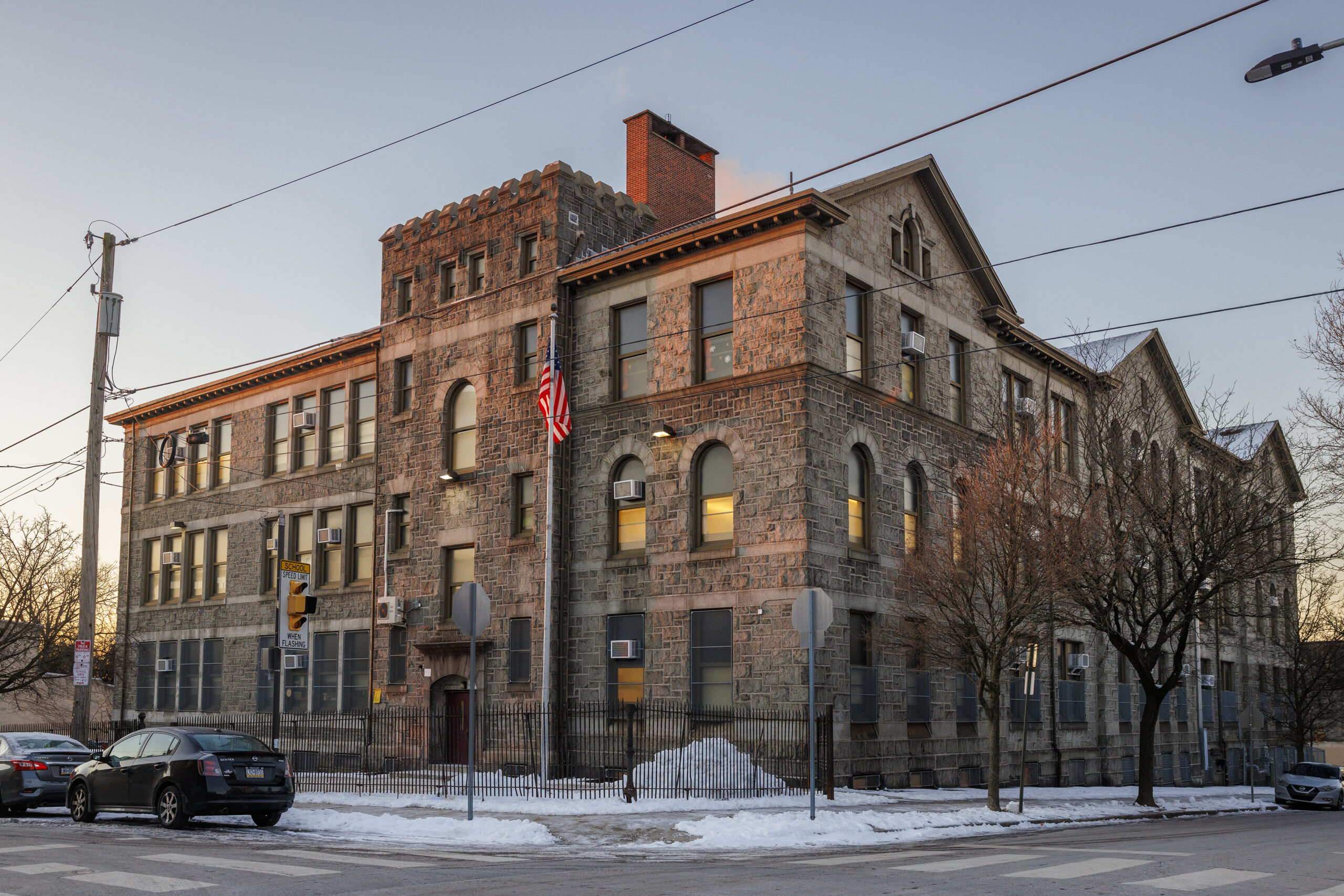
Fitler Academics Plus Elementary School in Germantown is among the 20 schools that would close under the proposed plan.
“This school is such a staple in the neighborhood,” she said. Fitler is a citywide admissions school, but draws many students from the area. Himmons’ own sons attended Fitler, and she wanted to teach there after her college graduation.
“This isn’t over,” she said. “We’re going to fight — hard.”
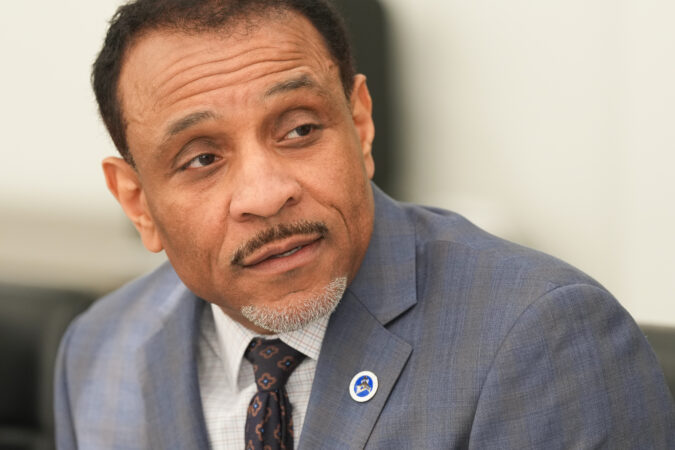
Arthur Steinberg, president of the Philadelphia Federation of Teachers, said he is waiting to see more granular details of the plan, including the list of schools that will be upgraded and what fixes are promised, and hopes for information about how much weight was given to every factor that went into the decisions.
But, Steinberg said, “it is devastating for any community to lose their school — the parents, the kids, and the staff.”
As for the process that led the district to this moment, Steinberg said it was abundantly clear even to advisory panel members that their viewpoints were just points of information for Watlington’s administration, that no promises about heeding any advice were made.
Either way, the closure of 20 schools and more changes that will have ripples across the city for years to come all lead back to one factor, he said.
“Without the chronic underfunding of the district,” Steinberg said, “we wouldn’t have gotten to this point.”
Robin Cooper, president of the union that represents district principals, said the announcement was destabilizing, even though officials had warned closings were coming.
“It’s a loss of history, a loss for Philadelphia,” Cooper said. “Schools are a family, and some families are breaking up.”
Staff writer Sean Collins Walsh contributed to this article.
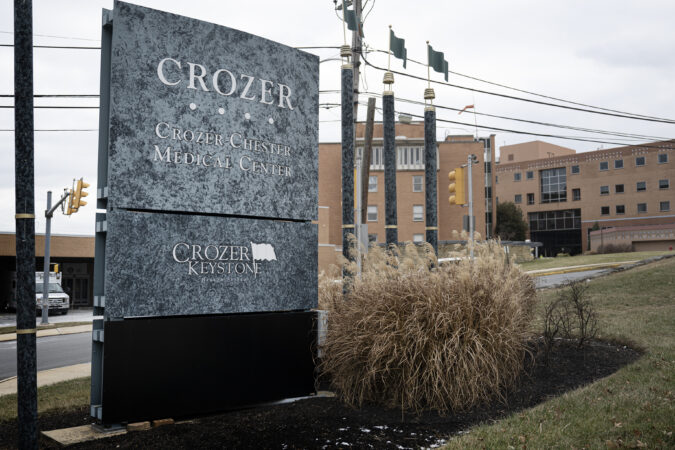
The new owner of the defunct Crozer-Chester Medical Center wants to restore hospital and emergency services to the 64-acre campus that straddles Chester and Upland Township in Delaware County.
Newly formed Chariot Equities completed the $10 million purchase Wednesday. The for-profit entity said it expected within six months to have an agreement with a health system that would operate a “right-sized” hospital and emergency department at the facility that had been the county’s largest provider of those services before closing last year.
The idea is then to open the first phase within two years, Chariot said in a statement.
Chariot did not say how much it would spend on refurbishing Crozer-Chester, which had suffered from years of neglect under its two previous owners.
Chariot’s partner at Crozer-Chester is Allaire Health Services, a Jackson, N.J.-based for-profit operator of nursing homes.
The partners said they are in talks with regional and national nonprofit health systems regarding an operating partnership, but provided no details. The amount of money needed for the project would likely depend on what prospective tenants would want to do at the property.
“Our belief in Delaware County’s future, and the community’s need for sustainable healthcare access, made this an effort worth committing to well before the finish line,” said Yoel Polack, Chariot’s founder and principal.
Little is known about the new owners. Polack worked in healthcare real estate in the New York City area before setting his sights on redeveloping Crozer-Chester.
Federal records list Allaire’s CEO Benjamin Kurland as an owner of 20 nursing homes, including three in the Philadelphia area. Chariot’s statement said Allaire owns a total of 29 facilities in five states.
Main Line Health has been involved in discussions about reopening emergency services at three former Crozer hospitals — Crozer-Chester Medical Center, Springfield Hospital, and Taylor Hospital — at the request of state lawmakers and the property owners, Ed Jimenez, CEO of Main Line Health, said Wednesday at a Riddle Hospital event.
Jimenez said he would “entertain the concept” of restoring emergency services at one of the hospitals as part of a partnership with other health systems, but only if it can be done on a break-even basis.
All three of the former hospital buildings visited by Main Line officials are in poor condition and were stripped of medical equipment after the closures. Main Line’s experts estimated it would cost between $15 million and $20 million just to make the emergency department at Taylor functional, Jimenez said.
ChristianaCare, Delaware’s largest health system, considered acquiring Crozer in 2022. Instead, it took a different path to expansion in Southeastern Pennsylvania. It is planning to open two micro-hospitals in Delaware County. The nonprofit system also took over five former Crozer outpatient locations. Its credit rating was recently downgraded by one notch because of lower profitability.
The importance of Crozer-Chester
Crozer-Chester closed in early May during the bankruptcy of owner Prospect Medical Holdings Inc., a for-profit company based in California, and after the failure of government-supported efforts to form a new nonprofit owner for Crozer-Chester and other Crozer Health facilities.
Crozer-Chester was particularly important as a safety-net provider for a low-income area of Delaware County that has few other nearby options. The Crozer system, which had four hospitals, was the county’s largest health system and largest employer for many years.
Two local Democratic officials, State Rep. Leanne Krueger and Delaware County Council member Monica Taylor, said they were encouraged by the approach being taken by Chariot and Allaire.
At Taylor Hospital, the other Crozer hospital that closed last year, new owners are also looking for healthcare tenants. Local investors bought the Ridley Park facility for $1 million. It is less than four miles from Crozer-Chester.
The same group agreed last week to pay $1 million for Springfield Hospital, another facility that had previously shut down under Prospect ownership.
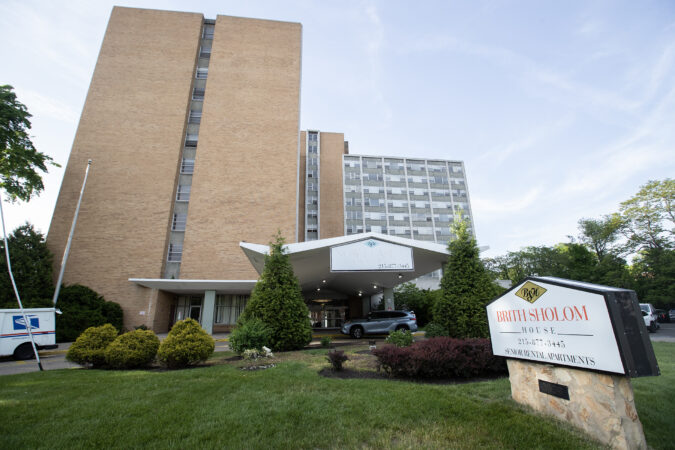
The man’s body was found around 5:45 a.m. after police were called to the property, located on the 3900 block of Conshohocken Avenue.
The man, whom police did not identity, was pronounced dead at the scene at 6:40 a.m.
Kelvin A. Jeremiah, president and CEO of the Philadelphia Housing Authority, said the complex’s doors and windows on the lower floors have been sealed since tenants left the property, though there have been several instances in which individuals managed to enter in an attempt to steal copper wiring from within the structure.
Early Wednesday morning, a 911 call was placed from Brith Sholom by a man who told police that a contractor had gotten hurt on the job and needed assistance, Jeremiah said.
But Jeremiah said the housing authority had not authorized any such work, and no one was permitted on the property at the time.
The housing authority later learned that the man was electrocuted and died after he tried to strip copper wire from the complex’s basement. The body was found next to the switch gears, Jeremiah said.
The CEO suspects the person who called 911 was an accomplice in the break-in, though police are still investigating.
The housing authority’s security cameras were not active during the incident because much of the building’s power is off, and other cameras have been destroyed by bad actors, according to Jeremiah.
He said the individuals might have used a ladder to enter the complex through the third floor.
Just a day earlier, Brith Sholom received a much different sort of attention.
On Tuesday, Mayor Cherelle L. Parker announced that the city’s powerful building trades unions would offer PHA a sizable loan to redevelop the complex, which the housing authority purchased from its former owners in 2024 in order to preserve it.
After PHA acquired the property, it initially told its 111 residents they could remain in their units. But upon discovering some units were damaged beyond repair, officials told those residents they would need to move out and return at a later date.
The Brith Sholom project, when completed, is expected to add 336 affordable units for seniors on fixed incomes, Parker said in her announcement Tuesday.
A coalition of building trades unions will lend the Philadelphia Housing Authority $50 million out of its pension fund to help finance the redevelopment of Brith Sholom House, a dilapidated senior apartment complex in West Philadelphia.
Mayor Cherelle L. Parker and her longtime political ally Ryan N. Boyer, the business manager of the Philadelphia Building and Construction Trades Council, announced the arrangement Tuesday and framed it as a first-of-its-kind approach to expanding the city’s affordable housing stock.
Under the terms of the deal, PHA will repay the building trades over 15 years at a 4.5% interest rate. PHA President and CEO Kelvin Jeremiah called it a good deal for taxpayers as banks and traditional financing institutions are lending at higher rates.
The city is guaranteeing the loan.Parker said the outcome will be 336 units of affordable housing for seniors on fixed incomes. Members of the building trades unions will perform the work at the site.
“This isn’t an investment for the building trades,” Boyer said. “It’s a down payment on our city’s future.”
Boyer, one of the most powerful nonelected political figures in the state, has been a longtime ally to Parker and much of City Council. The trades unions poured millions into Parker’s run for mayor in 2023 and have remained largely in lockstep with her. Boyer led the mayor’s transition team and has been a key voice on her signature housing plan, which stands to generate thousands of construction jobs.
The trades’ $50 million investment comes in addition to the $99.6 million that the housing authority is spending on a gut rehabilitation of the Wynnefield apartment complex, bringing the total cost of the project to $150 million.
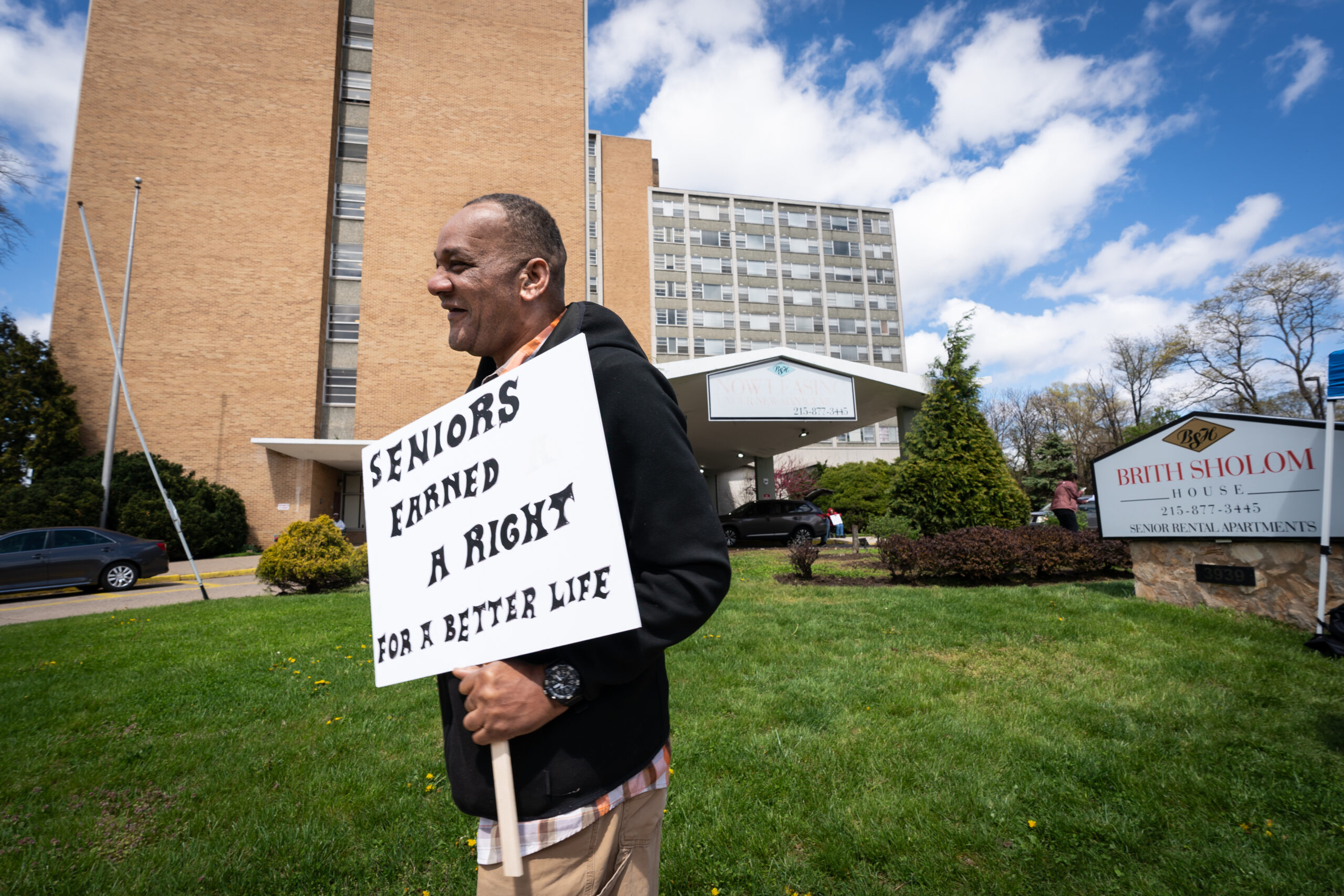
A protestor carries a sign to protest the living conditions at Brith Sholom House apartments, in Philadelphia, on Friday, April 12, 2024.
Jeremiah said he has been “shocked and dismayed” by the conditions at Brith Sholom, which was so neglected under its previous owners that tenants were forced to move out.
Work will begin late this year and is expected to take about 20 months to complete, Jeremiah said, meaning tenants may not be able to move back in until 2028. He had previously estimated a timeline that would have allowed residents to return this year.
Brith Sholom fell into disrepair under its previous owners, the New Jersey-based Puretz family. A 2024 Inquirer investigation found that members of the family became one of the nation’s largest affordable housing purveyors by buying up old buildings, saddling them with debt, and then defaulting on loans.
At Brith Sholom, the Puretz family profited while defaulting on a $36 million mortgage and amassing dozens of code violations. Residents — who organized to save their homes — complained of deteriorating infrastructure, threats of utility shutoffs, squatters, and severe pest infestations.
In a bid to preserve the building and reuse it in part as subsidized housing, PHA acquired Brith Sholom House in August 2024 for $24 million.
In addition to the price of the acquisition, Jeremiah estimated in 2024 that the cost of rehabilitating the building would be an additional $30 million to $40 million. PHA said then that the remaining 111 elderly residents in the 360-unit building would be able to remain in place.
Three months later, Jeremiah informed the tenants that Brith Sholom was in such ragged shape that they would have to be moved out to repair the building. Some units were so badly damaged that PHA could not fix them.
Following the acquisition of Brith Sholom, PHA has embarked on an ambitious $6.3 billion, 10-year plan that includes the purchase of 4,000 other privately held apartments. In the face of a glut of market-rate multifamily properties, many developers have struggled to charge the rents they need to pay back their loans — and the housing authority has been able to purchase buildings from such companies across the city.
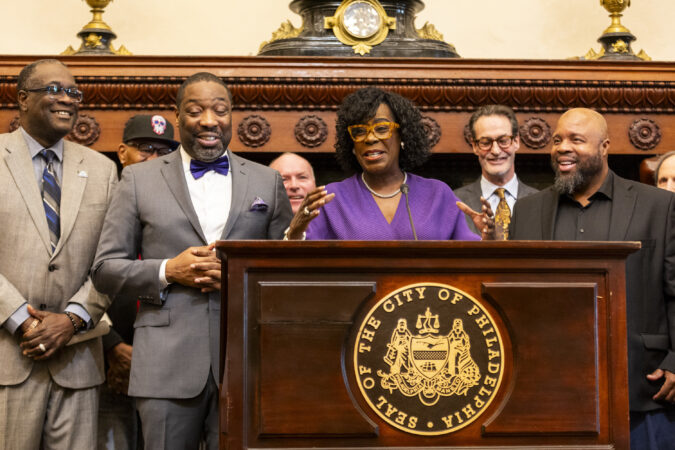
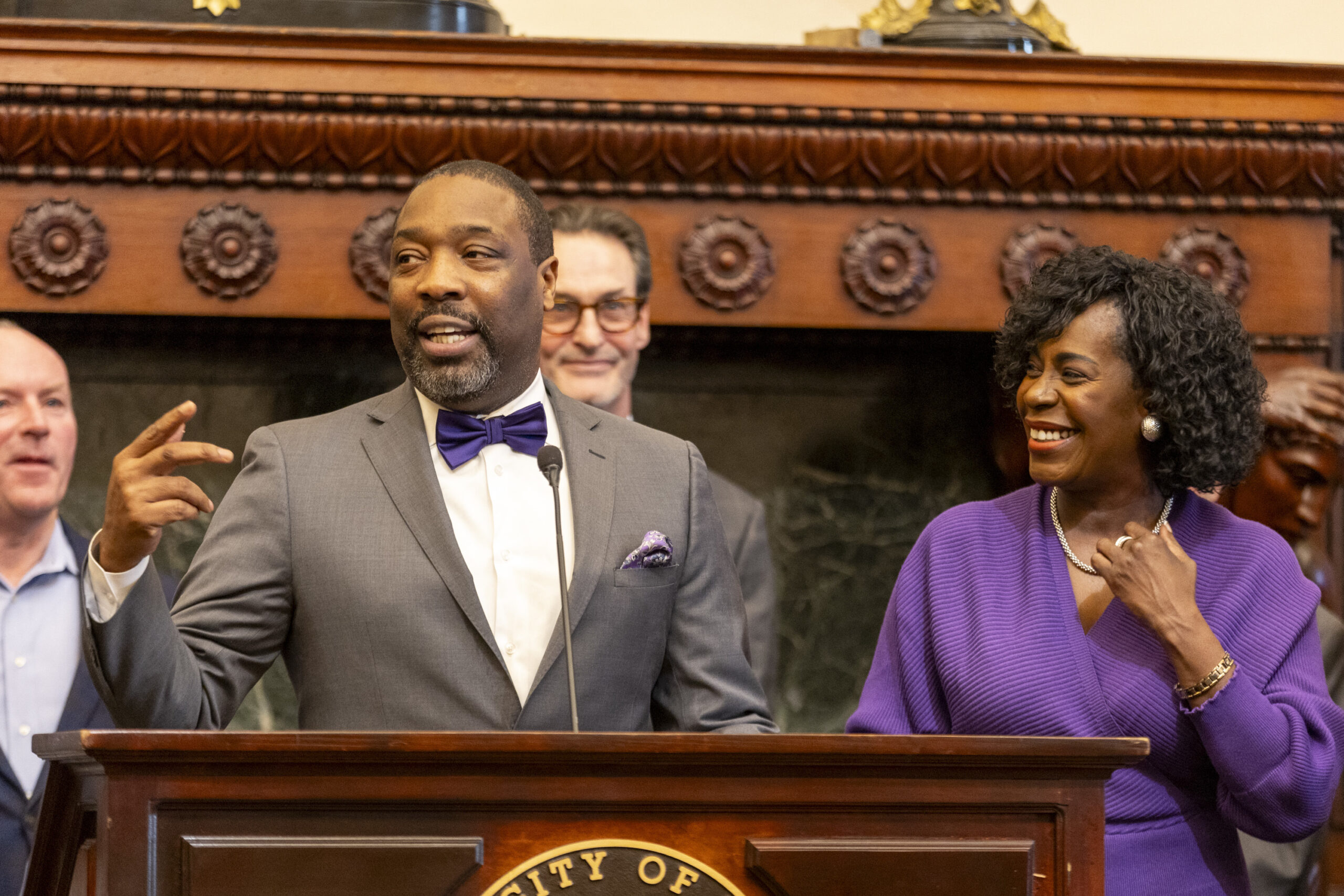
City Council President Kenyatta Johnson speaks during a news conference about the plan to redevelop Brith Sholom. At right is Mayor Cherelle L. Parker.
Parker also said the investment at Brith Sholom is part of her signature housing initiative, called Housing Opportunities Made Easy, or H.O.M.E. The mayor — who has promised to build, redevelop, and preserve more than 30,000 units of housing — is in the midst of continued negotiations with City Council over H.O.M.E.’s first-year budget.
Council in December gave initial approval to changes to legislation related to Parker’s housing initiative, which set income eligibility thresholds for two housing programs funded by H.O.M.E.’s bond proceeds. Parker wanted a higher threshold so middle-class residents could access the programs, while Council’s version aims to prioritize poorer Philadelphians.
Council could take a final vote on the related legislation as early as Thursday, when lawmakers return to session following their winter break.
Throughout the contentious process, Parker has said her administration is committed to affordable housing for lower-income Philadelphians. The collaboration with PHA to remake Brith Sholom, she said, is part of that effort.
“It’s not just for one particular constituency,” Parker said Tuesday about her overarching housing plan. “I’m personally on a mission to save Philly rowhomes. We’re trying to address our housing crisis and doing it for Philadelphians from all walks of life.”
Parker was joined at the news conference Tuesday by Council President Kenyatta Johnson, despite the two being at odds over the H.O.M.E. legislation in recent months. Johnson praised the mayor’s leadership and said the financing arrangement for Brith Sholom is remedying a “miscarriage of justice.”
“This is the type of work that helps those most in need,” Johnson said, “which is our seniors, who deserve to live out the twilight of their lives in dignity.”
At Penn Medicine’s clinic where adults receive genetic counseling and testing, about 9% of patients are Black.
By contrast, one in four patients at the cardiology and endocrinology clinics located in the same facility in West Philadelphia are Black, while nearly 40% of cityresidents are. Those from low-income neighborhoods are also less likely to be seen at the genetics clinic, yet more likely to have positive results when tested, a recent Penn study found.
These findings line up with what Theodore Drivas, a clinical geneticist and the study’s senior author, had long suspected about the impact of racial disparities based on his own experience seeing patients at Penn’s clinic.
The study, published this month in the American Journal of Human Genetics, found that Black patients were also less likely to be represented at adult genetics clinics at Mass General Brigham, a Harvard-affiliated health system in Massachusetts.
There’s no biological reason why rates of testing should differ, Drivas said. The overall rate of genetic disease should be similar regardless of race, even though certain diseases are more prevalent in some populations.
“Genetic disease doesn’t favor one group or another,” he said.
That means if one group isn’t getting tested as much, they’re probably missing out on key diagnoses.
Racial disparities are an ongoing concern in medicine and have been attributed to a wide range of causes, including socioeconomic factors, unequal access to care, implicit bias, and medical mistrust due to historic injustices.
In a study published last August, Drivas’ team found that the chances of a genetic condition being caught varied widely by race. Among patients admitted to intensive care units across the Penn health system, 63% of white patients knew about their genetic condition, compared to only 22.7% of Black patients.
To address these disparities, Drivas is calling for changes to how the medical field approaches genetic testing, such as by integrating testing into standard protocols and improving national guidelines.
“It’s not just a Penn problem or a Harvard problem. It’s a genetics problem in general,” Drivas said.
Diving into the disparities
Drivas’ team analyzed data from 14,669 patients who showed up at adult genetics clinics at Penn and Mass General Brigham between 2016 and 2021. The findings are limited to the two major academic centers on the East Coast, which tend to see sicker patients compared to community medical centers.
Black patients were 58% less likely to be seen at Penn’s genetics clinic than would be expected based on the overall University of Pennsylvania Health System patient population.
At Mass General Brigham, Black patients were 55% less likely than would be expected based on that system’s population.
Some literature has suggested that Black patients and others from minority groupsare less likely to agree to genetic testing because of an inherent distrust in the medical system due to historic injustices. “But we don’t see that in our data,” Drivas said.
Once evaluated at Penn’s clinic, Black patients were 35% more likely to have testing ordered than white individuals.
His team also found disparities affecting lower-income individuals. Each $10,000 increase in the median household income of a person’s neighborhood was associated with a 2% to 5% higher likelihood of evaluation at a genetics clinic.
Meanwhile, patients from neighborhoods with lower median socioeconomic status were more likely to get positive results from testing than those from wealthier neighborhoods.
“We’re relatively over-testing the people from higher socioeconomic brackets and under-testing the people from lower socioeconomic brackets,” Drivas said.
The solution is not to stop testing the wealthier people, he clarified, but to improve access to testing for others.
Undoing disparities
People who want to get a genetic diagnosis often have to go to major medical centers.
The University of Pennsylvania health system comprises sevenhospitals across Pennsylvania and New Jersey. Its Perelman Center for Advanced Medicine, adjacent to the Hospital of the University of Pennsylvania in West Philadelphia, is the only one that has an adult genetics clinic.
Drivas has many patients who drive two or three hours to be seen for genetic testing.
The current wait time at his clinic is around three or four months, which he said is “pretty good” compared to others.
He thinks part of the solution to reducing disparities requires expanding the size and diversity of the genetics workforce so more patients can be seen.
Geneticists also need to better educate doctors in other fields about when to refer patients, he said. Creating better guidelines would help.
Notably, Black patients in the study were more likely to be evaluated than white individuals for genetic risk factors of cancer — an area where there are clear clinical practice guidelines recommending genetic testing.
They need to come up with similar guidelines for other conditions, such ascardiovascular and kidney diseases, he said.
Another idea he had was to make genetic testing more integrated into standard care in the hospital.
His earlier study found a surprising number of adults in ICUs at Penn had undiagnosed genetic conditions. Such testing is now widely available and often costs as little as a few hundred dollars.
“It costs money, but I think there are cost savings and life-saving interventions that can come from it,” Drivas said.
In the most-watched race for Congress in Philadelphia in more than a decade, State Rep. Chris Rabb has cast himself as the unabashed anti-establishment leftist. He’s refusing donations from corporations, calls the war in Gaza a genocide, and wants to abolish U.S. Immigration and Customs Enforcement.
But despite announcing his campaign more than six months ago, he had yet to amass support from much of the city’s progressive flank, leading observers to wonder if he would be able to tap into the movement’s network of donors and volunteers.
It appears they’re coming around.
Rabb this week has won an endorsement from One PA, a progressive political group that’s aligned with labor and most of the city’s left-leaning elected officials. That comes after the environmental justice group Sunrise Movement said it, too, would back Rabb.
“This is a moment when democracy is at stake,” said Steve Paul, One PA’s executive director. “If there was any moment for the style of leadership that Chris [Rabb] brings to the table, it’s this moment.”
Rabb said he’s “energized” by the endorsement and what it means for the campaign.
“Our movement is growing every single day,” he said.
The questions now are whether some of the city’s most prominent progressive elected officials will lend their endorsements to Rabb, and if deep-pocketed national organizations will spend money to back him.
For example, Justice Democrats, a progressive political action committee, said it’s “very closely looking at this district.” And the Working Families Party, the labor-aligned third party that supports progressives across the nation, has endorsed candidates in four other congressional races with competitive primaries — but not yet in Philadelphia’s. The group previously spent millions to boost candidates in the region.
The primary election — the marquee race in deep-blue Philadelphia — isn’t until May. But some on the left say the movement should have already coalesced around Rabb.
“We will probably regret it in the end, because this is a seat we should win,” said one leader of a progressive organization in the city who requested anonymity to speak freely about the political dynamic.
Rabb is seen as something of a lone operator with his own political apparatus. He didn’t come up through the newer progressive organizations that have run their own candidates for office in the city. Rather, he won a seat in the state House for the first time a decade ago when he toppled an establishment-backed Democrat.
State Rep. Chris Rabb at a forum hosted by the 9th Ward Democratic Committee on Dec. 4, 2025. He is a Democratic candidate running to represent Philadelphia’s Third Congressional District.
Some of the city’s progressive leaders say they expect to back Rabb but that they were waiting to see how the field shaped up.
Last year, there were efforts to recruit other left-leaning candidates to run, including City Councilmember Kendra Brooks of the Working Families Party, and State Rep. Rick Krajewski, according to three sources with knowledge of the efforts who spoke on condition of anonymity to preserve relationships. Both decided against running.
Brooks — who emerged as a face of the Working Families Party six years ago after she became the first third-party candidate to win a seat on Council in 100 years — is likely to back whomever the organization endorses. The group is still in the midst of its endorsement process.
“We’re confident that we will land on a progressive who will fight for working people, not billionaire donors, big corporations, or special interests,” WFP spokesperson Nick Gavio said.
Krajewski, who represents parts of West Philadelphia, has also not endorsed a candidate but he said he will. Rabb, according to Krajewski, has the qualities necessary to be a member of Congress during “a pivotal moment for our country.”
“The question is: Do we allow the fascists and the ruling class to double down on this insanity that they’re pushing? Or do we use this opportunity to agitate and say a different world is possible?” Krajewski said. “That’s what I want from my member of Congress. Chris [Rabb] has demonstrated that he’s clear about that.”
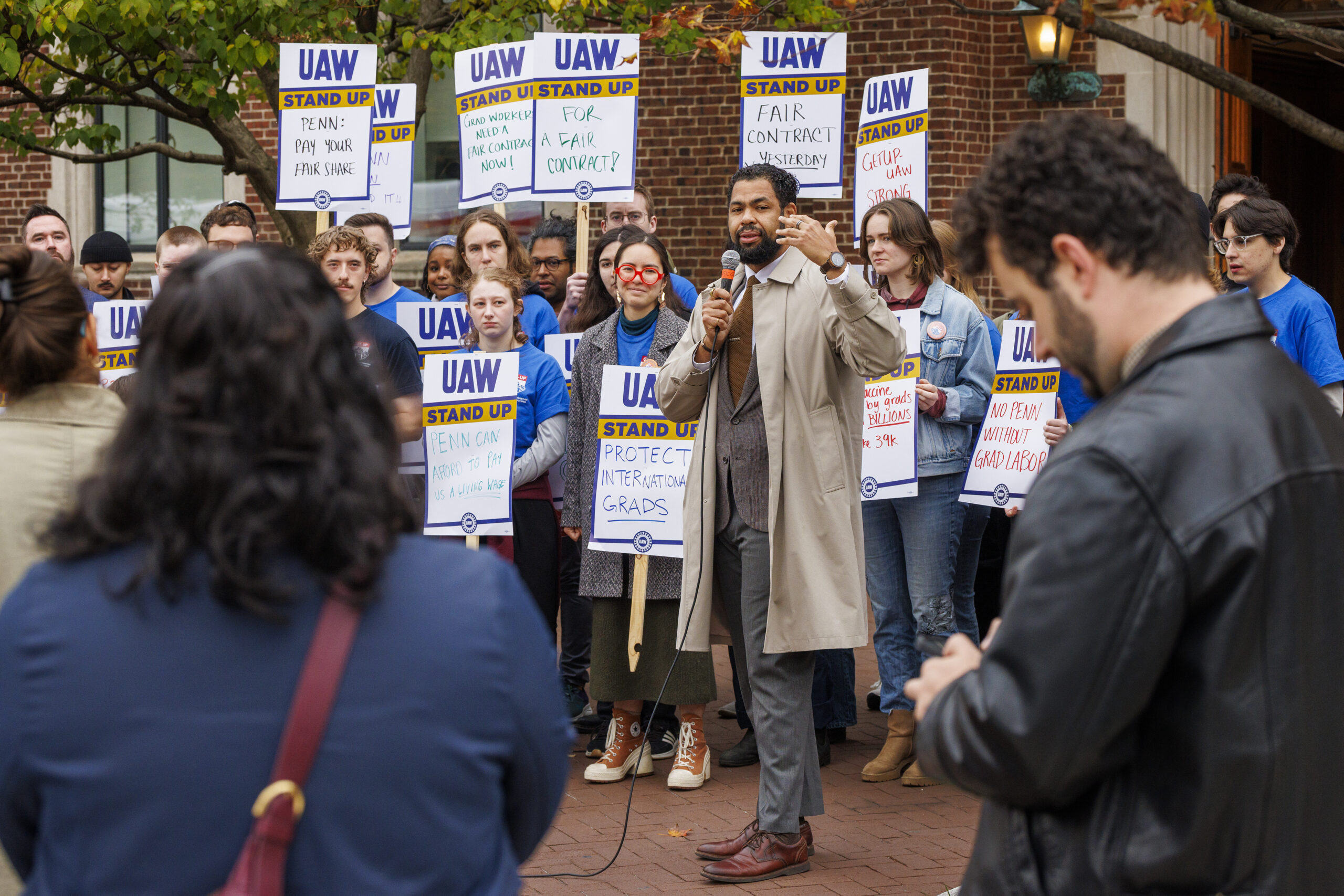
Pennsylvania State Rep. Rick Krajewski making statements at a news conference and rally by University of Pennsylvania graduate students. Grad students held the event to call for a strike vote against the university at corner of South 34th and Walnut Streets on Nov. 3, 2025.
Meanwhile, other candidates in the wide-open Democratic primary have tried to pick off progressive support.
State Sen. Sharif Street, the former chair of the state Democratic Party, is seen as the establishment’s pick for the seat. But he also has alliances with some of the city’s most progressive leaders.
That includes a decades-long relationship with Councilmember Rue Landau, who often votes with Council’s progressive bloc and is the first openly LGBTQ person ever elected to Council. Two sources familiar with Landau’s thinking said she is strongly considering endorsing Street.
Street has also worked closely on criminal justice reform matters with District Attorney Larry Krasner, perhaps the city’s most prominent elected progressive. He inherited some of Krasner’s political staff to manage his campaign.
However, several other candidates in the congressional race could be in the running for backing from Krasner, who recently won his third term in office in landslide fashion. Rabb, Street, and State Rep. Morgan Cephas previously endorsed Krasner for reelection.
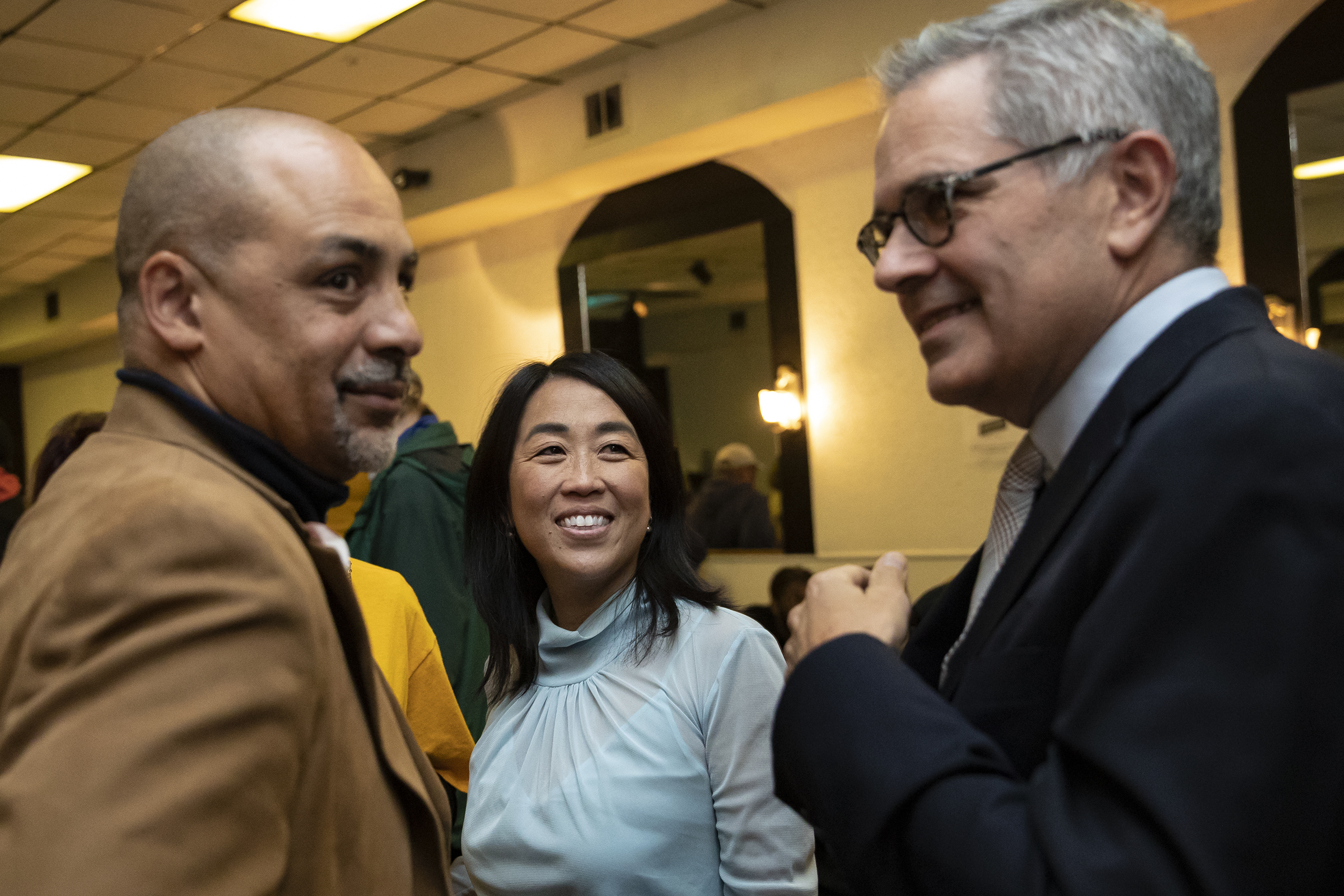
State Rep. Chris Rabb (left), Helen Gym (center), and District Attorney Larry Krasner attend the election results watch party for Working Families Party candidates Kendra Brooks and Nicolas O’Rourke in North Philadelphia on Nov. 5, 2019.
The crowded field may also mean that some elected officials choose not to get involved.
State Rep. Tarik Khan, a Democrat and nurse practitioner who has been backed by progressive organizations, said he has relationships with several leading candidates. That includes his colleagues in Harrisburg, as well as Ala Stanford, a surgeon. She and Khan were both prominent vaccine advocates during the COVID-19 pandemic.
“There’s a lot of good choices in this race,” Khan said. “I’m probably just going to let the process play out.”
Philadelphia police are investigating whether theseparate slayings of three men, all of whom worked in the city’s towing industry, are connected, authorities said this week.
Two of the men, who were shot and killed in December and January respectively, worked as truck operators for the Jenkintown-based company 448 Towing and Recovery, according to police.
The other man, who was shot and killed in November, is connected to a different towing company and worked as a wreck spotter.
Investigators began looking at a possible connection between the killings after the shooting death of 25-year-old Aaron Whitfield Jr. on Sunday, according to Lt. Thomas Walsh of the department’s homicide unit.
“On the surface, there’s obviously some sort of connection,” Walsh said.
Whitfield was in a tow truck with his girlfriend outside of a Northeast Philadelphia smoke shop near Bustleton Avenue and Knorr Street that evening when two men pulled up in another vehicle. They fired at least a dozen shots at the truck before speeding off.
Whitfield died at the scene, while the woman was hospitalized with gunshot wounds to the leg.
The shooting came after another 448 Towing and Recovery driver, David Garcia-Morales, was shot on Dec. 22 while in a tow truck on the 4200 block of Torresdale Avenue, according to police.
Police arrived to find Morales, 20, had been struck multiple times. They rushed him to a nearby hospital, where he died from his injuries on Dec. 26.
While Walsh could not conclusively say whether investigators believe the killings were carried out by the same person or by multiple individuals, he noted that two different vehicles had been used in the crimes.
One of those vehicles, a silver Honda Accord used in the shooting of Whitfield, was recovered earlier this week after police found it abandoned in West Philadelphia, Walsh said.
Meanwhile, police are investigating whether the shooting death of 26-year-old Aaron Smith-Sims in November may also be connected to the killings of Whitfield and Garcia-Morales.
Smith-Sims, who Walsh said was connected to a different towing company, died after he was shot multiple times on the 2700 block of North Hicks Street in North Philadelphia the morning of Nov. 23.
Investigators are now looking to question the owners of both towing companies involved, according to Walsh.
So far, they have failed to make contact with the owner of 448 Towing and Recovery.
“Obviously the victims’ families are cooperating,” Walsh said. “They’re supplying all the information that they have.”
An industry that draws suspicion
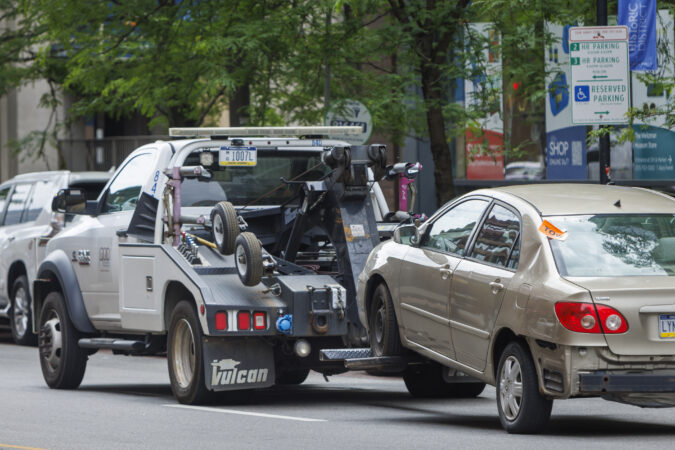
Philadelphia’s towing industry can appear like something out of the Wild West, with operators fiercely competing to arrive first at car wrecks and secure the business involved with towing or impounding vehicles.
Police began imposing some order on the process in 2007, introducing a rotational system in which responding officers cycle through a list of licensed towing operators to dispatch to accident scenes.
But tow operators often skirt that system, employing wreck spotters — those like Smith-Sims — to roam the city and listen to police scanners for accidents, convincing those involved to use their service before officers arrive.
The predatory nature of the industry and, in some cases, its historic ties to organized crime make it rife with exploitative business practices and even criminal activity.
But Walsh cautioned the public against jumping to conspiracy theories about the killings, which have proliferated on social media in the days after Whitfield’s death and the news of a possible connection between the murders.
Those suspicions aren’t entirely unwarranted.
In 2017, several employees who worked for the Philadelphia towing company A. Bob’s Towing were shot within 24 hours of one another — two of them fatally.
Pressley admitted to accepting payment in exchange for killing one of the towing employees, 28-year-old Khayyan Fruster, who had been preparing to testify as a witness in an assault trial.
Pressley shot Fruster in his tow truck on the 6600 block of Hegerman Street, killing him and injuring one of his coworkers.
And in an effort to mask the killing — and to make it appear as if it had been the result of a feud between towing operators — Pressley earlier shot and killed one of Fruster’s coworkers at A. Bob’s Towing at random, according to prosecutors.
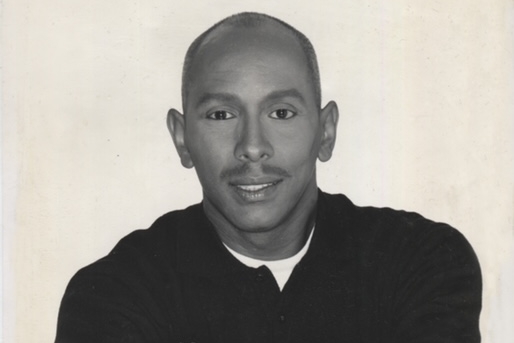
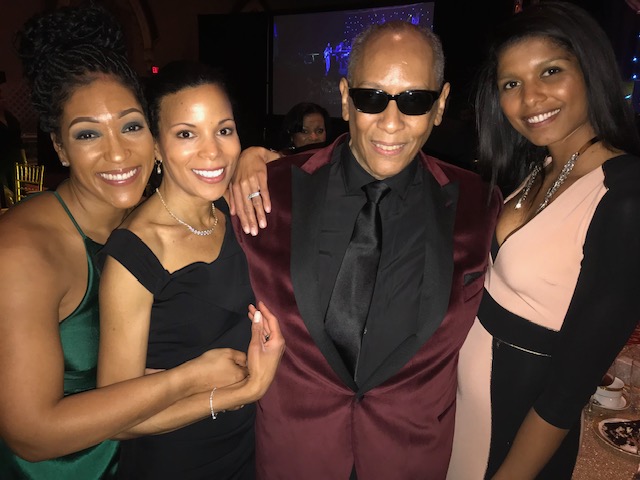
Jeffrey A. Woodley, 71, formerly of Philadelphia, internationally celebrated celebrity hairstylist, scholar, youth track and field star, mentor, and favorite uncle, died Wednesday, Dec. 10, of complications from acute respiratory distress syndrome at Mount Sinai West Hospital in Manhattan.
Reared in West Philadelphia, Mr. Woodley knew early that he was interested and talented in hairstyling, beauty culture, and fashion. He experimented with cutting and curling on his younger sister Aminta at home, left Abington High School before his senior year to attend the old Wilfred Beauty Academy on Chestnut Street, and quickly earned a chair at Wanamakers’ popular Glemby Salon at 13th and Chestnut Streets.
He went to New York in the mid-1970s after being recruited by famed stylist Walter Fontaine and spent the next 30 years doing hair for hundreds of actors, entertainers, models, athletes, and celebrities. He styled Diahann Carroll, Whitney Houston, Aretha Franklin, Anita Baker, Angela Bassett, Halle Berry, and Tyra Banks.
He worked with Denzel and Pauletta Washington, Eddie Murphy, Jasmine Guy, Lynn Whitfield, Pam Grier, Melba Moore, Jody Watley, and Karyn White. His hairstyles were featured in GQ, Vanity Fair, Ebony, Jet, Essence, Vibe, Vogue Italia, and other publications, and in advertising campaigns for L’Oréal and other products.
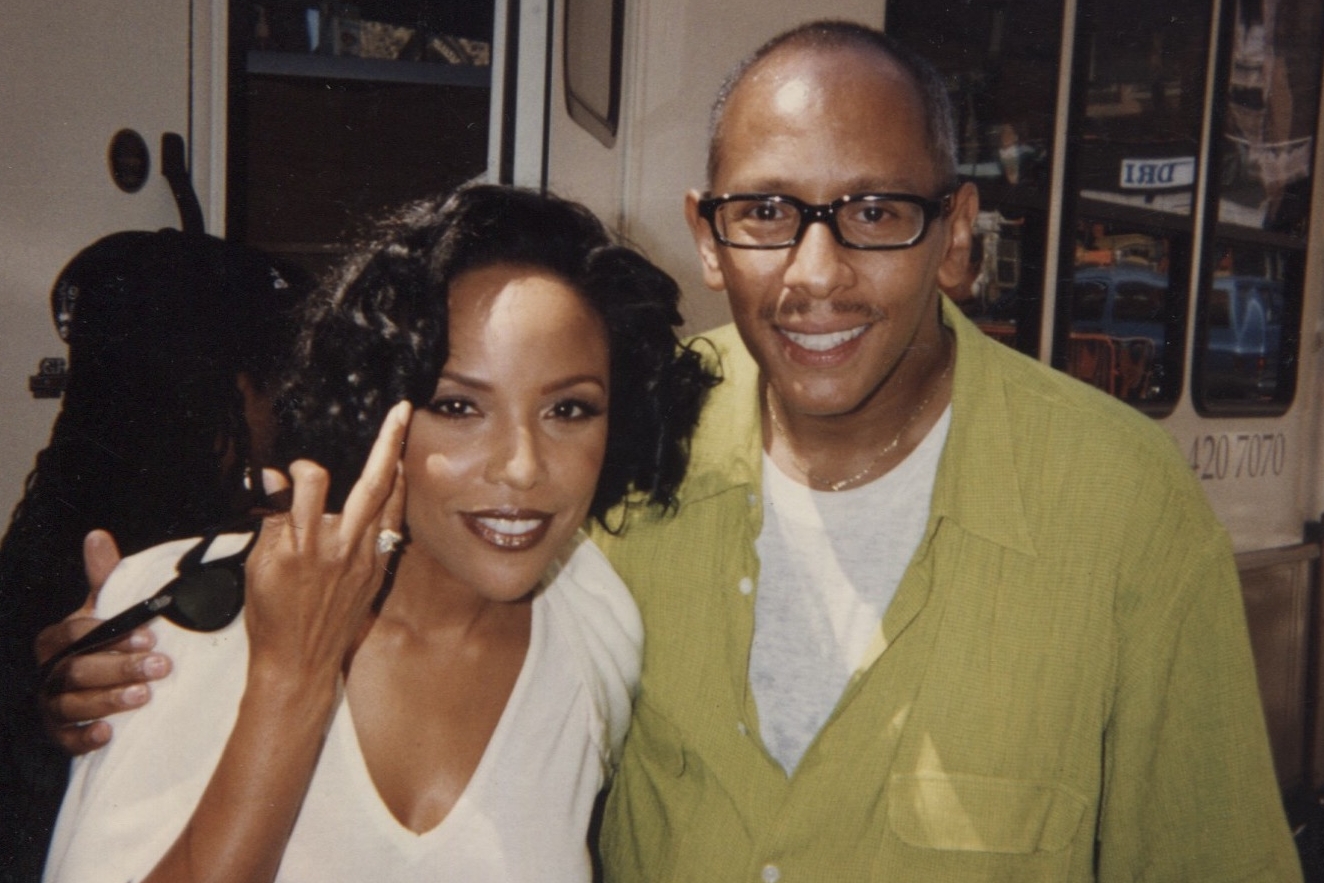
Mr. Woodley poses with actor Lynn Whitfield.
For years, actor Terry Burrell said, “He was the go-to hair stylist for every Black diva in New York City.” Pauletta Washington said: “He was responsible for so much of who I became as an artist and a friend.”
Mr. Woodley worked for Zoli Illusions in New York, Europe, Africa, and elsewhere around the world, and collaborated often with noted makeup artists Reggie Wells and Eric Spearman. Model Marica Fingal called Mr. Woodley “uber talented” on Instagram and said: “He was one of the most skilled artists, creating stunning, innovative styles for models and celebs alike.”
Friendly and curious, Mr. Woodley told Images magazine in 2000 that learning about the people in his chair was important. “A woman’s hairstyle should take into account the type of work she does, her likes, her dislikes, and her fantasies,” he said. “I’m a stylist, but I never impose hair styles on any client. When we arrive at our finished style, it’s always a collaboration.”
His hairstyles appeared on record albums and at exhibitions at the Philadelphia Art Museum and elsewhere. He was quoted often as an expert in coiffure and a fashion forecaster. In 1989, he told a writer for North Carolina’s Charlotte Post: “Texture is the key. … Cut will still be important, but the lines will be more softened and much less severe.”
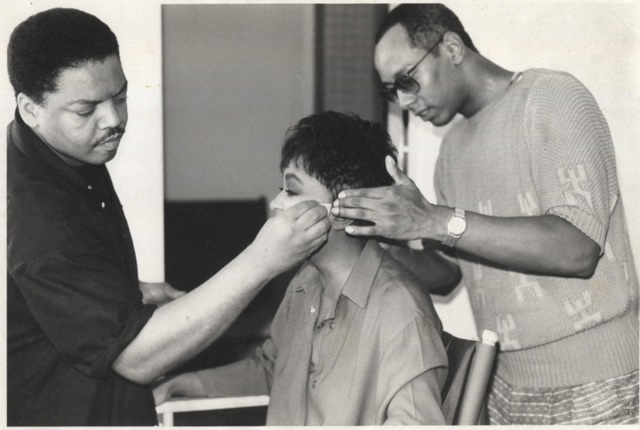
Mr. Woodley (right) handles hair styling for singer Anita Baker while makeup artist Reggie Wells attends to her face.
In 2000, he told Images that “low maintenance is the way of the future.” He said: “Today’s woman is going back to school. She has the corporate job. She has children that she needs to send off to school. She doesn’t have time anymore to get up and spend 35 to 40 minutes on her hair. She wants something she can get up and go with.”
He retired in 2005 after losing his sight to glaucoma. So he earned his General Educational Development diploma, attended classes at the Borough of Manhattan Community College, and studied literature, Black history, and spiritual writing.
“The entirety of his life was inspired by an insatiable thirst for knowledge,” said his friend Khadija Kamara.
He was working on his memoir and still taking classes when he died. “He lived life on his own terms,” Burrell said, “and my respect and admiration for his determination will forever be inspiring.”
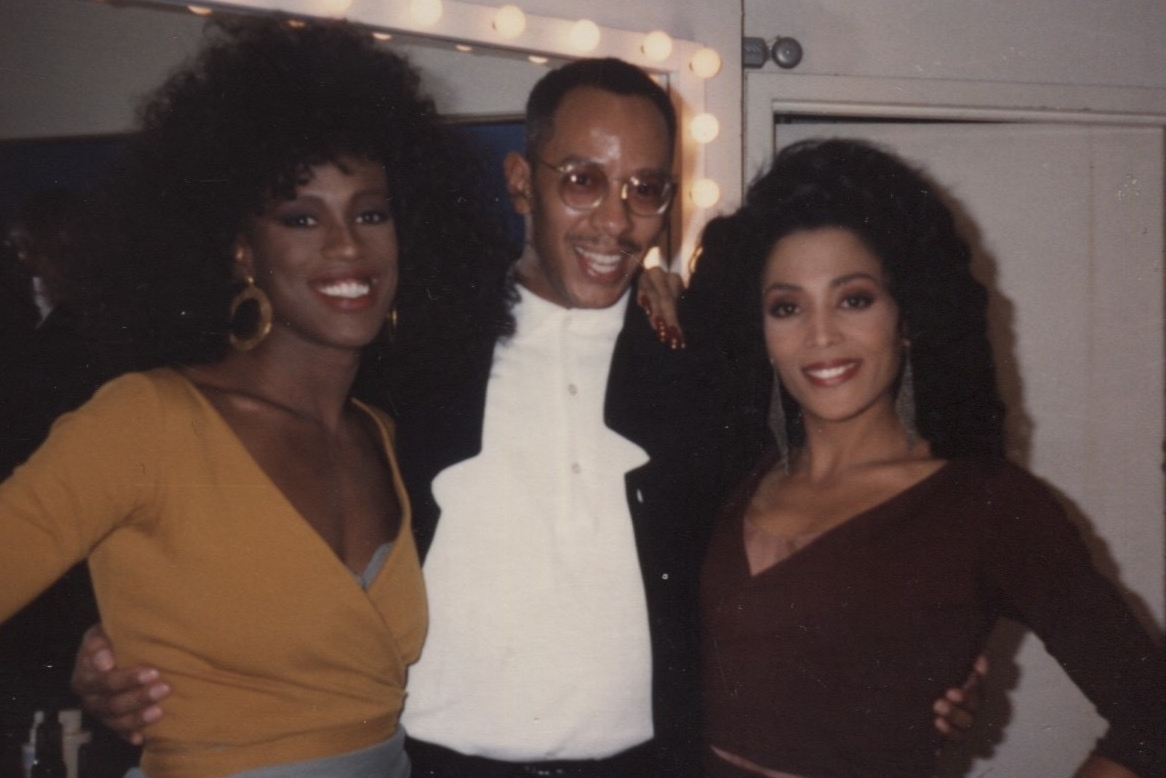
Mr. Woodley smiles with track stars and celebrities Jackie Joyner-Kersee (left) and Florence Griffith Joyner.
As a youth, Mr. Woodley excelled in sprints, relays, and the high jump at St. Rose of Lima Catholic School and Abington High School, and for the Philadelphia Pioneers and other local track and field teams. He ran on Abington’s 440-yard relay team that won the PIAA District 1 championship race at the 1970 Penn Relays and helped set a meet record in the four-lap relay at a 1971 Greater Philadelphia Track and Field Coaches Association indoor meet.
Family and friends called him authentic, generous, and proud of his Philadelphia roots. He mentored his nieces and nephews and hosted them on long visits to his home in New York.
“He was one of the most talented people around and always a lot of fun,” a friend said on Facebook. “A beautiful soul and spirit who made others beautiful.”
Jeffrey Alan Woodley was born May 30, 1954, in Philadelphia. He had an older brother, Alex, and two younger sisters, Aminta and Alicia, and ran cross-country as well as track in high school.
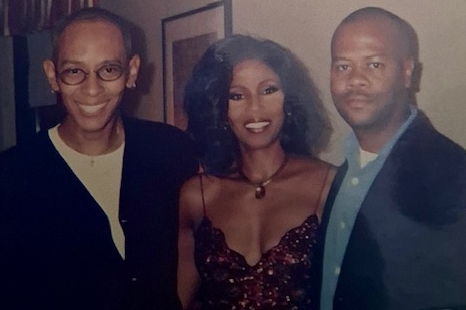
Mr. Woodley (left) worked with actor and musician Pauletta Washington and makeup stylist Eric Spearman.
He was always an avid reader and loved dogs, especially his guide dog Polly. He was a foodie and longtime member of the Abyssinian Baptist Church choir in Harlem. His close family and friends called him Uncle Jeff.
“He was a fun-loving, spirited, and passionate individual,” his brother said. “Uncle Jeff loved the Lord and poured his heart into his work as well as family.”