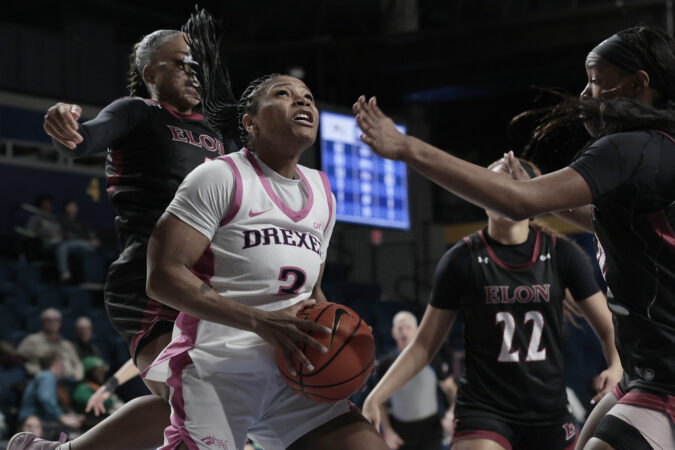
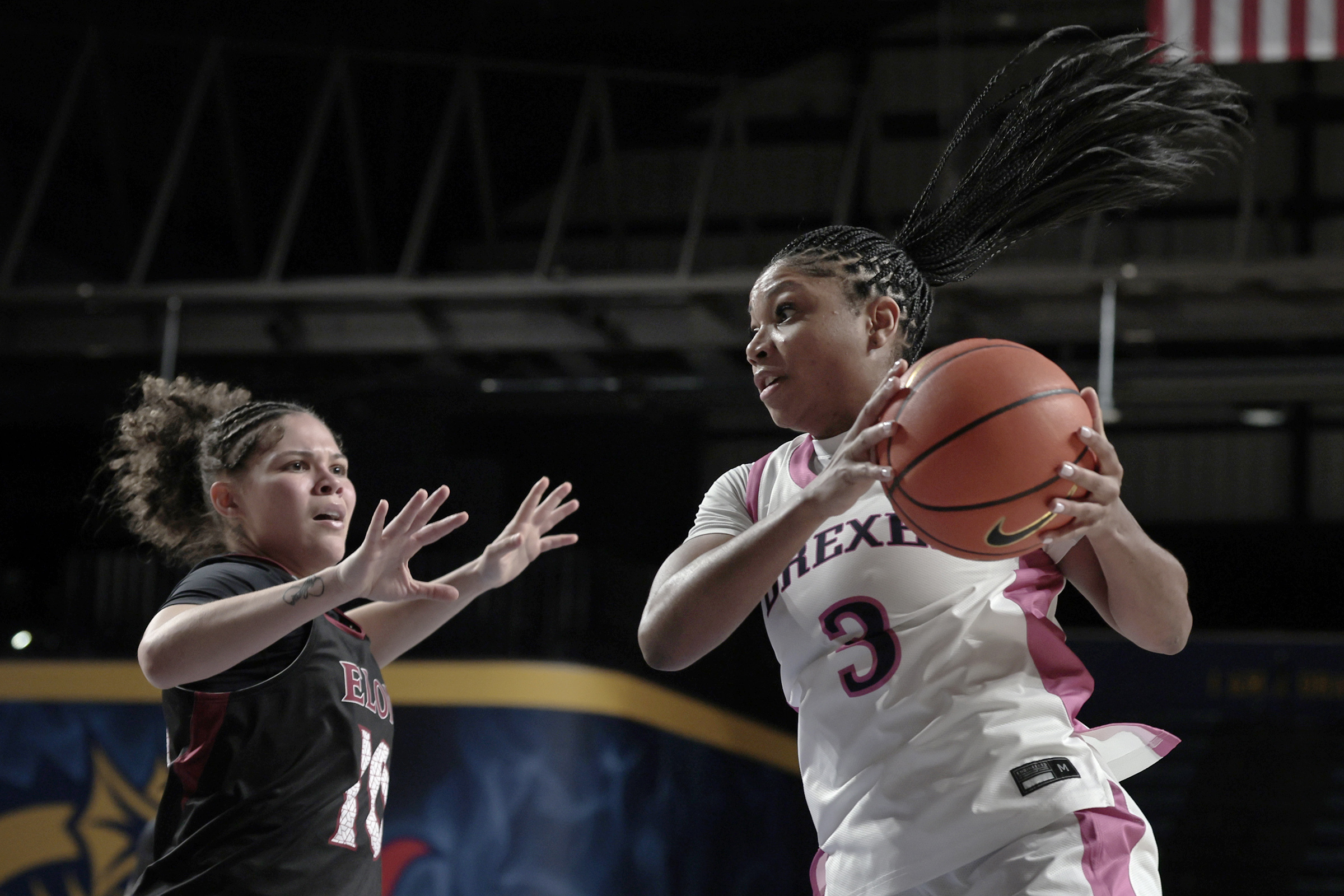
On Friday, Drexel defeated Elon, 68-59. After starting out 0-2 in Coastal Athletic Association play, the Dragons have rattled off eight wins in their last 10 conference outings.
The Dragons (15-8, 8-4 CAA) pushed their lead to 19 points late in the third quarter behind fifth-year guard Amaris Baker’s 27 points. The Phoenix cut Drexel’s lead to single-digits in the fourth, but ultimately dropped their ninth consecutive game to the Dragons.
Drexel currently sits in fifth place in the CAA standings with six games remaining. If Drexel can clinch a top four seed in the conference, the team will receive a first-round bye in the CAA Tournament.
“Every game at this point is going to be a position game for us,” said Drexel coach Amy Mallon. “I think that really has to be the mentality of this team. … We always take it game by game and possession by possession, but they have to understand right now where we are and where we fall.”
Local leaders
Baker, the CAA’s leading scorer and a Cardinal O’Hara graduate, notched her 14th game this season scoring at least 20 points. She also logged five rebounds and two assists.
“[Baker’s] composure this year with what she’s seen as one of the best players in the league, as far as scoring — they’re keying in on her every week,” said Mallon. “So the fact that she’s still capable of putting up the numbers she has been able to put up just goes to show the discipline she has.”
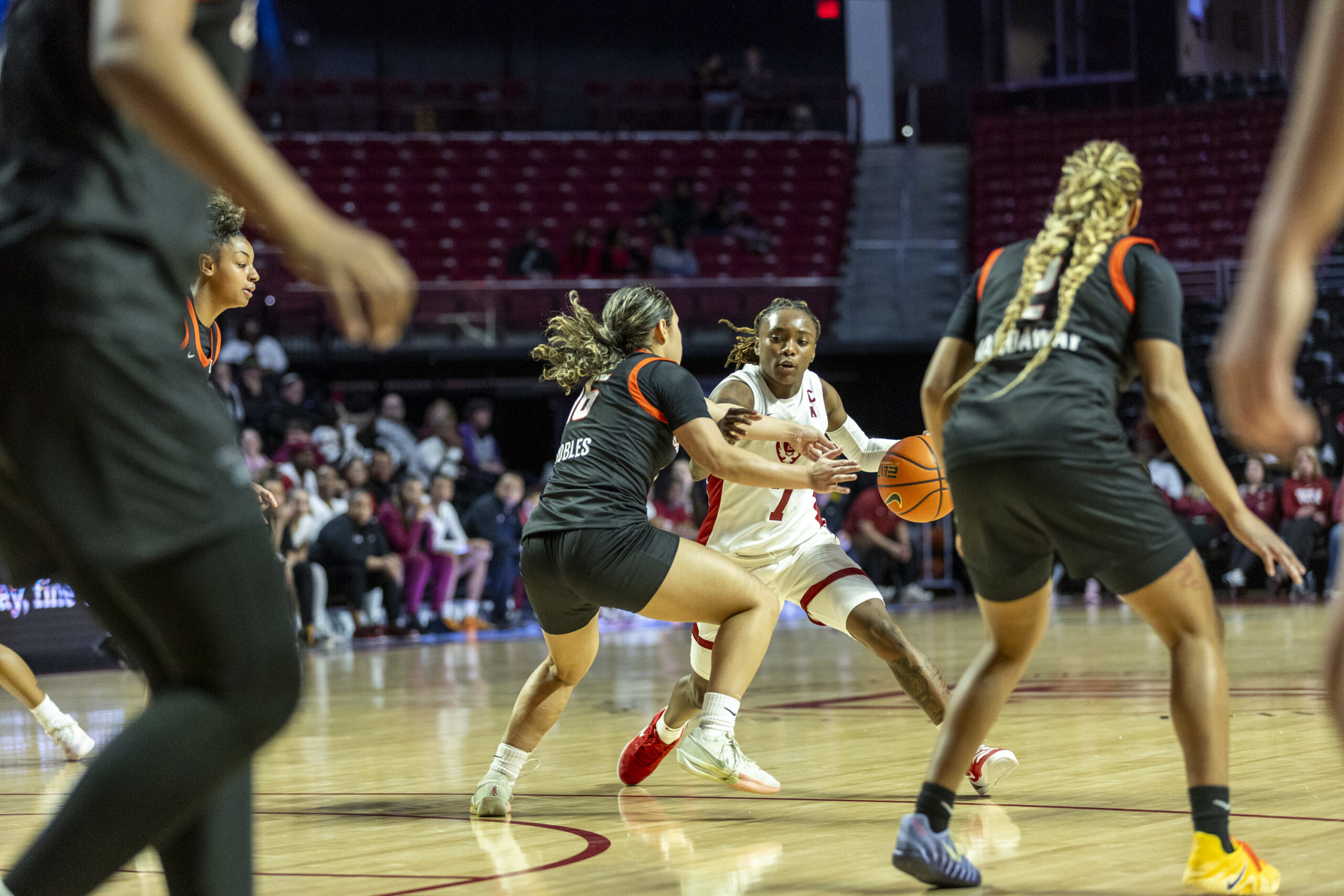
Drexel’s Amaris Baker (right) is the leading scorer in the CAA.
Behind her in the stat sheet was another local product, Archbishop Wood’s Deja Evans. The junior forward logged 14 points and a team-high seven rebounds. Evans’ efforts on the board were a major factor in Drexel winning the rebounding battle, 31-20.
After trailing big in the third quarter, Elon made the game competitive in the fourth behind freshman center Tamia Watkins. The three-time CAA rookie of the week scored 10 of her team-high 16 points in the final period.
Elon cold from deep
The Dragons were perfect from deep through the first quarter, shooting 4-for-4 from three-point range. Baker made two of those threes.
Meanwhile, Elon’s (11-13, 6-6) shooting woes started early and carried throughout the game. The Phoenix shot 23.8% from deep compared to Drexel’s 63.6% from three
“We mostly just locked in on defending them outside the three, and when we’re in our 2-3 [zone defense], we just were moving well together, and we’re just communicating well together,” said Evans.
The Dragons turned the ball over 10 times in the first half, taking a nine-point lead to the half. In the second half, Drexel cleaned up their ball security, turning it over nine times.
‘Staying composed’
A 12-0 run powered by Watkins helped Elon cut Drexel’s lead to six points with just over four minutes to go.
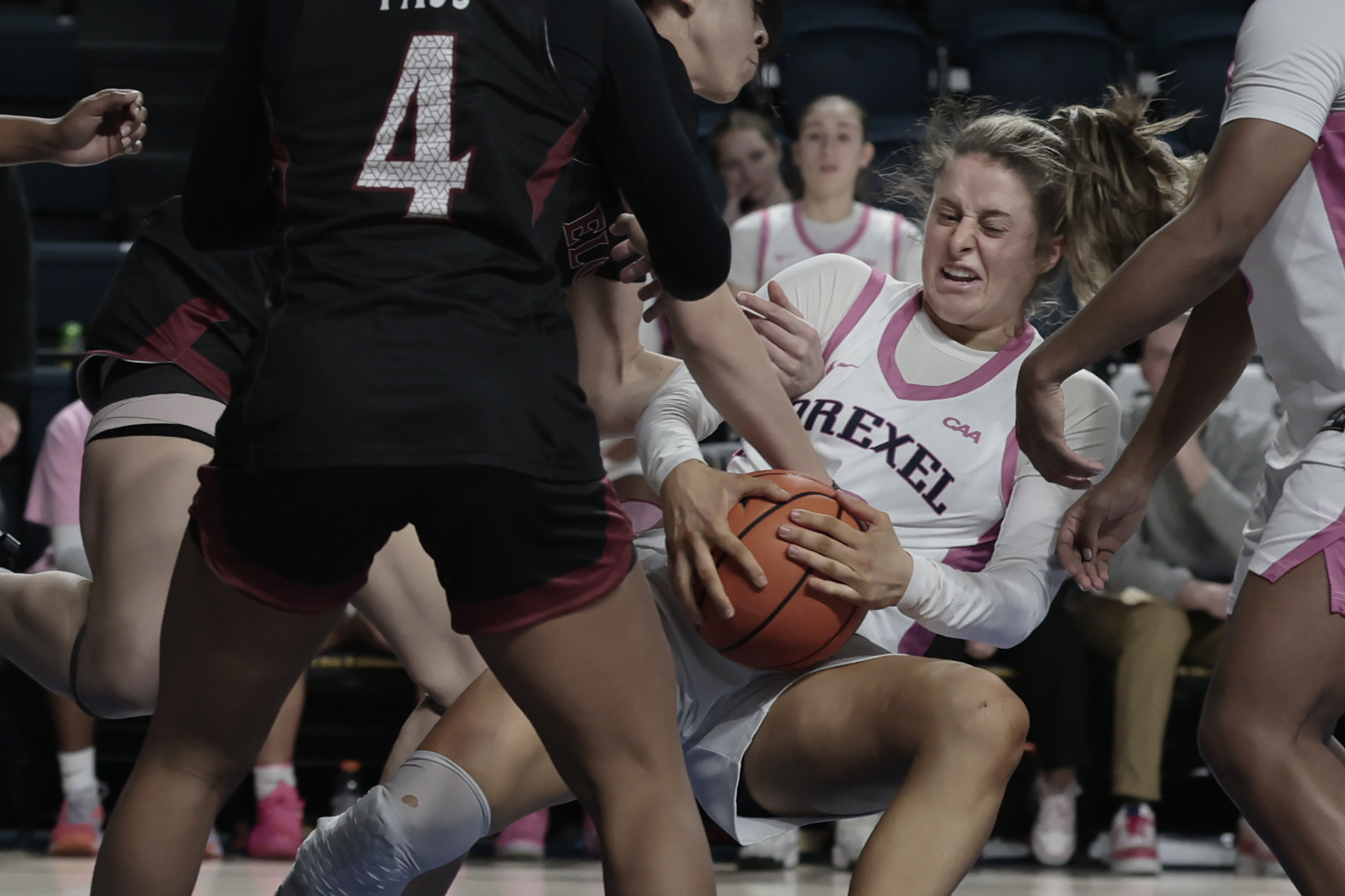
Drexel’s Laine McGurk (center) falls backward trying to control a loose ball against Elon.
Eight of Drexel’s 15 points in the fourth quarter came from the line to help the Dragons outlast the Phoenix.
“In a fourth quarter, they go on a run, and you can sustain and make sure you stay disciplined. Teams are going to have runs,” said Mallon. “I thought we did a nice job staying composed, understanding what needs to be done.”
Up next
Drexel goes on the road next Friday to face Hampton for a second time this season (7 p.m., FloCollege).
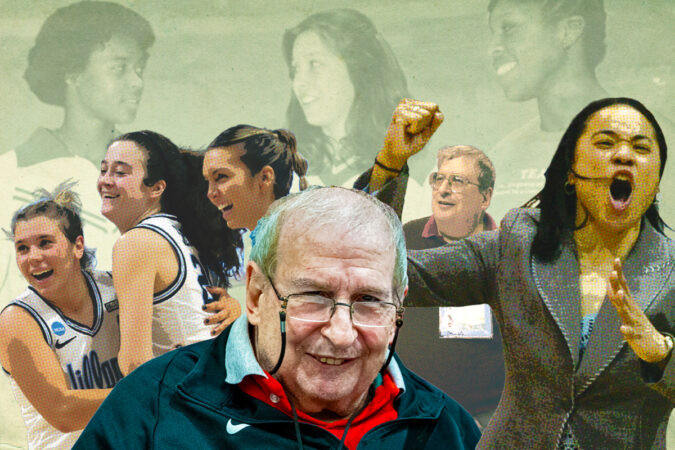
When the NCAA decided to go all-in on Division I women’s college basketball by adding a national championship tournament in 1981-82, it marked a fascinating turnaround. By grabbing the reins from the Association for Intercollegiate Athletics for Women — the longtime governing body of women’s hoops — the NCAA set out to make the game bigger and better forever.
The sport did change, vastly. Television exposure finally found big-name programs. Title IX brought more girls and women into play, literally and figuratively. All-American players and Hall of Fame-worthy coaches promulgated. What should not be lost is this: the roots of the game were plentiful, but none more important than what grew strong at schools throughout this tri-state region.
Here, programs and players were so impactful that to ignore the flood of talent became indefensible by 1982. So, the NCAA bit.
Before the dynasties at UConn and Tennessee, there were giant-killers on the courts of tiny Immaculata and Cheyney State.
Before there was a Geno Auriemma or Pat Summitt, there were legendary coaches like the Mighty Macs’ Cathy Rush and Cheyney’s C. Vivian Stringer. Rush’s and Stringer’s reputations and extraordinary programs surely caught the attention of the NCAA as they traveled the path to the Naismith Basketball Hall of Fame.
Before there were all-Americans like Dawn Staley, Maya Moore, and Caitlin Clark, future Hall of Famer Theresa Shank-Grentz and the fabulous talent, Yolanda Laney, were dealing here in the Delaware Valley.
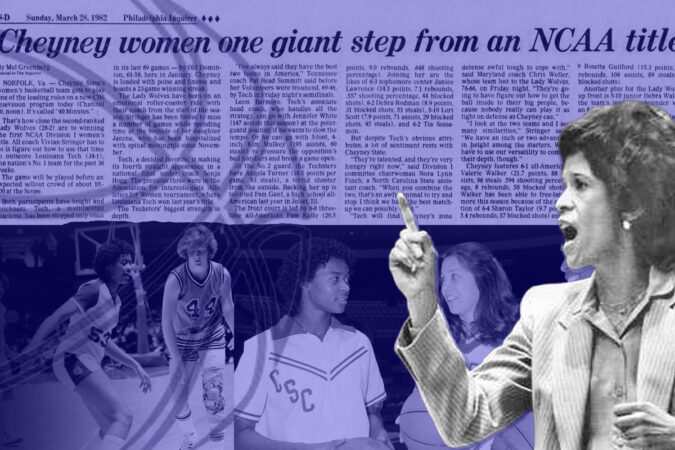
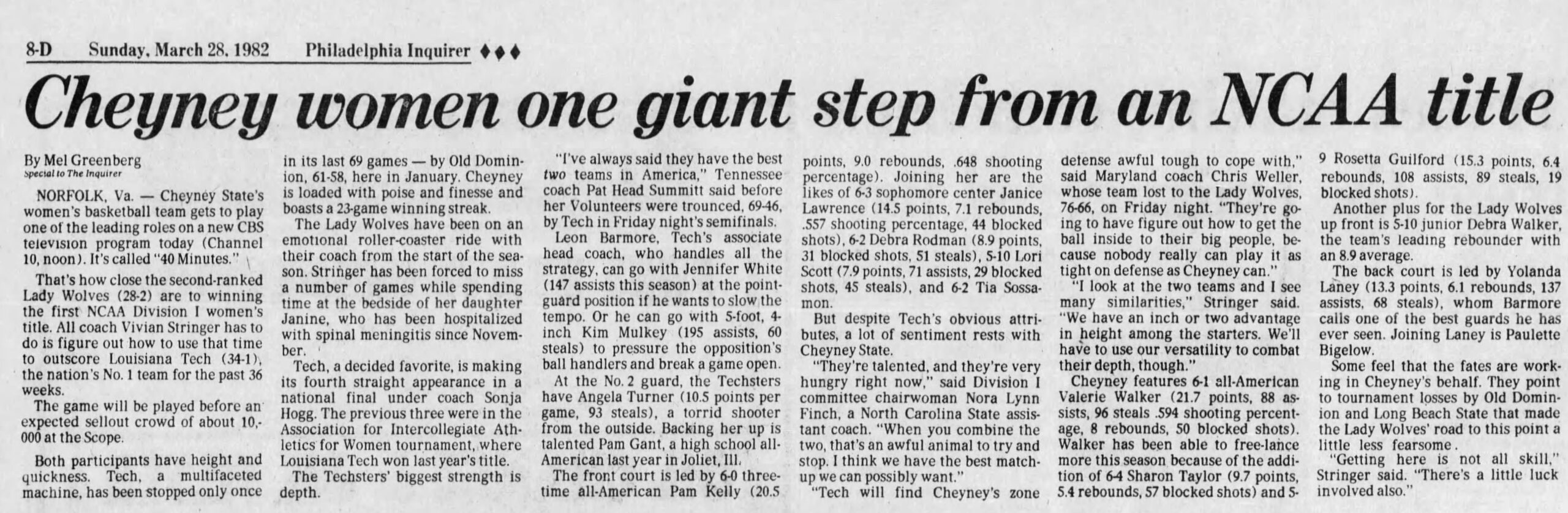
A clipping from The Philadelphia Inquirer’s sports section on March 28, 1982, when Yolanda Laney, C. Vivian Stringer, and the Cheyney State women’s basketball team was headed to the championship game of the first NCAA women’s basketball tournament.
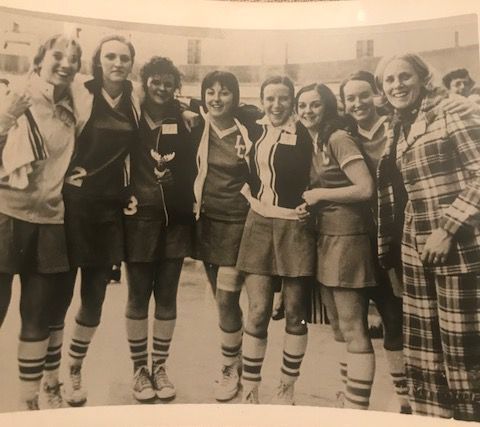
Shank-Grentz, star of the Mighty Macs’ improbable AIAW championships, helped put a school of fewer than 3,000 students on the map. The Macs ruled the game for a near decade, winning three AIAW crowns while reaching five consecutive AIAW Final Fours.
At even tinier Cheyney State, the All-American Laney and other talents who desired to play for Stringer helped the nation’s oldest historically Black college or university become the first HBCU to play in an NCAA Division I national championship game. Stringer’s team, with not one athletic scholarship to give, made that possible in 1982.
“When you look at our team, we were part of God’s plan … a team of All-American, all-state players turning down scholarships [from larger schools] but we had one common denominator, and that was the great Vivian Stringer,” the team’s star center, Valerie Walker, said in her acceptance speech at the Women’s Basketball Hall of Fame ceremony in 2024. The Lady Wolves were enshrined as “Trailblazers of the Game.”
The NCAA certainly was watching and calculating how to build off the growing women athletes’ import. But it arguably would not have had the curiosity or the vision if Greenberg had not provided the cohesiveness and foresight to champion programs, big and small.
The Philadelphia Inquirer’s women’s basketball savant did so by founding his national poll 50 years ago. By connecting the dots of powerhouses across the country, the poll allowed teams, whether big, small, or minuscule, to bring into focus what previously had been a guessing game of who, what, and why which teams and trends mattered. The clarity benefited not only the programs, but the players, recruits, fans, and media from coast to coast.
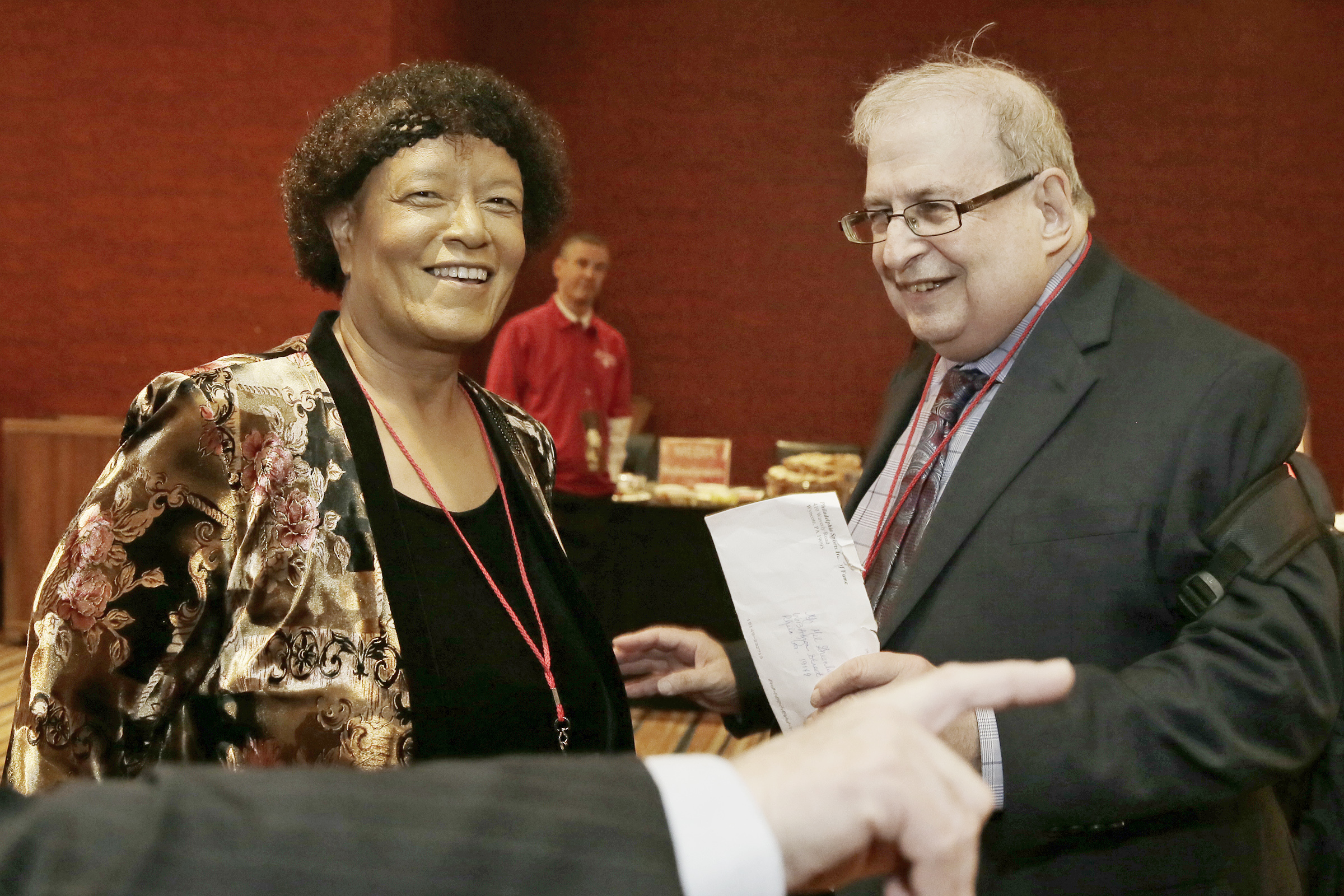
Claire Smith and Mel Greenberg, Hall of Famers and former Inquirer writers.
Greenberg gave even the most accomplished chroniclers of women’s hoops — as well as newbies such as this reporter — a divining rod. His informative and increasingly powerful poll beautifully grew in strength alongside the game. Local teams certainly benefited, as Greenberg shone a light on both with his polling and prose.
He helped me, a frenemy at the late, great Philadelphia Bulletin, appreciate the bushels of all-American players, future Hall of Fame coaches, and prominent teams that dominated the AIAW right in our own backyards. From Rutgers to Maryland, Cheyney State to Penn State, and rising Big 5 women’s teams, it fascinated me to see the seeds that one day sprouted so prominently.
To say that I saw the important contributions of the local teams growing the women’s game as clearly as did Greenberg would be beyond impudent. Rather, following the game in and around the immediate area as well as following the pollmeister was an education, one I and others needed to appreciate why the NCAA move was inevitable.
I missed seeing the Mighty Mac era by mere years. Still, I often was reminded of the footprints left during their legendary run through the ’70s. Greenberg, a walking encyclopedia of the sport, can to this day bring to life any tale about the Macs, starting with the 1972 team that won the first women’s national basketball championship.
Though I came to the job too late to witness the Mighty Macs magic, I saw what followed in their footsteps. For a similar miracle was unfolding at Cheyney State where Stringer was building a national behemoth at the tiniest of schools (today’s enrollment at Cheyney, which is now known as Cheyney University, is less than 1,000 students).
John Chaney, the Hall of Famer and Philly legend who was the coach of the men’s team at Cheyney when Stringer was leading the women there, knew which team was the stronger draw. “We were ranked No. 1 in Division II, but we’d play the first game so that we would have somebody there by halftime,” Chaney, laughing, told me for a column written for the New York Times. “The real show was our women’s team. They didn’t come to see me; they came to see Vivian!”
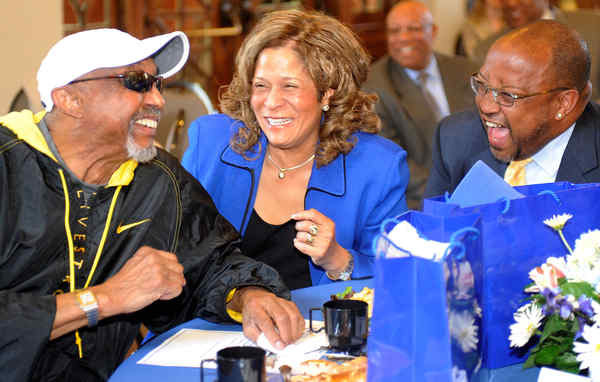
Former Temple coach John Chaney (left) shares stories with Rutgers coach C. Vivian Stringer and Nike executive Ralph Greene. Chaney and Stringer coached the men’s and women’s teams at Cheyney State in the 1980s.
It always was standing-room-only in Cheyney’s compact Cope Hall, for the scribes and fans had a sense that what they were watching was special: Two Hall of Fame coaches in the making. Oh, and one Hall of Fame team. For Stringer’s 1981-82 team that finished the season ranked No. 2 in the nation.
That final standing in the polls reflected Cheyney’s having come within one win of claiming the first-ever women’s NCAA championship. Though the team lost to Louisiana Tech in the final, just getting there was the ultimate victory.
In those days, Stringer spoke of how her Lady Wolves had to sell cookies, cakes, and sandwiches to raise funds to travel to Norfolk, Va., for that first Final Four.
That Cheyney team finished 28-3. The 11 players and coaching staff were honored years later by the Women’s Basketball Hall of Fame in 2024. The team also was nominated for the Naismith Basketball Hall of Fame in 2025.
Alas, those David and Goliath stories no longer happen in a world where a Cheyney State or Immaculata wouldn’t even dream of being allowed to compete at a Division I championship level. Big universities and programs awash with NIL money now gobble up the best players in the land. The little guys play in lower divisions, noses pressed against windows of the massive arenas holding tournaments made possible by the Immaculatas and Cheyney States, the Cathy Rushes and Vivian Stringers … and Mel Greenberg’s vision of what could be.
Amid the cacophony of whirling toddlers at a local YMCA in Oxford, Chester County, about 14 years ago, Jermaine Palmer caught a glimpse in the corner of his eye of what was to come. He had gotten his daughter, Jordyn, into basketball, taking her to his practices, letting her crawl around the court in diapers, and involving her in youth coed rec leagues with a tiny ball and hoop.
One afternoon, as a game was going on, he noticed, Jordyn and a little boy collided going after a rebound. They both fell. The boy went crying to his mother. Jordyn stood up, grabbed the ball, and scored a layup as if nothing happened, smiling back down the court. Jermaine just shook his head, he recalled.
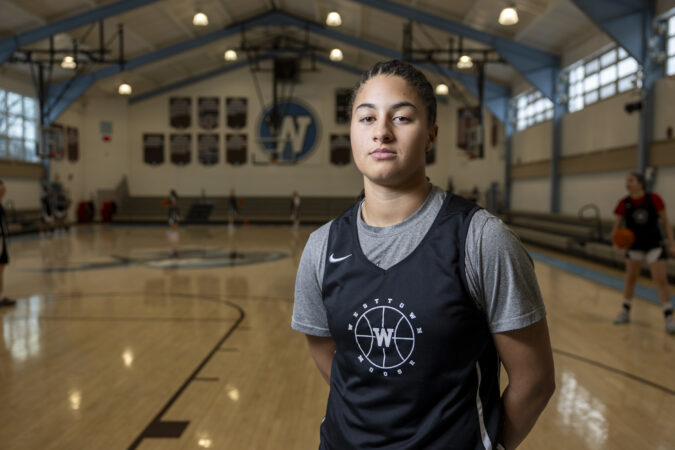
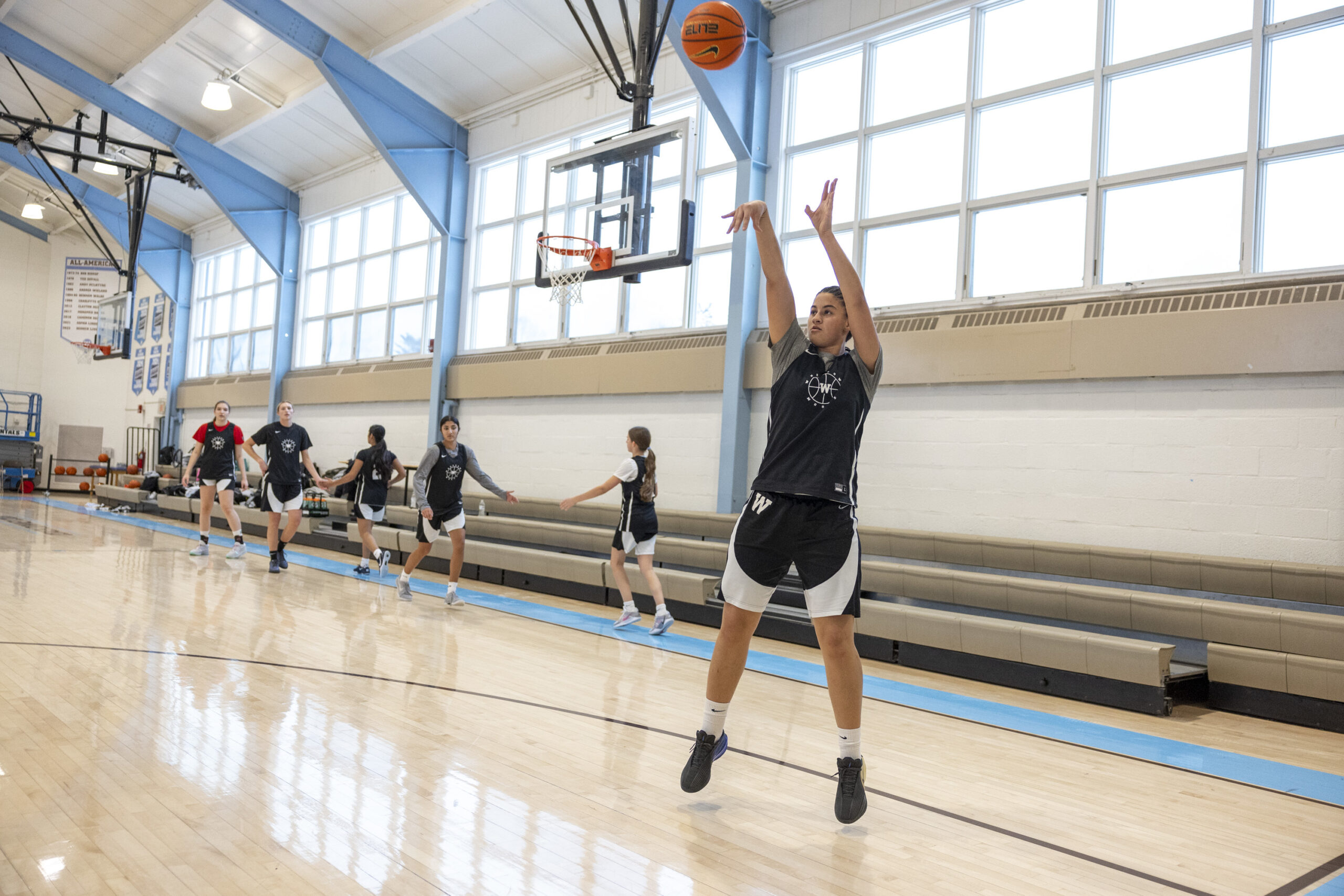
Jordyn Palmer, the gifted 6-foot-2 junior guard at Westtown School, tends to make a lot of people shake their heads in disbelief each time they see her play, especially the nation’s top college coaches. She is ranked as the No. 6 player in the country in the class of 2027 by ESPN’s SportsCenter NEXT — Super 60. She is averaging a humble 23 points and 12 rebounds for the Moose, who will be playing for their sixth straight Friends Schools League championship this Friday at 6:30 p.m. against archrival Friends’ Central at La Salle University.
As a junior, Palmer is on the threshold of 2,000 career points and is the leader of a star-studded team that has a/ 23-1 overall record this season and is ranked No. 7 in the country by ESPN.
What is so interesting about Palmer is that her best is yet to come. She’s always been tall for her age, and her parents, Jermaine and Kim, had to carry her birth certificate as proof of her age because of that. She has been playing varsity basketball since she was in eighth grade.
A dominant rebounder, ballhandler, and shooter, she can finish left- or right-handed and has added a more consistent perimeter game. She’s also a team player, making a point to get her teammates involved. She plays with poise, despite the constant attention she has had on her since she was 14.
She was 5-9 at age 12 playing for the Chester County Storm under-16 AAU team when Westtown coach Fran Burbidge first saw her in a summer tournament at the Spooky Nook complex in Manheim, Lancaster County. Burbidge, who coached women’s stars Elena Delle Donne and Breanna Stewart, quickly saw how much more advanced Palmer was than the teenage girls she was playing against.
“A friend of mine asked me if I ever saw her play. I remember going to one of the back courts and thinking, ‘There is no way that kid is in seventh grade,’” Burbidge said. “So, yeah, I had to convince myself she was that much better than everyone around her. If I didn’t know, I would have thought she was a high school junior.”
Palmer has evolved since then. The second-oldest of four, she’s 17 and may grow another inch.
She’s also a victim of her own success. Burbidge pulls her early in blowouts — and the Moose have many. She easily could score 40 points a game, but she plays with a pass-first, team-first mentality.
Last summer, she was playing in a league against a talented Imhotep Charter team when she dominated both ends of the court for 10 minutes. Then she turned back to being a facilitator again. She is by no means lazy, according to her coaches and her father, but she is so smooth that she can play at different levels.
Jordyn Palmer is averaging 23 points and 12 rebounds this season.
“I was raised around the game. I grew up with a basketball in my hands, my dad being a coach taking me to practice,” said Jordyn, who carries a 3.5 grade-point average. “I was pretty much crawling around a basketball court before I was walking. I was always the tallest kid, that was me. I grew up playing soccer, too, but basketball was definitively my first love. I would say I was around seventh, eighth grade, when I started to think I was pretty good at this. It really changed when I went to Westtown.”
And it really changed in 2023 when she was cut from the U.S. under-16 national team in Colorado Springs, Colo., when she was 14. It was the first and only time she was cut from something. She reached the second cuts. She sat in a conference room and was told that she did very well, but she would not make the team.
When Jordyn called her parents, tears were shed — fueling aheightened determination.
“A year later, I got invited back, and I made the team,” she said. “That was the first time I faced rejection, and I thought I dealt with it well. It made me work harder. Being cut didn’t make me angry because I was not too sure I would make it anyway, but it shocked me. I began working out in the morning, and I’m not a morning person. I hate waking up early. I began taking basketball more seriously than I ever did.”
A month after she was cut that summer, she led Philly Rise to an AAU national title.
Jermaine and Burbidge want her to play more intensely for sustained periods of time. Jordyn knows she will need to maintain those levels once she gets to college.
“Jordyn has not even scratched her full potential,” said Jermaine, the girls’ basketball coach at Oxford High School. “I’m proud of her. Jordyn is a great kid. Her upbringing keeps her humble. But she does not play with the urgency that I know she has. You see it in spurts, but when you see her playing national-level players, that comes out. I get on her all the time about dominating.
“The stuff people don’t see in the gym is someone who can outplay anyone. You can’t really guard her. When she tightens her shot off the dribble and her ballhandling, she is going to be terrifying. I’m her father and a coach — you see the way games are called. She’s so strong and so solid, refs look at her a different way than they do other players. She has gotten used to it. Refs don’t understand the body difference between Jordyn and everyone else.
“No one likes Goliath. It’s part of the game.”
Jordyn Palmer plans to make her college commitment next spring. She’s interested in South Carolina, LSU, Kentucky, Rutgers, Maryland, Notre Dame, and UCLA.
South Carolina, LSU, Kentucky, Rutgers, Maryland, Notre Dame, and UCLA are the schools in which she’s interested. She says she is looking to make her official visits over the summer and make a decision next spring. Jordyn and Jermaine said they want to take their time with the recruiting process.
She would get around 30 calls a day this time last year. That has been reduced to around five a day.
“It’s been a little bit of a pain,” she said. “There have been those times when I have cried by myself because it can sometimes be overwhelming. I spoke to my parents about it, and they have done a great job taking the pressure off me, telling these coaches I’m taking a break. I’m still a kid, and I’m grateful to my parents for allowing me to be a kid. They let me fish.”
Then, Jordyn went into her own “fish tale.” She got into fishing as a way to relax through her maternal grandfather. During summer vacations, she fishes with her family in northeast Maryland and the Outer Banks in North Carolina. She once hooked a baby shark when she was 7.
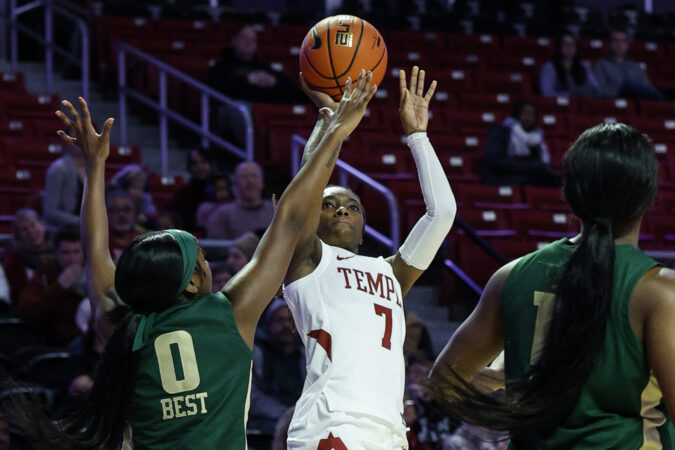
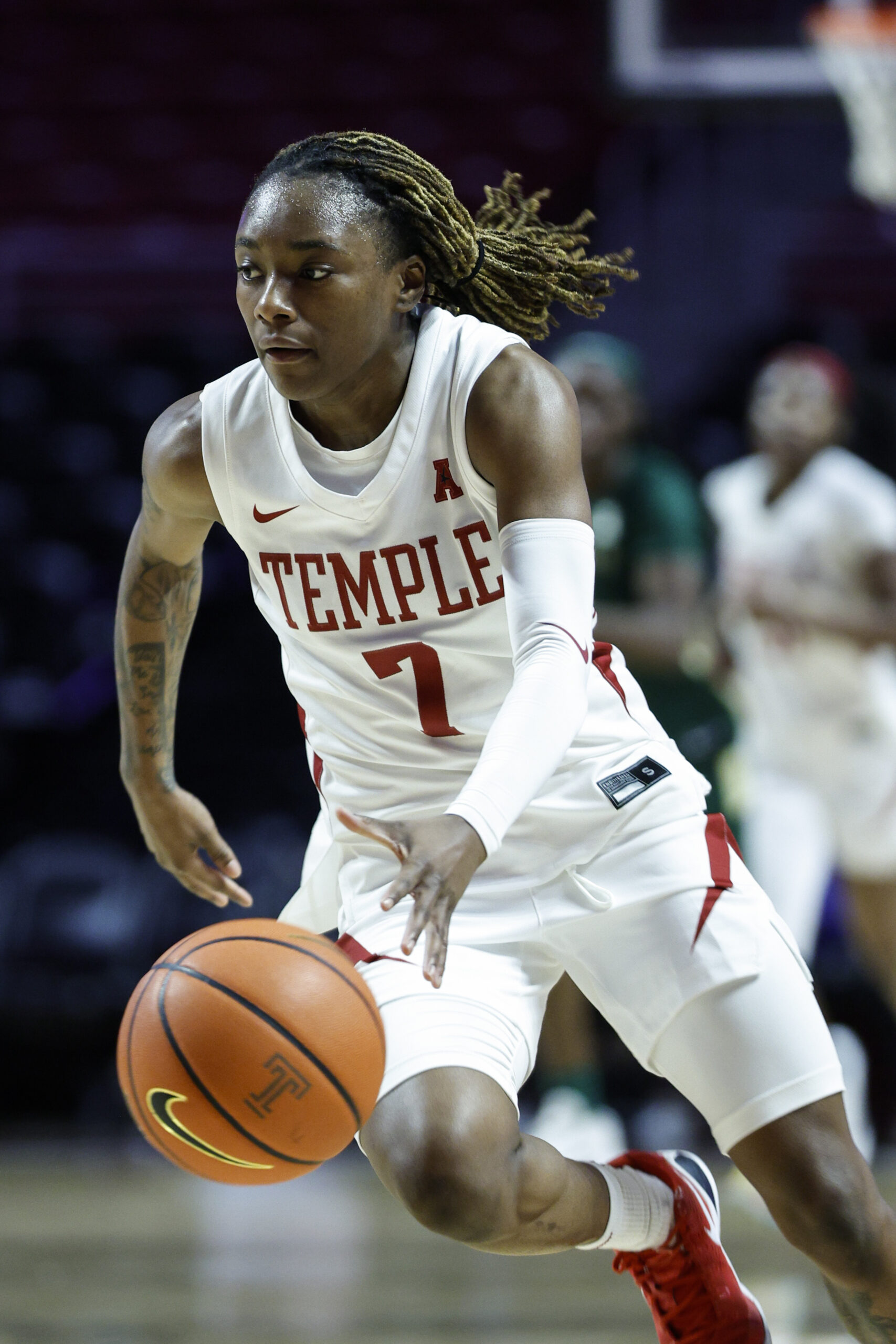
Temple guard Kaylah Turner describes her play as “KT ball,” which she says is scoring at all three levels and being a pest on defense.
However, the 5-foot-6 junior is constantly looking to improve, whether it’s becoming a better passer or grabbing more rebounds. Her drive has helped her blossom into one of the best players in the American Conference.
The Alabama A&M transfer and reigning American sixth player of the year leads the conference in scoring with 17.2 points per game. It’s been a difficult stretch for the Owls in conference play, and Turner has led Temple (10-13, 4-7) to three wins in its last seven games. She scored 12 points in Tuesday’s 52-43 loss against University of Texas San at Antonio.
“We just have to focus on the next game,” Turner said. “We can’t really draw on all the losses.”
Temple guard Kaylah Turner is averaging 17.2 points per game.
Turner had high expectations this season. She was named to the American’s preseason all-conference first team after a strong first season with the Owls, in which she averaged 9.9 points on 38.5% shooting off the bench. With the graduation of guards Tiarra East and Tarriyonna Gary, Turner moved into the starting lineup this season.
“First-team preseason was cool, but I think I should have been preseason player of the year,” Turner said. “So that’s on my mind, and that’s what’s motivated me every day to get better because I didn’t get my original goal, so I still have another couple of goals in mind. I’m just never satisfied.”
Moving into the starting lineup paired Turner with point guard Tristen Taylor, who led the American in assist-to-turnover ratio last season. Turner’s scoring prowess and Taylor’s facilitating has forged a formidable backcourt.
“We play very well together,” Taylor said. “I feel like we’re actually the best backcourt duo in the conference, and I’ll say that. But Kaylah comes in here and works hard every day. She is a great teammate, not just to me, but to everybody. She always brings energy, and I just feel like that flows onto the court when she goes out and plays.”
That energy has helped Turner lead the conference in scoring and shoot 41.6% on three-pointers, which is second in the conference..
However, when Temple lost four of its first five American contests, Turner was one of the players who couldn’t find her groove.
Turner shot below 40% in four of those five games. Before Temple’s game against South Florida on Jan. 20, the team held a meeting to go over everyone’s role on the floor. The Owls beat the Bulls, 86-83, and are 3-3 since the meeting. Turner has been one of the biggest beneficiaries of the refreshed role clarity.
Temple’s Kaylah Turner has surpassed 1,000 career points this season.
She had a 27-point outburst in Temple’s 67-65 overtime win over Tulane on Jan. 31 and came up with a steal and assisted forward Jaleesa Molina’s game-winning layup in the final seconds.
“We were just super locked in on that play,” Turner said. “I got the steal, but all my teammates were all talking at that time. So that’s why we got that steal and Jaleesa was able to get the bucket.”
Turner also eclipsed 1,000 career points after knocking down a three-pointer in the second quarter in the win over the Green Wave.
“It definitely means a lot,” Turner said. “I was definitely happy when I got it. Just seeing my success that I had at Alabama A&M, and then having the same thing here is just incredible, seeing my hard work pay off in that aspect.”
Despite having the best season of her career, Turner sees plenty of room for improvement. With Temple ninth in the 13-team American with seven games to play, Turner is looking to give the Owls momentum heading into the conference tournament.
“Looking at these games that we won recently, it was with the defense and 50/50 balls, intensity, urgency, all that type of stuff,” Turner said. “So we can make sure we really emphasize the little things. We can sit here and look at scout and run our plays, but what wins games is everything that’s not on the scout. Energy, talking, getting on the floor, that type of stuff. Just being consistent with our spicy defense, like Coach [Diane Richardson] always talks about.”
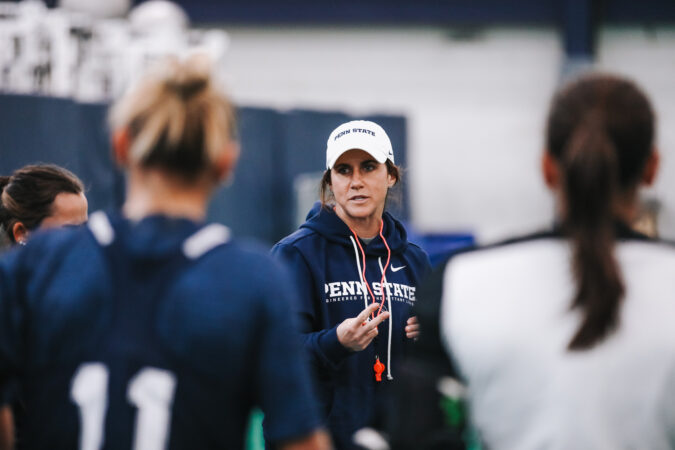
Hannah Prince hasn’t always been a standout Division I coach, nor has she always led with the conviction she does now as the Penn State field hockey coach. But she’s long been around the sport — starting nearly 30 years ago in Gorham, Maine.
When Prince was 6 years old, she made a declaration: She would make her high school’s varsity field hockey team. She did just that, which sparked a successful four-year career at Massachusetts.
The Minutewomen went 56-33 and won three Atlantic 10 titles during Prince’s four-year career as a starting defenseman. Following the team’s NCAA Tournament quarterfinal run in 2013, Prince, a senior at the time, earned National Field Hockey Coaches Association first-team all-region and A-10 first-team all-conference honors.
Prince continued playing after college and was captain of the U.S. women’s indoor team for six years, leading the team to gold at the 2017 Pan American Cup.
Prince’s captaincy meant holding others accountable. It meant leading by example and never asking teammates to do something she wouldn’t do herself.
“I like motivating people. I like building relationships with them that are strong, so they know I care,” Prince said. “I chose to work for some really great people who believed in me and allowed me to have a hand in certain technical and tactical areas.”
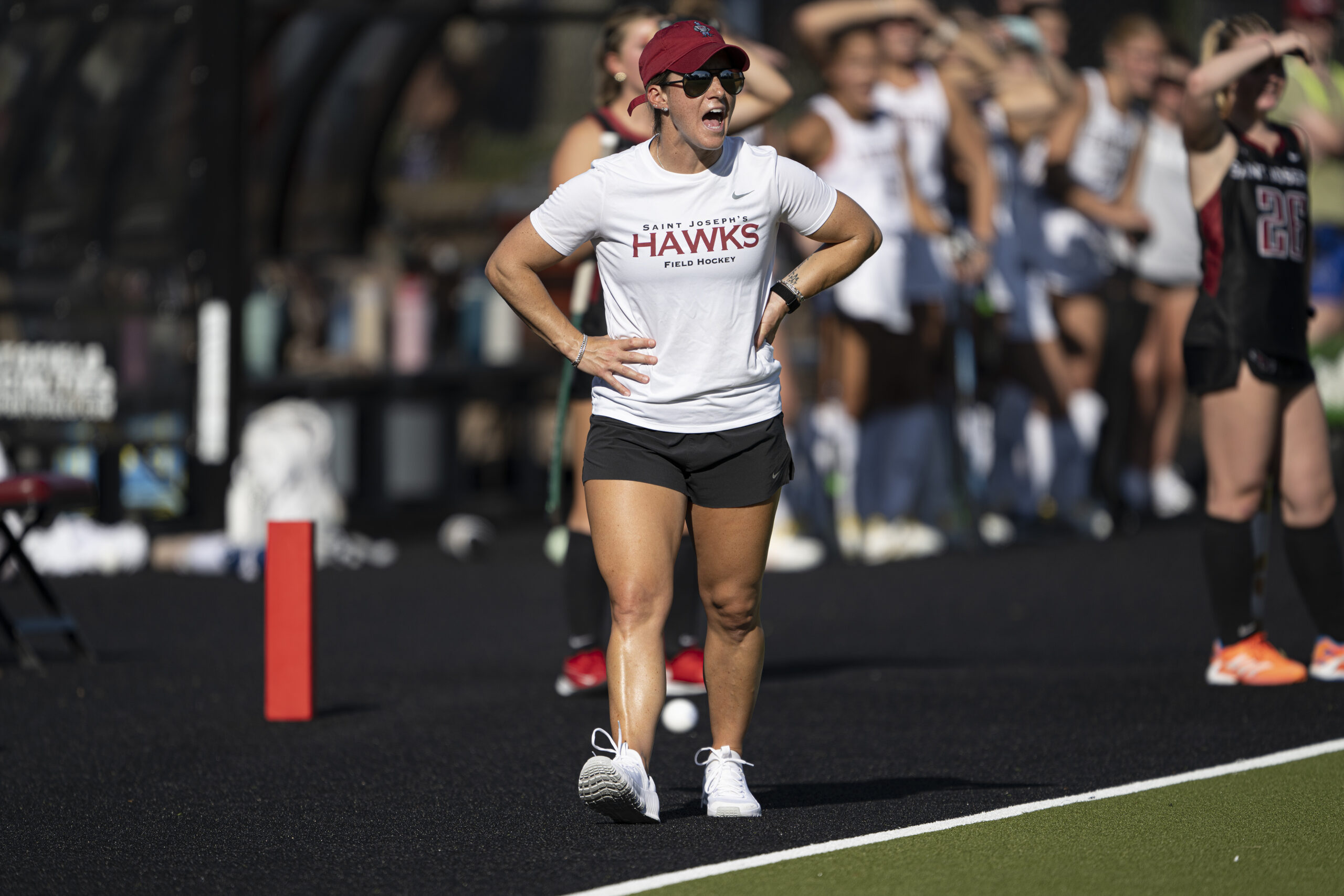
Hannah Prince comes to Penn State after a historic run at St. Joe’s.
Success has followed Prince at every stop of her coaching journey, which started in 2015 when New Hampshire made the America East title game in her first of two seasons as an assistant coach.
Prince later joined St. Joseph’s as an assistant during the program’s first run to the NCAA Tournament in 2017. She then helped Louisville to the Final Four in the spring of 2021 before returning to Hawk Hill in 2022, this time as head coach.
One of the “great people” she worked for was Justine Sowry, her coach at UMass, who has spent the last 14 seasons as Louisville’s coach. Prince credited Sowry for introducing her to coaching and for teaching her the patience required to build a championship-level program.
Sowry lauded her former player for different reasons, ones that extend beyond the field.
“[Prince] is an extrovert. She’s got that energy. She bounces around, and so many people are drawn to her,” Sowry said. “She just shows so much initiative. She took a lot of the weight off my plate just by being who she is … I don’t think I would have been able to get through [the 2020 COVID-19 season] if Hannah weren’t on my staff. She was an absolute godsend for so many more reasons other than just coaching hockey.”
After a final ride under Sowry’s tutelage, Prince accepted the head coaching gig at St. Joe’s, where she went 64-14 in four seasons. The Hawks made four NCAA Tournament appearances and won two Atlantic 10 regular-season titles and four A-10 tournament titles.
In 2023, Prince navigated the Hawks to their first-ever NCAA Tournament win. The next season, Prince guided them to the most wins in program history (20) and the NCAA title game, which marked the first time in school history that any St. Joe’s team had competed for a national championship.
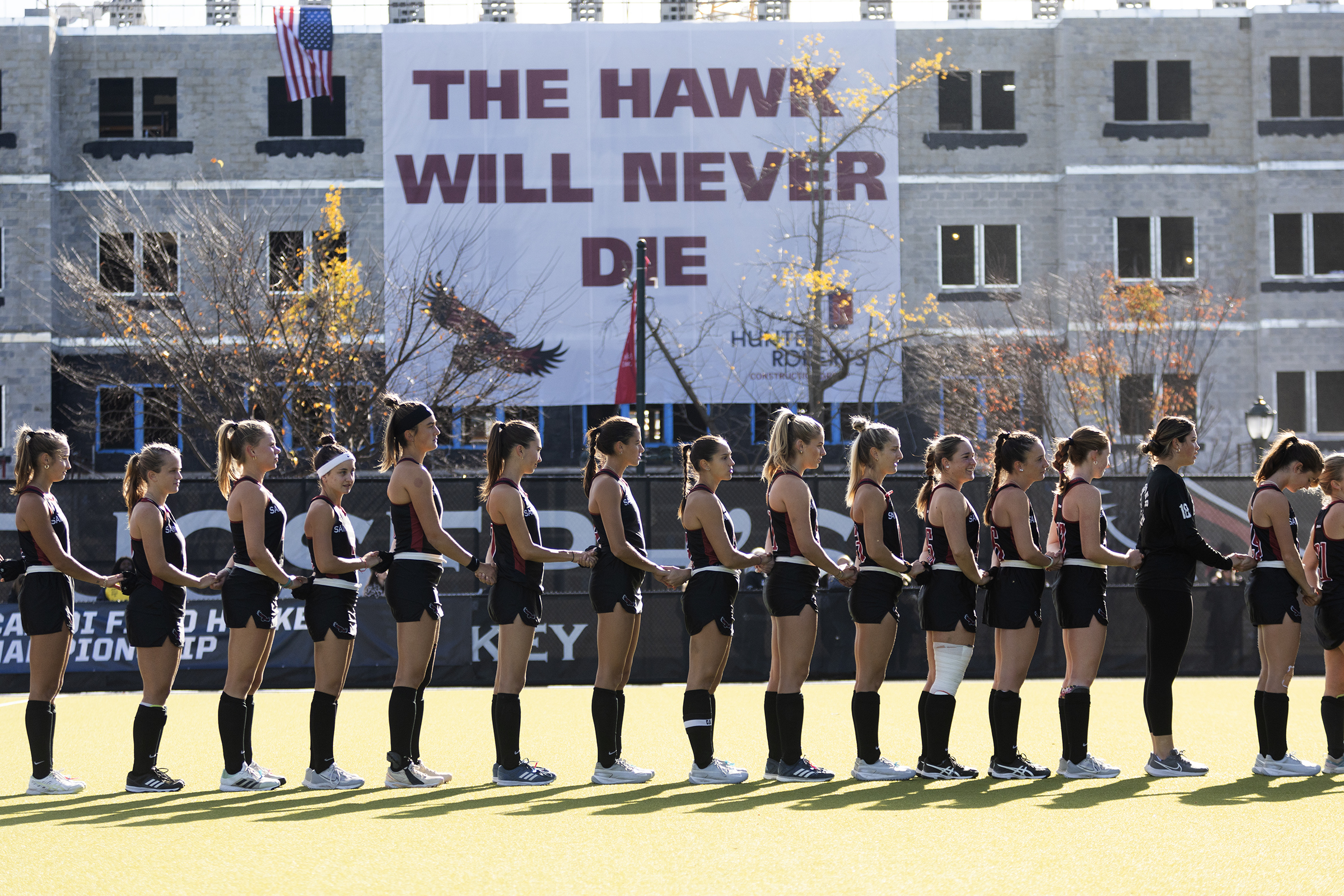
Hannah Prince led the 2024 St. Joseph’s field hockey team to the NCAA title game, a first for any program in Hawks history.
She praised the Philadelphia area’s support during the Hawks’ title pursuit. She also lauded the resolve of her team, which embraced a “why not us” mentality as the tournament’s underdogs.
Prince built the Hawks into a field hockey contender and galvanized area support for her team on its surge toward a championship — a showcase of her program-building prowess.
“[Prince] is passionate, she’s driven, she’s a competitor, and she’s a proven winner,” Sowry said. “She can run a program. She’s got the X’s and O’s covered. And even areas that she might feel deficient in, she has the confidence to bring in coaches that can complement her or make her better.”
Now, she’s ready for her next opportunity: Bringing a once-great Penn State program back into contention.
Under former coach Charlene Morett-Curtiss, the Nittany Lions went 524-219-9 and made eight NCAA Tournament appearances. But in the three seasons since her 2023 retirement, Penn State won just 24 of its 51 games and missed the NCAA Tournament each season.
Prince wants to win national championships in Happy Valley. And that starts with creating a culture of accountability and pride.
“I want [Penn State] to be described as a bunch of empowered, strong, and fearless women who are playing together for a collective reason, because they want to play for each other,” Prince said. “They want to play for those who came before them. They want to play for that legacy.”
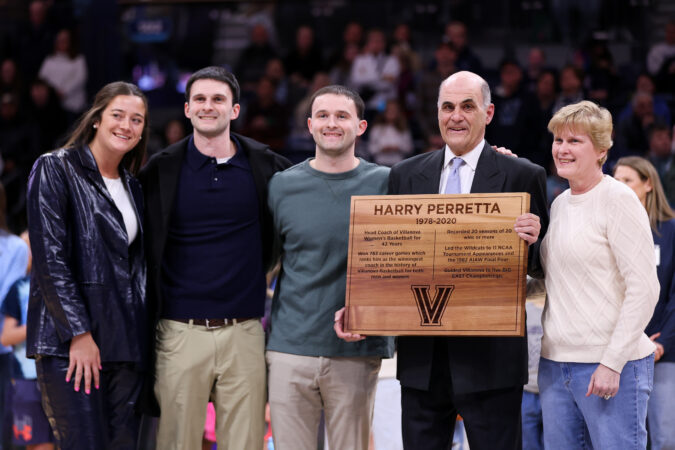
While 70 of the Villanova women’s basketball alumni attending Saturday’s game vs. Georgetown spanned decades of program history, most of them had a common experience: playing for former coach Harry Perretta.
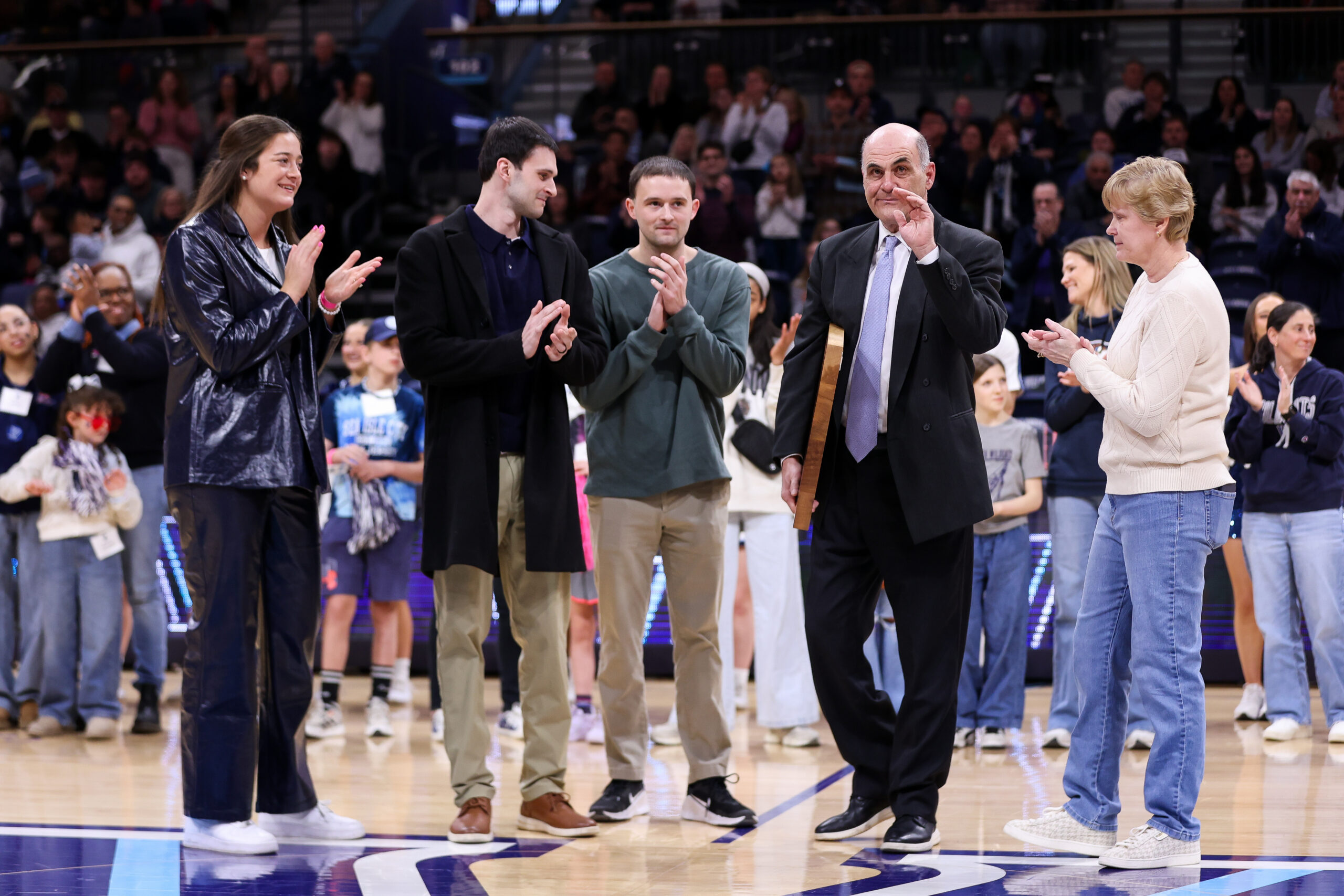
Perretta, who led the Wildcats for 42 years, stood in front of a long line of alumni during the halftime ceremony. It was a moving moment, Perretta said.
“It’s great to come back on alumni day because you realize how many people [who] you’ve met over 42 years,” Perretta added. “That’s what made it even more special to me. Any honor that I get is always associated with my former players and my assistant coaches, because they’re the ones [who] really did it. I just happen to be the common thread.”
Surrounded by his family and former women’s player Maddy Siegrist (left), former Villanova women’s coach Harry Perretta waves to the crowd during a halftime ceremony in his honor.
Former players walked onto the court in the order of their graduating class. Perretta was there on double duty, and he also announced the game for ESPN+, leaving the broadcast booth to receive an honor set to become a display inside the Finneran Pavilion.
“The turnout here is a testament to the type of coach [Perretta] was and the way he treated players,” said Laura Kurz, a 2009 graduate and former assistant coach to Perretta. “So much of that has to do with Harry, his legacy, and this sisterhood that he created here. Looking back, I learned so much from him. There were definitely tough times, but in the end, it was all a very rewarding experience.”
Following the ceremony, the alumni watched Villanova finish a 67-55 victory over Georgetown.
💙family🤍
Such a special day welcoming back so many of our alumni and honoring Harry Perretta with a plaque of his career accomplishments! pic.twitter.com/TeZCUPvoWB
Perretta, who coached the Wildcats from 1978 to 2020, took the team to 11 NCAA Tournament appearances. He is the winningest coach in Villanova men’s and women’s basketball history with 726 victories.
Kathy Razler, a 1985 graduate, has maintained her longtime connection to the program as a season-ticket holder. Razler has stayed in touch with Perretta and former teammates since their run to the Final Four in the 1982 AIAW Tournament, the predecessor to the women’s NCAA Tournament.
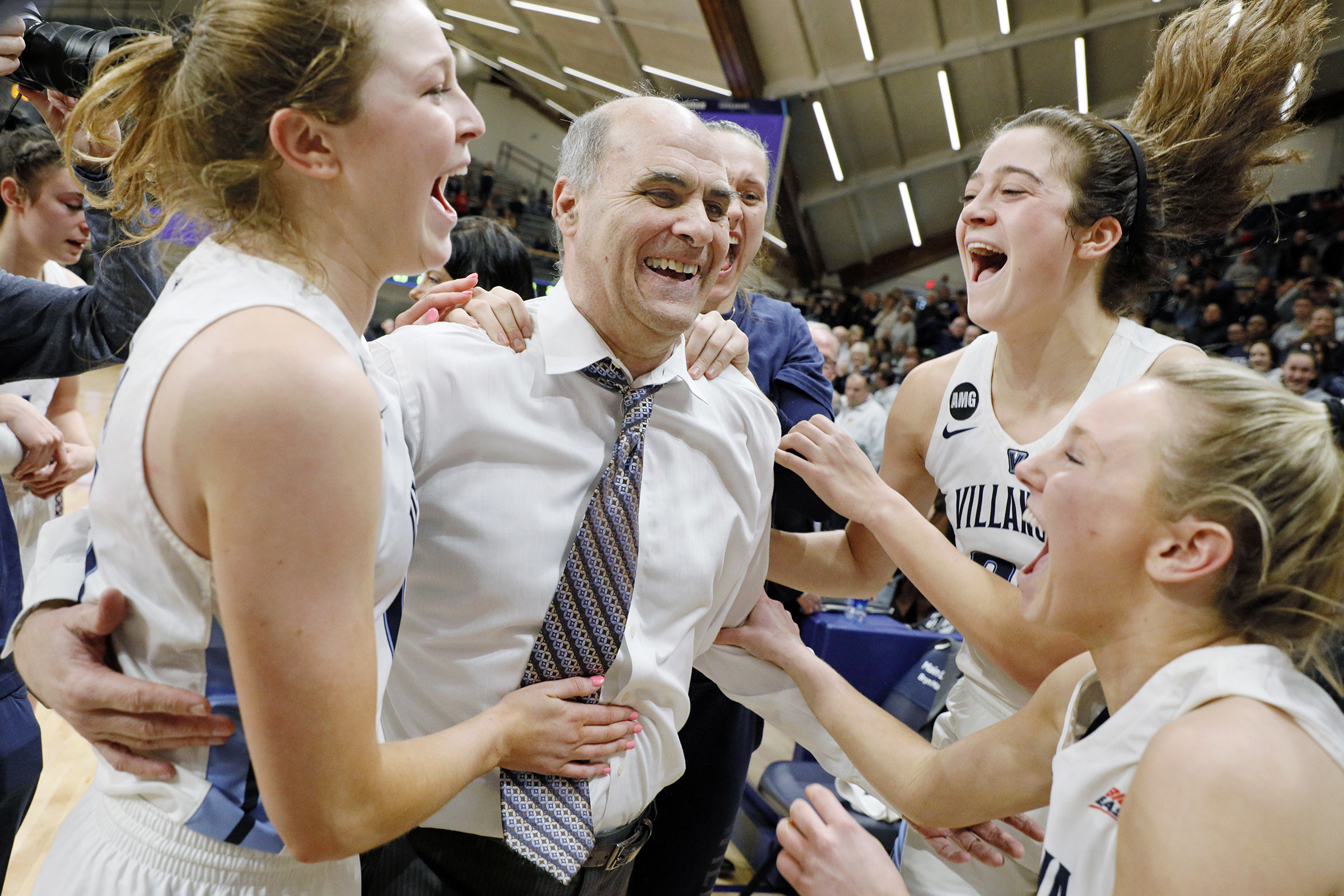
Former Villanova coach Harry Perretta led the team for 42 years.
“It’s so great to see the number of people that continue to come back, and everybody knows that’s because of Harry,” Razler said. “Harry was the connector between all of us. Harry wasn’t always easy, but we all knew that we were going to benefit in the long run from what he requested us to do, and the hard work we put in.”
Past to present
Villanova coach Denise Dillon, who played for Perretta from 1992 to 1996, credited her former coach for influencing her coaching style. Dillon replaced Perretta following his retirement in 2020.
“I think you always teach what you were taught, how you learned the game,” Dillon said. “That’s why I’m in coaching. I had great coaches all the way up the line, and the best in Harry through my college career. It was so intentional how he taught us team basketball and individual development, and most importantly, just about life. … I’ve definitely taken that [coaching philosophy] and passed that along to every player that comes through the program.”
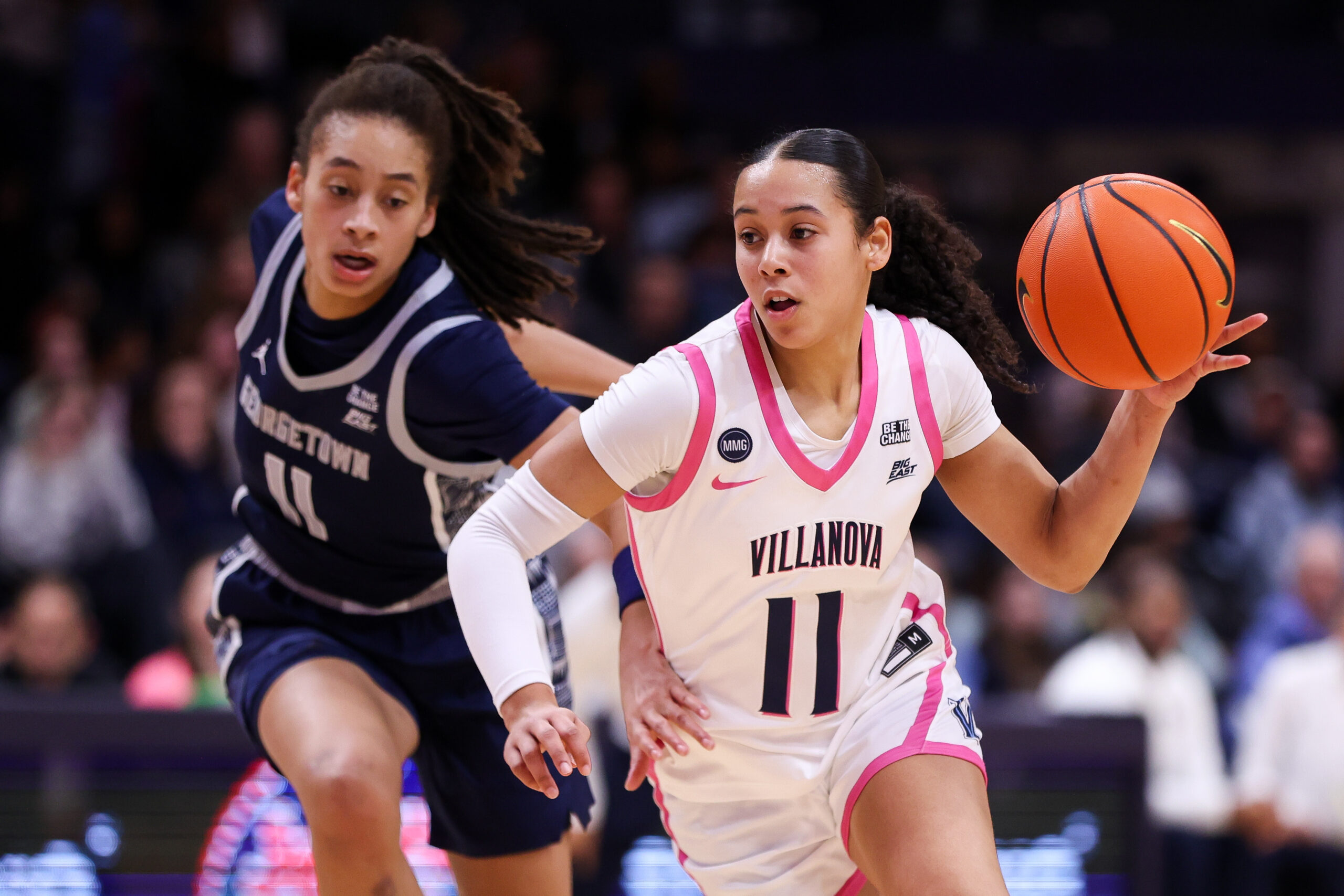
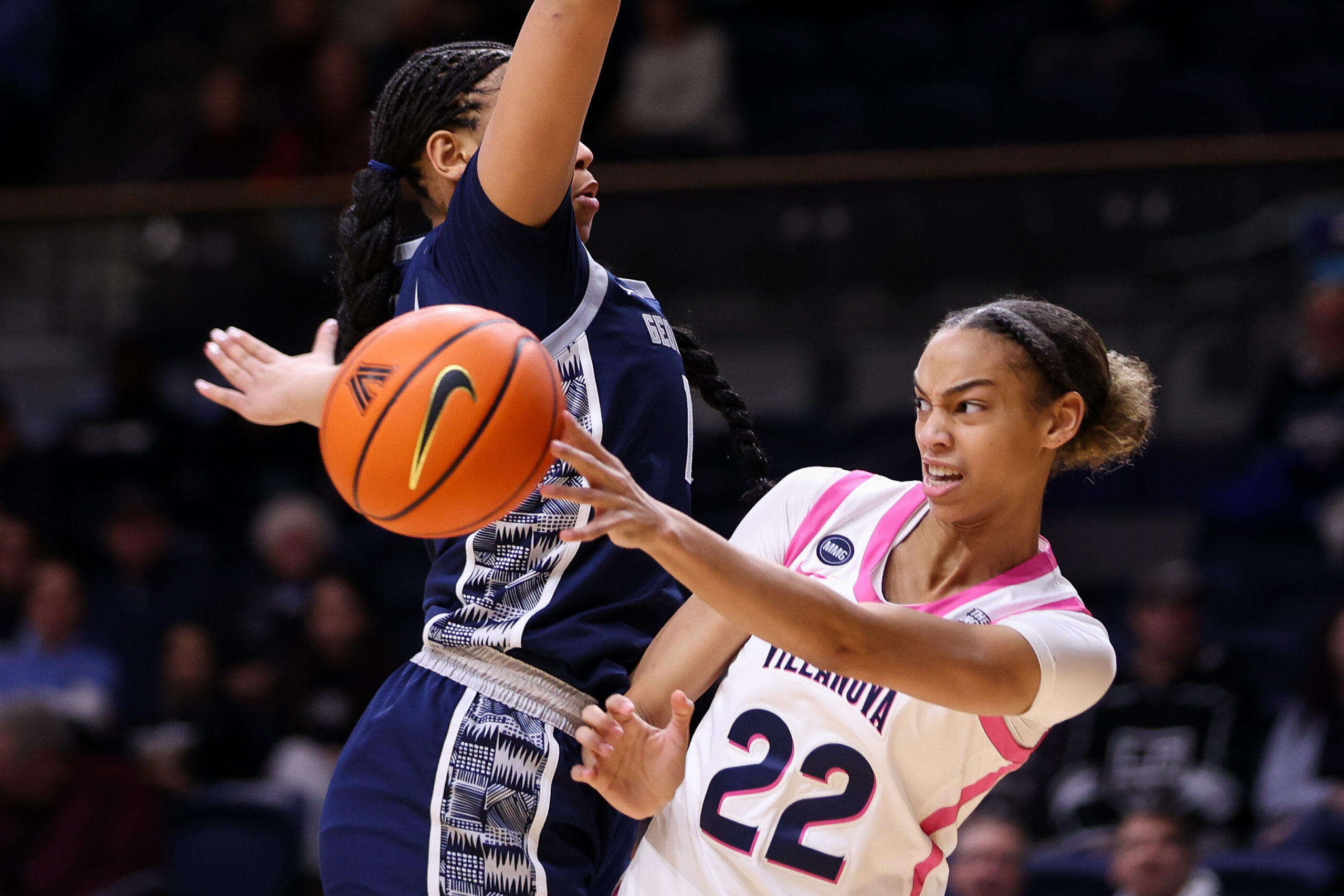
Villanova guard Jasmine Bascoe drives to the basket against Georgetown’s Khia Miller during the second half of their game on Saturday.
For Michele Eberz, a 1995 graduate, attending alumni day was essential, as Villanova basketball runs in the family. Her husband, Eric, is a 1996 alumnus of the men’s program.
Recently, their daughter, Alexis, a senior at Archbishop Carroll, signed to play for the Wildcats next season.
“From when I played to now, there’s just been enormous attention on women’s basketball and women’s sports in general,” Michele Eberz said. “They’re filling seats like never before. I’m just so proud of my daughter to have the opportunity to not only get a tremendous education here [at Villanova], but to also play under the roof of the Finneran Pavilion.”
Villanova’s Kennedy Henry passes the ball around Georgetown forward Brianna Scott during the first half on Saturday.
Up next
With the win over Georgetown, Villanova (19-5, 12-3 Big East) remains in second place in the Big East. On Wednesday, the Wildcats will visit Xavier (6:30 p.m., ESPN+).
Figure skating is one of the most popular events at the Winter Olympics.
But many only follow it every four years, which can make it confusing when the rules change — as they do annually. Most of the names also are new since 2022.
Plus, figure skating is a judged sport, so sometimes the skater you love might get dinged on rules you don’t know and not place as well as you’d expect.
Here is a breakdown of how to watch the Olympic figure skating events:
What are people talking about?
The Blade Angels
The American skaters! Team USA has been a powerhouse off and on, but 2026 is very much an on year.
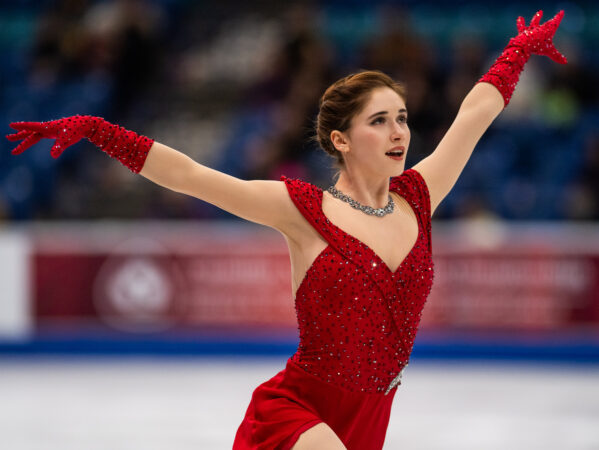
On the women’s side, all three women — who call themselves the Blade Angels — have major titles to their name. South Jersey’s Isabeau Levito is the 2023 U.S. champion and the 2024 world silver medalist. The 18-year-old was born in Philadelphia and lives and trains in Mount Laurel.
Amber Glenn is a three-time U.S. champion and won the Grand Prix Final in 2024.
Alysa Liu is a two-time national champion and the reigning world and Grand Prix Final champion.
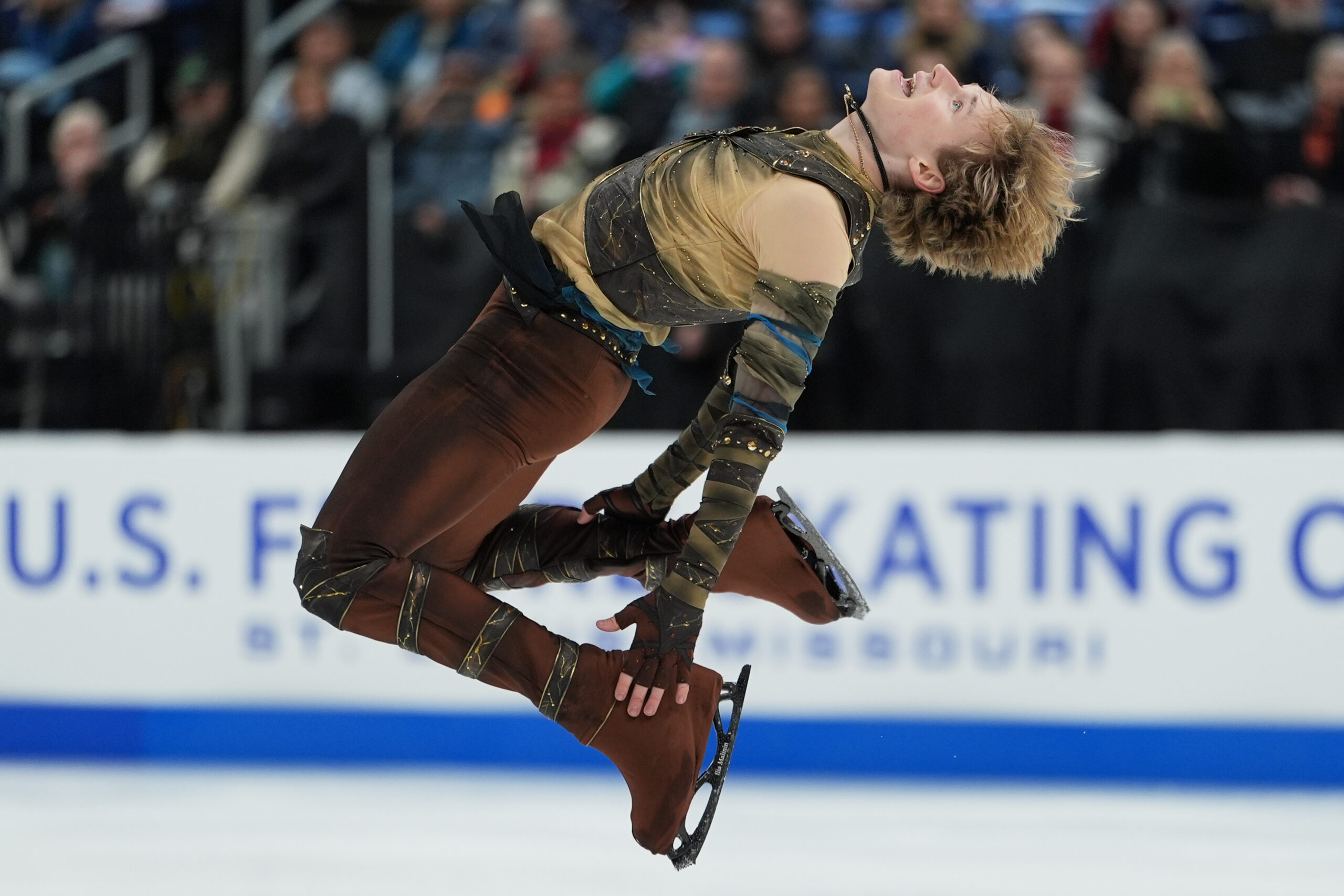
Ilia Malinin skates his program at the U.S. Figure Skating Championships in January in St. Louis.
The Quad God
Ilia Malinin named himself the Quad God early on, and he’s lived up to that name, landing seven triples (the six major jumps plus one in combination at the 2025 Grand Prix Final in December.
He is the only man in the world to land a quad axel in international competition. Sometimes called the quaxel, it is 4½ revolutions in the air with a forward (read: harder) takeoff.
The quad axel was the talk of the 2022 Olympics in Beijing because Japan’s Yuzuru Hanyu was going to attempt it. But he did not land it cleanly.
Malinin has competed it many times since then. Thanks to the difficulty of the move and his consistency, he has not lost a competition he skated in several years.
All three men on the U.S. team are second-generation skaters. Malinin’s parents represented Uzbekistan at two Games.
Andrew Torgashev’s Ukrainian mother, Ilona Melnichenko, competed for the Soviet Union and was the 1987 World Junior champion in ice dancing. His Russian father, Artem Torgashev, was a pairs skater, also for the Soviet Union, and is a two-time World Junior Championships medalist.
Ice dancer Anthony Ponomarenko’s parents, Marina Klimova and Sergei Ponomarenko, are the only ice dancers to have won an Olympic medal of every color. They are the 1992 Olympic champions.
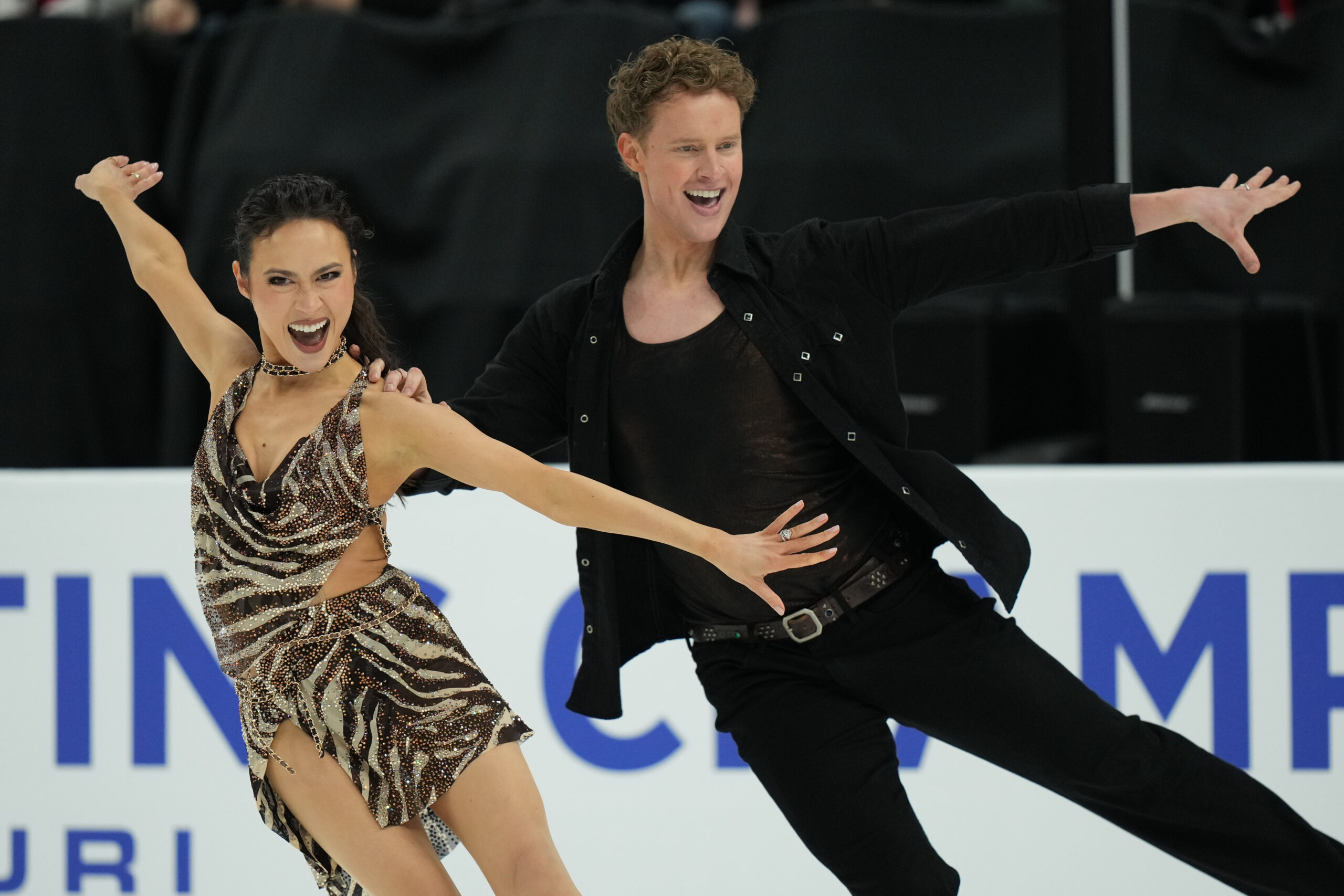
Married ice dancers Madison Chock and Evan Bates are seven-time national champions.
Chock and Bates
American ice dancers Madison Chock and Evan Bates are back for their fourth and fifth Olympics, respectively. The married couple has a team gold medal from the 2022 Winter Olympics. They are seven-time national champions and three-time world champions. The only title they haven’t earned yet is an individual Olympic medal. There are a few other teams who could challenge them for Olympic gold, but they have the edge entering the event.
The oldest competitor and whether she can skate
Deanna Stellato-Dudek is 42 and competed in singles for the United States when she was a teenager. She retired because of injury but came back 16 years later when she realized her unfulfilled Olympic dream. She competed in pairs for Team USA before teaming up with Maxime Deschamps and eventually getting her Canadian citizenship.
After a four-year ban because of the war in Ukraine, Russia was allowed to send a limited number of skaters to an Olympic qualifier competition to compete as neutral athletes. They were not considered if they had shown any support for the war. Two women qualified: Adeliia Petrosian and Viktoriia Safonova. Petrosian is in contention for a medal and likely will be the only woman to attempt quads at the Games.
One neutral Russian man was cleared to compete, Petr Gumennik. No pairs or ice dancers were allowed.
Who else is on Team USA?
The other U.S. dance teams in Milan are Ponomorenko and Christina Carreira, who’s from Canada and recently became a U.S. citizen. They are the 2026 U.S. bronze medalists and medaled twice at the World Junior Championships.
Emilea Zingas and Vadym Kolesnik teamed up in 2022 and quickly found success. They are the 2026 U.S. silver medalists.
Ellie Kam and Danny O’Shea compete during the pairs free skate in January.
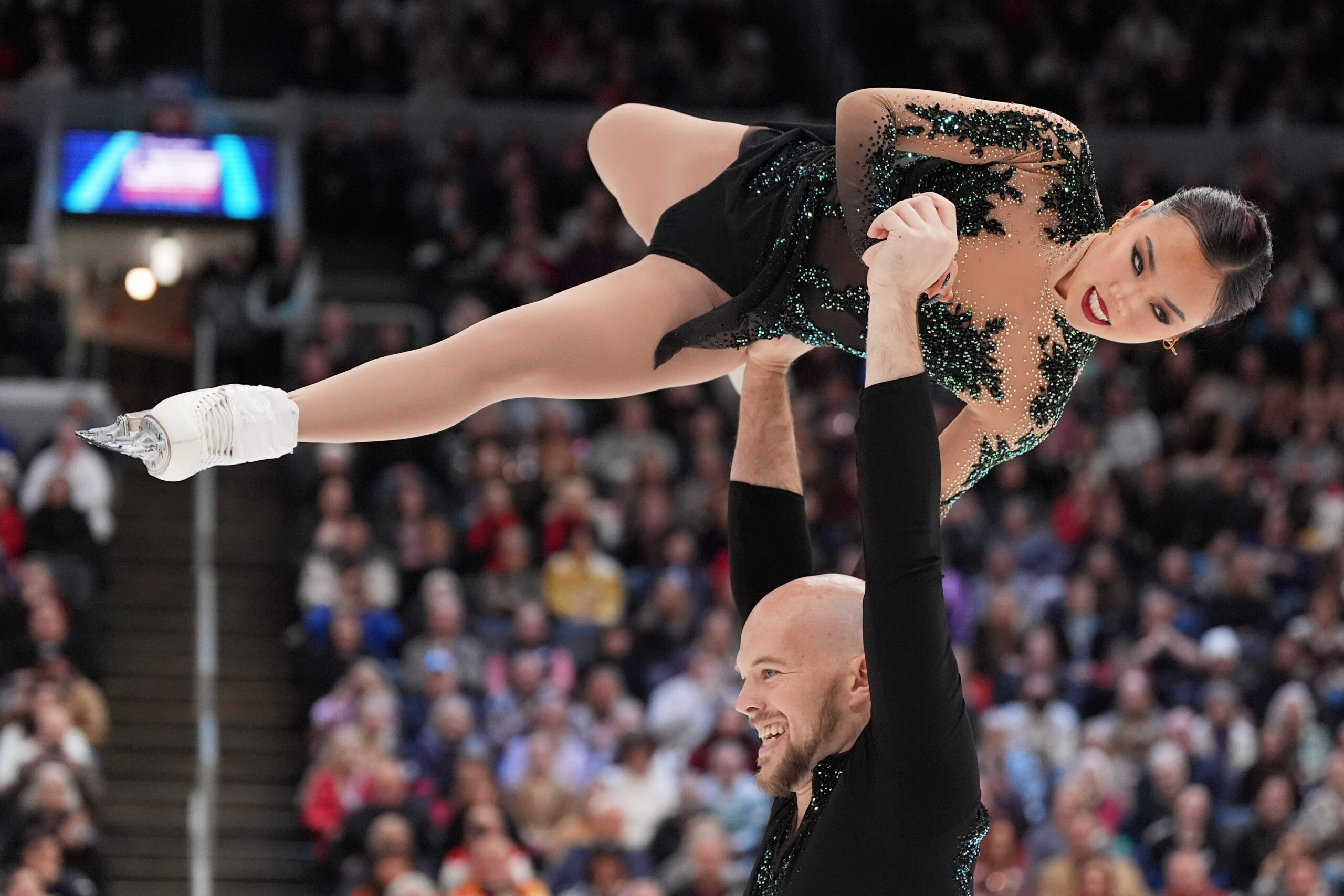
In pairs, Ellie Kam and Danny O’Shea, the 2026 U.S. silver medalists and 2024 champs, are fan favorites because O’Shea competed through three Olympic cycles before he made the team. They are 13 years apart.
Emily Chan and Spencer Akira Howe overcame a rough short program to place fourth (and win the pewter medal) in January’s U.S. championships. They made the team because other top teams’ skaters didn’t share citizenship. Chan and Howe are the 2023 U.S. silver medalists. Howe is in the World Class Athlete Program of the U.S. Army and hopes to become an Army chaplain.
Normally, skaters compete individually or in pairs. In 2014, the team event was added to Olympic competitions. Different skaters can skate the long and short programs for each event (men’s, women’s, pairs, dance), but a team can repeat in two events.
Only the ones chosen to skate win medals, rather than the entire Olympic team.
The team event began with ice dance on Friday and ran through Sunday. Individual events begin Monday, also with ice dance.
In 2022, Russia was poised to win the gold, with the United States right behind it and then Japan. But after 15-year-old Kamila Valieva was found with banned drugs in her system, she was retroactively banned for four years. (That period recently expired, and Valieva is training again.)
In past team events, the United States won bronze in 2014 and 2018. Russia and Canada were the other medalists both years (Russia won in 2014, and Canada in 2018).
Pairs has the big jumps, throws, and lifts. Dance is almost entirely footwork and is based on ballroom dance.
What is the difference between the short program and the long program?
The short program has a set of required elements that the skaters must perform. They have some freedom within those restrictions. For example, if they are told to do a triple jump, they may choose any triple jump. Generally, they choose the harder jumps because they earn more points. But they may also choose the jump they do best.
If skaters miss a required element, they get a zero for it. For example, if a triple jump is required and the skater does a double instead, it is as if he or she didn’t jump at all.
In dance, the short program is called the rhythm dance. A theme is chosen every year. This year, it is “the music, dance styles, and feeling of the 1990s.”
The long program has more freedom, but it still must be a “well-balanced program,” meaning a combination of elements covering the full surface of the ice.
The short program for singles and pairs is 2 minutes, 40 seconds, plus or minus 10 seconds. The rhythm dance is 2:50, plus or minus 10 seconds.
The long program for all is four minutes, plus or minus 10 seconds.
What are the differences between figure skating jumps?
The skating blade looks flat, but it actually is sharpened to a curve with two edges.
Jumps take off from an edge (axel, loop, Salchow) or from the skater tapping in his or her toe (flip, Lutz, toe loop).
The axel is a forward entry but lands backward. All other jumps start and land backward.
The flip and Lutz are very similar toe jumps, but the flip is from an inside edge, and the Lutz from the outside, meaning the Lutz requires slightly more rotation, and thus is given more points.
A common mistake is that a skater will aim to do one but change the edge at the last minute. Commentators often talk about that as a “flutz.”
Another common mistake is a “cheated” jump, meaning the blade lands at least a quarter turn short of rotation. That results in a deduction or sometimes even a downgrade, meaning an intended triple jump is called a double.
Which skaters are expected to do well?
Along with the U.S. women, the Japanese women are very strong. They are led by three-time world champion Kaori Sakamoto, who won the Olympic bronze medal in 2022.
On the men’s side, along with Malinin, the top contenders include Yuma Kagiyama of Japan, who earned the silver medal at the 2022 Olympics and is also a three-time World silver medalist. France’s Adam Siao Him Fa and Kazakstan’s Mikhail Shaidorov are others to watch.
The top ice dancers are Chock and Bates. Canadians Piper Gilles and Paul Poirier earned the silver medal behind Chock and Bates in the last two world championships.
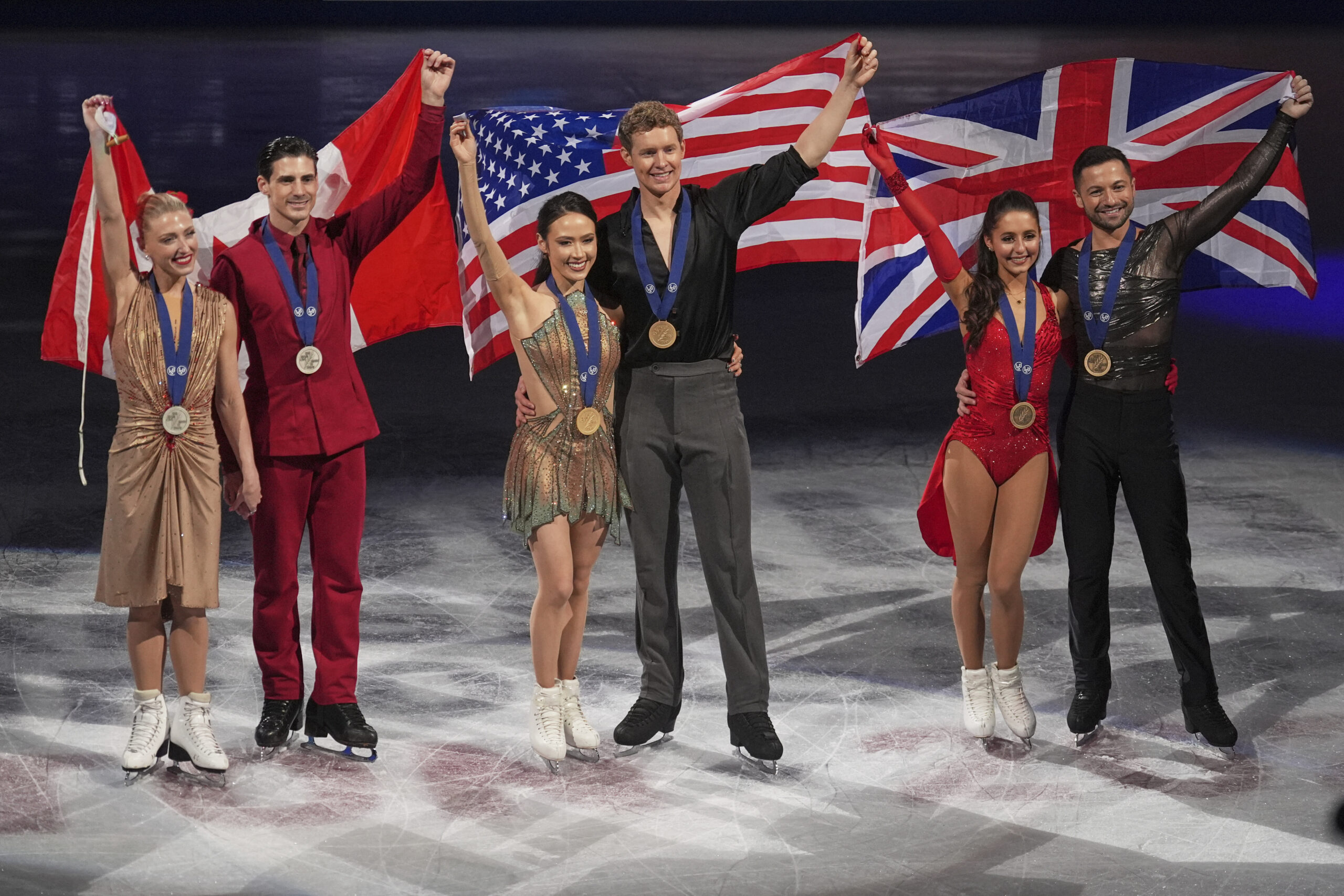
Silver medalists Piper Gilles and Paul Poirier (left), gold medalists Madison Chock and Evan Bates, and bronze medalists Lilah Fear and Lewis Gibson celebrate their medals at worlds in 2025.
The pairs contenders are led by Riku Miura and Ryuichi Kihara of Japan, the reigning world champions. Others include Sara Conti and Niccolò Macii (Italy), Minerva Fabienne Hase and Nikita Volodin (Germany), and Anastasiia Metelkina and Luka Berulava (Georgia).
How is Olympic figure skating judged and scored?
The judging system was changed after the 2002 Salt Lake Olympics judging scandal, when two judges allegedly colluded to make certain skaters champions. The 6.0 system was replaced by IJS, the international judging system, which defines how many points each element is worth.
The officials include judges and a technical panel. The technical panel determines an element — including whether a triple should be downgraded to count as a double — and the judges decide the quality of the element. Skaters may be given a positive or negative grade of execution depended on how the element was performed. They also are given points for skating skills, transitions between elements, and performance. This is how a more artistic skate with fewer big jumps, can still do well. It is also how a skater with lots of impressive jumps but easier footwork may not win.
Paging through the bulky Sunday Inquirer on Nov. 28, 1976, readers encountered a sports section that might have been compiled in Mount Athos, the tiny Greek republic that’s been off-limits to women for centuries.
It was stuffed with man’s-world staples — stories, stats, and standings on the NFL, NHL, pro and college basketball. There were columns on hunting, golf, boys’ high school sports; features on boxing, men’s cross-country, minor league hockey; an entire page devoted to horse racing.
The ads were no less macho-flavored, promoting car batteries, rifles, tires. A prominent one hyped January’s U.S. Pro Indoor Tennis Championship at the Spectrum with its lineup of “50 of the world’s top male pros.”
About the only indications that women participated in sports were an account of a West Chester State field hockey game and, buried on the gray scoreboard page, a truncated leaders’ list from that weekend’s LPGA tournament.
But for those who reached Page 16, a strange interloper awaited. Sandwiched between two men’s basketball previews, as if editors thought it incapable of standing alone, was one of the earliest and most consequential harbingers of a bubbling sports revolution — the first women’s college basketball poll.
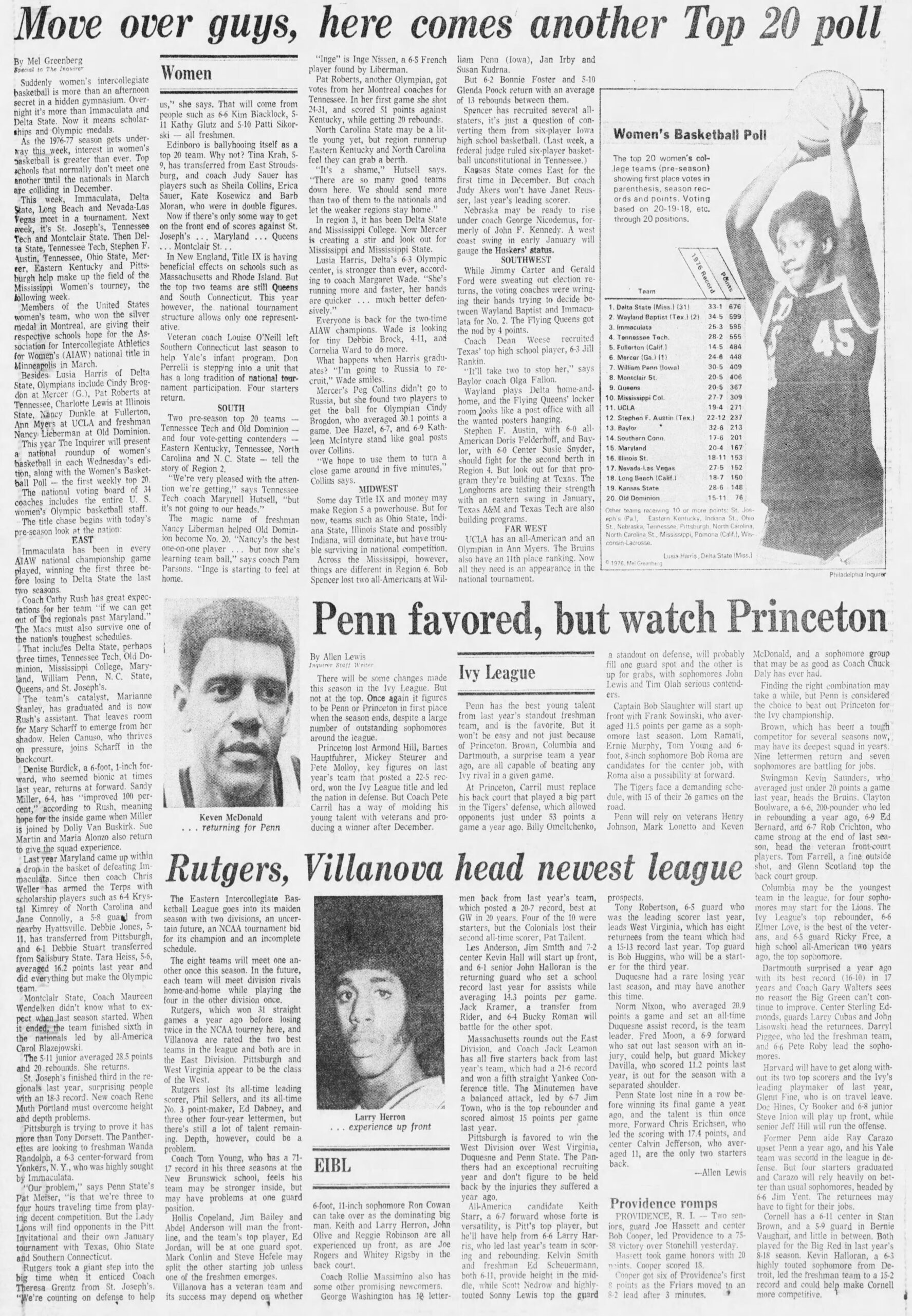
Conceived by then-Inquirer sports editor Jay Searcy and obsessively nurtured by a Temple-educated newspaper clerk named Mel Greenberg, its headline read like a polite plea for recognition: “Move over guys, here comes another Top 20 poll.”
A clipping from the Nov. 28, 1976, edition of The Inquirer that features the first installation of what became the AP women’s basketball poll.
It came. And it stayed. Week after week, year after year, Greenberg’s poll accumulated popularity and heft, becoming a building block in the growth of women’s basketball. A sport that had been widely ignored and loosely governed by the Association for Intercollegiate Women’s Athletics now had validation, a common sense of purpose, and unity.
“That poll gave coaches and others around the country an opportunity to know what was going on everywhere with women’s college basketball,” said Marianne Stanley, a star on Immaculata’s 1970s championship teams and later a successful college and WNBA coach. “Prior to that, there was only word-of-mouth. Newspapers didn’t cover it, and no one was tracking what was happening nationally.”
Revisiting that debut poll in this, its 50th anniversary year, is eye-opening. Its top 10 might today be mistaken for a ranking of Division III field hockey teams — Delta State, Wayland Baptist, Immaculata, Tennessee Tech, Fullerton, Mercer, William Penn, Montclair State, Queens, and Mississippi College.
Theresa Grentz (second from left) and Marianne Stanley (fourth from right) with Immaculata teammates and coach Cathy Rush at right. Immaculata was one of women’s college basketball’s first powers.
The large state schools that dominate in 2026 mostly were absent.
But not for long.
Motivated by the mandates of 1972’s Title IX and by a desire to see themselves in the new rankings, many started to invest in the sport.
By 1981, when the NCAA replaced the AIAW as the game’s overseer, there were 234 women’s Division I programs. That jumped to 284 in 1991, 317 in 2001. Last season there were 325 D-I programs, and more than 1,000 when Division II and III are included.
“The fact that so many schools where women’s basketball was nonexistent or an afterthought went all in is a credit to Mel and his poll,” said Jim Foster, the retired women’s coach at St. Joseph’s, Ohio State, and elsewhere.
Deirdre Kane, the retired West Chester University coach, said that “until Mel’s poll, the NCAA wasn’t even acknowledging our existence. That poll made people realize, some of them for the first time, that women’s collegiate basketball was being played.”
Greenberg built a national network of coaches and administrators, contacting them weekly for information and input. As newspapers beyond Philadelphia added his poll, its significance deepened.
“We were all fighting for recognition, but none of us were getting much,” said Geno Auriemma, the Norristown-raised, spectacularly successful coach at Connecticut. “Mel came along, and he was one of the few who gave us a little. His poll helped us all grow the game.”
It grew so widely that in 1996 the NBA launched a women’s pro league, stocked with the stars of the college game. The WNBA now has a national TV contract, recognizable superstars, and a lineup of big-city franchises that in 2030 will include Philadelphia.
“When Philadelphia gets that team,” Foster said, “they ought to call it the Philadelphia Mels.”
It took 28 years after the inception of the Associated Press’ men’s college basketball poll for the women to get one. In 1976, Searcy, who before arriving at The Inquirer had covered women’s sports for the New York Times, decided the time had come. His motivation likely sprang from developments in that Bicentennial year.
Women’s basketball made its Olympic debut that summer in Montreal. A few months earlier, Immaculata had appeared in its fifth straight AIAW national title game. The Mighty Macs, who in 1971 played in the first nationally televised women’s game, had won the first three and were runners-up the next two years.
Searcy reached out to Greenberg, an editorial clerk who by then was the de facto Immaculata beat writer.
“Jay called me into his office and said, ‘What do you think of the idea of a women’s basketball poll?’” Greenberg said. “And I said, ‘I think you’re nuts.’”
As Greenberg prepared for the poll’s November launch, Searcy promoted it. He revealed his plan to Temple students during a campus visit. In that audience was Foster, then a physical education major who also coached Bishop McDevitt High School’s girls.
“It was really exciting news for anyone interested in the sport,” Foster said. “He told us he was going to start a women’s basketball poll that would be just like the men’s.”
Still, many scoffed. Women’s basketball, after all, existed deep in the shadows. Most newspapers and TV stations ignored it. With few exceptions, games were played before tiny crowds, often in substandard gyms. Rules weren’t standardized, qualified coaches and referees were in short supply, and, until the AIAW’s 1971 founding, there was no universally accepted end-of-season tournament.
“The only people who followed women’s basketball then were the people involved in the game,” Kane said.
But if there was a hotbed, it probably was the Philadelphia area. Numerous elementary schools, high schools, and colleges here had teams. West Chester State, with its strong physical education program, gained prominence in the 1960s under coach Carol Eckman, now known as “the mother of women’s college basketball.” And it was a West Chester grad, Cathy Rush, who turned Immaculata into the nation’s best team in the early 1970s.
“There was always a huge basketball presence in Philadelphia,” Stanley said. “But it wasn’t until Immaculata that many people noticed the women. Then, the AIAW was formed, and that was big. Now, here comes the poll, and suddenly we’ve got a way to track and pay attention to what was happening not just here but across the country.”
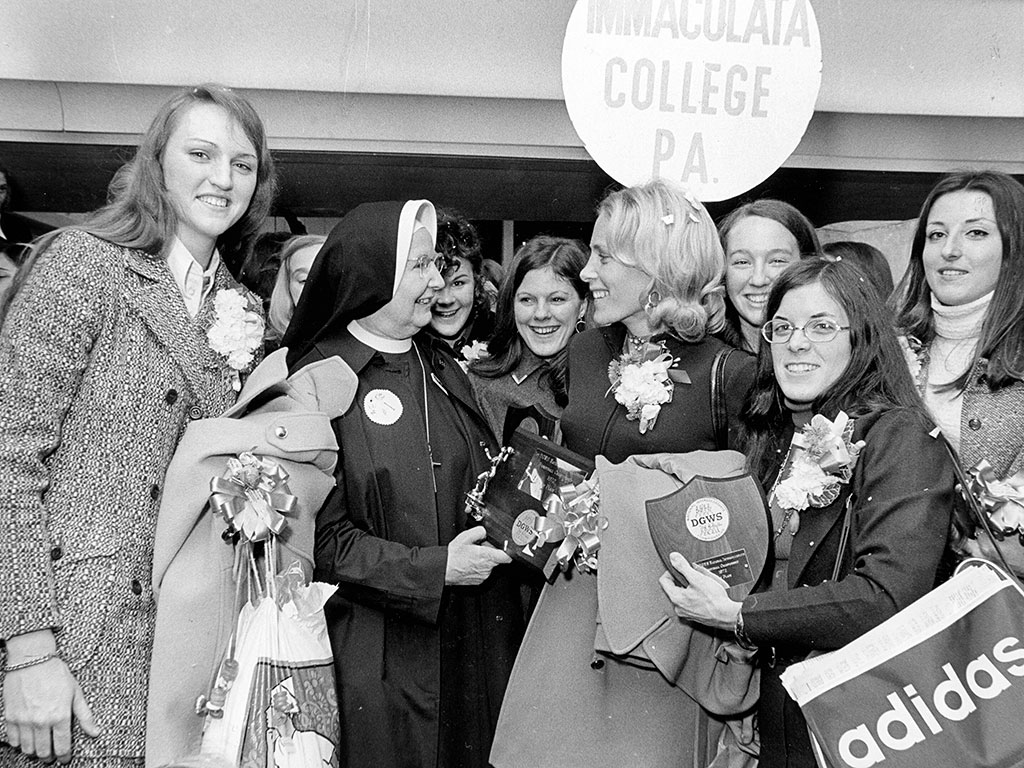
Members of the Immaculata College basketball team gather around their coach as they return after winning the first women’s collegiate national championship in 1972. From left in the foreground are Theresa Shank, college president Sister Mary of Lourdes, coach Cathy Rush, and Janet Ruch.
Despite Greenberg’s occasional stories on the Mighty Macs, few readers knew much of the women’s basketball world beyond. And few sports editors and writers besides Searcy and Greenberg saw its potential.
“I loved women’s basketball,” said Dick Weiss, a veteran sportswriter who then was covering men’s college basketball for the Philadelphia Daily News, “but most of us never saw it becoming a regular beat. All our energy went into the Sixers with Julius Erving and the Big 5, which still had NCAA teams filled with local talent.”
Launching the poll proved problematic. If women’s programs were second-class on most campuses, so were their support staffs. Gathering schedules and stats was nearly impossible. When Greenberg reached out to the AIAW for help, the organization balked.
“They told me women’s sports shouldn’t get involved in things like newspaper polls because that would lead to the evils of men’s athletics,” he said.
So he built a Rolodex of contacts, then he and some basketball contacts painstakingly collected information over the phones.
“Mel based the poll operation in our sports department,” said Gene Foreman, then The Inquirer’s managing editor. “His volunteer helpers were several tall women.”
Coaches telephoned in their votes on Sunday nights. One, N.C. State’s Kay Yow, provided an early indication of the poll’s impact.
On Jan. 2, 1977, Immaculata visited N.C. State, which typically played before small gatherings. But the new rankings promised a compelling matchup. The Wolfpack were ranked No. 15; Immaculata, which triumphed, 95-90, was No. 2.
“I remember Yow calling and talking about how excited she was,” Greenberg said. “It was snowing before the game, but there was a long line of fans outside the arena waiting for tickets.”
In 1978, the Associated Press began distributing the poll, giving most news outlets access. Then, in 1994, Greenberg ceded its compilation to the AP, and media members replaced coaches as the voters.
The poll was a cornerstone of the game, and in 2000, another Sunday Inquirer spotlighted women’s basketball’s maturity.
Philadelphia was hosting that year’s Final Four. Its lineup of Connecticut, Tennessee, Rutgers, and Penn State revealed the game’s progression from the days when little Immaculata could win three straight titles. Its two sessions attracted nearly 40,000 fans. Millions more watched on ESPN.
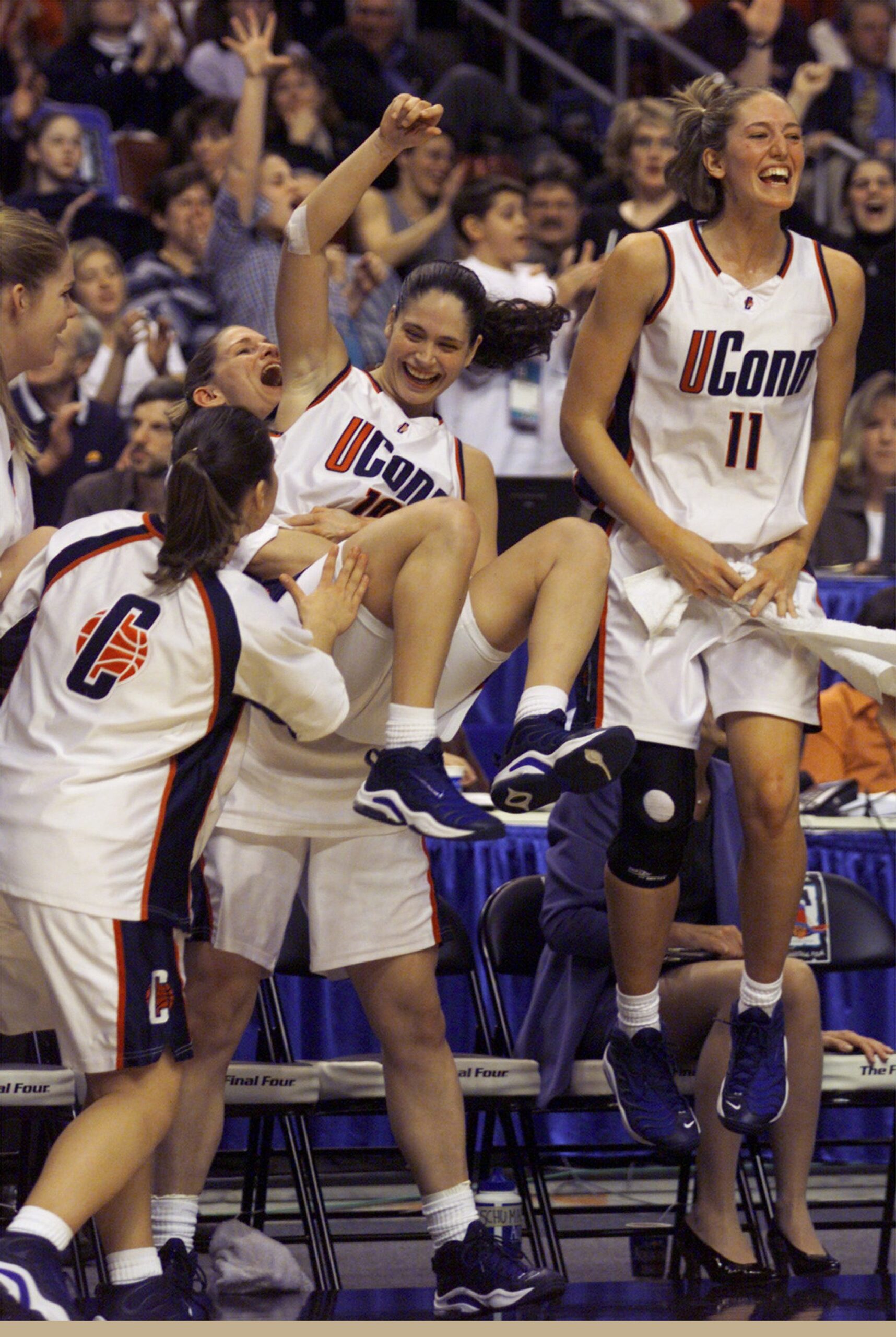
Stacy Hansmeyer, Sue Bird, and the UConn bench celebrate after Swin Cash makes a breakaway layup late in the second half of UConn’s Final Four game against Penn State on March 31, 2000, at what then was called the First Union Center.
The April 2 Inquirer ballyhooed that night’s title game on Page 1. Inside was an entire section previewing the event from every angle. There were profiles of coaches, players, even the referees. There were analyses, features, columns, statistics, photos and predictions.
And the poll?
Well, the championship game itself proved just how plugged in it was. Connecticut, the No. 1 team in the regular season’s final rankings, defeated No. 2 Tennessee.
Greenberg retired from The Inquirer in 2010 but still compiles a widely read blog. Organizations, including the Naismith Basketball Hall of Fame, have recognized him and his poll’s contributions.
“Mel was a gift to the women’s game,” Stanley said. “He was so passionate, and so dedicated and so single-minded. Who knows how long it otherwise would have taken for anything of substance to occur? Not many news outlets gave a crap about it, but Mel and The Inquirer decided to do something about women’s basketball. And that poll has stood the test of time.”
Head to the corner of 32nd and Berks, Kahleah Copper says. And find the telephone pole with the backboard still nailed to it.
“That’s where I started hooping,” Copper said Thursday. “That’s where it all really began for me.”
That spot is so meaningful that Copper took her Unrivaled teammates on a walking tour there, traipsing through snow-lined sidewalks and frigid temperatures to reach it. The 31-year-old wanted them to see the North Philly she always boasts about, to “share that little piece of me.”
Kah visiting where it all started👑 #Unrivaled #WNBA
It was part of the nostalgia and “waves of gratitude” Copper felt during this particular trip home, culminating in playing Friday night at Xfinity Mobile Arena in professional women’s basketball’s return to Philly. While speaking about the family, friends, and mentors in that sold-out crowd — who knew the kid who once shot on that makeshift hoop — Copper’s emotions quickly (and unexpectedly) bubbled to the surface.
“There’s so many people that just kind of stepped into my life,” said Copper, eyes teary and voice breaking, “and did stuff for me, literally not looking for anything in return. … For them to see me now, like I really made it because of y’all. That’s tough. That’s fire.
“Everybody literally planted little seeds for me to be who I am today. That’s why it’s so special.”
An early opponent on that neighborhood basket? One of her three sisters, whom Kahleah claims “wasn’t even that good, and she did not even, like, like it.” It is how she realized how much she did love basketball — and hated losing.
Then there were the guys who welcomed her into pickup games at Fairmount Park playground courts at 33rd and Diamond, even though she was a girl. As long as she did not cry. As long as she was ready to take hits. And as long as, whenever she lost, she got off the court and found her way back into the next game.
“Nothing being handed to me. Got to go get it. Got to be tougher,” Copper said. “That’s kind of where I got my mindset, and that’s how I approach everything.”
Eric Worley, the cofounder of Philadelphia Youth Basketball, first met Copper as a middle schooler. Sabrina Allen, a friend and then the coach at Girard College, recognized potential in Copper. Worley agreed that Copper “could run real fast, could jump real high” — and “got off the ground twice before the other player got off the ground once.”
“She just came in the game and you knew she was going to bring energy,” Worley told The Inquirer in front of an arena suite Friday night. “Get some offensive rebounds. Get some putbacks. And just kind of bring that North Philly toughness that she always kind of goes back to.
“That’s really true, and that has always been part of her makeup.”
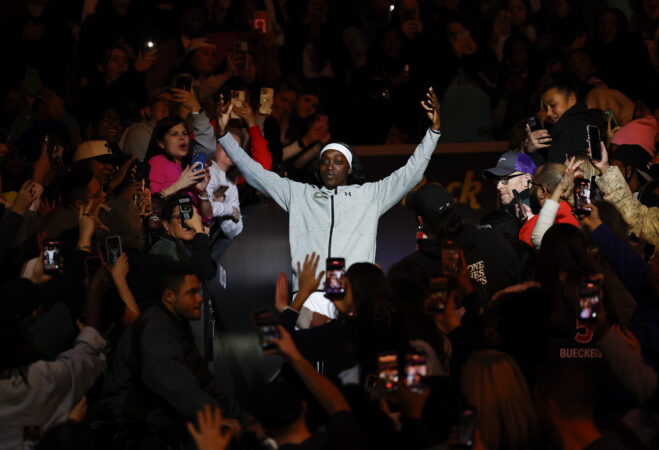
Kahleah Copper introduced in front of the Philly crowd. Got something cooking on her that you’ll be able to read tomorrow 👀
Yet because of work and family obligations for Copper’s mother, Leticia, Kahleah often needed a ride to practices or AAU games. Worley and his family stepped in. Reminiscing about that kindness is what first made Copper’s voice waver in front of reporters on Thursday. The next day, Worley called the gesture “easy” because of the Copper family’s honesty about their situation and appreciation for the support.
“She trusted us with her baby,” Worley said of Copper’s mother. “She was like, ‘Hey, I know y’all are good people. I know you have her best interests at heart. Come get her. What time do I need to have her ready? She’s going to have her bags packed and ready to go.’”
Copper later moved to 23rd and Diamond, into the same Raymond Rosen projects where basketball legend Dawn Staley grew up. Copper started playing at Hank Gathers Recreation Center and walked Broad Street to Temple to join the pickup games with the women’s basketball team.
Eventually, Copper branched out, starring in college at Rutgers before turning pro. She blossomed into a four-time All-Star and won the 2021 WNBA championship and Finals MVP. She played overseas in Belgium, Poland, Turkey, Israel, and Spain. This past fall, she helped the Phoenix Mercury to a surprise Finals run, upsetting the defending champion New York Liberty along the way.
Then Unrivaled, the offseason league in its second season, finally brought Copper home to play professionally.
Veteran star Skylar Diggins sat behind Copper on the bus once they arrived, watching her take in her hometown. Copper kept a camcorder handy to document everything from the familiar surroundings to her teammates crammed in an elevator in their hotel. Awaiting everybody was a massive cheesesteak order from the iconic Dalessandro’s, ready for Copper to dress her sandwich with mayonnaise, salt and pepper, and ketchup (but no onions).
“Everybody I know [eats it that way],” Copper said. “That’s real Philly right there.”
All four Unrivaled teams practiced at the Alan Horwitz “Sixth Man” Center located about 10 minutes from where she grew up. She marveled at the easily accessible “safe space” — complete with study areas, therapy rooms, and meals — it provides area kids today. That is where she first reunited with Worley, the coach calling it “genuine love.” Copper then spent time with some of Worley’s current players, along with kids who have grown up attending Copper’s summer camp, launched nine years ago.
“Now it’s time to really cement your legacy,” Worley said, “by paying it forward for the next generation.”
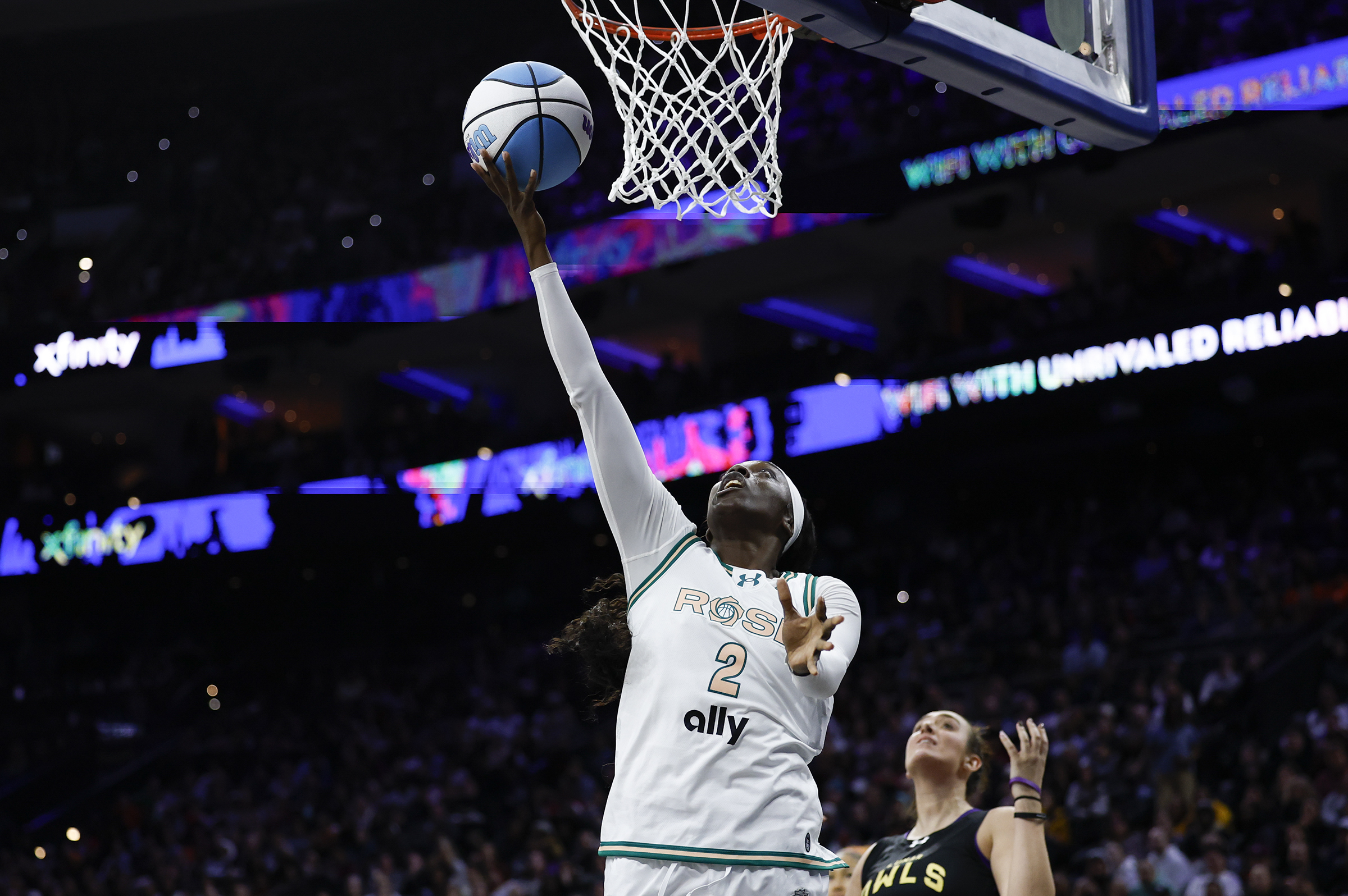
Kahleah Copper of the Rose scored 19 points and had four rebounds during the Philly Is Unrivaled doubleheader on Friday.
And with her Rose BC teammates in tow, Copper still squeezed in that neighborhood walk she made countless times as a kid. They began at the park and then moved to the pole with the backboard, which Copper said left everybody “in awe.” Then they went to her home, sat on the stoop, and yelled “Norf!”
Throughout the stroll, Copper pointed out her favorite water ice stand and go-to gas station. She shared memories of trying to hurry back home before the streetlights came on. It all illustrated why, in teammate Shakira Austin’s words, Copper is an “embodiment of Philly.”
“You can just see the way she speaks about things,” Austin said Friday. “She’s so excited about this opportunity and about this experience. She’s been rambling a lot, but it’s so fun to hear and just to see her be her true self.
“She’s probably been the most out of her shell since we’ve been here.”
Copper took all 60 tickets provided by Unrivaled for “her people” to attend Friday’s game, with several others sharing that they had bought their own. She could not wait to scan the crowd and “probably see people I haven’t seen since I was maybe in college, or maybe in high school.” After the Rose’s 85-75 loss, in which she totaled 19 points and four rebounds, Copper ventured into Section 123, wrapping those loved ones in hugs and posing for photos.
Many of them know all about 32nd and Berks, and the pole with the backboard. And now, so do her Unrivaled teammates.
“I made them walk in that cold,” Copper said. “But they love so much, so they did it for me. I was just super grateful to be able to show that little piece of me.”
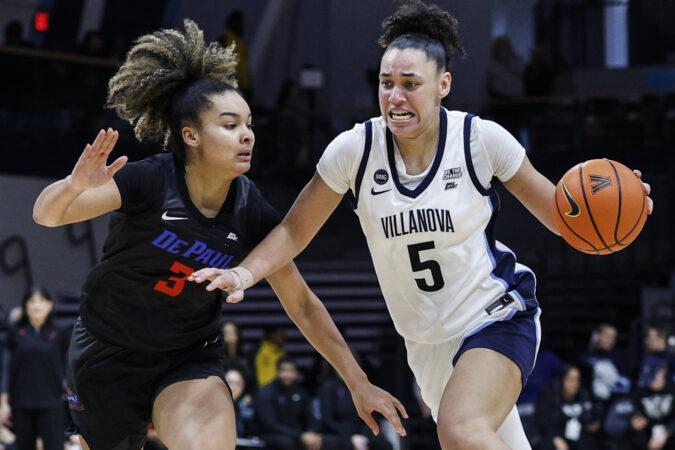
Fans hold up their signs supporting Kahleah Copper of the Rose and Natasha Cloud of the Phantom during the Philly Is Unrivaled doubleheader on Friday.
A deep bench has been crucial as Villanova maintains its hold on second place in the Big East.
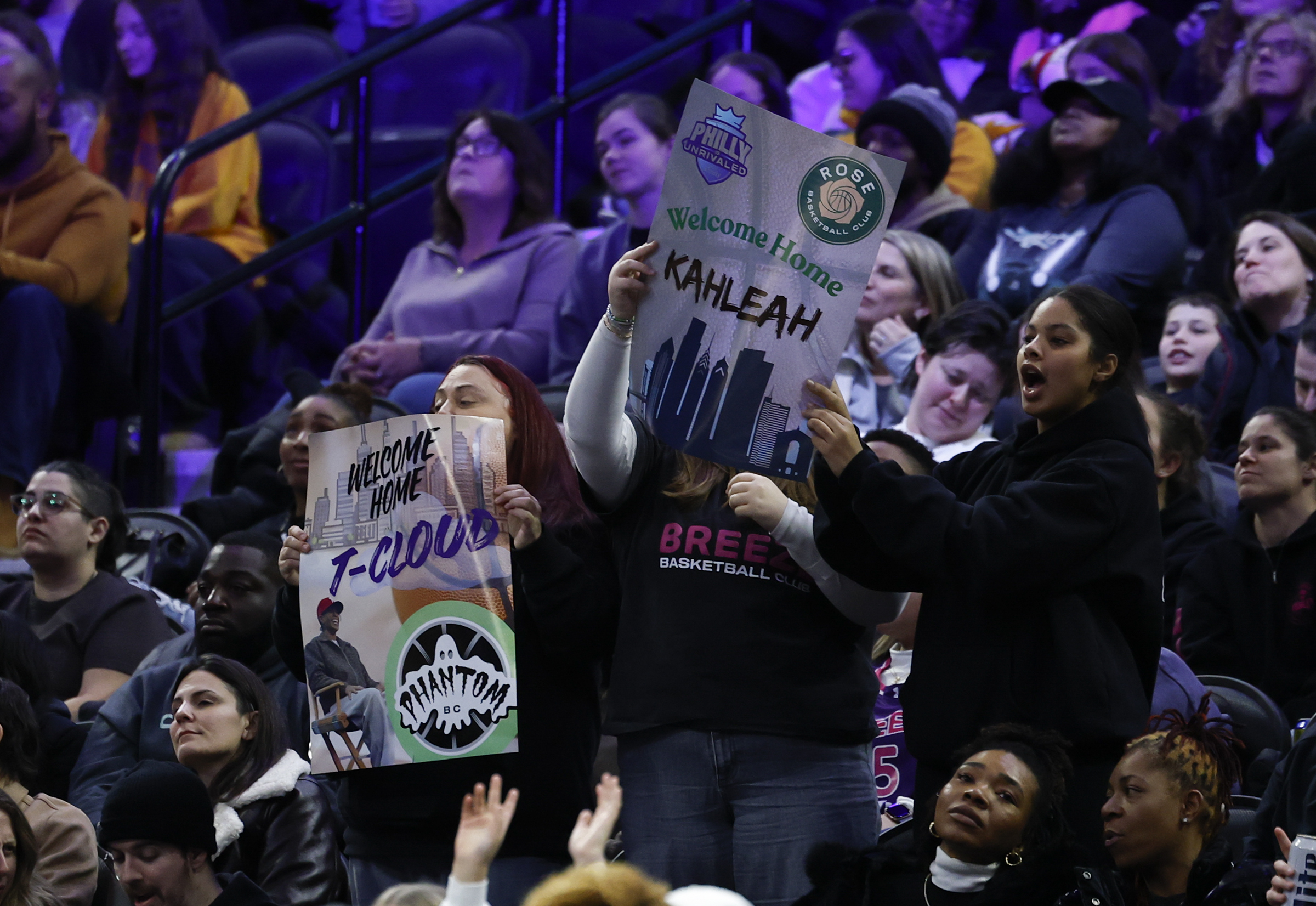
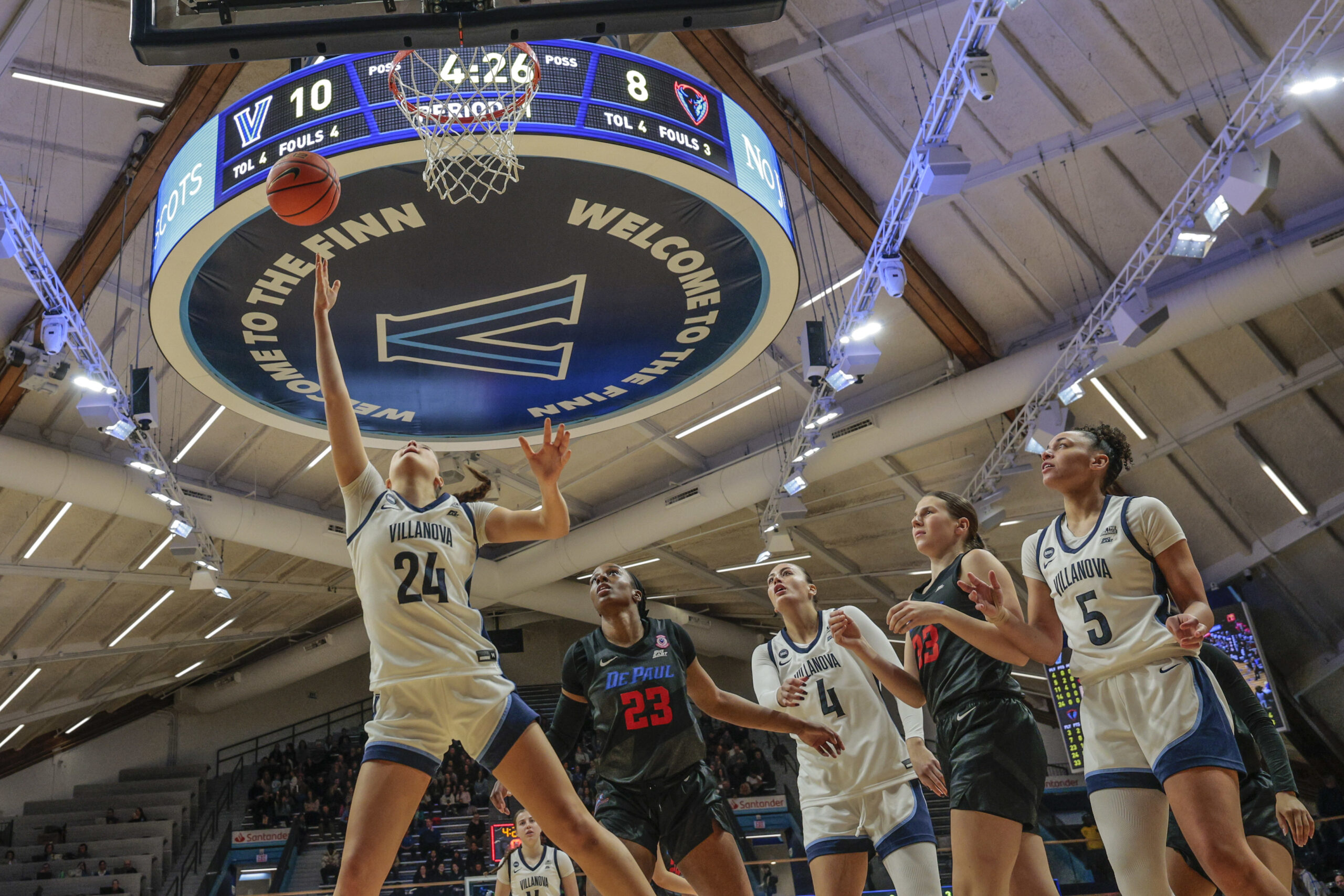
Just look at Saturday’s 69-56 win over DePaul at Finneran Pavilion.
Senior guard Ryanne Allen accounted for 17 points for the Wildcats (16-5, 9-3 Big East) and was their second-leading scorer behind sophomore guard Jasmine Bascoe (27 points).
The 6-foot-1 Perkasie native aims to bring a spark and is averaging 9.0 points and 2.3 rebounds, mostly off the bench.
“Our bench has been tremendous,” said Villanova coach Denise Dillon said. “I think any of them are capable of being in that starting lineup, with Ryanne, Dani [Ceseretti], and Brooke Bender. They generate a lot of offense for us. It’s so nice to have that spark coming off the bench.”
Bringing a ‘spark’
Allen’s specialty has been her consistent shooting from beyond the arc, where she’s averaging 48.7% this season. Against DePaul, she shot 5-for-6 from the field, including 3-for-4 in three-pointers.
Allen led the Wildcats to a strong finish against the Blue Demons (5-18, 2-10), contributing a three-pointer and a layup on consecutive possessions in Villanova’s 7-0 run in the final two minutes of action. She also led Villanova with seven rebounds, as it edged DePaul, 38-34, on the boards.
Dani Ceseretti shoots over DePaul’s Michelle Ojo during the first quarter at the Finneran Pavilion on Saturday.
“The big challenge today [against DePaul] was rebounding,” Dillon said. “It’s been a challenge for us as a team. So we crowned a rebounding leader today, and Ryanne was awarded the crown today. I think we’ve got to compete against each other. If we’re doing that, then we’re getting better.”
Although she has only started one game this season, Allen’s experience and sharp shooting have made her a crucial part of the rotation.
“When I come in, I just want to make an immediate impact and bring energy to those who have already been out there,” said Allen, who’s in her second season at Villanova after spending the first half of her college career at Vanderbilt. “Being on the bench, you’re able to see things, see what’s happening out there. So I want to bring that energy and see what I can do to help the team in any way.”
Allen is embracing the opportunity to finish her college basketball career not far from where it started, at Archbishop Wood.
“That’s one of the reasons I came back here, to be able to have my family here, especially to be able to see my siblings, my parents, grandparents, and aunts show out for me every game,” Allen said.
Every game will be crucial in the final stretch of conference play before the Big East tournament. Allen hopes that the energy she brings to the court will reverberate around the rest of the team.
The Wildcats next travel to Indianapolis for a matchup with Butler on Wednesday (7 p.m., ESPN+).
“In February, you’ve already played every [Big East opponent], so everyone knows what you can do, and they see your strengths and your weaknesses,” Allen said. “So it’s important to be able to find different ways to win, continue to put our foot in the gas and push forward when everyone’s trying to get as many wins as possible.”