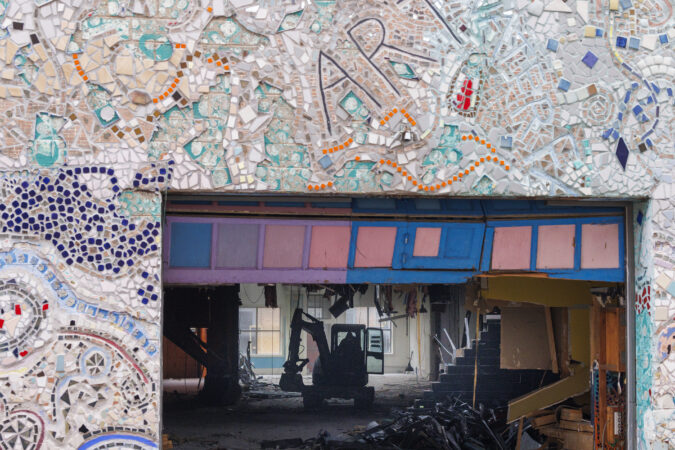
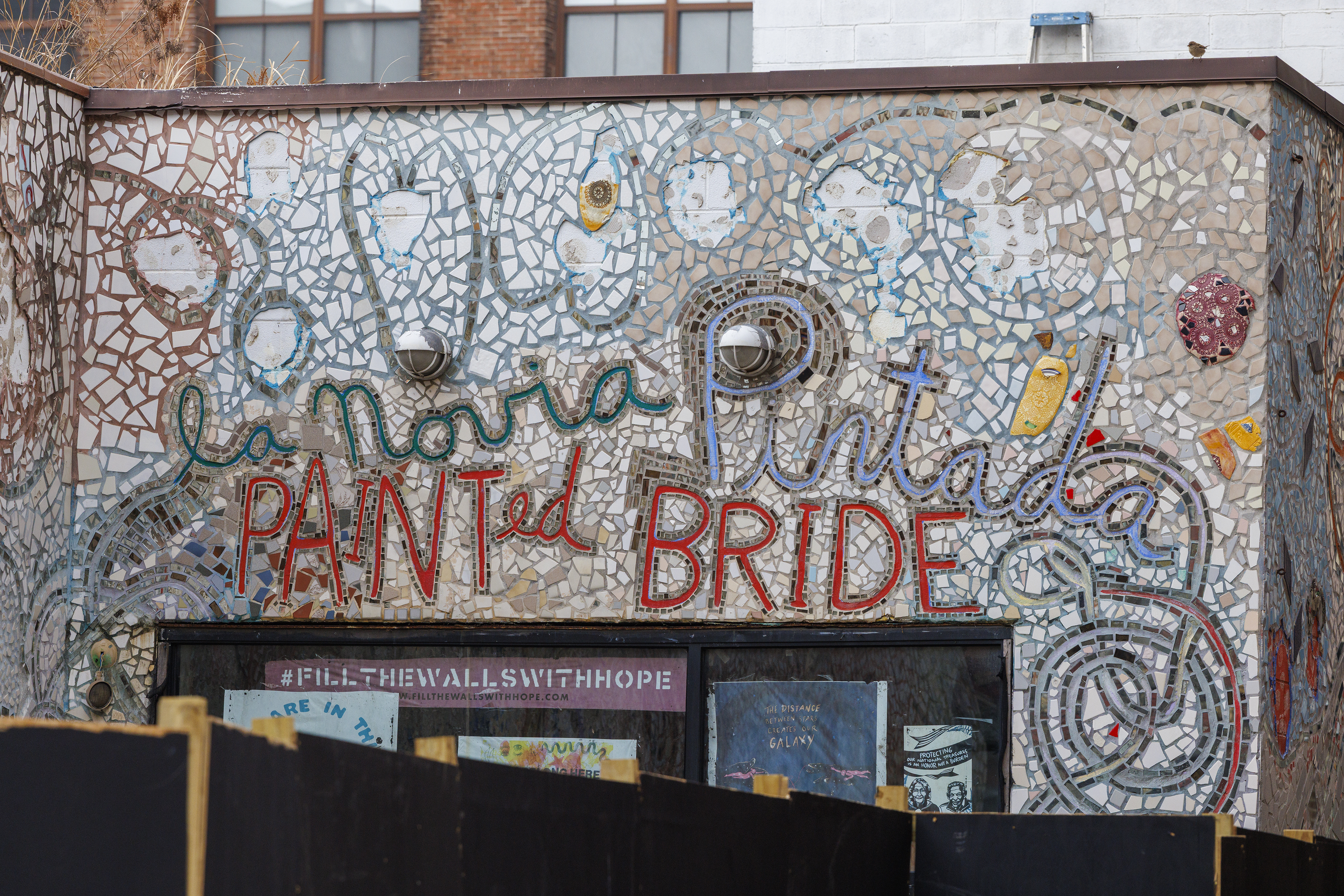
Eight years after the Philadelphia arts community learned it could lose the 7,000-square-foot mosaic that for decades wrapped around an Old City building, the structure’s current owner has started to demolish it.
The fate of the building was the subject of an almost six-year legal battle. Artists and preservationists wanted to save the building. Neighbors opposed a developer’s plans to preserve it.
That developer — architect and building owner Shimi Zakin of Atrium Design Group — had proposed constructing apartments above the mural with a design The Inquirer’s architecture critic called “a terrific work of architecture.”
Zakin received a permit from the city in September to tear down the building. He plans to replace it with 85 apartments and about 6,000 square feet of commercial space. The new building would be six stories and 65 feet tall.
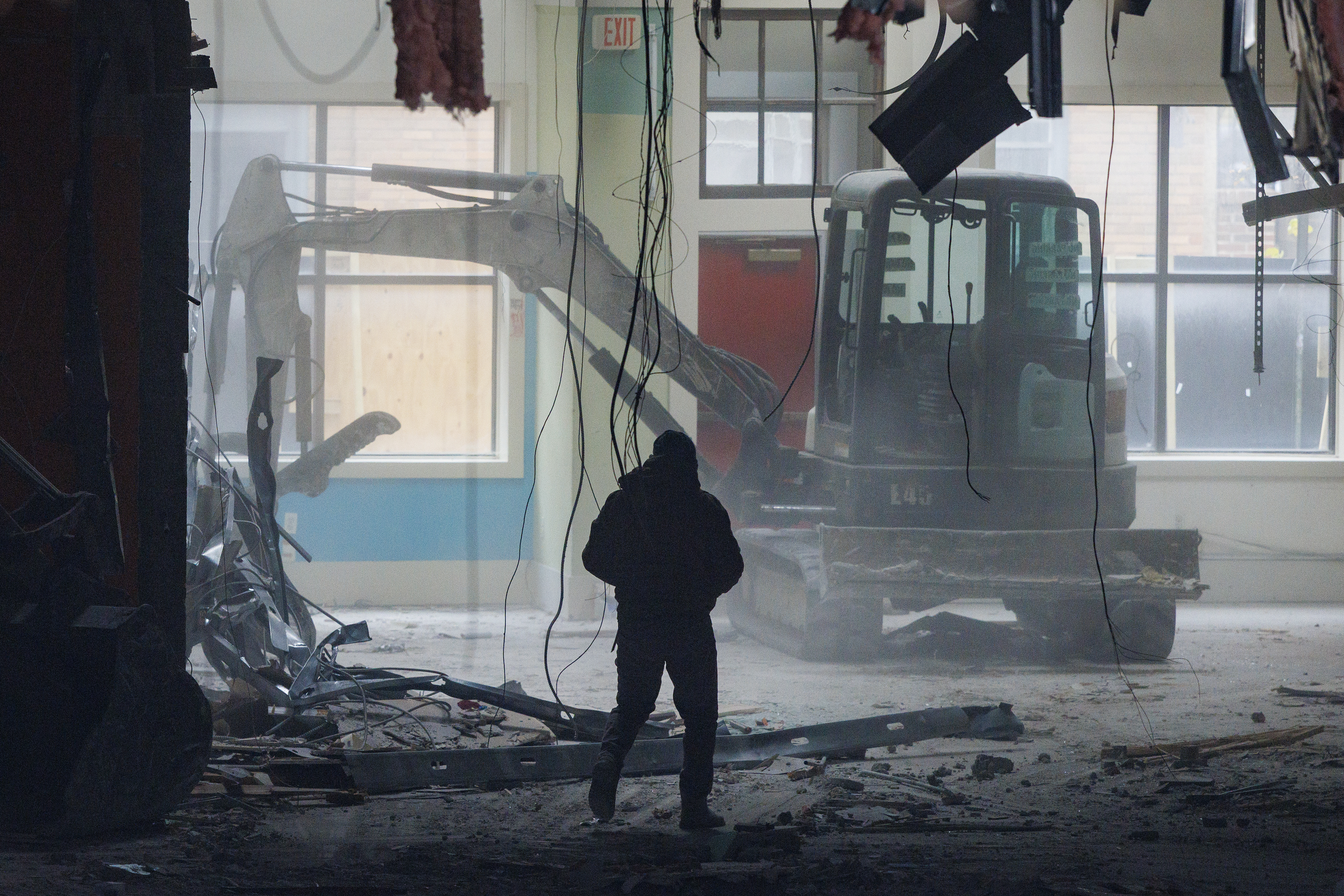
A digger operator walking through inside of the former Painted Bride building, Old City Philadelphia, Monday, December 8, 2025.
Zakin did not respond to a request for comment about the start of demolition at the site. In September, he told The Inquirer: “We are moving forward with an amazing project at an amazing location.”
He estimated that his apartment building would take about 2½ years to complete.
For now, a black wooden fence surrounds the former Painted Bride building while demolition equipment tears out its insides, and the walls await their turn.
Typical Philadelphia-area retail workers would need to make more than twice their annual wages to afford the region’s median-priced apartment, according to Redfin.
Retail workers in the Philadelphia metropolitan area, which includes Camden and Wilmington, made a median of $35,006 in 2024. But to comfortably afford the median monthly rent for an apartment in the area in October — $1,783 —they would need to make a median of $71,331, according to a report Redfin published last month.
In all 40 of the major areas Redfin analyzed, typical retail workers make less money than they need to afford the median rent for an apartment.
“As the cost of living has increased, so have the sacrifices renters must make to afford a place to live,” Daryl Fairweather, Redfin’s chief economist, said in a statement. “Since most retail workers don’t earn enough to afford the typical apartment, many are opting to share rent with a family member or friend, move far away from their job, or live in a very small space.”
A typical U.S. retail worker would have to work 83 hours per week to afford the typical apartment alone.
Renters struggling
Rents are considered affordable if they are no more than 30% of a renter’s income. A growing number of Philadelphia renters are spending more than 33% of their income and struggling to pay rent, according to Census Bureau data.
In a nationwide survey in May of about 1,600 renters, almost one in four said they regularly or greatly struggle to afford housing costs, Redfin found. Renters said they were diningout less, taking fewer vacations, and borrowing money from family and friends to pay their rent.
In Redfin’s November report, even retail workers with wages in the top 25% earn 44% less than they need to afford the median-priced apartment.
Data on rent affordability for retail workers in the Philadelphia metro area closely mirror national trends.The typical U.S. retail worker made $34,436 in 2024 but would need to make $71,172 to afford the typical apartment, priced at $1,779 in October.
Rents have gotten slightly more affordable for the typical retail worker in the last few years. Prices aren’t rising as much because of all the apartments that have been built in recent years.
window.addEventListener(“message”,function(a){if(void 0!==a.data[“datawrapper-height”]){var e=document.querySelectorAll(“iframe”);for(var t in a.data[“datawrapper-height”])for(var r,i=0;r=e[i];i++)if(r.contentWindow===a.source){var d=a.data[“datawrapper-height”][t]+”px”;r.style.height=d}}});
Bigger gaps in New York
Redfin analyzed wage data from the U.S. Bureau of Labor Statistics, and retail workers fell into three categories: cashiers, retail salespersons, and first-line retail supervisors.
The New York regionhad the biggest gap between what retail workers make and what they need to make to afford an apartment. Workers’ median annual wage was $39,185 in 2024. Workers would need to make $134,896 — almost 3½ times as much. The median apartment rent in October was $3,372.
The affordability gap for retail workers was smallest in Cleveland’s metro area — $31,982 vs. $47,654.
Editor’s note: A previous version of this story misstated the definition of the study’s metro area.
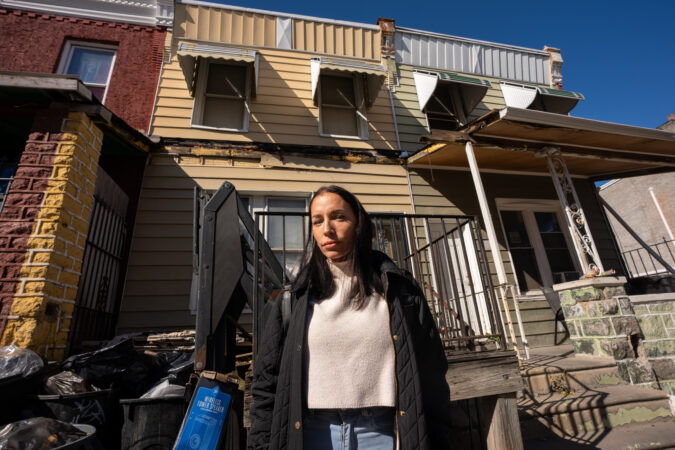
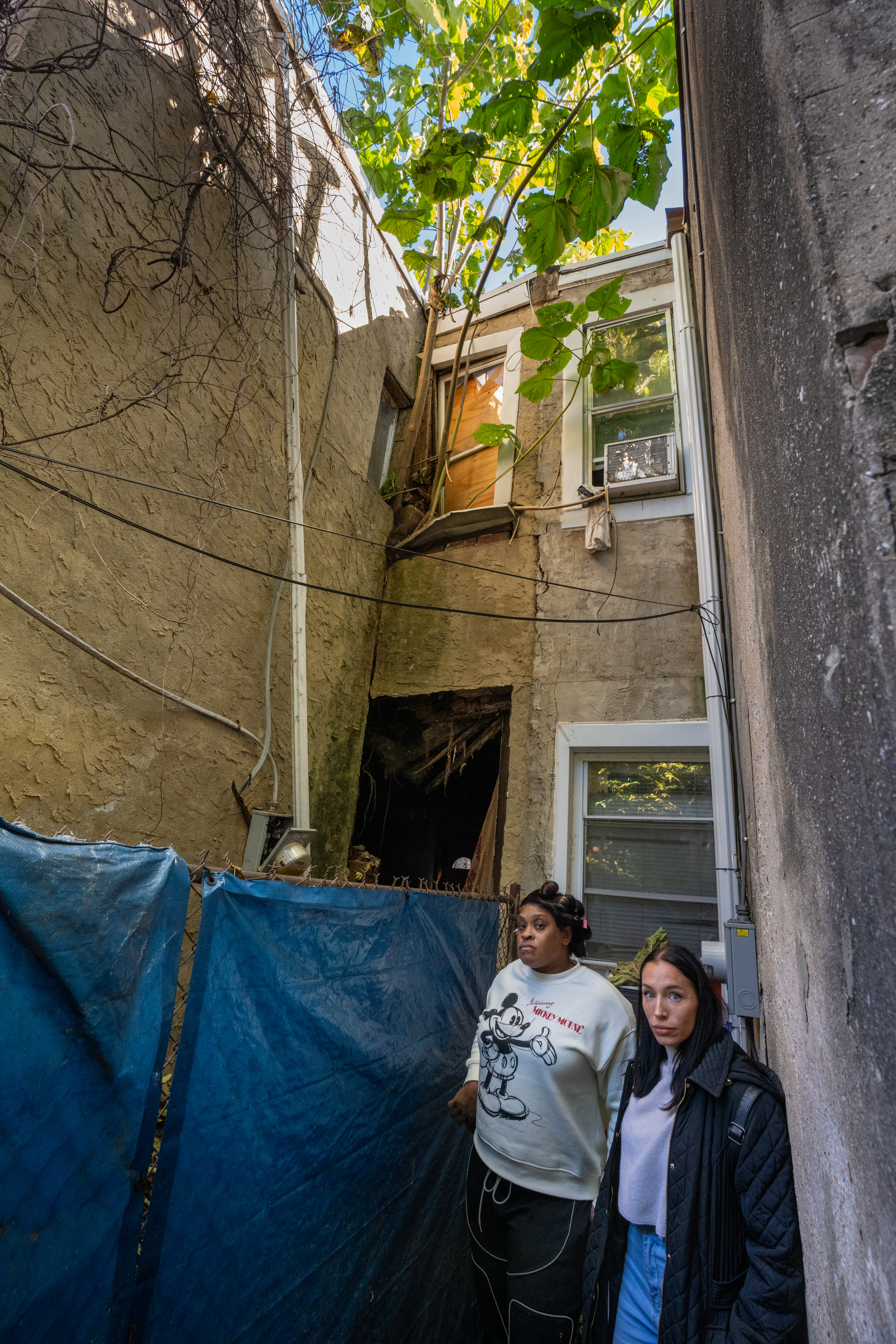
Emily Phillips and her family never slam doors or walk too heavily inside their North Philadelphia rowhouse. They’re afraid of what too much movement could do to the vacant house next door.
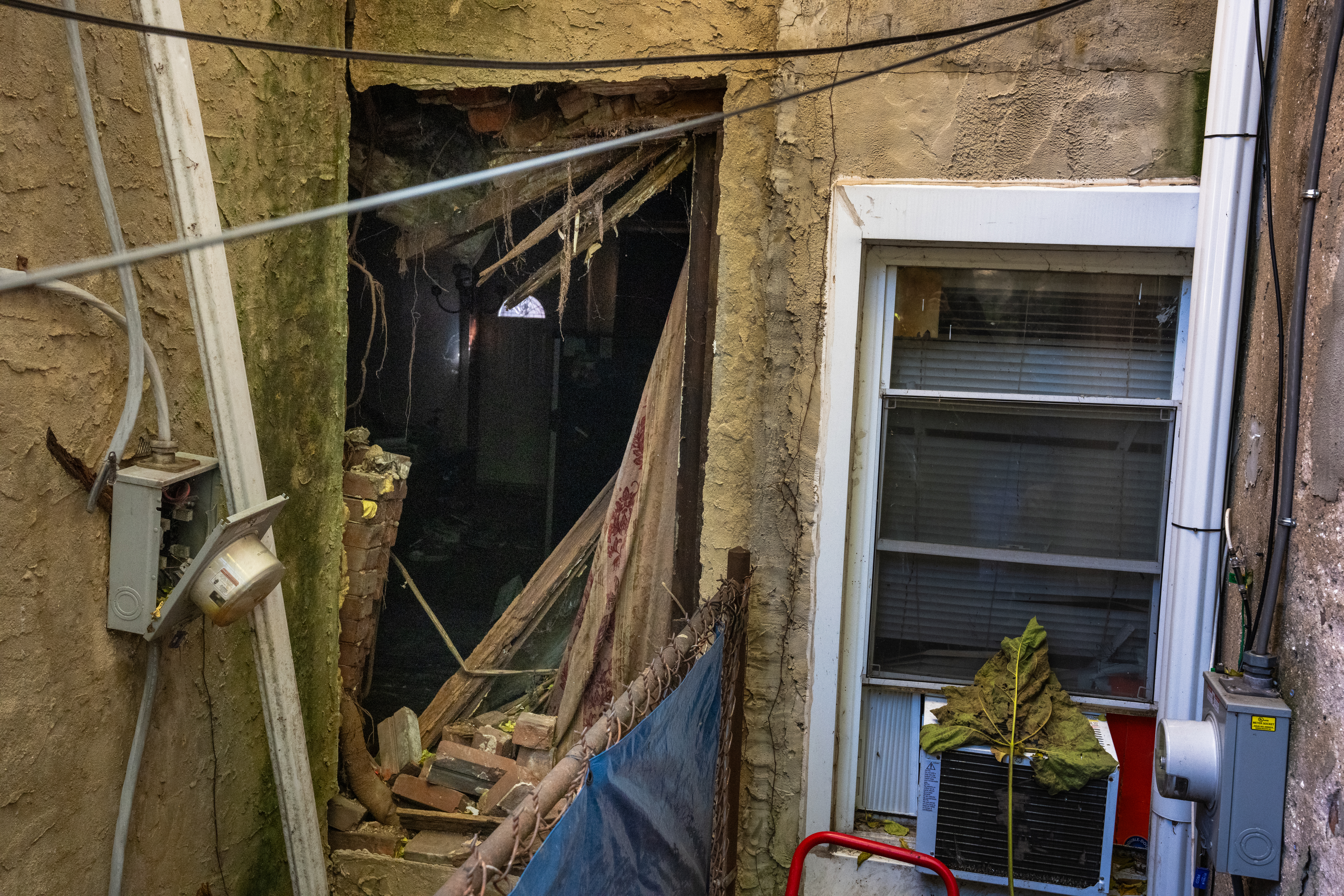
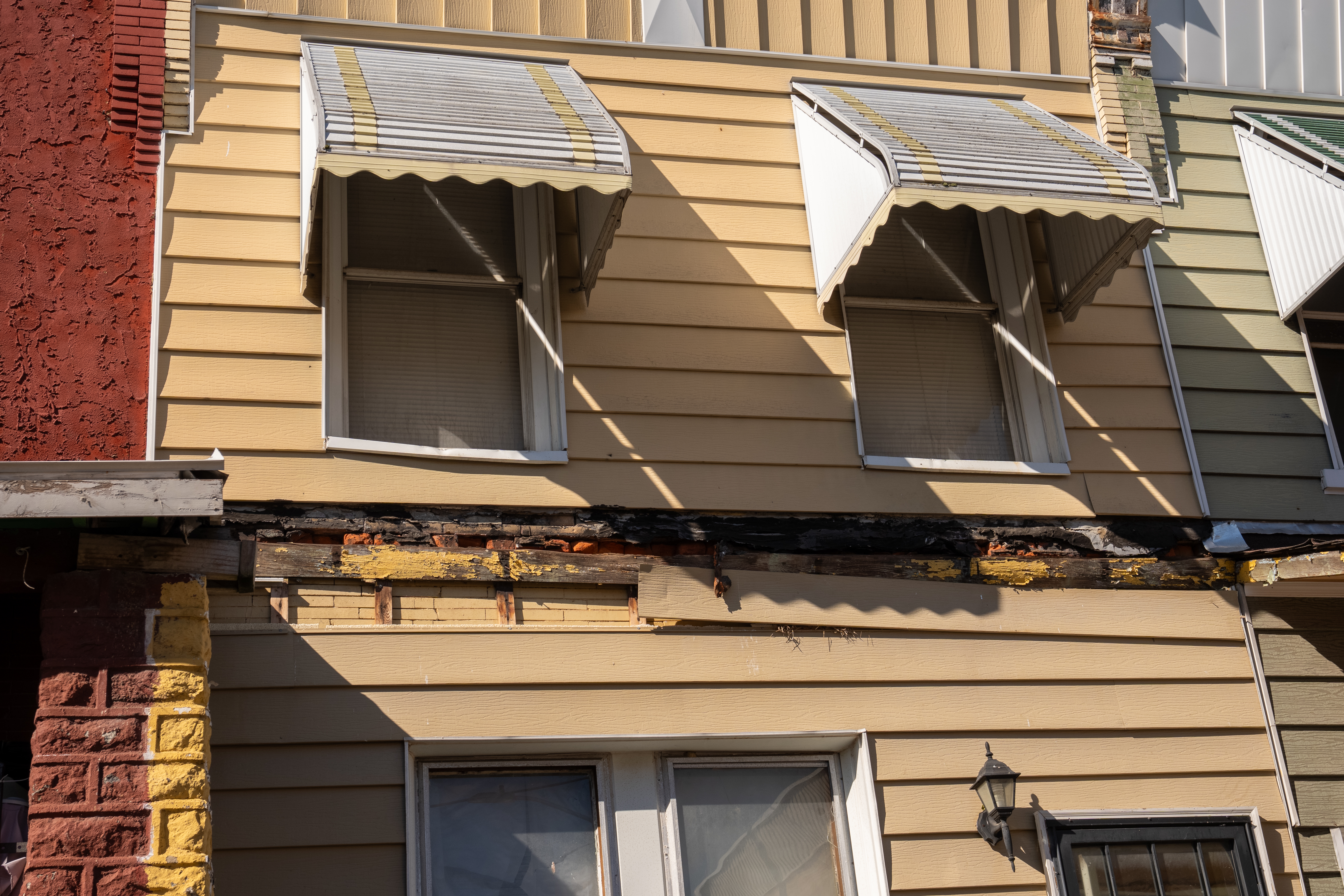
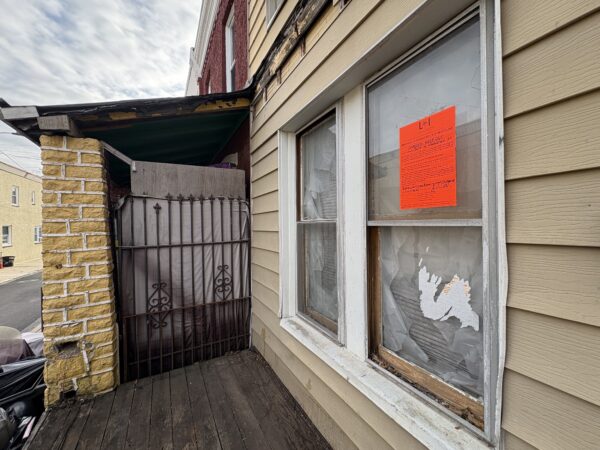
In early August, a back window and part of a wall came crashing down during harsh winds and rain. An inspector for the city’s Department of Licenses and Inspections declared the vacant rowhouse “imminently dangerous,” which means it is at risk of collapsing.
“I never know when something’s going to actually happen,” Phillips said in late October. “We know it’s just a matter of time. … I’m so scared right now.”
Across Philadelphia, families are living in a limbo of anxiety next to buildings that the city has determined are unsafe or imminently dangerous. The buildings at greatest risk of collapse are usually vacant.
Renters Emily Phillips (left) and Dayani Lemmon examine the basement wall that their home shares with the abandoned and dangerous rowhouse next door.
Philadelphians rely on the city to keep an eye on vacant properties that are or could become dangerous. And in 2016, the city rolled out a method for determining which properties were likely to be vacant. L&I’s commissioner at the time said the inventory tool was making the department more proactive in protecting the public from deteriorating vacant buildings.
But L&I officials now say the department no longer uses the tool. They said the department mainly relies on residents’ complaints and its list of vacant property licenses — which L&I admits is a massive undercount — to monitor empty buildings.
(function() {
var l2 = function() {
new pym.Parent(‘imm_dang_map’,
‘https://media.inquirer.com/storage/inquirer/projects/innovation/arcgis_iframe/imm_dang_map.html’);
};
if (typeof(pym) === ‘undefined’) {
var h = document.getElementsByTagName(‘head’)[0],
s = document.createElement(‘script’);
s.type = ‘text/javascript’;
s.src = ‘https://pym.nprapps.org/pym.v1.min.js’;
s.onload = l2;
h.appendChild(s);
} else {
l2();
}
})();
L&I points out that property owners are responsible for securing vacant properties and repairing dangerous buildings, and the department steps in as resources and laws allow.
Around the time Inquirer reporters spoke with Phillips, the city’s spreadsheet of likely vacant properties listed about 8,000 vacant buildings — a potentially serious threat to their neighbors. An Inquirer analysis of the city’s list of imminently dangerous buildings showed that 79% of those also appeared on the list of likely vacant buildings.
Just under half of those vacant and imminently dangerous buildings were rowhouses, which are especially risky to neighbors because of shared walls. This risk is not borne equally by all of Philadelphia’s residents.
Emily Phillips and her landlord, Samantha Wismann, stand next to a neighboring abandoned rowhouse, where part of a wall collapsed and a tree grows inside.
Nearly eight in 10 of all such rowhouses are in the poorest 25% of the city’s zip codes. The zip code with the most such rowhouses — 19132, where Phillips lives — has a median income of $31,000, according to the latest Census Bureau data. Philadelphia’s median household income is $61,000.
Seven in 10 vacant rowhouses that the city identified as imminently dangerous are in the 34% of the city’s zip codes that are predominantly Black. Roughly nine in 10 residents in 19132 are Black.
Dianna Coleman, a community activist who lives in Southwest Philadelphia, called vacant properties “one of Philadelphia’s most pressing and overlooked crises.”
This summer, a hole opened in the back of an abandoned rowhouse that is connected to a North Philadelphia house owned by Samantha Wismann.
When Coleman and a group of residents in Southwest and West Philadelphia came together last summer to organize around quality of life issues, residents’ top concern was fixing vacant properties. They partnered with the grassroots social justice nonprofit OnePA and launched their first campaign — asking the city to deal with abandoned buildings and vacant lots.
“While we recognize that the city has taken steps — demolishing some buildings, addressing some lots — the pace is way too slow, the resources too scarce, and the strategy too weak,” Coleman, cochair of OnePA West/Southwest Rising, said at a news conference this summer. “Unsafe buildings are left standing for years, growing more hazardous, pulling down property values, and pushing people out of their homes.”
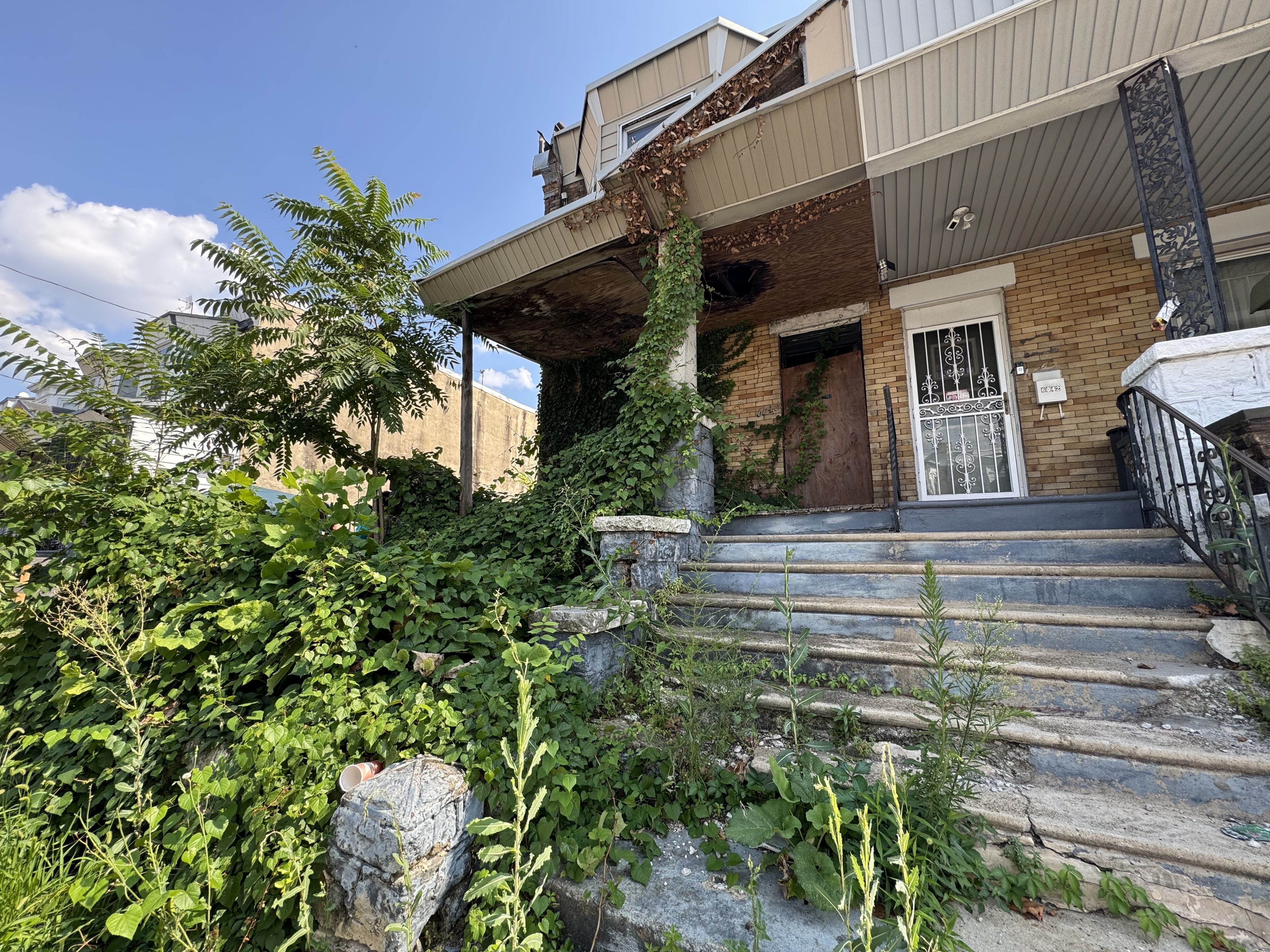
The vacant rowhouse next to Emily Phillips’ North Philadelphia home had its collapsing porch roof removed, but the rest of the home remains in disrepair.
The city’s questionable vacancy data
About a decade ago, the city started using an algorithm that takes feeds from a variety of datasets (such as whether a property has had its water cut off) to determine whether a property is likely to be vacant.
City officials celebrated the tool when it launched.
“Protecting the public from deteriorating vacant, abandoned properties as they grow more and more likely to collapse is critical to L&I’s mission,” former L&I Commissioner David Perri said in a 2016 news release announcing the index. “The Vacant Property Model and dataset are making us more proactive and strategic in carrying out that mission.”
But the reliability of the city’s list of likely vacant buildings and lots was recently called into question by individuals who have worked closely with the tool and collaborated with city officials in the past.
For more than three years, Clean & Green Philly, a nonprofit that — until its closure earlier this year — used data to help Philadelphians deal with vacant properties in their neighborhoods, relied on the city’s tool in combination with other data to identify vacant properties in greatest need of addressing.
But last year, founder Nissim Lebovits and the organization’s former executive director, Amanda Soskin, noticed something was wrong.
For years, the city’s list of suspected vacant properties had hovered somewhere around 40,000 records — buildings and land combined. But then, according to Lebovits and Soskin, that number plunged to around 24,000 in June 2024.
“And at first I was like, ‘OK. Something’s probably broken,’ and we looked into it,” Lebovits said. “And we realized that the city’s actual underlying datasets were no longer reporting the same number of vacant properties.”
window.addEventListener(“message”,function(a){if(void 0!==a.data[“datawrapper-height”]){var e=document.querySelectorAll(“iframe”);for(var t in a.data[“datawrapper-height”])for(var r,i=0;r=e[i];i++)if(r.contentWindow===a.source){var d=a.data[“datawrapper-height”][t]+”px”;r.style.height=d}}});
The spreadsheet was showing only about 14,000 records as of this June, according to Lebovits and Soskin.
Then at some point between June and early November, the index grew to about 37,000 total properties.
Inquirer reporters began investigating the connection between vacancy and structural deficiencies in buildings after the April collapse of an abandoned rowhouse in Sharswood. At that time, L&I offered the vacancy index while asserting it could not provide detailed information about the data and referring reporters to CityGeo, the department that developed and maintains the index.
At no point during an hour-long interview with the department’s chief data officer in early June did city officials mention any concerns about the reliability of the data.
Reporters learned about issues with the data when Lebovits and Soskin wrote an article for The Inquirer’s opinion section later that month detailing their concerns. They wrote that city sources told them the process of collecting and publishing vacancy estimates “was quietly discontinued after [Mayor Cherelle L.] Parker took office.”
In an email, a CityGeo spokesperson said the city has not stopped updating the index, asserted that its accuracy depends on continued updates from various departments, and noted that CityGeo pauses updates “every few years” for “a month or so” to ensure the tool continues to work, most recently this past summer.
The spokesperson did not respond to questions about why the index’s size had varied so greatly recently. Lebovits and Soskin told The Inquirer that nobody from the city reached out to them after their article was published.
“My big takeaway here is that the lack of transparency around this dataset is a major liability,” Lebovits wrote in an email. “Having so little accountability regarding data production and quality seriously hampers any community groups trying to use these data and undermines the credibility of the City’s vacancy work.”
The tree inside an abandoned North Philadelphia rowhouse towers above the roofs of the house and its neighbor, owned by Samantha Wismann.
‘Very, very scary’
When Phillips’ landlord, Samantha Wismann, bought the house on North Woodstock Street in 2020, she didn’t know that its neighbor was vacant.
Wismann noticed the house looked a little shabby, but it wasn’t until Phillips moved in the following year that the women saw no one lived there. They didn’t know how long it had been vacant, but they watched it quickly deteriorate.
Most pressing back then was the collapsing porch roof, which was dragging down the roofs of the porches on either side of it.
Someone eventually tore it down. But the rest of the home remains in disrepair.
“It’s very, very scary,” Wismann said in October, “because eventually, if it’s not handled, it’s gonna come down.”
Cracks snake between the homes.
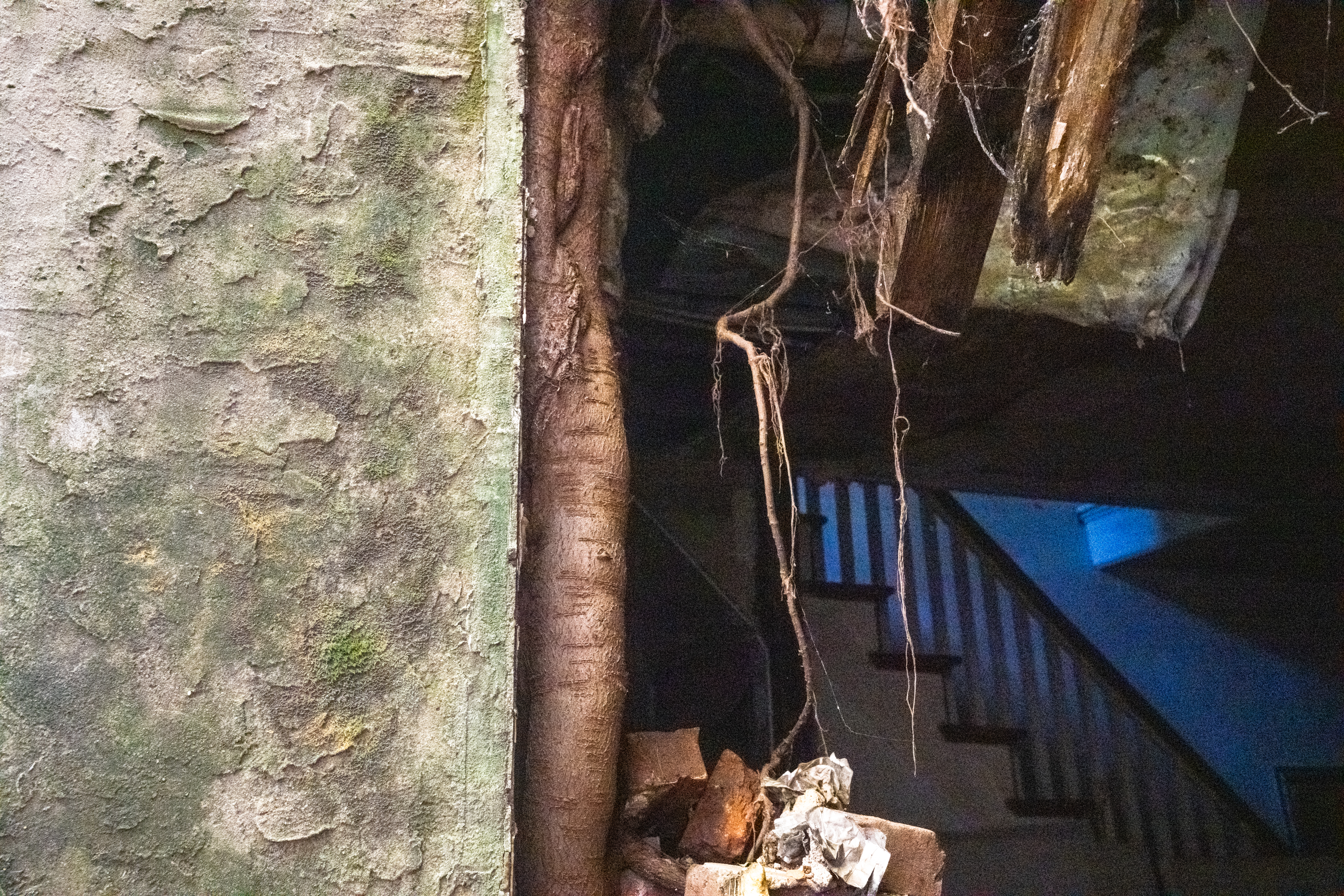
From the women’s backyard, through the door-sized hole in the back of the neighboring house, they can see past splintered beams and an abandoned refrigerator, beyond the staircase that leads to the second floor, and straight through to the front door.
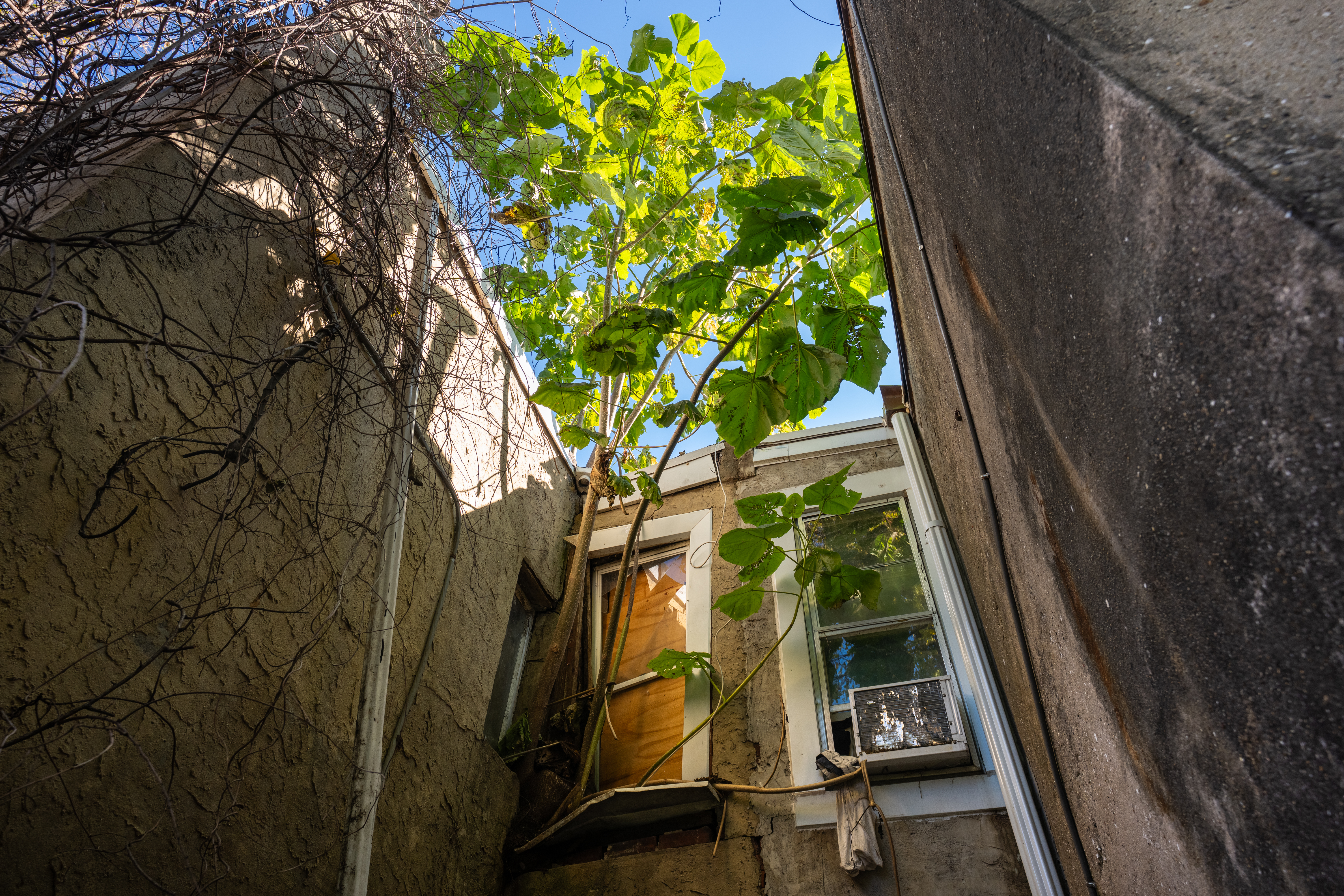
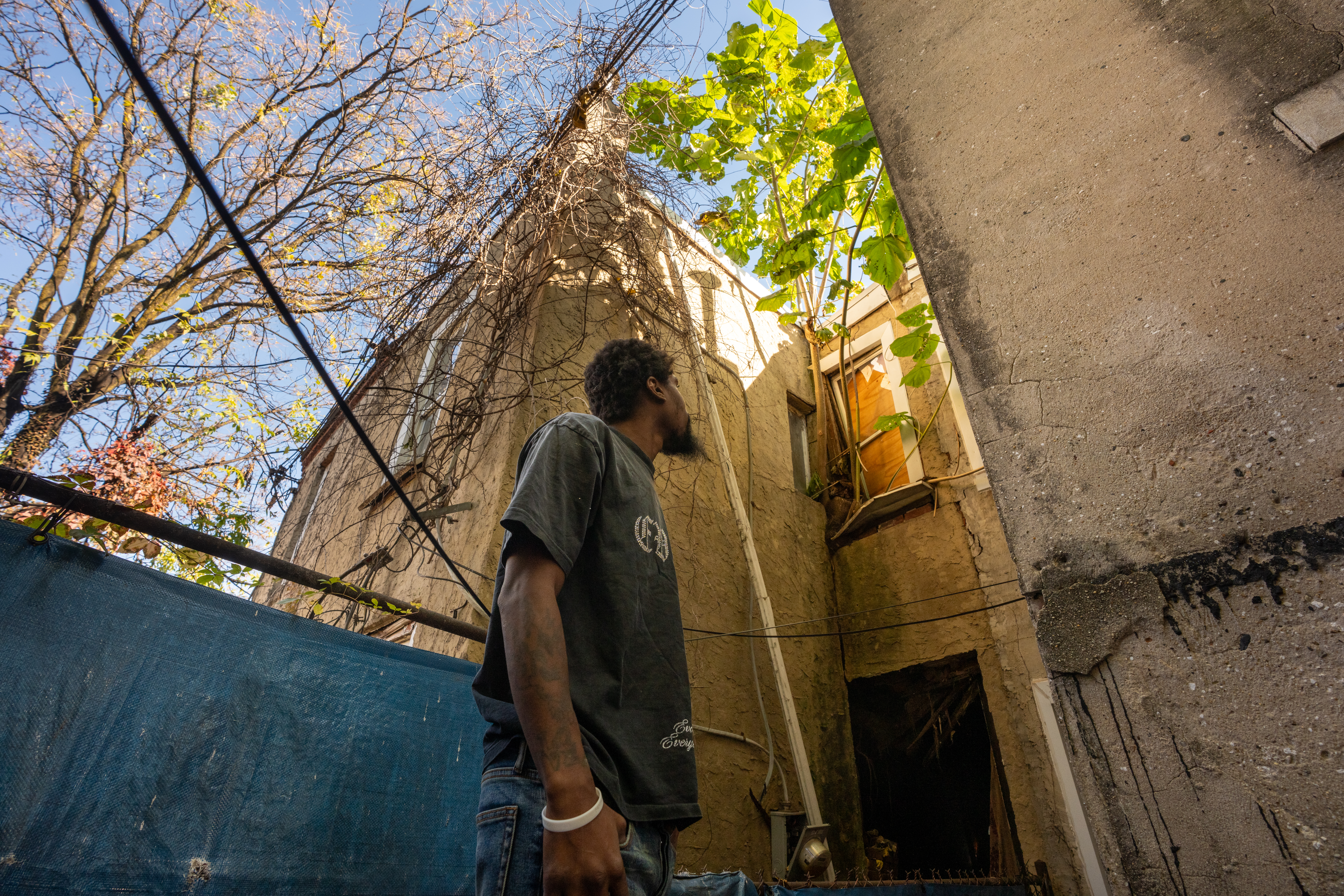
Then there’s the tree that’s growing inside the vacant house. It has pushed outward through bricks and plaster and busted a second-story window. The tree’s branches tower over the homes, and some have reached the window of the bedroom where Phillips’ grandchildren stay.
L&I’s Contractual Services Unit is responsible for inspecting unsafe and imminently dangerous properties and administers the city’s demolition program. The unit has 10 members and openings for two more inspectors, said Basil Merenda, commissioner for L&I’s Inspections, Safety & Compliance division.
“We’re out there doing our job,” he said. “We’re out there making sure that these unsafe and [imminently dangerous] properties are properly addressed through procedures and that public safety is always being maintained.”
Renter Dayani Lemmon looks at the abandoned property located next door to his home in North Philadelphia.
But a 2024 report by the City Controller’s Office said the unit used to have 15 inspectors, which the office said was not enough to keep up with inspections of unsafe and imminently dangerous properties.
Merenda said L&I is “making do with what we have” and mobilizes inspectors in other units when needed.
After L&I declares a property to be unsafe or imminently dangerous, it must issue notices to the property owner, who is responsible for repairs. The department can take unresponsive owners to court and pursue demolition in emergency situations, such as when a property is likely to collapse, is next to an occupied building, and has recent structural failures, Merenda said. The city demolishes imminently dangerous buildings in order of the risk officials determine they pose.
A tree can be seen growing inside the vacant North Philadelphia rowhouse through a hole in the back wall, which partially collapsed this summer.
The city charges owners for tear-down costs and places liens on properties if they do not pay.
L&I was unable to say how many such tear-downs the department has conducted this year and referred questions about the cost of demolitions — and the proportion of those costs recouped from owners — to the city’s Department of Revenue. The revenue department did not provide any figures to The Inquirer.
“In many, many cases, property owners surface at the last minute and request a continuance, request a temporary restraining order from us going in and demolishing the property,” Merenda said. “And you know, that’s the purview of the courts. It’s beyond us.”
In the meantime, people living next to dangerous properties are left in the dark.
Kate and Dan Thien and their daughter stand in the backyard of their Port Richmond home, the foundation of which is cracking because of weed trees next door.
Frustrated with L&I
After the back of the abandoned rowhouse on North Woodstock Street opened up this summer, Phillips led an L&I inspector through her home so he could see.
“He went in the backyard, he looked over and was like, ‘My god!’” Phillips said. “I said, ‘Yeah, I can see right through their house.’ And he looked up and was like, ‘It’s a tree!’ I said, ‘Yeah, the tree is pushing the house out.’”
The inspector put an orange “imminently dangerous” notice on a front window, and Phillips and her landlord thought they wouldn’t have to worry much longer. But days after the notice went up, it was ripped down.
Weeds from the neighboring vacant property surround Kate and Dan Thien’s home in Port Richmond.
The property has attracted rats and mice. Water leaked into Phillips’ basement until her landlord reinforced the shared wall with concrete.
For months, her landlord got no response from the city to her calls and emails asking for help.
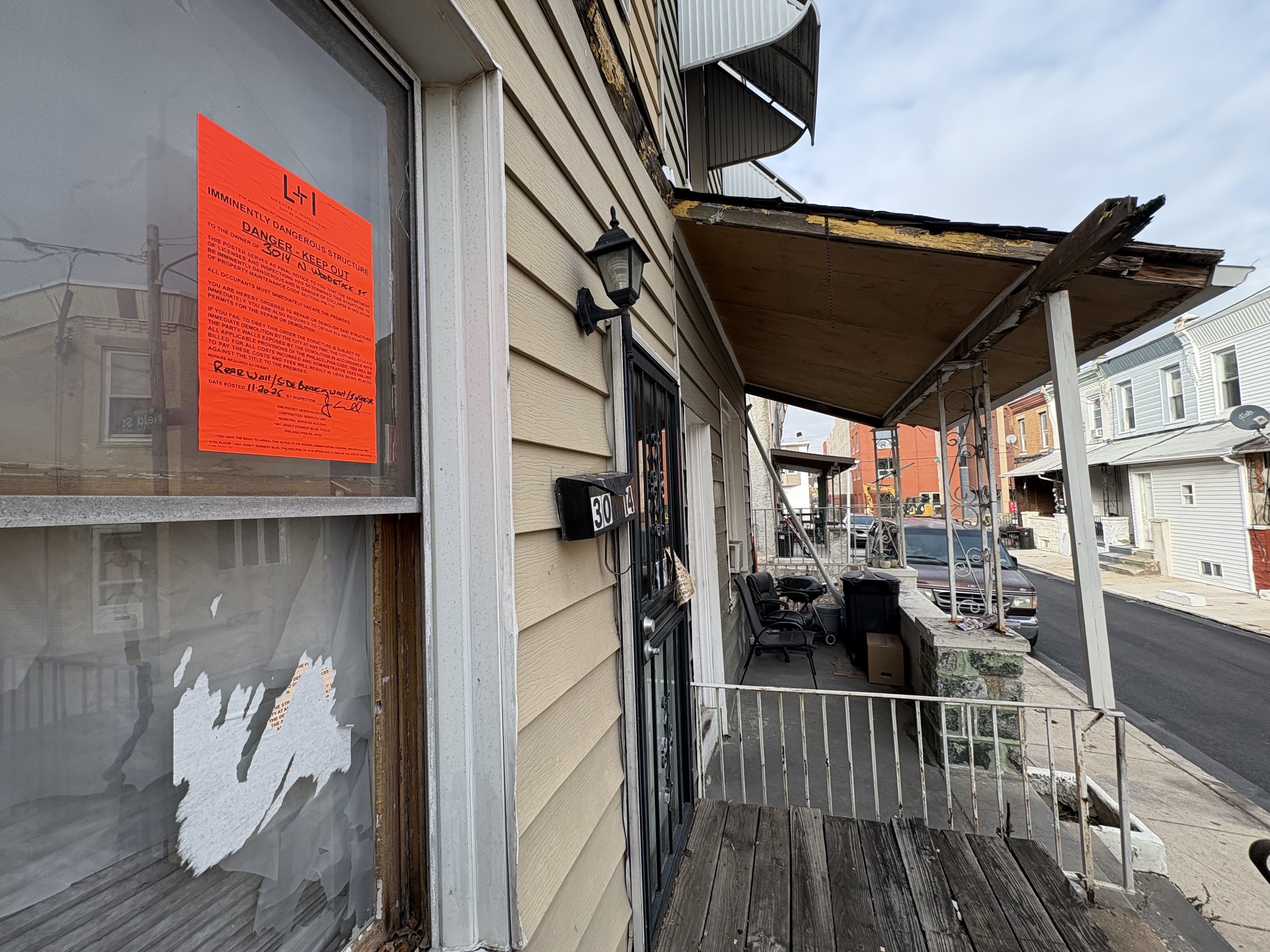
On Nov. 20 — 3 ½ months after the partial collapse — an L&I inspector visited the vacant rowhouse to post a “final notice” that the owner must repair or demolish the home or else the city will have it demolished.
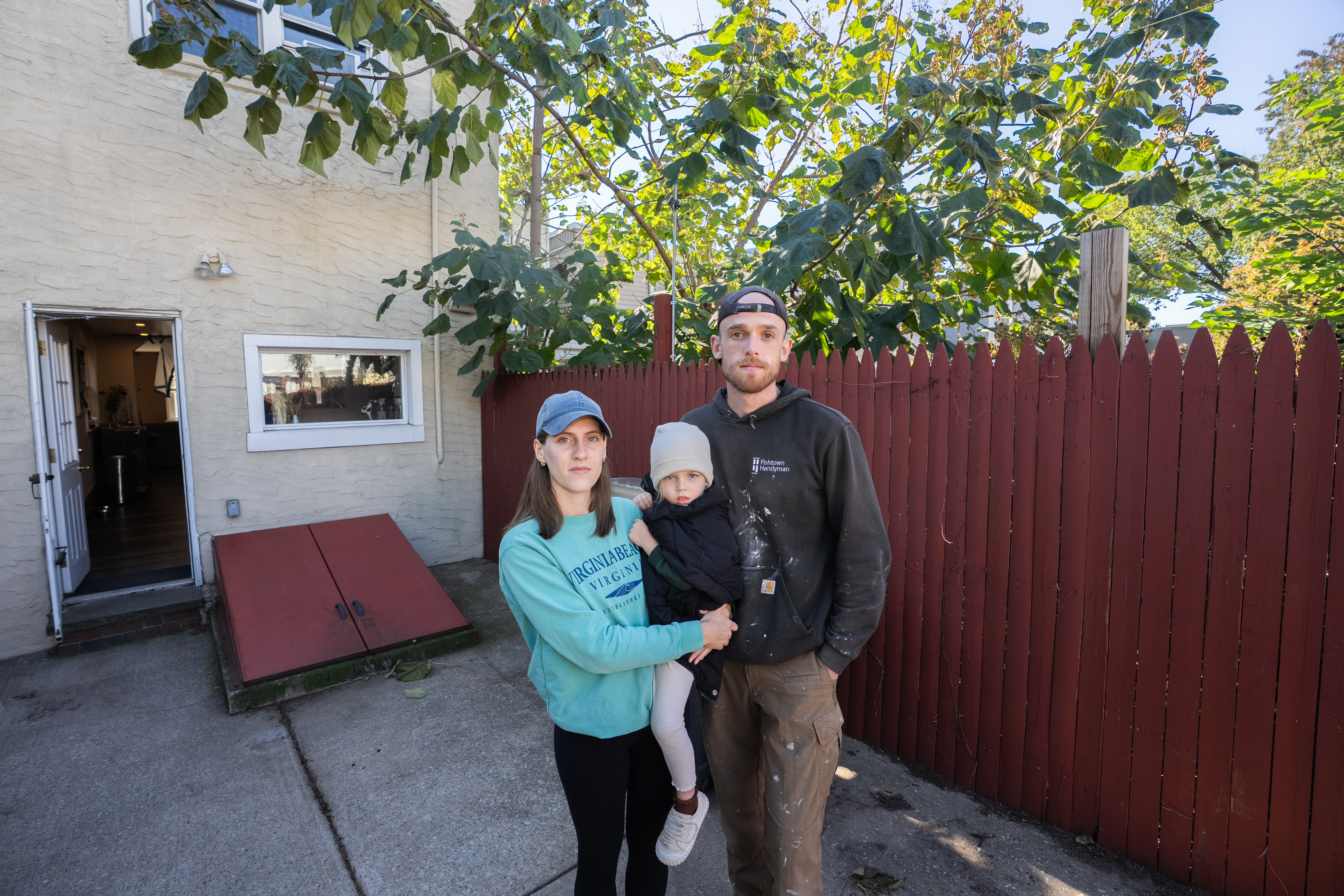
Kate and Dan Thien are trying to live with the vacant property next to their rowhouse in Port Richmond as they wait for the city to respond to their 311 complaints.
When they bought their house in February 2024, they saw that the neighboring backyard was a mess, but they didn’t know the house was vacant.
Renters who had lived in what is now the Thiens’ home had used and maintained the neighboring backyard. But it quickly became overgrown. Neighbors later told the Thiens that the home had been vacant for more than a decade.
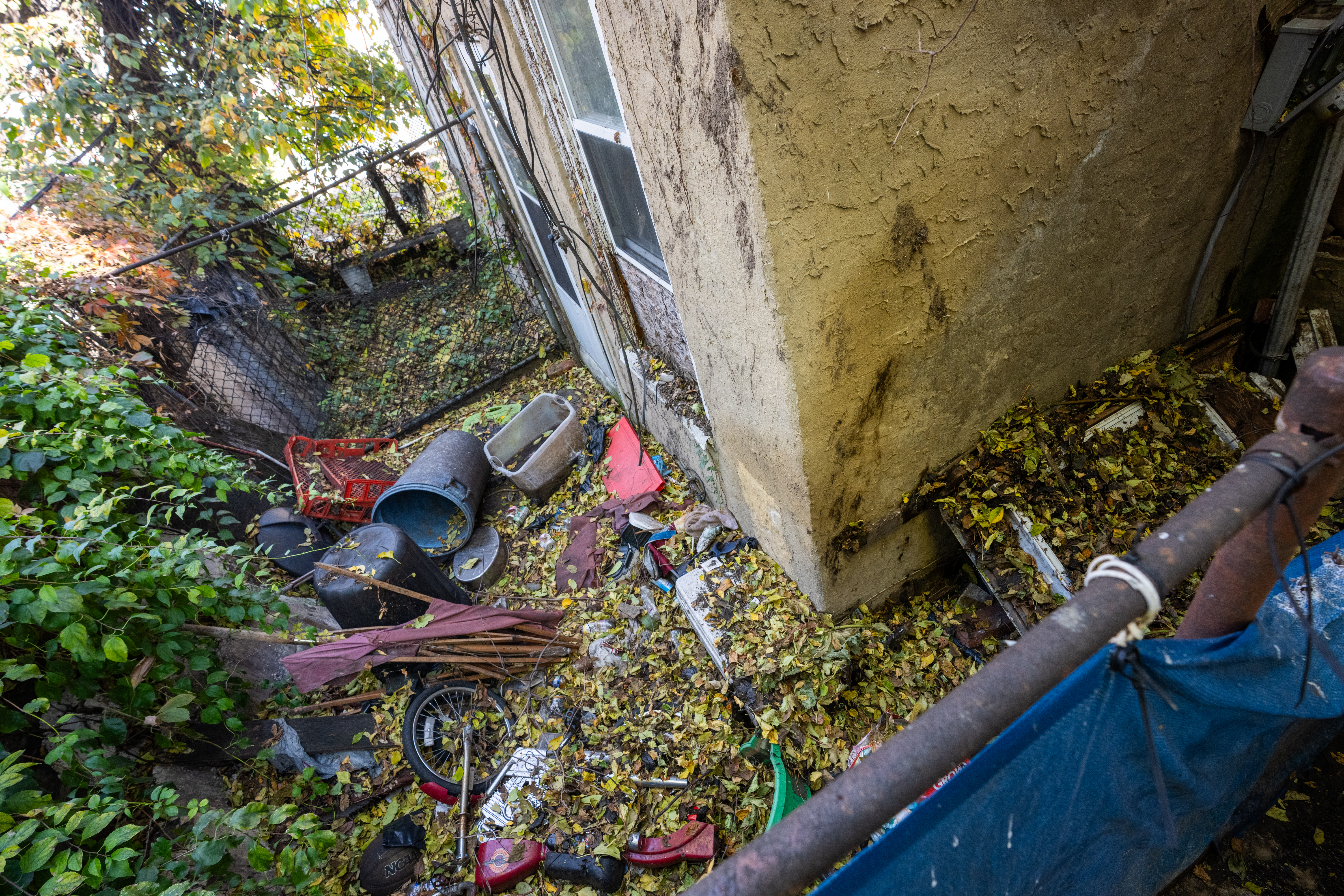
The backyard of the abandoned North Philadelphia rowhouse is full of debris.
“Pretty much the entire neighborhood knows about this house,” Kate Thien said.
She and neighbors on the other side have filed complaints with the city. The property has racked up 19 violations since 2012. Public records show that the city cited the property for “high weeds” last fall and most recently inspected it last December. The property passed inspection.
A year later, a weed tree’s branches stretch above and behind the Thiens’ two-story home. Tree roots are growing into their home’s foundation and cracking the concrete. Trees are “very rapidly growing” as Thien waits for the city to do something, she said. She worries about her home’s property value as the situation worsens.
This abandoned property on Spruce Street in West Philadelphia, pictured on July 30, was one of the houses on a list of problem vacant properties compiled by OnePA West/Southwest Rising.
“It’s not going away,” she said.
Annette Randolph and her husband, Dennis, live in a Point Breeze rowhouse next to a home that’s been vacant for more than a decade and that the city classifies as unsafe, a step below imminently dangerous. Four generations of her family have lived in her home. She hopes she’s not the last.
A tree growing inside the vacant house burst through its back roof, next to a tarp-covered hole. Randolph has had to repair her own roof because of damage from next door. Water gets into her basement.
The home’s legal owners are dead. A scheduled sheriff’s sale in 2011 for overdue property taxes gave Randolph hope for a resolution. But right before the sale, someone paid part of the tax bill to stop it.
On Nov. 20, an inspector with Philadelphia’s Department of Licenses and Inspections posted a final notice on the vacant North Philadelphia rowhouse that says owners must repair or demolish the home.
Now, “for sale” signs hang in the front windows, and a contractor showed up last week. Randolph hopes any work on the house won’t damage the one she’s called home for 66 years.
She has lost track of the number of times she’s called 311 about the situation. She’s felt helpless. When she needed new homeowner’s insurance, companies told her they wouldn’t insure her or would charge more because of the attached vacant and unsafe house.
“L&I and the city I blame for allowing this type of stuff to happen,” Randolph said.
Merenda said L&I hears neighbors’ complaints, “and we’re going to try to take action as efficiently and properly as possible.”
“I want to make, during my watch, L&I more accessible, responsive, and accountable to the neighbors, stakeholders, contractors, developers, average citizens, the City Council,” he said.
A collapsing roof was removed but the rest of the vacant rowhouse was left to deteriorate.
Neighbors band together
In September 2024, OnePA West/Southwest Rising launched its campaign to get the city to deal with abandoned properties.
The group created a list of 20 of the worst ones as submitted by neighbors. Among the vacant buildings, some had collapsing porches, one’s basement had flooded and damaged a neighbor’s house, and one’s walls were crumbling. Some had squatters, including a property where human waste was dumped in the backyard.
City Councilmember Jamie Gauthier’s office got the group a meeting with staff at L&I this January.
As a result, this summer, the group celebrated successes: five lots cleaned by the Pennsylvania Horticultural Society, three properties cleaned and sealed by the city, five properties whose owners the city took to court, and three properties that were repaired and returned to use.
The group believes it was able to get L&I to act because it had the weight of a Council member behind it.
“I do think L&I is overwhelmed. I don’t think they have enough staff to really stay on top of this,” said Eric Braxton, project director for OnePA West/Southwest Rising. “But clearly there are people in leadership that care about our communities and are trying to do the right thing.”
Now the group plans to push for systemic change. It wants the city to make small repairs to stabilize vacant buildings and charge the owners.
“There’s a gap in the system when it comes to dealing with unsafe abandoned buildings,” Braxton said. “The result of that is that those buildings just get worse and worse until they are imminently dangerous and have to be demolished.”
Across Philadelphia, people live next to vacant properties that are or could become dangerous.
Drew Miller, a paralegal at the legal aid nonprofit Community Legal Services of Philadelphia, said residents living next to risky vacant buildings can take certain steps right away to protect themselves and their properties.
Take pictures. When they start having concerns, they should immediately take pictures of the inside and outside of their home, especially basements and shared walls, Miller said.
“Having those initial photos is crucial for them to very clearly show that damage happened over this period of time,” he said.
Submit a 311 request. They should submit a 311 service request to the city’s Department of Licenses and Inspections by calling or using the online portal or app. Miller recommends submitting virtual complaints to easily track updates and to upload photos to give inspectors a head start before they arrive at a site.
“They can often see in the photo whether or not the issue is urgent,” he said. “That can be a helpful tool if the resident’s concern is that this is prioritized.”
Make a specific complaint. And if residents are concerned that a building is dangerous, they should make sure they select the right category for their complaint.
Complaints about vacant properties can range from trash or high grass to structural issues that need urgent attention. So “a vacant property complaint might not immediately be taken as seriously,” Miller said.
“In the most extreme circumstances,” if residents are worried that a building may collapse, they should consider filing a “construction complaint,” which clues L&I in that there may be a structural issue, he said.
But if part of a property collapses, a building facade is crumbling, or the situation otherwise seems like an emergency, call 911, said Basil Merenda, commissioner for L&I’s Inspections, Safety & Compliance division.
Contact your Council member. Merenda also encouraged residents to contact their City Council representative if they are concerned about a vacant property that doesn’t constitute an emergency.
Fights over historic preservation have been brewing and bubbling over in Philadelphia for decades. Now, a City Council member is provoking more debate.
His bill gives property owners additional notice before the city considers whether to designate their properties as historic — a designation that prevents owners from demolishing buildings or significantly altering their exteriors.
Preservationists say an extra heads-up would give developers more time to tear down potentially significant properties.
City Councilmember Mark Squilla’s latest historic preservation bill comes during a time of heightened debate around preservation in the city.
Preservationists are pushing back against demolitions. Some homeowner groups and organizations that advocate for more development are pushing back against an increase in historically protected properties and neighborhoods.
Squilla’s bill addresses some common frustrations that I hear from property owners.
In Philadelphia, people can nominate properties for historic designation without the permission of the owners. This is a frequent point of friction when the city’s historical commission considers nominations.
Supporters of Squilla’s bill call it a good-government fix that gives more notice and power to property owners. But some opponents of preservation say it doesn’t go far enough to help homeowners.
If you’re buying a home, refinancing a mortgage, or just want to know what your home is worth, you’ll probably want a home appraisal.
Last week, I talked to a professional home appraiser about what exactly an appraisal is and what goes into evaluating a property. He said a lot of people don’t understand the process.
At its most basic, an appraisal is “an opinion of value for a home,” he said.
Banks want them before they let you take out a mortgage or borrow against a home. Families get them when they want to figure out the value of property in a divorce or after a loved one’s death.
In my Q&A with Matthew Sestito, who’s been a licensed appraiser in the Philly area since 2009, we talk about:
factors that go into an appraisal
what homeowners should expect during an inspection
Nicala La Reau bought her 105-year-old home in Fishtown for the neighborhood and the house’s “incredible bones.”
But the home needed a lot of work. She immediately started renovations after her purchase in October 2024.
The home was dated throughout, so she had to update mechanical systems as well as finishes and the floor plan.
She started with five bedrooms and 1½ bathrooms but turned one of the bedrooms into an additional full bathroom. And she expanded the primary bathroom.
La Reau uses one of the bedrooms as a walk-in closet.
Off the third floor, she has a rooftop deck, where she drinks morning coffee and entertains. Her backyard is a “rare luxury for city living,” she said, and fits lots of seating, plants, and a garden.
The house near Rittenhouse Square has made headlines because it’s filled with thousands and thousands of books. Hundreds of the most valuable are now on auction.
And at 2 p.m. today, the house on the 1800 block of Delancey Street will open for the estate sale, which runs through Sunday. Besides books, shoppers can snag artwork, rugs, and other household items.
I’m curious what it’ll be like. Let me know if you go.
Enjoy the rest of your week.
By submitting your written, visual, and/or audio contributions, you agree to The Inquirer’s Terms of Use, including the grant of rights in Section 10.
City officials and housing advocates want Philadelphia to close a loophole in its tax code that allows people who forge deeds and steal homes to get a refund for taxes they paid to commit their crimes.
Thieves commit deed fraud when they illegally transfer a property’s ownership and record a fraudulent deed with the city.
This fraud often occurs after a homeowner dies but remains the legal owner of a property. Thieves use deceptive means, such as posing as fake heirs and forging documents, to take and sell properties, often flipping them to developers for large profits.
To record a deed, property owners — including fraudsters — need to pay a realty transfer tax. If a judge later determines that a sale was fraudulent, the person who paid the tax can request a refund from the city. That includes thieves.
“It’s a nightmare for victims of deed fraud, and while we can’t necessarily improve the situation, we can help to ease some of their financial burden,” Gilmore Richardson said during a Council hearing Wednesday.
Philadelphia’s portion of the realty transfer tax is 3.578% of the value of a home sold. So for a stolen $100,000 home, a victim could receive a refund of about $3,500.
A longstanding issue
Deed fraud is a persistent problem in Philadelphia. The city’s records department received about 130 reports of deed fraud in 2023 and about 110 reports in 2024.
Investigations by The Inquirer have shown that deed theft grew alongside gentrification in Philadelphia, as property values rose in neighborhoods that became more desirable. Victims of deed fraud disproportionately are people of color and seniors.
James Leonard, commissioner of the Philadelphia Department of Records, said the Parker administration supports the Council bill, which “addresses a gap in how we help victims of deed fraud.”
“We see these cases regularly,” he said. “They devastate families, they undermine confidence in our property system, and they impose significant costs on victims, who must fight in court to reclaim what was always rightfully theirs.”
Victims face a long legal battle in which they must prove that a deed is fraudulent and often must pay attorney fees. And they have to keep paying mortgages while they fight to reclaim properties.
“When they finally win, they get their property back. But they’re often financially and emotionally devastated by the process,” Leonard said.
The new Council legislation allows a victim who gets a court order that voids a fraudulent deed to request a refund of the realty transfer taxes that a thief paid. Leonard estimates the city will see at most 25 to 50 cases per year, a “modest” fiscal impact for the city.
And under current law, the city keeps tax payments that it never would have received if not for the deed fraud, he said, so the city has been benefiting from fraudsters’ payments.
“From an equity standpoint, this bill is the right thing to do,” he said.
Vincent Gilliam and his family were victims of deed fraud when his deceased mother’s home in North Philadelphia was stolen. Between the belongings that deed thieves took and the fight to reclaim the home, he estimates that the ordeal cost his family at least $5,000.
He told Council members that getting some money back from the city through a realty transfer tax refund “would be a tremendous help.”
Kate Dugan, a divisional supervising attorney at the legal aid nonprofit Community Legal Services of Philadelphia, said the problem of deed theft “is expensive and complicated to fix.”
“Even when free representation is available, which is normally not the case, victims are stuck paying for costs like repairs, changing locks, filing fees … out of their own pockets,” she said. “It’s rare for a deed fraud victim to collect any meaningful money damages or restitution.”
On Wednesday, Council’s Finance Committee sent the bill to the full Council for consideration.
Philadelphia renters have some more to be thankful for this holiday season.
City Council bills that cap rental application fees and allow renters to pay security deposits in installments take effect Tuesday.
“The goal was to address the unaffordability of moving in for so many tenants in Philadelphia,” said City Councilmember Rue Landau, who introduced the legislation. “Rents have gone up tremendously, and people’s incomes have not.”
Parker signed the bills capping renter application fees and allowing for security deposit installments in September.
Capped application fees
Starting Tuesday, the city is prohibiting landlords from charging a rental application fee of more than $50 or the cost of running a background and/or credit check, whichever is less, within a 12-month period. Landlords are prohibited from charging application fees unless they are used to cover the cost of these checks.
Landlords can’t perform a “hard pull” credit check that affects a prospective tenant’s credit score and have to provide tenants with a copy of any credit and/or background check performed.
And landlords who have more than one unit available can charge a prospective tenant only one application fee if the tenant applies for multiple units. Landau said some renters had been paying $100 or more per application. That adds up when renters have to apply for multiple homes.
“Historic discrimination of Black and brown, immigrant, LGBTQ, and disabled Philadelphians causes higher barriers for them to overcome in order to secure housing, with increased costs as they pay application fees throughout the city,” Landau said. “As a city, we still need to tackle housing discrimination in a serious way. But in the meantime, this bill will reduce those costs.”
Payment plans for security deposits
Also starting Tuesday, some landlords will have to allow renters to pay a portion of their security deposit in installments if the deposit is more than one month’s rent. According to state law, landlords can charge up to two months’ rent for a security deposit, with the charge of the last month’s rent included in the tally.
This ordinance does not apply to landlords with one or two units, a concession Landau made after pushback from other Council members and small landlords.
Landau said that when renters have to come up with a security deposit of multiple months’ rent, “it creates a barrier that many people can’t overcome,” which leaves people stuck in shelters, unsafe homes, or squeezed into overcrowded homes with family or friends.
“We’ve seen a national conversation about affordability happening because people are rightly concerned” about the costs of necessities, Landau said. “If they have to move for any reason, the affordability crisis is just exacerbated.”
If you’re buying a home, refinancing your mortgage, or just want to know how much your home is worth, you’re probably going to need a property appraisal.
At its most basic, “an appraisal is an opinion of value for a home,” said Matthew Sestito, a Philadelphia-based appraiser who works throughout the five-county area for the national company Velox Valuations.
Lenders require borrowers to get them for mortgages and lines of credit against a home. Families get appraisals to assess the value of properties after a divorce or a loved one’s death.
Costs depend on the scope of work, the type of property, and the borrower’s bank, but appraisals can range from about $300 to thousands of dollars, Sestito said.
A lot of people don’t understand the appraisal process, he said, and they’re very nervous the first time an appraiser comes to their home.
“You don’t have to be nervous,” he said. “It’s an easy inspection.”
The Inquirer talked to Sestito, who has been a licensed appraiser since 2009, about what people should know about home appraisals. This interview has been edited for length and clarity.
When you do an appraisal, what factors do you take into account?
The basic number of bedrooms, bathrooms. And then the amenities: decks, patios, garages. And then the overall condition: updated kitchens, updated bathrooms. And so on.
Location is always the No. 1 thing in real estate. The market dictates what is desired. And then there’s submarkets to each market. And what each market is looking for varies.
And then there’s different price points. A bathroom in a million-dollar home is different than a bathroom in a $300,000 home.
What the market is telling us is what we use to determine our opinion of value.
What should homeowners expect when an appraiser comes to their property?
The length of an appraisal depends on the size of the home. For example, if I were to do a standard South Philly rowhouse with two stories, three bedrooms, it takes about 15 minutes.
I’ll take a picture of the front of the house, the street view. And then when I come in the door, it’s a photo of the living room, dining room, kitchen, back of the house, backyard, bathrooms, each bedroom, then the basement.
Then I’ll take some measurements: the width of the house, the length.
I’ll talk to the homeowner and ask them anything they’ve done to the house, updates like kitchens, bathrooms, flooring, windows.
And then I’ll explain to them that I’ll type the report, give it to the lender, and then it’s basically out of my hands after that.
One of the common questions is: Do I get a copy of the report? The answer is no, from me. I’m not legally allowed to give you a copy of the report if this is for a refinance or a purchase. The bank is the client who orders the report, and legally, whoever orders the appraisal is the owner of the appraisal.
If they want to release it to you, they will. I don’t think I’ve come across a bank saying, “No, you can’t have a copy of it.”
What types of property design choices and features matter for an appraisal?
It goes back to the market. But you can’t go wrong with updated kitchens, updated bathrooms, flooring, windows, roof, driveway.
Parking, especially in the city, is almost No. 1. If you have a spot to park, that’s like gold.
And then adding a deck, a roof deck, patio, all those things add value to the house.
It’s all determined by what the market will be willing to pay.
How should a homeowner prepare for an appraisal?
You know, make the house look presentable. You’re showcasing your house.
I always tell people clutter doesn’t matter. I look through the clutter. So if there are toys on the floor, I don’t even see them. But it’s better to clean up.
Turn all the lights on. It looks better in the photos.
Lenders are looking for any safety issues: missing handrails, broken steps, anything that could cause a health or safety issue, any mold. Get them taken care of, because they will call for that repair. Missing handrails in the basement is one of the biggest ones.
And not having smoke and carbon monoxide detectors. It just started recently within the past couple years that they started asking for those to be in the homes.
How do you choose and use comps (sales of comparable homes)?
Lining each comp up and seeing what each home has, how many bedrooms, how many bathrooms, and just comparing each home. If you have a three-bedroom house, I’ll start looking for three-bedroom homes.
I start out [looking] at [comparable homes that sold within] three months, then six months, then one year if need be.
Typically, within the city, you try to stay within a quarter mile. I’ll expand to a half a mile sometimes if I need comps. But you typically want to stay within a quarter mile of the home.
I’ll narrow it down to where I have some matches of the property that I’m trying to appraise. I look at a ton of houses every day.
What are common misconceptions people have about appraisals?
There are a lot of checks and balances when we hand in the report. The report runs through a computer software program. There are multiple reviewers. And they’re looking at everything. They’re asking why you didn’t use certain comps or why you did use these comps.
There are a lot of regulations that we have to follow. It’s not just as simple as taking photos and saying your house is worth this amount.
What happens if a house appraises differently than you expected?
There is a formal process. You can file an appeal and then you provide some comparables that you think the appraiser should have used. And there’s a review process.
More out-of-towners and fewer locals are searching for rental homes in the Philadelphia region, with New Yorkers leading the way. No word on whether they plan to become Eagles fans.
In an analysis of the country’s 50 largest metropolitan areas, Philadelphia had the second-largest drop in local rental demand since before the pandemic, as measured by listing views on Realtor.com.
In fall 2019, about 68% of the Philadelphia metro’s rental traffic on the website came from local residents. By this fall, that share had dropped to about 45%, according to a Realtor.com report published this month.
This fall, most of the Philadelphia metro’s out-of-town rental traffic — 48% — came from the New York metro, which includes some North Jersey cities. The share of listing views coming from the New York metro grew from almost 7% of all traffic before the pandemic to more than 25% this fall.
window.addEventListener(“message”,function(a){if(void 0!==a.data[“datawrapper-height”]){var e=document.querySelectorAll(“iframe”);for(var t in a.data[“datawrapper-height”])for(var r,i=0;r=e[i];i++)if(r.contentWindow===a.source){var d=a.data[“datawrapper-height”][t]+”px”;r.style.height=d}}});
In the Philadelphia region, the median asking rent for rentals with zero to two bedrooms was $1,743 in October, according to Realtor.com. The area’s affordability compared to New York and other large nearby metros attracts out-of-town renters. That’s also the case in such metros as San Francisco and Charlotte, N.C.
“Shifting affordability across regions is reshaping renter behavior, with a growing share of demand coming from outside local markets,” Danielle Hale, chief economist at Realtor.com, said in a statement.
“Data show that more renters are willing to look farther afield, in some cases to entirely new markets, for homes that better align with their budgets,” Hale said.
Although New York renters are among those eyeing the Philadelphia region, many are looking to stay put. The New York metro had the highest share of local rental demand this fall. About three in four online views for rentals in that metro came from inside the metro, about the same share as in 2019.
window.addEventListener(“message”,function(a){if(void 0!==a.data[“datawrapper-height”]){var e=document.querySelectorAll(“iframe”);for(var t in a.data[“datawrapper-height”])for(var r,i=0;r=e[i];i++)if(r.contentWindow===a.source){var d=a.data[“datawrapper-height”][t]+”px”;r.style.height=d}}});
Nationwide, the rental market has continued to cool, Hale said. From January to October of this year, the median asking rent stayed roughly flat, falling by 0.1%. Over the same period of 2024, the median asking rent increased by 1.1%.
Across Philadelphia, low- and moderate-income households rely on federal subsidies that reduce the cost of their rent.
Federal housing programs directly subsidize at least 476 properties,totaling about 34,350 rental units. But the city is at risk of losing more than one in five of these affordable housing units during the next decade, according to an analysis by the Housing Initiative at Penn published Thursday.
Between 2026 and 2036, federal contracts or mandates that cap the rents at these properties can expire.
Owners candecide whether to renew contracts or let them end and then chargehigher market-rate rents orsell their properties in potentially lucrative deals as property values in the city continue to rise.
A property owner’s decision in 2021 not to renew a subsidy contract at the University City Townhomes in West Philadelphia is a recent high-profile example of what’s at stake. The site had grown much more valuable since the subsidized townhomes were built four decades earlier, and the owner decided to sell the property, displacing 69 households.
“Philadelphia has long relied on a large number of federally subsidized properties to provide affordable housing options that are protected from market forces,” researchers at the Housing Initiative at Penn wrote.
Also helpful, researchers noted, will be the public database of subsidized housing properties and their subsidy expiration dates that the city is creating, as directed by legislation City Council passed in 2023. City officials said they hope to launch the database early next year.
Here are some takeaways from Penn researchers’ analysis of subsidized properties in Philadelphia.
These properties are concentrated in certain areas
Subsidized properties, including those at risk of having their subsidies expire, operate in neighborhoods across the city.
But they are most concentrated in three City Council districts: the Third in West Philadelphia, the Fifth in North Philadelphia, and the Eighth, which includes the area around Germantown and Mount Airy.
The report’s total count of federally subsidized properties does not include those added in the last two to three years, due to limitations of the data.
Subsidies face several risk factors
Researchers found that where properties are located influences the odds of an owner ending participation in a subsidy program and if they do, how much rents potentially could increase.
Thirty-eight of the 136 Philadelphia properties whose subsidies will be up for renewal during the next decade are in areas where rents, household incomes, and home values have increased more than in the city as a whole.
In census tracts that have properties with expiring subsidies, home values increased by 28% in the last decade, compared to 21% citywide.
In areas with strong housing markets, property owners have more incentive to end subsidy contracts and charge market-rate rents.
For-profit property owners are less likely than nonprofit owners to renew subsidy contracts. And about six in 10 properties with expiring subsidies are owned by for-profit owners.
Researchers also noted that any policy change by President Donald Trump’s administration that reduces federal funding for subsidy programs would make properties less affordable for tenants.
These are the most common subsidies
The country’s largest source of funding for new and renovated subsidized rental housing is the Low-Income Housing Tax Credit program. It’s also the most common subsidy source in Philadelphia.
These properties have to keep rents affordable for 30 to 40 years after they are built.
Of the properties that have subsidies that expire within the next 10 years, 57% use Low-Income Housing Tax Credit subsidies, either alone or in combination with other programs.
In a 2024 report, Fannie Mae said the credit was “one of the most successful” programs that support affordable housing for “some of the most vulnerable renters in the country.”
Fannie Mae found that in early 2024, the average asking rent for Low-Income Housing Tax Credit properties in the Philadelphia metropolitan area was about half the average asking rent for a market-rate property.
For Philadelphia properties, the next largest source of federal housing subsidies is the Section 8 program that ties subsidies to units, not households.
This program, either alone or in combination with other programs, covers 27% of the city’s subsidized properties that have agreements that expire during the next decade.
Property owners can choose whether to renew these contracts when they end, which is usually after five to 20 years. Current contracts are all renewals of agreements that date back to before 1983, when Congress ended the program.