Author: Ximena Conde

  • Not just a Gobble Wobble: How a Montco amputee hopes to use a 1-mile walk to qualify for a running blade prosthetic

    Not just a Gobble Wobble: How a Montco amputee hopes to use a 1-mile walk to qualify for a running blade prosthetic

    Stephanie Dunn, who at first introduction has the warm disposition and positivity of someone who has never had a bad day, will tell you that a life-threatening, flesh-eating infection in her foot and the subsequent amputation of her left leg are not the hardest challenges she’s had in life.

    That distinction she reserves for motherhood.

    But the recovery from the mysterious illness that struck Dunn in September 2022 has had its share of brutal moments.

    Through the near-death experience, the onslaught of medical bills, and coming to terms with the fact that some aspects of her life would never be the same, the 52-year-old Schwenksville mom has worked to become as mobile as feasibly possible.

    In a matter of years, she has upgraded to a prosthetic meant for high-impact use and more mobile amputees. It’s a cumbersome process that involves proving to insurers the patient is active enough to qualify for the prosthetics that offer a broader range of motion and shock absorption. Amputee forums are filled with stories of red tape and insurance rejections, telling patients the advanced prosthetics are not “medically necessary.”

    “If I didn’t have two kids, I don’t know if I would have pushed myself to do it,” she said of the daily workout routines she has adopted in the years since her amputation. “I knew I had a responsibility to them and you can’t give up.”

    This Thanksgiving, Dunn, who never considered herself athletic before she lost her limb, hopes to put her current prosthetic to the test, walking in her local Gobble Wobble.
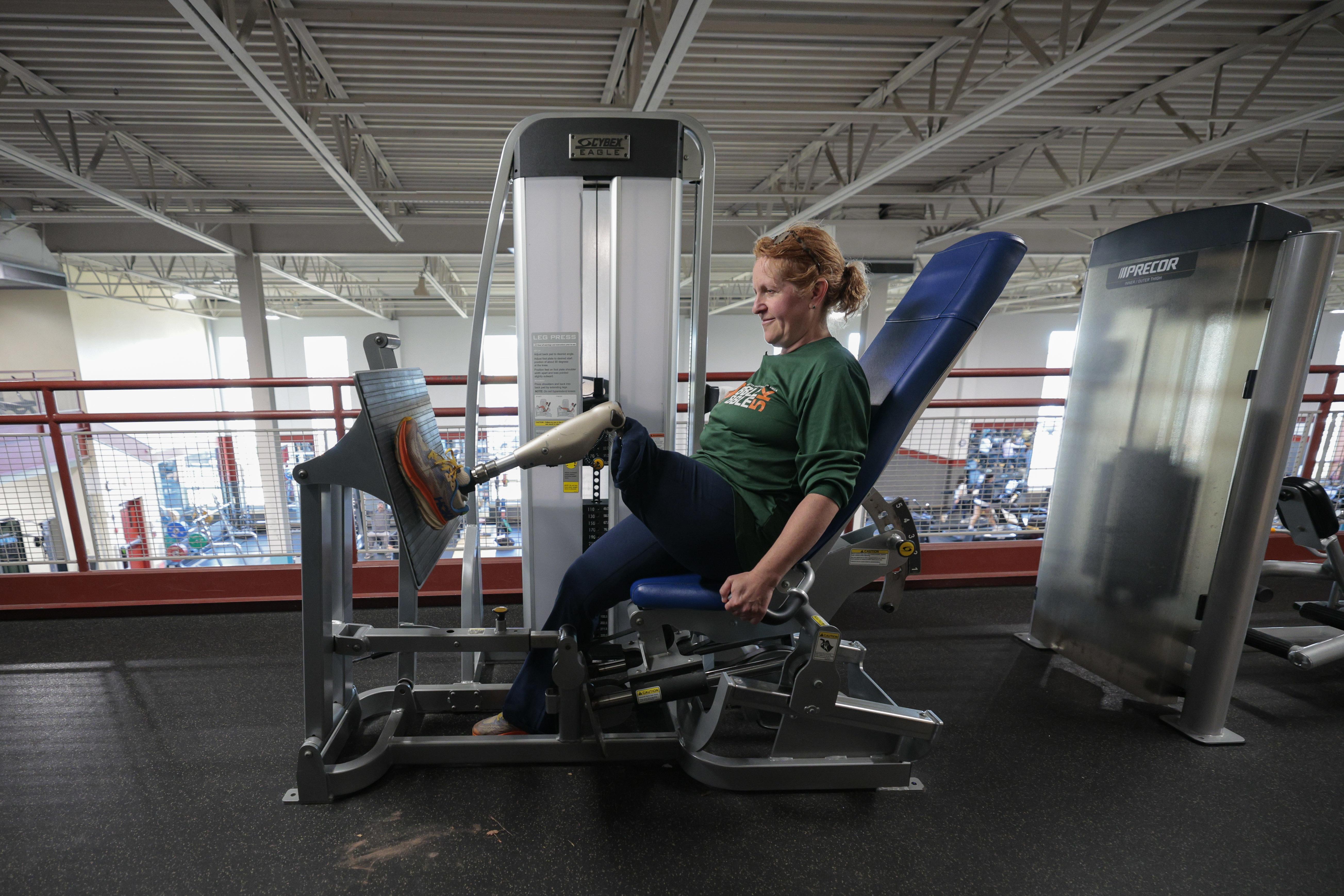
    Stephanie Dunn had to have her leg amputated because of a rare bacterial infection two years ago. She credits the Spring Valley YMCA, in Royersford, where Dunn was using a weight machine with her prosthetic legs on Monday.

    Hosted by the Greater Philadelphia YMCA, the Spring Valley event offers a 5k event and a mile walk. For her first Gobble Wobble with a prosthetic, in 2023, Dunn cut some sections of the walk. Last year, she finished the loop but came in last. Dunn believes she can beat that performance this year. She also hopes it will serve as a milestone on her way to an even more ambitious goal: qualifying for a running blade along with a grant to pay for it.

    And while Dunn doesn’t see herself as an amputee advocate or role model — she reserves that designation, perhaps incorrectly, to the “super-fit people out there running marathons” — she hopes her story will let people in similar situations know the journey to mobility is hard but possible with the right support system.

    This year’s Gobble Wobble is as much of a personal test for Dunn as it is a bit of an ode to the wheelchair-accessible Spring Valley YMCA, which has been a lifeline and refuge in the years following her amputation.

    “When [the amputation] first happened, I thought, ‘Oh, my God, I’m on the periphery of society now. I’ll never be able to do anything normal,’” she said, remembering how she avoided grocery stores at first. “But I did. I could come here.”
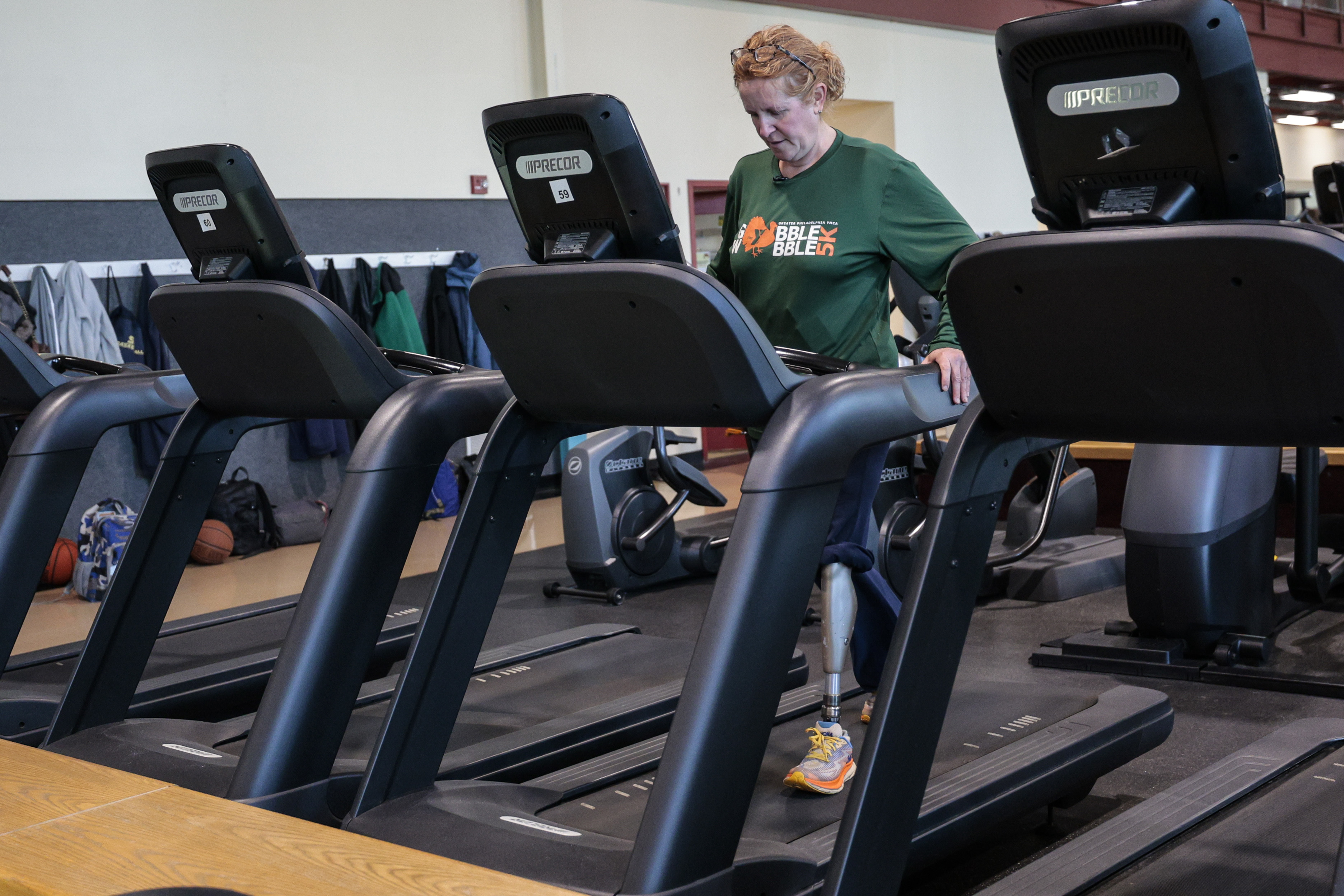
    Stephanie Dunn had to have her leg amputated because of a rare bacterial infection two years ago. She credits the Spring Valley YMCA, in Royersford, where Dunn was working out on the treadmill Monday.

    The challenges facing America’s growing number of amputees

    More than 2 million Americans live with limb loss, according to a 2024 study partially funded by the nonprofit Amputee Coalition. The reasons behind amputations vary. Johns Hopkins Medicine reports that about 45% of limb loss occurs after a traumatic injury, such as a car crash. Other people lose limbs amid complications from diabetes, gangrene, cancer, or blood vessel diseases.

    For Dunn, a throbbing left foot and waves of bile vomit ended up being necrotizing fasciitis, source unknown.

    The flesh-eating bacteria gnawed away at her limb in a matter of days, led to sepsis, and nearly reached her chest. Dunn said the amputation saved her life.

    Yet there is much more to an amputation than the operation itself.

    The Amputee Coalition says 36% of people living with limb loss experience depression. Many find themselves physically unable to return to demanding jobs that require fast movement or heavy lifting. Dunn, who had been a speech pathologist for 19 years, has come to terms that she cannot do the job full-time without risking an injury, even with her prosthetic.

    And while a Government Accountability Office report expects the number of people living with limb loss to double by 2050, online forums remain full of people looking for advice on how to get their insurers to pay for prosthetics that will help with mobility.

    Dunn’s experience navigating healthcare is only a snapshot of the challenges facing amputees.

    After the amputation, she faced a growing mountain of medical bills and paperwork. As Dunn managed pain and the care of her two young children, she had to go from her home in Schwenksville, Montgomery County, to South Philly to “prove” she had actually had her limb amputated in order to apply for disability benefits.

    Then there was the process of qualifying for a prosthetic.

    The most basic below-the-knee prosthetics cost $3,000. There is no secondhand market because each is molded to the person. Even so, as limbs naturally change size and swell or contract throughout the day, users will have to adjust. It’s why amputees sometimes stuff socks in their prosthetics.

    The more advanced prosthetics provide more mobility but easily run into the tens of thousands of dollars. Private insurance runs the gamut in terms of coverage, with many amputees reporting better luck through Medicare or Medicaid. But going with public insurance comes with other considerations, such as income limits.

    “You can’t financially get ahead at all,” said Dunn, who was making a six-figure salary before her amputation. “You can just barely make ends meet.”

    In the early post-op days, Dunn said, lying in bed and sitting in a chair were her biggest temptations — they often are for recent amputees. But skipping the at-home workouts assigned by her physical therapist risked muscle spasms and stiff muscles in the remaining part of the limb. To lose flexibility in the limb makes it harder to move with a prosthetic.

    Determined to become mobile, Dunn headed to her local Y branch.
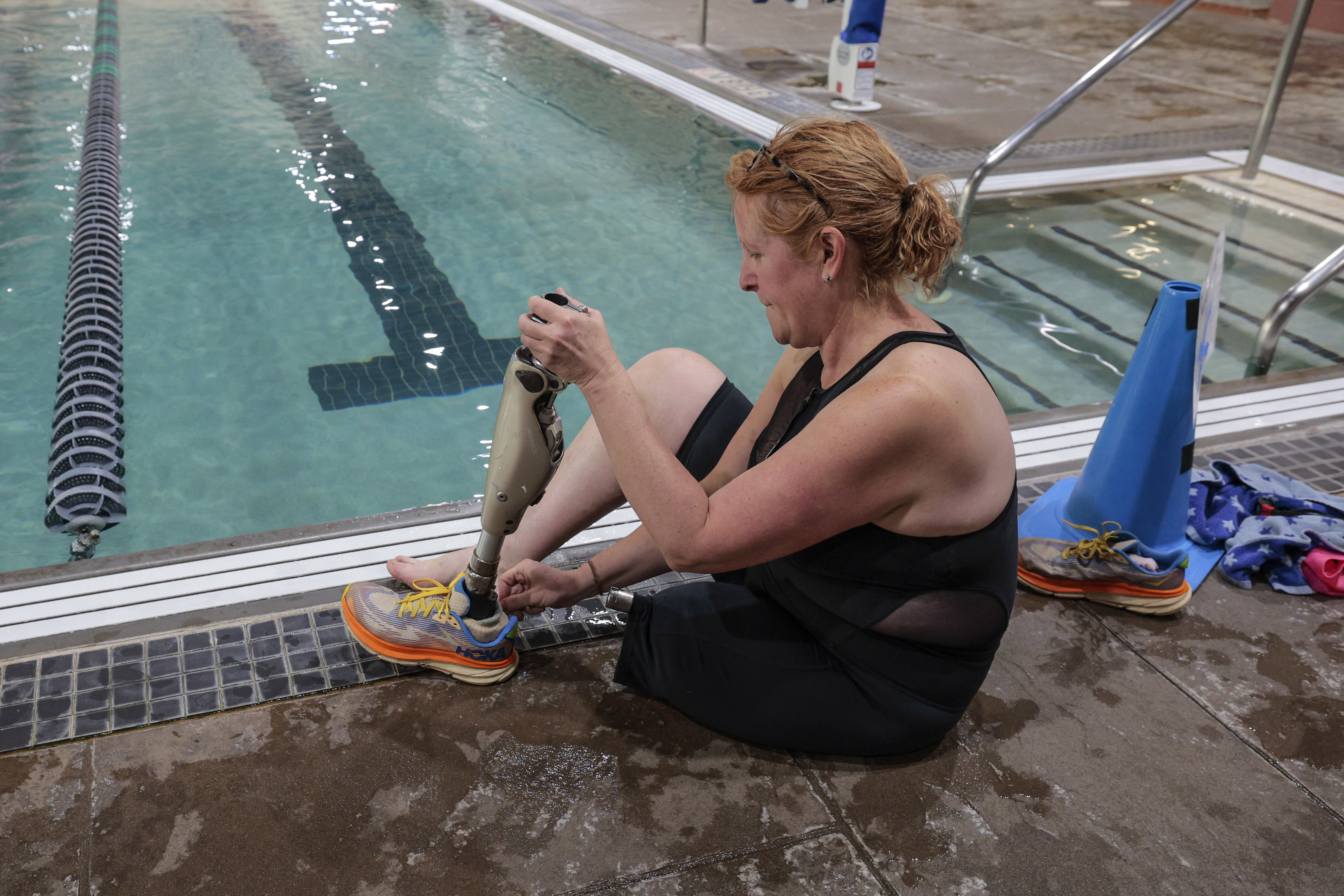
    Dunn said in those early post-op days, lying in bed and sitting in a chair were her biggest temptations — they often are for recent amputees.

    A gym offers refuge and resources

    To walk alongside Dunn at the Spring Valley Y is to accompany a minor celebrity. Dunn jokes that it’s the prosthetic leg, though that feels like she’s selling herself short. She is at the gym every day for anywhere between 30 minutes and three hours.

    “You must’ve had a good night’s sleep,” shouts a lifeguard taking his perch after Dunn completed several laps in the pool. One of the many greetings thrown over the hum of the pool machinery.

    Part of the Greater Philadelphia YMCA, the Spring Valley branch was familiar to Dunn before her injury because of the programming her children took part in, which only became more important during her two-month stay at the hospital.

    The children participated in the branch’s before- and after-school care, which Dunn credits with giving the boys a routine as she regained her strength.

    But the facility was also primed to aid in her recovery in small ways that added up.

    Before Dunn renovated her bathroom to be wheelchair-accessible, the Spring Valley Y was the only place she could shower.

    Soon, Dunn was navigating the gym equipment and pool. She could park her wheelchair along the pool’s edge and get in the water, where she enjoyed what she described as a weightlessness.

    Dunn still had days when she cried in the parking lot or the bathroom, but she kept coming to get on the sit-up machines and for the aquatic dance classes. Not once did she feel out of place, she said.

    The mental boosts served to buoy her physical gains and vice versa. It’s a rhythm she longs for other amputees to find.

    “I maintained the range of motion in my limb, so that when I did get measured for a prosthetic to see what kind of prosthetic I could qualify for, as far as insurance and what I could use … I got a higher-level prosthetic than if I hadn’t come here,” she said.

    That said, a robust support network or gym can’t fix the healthcare system, and Dunn continues to navigate the logistics of getting the prosthetics she needs to live the life she wants with her children.

    Dunn said she had to travel to New York City in order to get a one-step procedure that would allow a rod to be embedded in what is left of her femur. Approvals took six months.

    And even as Dunn gets more comfortable with her prosthetic, there is tweaking to be done. She has been dealing with pain that is constantly in the background.

    Still, Dunn characterizes these as small bumps along the way, as she does with many of the challenges she has navigated postamputation.

    She said going through fertility treatments to have her boys and the quandaries of raising them as a single mom by choice weighed much more heavily on her.

    Back then, when things felt particularly dire, she would tell herself: If at any time you want to stop, just stop.

    In the case of her mobility journey, as with conception, Dunn has yet found a reason to call it.

  • Two New Yorkers found dead in Atlantic City Borgata hotel room

    Two New Yorkers found dead in Atlantic City Borgata hotel room

    Atlantic City Police are investigating the deaths of two New Yorkers who were found dead in a casino hotel room Sunday afternoon.

    Police were called to the Borgata Hotel Casino and Spa around 5 p.m., where they found the bodies of Baoyi Bowie Zheng, a 36-year-old woman from Staten Island, and Wei Guo Liang, a 68-year-old man from Brooklyn.

    An autopsy determined Bowie Zheng died of a broken neck. Guo Liang was found to have died from self-inflicted stab wounds.

    Many details regarding the individuals, including their connection, if any, and how long they’d been at the Borgata, had not been made public as of Wednesday, when the Atlantic County Prosecutor’s Office encouraged people with information about the incident to call in.

    A spokesperson for the hotel could not be reached for comment.

  • ‘Philly will eat you alive’: Runners brave the deceptively challenging route of the city’s marathon

    ‘Philly will eat you alive’: Runners brave the deceptively challenging route of the city’s marathon

    Feet blistered, toenails were lost.

    Some chafed in places unimaginable.

    Others questioned it all as they attacked the hill leading to the Manayunk portion of the race.

    For the thousands of runners who crossed the Philadelphia Marathon finish line Sunday, the view of the Philadelphia Art Museum steps capped a blissful, sometimes brutal, 26.2-mile run.

    Whether they ran for personal bests or charity, the roughly 17,000 registrants couldn’t have asked for better weather, which largely remained in what studies say is the sweet spot of 39 to 50 degrees. No brutal winds to report, either.

    The fine weather was a stroke of luck for runners and spectators alike.

    Philadelphia resident Latasha Clark, 47, and her daughter Brianna, 23, began waiting at Eakins Oval around 6:30 a.m., when it was much colder, with a homemade sign that read “you go girl” with carefully cut out letters.

    Clark expected her daughter Trinity to finish around 11 a.m. but she wanted to secure a visible spot along the final mile. Philadelphia would mark her daughter’s first marathon and she trained for it while juggling classes at Arcadia University. Clark didn’t want to miss the photo finish and she wasn’t taking any chances.

    “She would run every morning before class,” said Clark, beaming with pride. “She would call and wake me up and say, ‘I’m ready to run.’”

    The crowd turnout did not go unnoticed.

    First-time marathoner Charlie Marquardt, 31, said the spectators “really helped out” and he was ultimately able to run the race he wanted thanks to the weather and motivation. A new father as of March, Marquardt said he was likely going to take it easy for a bit and try to do the Broad Street run in May.

    Caroline Kellner, 31, was also grateful for the crowds. The Ewing, N.J., resident couldn’t believe how many people were out cheering so early in the morning, calling it “the most spirited marathon” she’s participated in. There isn’t a huge running community in Ewing, said Kellner, making training runs somewhat lonely.

    “Here I feel like the first 10 to 15 miles, you just feel so good,” she said of the spectators. “Then, you know, you hit mile 20, and it’s hanging on for dear life.”

    The Philadelphia Marathon course is often billed in running circles as a relatively flat race. But there are some hills, and the one that leads to Manayunk’s boisterous Main Street is a bit of a cruel tease in timing.

    Before the Manayunk crowds appear, toting shots of beer and doling out pastries and high fives, there’s a stretch of road where all you hear is the echo of sneakers bouncing off a wall — it’s tough for spectators to gather there.

    It’s around the 18-mile mark that marathoners will sometimes hit “the wall,” a sign that a runner’s store of carbohydrates has slowly been depleted and calories are in need of replenishing. Still, the famous wall is as much psychological as it is physical.

    Sharon Tejada (right), a co-leader of Queer Run, encourages the roughly 17,000 runners heading out on the Benjamin Franklin Parkway at the start of the annual Philadelphia Marathon on Sunday, Nov. 23, 2025.

    New York City runner Mitch Kapler, 43, might be in the minority, but said he enjoyed the silence in a moment when his energy was drained and he needed to focus.

    “Especially in the back part, there’s an element of not wanting to see as many people,” he said, adding that he appreciated that the course offered a taste of the city as well as a hint of scenic foliage.

    In a way relatable to many long-distance runners, Kellner joked that she “blacked out” the memory of the lead-up to Manayunk, choosing to remember the effervescent crowds instead.

    Burlington Township, N. J., resident Brooks Sanders, 42, said that the final section of the race is what, in his mind, makes Philly harder than the New York City Marathon.

    “Philly will eat you alive,” said Sanders, who said people tend to underestimate the course difficulty. “In New York, you can rely on a crowd.”

    For this race, that motivation has to come from the runner in the Kelly Drive stretches, where there aren’t a lot of people. And sometimes, runners like Kapler and Sanders fall short of personal goals. Wrapped in a Mylar blanket, Kapler was already planning his Philly Marathon “revenge tour” and Sanders, who was a few minutes shy of qualifying for the Boston Marathon, similarly planned his return.

    Sanders said even the setback was part of the journey. He began running in 2021 when the love of his life and mother of his two children was diagnosed with stage 4 metastatic breast cancer. Running became therapeutic and he appreciated that the Philadelphia Marathon had close ties with the American Association of Cancer Research. By raising money for a possible cure, he felt he was doing something.

    Though Sanders’ wife died last year before he ran the New York City Marathon and the Philadelphia Marathon, he remains a devout supporter of the AACR, the weekend’s title sponsor, whose runners collectively fundraised more than $800,000.

    Between the amount raised for charity and the uncontrollable, such as weather, race organizers were pleased with the weekend’s turnout for the 8K, half marathon, and Sunday’s full marathon.

    Kathleen Titus, Philadelphia Marathon Weekend race director, said even with last-minute dropouts, organizers expect close to 17,000 runners to have hit the road Sunday after pulling from a 3,000-person wait list.

    Iris Annais, from Mexico City, talks to her mother, Rosa Gonzalez, back at home after finishing the Philadelphia Marathon on Sunday, Nov. 23, 2025. It was her fifth marathon.

    One striking note from Sunday, said Titus, was the rise in first-time marathoners. The top female runner, 26-year-old Anna Oeser from Connecticut, ran her first marathon at 2:34:55. People who took up running during COVID-19 lockdowns have graduated from their 5K, 10K, and half-marathon races.

    “Over the past couple of years, we have seen the surge in participation in sport,” Titus said. “But people who maybe got their toes wet during the COVID period are now taking to the streets.”

    It wasn’t all first-timers on the course, however, with South African professional runner Melikhaya Frans, 35, winning the male category with 2:13:57. He was a last-minute addition to the race after the Sanlam Cape Town Marathon, a major, was canceled due to weather.

    The top male in the wheelchair category was Miguel Vergara of California at 1:44:22. Hannah Babalola of Illinois won the female wheelchair category at 2:15:21.

    The push rim wheelchairs head out on the Benjamin Franklin Parkway at the start of the annual Philadelphia Marathon on Sunday, Nov. 23, 2025.

    Close to the finish line, families waited for their loved ones with changes of clothes and slippers.

    Joanna Campo, 50, a triathlete all too familiar with this particular feat of endurance, waited for her 17-year-old nephew from Rhinebeck, N. Y., to finish his first marathon, ready to provide some levity.

    “I’ve been training for months to hold this sign,” read Campo’s poster board of encouragement.

    The teen’s mother, Concetta Ferrari, 43, hoped to squeeze in some Philadelphia sightseeing but figured they’d probably let her son “soak in a bathtub and sleep.”

  • Delco homeless shelter system to close two shelters amid Harrisburg budget impasse

    Delco homeless shelter system to close two shelters amid Harrisburg budget impasse

    Delaware County’s homeless services, already overextended and stretched to its limits, are slated to lose two shelters and a much-needed rental assistance program at the end of the month as a result of the ongoing budget impasse in Harrisburg.

    The closures, though likely temporary until state lawmakers set aside partisan disagreements to approve a budget, would mark a major blow to a system some say is on the brink of collapse in one of Pennsylvania’s most populous counties.

    Delaware County officials have attempted to stave off suspensions in critical social services for the first few months of the budget impasse by dipping into their coffers. According to officials, the county typically spends $12 million a month on homeless shelters and other services for children and youth, mental health needs, and substance use disorders.

    Now out of options to pay for these critical supports, the county has notified local service providers that they won’t be able to help them any further. Only a budget can restore funding.

    “We had hoped the impasse would be resolved much sooner and had fully funded our providers through September, but unfortunately can no longer fully fund providers without the funds from the state,” county spokesperson Mike Connolly said.

    Men’s dorm at Life Center-Eastern Delaware County in Upper Darby on Friday.

    The Community Action Agency of Delaware County, which operates three shelters and a rental assistance program, among other services, has no choice but to make cuts to its services or even close, its executive director Ed Coleman said.

    Life Center, a shelter that has room for about 50 people, has gradually cut its capacity by half. Wesley House and Family Management Center, which have a combined capacity to house more than 110 people, are slated to close by the end of the month. Plus, CAADC’s rental assistance program, which helps approximately 270 families a year, will be paused until the state budget is passed.

    Remaining homeless shelters, such as Breaking Bread in Upper Darby and the Salvation Army in Chester, have already seen a surge in people seeking assistance in recent weeks as Wesley House Shelter and Family Management Center wind down operations.

    “We’re at capacity. We have no more room,” said James Stephenson, who leads the Salvation Army’s 40-person facility.

    Mental Health Partnerships, which provides services for people with mental health conditions or substance use disorders, has been assembling a weekly working group with local shelters and county government to prepare for a winter with at least one emergency shelter, in anticipation of more shelter closures, said its president and CEO, Jeannine Lisitski. Mental Health Partnerships officials have already begun seeing more people on the streets around Delaware County as part of their street outreach there due to the diminishing number of places that people can go to stay warm in these cooling months.

    “There’s a real crisis in Delaware County brewing now,” Lisitski said.

    ‘It’s childish for people to be so politically divided’

    With no state budget in sight, public schools, counties, and service providers that help Pennsylvania’s most vulnerable have been forced to find ways to keep their doors open as they await reimbursement from the state. School districts have had to make up more than $3 billion in expected state payments, while some counties have had to lay off staff or take out major loans.

    But the issues are particularly dire in Delaware County, where the budget impasse is just the latest blow to the threadbare safety net that has only been further stretched in recent years.

    Delco had the fourth-highest eviction rate in Pennsylvania in 2022, at 11.5%, according to a study by PolicyLink and Community Legal Services of Philadelphia.

    The persistent issue pushed Delco officials and dozens of other stakeholders to convene the following year to find ways to help the more than 300 people already facing homelessness and the 100 families on wait lists for shelters in the county, as well as all those in danger of losing housing.

    But just this year, Crozer-Chester Medical Center, which was the county’s only 24-7 crisis center for mental and behavioral health, closed in May. Shelter operators, such as the Salvation Army, believe they will have to step up to help the affected population.

    St. Joseph’s Family Hope Center closed in June.

    Breaking Bread, which until recently could serve 25 people, can take in only eight after moving back to its original building, which is in need of repairs and has limited space.

    And the county’s adult and family services agency, which contracts with shelter providers, saw a loss of $1 million in funding.

    Lisitski said Mental Health Partnerships — which serves Delaware County, the other three collar counties, and Philadelphia — has already taken out a significant amount of credit to continue operating. And she has grown deeply frustrated with the state government that leaders have not been able to come together to achieve a budget deal.

    “I’m really disgusted, I have to say. I hold myself to a very high standard as a CEO and as a leader. I would not leave my post if I did not take care of every program. I would not leave for the day until I resolved everything,” she said.

    “That’s my commitment. I want the same commitment from our elected officials. And it’s childish for people to be so politically divided,” she added.

    Separately, the federal shutdown is poised to delay funds from the Low-Income Energy Assistance Program, which help about 300,000 Pennsylvanians pay their heating bills, as well as the distribution of Supplemental Nutrition Assistance Program (SNAP) benefits.

    As funds dry up, limited options for families

    At Wesley House, which can serve an average of 50 children at any given time, families like Grayson’s are scrambling to find temporary housing.

    The 52-year-old has been living in Wesley House for almost seven months after caring for his terminally ill mother drained the family’s finances and led his family of four to be evicted. He asked that his full name be withheld to protect the identity of his two young children, as not everyone knows the family became homeless this year.

    “This is people’s last resort. This is the last stop before being on the street,” Grayson said of the room with four bunk beds he shares with his family. “I feel like we’re being kicked while we’re already down.”

    With news of Wesley House’s closure, Grayson and his wife are working with social workers to get rapid rehousing so as not to disrupt their children’s lives, but it’s a race against time in between the three combined jobs the couple is working.

    John Weis, Life Center of Delaware County’s lead case manager (left) assists client Joseph Wallace Friday.

    For Heather Schearer, her several months living at Life Center were a necessary step up in her recovery process. She had been unhoused for about five months earlier this year, and was sleeping in her car until it got too cold. When approached, she agreed to stay at Life Center until she eventually was connected to longer-term provider Mental Health Partnerships for its rapid rehousing and peer support programs, she said.

    “[Politicians] don’t want to get their boots on the ground, take your ties off, and sit and talk,” Schearer said. “It’s the little things that matter that will get you to the next step.”

    According to Community Action, similar scenes are playing out at Family Management Center, which can serve an average of a little more than 30 children at any given time. And while the most significant service reductions in homeless services are not scheduled for another week, the impacts of cuts are already visible across Delaware County.

    Lisitski, of Mental Health Partnerships, which provides street outreach around Delaware County, said staff have already seen “a lot more people” than usual living on the street.

    When shelters close like this, it becomes a “life-and-death situation” for people who are unhoused, she added. If the people who access critical services — usually people who are homeless, have substance use disorder, or have serious mental health conditions — cannot do so, she said, it will result in their being jailed, institutionalized, or, in the worst cases, dead.

    In anticipation of the added need for housing due to the impasse, Mental Health Partnerships is working with Delaware County officials, faith-based entities, and other local groups to prepare emergency shelter space from December through April. It is also taking a line of credit to stay afloat.

    But loans are not a viable option for all service providers.

    Coleman, of Community Action, said even if the nonprofit could be approved for a line of credit, leaders have no way of knowing how much to ask for since they don’t know when a budget will be passed. Then there would be the question of interest.

    “There’s no way [shelters] can afford to pay back interest on a loan, and the interest on a loan cannot be charged to a grant, so it would just be money lost to them,” he said.

    Without a state budget, local government is the nonprofit’s last hope. Upper Darby, where Life Center is located, has awarded Life Center $120,000 in Community Development Block Grant funds, which will become available Jan. 1, according to officials there.

    It’s much-needed money, but only one thing can help Community Action’s two other shelters stay open.

    “We’re hoping that the legislators can do their job and pass a budget so the county doesn’t have to deal with some unfortunate situations,” Coleman said.

  • The government shutdown is disrupting air travel. Sean Duffy visited PHL to blame Democrats.

    The government shutdown is disrupting air travel. Sean Duffy visited PHL to blame Democrats.

    The federal shutdown messaging war was in full swing at Philadelphia International Airport Friday, where U.S. Transportation Secretary Sean Duffy blamed airline travel disruptions on Democrats, as air traffic controllers are slated to miss their first full paycheck next week.

    “If you’re seeing an increase in shutdowns right now, or delays, or cancellations, it’s because the Democrats won’t open the government back up,” said Duffy.

    Duffy also reiterated a Republican talking point, inaccurately accusing Democrats of pushing for a shutdown in order to extend health care to undocumented immigrants. Various policy experts, however, have found this claim to be false, as undocumented immigrants were already ineligible for Medicaid and insurance provided by the Affordable Care Act.

    Travel disruptions fueled by air traffic controller absences played a major role in pressuring politicians to relent and reopen government during the last government shutdown, which started in December 2018 and bled into the new year for a total of 35 days. As that shutdown dragged on, air traffic controllers who were working without pay began calling out sick, sparking major delays across the country.

    Though a PHL spokesperson said the airport has not experienced disruptions as a result of the shutdown to date, other hubs, including Newark Liberty International Airport, have. Duffy said while about 5% of delays are typically due to staffing shortages, that number has been as high as 53% since the shutdown began Oct. 1.

    Joining Duffy, Nick Daniels, president of the National Air Traffic Controllers Association, described how members report taking on side gigs delivering food or driving rideshares.

    Air traffic controllers were able to receive about 90% of their pay in their last check because most of their biweekly pay period fell before the shutdown.

    As more families feel the impact of the shutdown, Daniels said air traffic controllers would feel the stress at work and “instead of focusing on the safety of the American flying public, they’re now focusing on what they can’t afford to pay.”

    The visit to Philadelphia International Airport comes amid a back-and-forth between President Donald Trump‘s administration and Democrats. The White House’s official website has a “Government Shutdown Clock,” which tells visitors, “Democrats have shut down the government.” Other federal government sites blame the “Radical Left” or call the shutdown “Democrat-led.”

    Airports have not been immune to the shutdown messaging wars, with Homeland Security Secretary Kristi Noem blaming Democrats in a video sent to the travel hubs to play — the Transportation Security Administration is part of Noem’s department and TSA workers are not being paid during the shutdown. PHL and several other airports have refused to play the video, citing federal limits on political messaging they can display.

    Just last week, Pennsylvania Gov. Josh Shapiro‘s administration pushed back with its own messaging on the state Department of Human Services website.

    “Because Republicans in Washington D.C., failed to pass a federal budget, causing the federal government shutdown, November 2025 [Supplemental Nutrition Assistance Program] benefits cannot be paid,“ reads a banner on the website.

    For airports and travelers, the possibility of a prolonged shutdown brings the potential for disruptions during one of the most popular times to travel.

    What’s more, it could affect those in the Federal Aviation Administration’s training academy, hoping to become air traffic controllers. Those students continued to receive modest pay amid the shutdown — their instructors have not — but Duffy said money is slated to run out in as little as a week or two. The transportation secretary said fears of future funding issues have caused some students to drop out at a time the department is short some 3,000 air traffic controllers.

    TSA employees at PHL, meanwhile, are also suffering.

    Joe Shuker, Region 7 vice president for AFGE Council 100, which represents TSA employees there, said workers are being required to bring doctor’s notes if they call out, adding the cost of a copay to legitimately sick staff. Shuker, like Daniels, said employees were being encouraged to keep working.

    “However, at some point running out of money will be an issue,” he said as workers struggle to pay for gas, childcare, and mortgages.

    Duffy on SEPTA

    Ahead of his visit to PHL, Duffy wrote a blistering letter to Shapiro, blaming the Democrat for SEPTA’s financial woes and, in particular, for five Regional Rail train fires this year involving 50-year-old Silverliner IV cars.

    “Thankfully, no fatalities resulted, but the department will not stand by waiting for tragedy to strike,” Duffy told Shapiro. “If changes are not made immediately, it is only a matter of time before SEPTA’s crumbling commuter rail system erupts in flames and kills someone.”

    The governor clapped back. A spokesperson noted that Shapiro has fought for new, stable state funding for SEPTA and other transit agencies in the last two budgets — only to have Senate Republicans, who hold the majority in the chamber, kill the proposals.

    “Instead of issuing a press release, if Secretary Duffy actually wants to be helpful, he should call his fellow Republicans and get them to fund the governor’s mass transit funding package for SEPTA,” said Rosie Lapowsky, Shapiro’s press secretary. “We would be happy to provide their phone numbers.”

    The mass-transit agency has been pulling the 225 cars off the line for extensive safety inspections and repairs, acting on an Oct. 1 order from the Federal Railroad Administration, which regulates commuter rail. SEPTA also is installing a modern thermal detection system on the Silverliner IVs, which were built in the mid 1970s.

    The FRA order imposed a deadline of Oct. 31 and Duffy warned unrepaired rail cars could be ordered out of service if it is not met.

    “I want a great system for Philadelphia, that’s what I want,” Duffy said when asked about the letter at PHL. “If I can be helpful, I will, if I get resistance, we can we can be great friends, or we can be really bad enemies. I think we should be in the friend business and serve in this community.”