Author: Joseph N. DiStefano

  • Exploding lithium-ion batteries are blamed for fires in area junkyards and drop in port traffic

    Exploding lithium-ion batteries are blamed for fires in area junkyards and drop in port traffic

    Scrap metal, one of the Philadelphia area’s biggest shipping products, has been piling up in area scrapyards since June 4 when Camden officials closed EMR USA Holdings Inc.’s metal-shredding facilities after the latest in a series of fires affecting the region’s million-ton-a-year scrap shipping industry.

    Scrap dealers, faced with bulging inventories, blame the fires on the increased use of lithium-ion batteries — not so much large car batteries but the increasingly ubiquitous, highly combustible smaller batteries slipping into landfills from lawn mowers, construction tools, “smart” infrastructure, and household appliances.

    The two-alarm May 29 fire, following a four-alarm Feb. 21, 2025, blaze that sent 100 neighbors fleeing for shelter, is the latest in what Camden code enforcement director Gabriel Camacho said have been up to a dozen “harmful, offensive, or obstructive” blazes at the Camden yard, which is at 1400 S. Front St. near the city’s Beckett Street Terminal. The fires spread smoke and hazardous materials.

    Camden officials in statements on the fire have focused on the effects, not the causes, of the fires.

    EMR CEO Joseph W. Balzano, whose company sued to reopen, last year agreed to pay the city $4.5 million up front and $2.2 million over five years, plus more for community and facility upgrades. After the May fire, the company promised steps to reduce fire risk.

    City Council is scheduled to review the proposal at a meeting Tuesday evening.

    The scene at EMR Metal Recycling in Camden on Feb. 22, 2025, the morning after a four-alarm fire sent thick plumes of black smoke over Camden County, causing some residents to evacuate two nearby hotels.

    EMR, including its offices and auto-parts business as well as its recycling facilities, employs 575 workers — almost 200 are Camden residents — including members of the Teamsters union. Some workers operate shredding and sorting machinery and haul old iron and steel to the South Jersey Port Corp.’s nearby pier, which is named for Balzano’s late father, who headed the port.

    EMR shreds and ships steel from smaller dealers, some to foreign users, but most of it, in recent years, to U.S. electric steel mills and other industrial recyclers.

    “We haven’t laid anyone off — our people are like family — but we are getting to the end of our rope,” Balzano said last week.

    Competing terminals at the port in Fairless Hills, Bucks County, and in Newark, N.J., have picked up some of the business, he said — at a higher price, including the cost of trucking scrap a longer distance.

    England-based European Metal Recycling Ltd. acquired and began operating the Camden site since it purchased the former Camden Iron & Metal in 2006.

    Scrapyard officials say they tracked the latest fire to a discarded lithium-ion battery, a factor in what they say is a surge of scrap fires.

    “It’s the biggest issue all recyclers face,” Balzano said. “Regulations need to be put in place that keep these batteries out of commerce.”

    The batteries are used in items like stoves, washing machines, dryers and “things you wouldn’t think of like light ballasts or guard rails,” he said.

    “Just last week we had 440 people in a Zoom meeting about lithium battery fires. Since then, you had Doylestown Recycling and another facility in Long Island burn to the ground,” said John Thomas, president of the national Construction & Demolition Recycling Association.

    “Nine times out of 10, it’s a power-tool lithium-ion battery,” he said. “Contractors throw ‘em in the dumpster, not realizing it’s hazardous once it’s broken out of its original container. Lead-acid batteries, not such a big deal. But lithium batteries burn so hot, you almost have to let ‘em burn out.”

    New Jersey lawmakers have been advancing bills to better track lithium-ion batteries and to regulate scrap recycling yards.

    Burns Co., a building-materials recycler whose yard covers more than 12 acres in Philadelphia’s Hunting Park section, needed city help putting out its most recent lithium-ion battery fire in May, said Allen Burns, who runs the family-owned yard, which employs nearly 100.

    He points to scorch marks on a concrete-block wall at the facility.

    “It took 30 firemen five hours to put out the fire,” Burns said. “They looked on our camera system, dug down, and found a lithium-battery-powered tool. There must be a landfill fire every day from a lithium battery.”

    Burns said the Camden shutdown has backed up shipments at yards around the region.

    “We have had to bail metal to conserve space,” he said. Disposal costs are up.

    David Wiechecki, owner of International Scrap Iron & Metal in Chester, said, “You don’t want to leave [lithium-ion batteries] laying in your yard. It’s a real problem.”

    “You go over the loads with a fine-tooth comb, but people who want to sneak them by will do it,” he said. “Meanwhile, prices are down because export demand is down,” leaving scrapyards with more iron and more fire concerns.

    Lithium-ion battery fires were blamed last year for burning dozens of decommissioned SEPTA buses and led to the end of SEPTA’s Proterra electric-bus program.

    Thomas said his group and national scrap-metal and waste-disposal trade associations want federal legislation forcing manufacturers to pay lithium-ion battery recycling fees.

    “But they don’t want them back. It’s cheaper for them to buy virgin material,” he said. “So there’s a big tug of war in state legislatures with the manufacturers. In Pennsylvania, we had a bill stalled in the state Senate just in the last 10 days with no action.”

    Staff writer Frank Kummer contributed to this article.

    This story has been updated to correct the timing of EMR’s agreement with Camden last year.

  • How unknown Chinese ‘insider traders’ cost Jeff Yass’ firm more than $70 million

    How unknown Chinese ‘insider traders’ cost Jeff Yass’ firm more than $70 million

    Susquehanna Investment Group, the Bala Cynwyd investment and trading firm that has made cofounder Jeff Yass the richest man in Pennsylvania, on Monday persuaded a federal judge in New York to freeze accounts of up to 100 options traders, who the firm contends used inside information to book illegal profits of over $100 million, largely at Susquehanna’s expense.

    The firm won the temporary injunction even though Susquehanna acknowledged it didn’t know the names of any of the alleged inside traders. It hopes the freeze will force them into the open.

    Susquehanna’s lawsuit, accusing them of illegal insider trading and unjust enrichment, identifies each as “John Doe” and asks the court to order the traders to pay back their illegal profits, plus expenses.

    “The timing, size, type and pattern of their trading, and the lack of any plausible alternative explanation” for some 200,000 “short-dated put options” are “powerful evidence” of the scheme, according to Susquehanna’s June 29 complaint. The company alleges that someone traded illegally on inside information about the Chinese government’s planned May 22 crackdown on international trading platforms.

    At the firm’s request, Judge Arun Subramanian of U.S. District Court in Manhattan signed an order that day freezing the unknown traders’ profits from suspiciously successful bets that the valuations of two online trading firms would shortly crash:

    • Futu Holdings Ltd. (which trades under the share symbol FUTU), a Hong Kong-based, Nasdaq-listed online brokerage
    • UP Fintech Holdings Ltd. (TIGR), the Singapore-based, Nasdaq-listed owner of New York-based TradeUp Securities, another electronic trading platform.

    The preliminary injunction stopped the unknown traders from cashing out Futu and UP Fintech options held in their accounts at brokerages associated with both of the firms and with Interactive Brokers Group Inc., billionaire online-trading pioneer Thomas Peterffy’s Connecticut-based trading platform. The brokerages themselves were not accused of wrongdoing.

    The traders will have a chance to ask the court to release their assets at a hearing July 10 in New York, after posting $100,000 in advance — effectively identifying themselves as defendants in Susquehanna’s suit. The court order also authorizes Susquehanna to subpoena broker records in an effort to learn their identities.

    On Wednesday, Bloomberg reported the SEC is investigating the case.

    According to Susquehanna’s complaint, the traders, operating through their brokerage accounts, bought $12 million worth of low-cost options in Futu and UP Fintech, betting the stocks would decline in the days before China announced stern penalties on brokers accused of illegally moving cash to foreign markets.

    The purchases were many times the usual volume of Futu and UP Fintech options trades and accounted for most of the trades in those options during that period, according to the suit.

    Futu and UP Fintech announced on the day of the crackdown that they were, in fact, facing enforcement actions by China regulators, with proposed multimillion-dollar penalties.

    That news sent each stock crashing more than 30%, according to the lawsuit — a loss for shareholders and for other options traders who were betting the stocks would rise, but enriching the unknown traders who had bet on a drop.

    In all, the news boosted the value of the unknown traders’ investments by more than $100 million, according to the suit.

    More than $70 million of the profit was made on options purchased from Susquehanna, the suit says.

    The options purchases were so closely coordinated, their expiration dates so soon after May 22, that the trades “suggest inside knowledge” of the crackdown, the suit contends.

    Susquehanna suggested two possible groups of insiders, who either “tipped” favored traders to buy the options, or illegally traded on the inside information themselves:

    • Futu and UP Fintech staff “who had knowledge of discussions with Chinese securities regulators” or
    • Corrupt Chinese securities regulators who knew in advance of their agency’s own enforcement actions.

    Acting on such insider information is illegal under Chinese and U.S. law, according to the lawsuit, and adding the scale of the profits makes this “one of the largest documented cases of insider trading in recent memory.”

    Susquehanna asked for a jury trial, the return of $71.4 million it lost to the traders, plus costs and other payments.

    Susquehanna is one of the biggest U.S. “proprietary trading” firms that buy and sell securities, mostly using their partners’ funds.

    Under Yass, it has also been a pioneering, long-term investor in China-based digital companies. That includes large positions in TikTok owner ByteDance.

    Because of the fraught U.S.-China relationship and concerns by Congress members of both parties about TikTok’s influence over U.S. consumers, President Donald Trump and other U.S. officials have mulled potential restrictions on TikTok’s ownership and operations, and Susquehanna and other investors in that business have been obliged to engage with them. Yass is a prolific political donor.

    Susquehanna has reinvested profits from its large, lucrative trading operations into more than 350 China-based tech, retail, and industrial companies. Some of them have prospered, and for many more profits have been elusive.

    The firm also has funds that invest in U.S., European, and Israeli private and public companies, and in South and Southeast Asian companies.

  • With a new $400M investor, FMC says it can remain independent and boost pesticide sales

    With a new $400M investor, FMC says it can remain independent and boost pesticide sales

    FMC Corp., the world’s fifth-largest farm pesticide maker, said Wednesday that it has received a $400 million investment from Belgium’s Tessenderlo investment group, ending a “strategic review” and concluding inquiries into the potential sale of the company, based in the FMC high-rise tower on Philadelphia’s Schuylkill riverfront.

    Tessenderlo agreed to pay $13.30 a share for a 20% stake in publicly traded FMC. That’s a modest premium to FMC’s recent trading price but less than the share value as recently as June 1. As if unimpressed with FMC’s prospects even with the new cash, traders drove the share price down almost 5% Wednesday to close at $10.95.

    FMC traded at over $120 a share in early 2022 but has since lost most of its value, with crop-protection sales growth slowing worldwide amid slow progress on regulatory approval and marketing for new products to offset last year’s expiration of patent protection on the company’s best-selling Rynaxypyr insecticide.

    The buyer expressed faith in FMC’s next-generation fungicides, herbicides, and insecticides.

    “FMC offers an attractive opportunity to invest in a business with meaningful long-term potential, driven by a new generation of proprietary molecules that are renewing its portfolio and strengthening its competitive position,” Luc Tack, chief executive of publicly traded Tessenderlo Group, said in a statement.

    That includes products developed at the company’s Stine research labs in Newark, Del., which FMC acquired from DuPont Co. in 2017 as DuPont spun off its farm chemicals and seed business into Corteva.

    FMC “perfectly aligns” with Tessenderlo’s farm businesses, Tack added. Tessenderlo gets a seat on FMC’s board as part of the deal.

    Those businesses include Kerley, an Arizona-based farm fertilizer maker and niche pesticide distributor; sulfur-based fertilizer maker Tiger-Sul, based in Connecticut; and French organic fertilizer developer Violleau.

    Other Tessenderlo investments include plastics, chemicals, industrial machinery, electronics, and animal-byproduct (“bio-valorization”) businesses.

    FMC’s board approved Tessenderlo’s investment after a “comprehensive and deliberate” process, which the company started in February with its investment bankers and lawyers, as the best way forward for the company and its shareholders, said Pierre Brondeau, FMC board chairman and chief executive.

    The $400 million inflow is the last piece in FMC’s efforts to reach Brondeau’s debt-reduction and cash-boosting targets, so the company can more easily remain independent until its new products get to market.

    Other recent steps by FMC included renegotiating its credit agreements; raising $1.2 billion in a junk-rated bond offering; selling its India commercial business for around $250 million; a $200 million deal to supply key products to its larger rival, Corteva, which is moving its headquarters from Wilmington to Indiana; and selling the 250-acre Stine Research Center to a unit of New York-based real estate investor Broadstone Net Lease Inc., while leasing back part of the property for continued research.

    These actions, plus reduced debt and increased cash, put FMC “on a path to growth,” Brondeau said.

    FMC employs around 5,500 worldwide, including around 300 at its headquarters and 330 at the Stine research and development center.

    Editor’s note: This article has been updated with FMC’s closing share price.

  • Philadelphia’s First Bank cited in Supreme Court ruling limiting Trump’s power

    Philadelphia’s First Bank cited in Supreme Court ruling limiting Trump’s power

    The First Bank of the United States shut in 1811, but the U.S. Supreme Court just ratified the enduring relevance of the Philadelphia-based central bank, whose marble-faced home on Third Street reopened Wednesday as a museum.

    First Bank’s independence from presidential authority was cited as precedent on the first page of Monday’s’s 5-4 Supreme Court decision that backed the independence of the Federal Reserve.

    The long-departed central bank also remains a center of controversy: A dissenting opinion challenged the First Bank’s actual role, as did hostile Democrats back in its day.

    The First Bank — along with the partly government-owned original Bank of the United States and the Second Bank of the United States — was cited by Chief Justice John Roberts and a bare majority in the decision that blocked President Donald Trump from firing Fed governor Lisa Cook.

    “The United States has a long tradition of independent central banking,” Roberts wrote, noting that Philadelphia-based central banking enjoyed “independence from the federal government,” even though its job was maintaining a sound U.S. dollar.

    After President Thomas Jefferson ended the First Bank and President Andrew Jackson refused to recharter the Second Bank, 80 years of “ruinous financial panics” convinced Congress to protect “public and private interests at times when they were imperiled” by setting up today’s Federal Reserve, Roberts wrote for the majority.

    The resulting system of independent Federal Reserve Banks in Philadelphia and 11 other cities shares control of the system with the presidentially appointed Federal Reserve Board of Governors. The governors are appointed to 14-year terms, stretching across three or four presidential terms. They can be fired only “for cause.”

    Calling the court’s ruling an early Independence Day for the Fed, Michael Reynolds, vice president at Glenmede, a $50 billion investment firm based in Center City, said the court majority “are carving out a special place for the Fed,” and it’s not by accident.

    The Fed “is a distinct case,” and its “unique historical lineage” tracing back to the First and Second Banks of the United States in Philadelphia provided legal justification to the court for preserving its independence, he said in an interview.

    The Cook decision contrasts with the court’s 6-3 Slaughter opinion, posted the same day, which allows Trump freer rein to fire staff at the Federal Trade Commission and other “independent” federal agencies.

    First Bank’s independence echoes in Fed

    Trump tried to fire Cook, a Fed governor appointed by President Joe Biden in 2024, alleging falsehoods in her mortgage application. Lower courts said Trump lacked the power to fire her that way. As Roberts put it, the president can fire a Fed governor “for cause” but subject to court review as to whether the president’s target has committed a fireable offense.

    “The Federal Reserve operates at a deliberate remove from the ordinary political process, including a budget free of congressional control and policies set not only by governors, but also by representatives of the private regional banks,” Roberts wrote.

    If a president could cite or make up any reason for firing a Fed official, “any perceived or alleged misstep, past or present, could provide a ready pretext for a governor’s removal,” Roberts wrote — and “nothing could be more corrosive of the independence that Congress sought” than for Fed leaders to know the president could fire them on any pretext, while pushing them to ratify his favored policies.

    Trump didn’t allow Cook to challenge her firing. She “was entitled notice and some opportunity to respond,” which Trump denied her, Roberts wrote.

    Liberal-leaning Justices Sonia Sotomayor, Elena Kagan, and Ketanji Brown Jackson concurred, along with Roberts’ fellow conservative Brett Kavanaugh.

    Kavanaugh added that letting a president fire Fed leaders at will would “expose the Federal Reserve to political influences and jeopardize the efficacy of U.S. monetary policy,” sparking “political upheaval” and “turmoil in the U.S. and world economies. I would not go down that road. I would not risk destabilizing the U.S. economy.”

    Justice Clarence Thomas in his solo dissent disparaged Philadelphia’s First and Second Banks as “short-lived corporations.” He noted that Paul Warburg, one of the bankers who helped found the current Federal Reserve System in 1913, had sought to distance the planned Fed from the Philadelphia central banks, “ridiculing” them as no more advanced than banks of medieval Italy or even ancient Mesopotamia.

    Justices Samuel Alito, Neil Gorsuch, and Amy Coney Barrett in separate dissents argued that Roberts wrote too sweeping an opinion in a case that should have been reviewed at greater length in the lower courts.

    The Fed’s Independence Day

    “Central bank independence is not an abstraction,” Glenmede’s Reynolds wrote in a letter to investors Tuesday. “The premise that monetary policy is set by long-term price stability, rather than near-term political pressure, underpins the credibility of the dollar, the anchoring of inflation expectations,” and the yield on Treasury debt.

    “A Fed perceived as subject to political direction” would hurt the dollar’s value, he added. Removing that risk “is a quiet but meaningful positive for the stability” of U.S. interest rates.

    Reynolds said in an interview that the court’s Slaughter decision, allowing the president wider powers to fire leaders of other agencies, is pro-business — even though its conclusion freeing Trump to fire Federal Trade Commissioners seems at odds with the Cook case.

    Greater presidential control of regulatory agencies should “accelerate deregulation efforts, which is a priority of both the president and his Treasury secretary,” Reynolds added.

    But Reynolds predicted that it will be a few years until such changes are likely to significantly reshape U.S. business rules.

    For now, he’s more interested in the Fed’s next jobs report, due Thursday.

    Editor’s note: This story has been updated to correct the day of the Supreme Court’s decision.

  • Comcast plans no big change for its 15,000 Philly workers as company splits in two

    Comcast plans no big change for its 15,000 Philly workers as company splits in two

    Comcast, the $125 billion-a-year media and communications giant based in Philadelphia, is planning to split into two publicly traded companies, one based on the NBCUniversal media group, the other focused on broadband and wireless services.

    Comcast’s consumer and business services and NBCUniversal media now face “distinct” opportunities that are best pursued separately, Brian L. Roberts, chief executive since 2002, told investors in a conference call.

    Shares of Comcast, which had recently been trading near a 10-year low, jumped as much as 17% on the news, before closing at $24.22, a 4.5% gain for the day but well below the stock’s highs earlier this year.

    The split reverses major Comcast media acquisitions.

    “We previously believed that scale and diversification benefits warranted operating these businesses as one company; we’ve now simply changed our mind about that,” said Michael Cavanagh, the former chief financial officer of both Comcast and JPMorgan Chase & Co., who became Comcast’s co-CEO last fall.

    “We’ve now concluded that future success for each of our businesses will depend on focus, speed, and strategic flexibility that this separation will unlock,” said Cavanagh, who will head NBCUniversal, based at 30 Rockefeller Center in New York, after the split.

    Comcast will retain the consumer and business services that employ the majority of the company’s 180,000 workers, including most of its 15,000 Philadelphia-area staff and managers.

    Michael Angelakis when he was CFO of Comcast in 2009. He is returning, this time as CEO, as the company divests NBCUniversal and Sky.

    Comcast’s CEO after the split will be Michael Angelakis, a Gladwyne resident, who was Comcast’s chief financial officer from 2007 to 2015 and has since headed tech investment firm Atairos while also advising Comcast.

    Comcast’s acquistion of NBCUniversal, announced in 2011 and financially structured by Angelakis, was “a brilliant success financially” since Comcast got a bargain price as it was the first multibillion-dollar acquisition after the Great Recession, telecommunications analyst Craig Moffett told clients in a report Monday.

    But it didn’t make much sense strategically, Moffett added. While original media and theme parks did little to boost cable sales, the combination turned investors off, depressing the share price.

    Angelakis’ return to Comcast is “the best part” of the “wonderful, overdue” breakup decision, Moffett said. He noted that the two successor companies were themselves unlikely to become takeover targets in the near future as it would endanger the tax-free structure of the spin-off and likely require long, expensive work to persuade national and state regulators.

    Angelakis told investors on the call: “This place was my home for many years. It’s great to be here. It feels familiar and exciting at the same time.”

    The planned move comes after Comcast announced in November 2024 that it was spinning off cable networks such as USA, Oxygen, E!, SYFY and Golf Channel, as well as CNBC and MSNBC into a new company, Versant. Movie ticketing platform Fandango and the Rotten Tomatoes movie rating site were also included. Versant went public in January at around $45 a share; it has lately traded around $36.

    Like other cable companies, Comcast in recent years has shifted its business emphasis away from traditional cable toward streaming and other sources of revenue, such as its movie studio, theme parks and home wireless and internet services.

    Media and entertainment company NBCUniversal includes a theme parks division, Universal film and television studios, NBC and Telemundo networks, Peacock, and Bravo. Its portfolio will now include European media business Sky.

    Comcast will continue providing internet and phone services to residential and business customers.

    Once the transaction is complete, Comcast shareholders will own shares in both Comcast and NBCUniversal. The separation is expected to be completed in about a year. It still needs final approval from Comcast’s board and is subject to regulatory approvals.

    Comcast expects to keep a stake of up to 19.9% ownership position in NBCUniversal for up to one year after the spinoff is complete.

    The Associated Press contributed to this report.

  • U.S. refinery accidents, including in Pa., raise questions about cost impact as fuel demand rises

    U.S. refinery accidents, including in Pa., raise questions about cost impact as fuel demand rises

    A leak and then a fire that stalled production at Delta Air Lines’ Monroe Energy oil refinery in Delaware County is just one of several unplanned stoppages that have dented U.S. oil production this summer, even as companies work to keep up with shifting supply and demand from the Iran war.

    A welcome drop in U.S. gas prices “masks” a string of U.S. supply issues that put stress on fuel markets, Industrial Info Resources told clients in a note last week.

    Beyond the stoppage at the 200,000-barrels-a-day Trainer plant, problems include:

    Fire at Delta Air Lines’ Monroe Energy refinery in Trainer, Delaware County, on Friday.

    In all, U.S. refineries can produce up to 18 million barrels a day.

    Refinery margins tripled after the U.S. and Israel attacked Iran in February and the Strait of Hormuz closed, and refineries felt pressure to boost production during what is normally the spring “maintenance season” of reduced production, said Stephen Schork, cofounder of the daily Schork Report on energy markets, based in King of Prussia.

    During the missile attacks, “crude oil went as high as $120-$130 a barrel; jet fuel traded at $180-$190 a barrel,” tripling the usual profit margins, Schork said. “More than half the jet fuel on the East Coast comes from the Monroe refinery.”

    Gasoline and diesel was also in high demand, he said.

    “When you can make $50 [in profit] a barrel, you will be running that refinery as hot as you can,” Schork said. But “when you run as complex a piece of engineering as a refinery at nearly 100% capacity, the risk of unscheduled maintenance is increased.”

    With prices now dropping, pressure from short-term shutdowns should be less, he said.

    Overall, petroleum prices that spiked during the war have dropped since the U.S.-Iran ceasefire began bringing back oil refining and shipping in nations that had been attacking each others’ oil infrastructure.

    The Brent crude benchmark price of oil fell to near prewar levels for the first time since the U.S. and Israel attacked Iran at the end of February and Iran retaliated with attacks on U.S. allies.

    U.S. gasoline prices fell below $4 a gallon in late June, according to AAA.

    But with the U.S. Strategic Petroleum Reserve half depleted to prevent prices from rising higher in the near future and oil-thirsty countries scouring the globe for new supplies, the industry is sensitive to slowdowns. President Donald Trump’s energy adviser, Kevin Hassett, has said he’s confident reserves are adequate.

    Monroe confirmed an internal leak at the Trainer facility on Tuesday, six months after addressing a long-running gasoline leak at its Aston tank farm.

    Industry sources say the plant leak shut the plant’s distilleries, which process up to 200,000 barrels of oil a day, much of it for jet fuel, to help Delta control the cost of keeping its commercial jets flying.

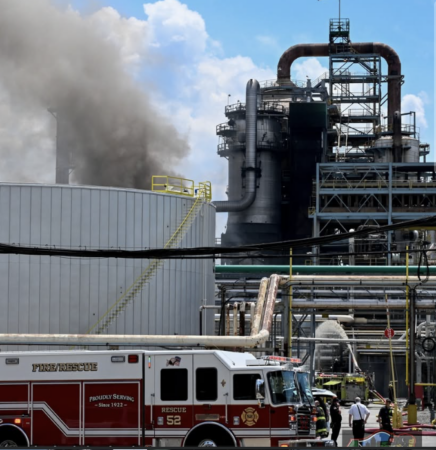
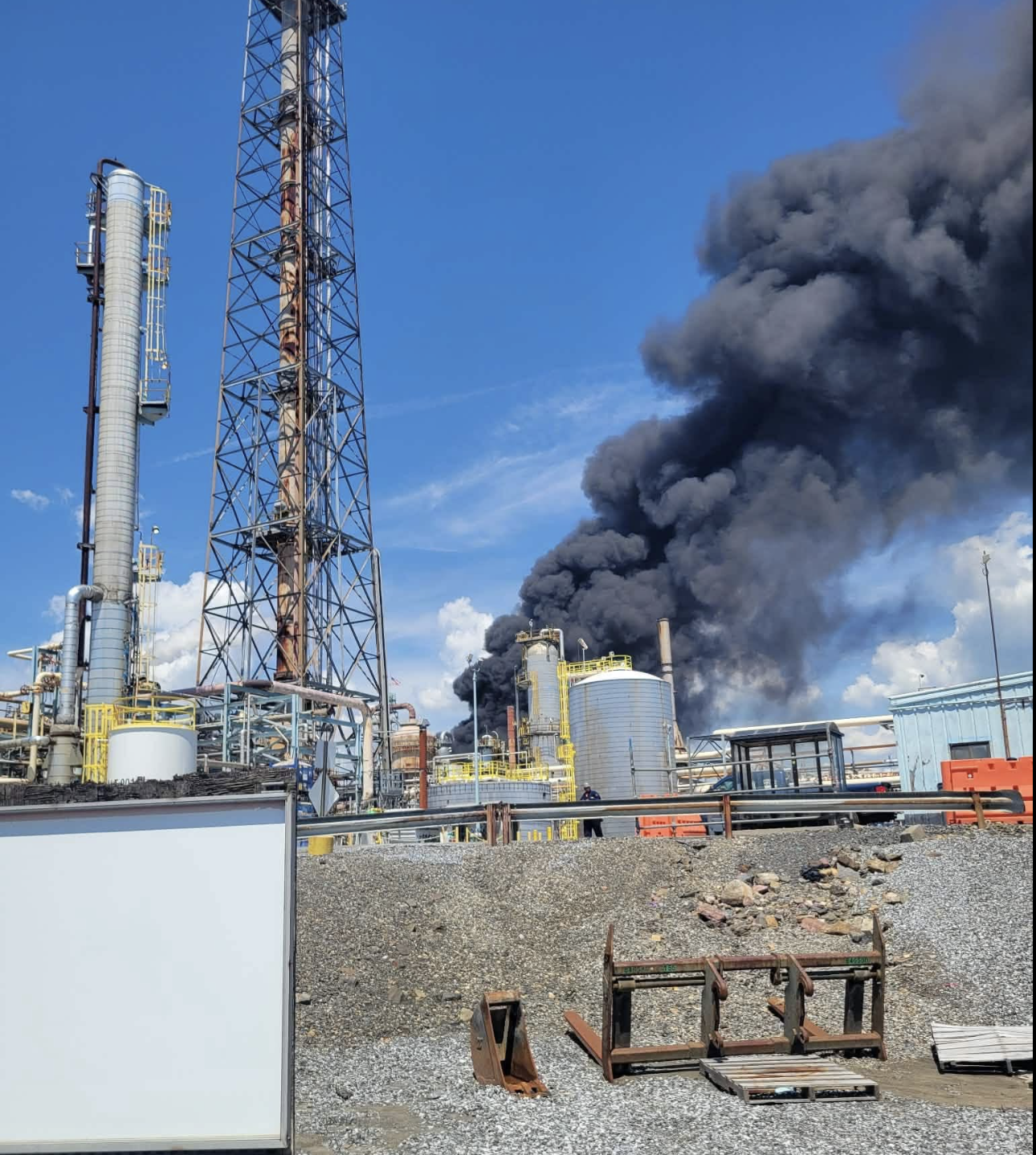
    According to a Monroe Energy statement, a process pump at the Trainer plant caught fire Thursday, injuring a worker. County officials said two others were treated for heat effects after refinery staff and volunteer fire companies mobilized to fight the blaze. Monroe said air monitoring showed no risk to people outside the plant. The fire is under investigation.

    Firefighters outside the plant noticed smoke rising from the refinery at 11:30 a.m. Tuesday, even before reports began flowing in from neighboring fire companies and Delaware County emergency workers, who urged residents to shelter in place, according to a statement by the Upper Chichester Volunteer Fire Co.

    The fire was declared under control, and the shelter order lifted at 2:54 p.m.

    In line with company policy not to discuss operations, a Monroe spokesperson declined to estimate when the plant would be fully back online.

    The earthquake this week in Venezuela, an oil source for East Coast U.S. refiners, did not disrupt production at the nation’s main Paranagua oil complex, but the second-largest concentration, at Morón, was temporarily stopped, Reuters reported. The loss of electric power and other infrastructure damage across Venezuela is expected to slow tanker shipments out of the stricken nation.

  • Incyte is built to grow, says the company’s CEO, who sold previous biotechs for billions

    Incyte is built to grow, says the company’s CEO, who sold previous biotechs for billions

    Bill Meury got the call early last year after the last company he ran got sold for $3 billion. Billionaire biotech investor Julian C. Baker asked Meury: Would you be interested in running Incyte, a 2,800-person, publicly traded drug developer in Wilmington with $5 billion in yearly sales?

    Under its previous CEO, Hervé Hoppenot, Incyte had multiplied sales of its breakout drug Jakafi (“JACK-ah-fye”), which treats blood cancers and transplant conditions. The company plowed revenues into hiring scientists, building labs, buying smaller businesses, and testing new products against the day Jakafi’s key patent runs out in 2028.

    But new Incyte products were coming to market slowly. Shares peaked at over $130 in 2017, then fell into the $50s by early 2025, when Meury took over that June.

    Meury’s signing-year compensation at Incyte was valued at over $30 million, mostly in stock grants and in options vesting over six years. (Hoppenot was given $17 million for his retirement year.)

    With Meury as CEO — and Baker, whose firm is its largest investor, succeeding Hoppenot as board chair — Incyte shares have again topped $100 a share. Investors are hoping that Incyte delivers the drugs it has been readying for market — or that the company gets sold at a premium price like Meury’s previous employers Anthos, Karuna, Allergan, and Forest Labs.

    Baker is also a director and investor in Madrigal Pharmaceuticals, a $1 billion (yearly sales), $12 billion (stock value) company based in Conshohocken, best known for Rezdiffra, which treats liver disease.

    Meury, who has been building a top management team with new chief financial, human-resources, and strategy officers, took questions from The Inquirer in his office atop Incyte’s glass-fronted hillside headquarters near U.S. Route 202.

    The interview has been edited for clarity and brevity.

    Why did you take this job?

    I did a great deal of diligence. I found their pipeline [of new therapies] was fundamentally under-appreciated. The company has excellent R&D and commercial capabilities. It has excellent potential products in three of the strongest areas of biotech — oncology, hematology, immunology — really good areas for long-term growth.

    That’s ultimately what companies solve for. When you have products, you win.

    Don’t all big pharma companies have that?

    Incyte has top-10 pharma scientists without the bureaucracy. Our researchers punch above our weight. Incyte is not a diversified giant, but it’s not a small start-up either. We avoid the downsides of both.

    Just for one example, Patrick Mayes, our chief scientific officer, is out of the University of Pennsylvania. We have a very capable group of scientists — biologists, chemists, translational researchers, drug developers. We are able to colocate here in Wilmington, which results in faster iteration.

    We have a lot to prove over the next couple of years. If we can advance half our assets through Phase 3 [clinical trial] to FDA approval of some scientifically and medically important products, Incyte will be much larger.

    I believe we have the potential to double or triple [sales] in five to seven years.

    For example?

    We are developing the first oral-targeted treatment for pancreatic cancer, which has been considered an undruggable target for decades.

    This is the Everest of oncology. Our scientists designed a small molecule to target KRAS G12D, a protein that causes [cancerous] cells [to reproduce uncontrollably]. We are in a race to be No. 1 with an approved treatment.

    And we have therapies for a group of blood cancers and for colorectal cancer. These are first-in-class molecules that can make a pronounced difference for those cancers.

    How can anyone avoid the ‘bureaucracy’ you say slows successful organizations?

    You can’t solve bureaucracy through structure and process. You have to solve through the attitudes of exceptional leaders. Hervé built a great culture on good hiring decisions. You have a bunch of people that trust each other.

    Failure is always right around the corner. Management has to be self-aware, to know the strengths and weaknesses of the employees. We are not running the company from 30,000 feet.

    Do you expect your board and major shareholders will want you to sell Incyte, like your previous companies?

    In general, companies can have two value-creation paths: There’s the independent path, and then there’s merger and acquisition.

    The only path that a management team controls is the independent path. We are focused on running the company, building a great business for the employees, customers, physicians, and patients — and for the shareholders.

    It hurts companies when there is a merger and acquisition theme all around them. If [buyers with offers] approach us, we have to listen. But we are building this company for the next decade. Most people want to work with a company that wants to be around in 10 years.

    You’re not antimerger. On June 16, you agreed to buy Vega Therapeutics for up to $2 billion.

    Vega has a novel compound [a treatment for an inherited blood disease] that we believe has potential sales of over $1 billion. If we can do several deals like this that fit one of our categories, in this case hematology, we will do them. These will never be more important than internal R&D, but each can be a multiplier for our business, with the right risk-and-reward profile.

    By the time Jakafi loses exclusivity in December 2028 — and it may go beyond that — we will have $3 billion to $4 billion in non-Jakafi revenues.

    Americans aren’t happy with the cost and availability of medical care, including drugs. Do you see any hopeful signs?

    Three things have to be in place for biopharma to thrive: First, patent and trademark laws have to be predictable. Second, pricing policy has to be balanced. Third, FDA has to run effectively. There have been headwinds, but I think those pillars will be in place as disruption settles.

    Are U.S. consumers and employers subsidizing world drug development with our high prices?

    It’s true there’s an imbalance. But Americans have access to the best medical care in the world, such as novel cancer treatments.

    But we have to get a better framework for global pricing. You’d like to see prices outside the U.S. come up, if they are going to moderate inside the U.S.

    Can the U.S. compete with China?

    China will be a source of innovation and competition. We have four or five major biotech centers in the U.S. They have 15. China is here to stay. For the U.S. to remain the leader, we have to create an environment where biotech can continue to thrive.

    Incyte was founded in 2002 by scientists from Wilmington-based DuPont, but recent plans to grow your space stalled. Will Incyte keep growing here?

    In the last two years we have added more than 150 [in Delaware] and anticipate adding another 250 [by 2031]. We will be here for as long as I’m here. The biotech labor market is not as strong as Boston, but it is strong here, with Thomas Jefferson and Penn in Philadelphia, and Johns Hopkins in Baltimore.

    We’ll grow somewhere else if we have to. I’m not religious about it. But the base of this company is here in Wilmington.

  • Engineer accused of using insider information on Three Mile Island nuclear plans to make $1.5 million

    Engineer accused of using insider information on Three Mile Island nuclear plans to make $1.5 million

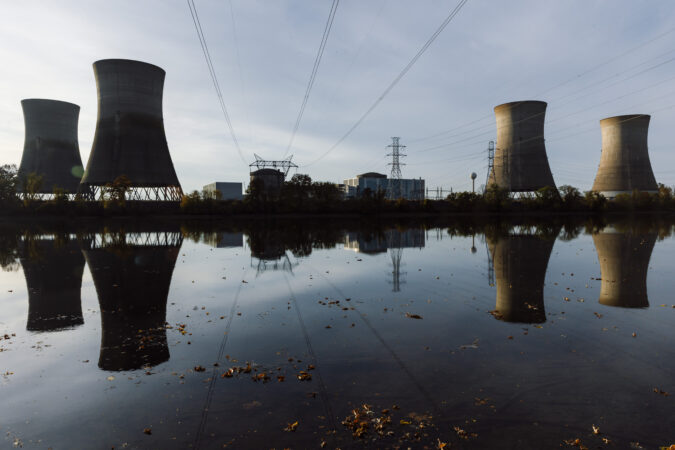
    A nuclear power plant engineering manager for Constellation Energy has been indicted on federal insider trading charges of using advance knowledge that his company planned to reopen a uranium-powered electric plant at Three Mile Island to collect illegal profits on the stock options market.

    Casey Muggleston, of Marshallton, Del., worked on the license renewal team applying to the Nuclear Regulatory Commission for permits to restart the plant. According to a Delaware grand jury indictment, Muggleston made $1.48 million from his “scheme to obtain illegal profits” using “material nonpublic information” before Constellation announced its decision.

    Following an investigation by FBI agents in Maryland and Delaware, Muggleston was charged Wednesday by the U.S. Attorney’s Office for Delaware with securities fraud and four counts of insider trading.

    The charges carry a maximum sentence of 105 years, if he is convicted. However, white-collar sentences are typically a fraction of guideline terms. The government also wants Muggleston to forfeit the $1.48 million.

    Neither Muggleston, who worked for Constellation or its former owner Exelon Corp. from 2008 until 2025, according to a related SEC complaint, or his attorney returned a call seeking comment.

    “Constellation is aware of the government’s indictment,” company spokesperson Paul Adams said in an email. “As Mr. Muggleston is no longer an employee, we have no further comment.”

    According to the indictment, Muggleston bought call options on the company’s shares, a cheap way to collect gains in a stock’s share value, without having to pay the shares’ entire trading cost.

    Three relatives also bought options but have not been charged, according to the indictment.

    In a separate civil complaint, the Securities & Exchange Commission alleged Muggleston also shared information on other confidential Constellation deals as late as June 2025. He left the company that year, according to the SEC.

    Here’s what the indictment alleges:

    As early as April 2024, Constellation had said publicly that it was looking at restarting the reactor but hadn’t made a decision. Before going public with the news, Constellation had employees such as Muggleston refer to the restart as “Project Tetris.”

    A May 21 email to staff, including Muggleston, which was part of correspondence cited by both federal prosecutors and the SEC in their complaints, told employees to keep the licensing team’s progress “very confidential.”

    Three days later, Muggleston sent his cousin, who lives near the plant, an email noting “the restart is building steam. I’m trying to think of how to profit off this …” He added that there were “no guarantees.”

    Eight days later, on June 1, he gave the cousin a heads-up that a decision would likely be made later that month.

    By June 8, Muggleston had begun buying Constellation options in his Delaware brokerage account, betting the stock would rise, mostly by dates in July or August. By Aug. 14, he had accumulated 195 options contracts.

    But Constellation hadn’t announced the reopening. The share price for a time drifted lower, and some of his initial options expired and became unprofitable.

    Then on Aug. 15, two colleagues told Muggleston the restart was approved, and he was summoned to a restart planning meeting.

    Starting the next day, he bought another 150 options, then another 360. In early September the stock rose to over $200, making more of his options profitable.

    On Sept. 20, when Constellation made its announcement, the stock closed at $255, and he sold his 550 remaining options for a total profit of $1.48 million.

    Muggleston had taken Constellation’s annual training reminding employees, board members, and contractors that they and their family members are barred from trading on insider information and from “tipping” outsiders with that information, the indictment says. Insider trading is also illegal under federal securities law.

    The nuclear restart would help Constellation, a Baltimore-based power plant operator, supply data centers under a contract with Microsoft, among other customers. The plan is supported by President Donald Trump, Gov. Josh Shapiro, and other government officials. Environmental critics say the process is being rushed and could raise the likelihood of contamination.

    Constellation’s plan focuses on Three Mile Island’s reactor that closed in 2019 for economic reasons. It was not damaged in the 1979 partial nuclear meltdown.

    Constellation says it’s on track to load uranium into the reactor next spring and begin to supply electric power later in 2027.

  • PSERS outsources $20 billion in investments

    PSERS outsources $20 billion in investments

    In one of the biggest outsourcing moves in Pennsylvania investment history, the board of the $84 billion-asset state teachers’ pension plan, PSERS, voted last week to outsource investments worth $20 billion to BNY Investments Mellon, replacing work now done by members of PSERS investment staff.

    “We are trying to be more efficient,” Benjamin Cotton, PSERS’s chief investment officer, said in an interview Thursday. PSERS staff “have done a good job” managing that money, he said, but commercial index fund fees have fallen so much, and Wall Street managers’ ability to match benchmark indexes has improved to where it’s best to hire outsiders.

    At Wednesday’s meeting, Cotton told trustees that BNY, which is based in New York and has investment offices in Pittsburgh, is already a PSERS contractor and “wants to be an index fund manager for PSERS as well.”

    He declined to estimate how much PSERS would pay the bank, adding that a final contract is under negotiation.

    The resolution passed by the PSERS board calls on BNY to invest $16 billion in a “passive” (index-fund) portfolio of stocks “benchmarked to the S&P 1500.” BNY Mellon does not currently manage an S&P 1500 index fund, though the measure is used as a benchmark for BNY funds combining other indexes.

    BNY documents show the bank charges institutional investors between 0.2% to 0.7% of assets per year for other index funds, which could result in PSERS payments to the bank of at least $32 million a year. But fund managers sometimes negotiate significantly lower rates with multibillion-dollar clients like PSERS.

    PSERS also agreed to invest $4 billion with BNY in a foreign stocks fund, its performance to be measured against the Morgan Stanley Capital International (MSCI) World Ex-U.S. benchmark.

    Cotton said no PSERS staffers would be laid off as a result of the outsourcing moves, with investors responsible for buying and selling stocks for the current portfolio reassigned to other work. He declined to estimate how many PSERS staffers managed the funds BNY will take over.

    The board voted to approve the transfer, with only State Sen. Katie Muth (D., Chester) dissenting.

    Muth has opposed or abstained from supporting scores of PSERS investments, citing the lack of fee information and other details she says are provided to the trustees.

    The agency’s investment contracts often include fee formulas managers say are available to trustees like Muth on request but redacted from public viewing, though the annual sums paid to contractors have been published in separate reports without explanation of how the payments were calculated.

    Manufactured housing profits

    Also at Wednesday’s meeting, Cotton said PSERS would collect nearly $700 million from selling a major investment. People familiar with that investment confirmed it is a stake in Yes Communities, which has owned and developed hundreds of U.S. trailer parks with amenities such as swimming pools and clubhouses.

    Cotton says PSERS invested a total of $230 million, starting in 2008, and including the new payout has received around $1 billion back, with another $500 million still invested in the same asset, currently through the Brookfield private investment group. Cotton said that return has been higher than if PSERS invested that money in the S&P 500.

    That’s better than the results PSERS realized on some of its other “direct” real estate investments from that period, including a handful of Southern hotels and shopping malls, and vacant Harrisburg industrial properties.

    The board also approved investments in TPG Peppertree Fund XI-A, an infrastructure fund, and PAI Mid-Market Fund II, a European private-equity fund.

    The board did not consider two other investments recommended by staff, in a pair of private-credit funds.

    Given poor results and variations in asset valuations reported by private-credit managers, Cotton said, PSERS needs to review its existing private-credit investments, and what’s happening to the high-risk loans that private-credit funds finance before buying more.

  • Philadelphia’s former top lawyer, now a corporate defender, says national companies need Philly lawyers

    Philadelphia’s former top lawyer, now a corporate defender, says national companies need Philly lawyers

    As Philadelphia’s city solicitor, heading a staff of more than 200 lawyers, Sozi Pedro Tulante sued some of the nation’s biggest corporations, accusing them of loan discrimination and pushing lethal painkillers.

    Now he’s a partner at Dechert LLP, a Philadelphia-founded, international corporate law firm, where the work includes defending big national corporations from the kinds of complaints he used to file.

    Corporate targets during his 2016-18 stint as the city’s top civil lawyer included Wells Fargo & Co., the third-largest U.S. bank, which settled his lending-discrimination complaint for a promise of $10 million in donations to housing programs, and six pharmaceutical companies, four of which were major Pennsylvania employers, for promoting addictive opioids. The city later got a nearly $200 million share of a national settlement.

    Tulante’s job also included routine legal reviews. He defended the city’s soda tax and its sanctuary city immigration status.

    After leaving his city position in 2018, Tulante — son of a refugee, a Northeast High School and Harvard University graduate, and a former federal prosecutor — lectured at the University of Pennsylvania’s law school.

    He joined Dechert’s litigation department the next year, then spent 2022 to 2025 as general counsel at Boston-based Form Energy, which builds iron-based batteries for data centers and other clients at its plant in Weirton, W.Va.

    Last year, Tulante moved back to Philadelphia and was named co-managing partner of Dechert’s Philadelphia office. He agreed to talk to The Inquirer about practicing law in Philadelphia.

    This interview has been edited for clarity and brevity.

    Does Philadelphia’s reputation as a “judicial hellhole” full of billboards urging citizens to sue businesses scare companies away?

    When a company is deciding to locate in a particular place, they do look at the tax structure and how red is the red tape and the legal climate.

    The Inquirer has reported how in Philadelphia [a plaintiff] can pursue a case in Philadelphia Court of Common Pleas even if they aren’t here. There have been these “nuclear verdicts” for millions of dollars.

    More companies are now aware of the risk. They adjust.

    There are extreme cases where litigation ends a company. But for the most part you factor it in.

    Who gains from a litigious climate?

    Sophisticated national companies have clients everywhere. They know they are going to get sued. They study to minimize litigation. For example, don’t use flip messaging. Just be familiar where the threats may come from. Know what litigation the city is pursuing.

    Many of the big companies facing litigation in Philadelphia are more likely to engage counsel that is locally respected and recognized in the area. In Philly, if you can’t answer the question, “Where did you go to high school?” [with a name the parties recognize], it’s a disadvantage. Here, we fight the plaintiff attorney, but we also serve on the same board and attend the same continuing legal education [CLE] classes.

    There are great lawyers on the other side, at [plaintiffs’] firms like Kline & Specter and Ross Feller Casey, sophisticated counsel who walk into court and get instant respect.

    Part of my role at Dechert is to represent clients in Philadelphia and nationally who are thinking about how Philadelphia has changed as a place of litigation and how that litigation impacts business.

    Businesses are saying, “We have the tax burden, the regulatory burden, we’ll comply, but you are pushing on the edges.”

    What recent laws have changed the legal climate for business?

    The new consumer protection ordinance, passed in 2024, has given the city more power to bring some major cases [through national law firms] that are broader than before. Life sciences cases. Firearms liability. Fair workweek litigation. They may go after [national] retailers in certain cases. The city can go forward and get penalties up to $2,000 per violation.

    As city solicitor, I was reminded that government has the broadest power of regulation at the local level. The police authority government has is really broad. Unless there’s some preemption by state or federal government. It’s something folks pay attention to.

    Is part of Philadelphia’s affordability a result of its failure to attract private-sector employers?

    I live in West Philly. I work at the law school. I have three children in public schools. I want the city to have a secure tax base. I want to make sure investment goes where it needs to.

    It’s challenging. One of the biggest challenges is getting people from Temple, Penn, Drexel, and St. Joe’s to stay.

    There are instances, like Chubb’s new office, where the city has persuaded [a longtime city employer] to stay.

    In Philadelphia the strength ultimately is in eds and meds. We have doctors and nurses, lab technicians, people with a high level of training. Philadelphia takes credit for helping solve COVID by our Nobel Prize winners Drew Weissman and Katalin Karikó at Penn, which has led to investments in gene therapy.

    What was the most satisfying thing you did as city solicitor?

    Working to get local control of the school district and disbanding the state’s School Reform Commission. It was humiliating, the way the state was running our schools. We should have a stake. The most important thing we can do is educate our children and prepare them for businesses that want to hire talent.

    Why did you choose the law?

    It’s not the ability to argue that makes a good lawyer. You have to solve problems. You have to be really good at writing. And you have to be able to talk to people — to be personable, to make the hard stuff simple, to help them understand.

    I like a career where people ask you to help them solve really big problems. They can be CEO of a major company or a pro bono client that needs a habeas petition. They require the same level of skill.

    How did you come to be a Philadelphian?

    I came here at age 8 in 1983 [after his father, a military official in Angola, fled to Congo following a change in government, was imprisoned, then was resettled in North Philly by a refugee agency].

    It was a difficult time to grow up here. I graduated in 1993 from Northeast High School. I got into Harvard, then Harvard Law School.

    Eight years ago, I left the city, to be general counsel at a startup.

    But it came back to family and affordability. Philadelphia is that place for me, within the larger Northeast corridor.

    What gives you hope?

    My dad drove a cab when he came here. My mom worked in the prison system. Now here I am, a Black attorney from the public school system.

    I am a big booster of today’s public schools. My children are at Central, at Masterman — I couldn’t get into those, I still hold a grudge! — and at Penn Alexander in West Philly.

    I want my children with other children who really want to achieve. I motivate them, the teachers motivate them, they are self-motivated, but the friends they are with have more of an impact on them.

    And I think we are finally putting into place an infrastructure for understanding government. You know Philadelphia has more political ads and advertising than almost anyplace, a big city in a swing state. But we have not always centered our education on civics. Now my son understands more than I did.

    I’m glad to be back at Dechert. I can see a lot from this perch.

    This story has been updated to correct some biographical information about Sozi Pedro Tulante.