Two of the 20 Philadelphiaschools originally targeted for closure under Superintendent Tony B. Watlington Sr.’s facilities plan have been spared and will remain open.
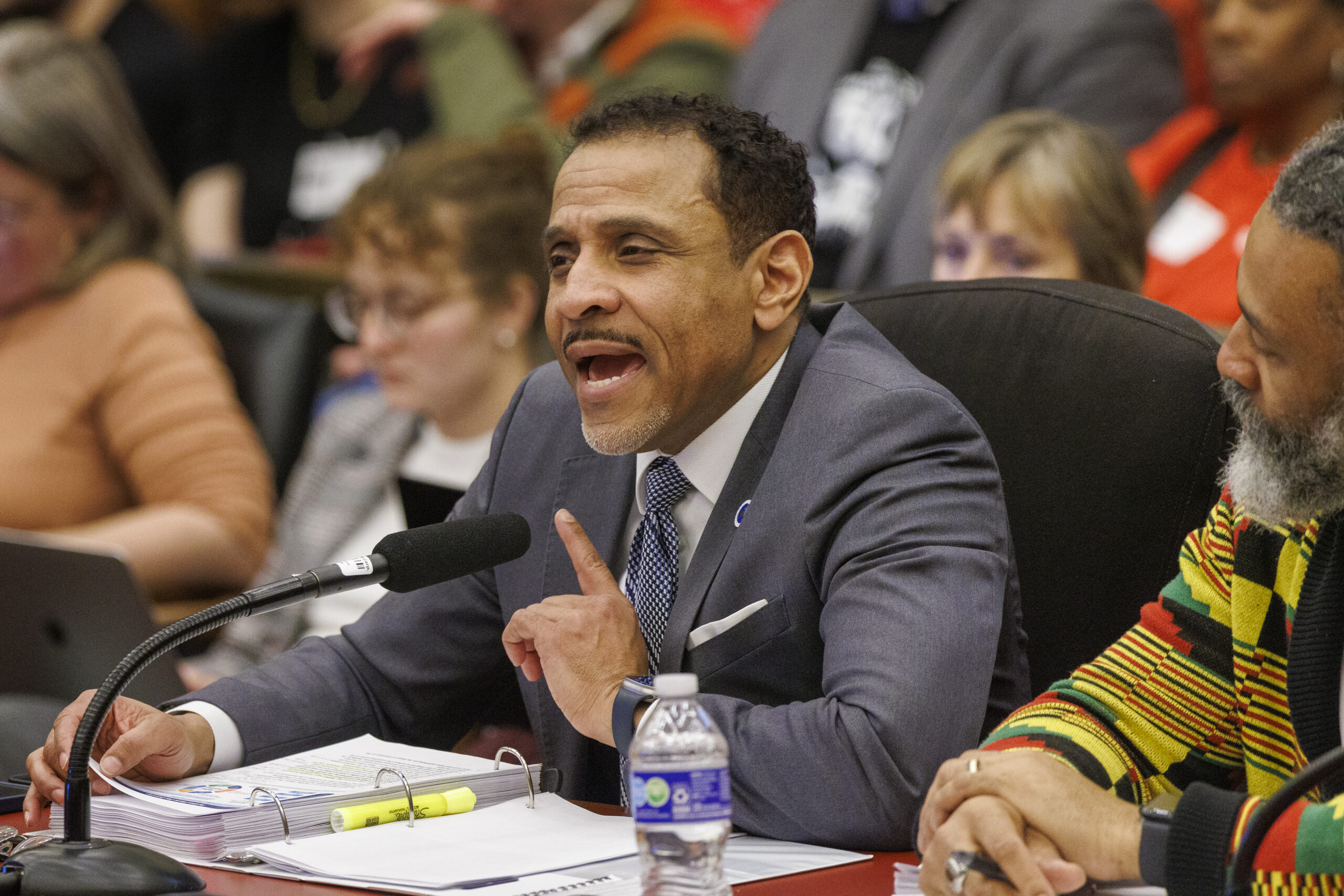
Conwell Middle School in Kensington and Motivation High in Southwest Philadelphiawill not close after all, Watlington announced at acharged school board meeting Thursday.
Watlington said the change from 20 to 18 school closures was not because of politicians, though.
“We pored through thousands of feedback loops from a number of Philadelphians, to include parents, students, grassroots organizations, and certainly elected officials,” the superintendent told reporters during a briefing this week. “We took all of that feedback together and, in tandem, we landed on these recommended changes, not reflecting one voice or sector more than the others.”
Watlington’s $2.8 billion facilities plan, which now includes closing 18 schools, colocating six, and upgrading 159, is not yet final and continues to face strong opposition from affected school communities. He formally presented it to the school board Thursday, and the board is expected to vote in the coming weeks, though no date has been set. Schools would begin closing in 2027, and school building upgrades would take several years.
Under the revisions Watlington presented Thursday:
Conwell would remain open and continue to be a magnet, but would also add a neighborhood admissions component. Students from nearby Elkin Elementary, a K-4, would move to Conwell beginning in fifth grade, and the school would still accept students from around the city.
Motivation would absorb students from Paul Robeson High, which is on the closure list. Robeson and Motivation are both citywide admissions schools, and Motivation would remain so under the plan. Robeson had previously been scheduled to move into Sayre, another citywide admissions school.
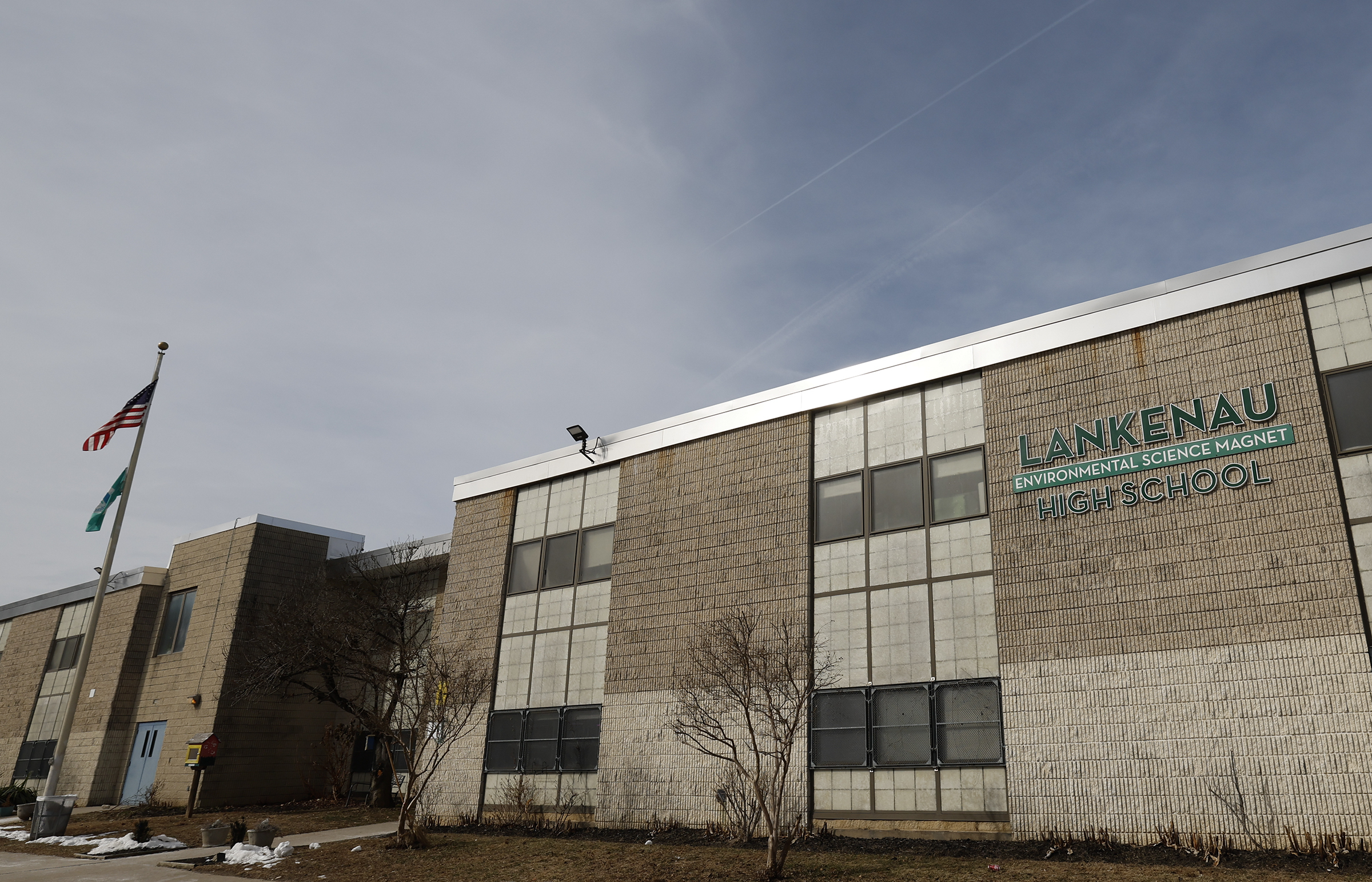
Lankenau High, the city’s environmental science magnet, had been targeted for closure and would have moved into Roxborough High. It would still close under the revised plan, but would instead move into Saul High School, the city’s agricultural science magnet. Both are in Roxborough.
‘Accelerating Opportunity’
In his presentation to the board, Watlington called the 10-year plan “Accelerating Opportunity.”
The proposed changes were spurred not by finances — though the district has 70,000 empty seats and has indicated it needs to shrink its footprint — but by a desire to accelerate progress, Watlington said.
(function() {
var l2 = function() {
new pym.Parent(‘schools6’,
‘https://media.inquirer.com/storage/inquirer/projects/innovation/arcgis_iframe/schools6.html’);
};
if (typeof(pym) === ‘undefined’) {
var h = document.getElementsByTagName(‘head’)[0],
s = document.createElement(‘script’);
s.type = ‘text/javascript’;
s.src = ‘https://pym.nprapps.org/pym.v1.min.js’;
s.onload = l2;
h.appendChild(s);
} else {
l2();
}
})();
The district is making gains in academics, attendance, and dropouts, but still, the superintendent said, “the majority of our young people still don’t perform at grade level of reading and math.”
Philadelphia, Watlington told reporters, “must multiply that acceleration curve by five or 10. Because we can’t wait for generations to improve these outcomes and opportunities for all of our children. And we know that there’s a huge disparity based on where you live in Philadelphia.”
The 159 modernization projects to upgrade schools range from new roofs and fresh paint in some buildings to larger projects, including a $58 million refresh at South Philadelphia High. The district released the full list of proposed modernization project details this week. But funding for them is not yet certain; the district plans to pay $1 billion of the $2.8 billion cost and hopes state and philanthropic funding will cover the rest.
How did Conwell and Motivation get spared?
Students, parents, and staff at each of the 20 schools proposed for closure have made cases for why Watlington should change his mind since their schools landed on the closure list last month.
In Conwell’s case, Watlington told reporters the advocacy work of the “large, historic alumni base” of the magnet middle school helped move the needle.
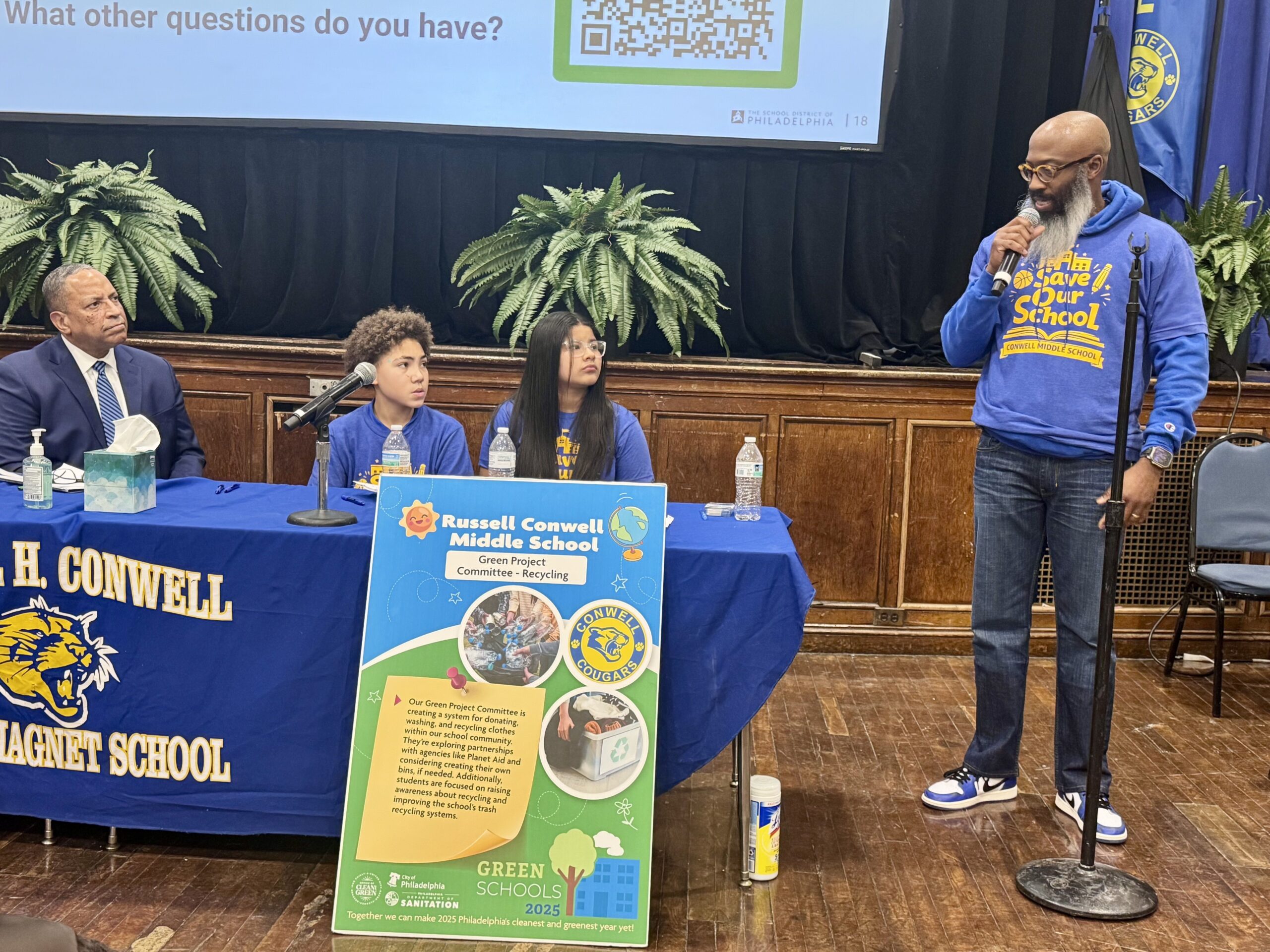
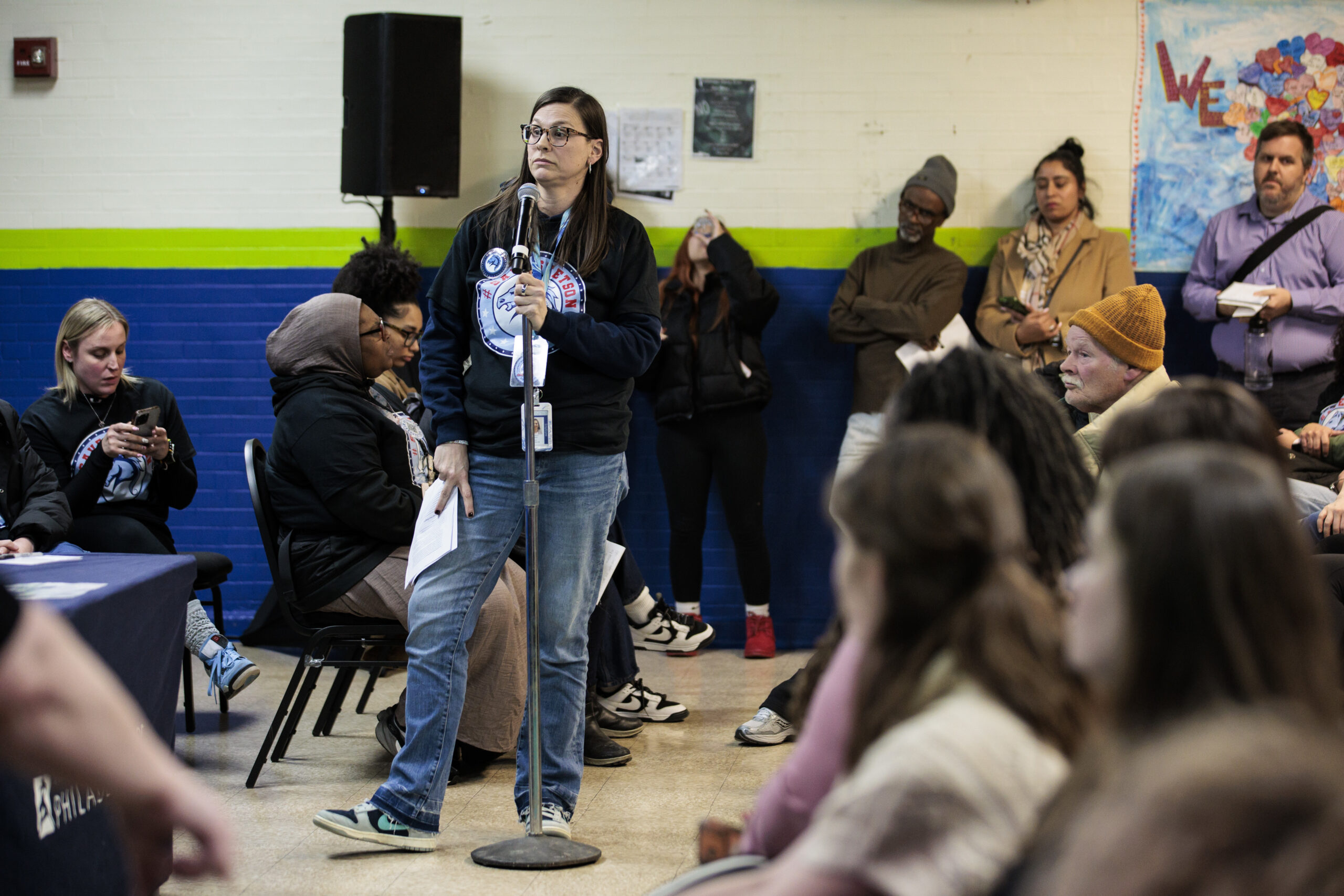
Philadelphia School District Deputy Superintendent Oz Hill and student moderators listen to Andre Sanford-Adams, the school’s health and physical education teacher, speak about why he thinks it’s a mistake to close Conwell at a meeting at the school.
So, too, did “significant feedback from individuals about a part of the city where individuals felt very strongly that we have to figure out how to invest more in.” Conwell supporters spoke out strongly against divesting from a school in Kensington, the center of the city’s opioid epidemic. Councilmember Quetcy Lozada, for example, said at a meeting at Conwell that “we are saying to these families, we are punishing them because as a city, we can’t respond to the public safety issues that we have on the outside, and that is just not fair.”
Also, Watlington said, the distance between Conwell and the school its students would have been sent to — AMY at James Martin, more than two miles awayin Fishtown — was significant.
Conwell would remain a magnet school, open to students citywide only through the school selection process. Elkin students would be in separate classes, and Conwell would continue to offer accelerated classes to its magnet students.
Closing Motivation would have leftSouthwest Philadelphia with no magnet school. Watlington said officials liked the idea of routing Robeson, a strong citywide school in West Philadelphia, to Motivation.
“The building itself at Motivation is not at the bottom of the heap in terms of programmatic ratings,” the superintendent said. “The problem with Motivation is that we’ve lost enrollment.”
Relocating Robeson inside Motivation solves “the number one problem we’re solving for, is how do we build our enrollments, address under- and overenrollment so we can push in more high-quality academic and extracurricular programs. Our community, quite frankly, made some suggestions that had merit.”
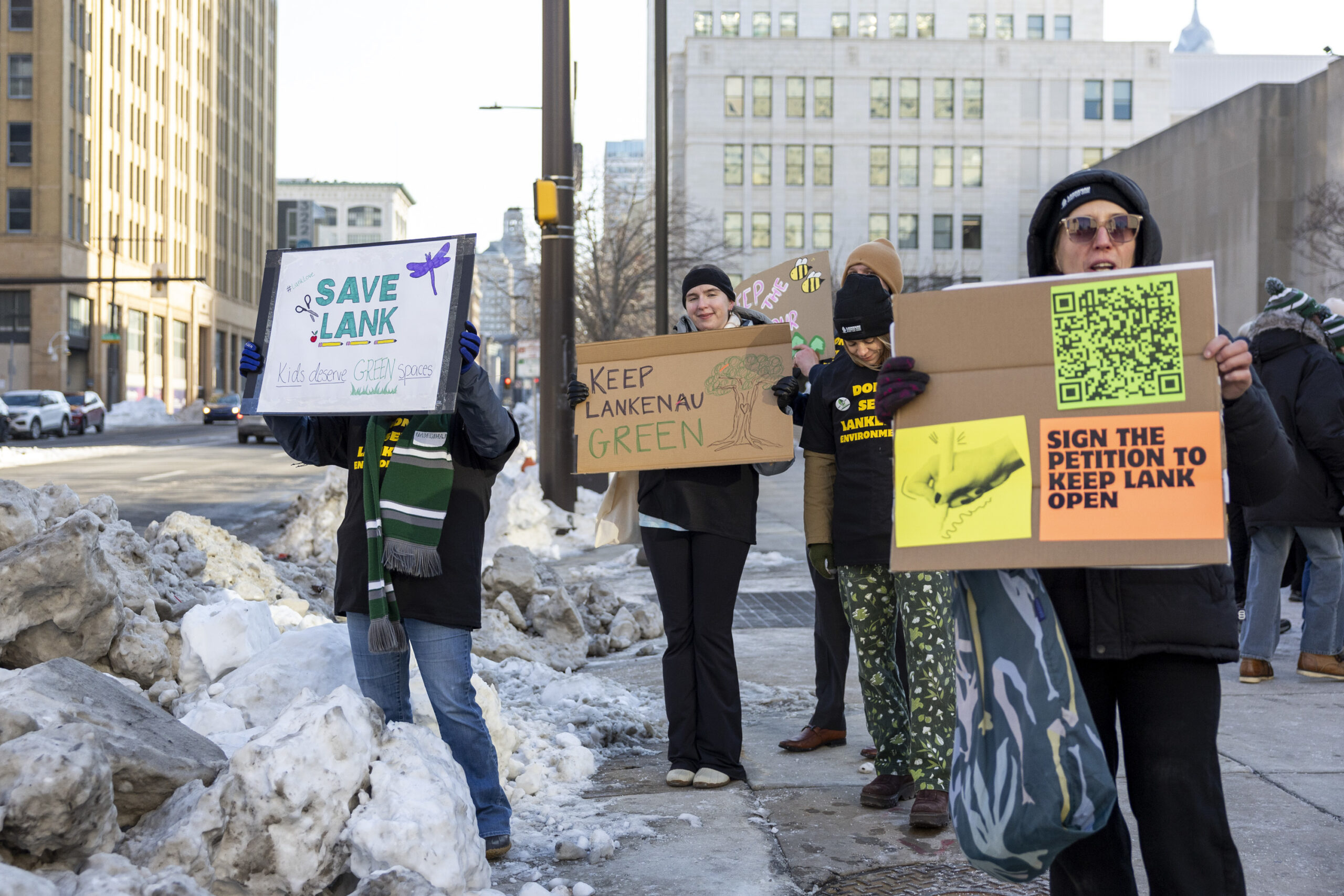
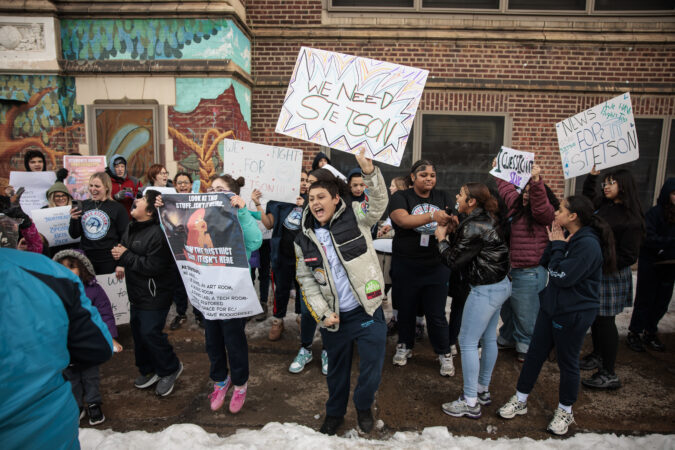
Teachers, students and community members rally against closing Lankenau High School on North Broad Street outside the school board meeting last month.
Disappointment for Lankenau and other schools
The outcry around closing Lankenau was also significant; Watlington’s team did not retreat from a closure recommendation, but now wants to locate the school at Saul, another magnet with a complementary mission.
“We have to do our due diligence, and those sometimes can be a bit complicated, but we’ll work through all of the details as appropriate,” he told reporters.
The ball is in the school board’s court now. It has not set a date for a vote on the plan or said whether it will consider further public engagement.
But, Watlington said, “we look forward to the board of education receiving these recommendations and doing some thoughtful digesting of these very well-thought-out recommendations that reflect our community at large’s feedback.”
The Philadelphia School District is considering a sweeping facilities plan. Superintendent Tony B. Watlington Sr. has proposed closing 18 schools, colocating 6, and modernizing 159.
Watlington presented his plan — sparing two schools from the initial list of 20 closures — to the school board Thursday.
Watlington’s recommendations are not yet final. The board is expected to vote on his plan later this year.
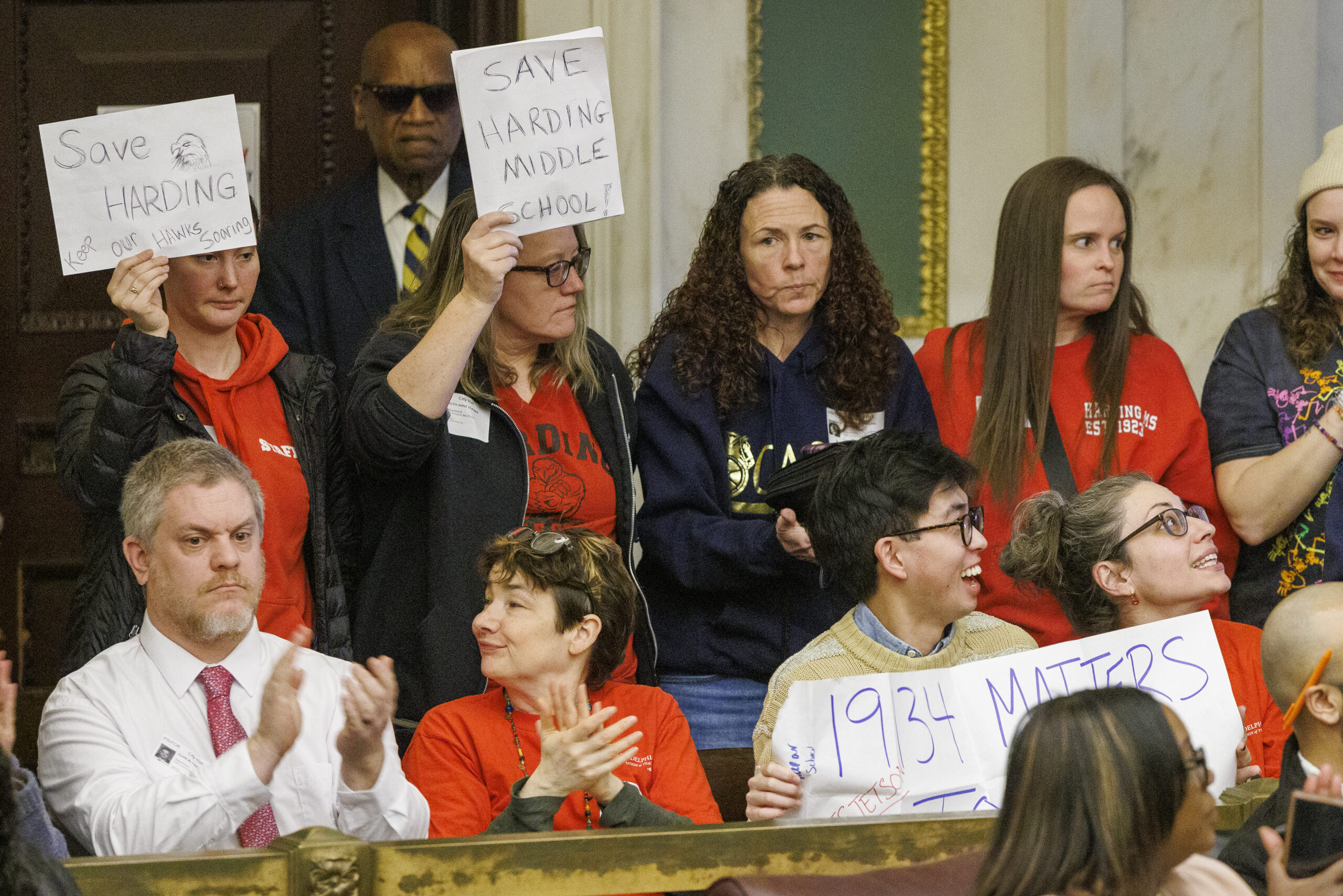
The plan has already faced opposition from students, parents, staff, and political leaders who are fighting to save their schools. Community members gathered for a rally outside school district headquarters ahead of Thursday’s board meeting.
// Pinned
// Timestamp 02/27/26 0:27am
Recap: Students, parents, and teachers beg board not to close their schools
The Philadelphia school board heard several hours of public testimony Thursday evening — and into Friday morning — about a proposal to close 18 schools.
Superintendent Tony B. Watlington presented his proposed facilities plan to the board Thursday. It includes closing 18 schools, colocating six schools, and modernizing 159 school buildings.
Meeting ends after hours of testimony about school closures
More than eight hours after the school board meeting began, it ended early Friday morning.
After concluding hours of public testimony, largely criticism of the school facilities plan, the board spent only a few minutes quickly passing items on its agenda.
Last speaker: ‘I beg you, do not close our schools’
Carin Bennicoff, a longtime teacher at Ludlow Elementary, notes that school closings hit vulnerable communities hard, and disproportionately. “Please – I beg you, do not close our schools,” Bennicoff said.
Here ends the speakers list.
“I think this board has been listening tonight,” said board president Reginald Streater, and more feedback will be heard on March 12.
Retired teacher says plan would ‘rip apart people’s communities’
Lisa Haver, a retired Philadelphia teacher and founder of the Alliance for Philadelphia Public Schools, said that no member of the board should vote for the plan.
“Do you really have to rip apart people’s communities?” Haver said.
Parent and student speak out about accessibility concerns
Kim Nelson, a parent, spoke on behalf of her daughter. Nelson said she is concerned about many schools that are not accessible for those with disabilities.
“My daughter wanted to express her concerns, and we’ve been here for the last seven years,” Nelson said. She said she wants fixes at Overbrook High, her daughter’s school.
“My school has over 60 bathrooms, and not one of those bathrooms is ADA accessible,” Nelson said.
Nelson’s daughter also spoke about problems accessing bathrooms at Overbrook.
Watlington asked Teresa Fleming, the district’s chief operating officer, to “attend to those issues immediately.”
Jonathan Hoffmeier began as a teacher at University City High School, which closed in 2013 and is now a parking lot.
He now works at Lankenau, which he urged the board not to close.
Lankenau has been evaluated “as an asset in a real estate portfolio,” Hoffmeier said. “Closing Lankenau sends a message. It tells students, ‘You don’t deserve these opportunities.’”
Amy Szymanski, a Lankenau staffer, is reading another staffer’s statement. The art teacher couldn’t attend the meeting because she led Lankenau students competing at the Philadelphia Flower Show. “You haven’t expressed your vision effectively,” wrote the teacher, who is certified in both art and agriculture.
Parkway Northwest teacher says ‘our students deserve better’
“Our students deserve better than promises,” said Beth Ziegenfus, a teacher at Parkway Northwest. “They deserve action.”
For years, middle school teachers and parents used neighborhood high schools as a warning or a punishment — and it will take years to undo that damage, said Ziegenfus, who taught for years at Frankford, a community high school, before she moved to Parkway Northwest, a magnet school.
Leah Clouden: “let’s call this what it is: a land grab and shell game that we already experienced in 2012. This plan is an egregious breach of trust.”
Clouden asks the district to stop holding up access to Algebra 1 in eighth grade as the be-all, end-all, when most district students cannot do math on grade level.
District staffers and teachers fight for their schools
Tanya Edmonds, a district staffer, questions the plan and the district’s move to give some schools to the city. The district’s website is not easy to navigate, she said, and data is tough to find.
Benjamin Grivensky, a history teacher at Parkway Northwest, opposes the plan.
“The closures will have an outsized impact on our minority students,” Grivensky said. The school’s graduation rate is 98%. “Simply put —Parkway works,” Grivensky said.
Patricia Rich, a teacher at Lankenau, notes that the district’s visual impaired life skills students learn at Lankenau. It’s small and safe, Rich said.
“We have shown that Lankenau cannot be transplanted,” Rich said.
‘Please do right by our kids,’ Stetson teacher tells board
Eugenia Giannoumis, a teacher at Stetson Middle School, said the survey that formed the basis of the district’s recommendation, was imperfect — and not reflective of most of the wishes of people in the Stetson community.
Lankenau’s principal says her school helps close district-charter gap
Jessica McAtamney, principal at Lankenau, notes the school is unique in the district — it has relationships with two separate charter schools. It’s closing the district-charter gap.
Watlington’s proposal would close Lankenau and send its students to Saul High School.
“Sending us to Saul does not fix why we are here,” said McAtamney, who said she worked at Saul for years and loves it.
Parkway Northwest is a unique environment for kids with disabilities, teacher says
Nicholas Shute, a special education teacher at Parkway Northwest, underscores his “firm opposition” to the plan. Moving Parkway Northwest into Martin Luther King is a “fundamental misunderstanding of what we do,” he said.
Parkway Northwest, which has a peace and social justice theme, focuses on safety, and creates a unique environment, especially for students with disabilities, Shute said.
Kyana Hopkins, a teacher at Robeson High, said the school lacks many resources, but “we worked with what we had” and experienced great successes — academic growth, sending a student to Harvard.
“Culture is not transferrable,” Hopkins said. “Make it make sense.”
The governor of Pennsylvania and other politicians held up Robeson as a model, Hopkins said. “Let us keep working the magic that we can keep producing,” said Hopkins.
Megan Murphy, a Waring teacher, said the school district has “obstructed opportunities for Waring” to overcome barriers and the school is now being penalized.
An emotional Renee Gair, a teacher at Fitler Elementary, said the school is a gem, with soaring academics and a real community. “Once students come to Fitler, they do not leave,” Gair said.
Horace Clouden, a retired building engineer and education activist, urges the board to invest in putting building trades programs in neighborhood schools.
Clouden is an ardent advocate of junior high schools. He and his family have attended school closing meetings around the city urging the district to commit to junior highs.
Charisma Presley, an advocate for year-round aquatics, is asking the board to recommit to reopening pools. A single year-round pool operates in the city now — at Lincoln High in the Northeast.
“We’re asking for concrete action,” Presley said.
Ariel Presley, another aquatics booster, pushes the board to commit to year-round pools and swimming instruction.
‘Data without context tells an incomplete story,’ says Stetson teacher
Kathryn Lajara, a teacher at Stetson Middle School, underscores the upheaval at the school in the past 20 years. First, it was turned over to Edison Schools, a for-profit company, to run. Then, it became a charter school run by Aspira, and then returned to the district, she said.
No major repairs were ever made to the building, and every change meant a new administration, new curriculum, and new expectations, she said.
“Data without context tells an incomplete story,” Lajara said. You can’t talk about Stetson without noting that the “foundation beneath it has been repeatedly shaken.”
Stetson has “endured systemic disruption” and is now being penalized for it, Lajara said.
Middle schools are taking a disproportionate hit, says district staff member
Cashonna Thomas is speaking in favor of Harding Middle School.
“Middle schools have taken a disproportionate hit,” Thomas noted.
Keeping students in K-8 schools “ignores child development,” Thomas said.
Kelli Gallagher, the next speaker, teaches at Harding Middle School now; she previously taught at Reynolds Elementary, which was closed in 2013.
Reynolds closing “created no positive effect on the community,” she said. It just benefitted developers and drove up house prices for long-term residents.
“We’re being asked to trust the process that lacks transparency,” Gallagher said.
Robeson High Home and School president calls district’s recommendations ‘trashy’ and ‘tasteless’
Samantha Bromfield, the Home and School president at Robeson High, said families want small schools.
“Understand that a parent like me will send my child back to being homeschooled” if Robeson closes. “Your choice doesn’t fit my criteria of what I’m looking for my children. Your recommendations and your data seems trashy. Tasteless.”
Rasheeda Simpson, a Robeson parent, said she chose Robeson — not Sayre or Motivation.
Closing Waring will hurt students with ‘complex trauma,’ teacher says
Hannah Myers, a teacher, is speaking about the proposed closure of Waring Elementary, where students have “complex trauma,” she said.
It’s a small school, but it’s a model of stability for the kids who need it most, she said, pointing out that 13% of its population is students experiencing homelessness.
Moving Waring students to larger classes at Bache-Martin is unwise, Myers said. “And thank you for keeping teachers here for six and a half hours waiting to speak,” Myers adds.
Megan Acedo, an AMY Northwest parent, told the board: “I don’t understand as a parent why we are closing a school that has incredible academic performance and is an incredibly supportive environment.”
The district ‘systematically denied students’ the ability to attend many small schools, Motivation teacher says
John Young, a teacher at Motivation High School, asks the district to slow down and show more data. (Motivation was recommended for closure, but is now off the list.)
“Our students thrive because of our safe, small, supportive settings,” Young said.
Young said the district’s data is often wrong, and noted the district “systematically denied students” the ability to attend many small schools.
Blankenburg is ‘the best environment for our students,’ teacher says
Mia Svendson, a teacher at Blankenburg, a West Philadelphia elementary school on the chopping block, said the school is “the best environment for our students.”
The school is part of the Acceleration Network — schools that receive more intense supports because of academic achievement needs. But the supports are working, Svendson said. The school should not be closed, she said.
“Dr. Watlington, you’re breaking my heart,” said Amanda Chandler, a teacher at Harding, who said the district’s plan is “not creative. It’s perfunctory.”
The district has not adequately maintained the Harding building, Chandler said. “Why can’t Harding have a swing space while you fix our building?”
// Timestamp 02/26/26 9:40pm
The facilities plan will cost the district students and teachers, AMY Northwest teacher says
“We’re running a school that serves our students well,” says Joseph Blank, a teacher at AMY Northwest. The only problem is low enrollment, which is a problem with the district’s enrollment system, Blank said.
“We expect better,” Blank said. “We demand better. If this plan goes through, the district will lose many students and many teachers.”
‘Slow down, send it back, mark it incomplete, save Robeson’
Andrew Saltz, a teacher at Robeson, said this plan isn’t a “once-in-a-lifetime opportunity.”
In 2013, the district closed schools and tried to close Robeson, which he said deserves a new building — just like the students at the Arts Academy at Benjamin Rush in the Northeast.
“The thing about boutique high schools — we fill them, and they work,” Saltz said. “Slow down, send it back, mark it incomplete, save Robeson.”
Lankenau parent urges the district to invest in the school building
Tiona Brown, a Lankenau parent, calls on the board to reverse its plan to close Lankenau.
“You guys are smart people, I trust you can find another way,” Brown said. Her house is over 100 years old, but its value is strong because she made investments in it. Lankenau, with its 100% graduation rate, is worth investment, said Brown.
Robeson teacher says closing the school will push ‘Black and brown kids out of University City’
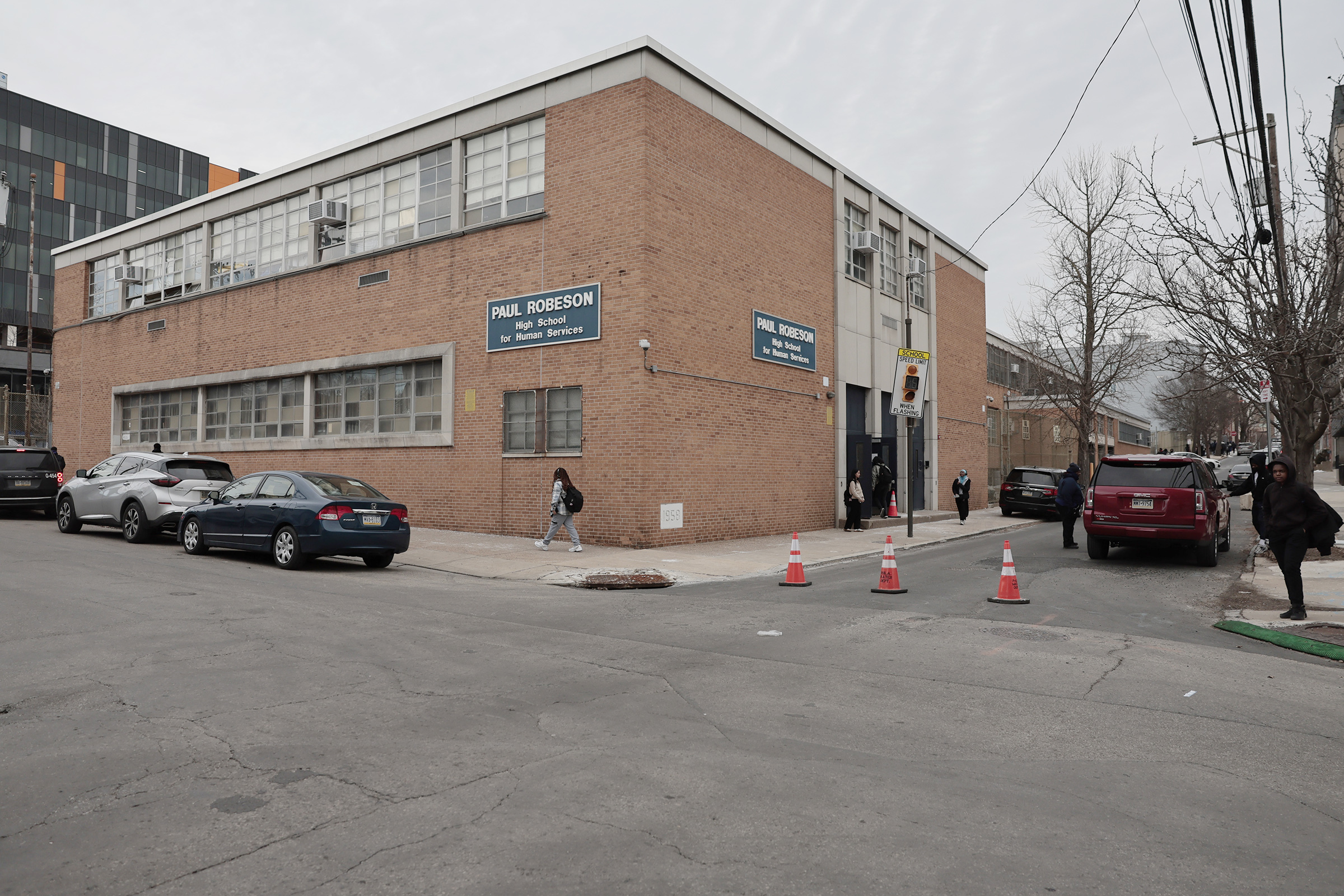
Paul Robeson High School on Ludlow Street in Philadelphia.
Gwen Franklin, a teacher at Robeson High and West Philadelphia resident, said she was speaking to support all West and Southwest Philadelphia schools on the chopping block.
“Forgive me if I fail to see the transparency of this process,” Franklin said.
We ask our kids to show their work, so show yours, she said.
“This plan pushes Black and brown kids out of University City.”
Robeson deserves a new building, and to keep its esteemed name, she said. And Sayre, which Robeson was first scheduled to merge with, deserves investment too. (Robeson is now proposed to close but move into Motivation High.)
State Rep. Darisha Parker pushes against the plan to close Fitler
State Rep. Darisha Parker is against the Fitler closure. She questions the plan to close the school and give it to the city for workforce development and housing.
“You cannot displace, families, children and a community that deserves to be educated,” Parker said.
“I do not accept your proposal to close Fitler,” Parker said.
Councilmember Quetcy Lozada asks the board to visit each school personally before deciding to close it
City Councilmember Quetcy Lozada said even revisions to the plan leave questions.
She asks the district to reconsider changes to Moffet and closing Harding, Welsh, and Stetson. “Why should our children bear the consequences of all of the school district’s failures?” Lozada said.
Lozada asks the board to visit each facility personally before casting votes to close them.
Councilmember Cindy Bass calls school closures ‘a self-created’ problem
Councilmember Cindy Bass is “greatly disturbed” by school closures. “This is, in my opinion, a self-created” problem.
Revisit the special admission policy, Bass said. “We can also move students to some of these empty spaces. We can provide transit. Why is that not an option?” she said.
“This just cannot happen,” said Bass. “We cannot allow more school closures.”
Even moving it to Saul is unacceptable, she said, because Saul does not have access to the Schuylkill Center for Environmental Education.
Moving Waring to give Masterman an extended middle school is not acceptable either, Ahmad said. “Why are we targeting that space where vulnerable students live?” she said.
“You are going to disrupt Lankenau so you can have high-value real estate,” Ahmad said. “We are a creative bunch. We can think of ways to address the issues that have come up. To disrupt solutions that are working makes no sense to me.”
Principals union president asks district to ‘slow the plan down’
Robin Cooper, president of CASA, the district’s principals’ union, asks for the board to “slow the plan down.”
Developing a blueprint for the district is complex, Cooper said.
“Improving facilities should not automatically require closing schools. This plan is full of bias, and I’m asking you to please slow it down,” she said.
Sen. Williams criticizes Watlington for bragging about incremental academic growth, and says superintendent has only called him once
Williams said he has heard only once from Watlington since the superintendent’s arrival in Philadelphia. (He says he speaks to William Penn Superintendent Eric Becoats weekly.)
Williams zings the district for bragging about incremental academic growth. Folks in his neighborhood want transformation, he said.
“I don’t pat myself on the back about 2% increases in anything,” Williams said. He invites members of the board and district to walk with him through the communities he represents.
State Sen. Anthony Hardy Williams speaks to the board alongside his mom, a 93-year-old retired district teacher
State Sen. Anthony Hardy Williams is up now.
He brought his mother, Carole Williams, a 93-year-old retired district teacher, to speak alongside him.
Carole Williams, a former science supervisor for the district, is a founder of the citywide George Washington Carver science fair.
“You don’t have an easy task,” she told the board. (She also encourages the board to hit up her son, a state senator, for more funding to help.)
The senator said his district, including West and Southwest Philadelphia has been “discriminated against” by the city and district. He acknowledges that some schools must close, but said the “ones you’ve identified clearly contradict” the ideals of improving education. “There are some schools that do not need to be on this list simply because their buildings are in decline.”
Williams was bussed as a student “into a neighborhood that did not welcome me,” he said. He attended Conwell.
“We’re talking about moving students to other neighborhoods without a commonsense plan,” he said.
“The problem with this plan is it’s top down,” Williams said. He said parents would come up with smart plans and would compromise on difficult decisions — if the district asked them in meaningful ways.
Families will have to cross “invisible lines” to get their children to new schools, Hunt said. Safety is a factor.
“We have been here before, and it didn’t work in 2013, and it’s not going to work now,” Hunt said. “If this is an open and honest plan, let us know who you’re selling our students’ future to.”
“Nothing for the people without the people,” Hunt said, saying the plan is really “a closure plan.”
Councilmember Jeffery Young says there are contradictions in the district facilities plan
City Councilmember Jeffery “Jay” Young, holding a sign that says “Ludlow is the Cornerstone of our Community,” said the goals of the plan are worthy. But the current iteration of the plan has many contradictions.
Students at Ludlow would lose not just their elementary school, but also their high school, Penn Treaty.
‘You are handing our students to a charter,’ says city committeeperson Delise Williams
Delise Williams, a city committeeperson who opposes the planned closure of Parkway Northwest, worked in the district’s central offices and at Martin Luther King. “We must fix MLK, but not by dismantling excellence,” Williams said.
“You are closing a budget gap,” Williams said. “You are handing our students to a charter on a silver platter just to fix a spreadsheet.”
Next to her, another community member holds up a silver platter with dollar bills taped all around its perimeter.
Teachers union leaders urge the board to slow down and consider what’s missing from the plan
Arthur Steinberg, president of the Philadelphia Federation of Teachers, urges the board to delay implementation of the facilities plan. Inadequate information has been presented to the public, Steinberg said.
PFT members and students know the realities of the city’s schools. They’ve gotten sick from lead, asbestos, mold, and buildings that were too hot or too cold.
“The negative impacts far outweigh the benefits,” Steinberg said of school closures.
Steinberg talks about the “lasting harm” of the 2013 closures.
“Our schools need fixing and funding, not closure,” Steinberg said. If the district can raise $1.8 billion for its plan, then it can fix schools.
Jerry Roseman, director of environmental science for the PFT, said an effective plan is needed. This isn’t it, he said, and there’s a lot missing. Roseman cited a “transparency and data gap” raised in various stages of the process. “The lack of detail and specificity is of serious concern,” Roseman said.
Roseman blew holes in the district’s $2.8 billion pricetag, which he said is “far too low.”
“Robeson did send a student to Harvard, and you still want to close it,” she said.
Robeson students fought the district for air conditioning when students got sick from the heat. Its staff found funding to renovate the cafeteria.
“Help us, instead of throwing away everyone’s ideas and hard work,” said Gauthier, who said the plan showed “a profound lack of care” for West and Southwest Philadelphia and vulnerable Black and brown communities.
“I will fight these closures with every ounce of energy that I can muster,” Gauthier said.
Waring ‘may seem poor in appearance,’ but ‘we are rich in love,’ student says
Nylan Williams, an eighth grader at Waring Elementary School, has attended Waring since kindergarten.
“Today I sit here because of the foundation Waring gave me,” he said.
He said “students stay, grow, and become family” at Waring, and has teachers who mentor and support the students. They celebrate students like their own children, he said, and stay after school to help students.
“Our building may seem poor in appearance … we are rich in love,” he said. “You cannot replace that by simply moving students somewhere else.”
Elementary school student shares concerns with board over teachers leaving mid-year
Evangeline Routh, a student at Houston Elementary School, said she is facing the second year in a row that her teacher left in the middle of the school year.
“Both years it was right before the PSSAs,” she said.
Lankenau High students show up in force to defend their school to the board
Messiah Stokes, a Lankenau student spoke against closing his school.
“The school’s culture is built on the idea of simply going outside and exploring,” he said.
He also noted a legal agreement that may require the district to sell Lankenau’s property to the Schuylkill Center for Environmental Education rather than giving it to the city to use for housing plans, as the district had planned. Closing Lankenau and moving it to Saul High School isn’t adequate, he said.
“At Lankenau we can simply walk less than a mile to the Schuylkill River and collect water samples,” he said, which allows students to learn about things like clean drinking water.
Juniper Sok Sarom, another Lankenau student, spoke out against closing the school.
“Why is a school that achieves all of the goals and guardrails that you set being recommended for closure?” she asked. “Do you prioritize land and money over our kids?”
She said the school board needs to look out for the city’s children.
By passing this plan, she told board members, “you fail the students of Philadelphia, you fail our parents, you fail the entire city. You fail all of us. Protect the children, OK? Prioritize us.”
Lankenau student Jesse Hall showed a poster of a city map to the school board. His map had dots showing that many of Lankenau’s students come from “high-risk” neighborhoods across the city. Lankenau’s neighborhood is “low-risk.”
“To our students, it is a safe space from the struggles they face at home … That’s what a magnet school is for,” he said.
Samad Groves, another Lankenau student, said “do not ignore our family members who are already a part of vulnerable populations.”
The data used to make decisions does not capture what the school community means to students, he said; “Lankenau remains unquantifiable.”
Student urges the board to open pools at district schools
Moving briefly to another topic, student Phinneas Dougherty spoke about the need to have swimming pools open at schools, which is part of the board’s strategic plan.
“This isn’t just an extracurricular activity, it’s a survival skill,” he said.
He said he wants to work as a certified lifeguard and make sure that kids learn to swim. Pools should be opened immediately, he said.
‘Lankenau cannot be erased,’ freshman tells the board
Justice Ray, a Lankenau sophomore, says its students “truly need this environment.”
Ray says she believes the district is closing Lankenau because of its valuable land.
Amari Reynolds, a Lankenau freshman, was “so excited” after he was admitted to the school. He was a quiet kid, but the school has brought him out of his shell.
‘Losing Parkway feels like losing my future’: More students address the board over schools on closure list
Alejandro Alvarado, a student at Stetson Middle School, tells the board: “We deserve more … Stetson has been neglected for decades … It isn’t fair to close our school because of maintenance issues that the district knew about years but chose to ignore.”
Melody Jenkins, a 10th grader at Parkway Northwest, said that “losing Parkway feels like losing my future.”
Parkway Northwest’s bell schedule had to be adjusted to avoid interactions with Martin Luther King students, Jenkins said. “I ask you tonight to reconsider this decision,” she said.
Khloe Polite, a Waring eighth grader, describes her school: “It is small and old,” but important. It’s a family, Polite said. “I understand we’re underpopulated, but maybe it’s what we need.”
Students speak in support of two magnet schools slated to close
Treasure Flowers, a sophomore at Parkway Northwest, says “small, specialized magnet schools are important to the people around them” and the voices of affected students must be heard.
Wyntir Alford, a Lankenau High student, said: “We have not come across a single person who agrees with the school board’s decision to close it.”
Lankenau, Alford said, deserves “stability and support. I hope that before making any final decisions, you take a look at the serious evidence and the strong resistance from the community. We are not just numbers on a page. We are young people with goals, dreams, and opinions that matter.”
Lankenau’s enrollment issues “are the district’s fault,” Alford said. “You say this isn’t about money, but the timing and patterns of these decisions makes your priorities clear.”
Even the changed recommendation — moving Lankenau to Saul instead of Roxborough — still won’t do, Alford said.
Noelle Alford, Wyntir’s mom, takes the microphone. She’s not registered to speak, and the board cuts off Alford’s mic. Alford continues to speak, and the restless audience shouts: “Let her speak! Let her speak!”
“You still have yet to answer our question — would you send your children to Saul?” Alford yells without a mic.
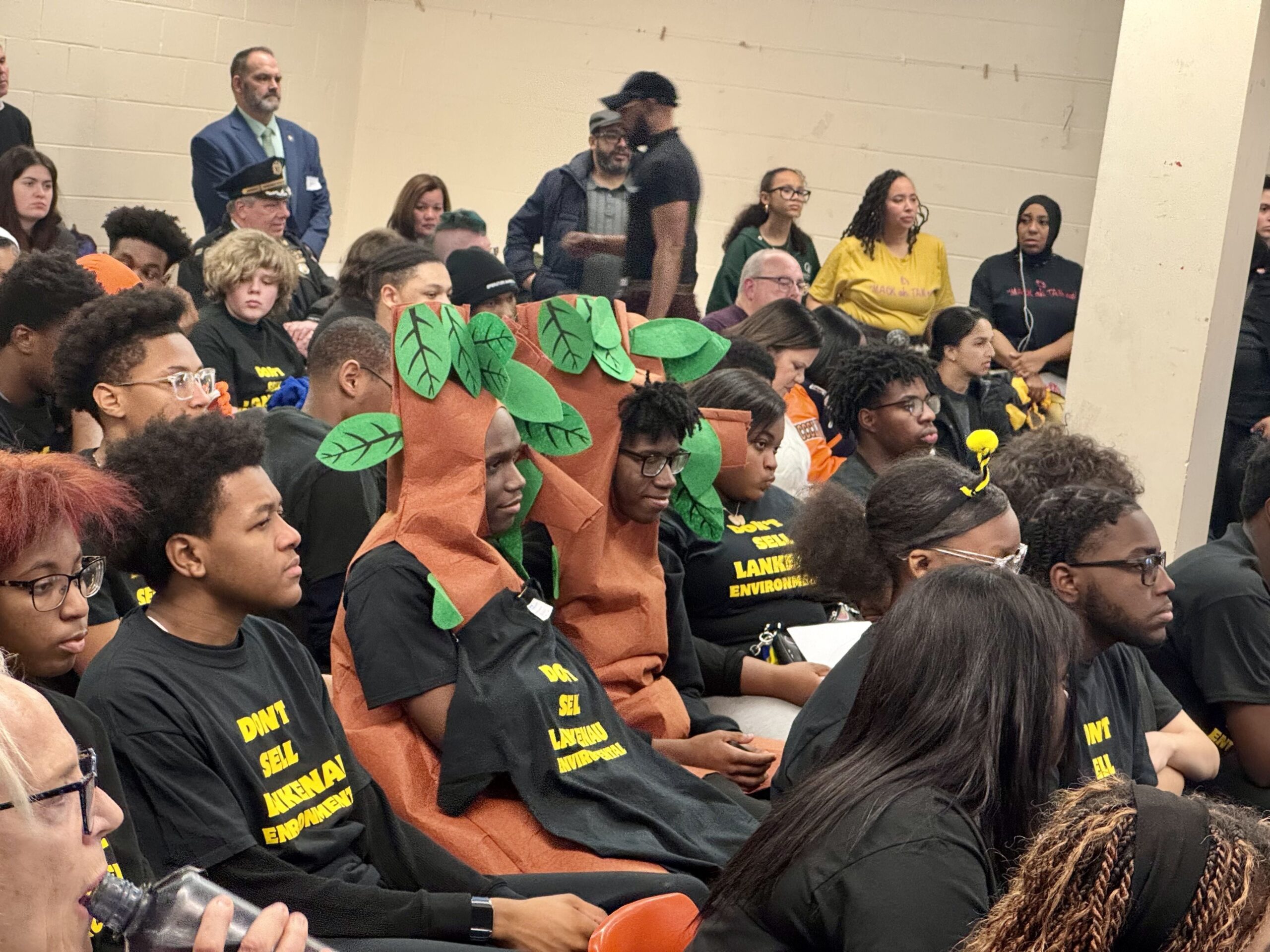
Students, staff, and community members who support Lankenau High School, including some dressed as trees, packed a community meeting at the school earlier this month.
‘If a roof leaks, you fix it,’ Stetson Middle School student says
Jade Colon, a student at Stetson Middle School, is speaking to the board about her school: “When we talk about closing a school like Stetson Middle, we’re not just talking about moving desks,” Colon said. The neighborhood has faced “decades of disinvestment,” and its residents are being asked to be able to sacrifice again.
“If a roof leaks, you fix it,” Colon said. “You don’t tear the family down.”
Student speakers begin to address the board, speaking in support of AMY Northwest and Parkway Northwest
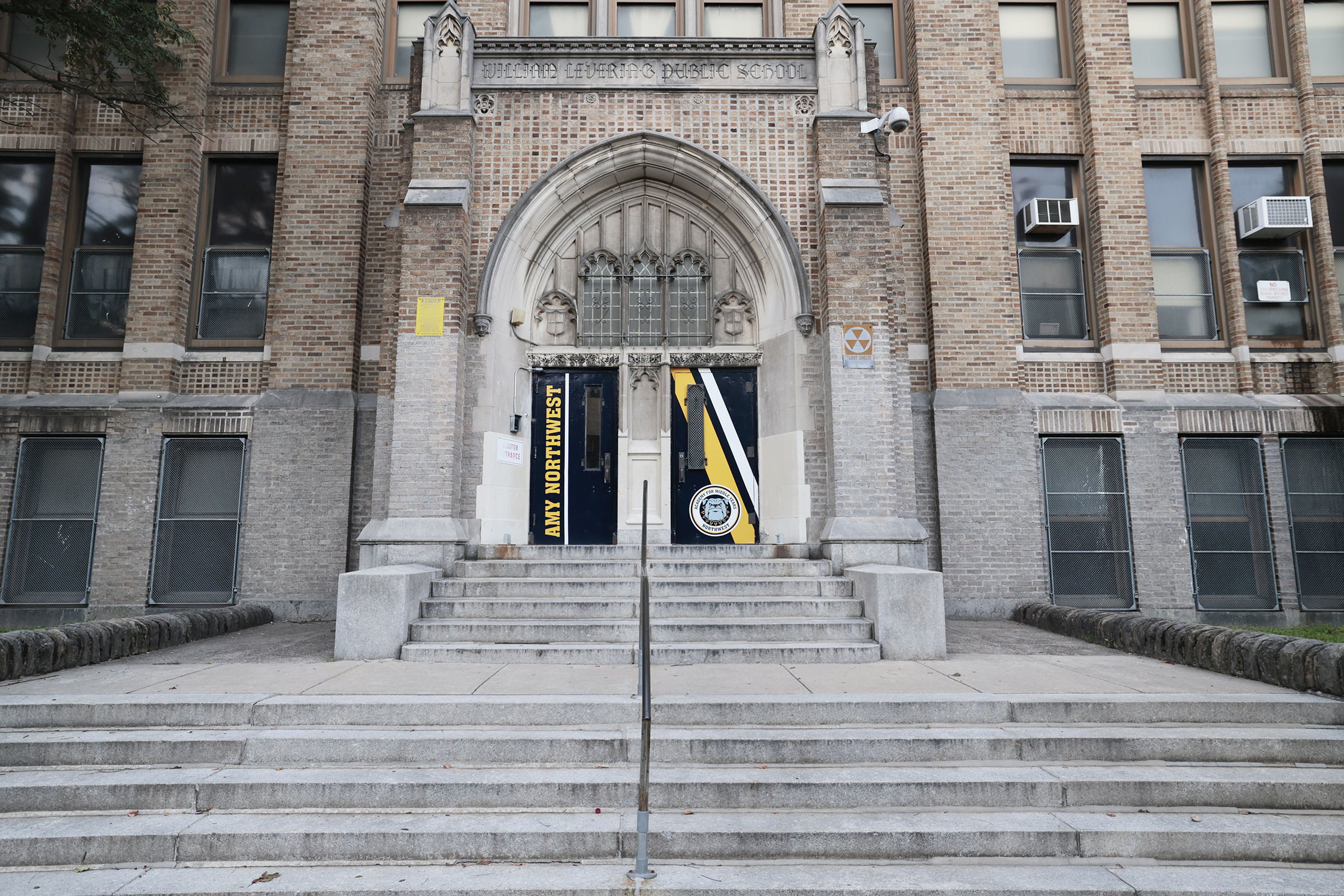
AMY Northwest on Ridge Avenue in Philadelphia.
We’re onto student speakers now.
Naveh Mahan, a student at AMY Northwest, asks the board to spare her school.
David Samuel, who attends Parkway Northwest, said the school is “building strong children.” Virtually all Parkway Northwest students are on track to graduation.
“Those are lives being moved forward,” Samuel said. “Closing Parkway Northwest wouldn’t be closing a school, it would be closing my home.”
Naomi Acedo Moorhead, a sixth grader at AMY Northwest, is speaking “to advocate for my school.”
It’s got great extracurriculars and a newly updated schoolyard, she said. Students feel “welcome and supported,” and strong academic achievement, including offering Algebra I. Her family toured eight schools, and AMY Northwest was her first choice. It’s worthy of investment, Moorhead said.
Lyric Jenkins, a student at Parkway Northwest, said the school is “a model of consistency” with strong student attendance. “We are on an upward trajectory,” Jenkins says.
Merging Parkway Northwest and Martin Luther King High School is a bad idea, Jenkins said. “Don’t dismantle a success story,” she said.
Dakota Turner, a student at AMY Northwest, says the school is “a good school,” and provides opportunities many other schools don’t have. It should not close.
Evan Mohr, another AMY Northwest student, said “the only problem with our school is that the building is old … Closing this school is not a logical conclusion.”
President Streater says he’s ‘very angry’ over the underfunding that brought the district to this point
Board president Streater said he’s “very angry” that the board must deal with closures.
“It infuriates me,” Streater said of underfunding and the pressures that led the district to this point.
He said it’s a “call to arms moment, irrespective of how this thing goes.”
If the district had “inadequate running water,” help would be on the way. It has “inadequate public education” because of underfunding, Streater said, and it’s on its own to figure it out. The district must shrink its footprint, Streater said.
‘We can’t afford to be locked in inaction,’ says board member Wilkerson
Board member Joyce Wilkerson says the district has known it’s needed to “rightsize” the system for a decade. Wilkerson is a former member of the School Reform Commission, which was the predecessor to the school board, when the district was under state control for 17 years.
“We can’t afford to be locked in inaction,” Wilkerson said.
“While there is lots that’s being proposed that we need to understand better, I appreciate the fact that this is aligned with our goals and guardrails,” Wilkerson said. She said she will comb over the plan, and appreciates the work that went into it.
‘This affects all lives in the city, including old people like me,’ says board member Stern
“We’re not adopting this plan tonight,” board member Joan Stern said. “We’re going to take time to do our necessary due diligence.” Stern invites people to come to the March 12 facilities town hall with the board, and communicate in other ways. “This affects all lives in the city, including old people like me.”
Stern says that former Philadelphia Superintendent Constance Clayton was also her mentor. When Clayton became superintendent, “we had no market access at all,” and the district’s credit was poor. “That we can borrow a billion dollars now is an amazing feat that we had to accomplish over many, many years.” (Stern was a groundbreaking bond counsel who helped the city and the district onto more solid financial footing.)
Student board member Reyes asks about the closure process for schools
Semira Reyes, another student board representative, asks about the phase-out process for closing schools.
A slow phase-out can cause trauma, Watlington said. (Though some schools will be phased out; Penn Treaty, for instance, would take four years.)
Reyes also asked about swing spaces: How do we maximize their use? They’re buildings or parts of buildings that are used to relocate school communities when they need to move. It’s impossible to guarantee their usage 100% of the time, Watlington said.
She also questioned what supports would be in place for students in newly colocated or merged schools as a result of the plan, saying that as a student who had experienced colocation, it “can be extremely stressful and disruptive.”
Watlington said affordable workforce housing “benefits communities, moreso than this district choosing to outright sell buildings to the highest bidder.” He noted that following the district’s last round of closures in 2012-13, some buildings were vacant for more than a decade.
Workforce development and job creation are worth it, Watlington said. “We think these facilities that have always belonged to the people of this city, that they should benefit students in their respective communities.” The district’s core business is academics, and “the city just has more resources” to handle real estate and development.
He said the district wanted to be sure “we don’t contribute to the rich getting richer, and the poor getting poorer” — to some objections from the audience.
‘We need a bolder plan,’ says board member Cubbage in a call-to-action to the district
Another board member, Crystal Cubbage, is also voicing skepticism.
“I’m struggling to reconcile this massive upheaval, and the $2.8 billion price tag, with the fact the plan is not explicitly designed to produce better outcomes for all of our children,” Cubbage said.
“We need a bolder plan. This is a false choice that we have here,” Cubbage said.
Board member Novales says she’s ‘struggling to see the heart’ in this proposed facilities plan
Audience members in the packed board room cheered as board member Wanda Novales voiced criticisms of the facilities plan.
“This conversation cannot just be about buildings, it must be about students,” Novales said.
While saying she recognized the “complexity of the challenges” facing the district, Novales said, “the standard cannot simply be operational efficiency,” but student success.
Of the plan, Novales said, “I am struggling to see the heart … that sees the lived realities of our neighborhoods.” Areas like Kensington and Fairhill have long been under-resourced, Novales said, and the plan falls short in providing opportunities to students there.
To students at Stetson, a school proposed for closure, “I am sorry for the years of underinvestment,” Novales said.
Board member Jones draws applause as he asks how to ensure ‘we don’t end up in this position again’
In addition to questions about funding and how much the plan would save the district, Whitney Jones drew applause from the crowd when he asked Watlington how the district would approach catchment design going forward, “so we don’t end up in this position again.”
He also asked about the plan’s proposal to merge some magnet schools: “What does it actually mean to merge two programs that are distinctly different?”
Watlington said he was committed to growing enrollment, but if numbers continue to drop, “I assure you we’ll be back in this boat again at some point.”
The superintendent said magnet programs could be successfully located in the same building as another school, and he didn’t anticipate problems.
Board member Harper asks: What will the district do to prevent student achievement drops as schools close?
Student achievement has dropped after school closures, board member Cheryl Harper says. She wants to know how Watlington will solve for that this time around, and asks about staff impact.
Watlington responds: The district will not cut staff in schools that absorb students, and it will begin a transition office to directly support students in schools that are closing or taking in another school.
The board has had to make decisions based on ‘what we can afford, rather than what our students deserve,’ Streater says
At one point, the district was looking at an $8 billion bill to address all of its facilities issues, board president Streater said. The board has had to make decisions based on “what we can afford, rather than what our students deserve,” Streater said. These decisions are based on “structural funding inequities.”
Like many major cities, the district has lost enrollment. But now, it’s “calling the question,” Streater said.
“We have a misalignment,” Streater said. The district is unable to pay for the programs it needs to provide to accelerate academic achievement with the footprint it has.
Streater called for “an open heart and an open mind” as the board starts to deliberate.
But, he stressed, the board will not vote tonight.
Watlington shares changes to his initial proposal, including sparing two schools from the closing list
Watlington runs down the changes between his initial proposal: Conwell Middle School and Motivation High are off the closing list. Robeson will still close, but move into Motivation, not Sayre; and Lankenau High will still close, but merge into Saul, a magnet, not Roxborough, a neighborhood high school. Saul is an agricultural magnet, and Lankenau an environmental magnet.
Watlington is also modifying the phase-out plan from Penn Treaty from seven years to four years.
There is murmuring from the crowd, and scattered applause, as Watlington presents the revised recommendations. Some people are taking photos of the PowerPoint with their phones.
‘In an ideal world, I never believe in closing schools,’ Watlington says
“In an ideal world, I never believe in closing schools,” Watlington said, a remark met with some groans from the crowd. “I would never want my child’s school to be closed, to be frank.”
But, he said, the district is in a place where it has to think about ways to “better use our limited resources.”
“We’ve done our level best to spread opportunity across learning networks, 10 City Council districts,” he said.
“We have listened with a third ear” to the public, Watlington said. “We’ve heard lots of feedback.”
District will double access to pre-kindergarten and bring Algebra I to all eighth graders
The district will be able to double access to pre-kindergarten, and create more academic and extracurricular programs.
It will be able to offer Algebra I in eighth grade to all students, Watlington said. Currently, just half of eighth graders have access. There will also be more Advanced Placement courses.
“We have a chance to level the playing field, I believe,” Watlington said.
Two of the schools initially proposed to close will be spared under revised plan
Big news out of the facilities plan: Two of the 20 schools Watlington initially proposed for closure will be spared under the revised plan.
Conwell Middle School in Kensington and Motivation High in Southwest Philadelphiawill not close after all, Watlington announced at acharged school board meeting Thursday.
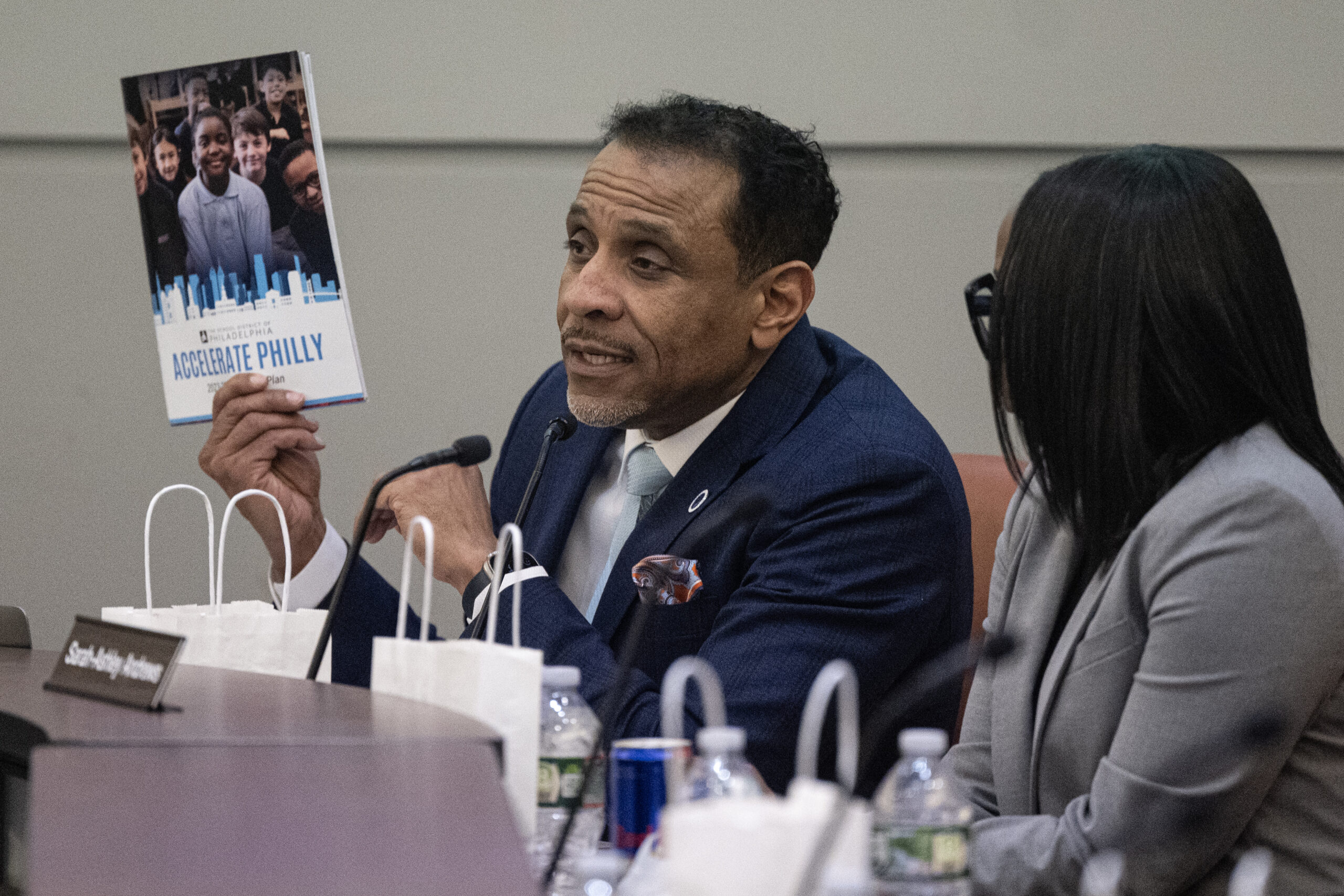
Watlington is calling the plan “Accelerating Opportunities,” a nod to “Accelerate Philly,” his academic strategic plan.
“This is a landmark, once-in-a-lifetime opportunity” to reduce the number of buildings in poor condition from 85 to 0, Watlington says. He acknowledges that there will be opposition to the plan, and he respects people’s right to disagree.
‘I see a tale of two cities’: Watlington presents facilities master plan with the board
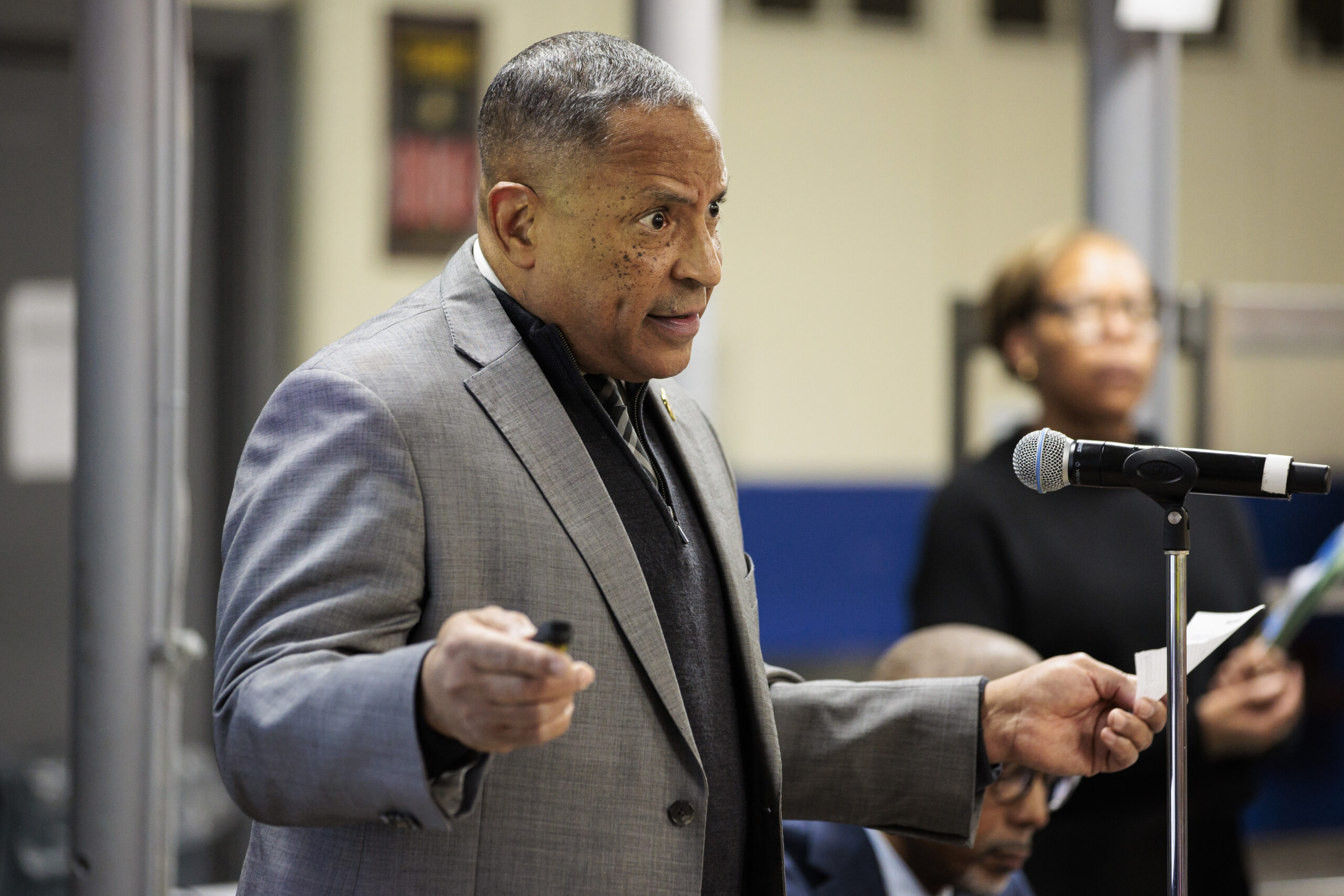
Superintendent Tony B. Watlington Sr. speaks during the school board meeting on Thursday.
It’s the big moment now: Watlington is presenting his facilities master plan.
He name-checks Constance E. Clayton, the legendary former Philadelphia superintendent, whom he called his “#1 mentor.”
“We’ve lost tens of thousands of children” since Clayton’s day, because of the growth of the charter school sector and a flat birth rate, Watlington said.
Watlington watched a 45-minute movie recently about Overbrook High, which in 1969 had 5,000 students. Today, Overbrook has 466 students.
Schools, 100 years ago, were built “big, bold,” sometimes with stained-glass windows, marble floors, and grand architecture.
But now, Watlington said, “I see a tale of two cities.” Kids in some places have ample access to high-quality academic programs, and in others, they do not, he said.
As Watlington continues to give his assessment of the district, there were some cheers from the crowd as the superintendent promised to “whiz through some slides quickly.”
Watlington says he will recommend cutting half days, as he shares attendance stats
Student regular attendance was 53% this past January, as compared to 51% in 2025, Watlington says.
Watlington will present a recommendation to eliminate half days, which affect student attendance negatively.
“We need to eliminate and sunset half days from our school calendars for now, and forevermore,” the superintendent said.
Teacher attendance was 76% in January, up from 74% in 2025, Watlington said.
As of this January, 1,071 students have dropped out of the district since the start of the school year, up slightly (1,069 students) from the same period last year.
Watlington begins his report with updates on the wellness campaign the board will consider
Superintendent Tony B. Watlington Sr. is shouting out Lift Every Voice, a grassroots parent organization, for its work.
LEV’s “joy campaign” helped advance the new wellness policy the board will consider tonight. LEV campaigned hard for things like the end to silent recess, plus mandatory bathroom and water breaks.
Student board members urge the board to pass school wellness policy
The student board members, in their report, urge the board to pass the school board wellness policy, and say they’ve attended multiple school closing community meetings.
They encourage students to continue to speak out about issues important to them.
The facilities plan being shared tonight has been long in the works, Streater says
Streater is talking about the history of the facilities master plan, which he says began with the board’s hiring of Superintendent Tony B. Watlington Sr in 2022.
It’s expanded its speaker policy Thursday to allow extra comment on the important topic, he said. The board will hold a special town hall on the facilities master plan on March 12, Streater said.
“We understand this works brings forth a range of mixed and often strong emotions,” Streater said.
Honored teacher of the month is from a school slated to close
Jessica Peruso, an autistic support teacher at Harding Middle School in Frankford — one of the 20 schools slated for closure under the district’s facilities plan — was honored as Teacher of the Month.
Peruso has taught at Harding for 13 years.
“Her work is more than teaching — it is advocacy and community building in action,” Superintendent Tony Watlington said.
The announcement drew some loud cheers from the audience, and a shout of “Harding!”
School board kicks off a meeting expected to be lengthy
Board meeting, here we go!
There’s a packed room and a packed agenda.
Board president Reginald Streater explains that given the length of the meeting, the board will take at least one break to help members maintain focus (and switch out batteries).
There are a whopping 98 speakers tonight between students, elected officials, and other members of the public. The board has allowed extra speakers on facilities issues.
The facilities plan is a ‘bad deal,’ says Councilmember Jamie Gauthier
City Councilmember Jamie Gauthier delivered a fiery speech to close the rally on behalf of all of the elected officials present. She called the proposal “a bad deal” for students, teachers, and staff across the district.
“Our kids, especially the Black and brown young people being disproportionately impacted by this plan, deserve better than a plan that’s dependent on raising an additional $2 billion informed by inconsistent data, and is missing so many crucial answers,” she said.
Gauthier said several well-performing schools, like Paul Robeson High School and Parkway West High School, are slated for closure, and implored the district to reevaluate its plan and slow down.
She also shared concern about the plan to close Motivation High School because of underutilized space, despite it sharing a building with another high school.
Lankenau students fight for their school to be saved
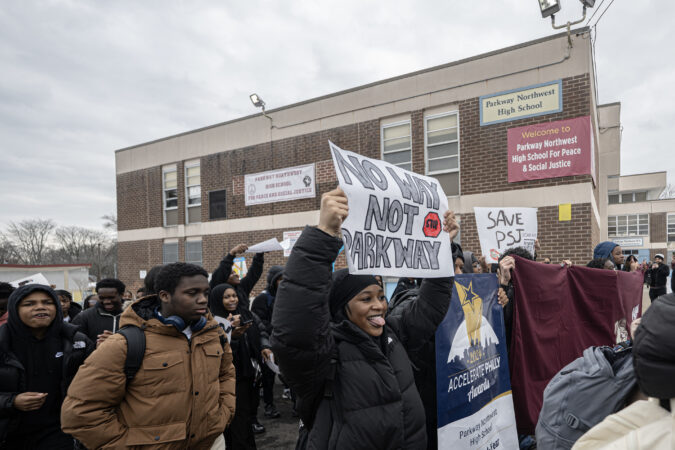
Midway through the rally, a busload of students and staff from Lankenau High, an environmental science magnet school, arrived in front of the school district headquarters, armed with signs calling the school district’s plan to close “trash.”
“I feel safe here,” said Zhanel Osmonova, a first-year student. At her previous school, she felt less welcome and struggled to fit in. That changed at Lankenau, and she said she’s worried about having to start over again.
“In this school, I find my voice and my safety,” she said.
Jesse Hall, a junior, said the district ought to understand that the characteristics that make Lankenau special won’t necessarily transfer if students have to move to Roxborough High School. Though he will have graduated by the time Lankenau would close, he feels close to and worried about his teachers and underclassmen friends. Hall will deliver a speech to the school board later today imploring them to keep Lankenau open.
“I hope they realize what they’re going to do to the students,” he said.
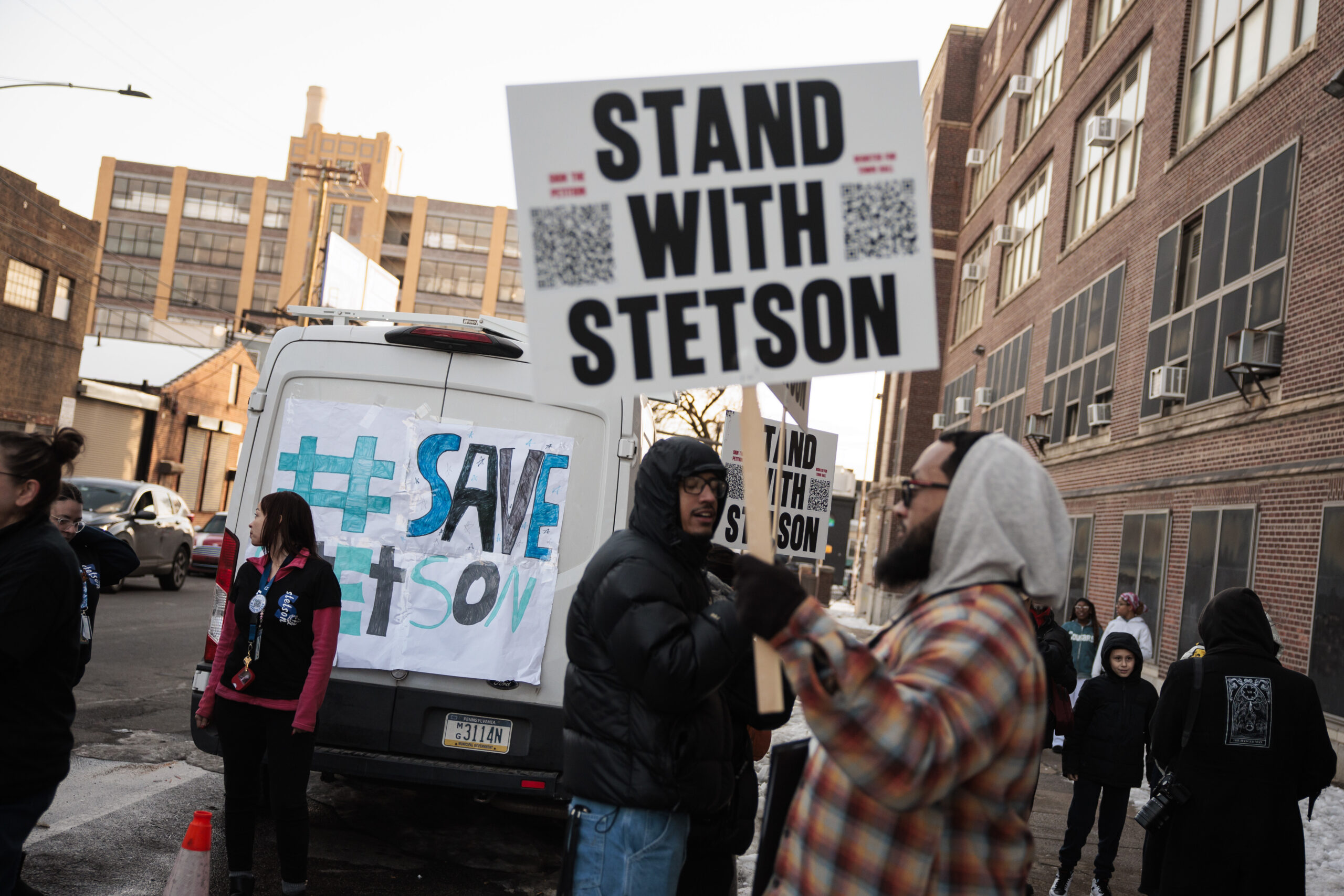
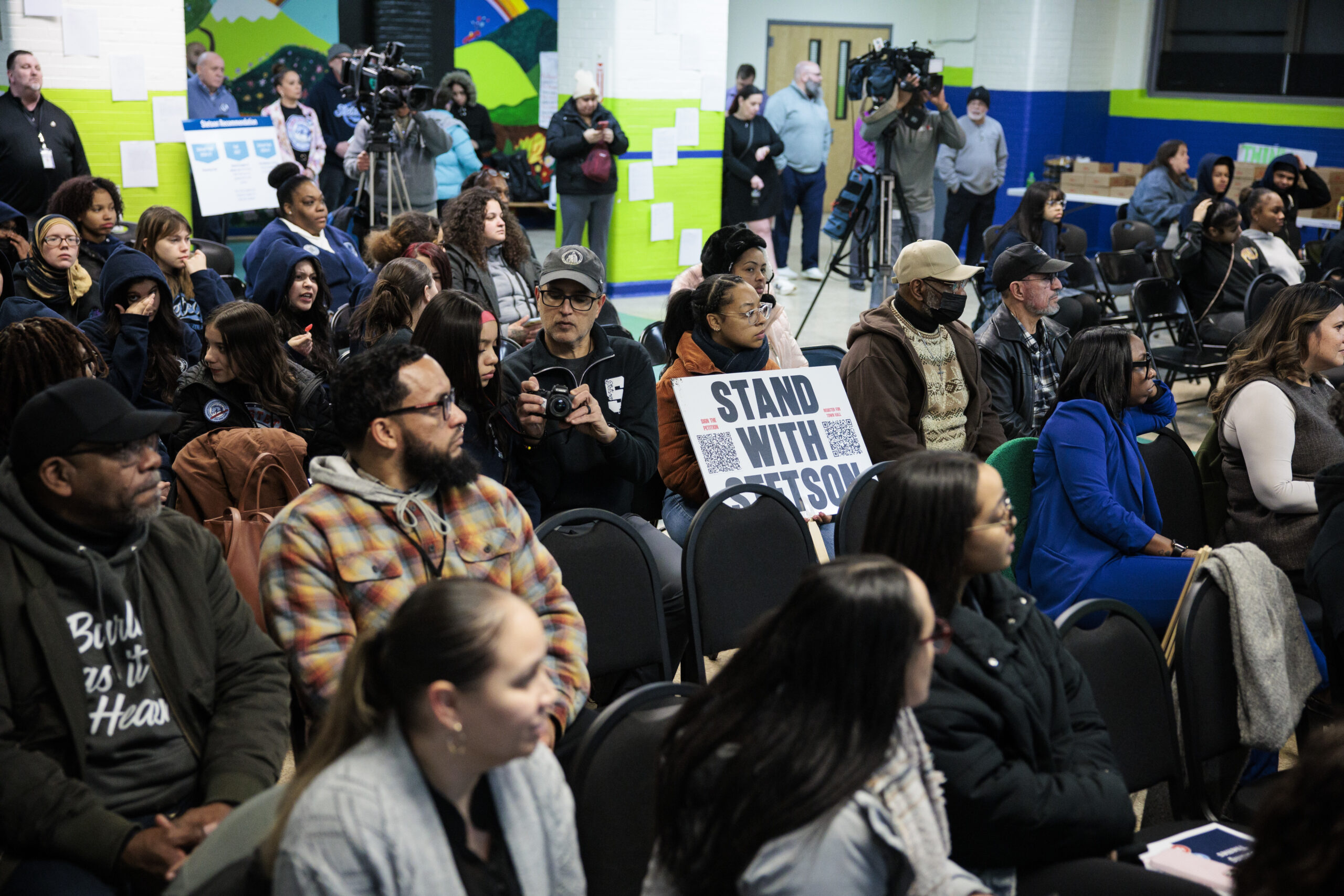
Stetson Middle School students get the energy rising as rally begins
Students rally before the school board meeting on Thursday.
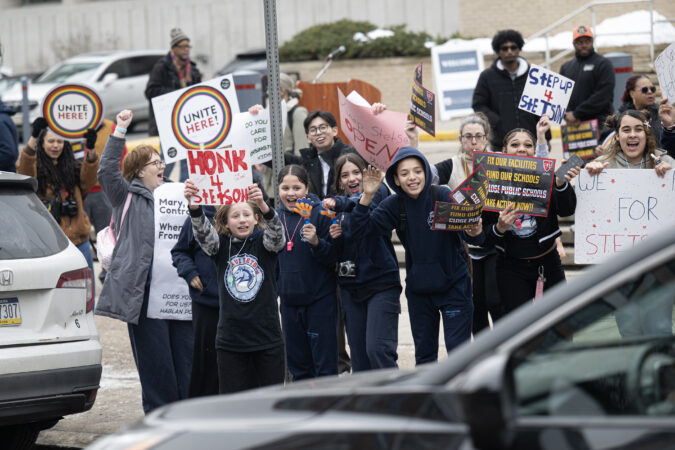
Ahead of the official start of the rally, students from John B. Stetson Middle School are raising the energy with whistles, noise-makers, and the kind of cheering you’d expect at a college basketball game, except these chants are: “Save our school!”
Some passing cars honked their support.
David Orellana, pastor of CityReach Church in Kensington, said that he and others in the Stetson community have not received adequate answers from the school district about why Stetson is recommended for closure.
“We believe that the school is a staple in the community. It’s a heartbeat in the community,” he said.
Watlington to present facilities plan to school board
Superintendent Tony B. Watlington St. is set to present his $2.8 billion facilities plan to school board members at Thursday’s meeting.
The board will not vote Thursday on the plan, which remains just a proposal until members act on it. The board has not yet set a date for that vote but it is expected in the coming weeks.
Opponents of school closures gather for rally outside district headquarters
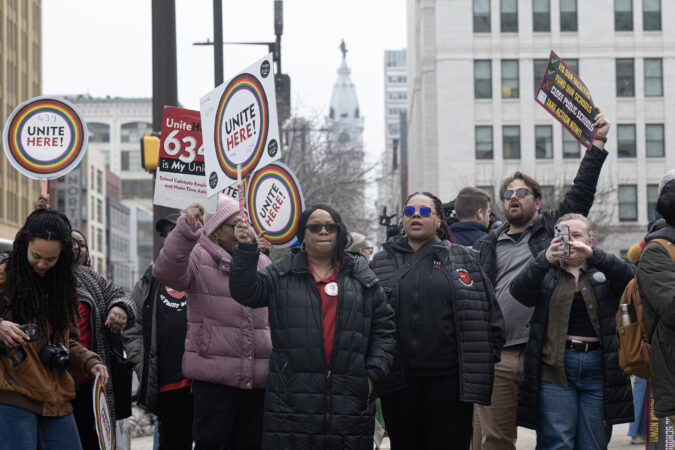
Before a scheduled 4 p.m. Philadelphia school board meeting, a large turnout is expected at a rally on the steps of the school district’s North Broad Street headquarters.
Union members, students, parents, teachers, and community members plan to rally against the proposed closure of 20 Philadelphia public schools. At the board meeting, Superintendent Tony B. Watlington Sr. is expected to present a $2.8 billion facilities plan to the board. The proposal, unveiled last month, includes closing 20 schools, colocating six and modernizing 159 school buildings.
The demonstration is being organized by the Philadelphia Federation of Teachers and other labor unions.
Lyric Jenkins is a strong student, with a report card full of As and Bs.
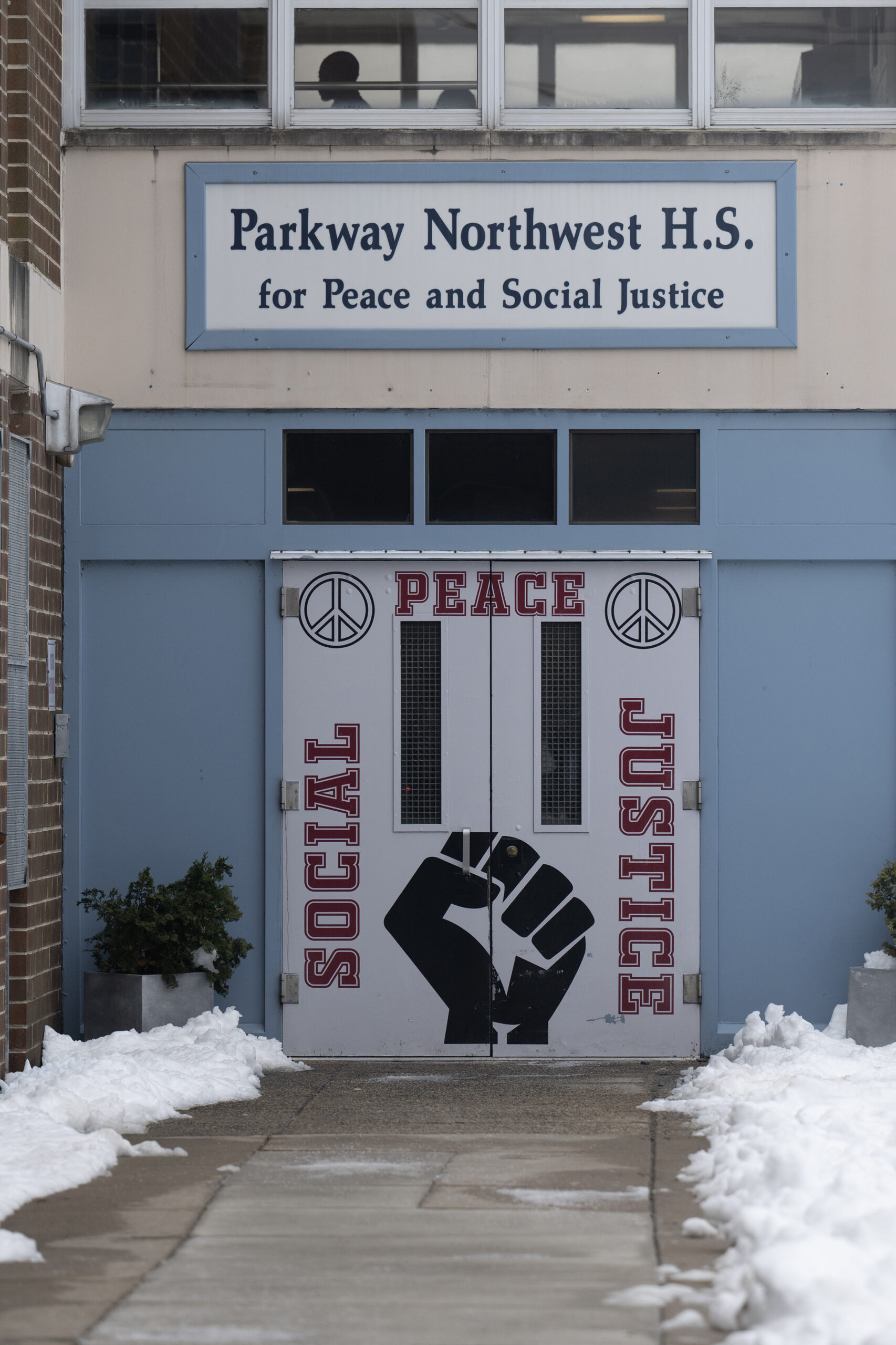
She approached her high school selection process seriously, finally zeroing in on a school that checked all her boxes. Jenkins chose Parkway Northwest High School for Peace and Social Justice, she said, because it was an academically rigorous magnet school, safe — and not huge.
“I wanted a small community where I could be seen,” said Jenkins, now a 10th grader at Parkway Northwest in East Germantown.
Last month, Jenkins was “shocked” to find her school was being targeted for closure, in part because of the very size that drew her to choose it.
Philadelphia School District officials have proposed closing Parkway Northwest and 19 other schools, colocating six more and modernizing 159 under a sweeping facilities plan. The proposal calls for closing Parkway Northwest in 2027 and making it an honors program inside Martin Luther King, a large comprehensive high school about half a mile away.
Student Alasia Payne speaks during a rally for peace and social justice on Wednesday outside Parkway Northwest in protest of its potential closure.
That plan has drawn fire from many, including more than 100 Parkway Northwest students, who walked out of school en masse Wednesday to protest — waving signs, singing, and banging drums.
Those fighting to save the school argue that its small size is an asset, and enrollment has been growing, and they have expressed safety concerns about sending children to Martin Luther King.
More students choosing Parkway NW
District leaders have said their plan is not motivated by finances, though there is clearly a desire to shrink the school system’s footprint, with 70,000 empty seats citywide. Some schools are less than a quarter full, and others, mostly in the Northeast, don’t have enough room to accommodate all the students enrolled.
Superintendent Tony B. Watlington Sr. said the plan will provide a stronger and more equitable education for students citywide.
Closing Parkway Northwest is part of a strategy to shut a handful of small district magnet or citywide schools, moving them into reinvigorate neighborhood high schools.
That strategy has been uniformly denounced by staff, students, and parents at Parkway Northwest and the other schools that would be forced to surrender their independence — Parkway West, Motivation, Lankenau, and Robeson. All have been affected by changes to the district’s special admission process, which shifted the district to a strict centralized lottery, stripping away from schools the ability to have any discretion over their incoming classes.
Student Dane McFarland speaks during a rally outside Parkway Northwest High School on Wednesday.
The school has worked diligently to build enrollment back up, said Beth Ziegenfus, Parkway Northwest’s school-based teacher leader and the coordinator of its robust dual enrollment program.
“More students have been choosing Parkway,” Ziegenfus said. “If you think about what our projected enrollment is for next year, we’re looking at an extra 150 kids that we could have here.”
The closure recommendation discounts that growth, Ziegenfus said, and it also threatens students like Jenkins.
“These small schools offer something to students who don’t thrive in large environments,” said Ziegenfus. “There is something to be said about kids knowing every single adult in the school — it contributes to the safety. When every child knows you and you know every child, you’re able to offer support, or redirect behaviors, or offer assistance.”
Ziegenfus spent years teaching at Frankford, another large neighborhood school. She said shecares about comprehensive high schools, sees their value, and believes they need more resources. But those resources shouldn’t come at the expense of Parkway and other small schools.
“We should invest in King, but two things can be true at the same time. We need Parkway,” said Ziegenfus. “They’re really disrupting the children here, and the children at King, and the incoming kids who are going through the school selection process.”
‘They’re going to flee somewhere else’
At recentdistrict meetings about the proposed Parkway Northwest closure, anger bubbled over.
Students, teachers, and community members disputed the district’s statistics around the school in a meeting with district officials, saying its 60% building capacity score was off.
But mostly, they raised alarms about safety.
“My question is, how will I be able to grow my education at a bigger school if I don’t even feel safe there?” said Sanai Williams, a Parkway Northwest 10th grader. “I don’t feel like I’m going to be able to grow my education if I’m watching my back, thinking I’m going to get attacked every which way at King.”
Parkway Northwest High School in Philadelphia.
Rodrigo Fernández, the Parkway Northwest Spanish teacher, said he was frustrated by a perceived lack of real opportunity to shape the plan.
“You are not listening to us,” Fernández said. “You haven’t heard one single person saying, ‘I am excited about this plan.’ If you want to retain our students, you won’t retain them by doing this. They’re going to flee somewhere else. They didn’t choose that setting.”
Over 1,500 community members have signed a Change.org petition calling for the district to reverse the closure recommendation.
A peace and social justice mission
Parkway Northwest, said Elliott Seif — a retired educator and author who’s volunteered at Parkway Northwest for 15 years — is being offered up as “sacrificial lamb to do something at Martin Luther King, which it may not be able to do.”
And Paula Paul, another longtime Parkway Northwest volunteer, said the very nature of the school makes it essential in the city.
Students walked out of Parkway Northwest on Wednesday to protest its closure.
“Does not our city need a school devoted to peace, social justice, and violence prevention, and one where people have formed a community that is functional, a school that works, a school where kids want to be?” Paul asked district officials. “We’ve been struggling to get schools that are functioning, not to lose students, for students to feel safe, to feel connected. Why would we close this school?”
Watlington is expected to present his plan to the school board Thursday, but the board will not vote then. A date for the final decision on closures and other changes has not yet been set.
Could a 1973 legal agreement help save Lankenau High?
The Schuylkill Center for Environmental Education hopes so.
The Philadelphia School District has proposed closing Lankenau, the city’s environmental science magnet school, and giving it to the city to help further Mayor Cherelle L. Parker’s affordable-housing goals, or for job creation.
But the Schuylkill Center, Lankenau’s neighbor, believes it’s prohibited from doing so, and just notified Superintendent Tony B. Watlington Sr.
The Schuylkill Center “holds a right to repurchase the property in the event that it is transferred or conveyed or used for any purpose other than school purposes, pursuant to a restriction in the October 4, 1973 deed by which [the Schuylkill Center] conveyed the property to the Lankenau School,” a lawyer for the environmental center wrote in a letter sent to the districtMonday.
Students, staff, and community members who support Lankenau High School – including some dressed as trees – packed a recent community meeting at the school about its proposed closure.
If the district is “considering a sale of the property or using the property for any purposes other than continued use as a school, this letter serves as written notice of [the Schuylkill Center’s] right to repurchase,” lawyer Sean T. O’Neill wrote to Watlington, “The school district must provide [the Schuylkill Center] with reasonable advance notice of any potential conveyance or change in use and allow [the Schuylkill Center] the opportunity to exercise its right to repurchase.”
The center, which touts itself as “one of the first urban environmental education centers in the country,” was founded in 1965. It has trails and a visitors’ center and runs educational programs and a wildlife clinic.
District officials had no immediate comment.
Lankenau’s history
Lankenau sits amid 400 wooded acres adjacent to the Schuylkill Center. The 17-acre parcel Lankenau High now sits on was originally the site of the private Lankenau School for Girls; after that school closed, the Philadelphia School District purchased the land.
What is now Lankenau High was first a program of Saul High and then Germantown High, but in 2005, it became a standalone school as part of then-CEO Paul Vallas’ small schools initiative.
Since then, Lankenau has soared as a diverse, hands-on magnet with a 100% graduation rate in a location like no other.
News that Lankenau landed on the district’s closure list infuriated students, parents, community members, and elected officials, who have mounted a robust campaign to fight plans to shut the school and relocate it as an honors program inside Roxborough High.
Teachers, students, and community members from Lankenau High School rally outside a Philadelphia school board meeting in January.
The Schuylkill Center’s first priority is for Lankenau to remain as it is, said Erin Mooney, executive director of the 60-year-old organization, which now partners closely with Lankenau.
“We are in opposition to Lankenau’s closing,” said Mooney, “but should something change with Lankenau, we want to ensure that the site continues to be used to teach people about nature.”
Mooney, who has been public in the Schuylkill Center’s support for the school, discovered the language giving the Schuylkill Center right of first refusal if the property ever ceases being a school in the 1973 agreement.
Watlington is scheduled to present his sweeping facilities plan — which as of January included 20 closures, six co-locations and 159 modernizations — at a school board meeting Thursday.
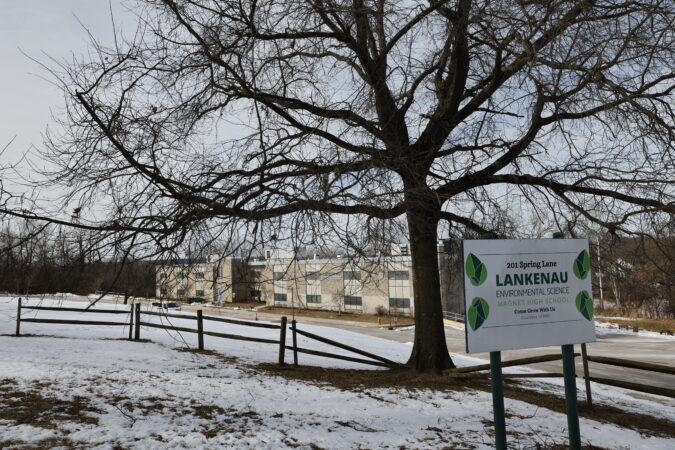
The Lankenau Environmental Science Magnet High School in Roxborough on Saturday, January 24, 2026.
But the superintendent has said what he presents to the board may include some tweaks to his initial recommendations.
Mooney hopes the information the Schuylkill’s lawyers sent Monday helps Lankenau come off the closing list.
“We want Lankenau to stay,” she said, “and I wanted the school board to have this information as part of its decision-making.”
Watlington’s recommendations are just that; the school board has ultimate say. It has not given a date for the final vote on school closings, but said no vote will happen Thursday.
School districts around the region made varying calls for how they’re handling classes Tuesday as the region continues to dig out from the massive snowstorm that dumped more than a foot of snow in many places — with some closed altogether, others fully open, and others open, but delayed.
The Philadelphia School District opted for another day of virtual instruction.
Superintendent Tony B. Watlington Sr. has said the nation’s eighth-largest school system favors in-personinstruction, but places student and staff safety as its highest priority.
In Upper Darby, Delaware County, Superintendent Dan McGarry made the call to bring students in on time.
“The district transportation team and facilities team have been working hard all day to clear snow from our facilities for in-person instruction,” McGarry wrote in a message to families and staff. “We have been in communication with the township as well, and I want to thank them for their hard work getting roads clear for school tomorrow.”
Districts including Council Rock and Pennridge, both in Bucks County, called two hour delays.
In Montgomery County, Cheltenham and Lower Merion schools both announced a two-hour delay.
“Buses are expected to arrive at bus stops two hours after their normal pickup times; however, please be patient as snow and ice on some streets may cause additional delays,” Lower Merion spokesperson Amy Buckman said in a message to families Monday evening.
Cherry Hill and Moorestown, in Camden County, will also hold classes with a two-hour delay.
Renewed debate over virtual instruction in New Jersey
And while some Pennsylvania districts pivot to virtual instruction when significant snow falls, that’s not possible in New Jersey, where state law prevents it.
A handful of New Jersey districts opted for total closures. Lenape Regional, Evesham, and Medford schools, all in Burlington County, cancelled classes altogether.
Winslow schools in Camden County will remain closed Tuesday for a second consecutive day, said interim Superintendent Mark Pease. The district was shut down for three days during the last storm.
Pease said the district would use two days from its spring in April to make up the missed days. The break will be cut to three days, he said.
“If we get another storm, we will be extending the school year,” Pease said. “Let’s hope this is it for the winter.”
The snow storm renewed calls among some New Jersey educators to the state to allow virtual and hybrid instruction to avoid closing schools due to inclement weather.
In a social media post, Camden Education Association President Pam Clark said she was asking Gov. Mikie Shirrell to revisit the virtual option for traditional public schools. She used the hashtag “not fair.”
New Jersey allowed virtual and hybrid instruction when the pandemic shut down schools.
However, state law now strictly limits remote learning, according to the state Department of Education. Districts must meet a state requirement of 180 days.
School districts may seek approval for virtual learning for school closures lasting more than three consecutive days because of a declared state of emergency or a declared public health emergency.
There has been pushback against virtual learning because of concerns about learning loss suffered during the pandemic. There also are concerns that some schools don’t have enough Chromebooks or devices for students to log on.
Timothy Purnell, executive director of the New Jersey School Boards Association, said districts should have the flexibility to pivot when circumstances warrant such as a snow day.
Districts have invested in technology and training to successfully implement virtual instruction, he said.
“Limiting virtual instruction days exclusively to public health emergencies is yesterday’s logic,“ Purnell said in a statement.
The Philadelphia School District is walking away from middle schools — mostly.
Of the 20 schools Superintendent Tony B. Watlington Sr. has recommended to close, six are middle schools — AMY Northwest, Conwell, and Stetson in Kensington; Harding in Frankford; Tilden in Southwest Philadelphia; and Wagner in West Oak Lane.
The district plans to expand elementary schools to take in those students in most cases, and Conwell, a magnet middle school, would send students to AMY at James Martin.
“Our research does not say that traditional middle school children in Philadelphia perform better academically than K-8 students,” Watlington said when he rolled out his tentative plan in January. “Nationally, and in Philadelphia, there’s a mixed bag.”
While the school district says the K-8 model reduces transitions for students and helps maximize resources, critics of the district’s plan say closing middle schools will uproot their children and abandon successful schools.
Education experts, meanwhile, say instructing middle school-age students has long been a complex and controversial issue — and it’s a debate that Philadelphia district officials are reigniting with their sweeping facilities proposal.
Among the top complaints from critics of the plan: The pivot isn’t absolute. Though many middle schools are disappearing, Philadelphia will still have13 standalone middle schools and secondary-middle schools if those six close. And some will even grow.
Middle-grades students from Masterman, the popular and elite city magnet, wouldtake over the closing Laura Wheeler Waring school building in Spring Garden “to expand access” to Masterman, officials said.
The district is also adding a new Academy at Palumbo Middle School to give students a feeder pattern into the South Philadelphia high schoolmagnet. The new middle school will co-locate with Childs Elementary in Point Breeze.
And in the Northeast, where schools are bursting at the seams, two standalone middle schools — Castor Gardens and Baldi — will be untouched. Sowill a handful of others, including Roberto Clemente in North Philadelphia, Feltonville School of Arts and Sciences, Grover Washington in Olney, AMY at James Martin in Fishtown, and MYA and Science Leadership Academy Middle School in West Philadelphia.
Why is the district targeting middle schools?
Though officials said the facilities plan is not driven by finances, it’s clear that the underfunded school system needs to shrink its footprint.
With 70,000 empty seats citywide and an inequitable distribution of programs and opportunities, system officials say they need to make changes to do better for all kids.
“We can more efficiently distribute our limited resources in a K-8 model by operating 13 grade spans as opposed to six,” Watlington told City Council at a hearing on March 17. “This is an efficiency issue.”
At present, the district has 13 different grade spans throughout its schools — from a single K-2 to K-4s, K-5s, K-8s, 5-8s, 6-8s, and others. It is proposing shrinking, mostly, to six different grade bands, and emphasizing K-8 or 5-12 as preferred models.
Students, teachers, and supporters rally before a community meeting at John B. Stetson Middle School this month. It’s one of six middle schools that is slated for closure.
Officials say they’re also relying on feedback received in surveys taken and meetings held prior to the plan’s release, despite critics’ worry that the feedback was crafted to give the district the answers it wanted.
Hilderbrand Pelzer III, an associate superintendent, told a crowd of more than100 people gathered at a Stetson Middle School meeting this month that in the surveys, families told the district they wanted to minimize transitions.
“Think of safety in the sense that young people should remain in one place longer, pre-K to 8,” Pelzer said. “Hence why we want to recommend some of our K-4s, K-5 schools grow to K-8. Now that may not be the answer you want to hear, but the voices that have informed that have allowed us to make that a recommendation.”
But critics of the district’s plan say they worry that the feedback was crafted to give the district the answers they wanted. And the audience at Stetson that day pushed back: Minimizing transitions is not what they want. They want their middle school to stay at their current school.
“Why can’t you inform recommendations from people at Stetson?” one person shouted.
The long and thorny history of middle schools
Wrestling with where middle-grades learners should attend school is nothing new, said Penny Bishop, dean of Boston University’s Wheelock College of Education and Human Development.
“We have been struggling to figure out how to provide appropriate schooling for this age group for well over a century,” Bishop said. “It’s a question with a long and thorny history” dating to the 1800s, she said, with much back and forth.
Philadelphia School District Deputy Superintendent Oz Hill (left) and student moderators listen to Andre Sanford-Adams, Conwell Middle School’s health and physical education teacher, speak during a recent community meeting about why he thinks it’s a mistake to close Conwell.
Many of Philadelphia’s middle schools began as junior highs. Middle schools as a concept first surfaced in the United States in the 1960s and took off in the 1980s as part of an explicit attempt to create schools “designed based on the developmental needs of this particular age group, as opposed to saying, they’re short high schoolers or they’re tall elementary students,” Bishop said.
But tweens and early adolescents can be a tough age group to educate well, and middle schools got a bad rap among some, said Bishop. As school choice and shifting birth rates caused belt-tightening in some places, some districts began to shift grade configurations.
Both Bishop and Katie Powell, director for middle level programs at the Association for Middle Level Education, said that research doesn’t support one kind of grade configuration or another.
“What matters most for middle school-age students is that we understand that they are going to need a different experience than their elementary counterparts in a K-8 building, and having a defined middle school, even within that K-8 school — that’s what tends to be most successful,” Powell said.
And, Bishop said, “a lot of this is tied up in the degree to which the leadership understands the developmental needs of the students.”
At a recentmeeting at slated-to-close Wagner Middle School, Kim Newman, another Philadelphia associate superintendent, vowed that the district will spend time and resources planning thoughtful transitions as grade configurations change.
Adding middle grades to elementary schools hasn’t always been done well in the district, Newman said.
“In the past, what we’ve done is said, ‘Let’s just add some furniture and books, great,’ grow a grade each year, and that’s really not what children need,” said Newman.
She said she hopes receiving schools and closing middle schools will work together on what middle-grades learners need in the newly expanded elementary schools.
Philly skepticism
Claire Andrews has taught at Wagner Middle School for 40 years — years ago, it had 1,000 students, buttoday, fewer than 300 are enrolled.
In the past, “we had opportunities for students, and as the years have gone on, they have just disappeared,” Andrews said. “Over the years, everything has just been pulled away.”
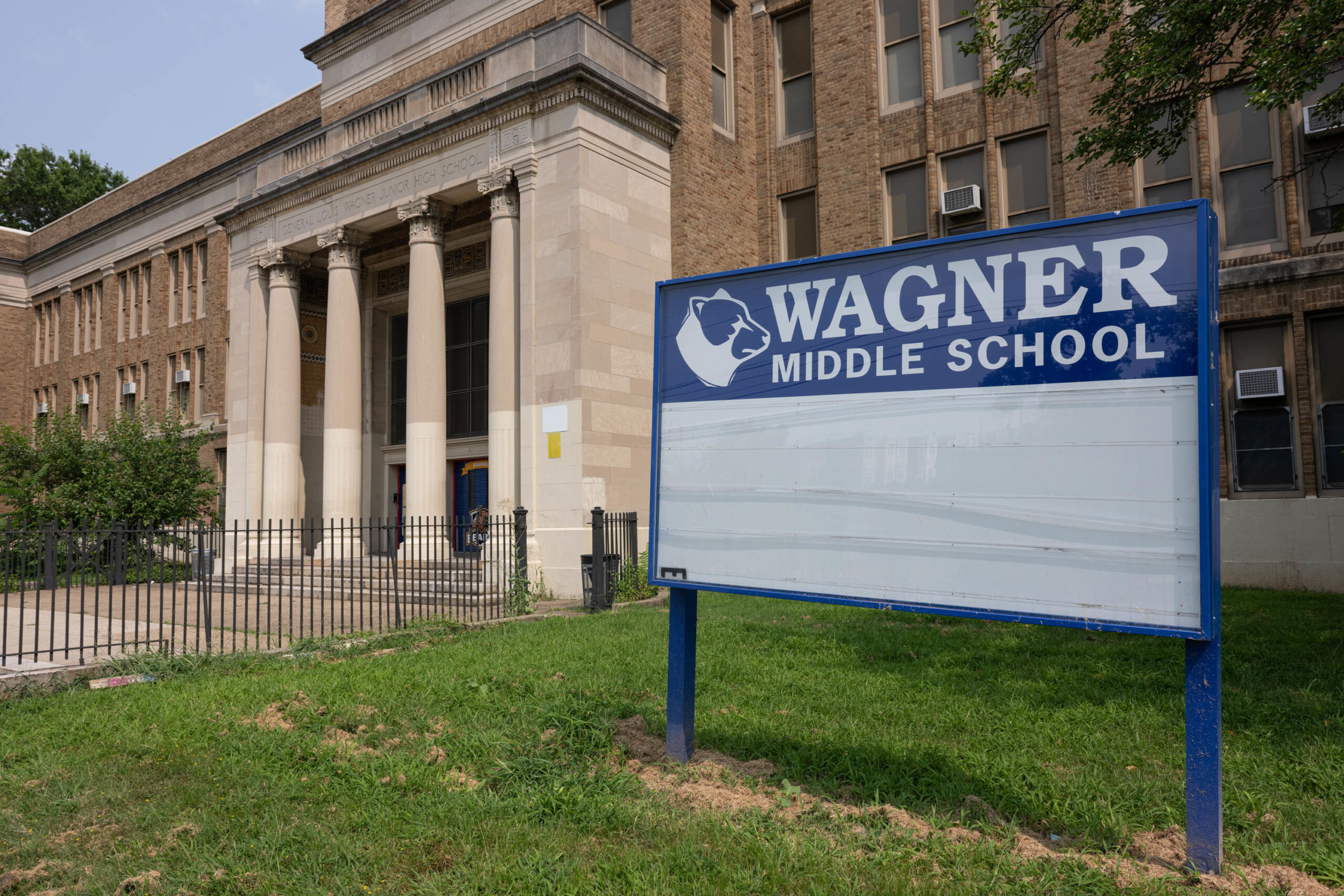
Wagner Middle School is one of six middle schools that is facing potential closure in Philadelphia.
Andrews, like others in the city, raised questions of equity.
“Are they closing schools in the Northeast?” Andrews said.
Councilmember Isaiah Thomas, chair of City Council’s education committee, highlighted Philadelphia’s complicated middle school position at a Council hearing last week.
The district’s talking points around middle school sound good,he said. But he questioned decisions to expand middle grades at magnet schools, like Masterman and Carver High School of Engineering and Science, whileclosing a number of neighborhood middle schools.
“I want us to have nuanced dialogue around where we are and what we need to do,” said Thomas, who has spoken out against closing Conwell, of which he’s an alumnus. “And I also recognize that there’s pushback on every decision you made. I understand that we have to make tough decisions somewhere else, there is no real facilities plan, and we do need a plan.
“But the reality is that we’re still not sending the right message to people, and I think our position around middle school is problematic.”
Watlington stressed the research around middle schools and the surveys.
The superintendent said the district is committed to modernizing and expanding receiving schools, where needed, and was not just focused on the Northeast.
“We absolutely will not present a plan that just pushes resources in parts of the cities that’s growing fastest,” Watlington said. “I think this is as strategic a plan as we could create.”
As a blizzard expected to dump significant snowfall on the region bore down, school districts across the region made the call: Monday classes are canceled — or shifted to online instruction.
The Philadelphia School District made the call early — on Saturday — calling a virtual instruction day for Monday.
“While we work to the greatest extent possible to keep schools open for in-person learning to accelerate student achievement, we also consider the staff members who are commuting from across the region and keep the safety of students and staff as our top priority,” Superintendent Tony B. Watlington Sr. said in a message to families and staff.
The district gave students one full snow day in January but has no more cushion built into its calendar to meet the Pennsylvania Department of Education’s requirement for 180 instructional days.
Any further inclement weather days will also be virtual learning days, Watlington said.
“After Monday, if schools need to remain closed due to inclement weather, the district will provide an update to parents, guardians and employees regarding remote learning,” Watlington said.
Among other districts that called for no school Monday: Camden, Cherry Hill, Evesham, Moorestown, and Washington Township in New Jersey; and Downington, Lower Merion, and Neshaminy in Pennsylvania.
Central Bucks, Pennsbury, Rose Tree Media, and Upper Darby moved to virtual instruction.
As cars whizzed by on B Street, one student banged a drum and another struck a cymbal. Others waved signs and marched in circles.
“Save our school!” the group of about 50 middle schoolers shouted outside Stetson Middle School in Kensington last week. “Save Stetson!”
Stetson is one of 20 schools Superintendent Tony B. Watlington Sr. has proposed closing as part of a $2.8 billion facilities plan. Officials say closures are necessary to improve educational outcomes and equity system-wide, and to balance enrollment in a district that has 70,000 empty seats.
Love Letters to Stetson decorate the hallway during a community meeting at John B. Stetson Middle School in Kensington last week. Stetson is one of 20 Philly public schools facing closure.
But Stetson isn’t going down without a fight.
The school is 59% occupied, by the district’s calculations, and its building is in “unsatisfactory” condition. Stetson also scored “poor” on program alignment, a measure that takes into account a school’s ability to offer “appropriate spaces” for things like art, music, physical education, and career and technical education.
Its supporters say Stetson has been left to languish and that their neighborhood is overrepresented on the closure list. The district, they say, is taking away a community that’s been a constant for families in a struggling neighborhood at the center of the city’sopioid crisis.
“You tell this community that they are not worth investment,” one Stetson studentsaid at a meeting at the school last week. “How is it equitable to shut a school in a neighborhood that already lost so much? If this building needs repair, fix it for the children, not for the administration.”
Twelve requests to fix a leaky roof
The district has said it plans to hold on to the Stetson building and operate it as “swing space” — a building that can be used to relocate students from other schools that must temporarily shut down to accommodate repairs.
Instead of closing soon, the district is proposing phasing Stetson out gradually. The school would stop accepting new fifth graders in 2028, and close in 2030.
Students who previously would have gone to Stetson will go to Cramp and Elkin elementaries, which will grow to accommodate middle grades. Both schools are less than a mile from Stetson.
Students, teachers and supporters rally before a community meeting at John B. Stetson Middle School on Thursday, Feb. 12, 2026 in Philadelphia. Stetson is one of 20 Philly public schools facing closure.
Officials have also said the move to shut downStetson is part of a larger strategy of movingaway from middle schools and focusing instead onK-8 schools.
Community angst spilled over at the closing meetinglast week, with audience members booing district officials who were there to present information and answer questions, and applauding for those who spoke up for Stetson.
If the district has money to spend on fixing up buildings, why not spend on Stetson’s building, students asked.
Students and attendees listen during a community meeting at John B. Stetson Middle School last week.
“We have a fourth floor,” one sixth grader said. “Y’all could just fix that, y’all could fix the pipes, y’all could fix everything.”
Another student said she was frustrated by mold in the school, and a leaky roof.
“I heard that it’s your fault,” the student said.
Later, at a Tuesday City Council hearing, Councilmember Quetcy Lozada told Superintendent Tony B. Watlington Sr. that Stetson staff have put in 12 separate requests to fix the leaking roof.
“That roof is still leaking,” a frustrated Lozada said. “Can I have someone please today commit to going to Stetson and checking their leaking roof?”
Watlington said he would “make that happen.”
‘The void that it’s going to leave behind’
The district got the Stetson call wrong, said Kathryn Lajara, a special-education teacher at the school.
“Our school is being penalized for allegedly lacking space — P.E., special education, art,” Lajara said. “These conclusions are based on incomplete and misleading information, not on lived reality of what happens in our building every single day.”
Special ed coordinator Kathryn Lajara speaks during a community meeting at John B. Stetson Middle School last week. Lajara and others spoke out against the recommendation to close the school in Kensington.
Stetson has an art lab, rooms for piano class, dance, a music room, anda photography room, Lajara said. And it serves 140 students with disabilities, despite the district saying it had inadequate special-education spaces.
Lajara was also frustrated by the district’s upkeep of the building.
“We fight the dripping water every day from the roof that you continue to neglect,” Lajara told district officials at the community meeting.
“I’m going to admit to you: We have neglected this building over decades,” Deputy Superintendent Oz Hill told the audience.
Lajara looked at Hill.
“Instead of continuing to neglect, how about we decide that our community and our students are best to invest in?” she said.
Deputy Superintendent Oz Hill speaks during a community meeting at John B. Stetson Middle School last week.
Crystal Pritchett, another Stetson teacher, suggested the district’s decision to send students to Cramp and Elkin was not in tune with neighbors’ wishes about safety and comfort.
Families have safety concerns about sending their kids to other schools, Pritchett said.
“You know nothing about this community,” Pritchett said. “You aren’t listening.”
Stetson opened in 1915 and was a district schoolfor nearly 100 years. It turned into a charter school runby the nonprofit Aspira in 2010, but the district took it backin 2022 after Aspira failed to meet district standards.
Abandoning it altogether is unthinkable, said the Rev. David Orellana, a pastor at CityReach Church in Kensington.
“I don’t think we’re taking into account the negative impact and the void that it’s going to leave behind,” Orellana said. “Taking Stetson away is taking the heartbeat of this community.”
Philadelphia City Council may not have a vote on Superintendent Tony B. Watlington Sr.’s sweeping facilities plan, but it indicated Tuesday that it will have a say in school closings.
As a packed hearing began in Council’s chambers Tuesday morning, both Council President Kenyatta Johnson and Isaiah Thomas, chair of the Education Committee, said Council refused to be a “rubber stamp” to Watlington’s proposal to close 20 schools, colocate six, and modernize 159.
“I’m infuriated that we don’t get a say,” Councilmember Jimmy Harrity said, warning the district officials who appeared before him. “But, Council president, you and I both know we do get a say, because budget’s coming. And we will be looking. Mindful is the word I would use for today — be mindful.”
Concerned citizens stand with signs in support of Harding Middle School before the start of a Philadelphia City Council hearing Tuesday at City Hall on the school district’s plan to close 20 schools.
About 40% of the district’s nearly $5 billion budget comes from local revenue and city funding, which City Council and Mayor Cherelle L. Parker must approve in the annual city budget by the end of June.
Harrity, an at-large Council member, said he was “tired that every time cuts come, they come from a certain neighborhood. You know, I live in Kensington, in the 7th District. I talk to these kids. They’re good kids. They deserve everything that other kids in other neighborhoods are getting. … You can see that this isn’t what our people want.” Watlington has proposed closing four schools in the 7th District.
More than 100 community members holding babies and waving signs opposing the facilities plan filled Council chambers on the fourth floor of City Hall on Tuesday as Council members spent hours grilling Watlington and other district officials.
Watlington, meanwhile, stood by his plan in testimony to Council on Tuesday, sayingthat 20 closings was a much smaller number than he could have settled on.
“We could have come here and presented a plan that closed twice as many schools and been able to defend it,” Watlington said.
A once-in-a-lifetime opportunity?
District officials have said thefacilities process is not about saving money, but about optimizing education and equity for the city’s 115,000 students.
But it was clear Tuesday that finances played a part: The district has lost 15,000 students in the last 10 years, and over 80,000 since 1997, when charter schools were first authorized in Pennsylvania. It has 300 buildings, many of them 75 years and older and in poor repair, and some schools with more than 1,000 empty seats, while others are overcrowded.
Tony B. Watlington Sr., superintendent of School District of Philadelphia, speaks at a City Council hearing Tuesday on his proposal to close 20 schools.
“We’ve got to be very careful with our limited resources in a historically underfunded district,” Watlington told Council.
Watlington and board president Reginald Streater, who also testified, pitched the plan as a way to add things the district cannot now offer — Advanced Placement courses in every high school, the opportunity for all eighth graders to take algebra, more prekindergarten, and career and technical education programs.
“I do not believe we’ll get this opportunity again in our lifetime,” Watlington said.
The superintendent dropped a few previously undisclosed facts about the facilities road map, indicating that his recommendations could shift slightly before he presents the plan to the school board on Feb. 26. No date has been set for the board’s final vote, which is expected later this winter.
“It’s premature to say how the final recommendations will land,” Watlington said.
But, the superintendent said, “if there are schools that Council wants me to take off the list, and add others on that list, we are open to you telling me what those are, but we cannot get to a place where we address our 35% non-utilization rate in buildings if no changes are made.”
Philadelphia City Council President Kenyatta Johnson (left) greets Dr. Tony Watlington, Superintendent of School District of Philadelphia Philadelphia City Council holds hearing with board members of School District of Philadelphia, Tuesday, Feb. 17, 2026. Reginald L. Streater, Esq., President Board of Education. (center)
Debora Carrera, the city’s chief education officer, who spent three decades as a district teacher and administrator, told Council that Parker believes “the current district footprint is unsustainable.”
Carrera said her own experience as principal of Kensington High School for Creative and Performing Arts shows that it is right for the district to focus resources on neighborhood high schools.
“My high school was a small high school,” Carrera said. “I could only offer my children two AP courses, when other schools like Central — where my son went — could offer them over 20-plus AP courses.“
‘Breaking down of public education’
The hearing got tense at times.
“I feel like this is the breaking down of public education in Philadelphia,” said Councilmember Cindy Bass, who said some of the district’s own decisions had led to closures.
Several members of Council raised questions about the plan’s price tag. Prior district and city estimates put the cost just under $8 billion, but members of Watlington’s team said they could they could actually do the work for $2.8 billion — $1 billion from district capital funds, and $1.8 from yet-unpromised state and philanthropic sources.
In the past, the district had made public detailed facilities condition assessments for every school in the district, Councilmember Rue Landau noted.
Residents could look up their school and see exactly what the condition of every system in the building was, and how much money would be required to fix those that needed repair.
“We don’t have any of those details,” said Landau, who went so far as to say she believed the district should be spending more than $2.8 billion on the plan. “What is the increased investment, and why don’t we have any of those details? They are not out there in the public for us, so none of us have any understanding as to why this is happening, This should all be public so all of the public can see.”
“You need much more money than that,” Roseman told Council. “We need more money than this plan comes close to.”
Some Council members pushed the district and the board on the plan’s timing.
The city has been asking for a long-range facilities plan for years, Councilmember Quetcy Lozada pointed out.
“It’s taken us all this time,” Lozada said. “Now, you guys have come up with a plan, and now we want to rush through it. Now all of a sudden there’s this urgency to get through this plan, which I don’t understand.”
Streater said the board is moving forward with hearing Watlington’s plan on Feb. 26, but won’t vote until it hears more feedback.
But ultimately, he said, the board will vote on “a plan that is dynamic, that can evolve over time. … I think that we all understand that things change, facts change, funding changes, enrollment trends change.”
And, Streater said, there will also likely be policy changes based on redrawing some catchment areas, or boundaries that determine which neighborhood schools children attend.
Streater, who introduced himself at the beginning of the hearing as “Reggie from Germantown,” underscoring his history as a graduate of two district schools that closed — Germantown High and Leeds Middle School — said that changes must be made.
“I think if we continue doing the same thing, expecting a different result — which I would argue is chronic underachievement — we are doomed.”
The city’s teachers union has significant concerns with the Philadelphia School District’s sweeping facilities plan, and it has taken them to a City Council committee.
Superintendent Tony B. Watlington Sr.’s $2.8 billion proposal “does not provide sufficient detail or data to inform binding decisions about school closures, co-location, re-purposing, or widespread impact and disruption that will be incurred,” Philadelphia Federation of Teachers president Arthur Steinberg wrote in a letter to Council’s education committee obtained by The Inquirer.
The appeal, sent late last week, comes as the district prepares for a Tuesday Council hearing on the school blueprint, which currently calls for 20 school closings, six colocations, and 159 modernization projects.
Council members are not the decision-makers — Philadelphia’s school board will ultimately vote on the plan sometime this winter — but as one of the district’s main funders, “you hold powerful levers that may be used to encourage the district to craft a more equitable [plan] that achieves our shared goals of improving student learning conditions and educators’ working conditions,” Steinberg wrote.
About 40% of the district’s nearly $2 billion budget comes from local revenue and city funding, which City Council and Mayor Cherelle L. Parker must approve in the annual city budget by the end of June.
What does the PFT letter say?
Before any decisions are made about what to do with the district’s buildings, the PFT wants system officials to do better by “showing their work and providing all data used to reach their determinations and recommendations for school improvement,” Steinberg wrote.
The teachers union also flagged compliance inconsistencies with the district’s own standards, implementation questions, and “substantial problems with data interpretation and application.”
The conclusions came after Jerry Roseman, the PFT’s longtime director of environmental science, scrutinized the plan. Roseman has decades of experience working with district officials on environmental issues.
The PFT and Roseman want access to all data. The district has released some details officials used to make their calls, but some remain opaque.
“How is the district ensuring that decisions regarding closing and receiving schools are based on comprehensive, up-to-date, and easily verifiable facility data (e.g., lead, asbestos, ventilation, overall condition)?” Steinberg wrote.
The PFT also wants to “definitively show that the facility condition of receiving schools is not, in fact, worse than the facilities thatare slated to close. If students are moving to a facility with worse current conditions, what will happen at the facility to improve it prior to students being moved there?”
District officials outlined some modernization and renovation plans ahead of Tuesday’s Council hearing, but some remain a mystery to the public. Watlington has promised all projects will be detailed before Feb. 26, when he’s scheduled to formally present the plan to the school board.
Don’t close schools or displace students based on incomplete data, PFT says
The school system’s own data contains some inconsistencies, Steinberg said — including some schools judged to be in “good” or “fair” building condition by the district’s metrics that have “severely inadequate” critical systems, such as roofing, windows, or electrical and plumbing systems.
And though the district said it could modernize all 85 school buildings currently in poor or unsatisfactory condition for $2.8 billion, the PFT questioned that price tag as overly optimistic. (City and district officials had previously put the system’s total deferred maintenance cost at $7 billion or more.)
“The cost to fully repair poor-inadequate buildings and systems could actually exceed $3.5 billion,” the PFT said.
The teachers union also highlighted the inequitable distribution of adverse conditions, noting that “Black and brown children and children from economically disadvantaged families are more vulnerable — to health risks, learning disruptions, and the long-term effects of instability and displacement.”
While the information the district has made public is “useful and has value as a ‘baseline,’ it is insufficient for its use in supporting the proposed conclusions, recommendations and other plan details released,” Steinberg said.