Author: Abraham Gutman

  • Philadelphia juries awarded $3 billion less in verdicts in 2025 compared to 2024

    Philadelphia juries awarded $3 billion less in verdicts in 2025 compared to 2024

    Philadelphia juries issued only three verdicts of $10 million or more in 2025, less than a third of the so-called nuclear verdicts awarded in 2024. The decline was so pronounced, it knocked the city’s Court of Common Pleas from the top spot on an annual “judicial hellhole” list.

    The overall amount doled out by Philadelphia Court of Common Pleas jurors declined by more than $3 billion this year compared to 2024, according to court data up to Dec. 19. The nearly $120 million awarded in 74 plaintiff verdicts represents largely a return to pre-pandemic norm.

    Two 2024 verdicts explain the majority of the gap: $2.25 billion against Monsanto in a Roundup weed killer case and $725.5 million against Exxon Mobil in a trial over toxic exposure to benzene-containing products.

    Compare those figures to the largest verdicts this year, a $35 million medical malpractice verdict against the University of Pennsylvania and Main Line Health and $15.3 million against a skill game designer and manufacturer for a dispute that led to the death of a Scranton man.

    Even the American Tort Reform Foundation, a group tied to an association that advocates for reform of civil litigation and represents business interests, took notice. Last year, the foundation blasted Philadelphia Common Pleas Court, along with the Pennsylvania Supreme Court, as the nation’s top “judicial hellhole.”

    In the 2025-26 report, the Philadelphia court was dethroned and ranked fifth. (The Pennsylvania Supreme Court had its own entry this year, making the group’s “watch list.”)

    “2025 did not bring the same level of activity, but this decline is not the result of positive reforms or improved legal activity, but rather a reduction of trials,” the report says on the fewer number of large verdicts in the Philadelphia Common Pleas Court.

    <iframe title="Philly Juries Issued Fewer, Lower  Verdicts in 2025" aria-label="Column Chart" id="datawrapper-chart-CF2on" src="https://datawrapper.dwcdn.net/CF2on/1/" scrolling="no" frameborder="0" style="width: 0; min-width: 100% !important; border: none;" height="427" data-external="1"></iframe><script type="text/javascript">window.addEventListener("message",function(a){if(void 0!==a.data["datawrapper-height"]){var e=document.querySelectorAll("iframe");for(var t in a.data["datawrapper-height"])for(var r,i=0;r=e[i];i++)if(r.contentWindow===a.source){var d=a.data["datawrapper-height"][t]+"px";r.style.height=d}}});</script>
    <iframe title="" aria-label="Column Chart" id="datawrapper-chart-txfq8" src="https://datawrapper.dwcdn.net/txfq8/1/" scrolling="no" frameborder="0" style="width: 0; min-width: 100% !important; border: none;" height="455" data-external="1"></iframe><script type="text/javascript">window.addEventListener("message",function(a){if(void 0!==a.data["datawrapper-height"]){var e=document.querySelectorAll("iframe");for(var t in a.data["datawrapper-height"])for(var r,i=0;r=e[i];i++)if(r.contentWindow===a.source){var d=a.data["datawrapper-height"][t]+"px";r.style.height=d}}});</script>

    This year had roughly 70 fewer trials that went to verdict, and no mass tort trials at all.

    Mass tort is the umbrella name for how courts handle a large volume of cases that all allege similar injuries. For example, the dozens of lawsuits in Philadelphia accusing Roundup weedkiller of causing blood cancer. The cases are consolidated under one judge, and “bellwether trials” are held to get a sense of what the cost of a global settlement might be, if an agreement is ever reached.

    Verdicts in mass tort cases are often large, as plaintiff attorneys encourage jurors to award a figure that the company’s boardroom would notice. Two of Philadelphia’s largest five verdicts in 2024 came from mass tort cases.

    Mass tort trials are scheduled for 2026, starting in January, and with them large verdicts could trend up again.

    Attorneys say there is more to the story than counting trials, as the large verdicts of 2024 and 2023 shaped how cases are handled behind the scenes. And fewer large verdicts don’t necessarily mean that defendants in Philadelphia are paying less.

    Robert J. Mongeluzzi, the founder of Saltz Mongeluzzi Bendesky, said defendants and insurers are agreeing to large settlements before any verdicts are delivered.

    “Defendants and their insurance carriers have resolved catastrophic cases by offering tens of millions of dollars to resolve these cases in advance of trial,” Mongeluzzi said via email.

    John Hare, a defense attorney with Marshall Dennehey, said that the large verdicts of recent years are prompting defendants to pay more, and more often, than they otherwise would.

    “There is a correlation between a rise in nuclear verdicts and a rise in nuclear settlements,” Hare said.

    The attorney also credits the court’s effort to mediate settlements in medical malpractice cases as one driver of the decline. But the key context is the historically high verdicts in 2023 and 2024, Hare said.

    “I don’t think the era of nuclear verdicts is over,” he said.

  • A bank’s ‘racist and overzealous’ fraud investigator ruined a Pa. car dealership, lawsuit says

    A bank’s ‘racist and overzealous’ fraud investigator ruined a Pa. car dealership, lawsuit says

    Tianna Williams didn’t finish high school after becoming a mom at 16. As a teen dropout, she began flipping cars to make money, and by her late 20s, her car sales acumen led her to open a dealership in Lehigh Valley that grossed over $1 million in annual sales.

    An opportunity to get a line of credit with one of the nation’s largest banks turned Williams’ dream into a nightmare, she said, which led the 30-year-old to file a lawsuit.

    M&T Bank opened a fraud investigation into Williams in spring 2023, says the suit filed in Common Pleas Court in Philadelphia in March. The bank inappropriately informed her financial partners that her business could be illegitimate, the complaint says. The bank froze her account, her partners cut ties, and her checks bounced. Williams’ growing businesses crashed.

    The investigation found no fraud, M&T lawyers said in a September hearing. But Williams says the damage was done.

    The complaint says the Black entrepreneur was a victim of the bank’s “racist and overzealous fraud investigator” who tormented the business owner for weeks. The investigator told Williams “you people” have ways of making fraudulent behavior seem legitimate, the suit says.

    Despite eventually finding no fraud, the investigator shared an email with a colleague, signed with a smiley-face emoji, saying “doing my best to not let her win on my watch.”

    “She killed my self-esteem,” Williams said of the investigator. “I lost all financial security.”

    The phenomenon of Black people being treated with suspicion by financial institutions has been dubbed “banking while Black” and has a history going back at least to the 1930s, when red lines on maps labeled majority-Black neighborhoods as unworthy of mortgages. More subtle variations of the practice have continued into the 21st century, resulting in settlement agreements for millions of dollars.

    Black customers have also reported tellers refusing to cash their checks, and banks calling police in disbelief that deposits made by Black people were legitimate. Studies further found that banks are more likely to scrutinize, and less likely to offer assistance to, Black small-business owners compared with their white counterparts.

    The Philadelphia area is not immune to the phenomenon. Black Philadelphians are less likely to have a bank account than their white neighbors, according to a report from the Economy League of Greater Philadelphia. And multiple banks entered settlements over offering worse interest rates and ratcheting up closing costs for Black mortgage seekers.

    ‘Somebody really has it out for you’

    Williams’ rags-to-riches story began in 2012, when she became pregnant at the age of 16. Her mother had recently been diagnosed with cervical cancer, and the family barely scraped by. After dropping out of high school before completing 10th grade, Williams learned how to flip cars from auctions with the help of a mentor she met through Facebook.

    Her first car: a 2002 Lincoln that as a 17-year-old she sold the next day for a $700 profit.

    The young hustler with a knack for sales got her auction license a couple of years later. She kept selling cars on Craigslist and through other social media connections. In 2018, she began working at an auto dealership. She learned the trade and became especially good at working with people who had low credit scores.

    Williams’ cut from each sale at the dealership was a fraction of the overall profit, so she decided to go it alone. She bought a lot in Easton in 2020 and set to work. The cars she sold became newer and more expensive.

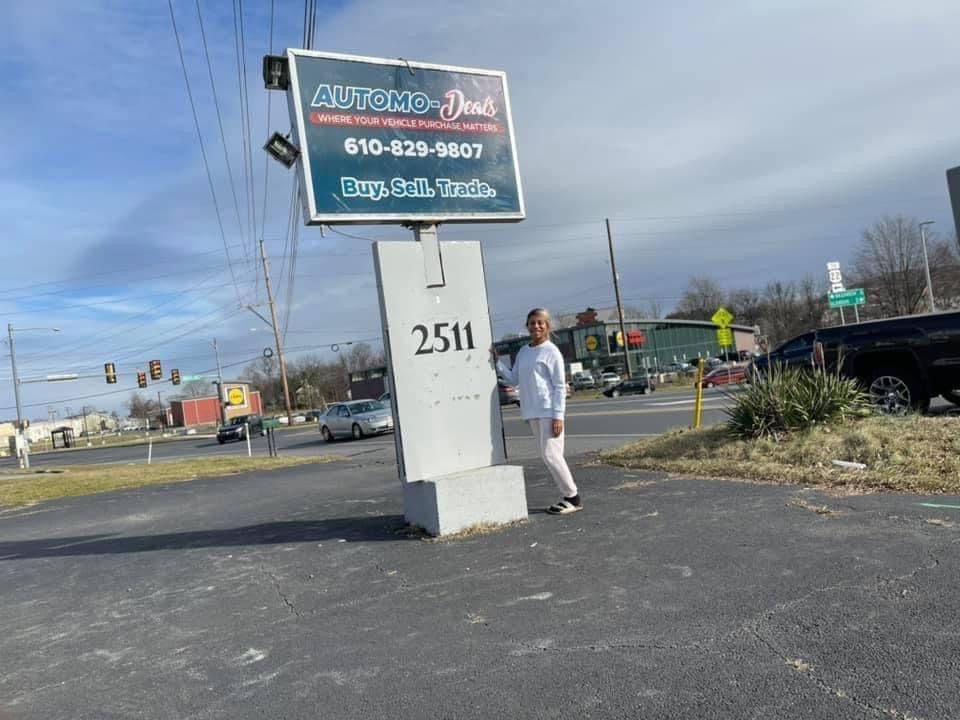
    Tianna Williams next to the sign of her car dealership in Easton.

    To sell cars for more than a couple of thousand dollars, Williams needed to offer financing options. She got her banking license and contracted with lenders. Her business was booming and she was planning to open a second location.

    That’s when Shazard Mohammed from M&T reached out, the complaint says. He offered Williams a line of credit that would allow her to take her business to the next level, and she transferred her accounts to the bank.

    Within days, Williams’ lenders contacted her to say they could no longer offer her financing because she was being investigated by M&T for fraud. Nearly overnight, she was without a business while owing about $200,000 in business and tax debts.

    “M&T BANK basically told me that they suspected you of fraud,” one business partner told Williams in a text message, according to the complaint. “If that’s not true, then somebody really has it out for you.”

    Records fight

    The bank is now fighting in court to keep documents related to the investigation secret, despite an attorney representing M&T saying in a September hearing that “there was no finding of fraud,” according to a transcript.

    M&T said in that hearing that Williams was investigated because of “red flags,” such as misspellings on checks that were immediately withdrawn as cash, and that the investigation lasted only seven days.

    Common Pleas Court Judge Paula Patrick sanctioned the bank’s lawyers in October for their failure to produce documents and ordered them to pay nearly $8,000 in attorneys’ fees. The judge also found that most records should not be sealed. M&T is appealing the ruling.

    Dean Malik, the attorney representing Williams, frames the case as a fight of David vs. Goliath. By issuing sanctions, he said, the judge reminded large entities that in court the playing field is leveled.

    “The judge is sending a message that it doesn’t matter if you are a billion-dollar bank and have two law firms representing you with five lawyers, you are still bound by the orders of the court,“ Malik said.

    Williams now cleans houses with her mother to support her family financially. She said her self-esteem has been shattered, and she hasn’t set foot inside a bank out of fear since her business closed in 2023.

    “There is nothing else I know how to do,” Williams said. “All I know is cars.”

  • Collingswood is sued after mayor voted on ambulance deal despite conflict-of-interest warning

    Collingswood is sued after mayor voted on ambulance deal despite conflict-of-interest warning

    A Collingswood commissioner has sued the South Jersey borough, asking a judge to nullify an ambulance-services contract with Virtua Health because the mayor’s husband works for the health system.

    James Maley is accusing Mayor Daniela Solano-Ward, who is a member of the three-person commissioners board, of voting in favor of the contract despite an opinion from the borough’s solicitor saying she should not vote, according to the complaint, filed in Camden County Superior Court.

    The lawsuit was filed two weeks after the Dec. 1 meeting in which the board approved the contract in a 2-1 vote. A draft contract has not been made publicly available, and there was a dispute between Maley and Solano-Ward during the meeting about the exact parameters of the arrangement with Virtua.

    “It’s absurd, it is wrong, it’s unethical,” Maley said during the meeting.

    Solano-Ward did not respond to a request for comment. The attorney representing Collingswood in the lawsuit, Alexandra Jacobs, declined to comment.

    The Camden County borough has 14,000 residents. It is governed by a three-person board whose members are elected every four years in nonpartisan elections. The board then appoints a member as mayor.

    Maley has been a commissioner since 1989 and served as mayor from 1997 until May, after his running mates to fill the two other board seats lost. Solano-Ward and Amy Henderson Riley, running under the Collingswood Forward slate, took the board’s majority.

    The catalyst for the dispute was concerns that Solano-Ward heard from the borough’s fire chief over his department’s lack of capacity to respond to the 4,000 calls it receives annually, the mayor said in the meeting. The emergency medical services generate $450,000 a year, the lawsuit says.

    The mayor held a meeting with Collingswood’s fire chief in August, the suit says, and brought her husband, a Virtua critical-care physician, Jared Ward.

    Ward does not hold a leadership position in the South Jersey healthcare system. A spokesperson for Virtua declined to comment on the lawsuit.

    Virtua was one of two entities that responded to a request for proposals to provide ambulance services for the borough.

    At the Dec. 1 meeting, Solano-Ward defended her husband’s involvement, saying the borough does not have a medical officer and she wanted to be sure no question went unasked.

    She also addressed the potential conflict of interest, saying she wanted to be forthcoming to prevent any appearance of impropriety. But she refused to recuse herself, despite the solicitor’s recommendation.

    “We reached out to our attorney and he agreed that there could be a conflict of interest,” the mayor said in the meeting. “To which I respectfully disagree and I will be voting on the matter.”

    The lawsuit says that Solano-Ward involved her husband in the process while shunning Maley and Henderson Riley, who is the borough’s public safety chief.

    Henderson Riley, who has a doctoral degree in public health, declined to comment on the dispute. She voted in favor of the contract at the Dec. 1 meeting, telling the public that her review of the data led her to support a one-year trial.

    “To be good stewards of taxpayer dollars, I believe in my role as director of public safety, it’s what I was elected to do,” Henderson Riley said.

    Maley’s lawsuit is asking a judge to find that there was a conflict of interest and nullify the vote. A hearing is scheduled for January.

  • Widows of photographer and pilot sue Airbus over fatal 6abc helicopter crash

    Widows of photographer and pilot sue Airbus over fatal 6abc helicopter crash

    The widows of a photographer and a pilot who died when a 6abc-operated helicopter crashed in 2023 have filed a lawsuit against Airbus, alleging a defect in the aircraft caused the fatal incident.

    Rosalyn Collins, the widow of pilot Monroe Smith, and Elaine Dougherty, the widow of photographer Christopher Dougherty, filed the lawsuit in Common Pleas Court in Philadelphia last week, just days before the two-year anniversary of the crash.

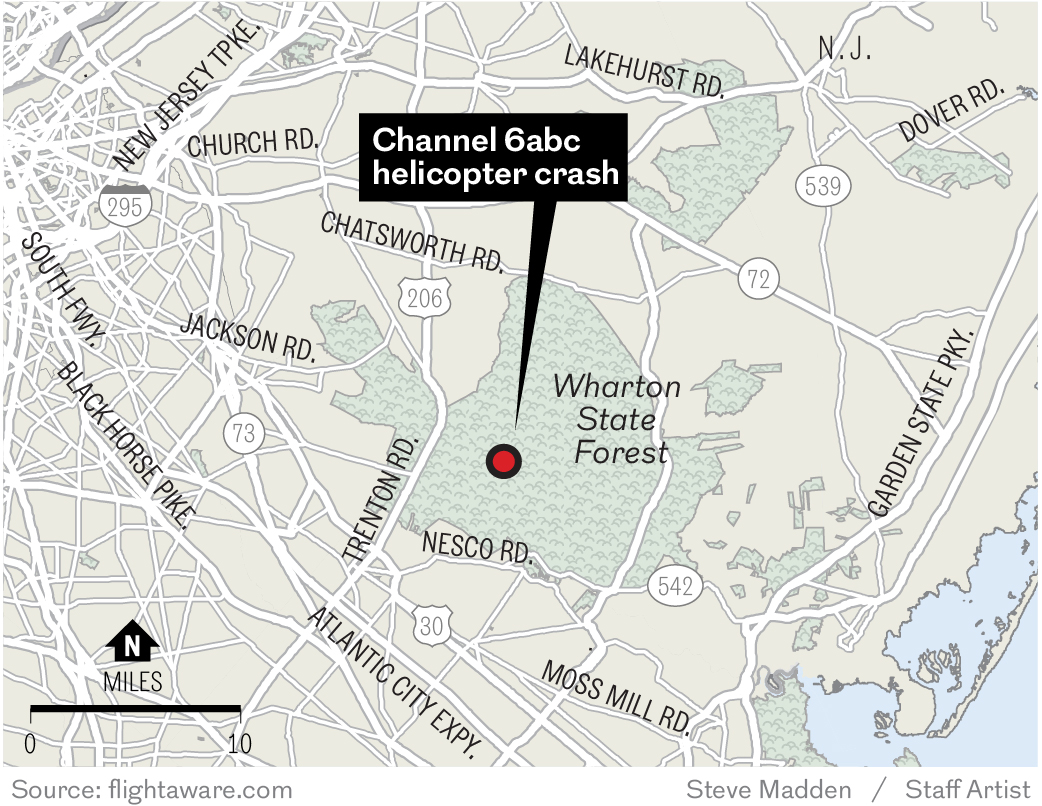
    The TV station’s Chopper 6 crashed in December 2023 in Wharton State Forest in Burlington County on its way back to Northeast Philadelphia Airport.

    The reason for the crash, the suit says, was a known defect in the design of the 2013 American Eurocopter AS-350A-STAR helicopter, which was manufactured by Airbus. The French aviation company has been warned for decades that the aircraft’s hydraulic system, which assists the pilot in controlling the helicopter’s rotor blades, was “defective and dangerous” and could leave pilots with few options, according to the complaint.

    “If the system fails, the pilot must manually operate the helicopter and counteract enormously strong aerodynamic forces by brute strength,” the complaint says. “Manual control of the AS350B2, however, is exceedingly difficult, and often impossible.”

    Map showing crash site of the 6abc-operated helicopter.

    Chopper 6’s hydraulic system previously failed in 2019, and part of it was replaced by Sterling Helicopters, a Bucks County-based company that is also named as a defendant in the lawsuit. Sterling also inspected the hydraulic system in 2021, the suit said.

    But the system failed again on the evening of the 2023 crash, which the suit says was “evidence” that the system’s parts were not designed to ”withstand such continuous use.”

    Airbus declined to comment. Sterling did not respond to a request for comment.

    The lawsuit also names as defendants companies that produced parts of the helicopter’s hydraulic system.

    A January 2024 National Transportation Safety Board preliminary report on the crash found “no anomalies of the engine” that “would have precluded normal operation.”

    Smith, 67, from Glenside, and Dougherty, 45, from Oreland, worked for U.S. Helicopters, a North Carolina company that owned the aircraft 6abc was leasing.

    The duo had been part of the Action News team for years, the station said following the crash.

    “Two really genuine people who have your best interest at heart and you can feel it,” Nicholas Thomas, a former colleague, said of Smith and Dougherty after their deaths.

    The lawsuit asks for an unspecified amount of compensatory and punitive damages.

  • A paralyzed New Hope man’s $1 billion verdict against Mitsubishi was erased by an appeals court

    A paralyzed New Hope man’s $1 billion verdict against Mitsubishi was erased by an appeals court

    A Pennsylvania appeals court vacated a $1 billion verdict against Japanese car manufacturer Mitsubishi Motors that was handed down by a Philadelphia jury in 2023.

    The whopping verdict was in favor of Francis Amagasu, a New Hope man who lost control of his car, which hit three trees and rolled over. Amagasu’s body was tossed in the car, though he was wearing a seat belt, and he was rendered quadriplegic. His attorneys alleged throughout the litigation that a defect in his 1992 Mitsubishi 3000GT’s seat belt caused the severe injuries.

    Through his wife, Amagasu sued Mitsubishi in 2018, and in fall 2023 a jury returned a verdict that included $800 million in punitive damages.

    The Superior Court did not assess whether the verdict was excessive, as it has been asked to do with other large verdicts. Instead the three-judge panel ordered a new trial because it said the jury was not instructed correctly by Common Pleas Court Judge Sierra Thomas Street.

    The issue at the crux of the appeal is that the seat belt defect did not cause Amagasu’s car to crash. Ahead of trial, attorneys for Mitsubishi asked Thomas Street to instruct the jury to assess what injuries Amagasu would have suffered if the seat belt was not defective, based on a legal doctrine for scenarios in which a vehicle’s defect didn’t cause the crash itself.

    The doctrine also requires proof there was a safer alternative to the defective product.

    Thomas Street, however, declined to provide those instructions. The judge told jurors that if they found that the seat belt was defective from when it was originally sold, Mitsubishi was “liable for all the harm caused by the occupant restraint system.”

    Superior Court Judge Judith Olson, who wrote the court’s opinion, said Amagasu’s attorneys never argued that a defect within the Mitsubishi 3000GT caused the crash itself.

    The appeal’s court opinion chastises Thomas Street, saying the trial court “abdicated its duty” to instruct the jury on correct legal principles.

    And the judge’s decision to deny Mitsubishi’s proposed jury instructions “was not a logical and dispassionate determination” based on the law and evidence, Olson said.

    Chip Becker, a Kline & Specter attorney who led Amagasu’s representation throughout the appeal, said in a statement that the court’s decision to vacate the verdict and order a new trial was wrong for multiple reasons.

    The jury instructions were consistent with past Pennsylvania Supreme Court precedent, Becker said. Plus, the jury found that Mitsubishi was liable because the car manufacturer failed to warn of the defect, making any other issue with the jury’s instructions “harmless.”

    “The Superior Court’s sharp criticism of Judge Street was unwarranted,” Becker said. “Mr. and Mrs. Amagasu look forward to vindicating Judge Street’s decisions in the appellate courts.”

    The car manufacturer, on the other hand, celebrated the decision.

    “Mitsubishi has always believed that the jury was not properly instructed on the applicable law,” Jeremy Barnes, a spokesperson for Mitsubishi Motors North America, said in a statement.

    Maureen McBride of Lamb McErlane and John Hare of Marshall Dennehey, who represented Mitsubishi throughout the appeal, declined to comment further.

  • Philadelphia man sentenced to 38 months in federal prison for commissioning videos of tortured monkeys

    Philadelphia man sentenced to 38 months in federal prison for commissioning videos of tortured monkeys

    Thankfully, prosecutors in the case of Robert Berndt did not submit video evidence as part of their court filing.

    The Philadelphia man was sentenced to 38 months in federal prison this week for his role in a scheme to pay people in Indonesia to torture and sexually abuse monkeys on camera.

    Berndt, 43, was a part of an online chat group in which people discussed and shared videos of tortured animals, according to Department of Justice court filings. Among the chat’s participants, Berndt’s “focus on the most grotesque forms of torture was unsurpassed.”

    “Over and over again, Berndt expressed a desire for more extreme torture that resulted in more pain, experienced over a longer period of time,” prosecutors told the judge.

    Messages from the chat are included in DOJ’s sentencing memo, and show Berndt’s enthusiasm over a video of a rat burning. Despite calling the footage “awesome,” he had suggestions on how to make the torture even crueler.

    “Like I want to see them maimed and miserable,” Berndt wrote under the alias Requiem Rhythm. “Killing them is great, of course, but it puts an end to it while I want them to suffer longer.”

    When the group discussed monkeys, Berndt expressed his desire for the tormentors to inflict more pain and focus on the primates’ genitalia.

    Berndt and his chat-mates actively commissioned footage of the torture. They’d contact so-called videographers, usually in Indonesia, who would torture monkeys following specific requests — some for as little as $10 a video.

    The monkeys in videos reviewed by DOJ were long-tailed macaques, which are native to Southeast Asia.

    Berndt and a co-conspirator even discussed the possibility of buying a baby monkey that was advertised for sale, DOJ said in court filings. The two daydreamed about meeting up to torture the youngster together in real life.

    “Hahah you would be welcome to visit and hang out,” Berndt said in a message to his co-conspirator, according to court records. “Like watching surgical theater.”

    The baby monkey that Robert Berndt and his co-conspiracy discussed purchasing to torture.

    Prosecutors from DOJ’s Environment and Natural Resources Division indicted Berndt in April and he pleaded guilty in May to a felony count of conspiring to create and distribute in videos depicting animal crush videos, the legal term for causing a non-human mammal serious bodily injury. Five other co-conspirators from the chat group were indicted, at least two of whom were sentenced to serve time in prison.

    Berndt’s attorney and DOJ did not immediately respond to a request for comment.

    Ahead of his sentencing, Berndt’s family members pleaded with the judge to not exceed the sentencing guidelines. which provide a range of 37 to 46 months of imprisonment.

    The letters and Berndt’s attorney’s sentencing memo paint a picture of a man who loved animals and was dependable whenever his loved ones needed him in the past. But Berndt changed following a sexual assault and opioid addiction, the filings say.

    Family members say that Berndt became manic and treated those who loved him as enemies. He became isolated, paranoid, and drank alcohol excessively.

    By 2021, most of Berndt’s social interactions were through online chat rooms, according to his attorney’s memo. He sought the approval of his new friends by escalating his rhetoric.

    “His acceptance and sense of validation with the group seemed to increase when he said more and more violent and troubling things,” his attorney told the judge.

    But DOJ prosecutors rebuffed the idea that Berndt was merely a follower, and note that he only stopped his engagement in the groups after he was contacted by law enforcement in 2024.

    “Berndt was personally responsible for creating some of the groups, establishing the rules of behavior within the groups, and then enforcing those rules after perceived violations,” prosecutors said in a sentencing memo.

    Judge Edmund Sargus Jr., of the Southern District of Ohio, sentenced Berndt to 38 months of imprisonment followed by three years of probation.

  • Lawsuit claiming Facebook had access to Jefferson’s private patient portal is dismissed

    Lawsuit claiming Facebook had access to Jefferson’s private patient portal is dismissed

    A federal judge on Wednesday tossed a proposed class-action lawsuit by Jefferson Health patients accusing the Philadelphia area’s largest health system of allowing Facebook’s third-party tracking technology, Meta Pixel, access to private patient information.

    After two years of litigation, and surviving a previous effort to dismiss the complaint, attorneys who filed the lawsuit asked the court to replace the named patients as the representatives of the proposed class. The lawyers said some aspects of their clients’ interactions with Jefferson’s web properties undermined the case.

    District Judge Cynthia M. Rufe rejected the request and dismissed the lawsuit, writing in an opinion that the plaintiffs had “ample opportunity to identify any defects or issues” over the last two years.

    “They have not identified any discovery or new evidence to justify such delay, nor have they explained how counsel’s due diligence did not determine the limitations of Plaintiffs’ claims,” Rufe wrote.

    The judge noted that the attorneys also missed the deadline to file for class certifications and did not respond to discovery requests.

    Attorneys David Cohen and James Zouras of the Stephan Zouras firm, who filed the complaint, did not respond to a request for comment.

    The original lawsuit was filed in 2022 in the Eastern District of Pennsylvania on behalf of Robert Stewart and Nancy Murphy, who said they suspected that their health information had been compromised when they started seeing Facebook ads related to medical issues, such as diabetes, kidney stones, and smoking cessation, that they had discussed with Jefferson providers through the patient portal.

    The lawsuit says Jefferson patients were tracked on the health system’s public-facing homepage, as well as within a password-protected portal where doctors and patients communicate.

    Jefferson denied in legal filings that it used Meta Pixel on its patient portals. It acknowledged using third-party tracking technology on its public-facing websites, which do not contain private medical information.

    Jefferson did not respond to a request for comment.

    In April, Cohen and Zouras asked the court to replace Stewart and Murphy with a third patient, Cathryn Thorpe, as the named plaintiff representing the patients in the class action.

    The attorneys said Stewart and Murphy would remain members of the proposed class of harmed patients.

    Jefferson’s attorneys argued in court filings that the request to replace the named plaintiffs was an admission that there was “no live controversy” and the suit should be tossed out.

    Rufe could not square how the patients’ case was too problematic to serve as named plaintiffs but they could still remain members of the class. She denied the request and dismissed the lawsuit.

  • Jalen Hurts gave a fan a touchdown ball. What happened next led to a lawsuit.

    Jalen Hurts gave a fan a touchdown ball. What happened next led to a lawsuit.

    First and goal from the New York Giants’ 10-yard line at MetLife Stadium. Jalen Hurts in the gun. Jason Kelce snaps the ball. Hurts takes off running, sneaks through a lane paved by a Kelce block, and dashes into the end zone for a touchdown.

    The quarterback who led the Birds to a win that December 2022 game and a Super Bowl at the end of the season then handed the ball to a bearded fan in a Philadelphia Eagles jersey.

    It should have been a memory for the ages. With that touchdown, Hurts became the first quarterback in NFL history to score 10 or more rushing touchdowns in two consecutive seasons. And Paul Hamilton, a lifelong Eagles fan, had the record-breaking game ball in his hands.

    But the events that followed led Hamilton, 34, to shed his Eagles fandom and file a lawsuit accusing the Eagles, Giants, stadium security, New Jersey State Police, and others of assault, false imprisonment, and other charges.

    After the touchdown celebration ended, various security, team, and NFL officials approached Hamilton and asked for the ball back, according to the lawsuit initially filed in 2023 in New Jersey state court. The officials told Hamilton that the Hall of Fame needed the ball, and he would break the law if he didn’t return it.

    A representative from the Eagles, accompanied by two New Jersey State Police troopers, offered Hamilton an “alternative gift opportunity” in exchange for the ball, the suit says. Hamilton declined and decided to leave the stadium with his friend.

    On the way out of MetLife, the suit says, security officers grabbed him from behind. They pinned Hamilton to a gate and radioed state police their location. Hamilton told a police officer that he was assaulted by security officers, according to the complaint.

    The security officers told Hamilton he was free to leave, but he was swarmed by about 10 New Jersey officers a few moments later, the suit says. Police escorted Hamilton to a gated area, where he says he was detained and feared for his life. The fan was threatened with arrest if he didn’t return the ball.

    An officer was told over the phone to let Hamilton go, a command that the fan overheard, the suit says, and he was released.

    Hamilton left MetLife with the ball and emotional scars that required psychotherapy.

    “He is so hurt by what happened and disappointed, he’s not an Eagles fan anymore,” said Adam Thompson, Hamilton’s attorney.

    The attorney for New Meadowlands Stadium Company and the Giants, and the attorney for the New Jersey State Police, did not respond to requests for comment. The Eagles, who have been dismissed from the case, declined to comment.

    The litigation is in discovery, which is set to continue through April, according to the court docket. Thompson said depositions of witnesses and officials from the teams, stadium, and NFL should begin soon.

    Philadelphia Eagles tight end Dallas Goedert tosses a touchdown ball into the stands during the third quarter at Lincoln Financial Field on Sunday, Dec. 14, 2025 in Philadelphia. The Philadelphia Eagles defeated the Las Vegas Raiders 31-0.

    Game balls are precious commodities in the NFL, which has penalized players for handing them out to fans or throwing them into the stands. But there is no policy that requires fans to return balls, an NFL official told The Athletic.

    Touchdown balls can also be meaningful to players, leading to retrieval efforts.

    Last year, a hyped-up A.J. Brown threw a touchdown ball into the stands only to realize seconds later that it was Tanner McKee’s first NFL touchdown throw.

    “Dude, no!!!!,” a miked-up McKee said on the sideline when he learned the ball was gone.

    But the wide receiver did good, offered a fan his jersey in return for the ball (“I got you,” the fan responded), and gave McKee his prized possession.

    Thompson said Hamilton went through a roller coaster of emotions that day in MetLife.

    “Fans have rights, fans have a voice, and fans should be respected by the game,” Thompson said.

  • Philly lawyer accused of falsifying medical records calls Uber’s suit a ‘tactic’ to scare attorneys

    Philly lawyer accused of falsifying medical records calls Uber’s suit a ‘tactic’ to scare attorneys

    The Philly-area personal injury lawyer accused by Uber of working in concert with a group of medical professionals to falsify medical records told a federal judge that the lawsuit was part of a “business tactic” by the rideshare giant to scare attorneys away from representing crash victims.

    Marc Simon, of Simon & Simon, asked the judge on Friday to toss out Uber’s complaint.

    “If you are a lawyer who dares to sue Uber or its drivers (or a doctor who agrees to treat the victims of the Uber drivers’ negligence), Uber will destroy your career — call you a fraud, accuse you of criminal racketeering, seek ‘eight figures’ in damages, and demand the surrender of your law license,” Simon’s filing said.

    Uber filed similar lawsuits against personal injury law firms in New York, California, and Florida in which the rideshare company alleges that attorneys conspired with medical professionals to fraudulently inflate medical costs in an effort to get higher settlements or verdicts.

    “Their strategy is simple: use their unlimited resources to intimidate injured victims and bully their lawyers into silence,” Simon said. ”It won’t work.”

    Uber sued Simon & Simon in September, accusing the firm and its founder of violating the Racketeer Influenced and Corrupt Organizations Act, saying the law was enacted “to address precisely this type of fraudulent pattern.”

    The scheme, as alleged in Uber’s lawsuit, involved the firm providing instructions on the treatments clients should get at a New Jersey pain physician’s clinic and having clients often receive more than 20 chiropractic visits.

    It culminated in expert reports written by a private-practice orthopedic surgeon who performed nearly 1,300 exams for Simon & Simon clients in the past three years, and the firm paid him about $1.5 million, according to the complaint.

    The providers documented a need for extensive treatments that often contrasted with police reports where officers on the scene noted no injuries, the suit says.

    The goal of the reports was to inflate cost-of-care projections, which Simon & Simon used in settlement negotiations to turn “low value claims into million-dollar-plus” requests, according to the complaint.

    Simon was an obvious target for Uber in Philadelphia, the attorney’s filing says. He was viewed as an “easy hit” because of two recent instances in which federal judges sanctioned him.

    The sanctions were related to firm procedures and jurisdictional issues, and neither order “even slightly resembles” the “outrageous fraud and criminal conspiracy” alleged by Uber, Simon said in his motion to dismiss.

    One of the judges who sanctioned Simon noted in a blistering memo that the firm’s expert reports had “little relationship to real world medical care” and that when the same expert in every case projects “monumental future costs” it “becomes difficult to read the reports in question as credibly addressing actual patient needs.”

    The attorney says Uber failed to show that it was injured by any alleged misrepresentation. As evidence of the conspiracy, Uber says Simon dropped the rideshare giant as a defendant from dozens of lawsuits in which the pain physician was the key expert once they asked question.

    “For this reason, Uber did not plead (and could not have pled) that it paid any verdicts or settlement in such cases,” the Simon’s filing says.

    The medical professionals also filed motions to dismiss the case.

    A spokesperson for Uber said in a statement that the motions to toss out the lawsuit offer “no real response to the detailed and credible allegations of fraudulent conduct.”

    “We are confident in the merits of our case and look forward to seeing the defendants in court,” the statement said.

  • Only N.J. residents can end their lives through the state’s aid-in-dying law, appeals court rules

    Only N.J. residents can end their lives through the state’s aid-in-dying law, appeals court rules

    New Jersey is among the 10 states that allow physicians to assist terminally ill patients in ending their own lives, under certain conditions. But those patients must be New Jersey residents, a federal appeals court ruled.

    The U.S. Court of Appeals for the Third Circuit said last week that New Jersey’s limit of the aid-in-dying law to state residents is constitutional, keeping on the books a significant hurdle for people from neighboring states — including Pennsylvania and Delaware — where the practice is not permitted.

    “In our federal system, states are free to experiment with policies as grave as letting doctors assist suicide. Other states are free to keep it a crime,” U.S. Circuit Judge Stephanos Bibas wrote in the opinion. “This novel option does not appear to be a fundamental privilege, let alone a fundamental right, that states must accord visitors.”

    Jess Pezley, a staff attorney at the legal arm of Compassion and Choices, a nonprofit advocacy organization that brought the lawsuit challenging the residency requirement, said aid in dying “remains a critically important option for all terminally ill people who wish to receive healthcare in the state of New Jersey.”

    The “ruling means that terminally ill patients who do not live in an authorized jurisdiction will continue to have to travel” to states like Oregon and Vermont that permit the practice for nonresidents, Pezley said in a statement.

    Aid in dying is a controversial concept. While some argue the law creates a pathway for empowerment over end of life, others worry that it can lead to coercion and expansion beyond the terminally ill in a country that has a dark history in how it treats people with disabilities.

    The residency requirement is meant to protect physicians from liability in states where assisting in suicide is a criminal offense, proponents of the restriction argue, and to prevent medical tourism in states with the option.

    The law does not specify how long a person must live in New Jersey but sets other qualifying requirements: A patient must have a New Jersey driver’s license, be registered to vote in the state, have filed income taxes as a New Jersey resident in the last year, or have another official government record that confirms residency.

    New Jersey enacted a medical aid-in-dying law in 2019. Last year, 122 people ended their lives through the program in the Garden State, according to New Jersey’s chief medical examiner. Nearly 70% of the patients had cancer and their average age was 72.

    The law allows adults who are residents of New Jersey and are expected to die within six months to obtain a prescription for a lethal drug cocktail. They must be able to make their own decisions and administer the medication by themselves.

    The ruling is the latest development in a lawsuit filed in August 2023 by a Camden County physician, Paul Bryman, who assists terminally ill patients in ending their lives on their own terms. He challenged the residency requirement, saying the law prohibits him from treating all patients equally because of where they live.

    Bryman’s suit originally included another New Jersey physician, Deborah Pasik, and two cancer patients, Judith Govatos of Delaware and Andy Sealy of South Philadelphia. Pasik has since retired, and Govatos, 81, and Sealy, 44, died before the court made its ruling.

    The lawsuit argued the prohibition “discriminates” against patients like Govatos and Sealy by not allowing them to receive “specific medical care after crossing State lines into New Jersey, even though they would otherwise qualify for this care.”

    New Jersey officials asked a federal district judge to dismiss the case, arguing that no court has recognized aid in dying as a constitutional right. The state further said that the residency requirement was among the “safeguards” in a policy that has “extraordinarily high stakes.”

    The judge tossed out the lawsuit in 2024.

    “And the residence requirement makes sense: While medical aid in dying is permitted in New Jersey, it is indistinguishable from the criminal act of assisted suicide in neighboring states,” District Judge Renee Marie Bumb wrote in her opinion. “By limiting the pool of eligible patients to State residents, the requirement is rationally related to the legitimate objective of protecting from out-of-state liability providers and advocates who assist terminally ill patients in seeking medical aid in dying.”

    Compassion and Choices appealed the ruling to the Third Circuit, where the plea met a similar fate.

    “The Constitution leaves moral questions like these to the states,” Bibas wrote. “New Jersey has answered them carefully.”