Author: Abraham Gutman

  • The Frankford Arsenal once housed Philly’s narcotics unit. The site gave officers brain cancer, lawsuits say.

    The Frankford Arsenal once housed Philly’s narcotics unit. The site gave officers brain cancer, lawsuits say.

    Joseph Cooney joined the Philadelphia Police Department’s narcotics unit in 1998. For eight years, the officer began and finished each workday at the unit’s headquarters on the site of the old Frankford Arsenal in Philadelphia’s Bridesburg section, where munitions were manufactured and tested from the Civil War through the Vietnam War.

    Cooney, 53, said he would joke with his colleagues that “we’ll all be glowing in the dark someday” because of the materials left behind in the ground and the chemical plants across the Frankford Creek. In 2024, that joke became a dark reality for Cooney when he was diagnosed with glioblastoma, an aggressive and incurable brain cancer.

    In a lawsuit, filed along with lawsuits by the families of two narcotics officers who died of the disease, Cooney links his cancer to radioactive and toxic materials that had not been properly remediated when the munitions factory shut down and the site was converted to a business park.

    The lawsuit, filed Monday in Common Pleas Court, accuses the Philadelphia Authority for Industrial Development, developer Mark Hankin, and Hankin’s businesses of having known about risks of exposure but failing to warn those working in the location or properly remediate the harm.

    “This type of cancer, at the end of the day, it’s a death sentence,” Cooney said. “When you go to work every day, you don’t expect to be dealing with this.”

    The Philadelphia Authority for Industrial Development declined to comment. Hankin did not respond to requests for comment.

    Joseph Cooney, a police officer who was diagnosed with glioblastoma in 2024, seen after his third surgery in July 2025.

    ‘The street that beat Hitler’

    The Frankford Arsenal opened in 1816 as a weapons storage and repair shop for the U.S. Army, and in 1849 became the country’s largest developer and manufacturer of small arms and artillery shells. The arsenal’s campus grew over the years, including a massive expansion during World War II. By the end of the war, workers fondly referred to it as “the street that beat Hitler.”

    Each war throughout the century-plus of the arsenal’s existence brought its own challenges, and the complex between Bridge Street, Tacony Street, and the Frankford Creek adapted to support the nation’s military needs.

    This woman is loading powder into cartridges of .30 caliber tracer bullets in the assembly division of the Frankford Arsenal in Philadelphia, Penn., on July 27, 1940 during World War II. (AP Photo)

    The arsenal closed in 1977 and the authority for industrial development, an agency with a mayor-appointed board, became the campus’ steward. Hankin, a Montgomery County developer, bought the campus in the 1980s and transformed it into a business park, which included the narcotics unit headquarters from the early 1990s until 2015.

    As soon as the arsenal closed, decontamination needs were discussed, newspaper articles from the time show. An official report found the existence of dangerous materials in buildings in 1981, before the property was converted to civilian use, the lawsuits say.

    Throughout the 2000s, the U.S. Army Corps of Engineers, in a series of reports, flagged concerns over dangers in the old arsenal’s ground. A 2016 report found elevated concentrations of lead and potentially cancer-causing substances in six areas that posed “unacceptable risk or potential concerns to future human receptors.”

    One of the areas of concern noted in the report sits atop building 202 — the narcotics unit’s former home.
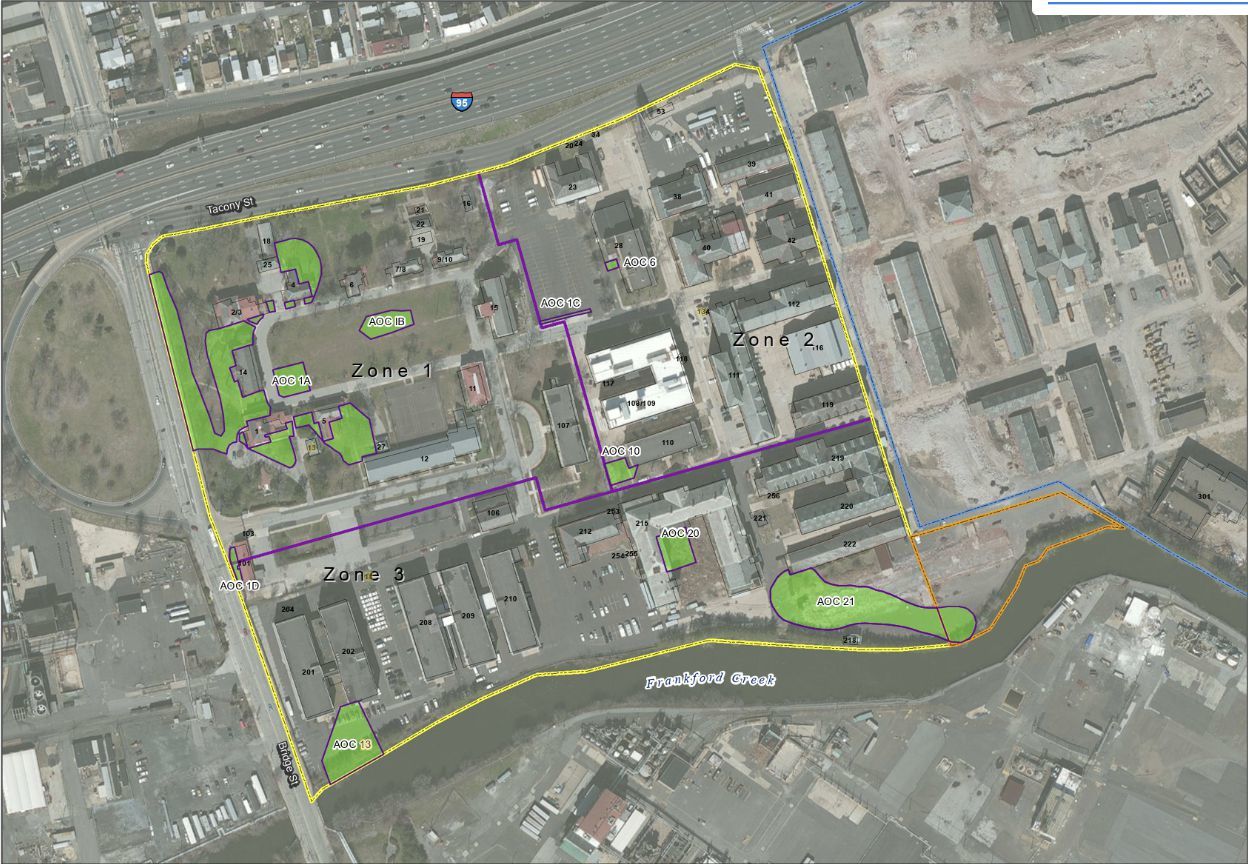
    A map showing areas of concern for hazardous materials at the Frankford Arsenal site, from a 2016 report on a feasibility study conducted by the U.S. Army Corp of Engineers.

    The common denominator

    Cooney has been hearing over the past decades about colleagues from his narcotics unit days who have gotten sick.

    Michael Deal, who spent 37 years on the police force and joined the narcotics unit in 1994, was diagnosed with glioblastoma in 2018 and died the next year at age 64. Then, in 2023, Andrew Schafer, a 20-year veteran who worked at narcotics from 2002 to 2015, also was diagnosed with the brain cancer. He died in March at age 51.

    The families of Deal and Schafer also filed lawsuits similar to Cooney’s.

    Cooney heard through the grapevine about other cases. And then he was diagnosed.

    “Everyone sat down, started talking,” Cooney said. “The only common denominator was everybody worked in the same building.”

    Adding to their concern were the adjacent chemical plants, Cooney said.

    Fifty-four employees of the Rohm & Haas chemical plant, right across the Frankford Creek from the arsenal, died of lung cancer in the 1960s and early ’70s, the Philadelphia Daily News reported in 1981.

    The current suits allege that the contaminants in the arsenal ground were not properly cleaned up, and that those working at the site were not warned despite a series of reports.

    “The remediation was not done to the extent that it eliminated the risk,“ said William Davis, the attorney who filed the suits. ”Up until now we have no evidence that there was any warning to any tenants.”

    Cooney still works as a police officer, with a desk job supporting the city’s SWAT team. He has lost much of his independence to the disease, which can be slowed but not cured. He can no longer drive or coach youth sports, and relies on a cane to walk.

    “It’s tough now,” Cooney said. “You feel like you’re getting robbed.”

    The officer is concerned about who will take care of his wife and their seven children once he is gone, and Cooney is especially worried for the health of one of his daughters — a biology teacher at Franklin Towne Charter High School, which sits on the arsenal’s old site.

  • An ex-Philly labor official claims she complained about sex discrimination and then was fired

    An ex-Philly labor official claims she complained about sex discrimination and then was fired

    A former top Philadelphia labor official claims in a lawsuit that she was passed over for a promotion because she’s a woman, and was later fired after raising concerns about gender-based discrimination spanning two mayoral administrations.

    Monica Marchetti-Brock, the former first deputy director of the Department of Labor, said in a federal lawsuit filed Wednesday that Mayor Cherelle L. Parker fired her last year, days after Marchetti-Brock had reiterated complaints about gender bias at the top rungs of the city government that had occurred before Parker took office.

    Marchetti-Brock had worked for the city since 2013. Under former Mayor Jim Kenney, she rose to the city’s No. 2 labor role.

    But when former Deputy Mayor for Labor Richard Lazer resigned in 2022 to lead the Philadelphia Parking Authority, Marchetti-Brock wasn’t hired to replace him because she’s a woman, alleges the complaint, filed in the Eastern District of Pennsylvania.

    The man hired for the position was Basil Merenda, a former top state labor official whom Marchetti-Brock claims “had a problem with women.”

    What started as a change in boss under then-Mayor Jim Kenney culminated in spring 2024 with Parker firing Marchetti-Brock after she complained of sex-based discrimination, according to the suit. The lawsuit says an outside investigator probed Merenda’s behavior and in 2023 recommended he undergo implicit bias training.

    The lawsuit accuses the city of minimizing the results of that investigation and of terminating Marchetti-Brock and a second woman who was mistreated by Merenda.

    “When [Marchetti-Brock] asked if her termination had anything to do with her sex discrimination complaints, [the city] refused to answer the question,” the complaint says.

    Merenda is currently one of two commissioners of the Department of Licenses and Inspections. Parker announced his appointment in February 2024, a few weeks before Marchetti-Brock says she was fired. It is common for there to be significant turnover in personnel at the beginning of a new mayoral administration.

    A city spokesperson declined to comment, citing the pending litigation.

    Attempts to reach Kenney were unsuccessful. The former mayor appointed many women to his top staff through his more than two decades in City Hall. When he took office as mayor in 2016, the majority of his cabinet were women.

    Marchetti-Brock began reporting to Merenda in January 2023. He ignored his deputy, excluded her from meetings and communications, yelled, and “unjustly” criticized her, the suit says.

    Marchetti-Brock says she complained of sex discrimination in the labor department to a long list of officials, some of whom still work for the city, including City Solicitor Renee Garcia and Chief Administrative Officer Camille Duchaussee. Marchetti-Brock “described how she was treated compared to how male employees were treated, including that Merenda ignored what female employees said and focused on what male employees said,” according to the lawsuit.

    The city opened an investigation in the spring of 2023, the suit says.

    After Parker was elected in November 2023, Marchetti-Brock again expressed her interest in the top labor role. However, the incoming mayor ultimately tapped Perritti DiVirgilio, who was previously the city’s director of labor standards. Marchetti-Brock described DiVirgilio in the suit as a “noncomplaining, male employee.”

    In February 2024, Marchetti-Brock received a letter summarizing the findings of the investigation into Merenda. The letter said that the probe concluded that “no violation” of the city’s sexual harassment prevention policy occurred. According to the complaint, Marchetti-Brock was told that Merenda had received a warning and the investigator recommended he undergo implicit bias training.

    The policy says city employees are protected from sexual harassment regardless if it’s “unlawful,” and it prohibits retaliation against employees who raise concerns or complain. Marchetti-Brock had a role crafting the policy following a critical 2018 City Controller report that said the city’s sexual harassment reporting protocols were inadequate.

    According to the suit, Marchetti-Brock pushed back on the summary letter in an email to Andrew Richman, a city attorney, saying that even though no unlawful behavior was found, “there were findings of bias toward me and other women.”

    “As you are aware, our policy holds our leaders to a higher standard than the law,” Marchetti-Brock wrote, according to the complaint. “It is misleading to say there are no findings under our policy.”

    Three days later, in early March 2024, top officials from Parker’s administration informed Marchetti-Brock that her employment would be terminated, according to the complaint. The suit states that another female employee who had complained about Merenda was terminated as well.

    The lawsuit asks the federal court to find that the city violated antidiscrimination laws and award Marchetti-Brock an unspecified amount of damages.

  • Montco’s former chief information officer accuses county of ‘fraud, waste, wrongdoing’ in lawsuit

    Montco’s former chief information officer accuses county of ‘fraud, waste, wrongdoing’ in lawsuit

    Montgomery County‘s former chief information officer says he was terminated because he requested accommodations for his mental health, according to a lawsuit.

    But while claiming that there is “simply no question” Anthony Olivieri was terminated primarily due to his request for accommodations, the complaint takes a detour to describe instances of what it calls “fraud, waste, wrongdoing” by Montco officials since 2017.

    Olivieri suffered from “anxiety, panic and depression complications,” the suit says. He took a medical leave of absence from November 2024 to January 2025. The issues persisted when Olivieri returned to work, in part because of “mistreatment,” the complaint says.

    In July, the county fired him.

    The fraud and wrongdoing allegations are included in the complaint because they explain how Olivieri’s “whistleblowing” contributed to a hostile work environment and his eventual termination, the lawsuit says.

    “Montgomery County is steadfast in our commitment to fiscal responsibility and integrity,” a spokesperson said in a statement. “We do not comment on personnel matters or ongoing litigation.”

    The most explosive allegation in the complaint revolves around the conduct of Dean Dortone, the county’s chief financial officer.

    Montgomery County gave nearly $5 million to ePlus Inc., a company that provides a wireless communications network, in 2023 although a competitor offered the best technology solution, according to the complaint. Dortone tipped the bid in favor of ePlus, where he had been employed for about five years before joining Montco.

    The complaint accuses Dortone of sharing the competitor’s proprietary bid with ePlus to allow the company to one-up its own proposal, in exchange for “lavish trips and golf outings.”

    The relationship between Dortone and ePlus did not end when the company received the contract, the complaint alleges. The county’s CFO shared with ePlus the amount set aside in the budget for servicing the communications system, the suit says, allowing the company to charge the maximum allowed instead of invoicing according to need.

    “This was gross waste and wrongdoing,” the complaint says.

    ePlus did not respond to request for comment.

    Olivieri also alleges that the county sent $500,000 to an impostor in 2017 and concealed the wire transfer to avoid embarrassment, and that in 2024 and 2025 the county claimed to have saved over $1 million by revamping printing infrastructure in offices even though the changes “did not happen.”

    The suit also says that county officials often use personal emails to keep information from being available through right-to-know requests.

    Olivieri says that he was “very vocal” in expressing concerns, using terms such as “fraud,” “waste,” and “illegal” to describe the conduct, and experienced hostility for it.

    The original reason given to Olivieri for his termination was a broader “change of direction,” but when he sought unemployment benefits he learned that the county cited performance issues for his dismissal. But Olivieri received an unsolicited severance package of $30,000 in exchange for a legal waiver for retaliation and discrimination claims, the suit says.

    The lawsuit calls the severance offer “well-established admissible evidence of discrimination, pretext, and retaliation.”

  • Former Fox exec urges FCC to reconsider petition to revoke Fox 29 license

    Former Fox exec urges FCC to reconsider petition to revoke Fox 29 license

    A former Fox broadcasting executive submitted a letter to the Federal Communications Commission on Tuesday asking the agency to reconsider a petition seeking to terminate the license of the network’s Philadelphia-area affiliate, Fox29.

    Preston Padden, who worked as a senior executive at the broadcasting network controlled by Rupert Murdoch and his family in the 1990s, has been a vocal critic of Fox News and its coverage of the 2020 election and an early supporter of the petition.

    In his letter to the FCC, Padden writes that Fox and the Murdochs lied to the American people by reporting that the 2020 election was stolen, despite knowing that it was untrue.

    He cites court findings in the defamation case brought against Fox News by Dominion Voting Systems, which resulted in a $787 million settlement.

    “Fox and the Murdochs’ lies to the American people had consequences,“ Padden wrote. ”Those lies undermined public confidence in the electoral process.”

    Neither Padden nor Fox’s attorneys responded to requests for comment.

    Padden’s letter urged the FCC to respond to an appeal of the order denying the challenge to Fox29’s license.

    The FCC dismissed in January a challenge to Fox29’s license renewal that was brought by the Media and Democracy Project, a self-described nonpartisan nonprofit. The petition, originally filed in July 2023, accused Fox of broadcasting “knowingly false narratives about the 2020 election” on the cable-based Fox News Channel.

    Former FCC chairperson Jessica Rosenworcel, who was appointed by President Joe Biden, said in a statement accompanying the dismissal of the petition, alongside three other complaints targeting local TV stations, that the order was intended to direct the agency to “take a stand on behalf of the First Amendment.”

    “We draw a bright line at a moment when clarity about government interference with the free press is needed more than ever,” she said.

    The challenge is not based on materials broadcast on Fox29, or the local channel’s journalism. Instead, character requirements for broadcast license owners that include a prohibition on “broadcasting false information that causes substantial ‘public harm.’”

    The examples in the FCC’s consumer guide are related to a crime or a catastrophe.

    Fox said in its filings with the FCC that revoking Fox29’s license would be “fundamentally incompatible with the First Amendment.”

    The Media and Democracy Project’s appeal is still pending, and is now in the hands of FCC chair Brendan Carr, a President Donald Trump appointee who has been criticized for interfering in broadcasters’ editorial decisions.

    In September, ABC temporarily removed Jimmy Kimmel’s late-night show from broadcast after a threat Carr made on a conservative podcast.

    “We can do this the easy way or the hard way,” Carr said following remarks Kimmel made about the assassination of conservative commentator and activist Charlie Kirk. “These companies can find ways to change conduct, to take action, frankly, on Kimmel, or there is going to be additional work for the FCC ahead.”

    Carr also reopened previously dismissed complaints of ABC’s moderation of a 2020 presidential debate and CBS’s 60 Minutes interview of then-Vice President Kamala Harris.

    He also blasted news organizations over their coverage of the deportation of the immigrant Kilmar Abrego García.

    Arthur Belendiuk, the attorney for the Media and Democracy Project, said he expects to “grow old and die” before Carr issues a response. Even if Carr denies the appeal, he would open the possibility of an appeal to court.

    Belendiuk believes that’s a risk the FCC chair will not take.

    “If you, Brendan Carr, think you are right, issue a decision and defend it in court,” the attorney said. “Be a man.”

    Staff writers Rob Tornoe and Nick Vadala contributed to this article.

  • Lawsuit accuses PPA of failing to pay its security officers for mandatory breaks

    Lawsuit accuses PPA of failing to pay its security officers for mandatory breaks

    The Philadelphia Parking Authority violated federal and Pennsylvania labor law by requiring the security officers in the agency’s impound lots to work during their mandatory 30-minute meal and rest breaks, according to a proposed class action lawsuit.

    The complaint was filed Monday in Philadelphia’s federal court by Terrez McCleary, who has been working for the PPA as a security officer since 2018. The suit does not say how many security officers are part of the class.

    McCleary staffs a security booth in a PPA impound, which requires her to control pedestrian and car traffic; go on security rounds; and respond to any safety issue, the suit says. During her eight-hour workday, the guard has to take a 30-minute unpaid break. But PPA doesn’t relieve her of her duties during that time, according to the complaint.

    “Put simply, the PPA requires Plaintiff and other security officers to work for 30 minutes without pay,” the lawsuit says.

    Had PPA counted the breaks toward security officers’ time sheets, many would have worked more than 40 hours a week, the complaint says. By not counting the 30-minute chunks, the PPA deprived its staffers of overtime pay.

    The proposed class action asks that the court award PPA’s security officers all the wages they lost due to the imposed break over the last three years, alongside an unspecified amount of damages.

    PPA declined to comment on the litigation.

    The lawsuit will have to be certified as a class action by a federal judge, which is not a forgone conclusion.

    Two Philadelphia Police Department chief inspectors filed a class-action lawsuit in August 2024, alleging they were denied overtime pay for emergencies for over a decade. In September, they asked a judge to certify their case as a class action representing 230 ranking officers.

    District Judge Mark Kearney denied the request earlier this month, explaining that it could not evaluate the claims for 230 officers without individually assessing the circumstances of each one.

    Jeremy Abay, the Pond Lehocky Giordano lawyer representing McCleary, said that the lawsuit fits a class action because the affected security officers would have the half hour deducted on their payroll records.

    “The class here is baked into their job duty,” Abay said. “Here these folks were at their post; they had to be at their post, and they have that .5 deduction on their payroll records.”

  • A 3-year-old was starved and beaten to death. Lawsuit accuses Philadelphia FIGHT of failing to report ongoing abuse.

    A 3-year-old was starved and beaten to death. Lawsuit accuses Philadelphia FIGHT of failing to report ongoing abuse.

    Three-year-old Hope Jones weighed 24.5 pounds, less than 99% of children her height and age, just a month before she died in July 2022.

    The child was starved and beaten up by her foster parent, a distant relative from Southwest Philadelphia who pleaded no contest to third-degree murder over Hope’s death.

    A child welfare agency, Northeast Treatment Centers, paid $6.5 million to settle a lawsuit accusing it of failing to supervise Hope’s care. And in a rare move, one of their social workers was charged criminally but later cleared of wrongdoing in trial.

    A new federal lawsuit is pointing a finger in another direction. It accuses medical providers from Philadelphia FIGHT, a community health nonprofit based in Center City, of failing to investigate or report abuse despite a series of red flags from Hope’s wellness checks.

    The lawsuit, filed Friday in the Eastern District of Pennsylvania, is against the United States because FIGHT is a federally qualified health center and thus receives funding and operates with requirements from the government.

    Philadelphia’s U.S. Attorney’s Office declined to comment. FIGHT did not respond to a request for comment.

    The lawsuit is not only the latest legal fallout from Hope’s death, but the latest in litigation brought after children who were part of the city’s child welfare system have been harmed.

    This fall, child welfare agencies were sued over the death of 20-month-old Syvir Hill, who was allegedly drowned by another child in a bath unsupervised, and that of 11-year-old Nayshaun Williams, who died of an asthma attack after a school nurse repeatedly raised concerns that he was not receiving adequate medical treatment.

    The city and its affiliated agencies were sued nearly 70 times between 2012 and 2024 after kids in their care were killed, sexually abused, or injured, an Inquirer/Resolve Philly investigation found. And at least 50 of these lawsuits led to settlements or verdicts of $1 million or more.

    Two agencies declined to extend their contract with the city last year, citing litigation insurance costs.

    The new lawsuit on behalf of Hope’s biological family extends the circle of litigants to include medical providers.

    “It’s another group of professionals that failed Hope,” said Sherrell Dandy, one of the Kline & Specter attorneys representing the family.

    Child welfare services were involved in Hope’s life from her first days on Earth, according to the complaint. Her mother and the infant tested positive for marijuana after the delivery, and the Philadelphia Department of Human Services placed the infant under its care.

    Hope became a FIGHT patient, and her first few visits as a baby went well, the lawsuit says. She was “well-developed and well-nourished,” the complaint says, and had a “good appetite.”

    Hope’s weight reached the 98th percentile at her 15-month wellness visit, in the summer of 2020, but she fell off the growth chart steadily after the following November when she was placed in foster care with a distant relative, the complaint says. Hope failed to meet developmental milestones and lost teeth, a couple times without explanation and another time following an alleged fall.

    The child’s medical records note that she developed an abnormal gait, ate her own feces, and was eating extremely fast followed by periodically vomiting, the suit says.

    The FIGHT physicians did refer Hope to an orthopedic specialist because of her gait, but the lawsuit says that they failed to recognize it as “clinical indicators of severe weight loss and underlying caloric deprivation, starvation, and neglect.”

    Hope’s weight fell to the single digits as summer 2022 approach. She was rushed to the hospital that July and was pronounced dead. The Philadelphia Medical Examiner’s Office determined that her cause of death was multiple blunt impact injuries, and the manner of death was homicide.

    “The hallmark for health is growth,” said Nadeem Bezar, another Kline & Specter attorney. “During those visits there were alarming things that were never followed up on.”

    A previous version of the lawsuit was filed against FIGHT in federal court in February. A judge dismissed that case in March because Hope’s estate had other administrative remedies to pursue before filing a lawsuit, and said that the appropriate defendant would be the United States. The new lawsuit says that all administrative remedies were exhausted and the government is the only defendant.

  • Former Central Bucks superintendent and principal appeal their terminations over handling of abuse allegations

    Former Central Bucks superintendent and principal appeal their terminations over handling of abuse allegations

    Former Central Bucks School District Superintendent Steven Yanni and former Jamison Elementary School principal David Heineman have appealed their terminations by the school board over their handling of abuse allegations in an autistic support classroom.

    The Central Bucks school board voted to terminate the duo last month, nearly a year after a classroom aide reported the alleged abuse.

    A report from the watchdog group Disability Rights Pennsylvania released in April found that students were illegally restrained, creating a “reasonable likelihood of bodily injury” and likely interfering with their breathing.

    The school board initially stood by the district’s leadership, but members’ tune shifted after the report’s publication. Yanni and Heineman were placed on leave the following day, and a two-day termination hearing was held in August.

    Yanni, who has accepted a position as the CEO of Northwood Academy charter school in Philadelphia, filed his appeal Monday in Bucks County Court.

    The filing rehashes the arguments Yanni made during the August hearing, including that he did not make an immediate report to ChildLine, Pennsylvania’s reporting system for child abuse or neglect, because he relied on the assessment of district officials during an internal investigation.

    Yanni’s appeal also says he did not remove the accused teacher and educational assistant from the classroom because the members of his leadership team closest to the investigation told him there was no reason to suspect abuse.

    The 139-page court filing attacks the termination hearing process and calls the school board biased. It notes that board member Jim Pepper‘s son was one of the alleged victims of abuse.

    Pepper recused himself from the hearing and other votes related to the investigation, but the appeal alleges that “he actively participated in the Board’s investigation and disciplinary actions and made public allegations.”

    Pepper declined to comment.

    “For almost a year now, there has been inaccurate and defamatory information shared about me,” Yanni said in a statement. “My appeal corrects the record and clearly articulates the truth around the Jamison situation.”

    The Central Bucks School District said it would not comment on the case because it is active litigation.

    Heineman, meanwhile, challenged his termination Oct. 29 by filing a petition through the Pennsylvania Department of Education’s tenure appeal process, according to a copy of his appeal obtained by The Inquirer. That process, unlike Yanni’s appeal in court, is private.

    The former principal accuses the board of terminating him after 26 years as a district employee over a series of “unproven allegations” that were made at his termination hearing.

    These include the notion that as principal he created a “chilling effect” that deterred staff from making reports to ChildLine, and that he threatened to fire the classroom aide for making the allegations.

    Heineman‘s petition notes that in the days after the allegations of abuse were made, the district’s leadership “unanimously agreed that there was no abuse, and no need to make a ChildLine report.”

    Heineman also says that there is no basis to the way he was characterized during the termination hearings.

    “CBSD’s allegation that Mr. Heineman ‘does not care about children’ carries no support in the record, and appears to be, once more, inflammatory rhetoric made more for the public than for purposes of meeting CBSD’s burden to terminate Mr. Heineman,” the petition says.

    Central Bucks also declined to comment on Heineman’s appeal. The attorney representing Heineman did not immediately respond to a request for comment.

    The school district responded to the petition this week, according to a copy of the filing obtained by The Inquirer that denies most of Heineman’s claims and stands by the termination decision.

    As for the allegation that the top leadership of the school concluded that there was no abuse before making a ChildLine report, Central Bucks says, “regrettably admitted.”

  • West Philly affordable housing project could finally advance, almost 6 years after it was proposed

    West Philly affordable housing project could finally advance, almost 6 years after it was proposed

    An affordable housing project slated for a junkyard in Cedar Park took a step forward Wednesday, when a Philadelphia judge rejected a neighbor’s challenge. The courtroom victory brings the 104-unit, two-building project, which was conceived in 2020, closer to reality.

    Common Pleas Court Judge Idee Fox ruled that the new zoning of a triangular group of parcels on Warrington Avenue, which allows for buildings up to seven stories, was legal.

    Melissa Johanningsmeier, who lives next to the planned development, sued the city to stop the project in 2023, arguing that the building was inconsistent with the city’s goal of preserving single-family homes in Cedar Park.

    Johanningsmeier said in court filings she would be harmed by the parking, traffic, and loss of green space if the project were to proceed.

    The homeowner told Fox during a two-day October bench trial that there was widespread discontent with the project in the neighborhood.

    The judge seemed skeptical, as Johanningsmeier’s attorney didn’t provide witnesses or evidence to support claims of widespread backlash to the project that has been promoted by City Councilmember Jamie Gauthier.

    It was not for her to decide whether the project was the best idea, Fox said, but whether the zoning was constitutional.

    “If the community is unhappy with what’s being done, they have the right to express their concerns to the councilwoman at the ballot box,” Fox said.

    Junkyard controversy

    The project dates to 2020, when New York affordable housing developer Omni formulated plans to add 174 reasonably priced apartments to the West Philadelphia neighborhood.

    But the developer’s plans for the junkyard at 50th and Warrington met opposition due to the proposed buildings’ height — six stories — and parking spaces for less than a third of the units.

    Omni’s plan required permission from the Zoning Board of Adjustment to move forward, which was more likely to succeed with neighborhood support. So they compromised.

    A new design unveiled in 2021 pushed the buildings back to the edge of the site, to avoid putting neighboring homes in shadow. A surface parking lot would offer 100 spaces for the 104 affordable apartments.

    These concessions appeased almost all of the critical neighbors and community groups. Many of them supported Omni before the Zoning Board of Adjustment, which granted the project permission to move forward.

    But Johanningsmeier remained a critic. She lives on the border of the property and challenged the zoning board’s ruling in Common Pleas Court. Judge Anne Marie Coyle ruled in her favor, arguing the new building “would unequivocally tower over the surrounding family homes.”

    In the aftermath, Gauthier passed a bill to allow the project to move forward without permission from the zoning board. Johanningsmeier then sued over that legislation as well.

    Councilmember Jamie Gauthier in City Council in 2024.

    Affordable housing and fruit analogies

    The issue at the heart of the case was whether a zoning change to allow for large multifamily buildings was considered spot zoning on the small parcel, which Johanningsmeier’s lawyer argued was inconsistent with the types on buildings on surrounding properties.

    Just because the “mega apartment buildings” are for residential use doesn’t make the project similar to the surrounding zoning, which mostly allows single-family homes and duplexes, Edward Hayes, a Fox Rothschild attorney representing Johanningsmeier, told Judge Fox on Wednesday.

    “A cranberry and a watermelon are fruit,” Hayes said. “They are not the same.”

    And while affordable housing is a laudable cause, the attorney said, that doesn’t mean that the city should “shove it down the throat of a community” in the form of large buildings that are out of character with the rest of the neighborhood.

    An attorney representing the developer, Evan Lechtman of Blank Rome, told the judge existing buildings of similar height are nearby, across the railroad track in Kingsessing.

    “We are transforming a blighted, dilapidated junkyard into affordable housing,” the developer’s attorney said.

    Johanningsmeier’s lawyer, Hayes, declined to comment after the ruling, which could be appealed.

    Gauthier celebrated the outcome as a victory against gentrification.

    “Lower-income neighbors belong in amenity-rich communities like this one, where they can easily access jobs, healthcare, groceries, and other necessities,” said Gauthier. ”I hope the court’s ruling puts an end to gratuitous delays.”

    Housing advocates note that the years of neighborhood meetings and lawsuits over the project are an example of why housing, and especially affordable units, has become so expensive to build in the United States.

    In the face of determined opposition from even a single foe, projects can incur millions in additional costs.

    “It’s a travesty that one deep-pocketed opponent has been able to block access to housing for over 100 families in my neighborhood for years,” said Will Tung, a neighbor of the project and a volunteer with the urbanist advocacy group 5th Square. “It’s more expensive than ever to rent or buy here, and this project would be a welcome change to its current use as a derelict warehouse.”

  • Contractor caused construction of the W and Element hotels to go ‘off the rails,’ judge finds

    Contractor caused construction of the W and Element hotels to go ‘off the rails,’ judge finds

    When a Marriott representative visited the construction site of the W Philadelphia hotel in Center City in January 2019, months after the project should have been completed, the concrete floors were so uneven that a pen placed on the ground rolled downhill.

    The construction of Philadelphia’s largest hotel, home of the W and the Element, both part of the Marriott umbrella, began in 2015 and had a strict 2018 deadline for completion. Delays led to an avalanche of nearly 30 lawsuits with the site’s owner, construction contractor, and design company pointing fingers at each other.

    The W, which comprises 295 rooms of the 51-story building, eventually opened in 2021, roughly three years late.

    Bringing to a close 25 of the lawsuits, a Philadelphia judge issued a 69-page memo last week laying out the saga and finding the construction company responsible for the project going “off the rails.”

    Common Pleas Court Judge James Crumlish found that the construction contractor, Tutor Perini Building Corp., subcontracted the concrete work to a company that botched the job. And despite knowing about the problems, which were detrimental to the entire project, Tutor denied the issues for months.

    The judge’s finding comes after trial testimonies that took five months as the parties “turned this litigation into a challenging behemoth that made any effort at resolution impossible,” Crumlish wrote.

    A yearslong saga

    The saga began when Chestlen Development LP, the owner of the site, picked Tutor as the construction manager. The agreement capped the cost of construction at $239 million and required completion within 1,017 days after April 2015.

    An attorney for Tutor did not respond to a request for comment.

    From the outset, Tutor suffered “chronic turnover of its personnel,” the judge wrote, resulting in the loss of “institutional knowledge of key decisions.”

    Tutored subcontracted the concrete work to Thomas P. Carney Inc. Construction, a Bucks County company.

    When a different subcontractor, Ventana DBS LLC, began installing the wall-window systems, they immediately noticed a “big problem,” according to the judge’s memo. In many places the concrete wasn’t level or did not meet the elevation requirements in the design.

    Tutor pushed back, denying that there was a problem, while quietly attempting to grind the edges of the concrete slabs to address the issue.

    While denying the problem, Tutor hired outside advisers to evaluate the concrete work. But they confirmed the problem too.

    Finally, in March 2018, Tutor shared the outside reports that acknowledged Carney’s shoddy concrete work with Chestlen’s representative for the project.

    As summer 2018 began, it was clear that the project would not be completed on deadline.

    In September 2018 Tutor asked Chestlen for an extension, which the owner rejected, saying the request came “months if not years after some of the concrete issues started to become apparent,” according to Crumlish’s memo.

    The remediation of the floor began in April 2019 and was completed in October.

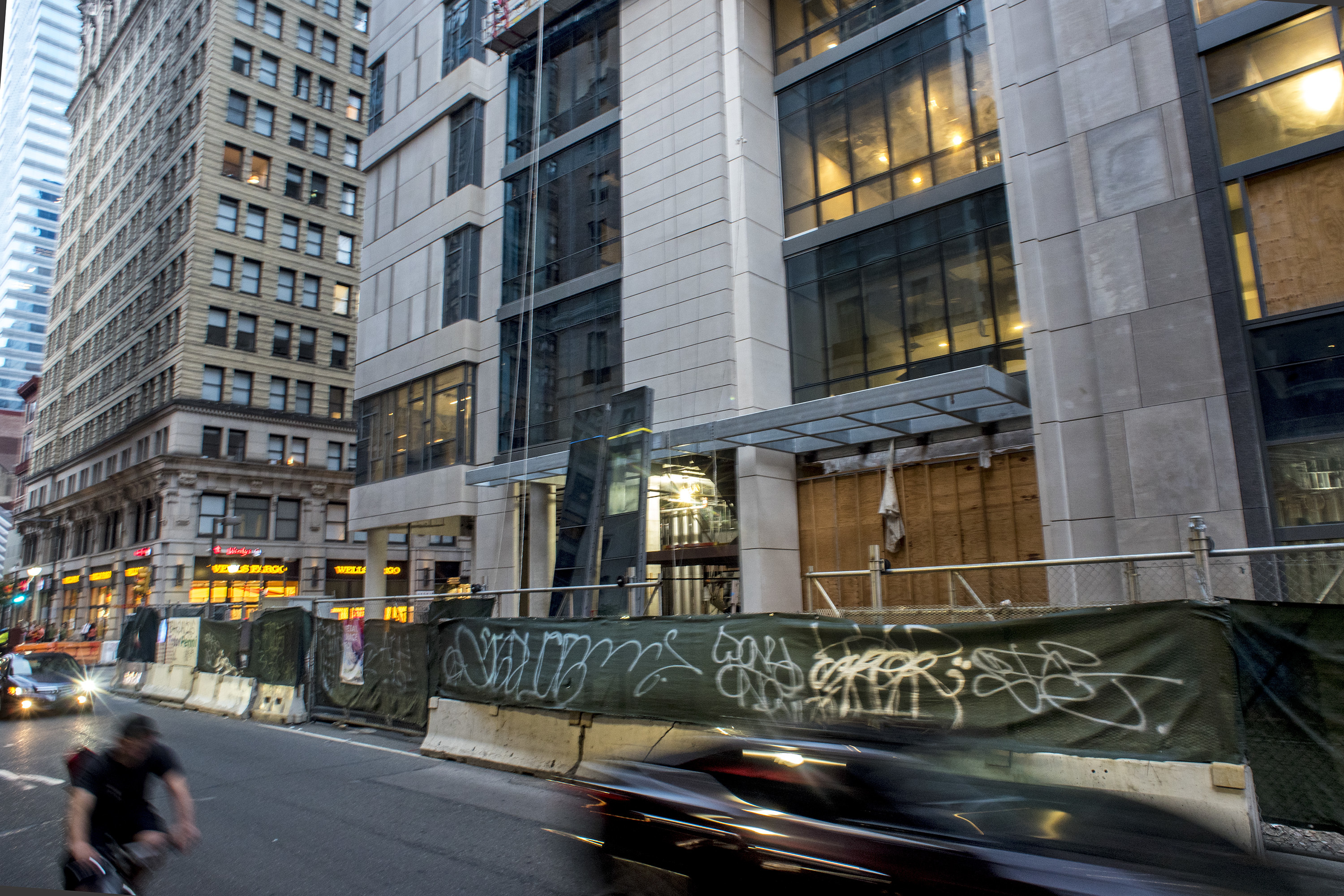
    The sidewalk area of W Philadelphia and Element Philadelphia Hotel under construction, looking northwest along the 1400 block of Chestnut Street July 2, 2019.

    The building finally obtained a certificate of occupancy in April 2021. But Marriott couldn’t open the W until August because over a hundred window vents were inoperable because Tutor failed to follow the design.

    “Tutor knew that the floors did not meet specifications but did not timely disclose its knowledge to Chestlen or consult with it,” Crumlish wrote. The judge further found that Tutor refused to work with contractors to remediate the problems in 2017 and 2018, and proceeded to install interiors over the deficient concrete floors.

    The blame game

    Throughout the litigation, the parties all blamed one another for various problems and aspects of the delay.

    Costs and liens piled up.

    Chestlen paid Tutor $239 million for the construction, accrued over $40 million in damages as set in its contract with Tutor, and paid tens of millions to remediate the floors. The property is “clouded with over $155 million in liens,” according to the judge’s memo.

    Crumlish concluded that Tutor breached its contract when it failed to oversee the concrete work and the window-wall installation, and generally didn’t fulfill its obligations.

    “Every delay in the performance and completion of the project is the responsibility of Tutor and Carney,” the judge said. The judge will decide on the amount of damages following hearings scheduled for January.

    Chestlen’s attorney was unavailable to provide comment. Carney did not respond to a request for comment.

    The W hotel is located where One Meridian Plaza used to be, before that building suffered a devastating fire in 1991 and was finally demolished in 1999.

    Filling the vacant lot, a mere block from City Hall, became a top priority for policymakers during Mayor Michael Nutter’s time in office. The hotel proposal eventually received $75 million in taxpayer support across local, state, and federal funding sources in addition to other legislative assistance.

    The project was developed by Brook Lenfest, son of the former Inquirer owner H.F. “Gerry” Lenfest, whose foundation continues to own the newspaper today.

  • Montco woman files for class action after her cat suffocated in a food container

    Montco woman files for class action after her cat suffocated in a food container

    Curiosity killed the cat, the adage goes, but in the case of Ace the kitten, the fault lies with a defective pet-food container, according to a proposed class-action lawsuit filed in Philadelphia’s federal court.

    Valentina Mallozzi, of Montgomery County, says in the complaint that, in July, Ace managed to get into a locked Iris pet food container she ordered from Amazon. But once the 3-pound kitten was inside, the airtight lid dropped and locked Ace inside.

    The lawsuit, filed last week, accuses Iris USA of creating a defective product that it markets as safe for pets. The complaint says Mallozzi is one of many pet owners who tragically lost their cat to an Iris container.

    The complaint aims to represent all people in the United States who purchased an Iris container. The complaint does not include an estimate of how many people are included in the class, or how much money Iris would owe each person.

    Iris USA, a subsidiary of Japanese plastics manufacturer Iris Ohyama, did not respond to a request for comment.

    Mallozzi bought the Iris airtight stackable containers for $29.99 from Amazon in March, the complaint says. The containers have a locking mechanism that Iris claimed is designed to “keep pets from sneaking a second or even third breakfast with the secure locking latch,” according to the complaint.

    Screenshot of a post in the Prevent Pet Suffocation Facebook group, which shares the story of Peach the cat who died trapped in a Iris USA food storage container, from Valentina Mallozzi’s lawsuit against the company.

    The problem, the suit says, is that cats can open the latch from outside, climb in, and get trapped as the mechanism automatically locks them in. The airtight seal that keeps pet food fresh makes the trap deadly, as a “pet will suffocate within a few minutes,” the complaint says.

    The lawsuit cites posts from the Prevent Pet Suffocation Facebook group in which cat owners share stories about their beloved pets getting trapped in an Iris container.

    One post included in the complaint shares the story of Baby Bear, a family’s cat who was found dead in an Iris container by an 8-year-old girl.

    “My cat, Max, also suffocated in an Iris pet food container,” a woman responded. “I know the pain you’re going through.”

    Iris USA was put on notice, and not only by people on social media, the complaint says. In March, the Center for Pet Safety, a Virginia-based nonprofit, put out a report evaluating the risk food containers represent for pet suffocation that specifically calls out Iris.

    The latch mechanism on the lid “significantly increases the risk of pet suffocation,” the report says.

    The lawsuit says the product should have come with a label warning of the suffocation risk for pets that can unlatch the lid.