Author: Maddie Hanna

  • Haverford parents are worried about chatbots in classrooms after a vote to buy AI tools

    Haverford parents are worried about chatbots in classrooms after a vote to buy AI tools

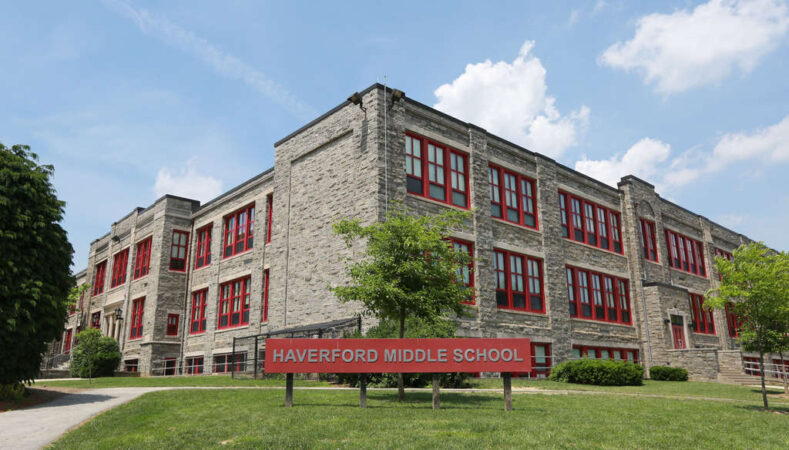
    A move by the Haverford Township School District to buy artificial intelligence tools for students and teachers has been met with protest from parents who fear the technology will erode learning.

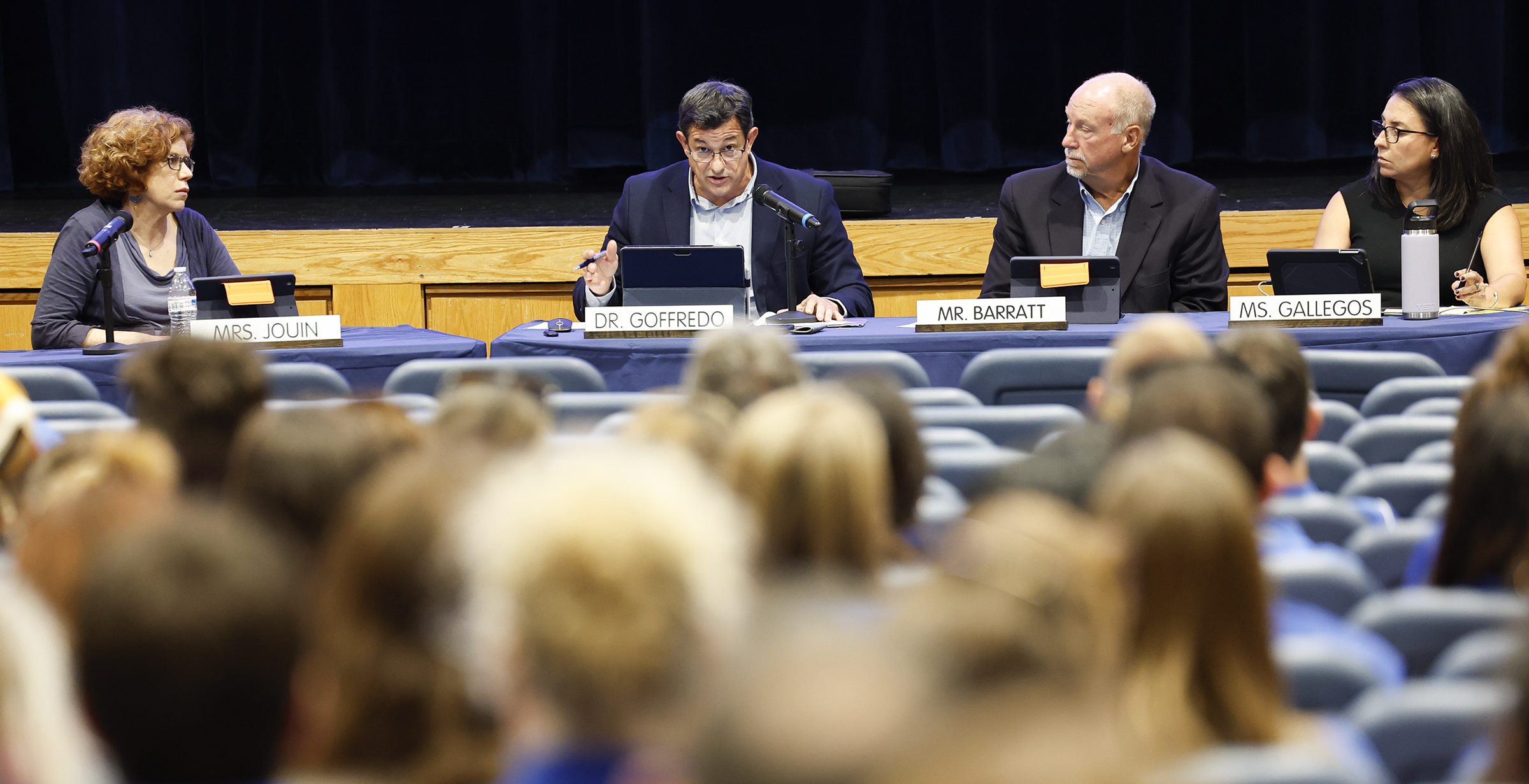
    At a meeting last week, the Haverford school board voted 5-3 to approve contracts with School AI, which features AI “tutors,” and Brisk, which automates tasks for teachers, like developing quizzes and giving students feedback.

    While administrators said the tools wouldn’t supplant teaching and learning, critics said it was inevitable that AI would be used inappropriately — making it easier for kids to avoid work.

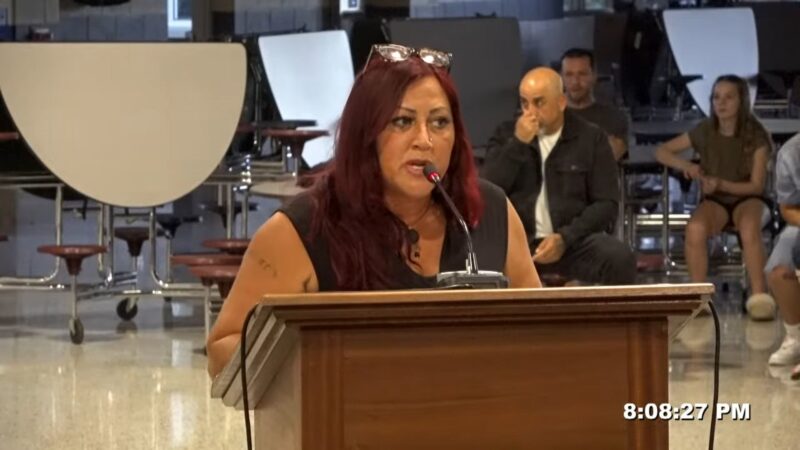
    “The idea of putting chatbots on computers — I don’t even care what age. I’m pretty disgusted by that,” said Christine Seewagen, a district parent of rising 12th and 7th graders.

    The district already struggles to manage technology in the classroom, said Seewagen, who said her older child has observed students run math questions through an AI tool on their phones. Her younger child, meanwhile, had a teacher who directed students to upload essays to an AI tool to get feedback, Seewagen said.

    “They’re just using AI, and not really being instructed on how to do it,” Seewagen said in an interview.

    Administrators said they were recommending buying AI tools in part because teachers are already using freely available versions, and they want to “eliminate free roaming around platforms,” Robert Anderson, the district’s technology director, said at the June 18 board meeting.

    Haverford’s superintendent, Matthew Hayes, said the School AI contract would “allow us to have a resource so that as we go through the process of the strategic plan and looking at all the implications down the line,” the district could begin teaching AI “thoughtfully, responsibly, ethically.”

    He added: “And also reducing screen time,” without providing further details.

    The controversy around AI in Haverford is the latest example of area parents pushing back on what they see as excessive and unchecked technology use in schools.

    In Lower Merion, parents have pushed to opt their kids out of district-assigned laptops or tablets; the district is planning changes to reduce usage for younger students, but has told parents they cannot opt out entirely. Parents in other districts are also raising concerns about too much Chromebook use.

    In Haverford, some parents said they were caught off guard by the proposal to adopt technology they felt posed risks to their kids.

    Patrick Burland, the parent of an incoming 10th grader and 6th grader, noted he’d had to sign numerous permission slips for his younger child to participate in end-of-year celebrations.

    “Apparently, sugar requires a signature, but cognitively rewiring her brain does not,” Burland told the board.

    Anderson said Haverford had been considering how to incorporate AI for years. He said the district sought feedback from teachers, including through an AI working group, before proposing the contracts.

    Board members who voted for the AI tools, meanwhile, said kids needed to learn how to use the technology responsibly.

    “Not acknowledging that it’s here … we don’t gain anything, right? We actually lose and we put ourselves farther behind because it’s not going anywhere,” said board member LaTonia Lee.

    But some raised questions about what the district was planning to do with the tools.

    Dave Schwartz, another board member, said he would support teaching kids about AI. But the district hasn’t said how it plans to do that, he said.

    “We’ve been talking very much in vague terms, and I can’t vote for something that I don’t understand,” Schwartz said.

    A district spokesperson did not respond to a question this week about examples of how School AI might be used.

    Board member Chris Shelton asked Anderson about criticism that the tool’s “historical figure” chatbots were giving students inaccurate information. (Last year, School AI acknowledged that responses from an Anne Frank character “didn’t provide critical historical details about the Nazis’ role in the Holocaust.”)

    Anderson called it “unfortunate” that the company had promoted the historical figures feature, but said the district “would have the option to potentially not use something like that.”

    John Flagler, a board member and English teacher, said he understood the burdens placed on teachers, “but I also believe there are lines that should not be crossed.”

    The suggestion that grading papers is a “menial task” that could be offloaded to AI “is an insult to both the teacher and the student,” Flagler said, calling grading essential to teachers learning about students.

    Administrators said Brisk wouldn’t be used for grading, but would provide “first-level feedback” — informing students they’re missing a topic sentence, for instance, said Meridith Herne, the district’s technology integration coordinator.

    “We insist that our teachers read it over and modify it so it’s in their own voice,” Herne said of Brisk’s feedback. Hayes said that 97 district teachers already use a free version of the tool.

    He said the tool was not meant to replace teachers.

    “That’s not my intent at all,” Hayes said, describing Brisk as “an option for individuals who want exposure to it.”

    He noted that the contracts with Brisk, for $22,260, and School AI, for $12,999, were each limited to one year.

    Teachers will be trained on the School AI platform, Anderson said; it will be up to them to decide whether they want to use it. He said the district envisions the platform being used in high school and “potentially” middle school, but isn’t planning for it to be used in elementary schools.

    Parents like Burland and Seewagen, who said like-minded parents have been organizing on social media, weren’t persuaded.

    “It does not feel like to me they have put any guardrails on,” Burland said in an interview. He questioned whether the district would have considered turning off School AI chatbots, for instance, had it not been asked at the board meeting.

    Seewagen said many parents who have learned about the AI plans aren’t happy.

    “It did not go under the radar,” she said.
  • An Upper Darby student was honored at the White House for a proposal to use AI to fight human trafficking

    An Upper Darby student was honored at the White House for a proposal to use AI to fight human trafficking

    As a student at Upper Darby High School, Khandakar Mahin was intrigued when the school installed a weapons detection system two years ago.

    Mahin, who was interested in the artificial intelligence behind the system, wrote email newsletters to the student body, describing how it worked.

    “I had fun doing that,” describing “how AI algorithms were working on a microscopic level,” Mahin said.

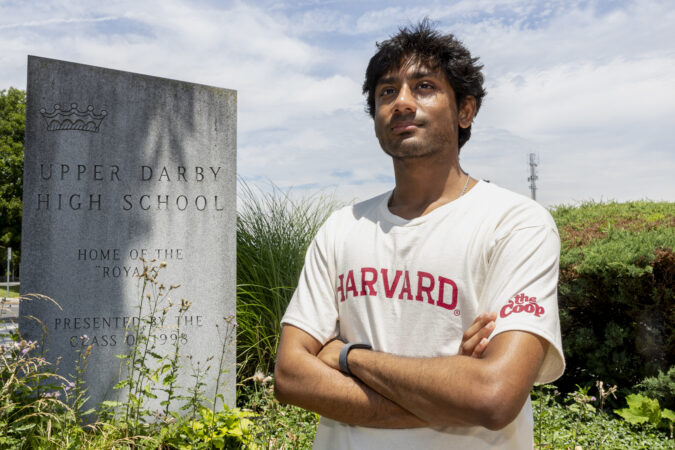
    Now an Upper Darby graduate, Mahin, 18, was honored at the White House earlier this month for a proposal he created for another use for AI: to combat human trafficking.

    First lady Melania Trump praised Mahin and the other five winning teams of the inaugural Presidential AI Challenge at a June 9 ceremony.

    “You saw AI’s potential and created ideas that will shape America’s future in many areas, including healthcare, nutrition, public safety, and beyond,” Trump told the winners, who were chosen from a field of 20,000.

    Upper Darby graduate Khandakar Mahin, right, poses for a picture with First Lady Melania Trump at a June 9 ceremony honoring Mahin and other winners of the Presidential AI Challenge.

    Mahin — who said he got to see the Oval Office and “network with many different types of people” — won for a proposal to use computer vision to match photos from the dark web to a database of 64,000 hotels.

    The tool would identify details like carpet designs or headboard features in photos depicting trafficking, then match them to known hotels, using images scraped from the internet. Mahin created a framework and demonstration of the tool, and said his proposal included ideas for how it could be scaled to be used by law enforcement nationwide.

    The award, which Mahin said came with a $22,500 prize, was yet another achievement for Mahin, who will attend Harvard University this fall; he was also accepted to Yale and Princeton.

    While at Upper Darby High School, he took 16 Advanced Placement classes and won an array of awards and scholarships, including being selected for the Amazon Future Engineers and the Disney Dreamers Academy earlier this year.

    “This is a very bright kid who’s been looking into things like this for a long time,” said Dan McGarry, the superintendent of the Upper Darby School District.

    Mahin immigrated to the United States with family from Bangladesh 12 years ago and has attended Upper Darby schools since then.

    Mahin has been “heavily invested in being a contributor in a positive way to his school community,” McGarry said, noting that the recent graduate was involved in setting up local libraries. “It’s not just artificial intelligence. He’s also a good kid.”

    But Mahin has a particular interest in AI. Mahin, who recently served as a student representative on Upper Darby’s school board, was among a group of students who joined school leaders in meeting with company representatives about the weapons detection system.

    The students made a video about the system, which McGarry said was critical in getting student buy-in.

    The district also sends students to the Delaware County Intermediate Unit to share their perspectives; Mahin has addressed other superintendents about AI, “the good and the bad,” McGarry said.

    At Harvard, Mahin hopes to study political science and government with an aim toward creating “more ethical AI policies,” he said.

    Mahin, who has already participated in programs at Princeton and MIT, credits teachers in Upper Darby — not just in computer science and math, but English, he said — with teaching him “how to have the grit to do research.” His award-winning AI project was supervised by Roseann Burns, an Upper Darby teacher who McGarry said works with gifted students.

    Despite being an underfunded district, Upper Darby “has a lot of opportunities,” Mahin said. “As a student, you really have to seek out the opportunities if you really want it.”

    While Mahin may stand out for the level of recognition he has received, McGarry said Upper Darby has many “amazingly talented, bright” students.

    “That’s often overlooked, unfortunately,” McGarry said. He said Mahin “represents what I think makes this country great. … Every opportunity that was there, he took it.”

  • Abington schools are reviewing security after a man charged with trying to rape a girl repeatedly entered the high school

    Abington schools are reviewing security after a man charged with trying to rape a girl repeatedly entered the high school

    The Abington School District is reviewing security procedures after police charged a 25-year-old man with trying to rape a student who repeatedly let him into Abington Senior High School.

    Police charged Raeem Grange-Allen of Philadelphia on Friday with attempted rape by force and attempted statutory sexual assault, among other charges. The student, a 14-year-old girl, told police she had met Grange-Allen at the high school.

    Grange-Allen initially identified himself as a student and began communicating with the girl through text messages and social media, according to a police affidavit.

    Grange-Allen later asked the girl to let him into the school “and requested she perform oral sex on him behind a stairwell,” according to the affidavit. The girl told police she “saw him or let him into the school approximately three to four times.”

    In a message to families Tuesday, Abington Superintendent Jeffrey Fecher said the girl let Grange-Allen into the high school on two occasions in March, opening a back door during the school day.

    “Video footage shows he was wearing a hoodie and was able to briefly blend in as a student while moving in the hallways,” Fecher said.

    On March 27, Grange-Allen came to the girl’s home in Abington Township, where he held her down and attempted to rape her, according to the police affidavit. The girl screamed, and her mother caught Grange-Allen, according to the affidavit. The girl went to the police the next day.

    Fecher said there were “numerous unresolved questions about this man’s presence in the high school, as well as, where and when he initially encountered the victim.”

    The district is “launching a third-party internal investigation” and reviewing security protocols, Fecher said. While exterior doors are locked throughout the school day, “building occupants always have the ability to open them from the inside for evacuation purposes, as required by law,” he said.

    Fecher said the district would be working with the Montgomery County Department of School Safety “to determine whether additional security measures can be put in place.”

    “We share in the concern and shock that this information causes, and we are committed to addressing it effectively,” Fecher said.

    As of Wednesday, Grange-Allen was being held at the Montgomery County Correctional Facility on $250,000 cash bail.

  • The Spring-Ford school district is moving to fire a Spanish teacher supported by community members

    The Spring-Ford school district is moving to fire a Spanish teacher supported by community members

    The Spring-Ford Area School District is moving to fire an eighth-grade Spanish teacher over protests from parents and students who say she is being unfairly terminated.

    The school board voted Monday to approve a statement of charges surrounding the dismissal of an employee, who was not identified in board documents. The statement of charges was not made public, which is typical procedure for school district personnel matters.

    But numerous supporters of Jasmine Ewing, including her husband, spoke out at Monday’s meeting against the dismissal, describing “Señora Ewing” as a passionate and dedicated educator who had positively impacted their lives.

    They also urged the board not to fire her over what some characterized as false accusations.

    “What foundation are we setting for the kids to know that they can retaliate against a teacher who is trying to hold them accountable for extremely inappropriate actions?” said Miranda Dombrosky, a 2010 Spring-Ford graduate and district parent.

    Dombrosky, who described herself as a friend of Ewing’s, referred to a student who had “bragged about getting a teacher fired” and accused the district of punishing “an innocent teacher.”

    Tamika Jeter, a district parent who credited Ewing with fostering her son’s enthusiasm for learning Spanish, told the board “it would be a big mistake to let a small thing that was considered playful among students cause her to lose her job.”

    Erin Crew, a district spokesperson, said Tuesday that “out of respect for the students and families involved, and because this is an ongoing personnel matter, the district will not comment on matters related to an individual’s employment.”

    The resolution approved by the board Monday “authorizes moving forward with a statement of charges while providing all due process rights required by law,” Crew said.

    As a result of the board’s vote, Ewing plans to request a public evidentiary hearing, her husband, Brian Ewing, said at Monday’s meeting.

    Brian Ewing told the board that he and his wife had “statements and factual information that directly dispute these claims against Jasmine, and raise serious concerns about this process.”

    “If the district insists on dragging this forward, the public will see what was done, who did it, and why it never should have happened,” said Ewing, who said his wife was not present Monday because she was leading students on a trip to Costa Rica.

    At a school board meeting the week before, at which supporters also spoke on her behalf, Jasmine Ewing said it was “devastating to stand here facing termination” after devoting herself to her teaching career.

    As a Latina, she said, “Spanish has always meant something deeper to me,” and she viewed her job as not just an educator, but a “cultural ambassador.” She said the support shown by community members was a “legacy I will carry with pride for the rest of my life.”

    Some supporters told the board that Ewing was an asset to the district as a teacher of color, providing valuable representation.

    Former students like Sofia McClintock said Ewing had broadened their horizons through international trips she had led.

    “Teachers who truly care are not easy to replace,” McClintock said. “They are the teachers that students remember years after leaving their classrooms because of the difference that they made, and that is Señora Ewing for me.”

    While supporters of Ewing dominated the school board meetings Monday and last week, one former student spoke out against the teacher, accusing Ewing of participating in antisemitic bullying.

    The student, Kayla Woodman, who graduated from Spring-Ford earlier this month, said that when she had Ewing for Spanish in eighth grade, boys repeatedly harassed her for being Jewish, including through a “Heil” chant.

    Ewing, Woodman said, not only did not tell the boys to stop, but “joined in and laughed.”

    It was not clear whether Woodman’s accusations were connected to the reasons the district is now seeking to dismiss Ewing.

    Woodman, who described the experience as “some of the darkest times in my life,” said that she had been afraid to go to administrators and that her parents had had a private conversation with Ewing.

  • The Norristown school board plans to hire Delaware’s Superintendent of the Year

    The Norristown school board plans to hire Delaware’s Superintendent of the Year

    The Norristown school board plans to vote Monday to hire Delaware’s Superintendent of the Year as the district’s next leader.

    The board announced Sunday that it had selected Dorrell Green, the superintendent of the Red Clay Consolidated School District in New Castle County as its pick for superintendent.

    Green is expected to start as superintendent in the Norristown Area School District on July 20, under a five-year term with an initial salary of $270,000, according to an agenda for Monday’s meeting.

    Dorrell Green, the superintendent of the Red Clay Consolidated School District in New Castle County, Del., is to join Norristown Area School District as superintendent on July 20, 2026.

    Green’s selection comes after the board, which has a new majority after November’s school board elections, moved this spring to oust Superintendent Christopher Dormer, citing poor test scores. The board has since sparked controversy with other changes, including eliminating its DEI director.

    Throughout the superintendent search process, “our community made it clear that they were seeking a visionary leader who is committed to student achievement, educational excellence, and meaningful engagement with all stakeholders,” the board’s president, Jeremiah Lemke, said in a statement.

    He said Green’s “experience, leadership record, and commitment to serving diverse school communities” set him apart during a search process that was led by a consulting group and attracted 88 applicants.

    Green has worked in public education for more than 25 years, including as a teacher, principal, and assistant superintendent.

    In Red Clay, Delaware’s largest school district with 15,000 students, Green has served as superintendent since 2019. He expanded early childhood education during his tenure there and increased access to advanced course work, according to the Norristown board.

    Before that, Green was the first executive director of the Delaware Department of Education’s Office of Innovation and Improvement, an office created by former Delaware Gov. John Carney to support the state’s neediest schools.

    Green has a bachelor’s degree in elementary education and master’s degree in educational leadership from the University of Delaware. He has a doctoral degree in organizational leadership from Wilmington University.

  • How Haverford High’s national teacher of the year is coaching aspiring teachers, on topics from racism to connecting with students

    How Haverford High’s national teacher of the year is coaching aspiring teachers, on topics from racism to connecting with students

    As the newly appointed National Teacher of the Year, Haverford High School’s Leon Smith has been celebrated on television: from CBS Mornings and Good Morning America to the Kelly Clarkson Show.

    But as the lone Black teacher when he started teaching at Haverford 25 years ago, Smith got a different reception. He experienced racism, he told a group of young people interested in teaching, and if it weren’t for a Black vice principal that listened and supported him, he might not still be teaching today.

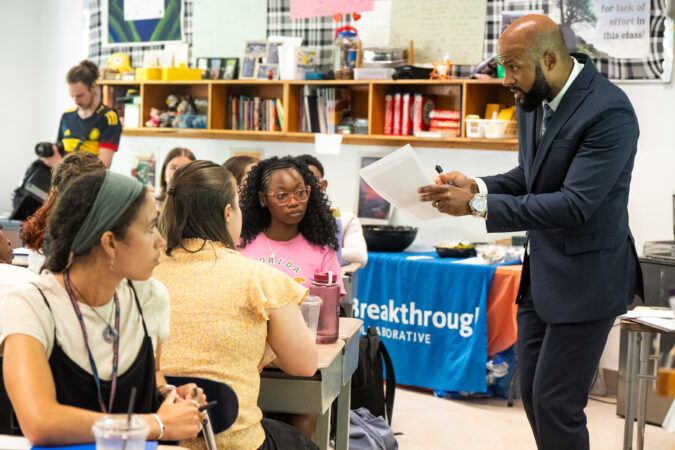
    “She would just be very honest with me, and be like, ‘First of all, you’re an excellent educator. … Keep being you. Somebody calls and says something crazy, I’m just hanging up,’” Smith told teaching fellows gathered in Germantown on Wednesday with Breakthrough of Greater Philadelphia, a nonprofit that trains aspiring teachers to lead enrichment programs for middle-school students.

    The event, sponsored by the Equitable Foundation, was just one of many for Smith during his yearlong stint as Teacher of the Year, a platform he was awarded in April by the Council of Chief State School Officers. In that role, he’s spending the year traveling the country to advocate for the teaching profession and growing its ranks.

    Smith, who teaches Advanced Placement U.S. History and Advanced Placement African American Studies at Haverford, spoke passionately to the fellows Wednesday about his motivation to be the teacher he didn’t have growing up, and the immense impact teachers can have on students’ lives — presenting the profession as a deeply rewarding opportunity to help kids recognize their talents.

    But he was also honest about the challenges. Fielding questions about his career from fellows gathered in an auditorium on the Germantown Friends School campus, Smith said he had struggled to find his way as a new teacher, staying up too late trying to perfect lessons.

    He described the sometimes lonely experience of being his predominantly white high school’s only Black teacher, and how he developed strategies to respond to racism, including learning when to walk away and when to speak out.

    He told fellows to find supportive colleagues and to be selective when they considered job offers.

    “Do your research. Make sure it’s a space that’s going to take care of you,” he said.

    Smith also described feeling self-conscious when he was younger about some of his lessons — worrying that students would say, “‘Oh, all he does is talk about Black history,’” Smith said. But he began hearing from students about how grateful they were to have learned about subjects that hadn’t been covered in other classes; an audit later identified African American studies as a class community members wanted to see added.

    ‘My why’

    His comments resonated with the teaching fellows, some of whom said they’re committed to careers in education.

    Dominique Sidae, a 23-year-old rising senior at Florida A&M University, is planning to become a special-education teacher. She said she was inspired by her appreciation for a teacher who helped her younger brothers, who have autism.

    Sidae said she is often the only Black person in teaching spaces. “It feels good to know this isn’t only happening to me,” she said. “You don’t really learn that in college.”

    Dominique Sidae, 23, a fellow with the Breakthrough of Greater Philadelphia, listens to a talk by Leon Smith last week.

    Miles Baldwin, an 18-year-old graduate of Harriton High School in Lower Merion, isn’t sure he wants to become a teacher. But he enjoyed working with students last summer in the Breakthrough program — “a lot of kids came in hating it, and left wanting more,” he said — and Smith’s pitch about being a mentor was compelling to him.

    “Honestly, yeah,” he said, when asked if hearing from Smith made him more interested in teaching.

    That’s part of the goal of Smith’s role as Teacher of the Year, as a dwindling pipeline has challenged recruitment efforts.

    Smith’s agenda this summer includes attending the National PTA Convention in Pittsburgh and giving a keynote speech at the Smithsonian’s National Education Summit. He also will be joining other state teachers of the year at Space Camp in Alabama and participating in professional development.

    But addressing the Breakthrough teaching fellows Wednesday “reminds me of my why,” Smith said in a brief interview. He said the fellows’ eagerness to ask questions “shows they want to be the best they can be,” and reflects qualities of good teachers: “You have to be curious, sometimes silent … often humbled,” Smith said.

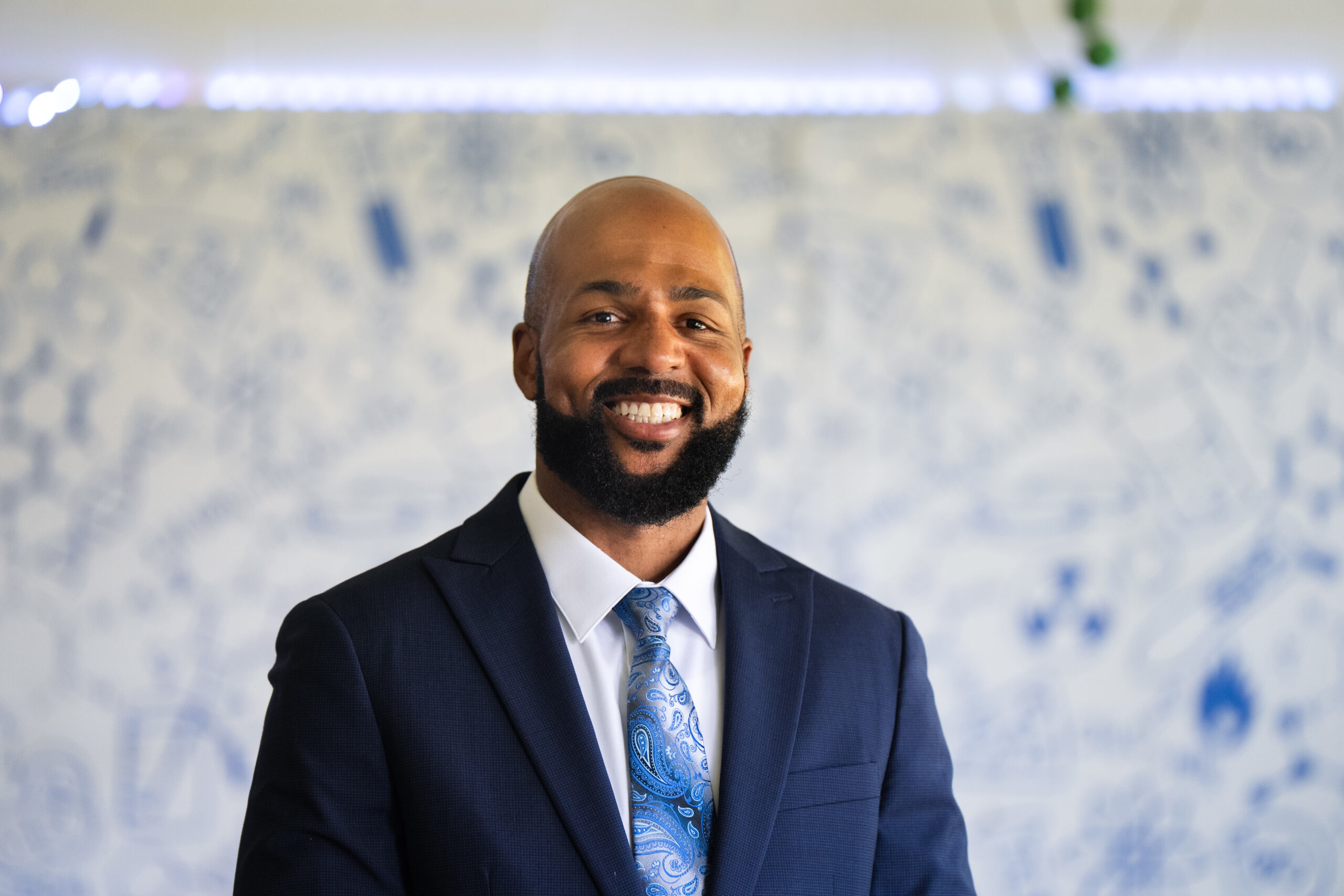
    Leon Smith, a teacher at Haverford High School, was named National Teacher of the Year this spring.

    Teaching students to lead

    In a model lesson after his talk, Smith put some of those skills on display. He started by gathering the 34 fellows in a circle, asking them each to share their name and a brief story about it; the group periodically broke into laughter at humorous anecdotes.

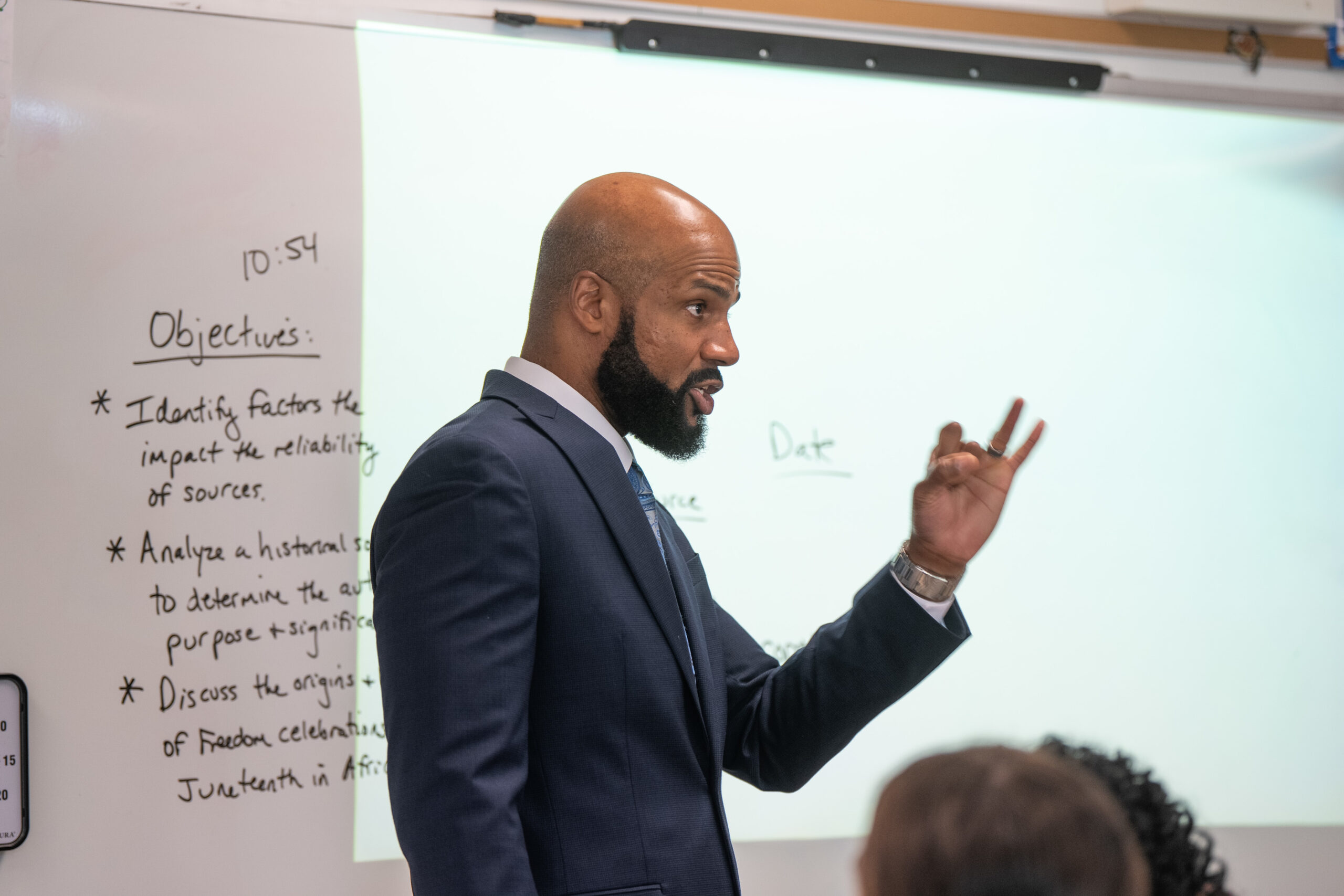
    Smith then outlined the objectives for his lesson about assessing the credibility of sources. He passed out copies of a photo, asking fellows to silently write and then discuss in small groups whether it provided strong evidence of the Fukushima power plant explosion.

    “I always tell my students, you want to be a leader,” Smith said, encouraging fellows to stand by their analyses, even if others disagreed. He then called on people, asking them to explain their thinking while challenging some of their points.

    Leon Smith talks to fellows at Breakthrough Collaborative last week.

    Matt Greenawalt, co-dean of faculty for the Breakthrough summer program and a teacher at Germantown Friends — which supports Breakthrough — was planning to breakdown Smith’s approach for the fellows after the lesson. He noted how Smith was walking through the room, engaging with the fellows as they talked, and Smith’s ability to affirm and redirect them when an answer wasn’t on point.

    Smith’s visit came on day three of a two-week orientation for the fellows, before they would begin teaching students during Breakthrough’s six-week free summer program.

    While access to academics is key for the program’s students, many of whom come from Germantown, “a big piece of it too is having role models,” Greenawalt said.

    Smith told fellows that when the students arrived, “they’re going to just admire you so much.”

    “You’re going to be able to see the light inside of them, and sometimes it just takes someone else to notice, right? … They’ll just kind of be doing their work, and then as you get to know them, you’ll notice certain characteristics and you’ll just pour into it.”

    What really helps make a connection with kids, Smith said, is “just you being yourself.”

    “You walking in there and walking in your own life, and bringing your passion and all the reasons why you wanted to become a teacher,” he said. “Your students are going to feel that.”

  • The Philly school board voted to nonrenew a charter run by a veteran administrator

    The Philly school board voted to nonrenew a charter run by a veteran administrator

    The Philadelphia School Board voted Thursday to nonrenew a charter school run by a veteran former district administrator, pointing to poor test scores and operational problems.

    The board voted 8-0 to nonrenew Global Leadership Academy Southwest at Huey, a charter run by Naomi Johnson-Booker, who operates another GLA charter in West Philadelphia. Board member Whitney Jones abstained, citing personal reasons.

    Charter schools are publicly funded but independently managed. In Philadelphia, about one-third of public school students attend brick-and-mortar charters.

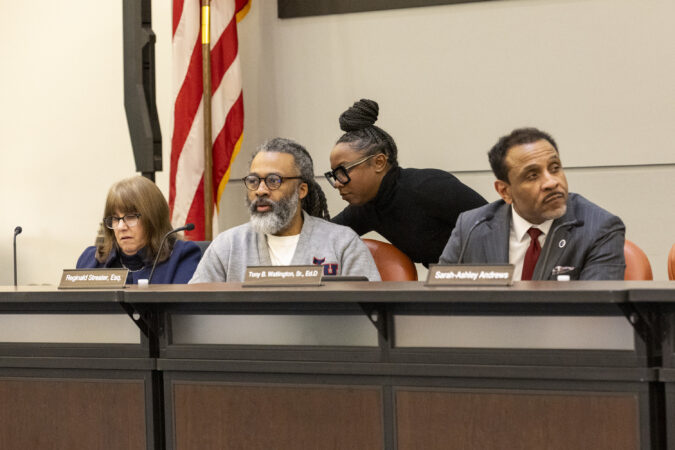
    “We have a responsibility that is clear … to protect every child’s right, civil right, to a high-quality public education,” said the board’s president, Reginald Streater. He noted that GLA Southwest, a K-8 enrolling close to 600 students at 52nd and Pine Streets, has posted poor academic performance, with only 7% of students scoring proficient or advanced in math on the Pennsylvania System of School Assessments in 2025.

    The school also has poor student attendance, and has not met district governance and financial standards, with conflicts of interest in counsel representation, insufficient cash on hand, and “questionable financial payment plans,” Streater said.

    Noting GLA Southwest’s status as a Renaissance school — a former district school handed over to charter management a decade ago as part of an initiative to turn around failing schools — Streater said it was the board’s obligation “to do everything we can to create seats or incentivize seats that truly support student achievement, and as a Renaissance school, to complete the turnaround.”

    The board’s vice president, Sarah-Ashley Andrews, said the fact that the charter didn’t meet academic, operational, or fiscal standards on the district’s evaluation was “a clear red flag.”

    The vote doesn’t mean GLA Southwest will close, but triggers public hearings on the school’s performance.

    Supporters of the charter said the school’s test scores weren’t a full reflection of its value to students and the community.

    Zenobia Story, the school’s principal, said students had been improving, with proficiency on the state’s English language arts tests growing from 9.6% in 2022 to 22.4% in preliminary 2026 results.

    The results tell “a story of progress, not stagnation,” and “a school community moving in the right direction,” Story said. “The response should not automatically be closure.”

    Nutina Martin, the school’s director of climate and culture, said the school had inherited “significant climate and safety challenges.” But she said it had transformed since it became a charter in 2016, when there were 147 out-of-school suspensions in a single school year, Martin said. Now, she said, there were fewer than 30.

    Streater said the charter’s nonrenewal hearings would give the school “an opportunity under oath with evidence” to support statements made by staff Thursday.

    The board pulled a planned vote to nonrenew Philadelphia Montessori Charter School, in light of a Common Pleas judge’s order Wednesday to delay the vote following a lawsuit brought by the charter.

    Philadelphia Montessori’s executive director, Amanda Wilson, said the board had “created needless uncertainty” for the school’s families and staff.

    Streater said the board was “simply trying to do our duty, in being responsible charter school authorizers” and fiscal stewards.

    Spending on SEPTA

    In other business, the school board agreed to spend up to $34 million on SEPTA fare cards for students in the 2026-27 school year. Officials estimate 62,000 district, charter, and parochial school students are eligible for free fare cards — but that money is reimbursed through a state transportation subsidy.

    SEPTA, with district cooperation, is warning students that they have to use those cards. It’s launching a crackdown on student fare evasion in the coming school year.

    Transit system officials, who said they’re losing an estimated $11 million annually on students not swiping their fare cards.

    Under the new fare diversion system, any student caught not swiping their card — technically a theft of service offense — will begin receiving formal warnings that will also be sent to transportation liaisons at their schools.

    After a student’s third warning, they would receive a theft of service citation and court referral.

    Money for technology and to fix a closing school

    The board also voted to spend $4.1 million on technology — an advanced Google system officials said was “foundational to the district’s educational and operational objectives” and GoGuardian, an internet-filtering service.

    The contract for both services lasts through 2029.

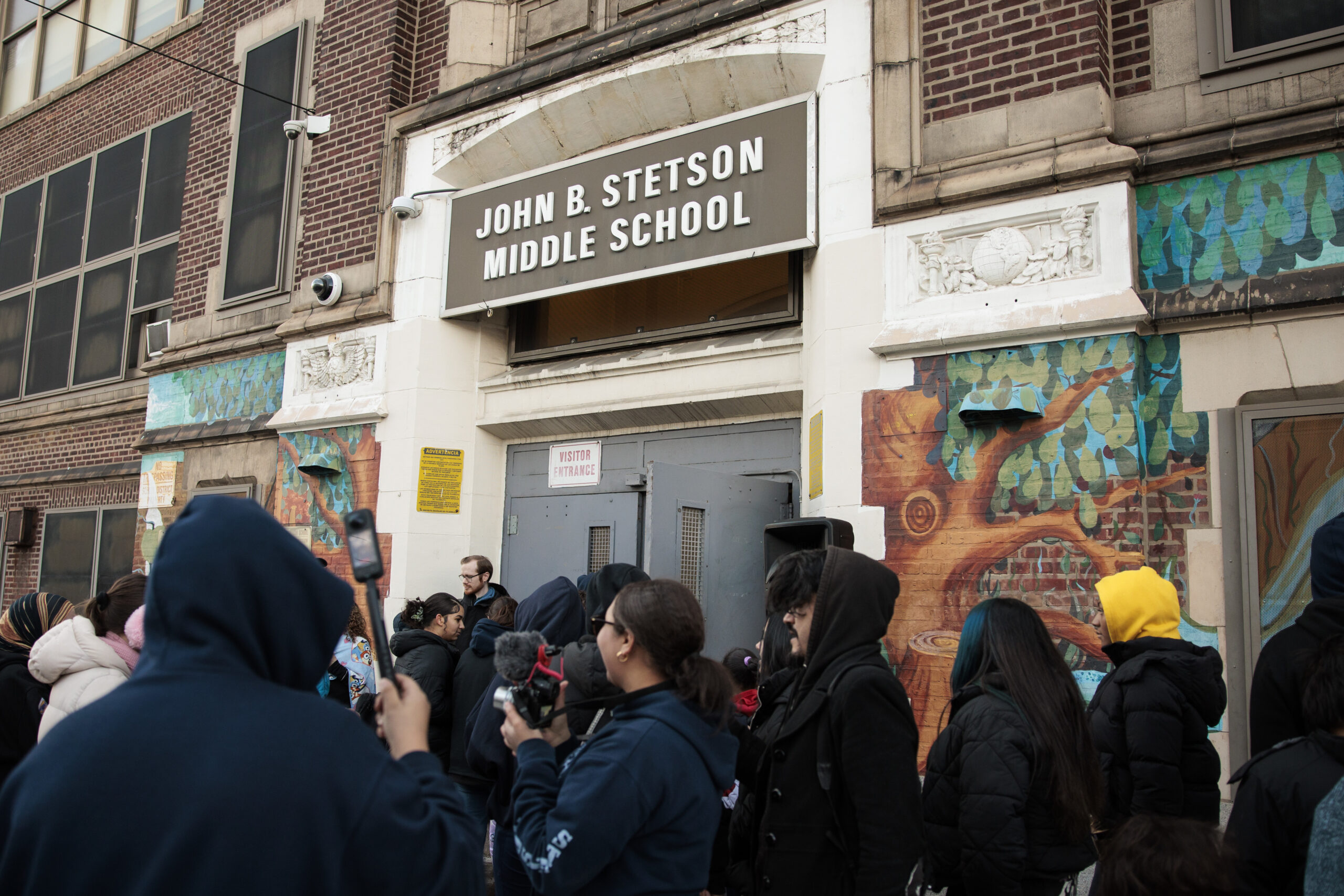
    Also approved was $3.4 million worth of repairs to John B. Stetson Middle School in Kensington, one of the 17 schools the board voted earlier this year to close.

    Students, teachers and supporters rally before a community meeting at John B. Stetson Middle School on Thursday, Feb. 12, 2026 in Philadelphia. Stetson is one of 20 Philly public schools facing closure.

    Stetson is getting a new roof and masonry repairs, work that’s necessary, according to board documents, “to preserve and protect the building’s structural integrity and long-term functionality.”

    According to the facilities plan the board adopted in April, the school will begin phasing out grades, eventually closing in the 2029-30 school year. Stetson will remain in district hands, used as “swing space” — a place to house district students or programs that need a temporary spot to learn.

    Members of the Stetson community fought to keep their school open, objecting to the district’s years of neglect of their building.

    Some schools closed by the board are mostly empty; Stetson is about 60% full, but its building was judged to be in “unsatisfactory” condition.

    Memphis Street back to the district

    The board also moved to formally return a Port Richmond charter school back into its fold.

    Memphis Street Academy at J.P. Jones, a former district school run by the nonprofit American Paradigm since 2012, was ordered by a judge last year to surrender its charter after a long legal battle.

    The board first moved to close Memphis Street in 2022 after the school missed the mark on meeting conditions it had previously agreed to.

    To make the reabsorption of the school official, the board had to vote to report “Memphis Street Middle School” to the Pennsylvania Department of Education as a new district school opening in the fall. The school will serve students in grades 6 through 8; the current Memphis Street Academy also educates fifth graders.

    In its first go-round as a district school, the building was known as John Paul Jones Middle School.

  • There’s now a ‘Club America’ at Great Valley High School. Turning Point USA says interest grew after Charlie Kirk’s assassination.

    Making his pitch to the Great Valley school board, Jed Lu said he and fellow students seeking to bring slain conservative activist Charlie Kirk’s Turning Point USA organization into their high school weren’t racists or extremists.

    “We simply have a different perspective,” Lu told the board at a late February meeting.

    The Chester County district is one of the latest in the Philadelphia area to approve a Club America chapter — the high school offshoot of Kirk’s group. The organization seeks to mobilize “anti-woke warriors” and has rapidly been adding new local chapters since his assassination in September, provoking debate around right-wing influence in public schools.

    Nationally, chapters have nearly tripled — from 1,200 prior to Kirk’s death, to more than 3,300, according to Turning Point officials. Governors in Republican-led states like Arkansas and Nebraska are partnering with Turning Point to expand clubs throughout their states.

    In eastern Pennsylvania, there were 11 Club America chapters at the end of last school year. Now, “we’re currently approaching 40,” said Nick Cocca, Turning Point’s enterprise director.

    The group’s expansion might be overstated in the Philadelphia region. Seven area high schools listed by Turning Point on its website or Instagram graphics as having Club America chapters said they didn’t have clubs.

    Souderton Area High School, for instance, appears on Turning Point’s map, but doesn’t have a club. The school’s assistant principal, Matthew Haines, said “a student made an inquiry” in September about starting a chapter, but never applied to do so.

    In some schools, like Springfield High School in Delaware County, “we have a few students who started running an after-school student pilot a few months back,” said principal Monica Conlin, but the district doesn’t officially recognize the club. Conlin said new clubs must complete a three-year pilot before gaining district approval.

    Still, the organization has gained traction. In addition to Great Valley, Penncrest High School in Rose Tree Media School District lists Club America among its student clubs; district officials and staff didn’t respond to requests for comment.

    Turning Point says it also has a Club America chapter at Pennsbury High School, and an Instagram account for “Club America at Pennsbury” invited students to a Feb. 25 meeting to discuss the State of the Union and “participate in prayer for law enforcement and our nation.” District officials didn’t respond to requests for comment.

    ‘An outpouring of support’ after Kirk’s death

    A spokesperson for Turning Point couldn’t explain the discrepancy between its list and schools that say they don’t have any Club America chapters.

    The organization was also unable to provide a local student willing to be interviewed.

    Cocca said Turning Point “saw an outpouring of support and outreach from young people across the country” in the wake of Kirk’s Sept. 10 assassination. To support its growth, the organization is hiring more field representatives to work with high school students, Cocca said.

    People hold posters of Charlie Kirk during a Turning Point USA rally at Utah State University, as a part of the organization’s push to memorialize Kirk in Logan, Utah, in September.

    Turning Point, which began as an organization advocating for conservative views on college campuses, had previously been expanding its presence in high schools. (A Turning Point chapter launched years ago at Pennridge High School in Upper Bucks County, for example.)

    Turning Point last July renamed its high school operation Club America. “We wanted a brand that spoke specifically to them,” Cocca said. He said that “when Charlie was alive, he used to say ‘I want a Club America chapter in every high school in America.’”

    The expansion has spurred conflict. Critics have highlighted Kirk’s controversial statements, including referring to the Rev. Dr. Martin Luther King, Jr. as “an awful person” and calling the passage of the 1964 Civil Rights Act a “mistake.”

    Kirk also promoted the so-called “great replacement theory,” framing non-white immigration as a plot to replace white populations.

    “This club is an easy way to incorporate hate and discrimination within our high school. This should not be normalized,” a Change.org petition launched in January against a proposed Club America chapter at West Chester East High School read. An update to the petition later declared that Turning Point “was shut down at West Chester East.”

    Molly Schwemler, a district spokesperson, said that earlier this year, some students expressed interest in starting a Club America chapter.

    But “after discussing the process and need for sponsorship from a teacher with school administration,” students “instead decided to organize independently outside of the school,” Schwemler said. (On its website, Turning Point lists West Chester East as having a chapter.)

    In an Instagram post, the club said it decided to operate independently “because people can’t be mature, open minded or respectful at our school.”

    Activism hubs and kits

    In addition to identifying a teacher adviser, students looking to form clubs often have to supply information to administrators like their purpose, planned activities, and funding needs.

    Schools have little discretion to reject a new club, based on the federal Equal Access Act and First Amendment, said Jeffrey Sultanik, a solicitor for numerous Philadelphia-area districts.

    Districts need “to be viewpoint-neutral,” Sultanik said, noting that “once you open up the door to clubs coming in,” administrators can’t pick and choose which to permit.

    In its handbook for Club America chapters, Turning Point calls it “imperative that every chapter works to become officially recognized by the school,” offering students help if schools deny them.

    Students can form an “activism hub” outside of school for a specific geographic area “as a last resort,” the handbook says.

    In Downingtown — where Turning Point says there is an activism hub — a school district spokesperson said the district has not sponsored any clubs “related to religious or political groups in recent history.” (Some other area schools have official political clubs: Penncrest High School, for instance, lists Penncrest Democrats of America.)

    Turning Point says its Club America chapters are nonpartisan and don’t support specific candidates.

    But the group’s ideology is clear from materials it supplies to student members. Presentations available in Turning Point’s “Activism Library” for students to use have titles including “Taxes Are Shady,” “Socialism Kinda Sus,” and “Big Gov Scares.”

    “Why are those on the left not proud to be Americans?” a presentation titled “Always Love America” asks.

    Kids can order “Activism Kits” from Turning Point with posters and stickers. A “2A” kit features slogans like “Gun rights are women’s rights” and “Guns are the greatest equalizer.”

    Cocca said Turning Point provides students “anything they may need, to promote what they want to promote, and what they want to make their club about” — whether that’s registering students to vote, or learning about the Constitution, he said.

    “Ultimately, it’s up to the students to use those resources the way they want to use them,” he said.

    Opposition to Club America groups

    Critics accuse Turning Point of trying to indoctrinate high schoolers.

    “They are grooming at the high school level, and college level, for a generational change,” said Sherry Lawrence, a parent in Great Valley who opposed the district’s new Club America chapter. “All the red flags are there for people who don’t subscribe to this brand of conservatism, or this brand of Christianity.”

    Lawrence questioned whether adults were driving some efforts to organize Club America chapters.

    In an October Facebook post in a Turning Point Pennsylvania Action group, George Sabo, then a GOP candidate for township supervisor in East Whiteland, said his daughter was starting a chapter at Great Valley High School. “We had discussed it over the summer but pulled the trigger after Charlie’s assassination,” Sabo wrote.

    In a brief phone interview, Sabo said it was his daughter’s idea to start the chapter.

    “My daughter and family, who believe in the Bible, and believe God is king, value those properties and want to see that brought more into the school district,” Sabo said.

    He said that while there had been pushback from other kids, “there’s some support from other kids, too.”

    Great Valley school board members during a meeting at Great Valley High School in Malvern in 2024.

    The Great Valley board approved the club 7-0 at its February meeting.

    At the board meeting, Lu, the club president, said he and the three other club officers had initiated its formation.

    While the club has a “conservative viewpoint,” Lu said, “our purpose is civic debate and civil discussion.” He added that the club is motivated by “the Christian value of love and compassion.”

    The club hopes to be an “impactful addition to Great Valley High School,” Lu said.

  • Abington high school principal returns after investigation into antisemitic social media post

    Abington high school principal returns after investigation into antisemitic social media post

    The principal of Abington Senior High School has been reinstated after an investigation into social media posts with antisemitic content.

    Alice Swift, who was placed on leave Feb. 12, returned to school Wednesday. District officials said in a letter to high school staff and families Tuesday that the findings of a third-party investigation had supported Swift’s reinstatement.

    The district had referred to allegations of “inappropriate social media posts” when it placed Swift on leave last month.

    In the letter Tuesday, Superintendent Jeffrey Fecher said one of the posts “contained an antisemitic stereotype and was not aligned with the values of Abington School District.” He said the district could not provide further information about the posts.

    “Given the sensitive nature of the posts that were called into question, we understand that there are members of our school community who may still be experiencing a sense of hurt, especially those in our Jewish community,” Fecher said.

    He said the district would work with faith leaders and the Anti-Defamation League “to ensure that Dr. Swift, along with students and staff, receive additional programming and training that align with our commitment to fostering welcoming, safe and positive learning environments for all of our students.”

    In a statement shared with staff and families Tuesday, Swift said that “recent content associated with my social media account has circulated within our community, and it is important to me that I address it directly.”

    “I want to be clear that this content does not represent me, my values, or anything I would ever choose to share,” Swift said. “I recognize, however, that regardless of how this content came to be shared, it caused real distress for members of our school community.”

    She said she accepted “full responsibility for not ensuring appropriate safeguards for my social media account, as the content does not reflect my core values and beliefs.”

    District officials said Swift would be meeting with student and community groups over the coming weeks.

    “I am pleased that Dr. Swift is willing to engage in such conversations in order to begin the process of restoring trust,” school board president Melissa Mowry said in Tuesday’s letter to families. “Central to this process is Dr. Swift’s welcome recognition that the post in question was corrosive and her explicit rejection of its antisemitism.”

    A former teacher and administrator in Maryland schools, Swift became principal of Abington Senior High School in 2024. She graduated from Abington in 1983.

  • Philly school officials want to close this Frankford middle and replace it with a K-8. Teachers worry programs will be lost.

    Philly school officials want to close this Frankford middle and replace it with a K-8. Teachers worry programs will be lost.

    From sports like soccer, football, and cheerleading to Model United Nations and unified programs for students with and without special needs, Harding Middle School’s offerings reflect its diverse enrollment.

    Of the Frankford school’s 570 students, more than 150 — nearly 27% — receive special-education services. About one quarter of students are English learners — with languages ranging from Spanish and Portuguese to Pashto and Ewe.

    Teachers say the school will not be able to offer the same depth of programming if the Philadelphia School District moves forward with a plan to close Harding, which serves grades six through eight. The district is proposing to move Sullivan Elementary School into the Harding building, and expand that school into a K-8 as part of a sweeping facilities plan.

    “We offer something for everybody,” said Beth Ann Dufner, a Harding teacher who coordinates the school’s English learner programs and has worked at Harding for six years.

    Because transitioning the building from a 6-8 school to a K-8 would mean fewer students per grade, Dufner said, she does not think the school’s programs for middle school kids could be replicated in the district’s plan — “not on a large scale like we have at Harding.” Teachers say students would have to travel to other schools to compete on some sports teams.

    Harding, which has capacity for 1,110 students, is one of five middle schools recommended for closure under the plan. In total, the district proposes to close 18 schools, pitching the plan as a better use of limited resources.

    Harding teachers disagree with the district’s shift away from standalone middle schools — saying that surveys did not give community members the option to voice support for the model.

    Arianna DeJesus (front, center), 8th Grader and captain of the Harding Hawks cheerleading squad, during a rally in support of the middle school in the Frankford neighborhood last month.

    “I’ve never heard any parents we’ve had enrolled say, ‘We hate middle schools,’” said Jessica Peruso, an autistic support teacher at Harding. “That was a theme — but where did that come from?”

    A hub for special-education students

    Teachers also dispute the rationale for closing Harding specifically — questioning how the district scored Harding as “poor” for program alignment on a rubric for determining which schools to close.

    At one session, teachers were told the school did not have enough closet space, according to Dufner.

    “The things they said they based their score on — we have all of those things,” Dufner said, noting that Harding has two gyms, media and technology labs, and dedicated spaces for English learners and special-needs students.

    Like other teachers, Dufner faulted the district for Harding’s underenrollment, saying its decision to allow charter schools had drawn students away.

    But she also questioned whether Harding — which the district rated as only half utilized — was being penalized for its large population of students receiving special-education services. Autistic support classrooms, for instance, are required to have no more than eight students, far smaller than a standard class size.

    That “creates the appearance of underutilized space,” but it’s not, Dufner said.

    A district spokesperson said building utilization scores are not adjusted to account for smaller class sizes for special-needs students.

    The spokesperson, Monique Braxton, said numerous factors resulted in Harding scoring poorly on program alignment, from gym facilities in disrepair to lack of appropriate spaces for music and art classes.

    Harding serves as a hub for special-education students from a range of neighborhoods beyond the Harding catchment, teachers said. They described the school’s culture as particularly inclusive of kids with special needs.

    “That makes me the most nervous for closing,” said Peruso, who has taught at Harding since 2014 and was recently named the district’s Teacher of the Month. “I’m concerned about my kids. I’ve been teaching autistic support here forever. I don’t want them to get lost.”

    Under the district’s plan, Harding would have a phased closure, starting in the 2027-28 school year. Students previously assigned to Harding would instead attend Sullivan, John Marshall, Lawton, or Carnell schools. Meanwhile, the Harding building — rated by the district as in “unsatisfactory” condition — would receive upgrades before the expanded Sullivan school moves in.

    “You’re going to come here and fix the building for Sullivan students? Why aren’t the Harding students worth that investment?” Peruso said.

    Harding Middle School Principal Mary Sanchez stands at the front door as students, staff, community members, and elected officials rally to support the school last month in the Frankford neighborhood. It’s one of 18 the district has proposed closing.

    A ‘tight knit’ community

    While current students would not be affected by the closure, some have expressed dismay that they would not be able to return to the school and visit their teachers, said Amanda Chandler, who teaches English language arts at Harding.

    Chandler, who has taught at Harding for seven years, called it “very tight knit.” Every year, she said, former students have come back to see her or her colleagues.

    Compared with past teaching jobs, “I have never had kids more loyal to me, my well-being … than I have at Harding Middle School,” Chandler said.

    In letters shared by Peruso, several students said they wanted Harding to stay open because of its welcoming environment. “Everyone is united like a big family,” one sixth grader wrote. Another sixth grader said that teachers “let me know that I am safe and that everything will be okay.”

    Amarika Thomas, a paraprofessional at Harding who has lived in the community for 20 years, had been working in the school’s cafeteria when principal Mary Sanchez noticed her strong connections with students.

    Sanchez “pushed me to come out of the cafeteria,” said Thomas, who hopes to become a special-education teacher.

    While Thomas’ daughter attends a K-12 charter, she had hoped to possibly send her daughter to Harding for middle school, citing its array of activities.

    The district should invest in Harding, Thomas said: “Harding literally just needs a fighting chance.”