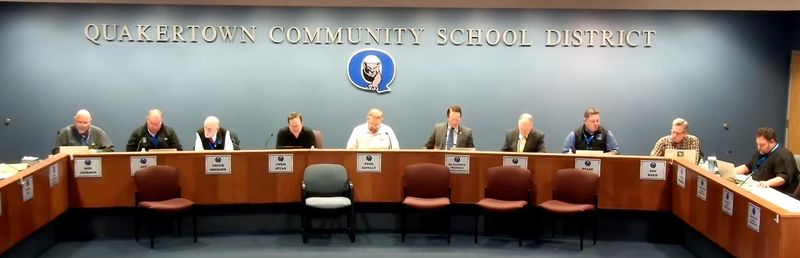
Addressing the board before the vote, Ryan Wieand, the president of Quakertown’s teachers union, said that selecting the next superintendent “is not simply about filling a position at this point. It’s about restoring trust.”
Wieand said the superintendent’s job “demands presence, visibility, and leadership that requires showing up, and not just for social media photo ops.”
The district “can’t be led effectively by someone who is absent more often than not,” Wieand said. “Our next superintendent needs to be 100% invested in Quakertown every single day,” and not view the job as “a stepping stone to another destination.”
He called Hoffman the best candidate for the job, praising her loyalty to the district and “true accountability.”
Friedman could not immediately be reached for comment Wednesday.
The Cheltenham School District said Friday it’s considering a change in school picture companies following social media posts linking its current provider to a billionaire associated with Jeffrey Epstein.
In light of news reports about Lifetouch, “the district is exploring all options for future student portrait services,” Superintendent Brian Scriven said in a message to the community Friday.
A number of school districts nationally have canceled plans for photos by Lifetouch after posts connecting the company to Leon Black, former CEO of Apollo Global Management, who met regularly with Epstein, the Associated Press reported.
Under Black’s leadership, funds managed by Apollo bought Lifetouch’s parent company, Shutterfly, in 2019.
Posts outlining that link have spread across social media, some telling parents they should worry about where their children’s images are being stored.
Lifetouch has said it has no connection to Epstein, and cited news reports that the company’s name hasn’t appeared in the Epstein files.
“Claims of any relationship between Epstein and Lifetouch are completely false,” the company said in an FAQ on its website. It noted that Epstein died before Apollo acquired Shutterfly in September 2019, and said it has “never shared student images with any third party, including Apollo Global Management.”
Cheltenham hadn’t received complaints from parents, but issued Friday’s message “proactively,” said spokesperson Kevin Kaufman.
In the message, Scriven said Lifetouch would still take K-8 pictures this spring, but told parents they could opt out of photos by talking with their principal. He also pointed families to instructions on how to request that Lifetouch delete images of their children.
“We understand that media reports such as these about business associations involving prominent individuals can raise questions for families and staff,” Scriven said.
He noted Lifetouch’s stated commitment to student privacy, and said “at this time, there is no indication of any impact on student safety, district operations, or the services provided in our schools. Nevertheless, we are conducting appropriate due diligence consistent with policies.”
While the school district attempted to cancel last Friday’s planned walkout after receiving what officials called a credible threat, some members of the public said school officials could have offered students the opportunity to protest on Quakertown Community High School’scampus, knowing they were likely to walk out anyway.
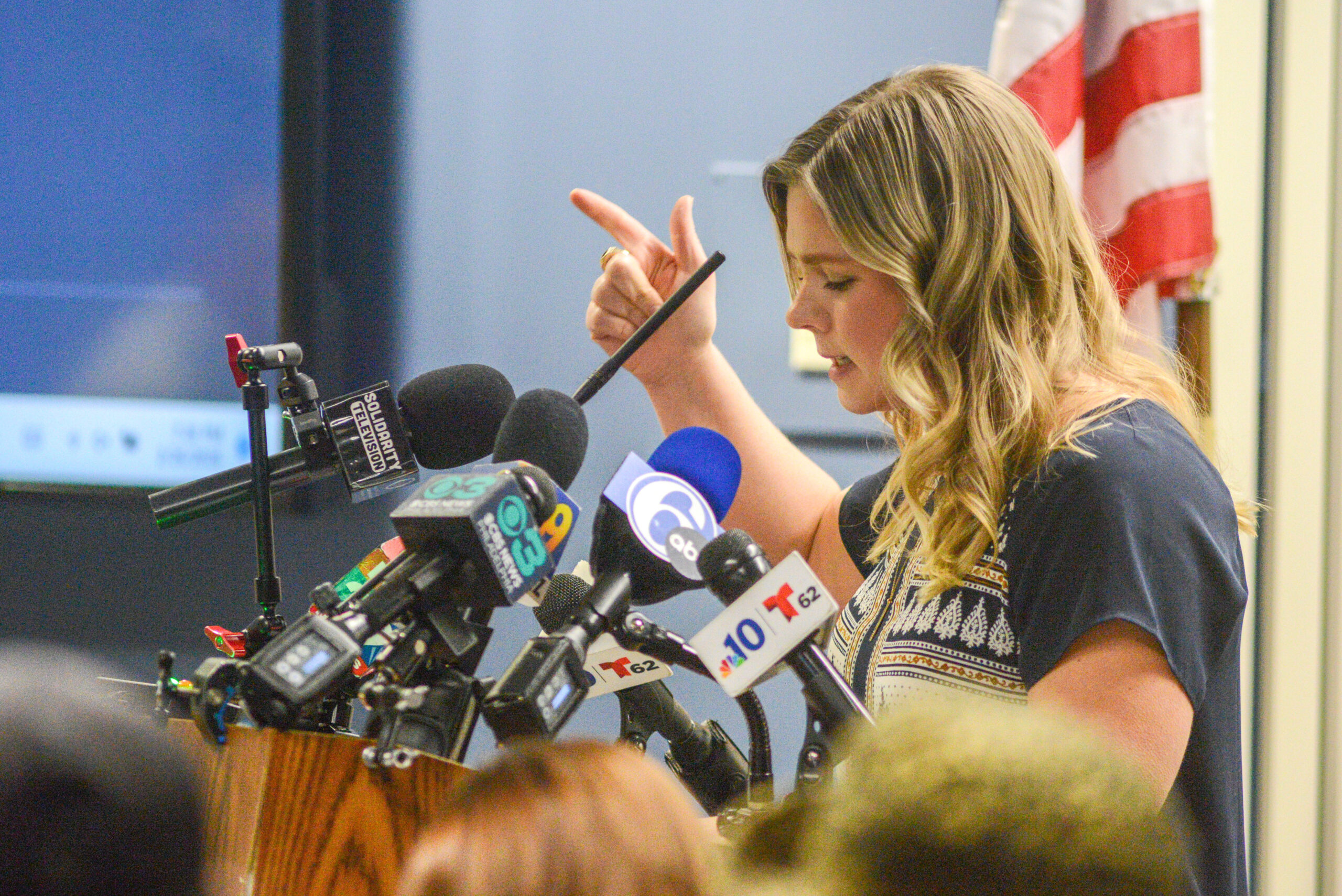
“Instead of guiding them to a safer option, we left them to navigate it on their own,” said Jessica Buhman, a parent of two children in the district who addressed the school board before a packed room Thursday. “The risks were foreseeable and unfortunately they materialized.”
Parent Jessica Buhman speaks to the board at the Quakertown school board meeting Thursday.
Some others faulted the district for allowing students to walk out at all. In the “real world … people don’t walk off their jobs to protest,” said Amalia Ritter. “You walk off the job, you’re fired. You want to protest, you do that on your own time.”
School officials have said they had no authority to stop about 35 students who left the high school Friday, walking off campus.
In town, a confrontation broke out. Video footage appears to show Quakertown’s police chief — dressed in plainclothes — putting a girl in a chokehold.
The five students were charged with aggravated assault, a felony-level crime, and jailed. By Thursday night, all five teenagers had been released.
Lawyers for two of the students denied that their clients hit McElree. Witnesses have said McElree didn’t identify himself as the police chief before engaging with the teenagers.
Anger over district’s handling of protest
Much of the attention in the aftermath of the incident has focused on McElree, but on Thursday, residents voiced their frustrations with the school district.
“How does an administrator …not know these kids were going to do something?” said Wes Comes, who also questioned why the district didn’t hold the protest on its own property. “We missed the whole ball. We whiffed.”
A number of speakers, Comes included, questioned what the threat was that prompted the district to try to cancel the protest — saying there had been a lack of transparency with the community.
Some faulted the district for not making any statement of support for the arrested students, who were in custody for days.
“It seems the school is wiping its hands of the kids who were injured and arrested,” said Lisen Cummings.
Laura Foster, an organizer with the liberal Upper Bucks United group, said the district’s communications were “tone deaf.”
“Thanking the students for staying in school while ignoring your students who were out there getting brutally attacked by the police …everyone on this board should have been like, what are we doing?” Foster said.
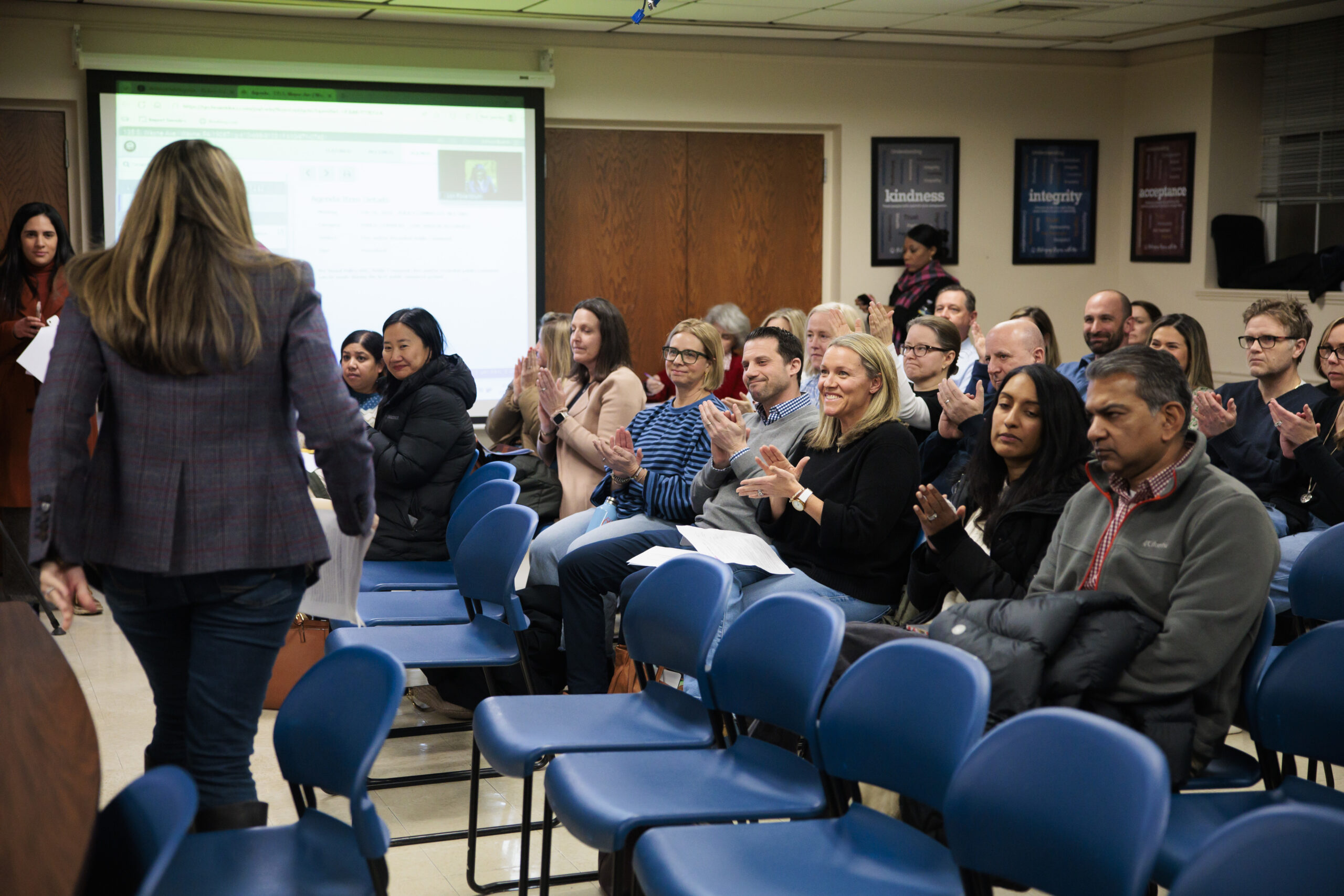
The meeting was at times tense, with arguments breaking out as speakers took their turns at the podium to share their perspectives. A Pennsylvania State Police trooper stationed at the meeting defused an argument between two women in the lobby.
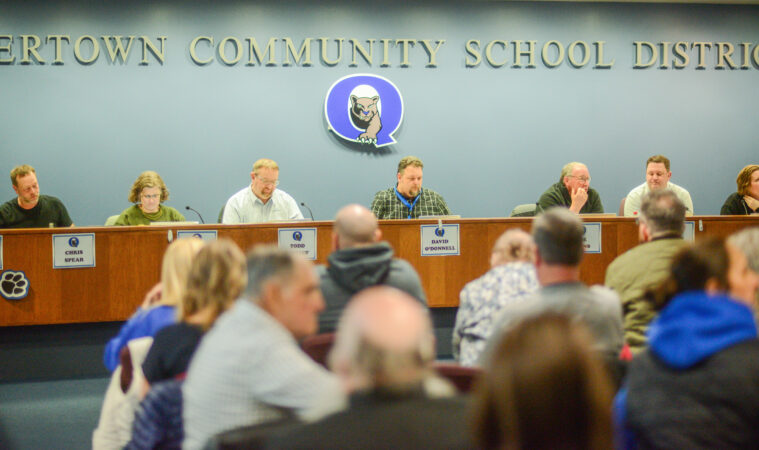
The board’s president, David O’Donnell, told the crowd that “the emotions up here are just as raw as they are out there.”
“No one up here would celebrate violence against children,” O’Donnell said. “I acknowledge that we probably have a lot to learn from how we handled the situation.”
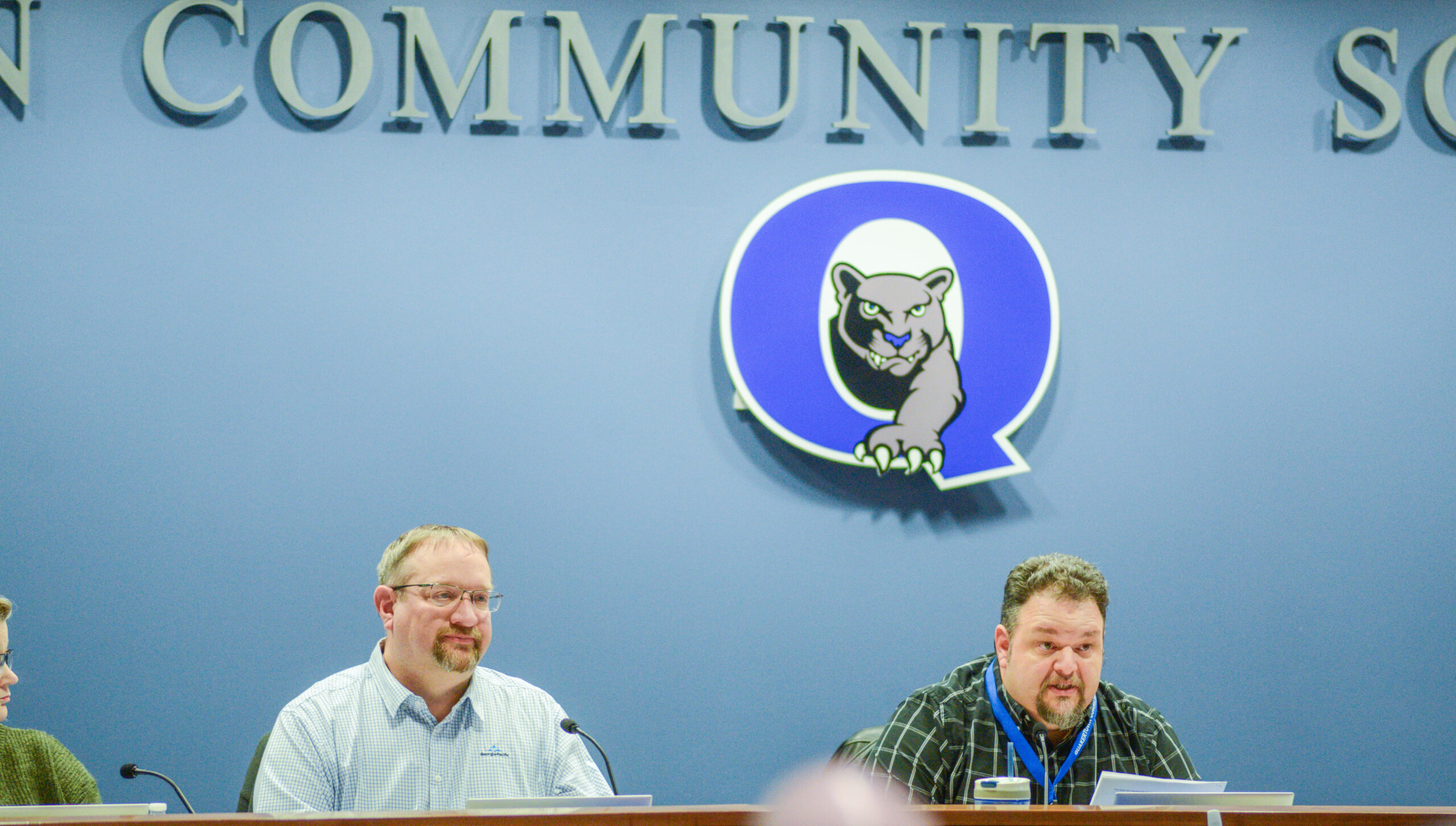
From left, school board member Todd Hippauf and board president David O’Donnell at the Quakertown school board meeting Thursday.
Pre-meeting gathering
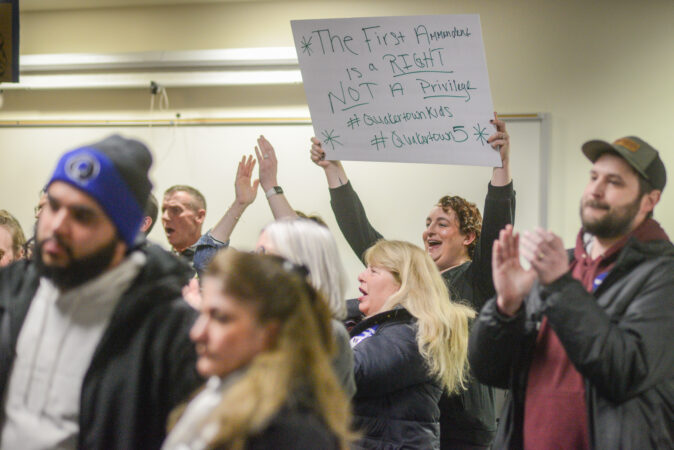
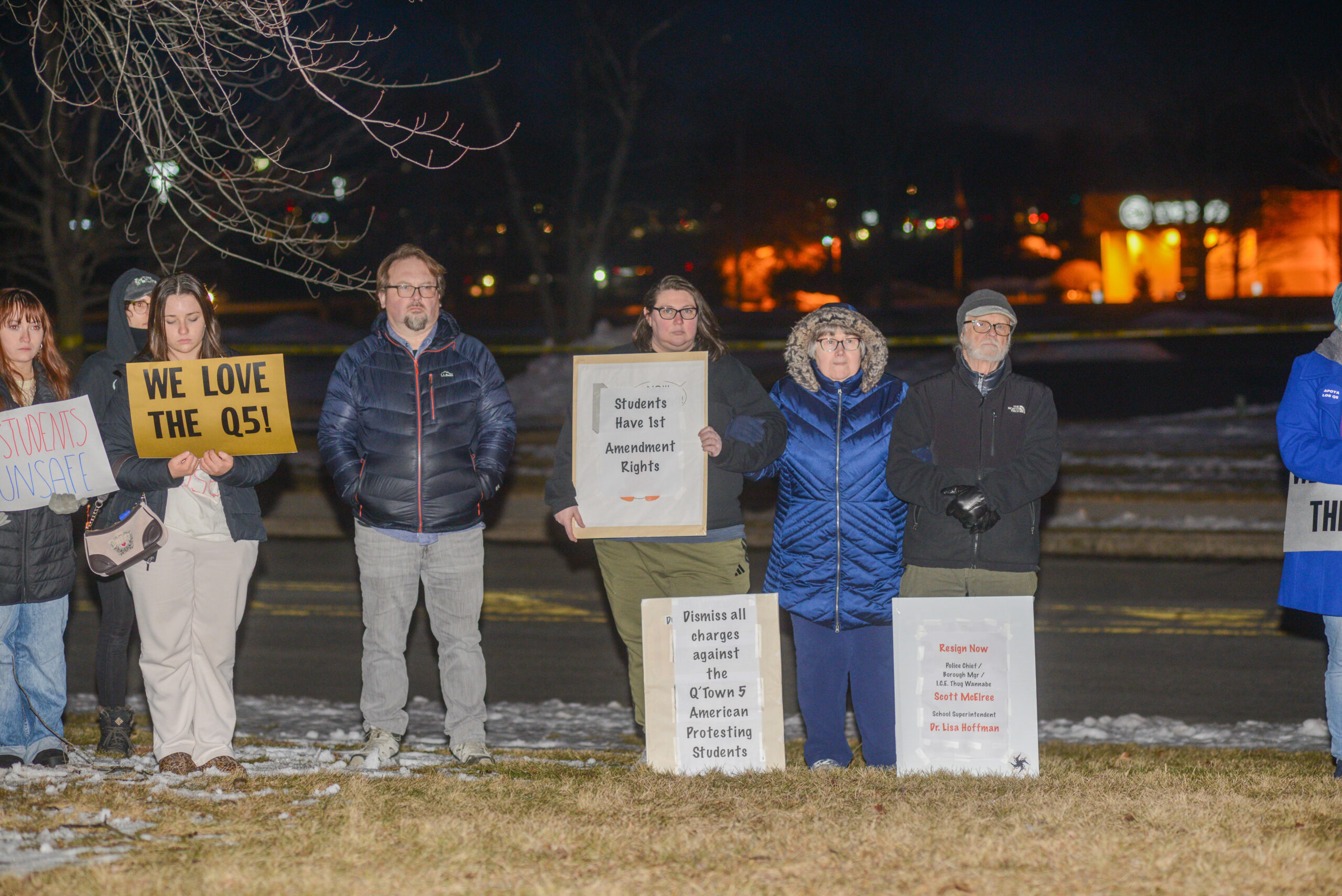
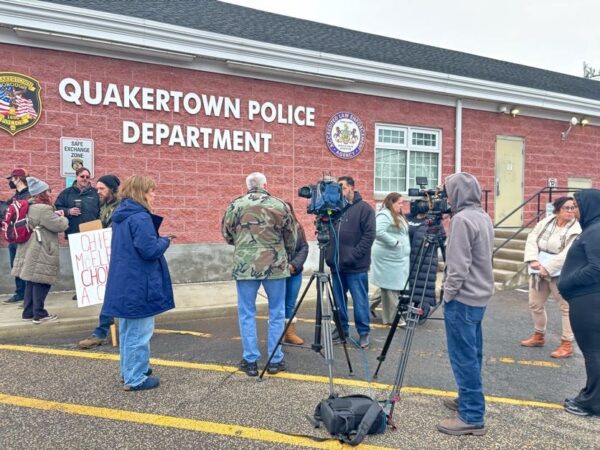
Outside the school before the meeting, a few dozen people attended agathering organized by Upper Bucks United. Stickers reading “support Q5” and “Apoya Los Q5” — referring in English and Spanish to the five teens who spent several nights in jail — were available at folding tables next to a gas burner providing hot chocolate to the protesters.
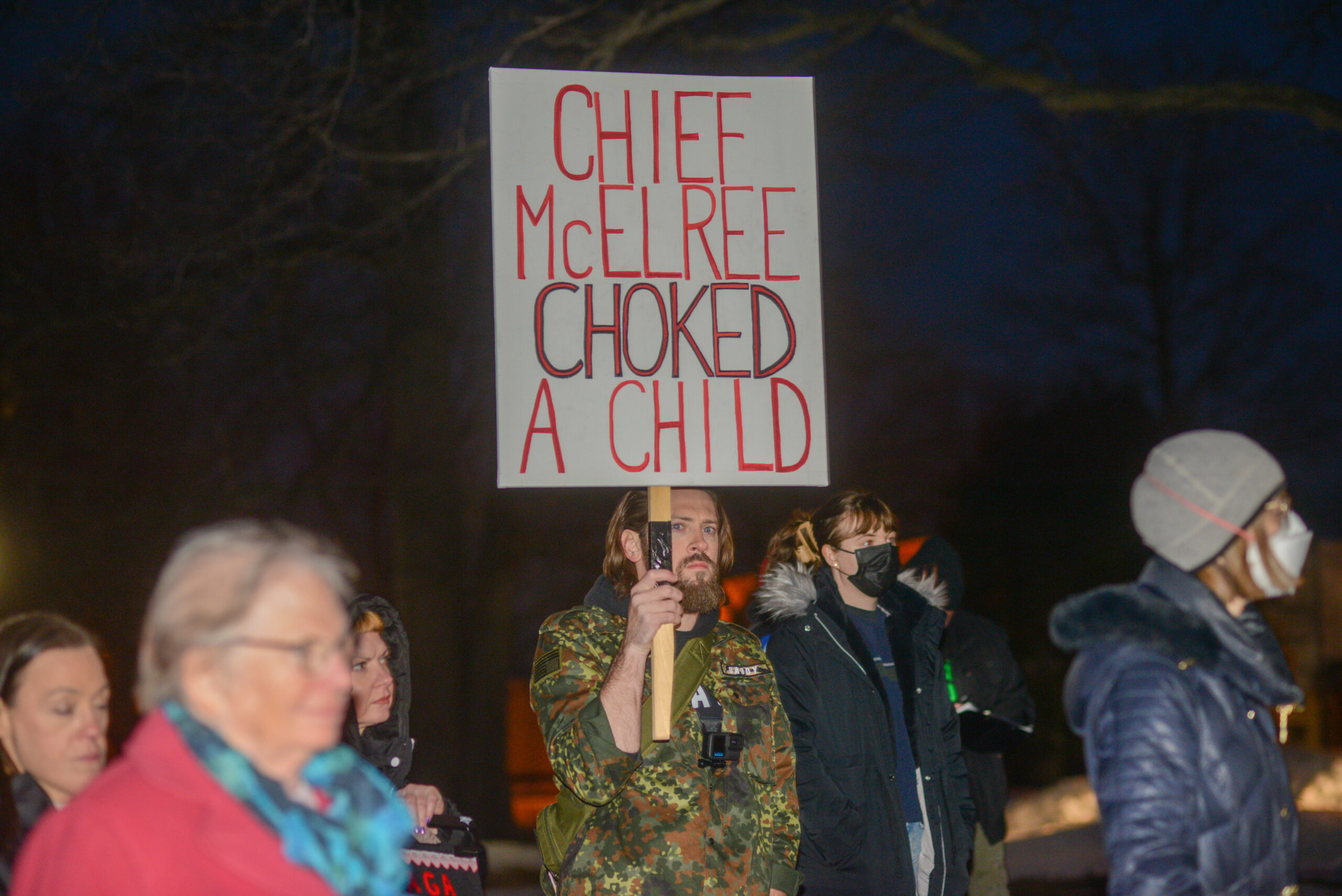
A parent holds a sign outside the Quakertown School Board Meeting Thursday.
“The First Amendment is a right, not a privilege,” read one of the signs protesters carried.
In the crowd, Wayne Codner — the mayor of neighboring Richlandtown Borough, which is in the Quakertown CommunitySchool District — shook hands with friends in the Democrat-aligned Upper Bucks group.
“I’m a Black, first-generation immigrant from Jamaica in a town that is 95% white — and I’m mayor,” Codner said. “And this doesn’t represent us,” he said of the Friday incident.
Numerous speakers inside the boardroom tied the incident to a broader climate of intolerance and racism in the Quakertown community.
Ashley Crowell, a “single parent and gender queer individual” with kids in the district, told the board that shehad been threatened by men in loud pickup trucks while running in her neighborhood, “because I look offensively masculine” based on her haircut.
Crowell said she believed the escalation during the walkout “was brought about by similar behaviors, also by men in loud trucks — maybe even the same people that made the threats which triggered your decision to cancel the walkout.”
“Our students spoke up …and that resulted in mismanagement of the situation by white men, with ignorance of other people’s lived experiences with discrimination,” Crowell said.
One student grew teary as she spoke about fears that “something would happen to my family” while she was at school, and how “35 students were fighting for my rights.”
After the comments, one board member, Chris Spear, said the board had “heard a lot of accusations of racism” and suggested the district should bring in a consultant, as he said it had in the past.
Spear also noted the criticisms that “this was predictable.”
“As much as the students are going to learn something, the adults are going to learn something as well,” Spear said.
Parents hold signs before the start of the Quakertown School Board Meeting.
The Wallingford-Swarthmore school board on Tuesday approved a plan that would eliminate nearly 20 positions as it tries to reverse what officials have called a trend of unsustainable spending in the affluent suburban district.
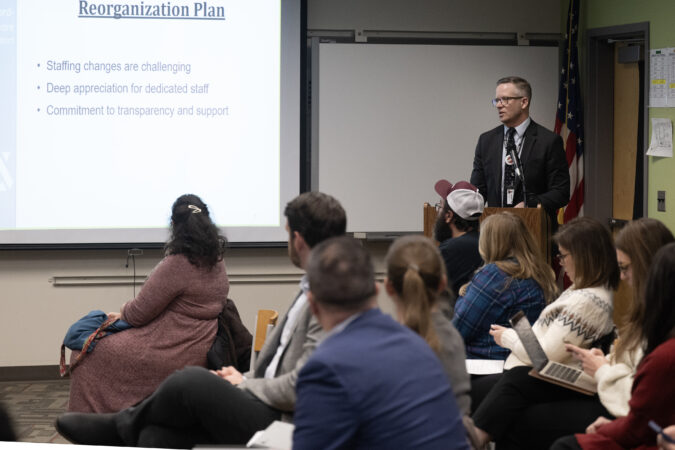
The reorganization plan, which was approved by the board 8-0 and takes effect July 1, will save the district about $2 million, said Superintendent Russell Johnston. Five administrative positions will be eliminated, along with positions for instructional assistants at the middle and high schools, a high school special education teacher, high school secretary, and high school part-time guidance counselor, among other roles.
Some of those positions are currently unfilled. And not everyone whose position is being eliminated will be leaving the district: Employees with seniority will be able to bump less senior staff, Johnston said.
Overall, the changes will result in three to four layoffs, Johnston said Tuesday. Seven long-term substitutes will also no longer work in the district.
“This is not about solving a problem in this year’s budget,” but ensuring the district can sustain its programs in the future, Johnston said Tuesday.
“Bottom line: the district has a spending problem,” DeJuana Mosley, the district’s business administrator, said at a November finance committee meeting. She said there had been “considerable increases” in staffing since 2021 — and the district’s budget grew by 18%, from $89 million to $105 million — despite no increase in enrollment.
The district also lacked adequate inventory management, Mosley said — describing a “culture of just ordering stuff” — and faces other mounting pressures, including deferred maintenance and a lack of curricular investments, including some course materials not aligned to Pennsylvania or Advanced Placement standards.
Mosley described the district’s $164 million capital plan as “added pressure,” but not the source of budget troubles.
Meanwhile, the district’s tax base — which is heavily residential, with limited commercial properties — has declined, Mosley said. Taxable assessed value dropped by $6 million from 2024 to 2025, resulting in a loss of $175,000 in annual tax revenue for the district.
Even if the district raised taxes for the coming year by 3.5%, the maximum amount allowed by state law, it would still be short $2.6 million, Mosley said.
The school board parted ways with former superintendent, Wagner Marseille, in 2024, after an opposition campaign from parents that accused Marseille of excessive spending, among other allegations. Marseille, who had led the district since 2021, was replaced on an interim basis in August 2024 by Jim Scanlon, a former West Chester superintendent.
The board hiredJohnston, a former Massachusetts education commissioner, in May.
In an interview this week, Johnston said that in planning for the fiscal year starting July 1, he “began to see more and more signs that we needed to make this adjustment.”
He said that in November, “I brought the full scope of the problem before the board.”
Which positions are being cut?
Five administrative positions will be cut under the plan approved Tuesday: director of assessment, compliance, and federal programs; supervisor of counseling and wellness; safety and security coordinator; communications and community relations liaison; and supervisor of buildings and grounds.
Other cuts include: two high school and one middle school instructional support positions; a high-school part-time guidance counselor; a high school secretary; a high-school special education teacher; a middle-school safety aide; a middle-school long-term substitute; a middle-school substitute custodian; and six teachers on special assignment helping with new curriculum rollouts. (The plan also includes the creation of two new curriculum supervisor positions.)
In outlining the cuts Tuesday, Johnston said, “This is really about a change in positions, not people.” He said responsibilities from discontinued administrative positions would be shifted to other administrators.
“What’s good for students is sometimes hard for adults,” he said.
The district is also eliminating “Cultural Proficiency Equity Teacher Leader” positions, which were created in 2022-23 and gave additional money to teachers working on equity initiatives.
Johnston said at a finance committee meeting last week that “this is no way a backing off of our commitment to equity,” and responsibilities would be absorbed elsewhere.
What happens next?
The reorganization plan isn’t the only way the district is trying to save money. At last week’s finance meeting, Johnston said the district would eliminate redundant software programs and increase oversight of supply purchases. He also said he would be sending a memo to staff to cut back on snacks at after-school events.
The district, which taxes residents at a relatively high rate compared to others, will be limited in how much it can increase taxes in future years, with the Act 1 index that dictates how much they can increase taxes projected to decline, Johnston said. The board directed district officials to prepare a budget for 2026-27 with an increase between 3-3.4%, under the 3.5% state-imposed limit.
“We want to make sure what we live with next year, we can live with in future years,” he said last week.
The Quakertown Community School District is planning to offer counseling and has requested a police presence this week after a student walkout Friday to protest federal immigration enforcement ended in a clash with police and multiple student arrests.
“Our responsibility is to focus on creating as safe and supportive a learning environment as possible for students and staff to return to school this week,” acting Superintendent Lisa Hoffman said in a statement Sunday night.
Like districts across the region, Quakertown schools were closed Monday because of snow. But administrators are preparing to reopen amid continuing intense attention from Friday’s walkout, which involved about 35 students from Quakertown Senior High School. Unlike other walkouts at Philadelphia-area schools by students protesting U.S. Immigration and Customs Enforcement, Quakertown’s protest turned confrontational.
The status of the students who were arrested, including whether they were still in custody, wasn’t clear Monday. A spokesperson for the Bucks County District Attorney’s Office — which is investigating the police response to the protest — said state law barred the office from discussing the teenagers’ cases.
The spokesperson, Manuel Gamiz, did not respond to questions about the charges, where the students were being held, or when they would be arraigned. While police had said one adult was arrested, Gamiz said that to his knowledge “no adult was ever charged” in connection with the incident.
Community members organized by the group Upper Bucks United demanded the immediate suspension of the police chief, Scott McElree, at a borough council meeting Monday night. An online petition also calls for McElree’s resignation.
McElree, who is also the borough manager, did not respond to requests for comment Monday.
Reached by phone Monday afternoon, borough council vice president James Roberts Jr. hung up on a reporter. He did not answer a second call. Messages left for four other council members were not immediately returned Monday.
Witold Walczak, legal director of the ACLU of Pennsylvania, said in a statement Monday that “by all accounts, including abundant video evidence, there were no issues at the demonstration until Quakertown police arrived and incited violence.”
Walczak called for a “full and transparent investigation” and for Quakertown police and McElree “to be held accountable for their actions if the evidence confirms the apparent excessive force, retaliation and false arrest.”
In response to a series of questions sent Monday, the police department sent a written statement, saying the borough and department were “fully cooperating with the Bucks County District Attorney’s Office concerning this investigation. Until this investigation is complete, neither the Borough nor its Police Department will be commenting on this matter.”
Tensions led to walkout cancellation
In her statement Sunday, Hoffman offered more context about Friday’s walkout, which the district had attempted to cancel that morning.
In the week leading up to the walkout, Hoffman said, administrators met with student organizers “to discuss alternative ways to demonstrate their right to free speech that wouldn’t disrupt the school day.”
Like “nearly every school district across the region,” Hoffman said, “it is our practice not to endorse or facilitate a student walkout during the school day for any reason. However, we also know it is our responsibility and duty to provide reasonable safety and security support for students and staff members who enter and exit our schools.”
The district was concerned that students who planned to participate in the walkout reported they were being bullied and threatened, Hoffman said.
At 9 p.m. Thursday, Hoffman said, “the district received what was deemed a new and concerning threat of violence.” A district spokesperson did not respond to questions Monday, including about the nature of the threat.
Though the district issued a notice and met with student organizers before school Friday, attempting to cancel the protest, administrators gathered in front of the high school at 11:25 a.m. Friday, preparing for the “the possibility that students would proceed with their walkout despite the safety concerns shared with them,” Hoffman said.
As students walked off campus — not following any previously discussed route, Hoffman said — district officials heard from community members that some students in town “were engaging in disruptive and unsafe behavior,” Hoffman said.
At that point, students “were no longer under the district’s custodial control or supervision, and we have almost no legal ability to regulate or investigate their behavior,” she said.
Hoffman said the district has no additional information on arrests or the investigation. She said administrators and “many of our staff members have been inundated with hateful messages and concerning physical threats to our personal safety via email, phone, and social media” since the walkout.
“This is simply inexcusable,” Hoffman said. “We have and will continue to report these threats to the appropriate law enforcement agencies.”
The district is working with the Bucks County Intermediate Unit to develop a “counseling support plan” for students and staff, Hoffman said. She also said it had “communicated with our law enforcement partners for police presence and support as we return to school.”
Over the weekend, supporters created a GoFundMe campaign to raise money for the students’ legal fees, court costs, medical expenses, and other support services. By Monday afternoon, it had collected more than $28,000. The campaign’s organizer did not respond to a request for comment.
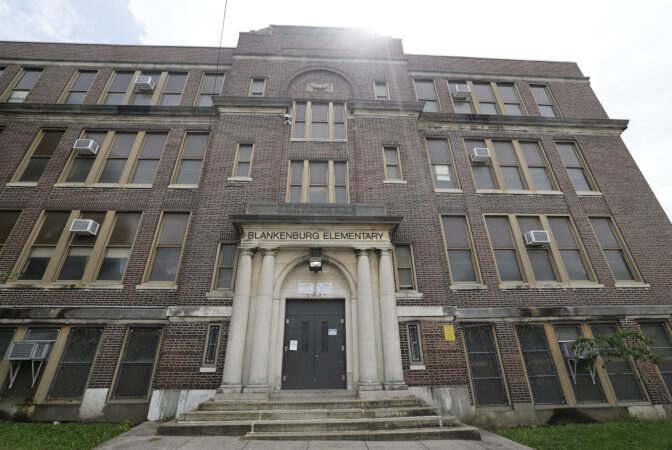
Rudolph Blankenburg Elementary School in West Philadelphia serves kids with complex needs — and test scores reflect that.
The school, where nearly 95% of students are considered economically disadvantaged, had been a Comprehensive Support and Improvement school — a federally mandated designation for schools performing in the bottom 5% statewide.
But last fall, Blankenburg shed that label. Many students are still struggling but are making gains, teachers said — progress they fear will be threatened by a district proposal to close the schoolas part of a sweeping facilities plan.
“We’ve worked really hard, with a consistent staff and all types of resources in place, for our students to pull ourselves out of that status,” said Flori Thomas, a middle school science teacher at Blankenburg.
That’s her biggest fear, she said: “You’re going to impact our scholars.”
Blankenburg is one of 20 district schools proposed for closure under the plan released last month. Six other schools would be colocated and more than 150 modernized as part of the proposal — which is facing resistance from City Council.
District officials say closures are needed in a system that has lost more than 80,000 students over the last 30 years, many to charter schools. The district has struggled to fund repairs of aging buildings — including at Blankenburg, where staff report chipping paint and roof leaks.
Marquita Jenkins, the school’s dean of climate and culture, does not disagree that the building, which opened in 1925, needs repairs — or that it is underutilized. The K-8 school, which currently enrolls 278 students, has room for almost 600. Officials said the school’s enrollment has declined by about 100 students over the last four years.
But the relatively low enrollment has also enabled smaller class sizes, helping student growth, Jenkins said. A former fourth- and sixth-grade teacher at Blankenburg, she recalled teaching a class of 33 students, 11 of whom had individualized special education plans: “It was tough.” Classes now are smaller, she said.
Like other staff, she worried about where Blankenburg students would end up. The district proposes to reassign them to Edward Heston School, James Rhoads Elementary School, and a newly colocated Martha Washington Academics Plus School and Middle Years Alternative School.
Blankenburg‘s building near 46th and Girard, meanwhile, would be conveyed to the city for “affordable workforce housing and/or job creation,” according to the district.
Jenkins and other staff questioned the safety of the routes to schoolfor reassigned students.
They also voiced concern for particularly vulnerable students: Blankenburg is surrounded by at least seven homeless shelters and “tends to have attendance fluctuations,” assistant principal Sandra Pitts said at a virtual community meeting with district officials this month. She questioned how families would be “assisted to avoid further trauma.” (Officials said they would be supporting students with housing instability in placements.)
Staffers noted that Blankenburg also has a significant population of students with special needs, who make up 25% of its enrollment.
Among them is Sherell Robinson’s kindergartener, Illiyin, who has autism and medical complexities.
Robinson, who lives in West Philadelphia, said that Illiyin had been denied enrollment at other district schools, and that she was told she had to send her daughter to Blankenburg.
Robinson initially had a negative impression of Blankenburg but was impressed with the school’s principal, Sheena Wilson, who “didn’t try to sell me, or placate me” — just presented what the school had to offer, she said.
What Robinson found was a small environment, “loving people,” and a routine for Illiyin. Now she is panicked at the prospect of the school closing.
“For them to be taking this whole community away is really devastating,” Robinson said. “It takes time to find the correct programming and environment and teachers who are neuro-affirming, especially for Black children.”
A real estate agent, Robinson said there was an irony to the district’s plan to convert Blankenburg to workforce housing — something she believes she currently would qualify for. But if she does not find a stable school environment for her daughter, she isn’t sure she will be able to keep her job.
“They might look at me as a single case, but I can assure you I am not an anomaly,” said Robinson, who also works for a disability nonprofit and is in touch with other parents of autistic children. “This is going to affect how we can take care of our families, how that perpetuates what we’re already experiencing. … I don’t want to normalize that struggle to them.”
Teachers said they are committed to Blankenburg’s students. “We bring a lot of positivity and try to keep our kids safe,” said Jenkins, who has led field trips to places including the Kimmel Center in Center City and the National Museum of African American History and Culture in Washington.
Thomas, who grew up in the neighborhood around Blankenburg and now lives in New Jersey, said that whenever students learn about her commute, she tells them they are worth the drive.
Others outside the city see headlines about crime, Thomas said, but she tells students: “I see you.”
One night in early December, the phones of Radnor High School students started buzzing. Some freshmen girls were getting disturbing messages: A male classmate, they were told, had made pornographic videos of them.
When one of the girls walked into school the next morning, “she said everyone was staring at her,” said her mother, who requested anonymity to protect her daughter’s identity. “All the kids knew. It spread like wildfire.”
So-called AI deepfakes — pictures of a real person manipulated with artificial intelligence,sometimes with “nudify” features that can convert clothed photos into naked ones — have become the talk of school hallways and Snapchat conversations in some area schools.
As Pennsylvania lawmakers have pushed new restrictions cracking down on deepfakes — defining explicit images as child sexual abuse material, and advancing another measure that would require schools to immediately alert law enforcement about AI incidents — schools say they have no role in criminal investigations, and are limited in their ability to police students off campus.
But some parents say schools should be taking a more proactive stance to prepare for AI abuse — and are failing to protect victims when it happens, further harming students who have been violated by their peers.
In the Council Rock School District, where AI-generated deepfakes were reported last March, parents of targeted girls said administrators waited five days to contact the police about the allegations and never notified the community, even after two boys were charged with crimes.
“They denied everything and kind of shoved it under the rug and failed to acknowledge it,” said a mother in Council Rock, who also requested anonymity to protect her daughter’s identity. “Everybody thought it was a rumor,” rather than real damage done to girls, the mother said.
Council Rock spokesperson Andrea Mangoldsaid that the district “recognizes and understands the deep frustration and concern expressed by parents,” and that a police investigation “began promptly upon the district’s notification.”
Mangold said that current laws were “insufficient to fully prevent or deter these incidents,” and that the district was “limited in what we know and what we can legally share publicly” due to student privacy laws.
In Radnor, parents also said the district minimized the December incident. A district message last month said a student had created images of classmates that “move and dance,” and reported that police had not found evidence of “anything inappropriate” — even though police later saidthey had charged a student with harassment after an investigation into alleged sexualized images of multiple girls.
A Radnor spokesperson said the alleged images were never discovered and the district’s message was cowritten by Radnor police, who declined to comment.
The district “approaches all student-related matters with care and sensitivity for those involved,” said the spokesperson, Theji Brennan. She said the district was limited in what it could share about minors.
In both Radnor and Council Rock, parents said their daughters were offered little support — and were told that if they were uncomfortable, they could go to quiet rooms or leave classes early to avoid crossing paths with boys involved in the incidents.
“She just felt like no one believed her,” the Radnor mother said of her daughter.
How an investigation unfolded in Radnor
In Radnor, five freshman girls first heard they were victims of deepfakes on Dec. 2, according to parents of two of the victims who requested anonymity to protect their daughters’ identities. They said boys told their daughters that a male classmate had made videosdepicting them sexually.
In a Snapchat conversation that night, one boy said, “‘Nobody tell their parents,’” a mother of one of the victims recalled. Reading her daughter’s texts, “it quickly went from high school drama to ‘Wow, this is serious.’”
The girls and their parents never saw the videos. In an email to school officials the next morning, parents asked for an investigation, discipline for the students involved, and efforts to stop any sharing of videos. They also asked for support for their daughters.
Schooladministrators began interviewing students. The mother of one of the victims said her daughter was interviewed alone by the male assistant principal — an uncomfortable dynamic, given the subject matter, she said.
One mother said the principal told her daughter that it was the boys’ word against hers, and that he was “so glad nothing was shared” on social media — even though no one knew at that point where videos had been shared, the mother said.
The principal said the school had no authority over kids’ phones, so the girl and her family would need to call the police if they wanted phones searched, the mother said.
Brennan, the Radnor spokesperson, said that administrators contacted Radnor police and child welfare authorities the same day they spoke with families. “The district’s and the police department’s investigations have found no evidence that the images remain or were shared, posted, or otherwise circulated,” she said.
The male classmate acknowledged making videos of the girls dancing in thong bikinis, the parents said police told them. But the app he used was deleted from his phone, and the videos were not on it, the police told them.
The parents didn’t believe the admission.
“I don’t think a 14-year-boy would report a TikTok video of girls in bikinis,” said one of the mothers, who said her daughter was told she was naked and touching herself in videos.
The police told parents they did not subpoena the app or any social media companies, making it impossible to know what was created.
Radnor Police Chief Chris Flanagan declined to comment, as did the Delaware County District Attorney’s Office.
In a message sent to the district community Jan. 16 announcing the end of the police investigation, officials said a student, outside of school hours, had taken “publicly available” photos of other students and “used an app that animates images, making them appear to move and dance.”
“No evidence shared with law enforcement depicted anything inappropriate or any other related crime,” the message said.
A week later, the police released a statement saying a juvenile was charged with harassment after an investigation into “the possible use of AI to generate non-consensual sexualized imagery of numerous juveniles.”
Asked why the district’s statement had omitted the criminal charge or mention of sexualized imagery, Brennan said the statement was also signed by Flanagan, who declined to comment on the discrepancy.
Brennan said the district had provided ongoing support to students, including access to a counselor and social worker.
Parents said the district had erred in failing to initiate a Title IX sexual harassment investigation, instead telling parents they needed to file their own complaints.
“They kept saying, ‘This is off campus,’” the mother said. But “my daughter could not walk around without crying and feeling ashamed.”
Parents say girls were ‘not supported’ in Council Rock
In Council Rock, a girl came home from Newtown Middle School on March 17 and told her mother a classmate had created naked images of her.
“I’m like, ‘Excuse me? Nobody contacted me,’” said the mother, who requested anonymity to protect her daughter’s identity. She called the school’s principal, who she said told her: “‘Oh, my God, I meant to reach out to you. I have a list of parents, I just have not gotten to it’ — you know, really downplaying it.”
The mother and other victims’parents later learned that administrators were alerted to the images on March 14, when boys reported them to the principal. But instead of calling the police, the principal met with the accused boy and his father, according to parents. Police told parents they were contacted by the school five days later. The Newtown police did not respond to a request for comment.
Mangold, the Council Rock spokesperson, declined to comment on the specific timing of the school’s contact with police.
Police ultimately obtained images after issuing a subpoena to Snapchat; in total, there were 11 victims, the parents said.
Through the Snapchat data, police learned that a second boy was involved, the parents said, which made them question what was created and how far it spread.
Parents said they believe there are more pictures and videos than police saw, based on what their daughters were told — and because the delayed reporting to police could have given boys an opportunity to delete evidence.
“That’s kind of what the fear of our daughters is — like, what was actually out there?” said one mother, who also requested anonymity to protect her child’s identity.
Manuel Gamiz, a spokesperson for the Bucks County district attorney, said Newtown Township police had charged two juveniles with unlawful dissemination of sexually explicit material by a minor. Gamiz said the office could not provide further information because the case involved juveniles.
Juvenile cases are not public, but victims’ parents said both boys were adjudicated delinquent. While the boys had been attending Council Rock North High School with their daughters, the district agreed to transfer both after their cases were resolved, according to a lawyer representing four of the parents, Matthew Faranda-Diedrich.
“How can you let this person be roaming the halls?” said Faranda-Diedrich, who said it took formal demand letters in order for the district to transfer the boys.
He accused the district of mishandling the incident and “protecting the institution” rather than the victimized girls.
“They’re putting themselves above these students,” Faranda-Diedrich said.
Parents said school leaders warned their daughters against spreading rumors, and never sent a districtwide message about the incident.
“These girls were victims,” one of the mothers said, “and they were not supported.”
She and the other mothers who spoke to The Inquirer said the incident has deeply affected their daughters, from anxiety around what images may have been created — and how many people saw them — to a loss of trust in school leaders.
Some of the girls are considering switching schools, one mother said.
State law changes and a debate around education about deepfakes
Those changes came in 2024 and 2025, after a scandal over deepfakes of nearly 50 girls at a Lancaster private school.
Another bill that passed the state Senate unanimously in November would require school staff and other mandated reporters to report AI-generated explicit images of minors as child abuse — closing what prosecutors had cited as a loophole when they declined to bring charges against Lancaster Country Day School for failing to report AI images to the police. That legislation is now pending in the House.
Schools can also do more, said Faranda-Diedrich, who also represented parents of victims in the Lancaster Country Day School incident. He has pressed schools to conduct mandated reporter training for staff. “By and large they refuse,” he said.
In Radnor, parents urged the school board at last week’s committee meeting to make changes.
Parent Luciana Librandi walks back to her seat after speaking during a Radnor school board committee meeting last week.
Luciana Librandi, a parent of a freshman who said she had been “directly impacted by the misuse of generative AI,” called for timelines for contacting police following an AI incident, safeguards during student questioning, and annual education for students and parents on AI.
Others called for the district to communicate the criminal charge to families, to enforce existing policies against harassment, and to independently review its response to the recent incident.
Radnor officials said they are planning educational programming on the dangers of making AI images without a person’s consent.
There is somedebate on whether to teach children about “nudify” apps and their dangers, said Riana Pfefferkorn, policy fellow at the Stanford Institute for Human-Centered AI, who has researched the prevalence of AI-generated child sexual abuse material. Alerting kids to the apps’ existence could cause them “to make a beeline for it,” Pfefferkorn said.
While “this isn’t something that is epidemic levels in schools just yet,” Pfefferkorn said, “is this a secret we can keep from children?”
One of the victims’ parents in Radnor said education on the topic is overdue.
“It’s clearly in school,” the mother said. “The fact there’s no video being shown on the big screen in your cafeteria — we don’t live in that world anymore.”
Quakertown Community School District Superintendent Matthew Friedman is on leave effective immediately, a district spokesperson said Friday.
The spokesperson, Melissa Hartney, said the district’s school board could not comment further.
“Because this is a personnel matter, the board is limited in the amount of information it can share at this time,” Hartney said in a statement.
Friedman did not return a request for comment.
Friedman took over the 4,600-student district in Upper Bucks County in 2023, after serving as superintendent of the Ocean City School District in New Jersey.
The Quakertown school board in November granted him a $10,000 raise, bringing his salary to $233,000, and extended his contract until June 30, 2028.
Assistant Superintendent Lisa Hoffman is taking over day-to-day operations of the district, Hartney said.
“The board is confident that district operations, instructional programs, and student services will continue without interruption,” Hartney said, adding that it “remains committed to transparency, accountability, and maintaining the trust of our students, staff, families, and community.”
The Abington School District has placed Abington Senior High School Principal Alice Swift on administrative leave amid an investigation into social media posts.
“I am writing to inform you that, effective Feb. 12, 2026, Dr. Alice Swift has been placed on administrative leave,” Superintendent Jeffrey Fecher wrote in a message to parents Thursday. “The district received allegations of inappropriate social media posts and is investigating the matter.”
It was not immediately clear what Swift had posted on social media that led to the district’s action. Attempts to reach Swift for comment Friday were unsuccessful.
Fecher declined to comment further Friday, calling the issue a personnel matter. He said support was in place at the high school to ensure stability for students.
Swift, a 1983 Abington graduate and former teacher and administrator in Maryland schools, became principal of Abington Senior High School in 2024.
Fecher said the district “will share additional updates regarding Dr. Swift’s return as more information becomes available.”
The Norristown Area School District’s board is moving to oustits superintendent, saying the district needs a new leader to reverse years of poor test scores.
The move to replace Superintendent Christopher Dormer, who has led the Montgomery County district since 2018 and whose contract expires June 30, comes after five new members were elected to the nine-person school board in November. The board voted unanimously Jan. 20 to give Dormer notice they would not renew his contract.
Some community members expressed shock at the decision to part ways with Dormer, who is also the president of the Pennsylvania Association of School Administrators. Dormer has been a vocal advocate for increasing funding to Norristown, which is considered underfunded by the state, and where nearly three-quarters of students are economically disadvantaged.
Jeremiah Lemke, who joined the Norristown school board in December and is now its president, acknowledged Dormer as “a leader statewide” in advocating for a new school funding system and a superintendent who has done “many good things for the district.” But, he said at the Jan. 20 meeting, test scores are a concern.
“Student achievement in Norristown hasn’t been winning, under Mr. Dormer, for years, not months, but years — seven to be exact,“ Lemke said in an emailed statement Wednesday. ”If the Eagles didn’t win for seven years, regardless of what positive developments happened in the organization, there would be no questions asked when the head coach was replaced.“
Norristown, a majority Hispanic district, enrolls about 8,000 students.
About 28% of Norristown’s third-through-eighth graders scored proficient or above in English language arts on the Pennsylvania System of School Assessment standardized tests last year, compared to 48.5% statewide. In math, 27.4% of Norristown students were proficient, compared to 41.7% statewide.
Over the last few years, changes in Norristown’s test scores have largely tracked Pennsylvania’s as a whole, with ELA scores sliding, and math scores improving. In 2023, 30.7% of Norristown students scored proficient in ELA, compared to 53.7% of students at the state level. In math, 21.6% of Norristown students scored proficient in 2023, compared to 39.4% statewide.
In a message to staff and families after the Jan. 20 vote, Dormer said he was proud of what the district had accomplished during his tenure — “including consecutive years with minimal to no tax increases, the sizable and significant additions in staffing after years of reductions, the sustained investment in new instructional resources and educational opportunities after years of unaffordability, the development and implementation of our facilities master plan after decades of deferred maintenance, and the commitment to the principles of equity, inclusion, and belonging as we navigated a worldwide pandemic and an increasingly politically divided country.”
Dormer, who began his career in education as an educational assistant in the Lower Merion School District, spent 13 years as a teacher, coach, and athletic director in the Upper Darby School District before moving into administration in 2005. He became Upper Darby High School’s principal in 2008, a role he held for five years, and came to Norristown in 2016.
Performance reviews on the district’s website show Dormer was rated “proficient” by the board in 2021-22 and 2022-23. More recent reviews were not listed online.
On Wednesday, Dormer declined to comment.
Lemke — who works for a Philadelphia nonprofit, Jounce Partners, that has coached charter school leaders to improve teacher performance — said in a statement Wednesday that the decision was “thoughtful, reflective, data-informed, and unanimous, amongst new and continuing board members.”
The board last week voted to approve a $79,500 contract with Alma Advisory Group, a Chicago-based firm, to conduct a national search for a new superintendent.
Jordan Alexander, another new school board member, said during that board meeting that members “often have to make decisions that are very unpopular.”
“I’m gonna be honest, I wasn’t so sold,” Alexander said. A former Norristown student, Alexander said that when Dormer “came to the scene, the pride did go up, and it was a breath of fresh air.”
But “we cannot advocate ourselves to be the best if our performance does not reflect that,” Alexander said.
Community reaction to the ouster
Some community members accused the board of a predetermined decision.
“Staff were not aware of these changes … the community was not aware, or anybody. You guys just threw it out there,” Ericka Wharton, a parent and leader of a Norristown community center, told the board at last week’s meeting. Wharton warned the decision could create instability, including a decline in student achievement.
Carmina Taylor, a local advocate, told the board that community members deserved “a full explanation with dates and details that led to your decision.”
“This decision is short-sighted, abrupt, without consideration as to how the students will be impacted by this major shift in leadership,” said Taylor, co-founder of the Movement for Black and Brown Lives in Montgomery County.
The election of the new board came after infighting in the local Democratic Party. Chris Jaramillo, the former board president, lost the local Democratic Party’s endorsement for reelection last year. Jaramillo had opposed a tax break for a senior affordable housing development. Last week, the new board voted to rescind a November district policy that restricted tax abatements, saying it would replace it.
Jaramillo is also a co-founder of the Movement for Black and Brown Lives in Montgomery County. In an interview Wednesday, he described the board’s new leaders as inexperienced and questioned how it could quickly replace Dormer without causing disruption.
“I don’t think it’s a sound decision,” said Jaramillo. He said he worried the board would pick someone “without any sort of knowledge of how diverse Norristown and its surrounding area are.”
Taylor said Wednesday she wasn’t speaking on behalf of Jaramillo. She accused the board of “plotting” to remove Dormer.
“How in the world, if they didn’t have a sense of what they wanted to do, could they have even attempted to do that in the last 45 days?” said Taylor, who has filed a complaint with the school board, alleging insufficient transparency.
Lemke said it is “categorially false” that the board acted too quickly and without transparency. “Once we were installed, we had a short time period in which to make a decision because we knew that if we didn’t renew his contract it would not be a quick task to do a national search for a superintendent,” he said.
Taylor noted that while the district’s test scores “are bad,” Norristown has only been receiving additional state money under a new formula intended to remedy constitutional underfunding for the past two years. (The budget proposed by Gov. Josh Shapiro Tuesday would give underfunded districts their third installment of a nine-year plan.)
“It’s not enough to address the systemic issue, period,” she said.