Author: David Murphy

  • The Phillies can’t afford not to re-sign Kyle Schwarber

    The Phillies can’t afford not to re-sign Kyle Schwarber

    What would it mean to keep Kyle Schwarber in a Phillies uniform?

    Just look at the names he is likely to pass on the franchise’s all-time home runs list by the end of 2026, his age-33 season.

    Sitting at 187 dingers since joining the Phillies, Schwarber likely will pass Bobby Abreu (195) and Dick Allen (204) before the All-Star break. A month or two later, he could pass Jimmy Rollins (216) and Cy Williams (217).

    By then, Schwarber will be in striking distance of three of the heaviest hitters in Phillies history, literally and figuratively.

    • Greg Luzinski, 223
    • Chase Utley, 233
    • Chuck Klein, 243

    A repeat of Schwarber’s 56 homers in 2025 would leave him in a tie with Klein for fifth place all-time. Only Del Ennis (259) and Pat Burrell (251) would stand between him and Mike Schmidt (548) and Ryan Howard (382).

    You can’t let a guy like that walk away. We know it. The Phillies know it. And, yeah, Schwarber’s agent knows it. Which is why we are here, in early December, on the eve of baseball’s annual winter meetings, still waiting for confirmation that the last of the Schwarbombs has yet to fall on South Philadelphia.

    Do not fret, sweet children. Save your angst for the Eagles. The baseball offseason is in its opening laps. The pace car is still on the track. The top of the market has barely begun to percolate. Kyle Tucker, Bo Bichette, Alex Bregman, Cody Bellinger … all have yet to agree to terms. All will remain free agents for the foreseeable future. Exactly one position player has signed a multiyear contract. Schwarber and the Phillies are right where we should have expected them to be.

    The one big deal to date actually bodes well for the Phillies. Josh Naylor’s five-year, $92.5 million contract with the Mariners suggests that the market won’t grow too outlandish for sluggers at nonpremium positions.
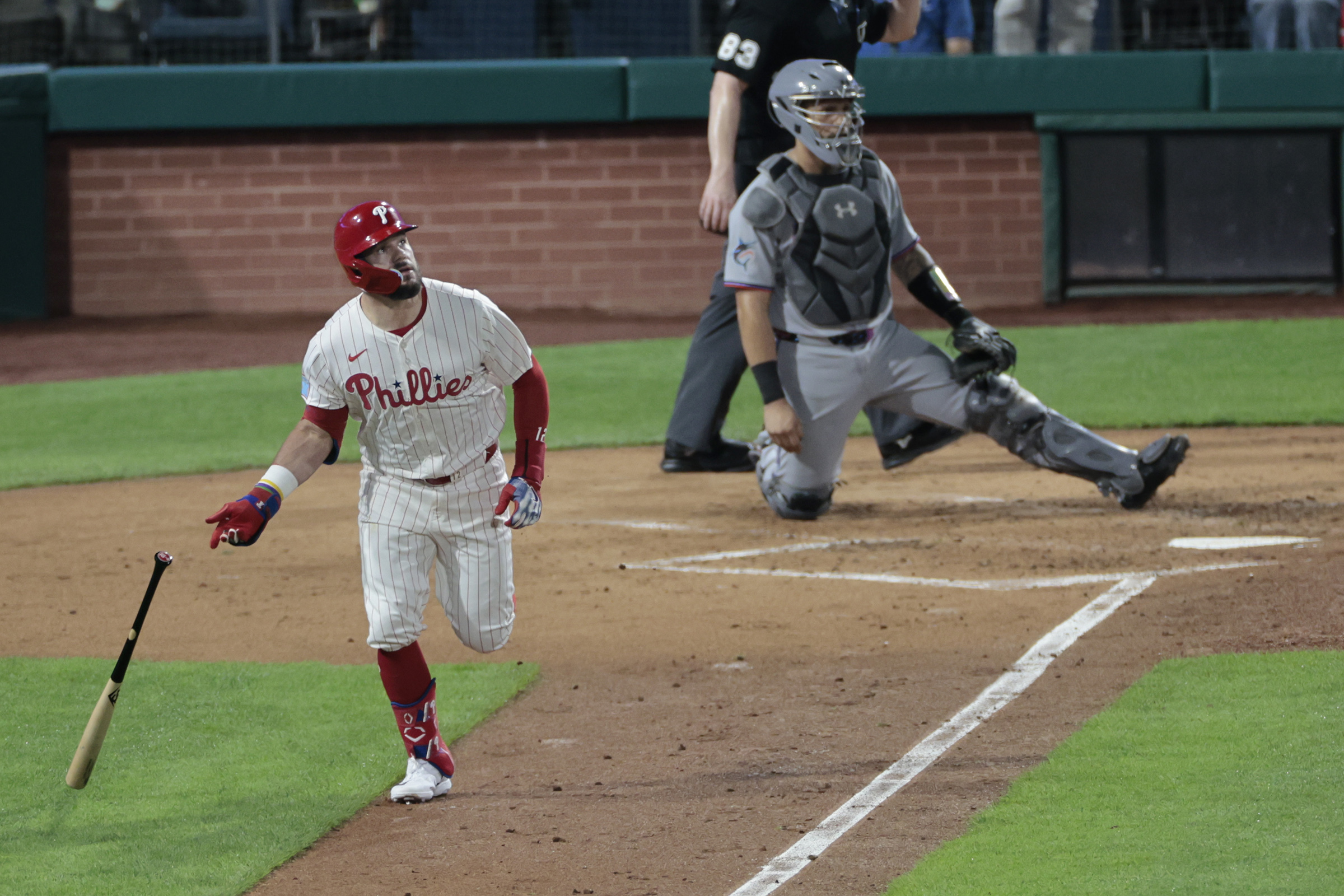
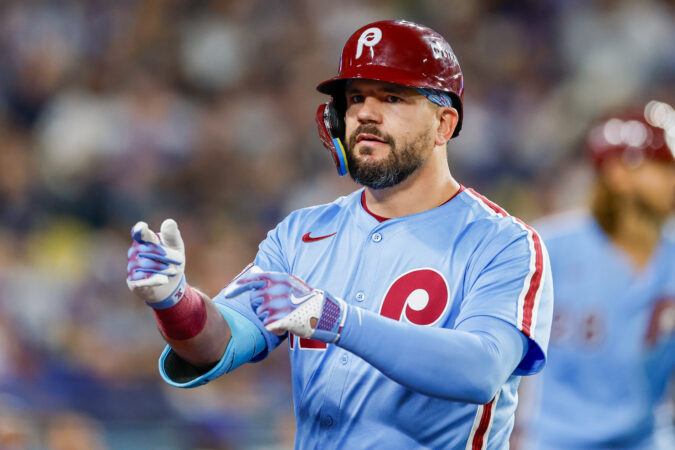
    Kyle Schwarber will enter his age-33 season coming off a 56-homer campaign in 2025.

    You can argue that Naylor barely qualifies as a slugger, with 88 home runs over the last four seasons. Whatever the semantics, he clearly is in a different power class. But there is some comparability here. Naylor’s 124 OPS+ from 2022 to 2025 is in a similar tier to Schwarber’s 134. He is also four years younger than Schwarber and has a good glove at first base.

    The logic goes something like this: The same types of teams that would have interest in a hitter like Schwarber probably would have interest in a hitter like Naylor. If Naylor had signed for six years and $120 million or five years and $110 million, we might be sitting here wondering if it really would be wise for the Phillies to shell out the stupid money it would take to retain Schwarber. The answer probably still would be yes. But it’s nice not to have to consider it.

    It’s fair to assume that the market will look as it has the past several seasons. There is a pretty hard limit on the amount teams are willing to spend on players who don’t add significant value on defense. Besides Juan Soto, the only hitters to sign for more than $95 million over the last three offseasons have played shortstop, center field, or starting pitcher (Shohei Ohtani). The last first baseman or designated hitter to sign for more than five years and $100 million was Freddie Freeman, who landed six years and $162 million from the Dodgers in 2022.

    Schwarber can — and should — argue that he is a different case. A typical designated hitter doesn’t finish second in MVP voting. Schwarber’s power and consistency are transcendent enough to disregard positional archetypes. The only hitter with more home runs than his 187 over the last four seasons is Aaron Judge (210). He, Judge, and Ohtani (also at 187) stand alone. In terms of impact on a contender, Schwarber is much closer to Freeman than he is to Naylor. Six years and $150 million is a defensible ask.

    The Phillies can argue that Schwarber’s age and positional limitations are legitimate factors. Just look at Pete Alonso, who is pretty close to a carbon copy of Schwarber at the plate. The Mets’ first baseman had to settle for a two-year, $54 million contract last offseason. Not only that, Alonso is on the market again after opting out of his deal. Or, consider Teoscar Hernández, who signed with the Dodgers for three years and $69 million last year. Schwarber is better than Hernández. But is he better than two Hernándezes? For the Phillies, four years and $100 million is a justifiable offer.

    Hopefully, we’re just waiting for the two sides to split the difference. Five years and $125 million would be a steep price to pay to lock up the designated hitter position through Schwarber’s age-37 season. But then, Schwarber will be bigger than a 37-year-old designated hitter when that time comes. He will be one of the defining players of an era, one of the franchise’s all-time greats, a fixture in the community and a potential Hall of Famer. He may have passed Howard for second on the franchise home run list. He may be closing in on 500 for his career.

    Can the Phillies afford to sign Schwarber?

    The better question is whether they can afford not to.
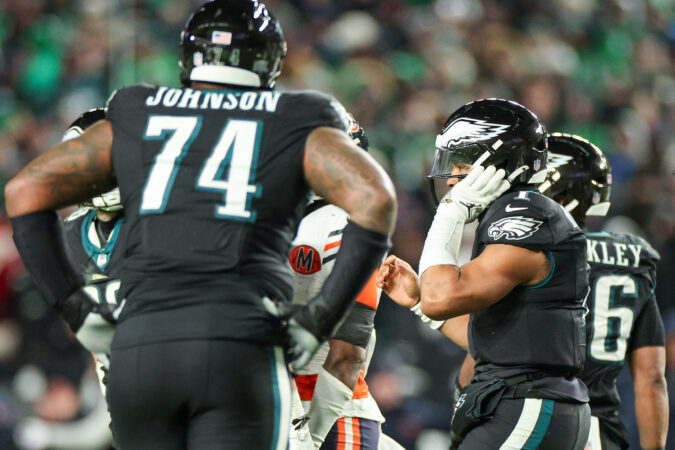
  • An alternate history of 2023, and why the Eagles are preaching the right message

    An alternate history of 2023, and why the Eagles are preaching the right message

    The biggest risk to the Eagles right now is overcorrection. There’s an alternate history to their 2023 collapse that they should consider before making any drastic changes.

    The setup is mostly the same as the one we all know well. A team fresh off a Super Bowl berth arrives in November looking like a good bet to again win its conference. But after a 7-2 start, the hubcaps start to rattle. The team loses four of the next six games, failing to crack 20 points in all four. Questions begin to swirl about its first-year offensive coordinator. The head coach stands by his man. The team finishes the regular season 11-6 and will likely need to win two games on the road in order to get back to the Super Bowl.

    In truth, this isn’t an alternate history at all. It’s the actual history of the 2023 Chiefs. The drop-off from the season before was massive on the offensive side of the football. Kansas City scored 125 fewer points in 2023 than it did in 2022, when it beat the Eagles in the Super Bowl. The Chiefs’ average yards per play fell from 6.43 to 5.54. And it really hasn’t rebounded. Since the start of the 2023 regular season, the Chiefs have averaged 23.1 points and 348.7 yards per game, down from 28.7 and 405.2 in 2021-22.

    But the Chiefs won the Super Bowl in 2023 despite entering the playoffs having lost four of their last eight to finish 11-6. They beat the Bills and Ravens on the road, thanks in large part to a late missed field goal in Buffalo and two fourth-quarter turnovers inside the Chiefs 25-yard line by Baltimore.

    Are there lessons for the Eagles to draw here? I don’t know. Lessons probably isn’t the right word. I’m not going to sit here and argue that people are overreacting to the mess that they’ve seen from Jalen Hurts, Kevin Patullo and Co., most acutely over the last three weeks. But I do think it can be detrimental if we fail to consider the Eagles’ struggles within the appropriate context.

    Walking around the locker room after the Eagles’ 24-15 loss to the Bears on Black Friday, I heard several players use the same phrase.

    Center Cam Jurgens: “We’re 8-4. The sky’s still above us.”

    Running back Saquon Barkley: “The sky’s falling outside the locker room, but I have nothing but the utmost confidence in the men in this locker room, players and coaches included.”

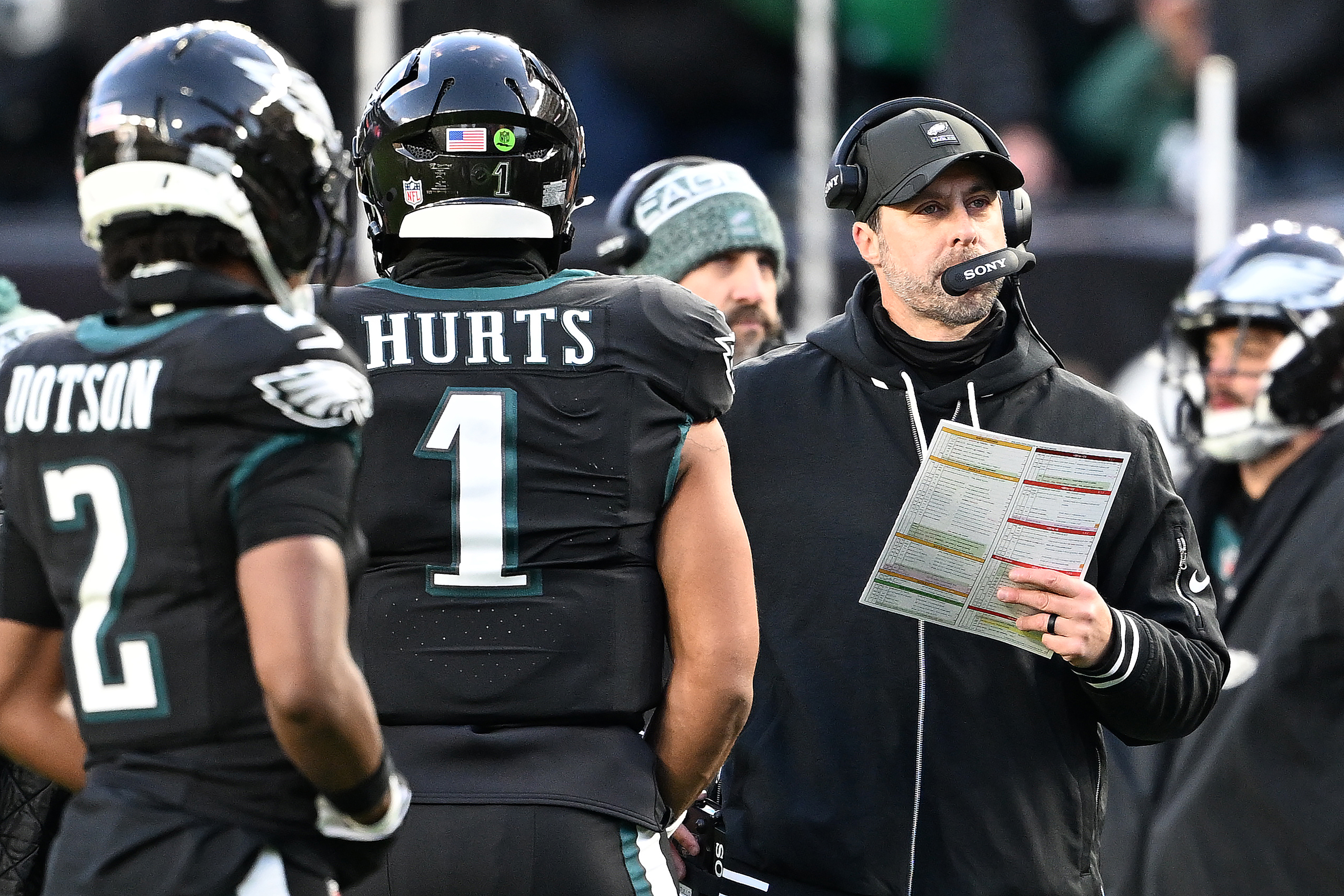
    Eagles offensive coordinator Kevin Patullo with Jalen Hurts and Jahan Dotson during the loss to the Bears.

    The remainder of the season will be determined by whether the Eagles can internalize all of this talk. They are correct when they say that the situation inside the locker room is not nearly as dire as the angst that abounds outside those walls. They still have three games remaining against the Raiders and the Commanders. That should get them to 11 wins, bare minimum. That would leave the Cowboys needing to win out in order to steal the division from them. The Eagles will tell you that they aren’t thinking about these things. Such is the NFL’s this-game-is-the-only-game ethos. But, sometimes, it can be helpful to take a little peek down the road, if only to remind yourself that you aren’t standing on the edge of a cliff.

    The Eagles play in an environment that can make it awfully tough to maintain perspective. The Birds are an all-consuming thing here. Questions, headlines, boos, all of them multiply. There comes a point when any human being will stop and wonder whether everybody else is right.

    There is a long list of reasons why it makes little sense to compare the Eagles’ current straits to the ones that led to the 2023 collapse. The one similarity is the way the chicken can become the egg and snowball into a big scrambled mess. The prime mover of the Eagles’ dysfunction that season wasn’t Hurts or Brian Johnson or Nick Sirianni or some chemical imbalance within the locker room. It was a defense that couldn’t get a stop, a defense that was of a wildly different makeup than it is right now.

    It’s funny to look back to the numbers from that season. The Eagles’ NFL rankings in yards and points in 2023 were exactly what they were in 2024: seventh in points, eighth in yards. They scored 31 points in a loss to the Cardinals down the stretch in 2023.

    The worst thing the Eagles can do is hold on to any sort of thought that the foundation of their collapse in 2023 lies within themselves. The dysfunction grew from the on-field struggles, not vice versa. Yes, that dysfunction eventually reached a point when it became self-fulfilling. But the Eagles allowed it to get to that point. The Chiefs of 2023 did not.

    The reality of the NFL is that good teams struggle. It is a counterpunchers league, led by a bunch of maniac coaches who won’t rest until they figure out what you are doing and how to beat it. Andy Reid did not suddenly become a worse offensive coach over the last three seasons. Patrick Mahomes is still the same Patrick Mahomes who threw for 5,250 yards in 2022. Nobody in Kansas City or elsewhere is seriously questioning whether one of them is the problem.

    The Eagles made it look easy last year. But last year was an anomaly. The competitive environment this season is much closer to the norm. The Eagles are still one of the two teams in the NFC most capable of making the Super Bowl. In the Rams, they have already beaten the one team that looks better than everybody else.

    The message that Sirianni and his team have been preaching is the right one. They just need to keep believing it.

  • Dave Dombrowski’s biggest offseason headache? The bullpen, not the Phillies’ lineup.

    Dave Dombrowski’s biggest offseason headache? The bullpen, not the Phillies’ lineup.

    The lack of hand-wringing about the Phillies bullpen this offseason isn’t too surprising. By the time everyone finishes worrying about the offense, their palms are raw. Nearly half of the starting lineup from Game 1 of the NLDS is no longer under contract. They need to re-sign or replace their catcher, left fielder, center fielder, and designated hitter. The guy who was their longtime right fielder is a $20 million sunk cost. Other than that, the bats are looking great.

    But, hey, save some angst for the later innings. Dave Dombrowski has 99 problems and a pitcher is one … namely, a pitcher who is capable of locking down high-leverage situations. Even if Jhoan Duran is the guy he has been throughout his career, and if Matt Strahm is the guy he has been during the last three regular seasons, if Jose Alvarado is the guy he was in 2022-23, the Phillies will still need a fourth guy who is better than Orion Kerkering was even before he short-circuited in Game 4 of the NLDS loss to the Dodgers.

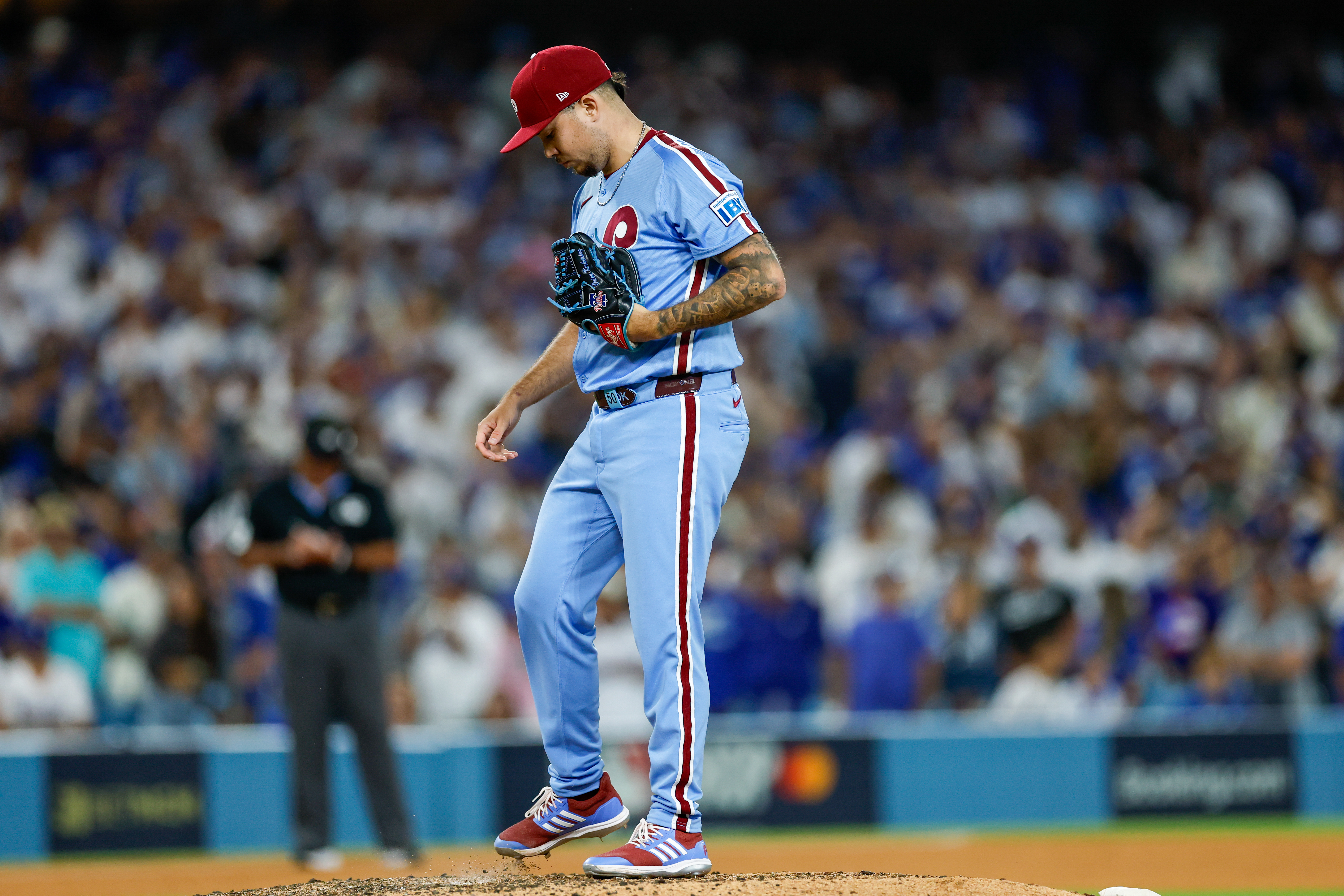
    Phillies pitcher Orion Kerkering posted a 3.30 ERA in 2025.

    That’s true whether Dombrowski realizes it or not. You’d think he would by this point in time. But, then, you’d be thinking. Everyone knows the cliche. Doing the same thing over and over is the definition of Dombrowski’s bullpen plan. As the nation at large celebrates the 250th anniversary of the signing of the Declaration of Independence, there’s a very good chance that the Phillies will be celebrating the 250th anniversary of realizing they need another reliever six days after the season starts. The Masters isn’t the month of April’s only tradition unlike any other.

    It’s getting to the point of mathematical certainty. If ’n’ is the number of high-leverage arms the Phillies need in order to win a postseason series, then ’n-1’ is the number of such arms the Phillies actually have. Feel free to alert the Fields Medal committee.

    Look at the list of relievers who have pitched make-or-break innings for the Phillies over the last several postseasons.

    Craig Kimbrel? The Phillies probably win a World Series if they have an elite shutdown arm to pitch the ninth inning of Game 3 and/or the eighth inning of Game 4 in the 2023 NLCS.

    David Robertson? He faced three batters last postseason, all in Game 1 of the NLDS, two of whom scored.

    Jordan Romano? Nope. Just kidding. He didn’t pitch a make-or-break inning in the postseason. Actually, he didn’t pitch any innings.

    Jesús Luzardo? He was exactly what the Phillies needed out of the bullpen in the 10th and 11th innings of Game 4 against the Dodgers. There was only one problem. He was their No. 2 starter. And he will be again.

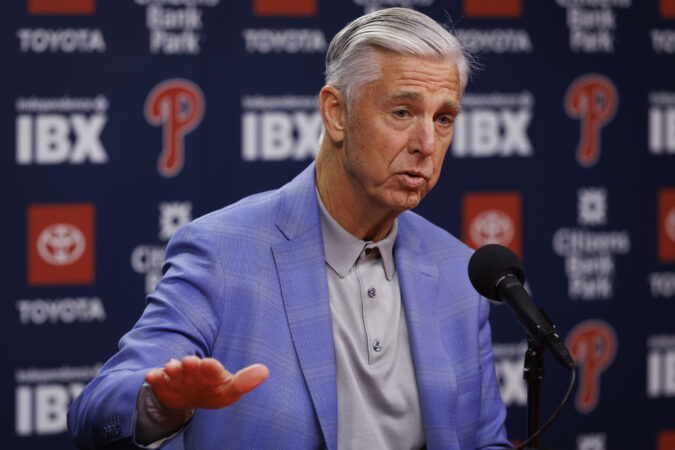
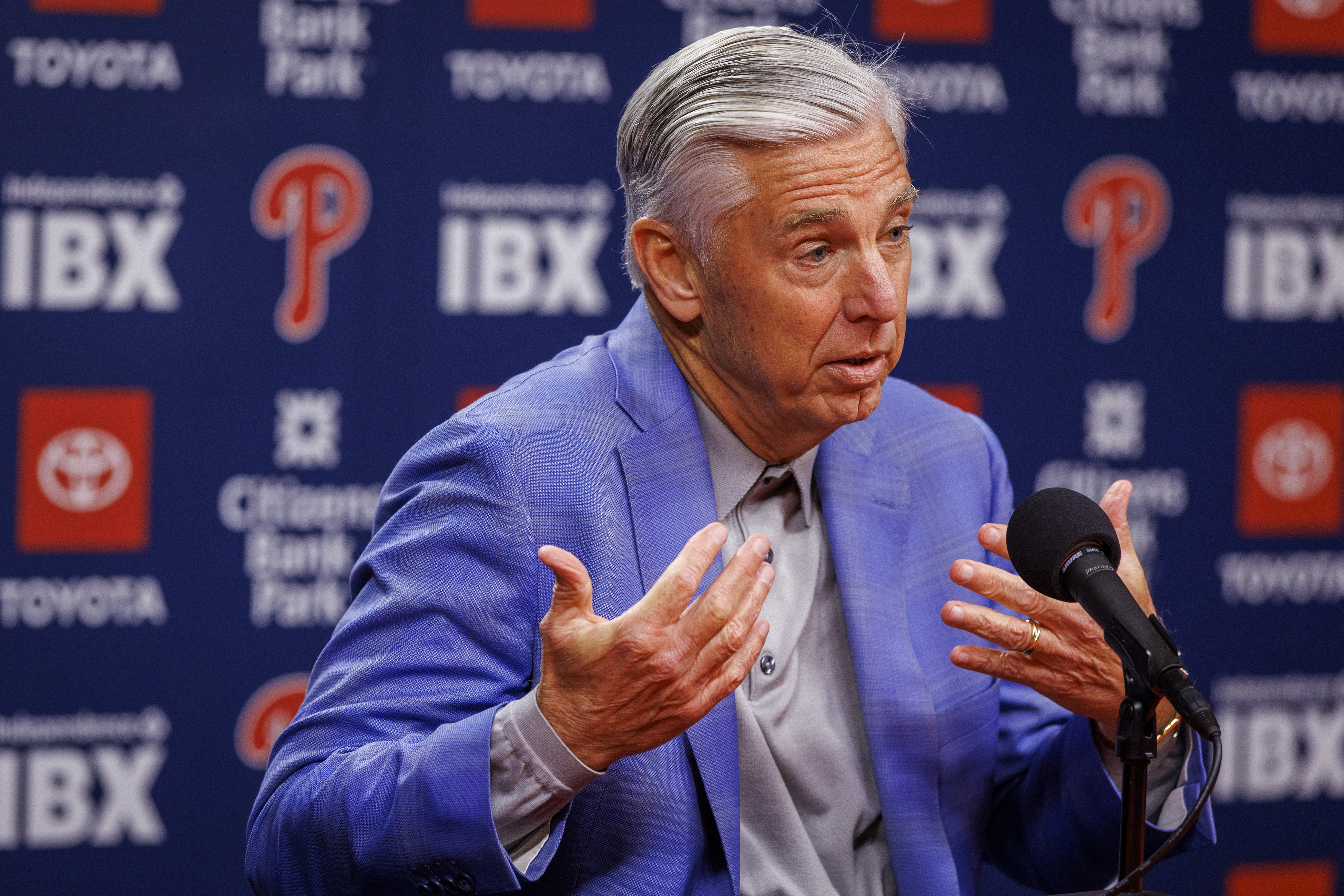
    Phillies president of baseball operations David Dombrowski is tasked with building the Phillies’ bullpen.

    Nobody wants to admit this, but the best way to fix the Phillies offense is to build a roster where the offense doesn’t need to matter so much. It’s easy to forget that the Phillies took a 1-0 lead over the Mets into the eighth inning of Game 1 of the 2024 NLDS before Jeff Hoffman and Strahm combined to allow five runs in the eighth. As lopsided as that series felt in hindsight, the Phillies were two shutdown innings away from potentially heading to New York with a 2-0 series lead. They also blew a 1-0 lead when the bullpen allowed four runs in the bottom of the sixth in Game 4.

    Bryce Harper and Trea Turner are fast approaching the points of their careers where the next season probably won’t be as good as the previous one. Same goes for Kyle Schwarber, assuming the Phillies re-sign him. J.T. Realmuto is already there, and re-signing him is still their best option at catcher. At some point, building an elite bullpen becomes a more feasible option than counting on a Max Kepler bounce back season.

    Unless we assume that John Middleton is going to bump up his spending to the level of the Dodgers, then we’re wasting our breath arguing that what the Phillies really need is Kyle Tucker or Alex Bregman or Pete Alonso. It would be a silly thing to assume. If you are worth $2 billion, then a $100 million contract is 5% of your net worth. Even us common folk aren’t lighting our cigars with $1,000 dollar bills.

    Which brings us to the real issue with the Phillies’ bullpen. You have to squint a lot harder to see a fiscally sound path to improvement. The Orioles just signed closer Ryan Helsley to a two-year, $28 million deal after a lackluster campaign. Braves closer Raisel Iglesias took a big step backward last season and will be 36 years old next year. He just re-signed for one year and $16 million.

    Chances are, both of those deals will look awful a year from now. Look at last year’s market. Of the 12 relievers who signed for an AAV of $8.5-plus million, seven finished with an ERA north of 4.30, five of whom had an ERA over 5.00. That group doesn’t include the Mets’ A.J. Minter, who pitched only nine innings after signing for two years and $22 million.

    Essentially, the success rate on big-ticket bullpen signings was 33%. Even that is overstating things. The Dodgers spent a combined $39.9 million in AAV on Tanner Scott, Kirby Yates and Blake Teinen. The odds said that one of them should have panned out. But none of them did.

    Unless the Phillies are willing to shell out $20-plus million for Edwin Diaz, they’ll be fishing in treacherous waters. There are a lot more Jordan Romanos than Josh Haders, at pretty much every price point. Dombrowski has found value before with Strahm, Hoffman and Alvarado. He’ll need to do it again in order to win this offseason.

  • Friday’s loss to the Bears was the most concerning one of the Nick Sirianni era. Is it 2023 all over again?

    Friday’s loss to the Bears was the most concerning one of the Nick Sirianni era. Is it 2023 all over again?

    Over in the visitors’ locker room, the head coach had his shirt off. He was flexing and jumping and shouting and looking like a man who might soon be taken away by some folks in white gowns. Ben Johnson had every right to act a fool. He earned it. His team earned it. All anybody else could do was shrug.

    “We’ve got great people in this team that I have a lot of faith and belief in,” Eagles tight end Dallas Goedert said after a disconcertingly definitive 24-15 loss to the Chicago Bears. “I think we still have everything we want ahead of us.”

    It is getting harder for those of us outside the locker room to share in that belief. The Bears didn’t just beat the Eagles on Friday evening. They shook them to their core. They walked into Lincoln Financial Field on the day after Thanksgiving as a seven-point underdog with a rookie head coach and a second-year quarterback who might not be good and they walked out with a win that lifted them to the second-best record in the NFC and dealt a serious blow to the Eagles’ hopes of landing the conference’s top playoff seed.

    The Bears will frame it as a statement victory. It felt more like a statement loss by the Eagles. They lost an important game in tough conditions against an opponent that entered the day having earned none of the benefit of the doubt. In short, the Eagles did exactly the opposite of what they had done, almost without exception, over their previous 32 games. They made it very clear that they were not the better team.

    That’s a remarkable thing to write, considering the circumstances. The Bears entered the day with an 8-3 record that couldn’t be taken seriously. They’d played the second-easiest schedule in the NFL, the easiest in the NFC by far, with six of their eight wins coming against teams that ranked among the 12 worst in point differential. The other two victories came against winning teams who barely qualified as such: the 6-5-1 Dallas Cowboys and the 6-5 Pittsburgh Steelers. In fact, until Friday, the Bears had been outscored on the season.

    “The sky is falling outside the locker room, we understand that, but I have nothing but confidence in the men in this locker room, players and coaches included,” said running back Saquon Barkley, who finished with 56 yards on 13 carries and has now gained 60 or fewer yards in nine of 12 games on the season. “It’s going to take all of us to come together, block out the noise.”

    Until Friday, we could err on the side of nodding along to such sentiments. All season, as the Eagles have struggled to replicate last year’s dominance, they’ve insisted that their Super Bowl blowout of the Kansas City Chiefs was an exorcism of the demons of 2023. They swore they were a different team. They’d learned their lessons. Plus, they had an actual defense.

    Neither of those things was evident against the Bears.

    They allowed 281 rushing yards, their most since 2015 and the third-most in the last 50 years. They lost the turnover battle, in a fashion meek and mild, a fumble on a Tush Push and an ugly interception, both at the hands of the quarterback. Neither could be written off as the unfortunate byproducts of a warrior mindset.

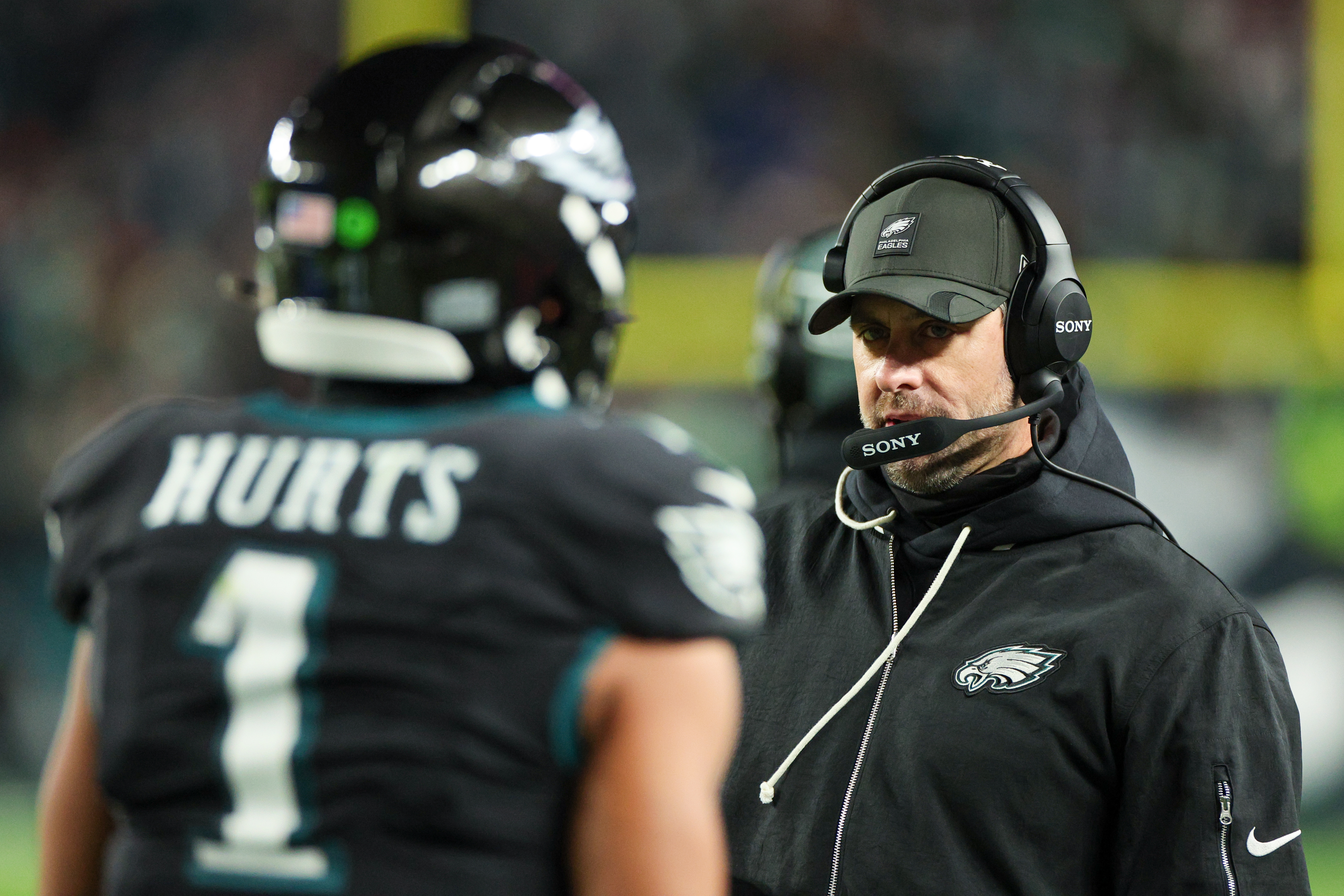
    Eagles offensive coordinator Kevin Patullo and quarterback Jalen Hurts have failed to inspire confidence for much of the season.

    Every quarterback has bad days. Where they differ is in their energy. Some quarterbacks are maddening, some erratic, some just plain dumb. Hurts at his worst looks listless. A nonfactor. Completely uncompetitive.

    His coaches look that way, too. For most of the last month, Nick Sirianni and Kevin Patullo have looked like video game players who suddenly move the difficulty slider from All-Pro to All-Madden. Again, the computer won handily. The issue isn’t a lack of improvement. It’s that things are getting worse.

    “It was both units, offense, defense, hats off to them,” Eagles coach Nick Sirianni said. “They played a good game; they coached a good game. They outcoached us; they outplayed us. That’s obviously something that I need to go through and watch, look through it, but to say I don’t want to — again, they ran for however many yards. We didn’t run for many yards. We lost the turnover battle. We lost the explosive play battle. All those things are going to dictate the win and loss.”

    They didn’t just lose. They are at a loss. No answers. No ideas, even. This was the most concerning game of the Sirianni era, and it isn’t particularly close. Sure, 2023 was ugly. But at least it hadn’t happened before. The three scariest words in the world are “here we go again.”

    If this Eagles season ends up where it is currently heading, the faces of the Bears will be the last thing they see on their final swirl around the toilet bowl. This was the kind of loss that can break a team through what it reveals. Until now, they’ve maintained an air of invincibility, a belief in the virtue of winning ugly. While the latter may be true, the Eagles looked entirely vincible on Black Friday.

    They could write off their loss to the Denver Broncos as a game they should have won. Their loss to the New York Giants was a Thursday night fluke. After their loss to the Cowboys last week, they could cling to their one great quarter.

    Their loss to the Bears? It felt like a culmination to all of that. The end of their suspension of disbelief. They are back in the same place they were when it all went up in flames. Talk has sufficed until now. Adversity is easy in its hypothetical form. Now, the Eagles must actually show us what they are made of.

  • Fear factors: Ranking the Eagles’ road to the Super Bowl, from the real Rams to the fraud Bears

    Fear factors: Ranking the Eagles’ road to the Super Bowl, from the real Rams to the fraud Bears

    It’s a weird year in the NFL. Each of the traditional powers is missing something. Everything we fret about with the Eagles are worries in Kansas City and Buffalo.

    The Chargers have failed to take the next step. The Lions and Ravens might miss the playoffs. Brock Purdy just threw three interceptions against the Panthers. Drake Maye is a great quarterback. Do the Patriots really have a great roster?

    Something to be thankful for: Nobody else is great, either.

    We’ll see that on Friday, when the Eagles host the Bears. Chicago is among the more fraudulent 8-3 teams we’ve seen.

    Here is a look at all of the NFC teams that matter more than the Bears.

    1. Rams (9-2)

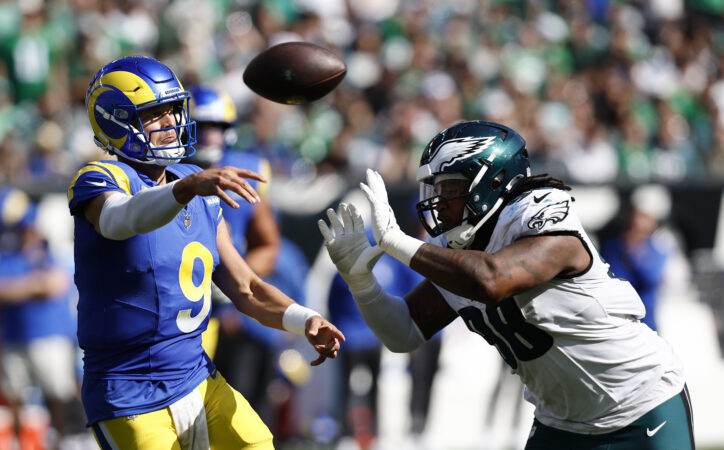
    It sure feels like 2025 is setting up for a Rams-Eagles NFC championship game that could launch an era-defining rivalry. The only thing missing right now is a big Rams win. The Eagles have beaten them four times over the last three seasons after initially replacing them as NFC champs in the 2022 season. But the Rams have walked away from the last two outings feeling like the Eagles’ equals if not betters.

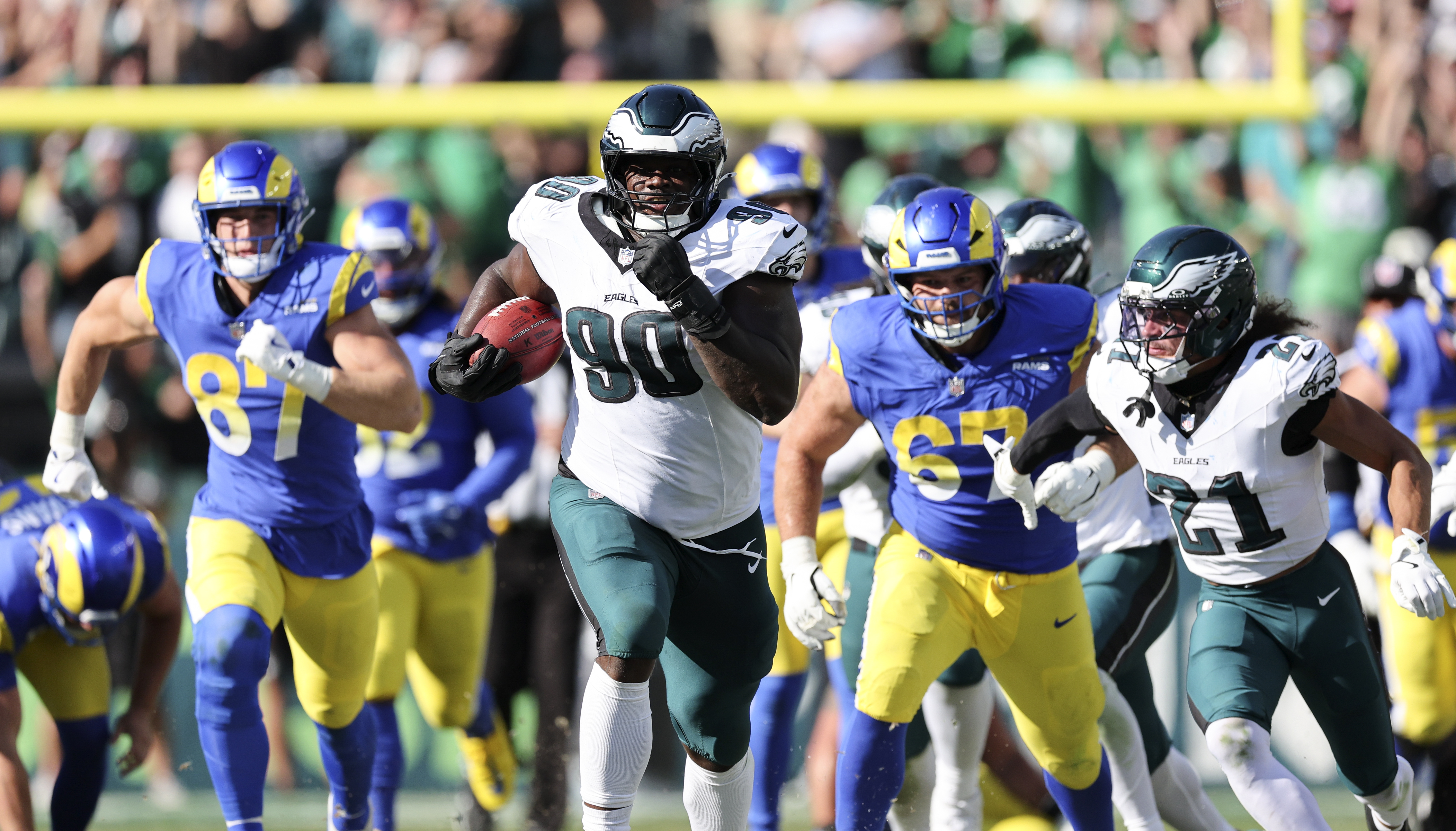
    First came that snowy 28-22 playoff loss when the Rams gave away six points on fumbles and still had a first down on the Eagles’ 21-yard line with 1 minute, 25 seconds remaining and a chance for a go-ahead touchdown. Then came Week 3, when L.A. blew a 26-7 lead and still had a shot at a game-winning 44-yard field goal with three seconds left only to have Jordan Davis block it and score a touchdown to boot.

    The Rams are due. Sean McVay is too good of a coach, Matthew Stafford too good of a quarterback, and Les Snead too good of an executive to not eventually announce it to the rest of the world. What they’ve done in the four years since they won the Super Bowl is every bit as impressive as the mini-dynasty that Nick Sirianni, Jalen Hurts, and Howie Roseman have put together.

    Eagles defensive tackle Jordan Davis brought the last meeting with the Rams to a thrilling end with his touchdown.

    Snead and McVay have orchestrated an incredible turnaround on par with the Eagles post-2017. Stafford is one of only four players remaining on either side of the football who played at least 20% of the offensive snaps in 2021, when the Rams won the Super Bowl (The others: OT Rob Havenstein, TE Tyler Higbee, CB Darious Williams). They exited their Super Bowl with a bloated cap sheet and just one first-round pick between 2017 and ’25. Now, suddenly, they are the most impressive team in the NFL. The only impressive team, arguably, along with maybe the Colts. Since losing to the Eagles, their only loss was in overtime to the division rival 49ers (more on them later). They’ve beaten the Colts, the Ravens, the Jaguars, the 49ers, the Seahawks, and the Bucs. Of their six straight wins, five have been by at least two touchdowns. Of their nine overall wins, seven have come against teams whose Super Bowl odds rank in the top half of the NFL.

    2. Detroit Lions (7-4)

    The eye test says Detroit is a team nobody should want to face, particularly at home. But they wouldn’t even make the playoffs if they started today. And they would need to overcome some considerable odds if they hadn’t pulled out an overtime win over the Giants on Sunday. The Lions’ last six games are all losable: on the road against the Rams, Vikings, and Bears; at home against Green Bay, Dallas, and Pittsburgh.

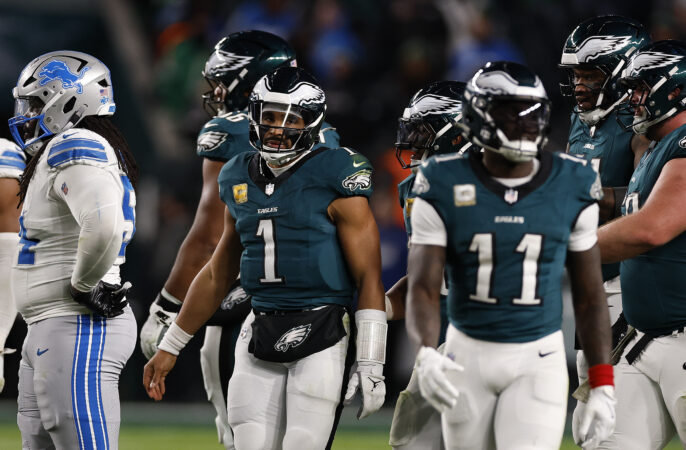
    Don’t get it twisted. They are a serious threat, one of two teams in the NFC who would have a strong argument to make to be favored over the Eagles in a playoff game at home. That’s a long shot to happen, given the tiebreaker the Eagles hold. But the Lions’ 16-9 loss at Lincoln Financial Field in Week 11 didn’t exactly establish them as the definitive favorites even at home.

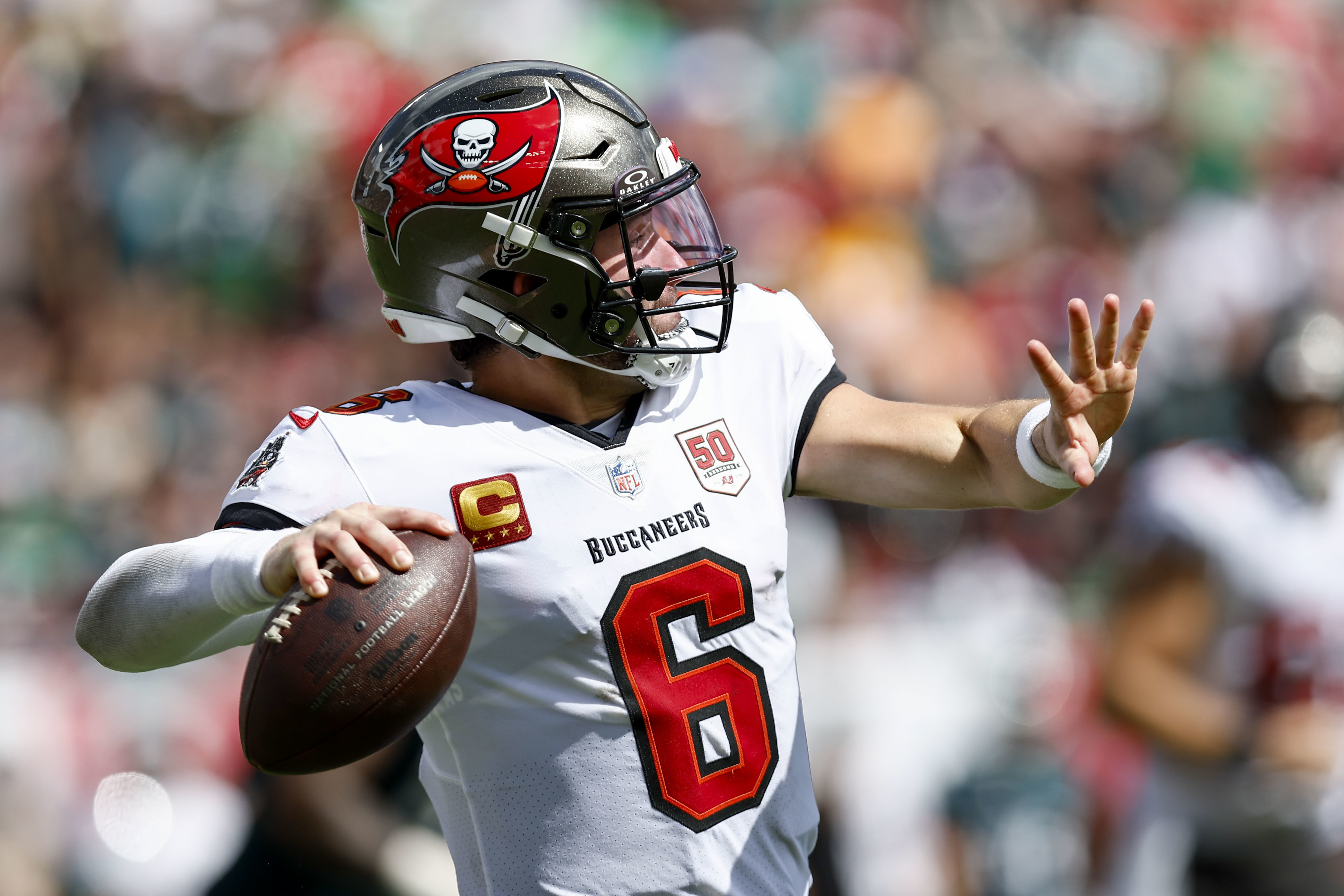
    Baker Mayfield and the Bucs have a soft schedule ahead.

    3. Buccaneers (6-5)

    Tampa Bay has one of the easiest remaining schedules in the NFL. Arizona, New Orleans, Atlanta, Miami, and Carolina twice. Find me two losses among those, assuming Baker Mayfield starts at quarterback. Even if Mayfield misses a week or two with his sprained nonthrowing shoulder, the Bucs should be able to finish atop the putrid NFC South. That means they have six weeks to get Mayfield and Chris Godwin healthy. Which means they could easily be a threat once the playoffs arrive.

    4. 49ers (8-4)

    Surprised? You shouldn’t be. Like I said, the field is weird this year. Who else would you put ahead of San Francisco? The Eagles are the only legitimate contender of the NFC’s three-loss teams. They already beat Green Bay on the road. Seattle is quarterbacked by Sam Darnold and will be playing as a wild card with the Rams winning the division. The Bears are the fakest of them all. You’ll see that on Friday.

    The 49ers? They are faker than they usually are. The Fred Warner injury — out for the season — was the final deal-breaker. They sorely miss Deebo Samuel and Brandon Aiyuk on the offensive side. San Francisco is only a threat to the Eagles if the Eagles turn out to be the team they’ve looked to be over the last several weeks. That team is capable of losing to anybody with a competent quarterback and a great head coach.

    5. Cowboys (5-5-1)

    This is not recency bias. The Cowboys would be second on this list if you could guarantee me that they would make the postseason. As it stands now, they will probably need to win two out of three against the Chiefs (home), Lions (road), and Chargers (home) just to have a reasonable chance of qualifying for the postseason. And that’s assuming they beat the Vikings, Commanders, and Giants.

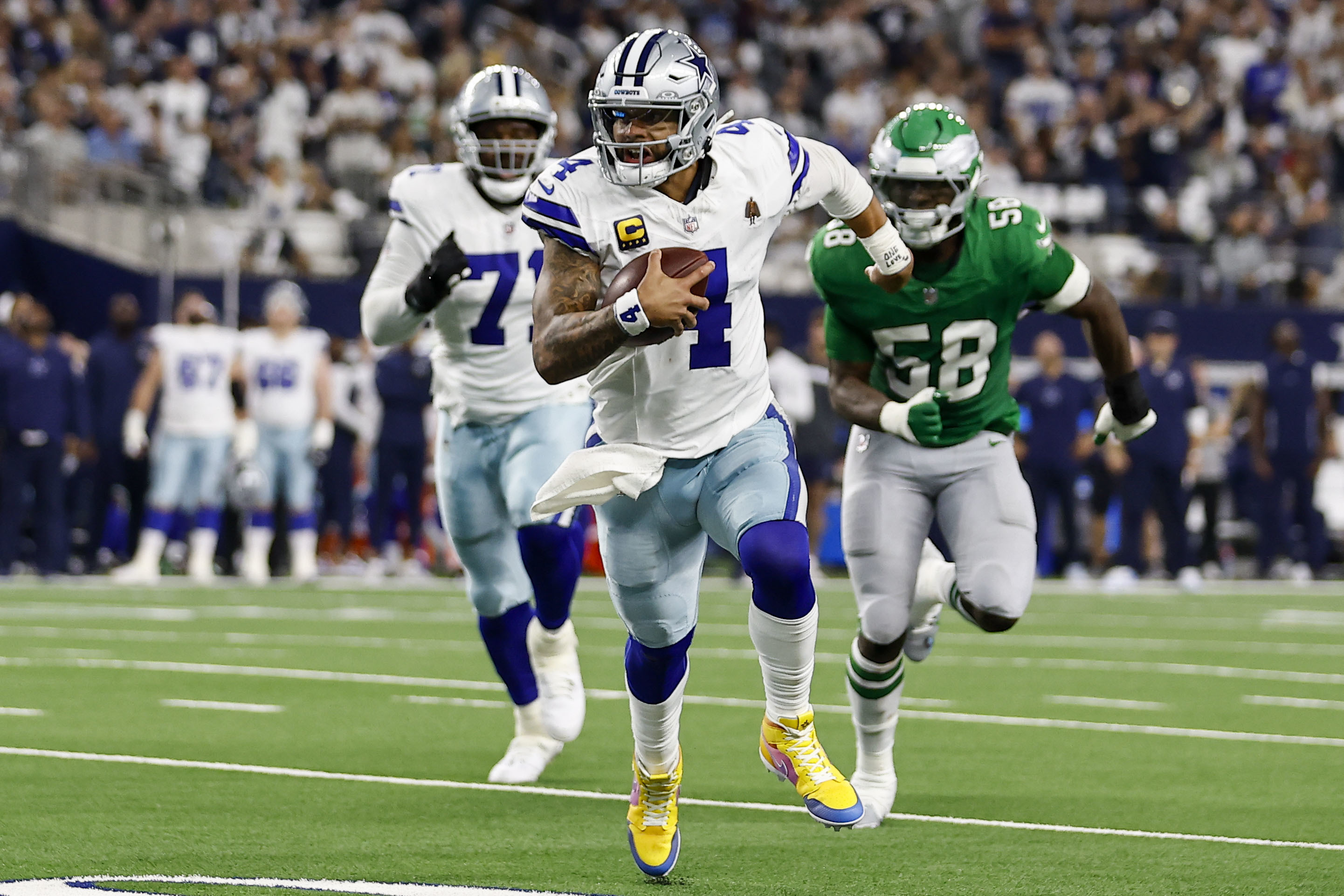
    Cowboys quarterback Dak Prescott running for a touchdown in the fourth quarter against the Eagles.

    That being said …

    If all of that happens, then we’d be foolish to consider the Eagles as anything better than a coin flip in a playoff game against the Cowboys, whether at home or on the road. Dallas has outplayed them even this season, once in a game the Eagles should have lost and, more recently, in a game the Eagles should have won. In both games this season, the Eagles have struggled to find an answer for CeeDee Lamb and George Pickens. Dak Prescott is playing at a near-MVP level and gives the Cowboys the advantage at quarterback. Mostly, this is a referendum on the rest of the NFC.

    6. Seahawks (8-3)

    Look, Darnold has been better than anybody could have envisioned after the Jets drafted him at No. 3 overall. But he is still the biggest reason to doubt that Seattle has been anything more than the beneficiary of a light schedule. The Seahawks’ best wins have come on the road in Pittsburgh in Week 2 and on the road in Jacksonville in Week 6. It’s definitely worth something that they put up 414 yards of total offense and nearly beat the Rams despite Darnold throwing four interceptions. But, then, Darnold threw four interceptions.

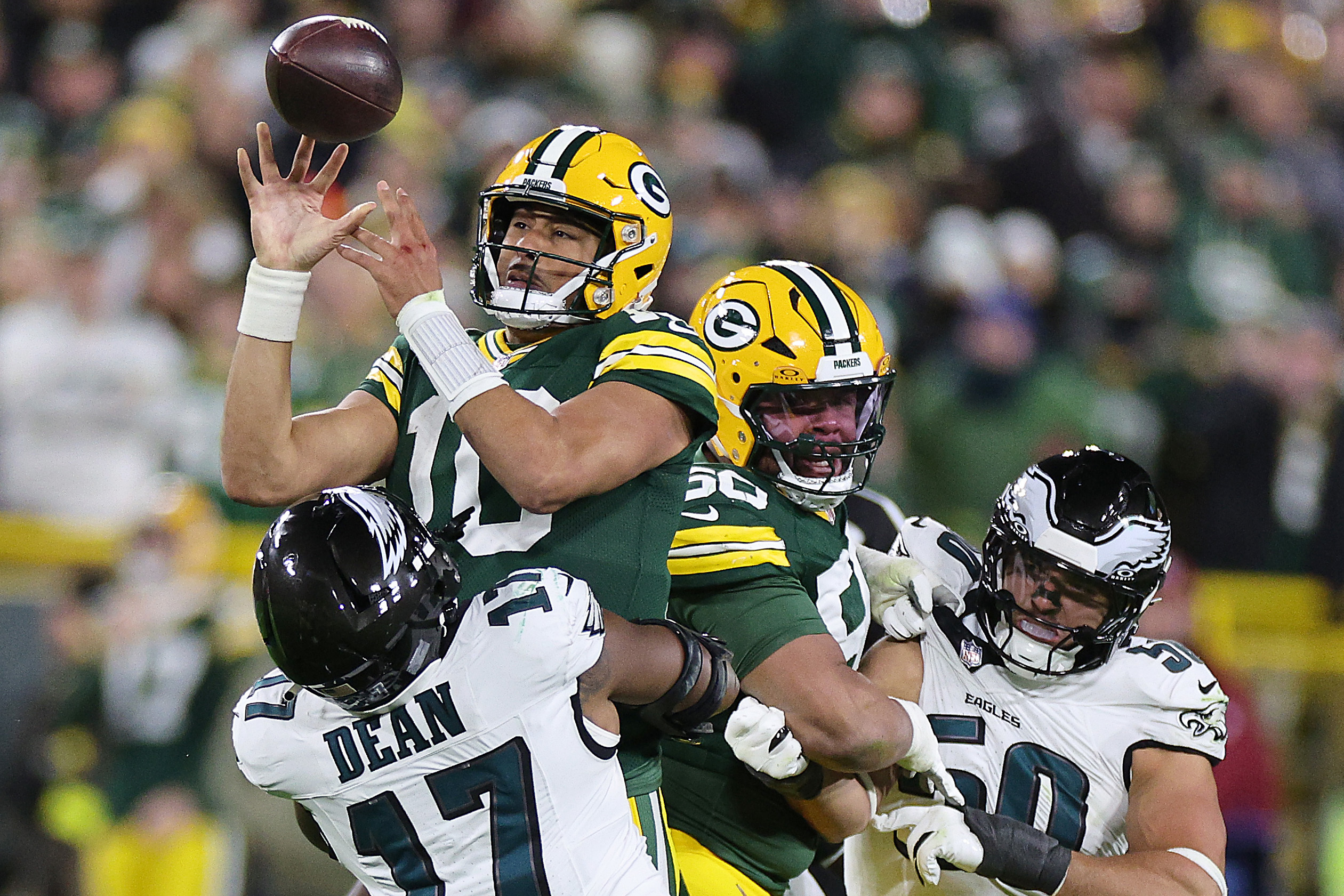
    Eagles linebacker Nakobe Dean forcing a fumble by Packers quarterback Jordan Love on Nov. 10.

    7. Packers (7-3-1)

    Jordan Love is the most overrated quarterback in the NFL, and Matt LaFleur might be the most overrated play-caller. Not a good combination. The Eagles already beat Green Bay at Lambeau Field on a night when a better team would have beaten them. No worries here.

    8. Bears (8-3)

    For whatever reason, I’ve watched more of the Bears this season than virtually any other team. At no point have they looked capable of beating even a semicompetent team. That holds true for some of the games that they’ve actually won. Caleb Williams is missing something. I think we will see that on Friday.

  • Nick Sirianni just gave Kevin Patullo a vote of confidence. He didn’t have a choice.

    Nick Sirianni just gave Kevin Patullo a vote of confidence. He didn’t have a choice.

    The worst thing the Eagles can do right now is the thing that everybody wants them to do. Nick Sirianni isn’t going to do it. He has said it all season and he said it again on Monday, even though he did not need to. You don’t make a change in play-calling duties after a late afternoon road game in the week of Thanksgiving when you are scheduled to play on Friday. Even if Sirianni was entertaining the idea of demoting offensive coordinator Kevin Patullo, doing it this week is almost a non-starter.

    But let’s be clear. He shouldn’t be entertaining such a move, short week or not. It doesn’t make sense on a practical level. It doesn’t make sense on a logistical level. And it certainly doesn’t make sense on an existential level, as the Eagles have seen before.

    “I feel like we’ve got the right people, as players, as coaches, that have had success, and we’re all searching for answers to make it more consistent,” Sirianni said Monday. “There’s some good things, there’s obviously some not so good things. We have to find the things that we can really hang our hat on and the complements that come off that.”

    It matters not whether you believe him, or whether he believes himself. Whatever he or you or the players think of the job Patullo has done in his first 11 games calling plays, the important thing is that he is the one who has been doing it. It has been his voice over the headset. It has been his messaging in the meetings. From a command and control perspective alone, changing coordinators this late into a season would introduce a whole new list of things that could go wrong. But what really matters is the message such a move would send.

    Offensive coordinator Kevin Patullo “did a good job” of calling plays against the Cowboys, Eagles coach Nick Sirianni said.

    Sirianni and the Eagles say they learned a lot of lessons a couple of years ago when their 10-1 start to the 2023 season ended with six losses in their last seven games. The biggest of those lessons is the one that so many of us can’t seem to wrap our heads around. Firing a coordinator this late into a season can do more harm than good, however much he deserves the blame.

    We all remember how the movie ended in 2023, right? When the Eagles stripped defensive coordinator Sean Desai of his play-calling duties on Dec. 17, the circumstances were remarkably similar to now. They were coming off two of their ugliest outings of the season, the second of them a 33-13 loss to the Cowboys at Dallas. But they were 10-3, still very much in the running for the top seed in the NFC playoffs, and only a few weeks removed from back-to-back statement wins over the Kansas City Chiefs and the Buffalo Bills. The ship was hardly sinking. Then Capt. Matt Patricia took charge.

    There’s a strong argument to be made that the 2023 season ended the day they demoted Desai. Up until then, the Eagles still had the confidence and swagger of a defending conference champion. They were a good team going through a rough patch. There was no reason to think otherwise.

    By demoting Desai and replacing him with Patricia, the Eagles made an unprompted announcement that things at One NovaCare Way were more dire than they seemed. From that point on, every week brought more dysfunction.

    Sirianni barely survived the fallout. It took him until last February to finally shake off the last of the weakness.

    The Eagles demoted defensive coordinator Sean Desai during the disastrous finish to their 2023 season.

    The kicker, of course, is that the defense didn’t get better. In Patricia’s first week on the job, the Eagles allowed a touchdown pass with 28 seconds left to lose a game to the Seattle Seahawks that they’d led throughout. The next week, they allowed 25 points to Tommy DeVito, Tyrod Taylor, and the Giants, with New York’s potential game-tying touchdown drive ending at the Eagles’ 26-yard line. After that, they lost a 35-31 shootout to an Arizona Cardinals team that hadn’t cracked 30 points all season.

    Demoting Patullo has even less potential upside. Anybody who would replace him is already in the building. That person would almost certainly try to do things the same way the Eagles have been doing them throughout Sirianni’s tenure as coach. Kellen Moore didn’t take the secret recipe box with him to New Orleans. He just happened to be calling plays with an offensive line that was averaging 6 yards per carry.

    Sirianni will get some ridicule for his messaging during Monday’s news conference. The worst thing you can tell an emotionally unstable Eagles fan is that everything is well.

    The head coach didn’t even go that far. He was asked if he’d considered making a change in play-calling duties. He answered definitively.

    “No, I haven’t,” Sirianni said. “Again, I think that we’re always looking for answers, as coaches we’re always looking for answers and we’re never into assigning blame, it’s just looking for answers. … It’s every piece of the puzzle: coaching, playing, execution, scheme, everything … have to be better in all of those aspects. Yesterday, I thought Kevin did a good job of calling. Obviously, he’s going to want plays back just like every player and myself, we all want plays back. … It’s never in football one thing. So, no, I haven’t considered that.”

    Anybody who calls plays for this offense is going to face the same challenges as Patullo. The Eagles have an offensive line that is missing its best player in Lane Johnson and looks incapable of the same dominance it showed on the road to a Super Bowl last season. They have a quarterback who isn’t confident enough in his arm to make the sorts of throws that Dak Prescott was making into traffic on Sunday, when the Cowboys overcame a 21-point deficit and the Eagles offense stalled for three quarters of a 24-21 Dallas win. They have a superstar wide receiver who looked like a distant third behind George Pickens and CeeDee Lamb as the best receivers on the field. They have a superstar running back who doesn’t have the same burst he did last season.

    In order for Sirianni to make a change, he would need to be reasonably confident that things would get better. If not, things would get appreciably worse. Sirianni and the Eagles would be operating from a position of weakness for the duration of the season. The worst thing they can do right now is panic. We’ve seen how that sort of thing ends.

  • Eagles QB Jalen Hurts deserves criticism, but what are we arguing about?

    Eagles QB Jalen Hurts deserves criticism, but what are we arguing about?

    The arguments that go nowhere are usually the ones that have nowhere else to go. That’s especially true whenever the argument revolves around Jalen Hurts … which is pretty much every Sunday right now. Debating Hurts is like locking yourself in a clothes dryer. You spin around in circles a bunch of times and then walk away hot. It has always been that way with him, even when he was in college.

    A good question to ask yourself in these sorts of situations:

    What, specifically, are we arguing about?

    It’s a question everybody should be asking themselves now that we again find ourselves snowballing down the slippery slopes on Aggregation Mountain. We’ve apparently reached the point in the news — take — news cycle where everybody needs to register their opinion about Hurts. But, like, to what end?

    At plenty of points in time, a robust debate about Hurts has been warranted. Should Alabama bench him? Can Oklahoma contend for a title with him? Should the Eagles have drafted him in the second round? Should they start him over Carson Wentz? Can he win a Super Bowl? Should they give him a franchise-level extension?

    It’s worth noting that the answer to all of these questions has turned out to be an unqualified yes. Few athletes in history have as lengthy and unblemished a track record of exceeding the measuring sticks placed before him. Wherever his career goes from here, he will retire as one of the most unprecedented performers in football history.

    And yet …

    There Hurts was, on Wednesday afternoon, the quarterback of an 8-2 team, the reigning Super Bowl MVP, the leader of the NFL’s current betting favorite, the pitchman for one of sports’ most iconic brands, fielding another one of those questions that suggests something about him is still up for debate. Hurts was clearly aware of the tempest that had been whirling around his name in the wake of a couple of media reports that suggested a certain level of frustration with Hurts among some coaches and players.

    Eagles quarterback Jalen Hurts said Wednesday that work to fix the offense begins with him.

    “I’m not surprised by anything,” Hurts said, wearing a black compression shirt with the Jumpman logo on his right breast. “This is kind of the nature of the position.”

    The original reports themselves are rather oblique in nature. Longtime Philly insider Derrick Gunn reported that people in the Eagles organization feel like Hurts has been hurting the offense by playing “his game” rather than the one the game plan calls for. Meanwhile, The Athletic reported a frustration from players about Hurts’ reluctance to throw into tight windows against zone coverage.

    None of this news qualifies as earth-shaking. In fact, it barely qualifies as news. We know the Eagles are frustrated with their offense. Left tackle Jordan Mailata recently labeled it “stuck-in-the-mud.” Wide receiver A.J. Brown has made it very clear he is frustrated that he isn’t getting the football. Likewise, Hurts has very clearly struggled. When he struggles, he does so in a specific way. He is hesitant, indecisive, overly focused on the safest option, too willing to buy time with his feet and shifts the offense to scramble mode.

    That’s not a slight against the reports themselves. The notable thing isn’t the news. It’s that the news is being reported.

    My real focus here is everything that comes after the news. The TV segments, the sports radio calls, newspaper columns like this one, the hour-to-hour churn of the Sports Take Industrial Complex. Everybody has decided it is time to have an honest discussion about Hurts.

    The thing that most of these opinions ignore is that there is nothing much to discuss. Any time an offense plays the way the Eagles offense has for most of this season, the quarterback will help matters by playing better. Beyond that, there is little to say. There is no existential question. Hurts has already answered all of them.

    What’s missing is context. In the last 23 years, Jalen Hurts is one of 12 people on the face of the earth to win a Super Bowl as a starting quarterback. He was named the MVP of that Super Bowl, and he very easily could have taken home the award in the other Super Bowl he started in. He is signed to a contract worth a quarter of a billion dollars. The Eagles have been the best team in the NFC for nearly two full seasons now. You can argue that they would already be a dynasty if they had their current defense for the last four years.

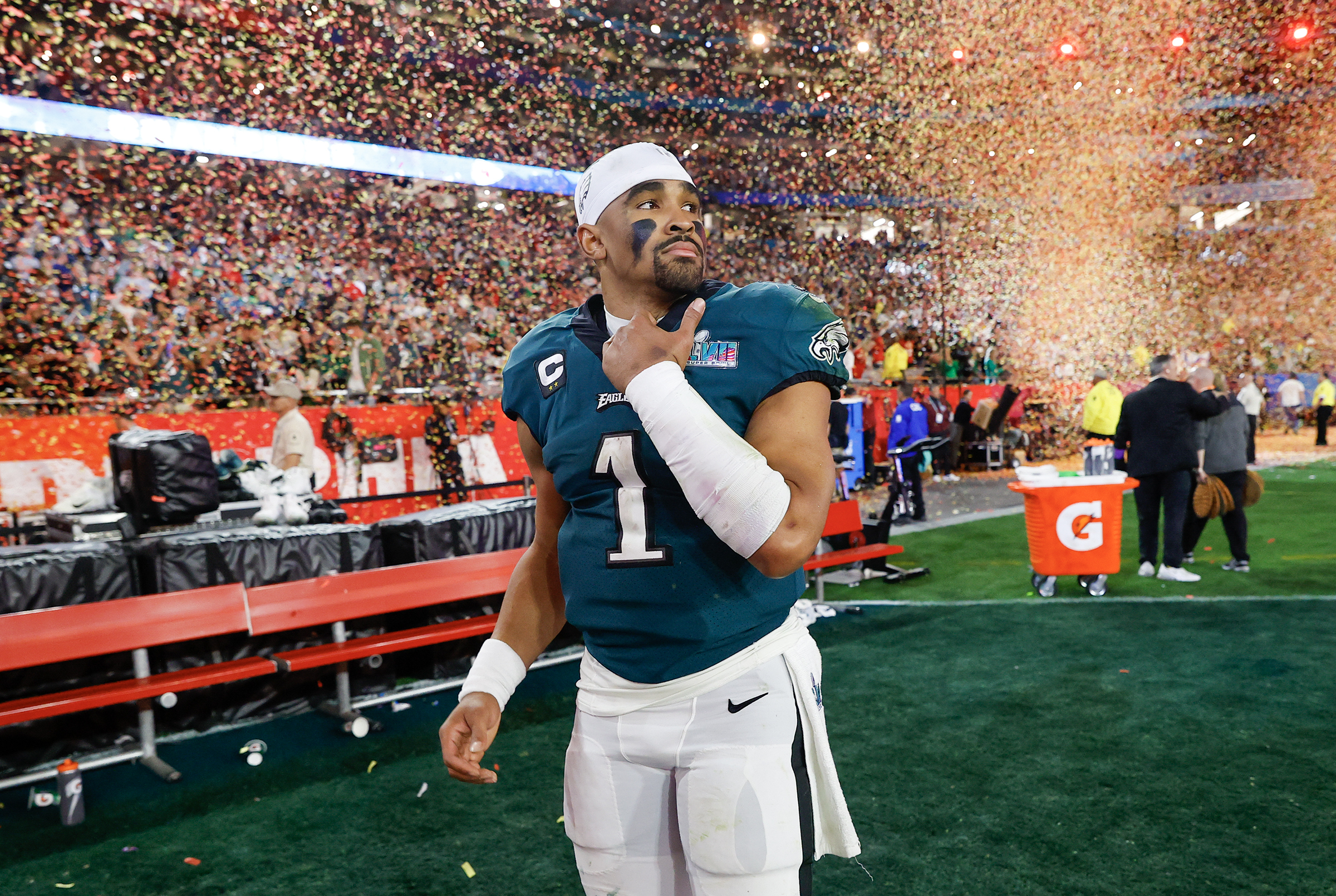
    Eagles quarterback Jalen Hurts shown after the Super Bowl LVII loss to the Chiefs.

    Can Hurts play better? Sure. It isn’t heresy to suggest it. We’ve seen him do it, most definitively in that Super Bowl LVII loss to the Chiefs. But he is never going to be Patrick Mahomes, or Joe Burrow. The Eagles’ offense might be higher functioning if they had Joe Burrow or Drake Maye. But all of those arguments are roads to nowhere. The only thing that matters is that Hurts has been good enough that the Eagles no longer need to acquire one of those other guys. Coaches and players are more than justified if they are frustrated with some aspects of Hurts’ approach and performance. But they also surely know that they are more fortunate than most.

    There’s the context that’s often missing from the Hurts debates: how bad so many other teams have it. Watch the Cam Wards, the J.J. McCarthys, the Tua Tagovailoas, any of a number of other quarterbacks who were drafted higher than Hurts with the hope they would become what he is. There is a lot of bad quarterback play out there. There are a lot of teams that have no hope. The divide between the tier of passers who can and can’t is stark. Even at his worst, Hurts is one of the few.

    There will be no trade, no competition, no readjustment of sights to the Tanner McKee era. That should be obvious to even Hurts’ most ardent of critics. Which brings us back to the original question. What are we arguing about?

  • Three Nick Castellanos trades that show how little the Phillies should expect in return

    Three Nick Castellanos trades that show how little the Phillies should expect in return

    The most important variable in any negotiation is what the other side thinks you are willing to pay. Right now, the other 29 teams in Major League Baseball have every reason to think the Phillies aren’t willing to pay Nick Castellanos anything. That’s a tough starting point for Dave Dombrowski as he tries to find someone interested in trading for the veteran right fielder.

    Fact is, Castellanos is due to make $20 million this season, which is at least $18 million more than he could reasonably expect to make if he were a free agent. Even if the Phillies eat most of that money, why would a team trade anything of value for Castellanos rather than signing this year’s version of Mark Canha for a couple of million bucks?

    The only realistic option for the Phillies is to find a team that is looking to shed a similarly overpriced contract. Even then, Dombrowski may have to further incentivize an interested party. That quickly leads to a point where the Phillies are better off simply releasing Castellanos. Or walking a lot of things back before he reports for spring training.

    Here are three examples of deals that maybe, kinda, sorta, if you squint could potentially make a fraction of a smidgen of sense for both parties.

    Get excited!

    Andrew Benintendi is slashing just .245/.309/.391 in his first three years with the White Sox.

    1. Andrew Benintendi plus cash to the Phillies, Castellanos to the White Sox

    This is the baseball equivalent of one of those NBA trades in which a couple of overpriced veterans and 16 second-round draft picks change hands but nobody ends up with more than they started with. You only live once, baby.

    Benintendi has been a sunk cost the moment he signed a five-year, $75 million contract in Chicago in 2023. Was it only three years ago that the White Sox were trying? Apparently, it was.

    Benintendi hit free agency as the rare hitter still in his prime, having broken into the big leagues at 21 years old on the watch of none other than Dombrowski. He hasn’t come close to the .782 OPS he posted in his first seven seasons in the majors, hitting just .245/.309/.391 in his first three years with the White Sox. He showed a little life in the second half of last season and finished with a .738 OPS that was slightly above league average. But he didn’t show nearly enough life to warrant salaries of $17.1 million this season and $15.1 million in 2027.

    Swapping Castellanos for Benintendi would make some sense from an accounting perspective. The Phillies would be taking on an additional $12.2 million in “dead” money over two years. More importantly from a competitive standpoint, they’d be tacking on $15 million in average annual value to next year’s payroll rather than paying Castellanos $20 million up front and then being free and clear.

    But what if the White Sox included $10 million in cash to pay Benintendi’s 2027 salary? That would essentially enable the Phillies to split up Castellanos’ money over two years, saving them $10 million this year while adding $10 million next year. And, hey, maybe Benintendi gives them a little something in the outfield rotation as a Max Kepler replacement. At 31 years old, the chances of that aren’t zero.

    What’s in it for the White Sox? Well, they’d save $5 million in cash in 2027 at the expense of an extra $3 million this year. I’m not sure whether this trade makes sense for both sides or makes sense for neither side. But that’s where we’re at.

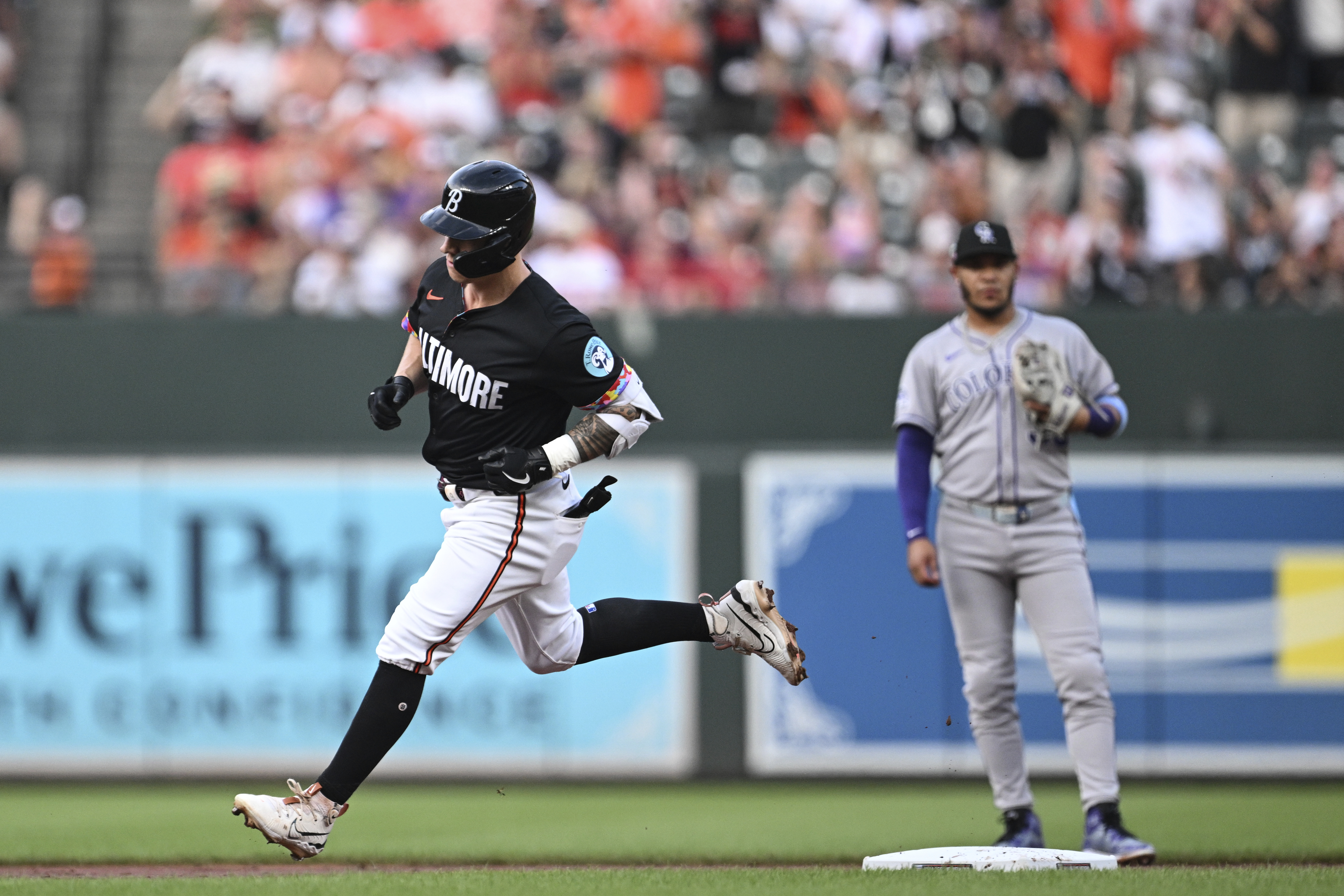
    The Orioles’ Tyler O’Neill had just 209 plate appearances and nine home runs in 2025.

    2. Tyler O’Neill to the Phillies, Castellanos to the Orioles

    Truthfully, I’m not sure how much sense this makes for either side. O’Neill signed a three-year, $49.5 million contract last offseason after a big year with the Red Sox (.847 OPS, 31 home runs). He was a major disappointment, posting a .684 OPS and nine home runs in 209 plate appearances in a season marred by injuries.

    The argument from the Phillies’ perspective goes like this. They’d essentially be signing O’Neill to a two-year, $13 million deal, given the $20 million they are saving on Castellanos. That’s pretty close to fair market value for O’Neill, who has mostly been a league-average hitter outside of his two spike years (2021 with the Cardinals and 2024 in Boston).

    The Phillies get a right-handed hitter who still might have another big season in him. Even if he doesn’t, maybe he is an adequate enough rotational corner outfielder for two years (O’Neill is heading into his 31-year-old season). They also save $3.5 million on this year’s official payroll.

    Is all of that worth $16.5 million less in spending power next offseason? Probably not.

    Likewise, what are the Orioles really gaining? Saving $13 million over two years isn’t nothing. But it’s probably not worth sacrificing the chance that O’Neill bounces back.

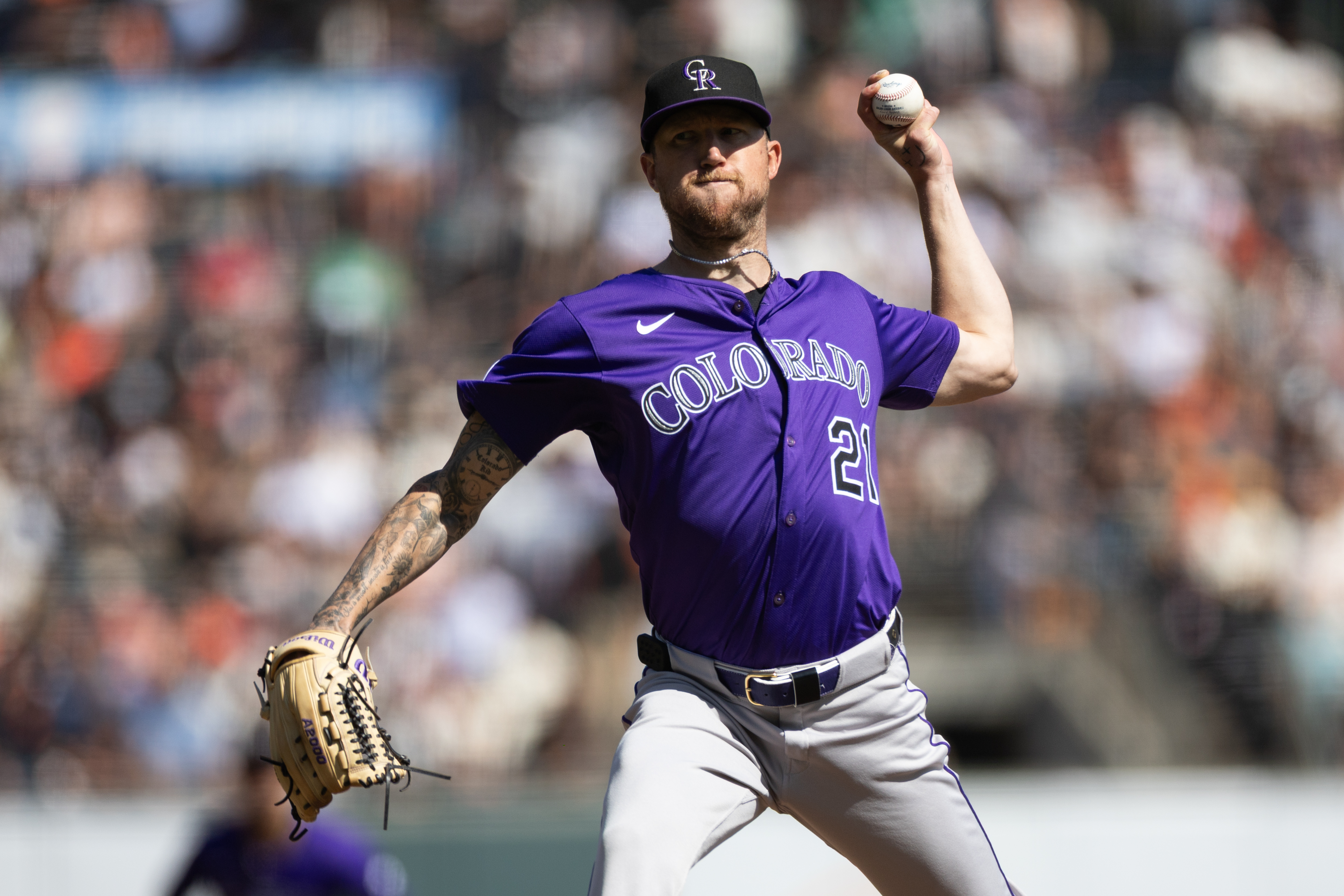
    Kyle Freeland, 32, has spent his entire career with the Rockies and has been better away from Coors Field.

    3. Kyle Freeland to the Phillies, Castellanos plus cash to the Rockies.

    Freeland, who has spent his entire career with the Rockies, has one year and $16 million left on his deal. That’s a lot to pay a guy who has a 5.07 ERA over the last three seasons. Castellanos has hit well at Coors Field with a .914 career OPS in 88 plate appearances. The Phillies get another piece of rotation depth in the form of a guy who has had some decent years on the road in his career. The Rockies get a guy who at least has chance of regaining some value between now and next year’s trade deadline.

  • A.J. Brown was right. The Eagles offense is still a bleep show. They need to fix it soon.

    A.J. Brown was right. The Eagles offense is still a bleep show. They need to fix it soon.

    A.J. Brown was wrong about one thing.

    The Eagles offense isn’t a bleep show.

    It isn’t any kind of show at all.

    At this point, it’s just plain ol’ bleep.

    If that sounds harsh, well, harsh is a pretty good word to describe the experience of watching the Eagles offense right now. The play-calling lacks imagination. The run-blocking lacks the dominance that was once its hallmark. The quarterback has always lacked aggression. Now, he lacks accuracy, too.

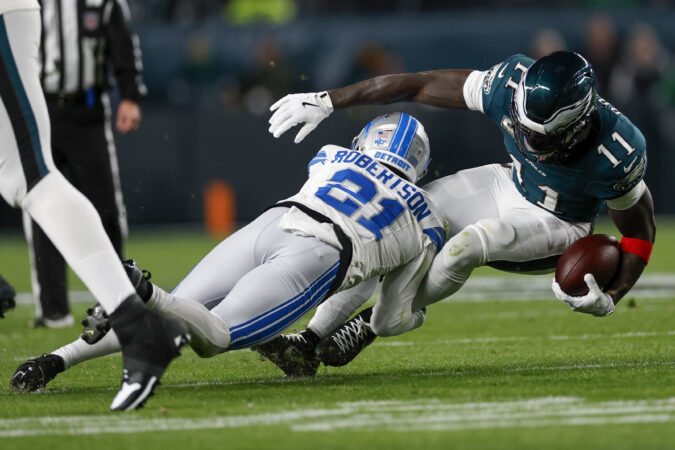
    That’s not an ideal formula. There are all kinds of ways you can shrug off the staggering ineptitude the Eagles displayed while muddling their way to a 16-9 win over the Detroit Lions on Sunday night. It’s an easy thing to do when your defense consistently forces opponents to play bleepier than you. The Eagles are 8-2, with the best Super Bowl odds in the NFC, and victories over four of the five teams whose odds are just behind theirs. That stuff matters. But you can’t shrug off the one question that every team with Super Bowl aspirations must constantly ask itself.

    Are we a championship team in our current form?

    That the Eagles can even think about answering yes is a testament to how good they are everywhere outside of offensive execution.

    Brown said it best on Sunday night.

    “This team is resilient,” said the Eagles’ wide receiver, who broke free of his recent on-field anonymity with 11 targets and seven catches, albeit for only 49 yards. “Show up, work hard, find a way, no matter what it looks like.”

    Brown is right. And he has been right all along. The Eagles are a very good team. Winning football games is important. But so is progress. Right now, the Eagles are a long way off from being the best team they can be.

    Nothing that we saw from them on Sunday night suggests their fundamental problem has been solved. It isn’t just that the Eagles aren’t scoring enough points. It’s that they don’t appear to be getting any better.

    They have scored 17 or fewer in four of their last six games, including a combined 26 in their last two. Are they capable of winning a Super Bowl in their current form? Absolutely. But you can’t ignore how different their current form is from the one that saw them win the Super Bowl last season.

    For the second straight game, and for the fifth time this season, the Eagles failed to crack 300 yards of total offense. That only happened three times all last season. Heck, it only happened five times in 2023.

    There are plenty of mitigating circumstances. Last week’s game in Green Bay was played in real feel temperatures that dropped into the teens. Sunday’s win over the Lions featured a steady wind with wild gusts above 30 miles per hour. In both games, the Eagles lost All-Pro right tackle Lane Johnson to an injury (most recently, his foot, which sidelined him for all of the second half Sunday night).

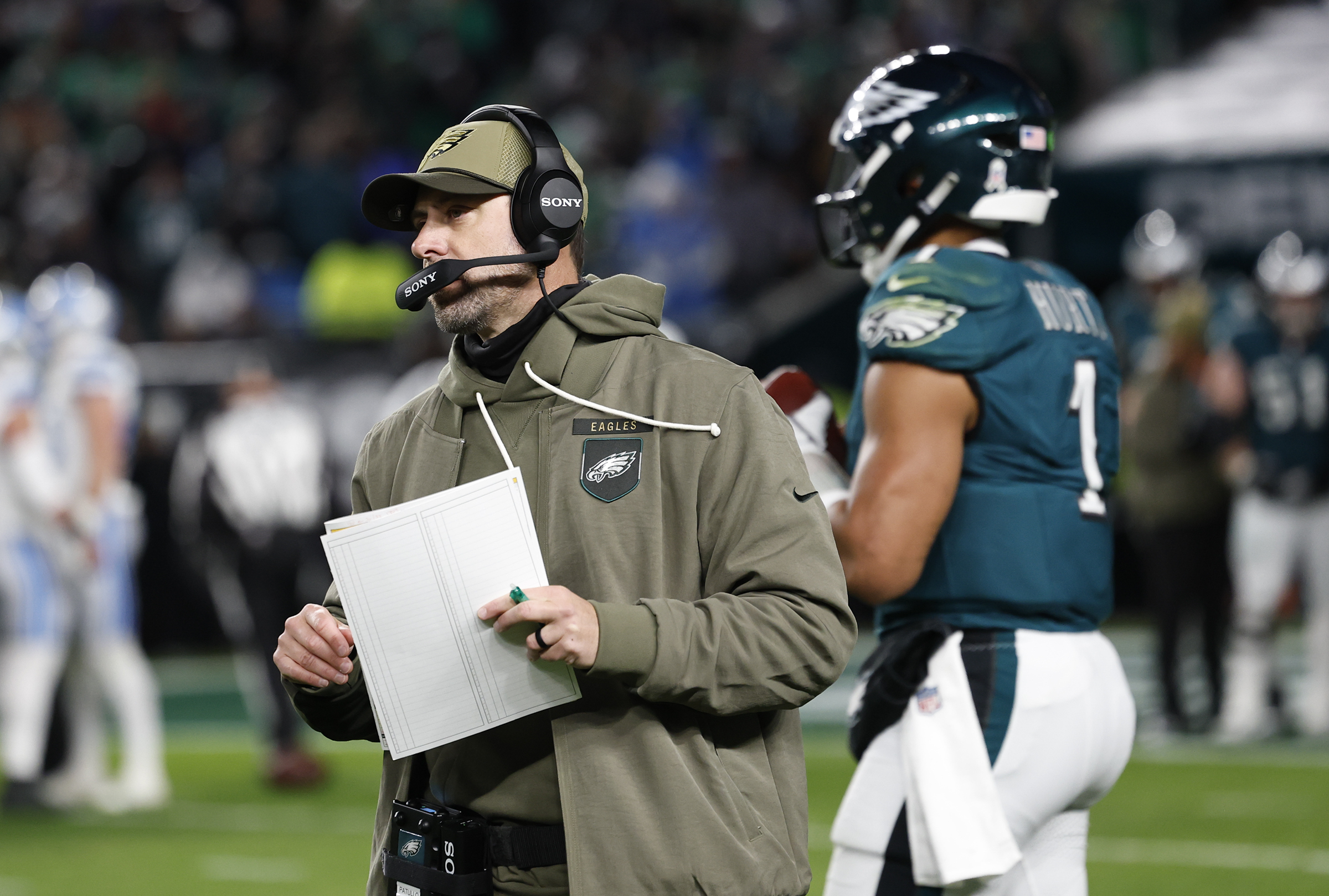
    Coordinator Kevin Patullo is among those seeking answers to the team’s offensive issues.

    The schedule has been brutal. The Lions defense entered Sunday ranked seventh in the NFL in yards per play allowed. The Eagles had already faced three of the six teams who ranked above Detroit (Denver Broncos, Green Bay Packers, Los Angeles Rams).

    “We want to be better than what we were tonight, but every game’s played a little bit differently,” coach Nick Sirianni said. “Every game is played to win, but do we have to clean up things on offense? Of course we do. As good as the defense played, we’re going to have to clean up things on defense. As good as the special teams played, we’re going to have to clean up things on special teams. But on offense, there’s some shooting ourselves in the foot that’s happening and some of those things are things that, we always talk about [things that] take no talent, and we have such good talent that we have to be able to master the things that take no talent so our talent can shine.”

    Give them credit for trying something new. They tried to force the ball to Brown, which is something that he and plenty of Eagles fans have been lobbying for in recent weeks. His 11 targets were more than he had in the last two games combined, including last week’s three-target, two-catch nothingburger in Green Bay.

    The concerning thing is that nothing else changed. Brown’s seven catches went for just 49 yards. The Eagles scored just one touchdown. Even on a night when Jared Goff was out of sync and the Lions went 0-for-5 on fourth down, Detroit’s offense looked like the more highly evolved unit. The pinnacle came in the second quarter, when Goff hit Amon-Ra St. Brown for 34 yards and then Jameson Williams for a 40-yard touchdown. The 74 yards the Lions gained on two plays were more than the Eagles had gained all game to that point.

    There were plenty of stretches last season when the Eagles looked like that sort of offense. Brown was always at the center of it, it seemed.

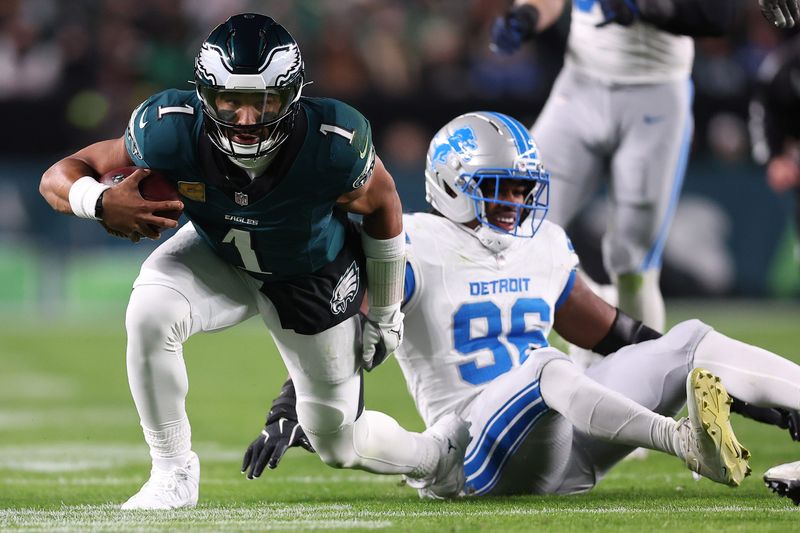
    Jalen Hurts and the Eagles offense must find a rhythm if they wish to make a run at another Super Bowl.

    The Eagles need to find a way to make Sunday night a building block. Good things happen when you target even a diminished Brown. The final example came with 1:47 left, with the Eagles one play away from turning the ball back over to the Lions for a chance at a wholly unearned game-tying touchdown drive. On third-and-8 from the Eagles 37, Jalen Hurts forced a pass to a tightly covered Brown, and Lions cornerback Rock Ya-Sin panicked. Instead of watching Hurts’ pass sail wide of its mark and short of the sticks, he reached out toward Brown and drew a flag. It was a questionable call, but the end result gave the Eagles a first down, and kept the Lions offense on the sidelines for the rest of the game.

    “We’re always trying to get A.J. involved,” Sirianni said. “Always, always, always, always. The game play is played differently each and every week of what happens. I don’t think I’ve been shy about saying this. The game plan’s always going to start in the passing game with him and [WR] DeVonta [Smith] and [TE] Dallas [Goedert], and so we’re always trying to do that and get him the football. That’s the way the game played out a little bit today.”

    At some point, it will need to play out better. Let’s hope that point comes soon.

  • Sad-sack Giants lost this one before it started. Next time, don’t poke the bear (or Saquon)

    Sad-sack Giants lost this one before it started. Next time, don’t poke the bear (or Saquon)

    Two weeks ago, Brian Daboll stood in front of his locker room and labeled a blowout win over the Eagles as “The Standard.”

    Since then, the Giants head coach has become reacquainted with The Usual.

    The Eagles accomplished their biggest objective on Sunday afternoon. It was to leave no doubt. Jaxson Dart would not be high-fiving any referees. Kayvon Thibodeaux would not be telling anybody to “[bleep] the Eagles.” And the Giants social media team most definitely would not be sharing any victorious videos of Daboll making grandiose proclamations to his players.

    “For sure, we definitely saw how they celebrated when they beat us last time,” running back Saquon Barkley said after his 65-yard touchdown run on the second play from scrimmage catapulted the Eagles to a 38-20 win on Sunday.

    It is never wise to poke the bear, but it is especially unwise to poke the bear when you know you will be seeing the bear again in 17 days. If you are going to do it, you’d better pack some extra whistles. Or, failing that, some A.1.

    What the Giants seem to have forgotten is that they are not a good football team. In fact, they are the kind of football team that makes a sport of their not being good. Ten days after they stunned the Eagles with a 34-17 rout on Thursday Night Football, they raced out to a 19-point lead over the Broncos and then allowed 25 points in the last six minutes to lose, 33-32. It takes a special team to lose a game in that fashion. But, then, the Giants are a special team. They lose games the way Bob Ross painted pictures. With breathtaking creativity and speed.

    On Sunday, the movable object met the unstoppable force. The Eagles came out in their kelly green uniforms and they did it in vintage fashion. On their second play of the game, the offensive line opened up a weakside lane so wide that Barkley and Tank Bigsby both could have run through it. Never has a 65-yard touchdown looked so inevitable. Nor did the 189 yards that followed from Barkley and Bigsby. After the game, more than one Eagles offensive lineman noted how good the Giants’ front four was. You got the sense that they were noting it with glee.

    “We came in, we made the adjustments based off of what they gave us the last game, and we called plays to win,” guard Landon Dickerson said.

    The rest of the NFC can blame the Giants if this was the game in which the Eagles truly got their groove back. They entered Week 8 having gone five straight weeks without breaking 90 yards rushing. Not once had they reached 400 total yards of offense. On Sunday, they finished with 276 and 427. Barkley and Bigsby both cracked 100 yards and averaged 10-plus yards per carry. This, on an afternoon when Jalen Hurts threw four touchdown passes.

    “For us, it wasn’t about a weight being lifted off our shoulders,” said left tackle Jordan Mailata. “We just wanted to be the more physical team. It didn’t matter what it looked like.”

    It shouldn’t surprise anybody at this point.

    The Eagles have won a lot of games over the last four years by rag-dolling opponents, often saving their best for teams that have previously offended their sensibilities. We saw it in last year’s NFC championship game, when they road-graded the Commanders for 229 yards on the ground one month after Washington handed them one of their three regular-season losses. We saw it in last year’s Super Bowl, when they avenged their last-second loss two years earlier, to an extent that was almost uncomfortable.

    Give the Giants credit. They are a more competitive team than they have been throughout most of Daboll’s tenure at the helm. For all of Dart’s weird Gen-Z energy, he clearly has the touch and poise that can win behind a competent offensive line. Rival NFL general managers should take notice if Act I ends up going the way of Baker Mayfield in Cleveland. He has a keen sort of talent that cannot be measured or quantified, although it probably cannot make up for wholesale dysfunction around him. You saw it even on Sunday, when he kept the Giants within striking distance despite relentless pressure and a no-name receiving corps and a gruesome injury to running back Cam Skattebo.

    But the Eagles are operating on a different level. It is easy to lose sight of that fact given that they are operating on a lesser level than last season. The last couple of weeks have left little doubt, though. At 6-2 headed into the bye, they remain the most complete team in the NFC.

    More than anything, Sunday’s win was a reminder that rumors of Barkley’s demise have been greatly exaggerated. Even after his 65-yard touchdown run, the veteran running back gained 85 yards on his last 13 carries before leaving the game with what was labeled a groin injury but mostly was precaution.

    “I wasn’t worried about it,” Barkley said. “I came off, but I’ve dealt with this before. Nothing crazy. It’s a long season. I try my best to listen to the trainers, listen to the coaches.”

    Did he fight to go back in?

    “I went out swinging,” he said. “Let’s say that.”

    With these Eagles, you wouldn’t expect anything else.